View allAll Photos Tagged Describing
----------------------------- JESUS ✝️ SAVES-------------------------------
SALVATION THROUGH FAITH IN JESUS CHRIST - ALONE!
12 Salvation is found in no one else, for there is no other name under heaven given to men by which we must be saved."
❤️❤️ IT'S ALL JESUS AND NONE OF OURSELVES! ❤️❤️
16 I am not ashamed of the gospel, because it is the power of God for the SALVATION of everyone WHO BELIEVES: first for the Jew, then for the Gentile. 17 For in the gospel a RIGHTEOUSNESS FROM GOD IS REVEALED, a righteousness that is by FAITH FROM FIRST TO LAST, just as it is written: "THE RIGHTEOUS WILL LIVE BY FAITH." (Romans 1:16-17)
16 KNOW that a man is NOT justified by observing the law, but by FAITH IN JESUS CHRIST. So we, too, have put our faith in Christ Jesus that we may be JUSTIFIED BY FAITH in CHRIST and NOT by observing the law, BECAUSE BY OBSERVING THE LAW NO ONE WILL BE JUSTIFIED. (Galatians 2:16)
1. Now, brothers, I want to remind you of the gospel I preached to you, which you received and on which you have taken your stand. 2. BY THIS GOSPEL YOU ARE SAVED, if you hold firmly to the word I preached to you. Otherwise, you have believed in vain.
3. For what I received I passed on to you as of first importance: that Christ died for our sins according to the Scriptures, 4. that he was buried, that he was raised on the third day according to the Scriptures, 5. and that he appeared to Peter, and then to the Twelve. 6. After that, he appeared to more than five hundred of the brothers at the same time, most of whom are still living, though some have fallen asleep. 7. Then he appeared to James, then to all the apostles, 8. and last of all he appeared to me also, as to one abnormally born.
9. For I am the least of the apostles and do not even deserve to be called an apostle, because I persecuted the church of God. 10. But by the grace of God I am what I am, and his grace to me was not without effect. No, I worked harder than all of them--yet not I, but the grace of God that was with me. 11. Whether, then, it was I or they, this is what we preach, and this is what you believed. (1 Corinthians 15:1-11)
7. Therefore Jesus said again, "I tell you the truth, I am the gate for the sheep. 8. All who ever came before me were thieves and robbers, but the sheep did not listen to them. 9. I am the gate; whoever enters through me WILL BE SAVED. He will come in and go out, and find pasture. 10. The thief comes only to STEAL and KILL and DESTROY; I have come that they may have LIFE, and have it to the FULL. (John 10:7-10)
1 Brothers, my heart's desire and prayer to God for the Israelites is that they may be saved. 2 For I can testify about them that they are zealous for God, but their zeal is not based on knowledge. 3 Since they did not know the righteousness that comes from God and sought to establish their own, they did not submit to God's righteousness. 4 Christ is the end of the law so that there may be righteousness for everyone who believes.
5 Moses describes in this way the righteousness that is by the law: "The man who does these things will live by them." 6 But the righteousness that is by faith says: "Do not say in your heart, 'Who will ascend into heaven?'" (that is, to bring Christ down) 7 "or 'Who will descend into the deep?'" (that is, to bring Christ up from the dead). 8 But what does it say? "The word is near you; it is in your mouth and in your heart," that is, the word of faith we are proclaiming: 9 That if you confess with your mouth, "Jesus is Lord," and believe in your heart that God raised him from the dead, you will be saved. 10 For it is with your heart that you believe and are justified, and it is with your mouth that you confess and are saved. 11 As the Scripture says, "Anyone who trusts in him will never be put to shame." 12 For there is no difference between Jew and Gentile--the same Lord is Lord of all and richly blesses all who call on him, 13 for, "Everyone who calls on the name of the Lord will be saved." (Romans 10:1-13)
Jesus came to bring spiritual LIFE to the spiritually dead and set the captives FREE! FREE from RELIGION, ERROR and outright LIES, so WE might serve THE LIVING GOD! In SPIRIT and in TRUTH!
So you'll KNOW, and not think you're to bad for God to love. The Christian LIFE isn't about how good WE are, because NONE of us are! It's about how GOOD JESUS IS! Because JESUS LOVES US, so much he died in our place and took the punishment for all of our sins on himself. The wages of sin is DEATH, and Jesus took the death WE so richly deserved for us and died in our place. The good news is, there's no more punishment for sin left. WE, you and I were all born forgive as a result of the crucifixion of God himself on the cross that took away the sins of the whole world. All we have to do is believe it, and put your Faith in the finished work of Jesus Christ. That my friends is REAL UNCONDITIONAL LOVE! YOU ARE LOVED. ❤️ ✝️ ❤️
For the best Biblical teaching in the last 2 centuries! Please listen to and down load these FREE audio files that were created with YOU in mind. It's ALL FREE, if you like it, please share it with others. ❤️
archive.org/details/PeopleToPeopleByBobGeorgeFREE-ARCHIVE...
CLICK ON THE LETTER "L" TO ENLARGE.
My THANK'S to all Flickr friends who fave and/or commented on my photos, I very much appreciate it! ❤️
© All Rights reserved no publication or copying without permission from the author.
I've described the South Shore as the Duneland Essence on more than one occasion on here, and many many more times than that in real life conversation. While I'm grateful for the unique photo opportunities the Double Track NWI project is bringing, I can't help but feel sad that the centuries-in-the-making interurban feel will effectively die with it. That is what I, and most others that I know, will miss the most. Scenes such as this, an electrified commuter railroad coming within 25' of a house, and but up against multiple backyards with nothing in between the two. This isn't some two-times-yearly used branchline for railcar storage, though I've always felt this location certainly gives that impression. You might notice the basketball hoop in the backyard of the blue house - sure enough, a few minutes before this was taken, the local youth were playing a friendly game that resulted in their ball landing right in the middle of the gauge multiple times.
But, as I mentioned, I have to be grateful that there are still -some- opportunities available to photograph trains in these places, and with so much work going on, what you can frame up are often subjects you could almost never see before the project began. This train was no exception.
The current infrastructure has had the capability to run electrified passenger trains many times a day between mileposts 33.0, where we are here, and 44.0 near Dune Park. Now, this stretch has been completely deenergized - overhead electric, signals, everything is now dark. Instead of doing 79 miles per between Michigan City and Chesterton, all train movements are now warrant-controlled, restricted to 25mph max, and all road crossings between the two mileposts are considered out of service, requiring all trains to stop before proceeding at each. Thankfully, a very small amount of CSS freight trains and the occasional work train on the NICTD side are all that pass through this stretch. This is a bit different though.
NICTD is still offering options for passengers to be bused between stations at Michigan City and Dune Park (out of the work zone, where business is still as usual). As a result, the passenger trains now begin and terminate at Dune Park, where they can be serviced at the base level - mostly just janitorial tasks. But, like everything in life, it's only a matter of time before something more serious requires attention from a shop - in this case, the South Shore's shops in Michigan City.
To take care of this, the passenger guys have been doing occasional ferry moves of EMUs between the two locations through the work zone, and here is one such example. My favorite motor on the South Shore period (freight and passenger considered), NICD 1001, with all its nose light excellence, was the power this morning with five EMUs for Dune Park. The crew has just received their track warrant to pass the dark signal directly behind me, and are treating me and my camera to quite a smoke-filled show getting their train back up to speed... smoking is another nice trait about this unit. The horn ain't bad either!
And thus completes another caption that is entirely too long. I should try writing a book sometime or something, so many words would look a lot less awkward in one...
La tundra
se describe como la región biogeográfica polar, cuya vegetación es de bajo crecimiento más allá del límite norte de la zona arbolada.
Es un bioma que se caracteriza por su subsuelo helado, falta de vegetación arbórea o, en todo caso, de árboles naturales, lo cual se debe a la poca heliofanía y al estrés del frío glacial; los suelos, que están cubiertos de musgos y líquenes, son pantanosos, con turberas en muchos sitios. Se extiende principalmente por el hemisferio norte: en el extremo norte de Rusia, Alaska, norte de Canadá, sur de Groenlandia y la costa ártica de Europa.
The tundra is described as the polar biogeographic region, the vegetation of which is low growing beyond the northern limit of the wooded zone. Mi fotografía ha sido tomada en Noruega.
It is a biome that is characterized by its frozen subsoil, lack of arboreal vegetation or, in any case, natural trees, which is due to the low heliophany and the stress of the freezing cold; the soils, which are covered with mosses and lichens, are swampy, with peat bogs in many places. It is mainly spread over the northern hemisphere: in the extreme north of Russia, Alaska, northern Canada, southern Greenland, and the Arctic coast of Europe.
My photograph has been taken in Norway.
Let me say a huge thank you, for over than 8 million visits that I receive in networks. But please do not leave one of those big logos, that are flooding in flickr .
If you like, to see more of my photography, go to
www.flickr.com/photos/agustinruiz/
How to Expose Shots in the Dark:
OK, so now I will describe my technique for properly exposing shots in the dark. I begin with my last shot as my baseline. I’ve got the composition I want, and the settings I used were 30 seconds at ISO 6400 with the lens wide open at f/3.5. For this shot, I want to have less noise and more star trails. I’ve decided to keep the aperture wide open so the only settings I will be adjusting will be the shutter speed and ISO. This keeps things simple.
A couple of things to keep in mind about shutter speed and ISO: 1) All other things being equal, doubling the exposure time lets in twice as much light. Conversely, halving the exposure time lets in half as much light. 2) All other things being equal, doubling the ISO setting lets in twice as much light. Conversely, halving the ISO setting lets in half as much light.
OK, now supposing I want to keep my exposure the same, I need to keep the light equation in balance as I make my adjustments and here’s the thoughts going through my head: If I change the ISO to 3200 from 6400 I will be letting in half as much light (actually, I’m turning the gain down on my sensor making it half as sensitive). To keep the exposure the same, I then need to double my exposure time to 1 minute. Good, different combination of settings but I will have the same exposure. Now I keep on going. I can change my ISO to 1600, again halving the sensitivity, so I double the exposure time again to 2 minutes. Back in balance. Halve the ISO again to 800, double the shutter time again to 4 minutes. Halve the ISO again to 400, double the exposure time to 8 minutes. And one more time I halve the ISO to 200, and double the exposure time to 16 minutes.
So here I am. I’m at ISO 200, which is the setting on my camera that has the optimum signal to noise ratio, and if I take a 16 minute exposure it will be exposed exactly the same as my test shot.
Now I’m going to make one more judgment call before I take my shot. My test shot was a little bit underexposed. I want this shot to be a little brighter. Doubling the exposure time again to 32 minutes would make it one f-stop (or EV [exposure value]) brighter but I don’t want it that bright. I think maybe 1/3 to 1/2 an f-stop will be just fine. I decide to add another 5 minutes to my exposure. That’s right in the range I want, and I know that at these long exposure times a minute more or less isn’t going to make a huge difference.
So I’ve decided on a 21 minute exposure at ISO 200 and f/3.5. I know this is going to be a perfect exposure, and I’m in a beautiful location so it’s going to be epic. I go back into my menu and turn the long exposure noise reduction back on. I put my camera in bulb mode and using a cable release I open the shutter. Bonus tip: Having a cheap $10-$20 digital watch is priceless when doing night photography. They have a stopwatch and a light. I start my stopwatch when I start my exposure and now all I have to do is wait for 21 minutes and enjoy the view. Sometimes the wind dies down and I can hear the brook babbling… sometimes I babble back.
OK, my stopwatch hits 21 minutes so I go over to my cable release and close the shutter. Since I’ve got the noise reduction on I’ll have to wait another 21 minutes for it to take the dark frame. I sit back down and resume my conversation with the melt water flowing through the rocks beneath me. OK, after 42 minutes my picture is done and Voila!!
Final Thoughts: So I can go out there and just wing it with night shots. It’s not that difficult considering there’s a pretty wide margin of error on long exposures. Using this technique, however, I’m able to get the exposure I want with a minimal amount of trial and error. I hope this tutorial helps folks interested in night photography. I’ll probably post some more tips later. Cheers!
21 minute exposure, f/3.5, ISO200
Described as one of the great railway journeys of the world this 84 mile round trip takes you past a list of impressive extremes. Starting near the highest mountain in Britain, Ben Nevis, it visits Britain’s most westerly mainland railway station, Arisaig; passes close by the deepest freshwater loch in Britain, Loch Morar and the shortest river in Britain, River Morar, finally arriving next to the deepest seawater loch in Europe, Loch Nevis!
The train stops en route to Mallaig at the village of Glenfinnan (see below). Beyond Glenfinnan are the beautiful villages of Lochailort, Arisaig, Morar and Mallaig. You may alight at Arisaig by request to the guard. From here, on a clear summer’s day, you can see the “Small Isles” of Rum, Eigg, Muck, Canna and the southern tip of Skye. The train continues on from here passing Morar and the silvery beaches used in the films “Highlander” and “Local Hero”
----------------------------- JESUS ✝️ SAVES-------------------------------
SALVATION THROUGH FAITH IN JESUS CHRIST - ALONE!
12 Salvation is found in no one else, for there is no other name under heaven given to men by which we must be saved."
❤️❤️ IT'S ALL JESUS AND NONE OF OURSELVES! ❤️❤️
16 I am not ashamed of the gospel, because it is the power of God for the SALVATION of everyone WHO BELIEVES: first for the Jew, then for the Gentile. 17 For in the gospel a RIGHTEOUSNESS FROM GOD IS REVEALED, a righteousness that is by FAITH FROM FIRST TO LAST, just as it is written: "THE RIGHTEOUS WILL LIVE BY FAITH." (Romans 1:16-17)
16 KNOW that a man is NOT justified by observing the law, but by FAITH IN JESUS CHRIST. So we, too, have put our faith in Christ Jesus that we may be JUSTIFIED BY FAITH in CHRIST and NOT by observing the law, BECAUSE BY OBSERVING THE LAW NO ONE WILL BE JUSTIFIED. (Galatians 2:16)
1. Now, brothers, I want to remind you of the gospel I preached to you, which you received and on which you have taken your stand. 2. BY THIS GOSPEL YOU ARE SAVED, if you hold firmly to the word I preached to you. Otherwise, you have believed in vain.
3. For what I received I passed on to you as of first importance: that Christ died for our sins according to the Scriptures, 4. that he was buried, that he was raised on the third day according to the Scriptures, 5. and that he appeared to Peter, and then to the Twelve. 6. After that, he appeared to more than five hundred of the brothers at the same time, most of whom are still living, though some have fallen asleep. 7. Then he appeared to James, then to all the apostles, 8. and last of all he appeared to me also, as to one abnormally born.
9. For I am the least of the apostles and do not even deserve to be called an apostle, because I persecuted the church of God. 10. But by the grace of God I am what I am, and his grace to me was not without effect. No, I worked harder than all of them--yet not I, but the grace of God that was with me. 11. Whether, then, it was I or they, this is what we preach, and this is what you believed. (1 Corinthians 15:1-11)
7. Therefore Jesus said again, "I tell you the truth, I am the gate for the sheep. 8. All who ever came before me were thieves and robbers, but the sheep did not listen to them. 9. I am the gate; whoever enters through me WILL BE SAVED. He will come in and go out, and find pasture. 10. The thief comes only to STEAL and KILL and DESTROY; I have come that they may have LIFE, and have it to the FULL. (John 10:7-10)
1 Brothers, my heart's desire and prayer to God for the Israelites is that they may be saved. 2 For I can testify about them that they are zealous for God, but their zeal is not based on knowledge. 3 Since they did not know the righteousness that comes from God and sought to establish their own, they did not submit to God's righteousness. 4 Christ is the end of the law so that there may be righteousness for everyone who believes.
5 Moses describes in this way the righteousness that is by the law: "The man who does these things will live by them." 6 But the righteousness that is by faith says: "Do not say in your heart, 'Who will ascend into heaven?'" (that is, to bring Christ down) 7 "or 'Who will descend into the deep?'" (that is, to bring Christ up from the dead). 8 But what does it say? "The word is near you; it is in your mouth and in your heart," that is, the word of faith we are proclaiming: 9 That if you confess with your mouth, "Jesus is Lord," and believe in your heart that God raised him from the dead, you will be saved. 10 For it is with your heart that you believe and are justified, and it is with your mouth that you confess and are saved. 11 As the Scripture says, "Anyone who trusts in him will never be put to shame." 12 For there is no difference between Jew and Gentile--the same Lord is Lord of all and richly blesses all who call on him, 13 for, "Everyone who calls on the name of the Lord will be saved." (Romans 10:1-13)
Jesus came to bring spiritual LIFE to the spiritually dead and set the captives FREE! FREE from RELIGION, ERROR and outright LIES, so WE might serve THE LIVING GOD! In SPIRIT and in TRUTH!
So you'll KNOW, and not think you're to bad for God to love. The Christian LIFE isn't about how good WE are, because NONE of us are! It's about how GOOD JESUS IS! Because JESUS LOVES US, so much he died in our place and took the punishment for all of our sins on himself. The wages of sin is DEATH, and Jesus took the death WE so richly deserved for us and died in our place. The good news is, there's no more punishment for sin left. WE, you and I were all born forgive as a result of the crucifixion of God himself on the cross that took away the sins of the whole world. All we have to do is believe it, and put your Faith in the finished work of Jesus Christ. That my friends is REAL UNCONDITIONAL LOVE! YOU ARE LOVED. ❤️ ✝️ ❤️
For the best Biblical teaching in the last 2 centuries! Please listen to and down load these FREE audio files that were created with YOU in mind. It's ALL FREE, if you like it, please share it with others. ❤️
archive.org/details/PeopleToPeopleByBobGeorgeFREE-ARCHIVE...
CLICK ON THE LETTER "L" TO ENLARGE.
My THANK'S to all my Flickr friends who've favored and/or commented on my photos, I very much appreciate you're kindness! ❤️
© All Rights reserved no publication or copying without permission from the author.
Described on the website as one of worlds great bridges, if you see it first hand it would be hard to disagree. Magnificently spanning the Avon Gorge, it was designed by Isambard Kingdom Brunel, but unfortunately wasn't finished until 1864, 5 years after his death.
No other word to describe this beauty. :)
(Sorry to post two today and to delete the first one. Ever have one of those days when NO shot of your own looks right to you? This is one of those days)
COLORADO wild horses
Not much to describe this other than "another boring silver TRAXX along the Maintal", but made slightly less boring by the fact it is operated by LINEAS who aren't too common along this busy freight artery.
This machine, built by Bombardier (now Alstom) is owned by AKIEM who are a big provider of locomotives to private operators. Their electric fleet was almost exclusively TRAXX until 2023 when the first of 100 newly built Siemens Vectrons was delivered.
LINEAS started out as the freight arm of the Belgian national railways (B Logistics) but the majority share was sold to a private investor - with SNCB retaining a minority stake - and rebranded as LINEAS.
Thungersheim, July 2023.
Jacob's Ladder refers to a ladder to heaven described in the Book of Genesis (28:11-19) which the biblical patriarch Jacob envisioned during his flight from his brother Esau:
Jacob left Beersheba, and went toward Haran. He came to the place and stayed there that night, because the sun had set. Taking one of the stones of the place, he put it under his head and lay down in that place to sleep. And he dreamed that there was a ladder set up on the earth, and the top of it reached to heaven; and behold, the angels of God were ascending and descending on it! And behold, the LORD stood above it [or "beside him"] and said, "I am the LORD, the God of Abraham your father and the God of Isaac; the land on which you lie I will give to you and to your descendants; and your descendants shall be like the dust of the earth, and you shall spread abroad to the west and to the east and to the north and to the south; and by you and your descendants shall all the families of the earth bless themselves. Behold, I am with you and will keep you wherever you go, and will bring you back to this land; for I will not leave you until I have done that of which I have spoken to you." Then Jacob awoke from his sleep and said, "Surely the LORD is in this place; and I did not know it." And he was afraid, and said, "This is none other than the house of God, and this is the gate of heaven."
Described in 2017 by the National Geographic as the coolest place on the planet, its not difficult to see why. No roads lead here which adds to the adventure. A beautiful hidden gem on the Donegal Coast.
The largest species of booby, the masked booby ranges from 75 to 85 cm (30 to 33 in) long, with a 160–170 cm (63–67 in) wingspan and 1.2–2.2 kg (2.6–4.9 lb) weight. It has a typical sulid body shape, with a long pointed bill, long neck, aerodynamic body, long slender wings and pointed tail. The adult is bright white with dark wings and a dark tail.
The sexes have similar plumage with no seasonal variation, but females are on average slightly heavier and larger than males. The bare skin around the face, throat and lores is described either as black or blue-black. It contrasts with the white plumage and gives a mask-like appearance.
The bill of the nominate subspecies is pale yellow with a greenish tinge, sometimes greyish at the base. Conical in shape, the bill is longer than the head and tapers to a slightly downcurved tip. Backward-pointing serrations line the mandibles. The primaries, secondaries, humerals and rectrices are brown-black. The inner webs of the secondaries are white at the base. The underwing is white except for the brown-black flight-feathers that are not covered by the white coverts.
This image was taken in the Atlantic Ocean, off the coast of Brazil
Great Linnaeus describes two family members of our plant: Urens and Insipida, and then this Oleracea under the name Spilanthes, devised by Nikolaus Joseph von Jacquin (1727-1817). But curiously he doesn't remark on the 'Electric' quality of this little daisy which hails from Central South America (Brazil and Paraquay). Whence its name in English: Para Cress.
A more complete and rather more fascinating description is given by Jean-Baptiste Pierre Antoine de Monet de Lamarck (1744-1829) in his Encyclopedia of 1785. Under the generic name 'Bidens' he describes it as numbing the mouth and causing an excess of saliva. In English it's sometimes called the Toothache Plant because chewing the buds or flowerheads masks any oral pain. And its taste - as I discovered, too, this morning - has an electric quality to it. In fact, I didn't just carefully chew a single floret but brashly popped an entire bud: an hour later my mouth was still numb...
The Arch of Titus (Italian: Arco di Tito; Latin: Arcus Titi) is a 1st-century CE honorific arch,[1] located on the Via Sacra, Rome, just to the south-east of the Roman Forum. It was constructed in c. 81 CE by Emperor Domitian shortly after the death of his older brother Titus to commemorate Titus's official deification or consecratio and the victory of Titus together with their father, Vespasian, over the Jewish rebellion in Judaea.[2]
The arch contains panels depicting the triumphal procession celebrated in 71 CE after the Roman victory culminating in the fall of Jerusalem,[2] and provides one of the few contemporary depictions of artifacts from Herod's Temple.[3] Although the panels are not explicitly stated as illustrating this event, they closely parallel the narrative of the Roman procession described a decade prior in Josephus' The Jewish War.[4][5]
It became a symbol of the Jewish diaspora, and the menorah depicted on the arch served as the model for the menorah used as the emblem of the State of Israel.[6]
The arch has provided the general model for many triumphal arches erected since the 16th century. It is the inspiration for the Arc de Triomphe in Paris.[7] It holds an important place in art history, being the focus of Franz Wickhoff's appreciation of Roman art in contrast to the then-prevailing view.[8]
... ...
--- WikiPedia
Hagia Sophia is a mosque and former church serving as a major cultural and historical site in Istanbul, Turkey. The last of three church buildings to be successively erected on the site by the Eastern Roman Empire, it was completed in 537 CE. The site was a Greek Orthodox church from 360 CE to 1453, except for a brief time as a Latin Catholic church between the Fourth Crusade and 1261. After the fall of Constantinople in 1453, it served as a mosque until 1935, when it became a museum. In 2020, the site once again became a mosque.
The current structure was built by the Byzantine emperor Justinian I as the Christian cathedral of Constantinople for the Byzantine Empire between 532 and 537, and was designed by the Greek geometers Isidore of Miletus and Anthemius of Tralles. It was formally called the Church of God's Holy Wisdom and upon completion became the world's largest interior space and among the first to employ a fully pendentive dome. It is considered the epitome of Byzantine architecture[8] and is said to have "changed the history of architecture". The present Justinianic building was the third church of the same name to occupy the site, as the prior one had been destroyed in the Nika riots. As the episcopal see of the ecumenical patriarch of Constantinople, it remained the world's largest cathedral for nearly a thousand years, until the Seville Cathedral was completed in 1520. Beginning with subsequent Byzantine architecture, Hagia Sophia became the paradigmatic Orthodox church form, and its architectural style was emulated by Ottoman mosques a thousand years later. It has been described as "holding a unique position in the Christian world" and as an architectural and cultural icon of Byzantine and Eastern Orthodox civilization.
The religious and spiritual centre of the Eastern Orthodox Church for nearly one thousand years, the church was dedicated to the Holy Wisdom. It was where the excommunication of Patriarch Michael I Cerularius was officially delivered by Humbert of Silva Candida, the envoy of Pope Leo IX in 1054, an act considered the start of the East–West Schism. In 1204, it was converted during the Fourth Crusade into a Catholic cathedral under the Latin Empire, before being returned to the Eastern Orthodox Church upon the restoration of the Byzantine Empire in 1261. Enrico Dandolo, the doge of Venice who led the Fourth Crusade and the 1204 Sack of Constantinople, was buried in the church.
After the fall of Constantinople to the Ottoman Empire in 1453, it was converted to a mosque by Mehmed the Conqueror and became the principal mosque of Istanbul until the 1616 construction of the Sultan Ahmed Mosque. Upon its conversion, the bells, altar, iconostasis, ambo, and baptistery were removed, while iconography, such as the mosaic depictions of Jesus, Mary, Christian saints and angels were removed or plastered over. Islamic architectural additions included four minarets, a minbar and a mihrab. The Byzantine architecture of the Hagia Sophia served as inspiration for many other religious buildings including the Hagia Sophia in Thessaloniki, Panagia Ekatontapiliani, the Şehzade Mosque, the Süleymaniye Mosque, the Rüstem Pasha Mosque and the Kılıç Ali Pasha Complex. The patriarchate moved to the Church of the Holy Apostles, which became the city's cathedral.
The complex remained a mosque until 1931, when it was closed to the public for four years. It was re-opened in 1935 as a museum under the secular Republic of Turkey, and the building was Turkey's most visited tourist attraction as of 2019.
In July 2020, the Council of State annulled the 1934 decision to establish the museum, and the Hagia Sophia was reclassified as a mosque. The 1934 decree was ruled to be unlawful under both Ottoman and Turkish law as Hagia Sophia's waqf, endowed by Sultan Mehmed, had designated the site a mosque; proponents of the decision argued the Hagia Sophia was the personal property of the sultan. The decision to designate Hagia Sophia as a mosque was highly controversial. It resulted in divided opinions and drew condemnation from the Turkish opposition, UNESCO, the World Council of Churches and the International Association of Byzantine Studies, as well as numerous international leaders, while several Muslim leaders in Turkey and other countries welcomed its conversion into a mosque.
San Miniato al Monte is a basilica in Florence, central Italy, standing atop one of the highest points in the city. It has been described as one of the finest Romanesque structures in Tuscany and one of the most scenic churches in Italy. There is an adjoining Olivetan monastery, seen to the right of the basilica when ascending the stairs.
St. Miniato or Minas was an Armenian prince serving in the Roman army under Emperor Decius. He was denounced as a Christian after becoming a hermit and was brought before the Emperor who was camped outside the gates of Florence. The Emperor ordered him to be thrown to beasts in the Amphitheatre where a panther was called upon him but refused to devour him. Beheaded in the presence of the Emperor, he is alleged to have picked up his head, crossed the Arno and walked up the hill of Mons Fiorentinus to his hermitage. A shrine was later erected at this spot and there was a chapel there by the 8th century. Construction of the present church was begun in 1013 by Bishop Alibrando and it was endowed by the Emperor Henry II. The adjoining monastery began as a Benedictine community, then passed to the Cluniacs and then in 1373 to the Olivetans, who still run it. The monks make famous liqueurs, honey and herbal teas, which they sell from a shop next to the church.
The interior exhibits the early feature of a choir raised on a platform above the large crypt. It has changed little since it was first built. The patterned pavement dates from 1207. The centre of the nave is dominated by the beautiful freestanding Cappella del Crocefisso (Chapel of the Crucifix), designed by Michelozzo in 1448. It originally housed the miraculous crucifix now in Santa Trìnita and is decorated with panels long thought to be painted by Agnolo Gaddi. The terracotta decoration of the vault is by Luca della Robbia.
The crypt is the oldest part of the church and the high altar supposedly contains the bones of St Minias himself (although there is evidence that these were removed to Metz before the church was even built). In the vaults are frescoes by Taddeo Gaddi.
The raised choir and presbytery contain a magnificent Romanesque pulpit and screen made in 1207. The apse is dominated by a great mosaic of Christ between the Virgin and St Minias on its vaulted ceiling dating from 1297; the same subject is depicted on the façade of the church and is probably by the same unknown artist. The crucifix above the high altar is attributed to Luca della Robbia. The sacristy is decorated with a great fresco cycle on the Life of St Benedict by Spinello Aretino (1387).
.
.
.
Dati Tecnici
.
a) Fujifilm X-H1 + Anello adattatore Fringer-EF-FXPRO2;
b) Canon Zoom Lens EF 24/70mm f.2,8 II L USM + Filtro Carl Zeiss T* UV Filter 82mm;
c) Tempo 1/25s con apertura diaframma a f.5,6 +1,5 di stop in manuale (a mano libera);
d) Lettura Esposimetrica effettuata con esposimetro della macchina impostata su "Media a Prevalenza Centrale" ( ho effettuato 4 misurazioni a luce incidente con il Sekonic Dual Spot F-L778 con lettura impostata a 5° per confrontarla con la lettura che mi dava l’esposimetro della macchina, ho effettuato quella correzione di +1,5 di stop per recuperare alcun particolare nelle ombre e nelle penombre, nella trama della maglietta del bimbo e nei capelli.
e) Impostazione nel corpo camera ISO/ASA 6400, DR (100%), Modalità AF (Area), WB Bilanciamento del Bianco (Auto), Simulazione Film (Provia Standard), Colore (+2), Nitidezza (+1), Tono Alte luci (0), Tono Ombre (0), Riduzione disturbo (+1), Gamma Dinamica (Auto), Qualità Immagine (Fine), Filtro ND (On), Dimensione Immagine (3:2 - L); Bit/pixed compressi 48.
f) Focale impiegata 24mm (reale 36mm);
g) Tecnica di ripresa esposimetrica con il sistema dell”Esposizione a Destra;
h) Prima Post-Produzione (leggerissima file quasi perfetto) per la correzione del bilanciamento cromatico/tonale (dopo la de saturazione) delle varie aree e zone di colore per compensare l’intensità di luce (ore 21,30 di ripresa “luci a soffitto e laterali – luce calda 3250K°”) con Nikon Capture NX 2;
i) Seconda Post-Produzione con Adobe Photoshop CS6 64Bit per il bilanciamento delle zone d’ombra (Lievissima file quasi perfetto);
l) Post-Produzione di completamento con Nikon Capture NX 2 e CorelPhoto-Paint X7 64Bit per il completamento e la sistemazione finale del "Sistema Zonale".
.
.
===========================================================
.
Mio breve Curriculum Vitae su LinkedIn: - My Brief Curriculum Vitae on LinkedIn:
.
Visualizza il profilo di Luigi Mirto/ArchiMlFotoWord
.
===========================================================
Tutti i diritti riservati ©2024©2034 da ArchiMlFotoWord/Luigi Mirto/Photography
Nessuna immagine o parte di essa può essere riprodotta o trasmessa in qualsiasi forma e con qualsiasi mezzo senza preventiva autorizzazione.
.
All rights reserved ©2024©2034 by ArchiMlFotoWord/Luigi Mirto/Photography
No images or part thereof may be reproduced or transmitted in any form or by any means Without prior permission.
===========================================================
.
Luigi Mirto/ArchiMlFotoWord's most interesting photos on Flickriver
.
===========================================================
.
Da Ascoltare leggendo la poesia
.
She Remembers – Max Richter
www.youtube.com/watch?v=y0YkZFxOFeI
.
.
Lontano da tutti,...lontano dal mondo
.
quando a casa fai ritorno
vorresti che lei
fosse li, ancora,
ad aspettarti,
si adagiasse vicino a te
al tuo fianco
per diventare la tua anima,
la tua immancabile ombra.
L’unica… che
hai da sempre amato
da quando la conoscesti.
Era la “ragazza” della porta accanto
l’hai notata e mai più l'hai scordata.
Bellissima e di un profumo
mai sentito,
d’un fiore non visto
dal colore candido
e delicato di cui
solo l’amore sa immaginare.
Saremmo stati solo noi
felici e nessun altro.
Lontano da tutti,
...lontano dal mondo.
Tu sai che sei la mia vita
da quel giorno che
ti ho rivista,
e con un unico bacio
ti ho riconquistata.
Ma adesso
la mia “ragazza”
mi ha abbandonato,
lo so, ho trascurato
quel grande amore , e tu,
adesso, appartieni ad un altro.
…vorrei solo morire
e in questo momento sparire
per sempre da questa terra
per non essere più visto
ne più ascoltato
e mai più da nessuna donna
…..amato.
………………..…Luigi Mirto
.
.
Far from everyone,...far from the world
.
when you return home
you would like her
were there, still,
waiting for you,
she would lie down next to you
by your side
to become your soul,
your ever-present shadow.
The only one... that
you have always loved
since you met her.
She was the “girl” next door
you noticed it and never forgot it again.
Beautiful and fragrant
never heard,
of an unseen flower
with a white colour
and delicate of which
only love can imagine.
It would have just been us
happy and no one else.
Far from everyone,
...far from the world.
You know that you are my life
since that day
I saw you again,
and with a single kiss
I won you back.
But now
my girlfriend"
he abandoned me,
I know, I overlooked it
that great love, and you,
now, you belong to someone else.
…I would just like to die
and at this moment disappear
forever from this earth
never to be seen again
nor listened to anymore
and never again by any woman
…..beloved.
………………..…Luigi Mirto
.
.
===========================================================
.
.
Italiano
.
Questa immagine è tratta da un reportage in continua evoluzione che sto effettuando nella ricerca di particolari volti che esprimano particolari sensazioni, scene di particolare enfasi ambientale, espressioni e sentimenti profondi trasmessi attraverso semplici sguardi, di particolari posture del corpo o anche dai semplici abiti e decorazioni fisiche.
.
Tali immagini verranno raccolte in un “Manuale Artistico Tecnico Fotografico” nella quale saranno descritte le particolari tecniche di ripresa, i materiali impiegati, l’attrezzatura fotografica, i luoghi e le condizioni sceniche ambientali.
.
.
English
.
This image is from a report in continuous evolution that I am making in the search for specific faces expressing particular feelings, scenes of environmental emphasis, expressions and deep feelings conveyed through simple look, a particular posture of the body or even from simple clothes and decorations individuals.
.
These images will be collected in a "Artistic Photography Technical Manual" which will describe the special filming techniques, materials, photographic equipment, sites and scenic environmental conditions.
.
.
===========================================================
.
.
.
Describes how I feel about my photography today... :(
Talking photos with a friend and they pointed out that all of my photos are very similar... :-/
Explored on flickr on the afternoon of 23rd February 2017. Thanks for the views, faves and kind comments. :)
The warm weather has certainly helped to bring the flowers out in our garden. I'm never quite sure whether to describe this as an iris or a blue flag.
Sphere Within Sphere describes a series of spherical bronze sculptures by Italian sculptor Arnaldo Pomodoro. In 1966, Pomodoro was commissioned to create a 3.5-meter sphere for Expo 67 in Montreal. The success of this sculpture propelled Pomodoro's works into the mainstream, allowing for commissions that would land his sculptures at the Headquarters of the United Nations and the Vatican Museums.
Over his career, Pomodoro has created 45 of these popular sculptures— aptly named Rotante, Sphera, or Sphera con sphera. The spheres range in size from as small as half a meter up to 4 meters in diameter. They are meant to represent the 'ideal city,' with contrasting imagery of organic and human shapes combined with technological and gear-like components. The spheres can be seen as a promising rebirth of a less troubled and destructive world. Pomodoro describes his desire for building these sculptures, stating, "breaking these perfect, magic forms in order to reveal their internal ferment, mysterious and alive, monstrous and yet pure; I [want to] create a discordant tension, a conflict, with the polished shine: a unity composed of incompleteness."
Versions of the sculpture can be found around the world, below is a comprehensive list (** indicates true Sphera con sphera sculptures. Unmarked locations allude to Sphera or Rotante).
----------------------------- JESUS ✝️ SAVES-------------------------------
SALVATION THROUGH FAITH IN JESUS CHRIST - ALONE!
12 Salvation is found in no one else, for there is no other name under heaven given to men by which we must be saved."
❤️❤️ IT'S ALL JESUS AND NONE OF OURSELVES! ❤️❤️
16 I am not ashamed of the gospel, because it is the power of God for the SALVATION of everyone WHO BELIEVES: first for the Jew, then for the Gentile. 17 For in the gospel a RIGHTEOUSNESS FROM GOD IS REVEALED, a righteousness that is by FAITH FROM FIRST TO LAST, just as it is written: "THE RIGHTEOUS WILL LIVE BY FAITH." (Romans 1:16-17)
16 KNOW that a man is NOT justified by observing the law, but by FAITH IN JESUS CHRIST. So we, too, have put our faith in Christ Jesus that we may be JUSTIFIED BY FAITH in CHRIST and NOT by observing the law, BECAUSE BY OBSERVING THE LAW NO ONE WILL BE JUSTIFIED. (Galatians 2:16)
1. Now, brothers, I want to remind you of the gospel I preached to you, which you received and on which you have taken your stand. 2. BY THIS GOSPEL YOU ARE SAVED, if you hold firmly to the word I preached to you. Otherwise, you have believed in vain.
3. For what I received I passed on to you as of first importance: that Christ died for our sins according to the Scriptures, 4. that he was buried, that he was raised on the third day according to the Scriptures, 5. and that he appeared to Peter, and then to the Twelve. 6. After that, he appeared to more than five hundred of the brothers at the same time, most of whom are still living, though some have fallen asleep. 7. Then he appeared to James, then to all the apostles, 8. and last of all he appeared to me also, as to one abnormally born.
9. For I am the least of the apostles and do not even deserve to be called an apostle, because I persecuted the church of God. 10. But by the grace of God I am what I am, and his grace to me was not without effect. No, I worked harder than all of them--yet not I, but the grace of God that was with me. 11. Whether, then, it was I or they, this is what we preach, and this is what you believed. (1 Corinthians 15:1-11)
7. Therefore Jesus said again, "I tell you the truth, I am the gate for the sheep. 8. All who ever came before me were thieves and robbers, but the sheep did not listen to them. 9. I am the gate; whoever enters through me WILL BE SAVED. He will come in and go out, and find pasture. 10. The thief comes only to STEAL and KILL and DESTROY; I have come that they may have LIFE, and have it to the FULL. (John 10:7-10)
1 Brothers, my heart's desire and prayer to God for the Israelites is that they may be saved. 2 For I can testify about them that they are zealous for God, but their zeal is not based on knowledge. 3 Since they did not know the righteousness that comes from God and sought to establish their own, they did not submit to God's righteousness. 4 Christ is the end of the law so that there may be righteousness for everyone who believes.
5 Moses describes in this way the righteousness that is by the law: "The man who does these things will live by them." 6 But the righteousness that is by faith says: "Do not say in your heart, 'Who will ascend into heaven?'" (that is, to bring Christ down) 7 "or 'Who will descend into the deep?'" (that is, to bring Christ up from the dead). 8 But what does it say? "The word is near you; it is in your mouth and in your heart," that is, the word of faith we are proclaiming: 9 That if you confess with your mouth, "Jesus is Lord," and believe in your heart that God raised him from the dead, you will be saved. 10 For it is with your heart that you believe and are justified, and it is with your mouth that you confess and are saved. 11 As the Scripture says, "Anyone who trusts in him will never be put to shame." 12 For there is no difference between Jew and Gentile--the same Lord is Lord of all and richly blesses all who call on him, 13 for, "Everyone who calls on the name of the Lord will be saved." (Romans 10:1-13)
Jesus came to bring spiritual LIFE to the spiritually dead and set the captives FREE! FREE from RELIGION, ERROR and outright LIES, so WE might serve THE LIVING GOD! In SPIRIT and in TRUTH!
So you'll KNOW, and not think you're to bad for God to love. The Christian LIFE isn't about how good WE are, because NONE of us are! It's about how GOOD JESUS IS! Because JESUS LOVES US, so much he died in our place and took the punishment for all of our sins on himself. The wages of sin is DEATH, and Jesus took the death WE so richly deserved for us and died in our place. The good news is, there's no more punishment for sin left. WE, you and I were all born forgive as a result of the crucifixion of God himself on the cross that took away the sins of the whole world. All we have to do is believe it, and put your Faith in the finished work of Jesus Christ. That my friends is REAL UNCONDITIONAL LOVE! YOU ARE LOVED. ❤️ ✝️ ❤️
For the best Biblical teaching in the last 2 centuries! Please listen to and down load these FREE audio files that were created with YOU in mind. It's ALL FREE, if you like it, please share it with others. ❤️
archive.org/details/PeopleToPeopleByBobGeorgeFREE-ARCHIVE...
CLICK ON THE LETTER "L" TO ENLARGE.
My THANK'S to all Flickr friends who fave and/or commented on my photos, I very much appreciate it! ❤️
© All Rights reserved no publication or copying without permission from the author.
Included in Simon Jenkins' Thousand Best Churches:
"Besford is described in the guide as the only timber-framed church left in England. A number of others survive, including in neighbouring Shropshire and Cheshire, but Besford is a fine example of the style, its interior concealed within a Victorian casing. The timber frame is 14th century, indicated by the ogival arch to the north doorway and the rare Decorated tracery made of wood that can be found in the west window. So accustomed are we to stone tracery that to see it in any other material comes as a shock."
Alec Clifton Taylor in English Parish Churches as Works of Art also notes the unique qualities of the church:
"Only a handful of [timber-framed churches] remain: Mattingley in Hampshire, Besford in Worcestershie, Melverley in Shropshire, Marton and Lower Peover in Cheshire are some of the best known. All were doted on by the Victorian ecclesiologists, but the truth is that every one of them has been so drastically restored as to offer today only very limited pleasure."
Described by William Morris as the most beautiful village in England, Bibury is a conservation area in the Cotswolds, and this garden is at the bottom of the famous Arlington Row. This is owned and managed by the National Trust, which rents out its ancient cottages. These are built of local stone with steeply pitched Cotswold stone roofs. With the exception of the cottages at either end, the row began as a monastic sheep house or wool store, dating from around 1380. In the seventeenth century, the dwellings were converted into cottages for weavers, who supplied the cloth for fulling (degreasing) at Arlington Mill. The row is Grade I-listed.
The Bayon is a richly decorated Khmer temple at Angkor in Cambodia. Built in the late 12th or early 13th century as the state temple of the Mahayana Buddhist King Jayavarman VII, the Bayon stands at the center of Jayavarman's capital, Angkor Thom. Following Jayavarman's death, it was modified and augmented by later Hindu and Theravada Buddhist kings in accordance with their own religious preferences.
The Bayon's most distinctive feature is the multitude of serene and smiling stone faces on the many towers which jut out from the upper terrace and cluster around its central peak. The temple has two sets of bas-reliefs, which present a combination of mythological, historical, and mundane scenes. The main conservatory body, the Japanese Government Team for the Safeguarding of Angkor (the JSA) has described the temple as "the most striking expression of the baroque style" of Khmer architecture, as contrasted with the classical style of Angkor Wat. (en.wikipedia.org/wiki/Bayon)
This site is described on pages 135-139 of my 320-page guidebook, "Photographing California Vol. 2 - South", available in hardcopy or ebook via Amazon:
www.jeffsullivanphotography.com/blog/photographing-califo...
Often described as Donkeys in Pyjamas these donkeys on the Ile de Ré wore coloured leggings to protect them from the flies and mosquitoes when they were working in the salt pans. Now they wear them for the benefit of tourists.
As promised under my last photograph, I thereby start the small series describing the Polish coal mainline.
First things first - what do we see on the picture?
ST44-1265 together with ST44-1256 are heading a heavy aggregate train to Gdańsk Osowa in some very unfavorable lighting conditions. The train is entering Kościerzyna after a short stop at the entry signal, providing a cool smoke show.
So now about the railway line. The Coal-Mainline of Poland is one of the greatest infrastructural undertakings of interwar period Poland. Not often do we get to see railway projects mentioned in our school history books, yet this one made it, which just goes to show how important it was.
There were a couple of reasons for building it, but there is one most important one.
Poland was a nation very rich in coal and it was one of the main exports (15 million tonnes a year) before the second world war. All thanks to the very developed region of Silesia, parts of which were aquired from the 3 occupiers of Poland throughout the 19th century. As one of the biggest coal mining regions in central Europe, it had a lot of significance and the coal had to be transported out to customers. This was often done with the help of cargo ships, which could sail across oceans and transport gigantic amounts of freight. Tthe largest harbour locally was Gdańsk, which got the status of Free City of Danzig. The semi-free government of the semi-free city state however put a lot of barriers on Polish exports and so the country had to find another way - construct a new, better and bigger harbour.
The location for it was chosen in Gdynia, a small fishing village 15 kilometers north of Danzig. Before the start of WW2, it had grown into a city of 130 thousand people with a big and prosperous harbour, which was to become the terminus of the numerous coal trains from the South. Here another problem emerged - all major railway routes leading to it, were passing through Danzig! There was only one way to solve this problem - bypassing the city via Kociewie and the very hilly (rolling hills formed by a glacier) historical region of Kashubia.
And so, the construction of the railway line started in 1928 on the South, with the first part of it connecting Herby Nowe and Inowrocław. There it connected to the already built railway line Inowrocław - Bydgoszcz, and from Bydgoszcz once again it went on through uncharted territory of the Tuchola woodlands - via Wierzchucin and Kościerzyna all the way to Gdynia.
At the end of 1930 the entire Northern and Southern sections of the line had been finished, but there were problems with the construction works and funding for the middle section. Consequently, normal traffic on the entire line from Silesia to Gdynia hadn't been started until 1937. The total length of the line reached just under 500km.
Before the start of WW2 countless pairs of freight trains from Silesia to Gdynia ran through what mostly was "no man's land". Because of that, running local passenger trains wasn't really viable, and so freight was prioritised, allowing for more throughput.
More posts about the line to come :)
Photo by Piotrek/Toprus
Described as "pugnacious" and "boisterous". I find them a challenge to photograph as they disappear and reappear in the marsh reeds. Photographed on the Western Slope, Colorado.
Best described as extremely windy at this point and wet. I decided to get lower to the rocks and hide away from the high winds. Thankfully I felt safe lower down from the cliff edge. This is a cracking place and one I will return at another time when the weather isn't so tough for photography. The grey day really brought out the beautiful blue aqua colours in the sea.
The National Churches Trust describes St Mary's in Potterne as a “an Early English church of exceptional purity and austerity.”
A priest, and land held by the Bishop of Salisbury, was recorded at Potterne in Domesday Book of 1086, and in Victorian times, a 10th Century font was found on the site of the present day Church of England parish church of St Mary. It was built in the 13th century and has survived with little change, beyond work to the tower in the 15th century and restoration by Ewan Christian. Pevsner describes it as, “An Early English parish church of exceptional purity and indeed classicity” and linked this to the Bishops’ ownership of the manor.
The church is cruciform, with a substantial tower over the crossing, and original lancet windows. It is built of rubble stone, with ashlar to the upper tower. The south porch was added in the 14th century, and in the 15th the tower was made higher and given an elaborate battlement. Restoration in 1870–2 included re-roofing and the removal of galleries, and the stained glass is from various dates in that century.
From the 11th century, the church had been linked to All Saints at West Lavington as tithes from both churches endowed a prebendary at Salisbury Cathedral. From 1967 the benefice was held in plurality with Worton and since 2017 the parish has been part of the Wellsprings benefice, which extends to Seend, Bulkington and Poulshot.
Potterne is a village with a population of 1,544 (2021), 2 miles/3 km south of the Wiltshire market town of Devizes.
This description incorporates text from the English Wikipedia.
“NGC 2264 describes several objects in the constellation Monoceros lying about 2,700 light-years from Earth. One is the Christmas Tree star cluster, here lying on its side with the blazing bright star S Monocerotis marking its trunk at Lower left. There is a diffuse red nebula caused by H-alpha emissions from hydrogen gas stimulated by ultraviolet radiation emitted by S Monocertis and the cluster's other white-blue stars. There are two special star forming regions in the red nebula. At centre right, off the tip of the Christmas Tree, is the Cone Nebula, named for its apparent shape sculpted by fierce stellar winds emitted from the stars. It is a dark molecular cloud within which other new stars are forming. Numerous other sculpted swirls of nebulosity are nearby. At centre left is the Fox Fur Nebula, Sharpless 273, named for the rich textured appearance sculpted by stellar winds in that region. In contrast, the blue nebula is a reflection nebula caused by scattered blue light reflecting off residual dust in a region where stars have already formed” [adapted text, credit SkyandTelescope].
The image is made up of a Luminance - Hydrogen Alpha blend for the resolution, and then a low resolution, small set of Red, Green, and Blue forming the colour channel. You can see I push the data a little too hard to reveal the detail, so maybe one day in the future I can collect more luminance and Ha to perhaps achieve a smoother result. But for the time being, I’m quite happy with the result from new Pixinsight procedures learnt.
Thanks for having a look.
Hi Res version:
c2.staticflickr.com/2/1849/30241366108_6a24dd52b9_o.jpg
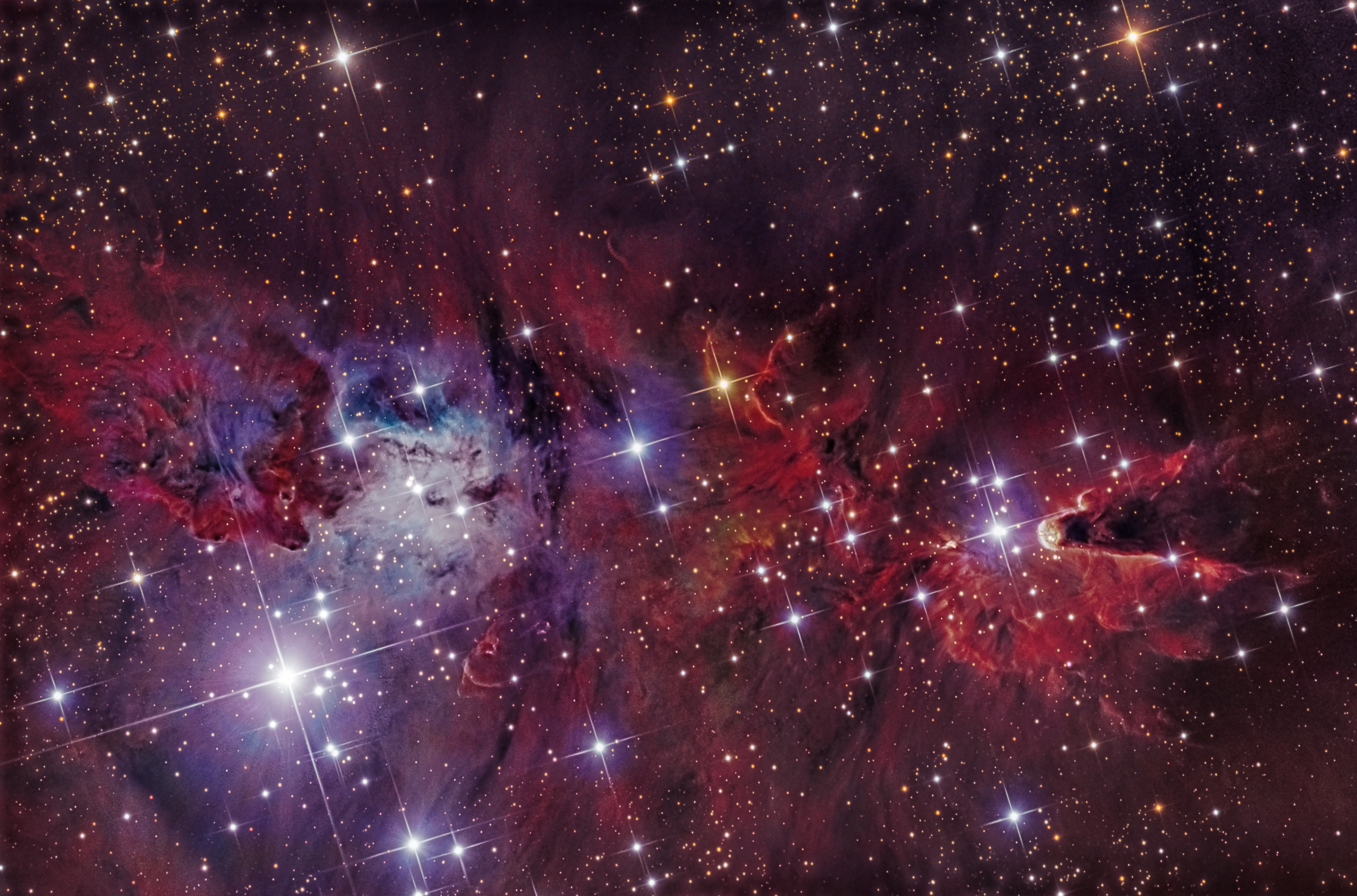
Information about the image:
Instrument: Planewave CDK 12.5 | Focal Ratio: F8
Camera: STXL-11002 + AOX | Mount: AP900GTO
Camera Sensitivity: Lum+Ha: Bin 1x1, Red, Green, Blue: Bin 2x2
Exposure Details: Lum: 32 x 900sec [8hrs], Ha: 31 x 1200 [8hrs] RGB: 450sec x 6 each [2.25hrs]
Viewing Location: Central Victoria, Australia.
Observatory: ScopeDome 3m
Date: January-February 2018
Software Enhancements: CCDStack2, CCDBand-Aid, PS, Pixinsight
Author: Steven Mohr
In my previous post I described my reason for being out this way and having arrived at Portage at 2015 I knew the Coastal would arrive soon. The sun was soon to be obscured by clouds so I decided to move a bit further south where the sun was still shining. I settled on this view of the train exiting the Placer River Valley with my view point towards the Portage Valley. I framed the shot with the Fireweed in full bloom and my luck held with the sun shining until after the train disappeared.
©2008 Susan Ogden- All Rights Reserved
...describes life right now...
have my father in law situated in a rehabilitative nursing center. The PT is WONDERFUL, attentive, concerned and more than willing to meet with family for discussion or to show us what she is doing and excellent at explaining why. The nursing staff is ABOMINABLE...they are so short handed and seem to disappear for HOURS at a time... (we did not see the floor nurse for 2 hours while there, in spite of her cart being parked outside the door the entire time we were having dinner with my father in law.) There seems to be no one there of any authority, and when you politely request assistance or medication, the wait is at minimum 20 minutes...yet when you see anyone, they are moving slower than the geriatrics they are supposed to be helping.
Pop was sick last night (poss. food poisoning) and we stayed until past visiting hours to assist him to the bathroom and attempt to get him medication...if this situation does not improve today, we may have to move him yet again, as this is totally unacceptable. Frustration is apparent in all family members and i am trying to keep it together as best i can....
i am thankful i am on acreage, so i can go outside and scream when i get overwhelmed! Prayers for my mental well being muchly appreciated (not that i had much mental well being to start with!)...
will try and catch up later this evening with comments and views of all of your streams...
Too awesome to describe.
To give a sense of scale, we were in a 20-person raft floating around this 'Horseshoe Bend' of the Colorado river earlier in the day. The river is about 200 ft wide in this shot, and the center rock is about 700 ft tall.
2-frame vertically-shot panorama, Taken from a cliff about 1000 ft up from the river, belly-laying on the rock ledge, hanging the camera over to take this. Yes, it was scary!
To see the view on the river at water level, go here:
Basilica of Santa Maria in Trastevere
The phrase "in Trastevere" (beyond the Tiber) describes the neighborhood of Rome in which the Basilica of Santa Maria is located. In ancient times, the neighborhood was mainly inhabited by immigrants, sailors, fishermen, and retired soldiers. Before Roman Emperor Constantine the Great (306–337 AD) decriminalized Christian worship by issuing the Edict of Milan in 313, Christian worship took place in "tituli"--private "house churches" that were sometimes named for the priest designated by church authorities as the patron. The original house church in this site was founded in 220 by Pope Callixtus I, who died in 222; and it became known as "Titulus Callisti."
The oratory of the house church that Pope Callixtus I proposed to build at this location necessitated displacement of part of the "Taberna meritoria" (a tavern and refuge for retired soldiers). This created a dispute between Christians and tavern-keepers. The new and young Roman Emperor Alexander Severus (approximately 14 years old)--not himself a Christian--settled the dispute in favor of the Christians, reportedly declaring, "I prefer that it should belong to those who honor God, whatever be their form of worship." Implicit in the young emperor's ruling, Christian worship in the church was known about and allowed 93 years before such worship's official decriminilization in 313's Edict of Milan. This then became one of the first locations (perhaps the very first location) of imperially permitted Christian worship in Rome.
According to inscriptions in the basilica, the original structure was rebuilt and enlarged in 340, restored in the 5th and 8th centuries, then re-erected on its old foundations in 1140-1143. The remains of Pope Callixtus I are preserved under the altar.
The central nave down which this photo looks, is built on the original floor plan. It is bounded on the sides by an assortment of granite columns that were taken from various ancient Roman ruins.
"Discover The Complete And Up-To-Date Encyclopedia That Shows How To Use The Healing Power Of Plants With Scientific, Accurate And Reliable Accuracy"
Introducing:
The Encyclopedia Of Medicinal Plants With a List of Medicinal Plants That Heal
Over 470 plants botanically described and classified by diseases.
From: James Luke
Tuesday, 11:24 a.m.
Dear Friend,
Inside of this encyclopedia is a large number of natural treatments described in a simple, clear language, correctly illustrated, placing the healing virtues of medicinal plants and their practical application methods within the reach of everyone. Experienced advice for the therapeutic preparation of fomentations, infusions, ointments, baths... Many charts describing the most frequent disorders and the plants endowed with the active agents that can heal them.
In each chapter the most important plants for the treatment of the diseases of a certain organ or system appear. When a single plant has several applications, as often happens, it is included in the chapter corresponding to its main application.
"Look at what people are saying about these Encyclopedia's"
I wanted to personally thank you for sharing those incredible encyclopedia books "THE FOODS WITH THEIR HEALING POWER and MEDICINAL PLANTS". They are an awesome source of reference especially when I talk about lifestyle change and health to my listeners. Praise 97.5FM is the #3 rated station in Atlanta so image how many thousands of listeners are blessed by the information they get from these books.
They and you are truly a God sent.
-Mellissa, Atlanta
...There is detailed information on the use and preparation for each plant.
In this encyclopedia you will find...
Plants for the eyes
The ___, raw or in juices is very good for the sight and for the skin in infusions and poultices.
Plants for the nervous system
___: The flowers and the leaves of this plant taken in infusions help to control and heal stress, insomnia, depressions, alcoholism, and drug addiction.
___: This plant also calms the nerves, beautifies the skin and protects the heart, using its flowers in infusions, or adding an infusion of it to bath water is very effective for insomnia or nervousness. Steam baths of its flowers also soften and beautify the skin.
Plants for the throat
___: Its flowers and its leaves in infusions, mouth rinse, mouth gargles and compresses are medicine for tonsillitis, pharyngitis and laryngitis.
___: Anti-inflammatory and astringent, the decoction of ___ or crushed ___, may be applied in any of the following ways:
Mouth rinses and gargles for ailments of the mouth and the throat.
Eye washes or blocked up noses
Vaginal irrigations
Sitz baths, for ailments of the anus or rectum
Arm baths, for chilblains
Plants for the heart
___: In infusions and under medical supervision, all the parts of this plant have properties to strengthen the heart, increase the strength of the cardiac contractions and to fight angina pectoris.
___: The infusion of its flowers and also its fruit are very effective for the treatment of palpitations, hypertension and other nervous cardio circulatory ailments.
Plants for the arteries
____: The decoction of the leaves of this plant is a powerful vasodilator of the arteries to the brain, to fight senile ailments, ageing and memory loss. ____ that is extracted from this prodigious plant is one of the most frequently used drugs today in the treatment of failure of the blood supply to the brain, migraines, hemorrhages, etc.
____: In mexico, and many other parts of the world, infusions of ____ and their young stems are used for bronchial colds and respiratory ailments. The oil from its seeds is rich in unsaturated fatty acids, as well as in vitamin E, A, and B. Therefore, it is particularly indicated for reducing the cholesterol levels in the blood, as well as for diabetes, kidneys and skin diseases.
Plants for the veins
___: A decoction of ____ nuts or wood is indicated to fight varicose veins, hemorrhoids and the disorders of menopause, using it in decoctions. In sitz baths it also alleviates urination disorders, pertaining to the prostate syndrome, cystitis or urinary incontinence. Likewise, it can be highly advisable for cases of hemorrhoids.
____: The oil of this plant is recommended for oily skin and for cases of acne. A decoction of the bark of the young branches and the leaves is used as a medicine in the case of heavy legs, varicose veins, phlebitis, in tisanes, compresses, hip baths and friction massages.
Plants for the respiratory system
____: The decoction of the leaves and the flowers has extraordinary properties, using it in infusions or essences to calm coughs, respiratory and digestive ailments. In baths, rinses, gargles, compresses and friction massages, it heals mouth and anal ailments, rheumatism and headaches, depression, asthenia and exhaustion.
____: Infusions of the dried leaves and flowers, used in tisanes give results in the cases of voice loss, acute bronchitis, bronco-pneumonia, asthma, and emphysema. ____ is also very helpful when stopping smoking, since it cleans the bronchial tubes of secretions, encouraging their elimination.
Plants for the digestive system
____: The infusions and essences of this plant are very appropriate for digestive ailments, colic's, flatulence, etc. Compresses, washes and friction massages are highly indicated for rheumatism, healing of wounds and eye washes.
____: Infusions of its leaves and flowered tops have properties to calm pain, they are invigorating and aphrodisiacs. It is recommended in cases of dyspepsia, intestinal wind, digestive spasms and colic, gastric atonia, hepatitis and physical exhaustion.
Plants for the stomach
____: The juice from this plants leaves heals peptic ulcers. Poultices of the leaves heal skin ulcers. It also improves acne.
____: The whole plant in infusions, mouth rinses and cleansing's help digestion increasing the gastric juices, it fights bad breath, it expulses intestinal parasites and calms menstrual pains.
Plants for the intestine
____: The leaves and seeds are a laxative par excellence, efficient and safe, it stimulates the motility of the large intestine and decreases the permeability of the intestine mucus.
____: The leaves and fruit, in infusions, irrigations, gargles, sitz baths and compresses reduce inflammation of the skin and the mucus. It heals digestive disorders, diarrhea, colitis and other ailments of the female genital system.
Plants for the anus and the rectum
____: All the parts of this vine hold healing properties: The leaves in infusions are medicine for vein circulatory ailments, hemorrhoids, chilblains, varicose veins, and diarrhea. The sap of the vine shoots heals skin irritations and irritated eyes. The ____ cure is very suitable for cleaning the blood. The oil from ____ seeds is highly applicable for excess of cholesterol.
____: It improves hemorrhoids taking a sitz bath with the decoction of the leaves and young buds, which also decreases the desire to smoke when chewed slowly. Also in poultices it is very useful to heal wounds, ulcers and boils.
Plants for the male sexual organ
____: The seeds reduce inflammation of the bladder and the prostate and expel intestinal parasites. The pulp of baked or boiled ____ is ideal for those suffering from digestive problems and kidney ailments.
____: This plant is normally presented in pharmaceutical preparations, it invigorates without exciting and without creating dependence increasing the energy production in the cells, therefore it increases sexual capacity and spermatozoid production, invigorating the organism in general.
Plants for the metabolism
____: infusions of the leaves are very useful in slimming diets due to its diuretic, depurative and anti cholesterol action.
____: It fights obesity and cellulite. Its algae have the property of removing the appetite and it is a gentle laxative.
Plants for the locomotive system
____: Poultices of fresh leaves alleviate rheumatic pain and inflammatory of the joints.
____: In infusions, essences, baths, frictions massages, fomentations and compresses it has invigorating properties for exhaustion, kidney colic, and rheumatism.
Plants for the skin
____: From the pulp of its leaves, the gel or juice is obtained which, when applied locally, in compresses, lotions, creams or pharmaceutical preparations, exercises beneficial effects on: wounds, burns, eczema, psoriasis, acne, fungi and herpes. It beautifies the skin and improves the appearance of scars.
____: The leaves and flowers in infusions or oil are an excellent remedy for burns, it moderates the inflammatory reaction, it has a local anesthetic effect, digestive, balancer of the nervous system and antidepressant.
Plants for infectious diseases
____: All the parts of this plant are natural antibiotics against respiratory and urinary infections. It encourages the functions of the skin. It acts against baldness.
____: It is a plant that has multiple anti-infectious properties with healing powers for the nervous system, digestive, respiratory and genital-urinary systems.
More Testimonials
Thank you for the encyclopedia books "The Foods With Their Healing Power and Medicinal Plants". I am Learning lots of information from them. This will be of great benefit to me when referring to the healing powers of foods. I will use this information in my chiropractic office when teaching about healthy eating to my patients. It is good to know that there are books that can provide this type of vital information to those who are willing to benefit from the information. Again thanks for these incredible books.
-Dr. Malcolm Hill
The Encyclopedia "Foods And Their Healing Power," Whose author is Dr. Jorge Pamplona Roger is a complete work, well structured, didactic and easy to understand for any kind of reader and of great value both for professionals and students in this field.
-Maria D Lopez-Martinez
It is my pleasure to recommend a set of books that I used and believe to be quite informational: Foods And Their Healing Power and Medicinal Plants. As a Fellow, in the Medical Fellowship Program at Wildwood Lifestyle Center and Hospital, I have found these books to be quite helpful. They provide accurate nutritional information for a wide array of foods found throughout the world and they include a list of medicinal plants with their properties and mechanisms of action. In addition, they are written without the usual heavy jargon, which makes them appealing to healthcare professionals, non-health care persons and children. The quality is superb and the material is presented in a colorful way. I have recommended them, on numerous occasions, to guests and patients at the Wildwood Lifestyle Center and Hospital. This set of books will complement the home and any other learning enviroments.
-Dr. Ervin Davis
I am writing this letter to offer my gratitude regarding the Encyclopedia of Medicinal Plants. In your description of the books you explained how beautiful they were and their content. All that I can say is that your words were not enough! The books have already proven to be an incredible asset to my own education and the promotion of God's health message to others.
The color and clarity of photographs is nothing less than phenomenal and the information given on each of the foods and medicinal plants far surpasses anything that I have been able to find thus far in book form or on the Internet. Not only will this prove very valuable in a health ministry but also in my profession as a medical doctor in education of my patients.
Please feel free to use me as a reference if anyone medical or non-medical needs further insight on these very valuable tools. Thanks again and God bless you!
-Bobby E. Scales, MD
hear hear for yourself the valuable information inside of this encyclopedia
htp://www.heisawesome.org
The value of this encyclopedia lies in its rational and truly practical focus point for healing and preventing the diseases of your family, without the disadvantages that most medicines have.
The pharmaceutical laboratories are aiming their research efforts towards the vegetable world, in such a way that more and more often you can find medicines prepared using medicinal plants by the chemists.
The creator has given foods a healing and preventative power, particularly when we use a balanced diet in combination with other natural elements, such as the sun, water, clean air, medicinal plants and a good mental disposition.
Take action now.
Please visit www.heisawesome.org
Tel. 786-307-4077
The first historical records on Aalst date from the 9th century, when it was described as the villa Alost, a dependency of the Abbey of Lobbes. During the Middle Ages, a town and port grew at this strategic point, where the road from Bruges to Cologne crossed the Dender. While it was within the Holy Roman Empire it was considered the capital of the province of Flanders. In 1046, Aalst was transferred to the Countship of Imperial Flanders, and absorbed a portion of Brabant, and in 1173 it was united with the remainder of the Flanders province. Its frontier position on the border of the Holy Roman Empire allowed the town to keep a certain degree of independence. Its relation with Brabant has been preserved in the city's white and red coat of arms, the colours of Lotharingia.
Construction of the town hall began in the middle of the 12th century, making it the oldest surviving town hall in Belgium. Several manuscripts from this period still survive in the town archives. During the Hundred Years War the town of Aalst allied themselves with Louis de Male against Philip van Artevelde and sent troops in the victorious Battle of Roosebeke. The town hall, and the city itself, were almost entirely destroyed by fire in 1360. The town was soon rebuilt and a new belfry in gothic style was built in the 15th century. This was a time of great prosperity for the city, dominated by the powerful weavers' guild. It is also at that time that Dirk Martens, a local citizen, became the Southern Netherlands’ first printer, founding a printing shop in 1473 that published books by various authors including Christopher Columbus; Martens would later become a professor at the Old University of Leuven, and he was laid to rest in the Saint Martin's Church (Aalst) [nl].
Aalst suffered considerably under the Eighty Years' War (1568–1648). It was later taken by the French Marshal Turenne in the War of Devolution of 1667, then occupied by France until 1706, when it became independent once more following the Battle of Ramillies, along with Southern Flanders in general. The textile-based economy flourished under the French. In the 18th century, the Austrians controlled the region. 1830 saw Belgium gain independence and Aalst became part of the country, this ended a long period, starting in 1056, of foreign control, by such as the Spanish, German, French, and the Dutch. The 19th century was marked by social crises engendered by the Industrial Revolution, with Father Adolf Daens and his Christene Volkspartij emerging as the local defender of workers' rights. This was in response to Rerum novarum, which established worker rights. However Daens felt this did not do enough. Eventually, he was made to pay for his "splinter movement".[how?] In the Pre-World War II years, the fascist movement in the Low Countries gained momentum, with the collaborationist Vlaamsch Nationaal Verbond (Flemish National Union) putting down roots in the region. Aalst, along with Brussels and Antwerp were the strongest subscribers to this line of thought.The 20th century was marked by bombardment and occupation by the Germans during both world wars.
China, Harbin, Song Hua Jiang Gonglu Bridge, or Songhua River Highway Bridge & National Street crossing the Songhua River from Harbin to the Sun Island & ahead. The tower is one of the three identical towers on both sides & centre with spiral staircases for pedestrians connected to the top of the slight over 2 km long bridge.
This bridge is leading directly to the "Ice & Snow Festival" & further to the Siberian Tiger research. centre
Not only for its special position, but also as the centre of Heilongjiang's political, economic, educational & cultural life, Harbin is described as the pearl beneath the swan's neck. Lying on the east of the Songnen Plain, what is more, Harbin plays a vital role in communications between South & North Asia as well the regions of Europe & the Pacific Ocean.
Harbin was the birthplace of Jin, 1115-1234 & Qing, 1644-1911, Dynasties, the latter of which had a very considerable influence on modern Chinese history.
At the end of the 19th century, Russia built the terminus of the Middle East Railway here. Later, more than 160,000 foreigners from 33 countries migrated to Harbin, promoting the development of a capitalist economy in the city. The economy & culture of Harbin achieved unprecedented prosperity at that time & the city gradually grew into a famous international commercial port. Assimilating external culture, Harbin created its unique & exotic cityscape. The majestic St. Sofia Orthodox Church & Zhongyang Dajie each built in a European style have the effect of bringing you into an 'eastern Moscow'. Even though you are sure to be attracted by various exotic buildings, the Dragon Tower which embodies the wisdom of the Chinese people is a must on your journey.
Besides these rich cultural heritages, Harbin is favoured with beautiful natural scenery. Based on meandering Song Hua River & subject to severe low temperatures in winter, down to -30°C, when I took this Pictures the Temperature varied between -20°C & -26°C but dry air, Harbin boasts a unique ice & snow culture. So, Harbin is also called the "Ice City".
The impressive "Ice & Snow Festival" is the greatest & unusual one in the world, therefor Harbin is also called the "Ice City".
As well the large Siberian Tiger & white tigers research centre, with about 500 tigers & a few other species, does an important work to prevent this species from extinction. The Research centre can be visited, tours in small a bus are available, passing through wide natural, separated, sections, however the focus point is to save the tigers.
👉 One World one Dream,
...Danke, Xièxie 谢谢, Thanks, Gracias, Merci, Grazie, Obrigado, Arigatô, Dhanyavad, Chokrane to you & over
10 million visits in my photostream with countless motivating comments
As described in the other picture, I was late to the scheduled alumni event due to the progressing sunset over Mannheim. a flock of birds arrived (one can still be seen on this picture), I switched lenses multiple time (to get back to the Summilux 50 again), and finally the sky turned red and orange. It became a very dramatic sunset, and I had a lot of fun documenting the progressing color shift from yellow-green to orange-red.
I assume that global warming is changing sunsets in Germany, as the air is more humid and sunset colors get more similar to tropical areas.
20191011-M10_9392-1-JPG
Most pilots would describe flying a C0034-S2 as similar to making a Rutenbahn Sandwhich with only your toes, while blindfolded and listening to Askreeen War Songs at 100 decibels. Were you to ask any of those pilots if they could name one still flying they would laugh in your face and tell you to joke around with some other sorry sod.
The C0034 was designed as a lightweight cargo jet with vertical takeoff and landing capabilities. The model was used for several years but never gained much appreciation as it was outclassed in nearly every regard by the more advanced C0102. During the years of the Raf Colony\'s expansion, the need for a small inter-planetary cargo shuttle inspired a few brilliant engineers (though early test pilots had other adjectives to describe them) ventured to retrofit the C0034 with two linear aerospike engines and maneuvering thrusters. The result was nothing less than abominabol and the engineers were promptly sacked.
The C0034-S was deemed unflightworthy and the project was sidelined for another decade until a new set of brilliant engineers decided to go out for drinks after work, got absolutley hammered and figured, why not just remove half of the internal structure and see what happens? The result, the C0034-S2, was light enough to fly but could only carry enough fuel for a few AU of travel, shelving it squarely in the disdainful categorey of \'rockhopper\'. Even worse, the ship was once-again outclassed (who are we kidding, it has never been anything else) as the VTOL system used air-breathing jet engines. Without an oxygenated atmosphere, hard landings were the only option.
Of course, an ultra-cheep rockhopper is the perfect workhorse of a Hibernia prospector! The Isadora has been around for decades and her crew insitsts she isn\'t going anywhere (although some joke that that’s because she can’t fly).
-----------
Wowowow this build drained me. It took effort spread over all 30 days of my given month. She\'s nearly 8000 pieces with most of those going to the internal structure. I did not post any WIP pics over the month as I honestly never thought I would finish. I may post my sketches now.
The full model is available here. I don\'t have time to make more renders so feel free to explore the boat yourself! (Also, unlike my usual, only the VISIBLE parts are color-checked against Bricklink. Timing was tight.)
Finally, a huge thank you to -majortom- for test-building the working landing gear for this beast and giving me the confidence to move forward with the project!
Emperor Shah Jahan himself described the Taj in these words:
Should guilty seek asylum here,
Like one pardoned, he becomes free from sin.
Should a sinner make his way to this mansion,
All his past sins are to be washed away.
The sight of this mansion creates sorrowing sighs;
And the sun and the moon shed tears from their eyes.
In this world this edifice has been made;
To display thereby the creator's glory.
Thanks to www.flickr.com/photos/ajawin/ for the texture.
Described on the web site as "our ‘northern lights’ over the Canal Pond". The Emperor fountain has been made into a fan of water, rather than a tall fountain. Lit up at dusk with coloured spotlights it gives an interesting effect, especially with the reflections of the illuminated trees.
A couple more shots in the comment below.