View allAll Photos Tagged Describe
Described by William Morris as the most beautiful village in England, Bibury is a conservation area in the Cotswolds, and this garden is at the bottom of the famous Arlington Row. This is owned and managed by the National Trust, which rents out its ancient cottages. These are built of local stone with steeply pitched Cotswold stone roofs. With the exception of the cottages at either end, the row began as a monastic sheep house or wool store, dating from around 1380. In the seventeenth century, the dwellings were converted into cottages for weavers, who supplied the cloth for fulling (degreasing) at Arlington Mill. The row is Grade I-listed.
Citycenter, arctic town
Ilulissat liegt an der Westküste Grönlands und zählt etwa 5.000 Einwohner. Der Name „Ilulissat“ bedeutet auf Grönländisch „Eisberge“, was perfekt zur Umgebung passt: Direkt vor der Stadt treiben gewaltige Eismassen durch die Diskobucht, die vom Jakobshavn Isbræ, einem der aktivsten Gletscher der Welt, stammen. Diese Eislandschaft ist nicht nur visuell beeindruckend, sondern auch UNESCO-Weltnaturerbe, da sie einzigartige Einblicke in die Dynamik des Klimasystems bietet.
Ilulissat is located on the west coast of Greenland and has a population of around 5,000. The name “Ilulissat” means “icebergs” in Greenlandic, which perfectly describes the surroundings: directly in front of the town, enormous ice masses drift through Disko Bay, originating from Jakobshavn Isbræ, one of the most active glaciers in the world. This ice landscape is not only visually impressive, but also a UNESCO World Heritage Site, as it offers unique insights into the dynamics of the climate system.
The Bayon is a richly decorated Khmer temple at Angkor in Cambodia. Built in the late 12th or early 13th century as the state temple of the Mahayana Buddhist King Jayavarman VII, the Bayon stands at the center of Jayavarman's capital, Angkor Thom. Following Jayavarman's death, it was modified and augmented by later Hindu and Theravada Buddhist kings in accordance with their own religious preferences.
The Bayon's most distinctive feature is the multitude of serene and smiling stone faces on the many towers which jut out from the upper terrace and cluster around its central peak. The temple has two sets of bas-reliefs, which present a combination of mythological, historical, and mundane scenes. The main conservatory body, the Japanese Government Team for the Safeguarding of Angkor (the JSA) has described the temple as "the most striking expression of the baroque style" of Khmer architecture, as contrasted with the classical style of Angkor Wat. (en.wikipedia.org/wiki/Bayon)
This site is described on pages 135-139 of my 320-page guidebook, "Photographing California Vol. 2 - South", available in hardcopy or ebook via Amazon:
www.jeffsullivanphotography.com/blog/photographing-califo...
Often described as Donkeys in Pyjamas these donkeys on the Ile de Ré wore coloured leggings to protect them from the flies and mosquitoes when they were working in the salt pans. Now they wear them for the benefit of tourists.
Ranunculus abortivus - Littleleaf buttercup
Ranunculus aconitifolius - Aconite-leaf buttercup
Ranunculus acraeus - a newly described species from Otago, New Zealand
Ranunculus acris - Meadow buttercup
Ranunculus alismifolius - Plantainleaf buttercup
Ranunculus andersonii - Anderson's buttercup
Ranunculus aquatilis - Common water crowfoot
Ranunculus arvensis - Corn buttercup
Ranunculus asiaticus - Persian buttercup
Ranunculus auricomus - Goldilocks buttercup (type species)
Ranunculus biternatus - Antarctic buttercup
Ranunculus bonariensis - Carter's buttercup
Ranunculus bulbosus - Bulbous buttercup
Ranunculus californicus - California buttercup
Ranunculus canus - Sacramento Valley buttercup
Ranunculus cassubicus - Kashubian buttercup
Ranunculus crassipes - Subantarctic buttercup
Ranunculus cymbalaria - Marsh buttercup
Ranunculus eschscholtzii - Alpine buttercup
Ranunculus ficaria - Lesser celandine
Ranunculus flabellaris - Yellow water buttercup
Ranunculus flammula - Lesser spearwort
Ranunculus fluitans - River water crowfoot
Ranunculus glaberrimus - Sagebrush buttercup
Ranunculus glacialis - Glacier buttercup
Ranunculus gormanii - Gorman's buttercup
Ranunculus hebecarpus - Delicate buttercup
Ranunculus hispidus - Bristly buttercup
Ranunculus hydrocharoides - Frogbit buttercup
Ranunculus jovis - Utah buttercup
Ranunculus kadzusensis Makino - Maehwamarum (see Ganghwa Maehwamarum Habitat)
Ranunculus lapponicus - Lapland buttercup
Ranunculus lingua - Greater spearwort
Ranunculus lobbii - Lobb's buttercup
Ranunculus longirostris - Water buttercup
Ranunculus lyallii - Mount Cook Lily - reputedly the largest buttercup
Ranunculus macounii - Macoun's buttercup
Ranunculus micranthus - Small-flowered crowfoot
Ranunculus moseleyi - Moseley's buttercup
Ranunculus muricatus - Spinyfruit buttercup
Ranunculus occidentalis - Western buttercup
Ranunculus orthorhynchus - Straightbeak buttercup
Ranunculus papulentus - Large River buttercup
Ranunculus parviflorus - Smallflower buttercup
Ranunculus pedatifidus - birdfoot buttercup
Ranunculus peltatus - Pond water crowfoot
Ranunculus pensylvanicus - Pennsylvania buttercup
Ranunculus platanifolius - Large white buttercup
Ranunculus populago - Popular buttercup
Ranunculus pusillus - Low spearwort
Ranunculus pygmaeus - Pygmy buttercup
Ranunculus recurvatus - Hooked Crowfoot
Ranunculus repens - Creeping buttercup
Ranunculus sardous - Hairy buttercup, Sardinian buttercup
Ranunculus sceleratus - Celery-leaved buttercup
Ranunculus septentrionalis - Swamp buttercup
Ranunculus sieboldii[4]
Ranunculus testiculatus - Bur buttercup
Ranunculus thora - Thora buttercup
Ranunculus uncinatus - Woodland buttercup
I picked this succulent flower from the garden this afternoon, and brought it indoors to photograph, where it's easier to control the light.
Lighting info: Lit with a single Yongnuo manual flash in an 8.6 inch Lastolite soft box, at camera right, and just out of the frame. Fill light is from a mirror, hand held at camera left. The strobe and my tripod mounted camera were triggered with a Yongnuo RF-603N.
Other plants, flowers, fruit or thingys that I've photographed using strobes can be seen in my Strobe Lit Plant set. For each image in the set, and there are over 1700 of them, I describe how I set up the lighting for that particular shot. www.flickr.com/photos/9422878@N08/sets/72157628079460544/
If you like pictures of cactus and succulents, you might enjoy my Cactus and Succulents set. That set can be seen here, and has over 400 images in it.
The National Churches Trust describes St Mary's in Potterne as a “an Early English church of exceptional purity and austerity.”
A priest, and land held by the Bishop of Salisbury, was recorded at Potterne in Domesday Book of 1086, and in Victorian times, a 10th Century font was found on the site of the present day Church of England parish church of St Mary. It was built in the 13th century and has survived with little change, beyond work to the tower in the 15th century and restoration by Ewan Christian. Pevsner describes it as, “An Early English parish church of exceptional purity and indeed classicity” and linked this to the Bishops’ ownership of the manor.
The church is cruciform, with a substantial tower over the crossing, and original lancet windows. It is built of rubble stone, with ashlar to the upper tower. The south porch was added in the 14th century, and in the 15th the tower was made higher and given an elaborate battlement. Restoration in 1870–2 included re-roofing and the removal of galleries, and the stained glass is from various dates in that century.
From the 11th century, the church had been linked to All Saints at West Lavington as tithes from both churches endowed a prebendary at Salisbury Cathedral. From 1967 the benefice was held in plurality with Worton and since 2017 the parish has been part of the Wellsprings benefice, which extends to Seend, Bulkington and Poulshot.
Potterne is a village with a population of 1,544 (2021), 2 miles/3 km south of the Wiltshire market town of Devizes.
This description incorporates text from the English Wikipedia.
Best described as extremely windy at this point and wet. I decided to get lower to the rocks and hide away from the high winds. Thankfully I felt safe lower down from the cliff edge. This is a cracking place and one I will return at another time when the weather isn't so tough for photography. The grey day really brought out the beautiful blue aqua colours in the sea.
“NGC 2264 describes several objects in the constellation Monoceros lying about 2,700 light-years from Earth. One is the Christmas Tree star cluster, here lying on its side with the blazing bright star S Monocerotis marking its trunk at Lower left. There is a diffuse red nebula caused by H-alpha emissions from hydrogen gas stimulated by ultraviolet radiation emitted by S Monocertis and the cluster's other white-blue stars. There are two special star forming regions in the red nebula. At centre right, off the tip of the Christmas Tree, is the Cone Nebula, named for its apparent shape sculpted by fierce stellar winds emitted from the stars. It is a dark molecular cloud within which other new stars are forming. Numerous other sculpted swirls of nebulosity are nearby. At centre left is the Fox Fur Nebula, Sharpless 273, named for the rich textured appearance sculpted by stellar winds in that region. In contrast, the blue nebula is a reflection nebula caused by scattered blue light reflecting off residual dust in a region where stars have already formed” [adapted text, credit SkyandTelescope].
The image is made up of a Luminance - Hydrogen Alpha blend for the resolution, and then a low resolution, small set of Red, Green, and Blue forming the colour channel. You can see I push the data a little too hard to reveal the detail, so maybe one day in the future I can collect more luminance and Ha to perhaps achieve a smoother result. But for the time being, I’m quite happy with the result from new Pixinsight procedures learnt.
Thanks for having a look.
Hi Res version:
c2.staticflickr.com/2/1849/30241366108_6a24dd52b9_o.jpg
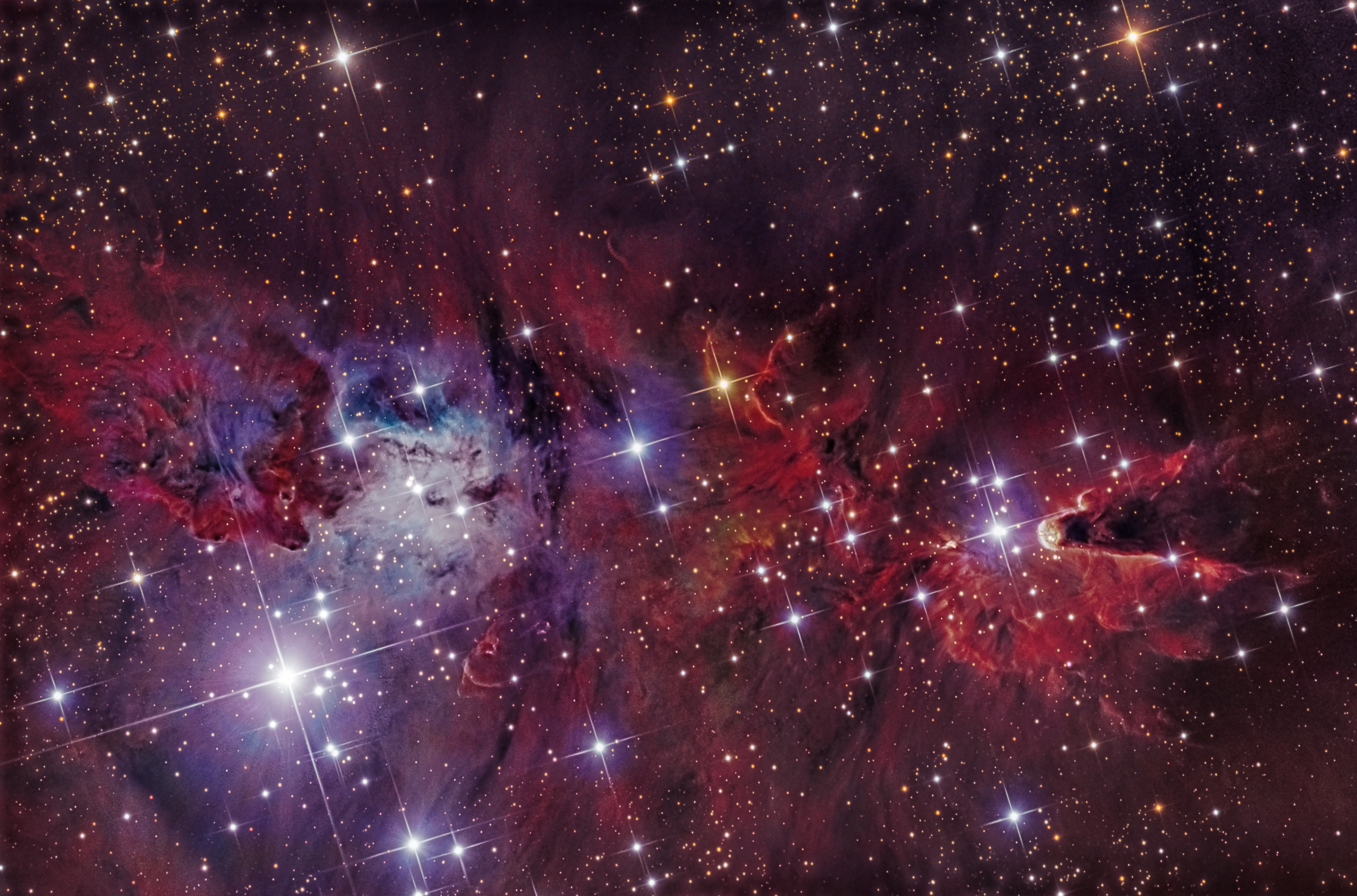
Information about the image:
Instrument: Planewave CDK 12.5 | Focal Ratio: F8
Camera: STXL-11002 + AOX | Mount: AP900GTO
Camera Sensitivity: Lum+Ha: Bin 1x1, Red, Green, Blue: Bin 2x2
Exposure Details: Lum: 32 x 900sec [8hrs], Ha: 31 x 1200 [8hrs] RGB: 450sec x 6 each [2.25hrs]
Viewing Location: Central Victoria, Australia.
Observatory: ScopeDome 3m
Date: January-February 2018
Software Enhancements: CCDStack2, CCDBand-Aid, PS, Pixinsight
Author: Steven Mohr
In my previous post I described my reason for being out this way and having arrived at Portage at 2015 I knew the Coastal would arrive soon. The sun was soon to be obscured by clouds so I decided to move a bit further south where the sun was still shining. I settled on this view of the train exiting the Placer River Valley with my view point towards the Portage Valley. I framed the shot with the Fireweed in full bloom and my luck held with the sun shining until after the train disappeared.
©2008 Susan Ogden- All Rights Reserved
...describes life right now...
have my father in law situated in a rehabilitative nursing center. The PT is WONDERFUL, attentive, concerned and more than willing to meet with family for discussion or to show us what she is doing and excellent at explaining why. The nursing staff is ABOMINABLE...they are so short handed and seem to disappear for HOURS at a time... (we did not see the floor nurse for 2 hours while there, in spite of her cart being parked outside the door the entire time we were having dinner with my father in law.) There seems to be no one there of any authority, and when you politely request assistance or medication, the wait is at minimum 20 minutes...yet when you see anyone, they are moving slower than the geriatrics they are supposed to be helping.
Pop was sick last night (poss. food poisoning) and we stayed until past visiting hours to assist him to the bathroom and attempt to get him medication...if this situation does not improve today, we may have to move him yet again, as this is totally unacceptable. Frustration is apparent in all family members and i am trying to keep it together as best i can....
i am thankful i am on acreage, so i can go outside and scream when i get overwhelmed! Prayers for my mental well being muchly appreciated (not that i had much mental well being to start with!)...
will try and catch up later this evening with comments and views of all of your streams...
Tectonic Asphalt Theory describes the small-scale movements of a road surface which causes it to drift apart over time.
So… that makes me wonder… if we wait long enough… will Smith street morph into West street… and will Adderly street one day lead us directly to Greenmarket Square!? Heh heh… I suspect NOT! :)
I still don’t have anything new to post… so I’m still scratching around in my archives… here’s hoping for a cloudy blue sky later this afternoon!!
Nikon D300, Sigma 18-200mm at 18mm, aperture of f11, with a 1/60th second exposure.
Click here to view this one large.

Click here to check out my Vertorama tutorial.
Towards the end of our trip south through the Lemaire Channel, cloud descended over Booth Island, the light got beautifully soft and this image and the next few were taken. This was shot at nearly 9pm. Most people had gone inside for dinner, and just me and JP (John Paul Caponigro) remained on the top deck of the ship. This isn't everyone's light or conditions, but we both loved it. Eventually JP went down and I was up there alone. It was one of the memories from the trip that will stay with me always.
The Lemaire Channel, Antarctica.
I made a short film of what I saw in Antarctica. If you'd like to see it, head over to YouTube or you can watch it here on Flickr.
If you'd like to see all my Antarctica images together, you can visit my Flickr Antarctica album.
I wrote three blog posts about this amazing trip to Antarctica. If you'd like read about the trip and see some more documentary/BTS images, you'll find the blog posts here:
Too awesome to describe.
To give a sense of scale, we were in a 20-person raft floating around this 'Horseshoe Bend' of the Colorado river earlier in the day. The river is about 200 ft wide in this shot, and the center rock is about 700 ft tall.
2-frame vertically-shot panorama, Taken from a cliff about 1000 ft up from the river, belly-laying on the rock ledge, hanging the camera over to take this. Yes, it was scary!
To see the view on the river at water level, go here:
This object when described is often referred to as having a resemblance to a Bogeyman, and I have to agree! Looking like some kind of dark ominous shadow creature, standing poised in the night’s sky, with an arm raised ready to cast a hot fiery orb. But, LDN1622 is in fact not such dramatic object, being mostly an enormous lane of obscuring dust a front of a faint emission nebula that seems to form part of the massive Barnard’s Loop in the constellation of Orion. The fiery orb object is a reflection nebula, categorised as van den Bergh 62 [VDB62].
In compiling this image, I remained with the colour filters of Luminance, Red, Green and Blue; leaving out my collected Ha data set.
Hi resolution image:
c2.staticflickr.com/8/7832/47032903891_1e7323f58f_o.jpg

Information about the image:
Instrument: Planewave CDK 12.5 | Focal Ratio: F8
Camera: STXL-11000 + AOX | Mount: AP900GTO
Camera Sensitivity: Lum: BIN 1x1, RGB: BIN 2x2
Exposure Details: Total: 19.75 hours | Lum: 55 x 900 sec [13.75hr], RGB 450sec x 16 each [6.0hrs]
Viewing Location: Central Victoria, Australia.
Observatory: ScopeDome 3m
Date: March-April 2018, and December 2018-February 2019
Software Enhancements: CCDStack2, CCDBand-Aid, PS, Pixinsight
Author: Steven Mohr
Powis Castle (Welsh: Castell Powys) is a medieval castle, fortress and grand country house near Welshpool, in Powys, Wales. The seat of the Herbert family, earls of Powis, the castle is known for its formal gardens and for its interiors, the former having been described as "the most important", and the latter "the most magnificent", in the country. The castle and gardens are under the care of the National Trust. Powis Castle is a Grade I listed building, while its gardens have their own Grade I listing on the Cadw/ICOMOS Register of Parks and Gardens of Special Historic Interest in Wales.
The present castle was built in the 13th century. Unusually for a castle on the Marches, it was constructed by a Welsh prince, Gruffydd ap Gwenwynwyn, rather than by a Norman baron. Gruffydd was prince of the ancient Kingdom of Powys and maintained an alliance with the English king Edward I during the struggles of the later 13th century. He was able to secure the position of his son, Owain, although the kingdom itself was abolished by the Parliament of Shrewsbury in 1283. After his father's death, Owain was raised to the peerage as Owen de la Pole, 1st Lord of Powis. Following his own death c. 1293, and the death of his only son, he was succeeded by his daughter, Hawys Gadarn, "the Lady of Powis". Hawys married Sir John Charlton in 1309.
In the late 16th century the castle was purchased by Sir Edward Herbert, a younger son of William Herbert, 1st earl of Pembroke, beginning a connection between the family and the castle that continues today. The Herberts remained Roman Catholic until the 18th century and, although rising in the peerage to earls, marquesses and Jacobite dukes of Powis, suffered periods of imprisonment and exile. Despite these setbacks, they were able in the late 17th and early 18th centuries to transform Powis from a border fortress into an aristocratic country house, and surround it with one of the very few extant examples of a British Baroque garden.
In 1784 Henrietta Herbert married Edward Clive, eldest son of Clive of India, a match which replenished the much-depleted Herbert family fortune. In the early 20th century, George Herbert, 4th Earl of Powis, redeveloped the castle with the assistance of the architect George Frederick Bodley. Herbert’s wife, Violet, undertook work of equal importance in the garden, seeking to turn it into "one of the most beautiful, if not the most beautiful, in England and Wales". On the 4th Earl's death in 1952, his wife and his sons having predeceased him, the castle passed into the care of the National Trust.
History
First castles at Welshpool: 1111–1286
Unlike the castles at Conwy, Caernarfon, Harlech and nearby Montgomery, which were built by the English to subdue the Welsh, the castles at Welshpool were built by the Welsh princes of Powys Wenwynwyn as their dynastic seat.[1] In addition to the current site, two motte-and-bailey castles and a set of earthworks are located nearby.[2] The names Trallwg/Tallwm and Pola are used interchangeably in early primary sources, and it is unclear which of these sites is being referred to.[3]
The earliest reference dates from 1111, when Cadwgan ap Bleddyn is mentioned as having planned to construct a castle at Trallwng Llywelyn,[3] the oldest record of a native Welsh castle.[4] Domen Castell, a motte-and-bailey near the modern railway station, is considered the most likely site of Cadwgan's castle, although it is uncertain whether it was completed as he was assassinated the same year.[5] The first documentary account of an extant castle at Welshpool is a description of the successful 1196 siege by an English army, although the castle was retaken by the Welsh within the year.[5][6]
The earliest castle at the current site may have been a timber building constructed by Owain Cyfeiliog or his son, Gwenwynwyn (r. 1197–1216).[7] The present masonry structure contains 13th-century fabric,[8] most likely the work of Gruffydd ap Gwenwynwyn (r. 1241–1287) – although historians are uncertain when this took place.[a][10] In 1274, Gruffydd's "first castle" at Welshpool was destroyed by Llywelyn ap Gruffudd as punishment for his involvement in a scheme to assassinate Llywelyn.[b] The castle was documented again in 1286, when it was listed amongst Gruffydd's possessions as "la Pole Castr".[12] A detailed examination of Powis Castle's extant masonry carried out between 1987 and 1989 revealed early stonework incorporated into the later structure, putatively the remains of an early stone shell keep.[13] At the end of Edward I's conquest of Wales in 1282–83, the king permitted Gruffydd to rebuild his castle at Welshpool as a reward for his loyalty.[14]
Early history: 1286–1644
Edward Herbert, 1st Baron Herbert of Cherbury[c]
In 1286, four years after the conquest of Wales, Gruffydd's son, Owain ap Gruffydd ap Gwenwynwyn became the last hereditary prince of Powys when he renounced his royal title, and was granted the barony of de la Pole, (i.e. "of the Pool", a reference to Welshpool, formerly called just "Pool").[d][16][17] The ancient Kingdom of Powys had once included the counties of Montgomeryshire, much of Denbighshire, parts of Radnorshire and large areas of Shropshire, but by the 13th century had been reduced to two independent principalities – Powys Wenwynwyn and Powys Fadog – roughly equivalent to Montgomeryshire and South Denbighshire (plus Maelor Saesneg), respectively; Welshpool had become the capital of Powys Wenwynwyn, of which Owain had been heir. On the death of Owain, the castle passed to his daughter Hawys, who married Sir John Charlton.[17] The Charltons continued to live at Powis until the fifteenth century when two daughters, Joyce Tiptoft and Joan Grey inherited the castle and estates. Both were equally divided, each daughter and her husband living in a portion of the castle.[18]
In 1578 an illegitimate son of the last Baron Grey of Powis, began leasing the lordship and castle to a distant relative – Sir Edward Herbert (d. 1595), second son of Sir William Herbert, 1st Earl of Pembroke. Edward eventually bought the castle outright in 1587, beginning the connection between the Herberts and Powis Castle which continues today.[19] Sir Edward's wife was a Roman Catholic and the family's allegiance to Rome and to the Stuart kings was to shape its destiny for over a century.[16] Sir Edward began the transformation of Powis from a border fortress into an Elizabethan country house. The major remaining element of his work is the Long Gallery.[19]
Herbert's descendent William Herbert, 1st Baron Powis (c. 1573–1655), was a supporter of Charles I, and was granted the barony of Powis in 1629.[19] His loyalty during the English Civil War cost him his castle and his estates.[20] On 22 October 1644 Powis Castle was captured by Parliamentary troops and was not returned to the family until the restoration of Charles II in 1660.[21]
The Herberts: 1660–1800
The Hercules statue which stood originally in the Water Garden
On the restoration, the Herberts returned to Powis, and in 1674 William Herbert (c. 1626–1696) was created Earl of Powis (of the first creation). The state bedroom was installed in about 1665 and further improvements, including the construction of the Great Staircase followed in the 1670s. These developments were most probably carried out under the direction of William Winde, who may also have designed the terraced gardens. His employer, although restored to his estates, and raised in the peerage, was barred by his Catholic faith from high office under Charles II. On the accession of the King's brother, James in 1685, Herbert became one of the new king's chief ministers, and was again advanced in the peerage becoming Marquess of Powis in 1687, but fell at the Glorious Revolution of 1688 and followed James into exile in France.[e] William III granted the castle to his nephew, William Nassau de Zuylestein, 1st Earl of Rochford. Herbert died, still in exile, in 1696.[24]
Despite their 30-year exile, the Herberts were able to continue with developments at the castle and even to live there on an irregular basis, the Baroque water garden below the castle being completed at this time.[25] Their fortunes were also materially improved by the discovery of a lucrative lead mine on their Welsh estates.[24] The second Marquess, also William, was reinstated in 1722. On the death of his son, the third Marquess in 1748, the marquessate became extinct, while the castle and estates passed to a relative, Henry Herbert (c. 1703–1772), of Oakly Park in Shropshire, who was made 1st Earl of Powis (of the second creation) by George II.[26] Herbert married Barbara, the fifteen-year-old granddaughter of the 2nd Marquess, in 1751. Their eldest son, George Herbert, 2nd Earl of Powis (1755–1801), died unmarried and the earldom of the second creation became extinct.[f][27] Powis was much neglected during his tenure. John Byng, 5th Viscount Torrington, a diarist and traveller who chronicled his journeys into Wales in the 1780s and 1790s, described the castle in 1784, "In the gardens not even the fruit is attended to; the balustrades and terraces are falling down, and the horses graze on the parterres!!!"[28] The castle itself was in no better condition, a visitor in 1774 describing it as "in Neglect and Ruin".[27] Nonetheless, the potential of the site was recognised. George Lyttelton, the politician, poet and essayist, recorded his impressions in 1756, "About £3,000 laid out upon Powis Castle would make it the most august place in the Kingdom."[29]
The Clives and Herberts: 1801–1952
The Outer Courtyard with the Fame statue in the foreground
In 1784, Henry Herbert's daughter, Henrietta, married Edward Clive (1754–1839), the eldest son of Clive of India.[30] Clive had followed his father to India, and served as Governor of Madras. Henrietta's brother died in 1801, whereupon the title lapsed; in 1804, her husband was created first Earl of Powis (of the third creation). The Clive fortune paid for long overdue repairs to the castle, which were carried out by Sir Robert Smirke.[31][32] Their son, Edward (1785–1848), inherited his late uncle's Powis estates on his 21st birthday, taking the surname Herbert in compliance with his uncle's will.[30] Edward Herbert served in a range of administrations as an Anti-Catholic Tory, his speeches in the House of Commons being "cautious and pertinent, although marred by dull delivery". He died in 1848, following a shooting accident at Powis in which he was fatally injured by his second son.[33] No further major changes were made to the Powis estate during his time, or in the long tenure of his eldest son Edward Herbert, 3rd Earl of Powis (1818–1891), although the castle was well maintained. In honour of his great-grandfather, the earl was offered the viceroyalty of India by Benjamin Disraeli but declined, writing "Not worth considering. Powis" on the envelope containing the invitation.[34]
The final alterations to Powis Castle were undertaken at the beginning of the 20th century by George Frederick Bodley for George Charles Herbert, 4th Earl of Powis (1862–1952). The rooms designed by Bodley remain his only extant decorative scheme; the longevity of the 4th Earl, the deaths of his heirs, and his bequest of the castle to the National Trust saw the early 20th-century remodelling remain largely unaltered.[g][36] The 4th earl's wife, Violet (nee Lane-Fox), undertook the final transformation of the gardens of Powis Castle, which she felt had the potential to be "the most beautiful in England and Wales".[37] The Countess died following a car accident in 1929, and Lord Powis outlived both his sons, who died on active service, Percy from wounds received at the Battle of the Somme in 1916,[38] and Mervyn in a plane crash in 1943.[39] On his own death in 1952, he bequeathed the castle and gardens to the National Trust.[h][42]
The National Trust: 1952–present
The 4th earl was succeeded by his cousin, Edward Herbert, 5th Earl of Powis (1889–1974). Edward's heir was Christian Herbert, 6th Earl of Powis (1904–1988). He was succeeded by his cousin, George Herbert, 7th Earl of Powis (1925–1993),[42] who was in turn succeeded by his son, John, the 8th and current Earl.[43] The Herbert family continue to live in part of the castle, under an arrangement with the National Trust.[44] The Trust has undertaken a number of major works of restoration during its ownership, including the Marquess Gate,[45] the Grand Staircase,[46] and the sculpture of Fame in the Outer Courtyard.[i][47] The castle and its gardens receive around 200,000 visitors annually. Wikipedia
The Alteration of 1578 must've been a lucky turn of worldly if not religious events for the Butchers' Guild of Amsterdam. That 'Alteration' is the term used to describe the quite sudden transition from Catholicism to Protestantism of the city and its bureaucracy. The Alteration made it possible to turn ecclesiastical properties to public use. in 1583, the Butchers, cramped for space to serve the ever-expanding city, were given the former chapel of St Peter's Almshouse, for their new Great Meat Hall. After two centuries (1779) it had to be renovated, and it lost its purpose around the middle off the nineteenth century.
Except for this marvellously decorated spout gable, the facade today is not very exciting - at least to me. Spout gables ('tuitgevel' in Dutch) were used especially for buildings devoted to merchants and trade. Here this quite wonderful trio of oxen clearly indicates the manner of business of this building's denizens. Of course, their own spouting days are over...
The first historical records on Aalst date from the 9th century, when it was described as the villa Alost, a dependency of the Abbey of Lobbes. During the Middle Ages, a town and port grew at this strategic point, where the road from Bruges to Cologne crossed the Dender. While it was within the Holy Roman Empire it was considered the capital of the province of Flanders. In 1046, Aalst was transferred to the Countship of Imperial Flanders, and absorbed a portion of Brabant, and in 1173 it was united with the remainder of the Flanders province. Its frontier position on the border of the Holy Roman Empire allowed the town to keep a certain degree of independence. Its relation with Brabant has been preserved in the city's white and red coat of arms, the colours of Lotharingia.
Construction of the town hall began in the middle of the 12th century, making it the oldest surviving town hall in Belgium. Several manuscripts from this period still survive in the town archives. During the Hundred Years War the town of Aalst allied themselves with Louis de Male against Philip van Artevelde and sent troops in the victorious Battle of Roosebeke. The town hall, and the city itself, were almost entirely destroyed by fire in 1360. The town was soon rebuilt and a new belfry in gothic style was built in the 15th century. This was a time of great prosperity for the city, dominated by the powerful weavers' guild. It is also at that time that Dirk Martens, a local citizen, became the Southern Netherlands’ first printer, founding a printing shop in 1473 that published books by various authors including Christopher Columbus; Martens would later become a professor at the Old University of Leuven, and he was laid to rest in the Saint Martin's Church (Aalst) [nl].
Aalst suffered considerably under the Eighty Years' War (1568–1648). It was later taken by the French Marshal Turenne in the War of Devolution of 1667, then occupied by France until 1706, when it became independent once more following the Battle of Ramillies, along with Southern Flanders in general. The textile-based economy flourished under the French. In the 18th century, the Austrians controlled the region. 1830 saw Belgium gain independence and Aalst became part of the country, this ended a long period, starting in 1056, of foreign control, by such as the Spanish, German, French, and the Dutch. The 19th century was marked by social crises engendered by the Industrial Revolution, with Father Adolf Daens and his Christene Volkspartij emerging as the local defender of workers' rights. This was in response to Rerum novarum, which established worker rights. However Daens felt this did not do enough. Eventually, he was made to pay for his "splinter movement".[how?] In the Pre-World War II years, the fascist movement in the Low Countries gained momentum, with the collaborationist Vlaamsch Nationaal Verbond (Flemish National Union) putting down roots in the region. Aalst, along with Brussels and Antwerp were the strongest subscribers to this line of thought.The 20th century was marked by bombardment and occupation by the Germans during both world wars.
Basilica of Santa Maria in Trastevere
The phrase "in Trastevere" (beyond the Tiber) describes the neighborhood of Rome in which the Basilica of Santa Maria is located. In ancient times, the neighborhood was mainly inhabited by immigrants, sailors, fishermen, and retired soldiers. Before Roman Emperor Constantine the Great (306–337 AD) decriminalized Christian worship by issuing the Edict of Milan in 313, Christian worship took place in "tituli"--private "house churches" that were sometimes named for the priest designated by church authorities as the patron. The original house church in this site was founded in 220 by Pope Callixtus I, who died in 222; and it became known as "Titulus Callisti."
The oratory of the house church that Pope Callixtus I proposed to build at this location necessitated displacement of part of the "Taberna meritoria" (a tavern and refuge for retired soldiers). This created a dispute between Christians and tavern-keepers. The new and young Roman Emperor Alexander Severus (approximately 14 years old)--not himself a Christian--settled the dispute in favor of the Christians, reportedly declaring, "I prefer that it should belong to those who honor God, whatever be their form of worship." Implicit in the young emperor's ruling, Christian worship in the church was known about and allowed 93 years before such worship's official decriminilization in 313's Edict of Milan. This then became one of the first locations (perhaps the very first location) of imperially permitted Christian worship in Rome.
According to inscriptions in the basilica, the original structure was rebuilt and enlarged in 340, restored in the 5th and 8th centuries, then re-erected on its old foundations in 1140-1143. The remains of Pope Callixtus I are preserved under the altar.
The central nave down which this photo looks, is built on the original floor plan. It is bounded on the sides by an assortment of granite columns that were taken from various ancient Roman ruins.
As described in the other picture, I was late to the scheduled alumni event due to the progressing sunset over Mannheim. a flock of birds arrived (one can still be seen on this picture), I switched lenses multiple time (to get back to the Summilux 50 again), and finally the sky turned red and orange. It became a very dramatic sunset, and I had a lot of fun documenting the progressing color shift from yellow-green to orange-red.
I assume that global warming is changing sunsets in Germany, as the air is more humid and sunset colors get more similar to tropical areas.
20191011-M10_9392-1-JPG
Most pilots would describe flying a C0034-S2 as similar to making a Rutenbahn Sandwhich with only your toes, while blindfolded and listening to Askreeen War Songs at 100 decibels. Were you to ask any of those pilots if they could name one still flying they would laugh in your face and tell you to joke around with some other sorry sod.
The C0034 was designed as a lightweight cargo jet with vertical takeoff and landing capabilities. The model was used for several years but never gained much appreciation as it was outclassed in nearly every regard by the more advanced C0102. During the years of the Raf Colony\'s expansion, the need for a small inter-planetary cargo shuttle inspired a few brilliant engineers (though early test pilots had other adjectives to describe them) ventured to retrofit the C0034 with two linear aerospike engines and maneuvering thrusters. The result was nothing less than abominabol and the engineers were promptly sacked.
The C0034-S was deemed unflightworthy and the project was sidelined for another decade until a new set of brilliant engineers decided to go out for drinks after work, got absolutley hammered and figured, why not just remove half of the internal structure and see what happens? The result, the C0034-S2, was light enough to fly but could only carry enough fuel for a few AU of travel, shelving it squarely in the disdainful categorey of \'rockhopper\'. Even worse, the ship was once-again outclassed (who are we kidding, it has never been anything else) as the VTOL system used air-breathing jet engines. Without an oxygenated atmosphere, hard landings were the only option.
Of course, an ultra-cheep rockhopper is the perfect workhorse of a Hibernia prospector! The Isadora has been around for decades and her crew insitsts she isn\'t going anywhere (although some joke that that’s because she can’t fly).
-----------
Wowowow this build drained me. It took effort spread over all 30 days of my given month. She\'s nearly 8000 pieces with most of those going to the internal structure. I did not post any WIP pics over the month as I honestly never thought I would finish. I may post my sketches now.
The full model is available here. I don\'t have time to make more renders so feel free to explore the boat yourself! (Also, unlike my usual, only the VISIBLE parts are color-checked against Bricklink. Timing was tight.)
Finally, a huge thank you to -majortom- for test-building the working landing gear for this beast and giving me the confidence to move forward with the project!
Described on the web site as "our ‘northern lights’ over the Canal Pond". The Emperor fountain has been made into a fan of water, rather than a tall fountain. Lit up at dusk with coloured spotlights it gives an interesting effect, especially with the reflections of the illuminated trees.
A couple more shots in the comment below.
Wikipedia described this as, “a group of relocated Anasazi ruined cliff dwellings and a museum located just west of Colorado Springs”.
The word "Epic" is one that is often overused to describe a scene or occurrence that really was out of this world. On this day I would stick by my guns and say the weather really was EPIC. Maybe the word ‘maelstrom’ would have been a good description.
This is a colour photo as can just be told from the vague colours of the moss on the nearby rocks. The location is nearing the summit of Froswick on the Kentmere Horseshoe. I was out for the day with a Flickr pal John and apart from two hikers who ventured as afar as this summit we saw no one all day. One of those two hikers is seen here battling against the swirling snow and ice that was being whipped up by the vicious winds. This photo hasn't been uploaded before but was taken at a similar time to others that I posted back in 2015.
Why upload a hiking photo like this today, well despite the lack lot recent mountain photos on my Flickr stream I would say that my biggest hobby over the last thirty years has been hill walking. Couple that fact with the fact that I have been unable to hike since February on account of a nasty dose of Plantar Fasciitis. Things seemed to have improved a little and I can't hold myself back any longer so early next week I head for a hike in the Lake District. We might even hike the Kentmere Horseshoe where this photo was taken.
I can’t adequately describe the thrill of seeing not one, but two, koalas just near home this week. It doesn’t get much better than that 😍 And it was just delightful to see so many people stopping their cars to look, show their kids and take photos. (The koalas were safely inside the fence line of our golf course which has unfortunately been sold, but close enough to to the road to be easily seen).
It’s a desperately sad fact that koalas in Queensland, where I live, are now listed as an endangered species. Their numbers continue to decline as a result of habitat loss due to land clearing for development and farming, climate events like bushfires and drought, and disease.
Spring is mating season for koalas and I was lucky to spot two of them in the same tree in our local area where it’s estimated there are around 40 living in a conservation zone. But even this area is now under threat of housing redevelopment which would mean the further destruction of precious habitat for the koalas, kangaroos and other wildlife. The developers and local authorities will have a fight on their hands. I am getting ready for battle.
30. Far apart
122 in 2022
Most pilots would describe flying a C0034-S2 as similar to making a Rutenbahn Sandwhich with only your toes, while blindfolded and listening to Askreeen War Songs at 100 decibels. Were you to ask any of those pilots if they could name one still flying they would laugh in your face and tell you to joke around with some other sorry sod.
The C0034 was designed as a lightweight cargo jet with vertical takeoff and landing capabilities. The model was used for several years but never gained much appreciation as it was outclassed in nearly every regard by the more advanced C0102. During the years of the Raf Colony\'s expansion, the need for a small inter-planetary cargo shuttle inspired a few brilliant engineers (though early test pilots had other adjectives to describe them) ventured to retrofit the C0034 with two linear aerospike engines and maneuvering thrusters. The result was nothing less than abominabol and the engineers were promptly sacked.
The C0034-S was deemed unflightworthy and the project was sidelined for another decade until a new set of brilliant engineers decided to go out for drinks after work, got absolutley hammered and figured, why not just remove half of the internal structure and see what happens? The result, the C0034-S2, was light enough to fly but could only carry enough fuel for a few AU of travel, shelving it squarely in the disdainful categorey of \'rockhopper\'. Even worse, the ship was once-again outclassed (who are we kidding, it has never been anything else) as the VTOL system used air-breathing jet engines. Without an oxygenated atmosphere, hard landings were the only option.
Of course, an ultra-cheep rockhopper is the perfect workhorse of a Hibernia prospector! The Isadora has been around for decades and her crew insitsts she isn\'t going anywhere (although some will joke that that’s because she can’t fly).
-----------
Wowowow this build drained me. It took effort spread over all 30 days of my given month. She\'s nearly 8000 pieces with most of those going to the internal structure. I did not post any WIP pics over the month as I honestly never thought I would finish. I may post my sketches now.
The full model is available here. I don\'t have time to make more renders so feel free to explore the boat yourself! (Also, unlike my usual, only the VISIBLE parts are color-checked against Bricklink. Timing was tight.)
Finally, a huge thank you to -majortom- for test-building the working landing gear for this beast and giving me the confidence to move forward with the project!
"From the personal logs of Protector Class ARC Trooper 018 "Galaar"..."
" It was 0200 and three days until our deployment to Geonosis when Mandalorian Cuy'val Dar member Vhonte Tervho, my mentor and training Sergeant summoned my squad to a nearby classroom. She hadn't specified why, nor was it my place to ask, but that didn't stop me from being curious. The barracks gossip from other squads described Mandalorian Sergeants putting their troopers through pre-battle "rituals" the previous night. That couldn't be it though, sure Sergeant Tervho followed the Mandalorian Resol'nare, but hazing her troops just nights prior to their first battle wasn't her style. Maybe she had one last lesson for us, one critical piece of advice that would carry us through what was to come, that seemed more likely. I entered the classroom along with several of my brothers, we had all trained under Vhonte, and had all been tasked with the destruction of a Techno Union tank foundry during the coming battle. The Mandalorian Sergeant stood behind a small holotable in the far corner of the classroom speaking with another Mandalorian in a hushed voice, I didn't recognize him, sure he could be Cuy'val Dar from one of the other facilities, but something about him was off, his armor was dirty caked in a thin red dust. The Mandalorians of the Cuy'val Dar cleaned their armor regularly in order to maintain a dress appearance while here on Kamino. Keeping my curiously to myself I lined up with the other troopers, a hodgepodge of armor, and garrison uniforms and waited. Eventually she turned away from the unknow Mandalorian and addressed us.
"Troopers it's been an honor being your mentor over these last couple years, before you go off to battle in three days I have one last lesson and one gift to give you. Preparation is everything, with proper preparation you will always be able to take down any mark and accomplish any task. The leadership of this army has neglected to prepare you for this battle and have decided to send you in blind. This will not do, I won't have my soldiers march blindly onto an unknow battlefield to be slaughtered, especially over some Jedi. This here is a colleague of mine from Mandalore, he owed me a favor and was kind enough to recon the factory which you've been tasked with destroying. Take notes troopers, this information will serve you well. You will be the best soldiers this galaxy has seen in a long time and will be the pride of not only the Republic, but of us few who had the honor of raising you, I know you are ready for what's to come. Oya Mando'ade, Oya.
And with that she stepped back and the other Mandalorian stepped forward and activated the holotable. The table displayed a detailed schematic of the tank factory on Geonosis, our target. I did my best to commit every inch of that factory to memory as the Mandalorian briefed us, some of the information wasn't even mission critical, but as Sergeant Tervho had said, it pays to be prepared. The briefing ended several hours later, just in time for morning mess and before we left Sergeant Tervho once again told us just how proud of us she was and that we were more than ready to tackle anything the Geonosians could throw at us. I left the room beaming with pride, feeling invincible, Geonosis felt like it would be a cake walk, nothing more than just another one of the thousands of simulations we had drilled during training. Victory felt guaranteed, well at least up until I made it to the mess hall and saw what they were serving."
END LOG
-----------------------------
Coming off of a pretty rough period of builders block, so I'm hopping that I can pump out another build or two before I leave for a month due to work. As for this build, it's defiantly nothing special, or very good, but necessary to advance Galaar's story within the 253rd. Let me know what you guys think, an d I promise not to take a week to write the story.
As always, thanks for stopping by!
- Tommy
i seem to like using the smoke brushes ^_^
title describes the expressions.
well idea for this is the me on the right is breathing out smoke, the bottom left me is disrupting the smokes dirtection causing it to curl round. initially bottom left me was just blowing air, but it looked confusing as nothing was there, so i added faint smoke (the smoke matches the eyeshadows ^_^) again still using camera in manual mode.
Often described as the 'Birmingham Routemaster', the Birmingham & Midland Omnibus Company (BMMO) D9 double-decker shared many innovative technical features with its London cousin. Visually, the most striking feature was the short wheelbase with large overhangs at the front and rear, which allowed for a very tight turning circle. Designed and built by the BMMO company for its own use, the first of the 345-strong D9 class entered service in 1959. None were supplied new to other operators and few saw further service after withdrawal by their original owner; the most notable exception being the handful purchased by the appropriately-named Obsolete Fleet for sightseeing operations in London.
This fictional image portrays an example supplied new to London Transport for comparative trials against the Routemaster. Unlike the BMMO-operated D9s, it features an open rear platform, standard London three-part destination display and a London Transport badge on the grille. It does however retain the standard provincial sliding window vents, rather than the drop type then favoured on London buses (09-Oct-10).
STRICTLY COPYRIGHT: You may download a copy of any image for your personal use, but it would be an offence to remove the copyright information or to post it elsewhere without the express permission of the copyright owner.
Thoughtfully described, "Sorry if this ends up in your yard!"
Thanks Phate Shepherd!
I always wanted one of these... I just didn't know yet.
Posted by Second Life Resident Torley Linden. Visit Rodel.
She was describing it to me from the back seat and said that I might not like it because most of the people in it were mad. They were upset because the youngest girl, who was happy, had brought out the trampoline and was jumping on it a thousand times. When she tried to play basketball with the others, they wouldn't let her. But she was nice and said that they could jump on the trampoline anyway. But when they left the ball outside, she said that she wasn't going to clean it up for them. There was more to it, but I have forgotten some of the details.
© all rights reserved by B℮n
Bagan formerly Pagan is an ancient city from the 9th to 13th centuries,. The city was the capital of Myanmar. Bagan is one of Myanmar’s main attractions. It was the capital of Bagan empire, where Theravada Buddhism was the main religion. The area also known as the Bagan Archaeological Zone, occupies an impressive 26-sq-mile area. Marco Polo described Bagan as one of the finest sights in the world. Despite centuries of neglect, looting, erosion, regular earthquakes, not to mention questionable restoration, this temple-studded plain remains a remarkably impressive and unforgettable vision. Bagan’s kings commissioned more than 4000 Buddhist temples. Htilominlo Temple is a Buddhist temple located in Bagan built during the reign of King Htilominlo, Anno 1211-1231. The temple is three stories tall, with a height of 46 metres and built with red brick. It is also known for its elaborate plaster moldings. On the first floor of the temple, there are four Buddhas that face each direction. You can climb up to terraces and view both the inside and outside of this temple. It has examples of painted stucco walls, many of which are still in good shape.
Probably because it is one of the first Bagan temples I saw but I was impressed by its magnificence and the way it was build inside. Situated close to the road between Nyaung U and Bagan, and about 1.5 km northeast of Bagan. This large temple was built by King Nantaungmya in 1218. The temple is known to be the last Myanmar Style temple built in Bagan. The name is a misreading of the Pali word for 'Blessings of the Three Worlds'. Inside the 46-metre-high temple, which is similar in design to Sulamani Temple there are four Buddhas on the lower and upper floors.
De stad Bagan is één van de vroegere hoofdsteden van Myanmar, en is gesticht in het jaar 849. Het was de hoofdstad van het Bagan-rijk, waar het Theravada-boeddhisme het belangrijkste geloof was. Bagan is één van de absolute top bezienswaardigheden van Myanmar. Een reis naar Myanmar zonder tussenstop in Bagan is gewoonweg ondenkbaar. Bagan wordt niet voor niets vaak op één lijn geplaatst met Angkor. Bagan, dat is 42 km² bezaaid met tempels. Er zijn er meer dan 4400 in totaal. Dat is waanzinnig veel. Ondanks dat deze rijkdom al lang is verdwenen worden er tegenwoordig nog steeds nieuwe tempels bijgebouwd. In 1975 zijn er echter veel tempels afgebroken bij een grote aardbeving in Myanmar en vandaag de dag zijn nog steeds niet alle gebouwen hersteld. Tijdens ons bezoek aan Bagan huurden we fietsen. We fietsen langs alle bijzondere boeddhistische tempels in Bagan. De
Htilominlo tempel is een boeddhistische tempel in Bagan gebouwd tijdens het bewind van koning Htilominlo, Anno 1211-1231. De tempel is drie verdiepingen hoog, met een hoogte van 46 meter en gebouwd met rode bakstenen. Het is ook bekend om zijn uitgebreide gipsen afgietsels. Op de eerste verdieping van de tempel, zijn er vier Boeddha's die in elke richting staan. Je kunt de terrassen beklimmen en bekijken van zowel de binnen- en buitenkant. De wanden binnenin zijn beschilderd waarvan er vele nog steeds in goede conditie zijn.
I found that my grandfather's old typewriter could be useful for annotating analogue paper-prints.
Minolta Dynax 505si Super
Helios 44-2, 58mm/f2
Ilford HP5 Plus @800 ISO
Rodinal 1:25 (20°C, 8 min.)
www.rspb.org.uk/discoverandenjoynature/discoverandlearn/b...
Also known as the peewit in imitation of its display calls, its proper name describes its wavering flight. Its black and white appearance and round-winged shape in flight make it distinctive, even without its splendid crest. This familiar farmland bird has suffered significant declines recently and is now an Red List species.
Overview
Latin name
Vanellus vanellus
Family
Plovers and lapwings (Charadriidae)
Where to see them
Lapwings are found on farmland throughout the UK particularly in lowland areas of northern England, the Borders and eastern Scotland. In the breeding season prefer spring sown cereals, root crops, permanent unimproved pasture, meadows and fallow fields. They can also be found on wetlands with short vegetation. In winter they flock on pasture and ploughed fields. The highest known winter concentrations of lapwings are found at the Somerset Levels, Humber and Ribble estuaries, Breydon Water/Berney Marshes, the Wash, and Morecambe Bay.
When to see them
All year round. Leaves upland areas after the breeding season and moves to lowland fields for the winter. Large numbers of N European birds arrive in autumn for the winter.
What they eat
Worms and insects
Population
UK Breeding:- 140,000 pairs
UK Wintering:- 650,000 birds
Breeding
The winter flocks begin to break up in February, when the birds will start to return to their breeding grounds.
The lapwing has a spectacular songflight. The male wobbles, zigzags, rolls and dives while calling to advertise his presence to rival males and potential mates. The birds tend to nest in loose groups. Individual territories are small about 0.4-0.8 ha and are only held until the chicks hatch.
In the breeding season, lapwings need a mosaic of habitats, because they need different conditions for nesting and for chick rearing.
The nest is a scrape in the ground, lined with a variable amount of plant material. The birds need a good all round view from the nest to spot predators, and nest either on bare ground or in short vegetation. They often choose rough or broken ground to aid concealment of the nest. Spring sown crops and rough grazing are ideal.
They lay clutches of four cryptically coloured eggs from late March to early June, and chicks hatch 3-4 weeks later. They are covered in down when they hatch, and are able to walk about and feed within hours.
Soon after hatching, the parents will lead them to suitable feeding areas, where the supply of surface invertebrates is good and the vegetation low. They particularly need to have nearby grassland, especially if it contains flood pools and damp patches.
The transfer between the nesting and chick-rearing habitats can be hazardous, and chick survival often depends on how far they have to travel. The families stay in the chick-rearing habitat until the young are ready to fly at 5-6 weeks old. Lapwings only rear one brood a year, but may lay up to four replacement clutches if the eggs are lost.
Legal status
The lapwing is fully protected under the Wildlife and Countryside Act 1981; it an offence to kill, injure or take an adult lapwing, or to take, damage or destroy an active nest or its contents.
The only exception is legitimate farming practices that cannot be reasonably delayed, although farming methods can often be modified to reduce the impact on the lapwings.
Population trends
Lapwing numbers have decreased in Britain since the middle of the 19th century. The early declines were caused by large scale collection of eggs for food. Introduction of the Lapwing Act in 1926 prohibited this, and was followed by a considerable recovery in bird numbers.
Since the 1940s lapwing declines have been driven by large-scale changes to farming. Large areas of grassland were converted to arable, marginal land was drained and improved, and chemicals were introduced for fertilisers and pest control with increasing reliance on them. By 1960 the lapwing population had stabilised at a lower level.
Another sharp and sustained decline started in the mid-1980s, with range contractions in south-west England and in parts of Wales. This followed further intensification and specialisation - abandonment of rotations, switch from spring to autumn sown crops, increased drainage, increased use of agrochemicals. Such changes have resulted in much of the arable land becoming unsuitable for nesting by April because the crop grows too high. Tillage, drainage and pesticides have also caused a reduction in food availability.
As pasture land is improved, the resulting increased risk of trampling by livestock, earlier cutting for silage and lower food availability have affected lapwings adversely. Phasing out of rotational farming and shift of arable to the east of England and pastureland to the west of England has removed the habitat mosaic that is essential for successful chick rearing.
Mosaic where grass and spring tillage fields are close together has declined significantly in recent years, and the loss of this prime habitat has resulted in a decline in lapwing numbers.
Nest failures on arable land come from egg losses during cultivation and from predation, and poor chick survival due to crop growth. Crop growth can also shorten the laying season.
The declines in lapwing population have been greatest in southern England and Wales, where the farming changes have been greatest and farmland is the only suitable habitat for the lapwing. Between 1987 and 1998 lapwing numbers dropped by 49% in England and Wales. Since 1960 the numbers dropped by 80%.
The birds have fared better in Scotland, where the crucial changes to farming were introduced later than in England and Wales. However, even there the numbers have dropped by 29% since 1987.
Lapwings have to fledge at least 0.6 young per pair each year to maintain the population. They usually can achieve this in rough grazing and unimproved pastures, but often not on arable land or improved grassland. Since the birds cannot produce enough chicks to offset the natural mortality of adults, population declines.
It is possible to halt and reverse the decline in lapwing numbers with sympathetic farming methods, which include creation of a mosaic of spring sown crops and grassland, managing grazing pressure and maintaining damp areas on unimproved grassland. Agri-environment schemes in each part of the UK provide grants to help land-owners manage their land to help lapwings.
Survival
Egg survival and hatching success varies depending on the habitat, and appears to have declined in some habitats over the past decade.
Main causes of nest failure are predation, agricultural activity and desertion. While the birds often re-lay, changes in cropping practices often result in the habitat being unsuitable for replacement clutches because the vegetation has grown too tall, thus shortening the potential breeding season.
Only about 25-40% of chicks survive to fledging. Most of the chick mortality occurs in the first few days after hatching, when chicks are most vulnerable to cold or wet weather, and when they may be undertaking hazardous journeys from nesting to feeding areas. The further chicks have to go, the lower their survival.
Once the birds have reached adulthood, they can expect to live a further 4-5 years. The oldest known individual was about 20 years. Lapwings normally breed one year after fledging.
This is a “Liquid Flow”-style image, where multiple liquids are mixed together and the resulting interaction is photographed. Based on the Rayleigh-Taylor instability which describes how two fluids of different densities interact, the inks I dropped into the liquid not only fluoresce, but they have different properties to create some very transient artwork.
I have something special for you – well beyond a behind-the-scenes photo of the setup, here is a behind-the-scenes VIDEO, with a complete list of equipment in the description: www.youtube.com/watch?v=zZQoR4AWBBA . And of course, for those curious, here is a BTS photo that you can examine as well: donkom.ca/bts/_1090342.jpg .

Huge thanks to Platypod for continuing to be a solid “base of operations” for tabletop macro work. I’m using two Platypod Max and two Platypod Ultras here to hold my lights in place, many of which with their gooseneck arms which will be available to purchase in November. They have a fun little side-port designed to hold the male-male adapter when you’re connecting two goosenecks together, but you can always just plug an extra gooseneck in there and piggyback one off the other, using both. Lots of possibilities.
One key strategy here has to do with depth of field resolution. You’ll notice a wooden kebab skewer across the top of the 8” cubed aquarium in the BTS shot. To focus, I drop another skewer vertically, manually focus on it, and then remove it. The frame covers the aquarium edge-to-edge, but the main subject usually only occupies a central portion of that – and cropping is key. Being further away allows for a greater depth of field but also for flexibility if where the subjects ends up – it might spread further than you expect and still be interesting! Shot with a Lumix S1R where I know my pixel quality is top-notch and I’m not afraid to throw some pixels away to create the composition I seek.
I threw a LOT of ultraviolet light at this, enough to get camera settings of 1/200sec, F/13 and ISO 1000 for the stills shooting. Since these images survive noise very well, I wouldn’t be afraid to shoot at up to ISO 6400 and beyond with some cameras if needed. The water is plain tap water, and the inks used are all from Noodler’s: Blue Ghost, Firefly, and Dragon Catfish Orange.
This image is, of course, inverted. The surface of the water is at the bottom of the frame, showing the growing and glowing structures rising into the composition. They have an almost x-ray feel to them, based on their transparency and luminosity. This was a very fun experiment and one I am certain that I will revisit.
One final tip: position the camera slightly lower than center on your glass tank, and aim up to get a bit of the bottom surface of the water into the frame. Makes for added depth and possible reflections!
I find it difficult to describe my feelings towards this last week in Oregon at the Flickr Gathering. All week long, the only thing I could think about was how incredible it was that all of this, everything that we've created, started from a simple website. I look back on my life and realize how much my life has been shaped by Flickr. Sounds crazy, doesn't it? But hear me out here: if I hadn't found Flickr, I never would have picked up my camera and experimented. Without Flickr, I never would have decided to study photography at college. I never would have met my first love. And most importantly, I never would have found this incredible network of friends whom I have been blessed to get to know in the past four years. I never would have gained the courage to get on a train and stay with a family in Canada whom I had never met before, or light off fireworks on New Year's Eve with familiar strangers, or explore abandoned houses and climb on rooftops--all for the sake of photography. It's a staggering thing to be a part of. I don't for a moment doubt that there is some greater plan in all of this, something stronger than coincidence that brought us together.
Flickr has truly been so influential to me, as I know it has for many others, and I am so grateful I found the people I have here. As I sit on my soft bed in my air conditioned room on a warm summer's evening, I know I would jump at any opportunity to give up those comforts and go spent a day anywhere in the world with the people I love most.
Thank you, Flickr. Thank you, photography. You have most certainly changed my life, and I am grateful every day.
Photo courtesy of Cameron Bushong, edited by me. Taken on our last night in Oregon.
To see more work from the meetup, be sure to follow this group: www.flickr.com/groups/2224428@N24/pool/with/9298296664/#p...
Described as the 'Rock of Lutheranism,' the Zion Evangelical Lutheran Church is valued as the home of Canada's oldest Lutheran congregation. As well, it is valued as an architectural landmark in Old Town Lunenburg, with a steeple that can be seen for kilometers. When German Lutheran settlers first arrived in 1753, the settlers held services in the open air and later at St. John's Anglican Church. The first church on this site was built in 1772 and replaced in 1841 with a Gothic structure. The only remains of the first Lutheran church are the key to the building and the Saint Antoine-Marie bell that had formerly hung in the Fortress of Louisbourg (a French fort located on Cape Breton Island), and had been purchased by the congregation in 1776.
The present building dates from 1890 and was designed in the High Victorian Gothic style. The church's long nave runs the length of the block on Cornwallis Street, with an ornately decorated gable end on Fox Street. The dentil courses and stained glass windows are among the most noticeable elements of the nave. Two asymmetrical towers flank the front façade, each with a different design. The larger one has a pointed arch doorway oriented to the corner of Fox and Cornwallis Streets, and mullioned lancet windows on the upper storeys. It also has a tall spire housing the bell, which is highly visible from many points in Lunenburg, including the harbour approaches. The second tower is pyramidal with windows of various shapes and sizes, making it appealing to the eye. The large hall to the rear of the church was added in 1946 and serves as a meeting place and Sunday school.
The commanding scale and vertical composition of the Zion Evangelical Lutheran Church speak to the fundamental importance of the Lutheran congregation in Lunenburg from its settlement to the present day.
....describes what we did today....it was seriously the most fun I have ever had railfanning.....
Im gonna post the entire set after the slide show next Saturday....
Ascetic: an adjective describing;
1. Leading a life of self-discipline, especially for spiritual improvement
2.Self-denying and austere
Aspect: a noun meaning:
1.Appearance to the eye, especially from a specific vantage point.
2. A way in which something can be viewed by the mind
3. A position facing or commanding a given direction; exposure.
4. A side or surface facing in a particular direction
You are looking down at the benches and floor of the ruins of the church in Aggstein, Austria. I leveled it a bit, but othewise straight out of the camera
The National Churches Trust describes St Mary's in Potterne as a “an Early English church of exceptional purity and austerity.”
A priest, and land held by the Bishop of Salisbury, was recorded at Potterne in Domesday Book of 1086, and in Victorian times, a 10th Century font was found on the site of the present day Church of England parish church of St Mary. It was built in the 13th century and has survived with little change, beyond work to the tower in the 15th century and restoration by Ewan Christian. Pevsner describes it as, “An Early English parish church of exceptional purity and indeed classicity” and linked this to the Bishops’ ownership of the manor.
The church is cruciform, with a substantial tower over the crossing, and original lancet windows. It is built of rubble stone, with ashlar to the upper tower. The south porch was added in the 14th century, and in the 15th the tower was made higher and given an elaborate battlement. Restoration in 1870–2 included re-roofing and the removal of galleries, and the stained glass is from various dates in that century.
From the 11th century, the church had been linked to All Saints at West Lavington as tithes from both churches endowed a prebendary at Salisbury Cathedral. From 1967 the benefice was held in plurality with Worton and since 2017 the parish has been part of the Wellsprings benefice, which extends to Seend, Bulkington and Poulshot.
Potterne is a village with a population of 1,544 (2021), 2 miles/3 km south of the Wiltshire market town of Devizes.
This description incorporates text from the English Wikipedia.