View allAll Photos Tagged Contribute
Building 5, a Ranger's Residence, was built in 1924, moved in 1929, and remodeled, with another remodel by Civilian Conservation Corps (CCC) workers in 1934. Set on a broken range ashlar foundation, the dwelling shows the rustic character typical of CCC-built National Park structures, but with a more down-to-earth, vernacular feel than the larger Rustic-style buildings. The Ranger's Residence is located in the Wind Cave National Park Administrative and Utility Area Historic District listed on the National Register of Historic Places and is a contributing structure.
Built in 1887, this structure is a contributing property to the Syracuse University-Comstock Tract Buildings Historic District, which was placed on the National Register of Historic Places in 1980.
Syracuse University (colloquially known as Syracuse, 'Cuse, or SU) is a private research university in Syracuse, New York. The institution's roots can be traced to the Genesee Wesleyan Seminary, founded in 1831 by the Methodist Episcopal Church in Lima, New York. After several years of debate over relocating the college to Syracuse, the university was established in 1870, independent of the college. Since 1920, the university has identified itself as nonsectarian, although it maintains a relationship with The United Methodist Church.
Information from: en.wikipedia.org/wiki/Syracuse_University
IAEA Director General Yukiya Amano met with Elba Rosa Pérez Montoya, Minister of Science, Technology and Environment of Cuba, during a bilateral meeting at the International Conference on the IAEA Technical Cooperation Programme: Sixty Years and Beyond – Contributing to Development. IAEA, Vienna, Austria. 30 May 2017.
Photo Credit: Dean Calma / IAEA
City Palace, Udaipur, is a palace complex in Udaipur, in the Indian state Rajasthan. It was built over a period of nearly 400 years being contributed by several kings of the dynasty, starting by the Maharana Udai Singh as the capital of the Sisodia Rajput clan in 1559, after he moved from Chittor. It is located on the east bank of the Lake Pichola and has several palaces built within its complex. Udaipur was the historic capital of the former kingdom of Mewar in the Rajputana Agency and its last capital.
The City Palace in Udaipur was built in a flamboyant style and is considered the largest of its type in Rajasthan, a fusion of the Rajasthani and Mughal architectural styles, and was built on a hill top that gives a panoramic view of the city and its surrounding, including several historic monuments such as the Lake Palace in Lake Pichola, the Jag Mandir on another island in the lake, the Jagdish Temple close to the palace, the Monsoon Palace on top of an overlooking hillock nearby and the Neemach Mata temple. These structures are linked to the filming of the James Bond movie Octopussy, which features the Lake Palace and the Monsoon Palace. The subsequent publicity has resulted in the epithet of Udaipur as "Venice of the East". In 2009, Udaipur was rated the top city in the World's Best Awards by Travel + Leisure.
HISTORY
The city Palace was built concurrently with establishment of the Udaipur city by Maharana Udai Singh, in 1559 and his successor Maharanas over a period of the next 300 years. It is considered the largest royal complex in Rajasthan and is replete with history. Founding of the city and building of the palace complex can not be looked in isolation as the Maharanas lived and administered their kingdom from this palace.
Prior to moving their capital from Udaipur to Chittor≤≥, the Mewar kingdom had flourished initially in Nagda (30 kilometres to the north of Udaipur), established in 568 AD by Guhil, the first Mewar Maharana. In the 8th century, the capital was moved to Chittor, a hill top fort from where the Sisodias ruled for 80 years. Maharana Udai Singh II inherited the Mewar kingdom at Chittor in 1537 but by that time there were signs of losing control of the fort in wars with the Mughals. Udai Singh II, therefore, chose the site near Lake Pichola for his new kingdom because the location was well protected on all sides by forests, lakes and the Aravalli hills. He had chosen this site for his new capital, much before the sacking of Chittor by Emperor Akbar, on the advice of a hermit he had met during one of his hunting expeditions.
At his capital Udaipur, Maharana Udai Singh soon faced defeat at the hands of Mughal Emperor Akbar. He soon moved to Udaipur to the chosen location to establish his new capital. The earliest royal structure he built here was the Royal courtyard or 'Rai Angan', which was the beginning of the building of the City Palace complex, at the place where the hermit had advised Maharana to build his Capital.
After Udai Singh’s death in 1572, his son Maharana Pratap took the reins of power at Udaipur. He was successful in defeating Akbar at the battle of Haldighati in 1576 and thereafter Udaipur was peaceful for quite some years. With this, prosperity of Udaipur ensued, palaces were built on the shore and in the midst of the Pichola lake. Concurrently art, particularly miniature painting, also flourished.
But in 1736, the marauding Marathas attacked Udaipur and by the end of the century the Mewar state was in dire straits and in ruins. However, the British came to Mewar’s rescue in the 19th century and soon the State of Mewar got re-established and prospered under British protection, under a treaty signed with the British. However, the British were not allowed to replace them. Once India got independence in 1947, the Mewar Kingdom, along with other princely states of Rajasthan, merged with the Democratic India, in 1949. The Mewar Kings subsequently also lost their special royal privileges and titles. However, the successor Maharanas have enjoyed the trust of their people and also retained their ownership of the palaces in Udaipur. They are now running the palaces by creating a trust, called the Mewar Trust, with the income generated from tourism and the heritage hotels that they have established in some of their palaces. With the fund so generated they are running charitable hospitals, educational institutions and promoting the cause of environmental preservation.
LEGEND
Historical legend narrated to the selection of the site for the palace is about a hermit meeting Maharana Udai Singh when he was on a hunting trail in the Udaipur hills. The Maharana met the hermit who was meditating on top of a hill above the Pichola Lake and sought the hermit’s blessings. The hermit advised the Maharana to build his palace at that very spot and that is where the palace complex came to be established at Udaipur.
GEOGRAPHY
The city palace located in Udaipur city at 24.576°N 73.68°E, which is set with an average elevation of 598 metres.
CLIMATE
The climate of Udaipur reflects the climate at the city palace. It is tropical, with the mercury recording between a maximum of 38.3 °C and a minimum of 28.8 °C during summers. Winter is cold with the maximum temperature rising to 28 °C and the minimum dipping to 11.6 °C. The average annual rainfall is 64 cm.
STRUCTURES
The series of palaces packed in the city palace complex, facing east (as customarily appropriate for the Maharana dynasty – the Sun dynasty), behind an exquisite facade of 244 metres length and 30.4 metres height, were built on a ridge on the east of lake Pichola. They were built over a long period, from 1559 onwards, by 76 generations of Sisodia Rajputs or Suryavanshi Rajputs (worshippers of Sun god). Several Maharanas (the title Maharana is distinctly different from Maharajah, as the former connotes a warrior and the latter a ruler or a king) starting with Udai Mirza Singh II, have richly contributed to this edifice, which comprises an agglomeration of structures, including 11 small separate palaces. The unique aspect of this conglomeration is that the architectural design (a rich blend of Rajasthani, Mughal, Medieval, European and Chinese Architecture) is distinctly homogeneous and eye catching. The palace complex has been built entirely in granite and marble. The interiors of the palace complex with its balconies, towers and cupolas exhibit delicate mirror-work, marble-work, murals, wall paintings, silver-work, inlay-work and leftover of colored glass. The complex provides a fine view of the lake and the Udaipur city from its upper terraces.
Located with the picturesque backdrop of rugged mountains, beside the Pichola lake on its shore, the city palace complex painted in gleaming white color has been compared to the Greek islands, such as the Mykonos.
The famous structures or palaces viewed from the Lake Palace appear like a fort. They are interlinked inside the complex through a number of chowks or quadrangles with zigzag corridors (planned in this fashion to avoid surprise attacks by enemies). Erected in the complex, after entering through the main Tripolia (triple) gate, are the Suraj Gokhda (public address facade), the Mor-chowk (Peacock courtyard), the Dilkhush Mahal (heart’s delight), the Surya Chopar, the Sheesh Mahal (Palace of glass and mirrors), the Moti Mahal (Palace of Pearls), the Krishna Vilas (named after Lord Krishna), Shambu Niwas (royal residence now), the Bhim Vilas, the Amar Vilas (with a raised garden) that faces the Badi Mahal (the big palace), the Fateprakash Palace and the Shiv Niwas Palace (the latest addition to the complex); the last two have been converted into heritage hotels. Details of all these structures are elaborated. The vast collection of structures are termed to form ‘a city within a city’ set with facilities of post office, bank, travel agency, numerous craft shops and also an Indian boutique belonging to the World Wildlife Fund (WWF) for Nature. The entire complex is the property of the Mewar royal family and a number of trusts take care of the running and maintenance of the structures. The earliest royal structure built in the complex was the Royal courtyard or Rai Angan.
GATEWAYS
Gateways, colloquially called Pols, are set to the east of Udaipur city that was established by Maharana Udai Singh II, concurrently with the City Palace. A number of impressive gateways provide access to the palace complex.
The main entry from the city is through the 'Bara Pol' (Great Gate), which leads to the first courtyard. Bara Pol (built in 1600) leads to the ‘Tripolia Pol', a triple arched gate built in 1725, which provides the northern entry. The road between this gate and the palace is lined with shops and kiosks owned by craftsmen, book-binders, miniature painters, textile dealers and antique shops. Between these two gates, eight marble arches or Toranas are erected. It is said that the Maharanas used to be weighed here with gold and silver, which was then distributed among the local people. Following the Tripolia gate is an arena in front of the Toran Pol and the facade palace, where elephant fights were staged in the past to test their prowess before starting on war campaigns.
The main block of the city palace at Udaipur is approached through a modest door from the Ganesha Deodhi terrace. The door is flanked by whitewashed walls vibrantly painted with martial animals in the traditional Rajput style.
AMAR VILAS
Amar Vilas is the uppermost court inside the complex, which is a raised garden. It provides entry to the Badi Mahal. It is a pleasure pavilion built in Mughal style. It has cussed arcades enclosing a square marble tub. Amar Vilas' is the highest point of the City palace and has wonderful hanging gardens with fountains, towers and terraces.
BADI MAHAL
Badi Mahal (Great Palace) also known as Garden Palace and is the exotic central garden palace that is situated on a 27 metres high natural rock formation bis-a-bis the rest of the palace. The rooms on the ground floor appear to be at the level of the fourth floor in view of the height difference to its surrounding buildings. There is a swimming pool here, which was then used for Holi festival (festival of colors) celebration. In an adjoining hall, miniature paintings of 18th and 19th centuries are displayed. In addition, wall paintings of Jag Mandir (as it appeared in the 18th century), Vishnu of Jagdish temple, the very courtyard and an elephant fight scene are depicted.
The elephant fight depicted in a painting on the wall was a representation of the real elephant fights, which used to be organized by the Maharanas. It is mentioned that the elephants used to be fed hashish (opium) before arranging the fights. An interesting observation is that the word ‘assassin’ is a derivative of the word ‘hashish’. The last such fight was reported in 1995.
BHIM VILAS
Bhim Vilas has a gallery of a remarkable collection of miniature paintings that depict the real life stories of Radha-Krishna.
CHINI CHITRASHALA
Chini Chitrashala (Chinese art place) depicts Chinese and Dutch ornamental tiles.
CHOTI CHITRASHALI
Choti Chitrashali or 'Residence of Little Pictures', built in early 19th century, has pictures of peacocks.
DILKHUSHA MAHAL
Dilkhusha Mahal or ‘Palace of Joy’ was built in 1620.
DURBAR HALL
Durbar Hall was built in 1909 within the Fatepraksh Palace (now a heritage hotel) Official functions such as State banquets and meetings were held here. The gallery of the hall was used by the Royal ladies to observe the Durbar proceedings. This hall has luxuriant interior with some unusually large chandeliers. Weapons of the maharanas and also some of their unique portraits are also depicted here. The foundation stone for this hall was laid by Lord Minto, the Viceroy of India, in 1909, during the rule of Maharana Fateh Singh and was then called Minto Hall.
FATEPRAKASH PALCE
Fateprakash Palace, which is now run as a luxury hotel, has a crystal gallery that consists of crystal chairs, dressing tables, sofas, tables, chairs and beds, crockery, table fountains which were never used. There is also a unique jewel studded carpet here. Maharaja Sajjan Singh had ordered these rare items in 1877 from F& C Osler & Co of London but he died before they arrived here. It is said that the packages containing these crystals remained unopened for 110 years.
JAGDISH MANDIR
Jagdish Mandir, located 150 metres north of the city palace, was built in 1652 in Indo-Aryan architectural style. It is a large and aesthetically elegant temple where an idol of Lord Jagannath, a form of Lord Vishnu made in black stone is deified in the sanctum. The temple walls and the sikhara or tower are decorated with carvings of Vishnu, scenes from Lord Krishna’s life and figurines of nymphs or apsaras. A brass image of Garuda (half-bird, half-man image, which is Lord Vishnu’s vehicle), is placed in a separate shrine in front of the temple. Flanking the steps up the temple decoration of statues of elephants are seen. The street square, where the temple is located, is also known as Jagdish Chowk from where several roads radiate in different directions.
KRISHNA VILAS
Krishna Vilas is another chamber, which has rich collection of miniature paintings that portray royal processions, festivals and games of the Maharanas. However, there is tragic story linked to this wing of the City Palace. In the 19th century, a royal princess was unable to choose from two suitors seeking her hand in marriage, one from the royal family of Jaipur and another from Jodhpur, and hence in a state of dilemma, she poisoned herself to death.
LAXMI VILAS CHOWK
Laxmi Vilas Chowk is an art gallery with a distinctive collection of Mewar paintings.
MANAK MAHAL
The Manek mahal approached from the Manak Chowk is an enclosure for formal audience for the Udaipur rulers. It has a raised alcove inlaid completely in mirror glass. Sun-face emblems, in gleaming brass, religious insignia of the Sisodia dynasty are a recurring display at several locations in the City Palace; one of these prominent emblems is depicted on the façade of the Manak Chowk, which can also be seen from the outermost court below. The largest of such an emblem is also seen on the wall of the Surya Chopar, a reception centre at the lower level. Surya or Sun emblem of the Mewar dynasty depicts a Bhil, the Sun, Chittor Fort and a Rajput with an inscription in Sanskrit of a quotation from the Bhagavad Gita (Hindu holy scripture), which means “God Helps those who do their duty". It was customary for the Maharanas to offer obeisance to the Sun facing east, every morning before taking breakfast.
MOR CHOK
Mor Chok or Peacock square is integral to the inner courts of the palace. The elaborate design of this chamber consists of three peacocks (representing the three seasons of summer, winter and monsoon) modeled in high relief and faced with coloured glass mosaic, built into successive niches in the wall area or jharoka, These were built during Maharana Sajjan Singh’s reign, 200 years after the palace was established. The peacocks have been crafted with 5000 pieces of glass, which shine in green, gold and blue colours. The apartments in front of the Chowk are picturesquely depicted with scenes of Hindu god Lord Krishna’s legends. At the upper level, there is a projecting balcony, which is flanked by inserts of coloured glass. In an adjoining chamber, called the Kanch-ki-Burj, mosaic of mirrors adorn the walls. The Badi Charur Chowk within this chowk is a smaller court for private use. Its screen wall has painted and inlaid compositions depicting European men and Indian women. Proceeding further from the Mor-Chowk, in the Zenana Mahal or women’s quarters exquisitely designed alcoves, balconies, colored windows, tiled walls and floors are seen.
MUSEUM
n 1974, a part of the city palace and the 'Zenana Mahal' (Ladies Chamber) were converted into a museum. The museum is open for public. There is an interesting exhibit of a freaky monkey holding a lamp and also portraits of maharajas displaying a spectacular array of mustaches. ‘Lakshmi Chowk' is an elegant white pavilion in the same precinct.
RANG BHAWAN
Rang Bhawan is the palace that used to contain royal treasure. There are temples of Lord Krishna, Meera Bai and Shiva, located here.
SHEESH MAHAL
Sheess Mahal or Palace of Mirrors and glasses was built in 1716.
A shrine of Dhuni Mata is also located in the complex. This location is considered as the oldest part of the Palace, where a sage spent his entire life meditating.
THE PALACE IN FILM & TELEVISION
The palace was used as a hotel in the 1985 James Bond film Octopussy, where Bond (played by Roger Moore) stayed as he began his quest to apprehend the villainous Kamal Khan (Louis Jordan).
A 1991 documentary film directed for television by Werner Herzog is called Jag Mandir and consists of footage of an elaborate theatrical performance for the Maharana Arvind Singh Mewar at the City Palace staged by André Heller.
The palace was used for filming part of Goliyon Ki Raasleela Ram-Leela (English: A Play of Bullets: Ram-Leela) 2013 directed by Sanjay Leela Bhansali.
WIKIPEDIA
Built circa 1870, this Italianate-style three-bay asymmetrical brick townhouse features simple window hoods, a bracketed cornice, a decorative surround around the front door, two-over-two double-hung windows, and full-height windows on the first floor. The house was constructed for Doctor James Thomas and his wife, Jennie, and bears a strong resemblance to houses that can be found in the dense old urban core of Cincinnati. The house is located on Martin Street in Covington’s Helentown neighborhood, and is a contributing structure in the Helentown Historic District, listed on the National Register of Historic Places in 1987.
Photograph contributed by The Isle of Arran Heritage Museum
For more information on the Yesterd@ys project, please visit Our Website, or email us at NAHeritage@North-Ayrshire.gov.uk
DISCLAIMER
All archival images on this website have been made available by The North Ayrshire Council in good faith for reference and/or educational purposes only and without intent to breach any proprietary rights which may subsist in the work. Images may not be printed, copied, distributed, published or used for any commercial purposes without the prior written consent of the individual or body which holds such rights. Should any alleged breach of proprietary rights be brought to the attention of The North Ayrshire Council, relevant material will be removed from the website with immediate effect.
The North Ayrshire Council is not responsible for the content, reliability or availability of external websites and cannot be held liable for any loss or damage to the user, of whatever kind, arising either directly or indirectly from use of same. Listing should not be taken as an endorsement of any kind and in particular, of views expressed within any such site.
www.844gethair.com - Female hair loss is a common concern. Stress, heredity, medical conditions, medications, nutrition and many other factors can contribute to hair loss in women. Today, hair loss specialists use a multitude of effective treatments to slow stop and reverse the hair loss process. Weak hair, thinning hair, loss of volume or severe shedding are common problems. An abnormal amount of hair in the brush or drain can be signs that hair loss is occurring. Your local dermatologist may not have the time or treatments to offer. Full-time hair loss specialists, like ABHRS-certified Hair Restoration Physician, Dr. Alan Bauman are your best source of diagnosis, treatment and accurate tracking of your hair loss and hair regrowth status. Dr. Alan Bauman was invited on the Emmy Award winning show The Doctors to discuss low level laser therapy, a non-chemical, non-drug treatment for hair loss.
Low Level Laser Therapy is a non-chemical, non-drug, side-effect free way to improve hair growth. Laser therapy can be used as a stand-alone treatment or in conjunction with other therapies such as PRP Platelet Rich Plasma, prescription topical medications (like Formula 82M), oral medications and supplements as well as no linear scar NeoGraft FUE hair transplants.
At Bauman Medical Group, we have successfully treated thousands of men and women with low level laser therapy since 1997.
For men and women suffering from thinning hair and hair loss, a full medical evaluation is recommended to determine genetic risks, medical conditions, nutritional status and other factors that influence hair growth.
Dr. Bauman also recommends obtaining scientific baseline trichometry measurements with the HairCheck cross-sectional hair bundle trichometer and HairCam dermoscopy for tracking purposes BEFORE starting any regimen.
To watch the video from The Doctors, or for more information on how you can be a part of a clinical trial and have a chance at receiving a FREE LaserCap, visit www.844GetHair.com or call 1-844-GET-HAIR.
Dr. Alan J. Bauman, M.D. is a full-time certified Diplomate of the American Board of Hair Restoration Surgery who has treated over 15,000 hair loss patients from across the globe since 1997. He has pioneered hair restoration treatments and procedures such as minimally-invasive FUE NeoGraft hair transplants, low level laser therapy for hair regrowth, compounded hair growth medications, eyelash and eyebrow transplants as well as Platelet Rich Plasma (PRP) treatments using placental ECM additives.
For more information about medical treatments for hair loss as well as more before and after photos, visit www.baumanmedical.com and request a consultation with ABHRS-certified Hair Restoration Physician, Dr. Alan J. Bauman, M.D., from anywhere in the world.
Please subscribe on YouTube, follow Dr. Bauman on Twitter @DrAlanBauman www.twitter.com/dralanbauman and become a fan on www.facebook.com/baumanmedical
Thanks For Watching!
Knowsley Safari Park is a zoological park and tourist attraction in the Knowsley area of Merseyside, England. Knowsley Safari Park is a member of the British and Irish Association of Zoos and Aquariums (BIAZA) and the European Association of Zoos and Aquaria (EAZA). The safari park contributes to conservation and research through links with conservation projects and its links with universities in Liverpool, Chester and Manchester.
History
The park was opened in July 1971 by Edward Stanley, 18th Earl of Derby and Jimmy Chipperfield[9] using the expertise of general manager Laurence Tennant MBE, formerly the Chief Game Warden of Parks in Uganda and Botswana. Initially the road through the park was 3.5 miles (5.6 km), with visitors driving past lions, cheetahs, monkeys, giraffes, zebra, elephants and various antelope. Due to the popularity of this route, an additional 1.5 miles (2.4 km) of road was added in 1973, and camels, buffalo, white rhino, and tigers were added to the park. Over the years, a few modifications have been made. For instance, tigers are now displayed in enclosures within the reserve, and a bypass around the baboons was built for visitors who are worried about damage to their cars.
The park was also home to a former RAF airfield which closed at the end of World War II. The RAF airbase situated at the safari park was also known as No 49 SLG or RAF Knowsley Park and was in use between 13 May 1942 – November 1944.
The park has hosted several sporting events including the Olympic torch relay, watched by 6,000 children and families in June 2012. The park hosted the finish of Stage Two of the 2012 Tour of Britain cycling event and is scheduled to host Stage Three of the 2013 Tour on Tuesday 17 September.
Most recently it hosted the final leg of Big Learner Relay 2017 which has raised over £300,000 for the BBC Children in Need appeal since 2014. Louise Walsh the inspiration behind the BLR has been awarded the prime minister's points of light award which recognises outstanding individual volunteers.
In 1995 Mr William Middleton, a warden at the park, was crushed and paralysed due to a faulty elephant enclosure. Mr Middleton died 12 years later due to complications caused by his injuries.
Zoological collection
Situated around Knowsley Hall on the ancestral estate of the Earl of Derby, the reserve is home to many different animals including elephants, giraffes, lions, bongos, tigers and baboons. The Derby Estate have a tradition of keeping animals, ever since the famous artist and nonsense-poet Edward Lear was employed there in the 19th century to paint pictures of the Earl's collection.
The park is open to the public and customers drive around the park in their own vehicles. There is a bypass route past the baboons for those who wish to avoid the risk of the baboons damaging their cars. In 2009 the baboons made the news all over the world when a video was released showing how they were intelligent and curious enough to open car roofboxes.
Tiger Trail
Amur Tiger Trail opened 25 May 2018, home to the Amur Tiger otherwise known as the Siberian Tiger. The area is 10,000m2 and includes forested areas, natural streams and ponds.
The Equatorial Trail
This exhibit focuses on animals who thrive in habitats around the Earth's Equator. The exhibit also houses the 'Equatorial Express', a small train which visitors can ride to gain a unique viewpoint of the animals. 4 completely different species of animals are housed in this exhibit, the South American tapir, Sitatunga, Rhea and the Capybara.
African Elephant
Until 2017 the park housed a herd of 4 adult cows named Tana, Ashanti, Nala and Juba. They were transported to Zoo Parc d'Beauval, France to enter the European Breeding Programme and allow for transformations on Knowsley Safari's Foot Safari. Knowsley previously housed a bull named Nissim, who collapsed in June 2014. Knowsley also recently lost their cow named Shaba due to a long battle with elephant arthritis.
Southern White Rhinoceros
Knowsley's crash of 11 adult rhinos is one of the most successful and genetically diverse breeding groups in Europe. The latest calf (as at 4 June 2016), Nomvula (Mother of Rain – a reference to the recent wet weather), born to mum Meru and is the 19th to be born at the facility in the last 40 years. Nomvula is Meru's 6th calf and was born on 2 January 2016.
Safari Drive
The Safari Drive is the park's main attraction and contains over 29 species of animals in 7 zones.
Zone 1+11
This zone contains: Père David's deer, Yak, Kiang and Bactrian camel.
Zone 2+8
This zone contains: Blackbuck, Nilgai, Eld's deer, Chital (Axis Deer) and Barasingha.
Zone 3+4+6
Zone 6 is over 100 acres and contains over a mile of road. It is one of Knowsley's two white rhino paddocks and is one of the largest in the UK. This zone contains: Southern White Rhino, Roan antelope, Eland, Lechwe, Wildebeest, Plains Zebra, African Forest Buffalo, Ostritch and Waterbuck.
Zone 5
This zone contains: Blesbok and Bongo
Zone 7
This zone contains exclusively the Olive baboon, which are famous for removing windscreen wipers and other appendages off vehicles. There is a car-friendly route which totally removes this zone however is still visible from outside the perimeter. This leads directly to zone 6.
Zone 9
This zone contains: European Bison, Fallow Deer and European Moose
Zone 10
This zone contains: Lion, and the Somali wild ass. This zone previously housed African wild dog, Iberian Wolf and Siberian Tiger.
All information correct and sourced from the Knowsley Safari Guide Book 2018 and edited by an editor who loves animals.
Railway and other attractions
The park features a 15 in (381 mm) gauge railway, 'The Lakeside Railway', on which visitors may tour parts of the site. There is also a collection of amusements and fairground rides on site plus paintballing, off-road driving challenges, and aerial extreme ropewalks.
A baboon house was added in 2006, along with African wild dogs that same year, a lion and tiger house in 2007. Red river hogs and marmosets were also added to the walkaround section, as well as an outdoor pool.
Animal care
In January 2011, local animal rights activists held a peaceful demonstration after an inspection by government vets found one instance of a breach of regulations on the disposal of animal ‘by-products’. Pictures in the Daily Mail showed animals lying dead on the ground and in binbags, although the park's directors claim the pictures were staged by the photographer, whose husband the paper claimed had recently lost his job at the park. The park has since installed an enclosure for the storage of animal carcasses before disposal. The British and Irish Association of Zoos and Aquariums (BIAZA) later said it had ‘full confidence’ in Knowsley and praised its ‘excellent standards of animal husbandry and welfare’.
If you have any questions or would like to contribute to this archive, please visit www.underjams.art and contact me on Twitter DM or Telegram ♥
Earth Infrastructures Limited is committed to contribute to the society in the best possible manner.
Going through some older shots to contribute to the "Winter Boycott" that Brian started! lol
Here's a little something to take the chill off...although I hear we are getting 6" of snow starting tomorrow afternoon. I've got plenty more to brighten the cold days...
From the Water Lily, and Lotus Pond at NY Botanical Gardens (2008)
Be well all, and continue to dream...
;0}
I will catch up with everyone soon...just got back from another trip and am beat!
Night all..
Knowsley Safari Park is a zoological park and tourist attraction in the Knowsley area of Merseyside, England. Knowsley Safari Park is a member of the British and Irish Association of Zoos and Aquariums (BIAZA) and the European Association of Zoos and Aquaria (EAZA). The safari park contributes to conservation and research through links with conservation projects and its links with universities in Liverpool, Chester and Manchester.
History
The park was opened in July 1971 by Edward Stanley, 18th Earl of Derby and Jimmy Chipperfield[9] using the expertise of general manager Laurence Tennant MBE, formerly the Chief Game Warden of Parks in Uganda and Botswana. Initially the road through the park was 3.5 miles (5.6 km), with visitors driving past lions, cheetahs, monkeys, giraffes, zebra, elephants and various antelope. Due to the popularity of this route, an additional 1.5 miles (2.4 km) of road was added in 1973, and camels, buffalo, white rhino, and tigers were added to the park. Over the years, a few modifications have been made. For instance, tigers are now displayed in enclosures within the reserve, and a bypass around the baboons was built for visitors who are worried about damage to their cars.
The park was also home to a former RAF airfield which closed at the end of World War II. The RAF airbase situated at the safari park was also known as No 49 SLG or RAF Knowsley Park and was in use between 13 May 1942 – November 1944.
The park has hosted several sporting events including the Olympic torch relay, watched by 6,000 children and families in June 2012. The park hosted the finish of Stage Two of the 2012 Tour of Britain cycling event and is scheduled to host Stage Three of the 2013 Tour on Tuesday 17 September.
Most recently it hosted the final leg of Big Learner Relay 2017 which has raised over £300,000 for the BBC Children in Need appeal since 2014. Louise Walsh the inspiration behind the BLR has been awarded the prime minister's points of light award which recognises outstanding individual volunteers.
In 1995 Mr William Middleton, a warden at the park, was crushed and paralysed due to a faulty elephant enclosure. Mr Middleton died 12 years later due to complications caused by his injuries.
Zoological collection
Situated around Knowsley Hall on the ancestral estate of the Earl of Derby, the reserve is home to many different animals including elephants, giraffes, lions, bongos, tigers and baboons. The Derby Estate have a tradition of keeping animals, ever since the famous artist and nonsense-poet Edward Lear was employed there in the 19th century to paint pictures of the Earl's collection.
The park is open to the public and customers drive around the park in their own vehicles. There is a bypass route past the baboons for those who wish to avoid the risk of the baboons damaging their cars. In 2009 the baboons made the news all over the world when a video was released showing how they were intelligent and curious enough to open car roofboxes.
Tiger Trail
Amur Tiger Trail opened 25 May 2018, home to the Amur Tiger otherwise known as the Siberian Tiger. The area is 10,000m2 and includes forested areas, natural streams and ponds.
The Equatorial Trail
This exhibit focuses on animals who thrive in habitats around the Earth's Equator. The exhibit also houses the 'Equatorial Express', a small train which visitors can ride to gain a unique viewpoint of the animals. 4 completely different species of animals are housed in this exhibit, the South American tapir, Sitatunga, Rhea and the Capybara.
African Elephant
Until 2017 the park housed a herd of 4 adult cows named Tana, Ashanti, Nala and Juba. They were transported to Zoo Parc d'Beauval, France to enter the European Breeding Programme and allow for transformations on Knowsley Safari's Foot Safari. Knowsley previously housed a bull named Nissim, who collapsed in June 2014. Knowsley also recently lost their cow named Shaba due to a long battle with elephant arthritis.
Southern White Rhinoceros
Knowsley's crash of 11 adult rhinos is one of the most successful and genetically diverse breeding groups in Europe. The latest calf (as at 4 June 2016), Nomvula (Mother of Rain – a reference to the recent wet weather), born to mum Meru and is the 19th to be born at the facility in the last 40 years. Nomvula is Meru's 6th calf and was born on 2 January 2016.
Safari Drive
The Safari Drive is the park's main attraction and contains over 29 species of animals in 7 zones.
Zone 1+11
This zone contains: Père David's deer, Yak, Kiang and Bactrian camel.
Zone 2+8
This zone contains: Blackbuck, Nilgai, Eld's deer, Chital (Axis Deer) and Barasingha.
Zone 3+4+6
Zone 6 is over 100 acres and contains over a mile of road. It is one of Knowsley's two white rhino paddocks and is one of the largest in the UK. This zone contains: Southern White Rhino, Roan antelope, Eland, Lechwe, Wildebeest, Plains Zebra, African Forest Buffalo, Ostritch and Waterbuck.
Zone 5
This zone contains: Blesbok and Bongo
Zone 7
This zone contains exclusively the Olive baboon, which are famous for removing windscreen wipers and other appendages off vehicles. There is a car-friendly route which totally removes this zone however is still visible from outside the perimeter. This leads directly to zone 6.
Zone 9
This zone contains: European Bison, Fallow Deer and European Moose
Zone 10
This zone contains: Lion, and the Somali wild ass. This zone previously housed African wild dog, Iberian Wolf and Siberian Tiger.
All information correct and sourced from the Knowsley Safari Guide Book 2018 and edited by an editor who loves animals.
Railway and other attractions
The park features a 15 in (381 mm) gauge railway, 'The Lakeside Railway', on which visitors may tour parts of the site. There is also a collection of amusements and fairground rides on site plus paintballing, off-road driving challenges, and aerial extreme ropewalks.
A baboon house was added in 2006, along with African wild dogs that same year, a lion and tiger house in 2007. Red river hogs and marmosets were also added to the walkaround section, as well as an outdoor pool.
Animal care
In January 2011, local animal rights activists held a peaceful demonstration after an inspection by government vets found one instance of a breach of regulations on the disposal of animal ‘by-products’. Pictures in the Daily Mail showed animals lying dead on the ground and in binbags, although the park's directors claim the pictures were staged by the photographer, whose husband the paper claimed had recently lost his job at the park. The park has since installed an enclosure for the storage of animal carcasses before disposal. The British and Irish Association of Zoos and Aquariums (BIAZA) later said it had ‘full confidence’ in Knowsley and praised its ‘excellent standards of animal husbandry and welfare’.
Knowsley Safari Park is a zoological park and tourist attraction in the Knowsley area of Merseyside, England. Knowsley Safari Park is a member of the British and Irish Association of Zoos and Aquariums (BIAZA) and the European Association of Zoos and Aquaria (EAZA). The safari park contributes to conservation and research through links with conservation projects and its links with universities in Liverpool, Chester and Manchester.
History
The park was opened in July 1971 by Edward Stanley, 18th Earl of Derby and Jimmy Chipperfield[9] using the expertise of general manager Laurence Tennant MBE, formerly the Chief Game Warden of Parks in Uganda and Botswana. Initially the road through the park was 3.5 miles (5.6 km), with visitors driving past lions, cheetahs, monkeys, giraffes, zebra, elephants and various antelope. Due to the popularity of this route, an additional 1.5 miles (2.4 km) of road was added in 1973, and camels, buffalo, white rhino, and tigers were added to the park. Over the years, a few modifications have been made. For instance, tigers are now displayed in enclosures within the reserve, and a bypass around the baboons was built for visitors who are worried about damage to their cars.
The park was also home to a former RAF airfield which closed at the end of World War II. The RAF airbase situated at the safari park was also known as No 49 SLG or RAF Knowsley Park and was in use between 13 May 1942 – November 1944.
The park has hosted several sporting events including the Olympic torch relay, watched by 6,000 children and families in June 2012. The park hosted the finish of Stage Two of the 2012 Tour of Britain cycling event and is scheduled to host Stage Three of the 2013 Tour on Tuesday 17 September.
Most recently it hosted the final leg of Big Learner Relay 2017 which has raised over £300,000 for the BBC Children in Need appeal since 2014. Louise Walsh the inspiration behind the BLR has been awarded the prime minister's points of light award which recognises outstanding individual volunteers.
In 1995 Mr William Middleton, a warden at the park, was crushed and paralysed due to a faulty elephant enclosure. Mr Middleton died 12 years later due to complications caused by his injuries.
Zoological collection
Situated around Knowsley Hall on the ancestral estate of the Earl of Derby, the reserve is home to many different animals including elephants, giraffes, lions, bongos, tigers and baboons. The Derby Estate have a tradition of keeping animals, ever since the famous artist and nonsense-poet Edward Lear was employed there in the 19th century to paint pictures of the Earl's collection.
The park is open to the public and customers drive around the park in their own vehicles. There is a bypass route past the baboons for those who wish to avoid the risk of the baboons damaging their cars. In 2009 the baboons made the news all over the world when a video was released showing how they were intelligent and curious enough to open car roofboxes.
Tiger Trail
Amur Tiger Trail opened 25 May 2018, home to the Amur Tiger otherwise known as the Siberian Tiger. The area is 10,000m2 and includes forested areas, natural streams and ponds.
The Equatorial Trail
This exhibit focuses on animals who thrive in habitats around the Earth's Equator. The exhibit also houses the 'Equatorial Express', a small train which visitors can ride to gain a unique viewpoint of the animals. 4 completely different species of animals are housed in this exhibit, the South American tapir, Sitatunga, Rhea and the Capybara.
African Elephant
Until 2017 the park housed a herd of 4 adult cows named Tana, Ashanti, Nala and Juba. They were transported to Zoo Parc d'Beauval, France to enter the European Breeding Programme and allow for transformations on Knowsley Safari's Foot Safari. Knowsley previously housed a bull named Nissim, who collapsed in June 2014. Knowsley also recently lost their cow named Shaba due to a long battle with elephant arthritis.
Southern White Rhinoceros
Knowsley's crash of 11 adult rhinos is one of the most successful and genetically diverse breeding groups in Europe. The latest calf (as at 4 June 2016), Nomvula (Mother of Rain – a reference to the recent wet weather), born to mum Meru and is the 19th to be born at the facility in the last 40 years. Nomvula is Meru's 6th calf and was born on 2 January 2016.
Safari Drive
The Safari Drive is the park's main attraction and contains over 29 species of animals in 7 zones.
Zone 1+11
This zone contains: Père David's deer, Yak, Kiang and Bactrian camel.
Zone 2+8
This zone contains: Blackbuck, Nilgai, Eld's deer, Chital (Axis Deer) and Barasingha.
Zone 3+4+6
Zone 6 is over 100 acres and contains over a mile of road. It is one of Knowsley's two white rhino paddocks and is one of the largest in the UK. This zone contains: Southern White Rhino, Roan antelope, Eland, Lechwe, Wildebeest, Plains Zebra, African Forest Buffalo, Ostritch and Waterbuck.
Zone 5
This zone contains: Blesbok and Bongo
Zone 7
This zone contains exclusively the Olive baboon, which are famous for removing windscreen wipers and other appendages off vehicles. There is a car-friendly route which totally removes this zone however is still visible from outside the perimeter. This leads directly to zone 6.
Zone 9
This zone contains: European Bison, Fallow Deer and European Moose
Zone 10
This zone contains: Lion, and the Somali wild ass. This zone previously housed African wild dog, Iberian Wolf and Siberian Tiger.
All information correct and sourced from the Knowsley Safari Guide Book 2018 and edited by an editor who loves animals.
Railway and other attractions
The park features a 15 in (381 mm) gauge railway, 'The Lakeside Railway', on which visitors may tour parts of the site. There is also a collection of amusements and fairground rides on site plus paintballing, off-road driving challenges, and aerial extreme ropewalks.
A baboon house was added in 2006, along with African wild dogs that same year, a lion and tiger house in 2007. Red river hogs and marmosets were also added to the walkaround section, as well as an outdoor pool.
Animal care
In January 2011, local animal rights activists held a peaceful demonstration after an inspection by government vets found one instance of a breach of regulations on the disposal of animal ‘by-products’. Pictures in the Daily Mail showed animals lying dead on the ground and in binbags, although the park's directors claim the pictures were staged by the photographer, whose husband the paper claimed had recently lost his job at the park. The park has since installed an enclosure for the storage of animal carcasses before disposal. The British and Irish Association of Zoos and Aquariums (BIAZA) later said it had ‘full confidence’ in Knowsley and praised its ‘excellent standards of animal husbandry and welfare’.
On 15 April 2014, Tony Lloyd and Jim Battle were very privileged to meet with some well turned out volunteer police cadets at their passing out parade in the Bolton sunshine.
Taking place at Bolton Town Hall, other guests included Sir Peter Fahy, the Chief Constable of Greater Manchester Police, Bolton’s Chief Superintendent Shaun Donnellan, Cllr Colin Shaw and his wife, Dee – the Mayor and Mayoress of Bolton.
In 2012, Sir Peter Fahy pledged to create a new Volunteer Police Cadet Scheme for young people in the region.
The scheme, developed by Sergeant Jane Butler and Youth Strategy Officer PC Andrew Marsden, is aimed at 13- 17 year-olds and provides a programme of weekly Cadet nights filled with activity, information and – hopefully – some fun.
The aims of the scheme include:
•Promoting and encouraging a practical interest in policing among young people
•Providing training which will encourage positive leadership within communities which will include volunteering opportunities
•Encouraging a spirit of adventure and developing qualities of leadership and good citizenship. Cadets will be given the opportunity to obtain a Duke of Edinburgh Award, First Aid qualification etc.
Cadets units will be based in areas where there is currently little to occupy local youngsters.
Volunteers will have to apply, stating their reasons for wanting to be part of the scheme and will be encouraged to remain with the scheme for as long as they can. On reaching the end of their time as a cadet, they will be given advice on careers and business, help with CVs and information about any opportunities to remain with the Force.
The first cadet scheme has been developed with the support of the Co-op Academy, Blackley.
Cadets are currently completing a "probationary" period and have so far experienced drill, physical exercise classes and advice on subjects such as the effective and safe use of social media.
Further items on the curriculum are lessons on the law, public order awareness, phonetics and radio use, problem solving … and more drill!
A uniform will be worn but is only issued on completion of a successful probationary period.
The scheme's team leaders are also volunteers and include schools-based officers, PCSOs, special constables, and university students, all contributing their own time to run each cadet night.
To build number of successful schemes across the region we are looking for help. Anyone interested in becoming a volunteer team leader and can demonstrate a commitment and desire to "change hearts and minds" can contact Sergeant Jane Butler at volunteerpolicecadets@gmp.police.uk.
famous zhao si wen arts
Introduction to Zhao Siwen --Traditional Chinese Painting Artist
Born in 1940 in the Minle County, Gansu Province, Mr. Zhao, male, who graduated from the Arts Department of Central Institute for Nationalities in 1960, studied under famous traditional Chinese painting artists Li Kuchan and Wang Xuetao. He has contributed his time and energy to Flower-Bird Painting with freehand brushwork in traditional Chinese painting and the craft of his painting has greatly improved.
In 1960s, the Chinese painting Harvest Scene of Yao Mountain, painted by Zhao Siwen, was hung in the “New Bud” art show hosted by Beijing Artists Association. From 1970s, his work was increasingly published in the arts publications of his native land. For instance, his work Three-Friend Picture and Beautiful Like the Spring Scenery were published in Hebei Worker-Peasant-Soldier Pictorial and HeBei Arts, the pictures Plum Blossom, Orchid, Chrysanthemum and Bamboo and Pine-Crane Picture published in Hebei New Year Pictures. In 1980s, Hebei Press of Fine Arts published the New Year pictures Pine-Crane Picture and Orchid-Bamboo Picture, the Chinese paintings Looking Down Upon Snow and Congratulating on the Victory. The paintings Four-Joy Picture, Autumn Charm and Floating Plum Blossom were published in Hongkong Collection World. Between 1980s and 1990s, Zhang Siwen was invited to hang his Flower-Bird Pictures respectively in the 1st, 2nd, 3rd, 5th and 10th exhibition of National Fhower-Bird Pictures Exhibition. The works on show were Exemplary Conduct and Nobility of Character, Two-Hawk Picture, Bird-Singing Picture, National Beauty and Heavenly Fragrance, etc.
Zhao Siwen had held personal paintings exhibition for many times, successively in Shijiazhuang city of Hebei Province, Beidaihe (a famous scenery place), Lanzhou city, Beijing City and so on. His work Strike Violently, painted in 1984, was awarded the 2-class prize in Hebei Painting& Calligraphy Exhibition, and Loquat Picture, painted in the fiftieth anniversary of PLA (People’s Liberation Army), was award the 2-class prize in Hebei province, Lotus in the Clear Water was exhibited in the China Gallery of Fine Arts at the National Painting & Calligraphy Exhibition of Industrial and Commercial Union and published in the magazine Progress. His Flower-Bird Pictures had ever been exhibited at abroad for many times. He was invited to hang his works successively in America, Brazil, Singapore, Japan, Thailand, Malaysia, and awarded the prizes.
In 1987, his Flower-Bird Pictures entered Sino-America Culture Exchange Itinerant Exhibition and was exhibited in a state of America. And the experts on arts at home and abroad had a high opinion of Zhao Siwen’s works. At the same year, he was invited by Taiwan Provincialism Magazine to hang his work at Cross-Strait Painting & Calligraphy Exchange Exhibition, in where his two paintings were exhibited and published in the magazine Taiwan Provincialism.
In 1988, his Flower-Bird pictures Secluded Orchid was award the “Copper Prize” at the “Qu Yuan Cup” Domestic-Overseas Painting and Calligraphy Competition; his work Flowers and Birds was chosen as the good painting and exhibited at the first “Chinese Talents Cup” Painting- Calligraphy- Photography Competition.
In 1995, his work was examined and approved for show and exchange by Painting and Calligraphy Arts Committee, National Symposium on Body Science. His work was shown and awarded the “Silver Prize”.
In 1996, Hebei Press of Fine Arts issued Flower-Bird Pictures Collection, which includes ten paintings of Zhao Siwen’s work.
In 1998, Zhao Siwen, who was invited by Thailand Chinese Chamber of Commerce, Thailand Eastern Culture Fund and Thailand Painting- Calligraphy-Bonsai Association, attended Chinese Artists’ Works Show at Thailand, and his work Brilliant Prospects was awarded the “Gold Prize”.
In March 2001, about ten pieces of his Flower-Bird pictures were exhibited at the Langfang Famous Artists’ Painting & Calligraphy Works Show. Then he was invited by Taiwan Swift-Horse Painting & Calligraphy Research Association to hang his work at Xianli Culture Center, Taizhong county, and exchanged with them.
In 2002, Hebei Press of Fine Arts issued Brushwork Study on Flower-Bird Pictures, which included Mr. Zhao’s four paintings.
Between 1990 and 2000, Zhao Siwen’s personal paintings show successively went the rounds at the following cities, Shandong province, Heze, Taian, Yantai, Zibo, Qingzhou, etc. and his paintings were collected by many collectors. Meanwhile, a number of medias reported on his personal paintings show. In December 2002, overseas edition of People’s Daily issued Chinese Famous Artists, which published some of Mr. Zhao’s paintings in the column.
In recent years, Mr. Zhao has painted for “Chairman Mao Memorial Hall”, “Zhongnanhai”, etc. and been invited to hold exhibition and go in for exchanges on arts at abroad. His directory has been listed into about ten issues, which includes China Dictionary on Famous Painting Calligraphy Artists, China Current Series Dictionary on High-tech Talents, World Current Painting Calligraphy Works Collection, etc. His publication includes Zhao Siwen Flower-Bird Pictures Collection, which has been issued at home and abroad.
Now, Mr. Zhao is over sixty years old. He has been elected as the director of Hebei Branch of Chinese Artists Association, deputy president of Flower-Bird Pictures Research Association of Hebei Province, standing deputy president of Langfang Academy of Arts, Hebei province, standing director of National Culture Fund of Ministry of Culture and deputy chairman o f Langfang Association of Arts, Hebei province. His title is National 1-Calss Teacher of Arts.
msn:bailiton@hotmail.com skype:chinagirlshop
my phone:+8613722615324
赵思温国画大师李苦禅弟子网上画展商店
本人为赵思温之女绝对是珍品,谨防假冒画
本人联系方式:+8613722615324
If you have any questions or would like to contribute to this archive, please visit www.underjams.art and contact me on Twitter DM or Telegram ♥
Video Mapping Philipp Geist_Germany+Brazil 2013-2014_- Santa Marta 2014_©Fred Pacífico/Porã
„VideoInstallation by Philipp Geist“, "Philipp Geist", „Copyright 2014 Philipp Geist / VG Bildkunst 2014", www.videogeist.de, mail@videogeist.de, „Rio de Janeiro“, "Santa Marta“, „Cristo Redentor“, „Dona Marta“, „Deutschland + Brasilien 2013-2014“, “Alemanha + Brasil 2013-2014”
Photo by Fred Pacífico
©2014 Philipp Geist / VG BIldkunst Bonn
Rio de Janeiro / Brazil 2014
Christ statue (Cristo Redentor) – May 12
Dona Marta favela – May 15 and 16,2014
Light Art-Video-Mapping-Installations Philipp Geist in Rio de Janeiro / Brazil 2014
on the Christ statue (Cristo Redentor) - May 12 and in the Dona Marta favela - May 15 and 16,
2014
Installation Philipp Geist Year of Germany in Brazil 2013/2014
Concept Time Drifts May 2014
At the end of the Year of Germany in Brazil 2013/2014, the artist Philipp Geist (Berlin, 1976)
develops two light installations in Rio this year; the first one on the world-famous Christ statue
(Cristo Redentor) and the other installation in the Santa Marta favela. For the installation the
artist presents artistic-liberal and poetic German and Brazilian themes and develops a building
and floor light installation of colored words and phrases in Portuguese, German, and in other
international languages. The installation deals with cultural characteristics and achievements of
both countries and visualizes the issues of time and space, volatility and presence in a free
artistic style. The two projects are in fact a double project which is combined. The installation
on the symbol of Rio and Brazil, the Christ statue, is recorded and projected onto the small
buildings and huts of the favela. The Christ statue, which has been built to protect the city and
the sailors, is symbolically projected on the shantytown, the favela, in a protective way. The
installation in the favela will be seen not only on a facade as a large cinema projection or as a
static image, but on several winding buildings, the roofs, the floor and on the steps. Thus, the
visitor becomes a part of the installation and can immerse into the projection and the light and
introduce himself. Chalk crayons are put out on the streets in the favela and the young and old
residents and visitors can write and paint words on the street, the ground, the stairs or even on
the house walls. The residents and several institutions should be addressed to submit words and
associations dealing with Rio, Brazil and Germany.
For the installation, which was shown at the Luminale in 2012, the artist Philipp Geist won the
German Lighting Design Award 2013 (Deutscher Lichtdesign-Preis 2013) in the category Light Art.
The series 'Time Drifts' is characterized by the complex and subtle way of visualizing various
currents and voices in cultural contexts and to provide institutions and visitors with the
opportunity of substantive participation: different personalities, visitors and institutions may be
addressed in advance and then contribute words and associations. Current and historico-cultural
topics are researched in advance by the artist and then integrated in a sensitive and subtle way.
The projection dismisses the use of screens, because concepts and associations are projected on
a large area onto the floor surface on several facades and in theater fog. Over the course of two
days, the installation can be seen on-site in the favela on May 15 and 16 and on the Cristo
Redentor on May 12 for a day.
Short, tall, young and old visitors can interactively participate in the installation by tracing and
adding words with colored chalk crayons available on the streets. Thus, over the period of the
installation, a carpet of words is evolved with terms that are contributed locally by the visitors
by means of the temporary and volatile 'medium' of chalk crayons. Philipp Geist develops in this
way a dialogue between the place, the visitors and his artistic work.
The concrete, tangible projection of the architecture and the static terms on the floor area
represents the facts and visible relics that are responsible for our understanding of history. The
transparent and volatile projection in the fog reminds us that part of the history can not be
preserved and that it is created in our individual imagination in a single moment. Words are
briefly visible as a metaphor for transience and then disappear again. This interplay of the
various text and image layers in the space refers to the location and the history/-ies of Brazil
and Germany and the cultural exchange between the two countries. The visitors themselves are
part of the installation: they dive into the large floor projection. In this way, different
perspectives and experiences of space are unified. Abstract passages which are created, then
overlapped and displaced by each other symbolize the constant changes in history, the passage
of time and the transience of existence. Even the understanding of the past is in the flux. The
modern writings and formations created on the computer establish a connection to the present
and the possibilities of today's technology and show that the perception of history and culture
depends always on the possibilities and constraints of the present.
'Time Drifts - Words of Berlin' is part of a series of installations, which has been shown in recent
years by Philipp Geist, and which are always re-developed site-specifically and adapted to the
local conditions: In October 2012, Philipp Geist showed the installation on the entire Potsdamer
Platz (public square) and the Kolhoff Tower and Renzo Piano Tower skyscrapers. In April 2012
the installation was shown at the Luminale in Frankfurt where it was seen by more than 40,000
visitors and thus the main project of the Luminale 2012. In 2011, Philipp Geist presented the
'Time Drifts' installation in Vancouver at the Jack Poole Plaza, as well as in Montreal on the
Place des Arts in 2010. The 'Timing' installation was shown at the 2009 Glow Festival in
Eindhoven. In the end of 2009, on the occasion of the birthday of the King of Thailand, 2-3
million visitors saw his facade installation at the royal throne in Bangkok. Other projects
include: 'Timelines' at the prestigious Pallazzio delle Esposizioni (Rome, 2007), 'Time Fades'
at the Cultural Forum of Berlin and 'Broken Time Lines' at the old spa Kurhaus Ahrenshoop
(Germany, 2008).
Geist's projects are primarily characterized by their complexity concerning the integration of
space, sound and motion images. His video mapping installations waive screens and transform a
wide range of architectures in moving, picturesque light sculptures which challenge the viewer's
perception of two- and three-dimensionality.
www.alemanha-brasil.org/br/node/8542
www.alemanha-brasil.org/Programme/Dia/2014-05-12
www.alemanha-brasil.org/Programme/Dia/2014-05-15
www.alemanha-brasil.org/Programme/Dia/2014-05-16
---------------
Arte de luz - Instalações de Mapeamento de Vídeo por Philipp Geist no Rio de Janeiro / Brasil
2014 no Cristo Redentor no dia 12 de maio e na favela Santa Marta nos dias 15 e 16 de maio de
2014
Instalação Philipp Geist Ano Alemanha + Brasil 2013/2014
Conceito Time Drifts Maio 2014
No final do ano Alemnaha + Brasil 2013/2014, o artista Philipp Geist (1976, Berlim) desenvolverá
duas instalações de luz no Rio; uma delas será exibida na mundialmente famosa estátua do
Cristo Redentor, e a outra na favela Santa Marta. Para a instalação, o artista traz temas teutobrasileiros
de maneira liberal-artística e poética desenvolvendo instalações de luz em edifícios e
no solo a partir de palavras e conceitos coloridos em Português, Alemão e em outros idiomas
internacionais. A instalação lida com as peculiaridades e realizações culturais de ambos os países
e visualiza as questões de tempo e espaço e de volatilidade e presença no estilo liberal-artístico.
Os dois projetos em questão representam um projeto duplo que é combinado. A instalação na
estátua do Cristo Redentor, como um símbolo do Rio e do Brasil, será gravada e projetada nos
pequenos prédios e barracos da favela. A estátua do Cristo Redentor, que foi erguida para
proteger a cidade e os marinheiros, será então projetada como um símbolo de proteção em uma
favela. A instalação na favela é visto não apenas em uma fachada como uma projeção grande de
cinema ou como uma imagem estática, mas em vários prédios sinuosos, em telhados, no solo e
nas escadas. Desta maneira, o visitante conseguirá ser parte da instalação e imergir e mergulhar
na projeção e na luz. Na favela, será distribuído giz para pintura de rua, e os moradores e
visitantes, tanto jovens quanto velhos, podem escrever e pintar conceitos na rua, no solo, nas
escadas ou até mesmo nas paredes das casas. Os moradores e diversas instituições serão
convidados a contribuir com conceitos e associações que representam o Rio, o Brasil e a
Alemanha.
Para as instalações apresentadas na Luminal em 2012, o artista Philipp Geist ganhou o
'Deutscher Lichtdesign-Preis 2013” (Prêmio Alemão de Desenho de Luz de 2013) na categoria
Arte de Luz. A série Time Drifts caracteriza-se pela forma complexa e sutil de visualizar várias
correntes e vozes em contextos culturais e de oferecer a instituições e aos visitantes a
oportunidade de participar: diferentes personalidades, visitantes e instituições podem ser
contatados antecipadamente para contribuir com termos e associações. Temas atuais, históricos
e culturais serão previamente pesquisados pelo artista e, depois, integrados de uma forma
sensível e sutil. A projeção é realizada sem o uso de telas porque conceitos e associações são
projetados, em grande estilo, sobre a superfície do solo, em diversas frentes e envolvidos em
fumaça. Ao longo de dois dias, a instalação estará em exibição em 15 e 16 de maio na favela, e
em 12 de maio, por um dia, no Cristo Redentor.
Visitantes jovens e velhos podem envolver-se na instalação e traçar ou adicionar palavras com
giz colorido, que será distribuído, e assim participar interativamente na instalação. Desta
maneira, durante a duração da instalação, será desenvolvido um tapete de palavras. As palavras
serão fornecidas, no próprio local, pelos visitantes usando o giz, um meio temporário e volátil.
Philipp Geist desenvolve assim um diálogo entre o local, os visitantes e seu trabalho artístico.
A área de projeção concreta e tangível da arquitetura e os termos estáticos sobre a superfície do
solo representam os fatos e as relíquias visíveis que compõem a nossa compreensão da história. A
área de projeção transparente e sumindo por dentro da fumaça lembra que parte da história não
pode ser preservada e que ela é criada na nossa imaginação individual momentaneamente.
Conceitos são brevemente visíveis, como uma metáfora para a transitoriedade e, logo mais,
desaparecem. Esta interação entre as várias camadas de texto e de imagens no espaço refere-se
à localização e a(s) história(s) do Brasil e da Alemanha e o intercâmbio cultural entre os dois
países. Os próprios visitantes tornam-se parte da instalação: eles imergem na grande projeção
do solo. Desta forma, diferentes perspectivas e experiências de espaço são unidas. Passagens
abstratas que são formadas, sobrepostas e suprimidas pela próxima simbolizam as mudanças
contínuas na história, a passagem do tempo e a transitoriedade da existência. A compreensão do
passado também está no fluxo. As fontes e formações modernas criadas no computador
estabelecem uma conexão com o presente e com as possibilidades da tecnologia de hoje: a
percepção da história e da cultura sempre dependende das capacidades e limitações do
presente.
'Time Drifts - Words of Berlin' faz parte de uma série de instalações, que foram apresentadas
durante os últimos anos por Philipp Geist e que são sempre redesenvolvidas para as condições
locais específicas: em outubro de 2012, Philipp Geist exibiu a instalação em toda a praça
Potsdamer Platz (Berlim) e nos dois arranha-céus Kolhoff Tower (Berlim) e Renzo Piano Tower
(Londres). Em abril de 2012, a instalação foi apresentada no evento da Luminal em Frankfurt
onde foi vista por mais de 40.000 visitantes sendo o principal projeto da Luminal de 2012. Em
2011, Philipp Geist mostrou a instalação Time Drifts na praça Jack Poole Plaza em Vancouver
bem como em Montreal, Canadá, no centro de arte Place des Arts, em 2010. A instalação Timing
foi exibida no Glow Festival de 2009 in Eindhoven, Holanda. No final de 2009 e por ocasião do
aniversário do rei tailandês, aprox. 2 a 3 milhões de visitantes viram a instalação de fachada do
artista no trono real em Banguecoque. Seus outros projetos incluem: Time Lines, no prestigiado
museu Palazzio delle Esposizioni (Roma, 2007); Time Fades, no Fórum Cultural de Berlim;
Broken Time Lines, no antigo spa Kurhaus Ahrenshoop (Alemanha, 2008).
Os projetos de Geist são principalmente caracterizados por sua complexidade na integração de
espaço, som e imagens de movimento. Suas instalações de mapeamento de vídeo renunciam
telas e transformam uma ampla gama de arquiteturas em esculturas móveis e pitorescas que
desafiam a percepção do espectador de duas e três dimensões.
www.alemanha-brasil.org/br/node/8542
www.alemanha-brasil.org/Programme/Dia/2014-05-12
www.alemanha-brasil.org/Programme/Dia/2014-05-15
www.alemanha-brasil.org/Programme/Dia/2014-05-16
---------------
Lichtkunst-VideoMappingInstallationen Philipp Geist in Rio de Janeiro / Brasilien 2014
an der Christstatue (Cristo Redender) 12.5 und in der Favela Santa Marta 15./16.5.2014
Installation Philipp Geist Deutsch-Brasilianisches Jahr 2013/2014
Konzept Time Drifts Mai 2014
Zum Abschluss des Deutsch-Brasilianischen-Jahres 2013/2014 entwickelt der Berliner Künstler
Philipp Geist (1976) zwei Lichtinstallation in Rio d.J.; eine an der weltbekannten Christstatue
(Cristo Redender) und in die andere Installation in der Favela Santa Marta. Bei der Installation
greift der Künstler künstlerisch frei und poetisch deutsch brasilianische Themen auf und
entwickelt eine Gebäude- und Boden-Lichtinstallation aus farbigen Wörtern und Begriffen in
portugiesischer, deutscher, und in weiteren internationalen Sprachen. Die Installation thematisiert
kulturelle Besonderheiten und Errungenschaften beider Länder und visualisiert die Themen Zeit
und Raum, Flüchtigkeit und Präsenz in freien künstlerischen Art. Bei den beiden Projekten handelt
es sich um ein Doppelprojekt welches kombiniert wird. Die Installation auf das Wahrzeichen von
Rio und Brasilien die Christstatue, wird aufgenommen und auf die kleinen Gebäude und Hütten
der Favela projiziert. Die Christstatue die errichtet worden ist um die Stadt und Seeleute zu
schützen, wird so symbolisch schützend über ein Armenviertel die Favela projiziert. Dabei ist die
Installation in der Favela nicht nur auf einer Fassade als große Kinoprojektion oder als statisches
Bild zu sehen, sondern auf mehreren verwinkelten Gebäuden, den Dächern, den Boden und auf
den Stufen. Der Besucher wird vielmehr auf diese Weise selbst Teil der Installation und kann in die
Projektion und das Licht eintauchen und sich einbringen. In der Favela werden Strassenmalkreide
ausgelegt und die Bewohner und Besucher ob jung oder alt können Begriffe auf die Strasse, den
Boden, die Treppenstufen oder sogar auf die Hauswände schreiben und malen. Die Bewohner und
verschiedene Institutionen sollen angesprochen werden Assoziationen und Begriffe die für Rio,
Brasilien und Deutschland stehen einzureichen.
Für die 2012 bei der Luminale gezeigten Installation hat der Künstler Philipp Geist den Deutschen
Lichtdesign-Preis 2013 in der der Kategorie Lichtkunst gewonnen. Die Serie 'Time Drifts' zeichnet
sich aus durch die komplexe und die subtile Möglichkeit, verschiedenste Strömungen und
Stimmen in kulturellen Kontexten sichtbar zu machen und Institutionen und Besuchern die
Möglichkeit zur inhaltlichen Partizipation zu geben: Es können verschiedene Persönlichkeiten,
Besucher und Institute im Vorfeld angesprochen werden, die Begriffe und Assoziationen
beisteuern. Aktuelle und kulturhistorische Themen werden im Vorfeld vom Künstler recherchiert
und auf sensible und subtile Weise integriert. Die Projektion verzichtet auf den Einsatz von
Leinwänden, denn Begriffe und Assoziationen werden grossflächig auf die Bodenfläche, auf
mehrere Fassaden und in Theaternebel projiziert. Über den Zeitraum von 2 Tagen wird die
Installation vor Ort in der Favela am 15/16.Mai und die Installation am Cristo Redentor am 12.Mai
für einen Tag zu sehen sein.!
Kleine, große, junge und alte Besucher können sich einbringen in die Installation und mit farbiger
Straßenmalkreide, die ausgelegt wird, Wörter nachzeichnen und hinzufügen und so interaktiv an
der Installation teilnehmen. Über die Installationsdauer entsteht somit ein Wörterteppich aus
Begriffen, die vor Ort von den Besuchern selbst mittels dem temporären und flüchtigen 'Medium'
der Strassenmalkreide beigesteuert werden. Geist entwickelt auf diese Weise einen Dialog
zwischen dem Ort, den Besuchern und seiner künstlerischen Arbeit. ! !
Die konkrete, greifbare Projektionsfläche der Architektur und die statischen Begriffe auf der
Bodenfläche stehen für die Fakten und sichtbaren Relikte, welche unser Geschichtsverständnis
ausmachen. Die transparente, sich verflüchtigende Projektionsfläche im Nebel erinnert daran,
dass ein Teil der Geschichte nicht konserviert werden kann und im Moment in unserer individuellen
Vorstellung entsteht. Begriffe werden als Metapher für die Vergänglichkeit kurzzeitig sichtbar und
verschwinden sofort wieder. Dieses Zusammenspiel der verschiedenen Text- und Bildschichten im
Raum verweist auf den Ort und die Geschichte(n) Brasiliens und Deutschlands und den kulturellen
Austausch beider Länder. Die Besucher selbst werden Teil der Installation: sie tauchen in die
großflächige Bodenprojektion ein. Auf diese Weise vereinen sich unterschiedliche Perspektiven
und Raumerfahrungen. Abstrakte Passagen, die sich aufbauen, überlagern und gegenseitig
verdrängen, symbolisieren die ständigen Veränderungen in der Geschichte, den Lauf der Zeit und
die Flüchtigkeit des Seins. Auch das Verständnis von der Vergangenheit ist im Fluss. Die
modernen Schriften und Formationen, die am Computer entstanden sind, stellen eine Verbindung
zur Gegenwart und den Möglichkeiten der heutigen Technik her und zeigen, dass die Erfahrbarkeit
von Geschichte und Kultur immer von den Möglichkeiten und Rahmenbedingungen der Gegenwart
abhängig ist.
'Time Drifts - Words of Berlin' ist Teil einer Serie von Installationen, die Philipp Geist in den letzten
Jahren gezeigt hat, und die dabei immer wieder neu an die örtlichen Gegebenheiten ortsspezifisch
weiterentwickelt wird: Im Oktober 2012 zeigte Geist die Installation auf dem gesamten Potsdamer
Platz und den beiden Hochhäusern Kolhoff Tower und Renzo Piano Tower. Im April 2012 wurde die
Installation in Frankfurt auf der Luminale gezeigt, wurde von mehr als 40.000 Besuchern gesehen
und war das Hauptprojekt der Luminale 2012. Im Jahr 2011 zeigte Geist die Installation Time Drifts
in Vancouver am Jack-Poole Plaza, ebenso wie in Montreal am Place des Arts in 2010. Die
Installation 'Timing' war 2009 auf dem Glow Festival in Eindhoven zu sehen. Ende 2009 sahen
anlässlich des Geburtstages des thailändischen Königs ca. 2-3 Millionen Besucher seine
Fassadeninstallation am königlichen Thron in Bangkok. Andere Projekte waren u.a.: 'Time Lines'
am renommierten Museum delle Esposizioni (2007), 'Time Fades' am Berliner Kulturforum,
'Broken Time Lines' am alten Kurhaus Ahrenshoop (2008).
Geists Projekte sind in erster Linie gekennzeichnet durch ihre Komplexität in der Integration von
Raum, Ton und Bewegbild. Seine Video-Mapping-Installationen verzichten auf Leinwände und
verwandeln verschiedenste Architekturen in bewegte, malerische Lichtskulpturen, die die
Wahrnehmung der Betrachter von Zwei- und Dreidimensionalität herausfordern.
Video Mapping Philipp Geist_Ano da Alemanha no Brasil - Cristo Redentor 2014
Photo by Fred Pacífico
©2014 Philipp Geist / VG BIldkunst Bonn
Rio de Janeiro / Brazil 2014
Christ statue (Cristo Redentor) – May 12
Dona Marta favela – May 15 and 16,2014
Light Art-Video-Mapping-Installations Philipp Geist in Rio de Janeiro / Brazil 2014
on the Christ statue (Cristo Redentor) - May 12 and in the Dona Marta favela - May 15 and 16,
2014
Installation Philipp Geist Year of Germany in Brazil 2013/2014
Concept Time Drifts May 2014
At the end of the Year of Germany in Brazil 2013/2014, the artist Philipp Geist (Berlin, 1976)
develops two light installations in Rio this year; the first one on the world-famous Christ statue
(Cristo Redentor) and the other installation in the Santa Marta favela. For the installation the
artist presents artistic-liberal and poetic German and Brazilian themes and develops a building
and floor light installation of colored words and phrases in Portuguese, German, and in other
international languages. The installation deals with cultural characteristics and achievements of
both countries and visualizes the issues of time and space, volatility and presence in a free
artistic style. The two projects are in fact a double project which is combined. The installation
on the symbol of Rio and Brazil, the Christ statue, is recorded and projected onto the small
buildings and huts of the favela. The Christ statue, which has been built to protect the city and
the sailors, is symbolically projected on the shantytown, the favela, in a protective way. The
installation in the favela will be seen not only on a facade as a large cinema projection or as a
static image, but on several winding buildings, the roofs, the floor and on the steps. Thus, the
visitor becomes a part of the installation and can immerse into the projection and the light and
introduce himself. Chalk crayons are put out on the streets in the favela and the young and old
residents and visitors can write and paint words on the street, the ground, the stairs or even on
the house walls. The residents and several institutions should be addressed to submit words and
associations dealing with Rio, Brazil and Germany.
For the installation, which was shown at the Luminale in 2012, the artist Philipp Geist won the
German Lighting Design Award 2013 (Deutscher Lichtdesign-Preis 2013) in the category Light Art.
The series 'Time Drifts' is characterized by the complex and subtle way of visualizing various
currents and voices in cultural contexts and to provide institutions and visitors with the
opportunity of substantive participation: different personalities, visitors and institutions may be
addressed in advance and then contribute words and associations. Current and historico-cultural
topics are researched in advance by the artist and then integrated in a sensitive and subtle way.
The projection dismisses the use of screens, because concepts and associations are projected on
a large area onto the floor surface on several facades and in theater fog. Over the course of two
days, the installation can be seen on-site in the favela on May 15 and 16 and on the Cristo
Redentor on May 12 for a day.
Short, tall, young and old visitors can interactively participate in the installation by tracing and
adding words with colored chalk crayons available on the streets. Thus, over the period of the
installation, a carpet of words is evolved with terms that are contributed locally by the visitors
by means of the temporary and volatile 'medium' of chalk crayons. Philipp Geist develops in this
way a dialogue between the place, the visitors and his artistic work.
The concrete, tangible projection of the architecture and the static terms on the floor area
represents the facts and visible relics that are responsible for our understanding of history. The
transparent and volatile projection in the fog reminds us that part of the history can not be
preserved and that it is created in our individual imagination in a single moment. Words are
briefly visible as a metaphor for transience and then disappear again. This interplay of the
various text and image layers in the space refers to the location and the history/-ies of Brazil
and Germany and the cultural exchange between the two countries. The visitors themselves are
part of the installation: they dive into the large floor projection. In this way, different
perspectives and experiences of space are unified. Abstract passages which are created, then
overlapped and displaced by each other symbolize the constant changes in history, the passage
of time and the transience of existence. Even the understanding of the past is in the flux. The
modern writings and formations created on the computer establish a connection to the present
and the possibilities of today's technology and show that the perception of history and culture
depends always on the possibilities and constraints of the present.
'Time Drifts - Words of Berlin' is part of a series of installations, which has been shown in recent
years by Philipp Geist, and which are always re-developed site-specifically and adapted to the
local conditions: In October 2012, Philipp Geist showed the installation on the entire Potsdamer
Platz (public square) and the Kolhoff Tower and Renzo Piano Tower skyscrapers. In April 2012
the installation was shown at the Luminale in Frankfurt where it was seen by more than 40,000
visitors and thus the main project of the Luminale 2012. In 2011, Philipp Geist presented the
'Time Drifts' installation in Vancouver at the Jack Poole Plaza, as well as in Montreal on the
Place des Arts in 2010. The 'Timing' installation was shown at the 2009 Glow Festival in
Eindhoven. In the end of 2009, on the occasion of the birthday of the King of Thailand, 2-3
million visitors saw his facade installation at the royal throne in Bangkok. Other projects
include: 'Timelines' at the prestigious Pallazzio delle Esposizioni (Rome, 2007), 'Time Fades'
at the Cultural Forum of Berlin and 'Broken Time Lines' at the old spa Kurhaus Ahrenshoop
(Germany, 2008).
Geist's projects are primarily characterized by their complexity concerning the integration of
space, sound and motion images. His video mapping installations waive screens and transform a
wide range of architectures in moving, picturesque light sculptures which challenge the viewer's
perception of two- and three-dimensionality.
www.alemanha-brasil.org/br/node/8542
www.alemanha-brasil.org/Programme/Dia/2014-05-12
www.alemanha-brasil.org/Programme/Dia/2014-05-15
www.alemanha-brasil.org/Programme/Dia/2014-05-16
---------------
Arte de luz - Instalações de Mapeamento de Vídeo por Philipp Geist no Rio de Janeiro / Brasil
2014 no Cristo Redentor no dia 12 de maio e na favela Santa Marta nos dias 15 e 16 de maio de
2014
Instalação Philipp Geist Ano Alemanha + Brasil 2013/2014
Conceito Time Drifts Maio 2014
No final do ano Alemnaha + Brasil 2013/2014, o artista Philipp Geist (1976, Berlim) desenvolverá
duas instalações de luz no Rio; uma delas será exibida na mundialmente famosa estátua do
Cristo Redentor, e a outra na favela Santa Marta. Para a instalação, o artista traz temas teutobrasileiros
de maneira liberal-artística e poética desenvolvendo instalações de luz em edifícios e
no solo a partir de palavras e conceitos coloridos em Português, Alemão e em outros idiomas
internacionais. A instalação lida com as peculiaridades e realizações culturais de ambos os países
e visualiza as questões de tempo e espaço e de volatilidade e presença no estilo liberal-artístico.
Os dois projetos em questão representam um projeto duplo que é combinado. A instalação na
estátua do Cristo Redentor, como um símbolo do Rio e do Brasil, será gravada e projetada nos
pequenos prédios e barracos da favela. A estátua do Cristo Redentor, que foi erguida para
proteger a cidade e os marinheiros, será então projetada como um símbolo de proteção em uma
favela. A instalação na favela é visto não apenas em uma fachada como uma projeção grande de
cinema ou como uma imagem estática, mas em vários prédios sinuosos, em telhados, no solo e
nas escadas. Desta maneira, o visitante conseguirá ser parte da instalação e imergir e mergulhar
na projeção e na luz. Na favela, será distribuído giz para pintura de rua, e os moradores e
visitantes, tanto jovens quanto velhos, podem escrever e pintar conceitos na rua, no solo, nas
escadas ou até mesmo nas paredes das casas. Os moradores e diversas instituições serão
convidados a contribuir com conceitos e associações que representam o Rio, o Brasil e a
Alemanha.
Para as instalações apresentadas na Luminal em 2012, o artista Philipp Geist ganhou o
'Deutscher Lichtdesign-Preis 2013” (Prêmio Alemão de Desenho de Luz de 2013) na categoria
Arte de Luz. A série Time Drifts caracteriza-se pela forma complexa e sutil de visualizar várias
correntes e vozes em contextos culturais e de oferecer a instituições e aos visitantes a
oportunidade de participar: diferentes personalidades, visitantes e instituições podem ser
contatados antecipadamente para contribuir com termos e associações. Temas atuais, históricos
e culturais serão previamente pesquisados pelo artista e, depois, integrados de uma forma
sensível e sutil. A projeção é realizada sem o uso de telas porque conceitos e associações são
projetados, em grande estilo, sobre a superfície do solo, em diversas frentes e envolvidos em
fumaça. Ao longo de dois dias, a instalação estará em exibição em 15 e 16 de maio na favela, e
em 12 de maio, por um dia, no Cristo Redentor.
Visitantes jovens e velhos podem envolver-se na instalação e traçar ou adicionar palavras com
giz colorido, que será distribuído, e assim participar interativamente na instalação. Desta
maneira, durante a duração da instalação, será desenvolvido um tapete de palavras. As palavras
serão fornecidas, no próprio local, pelos visitantes usando o giz, um meio temporário e volátil.
Philipp Geist desenvolve assim um diálogo entre o local, os visitantes e seu trabalho artístico.
A área de projeção concreta e tangível da arquitetura e os termos estáticos sobre a superfície do
solo representam os fatos e as relíquias visíveis que compõem a nossa compreensão da história. A
área de projeção transparente e sumindo por dentro da fumaça lembra que parte da história não
pode ser preservada e que ela é criada na nossa imaginação individual momentaneamente.
Conceitos são brevemente visíveis, como uma metáfora para a transitoriedade e, logo mais,
desaparecem. Esta interação entre as várias camadas de texto e de imagens no espaço refere-se
à localização e a(s) história(s) do Brasil e da Alemanha e o intercâmbio cultural entre os dois
países. Os próprios visitantes tornam-se parte da instalação: eles imergem na grande projeção
do solo. Desta forma, diferentes perspectivas e experiências de espaço são unidas. Passagens
abstratas que são formadas, sobrepostas e suprimidas pela próxima simbolizam as mudanças
contínuas na história, a passagem do tempo e a transitoriedade da existência. A compreensão do
passado também está no fluxo. As fontes e formações modernas criadas no computador
estabelecem uma conexão com o presente e com as possibilidades da tecnologia de hoje: a
percepção da história e da cultura sempre dependende das capacidades e limitações do
presente.
'Time Drifts - Words of Berlin' faz parte de uma série de instalações, que foram apresentadas
durante os últimos anos por Philipp Geist e que são sempre redesenvolvidas para as condições
locais específicas: em outubro de 2012, Philipp Geist exibiu a instalação em toda a praça
Potsdamer Platz (Berlim) e nos dois arranha-céus Kolhoff Tower (Berlim) e Renzo Piano Tower
(Londres). Em abril de 2012, a instalação foi apresentada no evento da Luminal em Frankfurt
onde foi vista por mais de 40.000 visitantes sendo o principal projeto da Luminal de 2012. Em
2011, Philipp Geist mostrou a instalação Time Drifts na praça Jack Poole Plaza em Vancouver
bem como em Montreal, Canadá, no centro de arte Place des Arts, em 2010. A instalação Timing
foi exibida no Glow Festival de 2009 in Eindhoven, Holanda. No final de 2009 e por ocasião do
aniversário do rei tailandês, aprox. 2 a 3 milhões de visitantes viram a instalação de fachada do
artista no trono real em Banguecoque. Seus outros projetos incluem: Time Lines, no prestigiado
museu Palazzio delle Esposizioni (Roma, 2007); Time Fades, no Fórum Cultural de Berlim;
Broken Time Lines, no antigo spa Kurhaus Ahrenshoop (Alemanha, 2008).
Os projetos de Geist são principalmente caracterizados por sua complexidade na integração de
espaço, som e imagens de movimento. Suas instalações de mapeamento de vídeo renunciam
telas e transformam uma ampla gama de arquiteturas em esculturas móveis e pitorescas que
desafiam a percepção do espectador de duas e três dimensões.
www.alemanha-brasil.org/br/node/8542
www.alemanha-brasil.org/Programme/Dia/2014-05-12
www.alemanha-brasil.org/Programme/Dia/2014-05-15
www.alemanha-brasil.org/Programme/Dia/2014-05-16
---------------
Lichtkunst-VideoMappingInstallationen Philipp Geist in Rio de Janeiro / Brasilien 2014
an der Christstatue (Cristo Redender) 12.5 und in der Favela Santa Marta 15./16.5.2014
Installation Philipp Geist Deutsch-Brasilianisches Jahr 2013/2014
Konzept Time Drifts Mai 2014
Zum Abschluss des Deutsch-Brasilianischen-Jahres 2013/2014 entwickelt der Berliner Künstler
Philipp Geist (1976) zwei Lichtinstallation in Rio d.J.; eine an der weltbekannten Christstatue
(Cristo Redender) und in die andere Installation in der Favela Santa Marta. Bei der Installation
greift der Künstler künstlerisch frei und poetisch deutsch brasilianische Themen auf und
entwickelt eine Gebäude- und Boden-Lichtinstallation aus farbigen Wörtern und Begriffen in
portugiesischer, deutscher, und in weiteren internationalen Sprachen. Die Installation thematisiert
kulturelle Besonderheiten und Errungenschaften beider Länder und visualisiert die Themen Zeit
und Raum, Flüchtigkeit und Präsenz in freien künstlerischen Art. Bei den beiden Projekten handelt
es sich um ein Doppelprojekt welches kombiniert wird. Die Installation auf das Wahrzeichen von
Rio und Brasilien die Christstatue, wird aufgenommen und auf die kleinen Gebäude und Hütten
der Favela projiziert. Die Christstatue die errichtet worden ist um die Stadt und Seeleute zu
schützen, wird so symbolisch schützend über ein Armenviertel die Favela projiziert. Dabei ist die
Installation in der Favela nicht nur auf einer Fassade als große Kinoprojektion oder als statisches
Bild zu sehen, sondern auf mehreren verwinkelten Gebäuden, den Dächern, den Boden und auf
den Stufen. Der Besucher wird vielmehr auf diese Weise selbst Teil der Installation und kann in die
Projektion und das Licht eintauchen und sich einbringen. In der Favela werden Strassenmalkreide
ausgelegt und die Bewohner und Besucher ob jung oder alt können Begriffe auf die Strasse, den
Boden, die Treppenstufen oder sogar auf die Hauswände schreiben und malen. Die Bewohner und
verschiedene Institutionen sollen angesprochen werden Assoziationen und Begriffe die für Rio,
Brasilien und Deutschland stehen einzureichen.
Für die 2012 bei der Luminale gezeigten Installation hat der Künstler Philipp Geist den Deutschen
Lichtdesign-Preis 2013 in der der Kategorie Lichtkunst gewonnen. Die Serie 'Time Drifts' zeichnet
sich aus durch die komplexe und die subtile Möglichkeit, verschiedenste Strömungen und
Stimmen in kulturellen Kontexten sichtbar zu machen und Institutionen und Besuchern die
Möglichkeit zur inhaltlichen Partizipation zu geben: Es können verschiedene Persönlichkeiten,
Besucher und Institute im Vorfeld angesprochen werden, die Begriffe und Assoziationen
beisteuern. Aktuelle und kulturhistorische Themen werden im Vorfeld vom Künstler recherchiert
und auf sensible und subtile Weise integriert. Die Projektion verzichtet auf den Einsatz von
Leinwänden, denn Begriffe und Assoziationen werden grossflächig auf die Bodenfläche, auf
mehrere Fassaden und in Theaternebel projiziert. Über den Zeitraum von 2 Tagen wird die
Installation vor Ort in der Favela am 15/16.Mai und die Installation am Cristo Redentor am 12.Mai
für einen Tag zu sehen sein.!
Kleine, große, junge und alte Besucher können sich einbringen in die Installation und mit farbiger
Straßenmalkreide, die ausgelegt wird, Wörter nachzeichnen und hinzufügen und so interaktiv an
der Installation teilnehmen. Über die Installationsdauer entsteht somit ein Wörterteppich aus
Begriffen, die vor Ort von den Besuchern selbst mittels dem temporären und flüchtigen 'Medium'
der Strassenmalkreide beigesteuert werden. Geist entwickelt auf diese Weise einen Dialog
zwischen dem Ort, den Besuchern und seiner künstlerischen Arbeit. ! !
Die konkrete, greifbare Projektionsfläche der Architektur und die statischen Begriffe auf der
Bodenfläche stehen für die Fakten und sichtbaren Relikte, welche unser Geschichtsverständnis
ausmachen. Die transparente, sich verflüchtigende Projektionsfläche im Nebel erinnert daran,
dass ein Teil der Geschichte nicht konserviert werden kann und im Moment in unserer individuellen
Vorstellung entsteht. Begriffe werden als Metapher für die Vergänglichkeit kurzzeitig sichtbar und
verschwinden sofort wieder. Dieses Zusammenspiel der verschiedenen Text- und Bildschichten im
Raum verweist auf den Ort und die Geschichte(n) Brasiliens und Deutschlands und den kulturellen
Austausch beider Länder. Die Besucher selbst werden Teil der Installation: sie tauchen in die
großflächige Bodenprojektion ein. Auf diese Weise vereinen sich unterschiedliche Perspektiven
und Raumerfahrungen. Abstrakte Passagen, die sich aufbauen, überlagern und gegenseitig
verdrängen, symbolisieren die ständigen Veränderungen in der Geschichte, den Lauf der Zeit und
die Flüchtigkeit des Seins. Auch das Verständnis von der Vergangenheit ist im Fluss. Die
modernen Schriften und Formationen, die am Computer entstanden sind, stellen eine Verbindung
zur Gegenwart und den Möglichkeiten der heutigen Technik her und zeigen, dass die Erfahrbarkeit
von Geschichte und Kultur immer von den Möglichkeiten und Rahmenbedingungen der Gegenwart
abhängig ist.
'Time Drifts - Words of Berlin' ist Teil einer Serie von Installationen, die Philipp Geist in den letzten
Jahren gezeigt hat, und die dabei immer wieder neu an die örtlichen Gegebenheiten ortsspezifisch
weiterentwickelt wird: Im Oktober 2012 zeigte Geist die Installation auf dem gesamten Potsdamer
Platz und den beiden Hochhäusern Kolhoff Tower und Renzo Piano Tower. Im April 2012 wurde die
Installation in Frankfurt auf der Luminale gezeigt, wurde von mehr als 40.000 Besuchern gesehen
und war das Hauptprojekt der Luminale 2012. Im Jahr 2011 zeigte Geist die Installation Time Drifts
in Vancouver am Jack-Poole Plaza, ebenso wie in Montreal am Place des Arts in 2010. Die
Installation 'Timing' war 2009 auf dem Glow Festival in Eindhoven zu sehen. Ende 2009 sahen
anlässlich des Geburtstages des thailändischen Königs ca. 2-3 Millionen Besucher seine
Fassadeninstallation am königlichen Thron in Bangkok. Andere Projekte waren u.a.: 'Time Lines'
am renommierten Museum delle Esposizioni (2007), 'Time Fades' am Berliner Kulturforum,
'Broken Time Lines' am alten Kurhaus Ahrenshoop (2008).
Geists Projekte sind in erster Linie gekennzeichnet durch ihre Komplexität in der Integration von
Raum, Ton und Bewegbild. Seine Video-Mapping-Installationen verzichten auf Leinwände und
verwandeln verschiedenste Architekturen in bewegte, malerische Lichtskulpturen, die die
Wahrnehmung der Betrachter von Zwei- und Dreidimensionalität herausfordern.
On February 26, 2014, the CLO/CTO Group was thrilled to kick off our 2014 quarterly summits at Workspring Central Loop, who are celebrating their 1st anniversary in downtown Chicago.
During 2014, to increase the collaborative experience for our CLO/CTO Group members, we will conduct our quarterly sessions in state-of-the-art meeting & training spaces.
Our 1st 2014 session focusing on Learning Strategies for increasing business performance by up to three times, is planned to be held at Workspring’s flagship centre. Workspring is a Steelcase company located in the historic Inland Steel Building, in the heart of Chicago’s Central Loop where they are increasing individual and team productivity.
The Chicagoland CLO/CTO Group (CCG) quarterly sessions are a year-long learning process through face-to-face collaboration and networking with other local heads of Learning & Talent Development.
Each senior leader is encouraged to bring a peer from their organization that contributes to, engages, or supports the Learning & Talent spectrum for their workplace.
Visit www.LearningExecutive.com to learn more.
ENGLISH VERSION available
Artprice puts the Etienne Perrone documentary online: “Artprice or the art market revolution”
This 23-minute documentary in HD format describes the extraordinary human adventure of the birth in France of the world leader in art market information, Artprice, which grew out of a twenty year search for perfection in a global quest to make an Alexandrian library available to the world on Internet. Today Artprice owns 360,000 books, documents and art manuscripts dating back to the 17th century. Referring to the documentary, Thierry Ehrmann said "Film-maker Etienne Perrone has captured the real added-value that Artprice has contributed to Art history. No other company in the world has given itself the objective of standardising the art market". This documentary shows the hundreds of thousands of work-hours by historians and scientists who year after year enrich the largest art market database in the world. Artprice, according to its founder, “is only at 10% of its history”. The film was made in collaboration with the managers and personnel that have constituted Artprice and Groupe Serveur every day since 1987".
blog.ehrmann.org/films/artprice.html
Artprice ou la révolution du marché de l'art
réalisation Etienne Perrone scénario thierry Ehrmann
L’histoire d’une aventure humaine hors du commun qui a vu naître à Lyon le leader mondial de l’information sur le marché de l’art à travers une recherche du Graal durant plus de 20 ans à parcourir le monde pour faire renaître une bibliothèque d’Alexandrie sur Internet. Une fois de plus, c’est mon réalisateur fétiche Etienne Perrone qui depuis 3 mois tourne mon scénario où j’ai écris ces 20 ans d’aventure. Le film a bénéficié de la complicité de celles et ceux qui font Artprice et groupe Serveur chaque jour depuis 1987.
Go to Page 691 in the Internet Archive
Title: Archives of dermatology, 06
Creator: American Medical Association
Publisher: Chicago American Medical Association
Sponsor: University of Toronto
Contributor: Gerstein - University of Toronto
Date: 1920
Vol: 06
Language: eng
Description: Vol. 1 called new ser
Supersedes the Journal of cutaneous diseases, and v. 1 called also v. 38 in continuation of the volume numbering of the journal
Title varies: Jan. 1920-Sept. 1950, Archives of dermatology and syphilology; Oct. 1950-1954, A.M.A. archives of dermatology and syphilology; 1955-June 1960, A.M.A. archives of dermatology
14 52 61 63
14
If you have questions concerning reproductions, please contact the Contributing Library.
Note: The colors, contrast and appearance of these illustrations are unlikely to be true to life. They are derived from scanned images that have been enhanced for machine interpretation and have been altered from their originals.
Read/Download from the Internet Archive
Employees of the NRC contribute to the Marine Corps Reserves “Toys For Tots” campaign during this holiday season. Pictured is Vanessa Cox, who coordinated the agency’s effort.
Visit the Nuclear Regulatory Commission's website at www.nrc.gov/.
To comment on this photo go to public-blog.nrc-gateway.gov/2012/04/01/nrc-moves-its-publ....
Photo Usage Guidelines: www.flickr.com/people/nrcgov/
Privacy Policy: www.nrc.gov/site-help/privacy.html.
Knowsley Safari Park is a zoological park and tourist attraction in the Knowsley area of Merseyside, England. Knowsley Safari Park is a member of the British and Irish Association of Zoos and Aquariums (BIAZA) and the European Association of Zoos and Aquaria (EAZA). The safari park contributes to conservation and research through links with conservation projects and its links with universities in Liverpool, Chester and Manchester.
History
The park was opened in July 1971 by Edward Stanley, 18th Earl of Derby and Jimmy Chipperfield[9] using the expertise of general manager Laurence Tennant MBE, formerly the Chief Game Warden of Parks in Uganda and Botswana. Initially the road through the park was 3.5 miles (5.6 km), with visitors driving past lions, cheetahs, monkeys, giraffes, zebra, elephants and various antelope. Due to the popularity of this route, an additional 1.5 miles (2.4 km) of road was added in 1973, and camels, buffalo, white rhino, and tigers were added to the park. Over the years, a few modifications have been made. For instance, tigers are now displayed in enclosures within the reserve, and a bypass around the baboons was built for visitors who are worried about damage to their cars.
The park was also home to a former RAF airfield which closed at the end of World War II. The RAF airbase situated at the safari park was also known as No 49 SLG or RAF Knowsley Park and was in use between 13 May 1942 – November 1944.
The park has hosted several sporting events including the Olympic torch relay, watched by 6,000 children and families in June 2012. The park hosted the finish of Stage Two of the 2012 Tour of Britain cycling event and is scheduled to host Stage Three of the 2013 Tour on Tuesday 17 September.
Most recently it hosted the final leg of Big Learner Relay 2017 which has raised over £300,000 for the BBC Children in Need appeal since 2014. Louise Walsh the inspiration behind the BLR has been awarded the prime minister's points of light award which recognises outstanding individual volunteers.
In 1995 Mr William Middleton, a warden at the park, was crushed and paralysed due to a faulty elephant enclosure. Mr Middleton died 12 years later due to complications caused by his injuries.
Zoological collection
Situated around Knowsley Hall on the ancestral estate of the Earl of Derby, the reserve is home to many different animals including elephants, giraffes, lions, bongos, tigers and baboons. The Derby Estate have a tradition of keeping animals, ever since the famous artist and nonsense-poet Edward Lear was employed there in the 19th century to paint pictures of the Earl's collection.
The park is open to the public and customers drive around the park in their own vehicles. There is a bypass route past the baboons for those who wish to avoid the risk of the baboons damaging their cars. In 2009 the baboons made the news all over the world when a video was released showing how they were intelligent and curious enough to open car roofboxes.
Tiger Trail
Amur Tiger Trail opened 25 May 2018, home to the Amur Tiger otherwise known as the Siberian Tiger. The area is 10,000m2 and includes forested areas, natural streams and ponds.
The Equatorial Trail
This exhibit focuses on animals who thrive in habitats around the Earth's Equator. The exhibit also houses the 'Equatorial Express', a small train which visitors can ride to gain a unique viewpoint of the animals. 4 completely different species of animals are housed in this exhibit, the South American tapir, Sitatunga, Rhea and the Capybara.
African Elephant
Until 2017 the park housed a herd of 4 adult cows named Tana, Ashanti, Nala and Juba. They were transported to Zoo Parc d'Beauval, France to enter the European Breeding Programme and allow for transformations on Knowsley Safari's Foot Safari. Knowsley previously housed a bull named Nissim, who collapsed in June 2014. Knowsley also recently lost their cow named Shaba due to a long battle with elephant arthritis.
Southern White Rhinoceros
Knowsley's crash of 11 adult rhinos is one of the most successful and genetically diverse breeding groups in Europe. The latest calf (as at 4 June 2016), Nomvula (Mother of Rain – a reference to the recent wet weather), born to mum Meru and is the 19th to be born at the facility in the last 40 years. Nomvula is Meru's 6th calf and was born on 2 January 2016.
Safari Drive
The Safari Drive is the park's main attraction and contains over 29 species of animals in 7 zones.
Zone 1+11
This zone contains: Père David's deer, Yak, Kiang and Bactrian camel.
Zone 2+8
This zone contains: Blackbuck, Nilgai, Eld's deer, Chital (Axis Deer) and Barasingha.
Zone 3+4+6
Zone 6 is over 100 acres and contains over a mile of road. It is one of Knowsley's two white rhino paddocks and is one of the largest in the UK. This zone contains: Southern White Rhino, Roan antelope, Eland, Lechwe, Wildebeest, Plains Zebra, African Forest Buffalo, Ostritch and Waterbuck.
Zone 5
This zone contains: Blesbok and Bongo
Zone 7
This zone contains exclusively the Olive baboon, which are famous for removing windscreen wipers and other appendages off vehicles. There is a car-friendly route which totally removes this zone however is still visible from outside the perimeter. This leads directly to zone 6.
Zone 9
This zone contains: European Bison, Fallow Deer and European Moose
Zone 10
This zone contains: Lion, and the Somali wild ass. This zone previously housed African wild dog, Iberian Wolf and Siberian Tiger.
All information correct and sourced from the Knowsley Safari Guide Book 2018 and edited by an editor who loves animals.
Railway and other attractions
The park features a 15 in (381 mm) gauge railway, 'The Lakeside Railway', on which visitors may tour parts of the site. There is also a collection of amusements and fairground rides on site plus paintballing, off-road driving challenges, and aerial extreme ropewalks.
A baboon house was added in 2006, along with African wild dogs that same year, a lion and tiger house in 2007. Red river hogs and marmosets were also added to the walkaround section, as well as an outdoor pool.
Animal care
In January 2011, local animal rights activists held a peaceful demonstration after an inspection by government vets found one instance of a breach of regulations on the disposal of animal ‘by-products’. Pictures in the Daily Mail showed animals lying dead on the ground and in binbags, although the park's directors claim the pictures were staged by the photographer, whose husband the paper claimed had recently lost his job at the park. The park has since installed an enclosure for the storage of animal carcasses before disposal. The British and Irish Association of Zoos and Aquariums (BIAZA) later said it had ‘full confidence’ in Knowsley and praised its ‘excellent standards of animal husbandry and welfare’.
Havana Times Contributing Writer Arrested
November 10, 2017 |
Osmel Ramirez in his home with one of his tobacco leafs.
HAVANA TIMES – Today, our contributing writer from Mayari, Holguin, Osmel Ramirez Alvarez, was arrested,
reported a family member. The agents also took with them Osmel’s laptop, hard drive and other belongings.
At this moment we do not know in what Police station or State Security facility the tobacco farmer and writer is
being held, or the reason for his arrest.
Osmel had suffered in recent months threats from plainclothes security agents who advised him to stop writing
his opinions.
On August 15 of this year Osmel wrote the following article warning of the threats that today were made
effective.
My Reply to a Dangerous Threat
August 15, 2017
By Osmel Ramirez Alvarez
They love applause, criticisms aren’t welcome. Raul Castro, his first VP Miguel Diaz Canel and the Communist
Party’s numbre two man, Jose Ramon Machado Ventura.
HAVANA TIMES — Every act in Cuba in favor of change, outside of the official framework, is considered an act of
dissidence. It doesn’t matter whether you sympathize with Posada Carriles’ violent methods, with the Chicago
school of economics or whether you are a democratic socialist like yours truly. The system doesn’t distinguish
between them; anyone who doesn’t cheer and applaud is an enemy.
I received my first sign of intimidation from State Security, who were threatening to imprison me, via my
family. According to them, I’m apparently not committing any crime, “but there is proof of my crimes in what I
do and they can imprison me.”
It is worth highlighting the fact that my journalistic work and the dissemination of my democratic and reformist
ideas within socialism have earned me great sympathies and support within my community. This despite backhanded
efforts to ruin my reputation, labeling me an “opponent”, “dangerous” or “counter-revolutionary”, really
derogatory words in Cuba that official propaganda uses.
At the Cooperative where I belong as a tobacco farmer, they have been insisting that I be president for years.
But the ANAP (National Association of Small Farmers) is standing in the way of this, on Party or State Security
orders. I was already a candidate back in 2013, after the ANAP had convinced me themselves, and then they
mysteriously met with the abovementioned institutions and all of a sudden decided to suspend the vote. They
placed a person who wasn’t very well-prepared for the position “provisionally”, pressuring farmers who were
asking for me to be the president.
The much-awaited election was set to take place on December 17th 2014 and I was put forward by the overwhelming
majority. It was really hard for me to refuse the position. But, the order was that I couldn’t take on any kind
of leadership role or responsibility within the community. They arbitrarily took me off of the list, mentioning
that I was an “opponent”. Without being on the candidate list, I still got six votes from farmers who took the
initiative to write down my name and put an “x” next to it.
ANAP, the National Association of Small Farmers.
There would have been a great debate on that day about this aberrant behavior, but it coincided, by chance, with
the simultaneous announcement that Obama and Raul were going to reestablish diplomatic relations between the US
and Cuba. The most symbolic act of this was the return of the “three heroes” from the Cuban 5 and the news
transformed the event into a great party and it was no longer the right time for this kind of dilemma.
The cooperative has serious problems with how it operates and its accounts are very shady, with serious
suspicions of corruption. The ANAP, the PCC and the Government know this, but they don’t dare do anything
because they are afraid that after exposing these problems, the majority of farmers will be able to impose my
leadership. For them, this is something unthinkable. That’s why they do everything they can to keep this current
disastrous situation.
They have even stopped the farmers from creating a monitoring committee so that they can revise their collective
finances, for the simple reason that they don’t want me to be at the head of this body. Worse than that, now
they are afraid, like they were in previous elections, that my neighbors will put me forward as a candidate for
the People’s Power representative and are already tryng to stop that from happening, that’s what they talked
about at a meeting of “revolutionary figures”, this weekend here. Now, the opposition are planning on taking
part in the upcoming elections.
After the threat of being imprisoned, I thought it would be wise and appropriate to send a letter to the
Communist Party’s First Secretary in Mayari, Estrella Maritza Segura, making my position clear. These are my
most important ideas:
“I am a socialist who believes in direct democracy and in political pluralism. I don’t share the concept of one
party meaning national unity, nor do I believe this to be socialist. (…) although our Govenment, like our laws,
are based on this united one-party belief…”
“Like many other people in Cuba, and the majority in the rest of the world, I think differently. I have a right
to have different ideas to official ideas as a Cuban citizen. I have a right to aspire even for our political
system to be better and to work better. Unfortunately, there aren’t any clear or truly effective mechanisms in
our laws or political system that allows people to offer new ideas, discuss them in public spaces and to reach a
majority consensus.”
“… it isn’t in my hands to do anything, nor is it in the hands of our people. According to the Constitution,
only the PCC and Parliament via their government bodies, which is the Party itself in the end and we all know
this, because it’s the only party, only those at this level of government have sovereign power in Cuba and can
decide what needs to be changed and when.”
“That’s why, in hoping for better times, when any citizen can raise their voice and try to promote their ideas
about a better country without this being a crime, I can only be hopeful and try to be useful in the meantime.”
“My articles are an expression of our reality and my personal thoughts can also be found in them (…). They are
my ideas, I write them down and I share them with whoever can read them and discuss them. The Internet is an
open space and nobody can ban anything for political reasons. Sadly, I am unable to publish my articles on media
platforms within the island, because they are controlled by the government and today’s politics dominate these
communication spaces, which should be used for a diverse, critical and productive national debate.”
“Forgive me if I am writing inconveniences. It’s the minimum I can do; and giving this up would mean losing my
dignity. I have a right to have ideas, to write them down and to share them. I am not breaking any law; I am
just using one of my most fundamental rights as a human, after my right to life.”
“Of course, I am afraid of all the power that you have and if you want to, you could imprison me unjustly, by
applying any arbitrary law to make me disappear off the map. You can do whatever you want to. But, I must run
this risk and be honest, just like Marti, “I have faith in the human race improving itself and in future life,”
I hope you don’t commit this silly madness.”
My battle of ideas works in your favor (…) Because a better Cuba has to be beneficial for everyone, not just for
an exclusive political group.”
Many people believe that a letter like this one is useless, but I believe it to be productive.
Cuba State Security Frees HT Writer Osmel Ramirez
November 14, 2017 |
File photo of Osmel Ramirez at his home in Mayarí, Holguin.
HAVANA TIMES – Osmel Ramirez Alvarez, a Havana Times contributing writer, arrested last Friday at his home in
Mayarí and later taken to a State Security facility in the city of Holguin, was released late Monday afternoon.
“I am free! Today at 5 pm, some 72 hours after I was detained at my house, they freed me from the Pedernales
detention center in Holguín. Greetings to colleagues and readers,” wrote Osmel in a brief message.
We still do not know if they returned the equipment confiscated, including his computer, “due to lack of
property papers”, when his house was searched and he was taken to the Mayarí police station.
Osmel’s wife, Idalia, traveled to Holguin, some 60 miles from Mayarí on Monday in hopes of seeing him, but the
visit was not authorized. The instructor handling the case was not there.
Instead, another officer spoke with her and made it clear that they know everything she talks about and what she
writes [on her text messages]. He tried to scare her by saying that she is not helping her husband; on the
contrary, she would also be complicating her own situation by collaborating.
The arrest of Osmel occurred, supposedly, “for recording on USB drives without a license and for his writings,
which go against the principles of the revolution.”
They informed Idalia, that possibly on Friday she would be able to visit him and take him a snack. Then later
in the day came his sudden release.
It was expected that within seven days the State Security authorities would determine what to do with Osmel. The
wife had been told that they would make “an example” out of him. Idalia and Osmel have a little daughter, who
has also suffered this unjust situation.
NOTE: The Havana Times collective knows that what Osmel experienced may happen tomorrow to any other
contributing writer or photographer. We denounce this unjust treatment for expressing ideas and sharing
experiences. We believe that any citizen can -and should- think about their environment and try to transform it
into something better. No to the criminalizing of criticism!
The students all worked to contribute a part,
To honor Dr. Seuss with some of their art.
Their pictures are lined down the hallway and back,
Including my favorite Cat in the Hat on crack.
Rice field fisheries are estimated to contribute up to 28% of the wild capture fisheries in Cambodia. These fisheries are seen as a promising sub-sector to increase fish catches and meet the domestic demand for food.
Fordham, Bronx, New York City, New York, United States
The monumental Dollar Savings Bank building with its tower dominates the intersection of Fordham Road and the Grand Concourse. Designed by Adolf L. Muller of the noted firm of bank architects, Halsey, McCormack & Helmer, the building is a major example of classicizing Art Deco architecture. The building's easternmost bay was constructed as the bank's Fordham branch office in 1932-33. Five years later the bank was expanded another 100 feet along the Grand Concourse. After World War n, in 1949-50, the bank's Grand Concourse frontage was extended fifty more feet when the ten-story office block and fifty-foot clock tower were constructed and the building became the bank's headquarters. Although the design was carried out over some twenty years, there is a consistency in the use of the classicizing Art Deco style and classical proportions. The skeletal frame of steel that supports the original building and each of the extensions is particularly apparent in the ten-story office block and clock tower which added a strong asymmetrical silhouette to the earlier symmetrical design. An important feature was the raised "Liberty Head" logo , echoed by the round clock faces in the tower and over the entrances.
The first thrift institution to be organized in the Bronx, the Dollar Savings Bank had opened for business in 1890 at 2808 Third Avenue as a mutual savings bank, which assured that most local savings would not leave the Bronx. The bank's trustees used the bank's capital to fund improvements in the borough. Since 1992, the building has housed facilities of the Emigrant Savings Bank. It still enjoys great prominence on the Grand Concourse.
Bronx Development'
Until the raid-nineteenth century, the block formed by the Grand Concourse, East 192nd Street, Valentine Avenue, and East Fordham Road on which the bank is located, was a part of the farm of John Valentine, described as located at Fordham in the Town of West Farms. Only in 1888 did Valentine's heirs begin to sell die land.
Improvements in transportation throughout the nineteenth century not only made the Bronx more accessible to Manhattan but contributed to its growth. The New York & Harlem Railroad , following the Bronx River valley, was opened to White Plains by 1844 and established stations at Morrisania, West Farms , and Yonkers. The Third Avenue & Fordham Railroad, ahorse car line formed in 1861, though never completed, was succeeded two years later by the Harlem Bridge, Morrisania & Fordham Railroad Company. Electric-powered trolley lines were introduced in 1892. But for the greater part of the century, the high ground just north of Fordham Road between the Harlem and Bronx Rivers remained largely unaffected by the development that redefined the south Bronx.
It was the introduction of the Grand Concourse, begun in 1902 and finished in 1909, running from 161st Street to Mosholu Parkway, which gave access to this ridge and spurred its development. The impetus behind the Grand Concourse, came, in part, from the influential members of the Rider & Driver Club, many of whom belonged to the American Jockey Club and were habitues of the Jerome Park Racing Association Grounds, who advocated a road free of commercial traffic and limited to pleasure driving. Influential Bronx residents favored the new road as well; members of the HafFen family of Melrose were particularly involved with the improvements of the borough's streets and highways.
Bronx Borough President Louis Haffen officiated at the ground breaking in 1902. The tree-lined four- and-one-half mile long road was 180 feet wide with a central roadway flanked by outer roadways, although the Concourse's central carriage drive was not paved until 1925 when five- and six-story apartment buildings had replaced single-family houses. This increased real-estate activity was the result of the opening of the elevated branch of the Lexington Avenue IRT over Jerome Avenue, to the west of the Concourse, in 1918, and it was that year that the block created by the Grand Concourse, 192nd Street, Valentine Avenue, and East Fordham Road was subdivided into lots.
With the growth in the area's population during the 1920s, Fordham Road, from Jerome Avenue to Webster Avenue, became lined with retail shops. The Adam Wertheimer Department Store established itself at the northwest comer of the Concourse and East Fordham Road, several movie palaces — the RKO Fordham, the Concourse, the Valentine, and the Windsor — were constructed nearby, and automobile showrooms opened fiirther down either side of the ridge. But the most direct impetus to the commercial development of these blocks occurred when the Eighth Avenue IND subway line, which continued uptown under the Grand Concourse, opened in 1931- 32. Although the Hub at Third and Willis Avenues was the borough's major shopping district, Fordham Road at the Concourse was fast becoming another. Alexander's, with its main store in the Hub, opened a branch in the remodelled Adam Wertheimer store. The Dollar Bank for Savings, likewise headquartered in the Hub, established a branch first at 2480 Grand Concourse in 1932, then up the boulevard at No. 2516.
A Brief History of the Dollar Savings Bank
The Dollar Savings Bank of the City of New York, die first thrift institution to be organized in the Bronx , received its charter in 1890 and opened its doors at 2808 Third Avenue, just below the intersection of Third and Willis Avenues and 148th Street, Its founder and first president, John Haffen , also was one of the organizers and served as vice-president of the Twenty-third Ward Bank." Among the Dollar Bank's early trustees were Charles W. Bogart, president of the Twenty-third Ward Bank and George E. Edwards, HafFen's successor as president of the Dollar. These business leaders and their associates represented the vanguard of the borough's commercial developers in the first half of this century. Neither descendants of the Bronx's older landowning families nor scions of the well-to-do city merchants whose estates formed a patchwork across the borough, these men grew up in and around the Hub .
These business leaders, who thought of themselves as "progressives," moved quickly to control the new borough's development. Establishing the Dollar Savings Bank as a mutual savings bank assured that most local savings would not leave the borough. The Dollar Bank's trustees used the savings deposits to fund improvements in the borough.
Howell Taylor ,Manson , fourth president of the Dollar Savings Bank, initiated the bank's branch expansion. A native of Greenpoint, Brooklyn, he began his lifelong career in banking as a clerk at the Third National Bank in 1895. After a year at Goldman Sachs, he joined die Gallatin Bank in 1897, becoming an officer in 1902, and remained with the Gallatin through its merger with the National Hanover Bank until 1920. He joined die board of trustees of the Dollar Savings Bank in 1911, becoming the Dollar's treasurer in 1920 and comptroller two years later. Manson, who was president from 1925 until 1941, embodied die "progressive" spirit of the bank's founders. In 1926 Manson had enlarged the Dollar's headquarters building at Third Avenue and 147th Street. In 1932 the Dollar Savings Bank merged with the Fordham Savings Bank and located its first Grand Concourse branch office at No. 2480; that September the Dollar trustees purchased a fifty-foot wide lot near the intersection of die Grand Concourse and Fordham Road. Manson opened the new Fordham branch at 2516 Grand Concourse, designed by Halsey, McCormack & Helmer, in 1933.The following year the Dollar trustees purchased three additional lots north of their new Fordham branch office and subsequently expanded the branch. The enlarged branch opened in January 1939. Again, the architect was the firm of Halsey, McCormack & Helmer.
Manson's successor, Robert M. Catharine, continued the bank's expansion policy. A survey published in 1936 found that the Dollar, once a local institution, had become the eighteenth largest in the nation.'' By 1948, of the 532 mutual savings banks in the nation, the Dollar had grown to be the sixth largest. In New York State savings per capita increased by sixty percent between 1941 and 1950. State banking laws permitted the Dollar Bank to open two more new branches: the Dollar's Parkchester branch opened in 1948 at Hugh J. Grant Circle and East 177th Street; the branch at 1046 Southern Parkway opened the following year. In 1950 the Grand Concourse building began to be enlarged once again, this time with a ten-story tower. Robert Catharine designated the Fordham branch as the bank's home office in 1951. Three years later the branch at Walton Avenue and East 170th Street was opened. All of this work was designed in the Halsey, McCormack, & Helmer office.
Banks and Architectural Imagery
The freestanding bank building, although not a new building type, became more prevalent at the end of the last century when the savings bank industry made itself more accessible to the individual depositor. Edward Hale Kendall's German Savings Bank on Union Square was an early example in die Second Empire style. Robert W. Gibson's building for the Greenwich Savings Bank at Sixth Avenue and West 16th Street marked a return to the classical orders from the intervening Queen Anne and Romanesque Revival styles. Other examples of classically-inspired bank buildings include the Bank for Savings at East 22nd Street and Fourth Avenue, designed by Cyrus L. W. Eidlitz; McFCim, Mead & White's Bowery Savings Bank at Grand Street and the Bowery; and R. H. Robertson's New York Bank for Savings at Eighth Avenue and West 14th Street. The Dollar's earlier headquarters building at 2792 Third Avenue followed this prototype.
In the 1920s, York & Sawyer strongly endorsed this traditional model for the firm's numerous bank building commissions, including the Greenwich Savings Bank and the Central Savings Bank , both designated New York City Landmarks. In the early 1930s another stylistic variation for the bank typology was introduced, a classicizing Art Deco; planar massing and streamlined detailing replaced the classical orders, but scale and spatial arrangement changed veiy little.
The Architects
The architects Halsey, McCormack & Helmer, Inc. maintained an office at 286 Fifth Avenue, Manhattan, from 1928 or 1929 into the 1960s.S
Hayward S. Halsey had co-founded the architectural and real estate development company of Thomas Bruce Boyd in 1920 and then changed its name to Halsey, McCormack & Helmer in 1925. George H. McCormack , who started his professional career as a banker, had been an officer of the Boyd company. Robert Helmer, whose name often followed the firm's lull title in its advertisements , was a registered architect in New York. The firm often contracted with consulting engineers, among whom were Lange & Noske. Its first large commission, the Williamsburgh Savings Bank's 512-fbot skyscraper at 1 Hanson Place in Brooklyn, was awarded in 1927; the cornerstone was laid in 1928 and the building was completed a year later.
For more than thirty years Halsey, McCormack & Helmer, Inc., specialized in bank buildings and was involved in the construction or enlargement of over two dozen such structures. From the Williamsburgh Savings Bank tower to the Seaman's Bank for Savings at 30 Wall Street, the firm designed bank buildings and branch offices for most of the leading savings banks in the metropolitan area as well as in upstate New York, Long Island, and New Jersey. Halsey, McCormack & Helmer advertised assiduously in the Savings Bank Journal, and representatives of the firm attended the annual meetings of the National Association of Savings Banks.' Like Edward Palmer York, who had won many of his firm's large banking commissions, George McCormack was familiar with bankers and banking as a result of his first career. Halsey, McCormack &. Helmet's predominance in bank design in New York in the 1930s, '40s, and '50s can be attributed, in part, to McCormack's connections in banking circles. In 1936 George McCormack accepted Donald Manson's invitation to join the Dollar Bank's board of trustees.
The firm's success is attributable to innovative construction techniques as well. After the First World War, American architects and engineers continued to collaborate in the development of steel- frame construction to achieve even greater spatial flexibility than had been realized in the previous decades. For example, at Halsey, McCormack & Helmer's Williamsburgh Savings Bank Building the steel framing had to accommodate the sixty-three foot-high banking room and superimposed 26-stoiy office tower. New office towers offered only one of the challenges feeing architects and their consulting engineers. Halsey, McCormack & Helmer was commissioned to enlarge existing bank buildings in 1931-32 — the home office of the Dime Savings Bank at 9 DeKalb Avenue in Brooklyn and the Onondaga County Savings Bank in Syracuse, New York, contracting with the civil engineers Lange & Noske to carry out the initial framing alterations. The wide experience gained with the framing of such large commissions prompted these architects and engineers to adapt this flexibility to smaller buildings as well. The clerestories above the tellers' counters on either side of the banking room that Halsey, McCormack & Helmer designed for the Brevoort Savings Bank interior at 1281 Fulton Street in the Bedford- Stuyvesant section of Brooklyn were, in fact, trasses erected to eliminate any intrusion of the building's structural frame. The transverse arches over the banking room spring from these trusses.
Stylistically, Halsey, McCormack & Helmer's early work depends upon prototypes created by York & Sawyer. The Romanesque/Byzantine splendor of the Bowery Savings Bank's East 42nd Street branch is evoked in the Williamsburgh Savings Bank's Hanson Place tower and banking room interior. Of the many branch offices Halsey, McCormack & Helmer designed for other banks before 1932, three are in the Romanesque style, and at least twelve more are simpler variations of die classical style exemplified by York & Sawyer's Greenwich Savings Bank.
When Adolf L. Muller joined Halsey, McCormack & Helmer, he appears to have become one of the principal architectural designers. Of the firm's projects for the Dollar Savings Bank, Muller signed the exterior renderings of both the initial Fordham branch office design and the addition as well as the working drawings for both the 1937- 38 and 1949-52 additions. Bom in Brooklyn in 1898, Adolf Lancken Muller studied architecture at the Massachusetts Institute of Technology, graduating in 1919, and completed his graduate degree at Columbia University . He began his career as a draftsman with George B. Post & Sons and then worked in the office of Alfred C. Bossom. In 1924 he moved to Starrett & Van VIeck but may have joined Halsey, McCormack & Helmer in 1930 or 1931. The firm's use of the Art Deco style coincided with Muller's advent. The work that stylistically most presages die Dollar's Fordham branch office is the Brownsville branch of the East River Savings Bank .
The Design of the Dollar Savings RanV
The design of the Dollar Savings Bank building, as it stands today, is the result of three separate building campaigns: the relatively narrow branch office facade of 1932-33 , occupying a fifty- foot wide lot on the bank's new Grand Concourse site; the addition of 1937-38 when the facade was extended to a total of 150 feet along the Grand Concourse; and the ten-stoiy office block and clocktower of 1949-52 , bringing the total frontage on the Grand Concourse to 200 feet. These three campaigns were carried out by Halsey, McCormack & Helmer, with the same designer, Adolf L. Muller, in charge. Thus there is a consistency in the use of the classicizing Art Deco style and classical proportions.
The first branch office facade is still apparent . Originally a freestanding, symmetrical composition consisting of a tall central entrance bay buttressed by lower flanking bays, this facade now forms the southern of the banking room's twin entrance pavilions. A prominent feature was the raised "Liberty Head" dollar logo. When Muller integrated the first facade with the design of the 1937-38 addition he removed the northern flanking bay but, by retaining the monolithic and planar massings, the deeply cut openings, and the revetment of polished Texas pink granite ashlar, he created a new symmetry. Joining the two pavilions with a broad wall, he repeated the dimensions of the twin entrances in the three windows lighting the enlarged banking room and their canopy cornices in the molding above the windows. He added an attic with three raised tablets bearing inscriptions conducive to thrift. From the original vertical character of the first facade, Muller created one with a more horizontal aspect.
The skeletal frame of steel that supports the original building and each of Mullet's additions is particularly apparent in the ten-story office block and clock tower, constructed in 1949-52 as the final building campaign. The trusses that support the first building's banking room clerestoiy and third floor, a system adapted for the 1937-38 addition as well, are masked by the facade's granite return and red brick party walls. But in die tower itself, brick piers and recessed terra-cotta spandrels express the steel frame and screen wall construction. The rhythm of the tall openings in the facades of the 1932-33 and 1937-38 buildings and the pink granite extend across the base of the tower. Other architectural elements repeated from the earlier buildings include the tower's entrance surround, the smaller representation of the "Liberty Head" coin surmounting the broad panel above the tenth-story windows, and die planar buttressing and raised copings of the office block and the clock tower. The round clock face echoes the "Liberty Head" coin logos and the clock feces within the doorway pediments.
The ten-story office block and clock tower created an asymmetrical addition to the previously symmetrical design. Upon its completion the enlarged bank building, with its four-sided, fifty-foot clock tower, became the Dollar Savings Bank's new headquarters, an indication that the Fordham area had surpassed the Hub as the borough's commercial center. A major example of classicizing Art Deco design, this building has great prominence on the Grand Concourse.
Builriinp Description The steel frame of the Dollar Savings Bank building carries an exterior cladding of polished Texas pink granite ashlar to the third-story level, red brick and terra cotta on the upper tower stories, and red brick on the building's party walls beyond the facade's eleven-foot granite return. There are three entrances into the building's broad Grand Concourse facade, two into the banking room and one into the base of the tower. These and the four tall windows between them constitute die facade's major features. The "Liberty Head" silver dollar representations and the four inscribed tablets within the attic, correspond with the openings below them.
The two banking room entrances are identical . Precise reveals articulate each entrance's deep embrasures, framing the doorway's granite block architrave and tall window above. The doorway's pediment contains a clock face. When the bank is closed, cast bronze doors are rolled across the three glazed and brass swinging doors and their transoms.
Flanking the doorway, brass-framed and glazed vitrines are set flush with the embrasures' surface; brass letters — "Dollar Savings Bank Safe Deposit Vault" - are inset above and below each of them. New signage — an anodized metal box bearing the name of the bank's current owner, "Emigrant" — has been placed above the doorway. The granite canopy at the top of the entrance contains down lighting; a bronze lattice with opaque glass infill defines its underside. Above the entrance is the corresponding "Liberty Head" logo, now almost completely covered with a metal and plastic disk carrying the name "Emigrant Savings Bank." A system of low relief buttresses and narrow panels, a variation of the surface treatment of the facade's southernmost bay, articulates the piers between the three banking room windows and is repeated on the three-story base of the tower. Consistent in design, though adapted to die vaiying dimensions of these large windows, are the window mullion and muntin configurations and bronze window grilles. The second- and third-story windows in the brick southern elevation of the banking room wing — beyond the granite return, contain steel-frame, multi- paned casements. An element of the original design, a flagpole, still projects from the only remaining lower flanking bay .
The design of the clock tower and that of the ten- story office block are integrated; die tower's buttress reveals rise 180 feet, crisply defined in both granite and brick, through moldings and under copings, to frame the four clock feces, fifty feet above the office block. The entrance to the office block is at the clock tower's base, the northernmost bay of the building's Grand Concourse facade. The office block's elevators and firestairs are located in the tower which is why, except for one window on the fifth story, the north wall is without windows. The fenestration of die office block is oriented east, south and west. Above die three-story granite base, the walls are of "Spring Garden light rose brick," a combination of random, matte red and rose bricks complementing the pink granite below, with raked joints. The paneled window spandrels are a pink terra cotta, again to match the granite. A "Liberty Head" coin superimposed upon a wide fluted panel, both of cream-colored terra cotta, ornaments the top of the block's western face; a broad electric sign has replaced die original neon sign at the top of block's southern face. A large neon sign, "The Dollar Savings Bank," remains high on die block's northern face. Like the coin ornament, the copings are of cream-colored terra cotta. The office block entrance at the tower's base is distinguished by a block-like architrave of pink granite — the pediment incised with "Dollar Savings Bank"; the swinging doors are brass and glazed doors and the transom grille is bronze. The flagpole over the entrance was moved to this location from the earlier buildings. Another flagpole surmounts the tower.
Subsequent History The Dollar Savings Bank merged with the Dry Dock Savings Bank to become the Dollar Dry Dock Bank on February 10, 1983. This, in turn, was purchased by the Emigrant Savings Bank on February 21, 1992.
In conjunction, with this last sale, the Grand Concourse property was divided into two condominium lots, one encompassing the bank facilities and the other containing the office floors of the building. Emigrant has made minimal changes to the exterior of the building consisting of new signage and some additional exterior lighting.
- From the 1994 NYCLPC Landmark Designation Report
The round mask in the early Kodaks contribute to the casual and offhand framing of many of the images. In this photograph a baby waves from an elaborate wicker carriage while the mother or nurse is cut off by the edge of the round frame. She holds a letter in her hand which suggests she was on her way to the mail box with the baby.
Knowsley Safari Park is a zoological park and tourist attraction in the Knowsley area of Merseyside, England. Knowsley Safari Park is a member of the British and Irish Association of Zoos and Aquariums (BIAZA) and the European Association of Zoos and Aquaria (EAZA). The safari park contributes to conservation and research through links with conservation projects and its links with universities in Liverpool, Chester and Manchester.
History
The park was opened in July 1971 by Edward Stanley, 18th Earl of Derby and Jimmy Chipperfield[9] using the expertise of general manager Laurence Tennant MBE, formerly the Chief Game Warden of Parks in Uganda and Botswana. Initially the road through the park was 3.5 miles (5.6 km), with visitors driving past lions, cheetahs, monkeys, giraffes, zebra, elephants and various antelope. Due to the popularity of this route, an additional 1.5 miles (2.4 km) of road was added in 1973, and camels, buffalo, white rhino, and tigers were added to the park. Over the years, a few modifications have been made. For instance, tigers are now displayed in enclosures within the reserve, and a bypass around the baboons was built for visitors who are worried about damage to their cars.
The park was also home to a former RAF airfield which closed at the end of World War II. The RAF airbase situated at the safari park was also known as No 49 SLG or RAF Knowsley Park and was in use between 13 May 1942 – November 1944.
The park has hosted several sporting events including the Olympic torch relay, watched by 6,000 children and families in June 2012. The park hosted the finish of Stage Two of the 2012 Tour of Britain cycling event and is scheduled to host Stage Three of the 2013 Tour on Tuesday 17 September.
Most recently it hosted the final leg of Big Learner Relay 2017 which has raised over £300,000 for the BBC Children in Need appeal since 2014. Louise Walsh the inspiration behind the BLR has been awarded the prime minister's points of light award which recognises outstanding individual volunteers.
In 1995 Mr William Middleton, a warden at the park, was crushed and paralysed due to a faulty elephant enclosure. Mr Middleton died 12 years later due to complications caused by his injuries.
Zoological collection
Situated around Knowsley Hall on the ancestral estate of the Earl of Derby, the reserve is home to many different animals including elephants, giraffes, lions, bongos, tigers and baboons. The Derby Estate have a tradition of keeping animals, ever since the famous artist and nonsense-poet Edward Lear was employed there in the 19th century to paint pictures of the Earl's collection.
The park is open to the public and customers drive around the park in their own vehicles. There is a bypass route past the baboons for those who wish to avoid the risk of the baboons damaging their cars. In 2009 the baboons made the news all over the world when a video was released showing how they were intelligent and curious enough to open car roofboxes.
Tiger Trail
Amur Tiger Trail opened 25 May 2018, home to the Amur Tiger otherwise known as the Siberian Tiger. The area is 10,000m2 and includes forested areas, natural streams and ponds.
The Equatorial Trail
This exhibit focuses on animals who thrive in habitats around the Earth's Equator. The exhibit also houses the 'Equatorial Express', a small train which visitors can ride to gain a unique viewpoint of the animals. 4 completely different species of animals are housed in this exhibit, the South American tapir, Sitatunga, Rhea and the Capybara.
African Elephant
Until 2017 the park housed a herd of 4 adult cows named Tana, Ashanti, Nala and Juba. They were transported to Zoo Parc d'Beauval, France to enter the European Breeding Programme and allow for transformations on Knowsley Safari's Foot Safari. Knowsley previously housed a bull named Nissim, who collapsed in June 2014. Knowsley also recently lost their cow named Shaba due to a long battle with elephant arthritis.
Southern White Rhinoceros
Knowsley's crash of 11 adult rhinos is one of the most successful and genetically diverse breeding groups in Europe. The latest calf (as at 4 June 2016), Nomvula (Mother of Rain – a reference to the recent wet weather), born to mum Meru and is the 19th to be born at the facility in the last 40 years. Nomvula is Meru's 6th calf and was born on 2 January 2016.
Safari Drive
The Safari Drive is the park's main attraction and contains over 29 species of animals in 7 zones.
Zone 1+11
This zone contains: Père David's deer, Yak, Kiang and Bactrian camel.
Zone 2+8
This zone contains: Blackbuck, Nilgai, Eld's deer, Chital (Axis Deer) and Barasingha.
Zone 3+4+6
Zone 6 is over 100 acres and contains over a mile of road. It is one of Knowsley's two white rhino paddocks and is one of the largest in the UK. This zone contains: Southern White Rhino, Roan antelope, Eland, Lechwe, Wildebeest, Plains Zebra, African Forest Buffalo, Ostritch and Waterbuck.
Zone 5
This zone contains: Blesbok and Bongo
Zone 7
This zone contains exclusively the Olive baboon, which are famous for removing windscreen wipers and other appendages off vehicles. There is a car-friendly route which totally removes this zone however is still visible from outside the perimeter. This leads directly to zone 6.
Zone 9
This zone contains: European Bison, Fallow Deer and European Moose
Zone 10
This zone contains: Lion, and the Somali wild ass. This zone previously housed African wild dog, Iberian Wolf and Siberian Tiger.
All information correct and sourced from the Knowsley Safari Guide Book 2018 and edited by an editor who loves animals.
Railway and other attractions
The park features a 15 in (381 mm) gauge railway, 'The Lakeside Railway', on which visitors may tour parts of the site. There is also a collection of amusements and fairground rides on site plus paintballing, off-road driving challenges, and aerial extreme ropewalks.
A baboon house was added in 2006, along with African wild dogs that same year, a lion and tiger house in 2007. Red river hogs and marmosets were also added to the walkaround section, as well as an outdoor pool.
Animal care
In January 2011, local animal rights activists held a peaceful demonstration after an inspection by government vets found one instance of a breach of regulations on the disposal of animal ‘by-products’. Pictures in the Daily Mail showed animals lying dead on the ground and in binbags, although the park's directors claim the pictures were staged by the photographer, whose husband the paper claimed had recently lost his job at the park. The park has since installed an enclosure for the storage of animal carcasses before disposal. The British and Irish Association of Zoos and Aquariums (BIAZA) later said it had ‘full confidence’ in Knowsley and praised its ‘excellent standards of animal husbandry and welfare’.
120410-N-3069F-005 KABUL – (April 10, 2012) A burqa-clad Afghan woman holds her child as she waits for Camp Eggers' personnel participating in a volunteer community relations mission to drop off clothing and school supplies at the Aschiana School in Kabul.
Aschiana (Afghanistan’s Children – A New Approach) is an Afghan non-governmental organization that provides services, support and programs to more than 4,500 working street children through centers in Kabul, Mazar-i-Sharif, Herat and Parwan.
The non-profit organization was a major beneficiary of Give Me Socks, a small foundation developed by a Department of Defense employee stationed at Camp Eggers dedicated to providing Afghan child refugees with winter garments, school supplies and hygiene products.
NATO Training Mission-Afghanistan is a coalition of 37 troop-contributing nations charged with assisting the Government of the Islamic Republic of Afghanistan in generating a capable and sustainable Afghan National Security Force ready to take lead of their country's security by 2014. For more information about NTM-A, visit www.ntm-a.com.
U.S. Navy photo by Mass Communications Specialist 1st Class (SW/AW) Chris Fahey, NATO Training Mission – Afghanistan Public Affairs.
In this modern era, office is the place where we spend partial of our time in a day. We understand your need for a modern efficiency desk with flat top and drawers below to support your occupants in performing their job with comfort. We Highmoon have come up with designing and manufacturing executive desks made of high quality German products for laminated board rails and handles. Being in this business for a decade in Dubai and UAE market, we are sure to meet your expectations and provide the best office furniture.
Europe's top designers have contributed to our ranges of exclusive executive furniture to create the atmosphere of prestige, whether its classic elegance or contemporary style.
EXECUTIVE DESK
Highmoon office furniture takes pride to introduce our second design, 100% designed by Highmoon. We are the best office furniture designers in Dubai making laminated board from German. This desk is designed in a way to bear storage on both sides. Storage space can be customized to be either drawer or file cabinet according to clients requirement. These desks have very nice front design and color to be matched or main desk color Germen products.
Key Features:
Desk- MDF Lacquer finish
Leg-size
Central lock system-size
Storage-size, pattern
All these features can be customized according to your choice
Product dimension:
30 shades of colour are there. To try out different colours and sizes we assist you to view using 3D tool and plan accordingly.
Some of the most productive forests in the world are managed by the BLM in western Oregon. The objectives of the O&C forestry program are to manage for a sustained yield of forest products and qualities needed to contribute to the economic stability of local communities, and continuing forest values and health. This vintage photo depicts forest management that took place in the BLM’s Eugene District in the 1980s.
The Eugene District of the Bureau of Land Management, now part of the Northwest Oregon District, extended from the Pacific Coast into the western slopes of the Cascade Range, and encompassed 316,000 acres. The Eugene District managed several ecosystems ranging from coastal inlands to dense Douglas-fir, hemlock, and cedar forests.
The Eugene District and the Salem Districts were officially consolidated into the Northwest Oregon District in 2016 and now collectively make up approximately 720,000 acres. The Northwest Oregon District stretches from the Cascades to the Pacific Ocean, where the historic Yaquina Lighthouse greets thousands each year.
To learn more about forestry in western Oregon head on over to: www.blm.gov/programs/natural-resources/forests-and-woodla...
To learn more about the Northwest Oregon District head on over to: www.blm.gov/office/northwest-oregon-district-office
Photo: Don Smurthwaite, BLM
www.844gethair.com - Female hair loss is a common concern. Stress, heredity, medical conditions, medications, nutrition and many other factors can contribute to hair loss in women. Today, hair loss specialists use a multitude of effective treatments to slow stop and reverse the hair loss process. Weak hair, thinning hair, loss of volume or severe shedding are common problems. An abnormal amount of hair in the brush or drain can be signs that hair loss is occurring. Your local dermatologist may not have the time or treatments to offer. Full-time hair loss specialists, like ABHRS-certified Hair Restoration Physician, Dr. Alan Bauman are your best source of diagnosis, treatment and accurate tracking of your hair loss and hair regrowth status. Dr. Alan Bauman was invited on the Emmy Award winning show The Doctors to discuss low level laser therapy, a non-chemical, non-drug treatment for hair loss.
Low Level Laser Therapy is a non-chemical, non-drug, side-effect free way to improve hair growth. Laser therapy can be used as a stand-alone treatment or in conjunction with other therapies such as PRP Platelet Rich Plasma, prescription topical medications (like Formula 82M), oral medications and supplements as well as no linear scar NeoGraft FUE hair transplants.
At Bauman Medical Group, we have successfully treated thousands of men and women with low level laser therapy since 1997.
For men and women suffering from thinning hair and hair loss, a full medical evaluation is recommended to determine genetic risks, medical conditions, nutritional status and other factors that influence hair growth.
Dr. Bauman also recommends obtaining scientific baseline trichometry measurements with the HairCheck cross-sectional hair bundle trichometer and HairCam dermoscopy for tracking purposes BEFORE starting any regimen.
To watch the video from The Doctors, or for more information on how you can be a part of a clinical trial and have a chance at receiving a FREE LaserCap, visit www.844GetHair.com or call 1-844-GET-HAIR.
Dr. Alan J. Bauman, M.D. is a full-time certified Diplomate of the American Board of Hair Restoration Surgery who has treated over 15,000 hair loss patients from across the globe since 1997. He has pioneered hair restoration treatments and procedures such as minimally-invasive FUE NeoGraft hair transplants, low level laser therapy for hair regrowth, compounded hair growth medications, eyelash and eyebrow transplants as well as Platelet Rich Plasma (PRP) treatments using placental ECM additives.
For more information about medical treatments for hair loss as well as more before and after photos, visit www.baumanmedical.com and request a consultation with ABHRS-certified Hair Restoration Physician, Dr. Alan J. Bauman, M.D., from anywhere in the world.
Please subscribe on YouTube, follow Dr. Bauman on Twitter @DrAlanBauman www.twitter.com/dralanbauman and become a fan on www.facebook.com/baumanmedical
Thanks For Watching!
Some of the most productive forests in the world are managed by the BLM in western Oregon. The objectives of the O&C forestry program are to manage for a sustained yield of forest products and qualities needed to contribute to the economic stability of local communities, and continuing forest values and health. This vintage photo depicts forest management that took place in the BLM’s Eugene District in the 1980s.
The Eugene District of the Bureau of Land Management, now part of the Northwest Oregon District, extended from the Pacific Coast into the western slopes of the Cascade Range, and encompassed 316,000 acres. The Eugene District managed several ecosystems ranging from coastal inlands to dense Douglas-fir, hemlock, and cedar forests.
The Eugene District and the Salem Districts were officially consolidated into the Northwest Oregon District in 2016 and now collectively make up approximately 720,000 acres. The Northwest Oregon District stretches from the Cascades to the Pacific Ocean, where the historic Yaquina Lighthouse greets thousands each year.
To learn more about forestry in western Oregon head on over to: www.blm.gov/programs/natural-resources/forests-and-woodla...
To learn more about the Northwest Oregon District head on over to: www.blm.gov/office/northwest-oregon-district-office
Photo: Don Smurthwaite, BLM
"The Woman He Loved": Fulton Sheen and the Blessed Mother - Contributed by Fr. Andrew Apostoli, C.F.R.
Devotion to the Blessed Virgin Mary was an ever-present grace in the life of Archbishop Fulton J. Sheen. Like the sun that sends its rays of light upon the earth from its rising to its setting, so the love of Our Lady shone like a bright light over the life of the future Archbishop, from its very beginning right through to its conclusion. It left an indelible impression on his life. This devotion began with his Baptism, at the very time his life in Christ began. He describes what happened in his autobiography: When I was baptized as an infant, my mother laid me on the altar of the Blessed Mother in St. Mary's Church, El Paso, Illinois, and consecrated me to her. As an infant may be very unconscious of a birthmark, so I was unconscious of the dedication but the mark was always there. Like a piece of iron to the magnet, I was drawn to her before I knew her, but never drawn to her without Christ. (Treasure in Clay, p. 316) We can judge how much this consecration to Our Lady meant to young Fulton from the fact that he spontaneously renewed it at the age of twelve when he received his First Holy Communion. His First Communion book contained a copy of the Litany of the Blessed Virgin, which he began to recite every night as a boy and kept the practice up to his death. Later on, when he was ordained a priest, he made a resolution to offer the Holy Sacrifice of the Mass every Saturday when the Liturgy permitted in honor of Our Lady. He saw it as a way to renew his love for her and to seek her powerful intercession. As he looked toward the end of his earthly life, he felt that his love and devotion to Our Lady would be an important part of his encounter with Christ at his final judgment. He felt Our Lord would say to him: "I know all about you; my Mother told me all about you!" Archbishop Sheen's filial love and trust in Our Lady is expressed very clearly in the motto he chose for his coat of arms as a bishop: "Da per Matrem me venire," "Grant that I may come to You through your Mother."This devotion expressed itself in his visits to some of the greatest shrines of Our Lady, especially Lourdes and Fatima. He visited Lourdes over thirty times.
He experienced many special signs of Our Lady's love and care for him there. On one such occasion, when he was without money, he stayed some ten days in a rather nice hotel. He asked Our Lady to send him someone to pay his hotel bill. On the tenth and final day, a man came up to him and asked if he would accompany him and his family on a tour of Paris. When the then Fr. Sheen agreed, the man added another question, "Have you paid your hotel bill yet?"The Archbishop made about ten visits to Our Lady's shrine in Fatima. Unlike Lourdes, where the place of the apparitions of Our Lady was the focus, at Fatima the message of Our Lady was stressed. She had come with a message of hope for world peace, as well as a plan from Heaven on how to obtain it. He saw four things in Fatima. First, he came to realize on the authority of Our Lady that Communism was an evil that was trying to conquer the world as it sought to destroy the Catholic Church. This conviction led him to be an unrelenting opponent of Communism in the West. His voice was often the only one to be heard opposing Communism because so many in the West did not see its dangers. He would often say, "We do not need a voice that's right when everybody else is right, but we need a voice that's right when everybody else is wrong."Fatima impelled him to be that voice! Secondly, the Archbishop saw in Our Lady of Fatima a hope of converting the Muslim people. He held that Our Lady did not appear in the only place in Portugal with a Muslim name (Fatima was named after a Muslim princess who converted to the Catholic faith), simply to convert Russia.
1963 Porsche 356B Super-90 Coupe
Chassis No. 122550
Engine: 1600 (Super-90)
Transmission: 741 4-Speed
History
The Porsche 356 was the company's first production automobile. It was a lightweight and nimble handling rear-engine rear-wheel-drive 2 door sports car, available in hardtop and convertible configurations. Design innovations continued during the years of manufacture, contributing to its motorsports success and popularity. Production started in 1948 at Gmünd, Austria where approximately 50 cars were built. In 1950 the factory relocated to Zuffenhausen, Germany and general production of the 356 continued until April 1965.
In 1960 Porsche first offered the offered the S90, or 'Super 90' motor as an available option in the 356B.
Porsche Super 90 Engine
Sports Car Graphic reported that the Porsche Super 90 was “tamer in traffic and [in the] lower speed ranges than the 1600 Super. Getting off the mark fast from a standing start takes some practice, as the big carburetors can’t be dumped open too fast. Once the biggest chunk of inertia is overcome, you can [floor the accelerator] and start moving out very fast indeed. In fact, one of the most impressive things about this engine is the feeling of torque -- the sheer push in the shoulders -- that one gets on booting the throttle...”
Objectively, the Super 90 was quick: with less than 10 seconds 0-60 mph in SCG’s test.
Testers generally praised the B’s handling, especially in 1961 when Koni shock absorbers became standard for both Supers, matched by suitably lower spring rates. More significant was a reduction in rear roll stiffness via 23-mm torsion bars and the addition of a transverse leaf spring -- sometimes called a “camber compensator” -- as standard for S90s (optional elsewhere).
Unique features of the Super 90 Engine appealed to performance-minded drivers. Super 90s could be revved about 800 rpm higher than other 356B 1600s thanks to a special cooling layout that gathered in more air, plus nitrided crank and cam-bearing surfaces, a lighter flywheel, stiffer valve springs, light-alloy rockers, larger-diameter (by 5 mm) main bearings, and cylinders lined with Ferral, a coating of steel over molybdenum. S90s also had a unique oil pickup system that allowed the engine to draw lubricant from the sump’s full side in hard cornering, thus ensuring proper lubrication at all times. It was an important advance that Porsche racers had wanted for several years and was especially welcome in the high-performance 90.
1963 was the last year for the 356B, it was succeeded by the 356C.
Presented here is an incredible three-owner example of the rare and highly desirable Super 90 Coupe; special ordered from the Porsche factory in 1962. This rare S-90 Reutter Coupe’s history is complete and well known, with the second owner possessing the car for 40 years! Finished in the gorgeous, yet seldom seen original Bali Blue/Light Brown factory color combination, this beauty has a beautiful older restored with no expense spared and no detail overlooked. An original California Black Plate car with extensive service records and history, this S90 has been well maintained and cared for its entire life.
It is accompanied by all the great accessories and documentation that are so important for a serious collector; spare tire, complete tool kit, reproduction 356B drivers manual, a full set of keys, service documentation, Porsche Certificate of Authenticity, and Larry Aguilar’s 40-year owner biography.
An original Bali Blue S90 with matching #’s as per Porsche Certificate of Authenticity!
Incredibly restored and immaculate interior with working radio!
One of the most delightful 356’s we’ve ever driven, tight and smooth shifting, great power and tight steering! A great set up!
Rare and Desirable Super 90 Engine!
Fully Restored!
Contact Jose Romero: jose@driversource.com
Visit our website for more info:
We buy all classic European and American sport cars! Finder’s fees paid!!
Photographer - Isaac Erb (1846-1924) was born in Kars, Kings County, the son of John Erb and Mary Ann Morrell Erb. He married Frances Huestis and they had two children, John H. and Lavinia F. A professional photographer, his career spanned more than 50 years, from 1870 to 1924. Whether in the studio or on location, Erb’s camera captured the many facets of contemporary Saint John, and his work led him throughout New Brunswick, Nova Scotia, and Maine. The composition of his portraits and commercial photographs show the artistic temperament of the 19th century cameraman. This personal style continues well into the 20th century. His attention to detail and unique perspective on his subjects contributed in equal parts to his success in a business marked by transiency and brevity. By the end of his career he had produced more than 12,000 images, all of which he meticulously recorded in his logbooks. The approximately 3,400 extant glass negatives make up one of the most comprehensive collection of its kind in the Maritimes, and one of the best in Canada. Isaac's son, John Erb (1876-1939) was also an accomplished photographer in his own right. By at least as early as the time of the 1900 directory, Isaac's studio was listed as "Erb & Son". According to his death certificate, John Erb continued in the trade until his death in 1939. LINK - archives.gnb.ca/Search/Collections/Details/0/6323/en-CA
Rothesay is a suburban town located in Kings County, New Brunswick, Canada. Located within Saint John's metropolitan area, it borders the town of Quispamsis to form the Kennebecasis Valley and is located along the lower Kennebecasis River. As of 2021, the population of Rothesay was 11,977.
Rothesay College School in New Brunswick
LINK to - 1906 Rothesay Collegiate School Hockey team - hockeygods.com/system/gallery_images/12765/original.JPG?1...
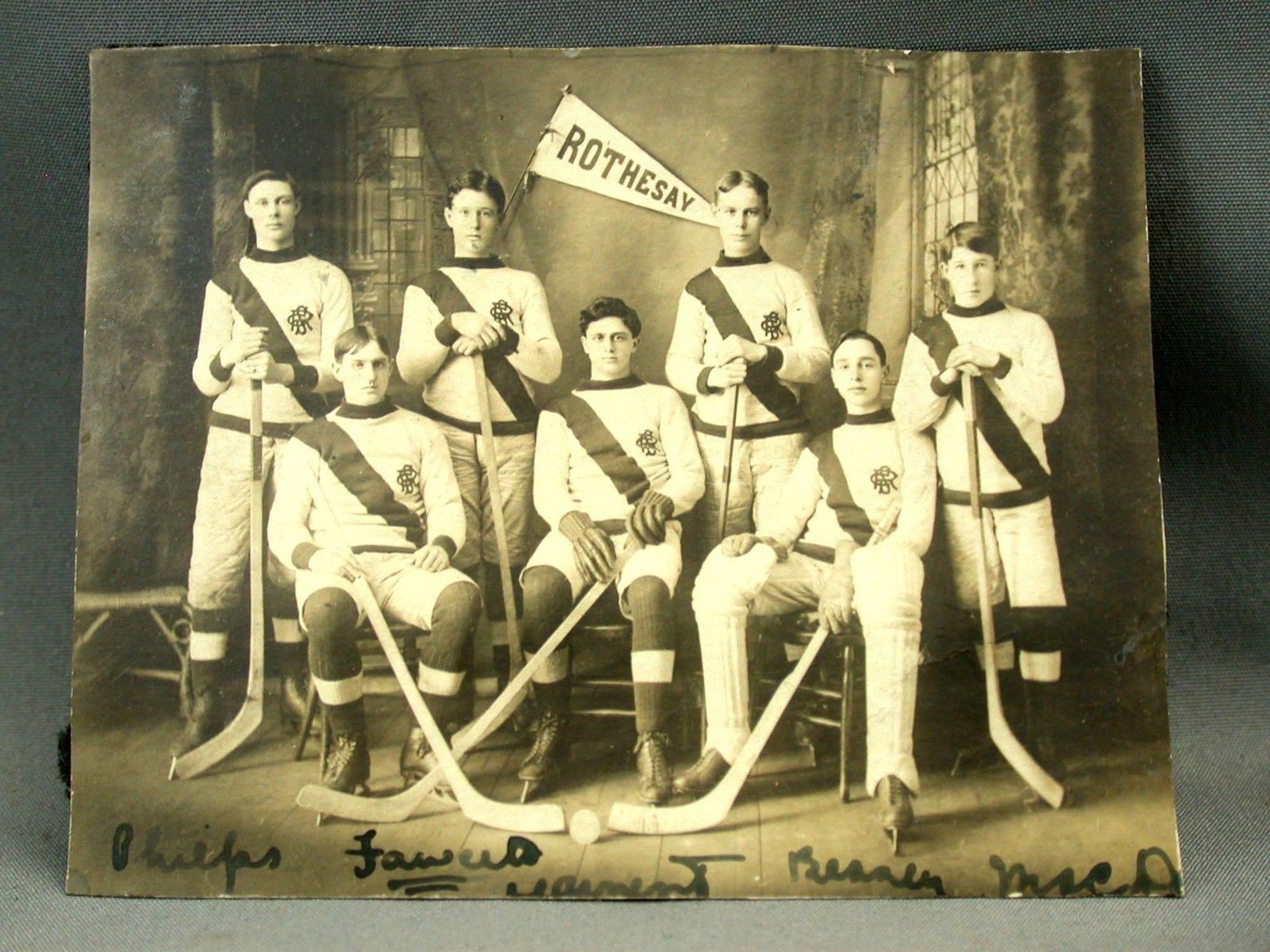
1932 Team Photo - R. C. S. / Rothesay Collegiate School, Second Rugby / Football Team, Rothesay, New Brunswick
(back row - left to right)
Lewis J. Archibald - Sydney Mines, Nova Scotia - Lewis Johnston Archibald (b. 1 April 1916 - d. 1988 in Nova Scotia, Canada) - LINK to his find a grave site - www.findagrave.com/memorial/36098150/lewis-johnston-archi...
William Fraser Napier - (b. 1916 in Campbellton, New Brunswick - d. 2 December 2004 in Victoria, B.C.) - LINK to his newspaper obituary - www.newspapers.com/article/times-colonist-obituary-for-wi...
H. B. Kee - Fair Vale, (Rothesay), New Brunswick - Harold Burgess Kee (b. 23 November 1920 – Deceased)
F. B. Edgett - Moncton, New Brunswick / Fred Brewster Edgett (b. 16 April 1915 in Moncton, Westmorland County, New Brunswick, Canada - d. 18 December 1988 (aged 73) in Moncton, Westmorland County, New Brunswick, Canada) - LINK to his Find a Grave site - www.findagrave.com/memorial/200848543/fred_brewster-edgett
R. B. Coates - Hampton Station, New Brunswick / Ralph Bamford Coates (b. 15 November 1917 in Scoudouc, New Brunswick – d. 26 June 1993 at age 75 in Moncton, New Brunswick) - LINK to his newspaper obituary - www.newspapers.com/article/the-times-transcript-obituary-...
Norman Sproul - Chatham, New Brunswick -
(b. October 2, 1913 in Chatham, New Brunswick - d. February 20, 2014 at age 100 in British Columbia) - Dr. Norman Sproul passed away at home on February 20, 2014 with his daughter by his side. He was born in Chatham New Brunswick on October 2, 1913, the youngest of 7 children to Dr. George Jasper Sproul and Janie Amanda Sproul, nee Searle. In December, 1941 he married Marjorie Campbell Armitage from Deseronto, Ontario. He graduated from University of Toronto Faculty of Dentistry in 1943. He served in the Canadian Army from 1942 to 1946 rising to the rank of Captain. Following the war he opened a dental practice in Kingston, Ontario. He was awarded the Queen's Silver Jubilee medal in 1977 for his contribution to geriatric dental care. LINK - www.legacy.com/us/obituaries/legacyremembers/norman-sprou...
Eric Blanchet - Rothesay, New Brunswick / Eric Sidney Blanchet (b. 14 November 1916 in Rothesay, Kings County, New Brunswick, Canada – d. 4 December 1993 at age 77 in Duncan, British Columbia, Canada) - LINK to his death certificate - search-collections.royalbcmuseum.bc.ca/Image/Genealogy/6c...
Harold Harding - Hammond River, New Brunswick - LINK to his newspaper obituary - www.newspapers.com/article/saint-john-times-globe-obituar...
Mr. Jackson - Coach
(front row - left to right)
Ralph Mason Burchell - Little Bras D'Or, Nova Scotia (1916-1998) - LINK to his Find a Grave site - www.findagrave.com/memorial/249548348/ralph-mason-burchell
Horace MacDonald Browne - (b. 1916 in Hamilton, Bermuda - d. 2005 in Bermuda) - Spouse - Kathryn "Kay" Mary Gault (1919 - 1981) LINK to his Find a Grave site - www.findagrave.com/memorial/146313774/horace-m-browne - LINK to their marriage - www.newspapers.com/article/the-post-standard-mrs-horace-m...
Donald Walton McNeill Good - Sussex (1917-1990) - LINK to his Find a Grave site - www.findagrave.com/memorial/226562911/donald-m-good
Ian Montgomery Malcom (1915-1985) - Frederickton - LINK to his Find a Grave site - www.findagrave.com/memorial/114532026/ian-montgomery-malcom
James Lawrence Gerry - New York (b. 31 May 1916 in
Pelham, Westchester County, New York, United States - d. September 1978)
Keith Burton Logie - Nassau, New York (b. 6 February 1917 in Lancashire, England - d. 1998 in Surrey, England)
Henry Blair Blanchard - Truro, N.S. LINK to his Find a Grave site - www.findagrave.com/memorial/212790642/henry-blair-blanchard
LINK to - 1932 Rothesay Collegiate School - List of Students - www.newspapers.com/article/saint-john-times-globe-1932-ro...
Italy - 19 February 2015
Indians in Italy join BJP to contribute the growth and development of India. National Secretary, BJP Kisan Morcha and Prabhari Himachal Pradesh Advocate, Sukhminderpal Singh Grewal said though India and Italy are quiet distant from each other but Italy have made its presence felt in the kitchens of India as every modern day indian cooks pasta and enjoys the dish pretty much and Italy resides in the hearts of modern day Indian. In a meeting with the party workers of Bharatiya Janata party (BJP) and people of Indian origin Grewal firstly thanked everyone for inviting him to this historical country. Grewal said that these two ancient civilizations have known, interacted and traded with each other for over 2000 years. Modern day contacts between the two nations were formed through exchanges between the intellectuals from both sides. Noble Laureate Rabindranath Tagore visited Italy on invitation of Carlo Formichi, a Professor of Sanskrit at the University of Rome. Grewal praised indian community Residing in Italy and said there contribution in the country is huge .Italy is home to second largest community of Indians in Europe after UK. As per the latest Italian official estimates, more than 1, 60000 Indian nationals are resident in Italy. As first generation migrants, majority of them are engaged in economic sectors such as agriculture, dairy farming, leather industry, construction works and in service Industry. In meeting listening to the problems of People Grewal said that he is aware of the problems which NRI's face relating to property disputes in India and other cases and he assured that Bharatiya Janata party operates a NRI wing which deals with such problems faced by NRI's , this wing stays in touch with its members . He further stated that NRI thanas are opened in punjab which has Bharatiya Janata party in power, He urged Indians in Italy and across the world to join Bharatiya Janata party and contribute further in the growth and development of your country. Grewal said that the United Nations also declared June 21 as the World Yoga Day. The decision, taken at the UN General Assembly, is being seen as a proud moment for India. Talking with the media persons after BJP workers meeting here today Grewal stated that our Hon'ble Prime Minister of India Shri Narendra Modi had urged the world community to celebrate Indian yoga at the international level during his visit to the United Nations in September this year. Grewal told here that India received support of 170 nations and United Nations declare June 21 as the World Yoga Day. He stated that in their speech at the UNGA, Hon'ble Prime Minister of India Shri Narendra Modi had said, "Let us work towards adopting an International Yoga Day. Yoga is an invaluable gift of our ancient tradition. It is not about exercise but to discover the sense of oneness with yourself, the world and the nature." He told that around 170 nations supported PM Modi's proposal. In November, European Union President Mr. Herman Van Rompuy told Hon'ble Prime Minister Shri Narendra Modi that the 28 member EU supported his idea for a Yoga Day at the UN. Grewal said that about four months ago, Hon'ble Prime Minister Shri Narendra Modi had appealed to the world community that India's yoga should be celebrated as World Yoga Day. Grewal said that I am happy to inform you that India have received support of 170 nations and the United Nations will declare June 21 as the World Yoga Day". Grewal told that Yoga is the 5000 years old Indian physical, mental and spiritual practice that aims to transform body and mind for good health. In this BJP Italy meeting President Satish Kumar Joshi, Cashier Sangeeta Sharma Monte-forte Dal pone , Aman Gupta Vicenza , Surender Kumar Khattar Asand Monte-forte Dal pone , Raj Kumar Vicenza , Balbir Saini San Bonifacio Verona , Sandeep Kumar Talhan Lonigo Vicenza Italy , Rajan Kumar Talhan Lonigo Vicenza , Balwinder Singh Dhillon Kulam Verona , Balvir Singh Verona , Jagtar Singh Sanboni Facio Verona , Ashok Kumar Sanboni Facio Verona , Parvesh Kumar Shukla Sanboni Facio Verona , Jagjit Singh Sanboni Facio Verona , Charanjit Singh Vicenza , Harpal Singh Sanboni Facio Verona , Sanjiv Kumar Vicenza , Sher Singh Dherdu Sanboni Facio Verona , Subash Chand San Bonifacio Verona , Baljit Singh Lonigo , Jatinder Pal Trento , Ranjit Singh Vicenza , Gurmukh Singh Crespadoro Vicenza , Rajinder Singh Crespadoro Vicenza , Raminder Singh Altissimo Vicenza were present
The Hotel Florence opened in 1881. The hotel was named for George Pullman's daughter, Florence. Pullman built the Eastlake/Queen Anne inspired structure as a lodging place for visitor to his sprawling railroad car manufacturing operation. A veranda extends along the entire front and sides of the building. The Hotel Florence is in the Pullman Historic District listed on the National Register of Historic Places and is a contributing structure.
The Emirates Air Line - Thames cable car-London 2012
Journey across the river ThamesThe system is sponsored by Dubai-based airline Emirates, which has contributed £36 million to the project in a 10-year deal.
A single fare will cost £3.20 for those using Oyster cards and £1.60 for children, while adults paying by cash will have to fork out £4.30.
There will also be special 'frequent flyer' deals for regular users.
It cuts journey times to around five minutes between the O2 arena and the ExCel exhibition centre - both of which are Olympic venues.
The O2 will host events including the gymnastics and basketball finals, while the ExCel centre features seven Olympic events and six Paralympic sports.
Each car provides 360-degree views taking in the City, Canary Wharf, historic Greenwich, the Thames Barrier and the Olympic Park.
Although it has been completed in time for the Olympics, it will also help cut commute times and stay in place after the games.
The two locations of the Emirates Airline has already been added to Transport for London maps.
North of the River Thames the Emirates Royal Dock is accessible via a short walk from Royal Victoria station on the DLR, while south of the river the Emirates Greenwich Peninsula is close to North Greenwich tube station on the Jubilee line.
Read more: www.dailymail.co.uk/news/article-2165872/London-2012-Olym...
If you have any questions or would like to contribute to this archive, please visit www.underjams.art and contact me on Twitter DM or Telegram ♥
If you have any questions or would like to contribute to this archive, please visit www.underjams.art and contact me on Twitter DM or Telegram ♥
© All Rights Reserved - Black Diamond Images
The IDENTIFYING AUSTRALIAN RAINFOREST PLANTS, TREES and FUNGI group was founded on August 23rd 2007.
On the 5th March 2020 there were just over 64,000 images in the pool, contributed by 694 members as of that date.
All images in the pool have been botanically identified and tagged allowing creation of DATABASES based on Scientific Name, Genus, Plant Family, Common Names as well as a large selection of specific tags aimed at creating freely accessible, useful, and specialised collections of images of Australian Rainforest Plants, Trees and Fungi.
GROUP STATISTICS
64,000 Images 5th March 2020 - 694 Members
63,000 images 12th January 2020 - 690 Members
62,000 images 29th October 2019 - 688 Members
61,000 images 4th July 2019 - 677 Members
60,000 images 3rd March 2019 - 660 Members
59,000 images 25th December 2018 - 654 Members
58,000 images 13th July 2018 - 643 Members
57000 images 2nd December 2017 - 624 Members
56,000 images 6th October 2017 - 622 Members
55,000 images 30th April 2017 - 598 Members
54,000 images 8th February 2017 - 590 Members
53,000 images 15th October 2016 - 575 Members
52,000 images 5th May 2016 - 565 Members
50,000 images 16th November 2015 - 550 Members
49,000 images 5th September 2015 - 537 Members
48,000 images 3rd July 2015 - 526 Members
47,000 images 9th May 2015 - 517 Members
46,000 images 3rd March 2015 - 506 Members
45,000 images 6th January 2015 - 502 Members
44,000 images 17th November 2014 - 494 Members
43,000 images 22nd September 2014 - 484 Members
42,000 images 5th August 2014 - 478 Members
41,000 images 26th June 2014 - 474 Members
40,000 images 10th May 2014 - 467 Members
39,000 images 15th April 2014 - 463 Members
38,000 images 6th March 2014 - 460 Members
37,000 images 11th February 2014 - 460 Members
36,000 images 30th December 2013 - 452 Members
35,000 images 12th November 2013 - 448 Members
34,000 images 12th October 2013 - 447 Members
33,000 images 16th September 2013 - 441 Members
32,000 images 10th August 2013 - 438 Members
31,000 images 22nd July 2013 - 438 Members
30,000 images 15th June 2013 - 434 Members
29,000 images 12th May 2013 - 425 Members
28,000 images 27th March 2013 - 422 Members
27,000 images 16th February 2013 - 415 Members
26,000 images 23rd January 2013 - 408 Members
25,000 images 16th December 2012 - 404 Members
24,000 images 10th November 2012 - 398 Members
23,000 images 28th September 2012 - 394 Members
22,000 images - 29th July 2012 - 387 members
21,000 images - 26th June 2012 - 383 Members
20,000 images - 9th May 2012 - 374 Members
19,000 images - 28th February 2012 - 360 members
18,000 images - 10th January 2012 - 352 members
17,000 images - 18th November 2011 - 349 members
16,000 images - 1st October 2011 - 345 members
15,000 images - 15th August 2011 - 342 members
14,000 images - 14th June 2011 - 337 members
13,000- images 2nd May 2011 - 327 members
12,000 images 16th February 2011 - 315 members
11,000 images - 7th December 2010 - 295 members
10,000 images - 10th August 2010 - 272 members
9,000 images - 28th May 2010 - 262 members
8,000 images - 13th February 2010 - 244 members
7,000 images - 16th November 2009 - 221 members
6,000 images - 29th July 2009 - 189 members
5,000 images - 9th March 2009 - 158 members
4,000 images - 26th November 2008 - 129 members
3,000 images - 18th August 2008 - 105 members
No prior records maintained
**Group Founded 23rd August 2007.
Some information about the groups history and milestones can be located HERE.
OR check out the arfmilestone tag
IDENTIFYING AUSTRALIAN RAINFOREST PLANTS,TREES & FUNGI - Flick Group --> DATABASE INDEX
Knowsley Safari Park is a zoological park and tourist attraction in the Knowsley area of Merseyside, England. Knowsley Safari Park is a member of the British and Irish Association of Zoos and Aquariums (BIAZA) and the European Association of Zoos and Aquaria (EAZA). The safari park contributes to conservation and research through links with conservation projects and its links with universities in Liverpool, Chester and Manchester.
History
The park was opened in July 1971 by Edward Stanley, 18th Earl of Derby and Jimmy Chipperfield[9] using the expertise of general manager Laurence Tennant MBE, formerly the Chief Game Warden of Parks in Uganda and Botswana. Initially the road through the park was 3.5 miles (5.6 km), with visitors driving past lions, cheetahs, monkeys, giraffes, zebra, elephants and various antelope. Due to the popularity of this route, an additional 1.5 miles (2.4 km) of road was added in 1973, and camels, buffalo, white rhino, and tigers were added to the park. Over the years, a few modifications have been made. For instance, tigers are now displayed in enclosures within the reserve, and a bypass around the baboons was built for visitors who are worried about damage to their cars.
The park was also home to a former RAF airfield which closed at the end of World War II. The RAF airbase situated at the safari park was also known as No 49 SLG or RAF Knowsley Park and was in use between 13 May 1942 – November 1944.
The park has hosted several sporting events including the Olympic torch relay, watched by 6,000 children and families in June 2012. The park hosted the finish of Stage Two of the 2012 Tour of Britain cycling event and is scheduled to host Stage Three of the 2013 Tour on Tuesday 17 September.
Most recently it hosted the final leg of Big Learner Relay 2017 which has raised over £300,000 for the BBC Children in Need appeal since 2014. Louise Walsh the inspiration behind the BLR has been awarded the prime minister's points of light award which recognises outstanding individual volunteers.
In 1995 Mr William Middleton, a warden at the park, was crushed and paralysed due to a faulty elephant enclosure. Mr Middleton died 12 years later due to complications caused by his injuries.
Zoological collection
Situated around Knowsley Hall on the ancestral estate of the Earl of Derby, the reserve is home to many different animals including elephants, giraffes, lions, bongos, tigers and baboons. The Derby Estate have a tradition of keeping animals, ever since the famous artist and nonsense-poet Edward Lear was employed there in the 19th century to paint pictures of the Earl's collection.
The park is open to the public and customers drive around the park in their own vehicles. There is a bypass route past the baboons for those who wish to avoid the risk of the baboons damaging their cars. In 2009 the baboons made the news all over the world when a video was released showing how they were intelligent and curious enough to open car roofboxes.
Tiger Trail
Amur Tiger Trail opened 25 May 2018, home to the Amur Tiger otherwise known as the Siberian Tiger. The area is 10,000m2 and includes forested areas, natural streams and ponds.
The Equatorial Trail
This exhibit focuses on animals who thrive in habitats around the Earth's Equator. The exhibit also houses the 'Equatorial Express', a small train which visitors can ride to gain a unique viewpoint of the animals. 4 completely different species of animals are housed in this exhibit, the South American tapir, Sitatunga, Rhea and the Capybara.
African Elephant
Until 2017 the park housed a herd of 4 adult cows named Tana, Ashanti, Nala and Juba. They were transported to Zoo Parc d'Beauval, France to enter the European Breeding Programme and allow for transformations on Knowsley Safari's Foot Safari. Knowsley previously housed a bull named Nissim, who collapsed in June 2014. Knowsley also recently lost their cow named Shaba due to a long battle with elephant arthritis.
Southern White Rhinoceros
Knowsley's crash of 11 adult rhinos is one of the most successful and genetically diverse breeding groups in Europe. The latest calf (as at 4 June 2016), Nomvula (Mother of Rain – a reference to the recent wet weather), born to mum Meru and is the 19th to be born at the facility in the last 40 years. Nomvula is Meru's 6th calf and was born on 2 January 2016.
Safari Drive
The Safari Drive is the park's main attraction and contains over 29 species of animals in 7 zones.
Zone 1+11
This zone contains: Père David's deer, Yak, Kiang and Bactrian camel.
Zone 2+8
This zone contains: Blackbuck, Nilgai, Eld's deer, Chital (Axis Deer) and Barasingha.
Zone 3+4+6
Zone 6 is over 100 acres and contains over a mile of road. It is one of Knowsley's two white rhino paddocks and is one of the largest in the UK. This zone contains: Southern White Rhino, Roan antelope, Eland, Lechwe, Wildebeest, Plains Zebra, African Forest Buffalo, Ostritch and Waterbuck.
Zone 5
This zone contains: Blesbok and Bongo
Zone 7
This zone contains exclusively the Olive baboon, which are famous for removing windscreen wipers and other appendages off vehicles. There is a car-friendly route which totally removes this zone however is still visible from outside the perimeter. This leads directly to zone 6.
Zone 9
This zone contains: European Bison, Fallow Deer and European Moose
Zone 10
This zone contains: Lion, and the Somali wild ass. This zone previously housed African wild dog, Iberian Wolf and Siberian Tiger.
All information correct and sourced from the Knowsley Safari Guide Book 2018 and edited by an editor who loves animals.
Railway and other attractions
The park features a 15 in (381 mm) gauge railway, 'The Lakeside Railway', on which visitors may tour parts of the site. There is also a collection of amusements and fairground rides on site plus paintballing, off-road driving challenges, and aerial extreme ropewalks.
A baboon house was added in 2006, along with African wild dogs that same year, a lion and tiger house in 2007. Red river hogs and marmosets were also added to the walkaround section, as well as an outdoor pool.
Animal care
In January 2011, local animal rights activists held a peaceful demonstration after an inspection by government vets found one instance of a breach of regulations on the disposal of animal ‘by-products’. Pictures in the Daily Mail showed animals lying dead on the ground and in binbags, although the park's directors claim the pictures were staged by the photographer, whose husband the paper claimed had recently lost his job at the park. The park has since installed an enclosure for the storage of animal carcasses before disposal. The British and Irish Association of Zoos and Aquariums (BIAZA) later said it had ‘full confidence’ in Knowsley and praised its ‘excellent standards of animal husbandry and welfare’.
Knowsley Safari Park is a zoological park and tourist attraction in the Knowsley area of Merseyside, England. Knowsley Safari Park is a member of the British and Irish Association of Zoos and Aquariums (BIAZA) and the European Association of Zoos and Aquaria (EAZA). The safari park contributes to conservation and research through links with conservation projects and its links with universities in Liverpool, Chester and Manchester.
History
The park was opened in July 1971 by Edward Stanley, 18th Earl of Derby and Jimmy Chipperfield[9] using the expertise of general manager Laurence Tennant MBE, formerly the Chief Game Warden of Parks in Uganda and Botswana. Initially the road through the park was 3.5 miles (5.6 km), with visitors driving past lions, cheetahs, monkeys, giraffes, zebra, elephants and various antelope. Due to the popularity of this route, an additional 1.5 miles (2.4 km) of road was added in 1973, and camels, buffalo, white rhino, and tigers were added to the park. Over the years, a few modifications have been made. For instance, tigers are now displayed in enclosures within the reserve, and a bypass around the baboons was built for visitors who are worried about damage to their cars.
The park was also home to a former RAF airfield which closed at the end of World War II. The RAF airbase situated at the safari park was also known as No 49 SLG or RAF Knowsley Park and was in use between 13 May 1942 – November 1944.
The park has hosted several sporting events including the Olympic torch relay, watched by 6,000 children and families in June 2012. The park hosted the finish of Stage Two of the 2012 Tour of Britain cycling event and is scheduled to host Stage Three of the 2013 Tour on Tuesday 17 September.
Most recently it hosted the final leg of Big Learner Relay 2017 which has raised over £300,000 for the BBC Children in Need appeal since 2014. Louise Walsh the inspiration behind the BLR has been awarded the prime minister's points of light award which recognises outstanding individual volunteers.
In 1995 Mr William Middleton, a warden at the park, was crushed and paralysed due to a faulty elephant enclosure. Mr Middleton died 12 years later due to complications caused by his injuries.
Zoological collection
Situated around Knowsley Hall on the ancestral estate of the Earl of Derby, the reserve is home to many different animals including elephants, giraffes, lions, bongos, tigers and baboons. The Derby Estate have a tradition of keeping animals, ever since the famous artist and nonsense-poet Edward Lear was employed there in the 19th century to paint pictures of the Earl's collection.
The park is open to the public and customers drive around the park in their own vehicles. There is a bypass route past the baboons for those who wish to avoid the risk of the baboons damaging their cars. In 2009 the baboons made the news all over the world when a video was released showing how they were intelligent and curious enough to open car roofboxes.
Tiger Trail
Amur Tiger Trail opened 25 May 2018, home to the Amur Tiger otherwise known as the Siberian Tiger. The area is 10,000m2 and includes forested areas, natural streams and ponds.
The Equatorial Trail
This exhibit focuses on animals who thrive in habitats around the Earth's Equator. The exhibit also houses the 'Equatorial Express', a small train which visitors can ride to gain a unique viewpoint of the animals. 4 completely different species of animals are housed in this exhibit, the South American tapir, Sitatunga, Rhea and the Capybara.
African Elephant
Until 2017 the park housed a herd of 4 adult cows named Tana, Ashanti, Nala and Juba. They were transported to Zoo Parc d'Beauval, France to enter the European Breeding Programme and allow for transformations on Knowsley Safari's Foot Safari. Knowsley previously housed a bull named Nissim, who collapsed in June 2014. Knowsley also recently lost their cow named Shaba due to a long battle with elephant arthritis.
Southern White Rhinoceros
Knowsley's crash of 11 adult rhinos is one of the most successful and genetically diverse breeding groups in Europe. The latest calf (as at 4 June 2016), Nomvula (Mother of Rain – a reference to the recent wet weather), born to mum Meru and is the 19th to be born at the facility in the last 40 years. Nomvula is Meru's 6th calf and was born on 2 January 2016.
Safari Drive
The Safari Drive is the park's main attraction and contains over 29 species of animals in 7 zones.
Zone 1+11
This zone contains: Père David's deer, Yak, Kiang and Bactrian camel.
Zone 2+8
This zone contains: Blackbuck, Nilgai, Eld's deer, Chital (Axis Deer) and Barasingha.
Zone 3+4+6
Zone 6 is over 100 acres and contains over a mile of road. It is one of Knowsley's two white rhino paddocks and is one of the largest in the UK. This zone contains: Southern White Rhino, Roan antelope, Eland, Lechwe, Wildebeest, Plains Zebra, African Forest Buffalo, Ostritch and Waterbuck.
Zone 5
This zone contains: Blesbok and Bongo
Zone 7
This zone contains exclusively the Olive baboon, which are famous for removing windscreen wipers and other appendages off vehicles. There is a car-friendly route which totally removes this zone however is still visible from outside the perimeter. This leads directly to zone 6.
Zone 9
This zone contains: European Bison, Fallow Deer and European Moose
Zone 10
This zone contains: Lion, and the Somali wild ass. This zone previously housed African wild dog, Iberian Wolf and Siberian Tiger.
All information correct and sourced from the Knowsley Safari Guide Book 2018 and edited by an editor who loves animals.
Railway and other attractions
The park features a 15 in (381 mm) gauge railway, 'The Lakeside Railway', on which visitors may tour parts of the site. There is also a collection of amusements and fairground rides on site plus paintballing, off-road driving challenges, and aerial extreme ropewalks.
A baboon house was added in 2006, along with African wild dogs that same year, a lion and tiger house in 2007. Red river hogs and marmosets were also added to the walkaround section, as well as an outdoor pool.
Animal care
In January 2011, local animal rights activists held a peaceful demonstration after an inspection by government vets found one instance of a breach of regulations on the disposal of animal ‘by-products’. Pictures in the Daily Mail showed animals lying dead on the ground and in binbags, although the park's directors claim the pictures were staged by the photographer, whose husband the paper claimed had recently lost his job at the park. The park has since installed an enclosure for the storage of animal carcasses before disposal. The British and Irish Association of Zoos and Aquariums (BIAZA) later said it had ‘full confidence’ in Knowsley and praised its ‘excellent standards of animal husbandry and welfare’.
Nizza
Nice (/niːs/ NEESS; French pronunciation: [nis]) is a city in and the prefecture of the Alpes-Maritimes department in France. The Nice agglomeration extends far beyond the administrative city limits, with a population of nearly one million on an area of 744 km2 (287 sq mi). Located on the French Riviera, the southeastern coast of France on the Mediterranean Sea, at the foot of the French Alps, Nice is the second-largest French city on the Mediterranean coast and second-largest city in the Provence-Alpes-Côte d'Azur region after Marseille. Nice is approximately 13 kilometres (8 mi) from the principality of Monaco and 30 kilometres (19 mi) from the French–Italian border. Nice's airport serves as a gateway to the region.
The city is nicknamed Nice la Belle (Nissa La Bella in Niçard), meaning 'Nice the Beautiful', which is also the title of the unofficial anthem of Nice, written by Menica Rondelly in 1912. The area of today's Nice contains Terra Amata, an archaeological site which displays evidence of a very early use of fire 380,000 years ago. Around 350 BC, Greeks of Marseille founded a permanent settlement and called it Nikaia, after Nike, the goddess of victory. Through the ages, the town has changed hands many times. Its strategic location and port significantly contributed to its maritime strength. From 1388, it was a dominion of Savoy, then became part of the French First Republic between 1792 and 1815, when it was returned to the Kingdom of Piedmont-Sardinia, the legal predecessor of the Kingdom of Italy, until its annexation by France in 1860.
The natural environment of the Nice area and its mild Mediterranean climate came to the attention of the English upper classes in the second half of the 18th century, when an increasing number of aristocratic families began spending their winters there. In 1931, following its refurbishment, the city's main seaside promenade, the Promenade des Anglais ("Walkway of the English"), was inaugurated by Prince Arthur, Duke of Connaught; it owes its name to visitors to the resort. These included Queen Victoria along with her son Edward VII who spent winters there, as well as Henry Cavendish, born in Nice, who discovered hydrogen.
The clear air and soft light have particularly appealed to notable painters, such as Marc Chagall, Henri Matisse, Niki de Saint Phalle, and Arman. Their work is commemorated in many of the city's museums, including Musée Marc Chagall, Musée Matisse and Musée des Beaux-Arts. International writers have also been attracted and inspired by the city. Frank Harris wrote several books including his autobiography My Life and Loves in Nice. Friedrich Nietzsche spent six consecutive winters in Nice, and wrote Thus Spoke Zarathustra there. Additionally, Russian writer Anton Chekhov completed his play Three Sisters while living in Nice.
Nice's appeal extended to the Russian upper classes. Prince Nicholas Alexandrovich, heir apparent to Imperial Russia, died in Nice and was a patron of the Russian Orthodox Cemetery, Nice where Princess Catherine Dolgorukova, morganatic wife of the Tsar Alexander II of Russia, is buried. Also buried there are General Dmitry Shcherbachev and General Nikolai Yudenich, leaders of the anti-Communist White Movement.
Those interred at the Cimetière du Château include celebrated jeweler Alfred Van Cleef, Emil Jellinek-Mercedes, founder of the Mercedes car company, film director Louis Feuillade, poet Agathe-Sophie Sasserno, dancer Carolina Otero, Asterix comics creator René Goscinny, The Phantom of the Opera author Gaston Leroux, French prime minister Léon Gambetta, and the first president of the International Court of Justice José Gustavo Guerrero.
Because of its historical importance as a winter resort town for the European aristocracy and the resulting mix of cultures found in the city, UNESCO proclaimed Nice a World Heritage Site in 2021. The city has the second largest hotel capacity in the country, and it is the second most visited metropolis in Metropolitan France, receiving four million tourists every year. It also has the third busiest airport in France, after the two main Parisian ones. It is the historical capital city of the County of Nice (French: Comté de Nice, Niçard: Countèa de Nissa).
History
Foundation
The first known hominid settlements in the Nice area date back about 400,000 years (homo erectus); the Terra Amata archeological site shows one of the earliest uses of fire, construction of houses, as well as flint findings dated to around 230,000 years ago. Nice was probably founded around 350 BC by colonists from the Greek city of Phocaea in western Anatolia. It was given the name of Níkaia (Νίκαια) in honour of a victory over the neighbouring Ligurians (people from the northwest of Italy, probably the Vediantii kingdom); Nike (Νίκη) was the Greek goddess of victory. The city soon became one of the busiest trading ports on the Ligurian coast; but it had an important rival in the Roman town of Cemenelum, which continued to exist as a separate city until the time of the Lombard invasions. The ruins of Cemenelum are in Cimiez, now a district of Nice.
Early development
In the 7th century, Nice joined the Genoese League formed by the towns of Liguria. In 729 the city repulsed the Saracens; but in 859 and again in 880 the Saracens pillaged and burned it, and for most of the 10th century remained masters of the surrounding country.
During the Middle Ages, Nice participated in the wars and history of Italy. As an ally of Pisa it was the enemy of Genoa, and both the King of France and the Holy Roman Emperor endeavoured to subjugate it; despite this, it maintained its municipal liberties. During the 13th and 14th centuries the city fell more than once into the hands of the Counts of Provence, but it regained its independence even though related to Genoa.
The medieval city walls surrounded the Old Town. The landward side was protected by the River Paillon, which was later covered over and is now the tram route towards the Acropolis. The east side of the town was protected by fortifications on Castle Hill. Another river flowed into the port on the east side of Castle Hill. Engravings suggest that the port area was also defended by walls. Under Monoprix in Place de Garibaldi are excavated remains of a well-defended city gate on the main road from Turin.
Duchy of Savoy
In 1388, the commune placed itself under the protection of the Counts of Savoy. Nice participated – directly or indirectly – in the history of Savoy until 1860.
The maritime strength of Nice now rapidly increased until it was able to cope with the Barbary pirates; the fortifications were largely extended and the roads to the city improved. In 1561 Emmanuel Philibert, Duke of Savoy abolished the use of Latin as an administrative language and established the Italian language as the official language of government affairs in Nice.
During the struggle between Francis I and Charles V great damage was caused by the passage of the armies invading Provence; pestilence and famine raged in the city for several years. In 1538, in the nearby town of Villeneuve-Loubet, through the mediation of Pope Paul III, the two monarchs concluded a ten years' truce.
In 1543, Nice was attacked by the united Franco-Ottoman forces of Francis I and Barbarossa Hayreddin Pasha, in the Siege of Nice; though the inhabitants repulsed the assault which followed the terrible bombardment, they were ultimately compelled to surrender, and Barbarossa was allowed to pillage the city and to carry off 2,500 captives. Pestilence appeared again in 1550 and 1580.
In 1600, Nice was briefly taken by the Duke of Guise. By opening the ports of the county to all nations, and proclaiming full freedom of trade (1626), the commerce of the city was given great stimulus, the noble families taking part in its mercantile enterprises.
Captured by Nicolas Catinat in 1691, Nice was restored to Savoy in 1696; but it was again besieged by the French in 1705, and in the following year its citadel and ramparts were demolished.
Kingdom of Sardinia
The Treaty of Utrecht (1713) once more gave the city back to the Duke of Savoy, who was on that same occasion recognised as King of Sicily. In the peaceful years which followed, the "new town" was built. From 1744 until the Treaty of Aix-la-Chapelle (1748) the French and Spaniards were again in possession.
In 1775 the king, who in 1718 had swapped his sovereignty of Sicily for the Kingdom of Sardinia, destroyed all that remained of the ancient liberties of the commune. Conquered in 1792 by the armies of the First French Republic, the County of Nice continued to be part of France until 1814; but after that date it reverted to the Kingdom of Piedmont-Sardinia.
French annexation
After the Treaty of Turin was signed in 1860 between the Sardinian king and Napoleon III as a consequence of the Plombières Agreement, the county was again and definitively ceded to France as a territorial reward for French assistance in the Second Italian War of Independence against Austria, which saw Lombardy united with Piedmont-Sardinia. King Victor-Emmanuel II, on 1 April 1860, solemnly asked the population to accept the change of sovereignty, in the name of Italian unity, and the cession was ratified by a regional referendum. Italophile manifestations and the acclamation of an "Italian Nice" by the crowd are reported on this occasion. A plebiscite was voted on 15 and 16 April 1860. The opponents of annexation called for abstention, hence the very high abstention rate. The "yes" vote won 83% of registered voters throughout the county of Nice and 86% in Nice, partly thanks to pressure from the authorities. This is the result of a masterful operation of information control by the French and Piedmontese governments, in order to influence the outcome of the vote in relation to the decisions already taken. The irregularities in the plebiscite voting operations were evident. The case of Levens is emblematic: the same official sources recorded, faced with only 407 voters, 481 votes cast, naturally almost all in favor of joining France.
The Italian language, which was the official language of the County, used by the Church, at the town hall, taught in schools, used in theaters and at the Opera, was immediately abolished and replaced by French. Discontent over annexation to France led to the emigration of a large part of the Italophile population, also accelerated by Italian unification after 1861. A quarter of the population of Nice, around 11,000 people from Nice, decided to voluntarily exile to Italy. The emigration of a quarter of the Niçard Italians to Italy took the name of Niçard exodus. Many Italians from Nizza then moved to the Ligurian towns of Ventimiglia, Bordighera and Ospedaletti, giving rise to a local branch of the movement of the Italian irredentists which considered the re-acquisition of Nice to be one of their nationalist goals. Giuseppe Garibaldi, born in Nice, strongly opposed the cession to France, arguing that the ballot was rigged by the French. Furthermore, for the niçard general his hometown was unquestionably Italian. Politically, the liberals of Nice and the partisans of Garibaldi also appreciated very little Napoleonic authoritarianism. Elements on the right (aristocrats) as on the left (Garibaldians) therefore wanted Nice to return to Italy. Savoy was also transferred to the French crown by similar means.
In 1871, during the first free elections in the County, the pro-Italian lists obtained almost all the votes in the legislative elections (26,534 votes out of 29,428 votes cast), and Garibaldi was elected deputy at the National Assembly. Pro-Italians took to the streets cheering "Viva Nizza! Viva Garibaldi!". The French government sent 10,000 soldiers to Nice, closed the Italian newspaper Il Diritto di Nizza and imprisoned several demonstrators. The population of Nice rose up from 8 to 10 February and the three days of demonstration took the name of "Niçard Vespers". The revolt was suppressed by French troops. On 13 February, Garibaldi was not allowed to speak at the French parliament meeting in Bordeaux to ask for the reunification of Nice to the newborn Italian unitary state, and he resigned from his post as deputy. The failure of Vespers led to the expulsion of the last pro-Italian intellectuals from Nice, such as Luciano Mereu or Giuseppe Bres, who were expelled or deported.
The pro-Italian irredentist movement persisted throughout the period 1860–1914, despite the repression carried out since the annexation. The French government implemented a policy of Francization of society, language and culture. The toponyms of the communes of the ancient County were francized, with the obligation to use French in Nice, as well as certain surnames (for example the Italian surname "Bianchi" was francized into "Leblanc", and the Italian surname "Del Ponte" was francized into "Dupont").
Italian-language newspapers in Nice were banned. In 1861, La Voce di Nizza was closed (temporarily reopened during the Niçard Vespers), followed by Il Diritto di Nizza, closed in 1871. In 1895 it was the turn of Il Pensiero di Nizza, accused of irredentism. Many journalists and writers from Nice wrote in these newspapers in Italian. Among these are Enrico Sappia, Giuseppe André, Giuseppe Bres, Eugenio Cais di Pierlas and others.
During the repression of January and February 1894, the police conducted raids targeting the Italian anarchists living there, without much success.
20th century
In 1900, the Tramway de Nice electrified its horse-drawn streetcars and spread its network to the entire département from Menton to Cagnes-sur-Mer. By the 1930s more bus connections were added in the area. In the 1930s, Nice hosted international car racing in the Formula Libre (predecessor to Formula One) on the so-called Circuit Nice. The circuit started along the waterfront just south of the Jardin Albert I, then headed westward along the Promenade des Anglais followed by a hairpin turn at the Hotel Negresco to come back eastward and around the Jardin Albert I before heading again east along the beach on the Quai des Etats-Unis.
As war broke out in September 1939, Nice became a city of refuge for many displaced foreigners, notably Jews fleeing the Nazi progression into Eastern Europe. From Nice many sought further shelter in the French colonies, Morocco and North and South America. After July 1940 and the establishment of the Vichy Regime, antisemitic aggressions accelerated the exodus, starting in July 1941 and continuing through 1942. On 26 August 1942, 655 Jews of foreign origin were rounded up by the Laval government and interned in the Auvare barracks. Of these, 560 were deported to Drancy internment camp on 31 August 1942. Due to the activity of the Jewish banker Angelo Donati and of the Capuchin friar Père Marie-Benoît the local authorities hindered the application of anti-Jewish Vichy laws.
The first résistants to the new regime were a group of high school seniors of the Lycée de Nice, now Lycée Masséna , in September 1940, later arrested and executed in 1944 near Castellane. The first public demonstrations occurred on 14 July 1942 when several hundred protesters took to the streets along the Avenue de la Victoire and in the Place Masséna. In November 1942 German troops moved into most of unoccupied France, but Italian troops moved into a smaller zone including Nice. A certain ambivalence remained among the population, many of whom were recent immigrants of Italian ancestry. However, the resistance gained momentum after the Italian surrender in 1943 when the German army occupied the former Italian zone. Reprisals intensified between December 1943 and July 1944, when many partisans were tortured and executed by the local Gestapo. American paratroopers entered the city on 30 August 1944 and Nice was finally liberated. The consequences of the war were heavy: the population decreased by 15% and economic life was totally disrupted.
In the second half of the 20th century, Nice enjoyed an economic boom primarily driven by tourism and construction. Two men dominated this period: Jean Médecin, mayor for 33 years from 1928 to 1943 and from 1947 to 1965, and his son Jacques, mayor for 24 years from 1966 to 1990. Under their leadership, there was extensive urban renewal, including many new constructions. These included the convention centre, theatres, new thoroughfares and expressways. The arrival of the Pieds-Noirs, refugees from Algeria after 1962 independence, also gave the city a boost and somewhat changed the make-up of its population and traditional views. By the late 1980s, rumors of political corruption in the city government surfaced; and eventually formal accusations against Jacques Médecin forced him to flee France in 1990. Later arrested in Uruguay in 1993, he was extradited back to France in 1994, convicted of several counts of corruption and associated crimes and sentenced to imprisonment.
On 16 October 1979, a landslide and an undersea slide caused two tsunamis that hit the western coast of Nice; these events killed between 8 and 23 people.
21st century
In February 2001, European leaders met in Nice to negotiate and sign what is now the Treaty of Nice, amending the institutions of the European Union.
In 2003, local Chief Prosecutor Éric de Montgolfier alleged that some judicial cases involving local personalities had been suspiciously derailed by the local judiciary, which he suspected of having unhealthy contacts through Masonic lodges with the defendants. A controversial official report stated later that Montgolfier had made unwarranted accusations.
On 14 July 2016, a truck was deliberately driven into a crowd of people by Mohamed Lahouaiej-Bouhlel on the Promenade des Anglais. The crowd was watching a fireworks display in celebration of Bastille Day. A total of 87 people were killed, including the perpetrator, who was shot dead by police. Another 434 were injured, with 52 in critical care and 25 in intensive care, according to the Paris prosecutor. On 29 October 2020, a stabbing attack killed three people at the local Notre-Dame de Nice. One of the victims, a woman, was beheaded by the attacker. Several additional victims were injured. The attacker, who was shot by the police, was taken into custody. The Islamic state claimed responsibility for both attacks.
In 2021, the city was proclaimed a World Heritage Site by UNESCO as "Nice, Winter Resort Town of the Riviera".
On 18 July 2024, seve people from the same family, including three young children, three adults and a teenager were killed in an arson attack. The fire also critically injured one other person and caused thirty other people to suffer from smoke inhalation.
Architecture
The Promenade des Anglais ("Walkway of the English") is a promenade along the Baie des Anges ("Bay of the Angels"), which is a bay of the Mediterranean in Nice. Before Nice was urbanised, the coastline at Nice was just bordered by a deserted stretch of shingle beach (covered with large pebbles). The first houses were located on higher ground well away from the sea, as wealthy tourists visiting Nice in the 18th century did not come for the beach, but for the gentle winter weather. The areas close to the water were home to Nice's dockworkers and fishermen.
In the second half of the 18th century, many wealthy English people took to spending the winter in Nice, enjoying the panorama along the coast. This early aristocratic English colony conceived the building of a promenade with the leadership and financial support of Rev. Lewis Way. With the initial promenade completed, the city of Nice, intrigued by the prospect, greatly increased the scope of the work. The Promenade was first called the Camin dei Anglès (the English Way) by the Niçois in their native dialect Nissart. In 1823, the promenade was named La Promenade des Anglais by the French, a name that would stick after the annexation of Nice by France in 1860.
The Hotel Negresco on the Promenade des Anglais was named after Henri Negresco who had the palatial hotel constructed in 1912. In keeping with the conventions of the time, when the Negresco first opened in 1913 its front opened on the side opposite the Mediterranean.
Beginning at Place Masséna, heading east and parallel to the Promenade des Anglais, there is a "Zone Piétonne", or "Pedestrian Zone". Cars are not allowed (with exception to delivery trucks), making this avenue a popular walkway.
Old Nice is also home to the Opéra de Nice. It was constructed at the end of the 19th century under the design of François Aune, to replace King Charles Félix's Maccarani Theater. Today, it is open to the public and provides a regular program of performances.
Climate
Nice has a hot-summer Mediterranean climate (Köppen: Csa), enjoying mild winters with moderate rainfall. It is one of the warmest Mediterranean climates for its latitude. Summers are warm to hot, dry, and sunny. Rainfall is rare in this season, and a typical July month only records one or two days with measurable rainfall. The temperature is typically above 26 °C (79 °F) but rarely above 32 °C (90 °F). The climate data is recorded from the airport, located just metres from the sea. Summer temperatures, therefore, are often higher in the city. The average maximum temperature in the warmest months of July and August is about 27 °C (81 °F). The highest recorded temperature was 37.7 °C (99.9 °F) on 1 August 2006. Autumn generally starts sunny in September and becomes more cloudy and rainy towards October, while temperatures usually remain above 20 °C (68 °F) until November where days start to cool down to around 17 °C (63 °F).
Winters are characterised by mild days (11 to 17 °C (52 to 63 °F)), cool nights (4 to 9 °C (39 to 48 °F)), and variable weather. Days can be either sunny and dry or damp and rainy. The average minimum temperature in January is around 5 °C (41 °F). Frost is unusual and snowfalls are rare. The most recent snowfall in Nice was on 26 February 2018.[46] Nice also received a dusting of snow in 2005, 2009 and 2010. Spring starts cool and rainy in late March, and Nice becomes increasingly warm and sunny around June.
Economy and tourism
Nice is the seat of the Chambre de commerce et d'industrie Nice Côte d'Azur, which manages the Port of Nice. Investors from France and abroad can benefit from the assistance of the Côte d'Azur Economic Development Agency Team Côte d'Azur.
Nice has one conference centre: the Palais des Congrès Acropolis. The city also has several business parks, including l'Arenas, Nice the Plain, Nice Méridia, Saint Isidore, and the Northern Forum.
In addition, the city features several shopping centres such as Nicetoile on Avenue Jean Médecin, Cap3000 in Saint-Laurent-du-Var (the 5th-biggest mall in France by surface area), Nice TNL, Nice Lingostière, Northern Forum, St-Isidore, the Trinity (around the Auchan hypermarket) and Polygone Riviera in Cagnes-sur-Mer.
Sophia Antipolis is a technology park northwest of Antibes. Much of the park is within the commune of Valbonne. Established between 1970 and 1984, it primarily houses companies in the fields of computing, electronics, pharmacology and biotechnology. Several institutions of higher learning are also located here, along with the European headquarters of W3C. It is known as "Europe's first science and technology hub" and is valued at more than 5 billion euros.
The Nice metropolitan area had a GDP amounting to $47.7 billion, and $34,480 per capita, slightly lower than the French average.
Culture
Terra-Amata, an archaeological site dating from the Lower Palaeolithic age, is situated near Nice. Nice itself was established by the ancient Greeks. There was also an independent Roman city, Cemenelum, near Nice, where the hill of Cimiez is located.
Since the 2nd century AD, the light of the city has attracted painters and sculptors such as Chagall, Matisse, Niki de Saint Phalle, Klein, Arman and Sosno. Nice inspired many composers and intellectuals in different countries e.g. Berlioz, Rossini, Nietzsche, etc.
Nice also has numerous museums of all kinds: Musée Marc Chagall, Musée Matisse, Musée des Beaux-Arts, Musée international d'Art naïf Anatole Jakovsky, Musée Terra-Amata, Museum of Asian Art, Musée d'art moderne et d'art contemporain (which devotes much space to the well-known École of Nice "), Museum of Natural History, Musée Masséna, Naval Museum and Galerie des Ponchettes.
Being a vacation resort, Nice hosts many festivals throughout the year, such as the Nice Carnival and the Nice Jazz Festival.
Nice has a distinct culture due to its unique history. The local language Niçard (Nissart) is an Occitan dialect (but some Italian scholars argue that it is a Ligurian dialect).[citation needed] It is still spoken by a substantial minority. Strong Italian and (to a lesser extent) Corsican influences make it more intelligible to speakers of Italian than other extant Provençal dialects.
In the past, Nice has welcomed many immigrants from Italy (who continue to make up a large proportion of the population), as well as Spaniards and Portuguese. In the past few decades immigration has been opened to include immigrants from all over the world, particularly those from former Northern and Western African colonies, as well as Southeast Asia.[citation needed] Traditions are still alive, especially in folk music and dances, including the farandole – an open-chain community dance.
Since 1860 a cannon (based at the Château east of Old Nice) is shot at twelve o'clock sharp. The detonation can be heard almost all over the city. This tradition goes back to Sir Thomas Coventry, who intended to remind the citizens of having lunch on time.
Hôtel du Couvent: A 17th-century monastery in Nice was transformed into a five-star hotel, opening its doors in June 2024. This project blends historical architecture with modern luxury, contributing to the city's hospitality offerings. LE MONDE.
Cuisine
The cuisine of Nice is especially close to those of Provence but also Liguria and Piedmont and uses local ingredients (olive oil, anchovies, fruit and vegetables) but also those from more remote regions, in particular from Northern Europe, because ships which came to pick up olive oil arrived full of food products, such as dried haddock.
The local cuisine is rich in around 200 recipes. Most famous include the local tart made with onions and anchovies (or anchovy paste), named "Pissaladière" and derived from the ligurian pissalandrea, a sort of pizza. Socca is a type of pancake made from chickpea flour. Farcis niçois is a dish made from vegetables stuffed with a mixture of breadcrumbs, meat (generally sausage and ground beef), and herbs; and salade niçoise is a tomato salad with baked eggs, tuna or anchovies, olives and often lettuce. Green peppers, vinaigrette, and other raw green vegetables may be included. Potatoes and green beans are not traditional components.
Local meat comes from neighbouring valleys, such as the sheep of Sisteron. Local fish, such as mullets, bream, sea urchins, anchovies and poutine/gianchetti are used to a great extent, so much so that it has given birth to a proverb: "fish are born in the sea and die in oil".
(Wikipedia)
Nizza (französisch Nice [nis], nissart Niça/Nissa) ist eine französische Großstadt mit 353.701 Einwohnern an der Mittelmeerküste (Côte d’Azur) im Département Alpes-Maritimes in der Region Provence-Alpes-Côte d’Azur. Seit Juli 2021 ist Nizza als „Winterurlaubsstadt an der Riviera“ Teil des UNESCO-Weltkulturerbes.
Nizza ist bevölkerungsmäßig die fünftgrößte Stadt Frankreichs und nach Marseille die zweitgrößte Stadt der provenzalischen Region Provence-Alpes-Côte d’Azur. Nizza ist Sitz der Präfektur des Départements Alpes-Maritimes. Sie liegt zwischen Cannes und dem Fürstentum Monaco, etwa 23 Kilometer (Luftlinie) von der Grenze zu Italien entfernt. Zusammen mit 48 weiteren Gemeinden bildet Nizza den Gemeindeverband Métropole Nice Côte d’Azur. Die Bevölkerungszahl im Ballungsraum beträgt über 944.000, die Aire urbaine hat 1,1 Millionen Einwohner.
Geographie
Nizza liegt im Südosten Frankreichs und in der direkten Verlängerung des Mercantour-Massivs (Seealpen), im Westen vom Var-Tal und im Osten vom Mont Boron begrenzt. Die Entfernung zum Fürstentum Monaco beträgt etwa zehn Kilometer, die Entfernung zur italienischen Grenze 30 Kilometer.
Sprache und Bevölkerung
Die Einwohner Nizzas werden im Französischen Niçois bezeichnet, im Deutschen als Nizzaer. Im nizzardischen Land wird noch teilweise ein okzitanischer bzw. provenzalischer Dialekt gesprochen, das sogenannte Nissart oder Niçard, standardsprachlich Niçois, das zuletzt wohl auf eine Vermischung des einheimischen ligurischen Dialekts mit dem Latein der römischen Eroberer zurückging.
Klima und Lokalgeographie
Durch die geschützte Lage ist Nizza auch im Winter einer der wärmsten Orte an der französischen Côte d’Azur. Die angenehmsten Reisemonate sind der Mai und Mitte September bis Mitte Oktober. Im Allgemeinen liegen die Temperaturen in Nizza einige Grad über den Temperaturen in Deutschland. Die Monate Juni bis August können sehr heiß werden. Die Winter sind mild, es gibt in Nizza kaum Frost. Deshalb war diese Stadt im 19. Jahrhundert ein beliebtes Winterquartier für Briten und Russen, darunter auch die Zarenfamilie. Noch heute zeugen die großen Hotels und Gärten sowie die orthodoxe Kirche von diesem Umstand. Nizza hat keinen Sand-, sondern einen Steinstrand. Das milde Mittelmeerklima begünstigt den Weinbau, das Weinbaugebiet um Nizza trägt den Namen Bellet.
Geschichte
Die Gegend des heutigen Nizza war bereits vor 400.000 Jahren vom Homo erectus besiedelt. 1965 stieß man bei Ausschachtungsarbeiten auf zahlreiche Artefakte, die heute im Museum Terra Amata ausgestellt sind. Vor 190.000 bis 130.000 Jahren lebten hier Neandertaler, deren Überreste in der Grotte du Lazaret ausgegraben wurden.
Wahrscheinlich um 350 v. Chr. besiegten die Phokäer aus der Gegend um Marseille die Ligurer und gründeten Νίκαια Níkaia („die Siegreiche“, nach der Siegesgöttin Nike). Im Jahre 154 v. Chr. setzten sich die Römer in der Gegend fest, nachdem die griechischen Siedlungen Nikaia und Antipolis, das heutige Antibes, von Ligurern aus der Gegend von Biot und Cannes angegriffen worden waren. Zur Sicherung der Region wurde daraufhin von den Römern neben Nikaia eine zweite Siedlung, Cemenelum, auf den Bergen des heutigen Cimiez errichtet. Die erhaltenen Ruinen deuten für Cemenelum (der heutige Stadtteil Cimiez) eine Bevölkerungszahl von 15.000 bis 20.000 Einwohnern an. Der Ort war damit ein regionaler Verwaltungsmittelpunkt und erlebte insbesondere durch den Bau der Via Julia Augusta (7 v. Chr.) einen Aufschwung, sodass etwa zu dieser Zeit der Stützpunkt zur Stadt anwuchs.
Im fünften Jahrhundert wurde Cemenelum zugunsten von Nikaia aufgegeben. Die Provence fiel 508 an die Ostgoten, 536 an das Frankenreich. 813, 859 und 880 wurde Nizza von sarazenischen Angreifern geplündert, die vom Meer her kamen. Auch in der Folgezeit (z. B. im Jahr 943) war die Stadt den Angriffen der Muslime ausgeliefert. Diese hatten sich von 888 bis um 975 im nahen Fraxinetum festgesetzt, ehe Graf Wilhelm von der Provence sie vertreiben konnte.
1144 wird ein Stadtrat („Consulat“) erwähnt, 1176 eine erste Stadtverfassung. Nizza blieb allerdings weiter der Grafschaft Provence unterstellt, sodass die Stadt im zwölften Jahrhundert aragonesisch war und ab 1246 zum Haus Anjou gehörte. Im 13. Jahrhundert machte sich zunehmend die Konkurrenz zu Genua bemerkbar, das um 1215 kurzzeitig die Oberhoheit über die Stadt erlangte. Als Reaktion ließ der Graf der Provence um 1250 in Nizza eine Flotte stationieren. 1295 erfolgte die Gründung der Stadt Villefranche (so viel wie Freie Stadt) nahe bei Nizza mit einem Stützpunkt zur Bekämpfung der Piraterie. 1385 kam es nach dem Tod der Landesherrin Johanna I. zu Erbfolgewirren, als Karl von Anjou und dessen Vetter Karl von Durazzo die Grafschaft Provence für sich beanspruchten. In dieser Situation wandte sich Nizza auf Anstiften des Herrn Jean Grimaldi gegen die Anjous, woraufhin im Jahre 1388 Graf Amadeus VII. von Savoyen den östlichen Teil der Provence als Terre Neuve de Provence seiner Grafschaft einverleibte und somit einen Zugang zum Meer erlangte. Später wurde dieser Teil Savoyens seinerseits zur Grafschaft Nizza (Comté de Nice) erhoben. Aufgrund ihrer strategischen Lage wurde die Stadt stark befestigt und war in der Folge immer wieder umkämpft.
1524 durchquerte Franz I. von Valois-Angoulême die Grafschaft Nizza, um die französischen Ansprüche in der Lombardei gegen die Habsburger zu erkämpfen. Er geriet in der Schlacht von Pavia jedoch in die Gefangenschaft Karls V., der ihn 1525 von Villefranche mit dem Schiff nach Spanien bringen ließ. 1536 zog sich der Herzog von Savoyen vor dem König von Frankreich in die Grafschaft Nizza zurück. Zwei Jahre später wurde in Nizza unter Vermittlung von Papst Paul III. ein Waffenstillstand zwischen Franz I. und Karl V. ausgehandelt. 1543 erfolgte die Belagerung und Plünderung von Nizza durch die französischen Truppen und die Flotte von Khair ad-Din Barbarossa; die Zitadelle konnte gehalten werden. Der lokalen Überlieferung nach war es eine Wäscherin, Catherine Ségourane, die als eine „Jeanne d’Arc von Nizza“ den Abzug osmanischer Truppen erzwungen haben soll.
Im Jahre 1600 ließ Heinrich IV. die Stadt belagern. Anlässlich des Friedens von Lyon von 1601 verblieb Nizza beim Herzogtum Savoyen, das hier 1614 einen der drei Gerichtshöfe des Landes errichtete. 1631 wurde Nizza von einer Pestepidemie heimgesucht. 1642 wurden die Spanier aus Nizza vertrieben. 1691 nahm Ludwig XIV. Nizza und die Region ein, zugleich übernahm er den Titel eines Grafen von Nizza. 1693 besichtigte der Militärarchitekt Sébastien Le Prestre de Vauban die Region um Nizza zur Organisation der Instandsetzung der Festungsanlagen. Zwei Jahre später erlangte der Herzog von Savoyen die Grafschaft Nizza durch die Heirat seiner Tochter mit einem Enkel Ludwigs XIV. zurück. Im Spanischen Erbfolgekrieg kam es erneut zu Kämpfen in der Region, da sich Savoyen auf die Seite der Habsburger gegen Frankreich stellte. Ein französischer Angriff unter General Catinat führte allerdings zur weitgehenden Zerstörung der Festung.
1744, im Rahmen des Österreichischen Erbfolgekriegs, eroberten französisch-spanische Truppen die Grafschaft, die allerdings im Aachener Frieden von 1748 erneut Savoyen zugesprochen wurde. 1749 wurde das Bassin Lympia, der heutige Hafen, angelegt. Nach einer Volksabstimmung wurde 1793 die Grafschaft an Frankreich angegliedert und zum 85. Département mit dem Namen Alpes-Maritimes erhoben.
Von hier aus begann Napoleon Bonaparte 1796 seinen Italienfeldzug, der zur Besetzung des Piemont führte. 1800 wurde die Region kurzfristig durch österreichische Truppen besetzt, jedoch nach dem Sieg Napoleons in der Schlacht bei Marengo wieder der französischen Herrschaft unterstellt. 1804 erkannte Nizza das Empire mit 3.488 zu 2 Stimmen an. Im Jahre 1814 fiel im Ersten Pariser Frieden die Grafschaft Nizza an Piemont zurück, das mittlerweile Teil des Königreichs Sardinien geworden war. Die Grenzen von 1760 wurden damit wiederhergestellt. 1859 unterstützte Frankreich die gegen die Habsburger errungene nationale Einigung Italiens unter der Herrschaft des Königs von Sardinien-Piemont, der Napoleon III. dafür im Vertrag von Turin die endgültige Angliederung Savoyens und Nizzas an Frankreich zugestehen musste. Das wurde von der Bevölkerung Nizzas in einem Plebiszit 1860 gebilligt, 6810 der 7912 Wahlberechtigten unterstützten das Vorhaben. Die Eisenbahn (PLM – Chemins de fer de Paris à Lyon et à la Méditerranée) erreichte 1864[4] die Stadt. Da der Bahnhof weit außerhalb der Stadt auf freiem Feld gebaut wurde, verlagerte sich die Bautätigkeit auf das Gebiet jenseits des Flusses Paillon. Die Altstadt blieb dadurch gut erhalten. 1882 erbaute der französische Architekt Charles Garnier das Observatorium von Nizza.
Mittlerweile war die Stadt als Sommerfrische der Briten so sehr etabliert, dass Alexandre Dumas 1851 erklärte, Nizza sei im Grunde eine englische Stadt, in der man hin und wieder auch einen Einheimischen treffen könne. Zunehmend logierte hier auch der europäische Hochadel, so der russische Zar und Victoria von Großbritannien. Verbrachten um 1890 hier etwa 22.000 Gäste den Winter, so waren es um 1910 bereits 150.000, bei 140.000[4] Einwohnern um 1911.
Der Aufschwung des Tourismus wurde von einer Industrialisierung begleitet, die im 20. Jahrhundert zunehmend italienische Gastarbeiter anzog, die sich überwiegend in den Vierteln Riquier und Madeleine niederließen. Weiße Russen und andere Russlandflüchtlinge nach den Russischen Revolutionen gründeten in Nizza das Comité d’assistance aux réfugiés de Russie, die Arbeitsvermittlung Société de secours par le travail pour les émigrés russes de la Côte d’Azur und das Altersheim Villa Konak des russischen roten Kreuzes. In Nizza erschien die italienischsprachige faschistische Zeitung Il Pensiero latino.
Im Zweiten Weltkrieg blieb die Stadt, die zunächst italienisch und später deutsch besetzt war, weitgehend unbeschädigt; in den Bergen oberhalb der Stadt befanden sich Widerstandszentren der Résistance. Bei einem amerikanischen Luftangriff am 27. Mai 1944 starben 316 Menschen. Am 30. August 1944 wurde Nizza befreit, nachdem am 15. August bei Cannes die alliierte Flotte in der Operation Dragoon gelandet war. Am 13. Mai 1945 gewann die sozialistische SFIO den zweiten Wahlgang für die Stadtregierung.
Während in der Nachkriegszeit der Anteil der Briten in der Stadt nach und nach zurückging, stieg der von italienischen Immigranten, finanziell gutgestellten Rentnern aus anderen Teilen Frankreichs und „repatriierten“ Algerienfranzosen (Pied-noir) und Harki-Familien aus den früheren französischen Kolonien besonders nach dem Ende des Algerienkriegs an. 1974 initiierte der über enge Kontakte zur extremen Rechten verfügende Bürgermeister Jacques Médecin eine Städtepartnerschaft mit Kapstadt im damals wegen der Apartheid international geächteten Südafrika. Im Jahr 1979 wurde Nizza von zwei Tsunamis heimgesucht.
Im Jahr 2000 wurde in der Stadt der Vertrag von Nizza verabschiedet. Nizza hat eine im nationalen Vergleich überdurchschnittlich hohe Arbeitslosigkeit und Armut mit überdurchschnittlich vielen Sozialwohnungen (Habitation à loyer modéré, HLM) und zählt überdurchschnittlich viele Wähler der extremen Rechten (FN, Les Identitaires/Nissa Rebela). Aus Sicherheitsgründen wurden rund 1700 Überwachungskameras installiert. Die Stadt, die als ein Zentrum der Kleinkriminalität gilt, beschäftigte 2017 rund 400 Polizisten. Besonders schwierig für die Bewohner ist die Lage im Randquartier L’Ariane, im äußersten Nordosten der Stadt, einst eine Mülldeponie, das vom Innenministerium als Zone de sécurité prioritaire (ZSP) eingestuft wurde. Der Stadtteil hat eine zu 80 Prozent muslimische Bevölkerung.
Während der Feierlichkeiten zum Nationalfeiertag am Abend des 14. Juli 2016 fuhr ein Lastkraftwagen rund zwei Kilometer lang durch eine Menschenmenge auf der Promenade des Anglais. Bei dem Anschlag in Nizza wurden 86 Menschen getötet und mehr als 200 Personen zum Teil schwer verletzt. Der Fahrer, ein 31-jähriger Einwohner Nizzas mit tunesischer Staatsbürgerschaft, wurde bei einem Schusswechsel von der Polizei getötet.
Die Stadt arbeitet mit zahlreichen kulturellen und sozialen Projekten an der Verbesserung des sozialen Zusammenhalts und der Lebensqualität.
Kultur und Sehenswürdigkeiten
Architektur
Infolge ihrer wechselhaften Vergangenheit entstand in der Stadt Nizza ein reiches architektonisches Erbe. Durch die Konzentration der Bautätigkeit auf die Stadterweiterung im Zweiten Kaiserreich blieb der Altstadtkern im Wesentlichen intakt. Auch viele Villen, Paläste und Barockkirchen wurden schon zur Zeit der Savoyer errichtet und blieben erhalten. Eine Besonderheit stellt die in mehreren historischen Etappen ab 1868 durchgeführte Einwölbung des Flusses Paillon dar. Sie ermöglichte es, im heutigen Zentralbereich der Stadt bedeutende Grünflächen zu schaffen und ein Teil der so gewonnenen Flächen diente auch als Bauplatz großer öffentlicher Gebäude. Die Belle Époque vor 1914 hinterließ in Nizza ebenfalls deutliche Spuren.
Bauwerke
In der gut erhaltenen Altstadt finden sich zahlreiche Barockbauten. Zu den Kirchen zählen die Kathedrale Sainte-Réparate aus dem 17. Jahrhundert, deren Fassade allerdings aus dem Jahr 1825 stammt, die Verkündigungskirche (Sainte-Rita), die Église du Gésu, die Kirche Saint-Martin-Saint-Augustin, die Grabtuchkirche St-Suaire oder die Église la Miséricorde.
Des Weiteren heben sich Profanbauten wie die Präfektur, einst Sitz der Herzoge von Savoyen oder das Palais communal als ehemaliges Rathaus hervor. Dieses wurde 1580 erbaut und im 17. Jahrhundert von Marc’Antonio Grigho um ein monumentales Portal erweitert. Oberhalb der Altstadt liegt der Schlosshügel (Colline du Château) mit Ruinen der 1706 geschleiften Zitadelle.
Die Place Garibaldi und die Place Masséna, beide einheitlich gestaltete Platzanlagen nach Turiner Vorbildern, bilden den Übergang zur Neustadt. Sie ist charakterisiert durch zahlreiche Luxushotels, Appartementhäuser und Villen aus der Belle Époque. Das berühmteste Hotel ist das Negresco. An der Südseite der Neustadt befindet sich die Promenade des Anglais, eine zwischen 1822 und 1824 angelegte Prachtstraße.
Das Anwachsen der russischen Gemeinschaft seit der zweiten Hälfte des 19. Jahrhunderts zog den Bau orthodoxer Kirchen nach sich. Die erste russische Kirche Saint-Nicolas-et-Sainte-Alexandra wurde ab 1858 vom Architekten Antoine-François Barraya erbaut und war damit die erste in Westeuropa. In den 1860er Jahren folgten eine Gedenkkapelle (1867–1868) für den Zarewitsch Nikolai Alexandrowitsch Romanow, der hier 1865 verstarb, und der Russische Friedhof, der älteste und zweitgrößte russische Friedhof Frankreichs, mit der Kapelle Saint-Nicolas (1867–1868). Im Jahr 1912 schuf schließlich der Architekt Preobrajensky im Auftrag des Zaren Nikolaus II. die russisch-orthodoxe Kathedrale Saint-Nicolas, die größte außerhalb Russlands.
Am Berg Cimiez sind die Ausgrabungen der römischen Stadt zu besichtigen. Dort befindet sich außerdem ein Franziskanerkloster mit Gemälden von Jacques Bréa und der Friedhof, auf dem Henri Matisse begraben ist. Die Deutsche Kirche Nizza besteht seit italienischer Zeit.
Veranstaltungen
Jährlich im Februar findet anlässlich des Karnevals auf Nizzas Renommierstraße der Promenade des Anglais der auch im übrigen Europa bekannt gewordene Blumenkorso mit festlich geschmückten Motivwagen und unzähligen Blütenarrangements statt.
Wirtschaft
Die Wirtschaft wird durch den Tourismus und die Spitzentechnologie dominiert. Das Technologiezentrum Sophia Antipolis befindet sich etwa 20 Kilometer westlich der Stadt.
Nizza war bis zum Beginn der COVID-19-Pandemie und des russischen Überfalls auf die Ukraine ein beliebtes Reiseziel vieler Russen einschließlich russischer Oligarchen.
Wissenswertes
Seit 1860 wird jeden Tag um Punkt 12 Uhr eine Kanone vom Château östlich der Altstadt in voller Lautstärke abgefeuert. Diese Tradition geht auf Sir Thomas Coventry zurück, der mit Unterstützung des Bürgermeisters hierdurch ein pünktliches Mittagessen der Bewohner fördern wollte.
Der deutsche Nutzfahrzeughersteller Magirus-Deutz benannte anno 1960 einen Luxus-Omnibus nach der Stadt Nizza. Das Modell „Nizza“ bekam seinen Namen, nachdem es auf der Internationalen Omnibuswoche, die in Nizza stattfand, den ersten Preis im Karosseriewettbewerb und bei den technischen Prüfungen gewonnen hatte.
(Wikipedia)
Photo kindly contributed by Jeremy Ensor.
Back row: Jeremy Gibbs, Ataur Rahman, unknown, Jahangir Rahman.
Middle row: Miles Wachter, Nicholas Benn, Robert Evans, Patrick Ensor, Richard Cullen.
Front row: Adam Price, Jeremy Matthews.
According to the Stouts Hill Magazine, members of the team that year included Robert Evans (captain), Nicholas Benn (vice-captain), Richard Cullen, Patrick Ensor, Jeremy Gibbs, Peter Hartill, Peter Langford, Jeremy Matthews, Adam Price, Ataur Rahman, Jahangir Rahman, Richards, Miles Wachter. Presumably two of these played as substitutes.