View allAll Photos Tagged Complexion
*Health - Very Very Important Tips** **
Answer the phone by **LEFT** **ear**.**
Do not drink coffee **TWICE** a day.
Do not take pills with **COOL** water**.**
Do not have **HUGE** meals after 5pm.
Reduce the amount of **OILY** food you consume.
Drink more **WATER** **in the morning, less at night.
Keep your distance from hand phone **CHARGERS**.**
Do not use headphones/earphone for **LONG** period of time.
Best sleeping time is from **10pm** at night to **6am** in the morning.
Do not lie down immediately after taking **medicine** before sleeping.
When battery is down to the **LAST** grid/bar, do not answer the phone as
the radiation is 1000 times.
Forward this to those whom you **CARE **about!*
Here are some healthy tip for your smartness & physical fitness*. *
*
Prevention is better than cure.** *
* HEALTHY JUICES *
[image: mail by: alpha-Q group]*
Carrot + Ginger + Apple - Boost and cleanse our system. *
[image: mail by: alpha-Q group]*
Apple + Cucumber + Celery - Prevent cancer, reduce cholesterol, and
eliminate stomach upset and headache. *
[image: mail by: alpha-Q group]*
Tomato + Carrot + Apple* - *Improve skin complexion and eliminate bad
breath. *
[image: mail by: alpha-Q group]*
Bitter gou rd + Apple + Milk* - *Avoid bad breath and reduce internal body
heat. *
[image: mail by: alpha-Q group]*
Orange + Ginger + Cucumber* - *Improve Skin texture and moisture and reduce
body heat. *
[image: mail by: alpha-Q group]*
Pineapple + Apple + Watermelon *- *To dispel excess salts, nourishes the
bladder and kidney.*
[image: mail by: alpha-Q group]*
Apple + Cucumber + Kiwi *- *To improve skin complexion.*
[image: mail by: alpha-Q group]*
Pear & Banana* - * regulates sugar content.. *
[image: mail by: alpha-Q group]*
Carrot + Apple + Pear + Mango *- *Clear body heat, counteracts toxicity,
decreased blood pressure and fight oxidization *.
[image: mail by: alpha-Q group]*
Honeydew + Grape + Watermelon + Milk* - *Rich in vitamin C + Vitamin B2 that
increase cell activity and str engthen body immunity. *
[image: mail by: alpha-Q group]*
Papaya + Pineapple + Milk* - *Rich in vitamin C, E, Iron. Improve skin
complexion and metabolism. *
[image: mail by: alpha-Q group]*
Banana + Pineapple + Milk* - *Rich in vitamin with nutritious and prevent
constipation*
*
**Quite interesting!* *
*
*Keep Walking.....*
Jus to check this out.......
The Organs of your body have their sensory touches at the bottom of your
foot, if you massage these points you will find relief from aches and pains
as you can see the heart is on the left foot.
[image: []]
Typically they are shown as points and arrows to show which organ it
connects to.
It is indeed correct since the nerves connected to these organs terminate
here.
This is covered in great details in Acupressure studies or textbooks.
God created our body so well that he thought of even this. He made us walk
so that we will always be pressing these pressure points and thus keeping
these organs activated at all times.
So, keep walking...
*
*[image: www.gurlzgroup.tk]
*
*[image: www.gurlzgroup.tk]
*
Good one. Don't miss the attachments* *
Did You Know?** *
*Blood type and Rh*
*How many people have it?*
O +
40 %
O -
7 %
A +
34 %
A -
6 %
B +
8 %
B -
1 %
AB +
3 %
AB -
1 %
Does Your Blood Type Reveal Your Personality?
Accord ing to a Japanese institute that does research on blood types, there
are certain personality traits that seem to match up with certain blood
types. How do you rate?
*TYPE O*
You want to be a leader, and when you see something you want, you keep
striving until you achieve your goal. You are a trend-setter, loyal,
passionate, and self-confident. Your weaknesses include vanity and jealously
and a tendency to be too competitive.
*TYPE A*
You like harmony, peace and organization. You work well with others, and are
sensitive, patient and affectionate. Among your weaknesses are stubbornness
and an inability to relax.
*TYPE B*
You're a rugged individualist, who's str aightforwa rd and likes to do
things your own way. Creative and flexible, you adapt easily to any
situation. But your insistence on being independent can sometimes go too far
and become a weakness.
*TYPE AB*
Cool and controlled, you're generally well liked and always put people at
ease. You're a natural entertainer who's tactful and fair. But you're
standoffish, blunt, and have difficulty making decisions.
*
MOST IMPORTANT INFO NOW:** *
REGARDS, MANIKANDAN,
*You Can Receive*
*If Your Type Is*
O-
O+
B-
B+
A-
A+
AB-
AB+
AB+
YES
YES
YES
YES
YES
YES
YES
YES
AB-
YES
YES
YES
YES
A+
YES
YES
YES
YES
A-
YES
YES
B+
YES
YES
YES
YES
B-
YES
YES
O+
YES
YES
O-
YES
*
KNOW ABOUT THE BENEFITS OF HAVING FRUITS AND VEGETABLES* REGARDS,
MANIKANDAN,
*Fruit*
*Benefit*
*Benefit*
*Benefit*
*Benefit*
*Benefit*
*apples*
*Protects your heart*
*prevents constipation*
*Blocks diarrhea*
*Improves lung capacity*
*Cushions joints*
*apricots*
*Combats cancer*
*Controls blood pressure*
*Saves your eyesight*
*Shields against Alzheimer's*
*Slows aging process*
*artichokes*
*Aids digestion*
*Lowers cholesterol*
*Protects your heart*
*Stabilizes blood sugar*
*Gua rd s against liver disease*
*avocados*
*Battles diabetes*
*Lowers cholesterol*
*Helps stops str okes*
*Controls blood pressure*
*Smoothes skin*
*bananas*
*Protects your heart*
*Quiets a cough*
*Strengthens bones*
*Controls blood pressure*
*Blocks diarrhea*
*beans*
*Prevents constipation*
*Helps hemorrhoids*
*Lowers cholesterol*
*Combats cancer*
*Stabilizes blood sugar*
*beets*
*Controls blood pressure*
*Combats cancer*
*Strengthens bones*
*Protects your heart*
*Aids weight loss*
*blueberries*
*Combats cancer*
*Protects your heart*
*Stabilizes blood sugar*
*Boosts memory*
*Prevents constipation*
*broccoli*
*Strengthens bones*
*Saves eyesight*
*Combats cancer*
*Protects your heart*
*Controls blood pressure*
*cabbage*
*Combats cancer*
*Prevents constipation*
*Promotes weight loss*
*Protects your heart*
*Helps hemorrhoids*
*cantaloupe*
*Saves eyesight*
*Controls blood pressure*
*Lowers cholesterol*
*Combats cancer*
*Supports immune system*
...* DRINK WATER ON EMPTY STOMACH*
It is popular in Japan today to drink water immediately after waking up
every morning. Furthermore, scientific tests have proven a its value. We
publish below a description of use of water for our readers. For old and
serious diseases as well as modern illnesses the water treatment had been
found successful by a Japanese med ical society as a 100% cure for the
following diseases:
Headache, body ache, heart system, arthritis, fast heart beat, epilepsy,
excess fatness, bronchitis asthma, TB, meningitis, kidney and urine
diseases, vomiting, ga str itis, diarrhea, piles, diabetes, constipation,
all eye diseases, womb, cancer and ear nose and throat diseases. *
METHOD OF TREATMENT*
1. As you wake up in the morning *before brushing teeth*, drink 4 x 160ml
glasses of water .....interesting
2. Brush and clean the mouth but do not eat or drink anything for 45 minutes
3. After 45 minutes you may eat and drink as normal.
4. After 15 minutes of breakfast, lunch and dinner do not eat or drink
anything for 2 hours
5. Those who are old or sick and are unable to drink 4 glasses of water at
the beginning may commence by taking little water and gradually increase it
to 4 glasses per day.
6. The above method of treatment will cure diseases of the sick and others
can enjoy a healthy life.
The following list gives the number of days of treatment required to
cure/control/reduce main diseases:
1. High Blood Pressure - 30 days
2. Ga str ic - 10 days
3. Diabetes - 30 days
4. Constipation - 10 days
5. Cancer - 180 days
6. TB - 90 days
7. Arthritis patients should follow the above treatment only for 3 days in
the 1st week, and from 2nd week onwa rd s - daily.
This treatment method has no side effects, however at the commencement of
treatment you may have to urinate a few times.
It is better if we continue this and make this procedure as a routine work
in our life.
Drink Water and Stay healthy and Active.
This makes sense .. The Chinese and Japanese drink hot tea with their meals
..not cold water. Maybe it is time we adopt their drinking habit while
eating!!! Nothing to lose, everything to gain...
For those who like to drink cold water, this article is applicable to you.
It is nice to have a cup of cold drink after a meal. However, the cold water
will solidify the oily stuff that you have just consumed . It will slow down
the digestion.
Once this 'sludge' reacts with the acid, it will break down and be absorbed
by the intestine faster than the solid food. It will line the intestine.
Very soon, this will turn into fats and lead to cancer. It is best to drink
hot soup or warm water after a meal.
*
A serious note about heart attacks*: Women should know that not every heart
attack symptom is going to be the left arm hurting.
Be aware of intense pain in the jaw line.
You may never have the first chest pain during the course of a heart
attack..
Nausea and intense sweating are also common symptoms.
60% of people who have a heart attack while they are asleep do not wake up.
Pain in the jaw can wake you from a sound sleep. Let's be careful and be
aware. The more we know, the better chance we could survive...
A cardiologist says if everyone who gets this mail sends it to everyone they
know, you can be sure that we'll save at least one life.
**Please send this article to all your friends you care for.
The headstone is to illegible to read however research shows that at least three of their sons served in WWI. 1 killed, 1 returned and 1 deserted the day before embarkation overseas and only 5 weeks after his brother was killed in the field, which must have had some bearing on his mental state.
Elijah bequested his farm to Auckland Hospital Board in the hope of it becoming the "Elijah Home for Aged Women".
Nonconformist Division C Row 13, Plot 63
Elijah
Died 28 April 1938
Aged 79
Occupation: Farmer
Winifred
Died 30 September 1917
Aged 58 years [3]
Memorial plaque [‘Dead man’s penny’] embedded in obelisk
Ernest BROKENSHIRE
Elijah:
…at his late residence, “Harbour View,” Te Atatu, Elijah, beloved husband of Laura Brokenshire. – Passed peacefully away.
The funeral will leave his ate residence to-day (Friday), at 1 p.m. for Waikumete Cemetery.[10]
Elijah’s probate is available:
archway.archives.govt.nz/ViewFullItem.do?code=23118698
Ernest:
Driver Ernest BROKENSHIRE 2/2587 was Elijah’s son.
Born 8 June 1894, Te Aroha [2]
Fair complexion; blue gray eyes; auburn hair; 5ft 8inches; 151 lbs
Died at No 2 Australian Casualty Clearing Station 27 November 1916 of multiple gunshot wounds [head, back and left arm] received in the field 26 Nov 1916, France
Buried Trois Arbres Cemetery, Steenwerck, Nord, France[1]
Images of cemetery www.cwgc.org/find-a-cemetery/cemetery/2000052/TROIS%20ARB...
Served in the NZ Field Artillery and attached Trench Mortar Battery.
Occupation before enlisting: Farmer
Next of Kin: Mrs H Brokenshire [mother]
From the evidence available there is nothing to show that cause of the accident or that there was negligence on the part of anyone. It is clear that the bomb burst after clearing the gun pit. The Court considers that the accident could only be due to some defect in the ammunition.
New Zealand Herald, Volume LXXV, Issue 23054, 3 June 1938, Page 12
HOME FOR AGED WOMEN
Property at Te Atatu
Bequest to Hospital Board
Under the will of the late Mr Elijah Brokenshire, a farm which comprises 22 acres and a dwelling at Te Atatu, is to be held by the Public Trustee on trust for the Auckland Hospital Board as a home for aged women. This will take effect after the termination of several life interests.
The property is admirably situated overlooking the upper reaches of the harbour, and is in an ideal position for the purpose. [7]
New Zealand Herald, Volume LXXV, Issue 23056, 6 June 1938, Page 8
FARM BEQUEST
DESIRE OF TESTATOR gift to hospital board Tho bequest under the will of the late Mr. Elijah Brokenshire of a farm of 22 acres and a dwelling with furniture at Te Atatu to the Auckland Hospital Board, subject to certain life interests, does not make it a mandatory condition that tho property should be utilised as a home for aged women. Under the will the wish is expressed without imposing a binding trust that the board should erect on the land a home for aged women, as the testator considered the location of the property made it eminently suitable for such a purpose. He desired that the home should be named "The Elijah Home for Aged Women."
In 1929 the Government valued the house and land at £I820. Under the will the widow and about six other persons have successive life interests in the property, so that it is likely to be many years before the farm comes into the possession of the board. [8]
FAMILY INFORMATION:
Elijah BROKENSHIRE, eighth son of Mr Thomas BROKENSHIRE, of Adelaide, South Australia married Winifrede [sic] only daughter of P CLARKE, of the A.C., Alexandra, Waikato on 11 September 1884 at St Patrick’s Cathedral, Auckland. [4][6]
Elijah married secondly to Laura, second daughter of the late Mr and Mrs H W REYNOLDS of Te Aroha West on 4 March 1919 at St Luke’s Anglican Church, Mount Albert.[18] She died 30 January 1953 aged 84 and is buried at Waikumete Cemetery, protestant lawn A Row 8, Plot 74[19]
Issue of first marriage [year/registration number]:
Son - James Elijah 1885/10078
Born 29 July 1885 at the residence of his grandmother Mrs P CLARKE, Bird-in-Hand Hill.
Family lived Waiorongomai West, Te Aroha[5]
New Zealand Herald, Volume LV, Issue 17026, 9 December 1918, Page 1
On December 8, at his parents’ residence, 38 Cobden Street, Newton, Ernest George the dearly loved and only son of James Elijah and Violet May Brokenshire; aged 1 yr 9 months. [11] He is buried at Waikumete Cemetery; Anglican Division E, Row 9, Plot 31
Auckland Star, Volume LXIV, Issue 121, 25 May 1933, Page 5
“Ten years ago to-day I obtained a separation order against my husband, and we have lived apart ever since,” said Violet May BROKENSHIRE (Mr Fraer), who was granted a decree nisi in her petition against James Elijah BROKENSHIRE on the ground of separation.[9]
Son - Albert 1887/5515
Born 21 June 1886 [13]
Died 6 August 1962
Next of kin at death: Mr L Brokenshire, 13 Harding Ave, Panmure, Auckland
Albert also saw service in WW1
Enlisted: 15 December 1914
Discharged: 13 May 1919
Occupation on enlist: Timberman at Waihi Sawmilling Co.
Brown hair, blue eyes, fair complexion; 5ft 11inches
21 August 1915 gunshot wound left forearm - Dardanelles
New Zealand Field Artillery. Service no. 7/820
Daughter - Laureltine 1893/10158
A Mrs Laureltine ALDRIDGE died 28 Feb 1970 aged 76 and ashes scattered at Waikumete Cemetery
Son - Ernest [mentioned on this headstone] 1895/16231
Son - Fred 1897/13050
A Fred Brokenshire in Whangarei Military district, a farmer of Silverdale appears in the 1940-45 WWII Ballot lists, no. 608229[17]
Died c1971 aged 73[16]
A Fred also appears in the 1928, Marsden, Northland electoral roll as a farmer with his wife Alice [nee Alice Agnes nee JACK], living in Silverdale. They married c1917[17]
Daughter - Winifred Irena 1889/12166
A Brokenshire infant aged 2 days is recorded as dying in 1889 which may possibly be Winifred as I can find no marriage nor named death entry for her elsewhere.[20]
Son - Norman 1891/9066
Born 20 July 1890[12]
Norman also saw service in WW1 however it seems he deserted the day before being sent on active service and 5 weeks after his brother Ernest was killed in France.
23 August 1917 posted as Private, military no. 64431
Fair complexion; hazel and blue eyes; fair hair; 5ft 6inches.
Occupation on enlist: labourer at Stevenson’s Sawmills, Piriaka
Previously missed some work due to bad back.
23 January 1918 posted as Deserter [30 Dec 1917 – 5 May 1919]. District court martial at Trentham Camp resulting in 2 years imprisonment mitigated to 1 year’s imprisonment with hard labour. Also charged with losing by neglect equipment and punishment of £5, 5 shillings and 7 pence. This equipment was made up of:
1 jacket - £1/11/1d; 1 greatcoat £2/8/11d; 2 titles 7d, 1 palliasse 2/-; 1 pair drawers 2/4d, pair shoes 11/10d; 1 pair socks 1d; 1 holdall 1/1d; 1 jersey 5/4d, and 1 undershirt 2/4d.
Witness: S.S.M. (W.O.) J. CUMMINGS, Camp Sergeant Major:
“I was present at the roll call of D Coy, 33rd Refts on the morning of the 30 Decr 1917. The accused was then in that Cy, and did not answer his name, and was absent without leave. As his Coy was embarking for active service on the following morning, he was transferred to F Cy 33rd Refts as an absentee without leave, and a man fro F 33rd Refts was transferred to D Coy 33rd Refts to take his place. Produce Army Book 161 containing a record of a Declaration of a Court of Inquiry held at Trentham Camp on the 21st of Jany 1918 for the purpose of investigating the illegal absence of the accused. The Court declared the accused to e illegally absent without leave from the 30th Decr 1917. I hand in Army Form B 115 certified true copy of the original Declaration. The accused surrendered himself at Wellington on the 5th May 1919 to the N.Z.? Military Police as per Certificate under Section 163 (j) A?A? signed by Lieut, S? Frickleton Assistant Provost Marshall, Wellington District which I hand in.” [n.b. the question marks were in the typed text ].
Daughter - Daphne 1900/2196
Died c1900 aged 4 months[14]
Son - Aubrey Gerald 1902/1410 [twin]
Died c1963 aged 62[15]
Son - Vernon Leslie 1902/1411 [twin]
Died 29 January 1971 Aged 70
Cremation Lawn Old Row W, Plot 4, Waikumete Cemetery
SOURCES:
[1]
muse.aucklandmuseum.com/databases/Cenotaph/1664.detail?Or...
[2]
Online military records
ndhadeliver.natlib.govt.nz/delivery/DeliveryManagerServle...
[3]
NZ Dept Internal Affairs historic BDM indexes: Death registration 1917/6462
[4]
NZ Dept Internal Affairs historic BDM indexes: Marriage registration 1884/3081
[5]
paperspast.natlib.govt.nz/cgi-bin/paperspast?a=d&cl=s...
[6]
paperspast.natlib.govt.nz/cgi-bin/paperspast?a=d&cl=s...
[7]
paperspast.natlib.govt.nz/cgi-bin/paperspast?a=d&cl=s...
[8]
paperspast.natlib.govt.nz/cgi-bin/paperspast?a=d&cl=s...
[9]
paperspast.natlib.govt.nz/cgi-bin/paperspast?a=d&cl=s...
[10]
paperspast.natlib.govt.nz/cgi-bin/paperspast?a=d&cl=s...
[11]
paperspast.natlib.govt.nz/cgi-bin/paperspast?a=d&cl=s...
[12]
Military records
ndhadeliver.natlib.govt.nz/delivery/DeliveryManagerServle...
[13]
ndhadeliver.natlib.govt.nz/delivery/DeliveryManagerServle...
[14]
NZ Dept Internal Affairs historic BDM indexes: Death registration 1900/2398
[15]
NZ Dept Internal Affairs historic BDM indexes: Death registration 1963/38166
[16]
NZ Dept Internal Affairs historic BDM indexes: Death registration 1971/35639
[17]
Ancestry.co.uk
[18]
paperspast.natlib.govt.nz/cgi-bin/paperspast?a=d&cl=s...
[19]
waitakere.govt.nz/cnlser/cm/cemeterysearch/cemeterydetail...
[20]
NZ Dept Internal Affairs historic BDM indexes: Death registration 1889/3397
Vishnu (/ˈvɪʃnuː/; Sanskrit: Viṣṇu) is a popular Hindu deity, the Supreme God of Vaishnavism (one of the three principal denominations of Hinduism) and one of the three supreme deities (Trimurti) of Hinduism. He is also known as Lord Narayana and Lord Hari. As one of the five primary forms of God in the Smarta tradition, He is conceived as "the Preserver or the Protector" within the Trimurti, the Hindu Trinity of the divinity.
In Hindu sacred texts, Vishnu is usually described as having dark complexion of water-filled clouds and as having four arms. He is depicted as a blue being, holding a padma (lotus flower) in the lower left hand, the Kaumodaki gada (mace) in the lower right hand, the Panchajanya shankha (conch) in the upper left hand and the discus weapon Sudarshana Chakra in the upper right hand.
Adherents of Hinduism believe Vishnu's eternal and supreme abode beyond the material universe is called Vaikuntha, which is also known as Paramdhama, the realm of eternal bliss and happiness and the final or highest place for liberated souls who have attained Moksha. Vaikuntha is situated beyond the material universe and hence, cannot be perceived or measured by material science or logic. Vishnu's other abode within the material universe is Ksheera Sagara (the ocean of milk), where he reclines and rests on Ananta Shesha, (the king of the serpent deities, commonly shown with a thousand heads). In almost all Hindu denominations, Vishnu is either worshipped directly or in the form of his ten avatars, the most famous of whom are Rama and Krishna.
The Puranabharati, an ancient text, describes these as the dashavatara, or the ten avatars of Vishnu. Among the ten described, nine have occurred in the past and one will take place in the future as Lord Kalki, at the end of Kali Yuga, (the fourth and final stage in the cycle of yugas that the world goes through). These incarnations take place in all Yugas in cosmic scales; the avatars and their stories show that gods are indeed unimaginable, unthinkable and inconceivable. The Bhagavad Gita mentions their purpose as being to rejuvenate Dharma, to vanquish those negative forces of evil that threaten dharma, and also to display His divine nature in front of all souls.
The Trimurti (three forms) is a concept in Hinduism "in which the cosmic functions of creation, maintenance, and destruction are personified by the forms of Brahma the creator, Vishnu the maintainer, preserver or protector and Shiva the destroyer or transformer." These three deities have also been called "the Hindu triad" or the "Great Trinity", all having the same meaning of three in One. They are the different forms or manifestation of One person the Supreme Being or Narayana/Svayam Bhagavan.
Vishnu is also venerated as Mukunda, which means God who is the giver of mukti or moksha (liberation from the cycle of rebirths) to his devotees or the worthy ones who deserve salvation from the material world.
ETYMOLOGY
The traditional explanation of the name Vishnu involves the root viś, meaning "to settle" (cognate with Latin vicus, English -wich "village," Slavic: vas -ves), or also (in the Rigveda) "to enter into, to pervade," glossing the name as "the All-Pervading One". Yaska, an early commentator on the Vedas, in his Nirukta, (etymological interpretation), defines Vishnu as viṣṇur viṣvater vā vyaśnoter vā, "one who enters everywhere". He also writes, atha yad viṣito bhavati tad viṣnurbhavati, "that which is free from fetters and bondages is Vishnu".
Adi Shankara in his commentary on the Sahasranama states derivation from viś, with a meaning "presence everywhere" ("As he pervades everything, vevesti, he is called Vishnu"). Adi Shankara states (regarding Vishnu Purana, 3.1.45): "The Power of the Supreme Being has entered within the universe. The root viś means 'enter into'." Swami Chinmayananda, in his translation of Vishnu Sahasranama further elaborates on that verse: "The root vis means to enter. The entire world of things and beings is pervaded by Him and the Upanishad emphatically insists in its mantra 'whatever that is there is the world of change.' Hence, it means that He is not limited by space, time or substance. Chinmayananda states that, that which pervades everything is Vishnu."
SACRET TEXTS - SHRUTI & SMRITI
Shruti is considered to be solely of divine origin. It is preserved as a whole, instead of verse by verse. It includes the four Vedas (Rigveda, Yajurveda, Samaveda and Atharvaveda) the Brahmanas, the Aranyakas and the Upanishads with commentaries on them.
Smṛti refers to all the knowledge derived and inculcated after Shruti had been received. Smrti is not 'divine' in origin, but was 'remembered' by later Rishis (sages by insight, who were the scribes) by transcendental means and passed down through their followers. It includes the Bhagavata Purana and the Vishnu Purana which are Sattva Puranas. These both declare Vishnu as Para Brahman Supreme Lord who creates unlimited universes and enters each one of them as Lord of Universe.
SHRUTI
VAISHNAVA CANON
The Vaishnava canon presents Vishnu as the supreme being, rather than another name for the Sun God, who also bore the name Suryanarayana and is considered only as a form of Vishnu.
VEDAS
In the Yajur Veda, Taittiriya Aranyaka (10-13-1), Narayana suktam, Lord Narayana is mentioned as the supreme being. The first verse of Narayana Suktam mentions the words "paramam padam", which literally mean "highest post" and may be understood as the "supreme abode for all souls". This is also known as Param Dhama, Paramapadam, or Vaikuntha. Rig Veda 1:22:20a also mentions the same "paramam padam". This special status is not given to any deity in the Vedas apart from Lord Vishnu/Narayana.[citation needed] Narayana is one of the thousand names of Vishnu as mentioned in the Vishnu Sahasranama. It describes Vishnu as the All-Pervading essence of all beings, the master of - and beyond - the past, present and future, one who supports, sustains and governs the Universe and originates and develops all elements within. This illustrates the omnipresent characteristic of Vishnu. Vishnu governs the aspect of preservation and sustenance of the universe, so he is called "Preserver of the universe".
Vishnu is the Supreme God who takes manifest forms or avatars across various ages or periods to save humanity from evil beings, demons or Asuras. According to the extant Hindu texts and traditions, Lord Vishnu is considered to be resident in the direction of the "Makara Rashi" (the "Shravana Nakshatra"), which is about coincident with the Capricorn constellation. In some of the extant Puranas, and Vaishnava traditions, Vishnu's eye is considered to be situated at the infinitely distant Southern Celestial Pole.
Following the defeat of Indra and his displacement as the Lord of Heaven or Swarga, Indra asks Lord Vishnu for help and thus Lord Vishnu takes his incarnations or avatars to Earth to save mankind, thus showing his position as Supreme God to all of creation.
In the Puranas, Indra frequently appears proud and haughty. These bad qualities are temporarily removed when Brahma and/or Shiva give boons to Asuras or Rakshasas such as Hiranyaksha, Hiranyakashipu and Ravana, who are then able to defeat Indra in wars between Devas and Asuras. The received boons often made Asuras virtually indestructible.
Indra has no option but to seek help from Vishnu. Indra prays before Vishnu for protection and the Supreme Lord obliges him by taking avatars and generating himself on Earth in various forms, first as a water-dweller (Matsya, fish), then as an amphibious creature (Kurma avatar or Tortoise), then as a half-man-half-animal (Varaha the pig-faced, human-bodied Lord, and Narasimha the Lord with lion's face and claws and a human body). Later, Vishnu appears as human beings (Vamana the short-heighted person), Parashurama, Rama, Krishna, Buddha and finally as Kalki for performing his task of protecting his devotees from demons and anti-religious entities.
Vishnu's supremacy is attested by his victories over those very powerful entities. It is further attested by the accepted iconography and sculptures of Vishnu in reclining position as producing Brahma emerging from his navel. Brahma the creator is thus created in turn by Vishnu out of his own person. Instead Vishnu takes various avatars to slay or defeat those demons. But it is to be noted that Vishnu also provided boons to Akupresura, a bear faced demon who was destroyed by Lord Shiva.
Vishnu's actions lowered Indra's ranking among Hindu deities and led to the ascendancy of Vishnu.
Few temples are dedicated to the Sun or Suryanarayana, nor indeed Indra, nor does Indra figure largely in the Hindu religion.
Indra is almost completely absent from the deities considered as the chief or most important deity.
RIGVEDA
In the Rigveda, Vishnu is mentioned 93 times. He is frequently invoked alongside other deities, especially Indra, whom he helps in killing Vritra and with whom he drinks Soma. His distinguishing characteristic in the Vedas is his association with light. Two Rigvedic hymns in Mandala 7 are dedicated to Vishnu. In 7.99, Vishnu is addressed as the god who separates heaven and earth, a characteristic he shares with Indra.
The Rig Veda describes Vishnu as younger brother to Indra as Vamana. In Vaishnava canon the 'Vishnu' who is younger brother to Indra is identified as Vamana, Avatar of Vishnu, hence referred to as Vishnu by Vaishnavites. Vishnu is the Supreme God who lives in the highest celestial region, contrasted against those who live in the atmospheric or terrestrial regions. Vishnu is content with mere prayer, unlike almost all of the other gods who receive sacrificial offerings such as Havis, which is given using clarified butter, or Soma. Later foreign translators have view that Vedas place Indra in a superior position to Vishnu's Avatar of Vamana but in fact Vamana helps Indra by restoring his Kingdom.
An alternate translation is provided by Wilson according to Sayana:
When Thy (younger brother) Viṣṇu (Vamana) by (his) strength stepped his three paces, then verily thy beloved horses bore thee. (Rigveda 8:12:27)
Wilson mentions Griffith's possible translation as a footnote. However the following verse from Rigveda renders the above translation by Wilson more probable.
Him whose three places that are filled with sweetness, imperishable, joy as it may list them, Who verily alone upholds the threefold, the earth, the heaven, and all living creatures. (Rig veda 1:154:4)
Wilson offers an alternate translation for Rigveda 10:113:2:
Viṣṇu offering the portion of Soma, glorifies by his own vigor that greatness of his. Indra, the lord of heaven, with the associated gods having slain Vritra, became deserving of honour. (Rigveda 10:113:2)
This verse sees Vishnu as one who is glorified by his own strength, while Indra became deserving of honor after having slain Vritra only in association with other gods.
However Vishnu's praise for other gods does not imply worship. Wilson translates:
Viṣṇu, the mighty giver of dwellings praises thee, and Mitra and Varuna; the company of Maruts imitates thee in exhilaration. (Rigveda 8:15:9) (page 280)
The following verses show categorically Vishnu as distinguished from other gods in Rigveda.
He who presents (offering) to Viṣṇu, the ancient, the creator, the recent, the self-born; he who celebrates the great birth of that mighty one; he verily possessed of abundance, attains (the station) that is to be sought (by all). (Rigveda 1:156:2) (page 98)
No being that is or that has been born, divine Viṣṇu, has attained the utmost limit of thy magnitude, by which thou hast upheld the vast and beautiful heaven, and sustained the eastern horizon of Earth.(Rigveda 7:99:2) (page 196)
The divine Viṣṇu, the best of the doers of good deeds, who came to the pious instituter of rite (Indra), to assist (at its celebration), knowing (the desires of the worshiper), and present at the three connected period (of worship), shows favor to the Arya, and admits the author of the ceremony to a share of the sacrifice. (Rigveda 1:156:5) (page 99)
Jan Gonda, the late Indologist, states that Vishnu, although remaining in the background of Indra's exploits, contributes by his presence, or is key to Indra's success. Vishnu is more than a mere companion, equal in rank or power to Indra, or sometime the one who made Indra's success possible.
Descriptions of Vishnu as younger to Indra are found in only the hymns to Indra, but in a kathenotheism religion like that of the Rigveda, each god, for a time, is supreme in the mind of the devotee.
In the Rig Vedic texts, the deity or god referred to as Vishnu is the Sun God, who also bears the name 'Suryanarayana'. By contrast, the 'Vishnu' referred to in 'Vishnu Purana', 'Vishnu Sahasranamam' and 'Purusha Sooktham' is Lord Narayana, the Consort of Lakshmi. Vaishnavites make a further distinction by extolling the qualities of Vishnu by highlighting his differences from other deities such as Shiva,[citation needed] Brahma or Surya.
THREE STEPS
Hymn 7.100 refers to the celebrated 'three steps' of Vishnu (as Trivikrama) by which he strode over the universe and in three places planted his step. The 'Vishnu Suktam' (RV 1.154) says that the first and second of Vishnu's strides (those encompassing the earth and air) are visible to men and the third is in the heights of heaven (sky). This last place is described as Vishnu's supreme abode in RV 1.22.20:
The princes evermore behold / that loftiest place where Vishnu is / Laid as it were an eye in heaven.(trans. Griffith)
Griffith's "princes" are the sūri, either "inciters" or lords of a sacrifice, or priests charged with pressing the Soma. The verse is quoted as expressing Vishnu's supremacy by Vaishnavites.
Though such solar aspects have been associated with Vishnu by tradition as well as modern-scholarship, he was not just the representation of the sun, as he moves both vertically and horizontally.
In hymns 1.22.17, 1.154.3, 1.154.4 he strides across the earth with three steps, in 6.49.13, 7.100.3 strides across the earth three times and in 1.154.1, 1.155.5,7.29.7 he strides vertically, with the final step in the heavens. The same Veda also says he strode wide and created space in the cosmos for Indra to fight Vritra. By his stride he made dwelling for men possible, the three forming a symbolic representation of the dwelling's all-encompassing nature. This nature and benevolence to men were Vishnu's enduring attributes. As the triple-strider he is known as Trivikrama and as Urukrama, for the strides were wide.
BRAHMANAS
The Brahmanas are commentaries on the Vedas and form part of the Shruti literature. They are concerned with the detail of the proper performance of rituals. In the Rigveda, Shakala Shakha: Aitareya Brahmana Verse 1 declares: agnir vai devānām ava mo viṣṇuḥ paramus, tadantareṇa sarvā anyā devatā - Agni is the lowest or youngest god and Vishnu is the greatest and the highest God.
The Brahmanas assert the supremacy of Lord Vishnu, addressing him as "Gajapati", the one whom all sacrifices are meant to please. Lord Vishnu accepts all sacrifices to the demigods and allots the respective fruits to the performer In one incident, a demonic person performs a sacrifice by abducting the Rishis (sages), who meditate by constantly chanting God's name. The sacrifice is meant to destroy Indra. But the rishis, who worship Indra as a demigod, alter one pronunciation of the Veda Mantra, reversing the purpose of the sacrifice. When the fruit of the sacrifice is given and the demon is on the verge of dying, he calls to Vishnu, whom he addresses as Supreme Godhead and "the father of all living entities including himself".
Aitareya Brahmana 1:1:1 mentions Vishnu as the Supreme God. But in the Vaishnava canon, in different ages, with Vishnu in different avatars, his relationship with the asuras or demons, was always adversarial. The asuras always caused harm, while the sages and devas or celestial beings, did penance and called to Vishnu for protection. Vishnu always obliged by taking an avatar to vanquish the asuras. In the Vaishnava canon, Vishnu never gave or granted any boons to the asuras, distinguishing him from the gods Shiva and Brahma, who did. He is the only God called upon to save good beings by defeating or killing the asuras.
Sayana writes that in Aitareya Brahmana 1:1:1 the declaration agnir vai devānām ava mo viṣṇuḥ paramus,tadantareṇa sarvā anyā devatā does not indicate any hierarchy among gods. Even in Rigveda Samhita, avama and parama are not applied to denote rank and dignity, but only to mark place and locality.
In Rigveda 1:108:9,: yadindrāghnī avamasyāṃ pṛthivyāṃ madhyamasyāṃ paramasyāmuta sthaḥ | i.e., in the lowest place, the middle (place), and the highest (place). Agni, the fire, has, among the gods, the lowest place; for he resides with man on the earth; while the other gods are either in the air, or in the sky. Vishnu occupies the highest place. The words avama and parama are understood as 'First' and 'Last' respectively. To support this claim, Sayana adduces the mantra (1,4. As'val. Sr. S. 4, 2), agnir mukham prathamo devathanam samathanam uttamo vishnur asit, i.e., Agni was the first of the deities assembled, (and) Vishnu the last.
In the Kausitaki Brahmana (7.1) Agni is called Aaradhya (instead of avama), and Visnu parardha(instead of parama),i.e., belonging to the lower and higher halves (or forming the lower and higher halves). The Vishnu Purana gives tremendous importance to the worship of Vishnu and mentions that sacrifices are to begin only with both the lighting of fire or 'Agni', pouring of sacrificial offerings to Vishnu in 'Agni' so that those offerings reach and are accepted by Vishnu. Worship of Vishnu through Yajnas (or Homams) and other rituals, will not achieve the desired result if Agni's role is neglected.
Muller says "Although the gods are sometimes distinctly invoked as the great and the small, the young and the old (Rig veda 1:27:13), this is only an attempt to find the most comprehensive expression for the divine powers, and nowhere is any of the gods represented as the subordinate to others. It would be easy to find, in the numerous hymns of the Veda, passages in which almost every single god is represented as supreme and absolute."
However this notion is not completely correct as per the following verses, which shows Rigveda describe one or more gods as subject to other god(s).
Him whose high law not Varuna nor Indra, not Mitra, Aryaman, nor Rudra breaketh, Nor evil-hearted fiends, here for my welfare him I invoke, God Savitar, with worship. (Rigveda 2.038.09)
I invite to this place, with reverential salutations, for my good, that divine Savita, whose functions neither Indra, nor Varun.a, nor Mitra nor Aryaman nor Rudra nor the enemies (of the gods), impede. (Rigveda 2.038.09)
SMRITI
VISHNU SMRITI
The Vishnu Smṛti, is one of the later books of the Dharmashastra tradition of Hinduism and the only one that focuses on the bhakti tradition and the required daily puja to Vishnu, rather than the means of knowing dharma. It is also known for its handling of the controversial subject of the practice of sati (self-immolation of a widow on her husband's funeral pyre). The text was composed by an individual or group. The author(s) created a collection of the commonly known legal maxims that were attributed to Vishnu into one book, as Indian oral culture began to be recorded more formally.
BHAGAVATA PURANA
Vishnu is the only Bhagavan as declared in the Bhagavata 1:2:11 in the verse: vadanti tat tattva-vidas tattvam yaj jnanam advayam brahmeti paramatmeti bhagavan iti sabdyate, translated as "Learned transcendentalists who know the Absolute Truth call this non-dual substance as Brahman, Paramātma and Bhagavan."
VISHNU PURANA
In the Vishnu Purana (6:5:79) the personality named Parashara Rishi defines six bhagas:
aiśvaryasya samagrasya vīryasya yaśasaḥ śriyaḥ
jñāna-vairāgyayoś caiva ṣannāḥ bhaga itīṇganā
Jiva Gosvami explains the verse in Gopala Champu (Pūrva 15:73) and Bhagavata Sandarbha 46:10:
jñāna-śakti-balaiśvarya-vīrya-tejām.sy aśeṣataḥ
bhagavac-chabda-vācyāni vinā heyair guṇādibhiḥ
"The substantives of the word bhagavat (bhagavat-śabda-vācyāni) are unlimited (aśeṣataḥ) knowledge (jñāna), energies (śakti), strength (bala), opulence (aiśvarya), heroism (vīrya), splendor (tejas), without (vinā) objectionable (heyair) qualities (guṇādibhiḥ)."
SANGAM LITERATURE
Tamil Sangam literature (300BCE to 500CE) mentions mAyOn, or the dark one, as the supreme deity who creates, sustains and destroys the universe. Paripadal 3 describes the glory of Thirumal in the most superlative terms.
Paripadal by kaduvan iLaveyinanAr:
"thIyinuL theRal nI poovinuL naaRRa nI kallinuL maNiyu nI sollinuL vaaymai aRaththinuL anbu nI maRaththinuL mainthu nI vEthaththu maRai nI boothaththu madhalu nI vencudar oLiyu nI thingaLuL aLiyu nI anaiththu nI anaiththinut poruLu nI"
The last line states that Lord Vishnu is the supreme deity who is the inner controller (Antaryamin) of the entire universe. This is one of the Lord's glories, which is first mentioned in Vedas and later propounded by Alwars in Prabhandams and Sri Vaishnavaite Acharyas in various commentaries
The Sri Ranganathaswamy Temple and Vishnu, Lakshmi is mentioned in Tamil works of literature of the Sangam era, including the epic Silapadikaram (book 11, lines 35–40):
āyiram viritteḻu talaiyuṭai aruntiṟaṟ
pāyaṟ paḷḷip palartoḻu tētta viritiraik kāviri viyaṉperu turuttit tiruvamar mārpaṉ kiṭanta vaṇṇamum
On a magnificent cot having a thousand heads spread out, worshipped and praised by many, in an islet surrounded by Kaveri with bellowing waves, is the lying posture of the one who has Lakshmi sitting in his chest.
THEOLOGICAL ATTRIBUTES
The actual number of Vishnu's auspicious qualities is countless, although his six most-important "divine glories" are:
Jnana (Omniscience); defined as the power to know about all beings simultaneously;
Aishvarya (Sovereignty), derived from the word Ishvara which means unchallenged rule over all;
Shakti (Power or Energy), the capacity to make the impossible possible;
Bala (Strength), the capacity to support everything by will and without any fatigue;
Virya (Vigour), the power to retain immateriality as the Supreme Spirit or Being in spite of being the material cause of mutable creations;
Tejas (Splendor), which expresses self-sufficiency and the capacity to overpower everything by spiritual effulgence.
Other important qualities attributed to Vishnu are Gambhirya (inestimatable grandeur), Audarya (generosity), and Karunya (compassion). Natya Shastra lists Vishnu as the presiding deity of the Sṛngara rasa.
The Rigveda says: Vishnu can travel in three strides. The first stride is the Earth. The second stride is the visible sky. The third stride cannot be seen by men and is the heaven where the gods and the righteous dead live. (This feature of three strides also appears in the story of his avatar Vamana/Trivikrama.) The Sanskrit for "to stride" is the root kram; its reduplicated perfect is chakram (guņa grade) or chakra (zero-grade), and in the Rigveda he is called by epithets such as vi-chakra-māņas = "he who has made 3 strides". The Sanskrit word chakra also means "wheel". That may have suggested the idea of Vishnu carrying a chakra.
FIVE FORMS
In Shree Vaishnavism, another school dating from around the 10th century AD, Vishnu assumes five forms:
In the Para Form, Para is the highest form of Vishnu found only in Sri Vaikunta also called Moksha, along with his consort Lakshmi, (and Bhumi Devi and Nila devi, avatars of Lakshmi) and surrounded by liberated souls like Ananta, Garuda, and a host of Muktas (liberated souls).
In the Vyuha form, Vishnu assumes four forms, which exercise different cosmic functions and controls activities of living beings.
In the Vibhava form, Vishnu assumes various manifestations, called Vibhavas, more popularly known as Avataras from time to time, to protect the virtuous, punish evil-doers and re-establish righteousness.
In the Antaryami; "Dwelling within" or "Suksma Vasudeva" form, Vishnu exists within the souls of all living beings and in every substance.
In the Arcavatara or Image manifestation, Vishnu is visible and therefore easily approachable by devotees since Para, Vyuha, Vibhava and Antaryami forms can only be imagined or meditated upon because they are beyond our reach. Such images can be
Revealed by Vishnu, for example, a self-manifested (Swayambhu) icon (murti), e.g. The Mahavishnu Temple at Tirunelli, The Sri Ranganathaswamy Temple at Srirangam, The Tirumala Venkateshwara Temple, etc.; or
Installed by Devas or celestial beings such as such as Guruvayur Temple installed by Vayu; or
Installed by humans, and consecrated according to Vaishnava Agama shastras or scriptures such as Lord Jagannatha of Jagannath Temple (Puri) at Puri.
RELATIONS WITH OTHER DEITIES
SHIVA
The three gods of the Trimurti clan are inseparable and in harmony in view of their common vision and universal good. They are perfectly ideal in all respects.
Both Asuras and Devas played supportive roles in this story by keeping company with Vishnu in his incarnated forms. Hanuman is a vanara who is completely dedicated to Rama. He gives Vishnu company and obeys his command, while playing an important part in Rama's life. He is regarded in Vaishnava canon because it is through blessings that Hanuman is born. Thus, Hanuman, Vishnu's constant companion, with his idol appearing temples of Rama, Krishna and Narasimha, i.e. all of Vishnu's avatars, is considered by Vaishnavas.
Syncretic forces produced stories in which the two deities were shown in cooperative relationships and combined forms. Harihara is the name of a combined deity form of both Vishnu (Hari) and Shiva (Hara). This dual form, which is also called Harirudra, is mentioned in the Mahabharata.
LAKSHMI
Vishnu's consort is Lakshmi, the goddess of wealth (also known as Maya). The Samvit (the primary intelligence/dark matter) of the universe is Vishnu, while the other five attributes emerge from this samvit and hence Maya or dark energy of the universe is Lakshmee is his ahamata, activity, or Vishnu's Power. This power of God, Maya or Shakti, is personified and has multiple names: Shree, Lakshmi, Maya, Vishnumaya or Mahamaya. She is said to manifest as Kriyashakti, (Creative Activity) and Bhutishakti (Creation). This world requires Vishnu's creativity. He therefore needs Lakshmi to always be with Him. Her various avatars as Lord Vishnu's consorts are Varahavatar (Bhoodevi) or Bhoomi, Ramavatar Seeta, Krishnavatar Rukmini)
SARASWATI & GANGA
According to Brahma Vaivarta Purana, Lord Vishnu had three wives Lakshmi, Saraswati and Ganga. Due to their constant quarrelsome nature among them. Once Ganga tried to be close with Vishnu, this rebuked Saraswati but Lakshmi tried to pacify them but faced a curse rather. As per the curse, Lakshmi to appear as Tulasi. Sarawati cursed Ganga to run as a river in the world and Saraswati was cursed to run as a river in the netherworld. After this, Lord Vishnu transformed and became Brahma and Shiva to pacify Saraswati and Ganga.
GARUDA
Vishnu's mount (Vahana) is Garuda, the eagle. Vishnu is commonly depicted as riding on his shoulders.
ICONOGRAPHY
According to various Puranas, Vishnu is the ultimate omnipresent reality and is shapeless and omnipresent. However, a strict iconography governs his representation, whether in pictures, icons, or idols:
He has four arms and is male: The four arms indicate his all-powerful and all-pervasive nature. His physical existence is represented by the two arms in the front, while the two arms at the back represent his presence in the spiritual world. The Upanishad Gopal Uttartapani describes the four arms.
The Shreevatsa mark is on his chest, symbolizing his consort Lakshmi.
He wears the auspicious "Kaustubha" jewel around his neck and a garland of vaijayanti flowers (Vanamala). Lakshmi dwells in this jewel, on Vishnu's chest.
A crown adorns his head: The crown symbolizes his supreme authority. This crown sometimes includes a peacock feather, borrowing from his Krishna-avatar.
He wears two earrings: The earrings represent inherent opposites in creation — knowledge and ignorance; happiness and unhappiness; pleasure and pain.
He rests on Ananta, the immortal and infinite snake.
Vishnu is always to be depicted holding four attributes:
A conch shell or Shankha, named Panchajanya, is held by the upper left hand. It represents Vishnu's power to create and maintain the universe. Panchajanya represents the five elements or Panchabhoota – water, fire, air, earth and sky or space. It also represents the five airs or Pranas that are within the body and mind. The conch symbolizes that Vishnu is the primeval Divine sound of creation and continuity. It also represented as Om. In the Bhagavad Gita, Krishna avatara states that of sound vibrations, 'He is Om'.
The Chakra, a sharp, spinning, discus-like weapon, named "Sudarshana", is held by the upper right hand. It symbolizes the purified spiritualized mind. The name Sudarshana is derived from two words – Su, which means good, superior, and Darshana, which means vision or sight; together. The Chakra represents destruction of ego in the awakening and realization of the soul's original nature and god, burning away spiritual ignorance and illusion, and developing higher spiritual vision and insight to realize god.
A mace or Gada, named "Kaumodaki", is held by the lower right hand. It symbolizes that Vishnu's divine power is the source of all spiritual, mental and physical strength. It also signifies Vishnu's power to destroy materialistic or demonic tendencies (Anarthas) that prevent people from reaching god. Vishnu's mace is the power of the Divine within us to spiritually purify and uplift us from our materialistic bonds.
A lotus flower or Padma is held by the lower left hand. It represents spiritual liberation, Divine perfection, purity and the unfolding of Spiritual consciousness within the individual. The lotus opening its petals in the light of the Sun is indicative of the expansion and awakening of our long dormant, original spiritual consciousness in the light of god. The lotus symbolizes that god is the power and source from which the universe and the individual soul emerges. It also represents Divine Truth or Satya, the originator of the rules of conduct or Dharma, and Divine Vedic knowledge or Jnana. The lotus also symbolizes that Vishnu is the embodiment of spiritual perfection and purity and that He is the wellspring of these qualities and that the individual soul must seek to awaken these intrinsic Divine qualities from Vishnu by surrendering to and linking with Him.
To this may be added, conventionally, the vanamaala flower garland, Vishnu's bow (Shaarnga/Kodand) and his sword Nandaka. A verse of the Vishnu Sahasranama stotram states;vanamālī gadhī shārngī shanki chakri cha nandaki / shrīmān nārāyaņo vişņo vāsudevo abhirakşatu//; translation: Protect us Oh Lord Narayana who wears the forest garland,who has the mace, conch, sword and the wheel. And who is called Vishnu and the Vasudeva.
In general, Vishnu's body is depicted in one of the following three ways:
Standing on a lotus flower, often with Lakshmi, his consort, beside him on a similar pedestal.
Reclining on the coiled-up thousand-hooded Shesha Naga, with Lakshmi seated at his feet; the assemblage rests on the "Kshira Sagar" (ocean of milk). In this representation, Brahma is depicted as sitting on a lotus that grows out of Vishnu's navel.
Riding on the back of his eagle mount, known as Garuda. Another name for Garuda is "Veda atma"; Soul of the Vedas. The flapping of his wings symbolizes the power of the Divine Truth of Vedic wisdom. Also the eagle represents the soul. Garuda carrying Vishnu symbolizes the soul or jiva atma carrying the Super soul or Param atma within it.
AVATARS
Ten avatars (dashavatara) of Vishnu are the most prominent: Apart from the most prominent incarnations there are believed to more.
The most commonly believed incarnations of Vishnu are:
Matsya, the fish that kills Damanaka to save the vedas and also saves Manu from a great flood that submerges the entire Earth.
Kurma, the turtle that helps the Devas and Asuras churn the ocean for the nectar of immortality.
Varaha, the boar that rescues the Earth and kills Hiranyaksha.
Narasimha, the half-lion half human, who defeats the demon Hiranyakashipu.
Vamana, the dwarf that grows into a giant to save the world from King Bali.
Parashurama, "Rama of the battle axe", a sage who appeared in the Treta Yuga. He killed Kartavirya Arjuna's army and clan and then killed all the kshatriyas 21 times.
Rama, the prince and king of Ayodhya who killed the Demon King Raavan.
Krishna, the eighth avatar of Vishnu, who takes part in the Mahabharata epic. Krishna is worshipped as the Supreme Avatar of Vishnu (Supreme Personality of Godhead) in Gaudiya-Vaishnava philosophy.
Buddha, the ninth avatar of Vishnu.
Kalki, the tenth Avatar of Vishnu and said to be the harbinger of the end Kali Yuga. This avatar of Vishnu is yet to come.
Some versions of the above list include Hayagreeva among the Dashavataras while some include Buddha as ninth avatar of Vishnu. Another 22 avatars are given in Chapter 3, Canto 1 of the Bhagavata Purana, although it states that "the incarnations of the Lord are innumerable, like rivulets flowing from inexhaustible sources of water".
BEYOND HINDUISM
SIKHISM
Guru Granth Sahib of Sikhism mentions Vishnu, one verse goes:
The true Vaishnaav, the devotee of Vishnu, is the one with whom God is thoroughly pleased. He dwells apart from Maya. Performing good deeds, he does not seek rewards. Spotlessly pure is the religion of such a Vaishnaav; he has no desire for the fruits of his labors. He is absorbed in devotional worship and the singing of Kirtan, the songs of the Lords Glory. Within his mind and body, he meditates in remembrance on the Lord of the Universe. He is kind to all creatures. He holds fast to the Naam, and inspires others to chant it. O Nanak, such a Vaishnaav obtains the supreme status.
BUDDHISM
While some Hindus consider Buddha as an incarnation of Vishnu, Buddhists in Sri Lanka venerate Vishnu as the custodian deity of Sri Lanka and protector of Buddhism. Lord Vishnu is also known as upulvan, or uthpala varna, meaning "Blue Lotus coloured". Some postulates that Uthpala varna was a local deity who later merged with Vishnu while another belief is that Uthpala Varna was an early form of Vishnu before he became a supreme deity in Puranic Hinduism. According to Chronicles "Mahawamsa", "Chulawamsa" and folklore in Sri Lanka, Buddha himself handed over the custodianship to Vishnu. Others believe that Buddha entrusted this task to Sakra(Indra) and Sakra delegated this task of custodianship to god Vishnu. In contrary to vedic Hinduism, in assimilation of Hindu god Vishnu into Sinhalese Buddhism, Vishnu becomes a mortal being and a Bodhisattva aspiring Buddhahood. Additionally, Vishnu is considered as the god of home and hearth representing mercy, goodness, order and stability. Many Buddhist and Hindu shrines are dedicated to Vishnu in Sri Lanka. In addition to specific Vishnu "Kovils" or "devalayas", all Buddhist temples necessarily house shrine rooms (Devalayas) closer to the main Buddhist shrine dedicated to Vishnu. John Holt in his groundbreaking study examines the assimilation, transformation, and subordination of the Hindu deity Vishnu within the contexts of Sri Lankan history and Sinhala Buddhist religious culture. He then explores the role and rationale of medieval Sinhala kings in assimilating Visnu into Sinhala Buddhism. According to Holt the veneration of Vishnu in Sri Lanka is evidence of a remarkable ability, over many centuries, to reiterate and reinvent culture as other ethnicities have been absorbed into their own. Though the Vishnu cult in Ceylon was formally endorsed by Kandyan kings in early 1700s, Holt states that vishnu images and shrines are among conspicuous ruins in the medieval capital Polonnaruwa. In Buddhist mythology, when Vishnu failed to traverse the universe in three steps, he was given the title "Ardha Vishnu (Half-Vishnu)" and when Vishnu banished demons from the Vaishali (Vishala)in India, he became "Mulu Vishnu or Whole Vishnu". The extreme significance of god Vishnu in Sinhala society is reflected in recitals of the traditional "Offerings to dwarfs and crossing the door frame (bahirwayanta dola pideem saha uluwahu peneema)" that starts with Sri Vishnu invocation.In the recitals,mentioning of the aspiring Buddhahood of Vishnu which is of prime importance to Buddhists and wishes for him to live five thousand and more years highlight the central role of Vishnu in the psyche of Sri Lankan Buddhists.
OTHERS
James Freeman Clarke, Richard Leviton, James Cowles Prichard, and others have noted the similarities between Vishnu and Ancient Egyptian God Horus.
During an excavation in an abandoned village of Russia in the Volga region, archaeologist Alexander Kozhevin excavated an ancient idol of Vishnu. The idol dates from between the 7th and 10th centuries. In the interview Kozhevin, stated that, "We may consider it incredible, but we have ground to assert that Middle-Volga region was the original land of Ancient Rus. This is a hypothesis, but a hypothesis, which requires thorough research"
THOUSAND NAMES OF VISHNU
Vishnu's many names and followers are collected in the Vishnu Sahasranama, (Vishnu's thousand names) from within the larger work Mahabharata. The character Bheeshma recites the names before Krishna on the battlefield of Kurukshetra, praising him (Vishnu) as the supreme god. These Sahasranama are regarded as the essence of all Vedas by followers of Vaishnavism, who believe sincere chanting of Vishnu Sahasranama results in spiritual well-being and a greater awareness of God.
The names are generally derived from the Anantakalyanagunas (meaning: infinite auspicious attributes).
According to the Siddhartha-samhita there are twenty-four forms of Lord Vishnu. The twenty-four forms are
Vasudeva
Sankarshana
Pradyumna
Anirudha
Keshava
Narayana
Madhava
Govinda
Vishnu
Madhusudana
Trivikrama
Vamana
Sridhara
Hrishikesha
Padmanabha
Damodara
Purushottama
Achyuta
Narasimha
Janardana
Hari
Krishna
Adhokshaja
Upulvan, Uthpala Varna - In Sri Lanka, Vishnu is also referred to as Upulvan ( Blue Lotus Coloured)
WIKIPEDIA
Vishnu (/ˈvɪʃnuː/; Sanskrit: Viṣṇu) is a popular Hindu deity, the Supreme God of Vaishnavism (one of the three principal denominations of Hinduism) and one of the three supreme deities (Trimurti) of Hinduism. He is also known as Lord Narayana and Lord Hari. As one of the five primary forms of God in the Smarta tradition, He is conceived as "the Preserver or the Protector" within the Trimurti, the Hindu Trinity of the divinity.
In Hindu sacred texts, Vishnu is usually described as having dark complexion of water-filled clouds and as having four arms. He is depicted as a blue being, holding a padma (lotus flower) in the lower left hand, the Kaumodaki gada (mace) in the lower right hand, the Panchajanya shankha (conch) in the upper left hand and the discus weapon Sudarshana Chakra in the upper right hand.
Adherents of Hinduism believe Vishnu's eternal and supreme abode beyond the material universe is called Vaikuntha, which is also known as Paramdhama, the realm of eternal bliss and happiness and the final or highest place for liberated souls who have attained Moksha. Vaikuntha is situated beyond the material universe and hence, cannot be perceived or measured by material science or logic. Vishnu's other abode within the material universe is Ksheera Sagara (the ocean of milk), where he reclines and rests on Ananta Shesha, (the king of the serpent deities, commonly shown with a thousand heads). In almost all Hindu denominations, Vishnu is either worshipped directly or in the form of his ten avatars, the most famous of whom are Rama and Krishna.
The Puranabharati, an ancient text, describes these as the dashavatara, or the ten avatars of Vishnu. Among the ten described, nine have occurred in the past and one will take place in the future as Lord Kalki, at the end of Kali Yuga, (the fourth and final stage in the cycle of yugas that the world goes through). These incarnations take place in all Yugas in cosmic scales; the avatars and their stories show that gods are indeed unimaginable, unthinkable and inconceivable. The Bhagavad Gita mentions their purpose as being to rejuvenate Dharma, to vanquish those negative forces of evil that threaten dharma, and also to display His divine nature in front of all souls.
The Trimurti (three forms) is a concept in Hinduism "in which the cosmic functions of creation, maintenance, and destruction are personified by the forms of Brahma the creator, Vishnu the maintainer, preserver or protector and Shiva the destroyer or transformer." These three deities have also been called "the Hindu triad" or the "Great Trinity", all having the same meaning of three in One. They are the different forms or manifestation of One person the Supreme Being or Narayana/Svayam Bhagavan.
Vishnu is also venerated as Mukunda, which means God who is the giver of mukti or moksha (liberation from the cycle of rebirths) to his devotees or the worthy ones who deserve salvation from the material world.
ETYMOLOGY
The traditional explanation of the name Vishnu involves the root viś, meaning "to settle" (cognate with Latin vicus, English -wich "village," Slavic: vas -ves), or also (in the Rigveda) "to enter into, to pervade," glossing the name as "the All-Pervading One". Yaska, an early commentator on the Vedas, in his Nirukta, (etymological interpretation), defines Vishnu as viṣṇur viṣvater vā vyaśnoter vā, "one who enters everywhere". He also writes, atha yad viṣito bhavati tad viṣnurbhavati, "that which is free from fetters and bondages is Vishnu".
Adi Shankara in his commentary on the Sahasranama states derivation from viś, with a meaning "presence everywhere" ("As he pervades everything, vevesti, he is called Vishnu"). Adi Shankara states (regarding Vishnu Purana, 3.1.45): "The Power of the Supreme Being has entered within the universe. The root viś means 'enter into'." Swami Chinmayananda, in his translation of Vishnu Sahasranama further elaborates on that verse: "The root vis means to enter. The entire world of things and beings is pervaded by Him and the Upanishad emphatically insists in its mantra 'whatever that is there is the world of change.' Hence, it means that He is not limited by space, time or substance. Chinmayananda states that, that which pervades everything is Vishnu."
SACRET TEXTS - SHRUTI & SMRITI
Shruti is considered to be solely of divine origin. It is preserved as a whole, instead of verse by verse. It includes the four Vedas (Rigveda, Yajurveda, Samaveda and Atharvaveda) the Brahmanas, the Aranyakas and the Upanishads with commentaries on them.
Smṛti refers to all the knowledge derived and inculcated after Shruti had been received. Smrti is not 'divine' in origin, but was 'remembered' by later Rishis (sages by insight, who were the scribes) by transcendental means and passed down through their followers. It includes the Bhagavata Purana and the Vishnu Purana which are Sattva Puranas. These both declare Vishnu as Para Brahman Supreme Lord who creates unlimited universes and enters each one of them as Lord of Universe.
SHRUTI
VAISHNAVA CANON
The Vaishnava canon presents Vishnu as the supreme being, rather than another name for the Sun God, who also bore the name Suryanarayana and is considered only as a form of Vishnu.
VEDAS
In the Yajur Veda, Taittiriya Aranyaka (10-13-1), Narayana suktam, Lord Narayana is mentioned as the supreme being. The first verse of Narayana Suktam mentions the words "paramam padam", which literally mean "highest post" and may be understood as the "supreme abode for all souls". This is also known as Param Dhama, Paramapadam, or Vaikuntha. Rig Veda 1:22:20a also mentions the same "paramam padam". This special status is not given to any deity in the Vedas apart from Lord Vishnu/Narayana.[citation needed] Narayana is one of the thousand names of Vishnu as mentioned in the Vishnu Sahasranama. It describes Vishnu as the All-Pervading essence of all beings, the master of - and beyond - the past, present and future, one who supports, sustains and governs the Universe and originates and develops all elements within. This illustrates the omnipresent characteristic of Vishnu. Vishnu governs the aspect of preservation and sustenance of the universe, so he is called "Preserver of the universe".
Vishnu is the Supreme God who takes manifest forms or avatars across various ages or periods to save humanity from evil beings, demons or Asuras. According to the extant Hindu texts and traditions, Lord Vishnu is considered to be resident in the direction of the "Makara Rashi" (the "Shravana Nakshatra"), which is about coincident with the Capricorn constellation. In some of the extant Puranas, and Vaishnava traditions, Vishnu's eye is considered to be situated at the infinitely distant Southern Celestial Pole.
Following the defeat of Indra and his displacement as the Lord of Heaven or Swarga, Indra asks Lord Vishnu for help and thus Lord Vishnu takes his incarnations or avatars to Earth to save mankind, thus showing his position as Supreme God to all of creation.
In the Puranas, Indra frequently appears proud and haughty. These bad qualities are temporarily removed when Brahma and/or Shiva give boons to Asuras or Rakshasas such as Hiranyaksha, Hiranyakashipu and Ravana, who are then able to defeat Indra in wars between Devas and Asuras. The received boons often made Asuras virtually indestructible.
Indra has no option but to seek help from Vishnu. Indra prays before Vishnu for protection and the Supreme Lord obliges him by taking avatars and generating himself on Earth in various forms, first as a water-dweller (Matsya, fish), then as an amphibious creature (Kurma avatar or Tortoise), then as a half-man-half-animal (Varaha the pig-faced, human-bodied Lord, and Narasimha the Lord with lion's face and claws and a human body). Later, Vishnu appears as human beings (Vamana the short-heighted person), Parashurama, Rama, Krishna, Buddha and finally as Kalki for performing his task of protecting his devotees from demons and anti-religious entities.
Vishnu's supremacy is attested by his victories over those very powerful entities. It is further attested by the accepted iconography and sculptures of Vishnu in reclining position as producing Brahma emerging from his navel. Brahma the creator is thus created in turn by Vishnu out of his own person. Instead Vishnu takes various avatars to slay or defeat those demons. But it is to be noted that Vishnu also provided boons to Akupresura, a bear faced demon who was destroyed by Lord Shiva.
Vishnu's actions lowered Indra's ranking among Hindu deities and led to the ascendancy of Vishnu.
Few temples are dedicated to the Sun or Suryanarayana, nor indeed Indra, nor does Indra figure largely in the Hindu religion.
Indra is almost completely absent from the deities considered as the chief or most important deity.
RIGVEDA
In the Rigveda, Vishnu is mentioned 93 times. He is frequently invoked alongside other deities, especially Indra, whom he helps in killing Vritra and with whom he drinks Soma. His distinguishing characteristic in the Vedas is his association with light. Two Rigvedic hymns in Mandala 7 are dedicated to Vishnu. In 7.99, Vishnu is addressed as the god who separates heaven and earth, a characteristic he shares with Indra.
The Rig Veda describes Vishnu as younger brother to Indra as Vamana. In Vaishnava canon the 'Vishnu' who is younger brother to Indra is identified as Vamana, Avatar of Vishnu, hence referred to as Vishnu by Vaishnavites. Vishnu is the Supreme God who lives in the highest celestial region, contrasted against those who live in the atmospheric or terrestrial regions. Vishnu is content with mere prayer, unlike almost all of the other gods who receive sacrificial offerings such as Havis, which is given using clarified butter, or Soma. Later foreign translators have view that Vedas place Indra in a superior position to Vishnu's Avatar of Vamana but in fact Vamana helps Indra by restoring his Kingdom.
An alternate translation is provided by Wilson according to Sayana:
When Thy (younger brother) Viṣṇu (Vamana) by (his) strength stepped his three paces, then verily thy beloved horses bore thee. (Rigveda 8:12:27)
Wilson mentions Griffith's possible translation as a footnote. However the following verse from Rigveda renders the above translation by Wilson more probable.
Him whose three places that are filled with sweetness, imperishable, joy as it may list them, Who verily alone upholds the threefold, the earth, the heaven, and all living creatures. (Rig veda 1:154:4)
Wilson offers an alternate translation for Rigveda 10:113:2:
Viṣṇu offering the portion of Soma, glorifies by his own vigor that greatness of his. Indra, the lord of heaven, with the associated gods having slain Vritra, became deserving of honour. (Rigveda 10:113:2)
This verse sees Vishnu as one who is glorified by his own strength, while Indra became deserving of honor after having slain Vritra only in association with other gods.
However Vishnu's praise for other gods does not imply worship. Wilson translates:
Viṣṇu, the mighty giver of dwellings praises thee, and Mitra and Varuna; the company of Maruts imitates thee in exhilaration. (Rigveda 8:15:9) (page 280)
The following verses show categorically Vishnu as distinguished from other gods in Rigveda.
He who presents (offering) to Viṣṇu, the ancient, the creator, the recent, the self-born; he who celebrates the great birth of that mighty one; he verily possessed of abundance, attains (the station) that is to be sought (by all). (Rigveda 1:156:2) (page 98)
No being that is or that has been born, divine Viṣṇu, has attained the utmost limit of thy magnitude, by which thou hast upheld the vast and beautiful heaven, and sustained the eastern horizon of Earth.(Rigveda 7:99:2) (page 196)
The divine Viṣṇu, the best of the doers of good deeds, who came to the pious instituter of rite (Indra), to assist (at its celebration), knowing (the desires of the worshiper), and present at the three connected period (of worship), shows favor to the Arya, and admits the author of the ceremony to a share of the sacrifice. (Rigveda 1:156:5) (page 99)
Jan Gonda, the late Indologist, states that Vishnu, although remaining in the background of Indra's exploits, contributes by his presence, or is key to Indra's success. Vishnu is more than a mere companion, equal in rank or power to Indra, or sometime the one who made Indra's success possible.
Descriptions of Vishnu as younger to Indra are found in only the hymns to Indra, but in a kathenotheism religion like that of the Rigveda, each god, for a time, is supreme in the mind of the devotee.
In the Rig Vedic texts, the deity or god referred to as Vishnu is the Sun God, who also bears the name 'Suryanarayana'. By contrast, the 'Vishnu' referred to in 'Vishnu Purana', 'Vishnu Sahasranamam' and 'Purusha Sooktham' is Lord Narayana, the Consort of Lakshmi. Vaishnavites make a further distinction by extolling the qualities of Vishnu by highlighting his differences from other deities such as Shiva,[citation needed] Brahma or Surya.
THREE STEPS
Hymn 7.100 refers to the celebrated 'three steps' of Vishnu (as Trivikrama) by which he strode over the universe and in three places planted his step. The 'Vishnu Suktam' (RV 1.154) says that the first and second of Vishnu's strides (those encompassing the earth and air) are visible to men and the third is in the heights of heaven (sky). This last place is described as Vishnu's supreme abode in RV 1.22.20:
The princes evermore behold / that loftiest place where Vishnu is / Laid as it were an eye in heaven.(trans. Griffith)
Griffith's "princes" are the sūri, either "inciters" or lords of a sacrifice, or priests charged with pressing the Soma. The verse is quoted as expressing Vishnu's supremacy by Vaishnavites.
Though such solar aspects have been associated with Vishnu by tradition as well as modern-scholarship, he was not just the representation of the sun, as he moves both vertically and horizontally.
In hymns 1.22.17, 1.154.3, 1.154.4 he strides across the earth with three steps, in 6.49.13, 7.100.3 strides across the earth three times and in 1.154.1, 1.155.5,7.29.7 he strides vertically, with the final step in the heavens. The same Veda also says he strode wide and created space in the cosmos for Indra to fight Vritra. By his stride he made dwelling for men possible, the three forming a symbolic representation of the dwelling's all-encompassing nature. This nature and benevolence to men were Vishnu's enduring attributes. As the triple-strider he is known as Trivikrama and as Urukrama, for the strides were wide.
BRAHMANAS
The Brahmanas are commentaries on the Vedas and form part of the Shruti literature. They are concerned with the detail of the proper performance of rituals. In the Rigveda, Shakala Shakha: Aitareya Brahmana Verse 1 declares: agnir vai devānām ava mo viṣṇuḥ paramus, tadantareṇa sarvā anyā devatā - Agni is the lowest or youngest god and Vishnu is the greatest and the highest God.
The Brahmanas assert the supremacy of Lord Vishnu, addressing him as "Gajapati", the one whom all sacrifices are meant to please. Lord Vishnu accepts all sacrifices to the demigods and allots the respective fruits to the performer In one incident, a demonic person performs a sacrifice by abducting the Rishis (sages), who meditate by constantly chanting God's name. The sacrifice is meant to destroy Indra. But the rishis, who worship Indra as a demigod, alter one pronunciation of the Veda Mantra, reversing the purpose of the sacrifice. When the fruit of the sacrifice is given and the demon is on the verge of dying, he calls to Vishnu, whom he addresses as Supreme Godhead and "the father of all living entities including himself".
Aitareya Brahmana 1:1:1 mentions Vishnu as the Supreme God. But in the Vaishnava canon, in different ages, with Vishnu in different avatars, his relationship with the asuras or demons, was always adversarial. The asuras always caused harm, while the sages and devas or celestial beings, did penance and called to Vishnu for protection. Vishnu always obliged by taking an avatar to vanquish the asuras. In the Vaishnava canon, Vishnu never gave or granted any boons to the asuras, distinguishing him from the gods Shiva and Brahma, who did. He is the only God called upon to save good beings by defeating or killing the asuras.
Sayana writes that in Aitareya Brahmana 1:1:1 the declaration agnir vai devānām ava mo viṣṇuḥ paramus,tadantareṇa sarvā anyā devatā does not indicate any hierarchy among gods. Even in Rigveda Samhita, avama and parama are not applied to denote rank and dignity, but only to mark place and locality.
In Rigveda 1:108:9,: yadindrāghnī avamasyāṃ pṛthivyāṃ madhyamasyāṃ paramasyāmuta sthaḥ | i.e., in the lowest place, the middle (place), and the highest (place). Agni, the fire, has, among the gods, the lowest place; for he resides with man on the earth; while the other gods are either in the air, or in the sky. Vishnu occupies the highest place. The words avama and parama are understood as 'First' and 'Last' respectively. To support this claim, Sayana adduces the mantra (1,4. As'val. Sr. S. 4, 2), agnir mukham prathamo devathanam samathanam uttamo vishnur asit, i.e., Agni was the first of the deities assembled, (and) Vishnu the last.
In the Kausitaki Brahmana (7.1) Agni is called Aaradhya (instead of avama), and Visnu parardha(instead of parama),i.e., belonging to the lower and higher halves (or forming the lower and higher halves). The Vishnu Purana gives tremendous importance to the worship of Vishnu and mentions that sacrifices are to begin only with both the lighting of fire or 'Agni', pouring of sacrificial offerings to Vishnu in 'Agni' so that those offerings reach and are accepted by Vishnu. Worship of Vishnu through Yajnas (or Homams) and other rituals, will not achieve the desired result if Agni's role is neglected.
Muller says "Although the gods are sometimes distinctly invoked as the great and the small, the young and the old (Rig veda 1:27:13), this is only an attempt to find the most comprehensive expression for the divine powers, and nowhere is any of the gods represented as the subordinate to others. It would be easy to find, in the numerous hymns of the Veda, passages in which almost every single god is represented as supreme and absolute."
However this notion is not completely correct as per the following verses, which shows Rigveda describe one or more gods as subject to other god(s).
Him whose high law not Varuna nor Indra, not Mitra, Aryaman, nor Rudra breaketh, Nor evil-hearted fiends, here for my welfare him I invoke, God Savitar, with worship. (Rigveda 2.038.09)
I invite to this place, with reverential salutations, for my good, that divine Savita, whose functions neither Indra, nor Varun.a, nor Mitra nor Aryaman nor Rudra nor the enemies (of the gods), impede. (Rigveda 2.038.09)
SMRITI
VISHNU SMRITI
The Vishnu Smṛti, is one of the later books of the Dharmashastra tradition of Hinduism and the only one that focuses on the bhakti tradition and the required daily puja to Vishnu, rather than the means of knowing dharma. It is also known for its handling of the controversial subject of the practice of sati (self-immolation of a widow on her husband's funeral pyre). The text was composed by an individual or group. The author(s) created a collection of the commonly known legal maxims that were attributed to Vishnu into one book, as Indian oral culture began to be recorded more formally.
BHAGAVATA PURANA
Vishnu is the only Bhagavan as declared in the Bhagavata 1:2:11 in the verse: vadanti tat tattva-vidas tattvam yaj jnanam advayam brahmeti paramatmeti bhagavan iti sabdyate, translated as "Learned transcendentalists who know the Absolute Truth call this non-dual substance as Brahman, Paramātma and Bhagavan."
VISHNU PURANA
In the Vishnu Purana (6:5:79) the personality named Parashara Rishi defines six bhagas:
aiśvaryasya samagrasya vīryasya yaśasaḥ śriyaḥ
jñāna-vairāgyayoś caiva ṣannāḥ bhaga itīṇganā
Jiva Gosvami explains the verse in Gopala Champu (Pūrva 15:73) and Bhagavata Sandarbha 46:10:
jñāna-śakti-balaiśvarya-vīrya-tejām.sy aśeṣataḥ
bhagavac-chabda-vācyāni vinā heyair guṇādibhiḥ
"The substantives of the word bhagavat (bhagavat-śabda-vācyāni) are unlimited (aśeṣataḥ) knowledge (jñāna), energies (śakti), strength (bala), opulence (aiśvarya), heroism (vīrya), splendor (tejas), without (vinā) objectionable (heyair) qualities (guṇādibhiḥ)."
SANGAM LITERATURE
Tamil Sangam literature (300BCE to 500CE) mentions mAyOn, or the dark one, as the supreme deity who creates, sustains and destroys the universe. Paripadal 3 describes the glory of Thirumal in the most superlative terms.
Paripadal by kaduvan iLaveyinanAr:
"thIyinuL theRal nI poovinuL naaRRa nI kallinuL maNiyu nI sollinuL vaaymai aRaththinuL anbu nI maRaththinuL mainthu nI vEthaththu maRai nI boothaththu madhalu nI vencudar oLiyu nI thingaLuL aLiyu nI anaiththu nI anaiththinut poruLu nI"
The last line states that Lord Vishnu is the supreme deity who is the inner controller (Antaryamin) of the entire universe. This is one of the Lord's glories, which is first mentioned in Vedas and later propounded by Alwars in Prabhandams and Sri Vaishnavaite Acharyas in various commentaries
The Sri Ranganathaswamy Temple and Vishnu, Lakshmi is mentioned in Tamil works of literature of the Sangam era, including the epic Silapadikaram (book 11, lines 35–40):
āyiram viritteḻu talaiyuṭai aruntiṟaṟ
pāyaṟ paḷḷip palartoḻu tētta viritiraik kāviri viyaṉperu turuttit tiruvamar mārpaṉ kiṭanta vaṇṇamum
On a magnificent cot having a thousand heads spread out, worshipped and praised by many, in an islet surrounded by Kaveri with bellowing waves, is the lying posture of the one who has Lakshmi sitting in his chest.
THEOLOGICAL ATTRIBUTES
The actual number of Vishnu's auspicious qualities is countless, although his six most-important "divine glories" are:
Jnana (Omniscience); defined as the power to know about all beings simultaneously;
Aishvarya (Sovereignty), derived from the word Ishvara which means unchallenged rule over all;
Shakti (Power or Energy), the capacity to make the impossible possible;
Bala (Strength), the capacity to support everything by will and without any fatigue;
Virya (Vigour), the power to retain immateriality as the Supreme Spirit or Being in spite of being the material cause of mutable creations;
Tejas (Splendor), which expresses self-sufficiency and the capacity to overpower everything by spiritual effulgence.
Other important qualities attributed to Vishnu are Gambhirya (inestimatable grandeur), Audarya (generosity), and Karunya (compassion). Natya Shastra lists Vishnu as the presiding deity of the Sṛngara rasa.
The Rigveda says: Vishnu can travel in three strides. The first stride is the Earth. The second stride is the visible sky. The third stride cannot be seen by men and is the heaven where the gods and the righteous dead live. (This feature of three strides also appears in the story of his avatar Vamana/Trivikrama.) The Sanskrit for "to stride" is the root kram; its reduplicated perfect is chakram (guņa grade) or chakra (zero-grade), and in the Rigveda he is called by epithets such as vi-chakra-māņas = "he who has made 3 strides". The Sanskrit word chakra also means "wheel". That may have suggested the idea of Vishnu carrying a chakra.
FIVE FORMS
In Shree Vaishnavism, another school dating from around the 10th century AD, Vishnu assumes five forms:
In the Para Form, Para is the highest form of Vishnu found only in Sri Vaikunta also called Moksha, along with his consort Lakshmi, (and Bhumi Devi and Nila devi, avatars of Lakshmi) and surrounded by liberated souls like Ananta, Garuda, and a host of Muktas (liberated souls).
In the Vyuha form, Vishnu assumes four forms, which exercise different cosmic functions and controls activities of living beings.
In the Vibhava form, Vishnu assumes various manifestations, called Vibhavas, more popularly known as Avataras from time to time, to protect the virtuous, punish evil-doers and re-establish righteousness.
In the Antaryami; "Dwelling within" or "Suksma Vasudeva" form, Vishnu exists within the souls of all living beings and in every substance.
In the Arcavatara or Image manifestation, Vishnu is visible and therefore easily approachable by devotees since Para, Vyuha, Vibhava and Antaryami forms can only be imagined or meditated upon because they are beyond our reach. Such images can be
Revealed by Vishnu, for example, a self-manifested (Swayambhu) icon (murti), e.g. The Mahavishnu Temple at Tirunelli, The Sri Ranganathaswamy Temple at Srirangam, The Tirumala Venkateshwara Temple, etc.; or
Installed by Devas or celestial beings such as such as Guruvayur Temple installed by Vayu; or
Installed by humans, and consecrated according to Vaishnava Agama shastras or scriptures such as Lord Jagannatha of Jagannath Temple (Puri) at Puri.
RELATIONS WITH OTHER DEITIES
SHIVA
The three gods of the Trimurti clan are inseparable and in harmony in view of their common vision and universal good. They are perfectly ideal in all respects.
Both Asuras and Devas played supportive roles in this story by keeping company with Vishnu in his incarnated forms. Hanuman is a vanara who is completely dedicated to Rama. He gives Vishnu company and obeys his command, while playing an important part in Rama's life. He is regarded in Vaishnava canon because it is through blessings that Hanuman is born. Thus, Hanuman, Vishnu's constant companion, with his idol appearing temples of Rama, Krishna and Narasimha, i.e. all of Vishnu's avatars, is considered by Vaishnavas.
Syncretic forces produced stories in which the two deities were shown in cooperative relationships and combined forms. Harihara is the name of a combined deity form of both Vishnu (Hari) and Shiva (Hara). This dual form, which is also called Harirudra, is mentioned in the Mahabharata.
LAKSHMI
Vishnu's consort is Lakshmi, the goddess of wealth (also known as Maya). The Samvit (the primary intelligence/dark matter) of the universe is Vishnu, while the other five attributes emerge from this samvit and hence Maya or dark energy of the universe is Lakshmee is his ahamata, activity, or Vishnu's Power. This power of God, Maya or Shakti, is personified and has multiple names: Shree, Lakshmi, Maya, Vishnumaya or Mahamaya. She is said to manifest as Kriyashakti, (Creative Activity) and Bhutishakti (Creation). This world requires Vishnu's creativity. He therefore needs Lakshmi to always be with Him. Her various avatars as Lord Vishnu's consorts are Varahavatar (Bhoodevi) or Bhoomi, Ramavatar Seeta, Krishnavatar Rukmini)
SARASWATI & GANGA
According to Brahma Vaivarta Purana, Lord Vishnu had three wives Lakshmi, Saraswati and Ganga. Due to their constant quarrelsome nature among them. Once Ganga tried to be close with Vishnu, this rebuked Saraswati but Lakshmi tried to pacify them but faced a curse rather. As per the curse, Lakshmi to appear as Tulasi. Sarawati cursed Ganga to run as a river in the world and Saraswati was cursed to run as a river in the netherworld. After this, Lord Vishnu transformed and became Brahma and Shiva to pacify Saraswati and Ganga.
GARUDA
Vishnu's mount (Vahana) is Garuda, the eagle. Vishnu is commonly depicted as riding on his shoulders.
ICONOGRAPHY
According to various Puranas, Vishnu is the ultimate omnipresent reality and is shapeless and omnipresent. However, a strict iconography governs his representation, whether in pictures, icons, or idols:
He has four arms and is male: The four arms indicate his all-powerful and all-pervasive nature. His physical existence is represented by the two arms in the front, while the two arms at the back represent his presence in the spiritual world. The Upanishad Gopal Uttartapani describes the four arms.
The Shreevatsa mark is on his chest, symbolizing his consort Lakshmi.
He wears the auspicious "Kaustubha" jewel around his neck and a garland of vaijayanti flowers (Vanamala). Lakshmi dwells in this jewel, on Vishnu's chest.
A crown adorns his head: The crown symbolizes his supreme authority. This crown sometimes includes a peacock feather, borrowing from his Krishna-avatar.
He wears two earrings: The earrings represent inherent opposites in creation — knowledge and ignorance; happiness and unhappiness; pleasure and pain.
He rests on Ananta, the immortal and infinite snake.
Vishnu is always to be depicted holding four attributes:
A conch shell or Shankha, named Panchajanya, is held by the upper left hand. It represents Vishnu's power to create and maintain the universe. Panchajanya represents the five elements or Panchabhoota – water, fire, air, earth and sky or space. It also represents the five airs or Pranas that are within the body and mind. The conch symbolizes that Vishnu is the primeval Divine sound of creation and continuity. It also represented as Om. In the Bhagavad Gita, Krishna avatara states that of sound vibrations, 'He is Om'.
The Chakra, a sharp, spinning, discus-like weapon, named "Sudarshana", is held by the upper right hand. It symbolizes the purified spiritualized mind. The name Sudarshana is derived from two words – Su, which means good, superior, and Darshana, which means vision or sight; together. The Chakra represents destruction of ego in the awakening and realization of the soul's original nature and god, burning away spiritual ignorance and illusion, and developing higher spiritual vision and insight to realize god.
A mace or Gada, named "Kaumodaki", is held by the lower right hand. It symbolizes that Vishnu's divine power is the source of all spiritual, mental and physical strength. It also signifies Vishnu's power to destroy materialistic or demonic tendencies (Anarthas) that prevent people from reaching god. Vishnu's mace is the power of the Divine within us to spiritually purify and uplift us from our materialistic bonds.
A lotus flower or Padma is held by the lower left hand. It represents spiritual liberation, Divine perfection, purity and the unfolding of Spiritual consciousness within the individual. The lotus opening its petals in the light of the Sun is indicative of the expansion and awakening of our long dormant, original spiritual consciousness in the light of god. The lotus symbolizes that god is the power and source from which the universe and the individual soul emerges. It also represents Divine Truth or Satya, the originator of the rules of conduct or Dharma, and Divine Vedic knowledge or Jnana. The lotus also symbolizes that Vishnu is the embodiment of spiritual perfection and purity and that He is the wellspring of these qualities and that the individual soul must seek to awaken these intrinsic Divine qualities from Vishnu by surrendering to and linking with Him.
To this may be added, conventionally, the vanamaala flower garland, Vishnu's bow (Shaarnga/Kodand) and his sword Nandaka. A verse of the Vishnu Sahasranama stotram states;vanamālī gadhī shārngī shanki chakri cha nandaki / shrīmān nārāyaņo vişņo vāsudevo abhirakşatu//; translation: Protect us Oh Lord Narayana who wears the forest garland,who has the mace, conch, sword and the wheel. And who is called Vishnu and the Vasudeva.
In general, Vishnu's body is depicted in one of the following three ways:
Standing on a lotus flower, often with Lakshmi, his consort, beside him on a similar pedestal.
Reclining on the coiled-up thousand-hooded Shesha Naga, with Lakshmi seated at his feet; the assemblage rests on the "Kshira Sagar" (ocean of milk). In this representation, Brahma is depicted as sitting on a lotus that grows out of Vishnu's navel.
Riding on the back of his eagle mount, known as Garuda. Another name for Garuda is "Veda atma"; Soul of the Vedas. The flapping of his wings symbolizes the power of the Divine Truth of Vedic wisdom. Also the eagle represents the soul. Garuda carrying Vishnu symbolizes the soul or jiva atma carrying the Super soul or Param atma within it.
AVATARS
Ten avatars (dashavatara) of Vishnu are the most prominent: Apart from the most prominent incarnations there are believed to more.
The most commonly believed incarnations of Vishnu are:
Matsya, the fish that kills Damanaka to save the vedas and also saves Manu from a great flood that submerges the entire Earth.
Kurma, the turtle that helps the Devas and Asuras churn the ocean for the nectar of immortality.
Varaha, the boar that rescues the Earth and kills Hiranyaksha.
Narasimha, the half-lion half human, who defeats the demon Hiranyakashipu.
Vamana, the dwarf that grows into a giant to save the world from King Bali.
Parashurama, "Rama of the battle axe", a sage who appeared in the Treta Yuga. He killed Kartavirya Arjuna's army and clan and then killed all the kshatriyas 21 times.
Rama, the prince and king of Ayodhya who killed the Demon King Raavan.
Krishna, the eighth avatar of Vishnu, who takes part in the Mahabharata epic. Krishna is worshipped as the Supreme Avatar of Vishnu (Supreme Personality of Godhead) in Gaudiya-Vaishnava philosophy.
Buddha, the ninth avatar of Vishnu.
Kalki, the tenth Avatar of Vishnu and said to be the harbinger of the end Kali Yuga. This avatar of Vishnu is yet to come.
Some versions of the above list include Hayagreeva among the Dashavataras while some include Buddha as ninth avatar of Vishnu. Another 22 avatars are given in Chapter 3, Canto 1 of the Bhagavata Purana, although it states that "the incarnations of the Lord are innumerable, like rivulets flowing from inexhaustible sources of water".
BEYOND HINDUISM
SIKHISM
Guru Granth Sahib of Sikhism mentions Vishnu, one verse goes:
The true Vaishnaav, the devotee of Vishnu, is the one with whom God is thoroughly pleased. He dwells apart from Maya. Performing good deeds, he does not seek rewards. Spotlessly pure is the religion of such a Vaishnaav; he has no desire for the fruits of his labors. He is absorbed in devotional worship and the singing of Kirtan, the songs of the Lords Glory. Within his mind and body, he meditates in remembrance on the Lord of the Universe. He is kind to all creatures. He holds fast to the Naam, and inspires others to chant it. O Nanak, such a Vaishnaav obtains the supreme status.
BUDDHISM
While some Hindus consider Buddha as an incarnation of Vishnu, Buddhists in Sri Lanka venerate Vishnu as the custodian deity of Sri Lanka and protector of Buddhism. Lord Vishnu is also known as upulvan, or uthpala varna, meaning "Blue Lotus coloured". Some postulates that Uthpala varna was a local deity who later merged with Vishnu while another belief is that Uthpala Varna was an early form of Vishnu before he became a supreme deity in Puranic Hinduism. According to Chronicles "Mahawamsa", "Chulawamsa" and folklore in Sri Lanka, Buddha himself handed over the custodianship to Vishnu. Others believe that Buddha entrusted this task to Sakra(Indra) and Sakra delegated this task of custodianship to god Vishnu. In contrary to vedic Hinduism, in assimilation of Hindu god Vishnu into Sinhalese Buddhism, Vishnu becomes a mortal being and a Bodhisattva aspiring Buddhahood. Additionally, Vishnu is considered as the god of home and hearth representing mercy, goodness, order and stability. Many Buddhist and Hindu shrines are dedicated to Vishnu in Sri Lanka. In addition to specific Vishnu "Kovils" or "devalayas", all Buddhist temples necessarily house shrine rooms (Devalayas) closer to the main Buddhist shrine dedicated to Vishnu. John Holt in his groundbreaking study examines the assimilation, transformation, and subordination of the Hindu deity Vishnu within the contexts of Sri Lankan history and Sinhala Buddhist religious culture. He then explores the role and rationale of medieval Sinhala kings in assimilating Visnu into Sinhala Buddhism. According to Holt the veneration of Vishnu in Sri Lanka is evidence of a remarkable ability, over many centuries, to reiterate and reinvent culture as other ethnicities have been absorbed into their own. Though the Vishnu cult in Ceylon was formally endorsed by Kandyan kings in early 1700s, Holt states that vishnu images and shrines are among conspicuous ruins in the medieval capital Polonnaruwa. In Buddhist mythology, when Vishnu failed to traverse the universe in three steps, he was given the title "Ardha Vishnu (Half-Vishnu)" and when Vishnu banished demons from the Vaishali (Vishala)in India, he became "Mulu Vishnu or Whole Vishnu". The extreme significance of god Vishnu in Sinhala society is reflected in recitals of the traditional "Offerings to dwarfs and crossing the door frame (bahirwayanta dola pideem saha uluwahu peneema)" that starts with Sri Vishnu invocation.In the recitals,mentioning of the aspiring Buddhahood of Vishnu which is of prime importance to Buddhists and wishes for him to live five thousand and more years highlight the central role of Vishnu in the psyche of Sri Lankan Buddhists.
OTHERS
James Freeman Clarke, Richard Leviton, James Cowles Prichard, and others have noted the similarities between Vishnu and Ancient Egyptian God Horus.
During an excavation in an abandoned village of Russia in the Volga region, archaeologist Alexander Kozhevin excavated an ancient idol of Vishnu. The idol dates from between the 7th and 10th centuries. In the interview Kozhevin, stated that, "We may consider it incredible, but we have ground to assert that Middle-Volga region was the original land of Ancient Rus. This is a hypothesis, but a hypothesis, which requires thorough research"
THOUSAND NAMES OF VISHNU
Vishnu's many names and followers are collected in the Vishnu Sahasranama, (Vishnu's thousand names) from within the larger work Mahabharata. The character Bheeshma recites the names before Krishna on the battlefield of Kurukshetra, praising him (Vishnu) as the supreme god. These Sahasranama are regarded as the essence of all Vedas by followers of Vaishnavism, who believe sincere chanting of Vishnu Sahasranama results in spiritual well-being and a greater awareness of God.
The names are generally derived from the Anantakalyanagunas (meaning: infinite auspicious attributes).
According to the Siddhartha-samhita there are twenty-four forms of Lord Vishnu. The twenty-four forms are
Vasudeva
Sankarshana
Pradyumna
Anirudha
Keshava
Narayana
Madhava
Govinda
Vishnu
Madhusudana
Trivikrama
Vamana
Sridhara
Hrishikesha
Padmanabha
Damodara
Purushottama
Achyuta
Narasimha
Janardana
Hari
Krishna
Adhokshaja
Upulvan, Uthpala Varna - In Sri Lanka, Vishnu is also referred to as Upulvan ( Blue Lotus Coloured)
WIKIPEDIA
Royal Coronation Aurora is fully deboxed, and is posed standing, supported by a Kaiser stand. She can free stand, but is very unstable that way. Photographed in daylight.
Review of Royal Coronation Aurora Doll
Her face is pretty, but bland and generic. She only has a passing resemblance to the movie character, as portrayed by Elle Fanning. She doesn't have very realistic features, but looks like an ordinary doll painted to look like an animated character. She has a light complexion, small blue green eyes gazing straight ahead, brown eyebrows, small straight nose, light pink lips on a small mouth, large chin, and light rouge on her cheeks.
She has long golden blonde hair that reaches her hips. There is a solitary long curl hanging from her left side. The rest of her hair is slightly wavy, and is grouped in a single mass, which I left alone. It would look better if it were combed out, but I was afraid that it might get frizzy if I attempted to do so. The hair is shiny and soft, and doesn't appear to have any hair product.
The dress is golden brocaded satin, with a floral design. The underside is very light tan in color. There is also a painted floral overlay in pink and green, which is only in the front of the dress (the front of the skirt and bodice). There is golden lace trim at the hem, waist and collar and cuffs. Her collar and cuffs end in white organza. The skirt is pleated, and almost floor length. The bodice has a high waist, with a golden belt sewn around it. Her sleeves are full length. There is a over sized train sewn to the back of the dress, just below the waist. It made of the same material and has the same decoration as the front of the skirt. Its underside is fully lined with gold satin. The dress looks and feels luxurious, and fit for royalty.
She is wearing tan colored heels, with a simulated strap and an unpainted embossed floral design. She is wearing a gold colored plastic crown that is made to look like a floral wreath, that goes halfway around her head. It is secured only by two T-tab fasteners, so it is not meant to be removed or used on other dolls.
Her body is made of hard plastic throughout. She has seven points of articulation: her neck, shoulders, elbows and hips. Her hands are permanently tilted back to make the standard Princess pose. Her feet are fixed at an angle to wear high heels. Her head can turn 360 degrees around, and can tilt up about 20 degrees, and tilt down 10 degrees. Her arms can swivel about the shoulders 360 degrees, and can tilt about 20 degrees. Her forearms can swivel around her elbows almost 360 degrees, but cannot go completely around. They can tilt back about 20 degrees, and forward about 60 degrees. Her hips can swivel 90 degrees both back and forth, and can tilt out about 30 degrees. She has white painted on underwear, which looks like a strapless one piece bathing suit.
Packaging and Deboxing
It was easy to debox Coronation Aurora, compared to most Disney Store dolls. First step was to remove the clear plastic cover from the box, by cutting the tape around the edges, and lifting the tabs free from the cardboard. Aurora is standing on a small cardboard spacer. Behind her is a printed background from the movie, which is common to all the dolls in this series. There was only plastic T-tab fasteners securing her to the backing and the plastic spacer. It was possible to reach all the fasteners and snip them off, without having to remove the large plastic spacer. It turned out that the fastener that was supposed to go into the back of her head didn't make it past her hair, so she didn't have a post sticking out of her head when I snipped the fastener loose. The other end of the fastener was just laying loose in her hair. There was tissue paper around her legs, but only up to her knees, to make the skirt look fuller in the box.
Purchase Details
I just received the four available Jakks Pacific dolls from the Maleficent movie in single doll packages. I ordered them from Toys R Us on Friday night and got them Tuesday, with free shipping. I appreciated the quick shipping, compared to the Disney Store. The dolls are the following, with links to the TRU site. All the dolls are 11 1/2'' H. The Coronation dolls are $39.95 each, the other two are $19.95.
b]~ Basics ~[/b]
[b]Name:[/b] Valkyrie Sandu
[b]Virtue:[/b] Fortitude
[b]Vice:[/b] Lust
[b]Auspice:[/b] Cahalith: Gibbous Moon
[b]Tribe:[/b]
[b]Concept:[/b] Face and Tactician
[b]~ Appearance ~[/b]
[b]Age:[/b] 19
[b]Gender:[/b] Female
[b]Height:[/b] 5’ 10
[b]Weight:[/b] 140
[b]Eyes:[/b] Green
[b]Hair Color:[/b] Black but has streaks of vibrant purple
[b]Hair Style:[/b] Long and wild
[b]Complexion:[/b] fair
[b]Build:[/b] slender
[b]Scars:[/b] None
[b]Distinguishing Features:[/b] Missing an eye, bright green fingernails, died hair, and body paint along her arms and face (stripes of bright purple and green)
[b]Alternate Forms:[/b]
> Hishu (Human): See above
>Dalu (Near-human): hairier and less sexier version of above
> Gauru (wolf-man): Warform
>Urshal (near-wolf) Larger furrier version of below
> Urhan (Wolf): Mostly black but had long pink and black socks on her front legs, Her front toes are died green, back toes purple, and her long mane of fur a bright glowing purple.
[b]~ Attributes ~[/b]
Intelligence ***
Wits ***
Resolve **
Strength **
Dexterity **
Stamina **
Presence ***
Manipulation **
Composure **
[b]~ Skills ~[/b]
Academics*
Computer
Crafts
Investigation
Medicine
Occult **
Politics *
Science
Athletics **
Brawl *** (Dirty-fighting)
Drive
Firearms
Larceny
Stealth *
Survival*
Weaponry
Animal Ken
Empathy **
*Expression **
Intimidation *** (Stare-downs)
*Persuasion** (Seduction)
Socialize *
Streetwise *
Subterfuge
[b]~ Aptitudes ~[/b]
[b]Gifts:[/b]
> [u]Auspice Ability:[/u] Prophetic Dreams-once per story, she can receive a dream about the future but must interpret the symbols to decipher the meaning behind the dream.
>Gibbous Moon
Pack Awareness *: Knows location and activity of pack mates within 1mile x primal urge
>Inspiration
Right Words* +2 on all social checks
>Knowledge
>Domination
Warning Growl * Issues a threatening growl that unnerves a target, making them hesitant to attack +2 to defense to Kyrie
Evasion
Weather
[b]Rites:[/b]
>
[b]Renown:[/b]
> Glory **
>Honor*
[b]Merits:[/b]
> Rites: * (Rite of Dedication): Can dedicate clothes so they don’t rip or tear during change.
>Danger Sense**: +2 reflex when evading surprise attacks and ambush
>Barfly*: Can gain access to all clubs, bars, and nightspots
Primal Urge Increase: ***
[b]Flaws:[/b]
> One-eyed
[b]~ Possessions ~[/b]
[b]Weapons:[/b] the ‘Stink-eye’, her fists
[b]Armor:[/b] None
[b]Equipment:[/b] Book Satchel
[b]Havens:[/b] Behind Momma, peeking over her shoulder
[b]Vehicles:[/b] Feet
[b]~ Self ~[/b]
[b]Personality:[/b] Kyrie is very sociable, she carried the unshakeable confidence of her parents and like them, if she sees something she wants, she’ll pursue it.
[b]History:[/b] Kyrie is one half of a set of twins to the late Marius Sandu and their unyielding mother Dwan. Before she was even born, the pup had been exposed to the supernatural world. After birth, that exposure didn’t end. Growing up the daughter of a mage and werewolf ensured that Kyrie and her dear sister Minnie would be taught the truth of things. All their lives, they knew of what lurked in the night. But they were never scared of the things that went bumped because their parents would bump back much harder. However, one doesn’t grow up in a place saturated by magic and essence without it effecting you. One night while Kyrie was still wee and young, she woke up in the middle of the night in agony. Her body felt it was on fire but she couldn’t squirm. She thrashed at her bed and writhed. Her eyes were glued to the window of her bedroom. Peering at the starlit sky, the light of the Gibbous Moon was reflected into her eyes. Her body shattered and reformed. Sensing the Change, Dwan rushed in and restrained the little girl so that the violence that came with the first Change couldn’t destroy any lives.
Since that night, her mother and the few years taught Kyrie that her Grampy Leto was alive what it meant to be an Uratha. She learned of spirits first hand, felt that deep connection of belonging with a pack, learned her first rite, and could sense her family in a instinctive way. However, that deep sense came with a drawback that her and her family didn’t realize. One night, Kyrie had awoken to the sound of her parents fighting. She couldn’t make it out but it didn’t sound like their normal fights. It ended with the door slamming and her father leaving to cool off. Kyrie perched herself at the window hoping to see him so she could call for him to come back. Because of her instinctive sense of her pack, she could feel where her father was. Then it came… “Father….dead” She didn’t know how or where but she knew that her father had been killed. She let out a deep mournful howl that woke up the entire apartment complex. She howled and cried, begging Minnie to go save dad but it was too late, she knew it. He was gone.
Now years later, Kyrie is coming into womanhood. She’s pretty and liked to flaunt it much to the confusion of her mother. While she loves her back and will always be with them. She has come to enjoy expressing her individuality with how she modifies her appearance with dyed hair, nail polish and unusual choice in clothing.
[b]~ Additional Information ~[/b]
[b]Health:[/b] 7
[b]Willpower:[/b] [][][][]
[b]Essence:[/b] 7
[b]Primal Urge:[/b] 2
[b]Harmony:[/b] 7
[b]Size:[/b] 5
[b]Defense:[/b] 2
[b]Initiative:[/b]
[b]Speed:[/b] 9
Hazrat Syed Ghulam Haider Shah - (1838-1908)
Hazrat Syed Ghulam Haider Shah (1838-1908), a renowned sufi, contributed a lot to the spread of Islam and to develop a through and deep belief on its teachings. Al-though century has passed yet his principles, teachings and attitude towards life is providing guidance to large number of masses, all over the world. His impressive religious personality has turned jalalpur Shareef into a symbol of light and inspiration.
BIRTH and Early Life:
In the Year in 1838, Hazrat Syed Ghulam Haider Shah was born in a beautiful hilly town, Jalapur Shareef, situated on the western bank of River Jehlum, near Kahwera saltmines in district Jehlum.
The grand father (Syed Sakhi Shah) and father (Syed Juma Shah) of Syed Ghulam Haider Shah have been renowned for their steadfastness and trustworthiness in the region.
His mother, from a Syed family of Khewah (Gujrat), had been very pious, a resolute lady and very considerate towards poor and needy ones.
Since his childhood Syed Ghulam Haider Shah had decent habits, clear thinking and complete faith and confidence in the supremacy and authority of Allah.
Learned Holy Quran from Mian Khan and his uncle Hzrt Syed Imam Shah. Among other teachers were Mian Mohammad Kamil and Mufti Ghulam Mohaiuddin, who were distinguished scholars in the region at that time.
As he reached his youth, Allah blessed him with strong and healthy built. He had fair wheatish complexion and attractive black eyes, full of confidence and conviction. His father used to impress upon him to lead a life with chastity. He honoured father’s advice and through out his life, avoided even minor touch with anyna-mahram lady.
Marriage:
He got married at the age of sixteen. After two years he had to witness the bereavement of his father, who was at the same time a spiritual tutor and with whom he was deeply attached. Before the demise, his father instructed and advised him, “Lead simple, chaste and respectable life. Always remember the Supreme Authority, Allah and Sunnah (practice and preaching of holy prophet Muhammad, peace be upon him) should be the conduct of life. Be-caring and considerate to relatives and also towards needy and poor. Be respectful to elders and loving and caring towards younger. Most visit every day, the shrine of Hzrt Syed Meer Shakir Shah commonly known as Syed Miran Shakir for spiritual guidance and strength”.
Hazrat Syed Miran Shakir, whose shrine is about three miles up-hills from Jallalpur Shareef, is the eldest son of well known Hazrat Syed Shah Muhammad Ghaus, who is buried in Lahore between Akbari and Dilli Gate.
The obedient son acted according to the will of his father. He led simple, contented and pious life according to the guide lines set by the Holy Quran and Sunnah. He strived to gain know ledge and be beneficial for people. Because of his generosity he is remembered as Gharib-Nawaz (generous to poor). Despite his own early moderate economic conditions, he used to give alms to any beggar visiting his doorstep and helped the travelers and needy ones, irrespective of their religion or creed.
Silsilah-e-bait:
Syed Ghulam Haider Shah mostly used to spend evenings and occasionally nights at Hazrat Miran Shakir’s shine that used to be deserted at nights. One night the heard a voice, instructing him to see Syed Ghulam Shah of a nearby town Haranpur for silsilah-e-bait (spiritual link). When he met Syed Ghulam Shah Haranpuri, he said,” Your bait is not easy for me, I will lead you to Hazrat Khawajah Shamsuddin Sialvi (a well-known Sufi and religious scholar of his times)”.
As both of them reached Sial Shareef, a town in district Jhang, Syed Ghulam Shah Haranpuri introduced him to Hazrat Khawaja Shamsuddin Sialvi, “He is a Syed from Jalalpur and is desirous of bait”. Khawajah Shamsuddin Sialvi, as if waiting for such a pious, devout and capable figure, welcomed him and entered him to silsilah-e-bait. This bait resulted in his spiritual growth and uplift. Gharib Nawaz developed too much attachment and attraction for his Murshid (Spiritual guide) Khawajah shamsuddin Sialvi and used to visit to Sial Shareef, he was awarded Khilafat and permission to accept hait from any follower. He also studied books of Sufism, e.g., Muraqa Shareef Kashkaol, etc. from his Murshid.
The virtues, purity and piousness of Syed Ghulam Haider Shah earned great respect from Khwajah Silavi, who used to instruct a number of salikeen and mureedain to go and seek bait of Syed Ghulam Haider Shah, Jalalpuri instead of his own. He used in his bait and that of Syed Jalalpuri’s bait.
His Life Routines:
Gharib-Nawaz Syed Ghulam Haider Shah, used to spend most of his time remembering Allah, offering prayers, even not missing nowafils (Non-obligatory worship), acquiring knowledge, study of sufi literature and guiding and helping visitors. At the same time he was very attentive towards the welfare and betterment of his family, followers and other matters of daily life. He maintained Langar (free meals for followers, travelers and needy ones). He used to keep himself abreast of political situation of the country and about the international affairs. He was very nervous over the deteriorating political conditions of Muslims in general and riots of 1907 in Bengal and Punjab. In Islam there is no Rehbaniyat, thereafter participated both in religious as well as in worldly activities. Every worldly deed becomes a religious activity when it is performed according to guide lines and teachings of Islam and remembering and fearing Almighty Allah all the times.
Gharib-Nawaz Syed Ghulam Haider Shah led simple, clean and graceful life. He was very generous and consistent in his commitments. He used to preach and practice love for Allah, His Prophet Muhammad (Peace Be Upon Him), Murshid and mankind and regarded it as a part of faith. He desired his family and followers to be pious, cooperative, knowledge and prolific. He hardly used to become angry with any one. He was always a well wisher and never wished bad for anyone. Almighty Allah, the Merciful, mostly rewarded whenever he prayed for the betterment of any one, who visited him and requested for pray. Hazrat Syed Mehr Ali Shah Golarvi was peer-bhai (brother in spiritual order) and contemporary of Syed Ghulam Haider Shah. Both had great respect and regard for each other and worked jointly for the cause of Islam.
Wissal:
In 1905, Hazrat Syed Ghulam Haider Shah, handed over Khilafat to his Younger son Hazrat Syed Muzaffar Ali Shah and advised to help and guide people, continue Langar Shareef and contribute in construction of facilities for the visitors and followers.
On afternoon of the 5th July 1908 (5th Jamadi-us-Sani, 1326 Hijra), following minor temperature he passed away for heavens. Malik Muhammad Din had written the biography, “Ziker-e-Habib” of Syed Ghulam Haider Shah. Many scholars and learned people expressed sorrow and grief by written articles, poems and verses. Dr Allama Muhammad Iqbal, also wrote quatrain indicating his high stature and date of expiry in Persian.
It translates as, “Every one who visits the grave of peer Haider Shah, described it as the glory of Koh-e-Toor (where Allah manifested His glory to Prophet Moses).
An angel descended, from heaven and kissed his grave, when asked about his year to expiry, the angle replied, Maghfoor, (meaning pardoned and exonerated one; the digit sum of the letters of Maghfoor is 1326, the year according to the lunar calendar).
After Syed Muzaffar Shah, his son, Hazrat Abdul Barkat Syed Muhammad Fazal Shah, graced dargah Jallalpur Shareef. He was a great spiritual as well as a religious leader and activity participated in the movements for independence of Pakistan and Kashmir. The volunteers of his Jamaat Hizbullah, fought and struggled to liberate Azad jamun Kashmir from Indian atrocities.
These days Hazrat Syed Anis Haider, the grand son of Syed Muhammad Fazal Shah, is the spiritual leader and Sajjada Nasheen of Jallahpur Shareef. His brother Hazrat Syed Tanveer Haider is also foreign qualified. Both are looking after all the affairs of Jallalpur Shareef jointly.
*Health - Very Very Important Tips** **
Answer the phone by **LEFT** **ear**.**
Do not drink coffee **TWICE** a day.
Do not take pills with **COOL** water**.**
Do not have **HUGE** meals after 5pm.
Reduce the amount of **OILY** food you consume.
Drink more **WATER** **in the morning, less at night.
Keep your distance from hand phone **CHARGERS**.**
Do not use headphones/earphone for **LONG** period of time.
Best sleeping time is from **10pm** at night to **6am** in the morning.
Do not lie down immediately after taking **medicine** before sleeping.
When battery is down to the **LAST** grid/bar, do not answer the phone as
the radiation is 1000 times.
Forward this to those whom you **CARE **about!*
Here are some healthy tip for your smartness & physical fitness*. *
*
Prevention is better than cure.** *
* HEALTHY JUICES *
[image: mail by: alpha-Q group]*
Carrot + Ginger + Apple - Boost and cleanse our system. *
[image: mail by: alpha-Q group]*
Apple + Cucumber + Celery - Prevent cancer, reduce cholesterol, and
eliminate stomach upset and headache. *
[image: mail by: alpha-Q group]*
Tomato + Carrot + Apple* - *Improve skin complexion and eliminate bad
breath. *
[image: mail by: alpha-Q group]*
Bitter gou rd + Apple + Milk* - *Avoid bad breath and reduce internal body
heat. *
[image: mail by: alpha-Q group]*
Orange + Ginger + Cucumber* - *Improve Skin texture and moisture and reduce
body heat. *
[image: mail by: alpha-Q group]*
Pineapple + Apple + Watermelon *- *To dispel excess salts, nourishes the
bladder and kidney.*
[image: mail by: alpha-Q group]*
Apple + Cucumber + Kiwi *- *To improve skin complexion.*
[image: mail by: alpha-Q group]*
Pear & Banana* - * regulates sugar content.. *
[image: mail by: alpha-Q group]*
Carrot + Apple + Pear + Mango *- *Clear body heat, counteracts toxicity,
decreased blood pressure and fight oxidization *.
[image: mail by: alpha-Q group]*
Honeydew + Grape + Watermelon + Milk* - *Rich in vitamin C + Vitamin B2 that
increase cell activity and str engthen body immunity. *
[image: mail by: alpha-Q group]*
Papaya + Pineapple + Milk* - *Rich in vitamin C, E, Iron. Improve skin
complexion and metabolism. *
[image: mail by: alpha-Q group]*
Banana + Pineapple + Milk* - *Rich in vitamin with nutritious and prevent
constipation*
*
**Quite interesting!* *
*
*Keep Walking.....*
Jus to check this out.......
The Organs of your body have their sensory touches at the bottom of your
foot, if you massage these points you will find relief from aches and pains
as you can see the heart is on the left foot.
[image: []]
Typically they are shown as points and arrows to show which organ it
connects to.
It is indeed correct since the nerves connected to these organs terminate
here.
This is covered in great details in Acupressure studies or textbooks.
God created our body so well that he thought of even this. He made us walk
so that we will always be pressing these pressure points and thus keeping
these organs activated at all times.
So, keep walking...
*
*[image: www.gurlzgroup.tk]
*
*[image: www.gurlzgroup.tk]
*
Good one. Don't miss the attachments* *
Did You Know?** *
*Blood type and Rh*
*How many people have it?*
O +
40 %
O -
7 %
A +
34 %
A -
6 %
B +
8 %
B -
1 %
AB +
3 %
AB -
1 %
Does Your Blood Type Reveal Your Personality?
Accord ing to a Japanese institute that does research on blood types, there
are certain personality traits that seem to match up with certain blood
types. How do you rate?
*TYPE O*
You want to be a leader, and when you see something you want, you keep
striving until you achieve your goal. You are a trend-setter, loyal,
passionate, and self-confident. Your weaknesses include vanity and jealously
and a tendency to be too competitive.
*TYPE A*
You like harmony, peace and organization. You work well with others, and are
sensitive, patient and affectionate. Among your weaknesses are stubbornness
and an inability to relax.
*TYPE B*
You're a rugged individualist, who's str aightforwa rd and likes to do
things your own way. Creative and flexible, you adapt easily to any
situation. But your insistence on being independent can sometimes go too far
and become a weakness.
*TYPE AB*
Cool and controlled, you're generally well liked and always put people at
ease. You're a natural entertainer who's tactful and fair. But you're
standoffish, blunt, and have difficulty making decisions.
*
MOST IMPORTANT INFO NOW:** *
REGARDS, MANIKANDAN,
*You Can Receive*
*If Your Type Is*
O-
O+
B-
B+
A-
A+
AB-
AB+
AB+
YES
YES
YES
YES
YES
YES
YES
YES
AB-
YES
YES
YES
YES
A+
YES
YES
YES
YES
A-
YES
YES
B+
YES
YES
YES
YES
B-
YES
YES
O+
YES
YES
O-
YES
*
KNOW ABOUT THE BENEFITS OF HAVING FRUITS AND VEGETABLES* REGARDS,
MANIKANDAN,
*Fruit*
*Benefit*
*Benefit*
*Benefit*
*Benefit*
*Benefit*
*apples*
*Protects your heart*
*prevents constipation*
*Blocks diarrhea*
*Improves lung capacity*
*Cushions joints*
*apricots*
*Combats cancer*
*Controls blood pressure*
*Saves your eyesight*
*Shields against Alzheimer's*
*Slows aging process*
*artichokes*
*Aids digestion*
*Lowers cholesterol*
*Protects your heart*
*Stabilizes blood sugar*
*Gua rd s against liver disease*
*avocados*
*Battles diabetes*
*Lowers cholesterol*
*Helps stops str okes*
*Controls blood pressure*
*Smoothes skin*
*bananas*
*Protects your heart*
*Quiets a cough*
*Strengthens bones*
*Controls blood pressure*
*Blocks diarrhea*
*beans*
*Prevents constipation*
*Helps hemorrhoids*
*Lowers cholesterol*
*Combats cancer*
*Stabilizes blood sugar*
*beets*
*Controls blood pressure*
*Combats cancer*
*Strengthens bones*
*Protects your heart*
*Aids weight loss*
*blueberries*
*Combats cancer*
*Protects your heart*
*Stabilizes blood sugar*
*Boosts memory*
*Prevents constipation*
*broccoli*
*Strengthens bones*
*Saves eyesight*
*Combats cancer*
*Protects your heart*
*Controls blood pressure*
*cabbage*
*Combats cancer*
*Prevents constipation*
*Promotes weight loss*
*Protects your heart*
*Helps hemorrhoids*
*cantaloupe*
*Saves eyesight*
*Controls blood pressure*
*Lowers cholesterol*
*Combats cancer*
*Supports immune system*
...* DRINK WATER ON EMPTY STOMACH*
It is popular in Japan today to drink water immediately after waking up
every morning. Furthermore, scientific tests have proven a its value. We
publish below a description of use of water for our readers. For old and
serious diseases as well as modern illnesses the water treatment had been
found successful by a Japanese med ical society as a 100% cure for the
following diseases:
Headache, body ache, heart system, arthritis, fast heart beat, epilepsy,
excess fatness, bronchitis asthma, TB, meningitis, kidney and urine
diseases, vomiting, ga str itis, diarrhea, piles, diabetes, constipation,
all eye diseases, womb, cancer and ear nose and throat diseases. *
METHOD OF TREATMENT*
1. As you wake up in the morning *before brushing teeth*, drink 4 x 160ml
glasses of water .....interesting
2. Brush and clean the mouth but do not eat or drink anything for 45 minutes
3. After 45 minutes you may eat and drink as normal.
4. After 15 minutes of breakfast, lunch and dinner do not eat or drink
anything for 2 hours
5. Those who are old or sick and are unable to drink 4 glasses of water at
the beginning may commence by taking little water and gradually increase it
to 4 glasses per day.
6. The above method of treatment will cure diseases of the sick and others
can enjoy a healthy life.
The following list gives the number of days of treatment required to
cure/control/reduce main diseases:
1. High Blood Pressure - 30 days
2. Ga str ic - 10 days
3. Diabetes - 30 days
4. Constipation - 10 days
5. Cancer - 180 days
6. TB - 90 days
7. Arthritis patients should follow the above treatment only for 3 days in
the 1st week, and from 2nd week onwa rd s - daily.
This treatment method has no side effects, however at the commencement of
treatment you may have to urinate a few times.
It is better if we continue this and make this procedure as a routine work
in our life.
Drink Water and Stay healthy and Active.
This makes sense .. The Chinese and Japanese drink hot tea with their meals
..not cold water. Maybe it is time we adopt their drinking habit while
eating!!! Nothing to lose, everything to gain...
For those who like to drink cold water, this article is applicable to you.
It is nice to have a cup of cold drink after a meal. However, the cold water
will solidify the oily stuff that you have just consumed . It will slow down
the digestion.
Once this 'sludge' reacts with the acid, it will break down and be absorbed
by the intestine faster than the solid food. It will line the intestine.
Very soon, this will turn into fats and lead to cancer. It is best to drink
hot soup or warm water after a meal.
*
A serious note about heart attacks*: Women should know that not every heart
attack symptom is going to be the left arm hurting.
Be aware of intense pain in the jaw line.
You may never have the first chest pain during the course of a heart
attack..
Nausea and intense sweating are also common symptoms.
60% of people who have a heart attack while they are asleep do not wake up.
Pain in the jaw can wake you from a sound sleep. Let's be careful and be
aware. The more we know, the better chance we could survive...
A cardiologist says if everyone who gets this mail sends it to everyone they
know, you can be sure that we'll save at least one life.
**Please send this article to all your friends you care for.
Vishnu (/ˈvɪʃnuː/; Sanskrit: Viṣṇu) is a popular Hindu deity, the Supreme God of Vaishnavism (one of the three principal denominations of Hinduism) and one of the three supreme deities (Trimurti) of Hinduism. He is also known as Lord Narayana and Lord Hari. As one of the five primary forms of God in the Smarta tradition, He is conceived as "the Preserver or the Protector" within the Trimurti, the Hindu Trinity of the divinity.
In Hindu sacred texts, Vishnu is usually described as having dark complexion of water-filled clouds and as having four arms. He is depicted as a blue being, holding a padma (lotus flower) in the lower left hand, the Kaumodaki gada (mace) in the lower right hand, the Panchajanya shankha (conch) in the upper left hand and the discus weapon Sudarshana Chakra in the upper right hand.
Adherents of Hinduism believe Vishnu's eternal and supreme abode beyond the material universe is called Vaikuntha, which is also known as Paramdhama, the realm of eternal bliss and happiness and the final or highest place for liberated souls who have attained Moksha. Vaikuntha is situated beyond the material universe and hence, cannot be perceived or measured by material science or logic. Vishnu's other abode within the material universe is Ksheera Sagara (the ocean of milk), where he reclines and rests on Ananta Shesha, (the king of the serpent deities, commonly shown with a thousand heads). In almost all Hindu denominations, Vishnu is either worshipped directly or in the form of his ten avatars, the most famous of whom are Rama and Krishna.
The Puranabharati, an ancient text, describes these as the dashavatara, or the ten avatars of Vishnu. Among the ten described, nine have occurred in the past and one will take place in the future as Lord Kalki, at the end of Kali Yuga, (the fourth and final stage in the cycle of yugas that the world goes through). These incarnations take place in all Yugas in cosmic scales; the avatars and their stories show that gods are indeed unimaginable, unthinkable and inconceivable. The Bhagavad Gita mentions their purpose as being to rejuvenate Dharma, to vanquish those negative forces of evil that threaten dharma, and also to display His divine nature in front of all souls.
The Trimurti (three forms) is a concept in Hinduism "in which the cosmic functions of creation, maintenance, and destruction are personified by the forms of Brahma the creator, Vishnu the maintainer, preserver or protector and Shiva the destroyer or transformer." These three deities have also been called "the Hindu triad" or the "Great Trinity", all having the same meaning of three in One. They are the different forms or manifestation of One person the Supreme Being or Narayana/Svayam Bhagavan.
Vishnu is also venerated as Mukunda, which means God who is the giver of mukti or moksha (liberation from the cycle of rebirths) to his devotees or the worthy ones who deserve salvation from the material world.
ETYMOLOGY
The traditional explanation of the name Vishnu involves the root viś, meaning "to settle" (cognate with Latin vicus, English -wich "village," Slavic: vas -ves), or also (in the Rigveda) "to enter into, to pervade," glossing the name as "the All-Pervading One". Yaska, an early commentator on the Vedas, in his Nirukta, (etymological interpretation), defines Vishnu as viṣṇur viṣvater vā vyaśnoter vā, "one who enters everywhere". He also writes, atha yad viṣito bhavati tad viṣnurbhavati, "that which is free from fetters and bondages is Vishnu".
Adi Shankara in his commentary on the Sahasranama states derivation from viś, with a meaning "presence everywhere" ("As he pervades everything, vevesti, he is called Vishnu"). Adi Shankara states (regarding Vishnu Purana, 3.1.45): "The Power of the Supreme Being has entered within the universe. The root viś means 'enter into'." Swami Chinmayananda, in his translation of Vishnu Sahasranama further elaborates on that verse: "The root vis means to enter. The entire world of things and beings is pervaded by Him and the Upanishad emphatically insists in its mantra 'whatever that is there is the world of change.' Hence, it means that He is not limited by space, time or substance. Chinmayananda states that, that which pervades everything is Vishnu."
SACRET TEXTS - SHRUTI & SMRITI
Shruti is considered to be solely of divine origin. It is preserved as a whole, instead of verse by verse. It includes the four Vedas (Rigveda, Yajurveda, Samaveda and Atharvaveda) the Brahmanas, the Aranyakas and the Upanishads with commentaries on them.
Smṛti refers to all the knowledge derived and inculcated after Shruti had been received. Smrti is not 'divine' in origin, but was 'remembered' by later Rishis (sages by insight, who were the scribes) by transcendental means and passed down through their followers. It includes the Bhagavata Purana and the Vishnu Purana which are Sattva Puranas. These both declare Vishnu as Para Brahman Supreme Lord who creates unlimited universes and enters each one of them as Lord of Universe.
SHRUTI
VAISHNAVA CANON
The Vaishnava canon presents Vishnu as the supreme being, rather than another name for the Sun God, who also bore the name Suryanarayana and is considered only as a form of Vishnu.
VEDAS
In the Yajur Veda, Taittiriya Aranyaka (10-13-1), Narayana suktam, Lord Narayana is mentioned as the supreme being. The first verse of Narayana Suktam mentions the words "paramam padam", which literally mean "highest post" and may be understood as the "supreme abode for all souls". This is also known as Param Dhama, Paramapadam, or Vaikuntha. Rig Veda 1:22:20a also mentions the same "paramam padam". This special status is not given to any deity in the Vedas apart from Lord Vishnu/Narayana.[citation needed] Narayana is one of the thousand names of Vishnu as mentioned in the Vishnu Sahasranama. It describes Vishnu as the All-Pervading essence of all beings, the master of - and beyond - the past, present and future, one who supports, sustains and governs the Universe and originates and develops all elements within. This illustrates the omnipresent characteristic of Vishnu. Vishnu governs the aspect of preservation and sustenance of the universe, so he is called "Preserver of the universe".
Vishnu is the Supreme God who takes manifest forms or avatars across various ages or periods to save humanity from evil beings, demons or Asuras. According to the extant Hindu texts and traditions, Lord Vishnu is considered to be resident in the direction of the "Makara Rashi" (the "Shravana Nakshatra"), which is about coincident with the Capricorn constellation. In some of the extant Puranas, and Vaishnava traditions, Vishnu's eye is considered to be situated at the infinitely distant Southern Celestial Pole.
Following the defeat of Indra and his displacement as the Lord of Heaven or Swarga, Indra asks Lord Vishnu for help and thus Lord Vishnu takes his incarnations or avatars to Earth to save mankind, thus showing his position as Supreme God to all of creation.
In the Puranas, Indra frequently appears proud and haughty. These bad qualities are temporarily removed when Brahma and/or Shiva give boons to Asuras or Rakshasas such as Hiranyaksha, Hiranyakashipu and Ravana, who are then able to defeat Indra in wars between Devas and Asuras. The received boons often made Asuras virtually indestructible.
Indra has no option but to seek help from Vishnu. Indra prays before Vishnu for protection and the Supreme Lord obliges him by taking avatars and generating himself on Earth in various forms, first as a water-dweller (Matsya, fish), then as an amphibious creature (Kurma avatar or Tortoise), then as a half-man-half-animal (Varaha the pig-faced, human-bodied Lord, and Narasimha the Lord with lion's face and claws and a human body). Later, Vishnu appears as human beings (Vamana the short-heighted person), Parashurama, Rama, Krishna, Buddha and finally as Kalki for performing his task of protecting his devotees from demons and anti-religious entities.
Vishnu's supremacy is attested by his victories over those very powerful entities. It is further attested by the accepted iconography and sculptures of Vishnu in reclining position as producing Brahma emerging from his navel. Brahma the creator is thus created in turn by Vishnu out of his own person. Instead Vishnu takes various avatars to slay or defeat those demons. But it is to be noted that Vishnu also provided boons to Akupresura, a bear faced demon who was destroyed by Lord Shiva.
Vishnu's actions lowered Indra's ranking among Hindu deities and led to the ascendancy of Vishnu.
Few temples are dedicated to the Sun or Suryanarayana, nor indeed Indra, nor does Indra figure largely in the Hindu religion.
Indra is almost completely absent from the deities considered as the chief or most important deity.
RIGVEDA
In the Rigveda, Vishnu is mentioned 93 times. He is frequently invoked alongside other deities, especially Indra, whom he helps in killing Vritra and with whom he drinks Soma. His distinguishing characteristic in the Vedas is his association with light. Two Rigvedic hymns in Mandala 7 are dedicated to Vishnu. In 7.99, Vishnu is addressed as the god who separates heaven and earth, a characteristic he shares with Indra.
The Rig Veda describes Vishnu as younger brother to Indra as Vamana. In Vaishnava canon the 'Vishnu' who is younger brother to Indra is identified as Vamana, Avatar of Vishnu, hence referred to as Vishnu by Vaishnavites. Vishnu is the Supreme God who lives in the highest celestial region, contrasted against those who live in the atmospheric or terrestrial regions. Vishnu is content with mere prayer, unlike almost all of the other gods who receive sacrificial offerings such as Havis, which is given using clarified butter, or Soma. Later foreign translators have view that Vedas place Indra in a superior position to Vishnu's Avatar of Vamana but in fact Vamana helps Indra by restoring his Kingdom.
An alternate translation is provided by Wilson according to Sayana:
When Thy (younger brother) Viṣṇu (Vamana) by (his) strength stepped his three paces, then verily thy beloved horses bore thee. (Rigveda 8:12:27)
Wilson mentions Griffith's possible translation as a footnote. However the following verse from Rigveda renders the above translation by Wilson more probable.
Him whose three places that are filled with sweetness, imperishable, joy as it may list them, Who verily alone upholds the threefold, the earth, the heaven, and all living creatures. (Rig veda 1:154:4)
Wilson offers an alternate translation for Rigveda 10:113:2:
Viṣṇu offering the portion of Soma, glorifies by his own vigor that greatness of his. Indra, the lord of heaven, with the associated gods having slain Vritra, became deserving of honour. (Rigveda 10:113:2)
This verse sees Vishnu as one who is glorified by his own strength, while Indra became deserving of honor after having slain Vritra only in association with other gods.
However Vishnu's praise for other gods does not imply worship. Wilson translates:
Viṣṇu, the mighty giver of dwellings praises thee, and Mitra and Varuna; the company of Maruts imitates thee in exhilaration. (Rigveda 8:15:9) (page 280)
The following verses show categorically Vishnu as distinguished from other gods in Rigveda.
He who presents (offering) to Viṣṇu, the ancient, the creator, the recent, the self-born; he who celebrates the great birth of that mighty one; he verily possessed of abundance, attains (the station) that is to be sought (by all). (Rigveda 1:156:2) (page 98)
No being that is or that has been born, divine Viṣṇu, has attained the utmost limit of thy magnitude, by which thou hast upheld the vast and beautiful heaven, and sustained the eastern horizon of Earth.(Rigveda 7:99:2) (page 196)
The divine Viṣṇu, the best of the doers of good deeds, who came to the pious instituter of rite (Indra), to assist (at its celebration), knowing (the desires of the worshiper), and present at the three connected period (of worship), shows favor to the Arya, and admits the author of the ceremony to a share of the sacrifice. (Rigveda 1:156:5) (page 99)
Jan Gonda, the late Indologist, states that Vishnu, although remaining in the background of Indra's exploits, contributes by his presence, or is key to Indra's success. Vishnu is more than a mere companion, equal in rank or power to Indra, or sometime the one who made Indra's success possible.
Descriptions of Vishnu as younger to Indra are found in only the hymns to Indra, but in a kathenotheism religion like that of the Rigveda, each god, for a time, is supreme in the mind of the devotee.
In the Rig Vedic texts, the deity or god referred to as Vishnu is the Sun God, who also bears the name 'Suryanarayana'. By contrast, the 'Vishnu' referred to in 'Vishnu Purana', 'Vishnu Sahasranamam' and 'Purusha Sooktham' is Lord Narayana, the Consort of Lakshmi. Vaishnavites make a further distinction by extolling the qualities of Vishnu by highlighting his differences from other deities such as Shiva,[citation needed] Brahma or Surya.
THREE STEPS
Hymn 7.100 refers to the celebrated 'three steps' of Vishnu (as Trivikrama) by which he strode over the universe and in three places planted his step. The 'Vishnu Suktam' (RV 1.154) says that the first and second of Vishnu's strides (those encompassing the earth and air) are visible to men and the third is in the heights of heaven (sky). This last place is described as Vishnu's supreme abode in RV 1.22.20:
The princes evermore behold / that loftiest place where Vishnu is / Laid as it were an eye in heaven.(trans. Griffith)
Griffith's "princes" are the sūri, either "inciters" or lords of a sacrifice, or priests charged with pressing the Soma. The verse is quoted as expressing Vishnu's supremacy by Vaishnavites.
Though such solar aspects have been associated with Vishnu by tradition as well as modern-scholarship, he was not just the representation of the sun, as he moves both vertically and horizontally.
In hymns 1.22.17, 1.154.3, 1.154.4 he strides across the earth with three steps, in 6.49.13, 7.100.3 strides across the earth three times and in 1.154.1, 1.155.5,7.29.7 he strides vertically, with the final step in the heavens. The same Veda also says he strode wide and created space in the cosmos for Indra to fight Vritra. By his stride he made dwelling for men possible, the three forming a symbolic representation of the dwelling's all-encompassing nature. This nature and benevolence to men were Vishnu's enduring attributes. As the triple-strider he is known as Trivikrama and as Urukrama, for the strides were wide.
BRAHMANAS
The Brahmanas are commentaries on the Vedas and form part of the Shruti literature. They are concerned with the detail of the proper performance of rituals. In the Rigveda, Shakala Shakha: Aitareya Brahmana Verse 1 declares: agnir vai devānām ava mo viṣṇuḥ paramus, tadantareṇa sarvā anyā devatā - Agni is the lowest or youngest god and Vishnu is the greatest and the highest God.
The Brahmanas assert the supremacy of Lord Vishnu, addressing him as "Gajapati", the one whom all sacrifices are meant to please. Lord Vishnu accepts all sacrifices to the demigods and allots the respective fruits to the performer In one incident, a demonic person performs a sacrifice by abducting the Rishis (sages), who meditate by constantly chanting God's name. The sacrifice is meant to destroy Indra. But the rishis, who worship Indra as a demigod, alter one pronunciation of the Veda Mantra, reversing the purpose of the sacrifice. When the fruit of the sacrifice is given and the demon is on the verge of dying, he calls to Vishnu, whom he addresses as Supreme Godhead and "the father of all living entities including himself".
Aitareya Brahmana 1:1:1 mentions Vishnu as the Supreme God. But in the Vaishnava canon, in different ages, with Vishnu in different avatars, his relationship with the asuras or demons, was always adversarial. The asuras always caused harm, while the sages and devas or celestial beings, did penance and called to Vishnu for protection. Vishnu always obliged by taking an avatar to vanquish the asuras. In the Vaishnava canon, Vishnu never gave or granted any boons to the asuras, distinguishing him from the gods Shiva and Brahma, who did. He is the only God called upon to save good beings by defeating or killing the asuras.
Sayana writes that in Aitareya Brahmana 1:1:1 the declaration agnir vai devānām ava mo viṣṇuḥ paramus,tadantareṇa sarvā anyā devatā does not indicate any hierarchy among gods. Even in Rigveda Samhita, avama and parama are not applied to denote rank and dignity, but only to mark place and locality.
In Rigveda 1:108:9,: yadindrāghnī avamasyāṃ pṛthivyāṃ madhyamasyāṃ paramasyāmuta sthaḥ | i.e., in the lowest place, the middle (place), and the highest (place). Agni, the fire, has, among the gods, the lowest place; for he resides with man on the earth; while the other gods are either in the air, or in the sky. Vishnu occupies the highest place. The words avama and parama are understood as 'First' and 'Last' respectively. To support this claim, Sayana adduces the mantra (1,4. As'val. Sr. S. 4, 2), agnir mukham prathamo devathanam samathanam uttamo vishnur asit, i.e., Agni was the first of the deities assembled, (and) Vishnu the last.
In the Kausitaki Brahmana (7.1) Agni is called Aaradhya (instead of avama), and Visnu parardha(instead of parama),i.e., belonging to the lower and higher halves (or forming the lower and higher halves). The Vishnu Purana gives tremendous importance to the worship of Vishnu and mentions that sacrifices are to begin only with both the lighting of fire or 'Agni', pouring of sacrificial offerings to Vishnu in 'Agni' so that those offerings reach and are accepted by Vishnu. Worship of Vishnu through Yajnas (or Homams) and other rituals, will not achieve the desired result if Agni's role is neglected.
Muller says "Although the gods are sometimes distinctly invoked as the great and the small, the young and the old (Rig veda 1:27:13), this is only an attempt to find the most comprehensive expression for the divine powers, and nowhere is any of the gods represented as the subordinate to others. It would be easy to find, in the numerous hymns of the Veda, passages in which almost every single god is represented as supreme and absolute."
However this notion is not completely correct as per the following verses, which shows Rigveda describe one or more gods as subject to other god(s).
Him whose high law not Varuna nor Indra, not Mitra, Aryaman, nor Rudra breaketh, Nor evil-hearted fiends, here for my welfare him I invoke, God Savitar, with worship. (Rigveda 2.038.09)
I invite to this place, with reverential salutations, for my good, that divine Savita, whose functions neither Indra, nor Varun.a, nor Mitra nor Aryaman nor Rudra nor the enemies (of the gods), impede. (Rigveda 2.038.09)
SMRITI
VISHNU SMRITI
The Vishnu Smṛti, is one of the later books of the Dharmashastra tradition of Hinduism and the only one that focuses on the bhakti tradition and the required daily puja to Vishnu, rather than the means of knowing dharma. It is also known for its handling of the controversial subject of the practice of sati (self-immolation of a widow on her husband's funeral pyre). The text was composed by an individual or group. The author(s) created a collection of the commonly known legal maxims that were attributed to Vishnu into one book, as Indian oral culture began to be recorded more formally.
BHAGAVATA PURANA
Vishnu is the only Bhagavan as declared in the Bhagavata 1:2:11 in the verse: vadanti tat tattva-vidas tattvam yaj jnanam advayam brahmeti paramatmeti bhagavan iti sabdyate, translated as "Learned transcendentalists who know the Absolute Truth call this non-dual substance as Brahman, Paramātma and Bhagavan."
VISHNU PURANA
In the Vishnu Purana (6:5:79) the personality named Parashara Rishi defines six bhagas:
aiśvaryasya samagrasya vīryasya yaśasaḥ śriyaḥ
jñāna-vairāgyayoś caiva ṣannāḥ bhaga itīṇganā
Jiva Gosvami explains the verse in Gopala Champu (Pūrva 15:73) and Bhagavata Sandarbha 46:10:
jñāna-śakti-balaiśvarya-vīrya-tejām.sy aśeṣataḥ
bhagavac-chabda-vācyāni vinā heyair guṇādibhiḥ
"The substantives of the word bhagavat (bhagavat-śabda-vācyāni) are unlimited (aśeṣataḥ) knowledge (jñāna), energies (śakti), strength (bala), opulence (aiśvarya), heroism (vīrya), splendor (tejas), without (vinā) objectionable (heyair) qualities (guṇādibhiḥ)."
SANGAM LITERATURE
Tamil Sangam literature (300BCE to 500CE) mentions mAyOn, or the dark one, as the supreme deity who creates, sustains and destroys the universe. Paripadal 3 describes the glory of Thirumal in the most superlative terms.
Paripadal by kaduvan iLaveyinanAr:
"thIyinuL theRal nI poovinuL naaRRa nI kallinuL maNiyu nI sollinuL vaaymai aRaththinuL anbu nI maRaththinuL mainthu nI vEthaththu maRai nI boothaththu madhalu nI vencudar oLiyu nI thingaLuL aLiyu nI anaiththu nI anaiththinut poruLu nI"
The last line states that Lord Vishnu is the supreme deity who is the inner controller (Antaryamin) of the entire universe. This is one of the Lord's glories, which is first mentioned in Vedas and later propounded by Alwars in Prabhandams and Sri Vaishnavaite Acharyas in various commentaries
The Sri Ranganathaswamy Temple and Vishnu, Lakshmi is mentioned in Tamil works of literature of the Sangam era, including the epic Silapadikaram (book 11, lines 35–40):
āyiram viritteḻu talaiyuṭai aruntiṟaṟ
pāyaṟ paḷḷip palartoḻu tētta viritiraik kāviri viyaṉperu turuttit tiruvamar mārpaṉ kiṭanta vaṇṇamum
On a magnificent cot having a thousand heads spread out, worshipped and praised by many, in an islet surrounded by Kaveri with bellowing waves, is the lying posture of the one who has Lakshmi sitting in his chest.
THEOLOGICAL ATTRIBUTES
The actual number of Vishnu's auspicious qualities is countless, although his six most-important "divine glories" are:
Jnana (Omniscience); defined as the power to know about all beings simultaneously;
Aishvarya (Sovereignty), derived from the word Ishvara which means unchallenged rule over all;
Shakti (Power or Energy), the capacity to make the impossible possible;
Bala (Strength), the capacity to support everything by will and without any fatigue;
Virya (Vigour), the power to retain immateriality as the Supreme Spirit or Being in spite of being the material cause of mutable creations;
Tejas (Splendor), which expresses self-sufficiency and the capacity to overpower everything by spiritual effulgence.
Other important qualities attributed to Vishnu are Gambhirya (inestimatable grandeur), Audarya (generosity), and Karunya (compassion). Natya Shastra lists Vishnu as the presiding deity of the Sṛngara rasa.
The Rigveda says: Vishnu can travel in three strides. The first stride is the Earth. The second stride is the visible sky. The third stride cannot be seen by men and is the heaven where the gods and the righteous dead live. (This feature of three strides also appears in the story of his avatar Vamana/Trivikrama.) The Sanskrit for "to stride" is the root kram; its reduplicated perfect is chakram (guņa grade) or chakra (zero-grade), and in the Rigveda he is called by epithets such as vi-chakra-māņas = "he who has made 3 strides". The Sanskrit word chakra also means "wheel". That may have suggested the idea of Vishnu carrying a chakra.
FIVE FORMS
In Shree Vaishnavism, another school dating from around the 10th century AD, Vishnu assumes five forms:
In the Para Form, Para is the highest form of Vishnu found only in Sri Vaikunta also called Moksha, along with his consort Lakshmi, (and Bhumi Devi and Nila devi, avatars of Lakshmi) and surrounded by liberated souls like Ananta, Garuda, and a host of Muktas (liberated souls).
In the Vyuha form, Vishnu assumes four forms, which exercise different cosmic functions and controls activities of living beings.
In the Vibhava form, Vishnu assumes various manifestations, called Vibhavas, more popularly known as Avataras from time to time, to protect the virtuous, punish evil-doers and re-establish righteousness.
In the Antaryami; "Dwelling within" or "Suksma Vasudeva" form, Vishnu exists within the souls of all living beings and in every substance.
In the Arcavatara or Image manifestation, Vishnu is visible and therefore easily approachable by devotees since Para, Vyuha, Vibhava and Antaryami forms can only be imagined or meditated upon because they are beyond our reach. Such images can be
Revealed by Vishnu, for example, a self-manifested (Swayambhu) icon (murti), e.g. The Mahavishnu Temple at Tirunelli, The Sri Ranganathaswamy Temple at Srirangam, The Tirumala Venkateshwara Temple, etc.; or
Installed by Devas or celestial beings such as such as Guruvayur Temple installed by Vayu; or
Installed by humans, and consecrated according to Vaishnava Agama shastras or scriptures such as Lord Jagannatha of Jagannath Temple (Puri) at Puri.
RELATIONS WITH OTHER DEITIES
SHIVA
The three gods of the Trimurti clan are inseparable and in harmony in view of their common vision and universal good. They are perfectly ideal in all respects.
Both Asuras and Devas played supportive roles in this story by keeping company with Vishnu in his incarnated forms. Hanuman is a vanara who is completely dedicated to Rama. He gives Vishnu company and obeys his command, while playing an important part in Rama's life. He is regarded in Vaishnava canon because it is through blessings that Hanuman is born. Thus, Hanuman, Vishnu's constant companion, with his idol appearing temples of Rama, Krishna and Narasimha, i.e. all of Vishnu's avatars, is considered by Vaishnavas.
Syncretic forces produced stories in which the two deities were shown in cooperative relationships and combined forms. Harihara is the name of a combined deity form of both Vishnu (Hari) and Shiva (Hara). This dual form, which is also called Harirudra, is mentioned in the Mahabharata.
LAKSHMI
Vishnu's consort is Lakshmi, the goddess of wealth (also known as Maya). The Samvit (the primary intelligence/dark matter) of the universe is Vishnu, while the other five attributes emerge from this samvit and hence Maya or dark energy of the universe is Lakshmee is his ahamata, activity, or Vishnu's Power. This power of God, Maya or Shakti, is personified and has multiple names: Shree, Lakshmi, Maya, Vishnumaya or Mahamaya. She is said to manifest as Kriyashakti, (Creative Activity) and Bhutishakti (Creation). This world requires Vishnu's creativity. He therefore needs Lakshmi to always be with Him. Her various avatars as Lord Vishnu's consorts are Varahavatar (Bhoodevi) or Bhoomi, Ramavatar Seeta, Krishnavatar Rukmini)
SARASWATI & GANGA
According to Brahma Vaivarta Purana, Lord Vishnu had three wives Lakshmi, Saraswati and Ganga. Due to their constant quarrelsome nature among them. Once Ganga tried to be close with Vishnu, this rebuked Saraswati but Lakshmi tried to pacify them but faced a curse rather. As per the curse, Lakshmi to appear as Tulasi. Sarawati cursed Ganga to run as a river in the world and Saraswati was cursed to run as a river in the netherworld. After this, Lord Vishnu transformed and became Brahma and Shiva to pacify Saraswati and Ganga.
GARUDA
Vishnu's mount (Vahana) is Garuda, the eagle. Vishnu is commonly depicted as riding on his shoulders.
ICONOGRAPHY
According to various Puranas, Vishnu is the ultimate omnipresent reality and is shapeless and omnipresent. However, a strict iconography governs his representation, whether in pictures, icons, or idols:
He has four arms and is male: The four arms indicate his all-powerful and all-pervasive nature. His physical existence is represented by the two arms in the front, while the two arms at the back represent his presence in the spiritual world. The Upanishad Gopal Uttartapani describes the four arms.
The Shreevatsa mark is on his chest, symbolizing his consort Lakshmi.
He wears the auspicious "Kaustubha" jewel around his neck and a garland of vaijayanti flowers (Vanamala). Lakshmi dwells in this jewel, on Vishnu's chest.
A crown adorns his head: The crown symbolizes his supreme authority. This crown sometimes includes a peacock feather, borrowing from his Krishna-avatar.
He wears two earrings: The earrings represent inherent opposites in creation — knowledge and ignorance; happiness and unhappiness; pleasure and pain.
He rests on Ananta, the immortal and infinite snake.
Vishnu is always to be depicted holding four attributes:
A conch shell or Shankha, named Panchajanya, is held by the upper left hand. It represents Vishnu's power to create and maintain the universe. Panchajanya represents the five elements or Panchabhoota – water, fire, air, earth and sky or space. It also represents the five airs or Pranas that are within the body and mind. The conch symbolizes that Vishnu is the primeval Divine sound of creation and continuity. It also represented as Om. In the Bhagavad Gita, Krishna avatara states that of sound vibrations, 'He is Om'.
The Chakra, a sharp, spinning, discus-like weapon, named "Sudarshana", is held by the upper right hand. It symbolizes the purified spiritualized mind. The name Sudarshana is derived from two words – Su, which means good, superior, and Darshana, which means vision or sight; together. The Chakra represents destruction of ego in the awakening and realization of the soul's original nature and god, burning away spiritual ignorance and illusion, and developing higher spiritual vision and insight to realize god.
A mace or Gada, named "Kaumodaki", is held by the lower right hand. It symbolizes that Vishnu's divine power is the source of all spiritual, mental and physical strength. It also signifies Vishnu's power to destroy materialistic or demonic tendencies (Anarthas) that prevent people from reaching god. Vishnu's mace is the power of the Divine within us to spiritually purify and uplift us from our materialistic bonds.
A lotus flower or Padma is held by the lower left hand. It represents spiritual liberation, Divine perfection, purity and the unfolding of Spiritual consciousness within the individual. The lotus opening its petals in the light of the Sun is indicative of the expansion and awakening of our long dormant, original spiritual consciousness in the light of god. The lotus symbolizes that god is the power and source from which the universe and the individual soul emerges. It also represents Divine Truth or Satya, the originator of the rules of conduct or Dharma, and Divine Vedic knowledge or Jnana. The lotus also symbolizes that Vishnu is the embodiment of spiritual perfection and purity and that He is the wellspring of these qualities and that the individual soul must seek to awaken these intrinsic Divine qualities from Vishnu by surrendering to and linking with Him.
To this may be added, conventionally, the vanamaala flower garland, Vishnu's bow (Shaarnga/Kodand) and his sword Nandaka. A verse of the Vishnu Sahasranama stotram states;vanamālī gadhī shārngī shanki chakri cha nandaki / shrīmān nārāyaņo vişņo vāsudevo abhirakşatu//; translation: Protect us Oh Lord Narayana who wears the forest garland,who has the mace, conch, sword and the wheel. And who is called Vishnu and the Vasudeva.
In general, Vishnu's body is depicted in one of the following three ways:
Standing on a lotus flower, often with Lakshmi, his consort, beside him on a similar pedestal.
Reclining on the coiled-up thousand-hooded Shesha Naga, with Lakshmi seated at his feet; the assemblage rests on the "Kshira Sagar" (ocean of milk). In this representation, Brahma is depicted as sitting on a lotus that grows out of Vishnu's navel.
Riding on the back of his eagle mount, known as Garuda. Another name for Garuda is "Veda atma"; Soul of the Vedas. The flapping of his wings symbolizes the power of the Divine Truth of Vedic wisdom. Also the eagle represents the soul. Garuda carrying Vishnu symbolizes the soul or jiva atma carrying the Super soul or Param atma within it.
AVATARS
Ten avatars (dashavatara) of Vishnu are the most prominent: Apart from the most prominent incarnations there are believed to more.
The most commonly believed incarnations of Vishnu are:
Matsya, the fish that kills Damanaka to save the vedas and also saves Manu from a great flood that submerges the entire Earth.
Kurma, the turtle that helps the Devas and Asuras churn the ocean for the nectar of immortality.
Varaha, the boar that rescues the Earth and kills Hiranyaksha.
Narasimha, the half-lion half human, who defeats the demon Hiranyakashipu.
Vamana, the dwarf that grows into a giant to save the world from King Bali.
Parashurama, "Rama of the battle axe", a sage who appeared in the Treta Yuga. He killed Kartavirya Arjuna's army and clan and then killed all the kshatriyas 21 times.
Rama, the prince and king of Ayodhya who killed the Demon King Raavan.
Krishna, the eighth avatar of Vishnu, who takes part in the Mahabharata epic. Krishna is worshipped as the Supreme Avatar of Vishnu (Supreme Personality of Godhead) in Gaudiya-Vaishnava philosophy.
Buddha, the ninth avatar of Vishnu.
Kalki, the tenth Avatar of Vishnu and said to be the harbinger of the end Kali Yuga. This avatar of Vishnu is yet to come.
Some versions of the above list include Hayagreeva among the Dashavataras while some include Buddha as ninth avatar of Vishnu. Another 22 avatars are given in Chapter 3, Canto 1 of the Bhagavata Purana, although it states that "the incarnations of the Lord are innumerable, like rivulets flowing from inexhaustible sources of water".
BEYOND HINDUISM
SIKHISM
Guru Granth Sahib of Sikhism mentions Vishnu, one verse goes:
The true Vaishnaav, the devotee of Vishnu, is the one with whom God is thoroughly pleased. He dwells apart from Maya. Performing good deeds, he does not seek rewards. Spotlessly pure is the religion of such a Vaishnaav; he has no desire for the fruits of his labors. He is absorbed in devotional worship and the singing of Kirtan, the songs of the Lords Glory. Within his mind and body, he meditates in remembrance on the Lord of the Universe. He is kind to all creatures. He holds fast to the Naam, and inspires others to chant it. O Nanak, such a Vaishnaav obtains the supreme status.
BUDDHISM
While some Hindus consider Buddha as an incarnation of Vishnu, Buddhists in Sri Lanka venerate Vishnu as the custodian deity of Sri Lanka and protector of Buddhism. Lord Vishnu is also known as upulvan, or uthpala varna, meaning "Blue Lotus coloured". Some postulates that Uthpala varna was a local deity who later merged with Vishnu while another belief is that Uthpala Varna was an early form of Vishnu before he became a supreme deity in Puranic Hinduism. According to Chronicles "Mahawamsa", "Chulawamsa" and folklore in Sri Lanka, Buddha himself handed over the custodianship to Vishnu. Others believe that Buddha entrusted this task to Sakra(Indra) and Sakra delegated this task of custodianship to god Vishnu. In contrary to vedic Hinduism, in assimilation of Hindu god Vishnu into Sinhalese Buddhism, Vishnu becomes a mortal being and a Bodhisattva aspiring Buddhahood. Additionally, Vishnu is considered as the god of home and hearth representing mercy, goodness, order and stability. Many Buddhist and Hindu shrines are dedicated to Vishnu in Sri Lanka. In addition to specific Vishnu "Kovils" or "devalayas", all Buddhist temples necessarily house shrine rooms (Devalayas) closer to the main Buddhist shrine dedicated to Vishnu. John Holt in his groundbreaking study examines the assimilation, transformation, and subordination of the Hindu deity Vishnu within the contexts of Sri Lankan history and Sinhala Buddhist religious culture. He then explores the role and rationale of medieval Sinhala kings in assimilating Visnu into Sinhala Buddhism. According to Holt the veneration of Vishnu in Sri Lanka is evidence of a remarkable ability, over many centuries, to reiterate and reinvent culture as other ethnicities have been absorbed into their own. Though the Vishnu cult in Ceylon was formally endorsed by Kandyan kings in early 1700s, Holt states that vishnu images and shrines are among conspicuous ruins in the medieval capital Polonnaruwa. In Buddhist mythology, when Vishnu failed to traverse the universe in three steps, he was given the title "Ardha Vishnu (Half-Vishnu)" and when Vishnu banished demons from the Vaishali (Vishala)in India, he became "Mulu Vishnu or Whole Vishnu". The extreme significance of god Vishnu in Sinhala society is reflected in recitals of the traditional "Offerings to dwarfs and crossing the door frame (bahirwayanta dola pideem saha uluwahu peneema)" that starts with Sri Vishnu invocation.In the recitals,mentioning of the aspiring Buddhahood of Vishnu which is of prime importance to Buddhists and wishes for him to live five thousand and more years highlight the central role of Vishnu in the psyche of Sri Lankan Buddhists.
OTHERS
James Freeman Clarke, Richard Leviton, James Cowles Prichard, and others have noted the similarities between Vishnu and Ancient Egyptian God Horus.
During an excavation in an abandoned village of Russia in the Volga region, archaeologist Alexander Kozhevin excavated an ancient idol of Vishnu. The idol dates from between the 7th and 10th centuries. In the interview Kozhevin, stated that, "We may consider it incredible, but we have ground to assert that Middle-Volga region was the original land of Ancient Rus. This is a hypothesis, but a hypothesis, which requires thorough research"
THOUSAND NAMES OF VISHNU
Vishnu's many names and followers are collected in the Vishnu Sahasranama, (Vishnu's thousand names) from within the larger work Mahabharata. The character Bheeshma recites the names before Krishna on the battlefield of Kurukshetra, praising him (Vishnu) as the supreme god. These Sahasranama are regarded as the essence of all Vedas by followers of Vaishnavism, who believe sincere chanting of Vishnu Sahasranama results in spiritual well-being and a greater awareness of God.
The names are generally derived from the Anantakalyanagunas (meaning: infinite auspicious attributes).
According to the Siddhartha-samhita there are twenty-four forms of Lord Vishnu. The twenty-four forms are
Vasudeva
Sankarshana
Pradyumna
Anirudha
Keshava
Narayana
Madhava
Govinda
Vishnu
Madhusudana
Trivikrama
Vamana
Sridhara
Hrishikesha
Padmanabha
Damodara
Purushottama
Achyuta
Narasimha
Janardana
Hari
Krishna
Adhokshaja
Upulvan, Uthpala Varna - In Sri Lanka, Vishnu is also referred to as Upulvan ( Blue Lotus Coloured)
WIKIPEDIA
Vishnu (/ˈvɪʃnuː/; Sanskrit: Viṣṇu) is a popular Hindu deity, the Supreme God of Vaishnavism (one of the three principal denominations of Hinduism) and one of the three supreme deities (Trimurti) of Hinduism. He is also known as Lord Narayana and Lord Hari. As one of the five primary forms of God in the Smarta tradition, He is conceived as "the Preserver or the Protector" within the Trimurti, the Hindu Trinity of the divinity.
In Hindu sacred texts, Vishnu is usually described as having dark complexion of water-filled clouds and as having four arms. He is depicted as a blue being, holding a padma (lotus flower) in the lower left hand, the Kaumodaki gada (mace) in the lower right hand, the Panchajanya shankha (conch) in the upper left hand and the discus weapon Sudarshana Chakra in the upper right hand.
Adherents of Hinduism believe Vishnu's eternal and supreme abode beyond the material universe is called Vaikuntha, which is also known as Paramdhama, the realm of eternal bliss and happiness and the final or highest place for liberated souls who have attained Moksha. Vaikuntha is situated beyond the material universe and hence, cannot be perceived or measured by material science or logic. Vishnu's other abode within the material universe is Ksheera Sagara (the ocean of milk), where he reclines and rests on Ananta Shesha, (the king of the serpent deities, commonly shown with a thousand heads). In almost all Hindu denominations, Vishnu is either worshipped directly or in the form of his ten avatars, the most famous of whom are Rama and Krishna.
The Puranabharati, an ancient text, describes these as the dashavatara, or the ten avatars of Vishnu. Among the ten described, nine have occurred in the past and one will take place in the future as Lord Kalki, at the end of Kali Yuga, (the fourth and final stage in the cycle of yugas that the world goes through). These incarnations take place in all Yugas in cosmic scales; the avatars and their stories show that gods are indeed unimaginable, unthinkable and inconceivable. The Bhagavad Gita mentions their purpose as being to rejuvenate Dharma, to vanquish those negative forces of evil that threaten dharma, and also to display His divine nature in front of all souls.
The Trimurti (three forms) is a concept in Hinduism "in which the cosmic functions of creation, maintenance, and destruction are personified by the forms of Brahma the creator, Vishnu the maintainer, preserver or protector and Shiva the destroyer or transformer." These three deities have also been called "the Hindu triad" or the "Great Trinity", all having the same meaning of three in One. They are the different forms or manifestation of One person the Supreme Being or Narayana/Svayam Bhagavan.
Vishnu is also venerated as Mukunda, which means God who is the giver of mukti or moksha (liberation from the cycle of rebirths) to his devotees or the worthy ones who deserve salvation from the material world.
ETYMOLOGY
The traditional explanation of the name Vishnu involves the root viś, meaning "to settle" (cognate with Latin vicus, English -wich "village," Slavic: vas -ves), or also (in the Rigveda) "to enter into, to pervade," glossing the name as "the All-Pervading One". Yaska, an early commentator on the Vedas, in his Nirukta, (etymological interpretation), defines Vishnu as viṣṇur viṣvater vā vyaśnoter vā, "one who enters everywhere". He also writes, atha yad viṣito bhavati tad viṣnurbhavati, "that which is free from fetters and bondages is Vishnu".
Adi Shankara in his commentary on the Sahasranama states derivation from viś, with a meaning "presence everywhere" ("As he pervades everything, vevesti, he is called Vishnu"). Adi Shankara states (regarding Vishnu Purana, 3.1.45): "The Power of the Supreme Being has entered within the universe. The root viś means 'enter into'." Swami Chinmayananda, in his translation of Vishnu Sahasranama further elaborates on that verse: "The root vis means to enter. The entire world of things and beings is pervaded by Him and the Upanishad emphatically insists in its mantra 'whatever that is there is the world of change.' Hence, it means that He is not limited by space, time or substance. Chinmayananda states that, that which pervades everything is Vishnu."
SACRET TEXTS - SHRUTI & SMRITI
Shruti is considered to be solely of divine origin. It is preserved as a whole, instead of verse by verse. It includes the four Vedas (Rigveda, Yajurveda, Samaveda and Atharvaveda) the Brahmanas, the Aranyakas and the Upanishads with commentaries on them.
Smṛti refers to all the knowledge derived and inculcated after Shruti had been received. Smrti is not 'divine' in origin, but was 'remembered' by later Rishis (sages by insight, who were the scribes) by transcendental means and passed down through their followers. It includes the Bhagavata Purana and the Vishnu Purana which are Sattva Puranas. These both declare Vishnu as Para Brahman Supreme Lord who creates unlimited universes and enters each one of them as Lord of Universe.
SHRUTI
VAISHNAVA CANON
The Vaishnava canon presents Vishnu as the supreme being, rather than another name for the Sun God, who also bore the name Suryanarayana and is considered only as a form of Vishnu.
VEDAS
In the Yajur Veda, Taittiriya Aranyaka (10-13-1), Narayana suktam, Lord Narayana is mentioned as the supreme being. The first verse of Narayana Suktam mentions the words "paramam padam", which literally mean "highest post" and may be understood as the "supreme abode for all souls". This is also known as Param Dhama, Paramapadam, or Vaikuntha. Rig Veda 1:22:20a also mentions the same "paramam padam". This special status is not given to any deity in the Vedas apart from Lord Vishnu/Narayana.[citation needed] Narayana is one of the thousand names of Vishnu as mentioned in the Vishnu Sahasranama. It describes Vishnu as the All-Pervading essence of all beings, the master of - and beyond - the past, present and future, one who supports, sustains and governs the Universe and originates and develops all elements within. This illustrates the omnipresent characteristic of Vishnu. Vishnu governs the aspect of preservation and sustenance of the universe, so he is called "Preserver of the universe".
Vishnu is the Supreme God who takes manifest forms or avatars across various ages or periods to save humanity from evil beings, demons or Asuras. According to the extant Hindu texts and traditions, Lord Vishnu is considered to be resident in the direction of the "Makara Rashi" (the "Shravana Nakshatra"), which is about coincident with the Capricorn constellation. In some of the extant Puranas, and Vaishnava traditions, Vishnu's eye is considered to be situated at the infinitely distant Southern Celestial Pole.
Following the defeat of Indra and his displacement as the Lord of Heaven or Swarga, Indra asks Lord Vishnu for help and thus Lord Vishnu takes his incarnations or avatars to Earth to save mankind, thus showing his position as Supreme God to all of creation.
In the Puranas, Indra frequently appears proud and haughty. These bad qualities are temporarily removed when Brahma and/or Shiva give boons to Asuras or Rakshasas such as Hiranyaksha, Hiranyakashipu and Ravana, who are then able to defeat Indra in wars between Devas and Asuras. The received boons often made Asuras virtually indestructible.
Indra has no option but to seek help from Vishnu. Indra prays before Vishnu for protection and the Supreme Lord obliges him by taking avatars and generating himself on Earth in various forms, first as a water-dweller (Matsya, fish), then as an amphibious creature (Kurma avatar or Tortoise), then as a half-man-half-animal (Varaha the pig-faced, human-bodied Lord, and Narasimha the Lord with lion's face and claws and a human body). Later, Vishnu appears as human beings (Vamana the short-heighted person), Parashurama, Rama, Krishna, Buddha and finally as Kalki for performing his task of protecting his devotees from demons and anti-religious entities.
Vishnu's supremacy is attested by his victories over those very powerful entities. It is further attested by the accepted iconography and sculptures of Vishnu in reclining position as producing Brahma emerging from his navel. Brahma the creator is thus created in turn by Vishnu out of his own person. Instead Vishnu takes various avatars to slay or defeat those demons. But it is to be noted that Vishnu also provided boons to Akupresura, a bear faced demon who was destroyed by Lord Shiva.
Vishnu's actions lowered Indra's ranking among Hindu deities and led to the ascendancy of Vishnu.
Few temples are dedicated to the Sun or Suryanarayana, nor indeed Indra, nor does Indra figure largely in the Hindu religion.
Indra is almost completely absent from the deities considered as the chief or most important deity.
RIGVEDA
In the Rigveda, Vishnu is mentioned 93 times. He is frequently invoked alongside other deities, especially Indra, whom he helps in killing Vritra and with whom he drinks Soma. His distinguishing characteristic in the Vedas is his association with light. Two Rigvedic hymns in Mandala 7 are dedicated to Vishnu. In 7.99, Vishnu is addressed as the god who separates heaven and earth, a characteristic he shares with Indra.
The Rig Veda describes Vishnu as younger brother to Indra as Vamana. In Vaishnava canon the 'Vishnu' who is younger brother to Indra is identified as Vamana, Avatar of Vishnu, hence referred to as Vishnu by Vaishnavites. Vishnu is the Supreme God who lives in the highest celestial region, contrasted against those who live in the atmospheric or terrestrial regions. Vishnu is content with mere prayer, unlike almost all of the other gods who receive sacrificial offerings such as Havis, which is given using clarified butter, or Soma. Later foreign translators have view that Vedas place Indra in a superior position to Vishnu's Avatar of Vamana but in fact Vamana helps Indra by restoring his Kingdom.
An alternate translation is provided by Wilson according to Sayana:
When Thy (younger brother) Viṣṇu (Vamana) by (his) strength stepped his three paces, then verily thy beloved horses bore thee. (Rigveda 8:12:27)
Wilson mentions Griffith's possible translation as a footnote. However the following verse from Rigveda renders the above translation by Wilson more probable.
Him whose three places that are filled with sweetness, imperishable, joy as it may list them, Who verily alone upholds the threefold, the earth, the heaven, and all living creatures. (Rig veda 1:154:4)
Wilson offers an alternate translation for Rigveda 10:113:2:
Viṣṇu offering the portion of Soma, glorifies by his own vigor that greatness of his. Indra, the lord of heaven, with the associated gods having slain Vritra, became deserving of honour. (Rigveda 10:113:2)
This verse sees Vishnu as one who is glorified by his own strength, while Indra became deserving of honor after having slain Vritra only in association with other gods.
However Vishnu's praise for other gods does not imply worship. Wilson translates:
Viṣṇu, the mighty giver of dwellings praises thee, and Mitra and Varuna; the company of Maruts imitates thee in exhilaration. (Rigveda 8:15:9) (page 280)
The following verses show categorically Vishnu as distinguished from other gods in Rigveda.
He who presents (offering) to Viṣṇu, the ancient, the creator, the recent, the self-born; he who celebrates the great birth of that mighty one; he verily possessed of abundance, attains (the station) that is to be sought (by all). (Rigveda 1:156:2) (page 98)
No being that is or that has been born, divine Viṣṇu, has attained the utmost limit of thy magnitude, by which thou hast upheld the vast and beautiful heaven, and sustained the eastern horizon of Earth.(Rigveda 7:99:2) (page 196)
The divine Viṣṇu, the best of the doers of good deeds, who came to the pious instituter of rite (Indra), to assist (at its celebration), knowing (the desires of the worshiper), and present at the three connected period (of worship), shows favor to the Arya, and admits the author of the ceremony to a share of the sacrifice. (Rigveda 1:156:5) (page 99)
Jan Gonda, the late Indologist, states that Vishnu, although remaining in the background of Indra's exploits, contributes by his presence, or is key to Indra's success. Vishnu is more than a mere companion, equal in rank or power to Indra, or sometime the one who made Indra's success possible.
Descriptions of Vishnu as younger to Indra are found in only the hymns to Indra, but in a kathenotheism religion like that of the Rigveda, each god, for a time, is supreme in the mind of the devotee.
In the Rig Vedic texts, the deity or god referred to as Vishnu is the Sun God, who also bears the name 'Suryanarayana'. By contrast, the 'Vishnu' referred to in 'Vishnu Purana', 'Vishnu Sahasranamam' and 'Purusha Sooktham' is Lord Narayana, the Consort of Lakshmi. Vaishnavites make a further distinction by extolling the qualities of Vishnu by highlighting his differences from other deities such as Shiva,[citation needed] Brahma or Surya.
THREE STEPS
Hymn 7.100 refers to the celebrated 'three steps' of Vishnu (as Trivikrama) by which he strode over the universe and in three places planted his step. The 'Vishnu Suktam' (RV 1.154) says that the first and second of Vishnu's strides (those encompassing the earth and air) are visible to men and the third is in the heights of heaven (sky). This last place is described as Vishnu's supreme abode in RV 1.22.20:
The princes evermore behold / that loftiest place where Vishnu is / Laid as it were an eye in heaven.(trans. Griffith)
Griffith's "princes" are the sūri, either "inciters" or lords of a sacrifice, or priests charged with pressing the Soma. The verse is quoted as expressing Vishnu's supremacy by Vaishnavites.
Though such solar aspects have been associated with Vishnu by tradition as well as modern-scholarship, he was not just the representation of the sun, as he moves both vertically and horizontally.
In hymns 1.22.17, 1.154.3, 1.154.4 he strides across the earth with three steps, in 6.49.13, 7.100.3 strides across the earth three times and in 1.154.1, 1.155.5,7.29.7 he strides vertically, with the final step in the heavens. The same Veda also says he strode wide and created space in the cosmos for Indra to fight Vritra. By his stride he made dwelling for men possible, the three forming a symbolic representation of the dwelling's all-encompassing nature. This nature and benevolence to men were Vishnu's enduring attributes. As the triple-strider he is known as Trivikrama and as Urukrama, for the strides were wide.
BRAHMANAS
The Brahmanas are commentaries on the Vedas and form part of the Shruti literature. They are concerned with the detail of the proper performance of rituals. In the Rigveda, Shakala Shakha: Aitareya Brahmana Verse 1 declares: agnir vai devānām ava mo viṣṇuḥ paramus, tadantareṇa sarvā anyā devatā - Agni is the lowest or youngest god and Vishnu is the greatest and the highest God.
The Brahmanas assert the supremacy of Lord Vishnu, addressing him as "Gajapati", the one whom all sacrifices are meant to please. Lord Vishnu accepts all sacrifices to the demigods and allots the respective fruits to the performer In one incident, a demonic person performs a sacrifice by abducting the Rishis (sages), who meditate by constantly chanting God's name. The sacrifice is meant to destroy Indra. But the rishis, who worship Indra as a demigod, alter one pronunciation of the Veda Mantra, reversing the purpose of the sacrifice. When the fruit of the sacrifice is given and the demon is on the verge of dying, he calls to Vishnu, whom he addresses as Supreme Godhead and "the father of all living entities including himself".
Aitareya Brahmana 1:1:1 mentions Vishnu as the Supreme God. But in the Vaishnava canon, in different ages, with Vishnu in different avatars, his relationship with the asuras or demons, was always adversarial. The asuras always caused harm, while the sages and devas or celestial beings, did penance and called to Vishnu for protection. Vishnu always obliged by taking an avatar to vanquish the asuras. In the Vaishnava canon, Vishnu never gave or granted any boons to the asuras, distinguishing him from the gods Shiva and Brahma, who did. He is the only God called upon to save good beings by defeating or killing the asuras.
Sayana writes that in Aitareya Brahmana 1:1:1 the declaration agnir vai devānām ava mo viṣṇuḥ paramus,tadantareṇa sarvā anyā devatā does not indicate any hierarchy among gods. Even in Rigveda Samhita, avama and parama are not applied to denote rank and dignity, but only to mark place and locality.
In Rigveda 1:108:9,: yadindrāghnī avamasyāṃ pṛthivyāṃ madhyamasyāṃ paramasyāmuta sthaḥ | i.e., in the lowest place, the middle (place), and the highest (place). Agni, the fire, has, among the gods, the lowest place; for he resides with man on the earth; while the other gods are either in the air, or in the sky. Vishnu occupies the highest place. The words avama and parama are understood as 'First' and 'Last' respectively. To support this claim, Sayana adduces the mantra (1,4. As'val. Sr. S. 4, 2), agnir mukham prathamo devathanam samathanam uttamo vishnur asit, i.e., Agni was the first of the deities assembled, (and) Vishnu the last.
In the Kausitaki Brahmana (7.1) Agni is called Aaradhya (instead of avama), and Visnu parardha(instead of parama),i.e., belonging to the lower and higher halves (or forming the lower and higher halves). The Vishnu Purana gives tremendous importance to the worship of Vishnu and mentions that sacrifices are to begin only with both the lighting of fire or 'Agni', pouring of sacrificial offerings to Vishnu in 'Agni' so that those offerings reach and are accepted by Vishnu. Worship of Vishnu through Yajnas (or Homams) and other rituals, will not achieve the desired result if Agni's role is neglected.
Muller says "Although the gods are sometimes distinctly invoked as the great and the small, the young and the old (Rig veda 1:27:13), this is only an attempt to find the most comprehensive expression for the divine powers, and nowhere is any of the gods represented as the subordinate to others. It would be easy to find, in the numerous hymns of the Veda, passages in which almost every single god is represented as supreme and absolute."
However this notion is not completely correct as per the following verses, which shows Rigveda describe one or more gods as subject to other god(s).
Him whose high law not Varuna nor Indra, not Mitra, Aryaman, nor Rudra breaketh, Nor evil-hearted fiends, here for my welfare him I invoke, God Savitar, with worship. (Rigveda 2.038.09)
I invite to this place, with reverential salutations, for my good, that divine Savita, whose functions neither Indra, nor Varun.a, nor Mitra nor Aryaman nor Rudra nor the enemies (of the gods), impede. (Rigveda 2.038.09)
SMRITI
VISHNU SMRITI
The Vishnu Smṛti, is one of the later books of the Dharmashastra tradition of Hinduism and the only one that focuses on the bhakti tradition and the required daily puja to Vishnu, rather than the means of knowing dharma. It is also known for its handling of the controversial subject of the practice of sati (self-immolation of a widow on her husband's funeral pyre). The text was composed by an individual or group. The author(s) created a collection of the commonly known legal maxims that were attributed to Vishnu into one book, as Indian oral culture began to be recorded more formally.
BHAGAVATA PURANA
Vishnu is the only Bhagavan as declared in the Bhagavata 1:2:11 in the verse: vadanti tat tattva-vidas tattvam yaj jnanam advayam brahmeti paramatmeti bhagavan iti sabdyate, translated as "Learned transcendentalists who know the Absolute Truth call this non-dual substance as Brahman, Paramātma and Bhagavan."
VISHNU PURANA
In the Vishnu Purana (6:5:79) the personality named Parashara Rishi defines six bhagas:
aiśvaryasya samagrasya vīryasya yaśasaḥ śriyaḥ
jñāna-vairāgyayoś caiva ṣannāḥ bhaga itīṇganā
Jiva Gosvami explains the verse in Gopala Champu (Pūrva 15:73) and Bhagavata Sandarbha 46:10:
jñāna-śakti-balaiśvarya-vīrya-tejām.sy aśeṣataḥ
bhagavac-chabda-vācyāni vinā heyair guṇādibhiḥ
"The substantives of the word bhagavat (bhagavat-śabda-vācyāni) are unlimited (aśeṣataḥ) knowledge (jñāna), energies (śakti), strength (bala), opulence (aiśvarya), heroism (vīrya), splendor (tejas), without (vinā) objectionable (heyair) qualities (guṇādibhiḥ)."
SANGAM LITERATURE
Tamil Sangam literature (300BCE to 500CE) mentions mAyOn, or the dark one, as the supreme deity who creates, sustains and destroys the universe. Paripadal 3 describes the glory of Thirumal in the most superlative terms.
Paripadal by kaduvan iLaveyinanAr:
"thIyinuL theRal nI poovinuL naaRRa nI kallinuL maNiyu nI sollinuL vaaymai aRaththinuL anbu nI maRaththinuL mainthu nI vEthaththu maRai nI boothaththu madhalu nI vencudar oLiyu nI thingaLuL aLiyu nI anaiththu nI anaiththinut poruLu nI"
The last line states that Lord Vishnu is the supreme deity who is the inner controller (Antaryamin) of the entire universe. This is one of the Lord's glories, which is first mentioned in Vedas and later propounded by Alwars in Prabhandams and Sri Vaishnavaite Acharyas in various commentaries
The Sri Ranganathaswamy Temple and Vishnu, Lakshmi is mentioned in Tamil works of literature of the Sangam era, including the epic Silapadikaram (book 11, lines 35–40):
āyiram viritteḻu talaiyuṭai aruntiṟaṟ
pāyaṟ paḷḷip palartoḻu tētta viritiraik kāviri viyaṉperu turuttit tiruvamar mārpaṉ kiṭanta vaṇṇamum
On a magnificent cot having a thousand heads spread out, worshipped and praised by many, in an islet surrounded by Kaveri with bellowing waves, is the lying posture of the one who has Lakshmi sitting in his chest.
THEOLOGICAL ATTRIBUTES
The actual number of Vishnu's auspicious qualities is countless, although his six most-important "divine glories" are:
Jnana (Omniscience); defined as the power to know about all beings simultaneously;
Aishvarya (Sovereignty), derived from the word Ishvara which means unchallenged rule over all;
Shakti (Power or Energy), the capacity to make the impossible possible;
Bala (Strength), the capacity to support everything by will and without any fatigue;
Virya (Vigour), the power to retain immateriality as the Supreme Spirit or Being in spite of being the material cause of mutable creations;
Tejas (Splendor), which expresses self-sufficiency and the capacity to overpower everything by spiritual effulgence.
Other important qualities attributed to Vishnu are Gambhirya (inestimatable grandeur), Audarya (generosity), and Karunya (compassion). Natya Shastra lists Vishnu as the presiding deity of the Sṛngara rasa.
The Rigveda says: Vishnu can travel in three strides. The first stride is the Earth. The second stride is the visible sky. The third stride cannot be seen by men and is the heaven where the gods and the righteous dead live. (This feature of three strides also appears in the story of his avatar Vamana/Trivikrama.) The Sanskrit for "to stride" is the root kram; its reduplicated perfect is chakram (guņa grade) or chakra (zero-grade), and in the Rigveda he is called by epithets such as vi-chakra-māņas = "he who has made 3 strides". The Sanskrit word chakra also means "wheel". That may have suggested the idea of Vishnu carrying a chakra.
FIVE FORMS
In Shree Vaishnavism, another school dating from around the 10th century AD, Vishnu assumes five forms:
In the Para Form, Para is the highest form of Vishnu found only in Sri Vaikunta also called Moksha, along with his consort Lakshmi, (and Bhumi Devi and Nila devi, avatars of Lakshmi) and surrounded by liberated souls like Ananta, Garuda, and a host of Muktas (liberated souls).
In the Vyuha form, Vishnu assumes four forms, which exercise different cosmic functions and controls activities of living beings.
In the Vibhava form, Vishnu assumes various manifestations, called Vibhavas, more popularly known as Avataras from time to time, to protect the virtuous, punish evil-doers and re-establish righteousness.
In the Antaryami; "Dwelling within" or "Suksma Vasudeva" form, Vishnu exists within the souls of all living beings and in every substance.
In the Arcavatara or Image manifestation, Vishnu is visible and therefore easily approachable by devotees since Para, Vyuha, Vibhava and Antaryami forms can only be imagined or meditated upon because they are beyond our reach. Such images can be
Revealed by Vishnu, for example, a self-manifested (Swayambhu) icon (murti), e.g. The Mahavishnu Temple at Tirunelli, The Sri Ranganathaswamy Temple at Srirangam, The Tirumala Venkateshwara Temple, etc.; or
Installed by Devas or celestial beings such as such as Guruvayur Temple installed by Vayu; or
Installed by humans, and consecrated according to Vaishnava Agama shastras or scriptures such as Lord Jagannatha of Jagannath Temple (Puri) at Puri.
RELATIONS WITH OTHER DEITIES
SHIVA
The three gods of the Trimurti clan are inseparable and in harmony in view of their common vision and universal good. They are perfectly ideal in all respects.
Both Asuras and Devas played supportive roles in this story by keeping company with Vishnu in his incarnated forms. Hanuman is a vanara who is completely dedicated to Rama. He gives Vishnu company and obeys his command, while playing an important part in Rama's life. He is regarded in Vaishnava canon because it is through blessings that Hanuman is born. Thus, Hanuman, Vishnu's constant companion, with his idol appearing temples of Rama, Krishna and Narasimha, i.e. all of Vishnu's avatars, is considered by Vaishnavas.
Syncretic forces produced stories in which the two deities were shown in cooperative relationships and combined forms. Harihara is the name of a combined deity form of both Vishnu (Hari) and Shiva (Hara). This dual form, which is also called Harirudra, is mentioned in the Mahabharata.
LAKSHMI
Vishnu's consort is Lakshmi, the goddess of wealth (also known as Maya). The Samvit (the primary intelligence/dark matter) of the universe is Vishnu, while the other five attributes emerge from this samvit and hence Maya or dark energy of the universe is Lakshmee is his ahamata, activity, or Vishnu's Power. This power of God, Maya or Shakti, is personified and has multiple names: Shree, Lakshmi, Maya, Vishnumaya or Mahamaya. She is said to manifest as Kriyashakti, (Creative Activity) and Bhutishakti (Creation). This world requires Vishnu's creativity. He therefore needs Lakshmi to always be with Him. Her various avatars as Lord Vishnu's consorts are Varahavatar (Bhoodevi) or Bhoomi, Ramavatar Seeta, Krishnavatar Rukmini)
SARASWATI & GANGA
According to Brahma Vaivarta Purana, Lord Vishnu had three wives Lakshmi, Saraswati and Ganga. Due to their constant quarrelsome nature among them. Once Ganga tried to be close with Vishnu, this rebuked Saraswati but Lakshmi tried to pacify them but faced a curse rather. As per the curse, Lakshmi to appear as Tulasi. Sarawati cursed Ganga to run as a river in the world and Saraswati was cursed to run as a river in the netherworld. After this, Lord Vishnu transformed and became Brahma and Shiva to pacify Saraswati and Ganga.
GARUDA
Vishnu's mount (Vahana) is Garuda, the eagle. Vishnu is commonly depicted as riding on his shoulders.
ICONOGRAPHY
According to various Puranas, Vishnu is the ultimate omnipresent reality and is shapeless and omnipresent. However, a strict iconography governs his representation, whether in pictures, icons, or idols:
He has four arms and is male: The four arms indicate his all-powerful and all-pervasive nature. His physical existence is represented by the two arms in the front, while the two arms at the back represent his presence in the spiritual world. The Upanishad Gopal Uttartapani describes the four arms.
The Shreevatsa mark is on his chest, symbolizing his consort Lakshmi.
He wears the auspicious "Kaustubha" jewel around his neck and a garland of vaijayanti flowers (Vanamala). Lakshmi dwells in this jewel, on Vishnu's chest.
A crown adorns his head: The crown symbolizes his supreme authority. This crown sometimes includes a peacock feather, borrowing from his Krishna-avatar.
He wears two earrings: The earrings represent inherent opposites in creation — knowledge and ignorance; happiness and unhappiness; pleasure and pain.
He rests on Ananta, the immortal and infinite snake.
Vishnu is always to be depicted holding four attributes:
A conch shell or Shankha, named Panchajanya, is held by the upper left hand. It represents Vishnu's power to create and maintain the universe. Panchajanya represents the five elements or Panchabhoota – water, fire, air, earth and sky or space. It also represents the five airs or Pranas that are within the body and mind. The conch symbolizes that Vishnu is the primeval Divine sound of creation and continuity. It also represented as Om. In the Bhagavad Gita, Krishna avatara states that of sound vibrations, 'He is Om'.
The Chakra, a sharp, spinning, discus-like weapon, named "Sudarshana", is held by the upper right hand. It symbolizes the purified spiritualized mind. The name Sudarshana is derived from two words – Su, which means good, superior, and Darshana, which means vision or sight; together. The Chakra represents destruction of ego in the awakening and realization of the soul's original nature and god, burning away spiritual ignorance and illusion, and developing higher spiritual vision and insight to realize god.
A mace or Gada, named "Kaumodaki", is held by the lower right hand. It symbolizes that Vishnu's divine power is the source of all spiritual, mental and physical strength. It also signifies Vishnu's power to destroy materialistic or demonic tendencies (Anarthas) that prevent people from reaching god. Vishnu's mace is the power of the Divine within us to spiritually purify and uplift us from our materialistic bonds.
A lotus flower or Padma is held by the lower left hand. It represents spiritual liberation, Divine perfection, purity and the unfolding of Spiritual consciousness within the individual. The lotus opening its petals in the light of the Sun is indicative of the expansion and awakening of our long dormant, original spiritual consciousness in the light of god. The lotus symbolizes that god is the power and source from which the universe and the individual soul emerges. It also represents Divine Truth or Satya, the originator of the rules of conduct or Dharma, and Divine Vedic knowledge or Jnana. The lotus also symbolizes that Vishnu is the embodiment of spiritual perfection and purity and that He is the wellspring of these qualities and that the individual soul must seek to awaken these intrinsic Divine qualities from Vishnu by surrendering to and linking with Him.
To this may be added, conventionally, the vanamaala flower garland, Vishnu's bow (Shaarnga/Kodand) and his sword Nandaka. A verse of the Vishnu Sahasranama stotram states;vanamālī gadhī shārngī shanki chakri cha nandaki / shrīmān nārāyaņo vişņo vāsudevo abhirakşatu//; translation: Protect us Oh Lord Narayana who wears the forest garland,who has the mace, conch, sword and the wheel. And who is called Vishnu and the Vasudeva.
In general, Vishnu's body is depicted in one of the following three ways:
Standing on a lotus flower, often with Lakshmi, his consort, beside him on a similar pedestal.
Reclining on the coiled-up thousand-hooded Shesha Naga, with Lakshmi seated at his feet; the assemblage rests on the "Kshira Sagar" (ocean of milk). In this representation, Brahma is depicted as sitting on a lotus that grows out of Vishnu's navel.
Riding on the back of his eagle mount, known as Garuda. Another name for Garuda is "Veda atma"; Soul of the Vedas. The flapping of his wings symbolizes the power of the Divine Truth of Vedic wisdom. Also the eagle represents the soul. Garuda carrying Vishnu symbolizes the soul or jiva atma carrying the Super soul or Param atma within it.
AVATARS
Ten avatars (dashavatara) of Vishnu are the most prominent: Apart from the most prominent incarnations there are believed to more.
The most commonly believed incarnations of Vishnu are:
Matsya, the fish that kills Damanaka to save the vedas and also saves Manu from a great flood that submerges the entire Earth.
Kurma, the turtle that helps the Devas and Asuras churn the ocean for the nectar of immortality.
Varaha, the boar that rescues the Earth and kills Hiranyaksha.
Narasimha, the half-lion half human, who defeats the demon Hiranyakashipu.
Vamana, the dwarf that grows into a giant to save the world from King Bali.
Parashurama, "Rama of the battle axe", a sage who appeared in the Treta Yuga. He killed Kartavirya Arjuna's army and clan and then killed all the kshatriyas 21 times.
Rama, the prince and king of Ayodhya who killed the Demon King Raavan.
Krishna, the eighth avatar of Vishnu, who takes part in the Mahabharata epic. Krishna is worshipped as the Supreme Avatar of Vishnu (Supreme Personality of Godhead) in Gaudiya-Vaishnava philosophy.
Buddha, the ninth avatar of Vishnu.
Kalki, the tenth Avatar of Vishnu and said to be the harbinger of the end Kali Yuga. This avatar of Vishnu is yet to come.
Some versions of the above list include Hayagreeva among the Dashavataras while some include Buddha as ninth avatar of Vishnu. Another 22 avatars are given in Chapter 3, Canto 1 of the Bhagavata Purana, although it states that "the incarnations of the Lord are innumerable, like rivulets flowing from inexhaustible sources of water".
BEYOND HINDUISM
SIKHISM
Guru Granth Sahib of Sikhism mentions Vishnu, one verse goes:
The true Vaishnaav, the devotee of Vishnu, is the one with whom God is thoroughly pleased. He dwells apart from Maya. Performing good deeds, he does not seek rewards. Spotlessly pure is the religion of such a Vaishnaav; he has no desire for the fruits of his labors. He is absorbed in devotional worship and the singing of Kirtan, the songs of the Lords Glory. Within his mind and body, he meditates in remembrance on the Lord of the Universe. He is kind to all creatures. He holds fast to the Naam, and inspires others to chant it. O Nanak, such a Vaishnaav obtains the supreme status.
BUDDHISM
While some Hindus consider Buddha as an incarnation of Vishnu, Buddhists in Sri Lanka venerate Vishnu as the custodian deity of Sri Lanka and protector of Buddhism. Lord Vishnu is also known as upulvan, or uthpala varna, meaning "Blue Lotus coloured". Some postulates that Uthpala varna was a local deity who later merged with Vishnu while another belief is that Uthpala Varna was an early form of Vishnu before he became a supreme deity in Puranic Hinduism. According to Chronicles "Mahawamsa", "Chulawamsa" and folklore in Sri Lanka, Buddha himself handed over the custodianship to Vishnu. Others believe that Buddha entrusted this task to Sakra(Indra) and Sakra delegated this task of custodianship to god Vishnu. In contrary to vedic Hinduism, in assimilation of Hindu god Vishnu into Sinhalese Buddhism, Vishnu becomes a mortal being and a Bodhisattva aspiring Buddhahood. Additionally, Vishnu is considered as the god of home and hearth representing mercy, goodness, order and stability. Many Buddhist and Hindu shrines are dedicated to Vishnu in Sri Lanka. In addition to specific Vishnu "Kovils" or "devalayas", all Buddhist temples necessarily house shrine rooms (Devalayas) closer to the main Buddhist shrine dedicated to Vishnu. John Holt in his groundbreaking study examines the assimilation, transformation, and subordination of the Hindu deity Vishnu within the contexts of Sri Lankan history and Sinhala Buddhist religious culture. He then explores the role and rationale of medieval Sinhala kings in assimilating Visnu into Sinhala Buddhism. According to Holt the veneration of Vishnu in Sri Lanka is evidence of a remarkable ability, over many centuries, to reiterate and reinvent culture as other ethnicities have been absorbed into their own. Though the Vishnu cult in Ceylon was formally endorsed by Kandyan kings in early 1700s, Holt states that vishnu images and shrines are among conspicuous ruins in the medieval capital Polonnaruwa. In Buddhist mythology, when Vishnu failed to traverse the universe in three steps, he was given the title "Ardha Vishnu (Half-Vishnu)" and when Vishnu banished demons from the Vaishali (Vishala)in India, he became "Mulu Vishnu or Whole Vishnu". The extreme significance of god Vishnu in Sinhala society is reflected in recitals of the traditional "Offerings to dwarfs and crossing the door frame (bahirwayanta dola pideem saha uluwahu peneema)" that starts with Sri Vishnu invocation.In the recitals,mentioning of the aspiring Buddhahood of Vishnu which is of prime importance to Buddhists and wishes for him to live five thousand and more years highlight the central role of Vishnu in the psyche of Sri Lankan Buddhists.
OTHERS
James Freeman Clarke, Richard Leviton, James Cowles Prichard, and others have noted the similarities between Vishnu and Ancient Egyptian God Horus.
During an excavation in an abandoned village of Russia in the Volga region, archaeologist Alexander Kozhevin excavated an ancient idol of Vishnu. The idol dates from between the 7th and 10th centuries. In the interview Kozhevin, stated that, "We may consider it incredible, but we have ground to assert that Middle-Volga region was the original land of Ancient Rus. This is a hypothesis, but a hypothesis, which requires thorough research"
THOUSAND NAMES OF VISHNU
Vishnu's many names and followers are collected in the Vishnu Sahasranama, (Vishnu's thousand names) from within the larger work Mahabharata. The character Bheeshma recites the names before Krishna on the battlefield of Kurukshetra, praising him (Vishnu) as the supreme god. These Sahasranama are regarded as the essence of all Vedas by followers of Vaishnavism, who believe sincere chanting of Vishnu Sahasranama results in spiritual well-being and a greater awareness of God.
The names are generally derived from the Anantakalyanagunas (meaning: infinite auspicious attributes).
According to the Siddhartha-samhita there are twenty-four forms of Lord Vishnu. The twenty-four forms are
Vasudeva
Sankarshana
Pradyumna
Anirudha
Keshava
Narayana
Madhava
Govinda
Vishnu
Madhusudana
Trivikrama
Vamana
Sridhara
Hrishikesha
Padmanabha
Damodara
Purushottama
Achyuta
Narasimha
Janardana
Hari
Krishna
Adhokshaja
Upulvan, Uthpala Varna - In Sri Lanka, Vishnu is also referred to as Upulvan ( Blue Lotus Coloured)
WIKIPEDIA
Vishnu (/ˈvɪʃnuː/; Sanskrit: Viṣṇu) is a popular Hindu deity, the Supreme God of Vaishnavism (one of the three principal denominations of Hinduism) and one of the three supreme deities (Trimurti) of Hinduism. He is also known as Lord Narayana and Lord Hari. As one of the five primary forms of God in the Smarta tradition, He is conceived as "the Preserver or the Protector" within the Trimurti, the Hindu Trinity of the divinity.
In Hindu sacred texts, Vishnu is usually described as having dark complexion of water-filled clouds and as having four arms. He is depicted as a blue being, holding a padma (lotus flower) in the lower left hand, the Kaumodaki gada (mace) in the lower right hand, the Panchajanya shankha (conch) in the upper left hand and the discus weapon Sudarshana Chakra in the upper right hand.
Adherents of Hinduism believe Vishnu's eternal and supreme abode beyond the material universe is called Vaikuntha, which is also known as Paramdhama, the realm of eternal bliss and happiness and the final or highest place for liberated souls who have attained Moksha. Vaikuntha is situated beyond the material universe and hence, cannot be perceived or measured by material science or logic. Vishnu's other abode within the material universe is Ksheera Sagara (the ocean of milk), where he reclines and rests on Ananta Shesha, (the king of the serpent deities, commonly shown with a thousand heads). In almost all Hindu denominations, Vishnu is either worshipped directly or in the form of his ten avatars, the most famous of whom are Rama and Krishna.
The Puranabharati, an ancient text, describes these as the dashavatara, or the ten avatars of Vishnu. Among the ten described, nine have occurred in the past and one will take place in the future as Lord Kalki, at the end of Kali Yuga, (the fourth and final stage in the cycle of yugas that the world goes through). These incarnations take place in all Yugas in cosmic scales; the avatars and their stories show that gods are indeed unimaginable, unthinkable and inconceivable. The Bhagavad Gita mentions their purpose as being to rejuvenate Dharma, to vanquish those negative forces of evil that threaten dharma, and also to display His divine nature in front of all souls.
The Trimurti (three forms) is a concept in Hinduism "in which the cosmic functions of creation, maintenance, and destruction are personified by the forms of Brahma the creator, Vishnu the maintainer, preserver or protector and Shiva the destroyer or transformer." These three deities have also been called "the Hindu triad" or the "Great Trinity", all having the same meaning of three in One. They are the different forms or manifestation of One person the Supreme Being or Narayana/Svayam Bhagavan.
Vishnu is also venerated as Mukunda, which means God who is the giver of mukti or moksha (liberation from the cycle of rebirths) to his devotees or the worthy ones who deserve salvation from the material world.
ETYMOLOGY
The traditional explanation of the name Vishnu involves the root viś, meaning "to settle" (cognate with Latin vicus, English -wich "village," Slavic: vas -ves), or also (in the Rigveda) "to enter into, to pervade," glossing the name as "the All-Pervading One". Yaska, an early commentator on the Vedas, in his Nirukta, (etymological interpretation), defines Vishnu as viṣṇur viṣvater vā vyaśnoter vā, "one who enters everywhere". He also writes, atha yad viṣito bhavati tad viṣnurbhavati, "that which is free from fetters and bondages is Vishnu".
Adi Shankara in his commentary on the Sahasranama states derivation from viś, with a meaning "presence everywhere" ("As he pervades everything, vevesti, he is called Vishnu"). Adi Shankara states (regarding Vishnu Purana, 3.1.45): "The Power of the Supreme Being has entered within the universe. The root viś means 'enter into'." Swami Chinmayananda, in his translation of Vishnu Sahasranama further elaborates on that verse: "The root vis means to enter. The entire world of things and beings is pervaded by Him and the Upanishad emphatically insists in its mantra 'whatever that is there is the world of change.' Hence, it means that He is not limited by space, time or substance. Chinmayananda states that, that which pervades everything is Vishnu."
SACRET TEXTS - SHRUTI & SMRITI
Shruti is considered to be solely of divine origin. It is preserved as a whole, instead of verse by verse. It includes the four Vedas (Rigveda, Yajurveda, Samaveda and Atharvaveda) the Brahmanas, the Aranyakas and the Upanishads with commentaries on them.
Smṛti refers to all the knowledge derived and inculcated after Shruti had been received. Smrti is not 'divine' in origin, but was 'remembered' by later Rishis (sages by insight, who were the scribes) by transcendental means and passed down through their followers. It includes the Bhagavata Purana and the Vishnu Purana which are Sattva Puranas. These both declare Vishnu as Para Brahman Supreme Lord who creates unlimited universes and enters each one of them as Lord of Universe.
SHRUTI
VAISHNAVA CANON
The Vaishnava canon presents Vishnu as the supreme being, rather than another name for the Sun God, who also bore the name Suryanarayana and is considered only as a form of Vishnu.
VEDAS
In the Yajur Veda, Taittiriya Aranyaka (10-13-1), Narayana suktam, Lord Narayana is mentioned as the supreme being. The first verse of Narayana Suktam mentions the words "paramam padam", which literally mean "highest post" and may be understood as the "supreme abode for all souls". This is also known as Param Dhama, Paramapadam, or Vaikuntha. Rig Veda 1:22:20a also mentions the same "paramam padam". This special status is not given to any deity in the Vedas apart from Lord Vishnu/Narayana.[citation needed] Narayana is one of the thousand names of Vishnu as mentioned in the Vishnu Sahasranama. It describes Vishnu as the All-Pervading essence of all beings, the master of - and beyond - the past, present and future, one who supports, sustains and governs the Universe and originates and develops all elements within. This illustrates the omnipresent characteristic of Vishnu. Vishnu governs the aspect of preservation and sustenance of the universe, so he is called "Preserver of the universe".
Vishnu is the Supreme God who takes manifest forms or avatars across various ages or periods to save humanity from evil beings, demons or Asuras. According to the extant Hindu texts and traditions, Lord Vishnu is considered to be resident in the direction of the "Makara Rashi" (the "Shravana Nakshatra"), which is about coincident with the Capricorn constellation. In some of the extant Puranas, and Vaishnava traditions, Vishnu's eye is considered to be situated at the infinitely distant Southern Celestial Pole.
Following the defeat of Indra and his displacement as the Lord of Heaven or Swarga, Indra asks Lord Vishnu for help and thus Lord Vishnu takes his incarnations or avatars to Earth to save mankind, thus showing his position as Supreme God to all of creation.
In the Puranas, Indra frequently appears proud and haughty. These bad qualities are temporarily removed when Brahma and/or Shiva give boons to Asuras or Rakshasas such as Hiranyaksha, Hiranyakashipu and Ravana, who are then able to defeat Indra in wars between Devas and Asuras. The received boons often made Asuras virtually indestructible.
Indra has no option but to seek help from Vishnu. Indra prays before Vishnu for protection and the Supreme Lord obliges him by taking avatars and generating himself on Earth in various forms, first as a water-dweller (Matsya, fish), then as an amphibious creature (Kurma avatar or Tortoise), then as a half-man-half-animal (Varaha the pig-faced, human-bodied Lord, and Narasimha the Lord with lion's face and claws and a human body). Later, Vishnu appears as human beings (Vamana the short-heighted person), Parashurama, Rama, Krishna, Buddha and finally as Kalki for performing his task of protecting his devotees from demons and anti-religious entities.
Vishnu's supremacy is attested by his victories over those very powerful entities. It is further attested by the accepted iconography and sculptures of Vishnu in reclining position as producing Brahma emerging from his navel. Brahma the creator is thus created in turn by Vishnu out of his own person. Instead Vishnu takes various avatars to slay or defeat those demons. But it is to be noted that Vishnu also provided boons to Akupresura, a bear faced demon who was destroyed by Lord Shiva.
Vishnu's actions lowered Indra's ranking among Hindu deities and led to the ascendancy of Vishnu.
Few temples are dedicated to the Sun or Suryanarayana, nor indeed Indra, nor does Indra figure largely in the Hindu religion.
Indra is almost completely absent from the deities considered as the chief or most important deity.
RIGVEDA
In the Rigveda, Vishnu is mentioned 93 times. He is frequently invoked alongside other deities, especially Indra, whom he helps in killing Vritra and with whom he drinks Soma. His distinguishing characteristic in the Vedas is his association with light. Two Rigvedic hymns in Mandala 7 are dedicated to Vishnu. In 7.99, Vishnu is addressed as the god who separates heaven and earth, a characteristic he shares with Indra.
The Rig Veda describes Vishnu as younger brother to Indra as Vamana. In Vaishnava canon the 'Vishnu' who is younger brother to Indra is identified as Vamana, Avatar of Vishnu, hence referred to as Vishnu by Vaishnavites. Vishnu is the Supreme God who lives in the highest celestial region, contrasted against those who live in the atmospheric or terrestrial regions. Vishnu is content with mere prayer, unlike almost all of the other gods who receive sacrificial offerings such as Havis, which is given using clarified butter, or Soma. Later foreign translators have view that Vedas place Indra in a superior position to Vishnu's Avatar of Vamana but in fact Vamana helps Indra by restoring his Kingdom.
An alternate translation is provided by Wilson according to Sayana:
When Thy (younger brother) Viṣṇu (Vamana) by (his) strength stepped his three paces, then verily thy beloved horses bore thee. (Rigveda 8:12:27)
Wilson mentions Griffith's possible translation as a footnote. However the following verse from Rigveda renders the above translation by Wilson more probable.
Him whose three places that are filled with sweetness, imperishable, joy as it may list them, Who verily alone upholds the threefold, the earth, the heaven, and all living creatures. (Rig veda 1:154:4)
Wilson offers an alternate translation for Rigveda 10:113:2:
Viṣṇu offering the portion of Soma, glorifies by his own vigor that greatness of his. Indra, the lord of heaven, with the associated gods having slain Vritra, became deserving of honour. (Rigveda 10:113:2)
This verse sees Vishnu as one who is glorified by his own strength, while Indra became deserving of honor after having slain Vritra only in association with other gods.
However Vishnu's praise for other gods does not imply worship. Wilson translates:
Viṣṇu, the mighty giver of dwellings praises thee, and Mitra and Varuna; the company of Maruts imitates thee in exhilaration. (Rigveda 8:15:9) (page 280)
The following verses show categorically Vishnu as distinguished from other gods in Rigveda.
He who presents (offering) to Viṣṇu, the ancient, the creator, the recent, the self-born; he who celebrates the great birth of that mighty one; he verily possessed of abundance, attains (the station) that is to be sought (by all). (Rigveda 1:156:2) (page 98)
No being that is or that has been born, divine Viṣṇu, has attained the utmost limit of thy magnitude, by which thou hast upheld the vast and beautiful heaven, and sustained the eastern horizon of Earth.(Rigveda 7:99:2) (page 196)
The divine Viṣṇu, the best of the doers of good deeds, who came to the pious instituter of rite (Indra), to assist (at its celebration), knowing (the desires of the worshiper), and present at the three connected period (of worship), shows favor to the Arya, and admits the author of the ceremony to a share of the sacrifice. (Rigveda 1:156:5) (page 99)
Jan Gonda, the late Indologist, states that Vishnu, although remaining in the background of Indra's exploits, contributes by his presence, or is key to Indra's success. Vishnu is more than a mere companion, equal in rank or power to Indra, or sometime the one who made Indra's success possible.
Descriptions of Vishnu as younger to Indra are found in only the hymns to Indra, but in a kathenotheism religion like that of the Rigveda, each god, for a time, is supreme in the mind of the devotee.
In the Rig Vedic texts, the deity or god referred to as Vishnu is the Sun God, who also bears the name 'Suryanarayana'. By contrast, the 'Vishnu' referred to in 'Vishnu Purana', 'Vishnu Sahasranamam' and 'Purusha Sooktham' is Lord Narayana, the Consort of Lakshmi. Vaishnavites make a further distinction by extolling the qualities of Vishnu by highlighting his differences from other deities such as Shiva,[citation needed] Brahma or Surya.
THREE STEPS
Hymn 7.100 refers to the celebrated 'three steps' of Vishnu (as Trivikrama) by which he strode over the universe and in three places planted his step. The 'Vishnu Suktam' (RV 1.154) says that the first and second of Vishnu's strides (those encompassing the earth and air) are visible to men and the third is in the heights of heaven (sky). This last place is described as Vishnu's supreme abode in RV 1.22.20:
The princes evermore behold / that loftiest place where Vishnu is / Laid as it were an eye in heaven.(trans. Griffith)
Griffith's "princes" are the sūri, either "inciters" or lords of a sacrifice, or priests charged with pressing the Soma. The verse is quoted as expressing Vishnu's supremacy by Vaishnavites.
Though such solar aspects have been associated with Vishnu by tradition as well as modern-scholarship, he was not just the representation of the sun, as he moves both vertically and horizontally.
In hymns 1.22.17, 1.154.3, 1.154.4 he strides across the earth with three steps, in 6.49.13, 7.100.3 strides across the earth three times and in 1.154.1, 1.155.5,7.29.7 he strides vertically, with the final step in the heavens. The same Veda also says he strode wide and created space in the cosmos for Indra to fight Vritra. By his stride he made dwelling for men possible, the three forming a symbolic representation of the dwelling's all-encompassing nature. This nature and benevolence to men were Vishnu's enduring attributes. As the triple-strider he is known as Trivikrama and as Urukrama, for the strides were wide.
BRAHMANAS
The Brahmanas are commentaries on the Vedas and form part of the Shruti literature. They are concerned with the detail of the proper performance of rituals. In the Rigveda, Shakala Shakha: Aitareya Brahmana Verse 1 declares: agnir vai devānām ava mo viṣṇuḥ paramus, tadantareṇa sarvā anyā devatā - Agni is the lowest or youngest god and Vishnu is the greatest and the highest God.
The Brahmanas assert the supremacy of Lord Vishnu, addressing him as "Gajapati", the one whom all sacrifices are meant to please. Lord Vishnu accepts all sacrifices to the demigods and allots the respective fruits to the performer In one incident, a demonic person performs a sacrifice by abducting the Rishis (sages), who meditate by constantly chanting God's name. The sacrifice is meant to destroy Indra. But the rishis, who worship Indra as a demigod, alter one pronunciation of the Veda Mantra, reversing the purpose of the sacrifice. When the fruit of the sacrifice is given and the demon is on the verge of dying, he calls to Vishnu, whom he addresses as Supreme Godhead and "the father of all living entities including himself".
Aitareya Brahmana 1:1:1 mentions Vishnu as the Supreme God. But in the Vaishnava canon, in different ages, with Vishnu in different avatars, his relationship with the asuras or demons, was always adversarial. The asuras always caused harm, while the sages and devas or celestial beings, did penance and called to Vishnu for protection. Vishnu always obliged by taking an avatar to vanquish the asuras. In the Vaishnava canon, Vishnu never gave or granted any boons to the asuras, distinguishing him from the gods Shiva and Brahma, who did. He is the only God called upon to save good beings by defeating or killing the asuras.
Sayana writes that in Aitareya Brahmana 1:1:1 the declaration agnir vai devānām ava mo viṣṇuḥ paramus,tadantareṇa sarvā anyā devatā does not indicate any hierarchy among gods. Even in Rigveda Samhita, avama and parama are not applied to denote rank and dignity, but only to mark place and locality.
In Rigveda 1:108:9,: yadindrāghnī avamasyāṃ pṛthivyāṃ madhyamasyāṃ paramasyāmuta sthaḥ | i.e., in the lowest place, the middle (place), and the highest (place). Agni, the fire, has, among the gods, the lowest place; for he resides with man on the earth; while the other gods are either in the air, or in the sky. Vishnu occupies the highest place. The words avama and parama are understood as 'First' and 'Last' respectively. To support this claim, Sayana adduces the mantra (1,4. As'val. Sr. S. 4, 2), agnir mukham prathamo devathanam samathanam uttamo vishnur asit, i.e., Agni was the first of the deities assembled, (and) Vishnu the last.
In the Kausitaki Brahmana (7.1) Agni is called Aaradhya (instead of avama), and Visnu parardha(instead of parama),i.e., belonging to the lower and higher halves (or forming the lower and higher halves). The Vishnu Purana gives tremendous importance to the worship of Vishnu and mentions that sacrifices are to begin only with both the lighting of fire or 'Agni', pouring of sacrificial offerings to Vishnu in 'Agni' so that those offerings reach and are accepted by Vishnu. Worship of Vishnu through Yajnas (or Homams) and other rituals, will not achieve the desired result if Agni's role is neglected.
Muller says "Although the gods are sometimes distinctly invoked as the great and the small, the young and the old (Rig veda 1:27:13), this is only an attempt to find the most comprehensive expression for the divine powers, and nowhere is any of the gods represented as the subordinate to others. It would be easy to find, in the numerous hymns of the Veda, passages in which almost every single god is represented as supreme and absolute."
However this notion is not completely correct as per the following verses, which shows Rigveda describe one or more gods as subject to other god(s).
Him whose high law not Varuna nor Indra, not Mitra, Aryaman, nor Rudra breaketh, Nor evil-hearted fiends, here for my welfare him I invoke, God Savitar, with worship. (Rigveda 2.038.09)
I invite to this place, with reverential salutations, for my good, that divine Savita, whose functions neither Indra, nor Varun.a, nor Mitra nor Aryaman nor Rudra nor the enemies (of the gods), impede. (Rigveda 2.038.09)
SMRITI
VISHNU SMRITI
The Vishnu Smṛti, is one of the later books of the Dharmashastra tradition of Hinduism and the only one that focuses on the bhakti tradition and the required daily puja to Vishnu, rather than the means of knowing dharma. It is also known for its handling of the controversial subject of the practice of sati (self-immolation of a widow on her husband's funeral pyre). The text was composed by an individual or group. The author(s) created a collection of the commonly known legal maxims that were attributed to Vishnu into one book, as Indian oral culture began to be recorded more formally.
BHAGAVATA PURANA
Vishnu is the only Bhagavan as declared in the Bhagavata 1:2:11 in the verse: vadanti tat tattva-vidas tattvam yaj jnanam advayam brahmeti paramatmeti bhagavan iti sabdyate, translated as "Learned transcendentalists who know the Absolute Truth call this non-dual substance as Brahman, Paramātma and Bhagavan."
VISHNU PURANA
In the Vishnu Purana (6:5:79) the personality named Parashara Rishi defines six bhagas:
aiśvaryasya samagrasya vīryasya yaśasaḥ śriyaḥ
jñāna-vairāgyayoś caiva ṣannāḥ bhaga itīṇganā
Jiva Gosvami explains the verse in Gopala Champu (Pūrva 15:73) and Bhagavata Sandarbha 46:10:
jñāna-śakti-balaiśvarya-vīrya-tejām.sy aśeṣataḥ
bhagavac-chabda-vācyāni vinā heyair guṇādibhiḥ
"The substantives of the word bhagavat (bhagavat-śabda-vācyāni) are unlimited (aśeṣataḥ) knowledge (jñāna), energies (śakti), strength (bala), opulence (aiśvarya), heroism (vīrya), splendor (tejas), without (vinā) objectionable (heyair) qualities (guṇādibhiḥ)."
SANGAM LITERATURE
Tamil Sangam literature (300BCE to 500CE) mentions mAyOn, or the dark one, as the supreme deity who creates, sustains and destroys the universe. Paripadal 3 describes the glory of Thirumal in the most superlative terms.
Paripadal by kaduvan iLaveyinanAr:
"thIyinuL theRal nI poovinuL naaRRa nI kallinuL maNiyu nI sollinuL vaaymai aRaththinuL anbu nI maRaththinuL mainthu nI vEthaththu maRai nI boothaththu madhalu nI vencudar oLiyu nI thingaLuL aLiyu nI anaiththu nI anaiththinut poruLu nI"
The last line states that Lord Vishnu is the supreme deity who is the inner controller (Antaryamin) of the entire universe. This is one of the Lord's glories, which is first mentioned in Vedas and later propounded by Alwars in Prabhandams and Sri Vaishnavaite Acharyas in various commentaries
The Sri Ranganathaswamy Temple and Vishnu, Lakshmi is mentioned in Tamil works of literature of the Sangam era, including the epic Silapadikaram (book 11, lines 35–40):
āyiram viritteḻu talaiyuṭai aruntiṟaṟ
pāyaṟ paḷḷip palartoḻu tētta viritiraik kāviri viyaṉperu turuttit tiruvamar mārpaṉ kiṭanta vaṇṇamum
On a magnificent cot having a thousand heads spread out, worshipped and praised by many, in an islet surrounded by Kaveri with bellowing waves, is the lying posture of the one who has Lakshmi sitting in his chest.
THEOLOGICAL ATTRIBUTES
The actual number of Vishnu's auspicious qualities is countless, although his six most-important "divine glories" are:
Jnana (Omniscience); defined as the power to know about all beings simultaneously;
Aishvarya (Sovereignty), derived from the word Ishvara which means unchallenged rule over all;
Shakti (Power or Energy), the capacity to make the impossible possible;
Bala (Strength), the capacity to support everything by will and without any fatigue;
Virya (Vigour), the power to retain immateriality as the Supreme Spirit or Being in spite of being the material cause of mutable creations;
Tejas (Splendor), which expresses self-sufficiency and the capacity to overpower everything by spiritual effulgence.
Other important qualities attributed to Vishnu are Gambhirya (inestimatable grandeur), Audarya (generosity), and Karunya (compassion). Natya Shastra lists Vishnu as the presiding deity of the Sṛngara rasa.
The Rigveda says: Vishnu can travel in three strides. The first stride is the Earth. The second stride is the visible sky. The third stride cannot be seen by men and is the heaven where the gods and the righteous dead live. (This feature of three strides also appears in the story of his avatar Vamana/Trivikrama.) The Sanskrit for "to stride" is the root kram; its reduplicated perfect is chakram (guņa grade) or chakra (zero-grade), and in the Rigveda he is called by epithets such as vi-chakra-māņas = "he who has made 3 strides". The Sanskrit word chakra also means "wheel". That may have suggested the idea of Vishnu carrying a chakra.
FIVE FORMS
In Shree Vaishnavism, another school dating from around the 10th century AD, Vishnu assumes five forms:
In the Para Form, Para is the highest form of Vishnu found only in Sri Vaikunta also called Moksha, along with his consort Lakshmi, (and Bhumi Devi and Nila devi, avatars of Lakshmi) and surrounded by liberated souls like Ananta, Garuda, and a host of Muktas (liberated souls).
In the Vyuha form, Vishnu assumes four forms, which exercise different cosmic functions and controls activities of living beings.
In the Vibhava form, Vishnu assumes various manifestations, called Vibhavas, more popularly known as Avataras from time to time, to protect the virtuous, punish evil-doers and re-establish righteousness.
In the Antaryami; "Dwelling within" or "Suksma Vasudeva" form, Vishnu exists within the souls of all living beings and in every substance.
In the Arcavatara or Image manifestation, Vishnu is visible and therefore easily approachable by devotees since Para, Vyuha, Vibhava and Antaryami forms can only be imagined or meditated upon because they are beyond our reach. Such images can be
Revealed by Vishnu, for example, a self-manifested (Swayambhu) icon (murti), e.g. The Mahavishnu Temple at Tirunelli, The Sri Ranganathaswamy Temple at Srirangam, The Tirumala Venkateshwara Temple, etc.; or
Installed by Devas or celestial beings such as such as Guruvayur Temple installed by Vayu; or
Installed by humans, and consecrated according to Vaishnava Agama shastras or scriptures such as Lord Jagannatha of Jagannath Temple (Puri) at Puri.
RELATIONS WITH OTHER DEITIES
SHIVA
The three gods of the Trimurti clan are inseparable and in harmony in view of their common vision and universal good. They are perfectly ideal in all respects.
Both Asuras and Devas played supportive roles in this story by keeping company with Vishnu in his incarnated forms. Hanuman is a vanara who is completely dedicated to Rama. He gives Vishnu company and obeys his command, while playing an important part in Rama's life. He is regarded in Vaishnava canon because it is through blessings that Hanuman is born. Thus, Hanuman, Vishnu's constant companion, with his idol appearing temples of Rama, Krishna and Narasimha, i.e. all of Vishnu's avatars, is considered by Vaishnavas.
Syncretic forces produced stories in which the two deities were shown in cooperative relationships and combined forms. Harihara is the name of a combined deity form of both Vishnu (Hari) and Shiva (Hara). This dual form, which is also called Harirudra, is mentioned in the Mahabharata.
LAKSHMI
Vishnu's consort is Lakshmi, the goddess of wealth (also known as Maya). The Samvit (the primary intelligence/dark matter) of the universe is Vishnu, while the other five attributes emerge from this samvit and hence Maya or dark energy of the universe is Lakshmee is his ahamata, activity, or Vishnu's Power. This power of God, Maya or Shakti, is personified and has multiple names: Shree, Lakshmi, Maya, Vishnumaya or Mahamaya. She is said to manifest as Kriyashakti, (Creative Activity) and Bhutishakti (Creation). This world requires Vishnu's creativity. He therefore needs Lakshmi to always be with Him. Her various avatars as Lord Vishnu's consorts are Varahavatar (Bhoodevi) or Bhoomi, Ramavatar Seeta, Krishnavatar Rukmini)
SARASWATI & GANGA
According to Brahma Vaivarta Purana, Lord Vishnu had three wives Lakshmi, Saraswati and Ganga. Due to their constant quarrelsome nature among them. Once Ganga tried to be close with Vishnu, this rebuked Saraswati but Lakshmi tried to pacify them but faced a curse rather. As per the curse, Lakshmi to appear as Tulasi. Sarawati cursed Ganga to run as a river in the world and Saraswati was cursed to run as a river in the netherworld. After this, Lord Vishnu transformed and became Brahma and Shiva to pacify Saraswati and Ganga.
GARUDA
Vishnu's mount (Vahana) is Garuda, the eagle. Vishnu is commonly depicted as riding on his shoulders.
ICONOGRAPHY
According to various Puranas, Vishnu is the ultimate omnipresent reality and is shapeless and omnipresent. However, a strict iconography governs his representation, whether in pictures, icons, or idols:
He has four arms and is male: The four arms indicate his all-powerful and all-pervasive nature. His physical existence is represented by the two arms in the front, while the two arms at the back represent his presence in the spiritual world. The Upanishad Gopal Uttartapani describes the four arms.
The Shreevatsa mark is on his chest, symbolizing his consort Lakshmi.
He wears the auspicious "Kaustubha" jewel around his neck and a garland of vaijayanti flowers (Vanamala). Lakshmi dwells in this jewel, on Vishnu's chest.
A crown adorns his head: The crown symbolizes his supreme authority. This crown sometimes includes a peacock feather, borrowing from his Krishna-avatar.
He wears two earrings: The earrings represent inherent opposites in creation — knowledge and ignorance; happiness and unhappiness; pleasure and pain.
He rests on Ananta, the immortal and infinite snake.
Vishnu is always to be depicted holding four attributes:
A conch shell or Shankha, named Panchajanya, is held by the upper left hand. It represents Vishnu's power to create and maintain the universe. Panchajanya represents the five elements or Panchabhoota – water, fire, air, earth and sky or space. It also represents the five airs or Pranas that are within the body and mind. The conch symbolizes that Vishnu is the primeval Divine sound of creation and continuity. It also represented as Om. In the Bhagavad Gita, Krishna avatara states that of sound vibrations, 'He is Om'.
The Chakra, a sharp, spinning, discus-like weapon, named "Sudarshana", is held by the upper right hand. It symbolizes the purified spiritualized mind. The name Sudarshana is derived from two words – Su, which means good, superior, and Darshana, which means vision or sight; together. The Chakra represents destruction of ego in the awakening and realization of the soul's original nature and god, burning away spiritual ignorance and illusion, and developing higher spiritual vision and insight to realize god.
A mace or Gada, named "Kaumodaki", is held by the lower right hand. It symbolizes that Vishnu's divine power is the source of all spiritual, mental and physical strength. It also signifies Vishnu's power to destroy materialistic or demonic tendencies (Anarthas) that prevent people from reaching god. Vishnu's mace is the power of the Divine within us to spiritually purify and uplift us from our materialistic bonds.
A lotus flower or Padma is held by the lower left hand. It represents spiritual liberation, Divine perfection, purity and the unfolding of Spiritual consciousness within the individual. The lotus opening its petals in the light of the Sun is indicative of the expansion and awakening of our long dormant, original spiritual consciousness in the light of god. The lotus symbolizes that god is the power and source from which the universe and the individual soul emerges. It also represents Divine Truth or Satya, the originator of the rules of conduct or Dharma, and Divine Vedic knowledge or Jnana. The lotus also symbolizes that Vishnu is the embodiment of spiritual perfection and purity and that He is the wellspring of these qualities and that the individual soul must seek to awaken these intrinsic Divine qualities from Vishnu by surrendering to and linking with Him.
To this may be added, conventionally, the vanamaala flower garland, Vishnu's bow (Shaarnga/Kodand) and his sword Nandaka. A verse of the Vishnu Sahasranama stotram states;vanamālī gadhī shārngī shanki chakri cha nandaki / shrīmān nārāyaņo vişņo vāsudevo abhirakşatu//; translation: Protect us Oh Lord Narayana who wears the forest garland,who has the mace, conch, sword and the wheel. And who is called Vishnu and the Vasudeva.
In general, Vishnu's body is depicted in one of the following three ways:
Standing on a lotus flower, often with Lakshmi, his consort, beside him on a similar pedestal.
Reclining on the coiled-up thousand-hooded Shesha Naga, with Lakshmi seated at his feet; the assemblage rests on the "Kshira Sagar" (ocean of milk). In this representation, Brahma is depicted as sitting on a lotus that grows out of Vishnu's navel.
Riding on the back of his eagle mount, known as Garuda. Another name for Garuda is "Veda atma"; Soul of the Vedas. The flapping of his wings symbolizes the power of the Divine Truth of Vedic wisdom. Also the eagle represents the soul. Garuda carrying Vishnu symbolizes the soul or jiva atma carrying the Super soul or Param atma within it.
AVATARS
Ten avatars (dashavatara) of Vishnu are the most prominent: Apart from the most prominent incarnations there are believed to more.
The most commonly believed incarnations of Vishnu are:
Matsya, the fish that kills Damanaka to save the vedas and also saves Manu from a great flood that submerges the entire Earth.
Kurma, the turtle that helps the Devas and Asuras churn the ocean for the nectar of immortality.
Varaha, the boar that rescues the Earth and kills Hiranyaksha.
Narasimha, the half-lion half human, who defeats the demon Hiranyakashipu.
Vamana, the dwarf that grows into a giant to save the world from King Bali.
Parashurama, "Rama of the battle axe", a sage who appeared in the Treta Yuga. He killed Kartavirya Arjuna's army and clan and then killed all the kshatriyas 21 times.
Rama, the prince and king of Ayodhya who killed the Demon King Raavan.
Krishna, the eighth avatar of Vishnu, who takes part in the Mahabharata epic. Krishna is worshipped as the Supreme Avatar of Vishnu (Supreme Personality of Godhead) in Gaudiya-Vaishnava philosophy.
Buddha, the ninth avatar of Vishnu.
Kalki, the tenth Avatar of Vishnu and said to be the harbinger of the end Kali Yuga. This avatar of Vishnu is yet to come.
Some versions of the above list include Hayagreeva among the Dashavataras while some include Buddha as ninth avatar of Vishnu. Another 22 avatars are given in Chapter 3, Canto 1 of the Bhagavata Purana, although it states that "the incarnations of the Lord are innumerable, like rivulets flowing from inexhaustible sources of water".
BEYOND HINDUISM
SIKHISM
Guru Granth Sahib of Sikhism mentions Vishnu, one verse goes:
The true Vaishnaav, the devotee of Vishnu, is the one with whom God is thoroughly pleased. He dwells apart from Maya. Performing good deeds, he does not seek rewards. Spotlessly pure is the religion of such a Vaishnaav; he has no desire for the fruits of his labors. He is absorbed in devotional worship and the singing of Kirtan, the songs of the Lords Glory. Within his mind and body, he meditates in remembrance on the Lord of the Universe. He is kind to all creatures. He holds fast to the Naam, and inspires others to chant it. O Nanak, such a Vaishnaav obtains the supreme status.
BUDDHISM
While some Hindus consider Buddha as an incarnation of Vishnu, Buddhists in Sri Lanka venerate Vishnu as the custodian deity of Sri Lanka and protector of Buddhism. Lord Vishnu is also known as upulvan, or uthpala varna, meaning "Blue Lotus coloured". Some postulates that Uthpala varna was a local deity who later merged with Vishnu while another belief is that Uthpala Varna was an early form of Vishnu before he became a supreme deity in Puranic Hinduism. According to Chronicles "Mahawamsa", "Chulawamsa" and folklore in Sri Lanka, Buddha himself handed over the custodianship to Vishnu. Others believe that Buddha entrusted this task to Sakra(Indra) and Sakra delegated this task of custodianship to god Vishnu. In contrary to vedic Hinduism, in assimilation of Hindu god Vishnu into Sinhalese Buddhism, Vishnu becomes a mortal being and a Bodhisattva aspiring Buddhahood. Additionally, Vishnu is considered as the god of home and hearth representing mercy, goodness, order and stability. Many Buddhist and Hindu shrines are dedicated to Vishnu in Sri Lanka. In addition to specific Vishnu "Kovils" or "devalayas", all Buddhist temples necessarily house shrine rooms (Devalayas) closer to the main Buddhist shrine dedicated to Vishnu. John Holt in his groundbreaking study examines the assimilation, transformation, and subordination of the Hindu deity Vishnu within the contexts of Sri Lankan history and Sinhala Buddhist religious culture. He then explores the role and rationale of medieval Sinhala kings in assimilating Visnu into Sinhala Buddhism. According to Holt the veneration of Vishnu in Sri Lanka is evidence of a remarkable ability, over many centuries, to reiterate and reinvent culture as other ethnicities have been absorbed into their own. Though the Vishnu cult in Ceylon was formally endorsed by Kandyan kings in early 1700s, Holt states that vishnu images and shrines are among conspicuous ruins in the medieval capital Polonnaruwa. In Buddhist mythology, when Vishnu failed to traverse the universe in three steps, he was given the title "Ardha Vishnu (Half-Vishnu)" and when Vishnu banished demons from the Vaishali (Vishala)in India, he became "Mulu Vishnu or Whole Vishnu". The extreme significance of god Vishnu in Sinhala society is reflected in recitals of the traditional "Offerings to dwarfs and crossing the door frame (bahirwayanta dola pideem saha uluwahu peneema)" that starts with Sri Vishnu invocation.In the recitals,mentioning of the aspiring Buddhahood of Vishnu which is of prime importance to Buddhists and wishes for him to live five thousand and more years highlight the central role of Vishnu in the psyche of Sri Lankan Buddhists.
OTHERS
James Freeman Clarke, Richard Leviton, James Cowles Prichard, and others have noted the similarities between Vishnu and Ancient Egyptian God Horus.
During an excavation in an abandoned village of Russia in the Volga region, archaeologist Alexander Kozhevin excavated an ancient idol of Vishnu. The idol dates from between the 7th and 10th centuries. In the interview Kozhevin, stated that, "We may consider it incredible, but we have ground to assert that Middle-Volga region was the original land of Ancient Rus. This is a hypothesis, but a hypothesis, which requires thorough research"
THOUSAND NAMES OF VISHNU
Vishnu's many names and followers are collected in the Vishnu Sahasranama, (Vishnu's thousand names) from within the larger work Mahabharata. The character Bheeshma recites the names before Krishna on the battlefield of Kurukshetra, praising him (Vishnu) as the supreme god. These Sahasranama are regarded as the essence of all Vedas by followers of Vaishnavism, who believe sincere chanting of Vishnu Sahasranama results in spiritual well-being and a greater awareness of God.
The names are generally derived from the Anantakalyanagunas (meaning: infinite auspicious attributes).
According to the Siddhartha-samhita there are twenty-four forms of Lord Vishnu. The twenty-four forms are
Vasudeva
Sankarshana
Pradyumna
Anirudha
Keshava
Narayana
Madhava
Govinda
Vishnu
Madhusudana
Trivikrama
Vamana
Sridhara
Hrishikesha
Padmanabha
Damodara
Purushottama
Achyuta
Narasimha
Janardana
Hari
Krishna
Adhokshaja
Upulvan, Uthpala Varna - In Sri Lanka, Vishnu is also referred to as Upulvan ( Blue Lotus Coloured)
WIKIPEDIA
Vishnu (/ˈvɪʃnuː/; Sanskrit: Viṣṇu) is a popular Hindu deity, the Supreme God of Vaishnavism (one of the three principal denominations of Hinduism) and one of the three supreme deities (Trimurti) of Hinduism. He is also known as Lord Narayana and Lord Hari. As one of the five primary forms of God in the Smarta tradition, He is conceived as "the Preserver or the Protector" within the Trimurti, the Hindu Trinity of the divinity.
In Hindu sacred texts, Vishnu is usually described as having dark complexion of water-filled clouds and as having four arms. He is depicted as a blue being, holding a padma (lotus flower) in the lower left hand, the Kaumodaki gada (mace) in the lower right hand, the Panchajanya shankha (conch) in the upper left hand and the discus weapon Sudarshana Chakra in the upper right hand.
Adherents of Hinduism believe Vishnu's eternal and supreme abode beyond the material universe is called Vaikuntha, which is also known as Paramdhama, the realm of eternal bliss and happiness and the final or highest place for liberated souls who have attained Moksha. Vaikuntha is situated beyond the material universe and hence, cannot be perceived or measured by material science or logic. Vishnu's other abode within the material universe is Ksheera Sagara (the ocean of milk), where he reclines and rests on Ananta Shesha, (the king of the serpent deities, commonly shown with a thousand heads). In almost all Hindu denominations, Vishnu is either worshipped directly or in the form of his ten avatars, the most famous of whom are Rama and Krishna.
The Puranabharati, an ancient text, describes these as the dashavatara, or the ten avatars of Vishnu. Among the ten described, nine have occurred in the past and one will take place in the future as Lord Kalki, at the end of Kali Yuga, (the fourth and final stage in the cycle of yugas that the world goes through). These incarnations take place in all Yugas in cosmic scales; the avatars and their stories show that gods are indeed unimaginable, unthinkable and inconceivable. The Bhagavad Gita mentions their purpose as being to rejuvenate Dharma, to vanquish those negative forces of evil that threaten dharma, and also to display His divine nature in front of all souls.
The Trimurti (three forms) is a concept in Hinduism "in which the cosmic functions of creation, maintenance, and destruction are personified by the forms of Brahma the creator, Vishnu the maintainer, preserver or protector and Shiva the destroyer or transformer." These three deities have also been called "the Hindu triad" or the "Great Trinity", all having the same meaning of three in One. They are the different forms or manifestation of One person the Supreme Being or Narayana/Svayam Bhagavan.
Vishnu is also venerated as Mukunda, which means God who is the giver of mukti or moksha (liberation from the cycle of rebirths) to his devotees or the worthy ones who deserve salvation from the material world.
ETYMOLOGY
The traditional explanation of the name Vishnu involves the root viś, meaning "to settle" (cognate with Latin vicus, English -wich "village," Slavic: vas -ves), or also (in the Rigveda) "to enter into, to pervade," glossing the name as "the All-Pervading One". Yaska, an early commentator on the Vedas, in his Nirukta, (etymological interpretation), defines Vishnu as viṣṇur viṣvater vā vyaśnoter vā, "one who enters everywhere". He also writes, atha yad viṣito bhavati tad viṣnurbhavati, "that which is free from fetters and bondages is Vishnu".
Adi Shankara in his commentary on the Sahasranama states derivation from viś, with a meaning "presence everywhere" ("As he pervades everything, vevesti, he is called Vishnu"). Adi Shankara states (regarding Vishnu Purana, 3.1.45): "The Power of the Supreme Being has entered within the universe. The root viś means 'enter into'." Swami Chinmayananda, in his translation of Vishnu Sahasranama further elaborates on that verse: "The root vis means to enter. The entire world of things and beings is pervaded by Him and the Upanishad emphatically insists in its mantra 'whatever that is there is the world of change.' Hence, it means that He is not limited by space, time or substance. Chinmayananda states that, that which pervades everything is Vishnu."
SACRET TEXTS - SHRUTI & SMRITI
Shruti is considered to be solely of divine origin. It is preserved as a whole, instead of verse by verse. It includes the four Vedas (Rigveda, Yajurveda, Samaveda and Atharvaveda) the Brahmanas, the Aranyakas and the Upanishads with commentaries on them.
Smṛti refers to all the knowledge derived and inculcated after Shruti had been received. Smrti is not 'divine' in origin, but was 'remembered' by later Rishis (sages by insight, who were the scribes) by transcendental means and passed down through their followers. It includes the Bhagavata Purana and the Vishnu Purana which are Sattva Puranas. These both declare Vishnu as Para Brahman Supreme Lord who creates unlimited universes and enters each one of them as Lord of Universe.
SHRUTI
VAISHNAVA CANON
The Vaishnava canon presents Vishnu as the supreme being, rather than another name for the Sun God, who also bore the name Suryanarayana and is considered only as a form of Vishnu.
VEDAS
In the Yajur Veda, Taittiriya Aranyaka (10-13-1), Narayana suktam, Lord Narayana is mentioned as the supreme being. The first verse of Narayana Suktam mentions the words "paramam padam", which literally mean "highest post" and may be understood as the "supreme abode for all souls". This is also known as Param Dhama, Paramapadam, or Vaikuntha. Rig Veda 1:22:20a also mentions the same "paramam padam". This special status is not given to any deity in the Vedas apart from Lord Vishnu/Narayana.[citation needed] Narayana is one of the thousand names of Vishnu as mentioned in the Vishnu Sahasranama. It describes Vishnu as the All-Pervading essence of all beings, the master of - and beyond - the past, present and future, one who supports, sustains and governs the Universe and originates and develops all elements within. This illustrates the omnipresent characteristic of Vishnu. Vishnu governs the aspect of preservation and sustenance of the universe, so he is called "Preserver of the universe".
Vishnu is the Supreme God who takes manifest forms or avatars across various ages or periods to save humanity from evil beings, demons or Asuras. According to the extant Hindu texts and traditions, Lord Vishnu is considered to be resident in the direction of the "Makara Rashi" (the "Shravana Nakshatra"), which is about coincident with the Capricorn constellation. In some of the extant Puranas, and Vaishnava traditions, Vishnu's eye is considered to be situated at the infinitely distant Southern Celestial Pole.
Following the defeat of Indra and his displacement as the Lord of Heaven or Swarga, Indra asks Lord Vishnu for help and thus Lord Vishnu takes his incarnations or avatars to Earth to save mankind, thus showing his position as Supreme God to all of creation.
In the Puranas, Indra frequently appears proud and haughty. These bad qualities are temporarily removed when Brahma and/or Shiva give boons to Asuras or Rakshasas such as Hiranyaksha, Hiranyakashipu and Ravana, who are then able to defeat Indra in wars between Devas and Asuras. The received boons often made Asuras virtually indestructible.
Indra has no option but to seek help from Vishnu. Indra prays before Vishnu for protection and the Supreme Lord obliges him by taking avatars and generating himself on Earth in various forms, first as a water-dweller (Matsya, fish), then as an amphibious creature (Kurma avatar or Tortoise), then as a half-man-half-animal (Varaha the pig-faced, human-bodied Lord, and Narasimha the Lord with lion's face and claws and a human body). Later, Vishnu appears as human beings (Vamana the short-heighted person), Parashurama, Rama, Krishna, Buddha and finally as Kalki for performing his task of protecting his devotees from demons and anti-religious entities.
Vishnu's supremacy is attested by his victories over those very powerful entities. It is further attested by the accepted iconography and sculptures of Vishnu in reclining position as producing Brahma emerging from his navel. Brahma the creator is thus created in turn by Vishnu out of his own person. Instead Vishnu takes various avatars to slay or defeat those demons. But it is to be noted that Vishnu also provided boons to Akupresura, a bear faced demon who was destroyed by Lord Shiva.
Vishnu's actions lowered Indra's ranking among Hindu deities and led to the ascendancy of Vishnu.
Few temples are dedicated to the Sun or Suryanarayana, nor indeed Indra, nor does Indra figure largely in the Hindu religion.
Indra is almost completely absent from the deities considered as the chief or most important deity.
RIGVEDA
In the Rigveda, Vishnu is mentioned 93 times. He is frequently invoked alongside other deities, especially Indra, whom he helps in killing Vritra and with whom he drinks Soma. His distinguishing characteristic in the Vedas is his association with light. Two Rigvedic hymns in Mandala 7 are dedicated to Vishnu. In 7.99, Vishnu is addressed as the god who separates heaven and earth, a characteristic he shares with Indra.
The Rig Veda describes Vishnu as younger brother to Indra as Vamana. In Vaishnava canon the 'Vishnu' who is younger brother to Indra is identified as Vamana, Avatar of Vishnu, hence referred to as Vishnu by Vaishnavites. Vishnu is the Supreme God who lives in the highest celestial region, contrasted against those who live in the atmospheric or terrestrial regions. Vishnu is content with mere prayer, unlike almost all of the other gods who receive sacrificial offerings such as Havis, which is given using clarified butter, or Soma. Later foreign translators have view that Vedas place Indra in a superior position to Vishnu's Avatar of Vamana but in fact Vamana helps Indra by restoring his Kingdom.
An alternate translation is provided by Wilson according to Sayana:
When Thy (younger brother) Viṣṇu (Vamana) by (his) strength stepped his three paces, then verily thy beloved horses bore thee. (Rigveda 8:12:27)
Wilson mentions Griffith's possible translation as a footnote. However the following verse from Rigveda renders the above translation by Wilson more probable.
Him whose three places that are filled with sweetness, imperishable, joy as it may list them, Who verily alone upholds the threefold, the earth, the heaven, and all living creatures. (Rig veda 1:154:4)
Wilson offers an alternate translation for Rigveda 10:113:2:
Viṣṇu offering the portion of Soma, glorifies by his own vigor that greatness of his. Indra, the lord of heaven, with the associated gods having slain Vritra, became deserving of honour. (Rigveda 10:113:2)
This verse sees Vishnu as one who is glorified by his own strength, while Indra became deserving of honor after having slain Vritra only in association with other gods.
However Vishnu's praise for other gods does not imply worship. Wilson translates:
Viṣṇu, the mighty giver of dwellings praises thee, and Mitra and Varuna; the company of Maruts imitates thee in exhilaration. (Rigveda 8:15:9) (page 280)
The following verses show categorically Vishnu as distinguished from other gods in Rigveda.
He who presents (offering) to Viṣṇu, the ancient, the creator, the recent, the self-born; he who celebrates the great birth of that mighty one; he verily possessed of abundance, attains (the station) that is to be sought (by all). (Rigveda 1:156:2) (page 98)
No being that is or that has been born, divine Viṣṇu, has attained the utmost limit of thy magnitude, by which thou hast upheld the vast and beautiful heaven, and sustained the eastern horizon of Earth.(Rigveda 7:99:2) (page 196)
The divine Viṣṇu, the best of the doers of good deeds, who came to the pious instituter of rite (Indra), to assist (at its celebration), knowing (the desires of the worshiper), and present at the three connected period (of worship), shows favor to the Arya, and admits the author of the ceremony to a share of the sacrifice. (Rigveda 1:156:5) (page 99)
Jan Gonda, the late Indologist, states that Vishnu, although remaining in the background of Indra's exploits, contributes by his presence, or is key to Indra's success. Vishnu is more than a mere companion, equal in rank or power to Indra, or sometime the one who made Indra's success possible.
Descriptions of Vishnu as younger to Indra are found in only the hymns to Indra, but in a kathenotheism religion like that of the Rigveda, each god, for a time, is supreme in the mind of the devotee.
In the Rig Vedic texts, the deity or god referred to as Vishnu is the Sun God, who also bears the name 'Suryanarayana'. By contrast, the 'Vishnu' referred to in 'Vishnu Purana', 'Vishnu Sahasranamam' and 'Purusha Sooktham' is Lord Narayana, the Consort of Lakshmi. Vaishnavites make a further distinction by extolling the qualities of Vishnu by highlighting his differences from other deities such as Shiva,[citation needed] Brahma or Surya.
THREE STEPS
Hymn 7.100 refers to the celebrated 'three steps' of Vishnu (as Trivikrama) by which he strode over the universe and in three places planted his step. The 'Vishnu Suktam' (RV 1.154) says that the first and second of Vishnu's strides (those encompassing the earth and air) are visible to men and the third is in the heights of heaven (sky). This last place is described as Vishnu's supreme abode in RV 1.22.20:
The princes evermore behold / that loftiest place where Vishnu is / Laid as it were an eye in heaven.(trans. Griffith)
Griffith's "princes" are the sūri, either "inciters" or lords of a sacrifice, or priests charged with pressing the Soma. The verse is quoted as expressing Vishnu's supremacy by Vaishnavites.
Though such solar aspects have been associated with Vishnu by tradition as well as modern-scholarship, he was not just the representation of the sun, as he moves both vertically and horizontally.
In hymns 1.22.17, 1.154.3, 1.154.4 he strides across the earth with three steps, in 6.49.13, 7.100.3 strides across the earth three times and in 1.154.1, 1.155.5,7.29.7 he strides vertically, with the final step in the heavens. The same Veda also says he strode wide and created space in the cosmos for Indra to fight Vritra. By his stride he made dwelling for men possible, the three forming a symbolic representation of the dwelling's all-encompassing nature. This nature and benevolence to men were Vishnu's enduring attributes. As the triple-strider he is known as Trivikrama and as Urukrama, for the strides were wide.
BRAHMANAS
The Brahmanas are commentaries on the Vedas and form part of the Shruti literature. They are concerned with the detail of the proper performance of rituals. In the Rigveda, Shakala Shakha: Aitareya Brahmana Verse 1 declares: agnir vai devānām ava mo viṣṇuḥ paramus, tadantareṇa sarvā anyā devatā - Agni is the lowest or youngest god and Vishnu is the greatest and the highest God.
The Brahmanas assert the supremacy of Lord Vishnu, addressing him as "Gajapati", the one whom all sacrifices are meant to please. Lord Vishnu accepts all sacrifices to the demigods and allots the respective fruits to the performer In one incident, a demonic person performs a sacrifice by abducting the Rishis (sages), who meditate by constantly chanting God's name. The sacrifice is meant to destroy Indra. But the rishis, who worship Indra as a demigod, alter one pronunciation of the Veda Mantra, reversing the purpose of the sacrifice. When the fruit of the sacrifice is given and the demon is on the verge of dying, he calls to Vishnu, whom he addresses as Supreme Godhead and "the father of all living entities including himself".
Aitareya Brahmana 1:1:1 mentions Vishnu as the Supreme God. But in the Vaishnava canon, in different ages, with Vishnu in different avatars, his relationship with the asuras or demons, was always adversarial. The asuras always caused harm, while the sages and devas or celestial beings, did penance and called to Vishnu for protection. Vishnu always obliged by taking an avatar to vanquish the asuras. In the Vaishnava canon, Vishnu never gave or granted any boons to the asuras, distinguishing him from the gods Shiva and Brahma, who did. He is the only God called upon to save good beings by defeating or killing the asuras.
Sayana writes that in Aitareya Brahmana 1:1:1 the declaration agnir vai devānām ava mo viṣṇuḥ paramus,tadantareṇa sarvā anyā devatā does not indicate any hierarchy among gods. Even in Rigveda Samhita, avama and parama are not applied to denote rank and dignity, but only to mark place and locality.
In Rigveda 1:108:9,: yadindrāghnī avamasyāṃ pṛthivyāṃ madhyamasyāṃ paramasyāmuta sthaḥ | i.e., in the lowest place, the middle (place), and the highest (place). Agni, the fire, has, among the gods, the lowest place; for he resides with man on the earth; while the other gods are either in the air, or in the sky. Vishnu occupies the highest place. The words avama and parama are understood as 'First' and 'Last' respectively. To support this claim, Sayana adduces the mantra (1,4. As'val. Sr. S. 4, 2), agnir mukham prathamo devathanam samathanam uttamo vishnur asit, i.e., Agni was the first of the deities assembled, (and) Vishnu the last.
In the Kausitaki Brahmana (7.1) Agni is called Aaradhya (instead of avama), and Visnu parardha(instead of parama),i.e., belonging to the lower and higher halves (or forming the lower and higher halves). The Vishnu Purana gives tremendous importance to the worship of Vishnu and mentions that sacrifices are to begin only with both the lighting of fire or 'Agni', pouring of sacrificial offerings to Vishnu in 'Agni' so that those offerings reach and are accepted by Vishnu. Worship of Vishnu through Yajnas (or Homams) and other rituals, will not achieve the desired result if Agni's role is neglected.
Muller says "Although the gods are sometimes distinctly invoked as the great and the small, the young and the old (Rig veda 1:27:13), this is only an attempt to find the most comprehensive expression for the divine powers, and nowhere is any of the gods represented as the subordinate to others. It would be easy to find, in the numerous hymns of the Veda, passages in which almost every single god is represented as supreme and absolute."
However this notion is not completely correct as per the following verses, which shows Rigveda describe one or more gods as subject to other god(s).
Him whose high law not Varuna nor Indra, not Mitra, Aryaman, nor Rudra breaketh, Nor evil-hearted fiends, here for my welfare him I invoke, God Savitar, with worship. (Rigveda 2.038.09)
I invite to this place, with reverential salutations, for my good, that divine Savita, whose functions neither Indra, nor Varun.a, nor Mitra nor Aryaman nor Rudra nor the enemies (of the gods), impede. (Rigveda 2.038.09)
SMRITI
VISHNU SMRITI
The Vishnu Smṛti, is one of the later books of the Dharmashastra tradition of Hinduism and the only one that focuses on the bhakti tradition and the required daily puja to Vishnu, rather than the means of knowing dharma. It is also known for its handling of the controversial subject of the practice of sati (self-immolation of a widow on her husband's funeral pyre). The text was composed by an individual or group. The author(s) created a collection of the commonly known legal maxims that were attributed to Vishnu into one book, as Indian oral culture began to be recorded more formally.
BHAGAVATA PURANA
Vishnu is the only Bhagavan as declared in the Bhagavata 1:2:11 in the verse: vadanti tat tattva-vidas tattvam yaj jnanam advayam brahmeti paramatmeti bhagavan iti sabdyate, translated as "Learned transcendentalists who know the Absolute Truth call this non-dual substance as Brahman, Paramātma and Bhagavan."
VISHNU PURANA
In the Vishnu Purana (6:5:79) the personality named Parashara Rishi defines six bhagas:
aiśvaryasya samagrasya vīryasya yaśasaḥ śriyaḥ
jñāna-vairāgyayoś caiva ṣannāḥ bhaga itīṇganā
Jiva Gosvami explains the verse in Gopala Champu (Pūrva 15:73) and Bhagavata Sandarbha 46:10:
jñāna-śakti-balaiśvarya-vīrya-tejām.sy aśeṣataḥ
bhagavac-chabda-vācyāni vinā heyair guṇādibhiḥ
"The substantives of the word bhagavat (bhagavat-śabda-vācyāni) are unlimited (aśeṣataḥ) knowledge (jñāna), energies (śakti), strength (bala), opulence (aiśvarya), heroism (vīrya), splendor (tejas), without (vinā) objectionable (heyair) qualities (guṇādibhiḥ)."
SANGAM LITERATURE
Tamil Sangam literature (300BCE to 500CE) mentions mAyOn, or the dark one, as the supreme deity who creates, sustains and destroys the universe. Paripadal 3 describes the glory of Thirumal in the most superlative terms.
Paripadal by kaduvan iLaveyinanAr:
"thIyinuL theRal nI poovinuL naaRRa nI kallinuL maNiyu nI sollinuL vaaymai aRaththinuL anbu nI maRaththinuL mainthu nI vEthaththu maRai nI boothaththu madhalu nI vencudar oLiyu nI thingaLuL aLiyu nI anaiththu nI anaiththinut poruLu nI"
The last line states that Lord Vishnu is the supreme deity who is the inner controller (Antaryamin) of the entire universe. This is one of the Lord's glories, which is first mentioned in Vedas and later propounded by Alwars in Prabhandams and Sri Vaishnavaite Acharyas in various commentaries
The Sri Ranganathaswamy Temple and Vishnu, Lakshmi is mentioned in Tamil works of literature of the Sangam era, including the epic Silapadikaram (book 11, lines 35–40):
āyiram viritteḻu talaiyuṭai aruntiṟaṟ
pāyaṟ paḷḷip palartoḻu tētta viritiraik kāviri viyaṉperu turuttit tiruvamar mārpaṉ kiṭanta vaṇṇamum
On a magnificent cot having a thousand heads spread out, worshipped and praised by many, in an islet surrounded by Kaveri with bellowing waves, is the lying posture of the one who has Lakshmi sitting in his chest.
THEOLOGICAL ATTRIBUTES
The actual number of Vishnu's auspicious qualities is countless, although his six most-important "divine glories" are:
Jnana (Omniscience); defined as the power to know about all beings simultaneously;
Aishvarya (Sovereignty), derived from the word Ishvara which means unchallenged rule over all;
Shakti (Power or Energy), the capacity to make the impossible possible;
Bala (Strength), the capacity to support everything by will and without any fatigue;
Virya (Vigour), the power to retain immateriality as the Supreme Spirit or Being in spite of being the material cause of mutable creations;
Tejas (Splendor), which expresses self-sufficiency and the capacity to overpower everything by spiritual effulgence.
Other important qualities attributed to Vishnu are Gambhirya (inestimatable grandeur), Audarya (generosity), and Karunya (compassion). Natya Shastra lists Vishnu as the presiding deity of the Sṛngara rasa.
The Rigveda says: Vishnu can travel in three strides. The first stride is the Earth. The second stride is the visible sky. The third stride cannot be seen by men and is the heaven where the gods and the righteous dead live. (This feature of three strides also appears in the story of his avatar Vamana/Trivikrama.) The Sanskrit for "to stride" is the root kram; its reduplicated perfect is chakram (guņa grade) or chakra (zero-grade), and in the Rigveda he is called by epithets such as vi-chakra-māņas = "he who has made 3 strides". The Sanskrit word chakra also means "wheel". That may have suggested the idea of Vishnu carrying a chakra.
FIVE FORMS
In Shree Vaishnavism, another school dating from around the 10th century AD, Vishnu assumes five forms:
In the Para Form, Para is the highest form of Vishnu found only in Sri Vaikunta also called Moksha, along with his consort Lakshmi, (and Bhumi Devi and Nila devi, avatars of Lakshmi) and surrounded by liberated souls like Ananta, Garuda, and a host of Muktas (liberated souls).
In the Vyuha form, Vishnu assumes four forms, which exercise different cosmic functions and controls activities of living beings.
In the Vibhava form, Vishnu assumes various manifestations, called Vibhavas, more popularly known as Avataras from time to time, to protect the virtuous, punish evil-doers and re-establish righteousness.
In the Antaryami; "Dwelling within" or "Suksma Vasudeva" form, Vishnu exists within the souls of all living beings and in every substance.
In the Arcavatara or Image manifestation, Vishnu is visible and therefore easily approachable by devotees since Para, Vyuha, Vibhava and Antaryami forms can only be imagined or meditated upon because they are beyond our reach. Such images can be
Revealed by Vishnu, for example, a self-manifested (Swayambhu) icon (murti), e.g. The Mahavishnu Temple at Tirunelli, The Sri Ranganathaswamy Temple at Srirangam, The Tirumala Venkateshwara Temple, etc.; or
Installed by Devas or celestial beings such as such as Guruvayur Temple installed by Vayu; or
Installed by humans, and consecrated according to Vaishnava Agama shastras or scriptures such as Lord Jagannatha of Jagannath Temple (Puri) at Puri.
RELATIONS WITH OTHER DEITIES
SHIVA
The three gods of the Trimurti clan are inseparable and in harmony in view of their common vision and universal good. They are perfectly ideal in all respects.
Both Asuras and Devas played supportive roles in this story by keeping company with Vishnu in his incarnated forms. Hanuman is a vanara who is completely dedicated to Rama. He gives Vishnu company and obeys his command, while playing an important part in Rama's life. He is regarded in Vaishnava canon because it is through blessings that Hanuman is born. Thus, Hanuman, Vishnu's constant companion, with his idol appearing temples of Rama, Krishna and Narasimha, i.e. all of Vishnu's avatars, is considered by Vaishnavas.
Syncretic forces produced stories in which the two deities were shown in cooperative relationships and combined forms. Harihara is the name of a combined deity form of both Vishnu (Hari) and Shiva (Hara). This dual form, which is also called Harirudra, is mentioned in the Mahabharata.
LAKSHMI
Vishnu's consort is Lakshmi, the goddess of wealth (also known as Maya). The Samvit (the primary intelligence/dark matter) of the universe is Vishnu, while the other five attributes emerge from this samvit and hence Maya or dark energy of the universe is Lakshmee is his ahamata, activity, or Vishnu's Power. This power of God, Maya or Shakti, is personified and has multiple names: Shree, Lakshmi, Maya, Vishnumaya or Mahamaya. She is said to manifest as Kriyashakti, (Creative Activity) and Bhutishakti (Creation). This world requires Vishnu's creativity. He therefore needs Lakshmi to always be with Him. Her various avatars as Lord Vishnu's consorts are Varahavatar (Bhoodevi) or Bhoomi, Ramavatar Seeta, Krishnavatar Rukmini)
SARASWATI & GANGA
According to Brahma Vaivarta Purana, Lord Vishnu had three wives Lakshmi, Saraswati and Ganga. Due to their constant quarrelsome nature among them. Once Ganga tried to be close with Vishnu, this rebuked Saraswati but Lakshmi tried to pacify them but faced a curse rather. As per the curse, Lakshmi to appear as Tulasi. Sarawati cursed Ganga to run as a river in the world and Saraswati was cursed to run as a river in the netherworld. After this, Lord Vishnu transformed and became Brahma and Shiva to pacify Saraswati and Ganga.
GARUDA
Vishnu's mount (Vahana) is Garuda, the eagle. Vishnu is commonly depicted as riding on his shoulders.
ICONOGRAPHY
According to various Puranas, Vishnu is the ultimate omnipresent reality and is shapeless and omnipresent. However, a strict iconography governs his representation, whether in pictures, icons, or idols:
He has four arms and is male: The four arms indicate his all-powerful and all-pervasive nature. His physical existence is represented by the two arms in the front, while the two arms at the back represent his presence in the spiritual world. The Upanishad Gopal Uttartapani describes the four arms.
The Shreevatsa mark is on his chest, symbolizing his consort Lakshmi.
He wears the auspicious "Kaustubha" jewel around his neck and a garland of vaijayanti flowers (Vanamala). Lakshmi dwells in this jewel, on Vishnu's chest.
A crown adorns his head: The crown symbolizes his supreme authority. This crown sometimes includes a peacock feather, borrowing from his Krishna-avatar.
He wears two earrings: The earrings represent inherent opposites in creation — knowledge and ignorance; happiness and unhappiness; pleasure and pain.
He rests on Ananta, the immortal and infinite snake.
Vishnu is always to be depicted holding four attributes:
A conch shell or Shankha, named Panchajanya, is held by the upper left hand. It represents Vishnu's power to create and maintain the universe. Panchajanya represents the five elements or Panchabhoota – water, fire, air, earth and sky or space. It also represents the five airs or Pranas that are within the body and mind. The conch symbolizes that Vishnu is the primeval Divine sound of creation and continuity. It also represented as Om. In the Bhagavad Gita, Krishna avatara states that of sound vibrations, 'He is Om'.
The Chakra, a sharp, spinning, discus-like weapon, named "Sudarshana", is held by the upper right hand. It symbolizes the purified spiritualized mind. The name Sudarshana is derived from two words – Su, which means good, superior, and Darshana, which means vision or sight; together. The Chakra represents destruction of ego in the awakening and realization of the soul's original nature and god, burning away spiritual ignorance and illusion, and developing higher spiritual vision and insight to realize god.
A mace or Gada, named "Kaumodaki", is held by the lower right hand. It symbolizes that Vishnu's divine power is the source of all spiritual, mental and physical strength. It also signifies Vishnu's power to destroy materialistic or demonic tendencies (Anarthas) that prevent people from reaching god. Vishnu's mace is the power of the Divine within us to spiritually purify and uplift us from our materialistic bonds.
A lotus flower or Padma is held by the lower left hand. It represents spiritual liberation, Divine perfection, purity and the unfolding of Spiritual consciousness within the individual. The lotus opening its petals in the light of the Sun is indicative of the expansion and awakening of our long dormant, original spiritual consciousness in the light of god. The lotus symbolizes that god is the power and source from which the universe and the individual soul emerges. It also represents Divine Truth or Satya, the originator of the rules of conduct or Dharma, and Divine Vedic knowledge or Jnana. The lotus also symbolizes that Vishnu is the embodiment of spiritual perfection and purity and that He is the wellspring of these qualities and that the individual soul must seek to awaken these intrinsic Divine qualities from Vishnu by surrendering to and linking with Him.
To this may be added, conventionally, the vanamaala flower garland, Vishnu's bow (Shaarnga/Kodand) and his sword Nandaka. A verse of the Vishnu Sahasranama stotram states;vanamālī gadhī shārngī shanki chakri cha nandaki / shrīmān nārāyaņo vişņo vāsudevo abhirakşatu//; translation: Protect us Oh Lord Narayana who wears the forest garland,who has the mace, conch, sword and the wheel. And who is called Vishnu and the Vasudeva.
In general, Vishnu's body is depicted in one of the following three ways:
Standing on a lotus flower, often with Lakshmi, his consort, beside him on a similar pedestal.
Reclining on the coiled-up thousand-hooded Shesha Naga, with Lakshmi seated at his feet; the assemblage rests on the "Kshira Sagar" (ocean of milk). In this representation, Brahma is depicted as sitting on a lotus that grows out of Vishnu's navel.
Riding on the back of his eagle mount, known as Garuda. Another name for Garuda is "Veda atma"; Soul of the Vedas. The flapping of his wings symbolizes the power of the Divine Truth of Vedic wisdom. Also the eagle represents the soul. Garuda carrying Vishnu symbolizes the soul or jiva atma carrying the Super soul or Param atma within it.
AVATARS
Ten avatars (dashavatara) of Vishnu are the most prominent: Apart from the most prominent incarnations there are believed to more.
The most commonly believed incarnations of Vishnu are:
Matsya, the fish that kills Damanaka to save the vedas and also saves Manu from a great flood that submerges the entire Earth.
Kurma, the turtle that helps the Devas and Asuras churn the ocean for the nectar of immortality.
Varaha, the boar that rescues the Earth and kills Hiranyaksha.
Narasimha, the half-lion half human, who defeats the demon Hiranyakashipu.
Vamana, the dwarf that grows into a giant to save the world from King Bali.
Parashurama, "Rama of the battle axe", a sage who appeared in the Treta Yuga. He killed Kartavirya Arjuna's army and clan and then killed all the kshatriyas 21 times.
Rama, the prince and king of Ayodhya who killed the Demon King Raavan.
Krishna, the eighth avatar of Vishnu, who takes part in the Mahabharata epic. Krishna is worshipped as the Supreme Avatar of Vishnu (Supreme Personality of Godhead) in Gaudiya-Vaishnava philosophy.
Buddha, the ninth avatar of Vishnu.
Kalki, the tenth Avatar of Vishnu and said to be the harbinger of the end Kali Yuga. This avatar of Vishnu is yet to come.
Some versions of the above list include Hayagreeva among the Dashavataras while some include Buddha as ninth avatar of Vishnu. Another 22 avatars are given in Chapter 3, Canto 1 of the Bhagavata Purana, although it states that "the incarnations of the Lord are innumerable, like rivulets flowing from inexhaustible sources of water".
BEYOND HINDUISM
SIKHISM
Guru Granth Sahib of Sikhism mentions Vishnu, one verse goes:
The true Vaishnaav, the devotee of Vishnu, is the one with whom God is thoroughly pleased. He dwells apart from Maya. Performing good deeds, he does not seek rewards. Spotlessly pure is the religion of such a Vaishnaav; he has no desire for the fruits of his labors. He is absorbed in devotional worship and the singing of Kirtan, the songs of the Lords Glory. Within his mind and body, he meditates in remembrance on the Lord of the Universe. He is kind to all creatures. He holds fast to the Naam, and inspires others to chant it. O Nanak, such a Vaishnaav obtains the supreme status.
BUDDHISM
While some Hindus consider Buddha as an incarnation of Vishnu, Buddhists in Sri Lanka venerate Vishnu as the custodian deity of Sri Lanka and protector of Buddhism. Lord Vishnu is also known as upulvan, or uthpala varna, meaning "Blue Lotus coloured". Some postulates that Uthpala varna was a local deity who later merged with Vishnu while another belief is that Uthpala Varna was an early form of Vishnu before he became a supreme deity in Puranic Hinduism. According to Chronicles "Mahawamsa", "Chulawamsa" and folklore in Sri Lanka, Buddha himself handed over the custodianship to Vishnu. Others believe that Buddha entrusted this task to Sakra(Indra) and Sakra delegated this task of custodianship to god Vishnu. In contrary to vedic Hinduism, in assimilation of Hindu god Vishnu into Sinhalese Buddhism, Vishnu becomes a mortal being and a Bodhisattva aspiring Buddhahood. Additionally, Vishnu is considered as the god of home and hearth representing mercy, goodness, order and stability. Many Buddhist and Hindu shrines are dedicated to Vishnu in Sri Lanka. In addition to specific Vishnu "Kovils" or "devalayas", all Buddhist temples necessarily house shrine rooms (Devalayas) closer to the main Buddhist shrine dedicated to Vishnu. John Holt in his groundbreaking study examines the assimilation, transformation, and subordination of the Hindu deity Vishnu within the contexts of Sri Lankan history and Sinhala Buddhist religious culture. He then explores the role and rationale of medieval Sinhala kings in assimilating Visnu into Sinhala Buddhism. According to Holt the veneration of Vishnu in Sri Lanka is evidence of a remarkable ability, over many centuries, to reiterate and reinvent culture as other ethnicities have been absorbed into their own. Though the Vishnu cult in Ceylon was formally endorsed by Kandyan kings in early 1700s, Holt states that vishnu images and shrines are among conspicuous ruins in the medieval capital Polonnaruwa. In Buddhist mythology, when Vishnu failed to traverse the universe in three steps, he was given the title "Ardha Vishnu (Half-Vishnu)" and when Vishnu banished demons from the Vaishali (Vishala)in India, he became "Mulu Vishnu or Whole Vishnu". The extreme significance of god Vishnu in Sinhala society is reflected in recitals of the traditional "Offerings to dwarfs and crossing the door frame (bahirwayanta dola pideem saha uluwahu peneema)" that starts with Sri Vishnu invocation.In the recitals,mentioning of the aspiring Buddhahood of Vishnu which is of prime importance to Buddhists and wishes for him to live five thousand and more years highlight the central role of Vishnu in the psyche of Sri Lankan Buddhists.
OTHERS
James Freeman Clarke, Richard Leviton, James Cowles Prichard, and others have noted the similarities between Vishnu and Ancient Egyptian God Horus.
During an excavation in an abandoned village of Russia in the Volga region, archaeologist Alexander Kozhevin excavated an ancient idol of Vishnu. The idol dates from between the 7th and 10th centuries. In the interview Kozhevin, stated that, "We may consider it incredible, but we have ground to assert that Middle-Volga region was the original land of Ancient Rus. This is a hypothesis, but a hypothesis, which requires thorough research"
THOUSAND NAMES OF VISHNU
Vishnu's many names and followers are collected in the Vishnu Sahasranama, (Vishnu's thousand names) from within the larger work Mahabharata. The character Bheeshma recites the names before Krishna on the battlefield of Kurukshetra, praising him (Vishnu) as the supreme god. These Sahasranama are regarded as the essence of all Vedas by followers of Vaishnavism, who believe sincere chanting of Vishnu Sahasranama results in spiritual well-being and a greater awareness of God.
The names are generally derived from the Anantakalyanagunas (meaning: infinite auspicious attributes).
According to the Siddhartha-samhita there are twenty-four forms of Lord Vishnu. The twenty-four forms are
Vasudeva
Sankarshana
Pradyumna
Anirudha
Keshava
Narayana
Madhava
Govinda
Vishnu
Madhusudana
Trivikrama
Vamana
Sridhara
Hrishikesha
Padmanabha
Damodara
Purushottama
Achyuta
Narasimha
Janardana
Hari
Krishna
Adhokshaja
Upulvan, Uthpala Varna - In Sri Lanka, Vishnu is also referred to as Upulvan ( Blue Lotus Coloured)
WIKIPEDIA
Royal Coronation Aurora is fully deboxed, and is posed standing, supported by a Kaiser stand. She can free stand, but is very unstable that way. Photographed in daylight.
Review of Royal Coronation Aurora Doll
Her face is pretty, but bland and generic. She only has a passing resemblance to the movie character, as portrayed by Elle Fanning. She doesn't have very realistic features, but looks like an ordinary doll painted to look like an animated character. She has a light complexion, small blue green eyes gazing straight ahead, brown eyebrows, small straight nose, light pink lips on a small mouth, large chin, and light rouge on her cheeks.
She has long golden blonde hair that reaches her hips. There is a solitary long curl hanging from her left side. The rest of her hair is slightly wavy, and is grouped in a single mass, which I left alone. It would look better if it were combed out, but I was afraid that it might get frizzy if I attempted to do so. The hair is shiny and soft, and doesn't appear to have any hair product.
The dress is golden brocaded satin, with a floral design. The underside is very light tan in color. There is also a painted floral overlay in pink and green, which is only in the front of the dress (the front of the skirt and bodice). There is golden lace trim at the hem, waist and collar and cuffs. Her collar and cuffs end in white organza. The skirt is pleated, and almost floor length. The bodice has a high waist, with a golden belt sewn around it. Her sleeves are full length. There is a over sized train sewn to the back of the dress, just below the waist. It made of the same material and has the same decoration as the front of the skirt. Its underside is fully lined with gold satin. The dress looks and feels luxurious, and fit for royalty.
She is wearing tan colored heels, with a simulated strap and an unpainted embossed floral design. She is wearing a gold colored plastic crown that is made to look like a floral wreath, that goes halfway around her head. It is secured only by two T-tab fasteners, so it is not meant to be removed or used on other dolls.
Her body is made of hard plastic throughout. She has seven points of articulation: her neck, shoulders, elbows and hips. Her hands are permanently tilted back to make the standard Princess pose. Her feet are fixed at an angle to wear high heels. Her head can turn 360 degrees around, and can tilt up about 20 degrees, and tilt down 10 degrees. Her arms can swivel about the shoulders 360 degrees, and can tilt about 20 degrees. Her forearms can swivel around her elbows almost 360 degrees, but cannot go completely around. They can tilt back about 20 degrees, and forward about 60 degrees. Her hips can swivel 90 degrees both back and forth, and can tilt out about 30 degrees. She has white painted on underwear, which looks like a strapless one piece bathing suit.
Packaging and Deboxing
It was easy to debox Coronation Aurora, compared to most Disney Store dolls. First step was to remove the clear plastic cover from the box, by cutting the tape around the edges, and lifting the tabs free from the cardboard. Aurora is standing on a small cardboard spacer. Behind her is a printed background from the movie, which is common to all the dolls in this series. There was only plastic T-tab fasteners securing her to the backing and the plastic spacer. It was possible to reach all the fasteners and snip them off, without having to remove the large plastic spacer. It turned out that the fastener that was supposed to go into the back of her head didn't make it past her hair, so she didn't have a post sticking out of her head when I snipped the fastener loose. The other end of the fastener was just laying loose in her hair. There was tissue paper around her legs, but only up to her knees, to make the skirt look fuller in the box.
Purchase Details
I just received the four available Jakks Pacific dolls from the Maleficent movie in single doll packages. I ordered them from Toys R Us on Friday night and got them Tuesday, with free shipping. I appreciated the quick shipping, compared to the Disney Store. The dolls are the following, with links to the TRU site. All the dolls are 11 1/2'' H. The Coronation dolls are $39.95 each, the other two are $19.95.
FIRST ASIAN AMERICAN STAR!
Written by PHILIP LEIBFRIED
Her complexion was described as "a rose blushing through old ivory;" she was beautiful, tall (5'7"), slender, and Chinese-American. The last fact kept her from attaining the highest echelon among Hollywood's pantheon of stars, but it did not affect her popularity, nor keep her from becoming a household name. She was Anna May Wong, nee Wong Liu Tsong, a name which translates to "Frosted Yellow Willows," and she was born, appropriately enough, on Flower Street in Los Angeles' Chinatown on 3 January 1905, above her father's laundry. Anna May Wong's contribution to show business is a unique one; she was the first Asian female to become a star, achieving that stardom at a time when bias against her race was crushing. With determination and talent allied to her exotic beauty, she remained the only Asian female star throughout her forty-year career, never fully overcoming all prejudices in maintaining that position. Perhaps the rediscovery of her art will elevate her star to the pantheon of great performers and serve as a guiding light to Asian performers who still struggle to find their rightful place. Anna May Wong's life and career is something that is important for all who value greatly the Asian / Asian Pacific American communities' many artists and what we can all contribute!
Excerpt from : That Old Feeling: Anna May Wong
Part II of Richard Corliss' tribute to the pioneer Chinese-American star.
Daughter of the Dragon. Paramount 1931.
Based on a Fu Manchu novel by Sax Rohmer.
Daughter of the Dragon extended the curse sworn by Dr. Fu on the Petrie family to the next generation. Fu Manchu (Warner Oland), long ago injured and exiled in an attempt on Petrie Sr., returns to London and confronts the father: "In the 20 years I have fought to live," he says in his florid maleficence, "the thought of killing you and your son has been my dearest nurse." He kills the father, is mortally wounded himself and, on his deathbed, reveals his identity to his daughter Ling Moy (Wong) and elicits her vow that she will "cancel the debt" to the Fu family honor and murder the son, Ronald (Bramwell Fletcher)... who, dash it all, is madly infatuated with Ling Moy. Ronald has seen "Princess Ling Moy Celebrated Oriental Dancer" perform, and the vision has made him woozy. "I wish I could find a word to describe her," this calf-man effuses. "Exotic that's the word! And she's intriguing, if you know what I mean." In a near-clinch, Ling Moy wonders if a Chinese woman can appeal to a British toff. When he begs her to "chuck everything and stay," she asks him, "If I stayed, would my hair ever become golden curls, and my skin ivory, like Ronald's?" But the lure of the exotic is hard to shake. "Strange," he says, "I prefer yours. I shall never forget your hair and your eyes." They almost kiss ... when an off-camera scream shakes him out of his dream. It is from his girlfriend Joan (Frances Dade), and the societal message is as clear and shrill: white woman alerting white man to treachery of yellow woman. Ling Moy, a nice girl, previously unaware of her lineage, might be expected to struggle, at least briefly, with the shock of her identity and the dreadful deed her father obliges her to perform. But Wong makes an instant transformation, hissing, "The blood is mine. The hatred is mine. The vengeance shall be mine." Just before his death, Fu mourns that he has no son to kill Ronald. But, in a good full-throated reading, Wong vows: "Father, father, I will be your son. I will be your son!" The audience then has the fun of watching her stoke Ronald's ardor while plotting his death. When she is with him, pleading and salesmanship radiate from her bigeyes. But when an ally asks her why she keeps encouraging the lad, she sneers and says, "I am giving him a beautiful illusion. Which I shall crush." As a villainess, she is just getting started. Revealing her mission to Ronald, she tells him she plans to kill Joan "Because you must have a thousand bitter tastes of death before you die." (The ripe dialogue is by Hollywood neophyte Sidney Buchman, whose distinguished list of credits would include Mr. Smith Goes to Washington, Here Comes Mr Jordan and The Talk of the Town.) She soon ascends on a geyser of madness as she decides on a new torture: "My vengeance is inspired tonight. You will first have the torture of seeing her beauty eaten slowly away by this hungry acid." An aide holds a hose gadget over Joan's soon-to-be-corroded face, and Ronald cries for Ling Moy to stop. Very well she says. "Ling Moy is merciful." She barks at Ronald: "Kill her!" He must decide if his favorite white girl is to be etched with acid or stabbed to death. Great stuff! Melodrama is the art of knowing how precisely too far to goThe film is a triangle: not so much of Ling Moy, Ronald and Joan as of Ling Moy, Ronald and a Chinese detective, Ah Kee, played by Sessue Hayakawa, the Japanese actor who in the teens was Hollywood's first Asian male star. He's not plausibly Chinese here, and he is in a constant, losing battle with spoken English. But he is a part of movie history, in the only studio film of the Golden Age to star two ethnically Asian actors. And he gives his emotive all to such lines as "It is the triumph of irony that the only woman I have ever deeply loved should be born of the blood that I loathe." And in the inevitable double-death finale neither the villainess nor the noble detective can survive the machinations of Hollywood justice he gently caresses the long hair of the lady he would love to have loved. "Flower Ling Moy," he says, a moment before expiring. "A flower need not love, but only be loved. As Ah Kee loved you."
The Personal Anna May Wong
This 5'7 beauty loved to study and could speak in an English accent, as well as being fluent in German and French with more than a passing knowledge of other tongues including Italian and Yiddish. For exercise she rode horses, played golf, and tennis. She liked to cook and regaled her guests with succulent Chinese dishes at frequent dinner parties. She preferred casual clothes, wearing slacks and sweaters at home, but cultivated an oriental motif in her very smart formal wardrobe. She studied singing with Welsh tenor Parry Jones before she participated in the film Limehouse Blues as George Raft's mistress. Anna loved to dance to contemporary music. Anna was quoted as saying, "I think I got my first chance because they thought I was peculiar. But, now I like to believe that the public are fond of me because they think I'm nice."
The story of Anna May Wong’s life traced the arc of triumph and tragedy that marked so many of her films. Wong's youthful ambition and screen appeal got her farther than anyone else of her race. But her race, or rather Hollywood's and America's fear of giving Chinese and other non-whites the same chance as European Americans, kept her from reaching the Golden Mountaintop. We can be startled and impressed by the success she, alone, attained. And still weask: Who knows what Anna May Wong could have been allowed to achieve if she
had been Anna May White?
Anna May Wong passed away on Feb. 3rd 1961 she was 56 years old.
Filmography:
The Red Lantern. Metro 1919. The First Born. Robertson Cole 1921.
Shame. Fox 1921. Bits of Life. Assoc. First National 1921.
The First Born. Robertson Cole 1921. Thundering Dawn. Universal 1923
The Toll of the Sea. Metro 1922 Drifting. Universal 1923 Fifth Avenue. PRC 1926.
Lillies of the Field. Assoc. First National 1924. The Thief of Bagdad. United Artists 1924
The Fortieth Door. Pathé serial 1924. The Alaskan. Paramount 1924.
Peter Pan. Paramount 1924. Forty Winks. Paramount 1925.
The Silk Bouquet/The Dragon Horse. Hi Mark Prod. 1926 The Desert's Toll. MGM 1926.
A Trip to Chinatown. Fox 1926. The Chinese Parrot. Universal. 1927.
Driven from Home. Chadwick 1927. Mr. Wu. MGM 1927.
Old San Francisco. Warner Bros. 1927. Why Girls Love Sailors. Pathé short 1927.
The Devil Dancer. United Artists 1927. Streets of Shanghai. Tiffany 1927.
Across to Singapore. MGM 1928. Pavement Butterfly (aka City Butterfly).
The City Butterfly. German 1929. Across to Singapore. MGM 1928.
The Crimson City. Warner Bros. 1928. Song. German 1928
Chinatown Charlie. First National 1928. Piccadilly, British International 1929.
Elstree Calling. British International 1930. The Flame of Love. British International 1930.
Hay Tang. German 1930. L'Amour Maitre Des Choses. French 1930.
Daughter of the Dragon. Paramount 1931. Shanghai Express. Paramount 1932.
A Study in Scarlet. World Wide 1933. Tiger Bay. Associated British 1933.
Chu Chin Chow. Gaumont 1934. Java Head. Associated British 1934.
Limehouse Blues. Paramount 1934. Daughter of Shanghai. Paramount 1937.
Hollywood Party. MGM short subject 1937. Dangerous to Know. Paramount 1938.
The Toll of the Sea. Metro 1922. The Thief of Bagdad 1924
Shanghai Express 1932
Vishnu (/ˈvɪʃnuː/; Sanskrit: Viṣṇu) is a popular Hindu deity, the Supreme God of Vaishnavism (one of the three principal denominations of Hinduism) and one of the three supreme deities (Trimurti) of Hinduism. He is also known as Lord Narayana and Lord Hari. As one of the five primary forms of God in the Smarta tradition, He is conceived as "the Preserver or the Protector" within the Trimurti, the Hindu Trinity of the divinity.
In Hindu sacred texts, Vishnu is usually described as having dark complexion of water-filled clouds and as having four arms. He is depicted as a blue being, holding a padma (lotus flower) in the lower left hand, the Kaumodaki gada (mace) in the lower right hand, the Panchajanya shankha (conch) in the upper left hand and the discus weapon Sudarshana Chakra in the upper right hand.
Adherents of Hinduism believe Vishnu's eternal and supreme abode beyond the material universe is called Vaikuntha, which is also known as Paramdhama, the realm of eternal bliss and happiness and the final or highest place for liberated souls who have attained Moksha. Vaikuntha is situated beyond the material universe and hence, cannot be perceived or measured by material science or logic. Vishnu's other abode within the material universe is Ksheera Sagara (the ocean of milk), where he reclines and rests on Ananta Shesha, (the king of the serpent deities, commonly shown with a thousand heads). In almost all Hindu denominations, Vishnu is either worshipped directly or in the form of his ten avatars, the most famous of whom are Rama and Krishna.
The Puranabharati, an ancient text, describes these as the dashavatara, or the ten avatars of Vishnu. Among the ten described, nine have occurred in the past and one will take place in the future as Lord Kalki, at the end of Kali Yuga, (the fourth and final stage in the cycle of yugas that the world goes through). These incarnations take place in all Yugas in cosmic scales; the avatars and their stories show that gods are indeed unimaginable, unthinkable and inconceivable. The Bhagavad Gita mentions their purpose as being to rejuvenate Dharma, to vanquish those negative forces of evil that threaten dharma, and also to display His divine nature in front of all souls.
The Trimurti (three forms) is a concept in Hinduism "in which the cosmic functions of creation, maintenance, and destruction are personified by the forms of Brahma the creator, Vishnu the maintainer, preserver or protector and Shiva the destroyer or transformer." These three deities have also been called "the Hindu triad" or the "Great Trinity", all having the same meaning of three in One. They are the different forms or manifestation of One person the Supreme Being or Narayana/Svayam Bhagavan.
Vishnu is also venerated as Mukunda, which means God who is the giver of mukti or moksha (liberation from the cycle of rebirths) to his devotees or the worthy ones who deserve salvation from the material world.
ETYMOLOGY
The traditional explanation of the name Vishnu involves the root viś, meaning "to settle" (cognate with Latin vicus, English -wich "village," Slavic: vas -ves), or also (in the Rigveda) "to enter into, to pervade," glossing the name as "the All-Pervading One". Yaska, an early commentator on the Vedas, in his Nirukta, (etymological interpretation), defines Vishnu as viṣṇur viṣvater vā vyaśnoter vā, "one who enters everywhere". He also writes, atha yad viṣito bhavati tad viṣnurbhavati, "that which is free from fetters and bondages is Vishnu".
Adi Shankara in his commentary on the Sahasranama states derivation from viś, with a meaning "presence everywhere" ("As he pervades everything, vevesti, he is called Vishnu"). Adi Shankara states (regarding Vishnu Purana, 3.1.45): "The Power of the Supreme Being has entered within the universe. The root viś means 'enter into'." Swami Chinmayananda, in his translation of Vishnu Sahasranama further elaborates on that verse: "The root vis means to enter. The entire world of things and beings is pervaded by Him and the Upanishad emphatically insists in its mantra 'whatever that is there is the world of change.' Hence, it means that He is not limited by space, time or substance. Chinmayananda states that, that which pervades everything is Vishnu."
SACRET TEXTS - SHRUTI & SMRITI
Shruti is considered to be solely of divine origin. It is preserved as a whole, instead of verse by verse. It includes the four Vedas (Rigveda, Yajurveda, Samaveda and Atharvaveda) the Brahmanas, the Aranyakas and the Upanishads with commentaries on them.
Smṛti refers to all the knowledge derived and inculcated after Shruti had been received. Smrti is not 'divine' in origin, but was 'remembered' by later Rishis (sages by insight, who were the scribes) by transcendental means and passed down through their followers. It includes the Bhagavata Purana and the Vishnu Purana which are Sattva Puranas. These both declare Vishnu as Para Brahman Supreme Lord who creates unlimited universes and enters each one of them as Lord of Universe.
SHRUTI
VAISHNAVA CANON
The Vaishnava canon presents Vishnu as the supreme being, rather than another name for the Sun God, who also bore the name Suryanarayana and is considered only as a form of Vishnu.
VEDAS
In the Yajur Veda, Taittiriya Aranyaka (10-13-1), Narayana suktam, Lord Narayana is mentioned as the supreme being. The first verse of Narayana Suktam mentions the words "paramam padam", which literally mean "highest post" and may be understood as the "supreme abode for all souls". This is also known as Param Dhama, Paramapadam, or Vaikuntha. Rig Veda 1:22:20a also mentions the same "paramam padam". This special status is not given to any deity in the Vedas apart from Lord Vishnu/Narayana.[citation needed] Narayana is one of the thousand names of Vishnu as mentioned in the Vishnu Sahasranama. It describes Vishnu as the All-Pervading essence of all beings, the master of - and beyond - the past, present and future, one who supports, sustains and governs the Universe and originates and develops all elements within. This illustrates the omnipresent characteristic of Vishnu. Vishnu governs the aspect of preservation and sustenance of the universe, so he is called "Preserver of the universe".
Vishnu is the Supreme God who takes manifest forms or avatars across various ages or periods to save humanity from evil beings, demons or Asuras. According to the extant Hindu texts and traditions, Lord Vishnu is considered to be resident in the direction of the "Makara Rashi" (the "Shravana Nakshatra"), which is about coincident with the Capricorn constellation. In some of the extant Puranas, and Vaishnava traditions, Vishnu's eye is considered to be situated at the infinitely distant Southern Celestial Pole.
Following the defeat of Indra and his displacement as the Lord of Heaven or Swarga, Indra asks Lord Vishnu for help and thus Lord Vishnu takes his incarnations or avatars to Earth to save mankind, thus showing his position as Supreme God to all of creation.
In the Puranas, Indra frequently appears proud and haughty. These bad qualities are temporarily removed when Brahma and/or Shiva give boons to Asuras or Rakshasas such as Hiranyaksha, Hiranyakashipu and Ravana, who are then able to defeat Indra in wars between Devas and Asuras. The received boons often made Asuras virtually indestructible.
Indra has no option but to seek help from Vishnu. Indra prays before Vishnu for protection and the Supreme Lord obliges him by taking avatars and generating himself on Earth in various forms, first as a water-dweller (Matsya, fish), then as an amphibious creature (Kurma avatar or Tortoise), then as a half-man-half-animal (Varaha the pig-faced, human-bodied Lord, and Narasimha the Lord with lion's face and claws and a human body). Later, Vishnu appears as human beings (Vamana the short-heighted person), Parashurama, Rama, Krishna, Buddha and finally as Kalki for performing his task of protecting his devotees from demons and anti-religious entities.
Vishnu's supremacy is attested by his victories over those very powerful entities. It is further attested by the accepted iconography and sculptures of Vishnu in reclining position as producing Brahma emerging from his navel. Brahma the creator is thus created in turn by Vishnu out of his own person. Instead Vishnu takes various avatars to slay or defeat those demons. But it is to be noted that Vishnu also provided boons to Akupresura, a bear faced demon who was destroyed by Lord Shiva.
Vishnu's actions lowered Indra's ranking among Hindu deities and led to the ascendancy of Vishnu.
Few temples are dedicated to the Sun or Suryanarayana, nor indeed Indra, nor does Indra figure largely in the Hindu religion.
Indra is almost completely absent from the deities considered as the chief or most important deity.
RIGVEDA
In the Rigveda, Vishnu is mentioned 93 times. He is frequently invoked alongside other deities, especially Indra, whom he helps in killing Vritra and with whom he drinks Soma. His distinguishing characteristic in the Vedas is his association with light. Two Rigvedic hymns in Mandala 7 are dedicated to Vishnu. In 7.99, Vishnu is addressed as the god who separates heaven and earth, a characteristic he shares with Indra.
The Rig Veda describes Vishnu as younger brother to Indra as Vamana. In Vaishnava canon the 'Vishnu' who is younger brother to Indra is identified as Vamana, Avatar of Vishnu, hence referred to as Vishnu by Vaishnavites. Vishnu is the Supreme God who lives in the highest celestial region, contrasted against those who live in the atmospheric or terrestrial regions. Vishnu is content with mere prayer, unlike almost all of the other gods who receive sacrificial offerings such as Havis, which is given using clarified butter, or Soma. Later foreign translators have view that Vedas place Indra in a superior position to Vishnu's Avatar of Vamana but in fact Vamana helps Indra by restoring his Kingdom.
An alternate translation is provided by Wilson according to Sayana:
When Thy (younger brother) Viṣṇu (Vamana) by (his) strength stepped his three paces, then verily thy beloved horses bore thee. (Rigveda 8:12:27)
Wilson mentions Griffith's possible translation as a footnote. However the following verse from Rigveda renders the above translation by Wilson more probable.
Him whose three places that are filled with sweetness, imperishable, joy as it may list them, Who verily alone upholds the threefold, the earth, the heaven, and all living creatures. (Rig veda 1:154:4)
Wilson offers an alternate translation for Rigveda 10:113:2:
Viṣṇu offering the portion of Soma, glorifies by his own vigor that greatness of his. Indra, the lord of heaven, with the associated gods having slain Vritra, became deserving of honour. (Rigveda 10:113:2)
This verse sees Vishnu as one who is glorified by his own strength, while Indra became deserving of honor after having slain Vritra only in association with other gods.
However Vishnu's praise for other gods does not imply worship. Wilson translates:
Viṣṇu, the mighty giver of dwellings praises thee, and Mitra and Varuna; the company of Maruts imitates thee in exhilaration. (Rigveda 8:15:9) (page 280)
The following verses show categorically Vishnu as distinguished from other gods in Rigveda.
He who presents (offering) to Viṣṇu, the ancient, the creator, the recent, the self-born; he who celebrates the great birth of that mighty one; he verily possessed of abundance, attains (the station) that is to be sought (by all). (Rigveda 1:156:2) (page 98)
No being that is or that has been born, divine Viṣṇu, has attained the utmost limit of thy magnitude, by which thou hast upheld the vast and beautiful heaven, and sustained the eastern horizon of Earth.(Rigveda 7:99:2) (page 196)
The divine Viṣṇu, the best of the doers of good deeds, who came to the pious instituter of rite (Indra), to assist (at its celebration), knowing (the desires of the worshiper), and present at the three connected period (of worship), shows favor to the Arya, and admits the author of the ceremony to a share of the sacrifice. (Rigveda 1:156:5) (page 99)
Jan Gonda, the late Indologist, states that Vishnu, although remaining in the background of Indra's exploits, contributes by his presence, or is key to Indra's success. Vishnu is more than a mere companion, equal in rank or power to Indra, or sometime the one who made Indra's success possible.
Descriptions of Vishnu as younger to Indra are found in only the hymns to Indra, but in a kathenotheism religion like that of the Rigveda, each god, for a time, is supreme in the mind of the devotee.
In the Rig Vedic texts, the deity or god referred to as Vishnu is the Sun God, who also bears the name 'Suryanarayana'. By contrast, the 'Vishnu' referred to in 'Vishnu Purana', 'Vishnu Sahasranamam' and 'Purusha Sooktham' is Lord Narayana, the Consort of Lakshmi. Vaishnavites make a further distinction by extolling the qualities of Vishnu by highlighting his differences from other deities such as Shiva,[citation needed] Brahma or Surya.
THREE STEPS
Hymn 7.100 refers to the celebrated 'three steps' of Vishnu (as Trivikrama) by which he strode over the universe and in three places planted his step. The 'Vishnu Suktam' (RV 1.154) says that the first and second of Vishnu's strides (those encompassing the earth and air) are visible to men and the third is in the heights of heaven (sky). This last place is described as Vishnu's supreme abode in RV 1.22.20:
The princes evermore behold / that loftiest place where Vishnu is / Laid as it were an eye in heaven.(trans. Griffith)
Griffith's "princes" are the sūri, either "inciters" or lords of a sacrifice, or priests charged with pressing the Soma. The verse is quoted as expressing Vishnu's supremacy by Vaishnavites.
Though such solar aspects have been associated with Vishnu by tradition as well as modern-scholarship, he was not just the representation of the sun, as he moves both vertically and horizontally.
In hymns 1.22.17, 1.154.3, 1.154.4 he strides across the earth with three steps, in 6.49.13, 7.100.3 strides across the earth three times and in 1.154.1, 1.155.5,7.29.7 he strides vertically, with the final step in the heavens. The same Veda also says he strode wide and created space in the cosmos for Indra to fight Vritra. By his stride he made dwelling for men possible, the three forming a symbolic representation of the dwelling's all-encompassing nature. This nature and benevolence to men were Vishnu's enduring attributes. As the triple-strider he is known as Trivikrama and as Urukrama, for the strides were wide.
BRAHMANAS
The Brahmanas are commentaries on the Vedas and form part of the Shruti literature. They are concerned with the detail of the proper performance of rituals. In the Rigveda, Shakala Shakha: Aitareya Brahmana Verse 1 declares: agnir vai devānām ava mo viṣṇuḥ paramus, tadantareṇa sarvā anyā devatā - Agni is the lowest or youngest god and Vishnu is the greatest and the highest God.
The Brahmanas assert the supremacy of Lord Vishnu, addressing him as "Gajapati", the one whom all sacrifices are meant to please. Lord Vishnu accepts all sacrifices to the demigods and allots the respective fruits to the performer In one incident, a demonic person performs a sacrifice by abducting the Rishis (sages), who meditate by constantly chanting God's name. The sacrifice is meant to destroy Indra. But the rishis, who worship Indra as a demigod, alter one pronunciation of the Veda Mantra, reversing the purpose of the sacrifice. When the fruit of the sacrifice is given and the demon is on the verge of dying, he calls to Vishnu, whom he addresses as Supreme Godhead and "the father of all living entities including himself".
Aitareya Brahmana 1:1:1 mentions Vishnu as the Supreme God. But in the Vaishnava canon, in different ages, with Vishnu in different avatars, his relationship with the asuras or demons, was always adversarial. The asuras always caused harm, while the sages and devas or celestial beings, did penance and called to Vishnu for protection. Vishnu always obliged by taking an avatar to vanquish the asuras. In the Vaishnava canon, Vishnu never gave or granted any boons to the asuras, distinguishing him from the gods Shiva and Brahma, who did. He is the only God called upon to save good beings by defeating or killing the asuras.
Sayana writes that in Aitareya Brahmana 1:1:1 the declaration agnir vai devānām ava mo viṣṇuḥ paramus,tadantareṇa sarvā anyā devatā does not indicate any hierarchy among gods. Even in Rigveda Samhita, avama and parama are not applied to denote rank and dignity, but only to mark place and locality.
In Rigveda 1:108:9,: yadindrāghnī avamasyāṃ pṛthivyāṃ madhyamasyāṃ paramasyāmuta sthaḥ | i.e., in the lowest place, the middle (place), and the highest (place). Agni, the fire, has, among the gods, the lowest place; for he resides with man on the earth; while the other gods are either in the air, or in the sky. Vishnu occupies the highest place. The words avama and parama are understood as 'First' and 'Last' respectively. To support this claim, Sayana adduces the mantra (1,4. As'val. Sr. S. 4, 2), agnir mukham prathamo devathanam samathanam uttamo vishnur asit, i.e., Agni was the first of the deities assembled, (and) Vishnu the last.
In the Kausitaki Brahmana (7.1) Agni is called Aaradhya (instead of avama), and Visnu parardha(instead of parama),i.e., belonging to the lower and higher halves (or forming the lower and higher halves). The Vishnu Purana gives tremendous importance to the worship of Vishnu and mentions that sacrifices are to begin only with both the lighting of fire or 'Agni', pouring of sacrificial offerings to Vishnu in 'Agni' so that those offerings reach and are accepted by Vishnu. Worship of Vishnu through Yajnas (or Homams) and other rituals, will not achieve the desired result if Agni's role is neglected.
Muller says "Although the gods are sometimes distinctly invoked as the great and the small, the young and the old (Rig veda 1:27:13), this is only an attempt to find the most comprehensive expression for the divine powers, and nowhere is any of the gods represented as the subordinate to others. It would be easy to find, in the numerous hymns of the Veda, passages in which almost every single god is represented as supreme and absolute."
However this notion is not completely correct as per the following verses, which shows Rigveda describe one or more gods as subject to other god(s).
Him whose high law not Varuna nor Indra, not Mitra, Aryaman, nor Rudra breaketh, Nor evil-hearted fiends, here for my welfare him I invoke, God Savitar, with worship. (Rigveda 2.038.09)
I invite to this place, with reverential salutations, for my good, that divine Savita, whose functions neither Indra, nor Varun.a, nor Mitra nor Aryaman nor Rudra nor the enemies (of the gods), impede. (Rigveda 2.038.09)
SMRITI
VISHNU SMRITI
The Vishnu Smṛti, is one of the later books of the Dharmashastra tradition of Hinduism and the only one that focuses on the bhakti tradition and the required daily puja to Vishnu, rather than the means of knowing dharma. It is also known for its handling of the controversial subject of the practice of sati (self-immolation of a widow on her husband's funeral pyre). The text was composed by an individual or group. The author(s) created a collection of the commonly known legal maxims that were attributed to Vishnu into one book, as Indian oral culture began to be recorded more formally.
BHAGAVATA PURANA
Vishnu is the only Bhagavan as declared in the Bhagavata 1:2:11 in the verse: vadanti tat tattva-vidas tattvam yaj jnanam advayam brahmeti paramatmeti bhagavan iti sabdyate, translated as "Learned transcendentalists who know the Absolute Truth call this non-dual substance as Brahman, Paramātma and Bhagavan."
VISHNU PURANA
In the Vishnu Purana (6:5:79) the personality named Parashara Rishi defines six bhagas:
aiśvaryasya samagrasya vīryasya yaśasaḥ śriyaḥ
jñāna-vairāgyayoś caiva ṣannāḥ bhaga itīṇganā
Jiva Gosvami explains the verse in Gopala Champu (Pūrva 15:73) and Bhagavata Sandarbha 46:10:
jñāna-śakti-balaiśvarya-vīrya-tejām.sy aśeṣataḥ
bhagavac-chabda-vācyāni vinā heyair guṇādibhiḥ
"The substantives of the word bhagavat (bhagavat-śabda-vācyāni) are unlimited (aśeṣataḥ) knowledge (jñāna), energies (śakti), strength (bala), opulence (aiśvarya), heroism (vīrya), splendor (tejas), without (vinā) objectionable (heyair) qualities (guṇādibhiḥ)."
SANGAM LITERATURE
Tamil Sangam literature (300BCE to 500CE) mentions mAyOn, or the dark one, as the supreme deity who creates, sustains and destroys the universe. Paripadal 3 describes the glory of Thirumal in the most superlative terms.
Paripadal by kaduvan iLaveyinanAr:
"thIyinuL theRal nI poovinuL naaRRa nI kallinuL maNiyu nI sollinuL vaaymai aRaththinuL anbu nI maRaththinuL mainthu nI vEthaththu maRai nI boothaththu madhalu nI vencudar oLiyu nI thingaLuL aLiyu nI anaiththu nI anaiththinut poruLu nI"
The last line states that Lord Vishnu is the supreme deity who is the inner controller (Antaryamin) of the entire universe. This is one of the Lord's glories, which is first mentioned in Vedas and later propounded by Alwars in Prabhandams and Sri Vaishnavaite Acharyas in various commentaries
The Sri Ranganathaswamy Temple and Vishnu, Lakshmi is mentioned in Tamil works of literature of the Sangam era, including the epic Silapadikaram (book 11, lines 35–40):
āyiram viritteḻu talaiyuṭai aruntiṟaṟ
pāyaṟ paḷḷip palartoḻu tētta viritiraik kāviri viyaṉperu turuttit tiruvamar mārpaṉ kiṭanta vaṇṇamum
On a magnificent cot having a thousand heads spread out, worshipped and praised by many, in an islet surrounded by Kaveri with bellowing waves, is the lying posture of the one who has Lakshmi sitting in his chest.
THEOLOGICAL ATTRIBUTES
The actual number of Vishnu's auspicious qualities is countless, although his six most-important "divine glories" are:
Jnana (Omniscience); defined as the power to know about all beings simultaneously;
Aishvarya (Sovereignty), derived from the word Ishvara which means unchallenged rule over all;
Shakti (Power or Energy), the capacity to make the impossible possible;
Bala (Strength), the capacity to support everything by will and without any fatigue;
Virya (Vigour), the power to retain immateriality as the Supreme Spirit or Being in spite of being the material cause of mutable creations;
Tejas (Splendor), which expresses self-sufficiency and the capacity to overpower everything by spiritual effulgence.
Other important qualities attributed to Vishnu are Gambhirya (inestimatable grandeur), Audarya (generosity), and Karunya (compassion). Natya Shastra lists Vishnu as the presiding deity of the Sṛngara rasa.
The Rigveda says: Vishnu can travel in three strides. The first stride is the Earth. The second stride is the visible sky. The third stride cannot be seen by men and is the heaven where the gods and the righteous dead live. (This feature of three strides also appears in the story of his avatar Vamana/Trivikrama.) The Sanskrit for "to stride" is the root kram; its reduplicated perfect is chakram (guņa grade) or chakra (zero-grade), and in the Rigveda he is called by epithets such as vi-chakra-māņas = "he who has made 3 strides". The Sanskrit word chakra also means "wheel". That may have suggested the idea of Vishnu carrying a chakra.
FIVE FORMS
In Shree Vaishnavism, another school dating from around the 10th century AD, Vishnu assumes five forms:
In the Para Form, Para is the highest form of Vishnu found only in Sri Vaikunta also called Moksha, along with his consort Lakshmi, (and Bhumi Devi and Nila devi, avatars of Lakshmi) and surrounded by liberated souls like Ananta, Garuda, and a host of Muktas (liberated souls).
In the Vyuha form, Vishnu assumes four forms, which exercise different cosmic functions and controls activities of living beings.
In the Vibhava form, Vishnu assumes various manifestations, called Vibhavas, more popularly known as Avataras from time to time, to protect the virtuous, punish evil-doers and re-establish righteousness.
In the Antaryami; "Dwelling within" or "Suksma Vasudeva" form, Vishnu exists within the souls of all living beings and in every substance.
In the Arcavatara or Image manifestation, Vishnu is visible and therefore easily approachable by devotees since Para, Vyuha, Vibhava and Antaryami forms can only be imagined or meditated upon because they are beyond our reach. Such images can be
Revealed by Vishnu, for example, a self-manifested (Swayambhu) icon (murti), e.g. The Mahavishnu Temple at Tirunelli, The Sri Ranganathaswamy Temple at Srirangam, The Tirumala Venkateshwara Temple, etc.; or
Installed by Devas or celestial beings such as such as Guruvayur Temple installed by Vayu; or
Installed by humans, and consecrated according to Vaishnava Agama shastras or scriptures such as Lord Jagannatha of Jagannath Temple (Puri) at Puri.
RELATIONS WITH OTHER DEITIES
SHIVA
The three gods of the Trimurti clan are inseparable and in harmony in view of their common vision and universal good. They are perfectly ideal in all respects.
Both Asuras and Devas played supportive roles in this story by keeping company with Vishnu in his incarnated forms. Hanuman is a vanara who is completely dedicated to Rama. He gives Vishnu company and obeys his command, while playing an important part in Rama's life. He is regarded in Vaishnava canon because it is through blessings that Hanuman is born. Thus, Hanuman, Vishnu's constant companion, with his idol appearing temples of Rama, Krishna and Narasimha, i.e. all of Vishnu's avatars, is considered by Vaishnavas.
Syncretic forces produced stories in which the two deities were shown in cooperative relationships and combined forms. Harihara is the name of a combined deity form of both Vishnu (Hari) and Shiva (Hara). This dual form, which is also called Harirudra, is mentioned in the Mahabharata.
LAKSHMI
Vishnu's consort is Lakshmi, the goddess of wealth (also known as Maya). The Samvit (the primary intelligence/dark matter) of the universe is Vishnu, while the other five attributes emerge from this samvit and hence Maya or dark energy of the universe is Lakshmee is his ahamata, activity, or Vishnu's Power. This power of God, Maya or Shakti, is personified and has multiple names: Shree, Lakshmi, Maya, Vishnumaya or Mahamaya. She is said to manifest as Kriyashakti, (Creative Activity) and Bhutishakti (Creation). This world requires Vishnu's creativity. He therefore needs Lakshmi to always be with Him. Her various avatars as Lord Vishnu's consorts are Varahavatar (Bhoodevi) or Bhoomi, Ramavatar Seeta, Krishnavatar Rukmini)
SARASWATI & GANGA
According to Brahma Vaivarta Purana, Lord Vishnu had three wives Lakshmi, Saraswati and Ganga. Due to their constant quarrelsome nature among them. Once Ganga tried to be close with Vishnu, this rebuked Saraswati but Lakshmi tried to pacify them but faced a curse rather. As per the curse, Lakshmi to appear as Tulasi. Sarawati cursed Ganga to run as a river in the world and Saraswati was cursed to run as a river in the netherworld. After this, Lord Vishnu transformed and became Brahma and Shiva to pacify Saraswati and Ganga.
GARUDA
Vishnu's mount (Vahana) is Garuda, the eagle. Vishnu is commonly depicted as riding on his shoulders.
ICONOGRAPHY
According to various Puranas, Vishnu is the ultimate omnipresent reality and is shapeless and omnipresent. However, a strict iconography governs his representation, whether in pictures, icons, or idols:
He has four arms and is male: The four arms indicate his all-powerful and all-pervasive nature. His physical existence is represented by the two arms in the front, while the two arms at the back represent his presence in the spiritual world. The Upanishad Gopal Uttartapani describes the four arms.
The Shreevatsa mark is on his chest, symbolizing his consort Lakshmi.
He wears the auspicious "Kaustubha" jewel around his neck and a garland of vaijayanti flowers (Vanamala). Lakshmi dwells in this jewel, on Vishnu's chest.
A crown adorns his head: The crown symbolizes his supreme authority. This crown sometimes includes a peacock feather, borrowing from his Krishna-avatar.
He wears two earrings: The earrings represent inherent opposites in creation — knowledge and ignorance; happiness and unhappiness; pleasure and pain.
He rests on Ananta, the immortal and infinite snake.
Vishnu is always to be depicted holding four attributes:
A conch shell or Shankha, named Panchajanya, is held by the upper left hand. It represents Vishnu's power to create and maintain the universe. Panchajanya represents the five elements or Panchabhoota – water, fire, air, earth and sky or space. It also represents the five airs or Pranas that are within the body and mind. The conch symbolizes that Vishnu is the primeval Divine sound of creation and continuity. It also represented as Om. In the Bhagavad Gita, Krishna avatara states that of sound vibrations, 'He is Om'.
The Chakra, a sharp, spinning, discus-like weapon, named "Sudarshana", is held by the upper right hand. It symbolizes the purified spiritualized mind. The name Sudarshana is derived from two words – Su, which means good, superior, and Darshana, which means vision or sight; together. The Chakra represents destruction of ego in the awakening and realization of the soul's original nature and god, burning away spiritual ignorance and illusion, and developing higher spiritual vision and insight to realize god.
A mace or Gada, named "Kaumodaki", is held by the lower right hand. It symbolizes that Vishnu's divine power is the source of all spiritual, mental and physical strength. It also signifies Vishnu's power to destroy materialistic or demonic tendencies (Anarthas) that prevent people from reaching god. Vishnu's mace is the power of the Divine within us to spiritually purify and uplift us from our materialistic bonds.
A lotus flower or Padma is held by the lower left hand. It represents spiritual liberation, Divine perfection, purity and the unfolding of Spiritual consciousness within the individual. The lotus opening its petals in the light of the Sun is indicative of the expansion and awakening of our long dormant, original spiritual consciousness in the light of god. The lotus symbolizes that god is the power and source from which the universe and the individual soul emerges. It also represents Divine Truth or Satya, the originator of the rules of conduct or Dharma, and Divine Vedic knowledge or Jnana. The lotus also symbolizes that Vishnu is the embodiment of spiritual perfection and purity and that He is the wellspring of these qualities and that the individual soul must seek to awaken these intrinsic Divine qualities from Vishnu by surrendering to and linking with Him.
To this may be added, conventionally, the vanamaala flower garland, Vishnu's bow (Shaarnga/Kodand) and his sword Nandaka. A verse of the Vishnu Sahasranama stotram states;vanamālī gadhī shārngī shanki chakri cha nandaki / shrīmān nārāyaņo vişņo vāsudevo abhirakşatu//; translation: Protect us Oh Lord Narayana who wears the forest garland,who has the mace, conch, sword and the wheel. And who is called Vishnu and the Vasudeva.
In general, Vishnu's body is depicted in one of the following three ways:
Standing on a lotus flower, often with Lakshmi, his consort, beside him on a similar pedestal.
Reclining on the coiled-up thousand-hooded Shesha Naga, with Lakshmi seated at his feet; the assemblage rests on the "Kshira Sagar" (ocean of milk). In this representation, Brahma is depicted as sitting on a lotus that grows out of Vishnu's navel.
Riding on the back of his eagle mount, known as Garuda. Another name for Garuda is "Veda atma"; Soul of the Vedas. The flapping of his wings symbolizes the power of the Divine Truth of Vedic wisdom. Also the eagle represents the soul. Garuda carrying Vishnu symbolizes the soul or jiva atma carrying the Super soul or Param atma within it.
AVATARS
Ten avatars (dashavatara) of Vishnu are the most prominent: Apart from the most prominent incarnations there are believed to more.
The most commonly believed incarnations of Vishnu are:
Matsya, the fish that kills Damanaka to save the vedas and also saves Manu from a great flood that submerges the entire Earth.
Kurma, the turtle that helps the Devas and Asuras churn the ocean for the nectar of immortality.
Varaha, the boar that rescues the Earth and kills Hiranyaksha.
Narasimha, the half-lion half human, who defeats the demon Hiranyakashipu.
Vamana, the dwarf that grows into a giant to save the world from King Bali.
Parashurama, "Rama of the battle axe", a sage who appeared in the Treta Yuga. He killed Kartavirya Arjuna's army and clan and then killed all the kshatriyas 21 times.
Rama, the prince and king of Ayodhya who killed the Demon King Raavan.
Krishna, the eighth avatar of Vishnu, who takes part in the Mahabharata epic. Krishna is worshipped as the Supreme Avatar of Vishnu (Supreme Personality of Godhead) in Gaudiya-Vaishnava philosophy.
Buddha, the ninth avatar of Vishnu.
Kalki, the tenth Avatar of Vishnu and said to be the harbinger of the end Kali Yuga. This avatar of Vishnu is yet to come.
Some versions of the above list include Hayagreeva among the Dashavataras while some include Buddha as ninth avatar of Vishnu. Another 22 avatars are given in Chapter 3, Canto 1 of the Bhagavata Purana, although it states that "the incarnations of the Lord are innumerable, like rivulets flowing from inexhaustible sources of water".
BEYOND HINDUISM
SIKHISM
Guru Granth Sahib of Sikhism mentions Vishnu, one verse goes:
The true Vaishnaav, the devotee of Vishnu, is the one with whom God is thoroughly pleased. He dwells apart from Maya. Performing good deeds, he does not seek rewards. Spotlessly pure is the religion of such a Vaishnaav; he has no desire for the fruits of his labors. He is absorbed in devotional worship and the singing of Kirtan, the songs of the Lords Glory. Within his mind and body, he meditates in remembrance on the Lord of the Universe. He is kind to all creatures. He holds fast to the Naam, and inspires others to chant it. O Nanak, such a Vaishnaav obtains the supreme status.
BUDDHISM
While some Hindus consider Buddha as an incarnation of Vishnu, Buddhists in Sri Lanka venerate Vishnu as the custodian deity of Sri Lanka and protector of Buddhism. Lord Vishnu is also known as upulvan, or uthpala varna, meaning "Blue Lotus coloured". Some postulates that Uthpala varna was a local deity who later merged with Vishnu while another belief is that Uthpala Varna was an early form of Vishnu before he became a supreme deity in Puranic Hinduism. According to Chronicles "Mahawamsa", "Chulawamsa" and folklore in Sri Lanka, Buddha himself handed over the custodianship to Vishnu. Others believe that Buddha entrusted this task to Sakra(Indra) and Sakra delegated this task of custodianship to god Vishnu. In contrary to vedic Hinduism, in assimilation of Hindu god Vishnu into Sinhalese Buddhism, Vishnu becomes a mortal being and a Bodhisattva aspiring Buddhahood. Additionally, Vishnu is considered as the god of home and hearth representing mercy, goodness, order and stability. Many Buddhist and Hindu shrines are dedicated to Vishnu in Sri Lanka. In addition to specific Vishnu "Kovils" or "devalayas", all Buddhist temples necessarily house shrine rooms (Devalayas) closer to the main Buddhist shrine dedicated to Vishnu. John Holt in his groundbreaking study examines the assimilation, transformation, and subordination of the Hindu deity Vishnu within the contexts of Sri Lankan history and Sinhala Buddhist religious culture. He then explores the role and rationale of medieval Sinhala kings in assimilating Visnu into Sinhala Buddhism. According to Holt the veneration of Vishnu in Sri Lanka is evidence of a remarkable ability, over many centuries, to reiterate and reinvent culture as other ethnicities have been absorbed into their own. Though the Vishnu cult in Ceylon was formally endorsed by Kandyan kings in early 1700s, Holt states that vishnu images and shrines are among conspicuous ruins in the medieval capital Polonnaruwa. In Buddhist mythology, when Vishnu failed to traverse the universe in three steps, he was given the title "Ardha Vishnu (Half-Vishnu)" and when Vishnu banished demons from the Vaishali (Vishala)in India, he became "Mulu Vishnu or Whole Vishnu". The extreme significance of god Vishnu in Sinhala society is reflected in recitals of the traditional "Offerings to dwarfs and crossing the door frame (bahirwayanta dola pideem saha uluwahu peneema)" that starts with Sri Vishnu invocation.In the recitals,mentioning of the aspiring Buddhahood of Vishnu which is of prime importance to Buddhists and wishes for him to live five thousand and more years highlight the central role of Vishnu in the psyche of Sri Lankan Buddhists.
OTHERS
James Freeman Clarke, Richard Leviton, James Cowles Prichard, and others have noted the similarities between Vishnu and Ancient Egyptian God Horus.
During an excavation in an abandoned village of Russia in the Volga region, archaeologist Alexander Kozhevin excavated an ancient idol of Vishnu. The idol dates from between the 7th and 10th centuries. In the interview Kozhevin, stated that, "We may consider it incredible, but we have ground to assert that Middle-Volga region was the original land of Ancient Rus. This is a hypothesis, but a hypothesis, which requires thorough research"
THOUSAND NAMES OF VISHNU
Vishnu's many names and followers are collected in the Vishnu Sahasranama, (Vishnu's thousand names) from within the larger work Mahabharata. The character Bheeshma recites the names before Krishna on the battlefield of Kurukshetra, praising him (Vishnu) as the supreme god. These Sahasranama are regarded as the essence of all Vedas by followers of Vaishnavism, who believe sincere chanting of Vishnu Sahasranama results in spiritual well-being and a greater awareness of God.
The names are generally derived from the Anantakalyanagunas (meaning: infinite auspicious attributes).
According to the Siddhartha-samhita there are twenty-four forms of Lord Vishnu. The twenty-four forms are
Vasudeva
Sankarshana
Pradyumna
Anirudha
Keshava
Narayana
Madhava
Govinda
Vishnu
Madhusudana
Trivikrama
Vamana
Sridhara
Hrishikesha
Padmanabha
Damodara
Purushottama
Achyuta
Narasimha
Janardana
Hari
Krishna
Adhokshaja
Upulvan, Uthpala Varna - In Sri Lanka, Vishnu is also referred to as Upulvan ( Blue Lotus Coloured)
WIKIPEDIA
The monument has a distinctive plan of a square surrounded by an octagonal wall. External detail of the mausoleum. A private cemetery of historical interest in St Margarets/ Isleworth. A full history and description is included in the set. This mausoleum which is now a grade II* listed building, was originally commissioned by the notorious eccentric of his day, the 2nd Earl of Kilmorey (also nicknamed as 'Black Jack’ Needham due to his dark complexion at times).
The monument was built in 1854 for his mistress, Priscilla Hoste, who had originally been his ward of court.
They suddenly eloped abroad and then eventually returned to Twickenham, where she had a son called Charles in 1844. Unfortunately, Priscilla then became seriously ill in 1851 with a terminal heart condition, with the Earl deciding to set about constructing a suitable memorial for her in 1853.
She eventually died in October 1854, and was interred in secret, with no-one knowing about it for years afterwards.
A noted Victorian architect of his time, Henry Edward Kendall was employed to design the mausoleum, which he did in the popular and fashionable Egyptian revival style. This Egyptian design is believed to have been derived from a plate in a French book ‘Description de I'Eqypte ’ published in 1809. The shape of the building relates to the shrines at the heart of Egyptian Temples - the place where a treasured image of a god was installed.
Inside the Mausoleum is a fine white marble carved relief of the death bed scene of Priscilla, with the young son Charles and the Earl in attendance. It was carved in Rome by portrait sculptor Lawrence Macdonald, using more than one artistic style.
It is thought that the pink and grey granite Egyptian style mausoleum cost around £30,000? (a very large sum of money in the 1850’s!) not including the subsequent moving costs.
The Mausoleum was originally erected on a plot that the Earl had secured at the Brompton Cemetery in London, then subsequently dismantled, moved and re-built twice.
First when the Earl moved to Woburn Park Chertsey in 1862, and being of unconventional nature and restless as well; six years later he was on the move again. The next time, it was moved to its present site at Twickenham in 1868, where he lived in Gordon House; eventually to be part of the Brunel University complex which has subsequently been re-developed.
In his day, Lord Kilmorey owned all the land between the mausoleum site and Gordon House. According to some rumours and fact, and being the true Victorian eccentric; some tunnels were built, the main one apparently having a tramway between Gordon House and the Mausoleum. This ensured his privacy could be maintained, and would not have to leave his own property when the time came for him to join Priscilla in the Mausoleum. It is said that ‘when in the mood’ he would summon his servants, and in secret, dress in ‘white garb’ and proceed through the tunnel to the mausoleum, where he would lie in his coffin. He lived to the grand age of 92, and in 1880 on his death, his final wishes were carried out.
Since then the mausoleum has had a chequered history, and the site passed eventually to Hounslow Borough Council on condition that access would be maintained, although it was not for some time that anyone entered this hidden burial site.
In an extremely neglected condition, responsibility for the site was passed to Richmond Council, and the maintenance of the grounds to The Environment Trust for Richmond upon Thames, where volunteers have worked exceptionally hard over several years, to get the gardens into the condition you see them today.
The edition of the Norwich Mercury dated Saturday September 29 1917 included this picture along with the caption Pioneer H. L.(?) Moore, brother of Mrs E. Carr, 19 Bury Road, Thetford, killed in action on August 21st.
The only likely match on the Commonwealth War Graves Commission website is:-
Private MOORE, HERBERT LEONARD
Service Number:………… 1000931
Died:………………………...... 21/08/1917
Aged:………………………..... 36
Unit:……………………….........27th Bn., Canadian Infantry
Remembered…………….…VIMY MEMORIAL
Son of the late James and Sarah Moore; husband of Blanche H. Moore, of Carberry, Manitoba.
CWGC: www.cwgc.org/search-for-war-dead/casualty/1572044/
No match on Picture Norfolk, the County Image Archive.
The Canadian National Archive has digitised the service record of 1000931 Herbert Leonard Moore, born 4th November 1882. It can be seen here:-
www.bac-lac.gc.ca/eng/discover/military-heritage/first-wo...
Herbert Leonard Moore, a married Painter born London, England, enlisted at Carberry, Manitoba on March 6th 1916. He was living then at Carberry with his wife Blanche Moore. He had no previous military experience. He was described as 34 years old, 5 feet 10 inches tall, of a Dark complexion and with Dark hair and Brown eyes. He had no distinguishing marks. He was initially posted to the 226th Battalion.
Herbert sailed from Halifax on the 13th December 1916 on the S.S. Olympic, bound for Europe. Like most of the battalion arriving from Canada at this stage of the way, the 226th Battalion was broken up and its men used as reinforcements for existing units already in the field. Initially transferred to the 14th Reserve Battalion, Herbert joined up with the 27th Battalion in France on the 7th June 1917.
Herbert was Killed in Action on the 21st August 1917.
His medals were sent post war to his widow, Mrs. Blanche H. Moore, of Box 174, Carberry, Manitoba. However his next of kin at that point is also shown to include his mother, Mrs Sarah Reynolds, of North Elmham, Norfolk. Blanche’s War Widows pension does not appear to include any children.
4th November 1882 – Birth……………
This is the date of birth shown in his service records. However the nearest match in the Civil Records for England and Wales is a a Herbert Leonard Moore whose birth was registered in the October to December quarter, (Q4), of 1881. That would tie in with the ages of the individual identified on the 1891 and 1901 census of England and Wales.
1891 Census of England and Wales
The most likely match for Herbert and his mother, based on the information on the 1901 and 1911 censuses, were recorded living at Garvestone, Norfolk. This was the household of James, (aged 50, a Retired Policeman, born Dereham, Norfolk) and Sarah Moore, (aged 44, born Lambeth, London). Living with them are their children:-
Kate……….aged 24…….born North Elmham, Norfolk
Frederick….aged 15…….born Hackney, London..Agricultural Labourer
May……….aged 12…….born Hackney, London
Herbert……aged 9………born Hackney, London
Rose………aged 6………born Hackney, London
Lilly………aged 3………born Hackney, London
1901 Census of England and Wales
Based on the information on the 1911 census, the most likely match is a 54 year old Sarah S Moore, born Lambeth, London. Living with her are her children Herbert L., (19, Blacksmith, born Homerton, London), Lily, (13, Homerton, London). They were all living at Swanton Road, Worthing, Norfolk.
In May 1904 the passenger list of the ship Ionian, bound for Quebec, included a 22 year old Englishman, Herbert L Moore, a Blacksmith last resident in Norfolk. He was heading for Carberry, Manitoba.
www.familysearch.org/ark:/61903/1:1:2Q3Q-K87
1911 Census of England and Wales
There is a 64 year old Sarah Reynolds, both Lambeth, London, who was recorded living at Primrose House, Gately, Elmham, Norfolk. She lives there with her husband of 6 years, Charles, a General Farm Labourer, born “Beccles”(?), ‘Norfolk’ – Beccles is (just) in Suffolk.
The marriage of a Charles Reynolds to a Sarah Susanna Moore was recorded in the Mitford District of Norfolk in the January to March quarter, (Q1), of 1905. Mitford District would have included Gately and (North) Elmham.
I could not find a likely match for Herbert and Blanche on either the 1906 or 1916 census of Canada, nor could I find a likely match anywhere in Canada for a marriage.
The caption for the photograph gives Herberts’ sister as Mrs E. Carr, of Bury Road, Thetford. The social norm of the time was for married woman to call themselves by their husbands initials.
The most likely candidate on this census is a 40 year old Clara Carr, a Midwife born Hackney, London, who was living with her husband Edward Ezra Carr, at 59 Bury Road, Thetford. The couple have been married 6 years and have had 2 children. The most likely marriage was that of an Edward Ezra C Carr to a Clara Moore which was recorded in the Thetford District in the July to September quarter, (Q3), of 1904.
On the day…………………………….
Battalion War Diary.
21st August 1917. Laurent Sector.
Battalion in Front Line, Chicory Trench, LAURENT SECTOR. Weather fair. Wind South. Zero hour set for 4.35. A.M. White tape placed for jumping-off position, and Companies assembled in fighting formation; A on right, B on centre and C on left, D Company in Support. Before 3 a.m. enemy artillery active, apparently expecting trouble. Barrage came down at 4.35 A.M., well placed and very heavy. Centre Company, after heavy fighting, held up by concrete strong-point. Other Companies got through, but with very severe casualties. 50th Battalion on right did not get up. 29th Battalion on left got to objective on our immediate left, but could not establish themselves on the rest of their sector. Reserve Company sent up immediately to support centre and right Companies, and Company of 28th called on to replace them in Support. Severe hand to hand fighting kept up all day. Spirit of Officers and Men superb. The Huns thrown back ay every attempted counter attack. Before noon enemy had succeeded in gaining foot-hold on 29th trench, and our left Company had to withdraw to keep in touch. Useless to retain salient on right held by A Coy – and orders issued for withdrawal at dark. In the mean time, bombs and supplies rushed up through 28th Battn Carrying Party and heavy casualties inflicted on Hun. Well planned and careful withdrawal made after dusk. Succeeded in taking over 40 prisoners and otherwise punishing the enemy. Narratives of Operation attached.
Casualties for this Operation.
Killed in Action:-
3 Officers
30 Other Ranks
Died of Wounds:-
2 Other Ranks
Wounded:-
7 Officers
241 Other Ranks
Missing
1 Officer
13 Other Ranks
Wounded at Duty
3 Officers
6 Other Ranks
Total Casualties all Ranks = 305
22nd August 1917. Laurent Sector.
Battalion in Front Line, LAURENT SECTOR. Weather fair. Wind South. Day proved quiet, and a number of parties sent up to clear up battlefield. Wounded all taken out, and dead sent back for burial. Relieved by 116th Battalion, relief complete 1.15 A.M. Battalion move to billets in FOSSE 10. Operation Order No.180 for relief by 116th Battalion. Reports on Operation attached. Temporary Defence Scheme Attached.
Appendix: A Coy. 27th (City of Winnipeg) Battalion.
Narrative of Operation on August 21st 1917.
The report of Lieut. J. M. Mackie, commanding the left Platoon of the Company, is attached hereto.
At 2.55 A.M. the Company was occupying the jumping off positions. No.4 Platoon under Lieut. Mackie on the left, No.2 Platoon with Lieut. H.R. Tyrrell on right, and No.1 Platoon as “moppers up” under Lieut. W.B. Wilton.The position of the first wave had been laid out by tape about 120 yards in front of CHICORY TRENCH. Between 3.30 A.M. and the Zero Hour (4.35 A.M.) the Germans heavily shelled our front line and the ground in front at intervals of 15 minutes for periods of about 3 minutes. The men were “dug in” in shell holes and well protected so that only two or three casualties occurred before zero – one of these was Lieut. Tyrrell, who was wounded in the head.
Our barrage opened on time and was exceptionally good. Little Infantry opposition was met until road running East and West through N.14.a.4.1 was reached. Here there was considerable enfilade M.G. fire and on the right the enemy put up a stiff opposition with bombs from the houses. The whole triangle of buildings surrounding the above road and the LA BASSEE and BETHUNE roads was strongly reinforced and garrisoned by the enemy. Our men fought their way this triangle and reached their first objective at the railway. A lot of casualties were incurred in this part of the advance and the 2 sections of “moppers up” detailed for this triangle were left without an N.C.O. and practically wiped out. Severe opposition was also encountered from M.G. fire from building on the east of the “Y” of the BETHUNE & LA BASSEE roads at our objective. Fortunately the smoke was very dense and it was impossible at that time for the enemy to take accurate aim at our men. This strongpoint was overcome by a quick rush down the road to the rear of the building where the entrance was found. Here 10 Germans were captured and 5 killed. In the centre of the company the advance was continued to the objective without interruption though a number of casualties were received from M.G. fire from the left while crossing the embankment at N.14.a.5.1. The large buildings just before this objective which had evidently been a railway repair shop was a mass of debris and twisted girders. Here a few Germans were found throwing bombs but were quickly dispersed of and the objective along the railway line was reached. Scouts went out a short distance ahead and shortly returned reporting Germans to be in buildings in front of our line. The ground along the objective was covered with bricks, old rails, etc, making it impossible to dig a trench so our men covered this part of the line taking cover in shell holes,. The time when the objective was reached was about 5.15 a.m. – somewhat later than the appointed time as we had been held up at several points and had had severe fighting. I then proceeded along the objective from the “Y” at the right towards the left where I got in touch with Lieu. Mackie and his men. At this time he was being held up by a strong party of Germans who were bombing vigorously from a redoubt. Our men endeavoured to bomb them out from the front but were unsuccessful. Lieut. Mackie took a party round the rear and captured the redoubt killing a number of the enemy and capturing 10 prisoners. The left platoon then made their objective successfully about 5.30 a.m. and the whole of the company frontage was then connected up along the line of our objective as planned. We had connection with B Company but their front ran back up Combat Trench.
I then returned to the right flank and found that my Scouts had returned from the right reporting that they were unable to find any 50th Battalion but that there were a lot of Germans over there. Just at this time a party of the enemy appeared on the opposite side of the road at the “Y” and commenced to throw bombs at us. They had evidently established themselves in the strong points among the houses at the apex of the triangle. I was very short of men by this time but succeeded in forming a defensive flank along the west side of the LA BASSEE ROAD out of my Company reserves, runners and signallers. These men fought very well and inflicted a lot of casualties on the enemy by rifle fire.
I then proceeded back to the Sunken Road at the “base of the triangle”. There I met two platoons of D Coy. who had come up to reinforce A and B Coys. I directed Lieut. D.G. Cameron to B Coy and asked Lieut. R. Sellar with his Platoon to endeavour to clean out the triangle. He met very strong opposition and only in getting through the first row of houses where he proceeded to dig in under my instructions. At what I should judge to be about 7.30 a.m., I received word that the 50th battalion were back in CHICORY Trench. This left my right flank “in the air” with a gap of about 400 yards between it and the 50th Bn. I knew that the enemy was now very strongly holding the buildings in the “triangle” as Lieut. Sellar had run up against so much opposition at this point. My only course was to withdraw which I did to a line running from N.14.a.0.1. to N.14.a.7.2. We consolidated along this line connecting with B Coy on the left. I then went to the Company Headquarters of the 50th Bn. and got them to put outposts on their frontage connecting with my right flank. The work of consolidation proceeded rapidly and this was the position we maintained until withdrawal to CHICORY TRENCH. it was while superintending the consolidation that Lieut. Wilton was shot by a sniper. After having taken up this position we received but few casualties, the majority of casualties having been incurred during the advance from enemy bombs and M.G. fire.
Signed: A.J.S. Taunton, Major.
O.C. “A” Company, 27th Bn.
data2.archives.ca/e/e039/e000971439.jpg

data2.archives.ca/e/e039/e000971440.jpg

Appendix: Report by Lieut. J.M. Mackie on Operation, day 21st August 1917. (O.C. No.4 Platoon.)
At 2.00 A.M. I commenced leading my Platoon by Sections into their respective positions in the jumping off Line 150 yards, approximately, in advance of CHICORY Trench. This manoeuvre was completed by 2.30 A.M. and I reported personally to the O.C. Company to this effect.
At 4.25 a.m. the enemy opened heavy shell fire on our front line trenches, also in and around jumping off position. No casualties to my Platoon as a result of this strafe.
Promptly at 4.35 a.m. our Barrage opened on “NO MAN’S LAND” about 100 yards in advance of our jumping off position. When the Barrage lifted four (4) minutes later I blew one long blast on my whistle as a signal to advance.
We followed our Barrages without any real opposition from the enemy until arrival at Sunken Road N.14.a.6.16 where we encountered rifle and M.G. fire, and bombing directed at us from our north easterly flank.
However, I led on and crossing the Sunken Road we seized trench which extends from N.14.a.72.17 to N.14.a.65.0 In this trench we secured 2 prisoners. I then advanced to final objective N.14.a.7.0 northeasterly to N.14.a.65.0. I was unable to “dig in” along this line, however, as the Company on the left (northeast) had not gained its objective. I, therefore, placed my men in a line running northerly from N.14.c.7.0, my object being to connect up with COMBAT Trench at N.14.a.72.17, and commenced consolidation of a new trench along this line. About this time I was reinforced by half a Platoon (No.1 Platoon) under Lieut. Wilton. I had already dispatched a patrol to connect with my right flank.
I was then advised by one of my N.C.Os that the Company on my left was being held up by an enemy strong point in COMBAT Trench. I immediately collected a small party and was hurrying to said S.P. when I met Major Taunton. He apparently was also aware of this S.P. because I heard him gathering a small party together and observed him leading some to the attack. I delivered my attack at the same time but the enemy were too strongly entrenched and both our parties were forced to retire after sustaining a number of casualties.
Realizing the uselessness of a further frontal attack I led the remainder of my party to a flank and succeeded in reaching a point in rear of the enemy S.P. We then quickly dispersed of the same, killing five of the garrison and capturing the remainder – 10. There were two Red Cross men with this party of prisoners and incidentally I might mention that one of these men was ARMED with a bayonet.
Immediately after dispatching these prisoners to the rear I was advised of a Bosche M.G. position in house at N.14.a.65.45, which was holding up our advance in this sector. Collecting a small party together I proceeded along CINNABAR Trench and attacked this strong point from the rear but owing to the fact that this S.P, which was a concrete structure, was heavily manned by rifles bombs and Machine Guns, and my party subjected to a severe fire my attack was unsuccessful and I was compelled to withdraw to COMBAT Trench with those of my party who had not become casualties. I then instructed an N.C.O. to erect a Block in CINNABAR Trench some twenty yards from COMBAT trench and to man same with a party of Bombers. In both these operations – just outlined – I was greatly handicapped in that my men had no rifle grenades, their fighting supply having been exhausted long since.
When I returned to COMBAT Trench from operation No.2, the time was 6.30 A.M. I then dispatched a written report of the situation to O.C. Bn. forwarding same by Battalion Scout. Shortly afterwards I telephoned in to “Report Centre” for supply of S.A.A. Bombs and Rifle Grenades. At this time (about 7 A.M.) B Coy. was lined along COMBAT Trench from N.14.a.55.45 to N.14.a.72.17 I furnished a party from my Platoon to guard Block in COMBAT Trench at N.14.a.72.17 The situation, as far as this portion of the line concerned, remained this for the balance of the day and until withdrawal took place in the evening.
During my absence from my Platoon, whom I left “digging in” Lieut. Cameron of D Coy. had come forward with one Platoon from the support line to re inforce B Coy. and his Platoon was lining trench from N.14.a.72.17 to N.14.a.68.05. At my request he detailed a number of his men to assist the remainder of my Platoon with new trench.
I then had occasion to proceed down COMBAT Trench to interview O.C.B.Coy. and on returning shortly afterwards I found that Major Taunton had withdrawn my men to a new line extending approximately from COMBAT trench N.14.a.7.8. southwesterly to LENS LA BASSEE Road at N.14.a.4.85. This withdrawal was made necessary in order to make connection with my right flank.
Whilst “digging in” along the new line a considerable number of casualties resulted from enemy snipers who had become active at that time. I established my Platoon Headquarters in Trench at N.14.a.5.22. Outside enemy activity in sniping, aircraft, and artillery nothing of interest occurred during the day. In order to prevent observation of our new line by the enemy observers the men lay low after the trench had been dug to a depth of about 3 feet.
At dusk in accordance with orders from O.C., my party withdrew to CHICORY Trench, the withdrawal being accomplished successfully and without casualties.
I may add that throughout the day our heavies were continually dropping shells short, and I am aware of one instance where one shell caused a considerable number of casualties to our men. Our F.A. was excellent.
I might also mention that had our men been equipped with a greater number of rifle grenades, our casualties would have been lighter and our advance rendered much more rapidly as the enemy resistance could have been smashed almost immediately we came in contact with same, and before he had time to recover properly from the surprise of our attack.
In concluding I wish to remark on the magnificent example of consummate coolness set by Major Taunton throughout the entire operation. His utter disregard for danger strengthened the mens moral to a very high degree, and his bravery in personally leading a bombing party against an enemy strong point was unexcelled during the day.
Respectfully submitted,
Signed J.M. Mackie, Lieut.
data2.archives.ca/e/e039/e000971432.jpg

data2.archives.ca/e/e039/e000971433.jpg

Sir:-
Herewith short account of the action in front of LENS, August 21st.
The Company was in position at 3 A.M., all movements carried out to the letter, in perfect order and in silence without any confusion. The first wave lay along a line marked out by white tape about 150 yards in front of our parapet, the second line close up and two mopping up platoons were close in their rear. During the movement the enemy kept up a steady shelling, some on the front and some on the rear areas. All ranks remained perfectly steady waiting for zero hour. Eventually it came and to the tick of the second hand, every gun opened as one, it was marvellous, and perfectly timed. The line of barrage was marked as perfectly, by bursting shells and was as easy to follow as if a train of powder had been laid along and touched off at a given signal. The artillery deserve all the credit in the world for the magnificent and perfect barrage they placed before us to advance under, it could not have been better.
The Infantry advanced as on parade, every man in his place, watching the barrage, we had not a casualty from our own barrage and yet it seemed that the Infantry were on the ground in advance just as the last shell left it. On our front we ran into a concrete and heavily wired and looped holed machine gun emplacement but the men were determined to get through. After the first repulse they swung around the flanks and bombed the position but it was of no avail, bombs took no effect on it at all; they bounced off. Several more attempts were made by small parties organized by N.C.O.s to carry the position but they were only mowed down. The right flank kept moving and ran into more obstructions and a strong listening post of six men with a machine gun. The machine gun was opened up but was soon put out of business before it caused us any casualties. The enemy were easily accounted for. The machine gun was eventually blown to “smithereens” by a shell landing on it.
The right flank made its objective and joined up with A Coy. When I got there I met Major Taunton calmly walking about with a Revolver in one hand and a cane in the other, absolutely unconscious of danger, directing his men as to the line to dig in on. The conduct of all ranks during the day was perfect; why they even stopped fighting to eat breakfast and then carried on afterwards.
(Sgd) J.B. Wood
Lieut.
B Company.
data2.archives.ca/e/e039/e000971434.jpg

27th (City of Winnipeg) Battalion.
6th Canadian Infantry Brigade.
Narrative of Operations N.W. of LENS
21st/22nd August 1917.
The 27th Battalion took over the LAURENT SECTOR on the night of 18th/19th August occupying the front line from N.3.b.6.5. to N.8.a.5.2. along CHICORY Trench. Battalion Headquarters N.7.d.5.t.
Before going in all ranks were fully equipped in fighting order carrying 48 hours rations and individual supplies of bombs, rifle grenades, ground flares, etc. A Battalion reserve dump was established at Battalion Hdqrs. The assault was ordered for the morning of the 20th but was postponed 24 hours and the intermediate time spent in careful reconnaissance.
On the night of 20th/21st a white tape was laid along the Jumping Off position which was approximately 150 yards in advance of the forward trench then occupied by the Battalion. ZERO HOUR was set for 4.35 A.M. 21st August and by 3 A.M. on that date all companies were in their jumping off positions.
The Battalion was assembled to go over in the standard fighting formation, 3 Platoons per Company, A Coy on right, B Coy in centre and C Coy on left with D Coy less one platoon in support. One Platoon of D Coy was detailed as a mopping up party for the centre Coy. The other companies supplied their own moppers up. Two Coys of the 28th Battalion were held in reserve for this Battalion. On the left the 29th Battalion was assaulting supported by two Companies of the 28th Bn. and on the right the 50th Battalion were going over. The 31st Battalion was held in Brigade Reserve.
The area between the Jumping Off position and our own front line was heavily shelled by the enemy from 3 A.M. onwards but the men were able to get sufficient cover in shell holes and casualties before assault were very light.
Promptly at ZERO hour our barrage was laid down accurately and with great intensity. The attacking companies moved away evenly following the lifting barrage. Enemy rockets went up within a minute and a half of ZERO and their protective barrage came down behind our line gradually moving back to NO MAN’S LAND.
On the right A Coy met their first serious opposition at the road running from N.14.a.6.2. The triangle enclosed by this road and the LA BASSEE and the BETHUNE Road was strongly fortified and garrisoned. In spite of tremendously heavy casualties our men fought through this area and reached their objective on the LENS Railway at 5.15 A.M. The left of this Company successfully passed the small road referred to above and seized the trench running south from the trench junction at N.14.a.7.2. Securing prisoners there they passed on to final objective reaching there at approximately 5.30 A.M.
B Company in the centre were held up by a strongly wired and well fortified strong point at N.14.a.7.5. manned by Machine Gun, snipers and bombers. The left of the Coy. was unable to proceed. The right pushed forward in COMBAT Trench, lead by Lieut. J.B. Wood they stormed a Machine Gun post killing 6 and capturing 2 of the crew and were then joined by Lieut. J.M. Mackie of A Coy who was attempting to make connection on his left. This officer and Major A.J.S. Taunton DSO., the Officer commanding the right Company each assembled storming parties and by a resolute attack in rear were able to drive the enemy out of a fortified position at N.14.a.7.8. taking 10 prisoners. Lieut’ Mackie then pressed on to the strong point checking the centre Company. In spite of the most gallant efforts of this Officer and his men this position held out, and a block had to be established in CINNABAR TRENCH about 20 yards North of COMBAT. The fighting throughout this sector was very severe, the houses in the vicinity being heavily fortified with concrete and well manned with Machine Guns and snipers supported by Bombing parties. The 50th Battalion on the right had been unable to reach its objective. Battalion Headquarters realizing the situation had immediately sent forward the Supporting Company and one Platoon of this Company was placed by Major Taunton to protect the right flank.
The right Company in spite of extremely heavy casualties had succeeded in taking the whole of its objective and consolidation was commenced. It was found that the ground was so covered with rubble that trenches could not be dug successfully and the right flank was withdrawn some 200 or more yards to obviate this difficulty and also to provide a stronger flank. The centre Company supported by a Platoon of the Reserve Coy took up a position in COMBAT Trench with a block in CINNABAR and established themselves there. Throughout the day these positions were subjected to heavy Machine Gun fire and sniping and attacked repeatedly with bombs. On every attempt the Hun was turned back with heavy casualties.
In the meantime C Company on the left had advanced on both sides of CONDUCTOR Trench to their objective in COMBAT and CINNABAR TRENCHES and had shown ground flares to the contact aeroplane from these points. Finding that the enemy held a strong point behind them in the sector of the Company on their right a determined effort was made by a bombing party under Lieut. H.A. Robertson to eject them from this location. This was unsuccessful and in order to protect themselves it was necessary to man CINNABAR Trench west of CONDUCTOR. On the left the right Company of the 29th Battalion had reached CINNABAR after a costly struggle. The enemy made a succession of counter attacks against these positions. Our men were in their element and took a tremendous toll. Unfortunately the Hun’s sniping positions were well chosen and his own harvest was not small. Lieut. J.H.McCormick learning that all officers of the Coy. of the 29th Bn. on his left were casualties assembled the nearby men of the Battalion and made several courageous attempts to clear the Hun from this area. In one of these efforts he was severely wounded. This line could not be established and the enemy after repeated bombing attacks succeeded in getting CINNABAR Trench from the 29th Battalion. This left our left Company with a narrow salient unprotected running well into the Hun lines and reluctantly a withdrawal was ordered and the left Company came back to the original line in CHICORY TRENCH.
data2.archives.ca/e/e039/e000971435.jpg

data2.archives.ca/e/e039/e000971436.jpg

data2.archives.ca/e/e039/e000971437.jpg

data2.archives.ca/e/e039/e000971438.jpg

www.collectionscanada.gc.ca/lac-bac/results/images?module...
Mildly photoshopped to minimise impact of damage present on the original image.
Vishnu (/ˈvɪʃnuː/; Sanskrit: Viṣṇu) is a popular Hindu deity, the Supreme God of Vaishnavism (one of the three principal denominations of Hinduism) and one of the three supreme deities (Trimurti) of Hinduism. He is also known as Lord Narayana and Lord Hari. As one of the five primary forms of God in the Smarta tradition, He is conceived as "the Preserver or the Protector" within the Trimurti, the Hindu Trinity of the divinity.
In Hindu sacred texts, Vishnu is usually described as having dark complexion of water-filled clouds and as having four arms. He is depicted as a blue being, holding a padma (lotus flower) in the lower left hand, the Kaumodaki gada (mace) in the lower right hand, the Panchajanya shankha (conch) in the upper left hand and the discus weapon Sudarshana Chakra in the upper right hand.
Adherents of Hinduism believe Vishnu's eternal and supreme abode beyond the material universe is called Vaikuntha, which is also known as Paramdhama, the realm of eternal bliss and happiness and the final or highest place for liberated souls who have attained Moksha. Vaikuntha is situated beyond the material universe and hence, cannot be perceived or measured by material science or logic. Vishnu's other abode within the material universe is Ksheera Sagara (the ocean of milk), where he reclines and rests on Ananta Shesha, (the king of the serpent deities, commonly shown with a thousand heads). In almost all Hindu denominations, Vishnu is either worshipped directly or in the form of his ten avatars, the most famous of whom are Rama and Krishna.
The Puranabharati, an ancient text, describes these as the dashavatara, or the ten avatars of Vishnu. Among the ten described, nine have occurred in the past and one will take place in the future as Lord Kalki, at the end of Kali Yuga, (the fourth and final stage in the cycle of yugas that the world goes through). These incarnations take place in all Yugas in cosmic scales; the avatars and their stories show that gods are indeed unimaginable, unthinkable and inconceivable. The Bhagavad Gita mentions their purpose as being to rejuvenate Dharma, to vanquish those negative forces of evil that threaten dharma, and also to display His divine nature in front of all souls.
The Trimurti (three forms) is a concept in Hinduism "in which the cosmic functions of creation, maintenance, and destruction are personified by the forms of Brahma the creator, Vishnu the maintainer, preserver or protector and Shiva the destroyer or transformer." These three deities have also been called "the Hindu triad" or the "Great Trinity", all having the same meaning of three in One. They are the different forms or manifestation of One person the Supreme Being or Narayana/Svayam Bhagavan.
Vishnu is also venerated as Mukunda, which means God who is the giver of mukti or moksha (liberation from the cycle of rebirths) to his devotees or the worthy ones who deserve salvation from the material world.
ETYMOLOGY
The traditional explanation of the name Vishnu involves the root viś, meaning "to settle" (cognate with Latin vicus, English -wich "village," Slavic: vas -ves), or also (in the Rigveda) "to enter into, to pervade," glossing the name as "the All-Pervading One". Yaska, an early commentator on the Vedas, in his Nirukta, (etymological interpretation), defines Vishnu as viṣṇur viṣvater vā vyaśnoter vā, "one who enters everywhere". He also writes, atha yad viṣito bhavati tad viṣnurbhavati, "that which is free from fetters and bondages is Vishnu".
Adi Shankara in his commentary on the Sahasranama states derivation from viś, with a meaning "presence everywhere" ("As he pervades everything, vevesti, he is called Vishnu"). Adi Shankara states (regarding Vishnu Purana, 3.1.45): "The Power of the Supreme Being has entered within the universe. The root viś means 'enter into'." Swami Chinmayananda, in his translation of Vishnu Sahasranama further elaborates on that verse: "The root vis means to enter. The entire world of things and beings is pervaded by Him and the Upanishad emphatically insists in its mantra 'whatever that is there is the world of change.' Hence, it means that He is not limited by space, time or substance. Chinmayananda states that, that which pervades everything is Vishnu."
SACRET TEXTS - SHRUTI & SMRITI
Shruti is considered to be solely of divine origin. It is preserved as a whole, instead of verse by verse. It includes the four Vedas (Rigveda, Yajurveda, Samaveda and Atharvaveda) the Brahmanas, the Aranyakas and the Upanishads with commentaries on them.
Smṛti refers to all the knowledge derived and inculcated after Shruti had been received. Smrti is not 'divine' in origin, but was 'remembered' by later Rishis (sages by insight, who were the scribes) by transcendental means and passed down through their followers. It includes the Bhagavata Purana and the Vishnu Purana which are Sattva Puranas. These both declare Vishnu as Para Brahman Supreme Lord who creates unlimited universes and enters each one of them as Lord of Universe.
SHRUTI
VAISHNAVA CANON
The Vaishnava canon presents Vishnu as the supreme being, rather than another name for the Sun God, who also bore the name Suryanarayana and is considered only as a form of Vishnu.
VEDAS
In the Yajur Veda, Taittiriya Aranyaka (10-13-1), Narayana suktam, Lord Narayana is mentioned as the supreme being. The first verse of Narayana Suktam mentions the words "paramam padam", which literally mean "highest post" and may be understood as the "supreme abode for all souls". This is also known as Param Dhama, Paramapadam, or Vaikuntha. Rig Veda 1:22:20a also mentions the same "paramam padam". This special status is not given to any deity in the Vedas apart from Lord Vishnu/Narayana.[citation needed] Narayana is one of the thousand names of Vishnu as mentioned in the Vishnu Sahasranama. It describes Vishnu as the All-Pervading essence of all beings, the master of - and beyond - the past, present and future, one who supports, sustains and governs the Universe and originates and develops all elements within. This illustrates the omnipresent characteristic of Vishnu. Vishnu governs the aspect of preservation and sustenance of the universe, so he is called "Preserver of the universe".
Vishnu is the Supreme God who takes manifest forms or avatars across various ages or periods to save humanity from evil beings, demons or Asuras. According to the extant Hindu texts and traditions, Lord Vishnu is considered to be resident in the direction of the "Makara Rashi" (the "Shravana Nakshatra"), which is about coincident with the Capricorn constellation. In some of the extant Puranas, and Vaishnava traditions, Vishnu's eye is considered to be situated at the infinitely distant Southern Celestial Pole.
Following the defeat of Indra and his displacement as the Lord of Heaven or Swarga, Indra asks Lord Vishnu for help and thus Lord Vishnu takes his incarnations or avatars to Earth to save mankind, thus showing his position as Supreme God to all of creation.
In the Puranas, Indra frequently appears proud and haughty. These bad qualities are temporarily removed when Brahma and/or Shiva give boons to Asuras or Rakshasas such as Hiranyaksha, Hiranyakashipu and Ravana, who are then able to defeat Indra in wars between Devas and Asuras. The received boons often made Asuras virtually indestructible.
Indra has no option but to seek help from Vishnu. Indra prays before Vishnu for protection and the Supreme Lord obliges him by taking avatars and generating himself on Earth in various forms, first as a water-dweller (Matsya, fish), then as an amphibious creature (Kurma avatar or Tortoise), then as a half-man-half-animal (Varaha the pig-faced, human-bodied Lord, and Narasimha the Lord with lion's face and claws and a human body). Later, Vishnu appears as human beings (Vamana the short-heighted person), Parashurama, Rama, Krishna, Buddha and finally as Kalki for performing his task of protecting his devotees from demons and anti-religious entities.
Vishnu's supremacy is attested by his victories over those very powerful entities. It is further attested by the accepted iconography and sculptures of Vishnu in reclining position as producing Brahma emerging from his navel. Brahma the creator is thus created in turn by Vishnu out of his own person. Instead Vishnu takes various avatars to slay or defeat those demons. But it is to be noted that Vishnu also provided boons to Akupresura, a bear faced demon who was destroyed by Lord Shiva.
Vishnu's actions lowered Indra's ranking among Hindu deities and led to the ascendancy of Vishnu.
Few temples are dedicated to the Sun or Suryanarayana, nor indeed Indra, nor does Indra figure largely in the Hindu religion.
Indra is almost completely absent from the deities considered as the chief or most important deity.
RIGVEDA
In the Rigveda, Vishnu is mentioned 93 times. He is frequently invoked alongside other deities, especially Indra, whom he helps in killing Vritra and with whom he drinks Soma. His distinguishing characteristic in the Vedas is his association with light. Two Rigvedic hymns in Mandala 7 are dedicated to Vishnu. In 7.99, Vishnu is addressed as the god who separates heaven and earth, a characteristic he shares with Indra.
The Rig Veda describes Vishnu as younger brother to Indra as Vamana. In Vaishnava canon the 'Vishnu' who is younger brother to Indra is identified as Vamana, Avatar of Vishnu, hence referred to as Vishnu by Vaishnavites. Vishnu is the Supreme God who lives in the highest celestial region, contrasted against those who live in the atmospheric or terrestrial regions. Vishnu is content with mere prayer, unlike almost all of the other gods who receive sacrificial offerings such as Havis, which is given using clarified butter, or Soma. Later foreign translators have view that Vedas place Indra in a superior position to Vishnu's Avatar of Vamana but in fact Vamana helps Indra by restoring his Kingdom.
An alternate translation is provided by Wilson according to Sayana:
When Thy (younger brother) Viṣṇu (Vamana) by (his) strength stepped his three paces, then verily thy beloved horses bore thee. (Rigveda 8:12:27)
Wilson mentions Griffith's possible translation as a footnote. However the following verse from Rigveda renders the above translation by Wilson more probable.
Him whose three places that are filled with sweetness, imperishable, joy as it may list them, Who verily alone upholds the threefold, the earth, the heaven, and all living creatures. (Rig veda 1:154:4)
Wilson offers an alternate translation for Rigveda 10:113:2:
Viṣṇu offering the portion of Soma, glorifies by his own vigor that greatness of his. Indra, the lord of heaven, with the associated gods having slain Vritra, became deserving of honour. (Rigveda 10:113:2)
This verse sees Vishnu as one who is glorified by his own strength, while Indra became deserving of honor after having slain Vritra only in association with other gods.
However Vishnu's praise for other gods does not imply worship. Wilson translates:
Viṣṇu, the mighty giver of dwellings praises thee, and Mitra and Varuna; the company of Maruts imitates thee in exhilaration. (Rigveda 8:15:9) (page 280)
The following verses show categorically Vishnu as distinguished from other gods in Rigveda.
He who presents (offering) to Viṣṇu, the ancient, the creator, the recent, the self-born; he who celebrates the great birth of that mighty one; he verily possessed of abundance, attains (the station) that is to be sought (by all). (Rigveda 1:156:2) (page 98)
No being that is or that has been born, divine Viṣṇu, has attained the utmost limit of thy magnitude, by which thou hast upheld the vast and beautiful heaven, and sustained the eastern horizon of Earth.(Rigveda 7:99:2) (page 196)
The divine Viṣṇu, the best of the doers of good deeds, who came to the pious instituter of rite (Indra), to assist (at its celebration), knowing (the desires of the worshiper), and present at the three connected period (of worship), shows favor to the Arya, and admits the author of the ceremony to a share of the sacrifice. (Rigveda 1:156:5) (page 99)
Jan Gonda, the late Indologist, states that Vishnu, although remaining in the background of Indra's exploits, contributes by his presence, or is key to Indra's success. Vishnu is more than a mere companion, equal in rank or power to Indra, or sometime the one who made Indra's success possible.
Descriptions of Vishnu as younger to Indra are found in only the hymns to Indra, but in a kathenotheism religion like that of the Rigveda, each god, for a time, is supreme in the mind of the devotee.
In the Rig Vedic texts, the deity or god referred to as Vishnu is the Sun God, who also bears the name 'Suryanarayana'. By contrast, the 'Vishnu' referred to in 'Vishnu Purana', 'Vishnu Sahasranamam' and 'Purusha Sooktham' is Lord Narayana, the Consort of Lakshmi. Vaishnavites make a further distinction by extolling the qualities of Vishnu by highlighting his differences from other deities such as Shiva,[citation needed] Brahma or Surya.
THREE STEPS
Hymn 7.100 refers to the celebrated 'three steps' of Vishnu (as Trivikrama) by which he strode over the universe and in three places planted his step. The 'Vishnu Suktam' (RV 1.154) says that the first and second of Vishnu's strides (those encompassing the earth and air) are visible to men and the third is in the heights of heaven (sky). This last place is described as Vishnu's supreme abode in RV 1.22.20:
The princes evermore behold / that loftiest place where Vishnu is / Laid as it were an eye in heaven.(trans. Griffith)
Griffith's "princes" are the sūri, either "inciters" or lords of a sacrifice, or priests charged with pressing the Soma. The verse is quoted as expressing Vishnu's supremacy by Vaishnavites.
Though such solar aspects have been associated with Vishnu by tradition as well as modern-scholarship, he was not just the representation of the sun, as he moves both vertically and horizontally.
In hymns 1.22.17, 1.154.3, 1.154.4 he strides across the earth with three steps, in 6.49.13, 7.100.3 strides across the earth three times and in 1.154.1, 1.155.5,7.29.7 he strides vertically, with the final step in the heavens. The same Veda also says he strode wide and created space in the cosmos for Indra to fight Vritra. By his stride he made dwelling for men possible, the three forming a symbolic representation of the dwelling's all-encompassing nature. This nature and benevolence to men were Vishnu's enduring attributes. As the triple-strider he is known as Trivikrama and as Urukrama, for the strides were wide.
BRAHMANAS
The Brahmanas are commentaries on the Vedas and form part of the Shruti literature. They are concerned with the detail of the proper performance of rituals. In the Rigveda, Shakala Shakha: Aitareya Brahmana Verse 1 declares: agnir vai devānām ava mo viṣṇuḥ paramus, tadantareṇa sarvā anyā devatā - Agni is the lowest or youngest god and Vishnu is the greatest and the highest God.
The Brahmanas assert the supremacy of Lord Vishnu, addressing him as "Gajapati", the one whom all sacrifices are meant to please. Lord Vishnu accepts all sacrifices to the demigods and allots the respective fruits to the performer In one incident, a demonic person performs a sacrifice by abducting the Rishis (sages), who meditate by constantly chanting God's name. The sacrifice is meant to destroy Indra. But the rishis, who worship Indra as a demigod, alter one pronunciation of the Veda Mantra, reversing the purpose of the sacrifice. When the fruit of the sacrifice is given and the demon is on the verge of dying, he calls to Vishnu, whom he addresses as Supreme Godhead and "the father of all living entities including himself".
Aitareya Brahmana 1:1:1 mentions Vishnu as the Supreme God. But in the Vaishnava canon, in different ages, with Vishnu in different avatars, his relationship with the asuras or demons, was always adversarial. The asuras always caused harm, while the sages and devas or celestial beings, did penance and called to Vishnu for protection. Vishnu always obliged by taking an avatar to vanquish the asuras. In the Vaishnava canon, Vishnu never gave or granted any boons to the asuras, distinguishing him from the gods Shiva and Brahma, who did. He is the only God called upon to save good beings by defeating or killing the asuras.
Sayana writes that in Aitareya Brahmana 1:1:1 the declaration agnir vai devānām ava mo viṣṇuḥ paramus,tadantareṇa sarvā anyā devatā does not indicate any hierarchy among gods. Even in Rigveda Samhita, avama and parama are not applied to denote rank and dignity, but only to mark place and locality.
In Rigveda 1:108:9,: yadindrāghnī avamasyāṃ pṛthivyāṃ madhyamasyāṃ paramasyāmuta sthaḥ | i.e., in the lowest place, the middle (place), and the highest (place). Agni, the fire, has, among the gods, the lowest place; for he resides with man on the earth; while the other gods are either in the air, or in the sky. Vishnu occupies the highest place. The words avama and parama are understood as 'First' and 'Last' respectively. To support this claim, Sayana adduces the mantra (1,4. As'val. Sr. S. 4, 2), agnir mukham prathamo devathanam samathanam uttamo vishnur asit, i.e., Agni was the first of the deities assembled, (and) Vishnu the last.
In the Kausitaki Brahmana (7.1) Agni is called Aaradhya (instead of avama), and Visnu parardha(instead of parama),i.e., belonging to the lower and higher halves (or forming the lower and higher halves). The Vishnu Purana gives tremendous importance to the worship of Vishnu and mentions that sacrifices are to begin only with both the lighting of fire or 'Agni', pouring of sacrificial offerings to Vishnu in 'Agni' so that those offerings reach and are accepted by Vishnu. Worship of Vishnu through Yajnas (or Homams) and other rituals, will not achieve the desired result if Agni's role is neglected.
Muller says "Although the gods are sometimes distinctly invoked as the great and the small, the young and the old (Rig veda 1:27:13), this is only an attempt to find the most comprehensive expression for the divine powers, and nowhere is any of the gods represented as the subordinate to others. It would be easy to find, in the numerous hymns of the Veda, passages in which almost every single god is represented as supreme and absolute."
However this notion is not completely correct as per the following verses, which shows Rigveda describe one or more gods as subject to other god(s).
Him whose high law not Varuna nor Indra, not Mitra, Aryaman, nor Rudra breaketh, Nor evil-hearted fiends, here for my welfare him I invoke, God Savitar, with worship. (Rigveda 2.038.09)
I invite to this place, with reverential salutations, for my good, that divine Savita, whose functions neither Indra, nor Varun.a, nor Mitra nor Aryaman nor Rudra nor the enemies (of the gods), impede. (Rigveda 2.038.09)
SMRITI
VISHNU SMRITI
The Vishnu Smṛti, is one of the later books of the Dharmashastra tradition of Hinduism and the only one that focuses on the bhakti tradition and the required daily puja to Vishnu, rather than the means of knowing dharma. It is also known for its handling of the controversial subject of the practice of sati (self-immolation of a widow on her husband's funeral pyre). The text was composed by an individual or group. The author(s) created a collection of the commonly known legal maxims that were attributed to Vishnu into one book, as Indian oral culture began to be recorded more formally.
BHAGAVATA PURANA
Vishnu is the only Bhagavan as declared in the Bhagavata 1:2:11 in the verse: vadanti tat tattva-vidas tattvam yaj jnanam advayam brahmeti paramatmeti bhagavan iti sabdyate, translated as "Learned transcendentalists who know the Absolute Truth call this non-dual substance as Brahman, Paramātma and Bhagavan."
VISHNU PURANA
In the Vishnu Purana (6:5:79) the personality named Parashara Rishi defines six bhagas:
aiśvaryasya samagrasya vīryasya yaśasaḥ śriyaḥ
jñāna-vairāgyayoś caiva ṣannāḥ bhaga itīṇganā
Jiva Gosvami explains the verse in Gopala Champu (Pūrva 15:73) and Bhagavata Sandarbha 46:10:
jñāna-śakti-balaiśvarya-vīrya-tejām.sy aśeṣataḥ
bhagavac-chabda-vācyāni vinā heyair guṇādibhiḥ
"The substantives of the word bhagavat (bhagavat-śabda-vācyāni) are unlimited (aśeṣataḥ) knowledge (jñāna), energies (śakti), strength (bala), opulence (aiśvarya), heroism (vīrya), splendor (tejas), without (vinā) objectionable (heyair) qualities (guṇādibhiḥ)."
SANGAM LITERATURE
Tamil Sangam literature (300BCE to 500CE) mentions mAyOn, or the dark one, as the supreme deity who creates, sustains and destroys the universe. Paripadal 3 describes the glory of Thirumal in the most superlative terms.
Paripadal by kaduvan iLaveyinanAr:
"thIyinuL theRal nI poovinuL naaRRa nI kallinuL maNiyu nI sollinuL vaaymai aRaththinuL anbu nI maRaththinuL mainthu nI vEthaththu maRai nI boothaththu madhalu nI vencudar oLiyu nI thingaLuL aLiyu nI anaiththu nI anaiththinut poruLu nI"
The last line states that Lord Vishnu is the supreme deity who is the inner controller (Antaryamin) of the entire universe. This is one of the Lord's glories, which is first mentioned in Vedas and later propounded by Alwars in Prabhandams and Sri Vaishnavaite Acharyas in various commentaries
The Sri Ranganathaswamy Temple and Vishnu, Lakshmi is mentioned in Tamil works of literature of the Sangam era, including the epic Silapadikaram (book 11, lines 35–40):
āyiram viritteḻu talaiyuṭai aruntiṟaṟ
pāyaṟ paḷḷip palartoḻu tētta viritiraik kāviri viyaṉperu turuttit tiruvamar mārpaṉ kiṭanta vaṇṇamum
On a magnificent cot having a thousand heads spread out, worshipped and praised by many, in an islet surrounded by Kaveri with bellowing waves, is the lying posture of the one who has Lakshmi sitting in his chest.
THEOLOGICAL ATTRIBUTES
The actual number of Vishnu's auspicious qualities is countless, although his six most-important "divine glories" are:
Jnana (Omniscience); defined as the power to know about all beings simultaneously;
Aishvarya (Sovereignty), derived from the word Ishvara which means unchallenged rule over all;
Shakti (Power or Energy), the capacity to make the impossible possible;
Bala (Strength), the capacity to support everything by will and without any fatigue;
Virya (Vigour), the power to retain immateriality as the Supreme Spirit or Being in spite of being the material cause of mutable creations;
Tejas (Splendor), which expresses self-sufficiency and the capacity to overpower everything by spiritual effulgence.
Other important qualities attributed to Vishnu are Gambhirya (inestimatable grandeur), Audarya (generosity), and Karunya (compassion). Natya Shastra lists Vishnu as the presiding deity of the Sṛngara rasa.
The Rigveda says: Vishnu can travel in three strides. The first stride is the Earth. The second stride is the visible sky. The third stride cannot be seen by men and is the heaven where the gods and the righteous dead live. (This feature of three strides also appears in the story of his avatar Vamana/Trivikrama.) The Sanskrit for "to stride" is the root kram; its reduplicated perfect is chakram (guņa grade) or chakra (zero-grade), and in the Rigveda he is called by epithets such as vi-chakra-māņas = "he who has made 3 strides". The Sanskrit word chakra also means "wheel". That may have suggested the idea of Vishnu carrying a chakra.
FIVE FORMS
In Shree Vaishnavism, another school dating from around the 10th century AD, Vishnu assumes five forms:
In the Para Form, Para is the highest form of Vishnu found only in Sri Vaikunta also called Moksha, along with his consort Lakshmi, (and Bhumi Devi and Nila devi, avatars of Lakshmi) and surrounded by liberated souls like Ananta, Garuda, and a host of Muktas (liberated souls).
In the Vyuha form, Vishnu assumes four forms, which exercise different cosmic functions and controls activities of living beings.
In the Vibhava form, Vishnu assumes various manifestations, called Vibhavas, more popularly known as Avataras from time to time, to protect the virtuous, punish evil-doers and re-establish righteousness.
In the Antaryami; "Dwelling within" or "Suksma Vasudeva" form, Vishnu exists within the souls of all living beings and in every substance.
In the Arcavatara or Image manifestation, Vishnu is visible and therefore easily approachable by devotees since Para, Vyuha, Vibhava and Antaryami forms can only be imagined or meditated upon because they are beyond our reach. Such images can be
Revealed by Vishnu, for example, a self-manifested (Swayambhu) icon (murti), e.g. The Mahavishnu Temple at Tirunelli, The Sri Ranganathaswamy Temple at Srirangam, The Tirumala Venkateshwara Temple, etc.; or
Installed by Devas or celestial beings such as such as Guruvayur Temple installed by Vayu; or
Installed by humans, and consecrated according to Vaishnava Agama shastras or scriptures such as Lord Jagannatha of Jagannath Temple (Puri) at Puri.
RELATIONS WITH OTHER DEITIES
SHIVA
The three gods of the Trimurti clan are inseparable and in harmony in view of their common vision and universal good. They are perfectly ideal in all respects.
Both Asuras and Devas played supportive roles in this story by keeping company with Vishnu in his incarnated forms. Hanuman is a vanara who is completely dedicated to Rama. He gives Vishnu company and obeys his command, while playing an important part in Rama's life. He is regarded in Vaishnava canon because it is through blessings that Hanuman is born. Thus, Hanuman, Vishnu's constant companion, with his idol appearing temples of Rama, Krishna and Narasimha, i.e. all of Vishnu's avatars, is considered by Vaishnavas.
Syncretic forces produced stories in which the two deities were shown in cooperative relationships and combined forms. Harihara is the name of a combined deity form of both Vishnu (Hari) and Shiva (Hara). This dual form, which is also called Harirudra, is mentioned in the Mahabharata.
LAKSHMI
Vishnu's consort is Lakshmi, the goddess of wealth (also known as Maya). The Samvit (the primary intelligence/dark matter) of the universe is Vishnu, while the other five attributes emerge from this samvit and hence Maya or dark energy of the universe is Lakshmee is his ahamata, activity, or Vishnu's Power. This power of God, Maya or Shakti, is personified and has multiple names: Shree, Lakshmi, Maya, Vishnumaya or Mahamaya. She is said to manifest as Kriyashakti, (Creative Activity) and Bhutishakti (Creation). This world requires Vishnu's creativity. He therefore needs Lakshmi to always be with Him. Her various avatars as Lord Vishnu's consorts are Varahavatar (Bhoodevi) or Bhoomi, Ramavatar Seeta, Krishnavatar Rukmini)
SARASWATI & GANGA
According to Brahma Vaivarta Purana, Lord Vishnu had three wives Lakshmi, Saraswati and Ganga. Due to their constant quarrelsome nature among them. Once Ganga tried to be close with Vishnu, this rebuked Saraswati but Lakshmi tried to pacify them but faced a curse rather. As per the curse, Lakshmi to appear as Tulasi. Sarawati cursed Ganga to run as a river in the world and Saraswati was cursed to run as a river in the netherworld. After this, Lord Vishnu transformed and became Brahma and Shiva to pacify Saraswati and Ganga.
GARUDA
Vishnu's mount (Vahana) is Garuda, the eagle. Vishnu is commonly depicted as riding on his shoulders.
ICONOGRAPHY
According to various Puranas, Vishnu is the ultimate omnipresent reality and is shapeless and omnipresent. However, a strict iconography governs his representation, whether in pictures, icons, or idols:
He has four arms and is male: The four arms indicate his all-powerful and all-pervasive nature. His physical existence is represented by the two arms in the front, while the two arms at the back represent his presence in the spiritual world. The Upanishad Gopal Uttartapani describes the four arms.
The Shreevatsa mark is on his chest, symbolizing his consort Lakshmi.
He wears the auspicious "Kaustubha" jewel around his neck and a garland of vaijayanti flowers (Vanamala). Lakshmi dwells in this jewel, on Vishnu's chest.
A crown adorns his head: The crown symbolizes his supreme authority. This crown sometimes includes a peacock feather, borrowing from his Krishna-avatar.
He wears two earrings: The earrings represent inherent opposites in creation — knowledge and ignorance; happiness and unhappiness; pleasure and pain.
He rests on Ananta, the immortal and infinite snake.
Vishnu is always to be depicted holding four attributes:
A conch shell or Shankha, named Panchajanya, is held by the upper left hand. It represents Vishnu's power to create and maintain the universe. Panchajanya represents the five elements or Panchabhoota – water, fire, air, earth and sky or space. It also represents the five airs or Pranas that are within the body and mind. The conch symbolizes that Vishnu is the primeval Divine sound of creation and continuity. It also represented as Om. In the Bhagavad Gita, Krishna avatara states that of sound vibrations, 'He is Om'.
The Chakra, a sharp, spinning, discus-like weapon, named "Sudarshana", is held by the upper right hand. It symbolizes the purified spiritualized mind. The name Sudarshana is derived from two words – Su, which means good, superior, and Darshana, which means vision or sight; together. The Chakra represents destruction of ego in the awakening and realization of the soul's original nature and god, burning away spiritual ignorance and illusion, and developing higher spiritual vision and insight to realize god.
A mace or Gada, named "Kaumodaki", is held by the lower right hand. It symbolizes that Vishnu's divine power is the source of all spiritual, mental and physical strength. It also signifies Vishnu's power to destroy materialistic or demonic tendencies (Anarthas) that prevent people from reaching god. Vishnu's mace is the power of the Divine within us to spiritually purify and uplift us from our materialistic bonds.
A lotus flower or Padma is held by the lower left hand. It represents spiritual liberation, Divine perfection, purity and the unfolding of Spiritual consciousness within the individual. The lotus opening its petals in the light of the Sun is indicative of the expansion and awakening of our long dormant, original spiritual consciousness in the light of god. The lotus symbolizes that god is the power and source from which the universe and the individual soul emerges. It also represents Divine Truth or Satya, the originator of the rules of conduct or Dharma, and Divine Vedic knowledge or Jnana. The lotus also symbolizes that Vishnu is the embodiment of spiritual perfection and purity and that He is the wellspring of these qualities and that the individual soul must seek to awaken these intrinsic Divine qualities from Vishnu by surrendering to and linking with Him.
To this may be added, conventionally, the vanamaala flower garland, Vishnu's bow (Shaarnga/Kodand) and his sword Nandaka. A verse of the Vishnu Sahasranama stotram states;vanamālī gadhī shārngī shanki chakri cha nandaki / shrīmān nārāyaņo vişņo vāsudevo abhirakşatu//; translation: Protect us Oh Lord Narayana who wears the forest garland,who has the mace, conch, sword and the wheel. And who is called Vishnu and the Vasudeva.
In general, Vishnu's body is depicted in one of the following three ways:
Standing on a lotus flower, often with Lakshmi, his consort, beside him on a similar pedestal.
Reclining on the coiled-up thousand-hooded Shesha Naga, with Lakshmi seated at his feet; the assemblage rests on the "Kshira Sagar" (ocean of milk). In this representation, Brahma is depicted as sitting on a lotus that grows out of Vishnu's navel.
Riding on the back of his eagle mount, known as Garuda. Another name for Garuda is "Veda atma"; Soul of the Vedas. The flapping of his wings symbolizes the power of the Divine Truth of Vedic wisdom. Also the eagle represents the soul. Garuda carrying Vishnu symbolizes the soul or jiva atma carrying the Super soul or Param atma within it.
AVATARS
Ten avatars (dashavatara) of Vishnu are the most prominent: Apart from the most prominent incarnations there are believed to more.
The most commonly believed incarnations of Vishnu are:
Matsya, the fish that kills Damanaka to save the vedas and also saves Manu from a great flood that submerges the entire Earth.
Kurma, the turtle that helps the Devas and Asuras churn the ocean for the nectar of immortality.
Varaha, the boar that rescues the Earth and kills Hiranyaksha.
Narasimha, the half-lion half human, who defeats the demon Hiranyakashipu.
Vamana, the dwarf that grows into a giant to save the world from King Bali.
Parashurama, "Rama of the battle axe", a sage who appeared in the Treta Yuga. He killed Kartavirya Arjuna's army and clan and then killed all the kshatriyas 21 times.
Rama, the prince and king of Ayodhya who killed the Demon King Raavan.
Krishna, the eighth avatar of Vishnu, who takes part in the Mahabharata epic. Krishna is worshipped as the Supreme Avatar of Vishnu (Supreme Personality of Godhead) in Gaudiya-Vaishnava philosophy.
Buddha, the ninth avatar of Vishnu.
Kalki, the tenth Avatar of Vishnu and said to be the harbinger of the end Kali Yuga. This avatar of Vishnu is yet to come.
Some versions of the above list include Hayagreeva among the Dashavataras while some include Buddha as ninth avatar of Vishnu. Another 22 avatars are given in Chapter 3, Canto 1 of the Bhagavata Purana, although it states that "the incarnations of the Lord are innumerable, like rivulets flowing from inexhaustible sources of water".
BEYOND HINDUISM
SIKHISM
Guru Granth Sahib of Sikhism mentions Vishnu, one verse goes:
The true Vaishnaav, the devotee of Vishnu, is the one with whom God is thoroughly pleased. He dwells apart from Maya. Performing good deeds, he does not seek rewards. Spotlessly pure is the religion of such a Vaishnaav; he has no desire for the fruits of his labors. He is absorbed in devotional worship and the singing of Kirtan, the songs of the Lords Glory. Within his mind and body, he meditates in remembrance on the Lord of the Universe. He is kind to all creatures. He holds fast to the Naam, and inspires others to chant it. O Nanak, such a Vaishnaav obtains the supreme status.
BUDDHISM
While some Hindus consider Buddha as an incarnation of Vishnu, Buddhists in Sri Lanka venerate Vishnu as the custodian deity of Sri Lanka and protector of Buddhism. Lord Vishnu is also known as upulvan, or uthpala varna, meaning "Blue Lotus coloured". Some postulates that Uthpala varna was a local deity who later merged with Vishnu while another belief is that Uthpala Varna was an early form of Vishnu before he became a supreme deity in Puranic Hinduism. According to Chronicles "Mahawamsa", "Chulawamsa" and folklore in Sri Lanka, Buddha himself handed over the custodianship to Vishnu. Others believe that Buddha entrusted this task to Sakra(Indra) and Sakra delegated this task of custodianship to god Vishnu. In contrary to vedic Hinduism, in assimilation of Hindu god Vishnu into Sinhalese Buddhism, Vishnu becomes a mortal being and a Bodhisattva aspiring Buddhahood. Additionally, Vishnu is considered as the god of home and hearth representing mercy, goodness, order and stability. Many Buddhist and Hindu shrines are dedicated to Vishnu in Sri Lanka. In addition to specific Vishnu "Kovils" or "devalayas", all Buddhist temples necessarily house shrine rooms (Devalayas) closer to the main Buddhist shrine dedicated to Vishnu. John Holt in his groundbreaking study examines the assimilation, transformation, and subordination of the Hindu deity Vishnu within the contexts of Sri Lankan history and Sinhala Buddhist religious culture. He then explores the role and rationale of medieval Sinhala kings in assimilating Visnu into Sinhala Buddhism. According to Holt the veneration of Vishnu in Sri Lanka is evidence of a remarkable ability, over many centuries, to reiterate and reinvent culture as other ethnicities have been absorbed into their own. Though the Vishnu cult in Ceylon was formally endorsed by Kandyan kings in early 1700s, Holt states that vishnu images and shrines are among conspicuous ruins in the medieval capital Polonnaruwa. In Buddhist mythology, when Vishnu failed to traverse the universe in three steps, he was given the title "Ardha Vishnu (Half-Vishnu)" and when Vishnu banished demons from the Vaishali (Vishala)in India, he became "Mulu Vishnu or Whole Vishnu". The extreme significance of god Vishnu in Sinhala society is reflected in recitals of the traditional "Offerings to dwarfs and crossing the door frame (bahirwayanta dola pideem saha uluwahu peneema)" that starts with Sri Vishnu invocation.In the recitals,mentioning of the aspiring Buddhahood of Vishnu which is of prime importance to Buddhists and wishes for him to live five thousand and more years highlight the central role of Vishnu in the psyche of Sri Lankan Buddhists.
OTHERS
James Freeman Clarke, Richard Leviton, James Cowles Prichard, and others have noted the similarities between Vishnu and Ancient Egyptian God Horus.
During an excavation in an abandoned village of Russia in the Volga region, archaeologist Alexander Kozhevin excavated an ancient idol of Vishnu. The idol dates from between the 7th and 10th centuries. In the interview Kozhevin, stated that, "We may consider it incredible, but we have ground to assert that Middle-Volga region was the original land of Ancient Rus. This is a hypothesis, but a hypothesis, which requires thorough research"
THOUSAND NAMES OF VISHNU
Vishnu's many names and followers are collected in the Vishnu Sahasranama, (Vishnu's thousand names) from within the larger work Mahabharata. The character Bheeshma recites the names before Krishna on the battlefield of Kurukshetra, praising him (Vishnu) as the supreme god. These Sahasranama are regarded as the essence of all Vedas by followers of Vaishnavism, who believe sincere chanting of Vishnu Sahasranama results in spiritual well-being and a greater awareness of God.
The names are generally derived from the Anantakalyanagunas (meaning: infinite auspicious attributes).
According to the Siddhartha-samhita there are twenty-four forms of Lord Vishnu. The twenty-four forms are
Vasudeva
Sankarshana
Pradyumna
Anirudha
Keshava
Narayana
Madhava
Govinda
Vishnu
Madhusudana
Trivikrama
Vamana
Sridhara
Hrishikesha
Padmanabha
Damodara
Purushottama
Achyuta
Narasimha
Janardana
Hari
Krishna
Adhokshaja
Upulvan, Uthpala Varna - In Sri Lanka, Vishnu is also referred to as Upulvan ( Blue Lotus Coloured)
WIKIPEDIA
Vishnu (/ˈvɪʃnuː/; Sanskrit: Viṣṇu) is a popular Hindu deity, the Supreme God of Vaishnavism (one of the three principal denominations of Hinduism) and one of the three supreme deities (Trimurti) of Hinduism. He is also known as Lord Narayana and Lord Hari. As one of the five primary forms of God in the Smarta tradition, He is conceived as "the Preserver or the Protector" within the Trimurti, the Hindu Trinity of the divinity.
In Hindu sacred texts, Vishnu is usually described as having dark complexion of water-filled clouds and as having four arms. He is depicted as a blue being, holding a padma (lotus flower) in the lower left hand, the Kaumodaki gada (mace) in the lower right hand, the Panchajanya shankha (conch) in the upper left hand and the discus weapon Sudarshana Chakra in the upper right hand.
Adherents of Hinduism believe Vishnu's eternal and supreme abode beyond the material universe is called Vaikuntha, which is also known as Paramdhama, the realm of eternal bliss and happiness and the final or highest place for liberated souls who have attained Moksha. Vaikuntha is situated beyond the material universe and hence, cannot be perceived or measured by material science or logic. Vishnu's other abode within the material universe is Ksheera Sagara (the ocean of milk), where he reclines and rests on Ananta Shesha, (the king of the serpent deities, commonly shown with a thousand heads). In almost all Hindu denominations, Vishnu is either worshipped directly or in the form of his ten avatars, the most famous of whom are Rama and Krishna.
The Puranabharati, an ancient text, describes these as the dashavatara, or the ten avatars of Vishnu. Among the ten described, nine have occurred in the past and one will take place in the future as Lord Kalki, at the end of Kali Yuga, (the fourth and final stage in the cycle of yugas that the world goes through). These incarnations take place in all Yugas in cosmic scales; the avatars and their stories show that gods are indeed unimaginable, unthinkable and inconceivable. The Bhagavad Gita mentions their purpose as being to rejuvenate Dharma, to vanquish those negative forces of evil that threaten dharma, and also to display His divine nature in front of all souls.
The Trimurti (three forms) is a concept in Hinduism "in which the cosmic functions of creation, maintenance, and destruction are personified by the forms of Brahma the creator, Vishnu the maintainer, preserver or protector and Shiva the destroyer or transformer." These three deities have also been called "the Hindu triad" or the "Great Trinity", all having the same meaning of three in One. They are the different forms or manifestation of One person the Supreme Being or Narayana/Svayam Bhagavan.
Vishnu is also venerated as Mukunda, which means God who is the giver of mukti or moksha (liberation from the cycle of rebirths) to his devotees or the worthy ones who deserve salvation from the material world.
ETYMOLOGY
The traditional explanation of the name Vishnu involves the root viś, meaning "to settle" (cognate with Latin vicus, English -wich "village," Slavic: vas -ves), or also (in the Rigveda) "to enter into, to pervade," glossing the name as "the All-Pervading One". Yaska, an early commentator on the Vedas, in his Nirukta, (etymological interpretation), defines Vishnu as viṣṇur viṣvater vā vyaśnoter vā, "one who enters everywhere". He also writes, atha yad viṣito bhavati tad viṣnurbhavati, "that which is free from fetters and bondages is Vishnu".
Adi Shankara in his commentary on the Sahasranama states derivation from viś, with a meaning "presence everywhere" ("As he pervades everything, vevesti, he is called Vishnu"). Adi Shankara states (regarding Vishnu Purana, 3.1.45): "The Power of the Supreme Being has entered within the universe. The root viś means 'enter into'." Swami Chinmayananda, in his translation of Vishnu Sahasranama further elaborates on that verse: "The root vis means to enter. The entire world of things and beings is pervaded by Him and the Upanishad emphatically insists in its mantra 'whatever that is there is the world of change.' Hence, it means that He is not limited by space, time or substance. Chinmayananda states that, that which pervades everything is Vishnu."
SACRET TEXTS - SHRUTI & SMRITI
Shruti is considered to be solely of divine origin. It is preserved as a whole, instead of verse by verse. It includes the four Vedas (Rigveda, Yajurveda, Samaveda and Atharvaveda) the Brahmanas, the Aranyakas and the Upanishads with commentaries on them.
Smṛti refers to all the knowledge derived and inculcated after Shruti had been received. Smrti is not 'divine' in origin, but was 'remembered' by later Rishis (sages by insight, who were the scribes) by transcendental means and passed down through their followers. It includes the Bhagavata Purana and the Vishnu Purana which are Sattva Puranas. These both declare Vishnu as Para Brahman Supreme Lord who creates unlimited universes and enters each one of them as Lord of Universe.
SHRUTI
VAISHNAVA CANON
The Vaishnava canon presents Vishnu as the supreme being, rather than another name for the Sun God, who also bore the name Suryanarayana and is considered only as a form of Vishnu.
VEDAS
In the Yajur Veda, Taittiriya Aranyaka (10-13-1), Narayana suktam, Lord Narayana is mentioned as the supreme being. The first verse of Narayana Suktam mentions the words "paramam padam", which literally mean "highest post" and may be understood as the "supreme abode for all souls". This is also known as Param Dhama, Paramapadam, or Vaikuntha. Rig Veda 1:22:20a also mentions the same "paramam padam". This special status is not given to any deity in the Vedas apart from Lord Vishnu/Narayana.[citation needed] Narayana is one of the thousand names of Vishnu as mentioned in the Vishnu Sahasranama. It describes Vishnu as the All-Pervading essence of all beings, the master of - and beyond - the past, present and future, one who supports, sustains and governs the Universe and originates and develops all elements within. This illustrates the omnipresent characteristic of Vishnu. Vishnu governs the aspect of preservation and sustenance of the universe, so he is called "Preserver of the universe".
Vishnu is the Supreme God who takes manifest forms or avatars across various ages or periods to save humanity from evil beings, demons or Asuras. According to the extant Hindu texts and traditions, Lord Vishnu is considered to be resident in the direction of the "Makara Rashi" (the "Shravana Nakshatra"), which is about coincident with the Capricorn constellation. In some of the extant Puranas, and Vaishnava traditions, Vishnu's eye is considered to be situated at the infinitely distant Southern Celestial Pole.
Following the defeat of Indra and his displacement as the Lord of Heaven or Swarga, Indra asks Lord Vishnu for help and thus Lord Vishnu takes his incarnations or avatars to Earth to save mankind, thus showing his position as Supreme God to all of creation.
In the Puranas, Indra frequently appears proud and haughty. These bad qualities are temporarily removed when Brahma and/or Shiva give boons to Asuras or Rakshasas such as Hiranyaksha, Hiranyakashipu and Ravana, who are then able to defeat Indra in wars between Devas and Asuras. The received boons often made Asuras virtually indestructible.
Indra has no option but to seek help from Vishnu. Indra prays before Vishnu for protection and the Supreme Lord obliges him by taking avatars and generating himself on Earth in various forms, first as a water-dweller (Matsya, fish), then as an amphibious creature (Kurma avatar or Tortoise), then as a half-man-half-animal (Varaha the pig-faced, human-bodied Lord, and Narasimha the Lord with lion's face and claws and a human body). Later, Vishnu appears as human beings (Vamana the short-heighted person), Parashurama, Rama, Krishna, Buddha and finally as Kalki for performing his task of protecting his devotees from demons and anti-religious entities.
Vishnu's supremacy is attested by his victories over those very powerful entities. It is further attested by the accepted iconography and sculptures of Vishnu in reclining position as producing Brahma emerging from his navel. Brahma the creator is thus created in turn by Vishnu out of his own person. Instead Vishnu takes various avatars to slay or defeat those demons. But it is to be noted that Vishnu also provided boons to Akupresura, a bear faced demon who was destroyed by Lord Shiva.
Vishnu's actions lowered Indra's ranking among Hindu deities and led to the ascendancy of Vishnu.
Few temples are dedicated to the Sun or Suryanarayana, nor indeed Indra, nor does Indra figure largely in the Hindu religion.
Indra is almost completely absent from the deities considered as the chief or most important deity.
RIGVEDA
In the Rigveda, Vishnu is mentioned 93 times. He is frequently invoked alongside other deities, especially Indra, whom he helps in killing Vritra and with whom he drinks Soma. His distinguishing characteristic in the Vedas is his association with light. Two Rigvedic hymns in Mandala 7 are dedicated to Vishnu. In 7.99, Vishnu is addressed as the god who separates heaven and earth, a characteristic he shares with Indra.
The Rig Veda describes Vishnu as younger brother to Indra as Vamana. In Vaishnava canon the 'Vishnu' who is younger brother to Indra is identified as Vamana, Avatar of Vishnu, hence referred to as Vishnu by Vaishnavites. Vishnu is the Supreme God who lives in the highest celestial region, contrasted against those who live in the atmospheric or terrestrial regions. Vishnu is content with mere prayer, unlike almost all of the other gods who receive sacrificial offerings such as Havis, which is given using clarified butter, or Soma. Later foreign translators have view that Vedas place Indra in a superior position to Vishnu's Avatar of Vamana but in fact Vamana helps Indra by restoring his Kingdom.
An alternate translation is provided by Wilson according to Sayana:
When Thy (younger brother) Viṣṇu (Vamana) by (his) strength stepped his three paces, then verily thy beloved horses bore thee. (Rigveda 8:12:27)
Wilson mentions Griffith's possible translation as a footnote. However the following verse from Rigveda renders the above translation by Wilson more probable.
Him whose three places that are filled with sweetness, imperishable, joy as it may list them, Who verily alone upholds the threefold, the earth, the heaven, and all living creatures. (Rig veda 1:154:4)
Wilson offers an alternate translation for Rigveda 10:113:2:
Viṣṇu offering the portion of Soma, glorifies by his own vigor that greatness of his. Indra, the lord of heaven, with the associated gods having slain Vritra, became deserving of honour. (Rigveda 10:113:2)
This verse sees Vishnu as one who is glorified by his own strength, while Indra became deserving of honor after having slain Vritra only in association with other gods.
However Vishnu's praise for other gods does not imply worship. Wilson translates:
Viṣṇu, the mighty giver of dwellings praises thee, and Mitra and Varuna; the company of Maruts imitates thee in exhilaration. (Rigveda 8:15:9) (page 280)
The following verses show categorically Vishnu as distinguished from other gods in Rigveda.
He who presents (offering) to Viṣṇu, the ancient, the creator, the recent, the self-born; he who celebrates the great birth of that mighty one; he verily possessed of abundance, attains (the station) that is to be sought (by all). (Rigveda 1:156:2) (page 98)
No being that is or that has been born, divine Viṣṇu, has attained the utmost limit of thy magnitude, by which thou hast upheld the vast and beautiful heaven, and sustained the eastern horizon of Earth.(Rigveda 7:99:2) (page 196)
The divine Viṣṇu, the best of the doers of good deeds, who came to the pious instituter of rite (Indra), to assist (at its celebration), knowing (the desires of the worshiper), and present at the three connected period (of worship), shows favor to the Arya, and admits the author of the ceremony to a share of the sacrifice. (Rigveda 1:156:5) (page 99)
Jan Gonda, the late Indologist, states that Vishnu, although remaining in the background of Indra's exploits, contributes by his presence, or is key to Indra's success. Vishnu is more than a mere companion, equal in rank or power to Indra, or sometime the one who made Indra's success possible.
Descriptions of Vishnu as younger to Indra are found in only the hymns to Indra, but in a kathenotheism religion like that of the Rigveda, each god, for a time, is supreme in the mind of the devotee.
In the Rig Vedic texts, the deity or god referred to as Vishnu is the Sun God, who also bears the name 'Suryanarayana'. By contrast, the 'Vishnu' referred to in 'Vishnu Purana', 'Vishnu Sahasranamam' and 'Purusha Sooktham' is Lord Narayana, the Consort of Lakshmi. Vaishnavites make a further distinction by extolling the qualities of Vishnu by highlighting his differences from other deities such as Shiva,[citation needed] Brahma or Surya.
THREE STEPS
Hymn 7.100 refers to the celebrated 'three steps' of Vishnu (as Trivikrama) by which he strode over the universe and in three places planted his step. The 'Vishnu Suktam' (RV 1.154) says that the first and second of Vishnu's strides (those encompassing the earth and air) are visible to men and the third is in the heights of heaven (sky). This last place is described as Vishnu's supreme abode in RV 1.22.20:
The princes evermore behold / that loftiest place where Vishnu is / Laid as it were an eye in heaven.(trans. Griffith)
Griffith's "princes" are the sūri, either "inciters" or lords of a sacrifice, or priests charged with pressing the Soma. The verse is quoted as expressing Vishnu's supremacy by Vaishnavites.
Though such solar aspects have been associated with Vishnu by tradition as well as modern-scholarship, he was not just the representation of the sun, as he moves both vertically and horizontally.
In hymns 1.22.17, 1.154.3, 1.154.4 he strides across the earth with three steps, in 6.49.13, 7.100.3 strides across the earth three times and in 1.154.1, 1.155.5,7.29.7 he strides vertically, with the final step in the heavens. The same Veda also says he strode wide and created space in the cosmos for Indra to fight Vritra. By his stride he made dwelling for men possible, the three forming a symbolic representation of the dwelling's all-encompassing nature. This nature and benevolence to men were Vishnu's enduring attributes. As the triple-strider he is known as Trivikrama and as Urukrama, for the strides were wide.
BRAHMANAS
The Brahmanas are commentaries on the Vedas and form part of the Shruti literature. They are concerned with the detail of the proper performance of rituals. In the Rigveda, Shakala Shakha: Aitareya Brahmana Verse 1 declares: agnir vai devānām ava mo viṣṇuḥ paramus, tadantareṇa sarvā anyā devatā - Agni is the lowest or youngest god and Vishnu is the greatest and the highest God.
The Brahmanas assert the supremacy of Lord Vishnu, addressing him as "Gajapati", the one whom all sacrifices are meant to please. Lord Vishnu accepts all sacrifices to the demigods and allots the respective fruits to the performer In one incident, a demonic person performs a sacrifice by abducting the Rishis (sages), who meditate by constantly chanting God's name. The sacrifice is meant to destroy Indra. But the rishis, who worship Indra as a demigod, alter one pronunciation of the Veda Mantra, reversing the purpose of the sacrifice. When the fruit of the sacrifice is given and the demon is on the verge of dying, he calls to Vishnu, whom he addresses as Supreme Godhead and "the father of all living entities including himself".
Aitareya Brahmana 1:1:1 mentions Vishnu as the Supreme God. But in the Vaishnava canon, in different ages, with Vishnu in different avatars, his relationship with the asuras or demons, was always adversarial. The asuras always caused harm, while the sages and devas or celestial beings, did penance and called to Vishnu for protection. Vishnu always obliged by taking an avatar to vanquish the asuras. In the Vaishnava canon, Vishnu never gave or granted any boons to the asuras, distinguishing him from the gods Shiva and Brahma, who did. He is the only God called upon to save good beings by defeating or killing the asuras.
Sayana writes that in Aitareya Brahmana 1:1:1 the declaration agnir vai devānām ava mo viṣṇuḥ paramus,tadantareṇa sarvā anyā devatā does not indicate any hierarchy among gods. Even in Rigveda Samhita, avama and parama are not applied to denote rank and dignity, but only to mark place and locality.
In Rigveda 1:108:9,: yadindrāghnī avamasyāṃ pṛthivyāṃ madhyamasyāṃ paramasyāmuta sthaḥ | i.e., in the lowest place, the middle (place), and the highest (place). Agni, the fire, has, among the gods, the lowest place; for he resides with man on the earth; while the other gods are either in the air, or in the sky. Vishnu occupies the highest place. The words avama and parama are understood as 'First' and 'Last' respectively. To support this claim, Sayana adduces the mantra (1,4. As'val. Sr. S. 4, 2), agnir mukham prathamo devathanam samathanam uttamo vishnur asit, i.e., Agni was the first of the deities assembled, (and) Vishnu the last.
In the Kausitaki Brahmana (7.1) Agni is called Aaradhya (instead of avama), and Visnu parardha(instead of parama),i.e., belonging to the lower and higher halves (or forming the lower and higher halves). The Vishnu Purana gives tremendous importance to the worship of Vishnu and mentions that sacrifices are to begin only with both the lighting of fire or 'Agni', pouring of sacrificial offerings to Vishnu in 'Agni' so that those offerings reach and are accepted by Vishnu. Worship of Vishnu through Yajnas (or Homams) and other rituals, will not achieve the desired result if Agni's role is neglected.
Muller says "Although the gods are sometimes distinctly invoked as the great and the small, the young and the old (Rig veda 1:27:13), this is only an attempt to find the most comprehensive expression for the divine powers, and nowhere is any of the gods represented as the subordinate to others. It would be easy to find, in the numerous hymns of the Veda, passages in which almost every single god is represented as supreme and absolute."
However this notion is not completely correct as per the following verses, which shows Rigveda describe one or more gods as subject to other god(s).
Him whose high law not Varuna nor Indra, not Mitra, Aryaman, nor Rudra breaketh, Nor evil-hearted fiends, here for my welfare him I invoke, God Savitar, with worship. (Rigveda 2.038.09)
I invite to this place, with reverential salutations, for my good, that divine Savita, whose functions neither Indra, nor Varun.a, nor Mitra nor Aryaman nor Rudra nor the enemies (of the gods), impede. (Rigveda 2.038.09)
SMRITI
VISHNU SMRITI
The Vishnu Smṛti, is one of the later books of the Dharmashastra tradition of Hinduism and the only one that focuses on the bhakti tradition and the required daily puja to Vishnu, rather than the means of knowing dharma. It is also known for its handling of the controversial subject of the practice of sati (self-immolation of a widow on her husband's funeral pyre). The text was composed by an individual or group. The author(s) created a collection of the commonly known legal maxims that were attributed to Vishnu into one book, as Indian oral culture began to be recorded more formally.
BHAGAVATA PURANA
Vishnu is the only Bhagavan as declared in the Bhagavata 1:2:11 in the verse: vadanti tat tattva-vidas tattvam yaj jnanam advayam brahmeti paramatmeti bhagavan iti sabdyate, translated as "Learned transcendentalists who know the Absolute Truth call this non-dual substance as Brahman, Paramātma and Bhagavan."
VISHNU PURANA
In the Vishnu Purana (6:5:79) the personality named Parashara Rishi defines six bhagas:
aiśvaryasya samagrasya vīryasya yaśasaḥ śriyaḥ
jñāna-vairāgyayoś caiva ṣannāḥ bhaga itīṇganā
Jiva Gosvami explains the verse in Gopala Champu (Pūrva 15:73) and Bhagavata Sandarbha 46:10:
jñāna-śakti-balaiśvarya-vīrya-tejām.sy aśeṣataḥ
bhagavac-chabda-vācyāni vinā heyair guṇādibhiḥ
"The substantives of the word bhagavat (bhagavat-śabda-vācyāni) are unlimited (aśeṣataḥ) knowledge (jñāna), energies (śakti), strength (bala), opulence (aiśvarya), heroism (vīrya), splendor (tejas), without (vinā) objectionable (heyair) qualities (guṇādibhiḥ)."
SANGAM LITERATURE
Tamil Sangam literature (300BCE to 500CE) mentions mAyOn, or the dark one, as the supreme deity who creates, sustains and destroys the universe. Paripadal 3 describes the glory of Thirumal in the most superlative terms.
Paripadal by kaduvan iLaveyinanAr:
"thIyinuL theRal nI poovinuL naaRRa nI kallinuL maNiyu nI sollinuL vaaymai aRaththinuL anbu nI maRaththinuL mainthu nI vEthaththu maRai nI boothaththu madhalu nI vencudar oLiyu nI thingaLuL aLiyu nI anaiththu nI anaiththinut poruLu nI"
The last line states that Lord Vishnu is the supreme deity who is the inner controller (Antaryamin) of the entire universe. This is one of the Lord's glories, which is first mentioned in Vedas and later propounded by Alwars in Prabhandams and Sri Vaishnavaite Acharyas in various commentaries
The Sri Ranganathaswamy Temple and Vishnu, Lakshmi is mentioned in Tamil works of literature of the Sangam era, including the epic Silapadikaram (book 11, lines 35–40):
āyiram viritteḻu talaiyuṭai aruntiṟaṟ
pāyaṟ paḷḷip palartoḻu tētta viritiraik kāviri viyaṉperu turuttit tiruvamar mārpaṉ kiṭanta vaṇṇamum
On a magnificent cot having a thousand heads spread out, worshipped and praised by many, in an islet surrounded by Kaveri with bellowing waves, is the lying posture of the one who has Lakshmi sitting in his chest.
THEOLOGICAL ATTRIBUTES
The actual number of Vishnu's auspicious qualities is countless, although his six most-important "divine glories" are:
Jnana (Omniscience); defined as the power to know about all beings simultaneously;
Aishvarya (Sovereignty), derived from the word Ishvara which means unchallenged rule over all;
Shakti (Power or Energy), the capacity to make the impossible possible;
Bala (Strength), the capacity to support everything by will and without any fatigue;
Virya (Vigour), the power to retain immateriality as the Supreme Spirit or Being in spite of being the material cause of mutable creations;
Tejas (Splendor), which expresses self-sufficiency and the capacity to overpower everything by spiritual effulgence.
Other important qualities attributed to Vishnu are Gambhirya (inestimatable grandeur), Audarya (generosity), and Karunya (compassion). Natya Shastra lists Vishnu as the presiding deity of the Sṛngara rasa.
The Rigveda says: Vishnu can travel in three strides. The first stride is the Earth. The second stride is the visible sky. The third stride cannot be seen by men and is the heaven where the gods and the righteous dead live. (This feature of three strides also appears in the story of his avatar Vamana/Trivikrama.) The Sanskrit for "to stride" is the root kram; its reduplicated perfect is chakram (guņa grade) or chakra (zero-grade), and in the Rigveda he is called by epithets such as vi-chakra-māņas = "he who has made 3 strides". The Sanskrit word chakra also means "wheel". That may have suggested the idea of Vishnu carrying a chakra.
FIVE FORMS
In Shree Vaishnavism, another school dating from around the 10th century AD, Vishnu assumes five forms:
In the Para Form, Para is the highest form of Vishnu found only in Sri Vaikunta also called Moksha, along with his consort Lakshmi, (and Bhumi Devi and Nila devi, avatars of Lakshmi) and surrounded by liberated souls like Ananta, Garuda, and a host of Muktas (liberated souls).
In the Vyuha form, Vishnu assumes four forms, which exercise different cosmic functions and controls activities of living beings.
In the Vibhava form, Vishnu assumes various manifestations, called Vibhavas, more popularly known as Avataras from time to time, to protect the virtuous, punish evil-doers and re-establish righteousness.
In the Antaryami; "Dwelling within" or "Suksma Vasudeva" form, Vishnu exists within the souls of all living beings and in every substance.
In the Arcavatara or Image manifestation, Vishnu is visible and therefore easily approachable by devotees since Para, Vyuha, Vibhava and Antaryami forms can only be imagined or meditated upon because they are beyond our reach. Such images can be
Revealed by Vishnu, for example, a self-manifested (Swayambhu) icon (murti), e.g. The Mahavishnu Temple at Tirunelli, The Sri Ranganathaswamy Temple at Srirangam, The Tirumala Venkateshwara Temple, etc.; or
Installed by Devas or celestial beings such as such as Guruvayur Temple installed by Vayu; or
Installed by humans, and consecrated according to Vaishnava Agama shastras or scriptures such as Lord Jagannatha of Jagannath Temple (Puri) at Puri.
RELATIONS WITH OTHER DEITIES
SHIVA
The three gods of the Trimurti clan are inseparable and in harmony in view of their common vision and universal good. They are perfectly ideal in all respects.
Both Asuras and Devas played supportive roles in this story by keeping company with Vishnu in his incarnated forms. Hanuman is a vanara who is completely dedicated to Rama. He gives Vishnu company and obeys his command, while playing an important part in Rama's life. He is regarded in Vaishnava canon because it is through blessings that Hanuman is born. Thus, Hanuman, Vishnu's constant companion, with his idol appearing temples of Rama, Krishna and Narasimha, i.e. all of Vishnu's avatars, is considered by Vaishnavas.
Syncretic forces produced stories in which the two deities were shown in cooperative relationships and combined forms. Harihara is the name of a combined deity form of both Vishnu (Hari) and Shiva (Hara). This dual form, which is also called Harirudra, is mentioned in the Mahabharata.
LAKSHMI
Vishnu's consort is Lakshmi, the goddess of wealth (also known as Maya). The Samvit (the primary intelligence/dark matter) of the universe is Vishnu, while the other five attributes emerge from this samvit and hence Maya or dark energy of the universe is Lakshmee is his ahamata, activity, or Vishnu's Power. This power of God, Maya or Shakti, is personified and has multiple names: Shree, Lakshmi, Maya, Vishnumaya or Mahamaya. She is said to manifest as Kriyashakti, (Creative Activity) and Bhutishakti (Creation). This world requires Vishnu's creativity. He therefore needs Lakshmi to always be with Him. Her various avatars as Lord Vishnu's consorts are Varahavatar (Bhoodevi) or Bhoomi, Ramavatar Seeta, Krishnavatar Rukmini)
SARASWATI & GANGA
According to Brahma Vaivarta Purana, Lord Vishnu had three wives Lakshmi, Saraswati and Ganga. Due to their constant quarrelsome nature among them. Once Ganga tried to be close with Vishnu, this rebuked Saraswati but Lakshmi tried to pacify them but faced a curse rather. As per the curse, Lakshmi to appear as Tulasi. Sarawati cursed Ganga to run as a river in the world and Saraswati was cursed to run as a river in the netherworld. After this, Lord Vishnu transformed and became Brahma and Shiva to pacify Saraswati and Ganga.
GARUDA
Vishnu's mount (Vahana) is Garuda, the eagle. Vishnu is commonly depicted as riding on his shoulders.
ICONOGRAPHY
According to various Puranas, Vishnu is the ultimate omnipresent reality and is shapeless and omnipresent. However, a strict iconography governs his representation, whether in pictures, icons, or idols:
He has four arms and is male: The four arms indicate his all-powerful and all-pervasive nature. His physical existence is represented by the two arms in the front, while the two arms at the back represent his presence in the spiritual world. The Upanishad Gopal Uttartapani describes the four arms.
The Shreevatsa mark is on his chest, symbolizing his consort Lakshmi.
He wears the auspicious "Kaustubha" jewel around his neck and a garland of vaijayanti flowers (Vanamala). Lakshmi dwells in this jewel, on Vishnu's chest.
A crown adorns his head: The crown symbolizes his supreme authority. This crown sometimes includes a peacock feather, borrowing from his Krishna-avatar.
He wears two earrings: The earrings represent inherent opposites in creation — knowledge and ignorance; happiness and unhappiness; pleasure and pain.
He rests on Ananta, the immortal and infinite snake.
Vishnu is always to be depicted holding four attributes:
A conch shell or Shankha, named Panchajanya, is held by the upper left hand. It represents Vishnu's power to create and maintain the universe. Panchajanya represents the five elements or Panchabhoota – water, fire, air, earth and sky or space. It also represents the five airs or Pranas that are within the body and mind. The conch symbolizes that Vishnu is the primeval Divine sound of creation and continuity. It also represented as Om. In the Bhagavad Gita, Krishna avatara states that of sound vibrations, 'He is Om'.
The Chakra, a sharp, spinning, discus-like weapon, named "Sudarshana", is held by the upper right hand. It symbolizes the purified spiritualized mind. The name Sudarshana is derived from two words – Su, which means good, superior, and Darshana, which means vision or sight; together. The Chakra represents destruction of ego in the awakening and realization of the soul's original nature and god, burning away spiritual ignorance and illusion, and developing higher spiritual vision and insight to realize god.
A mace or Gada, named "Kaumodaki", is held by the lower right hand. It symbolizes that Vishnu's divine power is the source of all spiritual, mental and physical strength. It also signifies Vishnu's power to destroy materialistic or demonic tendencies (Anarthas) that prevent people from reaching god. Vishnu's mace is the power of the Divine within us to spiritually purify and uplift us from our materialistic bonds.
A lotus flower or Padma is held by the lower left hand. It represents spiritual liberation, Divine perfection, purity and the unfolding of Spiritual consciousness within the individual. The lotus opening its petals in the light of the Sun is indicative of the expansion and awakening of our long dormant, original spiritual consciousness in the light of god. The lotus symbolizes that god is the power and source from which the universe and the individual soul emerges. It also represents Divine Truth or Satya, the originator of the rules of conduct or Dharma, and Divine Vedic knowledge or Jnana. The lotus also symbolizes that Vishnu is the embodiment of spiritual perfection and purity and that He is the wellspring of these qualities and that the individual soul must seek to awaken these intrinsic Divine qualities from Vishnu by surrendering to and linking with Him.
To this may be added, conventionally, the vanamaala flower garland, Vishnu's bow (Shaarnga/Kodand) and his sword Nandaka. A verse of the Vishnu Sahasranama stotram states;vanamālī gadhī shārngī shanki chakri cha nandaki / shrīmān nārāyaņo vişņo vāsudevo abhirakşatu//; translation: Protect us Oh Lord Narayana who wears the forest garland,who has the mace, conch, sword and the wheel. And who is called Vishnu and the Vasudeva.
In general, Vishnu's body is depicted in one of the following three ways:
Standing on a lotus flower, often with Lakshmi, his consort, beside him on a similar pedestal.
Reclining on the coiled-up thousand-hooded Shesha Naga, with Lakshmi seated at his feet; the assemblage rests on the "Kshira Sagar" (ocean of milk). In this representation, Brahma is depicted as sitting on a lotus that grows out of Vishnu's navel.
Riding on the back of his eagle mount, known as Garuda. Another name for Garuda is "Veda atma"; Soul of the Vedas. The flapping of his wings symbolizes the power of the Divine Truth of Vedic wisdom. Also the eagle represents the soul. Garuda carrying Vishnu symbolizes the soul or jiva atma carrying the Super soul or Param atma within it.
AVATARS
Ten avatars (dashavatara) of Vishnu are the most prominent: Apart from the most prominent incarnations there are believed to more.
The most commonly believed incarnations of Vishnu are:
Matsya, the fish that kills Damanaka to save the vedas and also saves Manu from a great flood that submerges the entire Earth.
Kurma, the turtle that helps the Devas and Asuras churn the ocean for the nectar of immortality.
Varaha, the boar that rescues the Earth and kills Hiranyaksha.
Narasimha, the half-lion half human, who defeats the demon Hiranyakashipu.
Vamana, the dwarf that grows into a giant to save the world from King Bali.
Parashurama, "Rama of the battle axe", a sage who appeared in the Treta Yuga. He killed Kartavirya Arjuna's army and clan and then killed all the kshatriyas 21 times.
Rama, the prince and king of Ayodhya who killed the Demon King Raavan.
Krishna, the eighth avatar of Vishnu, who takes part in the Mahabharata epic. Krishna is worshipped as the Supreme Avatar of Vishnu (Supreme Personality of Godhead) in Gaudiya-Vaishnava philosophy.
Buddha, the ninth avatar of Vishnu.
Kalki, the tenth Avatar of Vishnu and said to be the harbinger of the end Kali Yuga. This avatar of Vishnu is yet to come.
Some versions of the above list include Hayagreeva among the Dashavataras while some include Buddha as ninth avatar of Vishnu. Another 22 avatars are given in Chapter 3, Canto 1 of the Bhagavata Purana, although it states that "the incarnations of the Lord are innumerable, like rivulets flowing from inexhaustible sources of water".
BEYOND HINDUISM
SIKHISM
Guru Granth Sahib of Sikhism mentions Vishnu, one verse goes:
The true Vaishnaav, the devotee of Vishnu, is the one with whom God is thoroughly pleased. He dwells apart from Maya. Performing good deeds, he does not seek rewards. Spotlessly pure is the religion of such a Vaishnaav; he has no desire for the fruits of his labors. He is absorbed in devotional worship and the singing of Kirtan, the songs of the Lords Glory. Within his mind and body, he meditates in remembrance on the Lord of the Universe. He is kind to all creatures. He holds fast to the Naam, and inspires others to chant it. O Nanak, such a Vaishnaav obtains the supreme status.
BUDDHISM
While some Hindus consider Buddha as an incarnation of Vishnu, Buddhists in Sri Lanka venerate Vishnu as the custodian deity of Sri Lanka and protector of Buddhism. Lord Vishnu is also known as upulvan, or uthpala varna, meaning "Blue Lotus coloured". Some postulates that Uthpala varna was a local deity who later merged with Vishnu while another belief is that Uthpala Varna was an early form of Vishnu before he became a supreme deity in Puranic Hinduism. According to Chronicles "Mahawamsa", "Chulawamsa" and folklore in Sri Lanka, Buddha himself handed over the custodianship to Vishnu. Others believe that Buddha entrusted this task to Sakra(Indra) and Sakra delegated this task of custodianship to god Vishnu. In contrary to vedic Hinduism, in assimilation of Hindu god Vishnu into Sinhalese Buddhism, Vishnu becomes a mortal being and a Bodhisattva aspiring Buddhahood. Additionally, Vishnu is considered as the god of home and hearth representing mercy, goodness, order and stability. Many Buddhist and Hindu shrines are dedicated to Vishnu in Sri Lanka. In addition to specific Vishnu "Kovils" or "devalayas", all Buddhist temples necessarily house shrine rooms (Devalayas) closer to the main Buddhist shrine dedicated to Vishnu. John Holt in his groundbreaking study examines the assimilation, transformation, and subordination of the Hindu deity Vishnu within the contexts of Sri Lankan history and Sinhala Buddhist religious culture. He then explores the role and rationale of medieval Sinhala kings in assimilating Visnu into Sinhala Buddhism. According to Holt the veneration of Vishnu in Sri Lanka is evidence of a remarkable ability, over many centuries, to reiterate and reinvent culture as other ethnicities have been absorbed into their own. Though the Vishnu cult in Ceylon was formally endorsed by Kandyan kings in early 1700s, Holt states that vishnu images and shrines are among conspicuous ruins in the medieval capital Polonnaruwa. In Buddhist mythology, when Vishnu failed to traverse the universe in three steps, he was given the title "Ardha Vishnu (Half-Vishnu)" and when Vishnu banished demons from the Vaishali (Vishala)in India, he became "Mulu Vishnu or Whole Vishnu". The extreme significance of god Vishnu in Sinhala society is reflected in recitals of the traditional "Offerings to dwarfs and crossing the door frame (bahirwayanta dola pideem saha uluwahu peneema)" that starts with Sri Vishnu invocation.In the recitals,mentioning of the aspiring Buddhahood of Vishnu which is of prime importance to Buddhists and wishes for him to live five thousand and more years highlight the central role of Vishnu in the psyche of Sri Lankan Buddhists.
OTHERS
James Freeman Clarke, Richard Leviton, James Cowles Prichard, and others have noted the similarities between Vishnu and Ancient Egyptian God Horus.
During an excavation in an abandoned village of Russia in the Volga region, archaeologist Alexander Kozhevin excavated an ancient idol of Vishnu. The idol dates from between the 7th and 10th centuries. In the interview Kozhevin, stated that, "We may consider it incredible, but we have ground to assert that Middle-Volga region was the original land of Ancient Rus. This is a hypothesis, but a hypothesis, which requires thorough research"
THOUSAND NAMES OF VISHNU
Vishnu's many names and followers are collected in the Vishnu Sahasranama, (Vishnu's thousand names) from within the larger work Mahabharata. The character Bheeshma recites the names before Krishna on the battlefield of Kurukshetra, praising him (Vishnu) as the supreme god. These Sahasranama are regarded as the essence of all Vedas by followers of Vaishnavism, who believe sincere chanting of Vishnu Sahasranama results in spiritual well-being and a greater awareness of God.
The names are generally derived from the Anantakalyanagunas (meaning: infinite auspicious attributes).
According to the Siddhartha-samhita there are twenty-four forms of Lord Vishnu. The twenty-four forms are
Vasudeva
Sankarshana
Pradyumna
Anirudha
Keshava
Narayana
Madhava
Govinda
Vishnu
Madhusudana
Trivikrama
Vamana
Sridhara
Hrishikesha
Padmanabha
Damodara
Purushottama
Achyuta
Narasimha
Janardana
Hari
Krishna
Adhokshaja
Upulvan, Uthpala Varna - In Sri Lanka, Vishnu is also referred to as Upulvan ( Blue Lotus Coloured)
WIKIPEDIA
Vishnu (/ˈvɪʃnuː/; Sanskrit: Viṣṇu) is a popular Hindu deity, the Supreme God of Vaishnavism (one of the three principal denominations of Hinduism) and one of the three supreme deities (Trimurti) of Hinduism. He is also known as Lord Narayana and Lord Hari. As one of the five primary forms of God in the Smarta tradition, He is conceived as "the Preserver or the Protector" within the Trimurti, the Hindu Trinity of the divinity.
In Hindu sacred texts, Vishnu is usually described as having dark complexion of water-filled clouds and as having four arms. He is depicted as a blue being, holding a padma (lotus flower) in the lower left hand, the Kaumodaki gada (mace) in the lower right hand, the Panchajanya shankha (conch) in the upper left hand and the discus weapon Sudarshana Chakra in the upper right hand.
Adherents of Hinduism believe Vishnu's eternal and supreme abode beyond the material universe is called Vaikuntha, which is also known as Paramdhama, the realm of eternal bliss and happiness and the final or highest place for liberated souls who have attained Moksha. Vaikuntha is situated beyond the material universe and hence, cannot be perceived or measured by material science or logic. Vishnu's other abode within the material universe is Ksheera Sagara (the ocean of milk), where he reclines and rests on Ananta Shesha, (the king of the serpent deities, commonly shown with a thousand heads). In almost all Hindu denominations, Vishnu is either worshipped directly or in the form of his ten avatars, the most famous of whom are Rama and Krishna.
The Puranabharati, an ancient text, describes these as the dashavatara, or the ten avatars of Vishnu. Among the ten described, nine have occurred in the past and one will take place in the future as Lord Kalki, at the end of Kali Yuga, (the fourth and final stage in the cycle of yugas that the world goes through). These incarnations take place in all Yugas in cosmic scales; the avatars and their stories show that gods are indeed unimaginable, unthinkable and inconceivable. The Bhagavad Gita mentions their purpose as being to rejuvenate Dharma, to vanquish those negative forces of evil that threaten dharma, and also to display His divine nature in front of all souls.
The Trimurti (three forms) is a concept in Hinduism "in which the cosmic functions of creation, maintenance, and destruction are personified by the forms of Brahma the creator, Vishnu the maintainer, preserver or protector and Shiva the destroyer or transformer." These three deities have also been called "the Hindu triad" or the "Great Trinity", all having the same meaning of three in One. They are the different forms or manifestation of One person the Supreme Being or Narayana/Svayam Bhagavan.
Vishnu is also venerated as Mukunda, which means God who is the giver of mukti or moksha (liberation from the cycle of rebirths) to his devotees or the worthy ones who deserve salvation from the material world.
ETYMOLOGY
The traditional explanation of the name Vishnu involves the root viś, meaning "to settle" (cognate with Latin vicus, English -wich "village," Slavic: vas -ves), or also (in the Rigveda) "to enter into, to pervade," glossing the name as "the All-Pervading One". Yaska, an early commentator on the Vedas, in his Nirukta, (etymological interpretation), defines Vishnu as viṣṇur viṣvater vā vyaśnoter vā, "one who enters everywhere". He also writes, atha yad viṣito bhavati tad viṣnurbhavati, "that which is free from fetters and bondages is Vishnu".
Adi Shankara in his commentary on the Sahasranama states derivation from viś, with a meaning "presence everywhere" ("As he pervades everything, vevesti, he is called Vishnu"). Adi Shankara states (regarding Vishnu Purana, 3.1.45): "The Power of the Supreme Being has entered within the universe. The root viś means 'enter into'." Swami Chinmayananda, in his translation of Vishnu Sahasranama further elaborates on that verse: "The root vis means to enter. The entire world of things and beings is pervaded by Him and the Upanishad emphatically insists in its mantra 'whatever that is there is the world of change.' Hence, it means that He is not limited by space, time or substance. Chinmayananda states that, that which pervades everything is Vishnu."
SACRET TEXTS - SHRUTI & SMRITI
Shruti is considered to be solely of divine origin. It is preserved as a whole, instead of verse by verse. It includes the four Vedas (Rigveda, Yajurveda, Samaveda and Atharvaveda) the Brahmanas, the Aranyakas and the Upanishads with commentaries on them.
Smṛti refers to all the knowledge derived and inculcated after Shruti had been received. Smrti is not 'divine' in origin, but was 'remembered' by later Rishis (sages by insight, who were the scribes) by transcendental means and passed down through their followers. It includes the Bhagavata Purana and the Vishnu Purana which are Sattva Puranas. These both declare Vishnu as Para Brahman Supreme Lord who creates unlimited universes and enters each one of them as Lord of Universe.
SHRUTI
VAISHNAVA CANON
The Vaishnava canon presents Vishnu as the supreme being, rather than another name for the Sun God, who also bore the name Suryanarayana and is considered only as a form of Vishnu.
VEDAS
In the Yajur Veda, Taittiriya Aranyaka (10-13-1), Narayana suktam, Lord Narayana is mentioned as the supreme being. The first verse of Narayana Suktam mentions the words "paramam padam", which literally mean "highest post" and may be understood as the "supreme abode for all souls". This is also known as Param Dhama, Paramapadam, or Vaikuntha. Rig Veda 1:22:20a also mentions the same "paramam padam". This special status is not given to any deity in the Vedas apart from Lord Vishnu/Narayana.[citation needed] Narayana is one of the thousand names of Vishnu as mentioned in the Vishnu Sahasranama. It describes Vishnu as the All-Pervading essence of all beings, the master of - and beyond - the past, present and future, one who supports, sustains and governs the Universe and originates and develops all elements within. This illustrates the omnipresent characteristic of Vishnu. Vishnu governs the aspect of preservation and sustenance of the universe, so he is called "Preserver of the universe".
Vishnu is the Supreme God who takes manifest forms or avatars across various ages or periods to save humanity from evil beings, demons or Asuras. According to the extant Hindu texts and traditions, Lord Vishnu is considered to be resident in the direction of the "Makara Rashi" (the "Shravana Nakshatra"), which is about coincident with the Capricorn constellation. In some of the extant Puranas, and Vaishnava traditions, Vishnu's eye is considered to be situated at the infinitely distant Southern Celestial Pole.
Following the defeat of Indra and his displacement as the Lord of Heaven or Swarga, Indra asks Lord Vishnu for help and thus Lord Vishnu takes his incarnations or avatars to Earth to save mankind, thus showing his position as Supreme God to all of creation.
In the Puranas, Indra frequently appears proud and haughty. These bad qualities are temporarily removed when Brahma and/or Shiva give boons to Asuras or Rakshasas such as Hiranyaksha, Hiranyakashipu and Ravana, who are then able to defeat Indra in wars between Devas and Asuras. The received boons often made Asuras virtually indestructible.
Indra has no option but to seek help from Vishnu. Indra prays before Vishnu for protection and the Supreme Lord obliges him by taking avatars and generating himself on Earth in various forms, first as a water-dweller (Matsya, fish), then as an amphibious creature (Kurma avatar or Tortoise), then as a half-man-half-animal (Varaha the pig-faced, human-bodied Lord, and Narasimha the Lord with lion's face and claws and a human body). Later, Vishnu appears as human beings (Vamana the short-heighted person), Parashurama, Rama, Krishna, Buddha and finally as Kalki for performing his task of protecting his devotees from demons and anti-religious entities.
Vishnu's supremacy is attested by his victories over those very powerful entities. It is further attested by the accepted iconography and sculptures of Vishnu in reclining position as producing Brahma emerging from his navel. Brahma the creator is thus created in turn by Vishnu out of his own person. Instead Vishnu takes various avatars to slay or defeat those demons. But it is to be noted that Vishnu also provided boons to Akupresura, a bear faced demon who was destroyed by Lord Shiva.
Vishnu's actions lowered Indra's ranking among Hindu deities and led to the ascendancy of Vishnu.
Few temples are dedicated to the Sun or Suryanarayana, nor indeed Indra, nor does Indra figure largely in the Hindu religion.
Indra is almost completely absent from the deities considered as the chief or most important deity.
RIGVEDA
In the Rigveda, Vishnu is mentioned 93 times. He is frequently invoked alongside other deities, especially Indra, whom he helps in killing Vritra and with whom he drinks Soma. His distinguishing characteristic in the Vedas is his association with light. Two Rigvedic hymns in Mandala 7 are dedicated to Vishnu. In 7.99, Vishnu is addressed as the god who separates heaven and earth, a characteristic he shares with Indra.
The Rig Veda describes Vishnu as younger brother to Indra as Vamana. In Vaishnava canon the 'Vishnu' who is younger brother to Indra is identified as Vamana, Avatar of Vishnu, hence referred to as Vishnu by Vaishnavites. Vishnu is the Supreme God who lives in the highest celestial region, contrasted against those who live in the atmospheric or terrestrial regions. Vishnu is content with mere prayer, unlike almost all of the other gods who receive sacrificial offerings such as Havis, which is given using clarified butter, or Soma. Later foreign translators have view that Vedas place Indra in a superior position to Vishnu's Avatar of Vamana but in fact Vamana helps Indra by restoring his Kingdom.
An alternate translation is provided by Wilson according to Sayana:
When Thy (younger brother) Viṣṇu (Vamana) by (his) strength stepped his three paces, then verily thy beloved horses bore thee. (Rigveda 8:12:27)
Wilson mentions Griffith's possible translation as a footnote. However the following verse from Rigveda renders the above translation by Wilson more probable.
Him whose three places that are filled with sweetness, imperishable, joy as it may list them, Who verily alone upholds the threefold, the earth, the heaven, and all living creatures. (Rig veda 1:154:4)
Wilson offers an alternate translation for Rigveda 10:113:2:
Viṣṇu offering the portion of Soma, glorifies by his own vigor that greatness of his. Indra, the lord of heaven, with the associated gods having slain Vritra, became deserving of honour. (Rigveda 10:113:2)
This verse sees Vishnu as one who is glorified by his own strength, while Indra became deserving of honor after having slain Vritra only in association with other gods.
However Vishnu's praise for other gods does not imply worship. Wilson translates:
Viṣṇu, the mighty giver of dwellings praises thee, and Mitra and Varuna; the company of Maruts imitates thee in exhilaration. (Rigveda 8:15:9) (page 280)
The following verses show categorically Vishnu as distinguished from other gods in Rigveda.
He who presents (offering) to Viṣṇu, the ancient, the creator, the recent, the self-born; he who celebrates the great birth of that mighty one; he verily possessed of abundance, attains (the station) that is to be sought (by all). (Rigveda 1:156:2) (page 98)
No being that is or that has been born, divine Viṣṇu, has attained the utmost limit of thy magnitude, by which thou hast upheld the vast and beautiful heaven, and sustained the eastern horizon of Earth.(Rigveda 7:99:2) (page 196)
The divine Viṣṇu, the best of the doers of good deeds, who came to the pious instituter of rite (Indra), to assist (at its celebration), knowing (the desires of the worshiper), and present at the three connected period (of worship), shows favor to the Arya, and admits the author of the ceremony to a share of the sacrifice. (Rigveda 1:156:5) (page 99)
Jan Gonda, the late Indologist, states that Vishnu, although remaining in the background of Indra's exploits, contributes by his presence, or is key to Indra's success. Vishnu is more than a mere companion, equal in rank or power to Indra, or sometime the one who made Indra's success possible.
Descriptions of Vishnu as younger to Indra are found in only the hymns to Indra, but in a kathenotheism religion like that of the Rigveda, each god, for a time, is supreme in the mind of the devotee.
In the Rig Vedic texts, the deity or god referred to as Vishnu is the Sun God, who also bears the name 'Suryanarayana'. By contrast, the 'Vishnu' referred to in 'Vishnu Purana', 'Vishnu Sahasranamam' and 'Purusha Sooktham' is Lord Narayana, the Consort of Lakshmi. Vaishnavites make a further distinction by extolling the qualities of Vishnu by highlighting his differences from other deities such as Shiva,[citation needed] Brahma or Surya.
THREE STEPS
Hymn 7.100 refers to the celebrated 'three steps' of Vishnu (as Trivikrama) by which he strode over the universe and in three places planted his step. The 'Vishnu Suktam' (RV 1.154) says that the first and second of Vishnu's strides (those encompassing the earth and air) are visible to men and the third is in the heights of heaven (sky). This last place is described as Vishnu's supreme abode in RV 1.22.20:
The princes evermore behold / that loftiest place where Vishnu is / Laid as it were an eye in heaven.(trans. Griffith)
Griffith's "princes" are the sūri, either "inciters" or lords of a sacrifice, or priests charged with pressing the Soma. The verse is quoted as expressing Vishnu's supremacy by Vaishnavites.
Though such solar aspects have been associated with Vishnu by tradition as well as modern-scholarship, he was not just the representation of the sun, as he moves both vertically and horizontally.
In hymns 1.22.17, 1.154.3, 1.154.4 he strides across the earth with three steps, in 6.49.13, 7.100.3 strides across the earth three times and in 1.154.1, 1.155.5,7.29.7 he strides vertically, with the final step in the heavens. The same Veda also says he strode wide and created space in the cosmos for Indra to fight Vritra. By his stride he made dwelling for men possible, the three forming a symbolic representation of the dwelling's all-encompassing nature. This nature and benevolence to men were Vishnu's enduring attributes. As the triple-strider he is known as Trivikrama and as Urukrama, for the strides were wide.
BRAHMANAS
The Brahmanas are commentaries on the Vedas and form part of the Shruti literature. They are concerned with the detail of the proper performance of rituals. In the Rigveda, Shakala Shakha: Aitareya Brahmana Verse 1 declares: agnir vai devānām ava mo viṣṇuḥ paramus, tadantareṇa sarvā anyā devatā - Agni is the lowest or youngest god and Vishnu is the greatest and the highest God.
The Brahmanas assert the supremacy of Lord Vishnu, addressing him as "Gajapati", the one whom all sacrifices are meant to please. Lord Vishnu accepts all sacrifices to the demigods and allots the respective fruits to the performer In one incident, a demonic person performs a sacrifice by abducting the Rishis (sages), who meditate by constantly chanting God's name. The sacrifice is meant to destroy Indra. But the rishis, who worship Indra as a demigod, alter one pronunciation of the Veda Mantra, reversing the purpose of the sacrifice. When the fruit of the sacrifice is given and the demon is on the verge of dying, he calls to Vishnu, whom he addresses as Supreme Godhead and "the father of all living entities including himself".
Aitareya Brahmana 1:1:1 mentions Vishnu as the Supreme God. But in the Vaishnava canon, in different ages, with Vishnu in different avatars, his relationship with the asuras or demons, was always adversarial. The asuras always caused harm, while the sages and devas or celestial beings, did penance and called to Vishnu for protection. Vishnu always obliged by taking an avatar to vanquish the asuras. In the Vaishnava canon, Vishnu never gave or granted any boons to the asuras, distinguishing him from the gods Shiva and Brahma, who did. He is the only God called upon to save good beings by defeating or killing the asuras.
Sayana writes that in Aitareya Brahmana 1:1:1 the declaration agnir vai devānām ava mo viṣṇuḥ paramus,tadantareṇa sarvā anyā devatā does not indicate any hierarchy among gods. Even in Rigveda Samhita, avama and parama are not applied to denote rank and dignity, but only to mark place and locality.
In Rigveda 1:108:9,: yadindrāghnī avamasyāṃ pṛthivyāṃ madhyamasyāṃ paramasyāmuta sthaḥ | i.e., in the lowest place, the middle (place), and the highest (place). Agni, the fire, has, among the gods, the lowest place; for he resides with man on the earth; while the other gods are either in the air, or in the sky. Vishnu occupies the highest place. The words avama and parama are understood as 'First' and 'Last' respectively. To support this claim, Sayana adduces the mantra (1,4. As'val. Sr. S. 4, 2), agnir mukham prathamo devathanam samathanam uttamo vishnur asit, i.e., Agni was the first of the deities assembled, (and) Vishnu the last.
In the Kausitaki Brahmana (7.1) Agni is called Aaradhya (instead of avama), and Visnu parardha(instead of parama),i.e., belonging to the lower and higher halves (or forming the lower and higher halves). The Vishnu Purana gives tremendous importance to the worship of Vishnu and mentions that sacrifices are to begin only with both the lighting of fire or 'Agni', pouring of sacrificial offerings to Vishnu in 'Agni' so that those offerings reach and are accepted by Vishnu. Worship of Vishnu through Yajnas (or Homams) and other rituals, will not achieve the desired result if Agni's role is neglected.
Muller says "Although the gods are sometimes distinctly invoked as the great and the small, the young and the old (Rig veda 1:27:13), this is only an attempt to find the most comprehensive expression for the divine powers, and nowhere is any of the gods represented as the subordinate to others. It would be easy to find, in the numerous hymns of the Veda, passages in which almost every single god is represented as supreme and absolute."
However this notion is not completely correct as per the following verses, which shows Rigveda describe one or more gods as subject to other god(s).
Him whose high law not Varuna nor Indra, not Mitra, Aryaman, nor Rudra breaketh, Nor evil-hearted fiends, here for my welfare him I invoke, God Savitar, with worship. (Rigveda 2.038.09)
I invite to this place, with reverential salutations, for my good, that divine Savita, whose functions neither Indra, nor Varun.a, nor Mitra nor Aryaman nor Rudra nor the enemies (of the gods), impede. (Rigveda 2.038.09)
SMRITI
VISHNU SMRITI
The Vishnu Smṛti, is one of the later books of the Dharmashastra tradition of Hinduism and the only one that focuses on the bhakti tradition and the required daily puja to Vishnu, rather than the means of knowing dharma. It is also known for its handling of the controversial subject of the practice of sati (self-immolation of a widow on her husband's funeral pyre). The text was composed by an individual or group. The author(s) created a collection of the commonly known legal maxims that were attributed to Vishnu into one book, as Indian oral culture began to be recorded more formally.
BHAGAVATA PURANA
Vishnu is the only Bhagavan as declared in the Bhagavata 1:2:11 in the verse: vadanti tat tattva-vidas tattvam yaj jnanam advayam brahmeti paramatmeti bhagavan iti sabdyate, translated as "Learned transcendentalists who know the Absolute Truth call this non-dual substance as Brahman, Paramātma and Bhagavan."
VISHNU PURANA
In the Vishnu Purana (6:5:79) the personality named Parashara Rishi defines six bhagas:
aiśvaryasya samagrasya vīryasya yaśasaḥ śriyaḥ
jñāna-vairāgyayoś caiva ṣannāḥ bhaga itīṇganā
Jiva Gosvami explains the verse in Gopala Champu (Pūrva 15:73) and Bhagavata Sandarbha 46:10:
jñāna-śakti-balaiśvarya-vīrya-tejām.sy aśeṣataḥ
bhagavac-chabda-vācyāni vinā heyair guṇādibhiḥ
"The substantives of the word bhagavat (bhagavat-śabda-vācyāni) are unlimited (aśeṣataḥ) knowledge (jñāna), energies (śakti), strength (bala), opulence (aiśvarya), heroism (vīrya), splendor (tejas), without (vinā) objectionable (heyair) qualities (guṇādibhiḥ)."
SANGAM LITERATURE
Tamil Sangam literature (300BCE to 500CE) mentions mAyOn, or the dark one, as the supreme deity who creates, sustains and destroys the universe. Paripadal 3 describes the glory of Thirumal in the most superlative terms.
Paripadal by kaduvan iLaveyinanAr:
"thIyinuL theRal nI poovinuL naaRRa nI kallinuL maNiyu nI sollinuL vaaymai aRaththinuL anbu nI maRaththinuL mainthu nI vEthaththu maRai nI boothaththu madhalu nI vencudar oLiyu nI thingaLuL aLiyu nI anaiththu nI anaiththinut poruLu nI"
The last line states that Lord Vishnu is the supreme deity who is the inner controller (Antaryamin) of the entire universe. This is one of the Lord's glories, which is first mentioned in Vedas and later propounded by Alwars in Prabhandams and Sri Vaishnavaite Acharyas in various commentaries
The Sri Ranganathaswamy Temple and Vishnu, Lakshmi is mentioned in Tamil works of literature of the Sangam era, including the epic Silapadikaram (book 11, lines 35–40):
āyiram viritteḻu talaiyuṭai aruntiṟaṟ
pāyaṟ paḷḷip palartoḻu tētta viritiraik kāviri viyaṉperu turuttit tiruvamar mārpaṉ kiṭanta vaṇṇamum
On a magnificent cot having a thousand heads spread out, worshipped and praised by many, in an islet surrounded by Kaveri with bellowing waves, is the lying posture of the one who has Lakshmi sitting in his chest.
THEOLOGICAL ATTRIBUTES
The actual number of Vishnu's auspicious qualities is countless, although his six most-important "divine glories" are:
Jnana (Omniscience); defined as the power to know about all beings simultaneously;
Aishvarya (Sovereignty), derived from the word Ishvara which means unchallenged rule over all;
Shakti (Power or Energy), the capacity to make the impossible possible;
Bala (Strength), the capacity to support everything by will and without any fatigue;
Virya (Vigour), the power to retain immateriality as the Supreme Spirit or Being in spite of being the material cause of mutable creations;
Tejas (Splendor), which expresses self-sufficiency and the capacity to overpower everything by spiritual effulgence.
Other important qualities attributed to Vishnu are Gambhirya (inestimatable grandeur), Audarya (generosity), and Karunya (compassion). Natya Shastra lists Vishnu as the presiding deity of the Sṛngara rasa.
The Rigveda says: Vishnu can travel in three strides. The first stride is the Earth. The second stride is the visible sky. The third stride cannot be seen by men and is the heaven where the gods and the righteous dead live. (This feature of three strides also appears in the story of his avatar Vamana/Trivikrama.) The Sanskrit for "to stride" is the root kram; its reduplicated perfect is chakram (guņa grade) or chakra (zero-grade), and in the Rigveda he is called by epithets such as vi-chakra-māņas = "he who has made 3 strides". The Sanskrit word chakra also means "wheel". That may have suggested the idea of Vishnu carrying a chakra.
FIVE FORMS
In Shree Vaishnavism, another school dating from around the 10th century AD, Vishnu assumes five forms:
In the Para Form, Para is the highest form of Vishnu found only in Sri Vaikunta also called Moksha, along with his consort Lakshmi, (and Bhumi Devi and Nila devi, avatars of Lakshmi) and surrounded by liberated souls like Ananta, Garuda, and a host of Muktas (liberated souls).
In the Vyuha form, Vishnu assumes four forms, which exercise different cosmic functions and controls activities of living beings.
In the Vibhava form, Vishnu assumes various manifestations, called Vibhavas, more popularly known as Avataras from time to time, to protect the virtuous, punish evil-doers and re-establish righteousness.
In the Antaryami; "Dwelling within" or "Suksma Vasudeva" form, Vishnu exists within the souls of all living beings and in every substance.
In the Arcavatara or Image manifestation, Vishnu is visible and therefore easily approachable by devotees since Para, Vyuha, Vibhava and Antaryami forms can only be imagined or meditated upon because they are beyond our reach. Such images can be
Revealed by Vishnu, for example, a self-manifested (Swayambhu) icon (murti), e.g. The Mahavishnu Temple at Tirunelli, The Sri Ranganathaswamy Temple at Srirangam, The Tirumala Venkateshwara Temple, etc.; or
Installed by Devas or celestial beings such as such as Guruvayur Temple installed by Vayu; or
Installed by humans, and consecrated according to Vaishnava Agama shastras or scriptures such as Lord Jagannatha of Jagannath Temple (Puri) at Puri.
RELATIONS WITH OTHER DEITIES
SHIVA
The three gods of the Trimurti clan are inseparable and in harmony in view of their common vision and universal good. They are perfectly ideal in all respects.
Both Asuras and Devas played supportive roles in this story by keeping company with Vishnu in his incarnated forms. Hanuman is a vanara who is completely dedicated to Rama. He gives Vishnu company and obeys his command, while playing an important part in Rama's life. He is regarded in Vaishnava canon because it is through blessings that Hanuman is born. Thus, Hanuman, Vishnu's constant companion, with his idol appearing temples of Rama, Krishna and Narasimha, i.e. all of Vishnu's avatars, is considered by Vaishnavas.
Syncretic forces produced stories in which the two deities were shown in cooperative relationships and combined forms. Harihara is the name of a combined deity form of both Vishnu (Hari) and Shiva (Hara). This dual form, which is also called Harirudra, is mentioned in the Mahabharata.
LAKSHMI
Vishnu's consort is Lakshmi, the goddess of wealth (also known as Maya). The Samvit (the primary intelligence/dark matter) of the universe is Vishnu, while the other five attributes emerge from this samvit and hence Maya or dark energy of the universe is Lakshmee is his ahamata, activity, or Vishnu's Power. This power of God, Maya or Shakti, is personified and has multiple names: Shree, Lakshmi, Maya, Vishnumaya or Mahamaya. She is said to manifest as Kriyashakti, (Creative Activity) and Bhutishakti (Creation). This world requires Vishnu's creativity. He therefore needs Lakshmi to always be with Him. Her various avatars as Lord Vishnu's consorts are Varahavatar (Bhoodevi) or Bhoomi, Ramavatar Seeta, Krishnavatar Rukmini)
SARASWATI & GANGA
According to Brahma Vaivarta Purana, Lord Vishnu had three wives Lakshmi, Saraswati and Ganga. Due to their constant quarrelsome nature among them. Once Ganga tried to be close with Vishnu, this rebuked Saraswati but Lakshmi tried to pacify them but faced a curse rather. As per the curse, Lakshmi to appear as Tulasi. Sarawati cursed Ganga to run as a river in the world and Saraswati was cursed to run as a river in the netherworld. After this, Lord Vishnu transformed and became Brahma and Shiva to pacify Saraswati and Ganga.
GARUDA
Vishnu's mount (Vahana) is Garuda, the eagle. Vishnu is commonly depicted as riding on his shoulders.
ICONOGRAPHY
According to various Puranas, Vishnu is the ultimate omnipresent reality and is shapeless and omnipresent. However, a strict iconography governs his representation, whether in pictures, icons, or idols:
He has four arms and is male: The four arms indicate his all-powerful and all-pervasive nature. His physical existence is represented by the two arms in the front, while the two arms at the back represent his presence in the spiritual world. The Upanishad Gopal Uttartapani describes the four arms.
The Shreevatsa mark is on his chest, symbolizing his consort Lakshmi.
He wears the auspicious "Kaustubha" jewel around his neck and a garland of vaijayanti flowers (Vanamala). Lakshmi dwells in this jewel, on Vishnu's chest.
A crown adorns his head: The crown symbolizes his supreme authority. This crown sometimes includes a peacock feather, borrowing from his Krishna-avatar.
He wears two earrings: The earrings represent inherent opposites in creation — knowledge and ignorance; happiness and unhappiness; pleasure and pain.
He rests on Ananta, the immortal and infinite snake.
Vishnu is always to be depicted holding four attributes:
A conch shell or Shankha, named Panchajanya, is held by the upper left hand. It represents Vishnu's power to create and maintain the universe. Panchajanya represents the five elements or Panchabhoota – water, fire, air, earth and sky or space. It also represents the five airs or Pranas that are within the body and mind. The conch symbolizes that Vishnu is the primeval Divine sound of creation and continuity. It also represented as Om. In the Bhagavad Gita, Krishna avatara states that of sound vibrations, 'He is Om'.
The Chakra, a sharp, spinning, discus-like weapon, named "Sudarshana", is held by the upper right hand. It symbolizes the purified spiritualized mind. The name Sudarshana is derived from two words – Su, which means good, superior, and Darshana, which means vision or sight; together. The Chakra represents destruction of ego in the awakening and realization of the soul's original nature and god, burning away spiritual ignorance and illusion, and developing higher spiritual vision and insight to realize god.
A mace or Gada, named "Kaumodaki", is held by the lower right hand. It symbolizes that Vishnu's divine power is the source of all spiritual, mental and physical strength. It also signifies Vishnu's power to destroy materialistic or demonic tendencies (Anarthas) that prevent people from reaching god. Vishnu's mace is the power of the Divine within us to spiritually purify and uplift us from our materialistic bonds.
A lotus flower or Padma is held by the lower left hand. It represents spiritual liberation, Divine perfection, purity and the unfolding of Spiritual consciousness within the individual. The lotus opening its petals in the light of the Sun is indicative of the expansion and awakening of our long dormant, original spiritual consciousness in the light of god. The lotus symbolizes that god is the power and source from which the universe and the individual soul emerges. It also represents Divine Truth or Satya, the originator of the rules of conduct or Dharma, and Divine Vedic knowledge or Jnana. The lotus also symbolizes that Vishnu is the embodiment of spiritual perfection and purity and that He is the wellspring of these qualities and that the individual soul must seek to awaken these intrinsic Divine qualities from Vishnu by surrendering to and linking with Him.
To this may be added, conventionally, the vanamaala flower garland, Vishnu's bow (Shaarnga/Kodand) and his sword Nandaka. A verse of the Vishnu Sahasranama stotram states;vanamālī gadhī shārngī shanki chakri cha nandaki / shrīmān nārāyaņo vişņo vāsudevo abhirakşatu//; translation: Protect us Oh Lord Narayana who wears the forest garland,who has the mace, conch, sword and the wheel. And who is called Vishnu and the Vasudeva.
In general, Vishnu's body is depicted in one of the following three ways:
Standing on a lotus flower, often with Lakshmi, his consort, beside him on a similar pedestal.
Reclining on the coiled-up thousand-hooded Shesha Naga, with Lakshmi seated at his feet; the assemblage rests on the "Kshira Sagar" (ocean of milk). In this representation, Brahma is depicted as sitting on a lotus that grows out of Vishnu's navel.
Riding on the back of his eagle mount, known as Garuda. Another name for Garuda is "Veda atma"; Soul of the Vedas. The flapping of his wings symbolizes the power of the Divine Truth of Vedic wisdom. Also the eagle represents the soul. Garuda carrying Vishnu symbolizes the soul or jiva atma carrying the Super soul or Param atma within it.
AVATARS
Ten avatars (dashavatara) of Vishnu are the most prominent: Apart from the most prominent incarnations there are believed to more.
The most commonly believed incarnations of Vishnu are:
Matsya, the fish that kills Damanaka to save the vedas and also saves Manu from a great flood that submerges the entire Earth.
Kurma, the turtle that helps the Devas and Asuras churn the ocean for the nectar of immortality.
Varaha, the boar that rescues the Earth and kills Hiranyaksha.
Narasimha, the half-lion half human, who defeats the demon Hiranyakashipu.
Vamana, the dwarf that grows into a giant to save the world from King Bali.
Parashurama, "Rama of the battle axe", a sage who appeared in the Treta Yuga. He killed Kartavirya Arjuna's army and clan and then killed all the kshatriyas 21 times.
Rama, the prince and king of Ayodhya who killed the Demon King Raavan.
Krishna, the eighth avatar of Vishnu, who takes part in the Mahabharata epic. Krishna is worshipped as the Supreme Avatar of Vishnu (Supreme Personality of Godhead) in Gaudiya-Vaishnava philosophy.
Buddha, the ninth avatar of Vishnu.
Kalki, the tenth Avatar of Vishnu and said to be the harbinger of the end Kali Yuga. This avatar of Vishnu is yet to come.
Some versions of the above list include Hayagreeva among the Dashavataras while some include Buddha as ninth avatar of Vishnu. Another 22 avatars are given in Chapter 3, Canto 1 of the Bhagavata Purana, although it states that "the incarnations of the Lord are innumerable, like rivulets flowing from inexhaustible sources of water".
BEYOND HINDUISM
SIKHISM
Guru Granth Sahib of Sikhism mentions Vishnu, one verse goes:
The true Vaishnaav, the devotee of Vishnu, is the one with whom God is thoroughly pleased. He dwells apart from Maya. Performing good deeds, he does not seek rewards. Spotlessly pure is the religion of such a Vaishnaav; he has no desire for the fruits of his labors. He is absorbed in devotional worship and the singing of Kirtan, the songs of the Lords Glory. Within his mind and body, he meditates in remembrance on the Lord of the Universe. He is kind to all creatures. He holds fast to the Naam, and inspires others to chant it. O Nanak, such a Vaishnaav obtains the supreme status.
BUDDHISM
While some Hindus consider Buddha as an incarnation of Vishnu, Buddhists in Sri Lanka venerate Vishnu as the custodian deity of Sri Lanka and protector of Buddhism. Lord Vishnu is also known as upulvan, or uthpala varna, meaning "Blue Lotus coloured". Some postulates that Uthpala varna was a local deity who later merged with Vishnu while another belief is that Uthpala Varna was an early form of Vishnu before he became a supreme deity in Puranic Hinduism. According to Chronicles "Mahawamsa", "Chulawamsa" and folklore in Sri Lanka, Buddha himself handed over the custodianship to Vishnu. Others believe that Buddha entrusted this task to Sakra(Indra) and Sakra delegated this task of custodianship to god Vishnu. In contrary to vedic Hinduism, in assimilation of Hindu god Vishnu into Sinhalese Buddhism, Vishnu becomes a mortal being and a Bodhisattva aspiring Buddhahood. Additionally, Vishnu is considered as the god of home and hearth representing mercy, goodness, order and stability. Many Buddhist and Hindu shrines are dedicated to Vishnu in Sri Lanka. In addition to specific Vishnu "Kovils" or "devalayas", all Buddhist temples necessarily house shrine rooms (Devalayas) closer to the main Buddhist shrine dedicated to Vishnu. John Holt in his groundbreaking study examines the assimilation, transformation, and subordination of the Hindu deity Vishnu within the contexts of Sri Lankan history and Sinhala Buddhist religious culture. He then explores the role and rationale of medieval Sinhala kings in assimilating Visnu into Sinhala Buddhism. According to Holt the veneration of Vishnu in Sri Lanka is evidence of a remarkable ability, over many centuries, to reiterate and reinvent culture as other ethnicities have been absorbed into their own. Though the Vishnu cult in Ceylon was formally endorsed by Kandyan kings in early 1700s, Holt states that vishnu images and shrines are among conspicuous ruins in the medieval capital Polonnaruwa. In Buddhist mythology, when Vishnu failed to traverse the universe in three steps, he was given the title "Ardha Vishnu (Half-Vishnu)" and when Vishnu banished demons from the Vaishali (Vishala)in India, he became "Mulu Vishnu or Whole Vishnu". The extreme significance of god Vishnu in Sinhala society is reflected in recitals of the traditional "Offerings to dwarfs and crossing the door frame (bahirwayanta dola pideem saha uluwahu peneema)" that starts with Sri Vishnu invocation.In the recitals,mentioning of the aspiring Buddhahood of Vishnu which is of prime importance to Buddhists and wishes for him to live five thousand and more years highlight the central role of Vishnu in the psyche of Sri Lankan Buddhists.
OTHERS
James Freeman Clarke, Richard Leviton, James Cowles Prichard, and others have noted the similarities between Vishnu and Ancient Egyptian God Horus.
During an excavation in an abandoned village of Russia in the Volga region, archaeologist Alexander Kozhevin excavated an ancient idol of Vishnu. The idol dates from between the 7th and 10th centuries. In the interview Kozhevin, stated that, "We may consider it incredible, but we have ground to assert that Middle-Volga region was the original land of Ancient Rus. This is a hypothesis, but a hypothesis, which requires thorough research"
THOUSAND NAMES OF VISHNU
Vishnu's many names and followers are collected in the Vishnu Sahasranama, (Vishnu's thousand names) from within the larger work Mahabharata. The character Bheeshma recites the names before Krishna on the battlefield of Kurukshetra, praising him (Vishnu) as the supreme god. These Sahasranama are regarded as the essence of all Vedas by followers of Vaishnavism, who believe sincere chanting of Vishnu Sahasranama results in spiritual well-being and a greater awareness of God.
The names are generally derived from the Anantakalyanagunas (meaning: infinite auspicious attributes).
According to the Siddhartha-samhita there are twenty-four forms of Lord Vishnu. The twenty-four forms are
Vasudeva
Sankarshana
Pradyumna
Anirudha
Keshava
Narayana
Madhava
Govinda
Vishnu
Madhusudana
Trivikrama
Vamana
Sridhara
Hrishikesha
Padmanabha
Damodara
Purushottama
Achyuta
Narasimha
Janardana
Hari
Krishna
Adhokshaja
Upulvan, Uthpala Varna - In Sri Lanka, Vishnu is also referred to as Upulvan ( Blue Lotus Coloured)
WIKIPEDIA
Chaturbhuj temple (Devanagri: चतुर्भुज मंदिर) is dedicated to Lord Vishnu. The name Chaturbhuj (Devanagri: चतुर्भुज) is a derived from Sanskrit words चतु: = four and भुजा = arms, which literally means One who has four arms; and refers to Lord Vishnu.
The temple is Date-able to CIRCA 1100 A.D. This temple is also known as Jatakari (Devanagri:जटकारी) Temple on the name of the village Jatakari (Devanagri:जटकारी), where it is located.
This temple is located near a village Jatakara at Khajuraho. This temple is also known as Jatakari Temple on the name of the village.
It is grouped under southern group of temples, due to is location in southern area of Khajuraho.
This is the only temple in Khajuraho which lacks erotic sculptures.
The temple consists of a sanctum without ambulatory, vestibule, mandapa and an entrance porch. The temple stands on a Modest (chabutara).
Around the wall, there are three bands of sculptures.
The main idol in the temple is of four-armed Lord Vishnu. It is 2.7 meters in height.
_____________________________________________
Vishnu (/ˈvɪʃnuː/; Sanskrit: Viṣṇu) is a popular Hindu deity, the Supreme God of Vaishnavism (one of the three principal denominations of Hinduism) and one of the three supreme deities (Trimurti) of Hinduism. He is also known as Lord Narayana and Lord Hari. As one of the five primary forms of God in the Smarta tradition, He is conceived as "the Preserver or the Protector" within the Trimurti, the Hindu Trinity of the divinity.
In Hindu sacred texts, Vishnu is usually described as having dark complexion of water-filled clouds and as having four arms. He is depicted as a blue being, holding a padma (lotus flower) in the lower left hand, the Kaumodaki gada (mace) in the lower right hand, the Panchajanya shankha (conch) in the upper left hand and the discus weapon Sudarshana Chakra in the upper right hand.
Adherents of Hinduism believe Vishnu's eternal and supreme abode beyond the material universe is called Vaikuntha, which is also known as Paramdhama, the realm of eternal bliss and happiness and the final or highest place for liberated souls who have attained Moksha. Vaikuntha is situated beyond the material universe and hence, cannot be perceived or measured by material science or logic. Vishnu's other abode within the material universe is Ksheera Sagara (the ocean of milk), where he reclines and rests on Ananta Shesha, (the king of the serpent deities, commonly shown with a thousand heads). In almost all Hindu denominations, Vishnu is either worshipped directly or in the form of his ten avatars, the most famous of whom are Rama and Krishna.
The Puranabharati, an ancient text, describes these as the dashavatara, or the ten avatars of Vishnu. Among the ten described, nine have occurred in the past and one will take place in the future as Lord Kalki, at the end of Kali Yuga, (the fourth and final stage in the cycle of yugas that the world goes through). These incarnations take place in all Yugas in cosmic scales; the avatars and their stories show that gods are indeed unimaginable, unthinkable and inconceivable. The Bhagavad Gita mentions their purpose as being to rejuvenate Dharma, to vanquish those negative forces of evil that threaten dharma, and also to display His divine nature in front of all souls.
The Trimurti (three forms) is a concept in Hinduism "in which the cosmic functions of creation, maintenance, and destruction are personified by the forms of Brahma the creator, Vishnu the maintainer, preserver or protector and Shiva the destroyer or transformer." These three deities have also been called "the Hindu triad" or the "Great Trinity", all having the same meaning of three in One. They are the different forms or manifestation of One person the Supreme Being or Narayana/Svayam Bhagavan.
Vishnu is also venerated as Mukunda, which means God who is the giver of mukti or moksha (liberation from the cycle of rebirths) to his devotees or the worthy ones who deserve salvation from the material world.
ETYMOLOGY
The traditional explanation of the name Vishnu involves the root viś, meaning "to settle" (cognate with Latin vicus, English -wich "village," Slavic: vas -ves), or also (in the Rigveda) "to enter into, to pervade," glossing the name as "the All-Pervading One". Yaska, an early commentator on the Vedas, in his Nirukta, (etymological interpretation), defines Vishnu as viṣṇur viṣvater vā vyaśnoter vā, "one who enters everywhere". He also writes, atha yad viṣito bhavati tad viṣnurbhavati, "that which is free from fetters and bondages is Vishnu".
Adi Shankara in his commentary on the Sahasranama states derivation from viś, with a meaning "presence everywhere" ("As he pervades everything, vevesti, he is called Vishnu"). Adi Shankara states (regarding Vishnu Purana, 3.1.45): "The Power of the Supreme Being has entered within the universe. The root viś means 'enter into'." Swami Chinmayananda, in his translation of Vishnu Sahasranama further elaborates on that verse: "The root vis means to enter. The entire world of things and beings is pervaded by Him and the Upanishad emphatically insists in its mantra 'whatever that is there is the world of change.' Hence, it means that He is not limited by space, time or substance. Chinmayananda states that, that which pervades everything is Vishnu."
SACRET TEXTS - SHRUTI & SMRITI
Shruti is considered to be solely of divine origin. It is preserved as a whole, instead of verse by verse. It includes the four Vedas (Rigveda, Yajurveda, Samaveda and Atharvaveda) the Brahmanas, the Aranyakas and the Upanishads with commentaries on them.
Smṛti refers to all the knowledge derived and inculcated after Shruti had been received. Smrti is not 'divine' in origin, but was 'remembered' by later Rishis (sages by insight, who were the scribes) by transcendental means and passed down through their followers. It includes the Bhagavata Purana and the Vishnu Purana which are Sattva Puranas. These both declare Vishnu as Para Brahman Supreme Lord who creates unlimited universes and enters each one of them as Lord of Universe.
SHRUTI
VAISHNAVA CANON
The Vaishnava canon presents Vishnu as the supreme being, rather than another name for the Sun God, who also bore the name Suryanarayana and is considered only as a form of Vishnu.
VEDAS
In the Yajur Veda, Taittiriya Aranyaka (10-13-1), Narayana suktam, Lord Narayana is mentioned as the supreme being. The first verse of Narayana Suktam mentions the words "paramam padam", which literally mean "highest post" and may be understood as the "supreme abode for all souls". This is also known as Param Dhama, Paramapadam, or Vaikuntha. Rig Veda 1:22:20a also mentions the same "paramam padam". This special status is not given to any deity in the Vedas apart from Lord Vishnu/Narayana.[citation needed] Narayana is one of the thousand names of Vishnu as mentioned in the Vishnu Sahasranama. It describes Vishnu as the All-Pervading essence of all beings, the master of - and beyond - the past, present and future, one who supports, sustains and governs the Universe and originates and develops all elements within. This illustrates the omnipresent characteristic of Vishnu. Vishnu governs the aspect of preservation and sustenance of the universe, so he is called "Preserver of the universe".
Vishnu is the Supreme God who takes manifest forms or avatars across various ages or periods to save humanity from evil beings, demons or Asuras. According to the extant Hindu texts and traditions, Lord Vishnu is considered to be resident in the direction of the "Makara Rashi" (the "Shravana Nakshatra"), which is about coincident with the Capricorn constellation. In some of the extant Puranas, and Vaishnava traditions, Vishnu's eye is considered to be situated at the infinitely distant Southern Celestial Pole.
Following the defeat of Indra and his displacement as the Lord of Heaven or Swarga, Indra asks Lord Vishnu for help and thus Lord Vishnu takes his incarnations or avatars to Earth to save mankind, thus showing his position as Supreme God to all of creation.
In the Puranas, Indra frequently appears proud and haughty. These bad qualities are temporarily removed when Brahma and/or Shiva give boons to Asuras or Rakshasas such as Hiranyaksha, Hiranyakashipu and Ravana, who are then able to defeat Indra in wars between Devas and Asuras. The received boons often made Asuras virtually indestructible.
Indra has no option but to seek help from Vishnu. Indra prays before Vishnu for protection and the Supreme Lord obliges him by taking avatars and generating himself on Earth in various forms, first as a water-dweller (Matsya, fish), then as an amphibious creature (Kurma avatar or Tortoise), then as a half-man-half-animal (Varaha the pig-faced, human-bodied Lord, and Narasimha the Lord with lion's face and claws and a human body). Later, Vishnu appears as human beings (Vamana the short-heighted person), Parashurama, Rama, Krishna, Buddha and finally as Kalki for performing his task of protecting his devotees from demons and anti-religious entities.
Vishnu's supremacy is attested by his victories over those very powerful entities. It is further attested by the accepted iconography and sculptures of Vishnu in reclining position as producing Brahma emerging from his navel. Brahma the creator is thus created in turn by Vishnu out of his own person. Instead Vishnu takes various avatars to slay or defeat those demons. But it is to be noted that Vishnu also provided boons to Akupresura, a bear faced demon who was destroyed by Lord Shiva.
Vishnu's actions lowered Indra's ranking among Hindu deities and led to the ascendancy of Vishnu.
Few temples are dedicated to the Sun or Suryanarayana, nor indeed Indra, nor does Indra figure largely in the Hindu religion.
Indra is almost completely absent from the deities considered as the chief or most important deity.
RIGVEDA
In the Rigveda, Vishnu is mentioned 93 times. He is frequently invoked alongside other deities, especially Indra, whom he helps in killing Vritra and with whom he drinks Soma. His distinguishing characteristic in the Vedas is his association with light. Two Rigvedic hymns in Mandala 7 are dedicated to Vishnu. In 7.99, Vishnu is addressed as the god who separates heaven and earth, a characteristic he shares with Indra.
The Rig Veda describes Vishnu as younger brother to Indra as Vamana. In Vaishnava canon the 'Vishnu' who is younger brother to Indra is identified as Vamana, Avatar of Vishnu, hence referred to as Vishnu by Vaishnavites. Vishnu is the Supreme God who lives in the highest celestial region, contrasted against those who live in the atmospheric or terrestrial regions. Vishnu is content with mere prayer, unlike almost all of the other gods who receive sacrificial offerings such as Havis, which is given using clarified butter, or Soma. Later foreign translators have view that Vedas place Indra in a superior position to Vishnu's Avatar of Vamana but in fact Vamana helps Indra by restoring his Kingdom.
An alternate translation is provided by Wilson according to Sayana:
When Thy (younger brother) Viṣṇu (Vamana) by (his) strength stepped his three paces, then verily thy beloved horses bore thee. (Rigveda 8:12:27)
Wilson mentions Griffith's possible translation as a footnote. However the following verse from Rigveda renders the above translation by Wilson more probable.
Him whose three places that are filled with sweetness, imperishable, joy as it may list them, Who verily alone upholds the threefold, the earth, the heaven, and all living creatures. (Rig veda 1:154:4)
Wilson offers an alternate translation for Rigveda 10:113:2:
Viṣṇu offering the portion of Soma, glorifies by his own vigor that greatness of his. Indra, the lord of heaven, with the associated gods having slain Vritra, became deserving of honour. (Rigveda 10:113:2)
This verse sees Vishnu as one who is glorified by his own strength, while Indra became deserving of honor after having slain Vritra only in association with other gods.
However Vishnu's praise for other gods does not imply worship. Wilson translates:
Viṣṇu, the mighty giver of dwellings praises thee, and Mitra and Varuna; the company of Maruts imitates thee in exhilaration. (Rigveda 8:15:9) (page 280)
The following verses show categorically Vishnu as distinguished from other gods in Rigveda.
He who presents (offering) to Viṣṇu, the ancient, the creator, the recent, the self-born; he who celebrates the great birth of that mighty one; he verily possessed of abundance, attains (the station) that is to be sought (by all). (Rigveda 1:156:2) (page 98)
No being that is or that has been born, divine Viṣṇu, has attained the utmost limit of thy magnitude, by which thou hast upheld the vast and beautiful heaven, and sustained the eastern horizon of Earth.(Rigveda 7:99:2) (page 196)
The divine Viṣṇu, the best of the doers of good deeds, who came to the pious instituter of rite (Indra), to assist (at its celebration), knowing (the desires of the worshiper), and present at the three connected period (of worship), shows favor to the Arya, and admits the author of the ceremony to a share of the sacrifice. (Rigveda 1:156:5) (page 99)
Jan Gonda, the late Indologist, states that Vishnu, although remaining in the background of Indra's exploits, contributes by his presence, or is key to Indra's success. Vishnu is more than a mere companion, equal in rank or power to Indra, or sometime the one who made Indra's success possible.
Descriptions of Vishnu as younger to Indra are found in only the hymns to Indra, but in a kathenotheism religion like that of the Rigveda, each god, for a time, is supreme in the mind of the devotee.
In the Rig Vedic texts, the deity or god referred to as Vishnu is the Sun God, who also bears the name 'Suryanarayana'. By contrast, the 'Vishnu' referred to in 'Vishnu Purana', 'Vishnu Sahasranamam' and 'Purusha Sooktham' is Lord Narayana, the Consort of Lakshmi. Vaishnavites make a further distinction by extolling the qualities of Vishnu by highlighting his differences from other deities such as Shiva,[citation needed] Brahma or Surya.
THREE STEPS
Hymn 7.100 refers to the celebrated 'three steps' of Vishnu (as Trivikrama) by which he strode over the universe and in three places planted his step. The 'Vishnu Suktam' (RV 1.154) says that the first and second of Vishnu's strides (those encompassing the earth and air) are visible to men and the third is in the heights of heaven (sky). This last place is described as Vishnu's supreme abode in RV 1.22.20:
The princes evermore behold / that loftiest place where Vishnu is / Laid as it were an eye in heaven.(trans. Griffith)
Griffith's "princes" are the sūri, either "inciters" or lords of a sacrifice, or priests charged with pressing the Soma. The verse is quoted as expressing Vishnu's supremacy by Vaishnavites.
Though such solar aspects have been associated with Vishnu by tradition as well as modern-scholarship, he was not just the representation of the sun, as he moves both vertically and horizontally.
In hymns 1.22.17, 1.154.3, 1.154.4 he strides across the earth with three steps, in 6.49.13, 7.100.3 strides across the earth three times and in 1.154.1, 1.155.5,7.29.7 he strides vertically, with the final step in the heavens. The same Veda also says he strode wide and created space in the cosmos for Indra to fight Vritra. By his stride he made dwelling for men possible, the three forming a symbolic representation of the dwelling's all-encompassing nature. This nature and benevolence to men were Vishnu's enduring attributes. As the triple-strider he is known as Trivikrama and as Urukrama, for the strides were wide.
BRAHMANAS
The Brahmanas are commentaries on the Vedas and form part of the Shruti literature. They are concerned with the detail of the proper performance of rituals. In the Rigveda, Shakala Shakha: Aitareya Brahmana Verse 1 declares: agnir vai devānām ava mo viṣṇuḥ paramus, tadantareṇa sarvā anyā devatā - Agni is the lowest or youngest god and Vishnu is the greatest and the highest God.
The Brahmanas assert the supremacy of Lord Vishnu, addressing him as "Gajapati", the one whom all sacrifices are meant to please. Lord Vishnu accepts all sacrifices to the demigods and allots the respective fruits to the performer In one incident, a demonic person performs a sacrifice by abducting the Rishis (sages), who meditate by constantly chanting God's name. The sacrifice is meant to destroy Indra. But the rishis, who worship Indra as a demigod, alter one pronunciation of the Veda Mantra, reversing the purpose of the sacrifice. When the fruit of the sacrifice is given and the demon is on the verge of dying, he calls to Vishnu, whom he addresses as Supreme Godhead and "the father of all living entities including himself".
Aitareya Brahmana 1:1:1 mentions Vishnu as the Supreme God. But in the Vaishnava canon, in different ages, with Vishnu in different avatars, his relationship with the asuras or demons, was always adversarial. The asuras always caused harm, while the sages and devas or celestial beings, did penance and called to Vishnu for protection. Vishnu always obliged by taking an avatar to vanquish the asuras. In the Vaishnava canon, Vishnu never gave or granted any boons to the asuras, distinguishing him from the gods Shiva and Brahma, who did. He is the only God called upon to save good beings by defeating or killing the asuras.
Sayana writes that in Aitareya Brahmana 1:1:1 the declaration agnir vai devānām ava mo viṣṇuḥ paramus,tadantareṇa sarvā anyā devatā does not indicate any hierarchy among gods. Even in Rigveda Samhita, avama and parama are not applied to denote rank and dignity, but only to mark place and locality.
In Rigveda 1:108:9,: yadindrāghnī avamasyāṃ pṛthivyāṃ madhyamasyāṃ paramasyāmuta sthaḥ | i.e., in the lowest place, the middle (place), and the highest (place). Agni, the fire, has, among the gods, the lowest place; for he resides with man on the earth; while the other gods are either in the air, or in the sky. Vishnu occupies the highest place. The words avama and parama are understood as 'First' and 'Last' respectively. To support this claim, Sayana adduces the mantra (1,4. As'val. Sr. S. 4, 2), agnir mukham prathamo devathanam samathanam uttamo vishnur asit, i.e., Agni was the first of the deities assembled, (and) Vishnu the last.
In the Kausitaki Brahmana (7.1) Agni is called Aaradhya (instead of avama), and Visnu parardha(instead of parama),i.e., belonging to the lower and higher halves (or forming the lower and higher halves). The Vishnu Purana gives tremendous importance to the worship of Vishnu and mentions that sacrifices are to begin only with both the lighting of fire or 'Agni', pouring of sacrificial offerings to Vishnu in 'Agni' so that those offerings reach and are accepted by Vishnu. Worship of Vishnu through Yajnas (or Homams) and other rituals, will not achieve the desired result if Agni's role is neglected.
Muller says "Although the gods are sometimes distinctly invoked as the great and the small, the young and the old (Rig veda 1:27:13), this is only an attempt to find the most comprehensive expression for the divine powers, and nowhere is any of the gods represented as the subordinate to others. It would be easy to find, in the numerous hymns of the Veda, passages in which almost every single god is represented as supreme and absolute."
However this notion is not completely correct as per the following verses, which shows Rigveda describe one or more gods as subject to other god(s).
Him whose high law not Varuna nor Indra, not Mitra, Aryaman, nor Rudra breaketh, Nor evil-hearted fiends, here for my welfare him I invoke, God Savitar, with worship. (Rigveda 2.038.09)
I invite to this place, with reverential salutations, for my good, that divine Savita, whose functions neither Indra, nor Varun.a, nor Mitra nor Aryaman nor Rudra nor the enemies (of the gods), impede. (Rigveda 2.038.09)
SMRITI
VISHNU SMRITI
The Vishnu Smṛti, is one of the later books of the Dharmashastra tradition of Hinduism and the only one that focuses on the bhakti tradition and the required daily puja to Vishnu, rather than the means of knowing dharma. It is also known for its handling of the controversial subject of the practice of sati (self-immolation of a widow on her husband's funeral pyre). The text was composed by an individual or group. The author(s) created a collection of the commonly known legal maxims that were attributed to Vishnu into one book, as Indian oral culture began to be recorded more formally.
BHAGAVATA PURANA
Vishnu is the only Bhagavan as declared in the Bhagavata 1:2:11 in the verse: vadanti tat tattva-vidas tattvam yaj jnanam advayam brahmeti paramatmeti bhagavan iti sabdyate, translated as "Learned transcendentalists who know the Absolute Truth call this non-dual substance as Brahman, Paramātma and Bhagavan."
VISHNU PURANA
In the Vishnu Purana (6:5:79) the personality named Parashara Rishi defines six bhagas:
aiśvaryasya samagrasya vīryasya yaśasaḥ śriyaḥ
jñāna-vairāgyayoś caiva ṣannāḥ bhaga itīṇganā
Jiva Gosvami explains the verse in Gopala Champu (Pūrva 15:73) and Bhagavata Sandarbha 46:10:
jñāna-śakti-balaiśvarya-vīrya-tejām.sy aśeṣataḥ
bhagavac-chabda-vācyāni vinā heyair guṇādibhiḥ
"The substantives of the word bhagavat (bhagavat-śabda-vācyāni) are unlimited (aśeṣataḥ) knowledge (jñāna), energies (śakti), strength (bala), opulence (aiśvarya), heroism (vīrya), splendor (tejas), without (vinā) objectionable (heyair) qualities (guṇādibhiḥ)."
SANGAM LITERATURE
Tamil Sangam literature (300BCE to 500CE) mentions mAyOn, or the dark one, as the supreme deity who creates, sustains and destroys the universe. Paripadal 3 describes the glory of Thirumal in the most superlative terms.
Paripadal by kaduvan iLaveyinanAr:
"thIyinuL theRal nI poovinuL naaRRa nI kallinuL maNiyu nI sollinuL vaaymai aRaththinuL anbu nI maRaththinuL mainthu nI vEthaththu maRai nI boothaththu madhalu nI vencudar oLiyu nI thingaLuL aLiyu nI anaiththu nI anaiththinut poruLu nI"
The last line states that Lord Vishnu is the supreme deity who is the inner controller (Antaryamin) of the entire universe. This is one of the Lord's glories, which is first mentioned in Vedas and later propounded by Alwars in Prabhandams and Sri Vaishnavaite Acharyas in various commentaries
The Sri Ranganathaswamy Temple and Vishnu, Lakshmi is mentioned in Tamil works of literature of the Sangam era, including the epic Silapadikaram (book 11, lines 35–40):
āyiram viritteḻu talaiyuṭai aruntiṟaṟ
pāyaṟ paḷḷip palartoḻu tētta viritiraik kāviri viyaṉperu turuttit tiruvamar mārpaṉ kiṭanta vaṇṇamum
On a magnificent cot having a thousand heads spread out, worshipped and praised by many, in an islet surrounded by Kaveri with bellowing waves, is the lying posture of the one who has Lakshmi sitting in his chest.
THEOLOGICAL ATTRIBUTES
The actual number of Vishnu's auspicious qualities is countless, although his six most-important "divine glories" are:
Jnana (Omniscience); defined as the power to know about all beings simultaneously;
Aishvarya (Sovereignty), derived from the word Ishvara which means unchallenged rule over all;
Shakti (Power or Energy), the capacity to make the impossible possible;
Bala (Strength), the capacity to support everything by will and without any fatigue;
Virya (Vigour), the power to retain immateriality as the Supreme Spirit or Being in spite of being the material cause of mutable creations;
Tejas (Splendor), which expresses self-sufficiency and the capacity to overpower everything by spiritual effulgence.
Other important qualities attributed to Vishnu are Gambhirya (inestimatable grandeur), Audarya (generosity), and Karunya (compassion). Natya Shastra lists Vishnu as the presiding deity of the Sṛngara rasa.
The Rigveda says: Vishnu can travel in three strides. The first stride is the Earth. The second stride is the visible sky. The third stride cannot be seen by men and is the heaven where the gods and the righteous dead live. (This feature of three strides also appears in the story of his avatar Vamana/Trivikrama.) The Sanskrit for "to stride" is the root kram; its reduplicated perfect is chakram (guņa grade) or chakra (zero-grade), and in the Rigveda he is called by epithets such as vi-chakra-māņas = "he who has made 3 strides". The Sanskrit word chakra also means "wheel". That may have suggested the idea of Vishnu carrying a chakra.
FIVE FORMS
In Shree Vaishnavism, another school dating from around the 10th century AD, Vishnu assumes five forms:
In the Para Form, Para is the highest form of Vishnu found only in Sri Vaikunta also called Moksha, along with his consort Lakshmi, (and Bhumi Devi and Nila devi, avatars of Lakshmi) and surrounded by liberated souls like Ananta, Garuda, and a host of Muktas (liberated souls).
In the Vyuha form, Vishnu assumes four forms, which exercise different cosmic functions and controls activities of living beings.
In the Vibhava form, Vishnu assumes various manifestations, called Vibhavas, more popularly known as Avataras from time to time, to protect the virtuous, punish evil-doers and re-establish righteousness.
In the Antaryami; "Dwelling within" or "Suksma Vasudeva" form, Vishnu exists within the souls of all living beings and in every substance.
In the Arcavatara or Image manifestation, Vishnu is visible and therefore easily approachable by devotees since Para, Vyuha, Vibhava and Antaryami forms can only be imagined or meditated upon because they are beyond our reach. Such images can be
Revealed by Vishnu, for example, a self-manifested (Swayambhu) icon (murti), e.g. The Mahavishnu Temple at Tirunelli, The Sri Ranganathaswamy Temple at Srirangam, The Tirumala Venkateshwara Temple, etc.; or
Installed by Devas or celestial beings such as such as Guruvayur Temple installed by Vayu; or
Installed by humans, and consecrated according to Vaishnava Agama shastras or scriptures such as Lord Jagannatha of Jagannath Temple (Puri) at Puri.
RELATIONS WITH OTHER DEITIES
SHIVA
The three gods of the Trimurti clan are inseparable and in harmony in view of their common vision and universal good. They are perfectly ideal in all respects.
Both Asuras and Devas played supportive roles in this story by keeping company with Vishnu in his incarnated forms. Hanuman is a vanara who is completely dedicated to Rama. He gives Vishnu company and obeys his command, while playing an important part in Rama's life. He is regarded in Vaishnava canon because it is through blessings that Hanuman is born. Thus, Hanuman, Vishnu's constant companion, with his idol appearing temples of Rama, Krishna and Narasimha, i.e. all of Vishnu's avatars, is considered by Vaishnavas.
Syncretic forces produced stories in which the two deities were shown in cooperative relationships and combined forms. Harihara is the name of a combined deity form of both Vishnu (Hari) and Shiva (Hara). This dual form, which is also called Harirudra, is mentioned in the Mahabharata.
LAKSHMI
Vishnu's consort is Lakshmi, the goddess of wealth (also known as Maya). The Samvit (the primary intelligence/dark matter) of the universe is Vishnu, while the other five attributes emerge from this samvit and hence Maya or dark energy of the universe is Lakshmee is his ahamata, activity, or Vishnu's Power. This power of God, Maya or Shakti, is personified and has multiple names: Shree, Lakshmi, Maya, Vishnumaya or Mahamaya. She is said to manifest as Kriyashakti, (Creative Activity) and Bhutishakti (Creation). This world requires Vishnu's creativity. He therefore needs Lakshmi to always be with Him. Her various avatars as Lord Vishnu's consorts are Varahavatar (Bhoodevi) or Bhoomi, Ramavatar Seeta, Krishnavatar Rukmini)
SARASWATI & GANGA
According to Brahma Vaivarta Purana, Lord Vishnu had three wives Lakshmi, Saraswati and Ganga. Due to their constant quarrelsome nature among them. Once Ganga tried to be close with Vishnu, this rebuked Saraswati but Lakshmi tried to pacify them but faced a curse rather. As per the curse, Lakshmi to appear as Tulasi. Sarawati cursed Ganga to run as a river in the world and Saraswati was cursed to run as a river in the netherworld. After this, Lord Vishnu transformed and became Brahma and Shiva to pacify Saraswati and Ganga.
GARUDA
Vishnu's mount (Vahana) is Garuda, the eagle. Vishnu is commonly depicted as riding on his shoulders.
ICONOGRAPHY
According to various Puranas, Vishnu is the ultimate omnipresent reality and is shapeless and omnipresent. However, a strict iconography governs his representation, whether in pictures, icons, or idols:
He has four arms and is male: The four arms indicate his all-powerful and all-pervasive nature. His physical existence is represented by the two arms in the front, while the two arms at the back represent his presence in the spiritual world. The Upanishad Gopal Uttartapani describes the four arms.
The Shreevatsa mark is on his chest, symbolizing his consort Lakshmi.
He wears the auspicious "Kaustubha" jewel around his neck and a garland of vaijayanti flowers (Vanamala). Lakshmi dwells in this jewel, on Vishnu's chest.
A crown adorns his head: The crown symbolizes his supreme authority. This crown sometimes includes a peacock feather, borrowing from his Krishna-avatar.
He wears two earrings: The earrings represent inherent opposites in creation — knowledge and ignorance; happiness and unhappiness; pleasure and pain.
He rests on Ananta, the immortal and infinite snake.
Vishnu is always to be depicted holding four attributes:
A conch shell or Shankha, named Panchajanya, is held by the upper left hand. It represents Vishnu's power to create and maintain the universe. Panchajanya represents the five elements or Panchabhoota – water, fire, air, earth and sky or space. It also represents the five airs or Pranas that are within the body and mind. The conch symbolizes that Vishnu is the primeval Divine sound of creation and continuity. It also represented as Om. In the Bhagavad Gita, Krishna avatara states that of sound vibrations, 'He is Om'.
The Chakra, a sharp, spinning, discus-like weapon, named "Sudarshana", is held by the upper right hand. It symbolizes the purified spiritualized mind. The name Sudarshana is derived from two words – Su, which means good, superior, and Darshana, which means vision or sight; together. The Chakra represents destruction of ego in the awakening and realization of the soul's original nature and god, burning away spiritual ignorance and illusion, and developing higher spiritual vision and insight to realize god.
A mace or Gada, named "Kaumodaki", is held by the lower right hand. It symbolizes that Vishnu's divine power is the source of all spiritual, mental and physical strength. It also signifies Vishnu's power to destroy materialistic or demonic tendencies (Anarthas) that prevent people from reaching god. Vishnu's mace is the power of the Divine within us to spiritually purify and uplift us from our materialistic bonds.
A lotus flower or Padma is held by the lower left hand. It represents spiritual liberation, Divine perfection, purity and the unfolding of Spiritual consciousness within the individual. The lotus opening its petals in the light of the Sun is indicative of the expansion and awakening of our long dormant, original spiritual consciousness in the light of god. The lotus symbolizes that god is the power and source from which the universe and the individual soul emerges. It also represents Divine Truth or Satya, the originator of the rules of conduct or Dharma, and Divine Vedic knowledge or Jnana. The lotus also symbolizes that Vishnu is the embodiment of spiritual perfection and purity and that He is the wellspring of these qualities and that the individual soul must seek to awaken these intrinsic Divine qualities from Vishnu by surrendering to and linking with Him.
To this may be added, conventionally, the vanamaala flower garland, Vishnu's bow (Shaarnga/Kodand) and his sword Nandaka. A verse of the Vishnu Sahasranama stotram states;vanamālī gadhī shārngī shanki chakri cha nandaki / shrīmān nārāyaņo vişņo vāsudevo abhirakşatu//; translation: Protect us Oh Lord Narayana who wears the forest garland,who has the mace, conch, sword and the wheel. And who is called Vishnu and the Vasudeva.
In general, Vishnu's body is depicted in one of the following three ways:
Standing on a lotus flower, often with Lakshmi, his consort, beside him on a similar pedestal.
Reclining on the coiled-up thousand-hooded Shesha Naga, with Lakshmi seated at his feet; the assemblage rests on the "Kshira Sagar" (ocean of milk). In this representation, Brahma is depicted as sitting on a lotus that grows out of Vishnu's navel.
Riding on the back of his eagle mount, known as Garuda. Another name for Garuda is "Veda atma"; Soul of the Vedas. The flapping of his wings symbolizes the power of the Divine Truth of Vedic wisdom. Also the eagle represents the soul. Garuda carrying Vishnu symbolizes the soul or jiva atma carrying the Super soul or Param atma within it.
AVATARS
Ten avatars (dashavatara) of Vishnu are the most prominent: Apart from the most prominent incarnations there are believed to more.
The most commonly believed incarnations of Vishnu are:
Matsya, the fish that kills Damanaka to save the vedas and also saves Manu from a great flood that submerges the entire Earth.
Kurma, the turtle that helps the Devas and Asuras churn the ocean for the nectar of immortality.
Varaha, the boar that rescues the Earth and kills Hiranyaksha.
Narasimha, the half-lion half human, who defeats the demon Hiranyakashipu.
Vamana, the dwarf that grows into a giant to save the world from King Bali.
Parashurama, "Rama of the battle axe", a sage who appeared in the Treta Yuga. He killed Kartavirya Arjuna's army and clan and then killed all the kshatriyas 21 times.
Rama, the prince and king of Ayodhya who killed the Demon King Raavan.
Krishna, the eighth avatar of Vishnu, who takes part in the Mahabharata epic. Krishna is worshipped as the Supreme Avatar of Vishnu (Supreme Personality of Godhead) in Gaudiya-Vaishnava philosophy.
Buddha, the ninth avatar of Vishnu.
Kalki, the tenth Avatar of Vishnu and said to be the harbinger of the end Kali Yuga. This avatar of Vishnu is yet to come.
Some versions of the above list include Hayagreeva among the Dashavataras while some include Buddha as ninth avatar of Vishnu. Another 22 avatars are given in Chapter 3, Canto 1 of the Bhagavata Purana, although it states that "the incarnations of the Lord are innumerable, like rivulets flowing from inexhaustible sources of water".
BEYOND HINDUISM
SIKHISM
Guru Granth Sahib of Sikhism mentions Vishnu, one verse goes:
The true Vaishnaav, the devotee of Vishnu, is the one with whom God is thoroughly pleased. He dwells apart from Maya. Performing good deeds, he does not seek rewards. Spotlessly pure is the religion of such a Vaishnaav; he has no desire for the fruits of his labors. He is absorbed in devotional worship and the singing of Kirtan, the songs of the Lords Glory. Within his mind and body, he meditates in remembrance on the Lord of the Universe. He is kind to all creatures. He holds fast to the Naam, and inspires others to chant it. O Nanak, such a Vaishnaav obtains the supreme status.
BUDDHISM
While some Hindus consider Buddha as an incarnation of Vishnu, Buddhists in Sri Lanka venerate Vishnu as the custodian deity of Sri Lanka and protector of Buddhism. Lord Vishnu is also known as upulvan, or uthpala varna, meaning "Blue Lotus coloured". Some postulates that Uthpala varna was a local deity who later merged with Vishnu while another belief is that Uthpala Varna was an early form of Vishnu before he became a supreme deity in Puranic Hinduism. According to Chronicles "Mahawamsa", "Chulawamsa" and folklore in Sri Lanka, Buddha himself handed over the custodianship to Vishnu. Others believe that Buddha entrusted this task to Sakra(Indra) and Sakra delegated this task of custodianship to god Vishnu. In contrary to vedic Hinduism, in assimilation of Hindu god Vishnu into Sinhalese Buddhism, Vishnu becomes a mortal being and a Bodhisattva aspiring Buddhahood. Additionally, Vishnu is considered as the god of home and hearth representing mercy, goodness, order and stability. Many Buddhist and Hindu shrines are dedicated to Vishnu in Sri Lanka. In addition to specific Vishnu "Kovils" or "devalayas", all Buddhist temples necessarily house shrine rooms (Devalayas) closer to the main Buddhist shrine dedicated to Vishnu. John Holt in his groundbreaking study examines the assimilation, transformation, and subordination of the Hindu deity Vishnu within the contexts of Sri Lankan history and Sinhala Buddhist religious culture. He then explores the role and rationale of medieval Sinhala kings in assimilating Visnu into Sinhala Buddhism. According to Holt the veneration of Vishnu in Sri Lanka is evidence of a remarkable ability, over many centuries, to reiterate and reinvent culture as other ethnicities have been absorbed into their own. Though the Vishnu cult in Ceylon was formally endorsed by Kandyan kings in early 1700s, Holt states that vishnu images and shrines are among conspicuous ruins in the medieval capital Polonnaruwa. In Buddhist mythology, when Vishnu failed to traverse the universe in three steps, he was given the title "Ardha Vishnu (Half-Vishnu)" and when Vishnu banished demons from the Vaishali (Vishala)in India, he became "Mulu Vishnu or Whole Vishnu". The extreme significance of god Vishnu in Sinhala society is reflected in recitals of the traditional "Offerings to dwarfs and crossing the door frame (bahirwayanta dola pideem saha uluwahu peneema)" that starts with Sri Vishnu invocation.In the recitals,mentioning of the aspiring Buddhahood of Vishnu which is of prime importance to Buddhists and wishes for him to live five thousand and more years highlight the central role of Vishnu in the psyche of Sri Lankan Buddhists.
OTHERS
James Freeman Clarke, Richard Leviton, James Cowles Prichard, and others have noted the similarities between Vishnu and Ancient Egyptian God Horus.
During an excavation in an abandoned village of Russia in the Volga region, archaeologist Alexander Kozhevin excavated an ancient idol of Vishnu. The idol dates from between the 7th and 10th centuries. In the interview Kozhevin, stated that, "We may consider it incredible, but we have ground to assert that Middle-Volga region was the original land of Ancient Rus. This is a hypothesis, but a hypothesis, which requires thorough research"
THOUSAND NAMES OF VISHNU
Vishnu's many names and followers are collected in the Vishnu Sahasranama, (Vishnu's thousand names) from within the larger work Mahabharata. The character Bheeshma recites the names before Krishna on the battlefield of Kurukshetra, praising him (Vishnu) as the supreme god. These Sahasranama are regarded as the essence of all Vedas by followers of Vaishnavism, who believe sincere chanting of Vishnu Sahasranama results in spiritual well-being and a greater awareness of God.
The names are generally derived from the Anantakalyanagunas (meaning: infinite auspicious attributes).
According to the Siddhartha-samhita there are twenty-four forms of Lord Vishnu. The twenty-four forms are
Vasudeva
Sankarshana
Pradyumna
Anirudha
Keshava
Narayana
Madhava
Govinda
Vishnu
Madhusudana
Trivikrama
Vamana
Sridhara
Hrishikesha
Padmanabha
Damodara
Purushottama
Achyuta
Narasimha
Janardana
Hari
Krishna
Adhokshaja
Upulvan, Uthpala Varna - In Sri Lanka, Vishnu is also referred to as Upulvan ( Blue Lotus Coloured)
WIKIPEDIA
Edgar Anido, dancer with NYC's Complexions Contemporary Ballet, works with UMKC Conservatory dance students during his artist residency, Sept. 2013.
photos: Janet Rogers, UMKC
Palmolive Soap is 100% mild to help you guard that Schoolgirl Complexion Look!
From True Story Magazine Vol. 69, No. 2, September 1953
Vishnu (/ˈvɪʃnuː/; Sanskrit: Viṣṇu) is a popular Hindu deity, the Supreme God of Vaishnavism (one of the three principal denominations of Hinduism) and one of the three supreme deities (Trimurti) of Hinduism. He is also known as Lord Narayana and Lord Hari. As one of the five primary forms of God in the Smarta tradition, He is conceived as "the Preserver or the Protector" within the Trimurti, the Hindu Trinity of the divinity.
In Hindu sacred texts, Vishnu is usually described as having dark complexion of water-filled clouds and as having four arms. He is depicted as a blue being, holding a padma (lotus flower) in the lower left hand, the Kaumodaki gada (mace) in the lower right hand, the Panchajanya shankha (conch) in the upper left hand and the discus weapon Sudarshana Chakra in the upper right hand.
Adherents of Hinduism believe Vishnu's eternal and supreme abode beyond the material universe is called Vaikuntha, which is also known as Paramdhama, the realm of eternal bliss and happiness and the final or highest place for liberated souls who have attained Moksha. Vaikuntha is situated beyond the material universe and hence, cannot be perceived or measured by material science or logic. Vishnu's other abode within the material universe is Ksheera Sagara (the ocean of milk), where he reclines and rests on Ananta Shesha, (the king of the serpent deities, commonly shown with a thousand heads). In almost all Hindu denominations, Vishnu is either worshipped directly or in the form of his ten avatars, the most famous of whom are Rama and Krishna.
The Puranabharati, an ancient text, describes these as the dashavatara, or the ten avatars of Vishnu. Among the ten described, nine have occurred in the past and one will take place in the future as Lord Kalki, at the end of Kali Yuga, (the fourth and final stage in the cycle of yugas that the world goes through). These incarnations take place in all Yugas in cosmic scales; the avatars and their stories show that gods are indeed unimaginable, unthinkable and inconceivable. The Bhagavad Gita mentions their purpose as being to rejuvenate Dharma, to vanquish those negative forces of evil that threaten dharma, and also to display His divine nature in front of all souls.
The Trimurti (three forms) is a concept in Hinduism "in which the cosmic functions of creation, maintenance, and destruction are personified by the forms of Brahma the creator, Vishnu the maintainer, preserver or protector and Shiva the destroyer or transformer." These three deities have also been called "the Hindu triad" or the "Great Trinity", all having the same meaning of three in One. They are the different forms or manifestation of One person the Supreme Being or Narayana/Svayam Bhagavan.
Vishnu is also venerated as Mukunda, which means God who is the giver of mukti or moksha (liberation from the cycle of rebirths) to his devotees or the worthy ones who deserve salvation from the material world.
ETYMOLOGY
The traditional explanation of the name Vishnu involves the root viś, meaning "to settle" (cognate with Latin vicus, English -wich "village," Slavic: vas -ves), or also (in the Rigveda) "to enter into, to pervade," glossing the name as "the All-Pervading One". Yaska, an early commentator on the Vedas, in his Nirukta, (etymological interpretation), defines Vishnu as viṣṇur viṣvater vā vyaśnoter vā, "one who enters everywhere". He also writes, atha yad viṣito bhavati tad viṣnurbhavati, "that which is free from fetters and bondages is Vishnu".
Adi Shankara in his commentary on the Sahasranama states derivation from viś, with a meaning "presence everywhere" ("As he pervades everything, vevesti, he is called Vishnu"). Adi Shankara states (regarding Vishnu Purana, 3.1.45): "The Power of the Supreme Being has entered within the universe. The root viś means 'enter into'." Swami Chinmayananda, in his translation of Vishnu Sahasranama further elaborates on that verse: "The root vis means to enter. The entire world of things and beings is pervaded by Him and the Upanishad emphatically insists in its mantra 'whatever that is there is the world of change.' Hence, it means that He is not limited by space, time or substance. Chinmayananda states that, that which pervades everything is Vishnu."
SACRET TEXTS - SHRUTI & SMRITI
Shruti is considered to be solely of divine origin. It is preserved as a whole, instead of verse by verse. It includes the four Vedas (Rigveda, Yajurveda, Samaveda and Atharvaveda) the Brahmanas, the Aranyakas and the Upanishads with commentaries on them.
Smṛti refers to all the knowledge derived and inculcated after Shruti had been received. Smrti is not 'divine' in origin, but was 'remembered' by later Rishis (sages by insight, who were the scribes) by transcendental means and passed down through their followers. It includes the Bhagavata Purana and the Vishnu Purana which are Sattva Puranas. These both declare Vishnu as Para Brahman Supreme Lord who creates unlimited universes and enters each one of them as Lord of Universe.
SHRUTI
VAISHNAVA CANON
The Vaishnava canon presents Vishnu as the supreme being, rather than another name for the Sun God, who also bore the name Suryanarayana and is considered only as a form of Vishnu.
VEDAS
In the Yajur Veda, Taittiriya Aranyaka (10-13-1), Narayana suktam, Lord Narayana is mentioned as the supreme being. The first verse of Narayana Suktam mentions the words "paramam padam", which literally mean "highest post" and may be understood as the "supreme abode for all souls". This is also known as Param Dhama, Paramapadam, or Vaikuntha. Rig Veda 1:22:20a also mentions the same "paramam padam". This special status is not given to any deity in the Vedas apart from Lord Vishnu/Narayana.[citation needed] Narayana is one of the thousand names of Vishnu as mentioned in the Vishnu Sahasranama. It describes Vishnu as the All-Pervading essence of all beings, the master of - and beyond - the past, present and future, one who supports, sustains and governs the Universe and originates and develops all elements within. This illustrates the omnipresent characteristic of Vishnu. Vishnu governs the aspect of preservation and sustenance of the universe, so he is called "Preserver of the universe".
Vishnu is the Supreme God who takes manifest forms or avatars across various ages or periods to save humanity from evil beings, demons or Asuras. According to the extant Hindu texts and traditions, Lord Vishnu is considered to be resident in the direction of the "Makara Rashi" (the "Shravana Nakshatra"), which is about coincident with the Capricorn constellation. In some of the extant Puranas, and Vaishnava traditions, Vishnu's eye is considered to be situated at the infinitely distant Southern Celestial Pole.
Following the defeat of Indra and his displacement as the Lord of Heaven or Swarga, Indra asks Lord Vishnu for help and thus Lord Vishnu takes his incarnations or avatars to Earth to save mankind, thus showing his position as Supreme God to all of creation.
In the Puranas, Indra frequently appears proud and haughty. These bad qualities are temporarily removed when Brahma and/or Shiva give boons to Asuras or Rakshasas such as Hiranyaksha, Hiranyakashipu and Ravana, who are then able to defeat Indra in wars between Devas and Asuras. The received boons often made Asuras virtually indestructible.
Indra has no option but to seek help from Vishnu. Indra prays before Vishnu for protection and the Supreme Lord obliges him by taking avatars and generating himself on Earth in various forms, first as a water-dweller (Matsya, fish), then as an amphibious creature (Kurma avatar or Tortoise), then as a half-man-half-animal (Varaha the pig-faced, human-bodied Lord, and Narasimha the Lord with lion's face and claws and a human body). Later, Vishnu appears as human beings (Vamana the short-heighted person), Parashurama, Rama, Krishna, Buddha and finally as Kalki for performing his task of protecting his devotees from demons and anti-religious entities.
Vishnu's supremacy is attested by his victories over those very powerful entities. It is further attested by the accepted iconography and sculptures of Vishnu in reclining position as producing Brahma emerging from his navel. Brahma the creator is thus created in turn by Vishnu out of his own person. Instead Vishnu takes various avatars to slay or defeat those demons. But it is to be noted that Vishnu also provided boons to Akupresura, a bear faced demon who was destroyed by Lord Shiva.
Vishnu's actions lowered Indra's ranking among Hindu deities and led to the ascendancy of Vishnu.
Few temples are dedicated to the Sun or Suryanarayana, nor indeed Indra, nor does Indra figure largely in the Hindu religion.
Indra is almost completely absent from the deities considered as the chief or most important deity.
RIGVEDA
In the Rigveda, Vishnu is mentioned 93 times. He is frequently invoked alongside other deities, especially Indra, whom he helps in killing Vritra and with whom he drinks Soma. His distinguishing characteristic in the Vedas is his association with light. Two Rigvedic hymns in Mandala 7 are dedicated to Vishnu. In 7.99, Vishnu is addressed as the god who separates heaven and earth, a characteristic he shares with Indra.
The Rig Veda describes Vishnu as younger brother to Indra as Vamana. In Vaishnava canon the 'Vishnu' who is younger brother to Indra is identified as Vamana, Avatar of Vishnu, hence referred to as Vishnu by Vaishnavites. Vishnu is the Supreme God who lives in the highest celestial region, contrasted against those who live in the atmospheric or terrestrial regions. Vishnu is content with mere prayer, unlike almost all of the other gods who receive sacrificial offerings such as Havis, which is given using clarified butter, or Soma. Later foreign translators have view that Vedas place Indra in a superior position to Vishnu's Avatar of Vamana but in fact Vamana helps Indra by restoring his Kingdom.
An alternate translation is provided by Wilson according to Sayana:
When Thy (younger brother) Viṣṇu (Vamana) by (his) strength stepped his three paces, then verily thy beloved horses bore thee. (Rigveda 8:12:27)
Wilson mentions Griffith's possible translation as a footnote. However the following verse from Rigveda renders the above translation by Wilson more probable.
Him whose three places that are filled with sweetness, imperishable, joy as it may list them, Who verily alone upholds the threefold, the earth, the heaven, and all living creatures. (Rig veda 1:154:4)
Wilson offers an alternate translation for Rigveda 10:113:2:
Viṣṇu offering the portion of Soma, glorifies by his own vigor that greatness of his. Indra, the lord of heaven, with the associated gods having slain Vritra, became deserving of honour. (Rigveda 10:113:2)
This verse sees Vishnu as one who is glorified by his own strength, while Indra became deserving of honor after having slain Vritra only in association with other gods.
However Vishnu's praise for other gods does not imply worship. Wilson translates:
Viṣṇu, the mighty giver of dwellings praises thee, and Mitra and Varuna; the company of Maruts imitates thee in exhilaration. (Rigveda 8:15:9) (page 280)
The following verses show categorically Vishnu as distinguished from other gods in Rigveda.
He who presents (offering) to Viṣṇu, the ancient, the creator, the recent, the self-born; he who celebrates the great birth of that mighty one; he verily possessed of abundance, attains (the station) that is to be sought (by all). (Rigveda 1:156:2) (page 98)
No being that is or that has been born, divine Viṣṇu, has attained the utmost limit of thy magnitude, by which thou hast upheld the vast and beautiful heaven, and sustained the eastern horizon of Earth.(Rigveda 7:99:2) (page 196)
The divine Viṣṇu, the best of the doers of good deeds, who came to the pious instituter of rite (Indra), to assist (at its celebration), knowing (the desires of the worshiper), and present at the three connected period (of worship), shows favor to the Arya, and admits the author of the ceremony to a share of the sacrifice. (Rigveda 1:156:5) (page 99)
Jan Gonda, the late Indologist, states that Vishnu, although remaining in the background of Indra's exploits, contributes by his presence, or is key to Indra's success. Vishnu is more than a mere companion, equal in rank or power to Indra, or sometime the one who made Indra's success possible.
Descriptions of Vishnu as younger to Indra are found in only the hymns to Indra, but in a kathenotheism religion like that of the Rigveda, each god, for a time, is supreme in the mind of the devotee.
In the Rig Vedic texts, the deity or god referred to as Vishnu is the Sun God, who also bears the name 'Suryanarayana'. By contrast, the 'Vishnu' referred to in 'Vishnu Purana', 'Vishnu Sahasranamam' and 'Purusha Sooktham' is Lord Narayana, the Consort of Lakshmi. Vaishnavites make a further distinction by extolling the qualities of Vishnu by highlighting his differences from other deities such as Shiva,[citation needed] Brahma or Surya.
THREE STEPS
Hymn 7.100 refers to the celebrated 'three steps' of Vishnu (as Trivikrama) by which he strode over the universe and in three places planted his step. The 'Vishnu Suktam' (RV 1.154) says that the first and second of Vishnu's strides (those encompassing the earth and air) are visible to men and the third is in the heights of heaven (sky). This last place is described as Vishnu's supreme abode in RV 1.22.20:
The princes evermore behold / that loftiest place where Vishnu is / Laid as it were an eye in heaven.(trans. Griffith)
Griffith's "princes" are the sūri, either "inciters" or lords of a sacrifice, or priests charged with pressing the Soma. The verse is quoted as expressing Vishnu's supremacy by Vaishnavites.
Though such solar aspects have been associated with Vishnu by tradition as well as modern-scholarship, he was not just the representation of the sun, as he moves both vertically and horizontally.
In hymns 1.22.17, 1.154.3, 1.154.4 he strides across the earth with three steps, in 6.49.13, 7.100.3 strides across the earth three times and in 1.154.1, 1.155.5,7.29.7 he strides vertically, with the final step in the heavens. The same Veda also says he strode wide and created space in the cosmos for Indra to fight Vritra. By his stride he made dwelling for men possible, the three forming a symbolic representation of the dwelling's all-encompassing nature. This nature and benevolence to men were Vishnu's enduring attributes. As the triple-strider he is known as Trivikrama and as Urukrama, for the strides were wide.
BRAHMANAS
The Brahmanas are commentaries on the Vedas and form part of the Shruti literature. They are concerned with the detail of the proper performance of rituals. In the Rigveda, Shakala Shakha: Aitareya Brahmana Verse 1 declares: agnir vai devānām ava mo viṣṇuḥ paramus, tadantareṇa sarvā anyā devatā - Agni is the lowest or youngest god and Vishnu is the greatest and the highest God.
The Brahmanas assert the supremacy of Lord Vishnu, addressing him as "Gajapati", the one whom all sacrifices are meant to please. Lord Vishnu accepts all sacrifices to the demigods and allots the respective fruits to the performer In one incident, a demonic person performs a sacrifice by abducting the Rishis (sages), who meditate by constantly chanting God's name. The sacrifice is meant to destroy Indra. But the rishis, who worship Indra as a demigod, alter one pronunciation of the Veda Mantra, reversing the purpose of the sacrifice. When the fruit of the sacrifice is given and the demon is on the verge of dying, he calls to Vishnu, whom he addresses as Supreme Godhead and "the father of all living entities including himself".
Aitareya Brahmana 1:1:1 mentions Vishnu as the Supreme God. But in the Vaishnava canon, in different ages, with Vishnu in different avatars, his relationship with the asuras or demons, was always adversarial. The asuras always caused harm, while the sages and devas or celestial beings, did penance and called to Vishnu for protection. Vishnu always obliged by taking an avatar to vanquish the asuras. In the Vaishnava canon, Vishnu never gave or granted any boons to the asuras, distinguishing him from the gods Shiva and Brahma, who did. He is the only God called upon to save good beings by defeating or killing the asuras.
Sayana writes that in Aitareya Brahmana 1:1:1 the declaration agnir vai devānām ava mo viṣṇuḥ paramus,tadantareṇa sarvā anyā devatā does not indicate any hierarchy among gods. Even in Rigveda Samhita, avama and parama are not applied to denote rank and dignity, but only to mark place and locality.
In Rigveda 1:108:9,: yadindrāghnī avamasyāṃ pṛthivyāṃ madhyamasyāṃ paramasyāmuta sthaḥ | i.e., in the lowest place, the middle (place), and the highest (place). Agni, the fire, has, among the gods, the lowest place; for he resides with man on the earth; while the other gods are either in the air, or in the sky. Vishnu occupies the highest place. The words avama and parama are understood as 'First' and 'Last' respectively. To support this claim, Sayana adduces the mantra (1,4. As'val. Sr. S. 4, 2), agnir mukham prathamo devathanam samathanam uttamo vishnur asit, i.e., Agni was the first of the deities assembled, (and) Vishnu the last.
In the Kausitaki Brahmana (7.1) Agni is called Aaradhya (instead of avama), and Visnu parardha(instead of parama),i.e., belonging to the lower and higher halves (or forming the lower and higher halves). The Vishnu Purana gives tremendous importance to the worship of Vishnu and mentions that sacrifices are to begin only with both the lighting of fire or 'Agni', pouring of sacrificial offerings to Vishnu in 'Agni' so that those offerings reach and are accepted by Vishnu. Worship of Vishnu through Yajnas (or Homams) and other rituals, will not achieve the desired result if Agni's role is neglected.
Muller says "Although the gods are sometimes distinctly invoked as the great and the small, the young and the old (Rig veda 1:27:13), this is only an attempt to find the most comprehensive expression for the divine powers, and nowhere is any of the gods represented as the subordinate to others. It would be easy to find, in the numerous hymns of the Veda, passages in which almost every single god is represented as supreme and absolute."
However this notion is not completely correct as per the following verses, which shows Rigveda describe one or more gods as subject to other god(s).
Him whose high law not Varuna nor Indra, not Mitra, Aryaman, nor Rudra breaketh, Nor evil-hearted fiends, here for my welfare him I invoke, God Savitar, with worship. (Rigveda 2.038.09)
I invite to this place, with reverential salutations, for my good, that divine Savita, whose functions neither Indra, nor Varun.a, nor Mitra nor Aryaman nor Rudra nor the enemies (of the gods), impede. (Rigveda 2.038.09)
SMRITI
VISHNU SMRITI
The Vishnu Smṛti, is one of the later books of the Dharmashastra tradition of Hinduism and the only one that focuses on the bhakti tradition and the required daily puja to Vishnu, rather than the means of knowing dharma. It is also known for its handling of the controversial subject of the practice of sati (self-immolation of a widow on her husband's funeral pyre). The text was composed by an individual or group. The author(s) created a collection of the commonly known legal maxims that were attributed to Vishnu into one book, as Indian oral culture began to be recorded more formally.
BHAGAVATA PURANA
Vishnu is the only Bhagavan as declared in the Bhagavata 1:2:11 in the verse: vadanti tat tattva-vidas tattvam yaj jnanam advayam brahmeti paramatmeti bhagavan iti sabdyate, translated as "Learned transcendentalists who know the Absolute Truth call this non-dual substance as Brahman, Paramātma and Bhagavan."
VISHNU PURANA
In the Vishnu Purana (6:5:79) the personality named Parashara Rishi defines six bhagas:
aiśvaryasya samagrasya vīryasya yaśasaḥ śriyaḥ
jñāna-vairāgyayoś caiva ṣannāḥ bhaga itīṇganā
Jiva Gosvami explains the verse in Gopala Champu (Pūrva 15:73) and Bhagavata Sandarbha 46:10:
jñāna-śakti-balaiśvarya-vīrya-tejām.sy aśeṣataḥ
bhagavac-chabda-vācyāni vinā heyair guṇādibhiḥ
"The substantives of the word bhagavat (bhagavat-śabda-vācyāni) are unlimited (aśeṣataḥ) knowledge (jñāna), energies (śakti), strength (bala), opulence (aiśvarya), heroism (vīrya), splendor (tejas), without (vinā) objectionable (heyair) qualities (guṇādibhiḥ)."
SANGAM LITERATURE
Tamil Sangam literature (300BCE to 500CE) mentions mAyOn, or the dark one, as the supreme deity who creates, sustains and destroys the universe. Paripadal 3 describes the glory of Thirumal in the most superlative terms.
Paripadal by kaduvan iLaveyinanAr:
"thIyinuL theRal nI poovinuL naaRRa nI kallinuL maNiyu nI sollinuL vaaymai aRaththinuL anbu nI maRaththinuL mainthu nI vEthaththu maRai nI boothaththu madhalu nI vencudar oLiyu nI thingaLuL aLiyu nI anaiththu nI anaiththinut poruLu nI"
The last line states that Lord Vishnu is the supreme deity who is the inner controller (Antaryamin) of the entire universe. This is one of the Lord's glories, which is first mentioned in Vedas and later propounded by Alwars in Prabhandams and Sri Vaishnavaite Acharyas in various commentaries
The Sri Ranganathaswamy Temple and Vishnu, Lakshmi is mentioned in Tamil works of literature of the Sangam era, including the epic Silapadikaram (book 11, lines 35–40):
āyiram viritteḻu talaiyuṭai aruntiṟaṟ
pāyaṟ paḷḷip palartoḻu tētta viritiraik kāviri viyaṉperu turuttit tiruvamar mārpaṉ kiṭanta vaṇṇamum
On a magnificent cot having a thousand heads spread out, worshipped and praised by many, in an islet surrounded by Kaveri with bellowing waves, is the lying posture of the one who has Lakshmi sitting in his chest.
THEOLOGICAL ATTRIBUTES
The actual number of Vishnu's auspicious qualities is countless, although his six most-important "divine glories" are:
Jnana (Omniscience); defined as the power to know about all beings simultaneously;
Aishvarya (Sovereignty), derived from the word Ishvara which means unchallenged rule over all;
Shakti (Power or Energy), the capacity to make the impossible possible;
Bala (Strength), the capacity to support everything by will and without any fatigue;
Virya (Vigour), the power to retain immateriality as the Supreme Spirit or Being in spite of being the material cause of mutable creations;
Tejas (Splendor), which expresses self-sufficiency and the capacity to overpower everything by spiritual effulgence.
Other important qualities attributed to Vishnu are Gambhirya (inestimatable grandeur), Audarya (generosity), and Karunya (compassion). Natya Shastra lists Vishnu as the presiding deity of the Sṛngara rasa.
The Rigveda says: Vishnu can travel in three strides. The first stride is the Earth. The second stride is the visible sky. The third stride cannot be seen by men and is the heaven where the gods and the righteous dead live. (This feature of three strides also appears in the story of his avatar Vamana/Trivikrama.) The Sanskrit for "to stride" is the root kram; its reduplicated perfect is chakram (guņa grade) or chakra (zero-grade), and in the Rigveda he is called by epithets such as vi-chakra-māņas = "he who has made 3 strides". The Sanskrit word chakra also means "wheel". That may have suggested the idea of Vishnu carrying a chakra.
FIVE FORMS
In Shree Vaishnavism, another school dating from around the 10th century AD, Vishnu assumes five forms:
In the Para Form, Para is the highest form of Vishnu found only in Sri Vaikunta also called Moksha, along with his consort Lakshmi, (and Bhumi Devi and Nila devi, avatars of Lakshmi) and surrounded by liberated souls like Ananta, Garuda, and a host of Muktas (liberated souls).
In the Vyuha form, Vishnu assumes four forms, which exercise different cosmic functions and controls activities of living beings.
In the Vibhava form, Vishnu assumes various manifestations, called Vibhavas, more popularly known as Avataras from time to time, to protect the virtuous, punish evil-doers and re-establish righteousness.
In the Antaryami; "Dwelling within" or "Suksma Vasudeva" form, Vishnu exists within the souls of all living beings and in every substance.
In the Arcavatara or Image manifestation, Vishnu is visible and therefore easily approachable by devotees since Para, Vyuha, Vibhava and Antaryami forms can only be imagined or meditated upon because they are beyond our reach. Such images can be
Revealed by Vishnu, for example, a self-manifested (Swayambhu) icon (murti), e.g. The Mahavishnu Temple at Tirunelli, The Sri Ranganathaswamy Temple at Srirangam, The Tirumala Venkateshwara Temple, etc.; or
Installed by Devas or celestial beings such as such as Guruvayur Temple installed by Vayu; or
Installed by humans, and consecrated according to Vaishnava Agama shastras or scriptures such as Lord Jagannatha of Jagannath Temple (Puri) at Puri.
RELATIONS WITH OTHER DEITIES
SHIVA
The three gods of the Trimurti clan are inseparable and in harmony in view of their common vision and universal good. They are perfectly ideal in all respects.
Both Asuras and Devas played supportive roles in this story by keeping company with Vishnu in his incarnated forms. Hanuman is a vanara who is completely dedicated to Rama. He gives Vishnu company and obeys his command, while playing an important part in Rama's life. He is regarded in Vaishnava canon because it is through blessings that Hanuman is born. Thus, Hanuman, Vishnu's constant companion, with his idol appearing temples of Rama, Krishna and Narasimha, i.e. all of Vishnu's avatars, is considered by Vaishnavas.
Syncretic forces produced stories in which the two deities were shown in cooperative relationships and combined forms. Harihara is the name of a combined deity form of both Vishnu (Hari) and Shiva (Hara). This dual form, which is also called Harirudra, is mentioned in the Mahabharata.
LAKSHMI
Vishnu's consort is Lakshmi, the goddess of wealth (also known as Maya). The Samvit (the primary intelligence/dark matter) of the universe is Vishnu, while the other five attributes emerge from this samvit and hence Maya or dark energy of the universe is Lakshmee is his ahamata, activity, or Vishnu's Power. This power of God, Maya or Shakti, is personified and has multiple names: Shree, Lakshmi, Maya, Vishnumaya or Mahamaya. She is said to manifest as Kriyashakti, (Creative Activity) and Bhutishakti (Creation). This world requires Vishnu's creativity. He therefore needs Lakshmi to always be with Him. Her various avatars as Lord Vishnu's consorts are Varahavatar (Bhoodevi) or Bhoomi, Ramavatar Seeta, Krishnavatar Rukmini)
SARASWATI & GANGA
According to Brahma Vaivarta Purana, Lord Vishnu had three wives Lakshmi, Saraswati and Ganga. Due to their constant quarrelsome nature among them. Once Ganga tried to be close with Vishnu, this rebuked Saraswati but Lakshmi tried to pacify them but faced a curse rather. As per the curse, Lakshmi to appear as Tulasi. Sarawati cursed Ganga to run as a river in the world and Saraswati was cursed to run as a river in the netherworld. After this, Lord Vishnu transformed and became Brahma and Shiva to pacify Saraswati and Ganga.
GARUDA
Vishnu's mount (Vahana) is Garuda, the eagle. Vishnu is commonly depicted as riding on his shoulders.
ICONOGRAPHY
According to various Puranas, Vishnu is the ultimate omnipresent reality and is shapeless and omnipresent. However, a strict iconography governs his representation, whether in pictures, icons, or idols:
He has four arms and is male: The four arms indicate his all-powerful and all-pervasive nature. His physical existence is represented by the two arms in the front, while the two arms at the back represent his presence in the spiritual world. The Upanishad Gopal Uttartapani describes the four arms.
The Shreevatsa mark is on his chest, symbolizing his consort Lakshmi.
He wears the auspicious "Kaustubha" jewel around his neck and a garland of vaijayanti flowers (Vanamala). Lakshmi dwells in this jewel, on Vishnu's chest.
A crown adorns his head: The crown symbolizes his supreme authority. This crown sometimes includes a peacock feather, borrowing from his Krishna-avatar.
He wears two earrings: The earrings represent inherent opposites in creation — knowledge and ignorance; happiness and unhappiness; pleasure and pain.
He rests on Ananta, the immortal and infinite snake.
Vishnu is always to be depicted holding four attributes:
A conch shell or Shankha, named Panchajanya, is held by the upper left hand. It represents Vishnu's power to create and maintain the universe. Panchajanya represents the five elements or Panchabhoota – water, fire, air, earth and sky or space. It also represents the five airs or Pranas that are within the body and mind. The conch symbolizes that Vishnu is the primeval Divine sound of creation and continuity. It also represented as Om. In the Bhagavad Gita, Krishna avatara states that of sound vibrations, 'He is Om'.
The Chakra, a sharp, spinning, discus-like weapon, named "Sudarshana", is held by the upper right hand. It symbolizes the purified spiritualized mind. The name Sudarshana is derived from two words – Su, which means good, superior, and Darshana, which means vision or sight; together. The Chakra represents destruction of ego in the awakening and realization of the soul's original nature and god, burning away spiritual ignorance and illusion, and developing higher spiritual vision and insight to realize god.
A mace or Gada, named "Kaumodaki", is held by the lower right hand. It symbolizes that Vishnu's divine power is the source of all spiritual, mental and physical strength. It also signifies Vishnu's power to destroy materialistic or demonic tendencies (Anarthas) that prevent people from reaching god. Vishnu's mace is the power of the Divine within us to spiritually purify and uplift us from our materialistic bonds.
A lotus flower or Padma is held by the lower left hand. It represents spiritual liberation, Divine perfection, purity and the unfolding of Spiritual consciousness within the individual. The lotus opening its petals in the light of the Sun is indicative of the expansion and awakening of our long dormant, original spiritual consciousness in the light of god. The lotus symbolizes that god is the power and source from which the universe and the individual soul emerges. It also represents Divine Truth or Satya, the originator of the rules of conduct or Dharma, and Divine Vedic knowledge or Jnana. The lotus also symbolizes that Vishnu is the embodiment of spiritual perfection and purity and that He is the wellspring of these qualities and that the individual soul must seek to awaken these intrinsic Divine qualities from Vishnu by surrendering to and linking with Him.
To this may be added, conventionally, the vanamaala flower garland, Vishnu's bow (Shaarnga/Kodand) and his sword Nandaka. A verse of the Vishnu Sahasranama stotram states;vanamālī gadhī shārngī shanki chakri cha nandaki / shrīmān nārāyaņo vişņo vāsudevo abhirakşatu//; translation: Protect us Oh Lord Narayana who wears the forest garland,who has the mace, conch, sword and the wheel. And who is called Vishnu and the Vasudeva.
In general, Vishnu's body is depicted in one of the following three ways:
Standing on a lotus flower, often with Lakshmi, his consort, beside him on a similar pedestal.
Reclining on the coiled-up thousand-hooded Shesha Naga, with Lakshmi seated at his feet; the assemblage rests on the "Kshira Sagar" (ocean of milk). In this representation, Brahma is depicted as sitting on a lotus that grows out of Vishnu's navel.
Riding on the back of his eagle mount, known as Garuda. Another name for Garuda is "Veda atma"; Soul of the Vedas. The flapping of his wings symbolizes the power of the Divine Truth of Vedic wisdom. Also the eagle represents the soul. Garuda carrying Vishnu symbolizes the soul or jiva atma carrying the Super soul or Param atma within it.
AVATARS
Ten avatars (dashavatara) of Vishnu are the most prominent: Apart from the most prominent incarnations there are believed to more.
The most commonly believed incarnations of Vishnu are:
Matsya, the fish that kills Damanaka to save the vedas and also saves Manu from a great flood that submerges the entire Earth.
Kurma, the turtle that helps the Devas and Asuras churn the ocean for the nectar of immortality.
Varaha, the boar that rescues the Earth and kills Hiranyaksha.
Narasimha, the half-lion half human, who defeats the demon Hiranyakashipu.
Vamana, the dwarf that grows into a giant to save the world from King Bali.
Parashurama, "Rama of the battle axe", a sage who appeared in the Treta Yuga. He killed Kartavirya Arjuna's army and clan and then killed all the kshatriyas 21 times.
Rama, the prince and king of Ayodhya who killed the Demon King Raavan.
Krishna, the eighth avatar of Vishnu, who takes part in the Mahabharata epic. Krishna is worshipped as the Supreme Avatar of Vishnu (Supreme Personality of Godhead) in Gaudiya-Vaishnava philosophy.
Buddha, the ninth avatar of Vishnu.
Kalki, the tenth Avatar of Vishnu and said to be the harbinger of the end Kali Yuga. This avatar of Vishnu is yet to come.
Some versions of the above list include Hayagreeva among the Dashavataras while some include Buddha as ninth avatar of Vishnu. Another 22 avatars are given in Chapter 3, Canto 1 of the Bhagavata Purana, although it states that "the incarnations of the Lord are innumerable, like rivulets flowing from inexhaustible sources of water".
BEYOND HINDUISM
SIKHISM
Guru Granth Sahib of Sikhism mentions Vishnu, one verse goes:
The true Vaishnaav, the devotee of Vishnu, is the one with whom God is thoroughly pleased. He dwells apart from Maya. Performing good deeds, he does not seek rewards. Spotlessly pure is the religion of such a Vaishnaav; he has no desire for the fruits of his labors. He is absorbed in devotional worship and the singing of Kirtan, the songs of the Lords Glory. Within his mind and body, he meditates in remembrance on the Lord of the Universe. He is kind to all creatures. He holds fast to the Naam, and inspires others to chant it. O Nanak, such a Vaishnaav obtains the supreme status.
BUDDHISM
While some Hindus consider Buddha as an incarnation of Vishnu, Buddhists in Sri Lanka venerate Vishnu as the custodian deity of Sri Lanka and protector of Buddhism. Lord Vishnu is also known as upulvan, or uthpala varna, meaning "Blue Lotus coloured". Some postulates that Uthpala varna was a local deity who later merged with Vishnu while another belief is that Uthpala Varna was an early form of Vishnu before he became a supreme deity in Puranic Hinduism. According to Chronicles "Mahawamsa", "Chulawamsa" and folklore in Sri Lanka, Buddha himself handed over the custodianship to Vishnu. Others believe that Buddha entrusted this task to Sakra(Indra) and Sakra delegated this task of custodianship to god Vishnu. In contrary to vedic Hinduism, in assimilation of Hindu god Vishnu into Sinhalese Buddhism, Vishnu becomes a mortal being and a Bodhisattva aspiring Buddhahood. Additionally, Vishnu is considered as the god of home and hearth representing mercy, goodness, order and stability. Many Buddhist and Hindu shrines are dedicated to Vishnu in Sri Lanka. In addition to specific Vishnu "Kovils" or "devalayas", all Buddhist temples necessarily house shrine rooms (Devalayas) closer to the main Buddhist shrine dedicated to Vishnu. John Holt in his groundbreaking study examines the assimilation, transformation, and subordination of the Hindu deity Vishnu within the contexts of Sri Lankan history and Sinhala Buddhist religious culture. He then explores the role and rationale of medieval Sinhala kings in assimilating Visnu into Sinhala Buddhism. According to Holt the veneration of Vishnu in Sri Lanka is evidence of a remarkable ability, over many centuries, to reiterate and reinvent culture as other ethnicities have been absorbed into their own. Though the Vishnu cult in Ceylon was formally endorsed by Kandyan kings in early 1700s, Holt states that vishnu images and shrines are among conspicuous ruins in the medieval capital Polonnaruwa. In Buddhist mythology, when Vishnu failed to traverse the universe in three steps, he was given the title "Ardha Vishnu (Half-Vishnu)" and when Vishnu banished demons from the Vaishali (Vishala)in India, he became "Mulu Vishnu or Whole Vishnu". The extreme significance of god Vishnu in Sinhala society is reflected in recitals of the traditional "Offerings to dwarfs and crossing the door frame (bahirwayanta dola pideem saha uluwahu peneema)" that starts with Sri Vishnu invocation.In the recitals,mentioning of the aspiring Buddhahood of Vishnu which is of prime importance to Buddhists and wishes for him to live five thousand and more years highlight the central role of Vishnu in the psyche of Sri Lankan Buddhists.
OTHERS
James Freeman Clarke, Richard Leviton, James Cowles Prichard, and others have noted the similarities between Vishnu and Ancient Egyptian God Horus.
During an excavation in an abandoned village of Russia in the Volga region, archaeologist Alexander Kozhevin excavated an ancient idol of Vishnu. The idol dates from between the 7th and 10th centuries. In the interview Kozhevin, stated that, "We may consider it incredible, but we have ground to assert that Middle-Volga region was the original land of Ancient Rus. This is a hypothesis, but a hypothesis, which requires thorough research"
THOUSAND NAMES OF VISHNU
Vishnu's many names and followers are collected in the Vishnu Sahasranama, (Vishnu's thousand names) from within the larger work Mahabharata. The character Bheeshma recites the names before Krishna on the battlefield of Kurukshetra, praising him (Vishnu) as the supreme god. These Sahasranama are regarded as the essence of all Vedas by followers of Vaishnavism, who believe sincere chanting of Vishnu Sahasranama results in spiritual well-being and a greater awareness of God.
The names are generally derived from the Anantakalyanagunas (meaning: infinite auspicious attributes).
According to the Siddhartha-samhita there are twenty-four forms of Lord Vishnu. The twenty-four forms are
Vasudeva
Sankarshana
Pradyumna
Anirudha
Keshava
Narayana
Madhava
Govinda
Vishnu
Madhusudana
Trivikrama
Vamana
Sridhara
Hrishikesha
Padmanabha
Damodara
Purushottama
Achyuta
Narasimha
Janardana
Hari
Krishna
Adhokshaja
Upulvan, Uthpala Varna - In Sri Lanka, Vishnu is also referred to as Upulvan ( Blue Lotus Coloured)
WIKIPEDIA
Parvati (Devanagari: पार्वती, IAST: Pārvatī) is known as the motherly form of Mother Goddess Gauri Jagadamba, Parvati is another form of Shakti, the wife of Shiva and the gentle aspect of Maha Devi or Durga, the Great Goddess. Parvati is considered to be a complete incarnation of Adi Parashakti or Goddess Durga, with all other Goddesses being her incarnations or manifestations. Parvati is nominally the second consort of Shiva, the Hindu God of destruction and rejuvenation. However, she is not different from Sati, being the reincarnation of Shiva's first wife. Parvati is the mother of the Gods Ganesha, Kartikeya, Ashoka Sundari. Some communities also believe her to be the sister of Vishnu. She is also regarded as the daughter of King Himavan. Parvati, when depicted alongside Shiva, generally appears with two arms, but when alone, she is depicted having four, eight or ten arms, and is astride on a tiger or lion. Generally considered a benevolent Goddess, Parvati also has wrathful incarnations, such as Durga, Kali, Tara, Chandi, and the Dasha Mahavidyas (ten great wisdoms), Tripur Sundari (Shodashi), Bhuvaneshwari, Bhairavi, Chinnamasta, Dhumavati, Bagla Mukhi, Matangi and Kamala, as well as benevolent forms like Katyayani, Maha Gauri, Kamalatmika, Bhuvaneshwari and Lalita.
ETYMOLOGY
Parvata is one of the Sanskrit words for "mountain"; "Parvati" translates to "She of the mountains" and refers to Parvati being born the daughter of Himavan, lord of the mountains and the personification of the Himalayas. Other which associate her with mountains are Shailaja (Daughter of the mountains), Adrija or Nagajaa or Shailaputri (Daughter of Mountains), 'Haimavathi' (Daughter of Himavan) and 'Girija' or 'Girirajaputri' (Daughter of king of the mountains). Parvati's name is also sometimes considered a form of 'pavitra', meaning 'sinless' or 'holy' in Sanskrit. Her consort is Shiva and she is the sagun swaroop of the Supreme Being Adi Parashakti that is the material form of the supreme power.
She is also known by 108 names from the Durga Saptashati. These include Durga (invincible), Shakti (power), Ambika ('dear mother'), Gauri ('fair complexioned'), Bhairavi ('ferocious'), Kali ('dark'), Umā, Lalita, Mataji ('revered mother'), Sahana ('pure'), Maheshwari ('great goddess'). Bhavani, Shivaradni ('Queen of Shiva'), and many hundreds of others. The Lalita sahasranama contains an authoritative listing of 1,000 names of Parvati.
Two of Parvati's most famous epithets are Uma and Aparna. The name Uma is used for Sati in earlier texts, but in the Ramayana, it is used as synonym for Parvati. In the Harivamsa, Parvati is referred to as Aparna ('One who took no sustenance') and then addressed as Uma, who was dissuaded by her mother from severe austerity by saying u mā ('oh, don't').
The apparent contradiction that Parvati is addressed as the fair one, Gauri, as well as the dark one, Kali or Shyama is a philosophical matter. It suggests that the one calm and placid wife, Uma, in times of danger, can transfer back to her primal fierce and angry or (sometimes) Maternal nature as Kali, who stands uncloaked, with a foot on her husband's chest. The twin opposite colors, white and black represent the two opposing nature of the Goddess. Parvati is also the goddess of love and devotion, or Kamakshi.
GODDESS OF POWER
Parvati is the source of all the powers and weapons. She is the base of all kinds of powers that are used for doing any work. It is also believed that without her, Shiva remains as Shava or Corpse, for she is the ultimate source of power for all beings, gods and Devas. That is why she is considered as goddess of power. According to the Devi Bhagavatam, she is the most powerful of all. When her anger reaches its peak, she can destroy the whole universe in just seconds. Even Trinity i.e. Brahma, Vishnu and Shiva, never try to make her angry at any cost.
Sarvarupe Sarveshe Sarvashakti Samanvite Bhayebhyastrahi no devi durge devi namostute
It translates to: We bow down to Devi Durga, who is source of all forms (sarvarupe), who is the goddess of all beings (sarveshe), in whom all power exists (Sarvashakti samanvite) and who destroys all fear (bhaye bhyastrai no devi).
RISE TO PROMINENCE
Parvati herself does not explicitly appear in Vedic literature, though the Kena Upanishad (3.12) contains a goddess called Uma-Haimavati. She appears as the shakti, or essential power, of the Supreme Brahman. Her primary role is as a mediator who reveals the knowledge of Brahman to the Vedic trinity of Agni, Vayu, and Indra, who were boasting about their recent defeat of a group of demons. But Kinsley notes: "it is little more than conjecture to identify her with the later goddess Satī-Pārvatī, although [..] later texts that extol Śiva and Pārvatī retell the episode in such a way to leave no doubt that it was Śiva's spouse.." Both textual and archaeological evidence suggests Sati-Parvati appears in the epic period (400 BC–400 AD), as both the Ramayana and the Mahabharata present Parvati as Shiva's wife. However, it is not until the plays of Kalidasa (5th-6th centuries) and the Puranas (4th through the 13th centuries) that the myths of Sati-Parvati and Shiva acquire more comprehensive details. Kinsley adds that Parvati may have emerged from legends of non-aryan goddesses that lived in mountains.
Prof. Weber suggests that like Shiva is combination of various Vedic gods Rudra and Agni, the Puranic Parvati is a combination of Uma, Haimavati, Ambika and earlier Parvati, identified as wives of Rudra; of others like Kali, who could be a wife of Agni and of Gauri and others inspired by Nirriti. Tate suggests Parvati is a mixture of the Vedic goddess Aditi and Nirriti, and being a mountain goddess herself, was associated with other mountain goddesses like Durga and Kali in later traditions.
BIRTH AND MARRIAGE
The Puranas repeatedly tell the tale of Sati's marriage to Shiva against her father Daksha's wishes and her subsequent self-immolation at Daksha's sacrifice, leaving Shiva grief-stricken and having lost interest in worldly affairs. In the Brahma Vaivarta Purana, Sati appears before Shiva, in her divine form, and reassures him that she will return as the daughter of Himavan. Sati is reborn as Parvati, the daughter of Himavat and Minavati, and is named Parvati, 'daughter of Himavant '. Sati, as well as Parvati, are considered manifestations of Mahadevi, the great Goddess. In the Ramayana, the river goddess Ganga is depicted as the elder sister of Parvati. In the Harivamsa, Parvati has two younger sisters called Ekaparna and Ekapatala. According to Devi Bhagawata Purana and Shiva Purana mount Himalaya and his wife Mena perform extreme austerities to appease the goddess Adi Shakti. Pleased with their penance the Adi Shakti agrees to be born as their daughter. When born goddess Parvati has four arms and manifests a divine light which pervades the entire Himalaya region on the auspicious tritiya day. Mena implores to the child to withdraw its four armed form and make herself visible as a two armed normal child to which the goddess agrees and becomes a normal girl child.
Parvati is depicted as interested in Shiva's tales and appearance from her very birth and eventually remembering her previous life as Sati. As Parvati grows into a young woman, she begins tapas (austerities) to please Shiva to grant her wish to reunite with him. She is portrayed as surpassing all other ascetics in austerity, undergoing severe mortifications and fasting. Finally, Shiva tests her devotion by appearing himself in disguise to criticize Shiva. Untouched by the act, Parvati retains her desire for Shiva, compelling him to marry her. After the marriage, Parvati moves to Mount Kailash, the residence of Shiva.
Kalidasa's epic Kumarasambhavam ("Birth of Kumara") details with matchlessly lyrical beauty the story of the maiden Parvati: her devotions aimed at gaining the favor of Shiva, the subsequent annihilation of Kamadeva, the consequent fall of the universe into barren lifelessness, the subsequent marriage of Parvati and Shiva, the birth of Kumara, and the eventual resurrection of Kamadeva after Parvati intercedes for him to Shiva.
MAIN FORMS OF PARVATI
As per devi bhagwata Purana, Goddess Parvati is lineal progenitor of all other goddesses. She is one who is source of all forms of goddesses. She is worshiped as one with many forms and name. Her different mood brings different forms or incarnation.
- Durga is demon fighting form of this Goddess, and some texts suggest Parvati took the form of Goddess Durga to kill Demon Durgam.
- Kali is another aspect that was assisted by Goddess Chandi while fighting with rakta bija. She was born from the forehead of the goddess. But many interpretations of scriptures suggests that it was Goddess Chamunda who has gotten same iconography as goddess Kali who is nobody but an aspect of Kali, even Parvati is considered to be Goddess Kali herself in her ferocious form.
- Goddess Chandi is the epithet of Maa Durga, who is created by the collection of all demigods and trimurti power, and then considered to be power of sagun parashakti (Parvati), She is black in color and rides on lion, she is known as the original slayer of Demon Mahishasura, considered to be a form taken by Durga herself.
- Ten Mahavidyas are the ten aspects of Shakti, in tantra all have great importance in majority, they all took birth from Goddess Sati, previous Incarnation of Shakti before Goddess Parvati. There is no difference between Sati and Parvati.
- 52 Shakti Peethas of Sati, proves that all Goddesses are expansions of the Goddess Parvati.
- Nava Durga nine forms of goddess Parvati.
SEVERAL INCARNATIONS OF THE GODDESS
- Goddess Meenakshi
- Goddess Kamakshi
- Goddess Lalita, the Original Goddess of Universe, Parvati is referred as her complete incarnation.
- Goddess Akhilandeshwari.
- Goddess Annapurna the representation of all that is complete and of food is Parvati Herself.
- and many others . . .
ASSOCIATION WITH SHIVA
Parvati's legends are intrinsically related to Shiva. In the goddess-oriented Shakta texts, that she is said to transcend even Shiva, and is identified as the Supreme Being. Just as Shiva is at once the presiding deity of destruction and regeneration, the couple jointly symbolise at once both the power of renunciation and asceticism and the blessings of marital felicity.
Parvati thus symbolises many different virtues esteemed by Hindu tradition: fertility, marital felicity, devotion to the spouse, asceticism, and power. Parvati represents the householder ideal in the perennial tension in Hinduism in the household ideal and the ascetic ideal, represented by Shiva. In classical Hindu mythology, the "raison d’être" of Parvati, and before that of Sati, is to lure Shiva into marriage and thus into a wider circle of worldly affairs.
Parvati tames Shiva, the "great unpredictable madman" with her presence. When Shiva does his violent, destructive Tandava dance, Parvati is described as calming him or complementing his violence by slow, creative steps of her own Lasya dance. In many myths, Parvati is not as much his complement as his rival, tricking, seducing, or luring him away from his ascetic practices.
Three images are central to the mythology, iconography and philosophy of Parvati:
- The theme of Shiva-Shakti
- The image of Shiva as Ardhanarishvara (the Lord who is half-woman)
- The image of the linga and the yoni
These images that combine the two deities, Shiva and Parvati, yield a vision of reconciliation, interdependence and harmony between the way of the ascetic and that of a householder.
The couple are often depicted in the Puranas as engaged in "dalliance" or seated on Mount Kailash or discussing abstract concepts in Hindu theology. Occasionally, they are depicted as quarrelling. In stories of the birth of Kartikeya, the couple are described as love-making generating the seed of Shiva. Parvati's union with Shiva symbolises the union of a male and female in "ecstasy and sexual bliss". In art, Parvati is depicted seated on Shiva's knee or standing beside him (together the couple is referred to as Uma-Maheshvara or Hara-Gauri) or as Annapurna (the goddess of grain) giving alms to Shiva.
Shaiva approaches tend to look upon Parvati primarily as the Shiva's submissive and obedient wife and helpmate. However, Shaktas focus on Parvati's equality or even superiority to her consort. The story of the birth of the ten Mahavidyas (Wisdom Goddesses) of Shakta Tantrism. This event occurs while Shiva is living with Parvati in her father's house. Following an argument, he attempts to walk out on her. Her rage manifests in the form of ten terrifying goddesses who block Shiva's every exit.
As the scholar David Kinsley explains:
- The fact that [Parvati] is able to physically restrain Shiva dramatically makes the point that she is superior in power. The theme of the superiority of the goddess over male deities is common in Shakta texts, [and] so the story is stressing a central Shakta theological principle. ... The fact that Shiva and Parvati are living in her father's house in itself makes this point, as it is traditional in many parts of India for the wife to leave her father's home upon marriage and become a part of her husband's lineage and live in his home among his relatives. That Shiva dwells in Parvati's house thus implies Her priority in their relationship. Her priority is also demonstrated in her ability, through the Mahavidyas, to thwart Shiva's will and assert her own.
Aum Girijayai cha vidmahe Shivapriyayai cha dhimahi tanno durgah prachodayat
May the goddess Durga, who is the daughter of the mountains and the beloved of lord Shiva illumine me with spiritual wisdom
Sarvamangala mangalye shive sarvardha sadhike sharanye tryambake gouri narayani namostute
I bow down to and take the refuge of the three eyed Mother Gouri(Parvati) of fair countenance,who is the embodiment of supreme auspiciousness, the giver of all the benedictions,the beloved of Lord Shiva and the power of lord Narayana.
RELATIONSHIP TO VISHNU
During the initial stages when Parvathi was performing intense puja to Shiva to obtain Shiva as her husband, Shiva kept testing her by destroying the Shiva lingam she constructed to perform puja. Vishnu then helped in constructing a Shiva lingam for Parvati which was not destroyed by Shiva because of the respect Shiva had towards Vishnu. Thus Vishnu helped Paravthi in continuing her puja for Shiva. This is when Parvathi tied a knot to Vishnu's hand and claimed him as her brother. This is the reason during the marriage of Shiva and Parvathi, Vishnu got involved in all the ceremonies that are supposed to be done by the bride’s brother. This is how Parvati is related to Vishnu as a sister.
The interesting story about the relationship between Vishnu and Parvati is more clearly depicted in Markandeya Purana where it is said that Mahalakshmi or Durga was the only one. Then she transforms into Mahakali and Mahasarasvati. After which she ask them to evolve pair. Here Mahalakshmi gives rise to brahma and lakshmi, Mahakali evolved Shiv and Saraswati while Mahasarsvati gave rise to Vishnu and parvati. Then Mahalakshmi ordered rest to interchange pairs for marriage and Shiv was provided with parvati, vishnu with lakshmi and brahma with saraswati. Its quite interesting that Mahasarsvati who is goddess of education gives birth to parvati and vishnu and both of them in future tells Geeta to Himalaya and Arjun respectively.
MOTHER OF GANESHA
Though Ganesha considered to be son of Shiva and Parvati, the Matsya Purana, Shiva Purana, and Skanda Purana ascribe the birth of Ganesha to Parvati only, without any form of participation of Shiva in Ganesha's birth.
Once, while Parvati wanted to take a bath, there were no attendants around to guard her and stop anyone from accidentally entering the house. Hence she created an image of a boy out of turmeric paste which she prepared to cleanse her body, and infused life into it, and thus Ganesha was born. Parvati ordered Ganesha not to allow anyone to enter the house, and Ganesha obediently followed his mother's orders. After a while Shiva returned and tried to enter the house, Ganesha stopped him. Shiva was infuriated and it started a chain of events leading to war of the entire heavenly kingdom and the lone child. Midst the war, Shiva lost his temper and severed the boy's head with his trident. When Parvati came out and saw her son's lifeless body, she was very angry. She immediately revealed her true self as Adi Shakti, the primodial power. She called upon the nine forms within her, the nine forms surrounded her. She ordered them to destroy the whole world and if her son does not get back to life, then everyone and everything will be destroyed and demanded that Shiva restore Ganesha's life at once. The Gods prostrated at her feet and an elephant's head was attached to Ganesha's body, bringing him back to life. To appease Parvati further, Shiva declared that the child be made head of the ghost-followers (Gana's)of Shiva and worshipped by everyone before beginning any activity, and gods accepted this condition.
Ganesha is identified as a god named after his mother. He is called Umaputra, Parvatisuta, Gaurisuta meaning son of Parvati and Heramba, "mother's beloved (son)".
ICONOGRAPHY
Naturally, Parvati’s unique characteristics have become more and more obscured, as she absorbed more and more goddesses into her iconography. Therefore, her depictions have become rather generic today. When shown with Shiva, she carries a blue lotus in full bloom, shows the abhaya mudra (hand gesture of fearlessness) and usually has one of her children on her knee. The only hint of her former occult status is the somewhat languid appearance of her eyes, as one who has recently emerged from deep meditation. Other goddesses are usually shown with large staring eyes as this is considered a mark of beauty. The consorts of the other two Gods of the trinity, Saraswati and Lakshmi, may be depicted alone, but Parvati hasn’t been depicted this way for many centuries.
The goddess is usually represented as a fair and beautiful. The colour of her vestments is milk-white, the colour of enlightenment and knowledge. Since white is a combination of all hues it shows that She has all the qualities or Gunas. Since white also depicts huelesness, it indicates that She is devoid of all Gunas. Hence, She is referred to as Trigunatmika (having the three gunas - Sattva, Rajas, and Tamas) - and at the same time being Nirguna (without any gunas). She has three eyes. Her accoutrements tend to be those of a Rishi (seer). She is also usually depicted with jatamukuta or a crown of matted hair, as Shiva is usually depicted. She is also shown as having a crescent moon bound in her locks, like Shiva.
Images of Parvati, wearing a sacred thread something not many women are associated with and as this marks the second-birth or dwija it is seems an advanced concept far beyond early pashupatas, and with her hair styled in a top knot like a Rishi (seer) survive into the Chola period (approximately ninth century A.D.). In fact, these two particularities were the only means of distinguishing her statuary from the images of the Goddess Shri of the time.
Her Mudras (symbolic hand gestures) are Kataka-fascination and enchantment, Hirana - the antelope, the powers of nature and the elusive, Tarjani - gesture of menace, and Chandrakal - the moon, a symbol of intelligence. Kataka must be affected by one of the foremost hands as it is a means of drawing the worshiper closer. Tarjani must be described with the left hand, which symbolises contempt, and usually in the back set of hands. If Parvati is depicted with two hands, then Tarjani and Chandrakal may be dropped but Hirana and Kataka are signature except in very modern representations, where Abhaya (fearlessness), and Varada, (beneficence), are used.
ASSOCIATION WITH OTHER GODDESSES
In several myths, the presence of a dark, violent side of this otherwise benign Parvati is suggested. When approached by the gods to defeat demons, Parvati morphs back to her true self, shakti, which is pure energy, untamed, unchecked and chaotic. Her wrath crystallizes into a dark, blood thirsty, tangled-hair Goddess with an open mouth and a drooping tongue. This goddess is usually identified as the terrible mahakali or Kali. In Linga Purana, Parvati summons Kali on the request of Shiva, to destroy a female asura (demoness) Daruka. Even after destroying the demoness, Kali's wrath could not be controlled. She ran around the three worlds in her mad, blind fury and creation was endangered. To lower Kali's rage, Shiva appeared as a crying baby in the middle of a battlefield. The cries of the baby raised the maternal instinct of Kali who started breast-feeding Shiva and resorted back to her benign form as Parvati. Kali is associated and identified with Parvati as Shiva's consort.
In Skanda Purana, Parvati is said to have assumed a form of a warrior-goddess and defeated a demon called Durg who assumes the form of a buffalo. Thereafter, she is by the name Durga. In myths relating to her defeat of demons Sumbha and Nisumbha, Durga emerges from Parvati when Parvati sheds her outer sheath, which takes an identity of its own as a warrior goddess.
Although Parvati is considered to be synonymous with Kali, Durga, Kamakshi, Meenakshi, Gauri and many others in modern day Hinduism, many of these “forms” or incarnations originated from different sects, or traditions, and the distinctions from Parvati are pertinent.
The Shastras (sanctioned works of religious doctrine) attribute the golden colour of goddess Gauri’s skin and ornaments to the story of Parvati casting off her unwanted dark complexion after Shiva teased her, but the cult of Gauri tells a different story. Gauri is in essence a fertility Goddess, and is venerated as a corn mother which would seem to suggest that she owes her colouring to the hues of ripening grain, for which she is propitiated.
So whatever be said, Goddess Parvati has two main forms, what actually shaktas says out of which one is Lalita who is Supreme in Srikula family of shaktism and second one is Durga or kali who is supreme in kalikula family.
WORSHIP AND FESTIVALS
The Gowri Habba, or Gauri Festival, is celebrated on the seventh, eighth, ninth of Bhadrapada Shukla paksha. She is worshipped as the goddess of harvest and protectress of women. Her festival, chiefly observed by women, is closely associated with the festival of her son Ganesha (Ganesh Chaturthi). The festival is popular in Maharashtra and Karnataka.
In Rajasthan the worship of Gauri happens during the Gangaur festival. The festival starts on the first day of Chaitra the day after Holi and continues for 18 days. Images of Issar and Gauri are made from Clay for the festival.
Another very popular festival in regard to the Mother Parvati is Navratri, in which all her manfestations are worshiped for nine days. Actually the festival is associated with Her warrior appearance is Mother Durga, with her nine forms i.e. Shailputri, Brahmacharini, Chandraghanta, Kashmunda, Skandmata, Katyani, Kalratri, Mahagauri, Siddhidaatri.
Another festival Gauri tritiya is celebrated from Chaitra shukla third to Vaishakha shukla third. It is believed that Parvati spends a month at her parent's home now. This festival is popular in Maharashtra and Karnataka, less observed in North India and unknown in Bengal. The unwidowed women of the household erect a series of platforms in a pyramidal shape with the image of the goddess at the top and collection of ornaments, images of other Hindu deities, pictures, shells etc. below. Neighbours are invited and presented with turmeric, fruits, flowers etc. as gifts. At night, prayers are held by singing and dancing. Down south in Tamil Nadu and Andhra The Kethara Gauri Vritham festival is celebrated on the new moon day of Diwali and the unwidowed women of the family fast for the whole day and prepare sweets and worship the goddess for the well-being of the family.
FAMOUS TEMPLES
Annapurneshwari Temple, Cherukunnu, Kannur, Kerala is dedicated to an aspect of Parvati.
___________________________
Shiva, meaning "The Auspicious One"), also known as Mahadeva ("Great God"), is a popular Hindu deity. Shiva is regarded as one of the primary forms of God. He is the Supreme God within Shaivism, one of the three most influential denominations in contemporary Hinduism. He is one of the five primary forms of God in the Smarta tradition, and "the Destroyer" or "the Transformer" among the Trimurti, the Hindu Trinity of the primary aspects of the divine.
Shiva has many benevolent and fearsome forms. At the highest level Shiva is limitless, transcendent, unchanging and formless. In benevolent aspects, he is depicted as an omniscient Yogi who lives an ascetic life on Mount Kailash, as well as a householder with wife Parvati and his two children, Ganesha and Kartikeya and in fierce aspects, he is often depicted slaying demons. Shiva is also regarded as the patron god of yoga and arts.
The main iconographical attributes of Shiva are the third eye on his forehead, the snake Vasuki around his neck, the crescent moon adorning, the holy river Ganga flowing from his matted hair, the trishula as his weapon and the damaru as his instrument.
Shiva is usually worshiped in the aniconic form of Lingam. Temples of Lord Shiva are called shivalayam.
WIKIPEDIA
Chaturbhuj temple (Devanagri: चतुर्भुज मंदिर) is dedicated to Lord Vishnu. The name Chaturbhuj (Devanagri: चतुर्भुज) is a derived from Sanskrit words चतु: = four and भुजा = arms, which literally means One who has four arms; and refers to Lord Vishnu.
The temple is Date-able to CIRCA 1100 A.D. This temple is also known as Jatakari (Devanagri:जटकारी) Temple on the name of the village Jatakari (Devanagri:जटकारी), where it is located.
This temple is located near a village Jatakara at Khajuraho. This temple is also known as Jatakari Temple on the name of the village.
It is grouped under southern group of temples, due to is location in southern area of Khajuraho.
This is the only temple in Khajuraho which lacks erotic sculptures.
The temple consists of a sanctum without ambulatory, vestibule, mandapa and an entrance porch. The temple stands on a Modest (chabutara).
Around the wall, there are three bands of sculptures.
The main idol in the temple is of four-armed Lord Vishnu. It is 2.7 meters in height.
______________________________________________
Vishnu (/ˈvɪʃnuː/; Sanskrit: Viṣṇu) is a popular Hindu deity, the Supreme God of Vaishnavism (one of the three principal denominations of Hinduism) and one of the three supreme deities (Trimurti) of Hinduism. He is also known as Lord Narayana and Lord Hari. As one of the five primary forms of God in the Smarta tradition, He is conceived as "the Preserver or the Protector" within the Trimurti, the Hindu Trinity of the divinity.
In Hindu sacred texts, Vishnu is usually described as having dark complexion of water-filled clouds and as having four arms. He is depicted as a blue being, holding a padma (lotus flower) in the lower left hand, the Kaumodaki gada (mace) in the lower right hand, the Panchajanya shankha (conch) in the upper left hand and the discus weapon Sudarshana Chakra in the upper right hand.
Adherents of Hinduism believe Vishnu's eternal and supreme abode beyond the material universe is called Vaikuntha, which is also known as Paramdhama, the realm of eternal bliss and happiness and the final or highest place for liberated souls who have attained Moksha. Vaikuntha is situated beyond the material universe and hence, cannot be perceived or measured by material science or logic. Vishnu's other abode within the material universe is Ksheera Sagara (the ocean of milk), where he reclines and rests on Ananta Shesha, (the king of the serpent deities, commonly shown with a thousand heads). In almost all Hindu denominations, Vishnu is either worshipped directly or in the form of his ten avatars, the most famous of whom are Rama and Krishna.
The Puranabharati, an ancient text, describes these as the dashavatara, or the ten avatars of Vishnu. Among the ten described, nine have occurred in the past and one will take place in the future as Lord Kalki, at the end of Kali Yuga, (the fourth and final stage in the cycle of yugas that the world goes through). These incarnations take place in all Yugas in cosmic scales; the avatars and their stories show that gods are indeed unimaginable, unthinkable and inconceivable. The Bhagavad Gita mentions their purpose as being to rejuvenate Dharma, to vanquish those negative forces of evil that threaten dharma, and also to display His divine nature in front of all souls.
The Trimurti (three forms) is a concept in Hinduism "in which the cosmic functions of creation, maintenance, and destruction are personified by the forms of Brahma the creator, Vishnu the maintainer, preserver or protector and Shiva the destroyer or transformer." These three deities have also been called "the Hindu triad" or the "Great Trinity", all having the same meaning of three in One. They are the different forms or manifestation of One person the Supreme Being or Narayana/Svayam Bhagavan.
Vishnu is also venerated as Mukunda, which means God who is the giver of mukti or moksha (liberation from the cycle of rebirths) to his devotees or the worthy ones who deserve salvation from the material world.
ETYMOLOGY
The traditional explanation of the name Vishnu involves the root viś, meaning "to settle" (cognate with Latin vicus, English -wich "village," Slavic: vas -ves), or also (in the Rigveda) "to enter into, to pervade," glossing the name as "the All-Pervading One". Yaska, an early commentator on the Vedas, in his Nirukta, (etymological interpretation), defines Vishnu as viṣṇur viṣvater vā vyaśnoter vā, "one who enters everywhere". He also writes, atha yad viṣito bhavati tad viṣnurbhavati, "that which is free from fetters and bondages is Vishnu".
Adi Shankara in his commentary on the Sahasranama states derivation from viś, with a meaning "presence everywhere" ("As he pervades everything, vevesti, he is called Vishnu"). Adi Shankara states (regarding Vishnu Purana, 3.1.45): "The Power of the Supreme Being has entered within the universe. The root viś means 'enter into'." Swami Chinmayananda, in his translation of Vishnu Sahasranama further elaborates on that verse: "The root vis means to enter. The entire world of things and beings is pervaded by Him and the Upanishad emphatically insists in its mantra 'whatever that is there is the world of change.' Hence, it means that He is not limited by space, time or substance. Chinmayananda states that, that which pervades everything is Vishnu."
SACRET TEXTS - SHRUTI & SMRITI
Shruti is considered to be solely of divine origin. It is preserved as a whole, instead of verse by verse. It includes the four Vedas (Rigveda, Yajurveda, Samaveda and Atharvaveda) the Brahmanas, the Aranyakas and the Upanishads with commentaries on them.
Smṛti refers to all the knowledge derived and inculcated after Shruti had been received. Smrti is not 'divine' in origin, but was 'remembered' by later Rishis (sages by insight, who were the scribes) by transcendental means and passed down through their followers. It includes the Bhagavata Purana and the Vishnu Purana which are Sattva Puranas. These both declare Vishnu as Para Brahman Supreme Lord who creates unlimited universes and enters each one of them as Lord of Universe.
SHRUTI
VAISHNAVA CANON
The Vaishnava canon presents Vishnu as the supreme being, rather than another name for the Sun God, who also bore the name Suryanarayana and is considered only as a form of Vishnu.
VEDAS
In the Yajur Veda, Taittiriya Aranyaka (10-13-1), Narayana suktam, Lord Narayana is mentioned as the supreme being. The first verse of Narayana Suktam mentions the words "paramam padam", which literally mean "highest post" and may be understood as the "supreme abode for all souls". This is also known as Param Dhama, Paramapadam, or Vaikuntha. Rig Veda 1:22:20a also mentions the same "paramam padam". This special status is not given to any deity in the Vedas apart from Lord Vishnu/Narayana.[citation needed] Narayana is one of the thousand names of Vishnu as mentioned in the Vishnu Sahasranama. It describes Vishnu as the All-Pervading essence of all beings, the master of - and beyond - the past, present and future, one who supports, sustains and governs the Universe and originates and develops all elements within. This illustrates the omnipresent characteristic of Vishnu. Vishnu governs the aspect of preservation and sustenance of the universe, so he is called "Preserver of the universe".
Vishnu is the Supreme God who takes manifest forms or avatars across various ages or periods to save humanity from evil beings, demons or Asuras. According to the extant Hindu texts and traditions, Lord Vishnu is considered to be resident in the direction of the "Makara Rashi" (the "Shravana Nakshatra"), which is about coincident with the Capricorn constellation. In some of the extant Puranas, and Vaishnava traditions, Vishnu's eye is considered to be situated at the infinitely distant Southern Celestial Pole.
Following the defeat of Indra and his displacement as the Lord of Heaven or Swarga, Indra asks Lord Vishnu for help and thus Lord Vishnu takes his incarnations or avatars to Earth to save mankind, thus showing his position as Supreme God to all of creation.
In the Puranas, Indra frequently appears proud and haughty. These bad qualities are temporarily removed when Brahma and/or Shiva give boons to Asuras or Rakshasas such as Hiranyaksha, Hiranyakashipu and Ravana, who are then able to defeat Indra in wars between Devas and Asuras. The received boons often made Asuras virtually indestructible.
Indra has no option but to seek help from Vishnu. Indra prays before Vishnu for protection and the Supreme Lord obliges him by taking avatars and generating himself on Earth in various forms, first as a water-dweller (Matsya, fish), then as an amphibious creature (Kurma avatar or Tortoise), then as a half-man-half-animal (Varaha the pig-faced, human-bodied Lord, and Narasimha the Lord with lion's face and claws and a human body). Later, Vishnu appears as human beings (Vamana the short-heighted person), Parashurama, Rama, Krishna, Buddha and finally as Kalki for performing his task of protecting his devotees from demons and anti-religious entities.
Vishnu's supremacy is attested by his victories over those very powerful entities. It is further attested by the accepted iconography and sculptures of Vishnu in reclining position as producing Brahma emerging from his navel. Brahma the creator is thus created in turn by Vishnu out of his own person. Instead Vishnu takes various avatars to slay or defeat those demons. But it is to be noted that Vishnu also provided boons to Akupresura, a bear faced demon who was destroyed by Lord Shiva.
Vishnu's actions lowered Indra's ranking among Hindu deities and led to the ascendancy of Vishnu.
Few temples are dedicated to the Sun or Suryanarayana, nor indeed Indra, nor does Indra figure largely in the Hindu religion.
Indra is almost completely absent from the deities considered as the chief or most important deity.
RIGVEDA
In the Rigveda, Vishnu is mentioned 93 times. He is frequently invoked alongside other deities, especially Indra, whom he helps in killing Vritra and with whom he drinks Soma. His distinguishing characteristic in the Vedas is his association with light. Two Rigvedic hymns in Mandala 7 are dedicated to Vishnu. In 7.99, Vishnu is addressed as the god who separates heaven and earth, a characteristic he shares with Indra.
The Rig Veda describes Vishnu as younger brother to Indra as Vamana. In Vaishnava canon the 'Vishnu' who is younger brother to Indra is identified as Vamana, Avatar of Vishnu, hence referred to as Vishnu by Vaishnavites. Vishnu is the Supreme God who lives in the highest celestial region, contrasted against those who live in the atmospheric or terrestrial regions. Vishnu is content with mere prayer, unlike almost all of the other gods who receive sacrificial offerings such as Havis, which is given using clarified butter, or Soma. Later foreign translators have view that Vedas place Indra in a superior position to Vishnu's Avatar of Vamana but in fact Vamana helps Indra by restoring his Kingdom.
An alternate translation is provided by Wilson according to Sayana:
When Thy (younger brother) Viṣṇu (Vamana) by (his) strength stepped his three paces, then verily thy beloved horses bore thee. (Rigveda 8:12:27)
Wilson mentions Griffith's possible translation as a footnote. However the following verse from Rigveda renders the above translation by Wilson more probable.
Him whose three places that are filled with sweetness, imperishable, joy as it may list them, Who verily alone upholds the threefold, the earth, the heaven, and all living creatures. (Rig veda 1:154:4)
Wilson offers an alternate translation for Rigveda 10:113:2:
Viṣṇu offering the portion of Soma, glorifies by his own vigor that greatness of his. Indra, the lord of heaven, with the associated gods having slain Vritra, became deserving of honour. (Rigveda 10:113:2)
This verse sees Vishnu as one who is glorified by his own strength, while Indra became deserving of honor after having slain Vritra only in association with other gods.
However Vishnu's praise for other gods does not imply worship. Wilson translates:
Viṣṇu, the mighty giver of dwellings praises thee, and Mitra and Varuna; the company of Maruts imitates thee in exhilaration. (Rigveda 8:15:9) (page 280)
The following verses show categorically Vishnu as distinguished from other gods in Rigveda.
He who presents (offering) to Viṣṇu, the ancient, the creator, the recent, the self-born; he who celebrates the great birth of that mighty one; he verily possessed of abundance, attains (the station) that is to be sought (by all). (Rigveda 1:156:2) (page 98)
No being that is or that has been born, divine Viṣṇu, has attained the utmost limit of thy magnitude, by which thou hast upheld the vast and beautiful heaven, and sustained the eastern horizon of Earth.(Rigveda 7:99:2) (page 196)
The divine Viṣṇu, the best of the doers of good deeds, who came to the pious instituter of rite (Indra), to assist (at its celebration), knowing (the desires of the worshiper), and present at the three connected period (of worship), shows favor to the Arya, and admits the author of the ceremony to a share of the sacrifice. (Rigveda 1:156:5) (page 99)
Jan Gonda, the late Indologist, states that Vishnu, although remaining in the background of Indra's exploits, contributes by his presence, or is key to Indra's success. Vishnu is more than a mere companion, equal in rank or power to Indra, or sometime the one who made Indra's success possible.
Descriptions of Vishnu as younger to Indra are found in only the hymns to Indra, but in a kathenotheism religion like that of the Rigveda, each god, for a time, is supreme in the mind of the devotee.
In the Rig Vedic texts, the deity or god referred to as Vishnu is the Sun God, who also bears the name 'Suryanarayana'. By contrast, the 'Vishnu' referred to in 'Vishnu Purana', 'Vishnu Sahasranamam' and 'Purusha Sooktham' is Lord Narayana, the Consort of Lakshmi. Vaishnavites make a further distinction by extolling the qualities of Vishnu by highlighting his differences from other deities such as Shiva,[citation needed] Brahma or Surya.
THREE STEPS
Hymn 7.100 refers to the celebrated 'three steps' of Vishnu (as Trivikrama) by which he strode over the universe and in three places planted his step. The 'Vishnu Suktam' (RV 1.154) says that the first and second of Vishnu's strides (those encompassing the earth and air) are visible to men and the third is in the heights of heaven (sky). This last place is described as Vishnu's supreme abode in RV 1.22.20:
The princes evermore behold / that loftiest place where Vishnu is / Laid as it were an eye in heaven.(trans. Griffith)
Griffith's "princes" are the sūri, either "inciters" or lords of a sacrifice, or priests charged with pressing the Soma. The verse is quoted as expressing Vishnu's supremacy by Vaishnavites.
Though such solar aspects have been associated with Vishnu by tradition as well as modern-scholarship, he was not just the representation of the sun, as he moves both vertically and horizontally.
In hymns 1.22.17, 1.154.3, 1.154.4 he strides across the earth with three steps, in 6.49.13, 7.100.3 strides across the earth three times and in 1.154.1, 1.155.5,7.29.7 he strides vertically, with the final step in the heavens. The same Veda also says he strode wide and created space in the cosmos for Indra to fight Vritra. By his stride he made dwelling for men possible, the three forming a symbolic representation of the dwelling's all-encompassing nature. This nature and benevolence to men were Vishnu's enduring attributes. As the triple-strider he is known as Trivikrama and as Urukrama, for the strides were wide.
BRAHMANAS
The Brahmanas are commentaries on the Vedas and form part of the Shruti literature. They are concerned with the detail of the proper performance of rituals. In the Rigveda, Shakala Shakha: Aitareya Brahmana Verse 1 declares: agnir vai devānām ava mo viṣṇuḥ paramus, tadantareṇa sarvā anyā devatā - Agni is the lowest or youngest god and Vishnu is the greatest and the highest God.
The Brahmanas assert the supremacy of Lord Vishnu, addressing him as "Gajapati", the one whom all sacrifices are meant to please. Lord Vishnu accepts all sacrifices to the demigods and allots the respective fruits to the performer In one incident, a demonic person performs a sacrifice by abducting the Rishis (sages), who meditate by constantly chanting God's name. The sacrifice is meant to destroy Indra. But the rishis, who worship Indra as a demigod, alter one pronunciation of the Veda Mantra, reversing the purpose of the sacrifice. When the fruit of the sacrifice is given and the demon is on the verge of dying, he calls to Vishnu, whom he addresses as Supreme Godhead and "the father of all living entities including himself".
Aitareya Brahmana 1:1:1 mentions Vishnu as the Supreme God. But in the Vaishnava canon, in different ages, with Vishnu in different avatars, his relationship with the asuras or demons, was always adversarial. The asuras always caused harm, while the sages and devas or celestial beings, did penance and called to Vishnu for protection. Vishnu always obliged by taking an avatar to vanquish the asuras. In the Vaishnava canon, Vishnu never gave or granted any boons to the asuras, distinguishing him from the gods Shiva and Brahma, who did. He is the only God called upon to save good beings by defeating or killing the asuras.
Sayana writes that in Aitareya Brahmana 1:1:1 the declaration agnir vai devānām ava mo viṣṇuḥ paramus,tadantareṇa sarvā anyā devatā does not indicate any hierarchy among gods. Even in Rigveda Samhita, avama and parama are not applied to denote rank and dignity, but only to mark place and locality.
In Rigveda 1:108:9,: yadindrāghnī avamasyāṃ pṛthivyāṃ madhyamasyāṃ paramasyāmuta sthaḥ | i.e., in the lowest place, the middle (place), and the highest (place). Agni, the fire, has, among the gods, the lowest place; for he resides with man on the earth; while the other gods are either in the air, or in the sky. Vishnu occupies the highest place. The words avama and parama are understood as 'First' and 'Last' respectively. To support this claim, Sayana adduces the mantra (1,4. As'val. Sr. S. 4, 2), agnir mukham prathamo devathanam samathanam uttamo vishnur asit, i.e., Agni was the first of the deities assembled, (and) Vishnu the last.
In the Kausitaki Brahmana (7.1) Agni is called Aaradhya (instead of avama), and Visnu parardha(instead of parama),i.e., belonging to the lower and higher halves (or forming the lower and higher halves). The Vishnu Purana gives tremendous importance to the worship of Vishnu and mentions that sacrifices are to begin only with both the lighting of fire or 'Agni', pouring of sacrificial offerings to Vishnu in 'Agni' so that those offerings reach and are accepted by Vishnu. Worship of Vishnu through Yajnas (or Homams) and other rituals, will not achieve the desired result if Agni's role is neglected.
Muller says "Although the gods are sometimes distinctly invoked as the great and the small, the young and the old (Rig veda 1:27:13), this is only an attempt to find the most comprehensive expression for the divine powers, and nowhere is any of the gods represented as the subordinate to others. It would be easy to find, in the numerous hymns of the Veda, passages in which almost every single god is represented as supreme and absolute."
However this notion is not completely correct as per the following verses, which shows Rigveda describe one or more gods as subject to other god(s).
Him whose high law not Varuna nor Indra, not Mitra, Aryaman, nor Rudra breaketh, Nor evil-hearted fiends, here for my welfare him I invoke, God Savitar, with worship. (Rigveda 2.038.09)
I invite to this place, with reverential salutations, for my good, that divine Savita, whose functions neither Indra, nor Varun.a, nor Mitra nor Aryaman nor Rudra nor the enemies (of the gods), impede. (Rigveda 2.038.09)
SMRITI
VISHNU SMRITI
The Vishnu Smṛti, is one of the later books of the Dharmashastra tradition of Hinduism and the only one that focuses on the bhakti tradition and the required daily puja to Vishnu, rather than the means of knowing dharma. It is also known for its handling of the controversial subject of the practice of sati (self-immolation of a widow on her husband's funeral pyre). The text was composed by an individual or group. The author(s) created a collection of the commonly known legal maxims that were attributed to Vishnu into one book, as Indian oral culture began to be recorded more formally.
BHAGAVATA PURANA
Vishnu is the only Bhagavan as declared in the Bhagavata 1:2:11 in the verse: vadanti tat tattva-vidas tattvam yaj jnanam advayam brahmeti paramatmeti bhagavan iti sabdyate, translated as "Learned transcendentalists who know the Absolute Truth call this non-dual substance as Brahman, Paramātma and Bhagavan."
VISHNU PURANA
In the Vishnu Purana (6:5:79) the personality named Parashara Rishi defines six bhagas:
aiśvaryasya samagrasya vīryasya yaśasaḥ śriyaḥ
jñāna-vairāgyayoś caiva ṣannāḥ bhaga itīṇganā
Jiva Gosvami explains the verse in Gopala Champu (Pūrva 15:73) and Bhagavata Sandarbha 46:10:
jñāna-śakti-balaiśvarya-vīrya-tejām.sy aśeṣataḥ
bhagavac-chabda-vācyāni vinā heyair guṇādibhiḥ
"The substantives of the word bhagavat (bhagavat-śabda-vācyāni) are unlimited (aśeṣataḥ) knowledge (jñāna), energies (śakti), strength (bala), opulence (aiśvarya), heroism (vīrya), splendor (tejas), without (vinā) objectionable (heyair) qualities (guṇādibhiḥ)."
SANGAM LITERATURE
Tamil Sangam literature (300BCE to 500CE) mentions mAyOn, or the dark one, as the supreme deity who creates, sustains and destroys the universe. Paripadal 3 describes the glory of Thirumal in the most superlative terms.
Paripadal by kaduvan iLaveyinanAr:
"thIyinuL theRal nI poovinuL naaRRa nI kallinuL maNiyu nI sollinuL vaaymai aRaththinuL anbu nI maRaththinuL mainthu nI vEthaththu maRai nI boothaththu madhalu nI vencudar oLiyu nI thingaLuL aLiyu nI anaiththu nI anaiththinut poruLu nI"
The last line states that Lord Vishnu is the supreme deity who is the inner controller (Antaryamin) of the entire universe. This is one of the Lord's glories, which is first mentioned in Vedas and later propounded by Alwars in Prabhandams and Sri Vaishnavaite Acharyas in various commentaries
The Sri Ranganathaswamy Temple and Vishnu, Lakshmi is mentioned in Tamil works of literature of the Sangam era, including the epic Silapadikaram (book 11, lines 35–40):
āyiram viritteḻu talaiyuṭai aruntiṟaṟ
pāyaṟ paḷḷip palartoḻu tētta viritiraik kāviri viyaṉperu turuttit tiruvamar mārpaṉ kiṭanta vaṇṇamum
On a magnificent cot having a thousand heads spread out, worshipped and praised by many, in an islet surrounded by Kaveri with bellowing waves, is the lying posture of the one who has Lakshmi sitting in his chest.
THEOLOGICAL ATTRIBUTES
The actual number of Vishnu's auspicious qualities is countless, although his six most-important "divine glories" are:
Jnana (Omniscience); defined as the power to know about all beings simultaneously;
Aishvarya (Sovereignty), derived from the word Ishvara which means unchallenged rule over all;
Shakti (Power or Energy), the capacity to make the impossible possible;
Bala (Strength), the capacity to support everything by will and without any fatigue;
Virya (Vigour), the power to retain immateriality as the Supreme Spirit or Being in spite of being the material cause of mutable creations;
Tejas (Splendor), which expresses self-sufficiency and the capacity to overpower everything by spiritual effulgence.
Other important qualities attributed to Vishnu are Gambhirya (inestimatable grandeur), Audarya (generosity), and Karunya (compassion). Natya Shastra lists Vishnu as the presiding deity of the Sṛngara rasa.
The Rigveda says: Vishnu can travel in three strides. The first stride is the Earth. The second stride is the visible sky. The third stride cannot be seen by men and is the heaven where the gods and the righteous dead live. (This feature of three strides also appears in the story of his avatar Vamana/Trivikrama.) The Sanskrit for "to stride" is the root kram; its reduplicated perfect is chakram (guņa grade) or chakra (zero-grade), and in the Rigveda he is called by epithets such as vi-chakra-māņas = "he who has made 3 strides". The Sanskrit word chakra also means "wheel". That may have suggested the idea of Vishnu carrying a chakra.
FIVE FORMS
In Shree Vaishnavism, another school dating from around the 10th century AD, Vishnu assumes five forms:
In the Para Form, Para is the highest form of Vishnu found only in Sri Vaikunta also called Moksha, along with his consort Lakshmi, (and Bhumi Devi and Nila devi, avatars of Lakshmi) and surrounded by liberated souls like Ananta, Garuda, and a host of Muktas (liberated souls).
In the Vyuha form, Vishnu assumes four forms, which exercise different cosmic functions and controls activities of living beings.
In the Vibhava form, Vishnu assumes various manifestations, called Vibhavas, more popularly known as Avataras from time to time, to protect the virtuous, punish evil-doers and re-establish righteousness.
In the Antaryami; "Dwelling within" or "Suksma Vasudeva" form, Vishnu exists within the souls of all living beings and in every substance.
In the Arcavatara or Image manifestation, Vishnu is visible and therefore easily approachable by devotees since Para, Vyuha, Vibhava and Antaryami forms can only be imagined or meditated upon because they are beyond our reach. Such images can be
Revealed by Vishnu, for example, a self-manifested (Swayambhu) icon (murti), e.g. The Mahavishnu Temple at Tirunelli, The Sri Ranganathaswamy Temple at Srirangam, The Tirumala Venkateshwara Temple, etc.; or
Installed by Devas or celestial beings such as such as Guruvayur Temple installed by Vayu; or
Installed by humans, and consecrated according to Vaishnava Agama shastras or scriptures such as Lord Jagannatha of Jagannath Temple (Puri) at Puri.
RELATIONS WITH OTHER DEITIES
SHIVA
The three gods of the Trimurti clan are inseparable and in harmony in view of their common vision and universal good. They are perfectly ideal in all respects.
Both Asuras and Devas played supportive roles in this story by keeping company with Vishnu in his incarnated forms. Hanuman is a vanara who is completely dedicated to Rama. He gives Vishnu company and obeys his command, while playing an important part in Rama's life. He is regarded in Vaishnava canon because it is through blessings that Hanuman is born. Thus, Hanuman, Vishnu's constant companion, with his idol appearing temples of Rama, Krishna and Narasimha, i.e. all of Vishnu's avatars, is considered by Vaishnavas.
Syncretic forces produced stories in which the two deities were shown in cooperative relationships and combined forms. Harihara is the name of a combined deity form of both Vishnu (Hari) and Shiva (Hara). This dual form, which is also called Harirudra, is mentioned in the Mahabharata.
LAKSHMI
Vishnu's consort is Lakshmi, the goddess of wealth (also known as Maya). The Samvit (the primary intelligence/dark matter) of the universe is Vishnu, while the other five attributes emerge from this samvit and hence Maya or dark energy of the universe is Lakshmee is his ahamata, activity, or Vishnu's Power. This power of God, Maya or Shakti, is personified and has multiple names: Shree, Lakshmi, Maya, Vishnumaya or Mahamaya. She is said to manifest as Kriyashakti, (Creative Activity) and Bhutishakti (Creation). This world requires Vishnu's creativity. He therefore needs Lakshmi to always be with Him. Her various avatars as Lord Vishnu's consorts are Varahavatar (Bhoodevi) or Bhoomi, Ramavatar Seeta, Krishnavatar Rukmini)
SARASWATI & GANGA
According to Brahma Vaivarta Purana, Lord Vishnu had three wives Lakshmi, Saraswati and Ganga. Due to their constant quarrelsome nature among them. Once Ganga tried to be close with Vishnu, this rebuked Saraswati but Lakshmi tried to pacify them but faced a curse rather. As per the curse, Lakshmi to appear as Tulasi. Sarawati cursed Ganga to run as a river in the world and Saraswati was cursed to run as a river in the netherworld. After this, Lord Vishnu transformed and became Brahma and Shiva to pacify Saraswati and Ganga.
GARUDA
Vishnu's mount (Vahana) is Garuda, the eagle. Vishnu is commonly depicted as riding on his shoulders.
ICONOGRAPHY
According to various Puranas, Vishnu is the ultimate omnipresent reality and is shapeless and omnipresent. However, a strict iconography governs his representation, whether in pictures, icons, or idols:
He has four arms and is male: The four arms indicate his all-powerful and all-pervasive nature. His physical existence is represented by the two arms in the front, while the two arms at the back represent his presence in the spiritual world. The Upanishad Gopal Uttartapani describes the four arms.
The Shreevatsa mark is on his chest, symbolizing his consort Lakshmi.
He wears the auspicious "Kaustubha" jewel around his neck and a garland of vaijayanti flowers (Vanamala). Lakshmi dwells in this jewel, on Vishnu's chest.
A crown adorns his head: The crown symbolizes his supreme authority. This crown sometimes includes a peacock feather, borrowing from his Krishna-avatar.
He wears two earrings: The earrings represent inherent opposites in creation — knowledge and ignorance; happiness and unhappiness; pleasure and pain.
He rests on Ananta, the immortal and infinite snake.
Vishnu is always to be depicted holding four attributes:
A conch shell or Shankha, named Panchajanya, is held by the upper left hand. It represents Vishnu's power to create and maintain the universe. Panchajanya represents the five elements or Panchabhoota – water, fire, air, earth and sky or space. It also represents the five airs or Pranas that are within the body and mind. The conch symbolizes that Vishnu is the primeval Divine sound of creation and continuity. It also represented as Om. In the Bhagavad Gita, Krishna avatara states that of sound vibrations, 'He is Om'.
The Chakra, a sharp, spinning, discus-like weapon, named "Sudarshana", is held by the upper right hand. It symbolizes the purified spiritualized mind. The name Sudarshana is derived from two words – Su, which means good, superior, and Darshana, which means vision or sight; together. The Chakra represents destruction of ego in the awakening and realization of the soul's original nature and god, burning away spiritual ignorance and illusion, and developing higher spiritual vision and insight to realize god.
A mace or Gada, named "Kaumodaki", is held by the lower right hand. It symbolizes that Vishnu's divine power is the source of all spiritual, mental and physical strength. It also signifies Vishnu's power to destroy materialistic or demonic tendencies (Anarthas) that prevent people from reaching god. Vishnu's mace is the power of the Divine within us to spiritually purify and uplift us from our materialistic bonds.
A lotus flower or Padma is held by the lower left hand. It represents spiritual liberation, Divine perfection, purity and the unfolding of Spiritual consciousness within the individual. The lotus opening its petals in the light of the Sun is indicative of the expansion and awakening of our long dormant, original spiritual consciousness in the light of god. The lotus symbolizes that god is the power and source from which the universe and the individual soul emerges. It also represents Divine Truth or Satya, the originator of the rules of conduct or Dharma, and Divine Vedic knowledge or Jnana. The lotus also symbolizes that Vishnu is the embodiment of spiritual perfection and purity and that He is the wellspring of these qualities and that the individual soul must seek to awaken these intrinsic Divine qualities from Vishnu by surrendering to and linking with Him.
To this may be added, conventionally, the vanamaala flower garland, Vishnu's bow (Shaarnga/Kodand) and his sword Nandaka. A verse of the Vishnu Sahasranama stotram states;vanamālī gadhī shārngī shanki chakri cha nandaki / shrīmān nārāyaņo vişņo vāsudevo abhirakşatu//; translation: Protect us Oh Lord Narayana who wears the forest garland,who has the mace, conch, sword and the wheel. And who is called Vishnu and the Vasudeva.
In general, Vishnu's body is depicted in one of the following three ways:
Standing on a lotus flower, often with Lakshmi, his consort, beside him on a similar pedestal.
Reclining on the coiled-up thousand-hooded Shesha Naga, with Lakshmi seated at his feet; the assemblage rests on the "Kshira Sagar" (ocean of milk). In this representation, Brahma is depicted as sitting on a lotus that grows out of Vishnu's navel.
Riding on the back of his eagle mount, known as Garuda. Another name for Garuda is "Veda atma"; Soul of the Vedas. The flapping of his wings symbolizes the power of the Divine Truth of Vedic wisdom. Also the eagle represents the soul. Garuda carrying Vishnu symbolizes the soul or jiva atma carrying the Super soul or Param atma within it.
AVATARS
Ten avatars (dashavatara) of Vishnu are the most prominent: Apart from the most prominent incarnations there are believed to more.
The most commonly believed incarnations of Vishnu are:
Matsya, the fish that kills Damanaka to save the vedas and also saves Manu from a great flood that submerges the entire Earth.
Kurma, the turtle that helps the Devas and Asuras churn the ocean for the nectar of immortality.
Varaha, the boar that rescues the Earth and kills Hiranyaksha.
Narasimha, the half-lion half human, who defeats the demon Hiranyakashipu.
Vamana, the dwarf that grows into a giant to save the world from King Bali.
Parashurama, "Rama of the battle axe", a sage who appeared in the Treta Yuga. He killed Kartavirya Arjuna's army and clan and then killed all the kshatriyas 21 times.
Rama, the prince and king of Ayodhya who killed the Demon King Raavan.
Krishna, the eighth avatar of Vishnu, who takes part in the Mahabharata epic. Krishna is worshipped as the Supreme Avatar of Vishnu (Supreme Personality of Godhead) in Gaudiya-Vaishnava philosophy.
Buddha, the ninth avatar of Vishnu.
Kalki, the tenth Avatar of Vishnu and said to be the harbinger of the end Kali Yuga. This avatar of Vishnu is yet to come.
Some versions of the above list include Hayagreeva among the Dashavataras while some include Buddha as ninth avatar of Vishnu. Another 22 avatars are given in Chapter 3, Canto 1 of the Bhagavata Purana, although it states that "the incarnations of the Lord are innumerable, like rivulets flowing from inexhaustible sources of water".
BEYOND HINDUISM
SIKHISM
Guru Granth Sahib of Sikhism mentions Vishnu, one verse goes:
The true Vaishnaav, the devotee of Vishnu, is the one with whom God is thoroughly pleased. He dwells apart from Maya. Performing good deeds, he does not seek rewards. Spotlessly pure is the religion of such a Vaishnaav; he has no desire for the fruits of his labors. He is absorbed in devotional worship and the singing of Kirtan, the songs of the Lords Glory. Within his mind and body, he meditates in remembrance on the Lord of the Universe. He is kind to all creatures. He holds fast to the Naam, and inspires others to chant it. O Nanak, such a Vaishnaav obtains the supreme status.
BUDDHISM
While some Hindus consider Buddha as an incarnation of Vishnu, Buddhists in Sri Lanka venerate Vishnu as the custodian deity of Sri Lanka and protector of Buddhism. Lord Vishnu is also known as upulvan, or uthpala varna, meaning "Blue Lotus coloured". Some postulates that Uthpala varna was a local deity who later merged with Vishnu while another belief is that Uthpala Varna was an early form of Vishnu before he became a supreme deity in Puranic Hinduism. According to Chronicles "Mahawamsa", "Chulawamsa" and folklore in Sri Lanka, Buddha himself handed over the custodianship to Vishnu. Others believe that Buddha entrusted this task to Sakra(Indra) and Sakra delegated this task of custodianship to god Vishnu. In contrary to vedic Hinduism, in assimilation of Hindu god Vishnu into Sinhalese Buddhism, Vishnu becomes a mortal being and a Bodhisattva aspiring Buddhahood. Additionally, Vishnu is considered as the god of home and hearth representing mercy, goodness, order and stability. Many Buddhist and Hindu shrines are dedicated to Vishnu in Sri Lanka. In addition to specific Vishnu "Kovils" or "devalayas", all Buddhist temples necessarily house shrine rooms (Devalayas) closer to the main Buddhist shrine dedicated to Vishnu. John Holt in his groundbreaking study examines the assimilation, transformation, and subordination of the Hindu deity Vishnu within the contexts of Sri Lankan history and Sinhala Buddhist religious culture. He then explores the role and rationale of medieval Sinhala kings in assimilating Visnu into Sinhala Buddhism. According to Holt the veneration of Vishnu in Sri Lanka is evidence of a remarkable ability, over many centuries, to reiterate and reinvent culture as other ethnicities have been absorbed into their own. Though the Vishnu cult in Ceylon was formally endorsed by Kandyan kings in early 1700s, Holt states that vishnu images and shrines are among conspicuous ruins in the medieval capital Polonnaruwa. In Buddhist mythology, when Vishnu failed to traverse the universe in three steps, he was given the title "Ardha Vishnu (Half-Vishnu)" and when Vishnu banished demons from the Vaishali (Vishala)in India, he became "Mulu Vishnu or Whole Vishnu". The extreme significance of god Vishnu in Sinhala society is reflected in recitals of the traditional "Offerings to dwarfs and crossing the door frame (bahirwayanta dola pideem saha uluwahu peneema)" that starts with Sri Vishnu invocation.In the recitals,mentioning of the aspiring Buddhahood of Vishnu which is of prime importance to Buddhists and wishes for him to live five thousand and more years highlight the central role of Vishnu in the psyche of Sri Lankan Buddhists.
OTHERS
James Freeman Clarke, Richard Leviton, James Cowles Prichard, and others have noted the similarities between Vishnu and Ancient Egyptian God Horus.
During an excavation in an abandoned village of Russia in the Volga region, archaeologist Alexander Kozhevin excavated an ancient idol of Vishnu. The idol dates from between the 7th and 10th centuries. In the interview Kozhevin, stated that, "We may consider it incredible, but we have ground to assert that Middle-Volga region was the original land of Ancient Rus. This is a hypothesis, but a hypothesis, which requires thorough research"
THOUSAND NAMES OF VISHNU
Vishnu's many names and followers are collected in the Vishnu Sahasranama, (Vishnu's thousand names) from within the larger work Mahabharata. The character Bheeshma recites the names before Krishna on the battlefield of Kurukshetra, praising him (Vishnu) as the supreme god. These Sahasranama are regarded as the essence of all Vedas by followers of Vaishnavism, who believe sincere chanting of Vishnu Sahasranama results in spiritual well-being and a greater awareness of God.
The names are generally derived from the Anantakalyanagunas (meaning: infinite auspicious attributes).
According to the Siddhartha-samhita there are twenty-four forms of Lord Vishnu. The twenty-four forms are
Vasudeva
Sankarshana
Pradyumna
Anirudha
Keshava
Narayana
Madhava
Govinda
Vishnu
Madhusudana
Trivikrama
Vamana
Sridhara
Hrishikesha
Padmanabha
Damodara
Purushottama
Achyuta
Narasimha
Janardana
Hari
Krishna
Adhokshaja
Upulvan, Uthpala Varna - In Sri Lanka, Vishnu is also referred to as Upulvan ( Blue Lotus Coloured)
WIKIPEDIA
Philip Mould:
Known as La Belle Jennings, the sitter was one of the most celebrated beauties at the court of Charles II. Gramont compares her with Aurora, or the goddess of spring and says of her: Miss Jennings ... had a complexion more dazzlingly fair than had ever yet been seen. Her tresses were a perfect blond.'
Frances was one of nine children (four sons and five daughters) of Richard Jennings of Holywell House, near St.Albans by his second wife Frances, daughter of Sir Giffard Thornhurst, Bart, of Agnes Court, Kent. Her younger sister Sarah was later to marry John Churchill and became the famous Duchess of Marlborough.
At the age of about 15, Frances became a Maid of Honour to the Duchess of York and her appearance at court caused a sensation. The French Ambassador Courtin described her thus: She is small but has a fine figure, a splendid complexion, hair like Madame de Longueville''s (you will remember), quick brilliant eyes and the finest and whitest skin I have ever seen.
Frances and her fellow Maids of Honour gained a reputation of some notoriety for their behaviour at Court. Samuel Pepys records the incident of Miss Jennings and Miss Price disguising themselves as orange girls:
What mad freaks the Mayds of Honour at Court have that Mrs.Jenings, one of the Duchesse's mayds, the other day dressed herself like an orange wench and went up and down and cried oranges; till falling down, or by such accident, though in the evening, her fine shoes were discerned and she put to a great deale of shame.
Her admirers included James, Duke of York, Marquis de Berni, Henry Jermyn and Richard Talbot but all of them were rejected. She was almost alone among her competitors in maintaining a reputation of chastity. In the spring of 1666 she married George Hamilton, an officer and a Roman Catholic. The King showed his approval by bestowing on Hamilton a pension of £500 a year and their first child, a daughter Elizabeth, was born a year later.
As a result of increased religious tension following the Great Fire, Catholics were forced to retire from the English army. As a consequence, Hamilton and 200 other Catholics in the Lifeguards transferred their services to France but not before he was knighted by the King in 1667. The Hamiltons quickly established themselves at the French Court. Hamilton raised a regiment of 1,500 Irish recruits and successfully took part in the victories at Sintzheim and Entzheim but was later killed at the Battle of Savarne in 1676. Frances was widowed with three children and Madame de Sevigne wrote that she was inconsolable and ruined beyond all hope. 4 The diarist John Evelyn met her in the same year at the house of the Countess of Berkeley, whose husband was Ambassador Extraordinary at Paris:
There was in my Lady Ambassadress's company Lady Hamilton, a sprightly young lady, much in the good graces of the family, wife of that valiant and worthy gentleman, George Hamilton, not long after slain in the wars. She had been a Maid of Honour to the Duchess, and now turned papist.
She petitioned the English court and secured for herself an annuity and the title of the Countess of Bantry. In 1679 she married in Paris, Colonel Richard Talbot, one of her early suitors at the Court of Charles II, but continued her court duties, attending the Queen at the Coronation in Westminster Abbey on 23 April 1685 and in the earlier lists of Queen Mary's household she appears as a Lady of the Bedchamber. Three months after the accession of James II, her husband was elevated as the Earl of Tyrconnel and given command of the army in Ireland.
His activities in Ireland aroused considerable controversy and as Commander of the Army in Ireland he disarmed the Protestants and filled the ranks with Catholics. He succeeded Clarendon as Viceroy in January 1687 and the following year he sent three thousand Irish troops to England. He fought courageously when his cause was shattered at the Battle of the Boyne. Tyrconnel decided to continue the struggle and returned to Ireland in 1691 but he died suddenly of apoplexy in Limerick after the defeat of Aughrim.
Frances was with the exiled court of James and Mary at St.Germain, when her husband died. She spent the following years in France, England and Holland before finally settling in Dublin where she lived in a house in Paradise Row, Arbor Hill, near Phoenix Park. She founded a nunnery in King Street for the Order of Poor Clares. She died as a result of falling out of bed and was buried in a vault in St.Patrick's Cathedral.
By Tyrconnel she had two daughters, of whom lady Charlotte was married to the Prince of Vintimiglia. Three of her daughters by Hamilton, Elizabeth, Frances and Mary married respectively Viscounts Ross, Dillon and Kingsland and were well known in Ireland as the Three Viscountesses.
1st N.Z.E.F.
6/2573 PTE
H. D. CHALKLEN
CANTERBURY REGT
DIED 3.7.1941
AGED 47 YEARS
Henry Daniel CHALKLEN
Block 4C RSA Plot 19
Born: 10 July 1894, Maidstone, Kent
Occupation at death: Labourer
Years in NZ at death: 28
Cause of death: Heart failure resulting from degeneration of the coronary arteries of the heart.
There is a coroner’s report into his death: archway.archives.govt.nz/ViewFullItem.do?code=23867001
Buried in same plot:
Miriam Agnus CHALKLEN, his wife
Died 26 September 2002 aged 105
Occupation on enlist: Motor Mechanic for Pilkington Ltd
Next of Kin: Daniel CHALKLEN, High Street, Snodland, Kent (father)
Last NZ address on enlist: Jobe Street, Akaroa
Fresh complexion; 5ft 7in; brown hair; grey eyes.
Theatres of Operation: Egyptian 1915-16; Egyptian E.F. 1916; Balkan Gallipoli 1915; Western European 1916-18
Total service: 3 yrs 361 days
Awarded: Gallipoli medallion
Dominion, Volume 9, Issue 2677, 25 January 1916, Page 6
Chalklen, Lce.-Corpl. Harry Daniel (No. 6/2573). Next of Kin, Mr. D Chalklen, High Street, Snodland, Kent (Father) (not yet diagnosed).[3]
Akaroa Mail and Banks Peninsula Advertiser , Issue 3585, 10 October 1916, Page 2
In yesterday’s list of wounded the name occurs of Lance-Corporal H.D. Chalklen. He was well known in Akaroa where he acted as motor driver for Mr G. Pilkington. He left with the Sixth Reinforcements.[1] Gunshot wound right thigh
He was admitted to the Hospital Pont de Koubbeh, Cairo.[2] Corneal ulcer.
Slightly wounded remaining with unit[4]
9 July 1917 hospitalised with scabies, admitted to No. 1 NZ field ambulance
Article mentioning him returning home as part of Main Body draft (R.D. No. 221) on Hororata March 1919. Incorrect initials of F.D. and also notes ‘England’ beside his name.[5]
Akaroa Mail and Banks Peninsula Advertiser, Volume LXXXIV, Issue 3865, 4 July 1919, Page 2
AKAROA FIRE BRIGADE.
WELCOME HOME TO RETURNED MEN.
On Wednesday evening the members of the Akaroa Fire Brigade extended a welcome home to three of their members who had returned from active service. Superintendent Colin Stewart was in the chair, and there was a full muster of the Brigade. The toasts honoured were: "The King," "United Fire Brigades Association” and "Our Guests." The chairman, in proposing the toast of "Our Guests," welcomed home their comrades from active service, and wished them long life and happiness. Private Frank Maher, Rifleman Harry Chalklen, of the 6th Reinforcements, and Sergeant Norman J Pilkington, of the 2nd Battalion of the New Zealand Rifle Brigade, responded to the toast. Musical items were, given by Firemen Capes, Langrope, and Chalklen during the evening.[6]
Press, Volume LV, Issue 16617, 2 September 1919, Page 3
AKAROA.
At the Fire Brigade's social gathering, hold last week, the Mayor (Mr Geo. Armstrong), at the invitation of the superintendent, presented service bars and medals to various members…Firemen N. Pilkington, H. Chalklen, F.Maher (all returned soldiers), J Munro. And O. Glynan, each three years’ certificate.[7]
Press, Volume LV, Issue 16653, 14 October 1919, Page 3
AKAROA.
On Friday evening the Domain Tennis Club entertained their returned soldier members at a social gathering. The function was held in the boathouse, which was well filled. In an interval before supper Mr T. Lewitt, vice-president of the club, extended hearty congratulations to the returned men, and on behalf of the club, presented each or them with an appropriate token of esteem and goodwill. Tho recipients, Corporal Chalklen and Troopers Tom McGuire, and Fred Newton, were enthusiastically received as they went forward to receive the gifts. Trooper McGuire made suitable acknowledgment on behalf of himself and his comrades. The rest of the evening was devoted to dancing, interspersed with musical and elocutionary items.[8]
Press, Volume LV, Issue 16673, 6 November 1919, Page 6
The Loyal Good Intent Lodge met on Monday night…The congratulations of the lodge were conveyed to Bro. Harry Chalklen, a returned soldier, on the occasion of his approaching marriage.[9]
Akaroa Mail and Banks Peninsula Advertiser, Volume LXXXIV, Issue 3899, 7 November 1919, Page 2
WEDDING.
CHALKLEN- POOL.
There was a very pretty wedding at the Akaroa Presbyterian Church yesterday, when Miss Miriam Pool, only daughter of Mr C. Pool, was married to Mr H. Chalklen. The bride, who was given away by her father, looked very charming in a white merve silk wedding gown and georgette bodice trimmed with beads She wore an embroidered tutle wedding veil and the customary orange blossoms. She carried a bouquet of white roses with maiden hair fern. She was accompanied by two bridesmaids, her cousin, Miss Huston, of Hawera, and her small neice, Miss Evelyn Pool. Miss Huston wore a white chiffon, taffeta and crepe de chene pinafore dress and a white georgette hat trimmed with rose pink taffeta. She carried a bouquet. Miss Evelyn Pool wore a white satin dress and a mop cap and carried a basket of flowers. Mr H. R. Pool, youngest brother of the bride, acted as best man, while Corporal Brooks, brother-in-law of the groom, acted as groomsman. The church had been decorated most tastefully by the bride's girl friends. Mrs C. Hall presided at the organ. The marriage ceremony was performed by the Rev. J. W. Hayward. Mrs C. Pool wore on eroline costume and black hat trimmed with mauve and pink. Mrs J. Pool wore a blue voile dress and a pink and black hat. Mrs W. Pool wore a cream serge costume and leghorn hat trimmed with green. Mrs Harold Pool wore a check costume and a brown georgette and straw hat. Mrs Huston, aunt of the bride, wore a navy blue costume and a hat trimmed with blue. Miss Huston, Timaru, wore a mole coloured crepe de chene costume and a black hat trimmed with pansies.
After the ceremony Mr and Mrs C. Pool entertained a large number of guests at Ilfracombe House, where a very sumptuous wedding breakfast was enjoyed.
Rev. J. W. Hayward proposed the toast of the bride and bridegroom, and in doing so spoke of the pleasure he felt at having this duty. They had all been sorry to see the weather so threatening and were pleased to see that it was fine. The bride was well known in Akaroa, and good wishes would go with her. The bridegroom also was well and favourably known to them all. Nobody wished them better happiness than he did.
After the toast had been drunk with musical honours the bridegroom thanked them all on behalf of his wife and himself. He could not say too much for all the kindness shown him. He had been through some experiences the last few years, and this was the happiest one he had had so far.
Corporal Brooks proposed the toast of the bridesmaids, to which Mr H. R. Pool responded.
The Mayor (Mr G. Armstrong) proposed, the toast of the bride's parents, Mr and Mrs C. Pool. He said he had known Mr and Mrs Pool a very long time, and they had been respected ever since they had been in Akaroa. He spoke of the value of the work of such parents as Mr and Mrs Pool, who brought up their families well to be a credit to them and the Dominion. He said that there was inclination to avoid work these days; but the future of the country depended upon the workers, and particularly the men and women who brought up their families to be good and industrious citizens.
Rev. J. W. Hayward said that the bridegroom's parents were not present, but he understood they were coming to New Zealand, and he was sure they would make excellent settlers.
Rev. A. H. Julius said that Mr C. Pool and himself had been through many adventures on the harbour together but he had never seen him shirk his duty before. However, he was glad to have the opportunity of returning thanks for him. He was sure that Mr and Mrs Pool's feelings were mixed, as they were parting with their only daughter, though they were very satisfied with the husband she had chosen. Speaking for Mr and Mrs Pool he thanked them all for the way in which they had all drunk their health, and Mr Armstrong for his kind words. He personally endorsed all Mr Armstrong had said.
Mr T. Lewitt proposed the toast of the guests, and said that Mr and Mrs Pool deeply appreciated their expressions of goodwill. Personally, he regretted the bride's departure from Akaroa, as she was a good church worker and a worthy girl. He wished both bride and groom a happy and successful life.
Mr T. E. Taylor responded on behalf of the guests, and said it gave him great, pleasure to be present. He said he had had dealings with the Pool family for many years and found them honourable citizens, honourable in all their dealings. The bride and bridegroom left by car later for Christchurch, the bride's travelling dress being a smart navy blue costume and a fawn hat trimmed with saxc blue.
The weather, which had been very threatening, cleared up in the afternoon, the happy couple being granted the privilege of sunshine, always l counted an auspicious omen. The bride was the recipient of a large number of handsome wedding presents. [10]
Akaroa Mail and Banks Peninsula Advertiser, Volume LXXXV, Issue 3912, 23 January 1920, Page 2
The Akaroa Fire Brigade applied for a five years’ service bar for Fireman H. Chalklen.[11]
A lovely photo of a locket containing photos of Daniel and Rose CHALKLEN - Henry's parents.
www.muddlefamilies.info/framfield/images/locketdaniel&...
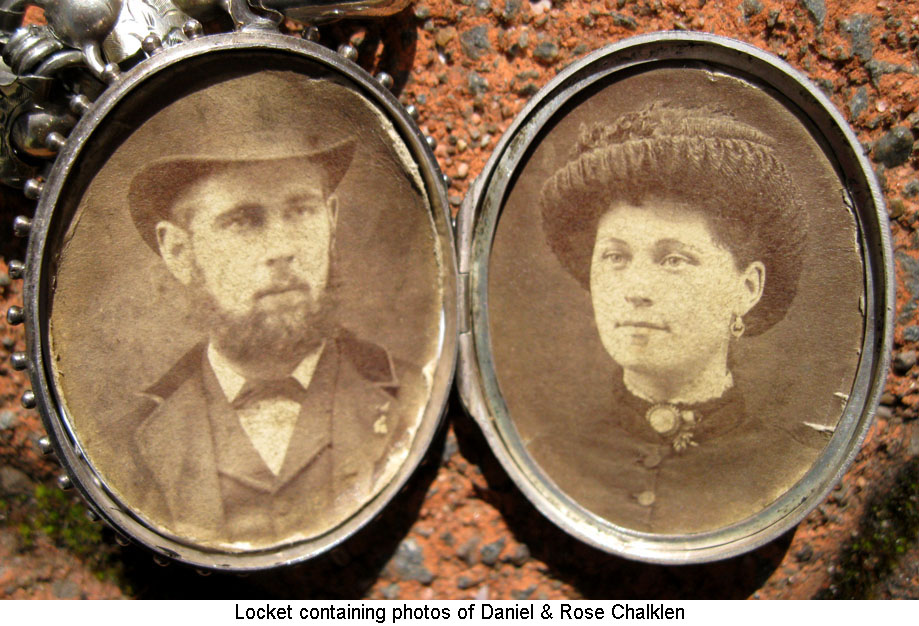
That is linked from this page of CHALKLEN family history – Rose’s line
www.muddlefamilies.info/framfield/19jp.htm
Henry’s Cenotaph database record:
muse.aucklandmuseum.com/databases/Cenotaph/40199.detail
SOURCES:
Military records
ndhadeliver.natlib.govt.nz/delivery/DeliveryManagerServle...
Christchurch City Council cemetery database
[1]
paperspast.natlib.govt.nz/cgi-bin/paperspast?a=d&cl=s...
[2]
paperspast.natlib.govt.nz/cgi-bin/paperspast?a=d&cl=s...
[3]
paperspast.natlib.govt.nz/cgi-bin/paperspast?a=d&cl=s...
[4]
paperspast.natlib.govt.nz/cgi-bin/paperspast?a=d&cl=s...
[5]
paperspast.natlib.govt.nz/cgi-bin/paperspast?a=d&cl=s...
[6]
paperspast.natlib.govt.nz/cgi-bin/paperspast?a=d&cl=s...
[7]
paperspast.natlib.govt.nz/cgi-bin/paperspast?a=d&cl=s...
[8]
paperspast.natlib.govt.nz/cgi-bin/paperspast?a=d&cl=s...
[9]
paperspast.natlib.govt.nz/cgi-bin/paperspast?a=d&cl=s...
[110]
paperspast.natlib.govt.nz/cgi-bin/paperspast?a=d&cl=s...
[11]
Vishnu (/ˈvɪʃnuː/; Sanskrit: Viṣṇu) is a popular Hindu deity, the Supreme God of Vaishnavism (one of the three principal denominations of Hinduism) and one of the three supreme deities (Trimurti) of Hinduism. He is also known as Lord Narayana and Lord Hari. As one of the five primary forms of God in the Smarta tradition, He is conceived as "the Preserver or the Protector" within the Trimurti, the Hindu Trinity of the divinity.
In Hindu sacred texts, Vishnu is usually described as having dark complexion of water-filled clouds and as having four arms. He is depicted as a blue being, holding a padma (lotus flower) in the lower left hand, the Kaumodaki gada (mace) in the lower right hand, the Panchajanya shankha (conch) in the upper left hand and the discus weapon Sudarshana Chakra in the upper right hand.
Adherents of Hinduism believe Vishnu's eternal and supreme abode beyond the material universe is called Vaikuntha, which is also known as Paramdhama, the realm of eternal bliss and happiness and the final or highest place for liberated souls who have attained Moksha. Vaikuntha is situated beyond the material universe and hence, cannot be perceived or measured by material science or logic. Vishnu's other abode within the material universe is Ksheera Sagara (the ocean of milk), where he reclines and rests on Ananta Shesha, (the king of the serpent deities, commonly shown with a thousand heads). In almost all Hindu denominations, Vishnu is either worshipped directly or in the form of his ten avatars, the most famous of whom are Rama and Krishna.
The Puranabharati, an ancient text, describes these as the dashavatara, or the ten avatars of Vishnu. Among the ten described, nine have occurred in the past and one will take place in the future as Lord Kalki, at the end of Kali Yuga, (the fourth and final stage in the cycle of yugas that the world goes through). These incarnations take place in all Yugas in cosmic scales; the avatars and their stories show that gods are indeed unimaginable, unthinkable and inconceivable. The Bhagavad Gita mentions their purpose as being to rejuvenate Dharma, to vanquish those negative forces of evil that threaten dharma, and also to display His divine nature in front of all souls.
The Trimurti (three forms) is a concept in Hinduism "in which the cosmic functions of creation, maintenance, and destruction are personified by the forms of Brahma the creator, Vishnu the maintainer, preserver or protector and Shiva the destroyer or transformer." These three deities have also been called "the Hindu triad" or the "Great Trinity", all having the same meaning of three in One. They are the different forms or manifestation of One person the Supreme Being or Narayana/Svayam Bhagavan.
Vishnu is also venerated as Mukunda, which means God who is the giver of mukti or moksha (liberation from the cycle of rebirths) to his devotees or the worthy ones who deserve salvation from the material world.
ETYMOLOGY
The traditional explanation of the name Vishnu involves the root viś, meaning "to settle" (cognate with Latin vicus, English -wich "village," Slavic: vas -ves), or also (in the Rigveda) "to enter into, to pervade," glossing the name as "the All-Pervading One". Yaska, an early commentator on the Vedas, in his Nirukta, (etymological interpretation), defines Vishnu as viṣṇur viṣvater vā vyaśnoter vā, "one who enters everywhere". He also writes, atha yad viṣito bhavati tad viṣnurbhavati, "that which is free from fetters and bondages is Vishnu".
Adi Shankara in his commentary on the Sahasranama states derivation from viś, with a meaning "presence everywhere" ("As he pervades everything, vevesti, he is called Vishnu"). Adi Shankara states (regarding Vishnu Purana, 3.1.45): "The Power of the Supreme Being has entered within the universe. The root viś means 'enter into'." Swami Chinmayananda, in his translation of Vishnu Sahasranama further elaborates on that verse: "The root vis means to enter. The entire world of things and beings is pervaded by Him and the Upanishad emphatically insists in its mantra 'whatever that is there is the world of change.' Hence, it means that He is not limited by space, time or substance. Chinmayananda states that, that which pervades everything is Vishnu."
SACRET TEXTS - SHRUTI & SMRITI
Shruti is considered to be solely of divine origin. It is preserved as a whole, instead of verse by verse. It includes the four Vedas (Rigveda, Yajurveda, Samaveda and Atharvaveda) the Brahmanas, the Aranyakas and the Upanishads with commentaries on them.
Smṛti refers to all the knowledge derived and inculcated after Shruti had been received. Smrti is not 'divine' in origin, but was 'remembered' by later Rishis (sages by insight, who were the scribes) by transcendental means and passed down through their followers. It includes the Bhagavata Purana and the Vishnu Purana which are Sattva Puranas. These both declare Vishnu as Para Brahman Supreme Lord who creates unlimited universes and enters each one of them as Lord of Universe.
SHRUTI
VAISHNAVA CANON
The Vaishnava canon presents Vishnu as the supreme being, rather than another name for the Sun God, who also bore the name Suryanarayana and is considered only as a form of Vishnu.
VEDAS
In the Yajur Veda, Taittiriya Aranyaka (10-13-1), Narayana suktam, Lord Narayana is mentioned as the supreme being. The first verse of Narayana Suktam mentions the words "paramam padam", which literally mean "highest post" and may be understood as the "supreme abode for all souls". This is also known as Param Dhama, Paramapadam, or Vaikuntha. Rig Veda 1:22:20a also mentions the same "paramam padam". This special status is not given to any deity in the Vedas apart from Lord Vishnu/Narayana.[citation needed] Narayana is one of the thousand names of Vishnu as mentioned in the Vishnu Sahasranama. It describes Vishnu as the All-Pervading essence of all beings, the master of - and beyond - the past, present and future, one who supports, sustains and governs the Universe and originates and develops all elements within. This illustrates the omnipresent characteristic of Vishnu. Vishnu governs the aspect of preservation and sustenance of the universe, so he is called "Preserver of the universe".
Vishnu is the Supreme God who takes manifest forms or avatars across various ages or periods to save humanity from evil beings, demons or Asuras. According to the extant Hindu texts and traditions, Lord Vishnu is considered to be resident in the direction of the "Makara Rashi" (the "Shravana Nakshatra"), which is about coincident with the Capricorn constellation. In some of the extant Puranas, and Vaishnava traditions, Vishnu's eye is considered to be situated at the infinitely distant Southern Celestial Pole.
Following the defeat of Indra and his displacement as the Lord of Heaven or Swarga, Indra asks Lord Vishnu for help and thus Lord Vishnu takes his incarnations or avatars to Earth to save mankind, thus showing his position as Supreme God to all of creation.
In the Puranas, Indra frequently appears proud and haughty. These bad qualities are temporarily removed when Brahma and/or Shiva give boons to Asuras or Rakshasas such as Hiranyaksha, Hiranyakashipu and Ravana, who are then able to defeat Indra in wars between Devas and Asuras. The received boons often made Asuras virtually indestructible.
Indra has no option but to seek help from Vishnu. Indra prays before Vishnu for protection and the Supreme Lord obliges him by taking avatars and generating himself on Earth in various forms, first as a water-dweller (Matsya, fish), then as an amphibious creature (Kurma avatar or Tortoise), then as a half-man-half-animal (Varaha the pig-faced, human-bodied Lord, and Narasimha the Lord with lion's face and claws and a human body). Later, Vishnu appears as human beings (Vamana the short-heighted person), Parashurama, Rama, Krishna, Buddha and finally as Kalki for performing his task of protecting his devotees from demons and anti-religious entities.
Vishnu's supremacy is attested by his victories over those very powerful entities. It is further attested by the accepted iconography and sculptures of Vishnu in reclining position as producing Brahma emerging from his navel. Brahma the creator is thus created in turn by Vishnu out of his own person. Instead Vishnu takes various avatars to slay or defeat those demons. But it is to be noted that Vishnu also provided boons to Akupresura, a bear faced demon who was destroyed by Lord Shiva.
Vishnu's actions lowered Indra's ranking among Hindu deities and led to the ascendancy of Vishnu.
Few temples are dedicated to the Sun or Suryanarayana, nor indeed Indra, nor does Indra figure largely in the Hindu religion.
Indra is almost completely absent from the deities considered as the chief or most important deity.
RIGVEDA
In the Rigveda, Vishnu is mentioned 93 times. He is frequently invoked alongside other deities, especially Indra, whom he helps in killing Vritra and with whom he drinks Soma. His distinguishing characteristic in the Vedas is his association with light. Two Rigvedic hymns in Mandala 7 are dedicated to Vishnu. In 7.99, Vishnu is addressed as the god who separates heaven and earth, a characteristic he shares with Indra.
The Rig Veda describes Vishnu as younger brother to Indra as Vamana. In Vaishnava canon the 'Vishnu' who is younger brother to Indra is identified as Vamana, Avatar of Vishnu, hence referred to as Vishnu by Vaishnavites. Vishnu is the Supreme God who lives in the highest celestial region, contrasted against those who live in the atmospheric or terrestrial regions. Vishnu is content with mere prayer, unlike almost all of the other gods who receive sacrificial offerings such as Havis, which is given using clarified butter, or Soma. Later foreign translators have view that Vedas place Indra in a superior position to Vishnu's Avatar of Vamana but in fact Vamana helps Indra by restoring his Kingdom.
An alternate translation is provided by Wilson according to Sayana:
When Thy (younger brother) Viṣṇu (Vamana) by (his) strength stepped his three paces, then verily thy beloved horses bore thee. (Rigveda 8:12:27)
Wilson mentions Griffith's possible translation as a footnote. However the following verse from Rigveda renders the above translation by Wilson more probable.
Him whose three places that are filled with sweetness, imperishable, joy as it may list them, Who verily alone upholds the threefold, the earth, the heaven, and all living creatures. (Rig veda 1:154:4)
Wilson offers an alternate translation for Rigveda 10:113:2:
Viṣṇu offering the portion of Soma, glorifies by his own vigor that greatness of his. Indra, the lord of heaven, with the associated gods having slain Vritra, became deserving of honour. (Rigveda 10:113:2)
This verse sees Vishnu as one who is glorified by his own strength, while Indra became deserving of honor after having slain Vritra only in association with other gods.
However Vishnu's praise for other gods does not imply worship. Wilson translates:
Viṣṇu, the mighty giver of dwellings praises thee, and Mitra and Varuna; the company of Maruts imitates thee in exhilaration. (Rigveda 8:15:9) (page 280)
The following verses show categorically Vishnu as distinguished from other gods in Rigveda.
He who presents (offering) to Viṣṇu, the ancient, the creator, the recent, the self-born; he who celebrates the great birth of that mighty one; he verily possessed of abundance, attains (the station) that is to be sought (by all). (Rigveda 1:156:2) (page 98)
No being that is or that has been born, divine Viṣṇu, has attained the utmost limit of thy magnitude, by which thou hast upheld the vast and beautiful heaven, and sustained the eastern horizon of Earth.(Rigveda 7:99:2) (page 196)
The divine Viṣṇu, the best of the doers of good deeds, who came to the pious instituter of rite (Indra), to assist (at its celebration), knowing (the desires of the worshiper), and present at the three connected period (of worship), shows favor to the Arya, and admits the author of the ceremony to a share of the sacrifice. (Rigveda 1:156:5) (page 99)
Jan Gonda, the late Indologist, states that Vishnu, although remaining in the background of Indra's exploits, contributes by his presence, or is key to Indra's success. Vishnu is more than a mere companion, equal in rank or power to Indra, or sometime the one who made Indra's success possible.
Descriptions of Vishnu as younger to Indra are found in only the hymns to Indra, but in a kathenotheism religion like that of the Rigveda, each god, for a time, is supreme in the mind of the devotee.
In the Rig Vedic texts, the deity or god referred to as Vishnu is the Sun God, who also bears the name 'Suryanarayana'. By contrast, the 'Vishnu' referred to in 'Vishnu Purana', 'Vishnu Sahasranamam' and 'Purusha Sooktham' is Lord Narayana, the Consort of Lakshmi. Vaishnavites make a further distinction by extolling the qualities of Vishnu by highlighting his differences from other deities such as Shiva,[citation needed] Brahma or Surya.
THREE STEPS
Hymn 7.100 refers to the celebrated 'three steps' of Vishnu (as Trivikrama) by which he strode over the universe and in three places planted his step. The 'Vishnu Suktam' (RV 1.154) says that the first and second of Vishnu's strides (those encompassing the earth and air) are visible to men and the third is in the heights of heaven (sky). This last place is described as Vishnu's supreme abode in RV 1.22.20:
The princes evermore behold / that loftiest place where Vishnu is / Laid as it were an eye in heaven.(trans. Griffith)
Griffith's "princes" are the sūri, either "inciters" or lords of a sacrifice, or priests charged with pressing the Soma. The verse is quoted as expressing Vishnu's supremacy by Vaishnavites.
Though such solar aspects have been associated with Vishnu by tradition as well as modern-scholarship, he was not just the representation of the sun, as he moves both vertically and horizontally.
In hymns 1.22.17, 1.154.3, 1.154.4 he strides across the earth with three steps, in 6.49.13, 7.100.3 strides across the earth three times and in 1.154.1, 1.155.5,7.29.7 he strides vertically, with the final step in the heavens. The same Veda also says he strode wide and created space in the cosmos for Indra to fight Vritra. By his stride he made dwelling for men possible, the three forming a symbolic representation of the dwelling's all-encompassing nature. This nature and benevolence to men were Vishnu's enduring attributes. As the triple-strider he is known as Trivikrama and as Urukrama, for the strides were wide.
BRAHMANAS
The Brahmanas are commentaries on the Vedas and form part of the Shruti literature. They are concerned with the detail of the proper performance of rituals. In the Rigveda, Shakala Shakha: Aitareya Brahmana Verse 1 declares: agnir vai devānām ava mo viṣṇuḥ paramus, tadantareṇa sarvā anyā devatā - Agni is the lowest or youngest god and Vishnu is the greatest and the highest God.
The Brahmanas assert the supremacy of Lord Vishnu, addressing him as "Gajapati", the one whom all sacrifices are meant to please. Lord Vishnu accepts all sacrifices to the demigods and allots the respective fruits to the performer In one incident, a demonic person performs a sacrifice by abducting the Rishis (sages), who meditate by constantly chanting God's name. The sacrifice is meant to destroy Indra. But the rishis, who worship Indra as a demigod, alter one pronunciation of the Veda Mantra, reversing the purpose of the sacrifice. When the fruit of the sacrifice is given and the demon is on the verge of dying, he calls to Vishnu, whom he addresses as Supreme Godhead and "the father of all living entities including himself".
Aitareya Brahmana 1:1:1 mentions Vishnu as the Supreme God. But in the Vaishnava canon, in different ages, with Vishnu in different avatars, his relationship with the asuras or demons, was always adversarial. The asuras always caused harm, while the sages and devas or celestial beings, did penance and called to Vishnu for protection. Vishnu always obliged by taking an avatar to vanquish the asuras. In the Vaishnava canon, Vishnu never gave or granted any boons to the asuras, distinguishing him from the gods Shiva and Brahma, who did. He is the only God called upon to save good beings by defeating or killing the asuras.
Sayana writes that in Aitareya Brahmana 1:1:1 the declaration agnir vai devānām ava mo viṣṇuḥ paramus,tadantareṇa sarvā anyā devatā does not indicate any hierarchy among gods. Even in Rigveda Samhita, avama and parama are not applied to denote rank and dignity, but only to mark place and locality.
In Rigveda 1:108:9,: yadindrāghnī avamasyāṃ pṛthivyāṃ madhyamasyāṃ paramasyāmuta sthaḥ | i.e., in the lowest place, the middle (place), and the highest (place). Agni, the fire, has, among the gods, the lowest place; for he resides with man on the earth; while the other gods are either in the air, or in the sky. Vishnu occupies the highest place. The words avama and parama are understood as 'First' and 'Last' respectively. To support this claim, Sayana adduces the mantra (1,4. As'val. Sr. S. 4, 2), agnir mukham prathamo devathanam samathanam uttamo vishnur asit, i.e., Agni was the first of the deities assembled, (and) Vishnu the last.
In the Kausitaki Brahmana (7.1) Agni is called Aaradhya (instead of avama), and Visnu parardha(instead of parama),i.e., belonging to the lower and higher halves (or forming the lower and higher halves). The Vishnu Purana gives tremendous importance to the worship of Vishnu and mentions that sacrifices are to begin only with both the lighting of fire or 'Agni', pouring of sacrificial offerings to Vishnu in 'Agni' so that those offerings reach and are accepted by Vishnu. Worship of Vishnu through Yajnas (or Homams) and other rituals, will not achieve the desired result if Agni's role is neglected.
Muller says "Although the gods are sometimes distinctly invoked as the great and the small, the young and the old (Rig veda 1:27:13), this is only an attempt to find the most comprehensive expression for the divine powers, and nowhere is any of the gods represented as the subordinate to others. It would be easy to find, in the numerous hymns of the Veda, passages in which almost every single god is represented as supreme and absolute."
However this notion is not completely correct as per the following verses, which shows Rigveda describe one or more gods as subject to other god(s).
Him whose high law not Varuna nor Indra, not Mitra, Aryaman, nor Rudra breaketh, Nor evil-hearted fiends, here for my welfare him I invoke, God Savitar, with worship. (Rigveda 2.038.09)
I invite to this place, with reverential salutations, for my good, that divine Savita, whose functions neither Indra, nor Varun.a, nor Mitra nor Aryaman nor Rudra nor the enemies (of the gods), impede. (Rigveda 2.038.09)
SMRITI
VISHNU SMRITI
The Vishnu Smṛti, is one of the later books of the Dharmashastra tradition of Hinduism and the only one that focuses on the bhakti tradition and the required daily puja to Vishnu, rather than the means of knowing dharma. It is also known for its handling of the controversial subject of the practice of sati (self-immolation of a widow on her husband's funeral pyre). The text was composed by an individual or group. The author(s) created a collection of the commonly known legal maxims that were attributed to Vishnu into one book, as Indian oral culture began to be recorded more formally.
BHAGAVATA PURANA
Vishnu is the only Bhagavan as declared in the Bhagavata 1:2:11 in the verse: vadanti tat tattva-vidas tattvam yaj jnanam advayam brahmeti paramatmeti bhagavan iti sabdyate, translated as "Learned transcendentalists who know the Absolute Truth call this non-dual substance as Brahman, Paramātma and Bhagavan."
VISHNU PURANA
In the Vishnu Purana (6:5:79) the personality named Parashara Rishi defines six bhagas:
aiśvaryasya samagrasya vīryasya yaśasaḥ śriyaḥ
jñāna-vairāgyayoś caiva ṣannāḥ bhaga itīṇganā
Jiva Gosvami explains the verse in Gopala Champu (Pūrva 15:73) and Bhagavata Sandarbha 46:10:
jñāna-śakti-balaiśvarya-vīrya-tejām.sy aśeṣataḥ
bhagavac-chabda-vācyāni vinā heyair guṇādibhiḥ
"The substantives of the word bhagavat (bhagavat-śabda-vācyāni) are unlimited (aśeṣataḥ) knowledge (jñāna), energies (śakti), strength (bala), opulence (aiśvarya), heroism (vīrya), splendor (tejas), without (vinā) objectionable (heyair) qualities (guṇādibhiḥ)."
SANGAM LITERATURE
Tamil Sangam literature (300BCE to 500CE) mentions mAyOn, or the dark one, as the supreme deity who creates, sustains and destroys the universe. Paripadal 3 describes the glory of Thirumal in the most superlative terms.
Paripadal by kaduvan iLaveyinanAr:
"thIyinuL theRal nI poovinuL naaRRa nI kallinuL maNiyu nI sollinuL vaaymai aRaththinuL anbu nI maRaththinuL mainthu nI vEthaththu maRai nI boothaththu madhalu nI vencudar oLiyu nI thingaLuL aLiyu nI anaiththu nI anaiththinut poruLu nI"
The last line states that Lord Vishnu is the supreme deity who is the inner controller (Antaryamin) of the entire universe. This is one of the Lord's glories, which is first mentioned in Vedas and later propounded by Alwars in Prabhandams and Sri Vaishnavaite Acharyas in various commentaries
The Sri Ranganathaswamy Temple and Vishnu, Lakshmi is mentioned in Tamil works of literature of the Sangam era, including the epic Silapadikaram (book 11, lines 35–40):
āyiram viritteḻu talaiyuṭai aruntiṟaṟ
pāyaṟ paḷḷip palartoḻu tētta viritiraik kāviri viyaṉperu turuttit tiruvamar mārpaṉ kiṭanta vaṇṇamum
On a magnificent cot having a thousand heads spread out, worshipped and praised by many, in an islet surrounded by Kaveri with bellowing waves, is the lying posture of the one who has Lakshmi sitting in his chest.
THEOLOGICAL ATTRIBUTES
The actual number of Vishnu's auspicious qualities is countless, although his six most-important "divine glories" are:
Jnana (Omniscience); defined as the power to know about all beings simultaneously;
Aishvarya (Sovereignty), derived from the word Ishvara which means unchallenged rule over all;
Shakti (Power or Energy), the capacity to make the impossible possible;
Bala (Strength), the capacity to support everything by will and without any fatigue;
Virya (Vigour), the power to retain immateriality as the Supreme Spirit or Being in spite of being the material cause of mutable creations;
Tejas (Splendor), which expresses self-sufficiency and the capacity to overpower everything by spiritual effulgence.
Other important qualities attributed to Vishnu are Gambhirya (inestimatable grandeur), Audarya (generosity), and Karunya (compassion). Natya Shastra lists Vishnu as the presiding deity of the Sṛngara rasa.
The Rigveda says: Vishnu can travel in three strides. The first stride is the Earth. The second stride is the visible sky. The third stride cannot be seen by men and is the heaven where the gods and the righteous dead live. (This feature of three strides also appears in the story of his avatar Vamana/Trivikrama.) The Sanskrit for "to stride" is the root kram; its reduplicated perfect is chakram (guņa grade) or chakra (zero-grade), and in the Rigveda he is called by epithets such as vi-chakra-māņas = "he who has made 3 strides". The Sanskrit word chakra also means "wheel". That may have suggested the idea of Vishnu carrying a chakra.
FIVE FORMS
In Shree Vaishnavism, another school dating from around the 10th century AD, Vishnu assumes five forms:
In the Para Form, Para is the highest form of Vishnu found only in Sri Vaikunta also called Moksha, along with his consort Lakshmi, (and Bhumi Devi and Nila devi, avatars of Lakshmi) and surrounded by liberated souls like Ananta, Garuda, and a host of Muktas (liberated souls).
In the Vyuha form, Vishnu assumes four forms, which exercise different cosmic functions and controls activities of living beings.
In the Vibhava form, Vishnu assumes various manifestations, called Vibhavas, more popularly known as Avataras from time to time, to protect the virtuous, punish evil-doers and re-establish righteousness.
In the Antaryami; "Dwelling within" or "Suksma Vasudeva" form, Vishnu exists within the souls of all living beings and in every substance.
In the Arcavatara or Image manifestation, Vishnu is visible and therefore easily approachable by devotees since Para, Vyuha, Vibhava and Antaryami forms can only be imagined or meditated upon because they are beyond our reach. Such images can be
Revealed by Vishnu, for example, a self-manifested (Swayambhu) icon (murti), e.g. The Mahavishnu Temple at Tirunelli, The Sri Ranganathaswamy Temple at Srirangam, The Tirumala Venkateshwara Temple, etc.; or
Installed by Devas or celestial beings such as such as Guruvayur Temple installed by Vayu; or
Installed by humans, and consecrated according to Vaishnava Agama shastras or scriptures such as Lord Jagannatha of Jagannath Temple (Puri) at Puri.
RELATIONS WITH OTHER DEITIES
SHIVA
The three gods of the Trimurti clan are inseparable and in harmony in view of their common vision and universal good. They are perfectly ideal in all respects.
Both Asuras and Devas played supportive roles in this story by keeping company with Vishnu in his incarnated forms. Hanuman is a vanara who is completely dedicated to Rama. He gives Vishnu company and obeys his command, while playing an important part in Rama's life. He is regarded in Vaishnava canon because it is through blessings that Hanuman is born. Thus, Hanuman, Vishnu's constant companion, with his idol appearing temples of Rama, Krishna and Narasimha, i.e. all of Vishnu's avatars, is considered by Vaishnavas.
Syncretic forces produced stories in which the two deities were shown in cooperative relationships and combined forms. Harihara is the name of a combined deity form of both Vishnu (Hari) and Shiva (Hara). This dual form, which is also called Harirudra, is mentioned in the Mahabharata.
LAKSHMI
Vishnu's consort is Lakshmi, the goddess of wealth (also known as Maya). The Samvit (the primary intelligence/dark matter) of the universe is Vishnu, while the other five attributes emerge from this samvit and hence Maya or dark energy of the universe is Lakshmee is his ahamata, activity, or Vishnu's Power. This power of God, Maya or Shakti, is personified and has multiple names: Shree, Lakshmi, Maya, Vishnumaya or Mahamaya. She is said to manifest as Kriyashakti, (Creative Activity) and Bhutishakti (Creation). This world requires Vishnu's creativity. He therefore needs Lakshmi to always be with Him. Her various avatars as Lord Vishnu's consorts are Varahavatar (Bhoodevi) or Bhoomi, Ramavatar Seeta, Krishnavatar Rukmini)
SARASWATI & GANGA
According to Brahma Vaivarta Purana, Lord Vishnu had three wives Lakshmi, Saraswati and Ganga. Due to their constant quarrelsome nature among them. Once Ganga tried to be close with Vishnu, this rebuked Saraswati but Lakshmi tried to pacify them but faced a curse rather. As per the curse, Lakshmi to appear as Tulasi. Sarawati cursed Ganga to run as a river in the world and Saraswati was cursed to run as a river in the netherworld. After this, Lord Vishnu transformed and became Brahma and Shiva to pacify Saraswati and Ganga.
GARUDA
Vishnu's mount (Vahana) is Garuda, the eagle. Vishnu is commonly depicted as riding on his shoulders.
ICONOGRAPHY
According to various Puranas, Vishnu is the ultimate omnipresent reality and is shapeless and omnipresent. However, a strict iconography governs his representation, whether in pictures, icons, or idols:
He has four arms and is male: The four arms indicate his all-powerful and all-pervasive nature. His physical existence is represented by the two arms in the front, while the two arms at the back represent his presence in the spiritual world. The Upanishad Gopal Uttartapani describes the four arms.
The Shreevatsa mark is on his chest, symbolizing his consort Lakshmi.
He wears the auspicious "Kaustubha" jewel around his neck and a garland of vaijayanti flowers (Vanamala). Lakshmi dwells in this jewel, on Vishnu's chest.
A crown adorns his head: The crown symbolizes his supreme authority. This crown sometimes includes a peacock feather, borrowing from his Krishna-avatar.
He wears two earrings: The earrings represent inherent opposites in creation — knowledge and ignorance; happiness and unhappiness; pleasure and pain.
He rests on Ananta, the immortal and infinite snake.
Vishnu is always to be depicted holding four attributes:
A conch shell or Shankha, named Panchajanya, is held by the upper left hand. It represents Vishnu's power to create and maintain the universe. Panchajanya represents the five elements or Panchabhoota – water, fire, air, earth and sky or space. It also represents the five airs or Pranas that are within the body and mind. The conch symbolizes that Vishnu is the primeval Divine sound of creation and continuity. It also represented as Om. In the Bhagavad Gita, Krishna avatara states that of sound vibrations, 'He is Om'.
The Chakra, a sharp, spinning, discus-like weapon, named "Sudarshana", is held by the upper right hand. It symbolizes the purified spiritualized mind. The name Sudarshana is derived from two words – Su, which means good, superior, and Darshana, which means vision or sight; together. The Chakra represents destruction of ego in the awakening and realization of the soul's original nature and god, burning away spiritual ignorance and illusion, and developing higher spiritual vision and insight to realize god.
A mace or Gada, named "Kaumodaki", is held by the lower right hand. It symbolizes that Vishnu's divine power is the source of all spiritual, mental and physical strength. It also signifies Vishnu's power to destroy materialistic or demonic tendencies (Anarthas) that prevent people from reaching god. Vishnu's mace is the power of the Divine within us to spiritually purify and uplift us from our materialistic bonds.
A lotus flower or Padma is held by the lower left hand. It represents spiritual liberation, Divine perfection, purity and the unfolding of Spiritual consciousness within the individual. The lotus opening its petals in the light of the Sun is indicative of the expansion and awakening of our long dormant, original spiritual consciousness in the light of god. The lotus symbolizes that god is the power and source from which the universe and the individual soul emerges. It also represents Divine Truth or Satya, the originator of the rules of conduct or Dharma, and Divine Vedic knowledge or Jnana. The lotus also symbolizes that Vishnu is the embodiment of spiritual perfection and purity and that He is the wellspring of these qualities and that the individual soul must seek to awaken these intrinsic Divine qualities from Vishnu by surrendering to and linking with Him.
To this may be added, conventionally, the vanamaala flower garland, Vishnu's bow (Shaarnga/Kodand) and his sword Nandaka. A verse of the Vishnu Sahasranama stotram states;vanamālī gadhī shārngī shanki chakri cha nandaki / shrīmān nārāyaņo vişņo vāsudevo abhirakşatu//; translation: Protect us Oh Lord Narayana who wears the forest garland,who has the mace, conch, sword and the wheel. And who is called Vishnu and the Vasudeva.
In general, Vishnu's body is depicted in one of the following three ways:
Standing on a lotus flower, often with Lakshmi, his consort, beside him on a similar pedestal.
Reclining on the coiled-up thousand-hooded Shesha Naga, with Lakshmi seated at his feet; the assemblage rests on the "Kshira Sagar" (ocean of milk). In this representation, Brahma is depicted as sitting on a lotus that grows out of Vishnu's navel.
Riding on the back of his eagle mount, known as Garuda. Another name for Garuda is "Veda atma"; Soul of the Vedas. The flapping of his wings symbolizes the power of the Divine Truth of Vedic wisdom. Also the eagle represents the soul. Garuda carrying Vishnu symbolizes the soul or jiva atma carrying the Super soul or Param atma within it.
AVATARS
Ten avatars (dashavatara) of Vishnu are the most prominent: Apart from the most prominent incarnations there are believed to more.
The most commonly believed incarnations of Vishnu are:
Matsya, the fish that kills Damanaka to save the vedas and also saves Manu from a great flood that submerges the entire Earth.
Kurma, the turtle that helps the Devas and Asuras churn the ocean for the nectar of immortality.
Varaha, the boar that rescues the Earth and kills Hiranyaksha.
Narasimha, the half-lion half human, who defeats the demon Hiranyakashipu.
Vamana, the dwarf that grows into a giant to save the world from King Bali.
Parashurama, "Rama of the battle axe", a sage who appeared in the Treta Yuga. He killed Kartavirya Arjuna's army and clan and then killed all the kshatriyas 21 times.
Rama, the prince and king of Ayodhya who killed the Demon King Raavan.
Krishna, the eighth avatar of Vishnu, who takes part in the Mahabharata epic. Krishna is worshipped as the Supreme Avatar of Vishnu (Supreme Personality of Godhead) in Gaudiya-Vaishnava philosophy.
Buddha, the ninth avatar of Vishnu.
Kalki, the tenth Avatar of Vishnu and said to be the harbinger of the end Kali Yuga. This avatar of Vishnu is yet to come.
Some versions of the above list include Hayagreeva among the Dashavataras while some include Buddha as ninth avatar of Vishnu. Another 22 avatars are given in Chapter 3, Canto 1 of the Bhagavata Purana, although it states that "the incarnations of the Lord are innumerable, like rivulets flowing from inexhaustible sources of water".
BEYOND HINDUISM
SIKHISM
Guru Granth Sahib of Sikhism mentions Vishnu, one verse goes:
The true Vaishnaav, the devotee of Vishnu, is the one with whom God is thoroughly pleased. He dwells apart from Maya. Performing good deeds, he does not seek rewards. Spotlessly pure is the religion of such a Vaishnaav; he has no desire for the fruits of his labors. He is absorbed in devotional worship and the singing of Kirtan, the songs of the Lords Glory. Within his mind and body, he meditates in remembrance on the Lord of the Universe. He is kind to all creatures. He holds fast to the Naam, and inspires others to chant it. O Nanak, such a Vaishnaav obtains the supreme status.
BUDDHISM
While some Hindus consider Buddha as an incarnation of Vishnu, Buddhists in Sri Lanka venerate Vishnu as the custodian deity of Sri Lanka and protector of Buddhism. Lord Vishnu is also known as upulvan, or uthpala varna, meaning "Blue Lotus coloured". Some postulates that Uthpala varna was a local deity who later merged with Vishnu while another belief is that Uthpala Varna was an early form of Vishnu before he became a supreme deity in Puranic Hinduism. According to Chronicles "Mahawamsa", "Chulawamsa" and folklore in Sri Lanka, Buddha himself handed over the custodianship to Vishnu. Others believe that Buddha entrusted this task to Sakra(Indra) and Sakra delegated this task of custodianship to god Vishnu. In contrary to vedic Hinduism, in assimilation of Hindu god Vishnu into Sinhalese Buddhism, Vishnu becomes a mortal being and a Bodhisattva aspiring Buddhahood. Additionally, Vishnu is considered as the god of home and hearth representing mercy, goodness, order and stability. Many Buddhist and Hindu shrines are dedicated to Vishnu in Sri Lanka. In addition to specific Vishnu "Kovils" or "devalayas", all Buddhist temples necessarily house shrine rooms (Devalayas) closer to the main Buddhist shrine dedicated to Vishnu. John Holt in his groundbreaking study examines the assimilation, transformation, and subordination of the Hindu deity Vishnu within the contexts of Sri Lankan history and Sinhala Buddhist religious culture. He then explores the role and rationale of medieval Sinhala kings in assimilating Visnu into Sinhala Buddhism. According to Holt the veneration of Vishnu in Sri Lanka is evidence of a remarkable ability, over many centuries, to reiterate and reinvent culture as other ethnicities have been absorbed into their own. Though the Vishnu cult in Ceylon was formally endorsed by Kandyan kings in early 1700s, Holt states that vishnu images and shrines are among conspicuous ruins in the medieval capital Polonnaruwa. In Buddhist mythology, when Vishnu failed to traverse the universe in three steps, he was given the title "Ardha Vishnu (Half-Vishnu)" and when Vishnu banished demons from the Vaishali (Vishala)in India, he became "Mulu Vishnu or Whole Vishnu". The extreme significance of god Vishnu in Sinhala society is reflected in recitals of the traditional "Offerings to dwarfs and crossing the door frame (bahirwayanta dola pideem saha uluwahu peneema)" that starts with Sri Vishnu invocation.In the recitals,mentioning of the aspiring Buddhahood of Vishnu which is of prime importance to Buddhists and wishes for him to live five thousand and more years highlight the central role of Vishnu in the psyche of Sri Lankan Buddhists.
OTHERS
James Freeman Clarke, Richard Leviton, James Cowles Prichard, and others have noted the similarities between Vishnu and Ancient Egyptian God Horus.
During an excavation in an abandoned village of Russia in the Volga region, archaeologist Alexander Kozhevin excavated an ancient idol of Vishnu. The idol dates from between the 7th and 10th centuries. In the interview Kozhevin, stated that, "We may consider it incredible, but we have ground to assert that Middle-Volga region was the original land of Ancient Rus. This is a hypothesis, but a hypothesis, which requires thorough research"
THOUSAND NAMES OF VISHNU
Vishnu's many names and followers are collected in the Vishnu Sahasranama, (Vishnu's thousand names) from within the larger work Mahabharata. The character Bheeshma recites the names before Krishna on the battlefield of Kurukshetra, praising him (Vishnu) as the supreme god. These Sahasranama are regarded as the essence of all Vedas by followers of Vaishnavism, who believe sincere chanting of Vishnu Sahasranama results in spiritual well-being and a greater awareness of God.
The names are generally derived from the Anantakalyanagunas (meaning: infinite auspicious attributes).
According to the Siddhartha-samhita there are twenty-four forms of Lord Vishnu. The twenty-four forms are
Vasudeva
Sankarshana
Pradyumna
Anirudha
Keshava
Narayana
Madhava
Govinda
Vishnu
Madhusudana
Trivikrama
Vamana
Sridhara
Hrishikesha
Padmanabha
Damodara
Purushottama
Achyuta
Narasimha
Janardana
Hari
Krishna
Adhokshaja
Upulvan, Uthpala Varna - In Sri Lanka, Vishnu is also referred to as Upulvan ( Blue Lotus Coloured)
WIKIPEDIA
Vishnu (/ˈvɪʃnuː/; Sanskrit: Viṣṇu) is a popular Hindu deity, the Supreme God of Vaishnavism (one of the three principal denominations of Hinduism) and one of the three supreme deities (Trimurti) of Hinduism. He is also known as Lord Narayana and Lord Hari. As one of the five primary forms of God in the Smarta tradition, He is conceived as "the Preserver or the Protector" within the Trimurti, the Hindu Trinity of the divinity.
In Hindu sacred texts, Vishnu is usually described as having dark complexion of water-filled clouds and as having four arms. He is depicted as a blue being, holding a padma (lotus flower) in the lower left hand, the Kaumodaki gada (mace) in the lower right hand, the Panchajanya shankha (conch) in the upper left hand and the discus weapon Sudarshana Chakra in the upper right hand.
Adherents of Hinduism believe Vishnu's eternal and supreme abode beyond the material universe is called Vaikuntha, which is also known as Paramdhama, the realm of eternal bliss and happiness and the final or highest place for liberated souls who have attained Moksha. Vaikuntha is situated beyond the material universe and hence, cannot be perceived or measured by material science or logic. Vishnu's other abode within the material universe is Ksheera Sagara (the ocean of milk), where he reclines and rests on Ananta Shesha, (the king of the serpent deities, commonly shown with a thousand heads). In almost all Hindu denominations, Vishnu is either worshipped directly or in the form of his ten avatars, the most famous of whom are Rama and Krishna.
The Puranabharati, an ancient text, describes these as the dashavatara, or the ten avatars of Vishnu. Among the ten described, nine have occurred in the past and one will take place in the future as Lord Kalki, at the end of Kali Yuga, (the fourth and final stage in the cycle of yugas that the world goes through). These incarnations take place in all Yugas in cosmic scales; the avatars and their stories show that gods are indeed unimaginable, unthinkable and inconceivable. The Bhagavad Gita mentions their purpose as being to rejuvenate Dharma, to vanquish those negative forces of evil that threaten dharma, and also to display His divine nature in front of all souls.
The Trimurti (three forms) is a concept in Hinduism "in which the cosmic functions of creation, maintenance, and destruction are personified by the forms of Brahma the creator, Vishnu the maintainer, preserver or protector and Shiva the destroyer or transformer." These three deities have also been called "the Hindu triad" or the "Great Trinity", all having the same meaning of three in One. They are the different forms or manifestation of One person the Supreme Being or Narayana/Svayam Bhagavan.
Vishnu is also venerated as Mukunda, which means God who is the giver of mukti or moksha (liberation from the cycle of rebirths) to his devotees or the worthy ones who deserve salvation from the material world.
ETYMOLOGY
The traditional explanation of the name Vishnu involves the root viś, meaning "to settle" (cognate with Latin vicus, English -wich "village," Slavic: vas -ves), or also (in the Rigveda) "to enter into, to pervade," glossing the name as "the All-Pervading One". Yaska, an early commentator on the Vedas, in his Nirukta, (etymological interpretation), defines Vishnu as viṣṇur viṣvater vā vyaśnoter vā, "one who enters everywhere". He also writes, atha yad viṣito bhavati tad viṣnurbhavati, "that which is free from fetters and bondages is Vishnu".
Adi Shankara in his commentary on the Sahasranama states derivation from viś, with a meaning "presence everywhere" ("As he pervades everything, vevesti, he is called Vishnu"). Adi Shankara states (regarding Vishnu Purana, 3.1.45): "The Power of the Supreme Being has entered within the universe. The root viś means 'enter into'." Swami Chinmayananda, in his translation of Vishnu Sahasranama further elaborates on that verse: "The root vis means to enter. The entire world of things and beings is pervaded by Him and the Upanishad emphatically insists in its mantra 'whatever that is there is the world of change.' Hence, it means that He is not limited by space, time or substance. Chinmayananda states that, that which pervades everything is Vishnu."
SACRET TEXTS - SHRUTI & SMRITI
Shruti is considered to be solely of divine origin. It is preserved as a whole, instead of verse by verse. It includes the four Vedas (Rigveda, Yajurveda, Samaveda and Atharvaveda) the Brahmanas, the Aranyakas and the Upanishads with commentaries on them.
Smṛti refers to all the knowledge derived and inculcated after Shruti had been received. Smrti is not 'divine' in origin, but was 'remembered' by later Rishis (sages by insight, who were the scribes) by transcendental means and passed down through their followers. It includes the Bhagavata Purana and the Vishnu Purana which are Sattva Puranas. These both declare Vishnu as Para Brahman Supreme Lord who creates unlimited universes and enters each one of them as Lord of Universe.
SHRUTI
VAISHNAVA CANON
The Vaishnava canon presents Vishnu as the supreme being, rather than another name for the Sun God, who also bore the name Suryanarayana and is considered only as a form of Vishnu.
VEDAS
In the Yajur Veda, Taittiriya Aranyaka (10-13-1), Narayana suktam, Lord Narayana is mentioned as the supreme being. The first verse of Narayana Suktam mentions the words "paramam padam", which literally mean "highest post" and may be understood as the "supreme abode for all souls". This is also known as Param Dhama, Paramapadam, or Vaikuntha. Rig Veda 1:22:20a also mentions the same "paramam padam". This special status is not given to any deity in the Vedas apart from Lord Vishnu/Narayana.[citation needed] Narayana is one of the thousand names of Vishnu as mentioned in the Vishnu Sahasranama. It describes Vishnu as the All-Pervading essence of all beings, the master of - and beyond - the past, present and future, one who supports, sustains and governs the Universe and originates and develops all elements within. This illustrates the omnipresent characteristic of Vishnu. Vishnu governs the aspect of preservation and sustenance of the universe, so he is called "Preserver of the universe".
Vishnu is the Supreme God who takes manifest forms or avatars across various ages or periods to save humanity from evil beings, demons or Asuras. According to the extant Hindu texts and traditions, Lord Vishnu is considered to be resident in the direction of the "Makara Rashi" (the "Shravana Nakshatra"), which is about coincident with the Capricorn constellation. In some of the extant Puranas, and Vaishnava traditions, Vishnu's eye is considered to be situated at the infinitely distant Southern Celestial Pole.
Following the defeat of Indra and his displacement as the Lord of Heaven or Swarga, Indra asks Lord Vishnu for help and thus Lord Vishnu takes his incarnations or avatars to Earth to save mankind, thus showing his position as Supreme God to all of creation.
In the Puranas, Indra frequently appears proud and haughty. These bad qualities are temporarily removed when Brahma and/or Shiva give boons to Asuras or Rakshasas such as Hiranyaksha, Hiranyakashipu and Ravana, who are then able to defeat Indra in wars between Devas and Asuras. The received boons often made Asuras virtually indestructible.
Indra has no option but to seek help from Vishnu. Indra prays before Vishnu for protection and the Supreme Lord obliges him by taking avatars and generating himself on Earth in various forms, first as a water-dweller (Matsya, fish), then as an amphibious creature (Kurma avatar or Tortoise), then as a half-man-half-animal (Varaha the pig-faced, human-bodied Lord, and Narasimha the Lord with lion's face and claws and a human body). Later, Vishnu appears as human beings (Vamana the short-heighted person), Parashurama, Rama, Krishna, Buddha and finally as Kalki for performing his task of protecting his devotees from demons and anti-religious entities.
Vishnu's supremacy is attested by his victories over those very powerful entities. It is further attested by the accepted iconography and sculptures of Vishnu in reclining position as producing Brahma emerging from his navel. Brahma the creator is thus created in turn by Vishnu out of his own person. Instead Vishnu takes various avatars to slay or defeat those demons. But it is to be noted that Vishnu also provided boons to Akupresura, a bear faced demon who was destroyed by Lord Shiva.
Vishnu's actions lowered Indra's ranking among Hindu deities and led to the ascendancy of Vishnu.
Few temples are dedicated to the Sun or Suryanarayana, nor indeed Indra, nor does Indra figure largely in the Hindu religion.
Indra is almost completely absent from the deities considered as the chief or most important deity.
RIGVEDA
In the Rigveda, Vishnu is mentioned 93 times. He is frequently invoked alongside other deities, especially Indra, whom he helps in killing Vritra and with whom he drinks Soma. His distinguishing characteristic in the Vedas is his association with light. Two Rigvedic hymns in Mandala 7 are dedicated to Vishnu. In 7.99, Vishnu is addressed as the god who separates heaven and earth, a characteristic he shares with Indra.
The Rig Veda describes Vishnu as younger brother to Indra as Vamana. In Vaishnava canon the 'Vishnu' who is younger brother to Indra is identified as Vamana, Avatar of Vishnu, hence referred to as Vishnu by Vaishnavites. Vishnu is the Supreme God who lives in the highest celestial region, contrasted against those who live in the atmospheric or terrestrial regions. Vishnu is content with mere prayer, unlike almost all of the other gods who receive sacrificial offerings such as Havis, which is given using clarified butter, or Soma. Later foreign translators have view that Vedas place Indra in a superior position to Vishnu's Avatar of Vamana but in fact Vamana helps Indra by restoring his Kingdom.
An alternate translation is provided by Wilson according to Sayana:
When Thy (younger brother) Viṣṇu (Vamana) by (his) strength stepped his three paces, then verily thy beloved horses bore thee. (Rigveda 8:12:27)
Wilson mentions Griffith's possible translation as a footnote. However the following verse from Rigveda renders the above translation by Wilson more probable.
Him whose three places that are filled with sweetness, imperishable, joy as it may list them, Who verily alone upholds the threefold, the earth, the heaven, and all living creatures. (Rig veda 1:154:4)
Wilson offers an alternate translation for Rigveda 10:113:2:
Viṣṇu offering the portion of Soma, glorifies by his own vigor that greatness of his. Indra, the lord of heaven, with the associated gods having slain Vritra, became deserving of honour. (Rigveda 10:113:2)
This verse sees Vishnu as one who is glorified by his own strength, while Indra became deserving of honor after having slain Vritra only in association with other gods.
However Vishnu's praise for other gods does not imply worship. Wilson translates:
Viṣṇu, the mighty giver of dwellings praises thee, and Mitra and Varuna; the company of Maruts imitates thee in exhilaration. (Rigveda 8:15:9) (page 280)
The following verses show categorically Vishnu as distinguished from other gods in Rigveda.
He who presents (offering) to Viṣṇu, the ancient, the creator, the recent, the self-born; he who celebrates the great birth of that mighty one; he verily possessed of abundance, attains (the station) that is to be sought (by all). (Rigveda 1:156:2) (page 98)
No being that is or that has been born, divine Viṣṇu, has attained the utmost limit of thy magnitude, by which thou hast upheld the vast and beautiful heaven, and sustained the eastern horizon of Earth.(Rigveda 7:99:2) (page 196)
The divine Viṣṇu, the best of the doers of good deeds, who came to the pious instituter of rite (Indra), to assist (at its celebration), knowing (the desires of the worshiper), and present at the three connected period (of worship), shows favor to the Arya, and admits the author of the ceremony to a share of the sacrifice. (Rigveda 1:156:5) (page 99)
Jan Gonda, the late Indologist, states that Vishnu, although remaining in the background of Indra's exploits, contributes by his presence, or is key to Indra's success. Vishnu is more than a mere companion, equal in rank or power to Indra, or sometime the one who made Indra's success possible.
Descriptions of Vishnu as younger to Indra are found in only the hymns to Indra, but in a kathenotheism religion like that of the Rigveda, each god, for a time, is supreme in the mind of the devotee.
In the Rig Vedic texts, the deity or god referred to as Vishnu is the Sun God, who also bears the name 'Suryanarayana'. By contrast, the 'Vishnu' referred to in 'Vishnu Purana', 'Vishnu Sahasranamam' and 'Purusha Sooktham' is Lord Narayana, the Consort of Lakshmi. Vaishnavites make a further distinction by extolling the qualities of Vishnu by highlighting his differences from other deities such as Shiva,[citation needed] Brahma or Surya.
THREE STEPS
Hymn 7.100 refers to the celebrated 'three steps' of Vishnu (as Trivikrama) by which he strode over the universe and in three places planted his step. The 'Vishnu Suktam' (RV 1.154) says that the first and second of Vishnu's strides (those encompassing the earth and air) are visible to men and the third is in the heights of heaven (sky). This last place is described as Vishnu's supreme abode in RV 1.22.20:
The princes evermore behold / that loftiest place where Vishnu is / Laid as it were an eye in heaven.(trans. Griffith)
Griffith's "princes" are the sūri, either "inciters" or lords of a sacrifice, or priests charged with pressing the Soma. The verse is quoted as expressing Vishnu's supremacy by Vaishnavites.
Though such solar aspects have been associated with Vishnu by tradition as well as modern-scholarship, he was not just the representation of the sun, as he moves both vertically and horizontally.
In hymns 1.22.17, 1.154.3, 1.154.4 he strides across the earth with three steps, in 6.49.13, 7.100.3 strides across the earth three times and in 1.154.1, 1.155.5,7.29.7 he strides vertically, with the final step in the heavens. The same Veda also says he strode wide and created space in the cosmos for Indra to fight Vritra. By his stride he made dwelling for men possible, the three forming a symbolic representation of the dwelling's all-encompassing nature. This nature and benevolence to men were Vishnu's enduring attributes. As the triple-strider he is known as Trivikrama and as Urukrama, for the strides were wide.
BRAHMANAS
The Brahmanas are commentaries on the Vedas and form part of the Shruti literature. They are concerned with the detail of the proper performance of rituals. In the Rigveda, Shakala Shakha: Aitareya Brahmana Verse 1 declares: agnir vai devānām ava mo viṣṇuḥ paramus, tadantareṇa sarvā anyā devatā - Agni is the lowest or youngest god and Vishnu is the greatest and the highest God.
The Brahmanas assert the supremacy of Lord Vishnu, addressing him as "Gajapati", the one whom all sacrifices are meant to please. Lord Vishnu accepts all sacrifices to the demigods and allots the respective fruits to the performer In one incident, a demonic person performs a sacrifice by abducting the Rishis (sages), who meditate by constantly chanting God's name. The sacrifice is meant to destroy Indra. But the rishis, who worship Indra as a demigod, alter one pronunciation of the Veda Mantra, reversing the purpose of the sacrifice. When the fruit of the sacrifice is given and the demon is on the verge of dying, he calls to Vishnu, whom he addresses as Supreme Godhead and "the father of all living entities including himself".
Aitareya Brahmana 1:1:1 mentions Vishnu as the Supreme God. But in the Vaishnava canon, in different ages, with Vishnu in different avatars, his relationship with the asuras or demons, was always adversarial. The asuras always caused harm, while the sages and devas or celestial beings, did penance and called to Vishnu for protection. Vishnu always obliged by taking an avatar to vanquish the asuras. In the Vaishnava canon, Vishnu never gave or granted any boons to the asuras, distinguishing him from the gods Shiva and Brahma, who did. He is the only God called upon to save good beings by defeating or killing the asuras.
Sayana writes that in Aitareya Brahmana 1:1:1 the declaration agnir vai devānām ava mo viṣṇuḥ paramus,tadantareṇa sarvā anyā devatā does not indicate any hierarchy among gods. Even in Rigveda Samhita, avama and parama are not applied to denote rank and dignity, but only to mark place and locality.
In Rigveda 1:108:9,: yadindrāghnī avamasyāṃ pṛthivyāṃ madhyamasyāṃ paramasyāmuta sthaḥ | i.e., in the lowest place, the middle (place), and the highest (place). Agni, the fire, has, among the gods, the lowest place; for he resides with man on the earth; while the other gods are either in the air, or in the sky. Vishnu occupies the highest place. The words avama and parama are understood as 'First' and 'Last' respectively. To support this claim, Sayana adduces the mantra (1,4. As'val. Sr. S. 4, 2), agnir mukham prathamo devathanam samathanam uttamo vishnur asit, i.e., Agni was the first of the deities assembled, (and) Vishnu the last.
In the Kausitaki Brahmana (7.1) Agni is called Aaradhya (instead of avama), and Visnu parardha(instead of parama),i.e., belonging to the lower and higher halves (or forming the lower and higher halves). The Vishnu Purana gives tremendous importance to the worship of Vishnu and mentions that sacrifices are to begin only with both the lighting of fire or 'Agni', pouring of sacrificial offerings to Vishnu in 'Agni' so that those offerings reach and are accepted by Vishnu. Worship of Vishnu through Yajnas (or Homams) and other rituals, will not achieve the desired result if Agni's role is neglected.
Muller says "Although the gods are sometimes distinctly invoked as the great and the small, the young and the old (Rig veda 1:27:13), this is only an attempt to find the most comprehensive expression for the divine powers, and nowhere is any of the gods represented as the subordinate to others. It would be easy to find, in the numerous hymns of the Veda, passages in which almost every single god is represented as supreme and absolute."
However this notion is not completely correct as per the following verses, which shows Rigveda describe one or more gods as subject to other god(s).
Him whose high law not Varuna nor Indra, not Mitra, Aryaman, nor Rudra breaketh, Nor evil-hearted fiends, here for my welfare him I invoke, God Savitar, with worship. (Rigveda 2.038.09)
I invite to this place, with reverential salutations, for my good, that divine Savita, whose functions neither Indra, nor Varun.a, nor Mitra nor Aryaman nor Rudra nor the enemies (of the gods), impede. (Rigveda 2.038.09)
SMRITI
VISHNU SMRITI
The Vishnu Smṛti, is one of the later books of the Dharmashastra tradition of Hinduism and the only one that focuses on the bhakti tradition and the required daily puja to Vishnu, rather than the means of knowing dharma. It is also known for its handling of the controversial subject of the practice of sati (self-immolation of a widow on her husband's funeral pyre). The text was composed by an individual or group. The author(s) created a collection of the commonly known legal maxims that were attributed to Vishnu into one book, as Indian oral culture began to be recorded more formally.
BHAGAVATA PURANA
Vishnu is the only Bhagavan as declared in the Bhagavata 1:2:11 in the verse: vadanti tat tattva-vidas tattvam yaj jnanam advayam brahmeti paramatmeti bhagavan iti sabdyate, translated as "Learned transcendentalists who know the Absolute Truth call this non-dual substance as Brahman, Paramātma and Bhagavan."
VISHNU PURANA
In the Vishnu Purana (6:5:79) the personality named Parashara Rishi defines six bhagas:
aiśvaryasya samagrasya vīryasya yaśasaḥ śriyaḥ
jñāna-vairāgyayoś caiva ṣannāḥ bhaga itīṇganā
Jiva Gosvami explains the verse in Gopala Champu (Pūrva 15:73) and Bhagavata Sandarbha 46:10:
jñāna-śakti-balaiśvarya-vīrya-tejām.sy aśeṣataḥ
bhagavac-chabda-vācyāni vinā heyair guṇādibhiḥ
"The substantives of the word bhagavat (bhagavat-śabda-vācyāni) are unlimited (aśeṣataḥ) knowledge (jñāna), energies (śakti), strength (bala), opulence (aiśvarya), heroism (vīrya), splendor (tejas), without (vinā) objectionable (heyair) qualities (guṇādibhiḥ)."
SANGAM LITERATURE
Tamil Sangam literature (300BCE to 500CE) mentions mAyOn, or the dark one, as the supreme deity who creates, sustains and destroys the universe. Paripadal 3 describes the glory of Thirumal in the most superlative terms.
Paripadal by kaduvan iLaveyinanAr:
"thIyinuL theRal nI poovinuL naaRRa nI kallinuL maNiyu nI sollinuL vaaymai aRaththinuL anbu nI maRaththinuL mainthu nI vEthaththu maRai nI boothaththu madhalu nI vencudar oLiyu nI thingaLuL aLiyu nI anaiththu nI anaiththinut poruLu nI"
The last line states that Lord Vishnu is the supreme deity who is the inner controller (Antaryamin) of the entire universe. This is one of the Lord's glories, which is first mentioned in Vedas and later propounded by Alwars in Prabhandams and Sri Vaishnavaite Acharyas in various commentaries
The Sri Ranganathaswamy Temple and Vishnu, Lakshmi is mentioned in Tamil works of literature of the Sangam era, including the epic Silapadikaram (book 11, lines 35–40):
āyiram viritteḻu talaiyuṭai aruntiṟaṟ
pāyaṟ paḷḷip palartoḻu tētta viritiraik kāviri viyaṉperu turuttit tiruvamar mārpaṉ kiṭanta vaṇṇamum
On a magnificent cot having a thousand heads spread out, worshipped and praised by many, in an islet surrounded by Kaveri with bellowing waves, is the lying posture of the one who has Lakshmi sitting in his chest.
THEOLOGICAL ATTRIBUTES
The actual number of Vishnu's auspicious qualities is countless, although his six most-important "divine glories" are:
Jnana (Omniscience); defined as the power to know about all beings simultaneously;
Aishvarya (Sovereignty), derived from the word Ishvara which means unchallenged rule over all;
Shakti (Power or Energy), the capacity to make the impossible possible;
Bala (Strength), the capacity to support everything by will and without any fatigue;
Virya (Vigour), the power to retain immateriality as the Supreme Spirit or Being in spite of being the material cause of mutable creations;
Tejas (Splendor), which expresses self-sufficiency and the capacity to overpower everything by spiritual effulgence.
Other important qualities attributed to Vishnu are Gambhirya (inestimatable grandeur), Audarya (generosity), and Karunya (compassion). Natya Shastra lists Vishnu as the presiding deity of the Sṛngara rasa.
The Rigveda says: Vishnu can travel in three strides. The first stride is the Earth. The second stride is the visible sky. The third stride cannot be seen by men and is the heaven where the gods and the righteous dead live. (This feature of three strides also appears in the story of his avatar Vamana/Trivikrama.) The Sanskrit for "to stride" is the root kram; its reduplicated perfect is chakram (guņa grade) or chakra (zero-grade), and in the Rigveda he is called by epithets such as vi-chakra-māņas = "he who has made 3 strides". The Sanskrit word chakra also means "wheel". That may have suggested the idea of Vishnu carrying a chakra.
FIVE FORMS
In Shree Vaishnavism, another school dating from around the 10th century AD, Vishnu assumes five forms:
In the Para Form, Para is the highest form of Vishnu found only in Sri Vaikunta also called Moksha, along with his consort Lakshmi, (and Bhumi Devi and Nila devi, avatars of Lakshmi) and surrounded by liberated souls like Ananta, Garuda, and a host of Muktas (liberated souls).
In the Vyuha form, Vishnu assumes four forms, which exercise different cosmic functions and controls activities of living beings.
In the Vibhava form, Vishnu assumes various manifestations, called Vibhavas, more popularly known as Avataras from time to time, to protect the virtuous, punish evil-doers and re-establish righteousness.
In the Antaryami; "Dwelling within" or "Suksma Vasudeva" form, Vishnu exists within the souls of all living beings and in every substance.
In the Arcavatara or Image manifestation, Vishnu is visible and therefore easily approachable by devotees since Para, Vyuha, Vibhava and Antaryami forms can only be imagined or meditated upon because they are beyond our reach. Such images can be
Revealed by Vishnu, for example, a self-manifested (Swayambhu) icon (murti), e.g. The Mahavishnu Temple at Tirunelli, The Sri Ranganathaswamy Temple at Srirangam, The Tirumala Venkateshwara Temple, etc.; or
Installed by Devas or celestial beings such as such as Guruvayur Temple installed by Vayu; or
Installed by humans, and consecrated according to Vaishnava Agama shastras or scriptures such as Lord Jagannatha of Jagannath Temple (Puri) at Puri.
RELATIONS WITH OTHER DEITIES
SHIVA
The three gods of the Trimurti clan are inseparable and in harmony in view of their common vision and universal good. They are perfectly ideal in all respects.
Both Asuras and Devas played supportive roles in this story by keeping company with Vishnu in his incarnated forms. Hanuman is a vanara who is completely dedicated to Rama. He gives Vishnu company and obeys his command, while playing an important part in Rama's life. He is regarded in Vaishnava canon because it is through blessings that Hanuman is born. Thus, Hanuman, Vishnu's constant companion, with his idol appearing temples of Rama, Krishna and Narasimha, i.e. all of Vishnu's avatars, is considered by Vaishnavas.
Syncretic forces produced stories in which the two deities were shown in cooperative relationships and combined forms. Harihara is the name of a combined deity form of both Vishnu (Hari) and Shiva (Hara). This dual form, which is also called Harirudra, is mentioned in the Mahabharata.
LAKSHMI
Vishnu's consort is Lakshmi, the goddess of wealth (also known as Maya). The Samvit (the primary intelligence/dark matter) of the universe is Vishnu, while the other five attributes emerge from this samvit and hence Maya or dark energy of the universe is Lakshmee is his ahamata, activity, or Vishnu's Power. This power of God, Maya or Shakti, is personified and has multiple names: Shree, Lakshmi, Maya, Vishnumaya or Mahamaya. She is said to manifest as Kriyashakti, (Creative Activity) and Bhutishakti (Creation). This world requires Vishnu's creativity. He therefore needs Lakshmi to always be with Him. Her various avatars as Lord Vishnu's consorts are Varahavatar (Bhoodevi) or Bhoomi, Ramavatar Seeta, Krishnavatar Rukmini)
SARASWATI & GANGA
According to Brahma Vaivarta Purana, Lord Vishnu had three wives Lakshmi, Saraswati and Ganga. Due to their constant quarrelsome nature among them. Once Ganga tried to be close with Vishnu, this rebuked Saraswati but Lakshmi tried to pacify them but faced a curse rather. As per the curse, Lakshmi to appear as Tulasi. Sarawati cursed Ganga to run as a river in the world and Saraswati was cursed to run as a river in the netherworld. After this, Lord Vishnu transformed and became Brahma and Shiva to pacify Saraswati and Ganga.
GARUDA
Vishnu's mount (Vahana) is Garuda, the eagle. Vishnu is commonly depicted as riding on his shoulders.
ICONOGRAPHY
According to various Puranas, Vishnu is the ultimate omnipresent reality and is shapeless and omnipresent. However, a strict iconography governs his representation, whether in pictures, icons, or idols:
He has four arms and is male: The four arms indicate his all-powerful and all-pervasive nature. His physical existence is represented by the two arms in the front, while the two arms at the back represent his presence in the spiritual world. The Upanishad Gopal Uttartapani describes the four arms.
The Shreevatsa mark is on his chest, symbolizing his consort Lakshmi.
He wears the auspicious "Kaustubha" jewel around his neck and a garland of vaijayanti flowers (Vanamala). Lakshmi dwells in this jewel, on Vishnu's chest.
A crown adorns his head: The crown symbolizes his supreme authority. This crown sometimes includes a peacock feather, borrowing from his Krishna-avatar.
He wears two earrings: The earrings represent inherent opposites in creation — knowledge and ignorance; happiness and unhappiness; pleasure and pain.
He rests on Ananta, the immortal and infinite snake.
Vishnu is always to be depicted holding four attributes:
A conch shell or Shankha, named Panchajanya, is held by the upper left hand. It represents Vishnu's power to create and maintain the universe. Panchajanya represents the five elements or Panchabhoota – water, fire, air, earth and sky or space. It also represents the five airs or Pranas that are within the body and mind. The conch symbolizes that Vishnu is the primeval Divine sound of creation and continuity. It also represented as Om. In the Bhagavad Gita, Krishna avatara states that of sound vibrations, 'He is Om'.
The Chakra, a sharp, spinning, discus-like weapon, named "Sudarshana", is held by the upper right hand. It symbolizes the purified spiritualized mind. The name Sudarshana is derived from two words – Su, which means good, superior, and Darshana, which means vision or sight; together. The Chakra represents destruction of ego in the awakening and realization of the soul's original nature and god, burning away spiritual ignorance and illusion, and developing higher spiritual vision and insight to realize god.
A mace or Gada, named "Kaumodaki", is held by the lower right hand. It symbolizes that Vishnu's divine power is the source of all spiritual, mental and physical strength. It also signifies Vishnu's power to destroy materialistic or demonic tendencies (Anarthas) that prevent people from reaching god. Vishnu's mace is the power of the Divine within us to spiritually purify and uplift us from our materialistic bonds.
A lotus flower or Padma is held by the lower left hand. It represents spiritual liberation, Divine perfection, purity and the unfolding of Spiritual consciousness within the individual. The lotus opening its petals in the light of the Sun is indicative of the expansion and awakening of our long dormant, original spiritual consciousness in the light of god. The lotus symbolizes that god is the power and source from which the universe and the individual soul emerges. It also represents Divine Truth or Satya, the originator of the rules of conduct or Dharma, and Divine Vedic knowledge or Jnana. The lotus also symbolizes that Vishnu is the embodiment of spiritual perfection and purity and that He is the wellspring of these qualities and that the individual soul must seek to awaken these intrinsic Divine qualities from Vishnu by surrendering to and linking with Him.
To this may be added, conventionally, the vanamaala flower garland, Vishnu's bow (Shaarnga/Kodand) and his sword Nandaka. A verse of the Vishnu Sahasranama stotram states;vanamālī gadhī shārngī shanki chakri cha nandaki / shrīmān nārāyaņo vişņo vāsudevo abhirakşatu//; translation: Protect us Oh Lord Narayana who wears the forest garland,who has the mace, conch, sword and the wheel. And who is called Vishnu and the Vasudeva.
In general, Vishnu's body is depicted in one of the following three ways:
Standing on a lotus flower, often with Lakshmi, his consort, beside him on a similar pedestal.
Reclining on the coiled-up thousand-hooded Shesha Naga, with Lakshmi seated at his feet; the assemblage rests on the "Kshira Sagar" (ocean of milk). In this representation, Brahma is depicted as sitting on a lotus that grows out of Vishnu's navel.
Riding on the back of his eagle mount, known as Garuda. Another name for Garuda is "Veda atma"; Soul of the Vedas. The flapping of his wings symbolizes the power of the Divine Truth of Vedic wisdom. Also the eagle represents the soul. Garuda carrying Vishnu symbolizes the soul or jiva atma carrying the Super soul or Param atma within it.
AVATARS
Ten avatars (dashavatara) of Vishnu are the most prominent: Apart from the most prominent incarnations there are believed to more.
The most commonly believed incarnations of Vishnu are:
Matsya, the fish that kills Damanaka to save the vedas and also saves Manu from a great flood that submerges the entire Earth.
Kurma, the turtle that helps the Devas and Asuras churn the ocean for the nectar of immortality.
Varaha, the boar that rescues the Earth and kills Hiranyaksha.
Narasimha, the half-lion half human, who defeats the demon Hiranyakashipu.
Vamana, the dwarf that grows into a giant to save the world from King Bali.
Parashurama, "Rama of the battle axe", a sage who appeared in the Treta Yuga. He killed Kartavirya Arjuna's army and clan and then killed all the kshatriyas 21 times.
Rama, the prince and king of Ayodhya who killed the Demon King Raavan.
Krishna, the eighth avatar of Vishnu, who takes part in the Mahabharata epic. Krishna is worshipped as the Supreme Avatar of Vishnu (Supreme Personality of Godhead) in Gaudiya-Vaishnava philosophy.
Buddha, the ninth avatar of Vishnu.
Kalki, the tenth Avatar of Vishnu and said to be the harbinger of the end Kali Yuga. This avatar of Vishnu is yet to come.
Some versions of the above list include Hayagreeva among the Dashavataras while some include Buddha as ninth avatar of Vishnu. Another 22 avatars are given in Chapter 3, Canto 1 of the Bhagavata Purana, although it states that "the incarnations of the Lord are innumerable, like rivulets flowing from inexhaustible sources of water".
BEYOND HINDUISM
SIKHISM
Guru Granth Sahib of Sikhism mentions Vishnu, one verse goes:
The true Vaishnaav, the devotee of Vishnu, is the one with whom God is thoroughly pleased. He dwells apart from Maya. Performing good deeds, he does not seek rewards. Spotlessly pure is the religion of such a Vaishnaav; he has no desire for the fruits of his labors. He is absorbed in devotional worship and the singing of Kirtan, the songs of the Lords Glory. Within his mind and body, he meditates in remembrance on the Lord of the Universe. He is kind to all creatures. He holds fast to the Naam, and inspires others to chant it. O Nanak, such a Vaishnaav obtains the supreme status.
BUDDHISM
While some Hindus consider Buddha as an incarnation of Vishnu, Buddhists in Sri Lanka venerate Vishnu as the custodian deity of Sri Lanka and protector of Buddhism. Lord Vishnu is also known as upulvan, or uthpala varna, meaning "Blue Lotus coloured". Some postulates that Uthpala varna was a local deity who later merged with Vishnu while another belief is that Uthpala Varna was an early form of Vishnu before he became a supreme deity in Puranic Hinduism. According to Chronicles "Mahawamsa", "Chulawamsa" and folklore in Sri Lanka, Buddha himself handed over the custodianship to Vishnu. Others believe that Buddha entrusted this task to Sakra(Indra) and Sakra delegated this task of custodianship to god Vishnu. In contrary to vedic Hinduism, in assimilation of Hindu god Vishnu into Sinhalese Buddhism, Vishnu becomes a mortal being and a Bodhisattva aspiring Buddhahood. Additionally, Vishnu is considered as the god of home and hearth representing mercy, goodness, order and stability. Many Buddhist and Hindu shrines are dedicated to Vishnu in Sri Lanka. In addition to specific Vishnu "Kovils" or "devalayas", all Buddhist temples necessarily house shrine rooms (Devalayas) closer to the main Buddhist shrine dedicated to Vishnu. John Holt in his groundbreaking study examines the assimilation, transformation, and subordination of the Hindu deity Vishnu within the contexts of Sri Lankan history and Sinhala Buddhist religious culture. He then explores the role and rationale of medieval Sinhala kings in assimilating Visnu into Sinhala Buddhism. According to Holt the veneration of Vishnu in Sri Lanka is evidence of a remarkable ability, over many centuries, to reiterate and reinvent culture as other ethnicities have been absorbed into their own. Though the Vishnu cult in Ceylon was formally endorsed by Kandyan kings in early 1700s, Holt states that vishnu images and shrines are among conspicuous ruins in the medieval capital Polonnaruwa. In Buddhist mythology, when Vishnu failed to traverse the universe in three steps, he was given the title "Ardha Vishnu (Half-Vishnu)" and when Vishnu banished demons from the Vaishali (Vishala)in India, he became "Mulu Vishnu or Whole Vishnu". The extreme significance of god Vishnu in Sinhala society is reflected in recitals of the traditional "Offerings to dwarfs and crossing the door frame (bahirwayanta dola pideem saha uluwahu peneema)" that starts with Sri Vishnu invocation.In the recitals,mentioning of the aspiring Buddhahood of Vishnu which is of prime importance to Buddhists and wishes for him to live five thousand and more years highlight the central role of Vishnu in the psyche of Sri Lankan Buddhists.
OTHERS
James Freeman Clarke, Richard Leviton, James Cowles Prichard, and others have noted the similarities between Vishnu and Ancient Egyptian God Horus.
During an excavation in an abandoned village of Russia in the Volga region, archaeologist Alexander Kozhevin excavated an ancient idol of Vishnu. The idol dates from between the 7th and 10th centuries. In the interview Kozhevin, stated that, "We may consider it incredible, but we have ground to assert that Middle-Volga region was the original land of Ancient Rus. This is a hypothesis, but a hypothesis, which requires thorough research"
THOUSAND NAMES OF VISHNU
Vishnu's many names and followers are collected in the Vishnu Sahasranama, (Vishnu's thousand names) from within the larger work Mahabharata. The character Bheeshma recites the names before Krishna on the battlefield of Kurukshetra, praising him (Vishnu) as the supreme god. These Sahasranama are regarded as the essence of all Vedas by followers of Vaishnavism, who believe sincere chanting of Vishnu Sahasranama results in spiritual well-being and a greater awareness of God.
The names are generally derived from the Anantakalyanagunas (meaning: infinite auspicious attributes).
According to the Siddhartha-samhita there are twenty-four forms of Lord Vishnu. The twenty-four forms are
Vasudeva
Sankarshana
Pradyumna
Anirudha
Keshava
Narayana
Madhava
Govinda
Vishnu
Madhusudana
Trivikrama
Vamana
Sridhara
Hrishikesha
Padmanabha
Damodara
Purushottama
Achyuta
Narasimha
Janardana
Hari
Krishna
Adhokshaja
Upulvan, Uthpala Varna - In Sri Lanka, Vishnu is also referred to as Upulvan ( Blue Lotus Coloured)
WIKIPEDIA
Vishnu (/ˈvɪʃnuː/; Sanskrit: Viṣṇu) is a popular Hindu deity, the Supreme God of Vaishnavism (one of the three principal denominations of Hinduism) and one of the three supreme deities (Trimurti) of Hinduism. He is also known as Lord Narayana and Lord Hari. As one of the five primary forms of God in the Smarta tradition, He is conceived as "the Preserver or the Protector" within the Trimurti, the Hindu Trinity of the divinity.
In Hindu sacred texts, Vishnu is usually described as having dark complexion of water-filled clouds and as having four arms. He is depicted as a blue being, holding a padma (lotus flower) in the lower left hand, the Kaumodaki gada (mace) in the lower right hand, the Panchajanya shankha (conch) in the upper left hand and the discus weapon Sudarshana Chakra in the upper right hand.
Adherents of Hinduism believe Vishnu's eternal and supreme abode beyond the material universe is called Vaikuntha, which is also known as Paramdhama, the realm of eternal bliss and happiness and the final or highest place for liberated souls who have attained Moksha. Vaikuntha is situated beyond the material universe and hence, cannot be perceived or measured by material science or logic. Vishnu's other abode within the material universe is Ksheera Sagara (the ocean of milk), where he reclines and rests on Ananta Shesha, (the king of the serpent deities, commonly shown with a thousand heads). In almost all Hindu denominations, Vishnu is either worshipped directly or in the form of his ten avatars, the most famous of whom are Rama and Krishna.
The Puranabharati, an ancient text, describes these as the dashavatara, or the ten avatars of Vishnu. Among the ten described, nine have occurred in the past and one will take place in the future as Lord Kalki, at the end of Kali Yuga, (the fourth and final stage in the cycle of yugas that the world goes through). These incarnations take place in all Yugas in cosmic scales; the avatars and their stories show that gods are indeed unimaginable, unthinkable and inconceivable. The Bhagavad Gita mentions their purpose as being to rejuvenate Dharma, to vanquish those negative forces of evil that threaten dharma, and also to display His divine nature in front of all souls.
The Trimurti (three forms) is a concept in Hinduism "in which the cosmic functions of creation, maintenance, and destruction are personified by the forms of Brahma the creator, Vishnu the maintainer, preserver or protector and Shiva the destroyer or transformer." These three deities have also been called "the Hindu triad" or the "Great Trinity", all having the same meaning of three in One. They are the different forms or manifestation of One person the Supreme Being or Narayana/Svayam Bhagavan.
Vishnu is also venerated as Mukunda, which means God who is the giver of mukti or moksha (liberation from the cycle of rebirths) to his devotees or the worthy ones who deserve salvation from the material world.
ETYMOLOGY
The traditional explanation of the name Vishnu involves the root viś, meaning "to settle" (cognate with Latin vicus, English -wich "village," Slavic: vas -ves), or also (in the Rigveda) "to enter into, to pervade," glossing the name as "the All-Pervading One". Yaska, an early commentator on the Vedas, in his Nirukta, (etymological interpretation), defines Vishnu as viṣṇur viṣvater vā vyaśnoter vā, "one who enters everywhere". He also writes, atha yad viṣito bhavati tad viṣnurbhavati, "that which is free from fetters and bondages is Vishnu".
Adi Shankara in his commentary on the Sahasranama states derivation from viś, with a meaning "presence everywhere" ("As he pervades everything, vevesti, he is called Vishnu"). Adi Shankara states (regarding Vishnu Purana, 3.1.45): "The Power of the Supreme Being has entered within the universe. The root viś means 'enter into'." Swami Chinmayananda, in his translation of Vishnu Sahasranama further elaborates on that verse: "The root vis means to enter. The entire world of things and beings is pervaded by Him and the Upanishad emphatically insists in its mantra 'whatever that is there is the world of change.' Hence, it means that He is not limited by space, time or substance. Chinmayananda states that, that which pervades everything is Vishnu."
SACRET TEXTS - SHRUTI & SMRITI
Shruti is considered to be solely of divine origin. It is preserved as a whole, instead of verse by verse. It includes the four Vedas (Rigveda, Yajurveda, Samaveda and Atharvaveda) the Brahmanas, the Aranyakas and the Upanishads with commentaries on them.
Smṛti refers to all the knowledge derived and inculcated after Shruti had been received. Smrti is not 'divine' in origin, but was 'remembered' by later Rishis (sages by insight, who were the scribes) by transcendental means and passed down through their followers. It includes the Bhagavata Purana and the Vishnu Purana which are Sattva Puranas. These both declare Vishnu as Para Brahman Supreme Lord who creates unlimited universes and enters each one of them as Lord of Universe.
SHRUTI
VAISHNAVA CANON
The Vaishnava canon presents Vishnu as the supreme being, rather than another name for the Sun God, who also bore the name Suryanarayana and is considered only as a form of Vishnu.
VEDAS
In the Yajur Veda, Taittiriya Aranyaka (10-13-1), Narayana suktam, Lord Narayana is mentioned as the supreme being. The first verse of Narayana Suktam mentions the words "paramam padam", which literally mean "highest post" and may be understood as the "supreme abode for all souls". This is also known as Param Dhama, Paramapadam, or Vaikuntha. Rig Veda 1:22:20a also mentions the same "paramam padam". This special status is not given to any deity in the Vedas apart from Lord Vishnu/Narayana.[citation needed] Narayana is one of the thousand names of Vishnu as mentioned in the Vishnu Sahasranama. It describes Vishnu as the All-Pervading essence of all beings, the master of - and beyond - the past, present and future, one who supports, sustains and governs the Universe and originates and develops all elements within. This illustrates the omnipresent characteristic of Vishnu. Vishnu governs the aspect of preservation and sustenance of the universe, so he is called "Preserver of the universe".
Vishnu is the Supreme God who takes manifest forms or avatars across various ages or periods to save humanity from evil beings, demons or Asuras. According to the extant Hindu texts and traditions, Lord Vishnu is considered to be resident in the direction of the "Makara Rashi" (the "Shravana Nakshatra"), which is about coincident with the Capricorn constellation. In some of the extant Puranas, and Vaishnava traditions, Vishnu's eye is considered to be situated at the infinitely distant Southern Celestial Pole.
Following the defeat of Indra and his displacement as the Lord of Heaven or Swarga, Indra asks Lord Vishnu for help and thus Lord Vishnu takes his incarnations or avatars to Earth to save mankind, thus showing his position as Supreme God to all of creation.
In the Puranas, Indra frequently appears proud and haughty. These bad qualities are temporarily removed when Brahma and/or Shiva give boons to Asuras or Rakshasas such as Hiranyaksha, Hiranyakashipu and Ravana, who are then able to defeat Indra in wars between Devas and Asuras. The received boons often made Asuras virtually indestructible.
Indra has no option but to seek help from Vishnu. Indra prays before Vishnu for protection and the Supreme Lord obliges him by taking avatars and generating himself on Earth in various forms, first as a water-dweller (Matsya, fish), then as an amphibious creature (Kurma avatar or Tortoise), then as a half-man-half-animal (Varaha the pig-faced, human-bodied Lord, and Narasimha the Lord with lion's face and claws and a human body). Later, Vishnu appears as human beings (Vamana the short-heighted person), Parashurama, Rama, Krishna, Buddha and finally as Kalki for performing his task of protecting his devotees from demons and anti-religious entities.
Vishnu's supremacy is attested by his victories over those very powerful entities. It is further attested by the accepted iconography and sculptures of Vishnu in reclining position as producing Brahma emerging from his navel. Brahma the creator is thus created in turn by Vishnu out of his own person. Instead Vishnu takes various avatars to slay or defeat those demons. But it is to be noted that Vishnu also provided boons to Akupresura, a bear faced demon who was destroyed by Lord Shiva.
Vishnu's actions lowered Indra's ranking among Hindu deities and led to the ascendancy of Vishnu.
Few temples are dedicated to the Sun or Suryanarayana, nor indeed Indra, nor does Indra figure largely in the Hindu religion.
Indra is almost completely absent from the deities considered as the chief or most important deity.
RIGVEDA
In the Rigveda, Vishnu is mentioned 93 times. He is frequently invoked alongside other deities, especially Indra, whom he helps in killing Vritra and with whom he drinks Soma. His distinguishing characteristic in the Vedas is his association with light. Two Rigvedic hymns in Mandala 7 are dedicated to Vishnu. In 7.99, Vishnu is addressed as the god who separates heaven and earth, a characteristic he shares with Indra.
The Rig Veda describes Vishnu as younger brother to Indra as Vamana. In Vaishnava canon the 'Vishnu' who is younger brother to Indra is identified as Vamana, Avatar of Vishnu, hence referred to as Vishnu by Vaishnavites. Vishnu is the Supreme God who lives in the highest celestial region, contrasted against those who live in the atmospheric or terrestrial regions. Vishnu is content with mere prayer, unlike almost all of the other gods who receive sacrificial offerings such as Havis, which is given using clarified butter, or Soma. Later foreign translators have view that Vedas place Indra in a superior position to Vishnu's Avatar of Vamana but in fact Vamana helps Indra by restoring his Kingdom.
An alternate translation is provided by Wilson according to Sayana:
When Thy (younger brother) Viṣṇu (Vamana) by (his) strength stepped his three paces, then verily thy beloved horses bore thee. (Rigveda 8:12:27)
Wilson mentions Griffith's possible translation as a footnote. However the following verse from Rigveda renders the above translation by Wilson more probable.
Him whose three places that are filled with sweetness, imperishable, joy as it may list them, Who verily alone upholds the threefold, the earth, the heaven, and all living creatures. (Rig veda 1:154:4)
Wilson offers an alternate translation for Rigveda 10:113:2:
Viṣṇu offering the portion of Soma, glorifies by his own vigor that greatness of his. Indra, the lord of heaven, with the associated gods having slain Vritra, became deserving of honour. (Rigveda 10:113:2)
This verse sees Vishnu as one who is glorified by his own strength, while Indra became deserving of honor after having slain Vritra only in association with other gods.
However Vishnu's praise for other gods does not imply worship. Wilson translates:
Viṣṇu, the mighty giver of dwellings praises thee, and Mitra and Varuna; the company of Maruts imitates thee in exhilaration. (Rigveda 8:15:9) (page 280)
The following verses show categorically Vishnu as distinguished from other gods in Rigveda.
He who presents (offering) to Viṣṇu, the ancient, the creator, the recent, the self-born; he who celebrates the great birth of that mighty one; he verily possessed of abundance, attains (the station) that is to be sought (by all). (Rigveda 1:156:2) (page 98)
No being that is or that has been born, divine Viṣṇu, has attained the utmost limit of thy magnitude, by which thou hast upheld the vast and beautiful heaven, and sustained the eastern horizon of Earth.(Rigveda 7:99:2) (page 196)
The divine Viṣṇu, the best of the doers of good deeds, who came to the pious instituter of rite (Indra), to assist (at its celebration), knowing (the desires of the worshiper), and present at the three connected period (of worship), shows favor to the Arya, and admits the author of the ceremony to a share of the sacrifice. (Rigveda 1:156:5) (page 99)
Jan Gonda, the late Indologist, states that Vishnu, although remaining in the background of Indra's exploits, contributes by his presence, or is key to Indra's success. Vishnu is more than a mere companion, equal in rank or power to Indra, or sometime the one who made Indra's success possible.
Descriptions of Vishnu as younger to Indra are found in only the hymns to Indra, but in a kathenotheism religion like that of the Rigveda, each god, for a time, is supreme in the mind of the devotee.
In the Rig Vedic texts, the deity or god referred to as Vishnu is the Sun God, who also bears the name 'Suryanarayana'. By contrast, the 'Vishnu' referred to in 'Vishnu Purana', 'Vishnu Sahasranamam' and 'Purusha Sooktham' is Lord Narayana, the Consort of Lakshmi. Vaishnavites make a further distinction by extolling the qualities of Vishnu by highlighting his differences from other deities such as Shiva,[citation needed] Brahma or Surya.
THREE STEPS
Hymn 7.100 refers to the celebrated 'three steps' of Vishnu (as Trivikrama) by which he strode over the universe and in three places planted his step. The 'Vishnu Suktam' (RV 1.154) says that the first and second of Vishnu's strides (those encompassing the earth and air) are visible to men and the third is in the heights of heaven (sky). This last place is described as Vishnu's supreme abode in RV 1.22.20:
The princes evermore behold / that loftiest place where Vishnu is / Laid as it were an eye in heaven.(trans. Griffith)
Griffith's "princes" are the sūri, either "inciters" or lords of a sacrifice, or priests charged with pressing the Soma. The verse is quoted as expressing Vishnu's supremacy by Vaishnavites.
Though such solar aspects have been associated with Vishnu by tradition as well as modern-scholarship, he was not just the representation of the sun, as he moves both vertically and horizontally.
In hymns 1.22.17, 1.154.3, 1.154.4 he strides across the earth with three steps, in 6.49.13, 7.100.3 strides across the earth three times and in 1.154.1, 1.155.5,7.29.7 he strides vertically, with the final step in the heavens. The same Veda also says he strode wide and created space in the cosmos for Indra to fight Vritra. By his stride he made dwelling for men possible, the three forming a symbolic representation of the dwelling's all-encompassing nature. This nature and benevolence to men were Vishnu's enduring attributes. As the triple-strider he is known as Trivikrama and as Urukrama, for the strides were wide.
BRAHMANAS
The Brahmanas are commentaries on the Vedas and form part of the Shruti literature. They are concerned with the detail of the proper performance of rituals. In the Rigveda, Shakala Shakha: Aitareya Brahmana Verse 1 declares: agnir vai devānām ava mo viṣṇuḥ paramus, tadantareṇa sarvā anyā devatā - Agni is the lowest or youngest god and Vishnu is the greatest and the highest God.
The Brahmanas assert the supremacy of Lord Vishnu, addressing him as "Gajapati", the one whom all sacrifices are meant to please. Lord Vishnu accepts all sacrifices to the demigods and allots the respective fruits to the performer In one incident, a demonic person performs a sacrifice by abducting the Rishis (sages), who meditate by constantly chanting God's name. The sacrifice is meant to destroy Indra. But the rishis, who worship Indra as a demigod, alter one pronunciation of the Veda Mantra, reversing the purpose of the sacrifice. When the fruit of the sacrifice is given and the demon is on the verge of dying, he calls to Vishnu, whom he addresses as Supreme Godhead and "the father of all living entities including himself".
Aitareya Brahmana 1:1:1 mentions Vishnu as the Supreme God. But in the Vaishnava canon, in different ages, with Vishnu in different avatars, his relationship with the asuras or demons, was always adversarial. The asuras always caused harm, while the sages and devas or celestial beings, did penance and called to Vishnu for protection. Vishnu always obliged by taking an avatar to vanquish the asuras. In the Vaishnava canon, Vishnu never gave or granted any boons to the asuras, distinguishing him from the gods Shiva and Brahma, who did. He is the only God called upon to save good beings by defeating or killing the asuras.
Sayana writes that in Aitareya Brahmana 1:1:1 the declaration agnir vai devānām ava mo viṣṇuḥ paramus,tadantareṇa sarvā anyā devatā does not indicate any hierarchy among gods. Even in Rigveda Samhita, avama and parama are not applied to denote rank and dignity, but only to mark place and locality.
In Rigveda 1:108:9,: yadindrāghnī avamasyāṃ pṛthivyāṃ madhyamasyāṃ paramasyāmuta sthaḥ | i.e., in the lowest place, the middle (place), and the highest (place). Agni, the fire, has, among the gods, the lowest place; for he resides with man on the earth; while the other gods are either in the air, or in the sky. Vishnu occupies the highest place. The words avama and parama are understood as 'First' and 'Last' respectively. To support this claim, Sayana adduces the mantra (1,4. As'val. Sr. S. 4, 2), agnir mukham prathamo devathanam samathanam uttamo vishnur asit, i.e., Agni was the first of the deities assembled, (and) Vishnu the last.
In the Kausitaki Brahmana (7.1) Agni is called Aaradhya (instead of avama), and Visnu parardha(instead of parama),i.e., belonging to the lower and higher halves (or forming the lower and higher halves). The Vishnu Purana gives tremendous importance to the worship of Vishnu and mentions that sacrifices are to begin only with both the lighting of fire or 'Agni', pouring of sacrificial offerings to Vishnu in 'Agni' so that those offerings reach and are accepted by Vishnu. Worship of Vishnu through Yajnas (or Homams) and other rituals, will not achieve the desired result if Agni's role is neglected.
Muller says "Although the gods are sometimes distinctly invoked as the great and the small, the young and the old (Rig veda 1:27:13), this is only an attempt to find the most comprehensive expression for the divine powers, and nowhere is any of the gods represented as the subordinate to others. It would be easy to find, in the numerous hymns of the Veda, passages in which almost every single god is represented as supreme and absolute."
However this notion is not completely correct as per the following verses, which shows Rigveda describe one or more gods as subject to other god(s).
Him whose high law not Varuna nor Indra, not Mitra, Aryaman, nor Rudra breaketh, Nor evil-hearted fiends, here for my welfare him I invoke, God Savitar, with worship. (Rigveda 2.038.09)
I invite to this place, with reverential salutations, for my good, that divine Savita, whose functions neither Indra, nor Varun.a, nor Mitra nor Aryaman nor Rudra nor the enemies (of the gods), impede. (Rigveda 2.038.09)
SMRITI
VISHNU SMRITI
The Vishnu Smṛti, is one of the later books of the Dharmashastra tradition of Hinduism and the only one that focuses on the bhakti tradition and the required daily puja to Vishnu, rather than the means of knowing dharma. It is also known for its handling of the controversial subject of the practice of sati (self-immolation of a widow on her husband's funeral pyre). The text was composed by an individual or group. The author(s) created a collection of the commonly known legal maxims that were attributed to Vishnu into one book, as Indian oral culture began to be recorded more formally.
BHAGAVATA PURANA
Vishnu is the only Bhagavan as declared in the Bhagavata 1:2:11 in the verse: vadanti tat tattva-vidas tattvam yaj jnanam advayam brahmeti paramatmeti bhagavan iti sabdyate, translated as "Learned transcendentalists who know the Absolute Truth call this non-dual substance as Brahman, Paramātma and Bhagavan."
VISHNU PURANA
In the Vishnu Purana (6:5:79) the personality named Parashara Rishi defines six bhagas:
aiśvaryasya samagrasya vīryasya yaśasaḥ śriyaḥ
jñāna-vairāgyayoś caiva ṣannāḥ bhaga itīṇganā
Jiva Gosvami explains the verse in Gopala Champu (Pūrva 15:73) and Bhagavata Sandarbha 46:10:
jñāna-śakti-balaiśvarya-vīrya-tejām.sy aśeṣataḥ
bhagavac-chabda-vācyāni vinā heyair guṇādibhiḥ
"The substantives of the word bhagavat (bhagavat-śabda-vācyāni) are unlimited (aśeṣataḥ) knowledge (jñāna), energies (śakti), strength (bala), opulence (aiśvarya), heroism (vīrya), splendor (tejas), without (vinā) objectionable (heyair) qualities (guṇādibhiḥ)."
SANGAM LITERATURE
Tamil Sangam literature (300BCE to 500CE) mentions mAyOn, or the dark one, as the supreme deity who creates, sustains and destroys the universe. Paripadal 3 describes the glory of Thirumal in the most superlative terms.
Paripadal by kaduvan iLaveyinanAr:
"thIyinuL theRal nI poovinuL naaRRa nI kallinuL maNiyu nI sollinuL vaaymai aRaththinuL anbu nI maRaththinuL mainthu nI vEthaththu maRai nI boothaththu madhalu nI vencudar oLiyu nI thingaLuL aLiyu nI anaiththu nI anaiththinut poruLu nI"
The last line states that Lord Vishnu is the supreme deity who is the inner controller (Antaryamin) of the entire universe. This is one of the Lord's glories, which is first mentioned in Vedas and later propounded by Alwars in Prabhandams and Sri Vaishnavaite Acharyas in various commentaries
The Sri Ranganathaswamy Temple and Vishnu, Lakshmi is mentioned in Tamil works of literature of the Sangam era, including the epic Silapadikaram (book 11, lines 35–40):
āyiram viritteḻu talaiyuṭai aruntiṟaṟ
pāyaṟ paḷḷip palartoḻu tētta viritiraik kāviri viyaṉperu turuttit tiruvamar mārpaṉ kiṭanta vaṇṇamum
On a magnificent cot having a thousand heads spread out, worshipped and praised by many, in an islet surrounded by Kaveri with bellowing waves, is the lying posture of the one who has Lakshmi sitting in his chest.
THEOLOGICAL ATTRIBUTES
The actual number of Vishnu's auspicious qualities is countless, although his six most-important "divine glories" are:
Jnana (Omniscience); defined as the power to know about all beings simultaneously;
Aishvarya (Sovereignty), derived from the word Ishvara which means unchallenged rule over all;
Shakti (Power or Energy), the capacity to make the impossible possible;
Bala (Strength), the capacity to support everything by will and without any fatigue;
Virya (Vigour), the power to retain immateriality as the Supreme Spirit or Being in spite of being the material cause of mutable creations;
Tejas (Splendor), which expresses self-sufficiency and the capacity to overpower everything by spiritual effulgence.
Other important qualities attributed to Vishnu are Gambhirya (inestimatable grandeur), Audarya (generosity), and Karunya (compassion). Natya Shastra lists Vishnu as the presiding deity of the Sṛngara rasa.
The Rigveda says: Vishnu can travel in three strides. The first stride is the Earth. The second stride is the visible sky. The third stride cannot be seen by men and is the heaven where the gods and the righteous dead live. (This feature of three strides also appears in the story of his avatar Vamana/Trivikrama.) The Sanskrit for "to stride" is the root kram; its reduplicated perfect is chakram (guņa grade) or chakra (zero-grade), and in the Rigveda he is called by epithets such as vi-chakra-māņas = "he who has made 3 strides". The Sanskrit word chakra also means "wheel". That may have suggested the idea of Vishnu carrying a chakra.
FIVE FORMS
In Shree Vaishnavism, another school dating from around the 10th century AD, Vishnu assumes five forms:
In the Para Form, Para is the highest form of Vishnu found only in Sri Vaikunta also called Moksha, along with his consort Lakshmi, (and Bhumi Devi and Nila devi, avatars of Lakshmi) and surrounded by liberated souls like Ananta, Garuda, and a host of Muktas (liberated souls).
In the Vyuha form, Vishnu assumes four forms, which exercise different cosmic functions and controls activities of living beings.
In the Vibhava form, Vishnu assumes various manifestations, called Vibhavas, more popularly known as Avataras from time to time, to protect the virtuous, punish evil-doers and re-establish righteousness.
In the Antaryami; "Dwelling within" or "Suksma Vasudeva" form, Vishnu exists within the souls of all living beings and in every substance.
In the Arcavatara or Image manifestation, Vishnu is visible and therefore easily approachable by devotees since Para, Vyuha, Vibhava and Antaryami forms can only be imagined or meditated upon because they are beyond our reach. Such images can be
Revealed by Vishnu, for example, a self-manifested (Swayambhu) icon (murti), e.g. The Mahavishnu Temple at Tirunelli, The Sri Ranganathaswamy Temple at Srirangam, The Tirumala Venkateshwara Temple, etc.; or
Installed by Devas or celestial beings such as such as Guruvayur Temple installed by Vayu; or
Installed by humans, and consecrated according to Vaishnava Agama shastras or scriptures such as Lord Jagannatha of Jagannath Temple (Puri) at Puri.
RELATIONS WITH OTHER DEITIES
SHIVA
The three gods of the Trimurti clan are inseparable and in harmony in view of their common vision and universal good. They are perfectly ideal in all respects.
Both Asuras and Devas played supportive roles in this story by keeping company with Vishnu in his incarnated forms. Hanuman is a vanara who is completely dedicated to Rama. He gives Vishnu company and obeys his command, while playing an important part in Rama's life. He is regarded in Vaishnava canon because it is through blessings that Hanuman is born. Thus, Hanuman, Vishnu's constant companion, with his idol appearing temples of Rama, Krishna and Narasimha, i.e. all of Vishnu's avatars, is considered by Vaishnavas.
Syncretic forces produced stories in which the two deities were shown in cooperative relationships and combined forms. Harihara is the name of a combined deity form of both Vishnu (Hari) and Shiva (Hara). This dual form, which is also called Harirudra, is mentioned in the Mahabharata.
LAKSHMI
Vishnu's consort is Lakshmi, the goddess of wealth (also known as Maya). The Samvit (the primary intelligence/dark matter) of the universe is Vishnu, while the other five attributes emerge from this samvit and hence Maya or dark energy of the universe is Lakshmee is his ahamata, activity, or Vishnu's Power. This power of God, Maya or Shakti, is personified and has multiple names: Shree, Lakshmi, Maya, Vishnumaya or Mahamaya. She is said to manifest as Kriyashakti, (Creative Activity) and Bhutishakti (Creation). This world requires Vishnu's creativity. He therefore needs Lakshmi to always be with Him. Her various avatars as Lord Vishnu's consorts are Varahavatar (Bhoodevi) or Bhoomi, Ramavatar Seeta, Krishnavatar Rukmini)
SARASWATI & GANGA
According to Brahma Vaivarta Purana, Lord Vishnu had three wives Lakshmi, Saraswati and Ganga. Due to their constant quarrelsome nature among them. Once Ganga tried to be close with Vishnu, this rebuked Saraswati but Lakshmi tried to pacify them but faced a curse rather. As per the curse, Lakshmi to appear as Tulasi. Sarawati cursed Ganga to run as a river in the world and Saraswati was cursed to run as a river in the netherworld. After this, Lord Vishnu transformed and became Brahma and Shiva to pacify Saraswati and Ganga.
GARUDA
Vishnu's mount (Vahana) is Garuda, the eagle. Vishnu is commonly depicted as riding on his shoulders.
ICONOGRAPHY
According to various Puranas, Vishnu is the ultimate omnipresent reality and is shapeless and omnipresent. However, a strict iconography governs his representation, whether in pictures, icons, or idols:
He has four arms and is male: The four arms indicate his all-powerful and all-pervasive nature. His physical existence is represented by the two arms in the front, while the two arms at the back represent his presence in the spiritual world. The Upanishad Gopal Uttartapani describes the four arms.
The Shreevatsa mark is on his chest, symbolizing his consort Lakshmi.
He wears the auspicious "Kaustubha" jewel around his neck and a garland of vaijayanti flowers (Vanamala). Lakshmi dwells in this jewel, on Vishnu's chest.
A crown adorns his head: The crown symbolizes his supreme authority. This crown sometimes includes a peacock feather, borrowing from his Krishna-avatar.
He wears two earrings: The earrings represent inherent opposites in creation — knowledge and ignorance; happiness and unhappiness; pleasure and pain.
He rests on Ananta, the immortal and infinite snake.
Vishnu is always to be depicted holding four attributes:
A conch shell or Shankha, named Panchajanya, is held by the upper left hand. It represents Vishnu's power to create and maintain the universe. Panchajanya represents the five elements or Panchabhoota – water, fire, air, earth and sky or space. It also represents the five airs or Pranas that are within the body and mind. The conch symbolizes that Vishnu is the primeval Divine sound of creation and continuity. It also represented as Om. In the Bhagavad Gita, Krishna avatara states that of sound vibrations, 'He is Om'.
The Chakra, a sharp, spinning, discus-like weapon, named "Sudarshana", is held by the upper right hand. It symbolizes the purified spiritualized mind. The name Sudarshana is derived from two words – Su, which means good, superior, and Darshana, which means vision or sight; together. The Chakra represents destruction of ego in the awakening and realization of the soul's original nature and god, burning away spiritual ignorance and illusion, and developing higher spiritual vision and insight to realize god.
A mace or Gada, named "Kaumodaki", is held by the lower right hand. It symbolizes that Vishnu's divine power is the source of all spiritual, mental and physical strength. It also signifies Vishnu's power to destroy materialistic or demonic tendencies (Anarthas) that prevent people from reaching god. Vishnu's mace is the power of the Divine within us to spiritually purify and uplift us from our materialistic bonds.
A lotus flower or Padma is held by the lower left hand. It represents spiritual liberation, Divine perfection, purity and the unfolding of Spiritual consciousness within the individual. The lotus opening its petals in the light of the Sun is indicative of the expansion and awakening of our long dormant, original spiritual consciousness in the light of god. The lotus symbolizes that god is the power and source from which the universe and the individual soul emerges. It also represents Divine Truth or Satya, the originator of the rules of conduct or Dharma, and Divine Vedic knowledge or Jnana. The lotus also symbolizes that Vishnu is the embodiment of spiritual perfection and purity and that He is the wellspring of these qualities and that the individual soul must seek to awaken these intrinsic Divine qualities from Vishnu by surrendering to and linking with Him.
To this may be added, conventionally, the vanamaala flower garland, Vishnu's bow (Shaarnga/Kodand) and his sword Nandaka. A verse of the Vishnu Sahasranama stotram states;vanamālī gadhī shārngī shanki chakri cha nandaki / shrīmān nārāyaņo vişņo vāsudevo abhirakşatu//; translation: Protect us Oh Lord Narayana who wears the forest garland,who has the mace, conch, sword and the wheel. And who is called Vishnu and the Vasudeva.
In general, Vishnu's body is depicted in one of the following three ways:
Standing on a lotus flower, often with Lakshmi, his consort, beside him on a similar pedestal.
Reclining on the coiled-up thousand-hooded Shesha Naga, with Lakshmi seated at his feet; the assemblage rests on the "Kshira Sagar" (ocean of milk). In this representation, Brahma is depicted as sitting on a lotus that grows out of Vishnu's navel.
Riding on the back of his eagle mount, known as Garuda. Another name for Garuda is "Veda atma"; Soul of the Vedas. The flapping of his wings symbolizes the power of the Divine Truth of Vedic wisdom. Also the eagle represents the soul. Garuda carrying Vishnu symbolizes the soul or jiva atma carrying the Super soul or Param atma within it.
AVATARS
Ten avatars (dashavatara) of Vishnu are the most prominent: Apart from the most prominent incarnations there are believed to more.
The most commonly believed incarnations of Vishnu are:
Matsya, the fish that kills Damanaka to save the vedas and also saves Manu from a great flood that submerges the entire Earth.
Kurma, the turtle that helps the Devas and Asuras churn the ocean for the nectar of immortality.
Varaha, the boar that rescues the Earth and kills Hiranyaksha.
Narasimha, the half-lion half human, who defeats the demon Hiranyakashipu.
Vamana, the dwarf that grows into a giant to save the world from King Bali.
Parashurama, "Rama of the battle axe", a sage who appeared in the Treta Yuga. He killed Kartavirya Arjuna's army and clan and then killed all the kshatriyas 21 times.
Rama, the prince and king of Ayodhya who killed the Demon King Raavan.
Krishna, the eighth avatar of Vishnu, who takes part in the Mahabharata epic. Krishna is worshipped as the Supreme Avatar of Vishnu (Supreme Personality of Godhead) in Gaudiya-Vaishnava philosophy.
Buddha, the ninth avatar of Vishnu.
Kalki, the tenth Avatar of Vishnu and said to be the harbinger of the end Kali Yuga. This avatar of Vishnu is yet to come.
Some versions of the above list include Hayagreeva among the Dashavataras while some include Buddha as ninth avatar of Vishnu. Another 22 avatars are given in Chapter 3, Canto 1 of the Bhagavata Purana, although it states that "the incarnations of the Lord are innumerable, like rivulets flowing from inexhaustible sources of water".
BEYOND HINDUISM
SIKHISM
Guru Granth Sahib of Sikhism mentions Vishnu, one verse goes:
The true Vaishnaav, the devotee of Vishnu, is the one with whom God is thoroughly pleased. He dwells apart from Maya. Performing good deeds, he does not seek rewards. Spotlessly pure is the religion of such a Vaishnaav; he has no desire for the fruits of his labors. He is absorbed in devotional worship and the singing of Kirtan, the songs of the Lords Glory. Within his mind and body, he meditates in remembrance on the Lord of the Universe. He is kind to all creatures. He holds fast to the Naam, and inspires others to chant it. O Nanak, such a Vaishnaav obtains the supreme status.
BUDDHISM
While some Hindus consider Buddha as an incarnation of Vishnu, Buddhists in Sri Lanka venerate Vishnu as the custodian deity of Sri Lanka and protector of Buddhism. Lord Vishnu is also known as upulvan, or uthpala varna, meaning "Blue Lotus coloured". Some postulates that Uthpala varna was a local deity who later merged with Vishnu while another belief is that Uthpala Varna was an early form of Vishnu before he became a supreme deity in Puranic Hinduism. According to Chronicles "Mahawamsa", "Chulawamsa" and folklore in Sri Lanka, Buddha himself handed over the custodianship to Vishnu. Others believe that Buddha entrusted this task to Sakra(Indra) and Sakra delegated this task of custodianship to god Vishnu. In contrary to vedic Hinduism, in assimilation of Hindu god Vishnu into Sinhalese Buddhism, Vishnu becomes a mortal being and a Bodhisattva aspiring Buddhahood. Additionally, Vishnu is considered as the god of home and hearth representing mercy, goodness, order and stability. Many Buddhist and Hindu shrines are dedicated to Vishnu in Sri Lanka. In addition to specific Vishnu "Kovils" or "devalayas", all Buddhist temples necessarily house shrine rooms (Devalayas) closer to the main Buddhist shrine dedicated to Vishnu. John Holt in his groundbreaking study examines the assimilation, transformation, and subordination of the Hindu deity Vishnu within the contexts of Sri Lankan history and Sinhala Buddhist religious culture. He then explores the role and rationale of medieval Sinhala kings in assimilating Visnu into Sinhala Buddhism. According to Holt the veneration of Vishnu in Sri Lanka is evidence of a remarkable ability, over many centuries, to reiterate and reinvent culture as other ethnicities have been absorbed into their own. Though the Vishnu cult in Ceylon was formally endorsed by Kandyan kings in early 1700s, Holt states that vishnu images and shrines are among conspicuous ruins in the medieval capital Polonnaruwa. In Buddhist mythology, when Vishnu failed to traverse the universe in three steps, he was given the title "Ardha Vishnu (Half-Vishnu)" and when Vishnu banished demons from the Vaishali (Vishala)in India, he became "Mulu Vishnu or Whole Vishnu". The extreme significance of god Vishnu in Sinhala society is reflected in recitals of the traditional "Offerings to dwarfs and crossing the door frame (bahirwayanta dola pideem saha uluwahu peneema)" that starts with Sri Vishnu invocation.In the recitals,mentioning of the aspiring Buddhahood of Vishnu which is of prime importance to Buddhists and wishes for him to live five thousand and more years highlight the central role of Vishnu in the psyche of Sri Lankan Buddhists.
OTHERS
James Freeman Clarke, Richard Leviton, James Cowles Prichard, and others have noted the similarities between Vishnu and Ancient Egyptian God Horus.
During an excavation in an abandoned village of Russia in the Volga region, archaeologist Alexander Kozhevin excavated an ancient idol of Vishnu. The idol dates from between the 7th and 10th centuries. In the interview Kozhevin, stated that, "We may consider it incredible, but we have ground to assert that Middle-Volga region was the original land of Ancient Rus. This is a hypothesis, but a hypothesis, which requires thorough research"
THOUSAND NAMES OF VISHNU
Vishnu's many names and followers are collected in the Vishnu Sahasranama, (Vishnu's thousand names) from within the larger work Mahabharata. The character Bheeshma recites the names before Krishna on the battlefield of Kurukshetra, praising him (Vishnu) as the supreme god. These Sahasranama are regarded as the essence of all Vedas by followers of Vaishnavism, who believe sincere chanting of Vishnu Sahasranama results in spiritual well-being and a greater awareness of God.
The names are generally derived from the Anantakalyanagunas (meaning: infinite auspicious attributes).
According to the Siddhartha-samhita there are twenty-four forms of Lord Vishnu. The twenty-four forms are
Vasudeva
Sankarshana
Pradyumna
Anirudha
Keshava
Narayana
Madhava
Govinda
Vishnu
Madhusudana
Trivikrama
Vamana
Sridhara
Hrishikesha
Padmanabha
Damodara
Purushottama
Achyuta
Narasimha
Janardana
Hari
Krishna
Adhokshaja
Upulvan, Uthpala Varna - In Sri Lanka, Vishnu is also referred to as Upulvan ( Blue Lotus Coloured)
WIKIPEDIA
Vishnu (/ˈvɪʃnuː/; Sanskrit: Viṣṇu) is a popular Hindu deity, the Supreme God of Vaishnavism (one of the three principal denominations of Hinduism) and one of the three supreme deities (Trimurti) of Hinduism. He is also known as Lord Narayana and Lord Hari. As one of the five primary forms of God in the Smarta tradition, He is conceived as "the Preserver or the Protector" within the Trimurti, the Hindu Trinity of the divinity.
In Hindu sacred texts, Vishnu is usually described as having dark complexion of water-filled clouds and as having four arms. He is depicted as a blue being, holding a padma (lotus flower) in the lower left hand, the Kaumodaki gada (mace) in the lower right hand, the Panchajanya shankha (conch) in the upper left hand and the discus weapon Sudarshana Chakra in the upper right hand.
Adherents of Hinduism believe Vishnu's eternal and supreme abode beyond the material universe is called Vaikuntha, which is also known as Paramdhama, the realm of eternal bliss and happiness and the final or highest place for liberated souls who have attained Moksha. Vaikuntha is situated beyond the material universe and hence, cannot be perceived or measured by material science or logic. Vishnu's other abode within the material universe is Ksheera Sagara (the ocean of milk), where he reclines and rests on Ananta Shesha, (the king of the serpent deities, commonly shown with a thousand heads). In almost all Hindu denominations, Vishnu is either worshipped directly or in the form of his ten avatars, the most famous of whom are Rama and Krishna.
The Puranabharati, an ancient text, describes these as the dashavatara, or the ten avatars of Vishnu. Among the ten described, nine have occurred in the past and one will take place in the future as Lord Kalki, at the end of Kali Yuga, (the fourth and final stage in the cycle of yugas that the world goes through). These incarnations take place in all Yugas in cosmic scales; the avatars and their stories show that gods are indeed unimaginable, unthinkable and inconceivable. The Bhagavad Gita mentions their purpose as being to rejuvenate Dharma, to vanquish those negative forces of evil that threaten dharma, and also to display His divine nature in front of all souls.
The Trimurti (three forms) is a concept in Hinduism "in which the cosmic functions of creation, maintenance, and destruction are personified by the forms of Brahma the creator, Vishnu the maintainer, preserver or protector and Shiva the destroyer or transformer." These three deities have also been called "the Hindu triad" or the "Great Trinity", all having the same meaning of three in One. They are the different forms or manifestation of One person the Supreme Being or Narayana/Svayam Bhagavan.
Vishnu is also venerated as Mukunda, which means God who is the giver of mukti or moksha (liberation from the cycle of rebirths) to his devotees or the worthy ones who deserve salvation from the material world.
ETYMOLOGY
The traditional explanation of the name Vishnu involves the root viś, meaning "to settle" (cognate with Latin vicus, English -wich "village," Slavic: vas -ves), or also (in the Rigveda) "to enter into, to pervade," glossing the name as "the All-Pervading One". Yaska, an early commentator on the Vedas, in his Nirukta, (etymological interpretation), defines Vishnu as viṣṇur viṣvater vā vyaśnoter vā, "one who enters everywhere". He also writes, atha yad viṣito bhavati tad viṣnurbhavati, "that which is free from fetters and bondages is Vishnu".
Adi Shankara in his commentary on the Sahasranama states derivation from viś, with a meaning "presence everywhere" ("As he pervades everything, vevesti, he is called Vishnu"). Adi Shankara states (regarding Vishnu Purana, 3.1.45): "The Power of the Supreme Being has entered within the universe. The root viś means 'enter into'." Swami Chinmayananda, in his translation of Vishnu Sahasranama further elaborates on that verse: "The root vis means to enter. The entire world of things and beings is pervaded by Him and the Upanishad emphatically insists in its mantra 'whatever that is there is the world of change.' Hence, it means that He is not limited by space, time or substance. Chinmayananda states that, that which pervades everything is Vishnu."
SACRET TEXTS - SHRUTI & SMRITI
Shruti is considered to be solely of divine origin. It is preserved as a whole, instead of verse by verse. It includes the four Vedas (Rigveda, Yajurveda, Samaveda and Atharvaveda) the Brahmanas, the Aranyakas and the Upanishads with commentaries on them.
Smṛti refers to all the knowledge derived and inculcated after Shruti had been received. Smrti is not 'divine' in origin, but was 'remembered' by later Rishis (sages by insight, who were the scribes) by transcendental means and passed down through their followers. It includes the Bhagavata Purana and the Vishnu Purana which are Sattva Puranas. These both declare Vishnu as Para Brahman Supreme Lord who creates unlimited universes and enters each one of them as Lord of Universe.
SHRUTI
VAISHNAVA CANON
The Vaishnava canon presents Vishnu as the supreme being, rather than another name for the Sun God, who also bore the name Suryanarayana and is considered only as a form of Vishnu.
VEDAS
In the Yajur Veda, Taittiriya Aranyaka (10-13-1), Narayana suktam, Lord Narayana is mentioned as the supreme being. The first verse of Narayana Suktam mentions the words "paramam padam", which literally mean "highest post" and may be understood as the "supreme abode for all souls". This is also known as Param Dhama, Paramapadam, or Vaikuntha. Rig Veda 1:22:20a also mentions the same "paramam padam". This special status is not given to any deity in the Vedas apart from Lord Vishnu/Narayana.[citation needed] Narayana is one of the thousand names of Vishnu as mentioned in the Vishnu Sahasranama. It describes Vishnu as the All-Pervading essence of all beings, the master of - and beyond - the past, present and future, one who supports, sustains and governs the Universe and originates and develops all elements within. This illustrates the omnipresent characteristic of Vishnu. Vishnu governs the aspect of preservation and sustenance of the universe, so he is called "Preserver of the universe".
Vishnu is the Supreme God who takes manifest forms or avatars across various ages or periods to save humanity from evil beings, demons or Asuras. According to the extant Hindu texts and traditions, Lord Vishnu is considered to be resident in the direction of the "Makara Rashi" (the "Shravana Nakshatra"), which is about coincident with the Capricorn constellation. In some of the extant Puranas, and Vaishnava traditions, Vishnu's eye is considered to be situated at the infinitely distant Southern Celestial Pole.
Following the defeat of Indra and his displacement as the Lord of Heaven or Swarga, Indra asks Lord Vishnu for help and thus Lord Vishnu takes his incarnations or avatars to Earth to save mankind, thus showing his position as Supreme God to all of creation.
In the Puranas, Indra frequently appears proud and haughty. These bad qualities are temporarily removed when Brahma and/or Shiva give boons to Asuras or Rakshasas such as Hiranyaksha, Hiranyakashipu and Ravana, who are then able to defeat Indra in wars between Devas and Asuras. The received boons often made Asuras virtually indestructible.
Indra has no option but to seek help from Vishnu. Indra prays before Vishnu for protection and the Supreme Lord obliges him by taking avatars and generating himself on Earth in various forms, first as a water-dweller (Matsya, fish), then as an amphibious creature (Kurma avatar or Tortoise), then as a half-man-half-animal (Varaha the pig-faced, human-bodied Lord, and Narasimha the Lord with lion's face and claws and a human body). Later, Vishnu appears as human beings (Vamana the short-heighted person), Parashurama, Rama, Krishna, Buddha and finally as Kalki for performing his task of protecting his devotees from demons and anti-religious entities.
Vishnu's supremacy is attested by his victories over those very powerful entities. It is further attested by the accepted iconography and sculptures of Vishnu in reclining position as producing Brahma emerging from his navel. Brahma the creator is thus created in turn by Vishnu out of his own person. Instead Vishnu takes various avatars to slay or defeat those demons. But it is to be noted that Vishnu also provided boons to Akupresura, a bear faced demon who was destroyed by Lord Shiva.
Vishnu's actions lowered Indra's ranking among Hindu deities and led to the ascendancy of Vishnu.
Few temples are dedicated to the Sun or Suryanarayana, nor indeed Indra, nor does Indra figure largely in the Hindu religion.
Indra is almost completely absent from the deities considered as the chief or most important deity.
RIGVEDA
In the Rigveda, Vishnu is mentioned 93 times. He is frequently invoked alongside other deities, especially Indra, whom he helps in killing Vritra and with whom he drinks Soma. His distinguishing characteristic in the Vedas is his association with light. Two Rigvedic hymns in Mandala 7 are dedicated to Vishnu. In 7.99, Vishnu is addressed as the god who separates heaven and earth, a characteristic he shares with Indra.
The Rig Veda describes Vishnu as younger brother to Indra as Vamana. In Vaishnava canon the 'Vishnu' who is younger brother to Indra is identified as Vamana, Avatar of Vishnu, hence referred to as Vishnu by Vaishnavites. Vishnu is the Supreme God who lives in the highest celestial region, contrasted against those who live in the atmospheric or terrestrial regions. Vishnu is content with mere prayer, unlike almost all of the other gods who receive sacrificial offerings such as Havis, which is given using clarified butter, or Soma. Later foreign translators have view that Vedas place Indra in a superior position to Vishnu's Avatar of Vamana but in fact Vamana helps Indra by restoring his Kingdom.
An alternate translation is provided by Wilson according to Sayana:
When Thy (younger brother) Viṣṇu (Vamana) by (his) strength stepped his three paces, then verily thy beloved horses bore thee. (Rigveda 8:12:27)
Wilson mentions Griffith's possible translation as a footnote. However the following verse from Rigveda renders the above translation by Wilson more probable.
Him whose three places that are filled with sweetness, imperishable, joy as it may list them, Who verily alone upholds the threefold, the earth, the heaven, and all living creatures. (Rig veda 1:154:4)
Wilson offers an alternate translation for Rigveda 10:113:2:
Viṣṇu offering the portion of Soma, glorifies by his own vigor that greatness of his. Indra, the lord of heaven, with the associated gods having slain Vritra, became deserving of honour. (Rigveda 10:113:2)
This verse sees Vishnu as one who is glorified by his own strength, while Indra became deserving of honor after having slain Vritra only in association with other gods.
However Vishnu's praise for other gods does not imply worship. Wilson translates:
Viṣṇu, the mighty giver of dwellings praises thee, and Mitra and Varuna; the company of Maruts imitates thee in exhilaration. (Rigveda 8:15:9) (page 280)
The following verses show categorically Vishnu as distinguished from other gods in Rigveda.
He who presents (offering) to Viṣṇu, the ancient, the creator, the recent, the self-born; he who celebrates the great birth of that mighty one; he verily possessed of abundance, attains (the station) that is to be sought (by all). (Rigveda 1:156:2) (page 98)
No being that is or that has been born, divine Viṣṇu, has attained the utmost limit of thy magnitude, by which thou hast upheld the vast and beautiful heaven, and sustained the eastern horizon of Earth.(Rigveda 7:99:2) (page 196)
The divine Viṣṇu, the best of the doers of good deeds, who came to the pious instituter of rite (Indra), to assist (at its celebration), knowing (the desires of the worshiper), and present at the three connected period (of worship), shows favor to the Arya, and admits the author of the ceremony to a share of the sacrifice. (Rigveda 1:156:5) (page 99)
Jan Gonda, the late Indologist, states that Vishnu, although remaining in the background of Indra's exploits, contributes by his presence, or is key to Indra's success. Vishnu is more than a mere companion, equal in rank or power to Indra, or sometime the one who made Indra's success possible.
Descriptions of Vishnu as younger to Indra are found in only the hymns to Indra, but in a kathenotheism religion like that of the Rigveda, each god, for a time, is supreme in the mind of the devotee.
In the Rig Vedic texts, the deity or god referred to as Vishnu is the Sun God, who also bears the name 'Suryanarayana'. By contrast, the 'Vishnu' referred to in 'Vishnu Purana', 'Vishnu Sahasranamam' and 'Purusha Sooktham' is Lord Narayana, the Consort of Lakshmi. Vaishnavites make a further distinction by extolling the qualities of Vishnu by highlighting his differences from other deities such as Shiva,[citation needed] Brahma or Surya.
THREE STEPS
Hymn 7.100 refers to the celebrated 'three steps' of Vishnu (as Trivikrama) by which he strode over the universe and in three places planted his step. The 'Vishnu Suktam' (RV 1.154) says that the first and second of Vishnu's strides (those encompassing the earth and air) are visible to men and the third is in the heights of heaven (sky). This last place is described as Vishnu's supreme abode in RV 1.22.20:
The princes evermore behold / that loftiest place where Vishnu is / Laid as it were an eye in heaven.(trans. Griffith)
Griffith's "princes" are the sūri, either "inciters" or lords of a sacrifice, or priests charged with pressing the Soma. The verse is quoted as expressing Vishnu's supremacy by Vaishnavites.
Though such solar aspects have been associated with Vishnu by tradition as well as modern-scholarship, he was not just the representation of the sun, as he moves both vertically and horizontally.
In hymns 1.22.17, 1.154.3, 1.154.4 he strides across the earth with three steps, in 6.49.13, 7.100.3 strides across the earth three times and in 1.154.1, 1.155.5,7.29.7 he strides vertically, with the final step in the heavens. The same Veda also says he strode wide and created space in the cosmos for Indra to fight Vritra. By his stride he made dwelling for men possible, the three forming a symbolic representation of the dwelling's all-encompassing nature. This nature and benevolence to men were Vishnu's enduring attributes. As the triple-strider he is known as Trivikrama and as Urukrama, for the strides were wide.
BRAHMANAS
The Brahmanas are commentaries on the Vedas and form part of the Shruti literature. They are concerned with the detail of the proper performance of rituals. In the Rigveda, Shakala Shakha: Aitareya Brahmana Verse 1 declares: agnir vai devānām ava mo viṣṇuḥ paramus, tadantareṇa sarvā anyā devatā - Agni is the lowest or youngest god and Vishnu is the greatest and the highest God.
The Brahmanas assert the supremacy of Lord Vishnu, addressing him as "Gajapati", the one whom all sacrifices are meant to please. Lord Vishnu accepts all sacrifices to the demigods and allots the respective fruits to the performer In one incident, a demonic person performs a sacrifice by abducting the Rishis (sages), who meditate by constantly chanting God's name. The sacrifice is meant to destroy Indra. But the rishis, who worship Indra as a demigod, alter one pronunciation of the Veda Mantra, reversing the purpose of the sacrifice. When the fruit of the sacrifice is given and the demon is on the verge of dying, he calls to Vishnu, whom he addresses as Supreme Godhead and "the father of all living entities including himself".
Aitareya Brahmana 1:1:1 mentions Vishnu as the Supreme God. But in the Vaishnava canon, in different ages, with Vishnu in different avatars, his relationship with the asuras or demons, was always adversarial. The asuras always caused harm, while the sages and devas or celestial beings, did penance and called to Vishnu for protection. Vishnu always obliged by taking an avatar to vanquish the asuras. In the Vaishnava canon, Vishnu never gave or granted any boons to the asuras, distinguishing him from the gods Shiva and Brahma, who did. He is the only God called upon to save good beings by defeating or killing the asuras.
Sayana writes that in Aitareya Brahmana 1:1:1 the declaration agnir vai devānām ava mo viṣṇuḥ paramus,tadantareṇa sarvā anyā devatā does not indicate any hierarchy among gods. Even in Rigveda Samhita, avama and parama are not applied to denote rank and dignity, but only to mark place and locality.
In Rigveda 1:108:9,: yadindrāghnī avamasyāṃ pṛthivyāṃ madhyamasyāṃ paramasyāmuta sthaḥ | i.e., in the lowest place, the middle (place), and the highest (place). Agni, the fire, has, among the gods, the lowest place; for he resides with man on the earth; while the other gods are either in the air, or in the sky. Vishnu occupies the highest place. The words avama and parama are understood as 'First' and 'Last' respectively. To support this claim, Sayana adduces the mantra (1,4. As'val. Sr. S. 4, 2), agnir mukham prathamo devathanam samathanam uttamo vishnur asit, i.e., Agni was the first of the deities assembled, (and) Vishnu the last.
In the Kausitaki Brahmana (7.1) Agni is called Aaradhya (instead of avama), and Visnu parardha(instead of parama),i.e., belonging to the lower and higher halves (or forming the lower and higher halves). The Vishnu Purana gives tremendous importance to the worship of Vishnu and mentions that sacrifices are to begin only with both the lighting of fire or 'Agni', pouring of sacrificial offerings to Vishnu in 'Agni' so that those offerings reach and are accepted by Vishnu. Worship of Vishnu through Yajnas (or Homams) and other rituals, will not achieve the desired result if Agni's role is neglected.
Muller says "Although the gods are sometimes distinctly invoked as the great and the small, the young and the old (Rig veda 1:27:13), this is only an attempt to find the most comprehensive expression for the divine powers, and nowhere is any of the gods represented as the subordinate to others. It would be easy to find, in the numerous hymns of the Veda, passages in which almost every single god is represented as supreme and absolute."
However this notion is not completely correct as per the following verses, which shows Rigveda describe one or more gods as subject to other god(s).
Him whose high law not Varuna nor Indra, not Mitra, Aryaman, nor Rudra breaketh, Nor evil-hearted fiends, here for my welfare him I invoke, God Savitar, with worship. (Rigveda 2.038.09)
I invite to this place, with reverential salutations, for my good, that divine Savita, whose functions neither Indra, nor Varun.a, nor Mitra nor Aryaman nor Rudra nor the enemies (of the gods), impede. (Rigveda 2.038.09)
SMRITI
VISHNU SMRITI
The Vishnu Smṛti, is one of the later books of the Dharmashastra tradition of Hinduism and the only one that focuses on the bhakti tradition and the required daily puja to Vishnu, rather than the means of knowing dharma. It is also known for its handling of the controversial subject of the practice of sati (self-immolation of a widow on her husband's funeral pyre). The text was composed by an individual or group. The author(s) created a collection of the commonly known legal maxims that were attributed to Vishnu into one book, as Indian oral culture began to be recorded more formally.
BHAGAVATA PURANA
Vishnu is the only Bhagavan as declared in the Bhagavata 1:2:11 in the verse: vadanti tat tattva-vidas tattvam yaj jnanam advayam brahmeti paramatmeti bhagavan iti sabdyate, translated as "Learned transcendentalists who know the Absolute Truth call this non-dual substance as Brahman, Paramātma and Bhagavan."
VISHNU PURANA
In the Vishnu Purana (6:5:79) the personality named Parashara Rishi defines six bhagas:
aiśvaryasya samagrasya vīryasya yaśasaḥ śriyaḥ
jñāna-vairāgyayoś caiva ṣannāḥ bhaga itīṇganā
Jiva Gosvami explains the verse in Gopala Champu (Pūrva 15:73) and Bhagavata Sandarbha 46:10:
jñāna-śakti-balaiśvarya-vīrya-tejām.sy aśeṣataḥ
bhagavac-chabda-vācyāni vinā heyair guṇādibhiḥ
"The substantives of the word bhagavat (bhagavat-śabda-vācyāni) are unlimited (aśeṣataḥ) knowledge (jñāna), energies (śakti), strength (bala), opulence (aiśvarya), heroism (vīrya), splendor (tejas), without (vinā) objectionable (heyair) qualities (guṇādibhiḥ)."
SANGAM LITERATURE
Tamil Sangam literature (300BCE to 500CE) mentions mAyOn, or the dark one, as the supreme deity who creates, sustains and destroys the universe. Paripadal 3 describes the glory of Thirumal in the most superlative terms.
Paripadal by kaduvan iLaveyinanAr:
"thIyinuL theRal nI poovinuL naaRRa nI kallinuL maNiyu nI sollinuL vaaymai aRaththinuL anbu nI maRaththinuL mainthu nI vEthaththu maRai nI boothaththu madhalu nI vencudar oLiyu nI thingaLuL aLiyu nI anaiththu nI anaiththinut poruLu nI"
The last line states that Lord Vishnu is the supreme deity who is the inner controller (Antaryamin) of the entire universe. This is one of the Lord's glories, which is first mentioned in Vedas and later propounded by Alwars in Prabhandams and Sri Vaishnavaite Acharyas in various commentaries
The Sri Ranganathaswamy Temple and Vishnu, Lakshmi is mentioned in Tamil works of literature of the Sangam era, including the epic Silapadikaram (book 11, lines 35–40):
āyiram viritteḻu talaiyuṭai aruntiṟaṟ
pāyaṟ paḷḷip palartoḻu tētta viritiraik kāviri viyaṉperu turuttit tiruvamar mārpaṉ kiṭanta vaṇṇamum
On a magnificent cot having a thousand heads spread out, worshipped and praised by many, in an islet surrounded by Kaveri with bellowing waves, is the lying posture of the one who has Lakshmi sitting in his chest.
THEOLOGICAL ATTRIBUTES
The actual number of Vishnu's auspicious qualities is countless, although his six most-important "divine glories" are:
Jnana (Omniscience); defined as the power to know about all beings simultaneously;
Aishvarya (Sovereignty), derived from the word Ishvara which means unchallenged rule over all;
Shakti (Power or Energy), the capacity to make the impossible possible;
Bala (Strength), the capacity to support everything by will and without any fatigue;
Virya (Vigour), the power to retain immateriality as the Supreme Spirit or Being in spite of being the material cause of mutable creations;
Tejas (Splendor), which expresses self-sufficiency and the capacity to overpower everything by spiritual effulgence.
Other important qualities attributed to Vishnu are Gambhirya (inestimatable grandeur), Audarya (generosity), and Karunya (compassion). Natya Shastra lists Vishnu as the presiding deity of the Sṛngara rasa.
The Rigveda says: Vishnu can travel in three strides. The first stride is the Earth. The second stride is the visible sky. The third stride cannot be seen by men and is the heaven where the gods and the righteous dead live. (This feature of three strides also appears in the story of his avatar Vamana/Trivikrama.) The Sanskrit for "to stride" is the root kram; its reduplicated perfect is chakram (guņa grade) or chakra (zero-grade), and in the Rigveda he is called by epithets such as vi-chakra-māņas = "he who has made 3 strides". The Sanskrit word chakra also means "wheel". That may have suggested the idea of Vishnu carrying a chakra.
FIVE FORMS
In Shree Vaishnavism, another school dating from around the 10th century AD, Vishnu assumes five forms:
In the Para Form, Para is the highest form of Vishnu found only in Sri Vaikunta also called Moksha, along with his consort Lakshmi, (and Bhumi Devi and Nila devi, avatars of Lakshmi) and surrounded by liberated souls like Ananta, Garuda, and a host of Muktas (liberated souls).
In the Vyuha form, Vishnu assumes four forms, which exercise different cosmic functions and controls activities of living beings.
In the Vibhava form, Vishnu assumes various manifestations, called Vibhavas, more popularly known as Avataras from time to time, to protect the virtuous, punish evil-doers and re-establish righteousness.
In the Antaryami; "Dwelling within" or "Suksma Vasudeva" form, Vishnu exists within the souls of all living beings and in every substance.
In the Arcavatara or Image manifestation, Vishnu is visible and therefore easily approachable by devotees since Para, Vyuha, Vibhava and Antaryami forms can only be imagined or meditated upon because they are beyond our reach. Such images can be
Revealed by Vishnu, for example, a self-manifested (Swayambhu) icon (murti), e.g. The Mahavishnu Temple at Tirunelli, The Sri Ranganathaswamy Temple at Srirangam, The Tirumala Venkateshwara Temple, etc.; or
Installed by Devas or celestial beings such as such as Guruvayur Temple installed by Vayu; or
Installed by humans, and consecrated according to Vaishnava Agama shastras or scriptures such as Lord Jagannatha of Jagannath Temple (Puri) at Puri.
RELATIONS WITH OTHER DEITIES
SHIVA
The three gods of the Trimurti clan are inseparable and in harmony in view of their common vision and universal good. They are perfectly ideal in all respects.
Both Asuras and Devas played supportive roles in this story by keeping company with Vishnu in his incarnated forms. Hanuman is a vanara who is completely dedicated to Rama. He gives Vishnu company and obeys his command, while playing an important part in Rama's life. He is regarded in Vaishnava canon because it is through blessings that Hanuman is born. Thus, Hanuman, Vishnu's constant companion, with his idol appearing temples of Rama, Krishna and Narasimha, i.e. all of Vishnu's avatars, is considered by Vaishnavas.
Syncretic forces produced stories in which the two deities were shown in cooperative relationships and combined forms. Harihara is the name of a combined deity form of both Vishnu (Hari) and Shiva (Hara). This dual form, which is also called Harirudra, is mentioned in the Mahabharata.
LAKSHMI
Vishnu's consort is Lakshmi, the goddess of wealth (also known as Maya). The Samvit (the primary intelligence/dark matter) of the universe is Vishnu, while the other five attributes emerge from this samvit and hence Maya or dark energy of the universe is Lakshmee is his ahamata, activity, or Vishnu's Power. This power of God, Maya or Shakti, is personified and has multiple names: Shree, Lakshmi, Maya, Vishnumaya or Mahamaya. She is said to manifest as Kriyashakti, (Creative Activity) and Bhutishakti (Creation). This world requires Vishnu's creativity. He therefore needs Lakshmi to always be with Him. Her various avatars as Lord Vishnu's consorts are Varahavatar (Bhoodevi) or Bhoomi, Ramavatar Seeta, Krishnavatar Rukmini)
SARASWATI & GANGA
According to Brahma Vaivarta Purana, Lord Vishnu had three wives Lakshmi, Saraswati and Ganga. Due to their constant quarrelsome nature among them. Once Ganga tried to be close with Vishnu, this rebuked Saraswati but Lakshmi tried to pacify them but faced a curse rather. As per the curse, Lakshmi to appear as Tulasi. Sarawati cursed Ganga to run as a river in the world and Saraswati was cursed to run as a river in the netherworld. After this, Lord Vishnu transformed and became Brahma and Shiva to pacify Saraswati and Ganga.
GARUDA
Vishnu's mount (Vahana) is Garuda, the eagle. Vishnu is commonly depicted as riding on his shoulders.
ICONOGRAPHY
According to various Puranas, Vishnu is the ultimate omnipresent reality and is shapeless and omnipresent. However, a strict iconography governs his representation, whether in pictures, icons, or idols:
He has four arms and is male: The four arms indicate his all-powerful and all-pervasive nature. His physical existence is represented by the two arms in the front, while the two arms at the back represent his presence in the spiritual world. The Upanishad Gopal Uttartapani describes the four arms.
The Shreevatsa mark is on his chest, symbolizing his consort Lakshmi.
He wears the auspicious "Kaustubha" jewel around his neck and a garland of vaijayanti flowers (Vanamala). Lakshmi dwells in this jewel, on Vishnu's chest.
A crown adorns his head: The crown symbolizes his supreme authority. This crown sometimes includes a peacock feather, borrowing from his Krishna-avatar.
He wears two earrings: The earrings represent inherent opposites in creation — knowledge and ignorance; happiness and unhappiness; pleasure and pain.
He rests on Ananta, the immortal and infinite snake.
Vishnu is always to be depicted holding four attributes:
A conch shell or Shankha, named Panchajanya, is held by the upper left hand. It represents Vishnu's power to create and maintain the universe. Panchajanya represents the five elements or Panchabhoota – water, fire, air, earth and sky or space. It also represents the five airs or Pranas that are within the body and mind. The conch symbolizes that Vishnu is the primeval Divine sound of creation and continuity. It also represented as Om. In the Bhagavad Gita, Krishna avatara states that of sound vibrations, 'He is Om'.
The Chakra, a sharp, spinning, discus-like weapon, named "Sudarshana", is held by the upper right hand. It symbolizes the purified spiritualized mind. The name Sudarshana is derived from two words – Su, which means good, superior, and Darshana, which means vision or sight; together. The Chakra represents destruction of ego in the awakening and realization of the soul's original nature and god, burning away spiritual ignorance and illusion, and developing higher spiritual vision and insight to realize god.
A mace or Gada, named "Kaumodaki", is held by the lower right hand. It symbolizes that Vishnu's divine power is the source of all spiritual, mental and physical strength. It also signifies Vishnu's power to destroy materialistic or demonic tendencies (Anarthas) that prevent people from reaching god. Vishnu's mace is the power of the Divine within us to spiritually purify and uplift us from our materialistic bonds.
A lotus flower or Padma is held by the lower left hand. It represents spiritual liberation, Divine perfection, purity and the unfolding of Spiritual consciousness within the individual. The lotus opening its petals in the light of the Sun is indicative of the expansion and awakening of our long dormant, original spiritual consciousness in the light of god. The lotus symbolizes that god is the power and source from which the universe and the individual soul emerges. It also represents Divine Truth or Satya, the originator of the rules of conduct or Dharma, and Divine Vedic knowledge or Jnana. The lotus also symbolizes that Vishnu is the embodiment of spiritual perfection and purity and that He is the wellspring of these qualities and that the individual soul must seek to awaken these intrinsic Divine qualities from Vishnu by surrendering to and linking with Him.
To this may be added, conventionally, the vanamaala flower garland, Vishnu's bow (Shaarnga/Kodand) and his sword Nandaka. A verse of the Vishnu Sahasranama stotram states;vanamālī gadhī shārngī shanki chakri cha nandaki / shrīmān nārāyaņo vişņo vāsudevo abhirakşatu//; translation: Protect us Oh Lord Narayana who wears the forest garland,who has the mace, conch, sword and the wheel. And who is called Vishnu and the Vasudeva.
In general, Vishnu's body is depicted in one of the following three ways:
Standing on a lotus flower, often with Lakshmi, his consort, beside him on a similar pedestal.
Reclining on the coiled-up thousand-hooded Shesha Naga, with Lakshmi seated at his feet; the assemblage rests on the "Kshira Sagar" (ocean of milk). In this representation, Brahma is depicted as sitting on a lotus that grows out of Vishnu's navel.
Riding on the back of his eagle mount, known as Garuda. Another name for Garuda is "Veda atma"; Soul of the Vedas. The flapping of his wings symbolizes the power of the Divine Truth of Vedic wisdom. Also the eagle represents the soul. Garuda carrying Vishnu symbolizes the soul or jiva atma carrying the Super soul or Param atma within it.
AVATARS
Ten avatars (dashavatara) of Vishnu are the most prominent: Apart from the most prominent incarnations there are believed to more.
The most commonly believed incarnations of Vishnu are:
Matsya, the fish that kills Damanaka to save the vedas and also saves Manu from a great flood that submerges the entire Earth.
Kurma, the turtle that helps the Devas and Asuras churn the ocean for the nectar of immortality.
Varaha, the boar that rescues the Earth and kills Hiranyaksha.
Narasimha, the half-lion half human, who defeats the demon Hiranyakashipu.
Vamana, the dwarf that grows into a giant to save the world from King Bali.
Parashurama, "Rama of the battle axe", a sage who appeared in the Treta Yuga. He killed Kartavirya Arjuna's army and clan and then killed all the kshatriyas 21 times.
Rama, the prince and king of Ayodhya who killed the Demon King Raavan.
Krishna, the eighth avatar of Vishnu, who takes part in the Mahabharata epic. Krishna is worshipped as the Supreme Avatar of Vishnu (Supreme Personality of Godhead) in Gaudiya-Vaishnava philosophy.
Buddha, the ninth avatar of Vishnu.
Kalki, the tenth Avatar of Vishnu and said to be the harbinger of the end Kali Yuga. This avatar of Vishnu is yet to come.
Some versions of the above list include Hayagreeva among the Dashavataras while some include Buddha as ninth avatar of Vishnu. Another 22 avatars are given in Chapter 3, Canto 1 of the Bhagavata Purana, although it states that "the incarnations of the Lord are innumerable, like rivulets flowing from inexhaustible sources of water".
BEYOND HINDUISM
SIKHISM
Guru Granth Sahib of Sikhism mentions Vishnu, one verse goes:
The true Vaishnaav, the devotee of Vishnu, is the one with whom God is thoroughly pleased. He dwells apart from Maya. Performing good deeds, he does not seek rewards. Spotlessly pure is the religion of such a Vaishnaav; he has no desire for the fruits of his labors. He is absorbed in devotional worship and the singing of Kirtan, the songs of the Lords Glory. Within his mind and body, he meditates in remembrance on the Lord of the Universe. He is kind to all creatures. He holds fast to the Naam, and inspires others to chant it. O Nanak, such a Vaishnaav obtains the supreme status.
BUDDHISM
While some Hindus consider Buddha as an incarnation of Vishnu, Buddhists in Sri Lanka venerate Vishnu as the custodian deity of Sri Lanka and protector of Buddhism. Lord Vishnu is also known as upulvan, or uthpala varna, meaning "Blue Lotus coloured". Some postulates that Uthpala varna was a local deity who later merged with Vishnu while another belief is that Uthpala Varna was an early form of Vishnu before he became a supreme deity in Puranic Hinduism. According to Chronicles "Mahawamsa", "Chulawamsa" and folklore in Sri Lanka, Buddha himself handed over the custodianship to Vishnu. Others believe that Buddha entrusted this task to Sakra(Indra) and Sakra delegated this task of custodianship to god Vishnu. In contrary to vedic Hinduism, in assimilation of Hindu god Vishnu into Sinhalese Buddhism, Vishnu becomes a mortal being and a Bodhisattva aspiring Buddhahood. Additionally, Vishnu is considered as the god of home and hearth representing mercy, goodness, order and stability. Many Buddhist and Hindu shrines are dedicated to Vishnu in Sri Lanka. In addition to specific Vishnu "Kovils" or "devalayas", all Buddhist temples necessarily house shrine rooms (Devalayas) closer to the main Buddhist shrine dedicated to Vishnu. John Holt in his groundbreaking study examines the assimilation, transformation, and subordination of the Hindu deity Vishnu within the contexts of Sri Lankan history and Sinhala Buddhist religious culture. He then explores the role and rationale of medieval Sinhala kings in assimilating Visnu into Sinhala Buddhism. According to Holt the veneration of Vishnu in Sri Lanka is evidence of a remarkable ability, over many centuries, to reiterate and reinvent culture as other ethnicities have been absorbed into their own. Though the Vishnu cult in Ceylon was formally endorsed by Kandyan kings in early 1700s, Holt states that vishnu images and shrines are among conspicuous ruins in the medieval capital Polonnaruwa. In Buddhist mythology, when Vishnu failed to traverse the universe in three steps, he was given the title "Ardha Vishnu (Half-Vishnu)" and when Vishnu banished demons from the Vaishali (Vishala)in India, he became "Mulu Vishnu or Whole Vishnu". The extreme significance of god Vishnu in Sinhala society is reflected in recitals of the traditional "Offerings to dwarfs and crossing the door frame (bahirwayanta dola pideem saha uluwahu peneema)" that starts with Sri Vishnu invocation.In the recitals,mentioning of the aspiring Buddhahood of Vishnu which is of prime importance to Buddhists and wishes for him to live five thousand and more years highlight the central role of Vishnu in the psyche of Sri Lankan Buddhists.
OTHERS
James Freeman Clarke, Richard Leviton, James Cowles Prichard, and others have noted the similarities between Vishnu and Ancient Egyptian God Horus.
During an excavation in an abandoned village of Russia in the Volga region, archaeologist Alexander Kozhevin excavated an ancient idol of Vishnu. The idol dates from between the 7th and 10th centuries. In the interview Kozhevin, stated that, "We may consider it incredible, but we have ground to assert that Middle-Volga region was the original land of Ancient Rus. This is a hypothesis, but a hypothesis, which requires thorough research"
THOUSAND NAMES OF VISHNU
Vishnu's many names and followers are collected in the Vishnu Sahasranama, (Vishnu's thousand names) from within the larger work Mahabharata. The character Bheeshma recites the names before Krishna on the battlefield of Kurukshetra, praising him (Vishnu) as the supreme god. These Sahasranama are regarded as the essence of all Vedas by followers of Vaishnavism, who believe sincere chanting of Vishnu Sahasranama results in spiritual well-being and a greater awareness of God.
The names are generally derived from the Anantakalyanagunas (meaning: infinite auspicious attributes).
According to the Siddhartha-samhita there are twenty-four forms of Lord Vishnu. The twenty-four forms are
Vasudeva
Sankarshana
Pradyumna
Anirudha
Keshava
Narayana
Madhava
Govinda
Vishnu
Madhusudana
Trivikrama
Vamana
Sridhara
Hrishikesha
Padmanabha
Damodara
Purushottama
Achyuta
Narasimha
Janardana
Hari
Krishna
Adhokshaja
Upulvan, Uthpala Varna - In Sri Lanka, Vishnu is also referred to as Upulvan ( Blue Lotus Coloured)
WIKIPEDIA
Titus Flavius Caesar Vespasianus Augustus;
Vicus Phalacrinae (Cittareale [AQ] - I), AD 17 XI 9 – Roma, AD 23 VI 79
Head from a marble statue of Vespasian
Portrait of the emperor: a soldier and a wit.
This naturalistic portrait of the emperor Vespasian (reigned AD 69-79) clearly shows the lined complexion of this battle-hardened emperor, and also the curious 'strained expression' which the Roman writer Suetonius said he had at all times. The loss of the nose is characteristic of the damage often suffered by ancient statues, either through deliberate mutilation or through falling or being toppled from their base.
Vespasian was born in the Roman town of Reate (Rieti), about forty miles (sixty-five kilometres) north-west of Rome in the Sabine Hills. Vespasian distinguished himself in military campaigns in Britain and later became a trusted aide of the emperor Nero. Together with one of his sons, Titus, Vespasian conquered Judaea in AD 75 and celebrated with a magnificent triumphal procession through Rome. Part of the event, in particular the displaying of the seven-branched candlestick or 'Menorah' from the Temple at Jerusalem, is shown on the Arch of Titus, in Rome. The proceeds from the conquest of Judaea provided funds for the building of the Colosseum and other famous buildings in Rome.
(from The British Museum WEB Site)
Roman, AD 70-80
From Carthage, northern Africa (modern Tunisia)
London, The British Museum
Vishnu (/ˈvɪʃnuː/; Sanskrit: Viṣṇu) is a popular Hindu deity, the Supreme God of Vaishnavism (one of the three principal denominations of Hinduism) and one of the three supreme deities (Trimurti) of Hinduism. He is also known as Lord Narayana and Lord Hari. As one of the five primary forms of God in the Smarta tradition, He is conceived as "the Preserver or the Protector" within the Trimurti, the Hindu Trinity of the divinity.
In Hindu sacred texts, Vishnu is usually described as having dark complexion of water-filled clouds and as having four arms. He is depicted as a blue being, holding a padma (lotus flower) in the lower left hand, the Kaumodaki gada (mace) in the lower right hand, the Panchajanya shankha (conch) in the upper left hand and the discus weapon Sudarshana Chakra in the upper right hand.
Adherents of Hinduism believe Vishnu's eternal and supreme abode beyond the material universe is called Vaikuntha, which is also known as Paramdhama, the realm of eternal bliss and happiness and the final or highest place for liberated souls who have attained Moksha. Vaikuntha is situated beyond the material universe and hence, cannot be perceived or measured by material science or logic. Vishnu's other abode within the material universe is Ksheera Sagara (the ocean of milk), where he reclines and rests on Ananta Shesha, (the king of the serpent deities, commonly shown with a thousand heads). In almost all Hindu denominations, Vishnu is either worshipped directly or in the form of his ten avatars, the most famous of whom are Rama and Krishna.
The Puranabharati, an ancient text, describes these as the dashavatara, or the ten avatars of Vishnu. Among the ten described, nine have occurred in the past and one will take place in the future as Lord Kalki, at the end of Kali Yuga, (the fourth and final stage in the cycle of yugas that the world goes through). These incarnations take place in all Yugas in cosmic scales; the avatars and their stories show that gods are indeed unimaginable, unthinkable and inconceivable. The Bhagavad Gita mentions their purpose as being to rejuvenate Dharma, to vanquish those negative forces of evil that threaten dharma, and also to display His divine nature in front of all souls.
The Trimurti (three forms) is a concept in Hinduism "in which the cosmic functions of creation, maintenance, and destruction are personified by the forms of Brahma the creator, Vishnu the maintainer, preserver or protector and Shiva the destroyer or transformer." These three deities have also been called "the Hindu triad" or the "Great Trinity", all having the same meaning of three in One. They are the different forms or manifestation of One person the Supreme Being or Narayana/Svayam Bhagavan.
Vishnu is also venerated as Mukunda, which means God who is the giver of mukti or moksha (liberation from the cycle of rebirths) to his devotees or the worthy ones who deserve salvation from the material world.
ETYMOLOGY
The traditional explanation of the name Vishnu involves the root viś, meaning "to settle" (cognate with Latin vicus, English -wich "village," Slavic: vas -ves), or also (in the Rigveda) "to enter into, to pervade," glossing the name as "the All-Pervading One". Yaska, an early commentator on the Vedas, in his Nirukta, (etymological interpretation), defines Vishnu as viṣṇur viṣvater vā vyaśnoter vā, "one who enters everywhere". He also writes, atha yad viṣito bhavati tad viṣnurbhavati, "that which is free from fetters and bondages is Vishnu".
Adi Shankara in his commentary on the Sahasranama states derivation from viś, with a meaning "presence everywhere" ("As he pervades everything, vevesti, he is called Vishnu"). Adi Shankara states (regarding Vishnu Purana, 3.1.45): "The Power of the Supreme Being has entered within the universe. The root viś means 'enter into'." Swami Chinmayananda, in his translation of Vishnu Sahasranama further elaborates on that verse: "The root vis means to enter. The entire world of things and beings is pervaded by Him and the Upanishad emphatically insists in its mantra 'whatever that is there is the world of change.' Hence, it means that He is not limited by space, time or substance. Chinmayananda states that, that which pervades everything is Vishnu."
SACRET TEXTS - SHRUTI & SMRITI
Shruti is considered to be solely of divine origin. It is preserved as a whole, instead of verse by verse. It includes the four Vedas (Rigveda, Yajurveda, Samaveda and Atharvaveda) the Brahmanas, the Aranyakas and the Upanishads with commentaries on them.
Smṛti refers to all the knowledge derived and inculcated after Shruti had been received. Smrti is not 'divine' in origin, but was 'remembered' by later Rishis (sages by insight, who were the scribes) by transcendental means and passed down through their followers. It includes the Bhagavata Purana and the Vishnu Purana which are Sattva Puranas. These both declare Vishnu as Para Brahman Supreme Lord who creates unlimited universes and enters each one of them as Lord of Universe.
SHRUTI
VAISHNAVA CANON
The Vaishnava canon presents Vishnu as the supreme being, rather than another name for the Sun God, who also bore the name Suryanarayana and is considered only as a form of Vishnu.
VEDAS
In the Yajur Veda, Taittiriya Aranyaka (10-13-1), Narayana suktam, Lord Narayana is mentioned as the supreme being. The first verse of Narayana Suktam mentions the words "paramam padam", which literally mean "highest post" and may be understood as the "supreme abode for all souls". This is also known as Param Dhama, Paramapadam, or Vaikuntha. Rig Veda 1:22:20a also mentions the same "paramam padam". This special status is not given to any deity in the Vedas apart from Lord Vishnu/Narayana.[citation needed] Narayana is one of the thousand names of Vishnu as mentioned in the Vishnu Sahasranama. It describes Vishnu as the All-Pervading essence of all beings, the master of - and beyond - the past, present and future, one who supports, sustains and governs the Universe and originates and develops all elements within. This illustrates the omnipresent characteristic of Vishnu. Vishnu governs the aspect of preservation and sustenance of the universe, so he is called "Preserver of the universe".
Vishnu is the Supreme God who takes manifest forms or avatars across various ages or periods to save humanity from evil beings, demons or Asuras. According to the extant Hindu texts and traditions, Lord Vishnu is considered to be resident in the direction of the "Makara Rashi" (the "Shravana Nakshatra"), which is about coincident with the Capricorn constellation. In some of the extant Puranas, and Vaishnava traditions, Vishnu's eye is considered to be situated at the infinitely distant Southern Celestial Pole.
Following the defeat of Indra and his displacement as the Lord of Heaven or Swarga, Indra asks Lord Vishnu for help and thus Lord Vishnu takes his incarnations or avatars to Earth to save mankind, thus showing his position as Supreme God to all of creation.
In the Puranas, Indra frequently appears proud and haughty. These bad qualities are temporarily removed when Brahma and/or Shiva give boons to Asuras or Rakshasas such as Hiranyaksha, Hiranyakashipu and Ravana, who are then able to defeat Indra in wars between Devas and Asuras. The received boons often made Asuras virtually indestructible.
Indra has no option but to seek help from Vishnu. Indra prays before Vishnu for protection and the Supreme Lord obliges him by taking avatars and generating himself on Earth in various forms, first as a water-dweller (Matsya, fish), then as an amphibious creature (Kurma avatar or Tortoise), then as a half-man-half-animal (Varaha the pig-faced, human-bodied Lord, and Narasimha the Lord with lion's face and claws and a human body). Later, Vishnu appears as human beings (Vamana the short-heighted person), Parashurama, Rama, Krishna, Buddha and finally as Kalki for performing his task of protecting his devotees from demons and anti-religious entities.
Vishnu's supremacy is attested by his victories over those very powerful entities. It is further attested by the accepted iconography and sculptures of Vishnu in reclining position as producing Brahma emerging from his navel. Brahma the creator is thus created in turn by Vishnu out of his own person. Instead Vishnu takes various avatars to slay or defeat those demons. But it is to be noted that Vishnu also provided boons to Akupresura, a bear faced demon who was destroyed by Lord Shiva.
Vishnu's actions lowered Indra's ranking among Hindu deities and led to the ascendancy of Vishnu.
Few temples are dedicated to the Sun or Suryanarayana, nor indeed Indra, nor does Indra figure largely in the Hindu religion.
Indra is almost completely absent from the deities considered as the chief or most important deity.
RIGVEDA
In the Rigveda, Vishnu is mentioned 93 times. He is frequently invoked alongside other deities, especially Indra, whom he helps in killing Vritra and with whom he drinks Soma. His distinguishing characteristic in the Vedas is his association with light. Two Rigvedic hymns in Mandala 7 are dedicated to Vishnu. In 7.99, Vishnu is addressed as the god who separates heaven and earth, a characteristic he shares with Indra.
The Rig Veda describes Vishnu as younger brother to Indra as Vamana. In Vaishnava canon the 'Vishnu' who is younger brother to Indra is identified as Vamana, Avatar of Vishnu, hence referred to as Vishnu by Vaishnavites. Vishnu is the Supreme God who lives in the highest celestial region, contrasted against those who live in the atmospheric or terrestrial regions. Vishnu is content with mere prayer, unlike almost all of the other gods who receive sacrificial offerings such as Havis, which is given using clarified butter, or Soma. Later foreign translators have view that Vedas place Indra in a superior position to Vishnu's Avatar of Vamana but in fact Vamana helps Indra by restoring his Kingdom.
An alternate translation is provided by Wilson according to Sayana:
When Thy (younger brother) Viṣṇu (Vamana) by (his) strength stepped his three paces, then verily thy beloved horses bore thee. (Rigveda 8:12:27)
Wilson mentions Griffith's possible translation as a footnote. However the following verse from Rigveda renders the above translation by Wilson more probable.
Him whose three places that are filled with sweetness, imperishable, joy as it may list them, Who verily alone upholds the threefold, the earth, the heaven, and all living creatures. (Rig veda 1:154:4)
Wilson offers an alternate translation for Rigveda 10:113:2:
Viṣṇu offering the portion of Soma, glorifies by his own vigor that greatness of his. Indra, the lord of heaven, with the associated gods having slain Vritra, became deserving of honour. (Rigveda 10:113:2)
This verse sees Vishnu as one who is glorified by his own strength, while Indra became deserving of honor after having slain Vritra only in association with other gods.
However Vishnu's praise for other gods does not imply worship. Wilson translates:
Viṣṇu, the mighty giver of dwellings praises thee, and Mitra and Varuna; the company of Maruts imitates thee in exhilaration. (Rigveda 8:15:9) (page 280)
The following verses show categorically Vishnu as distinguished from other gods in Rigveda.
He who presents (offering) to Viṣṇu, the ancient, the creator, the recent, the self-born; he who celebrates the great birth of that mighty one; he verily possessed of abundance, attains (the station) that is to be sought (by all). (Rigveda 1:156:2) (page 98)
No being that is or that has been born, divine Viṣṇu, has attained the utmost limit of thy magnitude, by which thou hast upheld the vast and beautiful heaven, and sustained the eastern horizon of Earth.(Rigveda 7:99:2) (page 196)
The divine Viṣṇu, the best of the doers of good deeds, who came to the pious instituter of rite (Indra), to assist (at its celebration), knowing (the desires of the worshiper), and present at the three connected period (of worship), shows favor to the Arya, and admits the author of the ceremony to a share of the sacrifice. (Rigveda 1:156:5) (page 99)
Jan Gonda, the late Indologist, states that Vishnu, although remaining in the background of Indra's exploits, contributes by his presence, or is key to Indra's success. Vishnu is more than a mere companion, equal in rank or power to Indra, or sometime the one who made Indra's success possible.
Descriptions of Vishnu as younger to Indra are found in only the hymns to Indra, but in a kathenotheism religion like that of the Rigveda, each god, for a time, is supreme in the mind of the devotee.
In the Rig Vedic texts, the deity or god referred to as Vishnu is the Sun God, who also bears the name 'Suryanarayana'. By contrast, the 'Vishnu' referred to in 'Vishnu Purana', 'Vishnu Sahasranamam' and 'Purusha Sooktham' is Lord Narayana, the Consort of Lakshmi. Vaishnavites make a further distinction by extolling the qualities of Vishnu by highlighting his differences from other deities such as Shiva,[citation needed] Brahma or Surya.
THREE STEPS
Hymn 7.100 refers to the celebrated 'three steps' of Vishnu (as Trivikrama) by which he strode over the universe and in three places planted his step. The 'Vishnu Suktam' (RV 1.154) says that the first and second of Vishnu's strides (those encompassing the earth and air) are visible to men and the third is in the heights of heaven (sky). This last place is described as Vishnu's supreme abode in RV 1.22.20:
The princes evermore behold / that loftiest place where Vishnu is / Laid as it were an eye in heaven.(trans. Griffith)
Griffith's "princes" are the sūri, either "inciters" or lords of a sacrifice, or priests charged with pressing the Soma. The verse is quoted as expressing Vishnu's supremacy by Vaishnavites.
Though such solar aspects have been associated with Vishnu by tradition as well as modern-scholarship, he was not just the representation of the sun, as he moves both vertically and horizontally.
In hymns 1.22.17, 1.154.3, 1.154.4 he strides across the earth with three steps, in 6.49.13, 7.100.3 strides across the earth three times and in 1.154.1, 1.155.5,7.29.7 he strides vertically, with the final step in the heavens. The same Veda also says he strode wide and created space in the cosmos for Indra to fight Vritra. By his stride he made dwelling for men possible, the three forming a symbolic representation of the dwelling's all-encompassing nature. This nature and benevolence to men were Vishnu's enduring attributes. As the triple-strider he is known as Trivikrama and as Urukrama, for the strides were wide.
BRAHMANAS
The Brahmanas are commentaries on the Vedas and form part of the Shruti literature. They are concerned with the detail of the proper performance of rituals. In the Rigveda, Shakala Shakha: Aitareya Brahmana Verse 1 declares: agnir vai devānām ava mo viṣṇuḥ paramus, tadantareṇa sarvā anyā devatā - Agni is the lowest or youngest god and Vishnu is the greatest and the highest God.
The Brahmanas assert the supremacy of Lord Vishnu, addressing him as "Gajapati", the one whom all sacrifices are meant to please. Lord Vishnu accepts all sacrifices to the demigods and allots the respective fruits to the performer In one incident, a demonic person performs a sacrifice by abducting the Rishis (sages), who meditate by constantly chanting God's name. The sacrifice is meant to destroy Indra. But the rishis, who worship Indra as a demigod, alter one pronunciation of the Veda Mantra, reversing the purpose of the sacrifice. When the fruit of the sacrifice is given and the demon is on the verge of dying, he calls to Vishnu, whom he addresses as Supreme Godhead and "the father of all living entities including himself".
Aitareya Brahmana 1:1:1 mentions Vishnu as the Supreme God. But in the Vaishnava canon, in different ages, with Vishnu in different avatars, his relationship with the asuras or demons, was always adversarial. The asuras always caused harm, while the sages and devas or celestial beings, did penance and called to Vishnu for protection. Vishnu always obliged by taking an avatar to vanquish the asuras. In the Vaishnava canon, Vishnu never gave or granted any boons to the asuras, distinguishing him from the gods Shiva and Brahma, who did. He is the only God called upon to save good beings by defeating or killing the asuras.
Sayana writes that in Aitareya Brahmana 1:1:1 the declaration agnir vai devānām ava mo viṣṇuḥ paramus,tadantareṇa sarvā anyā devatā does not indicate any hierarchy among gods. Even in Rigveda Samhita, avama and parama are not applied to denote rank and dignity, but only to mark place and locality.
In Rigveda 1:108:9,: yadindrāghnī avamasyāṃ pṛthivyāṃ madhyamasyāṃ paramasyāmuta sthaḥ | i.e., in the lowest place, the middle (place), and the highest (place). Agni, the fire, has, among the gods, the lowest place; for he resides with man on the earth; while the other gods are either in the air, or in the sky. Vishnu occupies the highest place. The words avama and parama are understood as 'First' and 'Last' respectively. To support this claim, Sayana adduces the mantra (1,4. As'val. Sr. S. 4, 2), agnir mukham prathamo devathanam samathanam uttamo vishnur asit, i.e., Agni was the first of the deities assembled, (and) Vishnu the last.
In the Kausitaki Brahmana (7.1) Agni is called Aaradhya (instead of avama), and Visnu parardha(instead of parama),i.e., belonging to the lower and higher halves (or forming the lower and higher halves). The Vishnu Purana gives tremendous importance to the worship of Vishnu and mentions that sacrifices are to begin only with both the lighting of fire or 'Agni', pouring of sacrificial offerings to Vishnu in 'Agni' so that those offerings reach and are accepted by Vishnu. Worship of Vishnu through Yajnas (or Homams) and other rituals, will not achieve the desired result if Agni's role is neglected.
Muller says "Although the gods are sometimes distinctly invoked as the great and the small, the young and the old (Rig veda 1:27:13), this is only an attempt to find the most comprehensive expression for the divine powers, and nowhere is any of the gods represented as the subordinate to others. It would be easy to find, in the numerous hymns of the Veda, passages in which almost every single god is represented as supreme and absolute."
However this notion is not completely correct as per the following verses, which shows Rigveda describe one or more gods as subject to other god(s).
Him whose high law not Varuna nor Indra, not Mitra, Aryaman, nor Rudra breaketh, Nor evil-hearted fiends, here for my welfare him I invoke, God Savitar, with worship. (Rigveda 2.038.09)
I invite to this place, with reverential salutations, for my good, that divine Savita, whose functions neither Indra, nor Varun.a, nor Mitra nor Aryaman nor Rudra nor the enemies (of the gods), impede. (Rigveda 2.038.09)
SMRITI
VISHNU SMRITI
The Vishnu Smṛti, is one of the later books of the Dharmashastra tradition of Hinduism and the only one that focuses on the bhakti tradition and the required daily puja to Vishnu, rather than the means of knowing dharma. It is also known for its handling of the controversial subject of the practice of sati (self-immolation of a widow on her husband's funeral pyre). The text was composed by an individual or group. The author(s) created a collection of the commonly known legal maxims that were attributed to Vishnu into one book, as Indian oral culture began to be recorded more formally.
BHAGAVATA PURANA
Vishnu is the only Bhagavan as declared in the Bhagavata 1:2:11 in the verse: vadanti tat tattva-vidas tattvam yaj jnanam advayam brahmeti paramatmeti bhagavan iti sabdyate, translated as "Learned transcendentalists who know the Absolute Truth call this non-dual substance as Brahman, Paramātma and Bhagavan."
VISHNU PURANA
In the Vishnu Purana (6:5:79) the personality named Parashara Rishi defines six bhagas:
aiśvaryasya samagrasya vīryasya yaśasaḥ śriyaḥ
jñāna-vairāgyayoś caiva ṣannāḥ bhaga itīṇganā
Jiva Gosvami explains the verse in Gopala Champu (Pūrva 15:73) and Bhagavata Sandarbha 46:10:
jñāna-śakti-balaiśvarya-vīrya-tejām.sy aśeṣataḥ
bhagavac-chabda-vācyāni vinā heyair guṇādibhiḥ
"The substantives of the word bhagavat (bhagavat-śabda-vācyāni) are unlimited (aśeṣataḥ) knowledge (jñāna), energies (śakti), strength (bala), opulence (aiśvarya), heroism (vīrya), splendor (tejas), without (vinā) objectionable (heyair) qualities (guṇādibhiḥ)."
SANGAM LITERATURE
Tamil Sangam literature (300BCE to 500CE) mentions mAyOn, or the dark one, as the supreme deity who creates, sustains and destroys the universe. Paripadal 3 describes the glory of Thirumal in the most superlative terms.
Paripadal by kaduvan iLaveyinanAr:
"thIyinuL theRal nI poovinuL naaRRa nI kallinuL maNiyu nI sollinuL vaaymai aRaththinuL anbu nI maRaththinuL mainthu nI vEthaththu maRai nI boothaththu madhalu nI vencudar oLiyu nI thingaLuL aLiyu nI anaiththu nI anaiththinut poruLu nI"
The last line states that Lord Vishnu is the supreme deity who is the inner controller (Antaryamin) of the entire universe. This is one of the Lord's glories, which is first mentioned in Vedas and later propounded by Alwars in Prabhandams and Sri Vaishnavaite Acharyas in various commentaries
The Sri Ranganathaswamy Temple and Vishnu, Lakshmi is mentioned in Tamil works of literature of the Sangam era, including the epic Silapadikaram (book 11, lines 35–40):
āyiram viritteḻu talaiyuṭai aruntiṟaṟ
pāyaṟ paḷḷip palartoḻu tētta viritiraik kāviri viyaṉperu turuttit tiruvamar mārpaṉ kiṭanta vaṇṇamum
On a magnificent cot having a thousand heads spread out, worshipped and praised by many, in an islet surrounded by Kaveri with bellowing waves, is the lying posture of the one who has Lakshmi sitting in his chest.
THEOLOGICAL ATTRIBUTES
The actual number of Vishnu's auspicious qualities is countless, although his six most-important "divine glories" are:
Jnana (Omniscience); defined as the power to know about all beings simultaneously;
Aishvarya (Sovereignty), derived from the word Ishvara which means unchallenged rule over all;
Shakti (Power or Energy), the capacity to make the impossible possible;
Bala (Strength), the capacity to support everything by will and without any fatigue;
Virya (Vigour), the power to retain immateriality as the Supreme Spirit or Being in spite of being the material cause of mutable creations;
Tejas (Splendor), which expresses self-sufficiency and the capacity to overpower everything by spiritual effulgence.
Other important qualities attributed to Vishnu are Gambhirya (inestimatable grandeur), Audarya (generosity), and Karunya (compassion). Natya Shastra lists Vishnu as the presiding deity of the Sṛngara rasa.
The Rigveda says: Vishnu can travel in three strides. The first stride is the Earth. The second stride is the visible sky. The third stride cannot be seen by men and is the heaven where the gods and the righteous dead live. (This feature of three strides also appears in the story of his avatar Vamana/Trivikrama.) The Sanskrit for "to stride" is the root kram; its reduplicated perfect is chakram (guņa grade) or chakra (zero-grade), and in the Rigveda he is called by epithets such as vi-chakra-māņas = "he who has made 3 strides". The Sanskrit word chakra also means "wheel". That may have suggested the idea of Vishnu carrying a chakra.
FIVE FORMS
In Shree Vaishnavism, another school dating from around the 10th century AD, Vishnu assumes five forms:
In the Para Form, Para is the highest form of Vishnu found only in Sri Vaikunta also called Moksha, along with his consort Lakshmi, (and Bhumi Devi and Nila devi, avatars of Lakshmi) and surrounded by liberated souls like Ananta, Garuda, and a host of Muktas (liberated souls).
In the Vyuha form, Vishnu assumes four forms, which exercise different cosmic functions and controls activities of living beings.
In the Vibhava form, Vishnu assumes various manifestations, called Vibhavas, more popularly known as Avataras from time to time, to protect the virtuous, punish evil-doers and re-establish righteousness.
In the Antaryami; "Dwelling within" or "Suksma Vasudeva" form, Vishnu exists within the souls of all living beings and in every substance.
In the Arcavatara or Image manifestation, Vishnu is visible and therefore easily approachable by devotees since Para, Vyuha, Vibhava and Antaryami forms can only be imagined or meditated upon because they are beyond our reach. Such images can be
Revealed by Vishnu, for example, a self-manifested (Swayambhu) icon (murti), e.g. The Mahavishnu Temple at Tirunelli, The Sri Ranganathaswamy Temple at Srirangam, The Tirumala Venkateshwara Temple, etc.; or
Installed by Devas or celestial beings such as such as Guruvayur Temple installed by Vayu; or
Installed by humans, and consecrated according to Vaishnava Agama shastras or scriptures such as Lord Jagannatha of Jagannath Temple (Puri) at Puri.
RELATIONS WITH OTHER DEITIES
SHIVA
The three gods of the Trimurti clan are inseparable and in harmony in view of their common vision and universal good. They are perfectly ideal in all respects.
Both Asuras and Devas played supportive roles in this story by keeping company with Vishnu in his incarnated forms. Hanuman is a vanara who is completely dedicated to Rama. He gives Vishnu company and obeys his command, while playing an important part in Rama's life. He is regarded in Vaishnava canon because it is through blessings that Hanuman is born. Thus, Hanuman, Vishnu's constant companion, with his idol appearing temples of Rama, Krishna and Narasimha, i.e. all of Vishnu's avatars, is considered by Vaishnavas.
Syncretic forces produced stories in which the two deities were shown in cooperative relationships and combined forms. Harihara is the name of a combined deity form of both Vishnu (Hari) and Shiva (Hara). This dual form, which is also called Harirudra, is mentioned in the Mahabharata.
LAKSHMI
Vishnu's consort is Lakshmi, the goddess of wealth (also known as Maya). The Samvit (the primary intelligence/dark matter) of the universe is Vishnu, while the other five attributes emerge from this samvit and hence Maya or dark energy of the universe is Lakshmee is his ahamata, activity, or Vishnu's Power. This power of God, Maya or Shakti, is personified and has multiple names: Shree, Lakshmi, Maya, Vishnumaya or Mahamaya. She is said to manifest as Kriyashakti, (Creative Activity) and Bhutishakti (Creation). This world requires Vishnu's creativity. He therefore needs Lakshmi to always be with Him. Her various avatars as Lord Vishnu's consorts are Varahavatar (Bhoodevi) or Bhoomi, Ramavatar Seeta, Krishnavatar Rukmini)
SARASWATI & GANGA
According to Brahma Vaivarta Purana, Lord Vishnu had three wives Lakshmi, Saraswati and Ganga. Due to their constant quarrelsome nature among them. Once Ganga tried to be close with Vishnu, this rebuked Saraswati but Lakshmi tried to pacify them but faced a curse rather. As per the curse, Lakshmi to appear as Tulasi. Sarawati cursed Ganga to run as a river in the world and Saraswati was cursed to run as a river in the netherworld. After this, Lord Vishnu transformed and became Brahma and Shiva to pacify Saraswati and Ganga.
GARUDA
Vishnu's mount (Vahana) is Garuda, the eagle. Vishnu is commonly depicted as riding on his shoulders.
ICONOGRAPHY
According to various Puranas, Vishnu is the ultimate omnipresent reality and is shapeless and omnipresent. However, a strict iconography governs his representation, whether in pictures, icons, or idols:
He has four arms and is male: The four arms indicate his all-powerful and all-pervasive nature. His physical existence is represented by the two arms in the front, while the two arms at the back represent his presence in the spiritual world. The Upanishad Gopal Uttartapani describes the four arms.
The Shreevatsa mark is on his chest, symbolizing his consort Lakshmi.
He wears the auspicious "Kaustubha" jewel around his neck and a garland of vaijayanti flowers (Vanamala). Lakshmi dwells in this jewel, on Vishnu's chest.
A crown adorns his head: The crown symbolizes his supreme authority. This crown sometimes includes a peacock feather, borrowing from his Krishna-avatar.
He wears two earrings: The earrings represent inherent opposites in creation — knowledge and ignorance; happiness and unhappiness; pleasure and pain.
He rests on Ananta, the immortal and infinite snake.
Vishnu is always to be depicted holding four attributes:
A conch shell or Shankha, named Panchajanya, is held by the upper left hand. It represents Vishnu's power to create and maintain the universe. Panchajanya represents the five elements or Panchabhoota – water, fire, air, earth and sky or space. It also represents the five airs or Pranas that are within the body and mind. The conch symbolizes that Vishnu is the primeval Divine sound of creation and continuity. It also represented as Om. In the Bhagavad Gita, Krishna avatara states that of sound vibrations, 'He is Om'.
The Chakra, a sharp, spinning, discus-like weapon, named "Sudarshana", is held by the upper right hand. It symbolizes the purified spiritualized mind. The name Sudarshana is derived from two words – Su, which means good, superior, and Darshana, which means vision or sight; together. The Chakra represents destruction of ego in the awakening and realization of the soul's original nature and god, burning away spiritual ignorance and illusion, and developing higher spiritual vision and insight to realize god.
A mace or Gada, named "Kaumodaki", is held by the lower right hand. It symbolizes that Vishnu's divine power is the source of all spiritual, mental and physical strength. It also signifies Vishnu's power to destroy materialistic or demonic tendencies (Anarthas) that prevent people from reaching god. Vishnu's mace is the power of the Divine within us to spiritually purify and uplift us from our materialistic bonds.
A lotus flower or Padma is held by the lower left hand. It represents spiritual liberation, Divine perfection, purity and the unfolding of Spiritual consciousness within the individual. The lotus opening its petals in the light of the Sun is indicative of the expansion and awakening of our long dormant, original spiritual consciousness in the light of god. The lotus symbolizes that god is the power and source from which the universe and the individual soul emerges. It also represents Divine Truth or Satya, the originator of the rules of conduct or Dharma, and Divine Vedic knowledge or Jnana. The lotus also symbolizes that Vishnu is the embodiment of spiritual perfection and purity and that He is the wellspring of these qualities and that the individual soul must seek to awaken these intrinsic Divine qualities from Vishnu by surrendering to and linking with Him.
To this may be added, conventionally, the vanamaala flower garland, Vishnu's bow (Shaarnga/Kodand) and his sword Nandaka. A verse of the Vishnu Sahasranama stotram states;vanamālī gadhī shārngī shanki chakri cha nandaki / shrīmān nārāyaņo vişņo vāsudevo abhirakşatu//; translation: Protect us Oh Lord Narayana who wears the forest garland,who has the mace, conch, sword and the wheel. And who is called Vishnu and the Vasudeva.
In general, Vishnu's body is depicted in one of the following three ways:
Standing on a lotus flower, often with Lakshmi, his consort, beside him on a similar pedestal.
Reclining on the coiled-up thousand-hooded Shesha Naga, with Lakshmi seated at his feet; the assemblage rests on the "Kshira Sagar" (ocean of milk). In this representation, Brahma is depicted as sitting on a lotus that grows out of Vishnu's navel.
Riding on the back of his eagle mount, known as Garuda. Another name for Garuda is "Veda atma"; Soul of the Vedas. The flapping of his wings symbolizes the power of the Divine Truth of Vedic wisdom. Also the eagle represents the soul. Garuda carrying Vishnu symbolizes the soul or jiva atma carrying the Super soul or Param atma within it.
AVATARS
Ten avatars (dashavatara) of Vishnu are the most prominent: Apart from the most prominent incarnations there are believed to more.
The most commonly believed incarnations of Vishnu are:
Matsya, the fish that kills Damanaka to save the vedas and also saves Manu from a great flood that submerges the entire Earth.
Kurma, the turtle that helps the Devas and Asuras churn the ocean for the nectar of immortality.
Varaha, the boar that rescues the Earth and kills Hiranyaksha.
Narasimha, the half-lion half human, who defeats the demon Hiranyakashipu.
Vamana, the dwarf that grows into a giant to save the world from King Bali.
Parashurama, "Rama of the battle axe", a sage who appeared in the Treta Yuga. He killed Kartavirya Arjuna's army and clan and then killed all the kshatriyas 21 times.
Rama, the prince and king of Ayodhya who killed the Demon King Raavan.
Krishna, the eighth avatar of Vishnu, who takes part in the Mahabharata epic. Krishna is worshipped as the Supreme Avatar of Vishnu (Supreme Personality of Godhead) in Gaudiya-Vaishnava philosophy.
Buddha, the ninth avatar of Vishnu.
Kalki, the tenth Avatar of Vishnu and said to be the harbinger of the end Kali Yuga. This avatar of Vishnu is yet to come.
Some versions of the above list include Hayagreeva among the Dashavataras while some include Buddha as ninth avatar of Vishnu. Another 22 avatars are given in Chapter 3, Canto 1 of the Bhagavata Purana, although it states that "the incarnations of the Lord are innumerable, like rivulets flowing from inexhaustible sources of water".
BEYOND HINDUISM
SIKHISM
Guru Granth Sahib of Sikhism mentions Vishnu, one verse goes:
The true Vaishnaav, the devotee of Vishnu, is the one with whom God is thoroughly pleased. He dwells apart from Maya. Performing good deeds, he does not seek rewards. Spotlessly pure is the religion of such a Vaishnaav; he has no desire for the fruits of his labors. He is absorbed in devotional worship and the singing of Kirtan, the songs of the Lords Glory. Within his mind and body, he meditates in remembrance on the Lord of the Universe. He is kind to all creatures. He holds fast to the Naam, and inspires others to chant it. O Nanak, such a Vaishnaav obtains the supreme status.
BUDDHISM
While some Hindus consider Buddha as an incarnation of Vishnu, Buddhists in Sri Lanka venerate Vishnu as the custodian deity of Sri Lanka and protector of Buddhism. Lord Vishnu is also known as upulvan, or uthpala varna, meaning "Blue Lotus coloured". Some postulates that Uthpala varna was a local deity who later merged with Vishnu while another belief is that Uthpala Varna was an early form of Vishnu before he became a supreme deity in Puranic Hinduism. According to Chronicles "Mahawamsa", "Chulawamsa" and folklore in Sri Lanka, Buddha himself handed over the custodianship to Vishnu. Others believe that Buddha entrusted this task to Sakra(Indra) and Sakra delegated this task of custodianship to god Vishnu. In contrary to vedic Hinduism, in assimilation of Hindu god Vishnu into Sinhalese Buddhism, Vishnu becomes a mortal being and a Bodhisattva aspiring Buddhahood. Additionally, Vishnu is considered as the god of home and hearth representing mercy, goodness, order and stability. Many Buddhist and Hindu shrines are dedicated to Vishnu in Sri Lanka. In addition to specific Vishnu "Kovils" or "devalayas", all Buddhist temples necessarily house shrine rooms (Devalayas) closer to the main Buddhist shrine dedicated to Vishnu. John Holt in his groundbreaking study examines the assimilation, transformation, and subordination of the Hindu deity Vishnu within the contexts of Sri Lankan history and Sinhala Buddhist religious culture. He then explores the role and rationale of medieval Sinhala kings in assimilating Visnu into Sinhala Buddhism. According to Holt the veneration of Vishnu in Sri Lanka is evidence of a remarkable ability, over many centuries, to reiterate and reinvent culture as other ethnicities have been absorbed into their own. Though the Vishnu cult in Ceylon was formally endorsed by Kandyan kings in early 1700s, Holt states that vishnu images and shrines are among conspicuous ruins in the medieval capital Polonnaruwa. In Buddhist mythology, when Vishnu failed to traverse the universe in three steps, he was given the title "Ardha Vishnu (Half-Vishnu)" and when Vishnu banished demons from the Vaishali (Vishala)in India, he became "Mulu Vishnu or Whole Vishnu". The extreme significance of god Vishnu in Sinhala society is reflected in recitals of the traditional "Offerings to dwarfs and crossing the door frame (bahirwayanta dola pideem saha uluwahu peneema)" that starts with Sri Vishnu invocation.In the recitals,mentioning of the aspiring Buddhahood of Vishnu which is of prime importance to Buddhists and wishes for him to live five thousand and more years highlight the central role of Vishnu in the psyche of Sri Lankan Buddhists.
OTHERS
James Freeman Clarke, Richard Leviton, James Cowles Prichard, and others have noted the similarities between Vishnu and Ancient Egyptian God Horus.
During an excavation in an abandoned village of Russia in the Volga region, archaeologist Alexander Kozhevin excavated an ancient idol of Vishnu. The idol dates from between the 7th and 10th centuries. In the interview Kozhevin, stated that, "We may consider it incredible, but we have ground to assert that Middle-Volga region was the original land of Ancient Rus. This is a hypothesis, but a hypothesis, which requires thorough research"
THOUSAND NAMES OF VISHNU
Vishnu's many names and followers are collected in the Vishnu Sahasranama, (Vishnu's thousand names) from within the larger work Mahabharata. The character Bheeshma recites the names before Krishna on the battlefield of Kurukshetra, praising him (Vishnu) as the supreme god. These Sahasranama are regarded as the essence of all Vedas by followers of Vaishnavism, who believe sincere chanting of Vishnu Sahasranama results in spiritual well-being and a greater awareness of God.
The names are generally derived from the Anantakalyanagunas (meaning: infinite auspicious attributes).
According to the Siddhartha-samhita there are twenty-four forms of Lord Vishnu. The twenty-four forms are
Vasudeva
Sankarshana
Pradyumna
Anirudha
Keshava
Narayana
Madhava
Govinda
Vishnu
Madhusudana
Trivikrama
Vamana
Sridhara
Hrishikesha
Padmanabha
Damodara
Purushottama
Achyuta
Narasimha
Janardana
Hari
Krishna
Adhokshaja
Upulvan, Uthpala Varna - In Sri Lanka, Vishnu is also referred to as Upulvan ( Blue Lotus Coloured)
WIKIPEDIA
Vishnu (/ˈvɪʃnuː/; Sanskrit: Viṣṇu) is a popular Hindu deity, the Supreme God of Vaishnavism (one of the three principal denominations of Hinduism) and one of the three supreme deities (Trimurti) of Hinduism. He is also known as Lord Narayana and Lord Hari. As one of the five primary forms of God in the Smarta tradition, He is conceived as "the Preserver or the Protector" within the Trimurti, the Hindu Trinity of the divinity.
In Hindu sacred texts, Vishnu is usually described as having dark complexion of water-filled clouds and as having four arms. He is depicted as a blue being, holding a padma (lotus flower) in the lower left hand, the Kaumodaki gada (mace) in the lower right hand, the Panchajanya shankha (conch) in the upper left hand and the discus weapon Sudarshana Chakra in the upper right hand.
Adherents of Hinduism believe Vishnu's eternal and supreme abode beyond the material universe is called Vaikuntha, which is also known as Paramdhama, the realm of eternal bliss and happiness and the final or highest place for liberated souls who have attained Moksha. Vaikuntha is situated beyond the material universe and hence, cannot be perceived or measured by material science or logic. Vishnu's other abode within the material universe is Ksheera Sagara (the ocean of milk), where he reclines and rests on Ananta Shesha, (the king of the serpent deities, commonly shown with a thousand heads). In almost all Hindu denominations, Vishnu is either worshipped directly or in the form of his ten avatars, the most famous of whom are Rama and Krishna.
The Puranabharati, an ancient text, describes these as the dashavatara, or the ten avatars of Vishnu. Among the ten described, nine have occurred in the past and one will take place in the future as Lord Kalki, at the end of Kali Yuga, (the fourth and final stage in the cycle of yugas that the world goes through). These incarnations take place in all Yugas in cosmic scales; the avatars and their stories show that gods are indeed unimaginable, unthinkable and inconceivable. The Bhagavad Gita mentions their purpose as being to rejuvenate Dharma, to vanquish those negative forces of evil that threaten dharma, and also to display His divine nature in front of all souls.
The Trimurti (three forms) is a concept in Hinduism "in which the cosmic functions of creation, maintenance, and destruction are personified by the forms of Brahma the creator, Vishnu the maintainer, preserver or protector and Shiva the destroyer or transformer." These three deities have also been called "the Hindu triad" or the "Great Trinity", all having the same meaning of three in One. They are the different forms or manifestation of One person the Supreme Being or Narayana/Svayam Bhagavan.
Vishnu is also venerated as Mukunda, which means God who is the giver of mukti or moksha (liberation from the cycle of rebirths) to his devotees or the worthy ones who deserve salvation from the material world.
ETYMOLOGY
The traditional explanation of the name Vishnu involves the root viś, meaning "to settle" (cognate with Latin vicus, English -wich "village," Slavic: vas -ves), or also (in the Rigveda) "to enter into, to pervade," glossing the name as "the All-Pervading One". Yaska, an early commentator on the Vedas, in his Nirukta, (etymological interpretation), defines Vishnu as viṣṇur viṣvater vā vyaśnoter vā, "one who enters everywhere". He also writes, atha yad viṣito bhavati tad viṣnurbhavati, "that which is free from fetters and bondages is Vishnu".
Adi Shankara in his commentary on the Sahasranama states derivation from viś, with a meaning "presence everywhere" ("As he pervades everything, vevesti, he is called Vishnu"). Adi Shankara states (regarding Vishnu Purana, 3.1.45): "The Power of the Supreme Being has entered within the universe. The root viś means 'enter into'." Swami Chinmayananda, in his translation of Vishnu Sahasranama further elaborates on that verse: "The root vis means to enter. The entire world of things and beings is pervaded by Him and the Upanishad emphatically insists in its mantra 'whatever that is there is the world of change.' Hence, it means that He is not limited by space, time or substance. Chinmayananda states that, that which pervades everything is Vishnu."
SACRET TEXTS - SHRUTI & SMRITI
Shruti is considered to be solely of divine origin. It is preserved as a whole, instead of verse by verse. It includes the four Vedas (Rigveda, Yajurveda, Samaveda and Atharvaveda) the Brahmanas, the Aranyakas and the Upanishads with commentaries on them.
Smṛti refers to all the knowledge derived and inculcated after Shruti had been received. Smrti is not 'divine' in origin, but was 'remembered' by later Rishis (sages by insight, who were the scribes) by transcendental means and passed down through their followers. It includes the Bhagavata Purana and the Vishnu Purana which are Sattva Puranas. These both declare Vishnu as Para Brahman Supreme Lord who creates unlimited universes and enters each one of them as Lord of Universe.
SHRUTI
VAISHNAVA CANON
The Vaishnava canon presents Vishnu as the supreme being, rather than another name for the Sun God, who also bore the name Suryanarayana and is considered only as a form of Vishnu.
VEDAS
In the Yajur Veda, Taittiriya Aranyaka (10-13-1), Narayana suktam, Lord Narayana is mentioned as the supreme being. The first verse of Narayana Suktam mentions the words "paramam padam", which literally mean "highest post" and may be understood as the "supreme abode for all souls". This is also known as Param Dhama, Paramapadam, or Vaikuntha. Rig Veda 1:22:20a also mentions the same "paramam padam". This special status is not given to any deity in the Vedas apart from Lord Vishnu/Narayana.[citation needed] Narayana is one of the thousand names of Vishnu as mentioned in the Vishnu Sahasranama. It describes Vishnu as the All-Pervading essence of all beings, the master of - and beyond - the past, present and future, one who supports, sustains and governs the Universe and originates and develops all elements within. This illustrates the omnipresent characteristic of Vishnu. Vishnu governs the aspect of preservation and sustenance of the universe, so he is called "Preserver of the universe".
Vishnu is the Supreme God who takes manifest forms or avatars across various ages or periods to save humanity from evil beings, demons or Asuras. According to the extant Hindu texts and traditions, Lord Vishnu is considered to be resident in the direction of the "Makara Rashi" (the "Shravana Nakshatra"), which is about coincident with the Capricorn constellation. In some of the extant Puranas, and Vaishnava traditions, Vishnu's eye is considered to be situated at the infinitely distant Southern Celestial Pole.
Following the defeat of Indra and his displacement as the Lord of Heaven or Swarga, Indra asks Lord Vishnu for help and thus Lord Vishnu takes his incarnations or avatars to Earth to save mankind, thus showing his position as Supreme God to all of creation.
In the Puranas, Indra frequently appears proud and haughty. These bad qualities are temporarily removed when Brahma and/or Shiva give boons to Asuras or Rakshasas such as Hiranyaksha, Hiranyakashipu and Ravana, who are then able to defeat Indra in wars between Devas and Asuras. The received boons often made Asuras virtually indestructible.
Indra has no option but to seek help from Vishnu. Indra prays before Vishnu for protection and the Supreme Lord obliges him by taking avatars and generating himself on Earth in various forms, first as a water-dweller (Matsya, fish), then as an amphibious creature (Kurma avatar or Tortoise), then as a half-man-half-animal (Varaha the pig-faced, human-bodied Lord, and Narasimha the Lord with lion's face and claws and a human body). Later, Vishnu appears as human beings (Vamana the short-heighted person), Parashurama, Rama, Krishna, Buddha and finally as Kalki for performing his task of protecting his devotees from demons and anti-religious entities.
Vishnu's supremacy is attested by his victories over those very powerful entities. It is further attested by the accepted iconography and sculptures of Vishnu in reclining position as producing Brahma emerging from his navel. Brahma the creator is thus created in turn by Vishnu out of his own person. Instead Vishnu takes various avatars to slay or defeat those demons. But it is to be noted that Vishnu also provided boons to Akupresura, a bear faced demon who was destroyed by Lord Shiva.
Vishnu's actions lowered Indra's ranking among Hindu deities and led to the ascendancy of Vishnu.
Few temples are dedicated to the Sun or Suryanarayana, nor indeed Indra, nor does Indra figure largely in the Hindu religion.
Indra is almost completely absent from the deities considered as the chief or most important deity.
RIGVEDA
In the Rigveda, Vishnu is mentioned 93 times. He is frequently invoked alongside other deities, especially Indra, whom he helps in killing Vritra and with whom he drinks Soma. His distinguishing characteristic in the Vedas is his association with light. Two Rigvedic hymns in Mandala 7 are dedicated to Vishnu. In 7.99, Vishnu is addressed as the god who separates heaven and earth, a characteristic he shares with Indra.
The Rig Veda describes Vishnu as younger brother to Indra as Vamana. In Vaishnava canon the 'Vishnu' who is younger brother to Indra is identified as Vamana, Avatar of Vishnu, hence referred to as Vishnu by Vaishnavites. Vishnu is the Supreme God who lives in the highest celestial region, contrasted against those who live in the atmospheric or terrestrial regions. Vishnu is content with mere prayer, unlike almost all of the other gods who receive sacrificial offerings such as Havis, which is given using clarified butter, or Soma. Later foreign translators have view that Vedas place Indra in a superior position to Vishnu's Avatar of Vamana but in fact Vamana helps Indra by restoring his Kingdom.
An alternate translation is provided by Wilson according to Sayana:
When Thy (younger brother) Viṣṇu (Vamana) by (his) strength stepped his three paces, then verily thy beloved horses bore thee. (Rigveda 8:12:27)
Wilson mentions Griffith's possible translation as a footnote. However the following verse from Rigveda renders the above translation by Wilson more probable.
Him whose three places that are filled with sweetness, imperishable, joy as it may list them, Who verily alone upholds the threefold, the earth, the heaven, and all living creatures. (Rig veda 1:154:4)
Wilson offers an alternate translation for Rigveda 10:113:2:
Viṣṇu offering the portion of Soma, glorifies by his own vigor that greatness of his. Indra, the lord of heaven, with the associated gods having slain Vritra, became deserving of honour. (Rigveda 10:113:2)
This verse sees Vishnu as one who is glorified by his own strength, while Indra became deserving of honor after having slain Vritra only in association with other gods.
However Vishnu's praise for other gods does not imply worship. Wilson translates:
Viṣṇu, the mighty giver of dwellings praises thee, and Mitra and Varuna; the company of Maruts imitates thee in exhilaration. (Rigveda 8:15:9) (page 280)
The following verses show categorically Vishnu as distinguished from other gods in Rigveda.
He who presents (offering) to Viṣṇu, the ancient, the creator, the recent, the self-born; he who celebrates the great birth of that mighty one; he verily possessed of abundance, attains (the station) that is to be sought (by all). (Rigveda 1:156:2) (page 98)
No being that is or that has been born, divine Viṣṇu, has attained the utmost limit of thy magnitude, by which thou hast upheld the vast and beautiful heaven, and sustained the eastern horizon of Earth.(Rigveda 7:99:2) (page 196)
The divine Viṣṇu, the best of the doers of good deeds, who came to the pious instituter of rite (Indra), to assist (at its celebration), knowing (the desires of the worshiper), and present at the three connected period (of worship), shows favor to the Arya, and admits the author of the ceremony to a share of the sacrifice. (Rigveda 1:156:5) (page 99)
Jan Gonda, the late Indologist, states that Vishnu, although remaining in the background of Indra's exploits, contributes by his presence, or is key to Indra's success. Vishnu is more than a mere companion, equal in rank or power to Indra, or sometime the one who made Indra's success possible.
Descriptions of Vishnu as younger to Indra are found in only the hymns to Indra, but in a kathenotheism religion like that of the Rigveda, each god, for a time, is supreme in the mind of the devotee.
In the Rig Vedic texts, the deity or god referred to as Vishnu is the Sun God, who also bears the name 'Suryanarayana'. By contrast, the 'Vishnu' referred to in 'Vishnu Purana', 'Vishnu Sahasranamam' and 'Purusha Sooktham' is Lord Narayana, the Consort of Lakshmi. Vaishnavites make a further distinction by extolling the qualities of Vishnu by highlighting his differences from other deities such as Shiva,[citation needed] Brahma or Surya.
THREE STEPS
Hymn 7.100 refers to the celebrated 'three steps' of Vishnu (as Trivikrama) by which he strode over the universe and in three places planted his step. The 'Vishnu Suktam' (RV 1.154) says that the first and second of Vishnu's strides (those encompassing the earth and air) are visible to men and the third is in the heights of heaven (sky). This last place is described as Vishnu's supreme abode in RV 1.22.20:
The princes evermore behold / that loftiest place where Vishnu is / Laid as it were an eye in heaven.(trans. Griffith)
Griffith's "princes" are the sūri, either "inciters" or lords of a sacrifice, or priests charged with pressing the Soma. The verse is quoted as expressing Vishnu's supremacy by Vaishnavites.
Though such solar aspects have been associated with Vishnu by tradition as well as modern-scholarship, he was not just the representation of the sun, as he moves both vertically and horizontally.
In hymns 1.22.17, 1.154.3, 1.154.4 he strides across the earth with three steps, in 6.49.13, 7.100.3 strides across the earth three times and in 1.154.1, 1.155.5,7.29.7 he strides vertically, with the final step in the heavens. The same Veda also says he strode wide and created space in the cosmos for Indra to fight Vritra. By his stride he made dwelling for men possible, the three forming a symbolic representation of the dwelling's all-encompassing nature. This nature and benevolence to men were Vishnu's enduring attributes. As the triple-strider he is known as Trivikrama and as Urukrama, for the strides were wide.
BRAHMANAS
The Brahmanas are commentaries on the Vedas and form part of the Shruti literature. They are concerned with the detail of the proper performance of rituals. In the Rigveda, Shakala Shakha: Aitareya Brahmana Verse 1 declares: agnir vai devānām ava mo viṣṇuḥ paramus, tadantareṇa sarvā anyā devatā - Agni is the lowest or youngest god and Vishnu is the greatest and the highest God.
The Brahmanas assert the supremacy of Lord Vishnu, addressing him as "Gajapati", the one whom all sacrifices are meant to please. Lord Vishnu accepts all sacrifices to the demigods and allots the respective fruits to the performer In one incident, a demonic person performs a sacrifice by abducting the Rishis (sages), who meditate by constantly chanting God's name. The sacrifice is meant to destroy Indra. But the rishis, who worship Indra as a demigod, alter one pronunciation of the Veda Mantra, reversing the purpose of the sacrifice. When the fruit of the sacrifice is given and the demon is on the verge of dying, he calls to Vishnu, whom he addresses as Supreme Godhead and "the father of all living entities including himself".
Aitareya Brahmana 1:1:1 mentions Vishnu as the Supreme God. But in the Vaishnava canon, in different ages, with Vishnu in different avatars, his relationship with the asuras or demons, was always adversarial. The asuras always caused harm, while the sages and devas or celestial beings, did penance and called to Vishnu for protection. Vishnu always obliged by taking an avatar to vanquish the asuras. In the Vaishnava canon, Vishnu never gave or granted any boons to the asuras, distinguishing him from the gods Shiva and Brahma, who did. He is the only God called upon to save good beings by defeating or killing the asuras.
Sayana writes that in Aitareya Brahmana 1:1:1 the declaration agnir vai devānām ava mo viṣṇuḥ paramus,tadantareṇa sarvā anyā devatā does not indicate any hierarchy among gods. Even in Rigveda Samhita, avama and parama are not applied to denote rank and dignity, but only to mark place and locality.
In Rigveda 1:108:9,: yadindrāghnī avamasyāṃ pṛthivyāṃ madhyamasyāṃ paramasyāmuta sthaḥ | i.e., in the lowest place, the middle (place), and the highest (place). Agni, the fire, has, among the gods, the lowest place; for he resides with man on the earth; while the other gods are either in the air, or in the sky. Vishnu occupies the highest place. The words avama and parama are understood as 'First' and 'Last' respectively. To support this claim, Sayana adduces the mantra (1,4. As'val. Sr. S. 4, 2), agnir mukham prathamo devathanam samathanam uttamo vishnur asit, i.e., Agni was the first of the deities assembled, (and) Vishnu the last.
In the Kausitaki Brahmana (7.1) Agni is called Aaradhya (instead of avama), and Visnu parardha(instead of parama),i.e., belonging to the lower and higher halves (or forming the lower and higher halves). The Vishnu Purana gives tremendous importance to the worship of Vishnu and mentions that sacrifices are to begin only with both the lighting of fire or 'Agni', pouring of sacrificial offerings to Vishnu in 'Agni' so that those offerings reach and are accepted by Vishnu. Worship of Vishnu through Yajnas (or Homams) and other rituals, will not achieve the desired result if Agni's role is neglected.
Muller says "Although the gods are sometimes distinctly invoked as the great and the small, the young and the old (Rig veda 1:27:13), this is only an attempt to find the most comprehensive expression for the divine powers, and nowhere is any of the gods represented as the subordinate to others. It would be easy to find, in the numerous hymns of the Veda, passages in which almost every single god is represented as supreme and absolute."
However this notion is not completely correct as per the following verses, which shows Rigveda describe one or more gods as subject to other god(s).
Him whose high law not Varuna nor Indra, not Mitra, Aryaman, nor Rudra breaketh, Nor evil-hearted fiends, here for my welfare him I invoke, God Savitar, with worship. (Rigveda 2.038.09)
I invite to this place, with reverential salutations, for my good, that divine Savita, whose functions neither Indra, nor Varun.a, nor Mitra nor Aryaman nor Rudra nor the enemies (of the gods), impede. (Rigveda 2.038.09)
SMRITI
VISHNU SMRITI
The Vishnu Smṛti, is one of the later books of the Dharmashastra tradition of Hinduism and the only one that focuses on the bhakti tradition and the required daily puja to Vishnu, rather than the means of knowing dharma. It is also known for its handling of the controversial subject of the practice of sati (self-immolation of a widow on her husband's funeral pyre). The text was composed by an individual or group. The author(s) created a collection of the commonly known legal maxims that were attributed to Vishnu into one book, as Indian oral culture began to be recorded more formally.
BHAGAVATA PURANA
Vishnu is the only Bhagavan as declared in the Bhagavata 1:2:11 in the verse: vadanti tat tattva-vidas tattvam yaj jnanam advayam brahmeti paramatmeti bhagavan iti sabdyate, translated as "Learned transcendentalists who know the Absolute Truth call this non-dual substance as Brahman, Paramātma and Bhagavan."
VISHNU PURANA
In the Vishnu Purana (6:5:79) the personality named Parashara Rishi defines six bhagas:
aiśvaryasya samagrasya vīryasya yaśasaḥ śriyaḥ
jñāna-vairāgyayoś caiva ṣannāḥ bhaga itīṇganā
Jiva Gosvami explains the verse in Gopala Champu (Pūrva 15:73) and Bhagavata Sandarbha 46:10:
jñāna-śakti-balaiśvarya-vīrya-tejām.sy aśeṣataḥ
bhagavac-chabda-vācyāni vinā heyair guṇādibhiḥ
"The substantives of the word bhagavat (bhagavat-śabda-vācyāni) are unlimited (aśeṣataḥ) knowledge (jñāna), energies (śakti), strength (bala), opulence (aiśvarya), heroism (vīrya), splendor (tejas), without (vinā) objectionable (heyair) qualities (guṇādibhiḥ)."
SANGAM LITERATURE
Tamil Sangam literature (300BCE to 500CE) mentions mAyOn, or the dark one, as the supreme deity who creates, sustains and destroys the universe. Paripadal 3 describes the glory of Thirumal in the most superlative terms.
Paripadal by kaduvan iLaveyinanAr:
"thIyinuL theRal nI poovinuL naaRRa nI kallinuL maNiyu nI sollinuL vaaymai aRaththinuL anbu nI maRaththinuL mainthu nI vEthaththu maRai nI boothaththu madhalu nI vencudar oLiyu nI thingaLuL aLiyu nI anaiththu nI anaiththinut poruLu nI"
The last line states that Lord Vishnu is the supreme deity who is the inner controller (Antaryamin) of the entire universe. This is one of the Lord's glories, which is first mentioned in Vedas and later propounded by Alwars in Prabhandams and Sri Vaishnavaite Acharyas in various commentaries
The Sri Ranganathaswamy Temple and Vishnu, Lakshmi is mentioned in Tamil works of literature of the Sangam era, including the epic Silapadikaram (book 11, lines 35–40):
āyiram viritteḻu talaiyuṭai aruntiṟaṟ
pāyaṟ paḷḷip palartoḻu tētta viritiraik kāviri viyaṉperu turuttit tiruvamar mārpaṉ kiṭanta vaṇṇamum
On a magnificent cot having a thousand heads spread out, worshipped and praised by many, in an islet surrounded by Kaveri with bellowing waves, is the lying posture of the one who has Lakshmi sitting in his chest.
THEOLOGICAL ATTRIBUTES
The actual number of Vishnu's auspicious qualities is countless, although his six most-important "divine glories" are:
Jnana (Omniscience); defined as the power to know about all beings simultaneously;
Aishvarya (Sovereignty), derived from the word Ishvara which means unchallenged rule over all;
Shakti (Power or Energy), the capacity to make the impossible possible;
Bala (Strength), the capacity to support everything by will and without any fatigue;
Virya (Vigour), the power to retain immateriality as the Supreme Spirit or Being in spite of being the material cause of mutable creations;
Tejas (Splendor), which expresses self-sufficiency and the capacity to overpower everything by spiritual effulgence.
Other important qualities attributed to Vishnu are Gambhirya (inestimatable grandeur), Audarya (generosity), and Karunya (compassion). Natya Shastra lists Vishnu as the presiding deity of the Sṛngara rasa.
The Rigveda says: Vishnu can travel in three strides. The first stride is the Earth. The second stride is the visible sky. The third stride cannot be seen by men and is the heaven where the gods and the righteous dead live. (This feature of three strides also appears in the story of his avatar Vamana/Trivikrama.) The Sanskrit for "to stride" is the root kram; its reduplicated perfect is chakram (guņa grade) or chakra (zero-grade), and in the Rigveda he is called by epithets such as vi-chakra-māņas = "he who has made 3 strides". The Sanskrit word chakra also means "wheel". That may have suggested the idea of Vishnu carrying a chakra.
FIVE FORMS
In Shree Vaishnavism, another school dating from around the 10th century AD, Vishnu assumes five forms:
In the Para Form, Para is the highest form of Vishnu found only in Sri Vaikunta also called Moksha, along with his consort Lakshmi, (and Bhumi Devi and Nila devi, avatars of Lakshmi) and surrounded by liberated souls like Ananta, Garuda, and a host of Muktas (liberated souls).
In the Vyuha form, Vishnu assumes four forms, which exercise different cosmic functions and controls activities of living beings.
In the Vibhava form, Vishnu assumes various manifestations, called Vibhavas, more popularly known as Avataras from time to time, to protect the virtuous, punish evil-doers and re-establish righteousness.
In the Antaryami; "Dwelling within" or "Suksma Vasudeva" form, Vishnu exists within the souls of all living beings and in every substance.
In the Arcavatara or Image manifestation, Vishnu is visible and therefore easily approachable by devotees since Para, Vyuha, Vibhava and Antaryami forms can only be imagined or meditated upon because they are beyond our reach. Such images can be
Revealed by Vishnu, for example, a self-manifested (Swayambhu) icon (murti), e.g. The Mahavishnu Temple at Tirunelli, The Sri Ranganathaswamy Temple at Srirangam, The Tirumala Venkateshwara Temple, etc.; or
Installed by Devas or celestial beings such as such as Guruvayur Temple installed by Vayu; or
Installed by humans, and consecrated according to Vaishnava Agama shastras or scriptures such as Lord Jagannatha of Jagannath Temple (Puri) at Puri.
RELATIONS WITH OTHER DEITIES
SHIVA
The three gods of the Trimurti clan are inseparable and in harmony in view of their common vision and universal good. They are perfectly ideal in all respects.
Both Asuras and Devas played supportive roles in this story by keeping company with Vishnu in his incarnated forms. Hanuman is a vanara who is completely dedicated to Rama. He gives Vishnu company and obeys his command, while playing an important part in Rama's life. He is regarded in Vaishnava canon because it is through blessings that Hanuman is born. Thus, Hanuman, Vishnu's constant companion, with his idol appearing temples of Rama, Krishna and Narasimha, i.e. all of Vishnu's avatars, is considered by Vaishnavas.
Syncretic forces produced stories in which the two deities were shown in cooperative relationships and combined forms. Harihara is the name of a combined deity form of both Vishnu (Hari) and Shiva (Hara). This dual form, which is also called Harirudra, is mentioned in the Mahabharata.
LAKSHMI
Vishnu's consort is Lakshmi, the goddess of wealth (also known as Maya). The Samvit (the primary intelligence/dark matter) of the universe is Vishnu, while the other five attributes emerge from this samvit and hence Maya or dark energy of the universe is Lakshmee is his ahamata, activity, or Vishnu's Power. This power of God, Maya or Shakti, is personified and has multiple names: Shree, Lakshmi, Maya, Vishnumaya or Mahamaya. She is said to manifest as Kriyashakti, (Creative Activity) and Bhutishakti (Creation). This world requires Vishnu's creativity. He therefore needs Lakshmi to always be with Him. Her various avatars as Lord Vishnu's consorts are Varahavatar (Bhoodevi) or Bhoomi, Ramavatar Seeta, Krishnavatar Rukmini)
SARASWATI & GANGA
According to Brahma Vaivarta Purana, Lord Vishnu had three wives Lakshmi, Saraswati and Ganga. Due to their constant quarrelsome nature among them. Once Ganga tried to be close with Vishnu, this rebuked Saraswati but Lakshmi tried to pacify them but faced a curse rather. As per the curse, Lakshmi to appear as Tulasi. Sarawati cursed Ganga to run as a river in the world and Saraswati was cursed to run as a river in the netherworld. After this, Lord Vishnu transformed and became Brahma and Shiva to pacify Saraswati and Ganga.
GARUDA
Vishnu's mount (Vahana) is Garuda, the eagle. Vishnu is commonly depicted as riding on his shoulders.
ICONOGRAPHY
According to various Puranas, Vishnu is the ultimate omnipresent reality and is shapeless and omnipresent. However, a strict iconography governs his representation, whether in pictures, icons, or idols:
He has four arms and is male: The four arms indicate his all-powerful and all-pervasive nature. His physical existence is represented by the two arms in the front, while the two arms at the back represent his presence in the spiritual world. The Upanishad Gopal Uttartapani describes the four arms.
The Shreevatsa mark is on his chest, symbolizing his consort Lakshmi.
He wears the auspicious "Kaustubha" jewel around his neck and a garland of vaijayanti flowers (Vanamala). Lakshmi dwells in this jewel, on Vishnu's chest.
A crown adorns his head: The crown symbolizes his supreme authority. This crown sometimes includes a peacock feather, borrowing from his Krishna-avatar.
He wears two earrings: The earrings represent inherent opposites in creation — knowledge and ignorance; happiness and unhappiness; pleasure and pain.
He rests on Ananta, the immortal and infinite snake.
Vishnu is always to be depicted holding four attributes:
A conch shell or Shankha, named Panchajanya, is held by the upper left hand. It represents Vishnu's power to create and maintain the universe. Panchajanya represents the five elements or Panchabhoota – water, fire, air, earth and sky or space. It also represents the five airs or Pranas that are within the body and mind. The conch symbolizes that Vishnu is the primeval Divine sound of creation and continuity. It also represented as Om. In the Bhagavad Gita, Krishna avatara states that of sound vibrations, 'He is Om'.
The Chakra, a sharp, spinning, discus-like weapon, named "Sudarshana", is held by the upper right hand. It symbolizes the purified spiritualized mind. The name Sudarshana is derived from two words – Su, which means good, superior, and Darshana, which means vision or sight; together. The Chakra represents destruction of ego in the awakening and realization of the soul's original nature and god, burning away spiritual ignorance and illusion, and developing higher spiritual vision and insight to realize god.
A mace or Gada, named "Kaumodaki", is held by the lower right hand. It symbolizes that Vishnu's divine power is the source of all spiritual, mental and physical strength. It also signifies Vishnu's power to destroy materialistic or demonic tendencies (Anarthas) that prevent people from reaching god. Vishnu's mace is the power of the Divine within us to spiritually purify and uplift us from our materialistic bonds.
A lotus flower or Padma is held by the lower left hand. It represents spiritual liberation, Divine perfection, purity and the unfolding of Spiritual consciousness within the individual. The lotus opening its petals in the light of the Sun is indicative of the expansion and awakening of our long dormant, original spiritual consciousness in the light of god. The lotus symbolizes that god is the power and source from which the universe and the individual soul emerges. It also represents Divine Truth or Satya, the originator of the rules of conduct or Dharma, and Divine Vedic knowledge or Jnana. The lotus also symbolizes that Vishnu is the embodiment of spiritual perfection and purity and that He is the wellspring of these qualities and that the individual soul must seek to awaken these intrinsic Divine qualities from Vishnu by surrendering to and linking with Him.
To this may be added, conventionally, the vanamaala flower garland, Vishnu's bow (Shaarnga/Kodand) and his sword Nandaka. A verse of the Vishnu Sahasranama stotram states;vanamālī gadhī shārngī shanki chakri cha nandaki / shrīmān nārāyaņo vişņo vāsudevo abhirakşatu//; translation: Protect us Oh Lord Narayana who wears the forest garland,who has the mace, conch, sword and the wheel. And who is called Vishnu and the Vasudeva.
In general, Vishnu's body is depicted in one of the following three ways:
Standing on a lotus flower, often with Lakshmi, his consort, beside him on a similar pedestal.
Reclining on the coiled-up thousand-hooded Shesha Naga, with Lakshmi seated at his feet; the assemblage rests on the "Kshira Sagar" (ocean of milk). In this representation, Brahma is depicted as sitting on a lotus that grows out of Vishnu's navel.
Riding on the back of his eagle mount, known as Garuda. Another name for Garuda is "Veda atma"; Soul of the Vedas. The flapping of his wings symbolizes the power of the Divine Truth of Vedic wisdom. Also the eagle represents the soul. Garuda carrying Vishnu symbolizes the soul or jiva atma carrying the Super soul or Param atma within it.
AVATARS
Ten avatars (dashavatara) of Vishnu are the most prominent: Apart from the most prominent incarnations there are believed to more.
The most commonly believed incarnations of Vishnu are:
Matsya, the fish that kills Damanaka to save the vedas and also saves Manu from a great flood that submerges the entire Earth.
Kurma, the turtle that helps the Devas and Asuras churn the ocean for the nectar of immortality.
Varaha, the boar that rescues the Earth and kills Hiranyaksha.
Narasimha, the half-lion half human, who defeats the demon Hiranyakashipu.
Vamana, the dwarf that grows into a giant to save the world from King Bali.
Parashurama, "Rama of the battle axe", a sage who appeared in the Treta Yuga. He killed Kartavirya Arjuna's army and clan and then killed all the kshatriyas 21 times.
Rama, the prince and king of Ayodhya who killed the Demon King Raavan.
Krishna, the eighth avatar of Vishnu, who takes part in the Mahabharata epic. Krishna is worshipped as the Supreme Avatar of Vishnu (Supreme Personality of Godhead) in Gaudiya-Vaishnava philosophy.
Buddha, the ninth avatar of Vishnu.
Kalki, the tenth Avatar of Vishnu and said to be the harbinger of the end Kali Yuga. This avatar of Vishnu is yet to come.
Some versions of the above list include Hayagreeva among the Dashavataras while some include Buddha as ninth avatar of Vishnu. Another 22 avatars are given in Chapter 3, Canto 1 of the Bhagavata Purana, although it states that "the incarnations of the Lord are innumerable, like rivulets flowing from inexhaustible sources of water".
BEYOND HINDUISM
SIKHISM
Guru Granth Sahib of Sikhism mentions Vishnu, one verse goes:
The true Vaishnaav, the devotee of Vishnu, is the one with whom God is thoroughly pleased. He dwells apart from Maya. Performing good deeds, he does not seek rewards. Spotlessly pure is the religion of such a Vaishnaav; he has no desire for the fruits of his labors. He is absorbed in devotional worship and the singing of Kirtan, the songs of the Lords Glory. Within his mind and body, he meditates in remembrance on the Lord of the Universe. He is kind to all creatures. He holds fast to the Naam, and inspires others to chant it. O Nanak, such a Vaishnaav obtains the supreme status.
BUDDHISM
While some Hindus consider Buddha as an incarnation of Vishnu, Buddhists in Sri Lanka venerate Vishnu as the custodian deity of Sri Lanka and protector of Buddhism. Lord Vishnu is also known as upulvan, or uthpala varna, meaning "Blue Lotus coloured". Some postulates that Uthpala varna was a local deity who later merged with Vishnu while another belief is that Uthpala Varna was an early form of Vishnu before he became a supreme deity in Puranic Hinduism. According to Chronicles "Mahawamsa", "Chulawamsa" and folklore in Sri Lanka, Buddha himself handed over the custodianship to Vishnu. Others believe that Buddha entrusted this task to Sakra(Indra) and Sakra delegated this task of custodianship to god Vishnu. In contrary to vedic Hinduism, in assimilation of Hindu god Vishnu into Sinhalese Buddhism, Vishnu becomes a mortal being and a Bodhisattva aspiring Buddhahood. Additionally, Vishnu is considered as the god of home and hearth representing mercy, goodness, order and stability. Many Buddhist and Hindu shrines are dedicated to Vishnu in Sri Lanka. In addition to specific Vishnu "Kovils" or "devalayas", all Buddhist temples necessarily house shrine rooms (Devalayas) closer to the main Buddhist shrine dedicated to Vishnu. John Holt in his groundbreaking study examines the assimilation, transformation, and subordination of the Hindu deity Vishnu within the contexts of Sri Lankan history and Sinhala Buddhist religious culture. He then explores the role and rationale of medieval Sinhala kings in assimilating Visnu into Sinhala Buddhism. According to Holt the veneration of Vishnu in Sri Lanka is evidence of a remarkable ability, over many centuries, to reiterate and reinvent culture as other ethnicities have been absorbed into their own. Though the Vishnu cult in Ceylon was formally endorsed by Kandyan kings in early 1700s, Holt states that vishnu images and shrines are among conspicuous ruins in the medieval capital Polonnaruwa. In Buddhist mythology, when Vishnu failed to traverse the universe in three steps, he was given the title "Ardha Vishnu (Half-Vishnu)" and when Vishnu banished demons from the Vaishali (Vishala)in India, he became "Mulu Vishnu or Whole Vishnu". The extreme significance of god Vishnu in Sinhala society is reflected in recitals of the traditional "Offerings to dwarfs and crossing the door frame (bahirwayanta dola pideem saha uluwahu peneema)" that starts with Sri Vishnu invocation.In the recitals,mentioning of the aspiring Buddhahood of Vishnu which is of prime importance to Buddhists and wishes for him to live five thousand and more years highlight the central role of Vishnu in the psyche of Sri Lankan Buddhists.
OTHERS
James Freeman Clarke, Richard Leviton, James Cowles Prichard, and others have noted the similarities between Vishnu and Ancient Egyptian God Horus.
During an excavation in an abandoned village of Russia in the Volga region, archaeologist Alexander Kozhevin excavated an ancient idol of Vishnu. The idol dates from between the 7th and 10th centuries. In the interview Kozhevin, stated that, "We may consider it incredible, but we have ground to assert that Middle-Volga region was the original land of Ancient Rus. This is a hypothesis, but a hypothesis, which requires thorough research"
THOUSAND NAMES OF VISHNU
Vishnu's many names and followers are collected in the Vishnu Sahasranama, (Vishnu's thousand names) from within the larger work Mahabharata. The character Bheeshma recites the names before Krishna on the battlefield of Kurukshetra, praising him (Vishnu) as the supreme god. These Sahasranama are regarded as the essence of all Vedas by followers of Vaishnavism, who believe sincere chanting of Vishnu Sahasranama results in spiritual well-being and a greater awareness of God.
The names are generally derived from the Anantakalyanagunas (meaning: infinite auspicious attributes).
According to the Siddhartha-samhita there are twenty-four forms of Lord Vishnu. The twenty-four forms are
Vasudeva
Sankarshana
Pradyumna
Anirudha
Keshava
Narayana
Madhava
Govinda
Vishnu
Madhusudana
Trivikrama
Vamana
Sridhara
Hrishikesha
Padmanabha
Damodara
Purushottama
Achyuta
Narasimha
Janardana
Hari
Krishna
Adhokshaja
Upulvan, Uthpala Varna - In Sri Lanka, Vishnu is also referred to as Upulvan ( Blue Lotus Coloured)
WIKIPEDIA
Chaturbhuj temple (Devanagri: चतुर्भुज मंदिर) is dedicated to Lord Vishnu. The name Chaturbhuj (Devanagri: चतुर्भुज) is a derived from Sanskrit words चतु: = four and भुजा = arms, which literally means One who has four arms; and refers to Lord Vishnu.
The temple is Date-able to CIRCA 1100 A.D. This temple is also known as Jatakari (Devanagri:जटकारी) Temple on the name of the village Jatakari (Devanagri:जटकारी), where it is located.
This temple is located near a village Jatakara at Khajuraho. This temple is also known as Jatakari Temple on the name of the village.
It is grouped under southern group of temples, due to is location in southern area of Khajuraho.
This is the only temple in Khajuraho which lacks erotic sculptures.
The temple consists of a sanctum without ambulatory, vestibule, mandapa and an entrance porch. The temple stands on a Modest (chabutara).
Around the wall, there are three bands of sculptures.
The main idol in the temple is of four-armed Lord Vishnu. It is 2.7 meters in height.
______________________________________________
Vishnu (/ˈvɪʃnuː/; Sanskrit: Viṣṇu) is a popular Hindu deity, the Supreme God of Vaishnavism (one of the three principal denominations of Hinduism) and one of the three supreme deities (Trimurti) of Hinduism. He is also known as Lord Narayana and Lord Hari. As one of the five primary forms of God in the Smarta tradition, He is conceived as "the Preserver or the Protector" within the Trimurti, the Hindu Trinity of the divinity.
In Hindu sacred texts, Vishnu is usually described as having dark complexion of water-filled clouds and as having four arms. He is depicted as a blue being, holding a padma (lotus flower) in the lower left hand, the Kaumodaki gada (mace) in the lower right hand, the Panchajanya shankha (conch) in the upper left hand and the discus weapon Sudarshana Chakra in the upper right hand.
Adherents of Hinduism believe Vishnu's eternal and supreme abode beyond the material universe is called Vaikuntha, which is also known as Paramdhama, the realm of eternal bliss and happiness and the final or highest place for liberated souls who have attained Moksha. Vaikuntha is situated beyond the material universe and hence, cannot be perceived or measured by material science or logic. Vishnu's other abode within the material universe is Ksheera Sagara (the ocean of milk), where he reclines and rests on Ananta Shesha, (the king of the serpent deities, commonly shown with a thousand heads). In almost all Hindu denominations, Vishnu is either worshipped directly or in the form of his ten avatars, the most famous of whom are Rama and Krishna.
The Puranabharati, an ancient text, describes these as the dashavatara, or the ten avatars of Vishnu. Among the ten described, nine have occurred in the past and one will take place in the future as Lord Kalki, at the end of Kali Yuga, (the fourth and final stage in the cycle of yugas that the world goes through). These incarnations take place in all Yugas in cosmic scales; the avatars and their stories show that gods are indeed unimaginable, unthinkable and inconceivable. The Bhagavad Gita mentions their purpose as being to rejuvenate Dharma, to vanquish those negative forces of evil that threaten dharma, and also to display His divine nature in front of all souls.
The Trimurti (three forms) is a concept in Hinduism "in which the cosmic functions of creation, maintenance, and destruction are personified by the forms of Brahma the creator, Vishnu the maintainer, preserver or protector and Shiva the destroyer or transformer." These three deities have also been called "the Hindu triad" or the "Great Trinity", all having the same meaning of three in One. They are the different forms or manifestation of One person the Supreme Being or Narayana/Svayam Bhagavan.
Vishnu is also venerated as Mukunda, which means God who is the giver of mukti or moksha (liberation from the cycle of rebirths) to his devotees or the worthy ones who deserve salvation from the material world.
ETYMOLOGY
The traditional explanation of the name Vishnu involves the root viś, meaning "to settle" (cognate with Latin vicus, English -wich "village," Slavic: vas -ves), or also (in the Rigveda) "to enter into, to pervade," glossing the name as "the All-Pervading One". Yaska, an early commentator on the Vedas, in his Nirukta, (etymological interpretation), defines Vishnu as viṣṇur viṣvater vā vyaśnoter vā, "one who enters everywhere". He also writes, atha yad viṣito bhavati tad viṣnurbhavati, "that which is free from fetters and bondages is Vishnu".
Adi Shankara in his commentary on the Sahasranama states derivation from viś, with a meaning "presence everywhere" ("As he pervades everything, vevesti, he is called Vishnu"). Adi Shankara states (regarding Vishnu Purana, 3.1.45): "The Power of the Supreme Being has entered within the universe. The root viś means 'enter into'." Swami Chinmayananda, in his translation of Vishnu Sahasranama further elaborates on that verse: "The root vis means to enter. The entire world of things and beings is pervaded by Him and the Upanishad emphatically insists in its mantra 'whatever that is there is the world of change.' Hence, it means that He is not limited by space, time or substance. Chinmayananda states that, that which pervades everything is Vishnu."
SACRET TEXTS - SHRUTI & SMRITI
Shruti is considered to be solely of divine origin. It is preserved as a whole, instead of verse by verse. It includes the four Vedas (Rigveda, Yajurveda, Samaveda and Atharvaveda) the Brahmanas, the Aranyakas and the Upanishads with commentaries on them.
Smṛti refers to all the knowledge derived and inculcated after Shruti had been received. Smrti is not 'divine' in origin, but was 'remembered' by later Rishis (sages by insight, who were the scribes) by transcendental means and passed down through their followers. It includes the Bhagavata Purana and the Vishnu Purana which are Sattva Puranas. These both declare Vishnu as Para Brahman Supreme Lord who creates unlimited universes and enters each one of them as Lord of Universe.
SHRUTI
VAISHNAVA CANON
The Vaishnava canon presents Vishnu as the supreme being, rather than another name for the Sun God, who also bore the name Suryanarayana and is considered only as a form of Vishnu.
VEDAS
In the Yajur Veda, Taittiriya Aranyaka (10-13-1), Narayana suktam, Lord Narayana is mentioned as the supreme being. The first verse of Narayana Suktam mentions the words "paramam padam", which literally mean "highest post" and may be understood as the "supreme abode for all souls". This is also known as Param Dhama, Paramapadam, or Vaikuntha. Rig Veda 1:22:20a also mentions the same "paramam padam". This special status is not given to any deity in the Vedas apart from Lord Vishnu/Narayana.[citation needed] Narayana is one of the thousand names of Vishnu as mentioned in the Vishnu Sahasranama. It describes Vishnu as the All-Pervading essence of all beings, the master of - and beyond - the past, present and future, one who supports, sustains and governs the Universe and originates and develops all elements within. This illustrates the omnipresent characteristic of Vishnu. Vishnu governs the aspect of preservation and sustenance of the universe, so he is called "Preserver of the universe".
Vishnu is the Supreme God who takes manifest forms or avatars across various ages or periods to save humanity from evil beings, demons or Asuras. According to the extant Hindu texts and traditions, Lord Vishnu is considered to be resident in the direction of the "Makara Rashi" (the "Shravana Nakshatra"), which is about coincident with the Capricorn constellation. In some of the extant Puranas, and Vaishnava traditions, Vishnu's eye is considered to be situated at the infinitely distant Southern Celestial Pole.
Following the defeat of Indra and his displacement as the Lord of Heaven or Swarga, Indra asks Lord Vishnu for help and thus Lord Vishnu takes his incarnations or avatars to Earth to save mankind, thus showing his position as Supreme God to all of creation.
In the Puranas, Indra frequently appears proud and haughty. These bad qualities are temporarily removed when Brahma and/or Shiva give boons to Asuras or Rakshasas such as Hiranyaksha, Hiranyakashipu and Ravana, who are then able to defeat Indra in wars between Devas and Asuras. The received boons often made Asuras virtually indestructible.
Indra has no option but to seek help from Vishnu. Indra prays before Vishnu for protection and the Supreme Lord obliges him by taking avatars and generating himself on Earth in various forms, first as a water-dweller (Matsya, fish), then as an amphibious creature (Kurma avatar or Tortoise), then as a half-man-half-animal (Varaha the pig-faced, human-bodied Lord, and Narasimha the Lord with lion's face and claws and a human body). Later, Vishnu appears as human beings (Vamana the short-heighted person), Parashurama, Rama, Krishna, Buddha and finally as Kalki for performing his task of protecting his devotees from demons and anti-religious entities.
Vishnu's supremacy is attested by his victories over those very powerful entities. It is further attested by the accepted iconography and sculptures of Vishnu in reclining position as producing Brahma emerging from his navel. Brahma the creator is thus created in turn by Vishnu out of his own person. Instead Vishnu takes various avatars to slay or defeat those demons. But it is to be noted that Vishnu also provided boons to Akupresura, a bear faced demon who was destroyed by Lord Shiva.
Vishnu's actions lowered Indra's ranking among Hindu deities and led to the ascendancy of Vishnu.
Few temples are dedicated to the Sun or Suryanarayana, nor indeed Indra, nor does Indra figure largely in the Hindu religion.
Indra is almost completely absent from the deities considered as the chief or most important deity.
RIGVEDA
In the Rigveda, Vishnu is mentioned 93 times. He is frequently invoked alongside other deities, especially Indra, whom he helps in killing Vritra and with whom he drinks Soma. His distinguishing characteristic in the Vedas is his association with light. Two Rigvedic hymns in Mandala 7 are dedicated to Vishnu. In 7.99, Vishnu is addressed as the god who separates heaven and earth, a characteristic he shares with Indra.
The Rig Veda describes Vishnu as younger brother to Indra as Vamana. In Vaishnava canon the 'Vishnu' who is younger brother to Indra is identified as Vamana, Avatar of Vishnu, hence referred to as Vishnu by Vaishnavites. Vishnu is the Supreme God who lives in the highest celestial region, contrasted against those who live in the atmospheric or terrestrial regions. Vishnu is content with mere prayer, unlike almost all of the other gods who receive sacrificial offerings such as Havis, which is given using clarified butter, or Soma. Later foreign translators have view that Vedas place Indra in a superior position to Vishnu's Avatar of Vamana but in fact Vamana helps Indra by restoring his Kingdom.
An alternate translation is provided by Wilson according to Sayana:
When Thy (younger brother) Viṣṇu (Vamana) by (his) strength stepped his three paces, then verily thy beloved horses bore thee. (Rigveda 8:12:27)
Wilson mentions Griffith's possible translation as a footnote. However the following verse from Rigveda renders the above translation by Wilson more probable.
Him whose three places that are filled with sweetness, imperishable, joy as it may list them, Who verily alone upholds the threefold, the earth, the heaven, and all living creatures. (Rig veda 1:154:4)
Wilson offers an alternate translation for Rigveda 10:113:2:
Viṣṇu offering the portion of Soma, glorifies by his own vigor that greatness of his. Indra, the lord of heaven, with the associated gods having slain Vritra, became deserving of honour. (Rigveda 10:113:2)
This verse sees Vishnu as one who is glorified by his own strength, while Indra became deserving of honor after having slain Vritra only in association with other gods.
However Vishnu's praise for other gods does not imply worship. Wilson translates:
Viṣṇu, the mighty giver of dwellings praises thee, and Mitra and Varuna; the company of Maruts imitates thee in exhilaration. (Rigveda 8:15:9) (page 280)
The following verses show categorically Vishnu as distinguished from other gods in Rigveda.
He who presents (offering) to Viṣṇu, the ancient, the creator, the recent, the self-born; he who celebrates the great birth of that mighty one; he verily possessed of abundance, attains (the station) that is to be sought (by all). (Rigveda 1:156:2) (page 98)
No being that is or that has been born, divine Viṣṇu, has attained the utmost limit of thy magnitude, by which thou hast upheld the vast and beautiful heaven, and sustained the eastern horizon of Earth.(Rigveda 7:99:2) (page 196)
The divine Viṣṇu, the best of the doers of good deeds, who came to the pious instituter of rite (Indra), to assist (at its celebration), knowing (the desires of the worshiper), and present at the three connected period (of worship), shows favor to the Arya, and admits the author of the ceremony to a share of the sacrifice. (Rigveda 1:156:5) (page 99)
Jan Gonda, the late Indologist, states that Vishnu, although remaining in the background of Indra's exploits, contributes by his presence, or is key to Indra's success. Vishnu is more than a mere companion, equal in rank or power to Indra, or sometime the one who made Indra's success possible.
Descriptions of Vishnu as younger to Indra are found in only the hymns to Indra, but in a kathenotheism religion like that of the Rigveda, each god, for a time, is supreme in the mind of the devotee.
In the Rig Vedic texts, the deity or god referred to as Vishnu is the Sun God, who also bears the name 'Suryanarayana'. By contrast, the 'Vishnu' referred to in 'Vishnu Purana', 'Vishnu Sahasranamam' and 'Purusha Sooktham' is Lord Narayana, the Consort of Lakshmi. Vaishnavites make a further distinction by extolling the qualities of Vishnu by highlighting his differences from other deities such as Shiva,[citation needed] Brahma or Surya.
THREE STEPS
Hymn 7.100 refers to the celebrated 'three steps' of Vishnu (as Trivikrama) by which he strode over the universe and in three places planted his step. The 'Vishnu Suktam' (RV 1.154) says that the first and second of Vishnu's strides (those encompassing the earth and air) are visible to men and the third is in the heights of heaven (sky). This last place is described as Vishnu's supreme abode in RV 1.22.20:
The princes evermore behold / that loftiest place where Vishnu is / Laid as it were an eye in heaven.(trans. Griffith)
Griffith's "princes" are the sūri, either "inciters" or lords of a sacrifice, or priests charged with pressing the Soma. The verse is quoted as expressing Vishnu's supremacy by Vaishnavites.
Though such solar aspects have been associated with Vishnu by tradition as well as modern-scholarship, he was not just the representation of the sun, as he moves both vertically and horizontally.
In hymns 1.22.17, 1.154.3, 1.154.4 he strides across the earth with three steps, in 6.49.13, 7.100.3 strides across the earth three times and in 1.154.1, 1.155.5,7.29.7 he strides vertically, with the final step in the heavens. The same Veda also says he strode wide and created space in the cosmos for Indra to fight Vritra. By his stride he made dwelling for men possible, the three forming a symbolic representation of the dwelling's all-encompassing nature. This nature and benevolence to men were Vishnu's enduring attributes. As the triple-strider he is known as Trivikrama and as Urukrama, for the strides were wide.
BRAHMANAS
The Brahmanas are commentaries on the Vedas and form part of the Shruti literature. They are concerned with the detail of the proper performance of rituals. In the Rigveda, Shakala Shakha: Aitareya Brahmana Verse 1 declares: agnir vai devānām ava mo viṣṇuḥ paramus, tadantareṇa sarvā anyā devatā - Agni is the lowest or youngest god and Vishnu is the greatest and the highest God.
The Brahmanas assert the supremacy of Lord Vishnu, addressing him as "Gajapati", the one whom all sacrifices are meant to please. Lord Vishnu accepts all sacrifices to the demigods and allots the respective fruits to the performer In one incident, a demonic person performs a sacrifice by abducting the Rishis (sages), who meditate by constantly chanting God's name. The sacrifice is meant to destroy Indra. But the rishis, who worship Indra as a demigod, alter one pronunciation of the Veda Mantra, reversing the purpose of the sacrifice. When the fruit of the sacrifice is given and the demon is on the verge of dying, he calls to Vishnu, whom he addresses as Supreme Godhead and "the father of all living entities including himself".
Aitareya Brahmana 1:1:1 mentions Vishnu as the Supreme God. But in the Vaishnava canon, in different ages, with Vishnu in different avatars, his relationship with the asuras or demons, was always adversarial. The asuras always caused harm, while the sages and devas or celestial beings, did penance and called to Vishnu for protection. Vishnu always obliged by taking an avatar to vanquish the asuras. In the Vaishnava canon, Vishnu never gave or granted any boons to the asuras, distinguishing him from the gods Shiva and Brahma, who did. He is the only God called upon to save good beings by defeating or killing the asuras.
Sayana writes that in Aitareya Brahmana 1:1:1 the declaration agnir vai devānām ava mo viṣṇuḥ paramus,tadantareṇa sarvā anyā devatā does not indicate any hierarchy among gods. Even in Rigveda Samhita, avama and parama are not applied to denote rank and dignity, but only to mark place and locality.
In Rigveda 1:108:9,: yadindrāghnī avamasyāṃ pṛthivyāṃ madhyamasyāṃ paramasyāmuta sthaḥ | i.e., in the lowest place, the middle (place), and the highest (place). Agni, the fire, has, among the gods, the lowest place; for he resides with man on the earth; while the other gods are either in the air, or in the sky. Vishnu occupies the highest place. The words avama and parama are understood as 'First' and 'Last' respectively. To support this claim, Sayana adduces the mantra (1,4. As'val. Sr. S. 4, 2), agnir mukham prathamo devathanam samathanam uttamo vishnur asit, i.e., Agni was the first of the deities assembled, (and) Vishnu the last.
In the Kausitaki Brahmana (7.1) Agni is called Aaradhya (instead of avama), and Visnu parardha(instead of parama),i.e., belonging to the lower and higher halves (or forming the lower and higher halves). The Vishnu Purana gives tremendous importance to the worship of Vishnu and mentions that sacrifices are to begin only with both the lighting of fire or 'Agni', pouring of sacrificial offerings to Vishnu in 'Agni' so that those offerings reach and are accepted by Vishnu. Worship of Vishnu through Yajnas (or Homams) and other rituals, will not achieve the desired result if Agni's role is neglected.
Muller says "Although the gods are sometimes distinctly invoked as the great and the small, the young and the old (Rig veda 1:27:13), this is only an attempt to find the most comprehensive expression for the divine powers, and nowhere is any of the gods represented as the subordinate to others. It would be easy to find, in the numerous hymns of the Veda, passages in which almost every single god is represented as supreme and absolute."
However this notion is not completely correct as per the following verses, which shows Rigveda describe one or more gods as subject to other god(s).
Him whose high law not Varuna nor Indra, not Mitra, Aryaman, nor Rudra breaketh, Nor evil-hearted fiends, here for my welfare him I invoke, God Savitar, with worship. (Rigveda 2.038.09)
I invite to this place, with reverential salutations, for my good, that divine Savita, whose functions neither Indra, nor Varun.a, nor Mitra nor Aryaman nor Rudra nor the enemies (of the gods), impede. (Rigveda 2.038.09)
SMRITI
VISHNU SMRITI
The Vishnu Smṛti, is one of the later books of the Dharmashastra tradition of Hinduism and the only one that focuses on the bhakti tradition and the required daily puja to Vishnu, rather than the means of knowing dharma. It is also known for its handling of the controversial subject of the practice of sati (self-immolation of a widow on her husband's funeral pyre). The text was composed by an individual or group. The author(s) created a collection of the commonly known legal maxims that were attributed to Vishnu into one book, as Indian oral culture began to be recorded more formally.
BHAGAVATA PURANA
Vishnu is the only Bhagavan as declared in the Bhagavata 1:2:11 in the verse: vadanti tat tattva-vidas tattvam yaj jnanam advayam brahmeti paramatmeti bhagavan iti sabdyate, translated as "Learned transcendentalists who know the Absolute Truth call this non-dual substance as Brahman, Paramātma and Bhagavan."
VISHNU PURANA
In the Vishnu Purana (6:5:79) the personality named Parashara Rishi defines six bhagas:
aiśvaryasya samagrasya vīryasya yaśasaḥ śriyaḥ
jñāna-vairāgyayoś caiva ṣannāḥ bhaga itīṇganā
Jiva Gosvami explains the verse in Gopala Champu (Pūrva 15:73) and Bhagavata Sandarbha 46:10:
jñāna-śakti-balaiśvarya-vīrya-tejām.sy aśeṣataḥ
bhagavac-chabda-vācyāni vinā heyair guṇādibhiḥ
"The substantives of the word bhagavat (bhagavat-śabda-vācyāni) are unlimited (aśeṣataḥ) knowledge (jñāna), energies (śakti), strength (bala), opulence (aiśvarya), heroism (vīrya), splendor (tejas), without (vinā) objectionable (heyair) qualities (guṇādibhiḥ)."
SANGAM LITERATURE
Tamil Sangam literature (300BCE to 500CE) mentions mAyOn, or the dark one, as the supreme deity who creates, sustains and destroys the universe. Paripadal 3 describes the glory of Thirumal in the most superlative terms.
Paripadal by kaduvan iLaveyinanAr:
"thIyinuL theRal nI poovinuL naaRRa nI kallinuL maNiyu nI sollinuL vaaymai aRaththinuL anbu nI maRaththinuL mainthu nI vEthaththu maRai nI boothaththu madhalu nI vencudar oLiyu nI thingaLuL aLiyu nI anaiththu nI anaiththinut poruLu nI"
The last line states that Lord Vishnu is the supreme deity who is the inner controller (Antaryamin) of the entire universe. This is one of the Lord's glories, which is first mentioned in Vedas and later propounded by Alwars in Prabhandams and Sri Vaishnavaite Acharyas in various commentaries
The Sri Ranganathaswamy Temple and Vishnu, Lakshmi is mentioned in Tamil works of literature of the Sangam era, including the epic Silapadikaram (book 11, lines 35–40):
āyiram viritteḻu talaiyuṭai aruntiṟaṟ
pāyaṟ paḷḷip palartoḻu tētta viritiraik kāviri viyaṉperu turuttit tiruvamar mārpaṉ kiṭanta vaṇṇamum
On a magnificent cot having a thousand heads spread out, worshipped and praised by many, in an islet surrounded by Kaveri with bellowing waves, is the lying posture of the one who has Lakshmi sitting in his chest.
THEOLOGICAL ATTRIBUTES
The actual number of Vishnu's auspicious qualities is countless, although his six most-important "divine glories" are:
Jnana (Omniscience); defined as the power to know about all beings simultaneously;
Aishvarya (Sovereignty), derived from the word Ishvara which means unchallenged rule over all;
Shakti (Power or Energy), the capacity to make the impossible possible;
Bala (Strength), the capacity to support everything by will and without any fatigue;
Virya (Vigour), the power to retain immateriality as the Supreme Spirit or Being in spite of being the material cause of mutable creations;
Tejas (Splendor), which expresses self-sufficiency and the capacity to overpower everything by spiritual effulgence.
Other important qualities attributed to Vishnu are Gambhirya (inestimatable grandeur), Audarya (generosity), and Karunya (compassion). Natya Shastra lists Vishnu as the presiding deity of the Sṛngara rasa.
The Rigveda says: Vishnu can travel in three strides. The first stride is the Earth. The second stride is the visible sky. The third stride cannot be seen by men and is the heaven where the gods and the righteous dead live. (This feature of three strides also appears in the story of his avatar Vamana/Trivikrama.) The Sanskrit for "to stride" is the root kram; its reduplicated perfect is chakram (guņa grade) or chakra (zero-grade), and in the Rigveda he is called by epithets such as vi-chakra-māņas = "he who has made 3 strides". The Sanskrit word chakra also means "wheel". That may have suggested the idea of Vishnu carrying a chakra.
FIVE FORMS
In Shree Vaishnavism, another school dating from around the 10th century AD, Vishnu assumes five forms:
In the Para Form, Para is the highest form of Vishnu found only in Sri Vaikunta also called Moksha, along with his consort Lakshmi, (and Bhumi Devi and Nila devi, avatars of Lakshmi) and surrounded by liberated souls like Ananta, Garuda, and a host of Muktas (liberated souls).
In the Vyuha form, Vishnu assumes four forms, which exercise different cosmic functions and controls activities of living beings.
In the Vibhava form, Vishnu assumes various manifestations, called Vibhavas, more popularly known as Avataras from time to time, to protect the virtuous, punish evil-doers and re-establish righteousness.
In the Antaryami; "Dwelling within" or "Suksma Vasudeva" form, Vishnu exists within the souls of all living beings and in every substance.
In the Arcavatara or Image manifestation, Vishnu is visible and therefore easily approachable by devotees since Para, Vyuha, Vibhava and Antaryami forms can only be imagined or meditated upon because they are beyond our reach. Such images can be
Revealed by Vishnu, for example, a self-manifested (Swayambhu) icon (murti), e.g. The Mahavishnu Temple at Tirunelli, The Sri Ranganathaswamy Temple at Srirangam, The Tirumala Venkateshwara Temple, etc.; or
Installed by Devas or celestial beings such as such as Guruvayur Temple installed by Vayu; or
Installed by humans, and consecrated according to Vaishnava Agama shastras or scriptures such as Lord Jagannatha of Jagannath Temple (Puri) at Puri.
RELATIONS WITH OTHER DEITIES
SHIVA
The three gods of the Trimurti clan are inseparable and in harmony in view of their common vision and universal good. They are perfectly ideal in all respects.
Both Asuras and Devas played supportive roles in this story by keeping company with Vishnu in his incarnated forms. Hanuman is a vanara who is completely dedicated to Rama. He gives Vishnu company and obeys his command, while playing an important part in Rama's life. He is regarded in Vaishnava canon because it is through blessings that Hanuman is born. Thus, Hanuman, Vishnu's constant companion, with his idol appearing temples of Rama, Krishna and Narasimha, i.e. all of Vishnu's avatars, is considered by Vaishnavas.
Syncretic forces produced stories in which the two deities were shown in cooperative relationships and combined forms. Harihara is the name of a combined deity form of both Vishnu (Hari) and Shiva (Hara). This dual form, which is also called Harirudra, is mentioned in the Mahabharata.
LAKSHMI
Vishnu's consort is Lakshmi, the goddess of wealth (also known as Maya). The Samvit (the primary intelligence/dark matter) of the universe is Vishnu, while the other five attributes emerge from this samvit and hence Maya or dark energy of the universe is Lakshmee is his ahamata, activity, or Vishnu's Power. This power of God, Maya or Shakti, is personified and has multiple names: Shree, Lakshmi, Maya, Vishnumaya or Mahamaya. She is said to manifest as Kriyashakti, (Creative Activity) and Bhutishakti (Creation). This world requires Vishnu's creativity. He therefore needs Lakshmi to always be with Him. Her various avatars as Lord Vishnu's consorts are Varahavatar (Bhoodevi) or Bhoomi, Ramavatar Seeta, Krishnavatar Rukmini)
SARASWATI & GANGA
According to Brahma Vaivarta Purana, Lord Vishnu had three wives Lakshmi, Saraswati and Ganga. Due to their constant quarrelsome nature among them. Once Ganga tried to be close with Vishnu, this rebuked Saraswati but Lakshmi tried to pacify them but faced a curse rather. As per the curse, Lakshmi to appear as Tulasi. Sarawati cursed Ganga to run as a river in the world and Saraswati was cursed to run as a river in the netherworld. After this, Lord Vishnu transformed and became Brahma and Shiva to pacify Saraswati and Ganga.
GARUDA
Vishnu's mount (Vahana) is Garuda, the eagle. Vishnu is commonly depicted as riding on his shoulders.
ICONOGRAPHY
According to various Puranas, Vishnu is the ultimate omnipresent reality and is shapeless and omnipresent. However, a strict iconography governs his representation, whether in pictures, icons, or idols:
He has four arms and is male: The four arms indicate his all-powerful and all-pervasive nature. His physical existence is represented by the two arms in the front, while the two arms at the back represent his presence in the spiritual world. The Upanishad Gopal Uttartapani describes the four arms.
The Shreevatsa mark is on his chest, symbolizing his consort Lakshmi.
He wears the auspicious "Kaustubha" jewel around his neck and a garland of vaijayanti flowers (Vanamala). Lakshmi dwells in this jewel, on Vishnu's chest.
A crown adorns his head: The crown symbolizes his supreme authority. This crown sometimes includes a peacock feather, borrowing from his Krishna-avatar.
He wears two earrings: The earrings represent inherent opposites in creation — knowledge and ignorance; happiness and unhappiness; pleasure and pain.
He rests on Ananta, the immortal and infinite snake.
Vishnu is always to be depicted holding four attributes:
A conch shell or Shankha, named Panchajanya, is held by the upper left hand. It represents Vishnu's power to create and maintain the universe. Panchajanya represents the five elements or Panchabhoota – water, fire, air, earth and sky or space. It also represents the five airs or Pranas that are within the body and mind. The conch symbolizes that Vishnu is the primeval Divine sound of creation and continuity. It also represented as Om. In the Bhagavad Gita, Krishna avatara states that of sound vibrations, 'He is Om'.
The Chakra, a sharp, spinning, discus-like weapon, named "Sudarshana", is held by the upper right hand. It symbolizes the purified spiritualized mind. The name Sudarshana is derived from two words – Su, which means good, superior, and Darshana, which means vision or sight; together. The Chakra represents destruction of ego in the awakening and realization of the soul's original nature and god, burning away spiritual ignorance and illusion, and developing higher spiritual vision and insight to realize god.
A mace or Gada, named "Kaumodaki", is held by the lower right hand. It symbolizes that Vishnu's divine power is the source of all spiritual, mental and physical strength. It also signifies Vishnu's power to destroy materialistic or demonic tendencies (Anarthas) that prevent people from reaching god. Vishnu's mace is the power of the Divine within us to spiritually purify and uplift us from our materialistic bonds.
A lotus flower or Padma is held by the lower left hand. It represents spiritual liberation, Divine perfection, purity and the unfolding of Spiritual consciousness within the individual. The lotus opening its petals in the light of the Sun is indicative of the expansion and awakening of our long dormant, original spiritual consciousness in the light of god. The lotus symbolizes that god is the power and source from which the universe and the individual soul emerges. It also represents Divine Truth or Satya, the originator of the rules of conduct or Dharma, and Divine Vedic knowledge or Jnana. The lotus also symbolizes that Vishnu is the embodiment of spiritual perfection and purity and that He is the wellspring of these qualities and that the individual soul must seek to awaken these intrinsic Divine qualities from Vishnu by surrendering to and linking with Him.
To this may be added, conventionally, the vanamaala flower garland, Vishnu's bow (Shaarnga/Kodand) and his sword Nandaka. A verse of the Vishnu Sahasranama stotram states;vanamālī gadhī shārngī shanki chakri cha nandaki / shrīmān nārāyaņo vişņo vāsudevo abhirakşatu//; translation: Protect us Oh Lord Narayana who wears the forest garland,who has the mace, conch, sword and the wheel. And who is called Vishnu and the Vasudeva.
In general, Vishnu's body is depicted in one of the following three ways:
Standing on a lotus flower, often with Lakshmi, his consort, beside him on a similar pedestal.
Reclining on the coiled-up thousand-hooded Shesha Naga, with Lakshmi seated at his feet; the assemblage rests on the "Kshira Sagar" (ocean of milk). In this representation, Brahma is depicted as sitting on a lotus that grows out of Vishnu's navel.
Riding on the back of his eagle mount, known as Garuda. Another name for Garuda is "Veda atma"; Soul of the Vedas. The flapping of his wings symbolizes the power of the Divine Truth of Vedic wisdom. Also the eagle represents the soul. Garuda carrying Vishnu symbolizes the soul or jiva atma carrying the Super soul or Param atma within it.
AVATARS
Ten avatars (dashavatara) of Vishnu are the most prominent: Apart from the most prominent incarnations there are believed to more.
The most commonly believed incarnations of Vishnu are:
Matsya, the fish that kills Damanaka to save the vedas and also saves Manu from a great flood that submerges the entire Earth.
Kurma, the turtle that helps the Devas and Asuras churn the ocean for the nectar of immortality.
Varaha, the boar that rescues the Earth and kills Hiranyaksha.
Narasimha, the half-lion half human, who defeats the demon Hiranyakashipu.
Vamana, the dwarf that grows into a giant to save the world from King Bali.
Parashurama, "Rama of the battle axe", a sage who appeared in the Treta Yuga. He killed Kartavirya Arjuna's army and clan and then killed all the kshatriyas 21 times.
Rama, the prince and king of Ayodhya who killed the Demon King Raavan.
Krishna, the eighth avatar of Vishnu, who takes part in the Mahabharata epic. Krishna is worshipped as the Supreme Avatar of Vishnu (Supreme Personality of Godhead) in Gaudiya-Vaishnava philosophy.
Buddha, the ninth avatar of Vishnu.
Kalki, the tenth Avatar of Vishnu and said to be the harbinger of the end Kali Yuga. This avatar of Vishnu is yet to come.
Some versions of the above list include Hayagreeva among the Dashavataras while some include Buddha as ninth avatar of Vishnu. Another 22 avatars are given in Chapter 3, Canto 1 of the Bhagavata Purana, although it states that "the incarnations of the Lord are innumerable, like rivulets flowing from inexhaustible sources of water".
BEYOND HINDUISM
SIKHISM
Guru Granth Sahib of Sikhism mentions Vishnu, one verse goes:
The true Vaishnaav, the devotee of Vishnu, is the one with whom God is thoroughly pleased. He dwells apart from Maya. Performing good deeds, he does not seek rewards. Spotlessly pure is the religion of such a Vaishnaav; he has no desire for the fruits of his labors. He is absorbed in devotional worship and the singing of Kirtan, the songs of the Lords Glory. Within his mind and body, he meditates in remembrance on the Lord of the Universe. He is kind to all creatures. He holds fast to the Naam, and inspires others to chant it. O Nanak, such a Vaishnaav obtains the supreme status.
BUDDHISM
While some Hindus consider Buddha as an incarnation of Vishnu, Buddhists in Sri Lanka venerate Vishnu as the custodian deity of Sri Lanka and protector of Buddhism. Lord Vishnu is also known as upulvan, or uthpala varna, meaning "Blue Lotus coloured". Some postulates that Uthpala varna was a local deity who later merged with Vishnu while another belief is that Uthpala Varna was an early form of Vishnu before he became a supreme deity in Puranic Hinduism. According to Chronicles "Mahawamsa", "Chulawamsa" and folklore in Sri Lanka, Buddha himself handed over the custodianship to Vishnu. Others believe that Buddha entrusted this task to Sakra(Indra) and Sakra delegated this task of custodianship to god Vishnu. In contrary to vedic Hinduism, in assimilation of Hindu god Vishnu into Sinhalese Buddhism, Vishnu becomes a mortal being and a Bodhisattva aspiring Buddhahood. Additionally, Vishnu is considered as the god of home and hearth representing mercy, goodness, order and stability. Many Buddhist and Hindu shrines are dedicated to Vishnu in Sri Lanka. In addition to specific Vishnu "Kovils" or "devalayas", all Buddhist temples necessarily house shrine rooms (Devalayas) closer to the main Buddhist shrine dedicated to Vishnu. John Holt in his groundbreaking study examines the assimilation, transformation, and subordination of the Hindu deity Vishnu within the contexts of Sri Lankan history and Sinhala Buddhist religious culture. He then explores the role and rationale of medieval Sinhala kings in assimilating Visnu into Sinhala Buddhism. According to Holt the veneration of Vishnu in Sri Lanka is evidence of a remarkable ability, over many centuries, to reiterate and reinvent culture as other ethnicities have been absorbed into their own. Though the Vishnu cult in Ceylon was formally endorsed by Kandyan kings in early 1700s, Holt states that vishnu images and shrines are among conspicuous ruins in the medieval capital Polonnaruwa. In Buddhist mythology, when Vishnu failed to traverse the universe in three steps, he was given the title "Ardha Vishnu (Half-Vishnu)" and when Vishnu banished demons from the Vaishali (Vishala)in India, he became "Mulu Vishnu or Whole Vishnu". The extreme significance of god Vishnu in Sinhala society is reflected in recitals of the traditional "Offerings to dwarfs and crossing the door frame (bahirwayanta dola pideem saha uluwahu peneema)" that starts with Sri Vishnu invocation.In the recitals,mentioning of the aspiring Buddhahood of Vishnu which is of prime importance to Buddhists and wishes for him to live five thousand and more years highlight the central role of Vishnu in the psyche of Sri Lankan Buddhists.
OTHERS
James Freeman Clarke, Richard Leviton, James Cowles Prichard, and others have noted the similarities between Vishnu and Ancient Egyptian God Horus.
During an excavation in an abandoned village of Russia in the Volga region, archaeologist Alexander Kozhevin excavated an ancient idol of Vishnu. The idol dates from between the 7th and 10th centuries. In the interview Kozhevin, stated that, "We may consider it incredible, but we have ground to assert that Middle-Volga region was the original land of Ancient Rus. This is a hypothesis, but a hypothesis, which requires thorough research"
THOUSAND NAMES OF VISHNU
Vishnu's many names and followers are collected in the Vishnu Sahasranama, (Vishnu's thousand names) from within the larger work Mahabharata. The character Bheeshma recites the names before Krishna on the battlefield of Kurukshetra, praising him (Vishnu) as the supreme god. These Sahasranama are regarded as the essence of all Vedas by followers of Vaishnavism, who believe sincere chanting of Vishnu Sahasranama results in spiritual well-being and a greater awareness of God.
The names are generally derived from the Anantakalyanagunas (meaning: infinite auspicious attributes).
According to the Siddhartha-samhita there are twenty-four forms of Lord Vishnu. The twenty-four forms are
Vasudeva
Sankarshana
Pradyumna
Anirudha
Keshava
Narayana
Madhava
Govinda
Vishnu
Madhusudana
Trivikrama
Vamana
Sridhara
Hrishikesha
Padmanabha
Damodara
Purushottama
Achyuta
Narasimha
Janardana
Hari
Krishna
Adhokshaja
Upulvan, Uthpala Varna - In Sri Lanka, Vishnu is also referred to as Upulvan ( Blue Lotus Coloured)
WIKIPEDIA
Royal Coronation Aurora is fully deboxed, and is posed standing, supported by a Kaiser stand. She can free stand, but is very unstable that way. Photographed in daylight.
Review of Royal Coronation Aurora Doll
Her face is pretty, but bland and generic. She only has a passing resemblance to the movie character, as portrayed by Elle Fanning. She doesn't have very realistic features, but looks like an ordinary doll painted to look like an animated character. She has a light complexion, small blue green eyes gazing straight ahead, brown eyebrows, small straight nose, light pink lips on a small mouth, large chin, and light rouge on her cheeks.
She has long golden blonde hair that reaches her hips. There is a solitary long curl hanging from her left side. The rest of her hair is slightly wavy, and is grouped in a single mass, which I left alone. It would look better if it were combed out, but I was afraid that it might get frizzy if I attempted to do so. The hair is shiny and soft, and doesn't appear to have any hair product.
The dress is golden brocaded satin, with a floral design. The underside is very light tan in color. There is also a painted floral overlay in pink and green, which is only in the front of the dress (the front of the skirt and bodice). There is golden lace trim at the hem, waist and collar and cuffs. Her collar and cuffs end in white organza. The skirt is pleated, and almost floor length. The bodice has a high waist, with a golden belt sewn around it. Her sleeves are full length. There is a over sized train sewn to the back of the dress, just below the waist. It made of the same material and has the same decoration as the front of the skirt. Its underside is fully lined with gold satin. The dress looks and feels luxurious, and fit for royalty.
She is wearing tan colored heels, with a simulated strap and an unpainted embossed floral design. She is wearing a gold colored plastic crown that is made to look like a floral wreath, that goes halfway around her head. It is secured only by two T-tab fasteners, so it is not meant to be removed or used on other dolls.
Her body is made of hard plastic throughout. She has seven points of articulation: her neck, shoulders, elbows and hips. Her hands are permanently tilted back to make the standard Princess pose. Her feet are fixed at an angle to wear high heels. Her head can turn 360 degrees around, and can tilt up about 20 degrees, and tilt down 10 degrees. Her arms can swivel about the shoulders 360 degrees, and can tilt about 20 degrees. Her forearms can swivel around her elbows almost 360 degrees, but cannot go completely around. They can tilt back about 20 degrees, and forward about 60 degrees. Her hips can swivel 90 degrees both back and forth, and can tilt out about 30 degrees. She has white painted on underwear, which looks like a strapless one piece bathing suit.
Packaging and Deboxing
It was easy to debox Coronation Aurora, compared to most Disney Store dolls. First step was to remove the clear plastic cover from the box, by cutting the tape around the edges, and lifting the tabs free from the cardboard. Aurora is standing on a small cardboard spacer. Behind her is a printed background from the movie, which is common to all the dolls in this series. There was only plastic T-tab fasteners securing her to the backing and the plastic spacer. It was possible to reach all the fasteners and snip them off, without having to remove the large plastic spacer. It turned out that the fastener that was supposed to go into the back of her head didn't make it past her hair, so she didn't have a post sticking out of her head when I snipped the fastener loose. The other end of the fastener was just laying loose in her hair. There was tissue paper around her legs, but only up to her knees, to make the skirt look fuller in the box.
Purchase Details
I just received the four available Jakks Pacific dolls from the Maleficent movie in single doll packages. I ordered them from Toys R Us on Friday night and got them Tuesday, with free shipping. I appreciated the quick shipping, compared to the Disney Store. The dolls are the following, with links to the TRU site. All the dolls are 11 1/2'' H. The Coronation dolls are $39.95 each, the other two are $19.95.
Vishnu (/ˈvɪʃnuː/; Sanskrit: Viṣṇu) is a popular Hindu deity, the Supreme God of Vaishnavism (one of the three principal denominations of Hinduism) and one of the three supreme deities (Trimurti) of Hinduism. He is also known as Lord Narayana and Lord Hari. As one of the five primary forms of God in the Smarta tradition, He is conceived as "the Preserver or the Protector" within the Trimurti, the Hindu Trinity of the divinity.
In Hindu sacred texts, Vishnu is usually described as having dark complexion of water-filled clouds and as having four arms. He is depicted as a blue being, holding a padma (lotus flower) in the lower left hand, the Kaumodaki gada (mace) in the lower right hand, the Panchajanya shankha (conch) in the upper left hand and the discus weapon Sudarshana Chakra in the upper right hand.
Adherents of Hinduism believe Vishnu's eternal and supreme abode beyond the material universe is called Vaikuntha, which is also known as Paramdhama, the realm of eternal bliss and happiness and the final or highest place for liberated souls who have attained Moksha. Vaikuntha is situated beyond the material universe and hence, cannot be perceived or measured by material science or logic. Vishnu's other abode within the material universe is Ksheera Sagara (the ocean of milk), where he reclines and rests on Ananta Shesha, (the king of the serpent deities, commonly shown with a thousand heads). In almost all Hindu denominations, Vishnu is either worshipped directly or in the form of his ten avatars, the most famous of whom are Rama and Krishna.
The Puranabharati, an ancient text, describes these as the dashavatara, or the ten avatars of Vishnu. Among the ten described, nine have occurred in the past and one will take place in the future as Lord Kalki, at the end of Kali Yuga, (the fourth and final stage in the cycle of yugas that the world goes through). These incarnations take place in all Yugas in cosmic scales; the avatars and their stories show that gods are indeed unimaginable, unthinkable and inconceivable. The Bhagavad Gita mentions their purpose as being to rejuvenate Dharma, to vanquish those negative forces of evil that threaten dharma, and also to display His divine nature in front of all souls.
The Trimurti (three forms) is a concept in Hinduism "in which the cosmic functions of creation, maintenance, and destruction are personified by the forms of Brahma the creator, Vishnu the maintainer, preserver or protector and Shiva the destroyer or transformer." These three deities have also been called "the Hindu triad" or the "Great Trinity", all having the same meaning of three in One. They are the different forms or manifestation of One person the Supreme Being or Narayana/Svayam Bhagavan.
Vishnu is also venerated as Mukunda, which means God who is the giver of mukti or moksha (liberation from the cycle of rebirths) to his devotees or the worthy ones who deserve salvation from the material world.
ETYMOLOGY
The traditional explanation of the name Vishnu involves the root viś, meaning "to settle" (cognate with Latin vicus, English -wich "village," Slavic: vas -ves), or also (in the Rigveda) "to enter into, to pervade," glossing the name as "the All-Pervading One". Yaska, an early commentator on the Vedas, in his Nirukta, (etymological interpretation), defines Vishnu as viṣṇur viṣvater vā vyaśnoter vā, "one who enters everywhere". He also writes, atha yad viṣito bhavati tad viṣnurbhavati, "that which is free from fetters and bondages is Vishnu".
Adi Shankara in his commentary on the Sahasranama states derivation from viś, with a meaning "presence everywhere" ("As he pervades everything, vevesti, he is called Vishnu"). Adi Shankara states (regarding Vishnu Purana, 3.1.45): "The Power of the Supreme Being has entered within the universe. The root viś means 'enter into'." Swami Chinmayananda, in his translation of Vishnu Sahasranama further elaborates on that verse: "The root vis means to enter. The entire world of things and beings is pervaded by Him and the Upanishad emphatically insists in its mantra 'whatever that is there is the world of change.' Hence, it means that He is not limited by space, time or substance. Chinmayananda states that, that which pervades everything is Vishnu."
SACRET TEXTS - SHRUTI & SMRITI
Shruti is considered to be solely of divine origin. It is preserved as a whole, instead of verse by verse. It includes the four Vedas (Rigveda, Yajurveda, Samaveda and Atharvaveda) the Brahmanas, the Aranyakas and the Upanishads with commentaries on them.
Smṛti refers to all the knowledge derived and inculcated after Shruti had been received. Smrti is not 'divine' in origin, but was 'remembered' by later Rishis (sages by insight, who were the scribes) by transcendental means and passed down through their followers. It includes the Bhagavata Purana and the Vishnu Purana which are Sattva Puranas. These both declare Vishnu as Para Brahman Supreme Lord who creates unlimited universes and enters each one of them as Lord of Universe.
SHRUTI
VAISHNAVA CANON
The Vaishnava canon presents Vishnu as the supreme being, rather than another name for the Sun God, who also bore the name Suryanarayana and is considered only as a form of Vishnu.
VEDAS
In the Yajur Veda, Taittiriya Aranyaka (10-13-1), Narayana suktam, Lord Narayana is mentioned as the supreme being. The first verse of Narayana Suktam mentions the words "paramam padam", which literally mean "highest post" and may be understood as the "supreme abode for all souls". This is also known as Param Dhama, Paramapadam, or Vaikuntha. Rig Veda 1:22:20a also mentions the same "paramam padam". This special status is not given to any deity in the Vedas apart from Lord Vishnu/Narayana.[citation needed] Narayana is one of the thousand names of Vishnu as mentioned in the Vishnu Sahasranama. It describes Vishnu as the All-Pervading essence of all beings, the master of - and beyond - the past, present and future, one who supports, sustains and governs the Universe and originates and develops all elements within. This illustrates the omnipresent characteristic of Vishnu. Vishnu governs the aspect of preservation and sustenance of the universe, so he is called "Preserver of the universe".
Vishnu is the Supreme God who takes manifest forms or avatars across various ages or periods to save humanity from evil beings, demons or Asuras. According to the extant Hindu texts and traditions, Lord Vishnu is considered to be resident in the direction of the "Makara Rashi" (the "Shravana Nakshatra"), which is about coincident with the Capricorn constellation. In some of the extant Puranas, and Vaishnava traditions, Vishnu's eye is considered to be situated at the infinitely distant Southern Celestial Pole.
Following the defeat of Indra and his displacement as the Lord of Heaven or Swarga, Indra asks Lord Vishnu for help and thus Lord Vishnu takes his incarnations or avatars to Earth to save mankind, thus showing his position as Supreme God to all of creation.
In the Puranas, Indra frequently appears proud and haughty. These bad qualities are temporarily removed when Brahma and/or Shiva give boons to Asuras or Rakshasas such as Hiranyaksha, Hiranyakashipu and Ravana, who are then able to defeat Indra in wars between Devas and Asuras. The received boons often made Asuras virtually indestructible.
Indra has no option but to seek help from Vishnu. Indra prays before Vishnu for protection and the Supreme Lord obliges him by taking avatars and generating himself on Earth in various forms, first as a water-dweller (Matsya, fish), then as an amphibious creature (Kurma avatar or Tortoise), then as a half-man-half-animal (Varaha the pig-faced, human-bodied Lord, and Narasimha the Lord with lion's face and claws and a human body). Later, Vishnu appears as human beings (Vamana the short-heighted person), Parashurama, Rama, Krishna, Buddha and finally as Kalki for performing his task of protecting his devotees from demons and anti-religious entities.
Vishnu's supremacy is attested by his victories over those very powerful entities. It is further attested by the accepted iconography and sculptures of Vishnu in reclining position as producing Brahma emerging from his navel. Brahma the creator is thus created in turn by Vishnu out of his own person. Instead Vishnu takes various avatars to slay or defeat those demons. But it is to be noted that Vishnu also provided boons to Akupresura, a bear faced demon who was destroyed by Lord Shiva.
Vishnu's actions lowered Indra's ranking among Hindu deities and led to the ascendancy of Vishnu.
Few temples are dedicated to the Sun or Suryanarayana, nor indeed Indra, nor does Indra figure largely in the Hindu religion.
Indra is almost completely absent from the deities considered as the chief or most important deity.
RIGVEDA
In the Rigveda, Vishnu is mentioned 93 times. He is frequently invoked alongside other deities, especially Indra, whom he helps in killing Vritra and with whom he drinks Soma. His distinguishing characteristic in the Vedas is his association with light. Two Rigvedic hymns in Mandala 7 are dedicated to Vishnu. In 7.99, Vishnu is addressed as the god who separates heaven and earth, a characteristic he shares with Indra.
The Rig Veda describes Vishnu as younger brother to Indra as Vamana. In Vaishnava canon the 'Vishnu' who is younger brother to Indra is identified as Vamana, Avatar of Vishnu, hence referred to as Vishnu by Vaishnavites. Vishnu is the Supreme God who lives in the highest celestial region, contrasted against those who live in the atmospheric or terrestrial regions. Vishnu is content with mere prayer, unlike almost all of the other gods who receive sacrificial offerings such as Havis, which is given using clarified butter, or Soma. Later foreign translators have view that Vedas place Indra in a superior position to Vishnu's Avatar of Vamana but in fact Vamana helps Indra by restoring his Kingdom.
An alternate translation is provided by Wilson according to Sayana:
When Thy (younger brother) Viṣṇu (Vamana) by (his) strength stepped his three paces, then verily thy beloved horses bore thee. (Rigveda 8:12:27)
Wilson mentions Griffith's possible translation as a footnote. However the following verse from Rigveda renders the above translation by Wilson more probable.
Him whose three places that are filled with sweetness, imperishable, joy as it may list them, Who verily alone upholds the threefold, the earth, the heaven, and all living creatures. (Rig veda 1:154:4)
Wilson offers an alternate translation for Rigveda 10:113:2:
Viṣṇu offering the portion of Soma, glorifies by his own vigor that greatness of his. Indra, the lord of heaven, with the associated gods having slain Vritra, became deserving of honour. (Rigveda 10:113:2)
This verse sees Vishnu as one who is glorified by his own strength, while Indra became deserving of honor after having slain Vritra only in association with other gods.
However Vishnu's praise for other gods does not imply worship. Wilson translates:
Viṣṇu, the mighty giver of dwellings praises thee, and Mitra and Varuna; the company of Maruts imitates thee in exhilaration. (Rigveda 8:15:9) (page 280)
The following verses show categorically Vishnu as distinguished from other gods in Rigveda.
He who presents (offering) to Viṣṇu, the ancient, the creator, the recent, the self-born; he who celebrates the great birth of that mighty one; he verily possessed of abundance, attains (the station) that is to be sought (by all). (Rigveda 1:156:2) (page 98)
No being that is or that has been born, divine Viṣṇu, has attained the utmost limit of thy magnitude, by which thou hast upheld the vast and beautiful heaven, and sustained the eastern horizon of Earth.(Rigveda 7:99:2) (page 196)
The divine Viṣṇu, the best of the doers of good deeds, who came to the pious instituter of rite (Indra), to assist (at its celebration), knowing (the desires of the worshiper), and present at the three connected period (of worship), shows favor to the Arya, and admits the author of the ceremony to a share of the sacrifice. (Rigveda 1:156:5) (page 99)
Jan Gonda, the late Indologist, states that Vishnu, although remaining in the background of Indra's exploits, contributes by his presence, or is key to Indra's success. Vishnu is more than a mere companion, equal in rank or power to Indra, or sometime the one who made Indra's success possible.
Descriptions of Vishnu as younger to Indra are found in only the hymns to Indra, but in a kathenotheism religion like that of the Rigveda, each god, for a time, is supreme in the mind of the devotee.
In the Rig Vedic texts, the deity or god referred to as Vishnu is the Sun God, who also bears the name 'Suryanarayana'. By contrast, the 'Vishnu' referred to in 'Vishnu Purana', 'Vishnu Sahasranamam' and 'Purusha Sooktham' is Lord Narayana, the Consort of Lakshmi. Vaishnavites make a further distinction by extolling the qualities of Vishnu by highlighting his differences from other deities such as Shiva,[citation needed] Brahma or Surya.
THREE STEPS
Hymn 7.100 refers to the celebrated 'three steps' of Vishnu (as Trivikrama) by which he strode over the universe and in three places planted his step. The 'Vishnu Suktam' (RV 1.154) says that the first and second of Vishnu's strides (those encompassing the earth and air) are visible to men and the third is in the heights of heaven (sky). This last place is described as Vishnu's supreme abode in RV 1.22.20:
The princes evermore behold / that loftiest place where Vishnu is / Laid as it were an eye in heaven.(trans. Griffith)
Griffith's "princes" are the sūri, either "inciters" or lords of a sacrifice, or priests charged with pressing the Soma. The verse is quoted as expressing Vishnu's supremacy by Vaishnavites.
Though such solar aspects have been associated with Vishnu by tradition as well as modern-scholarship, he was not just the representation of the sun, as he moves both vertically and horizontally.
In hymns 1.22.17, 1.154.3, 1.154.4 he strides across the earth with three steps, in 6.49.13, 7.100.3 strides across the earth three times and in 1.154.1, 1.155.5,7.29.7 he strides vertically, with the final step in the heavens. The same Veda also says he strode wide and created space in the cosmos for Indra to fight Vritra. By his stride he made dwelling for men possible, the three forming a symbolic representation of the dwelling's all-encompassing nature. This nature and benevolence to men were Vishnu's enduring attributes. As the triple-strider he is known as Trivikrama and as Urukrama, for the strides were wide.
BRAHMANAS
The Brahmanas are commentaries on the Vedas and form part of the Shruti literature. They are concerned with the detail of the proper performance of rituals. In the Rigveda, Shakala Shakha: Aitareya Brahmana Verse 1 declares: agnir vai devānām ava mo viṣṇuḥ paramus, tadantareṇa sarvā anyā devatā - Agni is the lowest or youngest god and Vishnu is the greatest and the highest God.
The Brahmanas assert the supremacy of Lord Vishnu, addressing him as "Gajapati", the one whom all sacrifices are meant to please. Lord Vishnu accepts all sacrifices to the demigods and allots the respective fruits to the performer In one incident, a demonic person performs a sacrifice by abducting the Rishis (sages), who meditate by constantly chanting God's name. The sacrifice is meant to destroy Indra. But the rishis, who worship Indra as a demigod, alter one pronunciation of the Veda Mantra, reversing the purpose of the sacrifice. When the fruit of the sacrifice is given and the demon is on the verge of dying, he calls to Vishnu, whom he addresses as Supreme Godhead and "the father of all living entities including himself".
Aitareya Brahmana 1:1:1 mentions Vishnu as the Supreme God. But in the Vaishnava canon, in different ages, with Vishnu in different avatars, his relationship with the asuras or demons, was always adversarial. The asuras always caused harm, while the sages and devas or celestial beings, did penance and called to Vishnu for protection. Vishnu always obliged by taking an avatar to vanquish the asuras. In the Vaishnava canon, Vishnu never gave or granted any boons to the asuras, distinguishing him from the gods Shiva and Brahma, who did. He is the only God called upon to save good beings by defeating or killing the asuras.
Sayana writes that in Aitareya Brahmana 1:1:1 the declaration agnir vai devānām ava mo viṣṇuḥ paramus,tadantareṇa sarvā anyā devatā does not indicate any hierarchy among gods. Even in Rigveda Samhita, avama and parama are not applied to denote rank and dignity, but only to mark place and locality.
In Rigveda 1:108:9,: yadindrāghnī avamasyāṃ pṛthivyāṃ madhyamasyāṃ paramasyāmuta sthaḥ | i.e., in the lowest place, the middle (place), and the highest (place). Agni, the fire, has, among the gods, the lowest place; for he resides with man on the earth; while the other gods are either in the air, or in the sky. Vishnu occupies the highest place. The words avama and parama are understood as 'First' and 'Last' respectively. To support this claim, Sayana adduces the mantra (1,4. As'val. Sr. S. 4, 2), agnir mukham prathamo devathanam samathanam uttamo vishnur asit, i.e., Agni was the first of the deities assembled, (and) Vishnu the last.
In the Kausitaki Brahmana (7.1) Agni is called Aaradhya (instead of avama), and Visnu parardha(instead of parama),i.e., belonging to the lower and higher halves (or forming the lower and higher halves). The Vishnu Purana gives tremendous importance to the worship of Vishnu and mentions that sacrifices are to begin only with both the lighting of fire or 'Agni', pouring of sacrificial offerings to Vishnu in 'Agni' so that those offerings reach and are accepted by Vishnu. Worship of Vishnu through Yajnas (or Homams) and other rituals, will not achieve the desired result if Agni's role is neglected.
Muller says "Although the gods are sometimes distinctly invoked as the great and the small, the young and the old (Rig veda 1:27:13), this is only an attempt to find the most comprehensive expression for the divine powers, and nowhere is any of the gods represented as the subordinate to others. It would be easy to find, in the numerous hymns of the Veda, passages in which almost every single god is represented as supreme and absolute."
However this notion is not completely correct as per the following verses, which shows Rigveda describe one or more gods as subject to other god(s).
Him whose high law not Varuna nor Indra, not Mitra, Aryaman, nor Rudra breaketh, Nor evil-hearted fiends, here for my welfare him I invoke, God Savitar, with worship. (Rigveda 2.038.09)
I invite to this place, with reverential salutations, for my good, that divine Savita, whose functions neither Indra, nor Varun.a, nor Mitra nor Aryaman nor Rudra nor the enemies (of the gods), impede. (Rigveda 2.038.09)
SMRITI
VISHNU SMRITI
The Vishnu Smṛti, is one of the later books of the Dharmashastra tradition of Hinduism and the only one that focuses on the bhakti tradition and the required daily puja to Vishnu, rather than the means of knowing dharma. It is also known for its handling of the controversial subject of the practice of sati (self-immolation of a widow on her husband's funeral pyre). The text was composed by an individual or group. The author(s) created a collection of the commonly known legal maxims that were attributed to Vishnu into one book, as Indian oral culture began to be recorded more formally.
BHAGAVATA PURANA
Vishnu is the only Bhagavan as declared in the Bhagavata 1:2:11 in the verse: vadanti tat tattva-vidas tattvam yaj jnanam advayam brahmeti paramatmeti bhagavan iti sabdyate, translated as "Learned transcendentalists who know the Absolute Truth call this non-dual substance as Brahman, Paramātma and Bhagavan."
VISHNU PURANA
In the Vishnu Purana (6:5:79) the personality named Parashara Rishi defines six bhagas:
aiśvaryasya samagrasya vīryasya yaśasaḥ śriyaḥ
jñāna-vairāgyayoś caiva ṣannāḥ bhaga itīṇganā
Jiva Gosvami explains the verse in Gopala Champu (Pūrva 15:73) and Bhagavata Sandarbha 46:10:
jñāna-śakti-balaiśvarya-vīrya-tejām.sy aśeṣataḥ
bhagavac-chabda-vācyāni vinā heyair guṇādibhiḥ
"The substantives of the word bhagavat (bhagavat-śabda-vācyāni) are unlimited (aśeṣataḥ) knowledge (jñāna), energies (śakti), strength (bala), opulence (aiśvarya), heroism (vīrya), splendor (tejas), without (vinā) objectionable (heyair) qualities (guṇādibhiḥ)."
SANGAM LITERATURE
Tamil Sangam literature (300BCE to 500CE) mentions mAyOn, or the dark one, as the supreme deity who creates, sustains and destroys the universe. Paripadal 3 describes the glory of Thirumal in the most superlative terms.
Paripadal by kaduvan iLaveyinanAr:
"thIyinuL theRal nI poovinuL naaRRa nI kallinuL maNiyu nI sollinuL vaaymai aRaththinuL anbu nI maRaththinuL mainthu nI vEthaththu maRai nI boothaththu madhalu nI vencudar oLiyu nI thingaLuL aLiyu nI anaiththu nI anaiththinut poruLu nI"
The last line states that Lord Vishnu is the supreme deity who is the inner controller (Antaryamin) of the entire universe. This is one of the Lord's glories, which is first mentioned in Vedas and later propounded by Alwars in Prabhandams and Sri Vaishnavaite Acharyas in various commentaries
The Sri Ranganathaswamy Temple and Vishnu, Lakshmi is mentioned in Tamil works of literature of the Sangam era, including the epic Silapadikaram (book 11, lines 35–40):
āyiram viritteḻu talaiyuṭai aruntiṟaṟ
pāyaṟ paḷḷip palartoḻu tētta viritiraik kāviri viyaṉperu turuttit tiruvamar mārpaṉ kiṭanta vaṇṇamum
On a magnificent cot having a thousand heads spread out, worshipped and praised by many, in an islet surrounded by Kaveri with bellowing waves, is the lying posture of the one who has Lakshmi sitting in his chest.
THEOLOGICAL ATTRIBUTES
The actual number of Vishnu's auspicious qualities is countless, although his six most-important "divine glories" are:
Jnana (Omniscience); defined as the power to know about all beings simultaneously;
Aishvarya (Sovereignty), derived from the word Ishvara which means unchallenged rule over all;
Shakti (Power or Energy), the capacity to make the impossible possible;
Bala (Strength), the capacity to support everything by will and without any fatigue;
Virya (Vigour), the power to retain immateriality as the Supreme Spirit or Being in spite of being the material cause of mutable creations;
Tejas (Splendor), which expresses self-sufficiency and the capacity to overpower everything by spiritual effulgence.
Other important qualities attributed to Vishnu are Gambhirya (inestimatable grandeur), Audarya (generosity), and Karunya (compassion). Natya Shastra lists Vishnu as the presiding deity of the Sṛngara rasa.
The Rigveda says: Vishnu can travel in three strides. The first stride is the Earth. The second stride is the visible sky. The third stride cannot be seen by men and is the heaven where the gods and the righteous dead live. (This feature of three strides also appears in the story of his avatar Vamana/Trivikrama.) The Sanskrit for "to stride" is the root kram; its reduplicated perfect is chakram (guņa grade) or chakra (zero-grade), and in the Rigveda he is called by epithets such as vi-chakra-māņas = "he who has made 3 strides". The Sanskrit word chakra also means "wheel". That may have suggested the idea of Vishnu carrying a chakra.
FIVE FORMS
In Shree Vaishnavism, another school dating from around the 10th century AD, Vishnu assumes five forms:
In the Para Form, Para is the highest form of Vishnu found only in Sri Vaikunta also called Moksha, along with his consort Lakshmi, (and Bhumi Devi and Nila devi, avatars of Lakshmi) and surrounded by liberated souls like Ananta, Garuda, and a host of Muktas (liberated souls).
In the Vyuha form, Vishnu assumes four forms, which exercise different cosmic functions and controls activities of living beings.
In the Vibhava form, Vishnu assumes various manifestations, called Vibhavas, more popularly known as Avataras from time to time, to protect the virtuous, punish evil-doers and re-establish righteousness.
In the Antaryami; "Dwelling within" or "Suksma Vasudeva" form, Vishnu exists within the souls of all living beings and in every substance.
In the Arcavatara or Image manifestation, Vishnu is visible and therefore easily approachable by devotees since Para, Vyuha, Vibhava and Antaryami forms can only be imagined or meditated upon because they are beyond our reach. Such images can be
Revealed by Vishnu, for example, a self-manifested (Swayambhu) icon (murti), e.g. The Mahavishnu Temple at Tirunelli, The Sri Ranganathaswamy Temple at Srirangam, The Tirumala Venkateshwara Temple, etc.; or
Installed by Devas or celestial beings such as such as Guruvayur Temple installed by Vayu; or
Installed by humans, and consecrated according to Vaishnava Agama shastras or scriptures such as Lord Jagannatha of Jagannath Temple (Puri) at Puri.
RELATIONS WITH OTHER DEITIES
SHIVA
The three gods of the Trimurti clan are inseparable and in harmony in view of their common vision and universal good. They are perfectly ideal in all respects.
Both Asuras and Devas played supportive roles in this story by keeping company with Vishnu in his incarnated forms. Hanuman is a vanara who is completely dedicated to Rama. He gives Vishnu company and obeys his command, while playing an important part in Rama's life. He is regarded in Vaishnava canon because it is through blessings that Hanuman is born. Thus, Hanuman, Vishnu's constant companion, with his idol appearing temples of Rama, Krishna and Narasimha, i.e. all of Vishnu's avatars, is considered by Vaishnavas.
Syncretic forces produced stories in which the two deities were shown in cooperative relationships and combined forms. Harihara is the name of a combined deity form of both Vishnu (Hari) and Shiva (Hara). This dual form, which is also called Harirudra, is mentioned in the Mahabharata.
LAKSHMI
Vishnu's consort is Lakshmi, the goddess of wealth (also known as Maya). The Samvit (the primary intelligence/dark matter) of the universe is Vishnu, while the other five attributes emerge from this samvit and hence Maya or dark energy of the universe is Lakshmee is his ahamata, activity, or Vishnu's Power. This power of God, Maya or Shakti, is personified and has multiple names: Shree, Lakshmi, Maya, Vishnumaya or Mahamaya. She is said to manifest as Kriyashakti, (Creative Activity) and Bhutishakti (Creation). This world requires Vishnu's creativity. He therefore needs Lakshmi to always be with Him. Her various avatars as Lord Vishnu's consorts are Varahavatar (Bhoodevi) or Bhoomi, Ramavatar Seeta, Krishnavatar Rukmini)
SARASWATI & GANGA
According to Brahma Vaivarta Purana, Lord Vishnu had three wives Lakshmi, Saraswati and Ganga. Due to their constant quarrelsome nature among them. Once Ganga tried to be close with Vishnu, this rebuked Saraswati but Lakshmi tried to pacify them but faced a curse rather. As per the curse, Lakshmi to appear as Tulasi. Sarawati cursed Ganga to run as a river in the world and Saraswati was cursed to run as a river in the netherworld. After this, Lord Vishnu transformed and became Brahma and Shiva to pacify Saraswati and Ganga.
GARUDA
Vishnu's mount (Vahana) is Garuda, the eagle. Vishnu is commonly depicted as riding on his shoulders.
ICONOGRAPHY
According to various Puranas, Vishnu is the ultimate omnipresent reality and is shapeless and omnipresent. However, a strict iconography governs his representation, whether in pictures, icons, or idols:
He has four arms and is male: The four arms indicate his all-powerful and all-pervasive nature. His physical existence is represented by the two arms in the front, while the two arms at the back represent his presence in the spiritual world. The Upanishad Gopal Uttartapani describes the four arms.
The Shreevatsa mark is on his chest, symbolizing his consort Lakshmi.
He wears the auspicious "Kaustubha" jewel around his neck and a garland of vaijayanti flowers (Vanamala). Lakshmi dwells in this jewel, on Vishnu's chest.
A crown adorns his head: The crown symbolizes his supreme authority. This crown sometimes includes a peacock feather, borrowing from his Krishna-avatar.
He wears two earrings: The earrings represent inherent opposites in creation — knowledge and ignorance; happiness and unhappiness; pleasure and pain.
He rests on Ananta, the immortal and infinite snake.
Vishnu is always to be depicted holding four attributes:
A conch shell or Shankha, named Panchajanya, is held by the upper left hand. It represents Vishnu's power to create and maintain the universe. Panchajanya represents the five elements or Panchabhoota – water, fire, air, earth and sky or space. It also represents the five airs or Pranas that are within the body and mind. The conch symbolizes that Vishnu is the primeval Divine sound of creation and continuity. It also represented as Om. In the Bhagavad Gita, Krishna avatara states that of sound vibrations, 'He is Om'.
The Chakra, a sharp, spinning, discus-like weapon, named "Sudarshana", is held by the upper right hand. It symbolizes the purified spiritualized mind. The name Sudarshana is derived from two words – Su, which means good, superior, and Darshana, which means vision or sight; together. The Chakra represents destruction of ego in the awakening and realization of the soul's original nature and god, burning away spiritual ignorance and illusion, and developing higher spiritual vision and insight to realize god.
A mace or Gada, named "Kaumodaki", is held by the lower right hand. It symbolizes that Vishnu's divine power is the source of all spiritual, mental and physical strength. It also signifies Vishnu's power to destroy materialistic or demonic tendencies (Anarthas) that prevent people from reaching god. Vishnu's mace is the power of the Divine within us to spiritually purify and uplift us from our materialistic bonds.
A lotus flower or Padma is held by the lower left hand. It represents spiritual liberation, Divine perfection, purity and the unfolding of Spiritual consciousness within the individual. The lotus opening its petals in the light of the Sun is indicative of the expansion and awakening of our long dormant, original spiritual consciousness in the light of god. The lotus symbolizes that god is the power and source from which the universe and the individual soul emerges. It also represents Divine Truth or Satya, the originator of the rules of conduct or Dharma, and Divine Vedic knowledge or Jnana. The lotus also symbolizes that Vishnu is the embodiment of spiritual perfection and purity and that He is the wellspring of these qualities and that the individual soul must seek to awaken these intrinsic Divine qualities from Vishnu by surrendering to and linking with Him.
To this may be added, conventionally, the vanamaala flower garland, Vishnu's bow (Shaarnga/Kodand) and his sword Nandaka. A verse of the Vishnu Sahasranama stotram states;vanamālī gadhī shārngī shanki chakri cha nandaki / shrīmān nārāyaņo vişņo vāsudevo abhirakşatu//; translation: Protect us Oh Lord Narayana who wears the forest garland,who has the mace, conch, sword and the wheel. And who is called Vishnu and the Vasudeva.
In general, Vishnu's body is depicted in one of the following three ways:
Standing on a lotus flower, often with Lakshmi, his consort, beside him on a similar pedestal.
Reclining on the coiled-up thousand-hooded Shesha Naga, with Lakshmi seated at his feet; the assemblage rests on the "Kshira Sagar" (ocean of milk). In this representation, Brahma is depicted as sitting on a lotus that grows out of Vishnu's navel.
Riding on the back of his eagle mount, known as Garuda. Another name for Garuda is "Veda atma"; Soul of the Vedas. The flapping of his wings symbolizes the power of the Divine Truth of Vedic wisdom. Also the eagle represents the soul. Garuda carrying Vishnu symbolizes the soul or jiva atma carrying the Super soul or Param atma within it.
AVATARS
Ten avatars (dashavatara) of Vishnu are the most prominent: Apart from the most prominent incarnations there are believed to more.
The most commonly believed incarnations of Vishnu are:
Matsya, the fish that kills Damanaka to save the vedas and also saves Manu from a great flood that submerges the entire Earth.
Kurma, the turtle that helps the Devas and Asuras churn the ocean for the nectar of immortality.
Varaha, the boar that rescues the Earth and kills Hiranyaksha.
Narasimha, the half-lion half human, who defeats the demon Hiranyakashipu.
Vamana, the dwarf that grows into a giant to save the world from King Bali.
Parashurama, "Rama of the battle axe", a sage who appeared in the Treta Yuga. He killed Kartavirya Arjuna's army and clan and then killed all the kshatriyas 21 times.
Rama, the prince and king of Ayodhya who killed the Demon King Raavan.
Krishna, the eighth avatar of Vishnu, who takes part in the Mahabharata epic. Krishna is worshipped as the Supreme Avatar of Vishnu (Supreme Personality of Godhead) in Gaudiya-Vaishnava philosophy.
Buddha, the ninth avatar of Vishnu.
Kalki, the tenth Avatar of Vishnu and said to be the harbinger of the end Kali Yuga. This avatar of Vishnu is yet to come.
Some versions of the above list include Hayagreeva among the Dashavataras while some include Buddha as ninth avatar of Vishnu. Another 22 avatars are given in Chapter 3, Canto 1 of the Bhagavata Purana, although it states that "the incarnations of the Lord are innumerable, like rivulets flowing from inexhaustible sources of water".
BEYOND HINDUISM
SIKHISM
Guru Granth Sahib of Sikhism mentions Vishnu, one verse goes:
The true Vaishnaav, the devotee of Vishnu, is the one with whom God is thoroughly pleased. He dwells apart from Maya. Performing good deeds, he does not seek rewards. Spotlessly pure is the religion of such a Vaishnaav; he has no desire for the fruits of his labors. He is absorbed in devotional worship and the singing of Kirtan, the songs of the Lords Glory. Within his mind and body, he meditates in remembrance on the Lord of the Universe. He is kind to all creatures. He holds fast to the Naam, and inspires others to chant it. O Nanak, such a Vaishnaav obtains the supreme status.
BUDDHISM
While some Hindus consider Buddha as an incarnation of Vishnu, Buddhists in Sri Lanka venerate Vishnu as the custodian deity of Sri Lanka and protector of Buddhism. Lord Vishnu is also known as upulvan, or uthpala varna, meaning "Blue Lotus coloured". Some postulates that Uthpala varna was a local deity who later merged with Vishnu while another belief is that Uthpala Varna was an early form of Vishnu before he became a supreme deity in Puranic Hinduism. According to Chronicles "Mahawamsa", "Chulawamsa" and folklore in Sri Lanka, Buddha himself handed over the custodianship to Vishnu. Others believe that Buddha entrusted this task to Sakra(Indra) and Sakra delegated this task of custodianship to god Vishnu. In contrary to vedic Hinduism, in assimilation of Hindu god Vishnu into Sinhalese Buddhism, Vishnu becomes a mortal being and a Bodhisattva aspiring Buddhahood. Additionally, Vishnu is considered as the god of home and hearth representing mercy, goodness, order and stability. Many Buddhist and Hindu shrines are dedicated to Vishnu in Sri Lanka. In addition to specific Vishnu "Kovils" or "devalayas", all Buddhist temples necessarily house shrine rooms (Devalayas) closer to the main Buddhist shrine dedicated to Vishnu. John Holt in his groundbreaking study examines the assimilation, transformation, and subordination of the Hindu deity Vishnu within the contexts of Sri Lankan history and Sinhala Buddhist religious culture. He then explores the role and rationale of medieval Sinhala kings in assimilating Visnu into Sinhala Buddhism. According to Holt the veneration of Vishnu in Sri Lanka is evidence of a remarkable ability, over many centuries, to reiterate and reinvent culture as other ethnicities have been absorbed into their own. Though the Vishnu cult in Ceylon was formally endorsed by Kandyan kings in early 1700s, Holt states that vishnu images and shrines are among conspicuous ruins in the medieval capital Polonnaruwa. In Buddhist mythology, when Vishnu failed to traverse the universe in three steps, he was given the title "Ardha Vishnu (Half-Vishnu)" and when Vishnu banished demons from the Vaishali (Vishala)in India, he became "Mulu Vishnu or Whole Vishnu". The extreme significance of god Vishnu in Sinhala society is reflected in recitals of the traditional "Offerings to dwarfs and crossing the door frame (bahirwayanta dola pideem saha uluwahu peneema)" that starts with Sri Vishnu invocation.In the recitals,mentioning of the aspiring Buddhahood of Vishnu which is of prime importance to Buddhists and wishes for him to live five thousand and more years highlight the central role of Vishnu in the psyche of Sri Lankan Buddhists.
OTHERS
James Freeman Clarke, Richard Leviton, James Cowles Prichard, and others have noted the similarities between Vishnu and Ancient Egyptian God Horus.
During an excavation in an abandoned village of Russia in the Volga region, archaeologist Alexander Kozhevin excavated an ancient idol of Vishnu. The idol dates from between the 7th and 10th centuries. In the interview Kozhevin, stated that, "We may consider it incredible, but we have ground to assert that Middle-Volga region was the original land of Ancient Rus. This is a hypothesis, but a hypothesis, which requires thorough research"
THOUSAND NAMES OF VISHNU
Vishnu's many names and followers are collected in the Vishnu Sahasranama, (Vishnu's thousand names) from within the larger work Mahabharata. The character Bheeshma recites the names before Krishna on the battlefield of Kurukshetra, praising him (Vishnu) as the supreme god. These Sahasranama are regarded as the essence of all Vedas by followers of Vaishnavism, who believe sincere chanting of Vishnu Sahasranama results in spiritual well-being and a greater awareness of God.
The names are generally derived from the Anantakalyanagunas (meaning: infinite auspicious attributes).
According to the Siddhartha-samhita there are twenty-four forms of Lord Vishnu. The twenty-four forms are
Vasudeva
Sankarshana
Pradyumna
Anirudha
Keshava
Narayana
Madhava
Govinda
Vishnu
Madhusudana
Trivikrama
Vamana
Sridhara
Hrishikesha
Padmanabha
Damodara
Purushottama
Achyuta
Narasimha
Janardana
Hari
Krishna
Adhokshaja
Upulvan, Uthpala Varna - In Sri Lanka, Vishnu is also referred to as Upulvan ( Blue Lotus Coloured)
WIKIPEDIA
Vishnu (/ˈvɪʃnuː/; Sanskrit: Viṣṇu) is a popular Hindu deity, the Supreme God of Vaishnavism (one of the three principal denominations of Hinduism) and one of the three supreme deities (Trimurti) of Hinduism. He is also known as Lord Narayana and Lord Hari. As one of the five primary forms of God in the Smarta tradition, He is conceived as "the Preserver or the Protector" within the Trimurti, the Hindu Trinity of the divinity.
In Hindu sacred texts, Vishnu is usually described as having dark complexion of water-filled clouds and as having four arms. He is depicted as a blue being, holding a padma (lotus flower) in the lower left hand, the Kaumodaki gada (mace) in the lower right hand, the Panchajanya shankha (conch) in the upper left hand and the discus weapon Sudarshana Chakra in the upper right hand.
Adherents of Hinduism believe Vishnu's eternal and supreme abode beyond the material universe is called Vaikuntha, which is also known as Paramdhama, the realm of eternal bliss and happiness and the final or highest place for liberated souls who have attained Moksha. Vaikuntha is situated beyond the material universe and hence, cannot be perceived or measured by material science or logic. Vishnu's other abode within the material universe is Ksheera Sagara (the ocean of milk), where he reclines and rests on Ananta Shesha, (the king of the serpent deities, commonly shown with a thousand heads). In almost all Hindu denominations, Vishnu is either worshipped directly or in the form of his ten avatars, the most famous of whom are Rama and Krishna.
The Puranabharati, an ancient text, describes these as the dashavatara, or the ten avatars of Vishnu. Among the ten described, nine have occurred in the past and one will take place in the future as Lord Kalki, at the end of Kali Yuga, (the fourth and final stage in the cycle of yugas that the world goes through). These incarnations take place in all Yugas in cosmic scales; the avatars and their stories show that gods are indeed unimaginable, unthinkable and inconceivable. The Bhagavad Gita mentions their purpose as being to rejuvenate Dharma, to vanquish those negative forces of evil that threaten dharma, and also to display His divine nature in front of all souls.
The Trimurti (three forms) is a concept in Hinduism "in which the cosmic functions of creation, maintenance, and destruction are personified by the forms of Brahma the creator, Vishnu the maintainer, preserver or protector and Shiva the destroyer or transformer." These three deities have also been called "the Hindu triad" or the "Great Trinity", all having the same meaning of three in One. They are the different forms or manifestation of One person the Supreme Being or Narayana/Svayam Bhagavan.
Vishnu is also venerated as Mukunda, which means God who is the giver of mukti or moksha (liberation from the cycle of rebirths) to his devotees or the worthy ones who deserve salvation from the material world.
ETYMOLOGY
The traditional explanation of the name Vishnu involves the root viś, meaning "to settle" (cognate with Latin vicus, English -wich "village," Slavic: vas -ves), or also (in the Rigveda) "to enter into, to pervade," glossing the name as "the All-Pervading One". Yaska, an early commentator on the Vedas, in his Nirukta, (etymological interpretation), defines Vishnu as viṣṇur viṣvater vā vyaśnoter vā, "one who enters everywhere". He also writes, atha yad viṣito bhavati tad viṣnurbhavati, "that which is free from fetters and bondages is Vishnu".
Adi Shankara in his commentary on the Sahasranama states derivation from viś, with a meaning "presence everywhere" ("As he pervades everything, vevesti, he is called Vishnu"). Adi Shankara states (regarding Vishnu Purana, 3.1.45): "The Power of the Supreme Being has entered within the universe. The root viś means 'enter into'." Swami Chinmayananda, in his translation of Vishnu Sahasranama further elaborates on that verse: "The root vis means to enter. The entire world of things and beings is pervaded by Him and the Upanishad emphatically insists in its mantra 'whatever that is there is the world of change.' Hence, it means that He is not limited by space, time or substance. Chinmayananda states that, that which pervades everything is Vishnu."
SACRET TEXTS - SHRUTI & SMRITI
Shruti is considered to be solely of divine origin. It is preserved as a whole, instead of verse by verse. It includes the four Vedas (Rigveda, Yajurveda, Samaveda and Atharvaveda) the Brahmanas, the Aranyakas and the Upanishads with commentaries on them.
Smṛti refers to all the knowledge derived and inculcated after Shruti had been received. Smrti is not 'divine' in origin, but was 'remembered' by later Rishis (sages by insight, who were the scribes) by transcendental means and passed down through their followers. It includes the Bhagavata Purana and the Vishnu Purana which are Sattva Puranas. These both declare Vishnu as Para Brahman Supreme Lord who creates unlimited universes and enters each one of them as Lord of Universe.
SHRUTI
VAISHNAVA CANON
The Vaishnava canon presents Vishnu as the supreme being, rather than another name for the Sun God, who also bore the name Suryanarayana and is considered only as a form of Vishnu.
VEDAS
In the Yajur Veda, Taittiriya Aranyaka (10-13-1), Narayana suktam, Lord Narayana is mentioned as the supreme being. The first verse of Narayana Suktam mentions the words "paramam padam", which literally mean "highest post" and may be understood as the "supreme abode for all souls". This is also known as Param Dhama, Paramapadam, or Vaikuntha. Rig Veda 1:22:20a also mentions the same "paramam padam". This special status is not given to any deity in the Vedas apart from Lord Vishnu/Narayana.[citation needed] Narayana is one of the thousand names of Vishnu as mentioned in the Vishnu Sahasranama. It describes Vishnu as the All-Pervading essence of all beings, the master of - and beyond - the past, present and future, one who supports, sustains and governs the Universe and originates and develops all elements within. This illustrates the omnipresent characteristic of Vishnu. Vishnu governs the aspect of preservation and sustenance of the universe, so he is called "Preserver of the universe".
Vishnu is the Supreme God who takes manifest forms or avatars across various ages or periods to save humanity from evil beings, demons or Asuras. According to the extant Hindu texts and traditions, Lord Vishnu is considered to be resident in the direction of the "Makara Rashi" (the "Shravana Nakshatra"), which is about coincident with the Capricorn constellation. In some of the extant Puranas, and Vaishnava traditions, Vishnu's eye is considered to be situated at the infinitely distant Southern Celestial Pole.
Following the defeat of Indra and his displacement as the Lord of Heaven or Swarga, Indra asks Lord Vishnu for help and thus Lord Vishnu takes his incarnations or avatars to Earth to save mankind, thus showing his position as Supreme God to all of creation.
In the Puranas, Indra frequently appears proud and haughty. These bad qualities are temporarily removed when Brahma and/or Shiva give boons to Asuras or Rakshasas such as Hiranyaksha, Hiranyakashipu and Ravana, who are then able to defeat Indra in wars between Devas and Asuras. The received boons often made Asuras virtually indestructible.
Indra has no option but to seek help from Vishnu. Indra prays before Vishnu for protection and the Supreme Lord obliges him by taking avatars and generating himself on Earth in various forms, first as a water-dweller (Matsya, fish), then as an amphibious creature (Kurma avatar or Tortoise), then as a half-man-half-animal (Varaha the pig-faced, human-bodied Lord, and Narasimha the Lord with lion's face and claws and a human body). Later, Vishnu appears as human beings (Vamana the short-heighted person), Parashurama, Rama, Krishna, Buddha and finally as Kalki for performing his task of protecting his devotees from demons and anti-religious entities.
Vishnu's supremacy is attested by his victories over those very powerful entities. It is further attested by the accepted iconography and sculptures of Vishnu in reclining position as producing Brahma emerging from his navel. Brahma the creator is thus created in turn by Vishnu out of his own person. Instead Vishnu takes various avatars to slay or defeat those demons. But it is to be noted that Vishnu also provided boons to Akupresura, a bear faced demon who was destroyed by Lord Shiva.
Vishnu's actions lowered Indra's ranking among Hindu deities and led to the ascendancy of Vishnu.
Few temples are dedicated to the Sun or Suryanarayana, nor indeed Indra, nor does Indra figure largely in the Hindu religion.
Indra is almost completely absent from the deities considered as the chief or most important deity.
RIGVEDA
In the Rigveda, Vishnu is mentioned 93 times. He is frequently invoked alongside other deities, especially Indra, whom he helps in killing Vritra and with whom he drinks Soma. His distinguishing characteristic in the Vedas is his association with light. Two Rigvedic hymns in Mandala 7 are dedicated to Vishnu. In 7.99, Vishnu is addressed as the god who separates heaven and earth, a characteristic he shares with Indra.
The Rig Veda describes Vishnu as younger brother to Indra as Vamana. In Vaishnava canon the 'Vishnu' who is younger brother to Indra is identified as Vamana, Avatar of Vishnu, hence referred to as Vishnu by Vaishnavites. Vishnu is the Supreme God who lives in the highest celestial region, contrasted against those who live in the atmospheric or terrestrial regions. Vishnu is content with mere prayer, unlike almost all of the other gods who receive sacrificial offerings such as Havis, which is given using clarified butter, or Soma. Later foreign translators have view that Vedas place Indra in a superior position to Vishnu's Avatar of Vamana but in fact Vamana helps Indra by restoring his Kingdom.
An alternate translation is provided by Wilson according to Sayana:
When Thy (younger brother) Viṣṇu (Vamana) by (his) strength stepped his three paces, then verily thy beloved horses bore thee. (Rigveda 8:12:27)
Wilson mentions Griffith's possible translation as a footnote. However the following verse from Rigveda renders the above translation by Wilson more probable.
Him whose three places that are filled with sweetness, imperishable, joy as it may list them, Who verily alone upholds the threefold, the earth, the heaven, and all living creatures. (Rig veda 1:154:4)
Wilson offers an alternate translation for Rigveda 10:113:2:
Viṣṇu offering the portion of Soma, glorifies by his own vigor that greatness of his. Indra, the lord of heaven, with the associated gods having slain Vritra, became deserving of honour. (Rigveda 10:113:2)
This verse sees Vishnu as one who is glorified by his own strength, while Indra became deserving of honor after having slain Vritra only in association with other gods.
However Vishnu's praise for other gods does not imply worship. Wilson translates:
Viṣṇu, the mighty giver of dwellings praises thee, and Mitra and Varuna; the company of Maruts imitates thee in exhilaration. (Rigveda 8:15:9) (page 280)
The following verses show categorically Vishnu as distinguished from other gods in Rigveda.
He who presents (offering) to Viṣṇu, the ancient, the creator, the recent, the self-born; he who celebrates the great birth of that mighty one; he verily possessed of abundance, attains (the station) that is to be sought (by all). (Rigveda 1:156:2) (page 98)
No being that is or that has been born, divine Viṣṇu, has attained the utmost limit of thy magnitude, by which thou hast upheld the vast and beautiful heaven, and sustained the eastern horizon of Earth.(Rigveda 7:99:2) (page 196)
The divine Viṣṇu, the best of the doers of good deeds, who came to the pious instituter of rite (Indra), to assist (at its celebration), knowing (the desires of the worshiper), and present at the three connected period (of worship), shows favor to the Arya, and admits the author of the ceremony to a share of the sacrifice. (Rigveda 1:156:5) (page 99)
Jan Gonda, the late Indologist, states that Vishnu, although remaining in the background of Indra's exploits, contributes by his presence, or is key to Indra's success. Vishnu is more than a mere companion, equal in rank or power to Indra, or sometime the one who made Indra's success possible.
Descriptions of Vishnu as younger to Indra are found in only the hymns to Indra, but in a kathenotheism religion like that of the Rigveda, each god, for a time, is supreme in the mind of the devotee.
In the Rig Vedic texts, the deity or god referred to as Vishnu is the Sun God, who also bears the name 'Suryanarayana'. By contrast, the 'Vishnu' referred to in 'Vishnu Purana', 'Vishnu Sahasranamam' and 'Purusha Sooktham' is Lord Narayana, the Consort of Lakshmi. Vaishnavites make a further distinction by extolling the qualities of Vishnu by highlighting his differences from other deities such as Shiva,[citation needed] Brahma or Surya.
THREE STEPS
Hymn 7.100 refers to the celebrated 'three steps' of Vishnu (as Trivikrama) by which he strode over the universe and in three places planted his step. The 'Vishnu Suktam' (RV 1.154) says that the first and second of Vishnu's strides (those encompassing the earth and air) are visible to men and the third is in the heights of heaven (sky). This last place is described as Vishnu's supreme abode in RV 1.22.20:
The princes evermore behold / that loftiest place where Vishnu is / Laid as it were an eye in heaven.(trans. Griffith)
Griffith's "princes" are the sūri, either "inciters" or lords of a sacrifice, or priests charged with pressing the Soma. The verse is quoted as expressing Vishnu's supremacy by Vaishnavites.
Though such solar aspects have been associated with Vishnu by tradition as well as modern-scholarship, he was not just the representation of the sun, as he moves both vertically and horizontally.
In hymns 1.22.17, 1.154.3, 1.154.4 he strides across the earth with three steps, in 6.49.13, 7.100.3 strides across the earth three times and in 1.154.1, 1.155.5,7.29.7 he strides vertically, with the final step in the heavens. The same Veda also says he strode wide and created space in the cosmos for Indra to fight Vritra. By his stride he made dwelling for men possible, the three forming a symbolic representation of the dwelling's all-encompassing nature. This nature and benevolence to men were Vishnu's enduring attributes. As the triple-strider he is known as Trivikrama and as Urukrama, for the strides were wide.
BRAHMANAS
The Brahmanas are commentaries on the Vedas and form part of the Shruti literature. They are concerned with the detail of the proper performance of rituals. In the Rigveda, Shakala Shakha: Aitareya Brahmana Verse 1 declares: agnir vai devānām ava mo viṣṇuḥ paramus, tadantareṇa sarvā anyā devatā - Agni is the lowest or youngest god and Vishnu is the greatest and the highest God.
The Brahmanas assert the supremacy of Lord Vishnu, addressing him as "Gajapati", the one whom all sacrifices are meant to please. Lord Vishnu accepts all sacrifices to the demigods and allots the respective fruits to the performer In one incident, a demonic person performs a sacrifice by abducting the Rishis (sages), who meditate by constantly chanting God's name. The sacrifice is meant to destroy Indra. But the rishis, who worship Indra as a demigod, alter one pronunciation of the Veda Mantra, reversing the purpose of the sacrifice. When the fruit of the sacrifice is given and the demon is on the verge of dying, he calls to Vishnu, whom he addresses as Supreme Godhead and "the father of all living entities including himself".
Aitareya Brahmana 1:1:1 mentions Vishnu as the Supreme God. But in the Vaishnava canon, in different ages, with Vishnu in different avatars, his relationship with the asuras or demons, was always adversarial. The asuras always caused harm, while the sages and devas or celestial beings, did penance and called to Vishnu for protection. Vishnu always obliged by taking an avatar to vanquish the asuras. In the Vaishnava canon, Vishnu never gave or granted any boons to the asuras, distinguishing him from the gods Shiva and Brahma, who did. He is the only God called upon to save good beings by defeating or killing the asuras.
Sayana writes that in Aitareya Brahmana 1:1:1 the declaration agnir vai devānām ava mo viṣṇuḥ paramus,tadantareṇa sarvā anyā devatā does not indicate any hierarchy among gods. Even in Rigveda Samhita, avama and parama are not applied to denote rank and dignity, but only to mark place and locality.
In Rigveda 1:108:9,: yadindrāghnī avamasyāṃ pṛthivyāṃ madhyamasyāṃ paramasyāmuta sthaḥ | i.e., in the lowest place, the middle (place), and the highest (place). Agni, the fire, has, among the gods, the lowest place; for he resides with man on the earth; while the other gods are either in the air, or in the sky. Vishnu occupies the highest place. The words avama and parama are understood as 'First' and 'Last' respectively. To support this claim, Sayana adduces the mantra (1,4. As'val. Sr. S. 4, 2), agnir mukham prathamo devathanam samathanam uttamo vishnur asit, i.e., Agni was the first of the deities assembled, (and) Vishnu the last.
In the Kausitaki Brahmana (7.1) Agni is called Aaradhya (instead of avama), and Visnu parardha(instead of parama),i.e., belonging to the lower and higher halves (or forming the lower and higher halves). The Vishnu Purana gives tremendous importance to the worship of Vishnu and mentions that sacrifices are to begin only with both the lighting of fire or 'Agni', pouring of sacrificial offerings to Vishnu in 'Agni' so that those offerings reach and are accepted by Vishnu. Worship of Vishnu through Yajnas (or Homams) and other rituals, will not achieve the desired result if Agni's role is neglected.
Muller says "Although the gods are sometimes distinctly invoked as the great and the small, the young and the old (Rig veda 1:27:13), this is only an attempt to find the most comprehensive expression for the divine powers, and nowhere is any of the gods represented as the subordinate to others. It would be easy to find, in the numerous hymns of the Veda, passages in which almost every single god is represented as supreme and absolute."
However this notion is not completely correct as per the following verses, which shows Rigveda describe one or more gods as subject to other god(s).
Him whose high law not Varuna nor Indra, not Mitra, Aryaman, nor Rudra breaketh, Nor evil-hearted fiends, here for my welfare him I invoke, God Savitar, with worship. (Rigveda 2.038.09)
I invite to this place, with reverential salutations, for my good, that divine Savita, whose functions neither Indra, nor Varun.a, nor Mitra nor Aryaman nor Rudra nor the enemies (of the gods), impede. (Rigveda 2.038.09)
SMRITI
VISHNU SMRITI
The Vishnu Smṛti, is one of the later books of the Dharmashastra tradition of Hinduism and the only one that focuses on the bhakti tradition and the required daily puja to Vishnu, rather than the means of knowing dharma. It is also known for its handling of the controversial subject of the practice of sati (self-immolation of a widow on her husband's funeral pyre). The text was composed by an individual or group. The author(s) created a collection of the commonly known legal maxims that were attributed to Vishnu into one book, as Indian oral culture began to be recorded more formally.
BHAGAVATA PURANA
Vishnu is the only Bhagavan as declared in the Bhagavata 1:2:11 in the verse: vadanti tat tattva-vidas tattvam yaj jnanam advayam brahmeti paramatmeti bhagavan iti sabdyate, translated as "Learned transcendentalists who know the Absolute Truth call this non-dual substance as Brahman, Paramātma and Bhagavan."
VISHNU PURANA
In the Vishnu Purana (6:5:79) the personality named Parashara Rishi defines six bhagas:
aiśvaryasya samagrasya vīryasya yaśasaḥ śriyaḥ
jñāna-vairāgyayoś caiva ṣannāḥ bhaga itīṇganā
Jiva Gosvami explains the verse in Gopala Champu (Pūrva 15:73) and Bhagavata Sandarbha 46:10:
jñāna-śakti-balaiśvarya-vīrya-tejām.sy aśeṣataḥ
bhagavac-chabda-vācyāni vinā heyair guṇādibhiḥ
"The substantives of the word bhagavat (bhagavat-śabda-vācyāni) are unlimited (aśeṣataḥ) knowledge (jñāna), energies (śakti), strength (bala), opulence (aiśvarya), heroism (vīrya), splendor (tejas), without (vinā) objectionable (heyair) qualities (guṇādibhiḥ)."
SANGAM LITERATURE
Tamil Sangam literature (300BCE to 500CE) mentions mAyOn, or the dark one, as the supreme deity who creates, sustains and destroys the universe. Paripadal 3 describes the glory of Thirumal in the most superlative terms.
Paripadal by kaduvan iLaveyinanAr:
"thIyinuL theRal nI poovinuL naaRRa nI kallinuL maNiyu nI sollinuL vaaymai aRaththinuL anbu nI maRaththinuL mainthu nI vEthaththu maRai nI boothaththu madhalu nI vencudar oLiyu nI thingaLuL aLiyu nI anaiththu nI anaiththinut poruLu nI"
The last line states that Lord Vishnu is the supreme deity who is the inner controller (Antaryamin) of the entire universe. This is one of the Lord's glories, which is first mentioned in Vedas and later propounded by Alwars in Prabhandams and Sri Vaishnavaite Acharyas in various commentaries
The Sri Ranganathaswamy Temple and Vishnu, Lakshmi is mentioned in Tamil works of literature of the Sangam era, including the epic Silapadikaram (book 11, lines 35–40):
āyiram viritteḻu talaiyuṭai aruntiṟaṟ
pāyaṟ paḷḷip palartoḻu tētta viritiraik kāviri viyaṉperu turuttit tiruvamar mārpaṉ kiṭanta vaṇṇamum
On a magnificent cot having a thousand heads spread out, worshipped and praised by many, in an islet surrounded by Kaveri with bellowing waves, is the lying posture of the one who has Lakshmi sitting in his chest.
THEOLOGICAL ATTRIBUTES
The actual number of Vishnu's auspicious qualities is countless, although his six most-important "divine glories" are:
Jnana (Omniscience); defined as the power to know about all beings simultaneously;
Aishvarya (Sovereignty), derived from the word Ishvara which means unchallenged rule over all;
Shakti (Power or Energy), the capacity to make the impossible possible;
Bala (Strength), the capacity to support everything by will and without any fatigue;
Virya (Vigour), the power to retain immateriality as the Supreme Spirit or Being in spite of being the material cause of mutable creations;
Tejas (Splendor), which expresses self-sufficiency and the capacity to overpower everything by spiritual effulgence.
Other important qualities attributed to Vishnu are Gambhirya (inestimatable grandeur), Audarya (generosity), and Karunya (compassion). Natya Shastra lists Vishnu as the presiding deity of the Sṛngara rasa.
The Rigveda says: Vishnu can travel in three strides. The first stride is the Earth. The second stride is the visible sky. The third stride cannot be seen by men and is the heaven where the gods and the righteous dead live. (This feature of three strides also appears in the story of his avatar Vamana/Trivikrama.) The Sanskrit for "to stride" is the root kram; its reduplicated perfect is chakram (guņa grade) or chakra (zero-grade), and in the Rigveda he is called by epithets such as vi-chakra-māņas = "he who has made 3 strides". The Sanskrit word chakra also means "wheel". That may have suggested the idea of Vishnu carrying a chakra.
FIVE FORMS
In Shree Vaishnavism, another school dating from around the 10th century AD, Vishnu assumes five forms:
In the Para Form, Para is the highest form of Vishnu found only in Sri Vaikunta also called Moksha, along with his consort Lakshmi, (and Bhumi Devi and Nila devi, avatars of Lakshmi) and surrounded by liberated souls like Ananta, Garuda, and a host of Muktas (liberated souls).
In the Vyuha form, Vishnu assumes four forms, which exercise different cosmic functions and controls activities of living beings.
In the Vibhava form, Vishnu assumes various manifestations, called Vibhavas, more popularly known as Avataras from time to time, to protect the virtuous, punish evil-doers and re-establish righteousness.
In the Antaryami; "Dwelling within" or "Suksma Vasudeva" form, Vishnu exists within the souls of all living beings and in every substance.
In the Arcavatara or Image manifestation, Vishnu is visible and therefore easily approachable by devotees since Para, Vyuha, Vibhava and Antaryami forms can only be imagined or meditated upon because they are beyond our reach. Such images can be
Revealed by Vishnu, for example, a self-manifested (Swayambhu) icon (murti), e.g. The Mahavishnu Temple at Tirunelli, The Sri Ranganathaswamy Temple at Srirangam, The Tirumala Venkateshwara Temple, etc.; or
Installed by Devas or celestial beings such as such as Guruvayur Temple installed by Vayu; or
Installed by humans, and consecrated according to Vaishnava Agama shastras or scriptures such as Lord Jagannatha of Jagannath Temple (Puri) at Puri.
RELATIONS WITH OTHER DEITIES
SHIVA
The three gods of the Trimurti clan are inseparable and in harmony in view of their common vision and universal good. They are perfectly ideal in all respects.
Both Asuras and Devas played supportive roles in this story by keeping company with Vishnu in his incarnated forms. Hanuman is a vanara who is completely dedicated to Rama. He gives Vishnu company and obeys his command, while playing an important part in Rama's life. He is regarded in Vaishnava canon because it is through blessings that Hanuman is born. Thus, Hanuman, Vishnu's constant companion, with his idol appearing temples of Rama, Krishna and Narasimha, i.e. all of Vishnu's avatars, is considered by Vaishnavas.
Syncretic forces produced stories in which the two deities were shown in cooperative relationships and combined forms. Harihara is the name of a combined deity form of both Vishnu (Hari) and Shiva (Hara). This dual form, which is also called Harirudra, is mentioned in the Mahabharata.
LAKSHMI
Vishnu's consort is Lakshmi, the goddess of wealth (also known as Maya). The Samvit (the primary intelligence/dark matter) of the universe is Vishnu, while the other five attributes emerge from this samvit and hence Maya or dark energy of the universe is Lakshmee is his ahamata, activity, or Vishnu's Power. This power of God, Maya or Shakti, is personified and has multiple names: Shree, Lakshmi, Maya, Vishnumaya or Mahamaya. She is said to manifest as Kriyashakti, (Creative Activity) and Bhutishakti (Creation). This world requires Vishnu's creativity. He therefore needs Lakshmi to always be with Him. Her various avatars as Lord Vishnu's consorts are Varahavatar (Bhoodevi) or Bhoomi, Ramavatar Seeta, Krishnavatar Rukmini)
SARASWATI & GANGA
According to Brahma Vaivarta Purana, Lord Vishnu had three wives Lakshmi, Saraswati and Ganga. Due to their constant quarrelsome nature among them. Once Ganga tried to be close with Vishnu, this rebuked Saraswati but Lakshmi tried to pacify them but faced a curse rather. As per the curse, Lakshmi to appear as Tulasi. Sarawati cursed Ganga to run as a river in the world and Saraswati was cursed to run as a river in the netherworld. After this, Lord Vishnu transformed and became Brahma and Shiva to pacify Saraswati and Ganga.
GARUDA
Vishnu's mount (Vahana) is Garuda, the eagle. Vishnu is commonly depicted as riding on his shoulders.
ICONOGRAPHY
According to various Puranas, Vishnu is the ultimate omnipresent reality and is shapeless and omnipresent. However, a strict iconography governs his representation, whether in pictures, icons, or idols:
He has four arms and is male: The four arms indicate his all-powerful and all-pervasive nature. His physical existence is represented by the two arms in the front, while the two arms at the back represent his presence in the spiritual world. The Upanishad Gopal Uttartapani describes the four arms.
The Shreevatsa mark is on his chest, symbolizing his consort Lakshmi.
He wears the auspicious "Kaustubha" jewel around his neck and a garland of vaijayanti flowers (Vanamala). Lakshmi dwells in this jewel, on Vishnu's chest.
A crown adorns his head: The crown symbolizes his supreme authority. This crown sometimes includes a peacock feather, borrowing from his Krishna-avatar.
He wears two earrings: The earrings represent inherent opposites in creation — knowledge and ignorance; happiness and unhappiness; pleasure and pain.
He rests on Ananta, the immortal and infinite snake.
Vishnu is always to be depicted holding four attributes:
A conch shell or Shankha, named Panchajanya, is held by the upper left hand. It represents Vishnu's power to create and maintain the universe. Panchajanya represents the five elements or Panchabhoota – water, fire, air, earth and sky or space. It also represents the five airs or Pranas that are within the body and mind. The conch symbolizes that Vishnu is the primeval Divine sound of creation and continuity. It also represented as Om. In the Bhagavad Gita, Krishna avatara states that of sound vibrations, 'He is Om'.
The Chakra, a sharp, spinning, discus-like weapon, named "Sudarshana", is held by the upper right hand. It symbolizes the purified spiritualized mind. The name Sudarshana is derived from two words – Su, which means good, superior, and Darshana, which means vision or sight; together. The Chakra represents destruction of ego in the awakening and realization of the soul's original nature and god, burning away spiritual ignorance and illusion, and developing higher spiritual vision and insight to realize god.
A mace or Gada, named "Kaumodaki", is held by the lower right hand. It symbolizes that Vishnu's divine power is the source of all spiritual, mental and physical strength. It also signifies Vishnu's power to destroy materialistic or demonic tendencies (Anarthas) that prevent people from reaching god. Vishnu's mace is the power of the Divine within us to spiritually purify and uplift us from our materialistic bonds.
A lotus flower or Padma is held by the lower left hand. It represents spiritual liberation, Divine perfection, purity and the unfolding of Spiritual consciousness within the individual. The lotus opening its petals in the light of the Sun is indicative of the expansion and awakening of our long dormant, original spiritual consciousness in the light of god. The lotus symbolizes that god is the power and source from which the universe and the individual soul emerges. It also represents Divine Truth or Satya, the originator of the rules of conduct or Dharma, and Divine Vedic knowledge or Jnana. The lotus also symbolizes that Vishnu is the embodiment of spiritual perfection and purity and that He is the wellspring of these qualities and that the individual soul must seek to awaken these intrinsic Divine qualities from Vishnu by surrendering to and linking with Him.
To this may be added, conventionally, the vanamaala flower garland, Vishnu's bow (Shaarnga/Kodand) and his sword Nandaka. A verse of the Vishnu Sahasranama stotram states;vanamālī gadhī shārngī shanki chakri cha nandaki / shrīmān nārāyaņo vişņo vāsudevo abhirakşatu//; translation: Protect us Oh Lord Narayana who wears the forest garland,who has the mace, conch, sword and the wheel. And who is called Vishnu and the Vasudeva.
In general, Vishnu's body is depicted in one of the following three ways:
Standing on a lotus flower, often with Lakshmi, his consort, beside him on a similar pedestal.
Reclining on the coiled-up thousand-hooded Shesha Naga, with Lakshmi seated at his feet; the assemblage rests on the "Kshira Sagar" (ocean of milk). In this representation, Brahma is depicted as sitting on a lotus that grows out of Vishnu's navel.
Riding on the back of his eagle mount, known as Garuda. Another name for Garuda is "Veda atma"; Soul of the Vedas. The flapping of his wings symbolizes the power of the Divine Truth of Vedic wisdom. Also the eagle represents the soul. Garuda carrying Vishnu symbolizes the soul or jiva atma carrying the Super soul or Param atma within it.
AVATARS
Ten avatars (dashavatara) of Vishnu are the most prominent: Apart from the most prominent incarnations there are believed to more.
The most commonly believed incarnations of Vishnu are:
Matsya, the fish that kills Damanaka to save the vedas and also saves Manu from a great flood that submerges the entire Earth.
Kurma, the turtle that helps the Devas and Asuras churn the ocean for the nectar of immortality.
Varaha, the boar that rescues the Earth and kills Hiranyaksha.
Narasimha, the half-lion half human, who defeats the demon Hiranyakashipu.
Vamana, the dwarf that grows into a giant to save the world from King Bali.
Parashurama, "Rama of the battle axe", a sage who appeared in the Treta Yuga. He killed Kartavirya Arjuna's army and clan and then killed all the kshatriyas 21 times.
Rama, the prince and king of Ayodhya who killed the Demon King Raavan.
Krishna, the eighth avatar of Vishnu, who takes part in the Mahabharata epic. Krishna is worshipped as the Supreme Avatar of Vishnu (Supreme Personality of Godhead) in Gaudiya-Vaishnava philosophy.
Buddha, the ninth avatar of Vishnu.
Kalki, the tenth Avatar of Vishnu and said to be the harbinger of the end Kali Yuga. This avatar of Vishnu is yet to come.
Some versions of the above list include Hayagreeva among the Dashavataras while some include Buddha as ninth avatar of Vishnu. Another 22 avatars are given in Chapter 3, Canto 1 of the Bhagavata Purana, although it states that "the incarnations of the Lord are innumerable, like rivulets flowing from inexhaustible sources of water".
BEYOND HINDUISM
SIKHISM
Guru Granth Sahib of Sikhism mentions Vishnu, one verse goes:
The true Vaishnaav, the devotee of Vishnu, is the one with whom God is thoroughly pleased. He dwells apart from Maya. Performing good deeds, he does not seek rewards. Spotlessly pure is the religion of such a Vaishnaav; he has no desire for the fruits of his labors. He is absorbed in devotional worship and the singing of Kirtan, the songs of the Lords Glory. Within his mind and body, he meditates in remembrance on the Lord of the Universe. He is kind to all creatures. He holds fast to the Naam, and inspires others to chant it. O Nanak, such a Vaishnaav obtains the supreme status.
BUDDHISM
While some Hindus consider Buddha as an incarnation of Vishnu, Buddhists in Sri Lanka venerate Vishnu as the custodian deity of Sri Lanka and protector of Buddhism. Lord Vishnu is also known as upulvan, or uthpala varna, meaning "Blue Lotus coloured". Some postulates that Uthpala varna was a local deity who later merged with Vishnu while another belief is that Uthpala Varna was an early form of Vishnu before he became a supreme deity in Puranic Hinduism. According to Chronicles "Mahawamsa", "Chulawamsa" and folklore in Sri Lanka, Buddha himself handed over the custodianship to Vishnu. Others believe that Buddha entrusted this task to Sakra(Indra) and Sakra delegated this task of custodianship to god Vishnu. In contrary to vedic Hinduism, in assimilation of Hindu god Vishnu into Sinhalese Buddhism, Vishnu becomes a mortal being and a Bodhisattva aspiring Buddhahood. Additionally, Vishnu is considered as the god of home and hearth representing mercy, goodness, order and stability. Many Buddhist and Hindu shrines are dedicated to Vishnu in Sri Lanka. In addition to specific Vishnu "Kovils" or "devalayas", all Buddhist temples necessarily house shrine rooms (Devalayas) closer to the main Buddhist shrine dedicated to Vishnu. John Holt in his groundbreaking study examines the assimilation, transformation, and subordination of the Hindu deity Vishnu within the contexts of Sri Lankan history and Sinhala Buddhist religious culture. He then explores the role and rationale of medieval Sinhala kings in assimilating Visnu into Sinhala Buddhism. According to Holt the veneration of Vishnu in Sri Lanka is evidence of a remarkable ability, over many centuries, to reiterate and reinvent culture as other ethnicities have been absorbed into their own. Though the Vishnu cult in Ceylon was formally endorsed by Kandyan kings in early 1700s, Holt states that vishnu images and shrines are among conspicuous ruins in the medieval capital Polonnaruwa. In Buddhist mythology, when Vishnu failed to traverse the universe in three steps, he was given the title "Ardha Vishnu (Half-Vishnu)" and when Vishnu banished demons from the Vaishali (Vishala)in India, he became "Mulu Vishnu or Whole Vishnu". The extreme significance of god Vishnu in Sinhala society is reflected in recitals of the traditional "Offerings to dwarfs and crossing the door frame (bahirwayanta dola pideem saha uluwahu peneema)" that starts with Sri Vishnu invocation.In the recitals,mentioning of the aspiring Buddhahood of Vishnu which is of prime importance to Buddhists and wishes for him to live five thousand and more years highlight the central role of Vishnu in the psyche of Sri Lankan Buddhists.
OTHERS
James Freeman Clarke, Richard Leviton, James Cowles Prichard, and others have noted the similarities between Vishnu and Ancient Egyptian God Horus.
During an excavation in an abandoned village of Russia in the Volga region, archaeologist Alexander Kozhevin excavated an ancient idol of Vishnu. The idol dates from between the 7th and 10th centuries. In the interview Kozhevin, stated that, "We may consider it incredible, but we have ground to assert that Middle-Volga region was the original land of Ancient Rus. This is a hypothesis, but a hypothesis, which requires thorough research"
THOUSAND NAMES OF VISHNU
Vishnu's many names and followers are collected in the Vishnu Sahasranama, (Vishnu's thousand names) from within the larger work Mahabharata. The character Bheeshma recites the names before Krishna on the battlefield of Kurukshetra, praising him (Vishnu) as the supreme god. These Sahasranama are regarded as the essence of all Vedas by followers of Vaishnavism, who believe sincere chanting of Vishnu Sahasranama results in spiritual well-being and a greater awareness of God.
The names are generally derived from the Anantakalyanagunas (meaning: infinite auspicious attributes).
According to the Siddhartha-samhita there are twenty-four forms of Lord Vishnu. The twenty-four forms are
Vasudeva
Sankarshana
Pradyumna
Anirudha
Keshava
Narayana
Madhava
Govinda
Vishnu
Madhusudana
Trivikrama
Vamana
Sridhara
Hrishikesha
Padmanabha
Damodara
Purushottama
Achyuta
Narasimha
Janardana
Hari
Krishna
Adhokshaja
Upulvan, Uthpala Varna - In Sri Lanka, Vishnu is also referred to as Upulvan ( Blue Lotus Coloured)
WIKIPEDIA
Vishnu (/ˈvɪʃnuː/; Sanskrit: Viṣṇu) is a popular Hindu deity, the Supreme God of Vaishnavism (one of the three principal denominations of Hinduism) and one of the three supreme deities (Trimurti) of Hinduism. He is also known as Lord Narayana and Lord Hari. As one of the five primary forms of God in the Smarta tradition, He is conceived as "the Preserver or the Protector" within the Trimurti, the Hindu Trinity of the divinity.
In Hindu sacred texts, Vishnu is usually described as having dark complexion of water-filled clouds and as having four arms. He is depicted as a blue being, holding a padma (lotus flower) in the lower left hand, the Kaumodaki gada (mace) in the lower right hand, the Panchajanya shankha (conch) in the upper left hand and the discus weapon Sudarshana Chakra in the upper right hand.
Adherents of Hinduism believe Vishnu's eternal and supreme abode beyond the material universe is called Vaikuntha, which is also known as Paramdhama, the realm of eternal bliss and happiness and the final or highest place for liberated souls who have attained Moksha. Vaikuntha is situated beyond the material universe and hence, cannot be perceived or measured by material science or logic. Vishnu's other abode within the material universe is Ksheera Sagara (the ocean of milk), where he reclines and rests on Ananta Shesha, (the king of the serpent deities, commonly shown with a thousand heads). In almost all Hindu denominations, Vishnu is either worshipped directly or in the form of his ten avatars, the most famous of whom are Rama and Krishna.
The Puranabharati, an ancient text, describes these as the dashavatara, or the ten avatars of Vishnu. Among the ten described, nine have occurred in the past and one will take place in the future as Lord Kalki, at the end of Kali Yuga, (the fourth and final stage in the cycle of yugas that the world goes through). These incarnations take place in all Yugas in cosmic scales; the avatars and their stories show that gods are indeed unimaginable, unthinkable and inconceivable. The Bhagavad Gita mentions their purpose as being to rejuvenate Dharma, to vanquish those negative forces of evil that threaten dharma, and also to display His divine nature in front of all souls.
The Trimurti (three forms) is a concept in Hinduism "in which the cosmic functions of creation, maintenance, and destruction are personified by the forms of Brahma the creator, Vishnu the maintainer, preserver or protector and Shiva the destroyer or transformer." These three deities have also been called "the Hindu triad" or the "Great Trinity", all having the same meaning of three in One. They are the different forms or manifestation of One person the Supreme Being or Narayana/Svayam Bhagavan.
Vishnu is also venerated as Mukunda, which means God who is the giver of mukti or moksha (liberation from the cycle of rebirths) to his devotees or the worthy ones who deserve salvation from the material world.
ETYMOLOGY
The traditional explanation of the name Vishnu involves the root viś, meaning "to settle" (cognate with Latin vicus, English -wich "village," Slavic: vas -ves), or also (in the Rigveda) "to enter into, to pervade," glossing the name as "the All-Pervading One". Yaska, an early commentator on the Vedas, in his Nirukta, (etymological interpretation), defines Vishnu as viṣṇur viṣvater vā vyaśnoter vā, "one who enters everywhere". He also writes, atha yad viṣito bhavati tad viṣnurbhavati, "that which is free from fetters and bondages is Vishnu".
Adi Shankara in his commentary on the Sahasranama states derivation from viś, with a meaning "presence everywhere" ("As he pervades everything, vevesti, he is called Vishnu"). Adi Shankara states (regarding Vishnu Purana, 3.1.45): "The Power of the Supreme Being has entered within the universe. The root viś means 'enter into'." Swami Chinmayananda, in his translation of Vishnu Sahasranama further elaborates on that verse: "The root vis means to enter. The entire world of things and beings is pervaded by Him and the Upanishad emphatically insists in its mantra 'whatever that is there is the world of change.' Hence, it means that He is not limited by space, time or substance. Chinmayananda states that, that which pervades everything is Vishnu."
SACRET TEXTS - SHRUTI & SMRITI
Shruti is considered to be solely of divine origin. It is preserved as a whole, instead of verse by verse. It includes the four Vedas (Rigveda, Yajurveda, Samaveda and Atharvaveda) the Brahmanas, the Aranyakas and the Upanishads with commentaries on them.
Smṛti refers to all the knowledge derived and inculcated after Shruti had been received. Smrti is not 'divine' in origin, but was 'remembered' by later Rishis (sages by insight, who were the scribes) by transcendental means and passed down through their followers. It includes the Bhagavata Purana and the Vishnu Purana which are Sattva Puranas. These both declare Vishnu as Para Brahman Supreme Lord who creates unlimited universes and enters each one of them as Lord of Universe.
SHRUTI
VAISHNAVA CANON
The Vaishnava canon presents Vishnu as the supreme being, rather than another name for the Sun God, who also bore the name Suryanarayana and is considered only as a form of Vishnu.
VEDAS
In the Yajur Veda, Taittiriya Aranyaka (10-13-1), Narayana suktam, Lord Narayana is mentioned as the supreme being. The first verse of Narayana Suktam mentions the words "paramam padam", which literally mean "highest post" and may be understood as the "supreme abode for all souls". This is also known as Param Dhama, Paramapadam, or Vaikuntha. Rig Veda 1:22:20a also mentions the same "paramam padam". This special status is not given to any deity in the Vedas apart from Lord Vishnu/Narayana.[citation needed] Narayana is one of the thousand names of Vishnu as mentioned in the Vishnu Sahasranama. It describes Vishnu as the All-Pervading essence of all beings, the master of - and beyond - the past, present and future, one who supports, sustains and governs the Universe and originates and develops all elements within. This illustrates the omnipresent characteristic of Vishnu. Vishnu governs the aspect of preservation and sustenance of the universe, so he is called "Preserver of the universe".
Vishnu is the Supreme God who takes manifest forms or avatars across various ages or periods to save humanity from evil beings, demons or Asuras. According to the extant Hindu texts and traditions, Lord Vishnu is considered to be resident in the direction of the "Makara Rashi" (the "Shravana Nakshatra"), which is about coincident with the Capricorn constellation. In some of the extant Puranas, and Vaishnava traditions, Vishnu's eye is considered to be situated at the infinitely distant Southern Celestial Pole.
Following the defeat of Indra and his displacement as the Lord of Heaven or Swarga, Indra asks Lord Vishnu for help and thus Lord Vishnu takes his incarnations or avatars to Earth to save mankind, thus showing his position as Supreme God to all of creation.
In the Puranas, Indra frequently appears proud and haughty. These bad qualities are temporarily removed when Brahma and/or Shiva give boons to Asuras or Rakshasas such as Hiranyaksha, Hiranyakashipu and Ravana, who are then able to defeat Indra in wars between Devas and Asuras. The received boons often made Asuras virtually indestructible.
Indra has no option but to seek help from Vishnu. Indra prays before Vishnu for protection and the Supreme Lord obliges him by taking avatars and generating himself on Earth in various forms, first as a water-dweller (Matsya, fish), then as an amphibious creature (Kurma avatar or Tortoise), then as a half-man-half-animal (Varaha the pig-faced, human-bodied Lord, and Narasimha the Lord with lion's face and claws and a human body). Later, Vishnu appears as human beings (Vamana the short-heighted person), Parashurama, Rama, Krishna, Buddha and finally as Kalki for performing his task of protecting his devotees from demons and anti-religious entities.
Vishnu's supremacy is attested by his victories over those very powerful entities. It is further attested by the accepted iconography and sculptures of Vishnu in reclining position as producing Brahma emerging from his navel. Brahma the creator is thus created in turn by Vishnu out of his own person. Instead Vishnu takes various avatars to slay or defeat those demons. But it is to be noted that Vishnu also provided boons to Akupresura, a bear faced demon who was destroyed by Lord Shiva.
Vishnu's actions lowered Indra's ranking among Hindu deities and led to the ascendancy of Vishnu.
Few temples are dedicated to the Sun or Suryanarayana, nor indeed Indra, nor does Indra figure largely in the Hindu religion.
Indra is almost completely absent from the deities considered as the chief or most important deity.
RIGVEDA
In the Rigveda, Vishnu is mentioned 93 times. He is frequently invoked alongside other deities, especially Indra, whom he helps in killing Vritra and with whom he drinks Soma. His distinguishing characteristic in the Vedas is his association with light. Two Rigvedic hymns in Mandala 7 are dedicated to Vishnu. In 7.99, Vishnu is addressed as the god who separates heaven and earth, a characteristic he shares with Indra.
The Rig Veda describes Vishnu as younger brother to Indra as Vamana. In Vaishnava canon the 'Vishnu' who is younger brother to Indra is identified as Vamana, Avatar of Vishnu, hence referred to as Vishnu by Vaishnavites. Vishnu is the Supreme God who lives in the highest celestial region, contrasted against those who live in the atmospheric or terrestrial regions. Vishnu is content with mere prayer, unlike almost all of the other gods who receive sacrificial offerings such as Havis, which is given using clarified butter, or Soma. Later foreign translators have view that Vedas place Indra in a superior position to Vishnu's Avatar of Vamana but in fact Vamana helps Indra by restoring his Kingdom.
An alternate translation is provided by Wilson according to Sayana:
When Thy (younger brother) Viṣṇu (Vamana) by (his) strength stepped his three paces, then verily thy beloved horses bore thee. (Rigveda 8:12:27)
Wilson mentions Griffith's possible translation as a footnote. However the following verse from Rigveda renders the above translation by Wilson more probable.
Him whose three places that are filled with sweetness, imperishable, joy as it may list them, Who verily alone upholds the threefold, the earth, the heaven, and all living creatures. (Rig veda 1:154:4)
Wilson offers an alternate translation for Rigveda 10:113:2:
Viṣṇu offering the portion of Soma, glorifies by his own vigor that greatness of his. Indra, the lord of heaven, with the associated gods having slain Vritra, became deserving of honour. (Rigveda 10:113:2)
This verse sees Vishnu as one who is glorified by his own strength, while Indra became deserving of honor after having slain Vritra only in association with other gods.
However Vishnu's praise for other gods does not imply worship. Wilson translates:
Viṣṇu, the mighty giver of dwellings praises thee, and Mitra and Varuna; the company of Maruts imitates thee in exhilaration. (Rigveda 8:15:9) (page 280)
The following verses show categorically Vishnu as distinguished from other gods in Rigveda.
He who presents (offering) to Viṣṇu, the ancient, the creator, the recent, the self-born; he who celebrates the great birth of that mighty one; he verily possessed of abundance, attains (the station) that is to be sought (by all). (Rigveda 1:156:2) (page 98)
No being that is or that has been born, divine Viṣṇu, has attained the utmost limit of thy magnitude, by which thou hast upheld the vast and beautiful heaven, and sustained the eastern horizon of Earth.(Rigveda 7:99:2) (page 196)
The divine Viṣṇu, the best of the doers of good deeds, who came to the pious instituter of rite (Indra), to assist (at its celebration), knowing (the desires of the worshiper), and present at the three connected period (of worship), shows favor to the Arya, and admits the author of the ceremony to a share of the sacrifice. (Rigveda 1:156:5) (page 99)
Jan Gonda, the late Indologist, states that Vishnu, although remaining in the background of Indra's exploits, contributes by his presence, or is key to Indra's success. Vishnu is more than a mere companion, equal in rank or power to Indra, or sometime the one who made Indra's success possible.
Descriptions of Vishnu as younger to Indra are found in only the hymns to Indra, but in a kathenotheism religion like that of the Rigveda, each god, for a time, is supreme in the mind of the devotee.
In the Rig Vedic texts, the deity or god referred to as Vishnu is the Sun God, who also bears the name 'Suryanarayana'. By contrast, the 'Vishnu' referred to in 'Vishnu Purana', 'Vishnu Sahasranamam' and 'Purusha Sooktham' is Lord Narayana, the Consort of Lakshmi. Vaishnavites make a further distinction by extolling the qualities of Vishnu by highlighting his differences from other deities such as Shiva,[citation needed] Brahma or Surya.
THREE STEPS
Hymn 7.100 refers to the celebrated 'three steps' of Vishnu (as Trivikrama) by which he strode over the universe and in three places planted his step. The 'Vishnu Suktam' (RV 1.154) says that the first and second of Vishnu's strides (those encompassing the earth and air) are visible to men and the third is in the heights of heaven (sky). This last place is described as Vishnu's supreme abode in RV 1.22.20:
The princes evermore behold / that loftiest place where Vishnu is / Laid as it were an eye in heaven.(trans. Griffith)
Griffith's "princes" are the sūri, either "inciters" or lords of a sacrifice, or priests charged with pressing the Soma. The verse is quoted as expressing Vishnu's supremacy by Vaishnavites.
Though such solar aspects have been associated with Vishnu by tradition as well as modern-scholarship, he was not just the representation of the sun, as he moves both vertically and horizontally.
In hymns 1.22.17, 1.154.3, 1.154.4 he strides across the earth with three steps, in 6.49.13, 7.100.3 strides across the earth three times and in 1.154.1, 1.155.5,7.29.7 he strides vertically, with the final step in the heavens. The same Veda also says he strode wide and created space in the cosmos for Indra to fight Vritra. By his stride he made dwelling for men possible, the three forming a symbolic representation of the dwelling's all-encompassing nature. This nature and benevolence to men were Vishnu's enduring attributes. As the triple-strider he is known as Trivikrama and as Urukrama, for the strides were wide.
BRAHMANAS
The Brahmanas are commentaries on the Vedas and form part of the Shruti literature. They are concerned with the detail of the proper performance of rituals. In the Rigveda, Shakala Shakha: Aitareya Brahmana Verse 1 declares: agnir vai devānām ava mo viṣṇuḥ paramus, tadantareṇa sarvā anyā devatā - Agni is the lowest or youngest god and Vishnu is the greatest and the highest God.
The Brahmanas assert the supremacy of Lord Vishnu, addressing him as "Gajapati", the one whom all sacrifices are meant to please. Lord Vishnu accepts all sacrifices to the demigods and allots the respective fruits to the performer In one incident, a demonic person performs a sacrifice by abducting the Rishis (sages), who meditate by constantly chanting God's name. The sacrifice is meant to destroy Indra. But the rishis, who worship Indra as a demigod, alter one pronunciation of the Veda Mantra, reversing the purpose of the sacrifice. When the fruit of the sacrifice is given and the demon is on the verge of dying, he calls to Vishnu, whom he addresses as Supreme Godhead and "the father of all living entities including himself".
Aitareya Brahmana 1:1:1 mentions Vishnu as the Supreme God. But in the Vaishnava canon, in different ages, with Vishnu in different avatars, his relationship with the asuras or demons, was always adversarial. The asuras always caused harm, while the sages and devas or celestial beings, did penance and called to Vishnu for protection. Vishnu always obliged by taking an avatar to vanquish the asuras. In the Vaishnava canon, Vishnu never gave or granted any boons to the asuras, distinguishing him from the gods Shiva and Brahma, who did. He is the only God called upon to save good beings by defeating or killing the asuras.
Sayana writes that in Aitareya Brahmana 1:1:1 the declaration agnir vai devānām ava mo viṣṇuḥ paramus,tadantareṇa sarvā anyā devatā does not indicate any hierarchy among gods. Even in Rigveda Samhita, avama and parama are not applied to denote rank and dignity, but only to mark place and locality.
In Rigveda 1:108:9,: yadindrāghnī avamasyāṃ pṛthivyāṃ madhyamasyāṃ paramasyāmuta sthaḥ | i.e., in the lowest place, the middle (place), and the highest (place). Agni, the fire, has, among the gods, the lowest place; for he resides with man on the earth; while the other gods are either in the air, or in the sky. Vishnu occupies the highest place. The words avama and parama are understood as 'First' and 'Last' respectively. To support this claim, Sayana adduces the mantra (1,4. As'val. Sr. S. 4, 2), agnir mukham prathamo devathanam samathanam uttamo vishnur asit, i.e., Agni was the first of the deities assembled, (and) Vishnu the last.
In the Kausitaki Brahmana (7.1) Agni is called Aaradhya (instead of avama), and Visnu parardha(instead of parama),i.e., belonging to the lower and higher halves (or forming the lower and higher halves). The Vishnu Purana gives tremendous importance to the worship of Vishnu and mentions that sacrifices are to begin only with both the lighting of fire or 'Agni', pouring of sacrificial offerings to Vishnu in 'Agni' so that those offerings reach and are accepted by Vishnu. Worship of Vishnu through Yajnas (or Homams) and other rituals, will not achieve the desired result if Agni's role is neglected.
Muller says "Although the gods are sometimes distinctly invoked as the great and the small, the young and the old (Rig veda 1:27:13), this is only an attempt to find the most comprehensive expression for the divine powers, and nowhere is any of the gods represented as the subordinate to others. It would be easy to find, in the numerous hymns of the Veda, passages in which almost every single god is represented as supreme and absolute."
However this notion is not completely correct as per the following verses, which shows Rigveda describe one or more gods as subject to other god(s).
Him whose high law not Varuna nor Indra, not Mitra, Aryaman, nor Rudra breaketh, Nor evil-hearted fiends, here for my welfare him I invoke, God Savitar, with worship. (Rigveda 2.038.09)
I invite to this place, with reverential salutations, for my good, that divine Savita, whose functions neither Indra, nor Varun.a, nor Mitra nor Aryaman nor Rudra nor the enemies (of the gods), impede. (Rigveda 2.038.09)
SMRITI
VISHNU SMRITI
The Vishnu Smṛti, is one of the later books of the Dharmashastra tradition of Hinduism and the only one that focuses on the bhakti tradition and the required daily puja to Vishnu, rather than the means of knowing dharma. It is also known for its handling of the controversial subject of the practice of sati (self-immolation of a widow on her husband's funeral pyre). The text was composed by an individual or group. The author(s) created a collection of the commonly known legal maxims that were attributed to Vishnu into one book, as Indian oral culture began to be recorded more formally.
BHAGAVATA PURANA
Vishnu is the only Bhagavan as declared in the Bhagavata 1:2:11 in the verse: vadanti tat tattva-vidas tattvam yaj jnanam advayam brahmeti paramatmeti bhagavan iti sabdyate, translated as "Learned transcendentalists who know the Absolute Truth call this non-dual substance as Brahman, Paramātma and Bhagavan."
VISHNU PURANA
In the Vishnu Purana (6:5:79) the personality named Parashara Rishi defines six bhagas:
aiśvaryasya samagrasya vīryasya yaśasaḥ śriyaḥ
jñāna-vairāgyayoś caiva ṣannāḥ bhaga itīṇganā
Jiva Gosvami explains the verse in Gopala Champu (Pūrva 15:73) and Bhagavata Sandarbha 46:10:
jñāna-śakti-balaiśvarya-vīrya-tejām.sy aśeṣataḥ
bhagavac-chabda-vācyāni vinā heyair guṇādibhiḥ
"The substantives of the word bhagavat (bhagavat-śabda-vācyāni) are unlimited (aśeṣataḥ) knowledge (jñāna), energies (śakti), strength (bala), opulence (aiśvarya), heroism (vīrya), splendor (tejas), without (vinā) objectionable (heyair) qualities (guṇādibhiḥ)."
SANGAM LITERATURE
Tamil Sangam literature (300BCE to 500CE) mentions mAyOn, or the dark one, as the supreme deity who creates, sustains and destroys the universe. Paripadal 3 describes the glory of Thirumal in the most superlative terms.
Paripadal by kaduvan iLaveyinanAr:
"thIyinuL theRal nI poovinuL naaRRa nI kallinuL maNiyu nI sollinuL vaaymai aRaththinuL anbu nI maRaththinuL mainthu nI vEthaththu maRai nI boothaththu madhalu nI vencudar oLiyu nI thingaLuL aLiyu nI anaiththu nI anaiththinut poruLu nI"
The last line states that Lord Vishnu is the supreme deity who is the inner controller (Antaryamin) of the entire universe. This is one of the Lord's glories, which is first mentioned in Vedas and later propounded by Alwars in Prabhandams and Sri Vaishnavaite Acharyas in various commentaries
The Sri Ranganathaswamy Temple and Vishnu, Lakshmi is mentioned in Tamil works of literature of the Sangam era, including the epic Silapadikaram (book 11, lines 35–40):
āyiram viritteḻu talaiyuṭai aruntiṟaṟ
pāyaṟ paḷḷip palartoḻu tētta viritiraik kāviri viyaṉperu turuttit tiruvamar mārpaṉ kiṭanta vaṇṇamum
On a magnificent cot having a thousand heads spread out, worshipped and praised by many, in an islet surrounded by Kaveri with bellowing waves, is the lying posture of the one who has Lakshmi sitting in his chest.
THEOLOGICAL ATTRIBUTES
The actual number of Vishnu's auspicious qualities is countless, although his six most-important "divine glories" are:
Jnana (Omniscience); defined as the power to know about all beings simultaneously;
Aishvarya (Sovereignty), derived from the word Ishvara which means unchallenged rule over all;
Shakti (Power or Energy), the capacity to make the impossible possible;
Bala (Strength), the capacity to support everything by will and without any fatigue;
Virya (Vigour), the power to retain immateriality as the Supreme Spirit or Being in spite of being the material cause of mutable creations;
Tejas (Splendor), which expresses self-sufficiency and the capacity to overpower everything by spiritual effulgence.
Other important qualities attributed to Vishnu are Gambhirya (inestimatable grandeur), Audarya (generosity), and Karunya (compassion). Natya Shastra lists Vishnu as the presiding deity of the Sṛngara rasa.
The Rigveda says: Vishnu can travel in three strides. The first stride is the Earth. The second stride is the visible sky. The third stride cannot be seen by men and is the heaven where the gods and the righteous dead live. (This feature of three strides also appears in the story of his avatar Vamana/Trivikrama.) The Sanskrit for "to stride" is the root kram; its reduplicated perfect is chakram (guņa grade) or chakra (zero-grade), and in the Rigveda he is called by epithets such as vi-chakra-māņas = "he who has made 3 strides". The Sanskrit word chakra also means "wheel". That may have suggested the idea of Vishnu carrying a chakra.
FIVE FORMS
In Shree Vaishnavism, another school dating from around the 10th century AD, Vishnu assumes five forms:
In the Para Form, Para is the highest form of Vishnu found only in Sri Vaikunta also called Moksha, along with his consort Lakshmi, (and Bhumi Devi and Nila devi, avatars of Lakshmi) and surrounded by liberated souls like Ananta, Garuda, and a host of Muktas (liberated souls).
In the Vyuha form, Vishnu assumes four forms, which exercise different cosmic functions and controls activities of living beings.
In the Vibhava form, Vishnu assumes various manifestations, called Vibhavas, more popularly known as Avataras from time to time, to protect the virtuous, punish evil-doers and re-establish righteousness.
In the Antaryami; "Dwelling within" or "Suksma Vasudeva" form, Vishnu exists within the souls of all living beings and in every substance.
In the Arcavatara or Image manifestation, Vishnu is visible and therefore easily approachable by devotees since Para, Vyuha, Vibhava and Antaryami forms can only be imagined or meditated upon because they are beyond our reach. Such images can be
Revealed by Vishnu, for example, a self-manifested (Swayambhu) icon (murti), e.g. The Mahavishnu Temple at Tirunelli, The Sri Ranganathaswamy Temple at Srirangam, The Tirumala Venkateshwara Temple, etc.; or
Installed by Devas or celestial beings such as such as Guruvayur Temple installed by Vayu; or
Installed by humans, and consecrated according to Vaishnava Agama shastras or scriptures such as Lord Jagannatha of Jagannath Temple (Puri) at Puri.
RELATIONS WITH OTHER DEITIES
SHIVA
The three gods of the Trimurti clan are inseparable and in harmony in view of their common vision and universal good. They are perfectly ideal in all respects.
Both Asuras and Devas played supportive roles in this story by keeping company with Vishnu in his incarnated forms. Hanuman is a vanara who is completely dedicated to Rama. He gives Vishnu company and obeys his command, while playing an important part in Rama's life. He is regarded in Vaishnava canon because it is through blessings that Hanuman is born. Thus, Hanuman, Vishnu's constant companion, with his idol appearing temples of Rama, Krishna and Narasimha, i.e. all of Vishnu's avatars, is considered by Vaishnavas.
Syncretic forces produced stories in which the two deities were shown in cooperative relationships and combined forms. Harihara is the name of a combined deity form of both Vishnu (Hari) and Shiva (Hara). This dual form, which is also called Harirudra, is mentioned in the Mahabharata.
LAKSHMI
Vishnu's consort is Lakshmi, the goddess of wealth (also known as Maya). The Samvit (the primary intelligence/dark matter) of the universe is Vishnu, while the other five attributes emerge from this samvit and hence Maya or dark energy of the universe is Lakshmee is his ahamata, activity, or Vishnu's Power. This power of God, Maya or Shakti, is personified and has multiple names: Shree, Lakshmi, Maya, Vishnumaya or Mahamaya. She is said to manifest as Kriyashakti, (Creative Activity) and Bhutishakti (Creation). This world requires Vishnu's creativity. He therefore needs Lakshmi to always be with Him. Her various avatars as Lord Vishnu's consorts are Varahavatar (Bhoodevi) or Bhoomi, Ramavatar Seeta, Krishnavatar Rukmini)
SARASWATI & GANGA
According to Brahma Vaivarta Purana, Lord Vishnu had three wives Lakshmi, Saraswati and Ganga. Due to their constant quarrelsome nature among them. Once Ganga tried to be close with Vishnu, this rebuked Saraswati but Lakshmi tried to pacify them but faced a curse rather. As per the curse, Lakshmi to appear as Tulasi. Sarawati cursed Ganga to run as a river in the world and Saraswati was cursed to run as a river in the netherworld. After this, Lord Vishnu transformed and became Brahma and Shiva to pacify Saraswati and Ganga.
GARUDA
Vishnu's mount (Vahana) is Garuda, the eagle. Vishnu is commonly depicted as riding on his shoulders.
ICONOGRAPHY
According to various Puranas, Vishnu is the ultimate omnipresent reality and is shapeless and omnipresent. However, a strict iconography governs his representation, whether in pictures, icons, or idols:
He has four arms and is male: The four arms indicate his all-powerful and all-pervasive nature. His physical existence is represented by the two arms in the front, while the two arms at the back represent his presence in the spiritual world. The Upanishad Gopal Uttartapani describes the four arms.
The Shreevatsa mark is on his chest, symbolizing his consort Lakshmi.
He wears the auspicious "Kaustubha" jewel around his neck and a garland of vaijayanti flowers (Vanamala). Lakshmi dwells in this jewel, on Vishnu's chest.
A crown adorns his head: The crown symbolizes his supreme authority. This crown sometimes includes a peacock feather, borrowing from his Krishna-avatar.
He wears two earrings: The earrings represent inherent opposites in creation — knowledge and ignorance; happiness and unhappiness; pleasure and pain.
He rests on Ananta, the immortal and infinite snake.
Vishnu is always to be depicted holding four attributes:
A conch shell or Shankha, named Panchajanya, is held by the upper left hand. It represents Vishnu's power to create and maintain the universe. Panchajanya represents the five elements or Panchabhoota – water, fire, air, earth and sky or space. It also represents the five airs or Pranas that are within the body and mind. The conch symbolizes that Vishnu is the primeval Divine sound of creation and continuity. It also represented as Om. In the Bhagavad Gita, Krishna avatara states that of sound vibrations, 'He is Om'.
The Chakra, a sharp, spinning, discus-like weapon, named "Sudarshana", is held by the upper right hand. It symbolizes the purified spiritualized mind. The name Sudarshana is derived from two words – Su, which means good, superior, and Darshana, which means vision or sight; together. The Chakra represents destruction of ego in the awakening and realization of the soul's original nature and god, burning away spiritual ignorance and illusion, and developing higher spiritual vision and insight to realize god.
A mace or Gada, named "Kaumodaki", is held by the lower right hand. It symbolizes that Vishnu's divine power is the source of all spiritual, mental and physical strength. It also signifies Vishnu's power to destroy materialistic or demonic tendencies (Anarthas) that prevent people from reaching god. Vishnu's mace is the power of the Divine within us to spiritually purify and uplift us from our materialistic bonds.
A lotus flower or Padma is held by the lower left hand. It represents spiritual liberation, Divine perfection, purity and the unfolding of Spiritual consciousness within the individual. The lotus opening its petals in the light of the Sun is indicative of the expansion and awakening of our long dormant, original spiritual consciousness in the light of god. The lotus symbolizes that god is the power and source from which the universe and the individual soul emerges. It also represents Divine Truth or Satya, the originator of the rules of conduct or Dharma, and Divine Vedic knowledge or Jnana. The lotus also symbolizes that Vishnu is the embodiment of spiritual perfection and purity and that He is the wellspring of these qualities and that the individual soul must seek to awaken these intrinsic Divine qualities from Vishnu by surrendering to and linking with Him.
To this may be added, conventionally, the vanamaala flower garland, Vishnu's bow (Shaarnga/Kodand) and his sword Nandaka. A verse of the Vishnu Sahasranama stotram states;vanamālī gadhī shārngī shanki chakri cha nandaki / shrīmān nārāyaņo vişņo vāsudevo abhirakşatu//; translation: Protect us Oh Lord Narayana who wears the forest garland,who has the mace, conch, sword and the wheel. And who is called Vishnu and the Vasudeva.
In general, Vishnu's body is depicted in one of the following three ways:
Standing on a lotus flower, often with Lakshmi, his consort, beside him on a similar pedestal.
Reclining on the coiled-up thousand-hooded Shesha Naga, with Lakshmi seated at his feet; the assemblage rests on the "Kshira Sagar" (ocean of milk). In this representation, Brahma is depicted as sitting on a lotus that grows out of Vishnu's navel.
Riding on the back of his eagle mount, known as Garuda. Another name for Garuda is "Veda atma"; Soul of the Vedas. The flapping of his wings symbolizes the power of the Divine Truth of Vedic wisdom. Also the eagle represents the soul. Garuda carrying Vishnu symbolizes the soul or jiva atma carrying the Super soul or Param atma within it.
AVATARS
Ten avatars (dashavatara) of Vishnu are the most prominent: Apart from the most prominent incarnations there are believed to more.
The most commonly believed incarnations of Vishnu are:
Matsya, the fish that kills Damanaka to save the vedas and also saves Manu from a great flood that submerges the entire Earth.
Kurma, the turtle that helps the Devas and Asuras churn the ocean for the nectar of immortality.
Varaha, the boar that rescues the Earth and kills Hiranyaksha.
Narasimha, the half-lion half human, who defeats the demon Hiranyakashipu.
Vamana, the dwarf that grows into a giant to save the world from King Bali.
Parashurama, "Rama of the battle axe", a sage who appeared in the Treta Yuga. He killed Kartavirya Arjuna's army and clan and then killed all the kshatriyas 21 times.
Rama, the prince and king of Ayodhya who killed the Demon King Raavan.
Krishna, the eighth avatar of Vishnu, who takes part in the Mahabharata epic. Krishna is worshipped as the Supreme Avatar of Vishnu (Supreme Personality of Godhead) in Gaudiya-Vaishnava philosophy.
Buddha, the ninth avatar of Vishnu.
Kalki, the tenth Avatar of Vishnu and said to be the harbinger of the end Kali Yuga. This avatar of Vishnu is yet to come.
Some versions of the above list include Hayagreeva among the Dashavataras while some include Buddha as ninth avatar of Vishnu. Another 22 avatars are given in Chapter 3, Canto 1 of the Bhagavata Purana, although it states that "the incarnations of the Lord are innumerable, like rivulets flowing from inexhaustible sources of water".
BEYOND HINDUISM
SIKHISM
Guru Granth Sahib of Sikhism mentions Vishnu, one verse goes:
The true Vaishnaav, the devotee of Vishnu, is the one with whom God is thoroughly pleased. He dwells apart from Maya. Performing good deeds, he does not seek rewards. Spotlessly pure is the religion of such a Vaishnaav; he has no desire for the fruits of his labors. He is absorbed in devotional worship and the singing of Kirtan, the songs of the Lords Glory. Within his mind and body, he meditates in remembrance on the Lord of the Universe. He is kind to all creatures. He holds fast to the Naam, and inspires others to chant it. O Nanak, such a Vaishnaav obtains the supreme status.
BUDDHISM
While some Hindus consider Buddha as an incarnation of Vishnu, Buddhists in Sri Lanka venerate Vishnu as the custodian deity of Sri Lanka and protector of Buddhism. Lord Vishnu is also known as upulvan, or uthpala varna, meaning "Blue Lotus coloured". Some postulates that Uthpala varna was a local deity who later merged with Vishnu while another belief is that Uthpala Varna was an early form of Vishnu before he became a supreme deity in Puranic Hinduism. According to Chronicles "Mahawamsa", "Chulawamsa" and folklore in Sri Lanka, Buddha himself handed over the custodianship to Vishnu. Others believe that Buddha entrusted this task to Sakra(Indra) and Sakra delegated this task of custodianship to god Vishnu. In contrary to vedic Hinduism, in assimilation of Hindu god Vishnu into Sinhalese Buddhism, Vishnu becomes a mortal being and a Bodhisattva aspiring Buddhahood. Additionally, Vishnu is considered as the god of home and hearth representing mercy, goodness, order and stability. Many Buddhist and Hindu shrines are dedicated to Vishnu in Sri Lanka. In addition to specific Vishnu "Kovils" or "devalayas", all Buddhist temples necessarily house shrine rooms (Devalayas) closer to the main Buddhist shrine dedicated to Vishnu. John Holt in his groundbreaking study examines the assimilation, transformation, and subordination of the Hindu deity Vishnu within the contexts of Sri Lankan history and Sinhala Buddhist religious culture. He then explores the role and rationale of medieval Sinhala kings in assimilating Visnu into Sinhala Buddhism. According to Holt the veneration of Vishnu in Sri Lanka is evidence of a remarkable ability, over many centuries, to reiterate and reinvent culture as other ethnicities have been absorbed into their own. Though the Vishnu cult in Ceylon was formally endorsed by Kandyan kings in early 1700s, Holt states that vishnu images and shrines are among conspicuous ruins in the medieval capital Polonnaruwa. In Buddhist mythology, when Vishnu failed to traverse the universe in three steps, he was given the title "Ardha Vishnu (Half-Vishnu)" and when Vishnu banished demons from the Vaishali (Vishala)in India, he became "Mulu Vishnu or Whole Vishnu". The extreme significance of god Vishnu in Sinhala society is reflected in recitals of the traditional "Offerings to dwarfs and crossing the door frame (bahirwayanta dola pideem saha uluwahu peneema)" that starts with Sri Vishnu invocation.In the recitals,mentioning of the aspiring Buddhahood of Vishnu which is of prime importance to Buddhists and wishes for him to live five thousand and more years highlight the central role of Vishnu in the psyche of Sri Lankan Buddhists.
OTHERS
James Freeman Clarke, Richard Leviton, James Cowles Prichard, and others have noted the similarities between Vishnu and Ancient Egyptian God Horus.
During an excavation in an abandoned village of Russia in the Volga region, archaeologist Alexander Kozhevin excavated an ancient idol of Vishnu. The idol dates from between the 7th and 10th centuries. In the interview Kozhevin, stated that, "We may consider it incredible, but we have ground to assert that Middle-Volga region was the original land of Ancient Rus. This is a hypothesis, but a hypothesis, which requires thorough research"
THOUSAND NAMES OF VISHNU
Vishnu's many names and followers are collected in the Vishnu Sahasranama, (Vishnu's thousand names) from within the larger work Mahabharata. The character Bheeshma recites the names before Krishna on the battlefield of Kurukshetra, praising him (Vishnu) as the supreme god. These Sahasranama are regarded as the essence of all Vedas by followers of Vaishnavism, who believe sincere chanting of Vishnu Sahasranama results in spiritual well-being and a greater awareness of God.
The names are generally derived from the Anantakalyanagunas (meaning: infinite auspicious attributes).
According to the Siddhartha-samhita there are twenty-four forms of Lord Vishnu. The twenty-four forms are
Vasudeva
Sankarshana
Pradyumna
Anirudha
Keshava
Narayana
Madhava
Govinda
Vishnu
Madhusudana
Trivikrama
Vamana
Sridhara
Hrishikesha
Padmanabha
Damodara
Purushottama
Achyuta
Narasimha
Janardana
Hari
Krishna
Adhokshaja
Upulvan, Uthpala Varna - In Sri Lanka, Vishnu is also referred to as Upulvan ( Blue Lotus Coloured)
WIKIPEDIA
Vishnu (/ˈvɪʃnuː/; Sanskrit: Viṣṇu) is a popular Hindu deity, the Supreme God of Vaishnavism (one of the three principal denominations of Hinduism) and one of the three supreme deities (Trimurti) of Hinduism. He is also known as Lord Narayana and Lord Hari. As one of the five primary forms of God in the Smarta tradition, He is conceived as "the Preserver or the Protector" within the Trimurti, the Hindu Trinity of the divinity.
In Hindu sacred texts, Vishnu is usually described as having dark complexion of water-filled clouds and as having four arms. He is depicted as a blue being, holding a padma (lotus flower) in the lower left hand, the Kaumodaki gada (mace) in the lower right hand, the Panchajanya shankha (conch) in the upper left hand and the discus weapon Sudarshana Chakra in the upper right hand.
Adherents of Hinduism believe Vishnu's eternal and supreme abode beyond the material universe is called Vaikuntha, which is also known as Paramdhama, the realm of eternal bliss and happiness and the final or highest place for liberated souls who have attained Moksha. Vaikuntha is situated beyond the material universe and hence, cannot be perceived or measured by material science or logic. Vishnu's other abode within the material universe is Ksheera Sagara (the ocean of milk), where he reclines and rests on Ananta Shesha, (the king of the serpent deities, commonly shown with a thousand heads). In almost all Hindu denominations, Vishnu is either worshipped directly or in the form of his ten avatars, the most famous of whom are Rama and Krishna.
The Puranabharati, an ancient text, describes these as the dashavatara, or the ten avatars of Vishnu. Among the ten described, nine have occurred in the past and one will take place in the future as Lord Kalki, at the end of Kali Yuga, (the fourth and final stage in the cycle of yugas that the world goes through). These incarnations take place in all Yugas in cosmic scales; the avatars and their stories show that gods are indeed unimaginable, unthinkable and inconceivable. The Bhagavad Gita mentions their purpose as being to rejuvenate Dharma, to vanquish those negative forces of evil that threaten dharma, and also to display His divine nature in front of all souls.
The Trimurti (three forms) is a concept in Hinduism "in which the cosmic functions of creation, maintenance, and destruction are personified by the forms of Brahma the creator, Vishnu the maintainer, preserver or protector and Shiva the destroyer or transformer." These three deities have also been called "the Hindu triad" or the "Great Trinity", all having the same meaning of three in One. They are the different forms or manifestation of One person the Supreme Being or Narayana/Svayam Bhagavan.
Vishnu is also venerated as Mukunda, which means God who is the giver of mukti or moksha (liberation from the cycle of rebirths) to his devotees or the worthy ones who deserve salvation from the material world.
ETYMOLOGY
The traditional explanation of the name Vishnu involves the root viś, meaning "to settle" (cognate with Latin vicus, English -wich "village," Slavic: vas -ves), or also (in the Rigveda) "to enter into, to pervade," glossing the name as "the All-Pervading One". Yaska, an early commentator on the Vedas, in his Nirukta, (etymological interpretation), defines Vishnu as viṣṇur viṣvater vā vyaśnoter vā, "one who enters everywhere". He also writes, atha yad viṣito bhavati tad viṣnurbhavati, "that which is free from fetters and bondages is Vishnu".
Adi Shankara in his commentary on the Sahasranama states derivation from viś, with a meaning "presence everywhere" ("As he pervades everything, vevesti, he is called Vishnu"). Adi Shankara states (regarding Vishnu Purana, 3.1.45): "The Power of the Supreme Being has entered within the universe. The root viś means 'enter into'." Swami Chinmayananda, in his translation of Vishnu Sahasranama further elaborates on that verse: "The root vis means to enter. The entire world of things and beings is pervaded by Him and the Upanishad emphatically insists in its mantra 'whatever that is there is the world of change.' Hence, it means that He is not limited by space, time or substance. Chinmayananda states that, that which pervades everything is Vishnu."
SACRET TEXTS - SHRUTI & SMRITI
Shruti is considered to be solely of divine origin. It is preserved as a whole, instead of verse by verse. It includes the four Vedas (Rigveda, Yajurveda, Samaveda and Atharvaveda) the Brahmanas, the Aranyakas and the Upanishads with commentaries on them.
Smṛti refers to all the knowledge derived and inculcated after Shruti had been received. Smrti is not 'divine' in origin, but was 'remembered' by later Rishis (sages by insight, who were the scribes) by transcendental means and passed down through their followers. It includes the Bhagavata Purana and the Vishnu Purana which are Sattva Puranas. These both declare Vishnu as Para Brahman Supreme Lord who creates unlimited universes and enters each one of them as Lord of Universe.
SHRUTI
VAISHNAVA CANON
The Vaishnava canon presents Vishnu as the supreme being, rather than another name for the Sun God, who also bore the name Suryanarayana and is considered only as a form of Vishnu.
VEDAS
In the Yajur Veda, Taittiriya Aranyaka (10-13-1), Narayana suktam, Lord Narayana is mentioned as the supreme being. The first verse of Narayana Suktam mentions the words "paramam padam", which literally mean "highest post" and may be understood as the "supreme abode for all souls". This is also known as Param Dhama, Paramapadam, or Vaikuntha. Rig Veda 1:22:20a also mentions the same "paramam padam". This special status is not given to any deity in the Vedas apart from Lord Vishnu/Narayana.[citation needed] Narayana is one of the thousand names of Vishnu as mentioned in the Vishnu Sahasranama. It describes Vishnu as the All-Pervading essence of all beings, the master of - and beyond - the past, present and future, one who supports, sustains and governs the Universe and originates and develops all elements within. This illustrates the omnipresent characteristic of Vishnu. Vishnu governs the aspect of preservation and sustenance of the universe, so he is called "Preserver of the universe".
Vishnu is the Supreme God who takes manifest forms or avatars across various ages or periods to save humanity from evil beings, demons or Asuras. According to the extant Hindu texts and traditions, Lord Vishnu is considered to be resident in the direction of the "Makara Rashi" (the "Shravana Nakshatra"), which is about coincident with the Capricorn constellation. In some of the extant Puranas, and Vaishnava traditions, Vishnu's eye is considered to be situated at the infinitely distant Southern Celestial Pole.
Following the defeat of Indra and his displacement as the Lord of Heaven or Swarga, Indra asks Lord Vishnu for help and thus Lord Vishnu takes his incarnations or avatars to Earth to save mankind, thus showing his position as Supreme God to all of creation.
In the Puranas, Indra frequently appears proud and haughty. These bad qualities are temporarily removed when Brahma and/or Shiva give boons to Asuras or Rakshasas such as Hiranyaksha, Hiranyakashipu and Ravana, who are then able to defeat Indra in wars between Devas and Asuras. The received boons often made Asuras virtually indestructible.
Indra has no option but to seek help from Vishnu. Indra prays before Vishnu for protection and the Supreme Lord obliges him by taking avatars and generating himself on Earth in various forms, first as a water-dweller (Matsya, fish), then as an amphibious creature (Kurma avatar or Tortoise), then as a half-man-half-animal (Varaha the pig-faced, human-bodied Lord, and Narasimha the Lord with lion's face and claws and a human body). Later, Vishnu appears as human beings (Vamana the short-heighted person), Parashurama, Rama, Krishna, Buddha and finally as Kalki for performing his task of protecting his devotees from demons and anti-religious entities.
Vishnu's supremacy is attested by his victories over those very powerful entities. It is further attested by the accepted iconography and sculptures of Vishnu in reclining position as producing Brahma emerging from his navel. Brahma the creator is thus created in turn by Vishnu out of his own person. Instead Vishnu takes various avatars to slay or defeat those demons. But it is to be noted that Vishnu also provided boons to Akupresura, a bear faced demon who was destroyed by Lord Shiva.
Vishnu's actions lowered Indra's ranking among Hindu deities and led to the ascendancy of Vishnu.
Few temples are dedicated to the Sun or Suryanarayana, nor indeed Indra, nor does Indra figure largely in the Hindu religion.
Indra is almost completely absent from the deities considered as the chief or most important deity.
RIGVEDA
In the Rigveda, Vishnu is mentioned 93 times. He is frequently invoked alongside other deities, especially Indra, whom he helps in killing Vritra and with whom he drinks Soma. His distinguishing characteristic in the Vedas is his association with light. Two Rigvedic hymns in Mandala 7 are dedicated to Vishnu. In 7.99, Vishnu is addressed as the god who separates heaven and earth, a characteristic he shares with Indra.
The Rig Veda describes Vishnu as younger brother to Indra as Vamana. In Vaishnava canon the 'Vishnu' who is younger brother to Indra is identified as Vamana, Avatar of Vishnu, hence referred to as Vishnu by Vaishnavites. Vishnu is the Supreme God who lives in the highest celestial region, contrasted against those who live in the atmospheric or terrestrial regions. Vishnu is content with mere prayer, unlike almost all of the other gods who receive sacrificial offerings such as Havis, which is given using clarified butter, or Soma. Later foreign translators have view that Vedas place Indra in a superior position to Vishnu's Avatar of Vamana but in fact Vamana helps Indra by restoring his Kingdom.
An alternate translation is provided by Wilson according to Sayana:
When Thy (younger brother) Viṣṇu (Vamana) by (his) strength stepped his three paces, then verily thy beloved horses bore thee. (Rigveda 8:12:27)
Wilson mentions Griffith's possible translation as a footnote. However the following verse from Rigveda renders the above translation by Wilson more probable.
Him whose three places that are filled with sweetness, imperishable, joy as it may list them, Who verily alone upholds the threefold, the earth, the heaven, and all living creatures. (Rig veda 1:154:4)
Wilson offers an alternate translation for Rigveda 10:113:2:
Viṣṇu offering the portion of Soma, glorifies by his own vigor that greatness of his. Indra, the lord of heaven, with the associated gods having slain Vritra, became deserving of honour. (Rigveda 10:113:2)
This verse sees Vishnu as one who is glorified by his own strength, while Indra became deserving of honor after having slain Vritra only in association with other gods.
However Vishnu's praise for other gods does not imply worship. Wilson translates:
Viṣṇu, the mighty giver of dwellings praises thee, and Mitra and Varuna; the company of Maruts imitates thee in exhilaration. (Rigveda 8:15:9) (page 280)
The following verses show categorically Vishnu as distinguished from other gods in Rigveda.
He who presents (offering) to Viṣṇu, the ancient, the creator, the recent, the self-born; he who celebrates the great birth of that mighty one; he verily possessed of abundance, attains (the station) that is to be sought (by all). (Rigveda 1:156:2) (page 98)
No being that is or that has been born, divine Viṣṇu, has attained the utmost limit of thy magnitude, by which thou hast upheld the vast and beautiful heaven, and sustained the eastern horizon of Earth.(Rigveda 7:99:2) (page 196)
The divine Viṣṇu, the best of the doers of good deeds, who came to the pious instituter of rite (Indra), to assist (at its celebration), knowing (the desires of the worshiper), and present at the three connected period (of worship), shows favor to the Arya, and admits the author of the ceremony to a share of the sacrifice. (Rigveda 1:156:5) (page 99)
Jan Gonda, the late Indologist, states that Vishnu, although remaining in the background of Indra's exploits, contributes by his presence, or is key to Indra's success. Vishnu is more than a mere companion, equal in rank or power to Indra, or sometime the one who made Indra's success possible.
Descriptions of Vishnu as younger to Indra are found in only the hymns to Indra, but in a kathenotheism religion like that of the Rigveda, each god, for a time, is supreme in the mind of the devotee.
In the Rig Vedic texts, the deity or god referred to as Vishnu is the Sun God, who also bears the name 'Suryanarayana'. By contrast, the 'Vishnu' referred to in 'Vishnu Purana', 'Vishnu Sahasranamam' and 'Purusha Sooktham' is Lord Narayana, the Consort of Lakshmi. Vaishnavites make a further distinction by extolling the qualities of Vishnu by highlighting his differences from other deities such as Shiva,[citation needed] Brahma or Surya.
THREE STEPS
Hymn 7.100 refers to the celebrated 'three steps' of Vishnu (as Trivikrama) by which he strode over the universe and in three places planted his step. The 'Vishnu Suktam' (RV 1.154) says that the first and second of Vishnu's strides (those encompassing the earth and air) are visible to men and the third is in the heights of heaven (sky). This last place is described as Vishnu's supreme abode in RV 1.22.20:
The princes evermore behold / that loftiest place where Vishnu is / Laid as it were an eye in heaven.(trans. Griffith)
Griffith's "princes" are the sūri, either "inciters" or lords of a sacrifice, or priests charged with pressing the Soma. The verse is quoted as expressing Vishnu's supremacy by Vaishnavites.
Though such solar aspects have been associated with Vishnu by tradition as well as modern-scholarship, he was not just the representation of the sun, as he moves both vertically and horizontally.
In hymns 1.22.17, 1.154.3, 1.154.4 he strides across the earth with three steps, in 6.49.13, 7.100.3 strides across the earth three times and in 1.154.1, 1.155.5,7.29.7 he strides vertically, with the final step in the heavens. The same Veda also says he strode wide and created space in the cosmos for Indra to fight Vritra. By his stride he made dwelling for men possible, the three forming a symbolic representation of the dwelling's all-encompassing nature. This nature and benevolence to men were Vishnu's enduring attributes. As the triple-strider he is known as Trivikrama and as Urukrama, for the strides were wide.
BRAHMANAS
The Brahmanas are commentaries on the Vedas and form part of the Shruti literature. They are concerned with the detail of the proper performance of rituals. In the Rigveda, Shakala Shakha: Aitareya Brahmana Verse 1 declares: agnir vai devānām ava mo viṣṇuḥ paramus, tadantareṇa sarvā anyā devatā - Agni is the lowest or youngest god and Vishnu is the greatest and the highest God.
The Brahmanas assert the supremacy of Lord Vishnu, addressing him as "Gajapati", the one whom all sacrifices are meant to please. Lord Vishnu accepts all sacrifices to the demigods and allots the respective fruits to the performer In one incident, a demonic person performs a sacrifice by abducting the Rishis (sages), who meditate by constantly chanting God's name. The sacrifice is meant to destroy Indra. But the rishis, who worship Indra as a demigod, alter one pronunciation of the Veda Mantra, reversing the purpose of the sacrifice. When the fruit of the sacrifice is given and the demon is on the verge of dying, he calls to Vishnu, whom he addresses as Supreme Godhead and "the father of all living entities including himself".
Aitareya Brahmana 1:1:1 mentions Vishnu as the Supreme God. But in the Vaishnava canon, in different ages, with Vishnu in different avatars, his relationship with the asuras or demons, was always adversarial. The asuras always caused harm, while the sages and devas or celestial beings, did penance and called to Vishnu for protection. Vishnu always obliged by taking an avatar to vanquish the asuras. In the Vaishnava canon, Vishnu never gave or granted any boons to the asuras, distinguishing him from the gods Shiva and Brahma, who did. He is the only God called upon to save good beings by defeating or killing the asuras.
Sayana writes that in Aitareya Brahmana 1:1:1 the declaration agnir vai devānām ava mo viṣṇuḥ paramus,tadantareṇa sarvā anyā devatā does not indicate any hierarchy among gods. Even in Rigveda Samhita, avama and parama are not applied to denote rank and dignity, but only to mark place and locality.
In Rigveda 1:108:9,: yadindrāghnī avamasyāṃ pṛthivyāṃ madhyamasyāṃ paramasyāmuta sthaḥ | i.e., in the lowest place, the middle (place), and the highest (place). Agni, the fire, has, among the gods, the lowest place; for he resides with man on the earth; while the other gods are either in the air, or in the sky. Vishnu occupies the highest place. The words avama and parama are understood as 'First' and 'Last' respectively. To support this claim, Sayana adduces the mantra (1,4. As'val. Sr. S. 4, 2), agnir mukham prathamo devathanam samathanam uttamo vishnur asit, i.e., Agni was the first of the deities assembled, (and) Vishnu the last.
In the Kausitaki Brahmana (7.1) Agni is called Aaradhya (instead of avama), and Visnu parardha(instead of parama),i.e., belonging to the lower and higher halves (or forming the lower and higher halves). The Vishnu Purana gives tremendous importance to the worship of Vishnu and mentions that sacrifices are to begin only with both the lighting of fire or 'Agni', pouring of sacrificial offerings to Vishnu in 'Agni' so that those offerings reach and are accepted by Vishnu. Worship of Vishnu through Yajnas (or Homams) and other rituals, will not achieve the desired result if Agni's role is neglected.
Muller says "Although the gods are sometimes distinctly invoked as the great and the small, the young and the old (Rig veda 1:27:13), this is only an attempt to find the most comprehensive expression for the divine powers, and nowhere is any of the gods represented as the subordinate to others. It would be easy to find, in the numerous hymns of the Veda, passages in which almost every single god is represented as supreme and absolute."
However this notion is not completely correct as per the following verses, which shows Rigveda describe one or more gods as subject to other god(s).
Him whose high law not Varuna nor Indra, not Mitra, Aryaman, nor Rudra breaketh, Nor evil-hearted fiends, here for my welfare him I invoke, God Savitar, with worship. (Rigveda 2.038.09)
I invite to this place, with reverential salutations, for my good, that divine Savita, whose functions neither Indra, nor Varun.a, nor Mitra nor Aryaman nor Rudra nor the enemies (of the gods), impede. (Rigveda 2.038.09)
SMRITI
VISHNU SMRITI
The Vishnu Smṛti, is one of the later books of the Dharmashastra tradition of Hinduism and the only one that focuses on the bhakti tradition and the required daily puja to Vishnu, rather than the means of knowing dharma. It is also known for its handling of the controversial subject of the practice of sati (self-immolation of a widow on her husband's funeral pyre). The text was composed by an individual or group. The author(s) created a collection of the commonly known legal maxims that were attributed to Vishnu into one book, as Indian oral culture began to be recorded more formally.
BHAGAVATA PURANA
Vishnu is the only Bhagavan as declared in the Bhagavata 1:2:11 in the verse: vadanti tat tattva-vidas tattvam yaj jnanam advayam brahmeti paramatmeti bhagavan iti sabdyate, translated as "Learned transcendentalists who know the Absolute Truth call this non-dual substance as Brahman, Paramātma and Bhagavan."
VISHNU PURANA
In the Vishnu Purana (6:5:79) the personality named Parashara Rishi defines six bhagas:
aiśvaryasya samagrasya vīryasya yaśasaḥ śriyaḥ
jñāna-vairāgyayoś caiva ṣannāḥ bhaga itīṇganā
Jiva Gosvami explains the verse in Gopala Champu (Pūrva 15:73) and Bhagavata Sandarbha 46:10:
jñāna-śakti-balaiśvarya-vīrya-tejām.sy aśeṣataḥ
bhagavac-chabda-vācyāni vinā heyair guṇādibhiḥ
"The substantives of the word bhagavat (bhagavat-śabda-vācyāni) are unlimited (aśeṣataḥ) knowledge (jñāna), energies (śakti), strength (bala), opulence (aiśvarya), heroism (vīrya), splendor (tejas), without (vinā) objectionable (heyair) qualities (guṇādibhiḥ)."
SANGAM LITERATURE
Tamil Sangam literature (300BCE to 500CE) mentions mAyOn, or the dark one, as the supreme deity who creates, sustains and destroys the universe. Paripadal 3 describes the glory of Thirumal in the most superlative terms.
Paripadal by kaduvan iLaveyinanAr:
"thIyinuL theRal nI poovinuL naaRRa nI kallinuL maNiyu nI sollinuL vaaymai aRaththinuL anbu nI maRaththinuL mainthu nI vEthaththu maRai nI boothaththu madhalu nI vencudar oLiyu nI thingaLuL aLiyu nI anaiththu nI anaiththinut poruLu nI"
The last line states that Lord Vishnu is the supreme deity who is the inner controller (Antaryamin) of the entire universe. This is one of the Lord's glories, which is first mentioned in Vedas and later propounded by Alwars in Prabhandams and Sri Vaishnavaite Acharyas in various commentaries
The Sri Ranganathaswamy Temple and Vishnu, Lakshmi is mentioned in Tamil works of literature of the Sangam era, including the epic Silapadikaram (book 11, lines 35–40):
āyiram viritteḻu talaiyuṭai aruntiṟaṟ
pāyaṟ paḷḷip palartoḻu tētta viritiraik kāviri viyaṉperu turuttit tiruvamar mārpaṉ kiṭanta vaṇṇamum
On a magnificent cot having a thousand heads spread out, worshipped and praised by many, in an islet surrounded by Kaveri with bellowing waves, is the lying posture of the one who has Lakshmi sitting in his chest.
THEOLOGICAL ATTRIBUTES
The actual number of Vishnu's auspicious qualities is countless, although his six most-important "divine glories" are:
Jnana (Omniscience); defined as the power to know about all beings simultaneously;
Aishvarya (Sovereignty), derived from the word Ishvara which means unchallenged rule over all;
Shakti (Power or Energy), the capacity to make the impossible possible;
Bala (Strength), the capacity to support everything by will and without any fatigue;
Virya (Vigour), the power to retain immateriality as the Supreme Spirit or Being in spite of being the material cause of mutable creations;
Tejas (Splendor), which expresses self-sufficiency and the capacity to overpower everything by spiritual effulgence.
Other important qualities attributed to Vishnu are Gambhirya (inestimatable grandeur), Audarya (generosity), and Karunya (compassion). Natya Shastra lists Vishnu as the presiding deity of the Sṛngara rasa.
The Rigveda says: Vishnu can travel in three strides. The first stride is the Earth. The second stride is the visible sky. The third stride cannot be seen by men and is the heaven where the gods and the righteous dead live. (This feature of three strides also appears in the story of his avatar Vamana/Trivikrama.) The Sanskrit for "to stride" is the root kram; its reduplicated perfect is chakram (guņa grade) or chakra (zero-grade), and in the Rigveda he is called by epithets such as vi-chakra-māņas = "he who has made 3 strides". The Sanskrit word chakra also means "wheel". That may have suggested the idea of Vishnu carrying a chakra.
FIVE FORMS
In Shree Vaishnavism, another school dating from around the 10th century AD, Vishnu assumes five forms:
In the Para Form, Para is the highest form of Vishnu found only in Sri Vaikunta also called Moksha, along with his consort Lakshmi, (and Bhumi Devi and Nila devi, avatars of Lakshmi) and surrounded by liberated souls like Ananta, Garuda, and a host of Muktas (liberated souls).
In the Vyuha form, Vishnu assumes four forms, which exercise different cosmic functions and controls activities of living beings.
In the Vibhava form, Vishnu assumes various manifestations, called Vibhavas, more popularly known as Avataras from time to time, to protect the virtuous, punish evil-doers and re-establish righteousness.
In the Antaryami; "Dwelling within" or "Suksma Vasudeva" form, Vishnu exists within the souls of all living beings and in every substance.
In the Arcavatara or Image manifestation, Vishnu is visible and therefore easily approachable by devotees since Para, Vyuha, Vibhava and Antaryami forms can only be imagined or meditated upon because they are beyond our reach. Such images can be
Revealed by Vishnu, for example, a self-manifested (Swayambhu) icon (murti), e.g. The Mahavishnu Temple at Tirunelli, The Sri Ranganathaswamy Temple at Srirangam, The Tirumala Venkateshwara Temple, etc.; or
Installed by Devas or celestial beings such as such as Guruvayur Temple installed by Vayu; or
Installed by humans, and consecrated according to Vaishnava Agama shastras or scriptures such as Lord Jagannatha of Jagannath Temple (Puri) at Puri.
RELATIONS WITH OTHER DEITIES
SHIVA
The three gods of the Trimurti clan are inseparable and in harmony in view of their common vision and universal good. They are perfectly ideal in all respects.
Both Asuras and Devas played supportive roles in this story by keeping company with Vishnu in his incarnated forms. Hanuman is a vanara who is completely dedicated to Rama. He gives Vishnu company and obeys his command, while playing an important part in Rama's life. He is regarded in Vaishnava canon because it is through blessings that Hanuman is born. Thus, Hanuman, Vishnu's constant companion, with his idol appearing temples of Rama, Krishna and Narasimha, i.e. all of Vishnu's avatars, is considered by Vaishnavas.
Syncretic forces produced stories in which the two deities were shown in cooperative relationships and combined forms. Harihara is the name of a combined deity form of both Vishnu (Hari) and Shiva (Hara). This dual form, which is also called Harirudra, is mentioned in the Mahabharata.
LAKSHMI
Vishnu's consort is Lakshmi, the goddess of wealth (also known as Maya). The Samvit (the primary intelligence/dark matter) of the universe is Vishnu, while the other five attributes emerge from this samvit and hence Maya or dark energy of the universe is Lakshmee is his ahamata, activity, or Vishnu's Power. This power of God, Maya or Shakti, is personified and has multiple names: Shree, Lakshmi, Maya, Vishnumaya or Mahamaya. She is said to manifest as Kriyashakti, (Creative Activity) and Bhutishakti (Creation). This world requires Vishnu's creativity. He therefore needs Lakshmi to always be with Him. Her various avatars as Lord Vishnu's consorts are Varahavatar (Bhoodevi) or Bhoomi, Ramavatar Seeta, Krishnavatar Rukmini)
SARASWATI & GANGA
According to Brahma Vaivarta Purana, Lord Vishnu had three wives Lakshmi, Saraswati and Ganga. Due to their constant quarrelsome nature among them. Once Ganga tried to be close with Vishnu, this rebuked Saraswati but Lakshmi tried to pacify them but faced a curse rather. As per the curse, Lakshmi to appear as Tulasi. Sarawati cursed Ganga to run as a river in the world and Saraswati was cursed to run as a river in the netherworld. After this, Lord Vishnu transformed and became Brahma and Shiva to pacify Saraswati and Ganga.
GARUDA
Vishnu's mount (Vahana) is Garuda, the eagle. Vishnu is commonly depicted as riding on his shoulders.
ICONOGRAPHY
According to various Puranas, Vishnu is the ultimate omnipresent reality and is shapeless and omnipresent. However, a strict iconography governs his representation, whether in pictures, icons, or idols:
He has four arms and is male: The four arms indicate his all-powerful and all-pervasive nature. His physical existence is represented by the two arms in the front, while the two arms at the back represent his presence in the spiritual world. The Upanishad Gopal Uttartapani describes the four arms.
The Shreevatsa mark is on his chest, symbolizing his consort Lakshmi.
He wears the auspicious "Kaustubha" jewel around his neck and a garland of vaijayanti flowers (Vanamala). Lakshmi dwells in this jewel, on Vishnu's chest.
A crown adorns his head: The crown symbolizes his supreme authority. This crown sometimes includes a peacock feather, borrowing from his Krishna-avatar.
He wears two earrings: The earrings represent inherent opposites in creation — knowledge and ignorance; happiness and unhappiness; pleasure and pain.
He rests on Ananta, the immortal and infinite snake.
Vishnu is always to be depicted holding four attributes:
A conch shell or Shankha, named Panchajanya, is held by the upper left hand. It represents Vishnu's power to create and maintain the universe. Panchajanya represents the five elements or Panchabhoota – water, fire, air, earth and sky or space. It also represents the five airs or Pranas that are within the body and mind. The conch symbolizes that Vishnu is the primeval Divine sound of creation and continuity. It also represented as Om. In the Bhagavad Gita, Krishna avatara states that of sound vibrations, 'He is Om'.
The Chakra, a sharp, spinning, discus-like weapon, named "Sudarshana", is held by the upper right hand. It symbolizes the purified spiritualized mind. The name Sudarshana is derived from two words – Su, which means good, superior, and Darshana, which means vision or sight; together. The Chakra represents destruction of ego in the awakening and realization of the soul's original nature and god, burning away spiritual ignorance and illusion, and developing higher spiritual vision and insight to realize god.
A mace or Gada, named "Kaumodaki", is held by the lower right hand. It symbolizes that Vishnu's divine power is the source of all spiritual, mental and physical strength. It also signifies Vishnu's power to destroy materialistic or demonic tendencies (Anarthas) that prevent people from reaching god. Vishnu's mace is the power of the Divine within us to spiritually purify and uplift us from our materialistic bonds.
A lotus flower or Padma is held by the lower left hand. It represents spiritual liberation, Divine perfection, purity and the unfolding of Spiritual consciousness within the individual. The lotus opening its petals in the light of the Sun is indicative of the expansion and awakening of our long dormant, original spiritual consciousness in the light of god. The lotus symbolizes that god is the power and source from which the universe and the individual soul emerges. It also represents Divine Truth or Satya, the originator of the rules of conduct or Dharma, and Divine Vedic knowledge or Jnana. The lotus also symbolizes that Vishnu is the embodiment of spiritual perfection and purity and that He is the wellspring of these qualities and that the individual soul must seek to awaken these intrinsic Divine qualities from Vishnu by surrendering to and linking with Him.
To this may be added, conventionally, the vanamaala flower garland, Vishnu's bow (Shaarnga/Kodand) and his sword Nandaka. A verse of the Vishnu Sahasranama stotram states;vanamālī gadhī shārngī shanki chakri cha nandaki / shrīmān nārāyaņo vişņo vāsudevo abhirakşatu//; translation: Protect us Oh Lord Narayana who wears the forest garland,who has the mace, conch, sword and the wheel. And who is called Vishnu and the Vasudeva.
In general, Vishnu's body is depicted in one of the following three ways:
Standing on a lotus flower, often with Lakshmi, his consort, beside him on a similar pedestal.
Reclining on the coiled-up thousand-hooded Shesha Naga, with Lakshmi seated at his feet; the assemblage rests on the "Kshira Sagar" (ocean of milk). In this representation, Brahma is depicted as sitting on a lotus that grows out of Vishnu's navel.
Riding on the back of his eagle mount, known as Garuda. Another name for Garuda is "Veda atma"; Soul of the Vedas. The flapping of his wings symbolizes the power of the Divine Truth of Vedic wisdom. Also the eagle represents the soul. Garuda carrying Vishnu symbolizes the soul or jiva atma carrying the Super soul or Param atma within it.
AVATARS
Ten avatars (dashavatara) of Vishnu are the most prominent: Apart from the most prominent incarnations there are believed to more.
The most commonly believed incarnations of Vishnu are:
Matsya, the fish that kills Damanaka to save the vedas and also saves Manu from a great flood that submerges the entire Earth.
Kurma, the turtle that helps the Devas and Asuras churn the ocean for the nectar of immortality.
Varaha, the boar that rescues the Earth and kills Hiranyaksha.
Narasimha, the half-lion half human, who defeats the demon Hiranyakashipu.
Vamana, the dwarf that grows into a giant to save the world from King Bali.
Parashurama, "Rama of the battle axe", a sage who appeared in the Treta Yuga. He killed Kartavirya Arjuna's army and clan and then killed all the kshatriyas 21 times.
Rama, the prince and king of Ayodhya who killed the Demon King Raavan.
Krishna, the eighth avatar of Vishnu, who takes part in the Mahabharata epic. Krishna is worshipped as the Supreme Avatar of Vishnu (Supreme Personality of Godhead) in Gaudiya-Vaishnava philosophy.
Buddha, the ninth avatar of Vishnu.
Kalki, the tenth Avatar of Vishnu and said to be the harbinger of the end Kali Yuga. This avatar of Vishnu is yet to come.
Some versions of the above list include Hayagreeva among the Dashavataras while some include Buddha as ninth avatar of Vishnu. Another 22 avatars are given in Chapter 3, Canto 1 of the Bhagavata Purana, although it states that "the incarnations of the Lord are innumerable, like rivulets flowing from inexhaustible sources of water".
BEYOND HINDUISM
SIKHISM
Guru Granth Sahib of Sikhism mentions Vishnu, one verse goes:
The true Vaishnaav, the devotee of Vishnu, is the one with whom God is thoroughly pleased. He dwells apart from Maya. Performing good deeds, he does not seek rewards. Spotlessly pure is the religion of such a Vaishnaav; he has no desire for the fruits of his labors. He is absorbed in devotional worship and the singing of Kirtan, the songs of the Lords Glory. Within his mind and body, he meditates in remembrance on the Lord of the Universe. He is kind to all creatures. He holds fast to the Naam, and inspires others to chant it. O Nanak, such a Vaishnaav obtains the supreme status.
BUDDHISM
While some Hindus consider Buddha as an incarnation of Vishnu, Buddhists in Sri Lanka venerate Vishnu as the custodian deity of Sri Lanka and protector of Buddhism. Lord Vishnu is also known as upulvan, or uthpala varna, meaning "Blue Lotus coloured". Some postulates that Uthpala varna was a local deity who later merged with Vishnu while another belief is that Uthpala Varna was an early form of Vishnu before he became a supreme deity in Puranic Hinduism. According to Chronicles "Mahawamsa", "Chulawamsa" and folklore in Sri Lanka, Buddha himself handed over the custodianship to Vishnu. Others believe that Buddha entrusted this task to Sakra(Indra) and Sakra delegated this task of custodianship to god Vishnu. In contrary to vedic Hinduism, in assimilation of Hindu god Vishnu into Sinhalese Buddhism, Vishnu becomes a mortal being and a Bodhisattva aspiring Buddhahood. Additionally, Vishnu is considered as the god of home and hearth representing mercy, goodness, order and stability. Many Buddhist and Hindu shrines are dedicated to Vishnu in Sri Lanka. In addition to specific Vishnu "Kovils" or "devalayas", all Buddhist temples necessarily house shrine rooms (Devalayas) closer to the main Buddhist shrine dedicated to Vishnu. John Holt in his groundbreaking study examines the assimilation, transformation, and subordination of the Hindu deity Vishnu within the contexts of Sri Lankan history and Sinhala Buddhist religious culture. He then explores the role and rationale of medieval Sinhala kings in assimilating Visnu into Sinhala Buddhism. According to Holt the veneration of Vishnu in Sri Lanka is evidence of a remarkable ability, over many centuries, to reiterate and reinvent culture as other ethnicities have been absorbed into their own. Though the Vishnu cult in Ceylon was formally endorsed by Kandyan kings in early 1700s, Holt states that vishnu images and shrines are among conspicuous ruins in the medieval capital Polonnaruwa. In Buddhist mythology, when Vishnu failed to traverse the universe in three steps, he was given the title "Ardha Vishnu (Half-Vishnu)" and when Vishnu banished demons from the Vaishali (Vishala)in India, he became "Mulu Vishnu or Whole Vishnu". The extreme significance of god Vishnu in Sinhala society is reflected in recitals of the traditional "Offerings to dwarfs and crossing the door frame (bahirwayanta dola pideem saha uluwahu peneema)" that starts with Sri Vishnu invocation.In the recitals,mentioning of the aspiring Buddhahood of Vishnu which is of prime importance to Buddhists and wishes for him to live five thousand and more years highlight the central role of Vishnu in the psyche of Sri Lankan Buddhists.
OTHERS
James Freeman Clarke, Richard Leviton, James Cowles Prichard, and others have noted the similarities between Vishnu and Ancient Egyptian God Horus.
During an excavation in an abandoned village of Russia in the Volga region, archaeologist Alexander Kozhevin excavated an ancient idol of Vishnu. The idol dates from between the 7th and 10th centuries. In the interview Kozhevin, stated that, "We may consider it incredible, but we have ground to assert that Middle-Volga region was the original land of Ancient Rus. This is a hypothesis, but a hypothesis, which requires thorough research"
THOUSAND NAMES OF VISHNU
Vishnu's many names and followers are collected in the Vishnu Sahasranama, (Vishnu's thousand names) from within the larger work Mahabharata. The character Bheeshma recites the names before Krishna on the battlefield of Kurukshetra, praising him (Vishnu) as the supreme god. These Sahasranama are regarded as the essence of all Vedas by followers of Vaishnavism, who believe sincere chanting of Vishnu Sahasranama results in spiritual well-being and a greater awareness of God.
The names are generally derived from the Anantakalyanagunas (meaning: infinite auspicious attributes).
According to the Siddhartha-samhita there are twenty-four forms of Lord Vishnu. The twenty-four forms are
Vasudeva
Sankarshana
Pradyumna
Anirudha
Keshava
Narayana
Madhava
Govinda
Vishnu
Madhusudana
Trivikrama
Vamana
Sridhara
Hrishikesha
Padmanabha
Damodara
Purushottama
Achyuta
Narasimha
Janardana
Hari
Krishna
Adhokshaja
Upulvan, Uthpala Varna - In Sri Lanka, Vishnu is also referred to as Upulvan ( Blue Lotus Coloured)
WIKIPEDIA
Took some detailed pics of Jinafire today. Like all MH ghouls, she is bright and colorful, and the accessories are all so original and creative.
Vishnu (/ˈvɪʃnuː/; Sanskrit: Viṣṇu) is a popular Hindu deity, the Supreme God of Vaishnavism (one of the three principal denominations of Hinduism) and one of the three supreme deities (Trimurti) of Hinduism. He is also known as Lord Narayana and Lord Hari. As one of the five primary forms of God in the Smarta tradition, He is conceived as "the Preserver or the Protector" within the Trimurti, the Hindu Trinity of the divinity.
In Hindu sacred texts, Vishnu is usually described as having dark complexion of water-filled clouds and as having four arms. He is depicted as a blue being, holding a padma (lotus flower) in the lower left hand, the Kaumodaki gada (mace) in the lower right hand, the Panchajanya shankha (conch) in the upper left hand and the discus weapon Sudarshana Chakra in the upper right hand.
Adherents of Hinduism believe Vishnu's eternal and supreme abode beyond the material universe is called Vaikuntha, which is also known as Paramdhama, the realm of eternal bliss and happiness and the final or highest place for liberated souls who have attained Moksha. Vaikuntha is situated beyond the material universe and hence, cannot be perceived or measured by material science or logic. Vishnu's other abode within the material universe is Ksheera Sagara (the ocean of milk), where he reclines and rests on Ananta Shesha, (the king of the serpent deities, commonly shown with a thousand heads). In almost all Hindu denominations, Vishnu is either worshipped directly or in the form of his ten avatars, the most famous of whom are Rama and Krishna.
The Puranabharati, an ancient text, describes these as the dashavatara, or the ten avatars of Vishnu. Among the ten described, nine have occurred in the past and one will take place in the future as Lord Kalki, at the end of Kali Yuga, (the fourth and final stage in the cycle of yugas that the world goes through). These incarnations take place in all Yugas in cosmic scales; the avatars and their stories show that gods are indeed unimaginable, unthinkable and inconceivable. The Bhagavad Gita mentions their purpose as being to rejuvenate Dharma, to vanquish those negative forces of evil that threaten dharma, and also to display His divine nature in front of all souls.
The Trimurti (three forms) is a concept in Hinduism "in which the cosmic functions of creation, maintenance, and destruction are personified by the forms of Brahma the creator, Vishnu the maintainer, preserver or protector and Shiva the destroyer or transformer." These three deities have also been called "the Hindu triad" or the "Great Trinity", all having the same meaning of three in One. They are the different forms or manifestation of One person the Supreme Being or Narayana/Svayam Bhagavan.
Vishnu is also venerated as Mukunda, which means God who is the giver of mukti or moksha (liberation from the cycle of rebirths) to his devotees or the worthy ones who deserve salvation from the material world.
ETYMOLOGY
The traditional explanation of the name Vishnu involves the root viś, meaning "to settle" (cognate with Latin vicus, English -wich "village," Slavic: vas -ves), or also (in the Rigveda) "to enter into, to pervade," glossing the name as "the All-Pervading One". Yaska, an early commentator on the Vedas, in his Nirukta, (etymological interpretation), defines Vishnu as viṣṇur viṣvater vā vyaśnoter vā, "one who enters everywhere". He also writes, atha yad viṣito bhavati tad viṣnurbhavati, "that which is free from fetters and bondages is Vishnu".
Adi Shankara in his commentary on the Sahasranama states derivation from viś, with a meaning "presence everywhere" ("As he pervades everything, vevesti, he is called Vishnu"). Adi Shankara states (regarding Vishnu Purana, 3.1.45): "The Power of the Supreme Being has entered within the universe. The root viś means 'enter into'." Swami Chinmayananda, in his translation of Vishnu Sahasranama further elaborates on that verse: "The root vis means to enter. The entire world of things and beings is pervaded by Him and the Upanishad emphatically insists in its mantra 'whatever that is there is the world of change.' Hence, it means that He is not limited by space, time or substance. Chinmayananda states that, that which pervades everything is Vishnu."
SACRET TEXTS - SHRUTI & SMRITI
Shruti is considered to be solely of divine origin. It is preserved as a whole, instead of verse by verse. It includes the four Vedas (Rigveda, Yajurveda, Samaveda and Atharvaveda) the Brahmanas, the Aranyakas and the Upanishads with commentaries on them.
Smṛti refers to all the knowledge derived and inculcated after Shruti had been received. Smrti is not 'divine' in origin, but was 'remembered' by later Rishis (sages by insight, who were the scribes) by transcendental means and passed down through their followers. It includes the Bhagavata Purana and the Vishnu Purana which are Sattva Puranas. These both declare Vishnu as Para Brahman Supreme Lord who creates unlimited universes and enters each one of them as Lord of Universe.
SHRUTI
VAISHNAVA CANON
The Vaishnava canon presents Vishnu as the supreme being, rather than another name for the Sun God, who also bore the name Suryanarayana and is considered only as a form of Vishnu.
VEDAS
In the Yajur Veda, Taittiriya Aranyaka (10-13-1), Narayana suktam, Lord Narayana is mentioned as the supreme being. The first verse of Narayana Suktam mentions the words "paramam padam", which literally mean "highest post" and may be understood as the "supreme abode for all souls". This is also known as Param Dhama, Paramapadam, or Vaikuntha. Rig Veda 1:22:20a also mentions the same "paramam padam". This special status is not given to any deity in the Vedas apart from Lord Vishnu/Narayana.[citation needed] Narayana is one of the thousand names of Vishnu as mentioned in the Vishnu Sahasranama. It describes Vishnu as the All-Pervading essence of all beings, the master of - and beyond - the past, present and future, one who supports, sustains and governs the Universe and originates and develops all elements within. This illustrates the omnipresent characteristic of Vishnu. Vishnu governs the aspect of preservation and sustenance of the universe, so he is called "Preserver of the universe".
Vishnu is the Supreme God who takes manifest forms or avatars across various ages or periods to save humanity from evil beings, demons or Asuras. According to the extant Hindu texts and traditions, Lord Vishnu is considered to be resident in the direction of the "Makara Rashi" (the "Shravana Nakshatra"), which is about coincident with the Capricorn constellation. In some of the extant Puranas, and Vaishnava traditions, Vishnu's eye is considered to be situated at the infinitely distant Southern Celestial Pole.
Following the defeat of Indra and his displacement as the Lord of Heaven or Swarga, Indra asks Lord Vishnu for help and thus Lord Vishnu takes his incarnations or avatars to Earth to save mankind, thus showing his position as Supreme God to all of creation.
In the Puranas, Indra frequently appears proud and haughty. These bad qualities are temporarily removed when Brahma and/or Shiva give boons to Asuras or Rakshasas such as Hiranyaksha, Hiranyakashipu and Ravana, who are then able to defeat Indra in wars between Devas and Asuras. The received boons often made Asuras virtually indestructible.
Indra has no option but to seek help from Vishnu. Indra prays before Vishnu for protection and the Supreme Lord obliges him by taking avatars and generating himself on Earth in various forms, first as a water-dweller (Matsya, fish), then as an amphibious creature (Kurma avatar or Tortoise), then as a half-man-half-animal (Varaha the pig-faced, human-bodied Lord, and Narasimha the Lord with lion's face and claws and a human body). Later, Vishnu appears as human beings (Vamana the short-heighted person), Parashurama, Rama, Krishna, Buddha and finally as Kalki for performing his task of protecting his devotees from demons and anti-religious entities.
Vishnu's supremacy is attested by his victories over those very powerful entities. It is further attested by the accepted iconography and sculptures of Vishnu in reclining position as producing Brahma emerging from his navel. Brahma the creator is thus created in turn by Vishnu out of his own person. Instead Vishnu takes various avatars to slay or defeat those demons. But it is to be noted that Vishnu also provided boons to Akupresura, a bear faced demon who was destroyed by Lord Shiva.
Vishnu's actions lowered Indra's ranking among Hindu deities and led to the ascendancy of Vishnu.
Few temples are dedicated to the Sun or Suryanarayana, nor indeed Indra, nor does Indra figure largely in the Hindu religion.
Indra is almost completely absent from the deities considered as the chief or most important deity.
RIGVEDA
In the Rigveda, Vishnu is mentioned 93 times. He is frequently invoked alongside other deities, especially Indra, whom he helps in killing Vritra and with whom he drinks Soma. His distinguishing characteristic in the Vedas is his association with light. Two Rigvedic hymns in Mandala 7 are dedicated to Vishnu. In 7.99, Vishnu is addressed as the god who separates heaven and earth, a characteristic he shares with Indra.
The Rig Veda describes Vishnu as younger brother to Indra as Vamana. In Vaishnava canon the 'Vishnu' who is younger brother to Indra is identified as Vamana, Avatar of Vishnu, hence referred to as Vishnu by Vaishnavites. Vishnu is the Supreme God who lives in the highest celestial region, contrasted against those who live in the atmospheric or terrestrial regions. Vishnu is content with mere prayer, unlike almost all of the other gods who receive sacrificial offerings such as Havis, which is given using clarified butter, or Soma. Later foreign translators have view that Vedas place Indra in a superior position to Vishnu's Avatar of Vamana but in fact Vamana helps Indra by restoring his Kingdom.
An alternate translation is provided by Wilson according to Sayana:
When Thy (younger brother) Viṣṇu (Vamana) by (his) strength stepped his three paces, then verily thy beloved horses bore thee. (Rigveda 8:12:27)
Wilson mentions Griffith's possible translation as a footnote. However the following verse from Rigveda renders the above translation by Wilson more probable.
Him whose three places that are filled with sweetness, imperishable, joy as it may list them, Who verily alone upholds the threefold, the earth, the heaven, and all living creatures. (Rig veda 1:154:4)
Wilson offers an alternate translation for Rigveda 10:113:2:
Viṣṇu offering the portion of Soma, glorifies by his own vigor that greatness of his. Indra, the lord of heaven, with the associated gods having slain Vritra, became deserving of honour. (Rigveda 10:113:2)
This verse sees Vishnu as one who is glorified by his own strength, while Indra became deserving of honor after having slain Vritra only in association with other gods.
However Vishnu's praise for other gods does not imply worship. Wilson translates:
Viṣṇu, the mighty giver of dwellings praises thee, and Mitra and Varuna; the company of Maruts imitates thee in exhilaration. (Rigveda 8:15:9) (page 280)
The following verses show categorically Vishnu as distinguished from other gods in Rigveda.
He who presents (offering) to Viṣṇu, the ancient, the creator, the recent, the self-born; he who celebrates the great birth of that mighty one; he verily possessed of abundance, attains (the station) that is to be sought (by all). (Rigveda 1:156:2) (page 98)
No being that is or that has been born, divine Viṣṇu, has attained the utmost limit of thy magnitude, by which thou hast upheld the vast and beautiful heaven, and sustained the eastern horizon of Earth.(Rigveda 7:99:2) (page 196)
The divine Viṣṇu, the best of the doers of good deeds, who came to the pious instituter of rite (Indra), to assist (at its celebration), knowing (the desires of the worshiper), and present at the three connected period (of worship), shows favor to the Arya, and admits the author of the ceremony to a share of the sacrifice. (Rigveda 1:156:5) (page 99)
Jan Gonda, the late Indologist, states that Vishnu, although remaining in the background of Indra's exploits, contributes by his presence, or is key to Indra's success. Vishnu is more than a mere companion, equal in rank or power to Indra, or sometime the one who made Indra's success possible.
Descriptions of Vishnu as younger to Indra are found in only the hymns to Indra, but in a kathenotheism religion like that of the Rigveda, each god, for a time, is supreme in the mind of the devotee.
In the Rig Vedic texts, the deity or god referred to as Vishnu is the Sun God, who also bears the name 'Suryanarayana'. By contrast, the 'Vishnu' referred to in 'Vishnu Purana', 'Vishnu Sahasranamam' and 'Purusha Sooktham' is Lord Narayana, the Consort of Lakshmi. Vaishnavites make a further distinction by extolling the qualities of Vishnu by highlighting his differences from other deities such as Shiva,[citation needed] Brahma or Surya.
THREE STEPS
Hymn 7.100 refers to the celebrated 'three steps' of Vishnu (as Trivikrama) by which he strode over the universe and in three places planted his step. The 'Vishnu Suktam' (RV 1.154) says that the first and second of Vishnu's strides (those encompassing the earth and air) are visible to men and the third is in the heights of heaven (sky). This last place is described as Vishnu's supreme abode in RV 1.22.20:
The princes evermore behold / that loftiest place where Vishnu is / Laid as it were an eye in heaven.(trans. Griffith)
Griffith's "princes" are the sūri, either "inciters" or lords of a sacrifice, or priests charged with pressing the Soma. The verse is quoted as expressing Vishnu's supremacy by Vaishnavites.
Though such solar aspects have been associated with Vishnu by tradition as well as modern-scholarship, he was not just the representation of the sun, as he moves both vertically and horizontally.
In hymns 1.22.17, 1.154.3, 1.154.4 he strides across the earth with three steps, in 6.49.13, 7.100.3 strides across the earth three times and in 1.154.1, 1.155.5,7.29.7 he strides vertically, with the final step in the heavens. The same Veda also says he strode wide and created space in the cosmos for Indra to fight Vritra. By his stride he made dwelling for men possible, the three forming a symbolic representation of the dwelling's all-encompassing nature. This nature and benevolence to men were Vishnu's enduring attributes. As the triple-strider he is known as Trivikrama and as Urukrama, for the strides were wide.
BRAHMANAS
The Brahmanas are commentaries on the Vedas and form part of the Shruti literature. They are concerned with the detail of the proper performance of rituals. In the Rigveda, Shakala Shakha: Aitareya Brahmana Verse 1 declares: agnir vai devānām ava mo viṣṇuḥ paramus, tadantareṇa sarvā anyā devatā - Agni is the lowest or youngest god and Vishnu is the greatest and the highest God.
The Brahmanas assert the supremacy of Lord Vishnu, addressing him as "Gajapati", the one whom all sacrifices are meant to please. Lord Vishnu accepts all sacrifices to the demigods and allots the respective fruits to the performer In one incident, a demonic person performs a sacrifice by abducting the Rishis (sages), who meditate by constantly chanting God's name. The sacrifice is meant to destroy Indra. But the rishis, who worship Indra as a demigod, alter one pronunciation of the Veda Mantra, reversing the purpose of the sacrifice. When the fruit of the sacrifice is given and the demon is on the verge of dying, he calls to Vishnu, whom he addresses as Supreme Godhead and "the father of all living entities including himself".
Aitareya Brahmana 1:1:1 mentions Vishnu as the Supreme God. But in the Vaishnava canon, in different ages, with Vishnu in different avatars, his relationship with the asuras or demons, was always adversarial. The asuras always caused harm, while the sages and devas or celestial beings, did penance and called to Vishnu for protection. Vishnu always obliged by taking an avatar to vanquish the asuras. In the Vaishnava canon, Vishnu never gave or granted any boons to the asuras, distinguishing him from the gods Shiva and Brahma, who did. He is the only God called upon to save good beings by defeating or killing the asuras.
Sayana writes that in Aitareya Brahmana 1:1:1 the declaration agnir vai devānām ava mo viṣṇuḥ paramus,tadantareṇa sarvā anyā devatā does not indicate any hierarchy among gods. Even in Rigveda Samhita, avama and parama are not applied to denote rank and dignity, but only to mark place and locality.
In Rigveda 1:108:9,: yadindrāghnī avamasyāṃ pṛthivyāṃ madhyamasyāṃ paramasyāmuta sthaḥ | i.e., in the lowest place, the middle (place), and the highest (place). Agni, the fire, has, among the gods, the lowest place; for he resides with man on the earth; while the other gods are either in the air, or in the sky. Vishnu occupies the highest place. The words avama and parama are understood as 'First' and 'Last' respectively. To support this claim, Sayana adduces the mantra (1,4. As'val. Sr. S. 4, 2), agnir mukham prathamo devathanam samathanam uttamo vishnur asit, i.e., Agni was the first of the deities assembled, (and) Vishnu the last.
In the Kausitaki Brahmana (7.1) Agni is called Aaradhya (instead of avama), and Visnu parardha(instead of parama),i.e., belonging to the lower and higher halves (or forming the lower and higher halves). The Vishnu Purana gives tremendous importance to the worship of Vishnu and mentions that sacrifices are to begin only with both the lighting of fire or 'Agni', pouring of sacrificial offerings to Vishnu in 'Agni' so that those offerings reach and are accepted by Vishnu. Worship of Vishnu through Yajnas (or Homams) and other rituals, will not achieve the desired result if Agni's role is neglected.
Muller says "Although the gods are sometimes distinctly invoked as the great and the small, the young and the old (Rig veda 1:27:13), this is only an attempt to find the most comprehensive expression for the divine powers, and nowhere is any of the gods represented as the subordinate to others. It would be easy to find, in the numerous hymns of the Veda, passages in which almost every single god is represented as supreme and absolute."
However this notion is not completely correct as per the following verses, which shows Rigveda describe one or more gods as subject to other god(s).
Him whose high law not Varuna nor Indra, not Mitra, Aryaman, nor Rudra breaketh, Nor evil-hearted fiends, here for my welfare him I invoke, God Savitar, with worship. (Rigveda 2.038.09)
I invite to this place, with reverential salutations, for my good, that divine Savita, whose functions neither Indra, nor Varun.a, nor Mitra nor Aryaman nor Rudra nor the enemies (of the gods), impede. (Rigveda 2.038.09)
SMRITI
VISHNU SMRITI
The Vishnu Smṛti, is one of the later books of the Dharmashastra tradition of Hinduism and the only one that focuses on the bhakti tradition and the required daily puja to Vishnu, rather than the means of knowing dharma. It is also known for its handling of the controversial subject of the practice of sati (self-immolation of a widow on her husband's funeral pyre). The text was composed by an individual or group. The author(s) created a collection of the commonly known legal maxims that were attributed to Vishnu into one book, as Indian oral culture began to be recorded more formally.
BHAGAVATA PURANA
Vishnu is the only Bhagavan as declared in the Bhagavata 1:2:11 in the verse: vadanti tat tattva-vidas tattvam yaj jnanam advayam brahmeti paramatmeti bhagavan iti sabdyate, translated as "Learned transcendentalists who know the Absolute Truth call this non-dual substance as Brahman, Paramātma and Bhagavan."
VISHNU PURANA
In the Vishnu Purana (6:5:79) the personality named Parashara Rishi defines six bhagas:
aiśvaryasya samagrasya vīryasya yaśasaḥ śriyaḥ
jñāna-vairāgyayoś caiva ṣannāḥ bhaga itīṇganā
Jiva Gosvami explains the verse in Gopala Champu (Pūrva 15:73) and Bhagavata Sandarbha 46:10:
jñāna-śakti-balaiśvarya-vīrya-tejām.sy aśeṣataḥ
bhagavac-chabda-vācyāni vinā heyair guṇādibhiḥ
"The substantives of the word bhagavat (bhagavat-śabda-vācyāni) are unlimited (aśeṣataḥ) knowledge (jñāna), energies (śakti), strength (bala), opulence (aiśvarya), heroism (vīrya), splendor (tejas), without (vinā) objectionable (heyair) qualities (guṇādibhiḥ)."
SANGAM LITERATURE
Tamil Sangam literature (300BCE to 500CE) mentions mAyOn, or the dark one, as the supreme deity who creates, sustains and destroys the universe. Paripadal 3 describes the glory of Thirumal in the most superlative terms.
Paripadal by kaduvan iLaveyinanAr:
"thIyinuL theRal nI poovinuL naaRRa nI kallinuL maNiyu nI sollinuL vaaymai aRaththinuL anbu nI maRaththinuL mainthu nI vEthaththu maRai nI boothaththu madhalu nI vencudar oLiyu nI thingaLuL aLiyu nI anaiththu nI anaiththinut poruLu nI"
The last line states that Lord Vishnu is the supreme deity who is the inner controller (Antaryamin) of the entire universe. This is one of the Lord's glories, which is first mentioned in Vedas and later propounded by Alwars in Prabhandams and Sri Vaishnavaite Acharyas in various commentaries
The Sri Ranganathaswamy Temple and Vishnu, Lakshmi is mentioned in Tamil works of literature of the Sangam era, including the epic Silapadikaram (book 11, lines 35–40):
āyiram viritteḻu talaiyuṭai aruntiṟaṟ
pāyaṟ paḷḷip palartoḻu tētta viritiraik kāviri viyaṉperu turuttit tiruvamar mārpaṉ kiṭanta vaṇṇamum
On a magnificent cot having a thousand heads spread out, worshipped and praised by many, in an islet surrounded by Kaveri with bellowing waves, is the lying posture of the one who has Lakshmi sitting in his chest.
THEOLOGICAL ATTRIBUTES
The actual number of Vishnu's auspicious qualities is countless, although his six most-important "divine glories" are:
Jnana (Omniscience); defined as the power to know about all beings simultaneously;
Aishvarya (Sovereignty), derived from the word Ishvara which means unchallenged rule over all;
Shakti (Power or Energy), the capacity to make the impossible possible;
Bala (Strength), the capacity to support everything by will and without any fatigue;
Virya (Vigour), the power to retain immateriality as the Supreme Spirit or Being in spite of being the material cause of mutable creations;
Tejas (Splendor), which expresses self-sufficiency and the capacity to overpower everything by spiritual effulgence.
Other important qualities attributed to Vishnu are Gambhirya (inestimatable grandeur), Audarya (generosity), and Karunya (compassion). Natya Shastra lists Vishnu as the presiding deity of the Sṛngara rasa.
The Rigveda says: Vishnu can travel in three strides. The first stride is the Earth. The second stride is the visible sky. The third stride cannot be seen by men and is the heaven where the gods and the righteous dead live. (This feature of three strides also appears in the story of his avatar Vamana/Trivikrama.) The Sanskrit for "to stride" is the root kram; its reduplicated perfect is chakram (guņa grade) or chakra (zero-grade), and in the Rigveda he is called by epithets such as vi-chakra-māņas = "he who has made 3 strides". The Sanskrit word chakra also means "wheel". That may have suggested the idea of Vishnu carrying a chakra.
FIVE FORMS
In Shree Vaishnavism, another school dating from around the 10th century AD, Vishnu assumes five forms:
In the Para Form, Para is the highest form of Vishnu found only in Sri Vaikunta also called Moksha, along with his consort Lakshmi, (and Bhumi Devi and Nila devi, avatars of Lakshmi) and surrounded by liberated souls like Ananta, Garuda, and a host of Muktas (liberated souls).
In the Vyuha form, Vishnu assumes four forms, which exercise different cosmic functions and controls activities of living beings.
In the Vibhava form, Vishnu assumes various manifestations, called Vibhavas, more popularly known as Avataras from time to time, to protect the virtuous, punish evil-doers and re-establish righteousness.
In the Antaryami; "Dwelling within" or "Suksma Vasudeva" form, Vishnu exists within the souls of all living beings and in every substance.
In the Arcavatara or Image manifestation, Vishnu is visible and therefore easily approachable by devotees since Para, Vyuha, Vibhava and Antaryami forms can only be imagined or meditated upon because they are beyond our reach. Such images can be
Revealed by Vishnu, for example, a self-manifested (Swayambhu) icon (murti), e.g. The Mahavishnu Temple at Tirunelli, The Sri Ranganathaswamy Temple at Srirangam, The Tirumala Venkateshwara Temple, etc.; or
Installed by Devas or celestial beings such as such as Guruvayur Temple installed by Vayu; or
Installed by humans, and consecrated according to Vaishnava Agama shastras or scriptures such as Lord Jagannatha of Jagannath Temple (Puri) at Puri.
RELATIONS WITH OTHER DEITIES
SHIVA
The three gods of the Trimurti clan are inseparable and in harmony in view of their common vision and universal good. They are perfectly ideal in all respects.
Both Asuras and Devas played supportive roles in this story by keeping company with Vishnu in his incarnated forms. Hanuman is a vanara who is completely dedicated to Rama. He gives Vishnu company and obeys his command, while playing an important part in Rama's life. He is regarded in Vaishnava canon because it is through blessings that Hanuman is born. Thus, Hanuman, Vishnu's constant companion, with his idol appearing temples of Rama, Krishna and Narasimha, i.e. all of Vishnu's avatars, is considered by Vaishnavas.
Syncretic forces produced stories in which the two deities were shown in cooperative relationships and combined forms. Harihara is the name of a combined deity form of both Vishnu (Hari) and Shiva (Hara). This dual form, which is also called Harirudra, is mentioned in the Mahabharata.
LAKSHMI
Vishnu's consort is Lakshmi, the goddess of wealth (also known as Maya). The Samvit (the primary intelligence/dark matter) of the universe is Vishnu, while the other five attributes emerge from this samvit and hence Maya or dark energy of the universe is Lakshmee is his ahamata, activity, or Vishnu's Power. This power of God, Maya or Shakti, is personified and has multiple names: Shree, Lakshmi, Maya, Vishnumaya or Mahamaya. She is said to manifest as Kriyashakti, (Creative Activity) and Bhutishakti (Creation). This world requires Vishnu's creativity. He therefore needs Lakshmi to always be with Him. Her various avatars as Lord Vishnu's consorts are Varahavatar (Bhoodevi) or Bhoomi, Ramavatar Seeta, Krishnavatar Rukmini)
SARASWATI & GANGA
According to Brahma Vaivarta Purana, Lord Vishnu had three wives Lakshmi, Saraswati and Ganga. Due to their constant quarrelsome nature among them. Once Ganga tried to be close with Vishnu, this rebuked Saraswati but Lakshmi tried to pacify them but faced a curse rather. As per the curse, Lakshmi to appear as Tulasi. Sarawati cursed Ganga to run as a river in the world and Saraswati was cursed to run as a river in the netherworld. After this, Lord Vishnu transformed and became Brahma and Shiva to pacify Saraswati and Ganga.
GARUDA
Vishnu's mount (Vahana) is Garuda, the eagle. Vishnu is commonly depicted as riding on his shoulders.
ICONOGRAPHY
According to various Puranas, Vishnu is the ultimate omnipresent reality and is shapeless and omnipresent. However, a strict iconography governs his representation, whether in pictures, icons, or idols:
He has four arms and is male: The four arms indicate his all-powerful and all-pervasive nature. His physical existence is represented by the two arms in the front, while the two arms at the back represent his presence in the spiritual world. The Upanishad Gopal Uttartapani describes the four arms.
The Shreevatsa mark is on his chest, symbolizing his consort Lakshmi.
He wears the auspicious "Kaustubha" jewel around his neck and a garland of vaijayanti flowers (Vanamala). Lakshmi dwells in this jewel, on Vishnu's chest.
A crown adorns his head: The crown symbolizes his supreme authority. This crown sometimes includes a peacock feather, borrowing from his Krishna-avatar.
He wears two earrings: The earrings represent inherent opposites in creation — knowledge and ignorance; happiness and unhappiness; pleasure and pain.
He rests on Ananta, the immortal and infinite snake.
Vishnu is always to be depicted holding four attributes:
A conch shell or Shankha, named Panchajanya, is held by the upper left hand. It represents Vishnu's power to create and maintain the universe. Panchajanya represents the five elements or Panchabhoota – water, fire, air, earth and sky or space. It also represents the five airs or Pranas that are within the body and mind. The conch symbolizes that Vishnu is the primeval Divine sound of creation and continuity. It also represented as Om. In the Bhagavad Gita, Krishna avatara states that of sound vibrations, 'He is Om'.
The Chakra, a sharp, spinning, discus-like weapon, named "Sudarshana", is held by the upper right hand. It symbolizes the purified spiritualized mind. The name Sudarshana is derived from two words – Su, which means good, superior, and Darshana, which means vision or sight; together. The Chakra represents destruction of ego in the awakening and realization of the soul's original nature and god, burning away spiritual ignorance and illusion, and developing higher spiritual vision and insight to realize god.
A mace or Gada, named "Kaumodaki", is held by the lower right hand. It symbolizes that Vishnu's divine power is the source of all spiritual, mental and physical strength. It also signifies Vishnu's power to destroy materialistic or demonic tendencies (Anarthas) that prevent people from reaching god. Vishnu's mace is the power of the Divine within us to spiritually purify and uplift us from our materialistic bonds.
A lotus flower or Padma is held by the lower left hand. It represents spiritual liberation, Divine perfection, purity and the unfolding of Spiritual consciousness within the individual. The lotus opening its petals in the light of the Sun is indicative of the expansion and awakening of our long dormant, original spiritual consciousness in the light of god. The lotus symbolizes that god is the power and source from which the universe and the individual soul emerges. It also represents Divine Truth or Satya, the originator of the rules of conduct or Dharma, and Divine Vedic knowledge or Jnana. The lotus also symbolizes that Vishnu is the embodiment of spiritual perfection and purity and that He is the wellspring of these qualities and that the individual soul must seek to awaken these intrinsic Divine qualities from Vishnu by surrendering to and linking with Him.
To this may be added, conventionally, the vanamaala flower garland, Vishnu's bow (Shaarnga/Kodand) and his sword Nandaka. A verse of the Vishnu Sahasranama stotram states;vanamālī gadhī shārngī shanki chakri cha nandaki / shrīmān nārāyaņo vişņo vāsudevo abhirakşatu//; translation: Protect us Oh Lord Narayana who wears the forest garland,who has the mace, conch, sword and the wheel. And who is called Vishnu and the Vasudeva.
In general, Vishnu's body is depicted in one of the following three ways:
Standing on a lotus flower, often with Lakshmi, his consort, beside him on a similar pedestal.
Reclining on the coiled-up thousand-hooded Shesha Naga, with Lakshmi seated at his feet; the assemblage rests on the "Kshira Sagar" (ocean of milk). In this representation, Brahma is depicted as sitting on a lotus that grows out of Vishnu's navel.
Riding on the back of his eagle mount, known as Garuda. Another name for Garuda is "Veda atma"; Soul of the Vedas. The flapping of his wings symbolizes the power of the Divine Truth of Vedic wisdom. Also the eagle represents the soul. Garuda carrying Vishnu symbolizes the soul or jiva atma carrying the Super soul or Param atma within it.
AVATARS
Ten avatars (dashavatara) of Vishnu are the most prominent: Apart from the most prominent incarnations there are believed to more.
The most commonly believed incarnations of Vishnu are:
Matsya, the fish that kills Damanaka to save the vedas and also saves Manu from a great flood that submerges the entire Earth.
Kurma, the turtle that helps the Devas and Asuras churn the ocean for the nectar of immortality.
Varaha, the boar that rescues the Earth and kills Hiranyaksha.
Narasimha, the half-lion half human, who defeats the demon Hiranyakashipu.
Vamana, the dwarf that grows into a giant to save the world from King Bali.
Parashurama, "Rama of the battle axe", a sage who appeared in the Treta Yuga. He killed Kartavirya Arjuna's army and clan and then killed all the kshatriyas 21 times.
Rama, the prince and king of Ayodhya who killed the Demon King Raavan.
Krishna, the eighth avatar of Vishnu, who takes part in the Mahabharata epic. Krishna is worshipped as the Supreme Avatar of Vishnu (Supreme Personality of Godhead) in Gaudiya-Vaishnava philosophy.
Buddha, the ninth avatar of Vishnu.
Kalki, the tenth Avatar of Vishnu and said to be the harbinger of the end Kali Yuga. This avatar of Vishnu is yet to come.
Some versions of the above list include Hayagreeva among the Dashavataras while some include Buddha as ninth avatar of Vishnu. Another 22 avatars are given in Chapter 3, Canto 1 of the Bhagavata Purana, although it states that "the incarnations of the Lord are innumerable, like rivulets flowing from inexhaustible sources of water".
BEYOND HINDUISM
SIKHISM
Guru Granth Sahib of Sikhism mentions Vishnu, one verse goes:
The true Vaishnaav, the devotee of Vishnu, is the one with whom God is thoroughly pleased. He dwells apart from Maya. Performing good deeds, he does not seek rewards. Spotlessly pure is the religion of such a Vaishnaav; he has no desire for the fruits of his labors. He is absorbed in devotional worship and the singing of Kirtan, the songs of the Lords Glory. Within his mind and body, he meditates in remembrance on the Lord of the Universe. He is kind to all creatures. He holds fast to the Naam, and inspires others to chant it. O Nanak, such a Vaishnaav obtains the supreme status.
BUDDHISM
While some Hindus consider Buddha as an incarnation of Vishnu, Buddhists in Sri Lanka venerate Vishnu as the custodian deity of Sri Lanka and protector of Buddhism. Lord Vishnu is also known as upulvan, or uthpala varna, meaning "Blue Lotus coloured". Some postulates that Uthpala varna was a local deity who later merged with Vishnu while another belief is that Uthpala Varna was an early form of Vishnu before he became a supreme deity in Puranic Hinduism. According to Chronicles "Mahawamsa", "Chulawamsa" and folklore in Sri Lanka, Buddha himself handed over the custodianship to Vishnu. Others believe that Buddha entrusted this task to Sakra(Indra) and Sakra delegated this task of custodianship to god Vishnu. In contrary to vedic Hinduism, in assimilation of Hindu god Vishnu into Sinhalese Buddhism, Vishnu becomes a mortal being and a Bodhisattva aspiring Buddhahood. Additionally, Vishnu is considered as the god of home and hearth representing mercy, goodness, order and stability. Many Buddhist and Hindu shrines are dedicated to Vishnu in Sri Lanka. In addition to specific Vishnu "Kovils" or "devalayas", all Buddhist temples necessarily house shrine rooms (Devalayas) closer to the main Buddhist shrine dedicated to Vishnu. John Holt in his groundbreaking study examines the assimilation, transformation, and subordination of the Hindu deity Vishnu within the contexts of Sri Lankan history and Sinhala Buddhist religious culture. He then explores the role and rationale of medieval Sinhala kings in assimilating Visnu into Sinhala Buddhism. According to Holt the veneration of Vishnu in Sri Lanka is evidence of a remarkable ability, over many centuries, to reiterate and reinvent culture as other ethnicities have been absorbed into their own. Though the Vishnu cult in Ceylon was formally endorsed by Kandyan kings in early 1700s, Holt states that vishnu images and shrines are among conspicuous ruins in the medieval capital Polonnaruwa. In Buddhist mythology, when Vishnu failed to traverse the universe in three steps, he was given the title "Ardha Vishnu (Half-Vishnu)" and when Vishnu banished demons from the Vaishali (Vishala)in India, he became "Mulu Vishnu or Whole Vishnu". The extreme significance of god Vishnu in Sinhala society is reflected in recitals of the traditional "Offerings to dwarfs and crossing the door frame (bahirwayanta dola pideem saha uluwahu peneema)" that starts with Sri Vishnu invocation.In the recitals,mentioning of the aspiring Buddhahood of Vishnu which is of prime importance to Buddhists and wishes for him to live five thousand and more years highlight the central role of Vishnu in the psyche of Sri Lankan Buddhists.
OTHERS
James Freeman Clarke, Richard Leviton, James Cowles Prichard, and others have noted the similarities between Vishnu and Ancient Egyptian God Horus.
During an excavation in an abandoned village of Russia in the Volga region, archaeologist Alexander Kozhevin excavated an ancient idol of Vishnu. The idol dates from between the 7th and 10th centuries. In the interview Kozhevin, stated that, "We may consider it incredible, but we have ground to assert that Middle-Volga region was the original land of Ancient Rus. This is a hypothesis, but a hypothesis, which requires thorough research"
THOUSAND NAMES OF VISHNU
Vishnu's many names and followers are collected in the Vishnu Sahasranama, (Vishnu's thousand names) from within the larger work Mahabharata. The character Bheeshma recites the names before Krishna on the battlefield of Kurukshetra, praising him (Vishnu) as the supreme god. These Sahasranama are regarded as the essence of all Vedas by followers of Vaishnavism, who believe sincere chanting of Vishnu Sahasranama results in spiritual well-being and a greater awareness of God.
The names are generally derived from the Anantakalyanagunas (meaning: infinite auspicious attributes).
According to the Siddhartha-samhita there are twenty-four forms of Lord Vishnu. The twenty-four forms are
Vasudeva
Sankarshana
Pradyumna
Anirudha
Keshava
Narayana
Madhava
Govinda
Vishnu
Madhusudana
Trivikrama
Vamana
Sridhara
Hrishikesha
Padmanabha
Damodara
Purushottama
Achyuta
Narasimha
Janardana
Hari
Krishna
Adhokshaja
Upulvan, Uthpala Varna - In Sri Lanka, Vishnu is also referred to as Upulvan ( Blue Lotus Coloured)
WIKIPEDIA
FIRST ASIAN AMERICAN STAR!
Written by PHILIP LEIBFRIED
Her complexion was described as "a rose blushing through old ivory;" she was beautiful, tall (5'7"), slender, and Chinese-American. The last fact kept her from attaining the highest echelon among Hollywood's pantheon of stars, but it did not affect her popularity, nor keep her from becoming a household name. She was Anna May Wong, nee Wong Liu Tsong, a name which translates to "Frosted Yellow Willows," and she was born, appropriately enough, on Flower Street in Los Angeles' Chinatown on 3 January 1905, above her father's laundry. Anna May Wong's contribution to show business is a unique one; she was the first Asian female to become a star, achieving that stardom at a time when bias against her race was crushing. With determination and talent allied to her exotic beauty, she remained the only Asian female star throughout her forty-year career, never fully overcoming all prejudices in maintaining that position. Perhaps the rediscovery of her art will elevate her star to the pantheon of great performers and serve as a guiding light to Asian performers who still struggle to find their rightful place. Anna May Wong's life and career is something that is important for all who value greatly the Asian / Asian Pacific American communities' many artists and what we can all contribute!
Excerpt from : That Old Feeling: Anna May Wong
Part II of Richard Corliss' tribute to the pioneer Chinese-American star.
Daughter of the Dragon. Paramount 1931.
Based on a Fu Manchu novel by Sax Rohmer.
Daughter of the Dragon extended the curse sworn by Dr. Fu on the Petrie family to the next generation. Fu Manchu (Warner Oland), long ago injured and exiled in an attempt on Petrie Sr., returns to London and confronts the father: "In the 20 years I have fought to live," he says in his florid maleficence, "the thought of killing you and your son has been my dearest nurse." He kills the father, is mortally wounded himself and, on his deathbed, reveals his identity to his daughter Ling Moy (Wong) and elicits her vow that she will "cancel the debt" to the Fu family honor and murder the son, Ronald (Bramwell Fletcher)... who, dash it all, is madly infatuated with Ling Moy. Ronald has seen "Princess Ling Moy Celebrated Oriental Dancer" perform, and the vision has made him woozy. "I wish I could find a word to describe her," this calf-man effuses. "Exotic that's the word! And she's intriguing, if you know what I mean." In a near-clinch, Ling Moy wonders if a Chinese woman can appeal to a British toff. When he begs her to "chuck everything and stay," she asks him, "If I stayed, would my hair ever become golden curls, and my skin ivory, like Ronald's?" But the lure of the exotic is hard to shake. "Strange," he says, "I prefer yours. I shall never forget your hair and your eyes." They almost kiss ... when an off-camera scream shakes him out of his dream. It is from his girlfriend Joan (Frances Dade), and the societal message is as clear and shrill: white woman alerting white man to treachery of yellow woman. Ling Moy, a nice girl, previously unaware of her lineage, might be expected to struggle, at least briefly, with the shock of her identity and the dreadful deed her father obliges her to perform. But Wong makes an instant transformation, hissing, "The blood is mine. The hatred is mine. The vengeance shall be mine." Just before his death, Fu mourns that he has no son to kill Ronald. But, in a good full-throated reading, Wong vows: "Father, father, I will be your son. I will be your son!" The audience then has the fun of watching her stoke Ronald's ardor while plotting his death. When she is with him, pleading and salesmanship radiate from her bigeyes. But when an ally asks her why she keeps encouraging the lad, she sneers and says, "I am giving him a beautiful illusion. Which I shall crush." As a villainess, she is just getting started. Revealing her mission to Ronald, she tells him she plans to kill Joan "Because you must have a thousand bitter tastes of death before you die." (The ripe dialogue is by Hollywood neophyte Sidney Buchman, whose distinguished list of credits would include Mr. Smith Goes to Washington, Here Comes Mr Jordan and The Talk of the Town.) She soon ascends on a geyser of madness as she decides on a new torture: "My vengeance is inspired tonight. You will first have the torture of seeing her beauty eaten slowly away by this hungry acid." An aide holds a hose gadget over Joan's soon-to-be-corroded face, and Ronald cries for Ling Moy to stop. Very well she says. "Ling Moy is merciful." She barks at Ronald: "Kill her!" He must decide if his favorite white girl is to be etched with acid or stabbed to death. Great stuff! Melodrama is the art of knowing how precisely too far to goThe film is a triangle: not so much of Ling Moy, Ronald and Joan as of Ling Moy, Ronald and a Chinese detective, Ah Kee, played by Sessue Hayakawa, the Japanese actor who in the teens was Hollywood's first Asian male star. He's not plausibly Chinese here, and he is in a constant, losing battle with spoken English. But he is a part of movie history, in the only studio film of the Golden Age to star two ethnically Asian actors. And he gives his emotive all to such lines as "It is the triumph of irony that the only woman I have ever deeply loved should be born of the blood that I loathe." And in the inevitable double-death finale neither the villainess nor the noble detective can survive the machinations of Hollywood justice he gently caresses the long hair of the lady he would love to have loved. "Flower Ling Moy," he says, a moment before expiring. "A flower need not love, but only be loved. As Ah Kee loved you."
The Personal Anna May Wong
This 5'7 beauty loved to study and could speak in an English accent, as well as being fluent in German and French with more than a passing knowledge of other tongues including Italian and Yiddish. For exercise she rode horses, played golf, and tennis. She liked to cook and regaled her guests with succulent Chinese dishes at frequent dinner parties. She preferred casual clothes, wearing slacks and sweaters at home, but cultivated an oriental motif in her very smart formal wardrobe. She studied singing with Welsh tenor Parry Jones before she participated in the film Limehouse Blues as George Raft's mistress. Anna loved to dance to contemporary music. Anna was quoted as saying, "I think I got my first chance because they thought I was peculiar. But, now I like to believe that the public are fond of me because they think I'm nice."
The story of Anna May Wong’s life traced the arc of triumph and tragedy that marked so many of her films. Wong's youthful ambition and screen appeal got her farther than anyone else of her race. But her race, or rather Hollywood's and America's fear of giving Chinese and other non-whites the same chance as European Americans, kept her from reaching the Golden Mountaintop. We can be startled and impressed by the success she, alone, attained. And still weask: Who knows what Anna May Wong could have been allowed to achieve if she
had been Anna May White?
Anna May Wong passed away on Feb. 3rd 1961 she was 56 years old.
Filmography:
The Red Lantern. Metro 1919. The First Born. Robertson Cole 1921.
Shame. Fox 1921. Bits of Life. Assoc. First National 1921.
The First Born. Robertson Cole 1921. Thundering Dawn. Universal 1923
The Toll of the Sea. Metro 1922 Drifting. Universal 1923 Fifth Avenue. PRC 1926.
Lillies of the Field. Assoc. First National 1924. The Thief of Bagdad. United Artists 1924
The Fortieth Door. Pathé serial 1924. The Alaskan. Paramount 1924.
Peter Pan. Paramount 1924. Forty Winks. Paramount 1925.
The Silk Bouquet/The Dragon Horse. Hi Mark Prod. 1926 The Desert's Toll. MGM 1926.
A Trip to Chinatown. Fox 1926. The Chinese Parrot. Universal. 1927.
Driven from Home. Chadwick 1927. Mr. Wu. MGM 1927.
Old San Francisco. Warner Bros. 1927. Why Girls Love Sailors. Pathé short 1927.
The Devil Dancer. United Artists 1927. Streets of Shanghai. Tiffany 1927.
Across to Singapore. MGM 1928. Pavement Butterfly (aka City Butterfly).
The City Butterfly. German 1929. Across to Singapore. MGM 1928.
The Crimson City. Warner Bros. 1928. Song. German 1928
Chinatown Charlie. First National 1928. Piccadilly, British International 1929.
Elstree Calling. British International 1930. The Flame of Love. British International 1930.
Hay Tang. German 1930. L'Amour Maitre Des Choses. French 1930.
Daughter of the Dragon. Paramount 1931. Shanghai Express. Paramount 1932.
A Study in Scarlet. World Wide 1933. Tiger Bay. Associated British 1933.
Chu Chin Chow. Gaumont 1934. Java Head. Associated British 1934.
Limehouse Blues. Paramount 1934. Daughter of Shanghai. Paramount 1937.
Hollywood Party. MGM short subject 1937. Dangerous to Know. Paramount 1938.
The Toll of the Sea. Metro 1922. The Thief of Bagdad 1924
Shanghai Express 1932