View allAll Photos Tagged Compellingly
This photo was selected for use in the article at: www.visitcalifornia.com/feature/farm-table-dining-experie...
Last Spring in Yokohl
Write it
the voice said, the one
inside my head
at dawn. Oh no
the one outside my head
said in reply,
too late.
Write it so even
the most complacent of us
will feel the loss, will want
to drive that old
one-and-a-half lane road
one last time
before it's improved
before it's disappeared
beneath the weight of heavy equipment:
bulldozers, graders, backhoes
and things I don't even want to know
the names of, beneath the press
of what some folks call progress,
under the heel
of the invisible boot.
Write it for all the settlers
who once tried to make that valley
home. Write it for the school children
who learned their three R's right there
beside the windmill, just across
from the dynamite shack. Write it
for Joe Ely the barber, the last
Yokodo born on that land
who never slit a white man's throat
despite the opportunities. Write it
for yourself, despite the agonies
of facing that land's demise
so when it's gone you won't
slit your own.
Write it even for the cyclists
who fly across the landscape
too fast to see
except when pumping hard
uphill.
Write it so the big men
will feel some guilt. Write it
so the cowboys and ranch hands,
the ones almost out of a job,
will feel honored. Write it so
the tragedy of too much
money power land
in ignorant hands
will be clear
as day.
But don't just write it
a third voice said somewhere between
inside and out, within the gray zone dividing
dark and light. Sing it, she said compellingly,
a suggestive note in her voice
modulating up half a step.
Sing it sweet
for the meadowlarks
warbling on rusty barbed wire.
Sing it soft so there's no hard line
between you and them. Sing it long
until no reservations remain whether to move
or stay put and lose. Sing it clear so there's no
second guessing, no second opinions, no
second chances for those with dreams
of developing that valley
by destroying it.
Sing it, she said
so I will.
By Trudy Wischemann.
Reprinted by kind permission from Dry Crik Review
HELP SAVE THIS PLACE. Sign my petition at wh.gov/iW5KG
Wike
The Nike of Samothrace, discovered in 1863, is estimated to have been created around 190 BC.[2] It was created to not only honor the goddess, Nike, but to honor a sea battle. It conveys a sense of action and triumph as well as portraying artful flowing drapery through its features which the Greeks considered ideal beauty.
Modern excavations suggest that the Victory occupied a niche in an open-air theater and also suggest it accompanied an altar that was within view of the ship monument of Demetrius I Poliorcetes (337–283 BC). Rendered in white Parian marble, the figure[3] originally formed part of the Samothrace temple complex dedicated to the Great gods, Megaloi Theoi. It stood on a rostral pedestal of gray marble from Lartos representing the prow of a ship (most likely a trihemiolia), and represents the goddess as she descends from the skies to the triumphant fleet. Before she lost her arms, which have never been recovered, Nike's right arm was raised,[4] cupped round her mouth to deliver the shout of Victory.[5] The work is notable for its convincing rendering of a pose where violent motion and sudden stillness meet, for its graceful balance and for the rendering of the figure's draped garments, compellingly depicted as if rippling in a strong sea breeze. Similar traits can be seen in the Laocoön group which is a reworked copy of a lost original that was likely close both in time and place of origin to Nike, but while Laocoon, vastly admired by Renaissance and classicist artists, has come to be seen[by whom?] as a more self-conscious and contrived work, Nike of Samothrace is seen as an iconic depiction of triumphant spirit and of the divine momentarily coming face to face with man. It is possible, however, that the power of the work is enhanced by the very fact that the head and arms are missing.
The statue’s outstretched right wing is a symmetric plaster version of the original left one. As with the arms, the figure's head has never been found, but various other fragments have since been found: in 1950, a team led by Karl Lehmann unearthed the missing right hand of the Louvre's Winged Victory. The fingerless hand had slid out of sight under a large rock, near where the statue had originally stood; on the return trip home, Dr Phyllis Williams Lehmann identified the tip of the Goddess's ring finger and her thumb in a storage drawer at the Kunsthistorisches Museum, Vienna, where the second Winged Victory is displayed; the fragments have been reunited with the hand,[6] which is now in a glass case in the Louvre next to the podium on which the statue stands.
The statue now stands over a supplementary platform over the prow that allows a better contemplation but was not present in the original. The different degree of finishing of the sides has led scholars to think that it was intended to be seen from three-quarters on the left.
A partial inscription on the base of the statue includes the word "Rhodios" (Rhodian), indicating that the statue was commissioned to celebrate a naval victory by Rhodes, at that time the most powerful maritime state in the Aegean.[7
a mountain stream.
well, for me anyway, these charming bubbly little waterways are the epitome of contentment; far surpassing any and all other geo-features; they please with contours, meanderings, sounds, aromas, sprays, a moving trail which beckons to be followed most compellingly.
the cascade i've named The Chop Drop, along Lower Laurel Brook, Erving Massachusetts.
museumPASSmusees 2024 - Mima - Multitude - Miguel
MULTITUDE, a solo exhibition by Alexandre Farto aka Vhils, is about our relationship with the city, ?the greatest human invention? according to historian Ben Wilson.
Spread across the MIMA, visitors can encounter wall carvings, billboards, cityscapes, videos and installations from different time periods that offer a compelling insight into the Portuguese artist approach to the relationship between people and cities.
( Le pass musees, comment ca marche ?
1 pass pour 244 musees
Tant de choses a vivre avec le pass musees
Le pass musees est l?abonnement le plus genereux aux musees belges. Cela signifie :
*Acces a tous les musees participants de notre pays, pendant une annee entiere. Quand vous le voulez et aussi souvent que vous le souhaitez.
*Visiter les expositions temporaires gratuitement ou avec une jolie reduction.
*Beneficier d?Avantages extra comme des billets de train a moitie prix, des reductions dans les boutiques des musees et de nombreux autres cadeaux reserves exclusivement aux detenteurs de pass musees.
*Recevoir et sauvegarder les meilleurs conseils en matiere de musees : tous les quinze jours, recevez dans votre boite mail des informations sur les expositions a ne pas manquer et les plus belles decouvertes a faire dans les musees. Vous pouvez sauvegarder vos expositions preferees dans l?app pass musees en prevision de votre prochaine visite.
Author : @Kiri Karma
museumPASSmusees 2024 - Mima - Multitude - Kiri
MULTITUDE, a solo exhibition by Alexandre Farto aka Vhils, is about our relationship with the city, ?the greatest human invention? according to historian Ben Wilson.
Spread across the MIMA, visitors can encounter wall carvings, billboards, cityscapes, videos and installations from different time periods that offer a compelling insight into the Portuguese artist approach to the relationship between people and cities.
( Le pass musees, comment ca marche ?
1 pass pour 244 musees
Tant de choses a vivre avec le pass musees
Le pass musees est l?abonnement le plus genereux aux musees belges. Cela signifie :
*Acces a tous les musees participants de notre pays, pendant une annee entiere. Quand vous le voulez et aussi souvent que vous le souhaitez.
*Visiter les expositions temporaires gratuitement ou avec une jolie reduction.
*Beneficier d?Avantages extra comme des billets de train a moitie prix, des reductions dans les boutiques des musees et de nombreux autres cadeaux reserves exclusivement aux detenteurs de pass musees.
*Recevoir et sauvegarder les meilleurs conseils en matiere de musees : tous les quinze jours, recevez dans votre boite mail des informations sur les expositions a ne pas manquer et les plus belles decouvertes a faire dans les musees. Vous pouvez sauvegarder vos expositions preferees dans l?app pass musees en prevision de votre prochaine visite.
Author : @Kiri Karma
museumPASSmusees 2024 - Mima - Multitude - Kiri
MULTITUDE, a solo exhibition by Alexandre Farto aka Vhils, is about our relationship with the city, ?the greatest human invention? according to historian Ben Wilson.
Spread across the MIMA, visitors can encounter wall carvings, billboards, cityscapes, videos and installations from different time periods that offer a compelling insight into the Portuguese artist approach to the relationship between people and cities.
( Le pass musees, comment ca marche ?
1 pass pour 244 musees
Tant de choses a vivre avec le pass musees
Le pass musees est l?abonnement le plus genereux aux musees belges. Cela signifie :
*Acces a tous les musees participants de notre pays, pendant une annee entiere. Quand vous le voulez et aussi souvent que vous le souhaitez.
*Visiter les expositions temporaires gratuitement ou avec une jolie reduction.
*Beneficier d?Avantages extra comme des billets de train a moitie prix, des reductions dans les boutiques des musees et de nombreux autres cadeaux reserves exclusivement aux detenteurs de pass musees.
*Recevoir et sauvegarder les meilleurs conseils en matiere de musees : tous les quinze jours, recevez dans votre boite mail des informations sur les expositions a ne pas manquer et les plus belles decouvertes a faire dans les musees. Vous pouvez sauvegarder vos expositions preferees dans l?app pass musees en prevision de votre prochaine visite.
The grocery stores in my neighborhood have yielded some great automotive finds, including this example of the final iteration of the Chevrolet El Camino (1982 - '87).
I had deboarded the northbound CTA Red Line at Berwyn to get a few things from GNC, when I noticed this stellar example in the parking lot of the Jewel Osco across the street.
Pride of ownership was obvious, and the latter day factory Chevy torque thrust wheels were a nice touch.
I never really cared all that much for these when they were new(er) and more omnipresent on the roads, but I wouldn't kick this one out of my garage. I find it strangely, compellingly attractive.
I used to dislike the look of the taillights set into the bumper, but they work here for a clean look overall. Combined with the two tone paint, with the lower silver accent melding well with the chrome front and rear bumpers, it's a particularly smooth and integrated look.
Edgewater, Chicago, Illinois.
Sunday, January 25, 2015.
Author : @Kiri Karma
museumPASSmusees 2024 - Mima - Multitude - Kiri
MULTITUDE, a solo exhibition by Alexandre Farto aka Vhils, is about our relationship with the city, ?the greatest human invention? according to historian Ben Wilson.
Spread across the MIMA, visitors can encounter wall carvings, billboards, cityscapes, videos and installations from different time periods that offer a compelling insight into the Portuguese artist approach to the relationship between people and cities.
( Le pass musees, comment ca marche ?
1 pass pour 244 musees
Tant de choses a vivre avec le pass musees
Le pass musees est l?abonnement le plus genereux aux musees belges. Cela signifie :
*Acces a tous les musees participants de notre pays, pendant une annee entiere. Quand vous le voulez et aussi souvent que vous le souhaitez.
*Visiter les expositions temporaires gratuitement ou avec une jolie reduction.
*Beneficier d?Avantages extra comme des billets de train a moitie prix, des reductions dans les boutiques des musees et de nombreux autres cadeaux reserves exclusivement aux detenteurs de pass musees.
*Recevoir et sauvegarder les meilleurs conseils en matiere de musees : tous les quinze jours, recevez dans votre boite mail des informations sur les expositions a ne pas manquer et les plus belles decouvertes a faire dans les musees. Vous pouvez sauvegarder vos expositions preferees dans l?app pass musees en prevision de votre prochaine visite.
PCA 138 Calm
Jan 2 - Jan 16, 2010 (2 weeks)
Image Tag: pca138
Assignment:
For this assignment you are to capture the essence of calm. We all know calm when we see and feel it, but the challenge is to capture the feeling in a photograph. There are many examples in flickr to whet your imagination. I look forward to seeing all the interpretations.
Some interesting reading on the psychology of colors:
www.precisionintermedia.com/color.html
www.sensationalcolor.com/color-meaning-symbolism-and-psyc...
WIT: Snowfall is always something which I find calming, but its super hard to capture compellingly - I tried a couple Uta Barth-esque shots the other day which worked out to an extent, but Uta might be an acquired taste and harder to get. I settled on this shot at Irwin Prairie on the way in to work the other morning - I think I may have overproccessed - maybe I've just stared at it too long. Its always tough for me to tell the difference between calm and boring or clam and drab, so I tried to lighten things up a bit and cut through the foggy nature of the shot while preserving all of the snowflakes and getting a feeling for the prairie.
Taken with the new (to me) Konica Hexanon 57/1.4 @ about f/2 (I remember the higher stops were just blurring the falling snow for a not-so-nice look.) There's no EXIF since its manual lens.
Somehow I also liked this one featuring a fellow morning commuter more than the one without.
I first encountered British-American science fiction writer James Blish through his involvement in Trek, specifically through his TOS novelizations. One Christmas when I was very young, I got for a present Bantam Books' 1991 three-volume republication of his novelizations, one thick paperback per season. Those novelizations were my first systematic exposure to TOS, occasional Sunday afternoon reruns notwithstanding. It makes it all the more surprising that it's only in this past week that I've read Spock Must Die!, Blish's only original Trek novel and the first adult-oriented Trek novel ever published. My take? While certain things feel off by standards of us early 21st century types, elements like the treatment of gender or the dialogue of the characters, Spock Must Die! is a solid book--almost surprisingly so, given its exclamation-marked title.
The novel begins in the third season, with the Enterprise charting space on the far side of the Klingon Empire behind the galactic centre when news comes of a massive Klingon invasion of the Federation. Kept by the ship's location from communicating with Starfleet Command without revealing the location of the Enterprise to the Klingons, Kirk follows Spock's recommendation to travel to Organia, to determine what happened to prevent the Organians' enforcement of the peace and hopefully restore them. The trip will be six months long, and so to try to get to Organia before too much damage is done Spock volunteers to be transported to Organia in tachyonic format. Scotty does the work, the transporter is set to work ... and when the concealing mesh around the transporter pad is withdrawn, two Spocks appear. The question of which one is the original takes on much greater importance after the Enterprise's course is briefly sabotaged, revealing the ship's existence to the Klingons. Which is the real Spock? What happened to the Organians? Will the Federation survive?
Spock Must Die! has a good story, its narrative dominated by the compelling philosophical question about the nature of individuality in an era of matter duplication and an exciting astropolitics of battle against the Klingons, stitched together by plausible-sounding physics. The Klingons' McGuffin, a perfect tachyon-reflecting sphere that cuts the Organians off from the outside universe while incidentally bouncing back Spock's transporter beam, creating a duplicate that was an inverse copy down to the reversed amino acids in his body and his malevolently anti-Federation mind, works for me. The plot is well-structured throughout, the situation resolved when the Organians are liberated from their prison and proceed to imprison the treaty-violating Klingons on their worlds for a thousand years and the final questions tidied up in a discussion of the bridge crew. As one would expect given the experience of Blish with the episode novelizations, he knows how to tell a good Trek story.
I felt nostalgic reading this book, since I was reminded of Blish's style of writing in the novelizations: intelligent, informed, somewhat digressive. His versions of the characters don't sound altogether like the characters as they spoke on the TV series and in the movies, unsurprisingly since Blish's novelizations drew only on the scripts, years ahead of the TV show's arrival in the United Kingdom where he lived. (This 2012 Trekbbs discussion of Blish's novelizations and the latitude given to him is interesting.) In other respects, Blish's writing betrays the attitude of his times somewhat, specifically in terms of gender, most notably when the female crew are imagined by Blish's Kirk to be fascinated sexually by Spock. Blish does give Uhura a fairly high profile on the bridge, so it's not nearly as bad as it could have been. Overall, Blish's writing style appeals to me.
This novel long predates the Pocket Books continuity, and is almost entirely out of continuity. The idea of the 23rd century Enterprise engaging in long-range exploration on the other side of the galaxy and then making it back to Earth's region in only a few months doesn't fit with Trek canon, as does likewise the peaceful destruction of the Klingon Empire by Organian interdict. Blish can hardly be blamed for not fitting into a continuity that only developed years after his death--in fact, it was six years before Spock Must Die! was joined by any new authorized fiction, 1976's fan fiction compilation Star Trek: The New Voyages. Blish just told a good compelling story. Still, I have picked up on two references in later novels, the first possible and the second almost certain, both in Duane novels. * The Hilbert space with energies that one Spock taps to an improvised warp drive sounds much like the De Sitter space accessed by K't'lk in The Wounded Sky and Duane's later novels. * More compellingly, in Spock's World Kirk comes across a posting by Uhura in the ship's BBS asking for tourist dictionaries in a variety of languages, including one for the Dalton recension of the Eurish language of James Joyce that Uhura used to communicate with Starfleet Command.
The Talk page for the novel's Memory Beta page contains a very detailed set of annotations for the book. There are a variety of reviews online, of which some of the more prominent can be found at Siskoid's Blog of Geekery, 8 of 5, www.tor.com/blogs/2012/03/spock-must-die-the-first-novel, Reading Star Trek, Marty McKee's review site, and a 2008 discussion of Spock Must Die! on the Trek Literature forums and another started by me this weekend.
Popoff is an old wooden trawler with a total length of 22 meters, built in 1946 in La Rochelle. Rigged ketch auric, it is designed to accommodate 18 passengers supervised by 2 professional sailors.
MMSI: 227610520
Call Sign: FH8527
Flag: France [FR]
AIS Vessel Type: Pleasure Craft
Gross Tonnage: -
Deadweight: -
Length Overall x Breadth Extreme: N/a
Year Built: - 1946
Status: Active
...
Thanks to venusascends (nancy berry) for letting me work with one her photographs. This photographer has a compellingly singular vision; a vision that certainly influenced the way I processed her photograph.
Photography - venusascends (nancy berry) © 2009
processing - Tim Lowly
Type of vessel:Lobster Caseyeur
Year built:1956
Hull: wood
Shipyard: Chantier Corentin Kéraudren de Camaret
Owners: Cossec Jean Sénéchal Michel - Béganton Jean
Rough measure: 70.79 grt
Overall length: 19.00 m
Width: 5.99 m
Engine power: 205 kw (Crepelle 135 Hp)
Homeport: Morlaix
Registration: CM 3064 then MX.195135
Callsign: TQAI
MMSI: 227521000
Details
Launched in 1956 at Corentin Keraudren, it was built on the same gabaris as the "Sainte Marine" but with 20 cm more E Bescou) He had a
40 m3 tank and a 60 m3 cooler
The "Etoile du Berger fish for lobster in Portugal, Morocco and the Mediterranean, it is one of the farget lobster (70 tx) in Camaret.
The Etoile du Berger also practiced tuna fishing during the summer. He sailed at Camaret (Morgat) from 1957 to 1971
In 1973, was bought by Hervé Beganton and registered in Morlaix MX 195135. Based in Mogueriec (Sibiril, it was commanded by Jean
Béganton and fished crab and lobster in the English Channel beforeto build the Gwenael at Tertu
This last boat later become the Broceliande also based in Camaret (thanks to Gwenge Moal)
In 2012 the Etoile du Berger came back to Camaret to finish his days Beached le Sillon Camaret sur Mer
average of diff and average views of satellite photos of the Earth
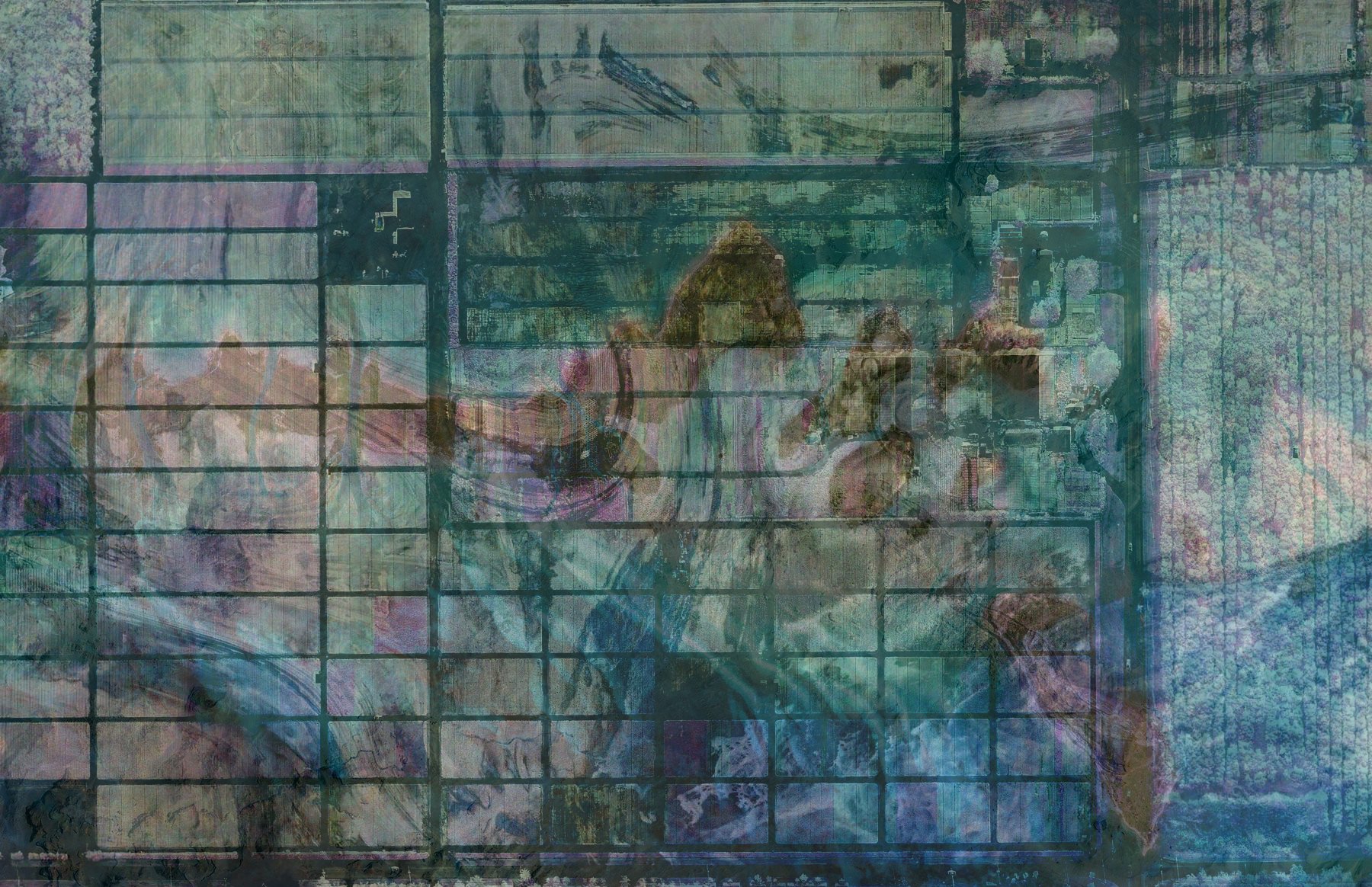
This is one of thousands of images like it (each unique though) I've recently generated with an experimental process. The experiment is a success if I may say so.
This is the process to (potentially) get some way cool procedural images from satellite (or any!) images, accomplished with a new script at github.com/…/ma…/recipes/diff_avg_supercompos... :
Phase I.
– collect several cool satellite images of civilization and/or wilderness, e.g. from this site: earthview.withgoogle.com/
– for every image pair in the collection, make a "diff" image (subtract the RGB values of every pixel in one image from every pixel in the other image), and save the result
– for every image pair in the collection, make an averaged image (average the RGB values of every pixel in one image with another), and save the result
Phase II.
– liberally delete less impressive results
Phase III.
– for every diffed result, average it with an averaged result and save that.
– for every averaged result, subtract (diff) a diffed result.
– liberally delete less impressive results. Good luck–with 17 source images and heavy pruning in Phase II, this will give me 17k+ results, so far all of them compellingly cool.
(Phase IV: sort all results by approx. nearest most similar and string them together in a movie of crossfades to see works between the works.)
(Phase V: accidentally produce glitch art because your computer ran out of hard drive space and memory doing all this, but the processing script keeps calling the utilities that do this, and the utilities break. I'll post some glitch results later).
(Phase VI: realize you have a storage and bandwidth problem for your new many gigabytes of images.)
I hope this post syndicated from my art blog ok. This is the first post attempting to do so via NEXTSCRIPTS AutoPoster, an amazing WordPress plugin.
Syndicated from: earthbound.io/blog/diff_avg_supercomposites-sh-example-ou... -- URL to original image: earthbound.io/blog/wp-content/uploads/2040_1713_diff__171...
museumPASSmusees 2024 - Mima - Multitude - Miguel
MULTITUDE, a solo exhibition by Alexandre Farto aka Vhils, is about our relationship with the city, ?the greatest human invention? according to historian Ben Wilson.
Spread across the MIMA, visitors can encounter wall carvings, billboards, cityscapes, videos and installations from different time periods that offer a compelling insight into the Portuguese artist approach to the relationship between people and cities.
( Le pass musees, comment ca marche ?
1 pass pour 244 musees
Tant de choses a vivre avec le pass musees
Le pass musees est l?abonnement le plus genereux aux musees belges. Cela signifie :
*Acces a tous les musees participants de notre pays, pendant une annee entiere. Quand vous le voulez et aussi souvent que vous le souhaitez.
*Visiter les expositions temporaires gratuitement ou avec une jolie reduction.
*Beneficier d?Avantages extra comme des billets de train a moitie prix, des reductions dans les boutiques des musees et de nombreux autres cadeaux reserves exclusivement aux detenteurs de pass musees.
*Recevoir et sauvegarder les meilleurs conseils en matiere de musees : tous les quinze jours, recevez dans votre boite mail des informations sur les expositions a ne pas manquer et les plus belles decouvertes a faire dans les musees. Vous pouvez sauvegarder vos expositions preferees dans l?app pass musees en prevision de votre prochaine visite.
La Cour internationale de Justice (CIJ), organe judiciaire principal de l’Organisation des Nations Unies, a aujourd’hui rendu son avis consultatif concernant le Jugement no 2867 du Tribunal administratif de l’Organisation internationale du Travail sur requête contre le Fonds international de développement agricole.
Dans son avis consultatif, la Cour
1) conclut à l’unanimité qu’elle est compétente pour répondre à la demande d’avis consultatif ;
2) décide à l’unanimité de donner suite à la demande d’avis consultatif ;
3) concernant les questions qui lui ont été soumises pour avis consultatif par le conseil d’administration du Fonds international de développement agricole, est d’avis, à l’unanimité :
a) concernant la question I, que le Tribunal administratif de l’Organisation internationale du Travail était compétent, en vertu de l’article II de son statut, pour connaître de la requête introduite contre le Fonds international de développement agricole le 8 juillet 2008 par Mme Ana Teresa Saez García ;
b) concernant les questions II à VIII, que ces questions n’appellent pas d’autres réponses de sa part ;
c) concernant la question IX, que la décision rendue par le Tribunal administratif de l’Organisation internationale du Travail dans son jugement no 2867 est valide.
I. Le contexte factuel
La demande d’avis consultatif adressée à la Cour a trait à la validité du jugement rendu par le Tribunal administratif de l’Organisation internationale du Travail (ci-après dénommé le «Tribunal» ou le «TAOIT») le 3 février 2010 au sujet du contrat d’engagement de Mme Saez García. En mars 2000, Mme Saez García reçut, et accepta, du Fonds international de développement agricole (ci-après dénommé le «FIDA» ou le «Fonds») une offre d’engagement d’une durée déterminée de deux ans pour un poste d’administrateur de programme au sein du Mécanisme mondial, entité hébergée par le FIDA. Le Mécanisme mondial ⎯ créé par la convention des Nations Unies sur la lutte contre la désertification dans les pays gravement touchés par la sécheresse et/ou la désertification, en particulier en Afrique (ci-après dénommée la «convention») ⎯ a pour mission de mobiliser et d’acheminer des ressources financières au profit des pays en développement. Le contrat de Mme Saez García fut renouvelé à deux reprises par le FIDA. Par un mémorandum en date du 15 décembre 2005, le directeur général du Mécanisme l’informa que, en raison d’une réduction du budget du Mécanisme, son poste allait être supprimé et son contrat ne serait pas renouvelé. Mme Saez García demanda l’ouverture d’une procédure de concertation, qui se conclut sans qu’un accord n’ait été trouvé, puis introduisit un recours auprès de la commission paritaire de recours du Fonds, qui recommanda à l’unanimité qu’elle soit réintégrée au sein du Mécanisme mondial et reçoive une somme équivalant à l’intégralité des traitements, allocations et indemnités qu’elle n’avait pas perçus. Le 4 avril 2008, le président du FIDA rejeta ces recommandations. Le 8 juillet 2008, Mme Saez García introduisit une requête auprès du Tribunal qui, dans son jugement du 3 février 2010, prononça l’annulation de «[l]a décision du président du 4 avril 2008» et ordonna le versement de dommages-intérêts et le paiement des dépens. Dans une résolution en date du 22 avril 2010 (annexe 1), le conseil d’administration du Fonds décida de soumettre à la Cour, pour avis consultatif, la question de la validité du jugement rendu par le Tribunal.
II. L’existence et l’étendue de la compétence de la Cour
Après avoir rappelé les termes de l’article XII de l’annexe au statut du Tribunal, la Cour fait observer que le pouvoir du conseil d’administration de demander un avis consultatif et la compétence de la Cour pour rendre un tel avis sont fondés sur la Charte des Nations Unies et sur son propre Statut, et non simplement sur l’article XII de l’annexe au statut du TAOIT. Outre cet article XII, la Cour examine l’article 96 de la Charte, le paragraphe 1 de l’article 65 de son Statut et le paragraphe 2 de l’article XIII de l’accord régissant les relations entre l’Organisation des Nations Unies et le Fonds international de développement agricole, et conclut que le Fonds a le pouvoir de soumettre, pour avis consultatif, la question de la validité de la décision rendue par le TAOIT dans son jugement no 2867 et qu’elle a compétence pour examiner la demande d’avis. Le texte de ces dispositions figure à l’annexe 2 du présent communiqué. La Cour rappelle que seuls deux motifs peuvent lui conférer le pouvoir de faire droit à une demande de réformation de jugement du TAOIT : que le Tribunal ait affirmé à tort sa compétence ou que sa décision ait été viciée par une faute essentielle dans la procédure suivie.
III. Le pouvoir discrétionnaire de la Cour
Eu égard au pouvoir discrétionnaire qui est le sien, en vertu de l’article 65 de son Statut, de répondre à une demande d’avis consultatif, la Cour rappelle que seules des «raisons décisives» peuvent justifier un refus. Elle a en effet toujours considéré que l’exercice de sa compétence consultative relevait de sa participation à l’action de l’Organisation et que, en principe, une demande ne devait pas être refusée. La Cour examine ensuite le principe de l’égalité devant elle entre le FIDA et Mme Saez García, en particulier l’égalité d’accès à la Cour et l’égalité dans la procédure se déroulant devant elle. S’agissant de la première, la Cour fait observer que seule l’institution employant le fonctionnaire a accès à la Cour. Elle considère qu’il est aujourd’hui permis de se demander si le système établi en 1946 satisfait effectivement au principe moderne de l’égalité d’accès aux cours et tribunaux. S’agissant de la seconde, la Cour estime que, nonobstant les difficultés qu’elle a rencontrées pour assurer l’égalité dans la présente procédure, elle dispose finalement de toutes les informations requises pour statuer sur les questions posées ; que le Fonds et Mme Saez García ont chacun pu présenter leurs arguments et répondre aux allégations de l’autre de manière appropriée et, dans une large mesure, dans des conditions d’égalité ; et que, en substance, il a été satisfait au principe de l’égalité devant elle dans la procédure. Par conséquent, la Cour considère que les raisons qui pourraient la pousser à refuser de donner un avis consultatif ne sont pas suffisamment décisives pour la conduire à le faire.
IV. Le fond
Avant d’en venir aux questions qui lui sont soumises pour avis consultatif, la Cour indique que, à la lumière des différents instruments portant création du FIDA, de la conférence des parties, du Mécanisme mondial et du secrétariat permanent, ainsi que de la pratique dont il est fait état dans le dossier soumis à la Cour, le Mécanisme mondial n’avait nullement la faculté de conclure des contrats, des accords ou des arrangements, sur le plan international ou national, ni n’a prétendu exercer une telle faculté.
A. Réponse à la question I
A la question I, il est demandé à la Cour de donner un avis sur la compétence du TAOIT pour connaître de la requête formée contre le FIDA par Mme Saez García. Aux termes du paragraphe 5 de l’article II de son statut, le Tribunal ne peut examiner une requête que si le requérant est un fonctionnaire d’une organisation qui a reconnu sa compétence et si la requête invoque l’inobservation des stipulations du contrat d’engagement dudit fonctionnaire ou des dispositions du statut du personnel de cette organisation. La Cour examine la première de ces deux conditions dans le cadre de la compétence ratione personae du Tribunal et la seconde, dans celui de sa compétence ratione materiae.
S’agissant de la compétence ratione personae du Tribunal, une procédure de recours devant le TAOIT étant ouverte aux fonctionnaires du FIDA, la Cour commence par rechercher si Mme Saez García était un fonctionnaire du Fonds, ou d’une autre entité n’ayant pas reconnu la compétence du Tribunal. Après avoir examiné son offre d’engagement et les renouvellements de son contrat, la Cour conclut qu’une relation de travail a été instituée entre le FIDA et Mme Saez García, qui fait de cette dernière un fonctionnaire du Fonds. L’existence de cette relation est corroborée par les conditions dans lesquelles a été instruit le recours que la requérante a formé contre la décision de supprimer son poste et, partant, de ne pas renouveler son engagement de durée déterminée, recours qui n’a à aucun moment été contesté par le FIDA. La Cour conclut dès lors que le Tribunal était compétent ratione personae pour examiner la requête formée par Mme Saez García contre le FIDA.
S’agissant de la compétence ratione materiae du Tribunal, la Cour conclut que la requête formée par Mme Saez García auprès du TAOIT entre dans la catégorie des requêtes invoquant l’inobservation des stipulations de son contrat d’engagement ou des dispositions statutaires ou réglementaires applicables au personnel du Fonds, ainsi qu’il est prescrit au paragraphe 5 de l’article II du statut du Tribunal. Elle considère par conséquent que le Tribunal était compétent ratione materiae pour examiner la requête de Mme Saez García concernant le non-renouvellement de son contrat par le FIDA. En ce qui concerne l’affirmation du Fonds selon laquelle le Tribunal n’était pas compétent pour examiner des questions ne relevant pas du paragraphe 5 de l’article II de son statut, tels que les arrangements juridiques régissant les relations entre le Mécanisme mondial et le Fonds, la Cour est d’avis que le Tribunal ne pouvait faire l’économie d’un examen de ces questions, ainsi que du statut du directeur général du Mécanisme mondial et de l’autorité devant laquelle il était responsable. La Cour conclut dès lors que le Tribunal était compétent ratione materiae pour examiner la requête formée par Mme Saez García contre le FIDA concernant le non-renouvellement de son contrat.
B. Réponse aux questions II à VIII
La Cour est d’avis que sa réponse à la première question posée par le FIDA couvre également tous les points relatifs à la compétence que le Fonds a soulevés dans les questions II à VIII de sa demande d’avis consultatif. Dans la mesure où les questions II à VIII visent à solliciter l’avis de la Cour sur le raisonnement qui sous-tend les conclusions auxquelles le Tribunal est
parvenu, la Cour rappelle que, conformément à l’article XII de l’annexe au statut du TAOIT, elle ne peut être saisie d’une requête pour avis consultatif que dans les cas d’une contestation de la décision du Tribunal affirmant sa compétence ou d’une faute essentielle dans la procédure. Dans ses questions II à VIII, le FIDA n’identifie pas de faute essentielle dans la procédure que le Tribunal aurait commise lors de son examen de la requête formée contre lui.
C. Réponse à la question IX
En réponse à la question IX posée par le conseil d’administration du FIDA concernant la validité de la décision rendue par le Tribunal dans son jugement n° 2867, la Cour, ayant décidé que le Tribunal était entièrement fondé à affirmer sa compétence et n’ayant pas identifié de faute essentielle dans la procédure suivie par ce dernier, conclut que la décision rendue par le TAOIT dans son jugement no 2867 est valide.
Composition de la Cour
La Cour était composée comme suit : M. Owada, président, M. Tomka, vice-président ; MM. Koroma, Abraham, Keith, Sepúlveda-Amor, Bennouna, Skotnikov, Cançado Trindade, Yusuf, Greenwood, Mmes Xue, Donoghue, juges ; M. Couvreur, greffier.
M. le juge Cançado Trindade joint à l’avis consultatif l’exposé de son opinion individuelle ; M. le juge Greenwood joint une déclaration à l’avis consultatif.
*
Un résumé de l’avis consultatif figure dans le document intitulé «Résumé n° 2012/1». Le présent communiqué de presse, le résumé de l’avis, ainsi que le texte intégral de celui-ci sont disponibles sur le site Internet de la Cour.
LA HAYE, le 1er février 2012.
-----------------------------------------
The Court finds that the decision given by the Administrative Tribunal of the
International Labour Organization in its Judgment No. 2867 is valid
THE HAGUE, 1 February 2012. The International Court of Justice (ICJ), the principal judicial organ of the United Nations, today delivered its Advisory Opinion concerning Judgment No. 2867 of the Administrative Tribunal of the International Labour Organization upon a complaint filed against the International Fund for Agricultural Development.
In its Advisory Opinion, the Court:
(1) Finds unanimously that it has jurisdiction to give the advisory opinion requested;
(2) Decides unanimously to comply with the request for an advisory opinion;
(3) With regard to the questions put for an advisory opinion by the Executive Board of the International Fund for Agricultural Development, is of the opinion:
(a) Unanimously, with regard to Question I, that the Administrative Tribunal of the International Labour Organization was competent, under Article II of its Statute, to hear the complaint introduced against the International Fund for Agricultural Development on 8 July 2008 by Ms Ana Teresa Saez García;
(b) Unanimously, with regard to Questions II to VIII, that these questions do not require further answers from the Court;
(c) Unanimously, with regard to Question IX, that the decision given by the Administrative Tribunal of the International Labour Organization in its Judgment No. 2867 is valid.
I. Factual background
The request for an advisory opinion concerns the validity of the Judgment rendered by the Administrative Tribunal of the International Labour Organization (hereinafter the “Tribunal”) on 3 February 2010, relating to Ms Saez García’s contract of employment. In March 2000, Ms Saez García was offered, and accepted, a two-year fixed-term contract with the International Fund for Agricultural Development (IFAD) to serve as a Programme Officer in the Global Mechanism, an entity hosted by IFAD. The Global Mechanism ⎯ established by the United Nations Convention to Combat Desertification in those Countries Experiencing Serious Drought and/or Desertification, particularly in Africa ⎯ works to mobilize and channel financial resources
- 2 -
to developing countries. Ms Saez García’s contract was twice extended by IFAD. By a memorandum of 15 December 2005, the Managing Director of the Global Mechanism informed her that, due to a reduction in the budget of the Global Mechanism, her post would be abolished and her contract would not be renewed. Ms Saez García requested a facilitation process, which ended with no settlement, and she then challenged the decision before the Joint Appeal’s Board of the Fund, which unanimously recommended that she be reinstated and awarded a payment of lost salaries, allowances and entitlements. On 4 April 2008 the President of the Fund rejected the recommendations. On 8 July 2008, Ms Saez García filed a complaint with the Tribunal, and, in its Judgment of 3 February 2010, the Tribunal decided that “[t]he President’s decision of 4 April 2008 is set aside” and made orders for the payment of damages and costs. In a resolution of 22 April 2010 (attached as Annex 1), the Executive Board of the Fund requested an advisory opinion of the Court on the validity of that judgment.
II. The Existence and Scope of the Court’s Jurisdiction
After recalling the terms of Article XII of the Annex to the Statute of the Tribunal, the Court observes that the power of the Executive Board to request an advisory opinion and the jurisdiction of the Court to give such an opinion are founded on the Charter of the United Nations and the Statute of the Court, and not on Article XII of the Annex to the Statute of the Tribunal alone. In addition to the latter provision, the Court examines Article 96 of the United Nations Charter, Article 65, paragraph 1, of its Statute and Article XIII, paragraph 2, of the Relationship Agreement between the United Nations and the Fund, concluding that the Fund has the power to request an advisory opinion on the validity of the decision given by the Tribunal in its Judgment No. 2867 and that the Court has jurisdiction to consider the request. These provisions are included in Annex 2 to this press release. The Court recalls that its power to review a judgment of the Tribunal is limited to two grounds: that the Tribunal wrongly confirmed its jurisdiction or the decision is vitiated by a fundamental fault in the procedure followed.
III. The Court’s Discretion
With regard to its discretion under Article 65 of its Statute as to whether to reply to a request for an advisory opinion, the Court recalls that “compelling reasons” would be required to justify a refusal. Indeed, it has always considered that to give the advisory opinion requested represents its participation in the activities of the Organization and, in principle, a request should not be refused. The Court then examines the principle of equality before it of IFAD on the one hand and the official on the other, including inequality of access to the Court and inequalities in the proceedings before the Court. With regard to the former, the Court observes that it is only the employing agencies which have access to the Court; the staff member concerned does not. The Court considers that questions may now properly be asked whether such a system, established in 1946, meets the present-day principle of equality of access to courts and tribunals. With regard to the latter, the Court finds that although the process of ensuring equality in the proceedings was not without its difficulties, the Court ultimately did have the information it required to decide on the questions submitted; that both the Fund and Ms Saez García have had adequate and, in large measure, equal opportunities to present their case and to answer that made by the other; and that, in essence, the principle of equality in the proceedings before the Court has been met. Thus, the Court considers that the reasons that could lead it to decline to give an advisory opinion are not sufficiently compelling to require it to do so.
IV. Merits
Before turning to the questions put to it for an advisory opinion, the Court observes that, in light of the different instruments setting up the Fund, the Conference of the Parties of the
- 3 -
Convention on Desertification (hereinafter the “COP”), the Global Mechanism and the Permanent Secretariat, and of the practice included in the record before the Court, the Global Mechanism had no power and has not purported to exercise any power to enter into contracts, agreements or “arrangements”, internationally or nationally.
A. Response to Question I
In Question I, the Court is requested to give its opinion on the competence of the Tribunal to hear the complaint brought against the Fund by Ms Saez García. Under Article II, paragraph 5, of its Statute, the Tribunal could hear the complaint only if the complainant was an official of an organization that has recognized the jurisdiction of the Tribunal, and if the complaint related to the non-observance of the terms of appointment of such an official or the provisions of the staff regulations of the organization. The Court examines the first set of conditions with reference to the competence ratione personae of the Tribunal and the second set of conditions under the heading of the competence ratione materiae of the Tribunal.
With respect to the Tribunal’s competence ratione personae, since recourse to the Tribunal is open to staff members of the Fund, the Court first considers whether Ms Saez García was an official of the Fund, or of some other entity that did not recognize the jurisdiction of the Tribunal. On the basis of an examination of her offer of employment and the renewals of her contract, the Court concludes that an employment relationship was established between Ms Saez García and the Fund, and that this relationship qualified her as a staff member of the Fund. The Court considers that this is further evidenced by the facts surrounding her appeal against the decision to abolish her post, an appeal that was at no point contested by IFAD, and the consequent non-renewal of her fixed-term appointment. The Court thus concludes that the Tribunal was competent ratione personae to consider the complaint brought by Ms Saez García against the Fund.
With respect to the Tribunal’s competence ratione materiae, the Court concludes that Ms Saez García’s complaint to the Tribunal falls within the scope of allegations of non-observance of her terms of appointment and of the provisions of the staff regulations and rules of the Fund, as prescribed by Article II, paragraph 5, of the Statute of the Tribunal. With regard to the Fund’s contention that the Tribunal lacked jurisdiction to examine matters outside the scope of Article II, paragraph 5, of its Statute, such as the legal arrangements governing the relationship between the Global Mechanism and the Fund, the Court is of the opinion that the Tribunal could not avoid examining such matters, as well as the status and accountability of the Managing Director of the Global Mechanism. Consequently, the Court is of the view that the Tribunal was competent ratione materiae to consider the complaint brought before it by Ms Saez García in respect of the non-renewal of her contract by the Fund.
B. Response to Questions II to VIII
The Court states that its answer to the first question put to it by the Fund covers also all the issues on jurisdiction raised by the Fund in Questions II to VIII. To the extent that Questions II to VIII seek the opinion of the Court on the reasoning underlying the conclusions reached by the Tribunal, the Court reiterates that, under the terms of Article XII of the Annex to the Statute of the Tribunal, a request for an advisory opinion is limited to a challenge of the decision of the Tribunal confirming its jurisdiction or to cases of fundamental fault of procedure. Questions II to VIII do not identify any fundamental fault in procedure which may have been committed by the Tribunal in its consideration of the complaint against the Fund.
- 4 -
C. Response to Question IX
In response to Question IX put by the Executive Board of the Fund, concerning the validity of the Tribunal’s decision in its judgment No. 2867, the Court, having decided that the Tribunal was entirely justified in confirming its jurisdiction, and not having found any fundamental fault in procedure committed by the Tribunal, finds that the decision given by the Tribunal in its Judgment No. 2867 is valid.
Composition of the Court
The Court was composed as follows: President Owada; Vice-President Tomka; Judges Koroma, Abraham, Keith, Sepúlveda-Amor, Bennouna, Skotnikov, Cançado Trindade, Yusuf, Greenwood, Xue, Donoghue; Registrar Couvreur.
Judge Cançado Trindade appends a separate opinion to the Advisory Opinion of the Court; Judge Greenwood appends a declaration to the Advisory Opinion of the Court.
*
A summary of the Advisory Opinion appears in the document “Summary No. 2012/1”. In addition, this press release, the summary and the full text of the Advisory Opinion can be found on the Court’s website.
In a recent roundup of thoughts from the Interaction 10 conference, Jan-Cristoph Zoels wrote:
"Unfortunately [Dave Gray] illustrated his engaging talk with a glorification of the AK47 as a ‘powerful tool of change’. His agnostic design philosophy hides an ethical ambivalence and repositions designers as hired hands of industry who do whatever is needed – even weapons of mass destruction. Can’t we find ethical examples which enable people, but don’t kill?"
Jan missed the point of my AK-47 example. There's nothing agnostic about my design philisophy -- a philosophy I share with Mikhail Kalashnikov, the designer of the AK-47. The design philosophy is this:
Don't design for a perfect world, because the world isn't perfect. Design simple things that are rugged, reliable, simple and easy to use; things that work even when conditions are chaotic; things that work even when they are mostly broken.
The AK-47 is a successful weapon because it was designed to work when the world is falling apart around you. When an AK-47 is wet, when it is clogged with mud, sand or snow, it will still work, in conditions where many more precise and accurate weapons will fail.
That's not an agnostic design philosophy, it's a philosophy that is deeply rooted in fundamentals. It's a philosophy that requires a designer to prize simplicity and exhibit strength of purpose; that emphasizes ease-of-use and reliability over feature-richness and perfection.
Now, we can also argue about ethical ambivalence -- whether it's ethical to design a weapon. This is an age-old and probably unresolvable argument. The intent of my talk was to demonstrate the design philosophy in a memorable and dramatic way by telling the true story of one designer.
Mikhail Kalashnikov designed the AK-47 because his homeland had been invaded by an enemy with superior weapons. He wasn't a "hired hand of an industry, doing whatever was needed." He was a tank mechanic who saw fellow soldiers and civilians gunned down and wanted to ensure that it would never happen again.
If Kalashnikov had lived in the west he would be a rich man today (Yes, he’s still alive, about 90 years old). But he grew up in a communist state, so he’s now a national hero who lives on a government pension.
Mikhail Kalashnikov is on record as saying that he would have preferred to have designed something more useful, for example, a lawn mower. But his country was invaded, he was severely wounded and in his hospital bed, his thoughts turned to weaponry. Can we really blame him? It's hard to see him as a profit-seeker or a "hired hand of industry."
He designed a weapon with the intention of repelling invaders, and in fact the AK-47 has to be seen as one of the most successful weapons of all time in this regard. Since he designed it in 1947, Kalashnikov’s weapon has enabled other people to defend their homelands from invaders, even superpowers: It helped the Vietcong drive American troops out of Vietnam, and it helped the Mujahideen drive the Soviet Union out of Afghanistan.
Are there other examples I could have used to make my point? I am sure there are. But as a person who has spoken at many conferences, and also as a person who has sat through many polite-but-boring talks, I choose to make my points as dramatically, engagingly and entertainingly as possible. As a history buff, the story of Mikhail Kalashnikov captivated me, and I was sure it would do the same for others if I could tell it compellingly. When I want to make an important point, I do it with drama, because that’s what people remember. There’s a reason that war movies are more popular than design documentaries.
I would rather stir up a bit of controversy than subject an audience to slow, agonizing death with PowerPoint bullet points. And if you are speaking and I am in the audience, I hope you will do the same for me.
From the brochure for the exhibition "John Waters: Change of Life" at the Orange County Museum of Art in Newport Beach, California from October 30, 2005 to January 15, 2006.
A relatively sedate exhibition featuring photos, movies, and objects collected by John Waters -- best known for the notorious "poodle scene" in his movie "Pink Flamingos". Photo above is from one of his "body part fetish" sequences - this one of actress Dorothy Malone's collar. Malone, best remembered for the then scandalous "Peyton Place" was "not amused". Grace Kelly was not around to comment on the 8 photo sequence "Grace Kelly's Elbow".
The highlight was the "last time ever" showing of 2 early "student movies" by Waters: "Eat Your Makeup" and "Hag in a Black Leather Jacket". Both showed total contempt for the viewer (no clue what they were "about") but were "compellingly absurd and ambiguous" - stayed for over 2 hours to watch.
from bit.ly/JurCBU
Read this post on Elitistreview - The Alresford Watercress Festival
Today Editor Dani and I visited the Alresford Watercress Festival. Alresford is a small town in Hampshire and it was recognised by the Romans as being the perfect place to grow watercress; a couple of millennia later it still is. As such, the locals have a large bash every year to celebrate this gratifying green grub.
Venerating a verdant victual? Long-time readers might wonder why the hell I am having anything to do with such things – I’ve warned you of the carcinogenic dangers of green growths so many times. Truth is, Alresford Watercress is really quite good for a plant. More importantly, it tastes wizard when served with meat. I’ll say more on this and the festival in general below.
Let’s deal with the vegetable itself first. Watercress we’ve all had in dreary restaurant salads is simply a wet green thing; that is precisely the kind of thing I hate. Alresford watercress has a compellingly crisp texture; there’s a satisfying quality to it when you bite. Unusually for a plant, it has flavour. Quite a lot of flavour, too, and it’s rather nice. Piquant and peppery with an edge of horseradish character to it. It enlivens food, which is why the Hampwich is such a brilliant construction.
I have to say, I’ve only had Alresford watercress quite close to the Town itself, and so I wonder how well it will travel and whether you, my dear and distant readers, will ever be able to sample its delights without coming to Hampshire. And you should come to Hampshire[1] as there are so many good things here as the festival amply demonstrated.
We tried watercress in all manner of things; perhaps most memorably some watercress and wasabi fudge. Yes, that sounds weird, and I can honestly say it was, but I loved it. For the first 30 seconds after I tried it all I could articulate was, “Wow!” When I recovered my wit I was struck by it’s odd but winning combination of sweetness, bite, fire and life all tied up in a complex whole. The lady from the producers, Mummy Makes, seemed highly entertained by my confused enthusiasm for it.
Of course, watercress featured in much more. It is excellent blended in sausages and burgers, where its peppery bite enlivens the meat flavours. We’ve got some rather good watercress sausages that I am looking forward to having for breakfast, hopefully tomorrow morning. Of course, a lot of people serving food didn’t actually make watercress-containing food but just had some on offer to put in burgers, sandwiches, hotdogs and the like. It worked a treat in everything I tried it with.
A lot of the Hampshire Farmers’ Market regulars were at the festival. I was smitten by the smell of Greenfield’s hog roast at the first market I attended and this time we finally tried one. It was amazing! The pork was moist and juicy with incredibly rich and powerful flavours. I never really see the point of crackling but the pieces in this roll tasted fantastic and the feel in the mouth as I crunched them was spiffing. Needless to say there was a happy heap of watercress in our hog roast roll.
We finally got some produce from The Spanish Ham Master, who sells excellent Spanish pig products at various Hampshire events. We got two packets of head-end Lomo Iberico, which is fattier than normal Lomo Iberico, and ate them both within 15 minutes of getting home. Prime pig!
The excellent Woodlands Jersey Beef were there and we secured two sirloins to have with some asparagus we procured from the gentleman pictured. Lyburn Farmhouse Cheesemakers provided us with a kilo and a half of Lyburn Gold.
I’ve got a lot more time for polytheism these days and if there is a god of pies, he runs Manydown Farm Shop in Basingstoke. Why do I say this? Just look how much chicken packs this chicken and ham pie:
We’ve had beef and various chicken pies from Manydown and they’ve never been less than utterly crammed with exceedingly high-quality ingredients that have been prepared with skill. I find it hard to imagine a better pie than Manydown’s, but when I finally get to meet the person who prepares these marvels I’m going to suggest she makes a chicken and truffle pie. My mind boggles!
Naturally there were plenty of festival type jollies. They included the Watercress Queen who distributed watercress to her subjects:
Falconry demonstrations that included this rather massive Canadian horned owl:
There was a small collection of farm animals you could stroke. Or lick, I suppose, if you like your meat really rare:
Marching bands entertained us:
As did various flavours of Morris Dancers:
All attendees were kept from getting too excited by Alresford’s police force:
Just to be complete, I should say it is worth visiting Alresford at any time, not just when the festival is on. It’s very pretty with some good walks, has rude signs and the very highest qualified professionals:
The Alresford Watercress Festival was a good warm-up for the Hampshire Food Festival, of which I shall write more soon. We purchased a pile of quality produce with our arms straining. Oddly despite the incredible range of goods we got we didn’t actually pick up any fresh watercress…
[1] Let me know when you are visiting and I’ll meet you for a drink or two. ↩
Related posts:
Mirth with meat at The Ginger Pig’s beef butchery course
This was published on Elitistreview
carla bley, 'trios', concert 09.10.13 in lantaren venster, rotterdam:
Carla Bley piano
Andy Sheppard tenor and soprano saxophones
Steve Swallow bass
ECM: Carla Bley, Andy Sheppard and Steve Swallow revisit classic Bley compositions in an exceptional album recorded in Lugano last year by Manfred Eicher. Included here are spirited new versions of “Utviklingssang” and “Vashkar”, and the suites “Les Trois Lagons”, “Wildlife” and “The Girl Who Cried Champagne”. Carla’s robust tunes are vividly conveyed, all members solo compellingly, and the trio has never sounded better.
Trios is one of the outstanding jazz albums of the season and marks the first time that a new Carla Bley album has appeared on ECM itself (rather than the ECM-distributed WATT label, which has been her primary platform for 40 years).
Revolutionary architecture? Well, sort of. Vladimir Shukhov was much-admired by the architectural vanguard, but like Berlage in the Netherlands or Wagner in Vienna, he was a child of the middle 19th century, successful and well established in his field well before things started getting really screwy. The Tsarist regime had no problem with his radically engineered infrastructural works - bridges, exhibition buildings, water towers, and lighthouses, as well as oil pipelines, oil tankers, and oil refineries. We've already seen his pre-revolutionary work on the roofs for the Petrovsky Passage and the Upper Trading Rows.
In this light, his gigantic Moscow radio tower, though post-revolutionary and clearly in line with the modern spirit, is actually nothing new for Shukhov. He had first used a diagrid-hyperboloid structure for an 1896 expo building, and understood well the advantages: light weight, relatively simple to construct, and with a good handling of wind loads. Still, the tower was ambitious; the original design imagined a height of 350 meters - taller than the Eiffel Tower. It had to be scaled down to less than half of that, but it's still visible from all over Moscow, and still compellingly weird in its frank pursuit of a technical goal. It's also of historical interest generally: its construction spans the years of the Russian Civil War, when very little else was getting built, certainly not at this scale - but it was a military priority. That it remained so is evidenced by its survival of the Second World War, when even the steel for the mighty Palace of the Soviets was redirected off the building site to make into anti-tank barriers at the edge of Moscow. The Shukhov Tower still stands, though perhaps not for long: no longer in use, visibly corroding, undermined by a botched reinforcement of the foundation (now a concrete ring which refuses to let the structure flex as intended), and unabashedly neglected by its owner, the tower is in serious danger of collapse.
Shukhov, by the way, remained discreetly apolitical in the post-Revolutionary period, providing consulting and engineering services much as he always had, including some arguably even more dramatic projects and some collaborations with Melnikov. He died of natural causes in 1939, at age eighty-five.
The Emergence of UX in an Agile World
As a provider of hearing solutions to hearing impaired people for almost 30 years, Cochlear is renowned worldwide as a technical innovator and as a great Australian success story. We share the story of our journey with Agile software development in an environment that is traditionally not comfortable with it. More compellingly we cover the emergence of user experience and user centered design and how it has integrated into almost every aspect of the product development and delivery cycle.
Keywords: Agile, UX, UserExperience, UserCenteredDesign, Process, Mobile, iPad
Target Audience: Developers, Managers, Thought Leaders, User Experience Architects
Speaker Information
Victor Rodrigues
Agile methods practitioner and evangelist with a passion for the total end user experience
Head of Audiological Software Development for Cochlear
Software Passion: "Supporting software teams to perform at their best and evangelising the total end user experience."
Links:
Twitter: @jeunj
Blog: beyondcomprehension.posterous.com/
Xerxes Battiwalla
Problem solver and bit-manipulator
Senior Developer, Cochlear
Software Passion: "My software passion: Making software simple and pain-free."
Website: www.xerxesb.com/
Twitter: @xerxesb
Blog: tumblr.xerxesb.com/
The YOW! 2010 Australia Software Developer Conference is a unique opportunity for you to listen to and talk with international software experts in a relaxed setting.
Here's why you should want to attend:
* concise, technically-rich talks and workshops delivered
without the usual vendor-hype and marketing spin
* broad exposure to the latests tools and technologies,
processes and practices in the software industry
* "invitation only" speakers selected by an independent
international program committee from a network
of over 400 authors and experts
* a relaxed conference setting where you get the rare opportunity
to meet and talk with world-reknowned speakers face-to-face
* an intimate workshop setting where you are able
to benefit from an in-depth learning experience
* a truly unique opportunity to make contacts and network
with other talented Australian software professionals
* you'll be supporting a great charity. Ten dollars from every registration will be donated to the Endeavour Foundation.
website: YOW! 2010 Melbourne
venue: Jasper Hotel, Melbourne
Again, heavily filtered due to being corrupted by Facebook compression, but hopefully you can get a glimpse into how beautiful our balcony and garden look in the snow by night! We really love fairy lights, and have quite a ridiculously expensive collection of them; we have a set of icicle lights in both our bedroom and living room that are each designed to go round the outside of your house! But they just look fantastic draped across the bay window and round the ceiling and give us a huge amount of pleasure! These ones around our balcony look brilliant in the dusk when seen from the garden, and they make it feel all magical and cosy when out on the balcony once the sun goes down.
Sunday was spent recovering from late night excesses, and featured a re-watch of all of Nathan Barley - I had forgotten how fantastic it is! Definitely the sort of thing for a hungover afternoon! We then indulged ourselves in a good session of Final Fantasy and Dark Souls - Tom had a massive breakthrough and found the route to actually enjoying it and now thinks it's a great game, so that's good!
On the downside, I have been disappointed by strangers quite a bit lately. It's not a feeling I like, and I do wonder how much it's linked to the feelings I mentioned in an earlier post about becoming more selfish. But I recently had some friendly overtures thrown back in my face for no real reason by an ex's new girlfriend, and it's left somewhat of a sour taste in my mouth. Ordinarily it might not be such an important thing, as I don't really see much of said ex; however, we do have a lot of friends in common (as do the new girlfriend and I) and we do frequent the same conventions, even if I haven't in the last write-off of a year. So from the first I heard of her I assumed that we would be likely to be in social situations together and that obviously that would be better if there were no crossed wires or paranoia on her part that might result in hostility.
Given how I had initially felt very awkward and uncomfortable at the idea of Tom's ex-wife, I could imagine that this girl might not be thrilled by the idea of me; and given that a lot of my feelings about Tom's ex were based on her having only expressed hostile thoughts about me, which had triggered my fear of crazy stalker type action again (re: the reason I moved out of London), I imagined that the best way to ensure that no awkwardness would occur would be to try to show her that I wanted to be friends with generic positive communication in public fora. Of course, there's no knowing what will work for one person based on your own experience; just because that's what I wanted from someone who intimidated me doesn't mean that it is what this new girl wanted.
Recently it emerged that it's very much not what she wanted; without having bothered to engage with me or to ask me not to contact her, she publicly posted snide remarks about me on her twitter - which of course both our friends can read. I thought this was a really nasty passive-aggressive tactic from someone who has no real reason to take umbrage with me, and pointless given that she could just have messaged me to say that she didn't appreciate my attempts at befriending her. I don't understand why people think that it's polite to avoid confrontation but to be cruel in spirit - again this comes back to what I was trying to express in this post regarding the divide between social norms and the actual benefit to observing them.
I even had a message from my ex saying that he would have to break all contact because the new girlfriend was so unhappy about me! While I am all in favour of walking different paths when your connection with someone has already dissolved, I think that articulating this rather than simply living it can lead to all sorts of problems - particularly when we now do encounter one another in public with our mutual friends. I've never really been in that situation before where I know someone I am likely to be face to face with doesn't want to see me (except the crazy stalker, who I didn't want to see).
The thing that made me want to mark this in my blogging is that the concepts that I'm describing here of semi-irrational intolerance and unwillingness to attempt to think positively about someone else seem to be very prevalent in dynamics around me at the moment, in terms of things that other people have also mentioned about their own interactions with others; I'm curious as to whether or not there's some cultural shift that's happening whereby everyone is just losing patience a little; or perhaps the prevalence of faith in psychotherapeutical attitudes to self-preservation and self-prioritisation are having a more insidious influence of social dynamics than previously.
I myself am just as guilty; I have allowed myself to feel actual venom towards people in the last year, and yes, I have been unusually not myself in the last year, but even so; I have found myself thinking without love on occasion and sometimes experiencing resentment of others actively knowing that I'm being irrational. On the plus side: having this experience with the new girlfriend has made me feel significantly more positively towards Tom's ex-wife again (which I did at the very beginning, but various circumstances and things that I heard made me worry that she would turn into another manipulative crazy and I started to think far more negatively - which she never got a say in) She has dealt with any negative feelings towards me in a personal and mature way and I am very respectful of that. I feel bad that I ever doubted it.
So maybe sometimes people can still surprise you in good ways too. And maybe I need to find a way to learn that communication and interaction isn't actually the solution for everyone on the planet, even if it feels like it must be to me.
I should clarify: I have used the word girl throughout to refer to the new girlfriend; some of you who know me well will know that I consider this an insulting term for anyone of the age and station who is female whose status is equivalent to that of someone you would call a man and not a boy. I'm using it intentionally because I would call her a boy based on her behaviour, which I don't find compellingly adult. However, my position on the disparity of gender pairs still stands, even if modifying usage isn't practical in most instances!
museumPASSmusees 2024 - Mima - Multitude - Miguel
MULTITUDE, a solo exhibition by Alexandre Farto aka Vhils, is about our relationship with the city, ?the greatest human invention? according to historian Ben Wilson.
Spread across the MIMA, visitors can encounter wall carvings, billboards, cityscapes, videos and installations from different time periods that offer a compelling insight into the Portuguese artist approach to the relationship between people and cities.
( Le pass musees, comment ca marche ?
1 pass pour 244 musees
Tant de choses a vivre avec le pass musees
Le pass musees est l?abonnement le plus genereux aux musees belges. Cela signifie :
*Acces a tous les musees participants de notre pays, pendant une annee entiere. Quand vous le voulez et aussi souvent que vous le souhaitez.
*Visiter les expositions temporaires gratuitement ou avec une jolie reduction.
*Beneficier d?Avantages extra comme des billets de train a moitie prix, des reductions dans les boutiques des musees et de nombreux autres cadeaux reserves exclusivement aux detenteurs de pass musees.
*Recevoir et sauvegarder les meilleurs conseils en matiere de musees : tous les quinze jours, recevez dans votre boite mail des informations sur les expositions a ne pas manquer et les plus belles decouvertes a faire dans les musees. Vous pouvez sauvegarder vos expositions preferees dans l?app pass musees en prevision de votre prochaine visite.
museumPASSmusees 2024 - Mima - Multitude - Miguel
MULTITUDE, a solo exhibition by Alexandre Farto aka Vhils, is about our relationship with the city, ?the greatest human invention? according to historian Ben Wilson.
Spread across the MIMA, visitors can encounter wall carvings, billboards, cityscapes, videos and installations from different time periods that offer a compelling insight into the Portuguese artist approach to the relationship between people and cities.
( Le pass musees, comment ca marche ?
1 pass pour 244 musees
Tant de choses a vivre avec le pass musees
Le pass musees est l?abonnement le plus genereux aux musees belges. Cela signifie :
*Acces a tous les musees participants de notre pays, pendant une annee entiere. Quand vous le voulez et aussi souvent que vous le souhaitez.
*Visiter les expositions temporaires gratuitement ou avec une jolie reduction.
*Beneficier d?Avantages extra comme des billets de train a moitie prix, des reductions dans les boutiques des musees et de nombreux autres cadeaux reserves exclusivement aux detenteurs de pass musees.
*Recevoir et sauvegarder les meilleurs conseils en matiere de musees : tous les quinze jours, recevez dans votre boite mail des informations sur les expositions a ne pas manquer et les plus belles decouvertes a faire dans les musees. Vous pouvez sauvegarder vos expositions preferees dans l?app pass musees en prevision de votre prochaine visite.
museumPASSmusees 2024 - Mima - Multitude - Miguel
MULTITUDE, a solo exhibition by Alexandre Farto aka Vhils, is about our relationship with the city, ?the greatest human invention? according to historian Ben Wilson.
Spread across the MIMA, visitors can encounter wall carvings, billboards, cityscapes, videos and installations from different time periods that offer a compelling insight into the Portuguese artist approach to the relationship between people and cities.
( Le pass musees, comment ca marche ?
1 pass pour 244 musees
Tant de choses a vivre avec le pass musees
Le pass musees est l?abonnement le plus genereux aux musees belges. Cela signifie :
*Acces a tous les musees participants de notre pays, pendant une annee entiere. Quand vous le voulez et aussi souvent que vous le souhaitez.
*Visiter les expositions temporaires gratuitement ou avec une jolie reduction.
*Beneficier d?Avantages extra comme des billets de train a moitie prix, des reductions dans les boutiques des musees et de nombreux autres cadeaux reserves exclusivement aux detenteurs de pass musees.
*Recevoir et sauvegarder les meilleurs conseils en matiere de musees : tous les quinze jours, recevez dans votre boite mail des informations sur les expositions a ne pas manquer et les plus belles decouvertes a faire dans les musees. Vous pouvez sauvegarder vos expositions preferees dans l?app pass musees en prevision de votre prochaine visite.
The Emergence of UX in an Agile World
As a provider of hearing solutions to hearing impaired people for almost 30 years, Cochlear is renowned worldwide as a technical innovator and as a great Australian success story. We share the story of our journey with Agile software development in an environment that is traditionally not comfortable with it. More compellingly we cover the emergence of user experience and user centered design and how it has integrated into almost every aspect of the product development and delivery cycle.
Keywords: Agile, UX, UserExperience, UserCenteredDesign, Process, Mobile, iPad
Target Audience: Developers, Managers, Thought Leaders, User Experience Architects
Speaker Information
Victor Rodrigues
Agile methods practitioner and evangelist with a passion for the total end user experience
Head of Audiological Software Development for Cochlear
Software Passion: "Supporting software teams to perform at their best and evangelising the total end user experience."
Links:
Twitter: @jeunj
Blog: beyondcomprehension.posterous.com/
Xerxes Battiwalla
Problem solver and bit-manipulator
Senior Developer, Cochlear
Software Passion: "My software passion: Making software simple and pain-free."
Website: www.xerxesb.com/
Twitter: @xerxesb
Blog: tumblr.xerxesb.com/
The YOW! 2010 Australia Software Developer Conference is a unique opportunity for you to listen to and talk with international software experts in a relaxed setting.
Here's why you should want to attend:
* concise, technically-rich talks and workshops delivered
without the usual vendor-hype and marketing spin
* broad exposure to the latests tools and technologies,
processes and practices in the software industry
* "invitation only" speakers selected by an independent
international program committee from a network
of over 400 authors and experts
* a relaxed conference setting where you get the rare opportunity
to meet and talk with world-reknowned speakers face-to-face
* an intimate workshop setting where you are able
to benefit from an in-depth learning experience
* a truly unique opportunity to make contacts and network
with other talented Australian software professionals
* you'll be supporting a great charity. Ten dollars from every registration will be donated to the Endeavour Foundation.
website: YOW! 2010 Melbourne
venue: Jasper Hotel, Melbourne
Author : @Kiri Karma
museumPASSmusees 2024 - Mima - Multitude - Kiri
MULTITUDE, a solo exhibition by Alexandre Farto aka Vhils, is about our relationship with the city, ?the greatest human invention? according to historian Ben Wilson.
Spread across the MIMA, visitors can encounter wall carvings, billboards, cityscapes, videos and installations from different time periods that offer a compelling insight into the Portuguese artist approach to the relationship between people and cities.
( Le pass musees, comment ca marche ?
1 pass pour 244 musees
Tant de choses a vivre avec le pass musees
Le pass musees est l?abonnement le plus genereux aux musees belges. Cela signifie :
*Acces a tous les musees participants de notre pays, pendant une annee entiere. Quand vous le voulez et aussi souvent que vous le souhaitez.
*Visiter les expositions temporaires gratuitement ou avec une jolie reduction.
*Beneficier d?Avantages extra comme des billets de train a moitie prix, des reductions dans les boutiques des musees et de nombreux autres cadeaux reserves exclusivement aux detenteurs de pass musees.
*Recevoir et sauvegarder les meilleurs conseils en matiere de musees : tous les quinze jours, recevez dans votre boite mail des informations sur les expositions a ne pas manquer et les plus belles decouvertes a faire dans les musees. Vous pouvez sauvegarder vos expositions preferees dans l?app pass musees en prevision de votre prochaine visite.
Voronezh, Voronezh Oblast, Russian Federation
Voronezh is a city located in the Voronezh Oblast of the Russian Federation. It is situated in the western part of Russia, about 450 kilometers (280 miles) south of Moscow. With a population of over one million people, Voronezh is one of the largest cities in the country and serves as an important cultural, industrial, and educational center.
History:
The history of Voronezh dates back to the 12th century when it was founded as a fortress on the Voronezh River. Over the centuries, the city played a significant role in the defense of the Russian lands against foreign invaders. It served as a key point in the defense system against the Crimean Tatars and later against the Polish invaders during the Time of Troubles.
During the 19th century, Voronezh experienced rapid growth and development. It became a major trade and transport hub, connecting central Russia with the southern regions. The city's economy flourished, fueled by the expansion of agriculture, manufacturing, and trade. Voronezh also became a cultural center, with the establishment of theaters, libraries, and educational institutions.
In the 20th century, Voronezh played a crucial role in World War II. The city was occupied by German forces during the Battle of Voronezh in 1942 but was later liberated by the Soviet Army. The war left a lasting impact on the city, with many buildings and infrastructure destroyed. However, Voronezh was quickly rebuilt, and its industrial capacity was expanded to contribute to the post-war reconstruction efforts.
Economy:
Voronezh is an important industrial center in Russia. The city's economy is diverse and includes sectors such as machinery manufacturing, chemical production, food processing, and agriculture. Voronezh is known for its production of heavy machinery, including tractors, agricultural equipment, and military vehicles. The region is also rich in natural resources, such as coal, limestone, and peat, which contribute to its mining industry.
The agricultural sector is another significant part of Voronezh's economy. The region is known as the "breadbasket of Russia" due to its fertile soil and favorable climate for farming. Voronezh Oblast produces a significant portion of Russia's grain, including wheat, barley, and corn. Livestock farming, particularly cattle and poultry, is also well-developed in the region.
Education and Culture:
Voronezh is home to several prestigious educational institutions. Voronezh State University, founded in 1918, is one of the leading universities in Russia. It offers a wide range of academic programs in various fields and attracts students from all over the country. The city also has numerous research institutes, technical colleges, and vocational schools that contribute to its reputation as an educational hub.
Culturally, Voronezh has a rich heritage and a vibrant arts scene. The city has several theaters, including the Voronezh State Opera and Ballet Theater, which stages performances of both classical and modern works. The Voronezh State Philharmonic Orchestra and the Voronezh State Chamber Choir are renowned for their musical performances. The city also hosts various cultural events, such as festivals, exhibitions, and concerts throughout the year.
Tourism:
Voronezh offers numerous attractions for visitors. The city has a picturesque riverside with beautiful parks and promenades, such as the Koltsovsky Public Garden and the Admiralteyskaya Embankment. Voronezh also has several historical landmarks, including the Annunciation Cathedral, built in the 18th century, and the Voronezh Resurrection Church, known for its unique architectural style.
For history enthusiasts, the Voronezh State Art Museum is a must-visit. It houses a vast collection of Russian art, including paintings, sculptures, and decorative arts. The Regional Museum of Local Lore provides insights into the history, culture, and traditions of the region.
Nature lovers can explore the natural attractions near Voronezh, such as the Divnogorye Nature Reserve, famous for its limestone cliffs and caves. The Voronezh Biosphere Reserve is another area of interest, home to diverse flora and fauna.
Transportation:
Voronezh has a well-developed transportation infrastructure. The city is connected to Moscow and other major Russian cities by rail and road networks. Voronezh International Airport offers domestic and international flights, making it convenient for travelers.
Within the city, public transportation options include buses, trams, and trolleybuses. The public transport system is well-organized, allowing residents and visitors to move around the city easily.
Conclusion:
Voronezh, located in the Voronezh Oblast of the Russian Federation, is a historic city with a rich cultural heritage and a strong industrial base. From its early days as a fortress to its present-day status as a major economic and educational center, Voronezh has played a significant role in the development of Russia. With its diverse economy, renowned educational institutions, and vibrant cultural scene, Voronezh offers a unique blend of tradition and modernity, making it a compelling destination for visitors and a thriving city for its residents.
Воронеж, Воронежская область, Российская Федерация
Воронеж – город, расположенный в Воронежской области Российской Федерации. Он находится на западе России, примерно в 450 километрах (280 милях) к югу от Москвы. С населением более одного миллиона человек, Воронеж является одним из крупнейших городов страны и является важным культурным, промышленным и образовательным центром.
История:
История Воронежа уходит своими корнями в XII век, когда он был основан как крепость на реке Воронеж. На протяжении веков город играл важную роль в защите русских земель от иностранных захватчиков. Он служил ключевым пунктом в системе обороны от крымских татар и польских захватчиков во время Смутного времени.
В XIX веке Воронеж пережил быстрый рост и развитие. Он стал крупным торгово-транспортным узлом, соединяющим центральную Россию с южными регионами. Экономика города процветала, подкрепленная развитием сельского хозяйства, производства и торговли. В Воронеже также стали появляться театры, библиотеки и учебные заведения, что сделало его культурным центром.
В XX веке Воронеж сыграл важную роль во Второй мировой войне. Город был оккупирован немецкими войсками во время Битвы за Воронеж в 1942 году, но позже был освобожден Советской армией. Война оставила глубокий след на городе, многие здания и инфраструктура были разрушены. Однако Воронеж был быстро восстановлен, а его промышленные мощности были расширены для участия в поствоенном восстановлении.
Экономика:
Воронеж является важным промышленным центром России. Экономика города разнообразна и включает в себя секторы машиностроения, химического производства, переработки продуктов питания и сельского хозяйства. Воронеж известен своим производством тяжелой техники, включая тракторы, сельскохозяйственное оборудование и военные автомобили. Регион также богат природными ресурсами, такими как уголь, известняк и торф, которые способствуют его горнодобывающей промышленности.
Сельскохозяйственный сектор является еще одной значимой частью экономики Воронежа. Регион известен как "хлебная корзина России" благодаря своим плодородным почвам и благоприятному климату для сельского хозяйства. Воронежская область производит значительную часть зерна в России, включая пшеницу, ячмень и кукурузу. В регионе также хорошо развито животноводство, особенно скотоводство и птицеводство.
Образование и культура:
Воронеж является домом для нескольких престижных образовательных учреждений. Воронежский государственный университет, основанный в 1918 году, является одним из ведущих университетов России. Он предлагает широкий спектр учебных программ в различных областях и привлекает студентов со всей страны. В городе также расположено множество исследовательских институтов, технических колледжей и профессиональных школ, которые способствуют его репутации как образовательного центра.
С культурной точки зрения Воронеж имеет богатое наследие и оживленную художественную сцену. Город имеет несколько театров, включая Воронежский государственный оперный и балетный театр, на котором ставятся спектакли как классической, так и современной литературы. Воронежская филармония и Воронежский государственный камерный хор известны своими музыкальными выступлениями. Город также организует различные культурные мероприятия, такие как фестивали, выставки и концерты на протяжении всего года.
Туризм:
Воронеж предлагает множество достопримечательностей для посетителей. В городе есть живописная набережная с прекрасными парками и променадами, такими как Кольцовский сквер и Адмиралтейская набережная. Воронеж также имеет несколько исторических памятников, включая Благовещенский собор, построенный в XVIII веке, и Воскресенскую церковь, известную своим уникальным архитектурным стилем.
Для любителей истории посещение Воронежского государственного художественного музея является обязательным. В музее представлена обширная коллекция русского искусства, включая картины, скульптуры и предметы декоративно-прикладного искусства. Региональный краеведческий музей предоставляет информацию о истории, культуре и традициях региона.
Любители природы могут исследовать природные достопримечательности поблизости от Воронежа, такие как заповедник "Дивногорье", известный своими известняковыми скалами и пещерами. Воронежский биосферный заповедник является еще одной интересной областью, где обитает разнообразная флора и фауна.
Транспорт:
Воронеж имеет хорошо развитую транспортную инфраструктуру. Город связан с Москвой и другими крупными городами России железнодорожными и автомобильными дорогами. Международный аэропорт Воронежа предлагает внутренние и международные рейсы, что удобно для путешественников.
Внутри города доступны общественные транспортные средства, такие как автобусы, трамваи и троллейбусы. Система общественного транспорта хорошо организована, позволяя жителям и посетителям свободно перемещаться по городу.
Заключение:
Воронеж, расположенный в Воронежской области Российской Федерации, является историческим городом с богатым культурным наследием и сильной промышленной базой. От своих первых дней как крепости до нынешнего статуса в качестве крупного экономического и образовательного центра, Воронеж сыграл значительную роль в развитии России. С его разнообразной экономикой, известными образовательными учреждениями и оживленной культурной сценой, Воронеж предлагает уникальное сочетание традиций и современности, делая его привлекательным местом для посетителей и процветающим городом для его жителей.
In India, cows are considered sacred and their milk is revered as a precious gift that comes straight from the Goddess.1 Since ancient times, Ayurveda has highly valued milk for its building and tonifying qualities and its ability to strengthen ojas, our vital immunity.
Yet when it comes to the gifts of the goddess, some of us take in her nourishment more readily through mantras and kirtan than from cow dairy. And while there is much to be revered about this creamy white nectar of the gods, the Ayurvedic perspective on milk is more nuanced than you might suspect.
When it comes to milk and dairy products, it’s helpful to keep the context of Ayurveda’s origins in mind. This nature-based system of healing developed in ancient India, long before the advent of synthetic hormones, factory farms, food manufacturing facilities, or agribusiness.
While milk and dairy products are common, they are often not of the same quality enjoyed centuries ago. Yet, like so much of the wisdom and tools of Ayurveda that have withstood the test of time, the benefits of high-quality, organic milk still have much to offer.
The Ayurvedic perspective on milk, whether from animals or plants, is that fresh is best.
The fresher the milk, the more prana or life force it can offer us.
I know one Ayurvedic physician who regularly makes her way to a local dairy farm for the freshest, purest milk and goes straight home to make her ghee and swiftly boiled milk. For those of us who can do this, or raise animals with respect, be they cows, goats, sheep, water buffalo, or others, I rejoice!
But for most of us, this direct relationship with dairy fresh from the farm is not always possible. So, what can we do, within the boundaries of our ethics, resources, and the planet at large? Here is some information on milk and milk alternatives from an Ayurvedic perspective. I leave it to you to respond appropriately for yourself.
Environmental Impacts and Considerations
Inherent in the philosophy of Ayurveda is a commitment to live in harmony with nature, which leads to a sense of respect for food, the earth, and its inhabitants—including humans, animals, and plants.
And while this thread of respect for the earth has survived and resurfaced in the awareness of many people today, as a species we have strayed far from it over time and environmental responsibility is still lacking on many fronts.
Because of the modern agribusiness practices that affect dairy and so many other foods today, it’s important to keep in mind where your milk is coming from and what environmental impacts it may have. If you can find dairy that is fresh and local, it will likely be the best choice for both your body and the planet.
In terms of carbon footprints, plant-based milks generally have less impact than animal dairy. In fact, rice, almond, and soymilk have one-third the climate impact of cow milk.2 Goat milk here in the US has a modest carbon footprint, with fewer goats than cows, but this is not true worldwide. Sadly, goats exceed cows on the planetary emission level.3
Lest you race out immediately to purchase that virtuous almond milk, I invite you to consider another factor: plastic containers. Ruth Ozeki wrote compellingly about the “Great Pacific Garbage Patch” of plastic bags in her novel, A Tale for the Time Being. Unfortunately, many fine products are robed in plastic these days.
Nutritional Benefits of Dairy
Dairy is a rich source of proteins and minerals that are essential to the health of the human body, helping build and maintain healthy bones, teeth, nerve function, and muscle contraction.
A cup of goat’s milk offers 327 milligrams of calcium, 271 milligrams of phosphorus, a whopping 498 milligrams of alkalizing potassium, and close to 9 grams of protein.
Cow’s milk offers very similar nutritional benefits, and sheep’s milk is even richer in calcium and protein.5 Growing children and pregnant women need these minerals and proteins the most.
If mineral balances are askew, physiologic functions can falter. This is especially common with calcium and phosphorus in the predominant American diet. While Americans get more calcium-rich foods than much of the planet, we have high rates of osteoporosis. Why? One factor could be our relative intake of calcium to phosphorus.
Rather than a healthy 1:1 ratio of calcium to phosphorus, we range toward 1:4, taking in four times more phosphorus than calcium, mostly through meat and sodas. This unbalanced ratio of minerals does not support healthy bones and teeth.6
While animal dairy is a great source of balanced minerals, it’s also possible to get calcium, magnesium, phosphorus, and protein from wholesome plant-based milks, with attention and wise choices.
The Importance of Preparation
How one prepares milk has a lot to do with how well the body can receive and absorb its benefits. Traditionally, milk came directly from the mother animal and was not pasteurized or genetically modified. It was then heated to just below boiling and consumed warm.
Animal dairy’s mucus-forming and kapha-increasing qualities are likely to be more pronounced if milk is served cold, frozen, dried into powder, otherwise processed, or served without spices. In these latter cases, dairy can be congesting, constipating, and ama-producing.
Adding spices to milk also counters its cool qualities and balances its heaviness. Ginger, cinnamon, and cardamom enhance its digestibility substantially and reduce mucus production.
Another thing to consider from an Ayurvedic perspective is the importance of proper food combining. While milk gets along well with many foods, we often combine foods that Ayurveda considers incompatible with it, such as sour fruits, bananas, cherries, melons, yeasted breads, yogurt, kitchari, fish, and meat. Eating these foods at different times than milk will help with the body’s ability to digest them well.
The Qualities of Milk and the Effects on the Doshas
Dairy is food produced from the milk of mammals. In looking at any food, Ayurvedic nutrition takes into account its qualities (gunas), such as cold and hot, its unique balance of the six tastes, and its energetic impact on the doshas.
Each food is unique and has a different impact on the doshas, the three biological energies of vata, pitta, and kapha. Each person is also unique and receives nourishment in differing ways. Thankfully there are a variety of both animal and plant-based milks, and what may not work for one person could be perfect for another.
Cow Milk
Cow’s milk is cool, heavy, laxative, and mucus-forming. It has a sweet taste (rasa), a cooling effect on the gut (virya), and a sweet, building long-term effect (vipaka). If you warm it up and spice it appropriately, cow’s milk is highly regarded in Ayurveda for calming both vata and pitta. Its cool heaviness can aggravate already cool kapha.
Goat Milk
The rasa, virya, and vipaka for goat’s milk is sweet, cooling, and pungent. Like cow dairy, it is nourishing and strengthening, but tends to be lighter and less mucus-forming. According to Vasant Lad, MASc, it is tridoshic (balancing for all three doshas) and a preferable milk in moderation for kapha. Goat milk is slightly astringent, which for some can rile vata.
Sheep Milk
Sheep’s milk is more heating than cow or goat milk. It calms vata, but aggravates pitta and kapha.7
Buffalo Milk
Buffalo milk was recommended by the sages for its ability to induce sleep. Colder and heavier than cow’s milk, it soothes pitta and vata, but increases kapha. It is used to slow rapid elimination. Buffalo milk is available in India and Italy, yet here in the United States, it is rare to find.8
What about Plant-Based Milks?
Taking into account both environmental and physiological considerations, plant-based milks offer a viable alternative for those who wish to avoid animal dairy. If we can make our own plant milk, it means less plastic in the ocean and provides a direct benefit to our body’s energy.
For the person with a dairy allergy, a lactose sensitivity, or for those who find animal milks congesting, plant-based milks can be a better option.
Almond milk in particular builds ojas, strength, and immunity in the same way that warm, well-spiced cow’s milk does. It calms vata and pitta and can be used occasionally by kapha.
Plant-based milks offer healthy fat, relaxing magnesium, and small amounts of fiber, yet a lot of them have appalling amounts of cane sugar. Sugar impairs immunity, and at this point, we need as strong an immune response as possible. Many plant milks also contain various gums, like carrageenan, which can aggravate some digestive tracts.
If you prefer a plant-based milk option, be sure to look for plain, unsweetened, and organic varieties. There are several fine companies offering tasty milks with just a few simple ingredients—organic nuts, water, and a pinch of salt.
If you want to add a little sweetness, you can use raw honey, stevia, or coconut sugar. Honey in particular carries the nourishment of milk deep into the tissues.
When you’re trying out different plant-based milks, you can ask yourself, is this calming, tonifying, and building for me? From an Ayurvedic perspective, these are milk’s most important purposes.
Nut and Seed-Based Milks
Sunflower, pumpkin, and hemp seed milks are well-tolerated by all doshas. Warm, heavy sesame seed milk is better for vata than pitta or kapha. It is a rich source of calcium, with 312 milligrams per two tablespoons of milk.9
Nut milks are a little heavier and oiler, fine for vata but best used in moderation by pitta and kapha. Coconut milk is the exception to this rule, as it is cooling enough for pitta while also nourishing and pacifying for vata. Because of its cooling and heavy qualities, it is not the best choice for kapha.
Consider making raw, homemade pumpkin (or sunflower) seed milk. Both of these seeds are affordable and rich in zinc, a trace mineral that supports immunity and healthy blood sugar metabolism. If you can find raw hemp seeds, they also make a tasty, high-protein plant milk that is rich in healthy omega-3 fatty acids.
Grain Milks
To assess a plant-milk’s impact on the doshas, consider its ingredients, as well as how your body responds to it. Sweet-cooling-sweet oat milk is a popular choice, calming to vata and pitta, yet increasing to kapha. If you follow a gluten-free diet, shop carefully with oat milks, as most are not gluten-free.10
Rice milk is also sweet-cool-sweet in nature and best for vata and pitta constitutions. Watch out for the added sweeteners in rice milk and try to avoid them when possible.
Organic Soymilk
Organic certification is especially important in soy milks. Soy is a legume that’s been widely genetically modified in the United States, but GMOs are prohibited in every step of organic farming. Organic soy milk is sweet and astringent, with a cooling virya and a pungent after-effect. It is best for pitta, and aggravates both vata and kapha.
Relax and Enjoy
Personally, I’m milkvorious. Last night my husband Gord and I taste-tested hot, spiced macadamia milk in our favorite creamy carob hot drink before bedtime. This plant “creamer” gave us 100 milligrams of calcium per cup, along with all the other herbal benefits of the recipe. And I’ve got to say, it was delicious and we slept like stones.
Now that you’re equipped with the Ayurvedic perspective, you can more easily choose which type of milk will best support you. Here’s hoping you find the drink that brings the most happiness and nourishment to your body, mind, and spirit—and have fun experimenting in the meantime!
Voronezh, Voronezh Oblast, Russian Federation
Voronezh is a city located in the Voronezh Oblast of the Russian Federation. It is situated in the western part of Russia, about 450 kilometers (280 miles) south of Moscow. With a population of over one million people, Voronezh is one of the largest cities in the country and serves as an important cultural, industrial, and educational center.
History:
The history of Voronezh dates back to the 12th century when it was founded as a fortress on the Voronezh River. Over the centuries, the city played a significant role in the defense of the Russian lands against foreign invaders. It served as a key point in the defense system against the Crimean Tatars and later against the Polish invaders during the Time of Troubles.
During the 19th century, Voronezh experienced rapid growth and development. It became a major trade and transport hub, connecting central Russia with the southern regions. The city's economy flourished, fueled by the expansion of agriculture, manufacturing, and trade. Voronezh also became a cultural center, with the establishment of theaters, libraries, and educational institutions.
In the 20th century, Voronezh played a crucial role in World War II. The city was occupied by German forces during the Battle of Voronezh in 1942 but was later liberated by the Soviet Army. The war left a lasting impact on the city, with many buildings and infrastructure destroyed. However, Voronezh was quickly rebuilt, and its industrial capacity was expanded to contribute to the post-war reconstruction efforts.
Economy:
Voronezh is an important industrial center in Russia. The city's economy is diverse and includes sectors such as machinery manufacturing, chemical production, food processing, and agriculture. Voronezh is known for its production of heavy machinery, including tractors, agricultural equipment, and military vehicles. The region is also rich in natural resources, such as coal, limestone, and peat, which contribute to its mining industry.
The agricultural sector is another significant part of Voronezh's economy. The region is known as the "breadbasket of Russia" due to its fertile soil and favorable climate for farming. Voronezh Oblast produces a significant portion of Russia's grain, including wheat, barley, and corn. Livestock farming, particularly cattle and poultry, is also well-developed in the region.
Education and Culture:
Voronezh is home to several prestigious educational institutions. Voronezh State University, founded in 1918, is one of the leading universities in Russia. It offers a wide range of academic programs in various fields and attracts students from all over the country. The city also has numerous research institutes, technical colleges, and vocational schools that contribute to its reputation as an educational hub.
Culturally, Voronezh has a rich heritage and a vibrant arts scene. The city has several theaters, including the Voronezh State Opera and Ballet Theater, which stages performances of both classical and modern works. The Voronezh State Philharmonic Orchestra and the Voronezh State Chamber Choir are renowned for their musical performances. The city also hosts various cultural events, such as festivals, exhibitions, and concerts throughout the year.
Tourism:
Voronezh offers numerous attractions for visitors. The city has a picturesque riverside with beautiful parks and promenades, such as the Koltsovsky Public Garden and the Admiralteyskaya Embankment. Voronezh also has several historical landmarks, including the Annunciation Cathedral, built in the 18th century, and the Voronezh Resurrection Church, known for its unique architectural style.
For history enthusiasts, the Voronezh State Art Museum is a must-visit. It houses a vast collection of Russian art, including paintings, sculptures, and decorative arts. The Regional Museum of Local Lore provides insights into the history, culture, and traditions of the region.
Nature lovers can explore the natural attractions near Voronezh, such as the Divnogorye Nature Reserve, famous for its limestone cliffs and caves. The Voronezh Biosphere Reserve is another area of interest, home to diverse flora and fauna.
Transportation:
Voronezh has a well-developed transportation infrastructure. The city is connected to Moscow and other major Russian cities by rail and road networks. Voronezh International Airport offers domestic and international flights, making it convenient for travelers.
Within the city, public transportation options include buses, trams, and trolleybuses. The public transport system is well-organized, allowing residents and visitors to move around the city easily.
Conclusion:
Voronezh, located in the Voronezh Oblast of the Russian Federation, is a historic city with a rich cultural heritage and a strong industrial base. From its early days as a fortress to its present-day status as a major economic and educational center, Voronezh has played a significant role in the development of Russia. With its diverse economy, renowned educational institutions, and vibrant cultural scene, Voronezh offers a unique blend of tradition and modernity, making it a compelling destination for visitors and a thriving city for its residents.
Воронеж, Воронежская область, Российская Федерация
Воронеж – город, расположенный в Воронежской области Российской Федерации. Он находится на западе России, примерно в 450 километрах (280 милях) к югу от Москвы. С населением более одного миллиона человек, Воронеж является одним из крупнейших городов страны и является важным культурным, промышленным и образовательным центром.
История:
История Воронежа уходит своими корнями в XII век, когда он был основан как крепость на реке Воронеж. На протяжении веков город играл важную роль в защите русских земель от иностранных захватчиков. Он служил ключевым пунктом в системе обороны от крымских татар и польских захватчиков во время Смутного времени.
В XIX веке Воронеж пережил быстрый рост и развитие. Он стал крупным торгово-транспортным узлом, соединяющим центральную Россию с южными регионами. Экономика города процветала, подкрепленная развитием сельского хозяйства, производства и торговли. В Воронеже также стали появляться театры, библиотеки и учебные заведения, что сделало его культурным центром.
В XX веке Воронеж сыграл важную роль во Второй мировой войне. Город был оккупирован немецкими войсками во время Битвы за Воронеж в 1942 году, но позже был освобожден Советской армией. Война оставила глубокий след на городе, многие здания и инфраструктура были разрушены. Однако Воронеж был быстро восстановлен, а его промышленные мощности были расширены для участия в поствоенном восстановлении.
Экономика:
Воронеж является важным промышленным центром России. Экономика города разнообразна и включает в себя секторы машиностроения, химического производства, переработки продуктов питания и сельского хозяйства. Воронеж известен своим производством тяжелой техники, включая тракторы, сельскохозяйственное оборудование и военные автомобили. Регион также богат природными ресурсами, такими как уголь, известняк и торф, которые способствуют его горнодобывающей промышленности.
Сельскохозяйственный сектор является еще одной значимой частью экономики Воронежа. Регион известен как "хлебная корзина России" благодаря своим плодородным почвам и благоприятному климату для сельского хозяйства. Воронежская область производит значительную часть зерна в России, включая пшеницу, ячмень и кукурузу. В регионе также хорошо развито животноводство, особенно скотоводство и птицеводство.
Образование и культура:
Воронеж является домом для нескольких престижных образовательных учреждений. Воронежский государственный университет, основанный в 1918 году, является одним из ведущих университетов России. Он предлагает широкий спектр учебных программ в различных областях и привлекает студентов со всей страны. В городе также расположено множество исследовательских институтов, технических колледжей и профессиональных школ, которые способствуют его репутации как образовательного центра.
С культурной точки зрения Воронеж имеет богатое наследие и оживленную художественную сцену. Город имеет несколько театров, включая Воронежский государственный оперный и балетный театр, на котором ставятся спектакли как классической, так и современной литературы. Воронежская филармония и Воронежский государственный камерный хор известны своими музыкальными выступлениями. Город также организует различные культурные мероприятия, такие как фестивали, выставки и концерты на протяжении всего года.
Туризм:
Воронеж предлагает множество достопримечательностей для посетителей. В городе есть живописная набережная с прекрасными парками и променадами, такими как Кольцовский сквер и Адмиралтейская набережная. Воронеж также имеет несколько исторических памятников, включая Благовещенский собор, построенный в XVIII веке, и Воскресенскую церковь, известную своим уникальным архитектурным стилем.
Для любителей истории посещение Воронежского государственного художественного музея является обязательным. В музее представлена обширная коллекция русского искусства, включая картины, скульптуры и предметы декоративно-прикладного искусства. Региональный краеведческий музей предоставляет информацию о истории, культуре и традициях региона.
Любители природы могут исследовать природные достопримечательности поблизости от Воронежа, такие как заповедник "Дивногорье", известный своими известняковыми скалами и пещерами. Воронежский биосферный заповедник является еще одной интересной областью, где обитает разнообразная флора и фауна.
Транспорт:
Воронеж имеет хорошо развитую транспортную инфраструктуру. Город связан с Москвой и другими крупными городами России железнодорожными и автомобильными дорогами. Международный аэропорт Воронежа предлагает внутренние и международные рейсы, что удобно для путешественников.
Внутри города доступны общественные транспортные средства, такие как автобусы, трамваи и троллейбусы. Система общественного транспорта хорошо организована, позволяя жителям и посетителям свободно перемещаться по городу.
Заключение:
Воронеж, расположенный в Воронежской области Российской Федерации, является историческим городом с богатым культурным наследием и сильной промышленной базой. От своих первых дней как крепости до нынешнего статуса в качестве крупного экономического и образовательного центра, Воронеж сыграл значительную роль в развитии России. С его разнообразной экономикой, известными образовательными учреждениями и оживленной культурной сценой, Воронеж предлагает уникальное сочетание традиций и современности, делая его привлекательным местом для посетителей и процветающим городом для его жителей.
Voronezh, Voronezh Oblast, Russian Federation
Voronezh is a city located in the Voronezh Oblast of the Russian Federation. It is situated in the western part of Russia, about 450 kilometers (280 miles) south of Moscow. With a population of over one million people, Voronezh is one of the largest cities in the country and serves as an important cultural, industrial, and educational center.
History:
The history of Voronezh dates back to the 12th century when it was founded as a fortress on the Voronezh River. Over the centuries, the city played a significant role in the defense of the Russian lands against foreign invaders. It served as a key point in the defense system against the Crimean Tatars and later against the Polish invaders during the Time of Troubles.
During the 19th century, Voronezh experienced rapid growth and development. It became a major trade and transport hub, connecting central Russia with the southern regions. The city's economy flourished, fueled by the expansion of agriculture, manufacturing, and trade. Voronezh also became a cultural center, with the establishment of theaters, libraries, and educational institutions.
In the 20th century, Voronezh played a crucial role in World War II. The city was occupied by German forces during the Battle of Voronezh in 1942 but was later liberated by the Soviet Army. The war left a lasting impact on the city, with many buildings and infrastructure destroyed. However, Voronezh was quickly rebuilt, and its industrial capacity was expanded to contribute to the post-war reconstruction efforts.
Economy:
Voronezh is an important industrial center in Russia. The city's economy is diverse and includes sectors such as machinery manufacturing, chemical production, food processing, and agriculture. Voronezh is known for its production of heavy machinery, including tractors, agricultural equipment, and military vehicles. The region is also rich in natural resources, such as coal, limestone, and peat, which contribute to its mining industry.
The agricultural sector is another significant part of Voronezh's economy. The region is known as the "breadbasket of Russia" due to its fertile soil and favorable climate for farming. Voronezh Oblast produces a significant portion of Russia's grain, including wheat, barley, and corn. Livestock farming, particularly cattle and poultry, is also well-developed in the region.
Education and Culture:
Voronezh is home to several prestigious educational institutions. Voronezh State University, founded in 1918, is one of the leading universities in Russia. It offers a wide range of academic programs in various fields and attracts students from all over the country. The city also has numerous research institutes, technical colleges, and vocational schools that contribute to its reputation as an educational hub.
Culturally, Voronezh has a rich heritage and a vibrant arts scene. The city has several theaters, including the Voronezh State Opera and Ballet Theater, which stages performances of both classical and modern works. The Voronezh State Philharmonic Orchestra and the Voronezh State Chamber Choir are renowned for their musical performances. The city also hosts various cultural events, such as festivals, exhibitions, and concerts throughout the year.
Tourism:
Voronezh offers numerous attractions for visitors. The city has a picturesque riverside with beautiful parks and promenades, such as the Koltsovsky Public Garden and the Admiralteyskaya Embankment. Voronezh also has several historical landmarks, including the Annunciation Cathedral, built in the 18th century, and the Voronezh Resurrection Church, known for its unique architectural style.
For history enthusiasts, the Voronezh State Art Museum is a must-visit. It houses a vast collection of Russian art, including paintings, sculptures, and decorative arts. The Regional Museum of Local Lore provides insights into the history, culture, and traditions of the region.
Nature lovers can explore the natural attractions near Voronezh, such as the Divnogorye Nature Reserve, famous for its limestone cliffs and caves. The Voronezh Biosphere Reserve is another area of interest, home to diverse flora and fauna.
Transportation:
Voronezh has a well-developed transportation infrastructure. The city is connected to Moscow and other major Russian cities by rail and road networks. Voronezh International Airport offers domestic and international flights, making it convenient for travelers.
Within the city, public transportation options include buses, trams, and trolleybuses. The public transport system is well-organized, allowing residents and visitors to move around the city easily.
Conclusion:
Voronezh, located in the Voronezh Oblast of the Russian Federation, is a historic city with a rich cultural heritage and a strong industrial base. From its early days as a fortress to its present-day status as a major economic and educational center, Voronezh has played a significant role in the development of Russia. With its diverse economy, renowned educational institutions, and vibrant cultural scene, Voronezh offers a unique blend of tradition and modernity, making it a compelling destination for visitors and a thriving city for its residents.
Воронеж, Воронежская область, Российская Федерация
Воронеж – город, расположенный в Воронежской области Российской Федерации. Он находится на западе России, примерно в 450 километрах (280 милях) к югу от Москвы. С населением более одного миллиона человек, Воронеж является одним из крупнейших городов страны и является важным культурным, промышленным и образовательным центром.
История:
История Воронежа уходит своими корнями в XII век, когда он был основан как крепость на реке Воронеж. На протяжении веков город играл важную роль в защите русских земель от иностранных захватчиков. Он служил ключевым пунктом в системе обороны от крымских татар и польских захватчиков во время Смутного времени.
В XIX веке Воронеж пережил быстрый рост и развитие. Он стал крупным торгово-транспортным узлом, соединяющим центральную Россию с южными регионами. Экономика города процветала, подкрепленная развитием сельского хозяйства, производства и торговли. В Воронеже также стали появляться театры, библиотеки и учебные заведения, что сделало его культурным центром.
В XX веке Воронеж сыграл важную роль во Второй мировой войне. Город был оккупирован немецкими войсками во время Битвы за Воронеж в 1942 году, но позже был освобожден Советской армией. Война оставила глубокий след на городе, многие здания и инфраструктура были разрушены. Однако Воронеж был быстро восстановлен, а его промышленные мощности были расширены для участия в поствоенном восстановлении.
Экономика:
Воронеж является важным промышленным центром России. Экономика города разнообразна и включает в себя секторы машиностроения, химического производства, переработки продуктов питания и сельского хозяйства. Воронеж известен своим производством тяжелой техники, включая тракторы, сельскохозяйственное оборудование и военные автомобили. Регион также богат природными ресурсами, такими как уголь, известняк и торф, которые способствуют его горнодобывающей промышленности.
Сельскохозяйственный сектор является еще одной значимой частью экономики Воронежа. Регион известен как "хлебная корзина России" благодаря своим плодородным почвам и благоприятному климату для сельского хозяйства. Воронежская область производит значительную часть зерна в России, включая пшеницу, ячмень и кукурузу. В регионе также хорошо развито животноводство, особенно скотоводство и птицеводство.
Образование и культура:
Воронеж является домом для нескольких престижных образовательных учреждений. Воронежский государственный университет, основанный в 1918 году, является одним из ведущих университетов России. Он предлагает широкий спектр учебных программ в различных областях и привлекает студентов со всей страны. В городе также расположено множество исследовательских институтов, технических колледжей и профессиональных школ, которые способствуют его репутации как образовательного центра.
С культурной точки зрения Воронеж имеет богатое наследие и оживленную художественную сцену. Город имеет несколько театров, включая Воронежский государственный оперный и балетный театр, на котором ставятся спектакли как классической, так и современной литературы. Воронежская филармония и Воронежский государственный камерный хор известны своими музыкальными выступлениями. Город также организует различные культурные мероприятия, такие как фестивали, выставки и концерты на протяжении всего года.
Туризм:
Воронеж предлагает множество достопримечательностей для посетителей. В городе есть живописная набережная с прекрасными парками и променадами, такими как Кольцовский сквер и Адмиралтейская набережная. Воронеж также имеет несколько исторических памятников, включая Благовещенский собор, построенный в XVIII веке, и Воскресенскую церковь, известную своим уникальным архитектурным стилем.
Для любителей истории посещение Воронежского государственного художественного музея является обязательным. В музее представлена обширная коллекция русского искусства, включая картины, скульптуры и предметы декоративно-прикладного искусства. Региональный краеведческий музей предоставляет информацию о истории, культуре и традициях региона.
Любители природы могут исследовать природные достопримечательности поблизости от Воронежа, такие как заповедник "Дивногорье", известный своими известняковыми скалами и пещерами. Воронежский биосферный заповедник является еще одной интересной областью, где обитает разнообразная флора и фауна.
Транспорт:
Воронеж имеет хорошо развитую транспортную инфраструктуру. Город связан с Москвой и другими крупными городами России железнодорожными и автомобильными дорогами. Международный аэропорт Воронежа предлагает внутренние и международные рейсы, что удобно для путешественников.
Внутри города доступны общественные транспортные средства, такие как автобусы, трамваи и троллейбусы. Система общественного транспорта хорошо организована, позволяя жителям и посетителям свободно перемещаться по городу.
Заключение:
Воронеж, расположенный в Воронежской области Российской Федерации, является историческим городом с богатым культурным наследием и сильной промышленной базой. От своих первых дней как крепости до нынешнего статуса в качестве крупного экономического и образовательного центра, Воронеж сыграл значительную роль в развитии России. С его разнообразной экономикой, известными образовательными учреждениями и оживленной культурной сценой, Воронеж предлагает уникальное сочетание традиций и современности, делая его привлекательным местом для посетителей и процветающим городом для его жителей.
Voronezh, Voronezh Oblast, Russian Federation
Voronezh is a city located in the Voronezh Oblast of the Russian Federation. It is situated in the western part of Russia, about 450 kilometers (280 miles) south of Moscow. With a population of over one million people, Voronezh is one of the largest cities in the country and serves as an important cultural, industrial, and educational center.
History:
The history of Voronezh dates back to the 12th century when it was founded as a fortress on the Voronezh River. Over the centuries, the city played a significant role in the defense of the Russian lands against foreign invaders. It served as a key point in the defense system against the Crimean Tatars and later against the Polish invaders during the Time of Troubles.
During the 19th century, Voronezh experienced rapid growth and development. It became a major trade and transport hub, connecting central Russia with the southern regions. The city's economy flourished, fueled by the expansion of agriculture, manufacturing, and trade. Voronezh also became a cultural center, with the establishment of theaters, libraries, and educational institutions.
In the 20th century, Voronezh played a crucial role in World War II. The city was occupied by German forces during the Battle of Voronezh in 1942 but was later liberated by the Soviet Army. The war left a lasting impact on the city, with many buildings and infrastructure destroyed. However, Voronezh was quickly rebuilt, and its industrial capacity was expanded to contribute to the post-war reconstruction efforts.
Economy:
Voronezh is an important industrial center in Russia. The city's economy is diverse and includes sectors such as machinery manufacturing, chemical production, food processing, and agriculture. Voronezh is known for its production of heavy machinery, including tractors, agricultural equipment, and military vehicles. The region is also rich in natural resources, such as coal, limestone, and peat, which contribute to its mining industry.
The agricultural sector is another significant part of Voronezh's economy. The region is known as the "breadbasket of Russia" due to its fertile soil and favorable climate for farming. Voronezh Oblast produces a significant portion of Russia's grain, including wheat, barley, and corn. Livestock farming, particularly cattle and poultry, is also well-developed in the region.
Education and Culture:
Voronezh is home to several prestigious educational institutions. Voronezh State University, founded in 1918, is one of the leading universities in Russia. It offers a wide range of academic programs in various fields and attracts students from all over the country. The city also has numerous research institutes, technical colleges, and vocational schools that contribute to its reputation as an educational hub.
Culturally, Voronezh has a rich heritage and a vibrant arts scene. The city has several theaters, including the Voronezh State Opera and Ballet Theater, which stages performances of both classical and modern works. The Voronezh State Philharmonic Orchestra and the Voronezh State Chamber Choir are renowned for their musical performances. The city also hosts various cultural events, such as festivals, exhibitions, and concerts throughout the year.
Tourism:
Voronezh offers numerous attractions for visitors. The city has a picturesque riverside with beautiful parks and promenades, such as the Koltsovsky Public Garden and the Admiralteyskaya Embankment. Voronezh also has several historical landmarks, including the Annunciation Cathedral, built in the 18th century, and the Voronezh Resurrection Church, known for its unique architectural style.
For history enthusiasts, the Voronezh State Art Museum is a must-visit. It houses a vast collection of Russian art, including paintings, sculptures, and decorative arts. The Regional Museum of Local Lore provides insights into the history, culture, and traditions of the region.
Nature lovers can explore the natural attractions near Voronezh, such as the Divnogorye Nature Reserve, famous for its limestone cliffs and caves. The Voronezh Biosphere Reserve is another area of interest, home to diverse flora and fauna.
Transportation:
Voronezh has a well-developed transportation infrastructure. The city is connected to Moscow and other major Russian cities by rail and road networks. Voronezh International Airport offers domestic and international flights, making it convenient for travelers.
Within the city, public transportation options include buses, trams, and trolleybuses. The public transport system is well-organized, allowing residents and visitors to move around the city easily.
Conclusion:
Voronezh, located in the Voronezh Oblast of the Russian Federation, is a historic city with a rich cultural heritage and a strong industrial base. From its early days as a fortress to its present-day status as a major economic and educational center, Voronezh has played a significant role in the development of Russia. With its diverse economy, renowned educational institutions, and vibrant cultural scene, Voronezh offers a unique blend of tradition and modernity, making it a compelling destination for visitors and a thriving city for its residents.
Воронеж, Воронежская область, Российская Федерация
Воронеж – город, расположенный в Воронежской области Российской Федерации. Он находится на западе России, примерно в 450 километрах (280 милях) к югу от Москвы. С населением более одного миллиона человек, Воронеж является одним из крупнейших городов страны и является важным культурным, промышленным и образовательным центром.
История:
История Воронежа уходит своими корнями в XII век, когда он был основан как крепость на реке Воронеж. На протяжении веков город играл важную роль в защите русских земель от иностранных захватчиков. Он служил ключевым пунктом в системе обороны от крымских татар и польских захватчиков во время Смутного времени.
В XIX веке Воронеж пережил быстрый рост и развитие. Он стал крупным торгово-транспортным узлом, соединяющим центральную Россию с южными регионами. Экономика города процветала, подкрепленная развитием сельского хозяйства, производства и торговли. В Воронеже также стали появляться театры, библиотеки и учебные заведения, что сделало его культурным центром.
В XX веке Воронеж сыграл важную роль во Второй мировой войне. Город был оккупирован немецкими войсками во время Битвы за Воронеж в 1942 году, но позже был освобожден Советской армией. Война оставила глубокий след на городе, многие здания и инфраструктура были разрушены. Однако Воронеж был быстро восстановлен, а его промышленные мощности были расширены для участия в поствоенном восстановлении.
Экономика:
Воронеж является важным промышленным центром России. Экономика города разнообразна и включает в себя секторы машиностроения, химического производства, переработки продуктов питания и сельского хозяйства. Воронеж известен своим производством тяжелой техники, включая тракторы, сельскохозяйственное оборудование и военные автомобили. Регион также богат природными ресурсами, такими как уголь, известняк и торф, которые способствуют его горнодобывающей промышленности.
Сельскохозяйственный сектор является еще одной значимой частью экономики Воронежа. Регион известен как "хлебная корзина России" благодаря своим плодородным почвам и благоприятному климату для сельского хозяйства. Воронежская область производит значительную часть зерна в России, включая пшеницу, ячмень и кукурузу. В регионе также хорошо развито животноводство, особенно скотоводство и птицеводство.
Образование и культура:
Воронеж является домом для нескольких престижных образовательных учреждений. Воронежский государственный университет, основанный в 1918 году, является одним из ведущих университетов России. Он предлагает широкий спектр учебных программ в различных областях и привлекает студентов со всей страны. В городе также расположено множество исследовательских институтов, технических колледжей и профессиональных школ, которые способствуют его репутации как образовательного центра.
С культурной точки зрения Воронеж имеет богатое наследие и оживленную художественную сцену. Город имеет несколько театров, включая Воронежский государственный оперный и балетный театр, на котором ставятся спектакли как классической, так и современной литературы. Воронежская филармония и Воронежский государственный камерный хор известны своими музыкальными выступлениями. Город также организует различные культурные мероприятия, такие как фестивали, выставки и концерты на протяжении всего года.
Туризм:
Воронеж предлагает множество достопримечательностей для посетителей. В городе есть живописная набережная с прекрасными парками и променадами, такими как Кольцовский сквер и Адмиралтейская набережная. Воронеж также имеет несколько исторических памятников, включая Благовещенский собор, построенный в XVIII веке, и Воскресенскую церковь, известную своим уникальным архитектурным стилем.
Для любителей истории посещение Воронежского государственного художественного музея является обязательным. В музее представлена обширная коллекция русского искусства, включая картины, скульптуры и предметы декоративно-прикладного искусства. Региональный краеведческий музей предоставляет информацию о истории, культуре и традициях региона.
Любители природы могут исследовать природные достопримечательности поблизости от Воронежа, такие как заповедник "Дивногорье", известный своими известняковыми скалами и пещерами. Воронежский биосферный заповедник является еще одной интересной областью, где обитает разнообразная флора и фауна.
Транспорт:
Воронеж имеет хорошо развитую транспортную инфраструктуру. Город связан с Москвой и другими крупными городами России железнодорожными и автомобильными дорогами. Международный аэропорт Воронежа предлагает внутренние и международные рейсы, что удобно для путешественников.
Внутри города доступны общественные транспортные средства, такие как автобусы, трамваи и троллейбусы. Система общественного транспорта хорошо организована, позволяя жителям и посетителям свободно перемещаться по городу.
Заключение:
Воронеж, расположенный в Воронежской области Российской Федерации, является историческим городом с богатым культурным наследием и сильной промышленной базой. От своих первых дней как крепости до нынешнего статуса в качестве крупного экономического и образовательного центра, Воронеж сыграл значительную роль в развитии России. С его разнообразной экономикой, известными образовательными учреждениями и оживленной культурной сценой, Воронеж предлагает уникальное сочетание традиций и современности, делая его привлекательным местом для посетителей и процветающим городом для его жителей.
Wagon ferries
2 x 250 PS Diesel
Vessel Type - Generic: Other
Ile de Batz - Roscoff / supply ferry
Vessel Type - Detailed: Other
Status: Active
MMSI: 227007050
Call Sign: FS2359
Flag: France [FR]
Gross Tonnage: -120
Summer DWT: -
Length Overall x Breadth Extreme: 30 x 10 m
Year Built: - Compagnie Maritime de Transport de Fret, Ile de Batz
Home Port: - Roscoff
Conseil général du Finistère
carla bley, 'trios', concert 09.10.13 in lantaren venster, rotterdam:
Carla Bley piano
Andy Sheppard tenor and soprano saxophones
Steve Swallow bass
ECM: Carla Bley, Andy Sheppard and Steve Swallow revisit classic Bley compositions in an exceptional album recorded in Lugano last year by Manfred Eicher. Included here are spirited new versions of “Utviklingssang” and “Vashkar”, and the suites “Les Trois Lagons”, “Wildlife” and “The Girl Who Cried Champagne”. Carla’s robust tunes are vividly conveyed, all members solo compellingly, and the trio has never sounded better.
Trios is one of the outstanding jazz albums of the season and marks the first time that a new Carla Bley album has appeared on ECM itself (rather than the ECM-distributed WATT label, which has been her primary platform for 40 years).
The Boys' Varsity Basketball Team opened their 2019 home season with a matchup versus Brewster Academy at Forslund Gymnasium on January 11, 2019. The capacity crowd at Forslund were treated to a compellingly skillful back and forth game which was eventually taken by Brewster with a 72 - 63 scoreline. Photography by Glenn Minshall.
Author : @Kiri Karma
museumPASSmusees 2024 - Mima - Multitude - Kiri
MULTITUDE, a solo exhibition by Alexandre Farto aka Vhils, is about our relationship with the city, ?the greatest human invention? according to historian Ben Wilson.
Spread across the MIMA, visitors can encounter wall carvings, billboards, cityscapes, videos and installations from different time periods that offer a compelling insight into the Portuguese artist approach to the relationship between people and cities.
( Le pass musees, comment ca marche ?
1 pass pour 244 musees
Tant de choses a vivre avec le pass musees
Le pass musees est l?abonnement le plus genereux aux musees belges. Cela signifie :
*Acces a tous les musees participants de notre pays, pendant une annee entiere. Quand vous le voulez et aussi souvent que vous le souhaitez.
*Visiter les expositions temporaires gratuitement ou avec une jolie reduction.
*Beneficier d?Avantages extra comme des billets de train a moitie prix, des reductions dans les boutiques des musees et de nombreux autres cadeaux reserves exclusivement aux detenteurs de pass musees.
*Recevoir et sauvegarder les meilleurs conseils en matiere de musees : tous les quinze jours, recevez dans votre boite mail des informations sur les expositions a ne pas manquer et les plus belles decouvertes a faire dans les musees. Vous pouvez sauvegarder vos expositions preferees dans l?app pass musees en prevision de votre prochaine visite.
Read this Friday night and Saturday while camping Memorial Day Weekend.
As youngest daughter to the Spanish monarchs and crusaders King Ferdinand and Queen Isabella, Catalina, princess of Wales and of Spain, was promised to the English Prince Arthur when she was three. She leaves Spain at 15 to fulfill her destiny as queen of England, where she finds true love with Arthur (after some initial sourness) as they plot the future of their kingdom together. Arthur dies young, however, leaving Catalina a widow and ineligible for the throne. Before his death, he extracts a promise from his wife to marry his younger brother Henry in order to become queen anyway, have children and rule as they had planned, a situation that can only be if Catalina denies that Arthur was ever her lover. Gregory's latest (after Earthly Joys) compellingly dramatizes how Catalina uses her faith, her cunning and her utter belief in destiny to reclaim her rightful title. By alternating tight third-person narration with Catalina's unguarded thoughts and gripping dialogue, the author presents a thorough, sympathetic portrait of her heroine and her transformation into Queen Katherine. Gregory's skill for creating suspense pulls the reader along despite the historical novel's foregone conclusion.
museumPASSmusees 2024 - Mima - Multitude - Miguel
MULTITUDE, a solo exhibition by Alexandre Farto aka Vhils, is about our relationship with the city, ?the greatest human invention? according to historian Ben Wilson.
Spread across the MIMA, visitors can encounter wall carvings, billboards, cityscapes, videos and installations from different time periods that offer a compelling insight into the Portuguese artist approach to the relationship between people and cities.
( Le pass musees, comment ca marche ?
1 pass pour 244 musees
Tant de choses a vivre avec le pass musees
Le pass musees est l?abonnement le plus genereux aux musees belges. Cela signifie :
*Acces a tous les musees participants de notre pays, pendant une annee entiere. Quand vous le voulez et aussi souvent que vous le souhaitez.
*Visiter les expositions temporaires gratuitement ou avec une jolie reduction.
*Beneficier d?Avantages extra comme des billets de train a moitie prix, des reductions dans les boutiques des musees et de nombreux autres cadeaux reserves exclusivement aux detenteurs de pass musees.
*Recevoir et sauvegarder les meilleurs conseils en matiere de musees : tous les quinze jours, recevez dans votre boite mail des informations sur les expositions a ne pas manquer et les plus belles decouvertes a faire dans les musees. Vous pouvez sauvegarder vos expositions preferees dans l?app pass musees en prevision de votre prochaine visite.
Author : @Kiri Karma
museumPASSmusees 2024 - Mima - Multitude - Kiri
MULTITUDE, a solo exhibition by Alexandre Farto aka Vhils, is about our relationship with the city, ?the greatest human invention? according to historian Ben Wilson.
Spread across the MIMA, visitors can encounter wall carvings, billboards, cityscapes, videos and installations from different time periods that offer a compelling insight into the Portuguese artist approach to the relationship between people and cities.
( Le pass musees, comment ca marche ?
1 pass pour 244 musees
Tant de choses a vivre avec le pass musees
Le pass musees est l?abonnement le plus genereux aux musees belges. Cela signifie :
*Acces a tous les musees participants de notre pays, pendant une annee entiere. Quand vous le voulez et aussi souvent que vous le souhaitez.
*Visiter les expositions temporaires gratuitement ou avec une jolie reduction.
*Beneficier d?Avantages extra comme des billets de train a moitie prix, des reductions dans les boutiques des musees et de nombreux autres cadeaux reserves exclusivement aux detenteurs de pass musees.
*Recevoir et sauvegarder les meilleurs conseils en matiere de musees : tous les quinze jours, recevez dans votre boite mail des informations sur les expositions a ne pas manquer et les plus belles decouvertes a faire dans les musees. Vous pouvez sauvegarder vos expositions preferees dans l?app pass musees en prevision de votre prochaine visite.
museumPASSmusees 2024 - Mima - Multitude - Miguel
MULTITUDE, a solo exhibition by Alexandre Farto aka Vhils, is about our relationship with the city, ?the greatest human invention? according to historian Ben Wilson.
Spread across the MIMA, visitors can encounter wall carvings, billboards, cityscapes, videos and installations from different time periods that offer a compelling insight into the Portuguese artist approach to the relationship between people and cities.
( Le pass musees, comment ca marche ?
1 pass pour 244 musees
Tant de choses a vivre avec le pass musees
Le pass musees est l?abonnement le plus genereux aux musees belges. Cela signifie :
*Acces a tous les musees participants de notre pays, pendant une annee entiere. Quand vous le voulez et aussi souvent que vous le souhaitez.
*Visiter les expositions temporaires gratuitement ou avec une jolie reduction.
*Beneficier d?Avantages extra comme des billets de train a moitie prix, des reductions dans les boutiques des musees et de nombreux autres cadeaux reserves exclusivement aux detenteurs de pass musees.
*Recevoir et sauvegarder les meilleurs conseils en matiere de musees : tous les quinze jours, recevez dans votre boite mail des informations sur les expositions a ne pas manquer et les plus belles decouvertes a faire dans les musees. Vous pouvez sauvegarder vos expositions preferees dans l?app pass musees en prevision de votre prochaine visite.