View allAll Photos Tagged Compellingly
Lincoln Continental Mk III - 1969
Encountered this huge beast/boat of a car at Vineland Estates Winery, Niagara, Ontario. There is something compellingly excessive and 'over the top' about it - yet strangely streamlined and 'retro' - that demanded a photograph. Note the vestigial tail fins.....
This is the first of a series about this South African self-help project ( with some assistannce from a local Soroptimist Society )... which meets in a local Catholic school....
You will need to look at photos in the comment section to get the picture ( this new !!!!!! Flickr layout...more difficult )
The work here is individual, colourful, energetic.... entirely each woman's own interpretation.
The woman in the first photo is showing off her beautiful beadwork...a version of a married woman's belt.
Many of these people have never seen the real animals...they know them from picture books...not even zoos...and they obviously like using lots of colour in their versions.
Some of the work they do has political or historical references...I will show them in the next series of photos from South Africa.
We were happy that we were able to bring such items as embroidery needles, , fabrics, reading glasses etc to these people...their resources are meagre. They are not paid for their work until it is sold.
PLEASE see the pics in the attached comments !!
and the next section is a description of a book, written in 2006 about the project:
"Book Description
Publication Date: January 1, 2006
The Mapula Embroidery Project in the Winterveld is one of the most important community art projects in South Africa. In addition to generating an income for economically disadvantaged women, Mapula embroideries couple high levels of technical and visual artistry with topics that speak eloquently of public histories as well as women's personal experiences.
Dazzling in colour and inventive in design, the embroideries also engage compellingly with social and political issues that have shaped the lives of their makers. In Mapula: Embroidery and Empowerment in the Winterveld, Brenda Schmahmann discusses the complex circumstances that resulted in the founding of Mapula in 1991, when the Winterveld was part of the former homeland of Bophuthatswana.
She examines the backgrounds of project members, revealing how women's experiences of disempowerment have been bound up with the politics of race and gender. She explores the ways in which the Mapula Embroidery Project is managed and organised, identifying the challenges that confront those engaged in development work. She also offers a detailed analysis of a range of embroideries, placing particular emphasis on the women's choice and treatment of subject matter and suggesting that topics chosen by the embroiderers frequently address political and economic disempowerment.
As her study indicates, Mapula embroideries are remarkable works of art that not only attest to the creativity of South African women but also provide us with invaluable insights about the anxieties and aspirations of females in a transforming society. Mapula: Embroidery and Empowerment in the Winterveld is the most comprehensive study of Mapula to be published to date and the first book with an exclusive focus on a community embroidery project in South Africa. "
You can google the book, and the project.
...
Thanks to Amelia Burns for letting me do some processing work on this photograph. You can find her original photograph here. This photograph has a compellingly surreal presence about it. I just tried to push it a bit more in that direction.
photography - Amelia Burns © 2008
processing - Tim Lowly
Fontaine et lavoirA " Lavoir" (Laundrette) was a public basin for washing clothes. The " Lavoir" was fed with water either from a water source or a running stream, and in general the washing area was under cover. Some of the lavoirs had a fireplace for producing the cinders required for blanching. Either in stone, in brick or more modestly in wood or cob (timber frame with a clay mix infill), they well deserve to be preserved de la Chapelle de Ste Marine - Combrit
On a hot summer afternoon this fountain appears compellingly refreshing.
Signs warning of aggressive swans ward off any potential waders.
...
Untitled (Hunger 5), Tim Lowly © 1996, tempera on ceramic bowl, 7" x 7" x 4", private collection.
This painting is from a series of 21 paintings on the bottom surface of traditional Korean bowls - done for an exhibition I had in Seoul, Korea in 1997. Recently, as I was writing some thoughts on my work to a colleague, it occurred that I had not explained publicly my thinking about and reason for making this work. This seems pretty important given the problematic territory that this work wanders into. What follows is an excerpt from my correspondence:
Around 1995 the “special needs” school that our daughter Temma had been attending for 6 years – Lakeview Learning Center – was preparing to close. I was working at the school on a large painting (titled Big Picture) of the classroom for “severely and profoundly disabled” children that Temma was part of. While working on this large painting I was given a collection of miscellaneous photographs documenting the students in their daily life at the school. Also around this time I was offered an exhibition with a gallery in South Korea, the country where I grew up (my parents were medical missionaries). I decided to make work for this show based on the photographs that I had been given of students from Lakeview Learning Center as a way of making present a population that was largely invisible / marginalized in Korea at that time. My goal in making these paintings was to select photographs that (for me) most powerfully expressed the humanity of these children. In making the paintings my intent was to try to represent them as best as I could in accordance to how I perceived them via the photographs: that is, as completely and compellingly human. Despite my ambivalence about using other people’s photographs as sources for paintings, these photographs – apparently taken by the staff of the school - offered a kind of “objective” perspective on the children somewhat fitting for my relative distance from them personally. That said, to the extent that these children were part of a community of which my daughter was a part I felt it was appropriate to make paintings based representing them.
This latter point is important in relation to the fundamental intent of this project. While I was attempting to portray the children in all their individuality evident in the photographic sources, I was doing so with the primary goal of presenting them as a community: a community as evidently diverse and complex (in various respects) as any other.
There is a well-known (in Korea) poem by the Korean Catholic “Minjung” writer Kim Chi Ha that has an essentially Eucharistic refrain: “God is rice”. In allusion to that poem I decided to do a series of 21 paintings on Korean rice bowls (a very commonly used kind of bowl). More specifically, as an allusion to the marginalization of this population I made the paintings on the bottom / underside (typically unseen) surface of the bowls. In using the rice bowl I not only wanted to draw a connection to Kim Chi Ha’s poem, but further to the movement of Minjung Art that had grown in vitality at the ending period of Korea’s long dictatorship (the early ‘80s). The Minjung Art movement (which, especially in the person of the artist Im Ok Sang, had been very influential for me) made the empowerment of the poor and the marginalized their priority. My hope was to situate the subject of the work I was making – at that time still a largely marginalized community - in the context of the Minjung political imperative.
In this work I was attempting to represent these children as faithfully as I could. It might be helpful to unpack my thinking “representation” a bit: Painting, particularly realistic / representational painting is frequently thought of / received in relation to the convention of “mastery”. That is, when one makes a realistic painting it might be understood as an artists’ claim of mastery and, implicitly, as their claim to an authority over the subject represented. I do not have any interest in that way of approaching painting. I am interested in painting that is a kind of conversation with the material used to make it (as opposed to painting as about control or domination of the material). No less importantly, I’m interested in painting as a regarding of the subject in humility: an attempt to represent the subject as honestly, accurately and respectfully as possible. Put another way: painting for me is learning how to make this painting in relation to trying to understand and represent this subject.
Taking that word representation a bit further: it is of course a reasonable question to ask whether one has the right to represent (make or take a picture of) another person – particularly someone who is not able to give consent. And it is reasonable to question whether I – even as the parent of a member of that community and trusted by the staff of that community – have the right to represent the students. But no less important is the other side of this question: the right of each person to be represented (both literally, in the sense of being pictured, and - via metaphoric implication - politically). In the case of this particular population and the particular context in which these paintings were being shown my intention was to make and show these representational paintings of these children as a claim to their right (authority) to be represented: Particularly towards the goal of advocating the presence of members of this population as they existed in that country at that time.
...
Untitled (Hunger 2), Tim Lowly © 1996, tempera on ceramic bowl, 7" x 7" x 4"
This painting is from a series of 21 paintings on the bottom surface of traditional Korean bowls - done for an exhibition I had in Seoul, Korea in 1997. Recently, as I was writing some thoughts on my work to a colleague, it occurred that I had not explained publicly my thinking about and reason for making this work. This seems pretty important given the problematic territory that this work wanders into. What follows is an excerpt from my correspondence:
Around 1995 the “special needs” school that our daughter Temma had been attending for 6 years – Lakeview Learning Center – was preparing to close. I was working at the school on a large painting (titled Big Picture) of the classroom for “severely and profoundly disabled” children that Temma was part of. While working on this large painting I was given a collection of miscellaneous photographs documenting the students in their daily life at the school. Also around this time I was offered an exhibition with a gallery in South Korea, the country where I grew up (my parents were medical missionaries). I decided to make work for this show based on the photographs that I had been given of students from Lakeview Learning Center as a way of making present a population that was largely invisible / marginalized in Korea at that time. My goal in making these paintings was to select photographs that (for me) most powerfully expressed the humanity of these children. In making the paintings my intent was to try to represent them as best as I could in accordance to how I perceived them via the photographs: that is, as completely and compellingly human. Despite my ambivalence about using other people’s photographs as sources for paintings, these photographs – apparently taken by the staff of the school - offered a kind of “objective” perspective on the children somewhat fitting for my relative distance from them personally. That said, to the extent that these children were part of a community of which my daughter was a part I felt it was appropriate to make paintings based representing them.
This latter point is important in relation to the fundamental intent of this project. While I was attempting to portray the children in all their individuality evident in the photographic sources, I was doing so with the primary goal of presenting them as a community: a community as evidently diverse and complex (in various respects) as any other.
There is a well-known (in Korea) poem by the Korean Catholic “Minjung” writer Kim Chi Ha that has an essentially Eucharistic refrain: “God is rice”. In allusion to that poem I decided to do a series of 21 paintings on Korean rice bowls (a very commonly used kind of bowl). More specifically, as an allusion to the marginalization of this population I made the paintings on the bottom / underside (typically unseen) surface of the bowls. In using the rice bowl I not only wanted to draw a connection to Kim Chi Ha’s poem, but further to the movement of Minjung Art that had grown in vitality at the ending period of Korea’s long dictatorship (the early ‘80s). The Minjung Art movement (which, especially in the person of the artist Im Ok Sang, had been very influential for me) made the empowerment of the poor and the marginalized their priority. My hope was to situate the subject of the work I was making – at that time still a largely marginalized community - in the context of the Minjung political imperative.
In this work I was attempting to represent these children as faithfully as I could. It might be helpful to unpack my thinking “representation” a bit: Painting, particularly realistic / representational painting is frequently thought of / received in relation to the convention of “mastery”. That is, when one makes a realistic painting it might be understood as an artists’ claim of mastery and, implicitly, as their claim to an authority over the subject represented. I do not have any interest in that way of approaching painting. I am interested in painting that is a kind of conversation with the material used to make it (as opposed to painting as about control or domination of the material). No less importantly, I’m interested in painting as a regarding of the subject in humility: an attempt to represent the subject as honestly, accurately and respectfully as possible. Put another way: painting for me is learning how to make this painting in relation to trying to understand and represent this subject.
Taking that word representation a bit further: it is of course a reasonable question to ask whether one has the right to represent (make or take a picture of) another person – particularly someone who is not able to give consent. And it is reasonable to question whether I – even as the parent of a member of that community and trusted by the staff of that community – have the right to represent the students. But no less important is the other side of this question: the right of each person to be represented (both literally, in the sense of being pictured, and - via metaphoric implication - politically). In the case of this particular population and the particular context in which these paintings were being shown my intention was to make and show these representational paintings of these children as a claim to their right (authority) to be represented: Particularly towards the goal of advocating the presence of members of this population as they existed in that country at that time.
Untitled (Hunger 16), 1996, 7" x 7" x 4", tempera on ceramic bowl, private collection.
This painting is from a series of 21 paintings on the bottom surface of traditional Korean bowls - done for an exhibition I had in Seoul, Korea in 1997. Recently, as I was writing some thoughts on my work to a colleague, it occurred that I had not explained publicly my thinking about and reason for making this work. This seems pretty important given the problematic territory that this work wanders into. What follows is an excerpt from my correspondence:
In 1995 the “special needs” school that our daughter Temma had been attending for 6 years – Lakeview Learning Center – was preparing to close. I was working at the school on a large painting (titled Big Picture) of the classroom for “severely and profoundly disabled” children that Temma was part of. While working on this large painting I was given a collection of miscellaneous photographs documenting the students in their daily life at the school. Also around this time I was offered an exhibition with a gallery in South Korea, the country where I grew up (my parents were medical missionaries). I decided to make work for this show based on the photographs that I had been given of students from Lakeview Learning Center as a way of making present a population that was largely invisible / marginalized in Korea at that time. My goal in making these paintings was to select photographs that (for me) most powerfully expressed the humanity of these children. In making the paintings my intent was to try to represent them as best as I could in accordance to how I perceived them via the photographs: that is, as completely and compellingly human. Despite my ambivalence about using other people’s photographs as sources for paintings, these photographs – apparently taken by the staff of the school - offered a kind of “objective” perspective on the children somewhat fitting for my relative distance from them personally. That said, to the extent that these children were part of a community of which my daughter was a part I felt it was appropriate to make paintings based representing them.
This latter point is important in relation to the fundamental intent of this project. While I was attempting to portray the children in all their individuality evident in the photographic sources, I was doing so with the primary goal of presenting them as a community: a community as evidently diverse and complex (in various respects) as any other.
There is a well-known (in Korea) poem by the Korean Catholic “Minjung” writer Kim Chi Ha that has an essentially Eucharistic refrain: “God is rice”. In allusion to that poem I decided to do a series of 21 paintings on Korean rice bowls (a very commonly used kind of bowl). More specifically, as an allusion to the marginalization of this population I made the paintings on the bottom / underside (typically unseen) surface of the bowls. In using the rice bowl I not only wanted to draw a connection to Kim Chi Ha’s poem, but further to the movement of Minjung Art that had grown in vitality at the ending period of Korea’s long dictatorship (the early ‘80s). The Minjung Art movement (which, especially in the person of the artist Im Ok Sang, had been very influential for me) made the empowerment of the poor and the marginalized their priority. My hope was to situate the subject of the work I was making – at that time still a largely marginalized community - in the context of the Minjung political imperative.
In this work I was attempting to represent these children as faithfully as I could. It might be helpful to unpack my thinking “representation” a bit: Painting, particularly realistic / representational painting is frequently thought of / received in relation to the convention of “mastery”. That is, when one makes a realistic painting it might be understood as an artists’ claim of mastery and, implicitly, as their claim to an authority over the subject represented. I do not have any interest in that way of approaching painting. I am interested in painting that is a kind of conversation with the material used to make it (as opposed to painting as about control or domination of the material). No less importantly, I’m interested in painting as a regarding of the subject in humility: an attempt to represent the subject as honestly, accurately and respectfully as possible. Put another way: painting for me is learning how to make this painting in relation to trying to understand and represent this subject.
Taking that word representation a bit further: it is of course a reasonable question to ask whether one has the right to represent (make or take a picture of) another person – particularly someone who is not able to give consent. And it is reasonable to question whether I – even as the parent of a member of that community and trusted by the staff of that community – have the right to represent the students. But no less important is the other side of this question: the right of each person to be represented (both literally, in the sense of being pictured, and - via metaphoric implication - politically). In the case of this particular population and the particular context in which these paintings were being shown my intention was to make and show these representational paintings of these children as a claim to their right (authority) to be represented: Particularly towards the goal of advocating the presence of members of this population as they existed in that country at that time.
Click the following link for an essay on this and other work included in an exhibition at Art Space Seoul in Seoul, South Korea in 1997.
Voronezh, Voronezh Oblast, Russian Federation
Voronezh is a city located in the Voronezh Oblast of the Russian Federation. It is situated in the western part of Russia, about 450 kilometers (280 miles) south of Moscow. With a population of over one million people, Voronezh is one of the largest cities in the country and serves as an important cultural, industrial, and educational center.
History:
The history of Voronezh dates back to the 12th century when it was founded as a fortress on the Voronezh River. Over the centuries, the city played a significant role in the defense of the Russian lands against foreign invaders. It served as a key point in the defense system against the Crimean Tatars and later against the Polish invaders during the Time of Troubles.
During the 19th century, Voronezh experienced rapid growth and development. It became a major trade and transport hub, connecting central Russia with the southern regions. The city's economy flourished, fueled by the expansion of agriculture, manufacturing, and trade. Voronezh also became a cultural center, with the establishment of theaters, libraries, and educational institutions.
In the 20th century, Voronezh played a crucial role in World War II. The city was occupied by German forces during the Battle of Voronezh in 1942 but was later liberated by the Soviet Army. The war left a lasting impact on the city, with many buildings and infrastructure destroyed. However, Voronezh was quickly rebuilt, and its industrial capacity was expanded to contribute to the post-war reconstruction efforts.
Economy:
Voronezh is an important industrial center in Russia. The city's economy is diverse and includes sectors such as machinery manufacturing, chemical production, food processing, and agriculture. Voronezh is known for its production of heavy machinery, including tractors, agricultural equipment, and military vehicles. The region is also rich in natural resources, such as coal, limestone, and peat, which contribute to its mining industry.
The agricultural sector is another significant part of Voronezh's economy. The region is known as the "breadbasket of Russia" due to its fertile soil and favorable climate for farming. Voronezh Oblast produces a significant portion of Russia's grain, including wheat, barley, and corn. Livestock farming, particularly cattle and poultry, is also well-developed in the region.
Education and Culture:
Voronezh is home to several prestigious educational institutions. Voronezh State University, founded in 1918, is one of the leading universities in Russia. It offers a wide range of academic programs in various fields and attracts students from all over the country. The city also has numerous research institutes, technical colleges, and vocational schools that contribute to its reputation as an educational hub.
Culturally, Voronezh has a rich heritage and a vibrant arts scene. The city has several theaters, including the Voronezh State Opera and Ballet Theater, which stages performances of both classical and modern works. The Voronezh State Philharmonic Orchestra and the Voronezh State Chamber Choir are renowned for their musical performances. The city also hosts various cultural events, such as festivals, exhibitions, and concerts throughout the year.
Tourism:
Voronezh offers numerous attractions for visitors. The city has a picturesque riverside with beautiful parks and promenades, such as the Koltsovsky Public Garden and the Admiralteyskaya Embankment. Voronezh also has several historical landmarks, including the Annunciation Cathedral, built in the 18th century, and the Voronezh Resurrection Church, known for its unique architectural style.
For history enthusiasts, the Voronezh State Art Museum is a must-visit. It houses a vast collection of Russian art, including paintings, sculptures, and decorative arts. The Regional Museum of Local Lore provides insights into the history, culture, and traditions of the region.
Nature lovers can explore the natural attractions near Voronezh, such as the Divnogorye Nature Reserve, famous for its limestone cliffs and caves. The Voronezh Biosphere Reserve is another area of interest, home to diverse flora and fauna.
Transportation:
Voronezh has a well-developed transportation infrastructure. The city is connected to Moscow and other major Russian cities by rail and road networks. Voronezh International Airport offers domestic and international flights, making it convenient for travelers.
Within the city, public transportation options include buses, trams, and trolleybuses. The public transport system is well-organized, allowing residents and visitors to move around the city easily.
Conclusion:
Voronezh, located in the Voronezh Oblast of the Russian Federation, is a historic city with a rich cultural heritage and a strong industrial base. From its early days as a fortress to its present-day status as a major economic and educational center, Voronezh has played a significant role in the development of Russia. With its diverse economy, renowned educational institutions, and vibrant cultural scene, Voronezh offers a unique blend of tradition and modernity, making it a compelling destination for visitors and a thriving city for its residents.
Воронеж, Воронежская область, Российская Федерация
Воронеж – город, расположенный в Воронежской области Российской Федерации. Он находится на западе России, примерно в 450 километрах (280 милях) к югу от Москвы. С населением более одного миллиона человек, Воронеж является одним из крупнейших городов страны и является важным культурным, промышленным и образовательным центром.
История:
История Воронежа уходит своими корнями в XII век, когда он был основан как крепость на реке Воронеж. На протяжении веков город играл важную роль в защите русских земель от иностранных захватчиков. Он служил ключевым пунктом в системе обороны от крымских татар и польских захватчиков во время Смутного времени.
В XIX веке Воронеж пережил быстрый рост и развитие. Он стал крупным торгово-транспортным узлом, соединяющим центральную Россию с южными регионами. Экономика города процветала, подкрепленная развитием сельского хозяйства, производства и торговли. В Воронеже также стали появляться театры, библиотеки и учебные заведения, что сделало его культурным центром.
В XX веке Воронеж сыграл важную роль во Второй мировой войне. Город был оккупирован немецкими войсками во время Битвы за Воронеж в 1942 году, но позже был освобожден Советской армией. Война оставила глубокий след на городе, многие здания и инфраструктура были разрушены. Однако Воронеж был быстро восстановлен, а его промышленные мощности были расширены для участия в поствоенном восстановлении.
Экономика:
Воронеж является важным промышленным центром России. Экономика города разнообразна и включает в себя секторы машиностроения, химического производства, переработки продуктов питания и сельского хозяйства. Воронеж известен своим производством тяжелой техники, включая тракторы, сельскохозяйственное оборудование и военные автомобили. Регион также богат природными ресурсами, такими как уголь, известняк и торф, которые способствуют его горнодобывающей промышленности.
Сельскохозяйственный сектор является еще одной значимой частью экономики Воронежа. Регион известен как "хлебная корзина России" благодаря своим плодородным почвам и благоприятному климату для сельского хозяйства. Воронежская область производит значительную часть зерна в России, включая пшеницу, ячмень и кукурузу. В регионе также хорошо развито животноводство, особенно скотоводство и птицеводство.
Образование и культура:
Воронеж является домом для нескольких престижных образовательных учреждений. Воронежский государственный университет, основанный в 1918 году, является одним из ведущих университетов России. Он предлагает широкий спектр учебных программ в различных областях и привлекает студентов со всей страны. В городе также расположено множество исследовательских институтов, технических колледжей и профессиональных школ, которые способствуют его репутации как образовательного центра.
С культурной точки зрения Воронеж имеет богатое наследие и оживленную художественную сцену. Город имеет несколько театров, включая Воронежский государственный оперный и балетный театр, на котором ставятся спектакли как классической, так и современной литературы. Воронежская филармония и Воронежский государственный камерный хор известны своими музыкальными выступлениями. Город также организует различные культурные мероприятия, такие как фестивали, выставки и концерты на протяжении всего года.
Туризм:
Воронеж предлагает множество достопримечательностей для посетителей. В городе есть живописная набережная с прекрасными парками и променадами, такими как Кольцовский сквер и Адмиралтейская набережная. Воронеж также имеет несколько исторических памятников, включая Благовещенский собор, построенный в XVIII веке, и Воскресенскую церковь, известную своим уникальным архитектурным стилем.
Для любителей истории посещение Воронежского государственного художественного музея является обязательным. В музее представлена обширная коллекция русского искусства, включая картины, скульптуры и предметы декоративно-прикладного искусства. Региональный краеведческий музей предоставляет информацию о истории, культуре и традициях региона.
Любители природы могут исследовать природные достопримечательности поблизости от Воронежа, такие как заповедник "Дивногорье", известный своими известняковыми скалами и пещерами. Воронежский биосферный заповедник является еще одной интересной областью, где обитает разнообразная флора и фауна.
Транспорт:
Воронеж имеет хорошо развитую транспортную инфраструктуру. Город связан с Москвой и другими крупными городами России железнодорожными и автомобильными дорогами. Международный аэропорт Воронежа предлагает внутренние и международные рейсы, что удобно для путешественников.
Внутри города доступны общественные транспортные средства, такие как автобусы, трамваи и троллейбусы. Система общественного транспорта хорошо организована, позволяя жителям и посетителям свободно перемещаться по городу.
Заключение:
Воронеж, расположенный в Воронежской области Российской Федерации, является историческим городом с богатым культурным наследием и сильной промышленной базой. От своих первых дней как крепости до нынешнего статуса в качестве крупного экономического и образовательного центра, Воронеж сыграл значительную роль в развитии России. С его разнообразной экономикой, известными образовательными учреждениями и оживленной культурной сценой, Воронеж предлагает уникальное сочетание традиций и современности, делая его привлекательным местом для посетителей и процветающим городом для его жителей.
.
Untitled (Hunger 14), Tim Lowly © 1996, tempera on ceramic bowl, 7" x 7" x 4"
This painting is from a series of 21 paintings on the bottom surface of traditional Korean bowls - done for an exhibition I had in Seoul, Korea in 1997. Recently, as I was writing some thoughts on my work to a colleague, it occurred that I had not explained publicly my thinking about and reason for making this work. This seems pretty important given the problematic territory that this work wanders into. What follows is an excerpt from my correspondence:
Around 1995 the “special needs” school that our daughter Temma had been attending for 6 years – Lakeview Learning Center – was preparing to close. I was working at the school on a large painting (titled Big Picture) of the classroom for “severely and profoundly disabled” children that Temma was part of. While working on this large painting I was given a collection of miscellaneous photographs documenting the students in their daily life at the school. Also around this time I was offered an exhibition with a gallery in South Korea, the country where I grew up (my parents were medical missionaries). I decided to make work for this show based on the photographs that I had been given of students from Lakeview Learning Center as a way of making present a population that was largely invisible / marginalized in Korea at that time. My goal in making these paintings was to select photographs that (for me) most powerfully expressed the humanity of these children. In making the paintings my intent was to try to represent them as best as I could in accordance to how I perceived them via the photographs: that is, as completely and compellingly human. Despite my ambivalence about using other people’s photographs as sources for paintings, these photographs – apparently taken by the staff of the school - offered a kind of “objective” perspective on the children somewhat fitting for my relative distance from them personally. That said, to the extent that these children were part of a community of which my daughter was a part I felt it was appropriate to make paintings based representing them.
This latter point is important in relation to the fundamental intent of this project. While I was attempting to portray the children in all their individuality evident in the photographic sources, I was doing so with the primary goal of presenting them as a community: a community as evidently diverse and complex (in various respects) as any other.
There is a well-known (in Korea) poem by the Korean Catholic “Minjung” writer Kim Chi Ha that has an essentially Eucharistic refrain: “God is rice”. In allusion to that poem I decided to do a series of 21 paintings on Korean rice bowls (a very commonly used kind of bowl). More specifically, as an allusion to the marginalization of this population I made the paintings on the bottom / underside (typically unseen) surface of the bowls. In using the rice bowl I not only wanted to draw a connection to Kim Chi Ha’s poem, but further to the movement of Minjung Art that had grown in vitality at the ending period of Korea’s long dictatorship (the early ‘80s). The Minjung Art movement (which, especially in the person of the artist Im Ok Sang, had been very influential for me) made the empowerment of the poor and the marginalized their priority. My hope was to situate the subject of the work I was making – at that time still a largely marginalized community - in the context of the Minjung political imperative.
In this work I was attempting to represent these children as faithfully as I could. It might be helpful to unpack my thinking “representation” a bit: Painting, particularly realistic / representational painting is frequently thought of / received in relation to the convention of “mastery”. That is, when one makes a realistic painting it might be understood as an artists’ claim of mastery and, implicitly, as their claim to an authority over the subject represented. I do not have any interest in that way of approaching painting. I am interested in painting that is a kind of conversation with the material used to make it (as opposed to painting as about control or domination of the material). No less importantly, I’m interested in painting as a regarding of the subject in humility: an attempt to represent the subject as honestly, accurately and respectfully as possible. Put another way: painting for me is learning how to make this painting in relation to trying to understand and represent this subject.
Taking that word representation a bit further: it is of course a reasonable question to ask whether one has the right to represent (make or take a picture of) another person – particularly someone who is not able to give consent. And it is reasonable to question whether I – even as the parent of a member of that community and trusted by the staff of that community – have the right to represent the students. But no less important is the other side of this question: the right of each person to be represented (both literally, in the sense of being pictured, and - via metaphoric implication - politically). In the case of this particular population and the particular context in which these paintings were being shown my intention was to make and show these representational paintings of these children as a claim to their right (authority) to be represented: Particularly towards the goal of advocating the presence of members of this population as they existed in that country at that time.
The Nike of Samothrace, discovered in 1863, is estimated to have been created around 190 BC. It was created to not only honor the goddess, Nike, but to honor a sea battle. It conveys a sense of action and triumph as well as portraying artful flowing drapery through its features which the Greeks considered ideal beauty.
Modern excavations suggest that the Victory occupied a niche in an open-air theater and also suggest it accompanied an altar that was within view of the ship monument of Demetrius I Poliorcetes (337–283 BC). Rendered in white Parian marble, the figure originally formed part of the Samothrace temple complex dedicated to the Great gods, Megaloi Theoi. It stood on a rostral pedestal of gray marble from Lartos representing the prow of a ship (most likely a trihemiolia), and represents the goddess as she descends from the skies to the triumphant fleet. Before she lost her arms, which have never been recovered, Nike's right arm was raised, cupped round her mouth to deliver the shout of Victory. The work is notable for its convincing rendering of a pose where violent motion and sudden stillness meet, for its graceful balance and for the rendering of the figure's draped garments, compellingly depicted as if rippling in a strong sea breeze. Nike of Samothrace is seen as an iconic depiction of triumphant spirit and of the divine momentarily coming face to face with man. It is possible, however, that the power of the work is enhanced by the very fact that the head is missing.
The statue’s outstretched right wing is a symmetric plaster version of the original left one. As with the arms, the figure's head has never been found, but various other fragments have since been found: in 1950, a team led by Karl Lehmann unearthed the missing right hand of the Louvre's Winged Victory. The fingerless hand had slid out of sight under a large rock, near where the statue had originally stood; on the return trip home, Dr Phyllis Williams Lehmann identified the tip of the Goddess's ring finger and her thumb in a storage drawer at the Kunsthistorisches Museum, Vienna, where the second Winged Victory is displayed; the fragments have been reunited with the hand, which is now in a glass case in the Louvre next to the podium on which the statue stands.
The statue now stands over a supplementary platform over the prow that allows a better contemplation but was not present in the original. The different degree of finishing of the sides has led scholars to think that it was intended to be seen from three-quarters on the left.
A partial inscription on the base of the statue includes the word "Rhodios" (Rhodian), indicating that the statue was commissioned to celebrate a naval victory by Rhodes, at that time the most powerful maritime state in the Aegean. [From "Wikipedia."]
Caseyeur of the flotilla of Concarneau.
Wooden ship built in 1974.
Size: 7m77 x 3m15.
Motor: 58 kw.
Tonnage (Gt / gross): 4.32 / 3.81 tx.
VHF code: FT6310.
Home port: Bénodet.
Successive bosses : Jean-Paul CARADEC , then Jean-Luc LE CAIN (from 2003).
Jacob and Esau relief, Gates of Paradise
from the east portal of the Baptistery of San Giovanni, Florence, 1425-1452
Lorenzo Ghiberti (Italian, 1378-1380-1455)
Gilt bronze; 31 1/2 x 31 1/2 in.
on loan from Museo dell'Opera del Duomo, Florence
Adored by generations of artists--including Michelangelo, who is reputed to have given them the name "Gates of Paradise"-the magnificent gilded bronze doors of the east portal of the Battistero di San Giovanni (Baptistery of St John) in Florence are among the seminal monuments of the Italian Renaissance. The massive 17 foot-high doors were created by the eminent Florentine goldsmith, sculptor, and designer Lorenzo Ghiberti. Ghiberti placed ten brilliantly visualized scenes from the Old Testament amid surrounding frames that include twenty-four heads and twenty-four statuettes of Biblical heroes, heroines, prophets, and sibyls, all enclosed within a lush frieze of the flora and fauna of Tuscany. All offer proof of Ghiberti's unique ability to combine compositional strength with the utmost delicacy, creating rich pictorial effects and perspectives that were unprecedented. He employed various grades of relief in combination some figures are shown nearly in the round, while others barely rise above the surface a subtly intricate modeling technique that he practiced magisterially. The whole was enhanced through the use of fire gilding. It took twenty-seven years for Ghiberti's workshop to design and make the massive doors; to conserve them and bring them back to their original splendor has taken an equivalent amount of time.
The "Gates of Paradise" now on the Baptistry are gilded bronze reproductions, placed there in 1990. The originals were moved nearby to the Museo dell'Opera del Duomo, preserved in containers filled with nitrogen. Aftermore than 25 years, the conservation neared completion and the panels were lent around the world for traveling exhibitions. From October 30, 2007 to January 13, 2008, three of the panels--Adam and Eve, David and Goliath, and this one of Jacob and Esau--were on display in The Gates of Paradise: Lorenzo Ghiberti's Renaissance Masterpiece at the Metropolitan Museum of Art.
The Jacob and Esau panel, a prodigious display of Ghiberti's systematic mastery of perspective, tells the story of the twin sons of Isaac and the deception through which Jacob (the younger son) wins the birthright and the blessing that had been intended for Esau. The figures are set within a series of arches that lead the eye compellingly through architectural space. Linear perspective was a key pursuit of the Early Renaissance, and Ghiberti was a leading pioneer.
The Battistero di San Giovanni is believed to be the oldest building in Florence, Tuscany, Italy. It stands in the Piazza del Duomo, just to the west of the Duomo. Until the end of the 19th century all Catholic Florentines were baptized in this church. It carries the status of a minor basilica.
**
The Metropolitan Museum of Art's permanent collection contains more than two million works of art from around the world. It opened its doors on February 20, 1872, housed in a building located at 681 Fifth Avenue in New York City. Under their guidance of John Taylor Johnston and George Palmer Putnam, the Met's holdings, initially consisting of a Roman stone sarcophagus and 174 mostly European paintings, quickly outgrew the available space. In 1873, occasioned by the Met's purchase of the Cesnola Collection of Cypriot antiquities, the museum decamped from Fifth Avenue and took up residence at the Douglas Mansion on West 14th Street. However, these new accommodations were temporary; after negotiations with the city of New York, the Met acquired land on the east side of Central Park, where it built its permanent home, a red-brick Gothic Revival stone "mausoleum" designed by American architects Calvert Vaux and Jacob Wrey Mold. As of 2006, the Met measures almost a quarter mile long and occupies more than two million square feet, more than 20 times the size of the original 1880 building.
In 2007, the Metropolitan Museum of Art was ranked #17 on the AIA 150 America's Favorite Architecture list.
The Metropolitan Museum of Art was designated a landmark by the New York City Landmarks Preservation Commission in 1967. The interior was designated in 1977.
National Historic Register #86003556
Author : @Kiri Karma
museumPASSmusees 2024 - Mima - Multitude - Kiri
MULTITUDE, a solo exhibition by Alexandre Farto aka Vhils, is about our relationship with the city, ?the greatest human invention? according to historian Ben Wilson.
Spread across the MIMA, visitors can encounter wall carvings, billboards, cityscapes, videos and installations from different time periods that offer a compelling insight into the Portuguese artist approach to the relationship between people and cities.
( Le pass musees, comment ca marche ?
1 pass pour 244 musees
Tant de choses a vivre avec le pass musees
Le pass musees est l?abonnement le plus genereux aux musees belges. Cela signifie :
*Acces a tous les musees participants de notre pays, pendant une annee entiere. Quand vous le voulez et aussi souvent que vous le souhaitez.
*Visiter les expositions temporaires gratuitement ou avec une jolie reduction.
*Beneficier d?Avantages extra comme des billets de train a moitie prix, des reductions dans les boutiques des musees et de nombreux autres cadeaux reserves exclusivement aux detenteurs de pass musees.
*Recevoir et sauvegarder les meilleurs conseils en matiere de musees : tous les quinze jours, recevez dans votre boite mail des informations sur les expositions a ne pas manquer et les plus belles decouvertes a faire dans les musees. Vous pouvez sauvegarder vos expositions preferees dans l?app pass musees en prevision de votre prochaine visite.
Info about the book, "The last horsemen : a year at Sillywrea, Britain's only horse-powered farm"
Control Number 0233050930
Codes 020529r20022001en W 00000 eng e
ISBN/Format 0233050930
Class 630.942
631.371
636.15
Author Bowden, Charles
Title The last horsemen : a year at Sillywrea, Britain's only horse-powered farm
Publisher Granada Media, 2002
Person as subject Dodd, Family
Library of Congress Draft horses, England, Northumberland
Farm life, England, Northumberland
Horses in agriculture
"A century ago, power on farms was provided by five million heavy horses. They were the pride of rural Britain and the men who worked with them were the elite among farm workers. But today heavy horses are almost a thing of the past. They might be seen in all their glory at agricultural shows decked in glistening harnesses and paraded around the main ring but generally they are a distant memory. Except for in one place: Sillywrea Farm in Northumberland - the last farm in Britain to be worked by horses. The Last Horsemen is the inspiring story of John Dodd and his family who have lived on Sillywrea for more than 150 years and for all that time, horses have been the source of power. Telling the inspirational story of a year in the life of John Dodd, his family and the farm, this book compellingly evokes the beauty of the countryside. Lambs playing in the sunshine are a highlight of Spring time. July and August are the busiest months of the year at Sillywrea - it's hay making time - while the Harvest and woodland work forms the focus for the farm during the Autumn and Winter brings hoar frost to the fields and ploughing lea.;With a farming industry that seems to lurch from crisis to crisis, learning from people who have chosen an alternative way of life becomes ever more important. Wholly evocative, The Last Horsemen is a truly inspirational opportunity to view first hand, scenes rarely played out in Britain's countryside in the twenty-first century."
norlink.norfolk.gov.uk/02_Catalogue/02_005_TitleInformati...
Knowing is merely the physical integration of a certain belief, and doesn’t actually require truth. Once embodied, however, it feels compellingly real. Since all beliefs dictate your feelings and behaviour in an equally powerful way, when you buy into a lie the dissonance can create much suffering. Being mindful of what you put into your body applies to ideas, too! Since so little is likely to be inherently true, perhaps it is wiser to know nothing. #nextlevelselfcare
museumPASSmusees 2024 - Mima - Multitude - Miguel
MULTITUDE, a solo exhibition by Alexandre Farto aka Vhils, is about our relationship with the city, ?the greatest human invention? according to historian Ben Wilson.
Spread across the MIMA, visitors can encounter wall carvings, billboards, cityscapes, videos and installations from different time periods that offer a compelling insight into the Portuguese artist approach to the relationship between people and cities.
( Le pass musees, comment ca marche ?
1 pass pour 244 musees
Tant de choses a vivre avec le pass musees
Le pass musees est l?abonnement le plus genereux aux musees belges. Cela signifie :
*Acces a tous les musees participants de notre pays, pendant une annee entiere. Quand vous le voulez et aussi souvent que vous le souhaitez.
*Visiter les expositions temporaires gratuitement ou avec une jolie reduction.
*Beneficier d?Avantages extra comme des billets de train a moitie prix, des reductions dans les boutiques des musees et de nombreux autres cadeaux reserves exclusivement aux detenteurs de pass musees.
*Recevoir et sauvegarder les meilleurs conseils en matiere de musees : tous les quinze jours, recevez dans votre boite mail des informations sur les expositions a ne pas manquer et les plus belles decouvertes a faire dans les musees. Vous pouvez sauvegarder vos expositions preferees dans l?app pass musees en prevision de votre prochaine visite.
from the AWM in Canberra, "The Lost Diggers"
See a few images of an ANZAC, who I'm proud to say, I have a few of the same genes.
www.flickr.com/photos/spelio/4547242234/ He fought in the same battles not far from here, at Pozieres - Mouquet Farm Sector...
All these images are copyright to the AWM, see...
www.awm.gov.au/collection/p10550.775
where you can buy copies..
I sadly missed this exhibition at the National Museum of Australia, NMA, but here is a good article that covers the effect of the First World War on Australian society, and adds some detail about Gallipoli from some letters sent home....
www.smh.com.au/national/grand-days-of-hope-and-glory-2013...
Grand days of hope and glory
Date
October 7, 2013
Read later
Ross McMullin
The popular myth is that Australia came of age amid the carnage of World War I. But years before Gallipoli, this young nation was internationally admired for its progressive policies, sporting dash and bold optimism.
Read more: www.smh.com.au/national/grand-days-of-hope-and-glory-2013...
The solitary exhibit that directly relates to the imminent world war is positioned at the end of the exhibition.
It's a poignant image, a large reproduction of a photograph showing AIF soldiers on a troopship about to depart. “Hope died in 1914” states a panel alongside.
Australia was indeed never the same. The casualties were catastrophic, but it was not just the numbing numbers. Australia's lost generation was devastating because of its quality as well as quantity. Another crippling legacy was the national economic debt arising from the conflict.
Moreover, the war generated political, industrial and cultural upheaval in Australia. The nation became more bitterly divided than at any other time. The forward-looking confidence of 1913 was replaced by a pessimistic, inward-turning greyness of spirit during the post-war era as Australians seemed to recoil, chastened, from the tumultuous years of a conflict they had welcomed with such enthusiasm.
Scepticism, disillusionment and cynicism increased, while optimism, idealism and joviality all declined. Norman Lindsay felt that uninhibited hearty laughter, common in Australia before 1914, virtually disappeared.
Historian Bill Gammage captured the war's aftermath compellingly: “Dreams abandoned, lives without purpose, women without husbands, families without family life, one long funeral for a generation and more after 1918.”
Read more: www.smh.com.au/national/grand-days-of-hope-and-glory-2013...
museumPASSmusees 2024 - Mima - Multitude - Miguel
MULTITUDE, a solo exhibition by Alexandre Farto aka Vhils, is about our relationship with the city, ?the greatest human invention? according to historian Ben Wilson.
Spread across the MIMA, visitors can encounter wall carvings, billboards, cityscapes, videos and installations from different time periods that offer a compelling insight into the Portuguese artist approach to the relationship between people and cities.
( Le pass musees, comment ca marche ?
1 pass pour 244 musees
Tant de choses a vivre avec le pass musees
Le pass musees est l?abonnement le plus genereux aux musees belges. Cela signifie :
*Acces a tous les musees participants de notre pays, pendant une annee entiere. Quand vous le voulez et aussi souvent que vous le souhaitez.
*Visiter les expositions temporaires gratuitement ou avec une jolie reduction.
*Beneficier d?Avantages extra comme des billets de train a moitie prix, des reductions dans les boutiques des musees et de nombreux autres cadeaux reserves exclusivement aux detenteurs de pass musees.
*Recevoir et sauvegarder les meilleurs conseils en matiere de musees : tous les quinze jours, recevez dans votre boite mail des informations sur les expositions a ne pas manquer et les plus belles decouvertes a faire dans les musees. Vous pouvez sauvegarder vos expositions preferees dans l?app pass musees en prevision de votre prochaine visite.
La Torre de Babel
Si observas un tiempo en la Plaza del Obradoiro o en la de la Quintana o en ésta de la Azabachería, te das cuenta de que las ciudades que como Santiago de Compostela reciben personas de multitud de países -en este caso de 146 en el 2016- llegadas con un objetivo común aunque la motivación sea distinta, reflejan en sus calles esa variedad de culturas, razas, creencias e idiomas, pero además crean en ellas un ambiente que en buena medida parece reflejo del de el Camino, donde cada uno recibe y da la ayuda que se precise: el hombre se hermana con el hombre, interactúa con él y se siente bien, aunque la ciudad se convierta en una especie de Babel, en la que las diferencias de idioma se suplen holgadamente con voluntad. El lenguaje, aunque sea el de señas, se utiliza para unir, no para separar, como ocurrió en el relato sobre la bíblica ciudad que es sobre la que quiero escribir.
La Biblia es, ante todo, un libro escrito en lenguaje religioso que cuenta la historia de la relación con Dios de su pueblo elegido, Israel. El calificativo "religioso" es importante, porque muchos se afanan en leerla como si estuviera escrita en lenguaje histórico, geográfico, geológico, astronómico, científico, ... cuando nada de eso es y para nada de ello se pensó.
Pero, obviamente, contiene datos que pertenecen a campos como los que he citado, y, en ese sentido, el investigador ha de tenerlo en cuenta. Durante mucho tiempo se tuvieron por falsos algunos de sus textos sólo porque no se podían corroborar por otras fuentes, como si hubiera tantas de su época, pero la Arqueología, como ya hizo con los nombres de los reyes asirios, sigue sacando a la luz confirmaciones de lo que algunos consideraron fábula. El último hallazgo, uno más que yo conozca, es el que se refiere a la construcción de la torre (el zigurat) de Babel. Se trata de una tablilla del siglo VI a.de C. que acredita su construcción en tiempos de Nabucodonosor II, y que se reclutó gente para edificarla (estaba hecha de ladrillos) "desde el mar superior" (Mediterráneo), "hasta el mar menor" (Golfo Pérsico), lo que significaría una gran disparidad de lenguas. También deja clara su intención de "alcanzar el cielo".
¿Qué cuenta el relato bíblico acreditado por las inscripciones de esta tablilla? Básicamente que, tras el diluvio universal, los descendientes de Noé, que "hablaban una misma lengua y empleaban las mismas palabras", decidieron establecerse en la tierra de Senaar (posible corrupción de Sumer) y levantar "una ciudad, y también una torre cuya cúspide llegue hasta el cielo, para perpetuar nuestro nombre y no dispersarnos por toda la tierra” (Gn 11, 1 ss.). Esto no fue grato a los ojos de Dios, que confundió sus lenguas.
Los antiguos sumerios llamaron a los zigurats "etemenanki", palabra que significa “fundación o creación del cielo y la tierra”, que indica bien su esencia. En su cima, un templo dedicado a Marduk. El escriba judío que transcribió este texto (s. V a.de C.), partió de un relato original que se había conservado por tradición oral durante muchos años, los suficientes como para que sufriera alteraciones en su forma (lenguaje histórico), pero no en su fondo (lenguaje religioso).
El autor del Génesis interpreta como una intervención divina la de que, a través de la confusión de las lenguas para "que no se entiendan unos con otros", se impidiera la construcción. Sabemos ahora gracias a esta tablilla que esa confusión se debió producir por la decisión del rey de traer operarios desde distintas y lejanas tierras, cada cual con su idioma, lo que la dificultaría en gran medida, convirtiendo así a Nabucodonosor II en el instrumento utilizado por Dios.
En torno al 732 a.de C., el Libro de Isaías profetiza ya la destrucción de Babilonia y da, casi dos siglos antes de que ocurriera, el nombre de su conquistador: Ciro, el rey persa que liberará al pueblo judío de su cautividad, aunque la crítica cree que estos capítulos fueron añadidos con posterioridad (Is 44,28-45,1). La profecía se cumple en el 539 a.de C., cuando Babilonia es conquistada por Ciro, como narra Herodoto, que pone como regente del reino a Dario, rey de los medos, cumpliéndose así otra profecía, en este caso de Daniel (Dn 5, 26-28)
www.smithsonianmag.com/videos/category/history/some-very-...
The Boys' Varsity Basketball Team opened their 2019 home season with a matchup versus Brewster Academy at Forslund Gymnasium on January 11, 2019. The capacity crowd at Forslund were treated to a compellingly skillful back and forth game which was eventually taken by Brewster with a 72 - 63 scoreline. Photography by Glenn Minshall.
Les Magnolias
Set along the bank with beautiful views of the Dordogne river, Les Magnolias is located in Lalinde in the Aquitaine Region, 23 miles from Sarlat-la-Canéda. Free WiFi is featured throughout the property and free private parking is available on site.
All rooms feature a seating area to relax in after a busy day. Enjoy a cup of tea while looking out at the river or garden.
You will find a shared lounge at the property and a a roof terrace where guests can enjoy breakfast with a view of the river. Within walking distance guests can find an old town center with a shopping street, several restaurants and cafes with terraces and a supermarket.
This bed and breakfast has a large swimming pool and a park with a boules court.
Domaine de la Marteriie golf course is 9.9 miles from the property and Lolivarie golf course is 11.2 miles away. A number of activities are offered in the area, such as cycling and fishing. Périgueux is 24.2 miles from Les Magnolias, while Bergerac is 13 miles from the property. Bergerac-Roumanière Airport is 11.2 miles away.
Station SNSM L’Herbaudière
Type de navire Canot tous temps
Construit-en 1952
Coque bois
Chantier naval Chantier Naval de Normandie Lemaistre Frères Fécamp
Longueur ht 13.45 m
Largeur 4.12 m
Puissance moteur 2 x 40 cv
Type de navire Chalutier de fond
Construit-en 1988
Coque métal
Chantier naval Gléhen Pierre Douarnenez
Jauge brute 33.36 tx
CARACTÉRISTIQUES DU NAVIRE CYRUS GV.639793
GV CYRUS
Longueur ht 14.50 m
Largeur 5.30 m
Puissance moteur 256 kw
Immatriculation GV.639793
Quartier maritime Le Guilvinec
Port d’attache St Guénolé
Indicatif d’appel FVGL
Numéro MMSI 228305000
museumPASSmusees 2024 - Mima - Multitude - Miguel
MULTITUDE, a solo exhibition by Alexandre Farto aka Vhils, is about our relationship with the city, ?the greatest human invention? according to historian Ben Wilson.
Spread across the MIMA, visitors can encounter wall carvings, billboards, cityscapes, videos and installations from different time periods that offer a compelling insight into the Portuguese artist approach to the relationship between people and cities.
( Le pass musees, comment ca marche ?
1 pass pour 244 musees
Tant de choses a vivre avec le pass musees
Le pass musees est l?abonnement le plus genereux aux musees belges. Cela signifie :
*Acces a tous les musees participants de notre pays, pendant une annee entiere. Quand vous le voulez et aussi souvent que vous le souhaitez.
*Visiter les expositions temporaires gratuitement ou avec une jolie reduction.
*Beneficier d?Avantages extra comme des billets de train a moitie prix, des reductions dans les boutiques des musees et de nombreux autres cadeaux reserves exclusivement aux detenteurs de pass musees.
*Recevoir et sauvegarder les meilleurs conseils en matiere de musees : tous les quinze jours, recevez dans votre boite mail des informations sur les expositions a ne pas manquer et les plus belles decouvertes a faire dans les musees. Vous pouvez sauvegarder vos expositions preferees dans l?app pass musees en prevision de votre prochaine visite.
The grocery stores in my neighborhood have yielded some great automotive finds, including this example of the final iteration of the Chevrolet El Camino (1982 - '87).
I had deboarded the northbound CTA Red Line at Berwyn to get a few things from GNC, when I noticed this stellar example in the parking lot of the Jewel Osco across the street.
Pride of ownership was obvious, and the latter day factory Chevy torque thrust wheels were a nice touch.
I never really cared all that much for these when they were new(er) and more omnipresent on the roads, but I wouldn't kick this one out of my garage. I find it strangely, compellingly attractive.
Edgewater, Chicago, Illinois.
Sunday, January 25, 2015.
Type of vessel:Lobster Caseyeur
Year built:1956
Hull: wood
Shipyard: Chantier Corentin Kéraudren de Camaret
Owners: Cossec Jean Sénéchal Michel - Béganton Jean
Rough measure: 70.79 grt
Overall length: 19.00 m
Width: 5.99 m
Engine power: 205 kw (Crepelle 135 Hp)
Homeport: Morlaix
Registration: CM 3064 then MX.195135
Callsign: TQAI
MMSI: 227521000
Details
Launched in 1956 at Corentin Keraudren, it was built on the same gabaris as the "Sainte Marine" but with 20 cm more E Bescou) He had a
40 m3 tank and a 60 m3 cooler
The "Etoile du Berger fish for lobster in Portugal, Morocco and the Mediterranean, it is one of the farget lobster (70 tx) in Camaret.
The Etoile du Berger also practiced tuna fishing during the summer. He sailed at Camaret (Morgat) from 1957 to 1971
In 1973, was bought by Hervé Beganton and registered in Morlaix MX 195135. Based in Mogueriec (Sibiril, it was commanded by Jean
Béganton and fished crab and lobster in the English Channel beforeto build the Gwenael at Tertu
This last boat later become the Broceliande also based in Camaret (thanks to Gwenge Moal)
In 2012 the Etoile du Berger came back to Camaret to finish his days Beached le Sillon Camaret sur Mer
Bonhams Lot 144
1929 7.1-LITRE MERCEDES-BENZ 38/250 MODEL SSK SHORT-WHEELBASE TWO-SEAT SPORTS TOURER
Registration no. GC96 Chassis no. 36045 Engine no. 76110
Sold for £ 4,181,500 (€ 4,771,223) inc. premium
THE GOODWOOD REVIVAL
3 Sep 2004, 17:30 BST
CHICHESTER, GOODWOOD
1929 7.1-litre Mercedes-Benz 38/250 Model SSK Short-Wheelbase Two-Seat Sports Tourer
Coachwork by Carlton Carriage Company
Registration no. GC96
Chassis no. 36045
Engine no. 76110
FOOTNOTES
George Milligen was a teenaged English motoring enthusiast when the specialist British press began to carry prominent coverage of the latest exploits of Unterturkheim’s latest S-series Mercedes-Benz models. Known in period as, simply, ‘the mighty Mercedes’, and ‘the great white Mercedes’, the impression that even mere word of these magnificent motor cars instilled into such a youthful enthusiast may be readily understood. Competition successes of these Mercedes were followed by advertisements which justifiably screamed, in capital letters, ‘THE FASTEST SPORTS CAR IN THE WORLD’. Just imagine today how that avid young fan absorbed the ad agency copy-writers’ compelling message during the late-1920s.
In the less than slick – but, at that time no less memorable - advertising style of the period they wrote: “The many years of the ‘Mercedes’ factory in the manufacture of Sports Cars, combined with their well-known workmanship and materials used, has enabled them to construct this super sports model. The Model possesses a high maximum speed, a power of acceleration which was considered unattainable hitherto, wonderful hill-climbing and the highest possible degree of reliability…”.
The hard-hitting punch line intended finally to push any interested would-be buyer over the edge began: “It has put up a number of records in the Sports Classes…and in the 1927 German Grand Prix, against considerable international competition (it) obtained FIRST, SECOND & THIRD PLACES…”.
It would be fourteen years before George Milligen could grasp an opportunity to engage directly with such Mercedes-Benz mastery, but the car which we at Bonhams are now so delighted to offer to you is that very special masterpiece itself – the George Milligen Mercedes-Benz SSK.
This high-performance motor car of world class was supplied new from the Stuttgart-Unterturkheim factory, via Car Mart Limited of London to Major John Coats of J. & P. Coats Limited, Dundonald, Northern Ireland, cotton millers. The Coats brand name was for decades familiar from the literally millions of cotton reels stocked in any British and Empire haberdashery store, and every self-respecting British lady’s sewing box...
This wickedly compact yet still uncompromisingly majestic new SSK was first registered ‘GC 96’ on January 11, 1930 by the London County Council. Major Coats kept his imposing and exciting new acquisition for some thirty months, before selling it on June 16, 1932, to one Alfred John Wroham of Holmwood, Brockenhurst in the New Forest, Hampshire.
Mr Wroham kept the car rather longer, the second ownership change recorded in its logbook having then taken place on March 12, 1935 to Clifford Hall of 32 Moseley Street, Newcastle, in the English north-east.
That well known purveyor of exotic, luxury and high-performance cars, Jack Bartlett of Pembridge Villas, Notting Hill Gate, London, next acquired ‘GC 96’ on February 10, 1937, and he found a willing buyer virtually within the week, for on February 19 the car was re-registered to Christopher Dalton Beaumont of 80 Millfield Lane, York, far to the north again.
The great car’s peripatetic odyssey around the island of Great Britain continued that August – as on the 16th Trevor Henry Norman of 14 Weston College Road, Plymouth in Devon – far out to the south-west - became its fifth registered owner.
On March 24, 1938, the great car reappeared in the London trade – with Central Motors Ltd of 148/150 Great Portland Street – from whom it was acquired on December 15 that same year by well-known performance motorist Gerald Montgomery ‘Gerry’ Crozier of Maida Vale, London.
Having experienced the fuel-thirsty joys of the SSK through the politically tense Spring of 1939, Crozier then sold the car to Arbuthnot’s High Speed Motors company in London, who became its eighth registered owner on June 16 that year.
Great Britain and Germany were at war by December 16, 1939, when Birmingham dealer Jimmy M. James assumed ownership of ‘GC 96’ and on November 13 that year – with bombs falling every night as the wartime ‘Blitz’ gathered pace – this magnificent machine passed almost as far south as is possible within the English mainland - to a wide-eyed young dealer named Stephen Pettit, of Hove on the Sussex coast.
It was then from Stephen Pettit that George Edward Milligen of Stalham, Norfolk, became this great car’s 11th – and so far final – owner. He had the car re-registered in his name on June 10, 1941, no fewer than sixty-three years ago this summer…
Mr Milligen paid £400 for the privilege of ownership, a considerable sum in those dark and uncertain times for a product of an enemy industry, yet indelibly one whose technological ascendancy in so many areas was at that time threatening the very survival of the United Kingdom itself.
George Milligen’s farm was being worked to the maximum to sustain what was known as ‘The Home Front’ and his already celebrated mechanical innovations there, and good management, had made it one of the most productive and efficient around.
Mr Milligen had high regard for Mercedes-Benz engineering and manufacturing standards, and he was delighted with the driving challenge and prodigious performance of the SSK – the long, empty straights and fast open curves of his local Norfolk roads providing the ideal stage upon which he could enjoy its all-round performance, burning some of his farming fuel allowance…
Mr Milligen was so impressed by the SSK – and perhaps also so conscious of the paucity of spares available for it in the UK - that on June 15, 1944, he bought a half-sister Mercedes-Benz 38/250, which had been registered ‘IP 2257’ in Kilkenny, Ireland, in 1930. This long-wheelbase ‘SS-Type’ was acquired from a Commander Goddard, and cost Mr Milligen £75. In his extensive notebooks recording developments and work upon the cars in his Collection it would be referred to as, simply, ‘The Black Car’…
The Milligen Mercedes-Benz SSK became something of a celebrity in postwar British vintage motoring circles, and he was a well-known character within the burgeoning Vintage Sports Car Club. Yet while always sociable and engaging to like-minded enthusiasts and Club members, he became increasingly protective of his personal privacy and restricted visits to his small but growing car collection at Stalham to a select few.
He was prepared, however, to run his cars from time to time in public events which appealed to him and for many years was a particularly avid supporter of local East Anglian fetes and agricultural shows etc, for which he would often provide vintage cars as attractive display pieces – a public-spirited show of support which he maintained throughout no fewer than five decades, from the 1950s to the 1990s and even into the present century…
He was also a keen supporter of the growing series of International rallies, ‘raids’ and club runs organised by various bodies for Vintage and Historic cars – virtually throughout the postwar period. This enthusiasm saw him drive his great SSK to its birthplace – the Mercedes-Benz factory site at Stuttgart-Unterturkheim – for the company’s jubilee celebrations, and he also drove it in a select number of organised Vintage events both at home and in Continental Europe, including the 1983 Historic Monte Carlo Rally.
While ‘GC 96’ has never been totally stripped and restored in the currently accepted meaning of that phrase, Mr Milligen did encounter difficulty with the car in the early 1950s when it appears circumstantially that the original radiator core was found to be blocked and corroded beyond further effective use and some castings of original engine Nr ‘77631’ had perhaps also become cracked, porous and suspect.
in one of the Mercedes-Benz publications included in the documentation file accompanying this Lot, Mr Milligen has hand-written “Details of cylinder liners as fitted from both cars to GC 96 at the beginning of 1953”, listing below four such liners originated from ‘GC 96’ in Nos 1, 2, 3 and 4 cylinders, while the liners in Nos 5 and 6 were both drawn from ‘Black Car IP2257’. The hand-written notes also record the use of “All six pistons from IP 2257” and further work in “Spring of 1954”. For many, many years the engine of ‘The Milligen SSK’ has used block and mount casting Nr ‘76110’ which we presume to have been taken from ‘The Black Car’.
In May 2002, in an interview with Michael Ware – the hugely respected former curator of The National Motor Museum at Beaulieu – Mr Milligen recalled how: “I had the interest in sports cars after I saw the 38/250 Mercedes when I was in Germany…near Baden watching a hill climb and a German was driving these 38/250s and from that time onwards it was in the back of my mind that I’d like to have one of those. Not with any idea of collecting anything. I bought my 38/250 via an advert in ‘The Autocar’ or one of those things and I bought it from a young car dealer in Brighton.
“It’s a very good car. What was always the mystery of these 38/250s is the supercharger … I was in touch with another knowledgeable driver and there was a comment about the supercharger and I replied to say that it was a very nice idea on the race track …. They produce the effect of a kick down like on the Facel Vega, it’s a terrible noise you know, very impressive on a race track. I’ve only ever used it about three times. Without it, it does a pleasant 80mph anyway. It’s all in running order but I haven’t licensed it (for a while…)….”.
It appears that upon Major Coats’ original purchase in 1929, ‘GC 96’ was supplied unbodied from Germany, and the bodywork which it has since worn throughout its active life was fashioned and fitted by the Carlton Carriage Company Ltd of Willesden, London – a specialist concern which carried out much bespoke work at the time, often on prestigious chassis.
From the 1960s, George Milligen had great respect for the widely published Vintage car writings and appreciation expressed by America’s first Formula 1 World Champion racing driver, Phil Hill – himself a dyed-in-the-wool motoring enthusiast since childhood. In ‘Automobile Quarterly’ (Volume 7, No 1) this renowned fellow connoisseur wrote with characteristic simple honesty of the short-chassis Mercedes-Benz SSK:
“I expected the driving position to be terrible, what with the steering wheel up against your chest, but it turned out to be quite comfortable. I have a 1750cc Alfa that feels very much the same.
“The SSK exhaust note has a very big sound…pretty noisy, but I hadn’t heard anything until I put my foot in it and brought the blower into operation. Now I understand what all the fuss is about when people rave over the scream of the SSK blower. It makes a heck of a racket…believe me – it’s loud.
“The car seems to be pulling very tall gear ratios…unavoidable in a machine with a rev limit of 3,200rpm that will do over 120mph.
“The handling and braking were absolutely superb for a car with solid axles and half-elliptics all round. I was just amazed at the way this great big thing felt in a corner. The harder you drive it the more it seems to dig itself into the road, and the brakes didn’t make a sound and would really stop the car. It was a strange sensation, sitting back over the rear axle and having the impression that the steering is being done way up ahead of you, but it was easy enough to get used to and after only a few minutes I was hanging the tail out with no trouble at all…It’s really too bad that there aren’t more of these fine cars around…”.
Indeed it is – but here we offer perhaps the most compellingly preserved, perfect-provenance Mercedes-Benz SSK to have survived anywhere in the world – the personal SSK of a lifelong enthusiast and truly acknowledged connoisseur, a survivor ‘au naturel’, a masterpiece whose individual history can be read today in every scuff, ripple and grain of its being.
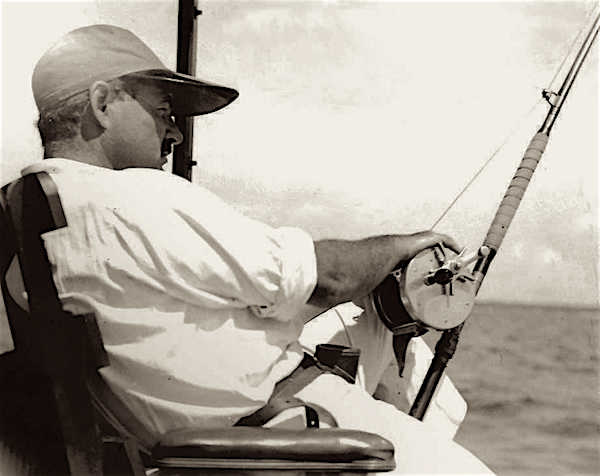
The "Hemingway's Cap," purported to be styled after the long-billed fishing caps the author Ernest Hemingway wears in a few photos from the 1930s to the 1950s, is still available from the J. Peterman Company web site and catalog (or, as Peterman's describes it, the "Owner's Manual").
Here's a J. Peterman link, current as of May 2016: J. PETERMAN COMPANY WEB SITE
Here's a link to an image of Hemingway wearing a cloth cap with a long, dark bill while fishing in Bimini in the mid-1930s.
A discussion topic on The Fedora Lounge website from 2006 indicates that the 2006 retail price for the Hemingway's Cap was $39.00, with an occasionally discounted price of $34.00. Ten years later, in 2016, the price is $59.00, although subscribers to the J. Peterman email list are sometimes offered short-term "percent off" coupons, generally 20%.
Early posts in this topic also describe the long bill of this cap as having been covered in soft deerskin. The current Owner's Manual listing indicates calfskin leather.
I recently purchased a J. Peterman "Hemingway's Cap." Yes, I paid fifty bucks for a baseball cap. Yes, I'm a frivolous moron sometimes. At least I had a "21% off" coupon, so actually I only paid $47.00 for a baseball cap. Plus shipping. So yeah, fifty bucks.
I've wanted one. For a long time. Practically forever, it seems. Or at least, ever since I first saw this cap and read the likely spurious but nevertheless compellingly entertaining description in a Peterman catalog years and years ago. But I could never justify the cost. And, quite frankly, I still can't justify the cost. I mean, it's a cotton baseball cap. Light tan in color. With a long, dark bill. There's no way it's worth fifty bucks.
Here's what you get for your $59.00: it's an "old school" low-crowned baseball-style cap made of a lightweight cotton canvas material. The crown consists of six wedge-shaped panels. Each panel sports a brass ventilation grommet in the middle. The back of the cap has elastic sewn into the hem of the fabric to keep it snug. No plastic adjustment band. No Velcro. No open back with a stretchy bit tacked in. Elastic, sewn into the hem. The hat is available in three sizes, Medium, Large, and Extra Large. Thus, it is "sized" to an extent, rather than merely being "adjustable" or "one size fits all."
I generally wear a 7-5/8 or 61 in "sized" hats. I purchased an Extra Large, and it fits well. You'd think that, what with all that space in my head for brains, I'd know better than to spend fifty bucks on a baseball cap.
A tag sewn inside the cap displays the J. Peterman logo and indicates the body of the cap is Made in Sri Lanka of 100% cotton.
The bill is, on my example, 4-7/8 inches long from the front edge to the seam where it attaches to the cotton body. The bill is, indeed, covered in leather. The leather is very smooth, almost shiny. In fact, it almost looks like vinyl. But a close examination of the inside of the hat where the brim attaches reveals that the brim covering is actual leather, as the "non-shiny" side of the hide is visible at the seams. The brim feels as though the core inside the leather is... cardboard. I don't know. What are the brims of baseball caps (or, I shudder at the term: "trucker's caps") usually made of? This one feels like thin cardboard. When the hat arrived the brim was completely flat. I have been gently attempting to give the brim a curve without inadvertently creasing it.
I suppose one way to justify having purchased this hat is that this is the first baseball-style cap I have ever owned. Even as a kid, I never had a baseball hat. So if you add up all the five and ten and fifteen dollar baseball hats and trucker's caps I haven't purchased over the years... okay, yeah, it's a stretch, I know.
Anyway:
PROS:
*Cotton body (not nylon or other new-fangled synthetic blend)
*Six-panel, low-profile, rounded crown construction
*Brass (probably plated) ventilation grommets, one in each panel
*1930s "fishing hat" style
*Long, nearly five inch, leather-covered "duck bill" brim
*Available in a range of three "sizes" rather than one-size-fits-all
*Elastic sewn into the hem; no Velcro or plastic size adjustment band
*No external sports team or "Big Johnson" novelty logos
*Made someplace other than China
CONS:
*Sixty bucks for a baseball hat: that's a "con" in more than one sense of the word!
*Fifty bucks for a baseball hat even with a discount coupon
Does anybody else own one of these? Or rather, will anybody else admit to having shelled out fifty bucks for a semi-fictionalized reproduction of a type of fisherman's cap a famous author might once have worn?
Never date a writer because she’ll fictionalize everything. She’ll write about things you have done to her, or things you never did for her. She’ll write about how you never bought her flowers. Not once. She’ll say in well-constructed prose how the whole time you were together, she never came home from a long week to see a vase full of roses, or daises, or anything.
She’ll describe times you embarrassed her, like at a party. It was her party because she was leaving for three months, and all her friends were there to see her off. People bought her champagne, which was never chilled, but you drank it anyway and that was after you had had whiskey. She’ll talk about how you played strip poker with others. And she walked in to see your clothes bunched up on the floor, next to smashed cigarette butts. She’ll say how she had to cover you with a coat because all her friends laughed about it, and so did you. Then she’ll describe how later, when she didn’t want to leave you and she wanted to be held, she heard you vomit in the bathroom. She’ll say how she had to make sure you were still alive and how she saw your face pressed against the toilet and how your legs shook on the tile. And she said your name and asked if you were okay and you just stared at her through half opened eyelids and looked away. She’ll say she couldn’t make love to you and she had to stay up and make coffee, before you took her to the airport.
She’ll continue this emphasis on what you had done to her, by describing things she had found, but said nothing about. Like when she opened your wallet to slide twenty dollars inside, because you had bought her dinner. She’ll say how she sat on the hardwood floor where the heat couldn’t reach and she shivered. She’ll explain the condom she found, and how it was lubricated and had small writing on the package she couldn’t see because her eyes watered. She’ll talk about the note she found from a girl she didn’t know but you did because in the scribbled handwriting she could make out your name. You were asleep on the bed and she was on the floor. She’ll tell the reader how she held her legs and tapped her chin against her knee. And she decided that it’s not wrong for men to have friends, because all men have friends, so she closed the wallet and slept without a blanket on the floor.
She’ll later describe the moment in the bedroom when she sat at the foot of the bed and you kneeled in front of her. She’ll give you short choppy dialogue, so that you sound distant. She’ll tell the reader how you said it’s not that you didn’t love her but you couldn’t be with her and that it’s more your fault than hers, except she’ll tell it much more compellingly. She’ll describe how she choked on her tears and tried not to vomit right in front of you. And how she looked at the poster on the wall, the one she bought for you and how the different colors turned together when you spoke. She’ll say how the bed you had brought from your place felt like steel and she couldn’t move because her legs were welded there and she could only listen to you and watch the colors of the room turn gray.
And she’ll send you a manuscript and you’ll be on the couch where you both had sat and you’ll read every word. You’ll notice she didn’t tell things, like the time you had to see her because she had been sick with the flu and unable to get out of bed. And you ran from the campus to her apartment to make sure she was okay. You ran in the dark and there was so much snow that your legs began to freeze. And she won’t tell the reader how you didn’t have gloves or good shoes and you couldn’t see the patch of ice and you slipped. She won’t tell them you slipped. You twisted your ankle and your face landed in a snow bank. She won’t describe the taste in your mouth, how you pulled yourself up and limped up to her apartment. You used the key she’d just given you and she won’t say how nice it was being able to enter unannounced. And she won’t say how good it was to see her asleep and that you kissed her on the top of her head and then staggered home. She won’t move into your head and explain how much you really loved her. How you almost started to cry when you walked. You shook from the wind but felt safe because she was.
You’ll sit alone on that couch where you made love to her and you won’t move and the glass of whiskey on the table will not be touched. You won’t get up to turn up the lights and you won’t get up to use the restroom even though you have to. You’ll sit in the dim of your living room. And you will read.
Author : @Kiri Karma
museumPASSmusees 2024 - Mima - Multitude - Kiri
MULTITUDE, a solo exhibition by Alexandre Farto aka Vhils, is about our relationship with the city, ?the greatest human invention? according to historian Ben Wilson.
Spread across the MIMA, visitors can encounter wall carvings, billboards, cityscapes, videos and installations from different time periods that offer a compelling insight into the Portuguese artist approach to the relationship between people and cities.
( Le pass musees, comment ca marche ?
1 pass pour 244 musees
Tant de choses a vivre avec le pass musees
Le pass musees est l?abonnement le plus genereux aux musees belges. Cela signifie :
*Acces a tous les musees participants de notre pays, pendant une annee entiere. Quand vous le voulez et aussi souvent que vous le souhaitez.
*Visiter les expositions temporaires gratuitement ou avec une jolie reduction.
*Beneficier d?Avantages extra comme des billets de train a moitie prix, des reductions dans les boutiques des musees et de nombreux autres cadeaux reserves exclusivement aux detenteurs de pass musees.
*Recevoir et sauvegarder les meilleurs conseils en matiere de musees : tous les quinze jours, recevez dans votre boite mail des informations sur les expositions a ne pas manquer et les plus belles decouvertes a faire dans les musees. Vous pouvez sauvegarder vos expositions preferees dans l?app pass musees en prevision de votre prochaine visite.
Author : @Kiri Karma
museumPASSmusees 2024 - Mima - Multitude - Kiri
MULTITUDE, a solo exhibition by Alexandre Farto aka Vhils, is about our relationship with the city, ?the greatest human invention? according to historian Ben Wilson.
Spread across the MIMA, visitors can encounter wall carvings, billboards, cityscapes, videos and installations from different time periods that offer a compelling insight into the Portuguese artist approach to the relationship between people and cities.
( Le pass musees, comment ca marche ?
1 pass pour 244 musees
Tant de choses a vivre avec le pass musees
Le pass musees est l?abonnement le plus genereux aux musees belges. Cela signifie :
*Acces a tous les musees participants de notre pays, pendant une annee entiere. Quand vous le voulez et aussi souvent que vous le souhaitez.
*Visiter les expositions temporaires gratuitement ou avec une jolie reduction.
*Beneficier d?Avantages extra comme des billets de train a moitie prix, des reductions dans les boutiques des musees et de nombreux autres cadeaux reserves exclusivement aux detenteurs de pass musees.
*Recevoir et sauvegarder les meilleurs conseils en matiere de musees : tous les quinze jours, recevez dans votre boite mail des informations sur les expositions a ne pas manquer et les plus belles decouvertes a faire dans les musees. Vous pouvez sauvegarder vos expositions preferees dans l?app pass musees en prevision de votre prochaine visite.
from bit.ly/MUZH1r
Read this post on Elitistreview - 2010 and 2011 at Domaine Roumier
My recent tasting at Domaine Georges Roumier showed his 2011s to be of highly desirable quality and 2010s perhaps the finest wines I have ever tried from him. Sometimes when tasting Christophe Roumier’s wines they don’t all glow with the most fulgurating intensity; those I tried on this visit were all dynamite!
We tasted with a sommelier from Gevrey-Chambertin and for some unaccountable reason he and our host found my reactions to tasting superlatively fine wines to be utterly hilarious. It wasn’t me who was being funny, it was them who were being insufficiently enthusiastic about being immensely pleasured. When you taste things that are as profoundly gratifying, as we did, then groaning, waving your arms in the air and spinning about on one leg are moderate and proportionate responses. I’m often shocked that more people are not as passionate as me about pleasure. Pleasure is good! One should throw one’s self into its embrace.
If I may warm to this theme, when people meet me for the first time and I try something good, I can almost guarantee they will suggest that I put video tasting notes on this site. Even ignoring my technically-challenged nature, I think there is no call for such indulgences. I like to think my writing transparently communicates the delight I get out of so many experiences and so video would add only to all of our bandwidth expenses. If you find my writing lacking fervour do let me know and I’ll try setting my vocabulary to extra-florid when I sit down to write in future.
So the pleasure of Christophe Roumier’s wines… there was a lot to revel in! At the bottom of the heap are his Chambolle villages and Morey-Saint-Denis Premier Cru Clos de la Bussiere; in 2011 that heap is of coolly charismatic character. The Chambolle is very elegant with great fruit and finely balanced acidity, quite delightful. The Morey is also elegant and fruity but has a powerful earth character that marks its origins. When these two made me grin so broadly I knew I was in for a good tasting.
A rarely-encountered wine of Christophe’s is the Chambolle Premier Cru Combottes (there must be countless vineyards of this name in Burgundy). This is a scented, refined expression of Chambolle that pulses with enjoyment value. Worth looking out for.
Definite steps ahead are the Premier Crus les Cras and Amoureuses. Everybody knows Roumier’s Amoureuses is good, everybody wants to buy it and so it costs a fortune. It is, indeed, excellent, but for those of us who cannot afford to live in genuinely nice parts of London I’d go for the Cras in a trice. It is an utterly ravishing, energetic, complex and incredibly stylish Chambolle. You couldn’t ask for much more from a Chambolle Premier Cru and if you do you should tone things down a bit before your pants ignite. This is a seriously fine, incredibly drinkable wine to be sought out with gusto.
Next came the 2011 Ruchottes-Chambertin Grand Cru and it clearly merited all of my ejaculations of enthusiasm. It has a dense core of powerful fruit that keeps on revealing more layers of complex flavours the more you sniff and slurp it. It has the fresh energy of the vintage but is not short on profound class. A corking effort from Christophe, bravo!
The final 2011 we tried was the Bonnes-Mares and, at the risk of tiring you with even more pleasure, that is even more abso-tmesis-lutely wizard. It combines the vivacious vigour of the vintage with extreme sophistication all wrapped up in a structure of elysian refinement and finesse. This is the kind of wine that improves us when we taste and revel in them.
We tried three 2010s from bottle and violate me with a two-foot electrified dildo if they didn’t show more depth of flavour, harmony and class. The 2011s are damned good wines to drink with unabashed joy but the 2010s are at the dumbfounding end of greatness. There is not much point in me giving tasting notes for the Chambolle villages or Morey Bussiere because during this section of the tasting I was barely coherent. I was so happy and all I remember from tasting these two is that each smell and sip had me exploding with colourful metaphors directed at anyone who wasn’t looking at me in too worried a manner.
The 2010 Bonnes-Mares Grand Cru, however, returned me to lucid focus with its radiant ravishment. 2010 is a vintage of concentrated, ripe fruit and high but balanced acidity and these characters shone resplendently in the Bonnes-Mares along with compellingly intricate minerality and nigh-unbelievable sexiness; luckily I can handle an awfully large amount of sexiness. I tried the Mugnier 2010 Bonnes-Mares the next day (full report of the event will follow) and I think this was the only time I’ve enjoyed Roumier’s Bonnes-Mares in preference to Freddie Mugnier’s. It was that good.
So it was a second great tasting in Burgundy and gave me an enhanced feel for the 2011 vintage. It was definitely a vintage that is tumescent with pleasure at Domaine Roumier and I have no hesitation recommending them for purchase when they come on the market. If you haven’t got any of his 2010s yet then that’s an awful shame. I suppose if you had there could be the danger than when you came to pop a bottle the extravagant excellence might have rendered you permanently catatonic with devastating delight. But take that risk and get out there to find some to buy anyway.
Related posts:
Domaine Roumier
Domaine Roumier 2009
Domaine Roumier 2008
This was published on Elitistreview
The "Hemingway's Cap," purported to be styled after the long-billed fishing caps the author Ernest Hemingway wears in a few photos from the 1930s to the 1950s, is still available from the J. Peterman Company web site and catalog (or, as Peterman's describes it, the "Owner's Manual").
Here's a J. Peterman link, current as of May 2016: J. PETERMAN COMPANY WEB SITE
Here's a link to an image of Hemingway wearing a cloth cap with a long, dark bill while fishing in Bimini in the mid-1930s.
A discussion topic on The Fedora Lounge website from 2006 indicates that the 2006 retail price for the Hemingway's Cap was $39.00, with an occasionally discounted price of $34.00. Ten years later, in 2016, the price is $59.00, although subscribers to the J. Peterman email list are sometimes offered short-term "percent off" coupons, generally 20%.
Early posts in this topic also describe the long bill of this cap as having been covered in soft deerskin. The current Owner's Manual listing indicates calfskin leather.
I recently purchased a J. Peterman "Hemingway's Cap." Yes, I paid fifty bucks for a baseball cap. Yes, I'm a frivolous moron sometimes. At least I had a "21% off" coupon, so actually I only paid $47.00 for a baseball cap. Plus shipping. So yeah, fifty bucks.
I've wanted one. For a long time. Practically forever, it seems. Or at least, ever since I first saw this cap and read the likely spurious but nevertheless compellingly entertaining description in a Peterman catalog years and years ago. But I could never justify the cost. And, quite frankly, I still can't justify the cost. I mean, it's a cotton baseball cap. Light tan in color. With a long, dark bill. There's no way it's worth fifty bucks.
Here's what you get for your $59.00: it's an "old school" low-crowned baseball-style cap made of a lightweight cotton canvas material. The crown consists of six wedge-shaped panels. Each panel sports a brass ventilation grommet in the middle. The back of the cap has elastic sewn into the hem of the fabric to keep it snug. No plastic adjustment band. No Velcro. No open back with a stretchy bit tacked in. Elastic, sewn into the hem. The hat is available in three sizes, Medium, Large, and Extra Large. Thus, it is "sized" to an extent, rather than merely being "adjustable" or "one size fits all."
I generally wear a 7-5/8 or 61 in "sized" hats. I purchased an Extra Large, and it fits well. You'd think that, what with all that space in my head for brains, I'd know better than to spend fifty bucks on a baseball cap.
A tag sewn inside the cap displays the J. Peterman logo and indicates the body of the cap is Made in Sri Lanka of 100% cotton.
The bill is, on my example, 4-7/8 inches long from the front edge to the seam where it attaches to the cotton body. The bill is, indeed, covered in leather. The leather is very smooth, almost shiny. In fact, it almost looks like vinyl. But a close examination of the inside of the hat where the brim attaches reveals that the brim covering is actual leather, as the "non-shiny" side of the hide is visible at the seams. The brim feels as though the core inside the leather is... cardboard. I don't know. What are the brims of baseball caps (or, I shudder at the term: "trucker's caps") usually made of? This one feels like thin cardboard. When the hat arrived the brim was completely flat. I have been gently attempting to give the brim a curve without inadvertently creasing it.
I suppose one way to justify having purchased this hat is that this is the first baseball-style cap I have ever owned. Even as a kid, I never had a baseball hat. So if you add up all the five and ten and fifteen dollar baseball hats and trucker's caps I haven't purchased over the years... okay, yeah, it's a stretch, I know.
Anyway:
PROS:
*Cotton body (not nylon or other new-fangled synthetic blend)
*Six-panel, low-profile, rounded crown construction
*Brass (probably plated) ventilation grommets, one in each panel
*1930s "fishing hat" style
*Long, nearly five inch, leather-covered "duck bill" brim
*Available in a range of three "sizes" rather than one-size-fits-all
*Elastic sewn into the hem; no Velcro or plastic size adjustment band
*No external sports team or "Big Johnson" novelty logos
*Made someplace other than China
CONS:
*Sixty bucks for a baseball hat: that's a "con" in more than one sense of the word!
*Fifty bucks for a baseball hat even with a discount coupon
Does anybody else own one of these? Or rather, will anybody else admit to having shelled out fifty bucks for a semi-fictionalized reproduction of a type of fisherman's cap a famous author might once have worn?
(Detail: inside label)
I've been wondering if the Sedum nussbaumerianum ('copper') I bought was not mis-I.D.ed and actually S. adolphi* ('golden')... Turns out it's both; these two names are synonyms!
If they are synonyms, S. adolphi is the older name, from 1912, so it takes precedence; Sedum nussbaumerianum was described in 1923.
Both plants were described in different German botanical gardens from plants grown from seeds collected in 1907 in (Veracruz) Mexico, by the great German plant explorer of Mexico; Karl Albert Purpus (1851–1941). Thus, in Europe (Germany) plants labelled as both S. adolphi and S. nussbaumerianum had been growing since the 1920's. By 1938 plants known under both species names were cultivated in Ithaca, New York; and had been obtained via the horticultural trade. The first record of S. nussbaumerianum in Spain is in 'Catalogus Seminum in Hortus Botanico Universitatis Valentinae anno 1953 Collectorum'.
The original description of S. adolphi only reported that the species was grown from seed collected by Purpus in Mexico; lacking a precise collection locale; it seems that this taxon became shrouded in mystery as time went by. Neither species was ever found in the wild again, and Purpus's collection locale reported for S. nussbaumerianum by Bitter in 1923 was never found.
According to Clausen [1959, 1975], in the horticultural trade in the USA in the 1950's S. adolphi & S. nussbaumerianum were often confused; both were often sold as S. adolphi, despite being what he considered S. nussbaumerianum. Also according to Clausen, cultivated plants of S. nussbaumerianum were all so similar he thought they might all belong to a single clone. According to San Marcos Growers, all such plants cultivated in California were known by the name S. adolphi (which they mistakenly believe is an incorrect synonym) since at least 1944, however, certain intergeneric hybrids with S. nussbaumerianum were recorded as being made by Californian nurseries in the late 1940's, so it seems that at least some people in California were growing plants labelled as S. nussbaumerianum since that time.
According to Robert Clausen in 'Sedum of the Trans-Mexican Volcanic Belt: an Exposition of Taxonomic Methods' in 1959 in the USA, S. adolphi was considered the species with larger, longer, thicker, broader, redder leaves prominently dorsally carinate (keeled), unknown from the wild, whereas the green, smaller S. nussbaumerianum was only known from Purpus's lost collection locale and was never seen in the wild by anyone except the deceased Purpus. Besides leaf size and shape, Clausen also thought inflorescence characteristics (the pattern in which flowers open on the inflorescence, shape of inflorescence, petal width) were key diagnostic features separating the two species; although his characteristics here have been described as 'vague' by Cházaro-Basáñez et al. [2010]. As pointed out by Bischofberger [2010] the description Clausen gives is significantly different than the original plant described by Hamet in the 'Notizblatt des Koniglichen botanischen Gartens und Museums zu Berlin' of 1912; this publication also contains an illustration -which shows that the leaves are not really carinate dorsally, but rounded, so it seems very likely that Clausen never read it. It would seem that all subsequent authors (Evans [1983], Stephenson [1991, 1994, 2002 (ed.2)], 't Hart & Bleij [2003]) used Clausen's leaf descriptions as a basis for describing S. adolphi. According to the Sedum Society the original form of S. adolphi as described by Hamet has now disappeared from collections.
In 1975 'Sedum of North America North of the Mexican Plateau' by Clausen was published. In this book Clausen seems to say much the same he said in 1959 regarding the two species; this is of note, because all the primary research done for this had been preformed in the late 1930's, almost 40 years earlier!
In 1978 S. nussbaumerianum was rediscovered in the wild in two different sites near those of Purpus in central Veracruz by Charles H. Uhl of Cornell University in Ithaca, New York and Felipe Otero (collection number: Uhl2497), although this rediscovery itself also seems to have been a confused affair. Uhl made no herbarium sheets or observational records, and seems not to have published anything about this, but he did take some cuttings back home with him to New York; The New York Botanical Garden received plants from him in 1983 (accession number: 135/83), and Huntington Botanic Garden received his plants around this time as well (HBG40419). In 1986 Huntington Botanic Garden sold Uhl's plants in their International Succulent Introductions program (ISI1682), described as the first S. nussbaumerianum re-introduction into horticulture. Nonetheless, it is clear that in Mexico itself none of the then current Mexican experts on the topic were aware of Uhl's rediscovery; in Meyrán [1987] and Chazaro [1990] Purpus's initial locality was considered the only known spot where S. nussbaumerianum occurred. The first scientific publication on the subject from Mexico was in 1991, the authors of that paper indicate they only became aware of Uhl's rediscoveries during correspondence with Myron Kimnach in 1990!
Meanwhile, in California in the late 1980's, people were realising that that their S. adolphi and Uhl's new S. nussbaumerianum were in fact the same plants, the S. adolphi plants were renamed as S. nussbaumerianum in many collections. The mistaken synonym S. adolphi Hort. seems to have arisen due to this; this synonym is wrong because S. adolphi is not a nomen nudum (lacking authority) and known only from horticulture as 'Hort.' would indicate, but had in fact been validly published by Hamet. 11 years earlier than S. nussbaumerianum!
Although the last five experts of Sedum (Evans [1983], Clausen [1951, 1959, 1975], Stephenson [1991, 1994, 2002 (ed.2)], 't Hart & Bleij [2003]) who wrote on this subject have retained the distinction between the species, this has always been problematic. Clausen in 1975 in 'Sedum of North America North of the Mexican Plateau' gave minute differences between the two species based mostly on flower characteristics, but these don't seem to hold up in practice. Clausen in 1959 in 'Sedum of the Trans-Mexican Volcanic Belt: an Exposition of Taxonomic Methods' already concedes these are probably the same species, although he says that there is not enough evidence available to known either way. According to Stephenson gave differences based on leaf shape and colour, but admits himself that these are not definitive characteristics, because of the existence of plants with intermediate characteristics. 't Hart & Bleij note that the species are probably the same. Synonymizing what earlier authors distinguish as the difference between the two nomens, Ortiz et al. in the book 'La Familia Crassulaceae en la Flora Alóctona Valenciana' [2009] describe the main differences to be that with S. adolphi the young leaves have a pronounced apex, all the leaves are more incurved and green (now 'Golden Glow'); whereas S. nussbaumerianum has larger, wider and flatter leaves (now 'Coppertone'). Nonetheless, it is clear some people also had the plants in their collection labelled the other way around!
In June of 2010 Margrit Bischofberger, wrote an article entitled 'Sedum adolphi and Sedum nussbaumerianum', available at the International Crassulaceae Network website, where she compellingly claims that all the previous experts, from Clausen to Bleij, were mistaken with their identification of S. adolphi; none of their descriptions really match what is being said in the original description by Hamet; it seems everyone was actually thinking of another clone; which she names as the cultivar 'Golden Glow'. See the section on infraspecific variability for more on this.
It has by now, due to another paper presented by Cházaro-Basáñez et al. [Sept 2010], where the rediscovery of the Purpus's original discovery locality of S. adolphi was detailed, become clear that they are the same, due to these reasons 1.) both names are described from plants grown from the same batch of seeds, thus found in the same locality in the same habitat, 2). no differences between the two in chromosomes number (2n= 64), 3). the foliage characteristics of the different forms called either one or the other intergrade, and the floral characteristics are very similar to each other despite the said differences (compare with the S. lucidum, the next closest taxon).
In two different articles published after September 2010, after the rediscovery of the original type locality of S. adolphi, Stephenson now also concedes to the synonymy of the two nomens and furthermore agrees with Bischofberger's analysis and conclusion that the plant frequently grown in Europe under the name S. adolphi must be called S. 'Golden Glow'.
Actually, in 1936, Fröderstrüm had already synonymized S. nussbaumerianum with S. adolphi, but his paper was forgotten and his work went unrecognised.
*Many people incorrectly spell this as name as S. adolphii (for example, Clausen 1959, Stephenson 1991, or even more stupidly Cházaro-Basáñez 2010); this is wrong, here is the original description. The correct citation is S. adolphi Raym.-Hamet, not S. adolphi Hamet or S. adolphi Hort.
My plants, although bought as S. nussbaumerianum, actually better fit with the descriptions given for S. adolphi, following Stephenson [1994] and 't Hart & Bleij [2003]. Following Bischofberger [2010], my plant would thus be the cultivar 'Golden Glow'. I think it is the same as that photographed in California by Kelley MacDonald on Dave's Garden in 2009. As Geoff Stein mentions there, and the generic moniker of the synonym x. Graptosedum 'Golden Glow' would indicate, the denser leaf growth at the apex gives this form a nice rosette, which can be used to I.D. it.
Stuff I'd like to read but I haven't found a copy of yet:
Stephenson R. 1991. 'Sedum adolphii HAMET and S. nussbaumerianum BITTER' The Sedum Society Newsletter 18: 13.
Meyrán GJ. 1987. Las cactáceas y otras suculentas del estado de Veracruz. Cactaceas y Suculentas Mexicanas 32(4): 93–100.
Chazaro M. 1990. Crassulaceae del centra de Veracruz y zona limítrofe de Puebla I. Cactaceas y Suculentas Mexicanas 35(3): 63–67.
Medina A.M.E. 1988. Estudio de la vegetación de la Barranca de Acazonica, en el Centro del Estado de Veracruz. Tesis Prof. Fac. de Biología. U.V. Xalapa
Sandoval J.M.C. 1984. La vegetación de la Sierra de Mataloyan, (Veracruz-Puebla), Tesis profesional, Fac. de Biología, Universidad Veracruzana, Xalapa
Ronald L. Evans; Handbook of Cultivated Sedums; 1983
International Succulent Introductions descriptions of 1986
I'm pleased by the clarity and concision of the following article from the Nation of Change website:
Why It’s a Privilege to be a Progressive in 2013 | NationofChange.
But I just can't help attempting an answer to the question asked at the end of the article, and which is, I think, important:
Research shows that conservatives will "rationalize away social inequalities in order to justify the status quo." They are orderly and moralistic and dependent on authority. Liberals, on the other hand, are more open to new ideas and experiences, probably because they have more of the gray matter that helps to manage complexity in the thought processes.
But if we're so smart..
..Why do we lose the wars of language and emotion to the conservatives?
[caption id="" align="alignleft" width="200"] English: Anterior cingulate gyrus.[/caption]
First, I should say that I don't believe that liberals are "losing the wars of of language and emotion to the conservatives." In general, I sense that the daft, over-simplified kind of thinking that leads to, say, the denial of global climate change or ludicrous pronunciamentos regarding women and pregnancy, is slowly being exposed for what it is: junk thought that everyone ought to ignore.
But why is there such a polarized disconnect? I'm not a social science expert, but I can only imagine that whole galaxies of reasons exist. What I'm fascinated by, however, are neurological explanations. Using science in this way is certainly no more than conjectural exercise, but a compellingly consistent picture of neural diversity is being painted that we ought to pay attention to.
We could look, for example, at some fascinating research that has been done correlating brain structure and political attitudes. Summarizing one study, Joshua Holland writes:
Looking at MRIs of a large sample of young adults last year, researchers at University College London discovered that “greater conservatism was associated with increased volume of the right amygdala” ( $$). The amygdala is an ancient brain structure that's activated during states of fear and anxiety. (The researchers also found that “greater liberalism was associated with increased gray matter volume in the anterior cingulate cortex” – a region in the brain that is believed to help people manage complexity.)
Additional studies corroborate and replicate this connection, suggesting why it is, particularly from a liberal point of view, political conservatives seem to think re-actively rather than rationally, simplistically rather than complexly.
If liberals are losing the culture wars, it is not because liberal thought is somehow inherently flawed. It is because brain structure leads to ideology, and--to take that idea to the next, wildly over-simplified level--that means some of us are born with a neural morphology that leads to--well, a desire to join the NRA or the Tea Party.
If this were true (and it's a big "if"), then liberals, if they are to remain loyal to their social values, should stop condemning conservatives for their lack of empathy, or for their refusal to acknowledge the actual complexity of our social and environmental problems, or for their unwillingness to develop truly thoughtful, equitable, nuanced proposals for social change. The conservative brain that produces reactionary, black-and-white bloviating, is just another form of neural diversity. Conservatives are complete, whole, and perfect just as they are--just as are blacks, illegal aliens, Muslims, the disabled, the gay, the transgendered, women, and so on. If liberals wish to consistently champion and celebrate the inherent worth of human racial, religious, sexual, and gender diversity, then they must also celebrate the neural diversity of their conservative brothers and sisters.
But there's a catch.
Celebrating, rather than condemning, some forms of neural diversity would be liberals' ineluctable choice, were it not for another fact of neuroscience: neuroplasticity. You see, neural diversity exists in an enormous range of forms in part because brain structure is not a static thing. And changes to its form and function occur to a greater degree and at a faster pace than most people realize.
[caption id="" align="alignleft" width="200"] A rotating animation of the human brain showing the left frontal lobe in red within a semitransparent skull. The anterior cingulate cortex (ACC) is sometimes also included in the frontal lobe. Other authors include the ACC as a part of limbic lobe. (Photo credit: Wikipedia)[/caption]
For example, numerous studies have shown a strong correlation between changes in brain structure and the deliberate attempt to cultivate positive thoughts (as in metta meditation) or in the "open monitoring" practice of mindfulness. Those changes result in reduced amygdala density and correspond to a reduction in stress rumination, as well as in a thickening of those portions of the brain responsible for higher order thinking skills, empathy, and self-regulation. In other words, the brain responds, functionally and structurally, to predominant mental activity. As an aside, I have to mention in regard to the "higher order thinking skills" mentioned in this paragraph, the irony of the Texas GOP's explicit opposition to "the teaching of Higher Order Thinking Skills (HOTS)" which it viewed as "simply a relabeling of Outcome-Based Education (OBE) (mastery learning) which focus on behavior modification and have the purpose of challenging the student’s fixed beliefs and undermining parental authority." In other words, obedience is preferred over independent thinking.
[caption id="" align="alignleft" width="240"] Conservatism Manifesto. (Photo credit: mmoneib)[/caption]
Never mind, that the "founding fathers," whom conservatives consistently revere, were highly independent, literally revolutionary, thinkers--and they produced the country that conservatives always claim to be defending.
The bottom line, therefore, is that the field of liberal tolerance does not have to include shoddy thinking just because it is born of another form of diversity. It should, however, encourage meditation and mindfulness practices as a way to improve one's outlook, one's health, and one's willingness to be good to others. In this, I think, there is still room for conservative thought, perhaps the most conservative thought of all: cease from callousness to harmful behaviors, cultivate wholesome intentions, and act in ways that will benefit everyone.
Related articles
Are Liberals Smarter? Study Indicates The Answer Is Yes
How Does Meditation Reduce Anxiety at a Neural Level?
How could we engineer humans to have more empathy?
Fear: A justified response or faulty wiring?
Political Orientations Are Correlated with Brain Structure in Young Adults

The "Hemingway's Cap," purported to be styled after the long-billed fishing caps the author Ernest Hemingway wears in a few photos from the 1930s to the 1950s, is still available from the J. Peterman Company web site and catalog (or, as Peterman's describes it, the "Owner's Manual").
Here's a J. Peterman link, current as of May 2016: J. PETERMAN COMPANY WEB SITE
Here's a link to an image of Hemingway wearing a cloth cap with a long, dark bill while fishing in Bimini in the mid-1930s.
A discussion topic on The Fedora Lounge website from 2006 indicates that the 2006 retail price for the Hemingway's Cap was $39.00, with an occasionally discounted price of $34.00. Ten years later, in 2016, the price is $59.00, although subscribers to the J. Peterman email list are sometimes offered short-term "percent off" coupons, generally 20%.
Early posts in this topic also describe the long bill of this cap as having been covered in soft deerskin. The current Owner's Manual listing indicates calfskin leather.
I recently purchased a J. Peterman "Hemingway's Cap." Yes, I paid fifty bucks for a baseball cap. Yes, I'm a frivolous moron sometimes. At least I had a "21% off" coupon, so actually I only paid $47.00 for a baseball cap. Plus shipping. So yeah, fifty bucks.
I've wanted one. For a long time. Practically forever, it seems. Or at least, ever since I first saw this cap and read the likely spurious but nevertheless compellingly entertaining description in a Peterman catalog years and years ago. But I could never justify the cost. And, quite frankly, I still can't justify the cost. I mean, it's a cotton baseball cap. Light tan in color. With a long, dark bill. There's no way it's worth fifty bucks.
Here's what you get for your $59.00: it's an "old school" low-crowned baseball-style cap made of a lightweight cotton canvas material. The crown consists of six wedge-shaped panels. Each panel sports a brass ventilation grommet in the middle. The back of the cap has elastic sewn into the hem of the fabric to keep it snug. No plastic adjustment band. No Velcro. No open back with a stretchy bit tacked in. Elastic, sewn into the hem. The hat is available in three sizes, Medium, Large, and Extra Large. Thus, it is "sized" to an extent, rather than merely being "adjustable" or "one size fits all."
I generally wear a 7-5/8 or 61 in "sized" hats. I purchased an Extra Large, and it fits well. You'd think that, what with all that space in my head for brains, I'd know better than to spend fifty bucks on a baseball cap.
A tag sewn inside the cap displays the J. Peterman logo and indicates the body of the cap is Made in Sri Lanka of 100% cotton.
The bill is, on my example, 4-7/8 inches long from the front edge to the seam where it attaches to the cotton body. The bill is, indeed, covered in leather. The leather is very smooth, almost shiny. In fact, it almost looks like vinyl. But a close examination of the inside of the hat where the brim attaches reveals that the brim covering is actual leather, as the "non-shiny" side of the hide is visible at the seams. The brim feels as though the core inside the leather is... cardboard. I don't know. What are the brims of baseball caps (or, I shudder at the term: "trucker's caps") usually made of? This one feels like thin cardboard. When the hat arrived the brim was completely flat. I have been gently attempting to give the brim a curve without inadvertently creasing it.
I suppose one way to justify having purchased this hat is that this is the first baseball-style cap I have ever owned. Even as a kid, I never had a baseball hat. So if you add up all the five and ten and fifteen dollar baseball hats and trucker's caps I haven't purchased over the years... okay, yeah, it's a stretch, I know.
Anyway:
PROS:
*Cotton body (not nylon or other new-fangled synthetic blend)
*Six-panel, low-profile, rounded crown construction
*Brass (probably plated) ventilation grommets, one in each panel
*1930s "fishing hat" style
*Long, nearly five inch, leather-covered "duck bill" brim
*Available in a range of three "sizes" rather than one-size-fits-all
*Elastic sewn into the hem; no Velcro or plastic size adjustment band
*No external sports team or "Big Johnson" novelty logos
*Made someplace other than China
CONS:
*Sixty bucks for a baseball hat: that's a "con" in more than one sense of the word!
*Fifty bucks for a baseball hat even with a discount coupon
Does anybody else own one of these? Or rather, will anybody else admit to having shelled out fifty bucks for a semi-fictionalized reproduction of a type of fisherman's cap a famous author might once have worn?
(Detail: elastic hem)
The "Hemingway's Cap," purported to be styled after the long-billed fishing caps the author Ernest Hemingway wears in a few photos from the 1930s to the 1950s, is still available from the J. Peterman Company web site and catalog (or, as Peterman's describes it, the "Owner's Manual").
Here's a J. Peterman link, current as of May 2016: J. PETERMAN COMPANY WEB SITE
Here's a link to an image of Hemingway wearing a cloth cap with a long, dark bill while fishing in Bimini in the mid-1930s.
A discussion topic on The Fedora Lounge website from 2006 indicates that the 2006 retail price for the Hemingway's Cap was $39.00, with an occasionally discounted price of $34.00. Ten years later, in 2016, the price is $59.00, although subscribers to the J. Peterman email list are sometimes offered short-term "percent off" coupons, generally 20%.
Early posts in this topic also describe the long bill of this cap as having been covered in soft deerskin. The current Owner's Manual listing indicates calfskin leather.
I recently purchased a J. Peterman "Hemingway's Cap." Yes, I paid fifty bucks for a baseball cap. Yes, I'm a frivolous moron sometimes. At least I had a "21% off" coupon, so actually I only paid $47.00 for a baseball cap. Plus shipping. So yeah, fifty bucks.
I've wanted one. For a long time. Practically forever, it seems. Or at least, ever since I first saw this cap and read the likely spurious but nevertheless compellingly entertaining description in a Peterman catalog years and years ago. But I could never justify the cost. And, quite frankly, I still can't justify the cost. I mean, it's a cotton baseball cap. Light tan in color. With a long, dark bill. There's no way it's worth fifty bucks.
Here's what you get for your $59.00: it's an "old school" low-crowned baseball-style cap made of a lightweight cotton canvas material. The crown consists of six wedge-shaped panels. Each panel sports a brass ventilation grommet in the middle. The back of the cap has elastic sewn into the hem of the fabric to keep it snug. No plastic adjustment band. No Velcro. No open back with a stretchy bit tacked in. Elastic, sewn into the hem. The hat is available in three sizes, Medium, Large, and Extra Large. Thus, it is "sized" to an extent, rather than merely being "adjustable" or "one size fits all."
I generally wear a 7-5/8 or 61 in "sized" hats. I purchased an Extra Large, and it fits well. You'd think that, what with all that space in my head for brains, I'd know better than to spend fifty bucks on a baseball cap.
A tag sewn inside the cap displays the J. Peterman logo and indicates the body of the cap is Made in Sri Lanka of 100% cotton.
The bill is, on my example, 4-7/8 inches long from the front edge to the seam where it attaches to the cotton body. The bill is, indeed, covered in leather. The leather is very smooth, almost shiny. In fact, it almost looks like vinyl. But a close examination of the inside of the hat where the brim attaches reveals that the brim covering is actual leather, as the "non-shiny" side of the hide is visible at the seams. The brim feels as though the core inside the leather is... cardboard. I don't know. What are the brims of baseball caps (or, I shudder at the term: "trucker's caps") usually made of? This one feels like thin cardboard. When the hat arrived the brim was completely flat. I have been gently attempting to give the brim a curve without inadvertently creasing it.
I suppose one way to justify having purchased this hat is that this is the first baseball-style cap I have ever owned. Even as a kid, I never had a baseball hat. So if you add up all the five and ten and fifteen dollar baseball hats and trucker's caps I haven't purchased over the years... okay, yeah, it's a stretch, I know.
Anyway:
PROS:
*Cotton body (not nylon or other new-fangled synthetic blend)
*Six-panel, low-profile, rounded crown construction
*Brass (probably plated) ventilation grommets, one in each panel
*1930s "fishing hat" style
*Long, nearly five inch, leather-covered "duck bill" brim
*Available in a range of three "sizes" rather than one-size-fits-all
*Elastic sewn into the hem; no Velcro or plastic size adjustment band
*No external sports team or "Big Johnson" novelty logos
*Made someplace other than China
CONS:
*Sixty bucks for a baseball hat: that's a "con" in more than one sense of the word!
*Fifty bucks for a baseball hat even with a discount coupon
Does anybody else own one of these? Or rather, will anybody else admit to having shelled out fifty bucks for a semi-fictionalized reproduction of a type of fisherman's cap a famous author might once have worn?
In the 16th Century, farmland just outside the City of London, owned by Roland Goodman, was grazed by horses. The 21st Century developers of the Goodman’s Fields site wanted to reference this, "celebrating the horses which worked alongside people in London’s ascent to prosperity". Hamish Mackie won the design competition, from a longlist of forty sculptors and shortlist of six. I love the way he used the space.
Unveiled in June 2015, six life-and-a-quarter size bronze horses gallop around the corner of Canter Way and across the development's main square. Four of the statues have been incorporated into a water feature, fountains (compellingly) representing the splash of their hooves.
I'm not sure of the source of an apparent quote on a plinth:
"... having escaped from their livery stables, six horses gallop through the streets of London. Careering through crowds of pedestrians they are finally brought to a halt by the traffic flow on Leman Street...."
However, it's a wonderful concept: horses normally toiling in harness have found their stable doors accidentally left open, and seized the opportunity for literally unbridled freedom.
Six different breeds are represented, covering the variety of equine roles in London.
Mackie sculpted the statues at their finished size – 6.5 tonnes of clay covered 1.5 km of steel armature – rather than scaling-up smaller pieces for casting into bronze (6 tonnes).
If you'd like a full-size copy, 'Goodman’s Mare (2014) was available in a limited edition of six, at £310,000 each in 2019. Bargain.