View allAll Photos Tagged Committed
Stagecoach have committed 50 buses to the Open Championship at Muirfield. Large fields are used as car parks and Stagecoach provide the shuttle service to Muirfield . In addition Drem Station car park becomes a bus station for the week of the event. The operation seems to run very smoothly with all the Stagecoach staff in good spirits and even the odd barbecue set up for lunch ( a few of the drivers had singed eyebrows) Stagecoach seem to rise to these occasions and the old Olympians sounded great even the scruffy ones. Well done Stagecoach .
These birds haves committed to the drop down to the pond in a steep descent... more a free fall drop (i.e., parachute) than a glide-in. This shot against a cloudy western sunset sky results in a silhouette view of the crane against the clouds... but if you're familiar with these birds such shots offer no difficulty regarding their ID. The sky colors change so rapidly and the bird groups continually arrive... you need to be constantly shooting to capture the ever changing spectacle! All of the subsequent shots this evening will be of silhouettes of the Cranes against the sky.
IMG_8253; Sandhill Cranes
This is going to get me committed …
I didn't set out to make a Big Bertha, it just happened along the way.
I'd like to make a ULF camera at some point, and I'd like it to be able to take big old lenses.
There was a discussion on the LFPF a few months ago, where the weights of these lenses was discussed.
It's difficult to gauge the heft of a big lens without actually handling one,
so when this one came up, I bought it as a surrogate.
It's a 36" Air Ministry Reconnaissance Lens, a telephoto, F/6.3, with a flange distance of around 650mm at infinity.
It's too big for my camera, so I did a quick and dirty adapter-
This is like ULF aversion therapy- it's like one of those realistic doll babies they give to teenagers, to put them off getting pregnant.
If I did make a ULF Portrait camera, it wouldn't go anywhere, it couldn't-
I had a look at a head and shoulders setup on 8x10, and the bellows draw was 800mm-
a bigger format would need even more-
So at least this thing has brought home some of the considerations involved in going extra large-
You and Your Health
Tell Me the Truth, Doctor
12:00 pm - 1:00 pm MDT on Monday, July 1, 2013
(Tickets Required) Recognizing the astonishing amount of misinformation that many important health decisions are based upon, Dr. Richard Besser is committed to delivering the truth. He isn't afraid to challenge the status quo or the interests within the health care industry to provide the knowledge you need to take control of your health.
Richard Besser Ezekiel Emanuel
Limelight Hotel
Events on the stage of Shonan area of Japan, aimed at the development of the Hawaiian culture. Dancers of about 1,000 people gathered from Kanagawa prefecture, I committed showcase technology of hula daily, polished.
Above all, she is beautiful, smile was a very nice lady at all times.
;-) Texto en castellano mas abajo ;-)
Excuse me the many mistakes that sure I have committed in the translation, I hope that it is understood regardless!
Introduction to the trilogy blog-pride-persons
I am going to dedicate this trilogy of photos to explain, and to explain myself too, because I use the captions (feet) of my photos as if they were my personal blog. To explain it I have to develop before the bases on which it is sustained. And the principal base consists of the vision that I have of the others and in my concept of person.
What do you see when you look at the others? You see women, fat men, disabled persons, children, bald men, gays, nice girls, blacks, foreigners, unfaithful, millionaires, old people … an infinite variety of adjectives. These adjectives are very useful for us, essential of fact, allow us to represent, to understand and to handle our reality. But this great skill leads us with excessive frequency to big mistakes, in fact, for me it is the cause of almost all (to not say all) the misfortunes caused by the man. We forget the obvious thing, the basic, forget that the adjectives are … adjectives. We replace the noun, what we are really, our common base, our essence, the substantive, to an alone specific adjective. This noun that defines us is … person, we are persons. I will put an example of what I want to say, when you see a woman, what do you see?, you see a woman who is a person, or you see like I do it, a person who is a woman. In the second case the noun is person, the essence and the main, and as characteristic note the adjective says to us that this person is woman, which awards some differentiated characteristics. In this second example I relate to a person and the adjective only is bear in mind when it is pertinent. Nevertheless in the first case, the noun is woman, to whom I give the person's category, and there is when the problems come. In this case, if I am a man the relation is totally different, we are different and share the characteristic of which both are persons. And as the adjectives are relative, we can do that some weigh more than other; we can do that they have different intensities, in this case, might be more or less person, we might apply the whole scale; and also they can change, today you are blond and tomorrow dark-haired, today you are person and tomorrow not. In this case it would produce machismo, even with our better intentions. And like with this adjective with all, and already you know the multiple discriminations that it produce: feminism, racism, homophobia, etc … all with the same evil of base. It is possible even in positive tone, like with the handsome ones, one does not see any more than the beauty and it annuls any other characteristic of the multiple ones that define a person. In fact not only annul them, but that in addition we invent ourselves. If she is handsome then implies that she is silly, is presumed, serves only as object of desire, that is … This one is another evil that is frequent, and with all the adjectives, for me, for example, to be a woman only means it, does not imply any other associate adjective, more clever to be a woman?, or more silly? The reality clarifies us it, the intelligence is another different and independent characteristic, in general the adjectives are not related a priori between themselves, for much that we insists in the contrary to simplify the world (sometimes yes, but the less). An adjective only means … what it means (it seems to be easy, but at the moment of the truth …). All of us make these mistakes, in a degree or other, but we must try to avoid it and to have very clear what we are and what are the others … we are persons!
Explanatory note: For these big brains, always there is someone, which instead of catching the message, has realized that woman is not an adjective, morphologically speaking, but a noun, to say to them that I have done it to conscience, I have used it for the example, not only because it concerns the half of the population, but because as noun subordinated to the principal noun, it should expand the concept that I want to express on any type of not conceptual barrier that should intervene, or this it is my intention (wooow!, this is a phrase!;-D).
Si veis que está mal traducido, echarme una manita y decírmelo, please! ;-D
Introducción a la trilogía blog-orgullo-personas.
Voy a dedicar esta trilogía de fotos a explicar, y a explicarme a mi misma de paso, el porque utilizo los pies de fotos como si fueran mi blog personal. Para explicarlo he de desarrollar antes las bases sobre las que se sustenta. Y la base principal consiste en la visión que tengo de los demás y en mi concepto de persona.
¿Qué veis cuando miráis a los demás? Veis mujeres, gordos, discapacitados, niños, calvos, mariquitas, listos, tontos, negros, ricos, extranjeros, poderosos, infieles, viejos… una infinita variedad de adjetivos. Esos adjetivos nos son muy útiles, esenciales de hecho, nos permiten representar, entender y manejar nuestra realidad. Pero esta gran habilidad nos lleva con excesiva frecuencia a grandes errores, de hecho, para mi es el causante de casi todas (por no decir todas) las desgracias causadas por el hombre. Olvidamos lo obvio, lo mas básico, olvidamos que los adjetivos son… adjetivos. Sustituimos el sustantivo, lo que somos realmente, nuestra base común, nuestra esencia, por un solo adjetivo en concreto. Ese sustantivo que nos define es… persona, somos personas. Pondré un ejemplo de lo que quiero decir, cuando veis a una mujer, ¿que veis?, veis a una mujer que es una persona, o veis como yo lo hago, a una persona que es mujer. En el segundo caso el sustantivo es persona, la esencia y lo principal, y como nota característica el adjetivo nos dice que esa persona es mujer, lo cual le confiere determinadas características diferenciadoras. En este segundo ejemplo yo me relaciono con una persona y el calificativo solo se tiene en cuenta cuando es pertinente. Sin embargo en el primer caso el sustantivo es mujer, a la que le doy la categoría de persona, y ahí vienen los problemas. En este caso, si soy hombre la relación es totalmente diferente, somos distintos y compartimos la característica de que ambos somos personas. Y como los adjetivos son relativos, podemos hacer que unos pesen más que otros; podemos hacer que tengan diferentes intensidades, en este caso, podría ser más o menos persona, podríamos aplicar toda una escala; y también pueden cambiar, hoy eres rubia y mañana morena, hoy persona y mañana no. En este caso produciría machismo, incluso con nuestras mejores intenciones. E igual que con este adjetivo con todos, y ya sabéis las múltiples discriminaciones que producen: feminismo, racismo, homofobia, etc… todas con el mismo mal de base. Se puede producir incluso en tono positivo, como con las guapas, no se ve más que la belleza y eso anula cualquier otra característica de las múltiples que definen a una persona. De hecho no solo las anulan, sino que además nos las inventamos. Si es guapa conlleva que es tonta, es presumida, solo sirve como objeto de deseo, es… Este es otro mal que se da frecuentemente, y con todos los adjetivos, para mi, por ejemplo, el ser mujer solo significa eso, no implica ningún otro adjetivo asociado, ¿se es mas lista por ser mujer?, ¿o mas tonta? La realidad nos lo deja muy claro, la inteligencia es otra característica distinta e independiente, en general los adjetivos no están relacionados a priori entre si, por mucho que nos empeñemos en lo contrario para simplificar el mundo (a veces si, claro, pero las menos). Un adjetivo solo significa… lo que significa (parece fácil, pero a la hora de la verdad…). Todos caemos en estos errores, en un grado u otro, pero debemos intentar evitarlo y tener muy claro que somos y que son los demás… ¡Somos personas!
Nota aclaratoria: Para esas grandes inteligencias, siempre hay alguna, que en vez de captar el mensaje, se haya dado cuenta de que mujer no es un adjetivo, morfológicamente hablando, sino un sustantivo, decirles que lo he hecho a conciencia, lo he utilizado para el ejemplo, no solo porque afecta a la mitad de la población, sino porque como sustantivo supeditado al sustantivo principal, debería expandir el concepto que quiero expresar sobre cualquier tipo de barrera no conceptual que pudiera interponerse, o esa es mi intención (¡¡hala!!,¡¡vaya frase me he marcado!! ;-D).
PS: Si quieres ver un video con este look (If you want see a video with this look):
An image from streets .
The boy is a street cobbler and was so dedicated to his work with a big smile on his face.
Beauty and dignity of his character personified. .
recently six young men committed suicide because of homophobic teasing aimed at them.
hearing about this really hit close to home. when i was in jr high i used to get made fun of all the time for "acting queer." so part of me knows what it's like having that dread looming over you. what i don't know is what it's was like and IS like for many of these boys and girls that are both gay and are being scrutinized for it.
my heart truly goes out to them. life is a blessing and it's so sad to have people see it as a curse.
I personally know that there are better days to come.
Stay strong, it's true when people say "It gets better."
+++ DISCLAIMER +++
Nothing you see here is real, even though the conversion or the presented background story might be based on authentic facts. BEWARE!
Some background:
The Austrian Air Force in its current form was created in May 1955 by the victorious Allied powers, subject to restrictions on its use of guided missiles. The Austrian State Treaty of 1955 committed Austria to permanent neutrality. Pilot training started out with a four Yak-11 Moose and four Yak-18 Max aircraft donated by the Soviet Union, and Austria purchased further light trainer types under the Military Assistance Program. Until 1960 Austria purchased training and support aircraft under the MAP, but no modern fighter aircraft; the role of a fighter was rather inadequately filled by thirty already outdated Saab 29 Tunnan, bought second-hand from the Swedish Air Force in the early 1960s which equipped two fighter bomber squadrons.
To expand its capabilities and modernize the fleet, Austria purchased from 1970 on a total of 40 Saab 105 lightweight multi-role aircraft from Sweden with the intention to deploy them in trainer, reconnaissance, ground attack and even interception roles. As it became clear in the 1980s that the light sub-sonic aircraft were inadequate for air combat and airspace interdiction, Austria started looking for a more capable aircraft. In 1984, Austria had devised a two-phase solution to its problem: buying 30 interim aircrafts cheaply as a stopgap and then trading them back for a new generation aircraft in the early or mid-Nineties.
International response was quick and manifold: Bristol Aerospace offered initially ex RAF Jaguars to be replaced by Tornado F.3 or even Eurofighters; Saab-Scania offered between 24 and 30 former Royal Swedish Air Force J 35D Draken, followed by Saab J 39 Gripen as future substitutes; General-Electric suggested downgraded F-16/79 or F-16A for phase one and an option for the same aircraft in a more modern variant for phase two; Northrop’s numberF-5E was another alternative for phase one. Dassault was also present with refurbished Mirage III initially, followed by Mirage 2000.
Finding the most suitable option in this mass was not easy, and eventually a surprising deal materialized: In 1985 the contract for the sale of twenty-four Lightning F.56 fighters plus four T.55 trainers was signed by the SPÖ/FPÖ government under Fred Sinowatz. The background: Saudi Arabia had been operating thirty-four F.53 single-seaters and six T.55 trainers since 1967 and was about to retire its fleet, which was still in very good condition and with a reasonable number of flying hours left on many airframes. The aircraft would be refurbished directly at BAe in Great Britain with the option to switch to the Tornado ADV or its successor, the Eurofighter Typhoon, later.
The Lightning F.53 was an export version of the RAF’s F.6, but with a multi-role mission profile in mind that included, beyond the primary interceptor mission with guided missiles or internal guns, the capability to carry out interdiction/ground attacks and reconnaissance missions. To carry a suitable ordnance load, the F.53 featured additional underwing pylons for bombs or unguided rocket pods. Instead of the standard Firestreak/Red Top AAM missile station in the lower front fuselage, two retractable panniers with a total of forty-four unguided 50 mm rockets, which were effective against both ground and aerial targets, could be installed, or, alternatively, two camera packs (one with five cameras and another with a rotating camera mount) was available for tactical photo reconnaissance missions. Overwing hardpoints, adapted from the Lightning F.6, allowed to carry auxiliary fuel tanks to increase range/endurance, additional rocket pods or even retarded bombs.
The Lightning T.55 was also an export variant, a two-seat side-by-side training aircraft, and virtually identical to the T.5, which itself was based on the older F.3 fighter variant, and fully combat-capable.
The Saudi Arabian multi-role F.53s had served in the ground-attack and reconnaissance roles as well as an air defense fighter, with Lightnings of No. 6 Squadron RSAF carrying out ground-attack missions using rockets and bombs during a border dispute with South Yemen between December 1969 and May 1970. Saudi Arabia received Northrop F-5E fighters from 1971, which resulted in the Lightnings relinquishing the ground-attack mission, concentrating on air defense, and to a lesser extent, reconnaissance. Until 1982, Saudi Arabia's Lightnings were mainly operated by 2 and 6 Squadron RSAF (although a few were also used by 13 Squadron RSAF), but when 6 Squadron re-equipped with the F-15 Eagle from 1978 on, all the remaining aircraft were concentrated and operated by 2 Squadron at Tabuk. In 1985, as part of the agreement to sell the Panavia Tornado (both IDS and ADV versions) to the RSAF, the Lightnings were traded in to British Aerospace, returned to Warton for refurbishment and re-sold to Austria.
While the Saudi Arabian Lightnings’ hardware was in very good shape, the Austrian Bundesluftwaffe requested some modifications, including a different missile armament: instead of the maintenance-heavy British Firestreak/Red Top AAMs, the Lightnings were to be armed with simpler, lighter and more economical IR-guided AIM-9 Sidewinder AAMs which were already in the Austrian Air Force’s inventory. Two of these missiles were carried on single launch rails on the lower forward fuselage; an additional pair of Sidewinders could also be carried on the outer underwing stations, for a total of four. The F.53s’ optional retractable unguided rocket panniers were dropped altogether in favor of a permanent avionics bay for the Sidewinders in its place. However, to carry out tactical reconnaissance tasks (formerly executed by J 29Fs with a removable camera pod instead of the portside gun bay), four Austrian Lightnings frequently had one of the optional camera compartments installed, thereby losing the capability to deploy Sidewinders, though.
Among other things, the machines were furthermore upgraded with new bird strike-proof cockpit glazing, avionics were modernized, and several other minor customer requests were adopted, like a 0.6-megacandela night identification light. This spotlight is mounted in the former portside gun bay in front of the cockpit, and an anti-glare panel was added under the windscreen.
The fixed in-flight refueling probe was deleted, as this was not deemed necessary anymore since the Lightnings would exclusively operate within neutral Austria’s borders. The probes could, however, be re-installed, even though the Austrian pilots would not receive on-flight refueling training. The Lightnings' optional 260 imp gal overwing tanks were retained since they were considered to be sufficient for extended subsonic air patrols or eventual ferry flights.
The refurbished Lightnings were re-designated F.56 and delivered in batches of four between 1987 and 1989 to the Austrian Air Force’s 1st and then 2nd Fighter Squadrons, carrying a grey air superiority paint scheme. At that time, the airframes had between 1,550 and 2,800 flight hours and all had a general overhaul behind them. In 1991, the Lightings were joined by eighteen German ex-NVA-LSK MiG-23s, which were transferred to Austrian Air Force's ‘Fliegerwerft B’ at Nittner Air Base, where they'd be overhauled and updated with NATO-compatible equipment. As MiG-23Ö they were exclusively used as interceptors, too.
Shortly after their introduction, the Austrian Lightnings saw their first major use in airspace interdiction starting 1991 during the Yugoslav Wars, when Yugoslav MiG-21 fighters frequently crossed the Austrian border without permission. In one incident on 28 June a MiG-21 penetrated as far as Graz, causing widespread demands for action. Following repeated border crossings by armed aircraft of the Yugoslav People's Army, changes were suggested to the standing orders for aircraft armament.
With more and more practice and frequent interceptions one of the Lightning's basic flaws became apparent: its low range. Even though the Lightning had a phenomenal acceleration and rate of climb, this was only achieved in a relatively clean configuration - intercepting intruders was one thing but escorting them back to the Austrian border or an assigned airfield, as well as standing air patrols, were a different thing. With more tactical experience, the overwing tanks were taken back into service, even though they were so draggy that their range benefit was ultimately zero when the aircraft would use its afterburners during a typical interception mission. Therefore, the Austrian QRA Lightnings were typically operated in pairs: one clean and only lightly armed (typically with the guns and a pair of AIM-9s), to make a quick approach for visual intruder identification and contact, while a second aircraft with extra fuel would follow at high subsonic speed and eventually take over and escort the intruder. Airspace patrol was primarily executed with the MiG-23Ö, because it had a much better endurance, thanks to its VG wings, even though the Floggers had a poor service record, and their maintenance became ever more complicated.
After more experience, the Austrian Lightnings received in 1992 new ALR-45 radar detectors in a fairing on the fin top as well as chaff and flare dispenser systems, and the communication systems were upgraded, too. In 2004 the installation of Garmin 295 moving map navigation devices followed, even though this turned out to be a negligible update: on December 22, 2005, the active service life and thus military use of the Lightnings in general ended, and Austria was the last country to decommission the type, more than 50 years after the first flight of the prototype on August 4, 1954.
The Austrian Lightnings’ planned service period of 10 years was almost doubled, though, due to massive delays with the Eurofighter’s development: In 2002, Austria had already selected the Typhoon as its new “Phase II” air defense aircraft, having beaten the F-16 and the Saab Gripen in competition, and its introduction had been expected to occur from early 2005 on, so that the Lightnings could be gradually phased out. The purchase of 18 Typhoons was agreed on 1 July 2003, but it would take until 12 July 2007 that the first Typhoon would eventually be delivered to Zeltweg Air Base and formally enter service with the Austrian Air Force. This operational gap had to be bridged with twelve F-5E leased from Switzerland for EUR 75 mio., so that Quick Reaction Alert (QRA) duties for the Austrian airspace could be continued.
General characteristics:
Crew: 1
Length: 55 ft 3 in (16.84 m)
Wingspan: 34 ft 10 in (10.62 m)
Height: 19 ft 7 in (5.97 m)
Wing area: 474.5 sq ft (44.08 m²)
Empty weight: 31,068 lb (14,092 kg) with armament and no fuel
Gross weight: 41,076 lb (18,632 kg) with two AIM-9B, cannon, ammunition, and internal fuel
Max takeoff weight: 45,750 lb (20,752 kg)
Powerplant:
2× Rolls-Royce Avon 301R afterburning turbojet engines,
12,690 lbf (56.4 kN) thrust each dry, 16,360 lbf (72.8 kN) with afterburner
Performance:
Maximum speed: Mach 2.27 (1,500 mph+ at 40,000 ft)
Range: 738 nmi (849 mi, 1,367 km)
Combat range: 135 nmi (155 mi, 250 km) supersonic intercept radius
Range: 800 nmi (920 mi, 1,500 km) with internal fuel
1,100 nmi (1,300 mi; 2,000 km) with external overwing tanks
Service ceiling: 60,000 ft (18,000 m)
Zoom ceiling: 70,000 ft (21,000 m)
Rate of climb: 20,000 ft/min (100 m/s) sustained to 30,000 ft (9,100 m)
Zoom climb: 50,000 ft/min
Time to altitude: 2.8 min to 36,000 ft (11,000 m)
Wing loading: 76 lb/sq ft (370 kg/m²) with two AIM-9 and 1/2 fuel
Thrust/weight: 0.78 (1.03 empty)
Armament:
2× 30 mm (1.181 in) ADEN cannon with 120 RPG in the lower fuselage
2× forward fuselage hardpoints for a single AIM-9 Sidewinder AAM each
2× underwing hardpoints for 1.000 lb (454 kg) each
2× overwing pylon stations for 2.000 lb (907 kg each),
typically occupied with 260 imp gal (310 US gal; 1,200 l) ferry tanks
The kit and its assembly:
This was another submission to the “Hunter, Lightning and Canberra” group build at whatifmodellers.com in 2022 and intended as a rather simple build since it was based on an alternate reality plot: the weird story that Austria was offered a revamped fleet of ex-Saudi Arabian Lightnings is true(!), but the decision eventually fell in favor of revamped Saab J 35Ds from Sweden. For this what-if build I used the real historic timeline, replaced the aircraft, and built both story and model around this – and the result became the BAC Lightning F.56 in Austrian Air Force service.
Initially I wanted to use an Airfix BAC Lightning in The Stash™, a really nice model kit and a relatively new mold, but it turned out to be the kit’s F.2A variant. While very similar to the F.6, changing it into a F.53 analogue with the OOB parts turned out to be too complex for my taste. For instance, the F.2A kit lacks the ventral gun bay (it just comes with the auxiliary tank option since the guns are already located in front of the cockpit) and the cable conduits on the lower flanks. Procuring a suitable and priceworthy Airfix F.6 turned out to be impossible, but then I remembered a Hasegawa Lightning F.6 in The Stash™ that I had shot at ev!lbay many moons ago for a laughable price and without a concrete plan. However, this kit is pretty old: it has raised (yet quite fine, less robust than the Matchbox kit) panel lines and even comes with a pilot figure, but also many weak spots like the air intake and the jet exhausts that end in flat walls after some millimeters depth and a very basic cockpit. But for this rather simple what-if project the kit appeared to be a suitable basis, and it would eventually find a good use.
The Hasegawa Lightning was basically built OOB, even though I made some cosmetic amendments like a better seat for the pilot, hydraulic fluid lines on the landing gear made from wire or opening the flat walls inside of the air intake opening and the jet nozzles. Behind the radome, a simple splitter plate was added as well as a recessed bulkhead in front of an implanted Me 262 cockpit tub (the Hasegawa kit just offers a bare floor panel, nothing else!), the afterburners were extended inwards with parts from a Matchbox A.W. Meteor night fighter.
The Red Top AAMs and the in-flight refueling probe were omitted. Instead, I added extra F.53-style forward-swept pylons under the outer wings, scratched from 1.5 mm styrene sheet due to their odd, raked shape, and I added Sidewinder launch rails plus suitable missiles from a Hasegawa air-to-air weapons set to all four stations. After long consideration I also retained the ‘overburger’ tanks, partly because of the unique layout on the Lightning, and also because of operational considerations.
Chaff dispensers were scratched from styrene profiles and placed at the fin’s base. A fairing for the retrofitted radar warning sensor was added to the fin tip, created from 1.5 mm styrene sheet.
Painting and markings:
To reflect the “alternate reality” role of the Lightning I gave the model a livery similar to the Saab J 35Ö that were actually procured: an adaptation of the USAF “Egypt One” scheme, carried primarily by the USAF F-16s. Adapting this simple three-tone camouflage from the flat F-16 to the Draken was easy and straightforward, but applying it to a Lightning with its many vertical surfaces turned out to be a tough challenge. I eventually came up with a paint scheme that reminds of the late RAF low-viz Lightning liveries, which existed in a wide range of patterns and graduations of grey.
The colors were authentic, FS 36118, 36270 and 36375 (using Humbrol 125, 126 and 127), and I decided to emphasize the camouflage of the flanks against the horizon, so that the vertical surfaces and the fin became FS 36270. The undersides of wings, stabilizers and fuselage became FS 36375. The dark FS 36118 was only applied to the upper sides of the wings and the stabilizer, and to a high dorsal section, starting at the wing roots. As a small contrast, the tank area on the spine was painted in light grey, simulating unpainted fiber glass. The radome was painted with a streaky mix of Humbrol 155 and 56.
As usual, the model received a light black ink washing, some post-panel-shading in lighter tones, and, due to the raised panel lines, was very lightly rubbed with graphite. The cockpit interior was painted in medium grey (Revell 47) with an olive drab fabric fairing behind the black pilot seat, which received ejection handles made from thin wire as eye candy. The landing gear and the respective wells were painted in Humbrol 56 (Aluminum Dope).
The decals are a wild mix: The fuselage roundels are actually wing markings from a Hasegawa J 35OE, as well as the huge orange "06" on the wings (I could not resist; they will later be partly obscured by the overwing tanks, but the heck with it!). The roundels on the wings come from a generic TL Modellbau sheet - I found that I needed larger markings than those on the Draken.
Both unit and individual aircraft identifiers are single black DIN font digits, also from TL Modellbau. The unit badges on the fin are authentic, even though from an earlier era: they came from an Austrian J 29 of Fliegerregiment 2 from a PrintScale sheet, and all stencils were taken from the OOB low-viz RAF markings sheet, plus four small warning triangles for the underwing pylons.
A ‘what-if’ model in the purest sense, since this model depicts what could really have been: ex Saudi-Arabian export BAC Lightnings over the Austrian Alps! However, refurbished Saab J 35D Draken made the race (and later followed by the Eurofighter Typhoon at ‘Stage 2’), so that this Lightning remains fictional. It does not look bad in the ‘Egypt One’ paint scheme, though, better than expected!
I finally committed to getting my old 450D converted for IR. This is just a test shot really, so that I could experience the novelty of shooting a living, moving thing in IR (I'm used to exposures of several minutes when shooting IR). The coverted camera is not a replacement to shooting IR through a filter - I'll still be doing that too. The conversion uses a stronger filter than I'm used to (colour will be very limited - this hasn't been converted to b/w), and should make for some interesting shots once I've got to grips with it. This was taken at 1/60 sec at ISO100.
I may not tell him often, but I am appreciative of my nephew's dedication in helping me elevate my photographic eye. He's always ready and willing to jump in front of my camera--and what budding photographer doesn't appreciate or NEED that?
So we spent sometime yesterday trying out a make-shift backdrop & some lighting techniques. Summer is nearing its end, and soon I'll be forced inside, and out of natural light. So I figured it was time to set about mastering light. No fancy set up here; just a directional halogen fixture, a wing and a whole lot of prayer! lol!
Committed to the removal of every single stone sett from the roadways of Preston - the contractors involved in this dastardly assignment have overlooked these nestling under the protection of Ringway
The Duchess of Cambridge is a committed supporter of children’s hospices and wider palliative care, which provides a vital lifeline to children and families affected by life-limiting conditions.
Stagecoach have committed 50 buses to the Open Championship at Muirfield. Large fields are used as car parks and Stagecoach provide the shuttle service to Muirfield . In addition Drem Station car park becomes a bus station for the week of the event. The operation seems to run very smoothly with all the Stagecoach staff in good spirits and even the odd barbecue set up for lunch ( a few of the drivers had singed eyebrows) Stagecoach seem to rise to these occasions and the old Olympians sounded great even the scruffy ones. Well done Stagecoach .
Written by my sister:
I am so COMMITTED to dolls. I think, instead of losing interest in dollies, my fascination for them gets stronger with each passing year. The simplest things can inspire me to spend oodles of money. Take this pretty festive picture, for example. Okay, it didn't really make me spend a lot of money, as the dresses were on clearance for about $14 each, but still--the idea of putting Bitty, a Wellie, and an 18 inch doll together in matching blue dresses was super enticing. We bought the Truly Me dress shortly after Christmas 2020, not knowing it was one of three, when we spotted it in the Last Chance Outlet. It was very inexpensive and we knew we'd get a lot of use out of it. A few months later, in March or April 2021, Shelly was perusing the same clearance section and realized there were matching outfits available for Bitty and the Wellies! At the time, we didn't have a Wellie and there wasn't a lot in the clearance section that we had reason to buy, so, though we wanted/had immediate use for Bitty's dress, there just wasn't much point ordering it on its own (because of shipping costs). It was at this point that I REALLY thought about Wellies for the first time in months. Sure, it was just a passing thought, "We really need to get a Wellie, just so that we have an excuse to buy matching outfits and I can take a group shot for our Collections and Lines album on Flickr." It didn't turn into a full blown Wellie obsession (yet), but it did continue to linger in my mind, particularly every time I happened to go into Shelly's room and look at Valerie, who was currently wearing the Truly Me Star & Snow dress. When we first adopted Camille and Willa, a tiny part of me hoped the Bitty and Wellie dresses were still available--but I figured they might not be. Shelly was thinking about it, well, not specifically these outfits, just wanting Wellie clothes in general, even more than me--she went onto the American Girl website within an hour of forking over the cash for Willa and Camille at the flea market. (Like, she was perusing the website before we even ate lunch.) It made me immensely happy that it worked out as though it were meant to be--shortly after I wished for a Wellie (or two) to put in this dress, two miraculously appeared at my flea market and both Bitty and Wellie sized dresses were still on clearance! It doesn't get better than that. These dresses are enchanting--together and on their own. I feel that the Truly Me dress and the Wellie dress are accessorized more similarly with glittery headbands and shoes. Bitty's headband has a bow that is similar to the waistband of the dress and her shoes are more wearable than the other two pairs. (When I swapped the dress over from Val to Angela, so Angela could model it here, I got silver glitter all over Shelly's bed. I also found a large sprinkling of glitter under the table Valerie and Angela sit at.) I love the embroidered designs on the dresses--it's festive, but also good marketing because it's a subtle play on AG's star logo. I love the tartan print on the skirts too! I chose blue eyed blondes (well, Bitty's eyes are actually gray) for this photo because I think their eyes really pop in this. These girls look like snow angels! These dresses are awesome--We have four female babies (counting Billie Jean the Bitty Twin), two Wellies, eight Girl of the Years, three Girl of Todays, one My American Girl, and one Truly Me. Every year, we take a photo of some of our dolls by our gingerbread house and the dolls all wear holiday/winter clothes. These dresses are guaranteed to feature in future holiday photos because there are so many dolls who could potentially model them!
Dolls in photo (from left to right):
-Girl of Today #3
-Wellie Wishers Camille
-Bitty Baby #3
Repsol is committed to being a responsible operator in all areas of our business. Our values of flexibility, transparency, responsibility, integrity and innovation are at the core of everything we do. Repsol holds an interest in 170,000 net acres in the Marcellus, which is one of the largest natural gas fields in the world. Our acreage is primarily located in northeastern Pennsylvania in Bradford, Susquehanna and Tioga counties.
Learn more about our U.S. exploration and production business at www.repsolusa.com.
Repsol se compromete a actuar con responsabilidad a lo largo de toda la cadena de valor. Nuestros valores de flexibilidad, transparencia, responsabilidad, integridad e innovación marcan nuestra manera de trabajar. Repsol tiene un interés de 170.000 acres netos en el Marcellus, es uno de los mayores campos de gas natural en el mundo. Nuestra área de operación se encuentra principalmente en el noreste de Pennsylvania en Bradford, y en los condados de Susquehanna y Tioga.
Más información sobre nuestro negocio de exploración y producción en EE.UU. www.repsolusa.com .
QUELLE HORREUR! A fashion faux pas was committed at the fashion show at Barbie’s Fashion Shop, when Miss Goldie and Miss Platinum Swirl strolled out in the same ensemble! But it was OK when they realised the outfits weren’t exactly the same…
It’s great when your Barbie BFF comes over with the same outfits and dolls so you can compare the interesting variations firsthand. Even though one of our favourite outfits ‘Evening Splendour’ was in production for such a long time (1959 to around 1964), we didn’t expect there would be so many differences, and came to the conclusion that mine was the earlier 1959/60 version, whereas Deany’s was the later 1963/4 version, as he got it in a lot with a bunch of other dolls, clothes and accessories from those years. As you can see, the brocade is a much lighter gold and has a much larger ‘daisy’ style pattern in the earlier 1959/60 version my platinum swirl is wearing, whereas Deany’s side-part bubble’s brocade is a much darker, ‘rosier’ gold with a smaller pattern. The pearls in the hat are slightly larger and are a slightly different shade on my Platinum Swirl, and the fur trim on the sleeves is much fuller and a shade lighter. Also, the cut of the shoulders, sleeves and upper part of the coat is more generous, and the dress a touch longer in my version. The aqua corduroy purse is much lighter in colour, too (this may be due to fading of course, but it matches the lining of the coat exactly.) Deany’s later version has a purse in a much deeper turquoise colour. He really wanted my version more, but I thought his later version suited his gal perfectly, due to her gorgeous golden colouring!
CBPD is all about:
Committed to Exceptional Service
Building Community Partnerships
Professional in All Our Words and Deeds
Delivering a Safe and Secure Community
1:43 Gearbox Police Vehicles:
Chevrolet Impala
Cocoa Beach Police Department
Vehicle #14
City of Cocoa Beach, Brevard County, Florida, USA
#1stPix43LE
Olympus OM-D E-M5 Mark II
Olympus M.Zuiko Digital ED 12-40mm f/2.8 PRO
For more info about the dioramas, check out the FAQ: 1stPix FAQ
1stPix Dioramas Instagram: 1stPix Dioramas on Instagram
1stPix Dioramas Facebook: 1stPix Dioramas Facebook
1stPix YouTube: 1stPix Dioramas on YouTube
Leaving Portland Union Station by train June 28th to Seattle, then six days of credit card touring, returning to Portland 4th of July. Five riders are committed right now.
We could use a sixth...
Often described as Britain's first supercar (a little late, Italy beat us to that like 5 years earlier!), but the Aston Martin V8 and the derivative Vantage helped keep the company afloat during those dark years of bankruptcy and recovery, even though it almost committed corporate suicide by developing the overly complicated Lagonda!
The original Aston Martin V8 was a coupé manufactured from 1969 to 1989, built to replace the Aston Martin DBS, a more angular car that killed off the DB6, and by extension the iconic design that had eminated through the James Bond DB5. As with all traditional Aston Martins, it was entirely handbuilt, with each car requiring 1,200 manhours to finish. Aston Martin's customers had been clamouring for an eight-cylinder car for years, so Aston Martin designed a larger car. The engine was not ready, however, so in 1967 the company released the DBS with the straight-six Vantage engine from the DB6. Two years later, Tadek Marek's V8 was ready, and Aston released the DBS V8. With the demise of the straight-six Vantage in 1973, the DBS V8, now restyled and called simply the Aston Martin V8, became the company's mainstream car for nearly two decades. It was retired in favour of the Virage in 1989.
The Aston Martin V8 Vantage on the other hand took the original bodyshell of this 60's sports coupé, and completely re-engineered it to create something that was not of this earth! The first series had 375hp, and series specific details such as a blanked bonnet vent and a separate rear spoiler, of which 38 of these were built.
The Vantage name had previously been used on a number of high-performance versions of Aston Martin cars, but this was a separate model. Although based on the Aston Martin V8, numerous detail changes added up to a unique driving experience. One of the most noticeable features was the closed-off hood bulge rather than the open scoop found on the normal V8. The grille area was also closed off, with twin driving lights inserted and a spoiler added to the bootlid.
Upon its introduction in 1977, the car's incredible speed and power was taken up with acclaim, and, as mentioned, was dubbed 'Britain's first supercar', with a top speed of 170 mph top speed. Its engine was shared with the Lagonda, but it used high-performance camshafts, increased compression ratio, larger inlet valves and bigger carburettors mounted on new manifolds for increased output. Straight-line performance was the best of the day, with acceleration from 0–60 mph in 5.3 seconds, one-tenth of a second quicker than the Ferrari Daytona.
The Oscar India version, introduced in late 1978, featured an integrated tea-tray spoiler and smoother bonnet bulge. Inside, a black leather-covered dash replaced the previous walnut. The wooden dashboard did find its way back into the Vantage during the eighties, giving a more luxurious appearance. The Oscar India version also received a slight increase in power, to 390hp. This line was produced, with some running changes, until 1989. From 1986 the engine had 403hp.
1986 saw the introduction of X-Pack was a further upgrade, with Cosworth pistons and Nimrod racing-type heads producing 403hp. A big bore after-market option was also available from Works Service, with 50mm carbs and straight-through exhaust system giving 432hp, the same engine as fitted to the limited-edition V8 Zagato. 16-inch wheels were also now fitted. A 450hp 6.3L version was also available from Aston Martin, and independent manufacturers offered a 7L version just to up the ante.
In 1986, the Vantage had its roof cut off into what would become the convertible Vantage Volante, basically identical. In 1987 The Prince of Wales took delivery of a Vantage Volante, but at his request without the production car's wider wheelarches, front air dam and side skirts. This became known as the 'Prince of Wales Spec' (or POW) and around another 26 such cars were built by the factory.
The Prince was obviously very specific about his motorcars!
304 Series 2 Vantage coupés were built, including 131 X-Packs and 192 Volantes. Volante's are often considered the most desirable of the Aston Martin V8 Vantage range. In all, 534 V8 Vantages were constructed during its 12 year production run, with the car being replaced in 1989 by the Aston Martin Virage, as well as a new generation V8 Vantage which remained somewhat faithful to the original design of the 60's (if not a little more bulky) and was the last Aston Martin design to incorporate a traditional style before changing to the style laid down by the DB7 in 1993.
However, the Vantage did find its way into movie fame as the first Aston Martin used in a James Bond movie since the DBS used in On Her Majesty's Secret Service in 1969. In 1987's 'The Living Daylights' (the first film to star Timothy Dalton as 007), Bond was treated to Q-Branch's Aston Martin V8 Vantage, complete with missiles, lasers to separate pesky Lada's from their chassis, and a heads-up display to assist in warding off evildoers. It also came with a 'Winter Pack', which included skis, a rocket propulsion and spiked tyres for better grip. The car however met an unfortunate demise after getting stuck in a snowdrift, forcing Bond to activate the self-destruct, engulfing the car in a fiery explosion. But at least everyone's favourite secret agent had finally been reunited with his faithful Aston Martin once again!
There is some slight incongruity with the film though, as at the beginning of the movie, the car is a convertible Volante, yet for the rest of the movie it's a hardtop regular Vantage. This confused me somewhat, or perhaps whilst Bond had the car shipped he had a roof welded on in the meantime!
Today there are a fair number of Vantages roaming the countryside, their popular design, pedigree Bond Car status and sheer raw power keeping them truly afloat. In fact, these cars are much more prominent than the Virage that replaced it, of which you barely see any!
SoulRider.222 / Eric Rider © 2022
The M60 is an American second-generation main battle tank (MBT). It was officially standardized as the Tank, Combat, Full Tracked: 105-mm Gun, M60 in March 1959. Although developed from the M48 Patton, the M60 tank series was never officially christened as a Patton tank. The US Army considered it a product-improved descendant of the Patton tank's design. The design similarities are evident comparing the original version of the M60 and the M48A2. It has been sometimes informally grouped as a member of the Patton tank family.
The United States fully committed to the MBT doctrine in 1963, when the Marine Corps retired the last (M103) heavy tank battalion. The M60 tank series became America's primary main battle tank during the Cold War. Over 15,000 M60s were built by Chrysler Defense Engineering. Hull production ended in 1983, but 5,400 older models were converted to the M60A3 variant ending in 1990.
The M60 reached operational capability upon fielding to US Army European units beginning in December 1960. The first combat use of the M60 was by Israel during the 1973 Yom Kippur War, where it saw service under the Magahi 6 designation, performing well in combat against comparable tanks such as the T-62. In 1982 the Israelis again used the M60 during the 1982 Lebanon War, equipped with upgrades such as explosive reactive armor to defend against guided missiles that proved very effective at destroying tanks. The M60 also saw use in 1983 during Operation Urgent Fury, supporting US Marines in an amphibious assault on Grenada. M60s delivered to Iran also served in the Iran–Iraq War.
The United States' largest deployment of M60s was in the 1991 Gulf War, where the US Marines equipped with M60A1s effectively defeated Iraqi armored forces, including T-72 tanks. The United States retired the M60 from front-line combat after Operation Desert Storm, with the last tanks being retired from National Guard service in 1997. M60-series vehicles continue in front-line service with a number of countries' militaries, though most of these have been highly modified and had their firepower, mobility and protection upgraded to increase their combat effectiveness on the modern battlefield.
The M60 underwent many updates over its service life. The interior layout, based on the design of the M48, provided ample room for updates and improvements, extending the vehicle's service life for over four decades. It was widely used by the US and its Cold War allies, especially those in NATO, and remains in service throughout the world, despite having been superseded by the M1 Abrams in the US military.
The M60 featured the M68 105mm main gun in the clamshell shaped Patton-styled T95E5 turret and several component improvements as well as the AVDS-1790-2A diesel engine and improved hull design. Some early production units did not have the commander's cupola.
The 116th Cavalry Brigade Combat Team is the largest formation of the Idaho Army National Guard. It is headquartered at Gowen Field, Boise, Idaho. It has been reorganized into an Armored Brigade Combat Team (ABCT) but remains the only unit to be designated a "Cavalry Brigade Combat Team" by special appointment of the US Army. The 116th Cavalry Brigade Combat Team has units located throughout Idaho, Montana, Oregon, and Nevada. It was reorganized into a heavy armor brigade in 1989. Often referred to as the Snake River Brigade and formerly known as the 116th Armored Cavalry Regiment, the unit includes about 3,000 citizen-soldiers from Idaho.
In July 2016, the 116th CBCT took part in Exercise Saber Guardian, which involve deploying troop elements from Armenia, Azerbaijan, Bulgaria, Canada, Georgia, Moldova, Poland, Romania, Ukraine and the U.S.
The 116th CBCT consists of the following units:
Headquarters and Headquarters Company, 116th Cavalry Brigade Combat Team (Idaho Army National Guard)
116 Cav Rgt DUI.png2nd Battalion (Combined Arms), 116th Cavalry Regiment (Idaho Army National Guard)
116 Cav Rgt DUI.png3rd Battalion (Combined Arms), 116th Cavalry Regiment (Oregon Army National Guard)
163rd Cavalry Regiment DUI.jpg1st Battalion (Combined Arms), 163rd Cavalry Regiment (Montana Army National Guard)
221st Cavalry Regiment DUI.jpg1st Squadron (Armored Reconnaissance), 221st Cavalry Regiment (Nevada Army National Guard) (joined CBCT Nov. 2016)
148 FA Rgt DUI.jpg1st Battalion, 148th Field Artillery Regiment (Idaho Army National Guard)
US 116th BEB insignia.png116th Brigade Engineer Battalion (Idaho Army National Guard) (re-organized from a special troops battalion and elements of the former 116th Engineer Battalion October 2016)
US 145th BSB insignia.png145th Brigade Support Battalion (Idaho, Montana, Nevada, and Oregon Army National Guard)
History
The 116th Cavalry (Snake River Regiment) was constituted on 4 March 1920 in the Idaho National Guard as the 1st Cavalry. It organized between March – November 1920 in the valley of the Snake River. It was redesignated on 12 October 1921 as the 116th Cavalry (less 2nd and 3rd Squadrons): Headquarters was federally recognized on 11 February 1922 at Boise (2nd and 3rd Squadrons were allotted in 1929 to the Idaho National Guard). The location of headquarters changed on 15 March 1929 to Weiser; and on 9 December 1930 back to Boise. The 116th Cavalry (less 3rd Squadron) converted and was redesignated on 16 September 1940 to the 183rd Field Artillery (the 3rd Squadron concurrently converted and was redesignated as elements of the 148th Field Artillery—hereafter separate lineage).
The 183rd Field Artillery Battalion was inducted into federal service on 1 April 1941 at home stations. The regiment was broken up on 8 February 1943 and its elements were reorganized and redesignated as follows: Headquarters and Headquarters Battery as Headquarters and Headquarters Battery, 183 Field Artillery Group; the 1st Battalion as the 183rd Field Artillery Battalion (it inactivated on 30 October 1944, Camp Myles Standish, Massachusetts); the 2nd Battalion as the 951st Field Artillery Battalion (it inactivated on 13 October 1945 also at Camp Myles Standish.
The above units were reorganized as elements of the 183rd Infantry (Headquarters was federally recognized on 10 January 1947 at Twin Falls) and the 116th Mechanized Cavalry Reconnaissance Squadron (Headquarters was federally recognized on 8 January 1947 at Caldwell). The 183rd Infantry (less 3rd Battalion) and 116th Mechanized Cavalry Reconnaissance Squadron were consolidated, reorganized, and redesignated on 12 September 1949 as the 116th Armored Cavalry with headquarters at Twin Falls. The 3rd Battalion, 183rd Infantry, was concurrently converted and redesignated as the 116th Engineer Combat Battalion—hereafter separate lineage. The 3rd Squadron was allotted on 15 December 1967 to the Nevada Army National Guard; it was relieved on 11 May 1974 from allotment to the Nevada Army National Guard and allotted to the Oregon Army National Guard. The 1st Squadron was relieved on 1 May 1977 from allotment to the Idaho Army National Guard. The Attack Helicopter Company was allotted on 1 September 1975 to the Washington and Wyoming Army National Guard. The 116th was one of the four Army National Guard armored cavalry regiments during the 1980s, along with the 107th Armored Cavalry Regiment, 163rd Armored Cavalry Regiment and the 278th Armored Cavalry Regiment.
The unit reorganized and was redesignated on 1 September 1989 in the Idaho and Oregon Army National Guard as the 116th Cavalry, a parent regiment under the United States Army Regiment System, to consist of the 2nd and 3rd Battalions and Troop E, elements of the 116th Cavalry Brigade, and Troop F, and element of the 41st Infantry Brigade. The 116th Cavalry Brigade then joined the 4th Infantry Division as the round out brigade. It was reorganized on 1 October 1995 to consist of the 2nd and 3rd Battalions, elements of the 116th Cavalry Brigade and in 1996 the brigade left the 4th Infantry Division.
Operation JOINT FORGE (SFOR XI)
Approximately 300 Idaho and Montana Army National Guardsmen and women of the 116th served in Bosnia in 2001 and 2002. The 116th Cavalry Brigade, headquartered at Gowen Field, deployed approximately 100 soldiers in March 2002, returning in October 2002. The 116th was under the command and control of the Army's 25th Infantry Division, Hawaii, during the deployment. The 91st Division (Training Support) trained the 116th Cavalry Brigade prior to its deployment to Bosnia for Stabilization Force 11.
Operation Iraqi Freedom III
In the early part of 2004 the 116th Cavalry Brigade was alerted for a mobilization to support Operation Iraqi Freedom. In June that year the entire brigade deployed for 18 months. The brigade spent the first six months at Fort Bliss, TX and Fort Polk, LA training for their combat mission.
The majority of the brigade arrived in Iraq late 2004. The 116th Cavalry Brigade was assigned to the northern part of Iraq, primarily in and around the oil-rich city of Kirkuk with elements occupying FOB Warrior, FOB McHenry and Gains Mills. For nearly a full year the soldiers of the 116th Cavalry Brigade conducted full spectrum operations in and around Kirkuk, stabilizing the region for national elections, and training the Iraqi Army and police forces.
The Iraq deployment marked the first time in the 116th Cavalry Brigade's history that the entire brigade had deployed together. This was also the first time that the 116th shoulder sleeve insignia was authorized to wear as the shoulder sleeve insignia – Former Wartime Service (often referred to as a combat patch).
As a cavalry unit, many soldiers serving in the brigade during the deployment were authorized to wear the gold combat spurs.
In November 2005 the 116th Cavalry Brigade redeployed to the United States. After redeployment the 116th Cavalry was officially redesignated from 116th Cavalry Brigade to 116th Cavalry Brigade Combat Team.
Operation New Dawn
On 17 September 2010 the brigade began a 12-month deployment to Iraq, first traveling to Camp Shelby, Mississippi, for training and premobilization certification. After serving for a year in various locations in Iraq performing Force Protection missions, the brigade returned to Idaho in September 2011.
During their deployment, they conducted numerous Force Protection missions. The unit was spread all over Iraq, being the main controlling task force for the country, from late November 2010 to early September 2011, when they turned the country over to the Kentucky National Guard.
From Quick Reaction Force platoons, convoy security teams, to ECP operations as well as administrative and biometrics operations, UAV operations, the 116th play a major role in initiating Operation New Dawn and the overall turnover of the country to the Iraqi Government.
Insignia
Shoulder Sleeve Insignia
Description: On a scarlet disc with a 1⁄8 inch yellow border 2 1⁄2 inches in diameter overall, a yellow sun emitting twelve rays surmounted by a blue horizontal wavy band bearing a yellow gliding snake.
Symbolism: The wavy band and the snake are taken from the coat of arms of the former organization, the 116th Armored Cavalry Regiment. The wavy band and snake represent the Snake River, and refer to the home area of the former organization, the Snake River Valley. The sun alludes to the state of Idaho, noted for the beauty of its sunrises. The name is taken from Shoshoni Indian words meaning " the sun comes down the mountain" or "it is morning." The predominant color, yellow, is representative of Armored Cavalry units.
Background: The shoulder sleeve insignia was originally approved for the 116th Armored Cavalry Regiment on 9 October 1967. The insignia was redesignated and the symbolism revised on 1 September 1989.
Distinctive Unit Insignia
A gold color metal and enamel device 1 3⁄16 inches high, consisting of a bundle of five gold arrows, points up, encompassed on either side of the tripartite black scroll passing across the center of the arrows and inscribed "MOVE STRIKE DESTROY" in gold letters; overall in base a red coiled rattlesnake.
Symbolism: Yellow/gold is the color traditionally associated with Cavalry. The coiled rattlesnake epitomizes the unit's motto – capabilities and military preparedness. The snake also alludes to the unit's association with the old 116th Armored Cavalry Regiment. The five arrows symbolize the unit's five campaign credits during World War II as Field Artillery; scarlet and yellow/gold are the colors associated with Field Artillery.
Background: The distinctive unit insignia was authorized on 2 May 1989.
Iphone Digital
INSTAGRAM. @hollographic
6.10.19
What a day from hell. When at work I was called by Jordan. I didn't respond and told him via text I never wanted to talk to him again. He then later told me his dad committed suicide. I went straight to him and spent all day with him.
---- a young devotee committed to set up the lateral altar ----
---------------------------------------------------------
---------------------------------------------------------
This is a long-short report on the feast of the Three Brothers Martyrs Saints Alfio, Filadelfo and Cirino, that the town of Saint Alfio (Sicily) is dedicating the first Sunday in May to its Three Patron Saints.
On Sunday the Feast is celebrated at 10.00 with a sung Mass in the Mother Church, at 15:00 preparations begin to go down the statues of the Saints on float. At 16.00 the float looks out from the main door of the Mother Church where starts a joyful sound of bells toghether a spectacular shoot of bombs and a spontaneous chorus of faithfuls who perform the anthem of the Three Saints, the famous "Sung".
Subsequently, the float travels the streets of the town of Saint Alfio, accompanied in procession from the large crowd of faithful, to return to the mother church.
Well, I've committed to it. 365 Breakfasts.
The Challenge: Variety, speed & discretion. Probably 40% of my breakfasts will be in restaurants, and I can't be going in with tripods, light stands, etc. (which is what I do when working as a food photographer).
So I made this morning's quiet breakfast at home a test case. I used one light, the FL-50R at 10 or 11 o'clock on its little foot, with a Lumiquest Lightbox III, and a 12-inch silver reflector opposite.
Camera:Olympus E-3
Exposure:0.008 sec (1/125)
Aperture:f/5.6
Focal Length:50 mm
ISO Speed:400
Exposure Bias:0/10 EV
Flash:Flash fired
I eat the other 60% of breakfasts at home, and it's usually the same--two eggs and two slices of bacon. So when time permits, I will be experimenting with different recipes--eggs benedict, pancakes, waffles, various muffins. But also presentation--plates, garnishes, props.
If I learn to take consistently excellent photos of a meal, while working with limited time and equipment, it will be worth the effort.
Fried eggs with steak seasoning.
At the beginning of the Vietnam War, there was little interest in a dedicated counterinsurgency (COIN) aircraft. The USAF was too committed to an all-jet, nuclear-capable force, while the US Army was satisfied with its helicopter fleet; the Navy concentrated on its carriers, and while the Marines were mildly interested, they lacked funding.
Vietnam was to change that. Horrendous losses among US Army UH-1s was to lead to a rethinking of helicopter doctrine, and pointed up the lack of a dedicated COIN aircraft. The USAF found itself depending on World War II-era A-26K Invaders, former US Navy A-1 Skyraiders, and converted trainers like the T-28 Trojan. The USAF also found itself in the market for a better forward air control (FAC) aircraft, due to the high loss rate of its O-1 Birddogs and O-2 Skymasters. Finally, the US Navy needed something to better cover its Mobile River Force units in the Mekong Delta, which could not always depend on USAF air support. In 1963, all three services issued a requirement for a new light design capable of performing as both a COIN and FAC aircraft. North American's NA-300 was selected in 1964 and designated OV-10A Bronco.
The OV-10 design drew heavily on independent research done at the China Lake research establishment, which in turn was inspired by the World War II P-38 Lightning fighter. The P-38 used a central "gondola" fuselage to concentrate all of its firepower along the centerline, which made for better accuracy; the OV-10 would do the same. As in the P-38, the engines were contained in twin booms that stretched back to the tail. The Bronco's four machine gun armament was placed in sponsons on either side of the fuselage, while ordnance was carried beneath the sponsons. To satisfy the USAF's requirements for a FAC aircraft, the two-man crew flew underneath a large, spacious canopy that gave them superb visibility. Because the Marines wanted an aircraft that could carry a Recon team, the fuselage was extended and, if the rear seat was removed, five paratroopers could be squeezed into the back, or two stretchers.
When the OV-10 arrived in Vietnam in 1968, there was a fear that the Bronco would be the jack of all trades and master of none. In fact, it proved to be excellent in all of its roles. As a FAC, it was a huge improvement over the slower O-1 and O-2; as a COIN aircraft, it was also a good aircraft, though it could not carry the same amount of ordnance as an A-1. The Navy equipped one squadron with OV-10As as VAL-4--nicknamed the "Black Ponies" for their dark green camouflage--and these were used extensively over the Mekong Delta. There were problems with the design: the airframe was actually too heavy for the engines, which left it underpowered, and ditching was invariably fatal for the pilot, as his seat tended to hurl forward into the instrument panel. Nonetheless, the Bronco turned in a sterling performance in Southeast Asia.
Though the Navy transferred its surviving Black Ponies to the Marines after the end of American involvement in Vietnam, the USAF and Marines would keep theirs for the next 20 years. For the 1970s and 1980s, the OV-10 replaced all other FAC designs in USAF service, aside from a handful of OA-37B Dragonfly squadrons. The Marines also kept their OV-10s and further refined the design by adding all-weather capability in the long-nosed OV-10D variant.
By the First Gulf War in 1991, the OV-10 was starting to show its age. The USAF began retiring its fleet even before Desert Storm; the Bronco was considered to be too slow to survive a modern air defense environment. Though the Marines used some of their OV-10Ds, the loss of two aircraft also led the USMC to retire their Broncos after war's end. Both services chose jets as replacements--the USAF with modified OA-10A Thunderbolt IIs, and the Marines with two-seat all-weather F/A-18Ds.
OV-10s were also a mild export success, going to seven other countries, mainly in the COIN role. Most have since been retired in favor of newer designs, though the Philippines still has a large and active OV-10 force. The type enjoyed a brief renaissance in 2015 when two former Marine OV-10Ds were taken up by the USAF for use against ISIS forces in Iraq, to see if the design was still viable. Though the OV-10s performed well, the USAF is not likely to put it back into production. 360 were built, and at least 25 are on display in museums aside from the aircraft that are still operational.
There's a little mystery behind this aircraft. There was only one OV-10A with 4643 in its tail number--67-14643. However, according to some reports, 67-14643 was shot down over South Vietnam in 1972. However, that's a bit strange...since Dad took this picture of 67-14643 at Ramstein in 1978. Either the reports are wrong, or the USAF renumbered one of its OV-10s. According to another online database, however, 67-14643 survived its Vietnam service, was assigned to the 601st Tactical Air Control Wing at Sembach, West Germany, and remained there until the USAF began retiring the Bronco in the late 1980s. It was then supplied to Colombia as FAC2214, and it served in the Fuerza Aerea Colombiana until 2015, when it was retired for good. 67-14643/FAC2214 then was placed on display as a gate guard, so it's still around...assuming that it wasn't lost in Vietnam in 1972!
Whatever the case, when Dad snapped this picture, the European-based OV-10 squadrons of the 601st TACW were just beginning to switch to the low-visibility Europe One camouflage from the overall light gray used by the FAC community over Vietnam. 67-14643 was still gray in 1978.
Stagecoach have committed 50 buses to the Open Championship at Muirfield. Large fields are used as car parks and Stagecoach provide the shuttle service to Muirfield . In addition Drem Station car park becomes a bus station for the week of the event. The operation seems to run very smoothly with all the Stagecoach staff in good spirits and even the odd barbecue set up for lunch ( a few of the drivers had singed eyebrows) Stagecoach seem to rise to these occasions and the old Olympians sounded great even the scruffy ones. Well done Stagecoach .
Scots Illustrator Angus McBride:
~~~~~~~~~~~~~~~~~~~~~~~~~~~~~~~~~~~~~~~~~~~~~~~~~~
www.theguardian.com/news/2007/may/26/guardianobituaries.a...
~~~~~~~~~~~~~~~~~~~~~~~~~~~~~~~~~~~~~~~~~~~~~~~~~~
Brennus or Brennos (Gaulish: Brano "raven") is the name of two Gaulish chieftains, famous in ancient history:
Brennus, chieftain of the Senones, a Gallic tribe originating from the modern areas of France known as Seine-et-Marne, Loiret, and Yonne; in 387 BC, in the Battle of the Allia, he led an army of Cisalpine Gauls in their attack on Rome.
This one . Another Brennus was one of the leaders of the army of Gauls who attempted to invade and settle in the Greek mainland in 278 BC. After a looting spree and after managing to pass Thermopylae by encircling the Greek army and forcing it to retreat he made his way to the rich treasury at Delphi but he was defeated by the re-assembled Greek army. Brennus was heavily injured at the battle of Delphi and may have committed suicide there. This Brennus invaded Greece in 281 BC with a huge war band and was turned back before he could plunder the temple of Apollo at Delphi. At the same time, another Gaulish group of men, women, and children were migrating through Thrace. They had split off from Brennus' people in 279 BC, and had migrated into Thrace under their leaders Leonnorius and Lutarius. These invaders appeared in Asia Minor in 278–277 BC.
John T. Koch, "Brân, Brennos: an instance of Early Gallo-Brittonic history and mythology'", Cambridge Medieval Celtic Studies 20 (Winter 1990:1-20).
______________________________________________
The Athenian Treasury at Delphi would have been one of the more wealthy there for the ancient pilgrims.
www.flickr.com/photos/celtico/23240585430/
Delphi was founded in the 'navel' of the known world by the Greek father god Zeus , he released two eagles that circumnavigated the world, where the two eagles met became the place to talk to their gods via the oracles or pythos. Apollo had a temple here. Before this, the major ancient site, a place of pilgrimage for Greeks
had been the Gates of Hades or the Underworld.
These Gauls (later some became Galatians) reached Delphi, to attack the Temple of Apollo in mid winter.An inscription near the oracle perhaps from older times was 'Know Thyself'.Delphi became the site of a major temple to Phoebus Apollo, as well as the Pythian Games and the famous prehistoric oracle. Even in Roman times, hundreds of votive statues remained, described by Pliny the Younger and seen by Pausanias.
www.livius.org/sources/content/pausanias-guide-to-greece/...
Carved into the temple were three phrases: γνῶθι σεαυτόν (gnōthi seautón = "know thyself") and μηδέν άγαν (mēdén ágan = "nothing in excess"), and Ἑγγύα πάρα δ'ἄτη (eggýa pára d'atē = "make a pledge and mischief is nigh"), In ancient times, the origin of these phrases was attributed to one or more of the Seven Sages of Greece.
Additionally, according to Plutarch's essay on the meaning of the "E at Delphi"—the only literary source for the inscription—there was also inscribed at the temple a large letter E.Among other things epsilon signifies the number 5.
According to one pair of modern scholars, "The actual authorship of the three maxims set up on the Delphian temple may be left uncertain. Most likely they were popular proverbs, which tended later to be attributed to particular sages."
A great actual and mythic battle began, recorded well after Greece was under Rome's dominion.
The Greeks had asked the gods for help to protect their sacred temple and treasury which was a focal point of their lives. Accordingly ,the pleas were 'answered' and there were earthquakes and thunderbolts and even rock slides from nearby Mount Parnassus upon the enemy. Still the Celts or Gauls fought on , a famous earlier story to Alexander the Great when he went north of the Danube briefly and met chieftains of the Gauls or Celts , who implied they were only fearful of the sky falling in....so he might have considered them too reckless rather than brave ...he may have thought they might fear him?
24.media.tumblr.com/tumblr_mcbsidHvJH1qaxacfo1_500.jpg
The Greeks again asked for divine help. During the night, the Celts were said to 'panic' and fight each other. Pausanias, writing over 300 years later in Roman times ,described the mayhem as "causeless terrors are said to come from the god Pan". Eventually the Celts retreated after suffering grievous losses, 26,000 dead, according to the Greek historian Pausanias in later times. Here is Pausanias describing the battle which was fought with symbolic divine aid (or knowledge of a primal fear of the Celts) as mentioned earlier to Alexander the Great of Macedonia :
Pausanias (geographer), Greek traveller, geographer, and writer (Description of Greece) of the 2nd century AD. As a Greek writing under the auspices of the Roman empire, he found himself in an awkward cultural space, between the glories of the Greek past he was so keen to describe and the realities of a Greece beholden to Rome as a dominating imperial force. His work bears the marks of his attempt to navigate that space and establish an identity for Roman Greece.
en.wikipedia.org/wiki/Pausanias_(geographer)
Pausanias has the instincts of an antiquary.
en.wikipedia.org/wiki/Pausanias_%28geographer%29
Ptolemy Keraunos (Greek: Πτολεμαῖος Κεραυνός, died 279 BC) was the arrogant ,murderous King of Macedon from 281 BC to 279 BC. His epithet Keraunos is Greek for "Thunder" or "Thunderbolt". See more on him here:
However, although Keraunos was at the zenith of his power, he did not live long afterwards. In 279 BC he was captured and killed (beheaded) during the wars against the Gauls led by Bolgios ("Lightening" ) who conducted a series of mass raids against Macedon and the rest of Greece.His death brought anarchy to the Greek states, since none of his successors were able to bring stability. This situation lasted about two years, until Antigonos Gonatas defeated the Gauls in the battle near Lysimachia, Thrace, in 277 BC, After this victory he was recognized king of Macedon and his power extended eventually also to south Greece.
en.wikipedia.org/wiki/File:Antigonus_Gonatas_British_Muse...

en.wikipedia.org/wiki/File:AntigonusGonatas.jpg

The Antigonid dynasty was a dynasty of Hellenistic kings descended from Alexander the Great's general Antigonus I Monophthalmus ("the One-eyed"). It was one of four dynasties established by Alexander's successors, the others being the Seleucid dynasty, Ptolemaic dynasty and Attalid dynasty. The last scion of the dynasty, Perseus of Macedon, who reigned between 179-168 BCE, proved unable to stop the advancing Roman legions and Macedon's defeat at the Battle of Pydna signaled the end of the dynasty.
skyelander.orgfree.com/celts4.html
Spanish language source internet illustration on ancient tribal attire.
www.housebarra.com/EP/ep04/15celtclothes.html
Several versions out there, if copyrighted please let me know.
Source is likely to be.... from an interesting book called 'Rome's Enemies 2 Gallic and British Celts', #158 in the Ospreys , Men-At-Arms Series, by Peter Wilcox and Angus MacBride (ISBN: 0850456061), 1985. The paintings, done by McBride, (see his picture here)
www.flickr.com/photos/roondorozhand/3234794396/
are based on literary descriptions and archeological finds and are said to be as accurate as possible at this time. www.flickr.com/photos/ancientgreekmapsandmore/2133688042/
www.youtube.com/watch?v=BZPd2DS5sq4
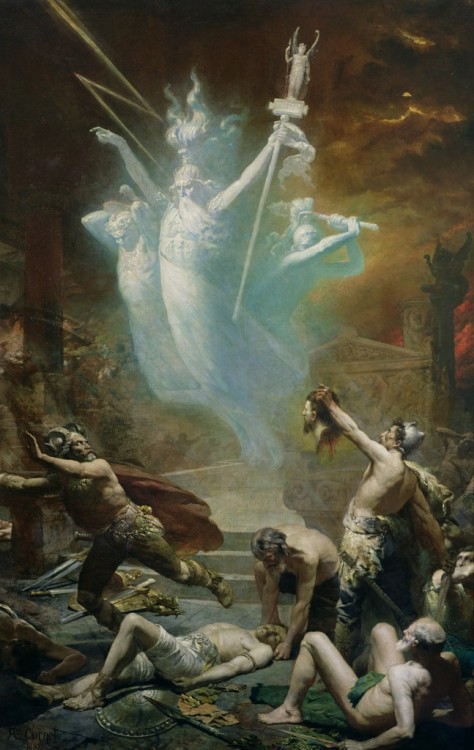
(NO , Not a~vik~ing, they who came from the north, hundreds of years later).See theTaking of the Temple at Delphi by the Gauls, 1885 by Alphonse Cornet a French Academic Classical artist born 1814 - died 1874.
The earliest directly attested examples of a Celtic language are the Lepontic .Lepontic is an extinct Alpine language that was spoken in parts of Rhaetia and Cisalpine Gaul between 550 and 100 BC. It is generally regarded as a Celtic language, although its exact classification within Celtic, or even within the western Indo-European languages, has been the object of debate...
inscriptions, beginning from the 6th century BC.The Continental Celtic languages were spoken by the people known to Roman and Greek writers as Keltoi,...
are attested only in inscriptions and place-names. Insular Celtic is attested from about the 4th century AD in ogham inscriptions, although it is clearly much earlier. Literary tradition begins with Old Irish from about the 8th century. Coherent texts of Early Irish literature. Early Irish literature-The earliest Irish authors:It is unclear when literacy first came to Ireland. The earliest Irish writings are inscriptions, mostly simple memorials, on stone in the ogham alphabet, the earliest of which date to the fourth century..., such as the Táin Bó Cúailnge (a legendary tale from early Irish literature, often considered an epic, although it is written primarily in prose rather than verse)...(The Cattle Raid of Cooley), survive in 12th-century recensions. According to the theory of Professor John T. Koch is an American academic, historian and linguist who specializes in Celtic studies, especially prehistory and the early Middle Ages....
and others.The Tartessian language, also known as Southwestern or South Lusitanian, is a Paleohispanic language once spoken in the southwest of the Iberian Peninsula: mainly in the south of Portugal , but also in Spain...may have been the earliest directly attested Celtic language with the Tartessian written script used in the inscriptions based on a version of a Phoenician script in use around 825 BC.
GREEK RELIEF writing on tablet 3RD BCE
Decree of the town of Cos, Greece. Inscription on stone about the conquest of Delphi by the Gauls under Brennus in March 278 BCE, followed by news of the expulsion of the Gauls from Delphi in the Archaeological Museum, Istanbul, modern Turkey.
www.lessing-photo.com/dispimg.asp?i=10010366+&cr=1679...
Synonyms: Bryth, Gaul: The Raven King
A Brennos , Brennos of the Senones, first appears as the Celtic or Gaulish hero who led the Celtic sack of Rome. During the third century BCE the Celtic expansion led them to the Po valley in Italy. Fearful of this expansion the Etruscans called , on their adversaries, Rome for assistance. The Romans sent three envoys to meet the Celtic leaders. However, one of the Roman envoys killed a Celtic chief and Rome sent an army of 40 000 to meet these 'barbarians'. When the Celts learned of the Roman army moving towards them, Brennos (most likely a chiefly title rather than a real name, like a Duke, see below) marched the Celts off to meet the Romans. The Celts met the Romans at the River Allia, the Romans panicked at the sight of all those crazed Celts, and many Roman soldiers even drowned in the River in attempt to escape. A few made it back to Rome and informed the Senate about the battle at Allia (the date of the battle, July 18, became known as Alliaensis, and was considered thereafter to be a very bad day to do any public activity). The Roman citizens, rightfully fearing that the Celts were headed toward Rome, fled in a panic (much like the soldiers at Allia). By the time the Celts/ Gauls arrived, Rome had been deserted, with the exception of several elderly patricians. These old patricians were sitting in a courtyard, believing that if they were to sacrifice their lives for Rome in its most dire hour of need, Rome's enemies would then be thrown into panic and confusion, and Rome thereby saved. This nearly worked, but the spell of quietude was broken and Rome was looted and the old men killed. They advanced on the Capitol, but were thwarted by plague and a night-time attack was spoiled by cackling of geese. However, about seven months, later the Romans decided to negotiate and the Celts agreed to leave if the Romans would pay them 1,000 pounds of gold. The Celts were accused of using false weights, upon which Brennos (the Celtic chieftain) is said to have thrown his sword on the scales and loudly declare, "Vea victus", or "woe to the defeated".
www.flickr.com/photos/96490373@N02/14550761807/
cgi.ebay.com/Ancient-Roman-Dictator-Brennus-c1915-Card-/3...
www.flickr.com/photos/summoning_ifrit/4211154813/
The early 4th century BCE a vast group of Gauls sacked the city of Rome. Romans gave it up rather easily, actually. Most fled to neighbouring cities like Veii while the Senate, priests, and what was left of the Roman army migrated to the Capitol - defending and taking refuge in the temples there. The Gauls made easy pickings of what they found in the city. According to Livy:
For several days they had been directing their fury only against bricks and mortar. Rome was a heap of smouldering ruins, but something remained - the armed men in the Citadel, and when the Gauls saw that, in spite of everything, they remained unshaken and would never yield to anything but force, they resolved to attempt an assault. At dawn, therefore, on a given signal the whole vast horde assembled in the Forum; then, roaring out their challenge, they locked shields and moved up the slope of the Capitol." (5.43)
The Romans, however, used the advantage of being at the top of the hill and managed to beat the Gauls back. Yet the Gauls were determined and even though they had destroyed most of the food and supplies in their initial sack of the city, they began a siege on the hill.
During all of this, officials in Veii were determined to get a message through to the Roman Senate - despite the fact that the Senate was under siege. As the old saying goes, 'if there's a will, there's a way', and a young Roman soldier named Pontius Cominus managed to do it. "Floating on a life-buoy down the river to Rome, he took the shortest way to the Capitol up and over a bluff so steep that the Gauls had never thought of watching it." (5.46) But the Gauls did find out about it and figured if he could do it, then they should all be able to do it too.
One starlit night, they made the attempt. Having first sent an unarmed man to reconnoitre the route, they began the climb. It was something of a scramble: at the awkward spots a man would get a purchase for his feet on a comrade below him, then haul him up in his turn - weapons were passed up from hand to hand as the lie of the rocks allowed - until by pushing and pulling on another they reached the top. What is more, they accomplished the climb so quietly that the Romans on guard never heard a sound, and even the dogs - who are normally aroused by the least noise in the night - noticed nothing. It was the geese that saved them - Juno's sacred geese, which in spite of the dearth of provisions had not been killed. The cackling of the birds and the clapping of their wings awoke Marcus Manlius - a distinguished officer who had been consul three years before - and he, seizing his sword and giving the alarm, hurried, without waiting for the support of his bewildered comrades, straight to the point of danger. (5.46)
And that is either Roman spin or real history of how the sacred geese of Juno saved Rome - since after that last attempt, the lack of food forced the Gaul to accept payment from the Romans to leave the city alone.
www.mmdtkw.org/AU0308bJunoMonetaGeese.jpg
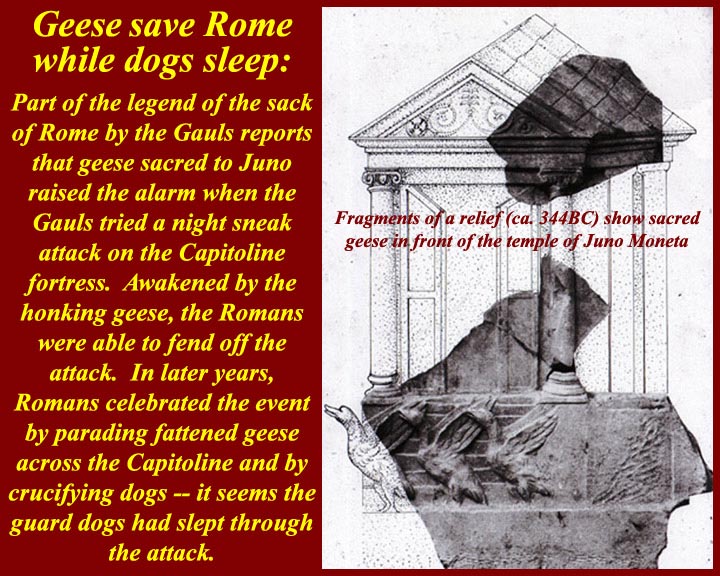
www.mmdtkw.org/AU0308gBrennerPass.jpg
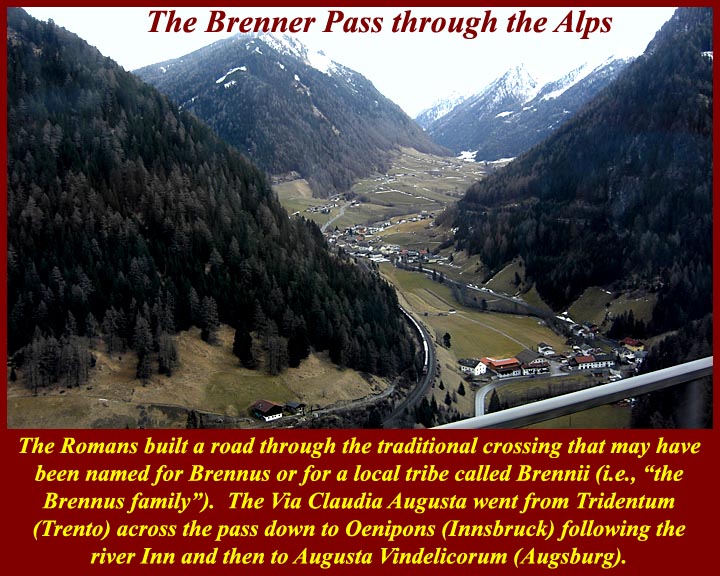
www.mmdtkw.org/AU0308gBrennusFrenchMaritimeSculpture.jpg
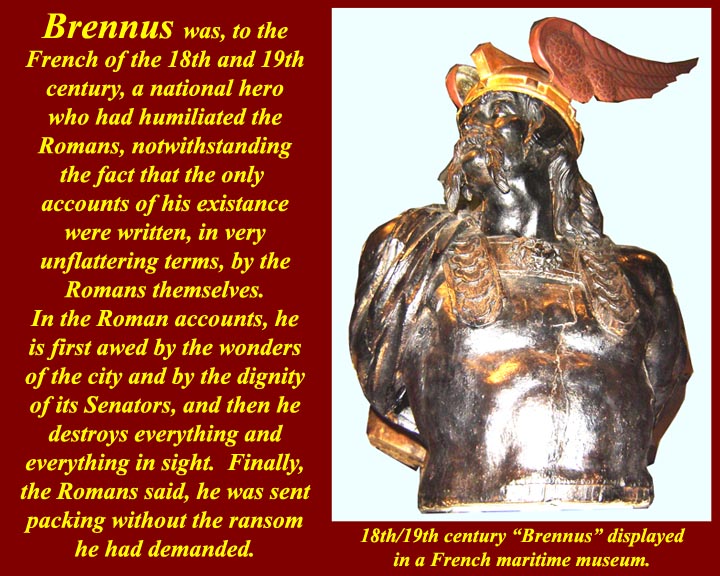
While Brennus I was evil personified to the Romans, he was a hero to transalpine people.
en.wikipedia.org/wiki/Battle_of_the_Allia
"Other Greek and Roman synchronisms have a more obvious historical symbolism, as may be the casewith the Polybian synchronism we saw above, between Dionysius’s siege of
Rhegium and the Gallic sack of Rome."
wxy.seu.edu.cn/humanities/sociology/htmledit/uploadfile/s...
www.unrv.com/empire/gallic-sack-of-rome.php
REFOUNDING THE CITY:
ENNIUS, LIVY, AND VIRGIL
The city of Rome has now been successfully founded in historical time—whether
that time is focalized as Greek or Roman—but we have not yet reached the end of
the story. As everyone knows, the city of Rome kept having to be re-founded, and
the patterns of refoundation drastically reconfigure the trajectory of movement
from myth to history that we have been following so far.188
Ennius’s most explicit surviving allusion to the date of the foundation of the city
in fact comes at the moment when the city had just been virtually destroyed, and
was on the verge of vanishing from history, after the sack by the Gauls in 387/6
b.c.e.189 The context is a speech in which Camillus persuades the Senate not to
move to Veii, but to refound the city instead (154–55 Skutsch):
Septingenti sunt paulo plus aut minus anni
augusto augurio postquam incluta condita Roma est.
It is seven hundred years, a little more or a little less,
since famous Rome was founded by august augury.
How this seven-hundred-year period between Romulus’s foundation and the sack
of Rome by the Gauls actually worked remains a mystery, at least to me.190 Still, we
should not overlook the symbolic significance of this number in its own right. The
importance of the seven-hundred-year period has been very well illustrated in the
fascinating book Die rhetorische Zahl, written by a scholar with the gloriously apt
name of Dreizehnter.191 Dreizehnter does not mention this passage of Ennius, but
he collects a great deal of interesting material about seven hundred years as the life
span of a city or an empire from foundation to extinction, or from foundation to
virtual extinction or only just-escaped extinction. In various traditions that he
examines there were seven hundred years from the foundation to the destruction
of Melos, Carthage, and Macedonia, or from the foundation to the virtual extinc-
(Myth into History I: Foundations of the city)
tion of Sparta.192 What we see in the Ennius passage, in other words, is that the city
was virtually destroyed and came within an ace of fulfilling the seven-hundred year
doom. The point will have been accentuated by Ennius’s book divisions.
Camillus’s speech comes at the end of book 4, and the regal period ended with
book 3, so that up to this point in the Annales we have had only one self-contained
volume of Republican history, and if things had gone differently that might have
been all we had.193
Livy activates the power of this Ennian symbolic numeral, even as he corrects
Ennius’s dating, with his allusion to the seven hundred years of Rome (Pref. 4):
Res est praeterea et immensi operis, ut quae supra septingentesimum annum
repetatur et quae ab exiguis profecta initiis eo creuerit ut iam magnitudine
laboret sua.
In addition, the matter is of immeasurable scope, in that it must be taken back
past the seven hundredth year, and having started from small beginnings has
grown to the stage that it is now laboring under its own size.194
Chaplin has argued that Livy’s preface is constructing recent Roman history as a
death, with a possible rebirth to come:195 the Republic has been destroyed, and the
Romans of Livy’s time are like the Romans of Camillus’s time, faced with the task
of refounding the city after it has only just escaped its seven-hundred-year doom.
In Livy’s treatment of the Roman response to the sack of the city by the Gauls,
we can see him returning to the Ennian theme of rebirth from destruction,
although this time using different significant numbers. Having exploited the numinous
associations of Ennius’s seven hundred years in his preface, Livy now produces
another numinous numeral for the span from foundation to sack, one that
conforms with the modern orthodox chronology. Livy has Camillus deliver a
mighty speech to convince his fellow citizens not to abandon Rome for the site of
Veii (5.51–54).196When Livy’s Camillus echoes Ennius’s by counting off the years
since the foundation, it appears that some kind of great year has gone by. From
Romulus’s foundation down to the sack by the Gauls there have been as many
years as there are days in a year: Trecentensimus sexagensimus quintus annus urbis,
Quirites, agitur (“This is the 365th year of the city, Quirites,” 5.54.5). This is of
course a calculation that fully resonates only after Caesar’s reform of the calendar,
when a Roman year for the first time had 365 days.This counting places
Camillus’s refounding of the city at a pivotal point in time, precisely halfway
(Refounding the City: Ennius, Livy, Virgil . 101)
between the first founding of the city, in 753, and the refounding that faces Livy
and his contemporaries 365 years after Camillus, in the 20s b.c.e.198 Exactly the
same structuring appears to underpin the panorama of Roman history on Virgil’s
Shield of Aeneas, where the barely averted destruction of Rome by the Gauls (Aen.
8.652–62) comes midway in time between the foundation of the city (8.635) and
the barely averted destruction of Rome by Antonius and Cleopatra (8.671–713).199
In all of these authors, city destruction, whether achieved or barely averted,
leads to refoundation and consequent reconfiguring of identity, in a process that
begins with Troy and continues through the fates of Alba Longa, Veii, and Rome
itself.200 As Kraus has shown, when Livy begins his next book after the Gallic sack,
he refounds his narrative along with the city, capitalizing on the annalistic tradition’s
identification of the city and history.201 In an extraordinary moment, the
opening sentences of book 6 tell us that only now is real history beginning. All of
the material in the first five books, Livy now declares, has been “obscure because
of its excessive antiquity” (uetustate nimia obscuras), and because there were few
written records in those early days, while the ones that did exist “for the most part
were destroyed when the city was burnt” (incensa urbe pleraeque interiere, 6.1.2).
Everything up until this point, from Troy to the Gallic sack, is suddenly reconfigured
as prior, prefoundational. In his preface Livy had drawn a line between myth
and history around the time of the Romulean foundation of the city (ante conditam
condendamue urbem, 6), but “the fresh start in 390 redraws the limits of the historically
verifiable.”202We now have a new entry into history, with a newly rebuilt city
and a newly solid evidential base for its written commemoration (6.1.3):
Clariora deinceps certioraque ab secunda origine uelut ab stirpibus laetius
feraciusque renatae urbis gesta domi militiaeque exponentur.
From here there will be a more clear and definite exposition of the domestic
and military history of the city, reborn from a second origin, as if from the
old roots, with a more fertile and fruitful growth.203
Livy here is picking up on the annalistic history of Claudius Quadrigarius, who
had written about fifty years earlier. We know that Claudius began his history with
the sack of Rome by the Gauls, no doubt on the grounds we see alluded to in Livy,
that no history was possible before then, thanks to the destruction of monuments
and archives.204
We have already seen how the Roman tradition picks up demarcations that are
102 . Myth into History I: Foundations of the City
crucial from the Greek tradition—Troy and the first Olympiad—and recasts
them as transitions into a new, Roman, phase of history. The Gallic sack is a vital
addition to this series of watersheds. The first key fixed synchronistic point in
Timaeus and Polybius that makes it possible for Roman history to be properly connected
with Greek history, the Gallic sack is itself made to serve as the “beginning
of history” in Claudius Quadrigarius and Livy book 6.205 The very event that almost
expunged Rome altogether is the one that put the city on the world stage—
just as the destruction of Troy led to the city’s existence in the first place.206
Ovid intuited the power of these associated watersheds of foundation and Gallic
sack, and his subtle deployment of them in the Metamorphoses is proof of their
understood significance. Before he arrives at the foundation of Rome in book 14,
he has a very small number of proleptic references to the as yet nonexistent city.
Book 1 contains two forward references to his own day, with the poem’s first simile
referring to the reign of Augustus (1.199–205), and the story of Apollo and
Daphne likewise anticipating the reign of Augustus, as Apollo prophesies the use
of his sacred laurel to grace Roman triumphs and adorn Augustus’s house (1.560–
63). His only other proleptic references to the city before the foundation in book
14 occur in book 2, and they are both references to the city only just escaping total
catastrophe, catastrophes that would have ensured the city was never part of world
history. One is in a cosmic setting, when the natural site of the city is almost
expunged, as the Tiber is dried up along with other rivers by Phaethon’s chariot
(2.254–59); the other is an allusion to the geese that “were to save the Capitol with
their wakeful cry” (seruaturis uigili Capitolia uoce/ . . . anseribus, 2.538–39).207
Again, in the Fasti, when the gods meet in council to deliberate how to save Rome
from the Gauls, Ovid takes as his template the Ennian council that deliberated over
the foundation of the city: in both cases, Mars expostulates with his father, Jupiter,
and is assured that all will be well.208
It is highly significant that these two events, the city’s foundation and near
destruction by the Gauls, are the only “historical” events commemorated on the
Republican calendar, the Fasti Antiates.209 Calendrical fasti from the Principate
mention all kinds of events, but the Fasti Antiates, the only calendar we have surviving
from the Republic, mark only two historical events: 21 April, the Parilia and
the foundation of the city, and 18 July, the dies Alliensis, the day of the battle of the
Allia, when the Roman army was scattered by the advancing Gauls on their way
to the city, which they entered on the next day.210
The foundation of the city and its near extinction by the Gauls are symbolically
joined events, linked by significant numbers, either 700 or 365, linked by themes of
Refounding the City: Ennius, Livy, Virgil . 103
refoundation and rebirth. The history of the city keeps getting restarted at such
crucial transition moments, when repetitive patterns of quasi-cyclical destruction
and refoundation replay themselves, in a fascinating interplay between a drive for
onward narrative continuity and the threat of eddying, repetitious, circularity.211 It
is poignant to observe the power of this theme still persisting in the fifth century
c.e., when Rutilius Namatianus, six years after the sack of Rome by the Visigoths
in 410 c.e., can hail Rome’s potential to bounce back from disaster, citing its eventual
defeat of Brennus, who led the Gauls to the sack of Rome, and of the Samnites,
Pyrrhus, and Hannibal:212 “You, Rome, are built up,” he claims, “by the very thing
that undoes other powers: the pattern of your rebirth is the ability to grow from
your calamities” (illud te reparat quod cetera regna resoluit:/ordo renascendi est
crescere posse malis, 139–40). Each of these key marker moments in time may become
a new opportunity for the community to reimagine itself, as the epochal moment
produces a new beginning point from which the community may imagine its
progress forward into time, measured against its backward extension into time.213
_______________________________ __________________________
The Gauls in the Italia peninsula .Clusium was reached by the Gauls, who had invaded most of Etruria already, and its people turned to Rome for help. However, the Roman embassy provoked a skirmish and, then, the Gauls marched straight for Rome (July, 387 BC). After the entire Roman army was defeated at the Allia brook (Battle of the Allia), the defenseless Rome was seized by the invaders. The entire Roman army retreated into the deserted Veii whereas most civilians ended at the Etruscan Caere. Nonetheless, a surrounded Roman garrison continued to resist on the Capitoline Hill. The Gauls dwelt within the city, getting their supplies by destroying all nearby towns for plunder.When the Gauls went for Ardea, the exiled Camillus, who was now a private man, organized the local forces for a defense. Particularly, he harangued that, always, the Gauls exterminated their defeated enemies. Camillus found that the Gauls were too distracted, celebrating their latest spoils with much 'crapulence' at their camp. Then, he attacked during a night, defeating the enemy easily with great bloodshed.He is thus considered the second founder of Rome.Camillus was hailed then by all other Roman exiles throughout the region. After he refused a makeshift generalship, a Roman messenger sneaked into the Capitol and, therein, Camillus was officially appointed dictator by the Roman Senators, to confront the Gauls.At the Roman base of Veii, Camillus gathered a 12,000-man army whereas more men joined out of the region. The occupying Gauls were in serious need, under quite poor health conditions. As the Roman Dictator, Camillus negotiated with the Gallic leader Brennus, and the Gauls left Rome, camping nearby at the Gabinian road. A day after this, Camillus confronted them with his refreshed army and the Gauls were forced to withdraw, after seven months of occupation (386 BC).
Camillus sacrificed for the successful return and he ordered the construction of the temple of Aius Locutius. Then, he subdued another claim of the plebeian orators, who importuned further about moving to Veii. After ordering a Senate debate, Camillus argued for staying and the Roman house approved this unanimously. The reconstruction extended for an entire year.
By this one-year office, Camillus was the longest of all Roman dictators. Basically, the Senators had been persuaded by the disturbing social clashes, which could be better managed by Camillus. Instead, Camillus disliked this and, vainly, he requested the dismissal.
Roman dictator (367 BC)
As the Gauls were, again, marching toward Latium, all Romans reunited despite their severe differences. Camillus was named Roman dictator for the fifth time then (367 BC). He organized the defense of Rome actively. By the commands of Camillus, the Roman soldiers were protected particularly against the Gallic main attack, the heavy blow of their swords. Both smooth iron helmets and brass rimed shields were built. Also, long pikes were used, to keep the enemy's swords far.
The Gauls camped at the Anio river, carrying loads of recently gotten plunder. Near them, at the Alban Hills, Camillus discovered their disorganization, which was due to unruly celebrations. Before the dawn, then, the light infantry disarrayed the Gallic defenses and, subsequently, the heavy infantry and the pikemen of the Romans finished their enemy. After the battle, Velitrae surrendered voluntarily to Rome. Back in Rome, Camillus celebrated with another Triumph.
ancientimes.blogspot.co.nz/2007/06/brennus-and-first-sack...
A deadly pestilence struck Rome and it affected most Roman public figures. Camillus was amongst them, passing away in 365 BC.
Source: Plutarch, The Parallel Lives - The Life of Camillus:
In popular culture
Marcus Furius Camillus was played by Massimo Serato in the 1963 film 'Brennus, Enemy of Rome'.
www.flickr.com/photos/ggnyc/1405297848/
BC 400's Celts from the Alps flowed into Italy ....
Herodotus of Halicarnassus reported a merchant from Samos named Colacus was driven off course by tides and winds when trading off the African shore. He landed at the Tartessus (modern River Guadalquivir in southern Spain) where he found tribes of Keltoi working the silver mines
396 BC Celts defeated the Etruscans at Melpum (Melzo, west of Milan)
390 Senones Celts ('the veterans') led by Brennos (Latinate: Brennus) defeated the Romans in Rome (July 19) so badly it took the Romans 200 years to recover from the 'terror Gallicus'. After seven months and a ransom of 100 pounds of gold, the Celts moved along to Picenum on Italy's eastern seaboard.
Ephoros of Cyme reported the Celts occupied an area the size of the Indian sub-continent.
334-335 Alexander of Macedonia met the Celts on the Danube banks to make an agreement: The Celts would not attack his empire while he was off conquering in the east. Only after his death they expanded to Moravia and Thrace .
----------- ----------
Along with Bolgios, Brennos II was the legendary leader of other Celts on their invasion of Macedonia in the second century BCE. Though Bolgios led the invasion of Macedonia , Brennus succeeded in crossing his whole army over the river Sperchios into Greece proper, where he laid seige to the town of Heraclea and, having driven out the garrison there, marched on to Thermopylae where he defeated an army raised by a confederation of Greek cities. Brennus then avanced across Greece, where he decided to go on to Delphi, which was reported as the treasure house of Greece. Brennus and his army of 30,000 set off to attack the temple of Apollo, the ultimate goal of his expedition. Here it is said that Brennos was defeated by earthquakes and thunderbolts that reduced the soldiers to ashes; snow storms, showers of great stones, and "ancient heroes appearing from the heavens". In the midst of this snowstorm, Brennos and his men were attacked near the Parnassus mountains. The Celts were soundly defeated and Brennos was mortally wounded. As he lay dying, he gave the order for all of the wounded to be killed, and all the booty to be burned, as the army would never make it home if they had to carry the wounded warriors and their plunder. After giving the order, Brennos drank some wine and then took his own life. (? Source)
www.maryjones.us/ctexts/classical_pausianas.html
The Description of Greece
Pausanias (fl. 2nd c. CE) XIX.
[5] "I have made some mention of the Gallic invasion of Greece in my description of the Athenian Council Chamber. But I have resolved to give a more detailed account of the Gauls in my description of Delphi, because the greatest of the Greek exploits against the barbarians took place there. The Celts conducted their first foreign expedition under the leadership of Cambaules. Advancing as far as Thrace they lost heart and broke off their march, realizing that they were too few in number to be a match for the Greeks. "...........
10]" When the Gallic horsemen were engaged, the servants remained behind the ranks and proved useful in the following way. Should a horseman or his horse fall, the slave brought him a horse to mount; if the rider was killed, the slave mounted the horse in his master's place; if both rider and horse were killed, there was a mounted man ready. When a rider was wounded, one slave brought back to camp the wounded man, while the other took his vacant place in the ranks.
[11] I believe that the Gauls in adopting these methods copied the Persian regiment of the Ten Thousand, who were called the Immortals. There was, however, this difference. The Persians used to wait until the battle was over before replacing casualties, while the Gauls kept reinforcing the horsemen to their full number during the height of the action. This organization is called in their native speech trimarcisia, for I would have you know that marca3 is the Celtic name for a horse. "
(Addit :we know from Celtic myth this was indigenous to the confederacy of Celtic tribes as on Gundestrup Cauldron ,warrior plate)
[12] "This was the size of the army, and such was the intention of Brennos, when he attacked Greece. The spirit of the Greeks was utterly broken, but the extremity of their terror forced them to defend Greece. They realized that the struggle that faced them would not be one for liberty, as it was when they fought the Persian, and that giving water and earth would not bring them safety. They still remembered the fate of Macedonia, Thrace and Paeonia during the former incursion of the Gauls, and reports were coming in of enormities committed at that very time on the Thessalians. So every man, as well as every state, was convinced that they must either conquer or perish. "
Attalus I (Greek: Ἄτταλος), surnamed Soter (Greek: Σωτὴρ, "Savior"; 269 BC – 197 BC) ruled Pergamon, an Ionian Greek polis (what is now Bergama, Turkey), first as dynast, later as king, from 241 BC to 197 BC. He was the second cousin and the adoptive son of Eumenes I, whom he succeeded, and was the first of the Attalid dynasty to assume the title of king in 238 BC.He was the son of Attalus and his wife Antiochis.
Attalus won an important victory over the Galatians, newly arrived Celtic tribes from Thrace, who had been, for more than a generation, plundering and exacting tribute throughout most of Asia Minor without any serious check. This victory, celebrated by the triumphal monument at Pergamon, famous for its 'Dying Galatian' or 'Gaul' statue , and the liberation from the Gallic "terror" which it represented, earned for Attalus the name of "Soter", and the title of "king". A courageous and capable general and loyal ally of Rome, he played a significant role in the first and second Macedonian Wars, waged against Philip V of Macedon.
Etymologically Brennos is related to Brân and is related to the reconstructed proto-Celtic lexical elements *brano- (raven) -n- (the deicific particle) and os (the masculine ending). Thus Brennos is literally the 'Raven God'. However, the bren part of the name is also the root for one Cymric word for king brenhin and Brennos can be rendered as 'Raven King'. Which also leads to the supposition that 'Brennos', rather than being a proper name is actually an honorific denoting 'battle lord'. Raven gods being tribal leaders in the time of war so a Celtic war leader would take-on the name of such a deity. Indeed, the modern Cymric for king is brenin a word derived from 'Brennos'.
An actual late Iron Age helmet like this has been located in ancient Dacia , Translyvania , now modern Roumania/ Romania the Helmet of Ciumeşti.
www.flickr.com/photos/42003310@N05/4886860352/
As one of the styles depicted on the Celtic Gundestrup Cauldron.
Wilcox and McBride mentioned that their illustration of the iron Gallic warrior's helmet of the middle La Tene period had been reconstructed the on the basis of the Ciumesti helmet.[45]
The combat-proven F-16 has proven itself as the world’s most capable 4th Generation multi-role fighter, serving as the workhorse of the fighter fleet for 28 customers around the world.
The F-16A, a single-seat model, first flew in December 1976. The first operational F-16A was delivered in January 1979 to the 388th Tactical Fighter Wing at Hill Air Force Base, Utah.
All F-16s delivered since November 1981 have built-in structural and wiring provisions and systems architecture that permit expansion of the multirole flexibility to perform precision strike, night attack, and beyond-visual-range interception missions. This improvement program led to the F-16C and F-16D aircraft, which are the single- and two-place counterparts to the F-16A/B, and incorporate the latest cockpit control and display technology. All active units and many Air National Guard and Air Force Reserve units have converted to the F-16C/D.
U.S. Air Force F-16 multirole fighters were deployed to the Persian Gulf in 1991 in support of Operation Desert Storm; where more sorties were flown than with any other aircraft. These fighters were used to attack airfields, military production facilities, Scud missiles sites and a variety of other targets.
During Operation Allied Force, U.S. Air Force F-16 multirole fighters flew a variety of missions to include; suppression of enemy air defense, offensive counter air, defensive counter air, close air support and forward air controller missions. Mission results were outstanding as these fighters destroyed radar sites, vehicles, tanks, MiGs and buildings.
Since Sept. 11, 2001, the F-16 has been a major component of the combat forces committed to the war on terrorism flying thousands of sorties in support of operations Noble Eagle (Homeland Defense), Enduring Freedom in Afghanistan and Iraqi Freedom.
The F-16s are an integral part of the Pacific Air Forces power projection based at Osan Air Base Korea and Eielson Air Force Base, Alaska.
-- Technical Information (or Nerdy Stuff) --
‧ Camera - Nikon D7200 (handheld)
‧ Lens – Nikkor 18-300mm Zoom
‧ ISO – 1250
‧ Aperture – f/7.1
‧ Exposure – 1/200 second
‧ Focal Length – 18mm
The original RAW file was processed with Adobe Camera Raw and final adjustments were made with Photoshop CS6.
"For I know the plans I have for you,” declares the LORD, “plans to prosper you and not to harm you, plans to give you hope and a future." ~Jeremiah 29:11
The best way to view my photostream is through Flickriver with the following link: www.flickriver.com/photos/photojourney57/
Well I tried to do some Portraits of this group this year, and I did them in B&W as it fits their motif. This is my first time doing a portrait session like this, so I am grateful for the chance to do this.
Strobist info:
ISO 200
f 4
Shutter 1/10th
Ambient light to the right, a Canon 480 EXII flash to the left with a Firefly Softbox fired using a Hahnel Trigger.
My brother Mark died on the 17th January 1996. He committed suicide. 25 years ago.
I remember I was just about to go back to Architecture school. I don't think he knew, he was working away from Perth.
He would have hassled me about it, being a carpenter, he thought all architects were wankers.
What is hard when looking back at 25 years, so much has happened. To me, but he never knew:
I went to Architecture School, worked at Donaldson and Warn.
Moved to Germany, worked at cool offices there, he would have made fun of me working for zee Germans!
In 2003 moved to Amsterdam, found a good job, lived in some great apartments, made lots of new great friends and met Kirsten.
Travelled to so many wonderful cities and countries.
I bought a place in Amsterdam and renovated it. Mark would have hassled me about that too. It was all white, white floor, white walls.
I tried to run my little office, be self-employed, like Mark did. I hated it. I got stressed. I worried about money. Like Mark did too.
In 2011 Kirsten and I moved to London, started afresh. New jobs, new apartment, new friends and new experiences.
I got seriously into outdoor activities, hiking, camping. Then climbing and mountaineering. Mark and I had once as kids hiked to our Nan's house and camped in her garden. I couldn't tell Mark that I wild camped on a remote island in Norway with 24 hours of sunlight and climbed a mountain at midnight.
Kirsten and I got married, bought a flat, slowly renovated it. Mark would have had something to say about that too.
In 25 years so much has happened to me, some a bit shit, but most amazing and unexpected things. I couldn't share any of them with him.
We didn't get to see his next 25 years, his life just stopped suddenly on the 17th January 1996.
O'G3NE committed as an ambassador of the deadly muscle and nerve disease Amyotrophic Lateral Sclerosis (ALS).
On October 29, 2016 it was announced that O'G3NE will represent the Netherlands at the Eurovision Song Contest 2017 in Ukraine.
O’G3NE zet zich in als ambassadeur van de dodelijke spier- en zenuwziekte Amyotrofische Laterale Sclerose (ALS).
Op 29 oktober 2016 werd bekend dat O'G3NE Nederland zou gaan vertegenwoordigen op het Eurovisiesongfestival 2017 in Oekraïne.
In the mid-1980s, Soviet leader Mikhail Gorbachev committed to the Conventional Force in Europe (CFE) Treaty that restricted the number of combat aircraft stationed west of the Ural mountains. Production Su-27 fighters delivered to the Air Force had a secondary strike role. The Su-27 fell under the terms of this treaty. To reduce the Soviet Air Force’s overall offensive capability, the Su-27s assigned to Soviet Air Defence Forces (Voyska Protivovozdushnoy Oborony, or PVO) regiments were designated as pure interceptors with no strike capabilities. These aircraft were designated Su-27P (perekhvatchik, or interceptor). The aircraft’s avionics suite was changed by downgrading the Izdeliye 10PM fire control system to the Izdeliye 10PMP and later the 10PMD. The Su-27P began production at the KnAAPO plant in late 1989. Many of the in-service Su-27s were progressively modified to this new standard. While the designation Su-27P was official, many front-line PVO units still referred to them as simply the Su-27.
In this image, a Su-27P (“38 Red”) of the 33rd AE, 941st Fighter Aviation Regiment (IAP) of the 10th Independent Air Defence Army (OA PVO) at Kilpyavr Air Base on the Kola Peninsula dives to intercept an intruding aircraft. The first new Su-27s arrived in December 1985, and by the end of 1986, the regiment had 26 Flankers in service. The 941st IAP became famous for having the first Flanker photographed close-up with a full weapons load and for the collision between a Royal Norwegian Air Force Lockheed P-3B Orion maritime aircraft from 333 Sqn at Bodø AB. The P-3B had been shadowing a group of Soviet Navy ships in the Barents Sea. Lt. (SG) Vasiliy Tsymbal, flying Su-27 “36 Red,” was ordered to make a practice intercept. The P-3B pilot, 1st Lt. Jan Salvesen, reduced speed and tried to squeeze the Su-27 out of its intended flight path by flying over the top of it. The Flanker’s excellent low-speed handling characteristics allowed it to keep formation, but Tsymbal manoeuvered the Flanker too close, and the port tail fin clipped the No. 4 propeller. The collision shattered the dielectric fin cap of the Flanker and the propeller of the Orion, sending debris through the Norwegian aircraft’s fuselage and causing decompression. Both aircraft returned to their respective bases safely.
A massive investigation was launched and three days later, the Soviet Union officially apologized for the incident, and Tsymbal was expelled from the Communist Party (a very severe punishment by Soviet standards). However, the next day Tsymbal was awarded the Order of the Red Star and transferred to another unit based in Rostov along with a promotion. 36 Red was re-coded 38 Red to avoid unwanted interest in this aircraft from Western observers. Plus, it also gave Soviet officials plausible deniability since no aircraft coded 36 Red served with the 941st IAP. In this image, 38 Red plots an intercept course toward an unidentified aircraft penetrating Soviet air space. For three consecutive days in the summer of 1988, a Norwegian pilot, Andreas Sommers, would fly along the border and then penetrate Soviet air space for 2-3 km (1.25-1.87 mi) and make a hasty retreat once the fighters scrambled to intercept. The 941st received orders to shoot him down if he did it again. Sommers never returned to Soviet air space.
Repsol is committed to being a responsible operator in all areas of our business. Our values of flexibility, transparency, responsibility, integrity and innovation are at the core of everything we do. Repsol holds an interest in 170,000 net acres in the Marcellus, which is one of the largest natural gas fields in the world. Our acreage is primarily located in northeastern Pennsylvania in Bradford, Susquehanna and Tioga counties.
Learn more about our U.S. exploration and production business at www.repsolusa.com.
Repsol se compromete a actuar con responsabilidad a lo largo de toda la cadena de valor. Nuestros valores de flexibilidad, transparencia, responsabilidad, integridad e innovación marcan nuestra manera de trabajar. Repsol tiene un interés de 170.000 acres netos en el Marcellus, es uno de los mayores campos de gas natural en el mundo. Nuestra área de operación se encuentra principalmente en el noreste de Pennsylvania en Bradford, y en los condados de Susquehanna y Tioga.
Más información sobre nuestro negocio de exploración y producción en EE.UU. www.repsolusa.com .
The Greek offensive under King Constantine as Supreme Commander of the Greek Forces in Asia was committed on July 16. 1921, and was skilfully executed. A feint towards the Turkish right flank at Eskişehir distracted Ismet Pasha just as the major assault fell on the left at Kara Hisar. The Greeks then wheeled their axis to the north and swept towards Eskişehir, rolling up the Turkish defence in a series of frontal assaults combined with flanking movements.[21]
Eskişehir fell on July 17, despite a vigorous counter-attack by Ismet Pasha who was determined to fight to the finish. The saner counsels of Mustafa Kemal prevailed, however, and Ismet disengaged with great losses to reach the comparative safety of the Sakarya River, some 30 miles (48 km) to the north and only 50 miles (80 km) from Ankara.[22]
The battle took place along the Sakarya River around the vicinity of Polatlı, stretching a 62 miles long battle line.
The determining feature of the terrain was the river itself, which flows eastward across the plateau, suddenly curves north and then turns back westwards describing a great loop that forms a natural barrier. The river banks are awkward and steep, and bridges were few, there being only two on the frontal section of the loop. East of the loop, the landscape rises before an invader in rocky, barren ridges and hills towards Ankara. It was here in these hills, east of the river that the Turks dug in their defensive positions. The front followed the hills east of the Sakarya River from a point near Polatlı southwards to where the Gök River joins the Sakarya, and then swung at rightangles eastwards following the line of the Gök River. It was an excellent defensive ground.[23]
For the Greeks, the question on whether to dig in and rest on their previous gains, or to advance towards Ankara in great effort and destroy the Army of the Grand National Assembly was difficult to resolve, posing the eternal problems that the Greek Staff had to deal since the beginning of the War. The dangers of extending the lines of communications still further in such an inhospitable terrain that killed horses, caused vehicles to break down and prevented the movement of heavy artillery were obvious. The present front that gave the Greeks the control of the essential strategic railway was tactically most favourable. But because the Army of the Grand National Assembly had escaped encirclement at Kütahya, nothing had been settled; therefore the temptation of achieving a “knock-out-blow” became irresistible.[24]
Battle[edit]
The Greek 9th infantry division marches through the steppe
Turkish prisoners of war during the battle of Sakarya
On August 10, Constantine finally committed his forces to an assault against the Sakarya Line. The Greeks marched hard for nine days before making contact with the enemy. This march included an outflanking manoeuvre through the northern part of Anatolia through the Salt Desert where food and water scarcely existed, so the advancing infantry had to rifle the poor Turkish villages for maize and water or obtain meat from the flocks which were pastured on the fringe of the desert.[25]
On August 23, battle was finally joined when Greeks made contact with advanced Turkish positions south of the Gök River. The Turkish Staff had made their headquarters at Polatlı on the railway a few miles east of the coast of the Sakarya River and the troops were prepared to resist.
On August 26, the Greeks attacked all along the line. Crossing the shallow Gök, the infantry fought its way step up onto the heights where every ridge and hill top had to be stormed against strong entrenchments and withering fire.
By September 2 the commanding heights of the key Mount Chal were in Greek hands and once a Greek enveloping movement against the Turkish left flank had failed, the Battle of the Sakarya River descended to a typical head-on confrontation of infantry, machine-guns and artillery.[21] The Greeks launched their main effort in the centre, pushing forward some 10 miles (16 km) in 10 days, through the Turkish Second Line of defense. Some Greek units came as close as 31 miles (50 km) to the city of Ankara.[26] This was the summit of their achievement in the Asia Minor Campaign.[25]
For days during the battle neither ammunition nor food had reached the front, owing to successful harassment of the Greek lines of communications and raids behind the Greek lines by Turkish cavalry. All the Greek troops were committed to the battle, while fresh Turkish drafts were still arriving throughout the campaign in response to the Nationals mobilization. For all these reasons the impetus of the Greek attack was gone. For a few days there was a lull in the fighting in which neither exhausted army could press an attack.[27] The Greek king Constantine I, who commanded the battle personally, was almost taken prisoner by a Turkish patrol.[28]
Astute as ever at the decisive moment, Mustafa Kemal assumed personal command and led a small counter-attack against the Greek left and around the Mount Chal on September 8. The Greek line held and the attack itself achieved a limited military success,[27] but in fear that this presaged a major Turkish effort to outflank their forces as the severity of winter was approaching, Constantine broke off the Greek assault on September 14. 1921.[29]
Consequently, Anastasios Papoulas ordered a general retreat towards Eskişehir and Kara Hisar. The Greek troops evacuated the Mount Chal which had been taken at such cost and retired unmolested across the Sakarya River to the positions they have left a month before, taking with them their guns and equipment. In the line of the retreating army nothing was left that could benefit the Turks. Railways and bridges were blown up, the same way villages were burnt.[30]
Aftermath[edit]
Map of Greek and Turkish offensives.
The retreat from Sakarya marked the end of the Greek hopes of imposing settlement on Turkey by force of arms. In May 1922 General Papoulas and his complete staff resigned and was replaced by General Georgios Hatzianestis, who proved much more inept than his predecessor.[29]
On the other hand, Mustafa Kemal returned in triumph to Ankara where the Grand National Assembly awarded him the rank of Field Marshal of the Army, as well as the title of Gazi rendering honours as the saviour of the Turkish nation.[31]
According to the speech that was delivered years later before the same National Assembly at the Second General Conference of the Republican People's Party which took part from October 15 to October 20, 1927; Kemal said to have ordered that " ... not an inch of the country should be abandoned until it was drenched with the blood of the citizens...," upon realizing that the Turkish army was losing ground rapidly, with virtually no natural defenses left between the battle line and Ankara.[32][33]
Lord Curzon argued that the military situation became a stalemate with time tending in favour of the Turks. The Turkish position within the British views was improving. In his opinion, the Turkish Nationalists were at that point more ready to treat.[34]
After this, the Ankara government signed the Treaty of Kars with the Russians, and the most important Treaty of Ankara with the French, thus reducing the enemy's front notably in the Cilician theatre and concentrating against the Greeks on the West.[35]
For the Turkish troops it was the turning point of the war, which would develop in a series of victorious clashes against the Greeks, driving out the invaders from the whole Asia Minor in the Turkish War of Independence.[36] The Greeks could do nothing but retreat and this would almost inevitably decline into a rout characterized by the most appalling atrocities: rape, pillage and arson rendering up to one million Turks homeless.[29]
As by August 26. 1922 Turkish offensive started with Battle of Dumlupınar. Kemal dispatched his army on a drive to the coast of the Aegean Sea pursuing the shattered Greek army, which would culminate in the direct assault of Smyrna between September 9 and 11th 1922.
The war would be over and sealed with the defeat of the Greeks, formalized by the Treaty of Lausanne on July 24. 1
Costco is firmly committed to helping protect the
health and safety of our members and employees,
and to serving our communities.
We are closely monitoring the changing situation,
and complying with Public Health guidance.
Repsol is committed to being a responsible operator in all areas of our business. Our values of flexibility, transparency, responsibility, integrity and innovation are at the core of everything we do. Repsol holds an interest in 170,000 net acres in the Marcellus, which is one of the largest natural gas fields in the world. Our acreage is primarily located in northeastern Pennsylvania in Bradford, Susquehanna and Tioga counties.
Learn more about our U.S. exploration and production business at www.repsolusa.com.
Repsol se compromete a actuar con responsabilidad a lo largo de toda la cadena de valor. Nuestros valores de flexibilidad, transparencia, responsabilidad, integridad e innovación marcan nuestra manera de trabajar. Repsol tiene un interés de 170.000 acres netos en el Marcellus, es uno de los mayores campos de gas natural en el mundo. Nuestra área de operación se encuentra principalmente en el noreste de Pennsylvania en Bradford, y en los condados de Susquehanna y Tioga.
Más información sobre nuestro negocio de exploración y producción en EE.UU. www.repsolusa.com .