View allAll Photos Tagged Command,
ANDERSEN AIR FORCE BASE, TUMON BAY, GUAM (Feb. 3, 2017) - U.S. Marines with Marine All Weather Fighter Attack Squadron (VMFA) 225 wait to direct F/A-18D Hornets during exercise Cope North at Andersen Air Force Base. Marines trained with the Royal Australian Air Force and Japan Air Self-Defense Force supporting theater security, focusing on dissimilar air combat training and large force employment. (U.S. Marine Corps photo by Cpl. Nathan Wicks) 170203-M-XD442-1144
** Interested in following U.S. Pacific Command? Engage and connect with us at www.facebook.com/pacific.command and twitter.com/PacificCommand and www.pacom.mil/
Lt. Gen. Darryl A. Williams assumed command as the 60th Superintendent of the U.S. Military Academy at West Point.
+++ DISCLAIMER +++
Nothing you see here is real, even though the conversion or the presented background story might be based on historical facts. BEWARE!
Some background:
The McDonnell F-101 Voodoo was a supersonic jet fighter which primarily served the United States Air Force (USAF). Initially designed by McDonnell Aircraft as a long-range bomber escort (known as a penetration fighter) for the Strategic Air Command (SAC), the Voodoo was instead developed as a nuclear-armed fighter-bomber for the Tactical Air Command (TAC) and later evolved into an all-weather interceptor as well as into a reconnaissance platform.
The Voodoo's career as a fighter-bomber (F-101A and C) was relatively brief, but the reconnaissance fighter versions served for some time. Along with the US Air Force's Lockheed U-2 and US Navy's Vought RF-8 Crusaders, the RF-101 reconnaissance variant of the Voodoo was instrumental during the Cuban Missile Crisis and saw extensive service during the Vietnam War. Beyond original RF-101 single seaters, a number of former F-101A and Cs were, after the Vietnam era, converted into photo reconnaissance aircraft (as RF-101G and H) for the US Air National Guards.
Delays in the 1954 interceptor project (also known as WS-201A, which spawned to the troubled F-102 Delta Dagger) led to demands for an interim interceptor aircraft design, a role that was eventually won by the Voodoo’s B model. This new role required extensive modifications to add a large radar to the nose of the aircraft, a second crewmember to operate it, and a new weapons bay using a unique rotating door that kept its four AIM-4 Falcon missiles (two of them alternatively replaced by unguided AIR-2 Genie nuclear warhead rockets with 1.5 Kt warheads) semi-recessed under the airframe.
The F-101B was first deployed into service on 5 January 1959, and this interceptor variant was produced in greater numbers than the original F-101A and C fighter bombers, with a total of 479 being delivered by the end of production in 1961. Most of these were delivered to the Air Defense Command (ADC), the only foreign customer was Canada from 1961 onwards (as CF-101B), after the cancellation of the CF-105 Arrow program in February 1959. From 1963–66, USAF F-101Bs were upgraded under the Interceptor Improvement Program (IIP; also known as "Project Bold Journey") with a fire control system enhancement against hostile ECM and an infrared sighting and tracking (IRST) system in the nose in place of the Voodoo’s original hose-and drogue in-flight refueling probe.
The F-101B interceptor later became the basis of further Voodoo versions which were intended to improve the tactical reconnaissance equipment of the US Air National Guards. In the early 1970s, a batch of 22 former Canadian CF-101Bs were returned to the US Air Force and, together with some USAF Voodoos, converted into dedicated reconnaissance aircraft, similar to the former RF-101G/H conversion program for the single-seat F-101A/C fighter bombers.
These modified interceptors were the RF-101B and J variants. Both had their radar replaced with a set of three KS-87B cameras (one looking forward and two as a split vertical left/right unit) and a panoramic KA-56 camera, while the former missile bay carried different sensor and avionics packages.
The RF-101Bs were exclusively built from returned Canadian Voodoos. Beyond the photo camera equipment, they featured upgraded navigational equipment in the former weapon bay and a set of two AXQ-2 TV cameras, an innovative technology of the era. A TV viewfinder was fitted to the cockpit and the system was operated effectively from altitudes of 250 ft at 600 knots.
The other re-built reconnaissance version, the RF-101J, was created from twelve former USAF F-101Bs, all of them from the final production year 1961 and with relatively few flying hours. Beyond the KS-87B/KA-56 camera set in the nose, the RF-101J featured a Goodyear AN/APQ-102 SLAR (Side-looking airborne radar) that occupied most of the interceptor’s former rotating internal weapon bay, which also carried a fairing for a heat exchanger. The radar’s conformal antenna array was placed on either side of the lower nose aft of the cameras and allowed to record radar maps from view to each side of the aircraft and pinpoint moving targets like trucks in a swath channel approximately 10 nautical miles (11.5 miles/18 km) wide. To identify potential targets along the flight path for the SLAR and to classify them, the RF-101J furthermore received an AN/AAS-18 Infrared Detecting Set (IRDS). It replaced the F-101B’s IRST in front of the cockpit and was outwardly the most obvious distinguishing detail from the RF-1010B, which lacked this hump in front of the windscreen. The IRDS’ range was almost six miles (9.5 km) and covered the hemisphere in front of the aircraft. With the help of this cryogenically-cooled device the crewman in the rear cockpit could identify through a monitor small heat signatures like hot engines, firing weapons or campfires, even in rough terrain and hidden under trees.
Both new Voodoo recce versions were unarmed and received AN/APR-36 radar homing and warning sensors to nose and tail. They also had an in-flight refueling receptacle re-fitted, even though this was now only compatible with the USAF’s high-speed refueling boom system and was therefore placed in a dorsal position behind the cockpit. Furthermore, both versions received a pair of unplumbed underwing pylons for light loads, e. g. for AN/ALQ-101,-119 or -184 ECM pods, photoflash ejectors for night photography or SUU-42A/A Flares/Infrared decoys and chaff dispenser pods.
The RF-101Bs were delivered in 1971 and allocated to the 192d Tactical Reconnaissance Squadron of the Nevada Air National Guard, where they served only through 1975 because their advanced TV camera system turned out to be costly to operate and prone to failures. Their operational value was very limited and most RF-101Bs were therefore rather used as proficiency trainers than for recce missions. As a consequence, they were already phased out from January 1975 on.
The RF-101Js entered service in 1972 and were allocated to the 147th Reconnaissance Wing of the Texas Air National Guard. Unlike the RF-101Bs’ TV cameras, the AN/APQ-102 SLAR turned out to be reliable and more effective. These machines were so valuable that they even underwent some upgrades: By 1977 the front-view camera under the nose had been replaced with an AN/ASQ-145 Low Light Level TV (LLLTV) camera, sensitive to wavelengths above the visible (0.4 to 0.7 micrometer) wavelengths and ranging into the short-wave Infrared (usually to about 1.0 to 1.1 micrometer). The AN/ASQ-145 complemented the IRDS with visual input and was able to amplify the existing light 60,000 times to produce television images as clearly as if it were noon. In 1980, the RF-101Js were furthermore enabled to carry a centerline pod for the gigantic HIAC-1 LOROP (Long Range Oblique Photography) camera, capable of taking high-resolution images of objects 100 miles (160 km) away.
USAF F-101B interceptors were, as more modern and effective interceptors became available (esp. the F-4 Phantom II), handed off to the Air National Guard, where they served in the fighter role until 1982. Canadian CF-101B interceptors remained in service until 1984 and were replaced by the CF-18 Hornet. The last operational Canadian Voodoo, a single EF-101B (nicknamed the “Electric Voodoo”, a CF-101B outfitted with the jamming system of the EB-57E Canberra and painted all-black) was returned to the United States on 7 April 1987. However, the RF-101Js served with the Texas ANG until 1988, effectively being the last operational Voodoos in the world. They were replaced with RF-4Cs.
General characteristics:
Crew: Two
Length: 67 ft 5 in (20.55 m)
Wingspan: 39 ft 8 in (12.09 m)
Height: 18 ft 0 in (5.49 m)
Wing area: 368 ft² (34.20 m²)
Airfoil: NACA 65A007 mod root, 65A006 mod tip
Empty weight: 28,495 lb (12,925 kg)
Loaded weight: 45,665 lb (20,715 kg)
Max. takeoff weight: 52,400 lb (23,770 kg)
Powerplant:
2× Pratt & Whitney J57-P-55 afterburning turbojets
with 11,990 lbf (53.3 kN) dry thrust and 16,900 lbf (75.2 kN) thrust with afterburner each
Performance:
Maximum speed: Mach 1.72, 1,134 mph (1,825 km/h) at 35,000 ft (10,500 m)
Range: 1,520 mi (2,450 km)
Service ceiling: 54,800 ft (17,800 m)
Rate of climb: 36,500 ft/min (185 m/s)
Wing loading: 124 lb/ft² (607 kg/m²)
Thrust/weight: 0.74
Armament:
None, but two 450 US gal (370 imp gal; 1,700 l) drop-tanks were frequently carried on ventral
hardpoints; alternatively, a central hardpoint could take single, large loads like the HIAC-1 LOROP
camera pod.
A pair of retrofitted underwing hardpoints could carry light loads like ECM jammer pods,
flare/chaff dispensers or photoflash ejectors
The kit and its assembly:
This is another project that I had on my agenda for a long while. It originally started with pictures of an RF-101H gate guard in Louisville at Standiford Field International from around 1987-1991:
imgproc.airliners.net/photos/airliners/6/2/9/1351926.jpg?...

www.aerialvisuals.ca/Airframe/Gallery/0/41/0000041339.jpg
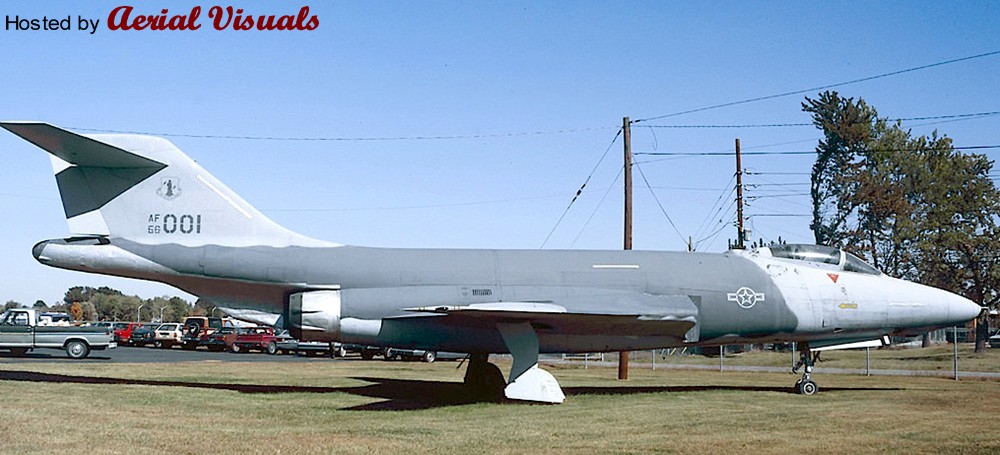
This preserved machine wore a rather unusual (for a Voodoo) ‘Hill’ low-viz scheme with toned-down markings, quite similar to the late USAF F-4 Phantom IIs of the early Eighties. The big aircraft looked quite good in this simple livery, and I kept the idea of a Hill scheme Voodoo in the back of my mind for some years until I recently had the opportunity to buy a cheap Matchbox Voodoo w/o box and decals. With its optional (and unique) RF-101B parts I decided to take the Hill Voodoo idea to the hardware stage and create another submission to the “Reconnaissance and Surveillance” group build at whatifmodellers.com around July 2021: an ANG recce conversion of a former two-seat interceptor, using the RF-101B as benchmark but with a different suite of sensors.
However, the Matchbox Voodoo kit is rather mediocre, and in a rather ambitious mood I decided to “upgrade” the project with a Revell F-101B as the model’s basis. This kit is from 1991 and a MUCH better and finely detailed model than the rather simple Matchbox kit from the early Eighties. In fact, the Revell F-101B is actually a scaled-down version of Monogram’s 1:48 F-101B model kit from 1985, with many delicate details. But while this downscaling practice has produced some very nice 1:72 models like the F-105D or the F-4D, the scaling effect caused IMHO in this case a couple of problems. Revell's assembly instructions for the 1:72 kit are not good, either. While the step-by-step documentation is basically good, some sketches are so cluttered that you cannot tell where parts in the cockpit or on the landing gear are actually intended to be placed and how. This is made worse by the fact that there are no suitable markings on the parts – you are left to guessing.
Worse, there is a massive construction error: the way the wings section is to be assembled and mounted to the hull is impossible! The upper wing halves have locator pins for the fuselage, but they are supposed to be glued to the lower wing half (which also encompasses the aircraft's belly) and the mounted to the hull. The locator pins make this impossible, unless you bend the lower wing section to a point where it might warp or break, or you just cut the pins off - and live with some instability. Technically the upper wing halves have to be mounted to the fuselage before you glue the lower wing section to them, but I am not certain if this would work well because you also have to assemble the air intakes at the same time “from behind”, which is only feasible when the wings have already been completed but still left away from the fuselage. It’s a nonsense construction! I cannot remember when I came across a kit the last time with such an inherent design flaw?
Except for the transplanted RF-101B nose section, which did not fit well because the Matchbox Voodoo apparently has a more slender nose, the Revell kit was built mostly OOB. However, this is already a challenge in itself because of the kit’s inherent flaws (see above), its complex construction and an unorthodox assembly sequence, due to many separate internal modules including the cockpit tub, a separate (fully detailed) front landing gear well, a rotating weapon bay, air intakes with complete ducts, and the wing section. A fiddly affair.
Only a few further changes beyond the characteristic camera fairing under the radome were made. The rotating weapon bay was faired-over with the original weapon pallet, just fixing it into place and using putty to blend it into the belly. The small underwing pylons (an upgrade that actually happened to some late Voodoos) were taken from a vintage Revell F-16. The SLAR antenna fairings along the cockpit flanks were created with 0.5mm styrene sheet and some PSR. They are a little too obvious/protruding, but for a retrofitted solution I find the result acceptable. The drop tanks came from the Revell kit, the underwing ordnance consists of an ALQ-119 ECM pod from a Hasegawa aftermarket set and a SUU-42 dispenser, scratched from a Starfighter ventral drop tank, bomb fins and the back of a Soviet unguided missile launcher.
Painting and markings:
Very simple and basic. While I originally wanted to adopt the simple two-tone ‘Hill’ scheme from the gate guard for my fictional Voodoo, I eventually settled for the very similar but slightly more sophisticated ‘Egypt One’ scheme that was introduced with the first F-16s – it just works better on the F-101’s surfaces. This scheme uses three grey tones: FS 36118 (Gunship Gray, ModelMaster 1723) for the upper wing surfaces, the “saddle” on the fuselage and the canopy area with an anti-glare panel, FS 36270 (Medium Grey, Humbrol 126) on the fin and the fuselage area in front of the wing roots, and FS 36375 (Light Ghost Grey, Humbrol 127) for all lower surfaces, all blended into each other with straight but slightly blurred edges (created with a soft, flat brush). The radome and the conformal antennae on the flanks became Revell 47 for a consistent grey-in-grey look, but with a slightly different shade. The model received an overall black ink washing and some post panel shading, so that the large grey areas would not look too uniform.
As an updated USAF aircraft I changed the color of the landing gear wells’ interior from green zinc chromate primer to more modern, uniform white, even though the red inside of the covers was retained. The interior of the flaps (a nice OOB option of Revell’s kit) and the air brakes became bright red, too.
The cockpit retained its standard medium grey (Humbrol 140, Dark Gull Grey) interior and I used the instrument decals from the kit – even though these did not fit well onto the 3D dashboards and side consoles. WTF? Decal softener came to the rescue. The exhaust area was painted with Revell 91 (Iron) and Humbrol’s Steel Metallizer (27003), later treated with graphite for a dirty, metallic shine.
Markings/decals primarily come from a 1:72 Hi-Decal F-4D sheet that contains (among others) several Texas ANG Phantoms from the mid-Eighties. Some stencils were taken over from the original Voodoo sheet, the yellow formation lights had to be procured from a Hasegawa F-4E/J sheet (the Matchbox sheet was lost and the Revell sheet lacks them completely!). The characteristic deep yellow canopy sealant stripes came from a CF-101 sheet from Winter Valley Decals (today part of Canuck Models as CAD 72008). I was lucky to have them left over from another what-if build MANY moons ago, my fictional CF-151 kitbashing.
Everything went on smoothly, but the walkway markings above the air intakes became a problem. I initially used those from the Revell sheet, which are only the outlines so that the camouflage would still be visible. But the decal film, which is an open square, turned out to be so thin that it wrinkled on the curved surface whatever I tried, and what looked like a crisp black outline on the white decal paper turned out to be a translucent dark blue with blurry edges on the kit. I scrapped them while still wet… Enter plan B: Next came the walkway markings from the aforementioned Winter Valley sheet, which were MUCH better, sharper and opaque, but they included the grey walking areas. While the tone looked O.K. on the sheet it turned out to be much too light for the all-grey Voodoo, standing out and totally ruining the low-viz look. With a bleeding heart I eventually ripped them off of the model with the help of adhesive tape, what left light grey residues. Instead of messing even more with the model I finally decided to embrace this accident and manually added a new black frame to the walkway areas with generic 2mm decal stripe material from TL Modellbau The area now looks rather worn, as if the camouflage had peeled off and light grey primer shows through. An unintentional result, but it looks quite “natural”.
The “Rhino Express” nose art was created with Corel Draw and produced with a simple inkjet printer on clear decal sheet. It was inspired by the “toenail” decoration on the main landing gear covers, a subtle detail I saw IIRC on a late CF-101B and painted onto the model by hand. With its all-grey livery, the rhino theme appeared so appropriate, and the tag on the nose appeared like a natural addition. It’s all not obvious but adds a personal touch to the aircraft.
Finally, after some more exhaust stains had been added to various air outlets around the hull, the model was sealed with matt acrylic varnish, position lights were added with clear paint and the camera windows, which had been created with black decal material, received glossy covers. The IRST sensor was painted with translucent black over a gold base.
Well, while the all-grey USAF livery in itself is quite dull and boring, but I must say that it suits the huge and slender Voodoo well. It emphasizes the aircraft's sleek lines and the Texas ANG fin flash as a colorful counterpoint, as well as the many red interior sections that only show from certain angles, nicely break the adapted low-viz Egypt One livery up. The whole thing looks surprisingly convincing, and the subtle rhino markings add a certain tongue-in-cheek touch.
POHANG, South Korea (Mar. 11, 2017) - Marines with 3rd Light Armored Reconnaissance Battalion discuss their preparations at an artillery school in Pohang, Republic of Korea, before heading to Camp Mujuk as a part of Korea Marine Exercise Program (KMEP) 17-6. The purpose of KMEP 17-6 is to enhance and improve the interoperability of both Marine Corps at the tactical level to build war fighting capabilities as partners. This includes ground combat element staff planning, mechanized maneuvers, mountain warfare training, bilateral tank operations and live fire ranges. (U.S. Marine Corps photo by Lance Cpl. Bernadette Wildes) 170311-M-GT736-002
** Interested in following U.S. Pacific Command? Engage and connect with us at www.facebook.com/pacific.command | twitter.com/PacificCommand |
instagram.com/pacificcommand | www.flickr.com/photos/us-pacific-command; | www.youtube.com/user/USPacificCommand | www.pacom.mil/
Kabal of the Pallid Sun Command Venom designed to carry the Archon with his Incubi retinue. Armed with two splinter cannons.
I work on a MacBook Pro laptop that plugs into the Apple Cinema Display monitor. Next to that is a Fujitsu ScanSnap scanner for digitizing everything. Apple keyboard and basic Logitech mouse (I had a MagicMouse but it just plain hurt my hand). Also featured: World of Warcraft stuffed gryphon, Kindle, iPad, ubiquitous moleskine (Pac Man edition).
Fort Gordon Child and Youth Services Coordinator Angela Davis talks with Sgt. 1st Class Christina Medina of Headquarters and Headquarters Company, Army Cyber Command, about CYS programs at the USO Warrior Center at Fort Belvoir, Va., March 28, 2019. The event was one of two sessions conducted at Fort Belvoir to provide information to ARCYBER military and civilian families planning to move with the command to Fort Gordon in 2020. In addition to Davis, representatives of several Fort Gordon region agencies took part in the event, including Tom Clark, executive director of the CSRA Alliance for Fort Gordon; Dr. Sean Alford, Superinendent of the Aiken County Public School District; Dr. Angela Pringle, Superintendent of the Richmond County School System; Dr. Sandra Carraway, Superintendent of the Columbia County School District; Wayne Bridges, Tax Commissioner for Columbia County; James Randall Roberts, Aiken County Assessor; and Steven Brian Kendrick, Tax Commissioner for Richmond County. (Photo by Bill Roche)
PACIFIC OCEAN (Sep. 15, 2014) - The Arleigh-Burke class guided-missile destroyer USS Stethem (DDG 63) fires a HARPOON missile during a sinking exercise during Valiant Shield 2014. Air and sea units from the U.S. Navy, Marine Corps and Air Force participated in the sinking exercise of the ex-USS Fresno. Valiant Shield is a U.S.-only exercise integrating U.S. Navy, Air Force, Army, and Marine Corps assets, offering real-world joint operational experience to develop capabilities that provide a full range of options to defend U.S. interests and those if its allies and partners. (U.S. Navy photo by MCSA Alonzo M. Archer) 140915-N-UN259-006
** Interested in following U.S. Pacific Command? Engage and connect with us at www.facebook.com/pacific.command and twitter.com/PacificCommand and www.pacom.mil/
No, not really.... just the south entrance for Fermilab off of Illinois Route 56. I have never seen them use it. The lights and the gates always intrigue me when I drive by here at night.
Illinois Route 56 & Eola Road
January 28th, 2013
COLOMBO, Sri Lanka (Nov. 29, 2016) -Admiral Harry B. Harris, Jr., Commander of U.S. Pacific Command, visited Sri Lanka from 27-29 to attend the Galle Dialogue 2016 maritime security conference.
** Interested in following U.S. Pacific Command? Engage and connect with us at www.facebook.com/pacific.command and twitter.com/PacificCommand and www.pacom.mil/ **
YOKOT AIR BASE, Japan (March 28, 2018) - U.S. Air Force and Koku-Jieitai Airmen (Japan Air Self-Defense Force) participate in a rapid airfield damage repair demonstration at Yokota Air Base. Airmen assigned to the 374th Civil Engineering Squadron took the Koku-Jieitai engineers through a step by step process as they accessed damage, cut and removed the damaged section and replaced the area with new concrete. (U.S. Air Force photo by Airman 1st Class Juan Torres) 180328-N-XK398-039
** Interested in following U.S. Pacific Command? Engage and connect with us at www.facebook.com/pacific.command | twitter.com/PacificCommand |
instagram.com/pacificcommand | www.flickr.com/photos/us-pacific-command; | www.youtube.com/user/USPacificCommand | www.pacom.mil/
EDF main command.
came 1st in the december 'golden guardsman' painting compertition at the IGMB.
EDF contains many xenos elements that have defected and joined in secret, wether it be an overly clever ork, human hybrid aliens , 'good' mutants , or reprogrammed androids.
Caption: KITGUM, Uganda, Oct 20 -- Pfc. Kendra Hinds, a medic deployed to Uganda with the Army Reserve's 7225th Medical Support Unit (MSU) searches for a vein in order to give a patient an IV. The expectant mother arrived at the Pajimo Clinic in the north of Uganda and delivered a healthy baby boy about 90 minutes later. (Photo credit Maj. Corey Schultz, Army Reserve Communications.)
Full Story:
Army Reserve Nurse Delivers Baby in Rural Uganda
By Maj.Corey Schultz, U.S. Army Reserve Command
KITGUM, Uganda -- When 1st Lt. Victoria Lynn Watson deployed to Uganda for Natural Fire 10, she never imagined using her labor and delivery nursing skills during the exercise.
But when a Ugandan woman, Linda, arrived in labor at Pajimo medical clinic, where the Army Reserve's 7225th Medical Support Unit was partnering with East African medics to offer healthcare to the Kitgum community, Watson sprang into action.
She checked her watch. It was nearly 2:30 pm when medics hurried the 19-year-old expectant mother from the clinic gates where hundreds had gathered to receive care.
During the 10-day exercise, the medics run a daily clinic to treat upwards of 700 Ugandans a day for ailments such as arthritis, minor wounds, skin infections --and dental and optometry care. Soldiers from Uganda, Rwanda, Tanzania, Kenya and Burundi are working alongside U.S. troops on medical, dental and engineering projects in the Kitgum region. Meanwhile, each nation is also taking part in security training and a simulated disaster relief exercise.
While pregnancy was not a planned treatment, the Pajimo clinic staffs a midwife and Watson was eager to assist. If the U.S. Army Reserve officer were back home in Abilene, Texas, she would do the same.
"This is what I do. I'm a labor and delivery nurse in my civilian job," Watson said, hurrying past Ugandan families clutching medicines and awaiting dental checks, "This is what I live for."
Watson serves with the 7231st Medical Support Unit in Lubbock, Texas, but volunteered to augment the 7225th for Uganda.
Once in the clinics maternity ward, Watson and Pfc. Kendra Hinds, a U.S. Army Reserve medic from Lubbock, Texas, joined Stella, the Ugandan midwife. Stella asked the lieutenant to work with her to deliver the child.
Stella and her Ugandan assistant prepared the delivery room. Watson's examined the woman - nine centimeters and having contractions. Her watch read 3 p.m.
Hinds never helped a woman give birth. So, Watson talked her through the exam as they felt the mother's stomach to see where the baby was.
"You can feel the contractions," Watson said to Hines. "Her sides and belly get hard. Feel here...that's the head. It's in the right place, that's good. The baby is aligned right."
The midwife, Stella Betty Lamono – who goes by Stella, produced a Pinnard Horn - a wooden listening device not often seen in America that is used to hear the baby's heartbeat. Watson and Hinds took turns listening.
Then Stella posed a question.
"You are delivering," Stella said. "You should name the baby."
"OK, I'll name the baby," Watson said, in a light-hearted way. "How about, let's see...Gracie for a girl? Yes, I like Gracie."
"And a boy?" asked Stella.
"Okay, for a boy...Cage. I like Cage."
Stella translated. The mother smiled, amused despite her obvious discomfort. It was nearly 3:30 p.m., the baby was coming but the delivery team still had things to do. They tried to start an intravenous drip.
There was a problem, they couldn't find a vein. They spoke with the mother and found she had not eaten anything for two days.
"She's dehydrated, she needs something with sugar," Watson said.
Soldiers offered sweet powdered drink pack from their daily rations - MRE's, such as lemon-flavored ice tea and a lemon-lime electrolyte drinks.
Watson stirred each drink in a green plastic cup and gave it to the mother, who drank thirstily.
The team then found a vein for an IV, the mother tried to relax. From time to time, she would lift a pink curtain and gaze through the window into the dusty yard. Things quieted.
Meanwhile, her sister arranged swaddling clothes on the receiving table at the other side of the room.
"How many weeks is she?" Hinds asked.
"Thirty-eight," Stella said, confidently.
Ugandan midwives determine the duration of the pregnancy by feeling the stomach for the size of the baby's head versus the height of the fundus -- how high the uterus has pressed upwards into the diaphragm.
"This is amazing," Watson said. "In the States, doctors run a sonogram over the belly, ask for the date of the last menstrual period, and go from there. We learn the 'old school' way, but we never actually do it like Stella has."
Certified Ugandan midwifes attend a three-year school, Stella said, herself a midwife with seven years experience who delivers up to 28 babies each month -- often in rural clinics.
The contractions continued. The mother remained stoic despite the lack of any pain medicine. Sweat beaded on her face, veins throbbed along her neck. She would lay calm more moments, the moan softly and slap the nearby wall. Hinds grabbed a cloth and patted her face and held her hands through contractions.
"Most girls in the States would be yelling and hollering by now," Watson said.
Unlike in the States, the clinic had no monitors, electrical gadgetry or air conditioning. It did have clean water, sterilized equipment and a trained midwife, plus her U.S. counterparts.
It was around 4 p.m., when the mother groaned and slapped the wall again.
"She's in second stage," Watson said. "All she has to do now is push."
A few minutes passed, the mother began to push – Hinds held her hand and continued to comfort her. Then came a loud cry from a healthy baby boy. It was 4:30 p.m.
Watson wiped him down. He waved his tiny hands and stared around the room with large, alert eyes. Stella tied up the stump of the umbilical cord
"You delivered the baby, what name did you pick for a baby boy,” Stella said, reminding Watson.
“Cage," Watson replied. "But I can't name her baby. It's her baby!"
Hinds placed the infant into his mother's arms. The new mom smiled.
"What is she going to name him?" Watson asked. Stella translated. The mother answered --and Stella began to laugh.
"What did she say?" Watson asked.
"She decided she liked the name you picked," Stella said. "She named her little boy 'Cage'."
Outside, U.S. and East African medics were closing up for the day, handing out the final doses of vitamins and routine medications, when they learned the good news. An officer took out the records reflecting the number of people treated, changing 714 to 715, to add Cage - Kitgum's newest resident.
"It's pretty amazing there's a little one out here that I named and that I helped bring into this world," Watson said. "Pretty amazing."
To learn more about United States Army Africa or Natural Fire 10, visit us online at www.usaraf.army.mil
YOKOSUKA, Japan (April 11, 2018) - The British Royal Navy Type 23 frigate HMS Sutherland (F 81) arrives at U.S. Fleet Activities (FLEACT) Yokosuka for a scheduled port visit. FLEACT Yokosuka provides, maintains, and operates base facilities and services in support of 7th Fleet's forward-deployed naval forces, 71 tenant commands, and 27,000 military and civilian personnel. (U.S. Navy photo by Mass Communication Specialist 1st Class Peter Burghart) 180411-N-XN177-151
** Interested in following U.S. Pacific Command? Engage and connect with us at www.facebook.com/pacific.command | twitter.com/PacificCommand |
instagram.com/pacificcommand | www.flickr.com/photos/us-pacific-command; | www.youtube.com/user/USPacificCommand | www.pacom.mil/
"Instrument Flight"
Fairchild UC-61A Argus - Journées Portes Ouvertes à l'aérodrome de Vesoul-Frotey (Bourgogne/Franche-Comté 2017)
Website : www.fluidr.com/photos/pat21
"Copyright © – Patrick Bouchenard
The reproduction, publication, modification, transmission or exploitation of any work contained here in for any use, personal or commercial, without my prior written permission is strictly prohibited. All rights reserved
Coast Guard Commandant Adm. Karl Schultz visits the Coast Guard Academy, Sept. 18, 2020.
U.S. Coast Guard photos by Petty Officer 2nd Class Lauren Laughlin
Army Cyber Command members and their family members compete in the tug of war, one of the four events in the Commander's Cup competition at ARCYBER's Organization Day, at Wells Field House on Fort Belvoir, Aug. 8, 2019. For more on ARCYBER and Army Cyber, go to www.arcyber.army.mil and www.army.mil/armycyber (Photo by Bill Roche)
CAMP AGUINALDO, CALABARZON , Philippines (May 8, 2017) - Philippine and U.S. color guards present the colors during the Balikatan 2017 opening ceremony at Camp Aguinaldo, Quezon City, May 8, 2017. Balikatan is an annual U.S.-Philippine bilateral military exercise focused on a variety of missions including humanitarian and disaster relief, counterterrorism, and other combined military operations. (U.S. Air Force photo by Senior Airman Corey Pettis) 170508-F-ED489-1039
** Interested in following U.S. Pacific Command? Engage and connect with us at www.facebook.com/pacific.command | twitter.com/PacificCommand |
instagram.com/pacificcommand | www.flickr.com/photos/us-pacific-command; | www.youtube.com/user/USPacificCommand | www.pacom.mil/
The Eastern Command Shellproof Pillbox is a modified version from a 1936 design for the use of three Bren Light Machine Guns, it's constructed with brickwork shuttering and poured concrete, which leaves a rough finish once the bricks have gone. The wall dimensions are 15ft 6in x 14ft with a wall thickness of 42in, there are chamfered edges on the front corners and roof edges. The roof also has ''Conrete Sandcastles'' which helps to break up the straight outlines of the Pillbox and help with Camouflage.
There is an entrance to the rear being offset to the right hand side and protected by a substantial External Blast Wall which also has a Bren Light Machine Gun Embrasure. These Eastern Command Type Pillboxes are found along the GHQ Line, and in the Cambridgeshire Fens they are referred to as a DFW3/27a Pillbox.
SOUTH CHINA SEA (June 24, 2014) - Ships from the George Washington Carrier Strike Group (GWCSG) and Royal Malaysian Navy steam in formation during an engagement between the two navies that also included a visit to USS George Washington (CVN 73) by Malaysia's Deputy Defense Minister Datuk Abd Rahim Bakri, and the Royal Malaysian Navy's Rear Adm. Dato’ Pahlawan Mior Rosdi, The GWCSG is on patrol in the 7th Fleet area of operations supporting security and stability in the Indo-Asia-Pacific. (U.S. Navy photo by Mass Communication Specialist 1st Class Trevor Welsh) 140624-N-ZS026-089
** Interested in following U.S. Pacific Command? Engage and connect with us at www.facebook.com/pacific.command and twitter.com/PacificCommand and www.pacom.mil/
USMA receives Colonel (P) Buzzard as the new Commandant for the Corps of Cadets at West Point New York on June 28, 2019. (US Army photo by Tarnish Pride).
Adam Johnson, 2001: The Lost Science
www.2001italia.it/2013/05/2001-lost-science-book-review-a...
Click here to learn more about Camp Click here to learn more about Camp Humphreys
U.S. Army photos by Anthony Langley
Ducks top Hoyas in Armed Forces Classic at Camp Humphreys
By Tim Hipps
U.S. Army Installation Management Command
CAMP HUMPHREYS, South Korea – In a season opener between teams led by newcomers, Joseph Young scored 24 points to lead No. 19 Oregon to an 82-75 victory over Georgetown in the 2013 Armed Forces Classic here.
The Ducks and Hoyas tipped off Nov. 9 at 10:16 a.m., on a Saturday morning in the Humphreys Community Fitness Center. For college basketball fans across America, the game was one of many season openers on Friday night. Only one, however, was played before 2,100 U.S. troops and their family members, along with a worldwide television audience on ESPN.
“We’re about to start the journey to determine who is the best team in college basketball, the best team in the country, and we’re doing it in front of the best team in the world,” ESPN announcer Jay Bilas said. “I’m in absolute awe of the commitment, the sacrifice, of our men and women in uniform.”
Young, a junior guard who transferred from Houston is a son of Michael Young, who played for the high-flying “Phi Slama Jama” teams of the early 1980’s. He grabbed five rebounds and was perfect on 12 free throws in his first game as a Duck.
Joshua Smith, a 6-foot-10, 350-pound junior center who transferred from UCLA, led Georgetown (0-1) with 25 points on 10-of-13 shooting and 5 of 9 free throws before fouling out of his first game as a Hoya with 9 seconds remaining.
Jason Calliste made all 11 of his free throws and scored 16 points for Oregon (1-0). Mike Moser added 15 points, seven rebounds and a career-high six steals, the most by an Oregon player in 15 seasons. Darius Wright was the last Duck to post six steals in a game against USC on Jan. 7, 1999.
“We came a long way, so we really didn’t want to lose this one,” Moser said. “It definitely feels good to go home – a 12-hour ride – with a win.”
Damyean Dotson grabbed eight rebounds and Johnathan Loyd had seven assists for Oregon. Loyd recorded his 304th career assist for a spot on the Ducks’ top 10 list.
The Hoyas shot 1 of 15 from 3-point range, failed to find much offensive continuity, and were outrebounded, 40-32.
“Things we can control, we have to control,” Georgetown coach John Thompson III said. “We had too many untimely unforced turnovers. We got our rhythm offensively, but we gave up a lot of threes in a row – it felt like four or five. The timing of that is what we have to learn. When we had to get a stop or a rebound, we didn’t.”
Oregon took an 18-7 lead via a 12-2 run, capped by two free throws by Calliste with 12:27 remaining in the first half. Calliste also converted a three-point play that gave the Ducks a 30-23 lead with 5:25 remaining in the period. Oregon led, 37-34, at halftime.
Georgetown took its first lead since 2-0 on a steal by Markel Starks and Smith’s feed to Jabril Trawick for a layup and a 40-39 lead with 18:06 left. D’Vauntes Smith-Rivera’s jumper put Georgetown ahead, 42-39. Loyd responded with a 3-pointer, Young followed with a layup, and the Ducks led the rest of the way.
Starks finished with 16 points and four assists for Georgetown. Trawick added 11 points and three rebounds. Before departing, Moser saluted the troops who welcomed the Ducks to Camp Humphreys, their most distant regular-season game site in school history.
“We had a lot of fun,” Moser said. “Getting a chance to hang out with the troops for a couple days inspired us to try and come out here and win this game.”
Played on Veterans Day weekend, the game featured a military theme throughout. Rather than players’ last names, Army values, such as “Courage,” “Integrity” and “Respect,” adorned the back of Georgetown’s camouflage-patterned jerseys. The backs of the Ducks’ camouflage-patterned jerseys displayed: “USA.” Members of both coaching staffs wore military-style cargo pants and combat boots.
“This was an unbelievable experience,” Thompson said. “It was a privilege to play in this environment, and it was a privilege to play in front of the Soldiers. One of the most rewarding times was serving lunch yesterday and getting the chance to interact with the young men and women stationed here at Camp Humphreys.”
Georgetown players Nate Lubick and Starks also were appreciative.
“This was a great opportunity to get a close-up look at what life is like for the men and women who protect our country,” Lubick said. “We’re very fortunate to have the opportunity to come here and play a game to thank them for all they do.”
“We’re blessed to have the chance to come here and see and tour the base and the helicopters,” Starks added. “It’s amazing all that they do and we’re really thankful to get the chance to meet everyone here.”
Folks at Camp Humphreys thought likewise.
“It’s such a blessing,” said Cassie Gaudette, wife of Army Capt. Brian Gaudette. “I don’t think that they can truly understand how exciting and wonderful it is to have a little piece of home and have the teams come here to South Korea. We’re originally from Eugene [home of the Oregon Ducks], so this was really exciting to see.”
Oregon played without sophomores Dominic Artis and Ben Carter, who were suspended nine games for violating NCAA rules by selling school-issued athletic apparel. If only they knew what they missed.
DoD photo by Cherie Cullen
Gen. Carter F. Ham assumes command of U.S. Africa Command (AFRICOM) this morning in a ceremony at the Stadthalle in Sindelfingen, Germany.
Africa is important to U.S. national security interests, Army General Carter F. Ham told committee members, Nov. 18, 2010, during a confirmation hearing with the Senate Armed Services Committee.
"These interests," Ham said, "include concerns over violent extremist activities, piracy, illicit trafficking, Africa's many humanitarian crises, armed conflict, and more general challenges such as the effect of HIV/AIDS."
AFRICOM has a role in addressing each of these issues, Ham said, as the military component of a U.S. whole-of-government approach.
However, "the key remains that Africa's future is up to Africans," the general said.
U.S. AFRICOM was established in October 2007 and operated under U.S. European Command during its first year. It transitioned to independent unified command status in 2008.
AFRICOM, which is headquartered in Stuttgart, Germany, focuses on synchronizing hundreds of activities inherited from three regional commands that previously coordinated U.S. military relations in Africa.
Gen. Ham served as an enlisted Infantryman in the 82nd Airborne Division before attending John Carroll University in Cleveland, Ohio. He was commissioned in the Infantry as a Distinguished Military Graduate in 1976.
His military service has included assignments in Kentucky, Ohio, California, Georgia, Italy and Germany to name a few. He has also served in Saudi Arabia, Qatar, Macedonia, and Iraq.
He has held a variety of positions to include Recruiting Area Commander; Battalion Executive Officer at the National Training Center; Advisor to the Saudi Arabian National Guard Brigade; Commander, 1st Battalion, 6th Infantry; Chief of Staff, 1st Infantry Division; Commander, 29th Infantry Regiment; commander, Multi-National Brigade, Mosul, Iraq; Commander, 1st Infantry Division; Director for Operations, J-3, The Joint Staff, Washington, DC.
His previous assignment was Commanding General of United States Army European Command and 7th Army.
His military education includes the Armor Officers Advanced Course, Naval College of Command and Staff, graduating with distinction, and the U. S. Air Force’s Air War College.
General Ham's awards and decorations include Army Distinguished Service Medal, Defense Superior Service Medal with three oak leaf clusters, the Legion of Merit with two oak leaf clusters, the Bronze Star Medal, and the Joint Service Commendation Medal.
To learn more about U.S. Army Africa visit our official website at www.usaraf.army.mil
Official Twitter Feed: www.twitter.com/usarmyafrica
Official Vimeo video channel: www.vimeo.com/usarmyafrica
WHITE BEACH, Okinawa (April 6, 2017) - Marines, assigned to the 31st Marine Expeditionary Unit, disembark the amphibious assault ship USS Bonhomme Richard (LHD 6) while pier side at White Beach Naval Facility. Bonhomme Richard, flagship of the Bonhomme Richard Amphibious Ready Group is on a patrol, operating in the Indo-Asia-Pacific region to enhance warfighting readiness and posture forward as a ready-response force for any type of contingency. (U.S. Navy photo by Mass Communication Specialist 3rd Class Jeanette Mullinax/Released) 170406-N-TH560-121
** Interested in following U.S. Pacific Command? Engage and connect with us at www.facebook.com/pacific.command | twitter.com/PacificCommand |
instagram.com/pacificcommand | www.flickr.com/photos/us-pacific-command; | www.youtube.com/user/USPacificCommand | www.pacom.mil/
Army Cyber Command members and their families make their way through the barbecue buffet line at ARCYBER's Organization Day, at Wells Field House on Fort Belvoir, Aug. 8, 2019. For more on ARCYBER and Army Cyber, go to www.arcyber.army.mil and www.army.mil/armycyber (Photo by Bill Roche)
COMBAT TOWN, OKINAWA, Japan (Mar. 21, 2017) - U.S. Marines with Chemical, Biological, Radiological and Nuclear (CBRN) Platoon, G-3, 3d Marine Division, protect themselves from debris caused by the MV-22 on Landing Zone Dodo, Camp Hansen, Okinawa. The CBRN Platoon conducts response drills to enhance the commander’s capabilities by exercising the operability and efficiency of the consequence management set within the 3d Marine Division CBRN response element. (U.S. Marine Corps photo by MCIPAC Combat Camera Lance Cpl. Jesus McCloud) 170321-M-NV775-0080
** Interested in following U.S. Pacific Command? Engage and connect with us at www.facebook.com/pacific.command | twitter.com/PacificCommand |
instagram.com/pacificcommand | www.flickr.com/photos/us-pacific-command; | www.youtube.com/user/USPacificCommand | www.pacom.mil/
Sgt. 1st Class Roddy Rieger, U.S. Army Africa Command Surgeon NCOIC, views leishmaniasis under the microscope during Tropical Medicine Course (TMC) training Sept. 13, 2010, at Walter Reed Army Institute of Research in Silver Spring, Md.
U.S. Army photo by Capt. Gabrielle Caldara
The continent of Africa is home to many tropical diseases, which cause illness and, in some instances, death. Tropical diseases wreak havoc on the social and economic growth of the continent and affect the health and welfare of those who travel.
To combat the affects of tropical diseases, and to ensure the health and safety of all Soldiers operating in the U.S. Africa Command operational area, the Uniformed Services University of Health Sciences, in coordination with the Walter Reed Army Institute of Research, has resurrected the formerly defunct Tropical Medicine Course (TMC) for the 21st century.
The original TMC was taught in 1941 and discontinued in 1991, after 50 years. It was resurrected in 2010 in response to the operational needs of AFRICOM and the Special Operations Command.
Once a six-week long course, it was converted to a targeted short course, and tailored toward non-physician health care providers. The week-long class is now a requirement for all medical professionals deploying to provide health care on the African continent, said Capt. Gabrielle Caldara, environmental science officer with U.S. Army Africa’s Command Surgeon’s Office.
Caldara, Sgt. 1st Class Roddy Rieger, the CSO’s NCOIC, and Staff Sgt. Darren Jones, a medical NCO with USARAF Headquarters Support Company, were the first Army Africa personnel to attend the class Sept. 13-17 at WRAIR in Silver Spring, Md.
The course focused on teaching medical personnel to recognize, diagnosis and treat a range of tropical diseases and ailments that can affect Soldiers who work and travel throughout Africa, said Rieger.
“There were a lot of lectures, seminars and hands on lab practices on things such as leishmaniasis and malaria,” he said. “We learned better ways to recognize symptoms and better ways to treat the problems.”
Among them was the Rapid Diagnostic Test, used to screen patients for malaria. The test uses only a pinprick amount of blood and “is as simple as using a pregnancy test,” Rieger said.
“This particular test allows medical professionals the freedom and convenience to test for the disease without requiring them to transport the patient to a medical facility,” Caldara said.
While Army Africa personnel attending the TMC appreciated the advances in treatment of many tropical diseases, Caldara stressed prevention and education remain key factors in disease prevention.
“This was a great class to understand the intricacies of these diseases, but in the end it all goes back to basics,” she said. “Proper precautions such as uniform treatment, use of DEET/insect repellent, adherence to proper medications and use of a bed net are essential.”
To learn more about U.S. Army Africa visit our official website at www.usaraf.army.mil
Official Twitter Feed: www.twitter.com/usarmyafrica
Official YouTube video channel: www.youtube.com/usarmyafrica
U.S. Army Africa command team visit peacekeeping training sites in Rwanda, Burundi
Story and photo by Sgt. Maj. Kimberly Williams
U.S. Army Africa
ENTEBBE, Uganda – Capacity building is a top priority for U.S. Army Africa. Therefore, during a visit to Rwanda and Burundi Oct. 19-20, Maj. Gen. William B. Garrett III and Command Sgt. Maj. Gary Bronson, the command team for U.S. Army Africa, seized the opportunity to see Africa Contingency Operations Training and Assistance sites in both countries.
“I was very impressed by the ACOTA programs in Rwanda and Burundi, where we are working closely with our partners to increase their capacity to support peacekeeping operations,” said Garrett.
Managed and funded by the Department of State, ACOTA is an initiative designed to improve African ability to respond quickly to crises by providing selected militaries with the training and equipment required to execute humanitarian or peace support operations.
At each site, civilian facilitators work closely with U.S. military noncommissioned officers, sent to the countries as mentors, in order to provide the most up-to-date and realistic learning experience possible.
Bronson, as U.S. Army Africa’s senior NCO, took the opportunity to meet with the U.S. facilitators and mentors in both countries to determine the road ahead. In the future, said Bronson, U.S. Army Africa needs to develop a process to prepare U.S. Army mentors for their role and to match up the right individuals with the skills needed.
But, Bronson said he is very impressed with what he has seen so far in both Rwanda and Burundi.
The ACOTA program is Rwanda is focused on preparing soldiers for peacekeeping operations while deployed in Darfur, Sudan. The site in Rwanda also has a computer simulation lab, which is the only simulation center for peacekeeping support operations in Africa.
“The partnership is doing great,” said Col. Aloys Muganga, commandant of the Rwanda Military Academy at Gako, which hosts the ACOTA in Rwanda. “They have trained my people so well that we can now train ourselves.”
Similar to Rwanda, the ACOTA program in Burundi focuses on preparing soldiers for peacekeeping operations, but in this case, to Mogadishu, Somalia.
This is the seventh iteration of ACOTA in Burundi.
The four-week program in Burundi includes individual skills, collective skills, lane evaluations, weapons familiarization and live fire ranges.
The 1st Battalion of the Burundi Land Forces took part in the first ACOTA rotation in 2007 and just recently returned from deployment to Mogadishu. Now, the Burundi Land Forces are bringing in these experienced soldiers to train the next rotations.
Sgt. Norberto Ramos, from the U.S. Army National Guard’s Co. B, 165th Infantry Battalion from Puerto Rice, is in Burundi along with two other NCOs to provide mentorship during the four-week program. Ramos said he believes the ACOTA program is successful.
“This has been great,” he said. “You can see the Burundi soldiers’ eagerness to learn in their eyes. “They are a beautiful people.”
“I’m happier and more satisfied with what I’m doing here than any time before,” Ramos said. “It builds me up as a leader and a person. It is a pleasure and an honor to be here.”
CAPTION: Brig. Gen. Cyprien Ndikuriyo (left), Burundi Land Forces commander, describes the outstanding efforts of Capt. Nicolas Bashizimpaka (right), who recently returned from peacekeeping operations in Mogadishu, Somalia, as Maj. Gen. William B. Garrett III, U.S. Army Africa commanding general, presents a coin to Bashizimpaka. Bashizimpaka attended the first Africa Contingency Operations Training and Assistance program in Burundi and will now pass on his first-hand knowledge to train battalions before they deploy.
U.S. Army Africa photo by Sgt. 1st Class Kyle Davis
U.S. Africa Command (AFRICOM) hosted its second annual C4ISR Senior Leaders Conference Feb. 2-4 at Caserma Ederle, headquarters of U.S. Army Africa, in Vicenza, Italy.
The communications and intelligence community event, hosted by Brig. Gen. Robert Ferrell, AFRICOM C4 director, drew approximately 80 senior leaders from diverse U.S. military and government branches and agencies, as well as representatives of African nations and the African Union.
“The conference is a combination of our U.S. AFRICOM C4 systems and intel directorate,” said Ferrell. “We come together annually to bring the team together to work on common goals to work on throughout the year. The team consists of our coalition partners as well as our inter-agency partners, as well as our components and U.S. AFRICOM staff.”
The conference focused on updates from participants, and on assessing the present state and goals of coalition partners in Africa, he said.
“The theme for our conference is ‘Delivering Capabilities to a Joint Information Environment,’ and we see it as a joint and combined team ... working together, side by side, to promote peace and stability there on the African continent,” Ferrell said.
Three goals of this year’s conference were to strengthen the team, assess priorities across the board, and get a better fix on the impact that the establishment of the U.S. Cyber Command will have on all members’ efforts in the future, he said.
“With the stand-up of U.S. Cyber Command, it brings a lot of unique challenges that we as a team need to talk through to ensure that our information is protected at all times,” Ferrell said.
African Union (AU) representatives from four broad geographic regions of Africa attended, which generated a holistic perspective on needs and requirements from across the continent, he said.
“We have members from the African Union headquarters that is located in Addis Ababa, Ethiopia; we have members that are from Uganda; from Zambia; from Ghana; and also from the Congo. What are the gaps, what are the things that we kind of need to assist with as we move forward on our engagements on the African continent?” Ferrell said.
U.S. Army Africa Commander, Maj. Gen. David R. Hogg, welcomed participants as the conference got under way.
“We’re absolutely delighted to be the host for this conference, and we hope that this week you get a whole lot out of it,” said Hogg.
He took the opportunity to address the participants not only as their host, but from the perspective of a customer whose missions depend on the results of their efforts to support commanders in the field.
“When we’re talking about this group of folks that are here — from the joint side, from our African partners, from State, all those folks — it’s about partnership and interoperability. And every commander who’s ever had to fight in a combined environment understands that interoperability is the thing that absolutely slaps you upside the head,” Hogg said.
“We’re in the early stages of the process here of working with the African Union and the other partners, and you have an opportunity to design this from the end state, versus just building a bunch of ‘gunkulators.’ And so, the message is: think about what the end state is supposed to look like and construct the strategy to support the end state.
“Look at where we want to be at and design it that way,” Hogg said.
He also admonished participants to consider the second- and third-order effects of their choices in designing networks.
“With that said, over the next four days, I hope this conference works very well for you. If there’s anything we can do to make your stay better, please let us know,” Hogg said.
Over the following three days, participants engaged in a steady stream of briefings and presentations focused on systems, missions and updates from the field.
Col. Joseph W. Angyal, director of U.S. Army Africa G-6, gave an overview of operations and issues that focused on fundamentals, the emergence of regional accords as a way forward, and the evolution of a joint network enterprise that would serve all interested parties.
“What we’re trying to do is to work regionally. That’s frankly a challenge, but as we stand up the capability, really for the U.S. government, and work through that, we hope to become more regionally focused,” he said.
He referred to Africa Endeavor, an annual, multi-nation communications exercise, as a test bed for the current state of affairs on the continent, and an aid in itself to future development.
“In order to conduct those exercises, to conduct those security and cooperation events, and to meet contingency missions, we really, from the C4ISR perspective, have five big challenges,” Angyal said.
“You heard General Hogg this morning talk about ‘think about the customer’ — you’ve got to allow me to be able to get access to our data; I’ve got to be able to get to the data where and when I need it; you’ve got to be able to protect it; I have to be able to share it; and then finally, the systems have to be able to work together in order to build that coalition.
“One of the reasons General Ferrell is setting up this joint information enterprise, this joint network enterprise . . . it’s almost like trying to bring together disparate companies or corporations: everyone has their own system, they’ve paid for their own infrastructure, and they have their own policy, even though they support the same major company.
“Now multiply that when you bring in different services, multiply that when you bring in different U.S. government agencies, and then put a layer on top of that with the international partners, and there are lots of policies that are standing in our way.”
The main issue is not a question of technology, he said.
“The boxes are the same — a Cisco router is a Cisco router; Microsoft Exchange server is the same all over the world — but it’s the way that we employ them, and it’s the policies that we apply to it, that really stops us from interoperating, and that’s the challenge we hope to work through with the joint network enterprise.
“And I think that through things like Africa Endeavor and through the joint enterprise network, we’re looking at knocking down some of those policy walls, but at the end of the day they are ours to knock down. Bill Gates did not design a system to work only for the Army or for the Navy — it works for everyone,” Angyal said.
Brig. Gen. Joseph Searyoh, director general of Defense Information Communication Systems, General Headquarters, Ghana Armed Forces, agreed that coordinating policy is fundamental to improving communications with all its implications for a host of operations and missions.
“One would expect that in these modern times there is some kind of mutual engagement, and to build that engagement to be strong, there must be some kind of element of trust. … We have to build some kind of trust to be able to move forward,” said Searyoh.
“Some people may be living in silos of the past, but in the current engagement we need to tell people that we are there with no hidden agenda, no negative hidden agenda, but for the common good of all of us.
“We say that we are in the information age, and I’ve been saying something: that our response should not be optional, but it must be a must, because if you don’t join now, you are going to be left behind.
“So what do we do? We have to get our house in order.
“Why do I say so? We used to operate like this before the information age; now in the information age, how do we operate?
“So, we have to get our house in order and see whether we are aligning ourselves with way things should work now. So, our challenge is to come up with a strategy, see how best we can reorganize our structures, to be able to deliver communications-information systems support for the Ghana Armed Forces,” he said.
Searyoh related that his organization has already accomplished one part of erecting the necessary foundation by establishing an appropriate policy structure.
“What is required now is the implementing level. Currently we have communications on one side, and computers on one side. The lines are blurred — you cannot operate like that, you’ve got to bring them together,” he said.
Building that merged entity to support deployed forces is what he sees as the primary challenge at present.
“Once you get that done you can talk about equipment, you can talk about resources,” Searyoh said. “I look at the current collaboration between the U.S. and the coalition partners taking a new level.”
“The immediate challenges that we have is the interoperability, which I think is one of the things we are also discussing here, interoperability and integration,” said Lt. Col. Kelvin Silomba, African Union-Zambia, Information Technology expert for the Africa Stand-by Force.
“You know that we’ve got five regions in Africa. All these regions, we need to integrate them and bring them together, so the challenge of interoperability in terms of equipment, you know, different tactical equipment that we use, and also in terms of the language barrier — you know, all these regions in Africa you find that they speak different languages — so to bring them together we need to come up with one standard that will make everybody on board and make everybody able to talk to each other,” he said.
“So we have all these challenges. Other than that also, stemming from the background of these African countries, based on the colonization: some of them were French colonized, some of them were British colonized and so on, so you find that when they come up now we’ve adopted some of the procedures based on our former colonial masters, so that is another challenge that is coming on board.”
The partnership with brother African states, with the U.S. government and its military branches, and with other interested collaborators has had a positive influence, said Silomba.
“Oh, it’s great. From the time that I got engaged with U.S. AFRICOM — I started with Africa Endeavor, before I even came to the AU — it is my experience that it is something very, very good.
“I would encourage — I know that there are some member states — I would encourage that all those member states they come on board, all of these regional organizations, that they come on board and support the AFRICOM lead. It is something that is very, very good.
“As for example, the African Union has a lot of support that’s been coming in, technical as well as in terms of knowledge and equipment. So it’s great; it’s good and it’s great,” said Salimba.
Other participant responses to the conference were positive as well.
“The feedback I’ve gotten from every member is that they now know what the red carpet treatment looks like, because USARAF has gone over and above board to make sure the environment, the atmosphere and the actual engagements … are executed to perfection,” said Ferrell. “It’s been very good from a team-building aspect.
“We’ve had very good discussions from members of the African Union, who gave us a very good understanding of the operations that are taking place in the area of Somalia, the challenges with communications, and laid out the gaps and desires of where they see that the U.S. and other coalition partners can kind of improve the capacity there in that area of responsibility.
“We also talked about the AU, as they are expanding their reach to all of the five regions, of how can they have that interoperability and connectivity to each of the regions,” Ferrell said.
“(It’s been) a wealth of knowledge and experts that are here to share in terms of how we can move forward with building capacities and capabilities. Not only for U.S. interests, but more importantly from my perspective, in building capacities and capabilities for our African partners beginning with the Commission at the African Union itself,” said Kevin Warthon, U.S. State Department, peace and security adviser to the African Union.
“I think that General Ferrell has done an absolutely wonderful thing by inviting key African partners to participate in this event so they can share their personal experience from a national, regional and continental perspective,” he said.
Warthon related from his personal experience a vignette of African trust in Providence that he believed carries a pertinent metaphor and message to everyone attending the conference.
“We are not sure what we are going to do tomorrow, but the one thing that I am sure of is that we are able to do something. Don’t know when, don’t know how, but as long as our focus is on our ability to assist and to help to progress a people, that’s really what counts more than anything else,” he said.
“Don’t worry about the timetable; just focus on your ability to make a difference and that’s what that really is all about.
“I see venues such as this as opportunities to make what seems to be the impossible become possible. … This is what this kind of venue does for our African partners.
“We’re doing a wonderful job at building relationships, because that’s where it begins — we have to build relationships to establish trust. That’s why this is so important: building trust through relationships so that we can move forward in the future,” Warthon said.
Conference members took a cultural tour of Venice and visited a traditional winery in the hills above Vicenza before adjourning.
To learn more about U.S. Army Africa visit our official website at www.usaraf.army.mil
Official Twitter Feed: www.twitter.com/usarmyafrica
Official YouTube video channel: www.youtube.com/usarmyafrica
PACIFIC OCEAN (Sept. 8, 2016) - Amphibious assault ship USS Boxer (LHD 4) transits in formation along with amphibious dock landing ship USS Harpers Ferry (LSD 49) amphibious transport dock ship USS New Orleans (LPD 18) and amphibious transport dock ship USS New Orleans (LPD 18) during a photographic exercise. USS Boxer, flagship for the Boxer Amphibious Ready Group, 13th Marine Expeditionary Unit team, is operating in the U.S. 3rd Fleet area of operations. (U.S. Navy photo by Mass Communication Specialist 2nd Class Jose Jaen/Released) 160908-N-VD165-241
** Interested in following U.S. Pacific Command? Engage and connect with us at www.facebook.com/pacific.command and twitter.com/PacificCommand and www.pacom.mil/
U.S. Army Africa photo by Sgt. 1st Class Kyle Davis
U.S. Africa Command (AFRICOM) hosted its second annual C4ISR Senior Leaders Conference Feb. 2-4 at Caserma Ederle, headquarters of U.S. Army Africa, in Vicenza, Italy.
The communications and intelligence community event, hosted by Brig. Gen. Robert Ferrell, AFRICOM C4 director, drew approximately 80 senior leaders from diverse U.S. military and government branches and agencies, as well as representatives of African nations and the African Union.
“The conference is a combination of our U.S. AFRICOM C4 systems and intel directorate,” said Ferrell. “We come together annually to bring the team together to work on common goals to work on throughout the year. The team consists of our coalition partners as well as our inter-agency partners, as well as our components and U.S. AFRICOM staff.”
The conference focused on updates from participants, and on assessing the present state and goals of coalition partners in Africa, he said.
“The theme for our conference is ‘Delivering Capabilities to a Joint Information Environment,’ and we see it as a joint and combined team ... working together, side by side, to promote peace and stability there on the African continent,” Ferrell said.
Three goals of this year’s conference were to strengthen the team, assess priorities across the board, and get a better fix on the impact that the establishment of the U.S. Cyber Command will have on all members’ efforts in the future, he said.
“With the stand-up of U.S. Cyber Command, it brings a lot of unique challenges that we as a team need to talk through to ensure that our information is protected at all times,” Ferrell said.
African Union (AU) representatives from four broad geographic regions of Africa attended, which generated a holistic perspective on needs and requirements from across the continent, he said.
“We have members from the African Union headquarters that is located in Addis Ababa, Ethiopia; we have members that are from Uganda; from Zambia; from Ghana; and also from the Congo. What are the gaps, what are the things that we kind of need to assist with as we move forward on our engagements on the African continent?” Ferrell said.
U.S. Army Africa Commander, Maj. Gen. David R. Hogg, welcomed participants as the conference got under way.
“We’re absolutely delighted to be the host for this conference, and we hope that this week you get a whole lot out of it,” said Hogg.
He took the opportunity to address the participants not only as their host, but from the perspective of a customer whose missions depend on the results of their efforts to support commanders in the field.
“When we’re talking about this group of folks that are here — from the joint side, from our African partners, from State, all those folks — it’s about partnership and interoperability. And every commander who’s ever had to fight in a combined environment understands that interoperability is the thing that absolutely slaps you upside the head,” Hogg said.
“We’re in the early stages of the process here of working with the African Union and the other partners, and you have an opportunity to design this from the end state, versus just building a bunch of ‘gunkulators.’ And so, the message is: think about what the end state is supposed to look like and construct the strategy to support the end state.
“Look at where we want to be at and design it that way,” Hogg said.
He also admonished participants to consider the second- and third-order effects of their choices in designing networks.
“With that said, over the next four days, I hope this conference works very well for you. If there’s anything we can do to make your stay better, please let us know,” Hogg said.
Over the following three days, participants engaged in a steady stream of briefings and presentations focused on systems, missions and updates from the field.
Col. Joseph W. Angyal, director of U.S. Army Africa G-6, gave an overview of operations and issues that focused on fundamentals, the emergence of regional accords as a way forward, and the evolution of a joint network enterprise that would serve all interested parties.
“What we’re trying to do is to work regionally. That’s frankly a challenge, but as we stand up the capability, really for the U.S. government, and work through that, we hope to become more regionally focused,” he said.
He referred to Africa Endeavor, an annual, multi-nation communications exercise, as a test bed for the current state of affairs on the continent, and an aid in itself to future development.
“In order to conduct those exercises, to conduct those security and cooperation events, and to meet contingency missions, we really, from the C4ISR perspective, have five big challenges,” Angyal said.
“You heard General Hogg this morning talk about ‘think about the customer’ — you’ve got to allow me to be able to get access to our data; I’ve got to be able to get to the data where and when I need it; you’ve got to be able to protect it; I have to be able to share it; and then finally, the systems have to be able to work together in order to build that coalition.
“One of the reasons General Ferrell is setting up this joint information enterprise, this joint network enterprise . . . it’s almost like trying to bring together disparate companies or corporations: everyone has their own system, they’ve paid for their own infrastructure, and they have their own policy, even though they support the same major company.
“Now multiply that when you bring in different services, multiply that when you bring in different U.S. government agencies, and then put a layer on top of that with the international partners, and there are lots of policies that are standing in our way.”
The main issue is not a question of technology, he said.
“The boxes are the same — a Cisco router is a Cisco router; Microsoft Exchange server is the same all over the world — but it’s the way that we employ them, and it’s the policies that we apply to it, that really stops us from interoperating, and that’s the challenge we hope to work through with the joint network enterprise.
“And I think that through things like Africa Endeavor and through the joint enterprise network, we’re looking at knocking down some of those policy walls, but at the end of the day they are ours to knock down. Bill Gates did not design a system to work only for the Army or for the Navy — it works for everyone,” Angyal said.
Brig. Gen. Joseph Searyoh, director general of Defense Information Communication Systems, General Headquarters, Ghana Armed Forces, agreed that coordinating policy is fundamental to improving communications with all its implications for a host of operations and missions.
“One would expect that in these modern times there is some kind of mutual engagement, and to build that engagement to be strong, there must be some kind of element of trust. … We have to build some kind of trust to be able to move forward,” said Searyoh.
“Some people may be living in silos of the past, but in the current engagement we need to tell people that we are there with no hidden agenda, no negative hidden agenda, but for the common good of all of us.
“We say that we are in the information age, and I’ve been saying something: that our response should not be optional, but it must be a must, because if you don’t join now, you are going to be left behind.
“So what do we do? We have to get our house in order.
“Why do I say so? We used to operate like this before the information age; now in the information age, how do we operate?
“So, we have to get our house in order and see whether we are aligning ourselves with way things should work now. So, our challenge is to come up with a strategy, see how best we can reorganize our structures, to be able to deliver communications-information systems support for the Ghana Armed Forces,” he said.
Searyoh related that his organization has already accomplished one part of erecting the necessary foundation by establishing an appropriate policy structure.
“What is required now is the implementing level. Currently we have communications on one side, and computers on one side. The lines are blurred — you cannot operate like that, you’ve got to bring them together,” he said.
Building that merged entity to support deployed forces is what he sees as the primary challenge at present.
“Once you get that done you can talk about equipment, you can talk about resources,” Searyoh said. “I look at the current collaboration between the U.S. and the coalition partners taking a new level.”
“The immediate challenges that we have is the interoperability, which I think is one of the things we are also discussing here, interoperability and integration,” said Lt. Col. Kelvin Silomba, African Union-Zambia, Information Technology expert for the Africa Stand-by Force.
“You know that we’ve got five regions in Africa. All these regions, we need to integrate them and bring them together, so the challenge of interoperability in terms of equipment, you know, different tactical equipment that we use, and also in terms of the language barrier — you know, all these regions in Africa you find that they speak different languages — so to bring them together we need to come up with one standard that will make everybody on board and make everybody able to talk to each other,” he said.
“So we have all these challenges. Other than that also, stemming from the background of these African countries, based on the colonization: some of them were French colonized, some of them were British colonized and so on, so you find that when they come up now we’ve adopted some of the procedures based on our former colonial masters, so that is another challenge that is coming on board.”
The partnership with brother African states, with the U.S. government and its military branches, and with other interested collaborators has had a positive influence, said Silomba.
“Oh, it’s great. From the time that I got engaged with U.S. AFRICOM — I started with Africa Endeavor, before I even came to the AU — it is my experience that it is something very, very good.
“I would encourage — I know that there are some member states — I would encourage that all those member states they come on board, all of these regional organizations, that they come on board and support the AFRICOM lead. It is something that is very, very good.
“As for example, the African Union has a lot of support that’s been coming in, technical as well as in terms of knowledge and equipment. So it’s great; it’s good and it’s great,” said Salimba.
Other participant responses to the conference were positive as well.
“The feedback I’ve gotten from every member is that they now know what the red carpet treatment looks like, because USARAF has gone over and above board to make sure the environment, the atmosphere and the actual engagements … are executed to perfection,” said Ferrell. “It’s been very good from a team-building aspect.
“We’ve had very good discussions from members of the African Union, who gave us a very good understanding of the operations that are taking place in the area of Somalia, the challenges with communications, and laid out the gaps and desires of where they see that the U.S. and other coalition partners can kind of improve the capacity there in that area of responsibility.
“We also talked about the AU, as they are expanding their reach to all of the five regions, of how can they have that interoperability and connectivity to each of the regions,” Ferrell said.
“(It’s been) a wealth of knowledge and experts that are here to share in terms of how we can move forward with building capacities and capabilities. Not only for U.S. interests, but more importantly from my perspective, in building capacities and capabilities for our African partners beginning with the Commission at the African Union itself,” said Kevin Warthon, U.S. State Department, peace and security adviser to the African Union.
“I think that General Ferrell has done an absolutely wonderful thing by inviting key African partners to participate in this event so they can share their personal experience from a national, regional and continental perspective,” he said.
Warthon related from his personal experience a vignette of African trust in Providence that he believed carries a pertinent metaphor and message to everyone attending the conference.
“We are not sure what we are going to do tomorrow, but the one thing that I am sure of is that we are able to do something. Don’t know when, don’t know how, but as long as our focus is on our ability to assist and to help to progress a people, that’s really what counts more than anything else,” he said.
“Don’t worry about the timetable; just focus on your ability to make a difference and that’s what that really is all about.
“I see venues such as this as opportunities to make what seems to be the impossible become possible. … This is what this kind of venue does for our African partners.
“We’re doing a wonderful job at building relationships, because that’s where it begins — we have to build relationships to establish trust. That’s why this is so important: building trust through relationships so that we can move forward in the future,” Warthon said.
Conference members took a cultural tour of Venice and visited a traditional winery in the hills above Vicenza before adjourning.
To learn more about U.S. Army Africa visit our official website at www.usaraf.army.mil
Official Twitter Feed: www.twitter.com/usarmyafrica
Official YouTube video channel: www.youtube.com/usarmyafrica
We finally reached this first milestone on the way to 10.000! The official Lego comment is coming soon and we hope for more and more supporters! Thank you for supporting and keeping GC alive so far!
I also apologize for not posting anything for a while. I have several things in progress and one almost finished.
Gleetings. To you.
In Gravesend, the wheelie bins sing "The Hippy Hippy Shake" on special occasions; it is good for them and stops them exterminating, indiscriminately.
One day, they are at the Royal Command Performance and get to meet Mrs Ma'am, she is a fan of proper rock and roll and admires them greatly; indeed, were she not royal (*) she would dance with them, outrageously.
"And do you come here often ?" she asks, as she is commanded to.
"Hurrah !" cry the wheelie bins. "You have spoken the magic words !"
They perform "Shakin' All Over" and sundry other stone gold classics. They are in ecstasy, as is Mrs Ma'am, gosh, gosh.
We had better leave it there, taps nose.
Walk Tall !
* I am Royal, Mrs Ma'am is royal. She is not my Mrs. By Order.