View allAll Photos Tagged Civilization
Transition from the soft shaped world of nature into the hard shaped industrial world... somehow they go well together :)
About:
This was shot a bit further up the Lysakerelven river, than this shot from Saturday. Fåbro Fossen or Granfossen waterfall that was utilized for industrial purposes for centuries, begins in the distance.
Discussion
Comments and critique are as always welcome. Let me hear your opinion, why do you like this, or even better, how would you approach this scenery. Give me your thoughts... not just a Wow!... only then I can improve :))
uberfischer and Gunnar Bangsmoen have spotted a halo in this shot....!!!! Hmmmm, not good :))))) They want to see a larger version to judge this matter better :))
So I uploaded a larger version (blurred foreground :)
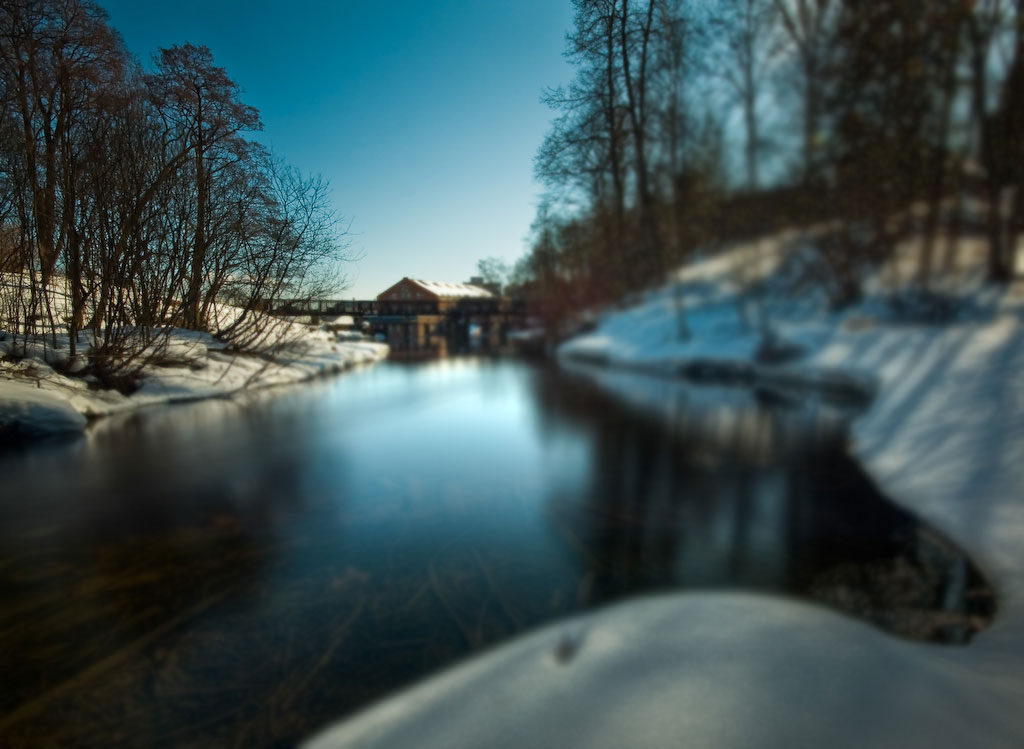
What do think? Is there a halo in there...
Kane feels that the glow on the water might be over powering. I used a circular polarizer filter to reduce reflections, that's why the river bottom is visible in the front. But I find it hard to reduce reflections in big surfaces when I'm shooting at 10mm (16mm fullframe eq).
Any suggestions?
Thanks
In and out of Explore, thanks to all for comments and faves :))
Use
This photo is Copyrighted 2010 © Morten Prom. All rights reserved.
Facebook Site | Contact & Portfolio | Twitter | Blog | Print Sales
Unidentified Radio Signal
Interplanetary Travel
Hello everyone from deep space. In the dark vacuum of space, I take a short break from my mind's visit to my past for a while as I drive my spacecraft to the planet I first visited. I would love to be able to describe to you the feeling that surrounds my body and soul with the radio signals I received years after I discovered and made my first planetary visit while searching for a planet suitable for life in my deep space journey. Although I thought for a long time, unfortunately I could not find the word suitable for this mood. I am very hopeful about this situation. There is a possibility that I may encounter a civilization after a long time. Moreover, I would live on the planet I had discovered and made my first visit. At least that's what I was hoping for. I had unique experiences during my time on that planet. That planet has been my new home for a long time, accompanied by unique space landscapes. However, despite my long time on the planet and my scientific research, I have not found any traces of life. It was a very unusual situation for that planet, which was quite suitable for life. Since it is the first planet I have visited yet, I did not feel negative about this situation. Having made the discovery of a planet suitable for life had increased my hope that I would find a planet with living things and even civilizations on it in the future. However, it did not. I have always encountered the same landscape in my planetary explorations suitable for new life that I have made over the course of time. Silence and nothingness. However, I was starting to come across many traces of past life on the planets I visited. Some habitats left over from civilizations that have left their home planets over time. As much as this excited me, it also caused a lot of questions in my mind. Why did these civilizations leave their planets? I was very curious about the answer to this question. When I was preparing a new route for myself after a long time in space, there was an unexpected development. I had picked up a radio signal from outer space. And this radio signal was coming from the planet I first visited years ago. This had taken me by surprise. As a result of the research, discovery and scientific analyzes I have done during my time on the planet, I have not come across any trace of life. There must be something I overlooked. Or this radio signal was a non-artificial one. Still, I didn't want to miss this opportunity. And I started this long journey by getting on my spacecraft. I was going back to my first planetary exploration. And there was still a long space of space ahead of me.
Camera: Canon EOS Kiss X7i
Photograph by Yusuf Alioglu
Location: Outer space (space)
Civilized society
Is not the one where people can drive cars
It is the one where they know when to stop.
...some colored..others very gray..
One more adventure with CResende www.flickr.com/photos/cresende/ in a frozen...very frozen morning
Wall, South Dakota, is only 45 minutes or eight miles by rail from this point west of Cottonwood. Western South Dakota is one of those places that whether you're in a car doing 60 or a train doing 10, once you leave a town it seems to disappear quickly and the distance between towns seems to last forever.
The good weather is holding. Mrs. Orca and I are at home for the foreseeable future, but the cat has never been happier, and the yardbirds are very active. Soon I'll start spending more time taking photos, but lately I've been transitioning to work-from-home.
Recently in the yard, of note:
I saw the first rufous hummingbird of the year on March 18. For some reason I don't have good records on first-arrivals for them, but here is what I do have:
2018 April 3
2017 March 14
2016 March 3
I saw a pacific wren on March 20, the first since December.
I saw a ruby-crowned kinglet in the yard today, March 21, the first since November.
I haven't been looking carefully but I haven't noticed the sapsucker in several days, and I'm worried.
Note (3/22): I saw two golden crowned kinglets in the yard today, the first since December 8, 2019.
Note (3/23): I saw a house finch today, the first since December 6, 2019.
Dunlin, Copalis Beach, Washington.
The Burj Khalifa is a skyscraper in Dubai, United Arab Emirates. With a total height of 829.8 m (2,722 ft) and a roof height (excluding antenna) of 828 m (2,717 ft), the Burj Khalifa has been the tallest structure and building in the world since its topping out in late 2008.
Manaus is a beautiful city rich in culture and biodiversity.
Amazon Theatre
©2014 Roglerson Moura
D3100 + NIKKOR 40mm f/2.8G
My Tumblr
Etruscan art was produced by the Etruscan civilization in central Italy between the 9th and 2nd centuries BC. From around 600 BC it was heavily influenced by Greek art but always retained its distinct characteristics.
Patio de las Doncellas - Real Alcázar - Seville - Spain.
The Alcázar of Seville (pronounced [alˈkaθar]; Spanish: Reales Alcázares de Sevilla or "Royal Alcazars of Seville") is a royal palace in Seville, Spain, built for the Christian king Peter of Castile. It was built by Castilian Christians on the site of an Abbadid Muslim residential fortress destroyed after the Christian conquest of Seville. Although some elements of other civilizations remains. The palace, a preeminent example of Mudéjar architecture in the Iberian Peninsula, is renowned as one of the most beautiful. The upper levels of the Alcázar are still used by the royal family as their official residence in Seville, and are administered by the Patrimonio Nacional. It is the oldest royal palace still in use in Europe, and was registered in 1987 by UNESCO as a World Heritage Site, along with the adjoining Seville Cathedral and the General Archive of the Indies.
The term Alcázar comes from the Arabic al-qaṣr, ("the castle" or "the palace", اَلْقَصْر), itself derived from the Latin castrum ("castle")
Patio de las Doncellas
One of the access-gates (b. 14th century) to Salón de los Embajadores in Palace of Peter of Castile
The name, meaning "The Courtyard of the Maidens", refers to the legend that the Moors demanded 100 virgins every year as tribute from Christian kingdoms in Iberia.
The lower level of the Patio was built for King Peter of Castile and includes inscriptions describing Peter as a "sultan". Various lavish reception rooms are located on the sides of the Patio. In the center is a large, rectangular reflecting pool with sunken gardens on either side. For many years, the courtyard was entirely paved in marble with a fountain in the center. However, historical evidence showed the gardens and the reflecting pool were the original design and this arrangement was restored. However, soon after this restoration, the courtyard was temporarily paved with marble once again at the request of movie director Ridley Scott. Scott used the paved courtyard as the set for the court of the King of Jerusalem in his movie Kingdom of Heaven. The courtyard arrangement was converted once more after the movie's production.
The upper story of the Patio was an addition made by Charles V. The addition was designed by Luis de Vega in the style of the Italian Renaissance although he did include both Renaissance and mudéjar plaster work in the decorations. Construction of the addition began in 1540 and ended in 1572.
Source: Wikipedia
Facebook page: www.facebook.com/mariano.colombotto.photography
Instagram: www.instagram.com/mariano.colombotto.photography
500px: 500px.com/marianocolombotto
photo rights reserved by B℮n
Tbilisi is the capital and largest city of Georgia, located in the eastern part of the country along the banks of the Kura River. The city has a rich history that spans over 1,500 years and has been influenced by various cultures and civilizations over the centuries. The old part of Tbilisi, known for its charming architecture and unique atmosphere, is one of the most fascinating areas of the city. One of the most striking features of this area is the traditional houses with wooden balconies. These wooden balconies, often adorned with intricate carvings, are a significant element of Tbilisi's urban aesthetic and culture. This old Tbilisi, also known as the Old Town or Dzveli Tbilisi, is one of the oldest parts of the city and has a rich history dating back to the 5th century. Over the centuries, Tbilisi has been influenced by Persian, Byzantine, Arab, and Russian cultures, which is evident in its diverse architectural styles. The houses with wooden balconies are typical of Tbilisi's traditional architectural style and reflect both Georgian and Persian influences. The balconies are often decorated with beautiful woodwork, characterized by intricate patterns and designs. Originally, these balconies served practical purposes, such as providing extra living space and creating shade during the hot summers, but today they are primarily an aesthetic and cultural feature of the city. Abanotubani, the Bath District, is one of the oldest parts of the city, known for its sulfur baths. Here you can find many traditional houses with wooden balconies, as well as narrow streets and colorful facades. Shavteli Street is one of the most picturesque streets in old Tbilisi and a popular destination for tourists due to its historic charm. The houses with wooden balconies contribute to the unique charm and character of Tbilisi. They are an important part of the city's cultural heritage. In recent years, significant efforts have been made to restore and preserve these historic houses, ensuring that the unique architecture and cultural value are maintained for future generations.
The old part of Tbilisi - Georgia, with its characteristic houses with wooden balconies, offers a fascinating insight into the history and culture of the city. These charming architectural elements are a must-see for anyone who wants to experience Tbilisi's rich traditions and unique heritage.
Tbilisi is de hoofdstad en grootste stad van Georgië, gelegen in het oosten van het land aan de oevers van de rivier de Koera. De stad heeft een rijke geschiedenis die meer dan 1.500 jaar teruggaat en heeft door de eeuwen heen vele invloeden ondergaan van diverse culturen en beschavingen. Het oude gedeelte van Tbilisi, bekend om zijn charmante architectuur en unieke sfeer, is een van de meest fascinerende delen van de stad. Een van de meest opvallende kenmerken van dit gebied zijn de traditionele huizen met houten balkonnetjes. Deze houten balkons, vaak versierd met delicate houtsnijwerken, zijn een belangrijk element van de stedelijke esthetiek en cultuur van Tbilisi. Dit oude Tbilisi, ook wel bekend als de Oude Stad of Dzveli Tbilisi, is een van de oudste delen van de stad en heeft een rijke geschiedenis die teruggaat tot de 5e eeuw. Door de eeuwen heen heeft Tbilisi invloeden ondergaan van Perzische, Byzantijnse, Arabische en Russische culturen, wat duidelijk te zien is in de diverse architecturale stijlen. De huizen met houten balkonnetjes zijn typisch voor de traditionele bouwstijl van Tbilisi en reflecteren zowel Georgische als Perzische invloeden. De balkons zijn vaak versierd met prachtig houtsnijwerk, gekenmerkt door sierlijke patronen en ontwerpen. Oorspronkelijk dienden deze balkons praktische doelen, zoals het bieden van extra leefruimte en het creëren van schaduw tijdens de warme zomers, maar tegenwoordig zijn ze vooral een esthetisch en cultureel kenmerk van de stad. Abanotubani, het Baden District, is een van de oudste delen van de stad, bekend om zijn zwavelbaden. Hier vind je veel traditionele huizen met houten balkons, evenals smalle straatjes en kleurrijke gevels. Shavteli Street is een van de meest pittoreske straten in het oude Tbilisi en een populaire bestemming voor toeristen vanwege zijn historische charme. De huizen met houten balkonnetjes dragen bij aan de unieke charme en het karakter van Tbilisi. Ze zijn een belangrijk onderdeel van het culturele erfgoed van de stad. In de afgelopen jaren zijn er veel inspanningen geleverd om deze historische huizen te restaureren en te behouden, waardoor de unieke architectuur en culturele waarde voor toekomstige generaties bewaard blijven.
... Now where did I park the car...?
It was fantastic trekking for multiple days in the Setesdalsheiane this summer! But... as you can see there was literally no place for my dSLR in my backpack... :-( Too big, too heavy (it was already 28 kg at the beginning of the trip... and I thought I had bought all lightweight camping equipment I could find by now :-) ). So I felt a bit 'naked' at times. But at least I had a compact camera with me, and this is just one exposure, so its RAW files are flexible enough. I missed the fine detail from my D810 in post though.
All images are copyrighted by EyeSeeLight Photography - Ron Jansen. If you want to use or buy any of my photographs, contact me. It is not allowed to download them or use them on any websites, blogs etc. etc. without asking me.
- Have a wonderful Sunday my friends.
- Your comments, faves and views are greatly appreciated.
- Note: Press L for better view.
- Please don't use this on any websites, blogs etc. without my permission.
I thought they'd built as close to Red Rock as they could, but as you can see in the middle left of the photo I was wrong again.
"They called it paradise, I don't know why
You call some place paradise, kiss it goodbye"