View allAll Photos Tagged COSMOLOGICAL
A long time ago in a galaxy far, far away...
A wide-field view of the Fornax Cluster, a cluster of Galaxies 62 million light-years from Earth. It is the second richest Galaxy cluster within 100 million light-years, after the considerably larger Virgo Cluster. It lies primarily in the Southern constellation Fornax, with its boundaries partially crossing into the constellation of Eridanus. The Galaxy Cluster covers an area of sky about 6° of arc across (and is a part of larger Fornax Wall).
NGC 1365 is the prominent Galaxy on the right, also known as "The Great Barred Spiral Galaxy", and on the left of the image NGC 1399 is the large Elliptical Galaxy.
A few quotes:
"There is an odd mannequin shape that is presented by the distribution of galaxies. This work has been done mainly by Margaret Geller with her collaborator John Huchra at Harvard University and the Smithsonian Institution. It's a little like soap bubbles in a bathtub or dishwashing detergent. The galaxies are on the surfaces of the bubbles. The insides of the bubbles seem to have no galaxies in them at all." - Carl Sagan - Cosmos - The Edge of Forever (S01E10).
The size and age of the cosmos are beyond ordinary human understanding. Lost somewhere between immensity and eternity is our tiny planetary home, the Earth." - Carl Sagan - Cosmos - The Shores of the Cosmic Ocean (S01E01).
About this image:
Imaged in LRGB over several sessions in October 2019 from the Southern Hemisphere.
Image Acquisition & Plate Solving:
SGP Mosaic and Framing Wizard.
PlaneWave PlateSolve 2 via SGP.
Integration time:
22 hours.
Processing:
Pre-Processing and Linear workflow in PixInsight,
and finished in Photoshop.
Astrometry info:
Center RA, Dec: 53.874, -35.727
Center RA, hms: 03h 35m 29.728s
Center Dec, dms: -35° 43' 37.706"
Size: 90.9 x 58.9 arcmin.
Radius: 0.903 deg.
Pixel scale: 3.41 arcsec/pixel.
Orientation: Up is 44.4 degrees E of N.
View an Aannotated Sky Chart for this image.
View this image in the WorldWideTelescope.
&creditsUrl=&ra=53.514137&dec=-35.757465&x=1043.1&y=711.1&rotation=135.65&thumb=http://nova.astrometry.net/image/7225988)
Also see:
The Markarian's Chain of Galaxies.
This image is part of the Legacy Series.
Photo usage and Copyright:
Medium-resolution photograph licensed under Creative Commons Attribution-NonCommercial-NoDerivatives 4.0 International Terms (CC BY-NC-ND 4.0). For High-resolution Royalty Free (RF) licensing, contact me via my site: Contact.
Martin
-
[Home Page] [Photography Showcase] [eBook] [Twitter]
Nikon d5500
38 x 8 seconds
50mm + Hoya filter
f/2.2
ISO 4000
Stitched in PTGui
This is another shot of the Milky Way over Two Rocks, this time it's the bigger of the two limestone formations, right next to the very well lit harbour! The light pollution kills a lot of the detail and colour in the core but with the Hoya filter it negates that just a bit........at least it lights up the big rock. The blue sky is also a result of the nearby light pollution.
la terra un disco piatto, gli astri sfere di fuoco, avvolte da nubi oscure, come catini forati dai cui pertugi, causa di eclissi se occlusi, si intravedono i raggi che guidano il navigante tra i flutti...
the Earth a plane disk, stars as fire shperes, hidden by dark clouds, pierced bowls from which holes, that causes eclypses when closed, we see the rays that lead sailors between waves.
The Hsinbyume Pagoda (also known as Mya Thein Tan Pagoda) was built in 1816 by prince Bagyidaw, the son of King Bodawpaya. The prince built this impressive white pagoda to commemorate Princess Hsinbyume his late wife (whose name means the White Elephant Queen) who had passed away during childbirth. One hundred thousand emeralds were used to fund the construction of the white pagoda which can explain its other name Mye Thein Tan (Mye= emerald, Thein Tan = 100,000).
The pagoda’s architectural style is very different from other pagodas in Myamar. The base of the structure shaped like circular terraces is a representation of the seven mountain ranges surrounding Mount Meru, the center of the universe in Buddhist cosmology. The pagoda on top is said to be built after the Chulamanee pagoda in the center of the universe on top of Mount Meru. The pagoda that is topped with a gold spire enshrines a Buddha image. The seven tiered concentric base shaped like waves contains niches, some of which contain small statues of mythological figures.
Prints and Downloads are available on my ►HOMEPAGE
Nikon d5500
35mm
ISO 4000
f/2.2
Sky: 25 x 30s
Foreground: 9 x 120s
iOptron SkyTracker
This is a 34 shot panorama of the Milky Way rising over Kalbarri National Park at the Z Bend lookout. Kalbarri is a small tourist town about 6 hours north of Perth in Western Australia. The national park is famous for its gorges. They are unfortunately overrun with feral goats so the only sounds that puncuate the silence at night are the goat's hooves walking over the rocks and the occasional 'baaaa'. The river you can see running through the gorges is the Murchison River but it wasn't flowing too much at that time of year, we'd just come out of our summer months.
The Insidious Paths of Shadows - The Void And The Emptiness by Daniel Arrhakis / Pethros Thoryan (2025)
The Insidious Paths of Shadows - The Corruption of Sensations - The Feeling of Uncertainty And Emptiness
The Feeling of Uncertainty and Emptiness
Darkness and the Human Psyche
Darkness often appears alluring, seeming to promise fulfillment. Yet, at its core, darkness is emptiness—a void defined by the absence of light, truth, and reality. It stands as a symbol of fear, the unknown, and the gradual decline of humanity.
When people succumb to this darkness, their fears obscure the truth and reality. In this shrouded state, darkness manipulates minds, giving rise to chaos and unrest.
Emptiness as a Human Condition
Emptiness manifests as a pervasive state of boredom, social alienation, nihilism, and apathy. This condition reflects a detachment from surroundings and a sense of meaninglessness that colors everyday experience. Such emptiness is not merely a fleeting sensation but a deeper existential concern, signaling a lack of fulfillment and connection.
Philosophical Insights on Emptiness
The exploration of emptiness reveals a profound insight: all phenomena lack inherent existence. Recognizing this leads to the understanding that attachment to these impermanent entities is the source of suffering. The realization of emptiness encourages a detachment from transient experiences, prompting a search for meaning beyond material or fleeting constructs.
Emotional Correlates of Emptiness
The feeling of emptiness closely intertwines with other emotional states such as dysphoria, boredom, loneliness, and numbness. It is especially linked with feelings of hopelessness, isolation, and loneliness. Notably, emptiness is a strong predictor of depression and suicidal ideation, though it is not directly associated with anxiety or actual suicide attempts.
The Concept of the Void in Philosophy
Philosophically, "The Void" captures the essence of nothingness and emptiness—a concept that has sparked debate and interpretation across various traditions. In ancient Greek philosophy, thinkers like Democritus considered the Void a necessary space that allowed atoms to move, making the existence of matter possible. In contrast, Aristotle denied the existence of a true Void, asserting that nature inherently resists a vacuum.
Eastern Perspectives on the Void
Eastern philosophical traditions assign significant spiritual and metaphysical meaning to the Void. In Buddhism, the concept of Śūnyatā (Emptiness) refers to the idea that all phenomena and beings do not possess an independent existence or permanent essence (they have no "inherent nature" or svabhava) because everything exists in interdependence with other things. Thus, all things are empty, and this means that they have no independent existence.
Western Thought and Modern Science On The Void
Modern scientific discourse, especially in quantum mechanics and cosmology, continues the approach that associates the Void with the quantum vacuum and the fundamental structure of the universe. The quantum vacuum is not an absolute "nothingness," but a state of minimum energy where virtual particles and antiparticles constantly appear and disappear, influencing the physical laws and the very existence of the universe. This view contrasts with the old notion of vacuum as empty space without properties.
____________________________________________________
Os Caminhos Insidiosos das Sombras - A Corrupção das Sensações - A Sensação de Incerteza e Vazio de Daniel Arrhakis / Pethros Thoryan (2025)
A Sensação de Incerteza e Vazio
Escuridão e a Psique Humana
A escuridão parece muitas vezes sedutora, prometendo plenitude. No entanto, na sua essência, a escuridão é o vazio — um vácuo definido pela ausência de luz, verdade e realidade. Apresenta-se como um símbolo do medo, do desconhecido e do declínio gradual da humanidade.
Quando as pessoas sucumbem a esta escuridão, os seus medos obscurecem a verdade e a realidade. Neste estado envolto em mistério, a escuridão manipula as mentes, dando origem ao caos e à inquietação.
O Vazio como Condição Humana
O vazio manifesta-se como um estado generalizado de tédio, alienação social, niilismo e apatia. Esta condição reflete um distanciamento do ambiente e uma sensação de falta de sentido que ultrapassa a experiência quotidiana. Tal vazio não é meramente uma sensação passageira, mas uma preocupação existencial mais profunda, sinalizando uma falta de realização e de conexão.
Reflexões Filosóficas sobre o Vazio
A exploração do vazio revela uma profunda perceção: todos os fenómenos carecem de existência inerente. Reconhecer isto leva à compreensão de que o apego a estas entidades impermanentes é a fonte do sofrimento. A perceção do vazio encoraja um desapego das experiências transitórias, impulsionando uma busca de significado para além das construções materiais ou efémeras.
Correlações Emocionais do Vazio
A sensação de vazio está intimamente ligada a outros estados emocionais, como a disforia, o tédio, a solidão e o entorpecimento. Está especialmente associada a sentimentos de desesperança, isolamento e solidão. Notavelmente, o vazio é um forte preditor de depressão e ideação suicida, embora não esteja diretamente associado à ansiedade ou a tentativas de suicídio.
O Conceito do Vazio na Filosofia
Filosoficamente, "O Vazio" capta a essência do nada e da vacuidade — um conceito que tem gerado debates e interpretações em diversas tradições. Na filosofia grega antiga, pensadores como Demócrito consideravam o Vazio um espaço necessário que permitia o movimento dos átomos, tornando possível a existência da matéria. Em contraste, Aristóteles negava a existência de um verdadeiro Vazio, afirmando que a natureza resiste inerentemente ao vácuo.
Perspetivas Orientais sobre o Vazio
As tradições filosóficas orientais atribuem um importante significado espiritual e metafísico ao Vazio. No Budismo, o conceito de Śūnyatā (Vacuidade) refere-se à ideia de que todos os fenómenos e seres não possuem uma existência independente ou essência permanente (não têm "natureza própria" ou svabhava) porque tudo existe em interdependência com outras coisas. Assim, todas as coisas são vazias e isso significa que elas não têm existência independente.
O Taoísmo refere-se ao Vazio como Wuji, representando o estado indiferenciado que precede toda a existência, contendo tanto o potencial para a criação como a ausência de forma.
O Pensamento Ocidental e a Ciência Moderna sobre o Vazio
O discurso científico moderno, especialmente na mecânica quântica e na cosmologia, continua a abordagem que associa o Vazio ao vácuo quântico e à estrutura fundamental do universo. O vácuo quântico não é um "nada" absoluto, mas um estado de energia mínima onde partículas e antipartículas virtuais surgem e desaparecem constantemente, influenciando as leis físicas e a própria existência do universo. Essa visão contrasta com a antiga noção de vácuo como espaço vazio e sem propriedades.
Imagem e texto por Daniel Arrhakis / Pethros Thoryan
Borobudur, or Barabudur, is a 9th-century Mahayana Buddhist monument near Magelang, Central Java, Indonesia. The monument comprises six square platforms topped by three circular platforms, and is decorated with 2,672 relief panels and 504 Buddha statues.. A main dome, located at the center of the top platform, is surrounded by 72 Buddha statues seated inside perforated stupa.
The monument is both a shrine to the Lord Buddha and a place for Buddhist pilgrimage. The journey for pilgrims begins at the base of the monument and follows a path circumambulating the monument while ascending to the top through the three levels of Buddhist cosmology, namely Kāmadhātu (the world of desire), Rupadhatu (the world of forms) and Arupadhatu (the world of formlessness). During the journey, the monument guides the pilgrims through a system of stairways and corridors with 1,460 narrative relief panels on the walls and the balustrades.
Evidence suggests Borobudur was abandoned following the 14th-century decline of Buddhist and Hindu kingdoms in Java, and the Javanese conversion to Islam. Worldwide knowledge of its existence was sparked in 1814 by Sir Thomas Stamford Raffles, then the British ruler of Java, who was advised of its location by native Indonesians. Borobudur has since been preserved through several restorations. The largest restoration project was undertaken between 1975 and 1982 by the Indonesian government and UNESCO, following which the monument was listed as a UNESCO World Heritage Site. Borobudur is still used for pilgrimage; once a year Buddhists in Indonesia celebrate Vesak at the monument, and Borobudur is Indonesia's single most visited tourist attraction.
The most popular pitstop for seagulls in the Wegelandspark in Kristiansand centrum, is on the poet Wergeland himself 😃
Henrik Arnold Wergeland (born 17 June 1808 in Christianssand, died 12 July 1845 in Christiania) was a Norwegian poet and the country's first national archivist.
His poetry ranges from cosmological poetry over children's poems to doomsday poems and works of poetry with a social tendency, among others. in the form of verse novels, short stories and short poems. The authorship contains a variety of hymns, patriotic songs, sailor songs and occasional poems. Wergeland also wrote dramas, such as mourning plays, singing plays and farces. On Norwegian soil, he created new genres such as the visionary creation poem, the utopian drama, the polemical short prose text and the visionary program script. [8]
He was also a historian, and wrote, among other things, the History of the Norwegian Constitution, which was published in the years 1841 to 1843.
Henrik Wergeland had a theological degree and held services in several churches. In addition, he had an unfinished medical degree behind him and was interested in botany.
One of Muang Boran's highlights is the Sumeru Mountain Palace. The Sumeru Mountain feature represents the centre of the Universe according to Thai cosmology, which is supported by the giant Ananda fish, keeping it above the waters of the Cosmic Ocean.
This fish from Hindu mythology, according to legend, she lives in the endless spaces of space, and one movement of the tail is capable of causing an earthquake and tsunami.
According to Thai cosmology, Sumeru Mountain is considered the pillar of the world as well as the center as the universe. The mountain, supported stays above the surface of the water. lt is the residence of spirits ranging from deities in heaven to devils in hell. The beings living by the mountainside also include humans, nagas, garudas. ogres. ogresses and yogis. Each of them is distinguished by wisdom morality.
Prints & Downloads are available on ☛ i s t v a n d e s i g n . c o m
Anuximana–Jade Hanuse (Nuxalk / Wuikinuxv / Kwagu'ł, b. 2001)
Adapted by Nunuusxli–Chazz Mack (Nuxalk / Hal̓tzaqv, b. 1990)
Alder, paint, mica, leather (2020; adapted 2022)
Courtesy of the artist
"Nuxalk Strong" exhibition
Museum of Anthropology
University of British Columbia
Vancouver, B.C.
This luminous Moon Mask was originally carved in 2020 by Jade Hanuse (Anuximana), a young Nuxalk, Wuikinuxv, and Kwagu'ł artist. Jade gifted the mask to her great-grandmother and name-inheritor, Anuximana–Violet Tallio, and was moved to realize she had sculpted a likeness of Violet’s face. After Violet’s passing in 2022, Jade collaborated with Nuxalk carver Chazz Mack (Nunuusxli) to adapt the mask for her great-grandmother’s spirit dance. Mack added eye holes, internal rigging, and mica flakes—elements meant to guide Violet’s spirit safely back to Nusmata, the Upper World.
Hanuse studied at the Freda Diesing School of Northwest Coast Art in Terrace, British Columbia, graduating in 2020. Founded in 2006 and named after the Haida artist Freda Diesing (1925–2002), the school is one of the few institutions dedicated specifically to the study and preservation of Northwest Coast Indigenous art forms. It emphasizes traditional carving, design, and cultural knowledge rooted in the visual languages of First Nations communities from the Pacific Northwest.
Since 2021, Hanuse has apprenticed under Dempsey Bob (Tahltan/Tlingit, b. 1948), a master carver, cultural advocate, and one of Canada’s most celebrated Indigenous artists. Bob is known for revitalizing Northwest Coast art traditions and for mentoring a generation of Indigenous artists. He is an Officer of the Order of Canada and his works are held in major institutions, including the Canadian Museum of History and the National Gallery of Canada.
In 2024, Hanuse was invited to serve as a design intern for the Museum of Anthropology’s exhibition Nuxalk Strong. She created the entrance artwork and eight original illustrations reflecting Nuxalk worldview and visual tradition.
The Nuxalk (pronounced "new-halk") are an Indigenous people of the Central Coast of British Columbia, whose territory centers on the Bella Coola Valley. Historically known as the Bella Coola, they speak the Nuxalk language—a unique isolate unrelated to neighbouring coastal tongues. The Nuxalk are known for their complex cosmology, carving traditions, and rich ceremonial life, including the smaíl (spirit dance) and potlatch traditions.
This text is a collaboration with Chat GPT.
Nikon d5500
50mm + Hoya Red Intensifier filter
ISO 3200
f/2.5
Foreground: 34 x 6 seconds
Sky: 66 x 30 seconds
iOptron SkyTracker
This is a 100 shot panorama of the Milky Way rising over a pine plantation at Jarrahdale, about 45 minutes east of Perth in Western Australia. The dirt road was light painted with a hand held spotlight.
Nikon D5100
Tokina AT-X Pro 11-16mm
18 x 25 seconds
ISO 2000
f2.8
12mm
This was supposed to be the main panorama from this location but I had a lot of trouble trying to get it right. You'll notice that this is a more complete pano than the other shot I posted earlier, which was pretty much unplanned. PTGui gave me all kinds of grief and it's actually what turned me towards Microsoft ICE. In the end, even though ICE did a better job, it still didn't quite work out the way I wanted it to.
NGC 7822 is a young star forming complex in the constellation of Cepheus. The complex encompasses the emission region designated Sharpless 171, and the young cluster of stars named Berkeley 59. Located in the constellation of Cepheus NGC7822 is approximately 3000 light years away.
This is a two pane mosaic. I aim to collect the OIII and SII data using the shorter focal length 330mm scopes and then resize it and use it here to colourise the image.
Details:
Mount: mesu 200
Scope: ODK10
Camera: QSI683 with 3nm Ha filter
Pane 1 24x1800s
Pane 2 22x1800s
Total exposure time 23 hours
An outing to Jodrell Bank yesterday. passing a railway viaduct near Twemloe on the way there. Different views of the massive Lovell telescope and a view across a field on the way home.
One of Muang Boran's highlights is the Sumeru Mountain Palace. The Sumeru Mountain feature represents the centre of the Universe according to Thai cosmology, which is supported by the giant Ananda fish, keeping it above the waters of the Cosmic Ocean.
This fish from Hindu mythology, according to legend, she lives in the endless spaces of space, and one movement of the tail is capable of causing an earthquake and tsunami.
According to Thai cosmology, Sumeru Mountain is considered the pillar of the world as well as the center as the universe. The mountain, supported stays above the surface of the water. lt is the residence of spirits ranging from deities in heaven to devils in hell. The beings living by the mountainside also include humans, nagas, garudas. ogres. ogresses and yogis. Each of them is distinguished by wisdom morality.
Prints & Downloads are available on ☛ i s t v a n d e s i g n . c o m
Excerpt from torontobiennial.org/work/eric-paul-riege-at-small-arms-in...:
Eric-Paul Riege creates woven sculptures, wearable art, and durational performances that directly link him to generations of makers and women weavers in his family. Inheritance and ideas of material faith figure into his decidedly matriarchal practice. His new installation, a Home for Her, is a year-long project drawn from a collection of looms and weavings made together with the women in his family. Collectively, the looms create the outline of his childhood home, which now sits empty. For Eric-Paul, inheritance is generated from the intersections between cosmologies, family, story, and Indigenous knowledge. The process of co-creation is also important as it is a means to share teachings and stories:
Our stories and our craft and our teachings and our gifts as Indigenous peoples are woven into our bodies. We have survived and will continue to survive. The makeup of my family and my ancestors permeate from my fingertips into my work. This project allows me to hold hands with my sisters and my mother through a large collaborative weaving piece. Born from a history of fiber artists, textiles connect our history to Diné cosmologies and these stories and beliefs are directly woven in the threads of our family.
Weaving is an embodied experience for Eric-Paul. The motions are meticulous and repetitive. These actions are a means of both slowing down and refocusing as well as re-establishing the relationships between the maker and the material.
In weaving and sewing and drawing and dancing I always found solace in my body. Repetitive, long, meticulous, meditative motions are a basis of my practice. I see these actions as gifts to a slowing down and refocus of existence. I see myself as both the performer and viewer; as the maker and the material; as the warp and the weft; as the web and the spider. … This is that knowledge of weaving that I have learned that I need to reintroduce to myself.
As an artist who works in durational performance, Eric-Paul marks the opening of the Biennial by unlocking the door to his old home, inviting and welcoming others inside. Wearing old and new regalia, he sits and moves with the work in a way that channels the same meditative pace that is so central to his material practice, embodying the temporality of weaving itself.
Nikon d5100
326 x 30 seconds
11mm
ISO 400
f/3.5
Lake Ninan is a salt lake near Wongan Hills in Western Australia. This was taken while I waited for the Milky Way core to get a bit lower on the horizon.....if you have a few hours to kill, why not use them productively ;)
The bright pink streak was a lens flare I picked up on one of the early shots as I accidentally deactivated my car alarm.
Now that I can consistently find Sigma Octantis (southern Polaris) with my sky tracking mount, I'm able to image deep space objects like Carina - yay! :-)
I would definitely like a much better lens though as my longest focal length lens is not really fast, f/5.6 at 300mm. Time to spend some money....
Nikon d5500
50mm + Hoya Red Intensifier Filter
ISO 3200
28 x 30 seconds
f/2.8
iOptron SkyTracker
This was taken during a prescribed burn by my local Parks & Wildlife authority. I was expecting some smoke but not as much as there was. You can see on the horizon here the thick blanket of smoke.
Nikon d5500
50mm
ISO 3200
f/2.8
Foreground: 6 x 13 seconds
Sky: 12 x 30 seconds
iOptron SkyTracker
Hoya Red Intensifier filter
This is an 18 image panorama of the Magellanic Clouds above a lone tree at a farm near Beverley, about 2 hours east of Perth in Western Australia.
This image from the NASA/ESA Hubble Space Telescope features the spiral galaxy Mrk 1337, which is roughly 120 million light-years away from Earth in the constellation Virgo. Hubble’s Wide Field Camera 3 snapped Mrk 1337 at a wide range of ultraviolet, visible and infrared wavelengths, producing this richly detailed image. Mrk 1337 is a weakly barred spiral galaxy, which as the name suggests means that the spiral arms radiate from a central bar of gas and stars. Bars occur in roughly half of spiral galaxies, including our own galaxy the Milky Way.
These observations are part of a campaign to improve our knowledge of how fast the universe is expanding. They were proposed by Adam Riess, who was awarded a Nobel Laureate in physics 2011 for his contributions to the discovery of the accelerating expansion of the Universe, alongside Saul Perlmutter and Brian Schmidt.
Credits: ESA/Hubble & NASA, A. Riess et al.; CC BY 4.0
Nikon d5500
50mm + Hoya Red Intensifier filter
ISO 3200
f/2.8
Foreground: 13 x 13 seconds
Sky: 47 x 30 seconds
This is a 60 shot panorama of the Milky Way setting above Herron Point, about an hour south of Perth in Western Australia. The tree in the foreground is covered in old shoes and sandals hence the name.
A dying star’s final moments are captured in this image from the NASA/ESA Hubble Space Telescope. The death throes of this star may only last mere moments on a cosmological timescale, but this star’s demise is still quite lengthy by our standards, lasting tens of thousands of years!
The star’s agony has culminated in a wonderful planetary nebula known as NGC 6565, a cloud of gas that was ejected from the star after strong stellar winds pushed the star’s outer layers away into space. Once enough material was ejected, the star’s luminous core was exposed, enabling its ultraviolet radiation to excite the surrounding gas to varying degrees and causing it to radiate in an attractive array of colors. These same colors can be seen in the famous and impressive Ring Nebula (heic1310), a prominent example of a nebula like this one.
Planetary nebulae are illuminated for around 10,000 years before the central star begins to cool and shrink to become a white dwarf. When this happens, the star’s light drastically diminishes and ceases to excite the surrounding gas, so the nebula fades from view.
Credit: ESA/Hubble & NASA, Acknowledgement: Matej Novak
NASA Goddard Space Flight Center enables NASA’s mission through four scientific endeavors: Earth Science, Heliophysics, Solar System Exploration, and Astrophysics. Goddard plays a leading role in NASA’s accomplishments by contributing compelling scientific knowledge to advance the Agency’s mission.
Follow us on Twitter
Like us on Facebook
Find us on Instagram
Messier 33
Credit: Giuseppe Bianco, Giuseppe J. Donatiello, Alessandro Falesiedi, Mario Lovrencie, Tim Stone /Sezione Nazionale di Ricerca Profondo Cielo UAI
L-RGB-Ha-OIII data obtained from different telescopes from 4.5" to 17", combined with CCD and ColdCMOS cameras.
New edit: August 23, 2024
(J2000) RA: 01h 33m 50.02s Dec: +30° 39′ 36.7″
The gas-rich low-mass dwarf spiral galaxy Triangulum (Messier 33) at 3 million light-years. It is catalogued also as NGC 598 and known as Triangulum Galaxy. The galaxy is the smallest spiral galaxy in the Local Group and it is believed to be a big satellite of the Andromeda Galaxy.
M33 has two asymmetric faint arms, and an interstellar medium rich in gaseous filaments that extends for about 7 kpc. Although the inner disk is relatively undisturbed, the northern arm is less regular in shape than the southern one. M33, is a bulge-free galaxy with only two optically luminous dwarf galaxies believed to be its satellites: AndXXII (McConnachie et al., 2009; Martin et al., 2016) and Pisces VII (Martínez-Delgado et al. 2022; MLM Collins et al. 2024) discovered by me in 2020. The possible discovery of a third satellite called Triangulum IV was recently announced, but its nature is still uncertain (Ogami et al. 2024). However, given its mass, ΛCDM cosmological simulations predict that M33 should host a larger number of satellites, at least 10.
The neutral hydrogen (HI) disk is three times larger than the star-forming disk and is clearly warped. The outer disk has the same inclination as the inner one with respect to our line of sight but the position angle of the major axis changes by about 30 degrees compared to the inner disk and is more aligned with the M31 direction. While M33's undisturbed inner disk indicates that no major collisions between M31 and M33 or between M33 and a satellite have occurred in the past, the distortion could be the result of a flyby about 9 billion years ago. Timing assessments make this scenario unlikely and favor the hypothesis of a first fall of M33 in the region of influence of M31.
The Cygnus Wall complex is part of the more recognisable North American nebula.
This ridge is approximately 20 light years long and is a huge star forming region. You can see where it is in a larger picture below.
This is a 4 pane mosaic as the field of view was too small to fit in the Cygnus Wall itself.
Details
M: Mesu 200
T: ODK10
C: QSI683 with 3nm Astrodon Ha filter
18x1800s in each pane
Total exposure 36 hours
Nighttime floodlit view of the central prang: The Khmer style Wat Chaiwatthanaram is a Royal temple that was used by the King and other members of the Royal family and is one of Ayutthaya's most impressive temples. The monastery is located opposite the South West corner of the historical island on the other side of the Chao Phraya river.
Wat Chaiwatthanaram was constructed in 1630 by King Prasat Thong. The King built the temple as a means to gain Buddhist merit and as a memorial to his mother. The monastery was looted and largely destroyed by the Burmese armies in 1767 after which it was deserted.
Wat Chaiwatthanaram was built following the concepts of the Khmer mountain temples of Angkor to symbolize the universe in Buddhist and Hindu cosmology. At the center is a 35 meter tall Khmer style prang (a corncob shaped tower). At each of its corners stands a much smaller tower. The prang represents Mount Meru surrounded by oceans. It is surrounded by eight smaller chedi connected by covered galleries that enclose a courtyard. The 25 meter tall slender towers diminish in size towards the top. In their interior are niches that each enshrined an image of the Buddha seated on a pedestal. Lining the gallery were over 100 gilded and black lacquered images of the Buddha in subduing Mara mudra. Ayutthaya Thailand
The twin galaxies NGC 4496A and NGC 4496B dominate the frame in this image from the NASA/ESA Hubble Space Telescope. Both galaxies lie in the constellation Virgo, but despite appearing side-by-side in this image they are at vastly different distances from both Earth and one another. NGC 4496A is 47 million light-years from Earth while NGC 4496B is 212 million light-years away. The enormous distances between the two galaxies mean that the two are not interacting, and only appear to overlap because of a chance alignment.
Chance galactic alignments such as this provide astronomers with the opportunity to delve into the distribution of dust in these galaxies. Galactic dust – the dark tendrils threading through both NGC 4496A and NGC 4496B – adds to the beauty of astronomical images, but it also complicates astronomers’ observations. Dust in the universe tends to scatter and absorb blue light, making stars seem dimmer and redder in a process called “reddening.” Reddening due to dust is different from redshift, which is due to the expansion of space itself. By carefully measuring how dust in the foreground galaxy affects starlight from the background galaxy, astronomers can map the dust in the foreground galaxy’s spiral arms. The resulting “dust maps” help astronomers calibrate measurements of everything from cosmological distances to the types of stars populating these galaxies.
Image Credit: ESA/Hubble & NASA, T. Boeker, B. Holwerda, Dark Energy Survey, Department of Energy, Fermilab/Dark Energy Camera (DECam), Cerro Tololo Inter-American Observatory/NOIRLab/National Science Foundation/Association of Universities for Research in Astronomy, Sloan Digital Sky Survey; Acknowledgment: R. Colombari
#NASA #NASAMarshall #Hubble #nebula #star
Excerpt from www.artworxto.ca/event/pitawitaiek:
pi'tawita'iek: we go up river:
This new artwork is rooted in Bennett’s relationships with Mi’kmaq porcupine quillwork. He brings forward and reimagines their graphic patterns, bright colours and inspiring stories. In visiting with these cultural objects Bennett connects with their visual language and furthers this conversation through his contemporary influences and experience.
The mural is presented with a solo exhibition by Jordan Bennett at Onsite Gallery also open for viewing (199 Richmond St. West): 'Souvenir' Curated by Ryan Rice, Curator, Indigenous Art, Onsite Gallery This exhibition draws upon Bennett's inspired intentions to visit, activate and respond to the innovative heritage embedded, woven and veiled in the richness of Mi’kmaq material culture and design. His interdisciplinary and intuitive approach grants new vitality to overlooked cultural expressions that carry elaborate Mi’kmaq cosmologies interpreted through customary geometric motifs embellished in a highly valued era of porcupine quillwork and basketry souvenir trade commodities that was thriving in the 19th century. The exhibition brings together Bennett’s newly designed site-specific work, museum collection loans, and installation to celebrate the vitality and influence of Indigenous aesthetic as contemporary practice.
The renowned Jain temple at Ranakpur is dedicated to Tirthankara Adinatha. Local legend has it that Dharma Shah, a local Jain businessperson, started construction of the temple in the 15th century following a divine vision. The temple honors Adinath, the first Tirthankar of the present half-cycle (avasarpiṇī) according to Jain cosmology. The town of Ranakpur and the temple are named after the provincial ruler monarch, Rana Kumbha who supported the construction of the temple
A rare single shot photo for me nowadays, taken with the galactic core about to set below the horizon. This one almost ended in disaster as I nearly face planted trying to scramble up the hill before my timer got to zero ;-)
Unmunsa Temple.
Una pietra con sopra inciso (Giapponese):
"88 Il nemico Musubi".
Nella cosmologia shintoista tutto l'esistente è pervaso da un'energia primordiale, che alimenta e compone tutta la materia e tutte le sue manifestazioni, è il Musubi.
Il significato dell'insieme non mi è chiaro, se qualcuno ha un idea.....
Unmunsa Temple.
A stone with the following engraved on it (Japanese):
"88 The Enemy Musubi".
In Shinto cosmology all existence is pervaded by a primordial energy, which feeds and composes all matter and all its manifestations, it is the Musubi.
The meaning of the whole is not clear to me, if anyone has an idea.....
IMG20240420113330m
Nikon d5500
35mm
ISO 3200
f/2.5
28 x 30 seconds
iOptron SkyTracker
This is a 28 image panorama of the Milky Way taken deep within a pine forest at Jarrahdale, about 45 mins east of Perth in Western Australia. The camera lens is pointing directly up towards zenith.
50mm
8 x 6 seconds
ISO 5000
f/1.8
This is a small 50mm mosaic of the Milky Way near Serpentine Dam in Western Australia.
The brightest star in the firmament of science whose insights shaped modern cosmology. He was an extraordinary, brilliant and humorous man whose work and legacy will live on for many years.
Incredibly saddened to learn today of his passing.
A particularly hot day and dusty atmosphere back in February produced Rayleigh scatter and made for a spectacular visual at dusk when the sun appeared as a massive red disc in the western sky.
© All rights reserved.
What is our universe made of? To help find out, ESA launched the Planck satellite from 2009 to 2013 to map, in unprecedented detail, slight temperature differences on the oldest optical surface known -- the background sky when our universe first became transparent to light. Visible in all directions, this cosmic microwave background is a complex tapestry that could only show the hot and cold patterns observed were the universe to be composed of specific types of energy that evolved in specific ways. The final results, reported last week, confirm again that most of our universe is mostly composed of mysterious and unfamiliar dark energy, and that even most of the remaining matter energy is strangely dark. Additionally, the "final" 2018 Planck data impressively peg the age of the universe at about 13.8 billion years and the local expansion rate -- called the Hubble constant -- at 67.4 (+/- 0.5) km/sec/Mpc. Oddly, this early-universe determined Hubble constant is slightly lower than that determined by other methods in the late-universe, creating a tension that is causing much discussion and speculation.
Credit: European Space Agency, Planck Collaboration
Explore the cosmos:
A silhouette of me looking at the Milky Way from the Fish River Canyon in Namibia. I know the correct grammar is "The Milky Way and I", but that sounds far too impersonal to describe the awe and wonder that you experience standing under the stars in the Desert.
This single 5 second exposure "beginner astro-photo" has special significance as it was one of my first Astophotography images that rekindled my lifelong interest in Astronomy and Astrophysics. Technical imperfections and all (which I decided to keep unfixed for sentimental reasons), this single short exposure was one of the catalysts that made me embark on a personal lifelong learning adventure in an attempt to better understand our place in the Cosmos.
I got my first small Telescope soon after I took this photo. Feel free to visit my Astrophotography Gallery with a collection of old and new images of the observable Universe, on my journey of discovery.
"Not all those who wander are lost." - J. R. R. Tolkien.
“I have loved the stars too fondly to be fearful of the night.” - Sarah Williams.
About the Milky Way, and Earth's place within it:
The Milky Way Galaxy is estimated to have over 400 billion stars. Stars are suns, and just like in our Solar System, many of the stars have planets with moons orbiting them. Our sun is a middle aged Yellow Dwarf star, located in the Orion Arm (or Orion Spur) of the Milky Way Galaxy. It’s a minor side spiral arm, located between two larger arms of the Milky Way Galaxy's spiral. The Milky Way is merely one mid-sized barred spiral Galaxy, amongst over 100 billion other Galaxies in the observable Universe. When we look up at the night sky from Earth, we see a glimpse of the Carina-Sagittarius Arm of the Milky Way Galaxy. It takes about 250 million years for the Milky Way Galaxy's spiral arms to complete one rotation.
The size, distance and age of the Universe is far beyond human comprehension. The known Universe is estimated to contain over One Billion Trillion stars.
1 000 000 000 000 000 000 000
Astrometry info for this photo:
nova.astrometry.net/user_images/774720#annotated
Click on this link to view an image that illustrates ''our Solar System's position within the Milky Way Galaxy''.
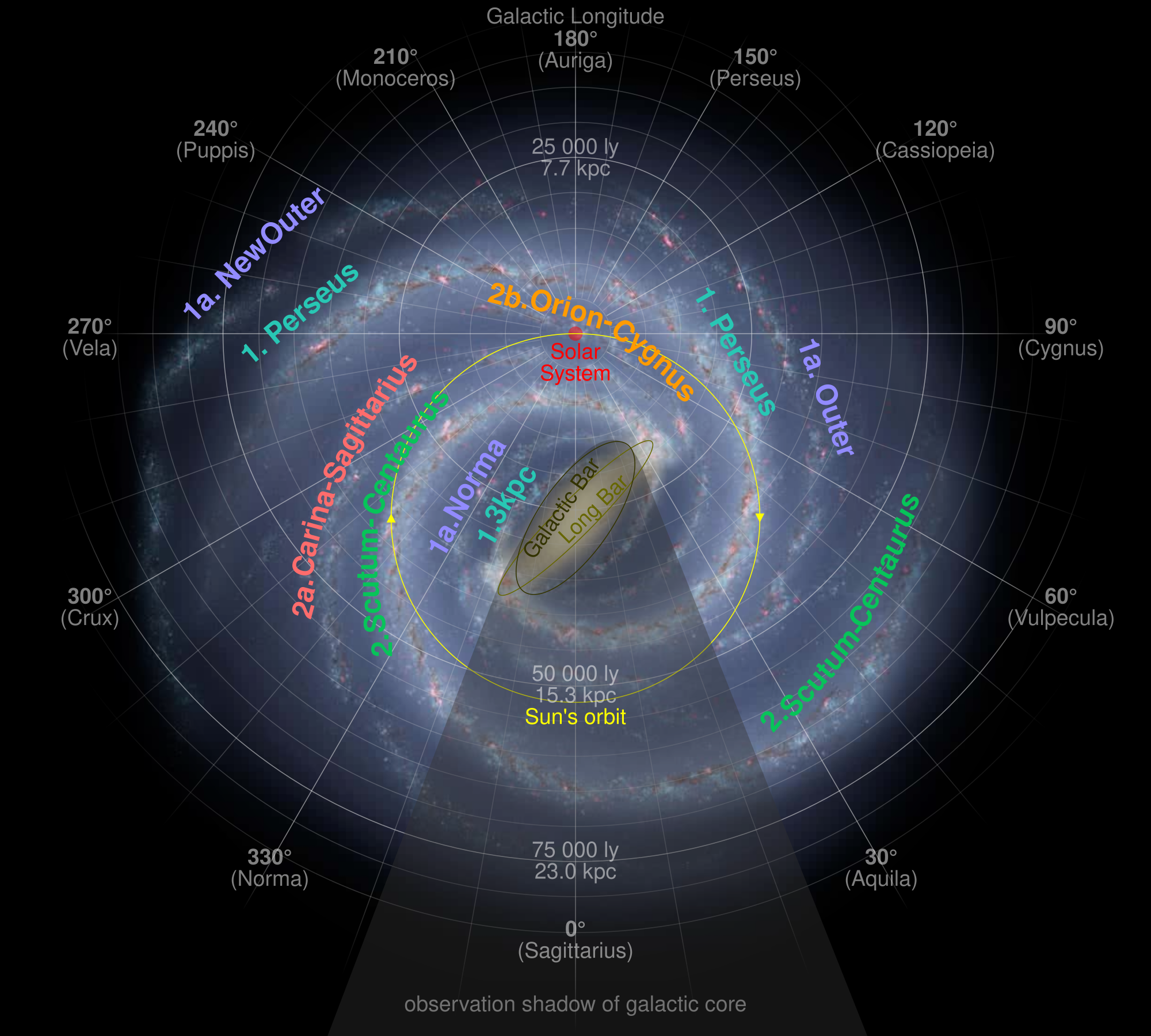
Consult Google & Wikipedia for more information and other interesting facts.
Martin Heigan
-
Crannogs were built in lakes or in waters that were almost surrounded by land. They tell the story of a human life that dates as far back as pre-historic times.
Archaeological evidence shows the construction of the crannogs to have been predominantly built in the Iron Age although some date as far as the new Stone Age, the middle, and late bronze ages.
In Scotland, the Scottish Crannog Centre focuses on the understanding and preservation of Scotland’s underwater heritage.
The discovery at Oak bank in the Loch Tay waters is, one of the most remarkable excavating artifacts including utensils, 2600-year-old clothing, and some stale butter in a tin preserved by the cold water.
The reconstruction of the crannog at Kenmore on Loch Tay is designed to duplicate the prehistoric one at Oak bank. The construction activity gave evidence of the immense skills the Iron Age builders applied when constructing their crannogs
The crannog builders would erect them on the rise of lake beds or in areas where the water was shallow. Although the chief material used was timber, there are some areas where crannogs were built entirely out of stone. In these areas, timber was unavailable, and the rocky geology supported stone architecture.
Crannogs were dwellings for extended families, but for what reason remains stubbornly unclear.
Crannogs may have been the high status dwellings of local leaders or chiefs. Perhaps they were trading posts located on waterways people used to move through the landscape or that living on water held some spiritual or cosmological significance.
While the pastel tones and fine texture of this image may bring to mind brush strokes on an artist’s canvas, they are in fact a visualisation of data from ESA’s Planck satellite. The image portrays the interaction between interstellar dust in the Milky Way and the structure of our Galaxy’s magnetic field.
Between 2009 and 2013, Planck scanned the sky to detect the most ancient light in the history of the Universe – the cosmic microwave background. It also detected significant foreground emission from diffuse material in our Galaxy which, although a nuisance for cosmological studies, is extremely important for studying the birth of stars and other phenomena in the Milky Way.
Among the foreground sources at the wavelengths probed by Planck is cosmic dust, a minor but crucial component of the interstellar medium that pervades the Galaxy. Mainly gas, it is the raw material for stars to form.
Interstellar clouds of gas and dust are also threaded by the Galaxy’s magnetic field, and dust grains tend to align their longest axis at right angles to the direction of the field. As a result, the light emitted by dust grains is partly ‘polarised’ – it vibrates in a preferred direction – and, as such, could be caught by the polarisation-sensitive detectors on Planck.
Scientists in the Planck collaboration are using the polarised emission of interstellar dust to reconstruct the Galaxy’s magnetic field and study its role in the build-up of structure in the Milky Way, leading to star formation.
In this image, the colour scale represents the total intensity of dust emission, revealing the structure of interstellar clouds in the Milky Way. The texture is based on measurements of the direction of the polarised light emitted by the dust, which in turn indicates the orientation of the magnetic field.
This image shows the intricate link between the magnetic field and the structure of the interstellar medium along the plane of the Milky Way. In particular, the arrangement of the magnetic field is more ordered along the Galactic plane, where it follows the spiral structure of the Milky Way. Small clouds are seen just above and below the plane, where the magnetic field structure becomes less regular.
From these and other similar observations, Planck scientists found that filamentary interstellar clouds are preferentially aligned with the direction of the ambient magnetic field, highlighting the strong role played by magnetism in galaxy evolution.
The emission from dust is computed from a combination of Planck observations at 353, 545 and 857 GHz, whereas the direction of the magnetic field is based on Planck polarisation data at 353 GHz.
Credit: ESA/Planck Collaboration. Acknowledgment: M.-A. Miville-Deschênes, CNRS – Institut d’Astrophysique Spatiale, Université Paris-XI, Orsay, France
The cosmos now shows evidence of having been at least loosely shaped from the start by what we may call a “narrative cosmological principle.”14 Built into matter, in addition to mathematical pattern, is the kind of indeterminate meaning that humans look for when reading or listening to stories. Consequently, if the cosmos exists as an unfinished story going on in irreversible time, we have good reason to wonder whether its narrative constitution plays host to a kind of meaning that science cannot reach, a meaning that may respond to our human attempts to live with purpose and hope.
What makes the post-Einsteinian picture of the universe so theologically compelling is that the kind of intelligibility it carries adds to the idea of geometric patterns a possible narrative disposition that may speak to our personal longing for a richer kind of meaning than that given by geometry.
-God after Einstein What’s Really Going On in the Universe? John F. Haught
Nikon d5500
50mm + Hoya Red Intensifier filter
ISO 3200
f/3.2
Foreground: 15 x 10 seconds
Sky: 10 x 30 seconds
iOptron SkyTracker
25 shot panorama of the Milky Way setting over Yenyening Lakes near Beverley, about 2 hours east of Perth in Western Australia.
Even though this shot was taken very shortly after winter, the lake bed is dry.
The white Hsinbyume Pagoda is seen here looking north from atop the Mingun Pahtodawgyi (aka Mantara Gyi, Mingun Pagoda). The Hsinbyume Pagoda was built in Mingun in 1816 by Bagyidaw, the then Crown Prince (later king, 1819-1837) of Burma, in honor of his wife, Princess Hsinbyume, who died in childbirth in 1812. The pagoda's architecture represents Mount Meru, which according to Hindu, Jain and Buddhist cosmology is the center of the physical, metaphysical and spiritual universes. It was severely damaged during an earthquake in 1839, and restored in 1874. A monk's school is seen with a golden stupa in the foreground. Mingun lies along the western (true right) bank of the Irrawaddy River, some 10 km (6.2 mi.) northwest of Mandalay in the Sagaing Region, Myanmar.
The view from the summit of the volcano is spectacular.
We were able to climb after 2 hours and 45 minutes. It is a climb that the physical preparation has to be perfect (snow in February, very cold at the top and strong and constant winds).
Hearing of the video on the summit of the volcano is hampered by strong winds.
We could only stay there for 20 minutes.
An old photo revisited...
Kalahari Desert Circular Star Trails, due to Earth's rotation around the Southern Celestial Pole (a stacked image sequence started just before daybreak, and ended at first light of day).
Entropy:
This image reminds me of a Thermodynamic principle in Physics called Entropy, where everything in the Universe has a tenancy to "naturally" go from a state of order (a living tree), to disorder (a dead tree in the process of decay).
When I returned to the exact same spot 2 years later, there was no sign of the dead tree. The Desert reclaimed it completely, and no trace of its existence remained.
The Desert runs on a "slower clock" than ours, and some of the plants survive in these seemingly harsh conditions for several human generations, but even here time eventually runs out.
In the words of Carl Sagan: "Nothing lasts forever, even the stars die." - Cosmos.
Boltzmann's entropy formula:
This image is part of the Legacy Series.
Photo usage and Copyright:
Medium-resolution photograph licensed under Creative Commons Attribution-NonCommercial-NoDerivatives 4.0 International Terms (CC BY-NC-ND 4.0). For High-resolution Royalty Free (RF) licensing, contact me via my site: Contact.
Martin
-