View allAll Photos Tagged Associate.
© Bank of England [2017]. This image is approved by the Bank of England for public use provided the following conditions are satisfied.
Terms and Conditions of use: The above image must not be used in a manner or context that, in the Bank of England's sole opinion, is offensive, inappropriate, or likely to undermine the integrity of the sterling currency. The Bank of England is not to be associated with any reproduction of this image. Your specific attention is drawn to section 18 of the Forgery and Counterfeiting Act 1981, adherence to which is a condition of the use of this image.
If you are unsure whether your proposed use adheres to the above conditions, you should submit a written reproduction request to the Bank of England and/or seek legal advice. Otherwise, your use of the image is at your own risk and in the knowledge that unauthorised use may result in civil or criminal actions against you.
NASA associate administrator for education and former astronaut Leland Melvin talks to International Space Station (ISS) crew members, Rick Mastracchio, screen left, and Michael Hopkins, during a live downlink at an event where they and eight astronaut candidates talked with Washington-area students and the public about the value of education in science, technology, engineering and mathematics (STEM), Thursday, Jan. 30, 2014 at the Smithsonian's National Air and Space Museum in Washington. Photo Credit: (NASA/Bill Ingalls)
Attending Theyyam is by far the best thing one can do while they are in Kerala. ”Theyyam” is a ritualistic performance, which can be described as the most visible, spectacular art form of Malabar (Northern part of Kerala), associated with myths and legends. Theyyam can also be described as a form of worship consisting of rituals, colorful costumes, and divine dance through which the gods are appeased and honoured.
Theyyam – the form of worshipping gods, goddesses, legendary heroes, etc is based on a rather simple concept, that after suitable propitiatory rituals, the god or goddess belonging to a temple becomes temporally manifest in the body of an empowered man (the performer), thereby elevating him to a divine status. Theyyam ceremonies usually take place either within the precincts of a small shrine – usually called Kavu, Kazhakam, Muchilottu, Mundiya, Sthanametc, or in the yard of an ancestral house or in an open space with a temporary shrine called Pathi.
According to Hinduism, all the creation-preservation-destruction activities in the universe are controlled by the three Gods – Brahma, Vishnu, and Maheshwara (Shiva), respectively. For upholding righteousness, these gods appear in many godly guises and incarnations. For propitiation of these gods, apart from ritualistic worship and sacrifices, the man also gave form to donning their godly forms and performing as another form of worship. These became a part of their culture, underwent many changes over time, and is an evolution of the clan culture. It is very difficult to find out the exact period of the origin of theyyam. At the same time, none can refute its antiquity.
According to the general belief, the origin of the theyyam is attributed to Manakkadan Gurukkal.(Gurukkal means master) He was a great artist and occultist belonging to the Vannan Community. Once, the Rajah of Chirakkal invited this great occultist to test his capacity as an artist as well as a magician. Gurukkal was residing at Manakkad in Karivellur, about 40 kilometers away from the palace of the Rajah. The Rajah had given several tests like causing obstacles to the ferry as he was trying to cross the river. But Gurukkal managed to cross the river with his divine power. The gates of the fort were also closed to prevent him from entering, but here also he managed to appear before the king with his physical power. The Rajah sat along with a few other persons so that Gurukkal could not identify him. But Gurukkal easily recognized the king and respected. While he was called for the food it was so arranged that he himself would have to throw away the plantain leaf in which food would be supplied. This was intended to make him feel inferior. Gurukkal foreseeing this received the hot rice in a melon leaf and after taking the food he swallowed the leaf and thus he cleverly avoided the indignity of himself taking the leaf and throwing it away. Thus he successfully overcame the tests of the Raja, Manakkadan. Gurukkal was asked to make the costumes for some deities whose ritualistic dances were to be performed in the form of the theyyams in the night. Accordingly, Gurukkal designed 35 different theyyams before the sunrise. Rajah realizing Gurukkal’s skill, a title, Manakkadan was bestowed on Gurukkal. It is believed that this is how the present form of Theyyams originated.
Theyyam reveals the human capabilities of abstraction, synthesis, and idealization; it describes social and economic activities and reveals practices, beliefs, and ideas. It provides a unique insight into spirituality, intellectual life, and cultural adventures. It is a divine dance with ancient testimony of customs, traditions, and artistic creativity. Shrines, ancestral houses, Kavus in villages offer the platform for theyyam festivals. Since the theyyam performer, transforms to the status of a particular deity, theyyam is very much a divine dance. Invoking god or goddess in his body, he dances through the compound of the sacred space where deities are worshipped. The dance is considered not for propitiating gods or goddesses, rather it is dance of the gods or goddesses themselves. Scores of nature deities (including animals and trees), ancestors, village heroes and heroines, and gods and goddesses from Saivite, Vaisnavite, and Sakti traditions of Hinduism form part of the pantheon of theyyam performance.
The fundamental facts of existence of theyyam performance, even in the present day, make the ritual a powerful instrument that influences the thoughts and practices of Malabar society. In support of this, experts point out that the deities are worshipped and propitiated for the blessing of fertility, for protection and security. There are powerful deities who ward off smallpox and other contagious diseases. Theyyam ritual performances also provide judicial services.
Some of the major disputes and caste conflicts are often settled by a specific representative of a particular deity during the theyyam performance. The devotees present their personal problems and troubles to the deities and the deities give them counsel and blessings.
During the time when I attended one of these rituals in theyyam, I was positioned right in front of where the holy bonfire is made in order to click photographs. I was warned by the authorities there to sit somewhere else as the devotee who dances in and around the fire strews the embers in his enthusiasm and that it was dangerous for me. I was quite reluctant to move, because I had travelled far to reach there and really wanted to materialize the composition that I had in my mind. I decided to stay put and watch the performance. As the performer entered the premises, the energy of the area completely changed. Their dance form was extremely exhilarating to watch and they were performing with absolutely no holding back. As he entered the fire, dancing to the music, his movements and actions actually tossed a large number of embers in his surroundings and especially on me because I was in proximity. I got really promising photos but I got burned by the shower of embers and my clothes got badly burnt too albeit at the compensation of getting some really memorable photographs.
Sculptural fragments found in the upper part of the city of Tarragona (ancient Tarraco) in Spain. They were originally published in the 19th century.
The horned Jupiter (the horns a reference to the supreme Egyptian deity Ammon) has been associated with the cult of the defied emperor Augustus. These decorative shields may have adorned a large shrine to Augustus (or possibly) Jupiter. The fragments were not apparently found in their original context, so identification with a specific monument is difficult. Perhaps of Flavian date.
Archaeological Museum of Tarragona, Spain (cf. Mierse, Temples and Towns in Roman Iberia - 1999: 48ff.).
RBU2014.4410
47323 (D1804) is seen in the head shunt at the end of the BR limit on Amlwch branch on the Isle of Anglesey, waiting for the daily train of Ethylene Dibromide from the Associated Octel's plant, which is being marshalled by their own shunter.
Octel's freight traffic totaled 70,000 tons annually, and this 17 mile branch was kept in order to serve this traffic, only one train was permitted to be on the branch at a time, but this was sufficient for Octel's requirements.
In 1993, Octel's daily freight traffic was transferred to road haulage, and traffic thus ceased on the line. The Octel plant closed in 2003, and has since been demolished.
47323 was new 16/2/65 to Darnall as D1804 withdrawn 06/00 cut up 07/03 by R Garrett at Basford Hall Yard
18th September 1989
The associated video with this picture series is Our Trip to Crete on YouTube.
This part of our adventures on our Grand Tour of Europe is in episode four of the Take Flight with Scott video series on YouTube. Please join us there for even more content from this trip. Part four is our time on Crete, Greece with our teen nieces Madeline and Emily, including a trip to the ruins in Ancient Aptera, and a visit to the freshwater flowing through Glyka Nera Beach.
Also, you can follow my personal ZiffedTraveler Instagram or the TakeFlight with Scott Instagram pages for more content and news. We are on Facebook, too.
The Dakshinkali Temple is located 22 kilometers from Kathmandu next to the village of Pharping. It's one of the main temples in Nepal. Twice every week thousands of people come here to worship the goddess Kali by sacrificing life animals, particularly cockerels and uncastrated male goats.
GODDESS KALI
Kālī (/ˈkɑːli/; Sanskrit: काली & Bengali: কালী; IPA: [kɑːliː]), also known as Kālikā (Sanskrit: कालिका), is the Hindu goddess associated with empowerment, or shakti. She is the fierce aspect of the goddess Durga. The name of Kali means black one and force of time; she is therefore called the Goddess of Time, Change, Power, Creation, Preservation, and Destruction. Her earliest appearance is that of a destroyer principally of evil forces. Various Shakta Hindu cosmologies, as well as Shākta Tantric beliefs, worship her as the ultimate reality or Brahman; and recent devotional movements re-imagine Kāli as a benevolent mother goddess. She is often portrayed standing or dancing on her husband, the god Shiva, who lies calm and prostrate beneath her. Worshipped throughout India but particularly South India, Bengal, and Assam, Kali is both geographically and culturally marginal.
ETYMOLOGY
Kālī is the feminine form of kālam ("black, dark coloured"). Kāla primarily means "time", but also means "black"; hence, Kālī means "the black one" or "beyond time". Kāli is strongly associated with Shiva, and Shaivas derive the masculine Kāla (an epithet of Shiva) from her feminine name. A nineteenth-century Sanskrit dictionary, the Shabdakalpadrum, states: कालः शिवः। तस्य पत्नीति - काली। kālaḥ śivaḥ। tasya patnīti kālī - "Shiva is Kāla, thus, his consort is Kāli".
Other names include Kālarātri ("black night"), as described above, and Kālikā ("relating to time"), and Kallie ("black alchemist"). Coburn notes that the name Kālī can be used as a proper name, or as a description of color.
Kāli's association with darkness stands in contrast to her consort, Shiva, whose body is covered by the white ashes of the cremation ground (Sanskrit: śmaśāna) where he meditates, and with which Kāli is also associated, as śmaśāna-kālī.
ORIGINS
Hugh Urban notes that although the word Kālī appears as early as the Atharva Veda, the first use of it as a proper name is in the Kathaka Grhya Sutra (19.7). Kali is the name of one of the seven tongues of Agni, the [Rigvedic] God of Fire, in the Mundaka Upanishad (2:4), but it is unlikely that this refers to the goddess. The first appearance of Kāli in her present form is in the Sauptika Parvan of the Mahabharata (10.8.64). She is called Kālarātri (literally, "black night") and appears to the Pandava soldiers in dreams, until finally she appears amidst the fighting during an attack by Drona's son Ashwatthama. She most famously appears in the sixth century Devi Mahatmyam as one of the shaktis of Mahadevi, and defeats the demon Raktabija ("Bloodseed"). The tenth-century Kalika Purana venerates Kāli as the ultimate reality.
According to David Kinsley, Kāli is first mentioned in Hinduism as a distinct goddess around 600 CE, and these texts "usually place her on the periphery of Hindu society or on the battlefield." She is often regarded as the Shakti of Shiva, and is closely associated with him in various Puranas. The Kalika Purana depicts her as the "Adi Shakti" (Fundamental Power) and "Para Prakriti" or beyond nature.
WORSHIP AND MANTRA
Kali could be considered a general concept, like Durga, and is mostly worshiped in the Kali Kula sect of worship. The closest way of direct worship is Maha Kali or Bhadra Kali (Bhadra in Sanskrit means 'gentle'). Kali is worshiped as one of the 10 Mahavidya forms of Adi Parashakti (Goddess Durga) or Bhagavathy according to the region. The mantra for worship is
Sanskrit: सर्वमङ्गलमाङ्गल्ये शिवे सर्वार्थसाधिके । शरण्ये त्र्यम्बके गौरि नारायणि नमोऽस्तु ते ॥
ॐ जयंती मंगल काली भद्रकाली कपालिनी । दुर्गा शिवा क्षमा धात्री स्वाहा स्वधा नमोऽस्तुते ॥
(Sarvamaṅgalamāṅgalyē śivē sarvārthasādhikē . śaraṇyē tryambakē gauri nārāyaṇi namō'stu tē.
Oṃ jayantī mangala kālī bhadrakālī kapālinī . durgā śivā ksamā dhātrī svāhā svadhā namō'stutē.)
YANTRA
Goddesses play an important role in the study and practice of Tantra Yoga, and are affirmed to be as central to discerning the nature of reality as are the male deities. Although Parvati is often said to be the recipient and student of Shiva's wisdom in the form of Tantras, it is Kali who seems to dominate much of the Tantric iconography, texts, and rituals. In many sources Kāli is praised as the highest reality or greatest of all deities. The Nirvana-tantra says the gods Brahma, Vishnu, and Shiva all arise from her like bubbles in the sea, ceaselessly arising and passing away, leaving their original source unchanged. The Niruttara-tantra and the Picchila-tantra declare all of Kāli's mantras to be the greatest and the Yogini-tantra, Kamakhya-tantra and the Niruttara-tantra all proclaim Kāli vidyas (manifestations of Mahadevi, or "divinity itself"). They declare her to be an essence of her own form (svarupa) of the Mahadevi.In the Mahanirvana-tantra, Kāli is one of the epithets for the primordial sakti, and in one passage Shiva praises her:At the dissolution of things, it is Kāla [Time]. Who will devour all, and by reason of this He is called Mahākāla [an epithet of Lord Shiva], and since Thou devourest Mahākāla Himself, it is Thou who art the Supreme Primordial Kālika. Because Thou devourest Kāla, Thou art Kāli, the original form of all things, and because Thou art the Origin of and devourest all things Thou art called the Adya [the Primordial One]. Re-assuming after Dissolution Thine own form, dark and formless, Thou alone remainest as One ineffable and inconceivable. Though having a form, yet art Thou formless; though Thyself without beginning, multiform by the power of Maya, Thou art the Beginning of all, Creatrix, Protectress, and Destructress that Thou art. The figure of Kāli conveys death, destruction, and the consuming aspects of reality. As such, she is also a "forbidden thing", or even death itself. In the Pancatattva ritual, the sadhaka boldly seeks to confront Kali, and thereby assimilates and transforms her into a vehicle of salvation. This is clear in the work of the Karpuradi-stotra, a short praise of Kāli describing the Pancatattva ritual unto her, performed on cremation grounds. (Samahana-sadhana)He, O Mahākāli who in the cremation-ground, naked, and with dishevelled hair, intently meditates upon Thee and recites Thy mantra, and with each recitation makes offering to Thee of a thousand Akanda flowers with seed, becomes without any effort a Lord of the earth. Oh Kāli, whoever on Tuesday at midnight, having uttered Thy mantra, makes offering even but once with devotion to Thee of a hair of his Shakti [his energy/female companion] in the cremation-ground, becomes a great poet, a Lord of the earth, and ever goes mounted upon an elephant.The Karpuradi-stotra clearly indicates that Kāli is more than a terrible, vicious, slayer of demons who serves Durga or Shiva. Here, she is identified as the supreme mistress of the universe, associated with the five elements. In union with Lord Shiva, she creates and destroys worlds. Her appearance also takes a different turn, befitting her role as ruler of the world and object of meditation. In contrast to her terrible aspects, she takes on hints of a more benign dimension. She is described as young and beautiful, has a gentle smile, and makes gestures with her two right hands to dispel any fear and offer boons. The more positive features exposed offer the distillation of divine wrath into a goddess of salvation, who rids the sadhaka of fear. Here, Kali appears as a symbol of triumph over death.
BENGALI TRADITION
Kali is also a central figure in late medieval Bengali devotional literature, with such devotees as Ramprasad Sen (1718–75). With the exception of being associated with Parvati as Shiva's consort, Kāli is rarely pictured in Hindu legends and iconography as a motherly figure until Bengali devotions beginning in the early eighteenth century. Even in Bengāli tradition her appearance and habits change little, if at all.
The Tantric approach to Kāli is to display courage by confronting her on cremation grounds in the dead of night, despite her terrible appearance. In contrast, the Bengali devotee appropriates Kāli's teachings adopting the attitude of a child, coming to love her unreservedly. In both cases, the goal of the devotee is to become reconciled with death and to learn acceptance of the way that things are. These themes are well addressed in Rāmprasād's work. Rāmprasād comments in many of his other songs that Kāli is indifferent to his wellbeing, causes him to suffer, brings his worldly desires to nothing and his worldly goods to ruin. He also states that she does not behave like a mother should and that she ignores his pleas:
Can mercy be found in the heart of her who was born of the stone? [a reference to Kali as the daughter of Himalaya]
Were she not merciless, would she kick the breast of her lord?
Men call you merciful, but there is no trace of mercy in you, Mother.
You have cut off the heads of the children of others, and these you wear as a garland around your neck.
It matters not how much I call you "Mother, Mother." You hear me, but you will not listen.
To be a child of Kāli, Rāmprasād asserts, is to be denied of earthly delights and pleasures. Kāli is said to refrain from giving that which is expected. To the devotee, it is perhaps her very refusal to do so that enables her devotees to reflect on dimensions of themselves and of reality that go beyond the material world.
A significant portion of Bengali devotional music features Kāli as its central theme and is known as Shyama Sangeet ("Music of the Night"). Mostly sung by male vocalists, today even women have taken to this form of music. One of the finest singers of Shyāma Sāngeet is Pannalal Bhattacharya.
In Bengal, Kāli is venerated in the festival Kali Puja, the new moon day of Ashwin month which coincides with Diwali festival.
In a unique form of Kāli worship, Shantipur worships Kāli in the form of a hand painted image of the deity known as Poteshwari (meaning the deity drawn on a piece of cloth).
LEGENDS
SLAYER AND RAKTABIJA
In Kāli's most famous legend, Devi Durga (Adi Parashakti) and her assistants, the Matrikas, wound the demon Raktabija, in various ways and with a variety of weapons in an attempt to destroy him. They soon find that they have worsened the situation for with every drop of blood that is dripped from Raktabija he reproduces a clone of himself. The battlefield becomes increasingly filled with his duplicates. Durga, in need of help, summons Kāli to combat the demons. It is said, in some versions, that Goddess Durga actually assumes the form of Goddess Kāli at this time. The Devi Mahatmyam describes:
Out of the surface of her (Durga's) forehead, fierce with frown, issued suddenly Kali of terrible countenance, armed with a sword and noose. Bearing the strange khatvanga (skull-topped staff ), decorated with a garland of skulls, clad in a tiger's skin, very appalling owing to her emaciated flesh, with gaping mouth, fearful with her tongue lolling out, having deep reddish eyes, filling the regions of the sky with her roars, falling upon impetuously and slaughtering the great asuras in that army, she devoured those hordes of the foes of the devas.
Kali consumes Raktabija and his duplicates, and dances on the corpses of the slain. In the Devi Mahatmya version of this story, Kali is also described as a Matrika and as a Shakti or power of Devi. She is given the epithet Cāṃuṇḍā (Chamunda), i.e. the slayer of the demons Chanda and Munda. Chamunda is very often identified with Kali and is very much like her in appearance and habit.
DAKSHINA KALI
In her most famous pose as Daksinakali, popular legends say that Kali, drunk on the blood of her victims, is about to destroy the whole universe when, urged by all the gods, Shiva lies in her way to stop her, and she steps upon his chest. Recognizing Shiva beneath her feet, she calms herself. Though not included in any of the puranas, popular legends state that Kali was ashamed at the prospect of keeping her husband beneath her feet and thus stuck her tongue out in shame. The Devi-Bhagavata Purana, which goes into great depths about the goddess Kali, reveals the tongue's actual symbolism.
The characteristic icons that depict Kali are the following; unbridled matted hair, open blood shot eyes, open mouth and a drooping tongue; in her hands, she holds a Khadga (bent sword or scimitar) and a human head; she has a girdle of human hands across her waist, and Shiva lies beneath her feet. The drooping out-stuck tongue represents her blood-thirst. Lord Shiva beneath her feet represents matter, as Kali energy. The depiction of Kali on Shiva shows that without energy, matter lies "dead". This concept has been simplified to a folk-tale depicting a wife placing her foot
on her husband and sticking her tongue out in shame. In tantric contexts, the tongue is seen to denote the element (guna) of rajas (energy and action) controlled by sattva.
If Kali steps on Shiva with her right foot and holds the sword in her left hand, she is considered to be Dakshina Kali. The Dakshina Kali Temple has important religious associations with the Jagannath Temple and it is believed that Daksinakali is the guardian of the kitchen of the Lord Jagannath Temple. Puranic tradition says that in Puri, Lord Jagannath is regarded as Daksinakalika. Goddess Dakshinakali plays an important role in the 'Niti' of Saptapuri Amavasya.
One South Indian tradition tells of a dance contest between Shiva and Kali. After defeating the two demons Sumbha and Nisumbha, Kali takes up residence in the forest of Thiruvalankadu or Thiruvalangadu. She terrorizes the surrounding area with her fierce, disruptive nature. One of Shiva's devotees becomes distracted while performing austerities, and asks Shiva to rid the forest of the destructive goddess. When Shiva arrives, Kali threatens him, and Shiva challenges Kali to a dance contest, wherein Kali matches Shiva until Shiva takes the "Urdhvatandava" step, vertically raising his right leg. Kali refuses to perform this step, which would not befit her as a woman, and becomes pacified.
SMASHAN KALI
If the Kali steps out with the left foot and holds the sword in her right hand, she is the terrible form of Mother, the Smashan Kali of the cremation ground. She is worshiped by tantrics, the followers of Tantra, who believe that one's spiritual discipline practiced in a smashan (cremation ground) brings success quickly. Sarda Devi, the consort of Ramakrishna Paramhansa, worshipped Smashan Kali at Dakshineshwar.
MATERNAL KALI
At the time of samundra manthan when amrit came out, along with that came out poison which was going to destroy the world hence on the request of all the gods, Lord Shiva drank it to save the world but as he is beyond death he didn't die but was very much in pain due to the poison effect hence he became a child so that Kali can feed him with her milk which will sooth out the poison effect.
MAHAKALI
Mahakali (Sanskrit: Mahākālī, Devanagari: महाकाली), literally translated as Great Kali, is sometimes considered as a greater form of Kali, identified with the Ultimate reality of Brahman. It can also be used as an honorific of the Goddess Kali, signifying her greatness by the prefix "Mahā-". Mahakali, in Sanskrit, is etymologically the feminized variant of Mahakala or Great Time (which is interpreted also as Death), an epithet of the God Shiva in Hinduism. Mahakali is the presiding Goddess of the first episode of the Devi Mahatmya. Here she is depicted as Devi in her universal form as Shakti. Here Devi serves as the agent who allows the cosmic order to be restored.
Kali is depicted in the Mahakali form as having ten heads, ten arms, and ten legs. Each of her ten hands is carrying a various implement which vary in different accounts, but each of these represent the power of one of the Devas or Hindu Gods and are often the identifying weapon or ritual item of a given Deva. The implication is that Mahakali subsumes and is responsible for the powers that these deities possess and this is in line with the interpretation that Mahakali is identical with Brahman. While not displaying ten heads, an "ekamukhi" or one headed image may be displayed with ten arms, signifying the same concept: the powers of the various Gods come only through Her grace.
ICONOGRAPHY
Kali is portrayed mostly in two forms: the popular four-armed form and the ten-armed Mahakali form. In both of her forms, she is described as being black in color but is most often depicted as blue in popular Indian art. Her eyes are described as red with intoxication, and in absolute rage, her hair is shown disheveled, small fangs sometimes protrude out of her mouth, and her tongue is lolling. She is often shown naked or just wearing a skirt made of human arms and a garland of human heads. She is also accompanied by serpents and a jackal while standing on a seemingly dead Shiva, usually right foot forward to symbolize the more popular Dakshinamarga or right-handed path, as opposed to the more infamous and transgressive Vamamarga or left-handed path.
In the ten-armed form of Mahakali she is depicted as shining like a blue stone. She has ten faces, ten feet, and three eyes for each head. She has ornaments decked on all her limbs. There is no association with Shiva.
The Kalika Purana describes Kali as possessing a soothing dark complexion, as perfectly beautiful, riding a lion, four-armed, holding a sword and blue lotuses, her hair unrestrained, body firm and youthful.
In spite of her seemingly terrible form, Kali Ma is often considered the kindest and most loving of all the Hindu goddesses, as she is regarded by her devotees as the Mother of the whole Universe. And because of her terrible form, she is also often seen as a great protector. When the Bengali saint Ramakrishna once asked a devotee why one would prefer to worship Mother over him, this devotee rhetorically replied, "Maharaj", when they are in trouble your devotees come running to you. But, where do you run when you are in trouble?"
According to Ramakrishna, darkness is the Ultimate Mother, or Kali:
My Mother is the principle of consciousness. She is Akhanda Satchidananda;
indivisible Reality, Awareness, and Bliss. The night sky between the stars is perfectly black.
The waters of the ocean depths are the same; The infinite is always mysteriously dark.
This inebriating darkness is my beloved Kali.
—Sri Ramakrishna
This is clear in the works of such contemporary artists as Charles Wish, and Tyeb Mehta, who sometimes take great liberties with the traditional, accepted symbolism, but still demonstrate a true reverence for the Shakta sect.
POPULAR FORM
Classic depictions of Kali share several features, as follows:
Kali's most common four armed iconographic image shows each hand carrying variously a sword, a trishul (trident), a severed head, and a bowl or skull-cup (kapala) catching the blood of the severed head.
Two of these hands (usually the left) are holding a sword and a severed head. The Sword signifies Divine Knowledge and the Human Head signifies human Ego which must be slain by Divine Knowledge in order to attain Moksha. The other two hands (usually the right) are in the abhaya (fearlessness) and varada (blessing) mudras, which means her initiated devotees (or anyone worshipping her with a true heart) will be saved as she will guide them here and in the hereafter.
She has a garland consisting of human heads, variously enumerated at 108 (an auspicious number in Hinduism and the number of countable beads on a Japa Mala or rosary for repetition of Mantras) or 51, which represents Varnamala or the Garland of letters of the Sanskrit alphabet, Devanagari. Hindus believe Sanskrit is a language of dynamism, and each of these letters represents a form of energy, or a form of Kali. Therefore, she is generally seen as the mother of language, and all mantras.
She is often depicted naked which symbolizes her being beyond the covering of Maya since she is pure (nirguna) being-consciousness-bliss and far above prakriti. She is shown as very dark as she is brahman in its supreme unmanifest state. She has no permanent qualities - she will continue to exist even when the universe ends. It is therefore believed that the concepts of color, light, good, bad do not apply to her - she is the pure, un-manifested energy, the Adi-shakti.
Kali as the Symbol of Creation , Freedom , Preservation and Destruction
The head that hangs in Kali's hand is a symbol of Ego and the scimitar which she is holding represents power and energy.It is believed that Kali is protecting the human race by that scimitar and also destroying the negativity and ego within human being. The body lying under Kali symbolizes ruination, is actually a form of Shiva. Kali steps her leg on the chest of the body and suppress ruination . Since she is standing on the pure white chest of Lord Shiva who, as pure primal awareness, lays in a passive reclining position, peacefully lies with his eyes half open in a state of bliss. Her hair is long, black and flowing freely depicting Her freedom from convention and the confines of conceptualization. The white teeth which Kali has stands for conscience and her red tongue represents greed. By pressing her white teeth on her tongue Kali refers to control greed.The goddess may appear terrible from outside but every symbol in Kali signifies truth of life. Since the earth was created out of darkness, the dark black color of Kali symbolizes the color from which everything was born. Her right hand side arms she shows the Abhaya mudra(gesture of fearlessness) and Vara mudra (gesture of welcome and charity) respectively . But on the other arm in left side she holds a bloody scimitar and a severed head depicting destruction and end of ego.
Kali as the Symbol of Mother Nature
The name Kali means Kala or force of time. When there were neither the creation, nor the sun, the moon, the planets, and the earth, there was only darkness and everything was created from the darkness. The Dark appearance of kali represents the darkness from which everything was born. Her complexion is deep blue, like the sky and ocean water as blue. As she is also the goddess of Preservation Kali is worshiped as mother to preserve the nature.Kali is standing calm on Shiva, her appearance represents the preservation of mother nature. Her free, long and black hair represents nature's freedom from civilization. Under the third eye of kali, the signs of both sun, moon and fire are visible which represent the driving forces of nature.
SHIVA IN KALI ICONOGRAPHY
In both these images she is shown standing on the prone, inert or dead body of Shiva. There is a legend for the reason behind her standing on what appears to be Shiva's corpse, which translates as follows:
Once Kali had destroyed all the demons in battle, she began a terrific dance out of the sheer joy of victory. All the worlds or lokas began to tremble and sway under the impact of her dance. So, at the request of all the Gods, Shiva himself asked her to desist from this behavior. However, she was too intoxicated to listen. Hence, Shiva lay like a corpse among the slain demons in order to absorb the shock of the dance into himself. When Kali eventually stepped upon Shiva, she realized she was trampling and hurting her husband and bit her tongue in shame.
The story described here is a popular folk tale and not described or hinted in any of the puranas. The puranic interpretation is as follows:
Once, Parvati asks Shiva to chose the one form among her 10 forms which he likes most. To her surprise, Shiva reveals that he is most comfortable with her Kali form, in which she is bereft of her jewellery, her human-form, her clothes, her emotions and where she is only raw, chaotic energy, where she is as terrible as time itself and even greater than time. As Parvati takes the form of Kali, Shiva lies at her feet and requests her to place her foot on his chest, upon his heart. Once in this form, Shiva requests her to have this place, below her feet in her iconic image which would be worshiped throughout.
This idea has been explored in the Devi-Bhagavata Purana [28] and is most popular in the Shyama Sangeet, devotional songs to Kali from the 12th to 15th centuries.
The Tantric interpretation of Kali standing on top of her husband is as follows:
The Shiv tattava (Divine Consciousness as Shiva) is inactive, while the Shakti tattava (Divine Energy as Kali) is active. Shiva and Kali represent Brahman, the Absolute pure consciousness which is beyond all names, forms and activities. Kali, on the other hand, represents the potential (and manifested) energy responsible for all names, forms and activities. She is his Shakti, or creative power, and is seen as the substance behind the entire content of all consciousness. She can never exist apart from Shiva or act independently of him, just as Shiva remains a mere corpse without Kali i.e., Shakti, all the matter/energy of the universe, is not distinct from Shiva, or Brahman, but is rather the dynamic power of Brahman. Hence, Kali is Para Brahman in the feminine and dynamic aspect while Shiva is the male aspect and static. She stands as the absolute basis for all life, energy and beneath her feet lies, Shiva, a metaphor for mass, which cannot retain its form without energy.
While this is an advanced concept in monistic Shaktism, it also agrees with the Nondual Trika philosophy of Kashmir, popularly known as Kashmir Shaivism and associated most famously with Abhinavagupta. There is a colloquial saying that "Shiva without Shakti is Shava" which means that without the power of action (Shakti) that is Mahakali (represented as the short "i" in Devanagari) Shiva (or consciousness itself) is inactive; Shava means corpse in Sanskrit and the play on words is that all Sanskrit consonants are assumed to be followed by a short letter "a" unless otherwise noted. The short letter "i" represents the female power or Shakti that activates Creation. This is often the explanation for why She is standing on Shiva, who is either Her husband and complement in Shaktism or the Supreme Godhead in Shaivism.
To properly understand this complex Tantric symbolism it is important to remember that the meaning behind Shiva and Kali does not stray from the non-dualistic parlance of Shankara or the Upanisads. According to both the Mahanirvana and Kularnava Tantras, there are two distinct ways of perceiving the same absolute reality. The first is a transcendental plane which is often described as static, yet infinite. It is here that there is no matter, there is no universe and only consciousness exists. This form of reality is known as Shiva, the absolute Sat-Chit-Ananda - existence, knowledge and bliss. The second is an active plane, an immanent plane, the plane of matter, of Maya, i.e., where the illusion of space-time and the appearance of an actual universe does exist. This form of reality is known as Kali or Shakti, and (in its entirety) is still specified as the same Absolute Sat-Chit-Ananda. It is here in this second plane that the universe (as we commonly know it) is experienced and is described by the Tantric seer as the play of Shakti, or God as Mother Kali.
From a Tantric perspective, when one meditates on reality at rest, as absolute pure consciousness (without the activities of creation, preservation or dissolution) one refers to this as Shiva or Brahman. When one meditates on reality as dynamic and creative, as the Absolute content of pure consciousness (with all the activities of creation, preservation or dissolution) one refers to it as Kali or Shakti. However, in either case the yogini or yogi is interested in one and the same reality - the only difference being in name and fluctuating aspects of appearance. It is this which is generally accepted as the meaning of Kali standing on the chest of Shiva.
Although there is often controversy surrounding the images of divine copulation, the general consensus is benign and free from any carnal impurities in its substance. In Tantra the human body is a symbol for the microcosm of the universe; therefore sexual process is responsible for the creation of the world. Although theoretically Shiva and Kali (or Shakti) are inseparable, like fire and its power to burn, in the case of creation they are often seen as having separate roles. With Shiva as male and Kali as female it is only by their union that creation may transpire. This reminds us of the prakrti and purusa doctrine of Samkhya wherein prakāśa- vimarśa has no practical value, just as without prakrti, purusa is quite inactive. This (once again) stresses the interdependencies of Shiva and Shakti and the vitality of their union.
Gopi Krishna proposed that Kali standing on the dead Shiva or Shava (Sanskrit for dead body) symbolised the helplessness of a person undergoing the changing process (psychologically and physiologically) in the body conducted by the Kundalini Shakti.
DEVELOPMENT
In the later traditions, Kali has become inextricably linked with Shiva. The unleashed form of Kali often becomes wild and uncontrollable, and only Shiva is able to tame her just as only Kali can tame Shiva. This is both because she is often a transformed version of one of his consorts and because he is able to match her wildness.
The ancient text of Kali Kautuvam describes her competition with Shiva in dance, from which the sacred 108 Karanas appeared. Shiva won the competition by acting the urdva tandava, one of the Karanas, by raising his feet to his head. Other texts describe Shiva appearing as a crying infant and appealing to her maternal instincts. While Shiva is said to be able to tame her, the iconography often presents her dancing on his fallen body, and there are accounts of the two of them dancing together, and driving each other to such wildness that the world comes close to unravelling.
Shiva's involvement with Tantra and Kali's dark nature have led to her becoming an important Tantric figure. To the Tantric worshippers, it was essential to face her Curse, the terror of death, as willingly as they accepted Blessings from her beautiful, nurturing, maternal aspect. For them, wisdom meant learning that no coin has only one side: as death cannot exist without life, so life cannot exist without death. Kali's role sometimes grew beyond that of a chaos - which could be confronted - to that of one who could bring wisdom, and she is given great metaphysical significance by some Tantric texts. The Nirvāna-tantra clearly presents her uncontrolled nature as the Ultimate Reality, claiming that the trimurti of Brahma, Vishnu and Rudra arise and disappear from her like bubbles from the sea. Although this is an extreme case, the Yogini-tantra, Kamakhya-tantra and the Niruttara-tantra declare her the svarupa (own-being) of the Mahadevi (the great Goddess, who is in this case seen as the combination of all devis).The final stage of development is the worshipping of Kali as the Great Mother, devoid of her usual violence. This practice is a break from the more traditional depictions. The pioneers of this tradition are the 18th century Shakta poets such as Ramprasad Sen, who show an awareness of Kali's ambivalent nature. Ramakrishna, the 19th century Bengali saint, was also a great devotee of Kali; the western popularity of whom may have contributed to the more modern, equivocal interpretations of this Goddess. Rachel McDermott's work, however, suggests that for the common, modern worshipper, Kali is not seen as fearful, and only those educated in old traditions see her as having a wrathful component. Some credit to the development of Devi must also be given to Samkhya. Commonly referred to as the Devi of delusion, Mahamaya or Durga, acting in the confines of (but not being bound by) the nature of the three gunas, takes three forms: Maha-Kali, Maha-Lakshmi and Maha-Saraswati, being her tamas-ika, rajas-ika and sattva-ika forms. In this sense, Kali is simply part of a larger whole.
Like Sir John Woodroffe and Georg Feuerstein, many Tantric scholars (as well as sincere practitioners) agree that, no matter how propitious or appalling you describe them, Shiva and Devi are simply recognizable symbols for everyday, abstract (yet tangible) concepts such as perception, knowledge, space-time, causation and the process of liberating oneself from the confines of such things. Shiva, symbolizing pure, absolute consciousness, and Devi, symbolizing the entire content of that consciousness, are ultimately one and the same - totality incarnate, a micro-macro-cosmic amalgamation of all subjects, all objects and all phenomenal relations between the "two." Like man and woman who both share many common, human traits yet at the same time they are still different and, therefore, may also be seen as complementary.
Worshippers prescribe various benign and horrific qualities to Devi simply out of practicality. They do this so they may have a variety of symbols to choose from, symbols which they can identify and relate with from the perspective of their own, ever-changing time, place and personal level of unfolding. Just like modern chemists or physicists use a variety of molecular and atomic models to describe what is unperceivable through rudimentary, sensory input, the scientists of ontology and epistemology must do the same. One of the underlying distinctions of Tantra, in comparison to other religions, is that it allows the devotee the liberty to choose from a vast array of complementary symbols and rhetoric which suit one's evolving needs and tastes. From an aesthetic standpoint, nothing is interdict and nothing is orthodox. In this sense, the projection of some of Devi's more gentle qualities onto Kali is not sacrilege and the development of Kali really lies in the practitioner, not the murthi.
A TIME magazine article of October 27, 1947, used Kali as a symbol and metaphor for the human suffering in British India during its partition that year. In 1971, Ms. Magazine used an image of Kali, her multiple arms juggling modern tasks, as a symbol of modern womanhood on its inaugural issue.
Swami Vivekananda wrote his favorite poem Kali the Mother in 1898.
KALI IN NEOPAGAN AND NEW AGE PRACTICE
An academic study of Western Kali enthusiasts noted that, "as shown in the histories of all cross-cultural religious transplants, Kali devotionalism in the West must take on its own indigenous forms if it is to adapt to its new environment."[60] The adoption of Kali by the West has raised accusations of cultural appropriation:
A variety of writers and thinkers have found Kali an exciting figure for reflection and exploration, notably feminists and participants in New Age spirituality who are attracted to goddess worship. [For them], Kali is a symbol of wholeness and healing, associated especially with repressed female power and sexuality. [However, such interpretations often exhibit] confusion and misrepresentation, stemming from a lack of knowledge of Hindu history among these authors, [who only rarely] draw upon materials written by scholars of the Hindu religious tradition. The majority instead rely chiefly on other popular feminist sources, almost none of which base their interpretations on a close reading of Kali's Indian background. The most important issue arising from this discussion - even more important than the question of 'correct' interpretation - concerns the adoption of other people's religious symbols. It is hard to import the worship of a goddess from another culture: religious associations and connotations have to be learned, imagined or intuited when the deep symbolic meanings embedded in the native culture are not available.
INCARNATIONS OF KALI
Draupadi, Wife of Pandavas, was an avatar of Kali, who born to assist Lord Krishna to destroy arrogant kings of India. There is a temple dedicated to this incarnation at Banni Mata Temple at Himachal Pradesh. The vedic deity Nirriti or the Puranic deity Alakshmi is often considered as incarnations of Kali.
WIKIPEDIA
Sanibel Island : L’île aux coquillages
Sanibel est une ville et une île situées dans le comté de Lee, dans l’État de Floride. Les plages de Sanibel que les explorateurs espagnols du XVIe siècle appelaient déjà Costa de Carocles (« côte des coquillages »), recèlent aujourd'hui encore une impressionnante quantité de coquillages multicolores. Plus de 200 espèces de mollusques habitent les eaux peu profondes du golfe du Mexique et l'orientation est-ouest inhabituelle de ces îles explique de tels dépôts sur leurs rivages par les courants marins. L'île de Sanibel est sans contredit le paradis des collectionneurs de coquillages. La posture associée à leur ramassage est appelée « Sanibel Stoop ».
Sanibel Island: The shellfish island
Sanibel is a city and island in Lee County, Florida. The beaches of Sanibel that the Spanish explorers of the XVIth century already called Costa de Carocles (“coast of shells”), still harbor an impressive quantity of multicolored shells today. More than 200 species of molluscs inhabit the shallow waters of the Gulf of Mexico and the unusual east-west orientation of these islands explains such deposits on their shores by sea currents. Sanibel Island is without a doubt a paradise for shell collectors. The posture associated with their collection is called "Sanibel Stoop".
Breakfield & Associates, Lawyers Office view from Green St
Breakfield & Associates, Lawyers 539 Green Street, Gainesville, GA (770) 783-5296
Me, Myself & The Tragic Party
A Matter Of Gender
Nude Spoons
Bap De La Bap
Ulcrajiceptimol
Paper House
It's Better This Way
Skipping
Gloomy Sunday
A Severe Bout Of Career Insecurity (And Then I Read A Book)
Ulcrajiceptimol
Would I ... Bounce Back?
Australia
Since the associated bookplate is that of Theodorus Bailey Myers Mason (1848–1899), who was born Myers but took the surname Mason at the request of his maternal grandfather Sidney Mason (1799-1871), this plate is also likely to be associated with Sidney Mason's family. (His daughter Catalina, Theodorus's mother, was boarding at the Ursuline convent in Charlestown, Massachusetts, at the time of the riots and was rescued by the grandfather of Oliver Wendell Holmes, Jr.'s wife Fanny. Reportedly, he dropped Catalina over a wall into a potato patch.)
Penn Libraries call number: AC8 Si488 845w
Sailboat Specifications
Hull Type: Keel/Cbrd.
Rigging Type: Gaffhead Sloop
Length overall: 22’6″ 6.858m
Length over deck: 19’3” 5.867m
Length of waterline: 17’7″ 5.334m
Beam: 7’2” 2.184m
Draught:1’6” – 4’0”0.457m – 1.219m
Displacement:2350lb1065kg
Ballast: 700 lb / 318 kg
Sail area:194ft218.02m2
Approx towing weight:3300lb1500kg
RCD categoryC
S.A./Disp.: 17.60
Bal./Disp.: 29.79
Disp./Len.: 195.75
Construction: GRP
Designer: Roger Dongray
First Built: 1979
# Built: 1000
Builder
Cornish Crabbers LLP
Unit 5, Bess Park Road
Wadebridge
Cornwall
PL27 6HB
Telephone: +44 (0)1208 862 666
Email: info@cornishcrabbers.co.uk
Auxiliary Power/Tanks (orig. equip.)
Make: Yanmar (opt.)
Model: Yanmar 1GM10 9hp
Type: Diesel
Sailboat Calculations
S.A./Disp.: 17.60
Bal./Disp.: 29.79
Disp./Len.: 195.75
Comfort Ratio: 14.60
Capsize Screening Formula: 2.16
Shrimper 19 standard sail away specification
Hull Construction: Hand laid solid GRP hull with no foam core. Integral centerplate case laminated as part of the complete hull structure. Internal bunk and
forepeak moulding bonded into hull with internal structural bulkheads bonded to both hull and deck mouldings. Standard colours are off white, dark blue
or dark green. The hull and deck joint is by way of an overlap or ‘Biscuit Tin Lid’ with GRP bonding.
Rudder: The rudder is transom hung on two stainless steel hangings bolted through the transom with Hardwood backing pads. The rudder is constructed
from laminated plywood with a stainless steel lifting drop plate.
Engine Beds: Engine beds are incorporated in the GRP bunk moulding with mild steel mounts bonded into the bed design which incorporates an oil drip tray.
Ballast: Ballast is by way of iron punchings encapsulated in resin inside the hull keel moulding. A galvanised steel centerplate forms part of the ballast
with a stainless steel lifting wire leading to a winch lifting system operated from the cockpit.
Boot Top: A single boot top moulded in gel coat located above antifouling level. Colour in contrast to main hull and normally matching the deck.
Deck Construction: Hand laid GRP with Balsa core in way of horizontal load areas. Hard wood pads under deck fittings and stress points.
Cockpit : Cockpit locker lids are hand laid with Balsa core. There is integrated non slip on horizontal surfaces with an optional two tone colour. A cockpit
drain is located in the center of the main foot well with additional drainage from the seats. A central watertight locker offers general storage or houses the
diesel engine when fitted.
Deck Fittings: Bespoke deck fittings including bowsprit, tabernacle and chain plates are made from stainless steel. 4 aluminium deck cleats are positioned
aft & amidships with two fairleads feeding a teak Sampson post forward. All sail controls are led aft to rope clutches / jammers with a single halyard
winch to starboard. Adjustable jib & mainsheet cars. Access below is via a teak lined sliding companionway hatch and split plywood / Perspex washboards.
Extra ventilation provided by an aluminium forward hatch.
Ports: 2 aluminium fixed ports are fitted one each in the hull topsides.
Chain plates: Chain plates are in stainless steel and through bolted on the hull sides.
Vents: Ventilation is via a washboard vent and opening forward hatch.
Miscellaneous Equipment: Fuel filler &tank vent.(Inboard version only), Life harness attachment point by the companionway, Rope tidies for halyards.
Cockpit Lockers: Two main watertight lockers with latches and padlocks are provided. A padlock is also provided for the companionway hatch.
Mainmast: Laminated in Sitka Spruce and treated with Sikkens Cetol including a stainless steel mast band to take Cap shrouds, jib and mainsail halyards.
All deck mounted on a substantial stainless steel tabernacle.
Main Boom: Laminated in Sitka Spruce and treated with Sikkens Cetol including a Stainless steel gooseneck fitting, kicker and mainsheet bands and all
associated reefing line leads / terminals.
Bowsprit: Laminated in Sitka Spruce and treated with Sikkens Cetol including a Stainless steel pivot fitting, end plate and bobstay take off points.
Gaff: Laminated in Sitka Spruce and treated with Sikkens Cetol including a Stainless steel gaff collar with rubber protection on bearing surface. Wire hoist
span and block.
Standing Rigging: Cap shrouds, lower shrouds & forestay in 4mm 1 x 19 stainless steel wire with swagged ends. Chromed rigging screws. Jib mounted on
reefing spar and controls led aft to cockpit.
Running Rigging: Main throat / peak halyards – 6mm braid. Jib &Staysail halyards – 6mm braid. Main topping lift – 6mm braid. Mainsail reefing lines –
6mm braid. Mainsail outhaul – 6mm braid. Mainsheet & Jib sheets – 10mm sheet rope. All associated blocks for purchase tackles.
Mainsail: Dacron in tan or cream. 2 reef points with tie in lacing. Luff and gaff lacing as required.
Jib: Dacron in tan or cream with wire luff and tell tails.
Boom Cover: In maroon, or cream acrylic. Fixings to allow for topping lift and mainsheet take off. All sails supplied with, sail numbers, logo and ties.
Engineering
Outboard Version
Outboard well: A teak engine mounting with stainless brackets. Engine well hull blank. GRP moulded fuel tank stowage and fuel lead splitter through aft
locker compartment. (fuel lead not supplied as standard)
Inboard Version
Stern Gear: A 1” stainless steel shaft is fitted, connected to the engine via a coupling and fitted with a Tides Marine ‘lip seal’ gland. The shaft drives a fixed
2-bladed propeller.
Engine: Yanmar 1GM10 9hp marine diesel engine. A 55 amp (12V) alternator is fitted to the engine.
Engine Instruments and Controls: The engine instruments are located at the rear of the cockpit coaming and are recessed with a clear cover. Instruments
include audible alarm, alternator warning light, start switch and stop control. A single lever engine control is supplied and fitted in the cockpit well.
Engine Cooling: The engine is directly salt water cooled. A 1/2″ diameter pipe leads from the main seawater inlet through a strainer to the engine and
discharges overboard through the exhaust.
Engine Exhaust: A flexible exhaust hose connects the exhaust via a swan neck with water trap to the outlet fitting through the transom.
Fuel System: A plastic diesel tank with a capacity of approximately 18 litres, breather and integrated fuel gauge. The tank is fitted with flow and return
lines, the flow line having a manual shut off valve.
Plumbing
Bilge System: 1 x Manual bilge pump operated from the cockpit with a handle stored in the aft locker.
Fresh Water Tanks: 2 x 10ltr plastic jerry cans with manual hand pump. Also a bucket / sink.
Soil System: When fitted the heads discharge directly to sea via a vent loop and skin fitting.
Inlet / Outlet Fittings: Engine: In through a single skin fitting with a valve and strainer, out via the exhaust system.
Gas System: There is a double burner hob cooker attached to a separately stored gas bottle.
12 volt DC system
Batteries: Engine – one 12 volt 55 amp/hour. (Optional on outboard version)
Charging: Via main engine – a 35 amp (at 12 volt) alternator.
Switchboard: An optional switch panel is fitted to boats that have additional electronics fitted.
Miscellaneous Standard Equipment
Deck: 1 x winch handle. 1 x bilge pump handle. Stowed in aft cockpit locker. 1 x fire extinguisher – situated down below.
Joinery: The interior joinery is constructed from high quality materials and in accordance with good yacht practice. Bulkheads and side back linings are
from plywood.
Finish: All cabin woodwork is finished in a mix of painted bulkheads and varnished trim.
Soles: Rubber textured sole throughout.
Upholstery: A choice of soft or wipe down plastic upholstery is available.
Historic Town of Sukhothai and Associated Historic Towns
Sukhothai, Si Satchanalai and Kamphaeng Phet all shared a common language and alphabet, a common administrative and legal system, and other features which leave no doubt as to their unity as a single political entity. All three towns also boasted a number of fine monuments and works of monumental sculpture, illustrating the beginning of Thai architecture and art known as the “Sukhothai style.”
The Si Satchanalai Historical Park (Thai: อุทยานประวัติศาสตร์ศรีสัชนาลัย) is a historical park in Si Satchanalai district, Sukhothai Province, northern Thailand. The park covers the ruins of Si Satchanalai and Chaliang. Si Satchanalai, which literally means "City of good people", was founded in 1250 as the second center of Sukhothai Kingdom and a residence of the crown prince in the 13th and 14th centuries.
The city was rectangular in shape. In the 16th century, a 5-metre high wall with an upstream moat was built to fend off the growing Burmese attacks. The location of the town was facilitated by two the neighborhood dominant hill. The park is maintained by the Fine Arts Department of Thailand with help from UNESCO, which has declared it a World Heritage Site together with the associated historic parks in Kamphaengphet and Sukhothai. Similar to Sukhothai Historical Park, Si Satchanalai Historical Park attracts thousands of visitors each year, who marvel at the ancient Buddha figures, palace buildings and ruined temples. The park is easily toured by bicycle or even on foot.
This map shows a cluster of over 70 earthquake events that occurred from 7 to 8 December 2021 offshore from America's Pacific Northwest. Activity started at 4:21 AM, local time, on 7 December 2021. As of this writing, 74 quakes of magnitude 3.4 or greater have been reported. Fifteen events were in the 5s. The two most powerful quakes were both magnitude 5.8. Clusters of earthquakes are called "swarms".
[Update: 101 quakes in the swarm, up to 10 December.]
This earthquake swarm occurred along the Blanco Transform Fault Zone (often mis-referred to as the "Blanco Fracture Zone"), along which the Pacific Plate and the Juan de Fuca Plate are sliding past each other. Despite the term "sliding", movement is usually in the form of sudden jolts. The Blanco Transform Fault is about 340 kilometers long and has an overall en echelon structure. It offsets spreading centers of the Juan de Fuca Ridge (to the north) and the Gorda Ridge (to the south).
--------------------------------
See info. at:
earthquake.usgs.gov/earthquakes/eventpage/us6000gaag/exec...
[A write-up of this swarm is at the bottom of that webpage.]
and
en.wikipedia.org/wiki/Blanco_Fracture_Zone
--------------------------------
An earthquake is a natural shaking or vibrating of the Earth caused by sudden fault movement and a rapid release of energy. Earthquake activity is called "seismicity". The study of earthquakes is called "seismology". The actual underground location of an earthquake is the hypocenter, or focus. The site at the Earth's surface, directly above the hypocenter, is the epicenter. Minor earthquakes may occur before a major event - such small quakes are called foreshocks. Minor to major quakes after a major event are aftershocks.
Most earthquakes occur at or near tectonic plate boundaries, such as subduction zones, mid-ocean ridges, collision zones, and transform plate boundaries. They also occur at hotspots - large subsurface mantle plumes (Examples: Hawaii, Yellowstone, Iceland, Afar).
Earthquakes generate four types of shock waves: P-waves, S-waves, Love waves, and Rayleigh waves. P-waves and S-waves are body waves - they travel through solid rocks. Love waves and Rayleigh waves travel only at the surface - they are surface waves. P-waves are push-pull waves that travel quickly and cause little damage. S-waves are up-and-down waves (like flicking a rope) that travel slowly and cause significant damage. Love waves are side-to-side surface waves, like a slithering snake. Rayleigh waves are rotational surface waves, somewhat like ripples from tossing a pebble into a pond.
Earthquakes are associated with many specific hazards, such as ground shaking, ground rupturing, subsidence (sinking), uplift (rising), tsunamis, landslides, fires, and liquefaction.
Some famous major earthquakes in history include: Shensi, China in 1556; Lisbon, Portugal in 1755; New Madrid, Missouri in 1811-1812; San Francisco, California in 1906; Anchorage, Alaska in 1964; and Loma Prieta, California in 1989.
Eastern Eye Associates (5,281 square feet)
3449 George Washington Memorial Highway, Hayes, VA
This optometrist opened on June 1st, 2009; it was originally located here.
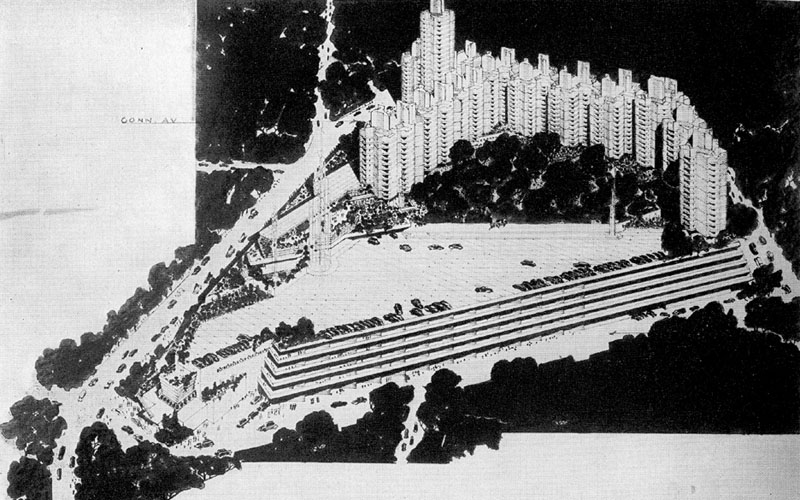
The Universal South Building located at 1825 Connecticut Avenue NW in the Dupont Circle neighborhood of Washington, D.C. Construction of the modernist style building was completed in 1959 to the designs of Leroy Werner and RTKL Associates.
The land the Universal South Building, Universal North Building, and Hilton Washington are built on was a ten-acre estate historically known as Temple Heights (also known as Dean's Tract or Dean's Estates). In 1940, architect Frank Lloyd Wright was chosen to design Crystal City (it was originally named Crystal Heights) on the site. The massive mixed-use unbuilt project would have included 14 high-rise towers, a 2,500-room hotel, an 1,100-seat theater, shops, and parking for 1,500 cars. Here's a photo of the design. You can read more about the project in this Washington Post article.
----------
This is one of my older photos I originally uploaded to Wikimedia Commons.

For years, Jordan has been associated with its epic history and landscapes, from the hidden ruined city of Petra to the red-sand dunes and canyons of Wadi Rum.
It's a country with stunning history, but not really known for hiking - the Jordan Trail, a recently introduced epic 650km route stretching the entire length of the state from its north to the south, may however well change that perception.
Each hike must have its most popular and admired part, and for the Jordan Trail it comes two-thirds of the way through the route with the stage from the Dana Biosphere Reserve to the ancient city of Petra.
Starting in one of Jordan's most scenic nature reserves, it takes four days mostly on the little-trodden and unmarked paths to finally reach the country's most iconic sights at Petra, which one enters - contrary to the vast majority of visitors - backdoor and alone.
-----
During the third day, we left Wadi Feid shortly before 5AM hiking in the eastern direction on the mostly dry rock riverbed.
The trail then continued along the escarpment line of the Jabal Safaha mountain ridge, offering stunning views of the deep valleys below us.
Having passed the Qutla ruins of a former settlement (no water source), we continued hiking in the southern direction, following now a slowly diminishing footpath.
Then, we entered an interesting sandstone landscape full of beautiful rock formations of different shapes and colours - the area here somehow reminded me of the Needles national park, Utah.
Then, we decided to make a shortcut to the Ammarin camp, our place of overnight stay - following a 4WD track to a ridge eastwards, we reached the pass realizing to our great relief that the shortcut is passable, despite quite steep descent requiring some minor scrambling.
We reached the secluded Ammarin camp shortly afterwards, and having much needed shower we enjoyed lazy laying on mattresses in the shade below a tall rock, sipping mint tea and taking a much needed rest.
© All rights reserved Ian C Brightman Please do not use this image on websites, blogs or any other media without my explicit written permission.
symbolism associated with the pansy is merriment and you occupy my thoughts. The pansy is also called the heartsease or Johnny Jump Up. The name pansy is derived from the French word pensée meaning "thought", and was so named because the flower resembles a human face. In August the pansy is thought to nod forward as if deep in thought.
The Dakshinkali Temple is located 22 kilometers from Kathmandu next to the village of Pharping. It's one of the main temples in Nepal. Twice every week thousands of people come here to worship the goddess Kali by sacrificing life animals, particularly cockerels and uncastrated male goats.
GODDESS KALI
Kālī (/ˈkɑːli/; Sanskrit: काली & Bengali: কালী; IPA: [kɑːliː]), also known as Kālikā (Sanskrit: कालिका), is the Hindu goddess associated with empowerment, or shakti. She is the fierce aspect of the goddess Durga. The name of Kali means black one and force of time; she is therefore called the Goddess of Time, Change, Power, Creation, Preservation, and Destruction. Her earliest appearance is that of a destroyer principally of evil forces. Various Shakta Hindu cosmologies, as well as Shākta Tantric beliefs, worship her as the ultimate reality or Brahman; and recent devotional movements re-imagine Kāli as a benevolent mother goddess. She is often portrayed standing or dancing on her husband, the god Shiva, who lies calm and prostrate beneath her. Worshipped throughout India but particularly South India, Bengal, and Assam, Kali is both geographically and culturally marginal.
ETYMOLOGY
Kālī is the feminine form of kālam ("black, dark coloured"). Kāla primarily means "time", but also means "black"; hence, Kālī means "the black one" or "beyond time". Kāli is strongly associated with Shiva, and Shaivas derive the masculine Kāla (an epithet of Shiva) from her feminine name. A nineteenth-century Sanskrit dictionary, the Shabdakalpadrum, states: कालः शिवः। तस्य पत्नीति - काली। kālaḥ śivaḥ। tasya patnīti kālī - "Shiva is Kāla, thus, his consort is Kāli".
Other names include Kālarātri ("black night"), as described above, and Kālikā ("relating to time"), and Kallie ("black alchemist"). Coburn notes that the name Kālī can be used as a proper name, or as a description of color.
Kāli's association with darkness stands in contrast to her consort, Shiva, whose body is covered by the white ashes of the cremation ground (Sanskrit: śmaśāna) where he meditates, and with which Kāli is also associated, as śmaśāna-kālī.
ORIGINS
Hugh Urban notes that although the word Kālī appears as early as the Atharva Veda, the first use of it as a proper name is in the Kathaka Grhya Sutra (19.7). Kali is the name of one of the seven tongues of Agni, the [Rigvedic] God of Fire, in the Mundaka Upanishad (2:4), but it is unlikely that this refers to the goddess. The first appearance of Kāli in her present form is in the Sauptika Parvan of the Mahabharata (10.8.64). She is called Kālarātri (literally, "black night") and appears to the Pandava soldiers in dreams, until finally she appears amidst the fighting during an attack by Drona's son Ashwatthama. She most famously appears in the sixth century Devi Mahatmyam as one of the shaktis of Mahadevi, and defeats the demon Raktabija ("Bloodseed"). The tenth-century Kalika Purana venerates Kāli as the ultimate reality.
According to David Kinsley, Kāli is first mentioned in Hinduism as a distinct goddess around 600 CE, and these texts "usually place her on the periphery of Hindu society or on the battlefield." She is often regarded as the Shakti of Shiva, and is closely associated with him in various Puranas. The Kalika Purana depicts her as the "Adi Shakti" (Fundamental Power) and "Para Prakriti" or beyond nature.
WORSHIP AND MANTRA
Kali could be considered a general concept, like Durga, and is mostly worshiped in the Kali Kula sect of worship. The closest way of direct worship is Maha Kali or Bhadra Kali (Bhadra in Sanskrit means 'gentle'). Kali is worshiped as one of the 10 Mahavidya forms of Adi Parashakti (Goddess Durga) or Bhagavathy according to the region. The mantra for worship is
Sanskrit: सर्वमङ्गलमाङ्गल्ये शिवे सर्वार्थसाधिके । शरण्ये त्र्यम्बके गौरि नारायणि नमोऽस्तु ते ॥
ॐ जयंती मंगल काली भद्रकाली कपालिनी । दुर्गा शिवा क्षमा धात्री स्वाहा स्वधा नमोऽस्तुते ॥
(Sarvamaṅgalamāṅgalyē śivē sarvārthasādhikē . śaraṇyē tryambakē gauri nārāyaṇi namō'stu tē.
Oṃ jayantī mangala kālī bhadrakālī kapālinī . durgā śivā ksamā dhātrī svāhā svadhā namō'stutē.)
YANTRA
Goddesses play an important role in the study and practice of Tantra Yoga, and are affirmed to be as central to discerning the nature of reality as are the male deities. Although Parvati is often said to be the recipient and student of Shiva's wisdom in the form of Tantras, it is Kali who seems to dominate much of the Tantric iconography, texts, and rituals. In many sources Kāli is praised as the highest reality or greatest of all deities. The Nirvana-tantra says the gods Brahma, Vishnu, and Shiva all arise from her like bubbles in the sea, ceaselessly arising and passing away, leaving their original source unchanged. The Niruttara-tantra and the Picchila-tantra declare all of Kāli's mantras to be the greatest and the Yogini-tantra, Kamakhya-tantra and the Niruttara-tantra all proclaim Kāli vidyas (manifestations of Mahadevi, or "divinity itself"). They declare her to be an essence of her own form (svarupa) of the Mahadevi.In the Mahanirvana-tantra, Kāli is one of the epithets for the primordial sakti, and in one passage Shiva praises her:At the dissolution of things, it is Kāla [Time]. Who will devour all, and by reason of this He is called Mahākāla [an epithet of Lord Shiva], and since Thou devourest Mahākāla Himself, it is Thou who art the Supreme Primordial Kālika. Because Thou devourest Kāla, Thou art Kāli, the original form of all things, and because Thou art the Origin of and devourest all things Thou art called the Adya [the Primordial One]. Re-assuming after Dissolution Thine own form, dark and formless, Thou alone remainest as One ineffable and inconceivable. Though having a form, yet art Thou formless; though Thyself without beginning, multiform by the power of Maya, Thou art the Beginning of all, Creatrix, Protectress, and Destructress that Thou art. The figure of Kāli conveys death, destruction, and the consuming aspects of reality. As such, she is also a "forbidden thing", or even death itself. In the Pancatattva ritual, the sadhaka boldly seeks to confront Kali, and thereby assimilates and transforms her into a vehicle of salvation. This is clear in the work of the Karpuradi-stotra, a short praise of Kāli describing the Pancatattva ritual unto her, performed on cremation grounds. (Samahana-sadhana)He, O Mahākāli who in the cremation-ground, naked, and with dishevelled hair, intently meditates upon Thee and recites Thy mantra, and with each recitation makes offering to Thee of a thousand Akanda flowers with seed, becomes without any effort a Lord of the earth. Oh Kāli, whoever on Tuesday at midnight, having uttered Thy mantra, makes offering even but once with devotion to Thee of a hair of his Shakti [his energy/female companion] in the cremation-ground, becomes a great poet, a Lord of the earth, and ever goes mounted upon an elephant.The Karpuradi-stotra clearly indicates that Kāli is more than a terrible, vicious, slayer of demons who serves Durga or Shiva. Here, she is identified as the supreme mistress of the universe, associated with the five elements. In union with Lord Shiva, she creates and destroys worlds. Her appearance also takes a different turn, befitting her role as ruler of the world and object of meditation. In contrast to her terrible aspects, she takes on hints of a more benign dimension. She is described as young and beautiful, has a gentle smile, and makes gestures with her two right hands to dispel any fear and offer boons. The more positive features exposed offer the distillation of divine wrath into a goddess of salvation, who rids the sadhaka of fear. Here, Kali appears as a symbol of triumph over death.
BENGALI TRADITION
Kali is also a central figure in late medieval Bengali devotional literature, with such devotees as Ramprasad Sen (1718–75). With the exception of being associated with Parvati as Shiva's consort, Kāli is rarely pictured in Hindu legends and iconography as a motherly figure until Bengali devotions beginning in the early eighteenth century. Even in Bengāli tradition her appearance and habits change little, if at all.
The Tantric approach to Kāli is to display courage by confronting her on cremation grounds in the dead of night, despite her terrible appearance. In contrast, the Bengali devotee appropriates Kāli's teachings adopting the attitude of a child, coming to love her unreservedly. In both cases, the goal of the devotee is to become reconciled with death and to learn acceptance of the way that things are. These themes are well addressed in Rāmprasād's work. Rāmprasād comments in many of his other songs that Kāli is indifferent to his wellbeing, causes him to suffer, brings his worldly desires to nothing and his worldly goods to ruin. He also states that she does not behave like a mother should and that she ignores his pleas:
Can mercy be found in the heart of her who was born of the stone? [a reference to Kali as the daughter of Himalaya]
Were she not merciless, would she kick the breast of her lord?
Men call you merciful, but there is no trace of mercy in you, Mother.
You have cut off the heads of the children of others, and these you wear as a garland around your neck.
It matters not how much I call you "Mother, Mother." You hear me, but you will not listen.
To be a child of Kāli, Rāmprasād asserts, is to be denied of earthly delights and pleasures. Kāli is said to refrain from giving that which is expected. To the devotee, it is perhaps her very refusal to do so that enables her devotees to reflect on dimensions of themselves and of reality that go beyond the material world.
A significant portion of Bengali devotional music features Kāli as its central theme and is known as Shyama Sangeet ("Music of the Night"). Mostly sung by male vocalists, today even women have taken to this form of music. One of the finest singers of Shyāma Sāngeet is Pannalal Bhattacharya.
In Bengal, Kāli is venerated in the festival Kali Puja, the new moon day of Ashwin month which coincides with Diwali festival.
In a unique form of Kāli worship, Shantipur worships Kāli in the form of a hand painted image of the deity known as Poteshwari (meaning the deity drawn on a piece of cloth).
LEGENDS
SLAYER AND RAKTABIJA
In Kāli's most famous legend, Devi Durga (Adi Parashakti) and her assistants, the Matrikas, wound the demon Raktabija, in various ways and with a variety of weapons in an attempt to destroy him. They soon find that they have worsened the situation for with every drop of blood that is dripped from Raktabija he reproduces a clone of himself. The battlefield becomes increasingly filled with his duplicates. Durga, in need of help, summons Kāli to combat the demons. It is said, in some versions, that Goddess Durga actually assumes the form of Goddess Kāli at this time. The Devi Mahatmyam describes:
Out of the surface of her (Durga's) forehead, fierce with frown, issued suddenly Kali of terrible countenance, armed with a sword and noose. Bearing the strange khatvanga (skull-topped staff ), decorated with a garland of skulls, clad in a tiger's skin, very appalling owing to her emaciated flesh, with gaping mouth, fearful with her tongue lolling out, having deep reddish eyes, filling the regions of the sky with her roars, falling upon impetuously and slaughtering the great asuras in that army, she devoured those hordes of the foes of the devas.
Kali consumes Raktabija and his duplicates, and dances on the corpses of the slain. In the Devi Mahatmya version of this story, Kali is also described as a Matrika and as a Shakti or power of Devi. She is given the epithet Cāṃuṇḍā (Chamunda), i.e. the slayer of the demons Chanda and Munda. Chamunda is very often identified with Kali and is very much like her in appearance and habit.
DAKSHINA KALI
In her most famous pose as Daksinakali, popular legends say that Kali, drunk on the blood of her victims, is about to destroy the whole universe when, urged by all the gods, Shiva lies in her way to stop her, and she steps upon his chest. Recognizing Shiva beneath her feet, she calms herself. Though not included in any of the puranas, popular legends state that Kali was ashamed at the prospect of keeping her husband beneath her feet and thus stuck her tongue out in shame. The Devi-Bhagavata Purana, which goes into great depths about the goddess Kali, reveals the tongue's actual symbolism.
The characteristic icons that depict Kali are the following; unbridled matted hair, open blood shot eyes, open mouth and a drooping tongue; in her hands, she holds a Khadga (bent sword or scimitar) and a human head; she has a girdle of human hands across her waist, and Shiva lies beneath her feet. The drooping out-stuck tongue represents her blood-thirst. Lord Shiva beneath her feet represents matter, as Kali energy. The depiction of Kali on Shiva shows that without energy, matter lies "dead". This concept has been simplified to a folk-tale depicting a wife placing her foot
on her husband and sticking her tongue out in shame. In tantric contexts, the tongue is seen to denote the element (guna) of rajas (energy and action) controlled by sattva.
If Kali steps on Shiva with her right foot and holds the sword in her left hand, she is considered to be Dakshina Kali. The Dakshina Kali Temple has important religious associations with the Jagannath Temple and it is believed that Daksinakali is the guardian of the kitchen of the Lord Jagannath Temple. Puranic tradition says that in Puri, Lord Jagannath is regarded as Daksinakalika. Goddess Dakshinakali plays an important role in the 'Niti' of Saptapuri Amavasya.
One South Indian tradition tells of a dance contest between Shiva and Kali. After defeating the two demons Sumbha and Nisumbha, Kali takes up residence in the forest of Thiruvalankadu or Thiruvalangadu. She terrorizes the surrounding area with her fierce, disruptive nature. One of Shiva's devotees becomes distracted while performing austerities, and asks Shiva to rid the forest of the destructive goddess. When Shiva arrives, Kali threatens him, and Shiva challenges Kali to a dance contest, wherein Kali matches Shiva until Shiva takes the "Urdhvatandava" step, vertically raising his right leg. Kali refuses to perform this step, which would not befit her as a woman, and becomes pacified.
SMASHAN KALI
If the Kali steps out with the left foot and holds the sword in her right hand, she is the terrible form of Mother, the Smashan Kali of the cremation ground. She is worshiped by tantrics, the followers of Tantra, who believe that one's spiritual discipline practiced in a smashan (cremation ground) brings success quickly. Sarda Devi, the consort of Ramakrishna Paramhansa, worshipped Smashan Kali at Dakshineshwar.
MATERNAL KALI
At the time of samundra manthan when amrit came out, along with that came out poison which was going to destroy the world hence on the request of all the gods, Lord Shiva drank it to save the world but as he is beyond death he didn't die but was very much in pain due to the poison effect hence he became a child so that Kali can feed him with her milk which will sooth out the poison effect.
MAHAKALI
Mahakali (Sanskrit: Mahākālī, Devanagari: महाकाली), literally translated as Great Kali, is sometimes considered as a greater form of Kali, identified with the Ultimate reality of Brahman. It can also be used as an honorific of the Goddess Kali, signifying her greatness by the prefix "Mahā-". Mahakali, in Sanskrit, is etymologically the feminized variant of Mahakala or Great Time (which is interpreted also as Death), an epithet of the God Shiva in Hinduism. Mahakali is the presiding Goddess of the first episode of the Devi Mahatmya. Here she is depicted as Devi in her universal form as Shakti. Here Devi serves as the agent who allows the cosmic order to be restored.
Kali is depicted in the Mahakali form as having ten heads, ten arms, and ten legs. Each of her ten hands is carrying a various implement which vary in different accounts, but each of these represent the power of one of the Devas or Hindu Gods and are often the identifying weapon or ritual item of a given Deva. The implication is that Mahakali subsumes and is responsible for the powers that these deities possess and this is in line with the interpretation that Mahakali is identical with Brahman. While not displaying ten heads, an "ekamukhi" or one headed image may be displayed with ten arms, signifying the same concept: the powers of the various Gods come only through Her grace.
ICONOGRAPHY
Kali is portrayed mostly in two forms: the popular four-armed form and the ten-armed Mahakali form. In both of her forms, she is described as being black in color but is most often depicted as blue in popular Indian art. Her eyes are described as red with intoxication, and in absolute rage, her hair is shown disheveled, small fangs sometimes protrude out of her mouth, and her tongue is lolling. She is often shown naked or just wearing a skirt made of human arms and a garland of human heads. She is also accompanied by serpents and a jackal while standing on a seemingly dead Shiva, usually right foot forward to symbolize the more popular Dakshinamarga or right-handed path, as opposed to the more infamous and transgressive Vamamarga or left-handed path.
In the ten-armed form of Mahakali she is depicted as shining like a blue stone. She has ten faces, ten feet, and three eyes for each head. She has ornaments decked on all her limbs. There is no association with Shiva.
The Kalika Purana describes Kali as possessing a soothing dark complexion, as perfectly beautiful, riding a lion, four-armed, holding a sword and blue lotuses, her hair unrestrained, body firm and youthful.
In spite of her seemingly terrible form, Kali Ma is often considered the kindest and most loving of all the Hindu goddesses, as she is regarded by her devotees as the Mother of the whole Universe. And because of her terrible form, she is also often seen as a great protector. When the Bengali saint Ramakrishna once asked a devotee why one would prefer to worship Mother over him, this devotee rhetorically replied, "Maharaj", when they are in trouble your devotees come running to you. But, where do you run when you are in trouble?"
According to Ramakrishna, darkness is the Ultimate Mother, or Kali:
My Mother is the principle of consciousness. She is Akhanda Satchidananda;
indivisible Reality, Awareness, and Bliss. The night sky between the stars is perfectly black.
The waters of the ocean depths are the same; The infinite is always mysteriously dark.
This inebriating darkness is my beloved Kali.
—Sri Ramakrishna
This is clear in the works of such contemporary artists as Charles Wish, and Tyeb Mehta, who sometimes take great liberties with the traditional, accepted symbolism, but still demonstrate a true reverence for the Shakta sect.
POPULAR FORM
Classic depictions of Kali share several features, as follows:
Kali's most common four armed iconographic image shows each hand carrying variously a sword, a trishul (trident), a severed head, and a bowl or skull-cup (kapala) catching the blood of the severed head.
Two of these hands (usually the left) are holding a sword and a severed head. The Sword signifies Divine Knowledge and the Human Head signifies human Ego which must be slain by Divine Knowledge in order to attain Moksha. The other two hands (usually the right) are in the abhaya (fearlessness) and varada (blessing) mudras, which means her initiated devotees (or anyone worshipping her with a true heart) will be saved as she will guide them here and in the hereafter.
She has a garland consisting of human heads, variously enumerated at 108 (an auspicious number in Hinduism and the number of countable beads on a Japa Mala or rosary for repetition of Mantras) or 51, which represents Varnamala or the Garland of letters of the Sanskrit alphabet, Devanagari. Hindus believe Sanskrit is a language of dynamism, and each of these letters represents a form of energy, or a form of Kali. Therefore, she is generally seen as the mother of language, and all mantras.
She is often depicted naked which symbolizes her being beyond the covering of Maya since she is pure (nirguna) being-consciousness-bliss and far above prakriti. She is shown as very dark as she is brahman in its supreme unmanifest state. She has no permanent qualities - she will continue to exist even when the universe ends. It is therefore believed that the concepts of color, light, good, bad do not apply to her - she is the pure, un-manifested energy, the Adi-shakti.
Kali as the Symbol of Creation , Freedom , Preservation and Destruction
The head that hangs in Kali's hand is a symbol of Ego and the scimitar which she is holding represents power and energy.It is believed that Kali is protecting the human race by that scimitar and also destroying the negativity and ego within human being. The body lying under Kali symbolizes ruination, is actually a form of Shiva. Kali steps her leg on the chest of the body and suppress ruination . Since she is standing on the pure white chest of Lord Shiva who, as pure primal awareness, lays in a passive reclining position, peacefully lies with his eyes half open in a state of bliss. Her hair is long, black and flowing freely depicting Her freedom from convention and the confines of conceptualization. The white teeth which Kali has stands for conscience and her red tongue represents greed. By pressing her white teeth on her tongue Kali refers to control greed.The goddess may appear terrible from outside but every symbol in Kali signifies truth of life. Since the earth was created out of darkness, the dark black color of Kali symbolizes the color from which everything was born. Her right hand side arms she shows the Abhaya mudra(gesture of fearlessness) and Vara mudra (gesture of welcome and charity) respectively . But on the other arm in left side she holds a bloody scimitar and a severed head depicting destruction and end of ego.
Kali as the Symbol of Mother Nature
The name Kali means Kala or force of time. When there were neither the creation, nor the sun, the moon, the planets, and the earth, there was only darkness and everything was created from the darkness. The Dark appearance of kali represents the darkness from which everything was born. Her complexion is deep blue, like the sky and ocean water as blue. As she is also the goddess of Preservation Kali is worshiped as mother to preserve the nature.Kali is standing calm on Shiva, her appearance represents the preservation of mother nature. Her free, long and black hair represents nature's freedom from civilization. Under the third eye of kali, the signs of both sun, moon and fire are visible which represent the driving forces of nature.
SHIVA IN KALI ICONOGRAPHY
In both these images she is shown standing on the prone, inert or dead body of Shiva. There is a legend for the reason behind her standing on what appears to be Shiva's corpse, which translates as follows:
Once Kali had destroyed all the demons in battle, she began a terrific dance out of the sheer joy of victory. All the worlds or lokas began to tremble and sway under the impact of her dance. So, at the request of all the Gods, Shiva himself asked her to desist from this behavior. However, she was too intoxicated to listen. Hence, Shiva lay like a corpse among the slain demons in order to absorb the shock of the dance into himself. When Kali eventually stepped upon Shiva, she realized she was trampling and hurting her husband and bit her tongue in shame.
The story described here is a popular folk tale and not described or hinted in any of the puranas. The puranic interpretation is as follows:
Once, Parvati asks Shiva to chose the one form among her 10 forms which he likes most. To her surprise, Shiva reveals that he is most comfortable with her Kali form, in which she is bereft of her jewellery, her human-form, her clothes, her emotions and where she is only raw, chaotic energy, where she is as terrible as time itself and even greater than time. As Parvati takes the form of Kali, Shiva lies at her feet and requests her to place her foot on his chest, upon his heart. Once in this form, Shiva requests her to have this place, below her feet in her iconic image which would be worshiped throughout.
This idea has been explored in the Devi-Bhagavata Purana [28] and is most popular in the Shyama Sangeet, devotional songs to Kali from the 12th to 15th centuries.
The Tantric interpretation of Kali standing on top of her husband is as follows:
The Shiv tattava (Divine Consciousness as Shiva) is inactive, while the Shakti tattava (Divine Energy as Kali) is active. Shiva and Kali represent Brahman, the Absolute pure consciousness which is beyond all names, forms and activities. Kali, on the other hand, represents the potential (and manifested) energy responsible for all names, forms and activities. She is his Shakti, or creative power, and is seen as the substance behind the entire content of all consciousness. She can never exist apart from Shiva or act independently of him, just as Shiva remains a mere corpse without Kali i.e., Shakti, all the matter/energy of the universe, is not distinct from Shiva, or Brahman, but is rather the dynamic power of Brahman. Hence, Kali is Para Brahman in the feminine and dynamic aspect while Shiva is the male aspect and static. She stands as the absolute basis for all life, energy and beneath her feet lies, Shiva, a metaphor for mass, which cannot retain its form without energy.
While this is an advanced concept in monistic Shaktism, it also agrees with the Nondual Trika philosophy of Kashmir, popularly known as Kashmir Shaivism and associated most famously with Abhinavagupta. There is a colloquial saying that "Shiva without Shakti is Shava" which means that without the power of action (Shakti) that is Mahakali (represented as the short "i" in Devanagari) Shiva (or consciousness itself) is inactive; Shava means corpse in Sanskrit and the play on words is that all Sanskrit consonants are assumed to be followed by a short letter "a" unless otherwise noted. The short letter "i" represents the female power or Shakti that activates Creation. This is often the explanation for why She is standing on Shiva, who is either Her husband and complement in Shaktism or the Supreme Godhead in Shaivism.
To properly understand this complex Tantric symbolism it is important to remember that the meaning behind Shiva and Kali does not stray from the non-dualistic parlance of Shankara or the Upanisads. According to both the Mahanirvana and Kularnava Tantras, there are two distinct ways of perceiving the same absolute reality. The first is a transcendental plane which is often described as static, yet infinite. It is here that there is no matter, there is no universe and only consciousness exists. This form of reality is known as Shiva, the absolute Sat-Chit-Ananda - existence, knowledge and bliss. The second is an active plane, an immanent plane, the plane of matter, of Maya, i.e., where the illusion of space-time and the appearance of an actual universe does exist. This form of reality is known as Kali or Shakti, and (in its entirety) is still specified as the same Absolute Sat-Chit-Ananda. It is here in this second plane that the universe (as we commonly know it) is experienced and is described by the Tantric seer as the play of Shakti, or God as Mother Kali.
From a Tantric perspective, when one meditates on reality at rest, as absolute pure consciousness (without the activities of creation, preservation or dissolution) one refers to this as Shiva or Brahman. When one meditates on reality as dynamic and creative, as the Absolute content of pure consciousness (with all the activities of creation, preservation or dissolution) one refers to it as Kali or Shakti. However, in either case the yogini or yogi is interested in one and the same reality - the only difference being in name and fluctuating aspects of appearance. It is this which is generally accepted as the meaning of Kali standing on the chest of Shiva.
Although there is often controversy surrounding the images of divine copulation, the general consensus is benign and free from any carnal impurities in its substance. In Tantra the human body is a symbol for the microcosm of the universe; therefore sexual process is responsible for the creation of the world. Although theoretically Shiva and Kali (or Shakti) are inseparable, like fire and its power to burn, in the case of creation they are often seen as having separate roles. With Shiva as male and Kali as female it is only by their union that creation may transpire. This reminds us of the prakrti and purusa doctrine of Samkhya wherein prakāśa- vimarśa has no practical value, just as without prakrti, purusa is quite inactive. This (once again) stresses the interdependencies of Shiva and Shakti and the vitality of their union.
Gopi Krishna proposed that Kali standing on the dead Shiva or Shava (Sanskrit for dead body) symbolised the helplessness of a person undergoing the changing process (psychologically and physiologically) in the body conducted by the Kundalini Shakti.
DEVELOPMENT
In the later traditions, Kali has become inextricably linked with Shiva. The unleashed form of Kali often becomes wild and uncontrollable, and only Shiva is able to tame her just as only Kali can tame Shiva. This is both because she is often a transformed version of one of his consorts and because he is able to match her wildness.
The ancient text of Kali Kautuvam describes her competition with Shiva in dance, from which the sacred 108 Karanas appeared. Shiva won the competition by acting the urdva tandava, one of the Karanas, by raising his feet to his head. Other texts describe Shiva appearing as a crying infant and appealing to her maternal instincts. While Shiva is said to be able to tame her, the iconography often presents her dancing on his fallen body, and there are accounts of the two of them dancing together, and driving each other to such wildness that the world comes close to unravelling.
Shiva's involvement with Tantra and Kali's dark nature have led to her becoming an important Tantric figure. To the Tantric worshippers, it was essential to face her Curse, the terror of death, as willingly as they accepted Blessings from her beautiful, nurturing, maternal aspect. For them, wisdom meant learning that no coin has only one side: as death cannot exist without life, so life cannot exist without death. Kali's role sometimes grew beyond that of a chaos - which could be confronted - to that of one who could bring wisdom, and she is given great metaphysical significance by some Tantric texts. The Nirvāna-tantra clearly presents her uncontrolled nature as the Ultimate Reality, claiming that the trimurti of Brahma, Vishnu and Rudra arise and disappear from her like bubbles from the sea. Although this is an extreme case, the Yogini-tantra, Kamakhya-tantra and the Niruttara-tantra declare her the svarupa (own-being) of the Mahadevi (the great Goddess, who is in this case seen as the combination of all devis).The final stage of development is the worshipping of Kali as the Great Mother, devoid of her usual violence. This practice is a break from the more traditional depictions. The pioneers of this tradition are the 18th century Shakta poets such as Ramprasad Sen, who show an awareness of Kali's ambivalent nature. Ramakrishna, the 19th century Bengali saint, was also a great devotee of Kali; the western popularity of whom may have contributed to the more modern, equivocal interpretations of this Goddess. Rachel McDermott's work, however, suggests that for the common, modern worshipper, Kali is not seen as fearful, and only those educated in old traditions see her as having a wrathful component. Some credit to the development of Devi must also be given to Samkhya. Commonly referred to as the Devi of delusion, Mahamaya or Durga, acting in the confines of (but not being bound by) the nature of the three gunas, takes three forms: Maha-Kali, Maha-Lakshmi and Maha-Saraswati, being her tamas-ika, rajas-ika and sattva-ika forms. In this sense, Kali is simply part of a larger whole.
Like Sir John Woodroffe and Georg Feuerstein, many Tantric scholars (as well as sincere practitioners) agree that, no matter how propitious or appalling you describe them, Shiva and Devi are simply recognizable symbols for everyday, abstract (yet tangible) concepts such as perception, knowledge, space-time, causation and the process of liberating oneself from the confines of such things. Shiva, symbolizing pure, absolute consciousness, and Devi, symbolizing the entire content of that consciousness, are ultimately one and the same - totality incarnate, a micro-macro-cosmic amalgamation of all subjects, all objects and all phenomenal relations between the "two." Like man and woman who both share many common, human traits yet at the same time they are still different and, therefore, may also be seen as complementary.
Worshippers prescribe various benign and horrific qualities to Devi simply out of practicality. They do this so they may have a variety of symbols to choose from, symbols which they can identify and relate with from the perspective of their own, ever-changing time, place and personal level of unfolding. Just like modern chemists or physicists use a variety of molecular and atomic models to describe what is unperceivable through rudimentary, sensory input, the scientists of ontology and epistemology must do the same. One of the underlying distinctions of Tantra, in comparison to other religions, is that it allows the devotee the liberty to choose from a vast array of complementary symbols and rhetoric which suit one's evolving needs and tastes. From an aesthetic standpoint, nothing is interdict and nothing is orthodox. In this sense, the projection of some of Devi's more gentle qualities onto Kali is not sacrilege and the development of Kali really lies in the practitioner, not the murthi.
A TIME magazine article of October 27, 1947, used Kali as a symbol and metaphor for the human suffering in British India during its partition that year. In 1971, Ms. Magazine used an image of Kali, her multiple arms juggling modern tasks, as a symbol of modern womanhood on its inaugural issue.
Swami Vivekananda wrote his favorite poem Kali the Mother in 1898.
KALI IN NEOPAGAN AND NEW AGE PRACTICE
An academic study of Western Kali enthusiasts noted that, "as shown in the histories of all cross-cultural religious transplants, Kali devotionalism in the West must take on its own indigenous forms if it is to adapt to its new environment."[60] The adoption of Kali by the West has raised accusations of cultural appropriation:
A variety of writers and thinkers have found Kali an exciting figure for reflection and exploration, notably feminists and participants in New Age spirituality who are attracted to goddess worship. [For them], Kali is a symbol of wholeness and healing, associated especially with repressed female power and sexuality. [However, such interpretations often exhibit] confusion and misrepresentation, stemming from a lack of knowledge of Hindu history among these authors, [who only rarely] draw upon materials written by scholars of the Hindu religious tradition. The majority instead rely chiefly on other popular feminist sources, almost none of which base their interpretations on a close reading of Kali's Indian background. The most important issue arising from this discussion - even more important than the question of 'correct' interpretation - concerns the adoption of other people's religious symbols. It is hard to import the worship of a goddess from another culture: religious associations and connotations have to be learned, imagined or intuited when the deep symbolic meanings embedded in the native culture are not available.
INCARNATIONS OF KALI
Draupadi, Wife of Pandavas, was an avatar of Kali, who born to assist Lord Krishna to destroy arrogant kings of India. There is a temple dedicated to this incarnation at Banni Mata Temple at Himachal Pradesh. The vedic deity Nirriti or the Puranic deity Alakshmi is often considered as incarnations of Kali.
WIKIPEDIA
Wikipedia reports, "A nymph (Greek: νύμφη, nymphē) in Greek mythology and in Latin mythology is a minor female nature deity typically associated with a particular location or landform. Different from goddesses, nymphs are generally regarded as divine spirits who animate nature, and are usually depicted as beautiful, young nubile maidens who love to dance and sing; their amorous freedom sets them apart from the restricted and chaste wives and daughters of the Greek polis. They are believed to dwell in mountains and groves, by springs and rivers, and also in trees and in valleys and cool grottoes." And in sea caves! - en.wikipedia.org/wiki/Nymph
New JOHHNY RANGER MCCOY Instagram! instagram.com/45surf
Welcome to your epic hero's journey! The beautiful 45surf goddess hath called ye to adventure, beckoning ye to read deeply Homer's Iliad and Odyssey, whence ye shall learn of yer own exalted artistic path guided by Hero's Journey Mythology. I wouldn't be saying it if it hadn't happened to me.
PRETTY! Canon 5D Mark II Photos of Beautiful Blonde Swimsuit Bikini (Green One Piece Swimsuit!) Model Goddess with Pretty Blue Eyes in a Sea Cave !
Some video of the goddess:
She was tall, thin, fit, and very pretty with long, blonde hair and blue eyes! From Sweden!
The Canon EOS 5D Mark II EF 24-105/4L IS USM was my workhorse until I got the Nikon D800 & D800E with the 70-200 mm 2.8 VR2 zoom.
Canon, Nikon, you can't go wrong with the pretty 45surf model goddesses! (Though the D800 is my new love.)
May the goddess inspire ye along a hero's journey of yer own making, and the path of yer own taking.
Was a classic socal autumn morning with a bright, blue, sunny sky! Hope the photos make you feel like you were there! :)
May the HJM Goddesses guide, inspire, and exalt ye along yer heroic artistic journey!
Shot in both RAW & JPEG, but all these photos are RAWs finished in Lightroom 5.3 ! :)
New Instagram! instagram.com/45surf
Join/like my facebook page! www.facebook.com/45surfHerosJourneyMythology
Follow me on facebook! facebook.com/elliot.mcgucken
A Gold 45 Goddess exalts the archetypal form of Athena--the Greek Goddess of wisdom, warfare, strategy, heroic endeavour, handicrafts and reason. A Gold 45 Goddess guards the beauty of dx4/dt=ic and embodies 45SURF's motto "Virtus, Honoris, et Actio Pro Veritas, Amor, et Bellus, (Strength, Honor, and Action for Truth, Love, and Beauty," and she stands ready to inspire and guide you along your epic, heroic journey into art and mythology. It is Athena who descends to call Telemachus to Adventure in the first book of Homer's Odyssey--to man up, find news of his true father Odysseus, and rid his home of the false suitors, and too, it is Athena who descends in the first book of Homer's Iliad, to calm the Rage of Achilles who is about to draw his sword so as to slay his commander who just seized Achilles' prize, thusly robbing Achilles of his Honor--the higher prize Achilles fought for. And now Athena descends once again, assuming the form of a Gold 45 Goddess, to inspire you along your epic journey of heroic endeavour.
A Gold 45 Goddess guards the wisdom of dx4/dt=ic -- my physics theory which appears on all the 45surf clothes. Yes I have a Ph.D. in physics! :) You can read more about my research and Hero's Journey Physics here:
herosjourneyphysics.wordpress.com/ MDT PROOF#2: Einstein (1912 Man. on Rel.) and Minkowski wrote x4=ict. Ergo dx4/dt=ic--the foundational equation of all time and motion which is on all the shirts and swimsuits. Every photon that hits my Nikon D800e's sensor does it by surfing the fourth expanding dimension, which is moving at c relative to the three spatial dimensions, or dx4/dt=ic!
May the Hero's Journey Mythology Goddess inspire you (as they have inspired me!) along your own artistic journey! All the Best on Your Epic Hero's Journey from Johnny Ranger McCoy! Catch those photons as they surf the fourth expanding dimension!
Maki & Associates.
Mildred Lane Kemper Art Museum.
Washington University in Saint Louis.
Saint Louis, Missouri.
Associate Administrator for the Science Mission Directorate John Grunsfeld speaks during a New Horizons Pluto Flyby briefing Monday, July 13, 2015 at the Johns Hopkins University Applied Physics Laboratory (APL) in Laurel, Maryland. Photo Credit: (NASA/Bill Ingalls)
Broadcasting House, Portland Place, London
Prospero and Ariel by Eric Gill, 1933.
Be not afeard; the isle is full of noises,
Sounds, and sweet airs, that give delight and hurt not.
Sometimes a thousand twangling instruments
Will hum about mine ears; and sometime voices,
That, if I then had waked after long sleep,
Will make me sleep again: and then, in dreaming,
The clouds methought would open, and show riches
Ready to drop upon me; that, when I waked,
I cried to dream again.
Ariel from The Tempest by William Shakespeare
-----------------------------------------------------------------------------------------------
Arthur Eric Rowton Gill, 1882-1940, was an English sculptor, typeface designer, stonecutter and printmaker, who was associated with the Arts and Crafts movement. A maverick socialist and radical Catholic, he is a controversial figure, with his well-known religious views and subject matter generally viewed as being at odds with his sexual behavior, including his erotic art. Gill was adamantly opposed to fascism, and was one of the few prominent Catholics in Britain to openly speak up for the cause of the Spanish Republicans. Gill became a pacifist, and helped set up the Catholic peace organisation Pax. Later Gill joined the Peace Pledge Union, as well as supporting the British branch of the Fellowship of Reconciliation. Gill died of lung cancer in Harefield Hospital in Middlesex in 1940. He was buried in Speen churchyard in the Chilterns, near Princes Risborough, the village where his last artistic community had practised.
-----------------------------------------------------------------------------------------------
'Over the front entrance of Broadcasting House stand the statues of Prospero and Ariel (from Shakespeare's last play The Tempest), by Eric Gill. Prospero, Ariel's master, stands 10ft tall and is depicted sending Ariel out into the world. Ariel, as the spirit of the air, was felt to be an appropriate symbol for the new mystery of broadcasting.
After Broadcasting House was opened and the statues were installed (1933), concern was voiced about the size of the sprite's genitalia. A question was tabled in the House of Commons, but the popular story, that Gill was ordered to modify the statue, is not substantiated.'
-----------------------------------------------------------------------------------------------
'Herbert Read first approached Gill about this commission in October 1929. In a letter of 15 February 1931 Gill referred to being in the thick of making designs for the BBC; he exhibited drawings for four different designs for this group at the French Gallery, November 1933. The drawing on stone of the approved design was done in March–April and the carving was begun in May and finished in August 1931, according to extracts from his diary supplied by his brother Evan Gill.
The theme of Prospero and Ariel set by the BBC did not appeal to Gill, and he wrote in his Autobiography: ‘I took it upon me to portray God the Father and God the Son. For even if that were not Shakespeare's meaning it ought to be the BBC's.’
(who hold the artist's models and plans for Prospero and Ariel)
-----------------------------------------------------------------------------------------------
2013: Sexual abuse charities are urging the BBC to remove the statute in front of Broadcasting House made by artist Eric Gill, after it was revealed that he sexually abused his two eldest daughters.
His 1932 statue Prospero And Ariel, inspired by Shakespeare's play The Tempest, occupies a prominent position at the entrance to the BBC's Broadcasting House in Portland Place, London.
Fay Maxted, chief executive of The Survivors' Trust, which supports survivors of rape and childhood sexual abuse, told the London Journalism Centre: 'It's an insult to allow a work like this to remain in such a public place. It is almost mocking survivors, it is intolerable.'
Peter Saunders, chief executive of the National Association For People Abused In Childhood, added: 'There's a strong argument that this should be removed. These symbols are in people's faces.' The statue was especially inappropriate in light of the recent Jimmy Savile scandal, he added.
Daily Mail, 22nd April 2013
-----------------------------------------------------------------------------------------------
puritanism noun Scrupulous moral rigor, especially hostility to social pleasures and indulgences: Extreme, often excessive strictness in moral or religious matters, esp. rigid austerity. (OED)
book-burning noun the destruction of writings of which the subject, the view of the author, or the like is considered politically or socially objectionable: used as a means of censorship or oppression. (CED)
witch-hunt noun a rigorous campaign to round up or expose dissenters on the pretext of safeguarding the welfare of the public witch-hunter noun ˈwitch-hunting noun, adjective (CED)
Puritanism is the source of our greatest hypocrisies and most crippling illusions - Molly Haskell
Liverpool Cathedral, 1904-78.
By Sir Giles Gilbert Scott (1880-1960).
Grade l listed.
A view from Hope Street.
—————————————————————————————————————-
Anglican Cathedral Church of Christ, St James Road, Liverpool, Merseyside, L1 7BY
Grade I listed
List Entry Number: 1361681
Summary
Anglican Cathedral, begun 1904 and completed 1978, by Sir Giles Gilbert Scott, brick with red sandstone facings, copper and reinforced concrete roofs, free and eclectic Gothic style. Lady Chapel built 1906-10 under the influence of G F Bodley. Chancel and East Transepts 1920-24, central Vestey Tower and West Transepts 1924-42, the Nave 1945-78.
Reasons for Designation
The Anglican Cathedral Church of Christ is listed at Grade I for the following principal reasons:
*Architectural Interest: it is the last undoubted masterpiece of the Gothic style, and of Gothic craftsmanship, in England. Its inspired use of light, space and height within the interior creates a feeling of awe and dramatic splendour and mark it out as one of the world's greatest modern cathedrals; *Architect: it was the life's work of the eminent C20 architect, Sir Giles Gilbert Scott, inventor of the New Gothic style; *Siting: set upon a raised plateau it forms a major landmark within Liverpool observable from all over the city and from the River Mersey ('the life of the city'); * Innovation: its construction displays great engineering skill that takes medieval concepts to their limits using C20 materials and techniques, including the tallest and widest Gothic arches in the world; *Craftsmanship: the quality of design, craftsmanship, artistry and materials is of the highest order throughout the building; *Artistry: the building's original concept has been enhanced by more modern works of art, including a powerful statue of the Welcoming Christ by Dame Elisabeth Frink.
History
In June 1901 Francis James Chavasse, 2nd Bishop of Liverpool embarked upon plans for an Anglican Cathedral on St James' Mount. An earlier scheme in 1885 for a cathedral designed by Sir William Emerson next to St George's Hall had already failed. Sir William Forwood offered his support to the bishop, along with the Earl of Derby who donated an initial £10,000. In 1902 a competition was held to find an architect and a suitable design. Out of 103 entries judged by G F Bodley and R Norman Shaw, five were shortlisted including that of Giles Gilbert Scott (son of George Gilbert Scott and grandson of Sir George Gilbert Scott, both renowned architects). Scott's Gothic design was finally selected in 1903, and he was a controversial choice for some due to his youth, inexperience and Catholicism. A compromise was reached whereby G F Bodley would act as joint architect.
Funding for the cathedral throughout its construction was raised by local subscription, including over £300,000 that was donated by Lord Vestey and his brother Sir Edmund Vestey for the construction of the Vestey Tower in memory of their parents. The builders of the cathedral were William Morrison & Son. The cathedral's sandstone came from the nearby Woolton Quarry, owned by the Marquis of Salisbury who later presented the quarry to the Cathedral Committee.
The foundation stone (inscribed by Herbert Tyson Smith) was laid on 19 July 1904 by King Edward VII. The partnership between Scott and Bodley was not happy and Scott was about to resign when Bodley died in 1907. The Lady Chapel (funded by Arthur Earle on behalf of the Earle and Langton families) was under construction at this time and the design had been heavily influenced by Bodley. Scott subsequently redesigned everything above the arcades that had not yet been constructed, and the Lady Chapel opened in 1910.
On 19 July 1924 the main part of the cathedral, including the Sanctuary, Chapter House, Chancel and Eastern Transepts, was consecrated in a ceremony attended by King George V and Queen Mary. The following day Giles Gilbert Scott received a knighthood. He was later appointed to the Order of Merit in 1944.
Work on the cathedral was delayed during both World Wars due to a shortage of labour and money, and damage sustained during the Second World War.
Scott's design evolved continuously right up until his death in 1960, and the finished building bears little resemblance to that chosen in the competition of 1903, which had a longer nave and twin towers instead of the final central tower. His 1942 design for the West Wall was redesigned by Frederick G Thomas and Roger Arthur Philip Pinkney in 1967 due to a lack of funding. The final consecration service took place on 25 October 1978 when the Cathedral was officially opened by Queen Elizabeth II.
A visitor centre/shop and refectory were created in the Welsford Porch and North-West Transept in 1984, and the Western Rooms were also converted into a dining area for larger groups in the 1980s. The statue of the Welcoming Christ by Dame Elisabeth Frink above the West Door was unveiled on 11 April 1993 by her son, Lin.
Details
PLAN
Nave (also known as 'The Well') to ritual west (actual north) end, Chancel to ritual east (actual south) end with Ambulatory behind. Chancel flanked by North and South Choir Aisles. Vast Central Space under the Vestey Tower. Transepts to ritual east and west of great porches. Octagonal Chapter House to ritual north-east corner, Lady Chapel to ritual south-east corner. Set upon raised plateau of St James' Mount with former quarry to ritual north side containing early C19 grade I registered St James' Cemetery (now St James' Gardens).
EXTERIOR
Massive in scale with contrasting east and west ends; that to the east is more elaborate, that to the west is in stark simplicity. Gableted buttresses. Mortar pointing to exterior and interior deliberately designed by Scott to highlight the Cathedral's stonework structure.
WEST ELEVATION: Scott's West wall re-designed by Frederick G Thomas and Roger Arthur Philip Pinkney in 1967 (completed 1978) due to lack of funding. Massive arched recess containing 3-light Great West window with pinnacled crest and glazed tympanum, flanking buttresses surmounted by pinnacles. West Door (cathedral's ceremonial entrance) with elaborate carved niche above surmounted by 13 ft high green bronze figure of the 'Welcoming Christ' by Dame Elisabeth Frink (1992), flanking side doors.
NAVE: 3-bays, in same style as choir but with fewer carved figures, large windows to north and south sides with simple geometrical tracery incorporating 2-lights with sexfoil above, quadrant jambs, separated by widely spaced buttresses, arcaded gallery above each window.
TRANSEPTS: Two transepts to each north and south side with tall traceried arched windows of 2-lights with octofoil above, copper roofs. Low arched projections to left and right of south transepts contain undercroft entrances.
PORCHES: Space in between transepts occupied by enormous porches with wide arched entrances and flat reinforced concrete roofs; that to ritual north side known as the Welsford Porch, that to ritual south side known as the Rankin Porch (cathedral's main entrance). Both accessed by stone stair flights, Hillsborough memorial stone laid by steps to Rankin Porch. Tall iron gates to Rankin Porch surmounted by elaborate cross and fish design. Both porches contain large arch to rear containing three wide carved oak doors with flat ogee heads merging into traceried tympanum. Triple-light windows to porch side walls with pierced balustraded gallery to top, studded oak doors to each side of Rankin Porch interior. Carved figure sculpture to both porches by Edward Carter Preston (Sculptor to the Cathedral, 1931-1955) influenced by C13 French portal figures, features based upon people working in the Cathedral. Sculpture depicts themes of Natural and Supernatural Virtues, Liberal Arts and Sciences, the Resurrection, and the Active Life. Carved figures of George V, Queen Mary, George VI, and Queen Elizabeth the Queen Mother to side walls of Rankin Porch.
VESTEY TOWER: 331 ft high, spans Central Space above and behind porches, design worked on from 1910 with Burnard Green as engineer. Square lower stage with plainer masonry and single large window to each north and south side incorporating 3-lights with rose above. Upper stage of tower is tapered with more elaborate decoration, octagonal corner turrets surmounted by carved lanterns, tall paired lancet belfry windows with timber louvres, 8 pinnacles surmounting top of tower with one slightly taller than the rest (added in February 1942 with carved initials of Scott and date).
CHOIR: 3-bays with large windows to north and south sides with simple geometrical tracery incorporating 2-lights with sexfoil above, carved figures and quadrant jambs, separated by widely spaced buttresses, arcaded gallery above each window. Walled founder's plot to south side in front of choir.
EAST CHOIR ELEVATION: Dominated by massive Great East window with curvilinear tracery and wide central mullion incorporating statue niches, four small pointed arched windows below, all flanked by full-height buttresses and corner turrets with short spires. 2-storey buttressed projection to bottom of elevation with series of lunette windows with cusped lights to upper level lighting Ambulatory, plain triple-light windows to lower level lighting former vestries (now education rooms).
CHAPTER HOUSE: Octagonal in shape with conical copper roof, taller stair turret to north-east side, tall pointed arched windows with curvilinear tracery, open balustraded balcony wraps around upper part and connects to main body of cathedral via a high-level bridge. Chapter House provided by Freemasons of West Lancashire in memory of 1st Earl of Lathom (their 1st Provincial Grand Master).
LADY CHAPEL: Tall, narrow, rectangular chapel of 8-bays with end bays forming polygonal apse. Tall slender windows with Decorated-style tracery, pierced balustrades above and below windows attached to full-height buttresses. Porch attached to bay 1 on south side with tall 2-arched balcony above, carved figures of children by Lillie Read in C15 Italian Renaissance style.
INTERIOR
Massive height with exceptionally tall Gothic arches to Nave, Transepts and Chancel. Subtle Gothic styling characterised by blank masonry broken up at strategic points by sophisticated and intricate detailing. Marble floor with hypocaust system. Animals feature heavily in the interior decoration. Interior woodwork by Green & Vardy and Waring & Gillow, metalwork by the Bromsgrove Guild, sculpture by Edward Carter Preston, Walter Gilbert and Louis Weingartner.
NAVE/'WELL': Sunken floor lower than Central Space and aisles, artificial sandstone vaulting known as 'Woolston' to second bay, triforium to each side of nave; that to south side contains Elizabeth Hoare Gallery. Late C20 toilets, lift, and stair inserted behind north wall of north aisle. Vestibule off adjacent south aisle containing stairs and lift to tower and operational K6 telephone kiosk (iconic 1935 design by Scott produced to celebrate Silver Jubilee of King George V). West Door with elaborate carved surround and crest with carving of royal coat of arms above, Great West/Benedicite window above.
DULVERTON BRIDGE/NAVE BRIDGE: Completed 1961, spans first bay of Nave and draws eye down length of cathedral. Surmounted by pierced oak balustrade and gallery, accessed by two stairs; that to south side with dedication stone reading 'THIS STONE WAS UNVEILED BY HER MAJESTY QUEEN ELIZABETH II ON 25TH OCTOBER 1978 AT THE SERVICE OF DEDICATION TO MARK THE COMPLETION OF THIS CATHEDRAL', that to north side with stone displaying carved initials of Queen Elizabeth and Duke of Edinburgh with entwined lovers' knot.
NORTH-WEST TRANSEPT: Contains shop and mezzanine cafe, converted in late C20.
SOUTH-WEST TRANSEPT (BAPTISTRY): Ornate dodecagon font of buff coloured marble with carved figures of apostles to each side by Edward Carter Preston, 39 ft high elaborate oak baldachino (ornamental canopy) designed by Scott with painted and gilded ornamented panelled ceiling, 15 ft high carved oak font cover with pulley system concealed in columns of baldachino, all set upon black marble platform with inlaid mosaic depicting breaking waves and fishes representing Christianity. Robing rooms below transepts converted into the Western Rooms (banqueting rooms).
CENTRAL SPACE (area between transepts underneath tower): Circular inlaid marble memorial to Scott to centre of floor reads '1880-1960/SIR GILES GILBERT SCOTT/O.M..R.A./ARCHITECT'. Three doorways to each north and south side lead to Rankin and Welsford Porches, similarly styled to the outer doors with sculpture by Edward Carter Preston, tower windows above, vaulted vestibule beyond doors to Welsford Porch now contains a cafe. Two paintings by Adrian Wiszniewski depict the parable of the Good Samaritan and the House built upon Rock, donated by the Jerusalem Trust in 1996. Star-shaped vaulted ceiling to Central Space with central circular opening through which the bells were hauled, Corona Gallery immediately below vaulting (originally used by cathedral's choir).
TOWER: Reinforced concrete girdle to base, steel cradle supports 14 bells (highest and heaviest peal in the world) including the great Bourdon Bell ('Great George'), bells cast by Whitechapel Bell Foundry, psalm texts incorporated onto each bell. Massive bell chamber with tall oak louvres, concrete stairs lead up to roof.
NORTH-EAST TRANSEPT/WAR MEMORIAL CHAPEL: Ornate alabaster and gilt altarpiece. Low rectangular carved alabaster cenotaph set on shallow plinth to front of chapel surmounted by bronze case containing the Roll of Honour (names of 40,000 soldiers, sailors and airmen from the Liverpool area lost during the First World War), bronze angels set to each corner of the case face inwards with kneeling figures of a soldier, sailor, airman and marine facing outwards. Wide arched porch surmounted by balustraded gallery to each side of transept; that to east side has glass case with decorative carved surround containing King's Regiment's Roll of Honour. Military colours displayed to each side wall with carved regiment badges above. Ship's bell of HMS Liverpool commemorating Liverpool's role as allied headquarters during Battle of the Atlantic in the Second World War.
SOUTH-EAST TRANSEPT (DERBY TRANSEPT): Contains tomb of 16th Earl of Derby (first chairman of Cathedral Committee) designed by Scott, bronze memorial depicts recumbent effigy of the Earl resting his head on a sculpture of the Cathedral with a timorous mouse peering out from his drapery.
CHANCEL: Divided into Choir and Sanctuary. Carved stone pulpit with pierced balustrade and statue niches to left of Chancel entrance, incorporates carved inscription in memory of Sir Arthur Forwood and John Torr who raised the Bishopric Endowment Fund. Elaborate carved oak organ cases either side of Choir take up a complete bay, designed by Scott, project slightly into the Choir, contain organ by Henry Willis III installed 1926, rebuilt in 1958-60 and made electric by Henry Willis IV, console to north side, organ gifted by Mrs Barrow. Carved oak clergy and choir stalls (latter gifted by Lord & Lady Waring), incorporate carved paired Liver birds guarding the choir stall steps, Bishop's Throne with Diocesan crest carved above gifted by Miss Watt, crest replicated to mosaic in Presbytery floor (eastern part of Choir) in front. Two paintings behind choir stalls by Christopher Le Brun depict Good Samaritan and Return of the Prodigal Son, donated by the Jerusalem Trust in 1996. Decorative patterned marble floor to Sanctuary. Altar set upon stepped platform (steps in alternating light and dark coloured marble). Highly elaborate carved stone and gilded reredos behind by Weingartner & Gilbert, overall design by Scott influenced by Spain, gifted by Mrs Mark Wood, figures designed and carved by Walter Gilbert, figures in lighter coloured Wooler sandstone carved by Arthur Turner. Lower reredos panel depicts Last Supper, centre panel depicts Crucifixion flanked by scenes of the Passion, outer panels depict Nativity and Resurrection. Altar rail supported by ten bronze figures depicting Ten Commandments, by Weingartner & Gilbert.
NORTH CHOIR AISLE: Memorial inscriptions to walls, door to west end leads into Chapel of the Holy Spirit with alabaster altarpiece depicting Jesus praying at Sea of Galilee by William Gough, 'Redemption' artwork by Arthur Dooley and Ann McTavish.
CHAPTER HOUSE: Tall geometric-patterned metal entrance gates by Keith Scott (1980s). Concrete domed ceiling, patterned marble floor. Panelled oak stalls to lower part of walls with carved detailing to Bishops' and Dean's stalls, plain panelled oak altar with altar painting of Crucifixion (Craigie Aitchison, 1998). Large carved stone relief crests in between stained glass windows. Oak door with ornate metal strap hinges incorporating Lancashire rose motifs and carved stone surround set to north-east corner leads to turret stair and high-level gallery above Chapter House floor.
AMBULATORY: Situated behind High Altar, lower floor level, corbelled ribbed vaulted ceiling with carved bosses. Four arched openings to west side (with stained glass windows above) lead into lobby area with series of oak doors with decorative ironwork and carved stone surrounds (one of which depicts a rose and Bishop's mitre), former vestries behind now used as education rooms. Two wide arched openings to west side of Ambulatory provide processional route in and out of Sanctuary. Stair flights to each north and south end set within arched openings accessing choir aisles, small corbelled balconies above.
SOUTH CHOIR AISLE: Monuments to Bishop Chavasse, Bishop Ryle and Dean Frederick Dwelly to north side, foundation stone to south side with inscriptions by Herbert Tyson Smith reading 'TO THE GLORY OF GOD THIS FOUNDATION STONE WAS LAID BY KING EDWARD THE SEVENTH ON THE 19TH DAY OF JULY 1904', and 'OTHER FOUNDATION CAN NO MAN LAY THAN THAT WHICH IS LAID, WHICH IS JESUS CHRIST'. Stained glass rose windows to west end of each Choir Aisle. Two doors towards east end of south wall of South Choir Aisle lead to Lady Chapel; that to west accesses a stone stair leading to the chapel floor, door to east leads to arcaded gallery to west end of Lady Chapel with short stair flight connecting to main chapel stair.
LADY CHAPEL: By Bodley and Scott, richly decorated, dedicated to Mary, mother of Jesus. Black and white marble chequerboard floor with interspersed motifs, decorative metal pendant lights by Scott, elaborate rib vaulted ceiling. Fine decorative stone carving by Joseph Phillips. Original choir stalls now removed. Wall piers linked by arches and pierced by narrow passage aisles, support triforium surmounted by elaborate crest, 38 carved angels with instruments project out above triforium, stylised stone inscription of the text 'GOD SO LOVED THE WORLD, THAT HE GAVE HIS ONLY BEGOTTEN SON...' (St John 3:16) carved below triforium, tall stained glass windows above and behind. Altar to east end with ornate tryptych reredos designed by Bodley and Scott, figures by G W Wilson, constructed by Rattee & Kent, centrepiece with delicate gilt filigree surrounding painted panels depicting the Nativity and Christ's early ministry, flanked by blue panelled wings to each side with gilt text. C15 kneeling figure of Our Lady by Giovanni della Robbia to left of altar. 'Alleluia Door' to north side of chapel with bronze handle incorporating a snail and salamander, ornate carved stone surround incorporating 'ALLELUIA' and relief crown above door. Elaborate carved oak organ case designed by Scott to west end above arcaded gallery.
STAINED GLASS: Window themes chosen by stained glass committee led by Sir Frederick Radcliffe with large input from Scott.
GREAT WEST WINDOW/BENEDICITE WINDOW: By Carl Edwards, 3 lancets over 52ft high depicting creation with separate lunette window to top depicting the Risen Lord, covers 1600 sq ft in total, installed in 1978.
NAVE AISLES: Windows depict historical development of the ministry, teaching and liturgy of the Church of England. Bishops' window by William Wilson depicts various historical bishops. All remaining windows to Nave by Carl Edwards; Parsons' window depicts various clergy members. Laymen's window depicts tradesmen who worked on the cathedral and committee members, including G F Bodley, Sir Giles Gilbert Scott, Sir William Forwood & the Earl of Derby. Musicians' Window depicts contributors to Anglican music. Hymnologists' window depicts hymn writers. Scholars' window depicts Oxford & Cambridge scholars, including the first Dean of Liverpool, Dean Frederick W Dwelly.
NORTH-WEST TRANSEPT: Window by Herbert Hendrie depicts theme of Church and State, including King George V and Queen Mary at 1924 consecration.
SOUTH-WEST TRANSEPT (BAPTISTRY): Window by Herbert Hendrie depicts salvation and healing through water, and baptisms.
CENTRAL SPACE: Old Testament window to north side of Central Space by James H Hogan depicts Old Testament figures and scenes, including Call of Abraham. New Testament window to south side of Central Space (also by Hogan) depicts New Testament figures and scenes, including Nativity and Crucifixion.
NORTH-EAST TRANSEPT/WAR MEMORIAL CHAPEL: Window by J W Brown & James H Hogan has theme of sacrifice and risen life.
SOUTH-EAST TRANSEPT: Window by J W Brown destroyed during the Second World War, replaced with simplified version by James H Hogan in same theme of Jesus' miracles.
GREAT EAST WINDOW/TE DEUM WINDOW: By J W Brown of Whitefriars Studios, gifted by Mrs Ismay, illustrates traditional hymn of the church 'Te Deum Laudamus', alternating bands of colour and clearer glass as dictated by Scott. Septfoil window to top depicts risen Jesus surrounded by heavenly chorus, two sets of paired lancets below with curvilinear-style tracery to top depict heavenly choirs with representatives of the faithful on Earth below, including apostles, saints, martyrs, and figures from the arts, science, law, commerce, scholarship, architecture and the army.
NORTH CHOIR AISLE: North Choir Aisle windows by J W Brown. 'Sapphire' window depicts St Matthew (symbolised as an angel) and Epiphany, 'Gold' window depicts St Luke (symbolised as an ox) and feeding of the five thousand, rose window to east end depicts journeys across the sea undertaken in faith.
CHAPTER HOUSE: Windows originally by Morris & Co, damaged in the Second World War and repaired by James Powell & Sons, depict interests and traditions of the Freemasons. Corn Merchants' window to Chapter House stair by C E Kempe & Co Ltd commemorates Woodward family (Liverpool corn merchants) 1803-1915.
AMBULATORY: Four windows by Burlison & Grylls each depict a pair of saints associated with the four nations of the British Isles.
SOUTH CHOIR AISLE: Windows by James H Hogan. 'Ruby' window depicts St John (symbolised as an eagle) and various biblical events, 'Emerald' window depicts St Mark (symbolised as a lion) and scenes from his gospel, rose window to east end by J W Brown depicts biblical demonstrations of God's power in and through water.
LADY CHAPEL: Windows illustrate role of women in history of faith from biblical times to C20, scroll runs across all windows displaying words of the Magnificat. Original glass designed by J W Brown destroyed during the Second World War, replaced by simplified adaptations by James H Hogan and Carl Edwards, gallery window above and behind organ by Hogan depicts Annunciation. Noble Women windows on west stair and atrium by J W Brown, 1921, donated by Girls' Friendly Society. Damaged in the Second World War but re-made to original designs, depict women who contributed to society, including Elizabeth Fry, Louisa Stewart, Grace Darling & Kitty Wilkinson.
Legacy
The contents of this record have been generated from a legacy data system.
Legacy System number: 359401
Legacy System:
LBS
Sources
Books and journals
Brooks, J, Crampton, M, Liverpool Cathedral Guidebook, (2007)
Brown, S, de Figuereido, P, Religion and Place: Liverpool's Historic Places of Worship, (2008), 53-58
Kennerley, P (ed), The Building of Liverpool Cathedral, (2008)
Sharples, J, Pevsner Architectural Guides: Liverpool, (2004), 73-82
Vincent, N T, The Stained Glass of Liverpool Cathedral, (2002)
Websites
Scott, Sir Giles Gilbert (1880-1960), accessed from www.oxforddnb.com/view/article/35987
Sir Giles Gilbert Scott, accessed from www.britannica.com/EBchecked/topic/529593/Sir-Giles-Gilbe...
War Memorials Online, accessed 16 August 2017 from www.warmemorialsonline.org.uk/memorial/108701
War Memorials Online, accessed 16 August 2017 from www.warmemorialsonline.org.uk/memorial/120295
War Memorials Online, accessed 16 August 2017 from www.warmemorialsonline.org.uk/memorial/120084
War Memorials Online, accessed 16 August 2017 from www.warmemorialsonline.org.uk/memorial/108709
War Memorials Register, accessed 16 August 2017 from www.iwm.org.uk/memorials/item/memorial/15157
War Memorials Register, accessed 16 August 2017 from www.iwm.org.uk/memorials/item/memorial/62832
War Memorials Register, accessed 16 August 2017 from www.iwm.org.uk/memorials/item/memorial/62833
War Memorials Register, accessed 16 August 2017 from www.iwm.org.uk/memorials/item/memorial/15149
Design by M Moser Associates
When workspace designer M Moser redesigned its Hong Kong office, it was determined to visibly demonstrate the benefits of migrating to a more technologically sophisticated, collaborative and Sustainable style of working. The doubling of existing meeting spaces and integration of shared areas such as team hubs, plus ‘heads down’ rooms for more private working and meetings ensured enhanced knowledge sharing. Collaboration was further improved by the seamless integration of new technologies. Incorporating optimised natural daylight, plus energy-efficient individually-lit, island style personal workstations and extensively recycling existing fittings and furnishings, the new office shortly expects to receive LEED certification.
Lead Designer: Karen Wong
Photography: Vitus Lau, Stefan Ripperger
Text: W. Frederic Nitschke
The Dakshinkali Temple is located 22 kilometers from Kathmandu next to the village of Pharping. It's one of the main temples in Nepal. Twice every week thousands of people come here to worship the goddess Kali by sacrificing life animals, particularly cockerels and uncastrated male goats.
GODDESS KALI
Kālī (/ˈkɑːli/; Sanskrit: काली & Bengali: কালী; IPA: [kɑːliː]), also known as Kālikā (Sanskrit: कालिका), is the Hindu goddess associated with empowerment, or shakti. She is the fierce aspect of the goddess Durga. The name of Kali means black one and force of time; she is therefore called the Goddess of Time, Change, Power, Creation, Preservation, and Destruction. Her earliest appearance is that of a destroyer principally of evil forces. Various Shakta Hindu cosmologies, as well as Shākta Tantric beliefs, worship her as the ultimate reality or Brahman; and recent devotional movements re-imagine Kāli as a benevolent mother goddess. She is often portrayed standing or dancing on her husband, the god Shiva, who lies calm and prostrate beneath her. Worshipped throughout India but particularly South India, Bengal, and Assam, Kali is both geographically and culturally marginal.
ETYMOLOGY
Kālī is the feminine form of kālam ("black, dark coloured"). Kāla primarily means "time", but also means "black"; hence, Kālī means "the black one" or "beyond time". Kāli is strongly associated with Shiva, and Shaivas derive the masculine Kāla (an epithet of Shiva) from her feminine name. A nineteenth-century Sanskrit dictionary, the Shabdakalpadrum, states: कालः शिवः। तस्य पत्नीति - काली। kālaḥ śivaḥ। tasya patnīti kālī - "Shiva is Kāla, thus, his consort is Kāli".
Other names include Kālarātri ("black night"), as described above, and Kālikā ("relating to time"), and Kallie ("black alchemist"). Coburn notes that the name Kālī can be used as a proper name, or as a description of color.
Kāli's association with darkness stands in contrast to her consort, Shiva, whose body is covered by the white ashes of the cremation ground (Sanskrit: śmaśāna) where he meditates, and with which Kāli is also associated, as śmaśāna-kālī.
ORIGINS
Hugh Urban notes that although the word Kālī appears as early as the Atharva Veda, the first use of it as a proper name is in the Kathaka Grhya Sutra (19.7). Kali is the name of one of the seven tongues of Agni, the [Rigvedic] God of Fire, in the Mundaka Upanishad (2:4), but it is unlikely that this refers to the goddess. The first appearance of Kāli in her present form is in the Sauptika Parvan of the Mahabharata (10.8.64). She is called Kālarātri (literally, "black night") and appears to the Pandava soldiers in dreams, until finally she appears amidst the fighting during an attack by Drona's son Ashwatthama. She most famously appears in the sixth century Devi Mahatmyam as one of the shaktis of Mahadevi, and defeats the demon Raktabija ("Bloodseed"). The tenth-century Kalika Purana venerates Kāli as the ultimate reality.
According to David Kinsley, Kāli is first mentioned in Hinduism as a distinct goddess around 600 CE, and these texts "usually place her on the periphery of Hindu society or on the battlefield." She is often regarded as the Shakti of Shiva, and is closely associated with him in various Puranas. The Kalika Purana depicts her as the "Adi Shakti" (Fundamental Power) and "Para Prakriti" or beyond nature.
WORSHIP AND MANTRA
Kali could be considered a general concept, like Durga, and is mostly worshiped in the Kali Kula sect of worship. The closest way of direct worship is Maha Kali or Bhadra Kali (Bhadra in Sanskrit means 'gentle'). Kali is worshiped as one of the 10 Mahavidya forms of Adi Parashakti (Goddess Durga) or Bhagavathy according to the region. The mantra for worship is
Sanskrit: सर्वमङ्गलमाङ्गल्ये शिवे सर्वार्थसाधिके । शरण्ये त्र्यम्बके गौरि नारायणि नमोऽस्तु ते ॥
ॐ जयंती मंगल काली भद्रकाली कपालिनी । दुर्गा शिवा क्षमा धात्री स्वाहा स्वधा नमोऽस्तुते ॥
(Sarvamaṅgalamāṅgalyē śivē sarvārthasādhikē . śaraṇyē tryambakē gauri nārāyaṇi namō'stu tē.
Oṃ jayantī mangala kālī bhadrakālī kapālinī . durgā śivā ksamā dhātrī svāhā svadhā namō'stutē.)
YANTRA
Goddesses play an important role in the study and practice of Tantra Yoga, and are affirmed to be as central to discerning the nature of reality as are the male deities. Although Parvati is often said to be the recipient and student of Shiva's wisdom in the form of Tantras, it is Kali who seems to dominate much of the Tantric iconography, texts, and rituals. In many sources Kāli is praised as the highest reality or greatest of all deities. The Nirvana-tantra says the gods Brahma, Vishnu, and Shiva all arise from her like bubbles in the sea, ceaselessly arising and passing away, leaving their original source unchanged. The Niruttara-tantra and the Picchila-tantra declare all of Kāli's mantras to be the greatest and the Yogini-tantra, Kamakhya-tantra and the Niruttara-tantra all proclaim Kāli vidyas (manifestations of Mahadevi, or "divinity itself"). They declare her to be an essence of her own form (svarupa) of the Mahadevi.In the Mahanirvana-tantra, Kāli is one of the epithets for the primordial sakti, and in one passage Shiva praises her:At the dissolution of things, it is Kāla [Time]. Who will devour all, and by reason of this He is called Mahākāla [an epithet of Lord Shiva], and since Thou devourest Mahākāla Himself, it is Thou who art the Supreme Primordial Kālika. Because Thou devourest Kāla, Thou art Kāli, the original form of all things, and because Thou art the Origin of and devourest all things Thou art called the Adya [the Primordial One]. Re-assuming after Dissolution Thine own form, dark and formless, Thou alone remainest as One ineffable and inconceivable. Though having a form, yet art Thou formless; though Thyself without beginning, multiform by the power of Maya, Thou art the Beginning of all, Creatrix, Protectress, and Destructress that Thou art. The figure of Kāli conveys death, destruction, and the consuming aspects of reality. As such, she is also a "forbidden thing", or even death itself. In the Pancatattva ritual, the sadhaka boldly seeks to confront Kali, and thereby assimilates and transforms her into a vehicle of salvation. This is clear in the work of the Karpuradi-stotra, a short praise of Kāli describing the Pancatattva ritual unto her, performed on cremation grounds. (Samahana-sadhana)He, O Mahākāli who in the cremation-ground, naked, and with dishevelled hair, intently meditates upon Thee and recites Thy mantra, and with each recitation makes offering to Thee of a thousand Akanda flowers with seed, becomes without any effort a Lord of the earth. Oh Kāli, whoever on Tuesday at midnight, having uttered Thy mantra, makes offering even but once with devotion to Thee of a hair of his Shakti [his energy/female companion] in the cremation-ground, becomes a great poet, a Lord of the earth, and ever goes mounted upon an elephant.The Karpuradi-stotra clearly indicates that Kāli is more than a terrible, vicious, slayer of demons who serves Durga or Shiva. Here, she is identified as the supreme mistress of the universe, associated with the five elements. In union with Lord Shiva, she creates and destroys worlds. Her appearance also takes a different turn, befitting her role as ruler of the world and object of meditation. In contrast to her terrible aspects, she takes on hints of a more benign dimension. She is described as young and beautiful, has a gentle smile, and makes gestures with her two right hands to dispel any fear and offer boons. The more positive features exposed offer the distillation of divine wrath into a goddess of salvation, who rids the sadhaka of fear. Here, Kali appears as a symbol of triumph over death.
BENGALI TRADITION
Kali is also a central figure in late medieval Bengali devotional literature, with such devotees as Ramprasad Sen (1718–75). With the exception of being associated with Parvati as Shiva's consort, Kāli is rarely pictured in Hindu legends and iconography as a motherly figure until Bengali devotions beginning in the early eighteenth century. Even in Bengāli tradition her appearance and habits change little, if at all.
The Tantric approach to Kāli is to display courage by confronting her on cremation grounds in the dead of night, despite her terrible appearance. In contrast, the Bengali devotee appropriates Kāli's teachings adopting the attitude of a child, coming to love her unreservedly. In both cases, the goal of the devotee is to become reconciled with death and to learn acceptance of the way that things are. These themes are well addressed in Rāmprasād's work. Rāmprasād comments in many of his other songs that Kāli is indifferent to his wellbeing, causes him to suffer, brings his worldly desires to nothing and his worldly goods to ruin. He also states that she does not behave like a mother should and that she ignores his pleas:
Can mercy be found in the heart of her who was born of the stone? [a reference to Kali as the daughter of Himalaya]
Were she not merciless, would she kick the breast of her lord?
Men call you merciful, but there is no trace of mercy in you, Mother.
You have cut off the heads of the children of others, and these you wear as a garland around your neck.
It matters not how much I call you "Mother, Mother." You hear me, but you will not listen.
To be a child of Kāli, Rāmprasād asserts, is to be denied of earthly delights and pleasures. Kāli is said to refrain from giving that which is expected. To the devotee, it is perhaps her very refusal to do so that enables her devotees to reflect on dimensions of themselves and of reality that go beyond the material world.
A significant portion of Bengali devotional music features Kāli as its central theme and is known as Shyama Sangeet ("Music of the Night"). Mostly sung by male vocalists, today even women have taken to this form of music. One of the finest singers of Shyāma Sāngeet is Pannalal Bhattacharya.
In Bengal, Kāli is venerated in the festival Kali Puja, the new moon day of Ashwin month which coincides with Diwali festival.
In a unique form of Kāli worship, Shantipur worships Kāli in the form of a hand painted image of the deity known as Poteshwari (meaning the deity drawn on a piece of cloth).
LEGENDS
SLAYER AND RAKTABIJA
In Kāli's most famous legend, Devi Durga (Adi Parashakti) and her assistants, the Matrikas, wound the demon Raktabija, in various ways and with a variety of weapons in an attempt to destroy him. They soon find that they have worsened the situation for with every drop of blood that is dripped from Raktabija he reproduces a clone of himself. The battlefield becomes increasingly filled with his duplicates. Durga, in need of help, summons Kāli to combat the demons. It is said, in some versions, that Goddess Durga actually assumes the form of Goddess Kāli at this time. The Devi Mahatmyam describes:
Out of the surface of her (Durga's) forehead, fierce with frown, issued suddenly Kali of terrible countenance, armed with a sword and noose. Bearing the strange khatvanga (skull-topped staff ), decorated with a garland of skulls, clad in a tiger's skin, very appalling owing to her emaciated flesh, with gaping mouth, fearful with her tongue lolling out, having deep reddish eyes, filling the regions of the sky with her roars, falling upon impetuously and slaughtering the great asuras in that army, she devoured those hordes of the foes of the devas.
Kali consumes Raktabija and his duplicates, and dances on the corpses of the slain. In the Devi Mahatmya version of this story, Kali is also described as a Matrika and as a Shakti or power of Devi. She is given the epithet Cāṃuṇḍā (Chamunda), i.e. the slayer of the demons Chanda and Munda. Chamunda is very often identified with Kali and is very much like her in appearance and habit.
DAKSHINA KALI
In her most famous pose as Daksinakali, popular legends say that Kali, drunk on the blood of her victims, is about to destroy the whole universe when, urged by all the gods, Shiva lies in her way to stop her, and she steps upon his chest. Recognizing Shiva beneath her feet, she calms herself. Though not included in any of the puranas, popular legends state that Kali was ashamed at the prospect of keeping her husband beneath her feet and thus stuck her tongue out in shame. The Devi-Bhagavata Purana, which goes into great depths about the goddess Kali, reveals the tongue's actual symbolism.
The characteristic icons that depict Kali are the following; unbridled matted hair, open blood shot eyes, open mouth and a drooping tongue; in her hands, she holds a Khadga (bent sword or scimitar) and a human head; she has a girdle of human hands across her waist, and Shiva lies beneath her feet. The drooping out-stuck tongue represents her blood-thirst. Lord Shiva beneath her feet represents matter, as Kali energy. The depiction of Kali on Shiva shows that without energy, matter lies "dead". This concept has been simplified to a folk-tale depicting a wife placing her foot
on her husband and sticking her tongue out in shame. In tantric contexts, the tongue is seen to denote the element (guna) of rajas (energy and action) controlled by sattva.
If Kali steps on Shiva with her right foot and holds the sword in her left hand, she is considered to be Dakshina Kali. The Dakshina Kali Temple has important religious associations with the Jagannath Temple and it is believed that Daksinakali is the guardian of the kitchen of the Lord Jagannath Temple. Puranic tradition says that in Puri, Lord Jagannath is regarded as Daksinakalika. Goddess Dakshinakali plays an important role in the 'Niti' of Saptapuri Amavasya.
One South Indian tradition tells of a dance contest between Shiva and Kali. After defeating the two demons Sumbha and Nisumbha, Kali takes up residence in the forest of Thiruvalankadu or Thiruvalangadu. She terrorizes the surrounding area with her fierce, disruptive nature. One of Shiva's devotees becomes distracted while performing austerities, and asks Shiva to rid the forest of the destructive goddess. When Shiva arrives, Kali threatens him, and Shiva challenges Kali to a dance contest, wherein Kali matches Shiva until Shiva takes the "Urdhvatandava" step, vertically raising his right leg. Kali refuses to perform this step, which would not befit her as a woman, and becomes pacified.
SMASHAN KALI
If the Kali steps out with the left foot and holds the sword in her right hand, she is the terrible form of Mother, the Smashan Kali of the cremation ground. She is worshiped by tantrics, the followers of Tantra, who believe that one's spiritual discipline practiced in a smashan (cremation ground) brings success quickly. Sarda Devi, the consort of Ramakrishna Paramhansa, worshipped Smashan Kali at Dakshineshwar.
MATERNAL KALI
At the time of samundra manthan when amrit came out, along with that came out poison which was going to destroy the world hence on the request of all the gods, Lord Shiva drank it to save the world but as he is beyond death he didn't die but was very much in pain due to the poison effect hence he became a child so that Kali can feed him with her milk which will sooth out the poison effect.
MAHAKALI
Mahakali (Sanskrit: Mahākālī, Devanagari: महाकाली), literally translated as Great Kali, is sometimes considered as a greater form of Kali, identified with the Ultimate reality of Brahman. It can also be used as an honorific of the Goddess Kali, signifying her greatness by the prefix "Mahā-". Mahakali, in Sanskrit, is etymologically the feminized variant of Mahakala or Great Time (which is interpreted also as Death), an epithet of the God Shiva in Hinduism. Mahakali is the presiding Goddess of the first episode of the Devi Mahatmya. Here she is depicted as Devi in her universal form as Shakti. Here Devi serves as the agent who allows the cosmic order to be restored.
Kali is depicted in the Mahakali form as having ten heads, ten arms, and ten legs. Each of her ten hands is carrying a various implement which vary in different accounts, but each of these represent the power of one of the Devas or Hindu Gods and are often the identifying weapon or ritual item of a given Deva. The implication is that Mahakali subsumes and is responsible for the powers that these deities possess and this is in line with the interpretation that Mahakali is identical with Brahman. While not displaying ten heads, an "ekamukhi" or one headed image may be displayed with ten arms, signifying the same concept: the powers of the various Gods come only through Her grace.
ICONOGRAPHY
Kali is portrayed mostly in two forms: the popular four-armed form and the ten-armed Mahakali form. In both of her forms, she is described as being black in color but is most often depicted as blue in popular Indian art. Her eyes are described as red with intoxication, and in absolute rage, her hair is shown disheveled, small fangs sometimes protrude out of her mouth, and her tongue is lolling. She is often shown naked or just wearing a skirt made of human arms and a garland of human heads. She is also accompanied by serpents and a jackal while standing on a seemingly dead Shiva, usually right foot forward to symbolize the more popular Dakshinamarga or right-handed path, as opposed to the more infamous and transgressive Vamamarga or left-handed path.
In the ten-armed form of Mahakali she is depicted as shining like a blue stone. She has ten faces, ten feet, and three eyes for each head. She has ornaments decked on all her limbs. There is no association with Shiva.
The Kalika Purana describes Kali as possessing a soothing dark complexion, as perfectly beautiful, riding a lion, four-armed, holding a sword and blue lotuses, her hair unrestrained, body firm and youthful.
In spite of her seemingly terrible form, Kali Ma is often considered the kindest and most loving of all the Hindu goddesses, as she is regarded by her devotees as the Mother of the whole Universe. And because of her terrible form, she is also often seen as a great protector. When the Bengali saint Ramakrishna once asked a devotee why one would prefer to worship Mother over him, this devotee rhetorically replied, "Maharaj", when they are in trouble your devotees come running to you. But, where do you run when you are in trouble?"
According to Ramakrishna, darkness is the Ultimate Mother, or Kali:
My Mother is the principle of consciousness. She is Akhanda Satchidananda;
indivisible Reality, Awareness, and Bliss. The night sky between the stars is perfectly black.
The waters of the ocean depths are the same; The infinite is always mysteriously dark.
This inebriating darkness is my beloved Kali.
—Sri Ramakrishna
This is clear in the works of such contemporary artists as Charles Wish, and Tyeb Mehta, who sometimes take great liberties with the traditional, accepted symbolism, but still demonstrate a true reverence for the Shakta sect.
POPULAR FORM
Classic depictions of Kali share several features, as follows:
Kali's most common four armed iconographic image shows each hand carrying variously a sword, a trishul (trident), a severed head, and a bowl or skull-cup (kapala) catching the blood of the severed head.
Two of these hands (usually the left) are holding a sword and a severed head. The Sword signifies Divine Knowledge and the Human Head signifies human Ego which must be slain by Divine Knowledge in order to attain Moksha. The other two hands (usually the right) are in the abhaya (fearlessness) and varada (blessing) mudras, which means her initiated devotees (or anyone worshipping her with a true heart) will be saved as she will guide them here and in the hereafter.
She has a garland consisting of human heads, variously enumerated at 108 (an auspicious number in Hinduism and the number of countable beads on a Japa Mala or rosary for repetition of Mantras) or 51, which represents Varnamala or the Garland of letters of the Sanskrit alphabet, Devanagari. Hindus believe Sanskrit is a language of dynamism, and each of these letters represents a form of energy, or a form of Kali. Therefore, she is generally seen as the mother of language, and all mantras.
She is often depicted naked which symbolizes her being beyond the covering of Maya since she is pure (nirguna) being-consciousness-bliss and far above prakriti. She is shown as very dark as she is brahman in its supreme unmanifest state. She has no permanent qualities - she will continue to exist even when the universe ends. It is therefore believed that the concepts of color, light, good, bad do not apply to her - she is the pure, un-manifested energy, the Adi-shakti.
Kali as the Symbol of Creation , Freedom , Preservation and Destruction
The head that hangs in Kali's hand is a symbol of Ego and the scimitar which she is holding represents power and energy.It is believed that Kali is protecting the human race by that scimitar and also destroying the negativity and ego within human being. The body lying under Kali symbolizes ruination, is actually a form of Shiva. Kali steps her leg on the chest of the body and suppress ruination . Since she is standing on the pure white chest of Lord Shiva who, as pure primal awareness, lays in a passive reclining position, peacefully lies with his eyes half open in a state of bliss. Her hair is long, black and flowing freely depicting Her freedom from convention and the confines of conceptualization. The white teeth which Kali has stands for conscience and her red tongue represents greed. By pressing her white teeth on her tongue Kali refers to control greed.The goddess may appear terrible from outside but every symbol in Kali signifies truth of life. Since the earth was created out of darkness, the dark black color of Kali symbolizes the color from which everything was born. Her right hand side arms she shows the Abhaya mudra(gesture of fearlessness) and Vara mudra (gesture of welcome and charity) respectively . But on the other arm in left side she holds a bloody scimitar and a severed head depicting destruction and end of ego.
Kali as the Symbol of Mother Nature
The name Kali means Kala or force of time. When there were neither the creation, nor the sun, the moon, the planets, and the earth, there was only darkness and everything was created from the darkness. The Dark appearance of kali represents the darkness from which everything was born. Her complexion is deep blue, like the sky and ocean water as blue. As she is also the goddess of Preservation Kali is worshiped as mother to preserve the nature.Kali is standing calm on Shiva, her appearance represents the preservation of mother nature. Her free, long and black hair represents nature's freedom from civilization. Under the third eye of kali, the signs of both sun, moon and fire are visible which represent the driving forces of nature.
SHIVA IN KALI ICONOGRAPHY
In both these images she is shown standing on the prone, inert or dead body of Shiva. There is a legend for the reason behind her standing on what appears to be Shiva's corpse, which translates as follows:
Once Kali had destroyed all the demons in battle, she began a terrific dance out of the sheer joy of victory. All the worlds or lokas began to tremble and sway under the impact of her dance. So, at the request of all the Gods, Shiva himself asked her to desist from this behavior. However, she was too intoxicated to listen. Hence, Shiva lay like a corpse among the slain demons in order to absorb the shock of the dance into himself. When Kali eventually stepped upon Shiva, she realized she was trampling and hurting her husband and bit her tongue in shame.
The story described here is a popular folk tale and not described or hinted in any of the puranas. The puranic interpretation is as follows:
Once, Parvati asks Shiva to chose the one form among her 10 forms which he likes most. To her surprise, Shiva reveals that he is most comfortable with her Kali form, in which she is bereft of her jewellery, her human-form, her clothes, her emotions and where she is only raw, chaotic energy, where she is as terrible as time itself and even greater than time. As Parvati takes the form of Kali, Shiva lies at her feet and requests her to place her foot on his chest, upon his heart. Once in this form, Shiva requests her to have this place, below her feet in her iconic image which would be worshiped throughout.
This idea has been explored in the Devi-Bhagavata Purana [28] and is most popular in the Shyama Sangeet, devotional songs to Kali from the 12th to 15th centuries.
The Tantric interpretation of Kali standing on top of her husband is as follows:
The Shiv tattava (Divine Consciousness as Shiva) is inactive, while the Shakti tattava (Divine Energy as Kali) is active. Shiva and Kali represent Brahman, the Absolute pure consciousness which is beyond all names, forms and activities. Kali, on the other hand, represents the potential (and manifested) energy responsible for all names, forms and activities. She is his Shakti, or creative power, and is seen as the substance behind the entire content of all consciousness. She can never exist apart from Shiva or act independently of him, just as Shiva remains a mere corpse without Kali i.e., Shakti, all the matter/energy of the universe, is not distinct from Shiva, or Brahman, but is rather the dynamic power of Brahman. Hence, Kali is Para Brahman in the feminine and dynamic aspect while Shiva is the male aspect and static. She stands as the absolute basis for all life, energy and beneath her feet lies, Shiva, a metaphor for mass, which cannot retain its form without energy.
While this is an advanced concept in monistic Shaktism, it also agrees with the Nondual Trika philosophy of Kashmir, popularly known as Kashmir Shaivism and associated most famously with Abhinavagupta. There is a colloquial saying that "Shiva without Shakti is Shava" which means that without the power of action (Shakti) that is Mahakali (represented as the short "i" in Devanagari) Shiva (or consciousness itself) is inactive; Shava means corpse in Sanskrit and the play on words is that all Sanskrit consonants are assumed to be followed by a short letter "a" unless otherwise noted. The short letter "i" represents the female power or Shakti that activates Creation. This is often the explanation for why She is standing on Shiva, who is either Her husband and complement in Shaktism or the Supreme Godhead in Shaivism.
To properly understand this complex Tantric symbolism it is important to remember that the meaning behind Shiva and Kali does not stray from the non-dualistic parlance of Shankara or the Upanisads. According to both the Mahanirvana and Kularnava Tantras, there are two distinct ways of perceiving the same absolute reality. The first is a transcendental plane which is often described as static, yet infinite. It is here that there is no matter, there is no universe and only consciousness exists. This form of reality is known as Shiva, the absolute Sat-Chit-Ananda - existence, knowledge and bliss. The second is an active plane, an immanent plane, the plane of matter, of Maya, i.e., where the illusion of space-time and the appearance of an actual universe does exist. This form of reality is known as Kali or Shakti, and (in its entirety) is still specified as the same Absolute Sat-Chit-Ananda. It is here in this second plane that the universe (as we commonly know it) is experienced and is described by the Tantric seer as the play of Shakti, or God as Mother Kali.
From a Tantric perspective, when one meditates on reality at rest, as absolute pure consciousness (without the activities of creation, preservation or dissolution) one refers to this as Shiva or Brahman. When one meditates on reality as dynamic and creative, as the Absolute content of pure consciousness (with all the activities of creation, preservation or dissolution) one refers to it as Kali or Shakti. However, in either case the yogini or yogi is interested in one and the same reality - the only difference being in name and fluctuating aspects of appearance. It is this which is generally accepted as the meaning of Kali standing on the chest of Shiva.
Although there is often controversy surrounding the images of divine copulation, the general consensus is benign and free from any carnal impurities in its substance. In Tantra the human body is a symbol for the microcosm of the universe; therefore sexual process is responsible for the creation of the world. Although theoretically Shiva and Kali (or Shakti) are inseparable, like fire and its power to burn, in the case of creation they are often seen as having separate roles. With Shiva as male and Kali as female it is only by their union that creation may transpire. This reminds us of the prakrti and purusa doctrine of Samkhya wherein prakāśa- vimarśa has no practical value, just as without prakrti, purusa is quite inactive. This (once again) stresses the interdependencies of Shiva and Shakti and the vitality of their union.
Gopi Krishna proposed that Kali standing on the dead Shiva or Shava (Sanskrit for dead body) symbolised the helplessness of a person undergoing the changing process (psychologically and physiologically) in the body conducted by the Kundalini Shakti.
DEVELOPMENT
In the later traditions, Kali has become inextricably linked with Shiva. The unleashed form of Kali often becomes wild and uncontrollable, and only Shiva is able to tame her just as only Kali can tame Shiva. This is both because she is often a transformed version of one of his consorts and because he is able to match her wildness.
The ancient text of Kali Kautuvam describes her competition with Shiva in dance, from which the sacred 108 Karanas appeared. Shiva won the competition by acting the urdva tandava, one of the Karanas, by raising his feet to his head. Other texts describe Shiva appearing as a crying infant and appealing to her maternal instincts. While Shiva is said to be able to tame her, the iconography often presents her dancing on his fallen body, and there are accounts of the two of them dancing together, and driving each other to such wildness that the world comes close to unravelling.
Shiva's involvement with Tantra and Kali's dark nature have led to her becoming an important Tantric figure. To the Tantric worshippers, it was essential to face her Curse, the terror of death, as willingly as they accepted Blessings from her beautiful, nurturing, maternal aspect. For them, wisdom meant learning that no coin has only one side: as death cannot exist without life, so life cannot exist without death. Kali's role sometimes grew beyond that of a chaos - which could be confronted - to that of one who could bring wisdom, and she is given great metaphysical significance by some Tantric texts. The Nirvāna-tantra clearly presents her uncontrolled nature as the Ultimate Reality, claiming that the trimurti of Brahma, Vishnu and Rudra arise and disappear from her like bubbles from the sea. Although this is an extreme case, the Yogini-tantra, Kamakhya-tantra and the Niruttara-tantra declare her the svarupa (own-being) of the Mahadevi (the great Goddess, who is in this case seen as the combination of all devis).The final stage of development is the worshipping of Kali as the Great Mother, devoid of her usual violence. This practice is a break from the more traditional depictions. The pioneers of this tradition are the 18th century Shakta poets such as Ramprasad Sen, who show an awareness of Kali's ambivalent nature. Ramakrishna, the 19th century Bengali saint, was also a great devotee of Kali; the western popularity of whom may have contributed to the more modern, equivocal interpretations of this Goddess. Rachel McDermott's work, however, suggests that for the common, modern worshipper, Kali is not seen as fearful, and only those educated in old traditions see her as having a wrathful component. Some credit to the development of Devi must also be given to Samkhya. Commonly referred to as the Devi of delusion, Mahamaya or Durga, acting in the confines of (but not being bound by) the nature of the three gunas, takes three forms: Maha-Kali, Maha-Lakshmi and Maha-Saraswati, being her tamas-ika, rajas-ika and sattva-ika forms. In this sense, Kali is simply part of a larger whole.
Like Sir John Woodroffe and Georg Feuerstein, many Tantric scholars (as well as sincere practitioners) agree that, no matter how propitious or appalling you describe them, Shiva and Devi are simply recognizable symbols for everyday, abstract (yet tangible) concepts such as perception, knowledge, space-time, causation and the process of liberating oneself from the confines of such things. Shiva, symbolizing pure, absolute consciousness, and Devi, symbolizing the entire content of that consciousness, are ultimately one and the same - totality incarnate, a micro-macro-cosmic amalgamation of all subjects, all objects and all phenomenal relations between the "two." Like man and woman who both share many common, human traits yet at the same time they are still different and, therefore, may also be seen as complementary.
Worshippers prescribe various benign and horrific qualities to Devi simply out of practicality. They do this so they may have a variety of symbols to choose from, symbols which they can identify and relate with from the perspective of their own, ever-changing time, place and personal level of unfolding. Just like modern chemists or physicists use a variety of molecular and atomic models to describe what is unperceivable through rudimentary, sensory input, the scientists of ontology and epistemology must do the same. One of the underlying distinctions of Tantra, in comparison to other religions, is that it allows the devotee the liberty to choose from a vast array of complementary symbols and rhetoric which suit one's evolving needs and tastes. From an aesthetic standpoint, nothing is interdict and nothing is orthodox. In this sense, the projection of some of Devi's more gentle qualities onto Kali is not sacrilege and the development of Kali really lies in the practitioner, not the murthi.
A TIME magazine article of October 27, 1947, used Kali as a symbol and metaphor for the human suffering in British India during its partition that year. In 1971, Ms. Magazine used an image of Kali, her multiple arms juggling modern tasks, as a symbol of modern womanhood on its inaugural issue.
Swami Vivekananda wrote his favorite poem Kali the Mother in 1898.
KALI IN NEOPAGAN AND NEW AGE PRACTICE
An academic study of Western Kali enthusiasts noted that, "as shown in the histories of all cross-cultural religious transplants, Kali devotionalism in the West must take on its own indigenous forms if it is to adapt to its new environment."[60] The adoption of Kali by the West has raised accusations of cultural appropriation:
A variety of writers and thinkers have found Kali an exciting figure for reflection and exploration, notably feminists and participants in New Age spirituality who are attracted to goddess worship. [For them], Kali is a symbol of wholeness and healing, associated especially with repressed female power and sexuality. [However, such interpretations often exhibit] confusion and misrepresentation, stemming from a lack of knowledge of Hindu history among these authors, [who only rarely] draw upon materials written by scholars of the Hindu religious tradition. The majority instead rely chiefly on other popular feminist sources, almost none of which base their interpretations on a close reading of Kali's Indian background. The most important issue arising from this discussion - even more important than the question of 'correct' interpretation - concerns the adoption of other people's religious symbols. It is hard to import the worship of a goddess from another culture: religious associations and connotations have to be learned, imagined or intuited when the deep symbolic meanings embedded in the native culture are not available.
INCARNATIONS OF KALI
Draupadi, Wife of Pandavas, was an avatar of Kali, who born to assist Lord Krishna to destroy arrogant kings of India. There is a temple dedicated to this incarnation at Banni Mata Temple at Himachal Pradesh. The vedic deity Nirriti or the Puranic deity Alakshmi is often considered as incarnations of Kali.
WIKIPEDIA
Lori Glaze, acting associate administrator for NASA's Exploration Systems Development Mission Directorate monitors the progress of a Countdown Demonstration Test with Artemis II crewmembers NASA astronauts Reid Wiseman, commander; Victor Glover, pilot; Christina Koch, mission specialist; and CSA (Canadian Space Agency) astronaut Jeremy Hansen, mission specialist onboard their Orion spacecraft from Firing Room 2 of the Rocco A. Petrone Launch Control Center, Saturday, Dec. 20, 2025, at NASA’s Kennedy Space Center in Florida. For this operation, the Artemis II crew and launch teams are simulating the launch day timeline including suit-up, walkout, and spacecraft ingress and egress. Through the Artemis campaign, NASA will send astronauts to explore the Moon for scientific discovery, economic benefits, and to build the foundation for the first crewed missions to Mars, for the benefit of all. Photo Credit: (NASA/Aubrey Gemignani)
from ift.tt/20G5fnX
If you considering seven years a long time, then I’ve been using Twitter for a long time. Even if you don’t, that’s longer than most people have been on the site. It’s probably longer than the user @AdmForrestal has been using it, but he’s brought the weirdness in a major way. I would applaud his weirdness or laugh at it if it wasn’t so ridiculous and, to some degree, frightening. This racist human being1 has decided that I defend the opinions that I have so vehemently because I’m working for someone. That’s right. I have a particular opinion because I’m a shill for some company or government agency. Yes, just what any contrarian would do with their life: conform to a particular idea to make money. Because contrarians are all about the Benjamins and not about the whole thinking-for-themselves thing. Uh-huh.
But really this guy claimed I’m a shill.
@janersm You clearly have been told to ind this post on the internet and make shit up who do you work for?
— JamesForrestal (@AdmForrestal) November 9, 2015
And why did he do this?
Because he’s nuts. No, I shouldn’t say that, especially since I would chide anyone else who promoted stigma when they were encountering someone who behaved in a difficult manner. His reason was that he believed that I lied about my experiences in hospital emergency rooms. He said that patients don’t get visitors until they’ve been stabilized. That’s not always true. One of my examples of that not being true was back in July of 2012 when a mound of fire ants decided to make me their bitch. I was at the park with my mom and my dad waiting between doctor appointments. We sat under a shady tree because it was hot as hell outside and we happened to sit next to a fire ant mound. We didn’t know that my predisposed-to-atopy2 body had decided that fire ants were just so out of style and that it wanted nothing more to do with them, so it just had to respond with anaphylaxis. Clearly, no other reaction would have been appropriate for that situation.
My parents, as witnesses to my fall and the first people that I mentioned the ant bites to,3 were essential to my care that day and to keeping me alive. They were the ones who told the doctors about my medical history. And they were the ones who eventually told the doctors about the ant bites. Before that happened, they thought that my fall and my two fainting spells were a result of the heat4.
But the fainting, the hospital visit, and everything associated with that day was all clearly a part of a conspiracy to upset @AdmForrestal.
When I mentioned before I “fainted” that we were hanging out at the Park, I was clearly just setting up this ruse.
Dad decided we could spend some time under a tree at the park; so did the birds t.co/ujNyLHij
— Janet Morris (@janersm) July 24, 2012
The geese in the picture included with that tweet were clearly provided by PETA and were part of a liberal media conspiracy to upset this one random Twitter user over three years later.
The original caption for that faked picture was “More lazy geese”, which, again, was all part of my clearly faked fall. No one in their right mind would ever insult geese by calling them lazy.5
My first tweet from the ER? Clearly, it was also a big old hoax.
I know absolutely nothing about having anaphylaxis.
Took 7 or so sticks to get IV started. Pulse being monitored. It was 139 at the park.
— Janet Morris (@janersm) July 24, 2012
Obviously, I’ve never ever talked about being a hard stick over the last almost 15 years of having this website. And I’ve never mentioned that I have tachycardia. Those were all totally new occurrences and haven’t happened since. Except on that one day. That’s how you can totally tell that I’m a shill. Because that isn’t an ongoing issue for me.
@janersm Idiot, the shock of hives and vomiting is not life threatening after stabilization them bringing them into a room after that haps
— JamesForrestal (@AdmForrestal) November 9, 2015
If I did know anything about anaphylaxis, I would have vomited instead of just fainting, having my heart rate go up, developing hives, and being extremely dizzy. And my life wouldn’t have been in danger even when my parents were in the room with me.
And when I mentioned that I hadn’t been tweeting during the rest of my visit? Clearly, that was me covering my ass. I must have needed some time to come up with the whole story.
I wanted to update when I got discharged but my phone was completely dead, so it's been charging for a few hours.
— Janet Morris (@janersm) July 25, 2012
When I talked that night about how hard my father took the trip, I was obviously continuing the hoax. When he had to be hospitalized the next day for stress that included that ER visit, I was also continuing the ruse on this poor Twitter user that I wouldn’t talk to for another three years.
Other than that, I'm itchy, sore, have a headache, and have been trying to reassure my dad that it isn't his fault this happened.
— Janet Morris (@janersm) July 25, 2012
When I talked about the people who helped me after I fainted, I must have been making that up, too.
Oh, and when I fell the principals of Ed White & Hampton Cove did the first aid while Dad called 911. They also helped keep me from
— Janet Morris (@janersm) July 25, 2012
getting up. I was stubborn enough that I kept thinking I was okay to get up. The four of them managed to keep me still.
— Janet Morris (@janersm) July 25, 2012
I mentioned two random schools in Huntsville in my shout-out for shits and giggles. I even lied about how disoriented I was after the falls, which was why I kept getting up. I thought I would be okay if I could just get to the car. I didn’t realize that I was going to fall if I moved or that my heart was going nuts or that my body was not operating properly because it was overreacting6 to the ant bites.
There I go, sounding like this all really happened again. Sorry.
Uh-oh, another picture that I must have faked. It had the caption, “the left knee…can’t see where the foot is discolored on the picture” because I needed to emphasize that I had actual injuries from a hoax of a fall. That’s also why I still have horrible scarring on both of my knees–the right one is worse than the left and the new scarring covering a gash from where I fell under a merry-go-round at a different park in the city and had my knee sliced open. Oops. That was probably made up, too. Because I don’t ever scar. Ever. That’s a special perk of being a shill.
Here‘s another faked picture of the damage of my “allergy” with the also faked caption of “my right knee…aka the gross one”:
When I mentioned that the paramedic used faceplanted, I was clearly lying.
There was a funny moment right as I got to the ER where the paramedic was describing what happened & said I faceplanted. #funmedicalterms
— Janet Morris (@janersm) July 25, 2012
I definitely never provided picture evidence of a head injury.
And when I documented my mom and I trying to get me in to see a doctor the next day?7 Lies.
We couldn't wait 5 minutes so I could call the family doctor on Nana's phone. Instead, I was told to use the cell…in the middle of nowhere
— Janet Morris (@janersm) July 25, 2012
Three dropped calls later, still no appt. I'd call on my phone, but I can't afford to pay for actual calls.
— Janet Morris (@janersm) July 25, 2012
Mom was able to call once and get an appointment for me. (I gave up after the 3 dropped ones.) Today at 1:45.
— Janet Morris (@janersm) July 25, 2012
They tried to get her to make it for 10:45. That's 15 minutes into my 30 minute infusion. I don't think that would have worked.
— Janet Morris (@janersm) July 25, 2012
I probably lied about having anemia, too. You know, just to upset some random right-wing guy on the internet. And since I had shingles diagnosed at one of my infusions in 2013 for the anemia, then I obviously never had shingles, which is why I don’t really have that gnarly scar that has shown up in pictures of me since then.
I have to take Doxycycline in case an infection starts developing. And I have to watch for blood clots.
— Janet Morris (@janersm) July 25, 2012
Blood clots were definitely not a worry for me, since I obviously didn’t hit my head on the concrete. No pictures of my head injury have ever been shared, even earlier in this post. And why would I need Doxycycline? Fire ants never present with pustules.8 I probably made up my multiple antibiotic allergies just to upset this one dude.
Officially, my foot pain and yesterday's falling/fainting was due to an allergy to fire ants.
— Janet Morris (@janersm) July 25, 2012
And, of course, THAT NEVER HAPPENED. It was just a well-timed tweet by my obviously devious mind.
And tweets since then that have mentioned my allergy to ants and newly-established fear of them? All lies to upset this guy who I never talked to until just a few hours ago.
I'm surprised I don't have nightmares involving ants now. Of course, the thought of watching "Honey, I Shrunk the Kids" terrifies me.
— Janet Morris (@janersm) August 6, 2012
Every time I itch (anywhere), I start to panic about ants.
— Janet Morris (@janersm) August 7, 2012
I want to go get my frozen mac & cheese out of the big freezer, but I'm afraid to go past the ants.
— Janet Morris (@janersm) August 19, 2012
Dear ants, If you don't move yourselves away from me, I will squish you until you pop. Kthxbai.
— Janet Morris (@janersm) September 6, 2012
Okay, I'm allergic to ants and caffeine, which is funny because ants are also intolerant of caffeine. Okay, maybe not funny, but weird.
— Janet Morris (@janersm) November 12, 2014
@SoulThatMatters And fire ants.
— Janet Morris (@janersm) November 27, 2014
#Instagram :: Always good to have around, especially when you're allergic to ants and ha… t.co/BQMcBSWDt2 pic.twitter.com/0bDwYMCqIv
— Janet Morris (@janersm) December 25, 2014
In that one, I obviously wasted money on generic Benadryl because I was faking new ant bites.
Unlike #VeronicaMars, I'm never up for being strapped down to an ant hill, especially if they're fire ants. #allergy
— Janet Morris (@janersm) July 7, 2015
I may never watch Ant-Man because I'm allergic to ants. I get creeped out by the promos.
— Janet Morris (@janersm) October 14, 2015
It was all fake. My allergy. My health issues. All of it.
Today’s blog entry is brought to you by the concept of….
Sarcasm.
Obviously.
This guy also thinks that he can explain away mental illness as being a problem with the soul and evil910 and all kinds of stigmatized bullshit that even most outright religious weirdos have disavowed. Quite frankly, I should be embarrassed at how much time I spent playing with this particular trolling ignoramus, but I did have a little fun, plus I got to write a very sarcastic blog entry, which is always a special treat.
Uh-huh. Do you feel this anxious or paranoid normally? t.co/8j2B3SAi4h
— Janet Morris (@janersm) November 9, 2015
So, @AdmForrestal, I understand that your conspiracies are a result of a need for safety & for human companionship and that they give your explanations for things you don’t understand, but they’re actually making you more upset. Anxiety drives some people to develop or accept conspiracy theories, but the ones you have are unhealthy for you and those around you, so you need to step away from them and into reality.11
Welcome to reality, dude.
This is where the fun12 is at.
Oh, and lose the racism & Holocaust denying. That much hate really doesn’t look good on anyone.
I’m assuming ↩
Allergies. ↩
I didn’t mention them before because I thought they were unimportant. ↩
It was 93.9°F that day and very humid. ↩
The shirt my dad is wearing in that picture is the same shirt he wore today, which is technically yesterday now. ↩
That’s what an allergy is. ↩
Something that the doctors in the ER said I needed to do. ↩
They’re typically sterile, but they had to make sure that I didn’t develop some horrible skin infection that killed me. ↩
@janersm NO they had something wrong with their souls and minds because of evil, and having their world shattered
— JamesForrestal (@AdmForrestal) November 9, 2015
↩
@janersm The brain does not control the mind, btw all the things listed down their are made up by Big Pharma, to poison people
— JamesForrestal (@AdmForrestal) November 9, 2015
↩
And that’s a reality where patients are often accompanied by their families or their friends while in the ER and before they are fully stabilized. ↩
By fun, I mean sarcasm, because it’s so awesome. ↩
Related Posts:
Inside the Dottie Matrix July 7, 2015
A Year In Review: 2012 December 31, 2012
Spitting Pain August 20, 2013
You Have But-Face March 10, 2014
24 Hours of GoFundMe September 2, 2015