View allAll Photos Tagged Apollo8
Hubble Deputy Project Manager Jim Jeletic (left) talks to Apollo 8 lunar module pilot Bill Anders (right) about the Mission Operations Room at the Space Telescope Operations Control Center at NASA's Goddard Space Flight Center in Greenbelt, Maryland, on April 25, 2012.
Credit: NASA / W. Hrybyk
Apollo 8 astronaut Jim Lovell speaks during the Smithsonian National Air and Space Museum's Spirit of Apollo event commemorating the 50th anniversary of Apollo 8, Tuesday, Dec. 11, 2018 at the Washington National Cathedral in Washington, DC. Apollo 8 was humanity's first journey to another world, taking astronauts Frank Borman, Jim Lovell, and William Anders to the Moon and back in December of 1968. Photo Credit: (NASA/Joel Kowsky)
Apollo 8 astronaut Jim Lovell speaks during the Smithsonian National Air and Space Museum's Spirit of Apollo event commemorating the 50th anniversary of Apollo 8, Tuesday, Dec. 11, 2018 at the Washington National Cathedral in Washington, DC. Apollo 8 was humanity's first journey to another world, taking astronauts Frank Borman, Jim Lovell, and William Anders to the Moon and back in December of 1968. Photo Credit: (NASA/Joel Kowsky)
Apollo 8 astronaut Jim Lovell speaks during the Smithsonian National Air and Space Museum's Spirit of Apollo event commemorating the 50th anniversary of Apollo 8, Tuesday, Dec. 11, 2018 at the Washington National Cathedral in Washington, DC. Apollo 8 was humanity's first journey to another world, taking astronauts Frank Borman, Jim Lovell, and William Anders to the Moon and back in December of 1968. Photo Credit: (NASA/Joel Kowsky)
Apollo 8 astronaut Jim Lovell acknowledges a stating ovation after being introduced during the Smithsonian National Air and Space Museum's Spirit of Apollo event commemorating the 50th anniversary of Apollo 8, Tuesday, Dec. 11, 2018 at the Washington National Cathedral in Washington, DC. Apollo 8 was humanity's first journey to another world, taking astronauts Frank Borman, Jim Lovell, and William Anders to the Moon and back in December of 1968. Photo Credit: (NASA/Joel Kowsky)
Image from the Roger Belstein Collection--Please tag these photos so information can be recorded.---Note: This material may be protected by Copyright Law (Title 17 U.S.C.)--Repository: San Diego Air and Space Museum
Hubble Deputy Project Manager Jim Jeletic (right) talks to Apollo 8 astronaut Bill Anders (left) about a Hubble image of the Cat's Eye Nebula during a tour of the Space Telescope Operations Control Center at NASA's Goddard Space Flight Center in Greenbelt, Maryland, on April 25, 2012.
Credit: NASA / W. Hrybyk
“Final touches are added to the engines on the first flight Saturn 5 first stage to be assembled at NASA’s Michoud Assembly Facility. The fifth and final engine was added by Boeing workers in mid-February, 1966, leaving only minor assembly work to complete the stage. The New Orleans rocket will be used to launch the flight of Apollo 8. Its five engines produce 7.5-million pounds of thrust, the equivalent of 160-million horsepower in flight, making the first stage the free world’s largest and most powerful rocket.
Date of photo: February, 1966.”
Excellent F-1 reading:
www.thespacereview.com/article/3724/1
Credit: The Space Review website
Hubble Deputy Project Manager Jim Jeletic (left) talks to Bill Anders (right), Apollo 8 lunar module pilot, about a scale model of Hubble outside the Space Telescope Operations Control Center at NASA's Goddard Space Flight Center in Greenbelt, Maryland, on April 25, 2012.
Credit: NASA / W. Hrybyk
Scan and remastering Dan beaumont, Pierre-Paul Beaumont photo.
ATTENTION APOLLO 17 : " A terrific launch ". EXCEPTIONAL REAL SOUND LIVE, Dan Beaumont film, December 7, 1972 VIDEO: www.youtube.com/watch?v=7yIvOYFOm6c
Apollo 8 astronaut Bill Anders (middle row, center) poses with members of the Hubble operations team outside the Space Telescope Operations Control Center at NASA's Goddard Space Flight Center in Greenbelt, Maryland, on April 25, 2012.
Credit: NASA / W. Hrybyk
The Washington National Cathedral Choir performs a choral performance of Apollo 8's Christmas Eve broadcast during the Smithsonian National Air and Space Museum's Spirit of Apollo event commemorating the 50th anniversary of Apollo 8, Tuesday, Dec. 11, 2018 at the Washington National Cathedral in Washington, DC. Apollo 8 was humanity's first journey to another world, taking astronauts Frank Borman, Jim Lovell, and William Anders to the Moon and back in December of 1968. Photo Credit: (NASA/Joel Kowsky)
Open hatch of the Apollo 8 command module, the capsule in which humans first traveled as far as the moon and viewed Earth from afar.
It was from this capsule that astronauts Frank Borman, Jim Lovell, and Bill Anders delivered a Christmas Eve message to all of humanity:
www.youtube.com/watch?v=ToHhQUhdyBY&feature=youtube_g...
The Apollo 8 command module is on display in the Henry Crown Space Center at the Museum of Science and Industry in Chicago.
Museum of Science and Industry, Chicago:
“The 363-foot-high Apollo/Saturn V space vehicle that will launch Apollo 8 Astronauts Frank Borman, James Lovell and William Anders in December, rolls out today from the Kennedy Space Center’s Vehicle Assembly Building en route to the launch pad. The three-stage launch vehicle, topped by an Apollo spacecraft, is being carried by the transporter to Pad A of Launch Complex 39, located 3 ½ miles from the assembly building. Apollo 8 will be the National Aeronautics and Space Administration’s first manned Saturn V flight.”
Get this, I HAD NO IDEA: The final decision for Apollo 8 to fly to the Moon was not made until November 12, less than six weeks before launch!
www.nasa.gov/feature/50-years-ago-apollo-8-is-go-for-the-...
Finally, what is that line or cable…running from that balcony-like thing on the VAB to Access Arm no. 7, (S-IVB Forward and Instrument Unit (inflight)).
A slide-wire? Nah, right? Interesting, I’ve never noticed such a thing in any other roll-out photos. It really doesn't look like a photographic or photograph development artifact or defect.
The audience is seen while a video about the Apollo 8 mission is shown on monitors during the Smithsonian National Air and Space Museum's Spirit of Apollo event commemorating the 50th anniversary of Apollo 8, Tuesday, Dec. 11, 2018 at the Washington National Cathedral in Washington, DC. Apollo 8 was humanity's first journey to another world, taking astronauts Frank Borman, Jim Lovell, and William Anders to the Moon and back in December of 1968. Photo Credit: (NASA/Joel Kowsky)
NASA Administrator Jim Bridenstine speaks during the Smithsonian National Air and Space Museum's Spirit of Apollo event commemorating the 50th anniversary of Apollo 8, Tuesday, Dec. 11, 2018 at the Washington National Cathedral in Washington, DC. Apollo 8 was humanity's first journey to another world, taking astronauts Frank Borman, Jim Lovell, and William Anders to the Moon and back in December of 1968. Photo Credit: (NASA/Joel Kowsky)
82.137.A 1 white envelope signed by Apollo 8 astronauts, Frank Borman, James Lovell, and William Anders; Envelope has a Houston, Texas stamp in the center-Image from the SDASM Curatorial Collection.Note: This material may be protected by Copyright Law (Title 17 U.S.C.)--Repository: San Diego Air and Space Museum
Apollo 8 astronaut Jim Lovell, left, NASA Administrator Jim Bridenstine, second from left, Ellen Stofan, Director of the Smithsonian's National Air and Space Museum, second from right, and the Very Reverend Randy Hollerith, Dean of the Washington National Cathedral, are seen as they watch a video on the Apollo 8 mission during the Smithsonian National Air and Space Museum's Spirit of Apollo event commemorating the 50th anniversary of Apollo 8, Tuesday, Dec. 11, 2018 at the Washington National Cathedral in Washington, DC. Apollo 8 was humanity's first journey to another world, taking astronauts Frank Borman, Jim Lovell, and William Anders to the Moon and back in December of 1968. Photo Credit: (NASA/Joel Kowsky)
-Image from the SDASM Curatorial Collection.Note: This material may be protected by Copyright Law (Title 17 U.S.C.)--Repository: San Diego Air and Space Museum
The Most Reverend Michael Curry speaks during the Smithsonian National Air and Space Museum's Spirit of Apollo event commemorating the 50th anniversary of Apollo 8, Tuesday, Dec. 11, 2018 at the Washington National Cathedral in Washington, DC. Apollo 8 was humanity's first journey to another world, taking astronauts Frank Borman, Jim Lovell, and William Anders to the Moon and back in December of 1968. Photo Credit: (NASA/Joel Kowsky)
Ellen Stofan, Director of Smithsonian's National Air and Space Museum, left, and NASA Administrator Jim Bridenstine look at Jim Lovell's Apollo 8 flight plan with Andrew Johnston, Vice President for Astronomy and Collections at Chicago's Adler Planetarium, during the Smithsonian National Air and Space Museum's Spirit of Apollo event commemorating the 50th anniversary of Apollo 8, Tuesday, Dec. 11, 2018 at the Washington National Cathedral in Washington, DC. Apollo 8 was humanity's first journey to another world, taking astronauts Frank Borman, Jim Lovell, and William Anders to the Moon and back in December of 1968. Photo Credit: (NASA/Joel Kowsky)
Ellen Stofan, director of the Smithsonian's National Air and Space Museum, speaks about NASA's Apollo program during the Smithsonian National Air and Space Museum's Spirit of Apollo event commemorating the 50th anniversary of Apollo 8, Tuesday, Dec. 11, 2018 at the Washington National Cathedral in Washington, DC. Apollo 8 was humanity's first journey to another world, taking astronauts Frank Borman, Jim Lovell, and William Anders to the Moon and back in December of 1968. Photo Credit: (NASA/Joel Kowsky)
Portrait in the Smithsonian's National Portrait Gallery of Neil Armstrong (1930-2012), an American astronaut who was the first person to walk on the moon was also an aerospace engineer, test pilot and university professor. He was born in Wapakoneta, Ohio. Learn more about him at en.wikipedia.org/wiki/Neil_Armstrong
(from NPG's exhibit notes)
On July 20, 1969, Neil Armstrong became the first person to walk on the moon, meeting President John F. Kennedy's 1961 goal for Americans to reach the moon by the end of the decade. Descending from the Lunar Excursion Module (LEM) to the lunar surface, Armstrong declared, "One small step for (a) man, one giant leap for mankind" as a camera beamed images back to earth. The lunar landing--during which Armstrong had to override the LEM's autopilot to manually guide the [vehicle] to a safe landing on the moon--represents a defining moment in Armstrong's distinguished career, which included service in the Korean War. In honor of his achievement, the nation recognized him with the Presidential Medal of Freedom in 1969; he also received many national and international accolades. He went on to teach and to work in private industry and helped the nation continue to strengthen its space program.
by Louis Glanzman (born 1922)
Acrylic and casein on Masonite, 1969
Gift of "Time" magazine
Ellen Stofan, director of the Smithsonian's National Air and Space Museum, speaks about NASA's Apollo program during the Smithsonian National Air and Space Museum's Spirit of Apollo event commemorating the 50th anniversary of Apollo 8, Tuesday, Dec. 11, 2018 at the Washington National Cathedral in Washington, DC. Apollo 8 was humanity's first journey to another world, taking astronauts Frank Borman, Jim Lovell, and William Anders to the Moon and back in December of 1968. Photo Credit: (NASA/Joel Kowsky)
Attendees to the Smithsonian National Air and Space Museum's Spirit of Apollo event commemorating the 50th anniversary of Apollo 8 look at artifacts from the mission, Tuesday, Dec. 11, 2018 at the Washington National Cathedral in Washington, DC. Apollo 8 was humanity's first journey to another world, taking astronauts Frank Borman, Jim Lovell, and William Anders to the Moon and back in December of 1968. Photo Credit: (NASA/Joel Kowsky)
The Very Reverend Randy Hollerith, Dean of the Washington National Cathedral speaks at the beginning of the Smithsonian National Air and Space Museum's Spirit of Apollo event commemorating the 50th anniversary of Apollo 8, Tuesday, Dec. 11, 2018 at the Washington National Cathedral in Washington, DC. Apollo 8 was humanity's first journey to another world, taking astronauts Frank Borman, Jim Lovell, and William Anders to the Moon and back in December of 1968. Photo Credit: (NASA/Joel Kowsky)
The Very Reverend Randy Hollerith, Dean of the Washington National Cathedral welcomes everyone to the Smithsonian National Air and Space Museum's Spirit of Apollo event commemorating the 50th anniversary of Apollo 8, Tuesday, Dec. 11, 2018 at the Washington National Cathedral in Washington, DC. Apollo 8 was humanity's first journey to another world, taking astronauts Frank Borman, Jim Lovell, and William Anders to the Moon and back in December of 1968. Photo Credit: (NASA/Joel Kowsky)
Image from the Roger Belstein Collection--Please tag these photos so information can be recorded.---Note: This material may be protected by Copyright Law (Title 17 U.S.C.)--Repository: San Diego Air and Space Museum
The interior of the Washington National Cathedral is seen illuminated prior to the Smithsonian National Air and Space Museum's Spirit of Apollo event commemorating the 50th anniversary of Apollo 8, Tuesday, Dec. 11, 2018 in Washington, DC. Apollo 8 was humanity's first journey to another world, taking astronauts Frank Borman, Jim Lovell, and William Anders to the Moon and back in December of 1968. Photo Credit: (NASA/Joel Kowsky)
“The first Saturn V flight booster (S-IC-3) assembled at the National Aeronautics and Space Administration’s Michoud Assembly Facility rolled out of its Manufacturing Building here today to begin a series of pre-static firing checkouts. The 7.5 million-pound-thrust first stage, built by the Boeing Company, measures 33 feet in diameter and 138 feet in length. It will serve as the first stage of the three-stage, 364-foot-tall Saturn V space vehicle designed to launch manned flights to the moon in Project Apollo. Boeing has previously assembled two Saturn V ground-test boosters at the NASA facility.”
Apollo 8 view of the nearly full moon.
Online - albeit upside down (at least from an earthly perspective) - at:
www.spaceflight.nasa.gov/gallery/images/apollo/apollo8/ht...
Aircraft Carrier USS Midway CV-41 - Anti Submarine Helicopter -NT-68 Sikorsky SH-3H Sea King 149711- Apollo Missions 8-10-11-12 & 13 - Seaport Village - San Diego California
“Apollo 8's High Gain Antenna seen during pre-launch preparations.”
“Near to the Earth, the spacecraft's omni-directional antennae (and a VHF backup) provide all the communications required. As they leave the Earth's vicinity, the signal strength weakens to the point that only low-speed comms are possible. High-speed comms require an antenna with a higher gain than the omnis. The High Gain Antenna (HGA) fulfils this role.
During launch, the HGA was stowed, folded behind the Service Module alongside the SPS engine bell. After separation from the S-IVB, it is deployed to the side of the SM. It consists of four 79-cm (31-inch) parabolic dishes clustered around a 28-cm (11-inch) square feedhorn. The dish assembly is mounted on an articulated joint at the end of the support arm and can be pointed at Earth under manual or automatic control. The antenna works in the 2 gigahertz range (within what is known as the S-band) and has three modes of operation: wide, intended for near-Earth operation; medium, for distances up to halfway to the Moon; narrow, for up to lunar distances though even here a wide beamwidth was often used to help the automatic systems acquire Earth.”
The above at/from the superlative Apollo Flight Journal website, specifically Apollo 8 in this instance:
apollojournals.org/afj/ap08fj/03day1_green_sep.html
Also:
ntrs.nasa.gov/api/citations/19720012253/downloads/1972001...
The photo is posted in order to satiate my current quandary pertaining to the Apollo Service Module high-gain antenna (primarily stowage & deployment mechanics)...and, actually, the more I look at it, the nearby smaller box-like appendage - seen at the top edge of this photo, with the red & white doodads in its immediate vicinity. But mostly, the lack of available photographic documentation of exclusively SM assembly, check-out/testing, etc.
And...specifically...what's up with the white SMs?!?
I’ve crudely edited & enlarged the image to my (and possibly your) taste.
All this, as a result of my posting of the (below) linked photo...ugh.
Online "official" version at:
science.ksc.nasa.gov/mirrors/images/images/pao/AS8/100749...

A much better version at!:
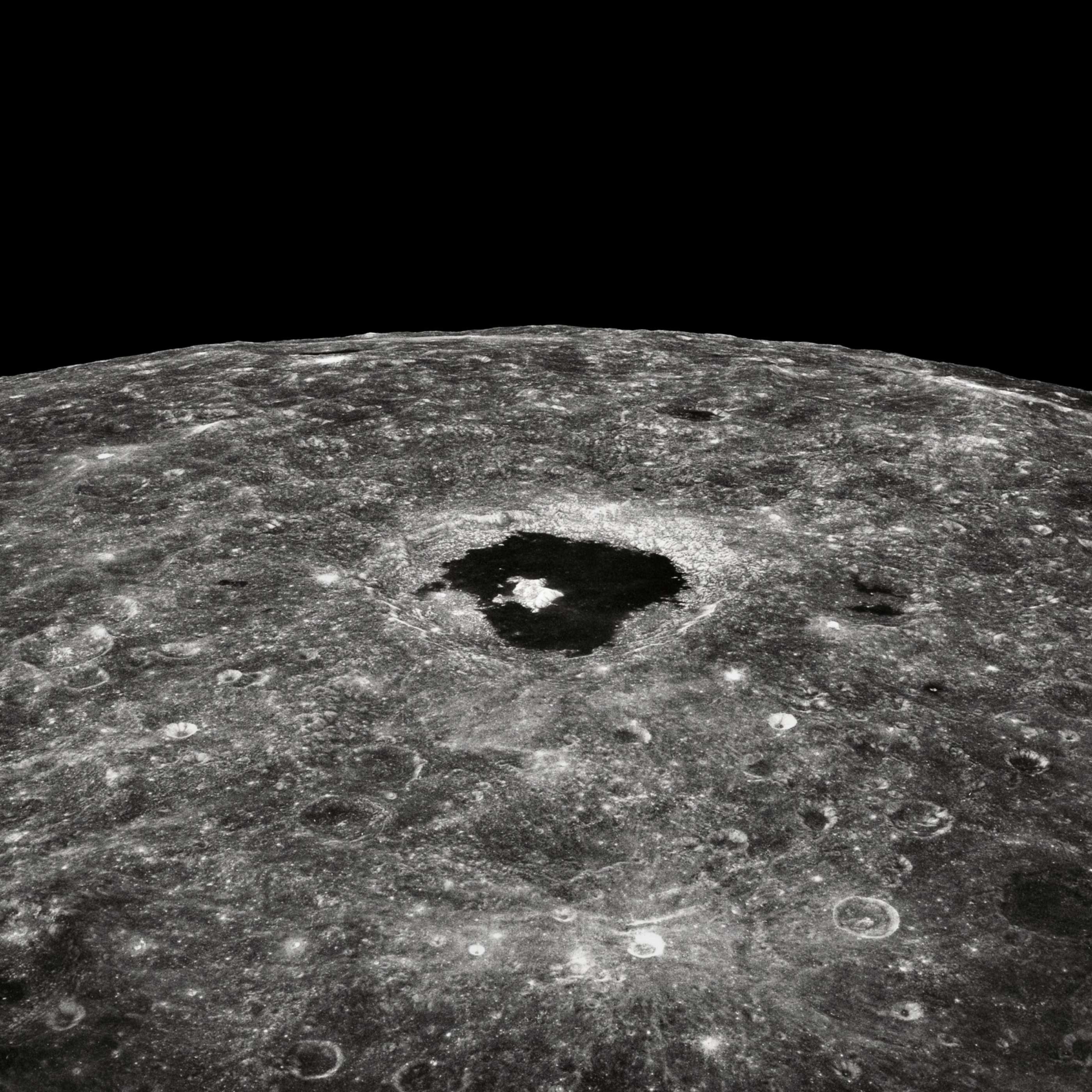
"Apollo 8 view of moon. High lunar mountain range rears up abruptly from a level region in this Apollo 8 picture from lunar orbit. Apollo 8 was launched from NASA's John F. Kennedy Space Center Dec. 21, 1968, and carried its three man crew into lunar orbit for a 20-hour stay on Christmas Eve."
Wow. Seriously...no one knew, or bothered to check that this is Tsiolkovsky Crater, with its ‘abruptly rearing’ central peak, on the far side??? And it’s incorrectly numbered as AS8-14-2540...why not. At least the caption correctly identifies it as being the moon & didn't use 'blasted off".
The view is looking roughly S-SE.
The rising Earth is about five degrees above the lunar horizon in this telephoto view taken from the Apollo 8 spacecraft near 110 degrees east longitude. The horizon, about 570 kilometers (350 statute miles) from the spacecraft, is near the eastern limb of the moon as viewed from Earth. Width of the view at the horizon is about 150 kilometers (95 statute miles). On Earth 240,000 statute miles away the sunset terminator crosses Africa. The crew took the photo around 10:40 a.m. Houston time on the morning of Dec. 24, and that would make it 15:40 GMT on the same day. The South Pole is in the white area near the left end of the terminator. North and South America are under the clouds.
No watermark; however, with the thick "A KODAK PAPER" feel.
Interesting reading:
amp.timeinc.net/time/5475697/apollo-8-50-years-later
Credit: AMP content website
Also, so so cool:
www.planetary.org/explore/space-topics/earth/pics-of-eart...
Credit: The Planetary Society website