View allAll Photos Tagged Apollo8
The crew of the historic Apollo 8 lunar orbit mission participates in a technical de-briefing session in Building 4 at Johnson Space Center. Left to right, are astronauts James A. Lovell Jr., command module pilot; Frank Borman, commander; and William A. Anders, lunar module pilot.
Credit: NASA
Image Number: S68-56530
Date: December 30, 1968
Based on the similarity of the overall view, the photo number & date, I presume this to be another fantastic view of Command Module 103 (CM-103) during assembly & testing at North American Aviation’s (NAA) Downey, CA facility. Possibly bldg. 290?
The dangling hoses from the fixture partially encircling the Command Module are all pneumatic, and interestingly - to me that is - five of them appear to lead into the spacecraft through the hatchway. In the companion photograph to this, they are hooked up to tanks/vessels visible within the exposed aft compartment, all Reaction Control System (RCS) related. So, I assume/d this ‘work station’ was to pressure test those tanks/vessels. If so, I wonder what pneumatic/high pressure, possible RCS connections are inside the crew cabin. Or maybe access to them is through the flooring? IDK, total SWAG.
Also, what I initially thought was the framework of the surrounding structure are the myriad of feed lines to each hose position!
Additionally, per an ‘H-Missions’ Command/Service Module News Reference, at:
www.hq.nasa.gov/alsj/CSM16_Reaction_Control_Subsystem_pp1...
which may or may not be applicable (I choose to think it is):
“The [CM reaction control] system consists of two independent, redundant systems, each containing six engines, helium and propellant tanks, and a dump and purge system. The two systems can operate in tandem; however, one can provide all the impulse needed for the entry maneuvers and normally only one is used.”
Note when compared to the companion photograph, which is of the opposite side of the capsule, the complete absence of any tanks. I first thought they had yet to be installed – WRONG, as shown in this very illustrative diagram.
Splitting the following diagram right down the middle; the right-hand side is what’s visible in this photograph & the left-hand side being what’s visible in the companion photograph:
sites.google.com/site/theapolloconnection/_/rsrc/14727686...

Credit: “The Apollo Connection” website
I ignorantly would’ve expected the components to be more equally distributed. I’m sure the placement/positioning is associated with weight/mass distribution, center of gravity & other possible ‘asymmetric’ properties of the CM. Fascinating.
A rare, obscure & stunning photograph that somehow fortunately survived.
RIP David Bowie- you touched so many lives!
Mixed media on canvas - 11 x 14
This is the painting I did for my Dad for Christmas. He worked for NASA for 37 years, all through the Apollo years. This was inspired by the night launch of the Apollo 8 mission - first manned mission to leave Earth's orbit as well as orbit the moon. The neat thing? I gave this painting to Dad on Christmas Eve, and Apollo 8 was circling the moon at that time, years ago. Here is their audio message from space on Christmas Eve, 1968:
www.youtube.com/watch?v=e1ybxwJJyg8
and I didn't know of the passing of David Bowie when I posted this. I had listened to Major Tom this afternoon as an odd coincidence . . . David was a legend. I feel so very sad.
“Artists concept shows Apollo 8 spacecraft as it orbits the Moon. During this mission, the tree-man crew will photograph the Moon’s surface and make landmark sightings and other observations. Television signals may be transmitted live to Earth by the four-dish high gain antenna at the rear of the spacecraft. The mission calls for ten orbits of the Moon. The initial two orbits will be 60 by 170 nautical miles and the next eight will be 60 nautical miles circular. Apollo 8 is scheduled for launch from the NASA Kennedy Space Center at 7:51 a.m., December 21. The 147-hour National Aeronautics and Space Administration lunar orbit mission will end with splashdown in the Pacific Ocean south of Hawaii.”
Note that the depiction is a cutaway, revealing one of the crewmen photographing the lunar surface...with a camera that has a sight on it befitting a WW II anti-aircraft gun. I don't know, maybe such was planned/used?
I can’t even guess on the artist...yet, which is a shame, because this is a beautiful piece of work.
Featured as the box cover of Columbia Pictures’ 8mm “home movie”, of the mission, entitled “APOLLO 8 - MOON ORBIT”.
Note the similarity:
spaceflight.nasa.gov/gallery/images/apollo/apollo10/hires...

Credit: Apollo 10 Flight Journal website
“SPACEMEN HONORED -- Astronomers attending the triennial assembly of the International Astronomical Union in Brighton, England named lunar craters after 513 persons. This photograph, taken by the National Aeronautics and Space Administration’s Lunar Orbiter V, shows craters honoring Apollo 8 astronauts Frank Borman, James A. Lovell, Jr., and William Anders; astronauts Virgil I. Grissom, Roger B. Chaffee, and Edward H. White, killed in the Apollo fire, and Dr. Hugh Dryden, Deputy Administrator and leading NASA scientist, who died in 1965. Other American and Russian cosmonauts were similarly honored.”
The names of the crews of STS-51L
and STS-107
images.spaceref.com/news/2011/columbia.craters.lrg.jpg
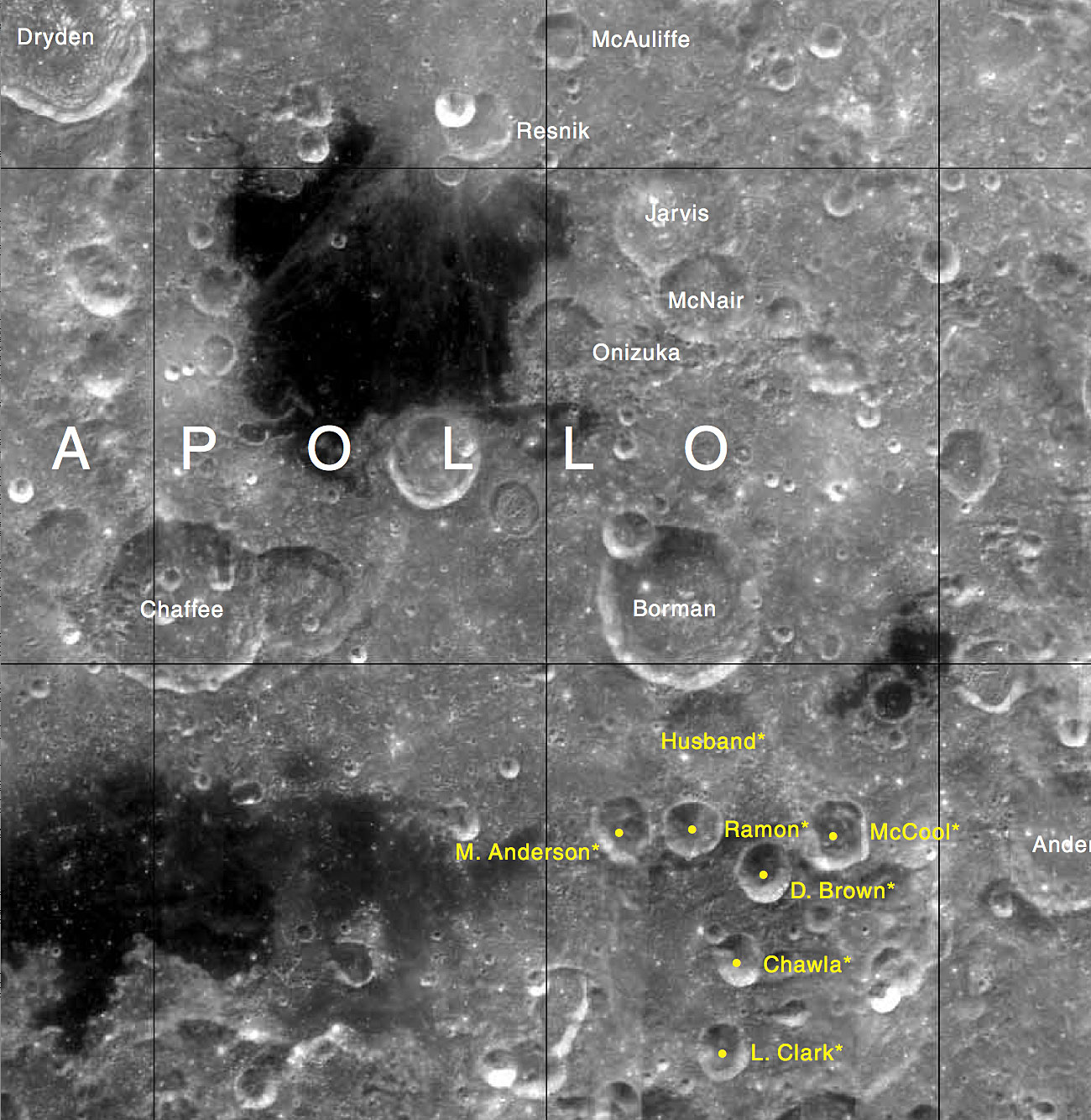
have since been added.
Preceding links credit: NASA/GSFC/Arizona State University & Spaceref.com website,respectively
www.lpi.usra.edu/resources/lunarorbiter/images/print/5030...
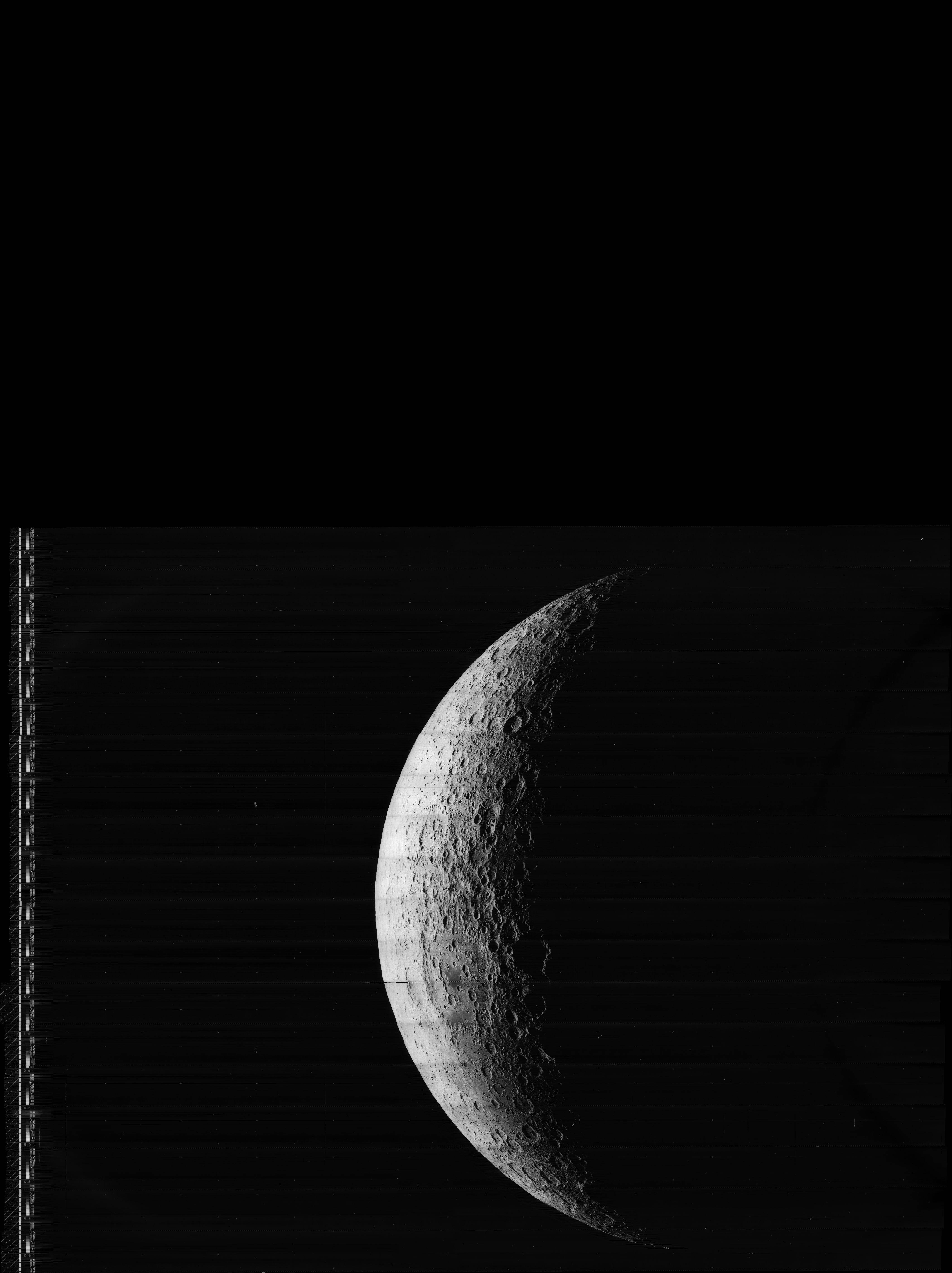
Credit: LPI website
www.nasa.gov/mission_pages/LRO/multimedia/lroimages/lroc-...
Photo taken by William Anders during Apollo 8 mission on 24 December 1968. This iconic photo was named "Earthrise".
Photography taken with an Hassebald camera with a 250mm Air Force lens and a special 70mm Kodak film. Film magazine n°14/B.
----------------------------------------------------------------------------------------------
Photo prise par William Anders au cours de la mission Apollo 8 le 24 décembre 1968. Cette photo iconique a été baptisée "Lever de Terre".
Photographie prise avec un appareil photo Hassebald muni d'un téléobjectif Air Force de 250 mm et doté d'une pellicule spéciale 70 mm développée par Kodak. Pellicule n°14/B de la mission Apollo 8.
50 years ago today, the astronauts of Apollo 8 entered lunar orbit for the first time and took the famous Earthrise photo. Nature photographer Galen Rowell declared it "the most influential environmental photograph ever taken".
This is the flown heel restraint used by Command Module Pilot Lovell on the Apollo 8 mission, consisting of a metal heel bracket with heavy duty brown Velcro stirrup straps. Signed on the bottom of the metal heel piece in black felt tip, “James Lovell, Apollo 8.”
These heel restraints locked the astronauts' feet in place for safety during liftoff of the Saturn V rocket from Earth. If the astronauts were not tightly restrained in their couches during the launch phase, the violent motion induced from extreme acceleration could result in injury. The restraints are made of a very lightweight metal and heavy duty stirrup straps with Velcro closures. The items were manufactured by B. Welson Co.
Lovell is the only person to have flown to the Moon twice without landing (Apollo 8 and 13). Apollo 8 was the second crewed flight of Apollo, and the first time humans left Earth's gravitational sphere of influence. It was a change from the original launch plan, and the date of this artifact reflects the timing: it was manufactured just 11 days before launch.
Photographer astronaut Bill Anders reflected today: "The Earth we saw rising over the battered grey lunar surface was small and delicate, a magnificent spot of color in the vast blackness of space. Once-distant places appeared inseparably close. Borders that once rendered division vanished. All of humanity appeared joined together on this glorious-but-fragile sphere. We set out to explore the moon and instead discovered the Earth." (Space.com)
Photo taken by William Anders during Apollo 8 mission on 24 December 1968. This iconic photo was named "Earthrise".
Photography taken with an Hassebald camera with a 250mm Air Force lens and a special 70mm Kodak film. Film magazine n°14/B.
----------------------------------------------------------------------------------------------
Photo prise par William Anders au cours de la mission Apollo 8 le 24 décembre 1968. Cette photo iconique a été baptisée "Lever de Terre".
Photographie prise avec un appareil photo Hassebald muni d'un téléobjectif Air Force de 250 mm et doté d'une pellicule spéciale 70 mm développée par Kodak. Pellicule n°14/B de la mission Apollo 8.
“A North American Rockwell Corporation artist's concept depicting the Apollo Command Module (CM), oriented in a blunt-end-forward attitude, re-entering Earth's atmosphere after returning from a lunar landing mission. Note the change in color caused by the extremely high temperatures encountered upon re-entry.”
Also:
“Artistic illustration of the an Apollo Command Module during atmospheric reentry. The image was created by an artist at North American Rockwell Corporation (previously North American Aviation) leading up to the Apollo 8 mission. North American Rockwell built the Command Service Module and Saturn V S-II stage for the Apollo Program. Image courtesy: NASA/Boeing”
Per/at:
wehackthemoon.com/missions/fiery-return-apollo-missions
wehackthemoon.com/sites/default/files/styles/hero_extra_l...

Credit: The Charles Stark Draper Laboratory, Inc. (We Hack The Moon) website
Although I’m not sure for how long he was under contract to NAA/NAR to render his artistic genius to the iconic – in my world – suite of Apollo mission depictions, and while there may be a standardized & universally reproduced artistic depiction of a Command Module’s reentry…used by all, I think this is by Gary Meyer.
Acrylic on heavy card stock - 6 1/4 x 5 3/4
This past week's Art Day challenge was to paint from a launch photo of the big Saturn V- Apollo 8, to be exact. The second smaller more abstract painting I did after my main one- because I had the paints/color palette left, and why waste paint, right? This smaller painting is a finger painting. :)
Happy Art Day, Everyone!
Apollo 8, Magazine 18(G) frames used:
AS8-18-2863, AS8-18-2865, AS8-18-2866, AS8-18-2867
Hasselblad 500EL 70 mm
Film Type : Kodak 2485 very high-speed ASA 6000 black and white
Source data:
tothemoon.ser.asu.edu/gallery/Apollo/8/Hasselblad%20500EL...
False Colour Version is only an Approximation
Although it was past 2 a.m., a crowd of more than 2,000 people were on hand at Ellington Air Force Base to welcome the members of the Apollo 8 crew back to Houston. Astronauts Frank Borman, James A. Lovell Jr., and William A. Anders had just flown to Houston from the pacific recovery area by way of Hawaii. The three crewmen of the historic Apollo 8 lunar orbit mission are standing at the microphones in center of picture.
Credit: NASA
Image Number: S69-16402
Date: December 29, 1968
a giant leap for bearkind!
The jellybears have been on the moon. Here is proof!
Thanks to our son for providing the LEGO-lander-model and to NASA for providing the earthrise simulation video which created the background
“Technician inserts two inflight pens and a penlight in spacesuit pocket of Apollo 8 Command Module Pilot James Lovell about four hours before he was launched on a lunar orbital mission with Commander Frank Borman and Lunar Module Pilot William Anders. The Astronauts rode into earth orbit aboard a 363-foot-high Saturn V space vehicle following their launch at 7:51 a.m., EST, December 21, 1968. Apollo 8 is the National Aeronautics and Space Administration’s first manned launch using the Saturn V.”
Consider this, the FIRST manned flight of the most complex, most powerful rocket ever built.
Destination: the friggin’ MOON.
Steely-eyed missile men? The Right Stuff?
Yes indeed, and a WHOLE LOT more.
Awe inspiring.
Once in a lifetime.
May/may not be the same one. Interesting regardless:
historical.ha.com/itm/explorers/space-exploration/apollo-...
Credit: Heritage Auctions website
Even more interesting:
www.collectspace.com/news/news-073117a-apollo-penlight-ba...
Credit: collectSPACE website
airandspace.si.edu/collection-objects/pressure-suit-a7-l-...
Credit: NASM website
Note that the name tab on the NASM suit appears to be “J LOVELL”, while the suit in the pre-flight photograph bears “LOVELL”. Most likely due to the original being removed after the flight, and given to Lovell, as I believe was the case with each mission, other than Apollo 11.
Neither here nor there; however, the name tab, U.S. flag and NASA/mission emblems are disturbingly faded, especially for wear only during Intravehicular Activity. Maybe some sort of conscientious conservation measures should’ve been started a whole lot earlier?
"Both sides of the Atlantic Ocean are visible in this view from the Apollo 8 spacecraft. The large, most prominent land mass is the bulge of west Africa. The portion of Africa near the equator is dark and cloudy, but the more northerly portions are clear, showing the prominent cape at Dakar and the Senegal River in Senegal; Cap Blanc; the Adrar Plateau in Mauritania; the wide expanse of desert in Algeria and Spanish Sahara; and at the far edge, the Atlas and Anti-Atlas Mountains in Morocco. Clouds cover the eastern coast of South America, southward from Surinam and Guyana to near the City of Salvador, Brazil. This view was taken after translunar insertion."
Both the photo identification number & caption of “Earth above Lunar Horizon” on the verso are wrong. I’d assume then so is the negative number. Photographer is annotated as “Cape”.
At, amongst others:
images.nasa.gov/details-as08-16-2588
Additionally, very very cool:
www.planetary.org/explore/space-topics/earth/pics-of-eart...
Credit: The Planetary Society website
“APOLLO 8 CENTRIFUGE TRAINING----Two members of the Apollo 8 prime crew stand beside the gondola in Building 29 after suiting up for centrifuge training in MSC’s Flight Acceleration Facility, Building 29. They are Astronauts William A. Anders (on left), lunar module pilot; and James A Lovell Jr., command module pilot.”
Anders’ designation as LMP was in line with future positional crew nomenclature. There was no lunar module on this mission…only a mass simulator, specifically, for this mission, Lunar Module Test Article B (LTA-B):
space.skyrocket.de/doc_sdat/lta-b.htm
Credit: GUNTER’S SPACE PAGE website
…but I digress.
“APOLLO 8 EARTH VIEW – This view of the rising earth greeted the Apollo 8 astronauts as they came from behind the moon after the lunar orbit insertion burn. Earth is about five degrees above the horizon in this photograph. The unnamed surface features in the foreground are near the eastern limb of the moon as viewed from earth. The lunar horizon is approximately 780 kilometers from the spacecraft. Width of the photographed area at the horizon is about 175 kilometers. On the earth 240,000 statute miles away, the sunset terminator bisects Africa.”
The USS Yorktown berthed as a museum ship at Patriot's Point in Mt. Pleasant across the Cooper River from Charleston, SC. The Yorktown is the site of the Medal of Honor Museum as well as many aircraft from her storied and historical career.
Texture by Kerstin Frank: Dark Cave III.
Ralph Morse LIFE Magazine photo : Apollo 8 astronauts suited up and posed outside with Cape Kennedy rocket gantry in background prior to launch of mission.
Apollo 8: Race to the moon. "The daring adventure of Apollo 8
: www.youtube.com/watch?v=zp_RDqPQ-qg
Apollo 8 Full Mission VIDEOS from (lunarmodule5) : www.youtube.com/watch?v=E_knzu4Lfj8&list=PLC1yaZz2qeG...
Mission Highlights by NASA: Apollo 8 launched from Cape Kennedy on Dec. 21, 1968, placing astronauts Frank Borman, James Lovell Jr. and William Anders into a 114 by 118 mile parking orbit at 32.6 degrees.
During the second revolution, at two hours, 50 minutes ground elapsed time, the S-IVB third stage restarted for a five-minute, 17-second burn, initiating translunar coast. Following S-IVB/CSM separation at three hours, 21 minutes, a 1.5 feet per second radial burn of the SM reaction control engines was initiated to establish sufficient distance for S-IVB propellant dumping. Following the propellant dumping, which sent the stage into diverging trajectory and solar orbit, the separation distance still was deemed inadequate and a second SM reaction control burn of 7.7 feet per second was performed.
The first midcourse correction occured at about 10 hours, 55 minutes into the mission and provided a first check on the service propulsion system, or SPS, engine prior to committing spacecraft to lunar orbit insertion. The second and final midcourse correction prior to lunar orbit insertion occurred at 61 hours, 8 minutes, 54 seconds.
Loss of signal occurred at 68 hours, 58 minutes, 45 seconds when Apollo 8 passed behind the moon. At that moment, NASA's three astronauts became the first humans to see the moon's far side. The first lunar orbit insertion burn, at 69 hours, 8 minutes, 52 seconds, lasted four minutes, two seconds and reduced the spacecraft's 8,400 feet per second velocity by 2,994 feet per second, resulting in an initial lunar orbit of 70 by 193 miles. The orbit circularized at 70 miles by the second lunar orbit insertion burn of 135 feet per second, performed at the start of the third revolution, again on the back side of the moon, at 73 hours, 35 minutes, five seconds.
During the 20-hour period in lunar orbit, the crew conducted a full, sleepless schedule of tasks including landmark and landing site tracking, vertical stereo photography, stereo navigation photography and sextant navigation. At the end of the 10th lunar orbit, at 89 hours, 19 minutes, and 16 seconds, a three-minute, 23-second trans-Earth injection burn was conducted, adding 3,522 feet per second. Only one midcourse correction, a burn of five feet per second conducted at 104 hours, was required instead of the three scheduled.
Six telecasts were conducted during the mission: two during translunar coast, two during lunar orbit and two during trans-Earth coast. These transmissions were telecast worldwide and in real time to all five continents. During a telecast on Christmas Eve, the crew read verses from the first chapter of Genesis and wished viewers, "Good night, good luck, a Merry Christmas and God bless all of you - all of you on the good Earth." All telecasts were of excellent quality. Voice communications also were exceptionally good throughout the mission.
Separation of the command module, or CM, from the SM occurred at 146 hours, 31 minutes. A double-skip maneuver conducted during the re-entry steering phase resulted in an altitude gain of 25,000 to 30,000 feet. The re-entry velocity was 24,696 mph, with heatshield temperatures reaching 5,000 degrees F. Parachute deployment and other re-entry events were nominal. Apollo 8 splashed down in the Pacific Ocean at 10:51 a.m. EST Dec. 27. The splashdown was about 5,100 yards from the recovery ship USS Yorktown, 147 hours after launch and precisely on time. According to prior planning, helicopters and aircraft hovered over the spacecraft, and pararescue personnel were not deployed until local sunrise, 50 minutes after splashdown. The Apollo 8 crew reached the recovery ship at 12:20 p.m. EST. www.nasa.gov/mission_pages/apollo/missions/apollo8.html#....
Apollo 8 MISSION: www.youtube.com/watch?v=zp_RDqPQ-qg
Apollo 8 Flickr (PHOTOS): www.flickr.com/photos/mrdanbeaumont/albums/72157638190662034
“Apollo 8 heads for home by firing its 20,500-pound thrust service propulsion system to remove the spacecraft from lunar orbit and place it is an Earth-bound trajectory. This maneuver shown in artist’s concept takes place while the spacecraft is behind the Moon with respect to Earth. The return trip to an Earth landing in the Pacific will take about 57 hours. Apollo 8 is scheduled for launch from the NASA Kennedy Space Center at 7:51 a.m., December 21. The 147-hour National Aeronautics and Space Administration lunar orbit mission will end with splashdown in the Pacific Ocean south of Hawaii.”
And/or the subsequent derivative versions predominantly associated with the photo. Note in both the addition of NAR artwork attribution. If correct - at the risk of being pathetic, and if so, so what - the exhaust plume does indeed look like that of the man himself, Mr. Gary Meyer:
North American Rockwell artist's concept illustrating a phase of the Apollo 8 lunar orbit mission. Here, after 20 hours of lunar orbit, Apollo 8 astronauts start the 20,500-pound thrust engine and head for home. The service module engine will fire about three minutes, starting up while the spacecraft is at the darkened, backside of the moon and blocked from communication with Earth.
And:
“North American Rockwell artist's concept illustrating a phase of the scheduled Apollo 8 lunar orbit mission. Here, after 20 hours of lunar orbit, Apollo 8 astronauts start the 20,500 lb. thrust engine and head for home.”
I'm assuming the "68-H-/68-HC-" numbering nomenclature to be printed on the verso, forever concealed by the excessive, military-grade, industrial-strength, super-duper glued "PHOTO RESEARCH INTERNATIONAL" tape. I'm not kidding, that's never coming off & it is seriously opaque.
Botched but interesting photo depicting the Apollo Program emblem and those of Apollo missions 7 - 16, with an Apollo 11 photo of the moon serving as placeholder for Apollo 17. So I assume this was slapped together prior to it being determined.
A rank amateur ‘effort’, highlighted by the Apollo 14 emblem being on its side. Must’ve been “Bring your 2nd - 4th grader to work…and let them do your job” day. Otherwise, there’s no excuse. Seriously, this is not the ‘rocket science’ part…it’s placing decals on a sheet of whatever, paper I suppose, and then photographing it. Incompetence & stupidity on exhibit, albeit low-level.
"Engine section of Stage 503 (foreground), Stage 207 on birdcage (left background), and Stage 206 in Tower no. 2 (right background). A45 Vehicle Checkout Lab."
McCall studios.com: www.mccallstudios.com/index.php?option=com_content&vi...
Robert T. McCall ( 1983 ) , from of Science Digest magazine, october 1983. WIKIPEDIA INFO: Robert McCall (December 23, 1919 – February 26, 2010) was a conceptual artist, known particularly for his works of space art. McCall was an illustrator for Life magazine in the 1960s, created promotional artwork for Stanley Kubrick's film 2001: A Space Odyssey and Richard Fleischer's production Tora! Tora! Tora! and worked as an artist for NASA, documenting the history of the Space Race. McCall was also production illustrator on Star Trek: The Motion Picture. The character Commander William Riker expressed admiration for the work of "Bob McCall" in one episode of the television series Star Trek: The Next Generation.
McCall's work can be found on U.S. postage stamps, NASA mission patches, and his murals grace the walls of the National Air and Space Museum, the National Gallery of Art, The Pentagon, Epcot, and Lyndon B. Johnson Space Center.
McCall died in 2010 of heart failure in Scottsdale, Arizona.
SCAN AND REMASTERED by Dan Beaumont
Robert McCall to Kennedy Space Center (Skylab) Press-Site: www.mccallstudios.com/gallery/kennedy-space-center-countd... and youtu.be/JzCXYd2v3xE?t=402
Do you remember where you were when William Anders pointed a pimped Hasselblad from Apollo 8 towards the little blue planet where he was born? I do. I was listening to the chatter on a crackling car radio on my way to visit a grandmother at Christmas. Isn't photography grand?
The resulting photograph was given the title "Earthrise". Staring into this blue infinity, I'm reminded of that photo and a great deal more existential stuff.
This isn't what it seems. It's not a portal. It's not a planet. This is just a circular hole in a stack of rocks, part of another 3D artwork. I'm inside a monumental work by James Turrell named Within Without. What I like about Turrell is the way his work messes with our perception of reality, and especially the way he uses light to such good effect. His "Virtuality squared" made me ask why I didn't have a Ganzfeld space of my own. I still don't. Until I do, then I'll have those memories from around ten years ago, and Apollo 8 quite a while before.
From my picture collection... No I did not take these and do not claim copyright as they are I believe in the public domain at least here in USA,
You have before you Apollo 17, with the last moon rocket (Saturn-5). It is 1h00 a.m. EST. The rocket has just been released from the great tower of technical service(The roll-back of the Mobile Service Structure). This tower was transported by the crawler-platform transporter vehicule has the size of a football field. Right now, we hear a loud noise of this Crawler vehicule. Many working on the launch pad. This is a moment of science fiction. That is a reality and it's very impressive. Dan Beaumont report. SCAN AND REMASTERED by Dan Beaumont, (Pierre-Paul Beaumont photo). www.youtube.com/watch?v=7yIvOYFOm6c
“MOON-BOUND APOLLO 8 --Separated from the McDonnell Douglas-built S-IVB rocket (foreground), Apollo 8, with its crew of three astronauts, speeds toward moon and historic first lunar fly-around. When astronauts splash down in the Pacific Ocean, they will have flown 230,000 miles from earth (370,150 km) and orbited the moon 10 times. As third stage of Saturn V launch vehicle, S-IVB will fire for 2.6 minutes to propel Apollo 8 into parking orbit. Following orbital checkout of rocket and spacecraft, S-IVB will restart and propel Apollo 8 into translunar trajectory, as shown in artist’s rendering. McDonnel Douglas Astronautics Company, a division of McDonnell Douglas Corporation, builds the S-IVB for National Aeronautics and Space Administration’s Marshall Space Flight Center.”
This beautiful conceptual Apollo Program artwork is by Gary Meyer, who was, at least during the first half of the 1960's, an illustrator for North American Aviation (NAA). Mr. Meyer was possibly the illustrator for the 1963 "series/family" of Apollo concept illustrations that I have posted. Hard to confirm, as most illustrations have no signature visible, being either cropped out or possibly never signed(?) Fortunately, this particular illustration "slipped through the cracks" of anonymity by the presence of his signature.
Mr. Meyer's credentials, achievements and honors are actually quite amazing!!!:
garymeyerillustration.net/BIOGRAPHY.html
Wow!!!:
garymeyerillustration.net/ILLUSTRATIONS/Pages/early_work....
In this instance, specifically:
garymeyerillustration.net/ILLUSTRATIONS/Pages/early_work....
In my world, I find MANY of his works to be iconic, proliferated through varied media: prints, posters, as 'figures' (in a range of NASA manuals, books, brochures, etc.), and much more. Whenever I stumble upon some morsel pertaining to the identity of any NASA/NASA contractor artist/illustrator, I'm always a little saddened as to his, and others', nearly total anonymity, at least in this 'venue'.
PictionID:54463303 - Catalog:1960s 2nd Apollo Mission Crew - Title:Array - Filename:1960s 2nd Apollo Mission Crew.jpg - - Images from the Convair/General Dynamics Astronautics Atlas Negative Collection. The processing, cataloging and digitization of these images has been made possible by a generous National Historical Publications and Records grant from the National Archives and Records Administration---Please Tag these images so that the information can be permanently stored with the digital file.---Repository: San Diego Air and Space Museum
“The nine new astronaut trainees attend desert survival training school at Stead AFB, Reno, Nevada. The four day course included instructions on how to live off the land, shelter making, and how to utilize survival kit equipment. Emphasis was placed on the means and methods for living off the natural resources of the land.”
Note the crossed machetes thrust into the ground in front of the ‘tribe’.
Check out the punk-ass slacker with the goofy expression, standing, second from the right...probably a civilian. And he’s the only one not wearing the individually-fashioned field expedient head-gear. He at least looks to be in the act of putting it on.
Regardless, I'm sure he either washed out or was voted “off the island” by the rest of the tribe.
Oh...wait...never mind. 😉
And, that's about as wild, crazy, irreverent & undisciplined as I've ever seen John Young in any photo.
Finally, Borman appears to be “palming” Lovell’s head like a basketball.
An all-around delightful photograph.
From 'MASHABLE:
1960-1967: NASA survival training
"You can survive space, but the desert?"
by Alex Q. Arbuckle
At:
mashable.com/2016/12/11/nasa-survival-training/#r7M_gC.4lsq3
"Astronauts pose during desert training at Stead Air Force Base in Nevada. Front row: Frank Borman; James A. Lovell; John W. Young; Charles Conrad; James A. McDivitt and Edward H. White. Back row: Ray Zedehar (Astronaut Training Officer); Thomas P. Stafford; Donald K. Slayton; Neil A. Armstrong and Elliot M. See."
Also:
history.nasa.gov/SP-350/ch-8-8.html
And:
commons.wikimedia.org/wiki/File:Next_Nine_Desert_Survival...

Credit: Wikimedia Commons
Apollo 8 Roll Out (Cape Kennedy, Florida) October 9, 1968--Permann Collection Image--Please tag these photos so information can be recorded.---Note: This material may be protected by Copyright Law (Title 17 U.S.C.)--Repository: San Diego Air and Space Museum
View of the lunar surface taken from the Apollo 8 spacecraft looking southward from high altitude across the Southern Sea. The bright-rayed crater near the horizon is located near 130 degrees east longitude and 70 degrees south latitude. The dark floored crater near the middle of the right side of the photograph is about 70 kilometers (45 statute miles) in diameter. Both features are beyond the eastern limb of the Moon as viewed from earth; neither has a name.
Credit: NASA
Image Number: AS8-12-2192
Date: December 24, 1968
Apollo 8: Race to the moon. "The daring adventure of Apollo 8 . : www.youtube.com/watch?v=zp_RDqPQ-qg
Apollo 8 Full Mission VIDEOS from (lunarmodule5) : www.youtube.com/watch?v=E_knzu4Lfj8&list=PLC1yaZz2qeG...
-Mission Highlights by NASA: Apollo 8 launched from Cape Kennedy on Dec. 21, 1968, placing astronauts Frank Borman, James Lovell Jr. and William Anders into a 114 by 118 mile parking orbit at 32.6 degrees.
During the second revolution, at two hours, 50 minutes ground elapsed time, the S-IVB third stage restarted for a five-minute, 17-second burn, initiating translunar coast. Following S-IVB/CSM separation at three hours, 21 minutes, a 1.5 feet per second radial burn of the SM reaction control engines was initiated to establish sufficient distance for S-IVB propellant dumping. Following the propellant dumping, which sent the stage into diverging trajectory and solar orbit, the separation distance still was deemed inadequate and a second SM reaction control burn of 7.7 feet per second was performed.
The first midcourse correction occured at about 10 hours, 55 minutes into the mission and provided a first check on the service propulsion system, or SPS, engine prior to committing spacecraft to lunar orbit insertion. The second and final midcourse correction prior to lunar orbit insertion occurred at 61 hours, 8 minutes, 54 seconds.
Loss of signal occurred at 68 hours, 58 minutes, 45 seconds when Apollo 8 passed behind the moon. At that moment, NASA's three astronauts became the first humans to see the moon's far side. The first lunar orbit insertion burn, at 69 hours, 8 minutes, 52 seconds, lasted four minutes, two seconds and reduced the spacecraft's 8,400 feet per second velocity by 2,994 feet per second, resulting in an initial lunar orbit of 70 by 193 miles. The orbit circularized at 70 miles by the second lunar orbit insertion burn of 135 feet per second, performed at the start of the third revolution, again on the back side of the moon, at 73 hours, 35 minutes, five seconds.
During the 20-hour period in lunar orbit, the crew conducted a full, sleepless schedule of tasks including landmark and landing site tracking, vertical stereo photography, stereo navigation photography and sextant navigation. At the end of the 10th lunar orbit, at 89 hours, 19 minutes, and 16 seconds, a three-minute, 23-second trans-Earth injection burn was conducted, adding 3,522 feet per second. Only one midcourse correction, a burn of five feet per second conducted at 104 hours, was required instead of the three scheduled.
Six telecasts were conducted during the mission: two during translunar coast, two during lunar orbit and two during trans-Earth coast. These transmissions were telecast worldwide and in real time to all five continents. During a telecast on Christmas Eve, the crew read verses from the first chapter of Genesis and wished viewers, "Good night, good luck, a Merry Christmas and God bless all of you - all of you on the good Earth." All telecasts were of excellent quality. Voice communications also were exceptionally good throughout the mission.
Separation of the command module, or CM, from the SM occurred at 146 hours, 31 minutes. A double-skip maneuver conducted during the re-entry steering phase resulted in an altitude gain of 25,000 to 30,000 feet. The re-entry velocity was 24,696 mph, with heatshield temperatures reaching 5,000 degrees F. Parachute deployment and other re-entry events were nominal. Apollo 8 splashed down in the Pacific Ocean at 10:51 a.m. EST Dec. 27. The splashdown was about 5,100 yards from the recovery ship USS Yorktown, 147 hours after launch and precisely on time. According to prior planning, helicopters and aircraft hovered over the spacecraft, and pararescue personnel were not deployed until local sunrise, 50 minutes after splashdown. The Apollo 8 crew reached the recovery ship at 12:20 p.m. EST. www.nasa.gov/mission_pages/apollo/missions/apollo8.html#....
APOLLO 8 MISSION REPORT (PDF): history.nasa.gov/ap08fj/pdf/a08-missionreport.pdf
Apollo 8 Flickr (PHOTOS): www.flickr.com/photos/mrdanbeaumont/albums/72157638190662034
“The Mobile Service Structure (MSS) being pulled back from the Apollo 8 spacecraft.
Also seen at the top of the escape tower is the Q-ball cover. This covers and protects the Q-ball, eight openings at the top of the Launch Escape Tower. These openings lead to air data probes which gauge air pressure and temperature. As well as providing dynamic pressure (known as "Q") information during powered flight, they help determine the angle of attack of the tower during an abort event. The crew can monitor any off-axis pressure on a gauge on panel 1 normally used to monitor combustion pressure in the spacecraft's SPS engine. A switch will be thrown after the tower is jettisoned to effect this change. Dual use of instruments is common in the spacecraft as it saves weight and panel.”
history.nasa.gov/afj/ap08fj/photos/ground/19681217-s68-55...
All above per the Apollo Flight Journey website:
“20th CENTURY SPACE TRAVELERS STILL NAVIGATE BY STARS
An optics technician at the Kollsman Instrument Corporation plant in Syosset, N.Y., fits cover on head of sextant part of Kollsman sextant-telescope that Apollo 8 astronauts will use to insure accuracy of the guidance and navigation system of spacecraft during its moon voyage in late December. The small instrument at right is the scanning telescope. The two celestial instruments make up the Optical Unit Assembly which fits in the wall of the command module.”
KSC INFO: Skylab 1 was rolled out from the Vertical Assembly Building to Complex 39a approximately three miles away April 16, 1973. The Skylab mission, SL-1/SL-2, will begin with the launch of the unmanned Saturn V vehicle and payload consisting of the S-1C booster and S-2 second stage. Payload elements are the Workshop, Instrument Unit, ATM, Airlock Module and Multiple Docking Adapter. The Skylab/Saturn V will weigh 2,822,300 kilograms (6,222,000 pounds) at lift-off and stand 101,7 meters, (333,7 feet) tall. The twin launches of the Skylab space station and the three astronauts who will live and work aboard it are scheduled for May 14-15. For release: April 16, 1973. 4X5 TRANSPARENCY NASA PHOTO, 73-HC-236, US GOVERNMENT PUBLICATION, SCAN AND REMASTERED by Dan Beaumont , ACQUISITION: Skylab News Center, May 12, 1973. www.youtube.com/user/MrDanBeaumont?feature=watch
The December 21, 1968 launch of Apollo 8 (AS-503) from Cape Kennedy, Fla. was the beginning of a mission designed to test the Apollo system and gain the operational experience necessary to realize President Kennedy’s goal of “landing a man on the Moon and returning him safely to Earth.” In this photo, Commander Colonel Frank Borman leads the way as he, Command Module Pilot Captain James A Lovell Jr., and Lunar Module Pilot Major William A. Anders head to the launch pad for humanity’s maiden voyage around the moon and its first aboard the Saturn V vehicle, developed by NASA’s Marshall Space Flight Center in Huntsville, Ala.
Image credit: NASA/MSFC
More Marshall history images:
www.nasa.gov/centers/marshall/history/gallery/marshall_hi...
_____________________________________________
These official NASA photographs are being made available for publication by news organizations and/or for personal use printing by the subject(s) of the photographs. The photographs may not be used in materials, advertisements, products, or promotions that in any way suggest approval or endorsement by NASA. All Images used must be credited. For information on usage rights please visit: www.nasa.gov/audience/formedia/features/MP_Photo_Guidelin...
“High-oblique view of the moon's surface showing Earth rising above the lunar horizon, looking west-southwest, as photographed from the Apollo 8 spacecraft as it orbited the moon. The center of the picture is located at about 105 degrees east longitude and 13 degrees south latitude. The lunar surface probably has less pronounced color than indicated by this print.”
Online at:
www.spaceflight.nasa.gov/gallery/images/apollo/apollo8/ht...
Also, so so cool:
www.planetary.org/explore/space-topics/earth/pics-of-eart...
Credit: The Planetary Society website
Photo taken by William Anders during Apollo 8 mission on 24 December 1968. This iconic photo was named "Earthrise".
I downloaded this picture on the flickr Project Apollo Archive. Then I adjusted levels and removed artifacts on the film.
Photography taken with an Hassebald camera with a 250mm Air Force lens and a special 70mm Kodak film. Film magazine n°14/B.
----------------------------------------------------------------------------------------------
Photo prise par William Anders au cours de la mission Apollo 8 le 24 décembre 1968. Cette photo iconique a été baptisée "Lever de Terre".
J'ai téléchargé cette photo sur le flickr Project Apollo Archive. Puis j'ai ajusté les niveaux et enlevé les défauts de la pellicule.
Photographie prise avec un appareil photo Hassebald muni d'un téléobjectif Air Force de 250 mm et doté d'une pellicule spéciale 70 mm développée par Kodak. Pellicule n°14/B de la mission Apollo 8.
A crop, with minor editing, of the referenced photograph. Within the numbered yellow rectangles are stamped/stenciled serial/identification numbers on the forward hatch docking tunnel, also referred to as the ‘access cylinder assembly’ in another NASA document.
No two Command Modules (CM) have these applied in the same locations…believe me, I exhaustively screened photographs of every manned CM from Apollo 7 to Apollo 15. I didn’t check Apollo 16 or 17, since I figured CM-113 & CM-114 were probably not yet even a gleam in some young NAA engineer’s eye as of January 24, 1967. For additional reference & context, I also marked with the red line, the edge of what appears to be the extensive application of duct tape within the forward compartment of CM-103.
To further (eventually) plunge down the rabbit hole, the red arrows point to innocuous looking components/structures that are actually fascinating & key to distinguishing between Block I and Block II CMs. However, that’ll require posting additional imagery - at a later date.
The additional linked photographs below confirm the identification.
Piction ID: 85081957 1 paperweight; Paperweight is circular, clear acrylic commemorating Apollo 8 and its crew Frank Borman, James Lovell, and William Anders; Paperweight reads "Guidance And Navigation AC Electronics Division General Motors" in blue along the bottom; Paperweight shows the blue and red mission emblem--Image from the SDASM Curatorial Collection--Please tag these photos so information can be recorded.---Note: This material may be protected by Copyright Law (Title 17 U.S.C.)--Repository: San Diego Air and Space Museum
At first blush, the title of this image will surely appear to have little to do with the photo itself, but in the way my mind works, it most assuredly does. This was taken several weeks ago at the Fred Astaire studio in Chandler, Arizona, and I had not really planned to post it here; but a short while ago, while going through some of my archives, I found it and decided others might enjoy it. So here it is now.
I am posting this on December 21, 2008, a Sunday. I have a very strong historical consciousness, and for much of the day I have been reflecting on what I was doing exactly 40 years ago. December 21, 1968 was a Saturday, and I was a 15-year-old high-school student living in Greenville, Mississippi. A few weeks before, NASA had announced that the plans for its next manned space flight, Apollo 8, had been changed, and that instead of being launched into low-earth orbit, it would instead go to the moon, circumnavigate it for 24 hours, and then return to earth. It was to be the greatest space adventure of all, up to that time, and certainly the most daring as well.
At around 7:30 on that morning of December 21, I lay in bed and listened to the launch on my handheld transistor radio. Several hours later, I learned from an updated news report that the astronauts were 40,000 miles from earth, a staggering distance indeed at a time when the record altitude reached in a manned spacecraft had been around 800 miles, a milestone attained near the end of Project Gemini in 1966.
I followed the Apollo 8 flight from launch to splashdown, always with enthusiasm, amazement and wonder, and I have often thought about it since. It was the one indisputably triumphant moment in what otherwise had been a horrible year, marked among other events by the Tet offensive in Vietnam, the Pueblo incident, the Soviet invasion of Czechoslovakia, the assassinations of Martin Luther King and Robert F. Kennedy, and the street upheavals in Chicago during that year's Democratic National Convention. That such an awful year could end on such a hopeful and triumphant note was, and remains, a monument to all that is good and noble and inspiring about the human spirit.
But the supreme moment of that six-day space flight took place on Christmas Eve. During a live television broadcast as the three astronauts passed some 70 miles above the stark, barren lunar landscape, they read the first few verses of the Book of Genesis to enraptured viewers back on earth, millions of whom, including myself, were profoundly touched by the gesture. I found myself blinking back tears as I listened to this broadcast, which may be heard here, accompanied by a slideshow which is well worth watching.
That, of course, was back in the days before political correctness, and the astronauts were not afraid either to invoke religion during their lunar adventure, or to wish their earth-bound viewers a Merry Christmas, instead of the watered-down "Happy Holidays," which is so ubiquitous and commonplace forty years later. In 1968, a Christmas tree was just that, a Christmas tree rather than a "holiday tree," and schoolchildren looked forward to an annual "Christmas vacation" instead of a "winter intersession" or "winter break." With all due respect to the fact that we have since become a far more diverse culture, I believe we have lost something important and good in the way we treat this annual holiday. I am not Jewish, but have many Jewish friends whom I do not hesitate to wish a Happy Hannukah at this time of year. And I will always wish them that, instead of a mere "happy holiday." Why should non-Christians treat Christmas any differently? (For what it's worth, I have friends who are devout Muslims, and yet find it within them to wish me a Merry Christmas every year. I don't think any of them would ever complain that doing so somehow makes him or her any less of a Muslim.)
I share this story now with my Flickr friends, in the hope that it will bring back fond memories for those who were alive in 1968, and educate those who were not yet born at the time.
Merry Christmas, then, to one and all! And thank you all for your friendship, support, and encouragement throughout the year. I count myself very fortunate indeed to have the best viewers and contacts of anyone here on Flickr, and you prove that to me again and again every single day.
(Incidentally, this one looks pretty good in large size!
Also, for another perspective on the Apollo 8 flight, check out this article in The Guardian.)
“Fish-eye lens captured this all-inclusive view of Apollo 8’s Saturn V space vehicle being rolled out today from the Kennedy Space Center’s Vehicle Assembly Building, left, to the launch pad, 3 ½ miles to the east. The 363-foot high rocket will launch Apollo 8 Astronauts Frank Borman, James Lovell and William Anders on space mission in December.”
Jacques Tiziou photo, from Moonshots and Snapshots of Project Apollo: A Rare Photographic History BOOK, INFO: www.unmpress.com/books.php?ID=20000000006532
REMASTERED by Dan Beaumont.
News photographers at the LC-39 Press Site, Kennedy Space Center.
Apollo 8: Race to the moon. "The daring adventure of Apollo 8 . : www.youtube.com/watch?v=zp_RDqPQ-qg
Mission Highlights by NASA: Apollo 8 launched from Cape Kennedy on Dec. 21, 1968, placing astronauts Frank Borman, James Lovell Jr. and William Anders into a 114 by 118 mile parking orbit at 32.6 degrees.
During the second revolution, at two hours, 50 minutes ground elapsed time, the S-IVB third stage restarted for a five-minute, 17-second burn, initiating translunar coast. Following S-IVB/CSM separation at three hours, 21 minutes, a 1.5 feet per second radial burn of the SM reaction control engines was initiated to establish sufficient distance for S-IVB propellant dumping. Following the propellant dumping, which sent the stage into diverging trajectory and solar orbit, the separation distance still was deemed inadequate and a second SM reaction control burn of 7.7 feet per second was performed.
The first midcourse correction occured at about 10 hours, 55 minutes into the mission and provided a first check on the service propulsion system, or SPS, engine prior to committing spacecraft to lunar orbit insertion. The second and final midcourse correction prior to lunar orbit insertion occurred at 61 hours, 8 minutes, 54 seconds.
Loss of signal occurred at 68 hours, 58 minutes, 45 seconds when Apollo 8 passed behind the moon. At that moment, NASA's three astronauts became the first humans to see the moon's far side. The first lunar orbit insertion burn, at 69 hours, 8 minutes, 52 seconds, lasted four minutes, two seconds and reduced the spacecraft's 8,400 feet per second velocity by 2,994 feet per second, resulting in an initial lunar orbit of 70 by 193 miles. The orbit circularized at 70 miles by the second lunar orbit insertion burn of 135 feet per second, performed at the start of the third revolution, again on the back side of the moon, at 73 hours, 35 minutes, five seconds.
During the 20-hour period in lunar orbit, the crew conducted a full, sleepless schedule of tasks including landmark and landing site tracking, vertical stereo photography, stereo navigation photography and sextant navigation. At the end of the 10th lunar orbit, at 89 hours, 19 minutes, and 16 seconds, a three-minute, 23-second trans-Earth injection burn was conducted, adding 3,522 feet per second. Only one midcourse correction, a burn of five feet per second conducted at 104 hours, was required instead of the three scheduled.
Six telecasts were conducted during the mission: two during translunar coast, two during lunar orbit and two during trans-Earth coast. These transmissions were telecast worldwide and in real time to all five continents. During a telecast on Christmas Eve, the crew read verses from the first chapter of Genesis and wished viewers, "Good night, good luck, a Merry Christmas and God bless all of you - all of you on the good Earth." All telecasts were of excellent quality. Voice communications also were exceptionally good throughout the mission.
Separation of the command module, or CM, from the SM occurred at 146 hours, 31 minutes. A double-skip maneuver conducted during the re-entry steering phase resulted in an altitude gain of 25,000 to 30,000 feet. The re-entry velocity was 24,696 mph, with heatshield temperatures reaching 5,000 degrees F. Parachute deployment and other re-entry events were nominal. Apollo 8 splashed down in the Pacific Ocean at 10:51 a.m. EST Dec. 27. The splashdown was about 5,100 yards from the recovery ship USS Yorktown, 147 hours after launch and precisely on time. According to prior planning, helicopters and aircraft hovered over the spacecraft, and pararescue personnel were not deployed until local sunrise, 50 minutes after splashdown. The Apollo 8 crew reached the recovery ship at 12:20 p.m. EST. www.nasa.gov/mission_pages/apollo/missions/apollo8.html#....
APOLLO 8 MISSION REPORT (PDF): history.nasa.gov/ap08fj/pdf/a08-missionreport.pdf
Apollo 8 Flickr (PHOTOS): www.flickr.com/photos/mrdanbeaumont/albums/72157638190662034
NASA PHOTO/ REMASTERED by Dan Beaumont.
Apollo 8 (ALL VIDEOS & INFO.): www.youtube.com/watch?v=Vn00BvWwke0&index=1&list=...
Apollo 8 (ALL PHOTOS): www.flickr.com/photos/mrdanbeaumont/albums/72157638190662034
NASA INFO: www.nasa.gov/mission_pages/apollo/missions/apollo8.html#....
Apollo 8 astronaut Jim Lovell speaks during the Smithsonian National Air and Space Museum's Spirit of Apollo event commemorating the 50th anniversary of Apollo 8, Tuesday, Dec. 11, 2018 at the Washington National Cathedral in Washington, DC. Apollo 8 was humanity's first journey to another world, taking astronauts Frank Borman, Jim Lovell, and William Anders to the Moon and back in December of 1968. Photo Credit: (NASA/Joel Kowsky)