View allAll Photos Tagged Apollo8
Recent exhibitions of the Earth and Moon surfaces at Brisbane's Museum of the Moon inspired me create a version of the famous 1968 Earthrise image taken on the 24/12 of that year. That evening, the astronauts-Commander Frank Borman, Command Module Pilot Jim Lovell, and Lunar Module Pilot William Anders-held a live broadcast from lunar orbit, in which they showed pictures of the Earth and moon as seen from their spacecraft.
For all the people on Earth the crew of Apollo 8 has a message we would like to send you:
"In the beginning God created the heaven and the earth. And the earth was without form, and void; and darkness was upon the face of the deep. And the Spirit of God moved upon the face of the waters. And God said, Let there be light: and there was light. And God saw the light, that it was good: and God divided the light from the darkness."
"And God called the light Day, and the darkness He called Night. And the evening and the morning were the first day. And God said, Let there be a firmament in the midst of the waters, and let it divide the waters from the waters. And God made the firmament, and divided the waters which were under the firmament from the waters which were above the firmament: and it was so. And God called the firmament Heaven. And the evening and the morning were the second day."
"And God said, Let the waters under the heavens be gathered together unto one place, and let the dry land appear: and it was so. And God called the dry land Earth; and the gathering together of the waters called he Seas: and God saw that it was good."
And from the crew of Apollo 8, we close with good night, good luck, a Merry Christmas, and God bless all of you - all of you on the Good Earth.
Digital painting based on the famous photo “Earthrise” by Apollo 8 astronaut Bill Anders, taken in December 1968, when humans traveled to the moon for the first time.
Photo taken by the NASA Apollo 8 mission in December 1968 during the first approach to the Moon. The photo was reprocessed by our artificial intelligence model to restore it to maximum sharpness and definition. The resulting document is at a resolution of 14569x14990 pixels, or 218.39 million pixels. The document can be downloaded from this page.
Credit: NASA/PipploIMP
Our Facebook Page: bit.ly/PipploFB
Our YouTube Channel: bit.ly/PipploYT
Christmas Eve, 1968. As one of the most turbulent, tragic years in American history drew to a close, millions around the world were watching and listening as the Apollo 8 astronauts - Frank Borman, Jim Lovell and Bill Anders - became the first humans to orbit another world. As their command module floated above the lunar surface, the astronauts beamed back images of the moon and Earth and took turns reading from the book of Genesis, closing with a wish for everyone "on the good Earth."
Image credit: NASA
#tbt #nasa #marshallspaceflightcenter #msfc #marshall #space #history #marshallhistory #nasamarshall #nasahistory #nasamarshallspaceflightcenter #apollo #apollo8 #moon #astronaut #earth
My Charger has hit 50 (The build date is actually May, 21st), Spokane is slowly saying goodbye to winter, and it's going to be a great year for cruising the Ave. Totally awesome plans include hitting a few shows, a few organized cruises, a few informal dinner cruises, and generally just enjoy the heck out of warm summer evenings. Full apologies to the Little River Band for the lame song reference. :-)

“SPACECRAFT WEIGHS IN -- Apollo 8 spacecraft command module for first manned lunar orbit mission is weighed and balance is checked in world’s largest cleanroom at North American Rockwell’s Space Division, Downey, Calif., before shipment to Florida. Spacecraft systems are installed and tested under dust free conditions.”
A wonderfully informative excerpt from - I’m sure - an “Apollo Spacecraft [Command/Service Module] News Reference”, issue/version unknown…this probably being found in multiple:
“Final assembly of the command and service modules takes place in a large "clean room," at Downey. When components reach this room, they have already gone through many hours of severe testing.
Checkout and testing at Downey can be separated into three broad categories: component and subassembly, individual subsystem tests during buildup, and integrated system testing. The first is at the component and subassembly level, before the equipment is installed in the spacecraft. The second follows installation on the spacecraft and is a long and complex series of tests involving such major operations as pressure cell testing, continuity checks of all wiring, and testing of each subsystem after installation in the vehicle.
The third category-integrated systems testing-is the final operation at Downey. It is conducted in two phases: "plugs-in" and "plugs-out" checkout in which the command and service module subsystems are operated together through a complete simulated mission. In addition, a manned suit loop test is performed with the flight crew to check the environmental control subsystem and all other crew equipment. The individual and integrated system testing is conducted with acceptance checkout equipment (ACE) similar to that at KSC. This equipment interrogates the spacecraft systems to elicit automatic responses as to their status. The responses are automatically gathered, processed, and displayed to test personnel for immediate evaluation and also are recorded and stored for later detailed analysis. The displays are part of a modular system which allows a staff of engineers to monitor more than 25,600 samples per second of spacecraft test data containing about 1500 separate spacecraft and ground support conditions while the test is being performed. The integrated system tests have a number of objectives: to check the operation of each subsystem under mission conditions and assure that all subsystems work together properly, to verify the electromagnetic compatibility of the subsystems, to assure that all crew equipment functions properly, and to check operation of specific alternate and backup equipment and procedures.
The plugs-in and plugs-out tests are similar. The differences are that the former uses ground power and ACE connected to the spacecraft while the latter uses simulated fuel cell power and the ACE is removed so that responses are sent over spacecraft communications equipment as it would operate during the actual mission.
The spacecraft is prepared for these tests exactly as it would be for actual flight except that special test devices are installed in place of some equipment such as ordnance and expendable items.
In each phase the proper operation and interaction of all spacecraft subsystems are checked. The checkout equipment enables both automatic and manual operations to be performed, so that manual backups and overrides to automatic operations can be evaluated. When the series of testing at Downey has been completed, the spacecraft and its subsystems are considered ready. Before it is delivered to NASA, however, additional tests are performed to be sure that all the crew equipment, and particularly the environmental control subsystem, works properly with an actual suited crew aboard.
All loose crew equipment is stowed aboard the spacecraft in its proper place. Three crewmen don and check out the space suits and check ease of entering and leaving the command module. The flight crew then enters the cabin and checks the operation and manipulation of all crew equipment while in a pressurized suit, in a ventilated suit, and in shirtsleeves. Operation of the environmental control subsystem's suit loop is checked as the final step in the test sequence.
After the manned suit loop test the modules are prepared for shipment. This preparation involves demating, final checkout of pressure vessels and the reaction control subsystem, installation of the aft heat shield, application of a thermal coating to the exterior of the command module, installation of earth landing subsystem components and ordnance, a tumble-cleaning, and weight and balance checks.”
Therefore, based on the above, with what’s transpiring in the photograph & spacecraft 103 history referenced in “APOLLO BY THE NUMBERS: A Statistical Reference”/ NASA SP-2000-4029, this occurred some time between 22 July – 13 August 1968.
So, I don’t know what’s up with the “112968” (a reasonable assumption that it’s a date) on the affixed caption. A three+ month lag between event photographed and its issuance/release date, especially since it’s by the originating organization, is a little curious to me. ¯\_(ツ)_/¯
And, machine printed (typed?) on the verso of the photo (behind the affixed NAR description) is “Story of California - Reject”. So, apparently, this was considered, but not used in some story, article, feature, book? etc.
Note what look like circular lidocaine patches at the CM sidewall/heat shield junction. Although readily visible in photographs of various CMs during construction, I haven’t been able to find a definitive reference/identification to/of their purpose. And, I’m not satisfied with my ignorant assumption that they’re some generic & transient protective covering…of some unidentified something. Ugh.
In fact, the “top one” is actually a double-tap, with one under what I’m assuming to be the protective blue “wrap” around the CM, and the second one placed directly over it, ON the blue wrap.
Informative blue wrap reading:
www.collectspace.com/ubb/Forum29/HTML/001922.html
Credit: collectSPACE website
Last, but not least, look at the poor gentleman in the foreground, captured forever on film, falling. 😕 Hopefully, not because the spacecraft was swinging/oscillating in his direction.
Multiple dings & other careless handling-induced “defects" do not detract. Still a wonderfully glossy and rare shot.
Colorization of Apollo 8 Hasselblad image from film magazine 13/E.
Image Credit: NASA/Kevin M. Gill
Source: flic.kr/p/zahsBf & flic.kr/p/z5KK9F
This week in 1968, Apollo 8 lifted off from Launch Complex 39A at NASA’s Kennedy Space Center. The primary mission objectives included a coordinated performance of the crew, the command and service module and the support facilities. The mission also demonstrated trans-lunar injection -- a propulsive maneuver used to set a spacecraft on a trajectory that will cause it to arrive at the Moon. All primary mission objectives were met and detailed test objectives were achieved. The crew escaped Earth’s gravity, traveled to the lunar vicinity, and orbited the Moon before returning to Earth on Dec. 27. Apollo 8 was the first crewed flight of the Saturn V vehicle and the first crewed lunar orbit mission. Now through December 2022, NASA will mark the 50th anniversary of the Apollo Program that landed a dozen astronauts on the Moon between July 1969 and December 1972, and the first U.S. crewed mission -- Apollo 8 -- that circumnavigated the Moon in December 1968. The NASA History Program is responsible for generating, disseminating, and preserving NASA’s remarkable history and providing a comprehensive understanding of the institutional, cultural, social, political, economic, technological and scientific aspects of NASA’s activities in aeronautics and space. For more pictures like this one and to connect to NASA’s history, visit the Marshall History Program’s webpage.
Image credit: NASA
“Searchlights at the Kennedy Space Center's Launch Complex 39A Illuminate the 363-loot high Saturn V space vehicle during final preparation for the launch of Apollo 8 Astronauts Frank Borman, James Lovell and William Anders on a planned lunar orbital mission. The open-ended flight is designed to verify spacecraft systems and crew operations at lunar distances. The Astronauts are to orbit the moon 10 times and splash down 147 hours after liftoff in the Pacific Ocean, 1,000 miles south of Hawaii. Apollo 8 marks the first manned flight of the National Aeronautics and Space Administration's Saturn V space vehicle.”
To me…then - now - always...the most beautiful & majestic machine designed & built to propel humans to the moon.
This was 1968. I'll bet most of you weren't even on this planet yet.
The photograph is in beautiful condition, with the slightest hint of three-ring binder dents along the right edge.
This is a photograph taken from the Apollo 8 spacecraft looking back at the Saturn V third (S-IVB) stage from which the spacecraft had just separated following trans-lunar injection. Attached to the S-IVB is the Lunar Module Test Article (LTA) which simulated the mass of a Lunar Module (LM) on the Apollo 8 lunar orbit mission. The 29-feet panels of the Spacecraft LM Adapter which enclosed the LTA during launch have already been jettisoned and are out of view. Sunlight reflected from small particles shows the "firefly" phenomenon which was reported by astronaut John H. Glenn Jr. during the first Earth-orbital flight, Mercury-Atlas 6 (MA-6) of the Mercury Program.
Credit: NASA
Image Number: AS08-16-2583
Date: December 21, 1968
NASA astronaut Bill Anders took this iconic image of Earth rising over the Moon’s horizon on Dec. 24, 1968. Anders, lunar module pilot on the Apollo 8 mission, and fellow astronauts Frank Borman and Jim Lovell became the first humans to orbit the Moon and the first to witness the sight pictured.
After becoming a fighter pilot in the Air Force, Anders was selected as an astronaut by NASA. He was backup pilot for the Gemini XI and Apollo 11 flights, and he was lunar module pilot for Apollo 8 – the first lunar orbit mission in December 1968. Anders passed away on June 7, 2024.
Image credit: NASA
#NASA #NASAMarshall #Apollo #Apollo8 #astronaut #Earth
More about NASA's Deep Space Food Challenge
NASA Administrator Remembers Apollo Astronaut William Anders
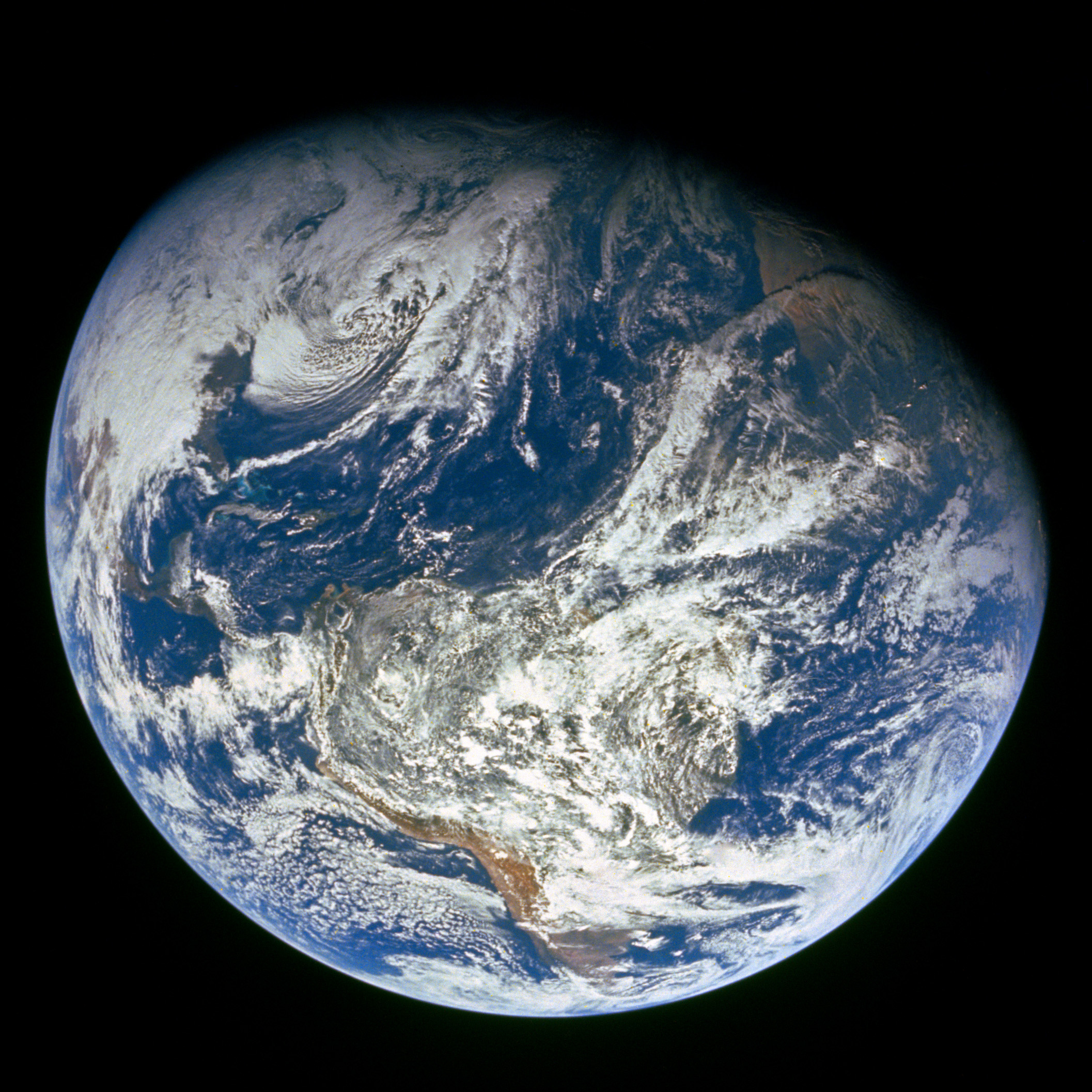
Photo taken by the NASA Apollo 8 mission in December 1968. This is one of the first images taken by humans of the whole Earth. Photographed probably by William Anders, the photo shows the Earth at a distance of about 30,000 km. The image was originally taken upside down, now you can clearly see that South America is in the foreground. The photo was reprocessed by our artificial intelligence model to restore it to maximum sharpness and definition. The resulting document is at a resolution of 25000x21877 pixels, or 546.92 million pixels. The document can be downloaded from this page.
Credit: NASA/PipploIMP
Our Facebook Page: bit.ly/PipploFB
Our YouTube Channel: bit.ly/PipploYT
Apollo 8 launched on December 21, 1968 and sent the first humans out of Earth's orbit. It carried Frank Borman, Jim Lovell and William Anders on the first launch of a Saturn V with a crew onboard on a mission to orbit the Moon 10 times before returning to Earth on December 27.
Credit: NASA
Image Number: S69-15558
Date: December 21, 1968
This you see is one of the 100 photos that changed the world according to Life magazine in 2003. It is the NASA photo taken on 24 December 1968 during the Apollo8 mission by US astronaut William Alison Anders. The title of this stunning image is 'Earthrise'. The photo was reprocessed by our artificial intelligence model to restore it to maximum sharpness and definition. The resulting document is at a resolution of 30000x30000 pixels, or 900 million pixels. It should currently be the version of this photo with the best resolution on the net. The document can be downloaded from this page.
Credit: NASA/PipploIMP
Our Facebook Page: bit.ly/PipploFB
Our YouTube Channel: bit.ly/PipploYT
NASA video release April 19, 2012
Everyone can see an Earthrise in this new NASA visualization, which draws on richly detailed maps of the moon's surface made from data gathered by NASA's Lunar Reconnaissance Orbiter.
To read more go to: www.nasa.gov/mission_pages/LRO/news/apollo8-retrace.html
Credit: NASA/GSFC
NASA Goddard Space Flight Center enables NASA’s mission through four scientific endeavors: Earth Science, Heliophysics, Solar System Exploration, and Astrophysics. Goddard plays a leading role in NASA’s accomplishments by contributing compelling scientific knowledge to advance the Agency’s mission.
Follow us on Twitter
Like us on Facebook
Find us on Instagram
This view of the rising Earth greeted the Apollo 8 astronauts on December 24, 1968 as they came from behind the Moon after the fourth nearside orbit. The photo is displayed here in its original orientation, though it is more commonly viewed with the lunar surface at the bottom of the photo. Earth is about five degrees left of the horizon in the photo. The unnamed surface features on the left are near the eastern limb of the Moon as viewed from Earth. The lunar horizon is approximately 780 kilometers from the spacecraft. Height of the photographed area at the lunar horizon is about 175 kilometers.
Credit: NASA
Image Number: 68-HC-870
Date: December 24, 1968
This week in 1964, hydrostatic testing of the Saturn V S-IC -- the first stage test fuel tank -- was successfully conducted at NASA's Marshall Space Flight Center. The S-IC stage was powered by five F-1 engines, which used liquid oxygen and kerosene as its propellants. When completely assembled, the Saturn V S-IC stage was 138 feet tall, 33 feet in diameter, and capable of delivering 7.5 million pounds of thrust from its five engines. Now through December 2022, NASA will mark the 50th anniversary of the Apollo Program that landed a dozen astronauts on the Moon between July 1969 and December 1972, and the first U.S. crewed mission -- Apollo 8 -- that circumnavigated the Moon in December 1968. The NASA History Program is responsible for generating, disseminating, and preserving NASA’s remarkable history and providing a comprehensive understanding of the institutional, cultural, social, political, economic, technological and scientific aspects of NASA’s activities in aeronautics and space. For more pictures like this one and to connect to NASA’s history, visit the Marshall History Program’s webpage.
Image credit: NASA
This week in 1967, the first stage of the Apollo 9 Saturn V rocket, S-IC-4, was acceptance fired at Mississippi Test Facility – now known as NASA Stennis Space Center. This was the first flight S-IC to be tested at Mississippi Test Facility. The S-IC stage of the Saturn V was powered by five F-1 engines, each producing 1.5 million pounds of thrust. Here, the S-IC-5, employed on the Apollo 10 mission, is tested at Mississippi Test Facility. The Saturn V was designed at NASA’s Marshall Space Flight Center. Now through December 2022, NASA will mark the 50th anniversary of the Apollo Program that landed a dozen astronauts on the Moon between July 1969 and December 1972, and the first U.S. crewed mission -- Apollo 8 -- that circumnavigated the Moon in December 1968. The NASA History Program is responsible for generating, disseminating and preserving NASA's remarkable history and providing a comprehensive understanding of the institutional, cultural, social, political, economic, technological and scientific aspects of NASA 's activities in aeronautics and space. For more pictures like this one and to connect to NASA's history, visit the Marshall History Program's webpage.
Image credit: NASA
The crew of Apollo 8 has a message for you.
Happy Holidays to all my Flickr friends and to everyone on "the good earth".
Commander Frank Borman leads the way for fellow astronauts Jim Lovell and Bill Anders as they leave the suit up room for the launch pad for the Apollo 8 mission.
Credit: NASA
Image Number: 6972185
Date: December 21, 1968
December 21, 1968.
Susan Borman, wife of commander Frank Borman, at home, watching the Apollo 8 launch on TV.
First 10 seconds after the ignition.
Apollo 8 was the first crewed spacecraft to leave low Earth orbit and the first to reach the Moon, orbit it, and return. Its three-astronaut crew—Frank Borman, James Lovell, and William Anders—were the first humans to fly to the Moon.
Less than two years before, on January 27, 1967, a cabin fire during a launch rehearsal test at Cape Kennedy killed all three crew members, Virgil Grissom, Ed White and Roger B. Chafee.
- - -
21 de diciembre de 1968.
Susan Borman (Susan Bugbee), mujer del comandante Frank Borman, en casa, contemplando el lanzamiento del Apolo 8 en televisión.
El Apolo 8 fué la primera nave espacial que alcanzó la Luna, la orbitó y regresó a la Tierra. La tripulación la componían Frank Borman, James Lovell y William Andres. Los primeros humanos en volar a la Luna.
Menos de dos años antes, el 27 de enero de 1967, un incendio en la cabina durante un ensayo de lanzamiento mató a los tres miembros de la tripulación, Virgil Grissom, Ed White y Roger B. Chafee.
Mission patches for Apollo flights 7-15 during the 1960s & 70s. Such beautiful and effective designs.
This is how the Earth looked as photographed from a point near the Moon by the Apollo 8 astronauts. The Earth fills less than one percent of the frame exposed through 80mm lens. North is approximately vertical. Kinda lonely, isn't it?
Credit: NASA
Image Number:
Date: December 24, 1968
Astronaut William A. Anders, backup crew pilot of the Gemini-11 spaceflight, participates in extravehicular activity (EVA) training under zero-gravity conditions aboard a KC-135 aircraft from Wright-Patterson Air Force Base, Dayton, Ohio. He is suited, and he also wears an Extravehicular Life Support System (ELSS) chest pack.
Credit: NASA
Image Number: s66-47857
Date: August 11, 1966
A rarely seen/published Apollo 8 image, capturing the moment of ignition - immediately before achieving full thrust - of its five Rocketdyne F-1 engines, marking the start of the historic mission, December 21, 1968.
I believe that's the jettisoned Q-ball cover immediately to the left and a little below the apex of the Launch Escape Tower/Launch Escape System. Too too cool:
apollo11space.com/how-does-the-q-ball-cover-retraction-sy...
Credit: "APOLLO 11 SPACE" website
www.collectspace.com/ubb/Forum29/HTML/000928.html
Credit: collectSPACE website
www.facebook.com/share/p/yxNZUShc4FeCvbaF/?mibextid=K35XfP
The “coolness” of the image led me to further research the engineering genius that made it possible. And the following pertains ONLY to the START-UP of the F-1 engines - which is what’s happening here, like super-duper fast!!!
Mind-boggling. Keeping in mind, this is 1968:
First, for those technically inclined, the following excerpt:
“The mechanical aspects of the Rocketdyne F-1 ignition sequence are mindboggling by themselves. In any large liquid-fueled rocket engine, a lot of massive parts have to be brought up to speed in a very short amount of time. The turbopumps in the F-1 are massive. Here's a cutaway: twicsy.com/i/hveRmc
One propellant line would be bolted to the top of the case. The cylinder in the center is the shaft. At the top of the shaft, you see the low-pressure pump, which feeds into the top of the impeller for the high-pressure pump. Its discharge flange is barely visible on the right. Beneath that is the other propellant's high-pressure impeller, arranged upside down relative to the first. Beneath that the "spiky" cutaway versions of its low-pressure pump. The intake flanges form the prominent "flank" of this assembly, and its discharge flange is also barely visible. Finally at the bottom is the toroidal combustion chamber for the gas generator and (at the very bottom) the drive turbine.
That's several hundred pounds of hardened steel and titanium that has to be brought up to minimal operating speed in just a few seconds. The "starter motor" (actually akin to how jet engines are started with compressed air blown into the compressor) gets that assembly to a barely serviceable speed -- a mere fraction of its operating speed and pressure, but just enough to get the propellants flowing.
Now we discovered through experience that you get smoother starts if you first inject oxidizer (liquid oxygen in this case) and then fuel, then spark the igniter. You see this in the slow-motion ignition videos as a cascade of white vapor. This, combined with the relatively low flow rate of propellants during the ignition transient, means a fairly non-propulsive, multi-directional conflagration first occurs (i.e., an ordinary fireball). As the gas-generator achieves a more self-sustaining operation and the engine builds thrust (and thus the plume becomes more unidirectional and propulsive), it entrains the air surrounding it by means of Bernoulli's principle.
As you may know, the simple explanation of Bernoulli's principle is that unidirectional fluid flow produces a zone of low static pressure around the flow column. The plume is moving downward only, therefore exerts no static pressure on the air around it. The air around it, however, is in a non-flowing state and hence has considerable static pressure (sea level normal). So, this creates the tendency for air (and the largely non-flowing fireball it now contains, due to effluence from the startup) to get sucked sideways into the plume and (obviously) start moving rapidly downward with it.
But this is not a finely demarcated effect. It is spread out over the several lateral feet of air (and fireball) near the plume, which means that the trend is for the static air (and fireball) pressure to decrease as one approaches the plume, and the entrainment flow therefore also to increase over those same few feet. Eventually (air being elastic), the effect diminishes as one gets far enough away from the plume.”
From/at:
forum.cosmoquest.org/forum/science-and-space/space-explor...
Credit: CosmoQuest Forum website
And, for the rest of us, the following is a MUST watch, seriously.
AGAIN, THIS IS FROM 1968.
THINK ABOUT IT:
Credit: Scott Manley/YouTube
Which is embedded here:
space.stackexchange.com/questions/26183/why-does-air-get-...
Credit: Space Exploration Stack Exchange website
Apollo 11 carried the first geologic samples from the Moon back to Earth. In all, astronauts collected 21.6 kilograms of material, including 50 rocks, samples of the fine-grained lunar regolith (or "soil"), and two core tubes that included material from up to 13 centimeters below the Moon's surface.
This is a sample given to Apollo 8 Astronaut Major General USAF (Ret) William Anders to commemorate his efforts to explore space and the Moon.
In August of 1968, three NASA astronauts received a call telling them to cancel their winter holiday plans — they were going to the Moon. Fifty years later we are celebrating the historic mission of Apollo 8: go.nasa.gov/2EDarq3
The December 21, 1968 launch of Apollo 8 (AS-503) from Cape Kennedy, Fla. was the beginning of a mission designed to test the Apollo system and gain the operational experience necessary to realize President Kennedy’s goal of “landing a man on the Moon and returning him safely to Earth.” In this photo, Commander Colonel Frank Borman leads the way as he, Command Module Pilot Captain James A Lovell Jr., and Lunar Module Pilot Major William A. Anders head to the launch pad for humanity’s maiden voyage around the moon and its first aboard the Saturn V vehicle, developed by NASA’s Marshall Space Flight Center in Huntsville, Ala.
Credit: NASA
NASA Goddard Space Flight Center enables NASA’s mission through four scientific endeavors: Earth Science, Heliophysics, Solar System Exploration, and Astrophysics. Goddard plays a leading role in NASA’s accomplishments by contributing compelling scientific knowledge to advance the Agency’s mission.
Follow us on Twitter
Like us on Facebook
Find us on Instagram
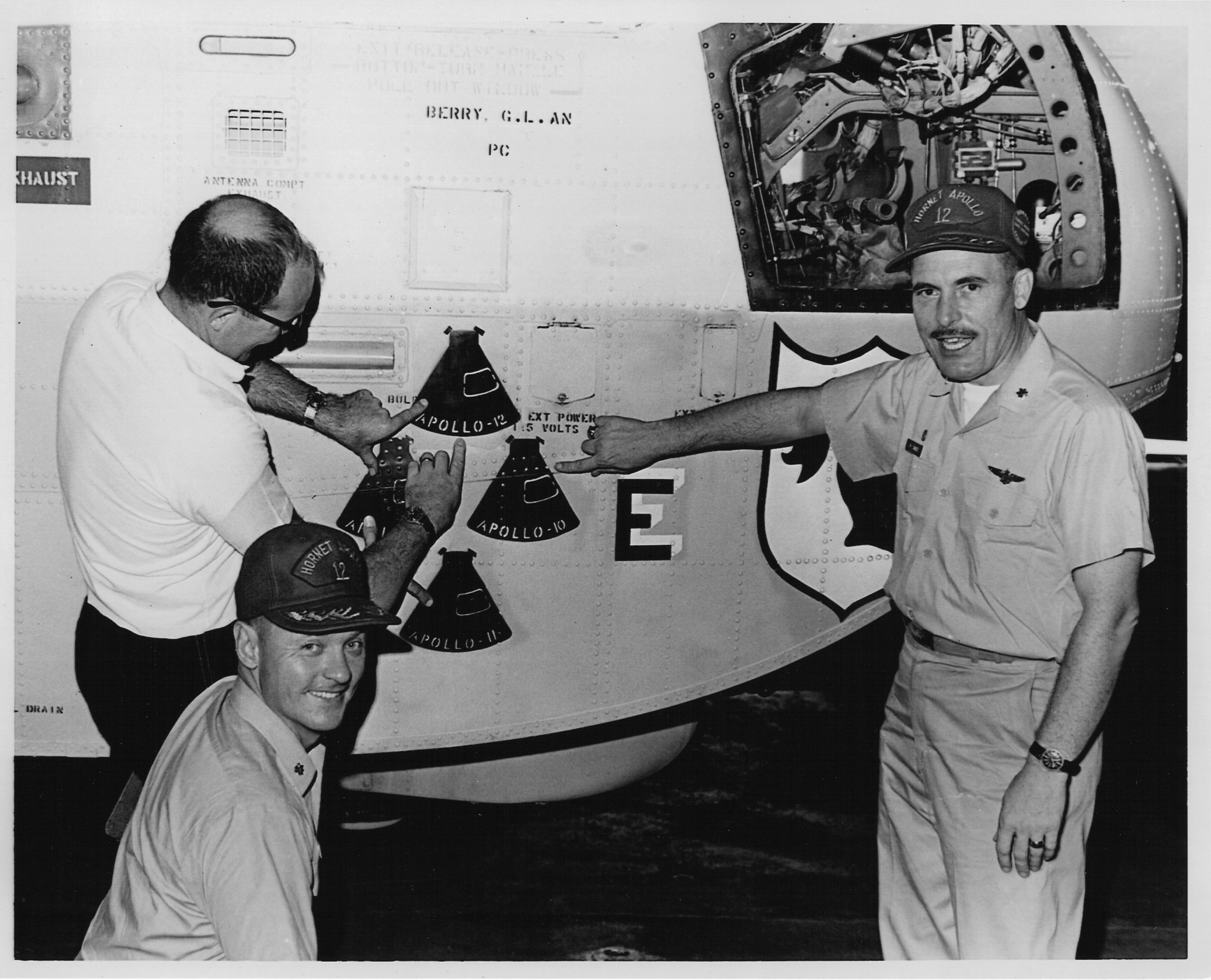
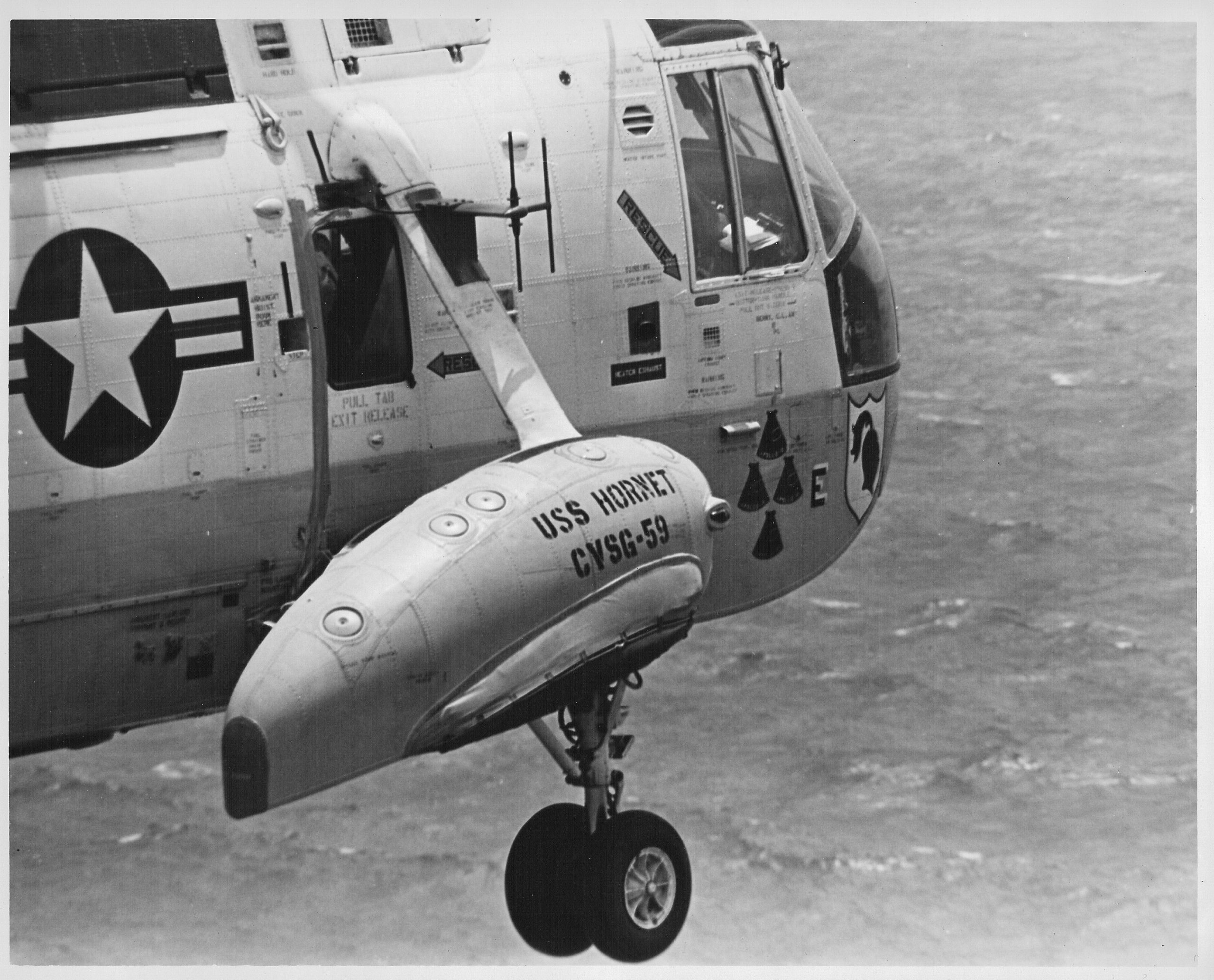
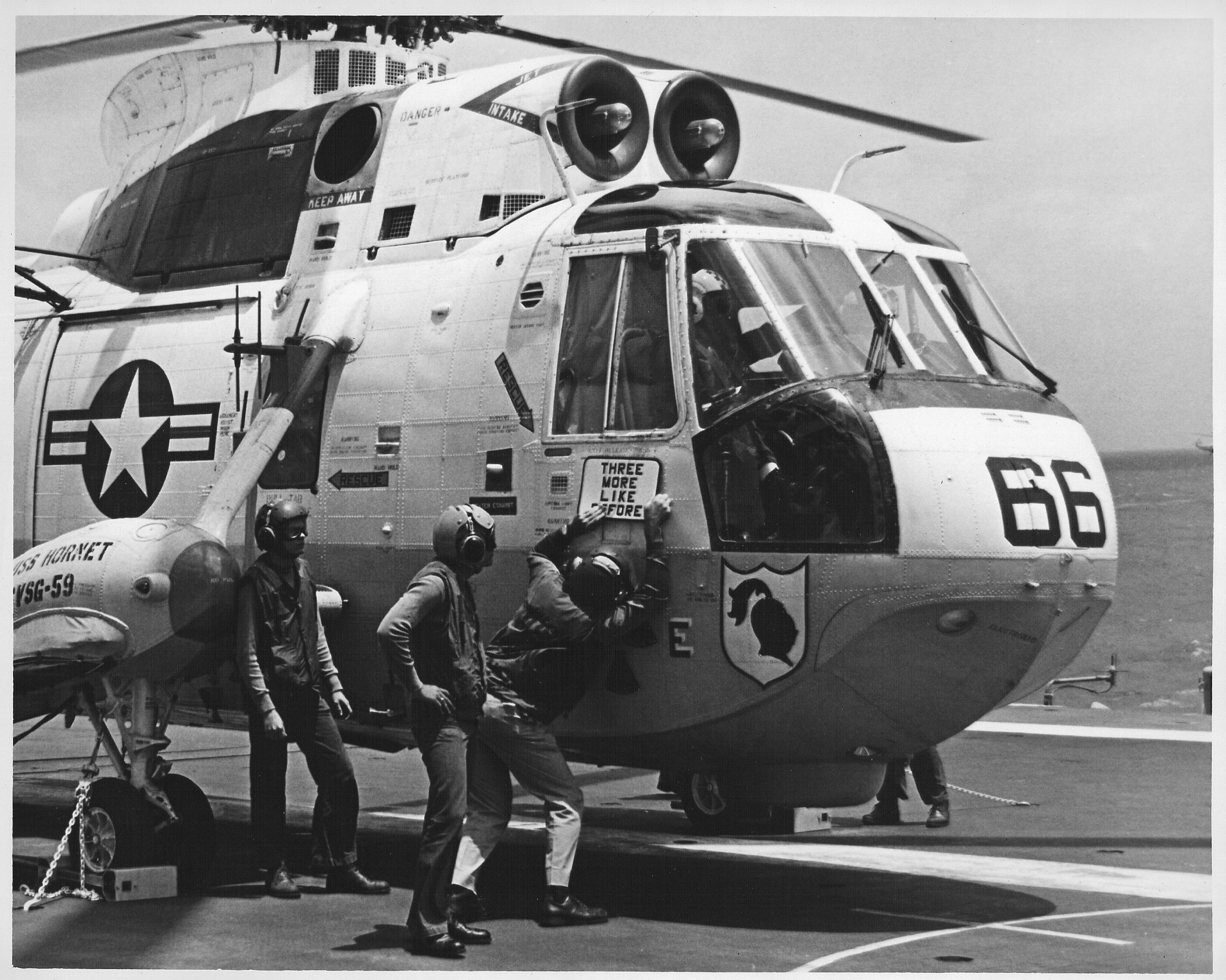
An excellent closeup view of the forward fuselage of Helicopter 66, specifically of its Command Module (CM) “victory marking” silhouettes, shortly after successfully leading the recovery of the crew Apollo 12 Crew & Command Module “Yankee Clipper”. The motto for this crew/capsule recovery operation was “THREE MORE LIKE BEFORE”, following up on that of Apollo 11, “HORNET +3”. Reasonable to assume the photo was taken enroute to, or after arrival at Pearl Harbor.
Good reading:
www.collectspace.com/ubb/Forum29/HTML/000205.html
Credit: collectSPACE website
And:
www.nasa.gov/feature/50-years-ago-three-more-like-before-...
Also:
en.wikipedia.org/wiki/Helicopter_66
Credit: Wikipedia
Further:
www.thespacereview.com/article/895/1
Credit: The Space Review website
Wow, way way cool:
www.nhahistoricalsociety.org/apollo-12-mission-and-recovery/
Affixing the Apollo 12 victory marker:
www.nhahistoricalsociety.org/wp-content/uploads/2020/03/H...
Inflight closeup:
www.nhahistoricalsociety.org/wp-content/uploads/2020/03/W...
Attaching the placard:
www.nhahistoricalsociety.org/wp-content/uploads/2020/03/W...
All above credit: “Naval Helicopter History” website
“G. L. Berry”??? That is a last name, comma, first & middle name initials, right? I’ve not been able to find anybody associated with Helicopter 66 by the last name of Berry. Maybe because he was only a (USN) Airman? But I wouldn’t expect an E-3 to have their name stenciled on an airframe. IDK. ¯\_(ツ)_/¯
Look at all of that instructional, descriptive, warning & identification stenciling/decal(s). Oh yeah…it’s for Navy bubbas, which explains it. So there’s probably one somewhere less conspicuous bearing “INHALE/EXHALE - REPEAT PROCESS INDEFINITELY - UNLESS SUBMERGED WITHOUT SCUBA GEAR”.
Just kidding shipmates…just kidding. HOOYAH!
“South tracking camera shows the moment the Apollo 8 S-IC stage begins its separation from the S-II stage, December 21, 1968.”
Talk about a rarely seen - let alone correctly (I’m pretty sure) identify/attribute - photograph/image. The above is paraphrased from the “APOLLO 11 SPACE” website, at:
apollo11space.com/how-did-the-saturn-v-stages-separate/
Specifically:
i0.wp.com/apollo11space.com/wp-content/uploads/2021/11/So...

Although I’d never heard of them before - and not to be an ass - but I lend much more credence to their identification than to anything N(Ass)A produced. And it looks like they have plenty of other interesting stuff.
With much appreciation to them!
“Apollo 8 launched on December 21, 1968 and sent the first humans out of Earth's orbit. It carried Frank Borman, Jim Lovell and William Anders on the first launch of a Saturn V with a crew onboard on a mission to orbit the Moon 10 times before returning to Earth on December 27.”
The above is associated with NASA photo S-69-15558, a near equivalent image.
~7.675 x 10”, likely trimmed. Despite some varied minor flaws resulting from improper handling & minimal care, the photograph has retained nice gloss & detail.
The two diagonal lines to the left of the Saturn V are not photo emulsion artifacts, flaws or scratches, since they show up in other photographs of this and other Saturn V launches. I suppose they’re guy wires of some sort, supported by the one near the lower left being dark, in effect ‘silhouetted’ against the brighter billowing exhaust gases behind it, while the lighter one – which looks like it leads up to the crew access arm level – is due to it being illuminated by the F-1 engine plumes below.
Acrylic on canvas - 11 x 14
This past week's Art Day challenge was to paint from a launch photo of the big Saturn V- Apollo 8, to be exact. The second smaller more abstract painting I did after my main one- because I had the paints/color palette left, and why waste paint, right? Smaller painting is a finger painting. :)
Happy Art Day, Everyone!
Apollo 13 Mission Commander.
Tualatin Fred Meyer, 11:34 PM.
Media:
* USA TODAY: A conversation with Capt. James Lovell 50 years after Apollo 13 | USA TODAY, April 13, 2020
* John Barry: Space March (Capsule In Space) (1967)
In August of 1968, three NASA astronauts received a call telling them to cancel their winter holiday plans — they were going to the Moon. Fifty years later we are celebrating the historic mission of Apollo 8: go.nasa.gov/2EDarq3
Date: Dec. 27, 1968. This Apollo 8 reentry photograph was taken by a U.S. Air Force ALOTS (Airborne Lightweight Optical Tracking System) camera mounted on a KC-135A aircraft flown at 40,000 ft altitude. Apollo 8 splashed down at 10:15 a.m. in the central Pacific approximately 1,000 miles South-Southwest of Hawaii.
Credit: NASA
NASA Goddard Space Flight Center enables NASA’s mission through four scientific endeavors: Earth Science, Heliophysics, Solar System Exploration, and Astrophysics. Goddard plays a leading role in NASA’s accomplishments by contributing compelling scientific knowledge to advance the Agency’s mission.
Follow us on Twitter
Like us on Facebook
Find us on Instagram
tothemoon.ser.asu.edu/gallery/Apollo/8/Hasselblad%20500EL...
"Fifty years ago today, I was part of a crew of three men orbiting the moon, cocooned inside a 13-foot by 11-foot space capsule. Inside, there wasn't much space at all. Outside, the immensity of our galaxy boggled our minds and dazzled our eyes.
Despite substantial risks in moving up the launch date in order to get ahead of the Soviet Union's space program, we set world records for speed, altitude, and distance. We became the first humans to leave low-Earth orbit, and to orbit another celestial body. Ours were the first human eyes to see the far side of the moon. Months later, Apollo 11's Neil Armstrong and Buzz Aldrin walked on the lunar surface.
The audacious nature of what NASA achieved in winning the space race remains unsurpassed. Those efforts fueled further progress that continues today, often through private enterprise. NASA demonstrated how American ingenuity could overcome nearly any obstacle.
In December of 1968, as Frank Borman, Jim Lovell, and I rocketed toward our nearest planetary neighbor, America faced many challenges. It sometimes seemed as if the country was coming apart at the seams. The assassinations of Dr. Martin Luther King, Jr. and Robert Kennedy, the Vietnam War and the protests against our involvement there, and the Cold War divided us against ourselves and against the world. Forces from within and without threatened us. Everywhere, tensions ran high. Still, millions of Americans, and some one billion people worldwide, tuned in on Christmas Eve to watch our crew's live television broadcast from space.
One of my assignments was to photograph the lunar surface to facilitate the evaluation of potential landing sites. I brought a 250 mm lens to bring that alien terrain into better view. On our fourth orbit, the spacecraft was oriented in a different direction. A startling image captivated the three of us.
Earth, 238,900 miles away, ascended above the barren lunar surface. Compelled by that vision, we scrambled for cameras. I deviated from the rigid NASA flight plan. Every photographic exposure had been determined in advance but I had to capture our view with the long lens on color film.
One of those shots became known as "Earthrise."
That photograph, shared globally and always in the public domain, has since served to educate and inspire: The Earth we saw rising over the battered grey lunar surface was small and delicate, a magnificent spot of color in the vast blackness of space. Once-distant places appeared inseparably close. Borders that once rendered division vanished. All of humanity appeared joined together on this glorious-but-fragile sphere.
Another vision made the hair on the back of my neck stand up. I held my fist at arm's length. That stunning vision disappeared. From one lunar distance our world was easily obscured. At 10 lunar distances Earth would have been but the size of a ladybug. And at 100 — then and now far beyond human reach — Earth would no longer be visible to the naked eye. Here was everything humans had been, everything we were, and everything we might become — and yet our home planet was physically insignificant in space.
I thought of my wife and five children on that little planet. The same forces that determined their fates worked on the other three-and-a-half-billion inhabitants. From our tiny capsule, it seemed as if the whole Earth was smaller even than the space the three of us inhabited.
From there, the blue-and-white glory of Earth, the only color amidst the blackness of space, became a beacon. Before liftoff I calculated we had a one-in-three chance of returning from a successful mission safely.
We did make it home.
Hundreds of thousands of people labored together to move us, as astronauts, as Americans, as humans forward.
The most significant revelation of Apollo 8's journey extends far beyond our scientific-and-technological achievements, beyond our "records" and "firsts."
We set out to explore the moon and instead discovered the Earth.
Fifty years later, "Earthrise" — the lingering imprint of our mission — stands sentinel. It still reminds us that distance and borders and division are merely a matter of perspective. We are all linked in a joined human enterprise; we are bound to a planet we all must share. We are all, together, stewards of this fragile treasure.
Seen this way, "Earthrise" can continue to serve, for generations to come, and after most details of Apollo are forgotten, as a beacon—not just for the three of us on Apollo 8 — but for all of us together on the good Earth."
-William "Bill" Anders, 24th December, 2018
A team of U.S. Navy underwater demolition swimmers prepares the Apollo 8 command module for being hoisted aboard the carrier U.S.S. Yorktown, prime recovery vessel for the initial human lunar orbital mission. The crew members—astronauts Frank Borman, James A. Lovell, Jr., and William A. Anders—had already egressed the spacecraft and were aboard the recovery ship at the time of this photo.
Credit: NASA
Image Number: S68-56344
Date: December 27, 1968
“SPACE TV - - Millions of Americans will enjoy “live” television from space this Fall when a 4 1/2-pound RCA TV camera is carried aloft by three astronauts during the first manned flight of the Apollo Command Module. The camera will transmit scenes of the astronauts at work in their spacecraft and can be aimed out the Command Module’s windows for panoramic views of earth. The compact camera was developed by RCA for the National Aeronautics and Space Administration’s Manned Spacecraft Center. Dick Dunphy, who headed the RCA space team which developed the shoebox-size unit, demonstrates how astronauts might aim the camera for views of earth or other celestial bodies. The Command Module serves as a fitting background.”
And, per the caption of the NASA-appropriated issuance of the photo:
“SPACE-TACULAR" expected to show up on U.S.
Television sets when astronauts make their 10-day Apollo flight in late sunner will be shot, in orbit, by this 4½-pound TV camera developed by RCA expressly for the National Aeronautics and Space Administration mission. Pictures originating in outer space will be brought in "live". Dick Dunphy, shown sighting with the pistol-grip unit, headed up the space-camera team that conceived it. It's only 1/85th as large as those used in TV studios, weighs only 1/30th as much.”
The “UNITED STATES/U.S. flag” decals(?), stenciling(?) look to be that of CM-012. Not implying they ARE such, they are however the same.
Featuring the image and a whole lot more, at the wonderful “Honeysuckle Creek Tracking Station” website:
www.honeysucklecreek.net/images/images_Apollo_8/RCA-Apoll...
This Apollo 8 reentry photograph was taken by a U.S. Air Force ALOTS (Airborne Lightweight Optical Tracking System) camera mounted on a KC-135A aircraft flown at 40,000 ft altitude. Apollo 8 splashed down at 10:15 a.m., December 27, 1968, in the central Pacific approximately 1,000 miles South-Southwest of Hawaii.
Credit: NASA
Image Number: S69-15592
Date: December 27, 1968
Very nice cutaway of either - take your pick - the Apollo 7 or Apollo 8 Command Module, as depicted by talented artist Russ Arasmith.
Note the lack of a docking probe in the space above the “FORWARD ACCESS TUNNEL”, as it was not required on either Apollo 7 or 8.
I wonder what, if anything actually occupied that space for those missions? There would’ve surely been something, of equivalent mass, possibly in the form of basic instrumentation or recording/telemetry capability, no?
A life well-lived, thank you for your service Sir, Rest In Peace:
www.dignitymemorial.com/obituaries/westminster-ca/russell...
Credit: Dignity Memorial website
In lieu of comparative photographs (other than the one following), along with well-founded skepticism and doubt associated with NASA photographic record keeping & identification, I’ll foolishly go out on a limb and call this S-IC-3…being hoisted into position or removed(?) from the S-IC Test Stand/Building 4670, Marshall Space Flight Center (MSFC), possibly in October 1966.
In support of my above, I submit the following weak evidence:
history.nasa.gov/MHR-5/part-7.htm
Specifically, the following passage:
“After successful completion of post-manufacturing checkout at the Michoud Booster Checkout Facility, the S-IC-3 stage left Michoud on September 23 and arrived at MSFC on October 1. Unloading operations began on October 3, and on that same date workmen erected the stage in the test stand. ³²⁵
325. MSFC Press Release No. 66-223, Sept. 29, 1966.”
Even more specifically, this image – it being the ‘smoking rocket’:
history.nasa.gov/MHR-5/Images/fig317.jpg

HOWEVER, odds are far greater that it’s S-IC-T, due to the fact that it was static fired multiple times in the test stand. Per Mike Jetzer’s superlative “HEROIC RELICS” website:
“A total of 18 tests were performed with the S-IC-T stage at MSFC. The first three flight stages were also static-fired in the stand, with S-IC-1 undergoing two tests and S-IC-2 and S-IC-3 each being fired once. S-IC-4 and subsequent were tested at the MTF.”
At:
heroicrelics.org/msfc/test-stand-s-ic/index.html
ALTHOUGH, what little photographic evidence I’ve found of the purported S-IC-T at the MSFC S-IC test stand, of both supposed emplacement & removal, none have evidence of thrust chambers installed.
FINALLY, the outward appearance of the S-IC probably offers a clue as to its identification, Unfortunately though, I can’t keep up with the different paint schemes of the Saturn V’s, which seemed to have been changed, at different locations, during different times of the manufacturing/testing process, and where/when/if the U.S. flag decals were applied, along with what font “USA” decal was applied. So I suppose my final determination should actually be: who the f**k knows.
Launch: December 21, 1968
Landing: December 27, 1968
Astronauts: Frank Borman, William A. Anders and James A. Lovell Jr.
Apollo 8 was the first mission to orbit the moon, making Borman, Anders and Lovell the first humans to see the far side of the moon. They conducted lunar landing site tracking while in orbit for future missions to the moon.
Credit: NASA
Image Number: S68-51093
Date: December 1968
A fantastic view of Command Module 103 (CM-103) during assembly & testing at North American Aviation’s (NAA) Downey, CA facility. Possibly bldg. 290?
Excessive elaboration to confirm/prove my identification of it as CM-103 accompanies the below linked photos. In lieu, suffice it to say that the look/configuration of certain forward compartment components visible here, along with markings, which, like fingerprints, are unique to each CM, confirm it to be a Block II capsule, which eventually flew on Apollo 8.
The dangling hoses from the fixture partially encircling the Command Module are all pneumatic, and the exposed tanks/vessels visible within the exposed aft compartment, other than the one clearly labeled “WASTE WATER TANK”, are Reaction Control System related. So, this ‘station’ may be to pressure test those tanks/vessels. What I initially thought was the framework of the overhead structure are the myriad of feed lines to each hose position!
Additionally, per an ‘H-Missions’ Command/Service Module News Reference, at:
www.hq.nasa.gov/alsj/CSM16_Reaction_Control_Subsystem_pp1...
which may or may not be applicable (I choose to think it is):
“The [CM reaction control] system consists of two independent, redundant systems, each containing six engines, helium and propellant tanks, and a dump and purge system. The two systems can operate in tandem; however, one can provide all the impulse needed for the entry maneuvers and normally only one is used.”
Further, per figure/plate P-200 within the above document, the two nearly adjacent tanks closest to the camera are fuel tanks, System 1 on the left, System 2 on the right. The smaller single tank to the right is the System 2 Helium tank. The panel of plastic wrapped/capped? connections farther to the right may then be fuel line connections to the yet-to-be installed yaw jets below it. To the left of the waste water tank are, left-to-right, System 1 & System 2 oxidizer tanks. Finally, the four connected pneumatic lines are at, appropriately enough, the ‘fuel servicing panel’.
A rare, obscure & stunning photograph that somehow fortunately survived.
Compare/contrast. Awesome:
Credit: the wonderful Internet Archive website