View allAll Photos Tagged 116a,
Chicago Great Western FP7A-116A, built in January of 1951, much in need of a paint touch-up, is on display at the Hub City Heritage Railway Museum. It later went to Chicago & North Western as their 217.
The Roosevelt elk, also known as Olympic elk, is the largest of the four surviving subspecies of elk in North America. Their range includes temperate rainforests of the Pacific Northwest, extends to parts of northern California, and they were introduced to Kodiak, Alaska's Afognak and Raspberry Islands in 1928.
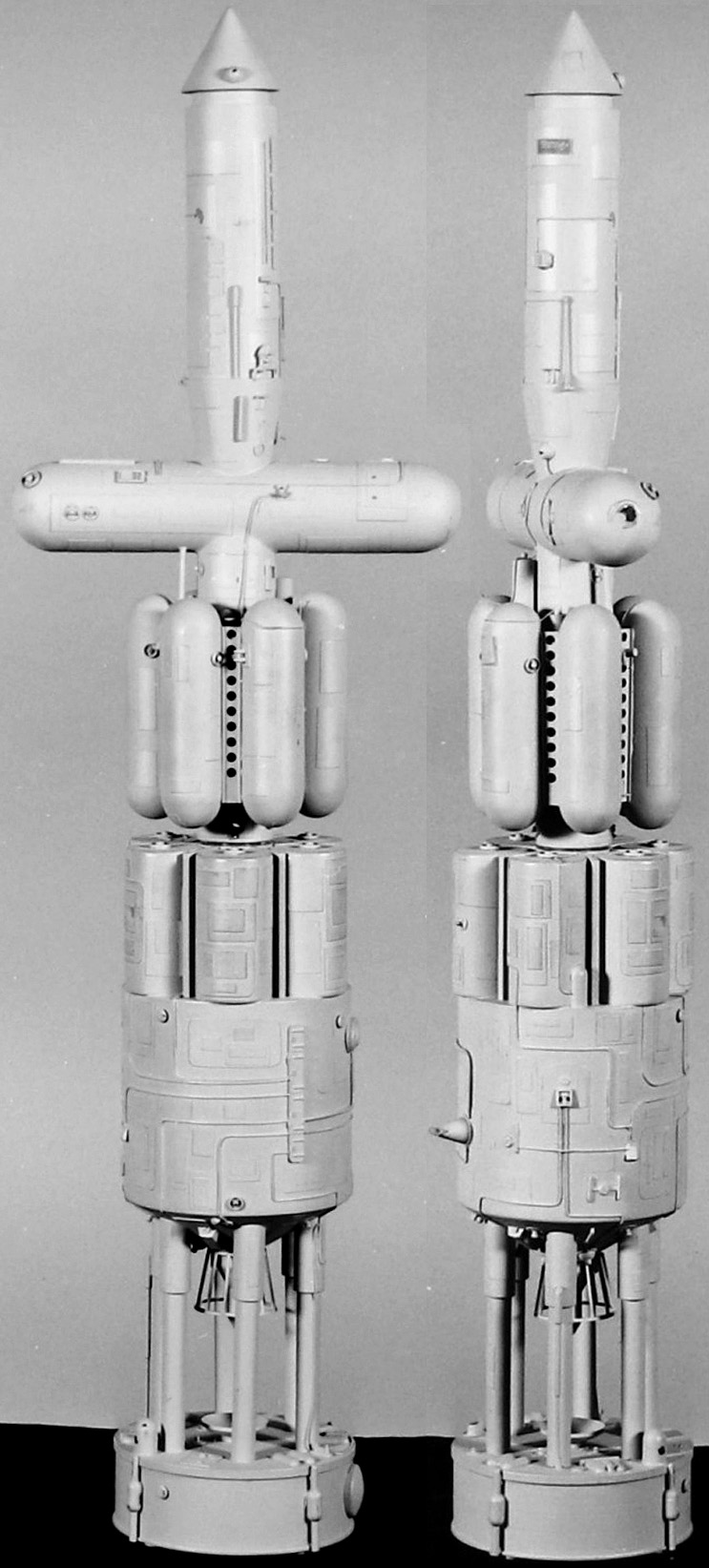
A gorgeous model of a version of the interplanetary, nuclear-pulse Project Orion spacecraft.
Just me I know & irrelevant...to anything; however, I find the presence of the date/photo ID number to be perplexing, with regard to the subject, that is. Its format & placement, even the font used, is that of official North American Aviation (NAA)/North American Rockwell (NR/NAR) photographs of the time. If so, the first grouping of numerals might even be missing the normally trailing "8".
Orion - to the best of my knowledge - was primarily, if not exclusively, a General Dynamics (GD)/General Atomic Div. effort/proposal, and the USAF. GD never became affiliated with, nor consumed by NR/NAR. Further, Orion was cancelled as of 1964/65.
If I’m correct, why would NR/NAR reissue what I assume to originally be a GD photo, from ca. 1960-64? The program itself was never resurrected. And if not a reissue, and indeed by NR/NAR, in 1969…why?
Not surprisingly, there’s no shortage of material pertaining to Project Orion.
e05.code.blog/2022/03/28/0025-bx094-fd001_020/
Credit: The Superlative “Station E05” blog
And:
LOTS of FANTASTIC stuff here, specifically page 2 in this instance:
edan.si.edu/slideshow/viewer/?eadrefid=NASM.2003.0025_ref...
ids.si.edu/ids/deliveryService?max_w=90&id=NASM-NASM....
ids.si.edu/ids/deliveryService?max_w=90&id=NASM-NASM....
ids.si.edu/ids/deliveryService?max_w=90&id=NASM-NASM....
All above credit: Smithsonian Institution/Smithsonian Online Virtual Archives (SOVA) website
Also:
www.projectrho.com/public_html/rocket/enginelist3.php#boo...
www.projectrho.com/public_html/rocket/images/realdesigns/...
Both above credit: ATOMIC ROCKETS website
A model of a different and the most prevalent variant in diagrams & literature, with the forward-located toroidal “crew/personnel accommodations” module/station:
commons.wikimedia.org/wiki/File:Model_of_proposed_Orion_N...

Credit: Wikimedia Commons
Other than the photos I’ve linked to above of what is likely the same model, my rather extensive searching hasn’t yielded nothing depicting/referencing the forward, transverse-mounted presumable crew/personnel module. Was it to possibly be used in an artificial gravity-inducing capacity? By rotation of the entire spacecraft along the central axis? I don’t see a separation plane between it and the "payload spine" of the vehicle - permitting independent rotation - which I naively/ignorantly would’ve expected.
¯\_(ツ)_/¯
There is this...which bears some outward resemblance...however, these are "deployable" modules, that apparently pivot outward - à la "Pilgrim Observer", which certainly doesn't seem to be the case with the model:
edan.si.edu/slideshow/viewer/?eadrefid=NASM.2003.0025_ref939
Credit: Smithsonian Institution/Smithsonian Online Virtual Archives (SOVA) website
Amusingly/Interestingly, artificial gravity for the more prevalently rendered design was to be achieved by the “tumbling pigeon”/”baton” mode of rotation, with the spacecraft basically tumbling end-over-end…not during periods of active nuclear pulsing…of course.
newatlas.com/orion-project-atom-bomb-spaceship/49454/
Credit: “New Atlas” website
web.archive.org/web/20070704104944/http://ntrs.nasa.gov/a...
Credit: The WONDERFUL Internet Archive/Wayback Machine website
ntrs.nasa.gov/api/citations/19760065935/downloads/1976006...
Finally...note the repeated nuclear detonation "weathering" of the bottom of the pusher plate.
I want one…IT. I hope it somehow survived.
Canadair CF-116A Freedom Fighter 116769 is seen during a May snow shower outside the Officers Mess at CFB Borden, about eighty kms north of Toronto, Ontario.
The Iowa Northern job arrives in Oelwein, IA passing the CGW 116A recently repainted in the dark purple scheme.
Tu BiShvat 2019 will begin at sundown on the evening of
Sunday, January 20 which is the 15th of Sh'vat, 5779, (Hebrew: ט״ו בשבט ) in the Hebrew Calendar.
And it will end after sundown on the evening of
Monday, January 21
It is also called "The New Year of the Trees" or (Hebrew: ראש השנה לאילנות, Rosh HaShanah La'Ilanot). Tu BiShvat is one of four "New Years" mentioned in the Mishnah.
Okay, now here is the fun part:
I'm reprinting this from Chabad's Kaballah Online
www.chabad.org/kabbalah/article_cdo/aid/379846/jewish/Tu-...
________________________
Tu B’Shevat: Basics
Beginner
By Yerachmiel Tilles
Tu B’Shevat: Basics
Meet the New Year for the Trees.
The Meaning of Tu B’Shevat
The 15th day of the Jewish month of Shevat is the official “birthday” for trees in Israel. Calculating the years of a tree is necessary for several mitzvot of the Torah: ma'aserot—tithing [of each year’s fruit]; orlah—forbidden fruit of a tree’s first three years; reva’i—[redemption of] the fruit of a tree’s fourth year; and shemitah—the Sabbatical year. Tu B’Shevat is considered the beginning of the year for trees because it is the midpoint of winter: the strength of the cold becomes less, the majority of the year’s rains (in Israel) have fallen, and the sap of the trees starts to rise. As a result, fruit begins to form. (Fruit that was already ripe is known to have been nurtured by the previous year’s rain.)
The Tu B’Shevat Celebration
The Code of Jewish Law states that on Tu B’Shevat fasting and eulogies are forbidden, and all penitential prayers are omitted. One of the most important authorities, the Magen Avraham, adds (131:16): “It is the custom to eat many different kinds of fruit.” The almond tree is always the first to bloom...
The Kabbalistic celebration of Tu B’Shevat that originated in Safed involves eating particular fruits in a specific order [or seder, in Hebrew] and reading mystical passages appropriate to each of them. It was first recorded in Pri Etz Hadar, a 50-page pamphlet arranged by a student of Rabbi Yitzchak Luria, the Ari (1534–1572), the greatest Kabbalist of Safed. Since not everyone can always find 30 fruits that are appropriate [see below] set out below are the primary 12 fruits recommended for the Seder, corresponding to the 12 possible permutations of G‑d’s four-letter name, along with related verses and themes to focus on while eating, which we have substituted for the lengthy Zohar passages of the original.
Guidelines
1) Gather a bunch of Jews. Each one should help with the preparations, including researching something to say.
2) Buy as many different fruits as you can (see “30 Fruits,” below). Make an extra effort to obtain the 12 listed below in “The First Twelve.”
3) Also buy at least two bottles of sealed kosher wine: one white, one red (see below, “Four Cups”).
4) Bake (or purchase) cake or cookies, or anything tasty that is made primarily from wheat flour.
5) Set the table festively—tablecloth, candles, flowers, etc.
6) Be sure each participant knows which blessings to say before and after each food. The proper blessings are very important, and are printed in every Jewish prayerbook. (See “Blessings,” below.)
7) Begin by serving the cake and saying the blessing for it.
8) On this occasion, the blessing over fruit should be said over one of those for which the Land of Israel is specially praised (numbers 2–6 in “The First Twelve”), either the one for which you have a strong preference or the one nearest the top of the list.
9) The first cup of wine should be poured at the beginning (see “Four Cups”). You may recite the blessing and drink it between the cake and the fruit, or after reaching grapes (#4 on the list).
10) Have a good time, but don’t be too light-headed. This is a unique opportunity to effect awesome spiritual rectifications (see “Tikkunim” and “Blessings”).
The First 12 Fruits of the Seder
1. Wheat is the basis for our sustenance (see Psalms 81:17, 104:15, 147:14), but only after we labor to grow, harvest and prepare it. (Barley, although not included in the order of the meal, is one of the seven fruits for which Israel is praised. Often used for feeding animals. Its designation for the Omer offering inspires our efforts to harness our animalistic tendencies.)
2. Olives yield the best of their oil only when the fruit is crushed. Olive oil floats on top of all liquids. (See also Jeremiah 11:16.)
3. Dates are often a metaphor for the righteous (Psalms 92:13, Song of Songs 7:9), as the date tree is both lofty and fruit-bearing. Also, as the date tree is impervious to the changing winds, so too are the Jewish people.
4. Grapes can be turned into very different sorts of food (raisins) and drink (wine); so too, each Jew has the potential to be successful in some aspect of Torah and mitzvah observance, and to be special in his or her own way. (See also Psalms 20:4; Hosea 9:10.)
5. Figs must be picked as soon as they ripen, for they quickly go bad. Similarly, we must be quick to do mitzvot at hand before the opportunity “spoils.” (See also Song of Songs 2:10.)
6. Pomegranates, it is said, have exactly 613 pips, equal to the number of mitzvot in the Torah. Try counting! In any case, “Even the least of Jews are as full of merit as a pomegranate is [full of pips]” (see Song of Songs 4:4, 6:7).
7. Etrogim [Hebrew for “citrons”] are considered to be an extremely beautiful fruit, and are of great importance at Sukkot time (see Lev. 23:40 and commentaries). The etrog remains on the tree throughout the entire year, benefiting from all four seasons and unifying them.
8. Apples take 50 days to ripen. So too, the Jews ripened—and still ripen—during the 50 days from Pesach to Shavuot. And just as the apple tree produces fruit before leaves, so too do Jews perform mitzvot without the prerequisite of total understanding—“We will do, and [then] we will hear” (Exodus 24:7). See also Song of Songs 2:3.
9. Walnuts are divided into four sections, corresponding to the four letters of G‑d’s name [Havayah] and the four legs of G‑d’s chariot (see Ezekiel ch. 1). As walnuts have two shells which have to be removed, one hard, one soft, we too have to undergo both physical and spiritual circumcision (see Deut. 30:6).
10. Almonds signify enthusiasm in serving G‑d, for the almond tree is always the first to bloom. This is why Aaron’s rod sprouted specifically almond blossoms (Num. 17:23). [See also Jer. 1:11–12—be sure to catch the pun in the original Hebrew.]
11. Carobs take longer to grow than any other fruit (there is a nice story about this in the Talmud, Taanit 23a). They remind us of the necessity to invest many years in Torah study in order to attain worthwhile, clear understanding.
12. Pears of different strains still maintain a close affinity (see Mishnah, Kilayim 1:4).
Blessings
Fruits grow because G‑d wills so; not to recognize this by (saying the proper) blessing is to put the entire Creation in jeopardy. (Pri Etz Hadar) Moreover, the blessings before eating help us to focus our minds on the vital energy and potential for elevation of the food, not just its taste. To eat without first pronouncing the appropriate blessing constitutes theft: not only is it taking without proper acknowledgement, it is depriving the world of the divine beneficence that could have been channeled into it by means of the blessing. To eat many different fruits on this day . . . is a wonderful spiritual anchoring . . .
Eating a fruit for the first time in its season is considered one of the appropriate occasions for the special blessing of joy, Shehecheyanu: “Blessed are You...who has granted us life, sustained us and enabled us to reach this occasion.” Everyone should make an effort to have available a fruit over which to recite this blessing on Tu B’Shevat. (By the way, if both the Shehecheyanu and the blessing for the fruit, “borei pri ha’etz,” are being made over the same piece of fruit, most authorities state that the Shehecheyanu should be said first.)
Tikkunim (Spiritual Rectifications)
In Kabbalah, the flow of G‑d’s beneficence is called the “Tree of Life”: the roots, above in G‑d’s essence; the fruit, here below. By eating fruit on this day we rectify and increase this flow. (Pri Etz Hadar) The Ari teaches that while eating fruit on Tu B’Shevat, one should reflect on the sin of Adam and Eve (that they ate forbidden fruit), and intend to rectify it.
Rabbi Meir says: “The fruit of (the Tree of Knowledge of Good and Evil) was a grape...”; Rabbi Nechemiah says: “It was a fig...”; Rabbi Yehudah says: “It was wheat...” (Talmud, Berachot 40a) [see there for their reasons. Notice that no one says “apple”!]
30 Fruits
Rabbi Chaim Vital (the main disciple of the Ari) explained that there are 30 fruits which parallel the ten sefirot as they are manifest in each of the three lower [of the four] spiritual worlds, Beriah, Yetzirah and Asiyah. Beriah is far removed from the realm of impurity, and is represented by those fruits which are wholly edible: fruits with soft cores (such as apples and pears) and with cookable skins (like lemons and oranges) are considered totally edible, even if those parts are undesirable. Yetzirah is a lesser level of purity, and is represented by those fruits of which all is eaten except for a pit on the inside. Asiyah can be described as being the realm that we experience, in which evil exerts a powerful attraction; it is represented by those fruits which are enclosed in a totally inedible, protective shell.
Four Cups of Wine (Or At Least a Few Sips)
The spirit of the occasion includes drinking white wine at the beginning of the Seder and red wine at the end. Some are accustomed to drink four cups, parallel to Passover night. The first is all white, the second mostly white, the third half-and-half, and the fourth mostly red. Why? See the discussion of the Four Worlds in “30 Fruits,” above.
Classic Thoughts
“A land of wheat and barley, and (grape)vines, and figs, and pomegranates; a land of oil-olives and (date-)honey” (Deut. 8:8)
Charoset (for the Passover Seder) should be made from those fruits to which Israel is compared in Song of Songs... (Tosafot, Pesachim 116a)
Rabbi Elazar would eat less and save money, in order to be able to eat all the new fruits on Tu B’Shevat.
We have a tradition from R. Tzvi Elimelech of Dinov (the author of Bnei Yissaschar) to pray on Tu B’Shevat that G‑d should make available for us a kosher and especially beautiful etrog in time for Sukkot.
After Sukkot we fry the etrog that we used for the Four Species, and on Tu B’Shevat we eat it. (Likutei Maharich)
To eat many different fruits on this day and to recite various passages and praises while doing so . . . is a wonderful spiritual anchoring. (Pri Etz Hadar)
IMG_9604 V2
In the hole for a meet with CGW 116A (FP7) in Lombard.
Roger caught this westbound Chicago Great Western way freight working in the western Chicago suburbs on December 28, 1962. He called it "Extra 9 West" which may have been what the dispatcher called it. This was pre-scanners. CGW 9 was an Alco S-2.
Northrop CF-5A/CF-116 Freedom Fighter near Trenton. This hotel is situated just south of highway 401 and is part of the Ramada chain rather than the Holiday Inn that has been reported previously.
As far as I can see only the last two digits of the serial are worn on the aircraft.
A mother's work is never done. Today's lesson: The proper way to eat your seedcake.
Ok, it could be Dad here, but with Carolina Wrens, you can't tell them apart, so we're going with Mommy in this shot.
Canadair CF-116A Freedom Fighter (116759) wearing 912B preserved at a snowy CFB Bordon, about eighty kms north of Toronto, Ontario.
Milwaukee Road F7 116A at Bensenville, Illinois on January 9, 1966, Kodachrome by Chuck Zeiler. This locomotive was built in November 1951 (c/n 15215) on EMD Order 3106A, retired October 1974, traded to EMD, sent to Precision National and scrapped.
Saw this Gull trotting along the edge of the water with something in his beak. Zoomed in and saw he had breakfast.
And there were a few other Gulls starting to take notice and head his way, too. Better run faster little fellow!
EMD built No. 630 in 1941, one of five E6As the Rock Island purchased. Today it’s one of only a few remaining slant-nosed E units.
Awesome Speed Religion babe Donna at the Autosport International show, NEC, Birmingham UK.
Nikon D-300, Nikkor 18-200mm f3.5/5.6 ED, Speedlite SB-800.
135mm, f5.6, 1/60 sec.
Please note:
These images are not public domain and are protected by copyright law.
All images © MSI (Motorsport Images Ireland) 2016. All rights reserved.
COPYRIGHT: The copyright and intellectual property rights of this image is owned by MSI (Ireland), and is protected by copyright laws of Ireland and international intellectual property right treaties. You may not copy any portion of the images in any form whatsoever. You may not alter the images in any way.
UNAUTHORIZED USE: You may not use, copy, rent, lease, sell, claim ownership, publish to a website, blog or other such electronic hosting medium, modify, decompile, disassemble, otherwise reverse engineer, or transfer images in any form whatsoever whether electronically, mechanically or any other method. Any such unauthorized use shall result in immediate and automatic termination of this license and may result in civil and/or legal action against you/your company or representative.
If you are interested in the use of this digital photographic image, please contact us via e-mail at msiireland@yahoo.com or motorsportimagesireland@gmail.com
......................................................................................................................
Photography by JOB/MSI Ireland
© MSI Ireland 2016
All Rights Reserved
Canadian Armed Forces Canadair CF-116A Freedom Fighter 116721 cn 1021 National Air Force Museum of Canada CFB Trenton YTR
Tu BiShvat, or Tu B'Shvat, or Tu BeShevat 2021 will begin at sundown on the evening of
Thursday, January 28 which is the 15th of Sh'vat, 5782, (Hebrew: ט״ו בשבט ) in the Hebrew Calendar.
And it will end after sundown on the evening of
Friday, January 29
It is also called "The New Year of the Trees" or (Hebrew: ראש השנה לאילנות, Rosh HaShanah La'Ilanot). Tu BiShvat is one of four "New Years" mentioned in the Mishnah.
Okay, now here is the fun part:
I'm reprinting this from Chabad's Kaballah Online
www.chabad.org/kabbalah/article_cdo/aid/379846/jewish/Tu-...
________________________
Tu B’Shevat: Basics
Beginner
By Yerachmiel Tilles
Tu B’Shevat: Basics
Meet the New Year for the Trees.
The Meaning of Tu B’Shevat
The 15th day of the Jewish month of Shevat is the official “birthday” for trees in Israel. Calculating the years of a tree is necessary for several mitzvot of the Torah: ma'aserot—tithing [of each year’s fruit]; orlah—forbidden fruit of a tree’s first three years; reva’i—[redemption of] the fruit of a tree’s fourth year; and shemitah—the Sabbatical year. Tu B’Shevat is considered the beginning of the year for trees because it is the midpoint of winter: the strength of the cold becomes less, the majority of the year’s rains (in Israel) have fallen, and the sap of the trees starts to rise. As a result, fruit begins to form. (Fruit that was already ripe is known to have been nurtured by the previous year’s rain.)
The Tu B’Shevat Celebration
The Code of Jewish Law states that on Tu B’Shevat fasting and eulogies are forbidden, and all penitential prayers are omitted. One of the most important authorities, the Magen Avraham, adds (131:16): “It is the custom to eat many different kinds of fruit.” The almond tree is always the first to bloom...
The Kabbalistic celebration of Tu B’Shevat that originated in Safed involves eating particular fruits in a specific order [or seder, in Hebrew] and reading mystical passages appropriate to each of them. It was first recorded in Pri Etz Hadar, a 50-page pamphlet arranged by a student of Rabbi Yitzchak Luria, the Ari (1534–1572), the greatest Kabbalist of Safed. Since not everyone can always find 30 fruits that are appropriate [see below] set out below are the primary 12 fruits recommended for the Seder, corresponding to the 12 possible permutations of G‑d’s four-letter name, along with related verses and themes to focus on while eating, which we have substituted for the lengthy Zohar passages of the original.
Guidelines
1) Gather a bunch of Jews. Each one should help with the preparations, including researching something to say.
2) Buy as many different fruits as you can (see “30 Fruits,” below). Make an extra effort to obtain the 12 listed below in “The First Twelve.”
3) Also buy at least two bottles of sealed kosher wine: one white, one red (see below, “Four Cups”).
4) Bake (or purchase) cake or cookies, or anything tasty that is made primarily from wheat flour.
5) Set the table festively—tablecloth, candles, flowers, etc.
6) Be sure each participant knows which blessings to say before and after each food. The proper blessings are very important, and are printed in every Jewish prayerbook. (See “Blessings,” below.)
7) Begin by serving the cake and saying the blessing for it.
8) On this occasion, the blessing over fruit should be said over one of those for which the Land of Israel is specially praised (numbers 2–6 in “The First Twelve”), either the one for which you have a strong preference or the one nearest the top of the list.
9) The first cup of wine should be poured at the beginning (see “Four Cups”). You may recite the blessing and drink it between the cake and the fruit, or after reaching grapes (#4 on the list).
10) Have a good time, but don’t be too light-headed. This is a unique opportunity to effect awesome spiritual rectifications (see “Tikkunim” and “Blessings”).
The First 12 Fruits of the Seder
1. Wheat is the basis for our sustenance (see Psalms 81:17, 104:15, 147:14), but only after we labor to grow, harvest and prepare it. (Barley, although not included in the order of the meal, is one of the seven fruits for which Israel is praised. Often used for feeding animals. Its designation for the Omer offering inspires our efforts to harness our animalistic tendencies.)
2. Olives yield the best of their oil only when the fruit is crushed. Olive oil floats on top of all liquids. (See also Jeremiah 11:16.)
3. Dates are often a metaphor for the righteous (Psalms 92:13, Song of Songs 7:9), as the date tree is both lofty and fruit-bearing. Also, as the date tree is impervious to the changing winds, so too are the Jewish people.
4. Grapes can be turned into very different sorts of food (raisins) and drink (wine); so too, each Jew has the potential to be successful in some aspect of Torah and mitzvah observance, and to be special in his or her own way. (See also Psalms 20:4; Hosea 9:10.)
5. Figs must be picked as soon as they ripen, for they quickly go bad. Similarly, we must be quick to do mitzvot at hand before the opportunity “spoils.” (See also Song of Songs 2:10.)
6. Pomegranates, it is said, have exactly 613 pips, equal to the number of mitzvot in the Torah. Try counting! In any case, “Even the least of Jews are as full of merit as a pomegranate is [full of pips]” (see Song of Songs 4:4, 6:7).
7. Etrogim [Hebrew for “citrons”] are considered to be an extremely beautiful fruit, and are of great importance at Sukkot time (see Lev. 23:40 and commentaries). The etrog remains on the tree throughout the entire year, benefiting from all four seasons and unifying them.
8. Apples take 50 days to ripen. So too, the Jews ripened—and still ripen—during the 50 days from Pesach to Shavuot. And just as the apple tree produces fruit before leaves, so too do Jews perform mitzvot without the prerequisite of total understanding—“We will do, and [then] we will hear” (Exodus 24:7). See also Song of Songs 2:3.
9. Walnuts are divided into four sections, corresponding to the four letters of G‑d’s name [Havayah] and the four legs of G‑d’s chariot (see Ezekiel ch. 1). As walnuts have two shells which have to be removed, one hard, one soft, we too have to undergo both physical and spiritual circumcision (see Deut. 30:6).
10. Almonds signify enthusiasm in serving G‑d, for the almond tree is always the first to bloom. This is why Aaron’s rod sprouted specifically almond blossoms (Num. 17:23). [See also Jer. 1:11–12—be sure to catch the pun in the original Hebrew.]
11. Carobs take longer to grow than any other fruit (there is a nice story about this in the Talmud, Taanit 23a). They remind us of the necessity to invest many years in Torah study in order to attain worthwhile, clear understanding.
12. Pears of different strains still maintain a close affinity (see Mishnah, Kilayim 1:4).
Blessings
Fruits grow because G‑d wills so; not to recognize this by (saying the proper) blessing is to put the entire Creation in jeopardy. (Pri Etz Hadar) Moreover, the blessings before eating help us to focus our minds on the vital energy and potential for elevation of the food, not just its taste. To eat without first pronouncing the appropriate blessing constitutes theft: not only is it taking without proper acknowledgement, it is depriving the world of the divine beneficence that could have been channeled into it by means of the blessing. To eat many different fruits on this day . . . is a wonderful spiritual anchoring . . .
Eating a fruit for the first time in its season is considered one of the appropriate occasions for the special blessing of joy, Shehecheyanu: “Blessed are You...who has granted us life, sustained us and enabled us to reach this occasion.” Everyone should make an effort to have available a fruit over which to recite this blessing on Tu B’Shevat. (By the way, if both the Shehecheyanu and the blessing for the fruit, “borei pri ha’etz,” are being made over the same piece of fruit, most authorities state that the Shehecheyanu should be said first.)
Tikkunim (Spiritual Rectifications)
In Kabbalah, the flow of G‑d’s beneficence is called the “Tree of Life”: the roots, above in G‑d’s essence; the fruit, here below. By eating fruit on this day we rectify and increase this flow. (Pri Etz Hadar) The Ari teaches that while eating fruit on Tu B’Shevat, one should reflect on the sin of Adam and Eve (that they ate forbidden fruit), and intend to rectify it.
Rabbi Meir says: “The fruit of (the Tree of Knowledge of Good and Evil) was a grape...”; Rabbi Nechemiah says: “It was a fig...”; Rabbi Yehudah says: “It was wheat...” (Talmud, Berachot 40a) [see there for their reasons. Notice that no one says “apple”!]
30 Fruits
Rabbi Chaim Vital (the main disciple of the Ari) explained that there are 30 fruits which parallel the ten sefirot as they are manifest in each of the three lower [of the four] spiritual worlds, Beriah, Yetzirah and Asiyah. Beriah is far removed from the realm of impurity, and is represented by those fruits which are wholly edible: fruits with soft cores (such as apples and pears) and with cookable skins (like lemons and oranges) are considered totally edible, even if those parts are undesirable. Yetzirah is a lesser level of purity, and is represented by those fruits of which all is eaten except for a pit on the inside. Asiyah can be described as being the realm that we experience, in which evil exerts a powerful attraction; it is represented by those fruits which are enclosed in a totally inedible, protective shell.
Four Cups of Wine (Or At Least a Few Sips)
The spirit of the occasion includes drinking white wine at the beginning of the Seder and red wine at the end. Some are accustomed to drink four cups, parallel to Passover night. The first is all white, the second mostly white, the third half-and-half, and the fourth mostly red. Why? See the discussion of the Four Worlds in “30 Fruits,” above.
Classic Thoughts
“A land of wheat and barley, and (grape)vines, and figs, and pomegranates; a land of oil-olives and (date-)honey” (Deut. 8:8)
Charoset (for the Passover Seder) should be made from those fruits to which Israel is compared in Song of Songs... (Tosafot, Pesachim 116a)
Rabbi Elazar would eat less and save money, in order to be able to eat all the new fruits on Tu B’Shevat.
We have a tradition from R. Tzvi Elimelech of Dinov (the author of Bnei Yissaschar) to pray on Tu B’Shevat that G‑d should make available for us a kosher and especially beautiful etrog in time for Sukkot.
After Sukkot we fry the etrog that we used for the Four Species, and on Tu B’Shevat we eat it. (Likutei Maharich)
To eat many different fruits on this day and to recite various passages and praises while doing so . . . is a wonderful spiritual anchoring. (Pri Etz Hadar)
IMG_9604 V2
CAF 116721 - Canadair (Northrop) CF-116A (F-5) Freedom Figher - Canadian Armed Forces
Painted in 419 "Moose" Squadron special colors
at the National Air Force Museum of Canada at CFB Trenton/ON (YTR)
The Freedom fighter has been at the National Air Force Museum since 1997. In service with the Canadian Armed Forces from 1968 to 1995, the Museum’s Freedom Fighter was used first as a tactical fighter and trainer with 434 Squadron in Cold Lake, Alberta. In 1976, it was transferred to 419 Moose Squadron, where it was used mainly for training. It entered storage at the Aircraft Maintenance Development Unit at CFB Trenton in February 1995. The aircraft is painted to commemorate the Moose Squadron and the red and white colours of Canada’s flag. It was on display at Kamloops Airport before it joined the National Air Force Museum of Canada collection.
116721 Canadair CF-116A Freedom Fighter [1021] (Ex Canadian Armed Forces / National Air Force Museum of Canada) Trenton~C 20/06/2005
Dezember 2022
Asahi Pentax Spotmatic SP1000
Carl Zeiss Jena Flektogon 20mm f4
Kodak Panatomic-X (1986 abgelaufen), ca. @ISO32
Chelsea Walk at 319 West 21st Street between 8th Avenue and 9th Avenue in New York City, NY on Wednesday afternoon, 20 March 2019 by Elvert Barnes Photography
My best friend, Frank Gramarossa, and I shared a 3rd floor studio apartment in the rear of this building from September 1980 to July 1981. At which time, he, his partner Steve Hannan and I moved to a second floor loft apartment at 22 East 22nd Street.
Walk to Whitney Museum from MegaBus Stop @ 7th Avenue and West 28th Street
Elvert Barnes Wednesday, 20 March 2019 NYC Day Trip docu-project at elvertbarnes.com/20March2019.html