View allAll Photos Tagged witwatersrand
Nelson Rolihlahla Mandela born Rolihlahla Mandela; 18 July 1918 – 5 December 2013) was a South African anti-apartheid activist and politician who served as the first president of South Africa from 1994 to 1999. He was the country's first black head of state and the first elected in a fully representative democratic election. His government focused on dismantling the legacy of apartheid by fostering racial reconciliation. Ideologically an African nationalist and socialist, he served as the president of the African National Congress (ANC) party from 1991 to 1997.
A Xhosa, Mandela was born into the Thembu royal family in Mvezo, South Africa. He studied law at the University of Fort Hare and the University of Witwatersrand before working as a lawyer in Johannesburg. There he became involved in anti-colonial and African nationalist politics, joining the ANC in 1943 and co-founding its Youth League in 1944. After the National Party's white-only government established apartheid, a system of racial segregation that privileged whites, Mandela and the ANC committed themselves to its overthrow. He was appointed president of the ANC's Transvaal branch, rising to prominence for his involvement in the 1952 Defiance Campaign and the 1955 Congress of the People. He was repeatedly arrested for seditious activities and was unsuccessfully prosecuted in the 1956 Treason Trial. Influenced by Marxism, he secretly joined the banned South African Communist Party (SACP). Although initially committed to non-violent protest, in association with the SACP he co-founded the militant uMkhonto we Sizwe in 1961 and led a sabotage campaign against the government. He was arrested and imprisoned in 1962, and, following the Rivonia Trial, was sentenced to life imprisonment for conspiring to overthrow the state.
Mandela served 27 years in prison, split between Robben Island, Pollsmoor Prison and Victor Verster Prison. Amid growing domestic and international pressure and fears of racial civil war, President F. W. de Klerk released him in 1990. Mandela and de Klerk led efforts to negotiate an end to apartheid, which resulted in the 1994 multiracial general election in which Mandela led the ANC to victory and became president. Leading a broad coalition government which promulgated a new constitution, Mandela emphasised reconciliation between the country's racial groups and created the Truth and Reconciliation Commission to investigate past human rights abuses. Economically, his administration retained its predecessor's liberal framework despite his own socialist beliefs, also introducing measures to encourage land reform, combat poverty and expand healthcare services. Internationally, Mandela acted as mediator in the Pan Am Flight 103 bombing trial and served as secretary-general of the Non-Aligned Movement from 1998 to 1999. He declined a second presidential term and was succeeded by his deputy, Thabo Mbeki. Mandela became an elder statesman and focused on combating poverty and HIV/AIDS through the charitable Nelson Mandela Foundation.
Mandela was a controversial figure for much of his life. Although critics on the right denounced him as a communist terrorist and those on the far left deemed him too eager to negotiate and reconcile with apartheid's supporters, he gained international acclaim for his activism. Globally regarded as an icon of democracy and social justice, he received more than 250 honours, including the Nobel Peace Prize. He is held in deep respect within South Africa, where he is often referred to by his Thembu clan name, Madiba, and described as the "Father of the Nation".
Graffiti (plural; singular graffiti or graffito, the latter rarely used except in archeology) is art that is written, painted or drawn on a wall or other surface, usually without permission and within public view. Graffiti ranges from simple written words to elaborate wall paintings, and has existed since ancient times, with examples dating back to ancient Egypt, ancient Greece, and the Roman Empire (see also mural).
Graffiti is a controversial subject. In most countries, marking or painting property without permission is considered by property owners and civic authorities as defacement and vandalism, which is a punishable crime, citing the use of graffiti by street gangs to mark territory or to serve as an indicator of gang-related activities. Graffiti has become visualized as a growing urban "problem" for many cities in industrialized nations, spreading from the New York City subway system and Philadelphia in the early 1970s to the rest of the United States and Europe and other world regions
"Graffiti" (usually both singular and plural) and the rare singular form "graffito" are from the Italian word graffiato ("scratched"). The term "graffiti" is used in art history for works of art produced by scratching a design into a surface. A related term is "sgraffito", which involves scratching through one layer of pigment to reveal another beneath it. This technique was primarily used by potters who would glaze their wares and then scratch a design into them. In ancient times graffiti were carved on walls with a sharp object, although sometimes chalk or coal were used. The word originates from Greek γράφειν—graphein—meaning "to write".
The term graffiti originally referred to the inscriptions, figure drawings, and such, found on the walls of ancient sepulchres or ruins, as in the Catacombs of Rome or at Pompeii. Historically, these writings were not considered vanadlism, which today is considered part of the definition of graffiti.
The only known source of the Safaitic language, an ancient form of Arabic, is from graffiti: inscriptions scratched on to the surface of rocks and boulders in the predominantly basalt desert of southern Syria, eastern Jordan and northern Saudi Arabia. Safaitic dates from the first century BC to the fourth century AD.
Some of the oldest cave paintings in the world are 40,000 year old ones found in Australia. The oldest written graffiti was found in ancient Rome around 2500 years ago. Most graffiti from the time was boasts about sexual experiences Graffiti in Ancient Rome was a form of communication, and was not considered vandalism.
Ancient tourists visiting the 5th-century citadel at Sigiriya in Sri Lanka write their names and commentary over the "mirror wall", adding up to over 1800 individual graffiti produced there between the 6th and 18th centuries. Most of the graffiti refer to the frescoes of semi-nude females found there. One reads:
Wet with cool dew drops
fragrant with perfume from the flowers
came the gentle breeze
jasmine and water lily
dance in the spring sunshine
side-long glances
of the golden-hued ladies
stab into my thoughts
heaven itself cannot take my mind
as it has been captivated by one lass
among the five hundred I have seen here.
Among the ancient political graffiti examples were Arab satirist poems. Yazid al-Himyari, an Umayyad Arab and Persian poet, was most known for writing his political poetry on the walls between Sajistan and Basra, manifesting a strong hatred towards the Umayyad regime and its walis, and people used to read and circulate them very widely.
Graffiti, known as Tacherons, were frequently scratched on Romanesque Scandinavian church walls. When Renaissance artists such as Pinturicchio, Raphael, Michelangelo, Ghirlandaio, or Filippino Lippi descended into the ruins of Nero's Domus Aurea, they carved or painted their names and returned to initiate the grottesche style of decoration.
There are also examples of graffiti occurring in American history, such as Independence Rock, a national landmark along the Oregon Trail.
Later, French soldiers carved their names on monuments during the Napoleonic campaign of Egypt in the 1790s. Lord Byron's survives on one of the columns of the Temple of Poseidon at Cape Sounion in Attica, Greece.
The oldest known example of graffiti "monikers" found on traincars created by hobos and railworkers since the late 1800s. The Bozo Texino monikers were documented by filmmaker Bill Daniel in his 2005 film, Who is Bozo Texino?.
In World War II, an inscription on a wall at the fortress of Verdun was seen as an illustration of the US response twice in a generation to the wrongs of the Old World:
During World War II and for decades after, the phrase "Kilroy was here" with an accompanying illustration was widespread throughout the world, due to its use by American troops and ultimately filtering into American popular culture. Shortly after the death of Charlie Parker (nicknamed "Yardbird" or "Bird"), graffiti began appearing around New York with the words "Bird Lives".
Modern graffiti art has its origins with young people in 1960s and 70s in New York City and Philadelphia. Tags were the first form of stylised contemporary graffiti. Eventually, throw-ups and pieces evolved with the desire to create larger art. Writers used spray paint and other kind of materials to leave tags or to create images on the sides subway trains. and eventually moved into the city after the NYC metro began to buy new trains and paint over graffiti.
While the art had many advocates and appreciators—including the cultural critic Norman Mailer—others, including New York City mayor Ed Koch, considered it to be defacement of public property, and saw it as a form of public blight. The ‘taggers’ called what they did ‘writing’—though an important 1974 essay by Mailer referred to it using the term ‘graffiti.’
Contemporary graffiti style has been heavily influenced by hip hop culture and the myriad international styles derived from Philadelphia and New York City Subway graffiti; however, there are many other traditions of notable graffiti in the twentieth century. Graffiti have long appeared on building walls, in latrines, railroad boxcars, subways, and bridges.
An early graffito outside of New York or Philadelphia was the inscription in London reading "Clapton is God" in reference to the guitarist Eric Clapton. Creating the cult of the guitar hero, the phrase was spray-painted by an admirer on a wall in an Islington, north London in the autumn of 1967. The graffito was captured in a photograph, in which a dog is urinating on the wall.
Films like Style Wars in the 80s depicting famous writers such as Skeme, Dondi, MinOne, and ZEPHYR reinforced graffiti's role within New York's emerging hip-hop culture. Although many officers of the New York City Police Department found this film to be controversial, Style Wars is still recognized as the most prolific film representation of what was going on within the young hip hop culture of the early 1980s. Fab 5 Freddy and Futura 2000 took hip hop graffiti to Paris and London as part of the New York City Rap Tour in 1983
Commercialization and entrance into mainstream pop culture
Main article: Commercial graffiti
With the popularity and legitimization of graffiti has come a level of commercialization. In 2001, computer giant IBM launched an advertising campaign in Chicago and San Francisco which involved people spray painting on sidewalks a peace symbol, a heart, and a penguin (Linux mascot), to represent "Peace, Love, and Linux." IBM paid Chicago and San Francisco collectively US$120,000 for punitive damages and clean-up costs.
In 2005, a similar ad campaign was launched by Sony and executed by its advertising agency in New York, Chicago, Atlanta, Philadelphia, Los Angeles, and Miami, to market its handheld PSP gaming system. In this campaign, taking notice of the legal problems of the IBM campaign, Sony paid building owners for the rights to paint on their buildings "a collection of dizzy-eyed urban kids playing with the PSP as if it were a skateboard, a paddle, or a rocking horse".
Tristan Manco wrote that Brazil "boasts a unique and particularly rich, graffiti scene ... [earning] it an international reputation as the place to go for artistic inspiration". Graffiti "flourishes in every conceivable space in Brazil's cities". Artistic parallels "are often drawn between the energy of São Paulo today and 1970s New York". The "sprawling metropolis", of São Paulo has "become the new shrine to graffiti"; Manco alludes to "poverty and unemployment ... [and] the epic struggles and conditions of the country's marginalised peoples", and to "Brazil's chronic poverty", as the main engines that "have fuelled a vibrant graffiti culture". In world terms, Brazil has "one of the most uneven distributions of income. Laws and taxes change frequently". Such factors, Manco argues, contribute to a very fluid society, riven with those economic divisions and social tensions that underpin and feed the "folkloric vandalism and an urban sport for the disenfranchised", that is South American graffiti art.
Prominent Brazilian writers include Os Gêmeos, Boleta, Nunca, Nina, Speto, Tikka, and T.Freak. Their artistic success and involvement in commercial design ventures has highlighted divisions within the Brazilian graffiti community between adherents of the cruder transgressive form of pichação and the more conventionally artistic values of the practitioners of grafite.
Graffiti in the Middle East has emerged slowly, with taggers operating in Egypt, Lebanon, the Gulf countries like Bahrain or the United Arab Emirates, Israel, and in Iran. The major Iranian newspaper Hamshahri has published two articles on illegal writers in the city with photographic coverage of Iranian artist A1one's works on Tehran walls. Tokyo-based design magazine, PingMag, has interviewed A1one and featured photographs of his work. The Israeli West Bank barrier has become a site for graffiti, reminiscent in this sense of the Berlin Wall. Many writers in Israel come from other places around the globe, such as JUIF from Los Angeles and DEVIONE from London. The religious reference "נ נח נחמ נחמן מאומן" ("Na Nach Nachma Nachman Meuman") is commonly seen in graffiti around Israel.
Graffiti has played an important role within the street art scene in the Middle East and North Africa (MENA), especially following the events of the Arab Spring of 2011 or the Sudanese Revolution of 2018/19. Graffiti is a tool of expression in the context of conflict in the region, allowing people to raise their voices politically and socially. Famous street artist Banksy has had an important effect in the street art scene in the MENA area, especially in Palestine where some of his works are located in the West Bank barrier and Bethlehem.
There are also a large number of graffiti influences in Southeast Asian countries that mostly come from modern Western culture, such as Malaysia, where graffiti have long been a common sight in Malaysia's capital city, Kuala Lumpur. Since 2010, the country has begun hosting a street festival to encourage all generations and people from all walks of life to enjoy and encourage Malaysian street culture.
The modern-day graffitists can be found with an arsenal of various materials that allow for a successful production of a piece. This includes such techniques as scribing. However, spray paint in aerosol cans is the number one medium for graffiti. From this commodity comes different styles, technique, and abilities to form master works of graffiti. Spray paint can be found at hardware and art stores and comes in virtually every color.
Stencil graffiti is created by cutting out shapes and designs in a stiff material (such as cardboard or subject folders) to form an overall design or image. The stencil is then placed on the "canvas" gently and with quick, easy strokes of the aerosol can, the image begins to appear on the intended surface.
Some of the first examples were created in 1981 by artists Blek le Rat in Paris, in 1982 by Jef Aerosol in Tours (France); by 1985 stencils had appeared in other cities including New York City, Sydney, and Melbourne, where they were documented by American photographer Charles Gatewood and Australian photographer Rennie Ellis
Tagging is the practice of someone spray-painting "their name, initial or logo onto a public surface" in a handstyle unique to the writer. Tags were the first form of modern graffiti.
Modern graffiti art often incorporates additional arts and technologies. For example, Graffiti Research Lab has encouraged the use of projected images and magnetic light-emitting diodes (throwies) as new media for graffitists. yarnbombing is another recent form of graffiti. Yarnbombers occasionally target previous graffiti for modification, which had been avoided among the majority of graffitists.
Theories on the use of graffiti by avant-garde artists have a history dating back at least to the Asger Jorn, who in 1962 painting declared in a graffiti-like gesture "the avant-garde won't give up"
Many contemporary analysts and even art critics have begun to see artistic value in some graffiti and to recognize it as a form of public art. According to many art researchers, particularly in the Netherlands and in Los Angeles, that type of public art is, in fact an effective tool of social emancipation or, in the achievement of a political goal
In times of conflict, such murals have offered a means of communication and self-expression for members of these socially, ethnically, or racially divided communities, and have proven themselves as effective tools in establishing dialog and thus, of addressing cleavages in the long run. The Berlin Wall was also extensively covered by graffiti reflecting social pressures relating to the oppressive Soviet rule over the GDR.
Many artists involved with graffiti are also concerned with the similar activity of stenciling. Essentially, this entails stenciling a print of one or more colors using spray-paint. Recognized while exhibiting and publishing several of her coloured stencils and paintings portraying the Sri Lankan Civil War and urban Britain in the early 2000s, graffitists Mathangi Arulpragasam, aka M.I.A., has also become known for integrating her imagery of political violence into her music videos for singles "Galang" and "Bucky Done Gun", and her cover art. Stickers of her artwork also often appear around places such as London in Brick Lane, stuck to lamp posts and street signs, she having become a muse for other graffitists and painters worldwide in cities including Seville.
Graffitist believes that art should be on display for everyone in the public eye or in plain sight, not hidden away in a museum or a gallery. Art should color the streets, not the inside of some building. Graffiti is a form of art that cannot be owned or bought. It does not last forever, it is temporary, yet one of a kind. It is a form of self promotion for the artist that can be displayed anywhere form sidewalks, roofs, subways, building wall, etc. Art to them is for everyone and should be showed to everyone for free.
Graffiti is a way of communicating and a way of expressing what one feels in the moment. It is both art and a functional thing that can warn people of something or inform people of something. However, graffiti is to some people a form of art, but to some a form of vandalism. And many graffitists choose to protect their identities and remain anonymous or to hinder prosecution.
With the commercialization of graffiti (and hip hop in general), in most cases, even with legally painted "graffiti" art, graffitists tend to choose anonymity. This may be attributed to various reasons or a combination of reasons. Graffiti still remains the one of four hip hop elements that is not considered "performance art" despite the image of the "singing and dancing star" that sells hip hop culture to the mainstream. Being a graphic form of art, it might also be said that many graffitists still fall in the category of the introverted archetypal artist.
Banksy is one of the world's most notorious and popular street artists who continues to remain faceless in today's society. He is known for his political, anti-war stencil art mainly in Bristol, England, but his work may be seen anywhere from Los Angeles to Palestine. In the UK, Banksy is the most recognizable icon for this cultural artistic movement and keeps his identity a secret to avoid arrest. Much of Banksy's artwork may be seen around the streets of London and surrounding suburbs, although he has painted pictures throughout the world, including the Middle East, where he has painted on Israel's controversial West Bank barrier with satirical images of life on the other side. One depicted a hole in the wall with an idyllic beach, while another shows a mountain landscape on the other side. A number of exhibitions also have taken place since 2000, and recent works of art have fetched vast sums of money. Banksy's art is a prime example of the classic controversy: vandalism vs. art. Art supporters endorse his work distributed in urban areas as pieces of art and some councils, such as Bristol and Islington, have officially protected them, while officials of other areas have deemed his work to be vandalism and have removed it.
Pixnit is another artist who chooses to keep her identity from the general public. Her work focuses on beauty and design aspects of graffiti as opposed to Banksy's anti-government shock value. Her paintings are often of flower designs above shops and stores in her local urban area of Cambridge, Massachusetts. Some store owners endorse her work and encourage others to do similar work as well. "One of the pieces was left up above Steve's Kitchen, because it looks pretty awesome"- Erin Scott, the manager of New England Comics in Allston, Massachusetts.
Graffiti artists may become offended if photographs of their art are published in a commercial context without their permission. In March 2020, the Finnish graffiti artist Psyke expressed his displeasure at the newspaper Ilta-Sanomat publishing a photograph of a Peugeot 208 in an article about new cars, with his graffiti prominently shown on the background. The artist claims he does not want his art being used in commercial context, not even if he were to receive compensation.
Territorial graffiti marks urban neighborhoods with tags and logos to differentiate certain groups from others. These images are meant to show outsiders a stern look at whose turf is whose. The subject matter of gang-related graffiti consists of cryptic symbols and initials strictly fashioned with unique calligraphies. Gang members use graffiti to designate membership throughout the gang, to differentiate rivals and associates and, most commonly, to mark borders which are both territorial and ideological.
Graffiti has been used as a means of advertising both legally and illegally. Bronx-based TATS CRU has made a name for themselves doing legal advertising campaigns for companies such as Coca-Cola, McDonald's, Toyota, and MTV. In the UK, Covent Garden's Boxfresh used stencil images of a Zapatista revolutionary in the hopes that cross referencing would promote their store.
Smirnoff hired artists to use reverse graffiti (the use of high pressure hoses to clean dirty surfaces to leave a clean image in the surrounding dirt) to increase awareness of their product.
Graffiti often has a reputation as part of a subculture that rebels against authority, although the considerations of the practitioners often diverge and can relate to a wide range of attitudes. It can express a political practice and can form just one tool in an array of resistance techniques. One early example includes the anarcho-punk band Crass, who conducted a campaign of stenciling anti-war, anarchist, feminist, and anti-consumerist messages throughout the London Underground system during the late 1970s and early 1980s. In Amsterdam graffiti was a major part of the punk scene. The city was covered with names such as "De Zoot", "Vendex", and "Dr Rat". To document the graffiti a punk magazine was started that was called Gallery Anus. So when hip hop came to Europe in the early 1980s there was already a vibrant graffiti culture.
The student protests and general strike of May 1968 saw Paris bedecked in revolutionary, anarchistic, and situationist slogans such as L'ennui est contre-révolutionnaire ("Boredom is counterrevolutionary") and Lisez moins, vivez plus ("Read less, live more"). While not exhaustive, the graffiti gave a sense of the 'millenarian' and rebellious spirit, tempered with a good deal of verbal wit, of the strikers.
I think graffiti writing is a way of defining what our generation is like. Excuse the French, we're not a bunch of p---- artists. Traditionally artists have been considered soft and mellow people, a little bit kooky. Maybe we're a little bit more like pirates that way. We defend our territory, whatever space we steal to paint on, we defend it fiercely.
The developments of graffiti art which took place in art galleries and colleges as well as "on the street" or "underground", contributed to the resurfacing in the 1990s of a far more overtly politicized art form in the subvertising, culture jamming, or tactical media movements. These movements or styles tend to classify the artists by their relationship to their social and economic contexts, since, in most countries, graffiti art remains illegal in many forms except when using non-permanent paint. Since the 1990s with the rise of Street Art, a growing number of artists are switching to non-permanent paints and non-traditional forms of painting.
Contemporary practitioners, accordingly, have varied and often conflicting practices. Some individuals, such as Alexander Brener, have used the medium to politicize other art forms, and have used the prison sentences enforced on them as a means of further protest. The practices of anonymous groups and individuals also vary widely, and practitioners by no means always agree with each other's practices. For example, the anti-capitalist art group the Space Hijackers did a piece in 2004 about the contradiction between the capitalistic elements of Banksy and his use of political imagery.
Berlin human rights activist Irmela Mensah-Schramm has received global media attention and numerous awards for her 35-year campaign of effacing neo-Nazi and other right-wing extremist graffiti throughout Germany, often by altering hate speech in humorous ways.
In Serbian capital, Belgrade, the graffiti depicting a uniformed former general of Serb army and war criminal, convicted at ICTY for war crimes and crimes against humanity, including genocide and ethnic cleansing in Bosnian War, Ratko Mladić, appeared in a military salute alongside the words "General, thank to your mother". Aleks Eror, Berlin-based journalist, explains how "veneration of historical and wartime figures" through street art is not a new phenomenon in the region of former Yugoslavia, and that "in most cases is firmly focused on the future, rather than retelling the past". Eror is not only analyst pointing to danger of such an expressions for the region's future. In a long expose on the subject of Bosnian genocide denial, at Balkan Diskurs magazine and multimedia platform website, Kristina Gadže and Taylor Whitsell referred to these experiences as a young generations' "cultural heritage", in which young are being exposed to celebration and affirmation of war-criminals as part of their "formal education" and "inheritance".
There are numerous examples of genocide denial through celebration and affirmation of war criminals throughout the region of Western Balkans inhabited by Serbs using this form of artistic expression. Several more of these graffiti are found in Serbian capital, and many more across Serbia and Bosnian and Herzegovinian administrative entity, Republika Srpska, which is the ethnic Serbian majority enclave. Critics point that Serbia as a state, is willing to defend the mural of convicted war criminal, and have no intention to react on cases of genocide denial, noting that Interior Minister of Serbia, Aleksandar Vulin decision to ban any gathering with an intent to remove the mural, with the deployment of riot police, sends the message of "tacit endorsement". Consequently, on 9 November 2021, Serbian heavy police in riot gear, with graffiti creators and their supporters, blocked the access to the mural to prevent human rights groups and other activists to paint over it and mark the International Day Against Fascism and Antisemitism in that way, and even arrested two civic activist for throwing eggs at the graffiti.
Graffiti may also be used as an offensive expression. This form of graffiti may be difficult to identify, as it is mostly removed by the local authority (as councils which have adopted strategies of criminalization also strive to remove graffiti quickly). Therefore, existing racist graffiti is mostly more subtle and at first sight, not easily recognized as "racist". It can then be understood only if one knows the relevant "local code" (social, historical, political, temporal, and spatial), which is seen as heteroglot and thus a 'unique set of conditions' in a cultural context.
A spatial code for example, could be that there is a certain youth group in an area that is engaging heavily in racist activities. So, for residents (knowing the local code), a graffiti containing only the name or abbreviation of this gang already is a racist expression, reminding the offended people of their gang activities. Also a graffiti is in most cases, the herald of more serious criminal activity to come. A person who does not know these gang activities would not be able to recognize the meaning of this graffiti. Also if a tag of this youth group or gang is placed on a building occupied by asylum seekers, for example, its racist character is even stronger.
By making the graffiti less explicit (as adapted to social and legal constraints), these drawings are less likely to be removed, but do not lose their threatening and offensive character.
Elsewhere, activists in Russia have used painted caricatures of local officials with their mouths as potholes, to show their anger about the poor state of the roads. In Manchester, England, a graffitists painted obscene images around potholes, which often resulted in them being repaired within 48 hours.
In the early 1980s, the first art galleries to show graffitists to the public were Fashion Moda in the Bronx, Now Gallery and Fun Gallery, both in the East Village, Manhattan.
A 2006 exhibition at the Brooklyn Museum displayed graffiti as an art form that began in New York's outer boroughs and reached great heights in the early 1980s with the work of Crash, Lee, Daze, Keith Haring, and Jean-Michel Basquiat. It displayed 22 works by New York graffitists, including Crash, Daze, and Lady Pink. In an article about the exhibition in the magazine Time Out, curator Charlotta Kotik said that she hoped the exhibition would cause viewers to rethink their assumptions about graffiti.
From the 1970s onwards, Burhan Doğançay photographed urban walls all over the world; these he then archived for use as sources of inspiration for his painterly works. The project today known as "Walls of the World" grew beyond even his own expectations and comprises about 30,000 individual images. It spans a period of 40 years across five continents and 114 countries. In 1982, photographs from this project comprised a one-man exhibition titled "Les murs murmurent, ils crient, ils chantent ..." (The walls whisper, shout and sing ...) at the Centre Georges Pompidou in Paris.
In Australia, art historians have judged some local graffiti of sufficient creative merit to rank them firmly within the arts. Oxford University Press's art history text Australian Painting 1788–2000 concludes with a long discussion of graffiti's key place within contemporary visual culture, including the work of several Australian practitioners.
Between March and April 2009, 150 artists exhibited 300 pieces of graffiti at the Grand Palais in Paris.
Spray paint has many negative environmental effects. The paint contains toxic chemicals, and the can uses volatile hydrocarbon gases to spray the paint onto a surface.
Volatile organic compound (VOC) leads to ground level ozone formation and most of graffiti related emissions are VOCs. A 2010 paper estimates 4,862 tons of VOCs were released in the United States in activities related to graffiti.
In China, Mao Zedong in the 1920s used revolutionary slogans and paintings in public places to galvanize the country's communist movement.
Based on different national conditions, many people believe that China's attitude towards Graffiti is fierce, but in fact, according to Lance Crayon in his film Spray Paint Beijing: Graffiti in the Capital of China, Graffiti is generally accepted in Beijing, with artists not seeing much police interference. Political and religiously sensitive graffiti, however, is not allowed.
In Hong Kong, Tsang Tsou Choi was known as the King of Kowloon for his calligraphy graffiti over many years, in which he claimed ownership of the area. Now some of his work is preserved officially.
In Taiwan, the government has made some concessions to graffitists. Since 2005 they have been allowed to freely display their work along some sections of riverside retaining walls in designated "Graffiti Zones". From 2007, Taipei's department of cultural affairs also began permitting graffiti on fences around major public construction sites. Department head Yong-ping Lee (李永萍) stated, "We will promote graffiti starting with the public sector, and then later in the private sector too. It's our goal to beautify the city with graffiti". The government later helped organize a graffiti contest in Ximending, a popular shopping district. graffitists caught working outside of these designated areas still face fines up to NT$6,000 under a department of environmental protection regulation. However, Taiwanese authorities can be relatively lenient, one veteran police officer stating anonymously, "Unless someone complains about vandalism, we won't get involved. We don't go after it proactively."
In 1993, after several expensive cars in Singapore were spray-painted, the police arrested a student from the Singapore American School, Michael P. Fay, questioned him, and subsequently charged him with vandalism. Fay pleaded guilty to vandalizing a car in addition to stealing road signs. Under the 1966 Vandalism Act of Singapore, originally passed to curb the spread of communist graffiti in Singapore, the court sentenced him to four months in jail, a fine of S$3,500 (US$2,233), and a caning. The New York Times ran several editorials and op-eds that condemned the punishment and called on the American public to flood the Singaporean embassy with protests. Although the Singapore government received many calls for clemency, Fay's caning took place in Singapore on 5 May 1994. Fay had originally received a sentence of six strokes of the cane, but the presiding president of Singapore, Ong Teng Cheong, agreed to reduce his caning sentence to four lashes.
In South Korea, Park Jung-soo was fined two million South Korean won by the Seoul Central District Court for spray-painting a rat on posters of the G-20 Summit a few days before the event in November 2011. Park alleged that the initial in "G-20" sounds like the Korean word for "rat", but Korean government prosecutors alleged that Park was making a derogatory statement about the president of South Korea, Lee Myung-bak, the host of the summit. This case led to public outcry and debate on the lack of government tolerance and in support of freedom of expression. The court ruled that the painting, "an ominous creature like a rat" amounts to "an organized criminal activity" and upheld the fine while denying the prosecution's request for imprisonment for Park.
In Europe, community cleaning squads have responded to graffiti, in some cases with reckless abandon, as when in 1992 in France a local Scout group, attempting to remove modern graffiti, damaged two prehistoric paintings of bison in the Cave of Mayrière supérieure near the French village of Bruniquel in Tarn-et-Garonne, earning them the 1992 Ig Nobel Prize in archeology.
In September 2006, the European Parliament directed the European Commission to create urban environment policies to prevent and eliminate dirt, litter, graffiti, animal excrement, and excessive noise from domestic and vehicular music systems in European cities, along with other concerns over urban life.
In Budapest, Hungary, both a city-backed movement called I Love Budapest and a special police division tackle the problem, including the provision of approved areas.
The Anti-social Behaviour Act 2003 became Britain's latest anti-graffiti legislation. In August 2004, the Keep Britain Tidy campaign issued a press release calling for zero tolerance of graffiti and supporting proposals such as issuing "on the spot" fines to graffiti offenders and banning the sale of aerosol paint to anyone under the age of 16. The press release also condemned the use of graffiti images in advertising and in music videos, arguing that real-world experience of graffiti stood far removed from its often-portrayed "cool" or "edgy'" image.
To back the campaign, 123 Members of Parliament (MPs) (including then Prime Minister Tony Blair), signed a charter which stated: "Graffiti is not art, it's crime. On behalf of my constituents, I will do all I can to rid our community of this problem."
In the UK, city councils have the power to take action against the owner of any property that has been defaced under the Anti-social Behaviour Act 2003 (as amended by the Clean Neighbourhoods and Environment Act 2005) or, in certain cases, the Highways Act. This is often used against owners of property that are complacent in allowing protective boards to be defaced so long as the property is not damaged.
In July 2008, a conspiracy charge was used to convict graffitists for the first time. After a three-month police surveillance operation, nine members of the DPM crew were convicted of conspiracy to commit criminal damage costing at least £1 million. Five of them received prison sentences, ranging from eighteen months to two years. The unprecedented scale of the investigation and the severity of the sentences rekindled public debate over whether graffiti should be considered art or crime.
Some councils, like those of Stroud and Loerrach, provide approved areas in the town where graffitists can showcase their talents, including underpasses, car parks, and walls that might otherwise prove a target for the "spray and run".
Graffiti Tunnel, University of Sydney at Camperdown (2009)
In an effort to reduce vandalism, many cities in Australia have designated walls or areas exclusively for use by graffitists. One early example is the "Graffiti Tunnel" located at the Camperdown Campus of the University of Sydney, which is available for use by any student at the university to tag, advertise, poster, and paint. Advocates of this idea suggest that this discourages petty vandalism yet encourages artists to take their time and produce great art, without worry of being caught or arrested for vandalism or trespassing.[108][109] Others disagree with this approach, arguing that the presence of legal graffiti walls does not demonstrably reduce illegal graffiti elsewhere. Some local government areas throughout Australia have introduced "anti-graffiti squads", who clean graffiti in the area, and such crews as BCW (Buffers Can't Win) have taken steps to keep one step ahead of local graffiti cleaners.
Many state governments have banned the sale or possession of spray paint to those under the age of 18 (age of majority). However, a number of local governments in Victoria have taken steps to recognize the cultural heritage value of some examples of graffiti, such as prominent political graffiti. Tough new graffiti laws have been introduced in Australia with fines of up to A$26,000 and two years in prison.
Melbourne is a prominent graffiti city of Australia with many of its lanes being tourist attractions, such as Hosier Lane in particular, a popular destination for photographers, wedding photography, and backdrops for corporate print advertising. The Lonely Planet travel guide cites Melbourne's street as a major attraction. All forms of graffiti, including sticker art, poster, stencil art, and wheatpasting, can be found in many places throughout the city. Prominent street art precincts include; Fitzroy, Collingwood, Northcote, Brunswick, St. Kilda, and the CBD, where stencil and sticker art is prominent. As one moves farther away from the city, mostly along suburban train lines, graffiti tags become more prominent. Many international artists such as Banksy have left their work in Melbourne and in early 2008 a perspex screen was installed to prevent a Banksy stencil art piece from being destroyed, it has survived since 2003 through the respect of local street artists avoiding posting over it, although it has recently had paint tipped over it.
In February 2008 Helen Clark, the New Zealand prime minister at that time, announced a government crackdown on tagging and other forms of graffiti vandalism, describing it as a destructive crime representing an invasion of public and private property. New legislation subsequently adopted included a ban on the sale of paint spray cans to persons under 18 and increases in maximum fines for the offence from NZ$200 to NZ$2,000 or extended community service. The issue of tagging become a widely debated one following an incident in Auckland during January 2008 in which a middle-aged property owner stabbed one of two teenage taggers to death and was subsequently convicted of manslaughter.
Graffiti databases have increased in the past decade because they allow vandalism incidents to be fully documented against an offender and help the police and prosecution charge and prosecute offenders for multiple counts of vandalism. They also provide law enforcement the ability to rapidly search for an offender's moniker or tag in a simple, effective, and comprehensive way. These systems can also help track costs of damage to a city to help allocate an anti-graffiti budget. The theory is that when an offender is caught putting up graffiti, they are not just charged with one count of vandalism; they can be held accountable for all the other damage for which they are responsible. This has two main benefits for law enforcement. One, it sends a signal to the offenders that their vandalism is being tracked. Two, a city can seek restitution from offenders for all the damage that they have committed, not merely a single incident. These systems give law enforcement personnel real-time, street-level intelligence that allows them not only to focus on the worst graffiti offenders and their damage, but also to monitor potential gang violence that is associated with the graffiti.
Many restrictions of civil gang injunctions are designed to help address and protect the physical environment and limit graffiti. Provisions of gang injunctions include things such as restricting the possession of marker pens, spray paint cans, or other sharp objects capable of defacing private or public property; spray painting, or marking with marker pens, scratching, applying stickers, or otherwise applying graffiti on any public or private property, including, but not limited to the street, alley, residences, block walls, and fences, vehicles or any other real or personal property. Some injunctions contain wording that restricts damaging or vandalizing both public and private property, including but not limited to any vehicle, light fixture, door, fence, wall, gate, window, building, street sign, utility box, telephone box, tree, or power pole.
To help address many of these issues, many local jurisdictions have set up graffiti abatement hotlines, where citizens can call in and report vandalism and have it removed. San Diego's hotline receives more than 5,000 calls per year, in addition to reporting the graffiti, callers can learn more about prevention. One of the complaints about these hotlines is the response time; there is often a lag time between a property owner calling about the graffiti and its removal. The length of delay should be a consideration for any jurisdiction planning on operating a hotline. Local jurisdictions must convince the callers that their complaint of vandalism will be a priority and cleaned off right away. If the jurisdiction does not have the resources to respond to complaints in a timely manner, the value of the hotline diminishes. Crews must be able to respond to individual service calls made to the graffiti hotline as well as focus on cleanup near schools, parks, and major intersections and transit routes to have the biggest impact. Some cities offer a reward for information leading to the arrest and prosecution of suspects for tagging or graffiti related vandalism. The amount of the reward is based on the information provided, and the action taken.
When police obtain search warrants in connection with a vandalism investigation, they are often seeking judicial approval to look for items such as cans of spray paint and nozzles from other kinds of aerosol sprays; etching tools, or other sharp or pointed objects, which could be used to etch or scratch glass and other hard surfaces; permanent marking pens, markers, or paint sticks; evidence of membership or affiliation with any gang or tagging crew; paraphernalia including any reference to "(tagger's name)"; any drawings, writing, objects, or graffiti depicting taggers' names, initials, logos, monikers, slogans, or any mention of tagging crew membership; and any newspaper clippings relating to graffiti crime.
Gold ore from the Precambrian of South Africa.
Black = uraninite (UO2)
Gold = native gold (Au)
The Witwatersrand area of South Africa produces a significant percentage of the world's gold. This is a spectacular sample of Precambrian high-grade gold ore from South Africa’s Blyvooruitzicht Gold Mine. The rock is from the Carbon Leader (also known as the Carbon Leader Reef & Carbon Leader Seam), a blackened, hydrocarbon-rich stromatolitic interval richly impregnated with native gold (Au) and radioactive uraninite/pitchblende (UO2). This is a paleoplacer deposit, part of an ancient alluvial fan succession.
Stratigraphy & Age: Carbon Leader Member, Main Conglomerate, lower Johannesburg Subgroup, lower Central Rand Group, Witwatersrand Supergroup, lower Neoarchean, ~2.9 billion years old.
Locality: Blyvooruitzicht Gold Mine, Carletonville Goldfield, West Witwatersrand (“West Wits”), South Africa.
Our tour began appropriately enough , in the Origins Museum at Wits University in Johannesburg, South Africa....on the eleventh of April/ 13 , though we had arrived the day before...and that day we were able to visit the Apartheid Museum... a very good introduction to understanding better everything we saw in the ensuing two weeks.
This from the internet:
"Situated atop the Witwatersrand (White Water’s Ridge) is the campus of the University of the Witwatersrand, popularly known as Wits. Visitors to Johannesburg don’t always realise that the city is built atop a ‘mountain’. Its elevation above sea level is a whopping 1850 m with the series of ridges that run through the suburbs of Linksfield, Hillbrow, Braamfontein, Brixton and Roodeport forming the Witwatersrand. This is in fact the continental watershed. From here fountains well up that feed the Braamfontein Spruit and Juskei River - tributaries of the Limpopo River that eventually reaches the Indian Ocean in Mozambique!
Being the continental watershed, rain that falls north of the ridge ends up in the Limpopo River system and the Indian Ocean. Rain that falls south of the ridge flows to the Vaal and Orange Rivers and eventually reaches the Atlantic Ocean.
One of Johannesburg’s best museums is undoubtedly the Origins Centre on the Wits Campus. This university’s archaeology department is world famous for having discovered some of the most important humanoid fossils in an area north of Johannesburg known as the Cradle of Humankind. The Origins Centre explains much about humankind’s origins and a stopover here is recommended for anyone planning to later visit Maropeng or the Sterkfontein Caves at the Cradle of Humankind.
The displays at the Origins Centre are captivating, making use of cutting-edge, multi-media technology and a highlight is the rock extensive art collection of the Wits Rock Art Research Institute.
The first thing you will encounter upon entry to the sizable Origins Centre is a wire sculpture by Walter Oltmann, which illustrates the migration of mankind from Africa to other continents. This is followed by many exhibitions covering everything from stone age tools and tricks to the evolution of man, palaeoanthropological data, archaeological data, genetic data, the World of the San, the Myth of the White Ladies, the Great Dance, interpreting rock art and the San People of Today.
In the Origins Centre’s own words “it seeks to restore the African continent to its rightful place in history – at the very beginning of mankind’s journey to humanity”. It is a story worth discovering so allow at least two hours for visiting this world-class museum. If ancient history and archaeology interests you, or if you are just curious as to how humankind evolved and migrated over the entire planet, then be sure to stop over at the Origins Centre. "
Valerie Hearder is a South African-born Canadian author, quiltmake, fibre artist...someone I have known for years.... the organizer of this splendid trip to South Africa...to see the usual sights...PLUS an emphasis on fibre-arts as an aspect of employment for some women in that country.... one example being the" Grandmothers for Grandmothers " efforts to assist women raising their grandchildren, as a result of the deaths of their children through AIDS, leaving the grandchildren orphaned.
NOTICE TO MEMBERS OF VALERIE HEARDER TOUR GROUP PHOTOS.... at the moment it is my plan to add photos to the group, in this fashion...which means that you will usually see a string of photos in the comment boxes, and some comments from some of my regular contacts...please feel free to add any other comments, if you wish. Please let me know if this arrangement causes any problems for any of you...regards, Bev
hex river train tunnel number 4.. north entrance/exit near touws river. 13,5 km long
Hex River Tunnels
From Wikipedia, the free encyclopedia
Jump to navigationJump to search
Hex River rail pass
Tunnel Hexrivier 4 West Approach.JPG
Western approach to tunnel no. 4, at 13.5 kilometres (8.4 miles) the longest rail tunnel in Africa until 2009.
show
Route map
Hexton Tunnel System Map.svg
The four Hex River Tunnels consist of a twin tunnel of 0.5 kilometres (0.31 miles) and three single tunnels of 1.1 kilometres (0.68 miles), 1.2 kilometres (0.75 miles) and 13.5 kilometres (8.39 miles), on the Hexton railway route between De Doorns and Kleinstraat through the Hex River Mountains of the Western Cape Province, South Africa. The line, which connects De Doorns in the Hex River valley with Touws River in the Great Karoo, is part of the main rail route between Cape Town and Johannesburg. Of the 30 kilometres (18.64 miles) of track, 16.8 kilometres (10.44 miles) are underground. Construction of the line eliminated the bottleneck of the Hex River rail pass.[1][2][3]
Contents
1The Hex River rail pass
1.1Route
1.2Cape Gauge
1.3First Tunnel
1.4Second Tunnel
2Current route
2.1Approval
2.2First postponement
2.3Second and third postponements
3Hexton completion
3.1Construction
3.2Completion
4Ecotourism
5References
6External links
The Hex River rail pass[edit]
Sir John Charles Molteno
The enormous Cape Fold Belt effectively separated Cape Town on the coast from the hinterland of Southern Africa, and had obstructed previous attempts to expand the Cape Colony's railway infrastructure inland. In 1872 the Cape Government, under Prime Minister John Molteno, ordered that a railway line must be constructed across this barrier in the vicinity of the Hex River Mountains. The Cape Government Railways (CGR) was formed and railway engineer William George Brounger was appointed to oversee the task.[4][5]
Route[edit]
The Hex River Mountain was a major obstacle to be overcome during the construction of the railway between Cape Town and the diamond fields at Kimberley in the Northern Cape. In 1874 surveyor Wells Hood, under the instruction of Brounger, found a potential route up the 2,353 feet (717 metres) climb from De Doorns in the Hex River valley to the top of the Karoo plateau east of the Valley, that would require gradients of no more than 1 in 40 uncompensated, very steep by railway standards, and tight curves with a minimum radius of 100 metres (328 feet). He also proposed that a short tunnel would be required.[1][2][6][7]
By 1876, the Molteno Government had selected Thomas Brounger's proposed route through the Hex River valley, with the line to follow the route from Worcester through De Doorns, then along Hood's proposed pass across the mountain via Osplaas to the 3,147 feet (959 metres) summit at Matroosberg, and then via Kleinstraat to Touws River.[1][2]
Cape Gauge[edit]
Dual gauge track on the old Strand street crossing outside Cape Town station, c. 1880
The original line between Cape Town and Wellington was laid to 4 ft 8 1⁄2 in (1,435 mm) standard gauge, but this gauge could not be accommodated economically on the tight curves required by the proposed Hex River rail pass. This led to a decision by the CGR to use a narrower gauge of 3 ft 6 in (1,067 mm) across the pass. After initially making use of dual gauge, it was decided in 1873 to convert all existing trackage of the CGR to this narrower gauge that was eventually to become known throughout Africa as Cape gauge. Credit for the fact that most of the present day railway lines in Africa are Cape gauge can therefore be directly attributed to the Hex River rail pass.[1]
First Tunnel[edit]
The original 180 metres (591 feet) tunnel, Southern Africa's first railway tunnel, is situated at 34 kilometres (21.13 miles) from De Doorns on the original line to Matroosberg. The tunnel is straight and the portals are of dressed stone masonry, but the inside is unlined. On the route ascending the mountain, Osplaas provided the only level stretch that was long enough for a conventional passing loop.[7][8]
Progress of the building of the line: Reached Worcester, June 16, 1876, and by the end of 1977 had reached Montagu Road, now known as Touws River - thus past the tunnel.[9]
Second Tunnel[edit]
Eastern portals, 1876 tunnel at left, 1929 tunnel at right
This first tunnel served the railways for 53 years, until the track was re-laid in 1929 to diminish a curve to accommodate larger locomotives. In the process a new concrete lined curved tunnel was sunk alongside the original. Since another crossing place had also become necessary, a siding named Tunnel was fashioned just east of the tunnel by laying two level dead-end spur tracks that branched directly off on opposite sides of the main line. This allowed trains to wait in one or the other of these sidings to allow an opposing train to pass. This latter tunnel remained in use for sixty years, until the line across the pass was closed to rail traffic in 1989.[7][8][10]
Despite its quick and relatively cheap construction, the Hex River rail pass served the South African Railways (SAR) for more than a century. It was the starting point of the country's first railway line to the Witwatersrand and opened the way for Cecil Rhodes' colonisation thrust into central Southern Africa.[8]
Current route[edit]
The railway line between Cape Town and Beaufort West has a ruling grade of 1 in 66 and a minimum curvature of 200 metres (656 feet), except for the pass where the steep gradient and sharp curves restricted train lengths and required additional locomotive power to bank trains on the ascent. In 1943 the gradients between De Doorns and Matroosberg stations were eased to 1 in 40 compensated, while the curves were eased to a minimum radius of 200 metres (656 feet), but despite this the Hex River rail pass still formed a bottleneck that would require more drastic measures to be eliminated.[1]
This eventually led to the decision to construct a tunnel system to eliminate the Hex River rail pass altogether. In 1945 Mr W.H. Evans, later to become Chief Civil Engineer of the SAR, proposed a new route for the section between De Doorns and Matroosberg that would result in a gradient of 1 in 66 compensated and a minimum curve radius of 800 metres (2,625 feet). The scheme would require four tunnels, two with a length of 0.8 kilometres (0.5 miles) each and two more with lengths of 2.4 kilometres (1.5 miles) and 13.5 kilometres (8.4 miles) respectively. The benefits to the SAR would be significant. Operating costs would be decreased as a result of the elimination of sharp curves and steep gradients. The length of the section would be reduced by 8 kilometres (5 miles) and it would also eliminate altogether 5,280 degrees of curvature and 110 metres (361 feet) of false rise in level. Train running times could be reduced by 23 minutes in the ascending direction and 36 minutes in the descending direction.[1][2]
Approval[edit]
Original eastern portal of tunnel no. 4, abandoned in 1948
The scheme was approved in 1946 and it was decided that full-face working would be employed in the long tunnel. With this method and working two faces simultaneously, it was expected that 3.5 kilometres (2.2 miles) complete with lining could be achieved annually, with the whole tunnel completed in four years.[1]
Tunnelling on the subsidiary tunnels and external earthworks commenced immediately, but start of work on the long tunnel was delayed due to special equipment that had to be designed and ordered in 1946. While awaiting the special equipment, the western (Cape Town side) and eastern (Johannesburg side) portals were established by heading and benching, and short 20 metres (66 feet) sections of tunnel were driven at both ends by 1948. The original eastern portal (coordinates 33.405814°S 19.9008°E) was dug immediately adjacent to the N1 national road some 15 kilometres (9 miles) west of Touws River and took the form of a cutting into a gradient to sufficient depth to commence tunnelling.[1]
First postponement[edit]
In April 1950, however, work on the whole Hexton scheme was deferred for reasons of economy. Instead, the existing line through the pass was electrified by 1954 and operated with the Class 4E electric locomotives that had been ordered for use through the tunnels. At the time the project was halted, altogether 1,170 metres (3,839 feet) of tunnel had been excavated and 540 metres (1,772 feet) of concrete lining had been placed in the shorter tunnels.[1][11]
Second and third postponements[edit]
Southwestern portal of tunnel no. 1, the twin tunnels, of which only one is in use
The tunnel scheme was briefly resuscitated in 1965 but was deferred once again in 1966. Work was eventually resumed in 1974 and included the remodelling of the lower section of the deviation between De Doorns and Osplaas stations as well as the construction of tunnel no. 1, the twin tunnels. This was completed in 1976, at which point financial constraints resulted in yet another postponement. Authority to proceed was only given once again in late 1979.[1]
The twin tunnels bored through a hill that was skirted around the western and northern sides by the original alignment to Osplaas. When completed, the south-eastern of the twin tunnels became part of the new alignment of the De Doorns-Osplaas section. The north-western of the twin tunnels was initially used for construction trains working on the rest of the tunnel system and became part of the new route when the tunnel system opened. The south-eastern of the twin tunnels eventually fell into disuse along with the old Hex River Railpass.[1]
Hexton completion[edit]
In most respects the scheme as eventually completed was the same as that envisaged in 1945. Before proceeding in 1979, however, a sophisticated evaluation of the capacity of the whole Hexton scheme had been carried out using train diagrams and computer-devised train running times. The conclusion was that, with only two passing loops between De Doorns and Kleinstraat compared to the three at Osplaas, Tunnel and Matroosberg on the existing line, the capacity would be 31 trains, but with an additional passing loop it would increase to 42 trains. It was therefore decided to place a third passing loop, called Hexton, inside the long tunnel in addition to the two loops between tunnels no. 1 and 2 at Almeria and between tunnels no. 3 and 4 at Salbar respectively.[1][12]
Construction[edit]
The passing siding inside the longest tunnel, looking west
When tenders were invited, two routes had been selected for tunnel no. 4, the longest tunnel. One would be straight and more or less on the original location, but with the eastern portal relocated further away from the N1 national road. The other would be curved to pass through shale material, that would make the use of a tunnel boring machine an economical proposition. Tenderers were invited to quote for circular or horseshoe profiles and concrete or shotcrete linings for each of the two profiles and for each of the proposed routes. After the engineering, geological and economic factors had been analysed, the straight route with a horseshoe profile and concrete lining was finally selected.[1]
The tunnel was constructed by Compagnie Interafricaine De Travaux (Comiat), a division of Spie-Batignolles in Paris, France.
The contract for tunnel no. 4 was awarded on 13 August 1980 at a tender price of R26,770,082 and with the completion date four years later on 12 August 1984. The contractual completion date was later extended to 25 February 1986. Construction commenced in September 1980, with tunnel excavation commencing in January 1981. As a result of unforeseen adverse sub-surface conditions [13] that were encountered during the execution of the contract, however, the tunnel was only completed in November 1988.[14]
Tunnels no. 2 and 3 are similar in construction to the long tunnel, but were completed under a separate contract at a cost of R9 million. Both of them had been partly excavated when work was suspended in 1949, the 1.1 kilometres (0.68 miles) tunnel no. 2 to a distance of 583 metres (1,913 feet) of which most was concrete lined, and the 1.2 kilometres (0.75 miles) tunnel no. 3 to a distance of 467 metres (1,532 feet), but only lined in areas of poor ground. The contract called for both to be widened to new design standards to allow for overhead electrification and broader loading gauge clearances.[15]
Completion[edit]
The eastern portal of tunnel no. 4
The western portal (coordinates 33.415182°S 19.765646°E) of tunnel no. 4, as established in 1948, enters directly into the mountain face, which is nearly vertical at that point. The eastern portal (coordinates 33.40843°S 19.908717°E) was relocated a short distance to the southeast of the original 1948 portal and is in a 600 metres (1,969 feet) long and 16 metres (52 feet) deep cutting. The tunnel is 13.5 kilometres (8.4 miles) long and has a maximum cover of 250 metres (820 feet). The gradient is mainly 1 in 66, except at the passing loop where it decreases to 1 in 200. Five ventilation shafts of 1.8 metres (5 feet 11 inches) diameter and with a combined length of 1,000 metres (3,281 feet) were sunk. The cross-sectional area of the horseshoe profile single line tunnel is 30 square metres (323 square feet), but this increases to 66 square metres (710 square feet) at the passing loop. Tunnel no. 4 also contains relay rooms for signalling equipment.[1][2]
The tunnel system became operational in April 1989, more than forty years after the first portals were sunk, and was officially opened on 27 November 1989. The completed four-tunnel system now boasts the longest railway tunnel system in Africa.[2][3]
Tunnel 4 was the longest railway tunnel in Africa until 2009. The present longest single railway tunnel in Africa is 15.5 kilometres (9.63 miles) long, on the Gautrain line between Johannesburg Park Station and Marlboro Portal, which was broken through in September 2009.[16]
Sometime in 1984, certainly tram no 1 was in service, while no 11 may well have been just static.
A Witwatersrand University dissertation ... ... from 2004 implies only one tram is in use by that time (page 39). An RSA travel agent web site ... ... features an even more recent photo, with the tram in an even more sorry state.
.
{img163 B ; scan}
Johannesburg (/dʒoʊˈhænɪsbɜːrɡ/ joh-HAN-iss-burg, also US: /-ˈhɑːn-/ -HAHN-; Afrikaans: [juəˈɦanəsbœrχ]; Zulu and Xhosa: eGoli), informally known as Jozi, Joburg, or "The City of Gold", is the largest city in South Africa, classified as a megacity, and is one of the 100 largest urban areas in the world.
It is the provincial capital and largest city of Gauteng, which is the wealthiest province in South Africa.
Johannesburg is the seat of the Constitutional Court, the highest court in South Africa.
Most of the major South African companies and banks have their head offices in Johannesburg. The city is located in the mineral-rich Witwatersrand range of hills and is the centre of large-scale gold and diamond trade.
Nelson Mandela is a bronze sculpture in Parliament Square, London, of former President of South Africa and anti-apartheid activist Nelson Mandela. Originally proposed to Mandela by Donald Woods in 2001, a fund was set up and led by Woods's wife and Lord Richard Attenborough after the death of Woods. The then Mayor of London Ken Livingstone obtained permission from Westminster City Council to locate the statue on the north terrace of Trafalgar Square, but after an appeal it was located in Parliament Square instead where it was unveiled on 29 August 2007.
Description
The statue is 9 feet (2.7 m) high, and made in bronze. The plinth the statue stands on is shorter than the other statues located in Parliament Square. It was created by English sculptor Ian Walters, at a cost of £400,000. Walters had previously created the bust of Mandela located on the South Bank in London. Fellow sculptor Glyn Williams criticised the statue at a public inquiry during the planning process, saying that it is "an adequate portrait but nothing more".
History
Donald Woods originally proposed the idea of a statue of Nelson Mandela for London; the fundraising to create the statue was led by his wife and Lord Richard Attenborough after his death. Woods gained approval from Mandela in 2001, with the original idea to site the statue on a fifth plinth to be located outside the High Commission of South Africa in Trafalgar Square. The fund was officially launched at London's City Hall on 24 March 2003.
In 2004, Mayor of London Ken Livingstone publicly pledged his support for a statue of Nelson Mandela for Trafalgar Square at a celebration in the square of the 10th anniversary of democracy in South Africa. "It will be a square of two Nelsons. The man up there, his battle of Trafalgar was the defining battle that paved the way for 100 years of British empire, and Nelson Mandela looking down on this square will symbolise the peaceful transition to a world without empires." Westminster City Council turned down the planning application to position the statue in the square's north terrace near the National Gallery on the grounds that it would impede events in the area and would end the symmetrical layout of that part of the square. The Mayor appealed to the office of the Deputy Prime Minister, which agreed with the council's decision. However the Deputy Prime Minister stated that he supported the location of the statue on an alternative site, while the council suggested placing the statue outside the High Commission of South Africa along the side of the square. The Liberal Democrats of the London Assembly later criticised the use of £100,000 by the London Mayor to appeal Westminster Council's decision, saying that "Thousands of pounds of taxpayers money is set to be wasted in these costly arguments."
In April 2007, Westminster City Council completed a further review of possible locations for the statue. It was decided to locate the statue in Parliament Square alongside the statues of other important figures including Abraham Lincoln, Benjamin Disraeli, Jan Smuts, and Churchill. The statue was unveiled by British Prime Minister Gordon Brown on 29 August 2007, in a ceremony held in Parliament Square. Among the attendees were Mandela, his wife Graça Machel, and Livingstone. In a speech, Mandela said that it fulfilled a dream for there to be a statue of a black man in Parliament Square.
The statue was temporarily covered up in June 2020 after protesters defaced a statue of Winston Churchill, attempted to vandalise The Cenotaph in London, and pulled down a statue of Edward Colston was in Bristol during the Black Lives Matter protests. Far-right group Britain First called for the statue of Mandela to be "torn down".
Nelson Rolihlahla Mandela born Rolihlahla Mandela; 18 July 1918 – 5 December 2013) was a South African anti-apartheid activist and politician who served as the first president of South Africa from 1994 to 1999. He was the country's first black head of state and the first elected in a fully representative democratic election. His government focused on dismantling the legacy of apartheid by fostering racial reconciliation. Ideologically an African nationalist and socialist, he served as the president of the African National Congress (ANC) party from 1991 to 1997.
A Xhosa, Mandela was born into the Thembu royal family in Mvezo, South Africa. He studied law at the University of Fort Hare and the University of Witwatersrand before working as a lawyer in Johannesburg. There he became involved in anti-colonial and African nationalist politics, joining the ANC in 1943 and co-founding its Youth League in 1944. After the National Party's white-only government established apartheid, a system of racial segregation that privileged whites, Mandela and the ANC committed themselves to its overthrow. He was appointed president of the ANC's Transvaal branch, rising to prominence for his involvement in the 1952 Defiance Campaign and the 1955 Congress of the People. He was repeatedly arrested for seditious activities and was unsuccessfully prosecuted in the 1956 Treason Trial. Influenced by Marxism, he secretly joined the banned South African Communist Party (SACP). Although initially committed to non-violent protest, in association with the SACP he co-founded the militant uMkhonto we Sizwe in 1961 and led a sabotage campaign against the government. He was arrested and imprisoned in 1962, and, following the Rivonia Trial, was sentenced to life imprisonment for conspiring to overthrow the state.
Mandela served 27 years in prison, split between Robben Island, Pollsmoor Prison and Victor Verster Prison. Amid growing domestic and international pressure and fears of racial civil war, President F. W. de Klerk released him in 1990. Mandela and de Klerk led efforts to negotiate an end to apartheid, which resulted in the 1994 multiracial general election in which Mandela led the ANC to victory and became president. Leading a broad coalition government which promulgated a new constitution, Mandela emphasised reconciliation between the country's racial groups and created the Truth and Reconciliation Commission to investigate past human rights abuses. Economically, his administration retained its predecessor's liberal framework despite his own socialist beliefs, also introducing measures to encourage land reform, combat poverty and expand healthcare services. Internationally, Mandela acted as mediator in the Pan Am Flight 103 bombing trial and served as secretary-general of the Non-Aligned Movement from 1998 to 1999. He declined a second presidential term and was succeeded by his deputy, Thabo Mbeki. Mandela became an elder statesman and focused on combating poverty and HIV/AIDS through the charitable Nelson Mandela Foundation.
Mandela was a controversial figure for much of his life. Although critics on the right denounced him as a communist terrorist and those on the far left deemed him too eager to negotiate and reconcile with apartheid's supporters, he gained international acclaim for his activism. Globally regarded as an icon of democracy and social justice, he received more than 250 honours, including the Nobel Peace Prize. He is held in deep respect within South Africa, where he is often referred to by his Thembu clan name, Madiba, and described as the "Father of the Nation".
Early life
Childhood: 1918–1934
Mandela was born on 18 July 1918 in the village of Mvezo in Umtata, then part of South Africa's Cape Province. Given the forename Rolihlahla, a Xhosa term colloquially meaning "troublemaker", in later years he became known by his clan name, Madiba. His patrilineal great-grandfather, Ngubengcuka, was ruler of the Thembu Kingdom in the Transkeian Territories of South Africa's modern Eastern Cape province. One of Ngubengcuka's sons, named Mandela, was Nelson's grandfather and the source of his surname. Because Mandela was the king's child by a wife of the Ixhiba clan, a so-called "Left-Hand House", the descendants of his cadet branch of the royal family were morganatic, ineligible to inherit the throne but recognised as hereditary royal councillors.
Nelson Mandela's father, Gadla Henry Mphakanyiswa Mandela (1880–1928), was a local chief and councillor to the monarch; he was appointed to the position in 1915, after his predecessor was accused of corruption by a governing white magistrate. In 1926, Gadla was also sacked for corruption, but Nelson was told that his father had lost his job for standing up to the magistrate's unreasonable demands. A devotee of the god Qamata, Gadla was a polygamist with four wives, four sons and nine daughters, who lived in different villages. Nelson's mother was Gadla's third wife, Nosekeni Fanny, daughter of Nkedama of the Right Hand House and a member of the amaMpemvu clan of the Xhosa.
Mandela later stated that his early life was dominated by traditional Xhosa custom and taboo. He grew up with two sisters in his mother's kraal in the village of Qunu, where he tended herds as a cattle-boy and spent much time outside with other boys. Both his parents were illiterate, but his mother, being a devout Christian, sent him to a local Methodist school when he was about seven. Baptised a Methodist, Mandela was given the English forename of "Nelson" by his teacher. When Mandela was about nine, his father came to stay at Qunu, where he died of an undiagnosed ailment that Mandela believed to be lung disease. Feeling "cut adrift", he later said that he inherited his father's "proud rebelliousness" and "stubborn sense of fairness".
Mandela's mother took him to the "Great Place" palace at Mqhekezweni, where he was entrusted to the guardianship of the Thembu regent, Chief Jongintaba Dalindyebo. Although he did not see his mother again for many years, Mandela felt that Jongintaba and his wife Noengland treated him as their own child, raising him alongside their children. As Mandela attended church services every Sunday with his guardians, Christianity became a significant part of his life. He attended a Methodist mission school located next to the palace, where he studied English, Xhosa, history and geography. He developed a love of African history, listening to the tales told by elderly visitors to the palace, and was influenced by the anti-imperialist rhetoric of a visiting chief, Joyi. Nevertheless, at the time he considered the European colonizers not as oppressors but as benefactors who had brought education and other benefits to southern Africa. Aged 16, he, Justice and several other boys travelled to Tyhalarha to undergo the ulwaluko circumcision ritual that symbolically marked their transition from boys to men; afterwards he was given the name Dalibunga.
Clarkebury, Healdtown, and Fort Hare: 1934–1940
Intending to gain skills needed to become a privy councillor for the Thembu royal house, Mandela began his secondary education in 1933 at Clarkebury Methodist High School in Engcobo, a Western-style institution that was the largest school for black Africans in Thembuland. Made to socialise with other students on an equal basis, he claimed that he lost his "stuck up" attitude, becoming best friends with a girl for the first time; he began playing sports and developed his lifelong love of gardening. He completed his Junior Certificate in two years, and in 1937 he moved to Healdtown, the Methodist college in Fort Beaufort attended by most Thembu royalty, including Justice. The headmaster emphasised the superiority of European culture and government, but Mandela became increasingly interested in native African culture, making his first non-Xhosa friend, a speaker of Sotho, and coming under the influence of one of his favourite teachers, a Xhosa who broke taboo by marrying a Sotho. Mandela spent much of his spare time at Healdtown as a long-distance runner and boxer, and in his second year he became a prefect.
In 1939, with Jongintaba's backing, Mandela began work on a BA degree at the University of Fort Hare, an elite black institution of approximately 150 students in Alice, Eastern Cape. He studied English, anthropology, politics, "native administration", and Roman Dutch law in his first year, desiring to become an interpreter or clerk in the Native Affairs Department. Mandela stayed in the Wesley House dormitory, befriending his own kinsman, K. D. Matanzima, as well as Oliver Tambo, who became a close friend and comrade for decades to come. He took up ballroom dancing, performed in a drama society play about Abraham Lincoln, and gave Bible classes in the local community as part of the Student Christian Association. Although he had friends who held connections to the African National Congress (ANC) who wanted South Africa to be independent of the British Empire, Mandela avoided any involvement with the nascent movement, and became a vocal supporter of the British war effort when the Second World War broke out. At the end of his first year he became involved in a students' representative council (SRC) boycott against the quality of food, for which he was suspended from the university; he never returned to complete his degree.
Arriving in Johannesburg: 1941–1943
Returning to Mqhekezweni in December 1940, Mandela found that Jongintaba had arranged marriages for him and Justice; dismayed, they fled to Johannesburg via Queenstown, arriving in April 1941. Mandela found work as a night watchman at Crown Mines, his "first sight of South African capitalism in action", but was fired when the induna (headman) discovered that he was a runaway. He stayed with a cousin in George Goch Township, who introduced Mandela to realtor and ANC activist Walter Sisulu. The latter secured Mandela a job as an articled clerk at the law firm of Witkin, Sidelsky and Eidelman, a company run by Lazar Sidelsky, a liberal Jew sympathetic to the ANC's cause. At the firm, Mandela befriended Gaur Radebe—a Hlubi member of the ANC and Communist Party—and Nat Bregman, a Jewish communist who became his first white friend. Mandela attended Communist Party gatherings, where he was impressed that Europeans, Africans, Indians, and Coloureds mixed as equals. He later stated that he did not join the party because its atheism conflicted with his Christian faith, and because he saw the South African struggle as being racially based rather than as class warfare. To continue his higher education, Mandela signed up to a University of South Africa correspondence course, working on his bachelor's degree at night.
Earning a small wage, Mandela rented a room in the house of the Xhoma family in the Alexandra township; despite being rife with poverty, crime and pollution, Alexandra always remained a special place for him. Although embarrassed by his poverty, he briefly dated a Swazi woman before unsuccessfully courting his landlord's daughter. To save money and be closer to downtown Johannesburg, Mandela moved into the compound of the Witwatersrand Native Labour Association, living among miners of various tribes; as the compound was visited by various chiefs, he once met the Queen Regent of Basutoland. In late 1941, Jongintaba visited Johannesburg—there forgiving Mandela for running away—before returning to Thembuland, where he died in the winter of 1942. After he passed his BA exams in early 1943, Mandela returned to Johannesburg to follow a political path as a lawyer rather than become a privy councillor in Thembuland.
Revolutionary activity and imprisonment
Law studies and the ANC Youth League: 1943–1949
Mandela began studying law at the University of the Witwatersrand, where he was the only black African student and faced racism. There, he befriended liberal and communist European, Jewish and Indian students, among them Joe Slovo and Ruth First. Becoming increasingly politicised, Mandela marched in August 1943 in support of a successful bus boycott to reverse fare rises. Joining the ANC, he was increasingly influenced by Sisulu, spending time with other activists at Sisulu's Orlando house, including his old friend Oliver Tambo. In 1943, Mandela met Anton Lembede, an ANC member affiliated with the "Africanist" branch of African nationalism, which was virulently opposed to a racially united front against colonialism and imperialism or to an alliance with the communists. Despite his friendships with non-blacks and communists, Mandela embraced Lembede's views, believing that black Africans should be entirely independent in their struggle for political self-determination. Deciding on the need for a youth wing to mass-mobilise Africans in opposition to their subjugation, Mandela was among a delegation that approached ANC president Alfred Bitini Xuma on the subject at his home in Sophiatown; the African National Congress Youth League (ANCYL) was founded on Easter Sunday 1944 in the Bantu Men's Social Centre, with Lembede as president and Mandela as a member of its executive committee.
At Sisulu's house, Mandela met Evelyn Mase, a trainee nurse and ANC activist from Engcobo, Transkei. Entering a relationship and marrying in October 1944, they initially lived with her relatives until moving into a rented house in the township of Orlando in early 1946. Their first child, Madiba "Thembi" Thembekile, was born in February 1945; a daughter, Makaziwe, was born in 1947 but died of meningitis nine months later. Mandela enjoyed home life, welcoming his mother and his sister, Leabie, to stay with him. In early 1947, his three years of articles ended at Witkin, Sidelsky and Eidelman, and he decided to become a full-time student, subsisting on loans from the Bantu Welfare Trust.
In July 1947, Mandela rushed Lembede, who was ill, to hospital, where he died; he was succeeded as ANCYL president by the more moderate Peter Mda, who agreed to co-operate with communists and non-blacks, appointing Mandela ANCYL secretary. Mandela disagreed with Mda's approach, and in December 1947 supported an unsuccessful measure to expel communists from the ANCYL, considering their ideology un-African. In 1947, Mandela was elected to the executive committee of the ANC's Transvaal Province branch, serving under regional president C. S. Ramohanoe. When Ramohanoe acted against the wishes of the committee by co-operating with Indians and communists, Mandela was one of those who forced his resignation.
In the South African general election in 1948, in which only whites were permitted to vote, the Afrikaner-dominated Herenigde Nasionale Party under Daniel François Malan took power, soon uniting with the Afrikaner Party to form the National Party. Openly racialist, the party codified and expanded racial segregation with new apartheid legislation. Gaining increasing influence in the ANC, Mandela and his party cadre allies began advocating direct action against apartheid, such as boycotts and strikes, influenced by the tactics already employed by South Africa's Indian community. Xuma did not support these measures and was removed from the presidency in a vote of no confidence, replaced by James Moroka and a more militant executive committee containing Sisulu, Mda, Tambo and Godfrey Pitje. Mandela later related that he and his colleagues had "guided the ANC to a more radical and revolutionary path." Having devoted his time to politics, Mandela failed his final year at Witwatersrand three times; he was ultimately denied his degree in December 1949.
Defiance Campaign and Transvaal ANC Presidency: 1950–1954
Mandela took Xuma's place on the ANC national executive in March 1950, and that same year was elected national president of the ANCYL. In March, the Defend Free Speech Convention was held in Johannesburg, bringing together African, Indian and communist activists to call a May Day general strike in protest against apartheid and white minority rule. Mandela opposed the strike because it was multi-racial and not ANC-led, but a majority of black workers took part, resulting in increased police repression and the introduction of the Suppression of Communism Act, 1950, affecting the actions of all protest groups. At the ANC national conference of December 1951, he continued arguing against a racially united front, but was outvoted.
Thereafter, Mandela rejected Lembede's Africanism and embraced the idea of a multi-racial front against apartheid. Influenced by friends like Moses Kotane and by the Soviet Union's support for wars of national liberation, his mistrust of communism broke down and he began reading literature by Karl Marx, Vladimir Lenin, and Mao Zedong, eventually embracing the Marxist philosophy of dialectical materialism. Commenting on communism, he later stated that he "found [himself] strongly drawn to the idea of a classless society which, to [his] mind, was similar to traditional African culture where life was shared and communal." In April 1952, Mandela began work at the H.M. Basner law firm, which was owned by a communist, although his increasing commitment to work and activism meant he spent less time with his family.
In 1952, the ANC began preparation for a joint Defiance Campaign against apartheid with Indian and communist groups, founding a National Voluntary Board to recruit volunteers. The campaign was designed to follow the path of nonviolent resistance influenced by Mahatma Gandhi; some supported this for ethical reasons, but Mandela instead considered it pragmatic. At a Durban rally on 22 June, Mandela addressed an assembled crowd of 10,000 people, initiating the campaign protests for which he was arrested and briefly interned in Marshall Square prison. These events established Mandela as one of the best-known black political figures in South Africa. With further protests, the ANC's membership grew from 20,000 to 100,000 members; the government responded with mass arrests and introduced the Public Safety Act, 1953 to permit martial law. In May, authorities banned Transvaal ANC president J. B. Marks from making public appearances; unable to maintain his position, he recommended Mandela as his successor. Although Africanists opposed his candidacy, Mandela was elected to be regional president in October.
In July 1952, Mandela was arrested under the Suppression of Communism Act and stood trial as one of the 21 accused—among them Moroka, Sisulu and Yusuf Dadoo—in Johannesburg. Found guilty of "statutory communism", a term that the government used to describe most opposition to apartheid, their sentence of nine months' hard labour was suspended for two years. In December, Mandela was given a six-month ban from attending meetings or talking to more than one individual at a time, making his Transvaal ANC presidency impractical, and during this period the Defiance Campaign petered out. In September 1953, Andrew Kunene read out Mandela's "No Easy Walk to Freedom" speech at a Transvaal ANC meeting; the title was taken from a quote by Indian independence leader Jawaharlal Nehru, a seminal influence on Mandela's thought. The speech laid out a contingency plan for a scenario in which the ANC was banned. This Mandela Plan, or M-Plan, involved dividing the organisation into a cell structure with a more centralised leadership.
Mandela obtained work as an attorney for the firm Terblanche and Briggish, before moving to the liberal-run Helman and Michel, passing qualification exams to become a full-fledged attorney. In August 1953, Mandela and Tambo opened their own law firm, Mandela and Tambo, operating in downtown Johannesburg. The only African-run law firm in the country, it was popular with aggrieved black people, often dealing with cases of police brutality. Disliked by the authorities, the firm was forced to relocate to a remote location after their office permit was removed under the Group Areas Act; as a result, their clientele dwindled.[88] As a lawyer of aristocratic heritage, Mandela was part of Johannesburg's elite black middle-class, and accorded much respect from the black community. Although a second daughter, Makaziwe Phumia, was born in May 1954, Mandela's relationship with Evelyn became strained, and she accused him of adultery. He may have had affairs with ANC member Lillian Ngoyi and secretary Ruth Mompati; various individuals close to Mandela in this period have stated that the latter bore him a child. Disgusted by her son's behaviour, Nosekeni returned to Transkei, while Evelyn embraced the Jehovah's Witnesses and rejected Mandela's preoccupation with politics.
Congress of the People and the Treason Trial: 1955–1961
After taking part in the unsuccessful protest to prevent the forced relocation of all black people from the Sophiatown suburb of Johannesburg in February 1955, Mandela concluded that violent action would prove necessary to end apartheid and white minority rule. On his advice, Sisulu requested weaponry from the People's Republic of China, which was denied. Although the Chinese government supported the anti-apartheid struggle, they believed the movement insufficiently prepared for guerrilla warfare. With the involvement of the South African Indian Congress, the Coloured People's Congress, the South African Congress of Trade Unions and the Congress of Democrats, the ANC planned a Congress of the People, calling on all South Africans to send in proposals for a post-apartheid era. Based on the responses, a Freedom Charter was drafted by Rusty Bernstein, calling for the creation of a democratic, non-racialist state with the nationalisation of major industry. The charter was adopted at a June 1955 conference in Kliptown, which was forcibly closed down by police. The tenets of the Freedom Charter remained important for Mandela, and in 1956 he described it as "an inspiration to the people of South Africa".
Following the end of a second ban in September 1955, Mandela went on a working holiday to Transkei to discuss the implications of the Bantu Authorities Act, 1951 with local Xhosa chiefs, also visiting his mother and Noengland before proceeding to Cape Town. In March 1956, he received his third ban on public appearances, restricting him to Johannesburg for five years, but he often defied it. Mandela's marriage broke down and Evelyn left him, taking their children to live with her brother. Initiating divorce proceedings in May 1956, she claimed that Mandela had physically abused her; he denied the allegations and fought for custody of their children. She withdrew her petition of separation in November, but Mandela filed for divorce in January 1958; the divorce was finalised in March, with the children placed in Evelyn's care. During the divorce proceedings, he began courting a social worker, Winnie Madikizela, whom he married in Bizana in June 1958. She later became involved in ANC activities, spending several weeks in prison. Together they had two children: Zenani, born in February 1959, and Zindziswa (1960–2020).
In December 1956, Mandela was arrested alongside most of the ANC national executive and accused of "high treason" against the state. Held in Johannesburg Prison amid mass protests, they underwent a preparatory examination before being granted bail. The defence's refutation began in January 1957, overseen by defence lawyer Vernon Berrangé, and continued until the case was adjourned in September. In January 1958, Oswald Pirow was appointed to prosecute the case, and in February the judge ruled that there was "sufficient reason" for the defendants to go on trial in the Transvaal Supreme Court. The formal Treason Trial began in Pretoria in August 1958, with the defendants successfully applying to have the three judges—all linked to the governing National Party—replaced. In August, one charge was dropped, and in October the prosecution withdrew its indictment, submitting a reformulated version in November which argued that the ANC leadership committed high treason by advocating violent revolution, a charge the defendants denied.
In April 1959, Africanists dissatisfied with the ANC's united front approach founded the Pan-Africanist Congress (PAC); Mandela disagreed with the PAC's racially exclusionary views, describing them as "immature" and "naïve". Both parties took part in an anti-pass campaign in early 1960, in which Africans burned the passes that they were legally obliged to carry. One of the PAC-organised demonstrations was fired upon by police, resulting in the deaths of 69 protesters in the Sharpeville massacre. The incident brought international condemnation of the government and resulted in rioting throughout South Africa, with Mandela publicly burning his pass in solidarity.
Responding to the unrest, the government implemented state of emergency measures, declaring martial law and banning the ANC and PAC; in March, they arrested Mandela and other activists, imprisoning them for five months without charge in the unsanitary conditions of the Pretoria Local prison. Imprisonment caused problems for Mandela and his co-defendants in the Treason Trial; their lawyers could not reach them, and so it was decided that the lawyers would withdraw in protest until the accused were freed from prison when the state of emergency was lifted in late August 1960. Over the following months, Mandela used his free time to organise an All-In African Conference near Pietermaritzburg, Natal, in March 1961, at which 1,400 anti-apartheid delegates met, agreeing on a stay-at-home strike to mark 31 May, the day South Africa became a republic. On 29 March 1961, six years after the Treason Trial began, the judges produced a verdict of not guilty, ruling that there was insufficient evidence to convict the accused of "high treason", since they had advocated neither communism nor violent revolution; the outcome embarrassed the government.
MK, the SACP, and African tour: 1961–62
Disguised as a chauffeur, Mandela travelled around the country incognito, organising the ANC's new cell structure and the planned mass stay-at-home strike. Referred to as the "Black Pimpernel" in the press—a reference to Emma Orczy's 1905 novel The Scarlet Pimpernel—a warrant for his arrest was put out by the police. Mandela held secret meetings with reporters, and after the government failed to prevent the strike, he warned them that many anti-apartheid activists would soon resort to violence through groups like the PAC's Poqo. He believed that the ANC should form an armed group to channel some of this violence in a controlled direction, convincing both ANC leader Albert Luthuli—who was morally opposed to violence—and allied activist groups of its necessity.
Inspired by the actions of Fidel Castro's 26th of July Movement in the Cuban Revolution, in 1961 Mandela, Sisulu and Slovo co-founded Umkhonto we Sizwe ("Spear of the Nation", abbreviated MK). Becoming chairman of the militant group, Mandela gained ideas from literature on guerrilla warfare by Marxist militants Mao and Che Guevara as well as from the military theorist Carl von Clausewitz. Although initially declared officially separate from the ANC so as not to taint the latter's reputation, MK was later widely recognised as the party's armed wing. Most early MK members were white communists who were able to conceal Mandela in their homes; after hiding in communist Wolfie Kodesh's flat in Berea, Mandela moved to the communist-owned Liliesleaf Farm in Rivonia, there joined by Raymond Mhlaba, Slovo and Bernstein, who put together the MK constitution. Although in later life Mandela denied, for political reasons, ever being a member of the Communist Party, historical research published in 2011 strongly suggested that he had joined in the late 1950s or early 1960s. This was confirmed by both the SACP and the ANC after Mandela's death. According to the SACP, he was not only a member of the party, but also served on its Central Committee.
Operating through a cell structure, MK planned to carry out acts of sabotage that would exert maximum pressure on the government with minimum casualties; they sought to bomb military installations, power plants, telephone lines, and transport links at night, when civilians were not present. Mandela stated that they chose sabotage because it was the least harmful action, did not involve killing, and offered the best hope for racial reconciliation afterwards; he nevertheless acknowledged that should this have failed then guerrilla warfare might have been necessary. Soon after ANC leader Luthuli was awarded the Nobel Peace Prize, MK publicly announced its existence with 57 bombings on Dingane's Day (16 December) 1961, followed by further attacks on New Year's Eve.
The ANC decided to send Mandela as a delegate to the February 1962 meeting of the Pan-African Freedom Movement for East, Central and Southern Africa (PAFMECSA) in Addis Ababa, Ethiopia. Leaving South Africa in secret via Bechuanaland, on his way Mandela visited Tanganyika and met with its president, Julius Nyerere. Arriving in Ethiopia, Mandela met with Emperor Haile Selassie I, and gave his speech after Selassie's at the conference. After the symposium, he travelled to Cairo, Egypt, admiring the political reforms of President Gamal Abdel Nasser, and in April 1962 he went to Morocco where asked El Khatib to meet the king to ask him to give him £5,000. The next day he got the £5,000 along with some weapons and training to Mandela's soldier, and then went to Tunis, Tunisia, where President Habib Bourguiba gave him £5,000 for weaponry. He proceeded to Morocco, Mali, Guinea, Sierra Leone, Liberia and Senegal, receiving funds from Liberian president William Tubman and Guinean president Ahmed Sékou Touré. He left Africa for London, England, where he met anti-apartheid activists, reporters and prominent politicians. Upon returning to Ethiopia, he began a six-month course in guerrilla warfare, but completed only two months before being recalled to South Africa by the ANC's leadership.
Imprisonment
Arrest and Rivonia trial: 1962–1964
On 5 August 1962, police captured Mandela along with fellow activist Cecil Williams near Howick. Many MK members suspected that the authorities had been tipped off with regard to Mandela's whereabouts, although Mandela himself gave these ideas little credence. In later years, Donald Rickard, a former American diplomat, revealed that the Central Intelligence Agency, which feared Mandela's associations with communists, had informed the South African police of his location. Jailed in Johannesburg's Marshall Square prison, Mandela was charged with inciting workers' strikes and leaving the country without permission. Representing himself with Slovo as legal advisor, Mandela intended to use the trial to showcase "the ANC's moral opposition to racism" while supporters demonstrated outside the court. Moved to Pretoria, where Winnie could visit him, he began correspondence studies for a Bachelor of Laws (LLB) degree from the University of London International Programmes. His hearing began in October, but he disrupted proceedings by wearing a traditional kaross, refusing to call any witnesses, and turning his plea of mitigation into a political speech. Found guilty, he was sentenced to five years' imprisonment; as he left the courtroom, supporters sang "Nkosi Sikelel iAfrika".
On 11 July 1963, police raided Liliesleaf Farm, arresting those that they found there and uncovering paperwork documenting MK's activities, some of which mentioned Mandela. The Rivonia Trial began at Pretoria Supreme Court in October, with Mandela and his comrades charged with four counts of sabotage and conspiracy to violently overthrow the government; their chief prosecutor was Percy Yutar. Judge Quartus de Wet soon threw out the prosecution's case for insufficient evidence, but Yutar reformulated the charges, presenting his new case from December 1963 until February 1964, calling 173 witnesses and bringing thousands of documents and photographs to the trial.
Although four of the accused denied involvement with MK, Mandela and the other five accused admitted sabotage but denied that they had ever agreed to initiate guerrilla war against the government. They used the trial to highlight their political cause; at the opening of the defence's proceedings, Mandela gave his three-hour "I Am Prepared to Die" speech. That speech—which was inspired by Castro's "History Will Absolve Me"—was widely reported in the press despite official censorship. The trial gained international attention; there were global calls for the release of the accused from the United Nations and World Peace Council, while the University of London Union voted Mandela to its presidency. On 12 June 1964, justice De Wet found Mandela and two of his co-accused guilty on all four charges; although the prosecution had called for the death sentence to be applied, the judge instead condemned them to life imprisonment.
Robben Island: 1964–1982
In 1964, Mandela and his co-accused were transferred from Pretoria to the prison on Robben Island, remaining there for the next 18 years. Isolated from non-political prisoners in Section B, Mandela was imprisoned in a damp concrete cell measuring 8 feet (2.4 m) by 7 feet (2.1 m), with a straw mat on which to sleep. Verbally and physically harassed by several white prison wardens, the Rivonia Trial prisoners spent their days breaking rocks into gravel, until being reassigned in January 1965 to work in a lime quarry. Mandela was initially forbidden to wear sunglasses, and the glare from the lime permanently damaged his eyesight. At night, he worked on his LLB degree, which he was obtaining from the University of London through a correspondence course with Wolsey Hall, Oxford, but newspapers were forbidden, and he was locked in solitary confinement on several occasions for the possession of smuggled news clippings. He was initially classified as the lowest grade of prisoner, Class D, meaning that he was permitted one visit and one letter every six months, although all mail was heavily censored.
The political prisoners took part in work and hunger strikes—the latter considered largely ineffective by Mandela—to improve prison conditions, viewing this as a microcosm of the anti-apartheid struggle. ANC prisoners elected him to their four-man "High Organ" along with Sisulu, Govan Mbeki and Raymond Mhlaba, and he involved himself in a group, named Ulundi, that represented all political prisoners (including Eddie Daniels) on the island, through which he forged links with PAC and Yu Chi Chan Club members. Initiating the "University of Robben Island", whereby prisoners lectured on their own areas of expertise, he debated socio-political topics with his comrades.
Though attending Christian Sunday services, Mandela studied Islam. He also studied Afrikaans, hoping to build a mutual respect with the warders and convert them to his cause. Various official visitors met with Mandela, most significantly the liberal parliamentary representative Helen Suzman of the Progressive Party, who championed Mandela's cause outside of prison. In September 1970, he met British Labour Party politician Denis Healey. South African Minister of Justice Jimmy Kruger visited in December 1974, but he and Mandela did not get along with each other. His mother visited in 1968, dying shortly after, and his firstborn son Thembi died in a car accident the following year; Mandela was forbidden from attending either funeral. His wife was rarely able to see him, being regularly imprisoned for political activity, and his daughters first visited in December 1975. Winnie was released from prison in 1977 but was forcibly settled in Brandfort and remained unable to see him.
From 1967 onwards, prison conditions improved. Black prisoners were given trousers rather than shorts, games were permitted, and the standard of their food was raised. In 1969, an escape plan for Mandela was developed by Gordon Bruce, but it was abandoned after the conspiracy was infiltrated by an agent of the South African Bureau of State Security (BOSS), who hoped to see Mandela shot during the escape. In 1970, Commander Piet Badenhorst became commanding officer. Mandela, seeing an increase in the physical and mental abuse of prisoners, complained to visiting judges, who had Badenhorst reassigned. He was replaced by Commander Willie Willemse, who developed a co-operative relationship with Mandela and was keen to improve prison standards.
By 1975, Mandela had become a Class A prisoner, which allowed him greater numbers of visits and letters. He corresponded with anti-apartheid activists like Mangosuthu Buthelezi and Desmond Tutu. That year, he began his autobiography, which was smuggled to London, but remained unpublished at the time; prison authorities discovered several pages, and his LLB study privileges were revoked for four years. Instead, he devoted his spare time to gardening and reading until the authorities permitted him to resume his LLB degree studies in 1980.
By the late 1960s, Mandela's fame had been eclipsed by Steve Biko and the Black Consciousness Movement (BCM). Seeing the ANC as ineffectual, the BCM called for militant action, but, following the Soweto uprising of 1976, many BCM activists were imprisoned on Robben Island. Mandela tried to build a relationship with these young radicals, although he was critical of their racialism and contempt for white anti-apartheid activists. Renewed international interest in his plight came in July 1978, when he celebrated his 60th birthday. He was awarded an honorary doctorate in Lesotho, the Jawaharlal Nehru Award for International Understanding in India in 1979, and the Freedom of the City of Glasgow, Scotland in 1981. In March 1980, the slogan "Free Mandela!" was developed by journalist Percy Qoboza, sparking an international campaign that led the UN Security Council to call for his release. Despite increasing foreign pressure, the government refused, relying on its Cold War allies US president Ronald Reagan and British prime minister Margaret Thatcher; both considered Mandela's ANC a terrorist organisation sympathetic to communism and supported its suppression.
Pollsmoor Prison: 1982–1988
In April 1982, Mandela was transferred to Pollsmoor Prison in Tokai, Cape Town, along with senior ANC leaders Walter Sisulu, Andrew Mlangeni, Ahmed Kathrada and Raymond Mhlaba; they believed that they were being isolated to remove their influence on younger activists at Robben Island. Conditions at Pollsmoor were better than at Robben Island, although Mandela missed the camaraderie and scenery of the island. Getting on well with Pollsmoor's commanding officer, Brigadier Munro, Mandela was permitted to create a roof garden; he also read voraciously and corresponded widely, now being permitted 52 letters a year. He was appointed patron of the multi-racial United Democratic Front (UDF), founded to combat reforms implemented by South African president P. W. Botha. Botha's National Party government had permitted Coloured and Indian citizens to vote for their own parliaments, which had control over education, health and housing, but black Africans were excluded from the system. Like Mandela, the UDF saw this as an attempt to divide the anti-apartheid movement on racial lines.
The early 1980s witnessed an escalation of violence across the country, and many predicted civil war. This was accompanied by economic stagnation as various multinational banks—under pressure from an international lobby—had stopped investing in South Africa. Numerous banks and Thatcher asked Botha to release Mandela—then at the height of his international fame—to defuse the volatile situation. Although considering Mandela a dangerous "arch-Marxist", Botha offered him, in February 1985, a release from prison if he "unconditionally rejected violence as a political weapon". Mandela spurned the offer, releasing a statement through his daughter Zindzi stating, "What freedom am I being offered while the organisation of the people [ANC] remains banned? Only free men can negotiate. A prisoner cannot enter into contracts."
In 1985, Mandela underwent surgery on an enlarged prostate gland before being given new solitary quarters on the ground floor. He was met by an international delegation sent to negotiate a settlement, but Botha's government refused to co-operate, calling a state of emergency in June and initiating a police crackdown on unrest. The anti-apartheid resistance fought back, with the ANC committing 231 attacks in 1986 and 235 in 1987. The violence escalated as the government used the army and police to combat the resistance and provided covert support for vigilante groups and the Zulu nationalist movement Inkatha, which was involved in an increasingly violent struggle with the ANC. Mandela requested talks with Botha but was denied, instead secretly meeting with Minister of Justice Kobie Coetsee in 1987, and having a further 11 meetings over the next three years. Coetsee organised negotiations between Mandela and a team of four government figures starting in May 1988; the team agreed to the release of political prisoners and the legalisation of the ANC on the condition that they permanently renounce violence, break links with the Communist Party, and not insist on majority rule. Mandela rejected these conditions, insisting that the ANC would end its armed activities only when the government renounced violence.
Mandela's 70th birthday in July 1988 attracted international attention, including a tribute concert at London's Wembley Stadium that was televised and watched by an estimated 200 million viewers. Although presented globally as a heroic figure, he faced personal problems when ANC leaders informed him that Winnie had set herself up as head of a gang, the "Mandela United Football Club", which had been responsible for torturing and killing opponents—including children—in Soweto. Though some encouraged him to divorce her, he decided to remain loyal until she was found guilty by trial.
Victor Verster Prison and release: 1988–1990
Recovering from tuberculosis exacerbated by the damp conditions in his cell, Mandela was moved to Victor Verster Prison, near Paarl, in December 1988. He was housed in the relative comfort of a warder's house with a personal cook, and he used the time to complete his LLB degree. While there, he was permitted many visitors and organised secret communications with exiled ANC leader Oliver Tambo.
In 1989, Botha suffered a stroke; although he retained the state presidency, he stepped down as leader of the National Party, to be replaced by F. W. de Klerk. In a surprise move, Botha invited Mandela to a meeting over tea in July 1989, an invitation Mandela considered genial. Botha was replaced as state president by de Klerk six weeks later; the new president believed that apartheid was unsustainable and released a number of ANC prisoners. Following the fall of the Berlin Wall in November 1989, de Klerk called his cabinet together to debate legalising the ANC and freeing Mandela. Although some were deeply opposed to his plans, de Klerk met with Mandela in December to discuss the situation, a meeting both men considered friendly, before legalising all formerly banned political parties in February 1990 and announcing Mandela's unconditional release. Shortly thereafter, for the first time in 20 years, photographs of Mandela were allowed to be published in South Africa.
Leaving Victor Verster Prison on 11 February, Mandela held Winnie's hand in front of amassed crowds and the press; the event was broadcast live across the world. Driven to Cape Town's City Hall through crowds, he gave a speech declaring his commitment to peace and reconciliation with the white minority, but he made it clear that the ANC's armed struggle was not over and would continue as "a purely defensive action against the violence of apartheid". He expressed hope that the government would agree to negotiations, so that "there may no longer be the need for the armed struggle", and insisted that his main focus was to bring peace to the black majority and give them the right to vote in national and local elections. Staying at Tutu's home, in the following days Mandela met with friends, activists, and press, giving a speech to an estimated 100,000 people at Johannesburg's FNB Stadium.
End of apartheid
Mandela proceeded on an African tour, meeting supporters and politicians in Zambia, Zimbabwe, Namibia, Libya and Algeria, and continuing to Sweden, where he was reunited with Tambo, and London, where he appeared at the Nelson Mandela: An International Tribute for a Free South Africa concert at Wembley Stadium. Encouraging foreign countries to support sanctions against the apartheid government, he met President François Mitterrand in France, Pope John Paul II in the Vatican, and Thatcher in the United Kingdom. In the United States, he met President George H. W. Bush, addressed both Houses of Congress and visited eight cities, being particularly popular among the African American community. In Cuba, he became friends with President Castro, whom he had long admired. He met President R. Venkataraman in India, President Suharto in Indonesia, Prime Minister Mahathir Mohamad in Malaysia, and Prime Minister Bob Hawke in Australia. He visited Japan, but not the Soviet Union, a longtime ANC supporter.
In May 1990, Mandela led a multiracial ANC delegation into preliminary negotiations with a government delegation of 11 Afrikaner men. Mandela impressed them with his discussions of Afrikaner history, and the negotiations led to the Groot Schuur Minute, in which the government lifted the state of emergency. In August, Mandela—recognising the ANC's severe military disadvantage—offered a ceasefire, the Pretoria Minute, for which he was widely criticised by MK activists.[210] He spent much time trying to unify and build the ANC, appearing at a Johannesburg conference in December attended by 1,600 delegates, many of whom found him more moderate than expected. At the ANC's July 1991 national conference in Durban, Mandela admitted that the party had faults and wanted to build a task force for securing majority rule.[212] At the conference, he was elected ANC President, replacing the ailing Tambo, and a 50-strong multiracial, mixed gendered national executive was elected.
Mandela was given an office in the newly purchased ANC headquarters at Shell House, Johannesburg, and moved into Winnie's large Soweto home. Their marriage was increasingly strained as he learned of her affair with Dali Mpofu, but he supported her during her trial for kidnapping and assault. He gained funding for her defence from the International Defence and Aid Fund for Southern Africa and from Libyan leader Muammar Gaddafi, but, in June 1991, she was found guilty and sentenced to six years in prison, reduced to two on appeal. On 13 April 1992, Mandela publicly announced his separation from Winnie. The ANC forced her to step down from the national executive for misappropriating ANC funds; Mandela moved into the mostly white Johannesburg suburb of Houghton. Mandela's prospects for a peaceful transition were further damaged by an increase in "black-on-black" violence, particularly between ANC and Inkatha supporters in KwaZulu-Natal, which resulted in thousands of deaths. Mandela met with Inkatha leader Buthelezi, but the ANC prevented further negotiations on the issue. Mandela argued that there was a "third force" within the state intelligence services fuelling the "slaughter of the people" and openly blamed de Klerk—whom he increasingly distrusted—for the Sebokeng massacre. In September 1991, a national peace conference was held in Johannesburg at which Mandela, Buthelezi and de Klerk signed a peace accord, though the violence continued.
hex river train tunnel number 4. southern exit/entrance near de doorns. 13,5 km long
Hex River Tunnels
From Wikipedia, the free encyclopedia
Jump to navigationJump to search
Hex River rail pass
Tunnel Hexrivier 4 West Approach.JPG
Western approach to tunnel no. 4, at 13.5 kilometres (8.4 miles) the longest rail tunnel in Africa until 2009.
show
Route map
Hexton Tunnel System Map.svg
The four Hex River Tunnels consist of a twin tunnel of 0.5 kilometres (0.31 miles) and three single tunnels of 1.1 kilometres (0.68 miles), 1.2 kilometres (0.75 miles) and 13.5 kilometres (8.39 miles), on the Hexton railway route between De Doorns and Kleinstraat through the Hex River Mountains of the Western Cape Province, South Africa. The line, which connects De Doorns in the Hex River valley with Touws River in the Great Karoo, is part of the main rail route between Cape Town and Johannesburg. Of the 30 kilometres (18.64 miles) of track, 16.8 kilometres (10.44 miles) are underground. Construction of the line eliminated the bottleneck of the Hex River rail pass.[1][2][3]
Contents
1The Hex River rail pass
1.1Route
1.2Cape Gauge
1.3First Tunnel
1.4Second Tunnel
2Current route
2.1Approval
2.2First postponement
2.3Second and third postponements
3Hexton completion
3.1Construction
3.2Completion
4Ecotourism
5References
6External links
The Hex River rail pass[edit]
Sir John Charles Molteno
The enormous Cape Fold Belt effectively separated Cape Town on the coast from the hinterland of Southern Africa, and had obstructed previous attempts to expand the Cape Colony's railway infrastructure inland. In 1872 the Cape Government, under Prime Minister John Molteno, ordered that a railway line must be constructed across this barrier in the vicinity of the Hex River Mountains. The Cape Government Railways (CGR) was formed and railway engineer William George Brounger was appointed to oversee the task.[4][5]
Route[edit]
The Hex River Mountain was a major obstacle to be overcome during the construction of the railway between Cape Town and the diamond fields at Kimberley in the Northern Cape. In 1874 surveyor Wells Hood, under the instruction of Brounger, found a potential route up the 2,353 feet (717 metres) climb from De Doorns in the Hex River valley to the top of the Karoo plateau east of the Valley, that would require gradients of no more than 1 in 40 uncompensated, very steep by railway standards, and tight curves with a minimum radius of 100 metres (328 feet). He also proposed that a short tunnel would be required.[1][2][6][7]
By 1876, the Molteno Government had selected Thomas Brounger's proposed route through the Hex River valley, with the line to follow the route from Worcester through De Doorns, then along Hood's proposed pass across the mountain via Osplaas to the 3,147 feet (959 metres) summit at Matroosberg, and then via Kleinstraat to Touws River.[1][2]
Cape Gauge[edit]
Dual gauge track on the old Strand street crossing outside Cape Town station, c. 1880
The original line between Cape Town and Wellington was laid to 4 ft 8 1⁄2 in (1,435 mm) standard gauge, but this gauge could not be accommodated economically on the tight curves required by the proposed Hex River rail pass. This led to a decision by the CGR to use a narrower gauge of 3 ft 6 in (1,067 mm) across the pass. After initially making use of dual gauge, it was decided in 1873 to convert all existing trackage of the CGR to this narrower gauge that was eventually to become known throughout Africa as Cape gauge. Credit for the fact that most of the present day railway lines in Africa are Cape gauge can therefore be directly attributed to the Hex River rail pass.[1]
First Tunnel[edit]
The original 180 metres (591 feet) tunnel, Southern Africa's first railway tunnel, is situated at 34 kilometres (21.13 miles) from De Doorns on the original line to Matroosberg. The tunnel is straight and the portals are of dressed stone masonry, but the inside is unlined. On the route ascending the mountain, Osplaas provided the only level stretch that was long enough for a conventional passing loop.[7][8]
Progress of the building of the line: Reached Worcester, June 16, 1876, and by the end of 1977 had reached Montagu Road, now known as Touws River - thus past the tunnel.[9]
Second Tunnel[edit]
Eastern portals, 1876 tunnel at left, 1929 tunnel at right
This first tunnel served the railways for 53 years, until the track was re-laid in 1929 to diminish a curve to accommodate larger locomotives. In the process a new concrete lined curved tunnel was sunk alongside the original. Since another crossing place had also become necessary, a siding named Tunnel was fashioned just east of the tunnel by laying two level dead-end spur tracks that branched directly off on opposite sides of the main line. This allowed trains to wait in one or the other of these sidings to allow an opposing train to pass. This latter tunnel remained in use for sixty years, until the line across the pass was closed to rail traffic in 1989.[7][8][10]
Despite its quick and relatively cheap construction, the Hex River rail pass served the South African Railways (SAR) for more than a century. It was the starting point of the country's first railway line to the Witwatersrand and opened the way for Cecil Rhodes' colonisation thrust into central Southern Africa.[8]
Current route[edit]
The railway line between Cape Town and Beaufort West has a ruling grade of 1 in 66 and a minimum curvature of 200 metres (656 feet), except for the pass where the steep gradient and sharp curves restricted train lengths and required additional locomotive power to bank trains on the ascent. In 1943 the gradients between De Doorns and Matroosberg stations were eased to 1 in 40 compensated, while the curves were eased to a minimum radius of 200 metres (656 feet), but despite this the Hex River rail pass still formed a bottleneck that would require more drastic measures to be eliminated.[1]
This eventually led to the decision to construct a tunnel system to eliminate the Hex River rail pass altogether. In 1945 Mr W.H. Evans, later to become Chief Civil Engineer of the SAR, proposed a new route for the section between De Doorns and Matroosberg that would result in a gradient of 1 in 66 compensated and a minimum curve radius of 800 metres (2,625 feet). The scheme would require four tunnels, two with a length of 0.8 kilometres (0.5 miles) each and two more with lengths of 2.4 kilometres (1.5 miles) and 13.5 kilometres (8.4 miles) respectively. The benefits to the SAR would be significant. Operating costs would be decreased as a result of the elimination of sharp curves and steep gradients. The length of the section would be reduced by 8 kilometres (5 miles) and it would also eliminate altogether 5,280 degrees of curvature and 110 metres (361 feet) of false rise in level. Train running times could be reduced by 23 minutes in the ascending direction and 36 minutes in the descending direction.[1][2]
Approval[edit]
Original eastern portal of tunnel no. 4, abandoned in 1948
The scheme was approved in 1946 and it was decided that full-face working would be employed in the long tunnel. With this method and working two faces simultaneously, it was expected that 3.5 kilometres (2.2 miles) complete with lining could be achieved annually, with the whole tunnel completed in four years.[1]
Tunnelling on the subsidiary tunnels and external earthworks commenced immediately, but start of work on the long tunnel was delayed due to special equipment that had to be designed and ordered in 1946. While awaiting the special equipment, the western (Cape Town side) and eastern (Johannesburg side) portals were established by heading and benching, and short 20 metres (66 feet) sections of tunnel were driven at both ends by 1948. The original eastern portal (coordinates 33.405814°S 19.9008°E) was dug immediately adjacent to the N1 national road some 15 kilometres (9 miles) west of Touws River and took the form of a cutting into a gradient to sufficient depth to commence tunnelling.[1]
First postponement[edit]
In April 1950, however, work on the whole Hexton scheme was deferred for reasons of economy. Instead, the existing line through the pass was electrified by 1954 and operated with the Class 4E electric locomotives that had been ordered for use through the tunnels. At the time the project was halted, altogether 1,170 metres (3,839 feet) of tunnel had been excavated and 540 metres (1,772 feet) of concrete lining had been placed in the shorter tunnels.[1][11]
Second and third postponements[edit]
Southwestern portal of tunnel no. 1, the twin tunnels, of which only one is in use
The tunnel scheme was briefly resuscitated in 1965 but was deferred once again in 1966. Work was eventually resumed in 1974 and included the remodelling of the lower section of the deviation between De Doorns and Osplaas stations as well as the construction of tunnel no. 1, the twin tunnels. This was completed in 1976, at which point financial constraints resulted in yet another postponement. Authority to proceed was only given once again in late 1979.[1]
The twin tunnels bored through a hill that was skirted around the western and northern sides by the original alignment to Osplaas. When completed, the south-eastern of the twin tunnels became part of the new alignment of the De Doorns-Osplaas section. The north-western of the twin tunnels was initially used for construction trains working on the rest of the tunnel system and became part of the new route when the tunnel system opened. The south-eastern of the twin tunnels eventually fell into disuse along with the old Hex River Railpass.[1]
Hexton completion[edit]
In most respects the scheme as eventually completed was the same as that envisaged in 1945. Before proceeding in 1979, however, a sophisticated evaluation of the capacity of the whole Hexton scheme had been carried out using train diagrams and computer-devised train running times. The conclusion was that, with only two passing loops between De Doorns and Kleinstraat compared to the three at Osplaas, Tunnel and Matroosberg on the existing line, the capacity would be 31 trains, but with an additional passing loop it would increase to 42 trains. It was therefore decided to place a third passing loop, called Hexton, inside the long tunnel in addition to the two loops between tunnels no. 1 and 2 at Almeria and between tunnels no. 3 and 4 at Salbar respectively.[1][12]
Construction[edit]
The passing siding inside the longest tunnel, looking west
When tenders were invited, two routes had been selected for tunnel no. 4, the longest tunnel. One would be straight and more or less on the original location, but with the eastern portal relocated further away from the N1 national road. The other would be curved to pass through shale material, that would make the use of a tunnel boring machine an economical proposition. Tenderers were invited to quote for circular or horseshoe profiles and concrete or shotcrete linings for each of the two profiles and for each of the proposed routes. After the engineering, geological and economic factors had been analysed, the straight route with a horseshoe profile and concrete lining was finally selected.[1]
The tunnel was constructed by Compagnie Interafricaine De Travaux (Comiat), a division of Spie-Batignolles in Paris, France.
The contract for tunnel no. 4 was awarded on 13 August 1980 at a tender price of R26,770,082 and with the completion date four years later on 12 August 1984. The contractual completion date was later extended to 25 February 1986. Construction commenced in September 1980, with tunnel excavation commencing in January 1981. As a result of unforeseen adverse sub-surface conditions [13] that were encountered during the execution of the contract, however, the tunnel was only completed in November 1988.[14]
Tunnels no. 2 and 3 are similar in construction to the long tunnel, but were completed under a separate contract at a cost of R9 million. Both of them had been partly excavated when work was suspended in 1949, the 1.1 kilometres (0.68 miles) tunnel no. 2 to a distance of 583 metres (1,913 feet) of which most was concrete lined, and the 1.2 kilometres (0.75 miles) tunnel no. 3 to a distance of 467 metres (1,532 feet), but only lined in areas of poor ground. The contract called for both to be widened to new design standards to allow for overhead electrification and broader loading gauge clearances.[15]
Completion[edit]
The eastern portal of tunnel no. 4
The western portal (coordinates 33.415182°S 19.765646°E) of tunnel no. 4, as established in 1948, enters directly into the mountain face, which is nearly vertical at that point. The eastern portal (coordinates 33.40843°S 19.908717°E) was relocated a short distance to the southeast of the original 1948 portal and is in a 600 metres (1,969 feet) long and 16 metres (52 feet) deep cutting. The tunnel is 13.5 kilometres (8.4 miles) long and has a maximum cover of 250 metres (820 feet). The gradient is mainly 1 in 66, except at the passing loop where it decreases to 1 in 200. Five ventilation shafts of 1.8 metres (5 feet 11 inches) diameter and with a combined length of 1,000 metres (3,281 feet) were sunk. The cross-sectional area of the horseshoe profile single line tunnel is 30 square metres (323 square feet), but this increases to 66 square metres (710 square feet) at the passing loop. Tunnel no. 4 also contains relay rooms for signalling equipment.[1][2]
The tunnel system became operational in April 1989, more than forty years after the first portals were sunk, and was officially opened on 27 November 1989. The completed four-tunnel system now boasts the longest railway tunnel system in Africa.[2][3]
Tunnel 4 was the longest railway tunnel in Africa until 2009. The present longest single railway tunnel in Africa is 15.5 kilometres (9.63 miles) long, on the Gautrain line between Johannesburg Park Station and Marlboro Portal, which was broken through in September 2009.[16]
hex river train tunnel number 4. north entrance/exit near touws river. 13,5 km long
Hex River Tunnels
From Wikipedia, the free encyclopedia
Jump to navigationJump to search
Hex River rail pass
Tunnel Hexrivier 4 West Approach.JPG
Western approach to tunnel no. 4, at 13.5 kilometres (8.4 miles) the longest rail tunnel in Africa until 2009.
show
Route map
Hexton Tunnel System Map.svg
The four Hex River Tunnels consist of a twin tunnel of 0.5 kilometres (0.31 miles) and three single tunnels of 1.1 kilometres (0.68 miles), 1.2 kilometres (0.75 miles) and 13.5 kilometres (8.39 miles), on the Hexton railway route between De Doorns and Kleinstraat through the Hex River Mountains of the Western Cape Province, South Africa. The line, which connects De Doorns in the Hex River valley with Touws River in the Great Karoo, is part of the main rail route between Cape Town and Johannesburg. Of the 30 kilometres (18.64 miles) of track, 16.8 kilometres (10.44 miles) are underground. Construction of the line eliminated the bottleneck of the Hex River rail pass.[1][2][3]
Contents
1The Hex River rail pass
1.1Route
1.2Cape Gauge
1.3First Tunnel
1.4Second Tunnel
2Current route
2.1Approval
2.2First postponement
2.3Second and third postponements
3Hexton completion
3.1Construction
3.2Completion
4Ecotourism
5References
6External links
The Hex River rail pass[edit]
Sir John Charles Molteno
The enormous Cape Fold Belt effectively separated Cape Town on the coast from the hinterland of Southern Africa, and had obstructed previous attempts to expand the Cape Colony's railway infrastructure inland. In 1872 the Cape Government, under Prime Minister John Molteno, ordered that a railway line must be constructed across this barrier in the vicinity of the Hex River Mountains. The Cape Government Railways (CGR) was formed and railway engineer William George Brounger was appointed to oversee the task.[4][5]
Route[edit]
The Hex River Mountain was a major obstacle to be overcome during the construction of the railway between Cape Town and the diamond fields at Kimberley in the Northern Cape. In 1874 surveyor Wells Hood, under the instruction of Brounger, found a potential route up the 2,353 feet (717 metres) climb from De Doorns in the Hex River valley to the top of the Karoo plateau east of the Valley, that would require gradients of no more than 1 in 40 uncompensated, very steep by railway standards, and tight curves with a minimum radius of 100 metres (328 feet). He also proposed that a short tunnel would be required.[1][2][6][7]
By 1876, the Molteno Government had selected Thomas Brounger's proposed route through the Hex River valley, with the line to follow the route from Worcester through De Doorns, then along Hood's proposed pass across the mountain via Osplaas to the 3,147 feet (959 metres) summit at Matroosberg, and then via Kleinstraat to Touws River.[1][2]
Cape Gauge[edit]
Dual gauge track on the old Strand street crossing outside Cape Town station, c. 1880
The original line between Cape Town and Wellington was laid to 4 ft 8 1⁄2 in (1,435 mm) standard gauge, but this gauge could not be accommodated economically on the tight curves required by the proposed Hex River rail pass. This led to a decision by the CGR to use a narrower gauge of 3 ft 6 in (1,067 mm) across the pass. After initially making use of dual gauge, it was decided in 1873 to convert all existing trackage of the CGR to this narrower gauge that was eventually to become known throughout Africa as Cape gauge. Credit for the fact that most of the present day railway lines in Africa are Cape gauge can therefore be directly attributed to the Hex River rail pass.[1]
First Tunnel[edit]
The original 180 metres (591 feet) tunnel, Southern Africa's first railway tunnel, is situated at 34 kilometres (21.13 miles) from De Doorns on the original line to Matroosberg. The tunnel is straight and the portals are of dressed stone masonry, but the inside is unlined. On the route ascending the mountain, Osplaas provided the only level stretch that was long enough for a conventional passing loop.[7][8]
Progress of the building of the line: Reached Worcester, June 16, 1876, and by the end of 1977 had reached Montagu Road, now known as Touws River - thus past the tunnel.[9]
Second Tunnel[edit]
Eastern portals, 1876 tunnel at left, 1929 tunnel at right
This first tunnel served the railways for 53 years, until the track was re-laid in 1929 to diminish a curve to accommodate larger locomotives. In the process a new concrete lined curved tunnel was sunk alongside the original. Since another crossing place had also become necessary, a siding named Tunnel was fashioned just east of the tunnel by laying two level dead-end spur tracks that branched directly off on opposite sides of the main line. This allowed trains to wait in one or the other of these sidings to allow an opposing train to pass. This latter tunnel remained in use for sixty years, until the line across the pass was closed to rail traffic in 1989.[7][8][10]
Despite its quick and relatively cheap construction, the Hex River rail pass served the South African Railways (SAR) for more than a century. It was the starting point of the country's first railway line to the Witwatersrand and opened the way for Cecil Rhodes' colonisation thrust into central Southern Africa.[8]
Current route[edit]
The railway line between Cape Town and Beaufort West has a ruling grade of 1 in 66 and a minimum curvature of 200 metres (656 feet), except for the pass where the steep gradient and sharp curves restricted train lengths and required additional locomotive power to bank trains on the ascent. In 1943 the gradients between De Doorns and Matroosberg stations were eased to 1 in 40 compensated, while the curves were eased to a minimum radius of 200 metres (656 feet), but despite this the Hex River rail pass still formed a bottleneck that would require more drastic measures to be eliminated.[1]
This eventually led to the decision to construct a tunnel system to eliminate the Hex River rail pass altogether. In 1945 Mr W.H. Evans, later to become Chief Civil Engineer of the SAR, proposed a new route for the section between De Doorns and Matroosberg that would result in a gradient of 1 in 66 compensated and a minimum curve radius of 800 metres (2,625 feet). The scheme would require four tunnels, two with a length of 0.8 kilometres (0.5 miles) each and two more with lengths of 2.4 kilometres (1.5 miles) and 13.5 kilometres (8.4 miles) respectively. The benefits to the SAR would be significant. Operating costs would be decreased as a result of the elimination of sharp curves and steep gradients. The length of the section would be reduced by 8 kilometres (5 miles) and it would also eliminate altogether 5,280 degrees of curvature and 110 metres (361 feet) of false rise in level. Train running times could be reduced by 23 minutes in the ascending direction and 36 minutes in the descending direction.[1][2]
Approval[edit]
Original eastern portal of tunnel no. 4, abandoned in 1948
The scheme was approved in 1946 and it was decided that full-face working would be employed in the long tunnel. With this method and working two faces simultaneously, it was expected that 3.5 kilometres (2.2 miles) complete with lining could be achieved annually, with the whole tunnel completed in four years.[1]
Tunnelling on the subsidiary tunnels and external earthworks commenced immediately, but start of work on the long tunnel was delayed due to special equipment that had to be designed and ordered in 1946. While awaiting the special equipment, the western (Cape Town side) and eastern (Johannesburg side) portals were established by heading and benching, and short 20 metres (66 feet) sections of tunnel were driven at both ends by 1948. The original eastern portal (coordinates 33.405814°S 19.9008°E) was dug immediately adjacent to the N1 national road some 15 kilometres (9 miles) west of Touws River and took the form of a cutting into a gradient to sufficient depth to commence tunnelling.[1]
First postponement[edit]
In April 1950, however, work on the whole Hexton scheme was deferred for reasons of economy. Instead, the existing line through the pass was electrified by 1954 and operated with the Class 4E electric locomotives that had been ordered for use through the tunnels. At the time the project was halted, altogether 1,170 metres (3,839 feet) of tunnel had been excavated and 540 metres (1,772 feet) of concrete lining had been placed in the shorter tunnels.[1][11]
Second and third postponements[edit]
Southwestern portal of tunnel no. 1, the twin tunnels, of which only one is in use
The tunnel scheme was briefly resuscitated in 1965 but was deferred once again in 1966. Work was eventually resumed in 1974 and included the remodelling of the lower section of the deviation between De Doorns and Osplaas stations as well as the construction of tunnel no. 1, the twin tunnels. This was completed in 1976, at which point financial constraints resulted in yet another postponement. Authority to proceed was only given once again in late 1979.[1]
The twin tunnels bored through a hill that was skirted around the western and northern sides by the original alignment to Osplaas. When completed, the south-eastern of the twin tunnels became part of the new alignment of the De Doorns-Osplaas section. The north-western of the twin tunnels was initially used for construction trains working on the rest of the tunnel system and became part of the new route when the tunnel system opened. The south-eastern of the twin tunnels eventually fell into disuse along with the old Hex River Railpass.[1]
Hexton completion[edit]
In most respects the scheme as eventually completed was the same as that envisaged in 1945. Before proceeding in 1979, however, a sophisticated evaluation of the capacity of the whole Hexton scheme had been carried out using train diagrams and computer-devised train running times. The conclusion was that, with only two passing loops between De Doorns and Kleinstraat compared to the three at Osplaas, Tunnel and Matroosberg on the existing line, the capacity would be 31 trains, but with an additional passing loop it would increase to 42 trains. It was therefore decided to place a third passing loop, called Hexton, inside the long tunnel in addition to the two loops between tunnels no. 1 and 2 at Almeria and between tunnels no. 3 and 4 at Salbar respectively.[1][12]
Construction[edit]
The passing siding inside the longest tunnel, looking west
When tenders were invited, two routes had been selected for tunnel no. 4, the longest tunnel. One would be straight and more or less on the original location, but with the eastern portal relocated further away from the N1 national road. The other would be curved to pass through shale material, that would make the use of a tunnel boring machine an economical proposition. Tenderers were invited to quote for circular or horseshoe profiles and concrete or shotcrete linings for each of the two profiles and for each of the proposed routes. After the engineering, geological and economic factors had been analysed, the straight route with a horseshoe profile and concrete lining was finally selected.[1]
The tunnel was constructed by Compagnie Interafricaine De Travaux (Comiat), a division of Spie-Batignolles in Paris, France.
The contract for tunnel no. 4 was awarded on 13 August 1980 at a tender price of R26,770,082 and with the completion date four years later on 12 August 1984. The contractual completion date was later extended to 25 February 1986. Construction commenced in September 1980, with tunnel excavation commencing in January 1981. As a result of unforeseen adverse sub-surface conditions [13] that were encountered during the execution of the contract, however, the tunnel was only completed in November 1988.[14]
Tunnels no. 2 and 3 are similar in construction to the long tunnel, but were completed under a separate contract at a cost of R9 million. Both of them had been partly excavated when work was suspended in 1949, the 1.1 kilometres (0.68 miles) tunnel no. 2 to a distance of 583 metres (1,913 feet) of which most was concrete lined, and the 1.2 kilometres (0.75 miles) tunnel no. 3 to a distance of 467 metres (1,532 feet), but only lined in areas of poor ground. The contract called for both to be widened to new design standards to allow for overhead electrification and broader loading gauge clearances.[15]
Completion[edit]
The eastern portal of tunnel no. 4
The western portal (coordinates 33.415182°S 19.765646°E) of tunnel no. 4, as established in 1948, enters directly into the mountain face, which is nearly vertical at that point. The eastern portal (coordinates 33.40843°S 19.908717°E) was relocated a short distance to the southeast of the original 1948 portal and is in a 600 metres (1,969 feet) long and 16 metres (52 feet) deep cutting. The tunnel is 13.5 kilometres (8.4 miles) long and has a maximum cover of 250 metres (820 feet). The gradient is mainly 1 in 66, except at the passing loop where it decreases to 1 in 200. Five ventilation shafts of 1.8 metres (5 feet 11 inches) diameter and with a combined length of 1,000 metres (3,281 feet) were sunk. The cross-sectional area of the horseshoe profile single line tunnel is 30 square metres (323 square feet), but this increases to 66 square metres (710 square feet) at the passing loop. Tunnel no. 4 also contains relay rooms for signalling equipment.[1][2]
The tunnel system became operational in April 1989, more than forty years after the first portals were sunk, and was officially opened on 27 November 1989. The completed four-tunnel system now boasts the longest railway tunnel system in Africa.[2][3]
Tunnel 4 was the longest railway tunnel in Africa until 2009. The present longest single railway tunnel in Africa is 15.5 kilometres (9.63 miles) long, on the Gautrain line between Johannesburg Park Station and Marlboro Portal, which was broken through in September 2009.[16]
Conglomerate from the Precambrian of South Africa. (6.5 centimeters across at its widest)
Conglomerate is a moderately common siliciclastic sedimentary rock. Occasionally, this lithology has economic significance - for example, the gold-bearing conglomerates of the Witwatersrand Supergroup in South Africa.
The quartz pebble conglomerate seen here has subrounded quartz pebbles (= grayish, glassy looking pieces), small detrital pyrite grains (barely visible as brass-colored specks between the pebbles), and detrital fine-grained gold (not visible here). It represents a fluvial paleoplacer deposit.
Stratigraphy: Vaal Reef, near-basal Krugersdorp Formation, upper Johannesburg Subgroup, Central Rand Group, upper Witwatersrand Supergroup, Neoarchean, ~2.76-2.89 Ga
Age of detrital pyrite grains & detrital gold grains: Mesoarchean, ~3.03 Ga
Locality: Stilfontein Mine, ~20 km east of Klerksdorp, southeastern North West Province (= southwestern Transvaal), northeastern South Africa
La Ceja, Colombia.
Clivia miniata is native to damp woodland habitats in South Africa. The world's love affair with South Africa's clivia began in the 1800's when specimens were sent back to England from Kwazulu-Natal.
Derivation of name:
Clivia- after the Duchess of Northumberland, Lady Charlotte Clive who first cultivated and flowered the type specimen in England.
miniata - colour of red lead - referring to the flowers.
Source:
Witwatersrand National Botanical Garden, South Africa
hex river train tunnel number 4.. north entrance/exit near touws river. 13,5 km long
Hex River Tunnels
From Wikipedia, the free encyclopedia
Jump to navigationJump to search
Hex River rail pass
Tunnel Hexrivier 4 West Approach.JPG
Western approach to tunnel no. 4, at 13.5 kilometres (8.4 miles) the longest rail tunnel in Africa until 2009.
show
Route map
Hexton Tunnel System Map.svg
The four Hex River Tunnels consist of a twin tunnel of 0.5 kilometres (0.31 miles) and three single tunnels of 1.1 kilometres (0.68 miles), 1.2 kilometres (0.75 miles) and 13.5 kilometres (8.39 miles), on the Hexton railway route between De Doorns and Kleinstraat through the Hex River Mountains of the Western Cape Province, South Africa. The line, which connects De Doorns in the Hex River valley with Touws River in the Great Karoo, is part of the main rail route between Cape Town and Johannesburg. Of the 30 kilometres (18.64 miles) of track, 16.8 kilometres (10.44 miles) are underground. Construction of the line eliminated the bottleneck of the Hex River rail pass.[1][2][3]
Contents
1The Hex River rail pass
1.1Route
1.2Cape Gauge
1.3First Tunnel
1.4Second Tunnel
2Current route
2.1Approval
2.2First postponement
2.3Second and third postponements
3Hexton completion
3.1Construction
3.2Completion
4Ecotourism
5References
6External links
The Hex River rail pass[edit]
Sir John Charles Molteno
The enormous Cape Fold Belt effectively separated Cape Town on the coast from the hinterland of Southern Africa, and had obstructed previous attempts to expand the Cape Colony's railway infrastructure inland. In 1872 the Cape Government, under Prime Minister John Molteno, ordered that a railway line must be constructed across this barrier in the vicinity of the Hex River Mountains. The Cape Government Railways (CGR) was formed and railway engineer William George Brounger was appointed to oversee the task.[4][5]
Route[edit]
The Hex River Mountain was a major obstacle to be overcome during the construction of the railway between Cape Town and the diamond fields at Kimberley in the Northern Cape. In 1874 surveyor Wells Hood, under the instruction of Brounger, found a potential route up the 2,353 feet (717 metres) climb from De Doorns in the Hex River valley to the top of the Karoo plateau east of the Valley, that would require gradients of no more than 1 in 40 uncompensated, very steep by railway standards, and tight curves with a minimum radius of 100 metres (328 feet). He also proposed that a short tunnel would be required.[1][2][6][7]
By 1876, the Molteno Government had selected Thomas Brounger's proposed route through the Hex River valley, with the line to follow the route from Worcester through De Doorns, then along Hood's proposed pass across the mountain via Osplaas to the 3,147 feet (959 metres) summit at Matroosberg, and then via Kleinstraat to Touws River.[1][2]
Cape Gauge[edit]
Dual gauge track on the old Strand street crossing outside Cape Town station, c. 1880
The original line between Cape Town and Wellington was laid to 4 ft 8 1⁄2 in (1,435 mm) standard gauge, but this gauge could not be accommodated economically on the tight curves required by the proposed Hex River rail pass. This led to a decision by the CGR to use a narrower gauge of 3 ft 6 in (1,067 mm) across the pass. After initially making use of dual gauge, it was decided in 1873 to convert all existing trackage of the CGR to this narrower gauge that was eventually to become known throughout Africa as Cape gauge. Credit for the fact that most of the present day railway lines in Africa are Cape gauge can therefore be directly attributed to the Hex River rail pass.[1]
First Tunnel[edit]
The original 180 metres (591 feet) tunnel, Southern Africa's first railway tunnel, is situated at 34 kilometres (21.13 miles) from De Doorns on the original line to Matroosberg. The tunnel is straight and the portals are of dressed stone masonry, but the inside is unlined. On the route ascending the mountain, Osplaas provided the only level stretch that was long enough for a conventional passing loop.[7][8]
Progress of the building of the line: Reached Worcester, June 16, 1876, and by the end of 1977 had reached Montagu Road, now known as Touws River - thus past the tunnel.[9]
Second Tunnel[edit]
Eastern portals, 1876 tunnel at left, 1929 tunnel at right
This first tunnel served the railways for 53 years, until the track was re-laid in 1929 to diminish a curve to accommodate larger locomotives. In the process a new concrete lined curved tunnel was sunk alongside the original. Since another crossing place had also become necessary, a siding named Tunnel was fashioned just east of the tunnel by laying two level dead-end spur tracks that branched directly off on opposite sides of the main line. This allowed trains to wait in one or the other of these sidings to allow an opposing train to pass. This latter tunnel remained in use for sixty years, until the line across the pass was closed to rail traffic in 1989.[7][8][10]
Despite its quick and relatively cheap construction, the Hex River rail pass served the South African Railways (SAR) for more than a century. It was the starting point of the country's first railway line to the Witwatersrand and opened the way for Cecil Rhodes' colonisation thrust into central Southern Africa.[8]
Current route[edit]
The railway line between Cape Town and Beaufort West has a ruling grade of 1 in 66 and a minimum curvature of 200 metres (656 feet), except for the pass where the steep gradient and sharp curves restricted train lengths and required additional locomotive power to bank trains on the ascent. In 1943 the gradients between De Doorns and Matroosberg stations were eased to 1 in 40 compensated, while the curves were eased to a minimum radius of 200 metres (656 feet), but despite this the Hex River rail pass still formed a bottleneck that would require more drastic measures to be eliminated.[1]
This eventually led to the decision to construct a tunnel system to eliminate the Hex River rail pass altogether. In 1945 Mr W.H. Evans, later to become Chief Civil Engineer of the SAR, proposed a new route for the section between De Doorns and Matroosberg that would result in a gradient of 1 in 66 compensated and a minimum curve radius of 800 metres (2,625 feet). The scheme would require four tunnels, two with a length of 0.8 kilometres (0.5 miles) each and two more with lengths of 2.4 kilometres (1.5 miles) and 13.5 kilometres (8.4 miles) respectively. The benefits to the SAR would be significant. Operating costs would be decreased as a result of the elimination of sharp curves and steep gradients. The length of the section would be reduced by 8 kilometres (5 miles) and it would also eliminate altogether 5,280 degrees of curvature and 110 metres (361 feet) of false rise in level. Train running times could be reduced by 23 minutes in the ascending direction and 36 minutes in the descending direction.[1][2]
Approval[edit]
Original eastern portal of tunnel no. 4, abandoned in 1948
The scheme was approved in 1946 and it was decided that full-face working would be employed in the long tunnel. With this method and working two faces simultaneously, it was expected that 3.5 kilometres (2.2 miles) complete with lining could be achieved annually, with the whole tunnel completed in four years.[1]
Tunnelling on the subsidiary tunnels and external earthworks commenced immediately, but start of work on the long tunnel was delayed due to special equipment that had to be designed and ordered in 1946. While awaiting the special equipment, the western (Cape Town side) and eastern (Johannesburg side) portals were established by heading and benching, and short 20 metres (66 feet) sections of tunnel were driven at both ends by 1948. The original eastern portal (coordinates 33.405814°S 19.9008°E) was dug immediately adjacent to the N1 national road some 15 kilometres (9 miles) west of Touws River and took the form of a cutting into a gradient to sufficient depth to commence tunnelling.[1]
First postponement[edit]
In April 1950, however, work on the whole Hexton scheme was deferred for reasons of economy. Instead, the existing line through the pass was electrified by 1954 and operated with the Class 4E electric locomotives that had been ordered for use through the tunnels. At the time the project was halted, altogether 1,170 metres (3,839 feet) of tunnel had been excavated and 540 metres (1,772 feet) of concrete lining had been placed in the shorter tunnels.[1][11]
Second and third postponements[edit]
Southwestern portal of tunnel no. 1, the twin tunnels, of which only one is in use
The tunnel scheme was briefly resuscitated in 1965 but was deferred once again in 1966. Work was eventually resumed in 1974 and included the remodelling of the lower section of the deviation between De Doorns and Osplaas stations as well as the construction of tunnel no. 1, the twin tunnels. This was completed in 1976, at which point financial constraints resulted in yet another postponement. Authority to proceed was only given once again in late 1979.[1]
The twin tunnels bored through a hill that was skirted around the western and northern sides by the original alignment to Osplaas. When completed, the south-eastern of the twin tunnels became part of the new alignment of the De Doorns-Osplaas section. The north-western of the twin tunnels was initially used for construction trains working on the rest of the tunnel system and became part of the new route when the tunnel system opened. The south-eastern of the twin tunnels eventually fell into disuse along with the old Hex River Railpass.[1]
Hexton completion[edit]
In most respects the scheme as eventually completed was the same as that envisaged in 1945. Before proceeding in 1979, however, a sophisticated evaluation of the capacity of the whole Hexton scheme had been carried out using train diagrams and computer-devised train running times. The conclusion was that, with only two passing loops between De Doorns and Kleinstraat compared to the three at Osplaas, Tunnel and Matroosberg on the existing line, the capacity would be 31 trains, but with an additional passing loop it would increase to 42 trains. It was therefore decided to place a third passing loop, called Hexton, inside the long tunnel in addition to the two loops between tunnels no. 1 and 2 at Almeria and between tunnels no. 3 and 4 at Salbar respectively.[1][12]
Construction[edit]
The passing siding inside the longest tunnel, looking west
When tenders were invited, two routes had been selected for tunnel no. 4, the longest tunnel. One would be straight and more or less on the original location, but with the eastern portal relocated further away from the N1 national road. The other would be curved to pass through shale material, that would make the use of a tunnel boring machine an economical proposition. Tenderers were invited to quote for circular or horseshoe profiles and concrete or shotcrete linings for each of the two profiles and for each of the proposed routes. After the engineering, geological and economic factors had been analysed, the straight route with a horseshoe profile and concrete lining was finally selected.[1]
The tunnel was constructed by Compagnie Interafricaine De Travaux (Comiat), a division of Spie-Batignolles in Paris, France.
The contract for tunnel no. 4 was awarded on 13 August 1980 at a tender price of R26,770,082 and with the completion date four years later on 12 August 1984. The contractual completion date was later extended to 25 February 1986. Construction commenced in September 1980, with tunnel excavation commencing in January 1981. As a result of unforeseen adverse sub-surface conditions [13] that were encountered during the execution of the contract, however, the tunnel was only completed in November 1988.[14]
Tunnels no. 2 and 3 are similar in construction to the long tunnel, but were completed under a separate contract at a cost of R9 million. Both of them had been partly excavated when work was suspended in 1949, the 1.1 kilometres (0.68 miles) tunnel no. 2 to a distance of 583 metres (1,913 feet) of which most was concrete lined, and the 1.2 kilometres (0.75 miles) tunnel no. 3 to a distance of 467 metres (1,532 feet), but only lined in areas of poor ground. The contract called for both to be widened to new design standards to allow for overhead electrification and broader loading gauge clearances.[15]
Completion[edit]
The eastern portal of tunnel no. 4
The western portal (coordinates 33.415182°S 19.765646°E) of tunnel no. 4, as established in 1948, enters directly into the mountain face, which is nearly vertical at that point. The eastern portal (coordinates 33.40843°S 19.908717°E) was relocated a short distance to the southeast of the original 1948 portal and is in a 600 metres (1,969 feet) long and 16 metres (52 feet) deep cutting. The tunnel is 13.5 kilometres (8.4 miles) long and has a maximum cover of 250 metres (820 feet). The gradient is mainly 1 in 66, except at the passing loop where it decreases to 1 in 200. Five ventilation shafts of 1.8 metres (5 feet 11 inches) diameter and with a combined length of 1,000 metres (3,281 feet) were sunk. The cross-sectional area of the horseshoe profile single line tunnel is 30 square metres (323 square feet), but this increases to 66 square metres (710 square feet) at the passing loop. Tunnel no. 4 also contains relay rooms for signalling equipment.[1][2]
The tunnel system became operational in April 1989, more than forty years after the first portals were sunk, and was officially opened on 27 November 1989. The completed four-tunnel system now boasts the longest railway tunnel system in Africa.[2][3]
Tunnel 4 was the longest railway tunnel in Africa until 2009. The present longest single railway tunnel in Africa is 15.5 kilometres (9.63 miles) long, on the Gautrain line between Johannesburg Park Station and Marlboro Portal, which was broken through in September 2009.[16]
Boitumelo Motau (student, University of Witwatersrand) 'Self-portrait' – Johannesburg, South Africa.
Nelson Rolihlahla Mandela (* 18. Juli 1918 in Mvezo, Transkei, Südafrika; in Südafrika auch mit dem traditionellen Clannamen Madiba bezeichnet) ist ein ehemaliger führender Anti-Apartheid-Kämpfer Südafrikas und war von 1994 bis 1999 der erste schwarze Präsident des Landes. Er gilt neben Martin Luther King und Malcolm X als wichtigster Vertreter im Kampf gegen die weltweite Unterdrückung der Schwarzen sowie als Wegbereiter des versöhnlichen Übergangs von der Apartheid zu einem gleichheitsorientierten, demokratischen Südafrika. 1993 erhielt er den Friedensnobelpreis.
Mandela ist Xhosa. Er studierte Jura an der Witwatersrand-Universität, war Rechtsanwalt und verbrachte 27 Jahre als politischer Gefangener in Haft.
Sometime in 1984, certainly tram no 1 was in service, while no 11 may well have been just static.
A Witwatersrand University dissertation ... ... from 2004 implies only one tram is in use by that time (page 39). An RSA travel agent web site ... ... features an even more recent photo, with the tram in an even more sorry state.
.
{img163 A ; scan}
The gumboot dance developed from traditional African roots, to become a part of urban South African working-class culture. The practice began with rural laborers who came to work at the gold mines of Witwatersrand in South Africa. They brought with them strong traditions of rhythm, song, and dance. Facing oppression and hardship at the mines, including punishment if they talked to each other while working, they were forced to adapt and create new forms of communication and entertainment.
Unfortunately, gumboot dancing, or isicathulo, has become something of a South African cliché. It is included in the repertoire of most South African dance groups that travel the world. Most people, in every part of the world, recognise isicathulo as quintessentially South African. Few know about its origins as a response by mineworkers to their racial oppression under apartheid.
Christina Culwick (staff, City Observatory, University of Witwatersrand) – Johannesburg, South Africa
Magistrates' Courts blasts, apartheid and art
17 August 2007
Justice has been meted out in the Magistrates' Courts in the centre of Johannesburg for more than half a century, and she still wields a mighty sword from the venerable building.
TWENTY years ago two car bombs went off outside the Johannesburg Magistrates' Courts. Three policemen died and 15 were injured.On 20 May 1987, a decoy blast drew policemen from the then John Vorster Square (now the Central Police Station), six or seven blocks away. The second, more powerful blast killed three of those policemen.
The scene outside the Magistrates' Courts was typical of the aftermath of blasts: debris was strewn across the road; the front sections of half a dozen cars were dented and distorted as if a giant had reached down and smashed them with a fist; windows were blasted out. Inside, the front office was strewn with glass and there was a hole in the ceiling. Dazed people wandered around.
These were the 11th and 12th bomb blasts in Johannesburg that year. Some of the others were at the Sanlam Centre in Eloff Street, in Sandton, at the Civic Centre, at Cosatu House and at the Carlton Centre.
Twenty-four-year-old Hein Grosskopf, a member of the ANC's Umkhonto we Sizwe armed wing, was responsible for planting the bombs. He also planted bombs outside the Krugersdorp Magistrates' Courts and the Witwatersrand Command in Quartz Street. Two military personnel died in the Krugersdorp blast.
Bomb blasts escalated through the 1980s and by 1988, 281 blasts were recorded across the country Joburg and South Africa were very different places in the 1980s.
Construction of the courts
The Magistrates' Courts were designed by Perry and Lightfoot of Cape Town (it was put out to tender) and construction was completed in 1941, at a cost of £600 000. They replaced the Johannesburg law courts in Gandhi Square, which were demolished in 1948, but had closed in 1911.
In September 1936, Jan Smuts laid the foundation stone, in his capacity as minister of justice. The building was officially opened by the then minister of justice, CF Steyn, in August 1941.
It's an impressive, square, three-storey building, the west, north and east sides punctuated by grand columned entrances, although these days only two of those entrances are in use west and east. The building takes up four blocks, an area of 121m².
Those entrances lead the visitor into a grand concourse some 120 metres long, almost seven metres wide and five metres high, with Tabootie marble columns and terrazza floors. It's wide enough for a car to drive through each way, with original features like the four-sided brass clock hanging from the roof and an illuminated robot giving directions to the various sections of the building. Original furniture like the long wooden benches is still to be seen in corridors.
The concourse is almost a continuation of Main Street, which continues westwards after the building. It contains 16 criminal courts and 12 civil courts, with a four-storey office block adjoining it on the southern edge, on Marshall Street.
The courts are insulated in the middle of the building, with the offices arranged around the outer sections. This means that the courts are immune to street noises and other outside disturbances.
The criminal courts are in four groups of four on the ground floor, with courtyards in between, giving each courtroom natural light. Witness rooms and offices adjoin the courts, for ease of access. A stairway up from the basement cells also leads straight into each courtroom.
Magistrates' offices are along the northern edge, on Fox Street, believed at the time to be the quieter side.
One of those courtyards contained an attractive fountain, but it is now filled with untidy plants. All the windows were frosted, even the ones overlooking the inner courtyards.
Apartheid etiquette
This elegant building is a model of apartheid etiquette. The ground floor courts have four subsidiary concourses, especially created as a "native concourse" linking to an ordinary southern entrance reserved for blacks, according to The South African Builder of August 1941.
"The native and Asiatic witness-rooms are so placed that these people have no need to use the public concourse or the European section," the journal explains.
Chief interpreter Abel Khoza recounts how blacks were served food in the canteen: "The court canteen allowed whites only to go inside and sit around tables and eat. The black members of the staff used to buy through an opening next to the entrance of the canteen. There was a white lady who was serving us through that open space. She always wear transparent gloves, she did not want to touch money from a black person without gloves.
"All stale food was put aside every afternoon and sold to the blacks the following day."
That serving hatch is still there, but is covered by the wooden panel behind it, now housing an electrical fitting.
Sixty-two year old Khoza has worked at the courts for the past 38 years, and speaks nine languages. He grew up in Alexandra and it is there that he was exposed to many languages.
Khoza recalls how, when blacks were found guilty, they were sent to jail without the option of a fine or suspended sentence; these options were offered to whites. Black witnesses and accused were refused letters to present to their employers as proof of their absence from work, he adds.
Despite being a crucial cog in the court operation interpreters were never referred to by their names. The court etiquette was a microcosm of how blacks were treated in the wider apartheid world.
Prisoners
Prisoners are brought to the cells through a large wooden double door from Ntemi Piliso Street. There are 15 cells in the basement, holding up to 500 prisoners most days. There have been attempted escapes from the cells, but most prisoners have been caught again immediately.
Originally, the basement also had provision for corpus delicti (evidence) storerooms and horse stables, says the journal. The horses were used in police patrols.
The civil courts are arranged in the same way on the first floor, which also has offices, detention rooms and probationers' offices. On the second floor there are conference rooms for the magistrates and the neat but small Krause Law Library.
Exterior artwork
The exterior of the building, in classical and impenetrable lines, is constructed from brick, concrete, granite and stone. Waterpoort stone wasused, presenting challenges to the architects. "This stone is very fine in texture, but so hard that specimens had to be sent to Britain and America for testing and advice on the best machinery to be used for cutting."
Originally the four sides were finished with a neat lawn garden, with a fountain on the Fox Street side, but now the lawn only exists on Fox Street. Today, the four sides are sealed with tall, steel fencing. Steel windows and cornices finish the exterior, together with several impressive sculptured figures.
The major figure at the Fox Street entrance is a classical stone sculpture of a female, symbolising justice. Almost three metres tall, it was carved by Moses Kottler from one piece of stone.
Kottler was born in 1896 in Lithuania but came to South Africa with his parents as a boy. He was a self-taught sculptor but also had a reputation as a painter he studied in Jerusalem, Munich and Paris. He was a contemporary of DC Boonzaier and, after living in Cape Town for some years, he settled in Johannesburg, where he died in 1977. He had associations with the Johannesburg Art Gallery, which has his 1926 wooden "Meidjie", a poignant piece.
Accompanying this sculpture are two bronze figures at the top of the stairs, the work of Coert Steynberg.
Steynberg was born in the Transvaal in 1905 and worked in stone, marble, brass, copper and wood. His work is represented around the country and abroad, in particular a Bartholomew Dias statue in SA House in London, an Andries Pretorius monument in Graaff Reinet, and a Peace of Vereeniging monument in Vereeniging.
Interior artwork
On the stairway from the Ntemi Piliso Street entrance are two large paintings 4,5m by 3,6m by Colin Gill, done in 1940. One depicts Captain Carl von Brandis, the town's first magistrate, settling a digger's dispute. The second, on the opposite wall, is incomplete, but depicts Louis Trichardt sitting in judgment over three boys during a Christmas outspan in the Drakensberg in 1887.
The artist died after completing the outline of the figures in charcoal and, after some deliberation, the authorities decided to leave the work in its incomplete state.
In a letter to the secretary for justice dated 21 May 1962, the secretary for public works, says: "The drawing presented an outstanding example of draughtsmanship and would be the subject of study by the rising generation of artists in South Africa. It was expressive and had a completeness in itself although it was unfinished. It was felt that it would create much general interest and be regarded by the public as a work of exceptional value."
After weeks of "arduous experiment", according to the Rand Daily Mail of 4 July 1964, PA Hendricks, the curator of the Johannesburg Art Gallery, and Jacobus Hendrik Pierneef finished the work in a matt varnish and mounted it on the wall, where it remains today.
Hendricks was apparently approached to complete the work, which he "properly refused to do", reported the newspaper.
Up the opposite stairway, on Miriam Makeba Street, are two large paintings by Pierneef, who is considered by some to be among the country's most innovative artists. One depicts the mining village of 1886 and the other the town of the late 1930s, when the court was being built. Both paintings are filled with his usual emotive skies.
Pierneef was also commissioned for another public building in the city: 28 panels for the Johannesburg Railway Station in 1929. Those works were removed in the 1990s to the railway museum in Graaff Reinet.
Halfway down the ground-floor concourse are another two murals, by Le Roux Smith le Roux, called Justice in industry, and Narrative of history. The former is filled with busy figures dominated by the traditional female figure of justice, with a black miner encased underground, working a drill.
The latter depicts an agricultural scene. They are wax on canvas. Le Roux has done murals for South Africa House in London and for SA Mutual Buildings in Cape Town.
Above the staircase at the north entrance is another mural, this one by Yolande Friend, entitled Trial by witchcraft. It depicts a sangoma throwing the bones with warriors sitting in a circle around him, and huts in the background.
Interior finishes
The walls of the main concourse are lined with cream-coloured terrazzo, with grey stone on the floors, bordered with black slate.
The courts are all finished in teak panelling, with teak docks and a teak balustrade railing around the magistrate's raised bench. The court ceilings and walls are finished in acoustic tiling and plaster, to enhance their soundproofing.
Every detail was considered. The walls of the juvenile waiting rooms were finished in a special coloured cement mixture, sprayed on by a machine. "Being rough and very hard, this finish will prevent scratching and marking by juveniles," says the journal.
Other rooms had special finishes too. The dignified office reserved for the minister of labour was panelled to door height with iroko wood, a dense, durable wood from the west coast of Africa, with teak wooden block flooring. The chief magistrate's office has stinkwood wall panelling, with teak flooring.
Iroko wall panelling has been used in the public committee rooms while the conference room, beneath the juvenile court, is lined with teak panelling.
Gleaming linoleum has been used in the corridors. The many windows have attractive opaque glass, with solid brass fittings. The original round brass door knobs are mostly still in place.
Heating and cooling was also carefully considered. The building is air-conditioned for summer along the western edge but not along the eastern, southern or northern edges, says the journal, as they are sufficiently cool. On the other hand, these three sides have central heating for winter, unlike the western perimeter.
"Naturally, this simple adjustment is practicable only because of the relative dryness of the Transvaal atmosphere."
There's a subtle presence of Von Brandis in the building. Besides the Gill painting, a stroll into the Krause Law Library reveals two bold photographs of him, with his full white beard and stern but astute face.
The city's newest court building, the Constitutional Court, stands in strong contrast to the Magistrates' Courts, both in its large art collection and in its architecture, designed as a more people-friendly place. But both are striking buildings, fine examples of their times.
Hein Grosskopf
HEIN Grosskopf matriculated at Linden High School, studied at the University of the Witwatersrand and was the junior mayor of Joburg. In 1988 a reward of R50 000 was offered by the police for information leading to his arrest. At the time, The Sunday Times described him as "SA's most wanted man".
Grosskopf was tried and convicted. He applied to the Truth and Reconciliation Commission for amnesty, but it is uncertain whether he got it. He appeared in 1988 at the Five Freedoms Forum meeting a group of business and political leaders who held meetings with the ANC in exile in Lusaka. His whereabouts today are unknown.
Read more: www.joburg.org.za/index.php?option=com_content&view=a...
Boitumelo Motau (student, University of Witwatersrand) 'Self-portrait' – Johannesburg, South Africa.
boekenhout, country house of president paul kruger, museum near rustenburg, western transvaal. pix 1997
Paul Kruger
From Wikipedia, the free encyclopedia
Jump to: navigation, search
This article is about the South African politician. For others of the same name, see Paul Kruger (disambiguation).
Paul Kruger
Kruger, photographed in 1900
3rd President of the South African Republic
In office
9 May 1883 – 10 September 1900
Preceded byTriumvirate
Succeeded bySchalk Willem Burger (acting)
Member of the Triumvirate
In office
8 August 1881 – 9 May 1883
Serving with M W Pretorius and Piet Joubert
Preceded byT F Burgers (President, 1872–77)
Personal details
BornStephanus Johannes Paulus Kruger
10 October 1825
Bulhoek, Steynsburg, Cape Colony
Died14 July 1904 (aged 78)
Clarens, Vaud, Switzerland
Resting placeHeroes' Acre, Pretoria, South Africa
Spouse(s)Maria (née du Plessis)
* (1842–46, her death)
* Gezina (née du Plessis)
* (1847–1901, her death)
Children17
Signature
Stephanus Johannes Paulus "Paul" Kruger (/ˈkruːɡər/; Dutch: [ˈkryɣər]; 10 October 1825 – 14 July 1904) was one of the dominant political and military figures in 19th-century South Africa, and President of the South African Republic (or Transvaal) from 1883 to 1900. Nicknamed Oom Paul ("Uncle Paul"), he came to international prominence as the face of the Boer cause—that of the Transvaal and its neighbour the Orange Free State—against Britain during the Second Boer War of 1899–1902. He has been called a personification of Afrikanerdom, and remains a controversial and divisive figure; admirers venerate him as a tragic folk hero, while critics view him as the obstinate guardian of an unjust cause.
Born near the eastern edge of the Cape Colony, Kruger took part in the Great Trek as a child during the late 1830s. He had almost no education apart from the Bible and, through his interpretations of scripture, believed the Earth was flat. A protégé of the Voortrekker leader Andries Pretorius, he witnessed the signing of the Sand River Convention with Britain in 1852 and over the next decade played a prominent role in the forging of the South African Republic, leading its commandos and resolving disputes between the rival Boer leaders and factions. In 1863 he was elected Commandant-General, a post he held for a decade before he resigned soon after the election of President Thomas François Burgers.
Kruger was appointed Vice-President in March 1877, shortly before the South African Republic was annexed by Britain as the Transvaal.[1] Over the next three years he headed two deputations to London to try to have this overturned and became the leading figure in the movement to restore the South African Republic's independence, culminating in the Boers' victory in the First Boer War of 1880–81. Kruger served until 1883 as a member of an executive triumvirate, then was elected President. In 1884 he headed a third deputation that brokered the London Convention, under which Britain recognised the South African Republic as a fully independent state.
Following the influx of thousands of predominantly British settlers with the Witwatersrand Gold Rush of 1886, "uitlanders" (out-landers) provided almost all of the South African Republic's tax revenues but lacked civic representation; Boer burghers retained control of the government. The uitlander problem and the associated tensions with Britain dominated Kruger's attention for the rest of his presidency, to which he was re-elected in 1888, 1893 and 1898, and led to the Jameson Raid of 1895–96 and ultimately the Second Boer War. Kruger left for Europe as the war turned against the Boers in 1900 and spent the rest of his life in exile, refusing to return home following the British victory. After he died in Switzerland at the age of 78 in 1904, his body was returned to South Africa for a state funeral, and buried in the Heroes' Acre in Pretoria.
Contents [hide]
* 1Early life1.1Family and childhood1.2Great Trek1.3Burgher1.4Field cornet2Commandant2.1Mediator2.2Forming the "Dopper Church"2.3Civil war; Commandant-General3Diamonds and deputations3.1Under Burgers3.2British annexation; first and second deputations3.3Drive for independence4Triumvirate4.1Transvaal rebellion: the First Boer War4.2Pretoria Convention5President5.1Third deputation; London Convention5.2Gold rush; burghers and uitlanders5.3Early 1890s5.4Rising tensions: raiders and reformers5.5Resurgence5.6Road to war5.7Second Boer War6Exile and death7Appraisal and legacy8Notes and references9
Further reading
Early life[edit]
Family and childhood[edit]
Stephanus Johannes Paulus Kruger was born on 10 October 1825 at Bulhoek, a farm in the Steynsburg area of the Cape Colony, the third child and second son of Casper Jan Hendrik Kruger, a farmer, and his wife Elsie (Elisa; née Steyn).[2] The family was of Dutch-speaking Afrikaner or Boer background, of German, French Huguenot and Dutch stock.[2][3] His paternal ancestors had been in South Africa since 1713, when Jacob Krüger, from Berlin, arrived in Cape Town as a 17-year-old soldier in the Dutch East India Company's service. Jacob's children dropped the umlaut from the family name, a common practice among South Africans of German origin, and over the following generations Kruger's paternal forebears moved into the interior.[2] His mother's family, the Steyns, had lived in South Africa since 1668 and were relatively affluent and cultured by Cape standards.[2] Kruger's great-great-uncle Hermanus Steyn had been President of the self-declared Republic of Swellendam that revolted against Company rule in 1795.[4]
Bulhoek, Kruger's birthplace, was the Steyn family farm and had been Elsie's home since early childhood; her father Douw Gerbrand Steyn had settled there in 1809. The Krugers and Steyns were acquainted and Casper occasionally visited Bulhoek as a young man. He and Elsie married in Cradock in 1820, when he was 18 and she was 14.[n 1] A girl, Sophia, and a boy, Douw Gerbrand, were born before Paul's arrival in 1825.[2] The child's first two names, Stephanus Johannes, were chosen after his paternal grandfather, but rarely used—the provenance of the third name Paulus "was to remain rather a mystery", Johannes Meintjes wrote in his 1974 biography of Kruger, "and yet the boy was always called Paul."[2]
Paul Kruger was baptised at Cradock on 19 March 1826,[2] and soon thereafter his parents acquired a farm of their own to the north-west at Vaalbank, near Colesberg, in the remote north-east of the Cape Colony.[6] His mother died when he was eight; Casper soon remarried and had more children with his second wife, Heiletje (née du Plessis).[7] Beyond reading and writing, which he learned from relatives, Kruger's only education was three months under a travelling tutor, Tielman Roos, and Calvinist religious instruction from his father.[7] In adulthood Kruger would claim to have never read any book apart from the Bible.[8]
Great Trek[edit]
Map showing the routes taken by the Voortrekkers during the Great Trek of the 1830s and 1840s
In 1835 Casper Kruger, his father and his brothers Gert and Theuns moved their families east and set up farms near the Caledon River, on the Cape Colony's far north-eastern frontier. The Cape had been under British sovereignty since 1814, when the Netherlands ceded it to Britain with the Convention of London. Boer discontent with aspects of British rule, such as the institution of English as the sole official language and the abolition of slavery in 1834, led to the Great Trek—a mass migration by Dutch-speaking "Voortrekkers" north-east from the Cape to the land over the Orange and Vaal Rivers.[9] While many Boers had been voicing displeasure with the British Cape administration for some time, the Krugers were comparatively content—they had always co-operated with the British and the abolition of slavery was irrelevant to them as they did not own slaves. They had given little thought to the idea of leaving the Cape.[10]
A group of emigrants under Hendrik Potgieter passed through the Krugers' Caledon encampments in early 1836. Potgieter envisioned a Boer republic with himself in a prominent role; he sufficiently impressed the Krugers that they joined his party of Voortrekkers.[11] Kruger's father continued to give the children religious education in the Boer fashion during the trek, having them recite or write down biblical passages from memory each day after lunch and dinner. At stops along the journey classrooms were improvised from reeds and grass and the more educated emigrants took turns in teaching.[12]
Voortrekkers; a 1909 depiction
The Voortrekkers faced competition for the area they were entering from Mzilikazi and his Ndebele (or Matabele) people, a recent offshoot from the Zulu Kingdom to the south-east. On 16 October 1836 the 11-year-old Kruger took part in the Battle of Vegkop, where Potgieter's laager, a circle of wagons chained together, was unsuccessfully attacked by Mzilikazi and around 4,000–6,000 Matabele warriors.[13][14] Kruger and the other small children assisted in tasks such as bullet-casting while the women and larger boys helped the fighting men, of whom there were about 40. Kruger could recall the battle in great detail and give a vivid account well into old age.[14]
During 1837 and 1838 Kruger's family was part of the Voortrekker group under Potgieter that trekked further east into Natal. Here they met the American missionary Daniel Lindley, who gave young Paul much spiritual invigoration.[15] The Zulu King Dingane concluded a land treaty with Potgieter, but then promptly reconsidered and massacred first Piet Retief's party of settlers, then others at Weenen.[13] Kruger would recount his family's group coming under attack from Zulus soon after the Retief massacre, describing "children pinioned to their mothers' breasts by spears, or with their brains dashed out on waggon wheels"—but "God heard our prayer", he recalled, and "we followed them and shot them down as they fled, until more of them were dead than those of us they had killed in their attack ... I could shoot moderately well for we lived, so to speak, among the game."[16]
These developments impelled the Krugers' return to the highveld, where they took part in Potgieter's campaign that compelled Mzilikazi to move his people north, across the Limpopo River, to what became Matabeleland. Kruger and his father thereupon settled at the foot of the Magaliesberg mountains in the Transvaal.[13] Meanwhile, in Natal, Andries Pretorius defeated more than 10,000 of Dingane's Zulus at the Battle of Blood River on 16 December 1838, a date subsequently marked by the Boers as Dingaansdag ("Dingane's Day") or the Day of the Vow.[n 2]
Burgher[edit]
Boer tradition of the time dictated that men were entitled to choose two 6,000-acre (24 km2) farms—one for crops and one for grazing—upon becoming enfranchised burghers at the age of 16. Kruger set up his home at Waterkloof, near Rustenburg in the Magaliesberg area.[13] This concluded, he wasted little time in pursuing the hand of Maria du Plessis, the daughter of a fellow Voortrekker south of the Vaal; she was only 14 years old when they married in Potchefstroom in 1842.[19] The same year Kruger was elected a deputy field cornet—"a singular honour at seventeen", Meintjes comments.[20] This role combined the civilian duties of a local magistrate with a military rank equivalent to that of a junior commissioned officer.[21]
Kruger was already an accomplished frontiersman, horseman and guerrilla fighter.[13] In addition to his native Dutch he could speak basic English and several African languages, some fluently.[22] He had shot a lion for the first time while still a boy—in old age he recalled being 14, but Meintjes suggests he may have been as young as 11.[23] During his many hunting excursions he was nearly killed on several occasions.[13] In 1845, while he was hunting rhinoceros along the Steelpoort River, his four-pounder elephant gun exploded in his hands and blew off most of his left thumb.[24] Kruger wrapped the wound in a handkerchief and retreated to camp, where he treated it with turpentine. He refused calls to have the hand amputated by a doctor, and instead cut off the remains of the injured thumb himself with a pocketknife. When gangrenous marks appeared up to his shoulder, he placed the hand in the stomach of a freshly-killed goat, a traditional Boer remedy.[25] He considered this a success—"when it came to the turn of the second goat, my hand was already easier and the danger much less."[26] The wound took over half a year to heal, but he did not wait that long to start hunting again.[25]
Andries Pretorius, a great influence on the young Kruger
Britain annexed the Voortrekkers' short-lived Natalia Republic in 1843 as the Colony of Natal. Pretorius briefly led Boer resistance to this, but before long most of the Boers in Natal had trekked back north-west to the area around the Orange and Vaal Rivers. In 1845 Kruger was a member of Potgieter's expedition to Delagoa Bay in Mozambique to negotiate a frontier with Portugal; the Lebombo Mountains were settled upon as the border between Boer and Portuguese lands.[27] After Maria and their first child died of fever in January 1846,[28] Kruger married her cousin Gezina du Plessis, from the Colesberg area, in 1847. Their first child, Casper Jan Hendrik, was born on 22 December that year.[29]
Concerned by the exodus of so many whites from the Cape and Natal, and taking the view that they remained British subjects, the British Governor Sir Harry Smith in 1848 annexed the area between the Orange and Vaal rivers as the "Orange River Sovereignty". A Boer commando led by Pretorius against this was defeated by Smith at the Battle of Boomplaats. Pretorius also lived in the Magaliesberg mountains and often hosted the young Kruger, who greatly admired the elder man's resolve, sophistication and piety. A warm relationship developed.[30] "Kruger's political awareness can be dated from 1850", Meintjes writes, "and it was in no small measure given to him by Pretorius."[31] Like Pretorius, Kruger wanted to centralise the emigrants under a single authority and win British recognition for this as an independent state. This last point was not due to hostility to Britain—neither Pretorius nor Kruger was particularly anti-British—but because they perceived the emigrants' unity as under threat if the Cape administration continued to regard them as British subjects.[31]
The British resident in the Orange River area, Henry Douglas Warden, advised Smith in 1851 that he thought a compromise should be attempted with Pretorius. Smith sent representatives to meet him at the Sand River. Kruger, aged 26, accompanied Pretorius and on 17 January 1852 was present at the conclusion of the Sand River Convention,[32] under which Britain recognised "the Emigrant Farmers" in the Transvaal—the Zuid-Afrikaansche Republiek ("South African Republic"), they called themselves—as independent. In exchange for the Boers' pledge not to introduce slavery in the Transvaal, the British agreed not to ally with any "coloured nations" there.[33] Kruger's uncle Gert was also present; his father Casper would have been as well had he not been ill.[32]
Field cornet[edit]
Kruger as a field cornet, photographed c. 1852
The Boers and the local Tswana and Basotho chiefdoms were in near-constant conflict, mainly over land.[33] Kruger was elected field cornet of his district in 1852,[21] and in August that year he took part in the Battle of Dimawe, a raid against the Tswana chief Sechele I. The Boer commando was headed by Pretorius, but in practice he did not take much part as he was suffering from dropsy. Kruger narrowly escaped death twice—first a piece of shrapnel hit him in the head but only knocked him out, then later a Tswana bullet swiped across his chest, tearing his jacket without wounding him.[34] The commando wrecked David Livingstone's mission station at Kolobeng, destroying his medicines and books. Livingstone was away at the time.[35] Kruger's version of the story was that the Boers found an armoury and a workshop for repairing firearms in Livingstone's house and, interpreting this as a breach of Britain's promise at the Sand River not to arm tribal chiefs, confiscated them.[34] Whatever the truth, Livingstone wrote about the Boers in strongly condemnatory terms thereafter, depicting them as mindless barbarians.[36]
One charge levelled by Livingstone and many others against the Boers was that when attacking tribal settlements they abducted women and children and took them home as slaves.[37] The Boer argument was that these were not slaves but inboekelings—indentured "apprentices" who, having lost their families, were given bed, board and training in a Boer household until reaching adulthood.[38] Modern scholarship widely dismisses this as a ruse to create inexpensive labour while avoiding overt slavery.[39][n 3] Gezina Kruger had an inboekeling maid for whom she eventually arranged marriage, paying her a dowry.[40]
Having been promoted to the rank of lieutenant (between field cornet and commandant), Kruger formed part of a commando sent against the chief Montshiwa in December 1852 to recover some stolen cattle. Pretorius was still sick, and only nominally in command.[42] Seven months later, on 23 July 1853, Pretorius died, aged 54. Just before the end he sent for Kruger, but the young man arrived too late.[43] Meintjes comments that Pretorius "was perhaps the first person to recognise that behind [Kruger's] rough exterior was a most singular person with an intellect all the more remarkable for being almost entirely self-developed."[31]
Commandant[edit]
Pretorius did not name a successor as Commandant-General; his eldest son Marthinus Wessel Pretorius was appointed in his stead.[43] The younger Pretorius elevated Kruger to the rank of commandant.[44] Pretorius the son claimed power over not just the Transvaal but also the Orange River area—he said the British had promised it to his father—but virtually nobody, not even supporters like Kruger, accepted this.[45] Following Sir George Cathcart's replacement of Smith as Governor in Cape Town, the British policy towards the Orange River Sovereignty changed to the extent that the British were willing to pull out and grant independence to a second Boer republic there. This was in spite of the fact that in addition to the Boer settlers there were many English-speaking colonists who wanted rule from the Cape to continue.[46] On 23 February 1854 Sir George Russell Clerk signed the Orange River Convention, ending the sovereignty and recognising what the Boers dubbed the Oranje-Vrijstaat ("Orange Free State").[47]
Bloemfontein, the former British garrison town, became the Free State's capital; the Transvaal seat of government became Pretoria, named after the elder Pretorius.[47] The South African Republic was in practice split between the south-west and central Transvaal, where most of Pretorius's supporters were, and regionalist factions in the Zoutpansberg, Lydenburg and Utrecht districts that viewed any central authority with suspicion.[48] Kruger's first campaign as a commandant was in the latter part of 1854, against the chiefs Mapela and Makapan near the Waterberg. The chiefs retreated into what became called the Caves of Makapan ("Makapansgat") with many of their people and cattle, and a siege ensued in which thousands of the defenders died, mainly from starvation. When Commandant-General Piet Potgieter of Zoutpansberg was shot dead, Kruger advanced under heavy fire to retrieve the body and was almost killed himself.[49]
Mediator[edit]
M W Pretorius, who became the Transvaal's first President in 1857
Marthinus Pretorius hoped to achieve either federation or amalgamation with the Orange Free State, but before he could contemplate this he would have to unite the Transvaal. In 1855 he appointed an eight-man constitutional commission, including Kruger, which presented a draft constitution in September that year. Lydenburg and Zoutpansberg rejected the proposals, calling for a less centralised government. Pretorius tried again during 1856, holding meetings with eight-man commissions in Rustenburg, Potchefstroom and Pretoria, but Stephanus Schoeman, Zoutpansberg's new Commandant-General, repudiated these efforts.[50]
The constitution settled upon formalised a national volksraad (parliament) and created an executive council, headed by a President. Pretorius was sworn in as the first President of the South African Republic on 6 January 1857. Kruger successfully proposed Schoeman for the post of national Commandant-General, hoping to thereby end the factional disputes and foster unity, but Schoeman categorically refused to serve under this constitution or Pretorius. With the Transvaal on the verge of civil war, tensions also rose with the Orange Free State after Pretorius's ambitions of absorbing it became widely known. Kruger had strong personal reservations about Pretorius, not considering him his father's equal, but nevertheless remained steadfastly loyal to him.[51]
After the Free State government dismissed an ultimatum from Pretorius to cease what he regarded as the marginalisation of his supporters south of the Vaal, Pretorius called up the burghers and rode to the border, prompting President Jacobus Nicolaas Boshoff of the Free State to do the same. Kruger was dismayed to learn of this and on reaching the Transvaal commando he spoke out against the idea of fighting their fellow Boers. However, when he learned that Boshoff had called on Schoeman to lead a commando against Pretorius from Zoutpansberg and Lydenburg, he realised that simply disbanding was no longer enough and that they would have to make terms.[52]
With Pretorius's approval, Kruger met Boshoff under a white flag. Kruger made clear that he personally disapproved of Pretorius's actions and the situation as a whole, but defended his President when the Free Staters began to speak harshly of him. A commission of 12 men from each republic, including Kruger, reached a compromise whereby Pretorius would drop his claim on the Free State, and a treaty was concluded on 2 June 1857.[53][n 4] Over the next year Kruger helped to negotiate a peace agreement between the Free State and Moshoeshoe I of the Basotho,[54] and persuaded Schoeman to take part in successful talks regarding constitutional revisions, after which Zoutpansberg accepted the central government with Schoeman as Commandant-General.[55] On 28 June 1858 Schoeman appointed Kruger Assistant Commandant-General of the South African Republic.[56] "All in all", Kruger's biographer T R H Davenport comments, "he had shown a loyalty to authority in political disputes, devotion to duty as an officer, and a real capacity for power play."[16]
Forming the "Dopper Church"[edit]
Kruger considered Providence his guide in life and referred to scripture constantly; he knew large sections of the Bible by heart.[8] He understood the biblical texts literally and inferred from them that the Earth was flat, a belief he retained firmly to his dying day.[8] At mealtimes he said grace twice, at length and in formal Dutch rather than the South African dialect that was to become Afrikaans.[57] In late 1858, when he returned to Waterkloof, he was mentally and physically drained following the exertions of the past few years and in the midst of a spiritual crisis. Hoping to establish a personal relationship with God,[58] he ventured into the Magaliesberg and spent several days without food or water. A search party found him "nearly dead from hunger and thirst", Davenport records.[16] The experience reinvigorated him and greatly intensified his faith, which for the rest of his life was unshakeable and, according to Meintjes, perceived by some of his contemporaries as like that of a child.[58]
Kruger belonged to the "Doppers"—a group of about 6,000 that followed an extremely strict interpretation of traditional Calvinist doctrine.[59] They based their theology almost entirely on the Old Testament and, among other things, wished to eschew hymns and organs and read only from the Psalms.[60] When the 1859 synod of the Nederduits Hervormde Kerk van Afrika (NHK), the main church in the Transvaal, decided to enforce the singing of modern hymns, Kruger led a group of Doppers that denounced the NHK as "deluded" and "false" and left its Rustenburg congregation.[61] They formed the Gereformeerde Kerke van Zuid-Afrika (GK),[59] thereafter known informally as the "Dopper Church",[60] and recruited the Reverend Dirk Postma, a like-minded traditionalist recently arrived from the Netherlands, to be their minister.[59] This act also had secular ramifications as according to the 1858 constitution only NHK members could take part in public affairs.[58]
Civil war; Commandant-General[edit]
In late 1859 Pretorius was invited to stand for President in the Orange Free State, where many burghers now favoured union, partly as a means to overcome the Basotho. The Transvaal constitution he had just enacted made it illegal to simultaneously hold office abroad, but nevertheless he readily did so and won. The Transvaal volksraad attempted to side-step the constitutional problems surrounding this by granting Pretorius half a year's leave, hoping a solution might come about during this time, and the President duly left for Bloemfontein, appointing Johannes Hermanus Grobler to be Acting President in his absence. Pretorius was sworn in as President of the Free State on 8 February 1860; he sent a deputation to Pretoria to negotiate union the next day.[62]
Stephanus Schoeman, a fierce opponent of Kruger during the 1860s
Kruger and others in the Transvaal government disliked Pretorius's unconstitutional dual presidency, and worried that Britain might declare the Sand River and Orange River Conventions void if the republics joined.[62] Pretorius was told by the Transvaal volksraad on 10 September 1860 to choose between his two posts—to the surprise of both supporters and detractors he resigned as President of the Transvaal and continued in the Free State.[62] After Schoeman unsuccessfully attempted to forcibly supplant Grobler as Acting President, Kruger persuaded him to submit to a volksraad hearing, where Schoeman was censured and relieved of his post. Willem Cornelis Janse van Rensburg was appointed Acting President while a new election was organised for October 1862. Having returned home, Kruger was surprised to receive a message urgently requesting his presence in the capital, the volksraad having recommended him as a suitable candidate; he replied that he was pleased to be summoned but his membership in the Dopper Church meant he could not enter politics. Van Rensburg promptly had legislation passed to give equal political rights to members of all Reformed denominations.[63]
Kruger, photographed as Commandant-General of the South African Republic, c. 1865. The loss of his left thumb is clearly visible.
Schoeman mustered a commando at Potchefstroom, but was routed by Kruger on the night of 9 October 1862. After Schoeman returned with a larger force Kruger and Pretorius held negotiations where it was agreed to hold a special court on the disturbances in January 1863, and soon thereafter fresh elections for President and Commandant-General.[64] Schoeman was found guilty of rebellion against the state and banished. In May the election results were announced—Van Rensburg became President, with Kruger as Commandant-General. Both expressed disappointment at the low turnout and resolved to hold another set of elections. Van Rensburg's opponent this time was Pretorius, who had resigned his office in the Orange Free State and returned to the Transvaal. Turnout was higher and on 12 October the volksraad announced another Van Rensburg victory. Kruger was returned as Commandant-General with a large majority.[65] The civil war ended with Kruger's victory over Jan Viljoen's commando, raised in support of Pretorius and Schoeman, at the Crocodile River on 5 January 1864. Elections were held yet again, and this time Pretorius defeated Van Rensburg. Kruger was re-elected as Commandant-General with over two-thirds of the vote.[66]
The civil war had led to an economic collapse in the Transvaal, weakening the government's ability to back up its professed authority and sovereignty over the local chiefdoms,[16] though Lydenburg and Utrecht did now accept the central administration.[67] By 1865 tensions had risen with the Zulus to the east and war had broken out again between the Orange Free State and the Basotho. Pretorius and Kruger led a commando of about 1,000 men south to help the Free State. The Basotho were defeated and Moshoeshoe ceded some of his territory, but President Johannes Brand of the Free State decided not to give any of the conquered land to the Transvaal burghers. The Transvaal men were scandalised and returned home en masse, despite Kruger's attempts to maintain discipline.[68] The following February, after a meeting of the executive council in Potchefstroom, Kruger capsized his cart during the journey home and broke his left leg. On one leg he righted the cart and continued the rest of the way. This injury incapacitated him for the next nine months, and his left leg was thereafter slightly shorter than his right.[68]
President Thomas François Burgers, whose election dismayed Kruger
In 1867, Pretoria sent Kruger to restore law and order in Zoutpansberg. He had around 500 men but very low reserves of ammunition, and discipline in the ranks was poor. On reaching Schoemansdal, which was under threat by the chief Katlakter, Kruger and his officers resolved that holding the town was impossible and ordered a general evacuation, following which Katlakter razed the town. The loss of Schoemansdal, once a prosperous settlement by Boer standards, was considered a great humiliation by many burghers. The Transvaal government formally exonerated Kruger over the matter, ruling that he had been forced to evacuate Schoemansdal by factors beyond his control, but some still argued that he had given the town up too readily.[69] Peace returned to Zoutpansberg in 1869, following the intervention of the republic's Swazi allies.[16]
Pretorius stepped down as President in November 1871. In the 1872 election Kruger's preferred candidate, William Robinson, was decisively defeated by the Reverend Thomas François Burgers, a church minister from the Cape who was noted for his eloquent preaching but controversial for some because of his liberal interpretation of the scriptures. He did not believe in the Devil, for example.[70][n 5] Kruger publicly accepted Burgers's election, announcing at his inauguration that "as a good republican" he submitted to the vote of the majority, but he had grave personal reservations regarding the new President.[70] He particularly disliked Burgers's new education law, which restricted children's religious instruction to outside school hours—in Kruger's view an affront to God.[71] This, coupled with the sickness of Gezina and their children with malaria, caused Kruger to lose interest in his office. In May 1873 he requested an honourable discharge from his post, which Burgers promptly granted. The office of Commandant-General was abolished the following week. Kruger moved his main residence to Boekenhoutfontein, near Rustenburg, and for a time absented himself from public affairs.[70][n 6]
Diamonds and deputations[edit]
Under Burgers[edit]
A map of South Africa in 1878, showing the Transvaal or South African Republic (purple), the Orange Free State (yellow), the Cape Colony (red), Natal (orange) and neighbouring territories
Burgers busied himself attempting to modernise the South African Republic along European lines, hoping to set in motion a process that would lead to a united, independent South Africa. Finding Boer officialdom inadequate, he imported ministers and civil servants en masse from the Netherlands. His ascent to the presidency came shortly after the realisation that the Boer republics might stand on land of immense mineral wealth. Diamonds had been discovered in Griqua territory just north of the Orange River on the western edge of the Free State, arousing the interest of Britain and other countries; mostly British settlers, referred to by the Boers as uitlanders ("out-landers"), were flooding into the region.[72] Britain began to pursue federation (at that time often referred to as "confederation") of the Boer republics with the Cape and Natal and in 1873, over Boer objections, annexed the area surrounding the huge diamond mine at Kimberley, dubbing it Griqualand West.[73][n 7]
Some Doppers preferred to embark on another trek, north-west across the Kalahari Desert towards Angola, rather than live under Burgers. This became the Dorsland Trek of 1874. The emigrants asked Kruger to lead the way, but he refused to take part. In September 1874, following a long delay calling the volksraad due to sickness, Burgers proposed a railway to Delagoa Bay and said he would go to Europe to raise the necessary funds. By the time he left in February 1875 opposition pressure had brought about an amendment to bring religious instruction back into school hours, and Kruger had been restored to the executive council.[72]
In 1876 hostilities broke out with the Bapedi people under Sekhukhune. Burgers had told the Acting President Piet Joubert not to fight a war in his absence, so the Transvaal government did little to combat the Bapedi raids. On his return Burgers resolved to send a commando against Sekhukhune; he called on Kruger to lead the column, but much to his surprise the erstwhile Commandant-General refused. Burgers unsuccessfully asked Joubert to head the commando, then approached Kruger twice more, but to no avail. Kruger was convinced that God would cause any military expedition organised by Burgers to fail—particularly if the President rode with the commando, which he was determined to do.[75] "I cannot lead the commando if you come", Kruger said, "for, with your merry evenings in laager and your Sunday dances, the enemy will even shoot me behind the wall; for God's blessing will not rest on your expedition."[76] Burgers, who had no military experience, led the commando himself after several other prospective generals rebuffed him. After being routed by Sekhukhune, he hired a group of "volunteers" under the German Conrad von Schlickmann to defend the country, paying for this by levying a special tax. The war ended, but Burgers became extremely unpopular among his electorate.[75]
With Burgers due to stand for re-election the following year, Kruger became a popular alternative candidate, but he resolved to stand by the President after Burgers privately assured him that he would do his utmost to defend the South African Republic's independence. The towns of the Transvaal were becoming increasingly British in character as immigration and trade gathered apace, and the idea of annexation was gaining support both locally and in the British government. In late 1876 Lord Carnarvon, Colonial Secretary under Benjamin Disraeli, gave Sir Theophilus Shepstone of Natal a special commission to confer with the South African Republic's government and, if he saw fit, annex the country.[77]
British annexation; first and second deputations[edit]
Shepstone arrived in Pretoria in January 1877. He outlined criticisms expressed by Carnarvon regarding the Transvaal government and expressed support for federation. After a joint commission of inquiry on the British grievances—Kruger and the State Attorney E J P Jorissen refuted most of Carnarvon's allegations, one of which was that Pretoria tolerated slavery—Shepstone stayed in the capital, openly telling Burgers he had come to the Transvaal to annex it. Hoping to stop the annexation by reforming the government, Burgers introduced scores of bills and revisions to a bewildered volksraad, which opposed them all but then passed them, heightening the general mood of discord and confusion. One of these reforms appointed Kruger to the new post of Vice-President.[78]
The impression of Kruger garnered by the British envoys in Pretoria during early 1877 was one of an unspeakably vulgar, bigoted backveld peasant.[79] Regarding his austere, weather-beaten face, greying hair and simple Dopper dress of a short-cut black jacket, baggy trousers and a black top hat, they considered him extremely ugly. Furthermore, they found his personal habits, such as copious spitting, revolting. Shepstone's legal adviser William Morcom was one of the first British officials to write about Kruger: calling him "gigantically horrible", he recounted a public luncheon at which Kruger dined with a dirty pipe protruding from his pocket and such greasy hair that he spent part of the meal combing it.[80] According to Martin Meredith, Kruger's unsightliness was mentioned in British reports "so often that it became shorthand for his whole personality, and indeed, his objectives".[80] They did not consider him a major threat to British ambitions.[80]
E J P Jorissen, Kruger's colleague in the first deputation to London, pictured in 1897
Shepstone had the Transvaal's annexation as a British territory formally announced in Pretoria on 12 April 1877. Burgers resigned and returned to the Cape to live in retirement—his last act as President was to announce the government's decision to send a deputation, headed by Kruger and Jorissen, to London to make an official protest. He exhorted the burghers not to attempt any kind of resistance to the British until these diplomats returned.[81] Jorissen, one of the Dutch officials recently imported by Burgers, was included at Kruger's request because of his wide knowledge of European languages (Kruger was not confident in his English); a second Dutchman, Willem Eduard Bok, accompanied them as secretary.[82] They left in May 1877, travelling first to Bloemfontein to confer with the Free State government, then on to Kimberley and Worcester, where the 51-year-old Kruger boarded a train for the first time in his life. In Cape Town, where his German ancestor had landed 164 years before, he had his first sight of the sea.[83]
During the voyage to England Kruger encountered a 19-year-old law student from the Orange Free State named Martinus Theunis Steyn.[84] Jorissen and Bok marvelled at Kruger, in their eyes more suited to the 17th century than his own time. One night, when Kruger heard the two Dutchmen discussing celestial bodies and the structure of the universe, he interjected that if their conversation was accurate and the Earth was not flat, he might as well throw his Bible overboard.[84] At the Colonial Office in Whitehall, Carnarvon and Kruger's own colleagues were astonished when, speaking through interpreters, he rose to what Meintjes calls "remarkable heights of oratory", averring that the annexation breached the Sand River Convention and went against the popular will in the Transvaal.[85] His arguments were undermined by reports to the contrary from Shepstone and other British officials, and by a widely publicised letter from a Potchefstroom vicar claiming that Kruger only represented the will of "a handful of irreconcilables".[85] Carnarvon dismissed Kruger's idea of a general plebiscite and concluded that British rule would remain.[85]
Kruger did not meet Queen Victoria, though such an audience is described in numerous anecdotes, depicted in films and sometimes reported as fact.[n 8] Between August and October he visited the Netherlands and Germany, where he aroused little general public interest, but made a potent impact in the Reformed congregations he visited. After a brief sojourn back in England he returned to South Africa and arrived at Boekenhoutfontein shortly before Christmas 1877.[86] He found a national awakening occurring. "Paradoxically", John Laband writes, "British occupation seemed to be fomenting a sense of national consciousness in the Transvaal which years of fractious independence had failed to elicit."[87] When Kruger visited Pretoria in January 1878 he was greeted by a procession that took him to a mass gathering in Church Square. Attempting to stir up the crowd, Kruger said that since Carnarvon had told him the annexation would not be revoked he could not see what more they could do. The gambit worked; burghers began shouting that they would sooner die fighting for their country than submit to the British.[88]
Piet Joubert, Kruger's associate in the second deputation
According to Meintjes, Kruger was still not particularly anti-British; he thought the British had made a mistake and would rectify the situation if this could be proven to them.[88] After conducting a poll through the former republican infrastructure—587 signed in favour of the annexation, 6,591 against—he organised a second deputation to London, made up of himself and Joubert with Bok again serving as secretary.[89] The envoys met the British High Commissioner in Cape Town, Sir Bartle Frere,[89] and arrived in London on 29 June 1878 to find a censorious letter from Shepstone waiting for them, along with a communication that since Kruger was agitating against the government he had been dismissed from the executive council.[n 9]
Carnarvon had been succeeded as Colonial Secretary by Sir Michael Hicks Beach, who received the deputation coldly. After Bok gave a lengthy opening declaration, Hicks Beach muttered: "Have you ever heard of an instance where the British Lion has ever given up anything on which he had set his paw?" Kruger retorted: "Yes. The Orange Free State."[91] The deputation remained in London for some weeks thereafter, communicating by correspondence with Hicks Beach, who eventually reaffirmed Carnarvon's decision that the annexation would not be revoked. The deputation attempted to rally support for their cause, as the first mission had done, but with the Eastern Question dominating the political scene few were interested.[91] One English sympathiser gave Kruger a gold ring, bearing the inscription: "Take courage, your cause is just and must triumph in the end."[74] Kruger was touched and wore it for the rest of his life.[74]
Like its predecessor, the second deputation went on from England to continental Europe, visiting the Netherlands, France and Germany.[92] In Paris, where the 1878 Exposition Universelle was in progress, Kruger saw a hot air balloon for the first time and readily took part in an ascent to view the city from above. "High up in mid-air", he recalled, "I jestingly asked the aeronaut, as we had gone so far, to take me all the way home."[93] The pilot asked who Kruger was and, on their descent, gave him a medal "to remind me of my journey through the air".[93] Meanwhile, the deputation composed a long reply to Hicks Beach, which was published as an open letter in the British press soon before they sailed for home on 24 October 1878. Unless the annexation were revoked, the letter stated, the Transvaal Boers would not co-operate regarding federation.[94]
Drive for independence[edit]
Kruger and Joubert returned home to find the British and the Zulus were close to war. Shepstone had supported the Zulus in a border dispute with the South African Republic, but then, after annexing the Transvaal, changed his mind and endorsed the Boer claim.[95] Meeting Sir Bartle Frere and Lord Chelmsford at Pietermaritzburg on 28 November 1878, Kruger happily gave tactical guidance for the British campaign—he advised the use of Boer tactics, making laagers at every stop and constantly scouting ahead—but refused Frere's request that he accompany one of the British columns, saying he would only help if assurances were made regarding the Transvaal.[n 10] Chelmsford thought the campaign would be a "promenade" and did not take Kruger's advice.[96] Soon after he entered Zululand in January 1879, starting the Anglo-Zulu War, his unlaagered central column was surprised by Cetshwayo's Zulus at Isandlwana and almost totally destroyed.[96]
Sir Garnet Wolseley, who headed the British Transvaal administration from 1879 to 1880
The war in Zululand effectively ended on 4 July 1879 with Chelmsford's decisive victory at the Zulu capital Ulundi. Around the same time the British appointed a new Governor and High Commissioner for the Transvaal and Natal, Sir Garnet Wolseley, who introduced a new Transvaal constitution giving the Boers a limited degree of self-government.[97] Wolseley blunted the Zulu military threat by splitting the kingdom into 13 chiefdoms, and crushed Sekhukhune and the Bapedi during late 1879. However, he had little success in winning the Boers over to the idea of federation—indeed his defeat of the Zulus and the Bapedi had the opposite effect, as with these two long-standing threats to security removed the Transvaalers could focus all their efforts against the British.[98] Most Boers refused to co-operate with Wolseley's new order;[87] Kruger declined a seat in the new executive council.[99]
At Wonderfontein on 15 December 1879, 6,000 burghers, many of them bearing the republic's vierkleur ("four-colour") flag, voted to pursue a restored, independent republic.[100] Pretorius and Bok were imprisoned on charges of high treason when they took this news to Wolseley and Sir Owen Lanyon (who had replaced Shepstone),[100] prompting many burghers to consider rising up there and then—Kruger persuaded them not to, saying this was premature.[87] Pretorius and Bok were swiftly released after Jorissen telegraphed the British Liberal politician William Ewart Gladstone, who had met Kruger's first deputation in London and had since condemned the annexation as unjust during his Midlothian campaign.[101]
In early 1880 Hicks Beach forwarded a scheme for South African federation to the Cape Parliament.[102] Kruger travelled to the Cape to agitate against the proposals alongside Joubert and Jorissen; by the time they arrived the Liberals had won an election victory in Britain and Gladstone was Prime Minister.[102] In Cape Town, Paarl and elsewhere Kruger lobbied vigorously against the annexation and won much sympathy.[n 11] Davenport suggests that this contributed to the federation plan's withdrawal, which in turn weakened the British resolve to keep the Transvaal.[16] Kruger and Joubert wrote to Gladstone asking him to restore the South African Republic's independence, but to their astonishment the Prime Minister replied in June 1880 that he feared withdrawing from the Transvaal might lead to chaos across South Africa. Kruger concluded that they had done all they could to try to regain independence peacefully, and over the following months the Transvaal burghers prepared for rebellion.[104] Meanwhile, Wolseley was replaced as Governor and High Commissioner by Sir George Pomeroy Colley.[104]
Piet Cronjé, pictured later in life
In the last months of 1880, Lanyon began to pursue tax payments from burghers who were in arrears.[105] Piet Cronjé, a farmer in the Potchefstroom district, gave his local landdrost a written statement that the burghers would pay taxes to their "legal government"—that of the South African Republic—but not to the British "usurper" administration. Kruger and Cronjé knew each other; the writer Johan Frederik van Oordt, who was acquainted with them both, suggested that Kruger may have had a hand in this and what followed.[105] In November, when the British authorities in Potchefstroom were about to auction off a burgher's wagon that had been seized amid a tax dispute, Cronjé and a group of armed Boers intervened, overcame the presiding officers and reclaimed the wagon.[106] On hearing of this from Cronjé, Kruger told Joubert: "I can no longer restrain the people, and the English government is entirely responsible for the present state of things."[107]
Starting on 8 December 1880 at Paardekraal, a farm to the south-west of Pretoria, 10,000 Boers congregated—the largest recorded meeting of white people in South Africa up to that time. "I stand here before you", Kruger declared, "called by the people. In the voice of the people I have heard the voice of God, the King of Nations, and I obey!"[107] He announced the fulfilment of the decision taken at Wonderfontein the previous year to restore the South African Republic government and volksraad, which as the Vice-President of the last independent administration he considered his responsibility.[108] To help him in this he turned to Jorissen and Bok, who respectively became State Attorney and State Secretary, and Pretorius and Joubert, who the reconstituted volksraad elected to an executive triumvirate along with Kruger.[108] The assembly approved a proclamation announcing the restoration of the South African Republic.[109]
Triumvirate[edit]
Transvaal rebellion: the First Boer War[edit]
Main article: First Boer War
Kruger, photographed c. 1880
At Kruger's suggestion Joubert was elected Commandant-General of the restored republic, though he had little military experience and protested he was not suited to the position.[109] The provisional government set up a temporary capital at Heidelberg, a strategically placed town on the main road from Natal, and sent a copy of the proclamation to Lanyon along with a written demand that he surrender the government offices in Pretoria.[110] Lanyon refused and mobilised the British garrison.[110]
Kruger took part in the First Boer War in a civilian capacity only, playing a diplomatic and political role with the aid of Jorissen and Bok.[111] The first major clash, a successful Boer ambush, took place on 20 December 1880 at Bronkhorstspruit.[112] By the turn of the year the Transvaalers had all six British garrison outposts, including that in Pretoria, under siege.[113] Colley assembled a field force in Natal, summoned reinforcements from India, and advanced towards the Transvaal.[114] Joubert moved about 2,000 Boers south to the Drakensberg and repulsed Colley at Laing's Nek on 28 January 1881.[115] After Colley retreated to Schuinshoogte, near Ingogo, he was attacked by Joubert's second-in-command Nicolaas Smit on 8 February and again defeated.[116]
Understanding that they could not hold out against the might of the British Empire indefinitely, Kruger hoped for a solution at the earliest opportunity.[117] The triumvirate wrote to Colley on 12 February that they were prepared to submit to a royal commission. Colley liaised by telegraph with Gladstone's Colonial Secretary Lord Kimberley, then wrote to Kruger on 21 February that if the Boers stopped fighting he would cease hostilities and send commissioners for talks. Kruger received this letter on 28 February and readily accepted, but by now it was too late. Colley had been killed at the Battle of Majuba Hill the day before, another decisive victory for the Boers under Smit.[118] This progressive humiliation of the Imperial forces in South Africa by a ragtag collection of farmers, to paraphrase Meintjes and the historian Ian Castle, stunned the Western world.[118]
Colley's death horrified Kruger, who feared it might jeopardise the peace process.[119] His reply to Colley's letter was delivered to his successor Sir Evelyn Wood on 7 March 1881, a day after Wood and Joubert had agreed to an eight-day truce.[120] Kruger was outraged to learn of this armistice, which in his view only gave the British opportunity to strengthen their forces—he expected a British attempt to avenge Majuba, which indeed Wood and others wanted[121]—but Gladstone wanted peace, and Wood was instructed to proceed with talks.[120] Negotiations began on 16 March. The British offered amnesty for the Boer leaders, retrocession of the Transvaal under British suzerainty, a British resident in Pretoria and British control over foreign affairs.[121] Kruger pressed on how the British intended to withdraw and what exactly "suzerainty" meant.[122] Brand arrived to mediate on 20 March and the following day agreement was reached; the British committed to formally restore the republic within six months.[n 12] The final treaty was concluded on 23 March 1881.[123]
Pretoria Convention[edit]
Kruger presented the treaty to the volksraad on the triumvirate's behalf at Heidelberg on 15 April 1881. "With a feeling of gratitude to the God of our fathers", he said, "who has been near us in battle and danger, it is to me an unspeakable privilege to lay before you the treaty ... I consider it my duty plainly to declare before you and the whole world, that our respect for Her Majesty the Queen of England, for the government of Her Majesty, and for the English Nation, has never been greater than at this time, when we are enabled to show you a proof of England's noble and magnanimous love for right and justice."[124] This statement was to be ignored by many writers,[124] but Manfred Nathan, one of Kruger's biographers, stresses it as one of his "most notable utterances".[124] Kruger reaffirmed his faith in the royal commission of Wood, Sir Hercules Robinson and the Cape's Chief Justice Sir Henry de Villiers, who convened for the first time in Natal on 30 April, Brand with them as an adviser. The commissioners held numerous sessions in Pretoria over the following months with little input from Kruger, who was bedridden with pneumonia.[125]
Kruger was largely happy with the terms under which the republic would regain its sovereignty, but two points offended him. The first of these was that the British would recognise them as the "Transvaal Republic" and not the South African Republic; the second was that it was still not clear to him what British "suzerainty" was. The commission, in which De Villiers emerged as the dominant figure, defined it primarily as British purview over the Transvaal's external affairs. The final Pretoria Convention was signed on 3 August 1881 by Joubert, Pretorius and the members of the royal commission. Kruger was absent due to his illness, but he did attend the official retrocession five days later in Church Square. Kruger felt well enough to give only a short speech, after which Pretorius addressed the crowd and the vierkleur was raised.[126]
Kruger House, the family home in Pretoria (2008 photograph)
By now aged nearly 56, Kruger resolved that he could no longer travel constantly between Boekenhoutfontein and the capital, and in August 1881 he and Gezina moved to Church Street, Pretoria, from where he could easily walk to the government offices on Church Square. Also around this time he shaved off his moustache and most of his facial hair, leaving the chinstrap beard he kept thereafter. His and Gezina's permanent home on Church Street, what is now called Kruger House, would be completed in 1884.[127]
A direct consequence of the end of British rule was an economic slump; the Transvaal government almost immediately found itself again on the verge of bankruptcy.[128] The triumvirate spent two months discussing the terms of the Pretoria Convention with the new volksraad—approve it or go back to Laing's Nek, said Kruger[128]—before it was finally ratified on 25 October 1881. During this time Kruger introduced tax reforms, announced the triumvirate's decision to grant industrial monopolies to raise money and appointed the Reverend S J du Toit to be Superintendent of Education.[128] To counteract the influx of uitlanders, the residency qualification to vote was raised from a year to five years.[129] In July 1882 the volksraad decided to elect a new President the following year; Joubert and Kruger emerged as candidates. Kruger campaigned on the idea of an administration in which "God's Word would be my rule of conduct"—as premier he would prioritise agriculture, industry and education, revive Burgers's Delagoa Bay railway scheme, introduce an immigration policy that would "prevent the Boer nationality from being stifled", and pursue a cordial stance towards Britain and "obedient native races in their appointed districts".[130] He defeated Joubert by 3,431 votes to 1,171,[130] and was inaugurated as President on 9 May 1883.[131]
President[edit]
Third deputation; London Convention[edit]
Lord Derby, with whom the third deputation concluded the London Convention
Kruger became President soon after the discovery of gold near what was to become Barberton, which prompted a fresh influx of uitlander diggers. "This gold is still going to soak our country in blood", said Joubert—a prediction he would repeat many times over the coming years.[132] Joubert remained Commandant-General under Kruger and also became Vice-President.[132] A convoluted situation developed on the Transvaal's western frontier, where burghers had crossed the border defined in the Pretoria Convention and formed two new Boer republics, Stellaland and Goshen, on former Tswana territory in 1882.[133] These states were tiny but they occupied land of potentially huge importance—the main road from the Cape to Matabeleland and the African interior.[133]
Kruger and the volksraad resolved to send yet another deputation to London to renegotiate the Pretoria Convention and settle the western border issue. The third deputation, comprising Kruger, Smit and Du Toit with Jan Eloff as secretary, left the Transvaal in August 1883 and sailed from Cape Town two months later. Kruger spent part of the voyage to Britain studying the English language with a Bible printed in Dutch and English side by side. Talks with the new Colonial Secretary Lord Derby and Robinson progressed smoothly—apart from an incident when Kruger, thinking himself insulted, nearly punched Robinson—and on 27 February 1884 the London Convention, superseding that of Pretoria, was concluded. Britain ended its suzerainty, reduced the Transvaal's national debt and once again recognised the country as the South African Republic. The western border question remained unresolved, but Kruger still considered the convention a triumph.[134][n 13]
Bismarck, one of the many European leaders Kruger met in 1884
The deputation went on from London to mainland Europe, where according to Meintjes their reception "was beyond all expectations ... one banquet followed the other, the stand of a handful of Boers against the British Empire having caused a sensation".[135] During a grand tour Kruger met William III of the Netherlands and his son the Prince of Orange, Leopold II of Belgium, President Jules Grévy of France, Alfonso XII of Spain, Luís I of Portugal, and in Germany Kaiser Wilhelm I and his Chancellor Otto von Bismarck. His public appearances were attended by tens of thousands.[135] The deputation discussed the bilateral aspects of the proposed Delagoa Bay railway with the Portuguese, and in the Netherlands laid the groundwork for the Netherlands-South African Railway Company, which would build and operate it.[135] Kruger now held that Burgers had been "far ahead of his time"[135]—while reviving his predecessor's railway scheme, he also brought back the policy of importing officials from the Netherlands, in his view a means to strengthen the Boer identity and keep the Transvaal "Dutch". Willem Johannes Leyds, a 24-year-old Dutchman, returned to South Africa with the deputation as the republic's new State Attorney.[135]
By late 1884 the Scramble for Africa was well underway. Competition on the western frontier rose after Germany annexed South-West Africa; at the behest of the mining magnate and Cape MP Cecil Rhodes, Britain proclaimed a protectorate over Bechuanaland, including the Stellaland–Goshen corridor. While Joubert was in negotiations with Rhodes, Du Toit had Kruger proclaim Transvaal protection over the corridor on 18 September 1884. Joubert was outraged, as was Kruger when on 3 October Du Toit unilaterally hoisted the vierkleur in Goshen. Realising the implications of this—it clearly violated the London Convention—Kruger had the flag stricken immediately and retracted his proclamation of 18 September. Meeting Rhodes personally in late January 1885, Kruger insisted the "flag incident" had taken place without his consent and conceded the corridor to the British.[136]
Gold rush; burghers and uitlanders[edit]
Gold mining at Johannesburg in 1893
In July 1886 an Australian prospector reported to the Transvaal government his discovery of an unprecedented gold reef between Pretoria and Heidelberg. The South African Republic's formal proclamation of this two months later prompted the Witwatersrand Gold Rush and the founding of Johannesburg, which within a few years was the largest city in southern Africa, populated almost entirely by uitlanders.[137] The economic landscape of the region was transformed overnight—the South African Republic went from the verge of bankruptcy in 1886 to a fiscal output equal to the Cape Colony's the following year.[138] The British became anxious to link Johannesburg to the Cape and Natal by rail, but Kruger thought this might have undesirable geopolitical and economic implications if done prematurely and gave the Delagoa Bay line first priority.[137]
The President was by this time widely nicknamed Oom Paul ("Uncle Paul"), both among the Boers and the uitlanders, who variously used it out of affection or contempt.[139] He was perceived by some as a despot after he compromised the independence of the republic's judiciary to help his friend Alois Hugo Nellmapius, who had been found guilty of embezzlement—Kruger rejected the court's judgement and granted Nellmapius a full pardon, an act Nathan calls "completely indefensible".[140] Kruger defeated Joubert again in the 1888 election, by 4,483 votes to 834, and was sworn in for a second time in May. Nicolaas Smit was elected Vice-President, and Leyds was promoted to State Secretary.[141]
President Francis William Reitz of the Orange Free State
Much of Kruger's efforts over the next year were dedicated to attempts to acquire a sea outlet for the South African Republic. In July Pieter Grobler, who had just negotiated a treaty with King Lobengula of Matabeleland, was killed by Ngwato warriors on his way home; Kruger alleged that this was the work of "Cecil Rhodes and his clique".[141] Kruger despised Rhodes, considering him corrupt and immoral—in his memoirs he called him "capital incarnate" and "the curse of South Africa".[142] According to the editor of Kruger's memoirs, Rhodes attempted to win him as an ally by suggesting "we simply take" Delagoa Bay from Portugal; Kruger was appalled.[141] Failing to make headway in talks with the Portuguese, Kruger switched his attention to Kosi Bay, next to Swaziland, in late 1888.[141]
In early 1889 Kruger and the new Orange Free State President Francis William Reitz enacted a common-defence pact and a customs treaty waiving most import duties.[143] The same year the volksraad passed constitutional revisions to remove the Nederduits Hervormde Kerk's official status, open the legislature to members of other denominations and make all churches "sovereign in their own spheres".[16] Kruger proposed to end the lack of higher education in the Boer republics by forming a university in Pretoria; enthusiastic support emerged for this but the Free University of Amsterdam expressed strong opposition, not wishing to lose the Afrikaner element of its student body.[144] No university was built.[n 14]
Kruger was obsessed with the South African Republic's independence,[146] the retention of which he perceived as under threat if the Transvaal became too British in character. The uitlanders created an acute predicament in his mind. Taxation on their mining provided almost all of the republic's revenues, but they had very limited civic representation and almost no say in the running of the country. Though the English language was dominant in the mining areas, only Dutch remained official.[147] Kruger expressed great satisfaction at the new arrivals' industry and respect for the state's laws,[139] but surmised that giving them full burgher rights might cause the Boers to be swamped by sheer weight in numbers, with the probable result of absorption into the British sphere.[147] Agonising over how he "could meet the wishes of the new population for representation, without injuring the republic or prejudicing the interests of the older burghers",[143] he thought he had solved the problem in 1889 when he tabled a "second volksraad" in which the uitlanders would have certain matters devolved to them.[143] Most deemed this inadequate, and even Kruger's own supporters were unenthusiastic.[143]
Rhodes and other Brit
slide film scans, 70s, 80s and 90s
boekenhout, country house of president paul kruger, museum near rustenburg, western transvaal. pix 1997
Paul Kruger
From Wikipedia, the free encyclopedia
Jump to: navigation, search
This article is about the South African politician. For others of the same name, see Paul Kruger (disambiguation).
Paul Kruger
Kruger, photographed in 1900
3rd President of the South African Republic
In office
9 May 1883 – 10 September 1900
Preceded byTriumvirate
Succeeded bySchalk Willem Burger (acting)
Member of the Triumvirate
In office
8 August 1881 – 9 May 1883
Serving with M W Pretorius and Piet Joubert
Preceded byT F Burgers (President, 1872–77)
Personal details
BornStephanus Johannes Paulus Kruger
10 October 1825
Bulhoek, Steynsburg, Cape Colony
Died14 July 1904 (aged 78)
Clarens, Vaud, Switzerland
Resting placeHeroes' Acre, Pretoria, South Africa
Spouse(s)Maria (née du Plessis)
* (1842–46, her death)
* Gezina (née du Plessis)
* (1847–1901, her death)
Children17
Signature
Stephanus Johannes Paulus "Paul" Kruger (/ˈkruːɡər/; Dutch: [ˈkryɣər]; 10 October 1825 – 14 July 1904) was one of the dominant political and military figures in 19th-century South Africa, and President of the South African Republic (or Transvaal) from 1883 to 1900. Nicknamed Oom Paul ("Uncle Paul"), he came to international prominence as the face of the Boer cause—that of the Transvaal and its neighbour the Orange Free State—against Britain during the Second Boer War of 1899–1902. He has been called a personification of Afrikanerdom, and remains a controversial and divisive figure; admirers venerate him as a tragic folk hero, while critics view him as the obstinate guardian of an unjust cause.
Born near the eastern edge of the Cape Colony, Kruger took part in the Great Trek as a child during the late 1830s. He had almost no education apart from the Bible and, through his interpretations of scripture, believed the Earth was flat. A protégé of the Voortrekker leader Andries Pretorius, he witnessed the signing of the Sand River Convention with Britain in 1852 and over the next decade played a prominent role in the forging of the South African Republic, leading its commandos and resolving disputes between the rival Boer leaders and factions. In 1863 he was elected Commandant-General, a post he held for a decade before he resigned soon after the election of President Thomas François Burgers.
Kruger was appointed Vice-President in March 1877, shortly before the South African Republic was annexed by Britain as the Transvaal.[1] Over the next three years he headed two deputations to London to try to have this overturned and became the leading figure in the movement to restore the South African Republic's independence, culminating in the Boers' victory in the First Boer War of 1880–81. Kruger served until 1883 as a member of an executive triumvirate, then was elected President. In 1884 he headed a third deputation that brokered the London Convention, under which Britain recognised the South African Republic as a fully independent state.
Following the influx of thousands of predominantly British settlers with the Witwatersrand Gold Rush of 1886, "uitlanders" (out-landers) provided almost all of the South African Republic's tax revenues but lacked civic representation; Boer burghers retained control of the government. The uitlander problem and the associated tensions with Britain dominated Kruger's attention for the rest of his presidency, to which he was re-elected in 1888, 1893 and 1898, and led to the Jameson Raid of 1895–96 and ultimately the Second Boer War. Kruger left for Europe as the war turned against the Boers in 1900 and spent the rest of his life in exile, refusing to return home following the British victory. After he died in Switzerland at the age of 78 in 1904, his body was returned to South Africa for a state funeral, and buried in the Heroes' Acre in Pretoria.
Contents [hide]
* 1Early life1.1Family and childhood1.2Great Trek1.3Burgher1.4Field cornet2Commandant2.1Mediator2.2Forming the "Dopper Church"2.3Civil war; Commandant-General3Diamonds and deputations3.1Under Burgers3.2British annexation; first and second deputations3.3Drive for independence4Triumvirate4.1Transvaal rebellion: the First Boer War4.2Pretoria Convention5President5.1Third deputation; London Convention5.2Gold rush; burghers and uitlanders5.3Early 1890s5.4Rising tensions: raiders and reformers5.5Resurgence5.6Road to war5.7Second Boer War6Exile and death7Appraisal and legacy8Notes and references9
Further reading
Early life[edit]
Family and childhood[edit]
Stephanus Johannes Paulus Kruger was born on 10 October 1825 at Bulhoek, a farm in the Steynsburg area of the Cape Colony, the third child and second son of Casper Jan Hendrik Kruger, a farmer, and his wife Elsie (Elisa; née Steyn).[2] The family was of Dutch-speaking Afrikaner or Boer background, of German, French Huguenot and Dutch stock.[2][3] His paternal ancestors had been in South Africa since 1713, when Jacob Krüger, from Berlin, arrived in Cape Town as a 17-year-old soldier in the Dutch East India Company's service. Jacob's children dropped the umlaut from the family name, a common practice among South Africans of German origin, and over the following generations Kruger's paternal forebears moved into the interior.[2] His mother's family, the Steyns, had lived in South Africa since 1668 and were relatively affluent and cultured by Cape standards.[2] Kruger's great-great-uncle Hermanus Steyn had been President of the self-declared Republic of Swellendam that revolted against Company rule in 1795.[4]
Bulhoek, Kruger's birthplace, was the Steyn family farm and had been Elsie's home since early childhood; her father Douw Gerbrand Steyn had settled there in 1809. The Krugers and Steyns were acquainted and Casper occasionally visited Bulhoek as a young man. He and Elsie married in Cradock in 1820, when he was 18 and she was 14.[n 1] A girl, Sophia, and a boy, Douw Gerbrand, were born before Paul's arrival in 1825.[2] The child's first two names, Stephanus Johannes, were chosen after his paternal grandfather, but rarely used—the provenance of the third name Paulus "was to remain rather a mystery", Johannes Meintjes wrote in his 1974 biography of Kruger, "and yet the boy was always called Paul."[2]
Paul Kruger was baptised at Cradock on 19 March 1826,[2] and soon thereafter his parents acquired a farm of their own to the north-west at Vaalbank, near Colesberg, in the remote north-east of the Cape Colony.[6] His mother died when he was eight; Casper soon remarried and had more children with his second wife, Heiletje (née du Plessis).[7] Beyond reading and writing, which he learned from relatives, Kruger's only education was three months under a travelling tutor, Tielman Roos, and Calvinist religious instruction from his father.[7] In adulthood Kruger would claim to have never read any book apart from the Bible.[8]
Great Trek[edit]
Map showing the routes taken by the Voortrekkers during the Great Trek of the 1830s and 1840s
In 1835 Casper Kruger, his father and his brothers Gert and Theuns moved their families east and set up farms near the Caledon River, on the Cape Colony's far north-eastern frontier. The Cape had been under British sovereignty since 1814, when the Netherlands ceded it to Britain with the Convention of London. Boer discontent with aspects of British rule, such as the institution of English as the sole official language and the abolition of slavery in 1834, led to the Great Trek—a mass migration by Dutch-speaking "Voortrekkers" north-east from the Cape to the land over the Orange and Vaal Rivers.[9] While many Boers had been voicing displeasure with the British Cape administration for some time, the Krugers were comparatively content—they had always co-operated with the British and the abolition of slavery was irrelevant to them as they did not own slaves. They had given little thought to the idea of leaving the Cape.[10]
A group of emigrants under Hendrik Potgieter passed through the Krugers' Caledon encampments in early 1836. Potgieter envisioned a Boer republic with himself in a prominent role; he sufficiently impressed the Krugers that they joined his party of Voortrekkers.[11] Kruger's father continued to give the children religious education in the Boer fashion during the trek, having them recite or write down biblical passages from memory each day after lunch and dinner. At stops along the journey classrooms were improvised from reeds and grass and the more educated emigrants took turns in teaching.[12]
Voortrekkers; a 1909 depiction
The Voortrekkers faced competition for the area they were entering from Mzilikazi and his Ndebele (or Matabele) people, a recent offshoot from the Zulu Kingdom to the south-east. On 16 October 1836 the 11-year-old Kruger took part in the Battle of Vegkop, where Potgieter's laager, a circle of wagons chained together, was unsuccessfully attacked by Mzilikazi and around 4,000–6,000 Matabele warriors.[13][14] Kruger and the other small children assisted in tasks such as bullet-casting while the women and larger boys helped the fighting men, of whom there were about 40. Kruger could recall the battle in great detail and give a vivid account well into old age.[14]
During 1837 and 1838 Kruger's family was part of the Voortrekker group under Potgieter that trekked further east into Natal. Here they met the American missionary Daniel Lindley, who gave young Paul much spiritual invigoration.[15] The Zulu King Dingane concluded a land treaty with Potgieter, but then promptly reconsidered and massacred first Piet Retief's party of settlers, then others at Weenen.[13] Kruger would recount his family's group coming under attack from Zulus soon after the Retief massacre, describing "children pinioned to their mothers' breasts by spears, or with their brains dashed out on waggon wheels"—but "God heard our prayer", he recalled, and "we followed them and shot them down as they fled, until more of them were dead than those of us they had killed in their attack ... I could shoot moderately well for we lived, so to speak, among the game."[16]
These developments impelled the Krugers' return to the highveld, where they took part in Potgieter's campaign that compelled Mzilikazi to move his people north, across the Limpopo River, to what became Matabeleland. Kruger and his father thereupon settled at the foot of the Magaliesberg mountains in the Transvaal.[13] Meanwhile, in Natal, Andries Pretorius defeated more than 10,000 of Dingane's Zulus at the Battle of Blood River on 16 December 1838, a date subsequently marked by the Boers as Dingaansdag ("Dingane's Day") or the Day of the Vow.[n 2]
Burgher[edit]
Boer tradition of the time dictated that men were entitled to choose two 6,000-acre (24 km2) farms—one for crops and one for grazing—upon becoming enfranchised burghers at the age of 16. Kruger set up his home at Waterkloof, near Rustenburg in the Magaliesberg area.[13] This concluded, he wasted little time in pursuing the hand of Maria du Plessis, the daughter of a fellow Voortrekker south of the Vaal; she was only 14 years old when they married in Potchefstroom in 1842.[19] The same year Kruger was elected a deputy field cornet—"a singular honour at seventeen", Meintjes comments.[20] This role combined the civilian duties of a local magistrate with a military rank equivalent to that of a junior commissioned officer.[21]
Kruger was already an accomplished frontiersman, horseman and guerrilla fighter.[13] In addition to his native Dutch he could speak basic English and several African languages, some fluently.[22] He had shot a lion for the first time while still a boy—in old age he recalled being 14, but Meintjes suggests he may have been as young as 11.[23] During his many hunting excursions he was nearly killed on several occasions.[13] In 1845, while he was hunting rhinoceros along the Steelpoort River, his four-pounder elephant gun exploded in his hands and blew off most of his left thumb.[24] Kruger wrapped the wound in a handkerchief and retreated to camp, where he treated it with turpentine. He refused calls to have the hand amputated by a doctor, and instead cut off the remains of the injured thumb himself with a pocketknife. When gangrenous marks appeared up to his shoulder, he placed the hand in the stomach of a freshly-killed goat, a traditional Boer remedy.[25] He considered this a success—"when it came to the turn of the second goat, my hand was already easier and the danger much less."[26] The wound took over half a year to heal, but he did not wait that long to start hunting again.[25]
Andries Pretorius, a great influence on the young Kruger
Britain annexed the Voortrekkers' short-lived Natalia Republic in 1843 as the Colony of Natal. Pretorius briefly led Boer resistance to this, but before long most of the Boers in Natal had trekked back north-west to the area around the Orange and Vaal Rivers. In 1845 Kruger was a member of Potgieter's expedition to Delagoa Bay in Mozambique to negotiate a frontier with Portugal; the Lebombo Mountains were settled upon as the border between Boer and Portuguese lands.[27] After Maria and their first child died of fever in January 1846,[28] Kruger married her cousin Gezina du Plessis, from the Colesberg area, in 1847. Their first child, Casper Jan Hendrik, was born on 22 December that year.[29]
Concerned by the exodus of so many whites from the Cape and Natal, and taking the view that they remained British subjects, the British Governor Sir Harry Smith in 1848 annexed the area between the Orange and Vaal rivers as the "Orange River Sovereignty". A Boer commando led by Pretorius against this was defeated by Smith at the Battle of Boomplaats. Pretorius also lived in the Magaliesberg mountains and often hosted the young Kruger, who greatly admired the elder man's resolve, sophistication and piety. A warm relationship developed.[30] "Kruger's political awareness can be dated from 1850", Meintjes writes, "and it was in no small measure given to him by Pretorius."[31] Like Pretorius, Kruger wanted to centralise the emigrants under a single authority and win British recognition for this as an independent state. This last point was not due to hostility to Britain—neither Pretorius nor Kruger was particularly anti-British—but because they perceived the emigrants' unity as under threat if the Cape administration continued to regard them as British subjects.[31]
The British resident in the Orange River area, Henry Douglas Warden, advised Smith in 1851 that he thought a compromise should be attempted with Pretorius. Smith sent representatives to meet him at the Sand River. Kruger, aged 26, accompanied Pretorius and on 17 January 1852 was present at the conclusion of the Sand River Convention,[32] under which Britain recognised "the Emigrant Farmers" in the Transvaal—the Zuid-Afrikaansche Republiek ("South African Republic"), they called themselves—as independent. In exchange for the Boers' pledge not to introduce slavery in the Transvaal, the British agreed not to ally with any "coloured nations" there.[33] Kruger's uncle Gert was also present; his father Casper would have been as well had he not been ill.[32]
Field cornet[edit]
Kruger as a field cornet, photographed c. 1852
The Boers and the local Tswana and Basotho chiefdoms were in near-constant conflict, mainly over land.[33] Kruger was elected field cornet of his district in 1852,[21] and in August that year he took part in the Battle of Dimawe, a raid against the Tswana chief Sechele I. The Boer commando was headed by Pretorius, but in practice he did not take much part as he was suffering from dropsy. Kruger narrowly escaped death twice—first a piece of shrapnel hit him in the head but only knocked him out, then later a Tswana bullet swiped across his chest, tearing his jacket without wounding him.[34] The commando wrecked David Livingstone's mission station at Kolobeng, destroying his medicines and books. Livingstone was away at the time.[35] Kruger's version of the story was that the Boers found an armoury and a workshop for repairing firearms in Livingstone's house and, interpreting this as a breach of Britain's promise at the Sand River not to arm tribal chiefs, confiscated them.[34] Whatever the truth, Livingstone wrote about the Boers in strongly condemnatory terms thereafter, depicting them as mindless barbarians.[36]
One charge levelled by Livingstone and many others against the Boers was that when attacking tribal settlements they abducted women and children and took them home as slaves.[37] The Boer argument was that these were not slaves but inboekelings—indentured "apprentices" who, having lost their families, were given bed, board and training in a Boer household until reaching adulthood.[38] Modern scholarship widely dismisses this as a ruse to create inexpensive labour while avoiding overt slavery.[39][n 3] Gezina Kruger had an inboekeling maid for whom she eventually arranged marriage, paying her a dowry.[40]
Having been promoted to the rank of lieutenant (between field cornet and commandant), Kruger formed part of a commando sent against the chief Montshiwa in December 1852 to recover some stolen cattle. Pretorius was still sick, and only nominally in command.[42] Seven months later, on 23 July 1853, Pretorius died, aged 54. Just before the end he sent for Kruger, but the young man arrived too late.[43] Meintjes comments that Pretorius "was perhaps the first person to recognise that behind [Kruger's] rough exterior was a most singular person with an intellect all the more remarkable for being almost entirely self-developed."[31]
Commandant[edit]
Pretorius did not name a successor as Commandant-General; his eldest son Marthinus Wessel Pretorius was appointed in his stead.[43] The younger Pretorius elevated Kruger to the rank of commandant.[44] Pretorius the son claimed power over not just the Transvaal but also the Orange River area—he said the British had promised it to his father—but virtually nobody, not even supporters like Kruger, accepted this.[45] Following Sir George Cathcart's replacement of Smith as Governor in Cape Town, the British policy towards the Orange River Sovereignty changed to the extent that the British were willing to pull out and grant independence to a second Boer republic there. This was in spite of the fact that in addition to the Boer settlers there were many English-speaking colonists who wanted rule from the Cape to continue.[46] On 23 February 1854 Sir George Russell Clerk signed the Orange River Convention, ending the sovereignty and recognising what the Boers dubbed the Oranje-Vrijstaat ("Orange Free State").[47]
Bloemfontein, the former British garrison town, became the Free State's capital; the Transvaal seat of government became Pretoria, named after the elder Pretorius.[47] The South African Republic was in practice split between the south-west and central Transvaal, where most of Pretorius's supporters were, and regionalist factions in the Zoutpansberg, Lydenburg and Utrecht districts that viewed any central authority with suspicion.[48] Kruger's first campaign as a commandant was in the latter part of 1854, against the chiefs Mapela and Makapan near the Waterberg. The chiefs retreated into what became called the Caves of Makapan ("Makapansgat") with many of their people and cattle, and a siege ensued in which thousands of the defenders died, mainly from starvation. When Commandant-General Piet Potgieter of Zoutpansberg was shot dead, Kruger advanced under heavy fire to retrieve the body and was almost killed himself.[49]
Mediator[edit]
M W Pretorius, who became the Transvaal's first President in 1857
Marthinus Pretorius hoped to achieve either federation or amalgamation with the Orange Free State, but before he could contemplate this he would have to unite the Transvaal. In 1855 he appointed an eight-man constitutional commission, including Kruger, which presented a draft constitution in September that year. Lydenburg and Zoutpansberg rejected the proposals, calling for a less centralised government. Pretorius tried again during 1856, holding meetings with eight-man commissions in Rustenburg, Potchefstroom and Pretoria, but Stephanus Schoeman, Zoutpansberg's new Commandant-General, repudiated these efforts.[50]
The constitution settled upon formalised a national volksraad (parliament) and created an executive council, headed by a President. Pretorius was sworn in as the first President of the South African Republic on 6 January 1857. Kruger successfully proposed Schoeman for the post of national Commandant-General, hoping to thereby end the factional disputes and foster unity, but Schoeman categorically refused to serve under this constitution or Pretorius. With the Transvaal on the verge of civil war, tensions also rose with the Orange Free State after Pretorius's ambitions of absorbing it became widely known. Kruger had strong personal reservations about Pretorius, not considering him his father's equal, but nevertheless remained steadfastly loyal to him.[51]
After the Free State government dismissed an ultimatum from Pretorius to cease what he regarded as the marginalisation of his supporters south of the Vaal, Pretorius called up the burghers and rode to the border, prompting President Jacobus Nicolaas Boshoff of the Free State to do the same. Kruger was dismayed to learn of this and on reaching the Transvaal commando he spoke out against the idea of fighting their fellow Boers. However, when he learned that Boshoff had called on Schoeman to lead a commando against Pretorius from Zoutpansberg and Lydenburg, he realised that simply disbanding was no longer enough and that they would have to make terms.[52]
With Pretorius's approval, Kruger met Boshoff under a white flag. Kruger made clear that he personally disapproved of Pretorius's actions and the situation as a whole, but defended his President when the Free Staters began to speak harshly of him. A commission of 12 men from each republic, including Kruger, reached a compromise whereby Pretorius would drop his claim on the Free State, and a treaty was concluded on 2 June 1857.[53][n 4] Over the next year Kruger helped to negotiate a peace agreement between the Free State and Moshoeshoe I of the Basotho,[54] and persuaded Schoeman to take part in successful talks regarding constitutional revisions, after which Zoutpansberg accepted the central government with Schoeman as Commandant-General.[55] On 28 June 1858 Schoeman appointed Kruger Assistant Commandant-General of the South African Republic.[56] "All in all", Kruger's biographer T R H Davenport comments, "he had shown a loyalty to authority in political disputes, devotion to duty as an officer, and a real capacity for power play."[16]
Forming the "Dopper Church"[edit]
Kruger considered Providence his guide in life and referred to scripture constantly; he knew large sections of the Bible by heart.[8] He understood the biblical texts literally and inferred from them that the Earth was flat, a belief he retained firmly to his dying day.[8] At mealtimes he said grace twice, at length and in formal Dutch rather than the South African dialect that was to become Afrikaans.[57] In late 1858, when he returned to Waterkloof, he was mentally and physically drained following the exertions of the past few years and in the midst of a spiritual crisis. Hoping to establish a personal relationship with God,[58] he ventured into the Magaliesberg and spent several days without food or water. A search party found him "nearly dead from hunger and thirst", Davenport records.[16] The experience reinvigorated him and greatly intensified his faith, which for the rest of his life was unshakeable and, according to Meintjes, perceived by some of his contemporaries as like that of a child.[58]
Kruger belonged to the "Doppers"—a group of about 6,000 that followed an extremely strict interpretation of traditional Calvinist doctrine.[59] They based their theology almost entirely on the Old Testament and, among other things, wished to eschew hymns and organs and read only from the Psalms.[60] When the 1859 synod of the Nederduits Hervormde Kerk van Afrika (NHK), the main church in the Transvaal, decided to enforce the singing of modern hymns, Kruger led a group of Doppers that denounced the NHK as "deluded" and "false" and left its Rustenburg congregation.[61] They formed the Gereformeerde Kerke van Zuid-Afrika (GK),[59] thereafter known informally as the "Dopper Church",[60] and recruited the Reverend Dirk Postma, a like-minded traditionalist recently arrived from the Netherlands, to be their minister.[59] This act also had secular ramifications as according to the 1858 constitution only NHK members could take part in public affairs.[58]
Civil war; Commandant-General[edit]
In late 1859 Pretorius was invited to stand for President in the Orange Free State, where many burghers now favoured union, partly as a means to overcome the Basotho. The Transvaal constitution he had just enacted made it illegal to simultaneously hold office abroad, but nevertheless he readily did so and won. The Transvaal volksraad attempted to side-step the constitutional problems surrounding this by granting Pretorius half a year's leave, hoping a solution might come about during this time, and the President duly left for Bloemfontein, appointing Johannes Hermanus Grobler to be Acting President in his absence. Pretorius was sworn in as President of the Free State on 8 February 1860; he sent a deputation to Pretoria to negotiate union the next day.[62]
Stephanus Schoeman, a fierce opponent of Kruger during the 1860s
Kruger and others in the Transvaal government disliked Pretorius's unconstitutional dual presidency, and worried that Britain might declare the Sand River and Orange River Conventions void if the republics joined.[62] Pretorius was told by the Transvaal volksraad on 10 September 1860 to choose between his two posts—to the surprise of both supporters and detractors he resigned as President of the Transvaal and continued in the Free State.[62] After Schoeman unsuccessfully attempted to forcibly supplant Grobler as Acting President, Kruger persuaded him to submit to a volksraad hearing, where Schoeman was censured and relieved of his post. Willem Cornelis Janse van Rensburg was appointed Acting President while a new election was organised for October 1862. Having returned home, Kruger was surprised to receive a message urgently requesting his presence in the capital, the volksraad having recommended him as a suitable candidate; he replied that he was pleased to be summoned but his membership in the Dopper Church meant he could not enter politics. Van Rensburg promptly had legislation passed to give equal political rights to members of all Reformed denominations.[63]
Kruger, photographed as Commandant-General of the South African Republic, c. 1865. The loss of his left thumb is clearly visible.
Schoeman mustered a commando at Potchefstroom, but was routed by Kruger on the night of 9 October 1862. After Schoeman returned with a larger force Kruger and Pretorius held negotiations where it was agreed to hold a special court on the disturbances in January 1863, and soon thereafter fresh elections for President and Commandant-General.[64] Schoeman was found guilty of rebellion against the state and banished. In May the election results were announced—Van Rensburg became President, with Kruger as Commandant-General. Both expressed disappointment at the low turnout and resolved to hold another set of elections. Van Rensburg's opponent this time was Pretorius, who had resigned his office in the Orange Free State and returned to the Transvaal. Turnout was higher and on 12 October the volksraad announced another Van Rensburg victory. Kruger was returned as Commandant-General with a large majority.[65] The civil war ended with Kruger's victory over Jan Viljoen's commando, raised in support of Pretorius and Schoeman, at the Crocodile River on 5 January 1864. Elections were held yet again, and this time Pretorius defeated Van Rensburg. Kruger was re-elected as Commandant-General with over two-thirds of the vote.[66]
The civil war had led to an economic collapse in the Transvaal, weakening the government's ability to back up its professed authority and sovereignty over the local chiefdoms,[16] though Lydenburg and Utrecht did now accept the central administration.[67] By 1865 tensions had risen with the Zulus to the east and war had broken out again between the Orange Free State and the Basotho. Pretorius and Kruger led a commando of about 1,000 men south to help the Free State. The Basotho were defeated and Moshoeshoe ceded some of his territory, but President Johannes Brand of the Free State decided not to give any of the conquered land to the Transvaal burghers. The Transvaal men were scandalised and returned home en masse, despite Kruger's attempts to maintain discipline.[68] The following February, after a meeting of the executive council in Potchefstroom, Kruger capsized his cart during the journey home and broke his left leg. On one leg he righted the cart and continued the rest of the way. This injury incapacitated him for the next nine months, and his left leg was thereafter slightly shorter than his right.[68]
President Thomas François Burgers, whose election dismayed Kruger
In 1867, Pretoria sent Kruger to restore law and order in Zoutpansberg. He had around 500 men but very low reserves of ammunition, and discipline in the ranks was poor. On reaching Schoemansdal, which was under threat by the chief Katlakter, Kruger and his officers resolved that holding the town was impossible and ordered a general evacuation, following which Katlakter razed the town. The loss of Schoemansdal, once a prosperous settlement by Boer standards, was considered a great humiliation by many burghers. The Transvaal government formally exonerated Kruger over the matter, ruling that he had been forced to evacuate Schoemansdal by factors beyond his control, but some still argued that he had given the town up too readily.[69] Peace returned to Zoutpansberg in 1869, following the intervention of the republic's Swazi allies.[16]
Pretorius stepped down as President in November 1871. In the 1872 election Kruger's preferred candidate, William Robinson, was decisively defeated by the Reverend Thomas François Burgers, a church minister from the Cape who was noted for his eloquent preaching but controversial for some because of his liberal interpretation of the scriptures. He did not believe in the Devil, for example.[70][n 5] Kruger publicly accepted Burgers's election, announcing at his inauguration that "as a good republican" he submitted to the vote of the majority, but he had grave personal reservations regarding the new President.[70] He particularly disliked Burgers's new education law, which restricted children's religious instruction to outside school hours—in Kruger's view an affront to God.[71] This, coupled with the sickness of Gezina and their children with malaria, caused Kruger to lose interest in his office. In May 1873 he requested an honourable discharge from his post, which Burgers promptly granted. The office of Commandant-General was abolished the following week. Kruger moved his main residence to Boekenhoutfontein, near Rustenburg, and for a time absented himself from public affairs.[70][n 6]
Diamonds and deputations[edit]
Under Burgers[edit]
A map of South Africa in 1878, showing the Transvaal or South African Republic (purple), the Orange Free State (yellow), the Cape Colony (red), Natal (orange) and neighbouring territories
Burgers busied himself attempting to modernise the South African Republic along European lines, hoping to set in motion a process that would lead to a united, independent South Africa. Finding Boer officialdom inadequate, he imported ministers and civil servants en masse from the Netherlands. His ascent to the presidency came shortly after the realisation that the Boer republics might stand on land of immense mineral wealth. Diamonds had been discovered in Griqua territory just north of the Orange River on the western edge of the Free State, arousing the interest of Britain and other countries; mostly British settlers, referred to by the Boers as uitlanders ("out-landers"), were flooding into the region.[72] Britain began to pursue federation (at that time often referred to as "confederation") of the Boer republics with the Cape and Natal and in 1873, over Boer objections, annexed the area surrounding the huge diamond mine at Kimberley, dubbing it Griqualand West.[73][n 7]
Some Doppers preferred to embark on another trek, north-west across the Kalahari Desert towards Angola, rather than live under Burgers. This became the Dorsland Trek of 1874. The emigrants asked Kruger to lead the way, but he refused to take part. In September 1874, following a long delay calling the volksraad due to sickness, Burgers proposed a railway to Delagoa Bay and said he would go to Europe to raise the necessary funds. By the time he left in February 1875 opposition pressure had brought about an amendment to bring religious instruction back into school hours, and Kruger had been restored to the executive council.[72]
In 1876 hostilities broke out with the Bapedi people under Sekhukhune. Burgers had told the Acting President Piet Joubert not to fight a war in his absence, so the Transvaal government did little to combat the Bapedi raids. On his return Burgers resolved to send a commando against Sekhukhune; he called on Kruger to lead the column, but much to his surprise the erstwhile Commandant-General refused. Burgers unsuccessfully asked Joubert to head the commando, then approached Kruger twice more, but to no avail. Kruger was convinced that God would cause any military expedition organised by Burgers to fail—particularly if the President rode with the commando, which he was determined to do.[75] "I cannot lead the commando if you come", Kruger said, "for, with your merry evenings in laager and your Sunday dances, the enemy will even shoot me behind the wall; for God's blessing will not rest on your expedition."[76] Burgers, who had no military experience, led the commando himself after several other prospective generals rebuffed him. After being routed by Sekhukhune, he hired a group of "volunteers" under the German Conrad von Schlickmann to defend the country, paying for this by levying a special tax. The war ended, but Burgers became extremely unpopular among his electorate.[75]
With Burgers due to stand for re-election the following year, Kruger became a popular alternative candidate, but he resolved to stand by the President after Burgers privately assured him that he would do his utmost to defend the South African Republic's independence. The towns of the Transvaal were becoming increasingly British in character as immigration and trade gathered apace, and the idea of annexation was gaining support both locally and in the British government. In late 1876 Lord Carnarvon, Colonial Secretary under Benjamin Disraeli, gave Sir Theophilus Shepstone of Natal a special commission to confer with the South African Republic's government and, if he saw fit, annex the country.[77]
British annexation; first and second deputations[edit]
Shepstone arrived in Pretoria in January 1877. He outlined criticisms expressed by Carnarvon regarding the Transvaal government and expressed support for federation. After a joint commission of inquiry on the British grievances—Kruger and the State Attorney E J P Jorissen refuted most of Carnarvon's allegations, one of which was that Pretoria tolerated slavery—Shepstone stayed in the capital, openly telling Burgers he had come to the Transvaal to annex it. Hoping to stop the annexation by reforming the government, Burgers introduced scores of bills and revisions to a bewildered volksraad, which opposed them all but then passed them, heightening the general mood of discord and confusion. One of these reforms appointed Kruger to the new post of Vice-President.[78]
The impression of Kruger garnered by the British envoys in Pretoria during early 1877 was one of an unspeakably vulgar, bigoted backveld peasant.[79] Regarding his austere, weather-beaten face, greying hair and simple Dopper dress of a short-cut black jacket, baggy trousers and a black top hat, they considered him extremely ugly. Furthermore, they found his personal habits, such as copious spitting, revolting. Shepstone's legal adviser William Morcom was one of the first British officials to write about Kruger: calling him "gigantically horrible", he recounted a public luncheon at which Kruger dined with a dirty pipe protruding from his pocket and such greasy hair that he spent part of the meal combing it.[80] According to Martin Meredith, Kruger's unsightliness was mentioned in British reports "so often that it became shorthand for his whole personality, and indeed, his objectives".[80] They did not consider him a major threat to British ambitions.[80]
E J P Jorissen, Kruger's colleague in the first deputation to London, pictured in 1897
Shepstone had the Transvaal's annexation as a British territory formally announced in Pretoria on 12 April 1877. Burgers resigned and returned to the Cape to live in retirement—his last act as President was to announce the government's decision to send a deputation, headed by Kruger and Jorissen, to London to make an official protest. He exhorted the burghers not to attempt any kind of resistance to the British until these diplomats returned.[81] Jorissen, one of the Dutch officials recently imported by Burgers, was included at Kruger's request because of his wide knowledge of European languages (Kruger was not confident in his English); a second Dutchman, Willem Eduard Bok, accompanied them as secretary.[82] They left in May 1877, travelling first to Bloemfontein to confer with the Free State government, then on to Kimberley and Worcester, where the 51-year-old Kruger boarded a train for the first time in his life. In Cape Town, where his German ancestor had landed 164 years before, he had his first sight of the sea.[83]
During the voyage to England Kruger encountered a 19-year-old law student from the Orange Free State named Martinus Theunis Steyn.[84] Jorissen and Bok marvelled at Kruger, in their eyes more suited to the 17th century than his own time. One night, when Kruger heard the two Dutchmen discussing celestial bodies and the structure of the universe, he interjected that if their conversation was accurate and the Earth was not flat, he might as well throw his Bible overboard.[84] At the Colonial Office in Whitehall, Carnarvon and Kruger's own colleagues were astonished when, speaking through interpreters, he rose to what Meintjes calls "remarkable heights of oratory", averring that the annexation breached the Sand River Convention and went against the popular will in the Transvaal.[85] His arguments were undermined by reports to the contrary from Shepstone and other British officials, and by a widely publicised letter from a Potchefstroom vicar claiming that Kruger only represented the will of "a handful of irreconcilables".[85] Carnarvon dismissed Kruger's idea of a general plebiscite and concluded that British rule would remain.[85]
Kruger did not meet Queen Victoria, though such an audience is described in numerous anecdotes, depicted in films and sometimes reported as fact.[n 8] Between August and October he visited the Netherlands and Germany, where he aroused little general public interest, but made a potent impact in the Reformed congregations he visited. After a brief sojourn back in England he returned to South Africa and arrived at Boekenhoutfontein shortly before Christmas 1877.[86] He found a national awakening occurring. "Paradoxically", John Laband writes, "British occupation seemed to be fomenting a sense of national consciousness in the Transvaal which years of fractious independence had failed to elicit."[87] When Kruger visited Pretoria in January 1878 he was greeted by a procession that took him to a mass gathering in Church Square. Attempting to stir up the crowd, Kruger said that since Carnarvon had told him the annexation would not be revoked he could not see what more they could do. The gambit worked; burghers began shouting that they would sooner die fighting for their country than submit to the British.[88]
Piet Joubert, Kruger's associate in the second deputation
According to Meintjes, Kruger was still not particularly anti-British; he thought the British had made a mistake and would rectify the situation if this could be proven to them.[88] After conducting a poll through the former republican infrastructure—587 signed in favour of the annexation, 6,591 against—he organised a second deputation to London, made up of himself and Joubert with Bok again serving as secretary.[89] The envoys met the British High Commissioner in Cape Town, Sir Bartle Frere,[89] and arrived in London on 29 June 1878 to find a censorious letter from Shepstone waiting for them, along with a communication that since Kruger was agitating against the government he had been dismissed from the executive council.[n 9]
Carnarvon had been succeeded as Colonial Secretary by Sir Michael Hicks Beach, who received the deputation coldly. After Bok gave a lengthy opening declaration, Hicks Beach muttered: "Have you ever heard of an instance where the British Lion has ever given up anything on which he had set his paw?" Kruger retorted: "Yes. The Orange Free State."[91] The deputation remained in London for some weeks thereafter, communicating by correspondence with Hicks Beach, who eventually reaffirmed Carnarvon's decision that the annexation would not be revoked. The deputation attempted to rally support for their cause, as the first mission had done, but with the Eastern Question dominating the political scene few were interested.[91] One English sympathiser gave Kruger a gold ring, bearing the inscription: "Take courage, your cause is just and must triumph in the end."[74] Kruger was touched and wore it for the rest of his life.[74]
Like its predecessor, the second deputation went on from England to continental Europe, visiting the Netherlands, France and Germany.[92] In Paris, where the 1878 Exposition Universelle was in progress, Kruger saw a hot air balloon for the first time and readily took part in an ascent to view the city from above. "High up in mid-air", he recalled, "I jestingly asked the aeronaut, as we had gone so far, to take me all the way home."[93] The pilot asked who Kruger was and, on their descent, gave him a medal "to remind me of my journey through the air".[93] Meanwhile, the deputation composed a long reply to Hicks Beach, which was published as an open letter in the British press soon before they sailed for home on 24 October 1878. Unless the annexation were revoked, the letter stated, the Transvaal Boers would not co-operate regarding federation.[94]
Drive for independence[edit]
Kruger and Joubert returned home to find the British and the Zulus were close to war. Shepstone had supported the Zulus in a border dispute with the South African Republic, but then, after annexing the Transvaal, changed his mind and endorsed the Boer claim.[95] Meeting Sir Bartle Frere and Lord Chelmsford at Pietermaritzburg on 28 November 1878, Kruger happily gave tactical guidance for the British campaign—he advised the use of Boer tactics, making laagers at every stop and constantly scouting ahead—but refused Frere's request that he accompany one of the British columns, saying he would only help if assurances were made regarding the Transvaal.[n 10] Chelmsford thought the campaign would be a "promenade" and did not take Kruger's advice.[96] Soon after he entered Zululand in January 1879, starting the Anglo-Zulu War, his unlaagered central column was surprised by Cetshwayo's Zulus at Isandlwana and almost totally destroyed.[96]
Sir Garnet Wolseley, who headed the British Transvaal administration from 1879 to 1880
The war in Zululand effectively ended on 4 July 1879 with Chelmsford's decisive victory at the Zulu capital Ulundi. Around the same time the British appointed a new Governor and High Commissioner for the Transvaal and Natal, Sir Garnet Wolseley, who introduced a new Transvaal constitution giving the Boers a limited degree of self-government.[97] Wolseley blunted the Zulu military threat by splitting the kingdom into 13 chiefdoms, and crushed Sekhukhune and the Bapedi during late 1879. However, he had little success in winning the Boers over to the idea of federation—indeed his defeat of the Zulus and the Bapedi had the opposite effect, as with these two long-standing threats to security removed the Transvaalers could focus all their efforts against the British.[98] Most Boers refused to co-operate with Wolseley's new order;[87] Kruger declined a seat in the new executive council.[99]
At Wonderfontein on 15 December 1879, 6,000 burghers, many of them bearing the republic's vierkleur ("four-colour") flag, voted to pursue a restored, independent republic.[100] Pretorius and Bok were imprisoned on charges of high treason when they took this news to Wolseley and Sir Owen Lanyon (who had replaced Shepstone),[100] prompting many burghers to consider rising up there and then—Kruger persuaded them not to, saying this was premature.[87] Pretorius and Bok were swiftly released after Jorissen telegraphed the British Liberal politician William Ewart Gladstone, who had met Kruger's first deputation in London and had since condemned the annexation as unjust during his Midlothian campaign.[101]
In early 1880 Hicks Beach forwarded a scheme for South African federation to the Cape Parliament.[102] Kruger travelled to the Cape to agitate against the proposals alongside Joubert and Jorissen; by the time they arrived the Liberals had won an election victory in Britain and Gladstone was Prime Minister.[102] In Cape Town, Paarl and elsewhere Kruger lobbied vigorously against the annexation and won much sympathy.[n 11] Davenport suggests that this contributed to the federation plan's withdrawal, which in turn weakened the British resolve to keep the Transvaal.[16] Kruger and Joubert wrote to Gladstone asking him to restore the South African Republic's independence, but to their astonishment the Prime Minister replied in June 1880 that he feared withdrawing from the Transvaal might lead to chaos across South Africa. Kruger concluded that they had done all they could to try to regain independence peacefully, and over the following months the Transvaal burghers prepared for rebellion.[104] Meanwhile, Wolseley was replaced as Governor and High Commissioner by Sir George Pomeroy Colley.[104]
Piet Cronjé, pictured later in life
In the last months of 1880, Lanyon began to pursue tax payments from burghers who were in arrears.[105] Piet Cronjé, a farmer in the Potchefstroom district, gave his local landdrost a written statement that the burghers would pay taxes to their "legal government"—that of the South African Republic—but not to the British "usurper" administration. Kruger and Cronjé knew each other; the writer Johan Frederik van Oordt, who was acquainted with them both, suggested that Kruger may have had a hand in this and what followed.[105] In November, when the British authorities in Potchefstroom were about to auction off a burgher's wagon that had been seized amid a tax dispute, Cronjé and a group of armed Boers intervened, overcame the presiding officers and reclaimed the wagon.[106] On hearing of this from Cronjé, Kruger told Joubert: "I can no longer restrain the people, and the English government is entirely responsible for the present state of things."[107]
Starting on 8 December 1880 at Paardekraal, a farm to the south-west of Pretoria, 10,000 Boers congregated—the largest recorded meeting of white people in South Africa up to that time. "I stand here before you", Kruger declared, "called by the people. In the voice of the people I have heard the voice of God, the King of Nations, and I obey!"[107] He announced the fulfilment of the decision taken at Wonderfontein the previous year to restore the South African Republic government and volksraad, which as the Vice-President of the last independent administration he considered his responsibility.[108] To help him in this he turned to Jorissen and Bok, who respectively became State Attorney and State Secretary, and Pretorius and Joubert, who the reconstituted volksraad elected to an executive triumvirate along with Kruger.[108] The assembly approved a proclamation announcing the restoration of the South African Republic.[109]
Triumvirate[edit]
Transvaal rebellion: the First Boer War[edit]
Main article: First Boer War
Kruger, photographed c. 1880
At Kruger's suggestion Joubert was elected Commandant-General of the restored republic, though he had little military experience and protested he was not suited to the position.[109] The provisional government set up a temporary capital at Heidelberg, a strategically placed town on the main road from Natal, and sent a copy of the proclamation to Lanyon along with a written demand that he surrender the government offices in Pretoria.[110] Lanyon refused and mobilised the British garrison.[110]
Kruger took part in the First Boer War in a civilian capacity only, playing a diplomatic and political role with the aid of Jorissen and Bok.[111] The first major clash, a successful Boer ambush, took place on 20 December 1880 at Bronkhorstspruit.[112] By the turn of the year the Transvaalers had all six British garrison outposts, including that in Pretoria, under siege.[113] Colley assembled a field force in Natal, summoned reinforcements from India, and advanced towards the Transvaal.[114] Joubert moved about 2,000 Boers south to the Drakensberg and repulsed Colley at Laing's Nek on 28 January 1881.[115] After Colley retreated to Schuinshoogte, near Ingogo, he was attacked by Joubert's second-in-command Nicolaas Smit on 8 February and again defeated.[116]
Understanding that they could not hold out against the might of the British Empire indefinitely, Kruger hoped for a solution at the earliest opportunity.[117] The triumvirate wrote to Colley on 12 February that they were prepared to submit to a royal commission. Colley liaised by telegraph with Gladstone's Colonial Secretary Lord Kimberley, then wrote to Kruger on 21 February that if the Boers stopped fighting he would cease hostilities and send commissioners for talks. Kruger received this letter on 28 February and readily accepted, but by now it was too late. Colley had been killed at the Battle of Majuba Hill the day before, another decisive victory for the Boers under Smit.[118] This progressive humiliation of the Imperial forces in South Africa by a ragtag collection of farmers, to paraphrase Meintjes and the historian Ian Castle, stunned the Western world.[118]
Colley's death horrified Kruger, who feared it might jeopardise the peace process.[119] His reply to Colley's letter was delivered to his successor Sir Evelyn Wood on 7 March 1881, a day after Wood and Joubert had agreed to an eight-day truce.[120] Kruger was outraged to learn of this armistice, which in his view only gave the British opportunity to strengthen their forces—he expected a British attempt to avenge Majuba, which indeed Wood and others wanted[121]—but Gladstone wanted peace, and Wood was instructed to proceed with talks.[120] Negotiations began on 16 March. The British offered amnesty for the Boer leaders, retrocession of the Transvaal under British suzerainty, a British resident in Pretoria and British control over foreign affairs.[121] Kruger pressed on how the British intended to withdraw and what exactly "suzerainty" meant.[122] Brand arrived to mediate on 20 March and the following day agreement was reached; the British committed to formally restore the republic within six months.[n 12] The final treaty was concluded on 23 March 1881.[123]
Pretoria Convention[edit]
Kruger presented the treaty to the volksraad on the triumvirate's behalf at Heidelberg on 15 April 1881. "With a feeling of gratitude to the God of our fathers", he said, "who has been near us in battle and danger, it is to me an unspeakable privilege to lay before you the treaty ... I consider it my duty plainly to declare before you and the whole world, that our respect for Her Majesty the Queen of England, for the government of Her Majesty, and for the English Nation, has never been greater than at this time, when we are enabled to show you a proof of England's noble and magnanimous love for right and justice."[124] This statement was to be ignored by many writers,[124] but Manfred Nathan, one of Kruger's biographers, stresses it as one of his "most notable utterances".[124] Kruger reaffirmed his faith in the royal commission of Wood, Sir Hercules Robinson and the Cape's Chief Justice Sir Henry de Villiers, who convened for the first time in Natal on 30 April, Brand with them as an adviser. The commissioners held numerous sessions in Pretoria over the following months with little input from Kruger, who was bedridden with pneumonia.[125]
Kruger was largely happy with the terms under which the republic would regain its sovereignty, but two points offended him. The first of these was that the British would recognise them as the "Transvaal Republic" and not the South African Republic; the second was that it was still not clear to him what British "suzerainty" was. The commission, in which De Villiers emerged as the dominant figure, defined it primarily as British purview over the Transvaal's external affairs. The final Pretoria Convention was signed on 3 August 1881 by Joubert, Pretorius and the members of the royal commission. Kruger was absent due to his illness, but he did attend the official retrocession five days later in Church Square. Kruger felt well enough to give only a short speech, after which Pretorius addressed the crowd and the vierkleur was raised.[126]
Kruger House, the family home in Pretoria (2008 photograph)
By now aged nearly 56, Kruger resolved that he could no longer travel constantly between Boekenhoutfontein and the capital, and in August 1881 he and Gezina moved to Church Street, Pretoria, from where he could easily walk to the government offices on Church Square. Also around this time he shaved off his moustache and most of his facial hair, leaving the chinstrap beard he kept thereafter. His and Gezina's permanent home on Church Street, what is now called Kruger House, would be completed in 1884.[127]
A direct consequence of the end of British rule was an economic slump; the Transvaal government almost immediately found itself again on the verge of bankruptcy.[128] The triumvirate spent two months discussing the terms of the Pretoria Convention with the new volksraad—approve it or go back to Laing's Nek, said Kruger[128]—before it was finally ratified on 25 October 1881. During this time Kruger introduced tax reforms, announced the triumvirate's decision to grant industrial monopolies to raise money and appointed the Reverend S J du Toit to be Superintendent of Education.[128] To counteract the influx of uitlanders, the residency qualification to vote was raised from a year to five years.[129] In July 1882 the volksraad decided to elect a new President the following year; Joubert and Kruger emerged as candidates. Kruger campaigned on the idea of an administration in which "God's Word would be my rule of conduct"—as premier he would prioritise agriculture, industry and education, revive Burgers's Delagoa Bay railway scheme, introduce an immigration policy that would "prevent the Boer nationality from being stifled", and pursue a cordial stance towards Britain and "obedient native races in their appointed districts".[130] He defeated Joubert by 3,431 votes to 1,171,[130] and was inaugurated as President on 9 May 1883.[131]
President[edit]
Third deputation; London Convention[edit]
Lord Derby, with whom the third deputation concluded the London Convention
Kruger became President soon after the discovery of gold near what was to become Barberton, which prompted a fresh influx of uitlander diggers. "This gold is still going to soak our country in blood", said Joubert—a prediction he would repeat many times over the coming years.[132] Joubert remained Commandant-General under Kruger and also became Vice-President.[132] A convoluted situation developed on the Transvaal's western frontier, where burghers had crossed the border defined in the Pretoria Convention and formed two new Boer republics, Stellaland and Goshen, on former Tswana territory in 1882.[133] These states were tiny but they occupied land of potentially huge importance—the main road from the Cape to Matabeleland and the African interior.[133]
Kruger and the volksraad resolved to send yet another deputation to London to renegotiate the Pretoria Convention and settle the western border issue. The third deputation, comprising Kruger, Smit and Du Toit with Jan Eloff as secretary, left the Transvaal in August 1883 and sailed from Cape Town two months later. Kruger spent part of the voyage to Britain studying the English language with a Bible printed in Dutch and English side by side. Talks with the new Colonial Secretary Lord Derby and Robinson progressed smoothly—apart from an incident when Kruger, thinking himself insulted, nearly punched Robinson—and on 27 February 1884 the London Convention, superseding that of Pretoria, was concluded. Britain ended its suzerainty, reduced the Transvaal's national debt and once again recognised the country as the South African Republic. The western border question remained unresolved, but Kruger still considered the convention a triumph.[134][n 13]
Bismarck, one of the many European leaders Kruger met in 1884
The deputation went on from London to mainland Europe, where according to Meintjes their reception "was beyond all expectations ... one banquet followed the other, the stand of a handful of Boers against the British Empire having caused a sensation".[135] During a grand tour Kruger met William III of the Netherlands and his son the Prince of Orange, Leopold II of Belgium, President Jules Grévy of France, Alfonso XII of Spain, Luís I of Portugal, and in Germany Kaiser Wilhelm I and his Chancellor Otto von Bismarck. His public appearances were attended by tens of thousands.[135] The deputation discussed the bilateral aspects of the proposed Delagoa Bay railway with the Portuguese, and in the Netherlands laid the groundwork for the Netherlands-South African Railway Company, which would build and operate it.[135] Kruger now held that Burgers had been "far ahead of his time"[135]—while reviving his predecessor's railway scheme, he also brought back the policy of importing officials from the Netherlands, in his view a means to strengthen the Boer identity and keep the Transvaal "Dutch". Willem Johannes Leyds, a 24-year-old Dutchman, returned to South Africa with the deputation as the republic's new State Attorney.[135]
By late 1884 the Scramble for Africa was well underway. Competition on the western frontier rose after Germany annexed South-West Africa; at the behest of the mining magnate and Cape MP Cecil Rhodes, Britain proclaimed a protectorate over Bechuanaland, including the Stellaland–Goshen corridor. While Joubert was in negotiations with Rhodes, Du Toit had Kruger proclaim Transvaal protection over the corridor on 18 September 1884. Joubert was outraged, as was Kruger when on 3 October Du Toit unilaterally hoisted the vierkleur in Goshen. Realising the implications of this—it clearly violated the London Convention—Kruger had the flag stricken immediately and retracted his proclamation of 18 September. Meeting Rhodes personally in late January 1885, Kruger insisted the "flag incident" had taken place without his consent and conceded the corridor to the British.[136]
Gold rush; burghers and uitlanders[edit]
Gold mining at Johannesburg in 1893
In July 1886 an Australian prospector reported to the Transvaal government his discovery of an unprecedented gold reef between Pretoria and Heidelberg. The South African Republic's formal proclamation of this two months later prompted the Witwatersrand Gold Rush and the founding of Johannesburg, which within a few years was the largest city in southern Africa, populated almost entirely by uitlanders.[137] The economic landscape of the region was transformed overnight—the South African Republic went from the verge of bankruptcy in 1886 to a fiscal output equal to the Cape Colony's the following year.[138] The British became anxious to link Johannesburg to the Cape and Natal by rail, but Kruger thought this might have undesirable geopolitical and economic implications if done prematurely and gave the Delagoa Bay line first priority.[137]
The President was by this time widely nicknamed Oom Paul ("Uncle Paul"), both among the Boers and the uitlanders, who variously used it out of affection or contempt.[139] He was perceived by some as a despot after he compromised the independence of the republic's judiciary to help his friend Alois Hugo Nellmapius, who had been found guilty of embezzlement—Kruger rejected the court's judgement and granted Nellmapius a full pardon, an act Nathan calls "completely indefensible".[140] Kruger defeated Joubert again in the 1888 election, by 4,483 votes to 834, and was sworn in for a second time in May. Nicolaas Smit was elected Vice-President, and Leyds was promoted to State Secretary.[141]
President Francis William Reitz of the Orange Free State
Much of Kruger's efforts over the next year were dedicated to attempts to acquire a sea outlet for the South African Republic. In July Pieter Grobler, who had just negotiated a treaty with King Lobengula of Matabeleland, was killed by Ngwato warriors on his way home; Kruger alleged that this was the work of "Cecil Rhodes and his clique".[141] Kruger despised Rhodes, considering him corrupt and immoral—in his memoirs he called him "capital incarnate" and "the curse of South Africa".[142] According to the editor of Kruger's memoirs, Rhodes attempted to win him as an ally by suggesting "we simply take" Delagoa Bay from Portugal; Kruger was appalled.[141] Failing to make headway in talks with the Portuguese, Kruger switched his attention to Kosi Bay, next to Swaziland, in late 1888.[141]
In early 1889 Kruger and the new Orange Free State President Francis William Reitz enacted a common-defence pact and a customs treaty waiving most import duties.[143] The same year the volksraad passed constitutional revisions to remove the Nederduits Hervormde Kerk's official status, open the legislature to members of other denominations and make all churches "sovereign in their own spheres".[16] Kruger proposed to end the lack of higher education in the Boer republics by forming a university in Pretoria; enthusiastic support emerged for this but the Free University of Amsterdam expressed strong opposition, not wishing to lose the Afrikaner element of its student body.[144] No university was built.[n 14]
Kruger was obsessed with the South African Republic's independence,[146] the retention of which he perceived as under threat if the Transvaal became too British in character. The uitlanders created an acute predicament in his mind. Taxation on their mining provided almost all of the republic's revenues, but they had very limited civic representation and almost no say in the running of the country. Though the English language was dominant in the mining areas, only Dutch remained official.[147] Kruger expressed great satisfaction at the new arrivals' industry and respect for the state's laws,[139] but surmised that giving them full burgher rights might cause the Boers to be swamped by sheer weight in numbers, with the probable result of absorption into the British sphere.[147] Agonising over how he "could meet the wishes of the new population for representation, without injuring the republic or prejudicing the interests of the older burghers",[143] he thought he had solved the problem in 1889 when he tabled a "second volksraad" in which the uitlanders would have certain matters devolved to them.[143] Most deemed this inadequate, and even Kruger's own supporters were unenth
This article was updated and corrected in November 2020. The many broken links have been repaired.
This is the view of the hospital as it was when we were there in 2007. We were looking south from Hospital Footbridge in Diepkloof, Soweto in the province of Gauteng, South Africa. The bridge spans the Chris Hani Road (formerly the Potchefstroom Road) at the north of the hospital. The coordinates are 26°15'35.5"S 27°56'37.4"E. The hospital's entrance gates are located close to Bara Square near the centre of this map. Potchefstroom is a town lying about 110 km southwest of Soweto.
As can be seen from this Street View, the construction referred to in the yellow notice on the photo has been completed and the entrance is open again. The StreetView also shows that bridge itself has been covered over since we were there in 2007 when it looked more like Grazyna Dobrzanska-Redrup's photograph.
As at 2020, with 3200 beds and 6760 staff members occupying 173 acres, the Chris Hani Baragwanath Hospital is reputedly the largest hospital in the southern hemisphere and the third largest in the world. Certainly it's the largest in the Southern Hemisphere. It is a teaching hospital for the University of the Witwatersrand Medical School, along with the Charlotte Maxeke Johannesburg Academic Hospital, Helen Joseph Hospital and the Rahima Moosa Mother and Child Hospital. There's an aerial view of the site on the the PJ Johannesburg website.
The hospital was built next to the site of a hostel founded by John Albert Baragwanath (1842-1928), a Cornishman who had emigrated to South Africa in the 1890's. He was born in Falmouth, but the family's roots were in Towednack near St Ives. There are still Baragwanaths in South Africa. Read about them here and here. It was opened by the then Prime Minister, Jan Smuts on 23 September 1942. It was the middle of WWII and six years were to pass before the seeds of apartheid were to be planted by Smuts' successor, Daniel Malan. Although, during the opening ceremony, Smuts said that after the war the Imperial Military Hospital, Baragwanath, as it was then called, would be used for the Black population of the Witwatersrand, in the meantime, the hospital would be used to treat war casualties. At first they were mainly from the Middle East command but, towards the end of the war, the hospital began to specialise in tuberculosis patients, both from the Middle East Command and from the Far East Command.
In 1948 Smuts' United Party was defeated by the National Party led by Malan. A few years later, South Africa left the British Commonwealth. This made ''Imperial'' an inappropriate description so the establishment was renamed Baragwanath Hospital. Read more about the history of the hospital here and about how it is in the present day here. In 1997, the hospital, already by then one of the largest in the world, was renamed the Chris Hani Baragwanath Hospital in his memory. Nowadays it admits more than two thousand patients daily. In 2007, about half of them are HIV positive.
It's said that, in his time, Chris Hani was the most popular member of the leadership of the ANC after Nelson Mandela – particularly among the poorest communities. He was born as Martin Thembisile Hani, the fifth of six children, on June 28, 1942 in Cofimvaba in the Transkei (now the Eastern Cape). That region was the birthplace of many other leaders of South Africa's protest movements – names such as Nelson Mandela himself, Walter Sisulu, Bathandwa Ndondo, Lindiwe Msengana-Ndlela, Steve Biko and Matthew Goniwe were all born in and around the Eastern Cape.
Chris Hani attended Lovedale school and went on to study literature at the University of Fort Hare. When 15 he joined the ANC Youth League and took part in protests against the Bantu Education Act. After graduating, he joined Umkhonto we Sizwe, the armed wing of the African National Congress (ANC). In 1963 he was exiled to Lesotho where he was the target of assassination attempts. He received military training in the Soviet Union and, after serving in the Rhodesian Bush War in what is now Zimbabwe, he moved to the ANC's headquarters in Lusaka, Zambia becoming head of Umkhonto we Sizwe.
In February 1990, President F.W. de Klerk announced the lifting of the bans on the ANC, the Pan Africanist Congress (PAC), the South African Communist Party (SACP) and thirty-one other organizations which, unitl then, had been declared to be illegal by the apartheid regime. Soon after, Chris Hani returned to South Africa and took over from Joe Slovo § as head of the SACP in 1991. He supported the suspension of the ANC's armed struggle in favour of negotiations.
On 10 April 1993, Chris Hani was assassinated by a Polish far-right immigrant named Janusz Waluś, who shot him in the head as he stepped out of his car. Waluś fled the scene, but was arrested soon afterwards after Hani's neighbour, a white woman, called the police. Clive Derby-Lewis, a senior South African Conservative Party M.P., who had lent Waluś his pistol, was also arrested for complicity in Hani's murder. Derby-Lewis was tried and sentenced to death for his role in the assassination but the sentence was commuted to life imprisonment when capital punishment was outlawed in 1995.
In June 2010 Derby-Lewis applied for parole on the grounds that he was over 70, and was entitled to parole in terms of South African law for having served in excess of 15 years in prison. In November 2010, Derby-Lewis' lawyer reported that Derby-Lewis was receiving treatment for skin cancer and prostate cancer, hypertension, and for a gangrenous spot in his leg. The Correctional Services department reported that a decision on his parole could be announced in early December. in spite of further requests for parole he remained in prison until his death in November 2016.
The Diepkloof district of Soweto has associations with Alan Paton, the author of the inspirational book Cry, the Beloved Country
that was written in 1946 while the author was touring Europe and America. Smuts was still Prime Minister of South Africa while the book was being written but by 1948, when the book was published, the National Party had won power and the seeds of Apartheid were being sown. There is a mention of the hospital in the book.
Paton was born in 1903 in Pietermaritzburg capital of what was then Natal and is now KwaZulu-Natal. He was the Principal of the nearby Diepkloof Reformatory from July 1935 to June 1948. In Diepkloof – Reflections of Diepkloof Reformatory, Clyde Broster, senior English master at Rondebosch Boys' High School, Cape Town, has selected some extracts from Paton's works that were inspired by his time at the Reformatory. First in the collection is To a Small Boy Who Died at Diepkloof Reformatotory – a poem in memory of a 6-year-old pupil of the Reformatory. I trust that such a boy, should he have offended nowadays, would be more humanely treated. Also in the book is a poignant short story about a boy called Ha'penny spent time in the Reformatory in the early 1940s. It can be read in full here. It's only a couple of pages long – but it's well worth reading. Alan Paton died in 1988 – just before the ANC Government took power. He had constantly opposed the apartheid regime and many of his stated beliefs are now enshrined in Self Africa's Bill of Rights.
A few days before first writing this in January 2009 I had heard the news of the death of Helen Suzman, a great South African dissident with Lithuanian Jewish ancestry. Suzman was born in Germiston in the Witwatersrand in 1917 and first entered the South African Parliament in 1953 as a member of the fast-declining United Party. She later switched to the Progressive Party which eventually became the Progressive Reform Party. At one stage Suzman was the only woman – and the only member opposing apartheid – in the South African Parliament. Suzman often asked questions in parliament about abuses of civil rights. On one such occasion, a cabinet minister yelled at her "You put these questions just to embarrass South Africa overseas." She replied "It is not my questions that embarrass South Africa – it is your answers". Her Progressive Reform Party was one of those which merged to become the present-day Democratic Alliance (South_Africa), now (November 2020) the official opposition party in the South African Parliament. Helen Suzman stood beside Nelson Mandela, the country's first black president, when he signed the new constitution in 1996.
Joe Slovo (1926-1995) was another great South African dissident with Lithuanian Jewish ancestry. His family emigrated to South Africa in 1934 when he was eight. He joined the SACP in 1942 and in the early 1960's was instrumental in forming an alliance between the Communists and the ANC. In 1963 he was exiled and lived in Britain for a while. In was elected general secretary of the SACP in1984 and returned to South Africa in 1990. He died of cancer in 1995. A settlement east of Cape Town has been named after him.
On 5 December 2013, four years after the death of his friend and supporter, Helen Suzman, Nelson Mandela himself died at the age of 95.
Prime Ministers and Presidents of South Africa
Louis Botha (1862-1919) – 1910-1919
Jan Smuts (1870-1950) – 1919-1924
Barry Hertzog (1866-1942) –1924-1939
Jan Smuts (1870-1950) – 1939-1948
Daniel Malan (1874-1959) – 1948-1954
Johannes Strijdom (1893-1958) – 1954-1958
Hendrik Verwoerd (1901-1966) – 1958-1966 (assassinated)
John Vorster (1915-1983) – 1966-1978
PW Botha (1916-2006) – 1978-1989 (PM then President)
FW de Klerk (1936‑2021 ) – 1989-1994
Nelson Mandela (1918-2013) – 1994-1999
Thabo Mbeki (1942‑ ) – 1999-2008 (resigned)
Kgalema Motlanthe (1949‑ ) – 2008-2008 (acting)
Jacob Zuma (1942‑ ) – 2009‑2018
Cyril Ramaphosa (1952- ) – 2018-
In case you're wondering, the Motorola Motorizr Z3 was a mobile phone that had been launched a year before the photograph was taken.
Photos of some of the people referred to in this description can be seen in my comment below. Others can be seen by clicking on the appropriate links that follow. Some of the links contain additional information:
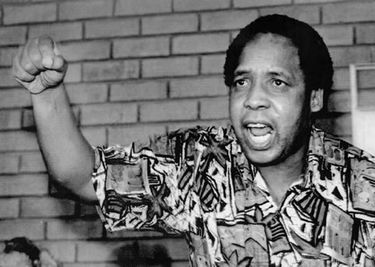

Nelson Mandela and Helen Suzman (from MailOnline, 5 January 2009)

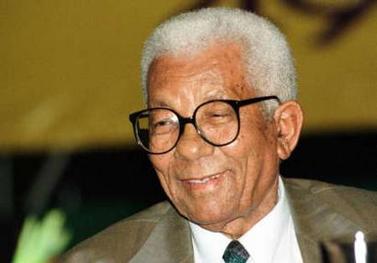
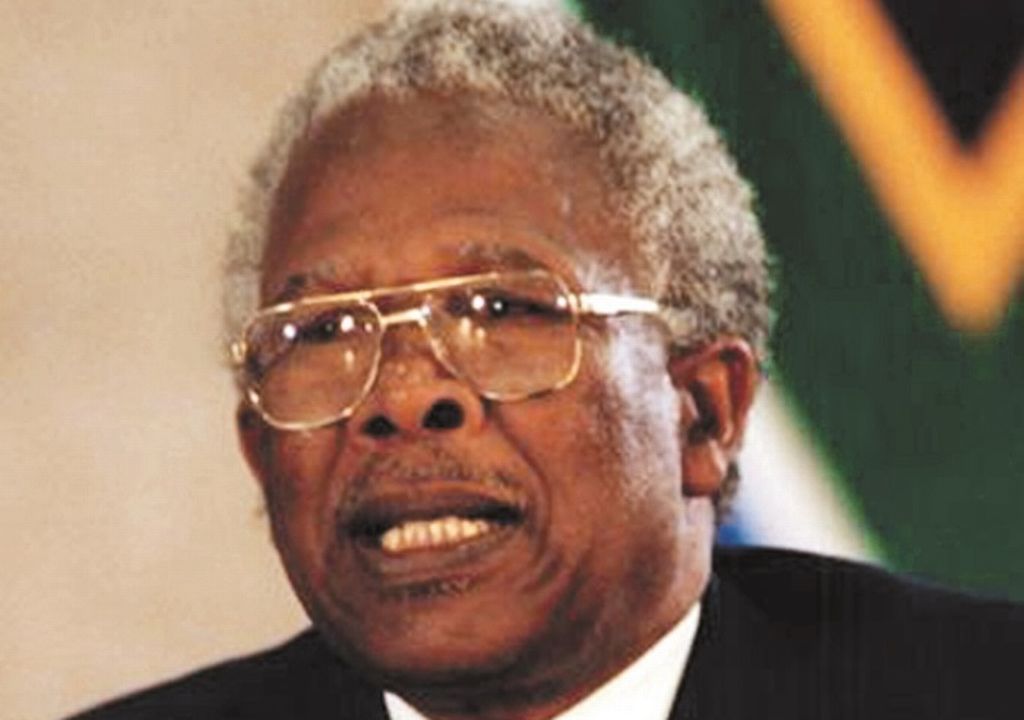
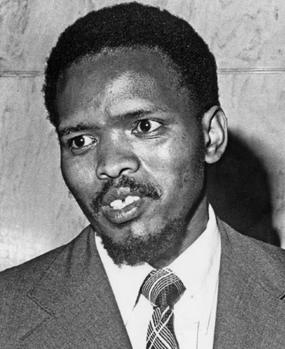


Robert Cutts, bob@winton.me.uk
This description was first incorporated in June 2008 and has been revised and expanded several times since. The current version dates from November 2020.
Photo uploaded: June 2008
Carbon Leader Gold Ore with gold (Au) and uraninite (UO2) (black). This rock is quite radioactive.
The Witwatersrand area of South Africa produces a significant percentage of the world's gold. This is a spectacular sample of Precambrian high-grade gold ore from South Africa’s Blyvooruitzicht Gold Mine. The rock is from the Carbon Leader (also known as the Carbon Leader Reef & Carbon Leader Seam), a blackened, hydrocarbon-rich stromatolitic interval richly impregnated with native gold (Au) and radioactive uraninite/pitchblende (UO2). This is a paleoplacer deposit, part of an ancient alluvial fan succession.
Stratigraphy & Age: Carbon Leader Member, Main Conglomerate, lower Johannesburg Subgroup, lower Central Rand Group, Witwatersrand Supergroup, lower Neoarchean, ~2.9 billion years old.
Locality: Blyvooruitzicht Gold Mine, Carletonville Goldfield, West Witwatersrand (“West Wits”), South Africa.
Tombstone of William Harding Le Riche (March 21, 1916 - December 31, 2010), a professor of epidemiology at the University of Toronto, and his wife. Mount Pleasant Cemetery, Toronto, Canada. Summer afternoon, 2021. Pentax K1 II.
From en.wikipedia.org/wiki/William_Harding_le_Riche
William Harding le Riche FRCPC (21 March 1916 – 31 December 2010) was a South African–born Canadian epidemiologist. He was Professor of Epidemiology (emeritus) at University of Toronto.
Le Riche was born in Dewetsdorp, Orange Free State, Republic of South Africa and first studied at the University of the Witwatersrand in Johannesburg, where he gained a Bachelor of Science (B.Sc.) in 1936. He died in Toronto, Ontario, Canada.
Education
He was educated at University of the Witwatersrand.B.Sc. 1936, MB.ChB. 1943, MD 1949. He received a Carnegie Research Grant, Bureau for Education and Social Research, Pretoria 1937-1939. Harvard University (Rockefeller fellowship) M.P.H. (cum laude) 1949-50. He had an internship at Zulu McCord Hospital, Durban 1944.
Employment
Appointed by Union Health Department to Health Centre Service firstly at Pholela, Natal and later (1945) established first Health Centre for Whites and Eurafricans at Knysna, South Africa. 1945-1949.
Epidemiologist Union (Fed) Health Department, South Africa 1950-1952
Consultant in Epidemiology, Department of National Health and Welfare, Ottawa (worked on background report of Canadian Sickness Survey 1952-1954.
Research Medical Officer, Physicians Service Inc. Toronto, Ontario 1954-1957
Department of Public Health, School of Hygiene, University of Toronto 1959
Professor and Head of Department of Epidemiology, University of Toronto, 1962-1975.
Professor of Epidemiology, Department of Preventive Medicine, 1975–1982
Professor Emeritus from 1982
In reference to his higher qualifications, the MD was by thesis: Studies in Health, Growth and Nutrition. The FRCPC was in the area of Medical Science 1973. The F.A.C.P. was in Preventive Medicine
His research interests were wide. In 1936 he and Dr G. Schepers took the famous paleontologist, Doctor Robert Broom, to the Sterkfontein caves, near Johannesburg, South Africa, where Broom made important discoveries of hominid fossils, Australopithecus africanus.
Professional positions and appointments
In his University teaching he saw epidemiology as a broad comprehensive subject studying the determinants of disease. From this point of view epidemiology includes the basic medical sciences, microbiology, environmental chemistry and clinical medicine. However, by 1975, in the English speaking academic world, epidemiology had become a narrow statistical subject, involved mainly with analysis and past epidemic surveys and clinical trials. The Department of Epidemiology and Biometrics grew and M.Sc. and Ph.D. Programs were developed.
Between 1950 and 1980 the pundits were claiming antibiotics would solve the problems of most infectious disease. The fact that bacteria develop resistance to medicaments was not considered. In 1973 le Riche and Dr. Michael Lenczner raised the importance of infectious and tropical disease imported into Canada by travellers, immigrants and refugees. Governments were not interested in these situations.
By 1981 it became clear that AIDS (acquired immune deficiency syndrome) was a serious infectious disease.
In 1953 he received a part-time commission in the Canadian Armed Forces, serving in the 23rd Field Ambulance, under Lieut. Col. David Thompson in Ottawa. In 1968 he became a member of the Defence Research Board and for many years he was Consultant on preventive medicine to the Defence Medical Council. Outside the University he served on many committees including those of the Ontario Medical Association and the Canadian Medical Association.
During 1966-72 he was on the Metropolitan Toronto Hospital Planning Council under the chairmanship of Dr. H. Hoyle Campbell, plastic surgeon, who with Dr. Shouldice, pioneered outpatient surgery in Toronto. Some of the excellent recommendations of the Council were carried out in 1998 and 1999. For many years he served as the Medical Research Council Associate Committee on Hospital Infections, Chairman Professor E.G.D. Murray. As a result of this association the book on "The Control of Infections in Hospitals" was published in 1966. Other committees were the Professional Education Committee of the American Public Health Association, Examiners Committee, Public Health and Preventive Medicine, Royal College of Physicians and Surgeons of Canada, Nursing Research Committee, Ontario Council of Health Care 1969, Physicians Services Inc. Research Grants Committee, Second International Conference on Agriculture, University of Reading, England, Committee, Canadian Cancer Research Foundation, Committee on Acupuncture, Ontario Council of Health, Report on Reorganization of the City of Toronto Health Department. He was Chairman of the Canadian Society for Tropical Medicine and International Health 1976-1978.
He was a member of the Committee on Preventive Medicine, Medical Council of Canada.
In the University he was on the Planning Strategy Committee, Planning and Priorities Subcommittee, and many others. Research on Medical Care included surveys on the work of Medical Officers of Health in Ontario, and the work of Optometrists and Ophthalmologists in Ontario.
For a few weeks he was visiting professor, Wayne County Medical School, Detroit and Distinguished Lecturer at Dalhousie Medical School.
In 1956 he first appeared with Dr. Arthur Kelly, Canadian Medical Association on a television program. This was the beginning of a 25-year career in radio, television and the daily press, which covered many aspects of health care, nutrition and communicable diseases, and medical politics. He became a good communicator, and public speaker. His academic interests were nutrition, infections, populations, and environmental destruction. He was a Fellow of the American Public Health Association and Fellow of the Royal Society of Tropical Medicine. For 18 years he was on the part-time staff of the Department of Family Practice and Extended Care at Sunnybrook Hospital. He was awarded the Defries medal and granted Honorary Membership of the Canadian Public Health Association. He became a Life Member of the Ontario Medical Association and was granted Senior Membership of The Canadian Medical Association.
Personal
Le Riche married Margaret Cardross Grant on 11 December 1943. They had five children. His hobbies, at various time of his life included camping, photography, and he rode regularly until the age of 70. He was interested in music, opera and live theatre, and attended St. Timothy's Anglican Church, Toronto, Ontario.
Sometimes you will smile while you’re crying inside
---
CRUEL CRAZY BEAUTIFUL WORLD - Johnny Clegg
You have to wash with the crocodile in the river
You have to swim with the sharks in the sea
You have to live with the crooked politician
Trust those things that you can never see
Ayeye ayeye Jesse mfana (jesse boy) ayeye ayeye
You have to trust your lover when you go away
Keep on believing tomorrow will bring a better day
Sometimes you will smile while you’re crying inside
And just once you will turn away while the truth is shining bright
Ayeye ayeye Jesse mfana ayeye ayeye
Chorus
It’s a cruel crazy beautiful world
Every day you wake up I hope it’s under a blue sky
It’s a cruel crazy beautiful world
One day when you wake up I will have to say goodbye
Goodbye - It’s your world so live in it !
Beyond the door, strange cruel beautiful years lie waiting for you
It kills me to know you won’t escape loneliness,
Maybe you lose hope too
Ayeye ayeye Jesse mfana ayeye ayeye
Chorus
When I hold your small body close to mine
I feel weak and strong at the same time
So few years to give you wings to fly
Show you stars to guide your ship by
Chorus
It's your world so live in it
Cruel, Crazy, Beautiful World is a studio album from South African artist Johnny Clegg and his band Savuka. Wikipedia
Artists: Johnny Clegg, Johnny Clegg and Savuka
Release date: 1989. Label: EMI Music Australia
---
Jonathan "Johnny" Clegg OBE OIS (born 7 June 1953) is a South African musician and anthropologist who has recorded and performed with his bands Juluka and Savuka, and more recently as a solo act, occasionally reuniting with his earlier band partners. Sometimes called Le Zoulou Blanc ("The White Zulu"), he is an important figure in South African popular music history, with songs that mix Zulu with English lyrics and African with various Western music styles.
Clegg was born in Bacup, Lancashire, to an English father and a Rhodesian mother. Clegg's mother's family were Jewish immigrants from Poland, and Clegg had a secular Jewish upbringing, learning about the Ten Commandments but refusing to have a bar mitzvah or even associate with other Jewish children at school. His parents divorced when he was still an infant, and he moved with his mother to Rhodesia and then, at age 6, to South Africa, also spending less than a year in Israel during childhood.
As an adolescent, Clegg developed an interest in Celtic music, which led to him learning about and performing Zulu street music and taking part in traditional Zulu dance competitions. He was first arrested at the age of 15 for violating apartheid-era laws in South Africa banning people of different races from congregating together after curfew hours. At the age of 17, he met Sipho Mchunu, a Zulu migrant worker with whom he began performing music. The partnership, which they named Juluka, was profiled in the 1970s television documentary Beats of the Heart: Rhythm of Resistance.
As a young man, in the early stages of his musical career, Clegg combined his music with the study of anthropology, a subject which he also taught for a while at the University of the Witwatersrand in Johannesburg, where he was influenced, among others, by the work of David Webster, a social anthropologist who was later assassinated in 1989.
Juluka was an unusual musical partnership for the time in South Africa, with a white man (Clegg) and a black man (Mchunu) performing together. The band, which grew to a six-member group (with three white musicians and three black musicians) by the time it released its first album Universal Men in 1979, faced harassment and censorship, with Clegg later remarking that it was "impossible" to perform in public in South Africa. The group tested the apartheid-era laws, touring and performing in private venues, including universities, churches, hostels, and even private homes in order to attract an audience, as national broadcasters would not play their music. Just as unusually, the band's music combined Zulu, Celtic, and rock elements, with both English and isiZulu lyrics. Those lyrics often contained coded political messages and references to the battle against apartheid, although Clegg has maintained that Juluka was not originally intended to be a political band. "Politics found us," he told The Baltimore Sun in 1996. In a 1989 interview with the Sunday Times, Clegg denied the label of "political activist." "For me a political activist is someone who has committed himself to a particular ideology. I don’t belong to any political party. I stand for human rights."
Juluka's music was both implicitly and explicitly political; not only was the fact of the success of the band (which openly celebrated African culture in a bi-racial band) a thorn in the flesh of a political system based on racial separation, the band also produced some explicitly political songs. For example, the album Work for All (which includes a song with the same title) picked up on South African trade union slogans in the mid-1980s.[11] As a result of their political messages and racial integration, Clegg and other band members were arrested several times and concerts routinely broken up.
Despite being ignored and often harassed by the South African government at home, Juluka were able to tour internationally, playing in Europe, Canada, and the United States, and had two platinum and five gold albums, becoming an international success. The group was disbanded in 1985, when Mchunu returned.
Together with the black musician and dancer Dudu Zulu, Clegg went on to form his second inter-racial band, Savuka, in 1986, continuing to blend African music with European influences. The group's first album, Third World Child, broke international sales records in several European countries, including France. The band went on to record several more albums, including Heat, Dust and Dreams, which received a Grammy Award nomination. Johnny Clegg and Savuka played both at home and abroad, even though Clegg's refusal to stop performing in apartheid-era South Africa created tensions with the international anti-apartheid movement and led to his expulsion from the British Musicians' Union. In one instance, the band drew such a large crowd in Lyon that Michael Jackson cancelled a concert there, complaining that Clegg and his group had "stole[n] all his fans".[15] In 1993, the band dissolved after Dudu Zulu was shot and killed while attempting to mediate a taxi war.
Briefly reunited in the mid-1990s, Clegg and Mchunu reformed Juluka, released a new album, and toured throughout the world in 1996 with King Sunny Ade. Since then, Clegg has recorded several solo albums and continues to tour the world. During one concert in 1999, he was joined onstage by South African President Nelson Mandela, who danced as he sang the protest song Savuka had dedicated to him, "Asimbonanga". During Mandela's illness and death in 2013, the video of the concert attracted considerable media attention outside South Africa.
His song "Scatterlings of Africa" gave him his only entries in the UK Singles Chart to date, reaching No. 44 in February 1983 with Juluka and 75 in May 1987 as Johnny Clegg and Savuka. The following year the song was featured on the soundtrack to the 1988 Oscar-winning film, Rain Man.
Savuka's song "Dela" was featured on the soundtrack of the 1997 film George of the Jungle and its 2003 sequel, while "Great Heart" was the title song for the 1992 film Jock of the Bushveld. "Cruel, Crazy, Beautiful World" was featured in the 1990 film Opportunity Knocks and 1991 film Career Opportunities. "Great Heart" was also the end credits song for the 2000 Disney movie Whispers: An Elephant's Tale.
Jimmy Buffett recorded "Great Heart" for his 1988 album, Hot Water.
In 2002 Clegg provided several songs and incidental background music for Jane Goodall's "Wild Chimpanzees" DVD. Included in the extras on the disc are rare scenes of Clegg in the recording studio.
He co-wrote "Diggah Tunnah" with Lebo M. for Disney's 2004 direct-to-video animated film The Lion King 1½ (Wikipedia)..
Deputy Minister of International Relations and Cooperation Luwellyn Landers with First Deputy Minister of Cuba Medina Gonzàlez at the University of Witwatersrand co-chair a public lecture under the theme: “SA-Cuba: 20-year celebration of formal bilateral cooperation. (Photo: Dirco)
The Bambatha Rebellion was the last armed resistance against white rule before the formation of the Union of South Africa in 1910. In the years following the Anglo-Boer War white employers in Natal had difficulty recruiting black farm workers because of increased competition from the gold mines of the Witwatersrand. The colonial authorities introduced a poll tax in addition to the existing hut tax to encourage black men to enter the labour market. Bambatha was one of the chiefs who resisted the introduction and collection of the new tax. The government of Natal sent police officers to collect the tax from recalcitrant districts, and in February 1906 two white officers were killed near Richmond, KwaZulu-Natal resulting in the introduction of martial law. Bambatha fled north to consult King Dinizulu, (who had been exiled on St Helena between 1890 and 1897 see: www.flickr.com/photos/30593522@N05/5340408052/in/set-7215... ) but on returning to the Mpanza Valley discovered that the Natal government had deposed him as chief. He gathered together a small force of supporters and began launching a series of guerrilla attacks. In late April 1906 Colonial troops under the command of Colonel Duncan McKenzie were sent out on an expedition to confront Bambatha and once they succeeded in getting face to face with and surrounding the rebels at Mome Gorge, the British victory in the unequal battle was inevitable, given the vast disparity of forces. Colonial soldiers opened fire with machine guns and cannon on rebels mostly armed only with traditional assegais, knobkerries and cowhide shields and Bambatha was killed and beheaded during the battle. King Dinizulu was arrested, tried, convicted of treason and sentenced to four years imprisonment, though only served two. An estimate of the total number of rebels that took part in the Rebellion is very difficult to arrive at but judging from the reports of Commanding Officers, the aggregate for Natal and Zululand would be about 10,000 to 12,000, of whom about 2,300 were killed. Colonial casualties numbered only 30 killed or died and the cost of the campaign was estimated at £883,000. Bambatha’s men were destroyed by the militia with a thoroughness which disconcerted many even at the time. Winston Churchill, then an Under-Secretary in the Colonial Office in London, was scathing about the colonial reaction, and, on being consulted on the subject of a campaign medal to be awarded to the troops, suggested that it should be struck in bronze, at the colony’s expense, and depict not the head of King Edward VII but the severed head of a rebel leader. The issue of a medal was approved by The King and was granted to those (including nursing sisters), who served between the 11th February and the 3rd August, for a continuous period of not less than twenty days, also to certain civilians, Native Chiefs, and others who had rendered valuable service. The Saint Helena Herald of 18th September 2009 has a photograph of the medal awarded to A.E. Thorpe for service during the Bambatha rebellion.
The militia’s actions still make disturbing reading now, they burned homes, looted, and shot Africans, under arms or not, with impunity. The aftermath was equally ruthless. The rank and file of some 4,700 prisoners were tried by their respective Magistrates and by Judges. The great majority of sentences ran from six months to two years, with whipping added. After a number had been flogged, the Government directed suspension of all further whippings. Special arrangements had to be made in Durban and elsewhere for accommodating the prisoners. About 2,500 were confined in a compound at Jacobs near Durban, formerly used by Chinese labourers ; 400 (for the most part with sentences of two years) in a special prison at the Point, Durban ; 100 at Fort Napier, Pietermaritzburg; and the rest in various gaols.
By mid-August 1906 twenty-five Chiefs who had supported the rebels had been arrested, charged and tried by Courts Martial for a variety of offences; sedition, public violence, murder, rebellion and high treason. Sentences ranged from death, 10 years plus 500 cattle, 10 years plus 20 lashes and 20 years all of which were later reduced, though all were to be served with hard labour and the prisoners were kept in local custody
In early January 1907 correspondence “Relating to the removal of certain native prisoners from Natal” commences with the Governor, Sir Henry McCallum, writing to The Secretary of State for The Colonies in London, Lord Elgin:
As your Excellency is aware, persistent reports are now circulating in Zululand and Natal amongst the natives there by those who have been released that all rebels are about to be released in consequence of an order received from across the sea to effect that the Home Government has told this Government that the rebels were only soldiers acting under orders of their chiefs, and they should not, therefore, have been punished. No more dangerous course therefore could be pursued by Ministers than the adoption of any act which could give the least ground for cultivating so pernicious a belief in the native mind, whether that mind be loyal or wicked. These reports, together with a recent one from Swaziland, induce Ministers to urge the necessity of a course of action which will demonstrate once for all to the native mind that rebellion is not a light matter or one to be followed by trivial consequences. Ministers think it essential that under the circumstances such demonstration can only be given by the immediate deportation of the ringleaders, to the number of about twenty-five, who, as long as they are in local custody, have, and will have, opportunities which no guarding can repress of conveying to their sympathisers outside reports and messages calculated to incite to further disorder, if not to attempts to obtain release.
The Colonial Prisoners Removal Act cap. 31 of 1884 appears to Ministers to provide the machinery to meet just such an emergency as confronts this Colony at this time. Ministers think that question of expediency in this instance can hardly be questioned and suggest that Island of Mauritius is, in respect of climate and other conditions, a locality to which exception could not well be taken.
In view of urgency of matter, Ministers would be glad if your Excellency would cable this application to the Secretary of State whilst simultaneously inquiring of the Mauritius Government by cable if it will be as good as to assist us. As a matter of great emergency I beg for your Lordship's good offices and that with least possible delay. I am repeating this telegram to Governor, Mauritius, that he may have full information on the subject.
By January 30, it was agreed and:” Ministers beg me to inform you that satisfactory despatch has been received from Governor, Mauritius, as to taking rebel ringleaders as prisoners. They now only await approval of His Majesty's Government”.
On February 25th The Governor of Mauritius sent a telegram to London: Cases of beri-beri reported to me yesterday, five in Central Prison, two fatal; seventeen in Port Louis Prison. Preventive measures against spread of disease by segregation and alteration in diet are being taken and inquiry being made to ascertain cause.
The Secretary of State requested: Please furnish me with your opinion as to whether the outbreak of beri-beri at the Central Gaol, reported by you in your telegram of 25th February, can be confined within limits which will secure the immunity of the Zulu chiefs who are to be entrusted to your care.
McCallum was becoming increasingly concerned at the delay: Much regret in hearing of outbreak especially as rumours of unrest are becoming daily aggravated. Immediate deportation of ringleaders would probably put end to this. Rank and file of rebels are being employed on Public works in wood and iron temporary buildings secured by double-fenced entanglement enclosures, such as used for safe custody of Boer prisoners. These have proved healthy and satisfactory and Ministers would like the same provided forthwith at Mauritius at cost of Government of Natal till the gaols are immune from beri-beri." Whilst discouraging credence of rumours and reports received I cannot help feeling uneasy, and shall be glad if Ministers' proposal could be approved by you and deportation of ring- leaders take place with least possible delay.
Further correspondence left the matter unresolved: Re. Your Lordship's telegram with regard to beri-beri. After consultation with Chief Medical Officer I cannot guarantee immunity from the disease for any person in confinement in any of our prisons and I am advised that no such prison can safely be used for the purpose. This ruled out Mauritius but McCallum had already been in correspondence with Governor Gallwey on St Helena who discussed the matter with Lord Elgin:
The Governor of St, Helena to the Secretary of State,
The Castle, St. Helena, March 21, 1907.
I have the honour to inform Your Lordship that I received a telegraphic despatch from the Governor of Natal on the 16th instant asking me whether St. Helena would receive twenty-five rebel ringleaders sentenced to various terms of penal servitude, using a portion of empty barracks as a prison ; and, if so, on what terms. Sir Henry McCallum informed me that owing to an outbreak of beri-beri in the Mauritius prisons the arrangement made to send the prisoners to that Colony had fallen through. He further informed me that the Mauritius Government had agreed to take the twenty- five prisoners at a cost of £20 per man per annum, provided the Natal Government sent two European warders with the
men.
I discussed the matter in Council on the 18th instant, when it was unanimously decided to receive the prisoners provided the War Office consented to the use of Ladder Hill Barracks as a prison. I accordingly telegraphed to this effect to the Governor of Natal, adding that the cost per man would not exceed £20 a year, but that the Natal Government must pay actual cost. I made this latter stipulation as this Government has no wish to make money out of the Natal Government whilst being unable to risk the smallest loss under the transaction. The actual feeding of the prisoners, including fuel, will not exceed £10 a year per man consequently the traders and farmers will benefit only to a very small extent. Every little helps, however, in these hard times.
Telegrams between McCallum, Gallwey and Lord Elgin give further comment and information:
The Castle, St. Helena, March 22, 1907. On the 17th instant, in reply to a telegram I despatched
to Your Excellency the previous day, you informed me that the following was the prisoners' diet:
Breakfast. — 12 ounces mealie meal.
Supper. — 12 ounces mealie meal.
Dinner. — 16 ounces mealie meal, or 2 lbs. potatoes.
Eight ounces fresh meat and four ounces fresh vegetables twice a week. One ounce of salt daily.
Your Excellency further stated that if mealies were not obtainable in this Colony that you would send supplies thereof periodically. I may say at once that mealies are obtainable here. I take it that the prisoners themselves make the meal. As regards the cost of feeding the prisoners, I calculate that according to the diet laid down by Your Excellency this will not exceed £10 per man per annum, including fuel. The cost of feeding a prisoner in the gaol here is roughly, including fuel, 1 shilling. a day. The diet, allowed, however, is quite different to the scale laid down for your prisoners. I take it that the two European warders will find themselves in everything but quarters, and the usual barrack furniture. I am not aware as to what furniture, if any, is required for the prisoners. There is a large swimming bath close by to where they will be confined with a continual flow of water passing through. I presume the prisoners do their own cooking. Should cooking and eating utensils and bedding be purchased? I must apologise for troubling Your Excellency with questions of these minor details, but I have no knowledge of the Zulu nor the way he is treated when a prisoner. Your Excellency will see that £20 per man a year should more than cover the recurrent expenditure necessary to keep the prisoners. We have the following items with their approximate cost per annum:
Food and fuel £250
Medical attendance £50
Medicines £6
Three warders at £55 £165
Oil, wick, and matches £5
Soap and cleaning materials £6
Water rate £4
Contingencies £5
Total £490
I have allowed for three extra warders as there will have to be a man continually on duty day and night, owing to the nature of the buildings in which the prisoners will be confined. This Government can lend rifles for the warders' use if necessary. I take it that the prisoners do not receive anything in the way of tea, coffee, or other groceries with the exception of salt? I ask this question as the Zulus who were interned in this Colony ten years ago received coffee, sugar, and other groceries. In fact, they appear to have been given anything they asked for.
April 3. from McCallum. The situation (in Natal) is improving. The atmosphere will be much cleared by transportation of ringleaders. Ministers inquire when they may expect your authority for their removal.
April 16. from McCallum. Ministers would respectfully urge upon the Secretary of State necessity for giving immediate authority for the removal to Saint Helena of the native ringleaders concerned in recent rebellion. It is now over three months since the proposal for the deportation of these natives from the Colony was originally made, and the great delay which has taken place through unforeseen circumstances has been unfortunate and embarrassing. Ministers deprecate any further delay, and will be obliged if your Excellency will at once cable to the Secretary of State urging him to accelerate settlement.
There then followed the question of the warrants needed for due process:
April 20. Warrants required under the Colonial Prisoners Removal Act, Section 6, must be signed by Secretary of State for the Colonies and by Governor of St. Helena as well as by Governor of Natal before prisoners can leave Natal. Warrants will be forwarded to Governor of St. Helena duly signed by me by the next mail, which leaves on 3rd May, and he has been instructed by telegraph to sign them and forward them to you by the same steamer. We regret the delay but it is inevitable. I would further confirm my telegram to you, wherein I state that I have been informed by the Secretary of State that it will not be possible to move the prisoners from Natal until about the end of May. Lord Elgin informs me that he has sent you for signature the warrants required under Section 6 of the Colonial Prisoners' Removal Act, with a request that you will sign and forward them to me by the same steamer. In this connection I should feel obliged if, when despatching the warrants, you will give directions that they be forwarded from Cape Town overland, as this will avoid a delay of three or four days.
Ministers propose to send the prisoners under special arrangement by direct steamer from Durban, and as soon as the details are settled I will apprise you by telegram of the date of their departure, and the probable date of their arrival at St. Helena.
The delay caused by the warrants having to be signed in London, St Helena and Pietermaritzburg meant that it was the 1st June when the twenty-five prisoners left Natal on the steamship Inyati to proceed directly to St Helena. . Despite their best efforts the Colonial Office through Lord Elgin failed to persuade the Natal colonial government to treat them as political prisoners and not as ordinary criminals and on arrival at St Helena they were treated as such.
Barbara George’s article www.saint.fm/Independent/20090605.pdf quotes the St Helena Guardian of 13th June 1907 reporting their arrival.
The expected steamship Inyati, Captain White, from Natal, with 25 Zulu prisoners in charge of Cunningham and Shepherd, arrived in port on Tuesday evening at 7p.m. The prisoners on landing yesterday at 7.30 a.m. were dressed in khaki jackets and pants. Several of them had the letter L with other marks on their jackets, presumably to indicate their sentences, which range from “Life” to 10 years imprisonment with hard labour. Their ages would appear to be from 20 years to 70. They seemed in a half starved condition and could hardly walk when landed. They were marched off to Ladder Hill Barracks where the Royal Artillery Garrison were stationed, under the escort of the local police armed with rifles. Ladder Hill is to be their future abode and they will be looked after by the Troopers who arrived with them and three of our local labourers as guard. We understand their diet is to be 12 ounces of mealy meal for breakfast and 12 for supper and 18 ounces of the same food for dinner with salt, and during the week some vegetables and 1 lb. of fresh beef per man per week will be issued. To tea, coffee, milk and tobacco they will be strangers. Blankets to lie on only will be furnished to them. Whether these prisoners are to be placed to work on our roads we shall have to learn. Considering the scarcity of work for our own labourers, we hope not. Whether making this island “known to the world” as the “Island of Historic Misfortune”, the prison for men such as the Zulus is a wise step or not, we await with interest to ascertain
By July 1907 questions were being asked in The House of Commons. hansard.millbanksystems.com/commons/1907/jul/18/treatment... This exchange between Ramsey Macdonald and Winston Churchill being one such.
MR. J. RAMSAY MACDONALD I beg further to ask the Under-Secretary of State for the Colonies whether his attention has been drawn to the fact that on arrival at St. Helena the Zulu prisoners were in an emaciated condition and looked half-starved, and some of them were hardly able to walk; whether amongst these is the chief Tilonko, from whom a petition is lying upon the Table of this House setting forth that he was illegally condemned under an indemnity Act wider in scope than has ever been assented to by the Sovereign, and which is alleged to have been unjustly put into operation; and whether he proposes to take any action on the matter.
THE UNDER-SECRETARY OF STATE FOR THE COLONIES (Mr. CHURCHILL, Manchester, N.W.) It was necessary to deport these prisoners under the Colonial Prisoners Removal Act, and they therefore remain in the status of convicts, but it has always been the view of the Secretary of State that the fact of their deportation would justify their receiving, while in St. Helena, liberal treatment in regard to conditions of their imprisonment, especially in the matter of dietary. He will at once call for a Report from the Governor of St. Helena on this subject, and will authorise him to make such modifications in the scale of dietary and general conditions as are possible consistently with this provisions of the law.
These Zulu prisoners were certainly not greeted with the same enthusiasm afforded by the islanders to the Boer prisoners seven years earlier, nor was their time on the island to be as fondly remembered locally as was the imprisonment of Dinizulu in 1890. There is a dearth of material written about this period and their time on the island is barely recorded.
Towards the end of 1910 the eighteen survivors amongst the twenty-five prisoners who had been sent to St Helena were granted parole. They were part of the general amnesty that was granted to about 4,500 prisoners by the Governor General during the formation of the Union of South Africa. Seven had died on the island as the Death Register records but their graves cannot be found and are not in the burial register. Two of the eighteen prisoners were carried on stretchers because they were seriously ill. John Dube, the founder of the Zulu-English newspaper Ilanga lase Natal remarked that the prisoners looked very wasted although they had only served three years of their prison sentences. Most of them looked very old and could not even be recognized. In fact they no longer looked like chiefs at all, but looked like commoners.
These were the last of St Helena’s political prisoners until the arrival of three Bahrainis in 1957.
www.flickr.com/photos/30593522@N05/5406764359/in/set-7215...
The following sources were used to compile these notes:
www.archive.org/stream/indexingandprci00beakgoog/indexing...
www.napoleon.org/EN/reading_room/articles/files/helena_pr...
www.archive.org/details/historyofzulureb00stua
en.wikipedia.org/wiki/Bambatha_Rebellion
scnc.ukzn.ac.za/doc/B/Ds/Biography_DIs/Dinizulu/Hadebe,_M...
Deputy Minister of International Relations and Cooperation Luwellyn Landers with First Deputy Minister of Cuba Medina Gonzàlez at the University of Witwatersrand co-chair a public lecture under the theme: “SA-Cuba: 20-year celebration of formal bilateral cooperation. (Photo: Dirco)
Deputy Minister of International Relations and Cooperation Luwellyn Landers with First Deputy Minister of Cuba Medina Gonzàlez at the University of Witwatersrand co-chair a public lecture under the theme: “SA-Cuba: 20-year celebration of formal bilateral cooperation. (Photo: Dirco)
Deputy Minister of International Relations and Cooperation Luwellyn Landers with First Deputy Minister of Cuba Medina Gonzàlez at the University of Witwatersrand co-chair a public lecture under the theme: “SA-Cuba: 20-year celebration of formal bilateral cooperation. (Photo: Dirco)
hex river train tunnel number 4.. north entrance/exit near touws river. 13,5 km long
Hex River Tunnels
From Wikipedia, the free encyclopedia
Jump to navigationJump to search
Hex River rail pass
Tunnel Hexrivier 4 West Approach.JPG
Western approach to tunnel no. 4, at 13.5 kilometres (8.4 miles) the longest rail tunnel in Africa until 2009.
show
Route map
Hexton Tunnel System Map.svg
The four Hex River Tunnels consist of a twin tunnel of 0.5 kilometres (0.31 miles) and three single tunnels of 1.1 kilometres (0.68 miles), 1.2 kilometres (0.75 miles) and 13.5 kilometres (8.39 miles), on the Hexton railway route between De Doorns and Kleinstraat through the Hex River Mountains of the Western Cape Province, South Africa. The line, which connects De Doorns in the Hex River valley with Touws River in the Great Karoo, is part of the main rail route between Cape Town and Johannesburg. Of the 30 kilometres (18.64 miles) of track, 16.8 kilometres (10.44 miles) are underground. Construction of the line eliminated the bottleneck of the Hex River rail pass.[1][2][3]
Contents
1The Hex River rail pass
1.1Route
1.2Cape Gauge
1.3First Tunnel
1.4Second Tunnel
2Current route
2.1Approval
2.2First postponement
2.3Second and third postponements
3Hexton completion
3.1Construction
3.2Completion
4Ecotourism
5References
6External links
The Hex River rail pass[edit]
Sir John Charles Molteno
The enormous Cape Fold Belt effectively separated Cape Town on the coast from the hinterland of Southern Africa, and had obstructed previous attempts to expand the Cape Colony's railway infrastructure inland. In 1872 the Cape Government, under Prime Minister John Molteno, ordered that a railway line must be constructed across this barrier in the vicinity of the Hex River Mountains. The Cape Government Railways (CGR) was formed and railway engineer William George Brounger was appointed to oversee the task.[4][5]
Route[edit]
The Hex River Mountain was a major obstacle to be overcome during the construction of the railway between Cape Town and the diamond fields at Kimberley in the Northern Cape. In 1874 surveyor Wells Hood, under the instruction of Brounger, found a potential route up the 2,353 feet (717 metres) climb from De Doorns in the Hex River valley to the top of the Karoo plateau east of the Valley, that would require gradients of no more than 1 in 40 uncompensated, very steep by railway standards, and tight curves with a minimum radius of 100 metres (328 feet). He also proposed that a short tunnel would be required.[1][2][6][7]
By 1876, the Molteno Government had selected Thomas Brounger's proposed route through the Hex River valley, with the line to follow the route from Worcester through De Doorns, then along Hood's proposed pass across the mountain via Osplaas to the 3,147 feet (959 metres) summit at Matroosberg, and then via Kleinstraat to Touws River.[1][2]
Cape Gauge[edit]
Dual gauge track on the old Strand street crossing outside Cape Town station, c. 1880
The original line between Cape Town and Wellington was laid to 4 ft 8 1⁄2 in (1,435 mm) standard gauge, but this gauge could not be accommodated economically on the tight curves required by the proposed Hex River rail pass. This led to a decision by the CGR to use a narrower gauge of 3 ft 6 in (1,067 mm) across the pass. After initially making use of dual gauge, it was decided in 1873 to convert all existing trackage of the CGR to this narrower gauge that was eventually to become known throughout Africa as Cape gauge. Credit for the fact that most of the present day railway lines in Africa are Cape gauge can therefore be directly attributed to the Hex River rail pass.[1]
First Tunnel[edit]
The original 180 metres (591 feet) tunnel, Southern Africa's first railway tunnel, is situated at 34 kilometres (21.13 miles) from De Doorns on the original line to Matroosberg. The tunnel is straight and the portals are of dressed stone masonry, but the inside is unlined. On the route ascending the mountain, Osplaas provided the only level stretch that was long enough for a conventional passing loop.[7][8]
Progress of the building of the line: Reached Worcester, June 16, 1876, and by the end of 1977 had reached Montagu Road, now known as Touws River - thus past the tunnel.[9]
Second Tunnel[edit]
Eastern portals, 1876 tunnel at left, 1929 tunnel at right
This first tunnel served the railways for 53 years, until the track was re-laid in 1929 to diminish a curve to accommodate larger locomotives. In the process a new concrete lined curved tunnel was sunk alongside the original. Since another crossing place had also become necessary, a siding named Tunnel was fashioned just east of the tunnel by laying two level dead-end spur tracks that branched directly off on opposite sides of the main line. This allowed trains to wait in one or the other of these sidings to allow an opposing train to pass. This latter tunnel remained in use for sixty years, until the line across the pass was closed to rail traffic in 1989.[7][8][10]
Despite its quick and relatively cheap construction, the Hex River rail pass served the South African Railways (SAR) for more than a century. It was the starting point of the country's first railway line to the Witwatersrand and opened the way for Cecil Rhodes' colonisation thrust into central Southern Africa.[8]
Current route[edit]
The railway line between Cape Town and Beaufort West has a ruling grade of 1 in 66 and a minimum curvature of 200 metres (656 feet), except for the pass where the steep gradient and sharp curves restricted train lengths and required additional locomotive power to bank trains on the ascent. In 1943 the gradients between De Doorns and Matroosberg stations were eased to 1 in 40 compensated, while the curves were eased to a minimum radius of 200 metres (656 feet), but despite this the Hex River rail pass still formed a bottleneck that would require more drastic measures to be eliminated.[1]
This eventually led to the decision to construct a tunnel system to eliminate the Hex River rail pass altogether. In 1945 Mr W.H. Evans, later to become Chief Civil Engineer of the SAR, proposed a new route for the section between De Doorns and Matroosberg that would result in a gradient of 1 in 66 compensated and a minimum curve radius of 800 metres (2,625 feet). The scheme would require four tunnels, two with a length of 0.8 kilometres (0.5 miles) each and two more with lengths of 2.4 kilometres (1.5 miles) and 13.5 kilometres (8.4 miles) respectively. The benefits to the SAR would be significant. Operating costs would be decreased as a result of the elimination of sharp curves and steep gradients. The length of the section would be reduced by 8 kilometres (5 miles) and it would also eliminate altogether 5,280 degrees of curvature and 110 metres (361 feet) of false rise in level. Train running times could be reduced by 23 minutes in the ascending direction and 36 minutes in the descending direction.[1][2]
Approval[edit]
Original eastern portal of tunnel no. 4, abandoned in 1948
The scheme was approved in 1946 and it was decided that full-face working would be employed in the long tunnel. With this method and working two faces simultaneously, it was expected that 3.5 kilometres (2.2 miles) complete with lining could be achieved annually, with the whole tunnel completed in four years.[1]
Tunnelling on the subsidiary tunnels and external earthworks commenced immediately, but start of work on the long tunnel was delayed due to special equipment that had to be designed and ordered in 1946. While awaiting the special equipment, the western (Cape Town side) and eastern (Johannesburg side) portals were established by heading and benching, and short 20 metres (66 feet) sections of tunnel were driven at both ends by 1948. The original eastern portal (coordinates 33.405814°S 19.9008°E) was dug immediately adjacent to the N1 national road some 15 kilometres (9 miles) west of Touws River and took the form of a cutting into a gradient to sufficient depth to commence tunnelling.[1]
First postponement[edit]
In April 1950, however, work on the whole Hexton scheme was deferred for reasons of economy. Instead, the existing line through the pass was electrified by 1954 and operated with the Class 4E electric locomotives that had been ordered for use through the tunnels. At the time the project was halted, altogether 1,170 metres (3,839 feet) of tunnel had been excavated and 540 metres (1,772 feet) of concrete lining had been placed in the shorter tunnels.[1][11]
Second and third postponements[edit]
Southwestern portal of tunnel no. 1, the twin tunnels, of which only one is in use
The tunnel scheme was briefly resuscitated in 1965 but was deferred once again in 1966. Work was eventually resumed in 1974 and included the remodelling of the lower section of the deviation between De Doorns and Osplaas stations as well as the construction of tunnel no. 1, the twin tunnels. This was completed in 1976, at which point financial constraints resulted in yet another postponement. Authority to proceed was only given once again in late 1979.[1]
The twin tunnels bored through a hill that was skirted around the western and northern sides by the original alignment to Osplaas. When completed, the south-eastern of the twin tunnels became part of the new alignment of the De Doorns-Osplaas section. The north-western of the twin tunnels was initially used for construction trains working on the rest of the tunnel system and became part of the new route when the tunnel system opened. The south-eastern of the twin tunnels eventually fell into disuse along with the old Hex River Railpass.[1]
Hexton completion[edit]
In most respects the scheme as eventually completed was the same as that envisaged in 1945. Before proceeding in 1979, however, a sophisticated evaluation of the capacity of the whole Hexton scheme had been carried out using train diagrams and computer-devised train running times. The conclusion was that, with only two passing loops between De Doorns and Kleinstraat compared to the three at Osplaas, Tunnel and Matroosberg on the existing line, the capacity would be 31 trains, but with an additional passing loop it would increase to 42 trains. It was therefore decided to place a third passing loop, called Hexton, inside the long tunnel in addition to the two loops between tunnels no. 1 and 2 at Almeria and between tunnels no. 3 and 4 at Salbar respectively.[1][12]
Construction[edit]
The passing siding inside the longest tunnel, looking west
When tenders were invited, two routes had been selected for tunnel no. 4, the longest tunnel. One would be straight and more or less on the original location, but with the eastern portal relocated further away from the N1 national road. The other would be curved to pass through shale material, that would make the use of a tunnel boring machine an economical proposition. Tenderers were invited to quote for circular or horseshoe profiles and concrete or shotcrete linings for each of the two profiles and for each of the proposed routes. After the engineering, geological and economic factors had been analysed, the straight route with a horseshoe profile and concrete lining was finally selected.[1]
The tunnel was constructed by Compagnie Interafricaine De Travaux (Comiat), a division of Spie-Batignolles in Paris, France.
The contract for tunnel no. 4 was awarded on 13 August 1980 at a tender price of R26,770,082 and with the completion date four years later on 12 August 1984. The contractual completion date was later extended to 25 February 1986. Construction commenced in September 1980, with tunnel excavation commencing in January 1981. As a result of unforeseen adverse sub-surface conditions [13] that were encountered during the execution of the contract, however, the tunnel was only completed in November 1988.[14]
Tunnels no. 2 and 3 are similar in construction to the long tunnel, but were completed under a separate contract at a cost of R9 million. Both of them had been partly excavated when work was suspended in 1949, the 1.1 kilometres (0.68 miles) tunnel no. 2 to a distance of 583 metres (1,913 feet) of which most was concrete lined, and the 1.2 kilometres (0.75 miles) tunnel no. 3 to a distance of 467 metres (1,532 feet), but only lined in areas of poor ground. The contract called for both to be widened to new design standards to allow for overhead electrification and broader loading gauge clearances.[15]
Completion[edit]
The eastern portal of tunnel no. 4
The western portal (coordinates 33.415182°S 19.765646°E) of tunnel no. 4, as established in 1948, enters directly into the mountain face, which is nearly vertical at that point. The eastern portal (coordinates 33.40843°S 19.908717°E) was relocated a short distance to the southeast of the original 1948 portal and is in a 600 metres (1,969 feet) long and 16 metres (52 feet) deep cutting. The tunnel is 13.5 kilometres (8.4 miles) long and has a maximum cover of 250 metres (820 feet). The gradient is mainly 1 in 66, except at the passing loop where it decreases to 1 in 200. Five ventilation shafts of 1.8 metres (5 feet 11 inches) diameter and with a combined length of 1,000 metres (3,281 feet) were sunk. The cross-sectional area of the horseshoe profile single line tunnel is 30 square metres (323 square feet), but this increases to 66 square metres (710 square feet) at the passing loop. Tunnel no. 4 also contains relay rooms for signalling equipment.[1][2]
The tunnel system became operational in April 1989, more than forty years after the first portals were sunk, and was officially opened on 27 November 1989. The completed four-tunnel system now boasts the longest railway tunnel system in Africa.[2][3]
Tunnel 4 was the longest railway tunnel in Africa until 2009. The present longest single railway tunnel in Africa is 15.5 kilometres (9.63 miles) long, on the Gautrain line between Johannesburg Park Station and Marlboro Portal, which was broken through in September 2009.[16]
Dlamini, Chancellor of Wits University, Professor Karen Thornber and Dr Precious Moloi-Motsepe at the University of Witwatersrand School of Governance in Johannesburg on the occasion of the Africa-Asia Partnerships in Health and Healthcare Delivery for Women & Youth Conference. The conference will also engage on vaccine development, strengthening private-public partnerships in health, and better academic collaboration in research and education underscored by multisectoral approaches to health and healthcare delivery. [Photo: GCIS]
Gold Reef City is a large amusement park in Johannesburg, South Africa. Located on an old gold mine, the park is themed around the gold rush on the Witwatersrand. Park staff wear period costumes of the 1880s, and the buildings on the park are designed to mimic the same period. There is a museum dedicated to gold mining on the grounds where it is possible to see a gold-containing ore vein and see how real gold is poured into barrels.
Dr Tshepo Motsepe, Dr Judy Dlamini, Chancellor of Wits University, Professor Karen Thornber and Dr Precious Moloi-Motsepe at the University of Witwatersrand School of Governance in Johannesburg on the occasion of the Africa-Asia Partnerships in Health and Healthcare Delivery for Women & Youth Conference. The conference will also engage on vaccine development, strengthening private-public partnerships in health, and better academic collaboration in research and education underscored by multisectoral approaches to health and healthcare delivery [Photo: GCIS]
Carbon Leader Gold Ore (2.1 cm across) with gold (Au) and uraninite (UO2) (black). This rock is quite radioactive.
The Witwatersrand area of South Africa produces a significant percentage of the world's gold. This is a spectacular sample of Precambrian high-grade gold ore from South Africa’s Blyvooruitzicht Gold Mine. The rock is from the Carbon Leader (also known as the Carbon Leader Reef & Carbon Leader Seam), a blackened, hydrocarbon-rich stromatolitic interval richly impregnated with native gold (Au) and radioactive uraninite/pitchblende (UO2). This is a paleoplacer deposit, part of an ancient alluvial fan succession.
Stratigraphy & Age: Carbon Leader Member, Main Conglomerate, lower Johannesburg Subgroup, lower Central Rand Group, Witwatersrand Supergroup, lower Neoarchean, ~2.9 billion years old.
Locality: Blyvooruitzicht Gold Mine, Carletonville Goldfield, West Witwatersrand (“West Wits”), South Africa.
Just 30 km west of Johannesburg, near the Witpoortjie Waterfall, you will find the Walter Sisulu National Botanical Garden, formerly known as the Witwatersrand National Botanical Garden.
The Walter Sisulu National Botanical Garden (previously known as the Witwatersrand National Botanical Garden) is a 300 hectares (3.0 km) botanical reserve in Roodepoort near Johannesburg. Formally established in 1982, it is one of the youngest of South Africa's National Botanical Gardens, but the site where it is located has been popular with visitors for many decades before that. The garden is home to a well known pair of Verreaux's eagles that nest in the Roodekrans ridge which intersects the reserve.
The garden has a restaurant, gift shop and nursery which sells South African native plants (the nursery closed March 2015). The Garden has been recognized as one of the most beautiful botanical gardens in the world.
hex river train tunnel number 4.. north entrance/exit near touws river. 13,5 km long
Hex River Tunnels
From Wikipedia, the free encyclopedia
Jump to navigationJump to search
Hex River rail pass
Tunnel Hexrivier 4 West Approach.JPG
Western approach to tunnel no. 4, at 13.5 kilometres (8.4 miles) the longest rail tunnel in Africa until 2009.
show
Route map
Hexton Tunnel System Map.svg
The four Hex River Tunnels consist of a twin tunnel of 0.5 kilometres (0.31 miles) and three single tunnels of 1.1 kilometres (0.68 miles), 1.2 kilometres (0.75 miles) and 13.5 kilometres (8.39 miles), on the Hexton railway route between De Doorns and Kleinstraat through the Hex River Mountains of the Western Cape Province, South Africa. The line, which connects De Doorns in the Hex River valley with Touws River in the Great Karoo, is part of the main rail route between Cape Town and Johannesburg. Of the 30 kilometres (18.64 miles) of track, 16.8 kilometres (10.44 miles) are underground. Construction of the line eliminated the bottleneck of the Hex River rail pass.[1][2][3]
Contents
1The Hex River rail pass
1.1Route
1.2Cape Gauge
1.3First Tunnel
1.4Second Tunnel
2Current route
2.1Approval
2.2First postponement
2.3Second and third postponements
3Hexton completion
3.1Construction
3.2Completion
4Ecotourism
5References
6External links
The Hex River rail pass[edit]
Sir John Charles Molteno
The enormous Cape Fold Belt effectively separated Cape Town on the coast from the hinterland of Southern Africa, and had obstructed previous attempts to expand the Cape Colony's railway infrastructure inland. In 1872 the Cape Government, under Prime Minister John Molteno, ordered that a railway line must be constructed across this barrier in the vicinity of the Hex River Mountains. The Cape Government Railways (CGR) was formed and railway engineer William George Brounger was appointed to oversee the task.[4][5]
Route[edit]
The Hex River Mountain was a major obstacle to be overcome during the construction of the railway between Cape Town and the diamond fields at Kimberley in the Northern Cape. In 1874 surveyor Wells Hood, under the instruction of Brounger, found a potential route up the 2,353 feet (717 metres) climb from De Doorns in the Hex River valley to the top of the Karoo plateau east of the Valley, that would require gradients of no more than 1 in 40 uncompensated, very steep by railway standards, and tight curves with a minimum radius of 100 metres (328 feet). He also proposed that a short tunnel would be required.[1][2][6][7]
By 1876, the Molteno Government had selected Thomas Brounger's proposed route through the Hex River valley, with the line to follow the route from Worcester through De Doorns, then along Hood's proposed pass across the mountain via Osplaas to the 3,147 feet (959 metres) summit at Matroosberg, and then via Kleinstraat to Touws River.[1][2]
Cape Gauge[edit]
Dual gauge track on the old Strand street crossing outside Cape Town station, c. 1880
The original line between Cape Town and Wellington was laid to 4 ft 8 1⁄2 in (1,435 mm) standard gauge, but this gauge could not be accommodated economically on the tight curves required by the proposed Hex River rail pass. This led to a decision by the CGR to use a narrower gauge of 3 ft 6 in (1,067 mm) across the pass. After initially making use of dual gauge, it was decided in 1873 to convert all existing trackage of the CGR to this narrower gauge that was eventually to become known throughout Africa as Cape gauge. Credit for the fact that most of the present day railway lines in Africa are Cape gauge can therefore be directly attributed to the Hex River rail pass.[1]
First Tunnel[edit]
The original 180 metres (591 feet) tunnel, Southern Africa's first railway tunnel, is situated at 34 kilometres (21.13 miles) from De Doorns on the original line to Matroosberg. The tunnel is straight and the portals are of dressed stone masonry, but the inside is unlined. On the route ascending the mountain, Osplaas provided the only level stretch that was long enough for a conventional passing loop.[7][8]
Progress of the building of the line: Reached Worcester, June 16, 1876, and by the end of 1977 had reached Montagu Road, now known as Touws River - thus past the tunnel.[9]
Second Tunnel[edit]
Eastern portals, 1876 tunnel at left, 1929 tunnel at right
This first tunnel served the railways for 53 years, until the track was re-laid in 1929 to diminish a curve to accommodate larger locomotives. In the process a new concrete lined curved tunnel was sunk alongside the original. Since another crossing place had also become necessary, a siding named Tunnel was fashioned just east of the tunnel by laying two level dead-end spur tracks that branched directly off on opposite sides of the main line. This allowed trains to wait in one or the other of these sidings to allow an opposing train to pass. This latter tunnel remained in use for sixty years, until the line across the pass was closed to rail traffic in 1989.[7][8][10]
Despite its quick and relatively cheap construction, the Hex River rail pass served the South African Railways (SAR) for more than a century. It was the starting point of the country's first railway line to the Witwatersrand and opened the way for Cecil Rhodes' colonisation thrust into central Southern Africa.[8]
Current route[edit]
The railway line between Cape Town and Beaufort West has a ruling grade of 1 in 66 and a minimum curvature of 200 metres (656 feet), except for the pass where the steep gradient and sharp curves restricted train lengths and required additional locomotive power to bank trains on the ascent. In 1943 the gradients between De Doorns and Matroosberg stations were eased to 1 in 40 compensated, while the curves were eased to a minimum radius of 200 metres (656 feet), but despite this the Hex River rail pass still formed a bottleneck that would require more drastic measures to be eliminated.[1]
This eventually led to the decision to construct a tunnel system to eliminate the Hex River rail pass altogether. In 1945 Mr W.H. Evans, later to become Chief Civil Engineer of the SAR, proposed a new route for the section between De Doorns and Matroosberg that would result in a gradient of 1 in 66 compensated and a minimum curve radius of 800 metres (2,625 feet). The scheme would require four tunnels, two with a length of 0.8 kilometres (0.5 miles) each and two more with lengths of 2.4 kilometres (1.5 miles) and 13.5 kilometres (8.4 miles) respectively. The benefits to the SAR would be significant. Operating costs would be decreased as a result of the elimination of sharp curves and steep gradients. The length of the section would be reduced by 8 kilometres (5 miles) and it would also eliminate altogether 5,280 degrees of curvature and 110 metres (361 feet) of false rise in level. Train running times could be reduced by 23 minutes in the ascending direction and 36 minutes in the descending direction.[1][2]
Approval[edit]
Original eastern portal of tunnel no. 4, abandoned in 1948
The scheme was approved in 1946 and it was decided that full-face working would be employed in the long tunnel. With this method and working two faces simultaneously, it was expected that 3.5 kilometres (2.2 miles) complete with lining could be achieved annually, with the whole tunnel completed in four years.[1]
Tunnelling on the subsidiary tunnels and external earthworks commenced immediately, but start of work on the long tunnel was delayed due to special equipment that had to be designed and ordered in 1946. While awaiting the special equipment, the western (Cape Town side) and eastern (Johannesburg side) portals were established by heading and benching, and short 20 metres (66 feet) sections of tunnel were driven at both ends by 1948. The original eastern portal (coordinates 33.405814°S 19.9008°E) was dug immediately adjacent to the N1 national road some 15 kilometres (9 miles) west of Touws River and took the form of a cutting into a gradient to sufficient depth to commence tunnelling.[1]
First postponement[edit]
In April 1950, however, work on the whole Hexton scheme was deferred for reasons of economy. Instead, the existing line through the pass was electrified by 1954 and operated with the Class 4E electric locomotives that had been ordered for use through the tunnels. At the time the project was halted, altogether 1,170 metres (3,839 feet) of tunnel had been excavated and 540 metres (1,772 feet) of concrete lining had been placed in the shorter tunnels.[1][11]
Second and third postponements[edit]
Southwestern portal of tunnel no. 1, the twin tunnels, of which only one is in use
The tunnel scheme was briefly resuscitated in 1965 but was deferred once again in 1966. Work was eventually resumed in 1974 and included the remodelling of the lower section of the deviation between De Doorns and Osplaas stations as well as the construction of tunnel no. 1, the twin tunnels. This was completed in 1976, at which point financial constraints resulted in yet another postponement. Authority to proceed was only given once again in late 1979.[1]
The twin tunnels bored through a hill that was skirted around the western and northern sides by the original alignment to Osplaas. When completed, the south-eastern of the twin tunnels became part of the new alignment of the De Doorns-Osplaas section. The north-western of the twin tunnels was initially used for construction trains working on the rest of the tunnel system and became part of the new route when the tunnel system opened. The south-eastern of the twin tunnels eventually fell into disuse along with the old Hex River Railpass.[1]
Hexton completion[edit]
In most respects the scheme as eventually completed was the same as that envisaged in 1945. Before proceeding in 1979, however, a sophisticated evaluation of the capacity of the whole Hexton scheme had been carried out using train diagrams and computer-devised train running times. The conclusion was that, with only two passing loops between De Doorns and Kleinstraat compared to the three at Osplaas, Tunnel and Matroosberg on the existing line, the capacity would be 31 trains, but with an additional passing loop it would increase to 42 trains. It was therefore decided to place a third passing loop, called Hexton, inside the long tunnel in addition to the two loops between tunnels no. 1 and 2 at Almeria and between tunnels no. 3 and 4 at Salbar respectively.[1][12]
Construction[edit]
The passing siding inside the longest tunnel, looking west
When tenders were invited, two routes had been selected for tunnel no. 4, the longest tunnel. One would be straight and more or less on the original location, but with the eastern portal relocated further away from the N1 national road. The other would be curved to pass through shale material, that would make the use of a tunnel boring machine an economical proposition. Tenderers were invited to quote for circular or horseshoe profiles and concrete or shotcrete linings for each of the two profiles and for each of the proposed routes. After the engineering, geological and economic factors had been analysed, the straight route with a horseshoe profile and concrete lining was finally selected.[1]
The tunnel was constructed by Compagnie Interafricaine De Travaux (Comiat), a division of Spie-Batignolles in Paris, France.
The contract for tunnel no. 4 was awarded on 13 August 1980 at a tender price of R26,770,082 and with the completion date four years later on 12 August 1984. The contractual completion date was later extended to 25 February 1986. Construction commenced in September 1980, with tunnel excavation commencing in January 1981. As a result of unforeseen adverse sub-surface conditions [13] that were encountered during the execution of the contract, however, the tunnel was only completed in November 1988.[14]
Tunnels no. 2 and 3 are similar in construction to the long tunnel, but were completed under a separate contract at a cost of R9 million. Both of them had been partly excavated when work was suspended in 1949, the 1.1 kilometres (0.68 miles) tunnel no. 2 to a distance of 583 metres (1,913 feet) of which most was concrete lined, and the 1.2 kilometres (0.75 miles) tunnel no. 3 to a distance of 467 metres (1,532 feet), but only lined in areas of poor ground. The contract called for both to be widened to new design standards to allow for overhead electrification and broader loading gauge clearances.[15]
Completion[edit]
The eastern portal of tunnel no. 4
The western portal (coordinates 33.415182°S 19.765646°E) of tunnel no. 4, as established in 1948, enters directly into the mountain face, which is nearly vertical at that point. The eastern portal (coordinates 33.40843°S 19.908717°E) was relocated a short distance to the southeast of the original 1948 portal and is in a 600 metres (1,969 feet) long and 16 metres (52 feet) deep cutting. The tunnel is 13.5 kilometres (8.4 miles) long and has a maximum cover of 250 metres (820 feet). The gradient is mainly 1 in 66, except at the passing loop where it decreases to 1 in 200. Five ventilation shafts of 1.8 metres (5 feet 11 inches) diameter and with a combined length of 1,000 metres (3,281 feet) were sunk. The cross-sectional area of the horseshoe profile single line tunnel is 30 square metres (323 square feet), but this increases to 66 square metres (710 square feet) at the passing loop. Tunnel no. 4 also contains relay rooms for signalling equipment.[1][2]
The tunnel system became operational in April 1989, more than forty years after the first portals were sunk, and was officially opened on 27 November 1989. The completed four-tunnel system now boasts the longest railway tunnel system in Africa.[2][3]
Tunnel 4 was the longest railway tunnel in Africa until 2009. The present longest single railway tunnel in Africa is 15.5 kilometres (9.63 miles) long, on the Gautrain line between Johannesburg Park Station and Marlboro Portal, which was broken through in September 2009.[16]
President Cyril Ramaphosa addressed the launch of the Oxford Handbook of the South African Economy. The virtual event was co-hosted by the Universities of the Witwatersrand and Johannesburg. (Photos: GCIS)
From Wikipedia: The Gauteng grass aloe, rand grass aloe and Witwatersrand grass aloe, is an aloe that is endemic to Mpumalanga, Gauteng, North West and Limpopo. The plant's leaves look almost like grass and the flowers are orange-red. The aloe loses its leaves during the winter and flowers in November to December.
Johannesburg (English: /dʒoʊˈhænɪsbɜrɡ/, Afrikaans: [joˈhɑnəsbʏrx]) also known as Jozi, Jo'burg or eGoli, is the largest city in South Africa. Johannesburg is the provincial capital of Gauteng, the wealthiest province in South Africa, having the largest economy of any metropolitan region in Sub-Saharan Africa. The city is one of the 40 largest metropolitan areas in the world, and is also the world's largest city not situated on a river, lake, or coastline. While Johannesburg is not officially one of South Africa's three capital cities, it does house the Constitutional Court – South Africa's highest court. Johannesburg is the source of a large-scale gold and diamond trade, due to its location on the mineral-rich Witwatersrand range of hills. Johannesburg is served by O.R. Tambo International Airport, the largest and busiest airport in Africa and a gateway for international air travel to and from the rest of southern Africa.
According to the 2007 Community Survey, the population of the municipal city was 3,888,180 and the population of the Greater Johannesburg Metropolitan Area was 7,151,447.[citation needed] A broader definition of the Johannesburg metropolitan area, including Ekhuruleni, the West Rand, Soweto and Lenasia, has a population of 10,267,700.[citation needed] The municipal city's land area of 1,645 km2 (635 sq mi) is very large when compared to other cities, resulting in a moderate population density of 2,364 /km2 (6,120 /sq mi).
Johannesburg once again includes Soweto, which was a separate city from the late 1970s until the 1990s. Originally an acronym for "SOuth-WEstern TOwnships", Soweto originated as a collection of settlements on the outskirts of Johannesburg populated mostly by native African workers in the gold mining industry. Eventually incorporated into Johannesburg, the apartheid regime (in power 1949–1994) separated Soweto from the rest of Johannesburg to make it a completely Black area. Lenasia is also part of Johannesburg.
Gauteng is growing rapidly due to mass urbanisation which is a feature of many developing countries. According to the State of the Cities Report, the urban portion of Gauteng – comprised primarily of the cities of Johannesburg, Ekurhuleni (the East Rand) and Tshwane (greater Pretoria) – will be a polycentric urban region with a projected population of some 14.6 million people by 2015.[Wikipedia.org]
During the 19th century, numerous gold rushes in remote regions around the globe caused large migrations of miners, such as the California Gold Rush of 1849, the Victorian Gold Rush, and the Klondike Gold Rush. The discovery of gold in the Witwatersrand led to the Second Boer War and ultimately the founding of South Africa.
Charcoal and chalk
by William Kentridge
Taken in the Exhibition
In 1994 Nelson Mandela of the African National Congress (ANC) was elected President of South Africa. The following year, the Truth and Reconciliation Commission (TRC), chaired by Archbishop Desmond Tutu, was established to help address the deep wounds left by apartheid.
Jane Taylor, a long-term collaborator with Kentridge, wrote ‘Ubu and the Truth Commission’, a play developed in collaboration with the Handspring Puppet Company (led by Adrian Kohler and Basil Jones), directed by Kentridge, and first performed in 1997 in the Laboratory of the Market Theatre, Johannesburg. The play was based on Alfred Jarry’s absurdist drama ‘Ubu Roi’, first staged in Paris in 1896, entwined with testimony recorded by the TRC.
Kentridge’s animated film, ‘Ubu Tells the Truth’, is constructed from archival footage and animation created for the stage production. Jarry’s protagonist, Père Ubu, becomes Pa Ubu, a member of a police unit charged with controlling anti-state activities such as political protest or membership of an illegal organisation. His wife fears he is having an affair but is relieved to discover he is actually out detaining, torturing and murdering suspected activists instead.
The work is an exposition of the brutal and illegal tactics used by the South African Defence Force and South African Police during apartheid. The film is presented alongside a site-specific wall drawing by the artist. A suite of eight etchings of the same name is shown in the adjacent gallery, with drawing fragments used in making the film.
[Royal Academy]
William Kentridge
(September — December 2022)
The largest exhibition of the artist’s work in the UK to date, ‘William Kentridge’ leads the visitor on an experiential voyage through the last 40 years of his extraordinary career.
William Kentridge was born in Johannesburg in 1955. After graduating in Political Science and African Studies at the University of the Witwatersrand, Johannesburg, in 1976, he spent two years studying at the Johannesburg Art Foundation before going to Paris in 1981 to study mime and theatre at the L’Ecole internationale de théâtre Jacques Lecoq.
Returning to Johannesburg, he continued to work in theatre but also began to concentrate on his art, which included suites of etchings and linocuts, large-scale charcoal drawings and short films.
By the late 1980s his work was gaining recognition outside South Africa, a process accelerated by the end of apartheid and the reopening of the country, which had long been internationally regarded as a pariah state. Since the 1990s, his art and work for stage has been seen in museums, galleries, theatres and opera houses across the world.
While always regarding drawing as his primary practice, Kentridge continues to make prints, sculptures, tapestries and films, and to work on theatrical projects and lectures. His work in theatre has expanded to include both directing operas and creating new operatic pieces in collaboration with composers and performers.
[Royal Academy]
From Drawings for ‘Ubu Tells the Truth’ (In situ wall drawing), 2022
Charcoal and chalk
by William Kentridge
Taken in the Exhibition
In 1994 Nelson Mandela of the African National Congress (ANC) was elected President of South Africa. The following year, the Truth and Reconciliation Commission (TRC), chaired by Archbishop Desmond Tutu, was established to help address the deep wounds left by apartheid.
Jane Taylor, a long-term collaborator with Kentridge, wrote ‘Ubu and the Truth Commission’, a play developed in collaboration with the Handspring Puppet Company (led by Adrian Kohler and Basil Jones), directed by Kentridge, and first performed in 1997 in the Laboratory of the Market Theatre, Johannesburg. The play was based on Alfred Jarry’s absurdist drama ‘Ubu Roi’, first staged in Paris in 1896, entwined with testimony recorded by the TRC.
Kentridge’s animated film, ‘Ubu Tells the Truth’, is constructed from archival footage and animation created for the stage production. Jarry’s protagonist, Père Ubu, becomes Pa Ubu, a member of a police unit charged with controlling anti-state activities such as political protest or membership of an illegal organisation. His wife fears he is having an affair but is relieved to discover he is actually out detaining, torturing and murdering suspected activists instead.
The work is an exposition of the brutal and illegal tactics used by the South African Defence Force and South African Police during apartheid. The film is presented alongside a site-specific wall drawing by the artist. A suite of eight etchings of the same name is shown in the adjacent gallery, with drawing fragments used in making the film.
[Royal Academy]
William Kentridge
(September — December 2022)
The largest exhibition of the artist’s work in the UK to date, ‘William Kentridge’ leads the visitor on an experiential voyage through the last 40 years of his extraordinary career.
William Kentridge was born in Johannesburg in 1955. After graduating in Political Science and African Studies at the University of the Witwatersrand, Johannesburg, in 1976, he spent two years studying at the Johannesburg Art Foundation before going to Paris in 1981 to study mime and theatre at the L’Ecole internationale de théâtre Jacques Lecoq.
Returning to Johannesburg, he continued to work in theatre but also began to concentrate on his art, which included suites of etchings and linocuts, large-scale charcoal drawings and short films.
By the late 1980s his work was gaining recognition outside South Africa, a process accelerated by the end of apartheid and the reopening of the country, which had long been internationally regarded as a pariah state. Since the 1990s, his art and work for stage has been seen in museums, galleries, theatres and opera houses across the world.
While always regarding drawing as his primary practice, Kentridge continues to make prints, sculptures, tapestries and films, and to work on theatrical projects and lectures. His work in theatre has expanded to include both directing operas and creating new operatic pieces in collaboration with composers and performers.
[Royal Academy]
This is a Red Location Museum poster (available for sale) and depicts one of the Red Location cottages which is earmaked for preservation under the Red Location Cultural Precinct development.
For more enquiries please contact Nosikumbuzo Hoza (Red Location Museum Receptionist) at
L 0414088400
F 0414088401
E nhoza@mandelametro.gov.za
Sadly these cottages have been critically damaged - to join the group in support of it's safety - please do so at www.facebook.com/group.php?gid=26684527714&ref=nf
Building materials for this cottage on the poster, stem from the Uitenhage Concentration camp (which was in use during the First South African "Anglo Boer" War circa 1899 - 1902)
BACKGROUND TO RED LOCATION (Before and how it came to pass)
The Colonial Government granted permission to the London Missionary Society to have burial grounds as well as residence in the vicinity of Hymans Kloof, Gubbs, Coopers Kloof and Strangers Location (Russel Road, Rink street and Mill Park).
With few exceptions these Black suburbs were informal in nature, and residents there were forced to endure living conditions which contemporary observers described as being squalid and open to exploitation by capitalist landlords. Many Whites considered them to be unhealthy and petitions were repeatedly organised demanding that they be removed to the outskirts of the town. These requests were in direct opposition to the needs of the growing commercial and industrial sectors which preferred to locate their labour sources close to the harbour and the inner city area. These conflicting vested interests created political tension within the Port Elizabeth Council which were only resolved in 1885 when the Municipality adopted its first set of markedly segregationist regulations.
As a result suburbs for the exclusive use of Black residents who were not housed by employers, and who could not afford to purchase property, were established on the outskirts of Port Elizabeth. Most prominent amongst them were:
Racecourse 1896
Walmer 1896
New Brighton 1902
In 1901 an outbreak of Bubonic plague struck the town. This was the direct result of Argentinian fodder and horses being imported into South Africa by the British military during the Anglo-Boer conflict. These cargos also carried plague-infected rats, and although many members of the White and Coloured communities were also affected, the Black population bore the brunt of the Plague Health Regulations.
In 1902 most of Port Elizabeth's old locations were demolished (with the exception of Walmer Township), the residents’ personal belongings were arbitrarily destroyed, and restrictions were imposed upon inter-town travel. Although these curbs might initially have been necessary, they were only loosely applied to Whites, and were maintained upon the lives of Black residents well after they were eased elsewhere, this in spite of repeated complaints by the community's leaders.
The Blacks, Coloureds, Indians and Chinese from these demolished settlements were forcefully removed to “Red Location” during 1903. (According to Lillian Diedericks - Coloureds, Chinese and Indians were forcefully removed from New Brighton in 1939 )
Because “Red Location” (Deal Party Estate) was located relatively far from the centre, many families preferred to settle in Korsten which, at the time, was beyond the Port Elizabeth municipal boundary, but was still substantially closer to town. Korsten also had a substantially more relaxed attitude towards the brewing of illegal liquor, an activity to which many families turned to as a strategy to balance their monthly household budgets.
It was in one of these cottages that the first cell of Mkonto Wesizwe (the former military wing of the African National Congress) was established in person by Nelson Mandela in the early 1960's.
Red Location became known as a "struggle hotspot" during the anti-apartheid resistance years in South Africa. Underground activities used to physically take place underneath the floorboard-space "cellars" of these cottages. These underground cellars also served as hiding places for activists during many occations. (The original structures were build on stilts but the earliest Red Location residents build walls around these stilted spaces as they apparently feared snakes and all kinds of "evil goggas" moving in. The Apartheid security system was unaware of these cellars :-) )
According to history…
BAINES, G. 1989. The Control and Administration of Port Elizabeth's African Population, 1834 - 1923. CONTREE. 26. 12-21.
BAKER, Jonathan. 1990. Small Town Africa - Studies in Rural-Urban Interaction. Sweden: Nordiska Afrikainstitutet.
*BACKHOUSE, James. 1844. A Narrative of a Visit to the Mauritius and South Africa. London: Hamilton, Adams.
CALDWELL, Sharon Edna. 1987. The Course and Results of the Plague Outbreaks in King William's Town, 1900-1907. Unpublished BA Hons Treatise, Rhodes University, Grahamstown.
CHRISTOPHER, AJ. 1991. Port Elizabeth Guide. University of Port Elizabeth.
CLAYTON, AJ. 1986. Facts and Figures. Port Elizabeth: City Engineer's Department.
DEL MONTE, Lance. 1991. One City Concept: Land Use. Port Elizabeth: Metroplan.
FRESCURA, Franco and RADFORD, Dennis. 1982. The Physical Growth of Johannesburg. Johannesburg: University of the Witwatersrand.
INFRAPLAN. 1988. Port Elizabeth Metropolitan Study. East London: INFRAPLAN.
LEMON, Anthony. 1991. Homes Apart. Cape Town: David Philip.
Gold Reef City is a large amusement park in Johannesburg, South Africa. Located on an old gold mine, the park is themed around the gold rush on the Witwatersrand. Park staff wear period costumes of the 1880s, and the buildings on the park are designed to mimic the same period. There is a museum dedicated to gold mining on the grounds where it is possible to see a gold-containing ore vein and see how real gold is poured into barrels.