View allAll Photos Tagged titanii
Gemini 1 at the moment of ignition, 11:00:01 a.m. EST, April 8, 1964, Launch Complex 19, CCAFS.
8.5” x 10.875”.
Note the reddish appearance of the Titan II’s exhaust. A telltale indicator of it being produced by a hypergolic fuel mixture. Even if you have no idea what that is, doesn’t it just look toxic & corrosive? Which it indeed is.
“Gemini 1 was an uncrewed orbital test of the Titan 2 launch vehicle, the Gemini spacecraft structural integrity, and the launch vehicle-spacecraft compatibility. The test covered all phases through the orbital insertion phase. Other objectives were to check out launch vehicle-spacecraft launch heating conditions, launch vehicle performance, launch vehicle flight control system switch-over circuits, launch vehicle orbit insertion accuracy, and the malfunction detection system. This was the first production Gemini spacecraft and launch vehicle.
Mission Profile
Launch of Gemini 1 took place at 11:00:01 a.m. EST (16:00:01.69 UT) from Complex 19. Six minutes after launch, the Titan 2 booster placed the Gemini spacecraft and the attached 2nd stage in a 160.5 x 320.6 km orbit with a period of 89.3 minutes. An excess speed of 22.5 km/hr sent the spacecraft 33.6 km higher than planned. Mission plans did not include separation of spacecraft from the 3.05 meter diameter, 5.8 meter long Titan stage 2, both orbited as a unit. The planned mission included only three orbits and ended about 4 hours 50 minutes after launch with the third pass over Cape Kennedy. The spacecraft was tracked until it reentered the atmosphere and disintegrated on the 64th orbital pass over the southern Atlantic on April 12. The systems functioned well within planned tolerances and the mission was deemed a successful test.
Spacecraft and Subsystems
The Gemini spacecraft was a cone-shaped capsule consisting of two components, a reentry module and an adaptor module. The adaptor module made up the base of the spacecraft. It was a truncated cone 228.6 cm high, 304.8 cm in diameter at the base and 228.6 cm at the upper end where it attached to the base of the reentry module. The re-entry module consisted of a truncated cone which decreased in diameter from 228.6 cm at the base to 98.2 cm, topped by a short cylinder of the same diameter and then another truncated cone decreasing to a diameter of 74.6 cm at the flat top. The reentry module was 345.0 cm high, giving a total height of 573.6 cm for the Gemini spacecraft.
The adaptor module was an externally skinned, stringer framed structure, with magnesium stringers and an aluminum alloy frame. The adaptor was composed of two parts, an equipment section at the base and a retrorocket section at the top. The reentry module consisted mainly of the pressurized cabin designed to hold the two Gemini astronauts. Two instrumentation pallets were mounted in place of the couches which would normally hold the astronauts. The pallets carried some 180 kg of pressure transducers, temperature sensors, and accelerometers. Separating the reentry module from the retrorocket section of the adaptor at its base was a curved silicone elastomer ablative heat shield. The module was composed predominantly of titanium and nickle-alloy with beryllium shingles. Dummy packages and ballast was used to simulate normal spacecraft weight and configuration for systems not required for this flight.”
Above per:
nssdc.gsfc.nasa.gov/nmc/spacecraft/display.action?id=1964...
Credit: NSSDCA website
Also:
en.wikipedia.org/wiki/Gemini_1
Credit: Wikipedia
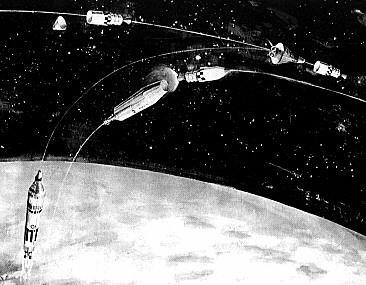
“NEW FEATURE OF MANNED SPACE FLIGHT REQUIRES STARTING BIG ENGINES AT ALTITUDE
as seen in this artist’s concept of the ignition of the second stage engine for the Gemini boosting Air Force Titan II. The 100,000 pound thrust engine begins firing while travelling at a speed of 6,000 miles per hour. It takes the Gemini spacecraft from an altitude of about 45 miles on into orbit at about 100 nautical miles. In so doing, it accelerates the spacecraft from a speed of about 6,000 miles per hour to 18,000 miles per hour. It has a maximum horsepower of four million pounds. The engine is produced by Aerojet-General Corporation’s Liquid Rocket Operations near Sacramento, Calif.”
The striking work, although lacking a signature, is easily identified as being by the hand of Aerojet-General’s resident artist, George Mathis.
Interestingly, it depicts the same event as my other linked photo (below), which also highlights the staging “corona”, apparently witnessed by Tom Stafford during his Gemini 6 flight.
So, logical to assume this is the preceding depiction?
“George Mathis (1909-1977) was born in Seattle, Washington. He spent much of his early life in Hoquiam, where his father managed a clothing store. He attended Washington State University, where he majored in art, and studied under William T. McDermott (1884-1961), who became a well-known western landscape painter. After graduation from WSU in June 1932, he moved to California and worked as a commercial artist and art teacher for a number of years. He married his wife Jean, also an artist, in 1936, in Oakland, California; they had one daughter, Carol.
After living for a few years in the Bay Area, the Mathis family relocated in 1948 to Nevada City, California, the Mother Lode country. The primary motivation for this change was George's growing urge to pictorially recreate western history. Here George and Jean began doing lithography, which eventually turned into a thriving business. Around 1960 they moved to Coloma, another Mother Lode town, where they completely remodeled a Victorian-style house dating to the Gold Rush era. Gold was in fact first discovered in Coloma in 1848 by James Marshall. The Mathis home was called "Friday House," after Jean's maiden name. Here they both lived and operated an art gallery and studio where they sold many products of lithography and George's numerous historical drawings and sketches. George became generally and affectionately known as the "pictorial historian of the Mother Lode."
Between 1960 and 1970 George Mathis' artistic vision took on a new dimension. During this time, he worked in Sacramento for Aerojet Corporation, America's largest producer of rocket engines. Here his versatility, imagination, and eye for detail were once again challenged, and he became one of the better-known space artists of the time.
His illustrations include Gemini and Apollo space missions. The Smithsonian Institution acquired some of his of oil paintings of space art. Spanning western frontiers and deep space, Mathis' artistic career was truly unique, successful, and rewarding.”
The above, along with an excellent exhaustive itemized list of Mr. Mathis’ works, at/from:
ntserver1.wsulibs.wsu.edu/masc/finders/pc90.htm
Credit: Washington State University website
twitter.com/AerojetRdyne/status/1148989764596580352
Credit: Twitter/”X”
Excellent, at the stellar Internet Archive website:
archive.org/details/aeroject2007calendargeorgemathisartis...
The Titan Missile museum is located near south-west Tucson, AZ. The pictured hallway leads to the missile silo. The launch control center is behind me.
Also known as the Titan II SLV (Space Launch Vehicle), the rockets were retired Titan II ICBMs that were converted into launch vehicles to carry payloads for the United States Air Force, NASA and NOAA. Thirteen were launched between 1988 and 2003. This unused Titan 23G was donated to the Evergreen Aviation & Space Museum. Adapted Titan IIs were also used in the 1960s for Project Gemini. They were known as the Titan II GLV (Gemini Launch Vehicle).
The Titan Missile museum is located on the south-west side of Tucson, AZ. This is a view of the missile as it sits within the silo (launchpad).
a titan II ICBM sits in its underground silo at the titan missile museum in southern arizona. for 20+ years, this missile stood on alert, tipped with a large nine megaton thrmonuclear warhead. the purpose of the titan II missiles was "counter strike" - to destroy russian cities and population centers as retaliation if the soviets launched a first strike attack against the USA.
scans from the archives. nikon n90s + sigma 24-70mm f/2.8. film: ilford delta 3200. scan: nikon coolscan 5000. exif tags: lenstagger.
This engine provided the initial lift-off power and assent for the Titan II Missile. Displayed at the Titan Missile Museum near Tucson, Arizona
“This multiple exposure photograph was the result of 11 separate exposures on one sheet of film when the Gemini 10 spacecraft was rocketed into orbit from Cape Kennedy on July 18, 1966. The fan effect of the gantry being lowered and the Titan launch vehicle lifting off was achieved by making 10 exposures through a mask and slit that worked on a pivot. The mask covered the entire film area except for the slit that exposed only the gantry as it went down. This mask was then removed and a fan-shaped mask blocked out the gantry area, with a final exposure showing the lift-off. This marked the eight manned flight in the National Aeronautics and Space Administration’s Gemini program.”
That’s quite a bit of effort & photographic wizardry. Bravo!
Needless to say, I couldn’t afford the color version of this. I saw what it went for at auction the past year…nope, no way.
“EXERCISE IN SPACE
This Martin Company, Baltimore, Md., artist’s drawing depicts the “station keeping” exercise which astronauts Frank Borman and James Lovell will attempt with the burned out second stage of their Air Force Gemini-Titan II rocket early in the GT-7 mission. The second stage (above capsule) will present a target about the size of a house trailer. To aid the astronauts in locating the 27-foot-long target, four flashing lights are mounted on the second stage.”
By the hand of THE MAN-MYTH-MACHINE-LEGEND - John Gorsuch.
Per the “GEMINI PROGRAM REPORT, GEMINI 7”:
“The Gemini launch vehicle performed satisfactorily in all respects. The countdown was nominal, resulting in a launch within 3.7 seconds of the scheduled time. The first-stage flight was normal with all planned events occurring within allowable limits. Staging was nominal. The crew reported that the flame front caused by staging had some effect on the visibility through the spacecraft windows. The second-stage flight was also normal and resulted in the nearest-to-nominal orbital-insertion conditions yet achieved in the Gemini Program. Immediately after the spacecraft separated from the launch vehicle, the crew turned the spacecraft around and began maneuvering back toward the expended Gemini launch vehicle second stage. They then successfully conducted station keeping maneuvers, maintaining distances from 60 to 150 feet for about a 15-minute period. During station keeping, the crew reported profuse second-stage fuel venting which was apparently causing it to tumble at rates of approximately 2 rpm. The crew reported no difficulty in station keeping with the second stage; however, a minimum distance of 60 feet between vehicles was maintained because of the high tumble rates of the launch vehicle. At the completion of station keeping, a separation maneuver was performed and the spacecraft was powered down in preparation for the 14-day mission.”
Above at/from:
tothemoon.ser.asu.edu/files/gemini/gemini_7_mission_repor...
Credit: “March to the Moon”/Arizona State University website
Last, but NOT least, thanks to fellow Flickr user Peter Duncan's astute input, 16mm footage during the station keeping can be seen at the following, commencing at the 4:27 mark:
www.youtube.com/watch?v=2ZB7NOWDvw0
Credit: Retro Space HD/YouTube
“Miles above the earth, the 2-man GEMINI capsule in the foreground moves into position for an orbital rendezvous attempt with the unmanned Agena B spacecraft. In National Aeronautics and Space Administration plans for the GEMINI program, the Air Force Agena stage would be launched into earth orbit first. Then, after tracking stations had determined its orbit, the GEMINI spacecraft would be launched into orbit for a rendezvous by the GEMINI launch vehicle, a modified Air Force TITAN II under development at Martin Company’s Space Systems Division near Baltimore. The GEMINI program also will be used to give astronauts experience in extended space flights of a week or more. In this artist’s concept, the Atlantic and Gulf coasts of Florida are visible.”
Yet another gorgeous work by Martin Company’s talented, versatile & prolific art machine, aka John Gorsuch.
Gemini 'happenings' during 1962:
Mid- to late-1970s artist’s concept depicting United States/NASA manned space flight programs, through the Space Shuttle. So, technically, SpaceX/Crew Dragon not withstanding, it’s still “up-to-date”. How depressing.
An “A” for the graphical depiction; with the whole launch vehicle/spacecraft pairing, not bad. Although the LM looks rather contorted. And a relatively minor detail, possibly due to space limitations, but the Mercury-Redstone launch vehicle has been omitted.
HOWEVER, an “F- -”, maybe even a “J”, for execution. There’s something blatantly & inexcusably wrong with one of these spacecraft.
Hopefully/likely, I don’t think this was intended to be anything educational or informative, probably just a lame promotional effort, so the visual ‘damage’ is minimal. It’s primarily just comically pathetic. The artwork is otherwise excellent. No idea on the artist. Intentional?
Seriously though, didn’t anybody with even the slightest/any clue look at this (and too many other images of the time) before they were printed?
Appropriately, it pretty much reflected NASA’s manned space flight doldrums of the late 70s. Fortunately & thankfully, the unmanned program was spectacularly successful.
Titan Missile Museum, Sahuarita, Arizona
"Missile site 571-7 at the Titan Missile Museum is the sole remaining Titan II Intercontinental Ballistic Missile (ICBM) complex of the 54 that were "on alert" during the Cold War between 1963 and 1987. It was once a part of the 571st Strategic Missile Squadron, 390th Strategic Missile Wing, Davis-Monthan Air Force Base, Arizona, and first came on alert on July 15, 1963." (Read more)
It's a really good photo of a Titan II launch.
Found this on my computer at home. ... Came along with all the junk we moved from Denver to Phoenix in May 2019. ... Never noticed it before.
Maybe some day I'll find my resume'. ... No, never mind.
359-10-34 (8-23-90)
494-13-34 (9-23-90}
620-16-37-(10-25-90)
710-18-37 (11-15-91)
821-18-37 (12-15-91)
1138-19-52 (2-12-20
Full Description: A Titan booster launched the Gemini 8 spacecraft on March 16, 1966, from launch complex 19 Cape Kennedy, Florida. The flight crew for the planned 3 day mission, astronauts Neil A. Armstrong and David R. Scott, achieved the first rendezvous and docking to Atlas/Agena in Earth orbit. But the mission was terminated early due to a malfunctioning thruster on the Gemini spacecraft.
Credit: NASA
Image Number: SPD-MARSH-9141927
Date: March 16, 1966
“SOME IMPROVEMENTS ON OTHER FRONTS IS SHOWN IN THIS PHOTO-DRAWING
Advances range from new surgical procedures for brain tumors to brassiere supports.”
I’ve never seen the benefits derived from the space program referred to as ‘fall-out’. A poor choice of words in my opinion. Nor have I ever seen a Gemini image as the vehicle/backdrop for such.
And that’s quite the spectrum of ‘fall outs’ the reporter chose for the caption. Overall, an interesting, and in a few instances, odd assemblage of benefits that are pointed out.
Artwork by Aerojet-General’s talented resident artist, George Mathis.
Looking down the silo at the nose cone of the TITAN-II missile. It was the largest intercontinental ballistic missile in the USAF inventory. The TITAN-II length measured 110 feet with a diameter of 10 feet. It was able to launch from the underground silo in 58 seconds. The TITAN-II was capable of delivering a 9 megaton nuclear warhead to targets more than 6300 miles (10,000km) in approximately 30 minutes. The TITAN-II remained on alert from 1962 until decommission in 1987.
These suits were worn by personnel working around fueling operations for the Titan II Missile. Displayed at the Titan Missile Museum near Tucson, Arizona
“THIS IS THE FIRST artist’s conception, developed by the Martin Company and approved by the U.S. Air Force, of the DYNA-SOAR boost-glide vehicle as it will be carried into space by the TITAN II intercontinental ballistic missile as a booster.”
Also written in French, as the photo was part of an information folder distributed at the 1961 Paris - Le Bourget International Air Show.
Gorgeous work by Frederick E. Fahdt, who, along with Frank R. DiPietro & John Gorsuch, comprised Martin Company’s artistic/illustrative “Dream Team”. There may have also been another team member, a (probable) Mr. Olivari.
Fascinating & extensive additional DynaSoar reading:
www.astronautix.com/d/dynasoar.html
Credit: Astronautix website
Full Description: Lift-off of Gemini-Titan 11 (GT-11) on Complex 19. The Gemini 11 mission included a rendezvous with an Agena target vehicle.
Credit: NASA
Image Number: 66PC-0261
Date: September 12, 1966
“U. S. SPACE PARK -- Dominating the extensive display of full-scale spacecraft and rockets at the New York World’s Fair will be the Gemini-Titan II, standing 110 feet tall, as it would be on the launch pad at Cape Kennedy. Other full-scale space hardware to be at the Space Park will be, from left, Apollo Command and Service Modules, the Lunar Excursion Module, Gemini-Titan II, Gemini spacecraft and the Aurora 7 Mercury spacecraft which carried Astronaut Scott Carpenter on three Earth orbits.”
Used for press purposes, permanent "highlight" lines remain. Fortunately, they were precisely traced, so they minimally detract.
Sites abound with additional information and photos. For something off the beaten path:
www.collectspace.com/ubb/Forum18/HTML/001194.html
Credit: collectSPACE website
Aviation author Nick Veronico with retired LGM-25C Titan II ICBMs at AMARC, Davis Monthan AFB, January 2000.
See:
en.wikipedia.org/wiki/LGM-25C_Titan_II
(Scanned 35mm color negative)
The Titan-23G-01 rocket launched for the first time from Vandenberg Air Force. After this launch this series of refurbished Titan ICBMs were turned over to NASA for space mission launches.
Image Number:
Date: September 5, 1988
1999 TITAN II (N80586)
Owner: Ronald Dewees
Titan Aircraft sells kit packages for homebuilt aircraft. Their product line includes this model (now called the Tornado) and a replica of the famous WWII fighter the P51 Mustang.
Seen at the:
Cracker Fly-In
Lee Gilmer Memorial Airport
Gainesville, GA
July 5, 2014
One of only a few Titan II missile silos left (the rest were destroyed in accordance with an international treaty), this site has been restored and converted to a museum.
The missile, which had a target range of 5,500 miles, measured 110 feet in length and 10 feet in diameter and was the largest ICBM in USAF inventory. A massive nuclear warhead sat atop the missile.
Become a fan of Scott Haefner Photography on Facebook.
Image from the SDASM Curatorial Collection. Note: This material may be protected by Copyright Law (Title 17 U.S.C.)--Repository: San Diego Air and Space Museum
Looking up from the depths of the underground silo… with a nuclear missile perpetually straining at the leash. ...and now with the top blast shield pulled halfway aside...
The Titan II was the largest operational land based nuclear missile ever used by the United States.
Everything is spring-mounted — from the overhead lights and cableways to the missile itself — to help isolate it from external attacks. The rocket rests on a thrust mount ring, held in place by four explosive bolts. Here you can see the 30-ft. springs that hold the thrust mount ring.
This underground complex, known as 571-7, is all that remains of the 54 Titan II missile sites that were on alert 24x7 across the United States from 1963 to 1987.
When given the command, it could launch within 58 seconds and deliver a 9-megaton nuclear warhead to targets 6300 miles (10,000 km) away in 30 minutes. It reminds me of the USAF high-speed delivery logo I once saw at a Minuteman facility which looked a lot like a Domino’s logo… served hot anywhere on the globe.
This was the era of MAD. The infrastructure to protect this missile is massive, as its intended use was a retaliatory strike — after most of the U.S. was destroyed, this needed to be able to destroy the attacker in return.
So the entire underground launch complex was capable of only being used once… and ideally never.
Diagram of U.S. Manned Spacecraft comparison.
Is that an engine exhaust nozzle at the end of the Gemini equipment module? Hmmm.
At first glance, this looks to be a Gemini - Agena target vehicle rendezvous & docking flight profile, but then, whoa...that pretty much looks to be a Mercury capsule (albeit with an early Gemini-like nose)...and the "Agena target vehicle" actually looks like a MIDAS, SAMOS...something like that...reconnaissance satellite. Huh? Was this ever a consideration? Who knew...other than Ed?! ;-)
At the Astronautix website:
www.astronautix.com/graphics/g/gemearly.jpg
But merely identified as an “Early Gemini Concept”.
Best guess on photo originator identification, based on the artist, the very talented George Mathis, and to a lesser degree, the apparent numbering.
8.5" x 11".
Interesting additional background & examples of Mr. Mathis' works:
ntserver1.wsulibs.wsu.edu/masc/masctour/mathis/index.html
Credit: Washington State University website
Compare to Artist Davis Meltzer’s beautiful (and representative) depiction of basically the same sequence of events:
i.pinimg.com/originals/58/1d/73/581d7330b802fea9af9aebb0a...

Credit: Pinterest/Randy Marcy
Striking depiction by George Mathis, Aerojet General Corporation’s artist, of the Gemini-Titan II second stage ignition ‘corona’.
Per a caption/description associated with another depiction of this phenomena, from the opposing perspective, likely also rendered by Mr. Mathis, Gemini 6 Astronaut Tom Stafford is cited as having witnessed it.
Possibly photographically recorded as well? If so, by onboard cameras? Long-range tracking cameras? I must admit, I know/have seen/have sought out very little Gemini-Titan ascent/staging footage.
8.5” x 11”.
PictionID:54488832 - Catalog:Titan Centaur 07 - Title:Array - Filename:Titan Centaur 07-1.jpg - ---- Images from the Convair/General Dynamics Astronautics Atlas Negative Collection. The processing, cataloging and digitization of these images has been made possible by a generous National Historical Publications and Records grant from the National Archives and Records Administration---Please Tag these images so that the information can be permanently stored with the digital file.---Repository: San Diego Air and Space Museum
First stage of a Martin LGM-25C Titan II ICBM in storage, more than a decade after the last Titan II missile was deactivated
See:
en.wikipedia.org/wiki/LGM-25C_Titan_II
Photographed at Davis-Monthan AFB
January 2000
(Scanned 35mm color negative)
“A modified Air Force TITAN II launch vehicle blasts off from its pad at Cape Canaveral in this artist’s concept of the 2-man National Aeronautics and Space Administration GEMINI spacecraft. Martin Company’s Space Systems Division near Baltimore is modifying the TITAN II under an Air Force Space Systems Division contract for use as launch vehicle in the NASA’s GEMINI project. During the program, the 2-man spacecraft will be boosted into earth for tests of rendezvous and docking techniques with another vehicle already in orbit and for experiments in extended space flights. Initial launchings are scheduled in the 1963-64 time period. GEMINI will be this nation’s first manned project to test rendezvous and docking and is envisioned as a major advance in manned space flight between the current 1-man Mercury program and Project APOLLO, in which a 3-man capsule will be rocketed to the moon.”
One of Frank R. DiPietro's gallery of fantastic Gemini/Gemini-Titan depictions, I'm sure along with many others that we'll never see.
Beautifully composed promotional(?) artwork by resident Aerojet-General Corporation artist George Mathis, in his distinctive style, featuring a dramatic perspective of a Gemini/Titan II launch vehicle during launch preparations. In fact, exercising a little artistic license, Mr. Mathis provides us a view of crew insertion.
8.5" x 11".
Interesting additional background & examples of Mr. Mathis' works:
news.wsu.edu/2019/07/16/wsu-grads-art-brought-apollo-era-...
ntserver1.wsulibs.wsu.edu/masc/masctour/mathis/index.html
Above credit: Washington State University website