View allAll Photos Tagged spacescience
ESA's astronaut candidates of the class of 2022 at the European Astronaut Centre in Cologne, Germany.
The five candidates are Sophie Adenot, Pablo Álvarez Fernández, Rosemary Coogan, Raphaël Liégeois, and Marco Sieber. The group is part of the 17-member astronaut class of 2022, selected from 22 500 applicants from across ESA Member States.
The astronaut candidates will be trained to the highest level for future space missions. Basic training includes learning about space exploration, technical and scientific disciplines, space systems and operations, as well as spacewalks and survival training.
The astronaut candidates are joined by Australian Space Agency astronaut candidate Katherine Bennell-Pegg.
Credits: ESA - P. Sebirot
Europe’s largest satellite constellation has grown even bigger, following the launch of two more Galileo navigation satellites by Soyuz launcher from Europe’s Spaceport in French Guiana on 5 December. Galileo satellites 27-28 add to an existing 26-satellite constellation in orbit, providing the world’s most precise satnav positioning to more than 2.3 billion users around the globe.
Soyuz launcher VS-26, operated by Arianespace and commissioned by ESA, lifted off with the pair of 715 kg satellites from French Guiana on 5 December at 01:19 CET. All the Soyuz stages performed as planned, with the Fregat upper stage releasing the satellites into their target orbit close to 23 525 km altitude, around 3 hours and 54 minutes after liftoff.
The satellites will spend the coming weeks being manoeuvred into their final working orbit at 23 222 km using their onboard thrusters, at the same time as their onboard systems are gradually checked out for operational use – known as the Launch and Early Operations Phase.
Credits: ESA/CNES/Arianespace/Optique Vidéo du CSG - P Piron
When massive stars die at the end of their short lives, they light up the cosmos with bright, explosive bursts of light and material known as supernovae. A supernova event is incredibly energetic and intensely luminous — so much so that it forms what looks like an especially bright new star that slowly fades away over time.
These exploding stars glow so incredibly brightly when they first form that they can be spotted from afar using telescopes such as the NASA/ESA Hubble Space Telescope. The subject of this image, a spiral galaxy named NGC 4051 — about 45 million light-years from Earth — has hosted multiple supernovae in past years. The first was spotted in 1983 (SN 1983I), the second in 2003 (SN 2003ie), and the most recent in 2010 (SN 2010br). These explosive events were seen scattered throughout the centre and spiral arms of NGC 4051.
The SN 1983I and SN 2010br were both categorised as supernovae of type Ic. This type of supernova is produced by the core collapse of a massive star that has lost its outer layer of hydrogen and helium, either via winds or by mass transfer to a companion. Because of this, type Ic — and also type Ib — supernovae are sometimes referred to as stripped core-collapse supernovae.
This galaxy’s beautiful spiral structure can be seen well in this image, along with other intriguing objects (including an emission-line galaxy known as SDSS J120312.35+443045.1, visible as the bright smudge to the lower middle of the image, beneath the sweeping arm of NGC 4051).NGC 4501 sits in the southern part of a cluster of galaxies known as the Ursa Major I Cluster; this cluster is especially rich in spirals such as NGC 4051, and is a subset of the larger Virgo Supercluster, which also houses the Milky Way.
Credits: ESA/Hubble, NASA, D. Crenshaw and O. Fox; CC BY 4.0
The Kangerlussuaq Glacier, one of Greenland’s largest tidewater outlet glaciers, is pictured in this false-colour image captured by the Copernicus Sentinel-1 mission. Meaning ‘large fjord’ in Greenlandic, the Kangerlussuaq Glacier flows into the head of the Kangerlussuaq Fjord, the second largest fjord in east Greenland.
Each Sentinel-1 satellite carries an advanced radar instrument giving us a day-and-night supply of images of Earth’s surface. Remote sensing allows us to monitor ice sheets across the globe and keep track of all calving stages – from rift detection to iceberg breakaway – as well as measure ice cover and drifting icebergs.
This Sentinel-1 radar image combines three separate acquisitions during the summer of 2021 and shows visible changes on the ground and sea surface between three acquisition dates: 4 June, 16 June and 28 June. The array of colours represents the seasonal retreat of ice during this time.
At the top of the image, stable ice can be seen in white and is present in all three radar acquisitions. Ice and snow visible only in the early-summer acquisitions can be seen in bright yellow and are not present in the last acquisition as they have melted by this time. The different shades of red highlights ice and snow detected only in the first acquisition captured on 4 June. Colours on the sea surface vary owing to surface currents and sea ice dynamics.
Research using satellite imagery suggests that since 2017, Kangerlussuaq has entered a new phase of rapid retreat and acceleration, and its ice front is now at its most retreated position since the early 20th century.
As global temperatures increase, the melting of the massive ice sheets that blanket Greenland has significantly accelerated, contributing to sea-level rise. Over the past decade alone, findings have revealed that 3.5 trillion tonnes of ice have melted from the Greenland ice sheet and spilled into the ocean – enough to cover the UK with meltwater 15 m deep.
Using data from ESA’s CryoSat mission, the research shows that extreme ice melting events in Greenland have become more frequent and more intense over the past 40 years, raising sea levels and the risk of flooding worldwide.
Raised sea levels heighten the risk of flooding for coastal communities worldwide and disrupt Arctic Ocean marine ecosystems, as well as altering patterns of ocean and atmospheric circulation – which affect weather conditions around the planet.
Observations of Greenland runoff from space can be used to verify how climate models simulate ice sheet melting which will allow improved predictions of how much Greenland will raise the global sea level in the future.
This image is also featured on the Earth from Space video programme.
Credits: contains modified Copernicus Sentinel data (2021), processed by ESA, CC BY-SA 3.0 IGO
Space Science image of the week:
Until the arrival of the international Cassini–Huygens mission at Saturn in 2004, much about the gas giant, its intricate ring system and enigmatic moons was a mystery.
On 14 January 2005, the mystery as to what lay beneath the thick atmosphere of Saturn’s largest moon Titan was to be revealed as ESA’s Huygens probe made the first successful landing on a world in the outer Solar System.
During the two-and-a-half hour descent under parachute, features that looked remarkably like shore lines and river systems on Earth appeared from the haze. But rather than water, with surface temperatures of around –180ºC, the fluid involved here is methane, a simple organic compound.
One set of images taken by Huygens is pictured here showing the view from 2 km altitude. It is in Mercator projection, so the N–S/E–W directions cross at right angles but surface areas appear distorted.
Huygens touched down on a frozen surface littered with rounded pebbles, and continued to transmit to its mothership for 72 minutes before Cassini dropped below the horizon. The stream of data returned from the surface provided a unique treasure trove of in situ measurements that scientists are still mining today.
In its 13-year odyssey of the Saturn system Cassini made 127 close flybys of Titan, including radar-mapping its surface – even before Huygens’ descent – and finding numerous hydrocarbon lakes and seas, evidence for a global ocean of water beneath its thick crust, and an atmosphere teeming with prebiotic chemicals. Titan’s atmosphere is thought to be similar to early Earth’s before life developed, and thus can be seen as a planet-scale laboratory to understand the chemical reactions that may have led to life on Earth.
Cassini also watched Titan’s seasons change over time, including the development of a swirling vortex and clouds of methane rain that precipitate onto the surface.
Titan has also acted as a gravitational slingshot for Cassini throughout its mission, setting it on course for exploration of the Saturn system. Tonight (19:04 GMT) Cassini will make its last, distant, flyby of Titan, dubbed the ‘goodbye kiss' by mission planners, taking it 119 049 km from its surface.
The flyby seals Cassini’s fate, causing the spacecraft to slow down slightly in its orbit around Saturn and lowering its altitude over the planet. Thus it will plunge into the atmosphere, disposing of the spacecraft in the safest way possible to avoid an unplanned impact into a pristine icy satellite, such as ocean-bearing Enceladus.
More about the mission Grand Finale.
More about discoveries at Titan, via “Cassini prepares to say goodbye to a true Titan"
More from ESA's Archive of Cassini-Huygens discoveries.
The Cassini–Huygens mission is a cooperative project between NASA, ESA and Italy’s ASI space agency.
Credit: ESA/NASA/JPL/University of Arizona
Located in the constellation of Hercules, about 230 million light-years away, NGC 6052 is a pair of colliding galaxies. They were first discovered in 1784 by William Herschel and were originally classified as a single irregular galaxy because of their odd shape. However, we now know that NGC 6052 actually consists of two galaxies that are in the process of colliding. This particular image of NGC 6052 was taken using the Wide Field Camera 3 on the NASA/ESA Hubble Space Telescope.
A long time ago gravity drew the two galaxies together into the chaotic state we now observe. Stars from within both of the original galaxies now follow new trajectories caused by the new gravitational effects. However, actual collisions between stars themselves are very rare as stars are very small relative to the distances between them (most of a galaxy is empty space). Eventually things will settle down and one day the two galaxies will have fully merged to form a single, stable galaxy.
Our own galaxy, the Milky Way, will undergo a similar collision in the future with our nearest galactic neighbour, the Andromeda Galaxy. Although this is not expected to happen for around 4 billion years so there is nothing to worry about just yet.
This object was previously observed by Hubble with its old WFPC2 camera. That image was released in 2015.
Credits: ESA/Hubble & NASA, A. Adamo et al.; CC BY 4.0
Landers and rovers on Mars gather data that help scientists answer fundamental questions about the geology, atmosphere, surface environment, history of water and potential for life on the Red Planet.
To get these insights to Earth, they first transmit the data up to spacecraft in orbit around Mars. These orbiters then use their much larger, more powerful transmitters to ‘relay’ the data across space to Earth.
“Normally, an orbiter like ESA’s Mars Express first sends down a hail signal to a rover as a ‘hello’,” says James Godfrey, Mars Express Spacecraft Operations Manager.
“The rover then sends back a response to establish stable communications and begin the two-way exchange of information. But this relies on the rover’s radio system being compatible with the orbiter’s.”
As Mars Express transmits its ‘hello’ signal using communication frequencies that are different from those the Chinese Zhurong Mars rover receives, two-way communication is not possible.
But in the other direction, Zhurong can transmit a signal using a frequency that Mars Express can receive.
The relay radio on Mars Express has a mode that allows this one-way communication – communication ‘in the blind’ where the sender can’t be sure if their signal is being received – but until now, the technique hadn’t been tested on the spacecraft.
In November, ESA’s Mars Express and CNSA’s Zhurong teams carried out a series of experimental communication tests in which Mars Express used this ‘in the blind’ mode to listen for signals sent to it by the Zhurong Rover.
The experiments culminated in a successful test on 20 November.
“Mars Express successfully received the signals sent by the rover, and our colleagues in the Zhurong team confirmed that all the data arrived on Earth in very good quality.” says ESA’s Gerhard Billig.
“We’re looking forward to carrying out more tests in future to continue to experiment and further improve this method of communicating between space missions.”
The data relayed by Mars Express arrived on Earth at ESA’s ESOC space operations centre in Darmstadt, Germany, via deep-space communication antennas. From there, these data were forwarded to the Zhurong team at the Beijing Aerospace Flight Control Center, who confirmed the success of the test.
Credits: ESA
The Orion spacecraft with integrated European Service Module sit atop the Space Launch System, imaged at sunrise at historic Launchpad 39B at Kennedy Space Center in Florida, USA on 27 August.
The Flight Readiness Review has deemed the trio GO for launch, marking the dawn of a new era in space exploration.
The first in a series of missions that will return humans to the Moon, including taking the first European, Artemis I is scheduled for launch no earlier than Monday 29 August, at 14:33 CEST.
This mission will put NASA’s Orion spacecraft and ESA’s European Service Module to the test during a journey beyond the Moon and back. No crew will be on board Orion this time, and the spacecraft will be controlled by teams on Earth.
The crew module, however, won’t be empty. Two mannequins, named Helga and Zohar, will occupy the passenger seats. Their female-shaped plastic bodies are filled with over 5600 sensors each to measure the radiation load during their trip around the Moon. The specially trained woolly astronaut, Shaun the Sheep, has also been assigned a seat.
The spacecraft will enter lunar orbit using the Moon’s gravity to gain speed and propel itself almost half a million km from Earth – farther than any human-rated spacecraft has ever travelled.
The second Artemis mission will see four astronauts travel around the Moon on a flyby voyage around our natural satellite.
Mission duration depends on the launch date and even time. It will last between 20 to 40 days, depending on how many orbits of the Moon mission designers decide to make.
This flexibility in mission length is necessary to allow the mission to end as intended with a splashdown during daylight hours in the Pacific Ocean, off the coast of California, USA.
Two more dates are available if a launch on 29 August is not possible. The Artemis Moon mission can also be launched on 2 September and 5 September. Check all the possible launch options on ESA’s Orion blog.
Orion is the only spacecraft capable of human spaceflight outside Earth orbit and high-speed reentry from the vicinity of the Moon. More than just a crew module, Orion includes the European Service Module (ESM), the powerhouse that fuels and propels Orion.
ESM provides for all astronauts’ basic needs, such as water, oxygen, nitrogen, temperature control, power and propulsion. Much like a train engine pulls passenger carriages and supplies power, the European Service Module will take the Orion capsule to its destination and back.
Watch launch coverage on ESA Web TV starting at 12:30 CEST here. Follow @esaspaceflight for updates and live Twitter coverage.
Credits: ESA-A. Conigli
This summer, heatwaves struck Europe, North Africa, the US and Asia with temperatures reaching over 40°C in places – breaking many long-standing records. Images from the Copernicus Sentinel-3 mission show the scale of Britain’s heatwave as it baked in extreme temperatures in August.
The image, captured on 12 August 2022, shows the United Kingdom’s previously green land appear brown (particularly in the southeast) amid the scorching conditions. The heatwave comes after months of extreme temperatures and low rainfall left the landscape parched. The dry conditions are also visible in parts of France, Belgium and the Netherlands.
The severe heatwaves experienced across Europe this summer are a harsh reminder of what is in store for our future. Extreme weather events will happen more frequently and intensely according to the Intergovernmental Panel on Climate Change (IPCC). This trend is set to worsen unless the rise in atmospheric greenhouse gas emissions caused by human activities is addressed.
Satellites orbiting our planet play an important role in delivering data to understand and monitor how our world is changing. Their observations and data are critical for improving model predictions of our future climate, mitigation strategies and policymaking.
The Copernicus Sentinel-3 mission not only provides two-day global coverage optical data, but it also carries a Sea and Land Surface Temperature Radiometer instrument that measures Earth’s land surface temperature (how hot the actual surface would feel to touch). During August 2022, the Sentinel-3 mission recorded extreme land surface temperatures of more than 45°C in the United Kingdom, 50°C in France and 60°C in Spain.
Sentinel-3 data has also been merged with archived satellite observations to form a recently released 25-year record of global land surface temperatures (from 1995 to 2020) developed by ESA’s Climate Change Initiative along with Europe’s leading climate scientists. This data record shows a stable increase in global land surface temperature of 0.2°C per decade, with strong regional variability.
Monitoring land-surface temperatures is useful for scientists because the warmth rising from Earth’s surface influences weather and climate patterns. These measurements are particularly important for farmers evaluating how much water their crops need and for urban planners looking to improve heat-mitigating strategies.
This image is also featured on the Earth from Space video programme.
Credits: contains modified Copernicus Sentinel data (2022), processed by ESA, CC BY-SA 3.0 IGO
The oblique perspective view within a large martian crater in Terra Sirenum was generated from the digital terrain model and the nadir and colour channels of the High Resolution Stereo Camera on ESA’s Mars Express.
Credit: ESA/DLR/FU Berlin, CC BY-SA 3.0 IGO
This image from ESA’s Mars Express shows the complex cratered region of Terra Sirenum, southwest of Pickering Crater. Key features described in the main story are marked on this annotated view. Click here for the non-labelled version.
This image comprises data gathered by Mars Express’ High Resolution Stereo Camera (HRSC) on 5 April 2022. It was created using data from the nadir channel, the field of view aligned perpendicular to the surface of Mars, and the colour channels of the HRSC. It is a ‘true colour’ image, reflecting what would be seen by the human eye if looking at this region of Mars.
The ground resolution is approximately 15 m/pixel and the image is centred at about 232°E/38°S. North is to the right.
Credit: ESA/DLR/FU Berlin, CC BY-SA 3.0 IGO
Humankind's most distant outpost was recently captured crossing the face of our enormous and gleaming Sun. The fleeting transit of the International Space Station was over in the blink of an eye, but Ian Griffin, Director at the Otago Museum of New Zealand, made sure he was in the right place to capture it.
“A transit was predicted about 130 km from my home in Dunedin on New Zealand's South Island. So, I packed my telescope into my car and drove for approximately 2 hours”, explains Ian.
“On Thursday 31 January, at 11:07 NZDT, the International Space Station crossed the Sun in less time than a human heart beats once, and I was there to witness it".
The Space Station, slightly larger in size than a football field, orbits Earth every 92 minutes. It is one of the most remarkable endeavours our species has ever embarked upon, yet it pales in comparison to the size and power of our star.
This remarkable spectacle serves as a much needed reminder that the people and technology we send into space can be affected by solar activity, and the changing environment .
One of the largest geomagnetic storms on record, the Carrington event of 1859, was caused as a fast coronal mass ejection associated with an enormous solar flare struck Earth’s magnetosphere. The impact created auroras as far north as Queensland, Australia, and as far south as the Caribbean.
Telegraph systems across Europe and North America failed, with reports of some operators receiving electric shocks and telegraph pylons sending out sparks.
Today, a storm of this magnitude would create far greater disruption, as we become ever-more dependent on infrastructure in space and on Earth that is vulnerable to the outbursts of the Sun.
As part of ESA’s Space Safety & Security activities, the Space Weather Office is working to minimise the potential damage and disruption these events can cause. The future Lagrange mission will keep a constant eye on the Sun, sending timely warnings via the Space Weather Service Network to operators and controllers of vital infrastructure, giving them time to take protective measures.
This early warning system will also be of great importance to astronauts and future explorers to the Moon and Mars, who, vulnerable to the radiation emitted during these extreme events will need time to get to safety.
Find out more:
From 3-5 March, ESA and the Norwegian Space Agency are coming together for the #AuroraHunters SocialSpace, live from Tromso, Norway. Together with a group of 30 attendees, selected from hundreds of applicants across the globe, we will be highlighting the affects of the Sun on our infrastructure, technologies and skies – in the form of the awesome Aurora. Keep an eye on @esaoperations and follow the hastag #AuroraHunters on twitter to keep up with the event.
Credits: Ian Griffin
The plane of the Milky Way is rich in star-forming regions, such as the one pictured in this stunning scene by ESA’s Herschel space observatory. To the far-infrared eye of Herschel, this region reveals an intricate network of gas filaments and dark bubbles interspersed by bright hotspots where new stars come to life.
The cooler regions, which emit light at longer wavelengths, are displayed in a red-brownish colour. Hotter areas, where star formation is more intense, shine in blue and white tones. Some areas are particularly bright, suggesting a number of luminous, massive stars are forming there.
Particularly striking is the chaotic web of gas filaments we see in this scene. Astronomers think there is a link between star formation and the filamentary structures in the interstellar medium. In the densest strands, the gas that makes up the filaments becomes unstable and forms clumps of material bound together by gravity. If dense enough, these collapsed blobs of gas eventually go on to become newborn stars.
Observations by Herschel showed the filamentary complexity to be ubiquitous in the plane of our Galaxy, from a few to hundreds of light-years. In nearby star-forming clouds, within 1500 light-years of the Sun, these filaments seem to be roughly all the same width – about a third of a light-year. This suggests a common physical mechanism in their origin, possibly linked to the turbulent nature of interstellar gas clouds.
The star-formation region in this image, centred around –70º longitude in galactic coordinates, is located in the Carina neighbourhood, home to the glorious Carina Nebula. Located some 7500 light-years away, Carina is one of the largest clouds of gas and dust in the plane of the Milky Way. It hosts the famous Eta Carinae, one of the most luminous and massive stellar systems in our galaxy.
Herschel, which operated from 2009 until 2013, was a large space telescope observing in the far-infrared and submillimetre parts of the spectrum. This spectral range is ideal to observe the glow from cool dust in the regions where stars form. As part of Hi-GAL, the Herschel infrared Galactic Plane Survey, the observatory surveyed the plane of our Galaxy, exploring the Milky Way’s star-formation regions in unprecedented detail. This image, a product of Hi-GAL, combines observations at three different wavelengths: 70 microns (blue), 160 microns (green) and 250 microns (red).
Credits: ESA/Herschel/PACS, SPIRE/Hi-GAL Project. Acknowledgement: UNIMAP / L. Piazzo, La Sapienza - Università di Roma; E. Schisano / G. Li Causi, IAPS/INAF, Italy
An enormous mosaic of Stephan’s Quintet is the largest image to date from the NASA/ESA/CSA James Webb Space Telescope, covering about one-fifth of the Moon’s diameter. It contains over 150 million pixels and is constructed from almost 1,000 separate image files. The visual grouping of five galaxies was captured by Webb’s Near-Infrared Camera (NIRCam) and Mid-Infrared Instrument (MIRI).
With its powerful, infrared vision and extremely high spatial resolution, Webb shows never-before-seen details in this galaxy group. Sparkling clusters of millions of young stars and starburst regions of fresh star birth grace the image. Sweeping tails of gas, dust and stars are being pulled from several of the galaxies due to gravitational interactions. Most dramatically, Webb’s MIRI instrument captures huge shock waves as one of the galaxies, NGC 7318B, smashes through the cluster. These regions surrounding the central pair of galaxies are shown in the colours red and gold.
This composite NIRCam-MIRI image uses two of the three MIRI filters to best show and differentiate the hot dust and structure within the galaxy. MIRI sees a distinct difference in colour between the dust in the galaxies versus the shock waves between the interacting galaxies. The image processing specialists at the Space Telescope Science Institute in Baltimore opted to highlight that difference by giving MIRI data the distinct yellow and orange colours, in contrast to the blue and white colours assigned to stars at NIRCam’s wavelengths.
Together, the five galaxies of Stephan’s Quintet are also known as the Hickson Compact Group 92 (HCG 92). Although called a “quintet,” only four of the galaxies are truly close together and caught up in a cosmic dance. The fifth and leftmost galaxy, called NGC 7320, is well in the foreground compared with the other four. NGC 7320 resides 40 million light-years from Earth, while the other four galaxies (NGC 7317, NGC 7318A, NGC 7318B, and NGC 7319) are about 290 million light-years away. This is still fairly close in cosmic terms, compared with more distant galaxies billions of light-years away. Studying these relatively nearby galaxies helps scientists better understand structures seen in a much more distant universe.
This proximity provides astronomers a ringside seat for witnessing the merging of and interactions between galaxies that are so crucial to all of galaxy evolution. Rarely do scientists see in so much exquisite detail how interacting galaxies trigger star formation in each other, and how the gas in these galaxies is being disturbed. Stephan’s Quintet is a fantastic “laboratory” for studying these processes fundamental to all galaxies.
Tight groups like this may have been more common in the early universe when their superheated, infalling material may have fueled very energetic black holes called quasars. Even today, the topmost galaxy in the group – NGC 7319 – harbours an active galactic nucleus, a supermassive black hole that is actively accreting material.
In NGC 7320, the leftmost and closest galaxy in the visual grouping, NIRCam was remarkably able to resolve individual stars and even the galaxy’s bright core. Old, dying stars that are producing dust clearly stand out as red points with NIRCam.
The new information from Webb provides invaluable insights into how galactic interactions may have driven galaxy evolution in the early universe.
As a bonus, NIRCam and MIRI revealed a vast sea of many thousands of distant background galaxies reminiscent of Hubble’s Deep Fields.
NIRCam was built by a team at the University of Arizona and Lockheed Martin’s Advanced Technology Center.
MIRI was contributed by ESA and NASA, with the instrument designed and built by a consortium of nationally funded European Institutes (The MIRI European Consortium) in partnership with JPL and the University of Arizona.
Get the full array of Webb’s first images and spectra, including downloadable files, here.
Credits: NASA, ESA, CSA, and STScI
If you put 228 old TV sets together, the poorly synced views on their screens might look a bit like what you see here. But the science behind these images – and the technology required to obtain them – is far more fascinating than what their appearance might suggest.
Rather than pixelated colourful static, the vast majority of these 228 thumbnail images shows dense 'over-concentrations' of far-away galaxies that could be the seeds of the galaxy clusters we see in today’s Universe.
Today, 13.8 billion years after the Big Bang, most galaxies are kept together by gravity into groups or larger clusters, but how and when exactly these cosmic structures first started to form is still an open question. Looking far back in time, astronomers observed collections of galaxies that they believe could be bound together by gravity. If they are right, this image could be showing us the birth of over 200 future galaxy clusters, at a time when the Universe was only three billion years old.
This science feat was possible by combining the powers of Planck and Herschel, two ESA space telescopes that were launched together on an Ariane 5 rocket eleven years ago, on 14 May 2009.
The Planck mission spent more than four years scanning the sky to collect and study the remnant radiation left over after the Big Bang, the cosmic microwave background. The Herschel space observatory, which also operated until 2013, performed detailed observations of a multitude of regions across the sky from the far infrared to the submillimetre part of the electromagnetic spectrum.
This image is part of a study published in 2015, in which a team of astronomers used Planck data to identify more than 2000 rare and very distant sources shining brightly in submillimetre wavelengths. One tenth of these sources were then observed using the SPIRE instrument on Herschel at three different wavelengths – 250, 350 and 500 microns – and combined with existing similar observations.
Unleashing the powers of Herschel, the team was able to ‘zoom in’ into the 228 most promising sources spotted with Planck to find clues about their nature. The evidence pointed to the vast majority of them being infant clusters of galaxies. The Herschel observations revealed in particular that the galaxies were forming stars at an impressive rate – about 700 solar-mass stars per year, roughly 700 times more intensely than our Milky Way does today.
A few years later, astronomers used NASA’s Spitzer Space Telescope, which completed its mission earlier this year, to scrutinise 82 of the previously spotted candidates in detail at near-infrared wavelengths. The new data showed without ambiguity that most of these objects consist of far-away galaxies in large concentrations. But some mysteries remain: what is the origin of such a prolific star-formation activity? Are these structures real proto-clusters? These questions will keep astronomers busy for a while.
Credits: ESA/Herschel/SPIRE/Planck consortia and H. Dole, D. Guéry, IAS, CNRS, Université Paris-Saclay
This star-studded image shows us a portion of Messier 11, an open star cluster in the southern constellation of Scutum (The Shield). Messier 11 is also known as the Wild Duck Cluster, as its brightest stars form a “V” shape that somewhat resembles a flock of ducks in flight.
Messier 11 is one of the richest and most compact open clusters currently known. By investigating the brightest, hottest main sequence stars in the cluster astronomers estimate that it formed roughly 220 million years ago. Open clusters tend to contain fewer and younger stars than their more compact globular cousins, and Messier 11 is no exception: at its centre lie many blue stars, the hottest and youngest of the cluster’s few thousand stellar residents.
The lifespans of open clusters are also relatively short compared to those of globular ones; stars in open clusters are spread further apart and are thus not as strongly bound to each other by gravity, causing them to be more easily and quickly drawn away by stronger gravitational forces. As a result Messier 11 is likely to disperse in a few million years as its members are ejected one by one, pulled away by other celestial objects in the vicinity.
Credits: ESA/Hubble & NASA, P. Dobbie et al.; CC BY 4.0
This mesmerizing image of swirling deposits on Mars was taken by the CaSSIS camera on the ESA-Roscosmos ExoMars Trace Gas Orbiter on 9 May 2021.
The swirling and looping texture is typical of the deposits on the floor of the Hellas impact basin in the southern hemisphere of Mars. At 2300 km in diameter and 7 km deep, Hellas is one of the largest identified impact craters both on Mars and within the Solar System.
The terrain imaged in this scene, centred at 52°42'E/39°38'S, is at one of the lowest points of Mars.
The swirling nature of the landscape evokes a feeling of flow. The exact reason for its origin is a puzzle however, and could be attributed to one of many different processes: salt tectonism, or viscous deformation of ice and sediments, for example.
TGO arrived at Mars in 2016 and began its full science mission in 2018. The spacecraft is not only returning spectacular images, but also providing the best ever inventory of the planet’s atmospheric gases, and mapping the planet’s surface for water-rich locations. It will also provide data relay services for the second ExoMars mission comprising the Rosalind Franklin rover and Kazachok platform, when it arrives on Mars in 2023.
Credits: ESA/Roscosmos/CaSSIS, CC BY-SA 3.0 IGO
This stereoscopic image shows the Mawrth Vallis region of Mars. It was generated from data captured by the High Resolution Stereo Camera (HRSC) on ESA’s Mars Express orbiter on 18 February 2023 during orbit 24164. The anaglyph, derived from data acquired by the nadir channel and one stereo channel of the HRSC, offers a three-dimensional view when viewed using red-green or red-blue glasses.
Credits: ESA/DLR/FU Berlin, CC BY-SA 3.0 IGO
This oblique perspective view of Utopia Planitia on Mars was generated from the digital terrain model and the nadir and colour channels of the High Resolution Stereo Camera on ESA’s Mars Express.
Credits: ESA/DLR/FU Berlin, CC BY-SA 3.0 IGO
As beautiful as the surrounding space may be, the sparkling galaxy in the foreground of this image from the NASA/ESA Hubble Space Telescope undeniably steals the show.
This spotlight-hogging galaxy, seen set against a backdrop of more distant galaxies of all shapes and sizes, is known as PGC 29388. Although it dominates in this image, this galaxy is a small player on the cosmic stage, and is known as a dwarf elliptical galaxy. As the “dwarf” moniker suggests, the galaxy is on the smaller side, and boasts a “mere” 100 million to a few billion stars — a very small number indeed when compared to the Milky Way's population of around 250 to 400 billion stellar residents.
Credits: ESA/Hubble & NASA, T. Armandroff; CC BY 4.0
The Copernicus Sentinel-2 mission takes us over the Tarawa Atoll in the Republic of Kiribati – a remote Pacific nation threatened by rising seas.
The Republic of Kiribati is an independent island nation consisting of some 33 atolls near the equator in the central Pacific. The islands are spread over approximately 3.5 million sq km of ocean, but with a total land area of only 800 sq km.
Tarawa Atoll, pictured here, lies approximately halfway between Hawaii and Australia. Tarawa consists of a large lagoon fringed by a V-shaped reef, around 35 km long, and is made up of more than 30 islets. Tarawa, the site of a brutal World War II battle, is divided into North and South Tarawa.
South Tarawa, is made up of a thin, string of islets joined by causeways and is home to more than half of Kiribati’s 100 000 citizens. Bonriki International Airport, serves as the main gateway to the country, and can be seen in the bottom right of the image.
Kiribati is one of the lowest-lying nations in the world, with many of the country’s atolls and coral islands rising no higher than 2 m above sea level – making them extremely vulnerable to sea level rise. Kiribati has already seen growing damage from storms and flooding. In 1999, two of the nation’s unpopulated islets, Tebua Tarawa and Abanuea, disappeared underwater entirely.
The Special Report on the Ocean and Cryosphere in a Changing Climate on sea level rise states that the global mean sea level is likely to rise between 0.29 m and 1.1 m by the end of this century. While this may not sound like a lot, small island nations, including Kiribati, will face particularly devastating consequences.
Small changes in sea-level rise will not only cause flooding, erosion, soil contamination and coral degradation, but will ultimately shrink more of Kiribati’s land area – displacing many of its inhabitants.
It is vital that over the coming decades, the changing height of Earth’s sea surface continues to be closely monitored. Set to launch in November, the Copernicus Sentinel-6 Michael Freilich satellite will accurately measure changes in global sea level. Mapping up to 95% of Earth’s ice-free ocean every 10 days, it will provide key information on ocean currents, wind speed and wave height for maritime safety.
This new satellite will assume the role as a reference mission, continuing the ‘gold standard’ record for climate studies started in 1992 – extending the legacy of sea-surface height measurements until at least 2030.
This image, acquired on 14 June 2020, is also featured on the Earth from Space video programme.
Credits: contains modified Copernicus Sentinel data (2020), processed by ESA, CC BY-SA 3.0 IGO
'Swage' was the word of the day on Monday as ESA astronaut Luca Parmitano carried out the third spacewalk to service the cosmic ray hunting Alpha Magnetic Spectrometer AMS-02. Luca swaged, or joined, the instrument’s tubes to a new pump system that will give it a new lease on life.
Riding on the International Space Station’s robotic arm, Luca soared to the cosmic ray detector’s worksite for nearly five hours of space plumbing.
Yesterday’s spacewalk was the most critical of four spacewalks planned to service the Alpha Magnetic Spectrometer that has provided scientists with invaluable data on cosmic particles long after its original three-year mission. In 2017 the decision was made to service the instrument after all four cooling systems wore out.
Luca and NASA astronaut Andrew Morgan began by passing the cooling system to each other as they inched their way from the airlock to the Space Station’s robotic arm. Luca then attached himself to the arm and – aided by astronaut Jessica Meir who operated this from inside the Station – transported the system to the hard-to-reach worksite.
Luca rode the arm into position, seen in this image, and together with Drew screwed the new pump onto AMS. The system was powered on and Luca was moved to a different location by robotic arm for the swage operations. Luca did six swages before taking the robotic arm ride again to the underside of AMS for the last two and finish the job.
The spacewalk was a success, with Luca and Drew finishing their delicate and unprecedented work ahead of schedule. They returned to the Space Station airlock ending the spacewalk at six hours and two minutes. A fourth and last spacewalk for AMS is planned at a later date.
Credits: NASA
This ethereal image was taken by Daniel Michalik, currently a research fellow at ESA. It was shortlisted as a finalist in the Royal Society photography competition in 2017, and went on to become the overall winner in the ‘Astronomy’ category – and it’s easy to see why.
It captures a beautiful scene at the Earth’s South Pole in Antarctica, where the dry, cold conditions allow for observations of a number of rare celestial phenomena that are seen far less often elsewhere. The sight captured beautifully here by Daniel is a good example of such a phenomenon: a light pillar.
The Moon illuminates a column of bright light between it and the frozen plateau below, creating a scene akin to a dramatic lunar spotlight beaming downwards. This is caused by moonlight reflecting from and refracting through ice crystals suspended in our planet’s atmosphere, producing a diffuse, eerie glow. Atmospheric ice crystals are behind a number of the phenomena showcased wonderfully at the South Pole, including halos and arcs (glowing rings that encircle the Sun or Moon in the sky), as well as sun and moon dogs (bright, circular spots of light that sometimes appear along these halos around the Sun or Moon).
Jupiter can be seen as a bright spot to the upper left of the Moon. This photograph is one single long exposure with minor contrast and exposure adjustments, taken at -60°C.
Daniel wintered at the Geographic South Pole in 2017 while he worked at the 10-metre South Pole Telescope (SPT), visible here as the leftmost radio dish. The other two dishes visible are BICEP2 (Background Imaging of Cosmic Extragalactic Polarization 2), and the Keck Array. These telescopes are exploring the very earliest days of the cosmos. They are located in the Dark Sector of the Amundsen–Scott South Pole Station, where any sources of electro-magnetic interference that could potentially affect the observations are kept as low as possible. This means no wifi, no radio contact, and no bright lights in this area, amongst others.
A line of flags is visible snaking away from the camera towards these telescopes – it helps astronomers and staff find their way to the site during the five months of continuous winter darkness.
The Moon creates a number of fascinating and unique sights for terrestrial observers, perhaps the most famous being eclipses. The most recent lunar eclipse – when the Earth slips between the Moon and the Sun, casting its shadow onto our satellite – occurred during the early hours of this morning. The total lunar eclipse could be seen from North America, South America, and parts of western and northern Europe and Africa.
While the Moon has not welcomed human visitors since the 1970s, it is again becoming a target for space agencies. The Moon is a key reference point for understanding the evolution of the early Solar System. There is also renewed interest in a long-term human presence on the Moon as it offers great potential as a ‘springboard’ for humans to explore other regions of space – Mars being the next goal.
Credits: D. Michalik/NSF/SPT
The Ariane 6 launch pad at Europe’s Spaceport in French Guiana now hosts for the first time a fully assembled example of ESA’s new heavy-lift rocket, following the addition of an upper composite to the core stage and four boosters already in place. The upper composite – consisting of two half-fairings and a payload mock-up with the structural adapter needed to join it to the core stage – made the 10 km trip from the encapsulation building to launch pad on 12 October.
Assembly, transfer and installation of an upper composite validates the Ariane 6 assembly process. Now, over the next several weeks, teams from ESA, ArianeGroup and French space agency CNES will make the mechanical, electrical and fluid connections which join this test model of the Ariane 64 configuration to the launch pad.
With Ariane 6 fully integrated with the pad, so-called combined tests will validate the rocket, launch pad and shared electrical, fluid and mechanical systems as a complete system. The combined tests include tank filling and drainage operations which guarantee smooth-running of a launch sequence. Flight and control bench software will also be tested.
Then, the launch pad will serve as a test bed for static hot-fire tests of the Vulcain 2.1 core stage engine, including aborted firings and long firings with disconnection. Vulcain 2.1 is derived from Ariane 5’s Vulcain 2.
Separately, static hot-fire tests of the Ariane 6 upper stage and its all-new Vinci engine began in October on a purpose-built test bed at Germany’s DLR centre for engine and stage testing at Lampoldshausen.
The reignitable Vinci engine allows Ariane 6 to deliver multiple payloads to different orbits on a single launch. After payload separation a final engine burn deorbits the upper stage so that it does not become a debris threat in space.
The Ariane 6 launch pad at Europe’s Spaceport in French Guiana now hosts for the first time a fully assembled example of ESA’s new heavy-lift rocket, following the addition of an upper composite to the core stage and four boosters already in place. The upper composite – consisting of two half-fairings and a payload mock-up with the structural adapter needed to join it to the core stage – made the 10 km trip from the encapsulation building to launch pad on 12 October.
Assembly, transfer and installation of an upper composite validates the Ariane 6 assembly process. Now, over the next several weeks, teams from ESA, ArianeGroup and French space agency CNES will make the mechanical, electrical and fluid connections which join this test model of the Ariane 64 configuration to the launch pad.
With Ariane 6 fully integrated with the pad, so-called combined tests will validate the rocket, launch pad and shared electrical, fluid and mechanical systems as a complete system. The combined tests include tank filling and drainage operations which guarantee smooth-running of a launch sequence. Flight and control bench software will also be tested.
Then, the launch pad will serve as a test bed for static hot-fire tests of the Vulcain 2.1 core stage engine, including aborted firings and long firings with disconnection. Vulcain 2.1 is derived from Ariane 5’s Vulcain 2.
Separately, static hot-fire tests of the Ariane 6 upper stage and its all-new Vinci engine began in October on a purpose-built test bed at Germany’s DLR centre for engine and stage testing at Lampoldshausen.
The reignitable Vinci engine allows Ariane 6 to deliver multiple payloads to different orbits on a single launch. After payload separation a final engine burn deorbits the upper stage so that it does not become a debris threat in space.
Credits: ESA-Manuel Pedoussaut
A key element of ESA’s Hera mission for planetary defence has left the facilities of its manufacturer OHB in Bremen – a major step in preparation for its eventual odyssey to the Didymos asteroid system.
The mission’s Propulsion Module, seen here, has been delivered to Avio, southeast of Rome, where propellant tanks, thrusters and associated pipes and valves will be integrated with it. The fully equipped Propulsion Module is what will take Hera on its 26-month trek through deep space to the main Didymos asteroid and its smaller Dimorphos companion.
On 26 September this year Dimorphos will become the very first Solar System body to have its orbit altered by human action in a measurable way, when NASA’s DART spacecraft impacts with it. When Hera arrives at the asteroid in December 2026 the spacecraft will perform a detailed post-crash investigation, assessing the mass and make-up of Dimorphos and measuring the crater left by DART’s impact, helping to validate kinetic impact as a workable planetary defence method.
Meanwhile Hera’s other half, the Core Module, is also taking shape at OHB in Bremen. The Core Module will carry all the mission’s scientific instruments as well as on-board computer and other subsystems. The spacecraft will be completed when these two halves are eventually joined together, ahead of Hera’s planned launch in October 2024.
Credits: OHB
Using a series of 'real' and 'fake' flybys, ESA's Mars Express has clarified a long-standing martian mystery: if and how Mars' largest moon, Phobos, reflects the solar wind.
This infographic shows three Mars Express flybys that occurred in July 2008, January 2016 and May 2017 – the former two being 'real' flybys completed in the vicinity of Phobos, and latter being a 'fake' flyby performed to clarify whether a particular signal detected by the spacecraft was a true detection of a process taking place on Phobos, or if it was due to reflection of particles from Mars Express itself.
Credits: ESA
This image shows Nirgal Vallis, a dried-up river valley on Mars, in 3D when viewed using red-green or red-blue glasses. This anaglyph was derived from data obtained by the nadir and stereo channels of the High Resolution Stereo Camera on ESA’s Mars Express during spacecraft orbit 18818. It covers a part of the martian surface centred at about 315°E/27°S. North is to the right.
Credits: ESA/DLR/FU Berlin, CC BY-SA 3.0 IGO
Black holes are among the most fascinating objects in the Universe. Enclosing huge amounts of matter in relatively small regions, these compact objects have enormous densities that give rise to some of the strongest gravitational fields in the cosmos, so strong that nothing can escape – not even light.
This artistic impression shows two black holes that are spiralling towards each other and will eventually coalesce. A black hole merger was first detected in 2015 by LIGO, the Laser Interferometer Gravitational-Wave Observatory, which detected the gravitational waves – fluctuations in the fabric of spacetime – created by the giant collision.
Black holes and gravitational waves are both predictions of Albert Einstein’s general relativity, which was presented in 1915 and remains to date the best theory to describe gravity across the Universe.
Karl Schwarzschild derived the equations for black holes in 1916, but they remained rather a theoretical curiosity for several decades, until X-ray observations performed with space telescopes could finally probe the highly energetic emission from matter in the vicinity of these extreme objects. The first ever image of a black hole’s dark silhouette, cast against the light from matter in its immediate surrounding, was only captured recently by the Event Horizon Telescope and published just last month.
As for gravitational waves, it was Einstein himself who predicted their existence from his theory, also in 1916, but it would take another century to finally observe these fluctuations. Since 2015, the ground-based LIGO and Virgo observatories have assembled over a dozen detections, and gravitational-wave astronomy is a burgeoning new field of research.
But another of Einstein’s predictions found observational proof much sooner: the gravitational bending of light, which was demonstrated only a few years after the theory had appeared, during a total eclipse of the Sun in 1919.
In the framework of general relativity, any object with mass bends the fabric of spacetime, deflecting the path of anything that passes nearby – including light. An artistic view of this distortion, also known as gravitational lensing, is depicted in this representation of two merging black holes.
One hundred years ago, astronomers set out to test general relativity, observing whether and by how much the mass of the Sun deflects the light of distant stars. This experiment could only be performed by obscuring the Sun’s light to reveal the stars around it, something that is possible during a total solar eclipse.
On 29 May 1919, Sir Arthur Eddington observed the distant stars around the Sun during an eclipse from the island of Príncipe, in West Africa, while Andrew Crommelin performed similar observations in Sobral, in the north east of Brazil. Their results, presented six months later, indicated that stars observed near the solar disc during the eclipse were slightly displaced, with respect to their normal position in the sky, roughly by the amount predicted by Einstein’s theory for the Sun’s mass to have deflected them.
“Lights All Askew in the Heavens,” headlined the New York Times in November 1919 to announce the triumph of Einstein’s new theory. This inaugurated a century of exciting experiments investigating gravity on Earth and in space and proving general relativity more and more precisely.
We have made giant leaps over the past hundred years, but there is still much for us to discover. Athena, ESA’s future X-ray observatory, will investigate in unprecedented detail the supermassive black holes that sit at the centre of galaxies. LISA, another future ESA mission, will detect gravitational waves from orbit, looking for the low-frequency fluctuations that are released when two supermassive black holes merge and can only be detected from space.
Both missions are currently in the study phase, and are scheduled to launch in the early 2030s. If Athena and LISA could operate jointly for at least a few years, they could perform a unique experiment: observing the merger of supermassive black holes both in gravitational waves and X-rays, using an approach known as multi-messenger astronomy.
We have never observed such a merger before: we need LISA to detect gravitational waves at the onset of the merger and tell us where to look in the sky, then we need Athena to observe it at high precision in X-rays to see how the mighty collision affects the gas surrounding the black holes. We don’t know what happens during such a cosmic clash so this experiment, much like the eclipse of 1919 that first proved Einstein’s theory, is set to shake our understanding of gravity and the Universe.
Credits: ESA
This image shows an artistic impression of the Milky Way, and on top of that an overlay showing the location and densities of a young star sample from Gaia’s data release 3 (in yellow-green). The “you are here” sign points towards the Sun.
The density of the star sample out to 5 kpc (~ 16 300 light years) from the Sun is provided on this image in the form of isodensity surfaces. The isodensity surfaces provide insight into the structure of our galaxy. The higher the density, the more young stars are found in this area. See more versions and read more about this map here.
Credits: ESA/Gaia/DPAC; CC BY-SA 3.0 IGO
After four months of darkness, it is finally time to rise and shine for the crew at Concordia Research Station in Antarctica. The most-welcome Sun finally made its appearance on 11 August and ESA-sponsored medical doctor Nick Smith was not about to miss it.
For nine months Nick and his fellow crew mates have been living and working in one of the most isolated, confined and extreme environments on Earth, with no way in or out of the Station during the winter-over period.
Nick is overseeing experiments in human physiology and biology, atmospheric physics, meteorology, and astronomy, among other disciplines. Along with the rest of the crew, he is also maintaining the base – one of only three to run year-round in the Antarctic.
Four months of complete darkness is quite the challenge, and one researchers are very interested in studying from a physiological and psychological point of view. From questionnaires to blood and stool samples, the crew are poked and prodded to understand how better to prepare humans for deep space travel.
Social dynamics are also of interest to researchers during the period of darkness. Stress brought on by lack of sunlight, changing sleep patterns, fatigue and moodiness can affect the group. The crew are especially encouraged to take on group activities and get creative to combat the isolation of the winter. And not just with their own station crew.
Bases across Antarctica take part in the annual Antarctic Film Festival. Crews from each base submit an entry for different categories, and the creativity and cooperation required to come up with an idea and script, film and edit the entry makes for friendly competition and camaraderie. Look out for 2021 entries here.
The first sunrise is always a remarkable moment, signalling the home stretch of their Antarctic residency. From now on the winter crew will start preparing for summer and the return of scientists that arrive for the warmer months starting in November. The base is cleaned thoroughly, machinery is serviced, tents are erected and heated, and the runway is cleared of snow. Extensive work is required to welcome the new arrivals back to the base at the end of the world.
Follow the adventures in science and socialisation at Concordia on the blog.
Credits: ESA/IPEV/PNRA–N. Smith
Thanks to a quirk of our cosmos, the Moon’s average distance from Earth is just right for it to appear as the same size in the sky as the significantly larger Sun. Once in a while the Moon slides directly between Earth and the Sun such that it appears to cover our star completely, temporarily blocking out its light and creating a total solar eclipse for those along the narrow path cast by the Moon’s shadow.
But sometimes the alignment is such that the Moon only partially covers the Sun’s disc. Such a partial eclipse occurred on Saturday for observers located primarily in northern and eastern Europe, northern parts of North America, and some northern locations in Asia.
ESA’s Sun-watching Proba-2 satellite orbits Earth about 14.5 times per day and with its constant change in viewing angle, it dipped in and out of the Moon’s shadow twice during Saturday’s eclipse.
Selected views of the two partial eclipses are seen side-by-side here – the first (left) was captured at 08:40:12 GMT and the second (right) at 10:32:17 GMT on 11 August.
The images were taken by the satellite’s SWAP camera, which works at extreme ultraviolet wavelengths to capture the Sun’s hot turbulent atmosphere – the corona – at temperatures of about a million degrees, which can be seen in the background.
Credits: ESA/Royal Observatory of Belgium
Space Science image of the week:
If you gazed at the night sky over the past few weeks, it is possible that you stumbled upon a very bright star near the Orion constellation. This is Sirius, the brightest star of the entire night sky, which is visible from almost everywhere on Earth except the northernmost regions. It is, in fact, a binary stellar system, and one of the nearest to our Sun – only eight light-years away.
Known since antiquity, this star played a key role for the keeping of time and agriculture in Ancient Egypt, as its return to the sky was linked to the annual flooding of the Nile. In Ancient Greek mythology, it represented the eye of the Canis Major constellation, the Great Dog that diligently follows Orion, the Hunter.
Dazzling stars like Sirius are both a blessing and a curse for astronomers. Their bright appearance provides plenty of light to study their properties, but also outshines other celestial sources that happen to lie in the same patch of sky.
This is why Sirius has been masked in this picture taken by amateur astronomer Harald Kaiser on 10 January from Karlsruhe, a city in the southwest of Germany.
Once the glare of Sirius is removed, an interesting object becomes visible to its left: the stellar cluster Gaia 1, first spotted last year using data from ESA’s Gaia satellite.
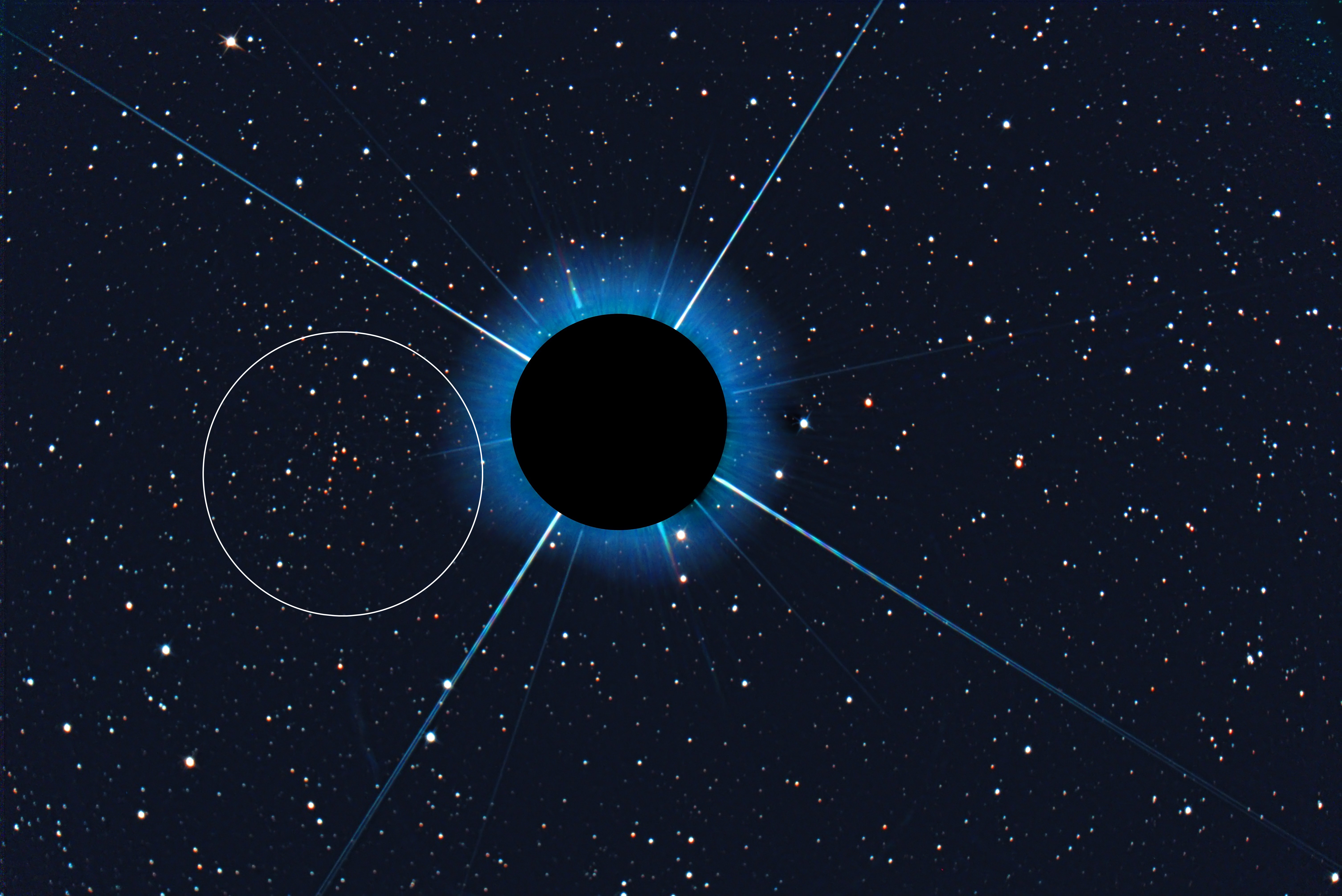
Gaia 1 is an open cluster – a family of stars all born at the same time and held together by gravity – and it is located some 15 000 light-years away. Its chance alignment next to nearby, bright Sirius kept it hidden to generations of astronomers that have been sweeping the heavens with their telescopes over the past four centuries. But not to the inquisitive eye of Gaia, which has been charting more than a billion stars in our Milky Way galaxy.
Mr Kaiser heard about the discovery of this cluster during a public talk on the Gaia mission and zealously waited for a clear sky to try and image it using his 30 cm-diameter telescope. After covering Sirius on the telescope sensor – creating the dark circle on the image – he succeeded at recording some of the brightest stars of the Gaia 1 cluster.
Gaia 1 is one of two previously unknown star clusters that have been discovered by counting stars from the first set of Gaia data, which was released in September 2016. Astronomers are now looking forward to Gaia’s second data release, planned for 25 April, which will provide vast possibilities for new, exciting discoveries.
More information about opportunities for amateur astronomers to follow up on Gaia observations here.
Credit: H. Kaiser
Concordia station, located on a plateau 3200 m above sea level on the Antarctic peninsula, is first and foremost a research hub.
Nestled at the very southern tip of Earth, where temperatures can drop to –80 °C in the winter, and a yearly average temperature of –50 °C, the station offers researchers the opportunity to collect data and experiment like no other place on Earth.
Among these researchers is a team of micrometeorite hunters scouting the snow and ice for traces of extra-terrestrial material less than a millimetre in diameter. Every year the amount of micrometeorites accounts for up to 1000 tonnes of particles on Earth.
Some of these fall in Antarctica where the frigid temperatures preserve these cosmic particles.
The French team of micrometeorite hunters at Concordia managed to remove just over 1000 cubic meters of ice and snow, setting a record.
The snow is slowly melted and filtered for micrometeorites that are then analysed. The results help further our understanding of the origins of the Solar System.
Researchers spent hours digging in the –50 °C temperatures for several days, equipped with protective suits, rubber gloves, picks and shovels in the name of cosmochemistry.
The end of their dig meant some fun for the residents. While researchers must ensure the ice and snow samples are as pristine as possible, once they had finished their sampling the trench could be “contaminated” by the boots of others.
Recreation is just as important for the isolated crew as the science and research that takes place there. So on a Sunday the residents took to the trench with sleds and snowmobiles.
The 7-m deep trench is a snowy time capsule, of sorts. Antarctica is the world's driest continent and Concordia is situated in the world’s largest desert. The layers of packed snow in the trench are the accumulation of approximately 80 years of snowfall.
To put it in the words of ESA-sponsored medical doctor Nadja Albertsen, “when the snow that we experienced on Sunday fell, World War II was just beginning and the atomic bomb was still just an idea.”
Dr. Albertsen is currently in residence at Concordia to run the biological experiments at the base. You can follow her adventures on the Chronicles from Concordia blog.
While scientists continue to follow the case of micrometeorites on Earth, we leave you to ponder the writing on the trench wall.
Credits: ESA/IPEV/PNRA-N. Albertsen
India is currently facing a prolonged heatwave, with temperatures exceeding 42°C in numerous cities across the country. This comes just weeks after India recorded its hottest March since the country’s meteorological department began its records over 120 years ago. This image, produced using data from the Copernicus Sentinel-3 mission, shows the land surface temperature across most of the nation.
According to the India Meteorological Department, maximum air temperatures reached 43-46°C over most parts of Rajasthan, Vidarbha, Madhya Pradesh and East Uttar Pradesh; in many parts over Gujarat, interior Odisha; and in some parts of Madhya Maharashtra on 28 April. Forecasters warned that heatwave conditions are expected to continue until 2 May.
Experts at the Indian Institute of Technology’s Water and Climate Lab stated that, in recent years, the number of Indian states hit by heatwaves has increased, as extreme temperatures become more frequent.
Owing to the absence of cloud cover on 29 April (10:30 local time), the Sentinel-3 mission was able to obtain an accurate measurement of the land surface temperature of the ground, which exceeded 60°C in several areas. The data shows that surface temperature in Jaipur and Ahmedabad reached 47°C, while the hottest temperatures recorded are southeast and southwest of Ahmedabad (visible in deep red) with maximum land surface temperatures of around 65°C.
The map was generated by using the mission’s Sea and Land Surface Temperature Radiometer instrument. While weather forecasts use predicted air temperatures, this satellite instrument measures the real amount of energy radiating from Earth. Therefore, the map shows the actual temperature of the land’s surface pictured here, which is usually significantly hotter than air temperatures.
Sentinel-3 can monitor wildfires, map the way the land is used, provide indices of vegetation state, as well as measure the temperature, colour and height of the sea surface. For more information on the Copernicus Sentinel-3 mission, click here.
Credits: contains modified Copernicus Sentinel data (2022), processed by ESA, CC BY-SA 3.0 IGO
Happy World Health Day
Celebrated each year on 7 April, World Health Day shines a light on a health topic of concern. This year all eyes, including ESA astronaut Matthias Maurer’s, are on the health of our planet Earth.
From on board the International Space Station 400 km above Earth, Matthias has a unique overview of our planet. Beautiful yet fragile, resilient yet under threat, our third rock from the Sun nevertheless needs looking after.
Matthias work in space during Cosmic Kiss reinforces this. Besides taking numerous photos of Earth from space that compliment data taken by Earth observation satellites, he is also running many experiments exploring human health in space that benefits those on Earth.
One such experiment is the joint ESA and German Aerospace Center’s Retinal Diagnostics project that monitors astronaut eyes while in space.
Developed by young researchers from ESA’s Spaceship EAC initiative, the project uses images of astronauts’ optical discs in space to train an artificially intelligent (AI) model. This model will be used to automatically detect changes in the optic nerve of astronauts, known as Space-Associated Neuro-ocular Syndrome (SANS).
Matthias uses an ophthalmic lens attached to a tablet camera to take images of his retina to send to experts on the ground. The app is so compact and easy to use that it can be used for remote examinations of patients in remote locations on Earth, so that everyone can keep an eye on their retinal health.
Follow Matthias on his Cosmic Kiss mission for more science and space on Twitter, Facebook, Instagram, YouTube the Cosmic Kiss mission page and in regular Space Station updates from ESA.
Credits: NASA/ESA–M. Maurer
A robot must obey the orders given it by human beings, according to one of the three laws of robotics imagined by science fiction writer Isaac Asimov. On board humanity’s only outpost in space, this obedience has turned into cooperation. Astronauts and robots are working together.
The latest robot to service the International Space Station is the European Robotic Arm (ERA). This android automaton is much like a human arm. It has an elbow, shoulders and even wrists, and it the first robot able to ‘walk’ around the Russian part of the Space Station.
The arm will be launched into space together with the Multipurpose Laboratory Module, called ‘Nauka’, from the Baikonur Cosmodrome, in Kazakhstan, on 15 July 2021 at 19:18 CEST.
ESA astronaut André Kuipers is seen in this picture during his first space mission in 2004, with a scale model of the European Robotic Arm. The real thing has a length of over 11 m, and has the ability to anchor itself to the Station in multiple locations, moving backwards and forwards with a large range of motion.
“I am happy to see the European Robotic Arm fly next month. It was a real pleasure to help prepare this fantastic piece of robotics for its duties on the International Space Station”, says André, who trained under water with a real-size model of the robot at Star City, in Russia, before his spaceflight.
Astronauts will find in ERA a most valuable ally – it will save them precious time to do other work in space. ERA will transfer payloads from inside to outside the International Space Station, but it will also help spacewalkers by transporting them around like a cherry-picker crane.
The crew can control ERA from both inside and outside the Space Station, a feature that no other robotic arm has offered before. The robotic arm can perform many tasks automatically, and it can be controlled in real time or preprogrammed. ERA’s first tasks in orbit are to set up the airlock and install a large radiator for ‘Nauka’.
ERA is 100% made-in-Europe. A consortium of European companies led by Airbus Defence and Space Netherlands designed and assembled it for ESA.
The story of the European Robotic Arm is one of perseverance – it has survived four changes of scenario, dealt with different space agencies and coped with budget shortfalls while keeping an international team motivated.
After two decades of technical and programmatic challenges, the long-awaited premiere of ERA in space is finally happening.
Credits: ESA/NASA
In this infrared image from the NASA/ESA/CSA James Webb Space Telescope, Jupiter is shown with its moon Europa (left), as seen by the NIRCam instrument 2.12 micron filter. The short-wavelength filter shows distinct bands that encircle the planet.
The Great Red Spot appears white on the right. The iconic spot appears white in this image because of the way Webb’s infrared image was processed. The dark spot to the left of the Great Red Spot is Europa’s shadow cast on Jupiter.
Scientists were especially eager to see these commissioning images because they are proof that Webb can observe the satellites and rings near bright solar system objects such as Jupiter, Saturn, and Mars. Scientists will use Webb to explore the tantalizing question of whether we can see plumes of material spewing out of moons like Europa and Saturn’s moon Enceladus. Webb may be able to see the signatures of plumes depositing material on the surface on Europa.
Credits: NASA/ESA/CSA/STScI
The second qualification model of the P120C solid rocket motor, configured for Ariane 6, completed its hot firing on 7 October 2020 in a final test to prove its readiness for flight.
Depending on the configuration, two or four P120C motors, developed in Europe, will be strapped onto the sides of the future Ariane 6
launch vehicle as boosters for liftoff. The P120C will also be used as the first stage of Vega-C.
After it was fully loaded with 142 tonnes of fuel, the 13.5 m long and 3.4 m diameter motor was ignited to simulate liftoff and the first phase of flight.
The motor burned for 130 seconds and delivered a maximum thrust of about 4500 kN. The test was performed at Europe’s Spaceport in French Guiana, and was completed with no anomalies.
ESA, France’s CNES space agency, and Europropulsion which is jointly owned by Avio and ArianeGroup, collaborated on this test.
Credits: ESA/CNES/Arianespace/Optique vidéo du CSG - JM Guillon
The quasar SDSS J165202.64+172852.3 is highlighted in an image from the NASA/ESA Hubble Space Telescope in visible and near-infrared on the left. The images in the centre and on the right present new observations from the NASA/ESA/CSA James Webb Space Telescope in multiple wavelengths to demonstrate the distribution of gas around the object.
The quasar is an “extremely red” quasar that exists in the very early Universe, 11.5 billion years ago.
The image in the centre is composed of four narrow-band images made from the Webb NIRSpec instrument’s integral-field spectroscopy mode. All the four narrow-band images show extremely red-shifted emissions from doubly ionised oxygen which has an emission line around 500nm in visible light; before it was shifted to infrared light.
The panels on the right present the four narrow-band images separately. Each colour illustrates the relative speed of ionised oxygen gas across the cluster. The redder the colour the faster gas is moving away from our line of sight with the quasar, while the bluer the colour the faster it's moving away from the quasar toward us. The colour green indicates that the gas is steady in our line of sight in comparison to the quasar.
The blue and yellow panels reveal the bi-conical outflow from the quasar, with the orange panel showing the gas moving faster from us, which is extended towards the lower right, as well as highlighting a companion galaxy on the upper left of the frame.
Credits: ESA/Webb, NASA, CSA, D. Wylezalek, A. Vayner and the Q3D Team
The Ariane 5 launch vehicle liftoff for flight VA261 from Europe’s Spaceport in French Guiana on 5 July at 23:00 BST (6 July at 00:00 CEST). Flight VA261 carried two payloads into space – the German space agency DLR’s experimental communications satellite Heinrich Hertz and the French communications satellite Syracuse 4b. The flight is the 117th and final mission for Ariane 5, a series which began in 1996.
Credits: ESA - M. Pedoussaut
The first Meteosat Third Generation Imager (MTG-I1) satellite lifted off on an Ariane 5 rocket from Europe’s Spaceport in French Guiana on 13 December at 21:30 CET.
From geostationary orbit, 36,000 km above the equator, this all-new weather satellite will provide state-of-the art observations of Earth’s atmosphere and realtime monitoring of lightning events, taking weather forecasting to the next level. The satellite carries two completely new instruments: Europe’s first Lightning Imager and a Flexible Combined Imager.
MTG-I1 is the first of six satellites that form the full MTG system, which will provide critical data for weather forecasting over the next 20 years. In full operations, the mission will comprise two MTG-I satellites and one MTG Sounding (MTG-S) satellites working in tandem.
Credits: ESA - M. Pedoussaut
The NASA/ESA Hubble Space Telescope is no stranger to spiral galaxies. The telescope has brought us some of the most beautiful images ever taken of our spiral neighbours — and this Picture of the Week, which features a galaxy known as NGC 4689, is no exception.
However, seen almost face on, NGC 4689 appears less like a majestic spiral and more like a smudged fingerprint on the sky. No matter how good the image quality, there is little contrast between the spiralling arms of stars, gas, and dust, and the less dense areas in between. This is because NGC 4689 is something known as an “anaemic galaxy”, a galaxy that contains only quite small quantities of the raw materials needed to produce stars. This means that star formation is quelled in NGC 4689, and the pinwheeling, bustling arms are less bright than those belonging to other Hubble muses.
Despite this subtlety when compared to its brash, spotlight-stealing relatives, NGC 4689 retains an otherworldly charm, its delicately glowing material standing out subtly from the surrounding darkness of space.
Credits: ESA/Hubble & NASA; CC BY 4.0
In a Swiss cleanroom, this historic object has been taking shape. Made of carbon fibre reinforced polymer, this is the central core of ESA’s Hera asteroid mission for planetary defence.
NASA’s DART spacecraft is currently on its way to the Didymos asteroid pair in deep space, to test the kinetic impact technique of asteroid deflection on the smaller of the two bodies on 26 September this year.
Hera will fly to the same asteroid system in the aftermath of the impact to perform a close-up ‘crime scene investigation’, including close-up mapping of DART’s crater and assessing the asteroid’s make-up and internal structure.
The stiff, strong core serves as a backbone to the spacecraft, built for ESA by a team from RUAG Space in Switzerland and OHB in the Czech Republic. Once current ‘static load’ testing confirms its performance, the core will be shipped to OHB in Germany to assemble the spacecraft’s primary structure around it.
It will then be passed on to Avio in Italy to integrate its propulsion module. The bottom aluminum cone includes the Launcher Interface Ring, providing all necessary connections with the launcher.
Hera is scheduled for launch in October 2024, due to reach the Didymos asteroids in December 2026.
Credits: RUAG Space
The Copernicus Sentinel-2 mission takes us over Montevideo – the capital and largest city of Uruguay.
With an area of around 175 000 sq km, Uruguay is geographically the second smallest nation in South America. Around half of the country’s total population lives in the Montevideo metropolitan area – visible as a grey, gridded expanse in this week’s image.
Montevideo is the southernmost capital city in the Americas and is known for its beaches – visible east of the city. The Rambla of Montevideo, the city’s famous promenade, stretches for 27 km along the coast – making it one of the longest esplanades in the world.
Montevideo lies on the northern shore of the River Plate, known as Río de la Plata in Spanish, an estuary formed by the confluence of the Paraná and Uruguay rivers. The Santa Lucia River, visible west of Montevideo, forms the natural border between Montevideo and the San José Department. The Santa Lucía River flows for around 230 km before forming a small delta and emptying into the River Plate. It is here that the river’s silt-laden waters, visible in dark brown, mix with the murky coloured waters of the River Plate.
Water from these two rivers then flows eastwards and mixes with the clearer, turquoise-coloured waters of the South Atlantic Ocean – visible in the far-right of the image.
This image was captured on 18 October 2019 by the Copernicus Sentinel-2 mission – a two-satellite mission to supply the coverage and data delivery needed for Europe’s Copernicus programme. The mission’s frequent revisits over the same area and high spatial resolution allow changes in land cover and water bodies to be closely monitored.
This image is also featured on the Earth from Space video programme.
Credits: contains modified Copernicus Sentinel data (2019), processed by ESA, CC BY-SA 3.0 IGO
ESA astronaut Luca Parmitano captured this image of the Bahamas from the International Space Station and shared it on his social media channels saying: "Bahamas: the colours of a Corto Maltese adventure, the blue of a Hugo Pratt watercolour.
Follow Luca and his Beyond mission on social media on his website and on his blog.
Credits: ESA/NASA-L.Parmitano
This oblique perspective view of Nectaris Fossae and Protva Valles on Mars was generated from the digital terrain model and the nadir and colour channels of the High Resolution Stereo Camera on ESA’s Mars Express. Bumpy textured mounds and grooves can be seen in the foreground, while a deeper fissure running roughly parallel to the top of the frame can be seen in the distance.
Credits: ESA/DLR/FU Berlin, CC BY-SA 3.0 IGO
ESA astronaut Matthias Maurer and NASA astronauts Raja Chari, Tom Marshburn and Kayla Barron liftoff to the International Space Station in the SpaceX Crew Dragon spacecraft “Endurance”.
Collectively known as “Crew-3”, the astronauts were launched from launchpad 39A at NASA’s Kennedy Space Center in Florida, USA. They will spend around six months living and working aboard the orbital outpost before returning to Earth.
It is the first space mission for Matthias, who will be the 600th human to fly to space. He chose the name “Cosmic Kiss” for his mission as a declaration of love for space.
Matthias has a background in materials science and looks forward to supporting a wide range of science and research in orbit. The work he carries out throughout his mission will contribute to the success of future space missions and help enhance life on Earth.
Visit the Cosmic Kiss mission page to learn more about Matthias’s mission.
Credits: ESA - S. Corvaja
ESA astronaut Alexander Gerst took this image from onboard the International Space Station. He posted it on social media ten days into his mission Horizons, commenting: "Horizon. Today first day off after some of the busiest 10 days in my life. I thought long about which should be my first photo from space. When I saw this sunrise, I immediately knew this would be it. What a fascinating planet."
Alexander Gerst is currently on his second mission to the International Space Station for Expeditions 56 and 57. The mission is part of ESA’s vision to use Earth-orbiting spacecraft as a place to live and work for the benefit of European society while using the experience to prepare for future voyages of exploration further into the Solar System.
Credits: ESA/NASA