View allAll Photos Tagged sinusiridium
December 05 2019 Crater Plato (center-left) - Moon Dec 05, 2019 #moon #astronomy #moonphotography #luna #lunaphotography #astrophotography #laluna #nikonp1000 #blogto #toronto #torontosky #canada #astro_photography_ #bluemoon #seaoftranquility #seaofserenity #halfmoon #crateraristoteles #moonphases #moonlovers #moonwatch #craterplato #montesalps #mareimbrium #montesjura #sinusiridium #arstillus #autolycus #archimedes #eudoxus
Features above the lava plain of the Mare Imbrium from L to R inlclude the Sinus Iridium and large round terraced crater Plato (101km). Pleased to pick up the sinuous Plato rille at 2 oclock to the main crater and the Plato pits (L 83).
The Plato pits are cratelets on the otherwise smooth lava floor of the crater - I can see a triangle of craterlets with 2 close together at one side making 4 in total - these measure 2.44/2.22/2.09/1.98 km diameter.
Celestron Nexstar 8SE (equivalent to 2000 mm focal length and f/10).
Red 2c filter
Point Grey Research Grasshopper 3 CCD camera
Ioptron ZEQ25GT polar aligned equatorial mount.
FireCapture 2.4/ Grasshopper 3 settings
Shutter=10.00ms
Gain=142
Gamma=1185
featuring craters tycho, copernicus and plato bottom,middle and top running up the left side. the semi circle hook at the upper left hanging out in the blackness is a ridge called the montes jura chain created where the sinus iridium "the bay of rainbows" rises from a shallow plain.
“This is the way the moon was seen by observers at the Air Force Missile Test Center at Patrick Air Force Base, Fla. A modified Thor-Able missile is scheduled soon to be fired in attempt to reach it from Cape Canaveral. This view was made with an Igor tracking telescope at the base.”
8" x 8.75", left-right reversed.
Intercept Ground Optical Recorder (IGOR):
Credit: White Sands Missile Range Museum website
19 December 2007, 18:50 UT
Vixen SP-102 refractor
Tele Vue 2.5x Powermate
Canon EOS 350D DSLR
Exposure time 1/100 sec, ISO 400, mirror lock-up on
46 photos, stacked and sharpened in Registax V4
Final touches in Photoshop
Taken on a bitterly cold night in December - I won't be doing that again!
Best viewed very large.
Lunar Orbiter IV view of Alpine Valley (Vallis Alpes).
GREAT additional stuff here:
the-moon.wikispaces.com/Alpine+Valley
And from the superlative LPI Site:
www.lpi.usra.edu/resources/lunarorbiter/images/preview/41...
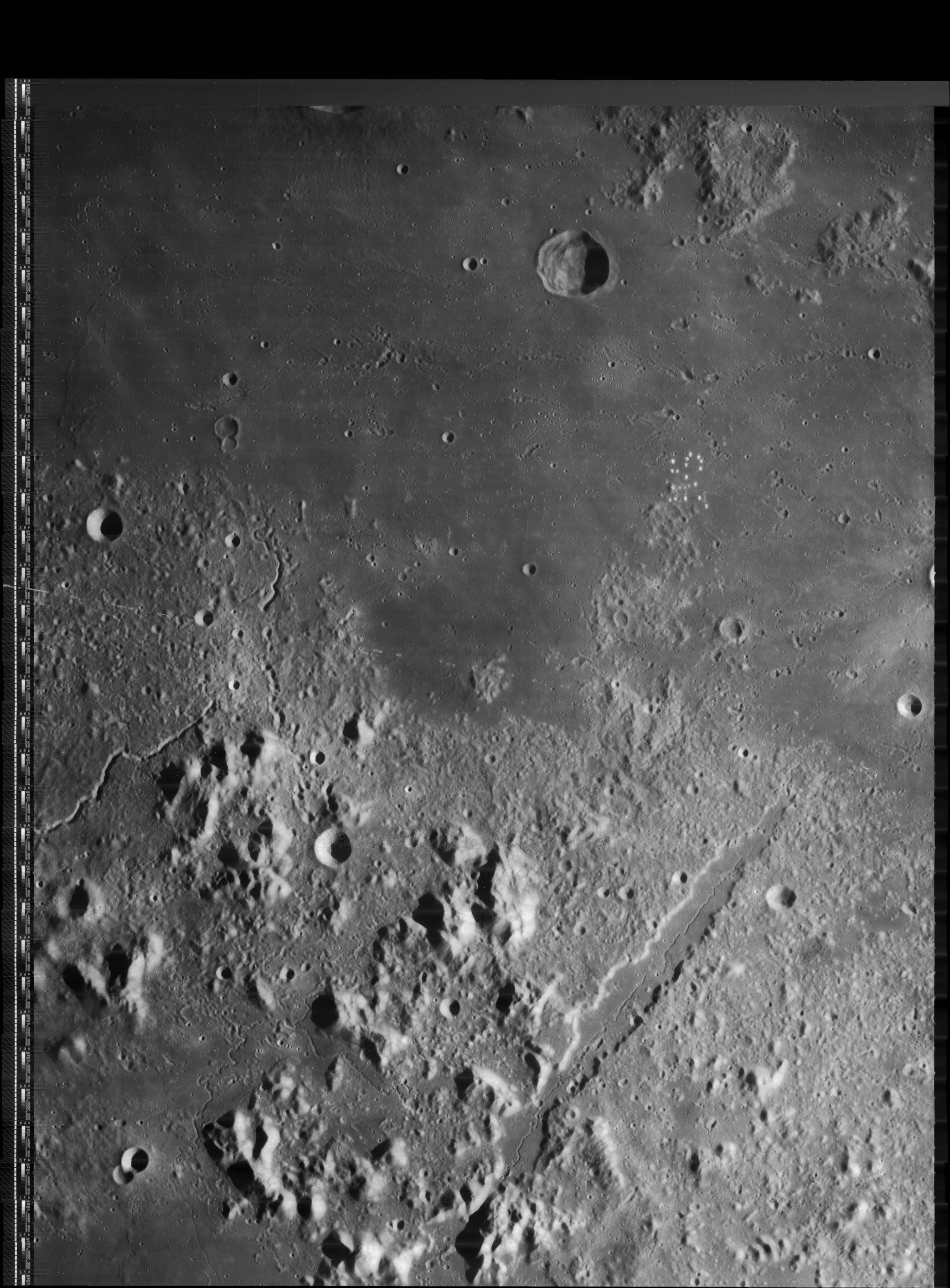
Which I believe is the “source” image.
And from Lunar Orbiter V:
www.lpi.usra.edu/resources/lunarorbiter/images/preview/51...

Images obtained as an .avi video through a 60mm refractor using an Orion Starshoot II USB Eyepiece Camera.
Best 176 of 438 images stacked with Registax 6. Wavelets applied. Post-processing with Photoshop CS5.
Heute mußte ich unbedingt nochmal den Mond ablichten, denn nur heute ist der Goldene Henkel zu sehen.
Dies ist das in den dunklen Bereich hineinragende und durch das Streiflicht beleuchtete Juragebirge (Montes Jura), das die Regenbogenbucht (Sinus Iridum) begrenzt.
Aufgenommen mit:
Sony A300 mit
Beroflex 500 f8
Iso 200
1/125 s
f 11
Short video over Sinus Iridium ................Please note ALL pictures on this Photostream are Copyright Protected)
See notes on photo for feature names and locations.
Taken through 24" Clark Telescope at Lowell Observatory, Flagstaff, Arizona
Camera: Nikon Coolpix 995
Telescope: Celestron Ultima 8 PEC
Exposure: 1/125 second
ISO: 100
Location: Oyster Bay, NY
Image processed using levels and unsharp mask in Photoshop.
The long curving shape of Montes Jura rises up to 12000 feet on the western edge of Sinus Iridium, from Cape Laplace in the upper-right to Cape Heraclides in the bottom part of this image. An 11-day old Moon yields the nearly ideal lighting to view the "Moon Maiden", when Cape Heraclides is suggestive of a woman's head with hair flowing downward, when looked at from the left. A feature first documented by Cassini in 1679. The image was created by stacking 2500 frames shot at 1/154 sec with an Imaging Source DBK21AU618 planetary camera, a Celestron SC8 telescope and an IR-cut filter.
-
L'arc majestueux des Monts Jura s'élève à 4000 m de hauteur à la limite occidentale de Sinus Iridium, le Golfe des Iris. Montes Jura s'étend du Promontoire Laplace (en haut à droite) jusqu'au Promontoire Heraclides au bas de l'image. La Lune de 11 jours procure l'illumination presque idéale pour distinguer la Dame de la Lune, où le Promontoire Héraclides et les formations environnantes suggèrent la forme d'une tête de femme avec chevelure au vent, lorsque vu de la gauche. L'effet a été mentionné la première fois par Cassini en 1679. L'image a été créée en additionnant 2500 clichés de 1/154 sec d'exposition réalisés avec une caméra planétaire Imaging Source DBK21AU618, un télescope Célestron SC8 (200 mm), et un filtre IR-cut.
Camera: Nikon Coolpix 995
Telescope: Celestron Ultima 8 PEC
Exposure: 1/60 second
ISO: 100
Location: Oyster Bay, NY
Image processed using levels and unsharp mask in Photoshop.
I must thank Astro Steve for pointing out this lovely view. This is Mare Imbrium with Sinus Iridium at top left. The Montes Jura are just coming into sunlight, making the "Golden Handle".
This was captured on 16 August 2013 using a PGI Firefly camera on a Equinox 120ED.
I had some time to spare after lunch today so I spent a bit of time annotating my previous picture of the Moon using maps of the Moon in one of my astronomy books. The picture was annotated in Publisher, printed and then rescanned as a JPG hence the difference in colour balance to the original image. The picture is best viewed at medium 800 x 800 under View all Sizes
Moon( nice view of Sinus Iridium and the Montes Jura on the terminator ............Please note ALL pictures on this Photostream are Copyright Protected)
shot with a C80ED (80mm Aperture, 600mm focal length) refractor. I also used an Antares 5x Barlow (TC) to get an effective focal length of 3m. This is a 500 of 1800 frames of mono data captured with a QHY5v.
Sinus Iridium. QHY5v @ about 30 fps, 2x barlow, Celestron 80ED (80mm Aperture, 600mm Focal Length f/7.5 ED telescope) with some extension tubes. 250 of 1000 frames, stacked and wavelets with Registax 5.1.
Uploaded with the Flock Browser
Sinus Iridium on the moon, taken using a T-mounted Canon Rebel XTi with a 2x Barlowed 9mm plossl on a 6" f/5 Newtonian reflector.
A photo taken of Sinus Iridum using my iPhone through an eyepiece connected to the C14 at the RASC Calgary Wilson Coulee Observatory
Eng. - Waxing Gibbous Moon
Time: 16 February 2019, 20:39 // 21:05 - 21:33 UT
Telescope: Celestron SC 203/2000mm @ f/6,3
DSLR: Nikon D5200
Webcam: Logitech C270, 30 fps - Only one - the best frame
Place. Virovitica, Hrvatska - Croatia