View allAll Photos Tagged shells
She'll Gas Station Sign Gasoline Petrol , pics by Mike Mozart of JeepersMedia and TheToyChannel on YouTube. Shell gas Station Signs Logo
Crushed Seashell textures captured along a beach of Lake Erie.
Full sized textures are found at www.outsidethefray.com.
Tridacna gigas (Linnaeus, 1758) - giant clam (public display, Bailey-Matthews Shell Museum, Sanibel Island, Florida, USA)
Bivalves are bilaterally symmetrical molluscs having two calcareous, asymmetrical shells (valves) - they include the clams, oysters, and scallops. In most bivalves, the two shells are mirror images of each other (the major exception is the oysters). They occur in marine, estuarine, and freshwater environments. Bivalves are also known as pelecypods and lamellibranchiates.
Bivalves are sessile, benthic organisms - they occur on or below substrates. Most of them are filter-feeders, using siphons to bring in water, filter the water for tiny particles of food, then expel the used water. The majority of bivalves are infaunal - they burrow into unlithified sediments. In hard substrate environments, some forms make borings, in which the bivalve lives. Some groups are hard substrate encrusters, using a mineral cement to attach to rocks, shells, or wood.
The fossil record of bivalves is Cambrian to Recent. They are especially common in the post-Paleozoic fossil record.
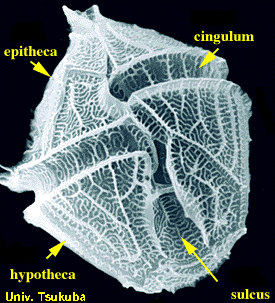
The bivalve shown above is the shell of a giant clam, Tridacna gigas, which is the largest bivalve species on Earth. Tridacnid bivalves sit on seafloors with their two shells open to expose colorful mantle tissues. Within the clam's mantle, small microbial organisms (zooxanthellae) live in a symbiotic relationship with the host. In tridacnid bivalves, the zooxanthellae are photosynthesizing dinoflagellates (www.daviddarling.info/images/dinoflagellate.gif). The dinoflagellates provide food for the clam, and the clam also obtains food by filter feeding.
---------------
Info. from museum signage: "The giant clam is not only the largest, but the most spectacular of all bivalves. The species may reach in excess of 1.4 meters (4.5 feet) in size and may weigh more than 400 kilos (about 900 pounds). It inhabits the shallow, warm waters of the Southwest Pacific including the Great Barrier Reef. Its colorful, soft mantle harbors microscopic algae that provide part the nourishment to this giant of the reef. The adductor muscle of the giant clam is a much-prized food item in Southeast Asia, where the species is cultivated in marine farms."
---------------
More info. from museum signage: "The giant Tridacna clam of the southwest Pacific may grow to a length of four feet and a weight of 500 pounds. They live upside-down in shallow, coral reef waters with their huge, fleshy mantle exposed to sunlight. Within this colorful, soft organ, the clam farms its own seaweed food, Zooxanthella. Giant clams are vegetarisn and have never eaten fish, crabs or worms, much less humans. No cases of a person being trapped and drowned by a clam have ever been proved. Cuts and bruises have been caused by the sharp edges of young clams."
---------------
Classification: Animalia, Mollusca, Bivalvia, Veneroida, Cardiidae
----------------------
More info. at:
en.wikipedia.org/wiki/Tridacna
and
I had not managed to take a Project 365 photograph during the day. I found these shells at home in the evening and decided to see if I could make a photograph out of them.
Day 202 of Project 365
One of the "shell trees" on Wild Beach at Chincoteague National Wildlife Refuge / Assateague Island National Seashore. Visitors like to decorate the remnants of trees, once in the marsh but now overtaken by the beach as it shifts.
Credit: Emma Kerr/USFWS
Navel shell. Model by Tomoko Fuse. From Spiral: Origami | Art | Design. Left: elephant hide; middle: Kraft Alios; right: Strathmore tracing paper.
Activists hang under the St. Johns Bridge in Portland, Oregon, In an attempt to block the Shell leased icebreaker, MSV Fennica July 29, 2015. The climbers are currently preventing the ship from passing underneath the bridge on its way to meet Shell’s drilling fleet. The climbers have enough supplies to last for several days. According to the latest federal permit, the Fennica must be at Shell’s drill site before Shell can reapply for federal approval to drill deep enough for oil in the Chukchi Sea.
Getting better. This is for the Strathmore watercolor sketching workshop I'm taking.
I'm trying two new things today. First I tried a technique called the double transfer. It's used by scientific illustrators to make an exact drawing. I photographed the shells on a white background remembering to overexposed the image by +1 E.V. (stop) in order to get a good white. I then transferred the file to my iPad, cropped it in Photogene, sized it in Pages, and printed it to plain paper using my Epson NX430 wireless printer. I then traced the shells onto thin tracing paper using a soft pencil. Here's where the double transfer comes in. You fold the tracing paper so that more tracing paper covers the original tracing. You then burnish the tracing with your fingernail or the edge of a spoon to transfer the graphite to the back of the folded piece. You then transfer that image to your art material by placing the tracing paper with the graphite down and burnishing again. By transferring the graphite twice you don't get a mirror image. If you do it right, you get a very faint pencil outline of your subject that is photo accurate. It's an interesting process to try, but I don't think I'll use it very often. It's more suitable for a finished illustration than for sketching. I'd rather just do a quick drawing.
The other new thing I tried today was to use my iPad to scan and upload my sketch to Flickr. In the past I used my desktop computer to scan, edit and upload. The Epson NX430 printer is also a wireless scanner. So, I scanned the sketch directly to my iPad, rotated, straightened, cropped, and resized the image in Photogene, and used FlickStackr to upload it to my Flickr photos.
Moleskine journal, Lucas watercolors, Kuretaki mini waterbrush, Zig extra fine sepia brush pen.
Note: I love my Zig brush pens. I got them from Jetpens.com.
Shell Beach on Tern Island in the French Frigate Shoals, Hawaii.
Camera: Olympus OM-1
Lens: Olympus OM-System S Zuiko MC Auto-Zoom f/4 35-70mm.
Film: Kodak Ektachrome E100D Expired 10/20
Developer: The Darkroom
Ah the good old service stations in the city center, with their pumps in the colors of the brand, and who were placing their hose in the ear between two customers!
* * *
Ah les bonnes vielles stations service en plein centre ville, avec leurs pompes aux couleurs de la marque, et qui se mettaient le tuyau dans l'oreille entre deux clients !
Shell pattern and cables from Alice Starmore's Cape Cod in "Fishermen's Sweaters" but otherwise my own, Yarn: Rowan Felted Tweed. Needles 3.5 mm (US 4). Knitted in 2006.
shell Full Name sheldon. He is a lover..He loves love. But.. He will nib you if you kiss him too much.... not Hard but he will bite you on the nose check or forehead ,,He lloves to sleep with us. with the covers up to his neck.and his head on the pillow.,,,He could never be a spy Because he sniffs really loud..so you could hear him miles away..............we call him sniffy wet jet.once and awhile ha ha. He is the babby. And we love him...
~ Stock available for use in your artworks with creative commons license ~
~ Do not re-distribute in ANY WAY ~
~ Please do not use to create your own stock ~
~ Please credit me if used with a link back to this image or my photostream ~
~ I would love to see what you have done, if you would like to put a small size sample in my comments, thanks & have fun~
~ Please add your artworks to my group here ~
~ PNG file, download the original size for the transparent background ~
==================
Like me @ [ Facebook ] [ Web ] [ Deviant Art ] [ Blog ] [ Twitter] [ Pinterest ]
==================
These grotty shells were everywhere on this fence...quite disgusting really, but made for interesting detail. I like the line of the fence and quite like that the post itself is slightly off centre. There's a spider up the top right too that looks great up close!
'Some shell cases on the roadside in the front area, the contents of which have been despatched over into the German lines'. Associated Illustration Agencies, Ltd 'passed' photo WW1. Probably 4 inch artillery shell cases
Rosamune Pilcher
Oorspronkelijke titel / taal: Shell seekers / GB
Eerste druk: 1987
Aantal pagina's: 582
Waardering:
Gekocht op:
Gelezen op: