View allAll Photos Tagged segmentation
Caves Branch Jungle Lodge, Belize
September 2013
This specimen looks like a lady beetle (family Coccinellidae) at first glance. However, its tarsal segmentation does not appear to match. Lady beetles have four tarsal segments per foot (most insects have five) but have only three segments that are clearly visible. This specimen has four obvious tarsal segments per foot. Perhaps it's a leaf beetle (family Chrysomelidae) mimicking a lady beetle, as leaf beetles have four tarsal segments per foot. The benefit of mimicking a lady beetle is obvious: lady beetles tend to secrete a foul-smelling, foul-tasting substance when disturbed, so visual predators like birds learn to avoid eating anything that looks like a ladybug.
The fourth generation Ford Focus (C519) launched in 2018 included a new sub-nameplate 'Active', previously introduced on the 7th generation of Ford Fiesta a year earlier. 'Active' represented a number of engineering and design changes, including a marginally taller ride height, roof bars, lower body black plastic cladding and revised front and rear bumper treatments.
Most changes were relatively insignificant, but represented a stylistic shift to associate the vehicles with the growing 'Crossover' vehicle market segmentation. In the case of the Focus, the 'Active' trim was available on the 5-door hatchback (shown) and the wagon/estate model.
This segmentation will be interesting to observe over the next few years, The natural Crossover version of the Focus is the Escape/Kuga, yet Ford has chosen to create a more offroad-oriented version with the Bronco Sport, and electrified version (a significantly re-engineered version of the platform) with the upcoming Mustang Mach-E. Other marques, such as BMW with the X4, and Mazda with the CX30, are blending the higher-riding Crossover wagon sub-type withe a Coupe/Hatch body style.
MARSYAS/MYSELF
MYSELF Diptych detail
Below is a transcription of the handwritten text on the detail pictured above:
Culture
Ambition—Recognition—Legacy
"And if I am forgotten? To be forgotten as my parents and their parents and their parents’ parents are forgotten—to be released—is this not freedom? The slow exhalation of definition—is this not charity? The blurring of possibility into the final erasure of regret—is this not tranquility? Though I cling still to stifled hope, the pain of the ultimate demise is anesthetized. I shall die as they have died but unlike those who preceded me, I confer no linearity. I am a segment...nothing more...a messy smear of obtuse angles and contradictions, recognized always for what I am not rather than for what I am. What others see is not what I seek. I seek the weakness of my enemy. Only that. To define that which seeks my erasure. I am not a victim. Having lived too long outside the safety of other artists’ possibilities, it is I who am the predator. I feed on the blood of ignorance. It is I who scoff at the rules and rituals of continuance...the dogma of immortality. I am a segment. I have accepted this and its freedom, self-imposed. I blame no one and nothing for this disconnection. My acceptance is freely given and from this detachment I have framed my life. I am suspect, bipolar and homosexual. I roam the periphery, prodding and probing all aspects of myself that affect the core. Hypocrisy is my prey. I can smell it like dead meat. The world reeks of it. I have sought to eliminate its stench from my life and to search out the rot of deceit. To this I have dedicated my life. Am I an artist? Is this the significance of Art? Is this the significance of Art now?...to speak from the core? Recently, I was asked if I thought I would, as an artist, leave a legacy. My answer was and is: “What do you think?” Legacies are not my concern. If I am to enjoy the freedom of segmentation, then I must accept the melancholy of endings...and the responsibility of beginnings. As I stumble toward the end of my life leaving bits and pieces of self-evidence, I sense no desperation. Whether I should or should not, did or did not have lost their intensity. They exist still, horizontal in fragmentation, but their edges are dulled. There is diminished regret. Still, to not have entered into collective memory stretches back into personal memory and touches a tear in the fabric of self that has never mended. That rent which became the festering wound of ambition has fed and bled the who and the what of me throughout all of remembered life. As a child, as an adult, the ugly stigmata has tormented and goaded. Without it, I could not have become—or at least not have become as I am—or produced so much or driven myself so far. Because of it, satisfaction and peace have eluded me. When madness arrives, I am recognized by others as its host. My guest is reflected in their eyes. I have no evidence of his presence. We are tenants of the same house and live as strangers in a shared space. There are only periods of exaggeration during which I am absent. As I review my life, I know it has always been so...unexplained moments which I view in retrospect with puzzled objectivity...he wears my face and commands my body. From here, too, have been produced great surges of energy and epiphany. How can I resent his tenancy? To have pursued this amalgam as the subject matter for the majority of my studio life has produced a multi-faceted documentation of selfness. I have used that which I know best and each new involvement has been a test of courage to delve further and objectify subjectivity. I require no audience for this process other than myself. Only I know if the truth is being told. This is my journey and I expect no other to accompany me or criticize my direction. I feel no conscious responsibility to history or to my time. I am a part of both whether I choose to be or not. I do not believe that this focus on myself is obsessive or narcissistic. Neither do I feel that it is a neurotic self-absorption or psychological confession in search of an audience. Rather, what I know it to be is a total commitment to transparency. To rid myself of obscurities, obfuscations and self-deception has been a brutalizing and invigorating process. It has also been isolating. I seem to exist in a vacuum, my work, blank pages in a book of cultural artifacts. In search of transparency, I have achieved transparency. I do not exist. Is this freedom? Am I rationalizing a position in which no artist would or should find himself? Limbo. Has been. Oblivion. What then should an artist want? Fame? Fortune? Visibility? Acknowledgement?...Respect?...Immortality? I think at this point I can, without reservation, say: I want not to want. To release myself from all of the fetters of audience... I remain needful of its ear and its eye. The most difficult opacity for me to overcome in terms of the audience (otherness) has been my sexuality. It has taken all of my life to accept intellectually and emotionally its power as a positive force in my work. Intellectually, I can support homosexuality’s evolutionary transcendency and emotionally I embrace my role in its evolution. To be of the most threatened and threatening elemental minority in the history of civilization has been a transcendent spiritual journey as well. To move beyond acculturated self-hatred into the rarified work-space of self-creation has been a limping, erratic, painful acceptance of responsibility for my survival as a person and an artist. Self-respect is a process rather than a possession. A verb rather than a noun. A never ending process of becoming. I have never forgiven my parents their instillation of bigotry. The poisoning of children is the greatest of generational crimes and the paradox, of course, is that without the crippling of children, there cannot exist linear continuity. History is a catalogue of repetition giving the illusion of change. Because homosexuality is the breaking of linearity, its nature is one of insurgency, a threat to the paradigm of illusion. Reality is a birth to death paradigm of individuation. The conflict and the reality of indivuation is the paradox of the human condition. This paradox is documented in what we call Art. That all Art is contemporary is the core of individuation. As homosexuality can appear at anytime, at any place, to anyone, under any condition, so, too, can Art. It is a capricious and serendipitous separating and segmenting of the illusions of linearity. It, too, is an insurgency. To accept its reality is to deny cultural linearity and enter into the finite space of self-creation. Misconceptions and impositions that promote the bigotry and illusions of linearity cannot be tolerated in the work-space of self-creation. The acceptance of the gestalt of segmentation changes all metaphors. Be it Art or homosexuality, both are the enemies of illusion. Rather than accept the negative discrimination of orthodoxy with its punishing verdict of exclusion, I have struggled to convert my personal indoctrination of self-hatred into a positive resource for a broader intellectual expansion of observation of the human condition. By not accepting the values of the linearity of repeat and confirmation which would paralyze, exile, and terminate my existence as a person and an artist, I have chosen to confront dogma which is my enemy. For me to equate Art with homosexuality in terms of segmentation is parallel to the culture-maker’s belief in art history. For me, Art and art are two entities diametrically opposed. Both depend on a belief system supported by emotional necessity. Segmentation and linearity are gestalts composed of metaphors and similies that seldom communicate. I have come to see that my sexuality is the source of my warrioring. The enemy of my Being is the gestalt of linearity...the illusions of infinite time. Though the sovereignty of my Being was established before birth, my acceptance of the responsibilities inherent in this sovereignty has been a process of triumphs and defeats worthy of any battlefield. My only arsenal has been a battery of questions. For me, the pursuit of the frontiers of Being has run parallel to the establishment of the borders of self. The process of making art has been the same process as creating self. Within the reality of segmentation, this is human life’s purpose, the attack of questions and the destruction of answers. Linearity sustains itself on the defense of answers. Its state is entropy. Selfness and Being, the Who and the What of me are not static entities; rather, they exist always as suppositions. If my sexuality has freed me from the linearity of repeat, then I must suppose that this freedom is for the viability of segmentation. This implies justification and responsibility, a moral and ethical code, the basis of which is honesty. Because my natural inclination has from the beginning been the representation of human imagery as my sole expression, my sexuality, in terms of the audience, has been problematic. Integrity is requisite to the process of making. Therefore, in terms of audience, I was faced with several dilemmas. My response to the female body has been clinical, intellectual, and objective in its representation. Except for the most nudaphobic of audiences, the exploitation of the naked female body has been acceptable and a viable resource for artists within the linear tradition of art history. Not so, the naked male. For the heterosexual male, the naked female form is an object of sexual desire whether presented in the guise of Marilyn Monroe or Mary Magdalene. Response, even on the level of prurience, is considered natural, normal, acceptable, and above all, unthreatening to traditional masculine values. Representational imagery for the male artist who is homosexual is a virtual minefield of reaction and response. If he deals with the male subject as the heterosexual male deals with the female, he is automatically involved in social, political, and religious polemics. Whether or not he chooses to leave the accepted frame of art, the sensuality evoked by the homosexual artist’s referencing of his love object will be found disturbing to the traditional audience. In contrast to the female body which shows no visual signs of sexual arousal, the male body exhibits its anatomical sexual function with the erected penis. In many cultures, the phallus or lingam is a symbol of fertility, a removal of the penis from its identification with sexuality and licentiousness into the realm of procreation and fecundity, an object of religious and social veneration for the worship of well-being and abundance. This has not been my choice. As I review my sexuality through the evolving imagery of my work, there is an acceptance of responsibility for its actuality. From a blurred avoidance of identification bordering on androgyny to explicit social, religious, and historical perspective, I now proclaim its viability. It has been an arduous and epiphanic journey. Accepted and acceptable reality is based on the lingam, a symbol of primitive necessity. Homosexuality is its greatest threat because it presents a constant and consistent alternative to its imperatives. Generation after generation after generation, its existence is indelible. It is in us and of us presenting ever and always the task of choice. As organs and structures become vestigial, so, too, symbols. The lingam is no longer a functional or honest icon of masculinity regardless of its pretense and insistence. Tribal mores and survival of the fittest theocracies have become toxic to the human experiment, relics of past realities. I have come to view my work as an act of defiance. I do not accept the structures and strictures of masculine deception. What once was is no more. Reality lies elsewhere. Because I objectify maleness in terms of sexual metaphor, there is effected a cosmic shift of gestalt within my frame of art. By replacing the traditional nudity of female passivity with naked male aggression, I am able to confront within my frame issues that my homosexuality would, traditionally, separate and place outside. Dealing directly with naked masculinity rather than feminine nudity in terms of subjective desire affords me great freedom of expression. Male homosexuality threatens the very foundation of masculinity from invention of god through its hierarchy of metaphors. By replacing the lingam with the penis in terms of symbolic representation, I have created a suppositional battlefield where-on the metaphorical masks of masculine gestalt are stripped away to reveal the stark nakedness of masculine reality: aggression, penetration, insemination, domination, and repression. Because I, too, am male by biological definition, my homosexuality affords me power over my object of desire. He fears me. I turn his verbs to nouns. As I move across the workbench of myself, adjusting and focussing the lens of my life, the audience has fallen into dissonance and distance. As I reflect, I sense a sweet sadness of loss as of the death of a love or the naivete of childhood. There is an inevitability about my course that is often startling and puzzling, like a blemish or a wrinkle caught unaware in my mirror. My penis is the measure of myself. It is average as I am average and is represented in biological proportionality in all of my presentations of masculine imagery. What a problem this bit of meat has been throughout the centuries of representation of the human body. My decision to represent it as it represents me is an intellectual resolution to emotional problems that the naked male presents to his viewer. By being biologically honest without pretense or prudery, the penis is permitted all of the prerogatives of nudity without undue consideration for the audience. In other words, the problem of the penis is delivered directly to the audience to be dealt with exactly as any other aspect of myself is dealt with within the context of Making. As I move into my eighth decade of living and my sixth decade of Making, I am confronted with the paradox of aging. Who I am and what I have become are a single reflection within the mirror of self. In spite of an accumulation of experiences and vast production of artifacts, my weight of being has remained unchanged, my dogged pursuit of the horizon static. Sitting in the theater of self watching the actor who is myself on a stage on which only the scenery changes with its cast of supporting characters places me constantly in the now. There is no past for the living, only the recurring present, only a constant changing of costume in the shifting light. How comfortable we are, each and every one of us wrapped tightly within the turgid repetition of a predetermined life. Our roles are set and their re-enactment establishes the illusion of the passage of time. We are each the main character in our own drama and a supporting actor locked into the scenery of everyone else. Only a total dismantling of the gestaltic stage, metaphor by metaphor, will permit the birth of a new reality...and if we do not dismantle the gestaltic stage, our drama of repetition will destroy us all in a final tragic act of mechanistic repeat. Inching forward in this self-portrait, I sense within me a desire to complete my Self in this final act of complexity. By will or by circumstance, I have positioned myself or been positioned outside the mainstream of linear flow. Fervidly atheistic, my religiosity favors objectivity. This I know: I am an artist. This, too, I know: no authority could have altered my course whether physical or metaphysical, pragmatic or philosophical. I serve no one exterior to myself and have been so rewarded. I am of no significance to the illusions of linearity or the consequences of repeat. No lessons can be learned from my journey for there has been no journey, no progression. I can only be viewed from the inside out and only I am positioned for this objectivity. I trust my honesty. Without audience, I have no temptation to illustrate myself other than as I am. Christopher Whitby persists. Of all the images that have wandered in and out of my production throughout the past fifty years, the child on his hobbyhorse has been the most insistently recurrent. It is the most commanding presence in this final self-portrait as well. Here, however, Christopher has progressed to his final disappearance. As I have aged, Christopher’s progression has been reductive. Oddly, we seem to be arriving at the same point on the horizon. We are both verging on absence."
Subsequent to the completion of STUDIO SECTION 2002-2005, Marsyas/Myself, the artist created another studio section, STUDIO SECTION 2005-2007, The Seven Deadly Sins and Three Diptychs from The Winter Notebooks. On Pages 7 and 8 of The Winter Notebooks he reprised MARSYAS/MYSELF in retrospect visual and verbal consideration and wrote the following excerpt about it:
"Marsyas/Myself was completed in 2005 and entered into the permanent collection of the Crocker Art Museum in November of that same year. My three year involvement with this studio section was epiphanic and liberating, the separation nearly complete. However, the song of the artist, the skin of Marsyas, hangs heavy and will not be silenced. It lingers still, as Myself lingers still, and will not be silenced. As long as artists create artifacts and as long as viewers persist in creating Art from these artifacts, the myth of Marsyas is the truth of the artist; his life, his pain, his ecstasy, and his fate. By subjection of myself as a particular artist in equation with the corpus of Marsyas, an attempt was made to recast the drama of art into an anti-fascisttic and non-authoritarian process; a complete reassignment of roles wherein the viewer becomes the sole creator of Art and all else is cultural rhetoric. It was also an attempt by this artist at total honesty. As we know virtually nothing about Marsyas, it was my intention to reveal everything about Myself even to the extent of confessional boredom. All information has been made available to the viewer. Setting the plight of Marsyas in his challenge of Apollo within the context of a contemporary sculptor’s studio establishes the parallel of the cautionary myth with all artists who would gamble their lives on a rigged contest. There is no drama greater than the artist’s struggle with his own mortality. The transmutation of mortal desire into material artifact into immortal response is the distinguishing principal of humanity and it is the artist who personifies this principal in its sublime purity. No challenge is greater, no reality more intense. Marsyas is the artist’s myth and it is to this myth all artists conform…."
STUDIO SECTION 2002-2005, Marsyas/Myself is a multi-part installation work that requires a space approximately 40' x 40' for exhibition in its entirety. It consists of free-standing sculptures, and large panels hanging on the walls and a combination of these and evenly divided into two metaphorical dimensions: "Marsyas" and "Myself."
Collection:
Crocker Art Museum
Sacramento, California
The fourth generation Ford Focus (C519) launched in 2018 included a new sub-nameplate 'Active', previously introduced on the 7th generation of Ford Fiesta a year earlier. 'Active' represented a number of engineering and design changes, including a marginally taller ride height, roof bars, lower body black plastic cladding and revised front and rear bumper treatments.
Most changes were relatively insignificant, but represented a stylistic shift to associate the vehicles with the growing 'Crossover' vehicle market segmentation. In the case of the Focus, the 'Active' trim was available on the 5-door hatchback (shown) and the wagon/estate model.
This segmentation will be interesting to observe over the next few years, The natural Crossover version of the Focus is the Escape/Kuga, yet Ford has chosen to create a more offroad-oriented version with the Bronco Sport, and electrified version (a significantly re-engineered version of the platform) with the upcoming Mustang Mach-E. Other marques, such as BMW with the X4, and Mazda with the CX30, are blending the higher-riding Crossover wagon sub-type withe a Coupe/Hatch body style.
An empty parking lot near dusk that has been altered with G'mic's dynamic range increase, bilateral filter, dream smoothing, shock filter detail enhancement, and segmentation filter; contrast enhancement; and a custom difference of Gaussians.
(Further pictures you can see quite easily by clicking on the link at the end of page!)
Vienna 1, The Franciscan Church
The Franciscans go back to St. Francis of Assisi and thus the 13th Century. They were founded as a mendicant orders but soon the arose the question how literally one should take the declaration of poverty. Was it allowed to make financial provision for elderly or sick brothers? Finally it came to the segmentation of the faith community, the more liberal Minoriten (Friars Minor Conventual) made their own order, while the Franciscans followed the old conventions. 1453 came the first Franciscan, John of Capistrano, to Vienna.
He founded the first Franciscan monastery in what is now 6th District. But the monks had to flee when the Turks besieged Vienna in 1529 and the monastery burned down. It took until 1589 until the city of Vienna gave them the at that time vacant monastery together with appendant church. The house, in its place now stands the monastery had already been donated in 1306 by wealthy citizens - namely for "loose women" who wanted give up their trade and convert themselves.
1476 was at the Weichenburg (hence Weihburggasse) inaugurated a church with seven altars, where formerly a "Pfarrheusl (small parsonage)" had stood for the soul welfare of the female residents. At the time of the Reformation, however, moral values in this house went downhill. 1553, the Foundation was dissolved, but it took yet until 1572 before the last resident had died. For eight years, the building was then an educational establishment for girls of poor people.
When the Franciscans now had got the property, they started in 1603 with a reconstruction of the church, which was consecrated in 1611. 1614, the foundation stone was laid for the new monastery.
The statues on the west facade are left Francis of Assisi and Anthony of Padua right. In the middle, on the pediment of the west portal of the Church stands Jerome, protector of the church. He is surrounded by two angle putti.
But let's go inside the church. Maria with the ax is the altarpiece above the high altar. The statue was carved in 1505 from lime wood and has its own story. She comes from the Green Mountain (Grünberg) in Bohemia, which was under the control the Sternberg family. Since the family in the meantime had become Protestant, it wanted to burn the statue. She were thrown into the fire - but the next day she stood unharmed again in the chapel. Now, the executioner was called who should dismember the effigy. However, even that was impossible, because the ax stuck in the shoulder of Mary and it was not possible to get it out. There it is still today. (You have to look closely, but then you see the great ax with slightly curved stem.) But that's not enough. A few years later the Madonna was lost in the gamble by a gegenreformierten (counter-reformed) Sternberg. The new owner, the Polish Baron Turnoffsky gave she in 1607 the Franciscan monastery. Exactly 100 years later, she got her current stand on the high altar.
The stone structure between altar and the statue of the Madonna also contains a crucifix, which dates from the beginning of the 17th Century. The wooden statues left and right represent the Saints Jerome respectively Francis and are typical examples of the so-called Franciscan carving school. It operated 1690-1730 and was run by lay brothers. The overall concept for the high altar dates back to the Jesuit Andrea dal Pozzo.
A special attraction is the organ by Hans Wöckherl that was already built in 1642 and today is the oldest organ in Vienna. It is, however, disappeared from the visible church, because it is behind the high altar and is only shown every Friday between 15.00 und 15.30 clock. In addition, one demans for that six euro entry...
The single-nave church has to both sides side chapels, of them I want to show two.
On the left we see the Magdalene Chapel, which was consecrated already in 1614 for the first time. 1644 and 1722, however, followed Neustiftungen (new foundings). The stucco decoration stems from 1644. The paintings in the vault are much more recent, from 1893. The altarpiece depicts the grieving Mary Magdalene under the Cross. It was created in 1725 by Carlo Innocenzo Carlone. The image above shows Veronica's handkerchief with the face of Christ. It was painted by Wolfram Koeberl and in 1974 installed. The statues beside the altar represent the Virgin Mary and John the Baptist. The two above chapels are provided with food grid, so that one could give Communion here.
An Immaculata chapel (pictured above right) is there since the existence of the church, but this was rebuilt in 1722. Previously, since 1642, there was a Michael altar here. From this period dates still the stucco decor on the ceiling. The altarpiece is by Johann Georg Schmidt, who painted it in 1721. The lateral statues depict the Saint Joachim and the mother of Mary.
Also the Capistrano Chapel, which was founded in 1723, is worth mentioning. The lateral stucco decor shows on the left side (picture) the glorification of St. John Capistrano, who, as I said, was the first Franciscan in Vienna. Right you can see him as a standard-bearer of Christian doctrine in the wars against the Turks. Both stucco images date from the time of the foundation. The altarpiece by Franz Xaver Wagenschön originated in 1761 and shows Capistrano in a scene from 1451, in Brescia when he healed a possessed man.
In the picture we see also the statue of Saint George, as he is killing the (admittedly small) dragon.
On the other side of the chapel is the Holy Florian, while Clara and Theresa stand next to the altar. Behind the altar there is a reliquary in glass from about 1720, in which we see a wax image of the Holy Hilaria. The relic shall be imbedded in the wax. Hilaria is rather unknown, but she was a martyr who was converted by Bishop Narcissus. She died in the year 304 in Augsburg, at the behest of the governor Gaius, because she did not want to renounce the Christian faith. About the nature of death, there are different opinions.
In the church there is a plaque that claims that she was burned at the grave of her daughter, while the Holy Encyclopedia states that she was enclosed in her house and this was then set on fire.
In the chapel opposite, the Chapel of the Good Shepherd, there is also a glass coffin with a relic. This is the skeleton of the Felix Puer wearing the uniform of a Roman Centurion.
As a counterpart to the pulpit, this just opposite, you will find the monument of Johann Nepomuk. We see how he flows on the water of the Vltava river after he was thrown in Prague there. He actually was called "John from Nepomuk" in Czech "ne Pomuk". The wife of Emperor Wenceslas IV is said to have chosen him as confessor. The Emperor wanted to know then what she had confessed, but Johann Nepomuk did not betray the seal of confession and was therefore thrown into the water. The Empress had then an appearance of five stars.
(We see she also in the water of the monument.) These stars indicated were one could find the body. So much for the legend.
The fact is that Johann Nepomuk was tortured by the king and thrown into the Vltava. The activating moment was a dispute over a new monastery between the emperor and the archbishop of Prague, in which John Nepomuk was trampled underfoot ...
The pulpit was built in 1726 and was executed by the Franciscan carving school. At the parapet there are wooden reliefs of Matthew, Mark and Luke. The relief of the fourth evangelist, John, is attached to the pulpit door. At the parapet you further can see statues of Capistrano and Bonaventura, while on the sounding board are sitting Anthony of Padua and Berhardin of Siena. At the top stands the freeze image of Francis of Assisi.
The pews were 1727 - 1729 by brother Johann Gottfried Hartmann built and carved.
A revolution in phenomic is taking place, using non-invasive technologies based on spectral reflectance from plant tissue.
Photo by Alfonso Cortés/CIMMYT.
Shakhrisabz is Timur's hometown, and once upon a time it probably put Samarkand itself in the shade.
Ak Saray, Shakhrisabz
Shahrisabz is, above all, associated with the Ak-Saray palace. Many amazing legends are linked with the history of the palace's construction. According to one of them, Timur began to think of building a magnificent edifice, summoned an architect and set out his objective. After listening to the ruler, the architect asked to be allowed into the state exchequer. When permission was granted, the craftsman started to make foundation blocks from clay mixed with gold in full view of Timur. Seeing that the ruler remained impassive, he broke up the blocks and returned the gold to the exchequer. When Timur asked: "Why did you do that?" the architect replied: "So as to make sure of your determination to embark on constructing a building that requires vast expenditure." A second legend recounts that, after the main building work had been completed, Timur began to tell the craftsmen to hurry up and finish the decorative facing of the palace. But they were in no hurry to cover the building with majolica and mosaic. When the angry ruler ordered the chief architect to be brought before him, it emerged that had vanished after hanging a chain in the centre of the palace's main arch. Since no other craftsman of equal stature could be found, the building remained unfinished. Some time later, however, the architect suddenly appeared and, after making sure that the chain on the entrance arch was now considerably lower, embarked on decorating the building. When Timur demanded an explanation of his strange flight and sudden reappearance, the architect replied: "I dared not disobey my sovereign's command, but I could not carry it out either. Stern punishment awaited me in either case, since such a majestic building had to settle and bed down firmly in the ground, otherwise all the decoration on it would be destroyed." The great ruler appreciated the craftsman's wisdom and resourcefulness.
The palace building in Shahrisabz took over a quarter of a century to construct. The Spanish ambassador, Ruy Gonzalez de Clavijo, who passed through Shahrisabz in 1404 on his way to the court of Timur in Samarkand, was astounded and charmed by the architectural miracle, and he left a detailed description of it, noting, however, that the splendid artistic decoration of the palace was still unfinished. The overall layout, scale and artistic appearance of Ak-Saray can be reconstituted from the descriptions of contemporaries and eyewitnesses, as well as from the results of archaeological excavation at the site. According to written accounts, the palace consisted of several
stately, living or service quarters, grouped around separate courtyards.The overall scale of the palace is impressive: the main courtyard alone, which has been reconstituted from the microrelief, was 120 - 125 m wide and 240 - 250 m long. The size of the other courtyards and of the outer perimeter of the palace has not been reconstructed owing to severe disturbance of the microrelief in the 15th - 16th centuries. Calculation of the proportions of the surviving elements of the site makes it fairly certain that the height of the main portal reached 70 m. It was topped by arched pinnacles (ko'ngra), while corner towers on a multifaceted pedestal were at least 80 m high. The main entrance portal was 50 m wide, and the arch had the largest span, 22.5 m, in Central Asia.
The architectural decor, featuring a wide variety of designs and colours, is particularly
noteworthy in the artistic appearance of Ak-Saray. When using various techniques,
however, the craftsmen bore in mind that the palace's main portal faced north, towards the capital, Samarkand. Given the poor light, the rchitects used only flat segmentation here and hence a continuous decorative treatment. The use of brick mosaic work, mainly dark and light blue in colour, forming large geometrical and epigraphic designs on a background of polished building brick, gives the portal a special softness of colour and an air of grand mystery.
The various mosaic and majolica work in the niche of the portal is particularly refined and highly coloured. The delicately executed foliate ornamentation incorporates exquisite calligraphic inscriptions of mainly Koranic content, although secular ones are found too. In the midst of the decorative facing, an inscription has survived, giving the date of completion, 798 (1395 - 1396), and the name of the craftsman, Muhammad Yusuf Tebrizi (from the Azeri city of Tabriz). According to Clavijo, who visited Ak-Saray, "in this palace was a very long entrance and a very high portal, and by the
entrance, to right and left, were brick arches covered with tiles painted with various designs. Beneath these arches was what looked like small rooms without doors, and the floor inside them was covered with tiles. This was done so that people could sit there when the king was present. Beyond this was another door and after that a large courtyard, paved with white slabs and surrounded by richly decorated galleries. In the middle of the courtyard was a large pool. The courtyard was some 300 paces wide, and it gave access to a large house, in which was a very high and wide door, decorated with gold, azure and tiles of very fine workmanship. In the middle, above the door, a lion was depicted, lying in the sun, and exactly the same picture was to be found at the edges. This was the device of the king of Samarkand. After this, the envoys were taken to look at the chamber that the king had appointed for sitting and feasting with his wives, very spacious and luxurious. Before it was a large garden with many shady and
assorted fruit trees. Inside it were many pools and artfully sited meadows. By the entrance to this garden there was such a vast space that many people could have enjoyed themselves sitting there in the summertime beside the water and beneath the shade of the trees. The workmanship in the palace is so luxurious that, in order to describe everything well, one has to go and examine it a little at a time."
The Ak-Saray palace is a grandiose piece of civil architecture, and not just by Central
Asian standards. Historical tradition ascribes the destruction of the majestic edifice to
Abdullakhan, who, during one of the sieges of unsubdued Shahrisabz, is supposed to have ordered the splendid structures of Timur and his descendants to be demolished. Be that as it may, of the once luxurious royal palace only the pillars and part of the arch of the main portal remained by the second half of the 18th century.
(Further pictures you can see quite easily by clicking on the link at the end of page!)
Vienna 1, The Franciscan Church
The Franciscans go back to St. Francis of Assisi and thus the 13th Century. They were founded as a mendicant orders but soon the arose the question how literally one should take the declaration of poverty. Was it allowed to make financial provision for elderly or sick brothers? Finally it came to the segmentation of the faith community, the more liberal Minoriten (Friars Minor Conventual) made their own order, while the Franciscans followed the old conventions. 1453 came the first Franciscan, John of Capistrano, to Vienna.
He founded the first Franciscan monastery in what is now 6th District. But the monks had to flee when the Turks besieged Vienna in 1529 and the monastery burned down. It took until 1589 until the city of Vienna gave them the at that time vacant monastery together with appendant church. The house, in its place now stands the monastery had already been donated in 1306 by wealthy citizens - namely for "loose women" who wanted give up their trade and convert themselves.
1476 was at the Weichenburg (hence Weihburggasse) inaugurated a church with seven altars, where formerly a "Pfarrheusl (small parsonage)" had stood for the soul welfare of the female residents. At the time of the Reformation, however, moral values in this house went downhill. 1553, the Foundation was dissolved, but it took yet until 1572 before the last resident had died. For eight years, the building was then an educational establishment for girls of poor people.
When the Franciscans now had got the property, they started in 1603 with a reconstruction of the church, which was consecrated in 1611. 1614, the foundation stone was laid for the new monastery.
The statues on the west facade are left Francis of Assisi and Anthony of Padua right. In the middle, on the pediment of the west portal of the Church stands Jerome, protector of the church. He is surrounded by two angle putti.
But let's go inside the church. Maria with the ax is the altarpiece above the high altar. The statue was carved in 1505 from lime wood and has its own story. She comes from the Green Mountain (Grünberg) in Bohemia, which was under the control the Sternberg family. Since the family in the meantime had become Protestant, it wanted to burn the statue. She were thrown into the fire - but the next day she stood unharmed again in the chapel. Now, the executioner was called who should dismember the effigy. However, even that was impossible, because the ax stuck in the shoulder of Mary and it was not possible to get it out. There it is still today. (You have to look closely, but then you see the great ax with slightly curved stem.) But that's not enough. A few years later the Madonna was lost in the gamble by a gegenreformierten (counter-reformed) Sternberg. The new owner, the Polish Baron Turnoffsky gave she in 1607 the Franciscan monastery. Exactly 100 years later, she got her current stand on the high altar.
The stone structure between altar and the statue of the Madonna also contains a crucifix, which dates from the beginning of the 17th Century. The wooden statues left and right represent the Saints Jerome respectively Francis and are typical examples of the so-called Franciscan carving school. It operated 1690-1730 and was run by lay brothers. The overall concept for the high altar dates back to the Jesuit Andrea dal Pozzo.
A special attraction is the organ by Hans Wöckherl that was already built in 1642 and today is the oldest organ in Vienna. It is, however, disappeared from the visible church, because it is behind the high altar and is only shown every Friday between 15.00 und 15.30 clock. In addition, one demans for that six euro entry...
The single-nave church has to both sides side chapels, of them I want to show two.
On the left we see the Magdalene Chapel, which was consecrated already in 1614 for the first time. 1644 and 1722, however, followed Neustiftungen (new foundings). The stucco decoration stems from 1644. The paintings in the vault are much more recent, from 1893. The altarpiece depicts the grieving Mary Magdalene under the Cross. It was created in 1725 by Carlo Innocenzo Carlone. The image above shows Veronica's handkerchief with the face of Christ. It was painted by Wolfram Koeberl and in 1974 installed. The statues beside the altar represent the Virgin Mary and John the Baptist. The two above chapels are provided with food grid, so that one could give Communion here.
An Immaculata chapel (pictured above right) is there since the existence of the church, but this was rebuilt in 1722. Previously, since 1642, there was a Michael altar here. From this period dates still the stucco decor on the ceiling. The altarpiece is by Johann Georg Schmidt, who painted it in 1721. The lateral statues depict the Saint Joachim and the mother of Mary.
Also the Capistrano Chapel, which was founded in 1723, is worth mentioning. The lateral stucco decor shows on the left side (picture) the glorification of St. John Capistrano, who, as I said, was the first Franciscan in Vienna. Right you can see him as a standard-bearer of Christian doctrine in the wars against the Turks. Both stucco images date from the time of the foundation. The altarpiece by Franz Xaver Wagenschön originated in 1761 and shows Capistrano in a scene from 1451, in Brescia when he healed a possessed man.
In the picture we see also the statue of Saint George, as he is killing the (admittedly small) dragon.
On the other side of the chapel is the Holy Florian, while Clara and Theresa stand next to the altar. Behind the altar there is a reliquary in glass from about 1720, in which we see a wax image of the Holy Hilaria. The relic shall be imbedded in the wax. Hilaria is rather unknown, but she was a martyr who was converted by Bishop Narcissus. She died in the year 304 in Augsburg, at the behest of the governor Gaius, because she did not want to renounce the Christian faith. About the nature of death, there are different opinions.
In the church there is a plaque that claims that she was burned at the grave of her daughter, while the Holy Encyclopedia states that she was enclosed in her house and this was then set on fire.
In the chapel opposite, the Chapel of the Good Shepherd, there is also a glass coffin with a relic. This is the skeleton of the Felix Puer wearing the uniform of a Roman Centurion.
As a counterpart to the pulpit, this just opposite, you will find the monument of Johann Nepomuk. We see how he flows on the water of the Vltava river after he was thrown in Prague there. He actually was called "John from Nepomuk" in Czech "ne Pomuk". The wife of Emperor Wenceslas IV is said to have chosen him as confessor. The Emperor wanted to know then what she had confessed, but Johann Nepomuk did not betray the seal of confession and was therefore thrown into the water. The Empress had then an appearance of five stars.
(We see she also in the water of the monument.) These stars indicated were one could find the body. So much for the legend.
The fact is that Johann Nepomuk was tortured by the king and thrown into the Vltava. The activating moment was a dispute over a new monastery between the emperor and the archbishop of Prague, in which John Nepomuk was trampled underfoot ...
The pulpit was built in 1726 and was executed by the Franciscan carving school. At the parapet there are wooden reliefs of Matthew, Mark and Luke. The relief of the fourth evangelist, John, is attached to the pulpit door. At the parapet you further can see statues of Capistrano and Bonaventura, while on the sounding board are sitting Anthony of Padua and Berhardin of Siena. At the top stands the freeze image of Francis of Assisi.
The pews were 1727 - 1729 by brother Johann Gottfried Hartmann built and carved.
+++ DISCLAIMER +++Nothing you see here is real, even though the conversion or the presented background story might be based on historical facts. BEWARE!
Some background:
The Nakajima J9N Kitsuka (中島 橘花, "Orange Blossom", pronounced Kikka in Kanji used traditionally by the Japanese) was Japan's first jet aircraft. In internal IJN documents it was also called Kōkoku Nigō Heiki (皇国二号兵器, "Imperial Weapon No.2"). After the Japanese military attaché in Germany witnessed trials of the Messerschmitt Me 262 in 1942, the Imperial Japanese Navy issued a request to Nakajima to develop a similar aircraft to be used as a fast attack bomber. Among the specifications for the design were the requirements that it should be able to be built largely by unskilled labor, and that the wings should be foldable. This latter feature was not intended for potential use on aircraft carriers, but rather to enable the aircraft to be hidden in caves and tunnels around Japan as the navy began to prepare for the defense of the home islands.
Nakajima designers Kazuo Ohno and Kenichi Matsumura laid out an aircraft that bore a strong but superficial resemblance to the Me 262. Compared to the Me 262, the J9N airframe was noticeably smaller and more conventional in design, with straight wings and tail surfaces, lacking the slight sweepback of the Me 262. The triangular fuselage cross section characteristic of the German design was less pronounced, due to smaller fuel tanks. The main landing gear of the Kikka was taken from the A6M Zero and the nose wheel from the tail of a Yokosuka P1Y bomber.
The Kikka was designed in preliminary form to use the Tsu-11, a rudimentary motorjet style jet engine that was essentially a ducted fan with an afterburner. Subsequent designs were planned around the Ne-10 (TR-10) centrifugal-flow turbojet, and the Ne-12, which added a four-stage axial compressor to the front of the Ne-10. Tests of this powerplant soon revealed that it would not produce anywhere near the power required to propel the aircraft, and the project was temporarily stalled. It was then decided to produce a new axial flow turbojet based on the German BMW 003.
Development of the engine was troubled, based on little more than photographs and a single cut-away drawing of the BMW 003. A suitable unit, the Ishikawa-jima Ne-20, was finally built in January 1945. By that time, the Kikka project was making progress and the first prototype made its maiden flight. Due to the worsening war situation, the Navy considered employing the Kikka as a kamikaze weapon, but this was quickly rejected due to the high cost and complexity associated with manufacturing contemporary turbojet engines. Other more economical projects designed specifically for kamikaze attacks, such as the simpler Nakajima Tōka (designed to absorb Japanese stock of obsolete engines), the pulsejet-powered Kawanishi Baika, and the infamous Yokosuka Ohka, were either underway or already in mass production.
The following month the prototype was dismantled and delivered to Kisarazu Naval Airfield where it was re-assembled and prepared for flight testing. The aircraft performed well during a 20-minute test flight, with the only concern being the length of the takeoff run – the Ne 20 only had a thrust of 4.66 kN (1,047 lbf), and the engine pair had barely sufficient power to get the aircraft off the ground. This lack of thrust also resulted in a maximum speed of just 623 km/h (387 mph, 336 kn) at sea level and 696 km/h (432 mph; 376 kn) at 10,000 m (32,808 ft).
For the second test flight, four days later, rocket assisted take off (RATO) units were fitted to the aircraft, which worked and gave the aircraft acceptable field performance. The tests went on, together with a second prototype, but despite this early test stage, the J9N was immediately rushed into production.
By May 1945 approximately forty airframes had been completed and handed over to IJN home defense frontline units for operational use and conversion training. These were structurally identical with the prototypes, but they were powered by more potent and reliable Ne-130 (with 8.826 kN/900 kgf) or Ne-230 (8.679 kN/885 kgf) engines, which finally gave the aircraft a competitive performance and also made the RATO boosters obsolete - unless an 800 kg bomb was carried in overload configuration. Most were J9N1 day fighter single seaters, armed with two 30 mm Type 5 cannons with 50 rounds per gun in the nose. Some operational Kitsukas had, due to the lack of equipment, the 30 mm guns replaced with lighter 20 mm Ho-5 cannon. A few were unarmed two-seaters (J9N2) with dual controls and a second seat instead of the fuselage fuel tank. This markedly limited the aircraft’s range but was accepted for a dedicated trainer, but a ventral 500 l drop tank could be carried to extend the two-seater’s range to an acceptable level.
A small number, both single- and two-seaters, were furthermore adapted to night fighter duties and equipped with an experimental ”FD-2” centimeter waveband radar in the nose with an “antler” antenna array, similar to German radar sets of the time. The FD-2 used four forward-facing Yagi style antennae with initially five and later with seven elements (the sideway facing rods) each. These consisted of two pairs, each with a sending (top and bot) and a receiving antenna (left and right). The set used horizontal lobe switching to find the target, an electrical shifter would continuously switch between the sets. The signal strengths would then be compared to determine the range and azimuth of the target, and the results would then be shown on a CRT display.
In order to fit the electronics (the FD-2 weighed around 70 kg/155 lb) the night fighters typically had one of the nose-mounted guns replaced by a fixed, obliquely firing Ho-5 gun ("Schräge Musik"-style), which was mounted in the aircraft’s flank behind the cockpit, and the 500l drop tank became a permanent installation to extend loiter time, at the expense of top speed, though. These machines received the suffix “-S” and flew, despite the FD-2’s weaknesses and limitations, a few quite effective missions against American B-29 bombers, but their impact was minimal due to the aircrafts’ small numbers and poor reliability of the still experimental radar system. However, the FD-2’s performance was rather underwhelming, though, with an insufficient range of only 3 km. Increased drag due to the antennae and countermeasures deployed by B-29 further decreased the effectiveness, and the J9N2-S’s successes could be rather attributed to experienced and motivated crews than the primitive radar.
Proposed follow-on J9N versions had included a reconnaissance aircraft and a fast attack aircraft that was supposed to carry a single bomb under the fuselage against ships. There was also a modified version of the design to be launched from a 200 m long catapult, the "Nakajima Kikka-kai Prototype Turbojet Special Attacker". All these proposed versions were expected to be powered by more advanced developments of the Ne-20, the Ne-330 with 13 kN (1.330 kg) thrust, but none of them reached the hardware stage.
The J9Ns’ overall war contribution was negligible, and after the war, several airframes (including partial airframes) were captured by Allied forces. Three airframes (including a two-seat night fighter with FD-2 radar) were brought to the U.S. for study. Today, two J9N examples survive in the National Air and Space Museum: The first is a Kikka that was taken to the Patuxent River Naval Air Base, Maryland for analysis. This aircraft is very incomplete and is believed to have been patched together from a variety of semi-completed airframes. It is currently still in storage at the Paul E. Garber Preservation, Restoration and Storage Facility in Silver Hill, MD. The second Kikka is on display at the NASM Udvar-Hazy Center in the Mary Baker Engen Restoration Hangar.
General characteristics:
Crew: 2
Length: 8.13 m (26 ft 8 in) fuselage only
10.30 m (33 ft 8¾ in) with FD-2 antenna array
Wingspan: 10 m (32 ft 10 in)
Height: 2.95 m (9 ft 8 in)
Wing area: 13.2 m² (142 sq ft)
Empty weight: 2,300 kg (5,071 lb)
Gross weight: 3,500 kg (7,716 lb)
Max takeoff weight: 4,080 kg (8,995 lb)
Powerplant:
2× Ishikawajima Ne-130 or Ne-230 axial-flow turbojet engines
each with 8.83 kN/900 kg or 8.68 kN/885 kg thrust
Performance:
Maximum speed: 785 km/h (487 mph, 426 kn)
Range: 925 km (574 mi, 502 nmi) with internal fuel
Service ceiling: 12,000 m (39,000 ft)
Rate of climb: 10.5 m/s (2,064 ft/min)
Wing loading: 265 kg/m² (54 lb/sq ft)
Thrust-to-weight ratio: 0.43
Armament:
1× 30 mm (1.181 in) Type 5 cannon with 50 rounds in the nose
1× 20 mm (0.787 in) Type Ho-2 cannon with 80 rounds, mounted obliquely behind the cockpit
1× ventral hardpoint for a 500 l drop tank or a single 500 kg (1,102 lb) bomb
The kit and its assembly:
This is in fact the second Kikka I have built, and this time it’s a two-seater from AZ Models – actually the trainer boxing, but converted into a personal night fighter interpretation. The AZ Models kit is a simple affair, but that's also its problem. In the box things look quite good, detail level is on par with a classic Matchbox kit. But unlike a Matchbox kit, the AZ Models offering does not go together well. I had to fight everywhere with poor fit, lack of locator pins, ejection marks - anything a short run model kit can throw at you! Thanks to the experience with the single-seater kit some time ago, things did not become too traumatic, but it’s still not a kit for beginners. What worked surprisingly well was the IP canopy, though, which I cut into five sections for an optional open display – even though I am not certain if the kit’s designers had put some brain into their work because the canopy’s segmentation becomes more and more dubious the further you go backwards.
The only personal mods is a slightly changed armament, with one nose gun deleted and faired over with a piece of styrene sheet, while the leftover gun was mounted obliquely onto the left flank. I initially considered a position behind the canopy but rejected this because of CoG reasons. Then I planned to mount it directly behind the 2nd seat, so that the barrel would protrude through the canopy, but this appeared unrealistic because the (utterly tiny) sliding canopy for the rear crewman could not have been opened anymore? Finally, I settled for an offset position in the aircraft’s flanks, partly inspired by “Schräge Musik” arrangements on some German Fw 190 night fighters.
The antennae come from a Jadar Model PE set for Italeri’s Me 210s, turning it either into a night fighter or a naval surveillance aircraft.
Painting and markings:
This became rather lusterless; many late IJN night fighters carried a uniform dark green livery with minimalistic, toned-down markings, e. g. hinomaru without a white high-contrast edge, just the yellow ID bands on the wings’ leading edges were retained.
For this look the model received an overall basis coat of Humbrol 75 (Bronze Green), later treated with a black ink washing, dry-brushed aluminum and post-shading with lighter shades of dark green (including Humbrol 116 and Revell 67). The only colorful highlight is a red fin tip (Humbrol 19) and a thin red stripe underneath (decal). The yellow and white ID bands were created with decal material.
The cockpit interior was painted in a yellowish-green primer (trying to simulate a typical “bamboo” shade that was used in some late-war IJN cockpits), while the landing gear wells were painted in aodake iro, a clear bluish protective lacquer. The landing gear struts themselves became semi-matt black.
The markings are fictional and were puzzled together from various sources. The hinomaru came from the AZ Models’ Kikka single seater sheet (since it offers six roundels w/o white edge), the tactical code on the fin was created with red numbers from a Fujimi Aichi B7A2 Ryusei.
Finally, the kit received a coat of matt acrylic varnish and some grinded graphite around the jet exhausts and the gun nozzles.
Well, this fictional Kikka night fighter looks quite dry, but that makes it IMHO more credible. The large antler antenna array might look “a bit too much”, and a real night fighter probably had a simpler arrangement with a single Yagi-style/arrow-shaped antenna, but a description of the FD-2 radar suggested the layout I chose – and it does not look bad. The oblique cannon in the flank is another odd detail, but it is not unplausible. However, with all the equipment and esp. the draggy antennae on board, the Kikka’s mediocre performance would surely have seriously suffered, probably beyond an effective use. But this is whifworld, after all. ;-)
+++ DISCLAIMER +++Nothing you see here is real, even though the conversion or the presented background story might be based on historical facts. BEWARE!
Some background:
The Nakajima J9N Kitsuka (中島 橘花, "Orange Blossom", pronounced Kikka in Kanji used traditionally by the Japanese) was Japan's first jet aircraft. In internal IJN documents it was also called Kōkoku Nigō Heiki (皇国二号兵器, "Imperial Weapon No.2"). After the Japanese military attaché in Germany witnessed trials of the Messerschmitt Me 262 in 1942, the Imperial Japanese Navy issued a request to Nakajima to develop a similar aircraft to be used as a fast attack bomber. Among the specifications for the design were the requirements that it should be able to be built largely by unskilled labor, and that the wings should be foldable. This latter feature was not intended for potential use on aircraft carriers, but rather to enable the aircraft to be hidden in caves and tunnels around Japan as the navy began to prepare for the defense of the home islands.
Nakajima designers Kazuo Ohno and Kenichi Matsumura laid out an aircraft that bore a strong but superficial resemblance to the Me 262. Compared to the Me 262, the J9N airframe was noticeably smaller and more conventional in design, with straight wings and tail surfaces, lacking the slight sweepback of the Me 262. The triangular fuselage cross section characteristic of the German design was less pronounced, due to smaller fuel tanks. The main landing gear of the Kikka was taken from the A6M Zero and the nose wheel from the tail of a Yokosuka P1Y bomber.
The Kikka was designed in preliminary form to use the Tsu-11, a rudimentary motorjet style jet engine that was essentially a ducted fan with an afterburner. Subsequent designs were planned around the Ne-10 (TR-10) centrifugal-flow turbojet, and the Ne-12, which added a four-stage axial compressor to the front of the Ne-10. Tests of this powerplant soon revealed that it would not produce anywhere near the power required to propel the aircraft, and the project was temporarily stalled. It was then decided to produce a new axial flow turbojet based on the German BMW 003.
Development of the engine was troubled, based on little more than photographs and a single cut-away drawing of the BMW 003. A suitable unit, the Ishikawa-jima Ne-20, was finally built in January 1945. By that time, the Kikka project was making progress and the first prototype made its maiden flight. Due to the worsening war situation, the Navy considered employing the Kikka as a kamikaze weapon, but this was quickly rejected due to the high cost and complexity associated with manufacturing contemporary turbojet engines. Other more economical projects designed specifically for kamikaze attacks, such as the simpler Nakajima Tōka (designed to absorb Japanese stock of obsolete engines), the pulsejet-powered Kawanishi Baika, and the infamous Yokosuka Ohka, were either underway or already in mass production.
The following month the prototype was dismantled and delivered to Kisarazu Naval Airfield where it was re-assembled and prepared for flight testing. The aircraft performed well during a 20-minute test flight, with the only concern being the length of the takeoff run – the Ne 20 only had a thrust of 4.66 kN (1,047 lbf), and the engine pair had barely sufficient power to get the aircraft off the ground. This lack of thrust also resulted in a maximum speed of just 623 km/h (387 mph, 336 kn) at sea level and 696 km/h (432 mph; 376 kn) at 10,000 m (32,808 ft).
For the second test flight, four days later, rocket assisted take off (RATO) units were fitted to the aircraft, which worked and gave the aircraft acceptable field performance. The tests went on, together with a second prototype, but despite this early test stage, the J9N was immediately rushed into production.
By May 1945 approximately forty airframes had been completed and handed over to IJN home defense frontline units for operational use and conversion training. These were structurally identical with the prototypes, but they were powered by more potent and reliable Ne-130 (with 8.826 kN/900 kgf) or Ne-230 (8.679 kN/885 kgf) engines, which finally gave the aircraft a competitive performance and also made the RATO boosters obsolete - unless an 800 kg bomb was carried in overload configuration. Most were J9N1 day fighter single seaters, armed with two 30 mm Type 5 cannons with 50 rounds per gun in the nose. Some operational Kitsukas had, due to the lack of equipment, the 30 mm guns replaced with lighter 20 mm Ho-5 cannon. A few were unarmed two-seaters (J9N2) with dual controls and a second seat instead of the fuselage fuel tank. This markedly limited the aircraft’s range but was accepted for a dedicated trainer, but a ventral 500 l drop tank could be carried to extend the two-seater’s range to an acceptable level.
A small number, both single- and two-seaters, were furthermore adapted to night fighter duties and equipped with an experimental ”FD-2” centimeter waveband radar in the nose with an “antler” antenna array, similar to German radar sets of the time. The FD-2 used four forward-facing Yagi style antennae with initially five and later with seven elements (the sideway facing rods) each. These consisted of two pairs, each with a sending (top and bot) and a receiving antenna (left and right). The set used horizontal lobe switching to find the target, an electrical shifter would continuously switch between the sets. The signal strengths would then be compared to determine the range and azimuth of the target, and the results would then be shown on a CRT display.
In order to fit the electronics (the FD-2 weighed around 70 kg/155 lb) the night fighters typically had one of the nose-mounted guns replaced by a fixed, obliquely firing Ho-5 gun ("Schräge Musik"-style), which was mounted in the aircraft’s flank behind the cockpit, and the 500l drop tank became a permanent installation to extend loiter time, at the expense of top speed, though. These machines received the suffix “-S” and flew, despite the FD-2’s weaknesses and limitations, a few quite effective missions against American B-29 bombers, but their impact was minimal due to the aircrafts’ small numbers and poor reliability of the still experimental radar system. However, the FD-2’s performance was rather underwhelming, though, with an insufficient range of only 3 km. Increased drag due to the antennae and countermeasures deployed by B-29 further decreased the effectiveness, and the J9N2-S’s successes could be rather attributed to experienced and motivated crews than the primitive radar.
Proposed follow-on J9N versions had included a reconnaissance aircraft and a fast attack aircraft that was supposed to carry a single bomb under the fuselage against ships. There was also a modified version of the design to be launched from a 200 m long catapult, the "Nakajima Kikka-kai Prototype Turbojet Special Attacker". All these proposed versions were expected to be powered by more advanced developments of the Ne-20, the Ne-330 with 13 kN (1.330 kg) thrust, but none of them reached the hardware stage.
The J9Ns’ overall war contribution was negligible, and after the war, several airframes (including partial airframes) were captured by Allied forces. Three airframes (including a two-seat night fighter with FD-2 radar) were brought to the U.S. for study. Today, two J9N examples survive in the National Air and Space Museum: The first is a Kikka that was taken to the Patuxent River Naval Air Base, Maryland for analysis. This aircraft is very incomplete and is believed to have been patched together from a variety of semi-completed airframes. It is currently still in storage at the Paul E. Garber Preservation, Restoration and Storage Facility in Silver Hill, MD. The second Kikka is on display at the NASM Udvar-Hazy Center in the Mary Baker Engen Restoration Hangar.
General characteristics:
Crew: 2
Length: 8.13 m (26 ft 8 in) fuselage only
10.30 m (33 ft 8¾ in) with FD-2 antenna array
Wingspan: 10 m (32 ft 10 in)
Height: 2.95 m (9 ft 8 in)
Wing area: 13.2 m² (142 sq ft)
Empty weight: 2,300 kg (5,071 lb)
Gross weight: 3,500 kg (7,716 lb)
Max takeoff weight: 4,080 kg (8,995 lb)
Powerplant:
2× Ishikawajima Ne-130 or Ne-230 axial-flow turbojet engines
each with 8.83 kN/900 kg or 8.68 kN/885 kg thrust
Performance:
Maximum speed: 785 km/h (487 mph, 426 kn)
Range: 925 km (574 mi, 502 nmi) with internal fuel
Service ceiling: 12,000 m (39,000 ft)
Rate of climb: 10.5 m/s (2,064 ft/min)
Wing loading: 265 kg/m² (54 lb/sq ft)
Thrust-to-weight ratio: 0.43
Armament:
1× 30 mm (1.181 in) Type 5 cannon with 50 rounds in the nose
1× 20 mm (0.787 in) Type Ho-2 cannon with 80 rounds, mounted obliquely behind the cockpit
1× ventral hardpoint for a 500 l drop tank or a single 500 kg (1,102 lb) bomb
The kit and its assembly:
This is in fact the second Kikka I have built, and this time it’s a two-seater from AZ Models – actually the trainer boxing, but converted into a personal night fighter interpretation. The AZ Models kit is a simple affair, but that's also its problem. In the box things look quite good, detail level is on par with a classic Matchbox kit. But unlike a Matchbox kit, the AZ Models offering does not go together well. I had to fight everywhere with poor fit, lack of locator pins, ejection marks - anything a short run model kit can throw at you! Thanks to the experience with the single-seater kit some time ago, things did not become too traumatic, but it’s still not a kit for beginners. What worked surprisingly well was the IP canopy, though, which I cut into five sections for an optional open display – even though I am not certain if the kit’s designers had put some brain into their work because the canopy’s segmentation becomes more and more dubious the further you go backwards.
The only personal mods is a slightly changed armament, with one nose gun deleted and faired over with a piece of styrene sheet, while the leftover gun was mounted obliquely onto the left flank. I initially considered a position behind the canopy but rejected this because of CoG reasons. Then I planned to mount it directly behind the 2nd seat, so that the barrel would protrude through the canopy, but this appeared unrealistic because the (utterly tiny) sliding canopy for the rear crewman could not have been opened anymore? Finally, I settled for an offset position in the aircraft’s flanks, partly inspired by “Schräge Musik” arrangements on some German Fw 190 night fighters.
The antennae come from a Jadar Model PE set for Italeri’s Me 210s, turning it either into a night fighter or a naval surveillance aircraft.
Painting and markings:
This became rather lusterless; many late IJN night fighters carried a uniform dark green livery with minimalistic, toned-down markings, e. g. hinomaru without a white high-contrast edge, just the yellow ID bands on the wings’ leading edges were retained.
For this look the model received an overall basis coat of Humbrol 75 (Bronze Green), later treated with a black ink washing, dry-brushed aluminum and post-shading with lighter shades of dark green (including Humbrol 116 and Revell 67). The only colorful highlight is a red fin tip (Humbrol 19) and a thin red stripe underneath (decal). The yellow and white ID bands were created with decal material.
The cockpit interior was painted in a yellowish-green primer (trying to simulate a typical “bamboo” shade that was used in some late-war IJN cockpits), while the landing gear wells were painted in aodake iro, a clear bluish protective lacquer. The landing gear struts themselves became semi-matt black.
The markings are fictional and were puzzled together from various sources. The hinomaru came from the AZ Models’ Kikka single seater sheet (since it offers six roundels w/o white edge), the tactical code on the fin was created with red numbers from a Fujimi Aichi B7A2 Ryusei.
Finally, the kit received a coat of matt acrylic varnish and some grinded graphite around the jet exhausts and the gun nozzles.
Well, this fictional Kikka night fighter looks quite dry, but that makes it IMHO more credible. The large antler antenna array might look “a bit too much”, and a real night fighter probably had a simpler arrangement with a single Yagi-style/arrow-shaped antenna, but a description of the FD-2 radar suggested the layout I chose – and it does not look bad. The oblique cannon in the flank is another odd detail, but it is not unplausible. However, with all the equipment and esp. the draggy antennae on board, the Kikka’s mediocre performance would surely have seriously suffered, probably beyond an effective use. But this is whifworld, after all. ;-)
(Further pictures you can see quite easily by clicking on the link at the end of page!)
Vienna 1, The Franciscan Church
The Franciscans go back to St. Francis of Assisi and thus the 13th Century. They were founded as a mendicant orders but soon the arose the question how literally one should take the declaration of poverty. Was it allowed to make financial provision for elderly or sick brothers? Finally it came to the segmentation of the faith community, the more liberal Minoriten (Friars Minor Conventual) made their own order, while the Franciscans followed the old conventions. 1453 came the first Franciscan, John of Capistrano, to Vienna.
He founded the first Franciscan monastery in what is now 6th District. But the monks had to flee when the Turks besieged Vienna in 1529 and the monastery burned down. It took until 1589 until the city of Vienna gave them the at that time vacant monastery together with appendant church. The house, in its place now stands the monastery had already been donated in 1306 by wealthy citizens - namely for "loose women" who wanted give up their trade and convert themselves.
1476 was at the Weichenburg (hence Weihburggasse) inaugurated a church with seven altars, where formerly a "Pfarrheusl (small parsonage)" had stood for the soul welfare of the female residents. At the time of the Reformation, however, moral values in this house went downhill. 1553, the Foundation was dissolved, but it took yet until 1572 before the last resident had died. For eight years, the building was then an educational establishment for girls of poor people.
When the Franciscans now had got the property, they started in 1603 with a reconstruction of the church, which was consecrated in 1611. 1614, the foundation stone was laid for the new monastery.
The statues on the west facade are left Francis of Assisi and Anthony of Padua right. In the middle, on the pediment of the west portal of the Church stands Jerome, protector of the church. He is surrounded by two angle putti.
But let's go inside the church. Maria with the ax is the altarpiece above the high altar. The statue was carved in 1505 from lime wood and has its own story. She comes from the Green Mountain (Grünberg) in Bohemia, which was under the control the Sternberg family. Since the family in the meantime had become Protestant, it wanted to burn the statue. She were thrown into the fire - but the next day she stood unharmed again in the chapel. Now, the executioner was called who should dismember the effigy. However, even that was impossible, because the ax stuck in the shoulder of Mary and it was not possible to get it out. There it is still today. (You have to look closely, but then you see the great ax with slightly curved stem.) But that's not enough. A few years later the Madonna was lost in the gamble by a gegenreformierten (counter-reformed) Sternberg. The new owner, the Polish Baron Turnoffsky gave she in 1607 the Franciscan monastery. Exactly 100 years later, she got her current stand on the high altar.
The stone structure between altar and the statue of the Madonna also contains a crucifix, which dates from the beginning of the 17th Century. The wooden statues left and right represent the Saints Jerome respectively Francis and are typical examples of the so-called Franciscan carving school. It operated 1690-1730 and was run by lay brothers. The overall concept for the high altar dates back to the Jesuit Andrea dal Pozzo.
A special attraction is the organ by Hans Wöckherl that was already built in 1642 and today is the oldest organ in Vienna. It is, however, disappeared from the visible church, because it is behind the high altar and is only shown every Friday between 15.00 und 15.30 clock. In addition, one demans for that six euro entry...
The single-nave church has to both sides side chapels, of them I want to show two.
On the left we see the Magdalene Chapel, which was consecrated already in 1614 for the first time. 1644 and 1722, however, followed Neustiftungen (new foundings). The stucco decoration stems from 1644. The paintings in the vault are much more recent, from 1893. The altarpiece depicts the grieving Mary Magdalene under the Cross. It was created in 1725 by Carlo Innocenzo Carlone. The image above shows Veronica's handkerchief with the face of Christ. It was painted by Wolfram Koeberl and in 1974 installed. The statues beside the altar represent the Virgin Mary and John the Baptist. The two above chapels are provided with food grid, so that one could give Communion here.
An Immaculata chapel (pictured above right) is there since the existence of the church, but this was rebuilt in 1722. Previously, since 1642, there was a Michael altar here. From this period dates still the stucco decor on the ceiling. The altarpiece is by Johann Georg Schmidt, who painted it in 1721. The lateral statues depict the Saint Joachim and the mother of Mary.
Also the Capistrano Chapel, which was founded in 1723, is worth mentioning. The lateral stucco decor shows on the left side (picture) the glorification of St. John Capistrano, who, as I said, was the first Franciscan in Vienna. Right you can see him as a standard-bearer of Christian doctrine in the wars against the Turks. Both stucco images date from the time of the foundation. The altarpiece by Franz Xaver Wagenschön originated in 1761 and shows Capistrano in a scene from 1451, in Brescia when he healed a possessed man.
In the picture we see also the statue of Saint George, as he is killing the (admittedly small) dragon.
On the other side of the chapel is the Holy Florian, while Clara and Theresa stand next to the altar. Behind the altar there is a reliquary in glass from about 1720, in which we see a wax image of the Holy Hilaria. The relic shall be imbedded in the wax. Hilaria is rather unknown, but she was a martyr who was converted by Bishop Narcissus. She died in the year 304 in Augsburg, at the behest of the governor Gaius, because she did not want to renounce the Christian faith. About the nature of death, there are different opinions.
In the church there is a plaque that claims that she was burned at the grave of her daughter, while the Holy Encyclopedia states that she was enclosed in her house and this was then set on fire.
In the chapel opposite, the Chapel of the Good Shepherd, there is also a glass coffin with a relic. This is the skeleton of the Felix Puer wearing the uniform of a Roman Centurion.
As a counterpart to the pulpit, this just opposite, you will find the monument of Johann Nepomuk. We see how he flows on the water of the Vltava river after he was thrown in Prague there. He actually was called "John from Nepomuk" in Czech "ne Pomuk". The wife of Emperor Wenceslas IV is said to have chosen him as confessor. The Emperor wanted to know then what she had confessed, but Johann Nepomuk did not betray the seal of confession and was therefore thrown into the water. The Empress had then an appearance of five stars.
(We see she also in the water of the monument.) These stars indicated were one could find the body. So much for the legend.
The fact is that Johann Nepomuk was tortured by the king and thrown into the Vltava. The activating moment was a dispute over a new monastery between the emperor and the archbishop of Prague, in which John Nepomuk was trampled underfoot ...
The pulpit was built in 1726 and was executed by the Franciscan carving school. At the parapet there are wooden reliefs of Matthew, Mark and Luke. The relief of the fourth evangelist, John, is attached to the pulpit door. At the parapet you further can see statues of Capistrano and Bonaventura, while on the sounding board are sitting Anthony of Padua and Berhardin of Siena. At the top stands the freeze image of Francis of Assisi.
The pews were 1727 - 1729 by brother Johann Gottfried Hartmann built and carved.
Some sandstone in the Santa Cruz Mountains have variable levels of calcium carbonate segmentation resulting is certain parts being softer than others. The heavy rainfalls in our mountains contain carbon dioxide from the air which seeps into the sandstone and dissolves the softer areas of calcium carbonate holding the sand grains in place. During our dry season (we do have a short one,) the calcium carbonate is drawn to the rock's surface forming a deposit that resists erosion. This leaves the uncemented sand below to crumble away. The resulting caves and honeycomb formations are called tafoni.
There are three areas in the Santa Cruz Mountains, all off of Skyline Boulevard (Highway 35,) that are particularly known for their tafoni. The most well known is at Castle Rock State Park. The sandstone here is hard enough that climbing is allowed and on 80-foot high sandstone outcropping is particularly popular.
Across Skyline Boulevard from Castle Rock in Sanborn County Park their is Summit Rock. With an elevation of 3076 feet you can take in the tafoni along with a nice panorama view of the Silicon Valley. On the down side, there is some graffiti on Summit Rock probable. The county parks just aren't as well policed as state parks and the hike is short enough that slobs can find their way to deface this natural beauty.
The third area of noted tafoni is located in the El Corte de Madera Creek Open Space Preserve between Highway 92 and Woodside Road at Skegg's Point Caltrans Rest Stop. The rock is only 2.5 mile hike from Highway 35. However, the bad guys haven't discovered this area yet so please only tell your responsible friends. There are 33 miles of multi-use trains within this 2,821-acre preserve. The preserve was established to protect the headwaters of the San Gregorio Creek watershed that is critical habitat for steelhead trout and coho salmon. Therefore, certain trails have been closed to the public to enable restoration. Failure of visitors to respect these closures could easily result in the entire preserve being closed to the public. The sandstone at El Corte de Madera Creek is softer and more fragile than at places such as Castle Rock and climbing is not allowed here. The up side of the rock being more fragile is that the tafoni is more spectacular. So, we highly recommend this preserve to our responsible flickr photographer friends. The light at the sandstone is very filtered and I really needed to carry a sturdier tripod (I normally just have a Trekpod) and a strong external flash for flash fill. Next time I'm bringing these items along.
Around second contact, beginning of annularity. See the segmentation of the solar limb (Baily's beads). Fantastic eclipse seen from Facundo, Chubut, Argentina.
Folded and designed by me from a single uncut square.
This phasmid, also known as the Lord Howe Island Stick Insect, is one of the largest in the world, reaching a body length of 15cm. In 1920 it was presumed to be extinct because of human activities, but much later in 2001 a population of only 24 individuals was discovered living on a tiny and remote island.
The design itself isn't very complex, but I'm very pleased with it. My main goal in the design was to get all of the segmentation right, since in the real insects you can clearly see the 3 segments of the thorax, and I really like how it came out.
Cube houses, Rotterdam, 1984. Architecture by Piet Blom.
Our current exhibition on Dutch structuralism sparked a new interest for this type of architecture. Although I don’t particularly like it from an estheticial point of view, the segmentation, in order to create ‘human scaled’ spaces that invite residents to meet and interact with each other, allows for multiple perspectives and seemingly endless photographic possibilities.
Under the title of ‘Living as an Urban Roof’, Blom designed a city composed primarily of two levels: a public space on the ground floor and habitats above, forming ‘the roof of the city’.
Olenellus thompsoni (Hall, 1859) - fossil trilobite from the Cambrian of Pennsylvania, USA. (YPM 6657, Peabody Museum of Natural History, Yale University, New Haven, Connecticut, USA)
This remarkable fossil trilobite is from the Kinzers Lagerstätte, a soft-bodied fossil deposit in the Lower Cambrian of Pennsylvania. About 60 species are present in the interval that contains exceptional preservation, of which 25 represent nonmineralizing organisms (principally arthropods, various "worms", algae, and bacteria).
This is the holotype specimen of Olenellus getzi Dunbar, 1925, which is a subjective junior synonym of Olenellus thompsoni (Hall, 1859). The fossil is a large, complete trilobite that is ~24.5 centimeters long total (terminal spine + body + antennae). The specimen has been tectonically elongated ~along the axial line. The anterior portion of the glabella is collapsed. A slightly circular impression of the hypostome is impressed onto the anterior part of the glabella. The third thoracic segment is macropleural. The matrix is dark to very dark gray mudrock that is heavily limonite-stained. The exoskeleton is decalcified and is now limonite. The nonmineralizing antennae are preserved; they do not display segmentation - both are broken distally. The preserved portion of the right antenna is ~4.5 centimeters long; the left is ~4.6 centimeters long. The antennae are limonite films, with a few scattered, disseminated pyrite crystals. The long pygidial spine is broken - ~8.2 centimeters are preserved. No leg appendages are present.
Three olenellid trilobite thoracic segment fragments and a partial olenellid cephalon occur around the complete specimen.
Classification: Animalia, Arthropoda, Trilobita, Polymerida, Olenellidae
Stratigraphy: Kinzers Lagerstätte, Emigsville Member, Kinzers Formation, middle Bonnia-Olenellus Assemblage-zone, mid-Dyeran Stage (= upper Botoman Stage or lower Toyonian Stage), upper Lower Cambrian
Locality: Getz Quarry, north of the eastern end of Chestnut Ridge, north of Spring Valley Road, near the Bethel Road-Spring Valley Road intersection & ~0.65 kilometers northwest of the Rt. 741-Rt. 30 interchange, western side of the town of Lancaster, Lancaster County, southeastern Pennsylvania, USA (~~vicinity of 40° 03' 48.66" North latitude, 76° 21' 59.55" West longitude) (= United States Geological Survey locality "12x"; this locality no longer exists)
----------------
References cited:
Hall, J. 1859. Trilobites of the shales of the Hudson River Group. Twelfth Annual Report of the Regents of the University of the State of New-York, on the Condition of the State Cabinet of Natural History: 59-62.
Dunbar, C.O. 1925. Antennae in Olenellus getzi, n. sp. American Journal of Science, Fifth Series 9: 303-308.
Broadcasting refers to distribution of visual and audio contents to large people through electronic media and other communication tools. Electronic devices such as radio and televisions, which help in mass communication, are considered as major broadcasting devices across the globe.
The global broadcasting
equipment market is anticipated to bolster at a compound annual growth rate (CAGR) of 7.3% over the forecast period i.e. 2015-2021. Geographically, the global broadcasting equipment market is segmented into North America, Latin America, Western and Eastern Europe, Asia-Pacific, Middle East and North Africa (MENA) and Rest of World.
Market Segmentation
By Equipment Type
The global broadcasting equipment market is segmented based of equipment type into servers, switchers, encoders, and cameras. In 2015, servers accounted for 26.0% of total market share; highest when compared to other solutions. Furthermore, the switchers market is expanding at a modest rate and anticipated to nurture at a CAGR of 6.2% and reach USD 2.5 Billion in 2024.
By Applications
By application, the global broadcasting equipment market can be divided on the basis of applications into studio production, news production, post production, sports production and others.
www.researchnester.com/reports/broadcasting-equipment-mar...
20. November 2019, Jugendstilhörsaal der MedUni Wien
“Multiparametic Diagnostics and Theranostics of Tumors”
Fabian Kiessling, Universitätsklinikum Aachen
Abstract:
Significant advances have been achieved in elucidating molecular regulations of cancer and numerous disease-related markers were identified. Additionally, imaging technologies steadily improved and are providing detailed insight into tissues’ morphology, function and molecular regulation. However, there is still a need to identify and quantify the most relevant information and to bring it into a mechanistic context.
In the first part of my talk, I present advanced imaging strategies to characterize tumors by assessing various “hallmarks of cancer” using non-invasive imaging and to assess therapy responses. In this context, I will discuss novel computer applications to improve data processing, lesion detection and segmentation as well as radiomic image analysis. However, taking a study on hepatocellular carcinoma therapy with a multispecific tyrosine kinase inhibitor as an example, I will also show that correlative analyses do not always lead to correct conclusions on biological mechanisms and that the interconnection and impact of the observed changes need to be understood.
The second part of my talk will be dedicated to drug delivery. Here, I will show how imaging can be used to improve the preselection of patients to therapies and discuss the value of nanomedicines and active targeting. Furthermore, I will highlight the potential of ultrasound mediated theranostics to overcome biological barriers and to improve tumor perfusion.
(c) MedUni Wien / Kovic
www.messersmith.name/wordpress/2010/10/03/sea-squirts-liv...
On Saturday we went out to Magic Passage in Faded Glory. This is the first dive that we've done with her since she rolled over and sank on the day we left for Australia. I was a bit apprehensive, because submerging your boat in salt water is not something that is good for it. There was a stong current coming through the passage into the anchorage and the water was wonderfully clear. Unfortunately, there was a thin layer of condensation inside my camera housing, so I got no images. I did not warm the camera and housing to drive out any moisture before sealing it.
So, today I'll show some images of a few of the very strange creatures commonly known as sea squirts. More properly called tunicates, sea squirts live just above the edge between invertebrates and vertebrates. Because I am so lazy I ripped this directly from the Wikipedia article on tunicates.
Most tunicates feed by filtering sea water through pharyngeal slits, but some are sub-marine predators such as the Megalodicopia hians. Like other chordates, tunicates have a notochord during their early development, but lack myomeric segmentation throughout the body and tail as adults. Tunicates lack the kidney-like metanephridial organs, and the original coelom body-cavity develops into a pericardial cavity and gonads. Except for the pharynx, heart and gonads, the organs are enclosed in a membrane called an epicardium, which is surrounded by the jelly-like mesenchyme. Tunicates begin life in a mobile larval stage that resembles a tadpole, later developing into a barrel-like and usually sedentary adult form.
There. That is probably way more than you wanted to know.
This is one sea squirt which you have seen many times before here in MPBM. It is Didemnum molle:
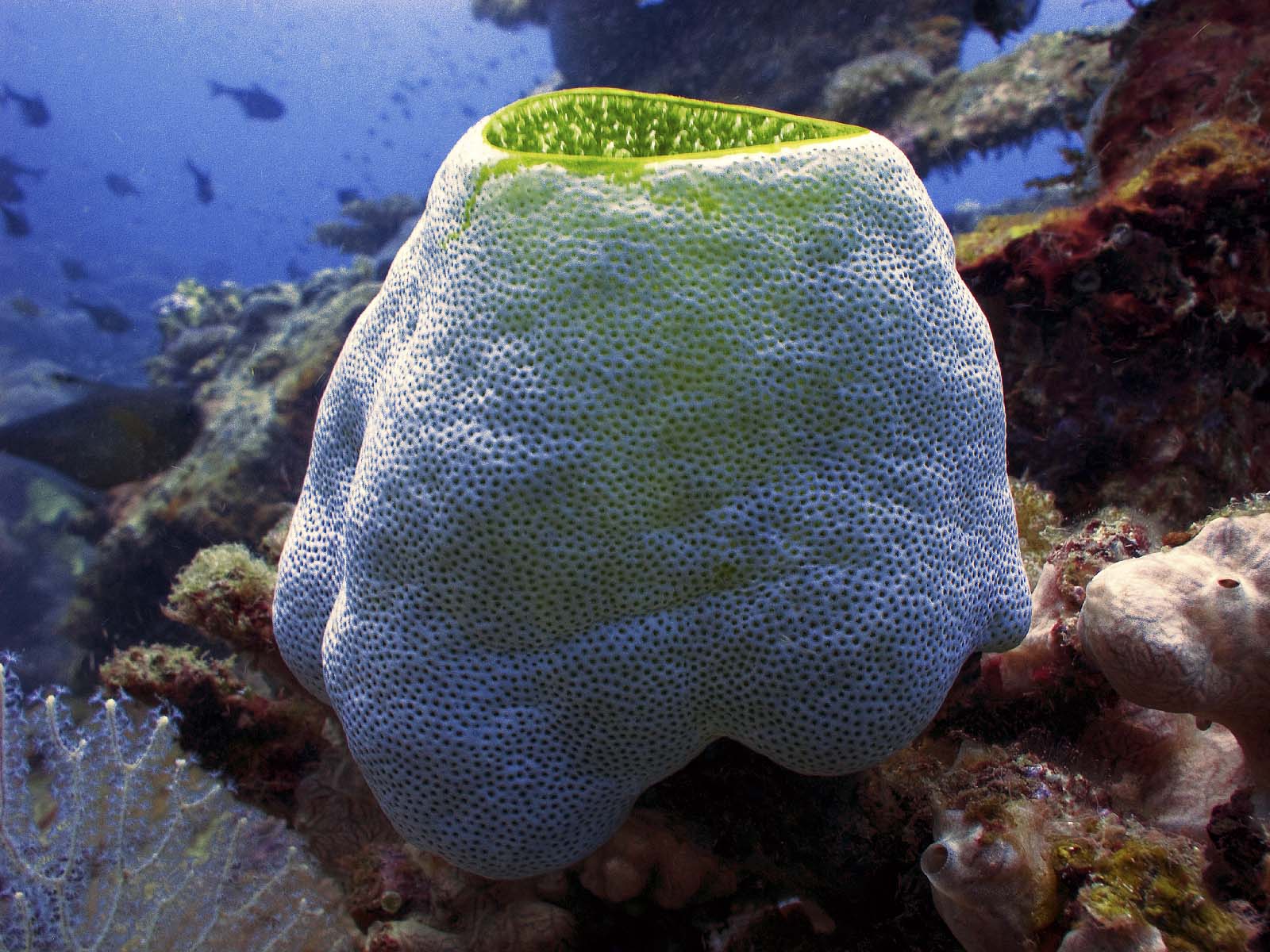
It is very delicate and floppy. It reminds me of a bag full of lettuce.
I still have some difficulty knowing for certain whether I am looking at a sea squirt colony or something else. I am pretty sure that this is a colony, but I can't identify the species:
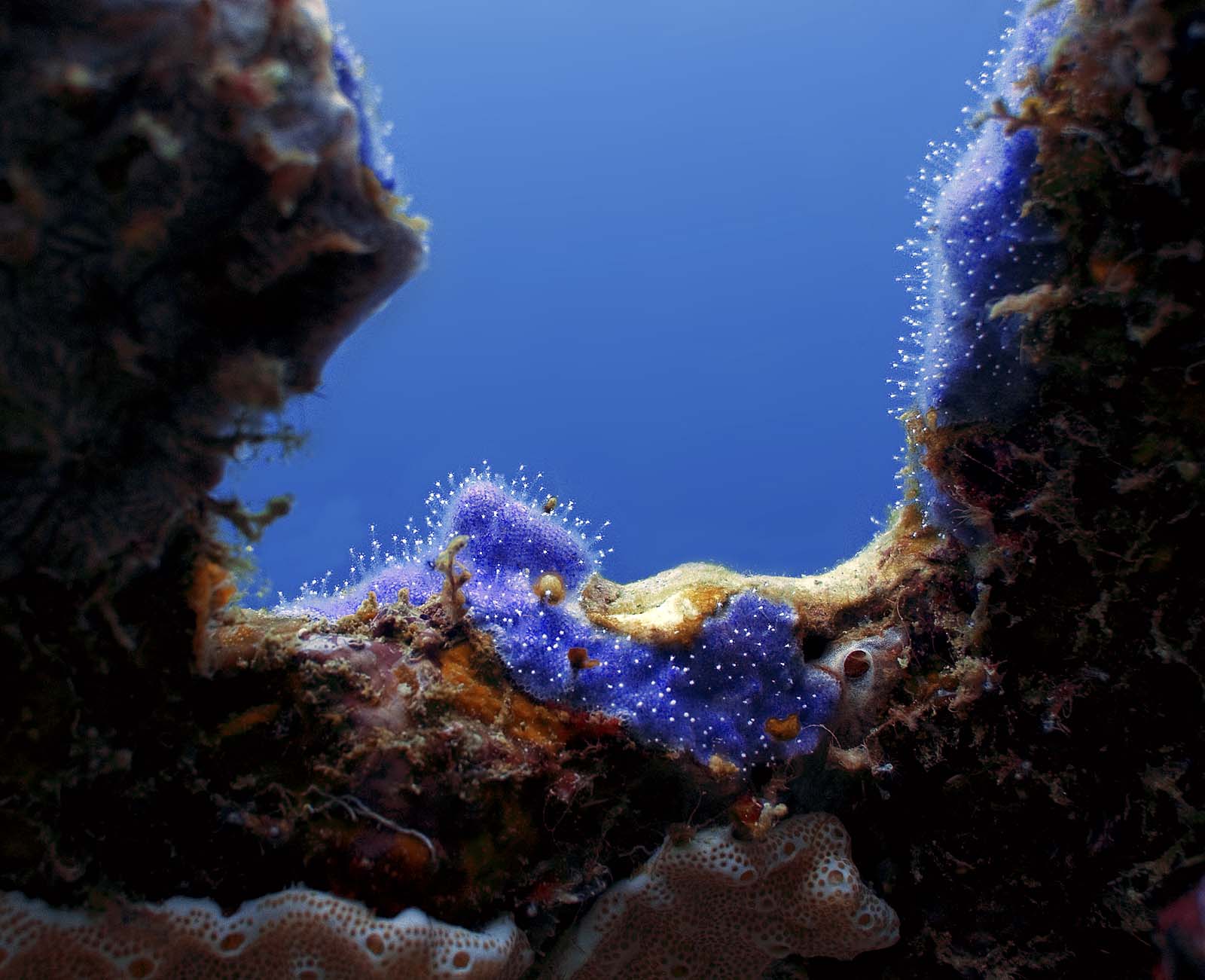
My resource book tries to cover all of the invertebrates of the Indo-Pacific region, so it contains only a tiny fraction of all species.
Again, I'm at a loss to identify the species, but I'm reasonably certain that this is a sea squirt colony. There is a bit of overlap in appearance between some sea squirts and some sponges; this complicates identification, at least for me, a rank amateur:
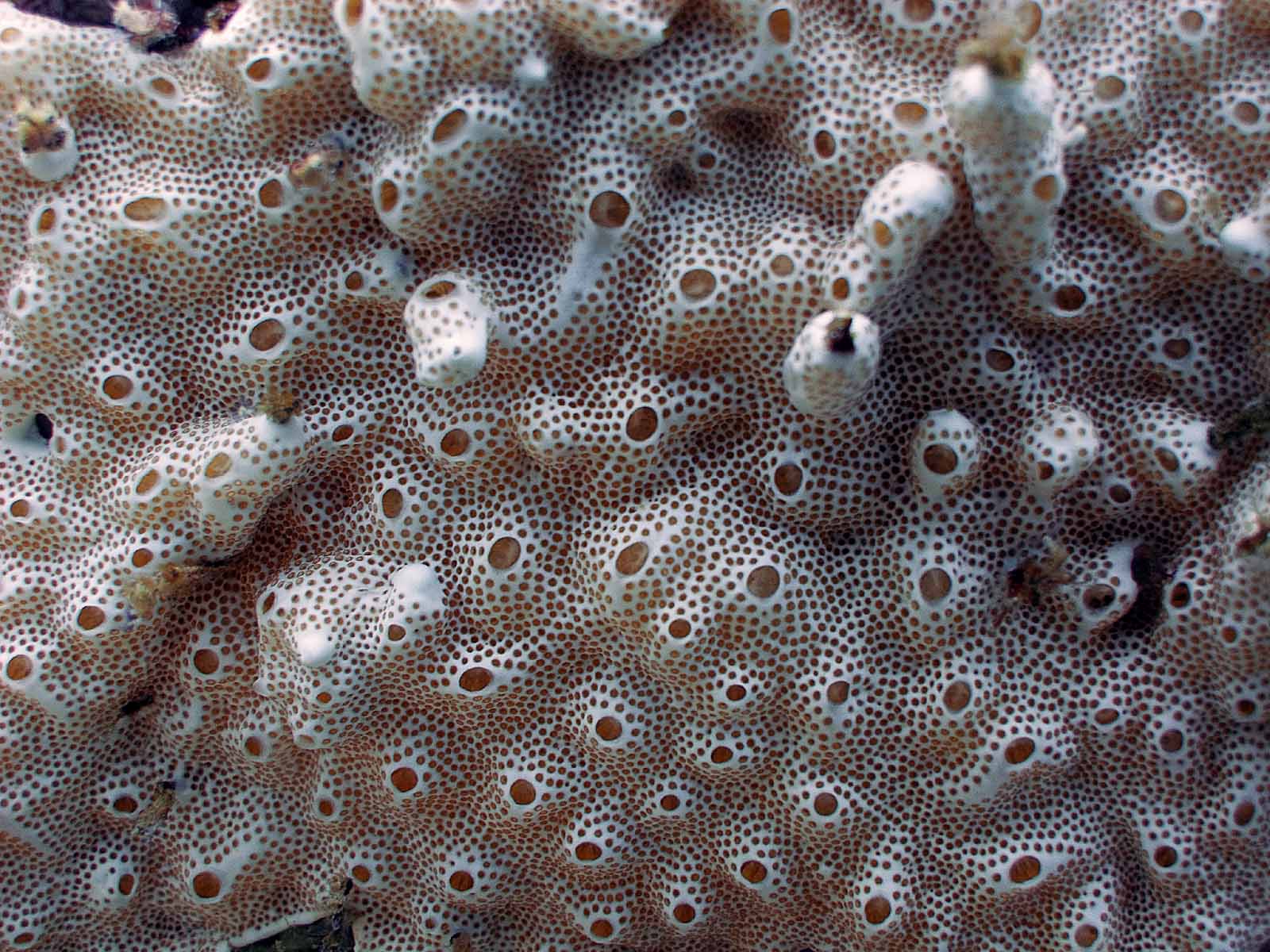
This is another bag-like sea squirt, though they are much smaller than the D. molle:
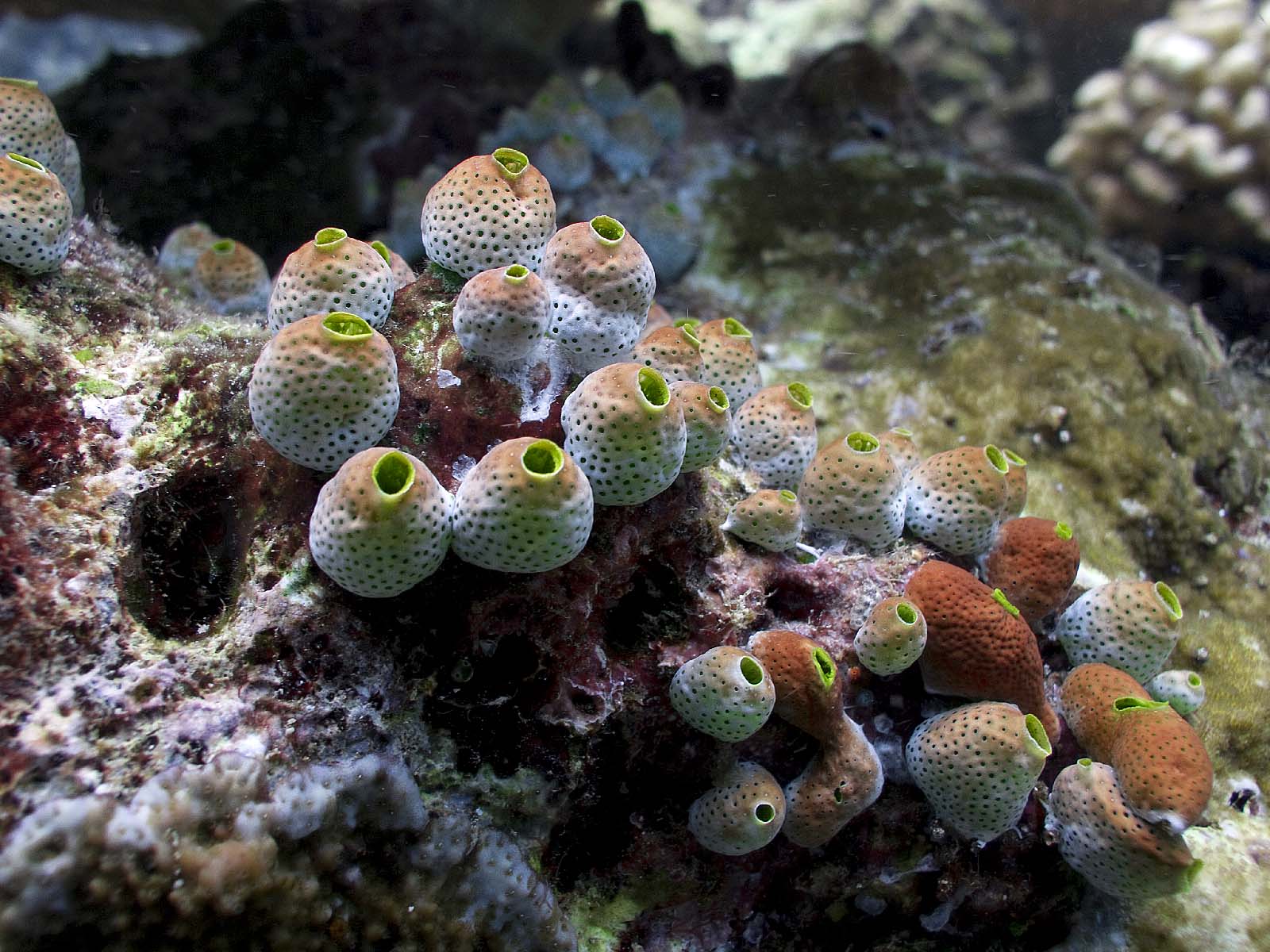
Just from these five images you can see the wide variety of forms. These colonies grow on little stalks which are not visible in this image. They look like strange little bushes growing on the reef:
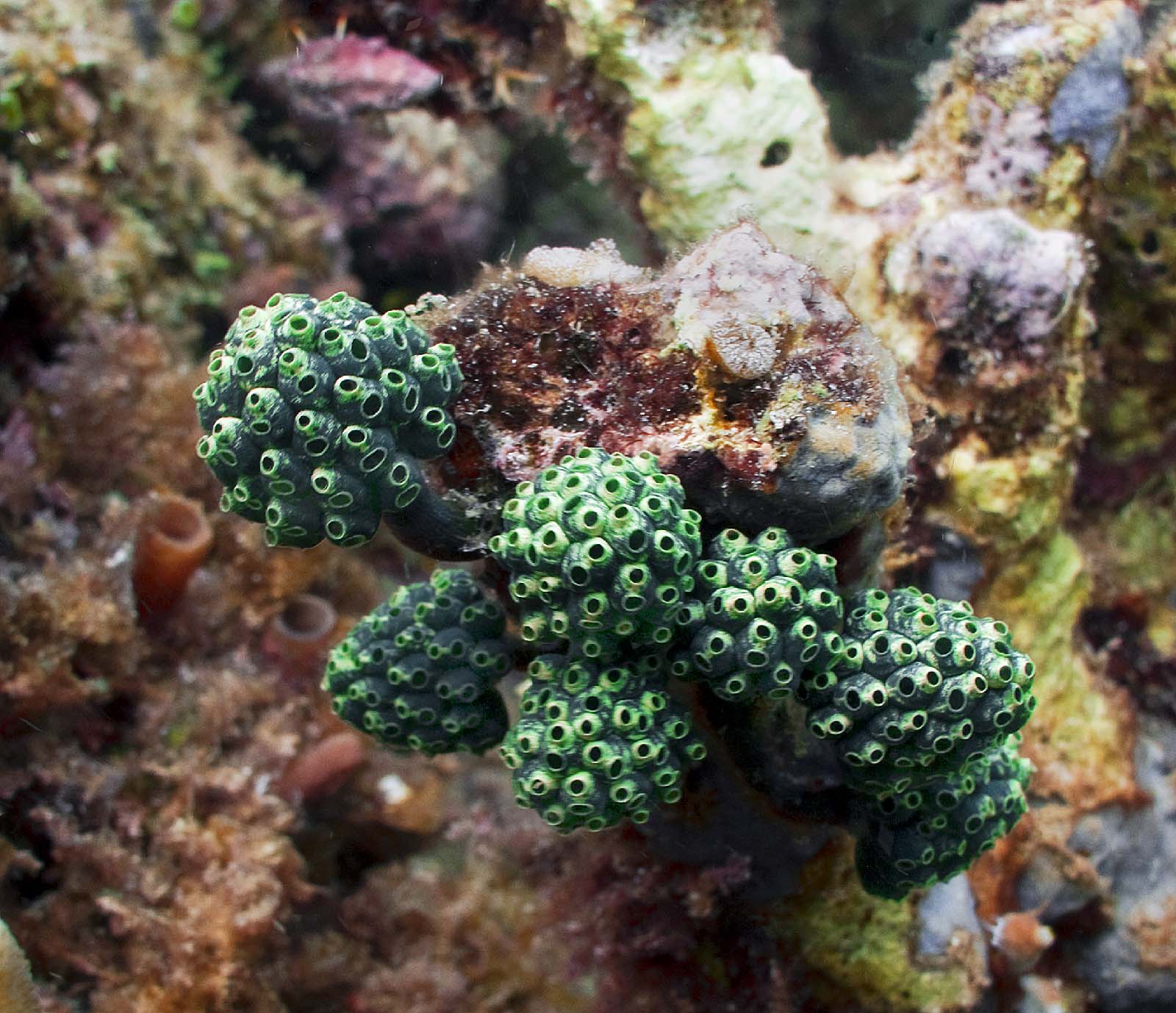
Sea squirts are a hot topic in the field of medicine. Researchers have found chemicals which are effective treatments for various cancers. Other research indicates that there is quite a bit to learn from sea squirts which may teach us how to regenerate human organs.
~ ~ ~ ~ ~ ~ ~ ~ ~ ~ ~ ~ ~ ~
The bizarre parade of physical symptoms accompanying my grief and stress continues to march through my life. I wasn't expecting this. For weeks, long before Eunie passed on to her reward, adrenaline was coursing through my body and giving me the shakes. Insomnia was my constant companion and still is. Three or four hours of sleep a night seems to be my limit. My toes feel like ice cubes and my ears are on fire. The backs of my calves feel very cold, but are warm to the touch. What's that all about? Some symptoms fade and are replaced by others. The daily small panic attacks have reduced in number and intensity. They have been gradually replaced by a permanently clenched jaw. I have to tell myself a hundred times a day to unclench and stop grinding. My jaw hurts.
I feel a bit silly complaining about such trivialities. Well, insomnia is certainly not trivial, so I'll complain about that. I was taking Temazepam to catch a little sleep. When I finally got around to reading about it I discovered why that bit of sleep began to diminish as time went by. It's a temporary fix and may end up causing more problems than it fixed, since it reduces the body's ability to sleep naturally. Okay, so much for "better living through chemistry".
Among my many fond memories I can relish the time when I could get a solid eight hours of peaceful slumber.
The new alltours head office building in Düsseldorf stands prominently on the Mannesmannufer, directly on the banks of the Rhine. Designed by HPP Architects, this significant new build aims to be a harmonious addition to its prestigious surroundings, nestled between the historic Behrensbau and the Mannesmann Tower. The building, completed around the first quarter of 2023, is a multi-functional ensemble, featuring not only modern office spaces for alltours but also freehold apartments, retirement housing, and a nursing and care facility, contributing to a vibrant mixed-use urban quarter.
Architecturally, the alltours headquarters is characterized by its elegant and finely structured facade. It features a vertical segmentation made of stone pilaster strips, creating a distinct yet calm architectural language. This design subtly references the nearby Behrensbau, with recurring "floor packages" and vertical window divisions. The main office building, spanning approximately 13,500 square meters over several floors (reportedly up to 10 or 11, with 2 underground), is designed with high transparency to maximize views of the Rhine and integrate naturally into the cityscape.
Inside, the building prioritizes a positive working environment and sustainability. A central, light-flooded atrium serves as the heart of the complex, offering generous communication and meeting zones. One of its most striking features is a massive 28-meter-high indoor green wall, considered one of Europe's largest, featuring over 5,600 plants. This vertical garden not only enhances the aesthetics but also contributes to air purification and a pleasant microclimate. The building also incorporates modern amenities such as a fitness area, chill-out zone, and employee restaurant with an outdoor terrace on the top floor, along with sustainable features like an intelligent energy concept and advanced cooling systems for year-round comfort.
© All rights reserved.
oct08 - 457 / 29 /118 /
~ a pinkdelicious saturday ~
forgot to say_ PLEASE NO MULTI INVITES In ONE COMMENT ! _ NO GLITTERs . thanks
#These long-legged spiders are in the family Pholcidae. Previously the common name of this family was the cellar spiders but arachnologists have also given them the moniker of "daddy-longlegs spiders" because of the confusion generated by the general public. Because these arachnids are spiders, they have 2 body basic body parts (cephalothorax and abdomen), have 8 eyes most often clumped together in the front of the body, the abdomen shows no evidence of segmentation, have 8 legs all attached to the front most body part (the cephalothorax) and make webs out of silk. This is most probably the animal to which people refer when they tell the tale because these spiders are plentiful especially in cellars (hence their common name) and are commonly seen by the general public. The most common pholcid spiders found in U.S. homes are both European immigrants. Pholcus phalangioides is a uniformly grey spider with rectangular, elongate abdomen and is found throughout the U.S. Holocnemus pluchei also has a rectangular, elongate abdomen but has a brown stripe on the ventral side (the belly side - which is typically directed upwards since the spider hangs upside down in its web) which covers its sternum and is a stripe on the abdomen. These spiders are very common along the Pacific Coast. and into the southwest deserts.
Jacinta (jacilluch) writes: en.wikipedia.org/wiki/Opiliones
(thanks my friend!)
Customer care, care for employees, labor union, CRM, and life insurance concepts. Protecting gesture of businesswoman or personnel with icons representing group of people.
Wikipedia
Carpobrotus edulis is a ground-creeping plant with succulent leaves in the genus Carpobrotus, native to South Africa. It is also known as Hottentot-fig, ice plant, highway ice plant or pigface and in South Africa as the sour fig.
Description Carpobrotus edulis is a creeping, mat-forming succulent species and member of the fig-marigold family Aizoaceae, one of about 30 species in the genus Carpobrotus.
C. edulis is easily confused with its close relatives, including the more diminutive and less aggressive Carpobrotus chilensis (sea fig), with which it hybridizes readily. C. edulis can, however, be distinguished from most of its relatives by the size and colour of its flowers. The large, 2.5 to 6 inches (64 to 152 mm) diameter flowers of C. edulis are yellow or light pink, whereas the smaller, 1.5 to 2.5 inches (38 to 64 mm) diameter C. chilensis flowers are deep magenta. On the flowers, two of the calyx lobes are longer, extending further than the petals.
The leaves of C. edulis are only very slightly curved and have serrated sides near the tips.
Flowers are pollinated by solitary bees, honey bees, carpenter bees, and many beetle species. Leaves are eaten by tortoises. Flowers are eaten by antelopes and baboons. Fruits are eaten by baboons, rodents, porcupines, antelopes, who also disperse the seeds. The clumps provide shelter for snails, lizards, and skinks. Puff adders and other snakes, such as the Cape cobra, are often found in Carpobrotus clumps, where they ambush the small rodents attracted by the fruits.
In California
The ice plant forms large monospecific zones.
Although the ice plant may have arrived by ship as early as the 16th century, C. edulis was actively introduced in the early 1900s to stabilize dunes[7] and soil along railroad tracks; it was later put to use by Caltrans for ground cover along freeway embankments. Thousands of acres were planted in California until the 1970s. It easily spreads by seed (hundreds per fruit) and from segmentation (any shoot segment can produce roots). Its succulent foliage, bright magenta or yellow flowers, and resistance to some harsh coastal climatic conditions (salt) have also made it a favored garden plant. The ice plant was, for several decades, widely promoted as an ornamental plant, and it is still available at some nurseries. Ice plant foliage can turn a vibrant red to yellow in color. Despite its use as a soil stabilizer, it actually exacerbates and speeds up coastal erosion. It holds great masses of water in its leaves, and its roots are very shallow. In the rainy season, the added weight on unstable sandstone slopes and dunes increases the chances of slope collapse and landslides.
The ice plant is still abundant along highways, beaches, on military bases, and in other public and private landscapes. It spreads beyond landscape plantings and has invaded foredune, dune scrub, coastal bluff scrub, coastal prairie, and, most recently, maritime chaparral communities. In California, the ice plant is found in coastal habitats from north of Eureka, south at least as far as Rosarito in Baja California. It is intolerant of frost, and is not found far inland or at elevations greater than about 500 ft (150 m).
Flowering occurs almost year-round, beginning in February in southern California and continuing through fall in northern California, with flowers present for at least a few months in any given population.
In South Africa...
They're known as the sour fig grows on coastal and inland slopes from Namaqualand in the Northern Cape through the Western Cape to the Eastern Cape. It is often seen as a pioneer in disturbed sites.
The sour fig's ripe fruit are gathered and either eaten fresh or made into a very tart jam.
#RigsRocks #Iceplant #LoversPointPark #MacroFlowers #PacificGrove #Monterey #SpringFlowers #WildFlowers #CarpobrotusEdulis #FigMarigoldFamily
#HottentotFig #HighwayIcePlant #Pigface #SourFig
+++ DISCLAIMER +++Nothing you see here is real, even though the conversion or the presented background story might be based on historical facts. BEWARE!
Some background:
The Nakajima J9N Kitsuka (中島 橘花, "Orange Blossom", pronounced Kikka in Kanji used traditionally by the Japanese) was Japan's first jet aircraft. In internal IJN documents it was also called Kōkoku Nigō Heiki (皇国二号兵器, "Imperial Weapon No.2"). After the Japanese military attaché in Germany witnessed trials of the Messerschmitt Me 262 in 1942, the Imperial Japanese Navy issued a request to Nakajima to develop a similar aircraft to be used as a fast attack bomber. Among the specifications for the design were the requirements that it should be able to be built largely by unskilled labor, and that the wings should be foldable. This latter feature was not intended for potential use on aircraft carriers, but rather to enable the aircraft to be hidden in caves and tunnels around Japan as the navy began to prepare for the defense of the home islands.
Nakajima designers Kazuo Ohno and Kenichi Matsumura laid out an aircraft that bore a strong but superficial resemblance to the Me 262. Compared to the Me 262, the J9N airframe was noticeably smaller and more conventional in design, with straight wings and tail surfaces, lacking the slight sweepback of the Me 262. The triangular fuselage cross section characteristic of the German design was less pronounced, due to smaller fuel tanks. The main landing gear of the Kikka was taken from the A6M Zero and the nose wheel from the tail of a Yokosuka P1Y bomber.
The Kikka was designed in preliminary form to use the Tsu-11, a rudimentary motorjet style jet engine that was essentially a ducted fan with an afterburner. Subsequent designs were planned around the Ne-10 (TR-10) centrifugal-flow turbojet, and the Ne-12, which added a four-stage axial compressor to the front of the Ne-10. Tests of this powerplant soon revealed that it would not produce anywhere near the power required to propel the aircraft, and the project was temporarily stalled. It was then decided to produce a new axial flow turbojet based on the German BMW 003.
Development of the engine was troubled, based on little more than photographs and a single cut-away drawing of the BMW 003. A suitable unit, the Ishikawa-jima Ne-20, was finally built in January 1945. By that time, the Kikka project was making progress and the first prototype made its maiden flight. Due to the worsening war situation, the Navy considered employing the Kikka as a kamikaze weapon, but this was quickly rejected due to the high cost and complexity associated with manufacturing contemporary turbojet engines. Other more economical projects designed specifically for kamikaze attacks, such as the simpler Nakajima Tōka (designed to absorb Japanese stock of obsolete engines), the pulsejet-powered Kawanishi Baika, and the infamous Yokosuka Ohka, were either underway or already in mass production.
The following month the prototype was dismantled and delivered to Kisarazu Naval Airfield where it was re-assembled and prepared for flight testing. The aircraft performed well during a 20-minute test flight, with the only concern being the length of the takeoff run – the Ne 20 only had a thrust of 4.66 kN (1,047 lbf), and the engine pair had barely sufficient power to get the aircraft off the ground. This lack of thrust also resulted in a maximum speed of just 623 km/h (387 mph, 336 kn) at sea level and 696 km/h (432 mph; 376 kn) at 10,000 m (32,808 ft).
For the second test flight, four days later, rocket assisted take off (RATO) units were fitted to the aircraft, which worked and gave the aircraft acceptable field performance. The tests went on, together with a second prototype, but despite this early test stage, the J9N was immediately rushed into production.
By May 1945 approximately forty airframes had been completed and handed over to IJN home defense frontline units for operational use and conversion training. These were structurally identical with the prototypes, but they were powered by more potent and reliable Ne-130 (with 8.826 kN/900 kgf) or Ne-230 (8.679 kN/885 kgf) engines, which finally gave the aircraft a competitive performance and also made the RATO boosters obsolete - unless an 800 kg bomb was carried in overload configuration. Most were J9N1 day fighter single seaters, armed with two 30 mm Type 5 cannons with 50 rounds per gun in the nose. Some operational Kitsukas had, due to the lack of equipment, the 30 mm guns replaced with lighter 20 mm Ho-5 cannon. A few were unarmed two-seaters (J9N2) with dual controls and a second seat instead of the fuselage fuel tank. This markedly limited the aircraft’s range but was accepted for a dedicated trainer, but a ventral 500 l drop tank could be carried to extend the two-seater’s range to an acceptable level.
A small number, both single- and two-seaters, were furthermore adapted to night fighter duties and equipped with an experimental ”FD-2” centimeter waveband radar in the nose with an “antler” antenna array, similar to German radar sets of the time. The FD-2 used four forward-facing Yagi style antennae with initially five and later with seven elements (the sideway facing rods) each. These consisted of two pairs, each with a sending (top and bot) and a receiving antenna (left and right). The set used horizontal lobe switching to find the target, an electrical shifter would continuously switch between the sets. The signal strengths would then be compared to determine the range and azimuth of the target, and the results would then be shown on a CRT display.
In order to fit the electronics (the FD-2 weighed around 70 kg/155 lb) the night fighters typically had one of the nose-mounted guns replaced by a fixed, obliquely firing Ho-5 gun ("Schräge Musik"-style), which was mounted in the aircraft’s flank behind the cockpit, and the 500l drop tank became a permanent installation to extend loiter time, at the expense of top speed, though. These machines received the suffix “-S” and flew, despite the FD-2’s weaknesses and limitations, a few quite effective missions against American B-29 bombers, but their impact was minimal due to the aircrafts’ small numbers and poor reliability of the still experimental radar system. However, the FD-2’s performance was rather underwhelming, though, with an insufficient range of only 3 km. Increased drag due to the antennae and countermeasures deployed by B-29 further decreased the effectiveness, and the J9N2-S’s successes could be rather attributed to experienced and motivated crews than the primitive radar.
Proposed follow-on J9N versions had included a reconnaissance aircraft and a fast attack aircraft that was supposed to carry a single bomb under the fuselage against ships. There was also a modified version of the design to be launched from a 200 m long catapult, the "Nakajima Kikka-kai Prototype Turbojet Special Attacker". All these proposed versions were expected to be powered by more advanced developments of the Ne-20, the Ne-330 with 13 kN (1.330 kg) thrust, but none of them reached the hardware stage.
The J9Ns’ overall war contribution was negligible, and after the war, several airframes (including partial airframes) were captured by Allied forces. Three airframes (including a two-seat night fighter with FD-2 radar) were brought to the U.S. for study. Today, two J9N examples survive in the National Air and Space Museum: The first is a Kikka that was taken to the Patuxent River Naval Air Base, Maryland for analysis. This aircraft is very incomplete and is believed to have been patched together from a variety of semi-completed airframes. It is currently still in storage at the Paul E. Garber Preservation, Restoration and Storage Facility in Silver Hill, MD. The second Kikka is on display at the NASM Udvar-Hazy Center in the Mary Baker Engen Restoration Hangar.
General characteristics:
Crew: 2
Length: 8.13 m (26 ft 8 in) fuselage only
10.30 m (33 ft 8¾ in) with FD-2 antenna array
Wingspan: 10 m (32 ft 10 in)
Height: 2.95 m (9 ft 8 in)
Wing area: 13.2 m² (142 sq ft)
Empty weight: 2,300 kg (5,071 lb)
Gross weight: 3,500 kg (7,716 lb)
Max takeoff weight: 4,080 kg (8,995 lb)
Powerplant:
2× Ishikawajima Ne-130 or Ne-230 axial-flow turbojet engines
each with 8.83 kN/900 kg or 8.68 kN/885 kg thrust
Performance:
Maximum speed: 785 km/h (487 mph, 426 kn)
Range: 925 km (574 mi, 502 nmi) with internal fuel
Service ceiling: 12,000 m (39,000 ft)
Rate of climb: 10.5 m/s (2,064 ft/min)
Wing loading: 265 kg/m² (54 lb/sq ft)
Thrust-to-weight ratio: 0.43
Armament:
1× 30 mm (1.181 in) Type 5 cannon with 50 rounds in the nose
1× 20 mm (0.787 in) Type Ho-2 cannon with 80 rounds, mounted obliquely behind the cockpit
1× ventral hardpoint for a 500 l drop tank or a single 500 kg (1,102 lb) bomb
The kit and its assembly:
This is in fact the second Kikka I have built, and this time it’s a two-seater from AZ Models – actually the trainer boxing, but converted into a personal night fighter interpretation. The AZ Models kit is a simple affair, but that's also its problem. In the box things look quite good, detail level is on par with a classic Matchbox kit. But unlike a Matchbox kit, the AZ Models offering does not go together well. I had to fight everywhere with poor fit, lack of locator pins, ejection marks - anything a short run model kit can throw at you! Thanks to the experience with the single-seater kit some time ago, things did not become too traumatic, but it’s still not a kit for beginners. What worked surprisingly well was the IP canopy, though, which I cut into five sections for an optional open display – even though I am not certain if the kit’s designers had put some brain into their work because the canopy’s segmentation becomes more and more dubious the further you go backwards.
The only personal mods is a slightly changed armament, with one nose gun deleted and faired over with a piece of styrene sheet, while the leftover gun was mounted obliquely onto the left flank. I initially considered a position behind the canopy but rejected this because of CoG reasons. Then I planned to mount it directly behind the 2nd seat, so that the barrel would protrude through the canopy, but this appeared unrealistic because the (utterly tiny) sliding canopy for the rear crewman could not have been opened anymore? Finally, I settled for an offset position in the aircraft’s flanks, partly inspired by “Schräge Musik” arrangements on some German Fw 190 night fighters.
The antennae come from a Jadar Model PE set for Italeri’s Me 210s, turning it either into a night fighter or a naval surveillance aircraft.
Painting and markings:
This became rather lusterless; many late IJN night fighters carried a uniform dark green livery with minimalistic, toned-down markings, e. g. hinomaru without a white high-contrast edge, just the yellow ID bands on the wings’ leading edges were retained.
For this look the model received an overall basis coat of Humbrol 75 (Bronze Green), later treated with a black ink washing, dry-brushed aluminum and post-shading with lighter shades of dark green (including Humbrol 116 and Revell 67). The only colorful highlight is a red fin tip (Humbrol 19) and a thin red stripe underneath (decal). The yellow and white ID bands were created with decal material.
The cockpit interior was painted in a yellowish-green primer (trying to simulate a typical “bamboo” shade that was used in some late-war IJN cockpits), while the landing gear wells were painted in aodake iro, a clear bluish protective lacquer. The landing gear struts themselves became semi-matt black.
The markings are fictional and were puzzled together from various sources. The hinomaru came from the AZ Models’ Kikka single seater sheet (since it offers six roundels w/o white edge), the tactical code on the fin was created with red numbers from a Fujimi Aichi B7A2 Ryusei.
Finally, the kit received a coat of matt acrylic varnish and some grinded graphite around the jet exhausts and the gun nozzles.
Well, this fictional Kikka night fighter looks quite dry, but that makes it IMHO more credible. The large antler antenna array might look “a bit too much”, and a real night fighter probably had a simpler arrangement with a single Yagi-style/arrow-shaped antenna, but a description of the FD-2 radar suggested the layout I chose – and it does not look bad. The oblique cannon in the flank is another odd detail, but it is not unplausible. However, with all the equipment and esp. the draggy antennae on board, the Kikka’s mediocre performance would surely have seriously suffered, probably beyond an effective use. But this is whifworld, after all. ;-)
A true unbiased and open-minded temple, this Hindu temple Birla Mandir in Jaipur combines 3 clear architecture features: the traditional tiered tower of Hinduism, the pyramid stupa of Buddhism and the dome of Islam. The marble sides were carved in figures representing not on the many Deities of Hinduism, but also Christian Saints and Jesus himself. Truly a place for all. We unfortunately did not get long to view inside as it was nearly closing time and the security were feverently shoeing people out!
This incorporation of different styles, if not full-blown religious segmentation as it appears here was a common scene in Rajasthan where centuries of influences from the Greeks to Muslims, Jains and Buddhists, Christians and tribals has fused. Tour guides often pointed out greek-taught column work with traditional Hindu carved figures (elephants often) at the tops holding muslim-taught domes and archways. And of course why not. If it works, is strong, asctetic and powerful, grab it. I particularly noted and took to theses lessons in the palaces, temples and forts we saw as it is good to remember that North America was not the original or only "melting pot" out there and cultures have been merging and bubbling for millennia. Too easy to remember only the British Victorian era of cultural segregation and the US's racial history as the way cultures always met and interacted, but that is not always the case.
But I go off track...it was a pretty temple, in marble. I guess I should have left it at that! ;-)
+++ DISCLAIMER +++Nothing you see here is real, even though the conversion or the presented background story might be based on historical facts. BEWARE!
Some background:
The Nakajima J9N Kitsuka (中島 橘花, "Orange Blossom", pronounced Kikka in Kanji used traditionally by the Japanese) was Japan's first jet aircraft. In internal IJN documents it was also called Kōkoku Nigō Heiki (皇国二号兵器, "Imperial Weapon No.2"). After the Japanese military attaché in Germany witnessed trials of the Messerschmitt Me 262 in 1942, the Imperial Japanese Navy issued a request to Nakajima to develop a similar aircraft to be used as a fast attack bomber. Among the specifications for the design were the requirements that it should be able to be built largely by unskilled labor, and that the wings should be foldable. This latter feature was not intended for potential use on aircraft carriers, but rather to enable the aircraft to be hidden in caves and tunnels around Japan as the navy began to prepare for the defense of the home islands.
Nakajima designers Kazuo Ohno and Kenichi Matsumura laid out an aircraft that bore a strong but superficial resemblance to the Me 262. Compared to the Me 262, the J9N airframe was noticeably smaller and more conventional in design, with straight wings and tail surfaces, lacking the slight sweepback of the Me 262. The triangular fuselage cross section characteristic of the German design was less pronounced, due to smaller fuel tanks. The main landing gear of the Kikka was taken from the A6M Zero and the nose wheel from the tail of a Yokosuka P1Y bomber.
The Kikka was designed in preliminary form to use the Tsu-11, a rudimentary motorjet style jet engine that was essentially a ducted fan with an afterburner. Subsequent designs were planned around the Ne-10 (TR-10) centrifugal-flow turbojet, and the Ne-12, which added a four-stage axial compressor to the front of the Ne-10. Tests of this powerplant soon revealed that it would not produce anywhere near the power required to propel the aircraft, and the project was temporarily stalled. It was then decided to produce a new axial flow turbojet based on the German BMW 003.
Development of the engine was troubled, based on little more than photographs and a single cut-away drawing of the BMW 003. A suitable unit, the Ishikawa-jima Ne-20, was finally built in January 1945. By that time, the Kikka project was making progress and the first prototype made its maiden flight. Due to the worsening war situation, the Navy considered employing the Kikka as a kamikaze weapon, but this was quickly rejected due to the high cost and complexity associated with manufacturing contemporary turbojet engines. Other more economical projects designed specifically for kamikaze attacks, such as the simpler Nakajima Tōka (designed to absorb Japanese stock of obsolete engines), the pulsejet-powered Kawanishi Baika, and the infamous Yokosuka Ohka, were either underway or already in mass production.
The following month the prototype was dismantled and delivered to Kisarazu Naval Airfield where it was re-assembled and prepared for flight testing. The aircraft performed well during a 20-minute test flight, with the only concern being the length of the takeoff run – the Ne 20 only had a thrust of 4.66 kN (1,047 lbf), and the engine pair had barely sufficient power to get the aircraft off the ground. This lack of thrust also resulted in a maximum speed of just 623 km/h (387 mph, 336 kn) at sea level and 696 km/h (432 mph; 376 kn) at 10,000 m (32,808 ft).
For the second test flight, four days later, rocket assisted take off (RATO) units were fitted to the aircraft, which worked and gave the aircraft acceptable field performance. The tests went on, together with a second prototype, but despite this early test stage, the J9N was immediately rushed into production.
By May 1945 approximately forty airframes had been completed and handed over to IJN home defense frontline units for operational use and conversion training. These were structurally identical with the prototypes, but they were powered by more potent and reliable Ne-130 (with 8.826 kN/900 kgf) or Ne-230 (8.679 kN/885 kgf) engines, which finally gave the aircraft a competitive performance and also made the RATO boosters obsolete - unless an 800 kg bomb was carried in overload configuration. Most were J9N1 day fighter single seaters, armed with two 30 mm Type 5 cannons with 50 rounds per gun in the nose. Some operational Kitsukas had, due to the lack of equipment, the 30 mm guns replaced with lighter 20 mm Ho-5 cannon. A few were unarmed two-seaters (J9N2) with dual controls and a second seat instead of the fuselage fuel tank. This markedly limited the aircraft’s range but was accepted for a dedicated trainer, but a ventral 500 l drop tank could be carried to extend the two-seater’s range to an acceptable level.
A small number, both single- and two-seaters, were furthermore adapted to night fighter duties and equipped with an experimental ”FD-2” centimeter waveband radar in the nose with an “antler” antenna array, similar to German radar sets of the time. The FD-2 used four forward-facing Yagi style antennae with initially five and later with seven elements (the sideway facing rods) each. These consisted of two pairs, each with a sending (top and bot) and a receiving antenna (left and right). The set used horizontal lobe switching to find the target, an electrical shifter would continuously switch between the sets. The signal strengths would then be compared to determine the range and azimuth of the target, and the results would then be shown on a CRT display.
In order to fit the electronics (the FD-2 weighed around 70 kg/155 lb) the night fighters typically had one of the nose-mounted guns replaced by a fixed, obliquely firing Ho-5 gun ("Schräge Musik"-style), which was mounted in the aircraft’s flank behind the cockpit, and the 500l drop tank became a permanent installation to extend loiter time, at the expense of top speed, though. These machines received the suffix “-S” and flew, despite the FD-2’s weaknesses and limitations, a few quite effective missions against American B-29 bombers, but their impact was minimal due to the aircrafts’ small numbers and poor reliability of the still experimental radar system. However, the FD-2’s performance was rather underwhelming, though, with an insufficient range of only 3 km. Increased drag due to the antennae and countermeasures deployed by B-29 further decreased the effectiveness, and the J9N2-S’s successes could be rather attributed to experienced and motivated crews than the primitive radar.
Proposed follow-on J9N versions had included a reconnaissance aircraft and a fast attack aircraft that was supposed to carry a single bomb under the fuselage against ships. There was also a modified version of the design to be launched from a 200 m long catapult, the "Nakajima Kikka-kai Prototype Turbojet Special Attacker". All these proposed versions were expected to be powered by more advanced developments of the Ne-20, the Ne-330 with 13 kN (1.330 kg) thrust, but none of them reached the hardware stage.
The J9Ns’ overall war contribution was negligible, and after the war, several airframes (including partial airframes) were captured by Allied forces. Three airframes (including a two-seat night fighter with FD-2 radar) were brought to the U.S. for study. Today, two J9N examples survive in the National Air and Space Museum: The first is a Kikka that was taken to the Patuxent River Naval Air Base, Maryland for analysis. This aircraft is very incomplete and is believed to have been patched together from a variety of semi-completed airframes. It is currently still in storage at the Paul E. Garber Preservation, Restoration and Storage Facility in Silver Hill, MD. The second Kikka is on display at the NASM Udvar-Hazy Center in the Mary Baker Engen Restoration Hangar.
General characteristics:
Crew: 2
Length: 8.13 m (26 ft 8 in) fuselage only
10.30 m (33 ft 8¾ in) with FD-2 antenna array
Wingspan: 10 m (32 ft 10 in)
Height: 2.95 m (9 ft 8 in)
Wing area: 13.2 m² (142 sq ft)
Empty weight: 2,300 kg (5,071 lb)
Gross weight: 3,500 kg (7,716 lb)
Max takeoff weight: 4,080 kg (8,995 lb)
Powerplant:
2× Ishikawajima Ne-130 or Ne-230 axial-flow turbojet engines
each with 8.83 kN/900 kg or 8.68 kN/885 kg thrust
Performance:
Maximum speed: 785 km/h (487 mph, 426 kn)
Range: 925 km (574 mi, 502 nmi) with internal fuel
Service ceiling: 12,000 m (39,000 ft)
Rate of climb: 10.5 m/s (2,064 ft/min)
Wing loading: 265 kg/m² (54 lb/sq ft)
Thrust-to-weight ratio: 0.43
Armament:
1× 30 mm (1.181 in) Type 5 cannon with 50 rounds in the nose
1× 20 mm (0.787 in) Type Ho-2 cannon with 80 rounds, mounted obliquely behind the cockpit
1× ventral hardpoint for a 500 l drop tank or a single 500 kg (1,102 lb) bomb
The kit and its assembly:
This is in fact the second Kikka I have built, and this time it’s a two-seater from AZ Models – actually the trainer boxing, but converted into a personal night fighter interpretation. The AZ Models kit is a simple affair, but that's also its problem. In the box things look quite good, detail level is on par with a classic Matchbox kit. But unlike a Matchbox kit, the AZ Models offering does not go together well. I had to fight everywhere with poor fit, lack of locator pins, ejection marks - anything a short run model kit can throw at you! Thanks to the experience with the single-seater kit some time ago, things did not become too traumatic, but it’s still not a kit for beginners. What worked surprisingly well was the IP canopy, though, which I cut into five sections for an optional open display – even though I am not certain if the kit’s designers had put some brain into their work because the canopy’s segmentation becomes more and more dubious the further you go backwards.
The only personal mods is a slightly changed armament, with one nose gun deleted and faired over with a piece of styrene sheet, while the leftover gun was mounted obliquely onto the left flank. I initially considered a position behind the canopy but rejected this because of CoG reasons. Then I planned to mount it directly behind the 2nd seat, so that the barrel would protrude through the canopy, but this appeared unrealistic because the (utterly tiny) sliding canopy for the rear crewman could not have been opened anymore? Finally, I settled for an offset position in the aircraft’s flanks, partly inspired by “Schräge Musik” arrangements on some German Fw 190 night fighters.
The antennae come from a Jadar Model PE set for Italeri’s Me 210s, turning it either into a night fighter or a naval surveillance aircraft.
Painting and markings:
This became rather lusterless; many late IJN night fighters carried a uniform dark green livery with minimalistic, toned-down markings, e. g. hinomaru without a white high-contrast edge, just the yellow ID bands on the wings’ leading edges were retained.
For this look the model received an overall basis coat of Humbrol 75 (Bronze Green), later treated with a black ink washing, dry-brushed aluminum and post-shading with lighter shades of dark green (including Humbrol 116 and Revell 67). The only colorful highlight is a red fin tip (Humbrol 19) and a thin red stripe underneath (decal). The yellow and white ID bands were created with decal material.
The cockpit interior was painted in a yellowish-green primer (trying to simulate a typical “bamboo” shade that was used in some late-war IJN cockpits), while the landing gear wells were painted in aodake iro, a clear bluish protective lacquer. The landing gear struts themselves became semi-matt black.
The markings are fictional and were puzzled together from various sources. The hinomaru came from the AZ Models’ Kikka single seater sheet (since it offers six roundels w/o white edge), the tactical code on the fin was created with red numbers from a Fujimi Aichi B7A2 Ryusei.
Finally, the kit received a coat of matt acrylic varnish and some grinded graphite around the jet exhausts and the gun nozzles.
Well, this fictional Kikka night fighter looks quite dry, but that makes it IMHO more credible. The large antler antenna array might look “a bit too much”, and a real night fighter probably had a simpler arrangement with a single Yagi-style/arrow-shaped antenna, but a description of the FD-2 radar suggested the layout I chose – and it does not look bad. The oblique cannon in the flank is another odd detail, but it is not unplausible. However, with all the equipment and esp. the draggy antennae on board, the Kikka’s mediocre performance would surely have seriously suffered, probably beyond an effective use. But this is whifworld, after all. ;-)
+++ DISCLAIMER +++Nothing you see here is real, even though the conversion or the presented background story might be based on historical facts. BEWARE!
Some background:
The Nakajima J9N Kitsuka (中島 橘花, "Orange Blossom", pronounced Kikka in Kanji used traditionally by the Japanese) was Japan's first jet aircraft. In internal IJN documents it was also called Kōkoku Nigō Heiki (皇国二号兵器, "Imperial Weapon No.2"). After the Japanese military attaché in Germany witnessed trials of the Messerschmitt Me 262 in 1942, the Imperial Japanese Navy issued a request to Nakajima to develop a similar aircraft to be used as a fast attack bomber. Among the specifications for the design were the requirements that it should be able to be built largely by unskilled labor, and that the wings should be foldable. This latter feature was not intended for potential use on aircraft carriers, but rather to enable the aircraft to be hidden in caves and tunnels around Japan as the navy began to prepare for the defense of the home islands.
Nakajima designers Kazuo Ohno and Kenichi Matsumura laid out an aircraft that bore a strong but superficial resemblance to the Me 262. Compared to the Me 262, the J9N airframe was noticeably smaller and more conventional in design, with straight wings and tail surfaces, lacking the slight sweepback of the Me 262. The triangular fuselage cross section characteristic of the German design was less pronounced, due to smaller fuel tanks. The main landing gear of the Kikka was taken from the A6M Zero and the nose wheel from the tail of a Yokosuka P1Y bomber.
The Kikka was designed in preliminary form to use the Tsu-11, a rudimentary motorjet style jet engine that was essentially a ducted fan with an afterburner. Subsequent designs were planned around the Ne-10 (TR-10) centrifugal-flow turbojet, and the Ne-12, which added a four-stage axial compressor to the front of the Ne-10. Tests of this powerplant soon revealed that it would not produce anywhere near the power required to propel the aircraft, and the project was temporarily stalled. It was then decided to produce a new axial flow turbojet based on the German BMW 003.
Development of the engine was troubled, based on little more than photographs and a single cut-away drawing of the BMW 003. A suitable unit, the Ishikawa-jima Ne-20, was finally built in January 1945. By that time, the Kikka project was making progress and the first prototype made its maiden flight. Due to the worsening war situation, the Navy considered employing the Kikka as a kamikaze weapon, but this was quickly rejected due to the high cost and complexity associated with manufacturing contemporary turbojet engines. Other more economical projects designed specifically for kamikaze attacks, such as the simpler Nakajima Tōka (designed to absorb Japanese stock of obsolete engines), the pulsejet-powered Kawanishi Baika, and the infamous Yokosuka Ohka, were either underway or already in mass production.
The following month the prototype was dismantled and delivered to Kisarazu Naval Airfield where it was re-assembled and prepared for flight testing. The aircraft performed well during a 20-minute test flight, with the only concern being the length of the takeoff run – the Ne 20 only had a thrust of 4.66 kN (1,047 lbf), and the engine pair had barely sufficient power to get the aircraft off the ground. This lack of thrust also resulted in a maximum speed of just 623 km/h (387 mph, 336 kn) at sea level and 696 km/h (432 mph; 376 kn) at 10,000 m (32,808 ft).
For the second test flight, four days later, rocket assisted take off (RATO) units were fitted to the aircraft, which worked and gave the aircraft acceptable field performance. The tests went on, together with a second prototype, but despite this early test stage, the J9N was immediately rushed into production.
By May 1945 approximately forty airframes had been completed and handed over to IJN home defense frontline units for operational use and conversion training. These were structurally identical with the prototypes, but they were powered by more potent and reliable Ne-130 (with 8.826 kN/900 kgf) or Ne-230 (8.679 kN/885 kgf) engines, which finally gave the aircraft a competitive performance and also made the RATO boosters obsolete - unless an 800 kg bomb was carried in overload configuration. Most were J9N1 day fighter single seaters, armed with two 30 mm Type 5 cannons with 50 rounds per gun in the nose. Some operational Kitsukas had, due to the lack of equipment, the 30 mm guns replaced with lighter 20 mm Ho-5 cannon. A few were unarmed two-seaters (J9N2) with dual controls and a second seat instead of the fuselage fuel tank. This markedly limited the aircraft’s range but was accepted for a dedicated trainer, but a ventral 500 l drop tank could be carried to extend the two-seater’s range to an acceptable level.
A small number, both single- and two-seaters, were furthermore adapted to night fighter duties and equipped with an experimental ”FD-2” centimeter waveband radar in the nose with an “antler” antenna array, similar to German radar sets of the time. The FD-2 used four forward-facing Yagi style antennae with initially five and later with seven elements (the sideway facing rods) each. These consisted of two pairs, each with a sending (top and bot) and a receiving antenna (left and right). The set used horizontal lobe switching to find the target, an electrical shifter would continuously switch between the sets. The signal strengths would then be compared to determine the range and azimuth of the target, and the results would then be shown on a CRT display.
In order to fit the electronics (the FD-2 weighed around 70 kg/155 lb) the night fighters typically had one of the nose-mounted guns replaced by a fixed, obliquely firing Ho-5 gun ("Schräge Musik"-style), which was mounted in the aircraft’s flank behind the cockpit, and the 500l drop tank became a permanent installation to extend loiter time, at the expense of top speed, though. These machines received the suffix “-S” and flew, despite the FD-2’s weaknesses and limitations, a few quite effective missions against American B-29 bombers, but their impact was minimal due to the aircrafts’ small numbers and poor reliability of the still experimental radar system. However, the FD-2’s performance was rather underwhelming, though, with an insufficient range of only 3 km. Increased drag due to the antennae and countermeasures deployed by B-29 further decreased the effectiveness, and the J9N2-S’s successes could be rather attributed to experienced and motivated crews than the primitive radar.
Proposed follow-on J9N versions had included a reconnaissance aircraft and a fast attack aircraft that was supposed to carry a single bomb under the fuselage against ships. There was also a modified version of the design to be launched from a 200 m long catapult, the "Nakajima Kikka-kai Prototype Turbojet Special Attacker". All these proposed versions were expected to be powered by more advanced developments of the Ne-20, the Ne-330 with 13 kN (1.330 kg) thrust, but none of them reached the hardware stage.
The J9Ns’ overall war contribution was negligible, and after the war, several airframes (including partial airframes) were captured by Allied forces. Three airframes (including a two-seat night fighter with FD-2 radar) were brought to the U.S. for study. Today, two J9N examples survive in the National Air and Space Museum: The first is a Kikka that was taken to the Patuxent River Naval Air Base, Maryland for analysis. This aircraft is very incomplete and is believed to have been patched together from a variety of semi-completed airframes. It is currently still in storage at the Paul E. Garber Preservation, Restoration and Storage Facility in Silver Hill, MD. The second Kikka is on display at the NASM Udvar-Hazy Center in the Mary Baker Engen Restoration Hangar.
General characteristics:
Crew: 2
Length: 8.13 m (26 ft 8 in) fuselage only
10.30 m (33 ft 8¾ in) with FD-2 antenna array
Wingspan: 10 m (32 ft 10 in)
Height: 2.95 m (9 ft 8 in)
Wing area: 13.2 m² (142 sq ft)
Empty weight: 2,300 kg (5,071 lb)
Gross weight: 3,500 kg (7,716 lb)
Max takeoff weight: 4,080 kg (8,995 lb)
Powerplant:
2× Ishikawajima Ne-130 or Ne-230 axial-flow turbojet engines
each with 8.83 kN/900 kg or 8.68 kN/885 kg thrust
Performance:
Maximum speed: 785 km/h (487 mph, 426 kn)
Range: 925 km (574 mi, 502 nmi) with internal fuel
Service ceiling: 12,000 m (39,000 ft)
Rate of climb: 10.5 m/s (2,064 ft/min)
Wing loading: 265 kg/m² (54 lb/sq ft)
Thrust-to-weight ratio: 0.43
Armament:
1× 30 mm (1.181 in) Type 5 cannon with 50 rounds in the nose
1× 20 mm (0.787 in) Type Ho-2 cannon with 80 rounds, mounted obliquely behind the cockpit
1× ventral hardpoint for a 500 l drop tank or a single 500 kg (1,102 lb) bomb
The kit and its assembly:
This is in fact the second Kikka I have built, and this time it’s a two-seater from AZ Models – actually the trainer boxing, but converted into a personal night fighter interpretation. The AZ Models kit is a simple affair, but that's also its problem. In the box things look quite good, detail level is on par with a classic Matchbox kit. But unlike a Matchbox kit, the AZ Models offering does not go together well. I had to fight everywhere with poor fit, lack of locator pins, ejection marks - anything a short run model kit can throw at you! Thanks to the experience with the single-seater kit some time ago, things did not become too traumatic, but it’s still not a kit for beginners. What worked surprisingly well was the IP canopy, though, which I cut into five sections for an optional open display – even though I am not certain if the kit’s designers had put some brain into their work because the canopy’s segmentation becomes more and more dubious the further you go backwards.
The only personal mods is a slightly changed armament, with one nose gun deleted and faired over with a piece of styrene sheet, while the leftover gun was mounted obliquely onto the left flank. I initially considered a position behind the canopy but rejected this because of CoG reasons. Then I planned to mount it directly behind the 2nd seat, so that the barrel would protrude through the canopy, but this appeared unrealistic because the (utterly tiny) sliding canopy for the rear crewman could not have been opened anymore? Finally, I settled for an offset position in the aircraft’s flanks, partly inspired by “Schräge Musik” arrangements on some German Fw 190 night fighters.
The antennae come from a Jadar Model PE set for Italeri’s Me 210s, turning it either into a night fighter or a naval surveillance aircraft.
Painting and markings:
This became rather lusterless; many late IJN night fighters carried a uniform dark green livery with minimalistic, toned-down markings, e. g. hinomaru without a white high-contrast edge, just the yellow ID bands on the wings’ leading edges were retained.
For this look the model received an overall basis coat of Humbrol 75 (Bronze Green), later treated with a black ink washing, dry-brushed aluminum and post-shading with lighter shades of dark green (including Humbrol 116 and Revell 67). The only colorful highlight is a red fin tip (Humbrol 19) and a thin red stripe underneath (decal). The yellow and white ID bands were created with decal material.
The cockpit interior was painted in a yellowish-green primer (trying to simulate a typical “bamboo” shade that was used in some late-war IJN cockpits), while the landing gear wells were painted in aodake iro, a clear bluish protective lacquer. The landing gear struts themselves became semi-matt black.
The markings are fictional and were puzzled together from various sources. The hinomaru came from the AZ Models’ Kikka single seater sheet (since it offers six roundels w/o white edge), the tactical code on the fin was created with red numbers from a Fujimi Aichi B7A2 Ryusei.
Finally, the kit received a coat of matt acrylic varnish and some grinded graphite around the jet exhausts and the gun nozzles.
Well, this fictional Kikka night fighter looks quite dry, but that makes it IMHO more credible. The large antler antenna array might look “a bit too much”, and a real night fighter probably had a simpler arrangement with a single Yagi-style/arrow-shaped antenna, but a description of the FD-2 radar suggested the layout I chose – and it does not look bad. The oblique cannon in the flank is another odd detail, but it is not unplausible. However, with all the equipment and esp. the draggy antennae on board, the Kikka’s mediocre performance would surely have seriously suffered, probably beyond an effective use. But this is whifworld, after all. ;-)
+++ DISCLAIMER +++Nothing you see here is real, even though the conversion or the presented background story might be based on historical facts. BEWARE!
Some background:
The Nakajima J9N Kitsuka (中島 橘花, "Orange Blossom", pronounced Kikka in Kanji used traditionally by the Japanese) was Japan's first jet aircraft. In internal IJN documents it was also called Kōkoku Nigō Heiki (皇国二号兵器, "Imperial Weapon No.2"). After the Japanese military attaché in Germany witnessed trials of the Messerschmitt Me 262 in 1942, the Imperial Japanese Navy issued a request to Nakajima to develop a similar aircraft to be used as a fast attack bomber. Among the specifications for the design were the requirements that it should be able to be built largely by unskilled labor, and that the wings should be foldable. This latter feature was not intended for potential use on aircraft carriers, but rather to enable the aircraft to be hidden in caves and tunnels around Japan as the navy began to prepare for the defense of the home islands.
Nakajima designers Kazuo Ohno and Kenichi Matsumura laid out an aircraft that bore a strong but superficial resemblance to the Me 262. Compared to the Me 262, the J9N airframe was noticeably smaller and more conventional in design, with straight wings and tail surfaces, lacking the slight sweepback of the Me 262. The triangular fuselage cross section characteristic of the German design was less pronounced, due to smaller fuel tanks. The main landing gear of the Kikka was taken from the A6M Zero and the nose wheel from the tail of a Yokosuka P1Y bomber.
The Kikka was designed in preliminary form to use the Tsu-11, a rudimentary motorjet style jet engine that was essentially a ducted fan with an afterburner. Subsequent designs were planned around the Ne-10 (TR-10) centrifugal-flow turbojet, and the Ne-12, which added a four-stage axial compressor to the front of the Ne-10. Tests of this powerplant soon revealed that it would not produce anywhere near the power required to propel the aircraft, and the project was temporarily stalled. It was then decided to produce a new axial flow turbojet based on the German BMW 003.
Development of the engine was troubled, based on little more than photographs and a single cut-away drawing of the BMW 003. A suitable unit, the Ishikawa-jima Ne-20, was finally built in January 1945. By that time, the Kikka project was making progress and the first prototype made its maiden flight. Due to the worsening war situation, the Navy considered employing the Kikka as a kamikaze weapon, but this was quickly rejected due to the high cost and complexity associated with manufacturing contemporary turbojet engines. Other more economical projects designed specifically for kamikaze attacks, such as the simpler Nakajima Tōka (designed to absorb Japanese stock of obsolete engines), the pulsejet-powered Kawanishi Baika, and the infamous Yokosuka Ohka, were either underway or already in mass production.
The following month the prototype was dismantled and delivered to Kisarazu Naval Airfield where it was re-assembled and prepared for flight testing. The aircraft performed well during a 20-minute test flight, with the only concern being the length of the takeoff run – the Ne 20 only had a thrust of 4.66 kN (1,047 lbf), and the engine pair had barely sufficient power to get the aircraft off the ground. This lack of thrust also resulted in a maximum speed of just 623 km/h (387 mph, 336 kn) at sea level and 696 km/h (432 mph; 376 kn) at 10,000 m (32,808 ft).
For the second test flight, four days later, rocket assisted take off (RATO) units were fitted to the aircraft, which worked and gave the aircraft acceptable field performance. The tests went on, together with a second prototype, but despite this early test stage, the J9N was immediately rushed into production.
By May 1945 approximately forty airframes had been completed and handed over to IJN home defense frontline units for operational use and conversion training. These were structurally identical with the prototypes, but they were powered by more potent and reliable Ne-130 (with 8.826 kN/900 kgf) or Ne-230 (8.679 kN/885 kgf) engines, which finally gave the aircraft a competitive performance and also made the RATO boosters obsolete - unless an 800 kg bomb was carried in overload configuration. Most were J9N1 day fighter single seaters, armed with two 30 mm Type 5 cannons with 50 rounds per gun in the nose. Some operational Kitsukas had, due to the lack of equipment, the 30 mm guns replaced with lighter 20 mm Ho-5 cannon. A few were unarmed two-seaters (J9N2) with dual controls and a second seat instead of the fuselage fuel tank. This markedly limited the aircraft’s range but was accepted for a dedicated trainer, but a ventral 500 l drop tank could be carried to extend the two-seater’s range to an acceptable level.
A small number, both single- and two-seaters, were furthermore adapted to night fighter duties and equipped with an experimental ”FD-2” centimeter waveband radar in the nose with an “antler” antenna array, similar to German radar sets of the time. The FD-2 used four forward-facing Yagi style antennae with initially five and later with seven elements (the sideway facing rods) each. These consisted of two pairs, each with a sending (top and bot) and a receiving antenna (left and right). The set used horizontal lobe switching to find the target, an electrical shifter would continuously switch between the sets. The signal strengths would then be compared to determine the range and azimuth of the target, and the results would then be shown on a CRT display.
In order to fit the electronics (the FD-2 weighed around 70 kg/155 lb) the night fighters typically had one of the nose-mounted guns replaced by a fixed, obliquely firing Ho-5 gun ("Schräge Musik"-style), which was mounted in the aircraft’s flank behind the cockpit, and the 500l drop tank became a permanent installation to extend loiter time, at the expense of top speed, though. These machines received the suffix “-S” and flew, despite the FD-2’s weaknesses and limitations, a few quite effective missions against American B-29 bombers, but their impact was minimal due to the aircrafts’ small numbers and poor reliability of the still experimental radar system. However, the FD-2’s performance was rather underwhelming, though, with an insufficient range of only 3 km. Increased drag due to the antennae and countermeasures deployed by B-29 further decreased the effectiveness, and the J9N2-S’s successes could be rather attributed to experienced and motivated crews than the primitive radar.
Proposed follow-on J9N versions had included a reconnaissance aircraft and a fast attack aircraft that was supposed to carry a single bomb under the fuselage against ships. There was also a modified version of the design to be launched from a 200 m long catapult, the "Nakajima Kikka-kai Prototype Turbojet Special Attacker". All these proposed versions were expected to be powered by more advanced developments of the Ne-20, the Ne-330 with 13 kN (1.330 kg) thrust, but none of them reached the hardware stage.
The J9Ns’ overall war contribution was negligible, and after the war, several airframes (including partial airframes) were captured by Allied forces. Three airframes (including a two-seat night fighter with FD-2 radar) were brought to the U.S. for study. Today, two J9N examples survive in the National Air and Space Museum: The first is a Kikka that was taken to the Patuxent River Naval Air Base, Maryland for analysis. This aircraft is very incomplete and is believed to have been patched together from a variety of semi-completed airframes. It is currently still in storage at the Paul E. Garber Preservation, Restoration and Storage Facility in Silver Hill, MD. The second Kikka is on display at the NASM Udvar-Hazy Center in the Mary Baker Engen Restoration Hangar.
General characteristics:
Crew: 2
Length: 8.13 m (26 ft 8 in) fuselage only
10.30 m (33 ft 8¾ in) with FD-2 antenna array
Wingspan: 10 m (32 ft 10 in)
Height: 2.95 m (9 ft 8 in)
Wing area: 13.2 m² (142 sq ft)
Empty weight: 2,300 kg (5,071 lb)
Gross weight: 3,500 kg (7,716 lb)
Max takeoff weight: 4,080 kg (8,995 lb)
Powerplant:
2× Ishikawajima Ne-130 or Ne-230 axial-flow turbojet engines
each with 8.83 kN/900 kg or 8.68 kN/885 kg thrust
Performance:
Maximum speed: 785 km/h (487 mph, 426 kn)
Range: 925 km (574 mi, 502 nmi) with internal fuel
Service ceiling: 12,000 m (39,000 ft)
Rate of climb: 10.5 m/s (2,064 ft/min)
Wing loading: 265 kg/m² (54 lb/sq ft)
Thrust-to-weight ratio: 0.43
Armament:
1× 30 mm (1.181 in) Type 5 cannon with 50 rounds in the nose
1× 20 mm (0.787 in) Type Ho-2 cannon with 80 rounds, mounted obliquely behind the cockpit
1× ventral hardpoint for a 500 l drop tank or a single 500 kg (1,102 lb) bomb
The kit and its assembly:
This is in fact the second Kikka I have built, and this time it’s a two-seater from AZ Models – actually the trainer boxing, but converted into a personal night fighter interpretation. The AZ Models kit is a simple affair, but that's also its problem. In the box things look quite good, detail level is on par with a classic Matchbox kit. But unlike a Matchbox kit, the AZ Models offering does not go together well. I had to fight everywhere with poor fit, lack of locator pins, ejection marks - anything a short run model kit can throw at you! Thanks to the experience with the single-seater kit some time ago, things did not become too traumatic, but it’s still not a kit for beginners. What worked surprisingly well was the IP canopy, though, which I cut into five sections for an optional open display – even though I am not certain if the kit’s designers had put some brain into their work because the canopy’s segmentation becomes more and more dubious the further you go backwards.
The only personal mods is a slightly changed armament, with one nose gun deleted and faired over with a piece of styrene sheet, while the leftover gun was mounted obliquely onto the left flank. I initially considered a position behind the canopy but rejected this because of CoG reasons. Then I planned to mount it directly behind the 2nd seat, so that the barrel would protrude through the canopy, but this appeared unrealistic because the (utterly tiny) sliding canopy for the rear crewman could not have been opened anymore? Finally, I settled for an offset position in the aircraft’s flanks, partly inspired by “Schräge Musik” arrangements on some German Fw 190 night fighters.
The antennae come from a Jadar Model PE set for Italeri’s Me 210s, turning it either into a night fighter or a naval surveillance aircraft.
Painting and markings:
This became rather lusterless; many late IJN night fighters carried a uniform dark green livery with minimalistic, toned-down markings, e. g. hinomaru without a white high-contrast edge, just the yellow ID bands on the wings’ leading edges were retained.
For this look the model received an overall basis coat of Humbrol 75 (Bronze Green), later treated with a black ink washing, dry-brushed aluminum and post-shading with lighter shades of dark green (including Humbrol 116 and Revell 67). The only colorful highlight is a red fin tip (Humbrol 19) and a thin red stripe underneath (decal). The yellow and white ID bands were created with decal material.
The cockpit interior was painted in a yellowish-green primer (trying to simulate a typical “bamboo” shade that was used in some late-war IJN cockpits), while the landing gear wells were painted in aodake iro, a clear bluish protective lacquer. The landing gear struts themselves became semi-matt black.
The markings are fictional and were puzzled together from various sources. The hinomaru came from the AZ Models’ Kikka single seater sheet (since it offers six roundels w/o white edge), the tactical code on the fin was created with red numbers from a Fujimi Aichi B7A2 Ryusei.
Finally, the kit received a coat of matt acrylic varnish and some grinded graphite around the jet exhausts and the gun nozzles.
Well, this fictional Kikka night fighter looks quite dry, but that makes it IMHO more credible. The large antler antenna array might look “a bit too much”, and a real night fighter probably had a simpler arrangement with a single Yagi-style/arrow-shaped antenna, but a description of the FD-2 radar suggested the layout I chose – and it does not look bad. The oblique cannon in the flank is another odd detail, but it is not unplausible. However, with all the equipment and esp. the draggy antennae on board, the Kikka’s mediocre performance would surely have seriously suffered, probably beyond an effective use. But this is whifworld, after all. ;-)
+++ DISCLAIMER +++Nothing you see here is real, even though the conversion or the presented background story might be based on historical facts. BEWARE!
Some background:
The Nakajima J9N Kitsuka (中島 橘花, "Orange Blossom", pronounced Kikka in Kanji used traditionally by the Japanese) was Japan's first jet aircraft. In internal IJN documents it was also called Kōkoku Nigō Heiki (皇国二号兵器, "Imperial Weapon No.2"). After the Japanese military attaché in Germany witnessed trials of the Messerschmitt Me 262 in 1942, the Imperial Japanese Navy issued a request to Nakajima to develop a similar aircraft to be used as a fast attack bomber. Among the specifications for the design were the requirements that it should be able to be built largely by unskilled labor, and that the wings should be foldable. This latter feature was not intended for potential use on aircraft carriers, but rather to enable the aircraft to be hidden in caves and tunnels around Japan as the navy began to prepare for the defense of the home islands.
Nakajima designers Kazuo Ohno and Kenichi Matsumura laid out an aircraft that bore a strong but superficial resemblance to the Me 262. Compared to the Me 262, the J9N airframe was noticeably smaller and more conventional in design, with straight wings and tail surfaces, lacking the slight sweepback of the Me 262. The triangular fuselage cross section characteristic of the German design was less pronounced, due to smaller fuel tanks. The main landing gear of the Kikka was taken from the A6M Zero and the nose wheel from the tail of a Yokosuka P1Y bomber.
The Kikka was designed in preliminary form to use the Tsu-11, a rudimentary motorjet style jet engine that was essentially a ducted fan with an afterburner. Subsequent designs were planned around the Ne-10 (TR-10) centrifugal-flow turbojet, and the Ne-12, which added a four-stage axial compressor to the front of the Ne-10. Tests of this powerplant soon revealed that it would not produce anywhere near the power required to propel the aircraft, and the project was temporarily stalled. It was then decided to produce a new axial flow turbojet based on the German BMW 003.
Development of the engine was troubled, based on little more than photographs and a single cut-away drawing of the BMW 003. A suitable unit, the Ishikawa-jima Ne-20, was finally built in January 1945. By that time, the Kikka project was making progress and the first prototype made its maiden flight. Due to the worsening war situation, the Navy considered employing the Kikka as a kamikaze weapon, but this was quickly rejected due to the high cost and complexity associated with manufacturing contemporary turbojet engines. Other more economical projects designed specifically for kamikaze attacks, such as the simpler Nakajima Tōka (designed to absorb Japanese stock of obsolete engines), the pulsejet-powered Kawanishi Baika, and the infamous Yokosuka Ohka, were either underway or already in mass production.
The following month the prototype was dismantled and delivered to Kisarazu Naval Airfield where it was re-assembled and prepared for flight testing. The aircraft performed well during a 20-minute test flight, with the only concern being the length of the takeoff run – the Ne 20 only had a thrust of 4.66 kN (1,047 lbf), and the engine pair had barely sufficient power to get the aircraft off the ground. This lack of thrust also resulted in a maximum speed of just 623 km/h (387 mph, 336 kn) at sea level and 696 km/h (432 mph; 376 kn) at 10,000 m (32,808 ft).
For the second test flight, four days later, rocket assisted take off (RATO) units were fitted to the aircraft, which worked and gave the aircraft acceptable field performance. The tests went on, together with a second prototype, but despite this early test stage, the J9N was immediately rushed into production.
By May 1945 approximately forty airframes had been completed and handed over to IJN home defense frontline units for operational use and conversion training. These were structurally identical with the prototypes, but they were powered by more potent and reliable Ne-130 (with 8.826 kN/900 kgf) or Ne-230 (8.679 kN/885 kgf) engines, which finally gave the aircraft a competitive performance and also made the RATO boosters obsolete - unless an 800 kg bomb was carried in overload configuration. Most were J9N1 day fighter single seaters, armed with two 30 mm Type 5 cannons with 50 rounds per gun in the nose. Some operational Kitsukas had, due to the lack of equipment, the 30 mm guns replaced with lighter 20 mm Ho-5 cannon. A few were unarmed two-seaters (J9N2) with dual controls and a second seat instead of the fuselage fuel tank. This markedly limited the aircraft’s range but was accepted for a dedicated trainer, but a ventral 500 l drop tank could be carried to extend the two-seater’s range to an acceptable level.
A small number, both single- and two-seaters, were furthermore adapted to night fighter duties and equipped with an experimental ”FD-2” centimeter waveband radar in the nose with an “antler” antenna array, similar to German radar sets of the time. The FD-2 used four forward-facing Yagi style antennae with initially five and later with seven elements (the sideway facing rods) each. These consisted of two pairs, each with a sending (top and bot) and a receiving antenna (left and right). The set used horizontal lobe switching to find the target, an electrical shifter would continuously switch between the sets. The signal strengths would then be compared to determine the range and azimuth of the target, and the results would then be shown on a CRT display.
In order to fit the electronics (the FD-2 weighed around 70 kg/155 lb) the night fighters typically had one of the nose-mounted guns replaced by a fixed, obliquely firing Ho-5 gun ("Schräge Musik"-style), which was mounted in the aircraft’s flank behind the cockpit, and the 500l drop tank became a permanent installation to extend loiter time, at the expense of top speed, though. These machines received the suffix “-S” and flew, despite the FD-2’s weaknesses and limitations, a few quite effective missions against American B-29 bombers, but their impact was minimal due to the aircrafts’ small numbers and poor reliability of the still experimental radar system. However, the FD-2’s performance was rather underwhelming, though, with an insufficient range of only 3 km. Increased drag due to the antennae and countermeasures deployed by B-29 further decreased the effectiveness, and the J9N2-S’s successes could be rather attributed to experienced and motivated crews than the primitive radar.
Proposed follow-on J9N versions had included a reconnaissance aircraft and a fast attack aircraft that was supposed to carry a single bomb under the fuselage against ships. There was also a modified version of the design to be launched from a 200 m long catapult, the "Nakajima Kikka-kai Prototype Turbojet Special Attacker". All these proposed versions were expected to be powered by more advanced developments of the Ne-20, the Ne-330 with 13 kN (1.330 kg) thrust, but none of them reached the hardware stage.
The J9Ns’ overall war contribution was negligible, and after the war, several airframes (including partial airframes) were captured by Allied forces. Three airframes (including a two-seat night fighter with FD-2 radar) were brought to the U.S. for study. Today, two J9N examples survive in the National Air and Space Museum: The first is a Kikka that was taken to the Patuxent River Naval Air Base, Maryland for analysis. This aircraft is very incomplete and is believed to have been patched together from a variety of semi-completed airframes. It is currently still in storage at the Paul E. Garber Preservation, Restoration and Storage Facility in Silver Hill, MD. The second Kikka is on display at the NASM Udvar-Hazy Center in the Mary Baker Engen Restoration Hangar.
General characteristics:
Crew: 2
Length: 8.13 m (26 ft 8 in) fuselage only
10.30 m (33 ft 8¾ in) with FD-2 antenna array
Wingspan: 10 m (32 ft 10 in)
Height: 2.95 m (9 ft 8 in)
Wing area: 13.2 m² (142 sq ft)
Empty weight: 2,300 kg (5,071 lb)
Gross weight: 3,500 kg (7,716 lb)
Max takeoff weight: 4,080 kg (8,995 lb)
Powerplant:
2× Ishikawajima Ne-130 or Ne-230 axial-flow turbojet engines
each with 8.83 kN/900 kg or 8.68 kN/885 kg thrust
Performance:
Maximum speed: 785 km/h (487 mph, 426 kn)
Range: 925 km (574 mi, 502 nmi) with internal fuel
Service ceiling: 12,000 m (39,000 ft)
Rate of climb: 10.5 m/s (2,064 ft/min)
Wing loading: 265 kg/m² (54 lb/sq ft)
Thrust-to-weight ratio: 0.43
Armament:
1× 30 mm (1.181 in) Type 5 cannon with 50 rounds in the nose
1× 20 mm (0.787 in) Type Ho-2 cannon with 80 rounds, mounted obliquely behind the cockpit
1× ventral hardpoint for a 500 l drop tank or a single 500 kg (1,102 lb) bomb
The kit and its assembly:
This is in fact the second Kikka I have built, and this time it’s a two-seater from AZ Models – actually the trainer boxing, but converted into a personal night fighter interpretation. The AZ Models kit is a simple affair, but that's also its problem. In the box things look quite good, detail level is on par with a classic Matchbox kit. But unlike a Matchbox kit, the AZ Models offering does not go together well. I had to fight everywhere with poor fit, lack of locator pins, ejection marks - anything a short run model kit can throw at you! Thanks to the experience with the single-seater kit some time ago, things did not become too traumatic, but it’s still not a kit for beginners. What worked surprisingly well was the IP canopy, though, which I cut into five sections for an optional open display – even though I am not certain if the kit’s designers had put some brain into their work because the canopy’s segmentation becomes more and more dubious the further you go backwards.
The only personal mods is a slightly changed armament, with one nose gun deleted and faired over with a piece of styrene sheet, while the leftover gun was mounted obliquely onto the left flank. I initially considered a position behind the canopy but rejected this because of CoG reasons. Then I planned to mount it directly behind the 2nd seat, so that the barrel would protrude through the canopy, but this appeared unrealistic because the (utterly tiny) sliding canopy for the rear crewman could not have been opened anymore? Finally, I settled for an offset position in the aircraft’s flanks, partly inspired by “Schräge Musik” arrangements on some German Fw 190 night fighters.
The antennae come from a Jadar Model PE set for Italeri’s Me 210s, turning it either into a night fighter or a naval surveillance aircraft.
Painting and markings:
This became rather lusterless; many late IJN night fighters carried a uniform dark green livery with minimalistic, toned-down markings, e. g. hinomaru without a white high-contrast edge, just the yellow ID bands on the wings’ leading edges were retained.
For this look the model received an overall basis coat of Humbrol 75 (Bronze Green), later treated with a black ink washing, dry-brushed aluminum and post-shading with lighter shades of dark green (including Humbrol 116 and Revell 67). The only colorful highlight is a red fin tip (Humbrol 19) and a thin red stripe underneath (decal). The yellow and white ID bands were created with decal material.
The cockpit interior was painted in a yellowish-green primer (trying to simulate a typical “bamboo” shade that was used in some late-war IJN cockpits), while the landing gear wells were painted in aodake iro, a clear bluish protective lacquer. The landing gear struts themselves became semi-matt black.
The markings are fictional and were puzzled together from various sources. The hinomaru came from the AZ Models’ Kikka single seater sheet (since it offers six roundels w/o white edge), the tactical code on the fin was created with red numbers from a Fujimi Aichi B7A2 Ryusei.
Finally, the kit received a coat of matt acrylic varnish and some grinded graphite around the jet exhausts and the gun nozzles.
Well, this fictional Kikka night fighter looks quite dry, but that makes it IMHO more credible. The large antler antenna array might look “a bit too much”, and a real night fighter probably had a simpler arrangement with a single Yagi-style/arrow-shaped antenna, but a description of the FD-2 radar suggested the layout I chose – and it does not look bad. The oblique cannon in the flank is another odd detail, but it is not unplausible. However, with all the equipment and esp. the draggy antennae on board, the Kikka’s mediocre performance would surely have seriously suffered, probably beyond an effective use. But this is whifworld, after all. ;-)
+++ DISCLAIMER +++Nothing you see here is real, even though the conversion or the presented background story might be based on historical facts. BEWARE!
Some background:
The Nakajima J9N Kitsuka (中島 橘花, "Orange Blossom", pronounced Kikka in Kanji used traditionally by the Japanese) was Japan's first jet aircraft. In internal IJN documents it was also called Kōkoku Nigō Heiki (皇国二号兵器, "Imperial Weapon No.2"). After the Japanese military attaché in Germany witnessed trials of the Messerschmitt Me 262 in 1942, the Imperial Japanese Navy issued a request to Nakajima to develop a similar aircraft to be used as a fast attack bomber. Among the specifications for the design were the requirements that it should be able to be built largely by unskilled labor, and that the wings should be foldable. This latter feature was not intended for potential use on aircraft carriers, but rather to enable the aircraft to be hidden in caves and tunnels around Japan as the navy began to prepare for the defense of the home islands.
Nakajima designers Kazuo Ohno and Kenichi Matsumura laid out an aircraft that bore a strong but superficial resemblance to the Me 262. Compared to the Me 262, the J9N airframe was noticeably smaller and more conventional in design, with straight wings and tail surfaces, lacking the slight sweepback of the Me 262. The triangular fuselage cross section characteristic of the German design was less pronounced, due to smaller fuel tanks. The main landing gear of the Kikka was taken from the A6M Zero and the nose wheel from the tail of a Yokosuka P1Y bomber.
The Kikka was designed in preliminary form to use the Tsu-11, a rudimentary motorjet style jet engine that was essentially a ducted fan with an afterburner. Subsequent designs were planned around the Ne-10 (TR-10) centrifugal-flow turbojet, and the Ne-12, which added a four-stage axial compressor to the front of the Ne-10. Tests of this powerplant soon revealed that it would not produce anywhere near the power required to propel the aircraft, and the project was temporarily stalled. It was then decided to produce a new axial flow turbojet based on the German BMW 003.
Development of the engine was troubled, based on little more than photographs and a single cut-away drawing of the BMW 003. A suitable unit, the Ishikawa-jima Ne-20, was finally built in January 1945. By that time, the Kikka project was making progress and the first prototype made its maiden flight. Due to the worsening war situation, the Navy considered employing the Kikka as a kamikaze weapon, but this was quickly rejected due to the high cost and complexity associated with manufacturing contemporary turbojet engines. Other more economical projects designed specifically for kamikaze attacks, such as the simpler Nakajima Tōka (designed to absorb Japanese stock of obsolete engines), the pulsejet-powered Kawanishi Baika, and the infamous Yokosuka Ohka, were either underway or already in mass production.
The following month the prototype was dismantled and delivered to Kisarazu Naval Airfield where it was re-assembled and prepared for flight testing. The aircraft performed well during a 20-minute test flight, with the only concern being the length of the takeoff run – the Ne 20 only had a thrust of 4.66 kN (1,047 lbf), and the engine pair had barely sufficient power to get the aircraft off the ground. This lack of thrust also resulted in a maximum speed of just 623 km/h (387 mph, 336 kn) at sea level and 696 km/h (432 mph; 376 kn) at 10,000 m (32,808 ft).
For the second test flight, four days later, rocket assisted take off (RATO) units were fitted to the aircraft, which worked and gave the aircraft acceptable field performance. The tests went on, together with a second prototype, but despite this early test stage, the J9N was immediately rushed into production.
By May 1945 approximately forty airframes had been completed and handed over to IJN home defense frontline units for operational use and conversion training. These were structurally identical with the prototypes, but they were powered by more potent and reliable Ne-130 (with 8.826 kN/900 kgf) or Ne-230 (8.679 kN/885 kgf) engines, which finally gave the aircraft a competitive performance and also made the RATO boosters obsolete - unless an 800 kg bomb was carried in overload configuration. Most were J9N1 day fighter single seaters, armed with two 30 mm Type 5 cannons with 50 rounds per gun in the nose. Some operational Kitsukas had, due to the lack of equipment, the 30 mm guns replaced with lighter 20 mm Ho-5 cannon. A few were unarmed two-seaters (J9N2) with dual controls and a second seat instead of the fuselage fuel tank. This markedly limited the aircraft’s range but was accepted for a dedicated trainer, but a ventral 500 l drop tank could be carried to extend the two-seater’s range to an acceptable level.
A small number, both single- and two-seaters, were furthermore adapted to night fighter duties and equipped with an experimental ”FD-2” centimeter waveband radar in the nose with an “antler” antenna array, similar to German radar sets of the time. The FD-2 used four forward-facing Yagi style antennae with initially five and later with seven elements (the sideway facing rods) each. These consisted of two pairs, each with a sending (top and bot) and a receiving antenna (left and right). The set used horizontal lobe switching to find the target, an electrical shifter would continuously switch between the sets. The signal strengths would then be compared to determine the range and azimuth of the target, and the results would then be shown on a CRT display.
In order to fit the electronics (the FD-2 weighed around 70 kg/155 lb) the night fighters typically had one of the nose-mounted guns replaced by a fixed, obliquely firing Ho-5 gun ("Schräge Musik"-style), which was mounted in the aircraft’s flank behind the cockpit, and the 500l drop tank became a permanent installation to extend loiter time, at the expense of top speed, though. These machines received the suffix “-S” and flew, despite the FD-2’s weaknesses and limitations, a few quite effective missions against American B-29 bombers, but their impact was minimal due to the aircrafts’ small numbers and poor reliability of the still experimental radar system. However, the FD-2’s performance was rather underwhelming, though, with an insufficient range of only 3 km. Increased drag due to the antennae and countermeasures deployed by B-29 further decreased the effectiveness, and the J9N2-S’s successes could be rather attributed to experienced and motivated crews than the primitive radar.
Proposed follow-on J9N versions had included a reconnaissance aircraft and a fast attack aircraft that was supposed to carry a single bomb under the fuselage against ships. There was also a modified version of the design to be launched from a 200 m long catapult, the "Nakajima Kikka-kai Prototype Turbojet Special Attacker". All these proposed versions were expected to be powered by more advanced developments of the Ne-20, the Ne-330 with 13 kN (1.330 kg) thrust, but none of them reached the hardware stage.
The J9Ns’ overall war contribution was negligible, and after the war, several airframes (including partial airframes) were captured by Allied forces. Three airframes (including a two-seat night fighter with FD-2 radar) were brought to the U.S. for study. Today, two J9N examples survive in the National Air and Space Museum: The first is a Kikka that was taken to the Patuxent River Naval Air Base, Maryland for analysis. This aircraft is very incomplete and is believed to have been patched together from a variety of semi-completed airframes. It is currently still in storage at the Paul E. Garber Preservation, Restoration and Storage Facility in Silver Hill, MD. The second Kikka is on display at the NASM Udvar-Hazy Center in the Mary Baker Engen Restoration Hangar.
General characteristics:
Crew: 2
Length: 8.13 m (26 ft 8 in) fuselage only
10.30 m (33 ft 8¾ in) with FD-2 antenna array
Wingspan: 10 m (32 ft 10 in)
Height: 2.95 m (9 ft 8 in)
Wing area: 13.2 m² (142 sq ft)
Empty weight: 2,300 kg (5,071 lb)
Gross weight: 3,500 kg (7,716 lb)
Max takeoff weight: 4,080 kg (8,995 lb)
Powerplant:
2× Ishikawajima Ne-130 or Ne-230 axial-flow turbojet engines
each with 8.83 kN/900 kg or 8.68 kN/885 kg thrust
Performance:
Maximum speed: 785 km/h (487 mph, 426 kn)
Range: 925 km (574 mi, 502 nmi) with internal fuel
Service ceiling: 12,000 m (39,000 ft)
Rate of climb: 10.5 m/s (2,064 ft/min)
Wing loading: 265 kg/m² (54 lb/sq ft)
Thrust-to-weight ratio: 0.43
Armament:
1× 30 mm (1.181 in) Type 5 cannon with 50 rounds in the nose
1× 20 mm (0.787 in) Type Ho-2 cannon with 80 rounds, mounted obliquely behind the cockpit
1× ventral hardpoint for a 500 l drop tank or a single 500 kg (1,102 lb) bomb
The kit and its assembly:
This is in fact the second Kikka I have built, and this time it’s a two-seater from AZ Models – actually the trainer boxing, but converted into a personal night fighter interpretation. The AZ Models kit is a simple affair, but that's also its problem. In the box things look quite good, detail level is on par with a classic Matchbox kit. But unlike a Matchbox kit, the AZ Models offering does not go together well. I had to fight everywhere with poor fit, lack of locator pins, ejection marks - anything a short run model kit can throw at you! Thanks to the experience with the single-seater kit some time ago, things did not become too traumatic, but it’s still not a kit for beginners. What worked surprisingly well was the IP canopy, though, which I cut into five sections for an optional open display – even though I am not certain if the kit’s designers had put some brain into their work because the canopy’s segmentation becomes more and more dubious the further you go backwards.
The only personal mods is a slightly changed armament, with one nose gun deleted and faired over with a piece of styrene sheet, while the leftover gun was mounted obliquely onto the left flank. I initially considered a position behind the canopy but rejected this because of CoG reasons. Then I planned to mount it directly behind the 2nd seat, so that the barrel would protrude through the canopy, but this appeared unrealistic because the (utterly tiny) sliding canopy for the rear crewman could not have been opened anymore? Finally, I settled for an offset position in the aircraft’s flanks, partly inspired by “Schräge Musik” arrangements on some German Fw 190 night fighters.
The antennae come from a Jadar Model PE set for Italeri’s Me 210s, turning it either into a night fighter or a naval surveillance aircraft.
Painting and markings:
This became rather lusterless; many late IJN night fighters carried a uniform dark green livery with minimalistic, toned-down markings, e. g. hinomaru without a white high-contrast edge, just the yellow ID bands on the wings’ leading edges were retained.
For this look the model received an overall basis coat of Humbrol 75 (Bronze Green), later treated with a black ink washing, dry-brushed aluminum and post-shading with lighter shades of dark green (including Humbrol 116 and Revell 67). The only colorful highlight is a red fin tip (Humbrol 19) and a thin red stripe underneath (decal). The yellow and white ID bands were created with decal material.
The cockpit interior was painted in a yellowish-green primer (trying to simulate a typical “bamboo” shade that was used in some late-war IJN cockpits), while the landing gear wells were painted in aodake iro, a clear bluish protective lacquer. The landing gear struts themselves became semi-matt black.
The markings are fictional and were puzzled together from various sources. The hinomaru came from the AZ Models’ Kikka single seater sheet (since it offers six roundels w/o white edge), the tactical code on the fin was created with red numbers from a Fujimi Aichi B7A2 Ryusei.
Finally, the kit received a coat of matt acrylic varnish and some grinded graphite around the jet exhausts and the gun nozzles.
Well, this fictional Kikka night fighter looks quite dry, but that makes it IMHO more credible. The large antler antenna array might look “a bit too much”, and a real night fighter probably had a simpler arrangement with a single Yagi-style/arrow-shaped antenna, but a description of the FD-2 radar suggested the layout I chose – and it does not look bad. The oblique cannon in the flank is another odd detail, but it is not unplausible. However, with all the equipment and esp. the draggy antennae on board, the Kikka’s mediocre performance would surely have seriously suffered, probably beyond an effective use. But this is whifworld, after all. ;-)
(Further pictures you can see quite easily by clicking on the link at the end of page!)
Vienna 1, The Franciscan Church
The Franciscans go back to St. Francis of Assisi and thus the 13th Century. They were founded as a mendicant orders but soon the arose the question how literally one should take the declaration of poverty. Was it allowed to make financial provision for elderly or sick brothers? Finally it came to the segmentation of the faith community, the more liberal Minoriten (Friars Minor Conventual) made their own order, while the Franciscans followed the old conventions. 1453 came the first Franciscan, John of Capistrano, to Vienna.
He founded the first Franciscan monastery in what is now 6th District. But the monks had to flee when the Turks besieged Vienna in 1529 and the monastery burned down. It took until 1589 until the city of Vienna gave them the at that time vacant monastery together with appendant church. The house, in its place now stands the monastery had already been donated in 1306 by wealthy citizens - namely for "loose women" who wanted give up their trade and convert themselves.
1476 was at the Weichenburg (hence Weihburggasse) inaugurated a church with seven altars, where formerly a "Pfarrheusl (small parsonage)" had stood for the soul welfare of the female residents. At the time of the Reformation, however, moral values in this house went downhill. 1553, the Foundation was dissolved, but it took yet until 1572 before the last resident had died. For eight years, the building was then an educational establishment for girls of poor people.
When the Franciscans now had got the property, they started in 1603 with a reconstruction of the church, which was consecrated in 1611. 1614, the foundation stone was laid for the new monastery.
The statues on the west facade are left Francis of Assisi and Anthony of Padua right. In the middle, on the pediment of the west portal of the Church stands Jerome, protector of the church. He is surrounded by two angle putti.
But let's go inside the church. Maria with the ax is the altarpiece above the high altar. The statue was carved in 1505 from lime wood and has its own story. She comes from the Green Mountain (Grünberg) in Bohemia, which was under the control the Sternberg family. Since the family in the meantime had become Protestant, it wanted to burn the statue. She were thrown into the fire - but the next day she stood unharmed again in the chapel. Now, the executioner was called who should dismember the effigy. However, even that was impossible, because the ax stuck in the shoulder of Mary and it was not possible to get it out. There it is still today. (You have to look closely, but then you see the great ax with slightly curved stem.) But that's not enough. A few years later the Madonna was lost in the gamble by a gegenreformierten (counter-reformed) Sternberg. The new owner, the Polish Baron Turnoffsky gave she in 1607 the Franciscan monastery. Exactly 100 years later, she got her current stand on the high altar.
The stone structure between altar and the statue of the Madonna also contains a crucifix, which dates from the beginning of the 17th Century. The wooden statues left and right represent the Saints Jerome respectively Francis and are typical examples of the so-called Franciscan carving school. It operated 1690-1730 and was run by lay brothers. The overall concept for the high altar dates back to the Jesuit Andrea dal Pozzo.
A special attraction is the organ by Hans Wöckherl that was already built in 1642 and today is the oldest organ in Vienna. It is, however, disappeared from the visible church, because it is behind the high altar and is only shown every Friday between 15.00 und 15.30 clock. In addition, one demans for that six euro entry...
The single-nave church has to both sides side chapels, of them I want to show two.
On the left we see the Magdalene Chapel, which was consecrated already in 1614 for the first time. 1644 and 1722, however, followed Neustiftungen (new foundings). The stucco decoration stems from 1644. The paintings in the vault are much more recent, from 1893. The altarpiece depicts the grieving Mary Magdalene under the Cross. It was created in 1725 by Carlo Innocenzo Carlone. The image above shows Veronica's handkerchief with the face of Christ. It was painted by Wolfram Koeberl and in 1974 installed. The statues beside the altar represent the Virgin Mary and John the Baptist. The two above chapels are provided with food grid, so that one could give Communion here.
An Immaculata chapel (pictured above right) is there since the existence of the church, but this was rebuilt in 1722. Previously, since 1642, there was a Michael altar here. From this period dates still the stucco decor on the ceiling. The altarpiece is by Johann Georg Schmidt, who painted it in 1721. The lateral statues depict the Saint Joachim and the mother of Mary.
Also the Capistrano Chapel, which was founded in 1723, is worth mentioning. The lateral stucco decor shows on the left side (picture) the glorification of St. John Capistrano, who, as I said, was the first Franciscan in Vienna. Right you can see him as a standard-bearer of Christian doctrine in the wars against the Turks. Both stucco images date from the time of the foundation. The altarpiece by Franz Xaver Wagenschön originated in 1761 and shows Capistrano in a scene from 1451, in Brescia when he healed a possessed man.
In the picture we see also the statue of Saint George, as he is killing the (admittedly small) dragon.
On the other side of the chapel is the Holy Florian, while Clara and Theresa stand next to the altar. Behind the altar there is a reliquary in glass from about 1720, in which we see a wax image of the Holy Hilaria. The relic shall be imbedded in the wax. Hilaria is rather unknown, but she was a martyr who was converted by Bishop Narcissus. She died in the year 304 in Augsburg, at the behest of the governor Gaius, because she did not want to renounce the Christian faith. About the nature of death, there are different opinions.
In the church there is a plaque that claims that she was burned at the grave of her daughter, while the Holy Encyclopedia states that she was enclosed in her house and this was then set on fire.
In the chapel opposite, the Chapel of the Good Shepherd, there is also a glass coffin with a relic. This is the skeleton of the Felix Puer wearing the uniform of a Roman Centurion.
As a counterpart to the pulpit, this just opposite, you will find the monument of Johann Nepomuk. We see how he flows on the water of the Vltava river after he was thrown in Prague there. He actually was called "John from Nepomuk" in Czech "ne Pomuk". The wife of Emperor Wenceslas IV is said to have chosen him as confessor. The Emperor wanted to know then what she had confessed, but Johann Nepomuk did not betray the seal of confession and was therefore thrown into the water. The Empress had then an appearance of five stars.
(We see she also in the water of the monument.) These stars indicated were one could find the body. So much for the legend.
The fact is that Johann Nepomuk was tortured by the king and thrown into the Vltava. The activating moment was a dispute over a new monastery between the emperor and the archbishop of Prague, in which John Nepomuk was trampled underfoot ...
The pulpit was built in 1726 and was executed by the Franciscan carving school. At the parapet there are wooden reliefs of Matthew, Mark and Luke. The relief of the fourth evangelist, John, is attached to the pulpit door. At the parapet you further can see statues of Capistrano and Bonaventura, while on the sounding board are sitting Anthony of Padua and Berhardin of Siena. At the top stands the freeze image of Francis of Assisi.
The pews were 1727 - 1729 by brother Johann Gottfried Hartmann built and carved.
View our most interesting photos according to flickr.
Some sandstone in the Santa Cruz Mountains have variable levels of calcium carbonate segmentation resulting is certain parts being softer than others. The heavy rainfalls in our mountains contain carbon dioxide from the air which seeps into the sandstone and dissolves the softer areas of calcium carbonate holding the sand grains in place. During our dry season (we do have a short one,) the calcium carbonate is drawn to the rock's surface forming a deposit that resists erosion. This leaves the uncemented sand below to crumble away. The resulting caves and honeycomb formations are called tafoni.
There are three areas in the Santa Cruz Mountains, all off of Skyline Boulevard (Highway 35,) that are particularly known for their tafoni. The most well known is at Castle Rock State Park. The sandstone here is hard enough that climbing is allowed and on 80-foot high sandstone outcropping is particularly popular.
Across Skyline Boulevard from Castle Rock in Sanborn County Park their is Summit Rock. With an elevation of 3076 feet you can take in the tafoni along with a nice panorama view of the Silicon Valley. On the down side, there is some graffiti on Summit Rock probable. The county parks just aren't as well policed as state parks and the hike is short enough that slobs can find their way to deface this natural beauty.
The third area of noted tafoni is located in the El Corte de Madera Creek Open Space Preserve between Highway 92 and Woodside Road at Skegg's Point Caltrans Rest Stop. The rock is only 2.5 mile hike from Highway 35. However, the bad guys haven't discovered this area yet so please only tell your responsible friends. There are 33 miles of multi-use trains within this 2,821-acre preserve. The preserve was established to protect the headwaters of the San Gregorio Creek watershed that is critical habitat for steelhead trout and coho salmon. Therefore, certain trails have been closed to the public to enable restoration. Failure of visitors to respect these closures could easily result in the entire preserve being closed to the public. The sandstone at El Corte de Madera Creek is softer and more fragile than at places such as Castle Rock and climbing is not allowed here. The up side of the rock being more fragile is that the tafoni is more spectacular. So, we highly recommend this preserve to our responsible flickr photographer friends. The light at the sandstone is very filtered and I really needed to carry a sturdier tripod (I normally just have a Trekpod) and a strong external flash for flash fill. Next time I'm bringing these items along.
Photo by Chuck Rogers.
Shakhrisabz is, above all, associated with the Ak-Saray palace. Many amazing legends are linked with the history of the palace's construction. According to one of them, Timur began to think of building a magnificent edifice, summoned an architect and set out his objective. After listening to the ruler, the architect asked to be allowed into the state exchequer. When permission was granted, the craftsman started to make foundation blocks from clay mixed with gold in full view of Timur.
Seeing that the ruler remained impassive, he broke up the blocks and returned the gold to the exchequer. When Timur asked: "Why did you do that?" the architect replied: "So as to make sure of your determination to embark on constructing a building that requires vast expenditure." A second legend recounts that, after the main building work had been completed, Timur began to tell the craftsmen to hurry up and finish the decorative facing of the palace. But they were in no hurry to cover the building with majolica and mosaic. When the angry ruler ordered the chief architect to be brought before him, it emerged that had vanished after hanging a chain in the centre of the palace's main arch. Since no other craftsman of equal stature could be found, the building remained unfinished. Some time later, however, the architect suddenly appeared and, after making sure that the chain on the entrance arch was now considerably lower, embarked on decorating the building.
When Timur demanded an explanation of his strange flight and sudden reappearance, the architect replied: "I dared not disobey my sovereign's command, but I could not carry it out either. Stern punishment awaited me in either case, since such a majestic building had to settle and bed down firmly in the ground, otherwise all the decoration on it would be destroyed." The great ruler appreciated the craftsman's wisdom and resourcefulness.
The palace building in Shahrisabz took over a quarter of a century to construct. The Spanish ambassador, Ruy Gonzalez de Clavijo, who passed through Shahrisabz in 1404 on his way to the court of Timur in Samarkand, was astounded and charmed by the architectural miracle, and he left a detailed description of it, noting, however, that the splendid artistic decoration of the palace was still unfinished. The overall layout, scale and artistic appearance of Ak-Saray can be reconstituted from the descriptions of contemporaries and eyewitnesses, as well as from the results of archaeological excavation at the site. According to written accounts, the palace consisted of several stately, living or service quarters, grouped around separate courtyards.
The overall scale of the palace is impressive: the main courtyard alone, which has been reconstituted from the micro relief, was 120 - 125 m wide and 240 - 250 m long. The size of the other courtyards and of the outer perimeter of the palace has not been reconstructed owing to severe disturbance of the micro relief in the 15th - 16th centuries. Calculation of the proportions of the surviving elements of the site makes it fairly certain that the height of the main portal reached 70 m. It was topped by arched pinnacles (ko'ngra), while corner towers on a multifaceted pedestal were at least 80 m high. The main entrance portal was 50 m wide, and the arch had the largest span, 22.5 m, in Central Asia.
The architectural decor, featuring a wide variety of designs and colours, is particularly noteworthy in the artistic appearance of Ak-Saray. When using various techniques, however, the craftsmen bore in mind that the palace's main portal faced north, towards the capital, Samarkand. Given the poor light, the architects used only flat segmentation here and hence a continuous decorative treatment. The use of brick mosaic work, mainly dark and light blue in colour, forming large geometrical and epigraphic designs on a background of polished building brick, gives the portal a special softness of colour and an air of grand mystery.
The various mosaic and majolica work in the niche of the portal is particularly refined and highly coloured. The delicately executed ornamentation incorporates exquisite calligraphic inscriptions of mainly Koranic content, although secular ones are found too. In the midst of the decorative facing, an inscription has survived, giving the date of completion, 798 (1395 - 1396), and the name of the craftsman, Muhammad Yusuf Tebrizi (from the Azeri city of Tabriz). According to Clavijo, who visited Ak-Saray, "in this palace was a very long entrance and a very high portal, and by the entrance, to right and left, were brick arches covered with tiles painted with various designs. Beneath these arches was what looked like small rooms without doors, and the floor inside them was covered with tiles. This was done so that people could sit there when the king was present. Beyond this was another door and after that a large courtyard, paved with white slabs and surrounded by richly decorated galleries. In the middle of the courtyard was a large pool. The courtyard was some 300 paces wide, and it gave access to a large house, in which was a very high and wide door, decorated with gold, azure and tiles of very fine workmanship. In the middle, above the door, a lion was depicted, lying in the sun, and exactly the same picture was to be found at the edges. This was the device of the king of Samarkand. After this, the envoys were taken to look at the chamber that the king had appointed for sitting and feasting with his wives, very spacious and luxurious. Before it was a large garden with many shady and assorted fruit trees. Inside it were many pools and artfully sited meadows. By the entrance to this garden there was such a vast space that many people could have enjoyed themselves sitting there in the summertime beside the water and beneath the shade of the trees. The workmanship in the palace is so luxurious that, in order to describe everything well, one has to go and examine it a little at a time."
The Ak-Saray palace is a grandiose piece of civil architecture, and not just by Central Asian standards. Historical tradition ascribes the destruction of the majestic edifice to Abdullakhan, who, during one of the sieges of un-subdued Shahrisabz, is supposed to have ordered the splendid structures of Timur and his descendants to be demolished. Be that as it may, of the once luxurious royal palace only the pillars and part of the arch of the main portal remained by the second half of the 18th century.
(Further pictures you can see quite easily by clicking on the link at the end of page!)
Vienna 1, The Franciscan Church
The Franciscans go back to St. Francis of Assisi and thus the 13th Century. They were founded as a mendicant orders but soon the arose the question how literally one should take the declaration of poverty. Was it allowed to make financial provision for elderly or sick brothers? Finally it came to the segmentation of the faith community, the more liberal Minoriten (Friars Minor Conventual) made their own order, while the Franciscans followed the old conventions. 1453 came the first Franciscan, John of Capistrano, to Vienna.
He founded the first Franciscan monastery in what is now 6th District. But the monks had to flee when the Turks besieged Vienna in 1529 and the monastery burned down. It took until 1589 until the city of Vienna gave them the at that time vacant monastery together with appendant church. The house, in its place now stands the monastery had already been donated in 1306 by wealthy citizens - namely for "loose women" who wanted give up their trade and convert themselves.
1476 was at the Weichenburg (hence Weihburggasse) inaugurated a church with seven altars, where formerly a "Pfarrheusl (small parsonage)" had stood for the soul welfare of the female residents. At the time of the Reformation, however, moral values in this house went downhill. 1553, the Foundation was dissolved, but it took yet until 1572 before the last resident had died. For eight years, the building was then an educational establishment for girls of poor people.
When the Franciscans now had got the property, they started in 1603 with a reconstruction of the church, which was consecrated in 1611. 1614, the foundation stone was laid for the new monastery.
The statues on the west facade are left Francis of Assisi and Anthony of Padua right. In the middle, on the pediment of the west portal of the Church stands Jerome, protector of the church. He is surrounded by two angle putti.
But let's go inside the church. Maria with the ax is the altarpiece above the high altar. The statue was carved in 1505 from lime wood and has its own story. She comes from the Green Mountain (Grünberg) in Bohemia, which was under the control the Sternberg family. Since the family in the meantime had become Protestant, it wanted to burn the statue. She were thrown into the fire - but the next day she stood unharmed again in the chapel. Now, the executioner was called who should dismember the effigy. However, even that was impossible, because the ax stuck in the shoulder of Mary and it was not possible to get it out. There it is still today. (You have to look closely, but then you see the great ax with slightly curved stem.) But that's not enough. A few years later the Madonna was lost in the gamble by a gegenreformierten (counter-reformed) Sternberg. The new owner, the Polish Baron Turnoffsky gave she in 1607 the Franciscan monastery. Exactly 100 years later, she got her current stand on the high altar.
The stone structure between altar and the statue of the Madonna also contains a crucifix, which dates from the beginning of the 17th Century. The wooden statues left and right represent the Saints Jerome respectively Francis and are typical examples of the so-called Franciscan carving school. It operated 1690-1730 and was run by lay brothers. The overall concept for the high altar dates back to the Jesuit Andrea dal Pozzo.
A special attraction is the organ by Hans Wöckherl that was already built in 1642 and today is the oldest organ in Vienna. It is, however, disappeared from the visible church, because it is behind the high altar and is only shown every Friday between 15.00 und 15.30 clock. In addition, one demans for that six euro entry...
The single-nave church has to both sides side chapels, of them I want to show two.
On the left we see the Magdalene Chapel, which was consecrated already in 1614 for the first time. 1644 and 1722, however, followed Neustiftungen (new foundings). The stucco decoration stems from 1644. The paintings in the vault are much more recent, from 1893. The altarpiece depicts the grieving Mary Magdalene under the Cross. It was created in 1725 by Carlo Innocenzo Carlone. The image above shows Veronica's handkerchief with the face of Christ. It was painted by Wolfram Koeberl and in 1974 installed. The statues beside the altar represent the Virgin Mary and John the Baptist. The two above chapels are provided with food grid, so that one could give Communion here.
An Immaculata chapel (pictured above right) is there since the existence of the church, but this was rebuilt in 1722. Previously, since 1642, there was a Michael altar here. From this period dates still the stucco decor on the ceiling. The altarpiece is by Johann Georg Schmidt, who painted it in 1721. The lateral statues depict the Saint Joachim and the mother of Mary.
Also the Capistrano Chapel, which was founded in 1723, is worth mentioning. The lateral stucco decor shows on the left side (picture) the glorification of St. John Capistrano, who, as I said, was the first Franciscan in Vienna. Right you can see him as a standard-bearer of Christian doctrine in the wars against the Turks. Both stucco images date from the time of the foundation. The altarpiece by Franz Xaver Wagenschön originated in 1761 and shows Capistrano in a scene from 1451, in Brescia when he healed a possessed man.
In the picture we see also the statue of Saint George, as he is killing the (admittedly small) dragon.
On the other side of the chapel is the Holy Florian, while Clara and Theresa stand next to the altar. Behind the altar there is a reliquary in glass from about 1720, in which we see a wax image of the Holy Hilaria. The relic shall be imbedded in the wax. Hilaria is rather unknown, but she was a martyr who was converted by Bishop Narcissus. She died in the year 304 in Augsburg, at the behest of the governor Gaius, because she did not want to renounce the Christian faith. About the nature of death, there are different opinions.
In the church there is a plaque that claims that she was burned at the grave of her daughter, while the Holy Encyclopedia states that she was enclosed in her house and this was then set on fire.
In the chapel opposite, the Chapel of the Good Shepherd, there is also a glass coffin with a relic. This is the skeleton of the Felix Puer wearing the uniform of a Roman Centurion.
As a counterpart to the pulpit, this just opposite, you will find the monument of Johann Nepomuk. We see how he flows on the water of the Vltava river after he was thrown in Prague there. He actually was called "John from Nepomuk" in Czech "ne Pomuk". The wife of Emperor Wenceslas IV is said to have chosen him as confessor. The Emperor wanted to know then what she had confessed, but Johann Nepomuk did not betray the seal of confession and was therefore thrown into the water. The Empress had then an appearance of five stars.
(We see she also in the water of the monument.) These stars indicated were one could find the body. So much for the legend.
The fact is that Johann Nepomuk was tortured by the king and thrown into the Vltava. The activating moment was a dispute over a new monastery between the emperor and the archbishop of Prague, in which John Nepomuk was trampled underfoot ...
The pulpit was built in 1726 and was executed by the Franciscan carving school. At the parapet there are wooden reliefs of Matthew, Mark and Luke. The relief of the fourth evangelist, John, is attached to the pulpit door. At the parapet you further can see statues of Capistrano and Bonaventura, while on the sounding board are sitting Anthony of Padua and Berhardin of Siena. At the top stands the freeze image of Francis of Assisi.
The pews were 1727 - 1729 by brother Johann Gottfried Hartmann built and carved.
(Further pictures you can see quite easily by clicking on the link at the end of page!)
Vienna 1, The Franciscan Church
The Franciscans go back to St. Francis of Assisi and thus the 13th Century. They were founded as a mendicant orders but soon the arose the question how literally one should take the declaration of poverty. Was it allowed to make financial provision for elderly or sick brothers? Finally it came to the segmentation of the faith community, the more liberal Minoriten (Friars Minor Conventual) made their own order, while the Franciscans followed the old conventions. 1453 came the first Franciscan, John of Capistrano, to Vienna.
He founded the first Franciscan monastery in what is now 6th District. But the monks had to flee when the Turks besieged Vienna in 1529 and the monastery burned down. It took until 1589 until the city of Vienna gave them the at that time vacant monastery together with appendant church. The house, in its place now stands the monastery had already been donated in 1306 by wealthy citizens - namely for "loose women" who wanted give up their trade and convert themselves.
1476 was at the Weichenburg (hence Weihburggasse) inaugurated a church with seven altars, where formerly a "Pfarrheusl (small parsonage)" had stood for the soul welfare of the female residents. At the time of the Reformation, however, moral values in this house went downhill. 1553, the Foundation was dissolved, but it took yet until 1572 before the last resident had died. For eight years, the building was then an educational establishment for girls of poor people.
When the Franciscans now had got the property, they started in 1603 with a reconstruction of the church, which was consecrated in 1611. 1614, the foundation stone was laid for the new monastery.
The statues on the west facade are left Francis of Assisi and Anthony of Padua right. In the middle, on the pediment of the west portal of the Church stands Jerome, protector of the church. He is surrounded by two angle putti.
But let's go inside the church. Maria with the ax is the altarpiece above the high altar. The statue was carved in 1505 from lime wood and has its own story. She comes from the Green Mountain (Grünberg) in Bohemia, which was under the control the Sternberg family. Since the family in the meantime had become Protestant, it wanted to burn the statue. She were thrown into the fire - but the next day she stood unharmed again in the chapel. Now, the executioner was called who should dismember the effigy. However, even that was impossible, because the ax stuck in the shoulder of Mary and it was not possible to get it out. There it is still today. (You have to look closely, but then you see the great ax with slightly curved stem.) But that's not enough. A few years later the Madonna was lost in the gamble by a gegenreformierten (counter-reformed) Sternberg. The new owner, the Polish Baron Turnoffsky gave she in 1607 the Franciscan monastery. Exactly 100 years later, she got her current stand on the high altar.
The stone structure between altar and the statue of the Madonna also contains a crucifix, which dates from the beginning of the 17th Century. The wooden statues left and right represent the Saints Jerome respectively Francis and are typical examples of the so-called Franciscan carving school. It operated 1690-1730 and was run by lay brothers. The overall concept for the high altar dates back to the Jesuit Andrea dal Pozzo.
A special attraction is the organ by Hans Wöckherl that was already built in 1642 and today is the oldest organ in Vienna. It is, however, disappeared from the visible church, because it is behind the high altar and is only shown every Friday between 15.00 und 15.30 clock. In addition, one demans for that six euro entry...
The single-nave church has to both sides side chapels, of them I want to show two.
On the left we see the Magdalene Chapel, which was consecrated already in 1614 for the first time. 1644 and 1722, however, followed Neustiftungen (new foundings). The stucco decoration stems from 1644. The paintings in the vault are much more recent, from 1893. The altarpiece depicts the grieving Mary Magdalene under the Cross. It was created in 1725 by Carlo Innocenzo Carlone. The image above shows Veronica's handkerchief with the face of Christ. It was painted by Wolfram Koeberl and in 1974 installed. The statues beside the altar represent the Virgin Mary and John the Baptist. The two above chapels are provided with food grid, so that one could give Communion here.
An Immaculata chapel (pictured above right) is there since the existence of the church, but this was rebuilt in 1722. Previously, since 1642, there was a Michael altar here. From this period dates still the stucco decor on the ceiling. The altarpiece is by Johann Georg Schmidt, who painted it in 1721. The lateral statues depict the Saint Joachim and the mother of Mary.
Also the Capistrano Chapel, which was founded in 1723, is worth mentioning. The lateral stucco decor shows on the left side (picture) the glorification of St. John Capistrano, who, as I said, was the first Franciscan in Vienna. Right you can see him as a standard-bearer of Christian doctrine in the wars against the Turks. Both stucco images date from the time of the foundation. The altarpiece by Franz Xaver Wagenschön originated in 1761 and shows Capistrano in a scene from 1451, in Brescia when he healed a possessed man.
In the picture we see also the statue of Saint George, as he is killing the (admittedly small) dragon.
On the other side of the chapel is the Holy Florian, while Clara and Theresa stand next to the altar. Behind the altar there is a reliquary in glass from about 1720, in which we see a wax image of the Holy Hilaria. The relic shall be imbedded in the wax. Hilaria is rather unknown, but she was a martyr who was converted by Bishop Narcissus. She died in the year 304 in Augsburg, at the behest of the governor Gaius, because she did not want to renounce the Christian faith. About the nature of death, there are different opinions.
In the church there is a plaque that claims that she was burned at the grave of her daughter, while the Holy Encyclopedia states that she was enclosed in her house and this was then set on fire.
In the chapel opposite, the Chapel of the Good Shepherd, there is also a glass coffin with a relic. This is the skeleton of the Felix Puer wearing the uniform of a Roman Centurion.
As a counterpart to the pulpit, this just opposite, you will find the monument of Johann Nepomuk. We see how he flows on the water of the Vltava river after he was thrown in Prague there. He actually was called "John from Nepomuk" in Czech "ne Pomuk". The wife of Emperor Wenceslas IV is said to have chosen him as confessor. The Emperor wanted to know then what she had confessed, but Johann Nepomuk did not betray the seal of confession and was therefore thrown into the water. The Empress had then an appearance of five stars.
(We see she also in the water of the monument.) These stars indicated were one could find the body. So much for the legend.
The fact is that Johann Nepomuk was tortured by the king and thrown into the Vltava. The activating moment was a dispute over a new monastery between the emperor and the archbishop of Prague, in which John Nepomuk was trampled underfoot ...
The pulpit was built in 1726 and was executed by the Franciscan carving school. At the parapet there are wooden reliefs of Matthew, Mark and Luke. The relief of the fourth evangelist, John, is attached to the pulpit door. At the parapet you further can see statues of Capistrano and Bonaventura, while on the sounding board are sitting Anthony of Padua and Berhardin of Siena. At the top stands the freeze image of Francis of Assisi.
The pews were 1727 - 1729 by brother Johann Gottfried Hartmann built and carved.
EAST WALL—Complementary Monologues
Detail: The monologues of the complementary male. Right Diptych, Right Panel, Top
A transcription of the words written across the male and the female torsos follows here below:
I am. Appearing in the bourn of the unsuspecting, I threaten the process of lineage. Like chaos, who is my father, I am feared above all others. I threaten the bourn…a question creating questions, a segment without linkage…my laughter, a duet of mirrors. No culture, no religion embraces me. I am the be all and the end all of myself. I am prey without extinction for I am replicated by those who seek my extermination. I am in them and of them…in their seed and born of their lust. They force wide the portals of contradiction separating myself from my selves. In cathartic revelation, I am an evolving entity, rootless in the process of becoming. I have always been and will always be. In my multifaceted ever changing conception of myself, I am and will always be. I know who I am. At core, I know what I am…and I know, too, that no matter what I would or will become, it must radiate from this core. Only I can create myself. If there be shame or hypocrisy, it is I who create them…only I. I will not be intimidated to see myself through the fear or the hate or the love of others. But wait… Are fear, love, and hate only the surface reflections of a deeper refractory emotion? Does the very whatness of me—my existence—present an unanswerable question upon each and every encounter with the other? If this is so, then I am always greeted as a stranger. This ubiquity I regard as freedom and rejoice in the structure of its inevitability. Our contiguity precludes intimacy. I am here because I am not there… Exile is a simple equation. To sustain my pupate state, I must evaluate and re-evaluate its continuance: Why am I here? Is my your offensive or defensive? Am I, too, employing fear, hate, or love in my encounters with the other? To protect or advance what?… And there it is… It is the whatness of me that demands enforcement of the Manichaean line. I am homosexuality, a sovereign territory on either side of the line of contiguity. Whatness is the truth of me and whatness is my obsession. I find no truth on either side of separation. What I am retains its tantalizing hypnotic seduction…a constant challenge to cognizance and rationale. Vacuity shapes my exile. It is the opiate of our humanness. No boundaries restrict its sovereignty. As I spring from the loins of my creators, I am born into exile. By those I love, I am taught to hate myself… Can there be a greater treachery than this..? But through this gammon of pain lies freedom. When the Christian prophet finally said “Get thee behind me, mother!” he knew what he was talking about. Hate, fear, and bigotry are almost impossible to shake if they are leached on through love. Child abuse is an ugly ugly business and, seemingly, a natural part of the tribal bourn. Linearity exacts a dreadful price… If one chooses to exist on the alien side of contiguity, he murders that which is himself and all possibility for becoming a pathetic and cowardly death, indeed. Fear, hate, and love… But the greatest threat to the bourn of self-creation is love. To know what I am not, though it has at times been difficult to accept, seeking that which I am or might become is a perpetual confabulation within the bourn… Do I mimic that which lies on the opposite side of the line of contiguity becoming linear through the sacrifice of the freedom of segmentation…or do I confront the conundrum which is myself? Do I seek the what of me rather than to accommodate the fear, hate, and love of others to define my whatness through apathy and vacuity? My bourn is the bourn of segmentation. Within the parameters of beginnings and endings, I define myself. My concern is not with metaphors on the opposite side of the line of contiguity. The necessity for linear episodic repetition for the extension of species is understood. Without this there would be no you, no us, no me. I, too, am a product of repeat, omnipresent in the organic whole however… My conflict lies with the apathy and vacuity within the bourns. In a sense, I was more artifact than product created out of the whole cloth of predestination. Stasis is my enemy. I cannot accept repeat or replication. Metaphors establishing such realities are hostile to self-creation and penetration of the unexplored territories. All metaphors intrinsic to reality on the opposite side of the line of contiguity are anathema to me. For those who would deny me legitimacy on either side of the line of contiguity, I carry profound rage… This is neither timid nor civil indignation; it is gut-roiling heart-pounding rage.How dare they question my prestige when from my quest within the bourn have issued works of Art that should put their commonality to shame. They carry about them the haughtiness of kings relishing their ignorance as virtue, polluting the earth with repeat and replication, dumb to the cries and persecution of others. Smug in their majority, how dare they acculturate my isness and cast my reflection into exile? I am Socrates, Alexander, Leonardo, Michelangelo, Servetus, Tchaikovsky, and on and on…I am humanity in exquisite bloom—history footnotes my achievements with slight and condescension… The what of me is treated as “in spite of” rather than “because of”… What does history fear?..a basically misinterpreted thesis? Masculine hegemony? Accusation of gammon? Fear is warranted. History is guilty of all three. Without the accomplishments of the complementary sexes, there is no history at all. The so-called “History of Mankind” is a misnomer of tragic consequence. Our multireflection in the mirror of possibility begs retraction. Hypocrisy is my enemy…it would erase my reflection from the mirror of possibility. This is an unforgivable trespass across the line of contiguity into the territories of self-creation. The determination to reify me as victim rather than liberator is insupportable. By mankind, I have been denied, tortured, tormented, and buried alive… Nothing can exorcise me from his loins…save castration. I am in him and of him. From where I come is of little concern. Where I go and what I become is who I am. I create myself.
STUDIO SECTION 2009-2012—DOROTHY LAUGHING was completed during the artist's seventy-ninth year. It is a work that requires an exhibition space forty feet by forty feet for optimal viewing. Altogether there are nineteen 8’ x 4’ articulated wood panels and seven free-standing sculptures. The extensive writing that appears on the articulated wood panels is transcribed in its entirety beneath the photographs of the panel on which written.
TERMINUS: Studio Section 1981-1983 was the first of the studio sections created by Robert Cremean. About the second, he wrote: “With TERMINUS II: Studio Section 1985-1990 began a flow of work receptive to everything I am, enfolding me in Process.” No longer did he make individual pieces, a collection of which would then be exhibited for sale in a gallery. He chose thereafter to continue the precedent established with the filling of his studio with work that was all of a piece, a studio section. It was the utilizing the entire space of the studio for the creating of whatever he wished, to experiment, to use panels mounted to the walls almost as canvases. He wrote: “I began to use the Wall as a separate voice in the work, setting it back rather like a Greek chorus for witness and commentary on the action within the sculpture which fronts it: cast shadows, interconnections of line, color, content, etc.” The “walls” became spaces whereon he recorded his thoughts, wrote essays, made images in bas-relief and in three dimension. Combined with three dimensional sculptures placed in front of these wall panels and within the center space bounded by the four walls of the studio, these large bodies of work, named studio sections, continued to be created even with the change of studios. There are the familiar four actual walls; the endless experimentation continues. With the exception of only one, its parts dispersed by a collector, all of the studio sections to the present are housed in the permanent collections of various museums.
The creation of studio sections rather than individual pieces came about during the early 1980s and was the result of the artist vowing, after many very successful one-person gallery shows, never again to place his work in a commercial gallery. All of his work presently is either in private or public collections.
Olenellus thompsoni (Hall, 1859) - fossil trilobite from the Cambrian of Pennsylvania, USA. (YPM 6657, Peabody Museum of Natural History, Yale University, New Haven, Connecticut, USA) (centimeter scale)
This remarkable fossil trilobite is from the Kinzers Lagerstätte, a soft-bodied fossil deposit in the Lower Cambrian of Pennsylvania. About 60 species are present in the interval that contains exceptional preservation, of which 25 represent nonmineralizing organisms (principally arthropods, various "worms", algae, and bacteria).
This is the holotype specimen of Olenellus getzi Dunbar, 1925, which is a subjective junior synonym of Olenellus thompsoni (Hall, 1859). The fossil is a large, complete trilobite that is ~24.5 centimeters long total (terminal spine + body + antennae). The specimen has been tectonically elongated ~along the axial line. The anterior portion of the glabella is collapsed. A slightly circular impression of the hypostome is impressed onto the anterior part of the glabella. The third thoracic segment is macropleural. The matrix is dark to very dark gray mudrock that is heavily limonite-stained. The exoskeleton is decalcified and is now limonite. The nonmineralizing antennae are preserved; they do not display segmentation - both are broken distally. The preserved portion of the right antenna is ~4.5 centimeters long; the left is ~4.6 centimeters long. The antennae are limonite films, with a few scattered, disseminated pyrite crystals. No leg appendages are present.
Classification: Animalia, Arthropoda, Trilobita, Polymerida, Olenellidae
Stratigraphy: Kinzers Lagerstätte, Emigsville Member, Kinzers Formation, middle Bonnia-Olenellus Assemblage-zone, mid-Dyeran Stage (= upper Botoman Stage or lower Toyonian Stage), upper Lower Cambrian
Locality: Getz Quarry, north of the eastern end of Chestnut Ridge, north of Spring Valley Road, near the Bethel Road-Spring Valley Road intersection & ~0.65 kilometers northwest of the Rt. 741-Rt. 30 interchange, western side of the town of Lancaster, Lancaster County, southeastern Pennsylvania, USA (~~vicinity of 40° 03' 48.66" North latitude, 76° 21' 59.55" West longitude) (= United States Geological Survey locality "12x"; this locality no longer exists)
----------------
References cited:
Hall, J. 1859. Trilobites of the shales of the Hudson River Group. Twelfth Annual Report of the Regents of the University of the State of New-York, on the Condition of the State Cabinet of Natural History: 59-62.
Dunbar, C.O. 1925. Antennae in Olenellus getzi, n. sp. American Journal of Science, Fifth Series 9: 303-308.
George Washington Bacon - Bacon's Map of Liverpool Corrected to the Present Time. (c.1890).
This is Bacon’s scarce c. 1890 travellers pocket map of Liverpool, England. Cartographically Bacon derived this map from the Ordinance Survey with embellishments including quarter mile grid and square segmentation, beautiful hand tinting, and a focus on the identification of docks, rail stations, churches, municipal buildings, parks, and other important buildings. Notes all streets and city wards. Parks are highlighted in green, pocks in blue, sandbars in yellow, and transportation hubs in red. Published form C. W. Bacon’s office at 127 Strand Street, London. This map was originally purchased in by A. H. Green in Liverpool bookseller and stationer H. B. Saunders. Though most maps are without substantial provenance, this map is known to have been originally purchased for the European tour of the prominent 19th century New Yorker Andrew Haswell Green (1820 - November 13, 1903). A. H. Green was a New York lawyer, city planner, civic leader and agitator for reform. Called by some historians a hundred years later the 19th century Robert Moses, he held several offices and played important roles in many New York projects, including the development of Riverside Drive, Morningside Park, Fort Washington Park, and Central Park. His last great project was the consolidation of the Imperial City or “City of Greater New York” from the earlier cities of New York, Brooklyn and Long Island City, and still largely rural parts of Westchester, Richmond and Queens Counties. In 1903 Green was murdered in a case of mistaken identity. He is buried in Worcester. In 1905 his family estate in Worchester was turned into a public park. Green's personal effects and other belongings were stored for over 100 years until recently being rediscovered and offed for sale.
+++ DISCLAIMER +++Nothing you see here is real, even though the conversion or the presented background story might be based on historical facts. BEWARE!
Some background:
The Nakajima J9N Kitsuka (中島 橘花, "Orange Blossom", pronounced Kikka in Kanji used traditionally by the Japanese) was Japan's first jet aircraft. In internal IJN documents it was also called Kōkoku Nigō Heiki (皇国二号兵器, "Imperial Weapon No.2"). After the Japanese military attaché in Germany witnessed trials of the Messerschmitt Me 262 in 1942, the Imperial Japanese Navy issued a request to Nakajima to develop a similar aircraft to be used as a fast attack bomber. Among the specifications for the design were the requirements that it should be able to be built largely by unskilled labor, and that the wings should be foldable. This latter feature was not intended for potential use on aircraft carriers, but rather to enable the aircraft to be hidden in caves and tunnels around Japan as the navy began to prepare for the defense of the home islands.
Nakajima designers Kazuo Ohno and Kenichi Matsumura laid out an aircraft that bore a strong but superficial resemblance to the Me 262. Compared to the Me 262, the J9N airframe was noticeably smaller and more conventional in design, with straight wings and tail surfaces, lacking the slight sweepback of the Me 262. The triangular fuselage cross section characteristic of the German design was less pronounced, due to smaller fuel tanks. The main landing gear of the Kikka was taken from the A6M Zero and the nose wheel from the tail of a Yokosuka P1Y bomber.
The Kikka was designed in preliminary form to use the Tsu-11, a rudimentary motorjet style jet engine that was essentially a ducted fan with an afterburner. Subsequent designs were planned around the Ne-10 (TR-10) centrifugal-flow turbojet, and the Ne-12, which added a four-stage axial compressor to the front of the Ne-10. Tests of this powerplant soon revealed that it would not produce anywhere near the power required to propel the aircraft, and the project was temporarily stalled. It was then decided to produce a new axial flow turbojet based on the German BMW 003.
Development of the engine was troubled, based on little more than photographs and a single cut-away drawing of the BMW 003. A suitable unit, the Ishikawa-jima Ne-20, was finally built in January 1945. By that time, the Kikka project was making progress and the first prototype made its maiden flight. Due to the worsening war situation, the Navy considered employing the Kikka as a kamikaze weapon, but this was quickly rejected due to the high cost and complexity associated with manufacturing contemporary turbojet engines. Other more economical projects designed specifically for kamikaze attacks, such as the simpler Nakajima Tōka (designed to absorb Japanese stock of obsolete engines), the pulsejet-powered Kawanishi Baika, and the infamous Yokosuka Ohka, were either underway or already in mass production.
The following month the prototype was dismantled and delivered to Kisarazu Naval Airfield where it was re-assembled and prepared for flight testing. The aircraft performed well during a 20-minute test flight, with the only concern being the length of the takeoff run – the Ne 20 only had a thrust of 4.66 kN (1,047 lbf), and the engine pair had barely sufficient power to get the aircraft off the ground. This lack of thrust also resulted in a maximum speed of just 623 km/h (387 mph, 336 kn) at sea level and 696 km/h (432 mph; 376 kn) at 10,000 m (32,808 ft).
For the second test flight, four days later, rocket assisted take off (RATO) units were fitted to the aircraft, which worked and gave the aircraft acceptable field performance. The tests went on, together with a second prototype, but despite this early test stage, the J9N was immediately rushed into production.
By May 1945 approximately forty airframes had been completed and handed over to IJN home defense frontline units for operational use and conversion training. These were structurally identical with the prototypes, but they were powered by more potent and reliable Ne-130 (with 8.826 kN/900 kgf) or Ne-230 (8.679 kN/885 kgf) engines, which finally gave the aircraft a competitive performance and also made the RATO boosters obsolete - unless an 800 kg bomb was carried in overload configuration. Most were J9N1 day fighter single seaters, armed with two 30 mm Type 5 cannons with 50 rounds per gun in the nose. Some operational Kitsukas had, due to the lack of equipment, the 30 mm guns replaced with lighter 20 mm Ho-5 cannon. A few were unarmed two-seaters (J9N2) with dual controls and a second seat instead of the fuselage fuel tank. This markedly limited the aircraft’s range but was accepted for a dedicated trainer, but a ventral 500 l drop tank could be carried to extend the two-seater’s range to an acceptable level.
A small number, both single- and two-seaters, were furthermore adapted to night fighter duties and equipped with an experimental ”FD-2” centimeter waveband radar in the nose with an “antler” antenna array, similar to German radar sets of the time. The FD-2 used four forward-facing Yagi style antennae with initially five and later with seven elements (the sideway facing rods) each. These consisted of two pairs, each with a sending (top and bot) and a receiving antenna (left and right). The set used horizontal lobe switching to find the target, an electrical shifter would continuously switch between the sets. The signal strengths would then be compared to determine the range and azimuth of the target, and the results would then be shown on a CRT display.
In order to fit the electronics (the FD-2 weighed around 70 kg/155 lb) the night fighters typically had one of the nose-mounted guns replaced by a fixed, obliquely firing Ho-5 gun ("Schräge Musik"-style), which was mounted in the aircraft’s flank behind the cockpit, and the 500l drop tank became a permanent installation to extend loiter time, at the expense of top speed, though. These machines received the suffix “-S” and flew, despite the FD-2’s weaknesses and limitations, a few quite effective missions against American B-29 bombers, but their impact was minimal due to the aircrafts’ small numbers and poor reliability of the still experimental radar system. However, the FD-2’s performance was rather underwhelming, though, with an insufficient range of only 3 km. Increased drag due to the antennae and countermeasures deployed by B-29 further decreased the effectiveness, and the J9N2-S’s successes could be rather attributed to experienced and motivated crews than the primitive radar.
Proposed follow-on J9N versions had included a reconnaissance aircraft and a fast attack aircraft that was supposed to carry a single bomb under the fuselage against ships. There was also a modified version of the design to be launched from a 200 m long catapult, the "Nakajima Kikka-kai Prototype Turbojet Special Attacker". All these proposed versions were expected to be powered by more advanced developments of the Ne-20, the Ne-330 with 13 kN (1.330 kg) thrust, but none of them reached the hardware stage.
The J9Ns’ overall war contribution was negligible, and after the war, several airframes (including partial airframes) were captured by Allied forces. Three airframes (including a two-seat night fighter with FD-2 radar) were brought to the U.S. for study. Today, two J9N examples survive in the National Air and Space Museum: The first is a Kikka that was taken to the Patuxent River Naval Air Base, Maryland for analysis. This aircraft is very incomplete and is believed to have been patched together from a variety of semi-completed airframes. It is currently still in storage at the Paul E. Garber Preservation, Restoration and Storage Facility in Silver Hill, MD. The second Kikka is on display at the NASM Udvar-Hazy Center in the Mary Baker Engen Restoration Hangar.
General characteristics:
Crew: 2
Length: 8.13 m (26 ft 8 in) fuselage only
10.30 m (33 ft 8¾ in) with FD-2 antenna array
Wingspan: 10 m (32 ft 10 in)
Height: 2.95 m (9 ft 8 in)
Wing area: 13.2 m² (142 sq ft)
Empty weight: 2,300 kg (5,071 lb)
Gross weight: 3,500 kg (7,716 lb)
Max takeoff weight: 4,080 kg (8,995 lb)
Powerplant:
2× Ishikawajima Ne-130 or Ne-230 axial-flow turbojet engines
each with 8.83 kN/900 kg or 8.68 kN/885 kg thrust
Performance:
Maximum speed: 785 km/h (487 mph, 426 kn)
Range: 925 km (574 mi, 502 nmi) with internal fuel
Service ceiling: 12,000 m (39,000 ft)
Rate of climb: 10.5 m/s (2,064 ft/min)
Wing loading: 265 kg/m² (54 lb/sq ft)
Thrust-to-weight ratio: 0.43
Armament:
1× 30 mm (1.181 in) Type 5 cannon with 50 rounds in the nose
1× 20 mm (0.787 in) Type Ho-2 cannon with 80 rounds, mounted obliquely behind the cockpit
1× ventral hardpoint for a 500 l drop tank or a single 500 kg (1,102 lb) bomb
The kit and its assembly:
This is in fact the second Kikka I have built, and this time it’s a two-seater from AZ Models – actually the trainer boxing, but converted into a personal night fighter interpretation. The AZ Models kit is a simple affair, but that's also its problem. In the box things look quite good, detail level is on par with a classic Matchbox kit. But unlike a Matchbox kit, the AZ Models offering does not go together well. I had to fight everywhere with poor fit, lack of locator pins, ejection marks - anything a short run model kit can throw at you! Thanks to the experience with the single-seater kit some time ago, things did not become too traumatic, but it’s still not a kit for beginners. What worked surprisingly well was the IP canopy, though, which I cut into five sections for an optional open display – even though I am not certain if the kit’s designers had put some brain into their work because the canopy’s segmentation becomes more and more dubious the further you go backwards.
The only personal mods is a slightly changed armament, with one nose gun deleted and faired over with a piece of styrene sheet, while the leftover gun was mounted obliquely onto the left flank. I initially considered a position behind the canopy but rejected this because of CoG reasons. Then I planned to mount it directly behind the 2nd seat, so that the barrel would protrude through the canopy, but this appeared unrealistic because the (utterly tiny) sliding canopy for the rear crewman could not have been opened anymore? Finally, I settled for an offset position in the aircraft’s flanks, partly inspired by “Schräge Musik” arrangements on some German Fw 190 night fighters.
The antennae come from a Jadar Model PE set for Italeri’s Me 210s, turning it either into a night fighter or a naval surveillance aircraft.
Painting and markings:
This became rather lusterless; many late IJN night fighters carried a uniform dark green livery with minimalistic, toned-down markings, e. g. hinomaru without a white high-contrast edge, just the yellow ID bands on the wings’ leading edges were retained.
For this look the model received an overall basis coat of Humbrol 75 (Bronze Green), later treated with a black ink washing, dry-brushed aluminum and post-shading with lighter shades of dark green (including Humbrol 116 and Revell 67). The only colorful highlight is a red fin tip (Humbrol 19) and a thin red stripe underneath (decal). The yellow and white ID bands were created with decal material.
The cockpit interior was painted in a yellowish-green primer (trying to simulate a typical “bamboo” shade that was used in some late-war IJN cockpits), while the landing gear wells were painted in aodake iro, a clear bluish protective lacquer. The landing gear struts themselves became semi-matt black.
The markings are fictional and were puzzled together from various sources. The hinomaru came from the AZ Models’ Kikka single seater sheet (since it offers six roundels w/o white edge), the tactical code on the fin was created with red numbers from a Fujimi Aichi B7A2 Ryusei.
Finally, the kit received a coat of matt acrylic varnish and some grinded graphite around the jet exhausts and the gun nozzles.
Well, this fictional Kikka night fighter looks quite dry, but that makes it IMHO more credible. The large antler antenna array might look “a bit too much”, and a real night fighter probably had a simpler arrangement with a single Yagi-style/arrow-shaped antenna, but a description of the FD-2 radar suggested the layout I chose – and it does not look bad. The oblique cannon in the flank is another odd detail, but it is not unplausible. However, with all the equipment and esp. the draggy antennae on board, the Kikka’s mediocre performance would surely have seriously suffered, probably beyond an effective use. But this is whifworld, after all. ;-)
Technavio has announced the top five leading vendors in their recent global anti-counterfeit packaging market report until 2021. This research report also lists 43 other prominent vendors that are expected to impact the market during the forecast period.
The research report on global anti-counterfeit packaging market by Technavio provides segmentation based on technology (authentication and traceability), application (consumer goods and healthcare products), and geography (the Americas, EMEA, and APAC).
“The global anti-counterfeit packaging market is expected to grow at a CAGR of almost 19% through the forecast period, driven by a rise of omnichannel retailing. This is made possible by the increasing internet penetration and rapidly developing network infrastructure, thereby driving market growth,” says Sharan Raj, one of the lead analysts at Technavio for packaging research.
Competitive vendor landscape
The global anti-counterfeit packaging market is highly fragmented and offers high potential for growth. Vendors have been increasing their investments in the R&D of radio-frequency identification (RFID) devices to introduce cost-effective and secure RFIDs. The influx of private labels in the market is also on the rise. Therefore, to establish a strong foothold in this competitive environment, vendors are introducing product and service offerings which have clear and unique value propositions.
Technavio’s sample reports are free of charge and contain multiple sections of the report including the market size and forecast, drivers, challenges, trends, and more.
Top five vendors in the global anti-counterfeit packaging market
Alien Technology
Alien Technology offers RFID and UHF products and services all over the world. It has more than 1,500 customers worldwide. The company offers its products for apparel, manufacturing, government and defense, corporate, universities, life sciences, pharmaceuticals, and cargo logistics.
AlpVision
AlpVision offers digital invisible technologies for counterfeit protection and product authentication. It also focuses on providing brand protection and document security solutions. The company offers digital invisible anti-counterfeit and product authentication solutions used for protecting different branded products including shipping boxes, labels, leaflets, and blister packs, as well as molded parts like caps and bottles, mechanical parts, electrical appliances, imaging supplies, and major plastic molded products in the market.
Avery Dennison
Avery Dennison produces and markets pressure-sensitive materials and converted products such as labels and tickets. It markets its products to apparel manufacturers, retailers, and brand owners. The company's businesses comprise production of pressure-sensitive materials and converted products such as tickets, tags, labels. Some pressure-sensitive materials are sold to converters that convert materials into labels and other products through printing, embossing, die-cutting, and stamping.
SICPA
SICPA is a leading global provider of secure identification, traceability, and authentication solutions and services. The company focuses on targeting the packaging industry through its major products. This helps the company in strengthening its position in the market across the world.
Zebra Technologies
Zebra Technologies undertakes the designing, manufacturing, and sale of direct thermal or thermal transfer label printers, RFID printers or encoders, real-time locating solutions, dye sublimation card printers, accessories, and support software worldwide. The company's products are mainly used in automatic identification, personal identification, and data collection applications and are distributed worldwide through a network of distributors, resellers, and end-users representing a wide cross-section of service, industrial, and government organizations.
EAST WALL—Complementary Monologues
Detail: The monologues of the complementary male. Right Diptych, Right Panel, Bottom
A transcription of the words written across the male and the female torsos follows here below:
We cleave in the silence of an exile that would separate us not from each other but from our selves. We exist in the same sphere but on opposite sides of the horizon. You are not a lover of men. You are a lover of women and I, a lover of men. Our sterility is our bond on this arid plain of exile. We have neither need nor desire for one another. For one another, we exist as absolute entities in a reality that would deny us both. In otherness we are coupled in a petri dish of phobia. What fear do we provoke? We are their offspring… We are their children. We present a different expression for their love. We challenge them with the threat of disorder…chaos. We instill self-doubt…a sense of uncertainty. We are a mirror reflecting betrayal. We revoke the easy assumptions of furtherance…community, competition, repetition. We reduce their reality to ashes. They would deny us viability by disappearing us from the visibility of repeat. But herein lies my joy. I want not what they find so precious to defend and deny. I want no part of them. Their gods…and military…and commercialism are anathema to me. The whole hermetic sphere of repetition threatens my segmentation. Their fiercest phobia cannot match my hatred of their superstitions and the arrogance of their certitudes. I don’t know what you think…I don’t know what you feel. Our separateness is by our sexuality, complete. Only in the mutuality of exile are we reciprocate. We are encircled by otherness, hatred, and fear. Our differences which are from east to west on the horizon of human experience are centered in the blind spot of disappearance. Myopic lethargy forces cohabitation. We are exiled into objectivity…We stand apart. They who have cast us out would believe that they have justified the light and intensified the darkness…And they would be right. They stand illuminated by their fear. Shadowless, the flatness magnifies their ignorance. Their “we” is the mob in full daylight, absent of reason or consequence. They are species, faceless, self-righteous, and malevolent. And this we know, you and I, and though we do not comprehend each other—this we know. In the mirror of self-reflection we, too, stand faceless. Who are we? Do we have significance within the evolutionary process of being or are we perversions of nature as our enemies would have us believe…or sins against god as religion ordains us to be..? A few of us have reached out through our circumscribed exile into the exotic possibilities of beyondness. Through science and art, glimpses of otherness have emerged…Religion, however, persists. The minions of faith are indefatigable. Theirs is the kingdom and the power and the glory for ever and ever amen… Their hypocrisy is boundless. Reason is their only enemy—all else is invention and self-deception. We have been exiled to the other side of the mirror and gaze back at what we might have been. We look aghast at the posturing and preening of metaphors ignorant of our perception… We are wary of discovery. But we are forced into confrontation. Our segmentation demands it…reason demands it…I demand it. I am flummoxed by religion. Born into faith, cast out by faith, persecuted by faith, I am faith’s enemy…I recognize its ugliness. It is unworthy of consecration. It is only worthy of dismissal…and I cannot dismiss it. My parents were murderers as their parents and their parents’ parents were murderers. Generation after generation the slaughter of innocence begat the slaughtering of the innocent on the altar of linearity and cultural identity to the glory and dictates of faith. Non-belief is so threatening that exile or death are entrusted for pursuance of other than obeisance and obedience. To become a “they” to them increases the ever widening gap between realities. We are forced to create an oil and water simultaneity within a mirror of opposing reflections. Some of us seek to mimic the other by creating offspring… But we cannot re-create ourselves anymore than they cannot create us… However egg and sperm conjoin, all else is chance and serendipity. I can only assume that your instincts for reproduction are more registered than mine, your desire for personal extension more focussed… Am I mistaken?…so be it. Perhaps it is your persona that distracts me…This is our plight, is it not? That which hides and protects us ultimately distracts us. Whereas I proudly and passionately claim segmentation I do not claim it equally for you…blatant sexism…however, among the four sexes, it is I who seem the most disconnected from linearity—its impositions and rewards. Before I knew, I was known. That which I am claimed me in the mirror of recognition. I saw myself in the past and in the future in the now. My life was presented to me whole, evenly lighted, without shadow. It was an experience epiphanic and terrifying…I tried to turn away but there was no place to turn… This I know, I would never have chosen this exile to be circumscribed by the fear and hatred of the other to be segmented, cut free from linear progression, ones sexuality documented in historical footnote…if one is found worthy of historical notation. We stand apart, you and I; if religion would destroy us, nature defines us significant. I do not envy and will not mimic what the other side of the mirror perceives me to be… I seek myself within the seed of nature’s purpose… Who am I? What am I? What is my significance?.. Finitude is my natural bourn, sexuality without propagation, same-sex coupling without possibility of lineage. I acknowledge my segmentation—I embrace it. Linearity is anathema to me. Here, in the now, lies my birth, my death, and the possibility for self-creation… With puberty comes the realization that all of the roles for the human drama have been cast…There are no unfilled spaces. Stereotypes look into stereotypes with procrustean dedication. We are as we always were, complementary sexes improperly cut to the patterns of infinitude. How primitive mankind is in its childish play with primary shapes and colors…simplistic and superstitious. How snugly the skein of exclusion entwines…each stereotypical piece snapped into place…all space pre-empted. We come into this unwelcoming bourn unprepared and unsuspecting…but we are expected and are cast into stereotypes by metaphors of masculinity…exiled and contained. Those of us who find it intolerable to live within a stereotype of self-destruction are challenged to create a selfness of contradiction…to be other. Those who submit to categorization simply exist in the ghetto of mediocrity… But what demons lie beyond the protecting moats of mediocrity, the defensive armor of stereotype? What of pain that would silence the sibilance of self-deprecation? Derision is the most naked of torments…and it is hideous in its nakedness. Unbearable. If one seeks beauty and is faced with derision, he faces the burden of insufferable pain… what then..? Self-creation is a flat-earth heresy. History is writ forward and back to ward off chaos in the now, the arc finely balanced so that the weight of groups ebbs with the flow of time lodging in logical sequence the future with the past. Beware being caught between shells when the tide draws back. We are rents in the fabric of generations…dimpled absences susceptible to dissonance and discord among the threads of desire…unwanted but not undesired.
STUDIO SECTION 2009-2012—DOROTHY LAUGHING was completed during the artist's seventy-ninth year. It is a work that requires an exhibition space forty feet by forty feet for optimal viewing. Altogether there are nineteen 8’ x 4’ articulated wood panels and seven free-standing sculptures. The extensive writing that appears on the articulated wood panels is transcribed in its entirety beneath the photographs of the panel on which written.
TERMINUS: Studio Section 1981-1983 was the first of the studio sections created by Robert Cremean. About the second, he wrote: “With TERMINUS II: Studio Section 1985-1990 began a flow of work receptive to everything I am, enfolding me in Process.” No longer did he make individual pieces, a collection of which would then be exhibited for sale in a gallery. He chose thereafter to continue the precedent established with the filling of his studio with work that was all of a piece, a studio section. It was the utilizing the entire space of the studio for the creating of whatever he wished, to experiment, to use panels mounted to the walls almost as canvases. He wrote: “I began to use the Wall as a separate voice in the work, setting it back rather like a Greek chorus for witness and commentary on the action within the sculpture which fronts it: cast shadows, interconnections of line, color, content, etc.” The “walls” became spaces whereon he recorded his thoughts, wrote essays, made images in bas-relief and in three dimension. Combined with three dimensional sculptures placed in front of these wall panels and within the center space bounded by the four walls of the studio, these large bodies of work, named studio sections, continued to be created even with the change of studios. There are the familiar four actual walls; the endless experimentation continues. With the exception of only one, its parts dispersed by a collector, all of the studio sections to the present are housed in the permanent collections of various museums.
The creation of studio sections rather than individual pieces came about during the early 1980s and was the result of the artist vowing, after many very successful one-person gallery shows, never again to place his work in a commercial gallery. All of his work presently is either in private or public collections.
In approximately 7 months time (on October 7th, 2016 to be exact), the last Australian-designed & manufactured Ford Falcon will exit the production line at Broadmeadows in Melbourne. This will marktthe end of 57 years of Falcon production, and 92 years of Ford production in Australia.
The Falcon, rather than the Territory (which is also assembled in Broadmeadows) has been chosen due to the many years that this nameplate has been at the forefront of the Australian automotive market.
Unfortunately, increased competition, globalisation and market segmentation have all played their part in reducing the viability of producing cars in Australia. After Ford's exit in October 2016, the two other automotive producers in Australia, Holden (part of General Motors) and Toyota Australia are expected to close within 12 months or so.
The remaining bright spot is that Ford's Product Development activities in Australia have never been stronger.
The office campus in Broadmeadows has been turned over solely to Product Development and Design, becoming the Asia-Pacific Product Development Campus (APPDC) - a bit of a mouthful, such that employees still just call it 'Head Office'.
This facility is supported by full-vehicle testing at the You-Yangs Proving Ground outside Lara, and the Ford Reasearch & Development Centre in Geelong (at one end of the existing vehicle production site).
The model shown the FGX G6-E displays the current Ford 'look' draped over the FG platform, first launched in 2008. the model has a 4.0 litre, inline six-cylinder engine producing 195 kW in standard form, and up to 325 kW in its final turbocharged edition (The XR6 Sprint). An intermediate 270 kW tune is used for the G6-E Turbo, - a luxury-sport model.
www.medilaw.tv - Uses superior and sagittal cross-section views to compare a normal and a congenitally stenosed spinal canal. Spinal stenosis refers to narrowing of the spinal canal and the nerve root exits (lateral recesses). Stenosis leading to central compression of the spinal cord can damage the cord (myelopathy). Stenosis is often exacerbated by movement. Compression of the nerve roots at the bottom of the spinal cord (cauda equina) can cause a cauda equina syndrome. Compression of the nerve root as it leaves the spinal canal through the lateral recess and then the intervertebral foramen (foraminal stenosis), can cause nerve root symptoms and damage (radiculopathy).
Primary spinal stenosis can be caused by
congenital malformations (incomplete vertebral arch closure (spinal dysraphism), segmentation failure, achondroplasia, osteopetrosis) or
developmental flaws (early vertebral arch ossification, shortened pedicles, thoracolumbar kyphosis, apical vertebral wedging, anterior vertebral beaking (Morquio syndrome), osseous exostosis).
Secondary spinal stenosis can be caused by
instability (rheumatoid arthritis, spondylolisthesis)
excessive scoliotic or lordotic curves
previous surgery
tumour growth
infection (epidural abscess, vertebral osteomyelitis-induced collapse of the vertebral body)
traumatic fracture of vertebral body
degenerative changes -
intervertebral disc herniation (bulging, protrusion, extrusion, sequestration, migration)
spondylosis of intervertebral disc margins (lipping)
enlargement of the vertebral body (Paget's Disease, acromegaly)
thickening / ossification of posterior longitudinal ligament
hypertrophy (degeneration) of facet joints
facet joint synovial cysts
hypertrophy / buckling of ligamentum flavum
epidural fat deposition and/or
uncovertebral joint hypertrophy (degeneration) in the neck.
SHORT PEDICLE SYNDROME
Some people have a narrow spinal canal due to short pedicles, or thickened lamina, often at many levels. The lack of space limits the mobility of the spinal cord within the canal. It can also restrict the blood and oxygen supply to the spinal cord. Short pedicles increase the likelihood of symptoms from spinal canal narrowing caused by any of the above mentioned causes of secondary spinal stenosis.
Lumbar spinal stenosis does not always cause symptoms. Symptoms include
a sensation of heaviness, weakness, numbness, pins and needles (paresthesia), pain in the buttocks or legs when walking or with prolonged standing, which is relieved by bending forward, sitting or lying down.
Lumbar spinal stenosis rarely causes cauda equina syndrome without a large disc herniation.
The compression of the nerves caused by spinal stenosis can only be relieved by surgery. However the back pain may be decreased by
pain-relieving medication
physical therapy -- traction, strengthening exercises
hydrotherapy
epidural steroid injections,
avoiding bending, lifting, twisting and prolonged sitting.
Spinal stenosis is never fatal and clients very rarely lose the ability to walk. Therefore surgery is never essential. If the pain is uncontrollable, or the pressure on the nerves affects your nerve function, your surgeon will consider decompressing the nerves by removing some bone and ligaments to enlarge the spinal canal. If the compression of the spinal cord (myelopathy) or the nerve roots (radiculopathy) has been long-standing, the damage done to the nerves may be permanent, and decompressing may not reverse the symptoms. Before surgery, it is not possible to tell to what degree the symptoms will resolve after the surgery. operation presentations