View allAll Photos Tagged redrawing
✰ This photo was featured on The Epic Global Showcase here: bit.ly/1QhQcru
-------------
Fire vs Water • Who do you think would win?? Redrawing from @jongkie though I had trouble re creating his style so I just decided to do my own thing for the top
by @creativityincolour on Instagram.
This is where I left the drawing on Sunday evening. The lower part of the north wall, floor and east arcade of the transept to do. Another afternoon of work I think, but I will need to adjust the tone in some areas I have already worked on as I have done throughout the drawing. In addition to the 0.3mm pencil I have also used a Pentel 0.5mm pencil for some of the larger areas of shading. This has added some background tone in some areas which has meant going back to them with the Tombow eraser and redrawing the lines which would otherwise have less contrast.
Changing Images of Man is a 1974 report (revised in 1982) by the Stanford Research Institute (SRI International). This report can be summed up like this:
You have two options: your future can either be 1984 or the Brave New World.
“We have met the enemy and he is us!” We must reform the way we conceptualize the nature of mankind. Indeed, the mind (and body) is a human biocomputer, with programs and coding that can be analyzed, hacked, and altered. Our concepts of free will, freedom, and consciousness must be cast off for man to attain a peaceful, rational, and humane society in the future.
Changing images of man has a double meaning: man’s image has changed throughout history, and man’s image can be changed (manipulated). If we apply this idea to the present, what would be man’s image? Today, man’s image is one of transition. Since we are in the digital age, man’s image would reflect the digital world. Man looks into his screen, and his screen reflects back his digital world. Man’s image is being tokenized into the digital world. His image is becoming digitalized. His image is going to transition into transhumanism (merging man with the digital world). So man’s future image will be one of transhumanism. He will be a techno-slave. Indeed, the image of man is currently being manipulated toward the goals of the elite.
This report warns that our society is heading towards friendly fascism. This form of fascism “will come under the slogans of democracy.” It will be a “techno-urban fascism,” a “friendly sort of totalitarianism.” This is what this friendly fascism will look like: they will use military surveillance technologies to aid the police; they will use behavior-changing drugs and indoctrination in schools; they will attempt to manage the news; they will use personality screening and maintain files on pre-delinquent children, via coordination with school administrations and local, state, and federal authorities; they will use interconnected computer systems to collect peoples personal data like: employment records, criminal records, tax status, credit, insurance, and information about education.
What is their solution to this friendly fascism? They want, instead, to introduce a friendly fascism that has a shiny spiritual veneer. They want man to “evolve” to a higher consciousness, a super consciousness, which lies at the boundary between the conscious and unconscious parts of the mind. This evolution of consciousness will be a personal, spiritual, social, and cultural evolution. They want people to tap into this consciousness through their dream states. They want them to evolve into a hivemind, where they can telepathically communicate with one another. This could possibly be achieved through mystical experiences, psychic phenomena, esoteric ideas, occult practices, hypnotism, self-hypnotism, meditation, yoga, psychotherapy, psychology, psychochemical drugs, electrocranial stimulation, and cybernetics. “I think that cybernetics is the biggest bite out of the fruit of the Tree of Knowledge that mankind has taken in the last 2000 years.”
This evolved man will see the inequality of the poorer nations. He will willingly give up his comfortable lifestyle. He will lower his living standards. He will share his wealth with the rest of the world. Men will collectively work together to accomplish equality (communism). And if they refuse to give up their wealth, they will be forced to give it up. This evolution is Gnostic in nature; it reminds me of Karl Marx, with his idea of man evolving into the socialist man/communist man. Out of this evolution will come a new system, a “new socialism,” which will be influenced by Freemasonry. “In ‘true Freemasonry’ there is one lodge, the universe-and one brotherhood, everything that exists. Each person has the ‘privilege of labor,’ of joining with the ‘Great Architect’ in building more noble structures and thus serving in the divine plan.”
The architects of this scheme must convince the masses that the earth has limited resources, which they term the “new scarcity.” They must convince the people that the earth is being overpopulated (today, climate change is the big scare they are pushing). With these supposed problems, man must be convinced that he needs to collectively band together. The architects of this scam must bring in a new economic and ecological system (known today as stakeholder capitalism and the green economy). To introduce this alternative way of life, they will introduce “behavior controls that would deprive the individual of freedoms” (which is known today as a social credit score system).
“Thanks to this initiative (the Green Economy Initiative) and the work of other agencies, ‘green economy in the context of sustainable development and poverty eradication’ was placed on the 2012 Rio+20 agenda and was acknowledged as a tool for achieving sustainable development.” – United Nations
“A crisis is often the catalyst for the redrawing of one’s preferred map.” A “crisis-oriented transformation” is likely to transform a culture rapidly. We saw some of this during COVID, which greatly affected our society and economy. People accepted a soft form of authoritarianism and the loss of freedoms. During COVID, they pushed vaccine passports. This mimicked Digital IDs. The unvaccinated could not go to certain places, because they didn’t have vaccine passports. The Canadian truckers had their bank accounts frozen. Those with alternative views were censored. These things mimicked a social credit score system with rewards and punishments. Society failed to think critically, thus proving that it was ready for the next step of the plan. Therefore, politicians touted the start of the Great Reset—a plan to build back better. So now we are in a transition period, a transition into a new economic order. As a result, we are being steered towards a major economic crisis. This “crisis-oriented transformation” will bring us into their new system. This system will use digital biometric IDs, CBDCs, and social credit scores.
The elites see multinational corporations as the “most effective mechanisms for husbanding the earth’s resources and optimizing their use for human benefit.” Giving multinational corporations the earth’s resources will supposedly lead to an “equitable sharing of the earth’s resources.” They will pressure corporations to help with the social engineering of society. The methods they will use to get corporations on board resemble those of a corporate social credit score system like ESGs. They will prod corporations, particularly multinational corporations, to shift their goals to line up with those of the (hijacked) public institutions. Indeed, the public institutions will be tools of indoctrination (today, these institutions promote things like DEI). They plan to use “corporations, foundations, political agencies, and voluntary associations” to help with the implementation of their plans. Today, this is called public–private partnerships. They will use networks at the local, regional, national, and world levels. This way, it will be quicker and easier for them to implement their new world order goals. They expect rapid social change, economic decline, and social disruption as they implement their new technocratic socialist order.
“We would thus hope not for a handful, but for a thousand heroes, ten thousand heroes-who will create a future image of what humankind can be.” They need an army of social(ist) justice warriors to bring about change. “The needed transformation cannot occur without both personal and institutional change.” This correlates with the left’s “long march through the institutions.”
They also want to experiment with a variety of family structures. They want to turn the family into “an extended unit,” which will provide “a larger source of meaning and significance.” So basically, the collective (government, schools, neighbors, and society) will raise your children in this new collectivist utopia. This extended family will be a “source of education,” and “a unit for work.” They want to “foster a period of experimentation and tolerance for diverse alternatives, both in life styles and in social institutions.” They also want to use “new experimental curricula.” Today, we have new experimental curricula such as critical race theory and queer theory.
They want the world’s population to embrace this new order. Their end goal is the Brave New World. In reality, those who refuse this new order will live out 1984, and those who accept it will live out the Brave New World. Though, as they admit, no transition will go smoothly. Everyone is going to feel some pain, and in a worst-case scenario, a lot of pain.
The Bible warns us about the Antichrist. Those who refuse the Mark of the Beast won’t be able to buy or sell, and they will be tracked down by the authorities. These people will experience the hell of 1984. But those who take the Mark of the Beast will evolve into transhumans, and they will experience the bliss of the Brave New World. They will be on a high, stimulated by soma frequencies. Thus, they will blissfully worship the Beast. They will evolve to a super consciousness; they will become one with the Beast.
God created man with a soul and free will. Those who accept the Mark of the Beast will lose their free will, because technology will control their allegiance and love for the Beast. Their free will is gonna be controlled by the Beast system. Never again will they have the free will to repent and turn to Jesus Christ. They will give up their free will; they will forfeit their own souls.
Revelation 14:9-11 “A third angel followed the first two, declaring in a loud voice: ‘If anyone worships the Beast and his Image, and takes the Mark on his forehead or his hand, that person will also drink of the wine of God’s anger that has been mixed undiluted in the cup of His wrath, and he will be tortured with fire and sulfur in front of the holy angels and in front of the Lamb. And the smoke from their torture will go up forever and ever, and those who worship the Beast and his Image will have no rest day or night, along with anyone who receives the Mark of his name.’”
Mark 8:36 “For what does it profit a man to gain the whole world, yet forfeit his soul?”
Created for Art Week Gallery theme “Women in art” with help from DDG AI.
From one of my own photographs and finished in Paint/Paint Shop Pro and Filter Forge (with redrawing where needed.)
Original character photo from Creative commons (part redrawn) processed using Wombo and then DDG with some redrawing.
Mustafa Kemal Atatürk, also known as Mustafa Kemal Pasha until 1921, and Ghazi Mustafa Kemal from 1921 until the Surname Law of 1934 (c. 1881 – 10 November 1938), was a Turkish field marshal, revolutionary statesman, author, and the founding father of the Republic of Turkey, serving as its first president from 1923 until his death in 1938. He undertook sweeping progressive reforms, which modernized Turkey into a secular, industrializing nation. Ideologically a secularist and nationalist, his policies and socio-political theories became known as Kemalism.
Atatürk came to prominence for his role in securing the Ottoman Turkish victory at the Battle of Gallipoli (1915) during World War I. During this time, the Ottoman Empire perpetrated genocides against its Greek, Armenian and Assyrian subjects; while not directly involved, Atatürk's role in their aftermath has been controversial. Following the defeat of the Ottoman Empire after World War I, he led the Turkish National Movement, which resisted mainland Turkey's partition among the victorious Allied powers. Establishing a provisional government in the present-day Turkish capital Ankara (known in English at the time as Angora), he defeated the forces sent by the Allies, thus emerging victorious from what was later referred to as the Turkish War of Independence. He subsequently proceeded to abolish the sultanate in 1922 and proclaimed the foundation of the Turkish Republic in its place the following year.
As the president of the newly formed Turkish Republic, Atatürk initiated a rigorous program of political, economic, and cultural reforms with the ultimate aim of building a republican and secular nation-state. He made primary education free and compulsory, opening thousands of new schools all over the country. He also introduced the Latin-based Turkish alphabet, replacing the old Ottoman Turkish alphabet. Turkish women received equal civil and political rights during Atatürk's presidency. In particular, women were given voting rights in local elections by Act no. 1580 on 3 April 1930 and a few years later, in 1934, full universal suffrage. His government carried out a policy of Turkification, trying to create a homogeneous, unified and above all secular nation under the Turkish banner. Under Atatürk, the minorities in Turkey were ordered to speak Turkish in public, but were allowed to maintain their own languages in private and within their own communities; non-Turkish toponyms were replaced and non-Turkish families were ordered to adopt a Turkish surname. The Turkish Parliament granted him the surname Atatürk in 1934, which means "Father of the Turks", in recognition of the role he played in building the modern Turkish Republic. He died on 10 November 1938 at Dolmabahçe Palace in Istanbul, at the age of 57; he was succeeded as president by his long-time prime minister İsmet İnönü and was honored with a state funeral.
In 1981, the centennial of Atatürk's birth, his memory was honoured by the United Nations and UNESCO, which declared it The Atatürk Year in the World and adopted the Resolution on the Atatürk Centennial, describing him as "the leader of the first struggle given against colonialism and imperialism" and a "remarkable promoter of the sense of understanding between peoples and durable peace between the nations of the world and that he worked all his life for the development of harmony and cooperation between peoples without distinction". Atatürk was also credited for his peace-in-the-world oriented foreign policy and friendship with neighboring countries such as Iran, Yugoslavia, Iraq, and Greece, as well as the creation of the Balkan Pact that resisted the expansionist aggressions of Fascist Italy and Tsarist Bulgaria.
The Turkish War of Independence (19 May 1919 – 24 July 1923) was a series of military campaigns and a revolution waged by the Turkish National Movement, after parts of the Ottoman Empire were occupied and partitioned following its defeat in World War I. The conflict was between the Turkish Nationalists against Allied and separatist forces over the application of Wilsonian principles, especially national self-determination, in post-World War I Anatolia and Eastern Thrace. The revolution concluded the collapse of the Ottoman Empire; the Ottoman monarchy and the Islamic caliphate were abolished, and the Republic of Turkey was declared in Anatolia and Eastern Thrace. This resulted in a transfer of vested sovereignty from the sultan-caliph to the nation, setting the stage for Republican Turkey's period of nationalist revolutionary reform.
While World War I ended for the Ottoman Empire with the Armistice of Mudros, the Allied Powers continued occupying and securing land per the Sykes–Picot Agreement, as well as to facilitate the prosecution of former members of the Committee of Union and Progress and those involved in the Armenian genocide. Ottoman military commanders therefore refused orders from both the Allies and the Ottoman government to surrender and disband their forces. In an atmosphere of turmoil throughout the remainder of the empire, sultan Mehmed VI dispatched Mustafa Kemal Pasha (Atatürk), a well-respected and high-ranking general, to Anatolia to restore order; however, Mustafa Kemal became an enabler and eventually leader of Turkish Nationalist resistance against the Ottoman government, Allied powers, and separatists.
In an attempt to establish control over the power vacuum in Anatolia, the Allies agreed to launch a Greek peacekeeping force into Anatolia and occupy Smyrna (İzmir), inflaming sectarian tensions and beginning the Turkish War of Independence. A nationalist counter government led by Mustafa Kemal was established in Ankara when it became clear the Ottoman government was appeasing the Allied powers. The Allies soon pressured the Ottoman government in Constantinople to suspend the Constitution, shutter Parliament, and sign the Treaty of Sèvres, a treaty unfavorable to Turkish interests that the "Ankara government" declared illegal.
In the ensuing war, Turkish and Syrian forces defeated the French in the south, and remobilized army units went on to partition Armenia with the Bolsheviks, resulting in the Treaty of Kars (October 1921). The Western Front of the independence war is known as the Greco-Turkish War, in which Greek forces at first encountered unorganized resistance. However, İsmet Pasha (İnönü)'s organization of militia into a regular army paid off when Ankara forces fought the Greeks in the First and Second Battle of İnönü. The Greek army emerged victorious in the Battle of Kütahya-Eskişehir and decided to drive on the Nationalist capital of Ankara, stretching their supply lines. The Turks checked their advance in the Battle of Sakarya and eventually counter-attacked in the Great Offensive, which expelled Greek forces from Anatolia in the span of three weeks. The war effectively ended with the recapture of İzmir and the Chanak Crisis, prompting the signing of another armistice in Mudanya.
The Grand National Assembly in Ankara was recognized as the legitimate Turkish government, which signed the Treaty of Lausanne (July 1923), a treaty more favorable to Turkey than the Sèvres Treaty. The Allies evacuated Anatolia and Eastern Thrace, the Ottoman government was overthrown and the monarchy abolished, and the Grand National Assembly of Turkey (which remains Turkey's primary legislative body today) declared the Republic of Turkey on 29 October 1923. With the war, a population exchange between Greece and Turkey, the partitioning of the Ottoman Empire, and the abolition of the sultanate, the Ottoman era came to an end, and with Atatürk's reforms, the Turks created the modern, secular nation-state of Turkey. On 3 March 1924, the Ottoman caliphate was also abolished.
The ethnic demographics of the modern Turkish Republic were significantly impacted by the earlier Armenian genocide and the deportations of Greek-speaking, Orthodox Christian Rum people. The Turkish Nationalist Movement carried out massacres and deportations to eliminate native Christian populations—a continuation of the Armenian genocide and other ethnic cleansing operations during World War I. Following these campaigns of ethnic cleansing, the historic Christian presence in Anatolia was destroyed, in large part, and the Muslim demographic had increased from 80% to 98%.
Following the chaotic politics of the Second Constitutional Era, the Ottoman Empire came under the control of the Committee of Union and Progress in a coup in 1913, and then further consolidated its control after the assassination of Mahmud Shevket Pasha.[citation needed] Founded as a radical revolutionary group seeking to prevent a collapse of the Ottoman Empire, by the eve of World War I it decided that the solution was to implement nationalist and centralizing policies. The CUP reacted to the losses of land and the expulsion of Muslims from the Balkan Wars by turning even more nationalistic. Part of its effort to consolidate power was to proscribe and exile opposition politicians from the Freedom and Accord Party to remote Sinop.
The Unionists brought the Ottoman Empire into World War I on the side of Germany and Austria-Hungary, during which a genocidal campaign was waged against Ottoman Christians, namely Armenians, Pontic Greeks, and Assyrians. It was based on an alleged conspiracy that the three groups would rebel on the side of the Allies, so collective punishment was applied. A similar suspicion and suppression from the Turkish nationalist government was directed towards the Arab and Kurdish populations, leading to localized rebellions. The Entente powers reacted to these developments by charging the CUP leaders, commonly known as the Three Pashas, with "Crimes against humanity" and threatened accountability. They also had imperialist ambitions on Ottoman territory, with a major correspondence over a post-war settlement in the Ottoman Empire being leaked to the press as the Sykes–Picot Agreement. With Saint Petersburg's exit from World War I and descent into civil war, driven in part from the Ottomans' closure of the Turkish straits of goods bound to Russia, a new imperative was given to the Entente powers to knock the Ottoman Empire out of the war to restart the Eastern Front.
World War I would be the nail in the coffin of Ottomanism, a monarchist and multicultural nationalism. Mistreatment of non-Turk groups after 1913, and the general context of great socio-political upheaval that occurred in the aftermath of World War I, meant many minorities now wished to divorce their future from imperialism to form futures of their own by separating into (often republican) nation-states.
In the summer months of 1918, the leaders of the Central Powers realized that the Great War was lost, including the Ottomans'. Almost simultaneously the Palestinian Front and then the Macedonian Front collapsed. The sudden decision by Bulgaria to sign an armistice cut communications from Constantinople (İstanbul) to Vienna and Berlin, and opened the undefended Ottoman capital to Entente attack. With the major fronts crumbling, Unionist Grand Vizier Talât Pasha intended to sign an armistice, and resigned on 8 October 1918 so that a new government would receive less harsh armistice terms. The Armistice of Mudros was signed on 30 October 1918, ending World War I for the Ottoman Empire. Three days later, the Committee of Union and Progress (CUP)—which governed the Ottoman Empire as a one-party state since 1913—held its last congress, where it was decided the party would be dissolved. Talât, Enver Pasha, Cemal Pasha, and five other high-ranking members of the CUP escaped the Ottoman Empire on a German torpedo boat later that night, plunging the country into a power vacuum.
The armistice was signed because the Ottoman Empire had been defeated in important fronts, but the military was intact and retreated in good order. Unlike other Central Powers, the Allies did not mandate an abdication of the imperial family as a condition for peace, nor did they request the Ottoman Army to dissolve its general staff. Though the army suffered from mass desertion throughout the war which led to banditry, there was no threat of mutiny or revolutions like in Germany, Austria-Hungary, or Russia. This is despite famine and economic collapse that was brought on by the extreme levels of mobilization, destruction from the war, disease, and mass murder since 1914.
Due to the Turkish nationalist policies pursued by the CUP against Ottoman Christians by 1918 the Ottoman Empire held control over a mostly homogeneous land of Muslims from Eastern Thrace to the Persian border. These included mostly Turks, as well as Kurds, Circassians, and Muhacir groups from Rumeli. Most Muslim Arabs were now outside of the Ottoman Empire and under Allied occupation, with some "imperialists" still loyal to the Ottoman Sultanate-Caliphate, and others wishing for independence or Allied protection under a League of Nations mandate. Sizable Greek and Armenian minorities remained within its borders, and most of these communities no longer wished to remain under the Empire.
On 30 October 1918, the Armistice of Mudros was signed between the Ottoman Empire and the Allies of World War I, bringing hostilities in the Middle Eastern theatre of World War I to an end. The Ottoman Army was to demobilize, its navy and air force handed to the Allies, and occupied territory in the Caucasus and Persia to be evacuated. Critically, Article VII granted the Allies the right to occupy forts controlling the Turkish Straits and the vague right to occupy "in case of disorder" any territory if there were a threat to security. The clause relating to the occupation of the straits was meant to secure a Southern Russian intervention force, while the rest of the article was used to allow for Allied controlled peace-keeping forces. There was also a hope to follow through punishing local actors that carried out exterminatory orders from the CUP government against Armenian Ottomans. For now, the House of Osman escaped the fates of the Hohenzollerns, Habsburgs, and Romanovs to continue ruling their empire, though at the cost of its remaining sovereignty.
On 13 November 1918, a French brigade entered Constantinople to begin a de facto occupation of the Ottoman capital and its immediate dependencies. This was followed by a fleet consisting of British, French, Italian and Greek ships deploying soldiers on the ground the next day, totaling 50,000 troops in Constantinople. The Allied Powers stated that the occupation was temporary and its purpose was to protect the monarchy, the caliphate and the minorities. Somerset Arthur Gough-Calthorpe—the British signatory of the Mudros Armistice—stated the Triple Entente's public position that they had no intention to dismantle the Ottoman government or place it under military occupation by "occupying Constantinople". However, dismantling the government and partitioning the Ottoman Empire among the Allied nations had been an objective of the Entente since the start of WWI.
A wave of seizures took place in the rest of the country in the following months. Citing Article VII, British forces demanded that Turkish troops evacuate Mosul, claiming that Christian civilians in Mosul and Zakho were killed en masse. In the Caucasus, Britain established a presence in Menshevik Georgia and the Lori and Aras valleys as peace-keepers. On 14 November, joint Franco-Greek occupation was established in the town of Uzunköprü in Eastern Thrace as well as the railway axis until the train station of Hadımköy on the outskirts of Constantinople. On 1 December, British troops based in Syria occupied Kilis, Marash, Urfa and Birecik. Beginning in December, French troops began successive seizures of the province of Adana, including the towns of Antioch, Mersin, Tarsus, Ceyhan, Adana, Osmaniye, and İslâhiye, incorporating the area into the Occupied Enemy Territory Administration North while French forces embarked by gunboats and sent troops to the Black Sea ports of Zonguldak and Karadeniz Ereğli commanding Turkey's coal mining region. These continued seizures of land prompted Ottoman commanders to refuse demobilization and prepare for the resumption of war.
The British similarly asked Mustafa Kemal Pasha (Atatürk) to turn over the port of Alexandretta (İskenderun), which he reluctantly did, following which he was recalled to Constantinople. He made sure to distribute weapons to the population to prevent them from falling into the hands of Allied forces. Some of these weapons were smuggled to the east by members of Karakol, a successor to the CUP's Special Organization, to be used in case resistance was necessary in Anatolia. Many Ottoman officials participated in efforts to conceal from the occupying authorities details of the burgeoning independence movement spreading throughout Anatolia.
Other commanders began refusing orders from the Ottoman government and the Allied powers. After Mustafa Kemal Pasha returned to Constantinople, Ali Fuat Pasha (Cebesoy) brought XX Corps under his command. He marched first to Konya and then to Ankara to organise resistance groups, such as the Circassian çetes he assembled with guerilla leader Çerkes Ethem. Meanwhile, Kazım Karabekir Pasha refused to surrender his intact and powerful XV Corps in Erzurum. Evacuation from the Caucusus, puppet republics and Muslim militia groups were established in the army's wake to hamper with the consolidation of the new Armenian state. Elsewhere in the country, regional nationalist resistance organizations known as Şuras –meaning "councils", not unlike soviets in revolutionary Russia– were founded, most pledging allegiance to the Defence of National Rights movement that protested continued Allied occupation and appeasement by the Sublime Porte.
Following the occupation of Constantinople, Mehmed VI Vahdettin dissolved the Chamber of Deputies which was dominated by Unionists elected back in 1914, promising elections for the next year. Vahdettin just ascended to the throne only months earlier with the death of Mehmed V Reşad. He was disgusted with the policies of the CUP, and wished to be a more assertive sovereign than his diseased half brother. Greek and Armenian Ottomans declared the termination of their relationship with the Ottoman Empire through their respective patriarchates, and refused to partake in any future election. With the collapse of the CUP and its censorship regime, an outpouring of condemnation against the party came from all parts of Ottoman media.
A general amnesty was soon issued, allowing the exiled and imprisoned dissidents persecuted by the CUP to return to Constantinople. Vahdettin invited the pro-Palace politician Damat Ferid Pasha, leader of the reconstituted Freedom and Accord Party, to form a government, whose members quickly set out to purge the Unionists from the Ottoman government. Ferid Pasha hoped that his Anglophilia and an attitude of appeasement would induce less harsh peace terms from the Allied powers. However, his appointment was problematic for nationalists, many being members of the liquidated committee that were surely to face trial. Years of corruption, unconstitutional acts, war profiteering, and enrichment from ethnic cleansing and genocide by the Unionists soon became basis of war crimes trials and courts martial trials held in Constantinople.[citation needed] While many leading Unionists were sentenced lengthy prison sentences, many made sure to escape the country before Allied occupation or to regions that the government now had minimal control over; thus most were sentenced in absentia. The Allies encouragement of the proceedings and the use of British Malta as their holding ground made the trials unpopular. The partisan nature of the trials was not lost on observers either. The hanging of the Kaymakam of Boğazlıyan district Mehmed Kemal resulted in a demonstration against the courts martials trials.
With all the chaotic politics in the capital and uncertainty of the severity of the incoming peace treaty, many Ottomans looked to Washington with the hope that the application of Wilsonian principles would mean Constantinople would stay Turkish, as Muslims outnumbered Christians 2:1. The United States never declared war on the Ottoman Empire, so many imperial elite believed Washington could be a neutral arbiter that could fix the empire's problems. Halide Edip (Adıvar) and her Wilsonian Principles Society led the movement that advocated for the empire to be governed by an American League of Nations Mandate (see United States during the Turkish War of Independence). American diplomats attempted to ascertain a role they could play in the area with the Harbord and King–Crane Commissions. However, with the collapse of Woodrow Wilson's health, the United States diplomatically withdrew from the Middle East to focus on Europe, leaving the Entente powers to construct a post-Ottoman order.
The Entente would have arrived at Constantinople to discover an administration attempting to deal with decades of accumulated refugee crisis. The new government issued a proclamation allowing for deportees to return to their homes, but many Greeks and Armenians found their old homes occupied by desperate Rumelian and Caucasian Muslim refugees which were settled in their properties during the First World War. Ethnic conflict restarted in Anatolia; government officials responsible for resettling Christian refugees often assisted Muslim refugees in these disputes, prompting European powers to continue bringing Ottoman territory under their control. Of the 800,000 Ottoman Christian refugees, approximately over half returned to their homes by 1920. Meanwhile 1.4 million refugees from the Russian Civil War would pass through the Turkish straits and Anatolia, with 150,000 White émigrés choosing to settle in Istanbul for short or long term (see Evacuation of the Crimea). Many provinces were simply depopulated from years of fighting, conscription, and ethnic cleansing (see Ottoman casualties of World War I). The province of Yozgat lost 50% of its Muslim population from conscription, while according to the governor of Van, almost 95% of its prewar residents were dead or internally displaced.
Administration in much of the Anatolian and Thracian countryside would soon all but collapse by 1919. Army deserters who turned to banditry essentially controlled fiefdoms with tacit approval from bureaucrats and local elites. An amnesty issued in late 1918 saw these bandits strengthen their positions and fight amongst each other instead of returning to civilian life. Albanian and Circassian muhacirs resettled by the government in northwestern Anatolia and Kurds in southeastern Anatolia were engaged in blood feuds that intensified during the war and were hesitant to pledge allegiance to the Defence of Rights movement, and only would if officials could facilitate truces. Various Muhacir groups were suspicious of the continued Ittihadist ideology in the Defence of Rights movement, and the potential for themselves to meet fates 'like the Armenians' especially as warlords hailing from those communities assisted the deportations of the Christians even though as many commanders in the Nationalist movement also had Caucasian and Balkan Muslim ancestry.
With Anatolia in practical anarchy and the Ottoman army being questionably loyal in reaction to Allied land seizures, Mehmed VI established the military inspectorate system to reestablish authority over the remaining empire. Encouraged by Karabekir and Edmund Allenby, he assigned Mustafa Kemal Pasha (Atatürk) as the inspector of the Ninth Army Troops Inspectorate –based in Erzurum– to restore order to Ottoman military units and to improve internal security on 30 April 1919, with his first assignment to suppress a rebellion by Greek rebels around the city of Samsun.
Mustafa Kemal was a well known, well respected, and well connected army commander, with much prestige coming from his status as the "Hero of Anafartalar"—for his role in the Gallipoli Campaign—and his title of "Honorary Aide-de-camp to His Majesty Sultan" gained in the last months of WWI. This choice would seem curious, as he was a nationalist and a fierce critic of the government's accommodating policy to the Entente powers. He was also an early member of the CUP. However Kemal Pasha did not associate himself with the fanatical faction of the CUP, many knew that he frequently clashed with the radicals of the Central Committee like Enver. He was therefore sidelined to the periphery of power throughout the Great War; after the CUP's dissolution he vocally aligned himself with moderates that formed the Liberal People's Party instead of the rump radical faction which formed the Renewal Party (both parties would be banned in May 1919 for being successors of the CUP). All these reasons allowed him to be the most legitimate nationalist for the sultan to placate. In this new political climate, he sought to capitalize on his war exploits to attain a better job, indeed several times he unsuccessfully lobbied for his inclusion in cabinet as War Minister. His new assignment gave him effective plenipotentiary powers over all of Anatolia which was meant to accommodate him and other nationalists to keep them loyal to the government.
Mustafa Kemal had earlier declined to become the leader of the Sixth Army headquartered in Nusaybin. But according to Patrick Balfour, through manipulation and the help of friends and sympathizers, he became the inspector of virtually all of the Ottoman forces in Anatolia, tasked with overseeing the disbanding process of remaining Ottoman forces. Kemal had an abundance of connections and personal friends concentrated in the post-armistice War Ministry, a powerful tool that would help him accomplish his secret goal: to lead a nationalist movement to safeguard Turkish interests against the Allied powers and a collaborative Ottoman government.
The day before his departure to Samsun on the remote Black Sea coast, Kemal had one last audience with Sultan Vahdettin, where he affirmed his loyalty to the sultan-caliph. It was in this meeting that they were informed of the botched occupation ceremony of Smyrna (İzmir) by the Greeks. He and his carefully selected staff left Constantinople aboard the old steamer SS Bandırma on the evening of 16 May 1919.
On 19 January 1919, the Paris Peace Conference was first held, at which Allied nations set the peace terms for the defeated Central Powers, including the Ottoman Empire. As a special body of the Paris Conference, "The Inter-Allied Commission on Mandates in Turkey", was established to pursue the secret treaties they had signed between 1915 and 1917. Italy sought control over the southern part of Anatolia under the Agreement of St.-Jean-de-Maurienne. France expected to exercise control over Hatay, Lebanon, Syria, and a portion of southeastern Anatolia based on the Sykes–Picot Agreement.
Greece justified their territorial claims of Ottoman land through the Megali Idea as well as international sympathy from the suffering of Ottoman Greeks in 1914 and 1917–1918. Privately, Greek prime minister Eleftherios Venizelos had British prime minister David Lloyd George's backing not least from Greece's entrance to WWI on the Allied side, but also from his charisma and charming personality. Greece's participation in the Allies' Southern Russian intervention also earned it favors in Paris. His demands included parts of Eastern Thrace, the islands of Imbros (Gökçeada), Tenedos (Bozcaada), and parts of Western Anatolia around the city of Smyrna (İzmir), all of which had large Greek populations. Venizelos also advocated a large Armenian state to check a post-war Ottoman Empire. Greece wanted to incorporate Constantinople, but Entente powers did not give permission. Damat Ferid Pasha went to Paris on behalf of the Ottoman Empire hoping to minimize territorial losses using Fourteen Points rhetoric, wishing for a return to status quo ante bellum, on the basis that every province of the Empire holds Muslim majorities. This plea was met with ridicule.
At the Paris Peace Conference, competing claims over Western Anatolia by Greek and Italian delegations led Greece to land the flagship of the Greek Navy at Smyrna, resulting in the Italian delegation walking out of the peace talks. On 30 April, Italy responded to the possible idea of Greek incorporation of Western Anatolia by sending a warship to Smyrna as a show of force against the Greek campaign. A large Italian force also landed in Antalya. Faced with Italian annexation of parts of Asia Minor with a significant ethnic Greek population, Venizelos secured Allied permission for Greek troops to land in Smyrna per Article VII, ostensibly as a peacekeeping force to keep stability in the region. Venizelos's rhetoric was more directed against the CUP regime than the Turks as a whole, an attitude not always shared in the Greek military: "Greece is not making war against Islam, but against the anachronistic [İttihadist] Government, and its corrupt, ignominious, and bloody administration, with a view to the expelling it from those territories where the majority of the population consists of Greeks." It was decided by the Triple Entente that Greece would control a zone around Smyrna and Ayvalık in western Asia Minor.
Most historians mark the Greek landing at Smyrna on 15 May 1919 as the start date of the Turkish War of Independence as well as the start of the "Kuva-yi Milliye Phase". The occupation ceremony from the outset was tense from nationalist fervor, with Ottoman Greeks greeting the soldiers with an ecstatic welcome, and Ottoman Muslims protesting the landing. A miscommunication in Greek high command led to an Evzone column marching by the municipal Turkish barracks. The nationalist journalist Hasan Tahsin fired the "first bullet"[note 4] at the Greek standard bearer at the head of the troops, turning the city into a warzone. Süleyman Fethi Bey was murdered by bayonet for refusing to shout "Zito Venizelos" (meaning "long live Venizelos"), and 300–400 unarmed Turkish soldiers and civilians and 100 Greek soldiers and civilians were killed or wounded.
Greek troops moved from Smyrna outwards to towns on the Karaburun peninsula; to Selçuk, situated a hundred kilometres south of the city at a key location that commands the fertile Küçük Menderes River valley; and to Menemen towards the north. Guerilla warfare commenced in the countryside, as Turks began to organize themselves into irregular guerilla groups known as Kuva-yi Milliye (national forces), which were soon joined by Ottoman soldiers, bandits, and disaffected farmers. Most Kuva-yi Milliye bands were led by rogue military commanders and members of the Special Organization. The Greek troops based in cosmopolitan Smyrna soon found themselves conducting counterinsurgency operations in a hostile, dominantly Muslim hinterland. Groups of Ottoman Greeks also formed contingents that cooperated with the Greek Army to combat Kuva-yi Milliye within the zone of control. A massacre of Turks at Menemen was followed up with a battle for the town of Aydın, which saw intense intercommunal violence and the razing of the city. What was supposed to be a peacekeeping mission of Western Anatolia instead inflamed ethnic tensions and became a counterinsurgency.
The reaction of Greek landing at Smyrna and continued Allied seizures of land served to destabilize Turkish civil society. Ottoman bureaucrats, military, and bourgeoisie trusted the Allies to bring peace, and thought the terms offered at Mudros were considerably more lenient than they actually were. Pushback was potent in the capital, with 23 May 1919 being largest of the Sultanahmet Square demonstrations organized by the Turkish Hearths against the Greek occupation of Smyrna, the largest act of civil disobedience in Turkish history at that point. The Ottoman government condemned the landing, but could do little about it. Ferid Pasha tried to resign, but was urged by the sultan to stay in his office.
Mustafa Kemal Pasha and his colleagues stepped ashore in Samsun on 19 May and set up their first quarters in the Mıntıka Palace Hotel. British troops were present in Samsun, and he initially maintained cordial contact. He had assured Damat Ferid about the army's loyalty towards the new government in Constantinople. However, behind the government's back, Kemal made the people of Samsun aware of the Greek and Italian landings, staged discreet mass meetings, made fast connections via telegraph with the army units in Anatolia, and began to form links with various Nationalist groups. He sent telegrams of protest to foreign embassies and the War Ministry about British reinforcements in the area and about British aid to Greek brigand gangs. After a week in Samsun, Kemal and his staff moved to Havza. It was there that he first showed the flag of the resistance.
Mustafa Kemal wrote in his memoir that he needed nationwide support to justify armed resistance against the Allied occupation. His credentials and the importance of his position were not enough to inspire everyone. While officially occupied with the disarming of the army, he met with various contacts in order to build his movement's momentum. He met with Rauf Pasha, Karabekir Pasha, Ali Fuat Pasha, and Refet Pasha and issued the Amasya Circular (22 June 1919). Ottoman provincial authorities were notified via telegraph that the unity and independence of the nation was at risk, and that the government in Constantinople was compromised. To remedy this, a congress was to take place in Erzurum between delegates of the Six Vilayets to decide on a response, and another congress would take place in Sivas where every Vilayet should send delegates. Sympathy and an lack of coordination from the capital gave Mustafa Kemal freedom of movement and telegraph use despite his implied anti-government tone.
On 23 June, High Commissioner Admiral Calthorpe, realising the significance of Mustafa Kemal's discreet activities in Anatolia, sent a report about the Pasha to the Foreign Office. His remarks were downplayed by George Kidson of the Eastern Department. Captain Hurst of the British occupation force in Samsun warned Admiral Calthorpe one more time, but Hurst's units were replaced with the Brigade of Gurkhas. When the British landed in Alexandretta, Admiral Calthorpe resigned on the basis that this was against the armistice that he had signed and was assigned to another position on 5 August 1919. The movement of British units alarmed the population of the region and convinced them that Mustafa Kemal was right.
By early July, Mustafa Kemal Pasha received telegrams from the sultan and Calthorpe, asking him and Refet to cease his activities in Anatolia and return to the capital. Kemal was in Erzincan and did not want to return to Constantinople, concerned that the foreign authorities might have designs for him beyond the sultan's plans. Before resigning from his position, he dispatched a circular to all nationalist organizations and military commanders to not disband or surrender unless for the latter if they could be replaced by cooperative nationalist commanders. Now only a civilian stripped of his command, Mustafa Kemal was at the mercy of the new inspector of Third Army (renamed from Ninth Army) Karabekir Pasha, indeed the War Ministry ordered him to arrest Kemal, an order which Karabekir refused. The Erzurum Congress was a meeting of delegates and governors from the six Eastern Vilayets. They drafted the National Pact (Misak-ı Millî), which envisioned new borders for the Ottoman Empire by applying principles of national self-determination per Woodrow Wilson's Fourteen Points and the abolition of the capitulations. The Erzurum Congress concluded with a circular that was effectively a declaration of independence: All regions within Ottoman borders upon the signing of the Mudros Armistice were indivisible from the Ottoman state –Greek and Armenian claims on Thrace and Anatolia were moot– and assistance from any country not coveting Ottoman territory was welcome. If the government in Constantinople was not able to attain this after electing a new parliament, they insisted a provisional government should be promulgated to defend Turkish sovereignty. The Committee of Representation was established as a provisional executive body based in Anatolia, with Mustafa Kemal Pasha as its chairman.
Following the congress, the Committee of Representation relocated to Sivas. As announced in the Amasya Circular, a new congress was held there in September with delegates from all Anatolian and Thracian provinces. The Sivas Congress repeated the points of the National Pact agreed to in Erzurum, and united the various regional Defence of National Rights Associations organizations, into a united political organisation: Anatolia and Rumeli Defence of Rights Association (A-RMHC), with Mustafa Kemal as its chairman. In an effort show his movement was in fact a new and unifying movement, the delegates had to swear an oath to discontinue their relations with the CUP and to never revive the party (despite most present in Sivas being previous members).[120] It was also decided there that the Ottoman Empire should not be a League of Nations mandate under the United States, especially after the U.S Senate failed to ratify American membership in the League.
Momentum was now on the Nationalists' side. A plot by a loyalist Ottoman governor and a British intelligence officer to arrest Kemal before the Sivas Congress led to the cutting of all ties with the Ottoman government until a new election would be held in the lower house of parliament, the Chamber of Deputies. In October 1919, the last Ottoman governor loyal to Constantinople fled his province. Fearing the outbreak of hostilities, all British troops stationed in the Black Sea coast and Kütahya were evacuated. Damat Ferid Pasha resigned, and the sultan replaced him with a general with nationalist credentials: Ali Rıza Pasha. On 16 October 1919, Ali Rıza and the Nationalists held negotiations in Amasya. They agreed in the Amasya Protocol that an election would be called for the Ottoman Parliament to establish national unity by upholding the resolutions made in the Sivas Congress, including the National Pact.
By October 1919, the Ottoman government only held de facto control over Constantinople; the rest of the Ottoman Empire was loyal to Kemal's movement to resist a partition of Anatolia and Thrace. Within a few months Mustafa Kemal went from General Inspector of the Ninth Army to a renegade military commander discharged for insubordination to leading a homegrown anti-Entente movement that overthrew a government and driven it into resistance.
In December 1919, an election was held for the Ottoman parliament, with polls only open in unoccupied Anatolia and Thrace. It was boycotted by Ottoman Greeks, Ottoman Armenians and the Freedom and Accord Party, resulting in groups associated with the Turkish Nationalist Movement winning, including the A-RMHC. The Nationalists' obvious links to the CUP made the election especially polarizing and voter intimidation and ballot box stuffing in favor of the Kemalists were regular occurrences in rural provinces. This controversy led to many of the nationalist MPs organizing the National Salvation Group separate from Kemal's movement, which risked the nationalist movement splitting in two.
Mustafa Kemal was elected an MP from Erzurum, but he expected the Allies neither to accept the Harbord report nor to respect his parliamentary immunity if he went to the Ottoman capital, hence he remained in Anatolia. Mustafa Kemal and the Committee of Representation moved from Sivas to Ankara so that he could keep in touch with as many deputies as possible as they traveled to Constantinople to attend the parliament.
Though Ali Rıza Pasha called the election as per the Amasya Protocol to keep unity between the "Istanbul government" and "Ankara government", he was wrong to think the election could bring him any legitimacy. The Ottoman parliament was under the de facto control of the British battalion stationed at Constantinople and any decisions by the parliament had to have the signatures of both Ali Rıza Pasha and the battalion's commanding officer. The only laws that passed were those acceptable to, or specifically ordered by the British.
On 12 January 1920, the last session of the Chamber of Deputies met in the capital. First the sultan's speech was presented, and then a telegram from Mustafa Kemal, manifesting the claim that the rightful government of Turkey was in Ankara in the name of the Committee of Representation. On 28 January the MPs from both sides of the isle secretly met to endorse the National Pact as a peace settlement. They added to the points passed in Sivas, calling for plebiscites to be held in West Thrace; Batum, Kars, and Ardahan, and Arab lands on whether to stay in the Empire or not. Proposals were also made to elect Kemal president of the Chamber;[clarification needed] however, this was deferred in the certain knowledge that the British would prorogue the Chamber. The Chamber of Deputies would be forcefully dissolved for passing the National Pact anyway. The National Pact solidified Nationalist interests, which were in conflict with the Allied plans.
From February to April, leaders of Britain, France, and Italy met in London to discuss the partitioning of the Ottoman Empire and the crisis in Anatolia. The British began to sense that the elected Ottoman government was under Kemalist influence and if left unchecked, the Entente could once again find themselves at war with the Empire. The Ottoman government was not doing all that it could to suppress the Nationalists.
Mustafa Kemal manufactured a crisis to pressure the Istanbul government to pick a side by deploying Kuva-yi Milliye towards İzmit. The British, concerned about the security of the Bosporus Strait, demanded Ali Rıza Pasha to reassert control over the area, to which he responded with his resignation to the sultan.
As they were negotiating the partition of the Ottoman Empire, the Allies were growing increasingly concerned about the Turkish National Movement. To this end, the Allied occupational authorities in Istanbul began to plan a raid to arrest nationalist politicians and journalists along with occupying military and police installations and government buildings. On 16 March 1920, the coup was carried out; several Royal Navy warships were anchored in the Galata Bridge to support British forces, including the Indian Army, while they carried out the arrests and occupied several government buildings in the early hours of the morning.
An Indian Army operation, the Şehzadebaşı raid, resulted in 5 Ottoman soldiers from the 10th Infantry Division being killed when troops raided their barracks. Among those arrested were the senior leadership of the Turkish National Movement and former members of the CUP. 150 arrested Turkish politicians accused of war crimes were interned in Malta and became known as the Malta exiles.
Mustafa Kemal was ready for this move. He warned all the Nationalist organisations that there would be misleading declarations from the capital. He warned that the only way to counter Allied movements was to organise protests. He declared "Today the Turkish nation is called to defend its capacity for civilization, its right to life and independence – its entire future".
On 18 March, the Chamber of Deputies declared that it was unacceptable to arrest five of its members, and dissolved itself. Mehmed VI confirmed this and declared the end of Constitutional Monarchy and a return to absolutism. University students were forbidden from joining political associations inside and outside the classroom. With the lower elected Chamber of Deputies shuttered, the Constitution terminated, and the capital occupied; Sultan Vahdettin, his cabinet, and the appointed Senate were all that remained of the Ottoman government, and were basically a puppet regime of the Allied powers. Grand Vizier Salih Hulusi Pasha declared Mustafa Kemal's struggle legitimate, and resigned after less than a month in office. In his place, Damat Ferid Pasha returned to the premiership. The Sublime Porte's decapitation by the Entente allowed Mustafa Kemal to consolidate his position as the sole leader of Turkish resistance against the Allies, and to that end made him the legitimate representative of the Turkish people.
The strong measures taken against the Nationalists by the Allies in March 1920 began a distinct new phase of the conflict. Mustafa Kemal sent a note to the governors and force commanders, asking them to conduct elections to provide delegates for a new parliament to represent the Ottoman (Turkish) people, which would convene in Ankara. With the proclamation of the counter-government, Kemal would then ask the sultan to accept its authority. Mustafa Kemal appealed to the Islamic world, asking for help to make sure that everyone knew he was still fighting in the name of the sultan who was also the caliph. He stated he wanted to free the caliph from the Allies. He found an ally in the Khilafat movement of British India, where Indians protested Britain's planned dismemberment of Turkey. A committee was also started for sending funds to help the soon to be proclaimed Ankara government of Mustafa Kemal. A flood of supporters moved to Ankara just ahead of the Allied dragnets. Included among them were Halide Edip and Abdülhak Adnan (Adıvar), Mustafa İsmet Pasha (İnönü), Mustafa Fevzi Pasha (Çakmak), many of Kemal's allies in the Ministry of War, and Celalettin Arif, the president of the now shuttered Chamber of Deputies. Celaleddin Arif's desertion of the capital was of great significance, as he declared that the Ottoman Parliament had been dissolved illegally.
Some 100 members of the Chamber of Deputies were able to escape the Allied roundup and joined 190 deputies elected. In March 1920, Turkish revolutionaries announced the establishment of a new parliament in Ankara known as the Grand National Assembly of Turkey (GNA) that was dominated by the A-RMHC.[citation needed] The parliament included Turks, Circassians, Kurds, and one Jew. They met in a building that used to serve as the provincial headquarters of the local CUP chapter. The inclusion of "Turkey" in its name reflected a increasing trend of new ways Ottoman citizens thought of their country, and was the first time it was formally used as the name of the country. On 23 April, the assembly, assuming full governmental powers, gathered for the first time, electing Mustafa Kemal its first Speaker and Prime Minister.
Hoping to undermine the Nationalist Movement, Mehmed VI issued a fatwa to qualify the Turkish revolutionaries as infidels, calling for the death of its leaders. The fatwa stated that true believers should not go along with the Nationalist Movement as they committed apostasy. The mufti of Ankara Rifat Börekçi issued a simultaneous fatwa, declaring that the caliphate was under the control of the Entente and the Ferid Pasha government. In this text, the Nationalist Movement's goal was stated as freeing the sultanate and the caliphate from its enemies. In reaction to the desertion of several prominent figures to the Nationalist Movement, Ferid Pasha ordered Halide Edip, Ali Fuat and Mustafa Kemal to be sentenced to death in absentia for treason.
On 28 April the sultan raised 4,000 soldiers known as the Kuva-yi İnzibatiye (Caliphate Army) to combat the Nationalists. Then using money from the Allies, another force about 2,000 strong from non-Muslim inhabitants were initially deployed in İznik. The sultan's government sent the forces under the name of the Caliphate Army to the revolutionaries to arouse counterrevolutionary sympathy. The British, being skeptical of how formidable these insurgents were, decided to use irregular power to counteract the revolutionaries. The Nationalist forces were distributed all around Turkey, so many smaller units were dispatched to face them. In İzmit there were two battalions of the British army. These units were to be used to rout the partisans under the command of Ali Fuat and Refet Pasha.
Anatolia had many competing forces on its soil: British troops, Nationalist militia (Kuva-yi Milliye), the sultan's army (Kuva-yi İnzibatiye), and Anzavur's bands. On 13 April 1920, an uprising supported by Anzavur against the GNA occurred at Düzce as a direct consequence of the fatwa. Within days the rebellion spread to Bolu and Gerede. The movement engulfed northwestern Anatolia for about a month. On 14 June, Nationalist militia fought a pitched battle near İzmit against the Kuva-yi İnzibatiye, Anzavur's bands, and British units. Yet under heavy attack some of the Kuva-yi İnzibatiye deserted and joined the Nationalist militia. Anzavur was not so lucky, as the Nationalists tasked Ethem the Circassian with crushing Anzavur's revolt. This revealed the sultan did not have the unwavering support of his own men and allies. Meanwhile, the rest of these forces withdrew behind the British lines which held their position. For now, Istanbul was out of Ankara's grasp.
The clash outside İzmit brought serious consequences. British forces conducted combat operations on the Nationalists and the Royal Air Force carried out aerial bombardments against the positions, which forced Nationalist forces to temporarily retreat to more secure missions. The British commander in Turkey, General George Milne—, asked for reinforcements. This led to a study to determine what would be required to defeat the Turkish Nationalists. The report, signed by French Field Marshal Ferdinand Foch, concluded that 27 divisions were necessary, but the British army did not have 27 divisions to spare. Also, a deployment of this size could have disastrous political consequences back home. World War I had just ended, and the British public would not support another lengthy and costly expedition.
The British accepted the fact that a nationalist movement could not be defeated without deployment of consistent and well-trained forces. On 25 June, the forces originating from Kuva-i İnzibatiye were dismantled under British supervision. The British realised that the best option to overcome these Turkish Nationalists was to use a force that was battle-tested and fierce enough to fight the Turks on their own soil. The British had to look no further than Turkey's neighbor already occupying its territory: Greece.
Eleftherios Venizelos, pessimistic of the rapidly deteriorating situation in Anatolia, requested to the Allies that a peace treaty be drawn up with the hope that fighting would stop. The subsequent treaty of Sèvres in August 1920 confirmed the Arab provinces of the empire would be reorganized into new nations given to Britain and France in the form of Mandates by the League of Nations, while the rest of the Empire would be partitioned between Greece, Italy, France (via Syrian mandate), Britain (via Iraqi mandate), Armenia (potentially under an American mandate), and Georgia. Smyrna would hold a plebiscite on whether to stay with Greece or Turkey, and the Kurdistan region would hold one on the question of independence. British, French, and Italian spheres of influence would also extend into Anatolia beyond the land concessions. The old capital of Constantinople as well as the Dardanelles would be under international League of Nations control.
However, the treaty could never come into effect. The treaty was extremely unpopular, with protests against the final document held even before its release in Sultanahmet square. Though Mehmed VI and Ferid Pasha loathed the treaty, they did not want Istanbul to join Ankara in nationalist struggle. The Ottoman government and Greece never ratified it. Though Ferid Pasha signed the treaty, the Ottoman Senate, the upper house with seats appointed by the sultan, refused to ratify the treaty. Greece disagreed on the borders drawn. The other allies began to fracture their support of the settlement immediately. Italy started openly supporting the Nationalists with arms by the end of 1920, and the French signed another separate peace treaty with Ankara only months later.
Kemal's GNA Government responded to the Treaty of Sèvres by promulgating a new constitution in January 1921. The resulting constitution consecrated the principle of popular sovereignty; authority not deriving from the unelected sultan, but from the Turkish people who elect governments representative of their interests. This document became the legal basis for the war of independence by the GNA, as the sultan's signature of the Treaty of Sèvres would be unconstitutional as his position was not elected. While the constitution did not specify a future role of the sultan, the document gave Kemal ever more legitimacy in the eyes of Turks for justified resistance against Istanbul.
In contrast to the Eastern and Western fronts, it was mostly unorganized Kuva-yi Milliye which were fighting in the Southern Front against France. They had help from the Syrians, who were fighting their own war with the French.
The British troops which occupied coastal Syria by the end of World War I were replaced by French troops over 1919, with the Syrian interior going to Faisal bin Al-Hussein's self-proclaimed Arab Kingdom of Syria. France which wanted to take control of all of Syria and Cilicia. There was also a desire facilitate the return of Armenian refugees in the region to their homes, and the occupation force consisted of the French Armenian Legion as well as various Armenian militia groups. 150,000 Armenians were repatriated to their homes within months of French occupation. On 21 January 1920, a Turkish Nationalist uprising and siege occurred against the French garrison in Marash. The French position untenable they retreated to Islahiye, resulting in a massacre of many Armenians by Turkish militia. A grueling siege followed in Antep which featured intense sectarian violence between Turks and Armenians. After a failed uprising by the Nationalists in Adana, by 1921, the French and Turks signed an armistice and eventually a treaty was brokered demarcating the border between the Ankara government and French controlled Syria. In the end, there was a mass exodus of Cilician Armenians to French controlled Syria, Previous Armenian survivors of deportation found themselves again as refugees and families which avoided the worst of the six years violence were forced from their homes, ending thousands of years of Christian presence in Southern Anatolia.[146] With France being the first Allied power to recognize and negotiate with the Ankara government only months after signing the Treaty of Sèvres, it was the first to break from the coordinated Allied approach to the Eastern question. In 1923 the Mandate for Syria and the Lebanon under French authority would be proclaimed in former Ottoman territory.
Some efforts to coordinate between Turkish Nationalists and the Syrian rebels persisted from 1920 to 1921, with the Nationalists supporting the Faisal's kingdom through Ibrahim Hanunu and Alawite groups which were also fighting the French. While the French conquered Syria, Cilicia had to be abandoned.
Kuva-yi Milliye also engaged with British forces in the "Al-Jazira Front," primarily in Mosul. Ali İhsan Pasha (Sabis) and his forces defending Mosul would surrender to the British in October 1918, but the British ignored the armistice and seized the city, following which the pasha also ignored the armistice and distributed weapons to the locals. Even before Mustafa Kemal's movement was fully organized, rogue commanders found allies in Kurdish tribes. The Kurds detested the taxes and centralization the British demanded, including Shaykh Mahmud of the Barzani family. Having previously supported the British invasion of Mesopotamia to become the governor of South Kurdistan, Mahmud revolted but was apprehended by 1919. Without legitimacy to govern the region, he was released from captivity to Sulaymaniyah, where he again declared an uprising against the British as the King of Kurdistan. Though an alliance existed with the Turks, little material support came to him from Ankara, and by 1923 there was a desire to cease hostilities between the Turks and British at Barzanji's expense. Mahmud was overthrown in 1924, and after a 1926 plebiscite, Mosul was awarded to British-controlled Iraq.
Since 1917, the Caucasus was in a chaotic state. The border of newly independent Armenia and the Ottoman Empire was defined in the Treaty of Brest-Litovsk (3 March 1918) after the Bolshevik revolution, and later by the Treaty of Batum (4 June 1918). To the east, Armenia was at war with the Azerbaijan Democratic Republic after the breakup of the Transcaucasian Democratic Federative Republic, and received support from Anton Denikin's White Russian Army. It was obvious that after the Armistice of Mudros (30 October 1918) the eastern border was not going to stay as it was drawn, which mandated the evacuation of the Ottoman army back to its 1914 borders. Right after the Armistice of Mudros was signed, pro-Ottoman provisional republics were proclaimed in Kars and Aras which were subsequently invaded by Armenia. Ottoman soldiers were convinced not to demobilize lest the area become a 'second Macedonia'.[149] Both sides of the new borders had massive refugee populations and famine, which were compounded by the renewed and more symmetric sectarian violence (See Massacres of Azerbaijanis in Armenia (1917–1921) and Muslim uprisings in Kars and Sharur–Nakhichevan). There were talks going on with the Armenian Diaspora and Allied Powers on reshaping the border. Woodrow Wilson agreed to transfer territories to Armenia based on the principles of national self-determination. The results of these talks were to be reflected on the Treaty of Sèvres (10 August 1920).
Kâzım Karabekir Pasha, commander of the XV corps, encountered Muslim refugees fleeing from the Armenian army, but did not have the authority to cross the border. Karabekir's two reports (30 May and 4 June 1920) outlined the situation in the region. He recommended redrawing the eastern borders, especially around Erzurum. The Russian government was receptive to this and demanded that Van and Bitlis be transferred to Armenia. This was unacceptable to the Turkish revolutionaries. However, Soviet support was absolutely vital for the Turkish Nationalist movement, as Turkey was underdeveloped and had no domestic armaments industry. Bakir Sami (Kunduh) was assigned to negotiate with the Bolsheviks.
On 24 September 1920, Karabekir's XV corps and Kurdish militia advance on Kars, blowing through Armenian opposition, and then Alexandropol. With an advance on Yerevan imminent, on 28 November 1920, the 11th Red Army under the command of Anatoliy Gekker crossed over into Armenia from Soviet Azerbaijan, and the Armenian government surrendered to Bolshevik forces, ending the conflict.
The Treaty of Alexandropol (2—3 December 1920) was the first treaty (although illegitimate) signed by the Turkish revolutionaries. The 10th article in the Treaty of Alexandropol stated that Armenia renounced the Treaty of Sèvres and its allotted partition of Anatolia. The agreement was signed with representatives of the former government of Armenia, which by that time had no de jure or de facto power in Armenia, since Soviet rule was already established in the country. On 16 March 1921, the Bolsheviks and Turkey signed a more comprehensive agreement, the Treaty of Kars, which involved representatives of Soviet Armenia, Soviet Azerbaijan, and Soviet Georgia.
Throughout most of his life, Atatürk was a moderate-to-heavy drinker, often consuming half a litre of rakı a day; he also smoked tobacco, predominantly in the form of cigarettes. During 1937, indications that Atatürk's health was worsening started to appear. In early 1938, while on a trip to Yalova, he suffered from a serious illness. He went to Istanbul for treatment, where he was diagnosed with cirrhosis. During his stay in Istanbul, he made an effort to keep up with his regular lifestyle, but eventually succumbed to his illness. He died on 10 November 1938, at the age of 57, in the Dolmabahçe Palace.
Atatürk's funeral called forth both sorrow and pride in Turkey, and 17 countries sent special representatives, while nine contributed armed detachments to the cortège. Atatürk's remains were originally laid to rest in the Ethnography Museum of Ankara, but they were transferred on 10 November 1953 (15 years after his death) in a 42-ton sarcophagus to a mausoleum overlooking Ankara, Anıtkabir.
In his will, Atatürk donated all of his possessions to the Republican People's Party, provided that the yearly interest of his funds would be used to look after his sister Makbule and his adopted children, and fund the higher education of İsmet İnönü's children. The remainder was willed to the Turkish Language Association and the Turkish Historical Society.
So it took a week to finish this piece. The reason way is because the paper I used for the original didn’t hold up to coloring pencils well, so I ended up redrawing it on watercolor paper. I also changed a few things in this piece as well (adding the flowers to Cassidy’s hoodie like she had on her dress, removing the high lights in both their hair to give them a more mature look, things like that). I do wish I had gotten Donnie’s hair a little bit darker because he has black hair, but I am happy with the way this piece turned out. 😊
Sincerely present to everyone a series of digital painting with inspiration from the Ao Dai - a symbol of Vietnamese culture. And it's called "In the Four Seasons". The painting is in the series "Season" - The theme that I have been, am, and will aim to draw.
This is probably one of the paintings I have spent the most time on, nearly three years redrawing from an old one, and consider it completed.
And now I also put some things aside, spend some time learning about printing, and then open a little online located shop in Vietnam, sell and share art prints that I create.
Invite you to visit the little shop on:
I'll keep redrawing the teeth until I am happy to give it to her. www.flickr.com/photos/luilu/ Link is her flickr photostream.
Loch Long; is a body of water in Argyll and Bute, Scotland. The Sea Loch extends from the Firth of Clyde at its southwestern end. It measures approximately 20 miles (32 km) in length, with a width of between 1 and 2 miles (1.6 and 3.2 km). The loch also has an arm, Loch Goil, on its western side.
Loch Long forms part of the coast of the Cowal peninsula and forms the entire western coastline of the Rosneath Peninsula.
Loch Long was historically the boundary between Argyll and Dunbartonshire. However, in 1996 boundary redrawing meant that it moved wholly within the council area of Argyll and Bute.
October Challenge - Advanced
Polychromos, Pablo, Derwent Drawing, Derwent Lightfast
8" x 8.5" on Grafix Drafting Film
Well, after a few mishaps...(including redrawing an entire area, & getting overzealous with markers & my heat gun!), I opted for quality over quantity, & decided to crop my image. I decided I'd rather finish a smaller area with the same care as the rest of the image, verses rushing through all the details in the last parts of a larger area. I've definitely learned a lot with this one! 😄
Lincoln County was created on November 14, 1809 by the Tennessee Legislature from parts of Bedford County. The land occupied by the county was part of a land session obtained from the Cherokee and Chickasaw in 1806. Lincoln County was named for Revolutionary War hero General Benjamin Lincoln. He served under General George Washington and was known for being appointed by him to accept Lord Cornwallis' sword as a symbol of England's surrender to the American Colonies, thereby ending the American Revolutionary War for Independance. Benjamin Lincoln was named Secretary of War and later given charge of the Port of Boston.
A Colonial Revival style building, the present Lincoln County Courthouse was designed by Architects Morton-Carter & Associates and built in 1970 Shepherd Construction Company.
The "Lincoln County Process", used in the distillation of Tennessee whiskey, is named for this county, as Jack Daniel's distillery was originally located there. However, a subsequent redrawing of county lines resulted in the establishment of adjacent Moore County, where it is now located, so no current Lincoln County business uses its namesake process.
Three bracketed photos were taken with a handheld Nikon D7200 and combined with Photomatix to create this HDR image. Additional adjustments were made in Photoshop CS6.
"For I know the plans I have for you,” declares the LORD, “plans to prosper you and not to harm you, plans to give you hope and a future." ~Jeremiah 29:11
Signalbox diagram from Trowse Swing Bridge dated to 10th Aug 1986.
This version of the diagram only existed in the box for one week, and was installed as stage works during the Norwich resignalling. The slightly odd layout of the Down Main was configured in this way because of track renewals between here and Thorpe Junction. The new alignment was pointing at he position of the new single track swing bridge which was being built alongside the old.
I have digitally backdated the diagram from the final version by redrawing the detil that was under the overlays.
The James Joyce House of the Dead in Dublin was the setting of Joyce's famous story "The Dead". The house is [was] available to rent for any event, party, business meeting, wedding, dinner or wake. There is [was] also a contemporary art gallery in the house where regular exhibitions take place.
It is interesting to note that there was a proposal by Dublin City councillors Dermot Lacey and Paddy McCartan to transfer the remains of James and Nora Joyce from Zurich to Dublin as a way to celebrate Joyce as we approach the centenary of the publication of Ulysses death.
The house of The Dead at 15 Usher’s Island is now under threat. To put things in context it should be mentioned that 7 Eccles Street disappeared in the 1960s while the Ormond Hotel Bar and Barney Kiernan’s pub on Little Britain Street are also gone.
The bad news is that the setting of Joyce’s universally acclaimed short story now risks destruction following the application from the developers, Fergus McCabe and Brian Stynes. The plan is gut and redevelop the “protected structure” as a 56-room hostel with a four-storey extension at the back.
This late eighteenth-century house shown in my photographs was built for Joshua Pim, a grain merchant. In the 1890s it was the home of James Joyce's grand-aunts and was the setting of his short story 'The Dead'. It was used in 1987 by John Huston as the set for the film version. Its proportions and decorative door-case are typical of Dublin Georgian townhouses. Together with numbers 12 and 14 it contributes positively to the historic character of the south quays, occupying a prominent position which closes the vista from Blackhall Place and the James Joyce Bridge. It has been recently restored, and its top storey reinstated.
Back in September 2016 Ushers Island was rated as the ugliest part of Dublin. According to architect Motti Ruimy and urban planner Paul Kearns, authors of Redrawing Dublin [amzn.to/2CbNCGU], the ugliest ares are the Usher’s Island-Bridgefoot Street area, Cork Street and the Coom
Okay, feeling better about this now. Still not decided about the official color (waiting for samples in the mail), but after redrawing the little guy and playing with the scale of the leaf shapes I think it's bolder and more fun, more what I had in mind in the first place..
Next up, Olorotitan, and then Velociraptor. (still trying to resolve feathered raptors in my head. It's hard for me to get used to!)
Alice Entangled' WIP; redrawing onto a wooden panel :) tedious u__u
For an up and coming show at Dragatomi later next month :D
And that's what they did, right up until the very last day...
A few days ago my dad and I decided to have a rumble down the route of the former Woodhead Line aboard a Class 323 from Manchester Piccadilly to the current terminus of the line at Hadfield, and couldn't help but feel rather deflated at seeing all of the infrustructure, such as Dinting Viaduct, the remains of Dewsnap Sidings and the overgrown area of empty land that was Mottram Marshaling Yard, as well as all the overhead gantries that echoed back to the better days. So I decided I'd make another little tribute to this amazing and unique railway by redrawing the following picture in my own style
upload.wikimedia.org/wikipedia/commons/d/d0/Class_76_loco...
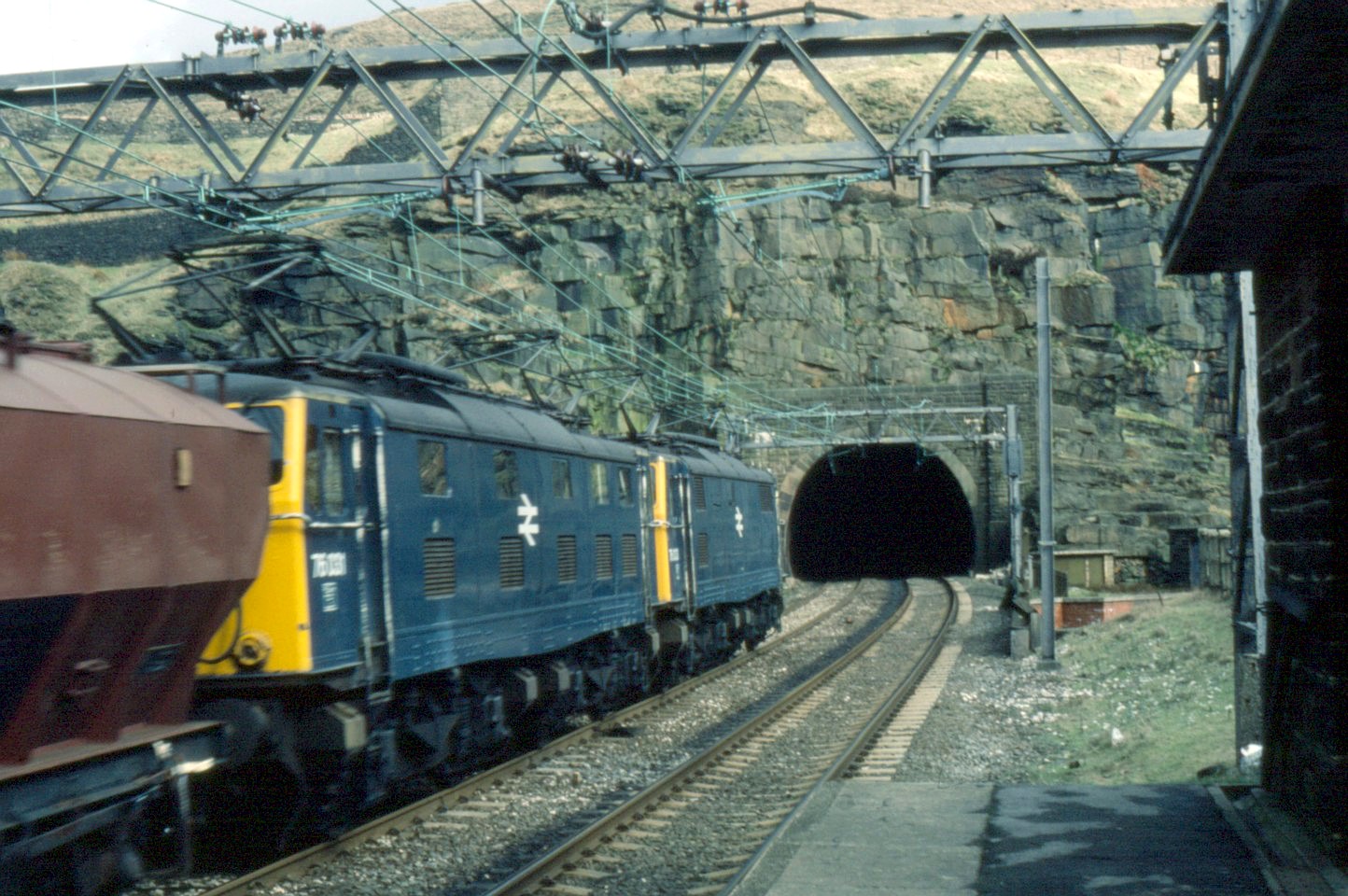
Here we see a pair of Class 76 EM1 locomotives about to enter Woodhead Tunnel with an eastbound coal train in the final days of the route, as seen from the long redundant platforms of Woodhead Station.
The Woodhead Route was opened in 1845 by the Sheffield, Ashton-under-Lyne and Manchester Railway, and stretched from Sheffield Victoria station, up to Penistone, through the hills in Woodhead Tunnel, and then down the valley via Guide Bridge to Manchester London Road (now Piccadilly), a distance of 41 miles. Operations later reverted to the Great Central Railway, and then the London and North Eastern Railway, before finally in 1948, as part of Nationalization and the formation of British Railways, it was designated as part of the Eastern Region, an odd move considering that this was deep Midland Region country.
In 1953 the route was electrified, a plan that had been considered by the GCR and later the LNER but was delayed due to World War II. Electrification of the route included the construction of a third Woodhead Tunnel, the previous two bores being unfit for handling heavy traffic and would need extensive modification to handle overhead wires. In 1955, electric services began fully using LNER designed EM1 and EM2 locomotives, these later being designated Class 76 and Class 77 respectively. The EM1's were used primarily for the haulage of heavy freight, whilst EM2's were specially designated for passenger usage. However, due to the fact that the line failed to serve any large settlements beyond Hadfield, the passenger service was withdrawn in 1971 and the EM2's were sold off to the Dutch Railways, where they continued to operate well into the 1980's.
Eventually, as coal traffic began to dwindle, the demand for trains travelling over the Pennines to be moved to the Hope Valley Line to the south and the outdated and non-standard equipment being used, the Woodhead Route was slated for closure, with the last trains running on the 17th July 1981. Throughout the 1980's the tracks were lifted and now there is very little to say the route ever existed beyond the abrupt buffer stops at Hadfield station, with nothing but an eerie trail leading off into the distance beyond, a hollow reminder of the roaring coal trains that used to pile through the now quiet station.
As for Woodhead Tunnel, the original Victorian bores are used to carry electric cabling for the National Grid, saving the need to construct Pylons over the top of the hills. The third bore has now been sealed off by gates and has been considered for use by the National Grid as a replacement for the dilapidated Victorian bores. However, stiff competition has resisted the use of the third bore as it would remove any chance of the tunnel being reused for railway operations, meaning that there is still a drive to have trains running through the Woodhead once again.
Only time will tell...
Pages scanned from a type specimen book for the Chicago Sun Times and Daily News ca. 1961. They plan copy with care is the mantra throughout. To design in those days was to be constantly counting, adding, dividing and redrawing to fit the available space. Though lead would soon be replaced by photo typesetting processes, the drudgery of counting characters and calculating what size type you could safely use remained the same until the arrival of the Macintosh. Unless that is, you were one of the lucky who owned their own stat camera.
As my father worked as a stereotyper at my hometown newspaper, these books bring back memories of Saturday nights watching him make plates for Sunday's paper. The linotype operators were in the next room, the composing room next to them.
My father was usually the only one working at that hour and often brought my brother and I with him. We wandered around picking up stray bits of type, entire lines of copy, advertisements that weighed a ton. Each page of the paper sat in a line on its own cart, so heavy was the finished composition.
My father sent the page, covered by a thick fibrous sheet they called a mat through a high pressure machine which perfectly indented every halftone, every nuance of the smallest line of copy. He then took this positive, placed it over a 180 degree cylinder, closed it, told us to get out of the way and poured a half gallon of molten lead into the contraption . What resulted was a printing plate, nearly ready to go on press.
After being sent through a cooling chamber Dad trimmed both sides with a saw and routed out any large white areas that might attract ink. He then placed it into a chute that delivered it swiftly to the pressman two stories below.
The industry and profession of stereotyping was already a dying one by the time Dad was in his 50s. Eventually the paper replaced lead with plastic and Dad retrained to be a pressman.
Ironically after all those years of working with lead with no adverse health issues he developed an allergy to the plastic plates and retired early.
I'm in the middle of revising the first of the two "Unpacking" chapters that will make up SHIRTLIFTER #4.
Part of the revisions is changing the color scheme, since I started the book planning for a duotone color scheme, which morphed into full color as my draft progressed.
Another part is rewriting. A third is getting rid of unnecessary material (only been a few panels here and there so far).
Another part is adding material. This is a panel from a complete new sequence that will be inserted about halfway through the chapter.
Revising is actually a lot more fun than working on the first draft - maybe because I can see the finish line. Hoping to get all the redrawing done by March.
Redrawing after a kylix in Tarquinia [~ 550 BC]
coloration by author to clarify the acting person
It is clearly visible how Herakles sits in the neck of the human-fish hybrid and strangles the Triton.
Greek vase paintings: a selection of examples ;
with preface, introduction and descriptions
London, 1894
digi.ub.uni-heidelberg.de/diglit/harrison1894/0048/image
Greek vase painting page 48 -
Herakles wrestling with Triton or Nereus
drawing after a kylix in Tarquinia
Black-figure kylix from Tarquinia, Archaeological Museum
RC 4194 [~ 550 BC]
Signalbox diagram from Trowse Yard in 1986.
At this stage, the yard area to the north of the line is being rationalised in readiness for the resignalling.
I have backdated the diagram digitally from the version in the box at closure, by redrawing overlaid area that covered the NCC warehouse siding, 39 disc and the two handpoints in the bottom left.
Mustafa Kemal Atatürk, also known as Mustafa Kemal Pasha until 1921, and Ghazi Mustafa Kemal from 1921 until the Surname Law of 1934 (c. 1881 – 10 November 1938), was a Turkish field marshal, revolutionary statesman, author, and the founding father of the Republic of Turkey, serving as its first president from 1923 until his death in 1938. He undertook sweeping progressive reforms, which modernized Turkey into a secular, industrializing nation. Ideologically a secularist and nationalist, his policies and socio-political theories became known as Kemalism.
Atatürk came to prominence for his role in securing the Ottoman Turkish victory at the Battle of Gallipoli (1915) during World War I. During this time, the Ottoman Empire perpetrated genocides against its Greek, Armenian and Assyrian subjects; while not directly involved, Atatürk's role in their aftermath has been controversial. Following the defeat of the Ottoman Empire after World War I, he led the Turkish National Movement, which resisted mainland Turkey's partition among the victorious Allied powers. Establishing a provisional government in the present-day Turkish capital Ankara (known in English at the time as Angora), he defeated the forces sent by the Allies, thus emerging victorious from what was later referred to as the Turkish War of Independence. He subsequently proceeded to abolish the sultanate in 1922 and proclaimed the foundation of the Turkish Republic in its place the following year.
As the president of the newly formed Turkish Republic, Atatürk initiated a rigorous program of political, economic, and cultural reforms with the ultimate aim of building a republican and secular nation-state. He made primary education free and compulsory, opening thousands of new schools all over the country. He also introduced the Latin-based Turkish alphabet, replacing the old Ottoman Turkish alphabet. Turkish women received equal civil and political rights during Atatürk's presidency. In particular, women were given voting rights in local elections by Act no. 1580 on 3 April 1930 and a few years later, in 1934, full universal suffrage. His government carried out a policy of Turkification, trying to create a homogeneous, unified and above all secular nation under the Turkish banner. Under Atatürk, the minorities in Turkey were ordered to speak Turkish in public, but were allowed to maintain their own languages in private and within their own communities; non-Turkish toponyms were replaced and non-Turkish families were ordered to adopt a Turkish surname. The Turkish Parliament granted him the surname Atatürk in 1934, which means "Father of the Turks", in recognition of the role he played in building the modern Turkish Republic. He died on 10 November 1938 at Dolmabahçe Palace in Istanbul, at the age of 57; he was succeeded as president by his long-time prime minister İsmet İnönü and was honored with a state funeral.
In 1981, the centennial of Atatürk's birth, his memory was honoured by the United Nations and UNESCO, which declared it The Atatürk Year in the World and adopted the Resolution on the Atatürk Centennial, describing him as "the leader of the first struggle given against colonialism and imperialism" and a "remarkable promoter of the sense of understanding between peoples and durable peace between the nations of the world and that he worked all his life for the development of harmony and cooperation between peoples without distinction". Atatürk was also credited for his peace-in-the-world oriented foreign policy and friendship with neighboring countries such as Iran, Yugoslavia, Iraq, and Greece, as well as the creation of the Balkan Pact that resisted the expansionist aggressions of Fascist Italy and Tsarist Bulgaria.
The Turkish War of Independence (19 May 1919 – 24 July 1923) was a series of military campaigns and a revolution waged by the Turkish National Movement, after parts of the Ottoman Empire were occupied and partitioned following its defeat in World War I. The conflict was between the Turkish Nationalists against Allied and separatist forces over the application of Wilsonian principles, especially national self-determination, in post-World War I Anatolia and Eastern Thrace. The revolution concluded the collapse of the Ottoman Empire; the Ottoman monarchy and the Islamic caliphate were abolished, and the Republic of Turkey was declared in Anatolia and Eastern Thrace. This resulted in a transfer of vested sovereignty from the sultan-caliph to the nation, setting the stage for Republican Turkey's period of nationalist revolutionary reform.
While World War I ended for the Ottoman Empire with the Armistice of Mudros, the Allied Powers continued occupying and securing land per the Sykes–Picot Agreement, as well as to facilitate the prosecution of former members of the Committee of Union and Progress and those involved in the Armenian genocide. Ottoman military commanders therefore refused orders from both the Allies and the Ottoman government to surrender and disband their forces. In an atmosphere of turmoil throughout the remainder of the empire, sultan Mehmed VI dispatched Mustafa Kemal Pasha (Atatürk), a well-respected and high-ranking general, to Anatolia to restore order; however, Mustafa Kemal became an enabler and eventually leader of Turkish Nationalist resistance against the Ottoman government, Allied powers, and separatists.
In an attempt to establish control over the power vacuum in Anatolia, the Allies agreed to launch a Greek peacekeeping force into Anatolia and occupy Smyrna (İzmir), inflaming sectarian tensions and beginning the Turkish War of Independence. A nationalist counter government led by Mustafa Kemal was established in Ankara when it became clear the Ottoman government was appeasing the Allied powers. The Allies soon pressured the Ottoman government in Constantinople to suspend the Constitution, shutter Parliament, and sign the Treaty of Sèvres, a treaty unfavorable to Turkish interests that the "Ankara government" declared illegal.
In the ensuing war, Turkish and Syrian forces defeated the French in the south, and remobilized army units went on to partition Armenia with the Bolsheviks, resulting in the Treaty of Kars (October 1921). The Western Front of the independence war is known as the Greco-Turkish War, in which Greek forces at first encountered unorganized resistance. However, İsmet Pasha (İnönü)'s organization of militia into a regular army paid off when Ankara forces fought the Greeks in the First and Second Battle of İnönü. The Greek army emerged victorious in the Battle of Kütahya-Eskişehir and decided to drive on the Nationalist capital of Ankara, stretching their supply lines. The Turks checked their advance in the Battle of Sakarya and eventually counter-attacked in the Great Offensive, which expelled Greek forces from Anatolia in the span of three weeks. The war effectively ended with the recapture of İzmir and the Chanak Crisis, prompting the signing of another armistice in Mudanya.
The Grand National Assembly in Ankara was recognized as the legitimate Turkish government, which signed the Treaty of Lausanne (July 1923), a treaty more favorable to Turkey than the Sèvres Treaty. The Allies evacuated Anatolia and Eastern Thrace, the Ottoman government was overthrown and the monarchy abolished, and the Grand National Assembly of Turkey (which remains Turkey's primary legislative body today) declared the Republic of Turkey on 29 October 1923. With the war, a population exchange between Greece and Turkey, the partitioning of the Ottoman Empire, and the abolition of the sultanate, the Ottoman era came to an end, and with Atatürk's reforms, the Turks created the modern, secular nation-state of Turkey. On 3 March 1924, the Ottoman caliphate was also abolished.
The ethnic demographics of the modern Turkish Republic were significantly impacted by the earlier Armenian genocide and the deportations of Greek-speaking, Orthodox Christian Rum people. The Turkish Nationalist Movement carried out massacres and deportations to eliminate native Christian populations—a continuation of the Armenian genocide and other ethnic cleansing operations during World War I. Following these campaigns of ethnic cleansing, the historic Christian presence in Anatolia was destroyed, in large part, and the Muslim demographic had increased from 80% to 98%.
Following the chaotic politics of the Second Constitutional Era, the Ottoman Empire came under the control of the Committee of Union and Progress in a coup in 1913, and then further consolidated its control after the assassination of Mahmud Shevket Pasha.[citation needed] Founded as a radical revolutionary group seeking to prevent a collapse of the Ottoman Empire, by the eve of World War I it decided that the solution was to implement nationalist and centralizing policies. The CUP reacted to the losses of land and the expulsion of Muslims from the Balkan Wars by turning even more nationalistic. Part of its effort to consolidate power was to proscribe and exile opposition politicians from the Freedom and Accord Party to remote Sinop.
The Unionists brought the Ottoman Empire into World War I on the side of Germany and Austria-Hungary, during which a genocidal campaign was waged against Ottoman Christians, namely Armenians, Pontic Greeks, and Assyrians. It was based on an alleged conspiracy that the three groups would rebel on the side of the Allies, so collective punishment was applied. A similar suspicion and suppression from the Turkish nationalist government was directed towards the Arab and Kurdish populations, leading to localized rebellions. The Entente powers reacted to these developments by charging the CUP leaders, commonly known as the Three Pashas, with "Crimes against humanity" and threatened accountability. They also had imperialist ambitions on Ottoman territory, with a major correspondence over a post-war settlement in the Ottoman Empire being leaked to the press as the Sykes–Picot Agreement. With Saint Petersburg's exit from World War I and descent into civil war, driven in part from the Ottomans' closure of the Turkish straits of goods bound to Russia, a new imperative was given to the Entente powers to knock the Ottoman Empire out of the war to restart the Eastern Front.
World War I would be the nail in the coffin of Ottomanism, a monarchist and multicultural nationalism. Mistreatment of non-Turk groups after 1913, and the general context of great socio-political upheaval that occurred in the aftermath of World War I, meant many minorities now wished to divorce their future from imperialism to form futures of their own by separating into (often republican) nation-states.
In the summer months of 1918, the leaders of the Central Powers realized that the Great War was lost, including the Ottomans'. Almost simultaneously the Palestinian Front and then the Macedonian Front collapsed. The sudden decision by Bulgaria to sign an armistice cut communications from Constantinople (İstanbul) to Vienna and Berlin, and opened the undefended Ottoman capital to Entente attack. With the major fronts crumbling, Unionist Grand Vizier Talât Pasha intended to sign an armistice, and resigned on 8 October 1918 so that a new government would receive less harsh armistice terms. The Armistice of Mudros was signed on 30 October 1918, ending World War I for the Ottoman Empire. Three days later, the Committee of Union and Progress (CUP)—which governed the Ottoman Empire as a one-party state since 1913—held its last congress, where it was decided the party would be dissolved. Talât, Enver Pasha, Cemal Pasha, and five other high-ranking members of the CUP escaped the Ottoman Empire on a German torpedo boat later that night, plunging the country into a power vacuum.
The armistice was signed because the Ottoman Empire had been defeated in important fronts, but the military was intact and retreated in good order. Unlike other Central Powers, the Allies did not mandate an abdication of the imperial family as a condition for peace, nor did they request the Ottoman Army to dissolve its general staff. Though the army suffered from mass desertion throughout the war which led to banditry, there was no threat of mutiny or revolutions like in Germany, Austria-Hungary, or Russia. This is despite famine and economic collapse that was brought on by the extreme levels of mobilization, destruction from the war, disease, and mass murder since 1914.
Due to the Turkish nationalist policies pursued by the CUP against Ottoman Christians by 1918 the Ottoman Empire held control over a mostly homogeneous land of Muslims from Eastern Thrace to the Persian border. These included mostly Turks, as well as Kurds, Circassians, and Muhacir groups from Rumeli. Most Muslim Arabs were now outside of the Ottoman Empire and under Allied occupation, with some "imperialists" still loyal to the Ottoman Sultanate-Caliphate, and others wishing for independence or Allied protection under a League of Nations mandate. Sizable Greek and Armenian minorities remained within its borders, and most of these communities no longer wished to remain under the Empire.
On 30 October 1918, the Armistice of Mudros was signed between the Ottoman Empire and the Allies of World War I, bringing hostilities in the Middle Eastern theatre of World War I to an end. The Ottoman Army was to demobilize, its navy and air force handed to the Allies, and occupied territory in the Caucasus and Persia to be evacuated. Critically, Article VII granted the Allies the right to occupy forts controlling the Turkish Straits and the vague right to occupy "in case of disorder" any territory if there were a threat to security. The clause relating to the occupation of the straits was meant to secure a Southern Russian intervention force, while the rest of the article was used to allow for Allied controlled peace-keeping forces. There was also a hope to follow through punishing local actors that carried out exterminatory orders from the CUP government against Armenian Ottomans. For now, the House of Osman escaped the fates of the Hohenzollerns, Habsburgs, and Romanovs to continue ruling their empire, though at the cost of its remaining sovereignty.
On 13 November 1918, a French brigade entered Constantinople to begin a de facto occupation of the Ottoman capital and its immediate dependencies. This was followed by a fleet consisting of British, French, Italian and Greek ships deploying soldiers on the ground the next day, totaling 50,000 troops in Constantinople. The Allied Powers stated that the occupation was temporary and its purpose was to protect the monarchy, the caliphate and the minorities. Somerset Arthur Gough-Calthorpe—the British signatory of the Mudros Armistice—stated the Triple Entente's public position that they had no intention to dismantle the Ottoman government or place it under military occupation by "occupying Constantinople". However, dismantling the government and partitioning the Ottoman Empire among the Allied nations had been an objective of the Entente since the start of WWI.
A wave of seizures took place in the rest of the country in the following months. Citing Article VII, British forces demanded that Turkish troops evacuate Mosul, claiming that Christian civilians in Mosul and Zakho were killed en masse. In the Caucasus, Britain established a presence in Menshevik Georgia and the Lori and Aras valleys as peace-keepers. On 14 November, joint Franco-Greek occupation was established in the town of Uzunköprü in Eastern Thrace as well as the railway axis until the train station of Hadımköy on the outskirts of Constantinople. On 1 December, British troops based in Syria occupied Kilis, Marash, Urfa and Birecik. Beginning in December, French troops began successive seizures of the province of Adana, including the towns of Antioch, Mersin, Tarsus, Ceyhan, Adana, Osmaniye, and İslâhiye, incorporating the area into the Occupied Enemy Territory Administration North while French forces embarked by gunboats and sent troops to the Black Sea ports of Zonguldak and Karadeniz Ereğli commanding Turkey's coal mining region. These continued seizures of land prompted Ottoman commanders to refuse demobilization and prepare for the resumption of war.
The British similarly asked Mustafa Kemal Pasha (Atatürk) to turn over the port of Alexandretta (İskenderun), which he reluctantly did, following which he was recalled to Constantinople. He made sure to distribute weapons to the population to prevent them from falling into the hands of Allied forces. Some of these weapons were smuggled to the east by members of Karakol, a successor to the CUP's Special Organization, to be used in case resistance was necessary in Anatolia. Many Ottoman officials participated in efforts to conceal from the occupying authorities details of the burgeoning independence movement spreading throughout Anatolia.
Other commanders began refusing orders from the Ottoman government and the Allied powers. After Mustafa Kemal Pasha returned to Constantinople, Ali Fuat Pasha (Cebesoy) brought XX Corps under his command. He marched first to Konya and then to Ankara to organise resistance groups, such as the Circassian çetes he assembled with guerilla leader Çerkes Ethem. Meanwhile, Kazım Karabekir Pasha refused to surrender his intact and powerful XV Corps in Erzurum. Evacuation from the Caucusus, puppet republics and Muslim militia groups were established in the army's wake to hamper with the consolidation of the new Armenian state. Elsewhere in the country, regional nationalist resistance organizations known as Şuras –meaning "councils", not unlike soviets in revolutionary Russia– were founded, most pledging allegiance to the Defence of National Rights movement that protested continued Allied occupation and appeasement by the Sublime Porte.
Following the occupation of Constantinople, Mehmed VI Vahdettin dissolved the Chamber of Deputies which was dominated by Unionists elected back in 1914, promising elections for the next year. Vahdettin just ascended to the throne only months earlier with the death of Mehmed V Reşad. He was disgusted with the policies of the CUP, and wished to be a more assertive sovereign than his diseased half brother. Greek and Armenian Ottomans declared the termination of their relationship with the Ottoman Empire through their respective patriarchates, and refused to partake in any future election. With the collapse of the CUP and its censorship regime, an outpouring of condemnation against the party came from all parts of Ottoman media.
A general amnesty was soon issued, allowing the exiled and imprisoned dissidents persecuted by the CUP to return to Constantinople. Vahdettin invited the pro-Palace politician Damat Ferid Pasha, leader of the reconstituted Freedom and Accord Party, to form a government, whose members quickly set out to purge the Unionists from the Ottoman government. Ferid Pasha hoped that his Anglophilia and an attitude of appeasement would induce less harsh peace terms from the Allied powers. However, his appointment was problematic for nationalists, many being members of the liquidated committee that were surely to face trial. Years of corruption, unconstitutional acts, war profiteering, and enrichment from ethnic cleansing and genocide by the Unionists soon became basis of war crimes trials and courts martial trials held in Constantinople.[citation needed] While many leading Unionists were sentenced lengthy prison sentences, many made sure to escape the country before Allied occupation or to regions that the government now had minimal control over; thus most were sentenced in absentia. The Allies encouragement of the proceedings and the use of British Malta as their holding ground made the trials unpopular. The partisan nature of the trials was not lost on observers either. The hanging of the Kaymakam of Boğazlıyan district Mehmed Kemal resulted in a demonstration against the courts martials trials.
With all the chaotic politics in the capital and uncertainty of the severity of the incoming peace treaty, many Ottomans looked to Washington with the hope that the application of Wilsonian principles would mean Constantinople would stay Turkish, as Muslims outnumbered Christians 2:1. The United States never declared war on the Ottoman Empire, so many imperial elite believed Washington could be a neutral arbiter that could fix the empire's problems. Halide Edip (Adıvar) and her Wilsonian Principles Society led the movement that advocated for the empire to be governed by an American League of Nations Mandate (see United States during the Turkish War of Independence). American diplomats attempted to ascertain a role they could play in the area with the Harbord and King–Crane Commissions. However, with the collapse of Woodrow Wilson's health, the United States diplomatically withdrew from the Middle East to focus on Europe, leaving the Entente powers to construct a post-Ottoman order.
The Entente would have arrived at Constantinople to discover an administration attempting to deal with decades of accumulated refugee crisis. The new government issued a proclamation allowing for deportees to return to their homes, but many Greeks and Armenians found their old homes occupied by desperate Rumelian and Caucasian Muslim refugees which were settled in their properties during the First World War. Ethnic conflict restarted in Anatolia; government officials responsible for resettling Christian refugees often assisted Muslim refugees in these disputes, prompting European powers to continue bringing Ottoman territory under their control. Of the 800,000 Ottoman Christian refugees, approximately over half returned to their homes by 1920. Meanwhile 1.4 million refugees from the Russian Civil War would pass through the Turkish straits and Anatolia, with 150,000 White émigrés choosing to settle in Istanbul for short or long term (see Evacuation of the Crimea). Many provinces were simply depopulated from years of fighting, conscription, and ethnic cleansing (see Ottoman casualties of World War I). The province of Yozgat lost 50% of its Muslim population from conscription, while according to the governor of Van, almost 95% of its prewar residents were dead or internally displaced.
Administration in much of the Anatolian and Thracian countryside would soon all but collapse by 1919. Army deserters who turned to banditry essentially controlled fiefdoms with tacit approval from bureaucrats and local elites. An amnesty issued in late 1918 saw these bandits strengthen their positions and fight amongst each other instead of returning to civilian life. Albanian and Circassian muhacirs resettled by the government in northwestern Anatolia and Kurds in southeastern Anatolia were engaged in blood feuds that intensified during the war and were hesitant to pledge allegiance to the Defence of Rights movement, and only would if officials could facilitate truces. Various Muhacir groups were suspicious of the continued Ittihadist ideology in the Defence of Rights movement, and the potential for themselves to meet fates 'like the Armenians' especially as warlords hailing from those communities assisted the deportations of the Christians even though as many commanders in the Nationalist movement also had Caucasian and Balkan Muslim ancestry.
With Anatolia in practical anarchy and the Ottoman army being questionably loyal in reaction to Allied land seizures, Mehmed VI established the military inspectorate system to reestablish authority over the remaining empire. Encouraged by Karabekir and Edmund Allenby, he assigned Mustafa Kemal Pasha (Atatürk) as the inspector of the Ninth Army Troops Inspectorate –based in Erzurum– to restore order to Ottoman military units and to improve internal security on 30 April 1919, with his first assignment to suppress a rebellion by Greek rebels around the city of Samsun.
Mustafa Kemal was a well known, well respected, and well connected army commander, with much prestige coming from his status as the "Hero of Anafartalar"—for his role in the Gallipoli Campaign—and his title of "Honorary Aide-de-camp to His Majesty Sultan" gained in the last months of WWI. This choice would seem curious, as he was a nationalist and a fierce critic of the government's accommodating policy to the Entente powers. He was also an early member of the CUP. However Kemal Pasha did not associate himself with the fanatical faction of the CUP, many knew that he frequently clashed with the radicals of the Central Committee like Enver. He was therefore sidelined to the periphery of power throughout the Great War; after the CUP's dissolution he vocally aligned himself with moderates that formed the Liberal People's Party instead of the rump radical faction which formed the Renewal Party (both parties would be banned in May 1919 for being successors of the CUP). All these reasons allowed him to be the most legitimate nationalist for the sultan to placate. In this new political climate, he sought to capitalize on his war exploits to attain a better job, indeed several times he unsuccessfully lobbied for his inclusion in cabinet as War Minister. His new assignment gave him effective plenipotentiary powers over all of Anatolia which was meant to accommodate him and other nationalists to keep them loyal to the government.
Mustafa Kemal had earlier declined to become the leader of the Sixth Army headquartered in Nusaybin. But according to Patrick Balfour, through manipulation and the help of friends and sympathizers, he became the inspector of virtually all of the Ottoman forces in Anatolia, tasked with overseeing the disbanding process of remaining Ottoman forces. Kemal had an abundance of connections and personal friends concentrated in the post-armistice War Ministry, a powerful tool that would help him accomplish his secret goal: to lead a nationalist movement to safeguard Turkish interests against the Allied powers and a collaborative Ottoman government.
The day before his departure to Samsun on the remote Black Sea coast, Kemal had one last audience with Sultan Vahdettin, where he affirmed his loyalty to the sultan-caliph. It was in this meeting that they were informed of the botched occupation ceremony of Smyrna (İzmir) by the Greeks. He and his carefully selected staff left Constantinople aboard the old steamer SS Bandırma on the evening of 16 May 1919.
On 19 January 1919, the Paris Peace Conference was first held, at which Allied nations set the peace terms for the defeated Central Powers, including the Ottoman Empire. As a special body of the Paris Conference, "The Inter-Allied Commission on Mandates in Turkey", was established to pursue the secret treaties they had signed between 1915 and 1917. Italy sought control over the southern part of Anatolia under the Agreement of St.-Jean-de-Maurienne. France expected to exercise control over Hatay, Lebanon, Syria, and a portion of southeastern Anatolia based on the Sykes–Picot Agreement.
Greece justified their territorial claims of Ottoman land through the Megali Idea as well as international sympathy from the suffering of Ottoman Greeks in 1914 and 1917–1918. Privately, Greek prime minister Eleftherios Venizelos had British prime minister David Lloyd George's backing not least from Greece's entrance to WWI on the Allied side, but also from his charisma and charming personality. Greece's participation in the Allies' Southern Russian intervention also earned it favors in Paris. His demands included parts of Eastern Thrace, the islands of Imbros (Gökçeada), Tenedos (Bozcaada), and parts of Western Anatolia around the city of Smyrna (İzmir), all of which had large Greek populations. Venizelos also advocated a large Armenian state to check a post-war Ottoman Empire. Greece wanted to incorporate Constantinople, but Entente powers did not give permission. Damat Ferid Pasha went to Paris on behalf of the Ottoman Empire hoping to minimize territorial losses using Fourteen Points rhetoric, wishing for a return to status quo ante bellum, on the basis that every province of the Empire holds Muslim majorities. This plea was met with ridicule.
At the Paris Peace Conference, competing claims over Western Anatolia by Greek and Italian delegations led Greece to land the flagship of the Greek Navy at Smyrna, resulting in the Italian delegation walking out of the peace talks. On 30 April, Italy responded to the possible idea of Greek incorporation of Western Anatolia by sending a warship to Smyrna as a show of force against the Greek campaign. A large Italian force also landed in Antalya. Faced with Italian annexation of parts of Asia Minor with a significant ethnic Greek population, Venizelos secured Allied permission for Greek troops to land in Smyrna per Article VII, ostensibly as a peacekeeping force to keep stability in the region. Venizelos's rhetoric was more directed against the CUP regime than the Turks as a whole, an attitude not always shared in the Greek military: "Greece is not making war against Islam, but against the anachronistic [İttihadist] Government, and its corrupt, ignominious, and bloody administration, with a view to the expelling it from those territories where the majority of the population consists of Greeks." It was decided by the Triple Entente that Greece would control a zone around Smyrna and Ayvalık in western Asia Minor.
Most historians mark the Greek landing at Smyrna on 15 May 1919 as the start date of the Turkish War of Independence as well as the start of the "Kuva-yi Milliye Phase". The occupation ceremony from the outset was tense from nationalist fervor, with Ottoman Greeks greeting the soldiers with an ecstatic welcome, and Ottoman Muslims protesting the landing. A miscommunication in Greek high command led to an Evzone column marching by the municipal Turkish barracks. The nationalist journalist Hasan Tahsin fired the "first bullet"[note 4] at the Greek standard bearer at the head of the troops, turning the city into a warzone. Süleyman Fethi Bey was murdered by bayonet for refusing to shout "Zito Venizelos" (meaning "long live Venizelos"), and 300–400 unarmed Turkish soldiers and civilians and 100 Greek soldiers and civilians were killed or wounded.
Greek troops moved from Smyrna outwards to towns on the Karaburun peninsula; to Selçuk, situated a hundred kilometres south of the city at a key location that commands the fertile Küçük Menderes River valley; and to Menemen towards the north. Guerilla warfare commenced in the countryside, as Turks began to organize themselves into irregular guerilla groups known as Kuva-yi Milliye (national forces), which were soon joined by Ottoman soldiers, bandits, and disaffected farmers. Most Kuva-yi Milliye bands were led by rogue military commanders and members of the Special Organization. The Greek troops based in cosmopolitan Smyrna soon found themselves conducting counterinsurgency operations in a hostile, dominantly Muslim hinterland. Groups of Ottoman Greeks also formed contingents that cooperated with the Greek Army to combat Kuva-yi Milliye within the zone of control. A massacre of Turks at Menemen was followed up with a battle for the town of Aydın, which saw intense intercommunal violence and the razing of the city. What was supposed to be a peacekeeping mission of Western Anatolia instead inflamed ethnic tensions and became a counterinsurgency.
The reaction of Greek landing at Smyrna and continued Allied seizures of land served to destabilize Turkish civil society. Ottoman bureaucrats, military, and bourgeoisie trusted the Allies to bring peace, and thought the terms offered at Mudros were considerably more lenient than they actually were. Pushback was potent in the capital, with 23 May 1919 being largest of the Sultanahmet Square demonstrations organized by the Turkish Hearths against the Greek occupation of Smyrna, the largest act of civil disobedience in Turkish history at that point. The Ottoman government condemned the landing, but could do little about it. Ferid Pasha tried to resign, but was urged by the sultan to stay in his office.
Mustafa Kemal Pasha and his colleagues stepped ashore in Samsun on 19 May and set up their first quarters in the Mıntıka Palace Hotel. British troops were present in Samsun, and he initially maintained cordial contact. He had assured Damat Ferid about the army's loyalty towards the new government in Constantinople. However, behind the government's back, Kemal made the people of Samsun aware of the Greek and Italian landings, staged discreet mass meetings, made fast connections via telegraph with the army units in Anatolia, and began to form links with various Nationalist groups. He sent telegrams of protest to foreign embassies and the War Ministry about British reinforcements in the area and about British aid to Greek brigand gangs. After a week in Samsun, Kemal and his staff moved to Havza. It was there that he first showed the flag of the resistance.
Mustafa Kemal wrote in his memoir that he needed nationwide support to justify armed resistance against the Allied occupation. His credentials and the importance of his position were not enough to inspire everyone. While officially occupied with the disarming of the army, he met with various contacts in order to build his movement's momentum. He met with Rauf Pasha, Karabekir Pasha, Ali Fuat Pasha, and Refet Pasha and issued the Amasya Circular (22 June 1919). Ottoman provincial authorities were notified via telegraph that the unity and independence of the nation was at risk, and that the government in Constantinople was compromised. To remedy this, a congress was to take place in Erzurum between delegates of the Six Vilayets to decide on a response, and another congress would take place in Sivas where every Vilayet should send delegates. Sympathy and an lack of coordination from the capital gave Mustafa Kemal freedom of movement and telegraph use despite his implied anti-government tone.
On 23 June, High Commissioner Admiral Calthorpe, realising the significance of Mustafa Kemal's discreet activities in Anatolia, sent a report about the Pasha to the Foreign Office. His remarks were downplayed by George Kidson of the Eastern Department. Captain Hurst of the British occupation force in Samsun warned Admiral Calthorpe one more time, but Hurst's units were replaced with the Brigade of Gurkhas. When the British landed in Alexandretta, Admiral Calthorpe resigned on the basis that this was against the armistice that he had signed and was assigned to another position on 5 August 1919. The movement of British units alarmed the population of the region and convinced them that Mustafa Kemal was right.
By early July, Mustafa Kemal Pasha received telegrams from the sultan and Calthorpe, asking him and Refet to cease his activities in Anatolia and return to the capital. Kemal was in Erzincan and did not want to return to Constantinople, concerned that the foreign authorities might have designs for him beyond the sultan's plans. Before resigning from his position, he dispatched a circular to all nationalist organizations and military commanders to not disband or surrender unless for the latter if they could be replaced by cooperative nationalist commanders. Now only a civilian stripped of his command, Mustafa Kemal was at the mercy of the new inspector of Third Army (renamed from Ninth Army) Karabekir Pasha, indeed the War Ministry ordered him to arrest Kemal, an order which Karabekir refused. The Erzurum Congress was a meeting of delegates and governors from the six Eastern Vilayets. They drafted the National Pact (Misak-ı Millî), which envisioned new borders for the Ottoman Empire by applying principles of national self-determination per Woodrow Wilson's Fourteen Points and the abolition of the capitulations. The Erzurum Congress concluded with a circular that was effectively a declaration of independence: All regions within Ottoman borders upon the signing of the Mudros Armistice were indivisible from the Ottoman state –Greek and Armenian claims on Thrace and Anatolia were moot– and assistance from any country not coveting Ottoman territory was welcome. If the government in Constantinople was not able to attain this after electing a new parliament, they insisted a provisional government should be promulgated to defend Turkish sovereignty. The Committee of Representation was established as a provisional executive body based in Anatolia, with Mustafa Kemal Pasha as its chairman.
Following the congress, the Committee of Representation relocated to Sivas. As announced in the Amasya Circular, a new congress was held there in September with delegates from all Anatolian and Thracian provinces. The Sivas Congress repeated the points of the National Pact agreed to in Erzurum, and united the various regional Defence of National Rights Associations organizations, into a united political organisation: Anatolia and Rumeli Defence of Rights Association (A-RMHC), with Mustafa Kemal as its chairman. In an effort show his movement was in fact a new and unifying movement, the delegates had to swear an oath to discontinue their relations with the CUP and to never revive the party (despite most present in Sivas being previous members).[120] It was also decided there that the Ottoman Empire should not be a League of Nations mandate under the United States, especially after the U.S Senate failed to ratify American membership in the League.
Momentum was now on the Nationalists' side. A plot by a loyalist Ottoman governor and a British intelligence officer to arrest Kemal before the Sivas Congress led to the cutting of all ties with the Ottoman government until a new election would be held in the lower house of parliament, the Chamber of Deputies. In October 1919, the last Ottoman governor loyal to Constantinople fled his province. Fearing the outbreak of hostilities, all British troops stationed in the Black Sea coast and Kütahya were evacuated. Damat Ferid Pasha resigned, and the sultan replaced him with a general with nationalist credentials: Ali Rıza Pasha. On 16 October 1919, Ali Rıza and the Nationalists held negotiations in Amasya. They agreed in the Amasya Protocol that an election would be called for the Ottoman Parliament to establish national unity by upholding the resolutions made in the Sivas Congress, including the National Pact.
By October 1919, the Ottoman government only held de facto control over Constantinople; the rest of the Ottoman Empire was loyal to Kemal's movement to resist a partition of Anatolia and Thrace. Within a few months Mustafa Kemal went from General Inspector of the Ninth Army to a renegade military commander discharged for insubordination to leading a homegrown anti-Entente movement that overthrew a government and driven it into resistance.
In December 1919, an election was held for the Ottoman parliament, with polls only open in unoccupied Anatolia and Thrace. It was boycotted by Ottoman Greeks, Ottoman Armenians and the Freedom and Accord Party, resulting in groups associated with the Turkish Nationalist Movement winning, including the A-RMHC. The Nationalists' obvious links to the CUP made the election especially polarizing and voter intimidation and ballot box stuffing in favor of the Kemalists were regular occurrences in rural provinces. This controversy led to many of the nationalist MPs organizing the National Salvation Group separate from Kemal's movement, which risked the nationalist movement splitting in two.
Mustafa Kemal was elected an MP from Erzurum, but he expected the Allies neither to accept the Harbord report nor to respect his parliamentary immunity if he went to the Ottoman capital, hence he remained in Anatolia. Mustafa Kemal and the Committee of Representation moved from Sivas to Ankara so that he could keep in touch with as many deputies as possible as they traveled to Constantinople to attend the parliament.
Though Ali Rıza Pasha called the election as per the Amasya Protocol to keep unity between the "Istanbul government" and "Ankara government", he was wrong to think the election could bring him any legitimacy. The Ottoman parliament was under the de facto control of the British battalion stationed at Constantinople and any decisions by the parliament had to have the signatures of both Ali Rıza Pasha and the battalion's commanding officer. The only laws that passed were those acceptable to, or specifically ordered by the British.
On 12 January 1920, the last session of the Chamber of Deputies met in the capital. First the sultan's speech was presented, and then a telegram from Mustafa Kemal, manifesting the claim that the rightful government of Turkey was in Ankara in the name of the Committee of Representation. On 28 January the MPs from both sides of the isle secretly met to endorse the National Pact as a peace settlement. They added to the points passed in Sivas, calling for plebiscites to be held in West Thrace; Batum, Kars, and Ardahan, and Arab lands on whether to stay in the Empire or not. Proposals were also made to elect Kemal president of the Chamber;[clarification needed] however, this was deferred in the certain knowledge that the British would prorogue the Chamber. The Chamber of Deputies would be forcefully dissolved for passing the National Pact anyway. The National Pact solidified Nationalist interests, which were in conflict with the Allied plans.
From February to April, leaders of Britain, France, and Italy met in London to discuss the partitioning of the Ottoman Empire and the crisis in Anatolia. The British began to sense that the elected Ottoman government was under Kemalist influence and if left unchecked, the Entente could once again find themselves at war with the Empire. The Ottoman government was not doing all that it could to suppress the Nationalists.
Mustafa Kemal manufactured a crisis to pressure the Istanbul government to pick a side by deploying Kuva-yi Milliye towards İzmit. The British, concerned about the security of the Bosporus Strait, demanded Ali Rıza Pasha to reassert control over the area, to which he responded with his resignation to the sultan.
As they were negotiating the partition of the Ottoman Empire, the Allies were growing increasingly concerned about the Turkish National Movement. To this end, the Allied occupational authorities in Istanbul began to plan a raid to arrest nationalist politicians and journalists along with occupying military and police installations and government buildings. On 16 March 1920, the coup was carried out; several Royal Navy warships were anchored in the Galata Bridge to support British forces, including the Indian Army, while they carried out the arrests and occupied several government buildings in the early hours of the morning.
An Indian Army operation, the Şehzadebaşı raid, resulted in 5 Ottoman soldiers from the 10th Infantry Division being killed when troops raided their barracks. Among those arrested were the senior leadership of the Turkish National Movement and former members of the CUP. 150 arrested Turkish politicians accused of war crimes were interned in Malta and became known as the Malta exiles.
Mustafa Kemal was ready for this move. He warned all the Nationalist organisations that there would be misleading declarations from the capital. He warned that the only way to counter Allied movements was to organise protests. He declared "Today the Turkish nation is called to defend its capacity for civilization, its right to life and independence – its entire future".
On 18 March, the Chamber of Deputies declared that it was unacceptable to arrest five of its members, and dissolved itself. Mehmed VI confirmed this and declared the end of Constitutional Monarchy and a return to absolutism. University students were forbidden from joining political associations inside and outside the classroom. With the lower elected Chamber of Deputies shuttered, the Constitution terminated, and the capital occupied; Sultan Vahdettin, his cabinet, and the appointed Senate were all that remained of the Ottoman government, and were basically a puppet regime of the Allied powers. Grand Vizier Salih Hulusi Pasha declared Mustafa Kemal's struggle legitimate, and resigned after less than a month in office. In his place, Damat Ferid Pasha returned to the premiership. The Sublime Porte's decapitation by the Entente allowed Mustafa Kemal to consolidate his position as the sole leader of Turkish resistance against the Allies, and to that end made him the legitimate representative of the Turkish people.
The strong measures taken against the Nationalists by the Allies in March 1920 began a distinct new phase of the conflict. Mustafa Kemal sent a note to the governors and force commanders, asking them to conduct elections to provide delegates for a new parliament to represent the Ottoman (Turkish) people, which would convene in Ankara. With the proclamation of the counter-government, Kemal would then ask the sultan to accept its authority. Mustafa Kemal appealed to the Islamic world, asking for help to make sure that everyone knew he was still fighting in the name of the sultan who was also the caliph. He stated he wanted to free the caliph from the Allies. He found an ally in the Khilafat movement of British India, where Indians protested Britain's planned dismemberment of Turkey. A committee was also started for sending funds to help the soon to be proclaimed Ankara government of Mustafa Kemal. A flood of supporters moved to Ankara just ahead of the Allied dragnets. Included among them were Halide Edip and Abdülhak Adnan (Adıvar), Mustafa İsmet Pasha (İnönü), Mustafa Fevzi Pasha (Çakmak), many of Kemal's allies in the Ministry of War, and Celalettin Arif, the president of the now shuttered Chamber of Deputies. Celaleddin Arif's desertion of the capital was of great significance, as he declared that the Ottoman Parliament had been dissolved illegally.
Some 100 members of the Chamber of Deputies were able to escape the Allied roundup and joined 190 deputies elected. In March 1920, Turkish revolutionaries announced the establishment of a new parliament in Ankara known as the Grand National Assembly of Turkey (GNA) that was dominated by the A-RMHC.[citation needed] The parliament included Turks, Circassians, Kurds, and one Jew. They met in a building that used to serve as the provincial headquarters of the local CUP chapter. The inclusion of "Turkey" in its name reflected a increasing trend of new ways Ottoman citizens thought of their country, and was the first time it was formally used as the name of the country. On 23 April, the assembly, assuming full governmental powers, gathered for the first time, electing Mustafa Kemal its first Speaker and Prime Minister.
Hoping to undermine the Nationalist Movement, Mehmed VI issued a fatwa to qualify the Turkish revolutionaries as infidels, calling for the death of its leaders. The fatwa stated that true believers should not go along with the Nationalist Movement as they committed apostasy. The mufti of Ankara Rifat Börekçi issued a simultaneous fatwa, declaring that the caliphate was under the control of the Entente and the Ferid Pasha government. In this text, the Nationalist Movement's goal was stated as freeing the sultanate and the caliphate from its enemies. In reaction to the desertion of several prominent figures to the Nationalist Movement, Ferid Pasha ordered Halide Edip, Ali Fuat and Mustafa Kemal to be sentenced to death in absentia for treason.
On 28 April the sultan raised 4,000 soldiers known as the Kuva-yi İnzibatiye (Caliphate Army) to combat the Nationalists. Then using money from the Allies, another force about 2,000 strong from non-Muslim inhabitants were initially deployed in İznik. The sultan's government sent the forces under the name of the Caliphate Army to the revolutionaries to arouse counterrevolutionary sympathy. The British, being skeptical of how formidable these insurgents were, decided to use irregular power to counteract the revolutionaries. The Nationalist forces were distributed all around Turkey, so many smaller units were dispatched to face them. In İzmit there were two battalions of the British army. These units were to be used to rout the partisans under the command of Ali Fuat and Refet Pasha.
Anatolia had many competing forces on its soil: British troops, Nationalist militia (Kuva-yi Milliye), the sultan's army (Kuva-yi İnzibatiye), and Anzavur's bands. On 13 April 1920, an uprising supported by Anzavur against the GNA occurred at Düzce as a direct consequence of the fatwa. Within days the rebellion spread to Bolu and Gerede. The movement engulfed northwestern Anatolia for about a month. On 14 June, Nationalist militia fought a pitched battle near İzmit against the Kuva-yi İnzibatiye, Anzavur's bands, and British units. Yet under heavy attack some of the Kuva-yi İnzibatiye deserted and joined the Nationalist militia. Anzavur was not so lucky, as the Nationalists tasked Ethem the Circassian with crushing Anzavur's revolt. This revealed the sultan did not have the unwavering support of his own men and allies. Meanwhile, the rest of these forces withdrew behind the British lines which held their position. For now, Istanbul was out of Ankara's grasp.
The clash outside İzmit brought serious consequences. British forces conducted combat operations on the Nationalists and the Royal Air Force carried out aerial bombardments against the positions, which forced Nationalist forces to temporarily retreat to more secure missions. The British commander in Turkey, General George Milne—, asked for reinforcements. This led to a study to determine what would be required to defeat the Turkish Nationalists. The report, signed by French Field Marshal Ferdinand Foch, concluded that 27 divisions were necessary, but the British army did not have 27 divisions to spare. Also, a deployment of this size could have disastrous political consequences back home. World War I had just ended, and the British public would not support another lengthy and costly expedition.
The British accepted the fact that a nationalist movement could not be defeated without deployment of consistent and well-trained forces. On 25 June, the forces originating from Kuva-i İnzibatiye were dismantled under British supervision. The British realised that the best option to overcome these Turkish Nationalists was to use a force that was battle-tested and fierce enough to fight the Turks on their own soil. The British had to look no further than Turkey's neighbor already occupying its territory: Greece.
Eleftherios Venizelos, pessimistic of the rapidly deteriorating situation in Anatolia, requested to the Allies that a peace treaty be drawn up with the hope that fighting would stop. The subsequent treaty of Sèvres in August 1920 confirmed the Arab provinces of the empire would be reorganized into new nations given to Britain and France in the form of Mandates by the League of Nations, while the rest of the Empire would be partitioned between Greece, Italy, France (via Syrian mandate), Britain (via Iraqi mandate), Armenia (potentially under an American mandate), and Georgia. Smyrna would hold a plebiscite on whether to stay with Greece or Turkey, and the Kurdistan region would hold one on the question of independence. British, French, and Italian spheres of influence would also extend into Anatolia beyond the land concessions. The old capital of Constantinople as well as the Dardanelles would be under international League of Nations control.
However, the treaty could never come into effect. The treaty was extremely unpopular, with protests against the final document held even before its release in Sultanahmet square. Though Mehmed VI and Ferid Pasha loathed the treaty, they did not want Istanbul to join Ankara in nationalist struggle. The Ottoman government and Greece never ratified it. Though Ferid Pasha signed the treaty, the Ottoman Senate, the upper house with seats appointed by the sultan, refused to ratify the treaty. Greece disagreed on the borders drawn. The other allies began to fracture their support of the settlement immediately. Italy started openly supporting the Nationalists with arms by the end of 1920, and the French signed another separate peace treaty with Ankara only months later.
Kemal's GNA Government responded to the Treaty of Sèvres by promulgating a new constitution in January 1921. The resulting constitution consecrated the principle of popular sovereignty; authority not deriving from the unelected sultan, but from the Turkish people who elect governments representative of their interests. This document became the legal basis for the war of independence by the GNA, as the sultan's signature of the Treaty of Sèvres would be unconstitutional as his position was not elected. While the constitution did not specify a future role of the sultan, the document gave Kemal ever more legitimacy in the eyes of Turks for justified resistance against Istanbul.
In contrast to the Eastern and Western fronts, it was mostly unorganized Kuva-yi Milliye which were fighting in the Southern Front against France. They had help from the Syrians, who were fighting their own war with the French.
The British troops which occupied coastal Syria by the end of World War I were replaced by French troops over 1919, with the Syrian interior going to Faisal bin Al-Hussein's self-proclaimed Arab Kingdom of Syria. France which wanted to take control of all of Syria and Cilicia. There was also a desire facilitate the return of Armenian refugees in the region to their homes, and the occupation force consisted of the French Armenian Legion as well as various Armenian militia groups. 150,000 Armenians were repatriated to their homes within months of French occupation. On 21 January 1920, a Turkish Nationalist uprising and siege occurred against the French garrison in Marash. The French position untenable they retreated to Islahiye, resulting in a massacre of many Armenians by Turkish militia. A grueling siege followed in Antep which featured intense sectarian violence between Turks and Armenians. After a failed uprising by the Nationalists in Adana, by 1921, the French and Turks signed an armistice and eventually a treaty was brokered demarcating the border between the Ankara government and French controlled Syria. In the end, there was a mass exodus of Cilician Armenians to French controlled Syria, Previous Armenian survivors of deportation found themselves again as refugees and families which avoided the worst of the six years violence were forced from their homes, ending thousands of years of Christian presence in Southern Anatolia.[146] With France being the first Allied power to recognize and negotiate with the Ankara government only months after signing the Treaty of Sèvres, it was the first to break from the coordinated Allied approach to the Eastern question. In 1923 the Mandate for Syria and the Lebanon under French authority would be proclaimed in former Ottoman territory.
Some efforts to coordinate between Turkish Nationalists and the Syrian rebels persisted from 1920 to 1921, with the Nationalists supporting the Faisal's kingdom through Ibrahim Hanunu and Alawite groups which were also fighting the French. While the French conquered Syria, Cilicia had to be abandoned.
Kuva-yi Milliye also engaged with British forces in the "Al-Jazira Front," primarily in Mosul. Ali İhsan Pasha (Sabis) and his forces defending Mosul would surrender to the British in October 1918, but the British ignored the armistice and seized the city, following which the pasha also ignored the armistice and distributed weapons to the locals. Even before Mustafa Kemal's movement was fully organized, rogue commanders found allies in Kurdish tribes. The Kurds detested the taxes and centralization the British demanded, including Shaykh Mahmud of the Barzani family. Having previously supported the British invasion of Mesopotamia to become the governor of South Kurdistan, Mahmud revolted but was apprehended by 1919. Without legitimacy to govern the region, he was released from captivity to Sulaymaniyah, where he again declared an uprising against the British as the King of Kurdistan. Though an alliance existed with the Turks, little material support came to him from Ankara, and by 1923 there was a desire to cease hostilities between the Turks and British at Barzanji's expense. Mahmud was overthrown in 1924, and after a 1926 plebiscite, Mosul was awarded to British-controlled Iraq.
Since 1917, the Caucasus was in a chaotic state. The border of newly independent Armenia and the Ottoman Empire was defined in the Treaty of Brest-Litovsk (3 March 1918) after the Bolshevik revolution, and later by the Treaty of Batum (4 June 1918). To the east, Armenia was at war with the Azerbaijan Democratic Republic after the breakup of the Transcaucasian Democratic Federative Republic, and received support from Anton Denikin's White Russian Army. It was obvious that after the Armistice of Mudros (30 October 1918) the eastern border was not going to stay as it was drawn, which mandated the evacuation of the Ottoman army back to its 1914 borders. Right after the Armistice of Mudros was signed, pro-Ottoman provisional republics were proclaimed in Kars and Aras which were subsequently invaded by Armenia. Ottoman soldiers were convinced not to demobilize lest the area become a 'second Macedonia'.[149] Both sides of the new borders had massive refugee populations and famine, which were compounded by the renewed and more symmetric sectarian violence (See Massacres of Azerbaijanis in Armenia (1917–1921) and Muslim uprisings in Kars and Sharur–Nakhichevan). There were talks going on with the Armenian Diaspora and Allied Powers on reshaping the border. Woodrow Wilson agreed to transfer territories to Armenia based on the principles of national self-determination. The results of these talks were to be reflected on the Treaty of Sèvres (10 August 1920).
Kâzım Karabekir Pasha, commander of the XV corps, encountered Muslim refugees fleeing from the Armenian army, but did not have the authority to cross the border. Karabekir's two reports (30 May and 4 June 1920) outlined the situation in the region. He recommended redrawing the eastern borders, especially around Erzurum. The Russian government was receptive to this and demanded that Van and Bitlis be transferred to Armenia. This was unacceptable to the Turkish revolutionaries. However, Soviet support was absolutely vital for the Turkish Nationalist movement, as Turkey was underdeveloped and had no domestic armaments industry. Bakir Sami (Kunduh) was assigned to negotiate with the Bolsheviks.
On 24 September 1920, Karabekir's XV corps and Kurdish militia advance on Kars, blowing through Armenian opposition, and then Alexandropol. With an advance on Yerevan imminent, on 28 November 1920, the 11th Red Army under the command of Anatoliy Gekker crossed over into Armenia from Soviet Azerbaijan, and the Armenian government surrendered to Bolshevik forces, ending the conflict.
The Treaty of Alexandropol (2—3 December 1920) was the first treaty (although illegitimate) signed by the Turkish revolutionaries. The 10th article in the Treaty of Alexandropol stated that Armenia renounced the Treaty of Sèvres and its allotted partition of Anatolia. The agreement was signed with representatives of the former government of Armenia, which by that time had no de jure or de facto power in Armenia, since Soviet rule was already established in the country. On 16 March 1921, the Bolsheviks and Turkey signed a more comprehensive agreement, the Treaty of Kars, which involved representatives of Soviet Armenia, Soviet Azerbaijan, and Soviet Georgia.
Throughout most of his life, Atatürk was a moderate-to-heavy drinker, often consuming half a litre of rakı a day; he also smoked tobacco, predominantly in the form of cigarettes. During 1937, indications that Atatürk's health was worsening started to appear. In early 1938, while on a trip to Yalova, he suffered from a serious illness. He went to Istanbul for treatment, where he was diagnosed with cirrhosis. During his stay in Istanbul, he made an effort to keep up with his regular lifestyle, but eventually succumbed to his illness. He died on 10 November 1938, at the age of 57, in the Dolmabahçe Palace.
Atatürk's funeral called forth both sorrow and pride in Turkey, and 17 countries sent special representatives, while nine contributed armed detachments to the cortège. Atatürk's remains were originally laid to rest in the Ethnography Museum of Ankara, but they were transferred on 10 November 1953 (15 years after his death) in a 42-ton sarcophagus to a mausoleum overlooking Ankara, Anıtkabir.
In his will, Atatürk donated all of his possessions to the Republican People's Party, provided that the yearly interest of his funds would be used to look after his sister Makbule and his adopted children, and fund the higher education of İsmet İnönü's children. The remainder was willed to the Turkish Language Association and the Turkish Historical Society.
O3O
I finally got around to redrawing the anime doll I made the other week on RinmaruGames eeeeee!! <3
Designed by Satoshi KAMIYA (神谷哲史)
Fold by me(PAN.Hang)
Second fold from CP redrawed by Magic9, Thanks a lot!!!
This was folded to take some pics of processing.
I use more than 70cmx70cm 160g kraft paper.
I like this one, it has much big size and my own taste of shaping, I changed the wing and tail shaping, hope you like the way:P
Belwe-Antiqua was first issued in 1913 but the Belwe most of us know and see is Letraset’s version, five styles designed by Alan Meeks in 1976–81 for transfer lettering, and later issued digitally via the ITC/Fontek label. It is not the only post-metal redrawing of Belwe, however. See three others below.
I went out to lunch at a place that I could park in front of and had lunch where I had a fortuitous meeting with a former student from 1956 and his beautiful wife , and went on to a nearby antique store for about an hour where I sketched this. Came home with half a delicious sandwich for supper and finally found my liquid graphite which I used along with just a waterbrush to finish this. There was lots of redrawing, and I left the top so that I could journal if I wanted to, but my line sort of designates the ceiling if I want to leave it blank. Enjoyed this! Even though I can't walk far, I can still drive and go to places where there is a chair waiting close to the door. I refuse to be confined if I can still get around a bit. Just don't want to be a danger to anyone. It was a good day. All of this will probably be written across the top...ha!
The first time I went to Kent, was with Sally Bowe in 2009 - OMG! It was amazing! I still laugh now when this tiger charged the fence! Roll on for the next one!
About 12 layers went into redrawing the fur and whiskers! I've even take a leg out because he was sat down when I took this covering a piece of meat.
it was a quick tracing job and not as accurate as it could be. the digital version of Akzidenz Grotesk, based on the redrawings made by Günter Gerhard Lange at Berthold in the 50's, is unfortunately, nowhere near as nice as that used by Müller-Brockmann. i'm guessing his printers had a very specific collection of type put aside just for him.
dopo varie vicissitudini lavorative ed una totale rielaborazione di me stesso come padre di due bambini (quale incredibile splendida fatica!) adesso cercherò di essere maggiormente presente
after so many job on-goings and a total self redrawing of myself as father of two children (what an incredibly marvelous exhaustion!) I will now try to be more active around here
See how these 6 simple ways can change your life.
Although some religions have introduced us as sinners and guilty, it doesn't and hasn't changed
our reality. We are love covered by the conditioned mind which has taken command of our whole existence. Nevertheless it has never and will never be able to change our being.
Inside all and every single one of us there is a reality untouched by any mind and thanks to yoga and meditation, it is starting to reveal itself in a way it never had. Below are the six secrets we have found will lead to Living Your Truth and also Loving Your Life in the quickest amount of time.
Key 1: Know Your Truth
Exactly how can we listen to the body's knowledge if we're constantly hurrying, reflecting concerning the past, projecting into the future, as well as mishandling time? Our authentic self realities existing in silence. In order to disclose that self, we should find stillness and also silence for a dedicated time frame every day. During this moment, show on exactly how you were educated "fact." Were you encouraged to reject your personal fact? As an example, did you want to be an artist, instead were informed to obtain a degree in company due to the fact that the job market is a lot better? Were you interested in learning a particular sport, instead a moms and dad pressed you to play a different one at which they stood out? Lots of might have been shown that talking the truth was impolite if it somehow angered one more person, so you established the "Disease to Please" in order to maintain the peace and not hurt feelings. Journal concerning exactly what your reflections expose from youth as well as attach the dots onward to problems you could have today.
Key 2: Speak Your Truth
Once you have systems in position to aid you identify your fact, the following action is to be able to properly honor as well as interact it. Ask on your own: How do I really feel? What do I require? Just what do I want? Express the solutions without have to validate or safeguard. You have to start every interaction with the hope that your demands will certainly be satisfied. Occasionally, our requirements can not be fulfilled nor do we have the need or storage capacity to fulfill another person's, so we must also learn how to with dignity, yet absolutely, say and also get "no." Along with spoken expression, revealing your authentic self through garments, embellishing your individual area, and developing something from absolutely nothing (art, creating, etc.) are all fun as well as liberating ways to mirror your credibility back to you.
Key 3: Lose Your Mafia (FEAR) Mind
Consider exactly how much of your day is worked on autopilot. This is your subconscious mind which is helpful in enabling you to keep in mind ways to reach work and tie your shoes, yet is detrimental in that it creates you to hang onto the same ol' ways of believing and the "this is the means it's consistently been so this is the method it will certainly continue to be" attitude. This is where the initial key is also vital due to the fact that all unfavorable inner voices have a beginning. Allow yourself to peel back the layers to subject when/ where/ by which the fear came from and also why you have actually transformed it right into scripture. If your auto-pilot worry mind runs your life's show, it additionally extorts pleasure from it. Understanding that many anxiety is a sensation not a fact releases you to transform your feedback. Worry belongs to the human condition and insightful, instead you do have control over exactly how much it controls you. To be genuine, you need to want to extend of your comfort zone. Have faith that you will make it through, grow, as well as learn just what it is you are indicated to know when you do exactly what you are called to do. Fear can be your largest instructor or the obstruction to where you intend to go. You determine.
Key 4: You = The Only ONE
"Comparison is the thief of delight."-- Dwight Edwards
When you cannot accept and also celebrate your originality, you adapt as well as pack on your own down, ultimately bring about those high qualities being lost. This "opposite side" of us becomes our shadow self-- the component of ourselves that we reject, dismiss, and think to be unwanted. The building of the shadow self returns to your upbringing as well as what high qualities were kept in esteem. Residing in your fact indicates allowing and embracing all aspects of YOU. Because you are the just you, now and also evermore, attempting to live another's life is just impossible. Concentrate on the high qualities that set you apart, honor your stability in all you do, and also accept your shadow self with kindness. Nobody else has your distinct presents and also abilities.
Key 5: Downloaded Blueprints
A belief is merely a thought you've had sometimes. Any type of area of your life that is not working is more than likely built on a malfunctioning plan (aka belief) designed by others. Disclosing your restricting, acquired ideas is the start of redrawing your plan to actually match the life you wish to develop. Identify you have control to flip the old downloaded and install blueprint from the past into a new, fresh version that matches your reality. (Check out the Daily Living tab on my site for assist with downloaded and install blueprints around love, cash, and health and wellness.).
Key 6: Revealing as well as Building Core Self with Balance.
When encountered with a decision, ask yourself two concerns to find your reality and live from your core self. What is my highest excellent in this moment? Exactly what is the following ideal action for me to take? When you attain this quality, you are in balance as well as can examine where you run out equilibrium. In those locations that are imbalanced, replying these concerns will certainly set you on course to creating concrete modifications to come back to center. Chump changes will certainly include up to big shifts, so ditch the all-or-nothing mentality and also begin today to know your truth and melt in joy.
With love by Yogasensing
Redrawing photos with a partially random particle system.
Made with Processing
View more: MY WEBSITE | BEHANCE | INSTAGRAM | TWITTER
The James Joyce House of the Dead in Dublin was the setting of Joyce's famous story "The Dead". The house is [was] available to rent for any event, party, business meeting, wedding, dinner or wake. There is [was] also a contemporary art gallery in the house where regular exhibitions take place.
It is interesting to note that there was a proposal by Dublin City councillors Dermot Lacey and Paddy McCartan to transfer the remains of James and Nora Joyce from Zurich to Dublin as a way to celebrate Joyce as we approach the centenary of the publication of Ulysses death.
The house of The Dead at 15 Usher’s Island is now under threat. To put things in context it should be mentioned that 7 Eccles Street disappeared in the 1960s while the Ormond Hotel Bar and Barney Kiernan’s pub on Little Britain Street are also gone.
The bad news is that the setting of Joyce’s universally acclaimed short story now risks destruction following the application from the developers, Fergus McCabe and Brian Stynes. The plan is gut and redevelop the “protected structure” as a 56-room hostel with a four-storey extension at the back.
This late eighteenth-century house shown in my photographs was built for Joshua Pim, a grain merchant. In the 1890s it was the home of James Joyce's grand-aunts and was the setting of his short story 'The Dead'. It was used in 1987 by John Huston as the set for the film version. Its proportions and decorative door-case are typical of Dublin Georgian townhouses. Together with numbers 12 and 14 it contributes positively to the historic character of the south quays, occupying a prominent position which closes the vista from Blackhall Place and the James Joyce Bridge. It has been recently restored, and its top storey reinstated.
Back in September 2016 Ushers Island was rated as the ugliest part of Dublin. According to architect Motti Ruimy and urban planner Paul Kearns, authors of Redrawing Dublin [amzn.to/2CbNCGU], the ugliest ares are the Usher’s Island-Bridgefoot Street area, Cork Street and the Coom
On July 7, 1919, a group of U.S. military members dedicated Zero Milestone – the point from which all road distances in the country would be measured – just south of the White House lawn in Washington, D.C. The next morning, they helped to define the future of the nation.
Instead of an exploratory rocket or deep-sea submarine, these explorers set out in 42 trucks, five passenger cars and an assortment of motorcycles, ambulances, tank trucks, mobile field kitchens, mobile repair shops and Signal Corps searchlight trucks. During the first three days of driving, they managed just over five miles per hour. This was most troubling because their goal was to explore the condition of American roads by driving across the U.S.
Participating in this exploratory party was U.S. Army Captain Dwight D. Eisenhower. Although he played a critical role in many portions of 20th-century U.S. history, his passion for roads may have carried the most significant impact on the domestic front. This trek, literally and figuratively, caught the nation and the young soldier at a crossroads.
Returning from World War I, Ike was entertaining the idea of leaving the military and accepting a civilian job. His decision to remain proved pivotal for the nation. By the end of the first half of the century, the roadscape – transformed with an interstate highway system while he was president – helped remake the nation and the lives of its occupants.
For Ike, though, roadways represented not only domestic development but also national security. By the early 1900s it become clear to many administrators that petroleum was a strategic resource to the nation’s present and future.
At the start of World War I, the world had an oil glut since there were few practical uses for it beyond kerosene for lighting. When the war was over, the developed world had little doubt that a nation’s future standing in the world was predicated on access to oil. “The Great War” introduced a 19th-century world to modern ideas and technologies, many of which required inexpensive crude.
Oil drilling in Beaumont, Texas in 1901. The U.S. supplied crude to its allies in World War I and relied on domestic production after its entry. AP Photo
Prime movers and national security
During and after World War I, there was a dramatic change in energy production, shifting heavily away from wood and hydropower and toward fossil fuels – coal and, ultimately, petroleum. And in comparison to coal, when utilized in vehicles and ships, petroleum brought flexibility as it could be transported with ease and used in different types of vehicles. That in itself represented a new type of weapon and a basic strategic advantage. Within a few decades of this energy transition, petroleum’s acquisition took on the spirit of an international arms race.
Even more significant, the international corporations that harvested oil throughout the world acquired a level of significance unknown to other industries, earning the encompassing name “Big Oil.” By the 1920s, Big Oil’s product – useless just decades prior – had become the lifeblood of national security to the U.S. and Great Britain. And from the start of this transition, the massive reserves held in the U.S. marked a strategic advantage with the potential to last generations.
As impressive as the U.S.’ domestic oil production was from 1900-1920, however, the real revolution occurred on the international scene, as British, Dutch and French European powers used corporations such as Shell, British Petroleum and others to begin developing oil wherever it occurred.
During this era of colonialism, each nation applied its age-old method of economic development by securing petroleum in less developed portions of the world, including Mexico, the Black Sea area and, ultimately, the Middle East. Redrawing global geography based on resource supply (such as gold, rubber and even human labor or slavery) of course, was not new; doing so specifically for sources of energy was a striking change.
Crude proves itself on the battlefield
“World War I was a war,” writes historian Daniel Yergin, “that was fought between men and machines. And these machines were powered by oil.”
When the war broke out, military strategy was organized around horses and other animals. With one horse on the field for every three men, such primitive modes dominated the fighting in this “transitional conflict.”
Throughout the war, the energy transition took place from horsepower to gas-powered trucks and tanks and, of course, to oil-burning ships and airplanes. Innovations put these new technologies into immediate action on the horrific battlefield of World War I.
It was the British, for instance, who set out to overcome the stalemate of trench warfare by devising an armored vehicle that was powered by the internal combustion engine. Under its code name “tank,” the vehicle was first used in 1916 at the Battle of the Somme. In addition, the British Expeditionary Force that went to France in 1914 was supported by a fleet of 827 motor cars and 15 motorcycles; by war’s end, the British army included 56,000 trucks, 23,000 motorcars and 34,000 motorcycles. These gas-powered vehicles offered superior flexibility on the battlefield.
Government airplane manufactured by Dayton-Wright Airplane Company in 1918. U.S. National Archives
In the air and sea, the strategic change was more obvious. By 1915, Britain had built 250 planes. In this era of the Red Baron and others, primitive airplanes often required that the pilot pack his own sidearm and use it for firing at his opponent. More often, though, the flying devices could be used for delivering explosives in episodes of tactical bombing. German pilots applied this new strategy to severe bombing of England with zeppelins and later with aircraft. Over the course of the war, the use of aircraft expanded remarkably: Britain, 55,000 planes; France, 68,0000 planes; Italy, 20,000; U.S., 15,000; and Germany, 48,000.
With these new uses, wartime petroleum supplies became a critical strategic military issue. Royal Dutch/Shell provided the war effort with much of its supply of crude. In addition, Britain expanded even more deeply in the Middle East. In particular, Britain had quickly come to depend on the Abadan refinery site in Persia, and when Turkey came into the war in 1915 as a partner with Germany, British soldiers defended it from Turkish invasion.
When the Allies expanded to include the U.S. in 1917, petroleum was a weapon on everyone’s mind. The Inter-Allied Petroleum Conference was created to pool, coordinate and control all oil supplies and tanker travel. The U.S. entry into the war made this organization necessary because it had been supplying such a large portion of the Allied effort thus far. Indeed, as the producer of nearly 70 percent of the world’s oil supply, the U.S.’ greatest weapon in the fighting of World War I may have been crude. President Woodrow Wilson appointed the nation’s first energy czar, whose responsibility was to work in close quarters with leaders of the American companies.
Infrastructure as a path to national power
When the young Eisenhower set out on his trek after the war, he deemed the party’s progress over the first two days “not too good” and as slow “as even the slowest troop train.” The roads they traveled across the U.S., Ike described as “average to nonexistent.” He continued:
“In some places, the heavy trucks broke through the surface of the road and we had to tow them out one by one, with the caterpillar tractor. Some days when we had counted on sixty or seventy or a hundred miles, we could do three or four.”
Eisenhower’s party completed its frontier trek and arrived in San Francisco, California on Sept. 6, 1919. Of course, the clearest implication that grew from Eisenhower’s trek was the need for roads. Unstated, however, was the symbolic suggestion that matters of transportation and of petroleum now demanded the involvement of the U.S. military, as it did in many industrialized nations.
The emphasis on roads and, later, particularly on Ike’s interstate system was transformative for the U.S.; however, Eisenhower was overlooking the fundamental shift in which he participated. The imperative was clear: Whether through road-building initiatives or through international diplomacy, the use of petroleum by his nation and others was now a reliance that carried with it implications for national stability and security.
Eisenhower served in the Tank Corps until 1922. Eisenhower Presidential Library, ARC 876971
Seen through this lens of history, petroleum’s road to essentialness in human life begins neither in its ability to propel the Model T nor to give form to the burping plastic Tupperware bowl. The imperative to maintain petroleum supplies begins with its necessity for each nation’s defense. Although petroleum use eventually made consumers’ lives simpler in numerous ways, its use by the military fell into a different category entirely. If the supply was insufficient, the nation’s most basic protections would be compromised.
After World War I in 1919, Eisenhower and his team thought they were determining only the need for roadways – “The old convoy,” he explained, “had started me thinking about good, two lane highways.”
At the same time, though, they were declaring a political commitment by the U.S. And thanks to its immense domestic reserves, the U.S. was late coming to this realization. Yet after the “war to end all wars,” it was a commitment already being acted upon by other nations, notably Germany and Britain, each of whom lacked essential supplies of crude.
theconversation.com/how-world-war-i-ushered-in-the-centur...
Signalbox diagram from Trowse Yard.
I have backdated the diagram by digitally redrawing the diagram as it appeared underneath the overlays. These covered the sidings on the Down side of the line. This is the layout that would have been in use during the reopening of Trowse Station during the remodelling of Norwich prior to electrification.
Compare to the version which followed:
Signalbox diagram from Trowse Swing bridge dated to the 3rd August 1986. This was the first stage of the simplification of the layout ready to support remodelling, with the Down Goods being taken out of use and the entry siding into Crown Point being plain lined.
I have backdated the box diagram to create this image by digitally redrawing the features underneath later overlays.
Redrawing photos with a partially random particle system.
Made with Processing
View more: MY WEBSITE | BEHANCE | INSTAGRAM | TWITTER
The original collage of web 2.0 logos was done in early 2006.
I updated it to show who was still around, who had vanished and who had got bought, in these images:
www.flickr.com/photos/meg/3528372602/
www.flickr.com/photos/meg/3528372734/
www.flickr.com/photos/meg/3527560991/
On this image, I've removed defunct companies in case anyone would like to refresh it with some current logos (e.g. Twitter) for use in presentations and things.
There are plenty of companies around at the moment which could fill the gaps!
More details on my blog: Game Web 2.Over?
Update: Four additional things you should know about this work:
1. This image is an update of a well-known earlier work which was created in 2006.
2. I have updated the image for the sake of accuracy, and not to call fail on Web 2.0. This is similar to redrawing a map which features Prussia - an interesting historical artefact, but you wouldn't want to navigate by it.
3. The original creator of the web 2.0 logo collage made the decision about which companies to include or exclude, based on his own criteria (which I don't know, but could be success, buzz, logo design or something else).
4. Because of this, it should be completely obvious that this list of companies wasn't comprehensive at the time (there were many more web 2.0 startups at the time that weren't featured) and isn't now (there are hundreds of exciting and successful startups which have launched since 2006 and which aren't featured). Many things on the internet are subjective and selective. The original collage was one. If your/favourite company isn't featured above, sorry; this is why.
If anyone would like to use this to make a new collage of startups in this genre for 2009, I'd be very interested to see it - please post the link in the comments.
Redrawing photos with a partially random particle system.
Made with Processing
View more: MY WEBSITE | BEHANCE | INSTAGRAM | TWITTER
Designed by KAMIYA Satoshi(神谷哲史)
Fold by me(PAN.Hang)
Test-fold from CP redrawed by Magic9, Thanks a lot!!!
I use nearly 50cm x50cm triple tissue paper. The final Shaping is hard, it seems impossiable for me to fold it out just from base, luckly here is my attempt, not exactly correct, but it looks good to me, hahha.
Wet finish, MC on the surface due to the wet weather here, it is necessary , white glue added on the claw , so it can stand on the cube, I may did it so hurry which made this part not clean enough:P
Mustafa Kemal Atatürk, also known as Mustafa Kemal Pasha until 1921, and Ghazi Mustafa Kemal from 1921 until the Surname Law of 1934 (c. 1881 – 10 November 1938), was a Turkish field marshal, revolutionary statesman, author, and the founding father of the Republic of Turkey, serving as its first president from 1923 until his death in 1938. He undertook sweeping progressive reforms, which modernized Turkey into a secular, industrializing nation. Ideologically a secularist and nationalist, his policies and socio-political theories became known as Kemalism.
Atatürk came to prominence for his role in securing the Ottoman Turkish victory at the Battle of Gallipoli (1915) during World War I. During this time, the Ottoman Empire perpetrated genocides against its Greek, Armenian and Assyrian subjects; while not directly involved, Atatürk's role in their aftermath has been controversial. Following the defeat of the Ottoman Empire after World War I, he led the Turkish National Movement, which resisted mainland Turkey's partition among the victorious Allied powers. Establishing a provisional government in the present-day Turkish capital Ankara (known in English at the time as Angora), he defeated the forces sent by the Allies, thus emerging victorious from what was later referred to as the Turkish War of Independence. He subsequently proceeded to abolish the sultanate in 1922 and proclaimed the foundation of the Turkish Republic in its place the following year.
As the president of the newly formed Turkish Republic, Atatürk initiated a rigorous program of political, economic, and cultural reforms with the ultimate aim of building a republican and secular nation-state. He made primary education free and compulsory, opening thousands of new schools all over the country. He also introduced the Latin-based Turkish alphabet, replacing the old Ottoman Turkish alphabet. Turkish women received equal civil and political rights during Atatürk's presidency. In particular, women were given voting rights in local elections by Act no. 1580 on 3 April 1930 and a few years later, in 1934, full universal suffrage. His government carried out a policy of Turkification, trying to create a homogeneous, unified and above all secular nation under the Turkish banner. Under Atatürk, the minorities in Turkey were ordered to speak Turkish in public, but were allowed to maintain their own languages in private and within their own communities; non-Turkish toponyms were replaced and non-Turkish families were ordered to adopt a Turkish surname. The Turkish Parliament granted him the surname Atatürk in 1934, which means "Father of the Turks", in recognition of the role he played in building the modern Turkish Republic. He died on 10 November 1938 at Dolmabahçe Palace in Istanbul, at the age of 57; he was succeeded as president by his long-time prime minister İsmet İnönü and was honored with a state funeral.
In 1981, the centennial of Atatürk's birth, his memory was honoured by the United Nations and UNESCO, which declared it The Atatürk Year in the World and adopted the Resolution on the Atatürk Centennial, describing him as "the leader of the first struggle given against colonialism and imperialism" and a "remarkable promoter of the sense of understanding between peoples and durable peace between the nations of the world and that he worked all his life for the development of harmony and cooperation between peoples without distinction". Atatürk was also credited for his peace-in-the-world oriented foreign policy and friendship with neighboring countries such as Iran, Yugoslavia, Iraq, and Greece, as well as the creation of the Balkan Pact that resisted the expansionist aggressions of Fascist Italy and Tsarist Bulgaria.
The Turkish War of Independence (19 May 1919 – 24 July 1923) was a series of military campaigns and a revolution waged by the Turkish National Movement, after parts of the Ottoman Empire were occupied and partitioned following its defeat in World War I. The conflict was between the Turkish Nationalists against Allied and separatist forces over the application of Wilsonian principles, especially national self-determination, in post-World War I Anatolia and Eastern Thrace. The revolution concluded the collapse of the Ottoman Empire; the Ottoman monarchy and the Islamic caliphate were abolished, and the Republic of Turkey was declared in Anatolia and Eastern Thrace. This resulted in a transfer of vested sovereignty from the sultan-caliph to the nation, setting the stage for Republican Turkey's period of nationalist revolutionary reform.
While World War I ended for the Ottoman Empire with the Armistice of Mudros, the Allied Powers continued occupying and securing land per the Sykes–Picot Agreement, as well as to facilitate the prosecution of former members of the Committee of Union and Progress and those involved in the Armenian genocide. Ottoman military commanders therefore refused orders from both the Allies and the Ottoman government to surrender and disband their forces. In an atmosphere of turmoil throughout the remainder of the empire, sultan Mehmed VI dispatched Mustafa Kemal Pasha (Atatürk), a well-respected and high-ranking general, to Anatolia to restore order; however, Mustafa Kemal became an enabler and eventually leader of Turkish Nationalist resistance against the Ottoman government, Allied powers, and separatists.
In an attempt to establish control over the power vacuum in Anatolia, the Allies agreed to launch a Greek peacekeeping force into Anatolia and occupy Smyrna (İzmir), inflaming sectarian tensions and beginning the Turkish War of Independence. A nationalist counter government led by Mustafa Kemal was established in Ankara when it became clear the Ottoman government was appeasing the Allied powers. The Allies soon pressured the Ottoman government in Constantinople to suspend the Constitution, shutter Parliament, and sign the Treaty of Sèvres, a treaty unfavorable to Turkish interests that the "Ankara government" declared illegal.
In the ensuing war, Turkish and Syrian forces defeated the French in the south, and remobilized army units went on to partition Armenia with the Bolsheviks, resulting in the Treaty of Kars (October 1921). The Western Front of the independence war is known as the Greco-Turkish War, in which Greek forces at first encountered unorganized resistance. However, İsmet Pasha (İnönü)'s organization of militia into a regular army paid off when Ankara forces fought the Greeks in the First and Second Battle of İnönü. The Greek army emerged victorious in the Battle of Kütahya-Eskişehir and decided to drive on the Nationalist capital of Ankara, stretching their supply lines. The Turks checked their advance in the Battle of Sakarya and eventually counter-attacked in the Great Offensive, which expelled Greek forces from Anatolia in the span of three weeks. The war effectively ended with the recapture of İzmir and the Chanak Crisis, prompting the signing of another armistice in Mudanya.
The Grand National Assembly in Ankara was recognized as the legitimate Turkish government, which signed the Treaty of Lausanne (July 1923), a treaty more favorable to Turkey than the Sèvres Treaty. The Allies evacuated Anatolia and Eastern Thrace, the Ottoman government was overthrown and the monarchy abolished, and the Grand National Assembly of Turkey (which remains Turkey's primary legislative body today) declared the Republic of Turkey on 29 October 1923. With the war, a population exchange between Greece and Turkey, the partitioning of the Ottoman Empire, and the abolition of the sultanate, the Ottoman era came to an end, and with Atatürk's reforms, the Turks created the modern, secular nation-state of Turkey. On 3 March 1924, the Ottoman caliphate was also abolished.
The ethnic demographics of the modern Turkish Republic were significantly impacted by the earlier Armenian genocide and the deportations of Greek-speaking, Orthodox Christian Rum people. The Turkish Nationalist Movement carried out massacres and deportations to eliminate native Christian populations—a continuation of the Armenian genocide and other ethnic cleansing operations during World War I. Following these campaigns of ethnic cleansing, the historic Christian presence in Anatolia was destroyed, in large part, and the Muslim demographic had increased from 80% to 98%.
Following the chaotic politics of the Second Constitutional Era, the Ottoman Empire came under the control of the Committee of Union and Progress in a coup in 1913, and then further consolidated its control after the assassination of Mahmud Shevket Pasha.[citation needed] Founded as a radical revolutionary group seeking to prevent a collapse of the Ottoman Empire, by the eve of World War I it decided that the solution was to implement nationalist and centralizing policies. The CUP reacted to the losses of land and the expulsion of Muslims from the Balkan Wars by turning even more nationalistic. Part of its effort to consolidate power was to proscribe and exile opposition politicians from the Freedom and Accord Party to remote Sinop.
The Unionists brought the Ottoman Empire into World War I on the side of Germany and Austria-Hungary, during which a genocidal campaign was waged against Ottoman Christians, namely Armenians, Pontic Greeks, and Assyrians. It was based on an alleged conspiracy that the three groups would rebel on the side of the Allies, so collective punishment was applied. A similar suspicion and suppression from the Turkish nationalist government was directed towards the Arab and Kurdish populations, leading to localized rebellions. The Entente powers reacted to these developments by charging the CUP leaders, commonly known as the Three Pashas, with "Crimes against humanity" and threatened accountability. They also had imperialist ambitions on Ottoman territory, with a major correspondence over a post-war settlement in the Ottoman Empire being leaked to the press as the Sykes–Picot Agreement. With Saint Petersburg's exit from World War I and descent into civil war, driven in part from the Ottomans' closure of the Turkish straits of goods bound to Russia, a new imperative was given to the Entente powers to knock the Ottoman Empire out of the war to restart the Eastern Front.
World War I would be the nail in the coffin of Ottomanism, a monarchist and multicultural nationalism. Mistreatment of non-Turk groups after 1913, and the general context of great socio-political upheaval that occurred in the aftermath of World War I, meant many minorities now wished to divorce their future from imperialism to form futures of their own by separating into (often republican) nation-states.
In the summer months of 1918, the leaders of the Central Powers realized that the Great War was lost, including the Ottomans'. Almost simultaneously the Palestinian Front and then the Macedonian Front collapsed. The sudden decision by Bulgaria to sign an armistice cut communications from Constantinople (İstanbul) to Vienna and Berlin, and opened the undefended Ottoman capital to Entente attack. With the major fronts crumbling, Unionist Grand Vizier Talât Pasha intended to sign an armistice, and resigned on 8 October 1918 so that a new government would receive less harsh armistice terms. The Armistice of Mudros was signed on 30 October 1918, ending World War I for the Ottoman Empire. Three days later, the Committee of Union and Progress (CUP)—which governed the Ottoman Empire as a one-party state since 1913—held its last congress, where it was decided the party would be dissolved. Talât, Enver Pasha, Cemal Pasha, and five other high-ranking members of the CUP escaped the Ottoman Empire on a German torpedo boat later that night, plunging the country into a power vacuum.
The armistice was signed because the Ottoman Empire had been defeated in important fronts, but the military was intact and retreated in good order. Unlike other Central Powers, the Allies did not mandate an abdication of the imperial family as a condition for peace, nor did they request the Ottoman Army to dissolve its general staff. Though the army suffered from mass desertion throughout the war which led to banditry, there was no threat of mutiny or revolutions like in Germany, Austria-Hungary, or Russia. This is despite famine and economic collapse that was brought on by the extreme levels of mobilization, destruction from the war, disease, and mass murder since 1914.
Due to the Turkish nationalist policies pursued by the CUP against Ottoman Christians by 1918 the Ottoman Empire held control over a mostly homogeneous land of Muslims from Eastern Thrace to the Persian border. These included mostly Turks, as well as Kurds, Circassians, and Muhacir groups from Rumeli. Most Muslim Arabs were now outside of the Ottoman Empire and under Allied occupation, with some "imperialists" still loyal to the Ottoman Sultanate-Caliphate, and others wishing for independence or Allied protection under a League of Nations mandate. Sizable Greek and Armenian minorities remained within its borders, and most of these communities no longer wished to remain under the Empire.
On 30 October 1918, the Armistice of Mudros was signed between the Ottoman Empire and the Allies of World War I, bringing hostilities in the Middle Eastern theatre of World War I to an end. The Ottoman Army was to demobilize, its navy and air force handed to the Allies, and occupied territory in the Caucasus and Persia to be evacuated. Critically, Article VII granted the Allies the right to occupy forts controlling the Turkish Straits and the vague right to occupy "in case of disorder" any territory if there were a threat to security. The clause relating to the occupation of the straits was meant to secure a Southern Russian intervention force, while the rest of the article was used to allow for Allied controlled peace-keeping forces. There was also a hope to follow through punishing local actors that carried out exterminatory orders from the CUP government against Armenian Ottomans. For now, the House of Osman escaped the fates of the Hohenzollerns, Habsburgs, and Romanovs to continue ruling their empire, though at the cost of its remaining sovereignty.
On 13 November 1918, a French brigade entered Constantinople to begin a de facto occupation of the Ottoman capital and its immediate dependencies. This was followed by a fleet consisting of British, French, Italian and Greek ships deploying soldiers on the ground the next day, totaling 50,000 troops in Constantinople. The Allied Powers stated that the occupation was temporary and its purpose was to protect the monarchy, the caliphate and the minorities. Somerset Arthur Gough-Calthorpe—the British signatory of the Mudros Armistice—stated the Triple Entente's public position that they had no intention to dismantle the Ottoman government or place it under military occupation by "occupying Constantinople". However, dismantling the government and partitioning the Ottoman Empire among the Allied nations had been an objective of the Entente since the start of WWI.
A wave of seizures took place in the rest of the country in the following months. Citing Article VII, British forces demanded that Turkish troops evacuate Mosul, claiming that Christian civilians in Mosul and Zakho were killed en masse. In the Caucasus, Britain established a presence in Menshevik Georgia and the Lori and Aras valleys as peace-keepers. On 14 November, joint Franco-Greek occupation was established in the town of Uzunköprü in Eastern Thrace as well as the railway axis until the train station of Hadımköy on the outskirts of Constantinople. On 1 December, British troops based in Syria occupied Kilis, Marash, Urfa and Birecik. Beginning in December, French troops began successive seizures of the province of Adana, including the towns of Antioch, Mersin, Tarsus, Ceyhan, Adana, Osmaniye, and İslâhiye, incorporating the area into the Occupied Enemy Territory Administration North while French forces embarked by gunboats and sent troops to the Black Sea ports of Zonguldak and Karadeniz Ereğli commanding Turkey's coal mining region. These continued seizures of land prompted Ottoman commanders to refuse demobilization and prepare for the resumption of war.
The British similarly asked Mustafa Kemal Pasha (Atatürk) to turn over the port of Alexandretta (İskenderun), which he reluctantly did, following which he was recalled to Constantinople. He made sure to distribute weapons to the population to prevent them from falling into the hands of Allied forces. Some of these weapons were smuggled to the east by members of Karakol, a successor to the CUP's Special Organization, to be used in case resistance was necessary in Anatolia. Many Ottoman officials participated in efforts to conceal from the occupying authorities details of the burgeoning independence movement spreading throughout Anatolia.
Other commanders began refusing orders from the Ottoman government and the Allied powers. After Mustafa Kemal Pasha returned to Constantinople, Ali Fuat Pasha (Cebesoy) brought XX Corps under his command. He marched first to Konya and then to Ankara to organise resistance groups, such as the Circassian çetes he assembled with guerilla leader Çerkes Ethem. Meanwhile, Kazım Karabekir Pasha refused to surrender his intact and powerful XV Corps in Erzurum. Evacuation from the Caucusus, puppet republics and Muslim militia groups were established in the army's wake to hamper with the consolidation of the new Armenian state. Elsewhere in the country, regional nationalist resistance organizations known as Şuras –meaning "councils", not unlike soviets in revolutionary Russia– were founded, most pledging allegiance to the Defence of National Rights movement that protested continued Allied occupation and appeasement by the Sublime Porte.
Following the occupation of Constantinople, Mehmed VI Vahdettin dissolved the Chamber of Deputies which was dominated by Unionists elected back in 1914, promising elections for the next year. Vahdettin just ascended to the throne only months earlier with the death of Mehmed V Reşad. He was disgusted with the policies of the CUP, and wished to be a more assertive sovereign than his diseased half brother. Greek and Armenian Ottomans declared the termination of their relationship with the Ottoman Empire through their respective patriarchates, and refused to partake in any future election. With the collapse of the CUP and its censorship regime, an outpouring of condemnation against the party came from all parts of Ottoman media.
A general amnesty was soon issued, allowing the exiled and imprisoned dissidents persecuted by the CUP to return to Constantinople. Vahdettin invited the pro-Palace politician Damat Ferid Pasha, leader of the reconstituted Freedom and Accord Party, to form a government, whose members quickly set out to purge the Unionists from the Ottoman government. Ferid Pasha hoped that his Anglophilia and an attitude of appeasement would induce less harsh peace terms from the Allied powers. However, his appointment was problematic for nationalists, many being members of the liquidated committee that were surely to face trial. Years of corruption, unconstitutional acts, war profiteering, and enrichment from ethnic cleansing and genocide by the Unionists soon became basis of war crimes trials and courts martial trials held in Constantinople.[citation needed] While many leading Unionists were sentenced lengthy prison sentences, many made sure to escape the country before Allied occupation or to regions that the government now had minimal control over; thus most were sentenced in absentia. The Allies encouragement of the proceedings and the use of British Malta as their holding ground made the trials unpopular. The partisan nature of the trials was not lost on observers either. The hanging of the Kaymakam of Boğazlıyan district Mehmed Kemal resulted in a demonstration against the courts martials trials.
With all the chaotic politics in the capital and uncertainty of the severity of the incoming peace treaty, many Ottomans looked to Washington with the hope that the application of Wilsonian principles would mean Constantinople would stay Turkish, as Muslims outnumbered Christians 2:1. The United States never declared war on the Ottoman Empire, so many imperial elite believed Washington could be a neutral arbiter that could fix the empire's problems. Halide Edip (Adıvar) and her Wilsonian Principles Society led the movement that advocated for the empire to be governed by an American League of Nations Mandate (see United States during the Turkish War of Independence). American diplomats attempted to ascertain a role they could play in the area with the Harbord and King–Crane Commissions. However, with the collapse of Woodrow Wilson's health, the United States diplomatically withdrew from the Middle East to focus on Europe, leaving the Entente powers to construct a post-Ottoman order.
The Entente would have arrived at Constantinople to discover an administration attempting to deal with decades of accumulated refugee crisis. The new government issued a proclamation allowing for deportees to return to their homes, but many Greeks and Armenians found their old homes occupied by desperate Rumelian and Caucasian Muslim refugees which were settled in their properties during the First World War. Ethnic conflict restarted in Anatolia; government officials responsible for resettling Christian refugees often assisted Muslim refugees in these disputes, prompting European powers to continue bringing Ottoman territory under their control. Of the 800,000 Ottoman Christian refugees, approximately over half returned to their homes by 1920. Meanwhile 1.4 million refugees from the Russian Civil War would pass through the Turkish straits and Anatolia, with 150,000 White émigrés choosing to settle in Istanbul for short or long term (see Evacuation of the Crimea). Many provinces were simply depopulated from years of fighting, conscription, and ethnic cleansing (see Ottoman casualties of World War I). The province of Yozgat lost 50% of its Muslim population from conscription, while according to the governor of Van, almost 95% of its prewar residents were dead or internally displaced.
Administration in much of the Anatolian and Thracian countryside would soon all but collapse by 1919. Army deserters who turned to banditry essentially controlled fiefdoms with tacit approval from bureaucrats and local elites. An amnesty issued in late 1918 saw these bandits strengthen their positions and fight amongst each other instead of returning to civilian life. Albanian and Circassian muhacirs resettled by the government in northwestern Anatolia and Kurds in southeastern Anatolia were engaged in blood feuds that intensified during the war and were hesitant to pledge allegiance to the Defence of Rights movement, and only would if officials could facilitate truces. Various Muhacir groups were suspicious of the continued Ittihadist ideology in the Defence of Rights movement, and the potential for themselves to meet fates 'like the Armenians' especially as warlords hailing from those communities assisted the deportations of the Christians even though as many commanders in the Nationalist movement also had Caucasian and Balkan Muslim ancestry.
With Anatolia in practical anarchy and the Ottoman army being questionably loyal in reaction to Allied land seizures, Mehmed VI established the military inspectorate system to reestablish authority over the remaining empire. Encouraged by Karabekir and Edmund Allenby, he assigned Mustafa Kemal Pasha (Atatürk) as the inspector of the Ninth Army Troops Inspectorate –based in Erzurum– to restore order to Ottoman military units and to improve internal security on 30 April 1919, with his first assignment to suppress a rebellion by Greek rebels around the city of Samsun.
Mustafa Kemal was a well known, well respected, and well connected army commander, with much prestige coming from his status as the "Hero of Anafartalar"—for his role in the Gallipoli Campaign—and his title of "Honorary Aide-de-camp to His Majesty Sultan" gained in the last months of WWI. This choice would seem curious, as he was a nationalist and a fierce critic of the government's accommodating policy to the Entente powers. He was also an early member of the CUP. However Kemal Pasha did not associate himself with the fanatical faction of the CUP, many knew that he frequently clashed with the radicals of the Central Committee like Enver. He was therefore sidelined to the periphery of power throughout the Great War; after the CUP's dissolution he vocally aligned himself with moderates that formed the Liberal People's Party instead of the rump radical faction which formed the Renewal Party (both parties would be banned in May 1919 for being successors of the CUP). All these reasons allowed him to be the most legitimate nationalist for the sultan to placate. In this new political climate, he sought to capitalize on his war exploits to attain a better job, indeed several times he unsuccessfully lobbied for his inclusion in cabinet as War Minister. His new assignment gave him effective plenipotentiary powers over all of Anatolia which was meant to accommodate him and other nationalists to keep them loyal to the government.
Mustafa Kemal had earlier declined to become the leader of the Sixth Army headquartered in Nusaybin. But according to Patrick Balfour, through manipulation and the help of friends and sympathizers, he became the inspector of virtually all of the Ottoman forces in Anatolia, tasked with overseeing the disbanding process of remaining Ottoman forces. Kemal had an abundance of connections and personal friends concentrated in the post-armistice War Ministry, a powerful tool that would help him accomplish his secret goal: to lead a nationalist movement to safeguard Turkish interests against the Allied powers and a collaborative Ottoman government.
The day before his departure to Samsun on the remote Black Sea coast, Kemal had one last audience with Sultan Vahdettin, where he affirmed his loyalty to the sultan-caliph. It was in this meeting that they were informed of the botched occupation ceremony of Smyrna (İzmir) by the Greeks. He and his carefully selected staff left Constantinople aboard the old steamer SS Bandırma on the evening of 16 May 1919.
On 19 January 1919, the Paris Peace Conference was first held, at which Allied nations set the peace terms for the defeated Central Powers, including the Ottoman Empire. As a special body of the Paris Conference, "The Inter-Allied Commission on Mandates in Turkey", was established to pursue the secret treaties they had signed between 1915 and 1917. Italy sought control over the southern part of Anatolia under the Agreement of St.-Jean-de-Maurienne. France expected to exercise control over Hatay, Lebanon, Syria, and a portion of southeastern Anatolia based on the Sykes–Picot Agreement.
Greece justified their territorial claims of Ottoman land through the Megali Idea as well as international sympathy from the suffering of Ottoman Greeks in 1914 and 1917–1918. Privately, Greek prime minister Eleftherios Venizelos had British prime minister David Lloyd George's backing not least from Greece's entrance to WWI on the Allied side, but also from his charisma and charming personality. Greece's participation in the Allies' Southern Russian intervention also earned it favors in Paris. His demands included parts of Eastern Thrace, the islands of Imbros (Gökçeada), Tenedos (Bozcaada), and parts of Western Anatolia around the city of Smyrna (İzmir), all of which had large Greek populations. Venizelos also advocated a large Armenian state to check a post-war Ottoman Empire. Greece wanted to incorporate Constantinople, but Entente powers did not give permission. Damat Ferid Pasha went to Paris on behalf of the Ottoman Empire hoping to minimize territorial losses using Fourteen Points rhetoric, wishing for a return to status quo ante bellum, on the basis that every province of the Empire holds Muslim majorities. This plea was met with ridicule.
At the Paris Peace Conference, competing claims over Western Anatolia by Greek and Italian delegations led Greece to land the flagship of the Greek Navy at Smyrna, resulting in the Italian delegation walking out of the peace talks. On 30 April, Italy responded to the possible idea of Greek incorporation of Western Anatolia by sending a warship to Smyrna as a show of force against the Greek campaign. A large Italian force also landed in Antalya. Faced with Italian annexation of parts of Asia Minor with a significant ethnic Greek population, Venizelos secured Allied permission for Greek troops to land in Smyrna per Article VII, ostensibly as a peacekeeping force to keep stability in the region. Venizelos's rhetoric was more directed against the CUP regime than the Turks as a whole, an attitude not always shared in the Greek military: "Greece is not making war against Islam, but against the anachronistic [İttihadist] Government, and its corrupt, ignominious, and bloody administration, with a view to the expelling it from those territories where the majority of the population consists of Greeks." It was decided by the Triple Entente that Greece would control a zone around Smyrna and Ayvalık in western Asia Minor.
Most historians mark the Greek landing at Smyrna on 15 May 1919 as the start date of the Turkish War of Independence as well as the start of the "Kuva-yi Milliye Phase". The occupation ceremony from the outset was tense from nationalist fervor, with Ottoman Greeks greeting the soldiers with an ecstatic welcome, and Ottoman Muslims protesting the landing. A miscommunication in Greek high command led to an Evzone column marching by the municipal Turkish barracks. The nationalist journalist Hasan Tahsin fired the "first bullet"[note 4] at the Greek standard bearer at the head of the troops, turning the city into a warzone. Süleyman Fethi Bey was murdered by bayonet for refusing to shout "Zito Venizelos" (meaning "long live Venizelos"), and 300–400 unarmed Turkish soldiers and civilians and 100 Greek soldiers and civilians were killed or wounded.
Greek troops moved from Smyrna outwards to towns on the Karaburun peninsula; to Selçuk, situated a hundred kilometres south of the city at a key location that commands the fertile Küçük Menderes River valley; and to Menemen towards the north. Guerilla warfare commenced in the countryside, as Turks began to organize themselves into irregular guerilla groups known as Kuva-yi Milliye (national forces), which were soon joined by Ottoman soldiers, bandits, and disaffected farmers. Most Kuva-yi Milliye bands were led by rogue military commanders and members of the Special Organization. The Greek troops based in cosmopolitan Smyrna soon found themselves conducting counterinsurgency operations in a hostile, dominantly Muslim hinterland. Groups of Ottoman Greeks also formed contingents that cooperated with the Greek Army to combat Kuva-yi Milliye within the zone of control. A massacre of Turks at Menemen was followed up with a battle for the town of Aydın, which saw intense intercommunal violence and the razing of the city. What was supposed to be a peacekeeping mission of Western Anatolia instead inflamed ethnic tensions and became a counterinsurgency.
The reaction of Greek landing at Smyrna and continued Allied seizures of land served to destabilize Turkish civil society. Ottoman bureaucrats, military, and bourgeoisie trusted the Allies to bring peace, and thought the terms offered at Mudros were considerably more lenient than they actually were. Pushback was potent in the capital, with 23 May 1919 being largest of the Sultanahmet Square demonstrations organized by the Turkish Hearths against the Greek occupation of Smyrna, the largest act of civil disobedience in Turkish history at that point. The Ottoman government condemned the landing, but could do little about it. Ferid Pasha tried to resign, but was urged by the sultan to stay in his office.
Mustafa Kemal Pasha and his colleagues stepped ashore in Samsun on 19 May and set up their first quarters in the Mıntıka Palace Hotel. British troops were present in Samsun, and he initially maintained cordial contact. He had assured Damat Ferid about the army's loyalty towards the new government in Constantinople. However, behind the government's back, Kemal made the people of Samsun aware of the Greek and Italian landings, staged discreet mass meetings, made fast connections via telegraph with the army units in Anatolia, and began to form links with various Nationalist groups. He sent telegrams of protest to foreign embassies and the War Ministry about British reinforcements in the area and about British aid to Greek brigand gangs. After a week in Samsun, Kemal and his staff moved to Havza. It was there that he first showed the flag of the resistance.
Mustafa Kemal wrote in his memoir that he needed nationwide support to justify armed resistance against the Allied occupation. His credentials and the importance of his position were not enough to inspire everyone. While officially occupied with the disarming of the army, he met with various contacts in order to build his movement's momentum. He met with Rauf Pasha, Karabekir Pasha, Ali Fuat Pasha, and Refet Pasha and issued the Amasya Circular (22 June 1919). Ottoman provincial authorities were notified via telegraph that the unity and independence of the nation was at risk, and that the government in Constantinople was compromised. To remedy this, a congress was to take place in Erzurum between delegates of the Six Vilayets to decide on a response, and another congress would take place in Sivas where every Vilayet should send delegates. Sympathy and an lack of coordination from the capital gave Mustafa Kemal freedom of movement and telegraph use despite his implied anti-government tone.
On 23 June, High Commissioner Admiral Calthorpe, realising the significance of Mustafa Kemal's discreet activities in Anatolia, sent a report about the Pasha to the Foreign Office. His remarks were downplayed by George Kidson of the Eastern Department. Captain Hurst of the British occupation force in Samsun warned Admiral Calthorpe one more time, but Hurst's units were replaced with the Brigade of Gurkhas. When the British landed in Alexandretta, Admiral Calthorpe resigned on the basis that this was against the armistice that he had signed and was assigned to another position on 5 August 1919. The movement of British units alarmed the population of the region and convinced them that Mustafa Kemal was right.
By early July, Mustafa Kemal Pasha received telegrams from the sultan and Calthorpe, asking him and Refet to cease his activities in Anatolia and return to the capital. Kemal was in Erzincan and did not want to return to Constantinople, concerned that the foreign authorities might have designs for him beyond the sultan's plans. Before resigning from his position, he dispatched a circular to all nationalist organizations and military commanders to not disband or surrender unless for the latter if they could be replaced by cooperative nationalist commanders. Now only a civilian stripped of his command, Mustafa Kemal was at the mercy of the new inspector of Third Army (renamed from Ninth Army) Karabekir Pasha, indeed the War Ministry ordered him to arrest Kemal, an order which Karabekir refused. The Erzurum Congress was a meeting of delegates and governors from the six Eastern Vilayets. They drafted the National Pact (Misak-ı Millî), which envisioned new borders for the Ottoman Empire by applying principles of national self-determination per Woodrow Wilson's Fourteen Points and the abolition of the capitulations. The Erzurum Congress concluded with a circular that was effectively a declaration of independence: All regions within Ottoman borders upon the signing of the Mudros Armistice were indivisible from the Ottoman state –Greek and Armenian claims on Thrace and Anatolia were moot– and assistance from any country not coveting Ottoman territory was welcome. If the government in Constantinople was not able to attain this after electing a new parliament, they insisted a provisional government should be promulgated to defend Turkish sovereignty. The Committee of Representation was established as a provisional executive body based in Anatolia, with Mustafa Kemal Pasha as its chairman.
Following the congress, the Committee of Representation relocated to Sivas. As announced in the Amasya Circular, a new congress was held there in September with delegates from all Anatolian and Thracian provinces. The Sivas Congress repeated the points of the National Pact agreed to in Erzurum, and united the various regional Defence of National Rights Associations organizations, into a united political organisation: Anatolia and Rumeli Defence of Rights Association (A-RMHC), with Mustafa Kemal as its chairman. In an effort show his movement was in fact a new and unifying movement, the delegates had to swear an oath to discontinue their relations with the CUP and to never revive the party (despite most present in Sivas being previous members).[120] It was also decided there that the Ottoman Empire should not be a League of Nations mandate under the United States, especially after the U.S Senate failed to ratify American membership in the League.
Momentum was now on the Nationalists' side. A plot by a loyalist Ottoman governor and a British intelligence officer to arrest Kemal before the Sivas Congress led to the cutting of all ties with the Ottoman government until a new election would be held in the lower house of parliament, the Chamber of Deputies. In October 1919, the last Ottoman governor loyal to Constantinople fled his province. Fearing the outbreak of hostilities, all British troops stationed in the Black Sea coast and Kütahya were evacuated. Damat Ferid Pasha resigned, and the sultan replaced him with a general with nationalist credentials: Ali Rıza Pasha. On 16 October 1919, Ali Rıza and the Nationalists held negotiations in Amasya. They agreed in the Amasya Protocol that an election would be called for the Ottoman Parliament to establish national unity by upholding the resolutions made in the Sivas Congress, including the National Pact.
By October 1919, the Ottoman government only held de facto control over Constantinople; the rest of the Ottoman Empire was loyal to Kemal's movement to resist a partition of Anatolia and Thrace. Within a few months Mustafa Kemal went from General Inspector of the Ninth Army to a renegade military commander discharged for insubordination to leading a homegrown anti-Entente movement that overthrew a government and driven it into resistance.
In December 1919, an election was held for the Ottoman parliament, with polls only open in unoccupied Anatolia and Thrace. It was boycotted by Ottoman Greeks, Ottoman Armenians and the Freedom and Accord Party, resulting in groups associated with the Turkish Nationalist Movement winning, including the A-RMHC. The Nationalists' obvious links to the CUP made the election especially polarizing and voter intimidation and ballot box stuffing in favor of the Kemalists were regular occurrences in rural provinces. This controversy led to many of the nationalist MPs organizing the National Salvation Group separate from Kemal's movement, which risked the nationalist movement splitting in two.
Mustafa Kemal was elected an MP from Erzurum, but he expected the Allies neither to accept the Harbord report nor to respect his parliamentary immunity if he went to the Ottoman capital, hence he remained in Anatolia. Mustafa Kemal and the Committee of Representation moved from Sivas to Ankara so that he could keep in touch with as many deputies as possible as they traveled to Constantinople to attend the parliament.
Though Ali Rıza Pasha called the election as per the Amasya Protocol to keep unity between the "Istanbul government" and "Ankara government", he was wrong to think the election could bring him any legitimacy. The Ottoman parliament was under the de facto control of the British battalion stationed at Constantinople and any decisions by the parliament had to have the signatures of both Ali Rıza Pasha and the battalion's commanding officer. The only laws that passed were those acceptable to, or specifically ordered by the British.
On 12 January 1920, the last session of the Chamber of Deputies met in the capital. First the sultan's speech was presented, and then a telegram from Mustafa Kemal, manifesting the claim that the rightful government of Turkey was in Ankara in the name of the Committee of Representation. On 28 January the MPs from both sides of the isle secretly met to endorse the National Pact as a peace settlement. They added to the points passed in Sivas, calling for plebiscites to be held in West Thrace; Batum, Kars, and Ardahan, and Arab lands on whether to stay in the Empire or not. Proposals were also made to elect Kemal president of the Chamber;[clarification needed] however, this was deferred in the certain knowledge that the British would prorogue the Chamber. The Chamber of Deputies would be forcefully dissolved for passing the National Pact anyway. The National Pact solidified Nationalist interests, which were in conflict with the Allied plans.
From February to April, leaders of Britain, France, and Italy met in London to discuss the partitioning of the Ottoman Empire and the crisis in Anatolia. The British began to sense that the elected Ottoman government was under Kemalist influence and if left unchecked, the Entente could once again find themselves at war with the Empire. The Ottoman government was not doing all that it could to suppress the Nationalists.
Mustafa Kemal manufactured a crisis to pressure the Istanbul government to pick a side by deploying Kuva-yi Milliye towards İzmit. The British, concerned about the security of the Bosporus Strait, demanded Ali Rıza Pasha to reassert control over the area, to which he responded with his resignation to the sultan.
As they were negotiating the partition of the Ottoman Empire, the Allies were growing increasingly concerned about the Turkish National Movement. To this end, the Allied occupational authorities in Istanbul began to plan a raid to arrest nationalist politicians and journalists along with occupying military and police installations and government buildings. On 16 March 1920, the coup was carried out; several Royal Navy warships were anchored in the Galata Bridge to support British forces, including the Indian Army, while they carried out the arrests and occupied several government buildings in the early hours of the morning.
An Indian Army operation, the Şehzadebaşı raid, resulted in 5 Ottoman soldiers from the 10th Infantry Division being killed when troops raided their barracks. Among those arrested were the senior leadership of the Turkish National Movement and former members of the CUP. 150 arrested Turkish politicians accused of war crimes were interned in Malta and became known as the Malta exiles.
Mustafa Kemal was ready for this move. He warned all the Nationalist organisations that there would be misleading declarations from the capital. He warned that the only way to counter Allied movements was to organise protests. He declared "Today the Turkish nation is called to defend its capacity for civilization, its right to life and independence – its entire future".
On 18 March, the Chamber of Deputies declared that it was unacceptable to arrest five of its members, and dissolved itself. Mehmed VI confirmed this and declared the end of Constitutional Monarchy and a return to absolutism. University students were forbidden from joining political associations inside and outside the classroom. With the lower elected Chamber of Deputies shuttered, the Constitution terminated, and the capital occupied; Sultan Vahdettin, his cabinet, and the appointed Senate were all that remained of the Ottoman government, and were basically a puppet regime of the Allied powers. Grand Vizier Salih Hulusi Pasha declared Mustafa Kemal's struggle legitimate, and resigned after less than a month in office. In his place, Damat Ferid Pasha returned to the premiership. The Sublime Porte's decapitation by the Entente allowed Mustafa Kemal to consolidate his position as the sole leader of Turkish resistance against the Allies, and to that end made him the legitimate representative of the Turkish people.
The strong measures taken against the Nationalists by the Allies in March 1920 began a distinct new phase of the conflict. Mustafa Kemal sent a note to the governors and force commanders, asking them to conduct elections to provide delegates for a new parliament to represent the Ottoman (Turkish) people, which would convene in Ankara. With the proclamation of the counter-government, Kemal would then ask the sultan to accept its authority. Mustafa Kemal appealed to the Islamic world, asking for help to make sure that everyone knew he was still fighting in the name of the sultan who was also the caliph. He stated he wanted to free the caliph from the Allies. He found an ally in the Khilafat movement of British India, where Indians protested Britain's planned dismemberment of Turkey. A committee was also started for sending funds to help the soon to be proclaimed Ankara government of Mustafa Kemal. A flood of supporters moved to Ankara just ahead of the Allied dragnets. Included among them were Halide Edip and Abdülhak Adnan (Adıvar), Mustafa İsmet Pasha (İnönü), Mustafa Fevzi Pasha (Çakmak), many of Kemal's allies in the Ministry of War, and Celalettin Arif, the president of the now shuttered Chamber of Deputies. Celaleddin Arif's desertion of the capital was of great significance, as he declared that the Ottoman Parliament had been dissolved illegally.
Some 100 members of the Chamber of Deputies were able to escape the Allied roundup and joined 190 deputies elected. In March 1920, Turkish revolutionaries announced the establishment of a new parliament in Ankara known as the Grand National Assembly of Turkey (GNA) that was dominated by the A-RMHC.[citation needed] The parliament included Turks, Circassians, Kurds, and one Jew. They met in a building that used to serve as the provincial headquarters of the local CUP chapter. The inclusion of "Turkey" in its name reflected a increasing trend of new ways Ottoman citizens thought of their country, and was the first time it was formally used as the name of the country. On 23 April, the assembly, assuming full governmental powers, gathered for the first time, electing Mustafa Kemal its first Speaker and Prime Minister.
Hoping to undermine the Nationalist Movement, Mehmed VI issued a fatwa to qualify the Turkish revolutionaries as infidels, calling for the death of its leaders. The fatwa stated that true believers should not go along with the Nationalist Movement as they committed apostasy. The mufti of Ankara Rifat Börekçi issued a simultaneous fatwa, declaring that the caliphate was under the control of the Entente and the Ferid Pasha government. In this text, the Nationalist Movement's goal was stated as freeing the sultanate and the caliphate from its enemies. In reaction to the desertion of several prominent figures to the Nationalist Movement, Ferid Pasha ordered Halide Edip, Ali Fuat and Mustafa Kemal to be sentenced to death in absentia for treason.
On 28 April the sultan raised 4,000 soldiers known as the Kuva-yi İnzibatiye (Caliphate Army) to combat the Nationalists. Then using money from the Allies, another force about 2,000 strong from non-Muslim inhabitants were initially deployed in İznik. The sultan's government sent the forces under the name of the Caliphate Army to the revolutionaries to arouse counterrevolutionary sympathy. The British, being skeptical of how formidable these insurgents were, decided to use irregular power to counteract the revolutionaries. The Nationalist forces were distributed all around Turkey, so many smaller units were dispatched to face them. In İzmit there were two battalions of the British army. These units were to be used to rout the partisans under the command of Ali Fuat and Refet Pasha.
Anatolia had many competing forces on its soil: British troops, Nationalist militia (Kuva-yi Milliye), the sultan's army (Kuva-yi İnzibatiye), and Anzavur's bands. On 13 April 1920, an uprising supported by Anzavur against the GNA occurred at Düzce as a direct consequence of the fatwa. Within days the rebellion spread to Bolu and Gerede. The movement engulfed northwestern Anatolia for about a month. On 14 June, Nationalist militia fought a pitched battle near İzmit against the Kuva-yi İnzibatiye, Anzavur's bands, and British units. Yet under heavy attack some of the Kuva-yi İnzibatiye deserted and joined the Nationalist militia. Anzavur was not so lucky, as the Nationalists tasked Ethem the Circassian with crushing Anzavur's revolt. This revealed the sultan did not have the unwavering support of his own men and allies. Meanwhile, the rest of these forces withdrew behind the British lines which held their position. For now, Istanbul was out of Ankara's grasp.
The clash outside İzmit brought serious consequences. British forces conducted combat operations on the Nationalists and the Royal Air Force carried out aerial bombardments against the positions, which forced Nationalist forces to temporarily retreat to more secure missions. The British commander in Turkey, General George Milne—, asked for reinforcements. This led to a study to determine what would be required to defeat the Turkish Nationalists. The report, signed by French Field Marshal Ferdinand Foch, concluded that 27 divisions were necessary, but the British army did not have 27 divisions to spare. Also, a deployment of this size could have disastrous political consequences back home. World War I had just ended, and the British public would not support another lengthy and costly expedition.
The British accepted the fact that a nationalist movement could not be defeated without deployment of consistent and well-trained forces. On 25 June, the forces originating from Kuva-i İnzibatiye were dismantled under British supervision. The British realised that the best option to overcome these Turkish Nationalists was to use a force that was battle-tested and fierce enough to fight the Turks on their own soil. The British had to look no further than Turkey's neighbor already occupying its territory: Greece.
Eleftherios Venizelos, pessimistic of the rapidly deteriorating situation in Anatolia, requested to the Allies that a peace treaty be drawn up with the hope that fighting would stop. The subsequent treaty of Sèvres in August 1920 confirmed the Arab provinces of the empire would be reorganized into new nations given to Britain and France in the form of Mandates by the League of Nations, while the rest of the Empire would be partitioned between Greece, Italy, France (via Syrian mandate), Britain (via Iraqi mandate), Armenia (potentially under an American mandate), and Georgia. Smyrna would hold a plebiscite on whether to stay with Greece or Turkey, and the Kurdistan region would hold one on the question of independence. British, French, and Italian spheres of influence would also extend into Anatolia beyond the land concessions. The old capital of Constantinople as well as the Dardanelles would be under international League of Nations control.
However, the treaty could never come into effect. The treaty was extremely unpopular, with protests against the final document held even before its release in Sultanahmet square. Though Mehmed VI and Ferid Pasha loathed the treaty, they did not want Istanbul to join Ankara in nationalist struggle. The Ottoman government and Greece never ratified it. Though Ferid Pasha signed the treaty, the Ottoman Senate, the upper house with seats appointed by the sultan, refused to ratify the treaty. Greece disagreed on the borders drawn. The other allies began to fracture their support of the settlement immediately. Italy started openly supporting the Nationalists with arms by the end of 1920, and the French signed another separate peace treaty with Ankara only months later.
Kemal's GNA Government responded to the Treaty of Sèvres by promulgating a new constitution in January 1921. The resulting constitution consecrated the principle of popular sovereignty; authority not deriving from the unelected sultan, but from the Turkish people who elect governments representative of their interests. This document became the legal basis for the war of independence by the GNA, as the sultan's signature of the Treaty of Sèvres would be unconstitutional as his position was not elected. While the constitution did not specify a future role of the sultan, the document gave Kemal ever more legitimacy in the eyes of Turks for justified resistance against Istanbul.
In contrast to the Eastern and Western fronts, it was mostly unorganized Kuva-yi Milliye which were fighting in the Southern Front against France. They had help from the Syrians, who were fighting their own war with the French.
The British troops which occupied coastal Syria by the end of World War I were replaced by French troops over 1919, with the Syrian interior going to Faisal bin Al-Hussein's self-proclaimed Arab Kingdom of Syria. France which wanted to take control of all of Syria and Cilicia. There was also a desire facilitate the return of Armenian refugees in the region to their homes, and the occupation force consisted of the French Armenian Legion as well as various Armenian militia groups. 150,000 Armenians were repatriated to their homes within months of French occupation. On 21 January 1920, a Turkish Nationalist uprising and siege occurred against the French garrison in Marash. The French position untenable they retreated to Islahiye, resulting in a massacre of many Armenians by Turkish militia. A grueling siege followed in Antep which featured intense sectarian violence between Turks and Armenians. After a failed uprising by the Nationalists in Adana, by 1921, the French and Turks signed an armistice and eventually a treaty was brokered demarcating the border between the Ankara government and French controlled Syria. In the end, there was a mass exodus of Cilician Armenians to French controlled Syria, Previous Armenian survivors of deportation found themselves again as refugees and families which avoided the worst of the six years violence were forced from their homes, ending thousands of years of Christian presence in Southern Anatolia.[146] With France being the first Allied power to recognize and negotiate with the Ankara government only months after signing the Treaty of Sèvres, it was the first to break from the coordinated Allied approach to the Eastern question. In 1923 the Mandate for Syria and the Lebanon under French authority would be proclaimed in former Ottoman territory.
Some efforts to coordinate between Turkish Nationalists and the Syrian rebels persisted from 1920 to 1921, with the Nationalists supporting the Faisal's kingdom through Ibrahim Hanunu and Alawite groups which were also fighting the French. While the French conquered Syria, Cilicia had to be abandoned.
Kuva-yi Milliye also engaged with British forces in the "Al-Jazira Front," primarily in Mosul. Ali İhsan Pasha (Sabis) and his forces defending Mosul would surrender to the British in October 1918, but the British ignored the armistice and seized the city, following which the pasha also ignored the armistice and distributed weapons to the locals. Even before Mustafa Kemal's movement was fully organized, rogue commanders found allies in Kurdish tribes. The Kurds detested the taxes and centralization the British demanded, including Shaykh Mahmud of the Barzani family. Having previously supported the British invasion of Mesopotamia to become the governor of South Kurdistan, Mahmud revolted but was apprehended by 1919. Without legitimacy to govern the region, he was released from captivity to Sulaymaniyah, where he again declared an uprising against the British as the King of Kurdistan. Though an alliance existed with the Turks, little material support came to him from Ankara, and by 1923 there was a desire to cease hostilities between the Turks and British at Barzanji's expense. Mahmud was overthrown in 1924, and after a 1926 plebiscite, Mosul was awarded to British-controlled Iraq.
Since 1917, the Caucasus was in a chaotic state. The border of newly independent Armenia and the Ottoman Empire was defined in the Treaty of Brest-Litovsk (3 March 1918) after the Bolshevik revolution, and later by the Treaty of Batum (4 June 1918). To the east, Armenia was at war with the Azerbaijan Democratic Republic after the breakup of the Transcaucasian Democratic Federative Republic, and received support from Anton Denikin's White Russian Army. It was obvious that after the Armistice of Mudros (30 October 1918) the eastern border was not going to stay as it was drawn, which mandated the evacuation of the Ottoman army back to its 1914 borders. Right after the Armistice of Mudros was signed, pro-Ottoman provisional republics were proclaimed in Kars and Aras which were subsequently invaded by Armenia. Ottoman soldiers were convinced not to demobilize lest the area become a 'second Macedonia'.[149] Both sides of the new borders had massive refugee populations and famine, which were compounded by the renewed and more symmetric sectarian violence (See Massacres of Azerbaijanis in Armenia (1917–1921) and Muslim uprisings in Kars and Sharur–Nakhichevan). There were talks going on with the Armenian Diaspora and Allied Powers on reshaping the border. Woodrow Wilson agreed to transfer territories to Armenia based on the principles of national self-determination. The results of these talks were to be reflected on the Treaty of Sèvres (10 August 1920).
Kâzım Karabekir Pasha, commander of the XV corps, encountered Muslim refugees fleeing from the Armenian army, but did not have the authority to cross the border. Karabekir's two reports (30 May and 4 June 1920) outlined the situation in the region. He recommended redrawing the eastern borders, especially around Erzurum. The Russian government was receptive to this and demanded that Van and Bitlis be transferred to Armenia. This was unacceptable to the Turkish revolutionaries. However, Soviet support was absolutely vital for the Turkish Nationalist movement, as Turkey was underdeveloped and had no domestic armaments industry. Bakir Sami (Kunduh) was assigned to negotiate with the Bolsheviks.
On 24 September 1920, Karabekir's XV corps and Kurdish militia advance on Kars, blowing through Armenian opposition, and then Alexandropol. With an advance on Yerevan imminent, on 28 November 1920, the 11th Red Army under the command of Anatoliy Gekker crossed over into Armenia from Soviet Azerbaijan, and the Armenian government surrendered to Bolshevik forces, ending the conflict.
The Treaty of Alexandropol (2—3 December 1920) was the first treaty (although illegitimate) signed by the Turkish revolutionaries. The 10th article in the Treaty of Alexandropol stated that Armenia renounced the Treaty of Sèvres and its allotted partition of Anatolia. The agreement was signed with representatives of the former government of Armenia, which by that time had no de jure or de facto power in Armenia, since Soviet rule was already established in the country. On 16 March 1921, the Bolsheviks and Turkey signed a more comprehensive agreement, the Treaty of Kars, which involved representatives of Soviet Armenia, Soviet Azerbaijan, and Soviet Georgia.
Throughout most of his life, Atatürk was a moderate-to-heavy drinker, often consuming half a litre of rakı a day; he also smoked tobacco, predominantly in the form of cigarettes. During 1937, indications that Atatürk's health was worsening started to appear. In early 1938, while on a trip to Yalova, he suffered from a serious illness. He went to Istanbul for treatment, where he was diagnosed with cirrhosis. During his stay in Istanbul, he made an effort to keep up with his regular lifestyle, but eventually succumbed to his illness. He died on 10 November 1938, at the age of 57, in the Dolmabahçe Palace.
Atatürk's funeral called forth both sorrow and pride in Turkey, and 17 countries sent special representatives, while nine contributed armed detachments to the cortège. Atatürk's remains were originally laid to rest in the Ethnography Museum of Ankara, but they were transferred on 10 November 1953 (15 years after his death) in a 42-ton sarcophagus to a mausoleum overlooking Ankara, Anıtkabir.
In his will, Atatürk donated all of his possessions to the Republican People's Party, provided that the yearly interest of his funds would be used to look after his sister Makbule and his adopted children, and fund the higher education of İsmet İnönü's children. The remainder was willed to the Turkish Language Association and the Turkish Historical Society.
Mustafa Kemal Atatürk, also known as Mustafa Kemal Pasha until 1921, and Ghazi Mustafa Kemal from 1921 until the Surname Law of 1934 (c. 1881 – 10 November 1938), was a Turkish field marshal, revolutionary statesman, author, and the founding father of the Republic of Turkey, serving as its first president from 1923 until his death in 1938. He undertook sweeping progressive reforms, which modernized Turkey into a secular, industrializing nation. Ideologically a secularist and nationalist, his policies and socio-political theories became known as Kemalism.
Atatürk came to prominence for his role in securing the Ottoman Turkish victory at the Battle of Gallipoli (1915) during World War I. During this time, the Ottoman Empire perpetrated genocides against its Greek, Armenian and Assyrian subjects; while not directly involved, Atatürk's role in their aftermath has been controversial. Following the defeat of the Ottoman Empire after World War I, he led the Turkish National Movement, which resisted mainland Turkey's partition among the victorious Allied powers. Establishing a provisional government in the present-day Turkish capital Ankara (known in English at the time as Angora), he defeated the forces sent by the Allies, thus emerging victorious from what was later referred to as the Turkish War of Independence. He subsequently proceeded to abolish the sultanate in 1922 and proclaimed the foundation of the Turkish Republic in its place the following year.
As the president of the newly formed Turkish Republic, Atatürk initiated a rigorous program of political, economic, and cultural reforms with the ultimate aim of building a republican and secular nation-state. He made primary education free and compulsory, opening thousands of new schools all over the country. He also introduced the Latin-based Turkish alphabet, replacing the old Ottoman Turkish alphabet. Turkish women received equal civil and political rights during Atatürk's presidency. In particular, women were given voting rights in local elections by Act no. 1580 on 3 April 1930 and a few years later, in 1934, full universal suffrage. His government carried out a policy of Turkification, trying to create a homogeneous, unified and above all secular nation under the Turkish banner. Under Atatürk, the minorities in Turkey were ordered to speak Turkish in public, but were allowed to maintain their own languages in private and within their own communities; non-Turkish toponyms were replaced and non-Turkish families were ordered to adopt a Turkish surname. The Turkish Parliament granted him the surname Atatürk in 1934, which means "Father of the Turks", in recognition of the role he played in building the modern Turkish Republic. He died on 10 November 1938 at Dolmabahçe Palace in Istanbul, at the age of 57; he was succeeded as president by his long-time prime minister İsmet İnönü and was honored with a state funeral.
In 1981, the centennial of Atatürk's birth, his memory was honoured by the United Nations and UNESCO, which declared it The Atatürk Year in the World and adopted the Resolution on the Atatürk Centennial, describing him as "the leader of the first struggle given against colonialism and imperialism" and a "remarkable promoter of the sense of understanding between peoples and durable peace between the nations of the world and that he worked all his life for the development of harmony and cooperation between peoples without distinction". Atatürk was also credited for his peace-in-the-world oriented foreign policy and friendship with neighboring countries such as Iran, Yugoslavia, Iraq, and Greece, as well as the creation of the Balkan Pact that resisted the expansionist aggressions of Fascist Italy and Tsarist Bulgaria.
The Turkish War of Independence (19 May 1919 – 24 July 1923) was a series of military campaigns and a revolution waged by the Turkish National Movement, after parts of the Ottoman Empire were occupied and partitioned following its defeat in World War I. The conflict was between the Turkish Nationalists against Allied and separatist forces over the application of Wilsonian principles, especially national self-determination, in post-World War I Anatolia and Eastern Thrace. The revolution concluded the collapse of the Ottoman Empire; the Ottoman monarchy and the Islamic caliphate were abolished, and the Republic of Turkey was declared in Anatolia and Eastern Thrace. This resulted in a transfer of vested sovereignty from the sultan-caliph to the nation, setting the stage for Republican Turkey's period of nationalist revolutionary reform.
While World War I ended for the Ottoman Empire with the Armistice of Mudros, the Allied Powers continued occupying and securing land per the Sykes–Picot Agreement, as well as to facilitate the prosecution of former members of the Committee of Union and Progress and those involved in the Armenian genocide. Ottoman military commanders therefore refused orders from both the Allies and the Ottoman government to surrender and disband their forces. In an atmosphere of turmoil throughout the remainder of the empire, sultan Mehmed VI dispatched Mustafa Kemal Pasha (Atatürk), a well-respected and high-ranking general, to Anatolia to restore order; however, Mustafa Kemal became an enabler and eventually leader of Turkish Nationalist resistance against the Ottoman government, Allied powers, and separatists.
In an attempt to establish control over the power vacuum in Anatolia, the Allies agreed to launch a Greek peacekeeping force into Anatolia and occupy Smyrna (İzmir), inflaming sectarian tensions and beginning the Turkish War of Independence. A nationalist counter government led by Mustafa Kemal was established in Ankara when it became clear the Ottoman government was appeasing the Allied powers. The Allies soon pressured the Ottoman government in Constantinople to suspend the Constitution, shutter Parliament, and sign the Treaty of Sèvres, a treaty unfavorable to Turkish interests that the "Ankara government" declared illegal.
In the ensuing war, Turkish and Syrian forces defeated the French in the south, and remobilized army units went on to partition Armenia with the Bolsheviks, resulting in the Treaty of Kars (October 1921). The Western Front of the independence war is known as the Greco-Turkish War, in which Greek forces at first encountered unorganized resistance. However, İsmet Pasha (İnönü)'s organization of militia into a regular army paid off when Ankara forces fought the Greeks in the First and Second Battle of İnönü. The Greek army emerged victorious in the Battle of Kütahya-Eskişehir and decided to drive on the Nationalist capital of Ankara, stretching their supply lines. The Turks checked their advance in the Battle of Sakarya and eventually counter-attacked in the Great Offensive, which expelled Greek forces from Anatolia in the span of three weeks. The war effectively ended with the recapture of İzmir and the Chanak Crisis, prompting the signing of another armistice in Mudanya.
The Grand National Assembly in Ankara was recognized as the legitimate Turkish government, which signed the Treaty of Lausanne (July 1923), a treaty more favorable to Turkey than the Sèvres Treaty. The Allies evacuated Anatolia and Eastern Thrace, the Ottoman government was overthrown and the monarchy abolished, and the Grand National Assembly of Turkey (which remains Turkey's primary legislative body today) declared the Republic of Turkey on 29 October 1923. With the war, a population exchange between Greece and Turkey, the partitioning of the Ottoman Empire, and the abolition of the sultanate, the Ottoman era came to an end, and with Atatürk's reforms, the Turks created the modern, secular nation-state of Turkey. On 3 March 1924, the Ottoman caliphate was also abolished.
The ethnic demographics of the modern Turkish Republic were significantly impacted by the earlier Armenian genocide and the deportations of Greek-speaking, Orthodox Christian Rum people. The Turkish Nationalist Movement carried out massacres and deportations to eliminate native Christian populations—a continuation of the Armenian genocide and other ethnic cleansing operations during World War I. Following these campaigns of ethnic cleansing, the historic Christian presence in Anatolia was destroyed, in large part, and the Muslim demographic had increased from 80% to 98%.
Following the chaotic politics of the Second Constitutional Era, the Ottoman Empire came under the control of the Committee of Union and Progress in a coup in 1913, and then further consolidated its control after the assassination of Mahmud Shevket Pasha.[citation needed] Founded as a radical revolutionary group seeking to prevent a collapse of the Ottoman Empire, by the eve of World War I it decided that the solution was to implement nationalist and centralizing policies. The CUP reacted to the losses of land and the expulsion of Muslims from the Balkan Wars by turning even more nationalistic. Part of its effort to consolidate power was to proscribe and exile opposition politicians from the Freedom and Accord Party to remote Sinop.
The Unionists brought the Ottoman Empire into World War I on the side of Germany and Austria-Hungary, during which a genocidal campaign was waged against Ottoman Christians, namely Armenians, Pontic Greeks, and Assyrians. It was based on an alleged conspiracy that the three groups would rebel on the side of the Allies, so collective punishment was applied. A similar suspicion and suppression from the Turkish nationalist government was directed towards the Arab and Kurdish populations, leading to localized rebellions. The Entente powers reacted to these developments by charging the CUP leaders, commonly known as the Three Pashas, with "Crimes against humanity" and threatened accountability. They also had imperialist ambitions on Ottoman territory, with a major correspondence over a post-war settlement in the Ottoman Empire being leaked to the press as the Sykes–Picot Agreement. With Saint Petersburg's exit from World War I and descent into civil war, driven in part from the Ottomans' closure of the Turkish straits of goods bound to Russia, a new imperative was given to the Entente powers to knock the Ottoman Empire out of the war to restart the Eastern Front.
World War I would be the nail in the coffin of Ottomanism, a monarchist and multicultural nationalism. Mistreatment of non-Turk groups after 1913, and the general context of great socio-political upheaval that occurred in the aftermath of World War I, meant many minorities now wished to divorce their future from imperialism to form futures of their own by separating into (often republican) nation-states.
In the summer months of 1918, the leaders of the Central Powers realized that the Great War was lost, including the Ottomans'. Almost simultaneously the Palestinian Front and then the Macedonian Front collapsed. The sudden decision by Bulgaria to sign an armistice cut communications from Constantinople (İstanbul) to Vienna and Berlin, and opened the undefended Ottoman capital to Entente attack. With the major fronts crumbling, Unionist Grand Vizier Talât Pasha intended to sign an armistice, and resigned on 8 October 1918 so that a new government would receive less harsh armistice terms. The Armistice of Mudros was signed on 30 October 1918, ending World War I for the Ottoman Empire. Three days later, the Committee of Union and Progress (CUP)—which governed the Ottoman Empire as a one-party state since 1913—held its last congress, where it was decided the party would be dissolved. Talât, Enver Pasha, Cemal Pasha, and five other high-ranking members of the CUP escaped the Ottoman Empire on a German torpedo boat later that night, plunging the country into a power vacuum.
The armistice was signed because the Ottoman Empire had been defeated in important fronts, but the military was intact and retreated in good order. Unlike other Central Powers, the Allies did not mandate an abdication of the imperial family as a condition for peace, nor did they request the Ottoman Army to dissolve its general staff. Though the army suffered from mass desertion throughout the war which led to banditry, there was no threat of mutiny or revolutions like in Germany, Austria-Hungary, or Russia. This is despite famine and economic collapse that was brought on by the extreme levels of mobilization, destruction from the war, disease, and mass murder since 1914.
Due to the Turkish nationalist policies pursued by the CUP against Ottoman Christians by 1918 the Ottoman Empire held control over a mostly homogeneous land of Muslims from Eastern Thrace to the Persian border. These included mostly Turks, as well as Kurds, Circassians, and Muhacir groups from Rumeli. Most Muslim Arabs were now outside of the Ottoman Empire and under Allied occupation, with some "imperialists" still loyal to the Ottoman Sultanate-Caliphate, and others wishing for independence or Allied protection under a League of Nations mandate. Sizable Greek and Armenian minorities remained within its borders, and most of these communities no longer wished to remain under the Empire.
On 30 October 1918, the Armistice of Mudros was signed between the Ottoman Empire and the Allies of World War I, bringing hostilities in the Middle Eastern theatre of World War I to an end. The Ottoman Army was to demobilize, its navy and air force handed to the Allies, and occupied territory in the Caucasus and Persia to be evacuated. Critically, Article VII granted the Allies the right to occupy forts controlling the Turkish Straits and the vague right to occupy "in case of disorder" any territory if there were a threat to security. The clause relating to the occupation of the straits was meant to secure a Southern Russian intervention force, while the rest of the article was used to allow for Allied controlled peace-keeping forces. There was also a hope to follow through punishing local actors that carried out exterminatory orders from the CUP government against Armenian Ottomans. For now, the House of Osman escaped the fates of the Hohenzollerns, Habsburgs, and Romanovs to continue ruling their empire, though at the cost of its remaining sovereignty.
On 13 November 1918, a French brigade entered Constantinople to begin a de facto occupation of the Ottoman capital and its immediate dependencies. This was followed by a fleet consisting of British, French, Italian and Greek ships deploying soldiers on the ground the next day, totaling 50,000 troops in Constantinople. The Allied Powers stated that the occupation was temporary and its purpose was to protect the monarchy, the caliphate and the minorities. Somerset Arthur Gough-Calthorpe—the British signatory of the Mudros Armistice—stated the Triple Entente's public position that they had no intention to dismantle the Ottoman government or place it under military occupation by "occupying Constantinople". However, dismantling the government and partitioning the Ottoman Empire among the Allied nations had been an objective of the Entente since the start of WWI.
A wave of seizures took place in the rest of the country in the following months. Citing Article VII, British forces demanded that Turkish troops evacuate Mosul, claiming that Christian civilians in Mosul and Zakho were killed en masse. In the Caucasus, Britain established a presence in Menshevik Georgia and the Lori and Aras valleys as peace-keepers. On 14 November, joint Franco-Greek occupation was established in the town of Uzunköprü in Eastern Thrace as well as the railway axis until the train station of Hadımköy on the outskirts of Constantinople. On 1 December, British troops based in Syria occupied Kilis, Marash, Urfa and Birecik. Beginning in December, French troops began successive seizures of the province of Adana, including the towns of Antioch, Mersin, Tarsus, Ceyhan, Adana, Osmaniye, and İslâhiye, incorporating the area into the Occupied Enemy Territory Administration North while French forces embarked by gunboats and sent troops to the Black Sea ports of Zonguldak and Karadeniz Ereğli commanding Turkey's coal mining region. These continued seizures of land prompted Ottoman commanders to refuse demobilization and prepare for the resumption of war.
The British similarly asked Mustafa Kemal Pasha (Atatürk) to turn over the port of Alexandretta (İskenderun), which he reluctantly did, following which he was recalled to Constantinople. He made sure to distribute weapons to the population to prevent them from falling into the hands of Allied forces. Some of these weapons were smuggled to the east by members of Karakol, a successor to the CUP's Special Organization, to be used in case resistance was necessary in Anatolia. Many Ottoman officials participated in efforts to conceal from the occupying authorities details of the burgeoning independence movement spreading throughout Anatolia.
Other commanders began refusing orders from the Ottoman government and the Allied powers. After Mustafa Kemal Pasha returned to Constantinople, Ali Fuat Pasha (Cebesoy) brought XX Corps under his command. He marched first to Konya and then to Ankara to organise resistance groups, such as the Circassian çetes he assembled with guerilla leader Çerkes Ethem. Meanwhile, Kazım Karabekir Pasha refused to surrender his intact and powerful XV Corps in Erzurum. Evacuation from the Caucusus, puppet republics and Muslim militia groups were established in the army's wake to hamper with the consolidation of the new Armenian state. Elsewhere in the country, regional nationalist resistance organizations known as Şuras –meaning "councils", not unlike soviets in revolutionary Russia– were founded, most pledging allegiance to the Defence of National Rights movement that protested continued Allied occupation and appeasement by the Sublime Porte.
Following the occupation of Constantinople, Mehmed VI Vahdettin dissolved the Chamber of Deputies which was dominated by Unionists elected back in 1914, promising elections for the next year. Vahdettin just ascended to the throne only months earlier with the death of Mehmed V Reşad. He was disgusted with the policies of the CUP, and wished to be a more assertive sovereign than his diseased half brother. Greek and Armenian Ottomans declared the termination of their relationship with the Ottoman Empire through their respective patriarchates, and refused to partake in any future election. With the collapse of the CUP and its censorship regime, an outpouring of condemnation against the party came from all parts of Ottoman media.
A general amnesty was soon issued, allowing the exiled and imprisoned dissidents persecuted by the CUP to return to Constantinople. Vahdettin invited the pro-Palace politician Damat Ferid Pasha, leader of the reconstituted Freedom and Accord Party, to form a government, whose members quickly set out to purge the Unionists from the Ottoman government. Ferid Pasha hoped that his Anglophilia and an attitude of appeasement would induce less harsh peace terms from the Allied powers. However, his appointment was problematic for nationalists, many being members of the liquidated committee that were surely to face trial. Years of corruption, unconstitutional acts, war profiteering, and enrichment from ethnic cleansing and genocide by the Unionists soon became basis of war crimes trials and courts martial trials held in Constantinople.[citation needed] While many leading Unionists were sentenced lengthy prison sentences, many made sure to escape the country before Allied occupation or to regions that the government now had minimal control over; thus most were sentenced in absentia. The Allies encouragement of the proceedings and the use of British Malta as their holding ground made the trials unpopular. The partisan nature of the trials was not lost on observers either. The hanging of the Kaymakam of Boğazlıyan district Mehmed Kemal resulted in a demonstration against the courts martials trials.
With all the chaotic politics in the capital and uncertainty of the severity of the incoming peace treaty, many Ottomans looked to Washington with the hope that the application of Wilsonian principles would mean Constantinople would stay Turkish, as Muslims outnumbered Christians 2:1. The United States never declared war on the Ottoman Empire, so many imperial elite believed Washington could be a neutral arbiter that could fix the empire's problems. Halide Edip (Adıvar) and her Wilsonian Principles Society led the movement that advocated for the empire to be governed by an American League of Nations Mandate (see United States during the Turkish War of Independence). American diplomats attempted to ascertain a role they could play in the area with the Harbord and King–Crane Commissions. However, with the collapse of Woodrow Wilson's health, the United States diplomatically withdrew from the Middle East to focus on Europe, leaving the Entente powers to construct a post-Ottoman order.
The Entente would have arrived at Constantinople to discover an administration attempting to deal with decades of accumulated refugee crisis. The new government issued a proclamation allowing for deportees to return to their homes, but many Greeks and Armenians found their old homes occupied by desperate Rumelian and Caucasian Muslim refugees which were settled in their properties during the First World War. Ethnic conflict restarted in Anatolia; government officials responsible for resettling Christian refugees often assisted Muslim refugees in these disputes, prompting European powers to continue bringing Ottoman territory under their control. Of the 800,000 Ottoman Christian refugees, approximately over half returned to their homes by 1920. Meanwhile 1.4 million refugees from the Russian Civil War would pass through the Turkish straits and Anatolia, with 150,000 White émigrés choosing to settle in Istanbul for short or long term (see Evacuation of the Crimea). Many provinces were simply depopulated from years of fighting, conscription, and ethnic cleansing (see Ottoman casualties of World War I). The province of Yozgat lost 50% of its Muslim population from conscription, while according to the governor of Van, almost 95% of its prewar residents were dead or internally displaced.
Administration in much of the Anatolian and Thracian countryside would soon all but collapse by 1919. Army deserters who turned to banditry essentially controlled fiefdoms with tacit approval from bureaucrats and local elites. An amnesty issued in late 1918 saw these bandits strengthen their positions and fight amongst each other instead of returning to civilian life. Albanian and Circassian muhacirs resettled by the government in northwestern Anatolia and Kurds in southeastern Anatolia were engaged in blood feuds that intensified during the war and were hesitant to pledge allegiance to the Defence of Rights movement, and only would if officials could facilitate truces. Various Muhacir groups were suspicious of the continued Ittihadist ideology in the Defence of Rights movement, and the potential for themselves to meet fates 'like the Armenians' especially as warlords hailing from those communities assisted the deportations of the Christians even though as many commanders in the Nationalist movement also had Caucasian and Balkan Muslim ancestry.
With Anatolia in practical anarchy and the Ottoman army being questionably loyal in reaction to Allied land seizures, Mehmed VI established the military inspectorate system to reestablish authority over the remaining empire. Encouraged by Karabekir and Edmund Allenby, he assigned Mustafa Kemal Pasha (Atatürk) as the inspector of the Ninth Army Troops Inspectorate –based in Erzurum– to restore order to Ottoman military units and to improve internal security on 30 April 1919, with his first assignment to suppress a rebellion by Greek rebels around the city of Samsun.
Mustafa Kemal was a well known, well respected, and well connected army commander, with much prestige coming from his status as the "Hero of Anafartalar"—for his role in the Gallipoli Campaign—and his title of "Honorary Aide-de-camp to His Majesty Sultan" gained in the last months of WWI. This choice would seem curious, as he was a nationalist and a fierce critic of the government's accommodating policy to the Entente powers. He was also an early member of the CUP. However Kemal Pasha did not associate himself with the fanatical faction of the CUP, many knew that he frequently clashed with the radicals of the Central Committee like Enver. He was therefore sidelined to the periphery of power throughout the Great War; after the CUP's dissolution he vocally aligned himself with moderates that formed the Liberal People's Party instead of the rump radical faction which formed the Renewal Party (both parties would be banned in May 1919 for being successors of the CUP). All these reasons allowed him to be the most legitimate nationalist for the sultan to placate. In this new political climate, he sought to capitalize on his war exploits to attain a better job, indeed several times he unsuccessfully lobbied for his inclusion in cabinet as War Minister. His new assignment gave him effective plenipotentiary powers over all of Anatolia which was meant to accommodate him and other nationalists to keep them loyal to the government.
Mustafa Kemal had earlier declined to become the leader of the Sixth Army headquartered in Nusaybin. But according to Patrick Balfour, through manipulation and the help of friends and sympathizers, he became the inspector of virtually all of the Ottoman forces in Anatolia, tasked with overseeing the disbanding process of remaining Ottoman forces. Kemal had an abundance of connections and personal friends concentrated in the post-armistice War Ministry, a powerful tool that would help him accomplish his secret goal: to lead a nationalist movement to safeguard Turkish interests against the Allied powers and a collaborative Ottoman government.
The day before his departure to Samsun on the remote Black Sea coast, Kemal had one last audience with Sultan Vahdettin, where he affirmed his loyalty to the sultan-caliph. It was in this meeting that they were informed of the botched occupation ceremony of Smyrna (İzmir) by the Greeks. He and his carefully selected staff left Constantinople aboard the old steamer SS Bandırma on the evening of 16 May 1919.
On 19 January 1919, the Paris Peace Conference was first held, at which Allied nations set the peace terms for the defeated Central Powers, including the Ottoman Empire. As a special body of the Paris Conference, "The Inter-Allied Commission on Mandates in Turkey", was established to pursue the secret treaties they had signed between 1915 and 1917. Italy sought control over the southern part of Anatolia under the Agreement of St.-Jean-de-Maurienne. France expected to exercise control over Hatay, Lebanon, Syria, and a portion of southeastern Anatolia based on the Sykes–Picot Agreement.
Greece justified their territorial claims of Ottoman land through the Megali Idea as well as international sympathy from the suffering of Ottoman Greeks in 1914 and 1917–1918. Privately, Greek prime minister Eleftherios Venizelos had British prime minister David Lloyd George's backing not least from Greece's entrance to WWI on the Allied side, but also from his charisma and charming personality. Greece's participation in the Allies' Southern Russian intervention also earned it favors in Paris. His demands included parts of Eastern Thrace, the islands of Imbros (Gökçeada), Tenedos (Bozcaada), and parts of Western Anatolia around the city of Smyrna (İzmir), all of which had large Greek populations. Venizelos also advocated a large Armenian state to check a post-war Ottoman Empire. Greece wanted to incorporate Constantinople, but Entente powers did not give permission. Damat Ferid Pasha went to Paris on behalf of the Ottoman Empire hoping to minimize territorial losses using Fourteen Points rhetoric, wishing for a return to status quo ante bellum, on the basis that every province of the Empire holds Muslim majorities. This plea was met with ridicule.
At the Paris Peace Conference, competing claims over Western Anatolia by Greek and Italian delegations led Greece to land the flagship of the Greek Navy at Smyrna, resulting in the Italian delegation walking out of the peace talks. On 30 April, Italy responded to the possible idea of Greek incorporation of Western Anatolia by sending a warship to Smyrna as a show of force against the Greek campaign. A large Italian force also landed in Antalya. Faced with Italian annexation of parts of Asia Minor with a significant ethnic Greek population, Venizelos secured Allied permission for Greek troops to land in Smyrna per Article VII, ostensibly as a peacekeeping force to keep stability in the region. Venizelos's rhetoric was more directed against the CUP regime than the Turks as a whole, an attitude not always shared in the Greek military: "Greece is not making war against Islam, but against the anachronistic [İttihadist] Government, and its corrupt, ignominious, and bloody administration, with a view to the expelling it from those territories where the majority of the population consists of Greeks." It was decided by the Triple Entente that Greece would control a zone around Smyrna and Ayvalık in western Asia Minor.
Most historians mark the Greek landing at Smyrna on 15 May 1919 as the start date of the Turkish War of Independence as well as the start of the "Kuva-yi Milliye Phase". The occupation ceremony from the outset was tense from nationalist fervor, with Ottoman Greeks greeting the soldiers with an ecstatic welcome, and Ottoman Muslims protesting the landing. A miscommunication in Greek high command led to an Evzone column marching by the municipal Turkish barracks. The nationalist journalist Hasan Tahsin fired the "first bullet"[note 4] at the Greek standard bearer at the head of the troops, turning the city into a warzone. Süleyman Fethi Bey was murdered by bayonet for refusing to shout "Zito Venizelos" (meaning "long live Venizelos"), and 300–400 unarmed Turkish soldiers and civilians and 100 Greek soldiers and civilians were killed or wounded.
Greek troops moved from Smyrna outwards to towns on the Karaburun peninsula; to Selçuk, situated a hundred kilometres south of the city at a key location that commands the fertile Küçük Menderes River valley; and to Menemen towards the north. Guerilla warfare commenced in the countryside, as Turks began to organize themselves into irregular guerilla groups known as Kuva-yi Milliye (national forces), which were soon joined by Ottoman soldiers, bandits, and disaffected farmers. Most Kuva-yi Milliye bands were led by rogue military commanders and members of the Special Organization. The Greek troops based in cosmopolitan Smyrna soon found themselves conducting counterinsurgency operations in a hostile, dominantly Muslim hinterland. Groups of Ottoman Greeks also formed contingents that cooperated with the Greek Army to combat Kuva-yi Milliye within the zone of control. A massacre of Turks at Menemen was followed up with a battle for the town of Aydın, which saw intense intercommunal violence and the razing of the city. What was supposed to be a peacekeeping mission of Western Anatolia instead inflamed ethnic tensions and became a counterinsurgency.
The reaction of Greek landing at Smyrna and continued Allied seizures of land served to destabilize Turkish civil society. Ottoman bureaucrats, military, and bourgeoisie trusted the Allies to bring peace, and thought the terms offered at Mudros were considerably more lenient than they actually were. Pushback was potent in the capital, with 23 May 1919 being largest of the Sultanahmet Square demonstrations organized by the Turkish Hearths against the Greek occupation of Smyrna, the largest act of civil disobedience in Turkish history at that point. The Ottoman government condemned the landing, but could do little about it. Ferid Pasha tried to resign, but was urged by the sultan to stay in his office.
Mustafa Kemal Pasha and his colleagues stepped ashore in Samsun on 19 May and set up their first quarters in the Mıntıka Palace Hotel. British troops were present in Samsun, and he initially maintained cordial contact. He had assured Damat Ferid about the army's loyalty towards the new government in Constantinople. However, behind the government's back, Kemal made the people of Samsun aware of the Greek and Italian landings, staged discreet mass meetings, made fast connections via telegraph with the army units in Anatolia, and began to form links with various Nationalist groups. He sent telegrams of protest to foreign embassies and the War Ministry about British reinforcements in the area and about British aid to Greek brigand gangs. After a week in Samsun, Kemal and his staff moved to Havza. It was there that he first showed the flag of the resistance.
Mustafa Kemal wrote in his memoir that he needed nationwide support to justify armed resistance against the Allied occupation. His credentials and the importance of his position were not enough to inspire everyone. While officially occupied with the disarming of the army, he met with various contacts in order to build his movement's momentum. He met with Rauf Pasha, Karabekir Pasha, Ali Fuat Pasha, and Refet Pasha and issued the Amasya Circular (22 June 1919). Ottoman provincial authorities were notified via telegraph that the unity and independence of the nation was at risk, and that the government in Constantinople was compromised. To remedy this, a congress was to take place in Erzurum between delegates of the Six Vilayets to decide on a response, and another congress would take place in Sivas where every Vilayet should send delegates. Sympathy and an lack of coordination from the capital gave Mustafa Kemal freedom of movement and telegraph use despite his implied anti-government tone.
On 23 June, High Commissioner Admiral Calthorpe, realising the significance of Mustafa Kemal's discreet activities in Anatolia, sent a report about the Pasha to the Foreign Office. His remarks were downplayed by George Kidson of the Eastern Department. Captain Hurst of the British occupation force in Samsun warned Admiral Calthorpe one more time, but Hurst's units were replaced with the Brigade of Gurkhas. When the British landed in Alexandretta, Admiral Calthorpe resigned on the basis that this was against the armistice that he had signed and was assigned to another position on 5 August 1919. The movement of British units alarmed the population of the region and convinced them that Mustafa Kemal was right.
By early July, Mustafa Kemal Pasha received telegrams from the sultan and Calthorpe, asking him and Refet to cease his activities in Anatolia and return to the capital. Kemal was in Erzincan and did not want to return to Constantinople, concerned that the foreign authorities might have designs for him beyond the sultan's plans. Before resigning from his position, he dispatched a circular to all nationalist organizations and military commanders to not disband or surrender unless for the latter if they could be replaced by cooperative nationalist commanders. Now only a civilian stripped of his command, Mustafa Kemal was at the mercy of the new inspector of Third Army (renamed from Ninth Army) Karabekir Pasha, indeed the War Ministry ordered him to arrest Kemal, an order which Karabekir refused. The Erzurum Congress was a meeting of delegates and governors from the six Eastern Vilayets. They drafted the National Pact (Misak-ı Millî), which envisioned new borders for the Ottoman Empire by applying principles of national self-determination per Woodrow Wilson's Fourteen Points and the abolition of the capitulations. The Erzurum Congress concluded with a circular that was effectively a declaration of independence: All regions within Ottoman borders upon the signing of the Mudros Armistice were indivisible from the Ottoman state –Greek and Armenian claims on Thrace and Anatolia were moot– and assistance from any country not coveting Ottoman territory was welcome. If the government in Constantinople was not able to attain this after electing a new parliament, they insisted a provisional government should be promulgated to defend Turkish sovereignty. The Committee of Representation was established as a provisional executive body based in Anatolia, with Mustafa Kemal Pasha as its chairman.
Following the congress, the Committee of Representation relocated to Sivas. As announced in the Amasya Circular, a new congress was held there in September with delegates from all Anatolian and Thracian provinces. The Sivas Congress repeated the points of the National Pact agreed to in Erzurum, and united the various regional Defence of National Rights Associations organizations, into a united political organisation: Anatolia and Rumeli Defence of Rights Association (A-RMHC), with Mustafa Kemal as its chairman. In an effort show his movement was in fact a new and unifying movement, the delegates had to swear an oath to discontinue their relations with the CUP and to never revive the party (despite most present in Sivas being previous members).[120] It was also decided there that the Ottoman Empire should not be a League of Nations mandate under the United States, especially after the U.S Senate failed to ratify American membership in the League.
Momentum was now on the Nationalists' side. A plot by a loyalist Ottoman governor and a British intelligence officer to arrest Kemal before the Sivas Congress led to the cutting of all ties with the Ottoman government until a new election would be held in the lower house of parliament, the Chamber of Deputies. In October 1919, the last Ottoman governor loyal to Constantinople fled his province. Fearing the outbreak of hostilities, all British troops stationed in the Black Sea coast and Kütahya were evacuated. Damat Ferid Pasha resigned, and the sultan replaced him with a general with nationalist credentials: Ali Rıza Pasha. On 16 October 1919, Ali Rıza and the Nationalists held negotiations in Amasya. They agreed in the Amasya Protocol that an election would be called for the Ottoman Parliament to establish national unity by upholding the resolutions made in the Sivas Congress, including the National Pact.
By October 1919, the Ottoman government only held de facto control over Constantinople; the rest of the Ottoman Empire was loyal to Kemal's movement to resist a partition of Anatolia and Thrace. Within a few months Mustafa Kemal went from General Inspector of the Ninth Army to a renegade military commander discharged for insubordination to leading a homegrown anti-Entente movement that overthrew a government and driven it into resistance.
In December 1919, an election was held for the Ottoman parliament, with polls only open in unoccupied Anatolia and Thrace. It was boycotted by Ottoman Greeks, Ottoman Armenians and the Freedom and Accord Party, resulting in groups associated with the Turkish Nationalist Movement winning, including the A-RMHC. The Nationalists' obvious links to the CUP made the election especially polarizing and voter intimidation and ballot box stuffing in favor of the Kemalists were regular occurrences in rural provinces. This controversy led to many of the nationalist MPs organizing the National Salvation Group separate from Kemal's movement, which risked the nationalist movement splitting in two.
Mustafa Kemal was elected an MP from Erzurum, but he expected the Allies neither to accept the Harbord report nor to respect his parliamentary immunity if he went to the Ottoman capital, hence he remained in Anatolia. Mustafa Kemal and the Committee of Representation moved from Sivas to Ankara so that he could keep in touch with as many deputies as possible as they traveled to Constantinople to attend the parliament.
Though Ali Rıza Pasha called the election as per the Amasya Protocol to keep unity between the "Istanbul government" and "Ankara government", he was wrong to think the election could bring him any legitimacy. The Ottoman parliament was under the de facto control of the British battalion stationed at Constantinople and any decisions by the parliament had to have the signatures of both Ali Rıza Pasha and the battalion's commanding officer. The only laws that passed were those acceptable to, or specifically ordered by the British.
On 12 January 1920, the last session of the Chamber of Deputies met in the capital. First the sultan's speech was presented, and then a telegram from Mustafa Kemal, manifesting the claim that the rightful government of Turkey was in Ankara in the name of the Committee of Representation. On 28 January the MPs from both sides of the isle secretly met to endorse the National Pact as a peace settlement. They added to the points passed in Sivas, calling for plebiscites to be held in West Thrace; Batum, Kars, and Ardahan, and Arab lands on whether to stay in the Empire or not. Proposals were also made to elect Kemal president of the Chamber;[clarification needed] however, this was deferred in the certain knowledge that the British would prorogue the Chamber. The Chamber of Deputies would be forcefully dissolved for passing the National Pact anyway. The National Pact solidified Nationalist interests, which were in conflict with the Allied plans.
From February to April, leaders of Britain, France, and Italy met in London to discuss the partitioning of the Ottoman Empire and the crisis in Anatolia. The British began to sense that the elected Ottoman government was under Kemalist influence and if left unchecked, the Entente could once again find themselves at war with the Empire. The Ottoman government was not doing all that it could to suppress the Nationalists.
Mustafa Kemal manufactured a crisis to pressure the Istanbul government to pick a side by deploying Kuva-yi Milliye towards İzmit. The British, concerned about the security of the Bosporus Strait, demanded Ali Rıza Pasha to reassert control over the area, to which he responded with his resignation to the sultan.
As they were negotiating the partition of the Ottoman Empire, the Allies were growing increasingly concerned about the Turkish National Movement. To this end, the Allied occupational authorities in Istanbul began to plan a raid to arrest nationalist politicians and journalists along with occupying military and police installations and government buildings. On 16 March 1920, the coup was carried out; several Royal Navy warships were anchored in the Galata Bridge to support British forces, including the Indian Army, while they carried out the arrests and occupied several government buildings in the early hours of the morning.
An Indian Army operation, the Şehzadebaşı raid, resulted in 5 Ottoman soldiers from the 10th Infantry Division being killed when troops raided their barracks. Among those arrested were the senior leadership of the Turkish National Movement and former members of the CUP. 150 arrested Turkish politicians accused of war crimes were interned in Malta and became known as the Malta exiles.
Mustafa Kemal was ready for this move. He warned all the Nationalist organisations that there would be misleading declarations from the capital. He warned that the only way to counter Allied movements was to organise protests. He declared "Today the Turkish nation is called to defend its capacity for civilization, its right to life and independence – its entire future".
On 18 March, the Chamber of Deputies declared that it was unacceptable to arrest five of its members, and dissolved itself. Mehmed VI confirmed this and declared the end of Constitutional Monarchy and a return to absolutism. University students were forbidden from joining political associations inside and outside the classroom. With the lower elected Chamber of Deputies shuttered, the Constitution terminated, and the capital occupied; Sultan Vahdettin, his cabinet, and the appointed Senate were all that remained of the Ottoman government, and were basically a puppet regime of the Allied powers. Grand Vizier Salih Hulusi Pasha declared Mustafa Kemal's struggle legitimate, and resigned after less than a month in office. In his place, Damat Ferid Pasha returned to the premiership. The Sublime Porte's decapitation by the Entente allowed Mustafa Kemal to consolidate his position as the sole leader of Turkish resistance against the Allies, and to that end made him the legitimate representative of the Turkish people.
The strong measures taken against the Nationalists by the Allies in March 1920 began a distinct new phase of the conflict. Mustafa Kemal sent a note to the governors and force commanders, asking them to conduct elections to provide delegates for a new parliament to represent the Ottoman (Turkish) people, which would convene in Ankara. With the proclamation of the counter-government, Kemal would then ask the sultan to accept its authority. Mustafa Kemal appealed to the Islamic world, asking for help to make sure that everyone knew he was still fighting in the name of the sultan who was also the caliph. He stated he wanted to free the caliph from the Allies. He found an ally in the Khilafat movement of British India, where Indians protested Britain's planned dismemberment of Turkey. A committee was also started for sending funds to help the soon to be proclaimed Ankara government of Mustafa Kemal. A flood of supporters moved to Ankara just ahead of the Allied dragnets. Included among them were Halide Edip and Abdülhak Adnan (Adıvar), Mustafa İsmet Pasha (İnönü), Mustafa Fevzi Pasha (Çakmak), many of Kemal's allies in the Ministry of War, and Celalettin Arif, the president of the now shuttered Chamber of Deputies. Celaleddin Arif's desertion of the capital was of great significance, as he declared that the Ottoman Parliament had been dissolved illegally.
Some 100 members of the Chamber of Deputies were able to escape the Allied roundup and joined 190 deputies elected. In March 1920, Turkish revolutionaries announced the establishment of a new parliament in Ankara known as the Grand National Assembly of Turkey (GNA) that was dominated by the A-RMHC.[citation needed] The parliament included Turks, Circassians, Kurds, and one Jew. They met in a building that used to serve as the provincial headquarters of the local CUP chapter. The inclusion of "Turkey" in its name reflected a increasing trend of new ways Ottoman citizens thought of their country, and was the first time it was formally used as the name of the country. On 23 April, the assembly, assuming full governmental powers, gathered for the first time, electing Mustafa Kemal its first Speaker and Prime Minister.
Hoping to undermine the Nationalist Movement, Mehmed VI issued a fatwa to qualify the Turkish revolutionaries as infidels, calling for the death of its leaders. The fatwa stated that true believers should not go along with the Nationalist Movement as they committed apostasy. The mufti of Ankara Rifat Börekçi issued a simultaneous fatwa, declaring that the caliphate was under the control of the Entente and the Ferid Pasha government. In this text, the Nationalist Movement's goal was stated as freeing the sultanate and the caliphate from its enemies. In reaction to the desertion of several prominent figures to the Nationalist Movement, Ferid Pasha ordered Halide Edip, Ali Fuat and Mustafa Kemal to be sentenced to death in absentia for treason.
On 28 April the sultan raised 4,000 soldiers known as the Kuva-yi İnzibatiye (Caliphate Army) to combat the Nationalists. Then using money from the Allies, another force about 2,000 strong from non-Muslim inhabitants were initially deployed in İznik. The sultan's government sent the forces under the name of the Caliphate Army to the revolutionaries to arouse counterrevolutionary sympathy. The British, being skeptical of how formidable these insurgents were, decided to use irregular power to counteract the revolutionaries. The Nationalist forces were distributed all around Turkey, so many smaller units were dispatched to face them. In İzmit there were two battalions of the British army. These units were to be used to rout the partisans under the command of Ali Fuat and Refet Pasha.
Anatolia had many competing forces on its soil: British troops, Nationalist militia (Kuva-yi Milliye), the sultan's army (Kuva-yi İnzibatiye), and Anzavur's bands. On 13 April 1920, an uprising supported by Anzavur against the GNA occurred at Düzce as a direct consequence of the fatwa. Within days the rebellion spread to Bolu and Gerede. The movement engulfed northwestern Anatolia for about a month. On 14 June, Nationalist militia fought a pitched battle near İzmit against the Kuva-yi İnzibatiye, Anzavur's bands, and British units. Yet under heavy attack some of the Kuva-yi İnzibatiye deserted and joined the Nationalist militia. Anzavur was not so lucky, as the Nationalists tasked Ethem the Circassian with crushing Anzavur's revolt. This revealed the sultan did not have the unwavering support of his own men and allies. Meanwhile, the rest of these forces withdrew behind the British lines which held their position. For now, Istanbul was out of Ankara's grasp.
The clash outside İzmit brought serious consequences. British forces conducted combat operations on the Nationalists and the Royal Air Force carried out aerial bombardments against the positions, which forced Nationalist forces to temporarily retreat to more secure missions. The British commander in Turkey, General George Milne—, asked for reinforcements. This led to a study to determine what would be required to defeat the Turkish Nationalists. The report, signed by French Field Marshal Ferdinand Foch, concluded that 27 divisions were necessary, but the British army did not have 27 divisions to spare. Also, a deployment of this size could have disastrous political consequences back home. World War I had just ended, and the British public would not support another lengthy and costly expedition.
The British accepted the fact that a nationalist movement could not be defeated without deployment of consistent and well-trained forces. On 25 June, the forces originating from Kuva-i İnzibatiye were dismantled under British supervision. The British realised that the best option to overcome these Turkish Nationalists was to use a force that was battle-tested and fierce enough to fight the Turks on their own soil. The British had to look no further than Turkey's neighbor already occupying its territory: Greece.
Eleftherios Venizelos, pessimistic of the rapidly deteriorating situation in Anatolia, requested to the Allies that a peace treaty be drawn up with the hope that fighting would stop. The subsequent treaty of Sèvres in August 1920 confirmed the Arab provinces of the empire would be reorganized into new nations given to Britain and France in the form of Mandates by the League of Nations, while the rest of the Empire would be partitioned between Greece, Italy, France (via Syrian mandate), Britain (via Iraqi mandate), Armenia (potentially under an American mandate), and Georgia. Smyrna would hold a plebiscite on whether to stay with Greece or Turkey, and the Kurdistan region would hold one on the question of independence. British, French, and Italian spheres of influence would also extend into Anatolia beyond the land concessions. The old capital of Constantinople as well as the Dardanelles would be under international League of Nations control.
However, the treaty could never come into effect. The treaty was extremely unpopular, with protests against the final document held even before its release in Sultanahmet square. Though Mehmed VI and Ferid Pasha loathed the treaty, they did not want Istanbul to join Ankara in nationalist struggle. The Ottoman government and Greece never ratified it. Though Ferid Pasha signed the treaty, the Ottoman Senate, the upper house with seats appointed by the sultan, refused to ratify the treaty. Greece disagreed on the borders drawn. The other allies began to fracture their support of the settlement immediately. Italy started openly supporting the Nationalists with arms by the end of 1920, and the French signed another separate peace treaty with Ankara only months later.
Kemal's GNA Government responded to the Treaty of Sèvres by promulgating a new constitution in January 1921. The resulting constitution consecrated the principle of popular sovereignty; authority not deriving from the unelected sultan, but from the Turkish people who elect governments representative of their interests. This document became the legal basis for the war of independence by the GNA, as the sultan's signature of the Treaty of Sèvres would be unconstitutional as his position was not elected. While the constitution did not specify a future role of the sultan, the document gave Kemal ever more legitimacy in the eyes of Turks for justified resistance against Istanbul.
In contrast to the Eastern and Western fronts, it was mostly unorganized Kuva-yi Milliye which were fighting in the Southern Front against France. They had help from the Syrians, who were fighting their own war with the French.
The British troops which occupied coastal Syria by the end of World War I were replaced by French troops over 1919, with the Syrian interior going to Faisal bin Al-Hussein's self-proclaimed Arab Kingdom of Syria. France which wanted to take control of all of Syria and Cilicia. There was also a desire facilitate the return of Armenian refugees in the region to their homes, and the occupation force consisted of the French Armenian Legion as well as various Armenian militia groups. 150,000 Armenians were repatriated to their homes within months of French occupation. On 21 January 1920, a Turkish Nationalist uprising and siege occurred against the French garrison in Marash. The French position untenable they retreated to Islahiye, resulting in a massacre of many Armenians by Turkish militia. A grueling siege followed in Antep which featured intense sectarian violence between Turks and Armenians. After a failed uprising by the Nationalists in Adana, by 1921, the French and Turks signed an armistice and eventually a treaty was brokered demarcating the border between the Ankara government and French controlled Syria. In the end, there was a mass exodus of Cilician Armenians to French controlled Syria, Previous Armenian survivors of deportation found themselves again as refugees and families which avoided the worst of the six years violence were forced from their homes, ending thousands of years of Christian presence in Southern Anatolia.[146] With France being the first Allied power to recognize and negotiate with the Ankara government only months after signing the Treaty of Sèvres, it was the first to break from the coordinated Allied approach to the Eastern question. In 1923 the Mandate for Syria and the Lebanon under French authority would be proclaimed in former Ottoman territory.
Some efforts to coordinate between Turkish Nationalists and the Syrian rebels persisted from 1920 to 1921, with the Nationalists supporting the Faisal's kingdom through Ibrahim Hanunu and Alawite groups which were also fighting the French. While the French conquered Syria, Cilicia had to be abandoned.
Kuva-yi Milliye also engaged with British forces in the "Al-Jazira Front," primarily in Mosul. Ali İhsan Pasha (Sabis) and his forces defending Mosul would surrender to the British in October 1918, but the British ignored the armistice and seized the city, following which the pasha also ignored the armistice and distributed weapons to the locals. Even before Mustafa Kemal's movement was fully organized, rogue commanders found allies in Kurdish tribes. The Kurds detested the taxes and centralization the British demanded, including Shaykh Mahmud of the Barzani family. Having previously supported the British invasion of Mesopotamia to become the governor of South Kurdistan, Mahmud revolted but was apprehended by 1919. Without legitimacy to govern the region, he was released from captivity to Sulaymaniyah, where he again declared an uprising against the British as the King of Kurdistan. Though an alliance existed with the Turks, little material support came to him from Ankara, and by 1923 there was a desire to cease hostilities between the Turks and British at Barzanji's expense. Mahmud was overthrown in 1924, and after a 1926 plebiscite, Mosul was awarded to British-controlled Iraq.
Since 1917, the Caucasus was in a chaotic state. The border of newly independent Armenia and the Ottoman Empire was defined in the Treaty of Brest-Litovsk (3 March 1918) after the Bolshevik revolution, and later by the Treaty of Batum (4 June 1918). To the east, Armenia was at war with the Azerbaijan Democratic Republic after the breakup of the Transcaucasian Democratic Federative Republic, and received support from Anton Denikin's White Russian Army. It was obvious that after the Armistice of Mudros (30 October 1918) the eastern border was not going to stay as it was drawn, which mandated the evacuation of the Ottoman army back to its 1914 borders. Right after the Armistice of Mudros was signed, pro-Ottoman provisional republics were proclaimed in Kars and Aras which were subsequently invaded by Armenia. Ottoman soldiers were convinced not to demobilize lest the area become a 'second Macedonia'.[149] Both sides of the new borders had massive refugee populations and famine, which were compounded by the renewed and more symmetric sectarian violence (See Massacres of Azerbaijanis in Armenia (1917–1921) and Muslim uprisings in Kars and Sharur–Nakhichevan). There were talks going on with the Armenian Diaspora and Allied Powers on reshaping the border. Woodrow Wilson agreed to transfer territories to Armenia based on the principles of national self-determination. The results of these talks were to be reflected on the Treaty of Sèvres (10 August 1920).
Kâzım Karabekir Pasha, commander of the XV corps, encountered Muslim refugees fleeing from the Armenian army, but did not have the authority to cross the border. Karabekir's two reports (30 May and 4 June 1920) outlined the situation in the region. He recommended redrawing the eastern borders, especially around Erzurum. The Russian government was receptive to this and demanded that Van and Bitlis be transferred to Armenia. This was unacceptable to the Turkish revolutionaries. However, Soviet support was absolutely vital for the Turkish Nationalist movement, as Turkey was underdeveloped and had no domestic armaments industry. Bakir Sami (Kunduh) was assigned to negotiate with the Bolsheviks.
On 24 September 1920, Karabekir's XV corps and Kurdish militia advance on Kars, blowing through Armenian opposition, and then Alexandropol. With an advance on Yerevan imminent, on 28 November 1920, the 11th Red Army under the command of Anatoliy Gekker crossed over into Armenia from Soviet Azerbaijan, and the Armenian government surrendered to Bolshevik forces, ending the conflict.
The Treaty of Alexandropol (2—3 December 1920) was the first treaty (although illegitimate) signed by the Turkish revolutionaries. The 10th article in the Treaty of Alexandropol stated that Armenia renounced the Treaty of Sèvres and its allotted partition of Anatolia. The agreement was signed with representatives of the former government of Armenia, which by that time had no de jure or de facto power in Armenia, since Soviet rule was already established in the country. On 16 March 1921, the Bolsheviks and Turkey signed a more comprehensive agreement, the Treaty of Kars, which involved representatives of Soviet Armenia, Soviet Azerbaijan, and Soviet Georgia.
Throughout most of his life, Atatürk was a moderate-to-heavy drinker, often consuming half a litre of rakı a day; he also smoked tobacco, predominantly in the form of cigarettes. During 1937, indications that Atatürk's health was worsening started to appear. In early 1938, while on a trip to Yalova, he suffered from a serious illness. He went to Istanbul for treatment, where he was diagnosed with cirrhosis. During his stay in Istanbul, he made an effort to keep up with his regular lifestyle, but eventually succumbed to his illness. He died on 10 November 1938, at the age of 57, in the Dolmabahçe Palace.
Atatürk's funeral called forth both sorrow and pride in Turkey, and 17 countries sent special representatives, while nine contributed armed detachments to the cortège. Atatürk's remains were originally laid to rest in the Ethnography Museum of Ankara, but they were transferred on 10 November 1953 (15 years after his death) in a 42-ton sarcophagus to a mausoleum overlooking Ankara, Anıtkabir.
In his will, Atatürk donated all of his possessions to the Republican People's Party, provided that the yearly interest of his funds would be used to look after his sister Makbule and his adopted children, and fund the higher education of İsmet İnönü's children. The remainder was willed to the Turkish Language Association and the Turkish Historical Society.
JOCP! It's been almost five days since I've posted anything here, and I have so much backed up in the queue...
There's a major conference deadline in a few days, and I'm struggling to finish up four different (and only loosely related) papers for submission. On top of that I leave Sunday morning for an excellent week in Germany at a research seminar at the wondrous Schloss Dagstuhl.
So sleep is short and photo fun on Flickr is shorter still. In two weeks, though, I should be able to get back in the game a bit.
This photo is of a student (Tyler - now graduated) during a talk he was giving with another student (Andy) at a regional computer science conference (MICS) last April. On the next day the two of them received the best student paper award for this work :-).
I've spent numerous hours this week drawing and redrawing graphs and tables, so this is all too reminiscent of my life at the moment.