View allAll Photos Tagged precisely
Sanaa and Mona Seif, sister of Alaa Abd El-Fattah, an imprisoned Egyptian-British democracy activist on hunger strike, talk to the press outside Britain's Foreign Office.
Alaa is over 200 days into his 100 calorie a day hunger strike in prison in Egypt. A candle-light vigil is planned for this Sunday 6 November at 4pm opposite 10 Downing Street.
Alaa Abd El-Fattah has endured much of the last twelve years in some of the worst prison conditions anywhere in the world, on account of his brave work in promoting democracy in Egypt.
He was last arrested in September 2019 while attending Cairo's Dokki Police Station and in December last year was sentenced to five years imprisonment for "spreading false news undermining state security." More precisely, he had shared social media posts explaining the hell-hole reality of Egyptian prison conditions.
PROTEST OUTSIDE THE FOREIGN OFFICE
Alaa's two sisters, Mona and Sana'a Seif, are currently staging a protest in London's King Charles Street outside the British Foreign Office in the hope that the Egyptian government can be pressured to release him, as media attention begins to focus on the upcoming COP27 conference at Sharm El Sheikh on Egypt's Red Sea coast.
TORA PRISON - "A DAY HERE, IS LIKE A YEAR IN BELMARSH"
In April, Alaa began his hunger strike in a cell in one of the most secure sections of Cairo's sprawling and notorious Tora Prison - a maze of grim high concrete walls and watch towers, which strike fear into even the thousands of commuters who have to pass daily.
In 2012, one young Londoner confined to one of the least uncomfortable and most survivable wings of Tora prison, contrasted it with his own previous experience at Britain's high security Belmarsh. I can never forget his exact words. "A day here, is like a year at Belmarsh!" A little over 12 months later, he died of TB - the prison authorities had refused to listen to the pleas of his aunt, who fell on her knees during a rare visit, begging that he be admitted to the prison hospital.
ALAA'S HUNGER STRIKE CONTINUES AT WADI EL NATRUN PRISON
More than 200 days have passed since Alaa started his hunger strike. He has now been moved to the Wadi El Natrun prison complex in the desert north of Cairo, dubbed by inmates as the "Valley of Hell."
He may not survive much longer. However, as he holds British-Egyptian nationality, one would hope that the British government would be doing everything they could to secure his immediate release and it would be reasonable to suppose that the Foreign Office could get an immediate pledge in this regard, especially given that the British companies, including the likes of British Petroleum and BP, are the biggest investors in Egypt.
NO CONSULAR ACCESS
However, the British government have failed even to get him any consular access - think about that. That's an outrage. Even a convicted mass murderer, if British, would be entitled to consular access while in prison. That meeting would obviously not take place in his cell - but in a designated room in the prison or the highly supervised prison visiting area.
British men and women convicted of drug smuggling and other crimes in Egypt have received consular visits, so why not Alaa? The answer is because Alaa's crime is that he dared to tell the truth about Egypt, and the injustice both inside and outside its many prison walls. Nobody knows exactly how many political prisoners Egypt now has, but the number is estimated to be at least 60,000.
ALAA WAS ONE OF THE LEADERS OF THE MOST INSPIRATIONAL DEMOCRATIC REVOLT THE WORLD HAS EVER SEEN
Alaa Abd El-Fattah was one of the leaders of arguably the most inspirational democratic revolt the world has seen in the last hundred years. Although the first phase of the 2011 uprising in Egypt lasted just 18 days, and although it followed the toppling of the dictator Ben Ali in Tunisia - the streets and bridges around Tahrir Square became a deadly stage watched by the world, where protesters from every walk of life were pitted against Egypt's feared state security forces. Against all the odds, and at the cost of many lives, Egyptians refused to leave the square, sleeping in front of the tanks and fending off attacks from government militia.
The Egyptian people's initial success in toppling the dictator Mubarak led to further revolts not just across the Middle East (most notably in Libya, Bahrain, Yemen and Syria) - the highly organised Tahrir-Square sit-in provided the inspiration for strikes and workplace sit-ins against austerity across the United States and Europe and to the Occupy Movement of the same year. The people of Egypt showed that it does not matter how brutal, feared and authoritarian a government is, it can be toppled if people act collectively.
THE MILITARY BACKLASH
It's true that Egypt's flirtation with the path to greater freedom seemed to be only temporary - the Egyptian authorities deployed the usual divide and rule tactics - encouraging the less committed protesters to return home - and then rushed to elections without allowing time for genuinely democratic opposition parties to develop.
Mohamed Morsi of the Muslim Brotherhood won the presidential election in 2012 - the Brotherhood (contrary to the perception many people have here in the West) had genuinely progressive elements within it, but the chance for any transformative radical programme was prevented partly by the corruption and self-interest of some of the main political actors and partly by opposition to its democratic mandate from the deep state (the military, the Interior Ministry, State Security, the police etc.)
The army, seeing its chance, seized power in 2013, superficially in the name of the people, but in reality, to advance the interests of the generals. The new president, Abdel Fattah El-Sissi, moved quickly to crush all opposition, and ordering his security forces to attack Muslim Brotherhood supporters who had gathered in eastern Cairo at Rabaa al-Adaweya Square, killing at least 800 people - the bloodiest massacre of civilians in Egypt's modern history.
DON'T ALLOW EGYPT TO USE COP27 TO GREENWASH ITS REGIME - AND PLEASE SIGN THE PETITION TO SAVE ALAA
Now COP27 is scheduled to take place in Sharm El-Sheikh and Sisi has been given a golden opportunity to greenwash his murderous regime, which has also seen ever increasing levels inequality and corruption. While British representatives at COP27 will be given accommodation in the most luxurious five star hotels in Sharm El-Sheikh and fall asleep listening to the sound of the waves, another British citizen, Alaa Abdel El-Fatah is near death, on a painful hunger strike in the darkest of places - his dimly lit cell. The only thing he might hear at night is the desperate cry from some prisoner in another cell appealing for medical help which most likely never comes.
If we care for freedom, real democracy and justice, we can't allow the British Foreign Office to forget Alaa - especially if it's simply not to upset the highly profitable relationship British multinationals have with one of the world's most authoritarian and corrupt regimes - a relationship which only benefits the wealthiest of Egyptians.
If you live in London, please show your support at the protest at King Charles Street - and wherever you live please sign the petition -
www.change.org/p/help-free-my-brother-before-it-s-too-lat...
Taken Remembrance Sunday 11th November 2018 at 10:09am. Precisely 50minutes and 29seconds before the 2 minute silence at the 11th day of the 11th hour of the 11th month, 100 years to the day. This is on a local public house. This is shot in 16:9 ratio using ART Filter Grainy Film.
I found this to be the most fitting and poignant tribute in Bristol.
I count myself especially fortunate to be lucky this time with the weather (that is no torrential downpour like a previous attempt to photograph) and also today no vehicles or people to block the view.
I am especially reminded of this, the importance that we must never forget those who gave their tomorrow for our today whether 1918 or 2018 or in the future.
Châteauvieux (literally, “Old Castle”) is a very small village –a hamlet, really– incorporated since 1658 in the not much larger village of Yzeron, a few kilometers west of the city of Lyon. From that city, and more precisely from the venerable abbey of Ainay, came the Benedictine monks who built a small chapel in Châteauvieux, around Year 1000. It seems that it was never meant to be a priory, just a parochial church gifted by the abbey to a growing local Christian community.
I had heard a few years back about the chapel, dedicated to Saint John the Baptist and which had only been listed on the secondary list of Historic Landmarks in 1979. Considering the very old age of the monument, this late listing (and not even on the main list) seemed a bit strange, and I went to see it in 2020. It stood in a walled enclosure and all I could do was take a photograph over the wall where it was the lowest, and in a somewhat precarious position (I will post that old photo under the #1 picture in this series).
I returned to Châteauvieux in April 2025 in my capacity as pro bono photographer for the Fondation du Patrimoine, as the chapel needs restoration works largely exceeding the financial means of the village of Yzeron. Thus, the Fondation will launch a fundraising campaign and possibly also use some of its own resources to cover all or part of the cost. To document the monument in its “before” condition, I was granted full access and could see the inside for the first time.
The floor plan is very simply basilical, with a narrower, flat apse protruding at the eastern end. The flat apse, as well as the apparel, are indicative of early 11th century, perhaps even older. Inside, the ever-present long and thin arch stones also point in the same direction. The relieving arches along the side walls rest on massive square pillars of medium to large apparel, and many of them slant visibly —the camera was of course perfectly leveled, as always, before the photos were taken. Many parts of the walls (most notably in the apse, which is probably the oldest part) and all of the rib-vaulted ceilings are plastered or cemented over, which prevent us from reading the history of the monument in the stones.
This lateral view of the first row of the nave, looking to the south, allows you to see the long and thin arch stones I mention above. Those are symbolic of a technique rarely used in southern France after Year 1000. The lower window was opened later, probably around 1100, using a more “modern” technique.
I used a handheld Godox AD200 Pro II studio strobe, equipped with a round H200R head and a half-spherical diffuser, to provide additional lighting for this shot. The flash was set and triggered via a Godox X Pro II radio transmitter mounted on the camera, which was itself triggered via a Pixel Oppilas RW–221 radio remote, allowing me to walk around and pop the flash wherever it was needed.
........ or more precisely, Alien overboard !
My entry for the Flickr Bake-off group's All In TD for August with the subject of Space.
Many congratulations to all the wonderful entries but especial congratulations to the very worthy winners ..... well done !
www.flickr.com/groups/bakeoff/discuss/72157622061721744/
Cupcake iced and decorated in Fondant.
Explore 24.08.2009
Sunset from The Scores
More precisely, from the rooftop balcony of the Wardlaw Museum. The light wasn’t quite right; but it wasn’t terrible.
Definitely somewhere to re-visit.
P105-3007 Taken at: Wardlaw Musuem, St Andrews, Scotland
Created with ChatGPT
The Book of Katarina by Adrian Keeley (Feat Kat Verde-Dillingham)
THE KEEPER OF MEMORY 1838–1840
Among immortals, rumours travelled differently than they did among men.
Human gossip sought attention.
Immortal gossip sought silence.
It crossed centuries instead of borders.
It passed from one old mind to another with exquisite caution, altered only by omission, never by enthusiasm. The deadliest rumours were not the loud ones. They were the quiet ones. The ones spoken once beside a fire, then never repeated until years later in another country, by another mouth, to another creature who knew better than to dismiss them.
Most rumours vanished.
Some became legend.
A very few became important.
One such rumour reached Marius in the autumn of 1838.
It concerned no king.
No war.
No fledgling.
No ancient awakening.
It concerned books.
More precisely, books that should no longer have existed.
The first report came from Venice.
A Byzantine manuscript, believed destroyed centuries earlier, had appeared briefly in a private collection before disappearing again. The man who had seen it was unreliable in most matters, but not in books. He knew parchment. He knew ink. He knew the particular stiffness of vellum cured in the old manner.
Months later, in Vienna, another impossible item surfaced.
Then Prague.
Then Florence.
Fragments copied from Alexandrian sources believed lost forever.
A Roman correspondence thought burned during a provincial uprising.
A theological commentary from Antioch.
An annotated Greek medical text with marginal notes that predated the oldest known surviving copy by nearly six hundred years.
Each appearance was brief.
Each transaction discreet.
Each object vanished before curiosity hardened into pursuit.
Marius found this interesting.
Very interesting.
He did not investigate immediately.
Ancient vampires rarely hurried.
Time rewarded patience.
Time punished appetite.
Instead, Marius watched.
For nearly eighteen months he followed the pattern from a distance, never directly enough to alarm whoever stood at its centre. He questioned booksellers, collectors, priests, monks, bankrupt nobles, scholars, smugglers, antiquarians, and thieves.
The answers differed.
The description did not.
A woman.
Blonde.
Composed.
Educated beyond plausibility.
Fluent in languages she should not have known.
Able to identify manuscripts no living scholar had properly catalogued.
She paid fairly when payment was required.
She stole only when delay would destroy the object.
She gave no explanation.
She left no address.
Sometimes she used the name Katarina Verde.
More often she did not.
Marius heard the name only once.
It was enough.
One evening, alone in a rented house near Padua, he stood before a table covered in copied notes and quietly spoke into the silence.
"Who are you?"
No one answered.
But somewhere beneath the mountains of Europe, Katarina Verde was cataloguing another forgotten collection by candlelight.
The message reached Katarina in Ravenna.
No seal.
No signature.
No identifiable hand.
Only one sheet of heavy paper delivered through a bookseller who clearly had no idea what he carried.
Five words appeared upon it.
You preserve what was abandoned.
Nothing else.
Katarina read the message once.
Then again.
Lucien stood beside the window, where late evening light lay across the shutters in narrow gold bars.
"You know who sent this," she said.
"Yes."
"Will you tell me?"
"No."
She folded the note slowly.
"You have become irritating."
"I have always been irritating."
"True."
Lucien smiled faintly.
For several moments he looked older than usual. Not in face. Never in face. But in some deeper way, as if memory had briefly risen through the mask and shown its weight.
"Go," he said.
"That's all?"
"Yes."
"No warnings?"
He considered.
Then answered quietly.
"Listen carefully."
They met inside the basilica after midnight.
The human world slept.
Ravenna lay quiet beneath a pale spring moon. The streets outside were narrow and shadowed, the stones holding the day's warmth badly and the night's damp perfectly. The old basilica stood beyond them, solemn and beautiful, a relic of empire preserved by faith, neglect, and stubborn stone.
Within, candlelight touched the mosaics.
Gold answered gold.
Saints and emperors stared from the walls with faces made of coloured glass and time. Their eyes were flat and eternal. Their gestures formal. Their robes arranged in patterns no living hand could improve.
Katarina entered alone.
At first she saw no one.
Then a figure turned beneath the glittering vault.
Marius.
She recognised him immediately, though they had never met.
Not from description.
From presence.
Some immortals carried age like exhaustion.
Some carried it like cruelty.
Marius carried it like civilisation itself.
He looked less like a predator than a philosopher who had accidentally become immortal and then spent two thousand years refusing to surrender either beauty or thought.
He regarded her with calm curiosity.
For several moments neither spoke.
Then he smiled.
"So."
His voice was quiet.
"You exist."
Katarina returned the smile.
"I was about to say the same."
They walked through the basilica as if through the memory of an empire.
Neither hurried.
Neither attempted to impress the other.
That alone distinguished the meeting from almost every immortal encounter Katarina had experienced.
Marius paused before one of the mosaics and looked up at the gold.
"Ravenna remembers better than Rome," he said.
"Stone remembers better than men."
"That depends upon the men."
"No," Katarina said. "It depends upon who writes after they die."
He looked at her then, fully.
The first test had arrived sooner than expected.
"You distrust memory."
"I respect it too much to trust it."
A faint amusement touched his mouth.
"An interesting contradiction."
"A necessary one."
"Explain."
Katarina looked toward the mosaic saints.
"The living change what they remember. The dead cannot correct them. A written record is imperfect, but at least it can be compared against another."
"And if both are false?"
"Then the silence between them becomes evidence."
Marius was still for several seconds.
Then he laughed softly.
"Lucien taught you well."
That was the first time he said Lucien's name.
Katarina did not react.
Not visibly.
Marius noticed anyway.
They spoke until dawn forced them apart.
On the second night they returned to the basilica.
On the third, they walked beyond it, through sleeping Ravenna, past old walls and quiet canals, past churches filled with saints and the dust of forgotten patrons.
Their subjects widened.
Rome.
Byzantium.
Alexandria.
The nature of art.
The arrogance of kings.
The fragility of libraries.
The persistent stupidity of men who burned books believing they had destroyed ideas.
Katarina found Marius infuriatingly courteous.
Marius found Katarina dangerously precise.
Neither disliked the discovery.
On the third night, beneath a ruined arch outside the city, Marius finally asked the question she had known was coming.
"You have answered every question except one."
Katarina looked toward him.
"Which one?"
"How."
The word required no elaboration.
How had she found the manuscripts?
How had she preserved them?
How had a vampire scarcely older than sixty gathered fragments that Marius himself believed lost to war, fire, negligence, and time?
Katarina studied him.
Then she said, "Walk with me."
They left Ravenna before dawn.
Not openly.
Not together in any human sense.
They travelled as immortals travel when they wish to remain unseen.
By night.
Across country roads, abandoned estates, sleeping villages, forest paths and mountain passes. Marius never asked where they were going after the first night. Katarina never volunteered the answer.
The journey lasted nearly three weeks.
It changed them.
Conversation in a basilica has shape.
Conversation upon a road has truth.
There were no mosaics to protect them from silence. No sacred gold to dignify every pause. There was only the night, the changing land, and the peculiar intimacy of shared movement.
They crossed northern Italy beneath storm clouds.
They entered Switzerland under a sky filled with hard stars.
They followed the Rhine northward through mist and rain.
On the seventh night, Marius spoke of Pandora.
Not at length.
Not romantically.
But with the care one uses when touching an old wound.
Katarina listened.
On the ninth, Katarina spoke of her mother.
Ilona.
The woman who had warned her not to love truth more than people.
Marius listened.
On the twelfth, he asked about Lestat.
She did not answer immediately.
That told him more than an answer would have.
"Ah," he said softly.
"Do not say ah."
"I said very little."
"You implied a great deal."
"That is often more efficient."
She almost smiled.
Almost.
Near the end of the journey, they entered a region of dense forest and ruined religious houses. The monastery they approached appeared abandoned, as it was meant to appear. Its outer walls had partially collapsed. Ivy claimed the chapel. The graveyard stones leaned at odd angles. No road led directly to it.
A place forgotten by all useful authorities.
Marius looked at the ruin and said nothing.
Katarina led him through the chapel, beneath a broken altar, down a stair concealed beneath stone.
The air changed as they descended.
Dry.
Cool.
Preserved.
At the first iron door she produced a key.
At the second, she placed her palm against a carved panel and pressed three hidden points in sequence.
At the third, she stopped.
"This is not the first Archive," she said.
Marius looked at her.
"Nor the greatest?"
"No."
"Then why this one?"
"Because if you are going to judge me, you should begin with something modest."
The corner of his mouth lifted.
"Prudent."
"Necessary."
The final door opened.
For the first time since Katarina had known his name, Marius was silent from astonishment.
The chamber beyond was vast.
Not a room.
A buried library.
Stone shelves rose in ordered rows beneath arched ceilings supported by pillars older than the monastery above. Lamps burned in niches without smoke. Cedar chests lined the walls. Bronze cabinets held scrolls sealed in treated leather. Manuscripts rested inside fitted cases. Maps lay flat beneath polished glass. Every object was labelled, dated, cross-referenced.
Not a hoard.
Not a collector's vanity.
A system.
Memory made architecture.
Marius stepped inside slowly.
His eyes moved from shelf to shelf.
Greek.
Latin.
Arabic.
Hebrew.
Syriac.
Armenian.
Old Persian.
Church Slavonic.
Languages dead, dying, reborn, miscopied, politicised, sanctified.
He touched nothing at first.
That restraint told Katarina more than reverence would have.
At last he whispered, "Impossible."
"No."
Her voice was quiet.
"Only forgotten."
For three nights Marius walked the Archive.
He read titles aloud as though naming ghosts.
He recognised copies of works he had seen burned.
Fragments of treatises debated by men dead before Charlemagne.
A Roman inventory from a villa he had visited in mortal life.
A theological argument whose author he had once met and disliked.
A medical manuscript containing diagrams copied from an Alexandrian source Marius had believed lost forever.
Again and again he stopped.
Again and again his face changed.
Not dramatically.
Marius was too old for that.
But grief, when refined by centuries, becomes almost invisible.
Katarina saw it.
She understood it.
On the fourth night she brought him a leather-bound journal.
"This was copied in the sixth century," she said.
"From what?"
"We believe from a private Roman record."
Marius opened it.
The page was written in a careful monastic hand.
Then he stopped.
His fingers tightened almost imperceptibly on the edge of the book.
Katarina waited.
He turned one page.
Then another.
His expression altered.
Recognition.
Not of the scribe.
Of the words.
"Mine," he said.
"Yes."
"A copy."
"Yes."
He lowered his head over the page.
For a long time he read without speaking.
Finally he stopped at one passage.
His voice, when it came, was almost a whisper.
"I had forgotten."
Katarina did not ask at once.
The silence deserved respect.
At last she said, "What?"
"The colour."
"What colour?"
"The evening sky."
He smiled, but the expression was painful.
"I remembered the fire. The smoke. The screams. I remembered the smell of wet ash on marble."
His fingertips rested upon the page.
"I had forgotten the sky was violet."
Katarina remained still.
Nothing needed saying.
The manuscript had made her argument for her.
Memory fades.
Ink endures.
Not perfectly.
Not purely.
But sometimes enough.
Later, they sat across from one another at a long oak table beneath the Archive lamps.
The copied journal rested between them.
Marius looked around at the shelves.
"Why?"
The question was not accusation.
It was wonder.
Katarina closed the catalogue before her.
"Because people think immortality defeats death."
"It does not."
"No."
She looked toward the rows of preserved lives.
"It merely postpones one kind. The second death comes when no one remembers."
Marius watched her carefully.
"And you appoint yourself enemy of that death?"
"No."
She almost smiled.
"I appoint myself its inconvenience."
He laughed then.
Fully.
The sound startled the room.
For perhaps the first time since Ravenna, something like warmth passed easily between them.
Before he left, Marius placed a wooden chest upon the table.
Katarina had not seen him bring it in.
That meant he had chosen the moment deliberately.
"What is it?" she asked.
"The next two thousand years."
She stared at him.
He opened the lid.
Inside lay copies.
Not originals.
Never originals.
Marius was generous, not reckless.
Journals.
Travel accounts.
Observations.
Fragments of correspondence.
Notes on art, cities, languages, mortals, immortals, temples, wars, and the endless stupidity of rulers.
Katarina looked from the chest to him.
"You trust me."
Marius considered.
"I trust your purpose."
There was a difference.
She appreciated it.
"And the Archive?"
He closed the chest gently.
"I will not speak of it."
"Not even to those you love?"
Something moved across his face then.
Pandora.
Armand.
Others.
The many beloved dead and living.
"No," he said.
"Not even to those I love."
Lucien appeared only after Marius had gone.
He stood at the threshold of the chamber and looked at the chest upon the table.
Then at Katarina.
"So."
"So."
"How much did you tell him?"
"Very little."
"And how much did he understand?"
Katarina looked across the Archive, toward the shelf where Marius's copied journal now rested beside histories that had outlived empires.
She smiled faintly.
"Everything."
Lucien nodded.
For once, he did not correct her.
Years later, when immortals spoke of Marius, they remembered the Roman.
The scholar.
The painter.
The guardian.
The one who had preserved Those Who Must Be Kept.
Few knew another truth.
That somewhere beneath forgotten stone, behind doors no mortal would ever find, Marius had entrusted part of his own memory to a blonde archivist from the Carpathians.
Not because she was stronger than he.
Not because she was older.
But because, after nearly two thousand years of watching beauty perish, he had found someone who understood that memory itself required shelter.
And in that recognition, two keepers of time had become friends.
------------------------------------------------------------------------------------------
Image Prompt - Ultra-photorealistic IMAX cinematic photograph, 16:9. Deep beneath the earth inside an immense hidden archive of forgotten civilizations, Marius de Romanus and Katarina Verde sit at a massive centuries-old oak table studying an opened sixth-century leather-bound journal. Marius is tall, classically handsome, clean-shaven, with shoulder-length pale golden-blond curls, brilliant blue eyes and noble Roman features, wearing an elegant burgundy velvet frock coat, ivory waistcoat, high-collared white shirt, black cravat and subtle gold watch chain. Katarina wears her lavender-and-black Victorian gown with long golden-blonde curls. The archive is entirely subterranean—no windows, no daylight, no shafts of natural light. Endless vaulted stone chambers disappear into darkness, packed with towering oak shelves holding thousands of ancient manuscripts, scrolls, codices and relics from forgotten empires. Narrow stone aisles, carved arches, iron ladders, chained cabinets, sealed chests, marble busts and weathered globes create the sense of a secret repository spanning centuries. Illumination comes only from oil lamps, candles and wrought-iron wall sconces casting warm amber pools of light against deep shadows. Dust hangs in the still air, leather textures and aged parchment glow softly, cinematic depth, museum-quality historical realism, intimate scholarly atmosphere, razor-sharp detail, no windows, no sunlight, no skylights, no watermark.
Pic, Prompt and Story by Adrian
How precisely can an object be created to an exact dimension. Can a perfectly straight line be drawn? Can a perfect sphere be molded? Can a perfect parabola be bent into shape?
How close is close enough? Some might state that being close to the "seat of one's pants" is not good enough.
On the other hand, at times, comfort can be the appropriate measure.
An empty park bench in Port Credit, Ontario.
One of famous beach in Bali, located precisely at the back yard of hotels at Jalan Kartika Plaza - Kuta.
It was flooded by tourists, mostly from Australia when i visited this location.
-----------------------------------------
Please do not use this picture for any kind of media for any objectives without my expressed permission.
© Daniela Hartmann, flickr.com
Perhaps the next official Milka cow, more precisely a cow elephant. But sometimes they have to improve the promotion. XXL chocolate, Milka Jumbo or chocolate giant. Törööööh!
______
Bewirbt sich als neue Milka Kuh. Ist zwar eine Elefantenkuh, vielleicht hat sie aber Chancen bis ins Recall zu kommen als Werbestar für Milka Jumbo, XXL Milka oder als "Schokoriese". Mit dem Muuuh könnte es schwierig werden: Törööööh!
Das Foto der Elefantenkuh habe ich in Kenia gemacht. Angestrichen habe ich sie natürlich in Photoshop.
All my images are copyrighted.
If you intend to use any of my pictures for non-commercial usage, you have to sign them with © Daniela Hartmann, flickr.com. Please write a comment if you have used it and for what purpose. I would be very happy about it. I am curious about the context in which the image is used.
If you have any commercial usage, you need to contact me always first. USE WITHOUT PERMISSION IS ILLEGAL.
You find some of my photos on Getty Images.
My name there is "alles-schlumpf".
My camera broke – precisely the zoom button wore out, so it would only shoot its widest angle – and these are the last pics before I took it in for repair. I’m not sure how long before I get it back.
However, I bought myself a new snapshot camera, so I won’t be sans camera again.
Source: en.wikipedia.org/wiki/Dublin
Dublin (Irish: Baile Átha Cliath) is the capital and largest city of Ireland. It is on the east coast of Ireland, in the province of Leinster, at the mouth of the River Liffey, and is bordered on the south by the Wicklow Mountains. It has an urban area population of 1,173,179, while the population of the Dublin Region (formerly County Dublin), as of 2016, was 1,347,359, and the population of the Greater Dublin area was 1,904,806.
There is archaeological debate regarding precisely where Dublin was established by the Gaels in or before the 7th century AD. Later expanded as a Viking settlement, the Kingdom of Dublin, the city became Ireland's principal settlement following the Norman invasion. The city expanded rapidly from the 17th century and was briefly the second largest city in the British Empire before the Acts of Union in 1800. Following the partition of Ireland in 1922, Dublin became the capital of the Irish Free State, later renamed Ireland.
Dublin is a historical and contemporary centre for education, the arts, administration and industry. As of 2018 the city was listed by the Globalization and World Cities Research Network (GaWC) as a global city, with a ranking of "Alpha −", which places it amongst the top thirty cities in the world.
Source: en.wikipedia.org/wiki/Arthur_Guinness
Arthur Guinness (24 September 1725 – 23 January 1803) was an Irish brewer and the founder of the Guinness brewery business and family. He was also an entrepreneur and philanthropist.
At 27, in 1752, Guinness's godfather Arthur Price, the Church of Ireland Archbishop of Cashel, bequeathed him £100 in his will. Guinness invested the money and in 1755 had a brewery at Leixlip, just 17 km from Dublin. In 1759, Guinness went to the city and set up his own business. He took a 9,000-year lease on the 4-acre (16,000 m2) brewery at St. James's Gate from the descendants of Sir Mark Rainsford for an annual rent of £45.
Guinness's flowery red signature is still copied on every label of bottled Guinness.
Source: en.wikipedia.org/wiki/Guinness_Storehouse
Guinness Storehouse is a tourist attraction at St. James's Gate Brewery in Dublin, Ireland. Since opening in 2000, it has received over four million visitors.
The Storehouse covers seven floors surrounding a glass atrium shaped in the form of a pint of Guinness. The ground floor introduces the beer's four ingredients (water, barley, hops and yeast), and the brewery's founder, Arthur Guinness. Other floors feature the history of Guinness advertising and include an interactive exhibit on responsible drinking. The seventh floor houses the Gravity Bar with views of Dublin and where visitors may drink a pint of Guinness included in the price of admission, which was €18.50 on 15 October 2018 with discounts depending on dates and times, described as "overpriced" by Condé Nast Traveler. In 2006, a new wing opened incorporating a live installation of the present-day brewing process.
Source: en.wikipedia.org/wiki/Guinness_Brewery
St. James's Gate Brewery (Irish: Grúdlann Gheata Naomh Séamuis) is a brewery founded in 1759 in Dublin, Ireland, by Arthur Guinness. The company is now a part of Diageo, a British company formed from the merger of Guinness and Grand Metropolitan in 1997. The main product of the brewery is Guinness Draught.
Originally leased in 1759 to Arthur Guinness at IR£45 (Irish pounds) per year for 9,000 years, the St. James's Gate area has been the home of Guinness ever since. It became the largest brewery in Ireland in 1838, and the largest in the world by 1886, with an annual output of 1.2 million barrels. Although no longer the largest brewery in the world, it remains as the largest brewer of stout. The company has since bought out the originally leased property, and during the 19th and early 20th centuries the brewery owned most of the buildings in the surrounding area, including many streets of housing for brewery employees, and offices associated with the brewery. The brewery also made all of its own power using its own power plant.
There is an attached exhibition on the 250-year-old history of Guinness, called the Guinness Storehouse.
Source: en.wikipedia.org/wiki/Guinness
Guinness is a dark Irish dry stout that originated in the brewery of Arthur Guinness at St. James's Gate, Dublin, Ireland, in 1759. It is one of the most successful beer brands worldwide, brewed in almost 50 countries, and available in over 120. Sales in 2011 amounted to 850 million litres (220,000,000 US gal). It is popular with the Irish, both in Ireland and abroad. In spite of declining consumption since 2001, it is still the best-selling alcoholic drink in Ireland where Guinness & Co. Brewery makes almost €2 billion worth annually.
Guinness' burnt flavour derives from malted barley and roasted unmalted barley, a relatively modern development, not becoming part of the grist until the mid-20th century. For many years, a portion of aged brew was blended with freshly brewed beer to give a sharp lactic acid flavour. Although Guinness's palate still features a characteristic "tang", the company has refused to confirm whether this type of blending still occurs. The draught beer's thick, creamy head comes from mixing the beer with nitrogen and carbon dioxide.[6]
The company moved its headquarters to London at the beginning of the Anglo-Irish Trade War in 1932. In 1997, Guinness Plc merged with Grand Metropolitan to form the multinational alcoholic-drinks producer Diageo plc, based out of London.
In contrast to girls and real women, T-girls are allowed to change from appearing a ”woman” to appearing a ”girl” precisely whenever they please, see fit and in accordance with every little mood.
To day I just felt... Fresh, unpretentious and very much myselfly me :o)
It's 06:45 precisely as GB Railfreight 66750 "Bristol Panel Signal Box" passes under the signal gantry at Stapleford with a trainload of aggregates running as 6L83 from Cemex, Peak Forest to Ripple Lane Exchange Sidings.
This image shows the path formed by the Milky Way seen from the southern hemisphere, precisely in the town of Ensenada in southern Chile.
We can appreciate the Osorno volcano (2,652 m) next to the Púntiagudo volcano (2,493 m) and the town of Puerto Varas surrounding Lake Llanquihue that forms a mirror effect due to the long exposure of the capture.
The arc formed by the Milky Way forms the effect of "galactic eruption" because it aligns with the Osorno volcano.
In the photograph we see the galactic center, the southern cross, the Carina region, together with the Magellanic clouds, as well as the glow of the air present in the scene.
Location: Ensenada, Lakes Region, South of Chile
Coordinates: O 72°32'18.24" S 41°12'26.86"
Date: 11 Ago 2021
Instagram: www.instagram.com/matuutex/
Website: www.marcelomaturana.com
Nikon d5600, Tokina lens 14/20mm f2 iso 1600 15 segs
Panorama (21 Photos)
Closeup shot of the dashboard clock on a Mercedes W212 model, E300. I later found out that the same clock model is fitted to the range topping, AMG E63 bi-turbo sedan. 😃
Châteauvieux (literally, “Old Castle”) is a very small village –a hamlet, really– incorporated since 1658 in the not much larger village of Yzeron, a few kilometers west of the city of Lyon. From that city, and more precisely from the venerable abbey of Ainay, came the Benedictine monks who built a small chapel in Châteauvieux, around Year 1000. It seems that it was never meant to be a priory, just a parochial church gifted by the abbey to a growing local Christian community.
I had heard a few years back about the chapel, dedicated to Saint John the Baptist and which had only been listed on the secondary list of Historic Landmarks in 1979. Considering the very old age of the monument, this late listing (and not even on the main list) seemed a bit strange, and I went to see it in 2020. It stood in a walled enclosure and all I could do was take a photograph over the wall where it was the lowest, and in a somewhat precarious position (I will post that old photo under the #1 picture in this series).
I returned to Châteauvieux in April 2025 in my capacity as pro bono photographer for the Fondation du Patrimoine, as the chapel needs restoration works largely exceeding the financial means of the village of Yzeron. Thus, the Fondation will launch a fundraising campaign and possibly also use some of its own resources to cover all or part of the cost. To document the monument in its “before” condition, I was granted full access and could see the inside for the first time.
The floor plan is very simply basilical, with a narrower, flat apse protruding at the eastern end. The flat apse, as well as the apparel, are indicative of early 11th century, perhaps even older. Inside, the ever-present long and thin arch stones also point in the same direction. The relieving arches along the side walls rest on massive square pillars of medium to large apparel, and many of them slant visibly —the camera was of course perfectly leveled, as always, before the photos were taken. Many parts of the walls (most notably in the apse, which is probably the oldest part) and all of the rib-vaulted ceilings are plastered or cemented over, which prevent us from reading the history of the monument in the stones.
The flat apse that is to my eye one sure sign of old age, as well as reference to old traditions from the builders. The bell tower looks less old and was probably added in its current shape during the 12th century.
Or perhaps, more precisely, the examination of a solid transitioning directly to the gaseous phase without passing through the liquid phase.
For We're Here! visiting Nerds and Geeks.
Strobist:
SB700, softbox, right of camera
TT560, cyan gel, left of camera
Triggered by science
I'm still having trouble with airbubbles in the ears. I can tolerate the eyes, nose, and small ones around the helmet, but the ears are hard to recreate. I have a solution for popping the bubbles, but it doesn't always work.
_____________________
English
_____________________
If this rooster looks like a disco ball, that's precisely the intended effect! The paths of the stars across the sky are reflected on each piece of metal that composes it. For 3 hours and 15 minutes, I continuously captured the movement of the stars, and I stitched all the images together to achieve this result. This type of photography is called circumpolar.
Normally, the Earth's rotation doesn't help us in our stargazing. 🌍 Motorized mounts exist to compensate for it, but here, on the contrary, it's the only astrophotography technique where we take advantage of this rotation. All year round, the stars of the northern hemisphere revolve around a very specific star: the North Star. This is explained by the fact that this star (outside the frame of the top left photo) is fortunately very close to the Earth's rotational axis! Hence the name of the technique: "Circum-": around (Latin); "-polar": the North Star.
This rooster is located east of Bordeaux (France) and belongs to the Château la France. 🍷🍇 It's quite large, at least 7 to 8 meters, I'd say! I like to play with reflections, and as soon as I saw this structure, I imagined the photo. During processing, I was amazed to see the star trails stand out so well! 🌠
_____________________
Français
_____________________
Si ce coq ressemble à une boule disco, c'est justement l'effet voulu ! Les trajets des étoiles dans le ciel se reflètent sur chaque pièce métallique qui le compose. Pendant 3h15, j'ai capturé le mouvement des étoiles en continu, et j'ai assemblé toutes les images pour avoir ce résultat. Ce type de photographie est appelé circumpolaire.
D'ordinaire, la rotation de la Terre ne nous aide pas dans notre chasse aux étoiles. 🌍 Des montures motorisées existent pour la compenser, mais ici au contraire, c'est bien la seule technique en astrophoto où l'on prend avantage de cette rotation. Toute l'année, les étoiles de l'hémisphère nord tournent autour d'un astre bien spécifique: l'étoile polaire. Cela s'explique par le fait que cette étoile (hors du champ de la photo en haut à gauche) se trouve par chance très proche de l'axe de rotation de la Terre ! D'où le nom de la technique: "Circum-": autour (latin) ; "-polaire" : l'étoile polaire.
Ce coq se trouve à l'est de Bordeaux (France), et appartient au château la France. 🍷🍇 Il est assez grand, au moins 7 à 8 mètres, je dirai ! J'aime bien jouer avec les reflets, et à peine ai-je vu cette structure que j'ai imaginé la photo. Lors du traitement, j'étais stupéfait de voir les trainées d'étoiles ressortir aussi bien ! 🌠
“The Fixer?”
Mercier arches an eyebrow at her guest, fingers the gun in her hand, and smiles knowingly.
The smile slowly dissolves, replaced by a look of fierce intensity. She spins around and fires three shots in quick succession. So quick the untrained ear might hear only one. Yet there they are: three bullet holes. Each target accurately hit, precisely in the kill zone.
“Goodbye Joker” she whispers.
“What to take out first?” she muses. “That rose? Or those manic eyes?”
“Rose,” her guest quips.
Mercier walks calmly to the targets. A serene, unhurried saunter that’s become her trademark. She inspects the bullet holes with satisfaction, running her index finger around the edge of each perfect circle. She places the gun back in its case, and looks out the window at the grey green sky. Clouds are gathering over the harbour.
“Looks like rain,” she says.
“Always,” comes the reply.
She recalls their last encounter. Standing in the pouring rain down by the Market. After hours. Everything closed now. Her thin frame trembling from the cold. Rain-drenched hair clinging to her forehead and neck. Beads of water trickling down, dripping onto her skin. Unable to tell if the wet on her cheeks was rain or tears.
Resisting the urge to embrace her. Studying the innocent but knowing look in her eyes, now overcast with vulnerability and fear.
“I’m here when you need me,” she’d told her. “Don’t fret. I’ll look after it.”
It’s what they share, this mask of innocence reflecting something real hidden deep inside, shielded by a cruelty as cold and cunning as a great white, lurking in the dark water just beyond visibility.
And now here she is, after all this time, needing her again. Even fixers need someone to fix things once in a while.
“Something’s missing.”
The rain starts to fall outside. She looks down the pier that runs alongside the abandoned warehouse. Stares at the row of fishers, huddled dockside, their poles dangling over the water, bowed and useless.
“There’s too many lures.”
“Lures?”
“All these players. Which ones are bait? Which ones just herrings, of the red variety?”
The Fixer nods.
“Who’s he really after?”
“Who? The Joker?”
“Yes.”
The Fixer joins her at the window, stares out at the darkening sky. “My guess: Selina.”
Mercier ponders a moment, then shakes her head. “Doubtful. She’s small potatoes. He’ll bide his time with her. Catch her in one of his traps someday. Collateral damage. Nah, he’s after something bigger.”
“What about this footsie, or tutsy, or whatever alias he’s going with now … this Humphrey?”
“Maybe, but my hunch is the Joker’s too smart for a guy who gives himself nicknames like that. Besides, sounds like Humpboy is piecing the whole nasty network together. My guess is Joker knows what he’s up to. Just waiting for him to finish, then he’ll download all that juicy information before Hump can upload. A little accident with his pal Ben Dover down on the docks one night and he’s fertilizer for all the bottom feeders.”
Fixer snorts.
“No, we need to go to the source. This Scofield girl. This little Hilly hottie. She’s the real bait. There’s no ransom, so he’s not looking for money. What’s he after?”
Mercier pauses, turns to look her in the eye. “Who would come to her rescue?”
The Fixer thinks for a while.
“Us” she finally concludes
.
“Precisely. And now, Humpboy knows you’re on the case.”
“Damn.”
“We need a diversion. I know just the person. And you? You’d better stay on the down low until this is over.”
“Where can I go?”
Mercier reaches over, tucks an errant lock of hair back in place.
“Don’t fret,” she answers. “I’ll look after it.”
================================================
The White Canvas Gallery challenges you to write your own story.
1. Someone has to tag you for you to qualify to do a sequel picture.
2. Assuming someone has tagged you, you have 3 days to think of a sequel picture and post it to Flickr. If you cannot do it then ask the person who tagged you to tag someone else. (3 days time period is done to keep this moving at a fair pace). If the storyline gets stuck with someone for too long, the moderators or admins of this group reserve the right to assign it to someone else in the group just to keep it moving. So dont lose your chance !
3. Tag someone to follow you, they will need to create another pic within 3 days, help them as much as you can.
4. Post your pic to this group
www.flickr.com/groups/twc-serendipity/
5. Feel free to write out your story in the description, just make sure these rules appear on your post at the bottom of your description
6. To help with sequence, i strongly urge that you start your title with "Scene [number]". the number is whatever your scene number is, one more than the previous.
Original Post (Scene 1):
www.flickr.com/photos/goodcross/28128101403
See links to previous scenes on GC's page too!
================================================
Photo taken by Andreas Müller, scan kindly provided by Michael Bernhard for inclusion on this page.
München-Riem
1976-06-06 (6 June 1976)
YK-AHA "November 16"
Boeing 747SP-94
21174/284
Syrian Arab Airlines (Syrian Air)
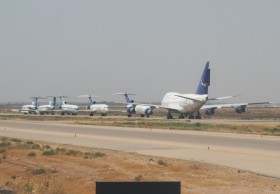
Brand new YK-AHA on one of its first visits to Riem (precisely on its 5th visit, the actual first visit was on Tuesday, 1 June 1976). The first visit of the type had happened a few weeks earlier on 24 April 1976 when Pan Am's N533PA was noted at Riem.
Syrian Air’s B747SPs were a regular sight at Munich-Riem and later also at Munich's new FJS airport into the mid-2000s. From 1976-06-01, Syrian Air operated the B747SP every Sunday, Tuesday and Thursday DAM-MUC-LHR and back.
Information from aussieairliners.org:
Syrian Arab Airlines placed an order for 2 Boeing 747SPs on December 06, 1974. Unlike most international airlines these two aircraft were to be used on the airline's medium range high density routes. Rolled out at Everett on March 23, 1976 with Pratt & Whitney JT9D-7A engines it was entered onto the Syrian Aircraft Register as YK-AHA. Although being the ninth SP to be built it was the eighth of its type to fly when it performed its maiden flight on April 15, 1976.
Accepted by Syrian Air at Paine Field on May 21, 1976 the aircraft was named 'November 16'. It entered service shortly thereafter mainly on the Damascus - London route. By November 1988 it had acquired a modified livery with an all-grey underside and was seen as such at London's Heathrow Airport and Munich.
The aircraft was repainted in 2003 and it was observed at London's Heathrow Airport on March 28, 2003 in the new livery. The aircraft was noted as being retired on December 01, 2007 and stored at Damascus with other Syrian Air aircraft.
Together with sister ship YK-AHB, YK-AHA was flown to Riyadh around 2011 for heavy maintenance with the intention to restore both aircraft to operation (source: 747sp.com), but apparently nothing came of the plans and both were scrapped around 2014.
Detailed history of this airframe:
www.747sp.com/747sp-production-list/21174-284/
YK-AHA brand new at Riem on 8 July 1976 (bare metal underside):
www.747sp.com/wp-content/gallery/21174-284/21174_1976-07-...

YK-AHA at ORY in January 1988 (bare metal fuselage):
www.747sp.com/wp-content/gallery/21174-284/21174_1988-01-...

YK-AHA at Riem in April 1990 (grey underside):
www.747sp.com/wp-content/gallery/21174-284/21174_2004-09-...

YK-AHA at MUC in September 1999 carrying a fifth engine:
www.747sp.com/wp-content/gallery/21174-284/21174_1999-09-...

YK-AHA at LHR in May 2002 (blue nacelles):
www.flickr.com/photos/gooneybird29/42523814200
YK-AHA climbing out of MUC in March 2003 (updated colours):
imgproc.airliners.net/photos/airliners/2/9/6/0544692.jpg

YK-AHA at MUC in May 2004:
www.747sp.com/wp-content/gallery/21174-284/21174_2004-05-...

Both YK-AHA and YK-AHB stored at DAM in July 2009:
www.flickr.com/photos/superspotter/3743511156/in/album-72...
YK-AHA stored at DAM in May 2010:
www.planes.cz/photo/1212/1212722/b747sp-94-yk-aha-syrian-...

www.planes.cz/photo/1079/1079975/b747sp-94-yk-aha-syrian-...
YK-AHA stored at RUH still unscrapped in November 2014:
www.flickr.com/photos/superspotter/15701416549
Scan from Kodachrome slide.
Photograph taken at an altitude of Nine metres, in the magic of the Golden hour around sunrise at 05:41am, (sunrise was at precisely 06.15am) on Saturday 6th September 2014 off the Patricia Bay Highway 17, on Lochside Drive close to Frost Avenue and the Lochside Waterfront Park, in beautiful Sidney by the sea on Vancouver Island, British Columbia, Canada.
Here, I am standing beside the wooden decked viewing platform, looking over towards Mt Baker in Washington State, USA from beautiful Sidney by the sea on Vancouver Island, British Columbia, Canada. Also known as Koma Kulshan, she is an active glaciated andesitic stratovolcano in the Cascade Volcanic Arc and the North Cascades of Washington State in the United States, standing 3,286 metres tall and was first ascended in 1868, her last eruption recorded in 1880.
The name Mount Baker first appeared in print in Captain Vancouver’s 1798 narrative of his voyage around Vancouver Island. Legend has it that his third-lieutenant, Joseph Baker, was the first to spot the mountain while they sailed into Dungeness Bay on April 30th, 1792. Also known by the Lummi as Kwud-Shad, and Koba (meaning 'high mountain always covered with snow', was the Skagit name.
These Canada Geese, along with many other small groups, fly across the lake from East to West every morning and back again every evening at Sunset, and I love to watch the classic Vee formations and listen to the honking as they pass me by. In flight, a group of Geese are called, a Skein. For this frame, in the dawns early darkness, I was shooting the sunrise over Mt Baker and I could hear the geese honking as groups of up to ten flew byu me East to West. I waited until they entered the frame, amazed at how close they actually were to me, and began manually pressing the shutter.
.
.
Nikon D800 70mm 1/1000s f/2.8 iso100 RAW (14 bit) Manual focus. Manual exposure. Matrix metering. Auto white balance. Auto Active D-lighting.
Nikkor AF-S 70-200mm f/2.8G ED IF VRII. Jessops 77mm UV filter. Nikon MB-D12 battery grip. Two Nikon EN-EL batteries. Nikon DK-17M Magnifying Eyepiece. Nikon DK-19 soft rubber eyecup. Manfrotto MT057C3 057 Carbon Fiber Tripod 3 Sections (Payload 18kgs). Manfrotto MH057M0-RC4 057 Magnesium Ball Head with RC4 Quick Release (Payload 15kgs). Manfrotto quick release plate 410PL-14.Jessops Tripod bag. Optech Tripod Strap.Digi-Chip 64GB Class 10 UHS-1 SDXC. Lowepro Transporter camera strap. Lowepro Vertex 200 AW camera bag. Nikon MC-DC2 remote shutter release. Nikon GP-1 GPS unit.
.
.
LATITUDE: N 48d 38m 15.77s
LONGITUDE: W 123d 24m 12.83s
ALTITUDE: 9.0m
RAW (TIFF) FILE SIZE: 103.00MB
PROCESSED (JPeg) SIZE: 10.38MB
.
.
PROCESSING POWER:
Nikon D800 Firmware versions A 1.10 B 1.10 L 2.009 (Lens distortion control version 2)
HP 110-352na Desktop PC with AMD Quad-Core A6-5200 APU processor. AMD Radeon HD8400 graphics. 8 GB DDR3 Memory with 1TB SATA storage. 64-bit Windows 10. Verbatim USB 2.0 1TB desktop hard drive. WD My Passport Ultra 1tb USB3 Portable hard drive. Nikon ViewNX2 Version 2.10.3 64bit. Adobe photoshop Elements 8 Version 8.0 64bit.
Photo taken with Rokinon 85mm F1.4 and Pentax-F AF Adapter 1.7x
SMC Pentax-F 1.7x AF Adapter questions & observations
Lindy Stone , Oct 16, 2006; 06:07 p.m.
I decided to buy a 1.7X AF Adapter to see whats up with it. I see now how it aides in autofocus when using either a manual focus and autofocus lens:
The 1.7x element moves in and out, driven by the cameras AF drive screw.
It does seem to work with my slow aperture zooms on my overcast day.
In the next few days as time permits I'll post digital images taken with it and my 2 slower zooms:
135-600mm/6.7 & 80-320mm/5.6
I am also experimenting with a manual focus Vivitar 100mm f2.8 macro, 1977 vintage. I'm pretty impressed with all 3 lenses I've tried so far. The instructions say use with 15mm/3.5 SMC will damage the 15mm, so I won't try it.
So far as I can see, if you manually focus into the general place you should be, the AF 1.7x then moves its inner element in or out to precisely dial the focus in and give me the green light.
Any insight, and opinions using the 1.7x AF adapter are appreciated. I am new to the pentax system, I know alot of the rest of you are long time pentax experts&photographers
Thanks, Lindy
Hanh Truong , Oct 25, 2006; 01:19 p.m.
Hi Lindy,
I have the SMC Pentax-F 1.7x AF Adapter. It worked wonderfullỵ
It work with screw mount lenses ALSO.
The trick for the SMC Pentax-F 1.7x AF Adapter to work with screw mount lenses is the short out the contact pins on the adapter. I use a thin strip of foil paper across all the pins.
If you have the Pentax istD, this trick of shorting out the contact pins on the camera mount will allow the Focus confirmation to work with screw mount lenses (the ist-DS and beyond does not need this trick for the focus confirmation).
I am using the 1.7F AF with the screw mount 85-210mm F/4.5, 35mm F/2 and the images are amazingly sharp wide open. I was surprised of how good the IQ is.
Let me know if this works for you.
Hanh
Topaz Labs Filters used
Think "Holland" and you've probably already conjured the iconic images of tulips and windmills. More precisely, the very specific windmills you're envisioning right now are that of Kinderdijk.
Though it may sound odd for how technical and pragmatic the region proved to be, the name Kinderdijk translates in Dutch to mean "children's dike." According to local legend, after a particularly terrible flood in the 15th century, a lone basket was left floating in an inundated canal. Upon closer inspection, a cat was found bounding from one side of the basket to the other in an effort to keep it balanced, for inside rested an orphaned baby. The cat had kept the babe afloat, safe and sound during its journey… Thus giving the world the folktale "The Cat and the Cradle" in addition to the village of Kinderdijk its name.
Back in the modern day, visitors will find 19 historically authentic windmills scattered across Kinderdijk's canal-riddled landscape. With their sails raised to the skies (coming to rest in formations that communicate across the bogs in a language of semafors), one could be forgiven for believing these are creatures beholden to the air. What history reveals, in fact, is that the Netherlands' famous windmills are well-disguised creatures of the sea, without which the nation's famously innovative water management system would not have been possible.
Sometime in the 13th century, Zuid-Holland's peat rivers ceased to drain as they had been, creating a pattern of flooding that devastated the beautiful landscape at Alblasserwaard, which already existed below sea level. Berms were built to prevent flooding, but pumping stations needed to be constructed to continue water flow from low to high areas; hence, the 19th windmills still seen today.
Nowhere else in the world offers a complete portrait of early water management like that of Kinderdijk, which accounts for UNESCO's inclusion of the site among its World Heritage as of 1997 for its "unique character." Thanks to its truly groundbreaking unification of sea and sky, plus the added bonus of a world-renowned folktale, a visit to Kinderdijk is the sort of treasure that offers something for dreamers and pragmatists alike. www.atlasobscura.com/places/windmills-of-kinderdijk
Photograph taken at an altitude of Six metres, during the first vestiges of ambient light prior to the magic of the Golden Hour around sunrise (which was at precisely 04:51am), at 03:28am on Monday 7th July 2014, off Botany Road and the Viking Coastal Trail on the shoreline of Botany Bay, the Northern most of seven bays in Broadstairs, Kent, England.
The seven bays are (from south to north) Dumpton Gap, Louisa Bay, Viking Bay, Stone Bay, Joss Bay, Kingsgate Bay and Botany Bay.
.
.
Nikon D800 24mm 1/20s f/2.8 iso200 RAW (14 bit) Mirror up. AF-S single point focus. Manual exposure. Matrix metering. Auto white balance.
Nikkor AF-S 24-70mm f/2.8G ED IF. Jessops 77mm UV filter. Nikon MB-D12 battery grip. Two Nikon EN-EL batteries. Nikon DK-17M Magnifying Eyepiece. Nikon DK-19 soft rubber eyecup. Manfrotto MT057C3 057 Carbon Fiber Tripod 3 Sections (Payload 18kgs). Manfrotto MH057M0-RC4 057 Magnesium Ball Head with RC4 Quick Release (Payload 15kgs). Manfrotto quick release plate 410PL-14.Jessops Tripod bag. Optech Tripod Strap.Digi-Chip 64GB Class 10 UHS-1 SDXC. Lowepro Transporter camera strap. Lowepro Vertex 200 AW camera bag. Nikon MC-DC2 remote shutter release. Nikon GP-1 GPS unit.
.
.
LATITUDE: N 51d 23m 20.12s
LONGITUDE: E 1d 26m 14.31s
ALTITUDE: 6.0m
RAW (TIFF) FILE: 103.00MB
PROCESSED FILE: 19.66MB
.
.
Processing power:
HP Pavillion Desktop with AMD A10-5700 APU processor. HD graphics. 2TB with 8GB RAM. 64-bit Windows 8.1. Verbatim USB 2.0 1TB desktop hard drive. Nikon VIEWNX2 Version 2.90 64bit. Adobe photoshop Elements 8 Version 8.0 64bit
Beginning of the world
This is the beginning of the world. More precisely, one of my worlds. The call of the flight is heavy in front of this light sea.
Le commencement du monde
Ceci est le commencement du monde. Ou plutôt, d’un de mes mondes. Devant cette mer de lumière, l’appel du ciel est extrêmement fort.
Aérodrome EU le tréport - Tour ULM 2015
Copyright © Rookipix
Follow me / suivez moi sur :
Soutenez moi / help me :
This photograph was taken in the magic of The Golden Hour around Sunrise, (Sunrise was at precisely 07:39am), at an altitude of Five metres, at 07:43am on Thursday January 28th 2016 off Botany Road and Marine Drive, on the sandy shoreline of Botany Bay in Broadstairs, Kent, England.
I set off at 05:00am on a clear morning, the moon and the stars out to dazzle in temperatures around five degrees, on a pleanst hour and half long journey to enjoy a lovely sunrise. The seven bays in Broadstairs consist of: (From south to north) Dumpton Gap, Louisa Bay, Viking Bay, Stone Bay, Joss Bay, Kingsgate Bay and Botany Bay.
.
.
Nikon D800 200mm 1/5000s f/5.6 iso1600 RAW (14Bit) Nikon back focus button enabled. AF-C Continuous point focus with 3-D tracking. Manual exposure. Matrix metering. Auto white balance. Nikon AF Fine tune set to (+6).
Nikkor AF-S 200-500mm f/5.6E ED VR. Power UP 95mm HD UV filter. Nikon MB-D12 battery grip. Two Nikon EN-EL batteries. Nikon DK-17M Magnifying Eyepiece. Nikon DK-19 soft rubber eyecup. Manfrotto MT057C3 057 Carbon Fiber Tripod 3 Sections (Payload 18kgs). Manfrotto MH057M0-RC4 057 Magnesium Ball Head with RC4 Quick Release (Payload 15kgs). Manfrotto quick release plate 410PL-14.Jessops Tripod bag. Optech Tripod Strap.Digi-Chip 64GB Class 10 UHS-1 SDXC. Lowepro Transporter camera strap. Lowepro Vertex 200 AW camera bag. Nikon MC-DC2 remote shutter release. Nikon GP-1 GPS unit.
.
.
LATITUDE: N 51d 23m 18.65s
LONGITUDE: E 1d 26m 19.27s
ALTITUDE: 5.0m
RAW (TIFF) FILE SIZE: 103.00MB
PROCESSED (JPeg) SIZE: 19.38MB
.
.
PROCESSING POWER:
Nikon D800 Firmware versions A 1.10 B 1.10 L 2.009 (Lens distortion control version 2)
HP 110-352na Desktop PC with AMD Quad-Core A6-5200 APU processor. AMD Radeon HD8400 graphics. 8 GB DDR3 Memory with 1TB SATA storage. 64-bit Windows 10. Verbatim USB 2.0 1TB desktop hard drive. WD My Passport Ultra 1tb USB3 Portable hard drive. Nikon ViewNX2 Version 2.10.3 64bit. Adobe photoshop Elements 8 Version 8.0 64bit
Henderson Bird Viewing Preserve, Henderson, Nevada, USA. I don't know why precisely but I really liked this shot. Not sure I cropped it in the most appealing way though.
that must be thought :-) Tom Robbins
HPPT!!
pink Japanese flowering apricot, 'Bonita', j c raulston arboretum, ncsu, raleigh, north carolina
At the N9 between Graaff-Reinet and Aberdeen.
An der N9 zwischen Graaff-Reinet und Aberdeen.
The Karoo (/kəˈruː/ kə-ROO; from a Khoikhoi word, possibly garo "desert") is a semi-desert natural region of South Africa. There is no exact definition of what constitutes the Karoo, and therefore its extent is also not precisely defined. The Karoo is partly defined by its topography, geology, and climate — above all, its low rainfall, arid air, cloudless skies, and extremes of heat and cold. The Karoo also hosted a well-preserved ecosystem hundreds of million years ago which is now represented by many fossils.
The Karoo formed an almost impenetrable barrier to the interior from Cape Town, and the early adventurers, explorers, hunters and travelers on the way to the Highveld unanimously denounced it as a frightening place of great heat, great frosts, great floods and great droughts. Today it is still a place of great heat and frosts, and an annual rainfall of between 50–250 mm, though on some of the mountains it can be 250–500 mm higher than on the plains. However, underground water is found throughout the Karoo, which can be tapped by boreholes, making permanent settlements and sheep farming possible.
The xerophytic vegetation consists of aloes, mesembryanthemums, crassulas, euphorbias, stapelias, and desert ephemerals, spaced 50 cm or more apart, and becoming very sparse going northwards into Bushmanland and, from there, into the Kalahari Desert. The driest region of the Karoo, however, is its southwestern corner, between the Great Escarpment and the Cederberg-Skurweberg mountain ranges, called the Tankwa Karoo, which receives only 75 mm of rain annually. The eastern and north-eastern Karoo are often covered by large patches of grassland. The typical Karoo vegetation used to support large game, sometimes in vast herds.
Today sheep thrive on the xerophytes, though each sheep requires about 4 hectares of grazing to sustain itself.
The Great Karoo straddles the 30° S parallel on the west of the continent, in a similar position to other semi-desert areas on earth, north and south of the equator. It is furthermore in the rainfall shadow of the Cape Fold Mountains along the western coastline. The western "Lower Karoo" (the Tankwa Karoo and Moordenaarskaroo) contain remnants of the Cape Fold Mountains (e.g. the Witteberg and Anysberg Mountains) which give it a moderate hilly appearance; but further east the Lower Karoo becomes a monotonously flat plain. The "Upper Karoo" has been intruded by dolerite sills (see below), creating multiple flat topped hills, or "Karoo Koppies", which are iconic of the Great Karoo.
The vegetation of the Upper and Lower Karoo is similar, so that few people make a distinction between the two.
(Wikipedia)
Die Karoo (auch Karroo, früher Karru; Khoisan für Halbwüste) ist eine Halbwüstenlandschaft in den Hochebenen des Landes Südafrika, nördlich der Großen Randstufe und im südlichen Namibia. Unterschieden werden Kleine Karoo, Große Karoo und Obere Karoo sowie Sukkulenten-Karoo und Nama-Karoo. Mit einer Ausdehnung von 500.000 km² umfasst die Karoo fast ein Drittel des Territoriums Südafrikas. Die Sukkulenten-Karoo gehört zu den Biodiversitäts-Hotspots der Erde und wird u. a. im Rahmen von BIOTA AFRICA systematisch kartiert.
Der Name Karoo kommt von kurú (trocken) aus der Sprache der San, die einst hier lebten und jagten. In Hinsicht auf die geographische Ausdehnung des Karoo-Begriffs sind die folgenden Teilaspekte zu beachten und voneinander zu unterscheiden.
Die Karoo als Landschaft im traditionellen Verständnis ist eine südafrikanische Trockenregion innerhalb der Provinzen Westkap, Ostkap und Nordkap sowie im Süden Namibias. Ihre spezifische kapländische Strauchvegetation weist sie als Halbwüste aus. Ursprünglich wird in zwei Regionen unterschieden: Große Karoo und Kleine Karoo.
Die Große Karoo besitzt eine West-Ost-Ausdehnung von über 750 Kilometern und eine Nord-Süd-Ausdehnung von etwa 110 Kilometern. Sie wird im Westen vom Massiv der Zederberge und im Osten durch die Winterberge begrenzt. Im Norden bilden die Bergketten vom Roggeveld-, Koms-, Nuweveldberge und Sneeuberg und im Süden die Höhenzüge der Witteberge, Groot Swartberge und die Groot Winterhoek die natürliche Begrenzung.
Südlich dieser Region schließt sich die Kleine Karoo an. Diese wird wiederum an ihrer südlichen Flanke von den küstennahen Langebergen und Outeniqua-Bergen begrenzt.
Anders als in dieser traditionellen Gliederung, wird die Karoo heute nach ökologischen Gesichtspunkten in einen östlichen Teil, die Nama-Karoo, und einen westlichen Teil, die Sukkulenten-Karoo, gegliedert, wobei auch die Gesamtausdehnung der Karoo nach diesem Konzept von jener der traditionellen Betrachtungsweise abweicht.
(Wikipedia)
"It was precisely to Mary Magdalene that St. Thomas Aquinas reserved the special title, "Apostle of the Apostles" (apostolorum apostola), dedicating to her this beautiful comment: "Just as a woman had announced the words of death to the first man, so also a woman was the first to announce to the Apostles the words of life" (Super Ioannem, ed. Cai, § 2519)."
– Pope Benedict XVI.
22 July is the feast of St Mary Magdalene.
In this statue by Charles Marochetti, St Mary Magdalene is depicted as being lifted up by angels to God. It is in the church of La Madeleine in Paris.
-Gotham City 10:53 pm -
It’s been a long week trying to track down this mysterious string of abductions and so far all my attempts to track down the culprit have proven…. unsuccessful. A word I am far from comfortable using when it comes to my investigations, but one I have unfortunately had to use at times despite my desire to avoid it. Over the course of five nights a young girl has been abducted every night no delay at precisely 10:40 pm from a different district of Gotham. Tonight a sixth girl has been taken from Kingston, the first abduction to be in a district positioned directly next to a district where another abduction has taken place.
Though all attempts to locate the perpetrator have been unsuccessful their calling card is distinct. Every night that the girl is taken a status is posted on their social media account claiming they have ‘been punished for their cruelty’. Originally I suspected that I could merely use the IP addresses to track the location where their last statuses were posted from respectively. But every time it would merely lead me back to the girls own laptops respectively. Checking the laptops for DNA proved unsuccessful like wise, the only connecting factor between all of the crime scenes is the slight trace of latex on the laptops keyboards respectively, no doubt from gloves worn by the abductor.
After five unsuccessful nights I’ve finally decided to call in Barry to help me inspect the crime scene, as a member of the Central City forensics lab his skill set is more than ideal to help investigate the crime scene. The GCPD have all but handed the case to me at this point, Jim has accepted that if anyone is going to be able to find these girls it’s me and thus I get exclusive first access to the crime scenes so that any evidence is not compromised by the ineptitude of the GCPD forensics department.
I had kept the bat-computer constantly scanning for when the next status was posted and where from. The moment I knew where I signaled Barry and he raced there. By the time I reached the scene the GCPD had the apartment complex sealed off and Barry was waiting for me outside in full costume, no doubt he’s going to make a comment about how long I’ve kept him waiting. He always does.
“Hey Bats, was wondering when you’d show up.”
“Why are you outside? You should be inside studying the crime scene.”
“You mean the girls room? These folks don’t want me going in without you. Apparently the Commissioner has given specific orders that no-one enters the girl’s room until you’ve been in.”
I’m surprised. Usually the GCPD are skeptical of any orders concerning interactions with me. The fact that they’ve held up to Jim’s orders is surprising, especially that they’ve not allowed the infamous Flash in. Nice to see that after all these years the GCPD have finally begun to realize that I am a benefit to them.
“Come on.”
Barry and I enter the house and I notice Jim’s voice behind a closed door. Clearly he’s comforting the mother of the girl who has just been taken.
“I promise you Miss, I’ve got my best people on the case. We will find your daughter.”
Jim is a natural when it comes to comforting people who have experienced family tragedy. He was the one who comforted me on the night my parents were gunned down in the alley. Barry and I walk up the stairs and enter the girls room. This one is near enough identical to the bedroom of all the other bedrooms I’ve inspected during my investigation into these kidnappings. Bright feminine colors, posters of boy bands on the walls, cuddly toys on the bed, one bedroom window where the kidnapper no doubt infiltrated and exited the building. But there was one notable difference to this crime scene. All the other windows from the previous bedrooms had been closed. This one was open.
Barry noticed this as well.
“That’s different. You think that?”
“Yes. Something happened here that hasn’t happened at the other scenes. Sweep the room for anything else, I’ll check the window.”
“On it!”
Barry speeds around the room and becomes a blur of red and yellow as he scans every detail of the room. By the time he has scanned every detail of the room I’ve only just managed to pull the window down to see that the lower section of the window has a hole through it. Clearly the window has closed when the kidnapper came to abduct his target tonight and thus had to break the glass on the window to enter the room.
"Anything?”
“Quite a bit. First of all as you’ve probably already seen there’s shards of glass over the floor of the room clearly from the window indicating it was broken from the outside meaning someone broke into the room.”
“I could tell you that. It’s what I couldn’t tell you that I want to know.”
“Well there’s also a large amount of bleach absorbed into the carpet clearly intended to destroy some form of DNA evidence, which means our criminal must have been stabbed with one of the shards of glass from the window.”
"It makes sense. You wouldn’t bother destroying any DNA evidence if it was of the girl you were kidnapping, as that wouldn’t be any evidence that could possibly be tracked. Why do you think he was stabbed with a shard of glass?”
“Well this piece has been coated in bleach as well. It’s dry now but there’s the dried up residue that is commonly found when a large amount of bleach is applied to glass and dries out.”
“Clearly the girl thought she was in danger after all the other kidnappings. Manage to find any actual blood?”
“Nothing. Whoever did this made sure to cover their tracks completely. But the large amount of bleach in the carpet means that the abductor must have some form of blood defect though, as the area coated in bleach implies that he bled over a large area probably meaning his blood didn’t clot and a shard of glass that size couldn’t of made a cut large enough to make the body lose this much blood.”
“Hmmm, that narrows down the possibilities at least even if it doesn’t give us any DNA evidence to track. Let’s head back to the cave and take the carpet with us, we might be able to salvage some DNA from it still.”
“On it!”
-------------------------------------
O.O.C
So this is a prologue to an upcoming event in the DC comics stories group that shall be told in the Justice League comic by [Stubbs]. This is also the first collaboration between two users of the group towards a story, in this case being between myself and levi (aka Mrminifig), so I hope you enjoy it!
Levi shall be posting this part of the tale from Flashes point of view, so keep posted to his photo stream to see how these events play out in Flashes mind.
At precisely 07:15 on a dark, dismal and damp morning at Coventry, these two are pictured just after arrival with "The Breakfast Bag".
In reality this was a bolt-on pre-tour from Reading to Coventry in order to get the stock in place for the day's main event: "The Marsh 'n Moor" railtour from Coventry to Hastings and back.
Both Cromptons survive today in preservation.
33116 is at The Great Central Railway, whilst 33208 resides pleasantly on The Battlefield Line
“Sometimes we need to stop analyzing the past, stop planning the future, stop figuring out precisely how we feel, stop deciding exactly what we want, and just see what happens.”
i wish it was just that easy.
my mind is full of ideas right now! but i can't realize them. i have spring break, almost whole week free and it's finally such a beautiful weather. but i still don't have my tripod, and i just found out that it probably doesn't come during this week. i still can't walk without crutches and my ankle even hurts again! tell me, how can something be painful after more than 7 months?! i know i keep saying this, but i just can't wait for the real spring. and i know it's not only because of the weather, but especially because i hope that i'll be ale to walk by this time. but hey, i hoped for this on christmas too and it's more than 2 months ago.
5 months precisely to 11 November 2017.
Euro 3(SCRT>Euro 5)
Voith DIWA864.3E 4-speed
Volvo D7C 250hp
Volvo B7TL 10.6m
Transbus (Alexander) ALX400 10.6m
Chassis number: Vo B7TL YV3S2G5184A003517
Body number: Tbs 4402/9
H49/22D + 18 standees
Weighs 12100kg
New June 2004 for route 337.
Diego: *chuckles, as he pulls something out of his pocket* “Well, it’s not wrapped, but I guess I don’t mind if you don’t.” *places it on Charley’s palm*
Charley: *looks down at the item in her hand, brow furrowed*
Yuri: *cranes neck* “What is that, precisely?”
Emma: “Erm, I canna quite…” *leans forward to get a better look*
Candy: “Is that a…dog collar?”
Kumi (triumphantly): “I knew he was into S&M. I just pegged him for an M and not an S. Put it on, Charley, and bark for us.”
Charley: “I don’t understand.”
Diego: *signs/says* “You said you wanted a dog. I got you a dog.”
Charley: *squeezes her hand around the collar, voice tight* “That’s not funny. You know I can’t have pets here.”
Diego: *signs/says* “Your landlord is willing to make an exception for you, as long as you play it low-key. You might have to tell your neighbors it’s some kind of service animal to help with your anxiety or whatever. I know you hate lying, but I also know you’ve wanted a dog your entire life. So, the choice is yours, Bug.”
Charley: “How’d you get him to agree? I’ve asked him more than once. I even offered to pay a little more in rent every month, and he’s always refused.”
Diego: *signs/says* “Let’s just say I helped him out of a tough spot.”
Charley (flatly): “You hacked him.”
Diego: *signs/says* “So quick with the accusations. I helped him. He had a virus that wiped out his hard drive. He was highly motivated to retrieve his info, and I was highly motivated to help him, assuming he’d grant me a favor in return. *pulls a piece of paper out of his other pocket, holds it up* Signed and notarized—his agreement to let you have one pet of your choosing.”
Charley: “You sent him the virus.”
Diego: *signs/says easily* “Viruses are everywhere. Click one shady link in an email and, poof, everything goes up in smoke.”
Charley: “Does he know?”
Diego: “Know what?”
Charley: “That you made everything go ‘poof’ before you ‘helped’ him get it all back.”
Diego: *insulted expression, signs/says* “Since when does this Dingo ever get caught?”
Yuri: *hand over heart* “I do not believe I have ever found a committed felony and blackmail quite so poignant.”’
Kumi: *purrs* “Mm, he’s so bad. I’ve never been more attracted to him than I am right now.”
Diego: *meets Charley’s gaze, lips curving into an uncharacteristically tender smile* “We couldn’t afford a dog back in Ohio, but we can now. Molls and I will look after it while you’re at school.”
Charley: *stares up at Diego, voice full of wonder* “You really got me a dog?”
Diego: “Well, I didn’t actually pick one out yet. I figured you’d want to do that yourself. Molly and I can go with you to the animal shelter, whenever you’re ready. Merry Christmas, Charley.”
Charley: *launches herself at Diego, wrapping her arms around him* “Thank you! Thank you! Thank you!”
Diego: *wraps his arms around her, hugs her tightly, and whispers in her ear* “I figured it was time to start making some good Christmas memories to compete with the bad.”
Charley: *presses her face into his chest, overcome with joy, muffled* “It’s a Christmas miracle!”
Diego: “Figured you were due.” *meets Molly’s eyes over Charley’s head*
Fashion Credits
**Any doll enhancements (i.e. freckles, piercings, eye color changes) were done by me unless otherwise stated.**
Charley
Jeans: Clear lan
Sweater: Christmas Ornament
Socks: sugarbabylovedoll (Etsy)
Belt: Cangaway (Etsy)
Boots: Snow’s Shopping Paradise (eBay)
Glasses: Sekiguchi – Momoko – separately sold accessory.
Doll is a Morning Dew Giselle transplanted to a Poppy body, re-rooted by the holly-jolly valmaxi(!!!)
Molly
Jeans: Squeaky Monkey
Shirt: ababietoy (Etsy)
Cardigan: hand-knit by a friend
Belt: IT – Dynamite Girls – Love Revolution – Free Spirit Jett
Boots: Jennifer Sue
Green Bracelet: IT – Poppy Parker – Popster!
Red Bracelet: IT – Dynamite Girls – Love Revolution – Own the Moment Aria
Barrett: Me
Doll is a She’s Not There Poppy Parker.
Diego
Pants: fakeskin (Etsy)
White Tee & Belt: Kimberlee of Hazel Street Dezigns
Plaid Shirt & Cardigan: Gwen of Gwendolyn’s Treasures
Shoes: IT – Poppy Parker – Baby, It’s You Chip
Hat: Mattel – Barbie Collectible – Frank Sinatra ‘The Recording Years’
Doll is a Rock Steady Romain, facial hair and shading by me.
Wawaka is between Ligonier and Waterloo, which I'm sure pins it down for you precisely. Anyway, my brother Doug and I were on our way to the Brick Ark Inn at Albion, a few miles south of here on September 18, 2020 when we spotted a long freight arriving from the west along the original New York Central mainline. I took a side road to meet the train coming to the crossing. Well, as soon as that train passed and we drove to a driveway to turn around, this train arrived from the east. Unfortunately, I couldn't get a shot of the front end, that's how quickly this one came after the eastbound had passed.
View my collections on flickr here: Collections
Press L for a larger image on black.
George Blake illustrated this as a single page article of what precisely one should aim for in the child's room "for the better sort of house."
Source: Delineator
Images from the Antique Home Style collection.
We call Blondie 'Roo-Roo' because she looks like a kangaroo. I can tell you exactly what she is saying here. It is precisely, 'You do have a treat for me, don't you'? Even dogs have their WIFM's. Unlike many of us, though she really doesn't care about appearances. How she looks in the mirror in unimportant to her even though she has a boyfriend next door named Troy. Mirrors mean nothing to Roo-Roo, she walks right by them.
So Troy frequently calls Roo-Roo out to play. Even though they really can't see each other through the fence, Roo-Roo has built this figure 8 track and she runs full blast through the bushes. She will do this on command and even at night. We call it 'Speed Dog'.
We had a little dog emergency Saturday as she was doing her Speed Dog thing, she sliced her right leg open pretty good. Much of the day was spent at the vet. She will be ok and today she let us know by doing the indoor version of Speed Dog which we call 'Blondie 500'. Top speed around everything in the house. It was more like the Blondie 50 with her leg all bandaged, but she's happy and I'll take it!!!
Thank you to Telzey and Nesster for your textures!
Please!! NO Awards or Large Graphics...Group Buddy Icons are OK. Thank You!
© CPMcGann. All rights reserved. If you are interested in using my images, please contact me first.
What you get with Dr. Savage is a very intelligent, efficient, and no nonsense professional who pinpointed and diagnosed my problem precisely and was able to guide me to the remedy as well as teaching me how to avoid the same event happening in the future. He arrived with his assistant and was escorted by hotel staff to our door within one hour
Thanks to Jeff Wharton for photo of re enactor doctor and assistant, background detail from Bing Images )
A side-by-side comparison of the Sun from precisely two years ago (left, from SOHO) to the present (right, from Solar Dynamics Observatory) dramatically illustrates just how active the Sun has become (Mar. 27-28, 2011). Viewed in two similar wavelengths of extreme ultraviolet light, the Sun now sports numerous active regions that appear as lighter areas that are capable of producing solar storms. Two years ago the Sun was in a very quiet period (solar minimum). The Sun's maximum period of activity is predicted to be around 2013, so we still have quite a ways to go.
Credit: NASA/GSFC/SOHO/SDO
NASA Goddard Space Flight Center enables NASA’s mission through four scientific endeavors: Earth Science, Heliophysics, Solar System Exploration, and Astrophysics. Goddard plays a leading role in NASA’s accomplishments by contributing compelling scientific knowledge to advance the Agency’s mission.
Follow us on Twitter
Join us on Facebook