View allAll Photos Tagged penetration
🎅Christmas boat parade🎄the boats owners decorate with lights and they go through the harbor , it’s quite pretty.
+++ DISCLAIMER +++
Nothing you see here is real, even though the conversion or the presented background story might be based on historical facts. BEWARE!
Some background:
The McDonnell F-101 Voodoo was a supersonic jet fighter which primarily served the United States Air Force (USAF). Initially designed by McDonnell Aircraft as a long-range bomber escort (known as a penetration fighter) for the Strategic Air Command (SAC), the Voodoo was instead developed as a nuclear-armed fighter-bomber for the Tactical Air Command (TAC) and later evolved into an all-weather interceptor as well as into a reconnaissance platform.
The Voodoo's career as a fighter-bomber (F-101A and C) was relatively brief, but the reconnaissance fighter versions served for some time. Along with the US Air Force's Lockheed U-2 and US Navy's Vought RF-8 Crusaders, the RF-101 reconnaissance variant of the Voodoo was instrumental during the Cuban Missile Crisis and saw extensive service during the Vietnam War. Beyond original RF-101 single seaters, a number of former F-101A and Cs were, after the Vietnam era, converted into photo reconnaissance aircraft (as RF-101G and H) for the US Air National Guards.
Delays in the 1954 interceptor project (also known as WS-201A, which spawned to the troubled F-102 Delta Dagger) led to demands for an interim interceptor aircraft design, a role that was eventually won by the Voodoo’s B model. This new role required extensive modifications to add a large radar to the nose of the aircraft, a second crewmember to operate it, and a new weapons bay using a unique rotating door that kept its four AIM-4 Falcon missiles (two of them alternatively replaced by unguided AIR-2 Genie nuclear warhead rockets with 1.5 Kt warheads) semi-recessed under the airframe.
The F-101B was first deployed into service on 5 January 1959, and this interceptor variant was produced in greater numbers than the original F-101A and C fighter bombers, with a total of 479 being delivered by the end of production in 1961. Most of these were delivered to the Air Defense Command (ADC), the only foreign customer was Canada from 1961 onwards (as CF-101B), after the cancellation of the CF-105 Arrow program in February 1959. From 1963–66, USAF F-101Bs were upgraded under the Interceptor Improvement Program (IIP; also known as "Project Bold Journey") with a fire control system enhancement against hostile ECM and an infrared sighting and tracking (IRST) system in the nose in place of the Voodoo’s original hose-and drogue in-flight refueling probe.
The F-101B interceptor later became the basis of further Voodoo versions which were intended to improve the tactical reconnaissance equipment of the US Air National Guards. In the early 1970s, a batch of 22 former Canadian CF-101Bs were returned to the US Air Force and, together with some USAF Voodoos, converted into dedicated reconnaissance aircraft, similar to the former RF-101G/H conversion program for the single-seat F-101A/C fighter bombers.
These modified interceptors were the RF-101B and J variants. Both had their radar replaced with a set of three KS-87B cameras (one looking forward and two as a split vertical left/right unit) and a panoramic KA-56 camera, while the former missile bay carried different sensor and avionics packages.
The RF-101Bs were exclusively built from returned Canadian Voodoos. Beyond the photo camera equipment, they featured upgraded navigational equipment in the former weapon bay and a set of two AXQ-2 TV cameras, an innovative technology of the era. A TV viewfinder was fitted to the cockpit and the system was operated effectively from altitudes of 250 ft at 600 knots.
The other re-built reconnaissance version, the RF-101J, was created from twelve former USAF F-101Bs, all of them from the final production year 1961 and with relatively few flying hours. Beyond the KS-87B/KA-56 camera set in the nose, the RF-101J featured a Goodyear AN/APQ-102 SLAR (Side-looking airborne radar) that occupied most of the interceptor’s former rotating internal weapon bay, which also carried a fairing for a heat exchanger. The radar’s conformal antenna array was placed on either side of the lower nose aft of the cameras and allowed to record radar maps from view to each side of the aircraft and pinpoint moving targets like trucks in a swath channel approximately 10 nautical miles (11.5 miles/18 km) wide. To identify potential targets along the flight path for the SLAR and to classify them, the RF-101J furthermore received an AN/AAS-18 Infrared Detecting Set (IRDS). It replaced the F-101B’s IRST in front of the cockpit and was outwardly the most obvious distinguishing detail from the RF-1010B, which lacked this hump in front of the windscreen. The IRDS’ range was almost six miles (9.5 km) and covered the hemisphere in front of the aircraft. With the help of this cryogenically-cooled device the crewman in the rear cockpit could identify through a monitor small heat signatures like hot engines, firing weapons or campfires, even in rough terrain and hidden under trees.
Both new Voodoo recce versions were unarmed and received AN/APR-36 radar homing and warning sensors to nose and tail. They also had an in-flight refueling receptacle re-fitted, even though this was now only compatible with the USAF’s high-speed refueling boom system and was therefore placed in a dorsal position behind the cockpit. Furthermore, both versions received a pair of unplumbed underwing pylons for light loads, e. g. for AN/ALQ-101,-119 or -184 ECM pods, photoflash ejectors for night photography or SUU-42A/A Flares/Infrared decoys and chaff dispenser pods.
The RF-101Bs were delivered in 1971 and allocated to the 192d Tactical Reconnaissance Squadron of the Nevada Air National Guard, where they served only through 1975 because their advanced TV camera system turned out to be costly to operate and prone to failures. Their operational value was very limited and most RF-101Bs were therefore rather used as proficiency trainers than for recce missions. As a consequence, they were already phased out from January 1975 on.
The RF-101Js entered service in 1972 and were allocated to the 147th Reconnaissance Wing of the Texas Air National Guard. Unlike the RF-101Bs’ TV cameras, the AN/APQ-102 SLAR turned out to be reliable and more effective. These machines were so valuable that they even underwent some upgrades: By 1977 the front-view camera under the nose had been replaced with an AN/ASQ-145 Low Light Level TV (LLLTV) camera, sensitive to wavelengths above the visible (0.4 to 0.7 micrometer) wavelengths and ranging into the short-wave Infrared (usually to about 1.0 to 1.1 micrometer). The AN/ASQ-145 complemented the IRDS with visual input and was able to amplify the existing light 60,000 times to produce television images as clearly as if it were noon. In 1980, the RF-101Js were furthermore enabled to carry a centerline pod for the gigantic HIAC-1 LOROP (Long Range Oblique Photography) camera, capable of taking high-resolution images of objects 100 miles (160 km) away.
USAF F-101B interceptors were, as more modern and effective interceptors became available (esp. the F-4 Phantom II), handed off to the Air National Guard, where they served in the fighter role until 1982. Canadian CF-101B interceptors remained in service until 1984 and were replaced by the CF-18 Hornet. The last operational Canadian Voodoo, a single EF-101B (nicknamed the “Electric Voodoo”, a CF-101B outfitted with the jamming system of the EB-57E Canberra and painted all-black) was returned to the United States on 7 April 1987. However, the RF-101Js served with the Texas ANG until 1988, effectively being the last operational Voodoos in the world. They were replaced with RF-4Cs.
General characteristics:
Crew: Two
Length: 67 ft 5 in (20.55 m)
Wingspan: 39 ft 8 in (12.09 m)
Height: 18 ft 0 in (5.49 m)
Wing area: 368 ft² (34.20 m²)
Airfoil: NACA 65A007 mod root, 65A006 mod tip
Empty weight: 28,495 lb (12,925 kg)
Loaded weight: 45,665 lb (20,715 kg)
Max. takeoff weight: 52,400 lb (23,770 kg)
Powerplant:
2× Pratt & Whitney J57-P-55 afterburning turbojets
with 11,990 lbf (53.3 kN) dry thrust and 16,900 lbf (75.2 kN) thrust with afterburner each
Performance:
Maximum speed: Mach 1.72, 1,134 mph (1,825 km/h) at 35,000 ft (10,500 m)
Range: 1,520 mi (2,450 km)
Service ceiling: 54,800 ft (17,800 m)
Rate of climb: 36,500 ft/min (185 m/s)
Wing loading: 124 lb/ft² (607 kg/m²)
Thrust/weight: 0.74
Armament:
None, but two 450 US gal (370 imp gal; 1,700 l) drop-tanks were frequently carried on ventral
hardpoints; alternatively, a central hardpoint could take single, large loads like the HIAC-1 LOROP
camera pod.
A pair of retrofitted underwing hardpoints could carry light loads like ECM jammer pods,
flare/chaff dispensers or photoflash ejectors
The kit and its assembly:
This is another project that I had on my agenda for a long while. It originally started with pictures of an RF-101H gate guard in Louisville at Standiford Field International from around 1987-1991:
imgproc.airliners.net/photos/airliners/6/2/9/1351926.jpg?...

www.aerialvisuals.ca/Airframe/Gallery/0/41/0000041339.jpg
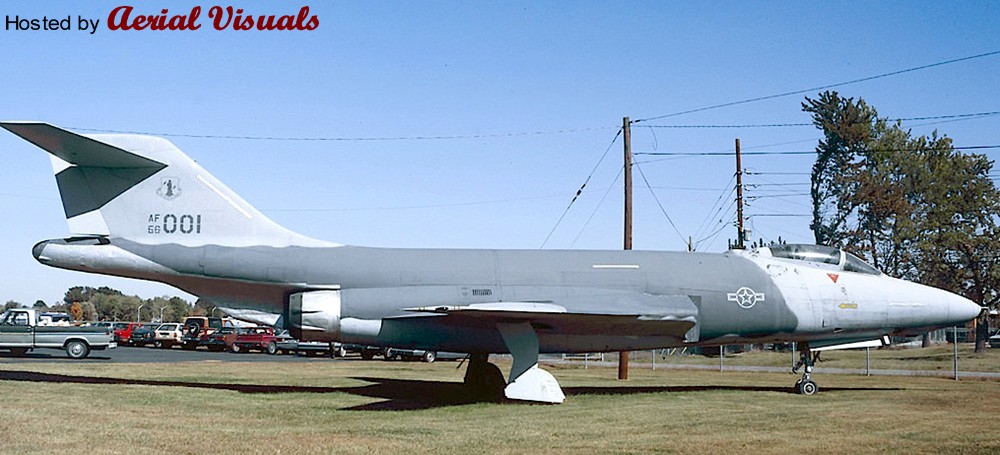
This preserved machine wore a rather unusual (for a Voodoo) ‘Hill’ low-viz scheme with toned-down markings, quite similar to the late USAF F-4 Phantom IIs of the early Eighties. The big aircraft looked quite good in this simple livery, and I kept the idea of a Hill scheme Voodoo in the back of my mind for some years until I recently had the opportunity to buy a cheap Matchbox Voodoo w/o box and decals. With its optional (and unique) RF-101B parts I decided to take the Hill Voodoo idea to the hardware stage and create another submission to the “Reconnaissance and Surveillance” group build at whatifmodellers.com around July 2021: an ANG recce conversion of a former two-seat interceptor, using the RF-101B as benchmark but with a different suite of sensors.
However, the Matchbox Voodoo kit is rather mediocre, and in a rather ambitious mood I decided to “upgrade” the project with a Revell F-101B as the model’s basis. This kit is from 1991 and a MUCH better and finely detailed model than the rather simple Matchbox kit from the early Eighties. In fact, the Revell F-101B is actually a scaled-down version of Monogram’s 1:48 F-101B model kit from 1985, with many delicate details. But while this downscaling practice has produced some very nice 1:72 models like the F-105D or the F-4D, the scaling effect caused IMHO in this case a couple of problems. Revell's assembly instructions for the 1:72 kit are not good, either. While the step-by-step documentation is basically good, some sketches are so cluttered that you cannot tell where parts in the cockpit or on the landing gear are actually intended to be placed and how. This is made worse by the fact that there are no suitable markings on the parts – you are left to guessing.
Worse, there is a massive construction error: the way the wings section is to be assembled and mounted to the hull is impossible! The upper wing halves have locator pins for the fuselage, but they are supposed to be glued to the lower wing half (which also encompasses the aircraft's belly) and the mounted to the hull. The locator pins make this impossible, unless you bend the lower wing section to a point where it might warp or break, or you just cut the pins off - and live with some instability. Technically the upper wing halves have to be mounted to the fuselage before you glue the lower wing section to them, but I am not certain if this would work well because you also have to assemble the air intakes at the same time “from behind”, which is only feasible when the wings have already been completed but still left away from the fuselage. It’s a nonsense construction! I cannot remember when I came across a kit the last time with such an inherent design flaw?
Except for the transplanted RF-101B nose section, which did not fit well because the Matchbox Voodoo apparently has a more slender nose, the Revell kit was built mostly OOB. However, this is already a challenge in itself because of the kit’s inherent flaws (see above), its complex construction and an unorthodox assembly sequence, due to many separate internal modules including the cockpit tub, a separate (fully detailed) front landing gear well, a rotating weapon bay, air intakes with complete ducts, and the wing section. A fiddly affair.
Only a few further changes beyond the characteristic camera fairing under the radome were made. The rotating weapon bay was faired-over with the original weapon pallet, just fixing it into place and using putty to blend it into the belly. The small underwing pylons (an upgrade that actually happened to some late Voodoos) were taken from a vintage Revell F-16. The SLAR antenna fairings along the cockpit flanks were created with 0.5mm styrene sheet and some PSR. They are a little too obvious/protruding, but for a retrofitted solution I find the result acceptable. The drop tanks came from the Revell kit, the underwing ordnance consists of an ALQ-119 ECM pod from a Hasegawa aftermarket set and a SUU-42 dispenser, scratched from a Starfighter ventral drop tank, bomb fins and the back of a Soviet unguided missile launcher.
Painting and markings:
Very simple and basic. While I originally wanted to adopt the simple two-tone ‘Hill’ scheme from the gate guard for my fictional Voodoo, I eventually settled for the very similar but slightly more sophisticated ‘Egypt One’ scheme that was introduced with the first F-16s – it just works better on the F-101’s surfaces. This scheme uses three grey tones: FS 36118 (Gunship Gray, ModelMaster 1723) for the upper wing surfaces, the “saddle” on the fuselage and the canopy area with an anti-glare panel, FS 36270 (Medium Grey, Humbrol 126) on the fin and the fuselage area in front of the wing roots, and FS 36375 (Light Ghost Grey, Humbrol 127) for all lower surfaces, all blended into each other with straight but slightly blurred edges (created with a soft, flat brush). The radome and the conformal antennae on the flanks became Revell 47 for a consistent grey-in-grey look, but with a slightly different shade. The model received an overall black ink washing and some post panel shading, so that the large grey areas would not look too uniform.
As an updated USAF aircraft I changed the color of the landing gear wells’ interior from green zinc chromate primer to more modern, uniform white, even though the red inside of the covers was retained. The interior of the flaps (a nice OOB option of Revell’s kit) and the air brakes became bright red, too.
The cockpit retained its standard medium grey (Humbrol 140, Dark Gull Grey) interior and I used the instrument decals from the kit – even though these did not fit well onto the 3D dashboards and side consoles. WTF? Decal softener came to the rescue. The exhaust area was painted with Revell 91 (Iron) and Humbrol’s Steel Metallizer (27003), later treated with graphite for a dirty, metallic shine.
Markings/decals primarily come from a 1:72 Hi-Decal F-4D sheet that contains (among others) several Texas ANG Phantoms from the mid-Eighties. Some stencils were taken over from the original Voodoo sheet, the yellow formation lights had to be procured from a Hasegawa F-4E/J sheet (the Matchbox sheet was lost and the Revell sheet lacks them completely!). The characteristic deep yellow canopy sealant stripes came from a CF-101 sheet from Winter Valley Decals (today part of Canuck Models as CAD 72008). I was lucky to have them left over from another what-if build MANY moons ago, my fictional CF-151 kitbashing.
Everything went on smoothly, but the walkway markings above the air intakes became a problem. I initially used those from the Revell sheet, which are only the outlines so that the camouflage would still be visible. But the decal film, which is an open square, turned out to be so thin that it wrinkled on the curved surface whatever I tried, and what looked like a crisp black outline on the white decal paper turned out to be a translucent dark blue with blurry edges on the kit. I scrapped them while still wet… Enter plan B: Next came the walkway markings from the aforementioned Winter Valley sheet, which were MUCH better, sharper and opaque, but they included the grey walking areas. While the tone looked O.K. on the sheet it turned out to be much too light for the all-grey Voodoo, standing out and totally ruining the low-viz look. With a bleeding heart I eventually ripped them off of the model with the help of adhesive tape, what left light grey residues. Instead of messing even more with the model I finally decided to embrace this accident and manually added a new black frame to the walkway areas with generic 2mm decal stripe material from TL Modellbau The area now looks rather worn, as if the camouflage had peeled off and light grey primer shows through. An unintentional result, but it looks quite “natural”.
The “Rhino Express” nose art was created with Corel Draw and produced with a simple inkjet printer on clear decal sheet. It was inspired by the “toenail” decoration on the main landing gear covers, a subtle detail I saw IIRC on a late CF-101B and painted onto the model by hand. With its all-grey livery, the rhino theme appeared so appropriate, and the tag on the nose appeared like a natural addition. It’s all not obvious but adds a personal touch to the aircraft.
Finally, after some more exhaust stains had been added to various air outlets around the hull, the model was sealed with matt acrylic varnish, position lights were added with clear paint and the camera windows, which had been created with black decal material, received glossy covers. The IRST sensor was painted with translucent black over a gold base.
Well, while the all-grey USAF livery in itself is quite dull and boring, but I must say that it suits the huge and slender Voodoo well. It emphasizes the aircraft's sleek lines and the Texas ANG fin flash as a colorful counterpoint, as well as the many red interior sections that only show from certain angles, nicely break the adapted low-viz Egypt One livery up. The whole thing looks surprisingly convincing, and the subtle rhino markings add a certain tongue-in-cheek touch.
A war memorial in the Belgian town of La Roche-en-Ardenne. This M4A1 has been penetrated by some sort of anti-tank weapon.
Mobile subscriber penetration rate in Hong Kong is 229% (April 2013)
ALL Photos of "Smartphones in Hong Kong" :
Spotted this awesome supercar combo in Frankfurt some days ago.
What would be your choise?
Comments and critism are welcome. :)
PS: Just a few meters in front of the SLR was standing the matt grey SL65 AMG Black Series.
Michael Essa (bmw) and Austin Meeks (nissan) love the wall at Orlando Speedworld
Photo: valtersboze.com
The original Polaris final stage had three RVs. Chevaline traded that for two but added a wide variety of 'pen-aids' (penetration aids) to avoid interception and destruction- thus assuring the Russians that Moscow would be getting the chop if they started chucking nukes.
A link to the Wiki page for anyone who'se interested in this sort of thing.
en.wikipedia.org/wiki/Chevaline
The tubes you see are for chucking out decoy balloons, made of Mylar, shaped, heated and inflated to look like an RV- also flares, chaff etc. Anything to confuse a defender.
Everyone knows what a missile looks like- massive great thing 60 feet long or whatever. But the only bit for the target to worry about- the only bit that gets to arrive at the target- is the RV, the Re-entry Vehicle- with the instant sunshine inside. This looks a bit like a big ice cream cone, although the Chevaline RVs were blunt nosed things.
Interestingly, the proper name for this thing is a PAC- a Penetration Aid Carrier. One of the RVs remained with the PAC, while the other seperated from it.. The PAC had 27 decoys to deploy. Both RVs went to the same target, so this is not a MIRV.
The RVs used Quartz Phenolic sacrificial ablative coatings to go straight into the atmosphere from Space at Mach numbers around 25. That is seriously strong, heat-wise. Almost nothing can stand that, but RVs can.
+++ DISCLAIMER +++
Nothing you see here is real, even though the conversion or the presented background story might be based on historical facts. BEWARE!
Some background:
The Panther tank, officially Panzerkampfwagen V Panther (abbreviated PzKpfw V) with ordnance inventory designation Sd.Kfz. 171, was a German medium tank of World War II. It was used on the Eastern and Western Fronts from mid-1943 to the end of the war. The Panther was intended to counter the Soviet T-34 medium tank and to replace the Panzer III and Panzer IV. Nevertheless, it served alongside the Panzer IV and the heavier Tiger I until the end of the war. It is considered one of the best tanks of World War II for its excellent firepower, protection, and mobility although its reliability in early times were less impressive.
The Panther was a compromise. While having essentially the same Maybach V12 petrol (700 hp) engine as the Tiger I, it had better gun penetration, was lighter and faster, and could traverse rough terrain better than the Tiger I. The trade-off was weaker side armor, which made it vulnerable to flanking fire. The Panther proved to be effective in open country and long-range engagements.
The Panther was far cheaper to produce than the heavy Tiger I. Key elements of the Panther design, such as its armor, transmission, and final drive, were simplifications made to improve production rates and address raw material shortages. Despite this the overall design remain described by some as "overengineered". The Panther was rushed into combat at the Battle of Kursk in the summer of 1943 despite numerous unresolved technical problems, leading to high losses due to mechanical failure. Most design flaws were rectified by late 1943 and early 1944, though the bombing of production plants, increasing shortages of high-quality alloys for critical components, shortage of fuel and training space, and the declining quality of crews all impacted the tank's effectiveness.
Though officially classified as a medium tank, at 44.8 metric tons the Panther was closer to a heavy tank weight and the same category as the American M26 Pershing (41.7 tons), British Churchill (40.7 tons) and the Soviet IS-2 (46 tons) heavy tanks. The Panther's weight caused logistical problems, such as an inability to cross certain bridges, otherwise the tank had a very high power-to-weight ratio which made it highly mobile.
The Panther was only used marginally outside of Germany, mostly captured or recovered vehicles, some even after the war. Japan already received in 1943 a specimen for evaluation. During March–April 1945, Bulgaria received 15 Panthers of various makes (D, A, and G variants) from captured and overhauled Soviet stocks; they only saw limited (training) service use. In May 1946, Romania received 13 Panther tanks from the USSR, too.
After the war, France was able to recover enough operable vehicles and components to equip its army and offer vehicles for sale. The French Army's 503e Régiment de Chars de Combat was equipped with a force of 50 Panthers from 1944 to 1947, in the 501st and 503rd Tank Regiments. These remained in service until they were replaced by French-built ARL 44 heavy tanks.
In 1946, Sweden sent a delegation to France to examine surviving specimens of German military vehicles. During their visit, the delegates found a few surviving Panthers and had one shipped to Sweden for further testing and evaluation, which continued until 1961.
However, this was not the Panther’s end of service. The last appearance by WWII German tanks on the world’s battlefields came in 1967, when Syria’s panzer force faced off against modern Israeli armor. Quite improbably, Syria had assembled a surprisingly wide collection of ex-Wehrmacht vehicles from a half-dozen sources over a decade and a half timeframe. This fleet consisted primarily of late production Panzer V, StuGIII and Jagdpanzer IVs, plus some Hummel SPAAGs and a handful Panthers. The tanks were procured from France, Spain, and Czechoslovakia, partly revamped before delivery.
All of the Panthers Syria came from Czechoslovakia. Immediately after Germany’s collapse in May 1945, the Soviet army established a staging area for surrendered German tanks at a former Wehrmacht barracks at Milovice, about 24 miles north of Prague, Czechoslovakia. By January 1946, a total of roughly 200 operational Panzer IVs and Panthers of varying versions were at this facility. Joining them was a huge cache of spare parts found at a former German tank repair depot in Teplice, along with ammunition collected from all over Czechoslovakia and the southern extremity of the Soviet occupation zone in Germany. Throughout 1946, the Czechoslovak government’s clean-up of WWII battlefields recovered more than one hundred further tank wrecks, of which 80 were pieced back together to operational status and handed over to the Czechoslovakian Army,
In early 1948, the now-nationalized CKD Works began a limited upkeep of the tanks, many of which had not had depot-level overhauls since the war. A few were rebuilt with a Czechoslovak-designed steering system, but this effort was halted due to cost. These tanks remained operational in the Czechoslovak army until the end of 1954, when sufficient T-34s were available to phase them out.
A Syrian military delegation visited Prague from 8 April – 22 April 1955. An agreement was struck for the sale, amongst other items, of 45 Panzer IVs and 15 Panthers. Despite their obsolescence the Czechoslovaks were not about to just give the tanks away and demanded payment in a ‘hard’ western currency, namely British pounds. The cost was £4,500 each (£86,000 or $112,850 in 2016 money), far above what they were probably worth militarily, especially considering the limited amount of foreign currency reserves available to the Damascus government. The deal included refurbishment, a full ammunition loadout for each, and a limited number of spare parts. Nonetheless, the deal was closed, and the tanks’ delivery started in early November 1955.
The Syrians were by that time already having dire problems keeping their French-sourced panzers operational, and in 1958, a second contract was signed with CKD Works for 15 additional Panzer IVs and 10 more Panthers, these being in lesser condition or non-operational, for use as spare parts hulks. An additional 16 refurbished Maybach engines for both types were also included in this contract, as well as more ammunition.
The refurbished Panthers for Syria had their original 7.5 cm KwK 42 L70 replaced with the less powerful Rheinmetall 7.5 cm KwK 40 L48 gun – dictated by the fact that this gun was already installed in almost all other Syrian tanks of German origin and rounds for the KwK 42 L70 were not available anymore. and the Panther’s full ammo load was 87 rounds. The KwK 40 L48 fired a standard APCBC shell at 750 m/s and could penetrate 109 mm (4.3 in) hardened steel at 1.000 m range. This was enough to take out an M4 Sherman at this range from any angle under ideal circumstances. With an APCR shell the gun was even able to penetrate 130 mm (5.1 in) of hardened steel at the same distance.
Outwardly, the gun switch was only recognizable through the shorter barrel with a muzzle brake, the German WWII-era TZF.5f gunsight was retained by the Syrians. Additionally, there were two secondary machine guns, either MG-34s or MG-42s, one coaxial with the main gun and a flexible one in a ball mount in the tank’s front glacis plate.
A few incomplete Panther hulls without turret were also outfitted with surplus Panzer IV turrets that carried the same weapon, but the exact share of them among the Syrian tanks is unknown – most probably less than five, and they were among the batch delivered in the course of the second contract from 1958.
As they had been lumped all together in Czechoslovak army service, the Syrians received a mixed bag of Panzer IV and Panther versions, many of them “half-breeds” or “Frankensteins”. Many had the bow machine gun removed, either already upon delivery or as a later field modification, and in some cases the machine gun in the turret was omitted as well.
An obvious modification of the refurbished Czech export Panthers for Syria was the installation of new, lighter road wheels. These were in fact adapted T-54 wheels from Czechoslovakian license production that had just started in 1957 - instead of revamping the Panthers’ original solid steel wheels, especially their rubberized tread surfaces, it was easier to replace them altogether, what also made spare parts logistics easier. The new wheels had almost the same diameter as the original German road wheels from WWII, and they were simply adapted to the Panther’s attachment points of the torsion bar suspension’s swing arms. Together with the lighter main gun and some other simplifications, the Syrian Panthers’ empty weight was reduced by more than 3 tonnes.
The Czechoslovaks furthermore delivered an adapter kit to mount a Soviet-made AA DShK 12.7mm machine gun to the commander cupola. This AA mount had originally been developed after WWII for the T-34 tank, and these kits were fitted to all initial tanks of the 1955 order. Enough were delivered that some could be installed on a few of the Spanish- / French-sourced tanks, too.
It doesn’t appear that the Czechoslovaks updated the radio fit on any of the ex-German tanks, and it’s unclear if the Syrians installed modern Soviet radios. The WWII German Fu 5 radio required a dedicated operator (who also manned the bow machine gun); if a more modern system was installed not requiring a dedicated operator, this crew position could be eliminated altogether, what favored the deletion of the bow machine gun on many ex-German Syrian tanks. However, due to their more spacious hull and turret, many Panthers were apparently outfitted with a second radio set and used as command tanks – visible through a second whip antenna on the hull.
A frequent domestic Panther upgrade were side skirts to suppress dust clouds while moving and to prevent dust ingestion into the engines and clogged dust filters. There was no standardized solution, though, and solutions ranged from simple makeshift rubber skirts bolted to the tanks’ flanks to wholesale transplants from other vehicles, primarily Soviet tanks. Some Panthers also had external auxiliary fuel tanks added to their rear, in the form of two 200 l barrels on metal racks of Soviet origin. These barrels were not directly connected with the Panther’s fuel system, though, but a pump-and-hose kit was available to re-fuel the internal tanks from this on-board source in the field. When empty or in an emergency - the barrels were placed on top of the engine bay and leaking fuel quite hazardous - the barrels/tanks could be jettisoned by the crew from the inside.
Inclusive of the cannibalization hulks, Syria received a total of roughly 80 former German tanks from Czechoslovakia. However, at no time were all simultaneously operational and by 1960, usually only two or three dozen were combat-ready.
Before the Six Day War, the Syrian army was surprisingly unorganized, considering the amount of money being pumped into it. There was no unit larger than a brigade, and the whole Syrian army had a sort of “hub & spokes” system originating in Damascus, with every individual formation answering directly to the GHQ rather than a chain of command. The Panthers, Panzer IVs and StuG IIIs were in three independent tank battalions, grossly understrength, supporting the normal tank battalions of three infantry brigades (the 8th, 11th, and 19th) in the Golan Heights. The Jagdpanzer IVs were in a separate independent platoon attached to a tank battalion operating T-34s and SU-100s. How the Hummel SPGs were assigned is unknown.
The first active participation of ex-German tanks in Syrian service was the so-called “Water War”. This was not really a war but rather a series of skirmishes between Israel and Syria during the mid-1960s. With increasing frequency starting in 1964, Syria emplaced tanks on the western slope of the Golan Heights, almost directly on the border, to fire down on Israeli irrigation workers and farmers in the Galilee region. Surprisingly (considering the small number available) Syria chose the Panzer IV for this task. It had no feature making it better or worse than any other tank; most likely the Syrians felt they were the most expendable tanks in their inventory as Israeli counterfire was expected. The panzers were in defilade (dug in) and not easy to shoot back at; due to their altitude advantage.
In 1964, Syria announced plans to divert 35% of the Jordan River’s flow away from Israel, to deprive the country of drinking water. The Israelis responded that they would consider this an act of war and, true to their word, engaged the project’s workers with artillery and sniper fire. Things escalated quickly; in 1965, Israeli M4 Shermans on Israeli soil exchanged fire with the Syrian Panzer IVs above inconclusively. A United Nations peacekeeping team ordered both sides to disengage from the border for a set period of time to “cool off”, but the UN “Blue Berets” were detested and considered useless by both the Israelis and Syrians, and both sides used the lull to prepare their next move. When the cooling-off period ended, the Syrians moved Panzer IVs and now some Panthers, too, back into position. However, the IDF had now Centurion tanks waiting for them, with their fire arcs pre-planned out. The Cold War-era Centurion had heavy armor, a high-velocity 105mm gun, and modern British-made optics. It outclassed the WWII panzers in any imaginable way and almost immediately, two Syrian Panzer IVs and a Panther were destroyed. Others were abandoned by their crews and that was the end of the situation.
Syria’s participation in the Six Say War that soon followed in 1967 war was sloppy and ultimately disastrous. Israel initially intended the conflict to be limited to a preemptive strike against Egypt to forestall an imminent attack by that country, with the possibility of having to fight Syria and Jordan defensively if they responded to the operations against Egypt. The war against Egypt started on 5 June 1967. Because of the poor organization of the Syrian army, news passed down from Damascus on the fighting in the Sinai was scarce and usually outdated by the time it reached the brigade level. Many Syrian units (including the GHQ) were using civilian shortwave radios to monitor Radio Cairo which was spouting off outlandish claims of imaginary Egyptian victories, even as Israeli divisions were steamrolling towards the Suez Canal.
Syrian vehicles of German origin during the Six Day War were either painted overall in beige or in a dark olive drab green. Almost all had, instead of tactical number codes, the name of a Syrian soldier killed in a previous war painted on the turret in white. During the Six Day War, no national roundel was typically carried, even though the Syrian flag was sometimes painted to the turret flanks. However just as the conflict was starting, white circles were often painted onto the top sides of tanks as quick ID markings for aircraft, and some tanks had red recognition triangles added to the side areas: Syrian soldiers were notoriously trigger-happy, and the decreased camouflage effect was likely cancelled out by the reduced odds of being blasted by a comrade!
During the evening of 5 June, Syrian generals in Damascus urged the government to take advantage of the situation and mount an immediate invasion of Israel. Planning and preparation were literally limited to a few hours after midnight, and shortly after daybreak on 6 June, Syrian commanders woke up with orders to invade Israel. The three infantry brigades in the Golan, backed up by several independent battalions, were to spearhead the attack as the rest of the Syrian army mobilized.
There was no cohesion at all: Separate battalions began their advance whenever they happened to be ready to go, and brigades went forward, missing subunits that lagged behind. A platoon attempting a southern outflank maneuver tried to ford the Jordan River in the wrong spot and was washed away. According to a KGB report, at least one Syrian unit “exhibited cowardice” and ignored its orders altogether.
On 7 June, 24 hours into their attack, Syrian forces had only advanced 2 miles into Israel. On 8 June, the IDF pushed the Syrians back to the prewar border and that afternoon, Israeli units eliminated the last Egyptian forces in the Sinai and began a fast redeployment of units back into Israel. Now the Syrians were facing serious problems.
On 9 June, Israeli forces crossed into the Golan Heights. They came by the route the Syrians least expected, an arc hugging the Lebanese border. Now for the first time, Syria’s panzers (considered too slow and fragile for the attack) were encountered. The next day, 10 June 1967, was an absolute rout as the Syrians were being attacked from behind by IDF units arcing southwards from the initial advance, plus Israel’s second wave coming from the west. It was later estimated that Syria lost between 20-25% of its total military vehicle inventory in a 15-hour span on 10 June, including eight Panthers. A ceasefire was announced at midnight, ending Syria’s misadventure. Syria permanently lost the Golan Heights to Israel.
By best estimate, Syria had just five Panthers and twenty-five Panzer IVs fully operational on 6 June 1967, with maybe another ten or so tanks partially operational or at least functional enough to take into combat. Most – if not all – of the ex-French tanks were probably already out of service by 1967, conversely the entire ex-Spanish lot was in use, along with some of the ex-Czechoslovak vehicles. The conflict’s last kill was on 10 June 1967 when a Panzer IV was destroyed by an Israeli M50 Super Sherman (an M4 Sherman hull fitted with a new American engine, and a modified turret housing Israeli electronics and a high-velocity French-made 75mm gun firing HEAT rounds). Like the Centurion, the Super Sherman outclassed the Panzer IV, and the Panther only fared marginally better.
Between 1964-1973 the USSR rebuilt the entire Syrian military from the ground up, reorganizing it along Warsaw Pact lines and equipping it with gear strictly of Soviet origin. There was no place for ex-Wehrmacht tanks and in any case, Czechoslovakia had ended spares & ammo support for the Panzer IV and the Panthers, so the types had no future. The surviving tanks were scrapped in Syria, except for a single Panzer IV survivor sold to a collector in Jordan.
Specifications:
Crew: Five (commander, gunner, loader, driver, radio operator)
Weight: 50 tonnes (55.1 long tons; 45.5 short tons)
Length: 6.87 m (22 ft 6 in) hull only
7.52 m (24 ft 7¾ in) overall with gun facing forward
Width: 3.42 m (11 ft 3 in) hull only
3,70 m (12 ft 1¾ in) with retrofitted side skirts
Height: 2.99 m (9 ft 10 in)’
Ground clearance: 56 cm (22 in)
Suspension: Double torsion bar, interleaved road wheels
Fuel capacity: 720 liters (160 imp gal; 190 US gal),
some Syrian Panthers carried two additional external 200 l fuel drums
Armor:
15–80 mm (0.6 – 3.93 in)
Performance:
Maximum road speed: 56 km/h (35 mph)
Operational range: 250 km (160 mi) on roads; 450 km (280 mi)with auxiliary fuel tanks
100 km (62 mi) cross-country
Power/weight: 14 PS (10.1 kW)/tonne (12.7 hp/ton)
Engine & transmission:
Maybach HL230 V-12 gasoline engine with 700 PS (690 hp, 515 kW)
ZF AK 7-200 gearbox with 7 forward 1 reverse gear
Armament:
1× 7,5 cm KwK 40 (L/48) with 87 rounds
2× 7.92 mm MG 34 or 42, or similar machine guns;
one co-axial with the main gun, another in the front glacis plate
with a total of 5.100 rounds (not always mounted)
Provision for a 12.7 mm DShK or Breda anti-aircraft machine gun on the commander cupola
The kit and its assembly:
A rather exotic what-if model, even though it’s almost built OOB. Inspiration came when I stumbled upon the weird Syrian Panzer IVs that were operated against Israel during the Six Day War – vehicles you would not expect there, and after more than 20 years after WWII. But when I did some more research, I was surprised about the numbers and the variety of former German tanks that Syria had gathered from various European countries, and it made me wonder if the Panther could not have been among this shaggy fleet, too?
I had a surplus Dragon Panther Spähpanzer in The Stash™, to be correct a “PzBeobWg V Ausf. G”, an observation and artillery fire guidance conversion that actually existed in small numbers, and I decided to use it as basis for this odd project. The Dragon kit has some peculiarities, though: its hull is made from primed white metal and consists of an upper and lower half that are held together by small screws! An ambiguous design, because the parts do not fit as good as IP parts, so that the model has a slightly die-cast-ish aura. PSR is necessary at the seams, but due to the metal it’s not easy to do. Furthermore, you have to use superglue everywhere, just as on a resin kit. On the other side, surface details are finely molded and crisp, even though many bits have to be added manually. However, the molded metal pins that hold the wheels are very robust and relatively thin – a feature I exploited for a modified running gear (see below).
For the modified Panther in my mind I had to retrograde the turret back to a late standard turret with mantlet parts left over from a Hasegawa kit – they fitted perfectly! The PzBeobWg V only comes with a stubby gun barrel dummy. But I changed the armament, anyway, and implanted an aftermarket white metal and brass KwK 40 L48, the weapon carried by all Syrian Panzer IVs, the Jagdpanzer IVs as well as the StuG IIIs. This standardization would IMHO make sense, even if it meant a performance downgrade from the original, longer KwK 42 L70.
For a Syrian touch, inspired by installations on the Panzer IVs, I added a mount for a heavy DShK machine gun on the commander’s cupola, which is a resin aftermarket kit from Armory Models Group (a kit that consists of no less than five fiddly parts for just a tiny machine gun!).
To change and modernize the Panther’s look further, I gave it side skirts, leftover from a ModelCollect T-72 kit, which had to be modified only slightly to fit onto the molded side skirt consoles on the Panther’s metal hull. A further late addition were the fuel barrels from a Trumpeter T-54 kit that I stumbled upon when I looked for the skirts among my pile of tank donor parts. Even though they look like foreign matter on the Panther’s tail, their high position is plausible and similar to the original arrangement on many Soviet post-WWII tanks. The whip antennae on turret and hull were created with heated black sprue material.
As a modern feature and to change the Panther’s overall look even more, I replaced its original solid “dish” road wheels with T-54/55 “starfish” wheels, which were frequently retrofitted to T-34-85s during the Fifties. These very fine aftermarket resin parts (all real-world openings are actually open, and there’s only little flash!) came from OKB Grigorovich from Bulgaria. The selling point behind this idea is/was that the Panther and T-54/55 wheels have almost the same diameter: in real life it’s 860 vs. 830 mm, so that the difference in 1:72 is negligible. Beneficially, the aftermarket wheels came in two halves, and these were thin enough to replace the Panther’s interleaved wheels without major depth problems.
Adapting the parts to the totally different wheel arrangement was tricky, though, especially due to the Dragon kit’s one-piece white metal chassis that makes any mods difficult. My solution: I retained the inner solid wheels from the Panther (since they are hardly visible in the “3rd row”), plus four pairs of T-54/55 wheels for the outer, more rows of interleaved wheels. The “inner” T-54/55 wheel halves were turned around, received holes to fit onto the metal suspension pins and scratched hub covers. The “outside” halves were taken as is but received 2 mm spacer sleeves on their back sides (styrene tube) for proper depth and simply to improve their hold on the small and rounded metal pin tips. This stunt worked better than expected and looks really good, too!
Painting and markings:
Basically very simple, and I used pictures of real Syrian Panzer IVs as benchmark. I settled for the common green livery variant, and though simple and uniform, I tried to add some “excitement” to it and attempted to make old paint shine through. The hull’s lower surface areas were first primed with RAL 7008 (Khakigrau, a rather brownish tone), then the upper surfaces were sprayed with a lighter sand brown tone, both applied from rattle cans.
On top of that, a streaky mix of Revell 45 and 46 – a guesstimate for the typical Syrian greyish, rather pale olive drab tone - was thinly applied with a soft, flat brush, so that the brownish tones underneath would shine through occasionally. Once dry, the layered/weathered effect was further emphasized through careful vertical wet-sanding and rubbing on all surfaces with a soft cotton cloth.
The rubber side skirts were painted with an anthracite base and the dry-brushed with light grey and beige.
The model then received an overall washing with a highly thinned mix of grey and dark brown acrylic artist paint. The vinyl tracks (as well as the IP spare track links on the hull) were painted, too, with a mix of grey, red brown and iron, all acrylic paints, too, that do not interact chemically with the soft vinyl.
The decals/markings are minimal; the Arabian scribble on the turret (must be a name?), using the picture of a Syrian Panzer IV as benchmark, was painted in white by hand, as well as the white circle on the turret roof. The orange ID triangles are a nice contrast, even though I was not able to come up with real-life visual evidence for them. I just found a color picture of a burned T-34-85 wreck with them, suggesting that the color was a dull orange red and not florescent orange, as claimed in some sources. I also found illustrations of the triangles as part of 1:35 decal sets for contemporary Syrian T-34-85s from FC Model Trend and Star Models, where they appear light red. For the model, they were eventually cut out from decal sheet material (TL-Modellbau, in a shade called “Rotorange”, what appears to be a good compromise).
Dry-brushing with light grey and beige to further emphasize edges and details followed. Finally, the model was sealed with matt acrylic vanish overall, and some additional very light extra dry-brushing with silver was done to simulate flaked paint. Dirt and rust residues were added here and there with watercolors. After final assembly, the lower areas of the model were furthermore powdered with mineral pigments to simulate dust.
The idea of a modernized WWII Panther: a simple idea that turned into a major conversion. With the resin DShK machine gun and T-54/55 wheel set the costs of this project escalated a little, but in hindsight I find that the different look and the mix of vintage German and modern Soviet elements provide this Panther with that odd touch that sets it apart from a simple paint/marking variation? I really like the outcome, and I think that the effort was worthwhile - this fictional Panther shoehorns well into its intended historical framework. :-D
The US Navy's experience in the Korean War showed the need for a new long-range strike aircraft with a high subsonic performance at tree-top height to permit under-the-radar penetration of enemy defences and capable of finding and hitting small targets in any weather. The outcome was the Grumman A-6 Intruder.
Manned by a pilot and bombardier/navigator seated side-by-side, the twin-engined design increased reliability and delivered superior performance to other single-engine designs.
The first A-6As were delivered to the Navy in 1963 and to the Marines in 1964. The first operational squadron to receive the them was VA-75, and began supporting US forces in Vietnam flying off of the carrier USS Independence and remained heavily engaged for the duration of the conflict. The Digital Integrated Attack and Navigation Equipment (DIANE) and its sub-systems incorporated into the aircraft enabled the crew to attack pre-selected targets at night or under adverse weather conditions without having to look out of the cockpit during the mission (from launch to recovery). On 23 May 1966, an A-6 fitted with a hose and drogue-refueling apparatus made its first flight to demonstrate that a tanker version of the jet was feasible.
As A-6 aircraft were produced -- from the -6A through the -6E -- developments in sophisticated electronics and delivery hardware were incorporated to include Low Light Level TV (LLLTV), Forward Looking Infrared (FLIR), laser targeting, and Moving Target Identification (MTI).
Properly used, Intruders were capable of delivering highly-effective aerial attacks. For example, two A-6s made a night strike with 26,500 lb bomb loads against a power plant in North Vietnam. The Vietnamese were convinced that B-52 bombers had been at work. A Navy Cross was awarded for that mission.
Succeeding the A-6A in production, the A-6E first flew in February 1970, in the form of a modified A-6A. The new model, featuring an updated avionics suite, airborne radar set, and navigational computer, entered service with the VA-42 training unit in 1971, and with VA-85 as the first operational unit in December that year.
After fatigue problems were discovered in the A-6E fleet, a new wing of graphite/epoxy construction was developed and flown by 1987. In addition to the new composite wing, these aircraft also were fitted with a digital armament system and a stand-off weapons capability under the systems weapons integration programme (SWIP).
Subsequent to Vietnam, equally effective all-weather strikes were made by A-6s against targets in Libya during the Gulf of Sidra crisis, Iranian gunboats in the Persian Gulf, and Iraqi installations during Desert Storm operations. The last of the A-6E Intruders were retired in 1997 although the EA-6B Prowler variants are still in service.
The above airframe was accepted by the US Navy on 5 March 1968 at the Grumman plant on Long Island and flown to NAS Whidbey Island, WA. The aircraft flew missions in both Vietnam and Operation Desert Storm. During its flying career, it had accumulated more than 7,500 flying hours, more than 6,500 landings, 767 carrier landings, and 712 catapult launches.
Seen with an AGM-84 Harpoon anti-ship missile under the wing at the National Air & Space Museum's Udvar-Hazy Center.
BUT I am not sure. I think it could be the Pink-Spotted Hawk-Moth (Agrius cingulta) which is found in the Neotropical and Neartic
(Butterfly and Moth by David Carter, 1992)
Mobile subscriber penetration rate in Hong Kong is 229% (April 2013)
ALL Photos of "Smartphones in Hong Kong" :
The origins of the A-6 Intruder came in a 1957 Navy specification for a new attack aircraft to replace the aging Douglas AD-1/A-1 Skyraiders. The Marine Corps initiated the request with a desire for a Close Air Support (CAS) aircraft capable of short takeoff. At the same time, however, the Navy's experience in the Korean War showed the need for a new long-range strike aircraft with high subsonic performance at tree-top height to permit under-the-radar penetration of enemy defenses and to be capable of finding and hitting small and moving targets in any weather. Thus, the final specifications combined both missions, giving requirements for speed, range, weight, and payload, but left the numbers and type of engines to the bidders. The specifications also included a new wrinkle: unlike prior invitations, this one required the bidders to design and integrate the entire weapons system rather than having another manufacturer supply the equipment for later installation.
Grumman's design won out. Designated as the A2F Intruder (re-designated the A-6 in 1962), it featured twin jet engines in the wing roots and side-by-side seating for the two-person crew, with the Bombardier/Navigator's seat slightly lower and further back to improve the pilot's view out the right side of the aircraft. The seating arrangement was possible because of the bulbous nose, which is necessary to house the significant target acquisition and tracking radar and a separate, smaller terrain radar. Input from these and other instruments fed into a central computer system, the Digital Integrated Attack and Navigation Equipment (DIANE), which drove new Cathode Ray Tube (CRT) displays—one of the first times these were used in an aircraft—to guide the pilot in navigation and bombing. The DIANE system was critical to the Intruder's all-weather ability. The Intruder's shape led to nicknames like "Flying Drumstick" and "Iron Tadpole," along with the more general "Double Ugly" and in better times, "Mighty Alpha Six."
Initial orders for the Intruder were placed in March of 1959 for eight YA2F-1 development aircraft. The first one flew on April 19th, 1960. The original design featured jet tailpipes that tilted down 23° to help shorten takeoffs and landings. However, testing with the YA2F-1s showed that this made no difference, so the feature was removed from production aircraft along with other changes due to testing. The YA2F-1s also added strengthened nose gear to accommodate the Navy's new nose-tow catapult system that replaced the older bridle-tow system. The Intruder was the first to have the new tow bar on the nose gear after Grumman's W2F-1/E-2A Hawkeye early warning airplane, designed around the same time as the Intruder.
The first A-6As were delivered to the U.S. Navy in 1963 and the Marines Corps in 1964. The first operational squadron to receive them was VA-75 ("Sunday Punchers"), which began supporting U.S. forces in Vietnam in 1965, flying off of the carrier USS Independence. The A-6's all-weather capability, enabled by the Digital Integrated Attack and Navigation Equipment (DIANE) and its subsystems, was a significant technological advancement. It allowed the crew to attack preselected targets at night or under adverse weather conditions without looking out of the cockpit during the mission (from launch to recovery). This capability greatly enhanced the aircraft's versatility and effectiveness in various combat scenarios.
As A-6 aircraft were produced, sophisticated electronics and delivery hardware developments were incorporated. 19 A models were modified to A-6Bs for "Iron Hand" missions (suppression of enemy anti-aircraft missiles). About a dozen aircraft became C models that carried a specialized belly pod called TRIM (Trails, Roads, Interdiction Multi-sensor) that included Low Light Level TV (LLLTV), Forward Looking Infrared (FLIR), and other specialized systems. TRIM was both heavy and unreliable. It was later replaced with a wing-mounted "Pave Knife" pod designed by the U.S. Air Force that added laser targeting and could be flown on many aircraft, not just the A-6. Properly used, Intruders were capable of delivering highly effective aerial attacks. For example, two A-6s made a night-time strike, dropping 26 500 lb. bombs against a power plant in North Vietnam. The Vietnamese were convinced that B-52 bombers had been at work. A Distinguished Navy Cross was awarded for this mission.
The final variant of the Intruder, the A-6E, first flew in February 1970 as a modified A-6A. 240 A-6Es were rebuilt as A, B, and C models, with another 207 that Grumman manufactured new. The new model, featuring an updated avionics suite, airborne radar set, and a navigational computer, entered service with the VA-42 ("Green Pawns") training unit in 1971 and with VA-85 ("Black Falcons") as the first operational unit in December of that year.
The new radar set was a multi-mode radar that replaced the two single-mode radars in the A-6A. As a result, there was space available in the nose for new sensors, but the final design of those sensors took longer than anticipated. Grumman delivered most of the A-6Es (new and conversion) with accommodations to install the sensors later. These sensors ultimately became a chin-mounted pod known as TRAM (Target Recognition Attack Multi-sensor) that featured FLIR (Forward Looking Infra-Red camera), laser ranging and designation, and a laser sensor (so the bombardier/navigator could see targets designated by others) in a gyro-stabilized turret. The TRAM began coming into the fleet in 1979. Newly constructed Intruders had them installed on the production line, as did older Intruders converted after that, but most were retrofitted to aircraft in the field.
After fatigue problems were discovered in the A-6E fleet, new wings made from graphite/epoxy construction were developed and flown by 1987. In addition to the new composite wings, these aircraft were fitted with a digital armament system and a standoff weapons capability under the Systems Weapons Integration Program (SWIP).
Since Vietnam, the A-6s have made effective all-weather strikes against targets in Libya during the Gulf of Sidra crisis, Iranian gunboats in the Persian Gulf, and Iraqi installations during Desert Storm operations. TRAM-equipped A-6E Intruders were responsible for up to 85% of the laser designations and laser-guided bomb drops during Operation Desert Storm. The Intruder's last combat missions were over Bosnia in 1994. Despite its continued effectiveness, the A-6 Intruder was retired from frontline service in 1997, marking the end of an era in military aviation. Its retirement was a testament to the advancements in military technology and the changing nature of warfare.
This aircraft is not an ordinary A-6 but is, in fact, an A-6F Intruder II. This version was a more advanced A-6E that was proposed in the mid-1980s that would have replaced the Intruder's aging Pratt & Whitney J52 turbojets with non-afterburning versions of the General Electric F404 turbofan used in the F/A-18 Hornets, providing substantial improvements in both power and fuel economy. The A-6F would have had new avionics, including a Norden AN/APQ-173 synthetic aperture radar and multi-function cockpit displays—the AN/APQ-173 would have given the Intruder air-to-air capacity with provision for the AIM-120 AMRAAM. Two additional wing pylons were added for a total of seven stations.
Although five development aircraft were built, the U.S. Navy ultimately chose not to proceed with the A-6F, preferring to concentrate on the A-12 Avenger II. This would leave the service in a tight bind when the A-12 was also canceled in 1991. Grumman proposed a cheaper alternative in the A-6G, which had most of the A-6F's advanced electronics but retained the existing engines. This proposal would be canceled as well.
A total of five full-scale development A-6Fs were ordered. These aircraft were diverted from a batch of A-6Es (BuNos 162183-162187) and were known as "Intruder II." They were fitted with Grumman metal wings since Boeing's composite wings were not ready yet. BuNo 163183 was the aerodynamic and propulsion test vehicle and flew for the first time on August 26th, 1987, with Harry Hentx and Dave Goulette at the controls. BuNo 162184 followed on November 23rd. This aircraft, BuNo 162185, was the Digital Systems Development aircraft and was used as the testbed for the AN/APQ-173 radar and other advanced avionics systems. It flew for the first time on August 22nd, 1988. However, by this time, the A-6F project had already been canceled, and the last two A-6Fs had been mothballed from the fleet without having a chance to leave the ground.
Lavinia is a small municipality in the state of São Paulo. It is located at latitude 21º10'06" south and longitude 51º02'23" west, at an altitude of 458 meters. Its estimated population in 2022 will be 12,000 inhabitants. It has an area of 538.5 km². The municipality is formed by the headquarters and the district of Tabajara. Its current mayor is Salvador Matsunaka. Lavínia is located on SP-300, Rodovia Marechal Rondon, 632 km from the capital of São Paulo.
Lavinia was born with the penetration of the Estrada de Ferro Noroeste do Brasil and with the evolution of coffee growing. It was founded in 1933 by Colonel Joaquim Franco de Mello. It received this name (State Law nº. 9775) in honor of his wife, Lavínia Dauntre Salles de Mello.
Lavínia é um pequeno município do estado de São Paulo. Localiza-se a uma latitude 21º10'06" sul e a uma longitude 51º02'23" oeste, estando a uma altitude de 458 metros. Sua população estimada em 2022 em 12,000 habitantes.Possui uma área de 538,5 km². O município é formado pela sede e pelo distrito de Tabajara. Seu atual prefeito é Salvador Matsunaka. Lavínia fica na SP-300, Rodovia Marechal Rondon, a 632 Km da capital paulista.
Lavínia nasceu com a penetração da Estrada de Ferro Noroeste do Brasil e com a evolução da cafeicultura.
Foi fundada em 1933, pelo Coronel Joaquim Franco de Mello. Recebeu este nome (Lei Estadual nº. 9775) em homenagem a sua esposa, Lavínia Dauntre Salles de Mello.
Lavinia es un pequeño municipio del estado de São Paulo. Se encuentra a 21º10'06" de latitud sur y 51º02'23" de longitud oeste, a una altitud de 458 metros. Su población estimada en 2022 será de 12.000 habitantes Tiene una superficie de 538,5 km². El municipio está formado por la sede y el distrito de Tabajara. Su alcalde actual es Salvador Matsunaka. Lavínia está ubicada en la SP-300, Rodovia Marechal Rondon, a 632 km de la capital paulista.
Lavinia nació con la penetración del Ferrocarril del Noroeste de Brasil y con la evolución de la caficultura.
Fue fundado en 1933 por el coronel Joaquim Franco de Mello. Recibió este nombre (Ley Estatal nº 9775) en honor a su esposa, Lavínia Dauntre Salles de Mello.
Lavinia est une petite municipalité de l'État de São Paulo. Il est situé à 21º10'06" de latitude sud et 51º02'23" de longitude ouest, à une altitude de 458 mètres. Sa population estimée en 2022 sera de 12 000 habitants pour une superficie de 538,5 km². La municipalité est formée par le siège et le district de Tabajara. Son maire actuel est Salvador Matsunaka. Lavínia est située sur la SP-300, Rodovie Marechal Rondon, à 632 km de la capitale de São Paulo.
Lavinia est née avec la pénétration du chemin de fer du nord-ouest du Brésil et avec l'évolution de la culture du café.
Elle a été fondée en 1933 par le colonel Joaquim Franco de Mello. Il a reçu ce nom (Loi de l'État nº. 9775) en l'honneur de son épouse, Lavínia Dauntre Salles de Mello.
Lavinia è un piccolo comune nello stato di San Paolo. Si trova a latitudine 21º10'06" sud e longitudine 51º02'23" ovest, ad un'altitudine di 458 metri. La sua popolazione stimata nel 2022 sarà di 12.000 abitanti e ha una superficie di 538,5 km². Il comune è formato dalla sede e dal distretto di Tabajara. Il suo attuale sindaco è Salvador Matsunaka. Lavínia si trova sulla SP-300, Rodovia Marechal Rondon, a 632 km dalla capitale San Paolo.
Lavinia nasce con la penetrazione della Northwest Railroad del Brasile e con l'evoluzione della coltivazione del caffè.
Fu fondata nel 1933 dal colonnello Joaquim Franco de Mello. Ha ricevuto questo nome (Legge statale nº. 9775) in onore di sua moglie, Lavínia Dauntre Salles de Mello.
Lavinia is een kleine gemeente in de staat São Paulo. Het is gelegen op 21º10'06" zuiderbreedte en 51º02'23" westerlengte, op een hoogte van 458 meter. De geschatte bevolking in 2022 zal 12.000 inwoners zijn en heeft een oppervlakte van 538,5 km². De gemeente wordt gevormd door het hoofdkantoor en het district Tabajara. De huidige burgemeester is Salvador Matsunaka. Lavínia ligt aan de SP-300, Rodovia Marechal Rondon, 632 km van de hoofdstad São Paulo.
Lavinia werd geboren met de penetratie van de Northwest Railroad van Brazilië en met de evolutie van de koffieteelt.
Het werd in 1933 opgericht door kolonel Joaquim Franco de Mello. Het kreeg deze naam (staatswet nr. 9775) ter ere van zijn vrouw, Lavínia Dauntre Salles de Mello.
Lavinia ist eine kleine Gemeinde im Bundesstaat São Paulo. Es befindet sich auf 21º10'06" südlicher Breite und 51º02'23" westlicher Länge auf einer Höhe von 458 Metern. Seine geschätzte Bevölkerung im Jahr 2022 beträgt 12.000 Einwohner und hat eine Fläche von 538,5 km². Die Gemeinde besteht aus dem Hauptsitz und dem Bezirk Tabajara. Sein derzeitiger Bürgermeister ist Salvador Matsunaka. Lavínia liegt an der SP-300, Rodovia Marechal Rondon, 632 km von der Hauptstadt São Paulo entfernt.
Lavinia wurde mit dem Eindringen der Northwest Railroad of Brazil und mit der Entwicklung des Kaffeeanbaus geboren.
Es wurde 1933 von Oberst Joaquim Franco de Mello gegründet. Es erhielt diesen Namen (Staatsgesetz Nr. 9775) zu Ehren seiner Frau Lavínia Dauntre Salles de Mello.
ラビニアはサンパウロ州の小さな自治体です。 南緯21º10'06 "、西経51º02'23"、標高458メートルに位置しています。 2022年の推定人口は12,000人で、面積は538.5km²です。 市町村は本部と田畑地区で構成されています。 現在の市長は松中サルバドールです。 Lavíniaは、サンパウロの首都から632 kmのSP-300、Rodovia MarechalRondonにあります。
Laviniaは、ブラジルの北西鉄道の浸透とコーヒー生産の進化とともに生まれました。
1933年にJoaquimFranco deMello大佐によって設立されました。 それは彼の妻、Lavinia Dauntre Salles de Melloに敬意を表してこの名前(州法nº.9775)を受け取りました。
Η Λαβίνια είναι ένας μικρός δήμος στην πολιτεία του Σάο Πάολο. Βρίσκεται σε γεωγραφικό πλάτος 21º10'06" νότια και γεωγραφικό μήκος 51º02'23" δυτικά, σε υψόμετρο 458 μέτρων. Ο εκτιμώμενος πληθυσμός της το 2022 θα είναι 12.000 κάτοικοι.Έχει έκταση 538,5 km². Ο δήμος σχηματίζεται από την έδρα και την περιφέρεια Tabajara. Ο σημερινός δήμαρχος της είναι ο Σαλβαδόρ Ματσουνάκα. Το Lavínia βρίσκεται στο SP-300, Rodovia Marechal Rondon, 632χλμ. από την πρωτεύουσα του Σάο Πάολο.
Η Lavinia γεννήθηκε με τη διείσδυση του Northwest Railroad της Βραζιλίας και με την εξέλιξη της καλλιέργειας του καφέ.
Ιδρύθηκε το 1933 από τον συνταγματάρχη Joaquim Franco de Mello. Έλαβε αυτό το όνομα (Κρατικός Νόμος nº. 9775) προς τιμήν της συζύγου του, Lavínia Dauntre Salles de Mello.
لافينيا هي بلدية صغيرة في ولاية ساو باولو. وهي تقع على خط عرض 21-10'06 "جنوبًا وخط طول 51º02'23" غربًا ، على ارتفاع 458 مترًا. يقدر عدد سكانها في عام 2022 بحوالي 12000 نسمة وتبلغ مساحتها 538.5 كيلومتر مربع. تتكون البلدية من المقر الرئيسي ومنطقة طباجارا. رئيس البلدية الحالي هو سلفادور ماتسوناكا. يقع Lavínia في SP-300 ، رودوفيا ماريشال روندون ، على بعد 632 كم من عاصمة ساو باولو.
ولدت لافينيا مع اختراق السكك الحديدية الشمالية الغربية في البرازيل وتطور زراعة البن.
تأسست في عام 1933 من قبل العقيد جواكيم فرانكو دي ميلو. حصل على هذا الاسم (قانون الولاية رقم 9775) تكريما لزوجته ، لافينيا دونتر ساليس دي ميلو.
+++ DISCLAIMER +++
Nothing you see here is real, even though the conversion or the presented background story might be based on historical facts. BEWARE!
Some background:
The McDonnell F-101 Voodoo was a supersonic jet fighter which primarily served the United States Air Force (USAF). Initially designed by McDonnell Aircraft as a long-range bomber escort (known as a penetration fighter) for the Strategic Air Command (SAC), the Voodoo was instead developed as a nuclear-armed fighter-bomber for the Tactical Air Command (TAC) and later evolved into an all-weather interceptor as well as into a reconnaissance platform.
The Voodoo's career as a fighter-bomber (F-101A and C) was relatively brief, but the reconnaissance fighter versions served for some time. Along with the US Air Force's Lockheed U-2 and US Navy's Vought RF-8 Crusaders, the RF-101 reconnaissance variant of the Voodoo was instrumental during the Cuban Missile Crisis and saw extensive service during the Vietnam War. Beyond original RF-101 single seaters, a number of former F-101A and Cs were, after the Vietnam era, converted into photo reconnaissance aircraft (as RF-101G and H) for the US Air National Guards.
Delays in the 1954 interceptor project (also known as WS-201A, which spawned to the troubled F-102 Delta Dagger) led to demands for an interim interceptor aircraft design, a role that was eventually won by the Voodoo’s B model. This new role required extensive modifications to add a large radar to the nose of the aircraft, a second crewmember to operate it, and a new weapons bay using a unique rotating door that kept its four AIM-4 Falcon missiles (two of them alternatively replaced by unguided AIR-2 Genie nuclear warhead rockets with 1.5 Kt warheads) semi-recessed under the airframe.
The F-101B was first deployed into service on 5 January 1959, and this interceptor variant was produced in greater numbers than the original F-101A and C fighter bombers, with a total of 479 being delivered by the end of production in 1961. Most of these were delivered to the Air Defense Command (ADC), the only foreign customer was Canada from 1961 onwards (as CF-101B), after the cancellation of the CF-105 Arrow program in February 1959. From 1963–66, USAF F-101Bs were upgraded under the Interceptor Improvement Program (IIP; also known as "Project Bold Journey") with a fire control system enhancement against hostile ECM and an infrared sighting and tracking (IRST) system in the nose in place of the Voodoo’s original hose-and drogue in-flight refueling probe.
The F-101B interceptor later became the basis of further Voodoo versions which were intended to improve the tactical reconnaissance equipment of the US Air National Guards. In the early 1970s, a batch of 22 former Canadian CF-101Bs were returned to the US Air Force and, together with some USAF Voodoos, converted into dedicated reconnaissance aircraft, similar to the former RF-101G/H conversion program for the single-seat F-101A/C fighter bombers.
These modified interceptors were the RF-101B and J variants. Both had their radar replaced with a set of three KS-87B cameras (one looking forward and two as a split vertical left/right unit) and a panoramic KA-56 camera, while the former missile bay carried different sensor and avionics packages.
The RF-101Bs were exclusively built from returned Canadian Voodoos. Beyond the photo camera equipment, they featured upgraded navigational equipment in the former weapon bay and a set of two AXQ-2 TV cameras, an innovative technology of the era. A TV viewfinder was fitted to the cockpit and the system was operated effectively from altitudes of 250 ft at 600 knots.
The other re-built reconnaissance version, the RF-101J, was created from twelve former USAF F-101Bs, all of them from the final production year 1961 and with relatively few flying hours. Beyond the KS-87B/KA-56 camera set in the nose, the RF-101J featured a Goodyear AN/APQ-102 SLAR (Side-looking airborne radar) that occupied most of the interceptor’s former rotating internal weapon bay, which also carried a fairing for a heat exchanger. The radar’s conformal antenna array was placed on either side of the lower nose aft of the cameras and allowed to record radar maps from view to each side of the aircraft and pinpoint moving targets like trucks in a swath channel approximately 10 nautical miles (11.5 miles/18 km) wide. To identify potential targets along the flight path for the SLAR and to classify them, the RF-101J furthermore received an AN/AAS-18 Infrared Detecting Set (IRDS). It replaced the F-101B’s IRST in front of the cockpit and was outwardly the most obvious distinguishing detail from the RF-1010B, which lacked this hump in front of the windscreen. The IRDS’ range was almost six miles (9.5 km) and covered the hemisphere in front of the aircraft. With the help of this cryogenically-cooled device the crewman in the rear cockpit could identify through a monitor small heat signatures like hot engines, firing weapons or campfires, even in rough terrain and hidden under trees.
Both new Voodoo recce versions were unarmed and received AN/APR-36 radar homing and warning sensors to nose and tail. They also had an in-flight refueling receptacle re-fitted, even though this was now only compatible with the USAF’s high-speed refueling boom system and was therefore placed in a dorsal position behind the cockpit. Furthermore, both versions received a pair of unplumbed underwing pylons for light loads, e. g. for AN/ALQ-101,-119 or -184 ECM pods, photoflash ejectors for night photography or SUU-42A/A Flares/Infrared decoys and chaff dispenser pods.
The RF-101Bs were delivered in 1971 and allocated to the 192d Tactical Reconnaissance Squadron of the Nevada Air National Guard, where they served only through 1975 because their advanced TV camera system turned out to be costly to operate and prone to failures. Their operational value was very limited and most RF-101Bs were therefore rather used as proficiency trainers than for recce missions. As a consequence, they were already phased out from January 1975 on.
The RF-101Js entered service in 1972 and were allocated to the 147th Reconnaissance Wing of the Texas Air National Guard. Unlike the RF-101Bs’ TV cameras, the AN/APQ-102 SLAR turned out to be reliable and more effective. These machines were so valuable that they even underwent some upgrades: By 1977 the front-view camera under the nose had been replaced with an AN/ASQ-145 Low Light Level TV (LLLTV) camera, sensitive to wavelengths above the visible (0.4 to 0.7 micrometer) wavelengths and ranging into the short-wave Infrared (usually to about 1.0 to 1.1 micrometer). The AN/ASQ-145 complemented the IRDS with visual input and was able to amplify the existing light 60,000 times to produce television images as clearly as if it were noon. In 1980, the RF-101Js were furthermore enabled to carry a centerline pod for the gigantic HIAC-1 LOROP (Long Range Oblique Photography) camera, capable of taking high-resolution images of objects 100 miles (160 km) away.
USAF F-101B interceptors were, as more modern and effective interceptors became available (esp. the F-4 Phantom II), handed off to the Air National Guard, where they served in the fighter role until 1982. Canadian CF-101B interceptors remained in service until 1984 and were replaced by the CF-18 Hornet. The last operational Canadian Voodoo, a single EF-101B (nicknamed the “Electric Voodoo”, a CF-101B outfitted with the jamming system of the EB-57E Canberra and painted all-black) was returned to the United States on 7 April 1987. However, the RF-101Js served with the Texas ANG until 1988, effectively being the last operational Voodoos in the world. They were replaced with RF-4Cs.
General characteristics:
Crew: Two
Length: 67 ft 5 in (20.55 m)
Wingspan: 39 ft 8 in (12.09 m)
Height: 18 ft 0 in (5.49 m)
Wing area: 368 ft² (34.20 m²)
Airfoil: NACA 65A007 mod root, 65A006 mod tip
Empty weight: 28,495 lb (12,925 kg)
Loaded weight: 45,665 lb (20,715 kg)
Max. takeoff weight: 52,400 lb (23,770 kg)
Powerplant:
2× Pratt & Whitney J57-P-55 afterburning turbojets
with 11,990 lbf (53.3 kN) dry thrust and 16,900 lbf (75.2 kN) thrust with afterburner each
Performance:
Maximum speed: Mach 1.72, 1,134 mph (1,825 km/h) at 35,000 ft (10,500 m)
Range: 1,520 mi (2,450 km)
Service ceiling: 54,800 ft (17,800 m)
Rate of climb: 36,500 ft/min (185 m/s)
Wing loading: 124 lb/ft² (607 kg/m²)
Thrust/weight: 0.74
Armament:
None, but two 450 US gal (370 imp gal; 1,700 l) drop-tanks were frequently carried on ventral
hardpoints; alternatively, a central hardpoint could take single, large loads like the HIAC-1 LOROP
camera pod.
A pair of retrofitted underwing hardpoints could carry light loads like ECM jammer pods,
flare/chaff dispensers or photoflash ejectors
The kit and its assembly:
This is another project that I had on my agenda for a long while. It originally started with pictures of an RF-101H gate guard in Louisville at Standiford Field International from around 1987-1991:
imgproc.airliners.net/photos/airliners/6/2/9/1351926.jpg?...
www.aerialvisuals.ca/Airframe/Gallery/0/41/0000041339.jpg
This preserved machine wore a rather unusual (for a Voodoo) ‘Hill’ low-viz scheme with toned-down markings, quite similar to the late USAF F-4 Phantom IIs of the early Eighties. The big aircraft looked quite good in this simple livery, and I kept the idea of a Hill scheme Voodoo in the back of my mind for some years until I recently had the opportunity to buy a cheap Matchbox Voodoo w/o box and decals. With its optional (and unique) RF-101B parts I decided to take the Hill Voodoo idea to the hardware stage and create another submission to the “Reconnaissance and Surveillance” group build at whatifmodellers.com around July 2021: an ANG recce conversion of a former two-seat interceptor, using the RF-101B as benchmark but with a different suite of sensors.
However, the Matchbox Voodoo kit is rather mediocre, and in a rather ambitious mood I decided to “upgrade” the project with a Revell F-101B as the model’s basis. This kit is from 1991 and a MUCH better and finely detailed model than the rather simple Matchbox kit from the early Eighties. In fact, the Revell F-101B is actually a scaled-down version of Monogram’s 1:48 F-101B model kit from 1985, with many delicate details. But while this downscaling practice has produced some very nice 1:72 models like the F-105D or the F-4D, the scaling effect caused IMHO in this case a couple of problems. Revell's assembly instructions for the 1:72 kit are not good, either. While the step-by-step documentation is basically good, some sketches are so cluttered that you cannot tell where parts in the cockpit or on the landing gear are actually intended to be placed and how. This is made worse by the fact that there are no suitable markings on the parts – you are left to guessing.
Worse, there is a massive construction error: the way the wings section is to be assembled and mounted to the hull is impossible! The upper wing halves have locator pins for the fuselage, but they are supposed to be glued to the lower wing half (which also encompasses the aircraft's belly) and the mounted to the hull. The locator pins make this impossible, unless you bend the lower wing section to a point where it might warp or break, or you just cut the pins off - and live with some instability. Technically the upper wing halves have to be mounted to the fuselage before you glue the lower wing section to them, but I am not certain if this would work well because you also have to assemble the air intakes at the same time “from behind”, which is only feasible when the wings have already been completed but still left away from the fuselage. It’s a nonsense construction! I cannot remember when I came across a kit the last time with such an inherent design flaw?
Except for the transplanted RF-101B nose section, which did not fit well because the Matchbox Voodoo apparently has a more slender nose, the Revell kit was built mostly OOB. However, this is already a challenge in itself because of the kit’s inherent flaws (see above), its complex construction and an unorthodox assembly sequence, due to many separate internal modules including the cockpit tub, a separate (fully detailed) front landing gear well, a rotating weapon bay, air intakes with complete ducts, and the wing section. A fiddly affair.
Only a few further changes beyond the characteristic camera fairing under the radome were made. The rotating weapon bay was faired-over with the original weapon pallet, just fixing it into place and using putty to blend it into the belly. The small underwing pylons (an upgrade that actually happened to some late Voodoos) were taken from a vintage Revell F-16. The SLAR antenna fairings along the cockpit flanks were created with 0.5mm styrene sheet and some PSR. They are a little too obvious/protruding, but for a retrofitted solution I find the result acceptable. The drop tanks came from the Revell kit, the underwing ordnance consists of an ALQ-119 ECM pod from a Hasegawa aftermarket set and a SUU-42 dispenser, scratched from a Starfighter ventral drop tank, bomb fins and the back of a Soviet unguided missile launcher.
Painting and markings:
Very simple and basic. While I originally wanted to adopt the simple two-tone ‘Hill’ scheme from the gate guard for my fictional Voodoo, I eventually settled for the very similar but slightly more sophisticated ‘Egypt One’ scheme that was introduced with the first F-16s – it just works better on the F-101’s surfaces. This scheme uses three grey tones: FS 36118 (Gunship Gray, ModelMaster 1723) for the upper wing surfaces, the “saddle” on the fuselage and the canopy area with an anti-glare panel, FS 36270 (Medium Grey, Humbrol 126) on the fin and the fuselage area in front of the wing roots, and FS 36375 (Light Ghost Grey, Humbrol 127) for all lower surfaces, all blended into each other with straight but slightly blurred edges (created with a soft, flat brush). The radome and the conformal antennae on the flanks became Revell 47 for a consistent grey-in-grey look, but with a slightly different shade. The model received an overall black ink washing and some post panel shading, so that the large grey areas would not look too uniform.
As an updated USAF aircraft I changed the color of the landing gear wells’ interior from green zinc chromate primer to more modern, uniform white, even though the red inside of the covers was retained. The interior of the flaps (a nice OOB option of Revell’s kit) and the air brakes became bright red, too.
The cockpit retained its standard medium grey (Humbrol 140, Dark Gull Grey) interior and I used the instrument decals from the kit – even though these did not fit well onto the 3D dashboards and side consoles. WTF? Decal softener came to the rescue. The exhaust area was painted with Revell 91 (Iron) and Humbrol’s Steel Metallizer (27003), later treated with graphite for a dirty, metallic shine.
Markings/decals primarily come from a 1:72 Hi-Decal F-4D sheet that contains (among others) several Texas ANG Phantoms from the mid-Eighties. Some stencils were taken over from the original Voodoo sheet, the yellow formation lights had to be procured from a Hasegawa F-4E/J sheet (the Matchbox sheet was lost and the Revell sheet lacks them completely!). The characteristic deep yellow canopy sealant stripes came from a CF-101 sheet from Winter Valley Decals (today part of Canuck Models as CAD 72008). I was lucky to have them left over from another what-if build MANY moons ago, my fictional CF-151 kitbashing.
Everything went on smoothly, but the walkway markings above the air intakes became a problem. I initially used those from the Revell sheet, which are only the outlines so that the camouflage would still be visible. But the decal film, which is an open square, turned out to be so thin that it wrinkled on the curved surface whatever I tried, and what looked like a crisp black outline on the white decal paper turned out to be a translucent dark blue with blurry edges on the kit. I scrapped them while still wet… Enter plan B: Next came the walkway markings from the aforementioned Winter Valley sheet, which were MUCH better, sharper and opaque, but they included the grey walking areas. While the tone looked O.K. on the sheet it turned out to be much too light for the all-grey Voodoo, standing out and totally ruining the low-viz look. With a bleeding heart I eventually ripped them off of the model with the help of adhesive tape, what left light grey residues. Instead of messing even more with the model I finally decided to embrace this accident and manually added a new black frame to the walkway areas with generic 2mm decal stripe material from TL Modellbau The area now looks rather worn, as if the camouflage had peeled off and light grey primer shows through. An unintentional result, but it looks quite “natural”.
The “Rhino Express” nose art was created with Corel Draw and produced with a simple inkjet printer on clear decal sheet. It was inspired by the “toenail” decoration on the main landing gear covers, a subtle detail I saw IIRC on a late CF-101B and painted onto the model by hand. With its all-grey livery, the rhino theme appeared so appropriate, and the tag on the nose appeared like a natural addition. It’s all not obvious but adds a personal touch to the aircraft.
Finally, after some more exhaust stains had been added to various air outlets around the hull, the model was sealed with matt acrylic varnish, position lights were added with clear paint and the camera windows, which had been created with black decal material, received glossy covers. The IRST sensor was painted with translucent black over a gold base.
Well, while the all-grey USAF livery in itself is quite dull and boring, but I must say that it suits the huge and slender Voodoo well. It emphasizes the aircraft's sleek lines and the Texas ANG fin flash as a colorful counterpoint, as well as the many red interior sections that only show from certain angles, nicely break the adapted low-viz Egypt One livery up. The whole thing looks surprisingly convincing, and the subtle rhino markings add a certain tongue-in-cheek touch.
+++ DISCLAIMER +++
Nothing you see here is real, even though the conversion or the presented background story might be based on historical facts. BEWARE!
Some background:
The Panther tank, officially Panzerkampfwagen V Panther (abbreviated PzKpfw V) with ordnance inventory designation Sd.Kfz. 171, was a German medium tank of World War II. It was used on the Eastern and Western Fronts from mid-1943 to the end of the war. The Panther was intended to counter the Soviet T-34 medium tank and to replace the Panzer III and Panzer IV. Nevertheless, it served alongside the Panzer IV and the heavier Tiger I until the end of the war. It is considered one of the best tanks of World War II for its excellent firepower, protection, and mobility although its reliability in early times were less impressive.
The Panther was a compromise. While having essentially the same Maybach V12 petrol (700 hp) engine as the Tiger I, it had better gun penetration, was lighter and faster, and could traverse rough terrain better than the Tiger I. The trade-off was weaker side armor, which made it vulnerable to flanking fire. The Panther proved to be effective in open country and long-range engagements.
The Panther was far cheaper to produce than the heavy Tiger I. Key elements of the Panther design, such as its armor, transmission, and final drive, were simplifications made to improve production rates and address raw material shortages. Despite this the overall design remain described by some as "overengineered". The Panther was rushed into combat at the Battle of Kursk in the summer of 1943 despite numerous unresolved technical problems, leading to high losses due to mechanical failure. Most design flaws were rectified by late 1943 and early 1944, though the bombing of production plants, increasing shortages of high-quality alloys for critical components, shortage of fuel and training space, and the declining quality of crews all impacted the tank's effectiveness.
Though officially classified as a medium tank, at 44.8 metric tons the Panther was closer to a heavy tank weight and the same category as the American M26 Pershing (41.7 tons), British Churchill (40.7 tons) and the Soviet IS-2 (46 tons) heavy tanks. The Panther's weight caused logistical problems, such as an inability to cross certain bridges, otherwise the tank had a very high power-to-weight ratio which made it highly mobile.
The Panther was only used marginally outside of Germany, mostly captured or recovered vehicles, some even after the war. Japan already received in 1943 a specimen for evaluation. During March–April 1945, Bulgaria received 15 Panthers of various makes (D, A, and G variants) from captured and overhauled Soviet stocks; they only saw limited (training) service use. In May 1946, Romania received 13 Panther tanks from the USSR, too.
After the war, France was able to recover enough operable vehicles and components to equip its army and offer vehicles for sale. The French Army's 503e Régiment de Chars de Combat was equipped with a force of 50 Panthers from 1944 to 1947, in the 501st and 503rd Tank Regiments. These remained in service until they were replaced by French-built ARL 44 heavy tanks.
In 1946, Sweden sent a delegation to France to examine surviving specimens of German military vehicles. During their visit, the delegates found a few surviving Panthers and had one shipped to Sweden for further testing and evaluation, which continued until 1961.
However, this was not the Panther’s end of service. The last appearance by WWII German tanks on the world’s battlefields came in 1967, when Syria’s panzer force faced off against modern Israeli armor. Quite improbably, Syria had assembled a surprisingly wide collection of ex-Wehrmacht vehicles from a half-dozen sources over a decade and a half timeframe. This fleet consisted primarily of late production Panzer V, StuGIII and Jagdpanzer IVs, plus some Hummel SPAAGs and a handful Panthers. The tanks were procured from France, Spain, and Czechoslovakia, partly revamped before delivery.
All of the Panthers Syria came from Czechoslovakia. Immediately after Germany’s collapse in May 1945, the Soviet army established a staging area for surrendered German tanks at a former Wehrmacht barracks at Milovice, about 24 miles north of Prague, Czechoslovakia. By January 1946, a total of roughly 200 operational Panzer IVs and Panthers of varying versions were at this facility. Joining them was a huge cache of spare parts found at a former German tank repair depot in Teplice, along with ammunition collected from all over Czechoslovakia and the southern extremity of the Soviet occupation zone in Germany. Throughout 1946, the Czechoslovak government’s clean-up of WWII battlefields recovered more than one hundred further tank wrecks, of which 80 were pieced back together to operational status and handed over to the Czechoslovakian Army,
In early 1948, the now-nationalized CKD Works began a limited upkeep of the tanks, many of which had not had depot-level overhauls since the war. A few were rebuilt with a Czechoslovak-designed steering system, but this effort was halted due to cost. These tanks remained operational in the Czechoslovak army until the end of 1954, when sufficient T-34s were available to phase them out.
A Syrian military delegation visited Prague from 8 April – 22 April 1955. An agreement was struck for the sale, amongst other items, of 45 Panzer IVs and 15 Panthers. Despite their obsolescence the Czechoslovaks were not about to just give the tanks away and demanded payment in a ‘hard’ western currency, namely British pounds. The cost was £4,500 each (£86,000 or $112,850 in 2016 money), far above what they were probably worth militarily, especially considering the limited amount of foreign currency reserves available to the Damascus government. The deal included refurbishment, a full ammunition loadout for each, and a limited number of spare parts. Nonetheless, the deal was closed, and the tanks’ delivery started in early November 1955.
The Syrians were by that time already having dire problems keeping their French-sourced panzers operational, and in 1958, a second contract was signed with CKD Works for 15 additional Panzer IVs and 10 more Panthers, these being in lesser condition or non-operational, for use as spare parts hulks. An additional 16 refurbished Maybach engines for both types were also included in this contract, as well as more ammunition.
The refurbished Panthers for Syria had their original 7.5 cm KwK 42 L70 replaced with the less powerful Rheinmetall 7.5 cm KwK 40 L48 gun – dictated by the fact that this gun was already installed in almost all other Syrian tanks of German origin and rounds for the KwK 42 L70 were not available anymore. and the Panther’s full ammo load was 87 rounds. The KwK 40 L48 fired a standard APCBC shell at 750 m/s and could penetrate 109 mm (4.3 in) hardened steel at 1.000 m range. This was enough to take out an M4 Sherman at this range from any angle under ideal circumstances. With an APCR shell the gun was even able to penetrate 130 mm (5.1 in) of hardened steel at the same distance.
Outwardly, the gun switch was only recognizable through the shorter barrel with a muzzle brake, the German WWII-era TZF.5f gunsight was retained by the Syrians. Additionally, there were two secondary machine guns, either MG-34s or MG-42s, one coaxial with the main gun and a flexible one in a ball mount in the tank’s front glacis plate.
A few incomplete Panther hulls without turret were also outfitted with surplus Panzer IV turrets that carried the same weapon, but the exact share of them among the Syrian tanks is unknown – most probably less than five, and they were among the batch delivered in the course of the second contract from 1958.
As they had been lumped all together in Czechoslovak army service, the Syrians received a mixed bag of Panzer IV and Panther versions, many of them “half-breeds” or “Frankensteins”. Many had the bow machine gun removed, either already upon delivery or as a later field modification, and in some cases the machine gun in the turret was omitted as well.
An obvious modification of the refurbished Czech export Panthers for Syria was the installation of new, lighter road wheels. These were in fact adapted T-54 wheels from Czechoslovakian license production that had just started in 1957 - instead of revamping the Panthers’ original solid steel wheels, especially their rubberized tread surfaces, it was easier to replace them altogether, what also made spare parts logistics easier. The new wheels had almost the same diameter as the original German road wheels from WWII, and they were simply adapted to the Panther’s attachment points of the torsion bar suspension’s swing arms. Together with the lighter main gun and some other simplifications, the Syrian Panthers’ empty weight was reduced by more than 3 tonnes.
The Czechoslovaks furthermore delivered an adapter kit to mount a Soviet-made AA DShK 12.7mm machine gun to the commander cupola. This AA mount had originally been developed after WWII for the T-34 tank, and these kits were fitted to all initial tanks of the 1955 order. Enough were delivered that some could be installed on a few of the Spanish- / French-sourced tanks, too.
It doesn’t appear that the Czechoslovaks updated the radio fit on any of the ex-German tanks, and it’s unclear if the Syrians installed modern Soviet radios. The WWII German Fu 5 radio required a dedicated operator (who also manned the bow machine gun); if a more modern system was installed not requiring a dedicated operator, this crew position could be eliminated altogether, what favored the deletion of the bow machine gun on many ex-German Syrian tanks. However, due to their more spacious hull and turret, many Panthers were apparently outfitted with a second radio set and used as command tanks – visible through a second whip antenna on the hull.
A frequent domestic Panther upgrade were side skirts to suppress dust clouds while moving and to prevent dust ingestion into the engines and clogged dust filters. There was no standardized solution, though, and solutions ranged from simple makeshift rubber skirts bolted to the tanks’ flanks to wholesale transplants from other vehicles, primarily Soviet tanks. Some Panthers also had external auxiliary fuel tanks added to their rear, in the form of two 200 l barrels on metal racks of Soviet origin. These barrels were not directly connected with the Panther’s fuel system, though, but a pump-and-hose kit was available to re-fuel the internal tanks from this on-board source in the field. When empty or in an emergency - the barrels were placed on top of the engine bay and leaking fuel quite hazardous - the barrels/tanks could be jettisoned by the crew from the inside.
Inclusive of the cannibalization hulks, Syria received a total of roughly 80 former German tanks from Czechoslovakia. However, at no time were all simultaneously operational and by 1960, usually only two or three dozen were combat-ready.
Before the Six Day War, the Syrian army was surprisingly unorganized, considering the amount of money being pumped into it. There was no unit larger than a brigade, and the whole Syrian army had a sort of “hub & spokes” system originating in Damascus, with every individual formation answering directly to the GHQ rather than a chain of command. The Panthers, Panzer IVs and StuG IIIs were in three independent tank battalions, grossly understrength, supporting the normal tank battalions of three infantry brigades (the 8th, 11th, and 19th) in the Golan Heights. The Jagdpanzer IVs were in a separate independent platoon attached to a tank battalion operating T-34s and SU-100s. How the Hummel SPGs were assigned is unknown.
The first active participation of ex-German tanks in Syrian service was the so-called “Water War”. This was not really a war but rather a series of skirmishes between Israel and Syria during the mid-1960s. With increasing frequency starting in 1964, Syria emplaced tanks on the western slope of the Golan Heights, almost directly on the border, to fire down on Israeli irrigation workers and farmers in the Galilee region. Surprisingly (considering the small number available) Syria chose the Panzer IV for this task. It had no feature making it better or worse than any other tank; most likely the Syrians felt they were the most expendable tanks in their inventory as Israeli counterfire was expected. The panzers were in defilade (dug in) and not easy to shoot back at; due to their altitude advantage.
In 1964, Syria announced plans to divert 35% of the Jordan River’s flow away from Israel, to deprive the country of drinking water. The Israelis responded that they would consider this an act of war and, true to their word, engaged the project’s workers with artillery and sniper fire. Things escalated quickly; in 1965, Israeli M4 Shermans on Israeli soil exchanged fire with the Syrian Panzer IVs above inconclusively. A United Nations peacekeeping team ordered both sides to disengage from the border for a set period of time to “cool off”, but the UN “Blue Berets” were detested and considered useless by both the Israelis and Syrians, and both sides used the lull to prepare their next move. When the cooling-off period ended, the Syrians moved Panzer IVs and now some Panthers, too, back into position. However, the IDF had now Centurion tanks waiting for them, with their fire arcs pre-planned out. The Cold War-era Centurion had heavy armor, a high-velocity 105mm gun, and modern British-made optics. It outclassed the WWII panzers in any imaginable way and almost immediately, two Syrian Panzer IVs and a Panther were destroyed. Others were abandoned by their crews and that was the end of the situation.
Syria’s participation in the Six Say War that soon followed in 1967 war was sloppy and ultimately disastrous. Israel initially intended the conflict to be limited to a preemptive strike against Egypt to forestall an imminent attack by that country, with the possibility of having to fight Syria and Jordan defensively if they responded to the operations against Egypt. The war against Egypt started on 5 June 1967. Because of the poor organization of the Syrian army, news passed down from Damascus on the fighting in the Sinai was scarce and usually outdated by the time it reached the brigade level. Many Syrian units (including the GHQ) were using civilian shortwave radios to monitor Radio Cairo which was spouting off outlandish claims of imaginary Egyptian victories, even as Israeli divisions were steamrolling towards the Suez Canal.
Syrian vehicles of German origin during the Six Day War were either painted overall in beige or in a dark olive drab green. Almost all had, instead of tactical number codes, the name of a Syrian soldier killed in a previous war painted on the turret in white. During the Six Day War, no national roundel was typically carried, even though the Syrian flag was sometimes painted to the turret flanks. However just as the conflict was starting, white circles were often painted onto the top sides of tanks as quick ID markings for aircraft, and some tanks had red recognition triangles added to the side areas: Syrian soldiers were notoriously trigger-happy, and the decreased camouflage effect was likely cancelled out by the reduced odds of being blasted by a comrade!
During the evening of 5 June, Syrian generals in Damascus urged the government to take advantage of the situation and mount an immediate invasion of Israel. Planning and preparation were literally limited to a few hours after midnight, and shortly after daybreak on 6 June, Syrian commanders woke up with orders to invade Israel. The three infantry brigades in the Golan, backed up by several independent battalions, were to spearhead the attack as the rest of the Syrian army mobilized.
There was no cohesion at all: Separate battalions began their advance whenever they happened to be ready to go, and brigades went forward, missing subunits that lagged behind. A platoon attempting a southern outflank maneuver tried to ford the Jordan River in the wrong spot and was washed away. According to a KGB report, at least one Syrian unit “exhibited cowardice” and ignored its orders altogether.
On 7 June, 24 hours into their attack, Syrian forces had only advanced 2 miles into Israel. On 8 June, the IDF pushed the Syrians back to the prewar border and that afternoon, Israeli units eliminated the last Egyptian forces in the Sinai and began a fast redeployment of units back into Israel. Now the Syrians were facing serious problems.
On 9 June, Israeli forces crossed into the Golan Heights. They came by the route the Syrians least expected, an arc hugging the Lebanese border. Now for the first time, Syria’s panzers (considered too slow and fragile for the attack) were encountered. The next day, 10 June 1967, was an absolute rout as the Syrians were being attacked from behind by IDF units arcing southwards from the initial advance, plus Israel’s second wave coming from the west. It was later estimated that Syria lost between 20-25% of its total military vehicle inventory in a 15-hour span on 10 June, including eight Panthers. A ceasefire was announced at midnight, ending Syria’s misadventure. Syria permanently lost the Golan Heights to Israel.
By best estimate, Syria had just five Panthers and twenty-five Panzer IVs fully operational on 6 June 1967, with maybe another ten or so tanks partially operational or at least functional enough to take into combat. Most – if not all – of the ex-French tanks were probably already out of service by 1967, conversely the entire ex-Spanish lot was in use, along with some of the ex-Czechoslovak vehicles. The conflict’s last kill was on 10 June 1967 when a Panzer IV was destroyed by an Israeli M50 Super Sherman (an M4 Sherman hull fitted with a new American engine, and a modified turret housing Israeli electronics and a high-velocity French-made 75mm gun firing HEAT rounds). Like the Centurion, the Super Sherman outclassed the Panzer IV, and the Panther only fared marginally better.
Between 1964-1973 the USSR rebuilt the entire Syrian military from the ground up, reorganizing it along Warsaw Pact lines and equipping it with gear strictly of Soviet origin. There was no place for ex-Wehrmacht tanks and in any case, Czechoslovakia had ended spares & ammo support for the Panzer IV and the Panthers, so the types had no future. The surviving tanks were scrapped in Syria, except for a single Panzer IV survivor sold to a collector in Jordan.
Specifications:
Crew: Five (commander, gunner, loader, driver, radio operator)
Weight: 50 tonnes (55.1 long tons; 45.5 short tons)
Length: 6.87 m (22 ft 6 in) hull only
7.52 m (24 ft 7¾ in) overall with gun facing forward
Width: 3.42 m (11 ft 3 in) hull only
3,70 m (12 ft 1¾ in) with retrofitted side skirts
Height: 2.99 m (9 ft 10 in)’
Ground clearance: 56 cm (22 in)
Suspension: Double torsion bar, interleaved road wheels
Fuel capacity: 720 liters (160 imp gal; 190 US gal),
some Syrian Panthers carried two additional external 200 l fuel drums
Armor:
15–80 mm (0.6 – 3.93 in)
Performance:
Maximum road speed: 56 km/h (35 mph)
Operational range: 250 km (160 mi) on roads; 450 km (280 mi)with auxiliary fuel tanks
100 km (62 mi) cross-country
Power/weight: 14 PS (10.1 kW)/tonne (12.7 hp/ton)
Engine & transmission:
Maybach HL230 V-12 gasoline engine with 700 PS (690 hp, 515 kW)
ZF AK 7-200 gearbox with 7 forward 1 reverse gear
Armament:
1× 7,5 cm KwK 40 (L/48) with 87 rounds
2× 7.92 mm MG 34 or 42, or similar machine guns;
one co-axial with the main gun, another in the front glacis plate
with a total of 5.100 rounds (not always mounted)
Provision for a 12.7 mm DShK or Breda anti-aircraft machine gun on the commander cupola
The kit and its assembly:
A rather exotic what-if model, even though it’s almost built OOB. Inspiration came when I stumbled upon the weird Syrian Panzer IVs that were operated against Israel during the Six Day War – vehicles you would not expect there, and after more than 20 years after WWII. But when I did some more research, I was surprised about the numbers and the variety of former German tanks that Syria had gathered from various European countries, and it made me wonder if the Panther could not have been among this shaggy fleet, too?
I had a surplus Dragon Panther Spähpanzer in The Stash™, to be correct a “PzBeobWg V Ausf. G”, an observation and artillery fire guidance conversion that actually existed in small numbers, and I decided to use it as basis for this odd project. The Dragon kit has some peculiarities, though: its hull is made from primed white metal and consists of an upper and lower half that are held together by small screws! An ambiguous design, because the parts do not fit as good as IP parts, so that the model has a slightly die-cast-ish aura. PSR is necessary at the seams, but due to the metal it’s not easy to do. Furthermore, you have to use superglue everywhere, just as on a resin kit. On the other side, surface details are finely molded and crisp, even though many bits have to be added manually. However, the molded metal pins that hold the wheels are very robust and relatively thin – a feature I exploited for a modified running gear (see below).
For the modified Panther in my mind I had to retrograde the turret back to a late standard turret with mantlet parts left over from a Hasegawa kit – they fitted perfectly! The PzBeobWg V only comes with a stubby gun barrel dummy. But I changed the armament, anyway, and implanted an aftermarket white metal and brass KwK 40 L48, the weapon carried by all Syrian Panzer IVs, the Jagdpanzer IVs as well as the StuG IIIs. This standardization would IMHO make sense, even if it meant a performance downgrade from the original, longer KwK 42 L70.
For a Syrian touch, inspired by installations on the Panzer IVs, I added a mount for a heavy DShK machine gun on the commander’s cupola, which is a resin aftermarket kit from Armory Models Group (a kit that consists of no less than five fiddly parts for just a tiny machine gun!).
To change and modernize the Panther’s look further, I gave it side skirts, leftover from a ModelCollect T-72 kit, which had to be modified only slightly to fit onto the molded side skirt consoles on the Panther’s metal hull. A further late addition were the fuel barrels from a Trumpeter T-54 kit that I stumbled upon when I looked for the skirts among my pile of tank donor parts. Even though they look like foreign matter on the Panther’s tail, their high position is plausible and similar to the original arrangement on many Soviet post-WWII tanks. The whip antennae on turret and hull were created with heated black sprue material.
As a modern feature and to change the Panther’s overall look even more, I replaced its original solid “dish” road wheels with T-54/55 “starfish” wheels, which were frequently retrofitted to T-34-85s during the Fifties. These very fine aftermarket resin parts (all real-world openings are actually open, and there’s only little flash!) came from OKB Grigorovich from Bulgaria. The selling point behind this idea is/was that the Panther and T-54/55 wheels have almost the same diameter: in real life it’s 860 vs. 830 mm, so that the difference in 1:72 is negligible. Beneficially, the aftermarket wheels came in two halves, and these were thin enough to replace the Panther’s interleaved wheels without major depth problems.
Adapting the parts to the totally different wheel arrangement was tricky, though, especially due to the Dragon kit’s one-piece white metal chassis that makes any mods difficult. My solution: I retained the inner solid wheels from the Panther (since they are hardly visible in the “3rd row”), plus four pairs of T-54/55 wheels for the outer, more rows of interleaved wheels. The “inner” T-54/55 wheel halves were turned around, received holes to fit onto the metal suspension pins and scratched hub covers. The “outside” halves were taken as is but received 2 mm spacer sleeves on their back sides (styrene tube) for proper depth and simply to improve their hold on the small and rounded metal pin tips. This stunt worked better than expected and looks really good, too!
Painting and markings:
Basically very simple, and I used pictures of real Syrian Panzer IVs as benchmark. I settled for the common green livery variant, and though simple and uniform, I tried to add some “excitement” to it and attempted to make old paint shine through. The hull’s lower surface areas were first primed with RAL 7008 (Khakigrau, a rather brownish tone), then the upper surfaces were sprayed with a lighter sand brown tone, both applied from rattle cans.
On top of that, a streaky mix of Revell 45 and 46 – a guesstimate for the typical Syrian greyish, rather pale olive drab tone - was thinly applied with a soft, flat brush, so that the brownish tones underneath would shine through occasionally. Once dry, the layered/weathered effect was further emphasized through careful vertical wet-sanding and rubbing on all surfaces with a soft cotton cloth.
The rubber side skirts were painted with an anthracite base and the dry-brushed with light grey and beige.
The model then received an overall washing with a highly thinned mix of grey and dark brown acrylic artist paint. The vinyl tracks (as well as the IP spare track links on the hull) were painted, too, with a mix of grey, red brown and iron, all acrylic paints, too, that do not interact chemically with the soft vinyl.
The decals/markings are minimal; the Arabian scribble on the turret (must be a name?), using the picture of a Syrian Panzer IV as benchmark, was painted in white by hand, as well as the white circle on the turret roof. The orange ID triangles are a nice contrast, even though I was not able to come up with real-life visual evidence for them. I just found a color picture of a burned T-34-85 wreck with them, suggesting that the color was a dull orange red and not florescent orange, as claimed in some sources. I also found illustrations of the triangles as part of 1:35 decal sets for contemporary Syrian T-34-85s from FC Model Trend and Star Models, where they appear light red. For the model, they were eventually cut out from decal sheet material (TL-Modellbau, in a shade called “Rotorange”, what appears to be a good compromise).
Dry-brushing with light grey and beige to further emphasize edges and details followed. Finally, the model was sealed with matt acrylic vanish overall, and some additional very light extra dry-brushing with silver was done to simulate flaked paint. Dirt and rust residues were added here and there with watercolors. After final assembly, the lower areas of the model were furthermore powdered with mineral pigments to simulate dust.
The idea of a modernized WWII Panther: a simple idea that turned into a major conversion. With the resin DShK machine gun and T-54/55 wheel set the costs of this project escalated a little, but in hindsight I find that the different look and the mix of vintage German and modern Soviet elements provide this Panther with that odd touch that sets it apart from a simple paint/marking variation? I really like the outcome, and I think that the effort was worthwhile - this fictional Panther shoehorns well into its intended historical framework. :-D
Campaign: Federal Penetration up the Cumberland and Tennessee Rivers (1862)
Date(s): February 11-16, 1862
Principal Commanders: Brig. Gen. Ulysses S. Grant and Flag-Officer A.H. Foote [US]; Brig. Gen. John B. Floyd, Brig. Gen. Gideon Pillow, and Brig. Gen. Simon B. Buckner [CS]
Forces Engaged: Army in the Field [US]; Fort Donelson Garrison [CS]
Description: After capturing Fort Henry on February 6, 1862, Brig. Gen. Ulysses S. Grant advanced cross-country to invest Fort Donelson. On February 16, 1862, after the failure of their all-out attack aimed at breaking through Grant’s investment lines, the fort’s 12,000-man garrison surrendered unconditionally. This was a major victory for Brig. Gen. Ulysses S. Grant and a catastrophe for the South. It ensured that Kentucky would stay in the Union and opened up Tennessee for a Northern advance along the Tennessee and Cumberland rivers. Grant received a promotion to major general for his victory and attained stature in the Western Theater, earning the nom de guerre “Unconditional Surrender.”
Result: Union victory
+++ DISCLAIMER +++
Nothing you see here is real, even though the conversion or the presented background story might be based historical facts. BEWARE!
Some background:
The Sondergerät SG104 "Münchhausen" was a German airborne recoillless 355.6 mm (14-inch) caliber gun, intended to engage even the roughest enemy battleships, primarily those of the Royal Navy. The design of this unusual and massive weapon began in 1939. The rationale behind it was that a battleship’s most vulnerable part was the deck – a flat surface, with relatively thin armor (as typical hits were expected on the flanks) and ideally with vital targets underneath, so that a single, good hit would cripple of even destroy a ship. The purpose of such a high angle of attack was likely to allow the projectile to penetrate the target ship's deck, where the ship's armor, if there was any, would have been much thinner than the armor on its sidesHowever, hitting the deck properly with another ship’s main gun was not easy, since it could only be affected through indirect hits and the typical angle of the attack from aballistic shot would not necessarily be ideal for deep penetration, esp. at long range.
The solution to this problem: ensure that the heavy projectile would hit its target directly from above, ideally at a very steep angle. To achieve this, the gun with battleship caliber was “relocated” from a carrier ship or a coastal battery onto an aircraft – specifically to a type that was capable of dive-bombing, a feature that almost any German bomber model of the time offered.
Firing such a heavy weapon caused a lot fo problems, which were severe even if the gun was mounted on a ship or on land. To compensate for such a large-caliber gun’s recoil and to make firing a 14 in shell (which alone weighed around almost 700 kg/1.550 lb, plus the charge) from a relatively light airframe feasible, the respective gun had to be as light as possible and avoid any recoil, which would easily tear an aircraft – even a bomber – apart upon firing. Therefore, the Gerät 104 was designed as a recoilless cannon. Its firing system involved venting the same amount of the weapon's propellant gas for its round to the rear of the launch tube (which was open at both ends), in the same fashion as a rocket launcher. This created a forward directed momentum which was nearly equal to the rearward momentum (recoil) imparted to the system by accelerating the projectile itself. The balance thus created did not leave much net momentum to be imparted to the weapon's mounting or the carrying airframe in the form of felt recoil. A further share of the recoil induced by the moving round itself could be compensated by a muzzle brake which re-directed a part of the firing gases backwards. Since recoil had been mostly negated, a heavy and complex recoil damping mechanism was not necessary – even though the weapon itself was huge and heavy.
Work on the "Münchhausen" device (a secret project handle after a fictional German nobleman created by the German writer Rudolf Erich Raspe in the late 18th century who reputedly had ridden on a cannonball between enemy frontlines), was done by Rheinmetall-Borsig and lasted until 1941. The first test of a prototype weapon was conducted on 9th of September 1940 in Unterlüss with a satisfactory result, even though the weapon was only mounted onto an open rack and not integrated into an airframe yet. At that time, potential carriers were the Ju 88, the Dornier Do 217 and the new Junkers Ju 288. Even though the system’s efficacy was doubted, the prospect of delivering a single, fatal blow to an important , armored arget superseded any doubts at the RLM, and the project was greenlit in early 1942 for the next stage: the integration of the Sondergerät 104 into an existing airframe. The Ju 88 and its successor, the Ju 188, turned out to be too light and lacked carrying capacity for the complete, loaded weapon, and the favored Ju 288 was never produced, so that only the Dornier Do 217 or the bigger He 177 remained as a suitable carriers. The Do 217 was eventually chosen because it had the biggest payload and the airframe was proven and readily available.
After calculations had verified that the designed 14 in rifle would have effectively no recoil, preliminary tests with dumm airframes were carried out. After ground trials with a Do 217 E day bomber to check recoil and blast effects on the airframe, the development and production of a limited Nullserie (pre-production series) of the dedicated Do 217 F variant for field tests and eventual operational use against British sea and land targets was ordered in April 1942.
The resulting Do 217 F-0 was based on the late “E” bomber variant and powered by a pair of BMW 801 radial engines. It was, however, heavily modified for its unique weapon and the highly specialized mission profile: upon arriving at the zone of operation at high altitude, the aircraft would initiate a dive with an angle of attack between 50° and 80° from the horizontal, firing the SG 104 at an altitude between 6,000 and 2,000 meters. The flight time of the projectile could range from 16.0 seconds for a shot from an altitude of 6,000 meters at a 50° angle to just 4.4 seconds for a shot from 2.000 meters at an almost vertical 80° angle. Muzzle velocity of the SG 104 was only 300 m/s, but, prior to impact, the effective velocity of the projectile was projected to range between 449 and 468 m/s (1,616 to 1,674 km/h). Together with the round's weight of roughly 700 kg (1.550 lb) and a hardened tip, this would still ensure a high penetration potential.
The operational Sondergerät 104 had an empty mass of 2.780 kg (6,123 lb) and its complete 14 inch double cartridge weighed around 1.600 kg (3,525 lb). The loaded mass of the weapon was 4,237 kg, stretching the limits of the Do 217’s load capacity to the maximum, so that some armor and less vital pieces of equipment were deleted. Crew and defensive armament were reduced to a minimum.
Even though there had been plans to integrate the wepaon into the airframe (on the Ju 288), the Gerät 104 was on the Do 217 F-0 mounted externally and occupied the whole space under the aircraft, precluding any use of the bomb bay. The latter was occupied by the Gerät 104’s complex mount, which extended to the outside under a streamlined fairing and held the weapon at a distance from the airframe. Between the mount’s struts inside of the fuselage, an additional fuel tank for balance reasons was added, too.
The gun’s center, where the heavy round was carried, was positioned under the aircraft’s center of gravity, so that the gun barrel markedly protruded from under the aircraft’s nose. To make enough space, the Do 217 Es bomb aimer’s ventral gondola and his rearward-facing defensive position under the cockpit were omitted and faired over. The nose section was also totally different: the original extensive glazing (the so-called “Kampfkopf”) was replaced by a smaller, conventional canopy, similar to the later Do 217 J and N night fighter versions, together with a solid nose - the original glass panels would have easily shattered upon firing the gun, esp. in a steep high-speed dive. A "Lotfernrohr" bomb aiming device was still installed in a streamlined and protected fairing, though, so that the navigator could guide the pilot during the approach to the target and during the attack run.
To stabilize the heavy aircraft during its attack and to time- and safely pull out of the dive, a massive mechanical dive brake was mounted at the extended tail tip, which unfolded with four "petals". A charecteristic stabilizing dorsal strake was added between the twin fins, too.
The ventral area behind the gun’s rear-facing muzzle received additional metal plating and blast guiding vanes, after trials in late 1940 had revealed that firing the SG 104 could easily damage the Do 217’s tail structure, esp. all of the tail surfaces’ rudders and the fins’ lower ends in particular. Due to all this extra weight, the Do 217 F-0’s defensive armament consisted only of a single 13 mm MG 131 machine gun in a manually operated dorsal position behind the cockpit cabin, which offered space for a crew of three. A fixed 15 mm MG 151 autocannon was mounted in the nose, too, a weapon with a long barrel for extended range and accuracy. It was not an offensive weapon, though, rather intended as an aiming aid for the SG 104 because it was loaded with tracer bullets: during the final phase of the attack dive, the pilot kept firing the MG 151, and the bullet trail showed if he was on target to fire the SG 104 when the right altitude/range had been reached.
The first Do 217 F-0 was flown and tested in late 1943, and after some detail changes the type was cleared for a limited production run of ten aircraft in January 1944. The first operational machine was delivered to a dedicated testing commando, the Erprobungskommando 104 “Münchhausen”, also known as “Sonderkommando Münchhausen” or simply “E-Staffel 104”. The unit was based at Bordeaux/Merignac and directly attached to the KG 40's as a staff flight. At that time, KG 40 operated Do 217 and He 177 bombers and frequently flew reconnaissance and anti-shipping missions over the Atlantic west of France, up to the British west and southern coast, equipped with experimental Henschel Hs 293 glide bombs.
Initial flights confirmed that the Do 217 airframe was burdened with the SG 104 to its limits, the already rather sluggish aircraft (the Do 217 had generally a high wing loading and was not easy to fly) lost anything that was left of what could be called agility. It needed an experienced pilot to handle it safely, esp. during start and landing. It is no wonder that two Do 217 F-0s suffered ground accidents during the first two weeks of operations, but the machines could be repaired, resume the test program and carry out attack missions.
However, during one of the first test shots with the weapon, one Do 217 F-0 lost its complete tail section though the gun blast, and the aircraft crashed into the Bay of Biscay, killing the complete crew.
On 4th or April 1944 the first "hot" attack against an enemy ship was executed in the Celtic Sea off of Brest, against a convoy of 20 ships homeward bound from Gibraltar. The attack was not successful, though, the shot missing its target, and the German bomber was attacked and heavily damaged by British Bristol Beaufighters that had been deployed to protect the ships. The Do 217F-0 eventually crashed and sank into the Atlantic before it could reach land again.
A couple of days later, on 10th of April, the first attempt to attack and destroy a land target was undertaken: two Do 217 F-0s took off to attack Bouldnor Battery, an armored British artillery position located on the Isle of Wight. One machine had to abort the attack due to oil leakages, the second Do 217 F-0 eventually reached its target and made a shallow attack run, but heavy fog obscured the location and the otherwise successful shot missed the fortification. Upon return to its home base the aircraft was intercepted by RAF fighters over the Channel and heavily damaged, even though German fighters deployed from France came to the rescue, fought the British attackers off and escorted the limping Do 217 F-0 back to its home base.
These events revealed that the overall SG 104 concept was generally feasible, but also showed that the Do 217 F-0 was very vulnerable without air superiority or a suitable escort, so that new tactics had to be developed. One consequence was that further Do 217 F-0 deployments were now supported by V/KG 40, the Luftwaffe's only long range maritime fighter unit. These escorts consisted of Junkers Ju 88C-6s, which were capable of keeping up with the Do 217 F-0 and fend of intercepting RAF Coastal Command’s Beaufighters and later also Mosquitos.
In the meantime, tests with the SG 104 progressed and several modifications were tested on different EKdo 104's Do 217 F-0s. One major upgrade was a further strengthening of the tail section, which added another 200 kg (440 lb) to the aircraft's dry weight. Furthermore, at least three aircraft were outfitted with additional dive brakes under the outer wings, so that the dive could be better controlled and intercepted. these aircraft, however, lost their plumbed underwing hardpoints, but these were only ever used for drop tanks during transfer flights - a loaded SG 104 precluded any other ordnance. On two other aircraft the SG 104 was modified to test different muzzle brakes and deflectors for the rear-facing opening, so that the gun blast was more effectively guided away from the airframe to prevent instability and structural damage. For instance, one machine was equipped with a bifurcated blast deflector that directed the rearward gasses partly sideways, away from the fuselage.
These tests did not last long, though. During the Allied Normandy landings in June 1944 E-Staffel 104 was hastily thrown into action and made several poorly-prepared attack runs against Allied support ships. The biggest success was a full hit and the resulting sinking of the Norwegian destroyer HNoMS Svenner (G03) by "1A+BA" at dawn on 6th of June, off Sword, one of the Allied landing zones. Other targets were engaged, too, but only with little effect. This involvement, however, led to the loss of three Do 217 F-0s within just two days and four more heavily damaged aircraft – leaving only two of EKdo 104's Do 217 F-0s operational.
With the Allied invasion of France and a worsening war condition, the SG 104 program was stopped in August 1944 and the idea of an airborne anti-ship gun axed in favor of more flexible guided weapons like the Hs 293 missile and the Fritz-X glide bomb. Plans for a further developed weapon with a three-round drum magazine were immediately stopped, also because there was no carrier aircraft in sight that could carry and deploy this complex 6.5 tons weapon. However, work on the SG 104 and the experience gained from EKdo 104's field tests were not in vain. The knowledge gathered from the Münchhausen program was directly used for the design of a wide range of other, smaller recoilless aircraft weapons, including the magnetically-triggered SG 113 "Förstersonde" anti-tank weapon or the lightweight SG 118 "Rohrblock" unguided air-to-air missile battery for the Heinkel He 162 "Volksjäger".
General characteristics:
Crew: 3 (pilot, navigator, radio operator/gunner)
Length: 20,73 m (67 ft 11 in) overall
18,93 m (62 ft 3/4 in) hull only
Wingspan: 19 m (62 ft 4 in)
Height: 4.97 m (16 ft 4 in)
Wing area: 57 m² (610 sq ft)
Empty weight: 9,065 kg (19,985 lb)
Empty equipped weight:10,950 kg (24,140 lb)
Max takeoff weight: 16,700 kg (36,817 lb)
Fuel capacity: 2,960 l (780 US gal; 650 imp gal) in fuselage tank and four wing tanks
Powerplant:
2× BMW 801D-2 14-cylinder air-cooled radial piston engines, delivering
1,300 kW (1,700 hp) each for take-off and 1,070 kW (1,440 hp) at 5,700 m (18,700 ft),
driving 3-bladed VDM constant-speed propellers
Performance:
Maximum speed: 475 km/h (295 mph, 256 kn) at sea level
560 km/h (350 mph; 300 kn) at 5,700 m (18,700 ft)
Cruise speed: 400 km/h (250 mph, 220 kn) with loaded Gerät 104 at optimum altitude
Range: 2,180 km (1,350 mi, 1,180 nmi) with maximum internal fuel
Ferry range: 2,500 km (1,600 mi, 1,300 nmi); unarmed, with auxiliary fuel tanks
Service ceiling: 7,370 m (24,180 ft) with loaded Gerät 104,
9,500 m (31,200 ft) after firing
Rate of climb: 3.5 m/s (690 ft/min)
Time to altitude: 1,000 m (3,300 ft) in 4 minutes 10 seconds
2,000 m (6,600 ft) in 8 minutes 20 seconds
6,100 m (20,000 ft) in 24 minutes 40 seconds
Armament:
1x 355.6 mm (14-inch) Sondergerät 104 recoilless gun with a single round in ventral position
1x 15 mm (0.787 in) MG 151 machine cannon with 200 rounds, fixed in the nose
1x 13 mm (0.512 in) MG 131 machine gun with 500 rounds, movable in dorsal position
Two underwing hardpoints for a 900 l drop tank each, but only used during unarmed ferry flights
The kit and its assembly:
This was another submission to the "Gunships" group build at whatifmodellers.com in late 2021, and inspiration struck when I realized that I had two Italeri Do 217 in The Stash - a bomber and a night fighter - that could be combined into a suitable (fictional) carrier for a Sondergerät 104. This mighty weapon actually existed and even reached the hardware/test stage - but it was never integrated into an airframe and tested in flight. But that's what this model is supposed to depict.
On the Do 217, the Sg 104 would have been carried externally under the fuselage, even though there had been plans to integrate this recoilless rifle into airframes, esp. into the Ju 288. Since the latter never made it into production, the Do 217 would have been the most logical alternative, also because it had the highest payload of all German bombers during WWII and probably the only aircraft capable of carrying and deploying the Münchhausen device, as the SG 104 was also known.
The fictional Do 217 F-0 is a kitbashing, using a Do 217 N fuselage, combined with the wings from a Do 217 K bomber, plus some modifications. What initially sounded like a simple plan soon turned into a improvisation mess: it took some time to realize that I had already donated the Do 217 K's BMW 801 engines to another project, an upgraded He 115... I did not want to use the nightfighter's more powerful DB 603s, and I was lucky to have an Italeri Ju 188 kit at hand which comes with optional BMW 801s and Jumo 211s. Transplanting these engines onto the Do 217's wings took some tailoring of the adapter plates, but was feasible. However, the BMW 801s from the Ju 188 kit have a flaw: they lack the engine's characteristic cooling fans... Another lucky find: I found two such parts in the scrap box, even though from different kits - one left over from another Italeri Do 217 K, the other one from what I assume is/was an Italeri 1:72 Fw 190 A/F. To make matters worse, one propeller from the Ju 188 kit was missing, so that I had to find a(nother) replacement. :-/
I eventually used something that looked like an 1:72 F6F Hellcat propeller, but I an not certain about this because I have never built this model...? With some trimming on the blades' trailing edges and other mods, the donor's overall look could be adapted to the Ju 188 benchmark. Both propellers were mounted on metal axis' so that they could also carry the cooling fans. Lots of work, but the result looks quite good.
The Do 217 N's hull lost the lower rear gunner position and its ventral gondola, which was faired over with a piece of styrene sheet. The pilot was taken OOB, the gunner in the rear position was replaced by a more blob-like crew member from the scrap box. The plan to add a navigator in the seat to the lower right of the pilot did not work out due to space shortage, but this figure would probably have been invisble, anyway.
All gun openings in the nose were filled and PSRed away, and a fairing for a bomb aiming device and a single gun (the barrel is a hollow steel needle) were added.
The SG 104 was scratched. Starting point was a white metal replacement barrel for an 1:35 ISU-152 SPG with a brass muzzle brake. However, after dry-fitting the barrel under the hull the barrel turned out to be much too wide, so that only the muzzal brake survived and the rest of the weapon was created from a buddy refueling pod (from an Italeri 1:72 Luftwaffe Tornado, because of its two conical ends) and protective plastic caps from medical canulas. To attach this creation to the hull I abused a conformal belly tank from a Matchbox Gloster Meteor night fighter and tailored it into a streamlined fairing. While this quite a Frankenstein creation, the overall dimensions match the real SG 104 prototype and its look well.
Other cosmetic modifications include a pair of underwing dive brakes, translanted from an Italeri 1:72 Ju 88 A-4 kit, an extended (scratched) tail "stinger" which resembles the real dive brake arrangement that was installed on some Do 217 E bombers, and I added blast deflector vanes and a dorsal stabilizer fin.
In order to provide the aircraft with enough ground clearance, the tail wheel was slightly extended. Thanks to the long tail stinger, this is not blatantly obvious.
Painting and markings:
This was not an easy choice, but as a kind of prototype I decided that the paint scheme should be rather conservative. However, German aircraft operating over the Atlantic tended to carry rather pale schemes, so that the standard pattern of RLM 70/71/65 (Dunkelgrün, Schwarzgrün and Hellblau) with a low waterline - typical for experimental types - would hardly be appropriate.
I eventually found a compromise on a He 177 bomber (coded 6N+BN) from 1944 that was operated by KG 100: this particular aircraft had a lightened upper camouflage - still a standard splinter scheme but consisting of RLM 71 and 02 (Dunkelgrün and Grau; I used Modelmaster 2081 and Humbrol 240), a combination that had been used on German fighters during the Battle of Britain when the standard colors turned out to be too dark for operations over the Channel. The aircraft also carried standard RLM 65 (or maybe the new RLM76) underneath (Humbrol 65) and on the fin, but with a very high and slightly wavy waterline. As a rather unusual feature, no typical camouflage mottles were carried on the flanks or the fin, giving the aircraft a very bleak and simple look.
Despite my fears that this might look rather boring I adapted this scheme for the Do 217 F-0, and once basic painting was completed I was rather pleased by the aircraft's look! As an aircraft operated at the Western front, no additional markings like fuselage bands were carried.
To set the SG 104 apart from the airframe, I painted the weapon's visible parts in RLM 66 (Schwarzgrau, Humbrol 67), because this tone was frequently used for machinery (including the interior surfaces of aircraft towards 1945).
RLM 02 was also used for the interior surfaces and the landing gear, even though I used a slightly different, lighter shade in form of Revell 45 (Helloliv).
A light black ink washing was applied and post-shading to emphasize panel lines. Most markings/decals came from a Begemot 1:72 He 11 sheet, including the unusual green tactical code - it belongs to a staff unit, a suitable marking for such an experimental aircraft. The green (Humbrol 2) was carried over to the tips of the propeller spinners. The unit's code "1A" is fictional, AFAIK this combination had never been used by the Luftwaffe.
The small unit badge was alucky find: it actually depicts the fictional Baron von Münchhausen riding on a cannonball, and it comes from an Academy 1:72 Me 163 kit and its respective sheet. The mission markings underneath, depicting two anti-ship missions plus a successful sinking, came from a TL Modellbau 1:72 scale sheet with generic German WWII victory markings.
After some soot stains around the engine exhaust and weapon muzzles had been added with graphite, the model was sealed with matt acrylic varnish and final details like position lights and wire antennae (from heated black plastic sprue material) were added.
Well, what started as a combination of two kits of the same kind with a simple huge pipe underneath turned out to be more demanding than expected. The (incomplete) replacement engines were quite a challenge, and body work on the hull (tail stinger, fairing for the SG 104 as well as the weapon itself) turned out to be more complex and extensive than initially thought of. The result looks quite convincing, also supported by the rather simple paint scheme which IMHO just "looks right" and very convincing. And the whole thing is probably the most direct representation of the inspiring "Gunship" theme!
A sloping penetration in the west wall. It doesn't appear to have been for shooting through and was therefore probably a drain or garderobe chute. (Also note that the corner of the wall has been built without using quoin stones, they have just used small 'pinnings' to get the shape they wanted.)
'Caisteal Bhuirgh' was the property of Macdonalds of Clanranald, one of the pre-eminent west highland clans, the chiefs ("Captains") of which were descendants of the 12th century figure, Somerled 'King of the Isles'. Somerled is known to have had at least 5 sons and a daughter, but the ones that influenced history were Dugall, progenitor of the Clan MacDougal, Ranald ('Raghnall'), progenitor of the Lords of the Isles and Clan Donald, and Angus.
Following the death of Somerled and his eldest son GilleBride at the Battle of Renfrew in 1165, the kingdom that Somerled had built for himself was broken up between his 3 surviving sons. In 1192, Angus defeated and killed his brother Ranald, however in 1210, Ranald's sons defeated Angus (who must have been fairly ancient by then) and killed all his sons.
Olympus XZ-1
Best on Black (press L) www.fluidr.com/photos/bw3200/8742071085/in/photostream
Thanks for your comments, faves, and views. Much appreciated!
Jupiter appears in pastel colors in this photo because this Hubble Space Telescope observation was taken in near-infrared light. The photo shows sunlight reflected from Jupiter's clouds. In the near infrared, methane gas in Jupiter's atmosphere limits the penetration of sunlight, which causes clouds to appear in different colors depending on their altitude.
Studying clouds in near-infrared light is very useful for scientists studying the layers of clouds that make up Jupiter's atmosphere. Yellow colors indicate high clouds, red colors lower clouds, and blue colors even lower clouds in Jupiter's atmosphere. The green color near the poles comes from a thin haze very high in the atmosphere.
The black circles are cast by three of Jupiter's largest moons: Io, Ganymede, and Callisto. Io's shadow is located just above center and to the left, Ganymede's on the planet's left edge, and Callisto's near the right edge.
The blue color of Ganymede (upper right) comes from the absorption of water ice on the moon's surface at longer wavelengths. The white color of Io (center) is from light reflected off bright sulfur compounds on that moon's surface. Callisto is out of the image and to the right.
Seeing three shadows on Jupiter happens only about once or twice a decade. Why is this triple eclipse so unique? Io, Ganymede, and Callisto orbit Jupiter at different rates. Their shadows likewise cross Jupiter's face at different rates. For example, the outermost moon Callisto orbits the slowest of the three moons. Callisto's shadow moves across the planet once for every 20 shadow crossings of Io. Add the crossing rate of Ganymede's shadow and the possibility of a triple eclipse becomes even more rare. Viewing the triple shadows in this 2004 observation was even more special, because two of the moons were crossing Jupiter's face at the same time as the three shadows.
For more information, visit: hubblesite.org/news_release/news/2004-30
Credit: NASA, ESA, and E. Karkoschka (University of Arizona)