View allAll Photos Tagged overpopulation
A Morning at Bradgate Park – A Photographer’s Journey - For weeks, the sun had been hiding behind the cold, reluctant to fully reveal itself. Because of this, my eyes were constantly glued to the weather forecast before heading out for a photo walk. Yesterday, I finally saw a promising window—clear skies until noon! Without hesitation, I grabbed my 105mm macro and 500mm PF lenses and set off for Bradgate Park.
As I started my drive, the temperature displayed on my car dashboard was a chilly 4°C. I figured that with the sun, it would feel at least twice as warm—and I was right. By midday, despite occasional strong gusts that sent shivers through the air, the temperature rose above 8°C. The sight of snowdrops glowing under the morning light, combined with the cheerful songs of birds, made it feel as if spring had officially arrived.
In Anatolian culture, it is believed that first the air warms, then the water, and finally the earth—each phase welcomed with celebration. This year, the snowdrops have bloomed later than usual. The reason remains uncertain, but I suspect climate change is playing its part. Observing nature closely reveals shifts that are hard to ignore. Some bird species seem less abundant, while others have surprisingly increased in number.
One such observation was with the European Stonechat. Typically, this species is seen hunting in pairs, following each other around. However, this year, they appear less frequently on the historic Bradgate Park walls. Determined to spot one, I kept my eyes peeled, listening for their distinct calls and watching for their characteristic flight patterns. After a patient search, I finally found a lone male European Stonechat. I tracked him persistently for about an hour, capturing four photos that I hope you’ll enjoy.
Meanwhile, I came across the inseparable duo of Fallow Deer Fawns (Dama dama) once again. This time, I was lucky to frame them side by side, enjoying their breakfast together. Unlike the rest of their herd, these two seem to live independently, watching out for each other against potential threats. They also allow me to approach within a respectful distance, which always feels like a privilege.
Lastly, I spotted a Raven (Corvus corax) along my walking route, preening its wings in an interesting pose. If you look closely at the enlarged version of the photo, you can see reflections of the sky and clouds in its eye—a fascinating detail of nature’s beauty.
Wishing you all a wonderful day and a fantastic week ahead!
Fallow Deer Fawn (Dama dama)
The Fallow Deer (Dama dama) is one of the most recognizable and widespread deer species in the UK, known for its beautiful spotted coat. Its fawns are particularly charming and are a favorite subject for wildlife photographers.
Identification
Size: At birth, fawns weigh approximately 4-5 kg.
Coat:
Newborn fawns have a light brown coat with prominent white spots that provide camouflage in grassy or woodland areas.
As they mature, the spots may fade but are still visible in the summer coat of adults.
Eyes: Large, dark eyes that enhance their endearing appearance.
Behavior
Birth Season: Fawns are typically born between May and July.
Hiding: For the first few weeks, fawns remain hidden in tall grass or woodland undergrowth, relying on their spotted coat for camouflage. They remain motionless when predators or humans are nearby.
Dependence on Mother: Fawns nurse from their mothers and stay close to them for protection. By autumn, they begin grazing more independently but remain within the safety of the herd.
Habitat
Fallow deer are found in parks, open grasslands, and woodlands across the UK. Managed deer parks like Bradgate Park and Richmond Park are excellent places to observe them.
Diet
Fawns primarily rely on their mother’s milk during the first 8-10 weeks.
As they grow, they begin to graze on grasses, herbs, and leaves.
Conservation Status
Fallow deer are not native to the UK but were introduced by the Romans or Normans.
They are now naturalized and thrive in many areas, often managed in parks to prevent overpopulation.
Their conservation status is of "Least Concern."
Interesting Facts
Fawns are born with no scent, which helps them avoid detection by predators.
Their characteristic spots are most prominent during the first months of life.
Fallow deer are known for their seasonal coat changes, with darker coats in winter and lighter, spotted coats in summer.
Where to Spot Them in the UK
Bradgate Park, Richmond Park, and Knole Park are some of the best places to see Fallow Deer and their fawns in their natural habitat. Early morning or late afternoon is ideal for observing their activities.
I've captured some unforgettable moments with my camera, and I hope you feel the same joy viewing these images as I did while shooting them.
Thank you so much for visiting my gallery, whether you leave a comment, add it to your favorites, or simply take a moment to look around. Your support means a lot to me, and I wish you good luck and beautiful light in all your endeavors.
© All rights belong to R.Ertuğ. Please refrain from using these images without my express written permission. If you are interested in purchasing or using them, feel free to contact me via Flickr mail.
Lens - With Nikon TC 14E II - hand held or Monopod and definitely SPORT VR on. Aperture is f8 and full length. All my images have been converted from RAW to JPEG.
I started using Nikon Cross-Body Strap or Monopod on long walks. Here is my Carbon Monopod details : Gitzo GM2542 Series 2 4S Carbon Monopod - Really Right Stuff MH-01 Monopod Head with Standard Lever - Really Right Stuff LCF-11 Replacement Foot for Nikon AF-S 500mm /5.6E PF Lense -
Your comments and criticism are very valuable.
Thanks for taking the time to stop by and explore :)
170 Million people
with
nothing much else to do
except
have
babies
who
will never
escape
poverty
in
Dhaka
Photography’s new conscience
STATS/ESTIMATES
state that there are
one million beggars in BDESH
indifference & apathy are omnipresent
its a GIVEN.............................
that human beings
such is this unfortunate soul
have to live like he does day in and day out ...............
Bengali photographers
avoid the ELEPHANT in the ROOM !
maybe if they shot their nation and its problems that would change things for the better
shame on all of you !
আপনি সব উপর লজ্জা
denial is lethal!
“Poverty is the worst form of violence.”
— Mahatma Gandhi, Indian political and spiritual leader
KHILKHET
DHAKA
Photography’s new conscience
French/English
Dinkenech est toujours restée sur la réserve. Jamais je n'ai réussi à connaître son âge et son histoire. Je suis cependant parvenu, au bout de plusieurs jours, à me faire oublier et à la prendre en photo.
Dinkenech vient d'Ethiopie. Depuis plusieurs années, il y un très fort exode des Ethiopiens qui quittent leur pays face à la misère et à l'explosion démographique. Ils n'ont qu'un seul rêve : traverser la Mer Rouge et atteindre l'Arabie Saoudite ou les Emirats. C'est leur eldorado, qui souvent se termine en cauchemar. Beaucoup meurent noyés en traversant le détroit de Bab el Manded, la porte des larmes, si bien nommée. Si par chance, ils survivent à la traversée, ils se retrouvent souvent maltraités et exploités par des employeurs peu scrupuleux.
Dinkenech, comme beaucoup de femmes éthiopiennes, s'est arrêtée quelque temps à Djibouti. Femme de ménage, elle essaye d'économiser un peu d'argent pour sa traversée jusqu'au Yémen. J'ai tenté de parler avec elle. Elle sait les risques qu'elle court, elle sait qu'elle risque d'être jetée à la mer par des passeurs somaliens peu scrupuleux. Arrivée en Arabie Saoudite, peut-être deviendra-t-elle l'esclave domestique d'une famille riche, peut-être sera-t-elle frappée, peut-être abusera-t-on d'elle ? Elle sait tout cela, mais rien ne la ferait renoncer.
J'ai donc réussi à prendre Dinkenech en photo. Puis, un matin, après avoir demandé son salaire pour ses quelques jours de ménage, elle a disparu sans laisser de traces.
©MiguelJauralde
Dinkenech was always reserved. I never got to know her age and her background. But eventually after a few days she forgot about me and I managed to take her picture.
Dinkenech comes from Ethiopia. For several years a high number of Ethiopians have been leaving their country to escape poverty and overpopulation. They have only one dream : cross the read sea and reach Saudi Arabia or the Emirates. It is their dream which very often ends in a nightmare. Many of them drown crossing the Bab el Manded straits, the tears gate, as it is so well named. If by chance they manage to cross, they often end up being exploited and mistreated by unscrupulous employers.
Dinkenech, like many Ethiopian women, settled for some time in Djibouti. Working as a housemaid she tries to save enough money to reach Yemen. I tried to speak with her. She knows the risks involved, she knows she could be thrown out to sea by dishonest smugglers. Once in Saudi Arabia she could become the slave of a rich family, she might be beaten up, raped. She knows all of this but she won’t give up.
I managed to take her picture. Then one morning, she asked for her wages for her few days of work and then she disappeared without a trace.
©MiguelJauralde
Welcome to NEW HASHIMA (端島), an urban landscape born from the ashes of the once-thriving Hashima Island mining colony. In a world teetering on the edge of cybernetic revolution and rampant overpopulation, this neon-lit megalopolis emerges as a gritty testament to society’s desperate pursuit of innovative development.
————————————
by @generaljj_builds
Huge thanks to Jordan for taking and editing these photos!
Animals on Earth by Dreamers & Co, the October exhibition @ Nitroglobus.
I am happy and surprised by the works of both Nette Reinoir and Livio Korobase, together forming the collective 'Dreamers & Co'.
I really love Nette's colorful and sometimes surrealistic images. This is Nette's first exhibition and yeah I have the privilege to show her work at my gallery. .
As for Livio, what can I say, he is a super creative, fun loving and socially involved person, as well as a dear friend and advisor.
I love his 'cat elevator' and the awesome art boxes shown in this exhibition. Don't forget to try the animations hidden in Livio's items. There are many!
Livio's and Nette's social involvement expresses itself in the message this exhibition contains for all of us: HELP SAVE THE PLANET AND THE ANIMALS ON IT. .
Dido Haas
curator/owner Nitroglobus
***
Opening party:
Monday, 5 October, 12.30 pm (is 21.30 hrs Amsterdam time)
Music by DJ Gorilla
Dresscode: jungle
LM to Nitroglobus: maps.secondlife.com/secondlife/Sunshine%20Homestead/38/25...
***
Explanations of the exhibition by the creators:
Our generation has taken many causes but the most important cause is sometimes forgotten and that's our planet's ecosystem. Today our planet still waits urgently for our action, Mother Earth itself is screaming to humanity to slow down and reconnect with her in a spiritual way.
Modern societies have been treating Mother Earth as if it was their property; extracting resources, polluting constantly, changing the landscape, killing the animals and destroying its natural balance.
Since the Industrial Revolution, humanity has killed 83% of all wild mammals and half of all the plants on Earth. Two hundred species of living beings are extincted every single day. We collectively need to change so many things in areas such as the use of plastic, meat consumption, contaminating energies, day-to-day overconsumption and more.
How can artists raise awareness regarding this?
Take a moment to think of nature: the Sun and Moon; forests, oceans, and mountains; birds, lions, and dolphins; salt and other aesthetic elements. Enchanting, isn’t it?
Imagine a world without them.
How dull will life become?
Flow with the thoughts and you’ll discover nature illustrates the Creator’s powers, whoever he/she is. Most of us, however, fail to appreciate nature because we’re entangled in our fast-paced lives, and life’s problems cloud our minds from grasping its beauty and lessons. Climate change, overpopulation, pollution, unfettered urbanization, and wars cause disasters to the natural environment. Little wonder we see less of nature and more of guns, nukes, and bloodshed in our cities.
Maybe this Covid times are a chance for start change something on each of us?
Dreamers & Co (Nette Reinoir & Livio Korobase) See less
The Viking Age (793–1066 AD) was the period during the Middle Ages when Norsemen known as Vikings undertook large-scale raiding, colonizing, conquest, and trading throughout Europe, and reached North America.
It followed the Migration Period and the Germanic Iron Age.[7] The Viking Age applies not only to their homeland of Scandinavia, but to any place significantly settled by Scandinavians during the period.[3] The Scandinavians of the Viking Age are often referred to as Vikings as well as Norsemen, although few of them were Vikings in the technical sense.
Voyaging by sea from their homelands in Denmark, Norway and Sweden, the Norse people settled in the British Isles, Ireland, the Faroe Islands, Iceland, Greenland, Normandy, the Baltic coast, and along the Dnieper and Volga trade routes in eastern Europe, where they were also known as Varangians. They also briefly settled in Newfoundland, becoming the first Europeans to reach North America. The Norse-Gaels, Normans, Rus' people, Faroese and Icelanders emerged from these Norse colonies.
The Vikings founded several kingdoms and earldoms in Europe: the kingdom of the Isles (Suðreyjar), Orkney (Norðreyjar), York (Jórvík) and the Danelaw (Danalǫg), Dublin (Dyflin), Normandy, and Kievan Rus' (Garðaríki). The Norse homelands were also unified into larger kingdoms during the Viking Age, and the short-lived North Sea Empire included large swathes of Scandinavia and Britain.
Several things drove this expansion. The Vikings were drawn by the growth of wealthy towns and monasteries overseas, and weak kingdoms. They may also have been pushed to leave their homeland by overpopulation, lack of good farmland, and political strife arising from the unification of Norway. The aggressive expansion of the Carolingian Empire and forced conversion of the neighboring Saxons to Christianity may also have been a factor.
Sailing innovations had allowed the Vikings to sail further and longer to begin with.
Information about the Viking Age is drawn largely from primary sources written by those the Vikings encountered, as well as archaeology, supplemented with secondary sources such as the Icelandic Sagas.
On reaching the ruins at Edzna, one of the first encounters is a typical Mayan arched passageway.
Not all Mayan archaeolgoical sites are the same. Experts have deemed Edzná, Tabasqueño, Hochob & Dzibilnocac sites in Mexico are part of a distinct style called Chenes.
The population of Edzna reached 25,000 at one point.
Edzná was finally abandoned in 1450, an unexplained abandonment that is still a mystery.
How did a society of brilliant mathematicians and architects just disappear? Current academic theories focus on three key factors, namely war, overpopulation, and drought.
Chronic war caused long-term instability, growing populations imbalanced a fragile rain forest ecology and sustained drought caused famine.
Edzna was discovered in 1907. The first organized excavations started in 1958 with additional excavations continuing in 1986.
The genus name, Lanius , is derived from the Latin word for " butcher ", and some shrikes are also known as "butcher birds" because of their feeding habits.
The Red-backed Shrike bird (Lanius collurio) is a member of the shrike family Laniidae. The general colour of the males upper parts is reddish. It has a grey head and a typical shrike black stripe through the eye. Underparts are tinged pink and the tail has a black and white pattern similar to that of a wheatear. In the female and young Red-backed Shrikes, the upperparts are brown and vermiculated (wavy lines or markings). Underparts are buff and also vermiculated.
This 16 – 18 centimetres long migratory passerine eats large insects, small birds, voles and lizards. Like other shrikes the Red-backed Shrike hunts from prominent perches and impales corpses on thorns or barbed wire as a ‘larder’.
The Red-backed Shrike breeds in most of Europe and western Asia and winters in tropical Africa.
The Red-backed Shrikes range is decreasing and it is now probably extinct in Great Britain as a breeding bird, although it is frequent on migration.
The Red-backed Shrike is named as a protected bird in Britain under a Biodiversity Action Plan. The Red-backed Shrikes’ decline is due to overuse of pesticides and scrub clearance due to human overpopulation.
The Red-backed Shrike breeds in open cultivated country with hawthorn and dog rose.
For the Pick your poison-category of Summer Joust 2025. I have built a caravan travelling along the Silk Road and passing by a small settlement.
My 3 out of the 5 criteria for the category:
• Overpopulation: 15 minifigures including;
Soldiers, settlers/farmers, merchants and one unlucky swimmer.
• Beaten Track: The caravan passing the settlement leave temporary tracks in the sand that will surely blow away fast.
• Unstable Load: A monkey stealing fruit sends some miss-placed barrels of a rooftop.
The Viking Age (793–1066 AD) was the period during the Middle Ages when Norsemen known as Vikings undertook large-scale raiding, colonizing, conquest, and trading throughout Europe, and reached North America.
It followed the Migration Period and the Germanic Iron Age.[7] The Viking Age applies not only to their homeland of Scandinavia, but to any place significantly settled by Scandinavians during the period.[3] The Scandinavians of the Viking Age are often referred to as Vikings as well as Norsemen, although few of them were Vikings in the technical sense.
Voyaging by sea from their homelands in Denmark, Norway and Sweden, the Norse people settled in the British Isles, Ireland, the Faroe Islands, Iceland, Greenland, Normandy, the Baltic coast, and along the Dnieper and Volga trade routes in eastern Europe, where they were also known as Varangians. They also briefly settled in Newfoundland, becoming the first Europeans to reach North America. The Norse-Gaels, Normans, Rus' people, Faroese and Icelanders emerged from these Norse colonies.
The Vikings founded several kingdoms and earldoms in Europe: the kingdom of the Isles (Suðreyjar), Orkney (Norðreyjar), York (Jórvík) and the Danelaw (Danalǫg), Dublin (Dyflin), Normandy, and Kievan Rus' (Garðaríki). The Norse homelands were also unified into larger kingdoms during the Viking Age, and the short-lived North Sea Empire included large swathes of Scandinavia and Britain.
Several things drove this expansion. The Vikings were drawn by the growth of wealthy towns and monasteries overseas, and weak kingdoms. They may also have been pushed to leave their homeland by overpopulation, lack of good farmland, and political strife arising from the unification of Norway. The aggressive expansion of the Carolingian Empire and forced conversion of the neighboring Saxons to Christianity may also have been a factor.
Sailing innovations had allowed the Vikings to sail further and longer to begin with.
Information about the Viking Age is drawn largely from primary sources written by those the Vikings encountered, as well as archaeology, supplemented with secondary sources such as the Icelandic Sagas.
I would much prefer to photograph and display fox pups in pristine natural conditions, i.e. grassy meadows, lush greenery, etc. However, there is reality and any serious photographer should capture it all, not just the beautiful sunsets and the waterfront vistas. We're native to the area and have deep roots here going back to the 1700's. We've lived next to the wetlands for over forty years now. When I moved here, we were very much alone. The wetlands were surrounded by woods, fields, meadows, hedgerows, etc. Both red and gray foxes were aplenty, living in their adjacent, but separate environs. The gray fox is a larger animal and is a woods fox. The red fox is smaller and lives in the fields and meadows. Slowly but surely, both the woods and the meadows have been replaced by housing developments. Gray fox populations have diminished and the red fox has adapted to living amongst their human invaders, which means they often have their dens under sheds and outbuildings in local developments. Last year, groundhogs burrowed under this shed and the infestation was ignored. The excavation completed, the red fox moved in this year. While cute, there are four pups in this litter. In a neighborhood in which the foxes already use the sidewalks and the roads quite frequently, there will quickly be an overpopulation of red foxes. Their natural food will quickly be consumed and then nature has a way of dealing with such conditions in a very cruel way, which is disease and starvation. While everyone may enjoy seeing healthy cute pups, they will be less happy to see mange infested, rabid, starved foxes wondering the neighborhood. It won't be just the fox population suffering, but other species as well. Over building must stop and responsible planned development must replace it. Green spaces must be preserved if we are to maintain a healthy environment in Coastal Sussex. These pups, cute as they are now, are victims of overdevelopment and their future is not a pretty picture.
fact:
With no seats and not many trains, people are forced to resort to grabbing hold of the outside and standing on the roof so they can get home.
Why do people ride on top of trains in Bangladesh?
People generally ride the roofs of trains in Bangladesh for one of three reasons: 1) It's free. 2) It's fun. 3) There is no room inside. Sitting or lying on the corroded metal roof of a train moving at 40 kilometers per hour is dangerous
Biman Bandar station
north Dhaka
Photography’s new conscience
Had been chained for months and his chain was embedded in his neck when we found him. He is now healed and healthy; a wonderful dog, who is now ready for adoption. Otis is in Houston.
A Chilly Morning in Bradgate Park -
Despite the freezing 0°C temperature this morning, I couldn’t resist heading out for a photo tour. The grey winter skies, often caused by increasingly frequent storms due to climate change, can be quite discouraging. However, the soft, glowing hues of the early morning sun always have a magical effect on nature, enhancing every frame we capture and bringing joy to photography enthusiasts like myself. Even the simple act of saying good morning feels different on a bright, sunny day.
Living near the historic Bradgate Park is truly a privilege. As I stepped into the park and took a short five-minute walk, I came across two fallow deer fawns (Dama dama) wandering alone, separated from their herd. Without my camouflage cover, I had to move carefully, stepping only on the damp, soft leaves to avoid making any noise. My 1.4x teleconverter wasn’t attached to my 500mm lens, and attempting to change it would have startled them.
As I observed, a group of jackdaws landed on one of the fawns, searching for ticks and other insects in its fur. It was a beautiful display of interspecies cooperation, and I was delighted to witness this moment of solidarity. Both seemed quite at ease, and the interaction lasted for about two minutes. The young fawn was busy with its morning meal and didn’t allow the jackdaws near its neck. Eventually, it leapt slightly, signaling that it had had enough, and the two little companions trotted back toward their family.
Although it wasn’t the exact shot I had envisioned, I plan to work on this subject in the coming weeks and hope to capture even better frames. One particularly striking moment was when a jackdaw perched near the tail of a fallow deer, beautifully framed against the golden bokeh created by the sunlight reflecting in the background.
During my four-hour tour, I also managed to photograph another fallow deer cautiously keeping an eye on me, maintaining a safe distance. And of course, no trip to Bradgate Park would be complete without capturing my favorite small bird—the European Robin (Erithacus rubecula)! I included three different poses of this charming little bird as well.
Now, I leave you with the nine images I uploaded to my Flickr account this afternoon. Thank you all for your comments, favorites, and support. Wishing you a great evening!
Fallow Deer Fawn (Dama dama)
The Fallow Deer (Dama dama) is one of the most recognizable and widespread deer species in the UK, known for its beautiful spotted coat. Its fawns are particularly charming and are a favorite subject for wildlife photographers.
Identification
Size: At birth, fawns weigh approximately 4-5 kg.
Coat:
Newborn fawns have a light brown coat with prominent white spots that provide camouflage in grassy or woodland areas.
As they mature, the spots may fade but are still visible in the summer coat of adults.
Eyes: Large, dark eyes that enhance their endearing appearance.
Behavior
Birth Season: Fawns are typically born between May and July.
Hiding: For the first few weeks, fawns remain hidden in tall grass or woodland undergrowth, relying on their spotted coat for camouflage. They remain motionless when predators or humans are nearby.
Dependence on Mother: Fawns nurse from their mothers and stay close to them for protection. By autumn, they begin grazing more independently but remain within the safety of the herd.
Habitat
Fallow deer are found in parks, open grasslands, and woodlands across the UK. Managed deer parks like Bradgate Park and Richmond Park are excellent places to observe them.
Diet
Fawns primarily rely on their mother’s milk during the first 8-10 weeks.
As they grow, they begin to graze on grasses, herbs, and leaves.
Conservation Status
Fallow deer are not native to the UK but were introduced by the Romans or Normans.
They are now naturalized and thrive in many areas, often managed in parks to prevent overpopulation.
Their conservation status is of "Least Concern."
Interesting Facts
Fawns are born with no scent, which helps them avoid detection by predators.
Their characteristic spots are most prominent during the first months of life.
Fallow deer are known for their seasonal coat changes, with darker coats in winter and lighter, spotted coats in summer.
Where to Spot Them in the UK
Bradgate Park, Richmond Park, and Knole Park are some of the best places to see Fallow Deer and their fawns in their natural habitat. Early morning or late afternoon is ideal for observing their activities.
I've captured some unforgettable moments with my camera, and I hope you feel the same joy viewing these images as I did while shooting them.
Thank you so much for visiting my gallery, whether you leave a comment, add it to your favorites, or simply take a moment to look around. Your support means a lot to me, and I wish you good luck and beautiful light in all your endeavors.
© All rights belong to R.Ertuğ. Please refrain from using these images without my express written permission. If you are interested in purchasing or using them, feel free to contact me via Flickr mail.
Lens - With Nikon TC 14E II - hand held or Monopod and definitely SPORT VR on. Aperture is f8 and full length. All my images have been converted from RAW to JPEG.
I started using Nikon Cross-Body Strap or Monopod on long walks. Here is my Carbon Monopod details : Gitzo GM2542 Series 2 4S Carbon Monopod - Really Right Stuff MH-01 Monopod Head with Standard Lever - Really Right Stuff LCF-11 Replacement Foot for Nikon AF-S 500mm /5.6E PF Lense -
Your comments and criticism are very valuable.
Thanks for taking the time to stop by and explore :)
A muddy elephant stretches high to grab a trunk full of leaves from the top of the only tree in the area still with leaves in the dry season. Mabula Private Game Reserve, South Africa. Large populations of elephants can cause a lot of destruction of trees and, as a consequence, degrade habitats for other species and there is a lot of controversy on whether or not to cull local overpopulations of elephants.
24/08/2019 www.allenfotowild.com
The Viking Age (793–1066 AD) was the period during the Middle Ages when Norsemen known as Vikings undertook large-scale raiding, colonizing, conquest, and trading throughout Europe, and reached North America.
It followed the Migration Period and the Germanic Iron Age.[7] The Viking Age applies not only to their homeland of Scandinavia, but to any place significantly settled by Scandinavians during the period.[3] The Scandinavians of the Viking Age are often referred to as Vikings as well as Norsemen, although few of them were Vikings in the technical sense.
Voyaging by sea from their homelands in Denmark, Norway and Sweden, the Norse people settled in the British Isles, Ireland, the Faroe Islands, Iceland, Greenland, Normandy, the Baltic coast, and along the Dnieper and Volga trade routes in eastern Europe, where they were also known as Varangians. They also briefly settled in Newfoundland, becoming the first Europeans to reach North America. The Norse-Gaels, Normans, Rus' people, Faroese and Icelanders emerged from these Norse colonies.
The Vikings founded several kingdoms and earldoms in Europe: the kingdom of the Isles (Suðreyjar), Orkney (Norðreyjar), York (Jórvík) and the Danelaw (Danalǫg), Dublin (Dyflin), Normandy, and Kievan Rus' (Garðaríki). The Norse homelands were also unified into larger kingdoms during the Viking Age, and the short-lived North Sea Empire included large swathes of Scandinavia and Britain.
Several things drove this expansion. The Vikings were drawn by the growth of wealthy towns and monasteries overseas, and weak kingdoms. They may also have been pushed to leave their homeland by overpopulation, lack of good farmland, and political strife arising from the unification of Norway. The aggressive expansion of the Carolingian Empire and forced conversion of the neighboring Saxons to Christianity may also have been a factor.
Sailing innovations had allowed the Vikings to sail further and longer to begin with.
Information about the Viking Age is drawn largely from primary sources written by those the Vikings encountered, as well as archaeology, supplemented with secondary sources such as the Icelandic Sagas.
The aerial view of Dhaka shows a densely packed city with narrow streets, blending modern and traditional buildings, reflecting rapid growth and vibrant energy. However, this density causes severe issues like inadequate infrastructure, pollution, and traffic congestion. Overpopulation strains resources such as water, sanitation, and healthcare, making daily life difficult. These challenges contribute to Dhaka’s reputation as an uninhabitable city, highlighting the urgent need for sustainable urban develop
The Viking Age (793–1066 AD) was the period during the Middle Ages when Norsemen known as Vikings undertook large-scale raiding, colonizing, conquest, and trading throughout Europe, and reached North America.
It followed the Migration Period and the Germanic Iron Age.[7] The Viking Age applies not only to their homeland of Scandinavia, but to any place significantly settled by Scandinavians during the period.[3] The Scandinavians of the Viking Age are often referred to as Vikings as well as Norsemen, although few of them were Vikings in the technical sense.
Voyaging by sea from their homelands in Denmark, Norway and Sweden, the Norse people settled in the British Isles, Ireland, the Faroe Islands, Iceland, Greenland, Normandy, the Baltic coast, and along the Dnieper and Volga trade routes in eastern Europe, where they were also known as Varangians. They also briefly settled in Newfoundland, becoming the first Europeans to reach North America. The Norse-Gaels, Normans, Rus' people, Faroese and Icelanders emerged from these Norse colonies.
The Vikings founded several kingdoms and earldoms in Europe: the kingdom of the Isles (Suðreyjar), Orkney (Norðreyjar), York (Jórvík) and the Danelaw (Danalǫg), Dublin (Dyflin), Normandy, and Kievan Rus' (Garðaríki). The Norse homelands were also unified into larger kingdoms during the Viking Age, and the short-lived North Sea Empire included large swathes of Scandinavia and Britain.
Several things drove this expansion. The Vikings were drawn by the growth of wealthy towns and monasteries overseas, and weak kingdoms. They may also have been pushed to leave their homeland by overpopulation, lack of good farmland, and political strife arising from the unification of Norway. The aggressive expansion of the Carolingian Empire and forced conversion of the neighboring Saxons to Christianity may also have been a factor.
Sailing innovations had allowed the Vikings to sail further and longer to begin with.
Information about the Viking Age is drawn largely from primary sources written by those the Vikings encountered, as well as archaeology, supplemented with secondary sources such as the Icelandic Sagas.
A Chilly Morning in Bradgate Park -
Despite the freezing 0°C temperature this morning, I couldn’t resist heading out for a photo tour. The grey winter skies, often caused by increasingly frequent storms due to climate change, can be quite discouraging. However, the soft, glowing hues of the early morning sun always have a magical effect on nature, enhancing every frame we capture and bringing joy to photography enthusiasts like myself. Even the simple act of saying good morning feels different on a bright, sunny day.
Living near the historic Bradgate Park is truly a privilege. As I stepped into the park and took a short five-minute walk, I came across two fallow deer fawns (Dama dama) wandering alone, separated from their herd. Without my camouflage cover, I had to move carefully, stepping only on the damp, soft leaves to avoid making any noise. My 1.4x teleconverter wasn’t attached to my 500mm lens, and attempting to change it would have startled them.
As I observed, a group of jackdaws landed on one of the fawns, searching for ticks and other insects in its fur. It was a beautiful display of interspecies cooperation, and I was delighted to witness this moment of solidarity. Both seemed quite at ease, and the interaction lasted for about two minutes. The young fawn was busy with its morning meal and didn’t allow the jackdaws near its neck. Eventually, it leapt slightly, signaling that it had had enough, and the two little companions trotted back toward their family.
Although it wasn’t the exact shot I had envisioned, I plan to work on this subject in the coming weeks and hope to capture even better frames. One particularly striking moment was when a jackdaw perched near the tail of a fallow deer, beautifully framed against the golden bokeh created by the sunlight reflecting in the background.
During my four-hour tour, I also managed to photograph another fallow deer cautiously keeping an eye on me, maintaining a safe distance. And of course, no trip to Bradgate Park would be complete without capturing my favorite small bird—the European Robin (Erithacus rubecula)! I included three different poses of this charming little bird as well.
Now, I leave you with the nine images I uploaded to my Flickr account this afternoon. Thank you all for your comments, favorites, and support. Wishing you a great evening!
Fallow Deer Fawn (Dama dama)
The Fallow Deer (Dama dama) is one of the most recognizable and widespread deer species in the UK, known for its beautiful spotted coat. Its fawns are particularly charming and are a favorite subject for wildlife photographers.
Identification
Size: At birth, fawns weigh approximately 4-5 kg.
Coat:
Newborn fawns have a light brown coat with prominent white spots that provide camouflage in grassy or woodland areas.
As they mature, the spots may fade but are still visible in the summer coat of adults.
Eyes: Large, dark eyes that enhance their endearing appearance.
Behavior
Birth Season: Fawns are typically born between May and July.
Hiding: For the first few weeks, fawns remain hidden in tall grass or woodland undergrowth, relying on their spotted coat for camouflage. They remain motionless when predators or humans are nearby.
Dependence on Mother: Fawns nurse from their mothers and stay close to them for protection. By autumn, they begin grazing more independently but remain within the safety of the herd.
Habitat
Fallow deer are found in parks, open grasslands, and woodlands across the UK. Managed deer parks like Bradgate Park and Richmond Park are excellent places to observe them.
Diet
Fawns primarily rely on their mother’s milk during the first 8-10 weeks.
As they grow, they begin to graze on grasses, herbs, and leaves.
Conservation Status
Fallow deer are not native to the UK but were introduced by the Romans or Normans.
They are now naturalized and thrive in many areas, often managed in parks to prevent overpopulation.
Their conservation status is of "Least Concern."
Interesting Facts
Fawns are born with no scent, which helps them avoid detection by predators.
Their characteristic spots are most prominent during the first months of life.
Fallow deer are known for their seasonal coat changes, with darker coats in winter and lighter, spotted coats in summer.
Where to Spot Them in the UK
Bradgate Park, Richmond Park, and Knole Park are some of the best places to see Fallow Deer and their fawns in their natural habitat. Early morning or late afternoon is ideal for observing their activities.
I've captured some unforgettable moments with my camera, and I hope you feel the same joy viewing these images as I did while shooting them.
Thank you so much for visiting my gallery, whether you leave a comment, add it to your favorites, or simply take a moment to look around. Your support means a lot to me, and I wish you good luck and beautiful light in all your endeavors.
© All rights belong to R.Ertuğ. Please refrain from using these images without my express written permission. If you are interested in purchasing or using them, feel free to contact me via Flickr mail.
Lens - With Nikon TC 14E II - hand held or Monopod and definitely SPORT VR on. Aperture is f8 and full length. All my images have been converted from RAW to JPEG.
I started using Nikon Cross-Body Strap or Monopod on long walks. Here is my Carbon Monopod details : Gitzo GM2542 Series 2 4S Carbon Monopod - Really Right Stuff MH-01 Monopod Head with Standard Lever - Really Right Stuff LCF-11 Replacement Foot for Nikon AF-S 500mm /5.6E PF Lense -
Your comments and criticism are very valuable.
Thanks for taking the time to stop by and explore :)
The Viking Age (793–1066 AD) was the period during the Middle Ages when Norsemen known as Vikings undertook large-scale raiding, colonizing, conquest, and trading throughout Europe, and reached North America.
It followed the Migration Period and the Germanic Iron Age.[7] The Viking Age applies not only to their homeland of Scandinavia, but to any place significantly settled by Scandinavians during the period.[3] The Scandinavians of the Viking Age are often referred to as Vikings as well as Norsemen, although few of them were Vikings in the technical sense.
Voyaging by sea from their homelands in Denmark, Norway and Sweden, the Norse people settled in the British Isles, Ireland, the Faroe Islands, Iceland, Greenland, Normandy, the Baltic coast, and along the Dnieper and Volga trade routes in eastern Europe, where they were also known as Varangians. They also briefly settled in Newfoundland, becoming the first Europeans to reach North America. The Norse-Gaels, Normans, Rus' people, Faroese and Icelanders emerged from these Norse colonies.
The Vikings founded several kingdoms and earldoms in Europe: the kingdom of the Isles (Suðreyjar), Orkney (Norðreyjar), York (Jórvík) and the Danelaw (Danalǫg), Dublin (Dyflin), Normandy, and Kievan Rus' (Garðaríki). The Norse homelands were also unified into larger kingdoms during the Viking Age, and the short-lived North Sea Empire included large swathes of Scandinavia and Britain.
Several things drove this expansion. The Vikings were drawn by the growth of wealthy towns and monasteries overseas, and weak kingdoms. They may also have been pushed to leave their homeland by overpopulation, lack of good farmland, and political strife arising from the unification of Norway. The aggressive expansion of the Carolingian Empire and forced conversion of the neighboring Saxons to Christianity may also have been a factor.
Sailing innovations had allowed the Vikings to sail further and longer to begin with.
Information about the Viking Age is drawn largely from primary sources written by those the Vikings encountered, as well as archaeology, supplemented with secondary sources such as the Icelandic Sagas.
poverty
slums
unclean air and water
overpopulation
pollution
all make for
this
scenic
of a local
slum
off
MYMENSINGH road
TONGI
Photography’s new conscience
Welcome to NEW HASHIMA (端島), an urban landscape born from the ashes of the once-thriving Hashima Island mining colony. In a world teetering on the edge of cybernetic revolution and rampant overpopulation, this neon-lit megalopolis emerges as a gritty testament to society’s desperate pursuit of innovative development.
————————————
Very happy to share some quality photos of my recent NH build. Definitely one of my personal favorites so far. Enjoy and stay tuned for more Cyberpsychos!!!
The Viking Age (793–1066 AD) was the period during the Middle Ages when Norsemen known as Vikings undertook large-scale raiding, colonizing, conquest, and trading throughout Europe, and reached North America.
It followed the Migration Period and the Germanic Iron Age.[7] The Viking Age applies not only to their homeland of Scandinavia, but to any place significantly settled by Scandinavians during the period.[3] The Scandinavians of the Viking Age are often referred to as Vikings as well as Norsemen, although few of them were Vikings in the technical sense.
Voyaging by sea from their homelands in Denmark, Norway and Sweden, the Norse people settled in the British Isles, Ireland, the Faroe Islands, Iceland, Greenland, Normandy, the Baltic coast, and along the Dnieper and Volga trade routes in eastern Europe, where they were also known as Varangians. They also briefly settled in Newfoundland, becoming the first Europeans to reach North America. The Norse-Gaels, Normans, Rus' people, Faroese and Icelanders emerged from these Norse colonies.
The Vikings founded several kingdoms and earldoms in Europe: the kingdom of the Isles (Suðreyjar), Orkney (Norðreyjar), York (Jórvík) and the Danelaw (Danalǫg), Dublin (Dyflin), Normandy, and Kievan Rus' (Garðaríki). The Norse homelands were also unified into larger kingdoms during the Viking Age, and the short-lived North Sea Empire included large swathes of Scandinavia and Britain.
Several things drove this expansion. The Vikings were drawn by the growth of wealthy towns and monasteries overseas, and weak kingdoms. They may also have been pushed to leave their homeland by overpopulation, lack of good farmland, and political strife arising from the unification of Norway. The aggressive expansion of the Carolingian Empire and forced conversion of the neighboring Saxons to Christianity may also have been a factor.
Sailing innovations had allowed the Vikings to sail further and longer to begin with.
Information about the Viking Age is drawn largely from primary sources written by those the Vikings encountered, as well as archaeology, supplemented with secondary sources such as the Icelandic Sagas.
Stoat - British Wildlife Centre, Surrey, England - Sunday August 17th 2008.
Click here to see the Larger image
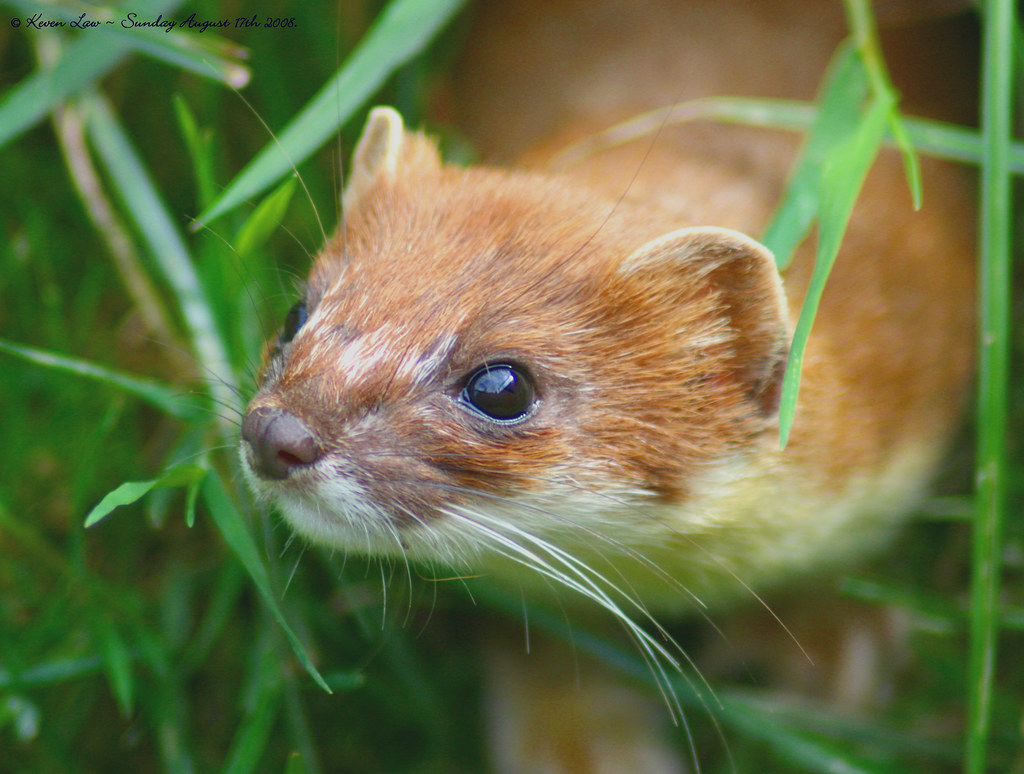
From Wikipedia, the free encyclopedia ~ The Ermine (Mustela erminea) is a small mammal of the family Mustelidae. It is also known as the stoat and the short-tailed weasel.
Natural history ~ The Ermine can be found almost everywhere throughout the northern temperate, subarctic and Arctic regions, of Europe, Asia, and North America. In an unsuccessful attempt to control the rabbit population, it was introduced into New Zealand. Ermines are largely nocturnal or crepuscular but will sometimes come out during the day.
Physical description ~ The Ermine is a member of the family Mustelidae, which also includes other weasels, mink, otters, ferret, badgers, polecats, the wolverine, martens, the tayra, the fisher and in some taxonomical classifications skunks. This is one of the most species-rich families in order Carnivora. The Ermine moves in a sinuous manner when pursuing its prey extremely quick over the ground considering its small size, and is also a strong swimmer that is able to colonize offshore islands. Although it inhabits northern latitudes, the Ermine is built long and thin, leading to an increased surface area-to-volume ratio and increased dissipation of heat from its body. The advantage of this shape is that it is one of the few species able to follow burrowing animals into their own homes. It partly compensates for this shape by having short legs, small ears, a fast metabolism and, in winter, thick fur. Ermines may grow up to 30 cm long, with males much larger than the females. In most areas it coexists with the weasel (Mustela nivalis, also known as the Least Weasel), the smallest member of order Carnivora. Where the weasel is absent the Ermine is smaller (~70 g).
The Ermine's coat is a rich medium brown with an off-white belly. In winter, the coat is thicker and in regions that experience an inch or more of snow for at least forty days of the year (such as in Armenia[1]), the color changes to clean white. This white fur is known as "ermine", a term originating either from the Latin phrase "Armenius mūs" ("Armenian rat") or from a word common to the Germanic and Baltic languages, hence the scientific name. At this stage, where the animal is known as a "stoat", it may be referred to as ermine, or as being "in ermine". The winter Ermine has been used in art as a symbol of purity or virginity. The white fur was highly prized, and used in the robes of the Lord Chief Justice of England. Both the animal and the heraldic tincture are symbols of Brittany. The furs would be sewn together making a pattern of black dots. A version of this pattern is used in heraldry as ermine tincture.
In all seasons the Ermine has a black tip to its tail. The black tip probably serves as a decoy to predators, which would include almost any carnivore large enough to eat a Ermine (e.g. wolves, foxes, wolverines, and some birds of prey). This kind of coat is very similar to the coat of the long-tailed weasel (Mustela frenata), a related animal of about the same size which also moults into white in the northern part of its range, and it is easy to confuse these kinds of weasels. The North American name for the Ermine, the "Short-tailed weasel" arose because its tail length distinguishes it from the long-tailed weasel. In general it is found farther north. Both species can be distinguished from the weasel because the weasel lacks a black tip on its tail.
Geographical range ~ The Ermine is native to the area between the 40th parallel (north) and the beginning of the Arctic Circle, which encompasses most of northern Eurasia and North America.
They have been introduced to New Zealand and Australia to control a rabbit overpopulation but found an alternative source of food easier to catch thus leaving the rabbit problem unsolved. They were also brought to Terschelling Island to control water voles (Arvicola terrestris). Ermines can swim up to 1.5 kilometers across seawater and have already reached several New Zealand offshore islands unaided. Maud Island which is 900 meters offshore has been colonised multiple times in the past 20 years.
Diet ~ The Ermine is a carnivore. It eats insects, rabbits; rodents such as the mouse, vole and rat; other small mammals; birds and their eggs and young; and sometimes fish, reptiles, amphibians, and invertebrates. It is a very skillful tree climber and can descend a trunk headfirst, like a squirrel. The Ermine is capable of killing animals much larger than itself. When it is able to obtain more meat than it can eat it will engage in "surplus killing" and often stores the extra food for later. When this is the case, it will often kill by breaking the prey's neck without marking the body, presumably so its cache does not spoil easily.
There are several recorded instances of Ermines 'transfixing' rabbits by exhibiting a tumbling routine akin to a dance. Rabbits appear hypnotised by this activity and fail to notice the Ermine approach within striking distance. Once close enough, the rabbit falls easy prey to the Ermine.
Like other mustelids it typically dispatches its prey by biting into the base of the skull to get at the centers of the brain responsible for such important biological functions as breathing. Sometimes it will also make preliminary bites to other areas of the body. In most areas in which Ermines and least weasels co-exist, the weasel generally takes smaller prey and the Ermine slightly larger prey. The larger male Ermines generally take larger prey than females. Commonly, the Ermine falls prey to animals such as the wolf, fox, cat or badger.
Reproduction ~ Young Mustela ermineaThe Ermine is territorial and intolerant of others in its range, especially others of the same sex. Within its range, it typically uses several dens, often taken from prey species. It usually travels alone, except when it is mating or is a mother with older offspring. It breeds once a year, producing several young kits (or kittens) per litter, and its mating system is promiscuous. Copulation occurs during the mating season with multiple partners and is often forced by the male, who does not help raise the offspring. Sometimes it occurs when the female is so young she has not even left the den. In spite of being such a small animal, the Ermine's gestation is among the longest reported for mammals (11 months) because of the adaptation of delayed implantation, or embryonic diapause, in which a fertilized egg is not implanted in the uterus until months later. The animal's "real" gestation is much shorter. This is presumably an adaptation to the highly seasonal environment in which the Ermine lives.
Senses and behavior ~ Communication (and also location of prey) occurs largely by scent, since the Ermine as typical of mammals has a sensitive olfactory system. As a result much of this communication is missed by human observers. However, Ermines are believed to identify females in estrus by scent, and also the sex, health and age of prey. Some kinds of rodents such as voles have counter-adapted by being able to shut down reproduction (which makes females slower and easier to catch) if they smell the odor of mustelids. The Ermine's visual resolution is lower than that of humans and color vision is poor, although night vision is superior. Like most other non-primate mammals they have dichromatic colour vision (they can distinguish long from short wavelengths of light, but cannot make distinctions of hue within those bands). Tactile information is conferred by the vibrissae, or whiskers. When alarmed, a Ermine can release a powerful musky smell from glands near its anus.
Red-backed Shrike male in rain.
Even when it's raining heavily, the male shrike keeps watch for predators bigger than himself.
Nesting Shrikes weigh up their ability to chase a given intruder away and avoid pointless aggression against large, undefeatable intruders. This suggests that shrikes are able to asses not only the dangerousness of the intruder but also the potential advantageousness, or otherwise, of active defence.
The genus name, Lanius , is derived from the Latin word for " butcher ", and some shrikes are also known as "butcher birds" because of their feeding habits.
The Red-backed Shrike bird (Lanius collurio) is a member of the shrike family Laniidae. The general colour of the males upper parts is reddish. It has a grey head and a typical shrike black stripe through the eye. Underparts are tinged pink and the tail has a black and white pattern similar to that of a wheatear. In the female and young Red-backed Shrikes, the upperparts are brown and vermiculated (wavy lines or markings). Underparts are buff and also vermiculated.
This 16 – 18 centimetres long migratory passerine eats large insects, small birds, voles and lizards. Like other shrikes the Red-backed Shrike hunts from prominent perches and impales corpses on thorns or barbed wire as a ‘larder’.
The Red-backed Shrike breeds in most of Europe and western Asia and winters in tropical Africa.
The Red-backed Shrikes range is decreasing and it is now probably extinct in Great Britain as a breeding bird, although it is frequent on migration.
The Red-backed Shrike is named as a protected bird in Britain under a Biodiversity Action Plan. The Red-backed Shrikes’ decline is due to overuse of pesticides and scrub clearance due to human overpopulation.
The Red-backed Shrike breeds in open cultivated country with hawthorn and dog rose.
Photo_w_1037
The Viking Age (793–1066 AD) was the period during the Middle Ages when Norsemen known as Vikings undertook large-scale raiding, colonizing, conquest, and trading throughout Europe, and reached North America.
It followed the Migration Period and the Germanic Iron Age.[7] The Viking Age applies not only to their homeland of Scandinavia, but to any place significantly settled by Scandinavians during the period.[3] The Scandinavians of the Viking Age are often referred to as Vikings as well as Norsemen, although few of them were Vikings in the technical sense.
Voyaging by sea from their homelands in Denmark, Norway and Sweden, the Norse people settled in the British Isles, Ireland, the Faroe Islands, Iceland, Greenland, Normandy, the Baltic coast, and along the Dnieper and Volga trade routes in eastern Europe, where they were also known as Varangians. They also briefly settled in Newfoundland, becoming the first Europeans to reach North America. The Norse-Gaels, Normans, Rus' people, Faroese and Icelanders emerged from these Norse colonies.
The Vikings founded several kingdoms and earldoms in Europe: the kingdom of the Isles (Suðreyjar), Orkney (Norðreyjar), York (Jórvík) and the Danelaw (Danalǫg), Dublin (Dyflin), Normandy, and Kievan Rus' (Garðaríki). The Norse homelands were also unified into larger kingdoms during the Viking Age, and the short-lived North Sea Empire included large swathes of Scandinavia and Britain.
Several things drove this expansion. The Vikings were drawn by the growth of wealthy towns and monasteries overseas, and weak kingdoms. They may also have been pushed to leave their homeland by overpopulation, lack of good farmland, and political strife arising from the unification of Norway. The aggressive expansion of the Carolingian Empire and forced conversion of the neighboring Saxons to Christianity may also have been a factor.
Sailing innovations had allowed the Vikings to sail further and longer to begin with.
Information about the Viking Age is drawn largely from primary sources written by those the Vikings encountered, as well as archaeology, supplemented with secondary sources such as the Icelandic Sagas.
This illustrates the way the world works...a bit...At first I thought it needed more birds but in the end I like the 'simplicity' of this illustration and it's 50 kind a feeling a lot!
The Viking Age (793–1066 AD) was the period during the Middle Ages when Norsemen known as Vikings undertook large-scale raiding, colonizing, conquest, and trading throughout Europe, and reached North America.
It followed the Migration Period and the Germanic Iron Age.[7] The Viking Age applies not only to their homeland of Scandinavia, but to any place significantly settled by Scandinavians during the period.[3] The Scandinavians of the Viking Age are often referred to as Vikings as well as Norsemen, although few of them were Vikings in the technical sense.
Voyaging by sea from their homelands in Denmark, Norway and Sweden, the Norse people settled in the British Isles, Ireland, the Faroe Islands, Iceland, Greenland, Normandy, the Baltic coast, and along the Dnieper and Volga trade routes in eastern Europe, where they were also known as Varangians. They also briefly settled in Newfoundland, becoming the first Europeans to reach North America. The Norse-Gaels, Normans, Rus' people, Faroese and Icelanders emerged from these Norse colonies.
The Vikings founded several kingdoms and earldoms in Europe: the kingdom of the Isles (Suðreyjar), Orkney (Norðreyjar), York (Jórvík) and the Danelaw (Danalǫg), Dublin (Dyflin), Normandy, and Kievan Rus' (Garðaríki). The Norse homelands were also unified into larger kingdoms during the Viking Age, and the short-lived North Sea Empire included large swathes of Scandinavia and Britain.
Several things drove this expansion. The Vikings were drawn by the growth of wealthy towns and monasteries overseas, and weak kingdoms. They may also have been pushed to leave their homeland by overpopulation, lack of good farmland, and political strife arising from the unification of Norway. The aggressive expansion of the Carolingian Empire and forced conversion of the neighboring Saxons to Christianity may also have been a factor.
Sailing innovations had allowed the Vikings to sail further and longer to begin with.
Information about the Viking Age is drawn largely from primary sources written by those the Vikings encountered, as well as archaeology, supplemented with secondary sources such as the Icelandic Sagas.
A large crowd, taken just after a Muse concert in Paris (not that you can tell). Incredible density of people as they walked slowly to the exit, without a hint of overcrowding. Great to have been in such a good position to get faces and a good smattering of colour.
Thank you for using this photograph all over the world - very exciting to see this photograph pop up in blogs and magazines everywhere.
The genus name, Lanius , is derived from the Latin word for " butcher ", and some shrikes are also known as "butcher birds" because of their feeding habits.
The Red-backed Shrike bird (Lanius collurio) is a member of the shrike family Laniidae. The general colour of the males upper parts is reddish. It has a grey head and a typical shrike black stripe through the eye. Underparts are tinged pink and the tail has a black and white pattern similar to that of a wheatear. In the female and young Red-backed Shrikes, the upperparts are brown and vermiculated (wavy lines or markings). Underparts are buff and also vermiculated.
This 16 – 18 centimetres long migratory passerine eats large insects, small birds, voles and lizards. Like other shrikes the Red-backed Shrike hunts from prominent perches and impales corpses on thorns or barbed wire as a ‘larder’.
The Red-backed Shrike breeds in most of Europe and western Asia and winters in tropical Africa.
The Red-backed Shrikes range is decreasing and it is now probably extinct in Great Britain as a breeding bird, although it is frequent on migration.
The Red-backed Shrike is named as a protected bird in Britain under a Biodiversity Action Plan. The Red-backed Shrikes’ decline is due to overuse of pesticides and scrub clearance due to human overpopulation.
The Red-backed Shrike breeds in open cultivated country with hawthorn and dog rose.
We walked the East End neighborhood around Hidalgo Park, talking to residents about the importance of Spay/Neuter, and convincing them not to chain their dogs.
The Viking Age (793–1066 AD) was the period during the Middle Ages when Norsemen known as Vikings undertook large-scale raiding, colonizing, conquest, and trading throughout Europe, and reached North America.
It followed the Migration Period and the Germanic Iron Age.[7] The Viking Age applies not only to their homeland of Scandinavia, but to any place significantly settled by Scandinavians during the period.[3] The Scandinavians of the Viking Age are often referred to as Vikings as well as Norsemen, although few of them were Vikings in the technical sense.
Voyaging by sea from their homelands in Denmark, Norway and Sweden, the Norse people settled in the British Isles, Ireland, the Faroe Islands, Iceland, Greenland, Normandy, the Baltic coast, and along the Dnieper and Volga trade routes in eastern Europe, where they were also known as Varangians. They also briefly settled in Newfoundland, becoming the first Europeans to reach North America. The Norse-Gaels, Normans, Rus' people, Faroese and Icelanders emerged from these Norse colonies.
The Vikings founded several kingdoms and earldoms in Europe: the kingdom of the Isles (Suðreyjar), Orkney (Norðreyjar), York (Jórvík) and the Danelaw (Danalǫg), Dublin (Dyflin), Normandy, and Kievan Rus' (Garðaríki). The Norse homelands were also unified into larger kingdoms during the Viking Age, and the short-lived North Sea Empire included large swathes of Scandinavia and Britain.
Several things drove this expansion. The Vikings were drawn by the growth of wealthy towns and monasteries overseas, and weak kingdoms. They may also have been pushed to leave their homeland by overpopulation, lack of good farmland, and political strife arising from the unification of Norway. The aggressive expansion of the Carolingian Empire and forced conversion of the neighboring Saxons to Christianity may also have been a factor.
Sailing innovations had allowed the Vikings to sail further and longer to begin with.
Information about the Viking Age is drawn largely from primary sources written by those the Vikings encountered, as well as archaeology, supplemented with secondary sources such as the Icelandic Sagas.
.
Brumleby is an enclave of terraced houses in Copenhagen, Denmark, located between Øster Allé and Østerbrogade, just south of Parken Stadium and St. James' Church. Built for indigent workers by the Danish Medical Association from 1854 to 1872, it is one of the earliest examples of social housing in Denmark and became a model for later projects.
Background
The idea of providing cheap and healthy homes for the poorest part of the city's work force originated among local politicians and medical doctors during the 1853 Copenhagen cholera outbreak which killed approximately 5,000 citizens. A major reason for the outbreak was the dismal conditions in the poorest parts of the city which suffered from overpopulation and lack of proper sanitary services. Copenhagen's population had almost doubled since 1800 but the city had still not been allowed to expand beyond its old fortification ring.
Wikipedia
Sailor Bar, American River Parkway / Sacramento County, California
This dragonfly is very difficult to get a quality shot of as the metering system of the camera struggles to maintain a proper balance in color tones due to the contrasting dark areas of the dragonfly's wings and the whitish color tones of the abdomen.
The background that you see behind the dragonfly are algae mats which consists of blue-green cyanobacteria that float on the surface of ponds such as this one that this dragonfly is perched above. Overpopulation of algal mats may be an ecological problem, when mats disrupt the other underwater marine life by blocking out the sunlight.
No one leaves home unless home is the mouth of a shark.
Warsan Shire
So often the world sits idly by, watching ethnic conflicts flare up, as if these were mere entertainment rather than human beings whose lives are being destroyed. Shouldn’t the existence of even one single refugee be a cause for alarm throughout the world?
Urkhan Alakbarov
In the midst of migrants in search of a better life there are people in need of protection: refugees and asylum-seekers, women and children victims of trafficking…Many move simply to avoid dying of hunger. When leaving is not an option but a necessity, this is more than poverty.
Antonio Guterres
A lasting solution, the possibility to begin a new life, is the only dignified solution for the refugee himself.
Poul Hartling
Environmental degradation, overpopulation, refugees, narcotics, terrorism, world crime movements, and organized crime are worldwide problems that don’t stop at a nation’s borders.
Warren Christopher
I urge you to celebrate the extraordinary courage and contributions of refugees past and present.
Kofi Annan
Thank you for your kind visit. Have a wonderful and beautiful day! ❤️❤️❤️