View allAll Photos Tagged osteopathy
my blue mood is lifting, like a blue balloon, it's ready to float away.
{thank you to the magic dianna for an amazing cranial osteopathy treatment, which will help me on my way}
happy bench monday.
uplifting blue ~ for the LOVE of COLOR week
Laila was glad to be stranger number 331 as she is 31 years old. She is doing a masters degree in osteopathy and naturopathy in London. There is a lot of sitting involved in Laila's studies. She likes to keep healthy by cycling and with yoga.
When she has finished studying Laila plans to enjoy more of the British countryside. She will begin by spending around six weeks walking some of the coastal paths in the South West of England. After this she wants to buy a campervan and explore more of the country, for about a year, taking a bicycle too.
One of the things that Laila plans to do is to swim in all the lakes of the lake district. I told her that they are very cold. Especially Coniston Water, which is very deep. Laila didn't mind. She will get a thin wet suit.
When I first met Laila, she was photographing her mother and brothers, at a seat half way up Glastonbury tor. I offered to photograph all of them. Laila thanked me. I took the photo and asked if it would be OK to take her photo for my project. I liked her hat and style. Laila agreed with a smile. I said that I would like to take the photo at the top of the tor (where they were heading anyway) and that I could photograph them all there too.
It was Laila's hat that drew me to her initially. I had walked past her on my way down the tor and decided to go back as I watched her photographing the rest of her family. When we reached the top of the tor, Laila sat and chatted with me for a few minutes before I started to take some photos. We tried portraits with different backdrops and a couple of locations before we called the rest of the party back for group photos.
Thank you Laila for agreeing to be in my project. It was good to meet you. Best wishes for your studies and beyond.
You can view more portraits and stories by visiting The Human Family
My osteopath asked me to take some photos of her new foam rollers (for exercising to ease muscle pain). I may just have to get one. I was quite nervous about doing it but luckily she loved them.
When the doctor suggested surgery
and a brace for all my youngest years,
my parents scrambled to take me
to massage therapy, deep tissue work,
osteopathy, and soon my crooked spine
unspooled a bit, I could breathe again,
and move more in a body unclouded
by pain. My mom would tell me to sing
songs to her the whole forty-five minute
drive to Middle Two Rock Road and forty-
five minutes back from physical therapy.
She’d say, even my voice sounded unfettered
by my spine afterward. So I sang and sang,
because I thought she liked it. I never
asked her what she gave up to drive me,
or how her day was before this chore. Today,
at her age, I was driving myself home from yet
another spine appointment, singing along
to some maudlin but solid song on the radio,
and I saw a mom take her raincoat off
and give it to her young daughter when
a storm took over the afternoon. My god,
I thought, my whole life I’ve been under her
raincoat thinking it was somehow a marvel
that I never got wet.
Ada Limón
Salamanca, New York
September 4th & 5th, 2024
Some history of this haunted historic location (taken from the Wildwood Sanitarium website):
"Wildwood Sanitarium was built in 1900 and bought by doctor John Henderson and doctor Carol Perry in 1903. The two doctors went to college for osteopathy, a branch of medical practice that emphasizes the treatment of medical disorders through the manipulation and massage of the bones, joints, and muscles. Dr. Henderson along with his partner Dr. Perry and a staff of three nurses Bertha , Agnes, and Sue spent seven years preparing the building to house twelve full time patients along with people seeking treatments in their renovated bath house located in the basement. When it was opened as a holistic private hospital in 1909 They offered cold baths , hot baths, electric battery baths, light bath therapy and other homeopathic treatments. They treated all types of patients with various ailments such as drug addiction, alcoholism, mental issues or they needed treatment for another non contagious disease all were welcome. Walter Freeman also performed lobotomies during this time. The doctors were eventually forced by the state to open up as a sanitarium to treat Tuberculosis in 1923 due to the pandemic at the time. Dr. Henderson passed away in 1941 it was owned by his family until 1946. Dr. Perry also passed in 1941 he was only fifty six. Both doctors had been married while Dr. Perry had no children Dr. Henderson had three but lost two of them but had been married twice. His first wife had passed away. The early 1950's the building became three apartments and stayed apartments for thirty years and afterwards was owned by different families and had sat vacant a couple of times. The building was bought by the Wagatha family in 2017 which is now currently an active restoration project funded by being open for paranormal investigations."
Wildwood Sanitarium
Salamanca, New York
September 4th & 5th, 2024
Some history of this haunted historic location (taken from the Wildwood Sanitarium website):
"Wildwood Sanitarium was built in 1900 and bought by doctor John Henderson and doctor Carol Perry in 1903. The two doctors went to college for osteopathy a branch of medical practice that emphasizes the treatment of medical disorders through the manipulation and massage of the bones, joints, and muscles. Dr. Henderson along with his partner Dr. Perry and a staff of three nurses Bertha , Agnes, and Sue spent seven years preparing the building to house twelve full time patients along with people seeking treatments in their renovated bath house located in the basement. When it was opened as a holistic private hospital in 1909 They offered cold baths , hot baths, electric battery baths, light bath therapy and other homeopathic treatments. They treated all types of patients with various ailments such as drug addiction, alcoholism, mental issues or they needed treatment for another non contagious disease all were welcome. Walter Freeman also performed lobotomies during this time. The doctors were eventually forced by the state to open up as a sanitarium to treat Tuberculosis in 1923 due to the pandemic at the time. Dr. Henderson passed away in 1941 it was owned by his family until 1946. Dr. Perry also passed in 1941 he was only fifty six. Both doctors had been married while Dr. Perry had no children Dr. Henderson had three but lost two of them but had been married twice. His first wife had passed away. The early 1950's the building became three apartments and stayed apartments for thirty years and afterwards was owned by different families and had sat vacant a couple of times. The building was bought by the Wagatha family in 2017 which is now currently an active restoration project funded by being open for paranormal investigations."
Salamanca, New York
September 4th & 5th, 2024
Some history of this haunted historic location (taken from the Wildwood Sanitarium website):
"Wildwood Sanitarium was built in 1900 and bought by doctor John Henderson and doctor Carol Perry in 1903. The two doctors went to college for osteopathy a branch of medical practice that emphasizes the treatment of medical disorders through the manipulation and massage of the bones, joints, and muscles. Dr. Henderson along with his partner Dr. Perry and a staff of three nurses Bertha , Agnes, and Sue spent seven years preparing the building to house twelve full time patients along with people seeking treatments in their renovated bath house located in the basement. When it was opened as a holistic private hospital in 1909 They offered cold baths , hot baths, electric battery baths, light bath therapy and other homeopathic treatments. They treated all types of patients with various ailments such as drug addiction, alcoholism, mental issues or they needed treatment for another non contagious disease all were welcome. Walter Freeman also performed lobotomies during this time. The doctors were eventually forced by the state to open up as a sanitarium to treat Tuberculosis in 1923 due to the pandemic at the time. Dr. Henderson passed away in 1941 it was owned by his family until 1946. Dr. Perry also passed in 1941 he was only fifty six. Both doctors had been married while Dr. Perry had no children Dr. Henderson had three but lost two of them but had been married twice. His first wife had passed away. The early 1950's the building became three apartments and stayed apartments for thirty years and afterwards was owned by different families and had sat vacant a couple of times. The building was bought by the Wagatha family in 2017 which is now currently an active restoration project funded by being open for paranormal investigations."
Salamanca, New York
September 4th & 5th, 2024
Some history of this haunted historic location (taken from the Wildwood Sanitarium website):
"Wildwood Sanitarium was built in 1900 and bought by doctor John Henderson and doctor Carol Perry in 1903. The two doctors went to college for osteopathy a branch of medical practice that emphasizes the treatment of medical disorders through the manipulation and massage of the bones, joints, and muscles. Dr. Henderson along with his partner Dr. Perry and a staff of three nurses Bertha , Agnes, and Sue spent seven years preparing the building to house twelve full time patients along with people seeking treatments in their renovated bath house located in the basement. When it was opened as a holistic private hospital in 1909 They offered cold baths , hot baths, electric battery baths, light bath therapy and other homeopathic treatments. They treated all types of patients with various ailments such as drug addiction, alcoholism, mental issues or they needed treatment for another non contagious disease all were welcome. Walter Freeman also performed lobotomies during this time. The doctors were eventually forced by the state to open up as a sanitarium to treat Tuberculosis in 1923 due to the pandemic at the time. Dr. Henderson passed away in 1941 it was owned by his family until 1946. Dr. Perry also passed in 1941 he was only fifty six. Both doctors had been married while Dr. Perry had no children Dr. Henderson had three but lost two of them but had been married twice. His first wife had passed away. The early 1950's the building became three apartments and stayed apartments for thirty years and afterwards was owned by different families and had sat vacant a couple of times. The building was bought by the Wagatha family in 2017 which is now currently an active restoration project funded by being open for paranormal investigations."
"The Haunting Wildwood Sanitarium"
Salamanca, New York
September 4th & 5th, 2024
Some history of this haunted historic location (taken from the Wildwood Sanitarium website):
"Wildwood Sanitarium was built in 1900 and bought by doctor John Henderson and doctor Carol Perry in 1903. The two doctors went to college for osteopathy, a branch of medical practice that emphasizes the treatment of medical disorders through the manipulation and massage of the bones, joints, and muscles. Dr. Henderson along with his partner Dr. Perry and a staff of three nurses Bertha , Agnes, and Sue spent seven years preparing the building to house twelve full time patients along with people seeking treatments in their renovated bath house located in the basement. When it was opened as a holistic private hospital in 1909 They offered cold baths , hot baths, electric battery baths, light bath therapy and other homeopathic treatments. They treated all types of patients with various ailments such as drug addiction, alcoholism, mental issues or they needed treatment for another non contagious disease all were welcome. Walter Freeman also performed lobotomies during this time. The doctors were eventually forced by the state to open up as a sanitarium to treat Tuberculosis in 1923 due to the pandemic at the time. Dr. Henderson passed away in 1941 it was owned by his family until 1946. Dr. Perry also passed in 1941 he was only fifty six. Both doctors had been married while Dr. Perry had no children Dr. Henderson had three but lost two of them but had been married twice. His first wife had passed away. The early 1950's the building became three apartments and stayed apartments for thirty years and afterwards was owned by different families and had sat vacant a couple of times. The building was bought by the Wagatha family in 2017 which is now currently an active restoration project funded by being open for paranormal investigations."
A university student playing bagpipes to raise funds towards his pursuit of a doctorate in osteopathic medicine in Ottawa, Ontario, Canada.
Demolition crews moved on the admin building first in July.
detroiturbex.com/content/healthandsafety/riverside/index....
Carte de visite by an unidentified photographer. Almost two decades after the guns of the Civil War fell silent, Capt. James Ford Zediker of the 12th Iowa Infantry joined surviving veterans at the regiment’s second reunion. The 41-year-old officer traveled all the way from his Nebraska farm to Manchester, Iowa, for the two-day event.
He’s pictured here as a first sergeant, his veteran’s stripes visible on the lower sleeve of his jacket.
On May 22, 1884, the reunion’s second day, Zediker stood before the crowd to deliver a ten-minute speech titled A Soldier’s Attachment. Though he admitted the time was too short to express all he felt for his comrades, he rose to the moment with heartfelt words recalling their shared trials.
A synopsis published in the official reunion record observed:
“The attachment of old soldiers for one another, was formed on the field, in the camp and on the march, enduring privations under the summer heats and the chill blasts of winter. Made strong by hunger and thirst, and hardships endured together; by danger and suffering; by the loss of comrades left on the battle field; by sufferings in Southern prisons. Is it a wonder that our attachment should be so strong? A few more years, and those who meet at these gatherings will be feeble and few. But let us all, while any of us are left, instill into the minds of our children, the same sentiments of loyalty and patriotism that actuated us.”
Zediker came by his loyalty and patriotism through generations stretching back to German immigrants in colonial times. His grandparents settled in Pennsylvania before it became a state, and his parents, Isaac and Elizabeth, moved to Iowa before it achieved statehood. They brought young James with them and added six more children to the family. He might have spent his life farming in Jackson County, along the Mississippi River—but the war changed everything.
When the conflict began, 19-year-old Zediker enlisted in Company I of the 12th Iowa in October 1861, beginning a bond with his fellow soldiers that would last a lifetime.
The regiment trained at Benton Barracks in St. Louis before joining Brig. Gen. Ulysses S. Grant’s army for the victories at Forts Henry and Donelson. At Shiloh, the 12th earned fame as part of the “Hornet’s Nest Brigade” for its fierce defense, ending with most of the regiment, including Zediker, captured and held as prisoners of war through the rest of 1862.
In 1863, Zediker re-enlisted as a veteran volunteer, rose from sergeant to captain, and fought in the Vicksburg Campaign and lesser-known operations in Mississippi, Arkansas, Missouri, and Tennessee that steadily weakened Confederate resistance.
In Tennessee, while guarding railroads in the vicinity of Chewalla, the Iowans pursued bands of Confederate guerillas disrupting the region. Zediker participated in one of these raids and left behind an official report. His account is illustrative of the many actions far off the front lines of major battles.
Zediker wrote:
On the 28th of December, 1863, our Tennessee scouts came in and reported that a rebel lieutenant on furlough was in the vicinity of Chewalla, Tenn. Accordingly at 4 o'clock P.M., Captain Sumbardo, in command of Companies I and G, marched through the stockade with a number of scouts to search out the lieutenant. About twenty of our number were mounted. We crossed the Tuscumbia river, and marched southward, crossing the Tennessee line into Mississippi. The night was dark, and the roads muddy, but we continued marching, searching houses, etc., occasionally capturing a suspicious character, until near morning, when we heard of a dance in the vicinity, and with increased speed pressed on eager to catch the prey. At 5 o'clock A.M., December 29th, we found ourselves within hearing of the music, and cautiously surrounding the premises we closed in upon the buildings, but the rebels, discovering our approach, broke out through doors and windows, some with and some without arms, and for several moments a sharp and lively fire was kept up without, while the deafening screams of females were heard within.
Finally they surrendered, and the excitement being partially quelled we learned the following results of our expedition: One rebel killed, five wounded, and fourteen captured, with several valuable cavalry horses, arms, etc. Among the captured were a captain and a lieutenant. We arrived at camp at 9 o'clock A.M., 29th, with nineteen prisoners in all, and were highly complimented upon our success. Our loss was none, much to the chagrin of the furloughed rebels.
I remain general, very respectfully, your obedient servant,
James F. Zediker,
Captain Company I, 12th Iowa V.V. Infantry.
The 12th went on to serve in the Atlanta Campaign, fought at Nashville and Spanish Fort, and performed garrison duty in Alabama before mustering out in early 1866.
Zediker returned to Iowa, married Julia Douglas, and raised eight children, six of whom survived to adulthood. In 1871, the family moved to Nebraska, where they homesteaded in Franklin County. Zediker studied medicine and became an osteopath, practicing hands-on healing through movement and manipulation. He also served as a clerk in the Nebraska legislature and as a delegate to a constitutional convention.
In 1902, the Zedikers moved to Yakima, Washington, where he focused on osteopathy and opened The Zediker Institute of Drugless Healing. He retired around 1920 and devoted his later years to church work. In 1928, he entered the Old Soldiers’ Home in Washington, where he died two years later at age 87 of heart issues.
He outlived Julia, who died in 1907, and his second wife, Rose. His third wife, Marietta—whom he married at age 83—and his children survived him.
I encourage you to use this image for educational purposes only. However, please ask for permission.
Rosie's 1 year old today, and she had a really fun party this evening, with her uncle Riley attending as a guest!! ;-) Today also marks the 1 year point with her Craniomandibular osteopathy (CMO) Decease. Studies about CMO show that it's a juvenile decease, and is only active during the first year of life. Once the growth cycle stops, so does the CMO decease. We already see her 10 to 15 day pain cycle starting to taper off, so we're almost out of the woods with this one!!!
Happy Birthday Rosie!!!
4th year medical student Cody Reynolds (standing) practices an examination of the lymphatic drainage of the head and chest of Associate Dean for Clinical Sciences and Health Policy Fellow Dr. Randy Litman, DO, at University of Pikeville Kentucky College of Osteopathic Medicine (UP-KYCOM), Pikeville, KY on Tuesday, July 12, 2011. The small size of this lab forces classes to be split, extending the school day and making the instructional content inconsistent between the split classes.
Dr. Reynolds will be in the first class to graduate from (but not study in) the new Coal Building, to be finished in 2012. The building is part of the $25 million expansion project at UP-KYCOM. The project will provide the undergraduate college with a new educational facility and an expanded clinical skills center. The nine-story structure is part of the new facility that will include two lecture halls, a gross anatomy lab, two research labs, offices, small group classrooms and student study space. A clinical skills training and evaluation center that will house 12 specially equipped examination rooms will be within the building and serve as training and testing centers for students in programs using standardized patients and high-fidelity robotic patient simulators. An expanded osteopathic manipulative medicine lab and clinic will provide learning opportunities, as well as housing UP-KYCOM’s free community clinic, which will be easy to reach from the sidewalk. Plans for the building also include a new cafeteria for the campus community. "We are embarking on a vital project that will greatly enhance the excellent medical education our student doctors receive," said Pikeville College President Paul E. Patton. "At the same time, it will allow us to expand the current class size from 75 to 125 students, increasing the total enrollment from 300 to 500 students. The college initiated a capital construction campaign. In order to secure adequate funding, the board of trustees authorized borrowing up to $25 million from the USDA Rural Development. Commitments of $1.6 million have been secured through gifts and pledges, including $500,000 from the James Graham Brown Foundation. Significant grants have also been received from the Appalachian Regional Commission, and the U.S. Small Business Administration. USDA Photo by Lance Cheung
The Haunting Wildwood Sanitarium
Salamanca, New York
September 4th & 5th, 2024
Some history of this haunted historic location (taken from the Wildwood Sanitarium website):
"Wildwood Sanitarium was built in 1900 and bought by doctor John Henderson and doctor Carol Perry in 1903. The two doctors went to college for osteopathy, a branch of medical practice that emphasizes the treatment of medical disorders through the manipulation and massage of the bones, joints, and muscles. Dr. Henderson along with his partner Dr. Perry and a staff of three nurses Bertha , Agnes, and Sue spent seven years preparing the building to house twelve full time patients along with people seeking treatments in their renovated bath house located in the basement. When it was opened as a holistic private hospital in 1909 They offered cold baths , hot baths, electric battery baths, light bath therapy and other homeopathic treatments. They treated all types of patients with various ailments such as drug addiction, alcoholism, mental issues or they needed treatment for another non contagious disease all were welcome. Walter Freeman also performed lobotomies during this time. The doctors were eventually forced by the state to open up as a sanitarium to treat Tuberculosis in 1923 due to the pandemic at the time. Dr. Henderson passed away in 1941 it was owned by his family until 1946. Dr. Perry also passed in 1941 he was only fifty six. Both doctors had been married while Dr. Perry had no children Dr. Henderson had three but lost two of them but had been married twice. His first wife had passed away. The early 1950's the building became three apartments and stayed apartments for thirty years and afterwards was owned by different families and had sat vacant a couple of times. The building was bought by the Wagatha family in 2017 which is now currently an active restoration project funded by being open for paranormal investigations."
BRIDGE RIVER - JAPANESE CANADIAN SELF-SUPPORTING INTERNMENT SITE OF THE SECOND WORLD WAR (1942–49)
SHALALTH was one of four local sites selected as Japanese-Canadian "relocation centres" - the others were McGillivray, Minto City and East Lillooet.
(from - Wrigley's 1939 British Columbia Directory) - SHALALTH - a Post Office on the Pacific Great Eastern Railway, 16 miles south of Lillooet, on beautiful Seton Lake. The gateway to the Bridge River Valley mines and transportation centre for the Bridge River mining area, that includes the famous Bralorne and Pioneer Gold mines, which can be reached by stage on a wonderful scenic highway over Mission Mountain reacing an elevation of 3,800 feet in the first five miles. The population in 1939 was 250.
Townsite (South SHALALTH) - Development of the electrical potential was in full swing by the mid-1920s, with a "model village" erected around the west side of the bay where Shalalth is located, and one of the tunnels piercing the mountainside above completed, but construction came to a halt with the onset of the Great Depression and the collapse of the finances backing the project, and work ground to a halt in 1929. The townsite remained largely empty during the 1930s, although steady traffic to the mines in the Bridge River Country over the mountain kept the hotels busy.
When World War II came, the semi-abandoned village built for the hydro project at the rail stop of South SHALALTH, which had gone dormant at the start of the Great Depression and colloquially known as Bridge River, was chosen for one of several relocation centres for Japanese-Canadians from the coast in the Lillooet area. One of the relocatees at Shalalth was Dr. Masajiro Miyazaki, a US-trained osteopathic physician who stayed on after the war and became one of Lillooet's two Companions of the Order of Canada.
Post-War Bridge River townsite - After the war, construction of the hydroelectric project resumed with a vengeance, and along with a new boom in traffic to the mines came a surge in equipment to finish the power project. For the next twenty or twenty-five years, SHALALTH became the main transportation hub for the surrounding region, with nearly 24-hour heavy traffic over the pass, either to and from the mines or to the new, expanded damsite just over the pass at the head of the Bridge River Canyon.
SHALALTH Post Office (1) was opened - 1 November 1925, being the First Nation name for Seton Lake. Renamed Bridge River Post Office - 1 June 1927. Name changed back to SHALALTH Post Office (2) - 16 June 1937.
LINKS to a list of the Postmasters who served at the Shalalth Post Office (first opening) - recherche-collection-search.bac-lac.gc.ca/eng/home/record... - BRIDGE RIVER Post Office - recherche-collection-search.bac-lac.gc.ca/eng/home/record... - Shalalth Post Office (second opening) - recherche-collection-search.bac-lac.gc.ca/eng/home/record...
Bridge River (Internment population: 269) - The community of Shalalth was formerly known as Bridge River. During the war it was the location of a self-supporting internment site for Japanese Canadians. This is a key example of how governments of the day used the imprisonment of Japanese Canadians to revitalize depressed or underutilized towns and infrastructure throughout the province. A thriving model company town established by the B.C. Electric Company in the 1920s, Bridge River was essentially a ghost town by the 1930s when the hydroelectric project there was abandoned. The former town site had cottages, a hotel, a hospital, a community hall, and sporting facilities that were deemed ideal to house self-supporting Japanese Canadians internees during the war.
Unlike other sites, Bridge River’s internment housing had electricity and indoor plumbing, making it one of the more comfortable internment locations. However, this did not mean that the Bridge River internees enjoyed luxuries or benefits that were denied to internees at other sites. There was no sense of social, political, or personal freedom for the people living in any of these places. Internees were not permitted to travel to Lillooet without a permit from the BCSC and a stamp from the BC Police in Lillooet. Japanese Nationals also had to report to the BCSC supervisor once a month to have their parole papers stamped. The continuity of education, social groups, and cultural activities was important to the Japanese Canadians living in the camps, so community organizers brought these activities into camp life. In particular, the Bridge River and Minto sites were managed by a committee of three men: Etsuji Morii from Minto, and Ippei Nishio and Asajiro Nishiguchi from Bridge River, who were instrumental in helping to bring as many social, medical, and educational services to the camps as possible. Camp residents even had to provide schooling for their own children, as Japanese Canadian children were not permitted to attend local schools. Bridge River was also the centre for medical care for internees in this area. The once-abandoned hospital became the home of Dr. Masajiro Miyazaki and dentist Dr. Fujiwara and their families. Together they looked after the medical needs of the internees, and their practices soon expanded to include the care of the First Nations community at the nearby Bridge River reserve. Both men were admired as leaders in their community. Dr. Miyazaki eventually moved his practice to Lillooet, and lived there until 1983. A miniature concrete and glass castle that still stands near the Bridge River Public Library is a reminder of the sense of community that people living in this camp had, despite their hardships. Built during the internment by Dr. Fujiwara and his son Alan, this castle remains as a symbol that equality among the races needs continuous advocacy and safeguarding. LINK to the complete article - www2.gov.bc.ca/assets/gov/driving-and-transportation/driv...
Sent by: Mamoru Sakamoto
(b. 1913 in Japan - d. ?) - occupation - carpenter - I could not locate his WWII internment records. LINK - loi.uvic.ca/archive/saka28.html - LINK to details on his fishing boat - landscapesofinjustice.uvic.ca/archive/media/boatLedgers/2...
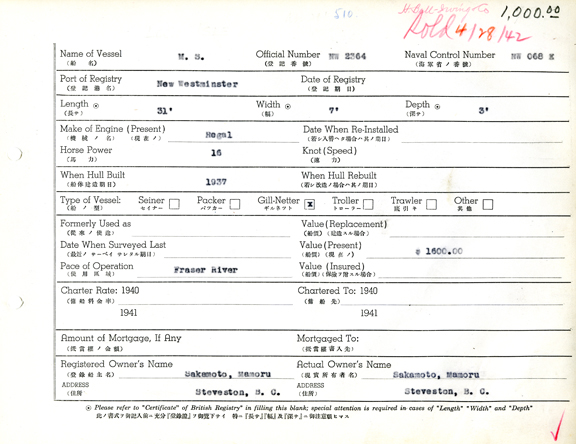
He married Aiko Murimoto on - 24 January 1941 in Vancouver, British Columbia - LINK to their marriage certificate - search-collections.royalbcmuseum.bc.ca/Image/Genealogy/12...
His wife - Aiko (nee Murimoto) Sakamoto (Custodian Identification Number - 5907) - she was born on 3 August 1915. Her maiden name is Aiko Murimoto. She was a housewife. Her family includes Chiyo Murimoto (mother), Rinosuke Murimoto (father), Mamoru Sakamoto (husband), and Harumi Sakamoto (daughter). Her home address is listed as P.O. Box 459, Atlas Cannery, Steveston, BC. She was forcibly uprooted to Bridge River, BC. - LINK to her internment records - landscapesofinjustice.uvic.ca/archive/media/custodianCase...
His mother - Yasue (nee Nitta) Sakamoto (Custodian Identification Number - 5906) - she was born on 17 May 1888. She was a housewife. Her family includes Bunzo Sakamoto (husband), Mamoru Sakamoto (son), Taira Sakamoto (son), and Noboru Sakamoto (son). Her home address is listed as P.O. Box 459, atlas Cannery, 6th Avenue & Dyke, Steveston, BC. She was forcibly uprooted to Bridge River, BC. - LINK to her internment records - landscapesofinjustice.uvic.ca/archive/media/custodianCase...
His father - Bunzo Sakamoto (Custodian Identification Number - 6431) - he was born on 21 March 1878. He was a self-employed carpenter. His family includes Yasue Sakamoto (wife; nee Yasue Nitta), Mamoru Sakamoto (son), Taira Sakamoto (son), and Noboru Sakamoto (son). His home address is listed as P.O. Box 459, Imperial Cannery, Steveston, BC. He was forcibly uprooted to Vernon, BC. - LINK to his internment records - loi.uvic.ca/archive/saka379.html and - landscapesofinjustice.uvic.ca/archive/media/custodianCase...
- sent from - / SHALALTH / JAN 5 / 44 / B.C. / - duplex cancel - this duplex hammer (first hammer / DBC-342) was proofed - 3 September 1937 - ERD - 15 September 1937 / LRD - 20 December 1945.
Addressed to - Gordon & Belyea Limited / Wholesale Hardware / 101 Powell Street / Vancouver, B.C. /
Gordon & Belyea Limited Vancouver B.C. was a wholesale hardware and ship chandlery business. Link to a photo of this building - searcharchives.vancouver.ca/uploads/r/null/8/1/813353/040...

The Former Philadelphia Osteopathic Hospital.Built in 1929,Lackey & Hettel Architects.Collegiate Gothic Style.Closed in 1972.Currently Emmanuel Korean Presbyterian Church.West Philadelphia.-35mm Olympus Stylus Epic,Ilford XP2 400.
Textbook work by Morganico & Steven Ball.
Work on the British School of Osteopathy in Borough, London SE1.
A university student playing bagpipes to raise funds towards his pursuit of a doctorate in osteopathic medicine in Ottawa, Ontario, Canada.
August 2018 Photo Challenge - Where were you born
As the old song goes, I was born in Saginaw, Michigan. (But I'm obviously not the son of a Saginaw fisherman! lol) I was born in this building at 515 N. Michigan Street in March of 1967. Back then it did not belong to Covenant Hospital (that hospital didn't even exist back then!), it was the Saginaw Osteopathic Hospital. My Grandma Robbins (mom's mom) worked in the "baby ward" at the hospital & was actually the first person to rock me to sleep.
Located on 4.2 acres with 500 foot frontage, at 2515 East Jefferson Street, South Bend. Off-street parking space for 250 cars
Plastichrome by Colourpicture
P29628
CAPA-023151
Osteopathic Hospital
South Bend, Indiana
Acme Distributors Co.
Lusterchrome by Tichnor Bros.
K-9312
CAPA-011084
Governor Moore addresses the Association of Colleges of Osteopathic Medicine by Joe Andrucyk at Baltimore Marriott Waterfront, 700 Aliceanna St, Baltimore, MD 21202,