View allAll Photos Tagged openaccess
Kastanie
more
www.flickr.com/search/?w=40036489@N00&q=kastanie
macro
Makro
Sx1
closer
"close up" Nahaufnahme chestnut fruit Samen Früchte Kapselfrucht conker conkers "Canon Powershot SX1 IS reference shot"
"Canon Powershot SX1 IS" "reference shot" City Stadt Tubinga Tuebingen Tubingen Tübingen Dibenga Germany Deutschland Baden-Wuerttemberg Württemberg "Stadt Tübingen" "Tübingen am Neckar"
Canon mode foliage, "Grünzeug"
Exposure 0.003 sec (1/400)
Aperture f/4.0
Focal Length 6.3 mm
Books at the Seattle Central Library.
As a reminder, keep in mind that this picture is available only for non-commercial use and that visible attribution is required. If you'd like to use this photo outside these terms, please contact me ahead of time to arrange for a paid license.
"COLORS IN OUR WORLD"
eagle1effi's photos tagged with Depot on Flickriver
Bunte Balkone .Wohnen im ehemaligen Getreidespeicher
im Depot Areal 2004- 2011 von Alef und Weinhardt Architekten
www.architekt-danner.de/wohnungsbau/depot-3/1.html
Video
Charles Gesner van der Voort (1916-1991) has been a member of NRCV (Nederlandse Reünisten Vereniging China (NRVC, Dutch Reunists Association China), as well as most of his former colleagues at Holland-China Trading Company.
NRVC evolved from Nederlandsch-Chineesche Vereeniging which was founded in 1923, by people who had an interest in China. Most of them had worked there, or studied Chinese and Chinese culture. Its magazine "China" had its editors' address at Leidsestraat 82-84 in Amsterdam, where Netherlands Harbour Works had its head office.
Its main activities before WWII were along the China coast: Shanghai, Hong Kong, Macao, Yantai (Chefoo), Xiamen (Amoy), etc.
Netherlands Harbour Works Company was founded 1 July 1912. More of its history is available online in the doctoral thesis by Frans-Paul van der Putten, Leiden University, "Corporate Behaviour and Political Risk, Dutch Companies in China, 1903-1941". openaccess.leidenuniv.nl/handle/1887/15900
020apps.nl/kaart/1850-1940/Leidsestraat/82-84:
[translation Pieter Lommerse] "Office building at the corner of Prinsengracht [and Leidsestraat] of N.V. Levensverzekeringsmaatschappij 'De Nederlanden', from 1954 'De Nederlanden van 1870'. Therefore, the building was named 'De Nederlanden'.
The insurance company used part of the offices, the other offices were rented to other companies {, one of which was Netherlands Harbour Works, or Nederlandsche Maatschappij voor Havenwerken].
The retail spaces at ground floor were rented to a furniture shop and to Municipal Gas Works. It displayed and sold gas stoves and fireplaces, up to 1921. From 1921 to 1994 a restaurant by the name of Dikker & Thijs was run here; there is still a hotel by that name."
photo by Pieter Lommerse
Inspired by Timothy Gower's blog post and the subsequent boycott page:
thecostofknowledge.com/ as described in The Chronicle of Higher Ed article, Elsevier Publishing Boycott Gathers Steam Among Academics via a tweet from @clintlalonde
Check out the larger version of the mock Elsevier logo
Deutsche Bahn 401 Class 14-car ICE 1 unit No. 93 80 5 401 585-5 D-DB Freilassing
Köln Hbf-Zurich Hbf via Frankfurt & Basel Bad/SBB service
Muttenz, Canton of Basel-Landschaft, Switzerland
September 20th, 2015
1600 x 1050
(Arriva) Grand Central Adelante Diesel unit 180112 works 1A61 the Sunderland to London Kings Cross service.
Seen here passing over Carr Lane Crossing, Bessacarr on the outskirts of Doncaster and heading for Peterborough via Lincoln.
This was due to planned engineering work on the East Coast Main line.
A delayed departure due to door closing problems at Platform 8, London Kings Cross station.
Class180 Adelante (Named Zephyr by Grand Central) 5 car dmu.
These 125mph units were Built in 2000/01.
Eyes - The Window to Your Soul
Candid portrait of a fakir - a sufi ascetic at the mela ground
Fakirs of Bengal
Ever since Islam came to Bengal in the 13th century it participated, via a merging of Sufi inputs with vernacular strands of Vaisnavism (Vishnuism), tantrism and local folk cults, in a very rich blend of religious beliefs and practices in the lower strata of society. The Fakir (Sufi ascetic), as a sub-section of the Bengali Bául with a more or less defined Muslim identity, are at present the largest group in Bengal perpetuating this form of 'Islamic syncretistic tradition'.
Lalan Shah or Lalan Fakir (?1774-?1890) is a product and proponent of purely Bengali syncretism. His writings and his teachings tell a story of merging Hinduism and Islam into a universalistic religion transcending the boundaries of any single religion.
The Hindu Bául and the Muslim Fakir share the same tenets of an mystic quest based on the intimate human-divine connection within every human being, cultivated through a philosophy and practices that emphasize the human body as locus and means for finding the essence of God. The path is taught in the traditional guru-disciple relationship where the guru is like the figure of the Sufi saint, in whom the divine is accomplished, merged with the human. More: openaccess.leidenuniv.nl/bitstream/handle/1887/17365/ISIM...
Poush Mela 2011, Santiniketan
Images of Bengal, India
Poush Mela / পৌষ মেলা
An annual fair and festival that takes place in Santiniketan, in Birbhum District in the Indian state of West Bengal, marking the harvest season. Commencing on the 7th day of the month of Poush (around 21/22 December), the fair officially lasts for three days, although vendors may stay up until the month-end. The key characteristic of this fair include live performances of Bengali folk music, notably baul and fakir songs.
A session about the copyright considerations in selecting and creating course materials
Chabriol Colebatch LLB, Copyright Co-ordinator/Legal Advisor, Brock University
Copyright rules and procedures at universities have confused faculty, instructors and lawyers for years. Recent copyright developments have resulted in changes to the ways faculty and instructors use copyright materials as well as increased scrutiny over Brock's copyright practices. This session will help faculty and instructors better understand the copyright issues involved in their work and will enable them to make sure that their materials do not infringe copyright.
Different copyright considerations which can affect your use of textbooks, course packs, electronic materials, print reserves etc
Copyright issues should you think about when creating PowerPoint slides?
How can you get permission to use copyright materials?
What alternatives do you have if you can't get permission (or just don't have the time)?
Who is available on campus to assist you with these issues?
For dates of upcoming copyright sessions and biweekly Lunch and Learn sessions (BYO lunch) go to www.brocku.ca/ctlet/workshops/faculty.
Copyright sessions are jointly sponsored by CPI and the Library.
Class-802 Hitachi Paragon at Chesterfield Derbyshire. Over the weekend 17/18th October 2020 Hull Trains were diverted off the East Coast Main Line from Doncaster to the Midland Mainline at Chesterfield. They ran in diesel mode via Toton to terminate at St.Pancras.
damncool famous pictorial "Neckarfront" - front of the city of Tuebingen, hometown
The row of historical houses, including the Hölderlintower, across one side of the elongated Neckarinsel is called the Neckarfront
The Collegiate Church [ Stiftskirche ]
of St. George was erected in Tübingen from 1470 to 1483 under Count EBERHARD IM BART [ "Eberhard beard in"] .
Master builder were " Peter of Koblenz "and Hans Augsteindreyer.
-
Tübingen's Altstadt (old town) survived the Second World War due to the city's lack of heavy industry. The result is a growing domestic tourism business as visitors come to wander through one of the few completely intact historic old cities [Altstädte ] in Germany.
The highlights of Tübingen
include its crooked cobblestone lanes, narrow-stair alleyways picking their way through the hilly terrain, streets lined with canals and well-maintained traditional half-timbered houses.
-
Highlights in Tübingen:
dazu gehören ihre krummen und steilen Gassen aus Kopfsteinpflaster, sehr enge Gässchen;
viele alte Naturstein-Treppen schlängeln sich durch die hügelige Landschaft der Innenstadt.
Manche Straßen sind mit altehrwürdigen offenen Kanälen durchzogen (Ammergasse) und überall gibt es gepflegte traditionelle Fachwerkhäusernaus dem späten Mittelalter.
Die Tübinger Altstadt (Altstadt) überlebte den Zweiten Weltkrieg fast ohne Bombardierung weil die Universitäts-Stadt keine Schwerindustrie beherbergt.
Fremdenverker Tourismus
Das Ergebnis ist eine schnell wachsende inländische Tourismus - Wirtschaft.
Besucher kommen, um durch eines der wenigen vollständig intakt historischen Städten [Altstädte] in Deutschland wandern.
104.864 offiziell registrierte Gästeankünfte und 206.424 Übernachtungen ,
darunter 49.797 von Gästen mit Wohnsitz im Ausland. (einschl. Camping)
2,0 Tage Übernachtungen im Durchschnitt.
Hotels: 21
Hotels garnis: 12
Gasthöfe: 21
Pensionen: 3 ( und viele private "Pensionen" )
Jugendherberg: 1
Campingplätze: 3
Erholungs-, Ferien- und Schulungsheime, Boardinghouses : 7
www.statistik.baden-wuerttemberg.de...
-
Neckarfront
The row of historical houses across one side of the elongated Neckarinsel is called the Neckarfront and includes the house with adjoining tower where poet Friedrich Hölderlin stayed for the last 36 years of his life as he struggled with mental instability.
Höderlinturm
Der Hölderlinturm zu Tübingen wurde im späten 19. Jahrhundert nach dem Dichter Friedrich Hölderlin benannt, der dort von 1807 bis zu seinem Tod im Jahr 1843 lebte. Das Gebäude ist eine der bekanntesten Gedenkstätten Tübingens.
Errichtet wurde der Hölderlinturm auf einem aus der Mauer vorspringenden Wehrturmsockel im späten 18. Jahrhundert.
Der Wehrturmsockel, auch Zwingel genannt, ist Teil der inneren Stadtmauer. Der alte Stadtgraben zwischen äußerer und innerer Stadtmauer, geht – wie staufische Buckelquader bei der Neckarbrücke beweisen – bis ins 13. Jahrhundert zurück.
Stiftskirche. St. Georg
Spätgotischer Bau mit fürstlicher Grablege des Hauses Württemberg.
Hervorragende Ausstattung: Glasfenster, *Lettner, Chorgestühl, reich verzierter Taufstein, spätgotische Steinkanzel, Altar des Dürer-Schülers Hans Schäufelein.
Vom Turm guter Blick über die Stadt.
Gegenüber: Münzgasse15 "Cottahaus", ehemaliger Sitz des berühmten Cotta -Verlags.
* Besonderheit: Lettner
Wie in vielen gotischen Kirchen bildete der Lettner einst die Schranke zwischen dem (der Geistlichkeit vorbehaltenen) Chorraum und dem Kirchenschiff der Laien, denen von dort die Lesungen („Lettner“ = „Lektorium“) vorgetragen wurden.
Als mit der Reformation die Chorschranken fielen, wurden auch landauf landab die Lettner entfernt.
Dass es in Tübingen anders kam, verdanken wir einer Idee Herzog Ulrichs, der 1534 in Württemberg die Reformation einführte.
Er machte den Chorraum zur Grablege des Württembergischen Fürstenhauses - so konnten Gottesdienste fortan nur noch im Schiff gefeiert werden - und der Lettner stehen bleiben.
Die Stiftskirche zu St. Georg in Tübingen wurde in ihrer heutigen Form von 1470 bis 1483 unter Graf Eberhard im Bart aufgrund der Übersiedlung des Chorherrnstiftes von Sindelfingen und der Gründung der Tübinger Universität erbaut. Baumeister waren Peter von Koblenz und Hans Augsteindreyer.
Service
Für Besucher gibt es im Kirchenvorraum sogar Toiletten.
Für Kinder während des Gottesdienstes
Im oberen Stock, neben der Orgel, ist für die spielenden und lärmenden Kinder ein schalldichter Raum mit vielen Spielmöglichkeiten.
Eine große Fensterfront gibt den Blick frei zum Gottedienst.
-
- Click , click
© View LARGE on BLACK
__ For your Eyes only ©
A Fakir - a Sufi ascetic on his spiritual journey!
National Highway (NH2), Saktigar (Langcha) Halt, Burdwan District
Images of Bengal, India
Fakirs of Bengal
Ever since Islam came to Bengal in the 13th century it participated, via a merging of Sufi inputs with vernacular strands of Vaisnavism (Vishnuism), tantrism and local folk cults, in a very rich blend of religious beliefs and practices in the lower strata of the society. The Fakir (Sufi ascetic), as a sub-section of the Bengali Bául with a more or less defined Muslim identity, are at present the largest group in Bengal perpetuating this form of 'Islamic syncretistic tradition'.
Lalan Shah or Lalan Fakir (?1774-?1890) is a product and proponent of purely Bengali syncretism. His writings and his teachings tell a story of merging Hinduism and Islam into a universalistic religion transcending the boundaries of any single religion.
The Hindu Bául and the Muslim Fakir share the same tenets of an mystic quest based on the intimate human-divine connection within every human being, cultivated through a philosophy and practices that emphasize the human body as locus and means for finding the essence of God. The path is taught in the traditional guru-disciple relationship where the guru is like the figure of the Sufi saint, in whom the divine is accomplished, merged with the human. More: openaccess.leidenuniv.nl/bitstream/handle/1887/17365/ISIM...
A Fakir, a Sufi ascetic on his spiritual journey, seeks alms from travellers on National Highway 60 (NH 60).
Suri Level Crossings, Birbhum district
Images of Bengal, India
Fakirs of Bengal
Ever since Islam came to Bengal in the 13th century it participated, via a merging of Sufi inputs with vernacular strands of Vaisnavism (Vishnuism), tantrism and local folk cults, in a very rich blend of religious beliefs and practices in the lower strata of the society. The Fakir (Sufi ascetic), as a sub-section of the Bengali Bául with a more or less defined Muslim identity, are at present the largest group in Bengal perpetuating this form of 'Islamic syncretistic tradition'.
Lalan Shah or Lalan Fakir (?1774-?1890) is a product and proponent of purely Bengali syncretism. His writings and his teachings tell a story of merging Hinduism and Islam into a universalistic religion transcending the boundaries of any single religion.
The Hindu Bául and the Muslim Fakir share the same tenets of an mystic quest based on the intimate human-divine connection within every human being, cultivated through a philosophy and practices that emphasize the human body as locus and means for finding the essence of God. The path is taught in the traditional guru-disciple relationship where the guru is like the figure of the Sufi saint, in whom the divine is accomplished, merged with the human. More: openaccess.leidenuniv.nl/bitstream/handle/1887/17365/ISIM...
This clay sculpture titled kneeling priest has no artist tied to it. This piece comes from the Joseon period during the 18th century. The sculpture is from Korean culture and is in the Korean section of the MET museum (Gift of Abby Aldrich Rockefeller, 1942). The accession number for the piece is 42.25.7. The image is public domain and can be found via the linked provided. I enjoyed this piece for the way the clay was shaped to help the robe have a flowing design.
www.metmuseum.org/art/collection/search/57386?searchField...
See second version here. This is the first logo I made for Open Science in honor of the Open Source Initiative (opensource.org/). Contact me if you'd like the free Adobe Illustrator file. CC by-SA 3.0. Font by Tepid Monkey Fonts, monoglyceride
Open Access beschäftigt uns an der SLUB 365 Tage im Jahr. Die Open Access Week 2013 finden weltweit vom 21.-27. Oktober statt. Das Programm steht auf www.slubdd.de/oaw2013.
"Marble Female Figure," is on view at the Metropolitan Museum in Gallery 151. This revealing, yet gorgeous figure dates back to the Late Cycladic I period in 3200-2800 B.C. According to the museum's website, there are pairs of holes in the neck of this figure and the right leg have ancient repairs from which the "clamp," of metal or another material, is missing. This figurine is made of marble, it has an abnormally long neck and the tiny arms are tucked underneath the breasts. The dimensions are 8 1/2 inches tall (216 cm). This piece of art was purchased from the Rogers Fund in 1945. This image is in the Public Domain and can be seen on the museum's website.
www.metmuseum.org/art/collection/search/254533?searchFiel...
Colourful sunset up on the moors above Allendale yesterday evening. Could be the last time the sun is seen here in Northumberland for the next few days...
View from Great Tor on Bamford Edge into the Dark Peak. Win Hill, Kinder Scout, Crook Hill, Ladybower Reservoir and Derwent Edge lie to the north.
The artwork Marble Female Figure made with marble from an Cycladic unknown artist in Southern Europe during the Early Cycladic Period between 2300 and 2200 BC. It measures 10 and 3/4 inches in height and shows a unique triangular figure of a women different from other curvier statues of it's time. This public domain image found in Metropolitan Museum in Manhattan, New York credited by Bequest of Alice K. Bache in 1977. It can be found it gallery 151 it's accession number is 1977.187.11 www.metmuseum.org/art/collection/search/255595?searchFiel...
Moody evening light over heather moorland near Harbottle in the Coquet Valley, Northumberland National Park...
Open-access freight operater LTE logistics & transport uses Softronic Transmontana locomotives on bulk freight operations in Romania and Hungary. In this view taken at Cegléd, Hungary 480 029 was hauling a block train of VTG and Wascosa registered Tagnpps cereal hoppers.
All images on this site are exclusive property and may not be copied, downloaded, reproduced, transmitted, manipulated or used in any way without expressed written permission of the photographer. All rights reserved – Copyright Don Gatehouse
This piece is a Minoan object titled Bronze statuette of a male votary. It was made in the Late Minoan II period ca. 1400–1300 B.C. The dimension of this bronze object is H. 4 in. (10.2 cm.)
It was credited to The Fletcher Fund in 1924. This early art is located at the Met Museum under the accession number 24.97.106. www.metmuseum.org/art/collection/search/251534?searchFiel...
A Fakir - a Sufi ascetic performing a fakir song
Poush Mela 2011, Santiniketan
Images of Bengal, India
Fakirs of Bengal
Ever since Islam came to Bengal in the 13th century it participated, via a merging of Sufi inputs with vernacular strands of Vaisnavism (Vishnuism), tantrism and local folk cults, in a very rich blend of religious beliefs and practices in the lower strata of the society. The Fakir (Sufi ascetic), as a sub-section of the Bengali Bául with a more or less defined Muslim identity, are at present the largest group in Bengal perpetuating this form of 'Islamic syncretistic tradition'.
Lalan Shah or Lalan Fakir (?1774-?1890) is a product and proponent of purely Bengali syncretism. His writings and his teachings tell a story of merging Hinduism and Islam into a universalistic religion transcending the boundaries of any single religion.
The Hindu Bául and the Muslim Fakir share the same tenets of an mystic quest based on the intimate human-divine connection within every human being, cultivated through a philosophy and practices that emphasize the human body as locus and means for finding the essence of God. The path is taught in the traditional guru-disciple relationship where the guru is like the figure of the Sufi saint, in whom the divine is accomplished, merged with the human. More: openaccess.leidenuniv.nl/bitstream/handle/1887/17365/ISIM...
Poush Mela / পৌষ মেলা
An annual fair and festival that takes place in Santiniketan, in Birbhum District in the Indian state of West Bengal, marking the harvest season. Commencing on the 7th day of the month of Poush (around 21/22 December), the fair officially lasts for three days, although vendors may stay up until the month-end. The key characteristic of this fair include live performances of Bengali folk music, notably baul and fakir songs.
Devendranath Tagore, the father of Rabindranath Tagore, accepted the Brahmo creed on 21 December 1843 (7th day of Poush 1250; according to the Bengali calendar). Later a Brahma mandir (temple) was established at Santiniketan on 21 December 1891 (7th day of Poush 1298). A small fair was then organised in 1894 in connection with the anniversary of the Brahma mandir. What started as a small homely Poush Mela now attracts attention of not only the people of Birbhum district but visitors from all around Bengal.
Würfelspiel: Marienkäfer 9-Pünktchen gewinnt.
EffiArt - CC - creator: © Eagle1effi
°°°°°°°°°°°°°°°°°°°°°°°°°°°°°°°°°°°°°°°°°°°
Click , click
F11 - Full - screen
Enjoy
© View LARGE on BLACK
For your Eyes only ©
°°°°°°°°°°°°°°°°°°°°°°°°°°°°°°°°°°°°°°°°°°°
Alter VorschulKinder.
Für 3 Spieler.
Dazu:
3 Würfel, 3 x3 Kastanien (oder Hütchen)
-
Start :
Regeln wie bei "Mensch ärgere Dich" . Nur wer exakt 9 Punkte hat kann in die Mitte zu " home".
Man kann mit bis zu drei Hütchen (Kastanien) zugleich spielen.
Ist ein Marienkäfer (Feld) belegt und ein neuer Spieler kommt drauf fliegt er weg und muss von vorn - "Start "beginnen.
-
Hütchen können über andere Hütchen springen und Hütchen von anderen Spielern. herauswerfen.
Ein Spieler kann seine eigenen Hütchen nicht heraus zwar werfen .
Er kann nicht weiter als das letzte Feld " home",
sonst muss er weiterziehen und auf eine neue Runde.
-
Der Gewinner darf die Kastanie behalten.
In der Mitte - "Home" haben jedoch alle gemeinsam Platz.
We're starting this season strong with an action-packed weekend! On Saturday, June 10th at 5pm SLT we celebrate the new season with our Homecoming Dance in the MGM Grande Lounge! Everyone is welcome, dress attire is formal! Bring a date and don't be late!
Limo: maps.secondlife.com/.../White%20Eagles.../124/32/1515
Facebook: www.facebook.com/profile.php?id=100083409815520
Instagram: www.instagram.com/gridwidefighting/
Discord: discord.gg/9gn4GQkgEw
Youtube: www.youtube.com/@gridwidefightingchampionsh8838
Flickr: www.flickr.com/.../grid-wide-fighting-championship/
Twitter: twitter.com/grid_wide
The genius of Web2.0 is that knowledge is participatory. Most broadcast media is a one-way street. A kind of knowledge fascism.
-
____|__click : Large_View__ © ____|___
----------- tech. specs. -------------
Camera: Canon PowerShot SX1 IS
Exposure: 0.003 sec (1/320)
Aperture: f/4.0
Focal Length: 5 mm
ISO Speed: 200
Exposure Bias: -1 EV
-
. Blue Iris-
Iris spuria is a species of the genus Iris, part of a subgenus series known as Limniris. The slender and elogated leaves surround a purple flower. It is a beardless form, sometimes known as the Blue Iris
-
Iris
is a genus of between
200–300 species of flowering plants with showy flowers.
It takes its name from the Greek
word for a rainbow,
referring to the wide variety of flower colors found among the many species.
This piece, Terracotta Situla is from early 3rd century BC, the Etruscan Hellenistic Period. It stands at 8 and a half inches tall, and is made from terracotta with black glaze. The reliefs on it depict Apollo and the satyr Marsyas. It was purchased by The Met in 1927 with the Fletcher Fund and can be seen today in Gallery 170. It's accession number is 27.122.3.
This image is in public domain.
www.metmuseum.org/art/collection/search/252918?searchFiel...
Stabled at Hornsey.
Lumo operates between Edinburgh and London. Operated by First group. The trains are all one class (No first or second class).
The Class 803 AT300 is an electric multiple unit built by Japanese rolling stock manufacturer Hitachi for open-access operator Lumo. Based on the Hitachi A-train design, a total of five units comprising five cars each have been produced.
This piece is called “Rafter Finial in the shape of a Dragon’s Head and Wind Chime” and is from the early Goryeo dynasty (918-1392) dated in the 10th century. It comes from Korean culture and is a gilt bronze. It has dimensions of, Finial: 11 3/4 in. × 9 in. × 15 1/2 in. (29.8 × 22.9 × 39.4 cm) Chime: 15 1/4 × 7 1/4 in. (38.7 × 18.4 cm) and is classified as a sculpture. It is credited as a gift from The Vincent Astor Foundation, 1999, Benefit Fund, and the Rosenkranz Foundation Inc., 1999. It is very symbolistic and shows great craftsmanship.
www.metmuseum.org/art/collection/search/50325?searchField...
Following our night to remember, we bring to you our open access Homecoming Tournament where all of our fighters will battle it out for the Tournament Champion Belt! You won't want to miss it, this is the first belt being given out for the season! Who will come out victorious and walk away with a belt? Find out on June 11th at 2pm SLT in the MGM Grande Main Auditorium!
Limo: maps.secondlife.com/.../White%20Eagles.../124/32/1515
Facebook: www.facebook.com/profile.php?id=100083409815520
Instagram: www.instagram.com/gridwidefighting/
Discord: discord.gg/9gn4GQkgEw
Youtube: www.youtube.com/@gridwidefightingchampionsh8838
Flickr: www.flickr.com/.../grid-wide-fighting-championship/
Twitter: twitter.com/grid_wide
"s Epple" Jugendzentrum Karlstr. 13 Tübingen - mit abfahrendem Stadtbus
Freies anarchisches Jugendhaus Tübingen am Bahnhof
-
______________________ www ___________Epplehaus___
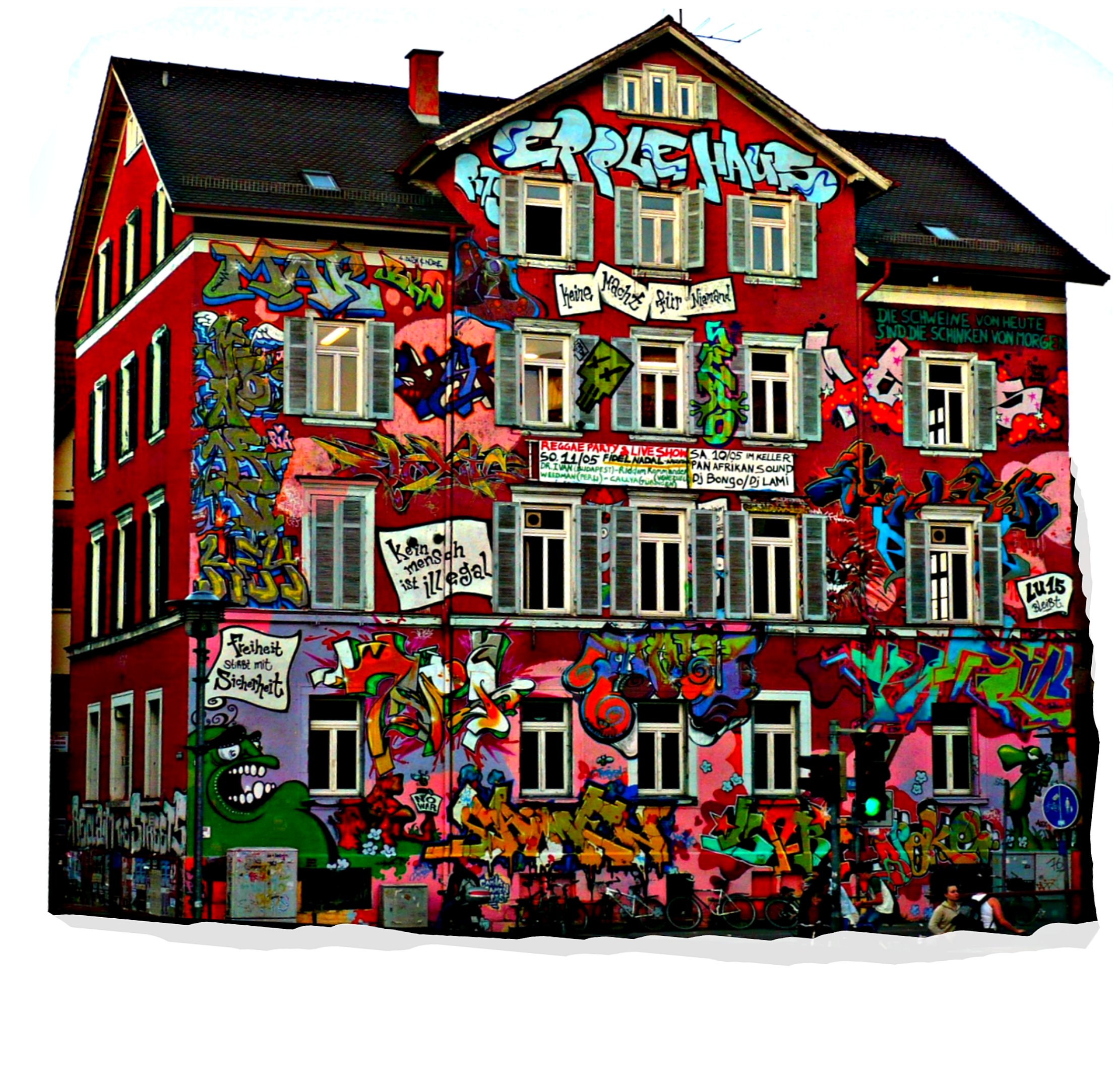
See Original shot VIEW: for all details to read !
-
Richard Epple (* 2. August 1954 in Ammerbuch-Breitenholz, Landkreis Tübingen; † 1. März 1972 in Affstätt) wurde von der Polizei irrtümlicherweise für einen RAF-Terroristen gehalten und im Laufe einer Verfolgungsjagd erschossen.
"Der Name Epple-Haus wurde in Erinnerung an Richard Epple (┼1972 )
verwendet, und am Haus oben verewigt."
www.epplehaus.de/EPPLEHAUS/einstieg.htm
Jugendzentrum e. V.
EPPLE HAUS
Karlstr. 13
72007 Tübingen
Postfach 1765
phon +49 7071 32743
fax +49 7071 37028
mailto:verein(at)epplehaus.de
en
Richard Epple (* August 2, 1954 Ammerbuch in Breitenholz, Landkreis Tübingen; † 1 March, 1972 in Affstätt) was in error by the police for an RAF terrorists and held in the course of a chase shot.
"The name Epple House was in memory of Richard Epple (+1972)
used, and written in big letters on top of the house . "
source
WIKI
de.wikipedia.org/wiki/Richard_Epple
- und