View allAll Photos Tagged onepage
This photo has been copied from the book taken from Matthews, Frederick C. (1931). American Merchant Ships, 1850 – 1900, Volume 1.
The caption reads Harvester. 1494 tons built at Bath, Maine in 1875. “Guy C. Goss” is at her stern and in the background are the “St. Paul” and the “J. D. Peters” – all salmon packets. Photograph by courtesy Edward S. Clark.
The the three masted barque (bark) Harvester was built in Bath, Maine, USA in 1875 and regularly traded between San Francisco, Cape Town and Newcastle. She was wrecked near Forster, NSW after hitting Big Seal Rock off Sugarloaf Point in June 1900.
Full details are available with the images in the Album Harvester
Image Source: Matthews, Frederick C. (1931). American Merchant Ships, 1850 – 1900, Volume 1 Page 143 - 144
All Images in this photostream are Copyright - Great Lakes Manning River Shipping and/or their individual owners as may be stated above and may not be downloaded, reproduced, or used in any way without prior written approval.
GREAT LAKES MANNING RIVER SHIPPING, NSW - Flickr Group --> Alphabetical Boat Index --> Boat builders Index --> Tags List
Les Passions de L’âme (Passions of The Soul) by René Descartes
"Perceptions or sensations or excitations of the soul which are referred to it in particular and which are caused, maintained, and strengthened by some movement of the spirits."
~René Descartes
This stately Kew Gardens residence appears to be unoccupied, and probably has been since late 2010, when the Department of Buildings issued a "full vacate order" after it determined, in response to a complaint, that the place had been turned into a "transient hotel" with 48 beds in 14 rooms. The house was forfeited to the federal government in 2011 along with four other properties owned by Irina Khaimov and her family that "constitute[d] or [were] derived from proceeds traceable to the commission of bank fraud and . . . [were] involved in money laundering".
Many years ago, 115-98 Park Lane was home to Lillian Lemmerman and (I would imagine) her husband Fred. At the time of Lillian's death in 1929, Fred was president of the Queensboro Chamber of Commerce. In 1933, he was appointed by Mayor O'Brien, a Tammany Democrat, as one of the three commissioners of the new Triborough Bridge Authority, a public authority charged with funding, building, and operating the bridge-to-be.
Shortly after taking office in 1934, however, Mayor La Guardia ousted Lemmerman and another commissioner and replaced them with appointees from his own party. One of those appointees was Robert Moses, who had drafted the legislation that created the authority in the first place, and who would go on to lead the authority until it was merged into the new MTA in 1968. Much of Moses's legendary power as New York's "master builder" came from his control of the tremendous revenues generated by the bridge's tolls and by tolls on other crossings later operated by the authority (which became the Triborough Bridge and Tunnel Authority in 1946). This huge money pot provided him with an independent source of funding for his infrastructure projects that was "free of any public or governmental interference".
Grotta Caruso/Grotta delle Ninfe (Caruso Cave, Cave of the Nymphs).
An extramural cave shrine of Demeter and the Nymphs at Locri Epizephyrii, located immediately outside the city's eastern circuit walls. Use is documented from the Archaic period; in the Hellenistic period, the cave was built into a nymphaeum. The site seems to have been the locus for ritual bathing by unmarried young women of Locri, perhaps a katabasis or descent representing death and rebirth.
For more information, see here and ; location is marked in Fig. 2 here.
For Locri Epizephyrii/Λοκροὶ Επιζεφύριοι: Pleiades; PECS-Perseus; Attalus; Wikipedia.
Museo Archeologico Nazionale di Reggio Calabria (en.wikipedia), Reggio Calabria, Italy.
1909 postmarked postcard view of Main Street in Churubusco, Indiana. The photographer was looking southeast from the Washington Street intersection. The farthest buildings in this scene were south of the Vandalia Railroad tracks.
The sign on the building at the left edge of this scene advertised O. GANDY & CO. THE EXCHANGE BANK. The 1905 Sanborn™ fire insurance map set for Churubusco shows a repository in the north half of that building and the bank in the south half. The 1911 map set identified the repository as a carriage repository. A 1910 state auditor’s report¹ identified the bank as The Exchange Bank of O. Gandy & Co. and indicated a Certificate of Authority had been issued in 1905. Oscar Gandy was the owner. The 1907 Whitley County history included the following paragraph about the founding of the bank.
“On September 11, 1893, Oscar Gandy established the "Exchange Bank" under the firm name of O. Gandy & Co.. with a capital of $10.000. The Exchnage [sic] Bank has always done a prosperous business and is considered one of our most substantial financial affairs and has increased its capital to $25,000. The present officers and employes are O. Gandy, president; E. E. Gandy, cashier; John A. Pressler, assistant cashier; Ursula Magers, bookkeeper; Minnie Anderson, stenographer; and George Gump, janitor.“²
The history also included an entry on page 305 stating the bank building was built in 1898.
Two brick buildings stood south of the bank building. Business names were printed on the awnings, but are not clear enough to read. The 1905 map set shows a meat market in the north building and department store in the south building. The 1911 map set shows the meat market and a clothing, dry goods and furniture business in the buildings.
Next door, the wood frame building housed (from north to south) the Churubusco Post Office, a bakery and a barbershop according to the 1905 map set. The 1911 map set shows a newer and longer brick building that housed (from north to south) a notions business, the post office, a confectionery and tobacco business, a jewelry business and a barbershop. The only visible sign on that building in this postcard scene was the US POST OFFICE sign.
Across the street, the most distant businesses were south of Whitley Street. Two of the signs appear to advertise a MEAT MARKET and A GROCERY. The 1905 and 1911 Sanborn™ map sets show a grocery in that block, but not in the different locations for each year. Neither shows a meat market. Another small sign in that block advertised a lunch room, but it’s difficult to tell which building the sign is on. The 1905 map set shows two restaurants in that block and the 1911 map set shows a single restaurant.
Farther north (closer to the photographer) were signs advertising CITY DRUG STORE, DENTIST and ICE CREAM SODA. The soda sign undoubtedly belonged with the drugstore sign. It is difficult to tell which signs belonged with which building. Although these signs may appear to be in front of one of the two two-story brick buildings, they were probably in front of the wood frame building across the alley to the north. Both map sets show a drugstore as the second business north of Whitley Street in a two-story wood frame building on the north side of the alley. This was directly across Main Street from the post office. The 1905 map set actually identifies the store as a drugs and stationery business.
The 1907 county history listed J. F. Criswell & Son and Miss Mary Eikenberry & Co. as owners of drug stores in town. However, a 1905 directory of retail druggists listed the names as Craig & Boggs and Eikenberry & Co. A 1908 directory listed A. B. Craig and Mary Eikenberry.
The only dentist listed for Churubusco in a 1914 directory was Frank B. Weaver, a 1900 graduate of Northwestern University Dental School in Chicago. The dental office would probably have been upstairs and the Sanborn™ map sets typically don’t identify those offices unless they are in separate buildings.
The awnings at the right edge of the postcard were on a group of small buildings near the southwest corner of Washington Street. A wood frame building stood on that corner and is outside this view. It housed a grocery and millinery shop. The awning at the right edge of this postcard may belong to the millinery shop. The other awnings were on a brick building south of the corner, and one awning appears to advertise M. KOCHER. Both Sanborn™ map sets show a boots and shoes business at that location. The 1907 county history reported that Mr. Kocher built a brick building in Churubusco in 1892 and ran his boots and shoes business in the building.
1. Auditor of the State of Indiana, Annual Report (Indianapolis, IN: William B. Burford, 1910). Available online at books.google.com/books?id=l_dJAAAAMAAJ&printsec=front....
2. Samuel P. Kaler and Richard H. Maring, History of Whitley County, Indiana (Indianapolis, IN: B. F. Bowen & Company, 1907), pages 307-308. Available online at books.google.com/books?id=-hUVAAAAYAAJ&printsec=front....
This image was created by Thomas Keesling from a postcard courtesy of the Indiana Postal History Society.
The full postcard image can be seen here.
www.flickr.com/photos/hoosier_recollections/27546603985/i...
Copyright 2005-2016 by Hoosier Recollections. All rights reserved. This image is part of a creative package that includes the associated text, geodata and/or other information. Neither this package in its entirety nor any of the individual components may be downloaded, transmitted or reproduced without the prior written permission of Hoosier Recollections.
1911 dated postcard view of the “Pennsylvania Flyer” (or “Pennsylvania Special”) deadly train wreck near Fort Wayne, Indiana. The eastbound train was on the P. Ft. W. & C. (Pittsburgh, Fort Wayne and Chicago) Railway line that was the western leg of the P. C. C. & St. L. (Pittsburgh, Cincinnati, Chicago & St. Louis) Railway main line between Chicago and New York. It was a very heavily traveled route with both freight and passenger trains. On the evening of August 13, 1911, as the train approached the St. Marys River crossing near Swinney Park, it was running late because of earlier locomotive problems.
The prior year, the railroad company had begun a three-year project to elevate the double rail lines through Fort Wayne in order to eliminate street crossings and thereby alleviate the vehicular traffic problems that were plaguing the city at rail crossings. This accident occurred in an area west of the river where work on that project was underway.
The following account of the accident was published in the August, 1911 edition of Railway Age Gazette.¹
Eighteen-Hour Train Derailed at Fort Wayne
The Pennsylvania Special, the 18-hour Chicago to New York train which left Chicago at 2:45 Sunday afternoon, August 13, was derailed just west of Fort Wayne, Ind., and four employees were killed and four trainmen, 17 dining and Pullman employees, three mail clerks and 29 passengers, were injured. The train was running late and was being pulled by two engines, and was derailed while running at high speed over a sharp curve at the west end of the track elevation work under way in Fort Wayne. Both engines and four cars left the rails. The engine of a freight train standing on an adjoining track was struck by the two passenger engines and all three were wrecked. The injuries were confined to trainmen and passengers in the forward coaches. The train was made up wholly of steel cars and to this fact may be attributed the escape of the passengers from fatal injuries.
The Chicago Record-Herald gives the following details. Charles P. Skillman who resides directly opposite the spot where the wreck occurred saw the whole thing as he sat on his veranda. “The passenger train,” said Mr. Skillman, “was coming at a terrific rate of speed. Just across the bridge which spans the St Mary's river it veered into a new switch placed there because of track elevation work. I think the train was going at too great a rate for the switch to stand, for as I watched it seemed to me that the rails of the switch slid from under the passenger directly over to the freight train standing on the north track…..” From Valparaiso to Winona Lake the engine which brought the train out of Chicago was working badly, so the engine which was to take the train from Fort Wayne to Crestline was sent to Winona Lake to meet the flyer….”
1. Railway Age Gazette, Volume 51 (New York, NY: Simmons-Boardman Publishing Company, 1911), pages 346-347. Available online at books.google.com/books?id=cLUlAAAAMAAJ&printsec=front....
From a private collection.
Copyright 2004-2017 Hoosier Recollections. All rights reserved. This creative JPG file package is an original compilation of materials and data. The package is unique, consisting of a wide variety of related and integrated components. Neither this package in its entirety nor any of the individual components may be downloaded, transmitted or reproduced without the prior written permission of Hoosier Recollections.
Shepherds of Lys
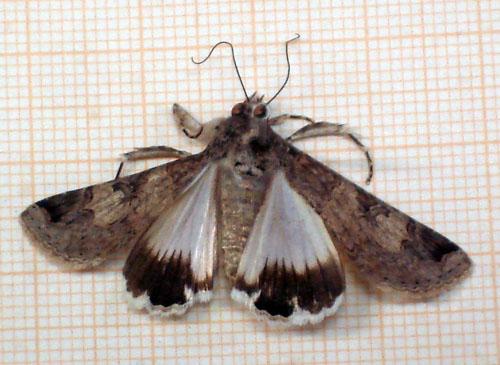
Description: Melipotis famelica is a moth belonging in the order Lepidoptera, subdivision Bombycina, superfamily Noctuoidea, family Erebidae, subfamily Erebinae and tribe Melipotini.
According to Wikipedia, the distribution status of this moth occurs in "Southern United States (Florida to Texas) to the Caribbean and Paraguay." (en.wikipedia.org/wiki/Melipotis_famelica). BugGuide lists this distribution for Melipotis famelica: "Southern United States, Antilles, South to Venezuela, including Bermuda (Ferguson et al., 1991)" - These informations require a very enlightened confirmation as no source is provided in the Wikipedia article and, as it concerns a moth, the true distribution status, even through BugGuide, is either lacking, unlikely 100% correct, or unlikely wrong. Thus, it's more likely that the information is lacking due to the lack of information available concerning Melipotis famelica's - and moths in general - distribution status.
After asking Cesar of Insetologia what Melipotis this was, he thought about Melipotis acontioides due to a link he provided from ESALQ (www.lea.esalq.usp.br/me/fotos/Lepidoptera/Erebidae/Erebin...), with the clear statement that other pictures he saw identified as Melipotis acontioides were considerably different (mothphotographersgroup.msstate.edu/species.php?hodges=8610). Then, he suggested the species Melipotis famelica and I agree with this statement (mothphotographersgroup.msstate.edu/species.php?hodges=8604) as it perfectly matches my specimen besides shading differences that are probably due to lighting or sexual dimorphism. I couldn't find any other perfect Melipotis matches to the individual portrayed besides Melipotis famelica.
Article on Insetologia: www.insetologia.com.br/2018/06/mariposa-melipotis-no-cear...
The Hodges Number of Melipotis famelica is 8604 with a phylogenetic sequence of #930875. Synonyms include Bolina bivittata (Walker, [1858]). The known host plant is, according to BugGuide, Lysiloma latisiliquum ("false tamarind" / "wild tamarind") ((L.) Benth.) (Fabaceae: Caesalpinioideae: Dimorphandra group B, including the Mimosoideae). According to this same source, they are on flight year round in Florida and from May to November in Texas. As for Brazil, this picture was captured on the 7th of May, 2018 at 07:45:32pm, which suggests the probability that they are also on flight in Brazil from May onwards, from earlier to May, year round, or only in May. More host plants might exist with a high probability ratio. Synonyms of the known host plant include:
Acacia bahamensis ((Benth.) Griseb.)
Acacia latisiliqua ((L.) Willd.)
Leucaena latisiliqua ((L.) Gillis)
Lysiloma bahamense (Benth.)
Mimosa latisiliqua (L.)
BugGuide also states that the wingspan of Melipotis famelica lies around 42mm.
A similar genus to Melipotis is the genus Drasteria, but this is, undoubtedly, a Melipotis as identified by the very enlightened James Adams (www.facebook.com/profile.php?id=100000288532343&sk=wa...). The famelica species was identified by Jeffery Wang (www.facebook.com/profile.php?id=100010987834629&fref=...) and Cesar of Insetologia, further reinforcing the identification as correct.
The larvae undergo between five and seven growth instars, a factor that depends on the detachment of the cephalic capsule, measuring the distance between gena to gena and between the frontal setae. 1 to 8 eggs are laid irregularly away from the optical edge, on the follicles of the host plant's leaves. Larvae are active from the moment of birth and scrape the follicles. Later instars choose to hide beneath the leaves and are less active, even though they defoliate with more voracity. The pupa process occurs underground, with the larva forming a cocoon of silk and ground, then proceeding to the pupa stage. The egg stage lasts 4 or 5 days; the larval stage lasts between 21 and 40 days; the pre-pupa stage lasts between 4 and 7 days; the pupa stage lasts between 10 and 23 days; adults' lifespan lies between 7 and 12 days. Thus, the entire egg-death process lasts 87 days or, more likely, less, with 87 days being achieved very rarely, and with the unlikely possibility of a longer lifespan. (Source: www.seb.org.br/asp/cbe2012/trabalhos/468/468_1.pdf)
Tachinids are known to parasitize Melipotis according to this free E-Book: books.google.com.br/books?id=29-ltt3cyFEC&pg=PA235&am...
Mantispidae (and most likely Mantodea in general), Polistes sp., Tyrannidae, Crotophaga major and the entomopathogenic bacteria Bacillus thuringiensis are all natural enemies of Melipotis famelica. Sadly, the abuse of these bioforms occurs against Melipotis famelica in agriculture (www.simbras-as.com.br/uploads/2012%20Palestras%20Simbras/...).
The coloring of the adults of Melipotis famelica is highly reminiscent of wood, a condition that might indicate the presence of a defensive mechanism of camouflage against potential predators, especially due to the appearance of the known host plant.
Under their true distribution range, Melipotis famelica most likely occur in fields, forests and anthropogenic habitats which include their host plant(s). For instance, this specimen was photographed on the 16th floor of a flat in an urban habitat, fact that displays they can fly relatively high.
They are attracted to artificial lighting.
Other sources:
BOLD Systems: v3.boldsystems.org/index.php/Taxbrowser_Taxonpage?taxid=3...
Encyclopedia of Life: eol.org/pages/553333/overview
PROJECT NOAH (Português): www.projectnoah.org/spottings/769631615
Kubinka Tank Museum.Moscow. July 2009.
books.google.ru/books?id=T1HHGU9BpfsC&lpg=PA36&ot... stremitelniy&pg=PP1#v=onepage&q=&f=false
French postcard by Croissant, Paris, no. 3871. Photo: Gaumont. Publicity still for Mignon (Alice Guy, 1906). Caption: Est-ce bien Mignon que voilà? Alice Guy directed nine (or seven - the sources differ) scenes from the opera 'Mignon' for a synchronized sound film, in the Gaumont Chronophone Studio, Paris, in 1906. 'Mignon' (1966) is an opéra comique in three acts by Ambroise Thomas. The original French libretto was by Jules Barbier and Michel Carré, based on Goethe's novel 'Wilhelm Meisters Lehrjahre'.
French-born Alice Guy (1873-1968) is generally considered to be the world's first female director. She was born in 1873 in Paris. In 1896, she entered the film business as a secretary for Léon Gaumont at Gaumont-Paris. The next year Gaumont changed from manufacturing cameras to producing films, and Guy became one of its first directors. She averaged two two-reelers a week and impressed the company so much with the output and the quality of her productions that by 1905 she was made the company's production director, supervising the company's other directors. After her first film in 1896, she directed and produced or supervised almost six hundred silent films ranging in length from one minute to thirty minutes, the majority of which were of the single-reel length. In addition, she also directed and produced or supervised one hundred and fifty synchronised sound films for the Gaumont Chronophone. Alison McMahan at Women Film Pioneers Project: "Her Gaumont silent films are notable for their energy and risk-taking; her preference for real locations gives the extant examples of these Gaumont films a contemporary feel."
In 1907 Alice Guy married Herbert Blaché, an Englishman who ran the company's British and German offices. The pair went to the U.S. in 1909 to set up the company's operations there. In 1910, she and husband Herbert Blaché set up their own production company in New York, the Solax Film Co. (1910-1914), and built a studio in Fort Lee, New Jersey. After a period of critical and financial success, her company's fortunes declined and she eventually shut down the studio. Although she secured work directing films for several major Hollywood studios, she returned to France in 1922 after her divorce from Blaché. She was never able to secure any directorial jobs there, and never made a film again. In 1964 she returned to the U.S. and lived in Mahwah, New Jersey - not far from where her original studios were - with her daughter Simone, where she died in 1968. Simone Blaché was born in 1908 and her brother Reginald in 1912. Simone played in two of her mother's films and later told about Guy in the documentary The Silent Feminists: America's First Women Directors (1993).
Sources: Roberta and Simone Blaché (The Memoirs of Alice Guy Blaché), Alison McMahan (Alice Guy Blaché: Lost Visionary of the Cinema), Alison McMahan (Women Film Pioneers Project), Kinomata: la donna nel cinema and IMDb.
And, please check out our blog European Film Star Postcards.
1911 postmarked postcard view of Lakeville, Indiana. This view was looking south on Michigan Street and shows a two-story wood frame building on the left with a POST OFFICE sign. The 1911 St. Joseph County atlas¹ shows the Lakeville Post Office on the northeast corner at the Second Street intersection. (That street is identified as East Washington Street today.) The sign painted on the display window to the right of the entrance advertises _____ MOORE HARDWARE [and] COAL. The postcard owner found that the Moore brothers opened a hardware store in Lakeville in 1894. A decade later, Alex Moore was identified as the coal and hardware business owner.
In this scene, a young girl sat on a crude bench in front of the store. The two signs leaning against the building on either side of the entrance advertised LOWE BROTHERS PAINT. The Lowe Brothers Company was founded in Dayton, Ohio and was later bought by the Sherwin-Williams Company. The partial sign pasted on the post in the foreground advertised SYRUP OF FIGS, a common laxative product.
The single-story wood frame building south of the hardware store advertised A. O. VANLIEW. DEALER IN DRUGS & HARDWARE. A 1910 Van Liew family history identified the druggist as Alpheus O. Van Liew. He was also listed in a 1905 directory of druggists.² A genealogy website says he died in August, 1906. If the man posing in front of that store was Mr. Van Liew, then the photograph was taken earlier in 1906 or perhaps 1905.
The sign on the small building beyond the Van Liew store advertised DR. HOW. A report³ issued in 1904 listed John T. How as a physician in Lakeville. He had received his license to practice in St. Joseph County in 1902 after graduating in 1897 from Hahnemann Medical College and Hospital in Chicago.
None of the signs posted on the utility pole in front of the doctor’s office are clear enough to read. A sign on the small structure beyond Dr. How’s office appears to include the word FEED.
Typically, the store owner where the post office was located served as the community’s postmaster, but the list of postmasters for this period does not include anyone with the Moore name. The following were the Lakeville postmasters during this period:
1893 Douglas Rush
1897 Charles W. Moon
1908 Frank A. Barkley
Postmaster Moon owned a building across the street where he ran the C. W. Moon & Son general store, and operated the post office. His building was next to the building commonly known as the Rensberger General Store. The Moon building was destroyed by fire, but the Rensberger building is still in use today. Mr. Moon was postmaster from 1897 until December of 1902, when he filed for bankruptcy. The sheriff closed the Moon store and Deputy Sheriff Frank Barkley was placed in charge of the post office. The records don’t indicate if the deputy sheriff was the same Frank A. Barkley that became postmaster in 1908, nor do the records indicate when the post office was moved across the street to the location shown in this postcard scene. If the gentleman standing in the background in this scene is Mr. Van Liew, then the post office was moved across the street from the Moon building long before Mr. Barkley was appointed postmaster. It is possible the post office was moved out of the Moon building shortly after that building was closed by the sheriff at the end of 1902. Mr. Barkley may have been acting as postmaster from that time until his official appointment in 1908, or Mr. Moon may have resumed his duties as postmaster in the new location while the bankruptcy was being adjudicated and for the years following. We have not yet found information to explain the situation during this period. Mr. Moon was 62 at the time of the bankruptcy filing.
When this photograph was taken, Michigan Street made a sharp turn to the west at the south edge of town. The house at that corner in this scene is shown on the 1911 plat map. That property belonged to F. E. Van Liew.
1. Standard Atlas of St. Joseph County Indiana Including a Plat Book (Chicago, IL: George A. Ogle & Co., 1911) page 83. Available online at www.historicmapworks.com/Atlas/US/7719/St.+Joseph+County+....
2. The Era Druggists Directory, Eleventh Edition (New York, NY: D. O. Haynes & Co., 1905). Available online at books.google.com/books?id=bantAAAAMAAJ&printsec=front....
3. Indiana State Board of Medical Registration and Examination, The Sixth Annual Report (Indianapolis, IN: William B. Burford, 1904). Available online at books.google.com/books?id=yk1JCeJJsPAC&printsec=front....
From a private collection.
The full postcard image can be seen here.
Copyright 2007-2016 by Hoosier Recollections. All rights reserved. This image is part of a creative package that includes the associated text, geodata and/or other information. Neither this package in its entirety nor any of the individual components may be downloaded, transmitted or reproduced without the prior written permission of Hoosier Recollections.
On behalf of all the Marys we wish you a happy Easter and for those in Ireland enjoy the ceremonies!
Today we have a survey sketch of the area around St. Andrews Church Dublin, with some interesting notations.
With thanks to AndyBrii, sharon.corbet, RETRO STU and O Mac, we have some context for those notes. In particular, it's suggested that the surveyor's signature at the bottom is that of John Greene, who was Dublin's first City Surveyor - appointed in 1679. The two main survey subjects are the site of St Andrew's Church, and the "mount or hill" in the centre. St Andrew's Church was first built in the 1660s in the Dame Street/College Green area of the city. The hill was likely the 10th century Viking "Thingmount" (Thingmote); a conical mound which was an assembly point of legal/cultural importance for the city's original Norse inhabitants. This survey is likely one from 1682 - not long before William Davies (mentioned by name on the survey) had the site flattened to develop the area. See:
- Royal Inauguration in Gaelic Ireland C. 1100-1600 (page 46)
Collection: Mason Photographic Collection
Date: Lantern slide 1890-1910. Sketch itself from 1682.
NLI Ref: M27/1
You can also view this image, and many thousands of others, on the NLI’s catalogue at catalogue.nli.ie
Garden Place, Peaks Island (in Casco Bay), Maine USA • The first event of the Lions Club's 63rd seasondrew a visitor in this great car.
Greenwood Garden was at one time the "Coney Island of Maine," and is now operated as a charming, rustic event facility owned and operated by the Peaks Island Lions Club.
… the summer people began coming to Maine in the 19th century. For cool tranquil beauty, summer here has few peers. The Maine coast had been drawing wealthy vacationers for some time by the 1880s. Then after two centuries this fishing community exploded into a kind of Coney-Island-north -- hotels, restaurants, theatres, dancehalls, a theme park, all served by twelve steamboat lines. – From Engines of Our Ingenuity: No. 2407 Peaks Island.
The Greenwood Garden Amusement Park started as a picnic grove in the southwest corner of the island in the 1850s, transformed by the Brackett family in the 1880s into an amusement park with observatory, skating rink (later converted into this theatre), carousel, ferris wheel, midway and petting zoo.
From XX: This is an island of movie stars and artists, of budding theatrical productions and protected open spaces preserving native forests for all time. Martin Landau, famed for his “Mission Impossible” role and Jean Stapleton, Edith on “All in the Family” both got their start at Peaks Island’s Greenwood Garden playhouse.
Another view: Bowling alleys were common at summer resorts, but from the 1880s to the 1930s, Greenwood Gardens [actually: Greenwood Garden Amusement Park] was a reason for families to visit the island. it held a summer theater, an observation tower, a dance hall, facilities offering food and drink, a merry-go-round, and a small zoo. A pavilion at times provided variety shows, tightrope walkers, and balloon ascensions. – From page 20; Portland, by Joyce K. Bibber and Earle G. Shettleworth, Jr., © 2007.
Cliff Gallant says the Playhouse, operated through the first half of the twentieth century, and is where Jean Stapleton, the lovable Edith of "All in the Family" fame, made her first professional appearance, in the summer of 1941. [ Circa 1908, D.W. Griffith was torn between continuing to appear in plays produced at the island's playhouses as he frequently did or heading to Hollywood. Martin Landau also made his professional stage debut in a 1951 production of "Detective Story" at Greenwood Garden where for several seasons he was a resident cast member.] The Gem Theater, the best known of the Peaks Island summer theaters, hosted productions featuring members of the famous Barrymore family, and was also a favorite venue of George M. Cohan, who liked to stage productions there before bringing them to Broadway.
The New Jersey transmitting towers of New York's WMCA/570 and WNYC/820, which share a long history together, starting in the mid-1920s.
WMCA (which stands for Hotel McAlpin, the first owner) and WNYC (which was originally the city's own station) have long histories, much of which are tied up with competitively sharing one channel, the last of which was 570am.
Eventually WMCA got sole custody of 570am while WNYC went to 830am; but then had to go off the air every day at local sunset in Minneapolis, home of the 50000-watt "clear channel" WCCO, which had exclusive rights to cover the whole country at night on that channel.
WMCA's original transmitter was at the Hotel McAlpin, but has moved three times since then. In 1929 it moved to the Hoboken Waterfront with 500 watts. In 1932, still 500 watts, it moved to the edge of Flushing Creek, off College Point Boulevard, just west of what is now the north end of the Bronx Whitestone Bridge. In 1936 it moved back into Manhattan, to the top of a building which today hosts the Ed Sullivan Theater on Broadway, and now 1000 watts.
In 1939, the station received a license to broadcast with 5000 watts in a directional pattern from this facility in the New Jersey meadowlands. The towers were made by Truscon, and completed in 1940.
Back in 1940, this was Hackensack River tideland; but one could walk across it. Later water was impounded for flood control and other purposes.
Since the original towers of every other station in the adjacent Meadowlands have been replaced in recent decades, this is now the oldest continuously operating AM transmitter site here. With the 2020 sale of the land under WFME/1560 (long known as WQXR) in Maspeth, Queens, after which its towers were demolished, these towers will be the oldest continuously operating AM radio facility in the New York area.
WNYC had a storied history of its own. Coming on the air in the late '20s as a city-owned station, its original transmitter was located somewhere in the complex of city buildings by Foley Square, and operated with 500 watts on 570am, which it shared with WMCA. In 1924 it moved to 810am, but daytime only. In 1935 it got a license for 1000 watts using a two-tower directional antenna on 810am, on the East River at what is now called WNYC Transmitter Park. In 1942, with a shuffling of many channels nationwide, WNYC moved to 830am, with a sign-off time of local sunset in Minneapolis. In 1982, an application for a license to operate full-time with 50,000 watts on 830am from a four-tower facility at Brielle and Bradley Avenues on Staten Island was rejected by the FCC. Finally, it received a license to operate here, diplexed onto WMCA's towers, with 10,000 watts by day and 1000 watts by night, with two different directional patterns.
The three towers point WMCA's 5000-watt signal toward the city with a pumpkin-shaped pattern you can see here. "Nulls" in the signal protect other stations on 570 and adjacent channels "behind" the transmitter, especially toward Philadelphia, Washington, Youngstown, and Syracuse.
More recently WNYC also received a construction permit to alter the night pattern to match the day one and drop to 930 watts, but it let that lapse. Like WMCA's. WNYC's day and night patterns are aimed toward the city boroughs.
When Hurricane Sandy hit in 2012, the transmitter building was flooded, both stations were knocked off the air, and the catwalk out to the towers was terminally damaged. The one in the picture was built after that. You can see traces of the old one in the water to the right. The catwalk also serves as a bird roost and the guano is thick in places.
No longer illuminated, the sign on the building still says "wmca 570," and faces the New Jersey Turnpike's eastern spur. Across the highway is the abandoned original transmitter building of WNEW/1130 (now WBBR), the towers of which still lay in the water. Beyond that on the Belleville Pike are the original sites of WLWL (which was on a variety of frequencies and went off the air in 1935) and of WAAT/970 (now WWDJ). The bases of the WLWL towers are still there, but not a trace remains of WAAT. Both WNEW/WBBR and WAAT/WWDJ moved to other sites in the 1960s.
The story of WLWL is an interesting one. As you see here,the station operated by the Paulist Fathers from 1925-1935.
You can see an aerial photo of all three stations, plus the concrete bases of WLWL, in a photo posted in this 2005 site visit report by the great Scott Fybush.
In its heyday as a Top 40 station, in the late 1950s and 1960s, WMCA punched far above its signal weight, winning ratings battles with stations ten times its wattage. For more about that, see here. Today it is a religious station that almost never shows in the ratings. WNYC does show, though not as well as its sister on 93.9fm.
One of my most vivid memories is walking from the snack shop to our family's umbrella and blanket at Mantoloking Beach on the Jersey Shore, where we went every day all that summer—1959—hearing Connie Francis singing Lipstick on Your Collar from every transistor radio on every blanket on the beach, all tuned to WMCA/570 in New York. It was a moment in a short stretch of history like few if any before or since.
NGC 6885 (Caldwell 37 and others) is a trumpler class III 2 p open cluster located approximately 1,950 light-years away in Vulpecula. This one also appears to be cataloged as NGC 6882. There are also two Collinder designations that appear to be reversed. Stephen James O’Meara’s Deep-Sky Companions: The Caldwell Objects has more information. Google leads me here - books.google.com/books?id=MMfxDAAAQBAJ&pg=PA172&l... .
Luminance – 15x600s – 150 minutes – binned 1x1
RGB –8x300s – 40 minutes each – binned 2x2
270 minutes total exposure – 4 hours 30 minutes
Imaged from Dardenne Prairie, Missouri (a red zone) on July 11th, 2018 with a SBIG ST-8300M on an Astro-Tech AT90DT at f/6.7 603mm.
Garden Place, Peaks Island, Maine USA • View from the front deck of the Greenwood Garden Playhouse which was built in 1884 as an open-air roller skating rink. It was transformed into a theater in 1891, and is now operated as a charming, rustic event facility owned and operated by the Peaks Island Lions Club.
… the summer people began coming to Maine in the 19th century. For cool tranquil beauty, summer here has few peers. The Maine coast had been drawing wealthy vacationers for some time by the 1880s. Then after two centuries this fishing community exploded into a kind of Coney-Island-north -- hotels, restaurants, theatres, dancehalls, a theme park, all served by twelve steamboat lines. – From Engines of Our Ingenuity: No. 2407 Peaks Island.
• The Greenwood Garden Amusement Park started as a picnic grove in the southwest corner of the island in the 1850s, transformed by the Brackett family in the 1880s into an amusement park with observatory, skating rink (later converted into this theatre), carousel, ferris wheel, midway and petting zoo.
This is an island of movie stars and artists, of budding theatrical productions and protected open spaces preserving native forests for all time. Martin Landau, famed for his “Mission Impossible” role and Jean Stapleton, Edith on “All in the Family” both got their start at Peaks Island’s Greenwood Garden playhouse.
Another view: Bowling alleys were common at summer resorts, but from the 1880s to the 1930s, Greenwood Gardens [actually: Greenwood Garden Amusement Park] was a reason for families to visit the island. it held a summer theater, an observation tower, a dance hall, facilities offering food and drink, a merry-go-round, and a small zoo. A pavilion at times provided variety shows, tightrope walkers, and balloon ascensions. – From page 20; Portland, by Joyce K. Bibber and Earle G. Shettleworth, Jr., © 2007.
Cliff Gallant says the Playhouse, operated through the first half of the twentieth century, and is where Jean Stapleton, the lovable Edith of "All in the Family" fame, made her first professional appearance, in the summer of 1941. [ Circa 1908, D.W. Griffith was torn between continuing to appear in plays produced at the island's playhouses as he frequently did or heading to Hollywood. Martin Landau also made his professional stage debut in a 1951 production of "Detective Story" at Greenwood Garden where for several seasons he was a resident cast member.] The Gem Theater, the best known of the Peaks Island summer theaters, hosted productions featuring members of the famous Barrymore family, and was also a favorite venue of George M. Cohan, who liked to stage productions there before bringing them to Broadway.
========================================
• Fort Gorges is a military fort built on Hog Island Ledge in Casco Bay, Maine. Casco Bay is an inlet of the Atlantic Ocean on the southern coast of Maine. • Following the War of 1812, the United States Army Corps of Engineers proposed that a fort be built on Hog Island Ledge, in Casco Bay at the entrance to the harbor at Portland, Maine. Named for the colonial proprietor of Maine, Sir Ferdinando Gorges, it was constructed to support existing forts, including Fort Preble in South Portland and Fort Scammel built on nearby House Island in 1808. Congress, however, did not fund construction of Fort Gorges until 1857. The walls of the fort were begun the next year, and when the United States Civil War broke out in 1861, work quickly advanced.
The fort was designed by Colonel Reuben Staples Smart. The chief architect in charge of construction was Thomas Lincoln Casey, who later became Chief of Engineers. It is similar in size and construction to Fort Sumter, but is built of granite instead of brick.
The fort was completed in 1865 as the war ended. Modern explosives made the fort obsolete by the time it was completed. A modernization plan was begun in 1869, but funding was cut off in 1876, with the third level of the fort still unfinished.
The fort was last used by the military during World War II, when it was used to store submarine mines. It was acquired by the City of Portland in 1960 … . – From the Nation Master Encyclopedia.
☞ On August 28, 1973, the National Park Service added this structure and site to the National Register of Historic Places (#73000114).
∆ GeoHack: 43°39′47″N 70°13′17″W.
This print was made from a negative that was taken with a Graflex rollback 52 yielding a negative 5.5 x 3.25 inches. Since many of the early prints were made as contact prints I made this one by placing the paper on the enlarging table with the negative on top and then a piece of glass to hold the negative in close contact with the paper. The negative was purchased on ebay a couple of years ago.
The Steamer Monginevro an Italian ship was built in 1906 GRT 5,271 tons by Cant. Nav. di Muggiano, La Spezia and operated by Navigazione Alta Italia, Soc. Anon., Genoa. I found numerous references in trade journals about the Monginevro carrying various types of goods from the United States to Genoa and other Italian ports. On June 26, 1911, Via Norfolk to Genoa with 1,565,000 feet of sawn pitch pine timber, and 337,000 feet of sawn pine. warsailors.com/forum/read.php?1,18764,18783#msg-18783
In WWI the Steamer Monginevro was torpedoed off of Cape Tortosa Spain on 12 June 1918 by German U-boat 68 and damaged while on route from Genoa to Gibraltar. uboat.net/wwi/ships_hit/4218.html
During WWII Monginevro was active in Axis in convoys in the Mediterranean Sea during 1941 to 1943. On 16 October 1942 it was attacked by RAF aircraft while traveling from Corfu to Tobruk. books.google.com/books?id=6uiwCgAAQBAJ&pg=PA177&l...
The Steamer Monginevro was sunk on 17 April 1943 by FAA torpedo aircraft 10 sea miles north of Zambretta, Sicily. books.google.com/books?id=EXYQDAAAQBAJ&pg=PA201&l... FAA is short for Fleet Air Arm, part of the British armed forces in WWII.
Sail-037CP
Hey the building was erected in 1915 as the Ocala Knitting and Manufacturing Company, a Black-owned manufacturer of cotton underwear.
-----------------------
In downtown Ocala, Florida, on March 6th, 2019, at the southeast corner of Southeast 1st Avenue and Southeast 3rd Street.
-----------------------
Getty Thesaurus of Geographic Names terms:
• Marion (county) (1002631)
• Ocala (2020611)
Art & Architecture Thesaurus terms:
• brick (clay material) (300010463)
• brick red (color) (300311462)
• capital letters (300055061)
• commercial buildings (300005147)
• engineering (300054474)
• last names (300404652)
• shop signs (300211862)
• three-story (300163795)
• underwear (300209267)
Wikidata items:
• 6 March 2019 (Q57349898)
• 305 (Q1091837)
• 1910s in architecture (Q11185482)
• 1915 in architecture (Q2744689)
• African-American business (Q25040717)
• all caps (Q3960579)
• Central Florida (Q2920358)
• clothing industry (Q11828862)
• March 6 (Q2399)
• March 2019 (Q31275158)
• Moorhead (Q16877387)
• North Central Florida (Q2916367)
• North Florida (Q7055353)
• Second Seminole War (Q2976715)
• Treaty of Payne's Landing (Q865831)
Library of Congress Subject Headings:
• Business names (sh85018315)
• Small business (sh85123568)
c1908 postcard view of Hamilton, Indiana. The postcard title refers to “Main Street,” but this must have been Fort Wayne Road, known as Wayne Street today. The photographer was standing at the intersection of Bellefontaine Road (identified as Defiance Road in the 1912 Steuben County atlas.¹). The shadows indicate it was late morning. The Hamilton map in the 1912 atlas shows the Wabash Railroad crossing from west to east at the south edge of town and then turning east-northeast and crossing Richland Township on the way to Ohio. However, the railroad isn’t clearly visible in this view and the map doesn’t show a depot. A small bridge in the distance (above the buggy) must have carried the road over Fish Creek.
The two buildings on the left in this scene are still standing on the southeast corner of the Wayne Street/Bellfontaine Road intersection, but the south half of the second building is gone. The GROCERIES sign advertised the business on that corner, but no other identification of the business name is visible. The word SODA was printed on the folded awning next door and was probably preceded by ICE CREAM. This may have been the location of a drugstore.
The potted tree stood in front of the next store to the south. The two signs above the awning are unclear, but the top sign appears to have a name painted on it. Beyond that tree, the Bell System sign on the utility pole advertised the location of a public telephone. These signs were common across Indiana before personal telephones became commonplace. The J. HARGER MEAT MARKET, CASH FOR HIDES sign appears to be standing in front of the two-story wood frame building. The wagon was parked in front of that building. A barber’s pole is visible farther down the street. It was standing beyond the fourth utility pole on that side of the street, but the shop itself was hidden by tree foliage.
Across the street, the woman with the bonnet was standing on the southwest corner at Church Street next to a small structure that might have been a public water well. The FISHING TACKLE HERE sign appears to be associated with a business on the southwest corner of that intersection. A sign advertising THE HAMILTON HARDWARE COMPANY stood at the curb in front of the building on the northwest corner of the intersection. The shape and format of the lettering on the sign hanging on the corner of that building strongly suggests it is advertising Garland brand stoves and ranges. Many hardware stores across Indiana displayed similar signs back then.
Farther north, another sign advertised RUDD & CO. DRUGGIST. The lower sign advertised ICE CREAM SODA, SOUVENIR POSTALS, FISHING TACKLE. (The souvenir postals were postcards.) A 1905 national druggists directory² included only two druggists at Hamilton. They were Rudd & Co. and Charles E Swift. A 1909 National Association of Retail Druggists publication reported, “… at Hamilton, Rudd & Co. sold out to Waldo Miller….” This photograph must have been taken prior to that sale.
Next door to the drugstore, the awning advertised HAMILTON BANK. A 1910 report³ said the bank received its state Certificate of Authority in 1905. O. H. Taylor was listed as president and cashier.
1. H. W. Morley, Atlas of Steuben County Indiana/i> (Angola, IN, 1912), page 25. Available online at www.historicmapworks.com/Atlas/US/11595/.
2. The Era Druggists Directory, Eleventh Edition (New York, NY: D. O. Haynes & Co., 1905). Available online at books.google.com/books?id=bantAAAAMAAJ&printsec=front....
3. Auditor of the State of Indiana, Annual Report (Indianapolis, IN: William B. Burford, 1910). Available online at books.google.com/books?id=l_dJAAAAMAAJ&printsec=front....
From a private collection.
The full postcard image can be seen here.
www.flickr.com/photos/hoosier_recollections/27722364276/i...
Copyright 2006-2016 by Hoosier Recollections. All rights reserved. This image is part of a creative package that includes the associated text, geodata and/or other information. Neither this package in its entirety nor any of the individual components may be downloaded, transmitted or reproduced without the prior written permission of Hoosier Recollections.
1911 postmarked postcard view of Lake Cicott, Indiana. This name applies to both the lake and the community at the east end of the lake. This view was looking east from a high point at the south edge of the lake. Three small boats were tied up at the edge of the lake below the photographer’s position. A large house stood at the east end of the lake with a dock and small boat nearby. Another house was located a short distance farther east with laundry hanging on the line in the back yard. On the road north of the railroad, three men were watching the photographer take the photograph. The area was briefly described in a December 10, 1908 publication.
“On October 20, 1900, the senior writer visited Lake Cicott for the purpose of learning something about its physical and biologic features…. Lake Cicott is situated in the southwest corner of Cass County Indiana, about 10 miles west of Logansport on the Effner branch of the Panhandle Railroad. The railroad station of Lake Cicott is a small place with 2 general stores, a small depot, water tank, and 10 to 15 residences.”¹
The 1913 county history included the following description.
“Lake Cicott is a small station on the state line division of the Pittsburg, Cincinnati & St Louis railroad, situated at the east end of Lake Cicott, from which it derives its name. The former name was ‘Lakeville….’ The present postmaster is Albert Good…. At present there are two general stores kept by Lantz & Good and Turpie Saunders, the latter is also the station agent; a restaurant kept by Jacob Williams; a blacksmith shop and implements by John Cassman. The Pennsylvania railroad has extensive ice houses located here which supply a good quality of ice taken from Lake Cicott. A Methodist church was erected in the town a few years ago, but the schoolhouse is nearly a mile to the north. Million brothers operate extensive sand pits near the town and ship annually 2,000 [sic] car loads of sand to all parts of the country.”²
The Effner (Illinois) Branch of the Panhandle Railroad was also known at one time as the Peoria Branch of the P. C. & St. L. (Pittsburgh, Cincinnati & St. Louis) Railway. Through mergers and reorganizations, the line eventually became part of the much larger P. C. C. & St. L. (Pittsburgh, Cincinnati, Chicago & St. Louis) Railway. The company was commonly referred to as the Panhandle or Pennsylvania Railroad. The elevated water tank and other buildings associated with the railroad station stood along the north side of the track. The station itself and a concrete station platform were on the south side of the track.
The Million Brothers plant was mentioned in an Illinois State Highway Department bulletin in 1915.
“Million Brothers, Lake Cicott, Indiana, own and operate a pit located eight miles west of Logansport at Lake Cicott, Cass County, Indiana The Pennsylvania Railroad furnishes transportation facilities. The plant produces 1,200 cubic yards of material per day. It is completely equipped and the material produced consists of ¼” sand and ¼” to 2” gravel.”³
The plant in the background of this scene (left of the water tower) was probably the Million Brothers operation. Railroad gondola cars were sitting on a siding and one was filled with what may have been sand or gravel. The 1962 USGS Burnettsville topographic map shows large unidentified pits a few hundred feet south and southeast of this plant. They were probably the areas from which sand and gravel were mined.
1. Barton W. Evermann and H. Walton Clark, “Lake Cicott Indiana and Notes on Its Flora and Fauna,” Proceedings of the Biological Society of Washington, Volume 21 (Washington, DC: Biological Society of Washington, 1908), page 213. Available online at books.google.com/books?id=uc7RAAAAMAAJ&printsec=front....
2. Dr. Jehu Z. Powell, editor, History of Cass County, Indiana (Chicago and New York: The Lewis Publishing Company, 1913). Available online at archive.org/stream/historycasscoun00unkngoog#page/n8/mode....
3. F. L. Roman, Test Engineer, “Dust Prevention” State of Illinois, State Highway Department Bulletin No. 6 (Springfield, IL: Schnepp & Barnes, State Printer, 1915), page 19. Available online at books.google.com/books?id=6WY4AQAAMAAJ&printsec=front....
From a private collection.
Selected close-up sections of this postcard can be seen here, from left to right in the image.
www.flickr.com/photos/hoosier_recollections/16083580154/
www.flickr.com/photos/hoosier_recollections/16679976356/
www.flickr.com/photos/hoosier_recollections/16704610101/
www.flickr.com/photos/hoosier_recollections/16085963133/
Copyright 2013-2015 by Hoosier Recollections. All rights reserved. This image is part of a creative package that includes the associated text, geodata and/or other information. Neither this package in its entirety nor any of the individual components may be downloaded, transmitted or reproduced without the prior written permission of Hoosier Recollections.
The colour of these small Spiny Rose Galls (I think I have the correct ID) growing on a wild Rose caught my eye when we were walking through the forest at the Dover family's acreage. Galls are abnormal plant growths resulting from activity of the tiny, non-stinging cynipid wasps - (Diplolepis bicolor). Insect larvae develop inside the gall. Each gall is round with many reddish/pink spines - I find them quite attractive.
"Insects can cause two types of rose galls: spiny rose gall and mossy rose gall. The spiny rose gall is caused by tiny cynipid wasps. They produce small hard internal caverns armed with stout, sharp spines on the exterior. The galls usually occur on the surface of leaves, but they sometimes occur on stems. These rose galls do not appear to harm the plant. Spiny rose gall develops exclusively on wild roses."
hortsense.cahnrs.wsu.edu/Search/MainMenuWithFactSheet.asp...
On 7 August 2015, four of us were extremely fortunate to have the chance to visit the home and 'highly varied topographic 62-acre property' belonging to Frances and David Dover. We felt honoured and privileged to meet and spend time with Frances and David, and also their daughter Carolyn and her husband Clair. A delightful family who welcomed us so warmly into their home and land.
This acreage of grassland, forest, rolling hills - and special gardens - is not far from Millarville, SW of Calgary. In fact, it's in an area that I often drive through when I only have time for, or only feel like doing, a short drive. Amazing what little gems exist out there.
This is not just a beautiful property, but is very special for various reasons. For one thing, read any history of Alberta and you will find the Dover family, including David's mother, Mary Dover. Second, among the trees and open "lawns", there are Peony flower beds, containing 100-150 heritage Peonies, each one different, that have now multiplied to more than 300 plants. Unfortunately, they bloomed a couple of weeks early this year, and all the flowers had already gone to seed. Another open area had a different kind of ground cover - Thyme, which smelled wonderful. If I remember correctly, this was the open space where the Calgary Philharmonic Orchestra performed on one occasion!
There are two large ponds on the property and another smaller area of water that they hope to turn into a Japanese Garden. There is a total of seven wetland basins, including these. It was while walking around the Japanese Garden that a large brown 'shape' could just be seen through the dense trees - a handsome Moose buck. I will look properly at the four or so photos I just managed to get and may slip one of them into my photostream sometime, just for the record, definitely not for the photo quality : ) This was also where a Great Horned Owl was seen flying through the trees by some of us (not me, ha!).
There are grassy paths winding through the acreage, up and down hill, that take David seven hours to mow. They are not pristine, velvety paths, but instead, they seem to take nothing away from the wildness of the whole area. One of the animals that has passed through is the Cougar. In fact, several years ago, I saw a video taken on a nearby (or adjacent?) property, where a 'kill' and night-time camera had been set up and a total of six different Cougar individuals were seen!
Even the Dover's home is unique and beautiful. It is completely built of concrete (and glass) - floors, walls, ceilings, roof, deck, and so on. A Hummingbird feeder and regular bird feeders, set up on the patio, attract a variety of birds. We sat on the patio after our walk to eat our packed lunches - and to enjoy a delicious Orange Pound Cake that Frances had made for us, along with refreshing Iced Tea - thank you so much for this, Frances! While I was waiting for one of three tiny Calliope (?) Hummingbirds to come back, I was lucky enough to see a little Mountain Chickadee, along with many Pine Siskins. We could also hear a Red-tailed Hawk in the area. Saw a total of 22 bird species.
There is just so much I could write about this visit and family. Instead, or for now, I will add several links to more information on the Internet. This was a memorable day for us. Thank you so much, Frances and David, Carolyn and Clair, for being so kind and welcoming us into your home and gardens.
books.google.ca/books?id=Tr36Tq_gadcC&pg=PA290&lp...
www.westernwheel.com/article/20110727/WHE06/307279983/-1/...
David's mother, Mary Dover (her father was A. E. Cross), was "a dynamic and distinguished Calgarian, particularly known for her work with the military during World War II." As well as being an army officer, and an alderman, she was also a preservationist. See the following link.
www.albertachampions.org/champions-mary_dover.htm#.VcY1KP...
ww2.glenbow.org/search/archivesMainResults.aspx?XC=/searc...
glencoe.org/documents/10184/637479/The-History-of-Elbow-P... page 44-45
The story of why the sky withdrew to a great distance is popular in their oral traditions- and often explains why the sky deity or the creator God who lives in or beyond the sky is now distant from his people .A myth told in Western Africa from Nigeria to the Ivory Coast links the remoteness of the sky to the apparent inaccessibility of the divine . According to this tale, the great creator God once lived close to his people, just beyond the sky that rested a little way above their heads. But the people, becoming accustomed to their good fortune, began to mistreat the sky : at cooking pot, women would reach up and seize a piece of the blue heaven to add to their soups, while after the meal children would scrabble among the clouds to clean the grease from their hands.
Traditionally African women used long pestles to pound their cereal in a deep mortar carved from a log. When the women were particularly energetic their pestles would sometimes bump into the clouds and sky. One woman often hit the creator. One day, as she was working out her frustrations on the grain, she gave the deity an almighty blow in the eye and the rose up in fury, rushing away to the inaccessible place where he now lives. In that instant the sky also swept upward to its present position. The woman who had inadvertently driven God away gathered her children and instructed them to collect wooden mortars far and wide; her plan was to build a tower tall enough to reach his new celestial home . The audacious attempts almost succeed, but the tower was to short. Then the women desperate to succeed, told her children to pull the lowest mortar from the tower so that they could add it to the top. The tower crashed down, flinging the men and women who clung to it to a painful death.
This was one of the two large ponds on Frances and David Dover's property, visited on 7 August 2015. There were so many Cedar Waxwings in this area. 21 other species of bird were seen during the few hours that we spent on this wonderful property.
On 7 August 2015, four of us were extremely fortunate to have the chance to visit the home and highly varied topographic 62-acre property belonging to Frances and David Dover. We felt honoured and privileged to meet and spend time with Frances and David, and also their daughter Carolyn and her husband Clair. A delightful family who welcomed us so warmly into their home and land.
This acreage of grassland, forest, rolling hills - and special gardens - is not far from Millarville, SW of Calgary. In fact, it's in an area that I often drive through when I only have time for, or only feel like doing, a short drive. Amazing what little gems exist out there.
This is not just a beautiful property, but is very special for various reasons. For one thing, read any history of Alberta and you will find the Dover family, including David's mother, Mary Dover. Second, among the trees and open "lawns", there are Peony flower beds, containing 100-150 heritage Peonies, each one different, that have now multiplied to more than 300 plants. Unfortunately, they bloomed a couple of weeks early this year, and all the flowers had gone to seed. Another open area had a different kind of ground cover - Thyme, which smelled wonderful. If I remember correctly, this was the open space where the Calgary Philharmonic Orchestra performed on one occasion!
There are two large ponds on the property and another smaller area of water that they hope to turn into a Japanese Garden. There is a total of seven wetland basins, including these. It was while walking around the Japanese Garden that a large brown 'shape' could just be seen through the dense trees - a handsome Moose buck. I will look properly at the four or so photos I just managed to get and will slip one of them into my photostream sometime soon, just for the record, definitely not for the photo quality : ) This was also where a Great Horned Owl was seen flying through the trees by some of us (not me, ha!).
There are grassy paths winding through the acreage, up and down hill, that take David seven hours to mow. They are not pristine, velvety paths, but instead, they seem to take nothing away from the wildness of the whole area. One of the animals that have passed through is the Cougar. In fact, several years ago, I saw a video taken on a nearby (or adjacent?) property, where a 'kill' and night-time camera had been set up and a total of six different Cougar individuals were seen!
Even the Dover's home is unique and beautiful. It is completely built of concrete (and glass) - floors, walls, ceilings, roof, deck, and so on. A Hummingbird feeder and regular bird feeders, set up on the patio, attract a variety of birds. We sat on the patio after our walk to eat our packed lunches - and to enjoy a delicious Orange Pound Cake that Frances had made for us, along with refreshing Iced Tea - thank you so much for this, Frances! While I was waiting for one of three tiny Calliope Hummingbirds to come back, I was lucky enough to see a little Mountain Chickadee, along with many Pine Siskins. We could also hear a Red-tailed Hawk in the area. Saw a total of 22 bird species.
There is just so much I could write about this visit and family. Instead, or for now, I will add several links to more information on the Internet. This was a memorable day for us. Thank you so much, Frances and David, Carolyn and Clair, for being so kind and welcoming us into your home and gardens.
books.google.ca/books?id=Tr36Tq_gadcC&pg=PA290&lp...
www.westernwheel.com/article/20110727/WHE06/307279983/-1/...
David's mother, Mary Dover (her father was A. E. Cross), was "a dynamic and distinguished Calgarian, particularly known for her work with the military during World War II." As well as being an army officer, and an alderman, she was also a preservationist. See the following link.
www.albertachampions.org/champions-mary_dover.htm#.VcY1KP...
ww2.glenbow.org/search/archivesMainResults.aspx?XC=/searc...
glencoe.org/documents/10184/637479/The-History-of-Elbow-P... page 44-45
2633 W. Lake St. Chicago Illinois. Before this building was abandoned it was New Greater Bethlehem Pb Church. In 1907 the Fred Kautz Engraving Co. was on 71 East Washington Street. Chicago. books.google.com/books?id=vhkAAAAAMAAJ&pg=PA21-IA25&a...
Zusprache von meinen Freunden tut mir itzt desto wohler, je nötiger mir sie ist
aus der Zeit als Bibliotekar
in Lessinghaus in Wolfenbüttel
für meine Zwillingsschwester Lorella, die mich z.Z. sehr liebevoll erträgt und unterstützt :)
Il conforto da parte dei miei amici mi fa tanto più bene quanto più mi è necessario
citazioni da lettere di di Lessing all'epoca in cui era bibliotecario a Wolfenbüttel
Per la mia gemella Lorella che al momento tanto mi sopporta e sostiene :)
The 'official' date of ca. 1560 for this painting by Museum Mayer van den Bergh should be discarded: Francesco I de' Medici, born in 1541, is definitely older than 19 here, probably in his late 20s, early 30s.
The portrait, by Florentine artist Alessandro Allori, must have been commissioned after 1565, the year he married his niece Joanna of Austria, and after his visit in 1562-63 to the Spanish court of Philip II, the native land of his mother Eleonora of Toledo, where he must have been influenced by the stately portrait of the Spanish king by Titian of 1551, which shows many similarities.
Francesco wears an armour appropriate for foot combat, a 'corsaletto da barriera'. However, the bolt on his left couter indicates the possibility for a reinforcement which would have been more suitable for the tilt. Note the fanciful pickadils, the scalloped fabric edges around his pauldrons and tassets, the codpiece, and his fashionable peascod breastplate.
Do have a look at the entry of this painting in the catalogue of the exhibition 'The Medici. Portraits & Politics, 1512-1570' in the Met, New York, 2021: books.google.be/books?id=7AMpEAAAQBAJ&pg=PA154&lp...
Museum Mayer van den Bergh: search.museummayervandenbergh.be/Details/collect/210
ismeretlen pár / unknown pair
---
Fényképész / Photographer
Charles Reutlinger (German, Karlsruhe 1816–1881 Karlsruhe)
---
Verzó / Verso
CH. REUTLINGER
photographe
21, Boulevard Montmartre, 21
PARIS.
---
The Reutlinger Studio
1850 - 1930
Paris, France
The most notable studio of its day was the Reutlinger Studio. Known for their portrayal of the rich and famous, in the most lavish settings which included palm trees, tapestries, and a great variety of other valuable decorations, the fashionable Paris based studio was founded in 1850 by Charles Reutlinger, of German descent.
Charles Reutlinger, a member of the "Society of French Photographers, 1862, photographed many of the best-known artists, scientists, musicians and writers of his time. He belonged to an elite group of photographers who had studios on the boulevards à.la.mode and whose photographs were featured in the most prestigious newspapers and magazines, including the first society of "La Illustration", a weekly journal that catered to the concerns of the upper echelon of society. Among these photographers were Gustave Gray, Eugene Disdéri, and the studio of Bertsch and Arnaud.
In 1880, Charles became ill and decided to turn his studio over to his brother Emile. Prior to his death in 1881, Charles Reutlinger was awarded many credits during his life. His brother, Emile, ran the studio until 1890, with little credits to his name.
In 1883, after only 3 years of running the Reutlinger Studios, Emile summoned his first-born son, Leopold born, March 17, 1863, and raised in Callao, Peru, to come to Paris to begin working with his father in the family photography business.
Leopold Reutlinger had a well-established socialite clientele and a very elaborate studio given to him upon his arrival in Paris, although officially, the Reutlinger Studio was given to him in 1890. The young Reutlinger adapted quickly to the upper echelon of society photography Charles had established many years before his arrival.
Léopold Reutlinger produced a vast number of images, ranging from portraits, performers, showgirls, and theatre stars. He photographed for advertising purposes, as well as, for magazines and newspapers. By the early 1900's, Leopold had far surpassed his Uncle Charles accomplishments. The rich and famous held Leopold Reutlinger in the highest esteem, requesting him whenever a professional photograph was needed.
He frequently held exhibitions of his work in the offices of the newspapers and magazines where he was employed. Announcements of his works were published in the newspapers and magazines. Of course, all the socialites attended these showings.
To his credit, Reutlinger introduced a very distinctive style of merging photographic images with art nouveau fantasy overlays. He added to that process exceptionally well-done hand tinting. The Reutlinger Studio became known for their unusual art nouveau styles of postcard designs, especially for portraits of actresses. These postcards were not cheaply produced, nor were they cheaply sold. This part of his business was very successful and sought-after, as thousands of his art nouveau postcards were produced.
By the age of 30, Leopold Reutlinger was a man of great reputation. Now, wealthy, successful, and having the best of everything money could buy, Leopold could pick and choose photographic projects.
Léopold continued in a very successful business until 1930, when he lost an eye in an accident with a champagne cork, forcing him into retirement, ending the reign of the Reutlinger Studios. He died in Paris at the age of 74 on 16 March, 1937.
Although, Leopold Reutlinger had an inherited life, never having to struggle in establishing his business, he worked very hard to maintain the high standards of his forefathers and is highly accredited for the advancement of new styles in postcard design, all the while, photographing the most beautiful and famous people in the world.
---
Charles Reutlinger was born in 1816 and came from a French family. He founded his studio in 1850 and photographed many of the best-known artists, musicians and writers of his time, including Liszt, Verdi and Berlioz. In 1880, Charles Reutingler handed over his studio to his brother Emile Reutlinger. Emile's son Leopold-Emile Reutlingerbegan to work for his father when he went to Paris from Peru in 1883. He took over the Reutlinger studio in 1890 and produced photographs for advertising purposes, as well as for magazines and newspapers. He frequently held exhibitions of his work in the offices of the newspapers that he worked for. Leopold-Emile also added erotic images to the Reutlinger portfolio.
The studio flourished, making photographs for commercial and advertising usage, but also mass-producing portraits of performers for the adoring and collecting public. Leopold-Emile stopped working in 1930 when he lost an eye in an accident with a champagne cork.
The Reutlinger studio was located in the heart of the capital of fashion, Paris. It consisted of palm trees, columns, tapestries, rugs, and an assortment of steps and stairways on which the flowing trains from the ladies' gowns could be resplendently fanned out. The most attractive models were sought, and often the prettiest ladies with the best figures were found at the Folies Bèrgeres, the Comedie Français, or the Opera Bouffe. Therefore, it is not unusual to see early photographs of Paris-based opera singers, such as Lina Cavalieri who performed for the Folies Bèrgeres, prior to their operatic debuts.
The Reutlinger Studio, closed its doors in 1937.
jewelryaccessories.com/fashion-photographers/354-reutling...
---
The british journal of photography visited to the studio in 1867
books.google.hu/books?id=05wOAAAAQAAJ&pg=PA426&lp...
---
National Portrait Gallery Reutlinger collection /54 portrait!/:
www.npg.org.uk/collections/search/person/mp82485/charles-...
---
Online exhibitions > Reutlinger Studio
www.luminous-lint.com/app/vexhibit/_PHOTOGRAPHER_Reutling...
---
The Metropolitan Museum of Art Charles Reutlinger collection:
www.metmuseum.org/collections/search-the-collections?&...
---
Atelier Reutlinger in wonderings.net
wonderings.net/vintage-postcards/atelier-reutlinger/
---
Reutliger photos in painting in light's Photostream:
This is a 6 tube TRF radio with some regeneration. At first all I got was 60 Hz hum. Then I decided to track all 3 RF dials even if nothing was heard. That did it. The paper on the desk lists the dial positions for several stations I was able to receive. It worked on headphones and a PM speaker. I was thrilled!
This radio sold for $38 in 1926. It required A, B, and C batteries. It did not run on house current. The AES power supply provides the proper voltages.
The Price of Winning Worthless Fights
Old cellphone picture. Posting for the register.
Description: These weevils are members of the order Coleoptera, suborder Polyphaga, infraorder Cucujiformia, superfamily Curculionoidea, family Curculionidae, subfamily Molytinae, tribus group Cryptorhynchinae, tribe Cryptorhynchini and subtribe Cryptorhynchina.
Neodiplogrammus quadrivittatus is originarily from South America and is considered "beneficial", a bad term which simply means they don't give humans monetary damage. In Brazil, they are registered for the state of São Paulo (one registered sighting) and Rio Grande do Sul, but I found this one in Santa Catarina, a neighbor state. They feed on Sesbania punicea ((Cav.) Benth) (Fabaceae: Faboideae: Sesbanieae), Cassia corymbosa (Lamk) (Fabaceae: Caesalpinioideae: Cassieae: Cassiinae) which seems to be a synonym of Senna corymbosa ((Lam.) H.S.Irwin & Barneby), and Sesbania virgata ((Cav.) Pers.) (Fabaceae: Faboideae: Sesbanieae). To the latter was attributed the sighting of the beetle in the state of São Paulo. The beetles measure around 13mm in length and possesss predominantly black elytra and yellowish-colored stripes on along each elytron, along each leg and on the lower surface of the abdomen. The thorax is red or orange with irregular lateral black spots and an irregular median black spot with light spots above and below it. The head is black with parts about the same color of the stripes on the elytra. They can often be registered through the tunnelling behavior of the immatures, which destroy important vascular tissues restricting water movements and nutrients in the plant. The stems will most likely die because this behavior comes often along with the cutting of vascular contacts between the roots and the stem.
The impregnated female will lay single eggs under the bark of stems and branches of the host plants. The immature grubs will feed inside the wood of the plants just below the bark, moving downwards, destroying tissue in the process and often reaching the root crown. They take several months to reach maturity to pupate. The pupa is a rough cocoon constructed from chips of chewed wood. The eggs of Neodiplogrammus quadrivittatus take a long time to hatch; about a year and the reason to this is unknown to me.
The Neodiplogrammus quadrivittatus is yet another case of human interference in nature by introducing them to other areas to control the population of Sesbania sp. trees as, as few as three immatures are enough to down a tree. This human interference might actually be problematic in the long run. This interference went further along with the "help" of Rhyssomatus marginatus ("seed feeder") and Trichapion lativentre ("flower bud feeder"). N. quadrivittatus are univoltine (reproduces once a year), of poor dispersal and takes a long time to mature.
With these three natural enemies of Sesbania sp. trees present, the seeds become scarce and old trees die. This successfully gave humans levels below economic thresholds but, although large populations of N. quadrivittatus have scattered to isoated plants or small clumps, seemingly posing no threat to ecosystem functioning, it is hard to predict how bad this can get in the future. If a threat is posed against the ecosystem, another biological control will most likely be implemented to annihilate the weevils, possibly bringing even more ecosystem destruction in which the innocents pay the price. While the control of the trees might be important now, it is just a consequence of more human intervention. This introduction is used because the course of control is gradual. Introduced plants or insects are, in reality and in most of the cases, if not all (to be politically correct), the result of human intervention in which many and innocent lives are scythed due to the truth behind the curtains: money. The spotting of a N. quadrivittatus in São Paulo possibly means that they can move on to other areas. I could find no registers of them in Santa Catarina, further reinforcing that it is unpredictable what will happen long term and who will pay the heaviest price once their introduction to other places become widespread. The chances are low due to their low dispersal process, but not impossible. They can also be found in Argentina, South Africa and possibly other places.
The males of N. quadrivittatus are smaller than females (www.inaturalist.org/taxa/417295-Neodiplogrammus-quadrivit...). The subject portrayed in this post is most likely a female.
Their habitats became forests containing their host plants within their zone of distribution and introduction.
Further sources:
www.scielo.br/scielo.php?pid=S1519-566X2003000300022&...
books.google.com.br/books?id=li5gq1pqR3kC&pg=PA145&am...
www.ncbi.nlm.nih.gov/pubmed/28307777
www.arc.agric.za/arc-ppri/Pages/Red-sesbania.aspx
PROJECT NOAH (Português): www.projectnoah.org/spottings/1622169192
Yesterday, 7 August 2015, four of us were extremely fortunate to have the chance to visit the home and highly varied topographic 62-acre property belonging to Frances and David Dover. We felt honoured and privileged to meet and spend time with Frances and David, and also their daughter Carolyn and her husband Clair. A delightful family who welcomed us so warmly into their home and land.
This acreage of grassland, forest, rolling hills - and special gardens - is not far from Millarville, SW of Calgary. In fact, it's in an area that I often drive through when I only have time for, or only feel like doing, a short drive. Amazing what little gems exist out there.
This is not just a beautiful property, but is very special for various reasons. For one thing, read any history of Alberta and you will find the Dover family, including David's mother, Mary Dover. Second, among the trees and open "lawns", there are Peony flower beds, containing 100-150 heritage Peonies, each one different, that have now multiplied to more than 300 plants. Unfortunately, they bloomed a couple of weeks early this year, and all the flowers had gone to seed. Another open area had a different kind of ground cover - Thyme, which smelled wonderful. If I remember correctly, this was the open space where the Calgary Philharmonic Orchestra performed on one occasion!
There are two large ponds on the property and another smaller area of water that they hope to turn into a Japanese Garden. It was while walking around the latter that a large brown 'shape' could be seen through the dense trees - a handsome Moose buck. I will look properly at the four or so photos I just managed to get and will slip one of them into my photostream sometime soon, just for the record, definitely not for the photo quality : ) This was also where a Great Horned Owl was seen flying through the trees by some of us (not me, ha!).
There are grassy paths winding through the acreage, up and down hill, that take David seven hours to mow. They are not pristine, velvety paths, but instead, they seem to take nothing away from the wildness of the whole area. One of the animals that have passed through is the Cougar. In fact, several years ago, I saw a video taken on a nearby (or adjacent?) property, where a 'kill' and night-time camera had been set up and a total of six different Cougar individuals were seen!
Even the Dover's home is unique and beautiful. It is completely built of concrete - floors, walls, ceilings, roof, deck, and so on. A Hummingbird feeder and regular bird feeders, set up on the patio, attract a variety of birds. We sat on the patio after our walk to eat our packed lunches - and to enjoy a delicious Orange Pound Cake that Frances had made for us, along with refreshing Iced Tea - thank you so much for this, Frances! Yesterday, while I was waiting for one of three tiny Calliope Hummingbirds to come back, I was lucky enough to see a little Mountain Chickadee, along with many Pine Siskins. We could also hear a Red-tailed Hawk in the area.
There is just so much I could write about this visit and family. Instead, or for now, I will add several links to more information on the Internet. This was a memorable day for us. Thank you so much, Frances and David, Carolyn and Clair, for being so kind and welcoming us into your home and gardens.
books.google.ca/books?id=Tr36Tq_gadcC&pg=PA290&lp...
www.westernwheel.com/article/20110727/WHE06/307279983/-1/...
David's mother, Mary Dover (her father was A. E. Cross), was "a dynamic and distinguished Calgarian, particularly known for her work with the military during World War II." As well as being an army officer, and an alderman, she was also a preservationist. See the following link.
www.albertachampions.org/champions-mary_dover.htm#.VcY1KP...
ww2.glenbow.org/search/archivesMainResults.aspx?XC=/searc...
glencoe.org/documents/10184/637479/The-History-of-Elbow-P... page 44-45
------------------------------------------------------------------------------------------
On the way home, I couldn't resist stopping at the row of five old, red granaries. I had seen someone's photo, taken fairly recently, of the surrounding fields golden with Canola. I was, sadly, too late, but I took a photo anyway - of course!
1912 postcard view looking across a snowy cornfield toward Banquo, Indiana. The photographer was standing on the east edge of Main Street. Although the postcard’s caption says the view was looking west, it was actually northwest. These buildings lined the road that is now designated W 900 S 35. A man and two children were standing along the road when this photograph was taken. The house on the northwest corner of that intersection was still there as of 2013, picket fence and all. One or two of the other buildings may still be there as well.
A windmill stood near Main Street north of that house on the corner. A bell tower is visible on the west side of Main Street at the right edge of this scene. A church still stood in that general vicinity in 2013.
The only business sign in the scene advertised E. E. HEDRICK’S GENERAL STORE. Another postcard from the same time period shows a delivery wagon in front of a barn with E. E. HEDRICK 1911 painted on the barn. The delivery wagon advertised E. E. HEDRICK, DRUGS, GENERAL MERCHANDISE, BANQUO, IND.
A national retail druggists’ publication¹ published the following notice in 1911. “The drug store at Banquo owned by Conrad Plaster has been sold to Elias Hedrick.” The Huntington Heraldpublished a similar announcement, adding, “[t]he Plaster residence adjoining the store was also bought by Mr. Hedrick. He will establish a general merchandise store in the building.”
1. Charles M. Carr, Editor, N.A.R.D. Notes, The Journal of the National Association of Retail Druggists, Vol. XI. (Chicago, IL: National Association of Retail Druggists, 1911), page 1556. Available online at books.google.com/books?id=lYAxAQAAMAAJ&printsec=front....
From a private collection.
The full postcard image can be seen here.
www.flickr.com/photos/hoosier_recollections/5543231752/in...
Copyright 2008-2017 Hoosier Recollections. All rights reserved. This creative JPG file package is an original compilation of materials and data. The package is unique, consisting of a wide variety of related and integrated components. Neither this package in its entirety nor any of the individual components may be downloaded, transmitted or reproduced without the prior written permission of Hoosier Recollections.
This is one of three large Expert or Expert-like jigsaws in my collection bought in Aug 2018. (I did win another 1200pc but sadly it disappeared in the post and I had to make do with a refund.) Probably my top vintage candidate for the theme of History.
This is a Home Library jigsaw circulated in the early 1950s, unless there are earlier cards that have not stayed with the jigsaw. It is a c1000pc jigsaw measuring 25x21.5in, spiral cut in the Expert-style, but I can't make out any of the continuous cutting paths in the photos I have available. The massed jigsaws look very stick-like and remind me of one of the other very large Expert-type jigsaws of a travel poster that I bought from Penbleth.
The image is a painting from a series of murals in the Royal Exchange in London - Queen Elizabeth visits the first Royal Exchange, 1570, by Ernest Crofts, painted in 1899.
This article is about the threat to the murals:
spitalfieldslife.com/2016/08/25/save-the-royal-exchange-m...
The Murals are:
Those marked * were included in a series of six 600pc jigsaws by Fine Arts Publishing Co in their Burlington range.
From 1892, twenty-four scenes from London's history were painted on the first-floor walls by artists including Sir Frederick Leighton, Sir Frank Brangwyn and Stanhope Forbes. The murals run as a sequence:
1* Phoenicians trading with the early Britons on the coast of Cornwall by Sir Frederic Leighton (1895)
2* Alfred the Great repairing the walls of the City of London by Frank O. Salisbury (1912)
3 William the Conqueror granting a Charter to the Citizens of London by John Seymour Lucas (1898)
4 William II building the Tower of London by Charles Goldsborough Anderson (1911)
5* King John sealing Magna Carta by Ernest Normand (1900)
6 Sir Henry Picard, Master of the Vinters' Company entertaining Kings of England, France, Scotland Denmark & Cyprus by Albert Chevallier Tayler (1903)
7 Sir Richard Whittington dispensing his Charities by Henrietta Rae (1900)
8 Philip the Good presenting the charter to the Merchant Adventurers by Elija A Cox (1916)
9 Henry VI Battle of Barnet 1471, the Trained Bands marching to the support of Edward IV by John Henry Amschewitz (1911)
10 Reconciliation of the Skinners & Merchant Taylors' Companies by Lord Mayor Billesden, 1484 by Edwin Austin Abbey (1904)
11 The Crown offered to Richard III at Baynard's Castle by Sigismund Goetze (1898)
12 The Foundation of St Paul's School, 1509 by William Frederick Yeames (1905)
13* The Opening the first Royal Exchange by Queen Elizabeth I by Ernest Crofts (1899)
14* Charles I demanding the Five Members at the Guildhall, 1641–42 by Solomon Joseph Solomon (1897)
15 The Great Fire of London, 1666 by Stanhope Forbes (1899)
16* Founding of the Bank of England, 27 July 1694 by George Harcourt (1904)
17 Nelson leaving Portsmouth, 18 May 1803 by Andrew Carrick Gow (1903)
18 Destruction of the Second Royal Exchange in 1838 by Stanhope Forbes (1899)
19 Opening of the Royal Exchange by Her Majesty Queen Victoria, 28 October 1844 by Robert Walker Macbeth (1895)
20 Women's Work in the Great War, 1914–1918 by Lucy Kemp-Welch (1922)
21 Blocking of Zeebrugge Waterway, St George's Day, 23 April 1918 by William Lionel Wyllie (1920)
22 Their Majesties King George V & Queen Mary visiting the Battle Districts in France, 1917 by Frank O. Salisbury (1917)
23 National Peace Thanksgiving Service on the steps of St Paul's Cathedral, 6 July 1919 by Frank O. Salisbury (1919)
24 Modern Commerce by Sir Frank Brangwyn (1906).
Circa 1910 postcard view of the C. C. C. & St. L. (Cleveland, Cincinnati, Chicago & St. Louis) Railroad Depot in Union City, Indiana. The common name for this railroad was Big Four. The 1901 and 1911 Sanborn™ fire insurance map sets for Union City show this depot on the north side of the tracks midway between Columbia Street to the west and Union and State Line streets to the east. Access was via Broadway Street, from Pearl Street south to the depot. The 1885, 1890 and 1896 map sets all show a somewhat smaller passenger depot at this same location. This view was looking east-northeast from near the Columbia Street crossing.
Several empty baggage carts sat on the platform. Most, if not all, of the men in this scene appeared to be railroad employees. This was the passenger depot. The freight depot was the next building east along the north side of the tracks. The 1901 and 1911 map sets show the freight depot located about a block east of State Line Street. The 1885, 1890 and 1896 map sets show an older freight depot at the east side of State Line Street. The standing water column in the foreground seems to be missing the spout for filling the steam locomotives.
The sign on the building behind the station advertised _____ DURHAM. That brick building stood on the southwest corner at Pearl and Union streets. The address was 201 Pearl Street, but the building extended south along Union Street. The building first appeared in the 1896 map set with a furniture business in the building. The 1901 map set showed an implements warehouse in the building. This was probably referring to agricultural implements. The 1911 map set showed an Italian bakery in the building. That section of Union Street south of Pearl Street has been vacated and no longer exists. The building is gone as well, as are the passenger and freight depots.
Union City was well connected. The depot in this postcard scene represented the Big Four route running through Union City between Indianapolis and Toledo (with connection to Detroit). The P. C. C. & St. L. (Pittsburgh, Cincinnati, Chicago & St. Louis) Railway connected Chicago and Columbus, Ohio via Union City and Logansport, Indiana. The Dayton & Union Railroad was a small company that connected Dayton, Ohio and Union City, Indiana. They ran five trains daily between the two cities.¹
1. W. F. Allen, editor, The Official Guide of the Railways and Steam Navigation Lines of the United States, Porto Rico, Canada, Mexico and Cuba (New York, NY: National Railway Publication Co., 1910). Available online at books.google.com/books?id=BpQ1AQAAMAAJ&printsec=front....
From a private collection.
Selected close-up sections of this postcard can be seen here, from left to right in the image.
www.flickr.com/photos/hoosier_recollections/27325859718/i...
www.flickr.com/photos/hoosier_recollections/39389947800/i...
www.flickr.com/photos/hoosier_recollections/27325859248/i...
Copyright 2006-2018 Hoosier Recollections. All rights reserved. This creative JPG file package is an original compilation of materials and data. The package is unique, consisting of a wide variety of related and integrated components. Neither this package in its entirety nor any of the individual components may be downloaded, transmitted or reproduced without the prior written permission of Hoosier Recollections..
Dr. John Birkmire Lawrence (1890-1961), a chiropodist (or podiatrist) in Harrisburg, Pennsylvania, promoted his services by adding his name to this amusing list of Rules of the Road.
It's difficult to determine when Lawrence may have first circulated these rules. Versions of it were already appearing in published sources as early as the first decade of the twentieth century (see, for instance, "Constable Trust in Darkest Michigan," The Auto Era, Sept. 1908, p. 11). According to "Dr. Lawrence Moves to 23 S. Third St.," an article that appeared in the Harrisburg Sunday Courier, on February 3, 1935, p. 5, the doctor's office was located at 204 Market Street from 1915 until 1924, so presumably he had them printed sometime during those years.
For another example of early automobile humor, see Not Exceeding the Speed Limit in 1908.
Rules of the Road
Adoped by the Farmers' Anti-Automobile Society
1. Upon Discovering an Approaching Team, the automobilist must stop offside and cover his machine with a blanket painted to correspond to the scenery.
2. The Speed Limit on Country Roads This Year Will Be a Secret, and the penalty for violation will be $10 for every mile an offender is caught going in excess of it.
3 In Case an Automobile Makes a Team Run Away, the penalty will be $50 for the first mile, $100 for the second, $200 for the third, etc., that the team runs; in addition to the usual damages.
4 On Approaching a Corner, where he cannot command a view of the road ahead, the automobilist must stop not less than 100 yards from the turn, toot his horn, ring a bell, fire a revolver, halloo, and send up three bombs at intervals of five minutes.
5 Automobiles Must Again Be Seasonably Painted, that is, so they will merge with the pastoral ensemble and not be startling. They must be green in spring, golden in summer, red in autumn, and white in winter.
6 Automobiles Running on the Country Roads at Night must send up a red rocket Every Mile and Wait Ten Minutes for the road to clear. They may then proceed carefully, blowing their horns and shooting Roman candles.
7. All Members of the Society will give up Sunday to chasing automobiles, shooting and shouting at them, making arrests, and otherwise discouraging country touring on that day.
8. In Case a Horse Will Not Pass an Automobile, the automobilist will take the machine apart as rapidly as possible and conceal the parts in the grass.
9. In Case an Automobile Approach[es] a Farmer's House When the Roads Are Dusty, it will slow down to one mile an hour and the chauffeur will lay the dust in front of the house with a hand sprinkler worked over the dashboard.
Compliments of Dr. J. B. Lawrence, chiropodist, 204 Market Street, Harrisburg, Pa.
Logo at top: "Harrisburg Rotary Club."
This photo shows a Thaloid Liverwort (non-vascular plant) found growing at the edge of a pond on Frances and David Dover's acreage. You can see the rhizoids that anchor it, also a few tiny water creatures (seen on friend Sandy's hand). Well found, Sandy, as this is a tracked liverwort (S2). We have only seen it at one location in Calgary, along the edge of one of the ponds at Pearce Estate. I was at that location in 2008 and again on 27 August 2013, when it was discovered there.
"In ancient times, it was believed that liverworts cured diseases of the liver, hence the name. In Old English, the word liverwort literally means liver plant. This probably stemmed from the superficial appearance of some thalloid liverworts (which resemble a liver in outline), and led to the common name of the group as hepatics, from the Latin word hēpaticus for "belonging to the liver". An unrelated flowering plant, Hepatica, is sometimes also referred to as liverwort because it was once also used in treating diseases of the liver. This archaic relationship of plant form to function was based in the "Doctrine of Signatures".
The greatest impact of Liverworts is through the reduction of erosion along streambanks, their collection and retention of water in tropical forests, and the formation of soil crusts in deserts and polar regions. However, a few species are used by humans directly. A few species, such as Riccia fluitans, are aquatic thallose liverworts sold for use in aquariums. Their thin, slender branches float on the water's surface and provide habitat for both small invertebrates and the fish that feed on them." From Wikipedia.
en.wikipedia.org/wiki/Marchantiophyta
I will copy and paste the description I posted on Flickr from our first visit to the Dover's property, on 7 August 2015:
"Yesterday, 7 August 2015, four of us were extremely fortunate to have the chance to visit the home and highly varied topographic 62-acre property belonging to Frances and David Dover. We felt honoured and privileged to meet and spend time with Frances and David, and also their daughter Carolyn and her husband Clair. A delightful family who welcomed us so warmly into their home and land.
This acreage of grassland, forest, rolling hills - and special gardens - is not far from Millarville, SW of Calgary. In fact, it's in an area that I often drive through when I only have time for, or only feel like doing, a short drive. Amazing what little gems exist out there.
This is not just a beautiful property, but is very special for various reasons. For one thing, read any history of Alberta and you will find the Dover family, including David's mother, Mary Dover. Second, among the trees and open "lawns", there are Peony flower beds, containing 100-150 heritage Peonies, each one different, that have now multiplied to more than 300 plants. Unfortunately, they bloomed a couple of weeks early this year, and all the flowers had gone to seed. Another open area had a different kind of ground cover - Thyme, which smelled wonderful. If I remember correctly, this was the open space where the Calgary Philharmonic Orchestra performed on one occasion!
There are two large ponds on the property and another smaller area of water that they hope to turn into a Japanese Garden. It was while walking around the latter that a large brown 'shape' could be seen through the dense trees - a handsome Moose buck. I will look properly at the four or so photos I just managed to get and will slip one of them into my photostream sometime soon, just for the record, definitely not for the photo quality : ) This was also where a Great Horned Owl was seen flying through the trees by some of us (not me, ha!).
There are grassy paths winding through the acreage, up and down hill, that take David seven hours to mow. They are not pristine, velvety paths, but instead, they seem to take nothing away from the wildness of the whole area. One of the animals that have passed through is the Cougar. In fact, several years ago, I saw a video taken on a nearby (or adjacent?) property, where a 'kill' and night-time camera had been set up and a total of six different Cougar individuals were seen!
Even the Dover's home is unique and beautiful. It is completely built of concrete - floors, walls, ceilings, roof, deck, and so on. A Hummingbird feeder and regular bird feeders, set up on the patio, attract a variety of birds. We sat on the patio after our walk to eat our packed lunches - and to enjoy a delicious Orange Pound Cake that Frances had made for us, along with refreshing Iced Tea - thank you so much for this, Frances! Yesterday, while I was waiting for one of three tiny Calliope Hummingbirds to come back, I was lucky enough to see a little Mountain Chickadee, along with many Pine Siskins. We could also hear a Red-tailed Hawk in the area.
There is just so much I could write about this visit and family. Instead, or for now, I will add several links to more information on the Internet. This was a memorable day for us. Thank you so much, Frances and David, Carolyn and Clair, for being so kind and welcoming us into your home and gardens.
books.google.ca/books?id=Tr36Tq_gadcC&pg=PA290&lp...
www.westernwheel.com/article/20110727/WHE06/307279983/-1/...
David's mother, Mary Dover (her father was A. E. Cross), was "a dynamic and distinguished Calgarian, particularly known for her work with the military during World War II." As well as being an army officer, and an alderman, she was also a preservationist. See the following link.
www.albertachampions.org/champions-mary_dover.htm#.VcY1KP...
ww2.glenbow.org/search/archivesMainResults.aspx?XC=/searc...
glencoe.org/documents/10184/637479/The-History-of-Elbow-P... page 44-45 ."
(This one is along the old, abandoned, Rock Creek to Molson Railroad... I've been doing a little research on this historic line and it's part of the VV&E (Vancouver, Victoria and Eastern) Railway, which was a rival to the more infamous Kettle Valley Railway (KVR)... There's some stuff about it here)
The 'official' date of ca. 1560 for this painting by Museum Mayer van den Bergh should be discarded: Francesco I de' Medici, born in 1541, is definitely older than 19 here, probably in his late 20s, early 30s.
The portrait, by Florentine artist Alessandro Allori, must have been commissioned after 1565, the year he married his niece Joanna of Austria, and after his visit in 1562-63 to the Spanish court of Philip II, the native land of his mother Eleonora of Toledo, where he must have been influenced by the stately portrait of the Spanish king by Titian of 1551, which shows many similarities.
Francesco wears an armour appropriate for foot combat, a 'corsaletto da barriera'. However, the bolt on his left couter indicates the possibility for a reinforcement which would have been more suitable for the tilt. Note the fanciful pickadils, the scalloped fabric edges around his pauldrons and tassets, the codpiece, and his fashionable peascod breastplate.
Do have a look at the entry of this painting in the catalogue of the exhibition 'The Medici. Portraits & Politics, 1512-1570' in the Met, New York, 2021: books.google.be/books?id=7AMpEAAAQBAJ&pg=PA154&lp...
Museum Mayer van den Bergh: search.museummayervandenbergh.be/Details/collect/210
Lolxury!
It is needless to say, NIKKOR 14-24 is the greatest wide-angle lens of the century, it is sharper than ever before. Look at gentle yellow line on the bottom of the chart, this lens never merge any other lines.
But how about Canon? The chart tell all. Perhaps Canon cares only big white cannons. Please don't forget wide-angles which I loved. Anyway Canon win only PC-E vs TS-E. I feel the L letter is cursed. Look at 17-40/4! This cheap lens beats 16-35/2.8 II. lol They cannot make grading either.
I like 24mm. I like sharpness. I want to know which is best. GANREF have many lens data but these are different ratio and I cannot compare directory. So I picked up these data and combine them on Illustrator CS4. They are using DxO analyzer for Blur measurement. Believe it or not this is actually measured by optical device, not someone's eye.
Dear Canon, I know you are busy for make money, but please make a decent wide-angle zoom lens, and hopefuly I want to see Canon's 14-24 by any chance. The glass is always sharper on the other side but this is too much.
I used to have 16-35/2.8 II once but I sold my copy because it was too crap. Now I have only 2,8/21, 14-24/2.8, TS-E24/3.5 II. I don't have EF zoom so I should add 17-40/4 I guess, it is cheaper and lighter, at least it is better than 16-35/2.8 II except slow abit.
Bodies?
They said 5D2 has been used to measure the lens of the Canon and Sigma. D700 for Nikon, respectively.
What does BxU stand for? How can you compare different body?
DxO labs explain here.
"BxU is covariant to rescaling, changes of resolution, etc… This means that it is possible to compare BxUs from digital cameras having different numbers of pixels, different sensor-pixel sizes, different sensor sizes, ..."
So this chart will helps you when you believe DxO labs is reliable and BxU is a science. If not, just ignore this chart.
GANREF pages
- EF 17-40mm f/4L USM (@24mm) 750 USD
- EF 24-105mm f/4L IS USM (@24mm) 1,149.95 USD
- EF 16-35mm f/2.8L II USM (@24mm) 1,499 USD
- EF 24-70mm f/2.8L USM (@24mm) 1,359 USD
- EF 24mm f/2.8 339.95 USD
- EF 24mm f/1.4L II USM 1,699 USD
- TS-E 24mm f/3.5L II 2,199 USD
- Ai AF-S Zoom-Nikkor ED 17-35mm F2.8D (@22mm, not 24mm) 1,764.95 USD
- AF-S NIKKOR 14-24mm f/2.8G ED (@24mm) 1,829.95 USD
- AF-S NIKKOR 24-70mm F2.8G ED (@24mm) 1,779 USD
- Ai AF Nikkor 24mm F2.8D 359.95 USD
- PC-E NIKKOR 24mm f/3.5D ED 1,989.95 USD
- 12-24mm F4.5-5.6 EX DG ASPHERICAL / HSM (@24mm) 859 USD
How to see Ganref's chart:
Green line: center
Red line: average center
Orange line: average peripheral
Blue line: average whole surface
I am using Blue one.
If you have any requests, please comment here.
July 2018, full resolution image from the Paper: "A special poetic of iron and stone: reflections about the design of the Montemartini Museum in Rome" by me and Pelin Arslan.
Full volume available here: Google Books
Full Paper available in Reserchgate.net and in Academia.edu
Original shot taken with a Nikon D800e 36.3 Mp Digital SLR, Nikkor F1.8 lens, various post processing
Grotta Caruso/Grotta delle Ninfe (Caruso Cave, Cave of the Nymphs).
An extramural cave shrine of Demeter and the Nymphs at Locri Epizephyrii, located immediately outside the city's eastern circuit walls. Use is documented from the Archaic period; in the Hellenistic period, the cave was built into a nymphaeum. The site seems to have been the locus for ritual bathing by unmarried young women of Locri, perhaps a katabasis or descent representing death and rebirth.
For more information, see here and ; location is marked in Fig. 2 here.
For Locri Epizephyrii/Λοκροὶ Επιζεφύριοι: Pleiades; PECS-Perseus; Attalus; Wikipedia.
Museo Archeologico Nazionale di Reggio Calabria (en.wikipedia), Reggio Calabria, Italy.
The 'official' date of ca. 1560 for this painting by Museum Mayer van den Bergh should be discarded: Francesco I de' Medici, born in 1541, is definitely older than 19 here, probably in his late 20s, early 30s.
The portrait, by Florentine artist Alessandro Allori, must have been commissioned after 1565, the year he married his niece Joanna of Austria, and after his visit in 1562-63 to the Spanish court of Philip II, the native land of his mother Eleonora of Toledo, where he must have been influenced by the stately portrait of the Spanish king by Titian of 1551, which shows many similarities.
Francesco wears an armour appropriate for foot combat, a 'corsaletto da barriera'. However, the bolt on his left couter indicates the possibility for a reinforcement which would have been more suitable for the tilt. Note the fanciful pickadils, the scalloped fabric edges around his pauldrons and tassets, the codpiece, and his fashionable peascod breastplate.
Do have a look at the entry of this painting in the catalogue of the exhibition 'The Medici. Portraits & Politics, 1512-1570' in the Met, New York, 2021: books.google.be/books?id=7AMpEAAAQBAJ&pg=PA154&lp...
Museum Mayer van den Bergh: search.museummayervandenbergh.be/Details/collect/210
Been passing by all this construction for a while now, and I've had this idea. Glad I finally did it!
Implemented this idea that I picked up from Joe McNally's Hot Shoe Diaries a while back, except using the reflective strips on the traffic cones instead of alligator eyes...
--
Strobist info:
Key: LP160 into DIY beauty dish above model
Fill: LP160 on-camera (far enough back that it's on-axis, like a ring flash)
--
Facebook: www.facebook.com/JLanier.Photo
Follow me on Instagram: @JLanierPhoto
Twitter: twitter.com/JLanier_Photo
Wimdo monastery, ceremonies,
The dance of Milarepa.
Milarepa Dance
Deer may appear in several contexts within cham dances. One commonly known dance enacts a story from the life of Milarepa, a great Tibetan saint. While Milarepa was in meditative retreat, a frightened deer came near him, fleeing from a hunter. Milarepa spoke scripture to the deer and it became calm. Shortly after, the hunter's dog caught up with it. Milarepa preached to the dog and it, too, became calm. Finally, the hunter arrived and in his anger at finding his hunting dog pacified, he tried to shoot Milarepa, but missed. Since the hunter had excellent skills, he knew it must be supernatural that the arrow missed Milarepa. The saint took this chance to preach to the hunter, and the hunter, too, was moved to follow the teachings of Buddhism.
tibetanmaterialhistory.wikischolars.columbia.edu/Deer+in+...
Read also the nice story, page 38
Colwall, Herefordshire
------------------------------------------------------------------------------------------------------------------------------
A history of the memorial and biographical details of those whose names are listed on it are generously shared by Jenny Harrison and Chris Neve at Colwell Church War Memorial
--------------------------------------------------------------------------------------------------------------------------------
“HONOUR THE BRAVE who from this Parish in the Great War 1914 – 1918 made the supreme Sacrifice for their Country and for Humanity
…
All they had hope for
All they had they gave to save mankind
Themselves they scorned to save”
-------------------------
R. I. P.
26.03.17 Jerusalem Memorial
1/1st Battalion, Herefordshire Regt
-------------------------
31.10.14 Le Touret Memorial
1st Battalion, Wiltshire Regt
-------------------------
02.09.18 Dury, nr Arras
46th Battalion, Canadian Infantry
Born: 19th Oct 1885 in Bristol
Living in Regina, Saskatchewan when enlisted.
Unmarried
Occupation: Farmer
Attested: 7th June 1916
Without a service record I can't be sure of the circumstances in which Pte Beauchamp met his death.
Photo & page displayed in Memorial Chamber of the Peace Tower in Ottawa on August 10th.
-------------------------
25.01.17 Amara, Iraq
10th Battalion, Worcestershire Regt
Educated at King's School, Worcester. "leading athlete, captain of football, head of his house, and a cadet officer in the O.T.C". Spent 2 years as preparatory schoolmaster, before taking a commission in the Worcesters in early 1915.
The Times: 14th Feb 1917
-------------------------
Pte 21556 Walter Booton (probable match)
06.08.15 Helles Memorial
4th Battalion, Worcestershire Regt
-------------------------
29.09.17 Tyne Cot Memorial
7th Battalion, Herefordshire Regt,
attached to 7th Battalion, King’s Shropshire Light Infantry
-------------------------
Pte 2038 Harry Caines (probable match)
04.08.16 Kantara War Memorial, Egypt
1/1st Battalion, Herefordshire Regt
-------------------------
13.08.16 Becourt, nr Albert
4th Battalion, Leinster Regt
attached to 45th Company, Machine Gun Corps
Killed in action near Martinpuich
"Educated at Bilton Grange, Rugby, and at Charterhouse. where he was a senior scholar and a member of the O.T.C."
"He directed the fire of his gun in the most splendid manner in the attack on the night of the 12th and did great work. No-one in that particular part of the trenches worked harder right through the attack, and many a man can tell of how his wounds were bandaged by Eric. He was hit by a sniper as it was beginning to get light and died instantaneously. He was buried the following morning beside other gallant men, the whole company being present." The Times: 26 Aug 1916
--------------------------
26.02.18 Aubigny-en-Artois, nr Arras (killed in action)
16 Squadron, Royal Flying Corps
AIR 76/79/36
Educated at Bilton Grange, Rugby and Malvern College.
Had been living in British Columbia for just a few months before the war began, but joined up with the Canadian forces and sailed for England in early 1915.
He fought with the 16th Battalion (Canadian Scottish) (Extracts from Brave Battalion ...).
After an 18 month period suffering from shell shock, he obtained a commission in the RFC and was at the front again in September 1917. (Flight Global Archive: March 21st 1918)
“It may be some consolation to you that your son put up a most gallant fight against overwhelming odds …
No one could have done more to save his pilot and machine in the face of such an attack.”
"He is a very great loss indeed to the squadron, as he was one of the best observers we had …"
The Times: 18 Mar 1918
More Research Required: Air Combat reports January to March 1918 (AIR 1/1219/204/5/2634/40)
Page in Memorial Chamber of the Peace Tower in Ottawa displayed on December 18th
-------------------------
2nd Lieut Eustace Chance (probable match)
27.09.18Graincourt-les-Havrincourt, nr Cambrai
2nd Battalion, Coldstream Guards
-------------------------
Archibald Clarke
-------------------------
15.10.14 Chatham Naval Memorial
HMS Hawke
Cruiser, torpedoed and sunk by Submarine, U.9 in North Sea
An interesting account of the sinking by H. McKelvey describes the attack from both sides of the action.
List of those who died and survivors at naval-history . net
-------------------------
23.10.18 Portsmouth Naval Memorial
HMS Andes, Royal Marine Light Infantry
23 October "3.45pm: Reginald Francis Farley Pte RMLI Departed this life age 19.5 years.
Influenza & Pneumonia Lat 42 26N Long 55 5W"
24 October "4.40pm: Committed the Body of Reginald Francis Farley Pte RMLI to the Deep with C of E Rites Lat 43 35N 48 27W"
HMS Andes: Armed Merchantman (naval-history . net)
-------------------------
John Freeman
-------------------------
06.08.17 Reningelst, nr Ypres
77th Field Ambulance, Royal Army Medical Corps
-------------------------
15.04.17 Mikra Memorial, Greece
Royal Army Medical Corps
-------------------------
Henry Greening
-------------------------
Lieut Willie Goodwin M.C & Bar
04.10.17 nr Ypres
8th Battalion, Australian Infantry, AIF
Enlisted at Broadmeadows, Victoria as a Private in the 8th Battalion on 29th August 1914.
His home address was given as Chilwell, Geelong. His occupation was Farmer.
He received a Gun Shot Wound in the leg, probably during the landings at Anzac Cove, Gallipoli on April 25th 1915. Sent back to Egypt for hospital treatment at 1st Australian General Hospital, Heliopolis, but returned to Gallipoli in mid June. Received rapid promotion such that he was Temporary Regimental Sergeant Major by October 1915.
Remained in Gallipoli, possibly until the first week of January 1916
Mentioned in Despatches 29th February 1916.
Disembarked Marseilles for BEF on 31st March 1916
Became Second Lieut on 5th August 1916
Awarded Military Cross on 23rd September 1916 for his gallanry during the fighting at Mouquet Farm, Pozieres (battle of the Somme)
Mentioned in Despatches again for a raid on enemy trenches on 30th September.
Awarded bar to his Military Cross on 4th October.
He was taken ill on 13th November and sent back to 8th General Hospital in Rouen for what appears to have been a problem with his ears. From there he was sent back to England to be treated at 3rd London General Hospital.
Promoted to Lieutenant in February
On 12th April 1917, it seems he was released to No 1 Convalescent Depot.
Over the next few months he seems to have spent time recovering, but was also involved in training activities at Australian Depots in England.
He didn't return to France until early September, rejoining his battalion on 13th September 1917.
On 4th October he was wounded by a "burst of M.G. Bullets near Zonnebeke", and died shortly afterwards.
He was buried 600 yards north west of Westhoek. A little over 3 miles east of Ypres.
-------------------------
Pte 29630 Frederick Handy
27.03.18
3rd Battalion, Grenadier Guards
-------------------------
21.03.17 Basra Memorial, Iraq
125th Napier’s Rifles
-------------------------
26.09.18 Rouen
13th Battalion, Gloucestershire Regt
-------------------------
13.09.16 Theipval Memorial
1st Battalion, Scots Guards
Medal Card (WO 372/10/56) shows Service Number 29541 in Worcestershire Yeomanry.
Became a Temporary 2nd Lieut in the Yeomanry on 9th July 1915, and later became a Lieut, date not know. Then on 28th April 1916, he became a 2nd Lieut in the Scots Guards, with seniority from 29th August 1914.
Awarded the Military Cross (London Gazette 3rd June 1916) while serving in the Worcestershire Yeomanry
Need to look at WO 339/58272 at Kew
-------------------------
Capt A. V. Holman (probable match)
09.01.17 Prestbury
1/1st Battalion, Herefordshire Regt
-------------------------
01.10.17 Outtersteene, nr Bailleul
Army Service Corps, attached to X Corps, Royal Artillery
-------------------------
21.03.18 Arras Memorial
1st Battalion, King’s Shropshire Light Infantry
-------------------------
Pte 48954 Albert Lock(probable match)
16.07.18 Borre, nr Hazebrouck
2nd Battalion, South Wales Borderers
-------------------------
21.07.16 Baghdad
1/1st Queen’s Own Worcestershire Hussars
-------------------------
15.05.18 Arneke, nr Cassel
61st Division Ammunition Column, Royal Field Artillery
-------------------------
Donald Moss
-------------------------
01.06.16 Portsmouth Naval Memorial
HMS Turbulent
Orr-Ewing looks to have been the first officer of Turbulent, when she was sunk at the Battle of Jutland (northeastmedals)
-------------------------
Albert Oliver
-------------------------
13.06.18 Dainville, nr Arras
1/8th Battalion, Middlesex Regt
-------------------------
20.11.16 Colwall
East Yorkshire Regt
-------------------------
Wilfred Phillips
-------------------------
27.09.18 Havrincourt, nr Cambrai
7th Battalion, King's Shropshire Light Infantry
-------------------------
Samuel Pugh
-------------------------
Frank Rawlings
-------------------------
20.08.16 Serre, nr Albert
3rd Battalion, King's Royal Rifles
-------------------------
William Selly
-------------------------
Amos Smith
-------------------------
Officer's Steward 2nd Class L/8162 Arthur Smith (possible match)
22.03.18 Chatham Naval Memorial
HMS Gaillardia
-------------------------
Raymond Smith
-------------------------
Ernest Suter
-------------------------
13.06.18 Ribemont, nr Albert
14th Battalion, Gloucestershire Regt,
attached to 7th Battalion, Queen's Own (Royal West Kent Regt)
-------------------------
26.11.14 Portsmouth Naval Memorial
HMS Bulwark
-------------------------
L/Cpl 240705 Robert Washington (possible match)
27.08.17 Tyne Cot, nr Ypres
2/8th Battalion, Worcestershire Regt
-------------------------
08.04.17 Rouen
2nd Battalion, attached to 24th Battalion, The Royal Scots
-------------------------
2nd Lieut John Victor Williams
26.09.17 Tyne Cot Memorial
4th Battalion, The King's (Liverpool Regt)
-------------------------
E. A. Tom Willis
--------------------------------------------------------------------------------------------------------------------------------