View allAll Photos Tagged onepage
Green Tomato
Description: Arvelius albupunctatus, also known as the "tomato stink bug" are polyphagous in nature and are members or the order Hemiptera, suborder Heteroptera, infraorder Pentatomomorpha, superfamily Pentatomoidea, family Pentatomidae, subfamily Pentatominae and tribe Chlorocorini.
Their host plants include Solanum lycopersicum ("tomato"), Solanum tuberosum ("potato"), Glycine max ("soybean"), Ipomoea batatas ("sweet potato"), Phaseolus vulgaris ("green bean"), Helianthus anuus ("sunflower"), Solanum melongena ("eggplant"), Capsicum sp. ("pepper"), Abelmoschus esculentus ("okra"), Solanum palinacanthum ("joá" - PTBR), Solanum asperolanatum ("jurubeba" - PTBR), Solanum erianthum ("nightshade") and possibly many more. As such, it can be noted that they are widely associated with Solanaceae, possibly many others that are wild-growing.
They are distributed as follows: Antigua, Argentina (Buenos Aires, Entre Rios, Misiones), Bahamas, Barbados, Bolivia, Brazil (Ceará, Minas Gerais, Rio Grande do Sul, Rio de Janeiro, São Paulo, Santa Catarina), Colombia, Cuba, Dominican Republic, Grenada, Guatemala, Ecuador, El Salvador, Guyana, Haiti, Honduras, Jamaica, Mexico (Baja California, Baja California Sur, Chiapas, Chihuahua, Colima, Guerrero, Jalisco, Michoacán, Morelos, Nayarit, Nuevo León, Oaxaca, Puebla, San Luis Potosí, Sinaloa, Sonora, Tamaulipas, Veracruz, Yucatán), Montserrat, Nicaragua, Panama, Paraguay, Peru, Puerto Rico, St. Vincent, Surinam, Trinidad, United States (AZ, FL, TX), Uruguay, U.S. Virgin Islands (St. Croix, St. Thomas), Venezuela.
They ara parasitized by Trichopoda pennipes (invalid: Trichopodopsis pennipes) (F.) (Fabricius, 1781: 450) (Silva et al., 1968) (Tachinidae: Phasiinae: Trichopodini). Adults possess a length between 11 and 12mm. The eggs are light yellow, barrel-shaped and deposited in clusters between 7 and 65. The first instars are oval, between 1,8 and 2,0mm in length and light yellow with two gray stripes on the thorax. The second instars disperse and feed on fruits, leaves and stems. They are oval, between 2 and 2,9mm in length. The third, fourth and fifth instars are oval, between 3,4 and 5,0mm, 5,2 and 7,2mm, and 8,3 and 10,6mm in length, respectively.
The spermatic class of Arvelius albopunctatus possesses nuclear volumes of 200, 400 and 1600 μ³ (Schrader and Leuchtenberger, 1950). The differences are due to nuclear proteins and RNA. (many genera of neotropical Pentatomids possess apyrene sperms formed on the "harlequin" lobe of the testes (Schrader, 1960). (books.google.com.br/books?id=FhvmHW972mAC&pg=PA428&am...)
It was discovered that they can present polymorphism in their immature stages: www.scielo.br/scielo.php?script=sci_arttext&pid=S1519...
Consult the article above for more information, as the information provided below is quoted from it with a few differences to better fit it in both the Portuguese and English description of this post's range:
"Besides the normal color variations in nymphs, three new forms were discovered and nominated; "red form" (4th and 5th instars), "green form" (4th and 5th instars) and "orange form" (5th instar). The normal nymphal description presented in their 4th and 5th instars standard dorsal patterns colored an orangeish-brown, brown head with black borders, dark brown thorax with black punctuations and a dark, orange abdomen, with brown markings in the median and lateral plates (Grazia et al., 1984). The normal nymphal description was nominated the "dark form". Furthermore, the authors described a "light form" that presents a brown thorax with dark brown or black punctuations and a light brown abdomen that tended to green in the dorsal surface.
The red form's (4th and 5th instars) head had red spots and darkish-brown spots with few, non-contrasting punctuations and black-lined juga. The presence of a dark thorax with a dorsal disk, light subtriangular translucid area next to the antero-lateral denticles of the pronotrum and the lateral spikes of the mesonotum with red umeral angles were noted. The pronotrum and mesonotum were delineated black, with moderated, dark punctuations. The scars were devoid of punctuations. The red abdomen had non-contrasting punctuations; the five median plates were black, with the three first possessing white spots on the openings of the odoriferous glands. The lateral plates had a central area and the intersegmental limits were light and translucid. Two black bands forming an arc delimited the central area, the anterior one being two to three times larger than the posterior one. (www.scielo.br/img/revistas/ne/v36n6/html/22f1.htm#fig3 - Fig. 3 & 5)
The green form (4th and 5th instars) had a yellowish-green head with few non-contrasting punctuations; juga delineated black. The thorax was green on the dorsal disk, with a light and translucid subtriangular area next to the antero-lateral denticles of the pronotrum and to the lateral spike on the mesonotum. Orangeish umeral angles. The pronotrum and mesonotum were moderately punctuated black with scars devoid of punctuations. Pronotrum and the mesonotum spikes were delineated black. Four pairs of dark suboval spots were present on the thorax; a pair on the pronotrum next to the lateral internal margin of the scars and three pairs on the mesonotum, with one of the median pairs almost straightened with the pair present on the pronotrum and the other two pairs, smaller, on the pteroteca, and an anterior and posterior pair being marginal. The 4th instar and the anterior pair of spots of the pterotacae were minute, with the 5th instar presenting it as enlarged and laterally displaced. The spots on the pronotrum and medians of the mesonotum were followed, laterally, by small whitish areas. The presence of elongate 1+1 black spots next to the internal limit posteriorly to the spike could be noted. The posterior limit of the mesonotum and metanotum were delinated black on the third median with a central interruption. Light-green abdomen with non-contrasting punctuation; Suture lines and limits between the orangeish segments. The presence of 1+1 whitish spots on the 3rd and 7th urotergites, between the longitudinal median line and the lateral margin of each segment could be noted. Of all the five median plates, the first three are green, with white spots on and around the openings of the odoriferous glands, which were delineated black. The lateral plates had a central, translucid, light area and the intersegmental limits were greenish; the black bands that delimited the central area were straight, with the anterior one slightly larger than the posterior one. (www.scielo.br/img/revistas/ne/v36n6/html/22f1.htm#fig3 - Fig. 4 & 6)
The orange form (5th instar) had an orangeish head with few non-contrasting punctuations and lighter juga delineated black. The thorax was orangeish, with a clear and translucid subtriangular area next to the antero-lateral denticles of the pronotrum and of the lateral spikes on the mesonotum. Umeral angles of the pronotrum were orangeish. Pronotrum and mesonotum moderately delinated black. Four pairs of black, suboval spots and the elongate 1+1 spot were present over the thorax, following the same pattern described for the 5th instar of the green form. The spots on the pronotrum were followed by small yellowish areas that followed the similar standard of the whitish areas mentioned on the green form. Posterior limit of the mesonotum and metanotum with 1+1 straight black spots on the third median. Abdomen orangeish, lighter on the central disk with dark-orange punctuations. Suture lines and limits between the dark-orange segments were present. 1+1 whitish spots present on the 3rd and 7th urotergites, as described for the green form. Of all five median plates, the first three are orangeish, with white spots on the openings of the odoriferous glands, which are delineated black. Lateral plates with a light, translucid central area and the intersegmental limits were orangeish; black bands delimiting the central area followed the standards described to the green form. External lateral limit of the plates slenderly delineated black. (www.scielo.br/img/revistas/ne/v36n6/html/22f1.htm#fig5 - Fig. 7)
Adults of all these forms didn't present corresponding variation and all presented pale greenish-yellow coloration, typical of the species, with no distinction between males and females."
I could note 5 antennal segments, the first tuberculate and short, the second slender and longer than the first and shorter than the third, fourth and fifth, which are longer than the first and second and thinner than the first. The second, third, fourth and fifth segments seemed to be of equal or semi-equal width, while the first is noticeably thicker than all other segments. There is a possibility of a sixth segment before the first segment I mentioned; this one, if it exists, is the shortest of them all, sort of tuberculate and more or less or equally wider than the following segment. All pictures are of the same individual.
Synonyms include:
Cimex albo-punctatus (De Geer, 1773: 331-332, pl. 34 fig. 6.)
Cimex gladiator (Fabricius, 1775: 705. (syn. by Lepeletier & Serville, 1825)
Cimex leucostictos (Gmelin, 1790: 2148). (unnecessary new name for Cimex albopunctatus (De Geer, 1773))
Pentatoma gladiator (Palisot de Beauvois, 1811: 127, pl. 9 fig. 1)
Acanthosoma gladiator (Burmeister, 1835: 359)
Arvelius gladiator (Spinola, 1837: 346)
Acanthosoma luteicornis (Westwood, 1837: 7, 30) (syn. by Stål, 1872)
Arvelius albopunctatus (Amyot & Serville, 1843: 150-151)
Arvelius luteicornis (Herrich-Schäffer, 1853: 4, 18)
Pentatoma albopunctata (Guérin-Méneville, 1857: 374-375)
Distribution and synonyms source here: www.ndsu.edu/pubweb/~rider/Pentatomoidea/Species_Chloroco...
Feeding habits here: bugguide.net/node/view/119316
Other source: books.google.com.br/books?id=00jRBQAAQBAJ&pg=PA426&am...
Catalogue of Life: www.catalogueoflife.org/col/details/species/id/e8cda792da...
GBIF: www.gbif.org/species/2078944
ITIS: www.itis.gov/servlet/SingleRpt/SingleRpt?search_topic=TSN...
More sources in the text.
Identified by my dear friend Santiago Corrêa (www.facebook.com/santiago.dossantoscorrea)
PROJECT NOAH (Português): www.projectnoah.org/spottings/1589420661
Roman, Imperial period, ca. 200-225 CE
According to Lanciani, found in the Tiber at the Ponte Sisto in 1878, and part of a group of bronzes from a 'triumphal' arch on the bridge, all aside from this head in the Museo Nazionale Romano
In the collection of, and photographed on display at, the Museum of Fine Arts, Boston, Massachusetts, USA
Catharine Page Perkins Fund, 1896, inv. 96.703
Formerly Alessandro Castellani Collection, then Edward Perry Warren Collection
Description: Inca bonplandi is a beetle in the order Coleoptera, suborder Polyphaga, infraorder Scarabaeiformia, superfamily Scarabaeoidea and family Scarabaeidae. The subfamily is confusing; most entities place the Inca bonplandi into the Cetoniinae, but a few place them under Trichiinae ("http://www.digitalcommons.unl.edu/cgi/viewcontent.cgi?article=1070&context=entomologypapers"). The tribe is also confusing, as a few entities place them under Incaini while others place them under Trichiini and under the subtribe Incaina. Currently, the correct taxonomy - as far as my knowledge goes - places them under the subfamily Cetoniinae, tribe Trichiini and subtribe Incaina.
They are endemic to Brazil, where they inhabit the humid rainforests.
These beetles are mostly diurnal, but a few species are known to occasionally be active during nocturnal hours; I don't know if this is the case. They are normally seen surrounding trees, looking for any damage. This is due to their feeding habits; the Inca bonplandi feeds on the sap flows that ooze out of the wound on the tree. I do not know the specific host trees of the Inca bonplandi, but some Inca sp. feed on a wide selection of trees, such as - especially - those of Mangifera sp. ("mango") and Persea sp. ("avocado"). Their coloring is reminiscent of wood, most likely an evolved camouflage adaptation to hide from potential predators. The eggs are laid in decaying wood, where the larvae will feed on the substract and develop until pupating into the adult, which will proceed to search for nourishment and partners to continue the cycle. Adults can reach from 27 to 31 milimetres.
Feeding type: Adults feed on the sap oozing out of wounded trees. Eggs are laid in decaying wood, where the larvae will feed on the substract.
Sources:
eol.org/pages/1027056/overview
en.wikipedia.org/wiki/Inca_bonplandi
books.google.com.br/books?id=bEK7CwAAQBAJ&pg=PA500&am...
PROJECT NOAH (Português): www.projectnoah.org/spottings/1783170671
4020 West Lake St. Chicago. This business was operating back in 1919. books.google.com/books?id=Nz4fAQAAMAAJ&pg=PA1300&...
This pair of delicate Damselflies was part way through mating. The sun was rather bright on their wings and bodies, but I think I like the colourful bokeh even more than the insects.
"Damselflies, like all odonates, have a very interesting breeding system. Before they actually copulate, males and females of many groups spend some considerable time in physical contact with one another, presumably in an effort to assess their potential mate. (In my photo above), a male Damselfy is holding a female Damselfy. This physical contact is made by the male clasping the female's thorax with the four terminal appendages on the end of his abdomen." From link below.
www.enallagma.com/cerci/damselflyMating.html
Short video of mating process, 3:21 minutes:
On 7 August 2015, four of us were extremely fortunate to have the chance to visit the home and highly varied topographic 62-acre property belonging to Frances and David Dover. We felt honoured and privileged to meet and spend time with Frances and David, and also their daughter Carolyn and her husband Clair. A delightful family who welcomed us so warmly into their home and land.
This acreage of grassland, forest, rolling hills - and special gardens - is not far from Millarville, SW of Calgary. In fact, it's in an area that I often drive through when I only have time for, or only feel like doing, a short drive. Amazing what little gems exist out there.
This is not just a beautiful property, but is very special for various reasons. For one thing, read any history of Alberta and you will find the Dover family, including David's mother, Mary Dover. Second, among the trees and open "lawns", there are Peony flower beds, containing 100-150 heritage Peonies, each one different, that have now multiplied to more than 300 plants. Unfortunately, they bloomed a couple of weeks early this year, and all the flowers had gone to seed. Another open area had a different kind of ground cover - Thyme, which smelled wonderful. If I remember correctly, this was the open space where the Calgary Philharmonic Orchestra performed on one occasion!
There are two large ponds on the property and another smaller area of water that they hope to turn into a Japanese Garden. There is a total of seven wetland basins, including these. It was while walking around the Japanese Garden that a large brown 'shape' could just be seen through the dense trees - a handsome Moose buck. I will look properly at the four or so photos I just managed to get and may slip one of them into my photostream sometime soon, just for the record, definitely not for the photo quality : ) This was also where a Great Horned Owl was seen flying through the trees by some of us (not me, ha!).
There are grassy paths winding through the acreage, up and down hill, that take David seven hours to mow. They are not pristine, velvety paths, but instead, they seem to take nothing away from the wildness of the whole area. One of the animals that have passed through is the Cougar. In fact, several years ago, I saw a video taken on a nearby (or adjacent?) property, where a 'kill' and night-time camera had been set up and a total of six different Cougar individuals were seen!
Even the Dover's home is unique and beautiful. It is completely built of concrete (and glass) - floors, walls, ceilings, roof, deck, and so on. A Hummingbird feeder and regular bird feeders, set up on the patio, attract a variety of birds. We sat on the patio after our walk to eat our packed lunches - and to enjoy a delicious Orange Pound Cake that Frances had made for us, along with refreshing Iced Tea - thank you so much for going to this trouble, Frances! While I was waiting for one of three tiny Calliope (?) Hummingbirds to come back, I was lucky enough to see a little Mountain Chickadee, along with many Pine Siskins. We could also hear a Red-tailed Hawk in the area. Saw a total of 22 bird species this day.
There is just so much I could write about this visit and family. Instead, or for now, I will add several links to more information on the Internet. This was a memorable day for us. Thank you so much, Frances and David, Carolyn and Clair, for being so kind and welcoming us into your home and gardens.
books.google.ca/books?id=Tr36Tq_gadcC&pg=PA290&lp...
www.westernwheel.com/article/20110727/WHE06/307279983/-1/...
David's mother, Mary Dover (her father was A. E. Cross), was "a dynamic and distinguished Calgarian, particularly known for her work with the military during World War II." As well as being an army officer, and an alderman, she was also a preservationist. See the following link.
www.albertachampions.org/champions-mary_dover.htm#.VcY1KP...
ww2.glenbow.org/search/archivesMainResults.aspx?XC=/searc...
glencoe.org/documents/10184/637479/The-History-of-Elbow-P... page 44-45
Coastal Interpretive Center, Ocean Shores, Washington,
Maggie Kelly, who was Ouinault/Quileuite, is pictured in the book From the Hands of a Weaver: Olympic Peninsula Basketry through Time. The book states:
"Maggie Kelly lived in the community of Queets and sold baskets from her home . . . [She] made baskets practically her entire life. Kelly learned how to make baskets when she was seven or eight years old by watching her mother, Sally Freeman, and her grandmother, Sally Chepalis."
July 2018, full resolution image from the Paper: "A special poetic of iron and stone: reflections about the design of the Montemartini Museum in Rome" by me and Pelin Arslan.
Full volume available here: Google Books
Full Paper available in Reserchgate.net and in Academia.edu
Original shot taken with a Nikon D800e 36.3 Mp Digital SLR, Nikkor F1.8 lens, various post processing
I never get tired of seeing a view like this one. Each time it happens, I always think how lucky I am! This photo was taken on 7 August 2015, from high up on the acreage belonging to Frances and David Dover. Views looking over the Foothills towards the distant mountains are always beautiful, at any time of the year. This day, I was lucky to have a sky full of clouds, too.
On this day, four of us were extremely fortunate to have the chance to visit the home and highly varied topographic 62-acre property belonging to Frances and David Dover. We felt honoured and privileged to meet and spend time with Frances and David, and also their daughter Carolyn and her husband Clair. A delightful family who welcomed us so warmly into their home and land.
This acreage of grassland, forest, rolling hills - and special gardens - is not far from Millarville, SW of Calgary. In fact, it's in an area that I often drive through when I only have time for, or only feel like doing, a short drive. Amazing what little gems exist out there.
This is not just a beautiful property, but is very special for various reasons. For one thing, read any history of Alberta and you will find the Dover family, including David's mother, Mary Dover. Second, among the trees and open "lawns", there are Peony flower beds, containing 100-150 heritage Peonies, each one different, that have now multiplied to more than 300 plants. Unfortunately, they bloomed a couple of weeks early this year, and all the flowers had gone to seed. Another open area had a different kind of ground cover - Thyme, which smelled wonderful. If I remember correctly, this was the open space where the Calgary Philharmonic Orchestra performed on one occasion!
There are two large ponds on the property and another smaller area of water that they hope to turn into a Japanese Garden. There is a total of seven wetland basins, including these. It was while walking around the Japanese Garden that a large brown 'shape' could just be seen through the dense trees - a handsome Moose buck. I will look properly at the four or so photos I just managed to get and will slip one of them into my photostream sometime soon, just for the record, definitely not for the photo quality : ) This was also where a Great Horned Owl was seen flying through the trees by some of us (not me, ha!).
There are grassy paths winding through the acreage, up and down hill, that take David seven hours to mow. They are not pristine, velvety paths, but instead, they seem to take nothing away from the wildness of the whole area. One of the animals that have passed through is the Cougar. In fact, several years ago, I saw a video taken on a nearby (or adjacent?) property, where a 'kill' and night-time camera had been set up and a total of six different Cougar individuals were seen!
Even the Dover's home is unique and beautiful. It is completely built of concrete (and glass) - floors, walls, ceilings, roof, deck, and so on. A Hummingbird feeder and regular bird feeders, set up on the patio, attract a variety of birds. We sat on the patio after our walk to eat our packed lunches - and to enjoy a delicious Orange Pound Cake that Frances had made for us, along with refreshing Iced Tea - thank you so much for this, Frances! While I was waiting for one of three tiny Calliope Hummingbirds to come back, I was lucky enough to see a little Mountain Chickadee, along with many Pine Siskins. We could also hear a Red-tailed Hawk in the area. Saw a total of 22 bird species.
There is just so much I could write about this visit and family. Instead, or for now, I will add several links to more information on the Internet. This was a memorable day for us. Thank you so much, Frances and David, Carolyn and Clair, for being so kind and welcoming us into your home and gardens.
books.google.ca/books?id=Tr36Tq_gadcC&pg=PA290&lp...
www.westernwheel.com/article/20110727/WHE06/307279983/-1/...
David's mother, Mary Dover (her father was A. E. Cross), was "a dynamic and distinguished Calgarian, particularly known for her work with the military during World War II." As well as being an army officer, and an alderman, she was also a preservationist. See the following link.
www.albertachampions.org/champions-mary_dover.htm#.VcY1KP...
ww2.glenbow.org/search/archivesMainResults.aspx?XC=/searc...
glencoe.org/documents/10184/637479/The-History-of-Elbow-P... page 44-45
Towards the centre of Callestick village and recorded on old maps was an old chapel, south of the road by the stream. In this shot to the left of picture.
The Magna Britannica records a Chapel - Callestick Rual. The guide to Historical place names notes that Callestick was also known as Kelestock Ruall (c 1950s), so this is likely to place the chapel as that in the centre of the village.
It is now lost.
Precursor to Fate
Description: Thank you to Leonardo Carvalho (www.facebook.com/leonardo.carvalho.31521?fref=gc&dti=...) for the identification of this specimen. Found on the 16th floor of a flat in Brazil, Ceará, Fortaleza.
Micropholcus fauroti is a spider in the class Arachnida, order Araneae, suborder Opisthothelae, infraorder Araneomorphae, clade Synspermiata (most entities place them under Haplogynae, but take a look at this: en.wikipedia.org/wiki/Haplogynae), superfamily Pholcoidea, family Pholcidae and subfamily Pholcinae.
As of now, 2nd of May, 2018 at 05:15pm, Micropholcus is a genus with 15 recognized and accepted species. M. fauroti are Pantropically distributed, but were introduced in Belgium and Germany. The fragility of this spider is remarkable; simple, gentle touching or taps can break off the legs. They are usually very long-legged, with the femur being about two times the body's length in males and 1.5 times the body's length in females. The male's procursus possesses a characteristic dorsal projection. The females and the males have a shallow, inconspicuous thoracic groove. The female's epigyne is unsclerotized with distinctive internal structures in a crescent shape visible through the cuticle anteriorly. The male's body length is generally around 2,4mm, while the female's is generally around 2,7mm. Micropholcus fauroti has 8 eyes arranged in two lateral triads and the anterior median eyes are placed in between, on the frontal part of the prosoma. In species with six eyes, the anterior median eyes are absent. In some genera the eyes are placed on conspicuous elevations of the prosoma. These are reminiscent of a pair of horns, each carrying one of the lateral eye triads. Eyes are further reduced in size in many cave dwelling species and many troglodite species' eyes are completely lost. They are pale in coloring; the subject portrayed's coloring may be slightly off due to lighting. The webs built by Pholcids vary greatly in size and complexity. Some species possess shorter legs, while others' legs can reach sizes over 20 times the body's length. Pholcids are very variable in body shape and coloration but there are diagnostic characters that can distinguish them from other relatives; modified male palpal paracymbium called procursus; the sexual modifications of the male chelicerae; the pseudosegmentation of the leg tarsi.
Synonyms can be found here: species.wikimedia.org/wiki/Micropholcus_fauroti
The genus itself is composed of fragile species that seek shelter in protected places, possibly as a mechanism of defense due to that fragility. These places are able to provide them with food. As such, the habitats of Micropholcus fauroti in the wild are often places where they can lay under rocks, in cavities and crevices, and in caves. They possess great ecological plasticity and can be found everywhere, from deserts to humid tropical forests. In forests, they are found in leaf litter, in webs between buttresses and twigs of trees reaching up to the canopy and on the underside of preferably large leaves. Many species are cryptic. Those occurring between buttresses are typically dark while the ones that lay underside leaves tend to be of a light greenish coloring. In urban and suburban habitats, where they are most often seen, they are most commonly found in houses on the ceiling and in corners where groundbound bioforms have less access to them and flying prey can be caught easily. They will vibrate when disturbed. They may have substantial impact on the population of disease transmitting insects, but this has been studied in only one case (Stickman et al., 1997). They are 100% harmless to anything that is not a small insect. The subject portrayed is a female. According to the "Pholcidae" article on Wikipedia: "Certain species of these seemingly benign spiders invade webs of other spiders and eat the host, the eggs, or the prey. In some cases the spider vibrates the web of other spiders, mimicking the struggle of trapped prey to lure the host of the web closer. Pholcids are natural predators of the Tegenaria species, and are known to attack and eat redback spiders (Latrodectus hasseltii), huntsman spiders (Sparassidae) and house spiders. It is this competition that helps keep Tegenaria populations in check, which may be advantageous to humans who live in regions with dense hobo spider populations."
Sources:
books.google.com.br/books?id=zpoCc_c6dx8C&pg=PA182&am...
bugguide.net/node/view/1490680
araneae.unibe.ch/data/1779/Micropholcus_fauroti
en.wikipedia.org/wiki/Micropholcus_fauroti
en.wikipedia.org/wiki/Pholcidae
PROJECT NOAH (Português): www.projectnoah.org/spottings/341140998
David Garrick (19 February 1717 – 20 January 1779) was an English actor, playwright, theatre manager and producer who influenced nearly all aspects of theatrical practice throughout the 18th century. He appeared in a number of amateur theatricals, and with his appearance in the title role of Shakespeare's Richard III, audiences and managers began to take notice. The depicted private excursion coach was named after him, in connection with the 1887/8 tour of the American performer and actor, Edwin Booth.
Booth was a 19th-century American actor who toured throughout America and the major capitals of Europe, performing Shakespearean plays. In 1869, he founded Booth's Theatre in New York. His professional achievements are often overshadowed by his relationship with his brother, John Wilkes Booth, the man who assassinated President Abraham Lincoln.
General information about the Worcester Excursion Car Company is available in the following Google Books link:
Popular Science May 1953
books.google.com/books?id=wC0DAAAAMBAJ&printsec=front...
The article is on p. 90-91
La Carosse was also known as 3233-WO.
Paul Arzens (1903–90) was one of the foremost European industrial designers of the 20th century. He also designed the aluminum and flexiglass microcar L'Œuf électrique (Electric Egg), which is acknowledged as the ancestor of all bubble cars.
Further reading:
en.wikipedia.org/wiki/Paul_Arzens
www.hagerty.co.uk/articles/car-profiles/the-electric-egg-...
Deadwood is a ghost town in British Columbia. Deadwood existed in 1897 and was located several miles west of Greenwood, between Grand Forks and Osoyoos. A number of copper claims in the area gave rise to Deadwood. The copper claims include Big Ledge, Eagle, Butte City, Spoiled Horse, and Mother Lode. The Mother Lode became a great mine although Deadwood disappeared within a few years. Deadwood contained two hotels, a store, a post office and a school. Traces of the Algoma Hotel may still exist, although the town of Deadwood has disappeared.
Mrs. Bessie Henderson, wife of James Henderson, died in Deadwood on April 2, 1915, aged 50 years. She was the daughter of John Ruddell, and was born in London, England, coming to Canada in 1881. In 1885 at Port Arthur, Ontario, she was married to James Henderson. She came to Greenwood with her husband and family in 1900, and purchased the Algoma Hotel at Deadwood where they have resided ever since. Besides her husband she leaves three children, to mourn her loss at the early age of 50 years. LINK to a photo of the Algoma Hotel in Deadwood, B.C. - arcabc.ca/islandora/object/greenwood%3A3846
- from 1908 "Lovell's Gazetteer of the Dominion of Canada" - DEADWOOD, a post office in the Kettle River region, Yale District, B.C., 2 1/2 miles from Greenwood Station, on the C.P.R., 23 miles west of Grand Forks.
(from - Wrigley's 1918 British Columbia Directory) - DEADWOOD - a post office and small mining town, 2 miles from Greenwood, on the C. P. R., in the Greenwood Provincial Electoral District. Anglican and Presbyterian Churches. Local resources: Mining, with some farming, principally hay and stock.
In 1904 the Deadwood Post Office operated from the McLaren home, with Mary Victoria McLaren being the Postmistress unit it closed permanently in 1922. The local stage operated on Monday, Wednesday and Friday between Greenwood, Deadwood and the Mother Lode. The mail was picked up at the Greenwood Post Office and delivered to the McLaren home, where it was sorted. Similarity, the out going mail was delivered to the Greenwood Post Office. The actual population of Deadwood never exceeded 100. After the Post Office closed Donald McLaren moved his family to Rossland, B.C. where he died in 1941. Today, the old Deadwood townsite has been reclaimed by nature. LINK to article - books.google.ca/books?id=89fdJIu-hagC&pg=PA81&lpg...
LINK to the article - The Mother Lode Mine - www.beautifulgreenwood.com/history/motherlode.html
This article was written by - Greg Nesteroff on Feb. 9, 2014 for the Nelson Star newspaper. - Mining rushes gave birth to Deadwood, BC - The ghost town of Deadwood, west of Greenwood, was originally called Deadwood Camp and its earliest known mention was in 1894. The ghost town of Deadwood, west of Greenwood, was originally called Deadwood Camp and its earliest known mention is in the Nelson Miner of September 1, 1894: McMartin & Co. are running an arrasta [a primitive ore mill] on their claims in Deadwood camp …” The name’s origin isn’t certain — it might’ve been after Deadwood, South Dakota, but then again, the 2001 Boundary visitors guide claimed: “Greenwood Camp and nearby Deadwood Camp were aptly named to distinguish one another: Greenwood was known for its green wood, Deadwood for its dead wood as a result of a fire.” In December 1899, Forbes M. Kerby surveyed the Deadwood townsite for McRae and McLaren on the northern part of their ranch. The Deadwood post office operated from 1900-22. Nothing is left of the town, although there’s a large field where it once stood. The name survives in Deadwood Road and Greenwood’s Deadwood Junction. LINK to the complete article - www.nelsonstar.com/community/mining-rushes-gave-birth-to-...
The DEADWOOD Post Office was established - 1 August 1900 and closed - 31 December 1922.
LINK to a list of the Postmasters / Postmistress' who served at the DEADWOOD Post Office - www.bac-lac.gc.ca/eng/discover/postal-heritage-philately/...;
- sent from - / OWEN SOUND / 14 / MY 13 / 12 / ONT. / - duplex cancel.
- via - / GREENWOOD / MY 18 / 12 / B.C. / - cds transit backstamp
- arrival - / DEADWOOD / MY 20 / 12 / B.C. / - split ring arrival backstamp - this split ring hammer (A-1) was not listed in the Proof Book - it was most likely proofed c. 1900 when the Post Office opened - (RF E / now is classified as RF E1).
Addressed to: Mrs. D. D. McLaren
Deadwood, B.C.
Donald Mclaren
(b. 6 November 1861 in Ontario, Canada – d. 16 March 1941 in Trail, British Columbia, Canada) - His occupation in 1911 was a dairy farmer.
Mary Victoria (nee Bothwell) McLaren
(b. 7 April 1875 in Sydenham, Grey County, Ontario, Canada – d. 27 November 1938 in Rossland, British Columbia, Canada)
She was the Postmistress at Deadwood, B.C. from - 22 March 1904 to - 31 December 1922.
They were married - 25 July 1900 Sydenham, Grey County, Ontario, Canada. They had 4 children.
"National Biscuit Company. Lemon Snaps. 5¢. In-Er Seal. A touch of sweetness with the flavor of lemon."
The National Biscuit Company, which continues in business today as Nabisco, apparently used this small printed slip of paper as a package insert. American Printer, vol. 59, no. 6 (Feb. 1915): 708, notes that a similar Lemon Snaps design was "used as [street]car cards and also for small slips enclosed in cartons."
As far as I can determine, Nabisco no longer sells these cookies and probably does not advertise as often on streetcars.
Usually, when we see Rose hips (berries, fruit), they are red or orange. During a walk on Frances and David Dover's acreage on 25 September 2015, we noticed these beautiful, large, dark purple Rose hips. Does anyone happen to know what species of Rose produces hips like these? I would imagine it's a garden variety rather than a wild Rose species.
In the morning of 25 September 2015, six of us were lucky enough to explore a tiny part of the land belonging to Frances and David Dover. For two of us (myself and our leader), this was our second visit - for the rest, it was a first time there.
I will copy and paste the description I posted on Flickr from our first visit to the Dover's acreage, on 7 August 2015:
"Yesterday, 7 August 2015, four of us were extremely fortunate to have the chance to visit the home and highly varied topographic 62-acre property belonging to Frances and David Dover. We felt honoured and privileged to meet and spend time with Frances and David, and also their daughter Carolyn and her husband Clair. A delightful family who welcomed us so warmly into their home and land.
This acreage of grassland, forest, rolling hills - and special gardens - is not far from Millarville, SW of Calgary. In fact, it's in an area that I often drive through when I only have time for, or only feel like doing, a short drive. Amazing what little gems exist out there.
This is not just a beautiful property, but is very special for various reasons. For one thing, read any history of Alberta and you will find the Dover family, including David's mother, Mary Dover. Second, among the trees and open "lawns", there are Peony flower beds, containing 100-150 heritage Peonies, each one different, that have now multiplied to more than 300 plants. Unfortunately, they bloomed a couple of weeks early this year, and all the flowers had gone to seed. Another open area had a different kind of ground cover - Thyme, which smelled wonderful. If I remember correctly, this was the open space where the Calgary Philharmonic Orchestra performed on one occasion!
There are two large ponds on the property and another smaller area of water that they hope to turn into a Japanese Garden. It was while walking around the latter that a large brown 'shape' could be seen through the dense trees - a handsome Moose buck. I will look properly at the four or so photos I just managed to get and will slip one of them into my photostream sometime soon, just for the record, definitely not for the photo quality : ) This was also where a Great Horned Owl was seen flying through the trees by some of us (not me, ha!).
There are grassy paths winding through the acreage, up and down hill, that take David seven hours to mow. They are not pristine, velvety paths, but instead, they seem to take nothing away from the wildness of the whole area. One of the animals that have passed through is the Cougar. In fact, several years ago, I saw a video taken on a nearby (or adjacent?) property, where a 'kill' and night-time camera had been set up and a total of six different Cougar individuals were seen!
Even the Dover's home is unique and beautiful. It is completely built of concrete - floors, walls, ceilings, roof, deck, and so on. A Hummingbird feeder and regular bird feeders, set up on the patio, attract a variety of birds. We sat on the patio after our walk to eat our packed lunches - and to enjoy a delicious Orange Pound Cake that Frances had made for us, along with refreshing Iced Tea - thank you so much for this, Frances! Yesterday, while I was waiting for one of three tiny Calliope Hummingbirds to come back, I was lucky enough to see a little Mountain Chickadee, along with many Pine Siskins. We could also hear a Red-tailed Hawk in the area.
There is just so much I could write about this visit and family. Instead, or for now, I will add several links to more information on the Internet. This was a memorable day for us. Thank you so much, Frances and David, Carolyn and Clair, for being so kind and welcoming us into your home and gardens.
books.google.ca/books?id=Tr36Tq_gadcC&pg=PA290&lp...
www.westernwheel.com/article/20110727/WHE06/307279983/-1/...
David's mother, Mary Dover (her father was A. E. Cross), was "a dynamic and distinguished Calgarian, particularly known for her work with the military during World War II." As well as being an army officer, and an alderman, she was also a preservationist. See the following link.
www.albertachampions.org/champions-mary_dover.htm#.VcY1KP...
ww2.glenbow.org/search/archivesMainResults.aspx?XC=/searc...
glencoe.org/documents/10184/637479/The-History-of-Elbow-P... page 44-45 ."
After our visit to the Dover's on 25 September 2015, I decided to drive eastwards along a road that I'd never driven before, until I reached the main road going south. From there, it was a fairly short drive to the Saskatoon Farm. As usual, I wandered round the grounds with my camera and then, when I was ready to leave, I ordered a pizza to take home with me. The inside of the gift shop has recently been renovated and they now have a pizza oven and area.
...taken with a Yashica Electro 35mm Film Camera in 1971 and scanned from the slide....
The tug Tamaran had fire fighting equipment and went to the rescue of the Norwegian owned cruise liner Fulvia which caught fire 140 miles of the Canary Islands on the 20th July 1970.
The French liner Ancerville which was in the vicinity rescued 270 passengers and crew.
The story was reported in the Kabul Times page 1 on the same day (different times). See archived copy from the University of Arizona Archives online at:
COPY LINK TO YOUR BROWSER TO VIEW IN NEED:
content.library.arizona.edu/cdm/ref/collection/p16127coll...
The French Liner: MS Ancerville - 1970:
"In 1970 she was transferred to “Nouvelle Compagnie de Paquebots,” however she continued on her regular schedules. In July 1970, the Ancerville went to the rescue of the sinking liner SS Fulvia and rescued all her passengers and crew of the burning ship in the Canary Islands."
www.ssmaritime.com/Ancerville-Minghua.htm
Norwegian Owned Liner - Fulvia - 1970:
1910 postmarked postcard view of the post office and general store at Crisman, Indiana. Crisman was located where the Michigan Central Railroad crossed both the Wabash Railroad and the Baltimore & Ohio Railroad. Today, the community is located within the city limits of Portage in Portage Township. H. D. Scofield was publisher of the postcard.
Since the postcard was postmarked in 1910 and was produced after divided-back postcards were permitted by the Post Office Department in 1906, the photograph used for this postcard probably dates from the 1907-1910 period. The following list of Crisman postmasters shows that Herbert D. Scofield was appointed postmaster at Crisman for a second time on February 14, 1907.¹ The man in the photograph was probably Scofield. The two children may have been his sons. The 1910 census listed two Scofield sons, ages 9 and 6.
Shepard Sargent, Postmaster, 06/7/1888
Herbert D. Scofield, Postmaster, 06/18/1894
Claus Brink, Postmaster, 10/10/1900
Brutus T Spencer, Postmaster, 03/15/1905
Herbert D. Scofield, Postmaster, 02/14/1907
Richard D. Nicholson, Postmaster, 01/14/1926
A wagon and a cart were parked next to the building in the foreground. The sign at the far end of the building advertised FINE GROCERIES, DRY GOODS & NOTIONS. The top part of that sign, possibly a name, had been painted over. That name appears to include ___S T. SP_____. Scofield replaced Brutus T. Spencer as postmaster in 1907. We know from the 1912 Porter County history² that Scofield opened the store in 1892 and sold it in 1900 to Claus Brink who then took a job with a Chicago company in 1905. Presumably, Brink sold the business. Since Spencer was appointed postmaster in 1905, he may have been the store’s owner from 1905 until 1907 when Scofield was appointed postmaster for the second time. Scofield must have reacquired the general store at that time.
1. National Archives and Records Administration Microfilm Publications, publication M841, Record of Appointment of Postmasters, 1832-1971, (Washington, D.C.: General Services Administration, 1977). Available online at search.ancestry.com/search/db.aspx?dbid=1932.
2. History of Porter County, Indiana: A Narrative Account of Its Historical Progress, Its People and Its Principal Interests, Volume 2 (Chicago and New York: Lewis Publishing Co., 1912), pages712 and 736. Available online at books.google.com/books?id=Nk00AQAAMAAJ&printsec=front....
This image was created by Thomas Keesling from a postcard courtesy of the Indiana Postal History Society. The Indiana Postal History Society assisted with the postmaster information and Jane Lyle graciously researched and contributed the census information.
Selected close-up sections of this postcard can be seen here, from left to right in the image.
www.flickr.com/photos/hoosier_recollections/24174222020/i...
www.flickr.com/photos/hoosier_recollections/24443605016/i...
Copyright 2003-2016 Hoosier Recollections. All rights reserved. This creative JPG file package is an original compilation of materials and data. The package is unique, consisting of a wide variety of related and integrated components. Neither this package in its entirety nor any of the individual components may be downloaded, transmitted or reproduced without the prior written permission of Hoosier Recollections.
primary diesel engines used in refuse trucks, for educational purposes
useful link for Cummins diesels: books.google.com/books?id=b3UcCgAAQBAJ&pg=PA910&l...
Octan Energy's entry into the Wipeout series of races was a fast and feisty handful for its pilots. Built for speed, it was equipped with two massive engines from Whatt & Pritney. Much of the underside of its nose was given to heat exchanger pipes. This cooling array boosted the power of the engines considerably. If the designers had paid as much attention to the steering it might have been a successful racer.
"Looks like a fish, moves like a fish, steers like a cow."
+++++++++++++++++++++++
This ship was inspired by images that I've seen of the Wipeout computer games. I've never played them, so I might have got some wrong ideas!
At The Nocturnes Alumni Event March 16, 2013. No fence climbing involved here (used a small clamp to attach camera to the crossbar of the fence for a short time). The dock was lit with a very bright light source and considerably more time was needed to light the far part of the dock.
This historic dry dock was completed in 1891 and is built of granite blocks that were mined in the Sierra Nevada Mountains. Some say they came from Yosemite, but this reference implies that they came from the Penryn area:
Garden Place, Peaks Island (in Casco Bay), Maine USA •
An inebriated guest thought he was trapped in the toilet stall, and smashed the urinal as he forced the door open.
Greenwood Garden was at one time the "Coney Island of Maine," and is now operated as a charming, rustic event facility owned and operated by the Peaks Island Lions Club.
… the summer people began coming to Maine in the 19th century. For cool tranquil beauty, summer here has few peers. The Maine coast had been drawing wealthy vacationers for some time by the 1880s. Then after two centuries this fishing community exploded into a kind of Coney-Island-north -- hotels, restaurants, theatres, dancehalls, a theme park, all served by twelve steamboat lines. – From Engines of Our Ingenuity: No. 2407 Peaks Island.
The Greenwood Garden Amusement Park started as a picnic grove in the southwest corner of the island in the 1850s, transformed by the Brackett family in the 1880s into an amusement park with observatory, skating rink (later converted into this theatre), carousel, Ferris wheel, midway and petting zoo.
This is an island of movie stars and artists, of budding theatrical productions and protected open spaces preserving native forests for all time. Martin Landau, famed for his “Mission Impossible” role and Jean Stapleton, Edith on “All in the Family” both got their start at Peaks Island’s Greenwood Garden playhouse.
Bowling alleys were common at summer resorts, but from the 1880s to the 1930s, Greenwood Gardens [actually: Greenwood Garden Amusement Park] was a reason for families to visit the island. it held a summer theater, an observation tower, a dance hall, facilities offering food and drink, a merry-go-round, and a small zoo. A pavilion at times provided variety shows, tightrope walkers, and balloon ascensions. – From page 20; Portland, by Joyce K. Bibber and Earle G. Shettleworth, Jr., © 2007.
Cliff Gallant says the Playhouse, operated through the first half of the twentieth century, and is where Jean Stapleton, the lovable Edith of "All in the Family" fame, made her first professional appearance, in the summer of 1941. [ Circa 1908, D.W. Griffith was torn between continuing to appear in plays produced at the island's playhouses as he frequently did or heading to Hollywood. Martin Landau also made his professional stage debut in a 1951 production of "Detective Story" at Greenwood Garden where for several seasons he was a resident cast member.] The Gem Theater, the best known of the Peaks Island summer theaters, hosted productions featuring members of the famous Barrymore family, and was also a favorite venue of George M. Cohan, who liked to stage productions there before bringing them to Broadway.
Bronzino : Agnolo di Cosimo
Portrait of Laura Battiferri ca 1555 -1560
Oilpainting on wood.
Donated by : Loeser.
The tiny book was on show at an exhibition in Palazzo Medici Ricardi in march 2012.
Blumen-Lesezeichen und ein Gedicht
Photographed with Helios 40-2
a Russian lens ...
Please scroll down to the poem from Alexander Sergeyevich Pushkin suitable to this image.
The translator of the Russian poem into German is unknown.
The Translation from German into English was done by Poppy Cocqué a multi-faceted talented great artist, I admire very much. Poppy changed it a little. It is her interpretation. A translation, not only from German to English, but from one poet to another … many thanks dear Poppy - She is an unique young girl, a charming poetess who not only writes fantastic poems, but also lives her poems herself!
More about Poppy
More about Alexander Sergejewitsch Puschkin:
German: de.wikipedia.org/wiki/Alexander_Sergejewitsch_Puschkin
English: en.wikipedia.org/wiki/Alexander_Pushkin
Poppy's translation:
Flower
Forget I saw in the book
A flower that lost the scent;
And strange thoughts rose
In my soul there:
Where did it flourish? in which year?
How long? and who will pick it?
Did a girl place it in her hair?
Why was it buried within the book?
Memory of a reunion,
At a painful farewell,
A lonely walk
In the silent field, in the dark forest?
Is she still joyful of his life?
Where are they, where?
If happiness and life are already for both,
How is this flower here, withered?
© AP translation
Alexander Sergeyevich Pushkin (1799 - 1837), Russian poet, narrator, playwright and novelist
Blume
Vergessen sah im Buch ich liegen
Ein Blümchen, das den Duft verlor;
Und seltsame Gedanken stiegen
In meiner Seele da empor:
Wo blühte es? in welchem Jahre?
Wie lange? und wer pflückt' es ab?
Stak einem Mädchen es im Haare?
Warum fand es im Buch sein Grab?
Erinnerung an ein Wiedersehen,
An eines Abschieds Schmerzgewalt,
An einsames Spaziergehen
Im stillen Feld, im dunklen Wald?
Ist sie noch seines Lebens Freude?
Wo sind sie nun, an welchem Ort?
Sind Glück und Leben schon für beide,
Wie diese Blume hier, verdorrt?
Alexander Sergejewitsch Puschkin (1799 - 1837), russischer Dichter, Erzähler, Dramatiker und Romanautor
Russian Original:
Цветок
Цветок засохший, безуханный,
Забытый в книге вижу я;
И вот уже мечтою странной
Душа наполнилась моя:
Где цвел? когда? какой весною?
И долго ль цвел? и сорван кем,
Чужой, знакомой ли рукою?
И положен сюда зачем?
На память нежного ль свиданья,
Или разлуки роковой,
Иль одинокого гулянья
В тиши полей, в тени лесной?
И жив ли тот, и та жива ли?
И нынче где их уголок?
Или уже они увяли,
Как сей неведомый цветок?
Александр Серге́евич Пу́шкин
Interesting article (book preview) about this poem and about "Spurenleser" (Tracker), this is precisely my kind to interpret poems (more bad than successful ;-) ) - unfortunately only in German:
books.google.de/books?id=JZbEDQAAQBAJ&pg=PA3&lpg=...
******************************************************
Press L and then F11 for a large view -
you must absolute fully enjoy this picture!
******************************************************
“SPACE STATION—This artist’s drawing shows Lockheed Missiles & Space Company’s 216-foot “Space Station” on which design patent has been granted. The multi-purpose, multi-manned nuclear-powered station is projected for indefinite earth orbit at an altitude of 318 miles where it could serve as a space laboratory, observation platform and as a strategic base for an almost unlimited number of missions. It would rotate about the central axis at a speed to simulate earth gravity and create a gyroscopic effect limiting “pitch, roll and yaw to less than that experienced on an ocean liner riding in a calm [sea]…?”
And particularly gratifying for me - finally - positive identification of the master artist/illustrator…”L Źiemba”…is revealed…Ludwik. How appropriate, a first name befitting a genius. Sadly, I’m sure I’ll find absolutely NOTHING on him.
Note the “astrocommuter” winged spaceplane/shuttle to the right. Also note the double headed insect-like craft...the Lockheed proposed “astrotug”...used to assemble the station.
Astrocommuter:
www.astronautix.com/a/astrocommuter.html
Credit: Astronautix website
Excellent additional astrotug images & information:
cyberneticzoo.com/teleoperators/1958-astrotug-lockheed-am...
Credit: Cybernetic Zoo website
As if the above weren't enough!
Look under "DESIGNS, January 22, 1963, Page 1275". Patent number 194,444...sandwiched, chronologically, between "SLIDE PROJECTOR OR SIMILAR ARTICLE" and "AIRPLANE". However, tangentially, that's a bad-ass looking USN airplane concept for 1961:
books.google.com/books?id=zmcbAQAAMAAJ&ppis=_e&pr...
Credit: Google books online
Take a look at THIS:
www.aerospaceprojectsreview.com/blog/wp-content/uploads/2...
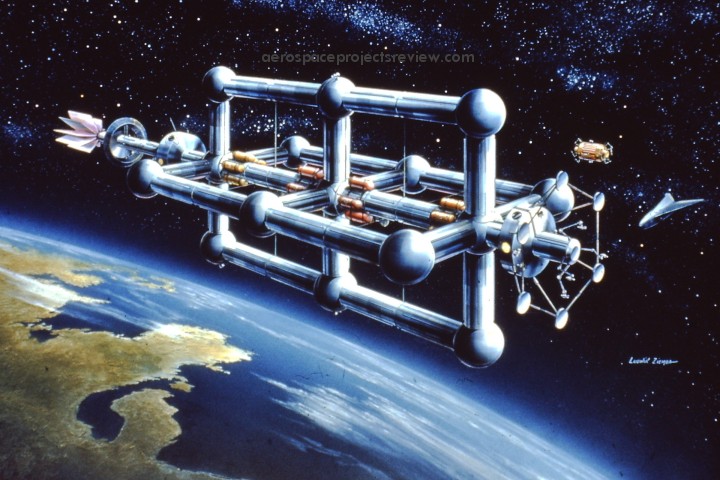
AND THIS:
www.aerospaceprojectsreview.com/blog/wp-content/uploads/2...
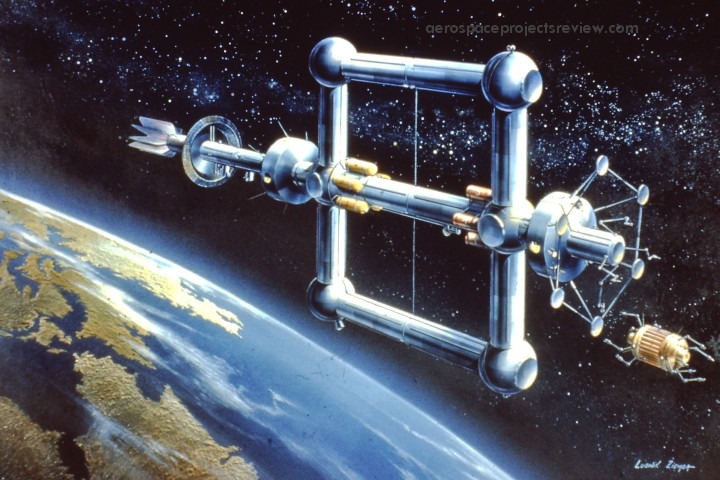
Both above credit: Aerospace Projects Review website
"Conveniently located in the heart of Ashtabula, Ohio. Counter and Dining Room Service. Separate Cocktail Lounge. 4640 Main Ave. Telephone 21-136"
Color photo by Richard Stoner
Pub. by Charles C. Davis, Box 4032, Cleveland 23, Ohio
Genuine Natural Color, Made by Dexter Press, Inc., West Nyack, N. Y.
www.google.com/maps/@41.864782,-80.7824354,3a,37.5y,113.6...
books.google.com/books?id=TP6KM_w06isC&lpg=PA40&o...
Also operated the Jack Mintz Children's Shop at 4423 Main Avenue.
Cincinnati Enquirer April 26, 1954:
Business Building Burns ASHTABULA, Ohio. April 23 CP Flames destroyed a two-story building in the heart of the Ashtabula business section today, causing damage estimated at $150,000. Only the brick walls of the building which housed the Jack Mintz Restaurant...
This wonderful old bench, seen on the acreage belonging to the Dover family on 25 September 2015, has been taken over by various lichens. The Dovers preserve and conserve, and their forest and gardens hold some neat treasures. Being interested in nature and botany, we thought this bench was quite interesting to see.
In the morning of 25 September 2015, six of us were lucky enough to explore a tiny part of the land belonging to Frances and David Dover. For two of us (myself and our leader), this was our second visit - for the rest, it was a first time there.
I will copy and paste the description I posted on Flickr from our first visit to the Dover's acreage, on 7 August 2015:
"Yesterday, 7 August 2015, four of us were extremely fortunate to have the chance to visit the home and highly varied topographic 62-acre property belonging to Frances and David Dover. We felt honoured and privileged to meet and spend time with Frances and David, and also their daughter Carolyn and her husband Clair. A delightful family who welcomed us so warmly into their home and land.
This acreage of grassland, forest, rolling hills - and special gardens - is not far from Millarville, SW of Calgary. In fact, it's in an area that I often drive through when I only have time for, or only feel like doing, a short drive. Amazing what little gems exist out there.
This is not just a beautiful property, but is very special for various reasons. For one thing, read any history of Alberta and you will find the Dover family, including David's mother, Mary Dover. Second, among the trees and open "lawns", there are Peony flower beds, containing 100-150 heritage Peonies, each one different, that have now multiplied to more than 300 plants. Unfortunately, they bloomed a couple of weeks early this year, and all the flowers had gone to seed. Another open area had a different kind of ground cover - Thyme, which smelled wonderful. If I remember correctly, this was the open space where the Calgary Philharmonic Orchestra performed on one occasion!
There are two large ponds on the property and another smaller area of water that they hope to turn into a Japanese Garden. It was while walking around the latter that a large brown 'shape' could be seen through the dense trees - a handsome Moose buck. I will look properly at the four or so photos I just managed to get and will slip one of them into my photostream sometime soon, just for the record, definitely not for the photo quality : ) This was also where a Great Horned Owl was seen flying through the trees by some of us (not me, ha!).
There are grassy paths winding through the acreage, up and down hill, that take David seven hours to mow. They are not pristine, velvety paths, but instead, they seem to take nothing away from the wildness of the whole area. One of the animals that have passed through is the Cougar. In fact, several years ago, I saw a video taken on a nearby (or adjacent?) property, where a 'kill' and night-time camera had been set up and a total of six different Cougar individuals were seen!
Even the Dover's home is unique and beautiful. It is completely built of concrete - floors, walls, ceilings, roof, deck, and so on. A Hummingbird feeder and regular bird feeders, set up on the patio, attract a variety of birds. We sat on the patio after our walk to eat our packed lunches - and to enjoy a delicious Orange Pound Cake that Frances had made for us, along with refreshing Iced Tea - thank you so much for this, Frances! Yesterday, while I was waiting for one of three tiny Calliope Hummingbirds to come back, I was lucky enough to see a little Mountain Chickadee, along with many Pine Siskins. We could also hear a Red-tailed Hawk in the area.
There is just so much I could write about this visit and family. Instead, or for now, I will add several links to more information on the Internet. This was a memorable day for us. Thank you so much, Frances and David, Carolyn and Clair, for being so kind and welcoming us into your home and gardens.
books.google.ca/books?id=Tr36Tq_gadcC&pg=PA290&lp...
www.westernwheel.com/article/20110727/WHE06/307279983/-1/...
David's mother, Mary Dover (her father was A. E. Cross), was "a dynamic and distinguished Calgarian, particularly known for her work with the military during World War II." As well as being an army officer, and an alderman, she was also a preservationist. See the following link.
www.albertachampions.org/champions-mary_dover.htm#.VcY1KP...
ww2.glenbow.org/search/archivesMainResults.aspx?XC=/searc...
glencoe.org/documents/10184/637479/The-History-of-Elbow-P... page 44-45 ."
After our visit to the Dover's on 25 September 2015, I decided to drive eastwards along a road that I'd never driven before, until I reached the main road going south. From there, it was a fairly short drive to the Saskatoon Farm. As usual, I wandered round the grounds with my camera and then, when I was ready to leave, I ordered a pizza to take home with me. The inside of the gift shop has recently been renovated and they now have a pizza oven and area.
July 2018, full resolution image from the Paper: "A special poetic of iron and stone: reflections about the design of the Montemartini Museum in Rome" by me and Pelin Arslan.
Full volume available here: Google Books
Full Paper available in Reserchgate.net and in Academia.edu
Original shot taken with a Nikon D800e 36.3 Mp Digital SLR, Nikkor F1.8 lens, various post processing
My sleuthing uncovered interesting information about this photo. It's below, after the text from the Oregon Historical Society's label.
=========================================================================================================================
Boilers at Station E
Portland General Electric Photograph Collection
ORG lot 151 PGE 5-29, Oregon Historical Society Research Library
"Capturing movements and processes in photographs was difficult due to limitations in technology. As a result, people in motion were often blurred in early photographic images."
It's fine to understand this aspect of photography, but it tells us nothing about this surreal scene in which men are climbing on and in the entrails of a massive piece of equipment.
=========================================================================================================================
INTRODUCTION
I stumbled across a key piece of information about this photo by accident. The image was behind glass at the historical society, so when I photographed it, a bit of the colorful shirt I was wearing was reflected on the glass. Consequently, my camera picked it up.
When I magnified the photo in Photo Shop to select the area with colors in order to make them go away, I discovered inscriptions on the lintels over the three open doors at the bottom of the photo.
Initially, I was able to read:
_ _ _ _ _ _ HORIZONTAL BOILER
THE AULTMAN & TAYOR _ _ _ _ CO BUILDERS
MANSFIELD, OHIO
=========================================================================================================================
THE AULTMAN & TAYLOR CO.
Luck was on my side, because when I searched for "Aultman & Taylor horizontal boiler Mansfield Ohio," I came up with several hits.
One of them was an article titled " Mansfield’s first harvest of genius: Aultman & Taylor" by columnist Timothy Brian McKee dated 25 November 2017 in the online publication Richland Source.
It provides a history of Aultman & Taylory's accomplishments in the field of agricultural equipment:
For many generations, Mansfield has been recognized as a center of innovation in the US: a place where new things are put forth; new products are devised; new methods perfected; new procedures developed.
This is not hyperbole; it is not wishful promotion from city boosters. There are a remarkable number of societal-shifting accomplishments covering a broad spectrum of focus, that had their origin right here in our town.
This trend can be traced back, perhaps, to 150 years ago when the Aultman & Taylor Company set up shop in Mansfield, and revolutionized the industry of farm machinery.
Cornelius Aultman already had a successful farm machinery factory in Canton; manufacturing horse powered mowers, reapers and “thrashers,” but he wanted to try something new. He was convinced the agricultural world in America was ripe for a new technology in harvesting.
The new idea he wanted to explore, and products he wanted to tackle were so different from what he was doing in Canton, he decided to establish an entirely new center of production in a location where independent creativity could take root.
In 1866 he and Mr. Taylor of Chicago rode all over the Midwest looking for a suitable site. When the train stopped in Mansfield they recognized the perfect spot.
Thirty years later, after the company was unbelievably successful and celebrating its accomplishments at the 1893 Columbian Exposition in Chicago, this is what they wrote:
“The works are located at Mansfield, Ohio, one of the best railroad points in the country. They occupy twenty-eight acres of ground, and the tracks of three of the greatest trunk lines of the world run through its yards, thus affording shipping facilities that no other company possesses.”
When Aultman & Taylor came to town, they selected a site in the flats that was not only close to the railroads, but actually within the triangle created by the confluence of the crossing lines. Their shipping docks were literally only feet from all three tracks.
They went on to say that Mansfield “is the geographical center of the best hardwood district of the United States.” The Aultman & Taylor machinery required the finest oak, hickory and ash wood; and by the 1890s a regular year of operation required 300 train cars of coal, 500 cars of lumber, and 300 cars of iron.
In 1866, when the Mansfield factory was established, it was not like there was a shortage of competition in the agricultural implements field: Deere, McCormick, and Case were already leading a crowd of factories all over the country. Another factory would never find a foothold in that market.
But Mr. Aultman intended to create a product that was so radically superior to everything else available to farmers, that he would have essentially no competition at all.
That’s why many of the Aultman & Taylor products made in Mansfield were in the record books as “firsts” in the history of American agriculture: that was his intention when he set foot here.
Accordingly, Mansfield is where the first US traction engine was produced in 1880. They manufactured the first vibrating thresher machine. They invented boilers for steam power that were always the first of their kind, and devised patented mechanical elements of farm vehicles that became standard designs afterward.
Mansfield is where the largest traction engine in the world was imagined and fabricated.
Largest traction engine
In 1907 the Mansfield plant fabricated this steam powered traction engine: big enough to pull huge gangs of plows, and rated at 100 horsepower. Designed for huge western farms, the machine was one of a kind, and sold to a massive Faulkton, South Dakota wheat farm.
In 1869 they produced 400 threshing machines. By 1873 they led the nation in sales, and could not make them fast enough. They started with 150 employees, and hit their peak in 1918 with 900.
The Aultman & Taylor epoch of farm machinery in Mansfield saw a progression from horse powered equipment, to steam power, to engines run by kerosene and gasoline. Their tractors, hullers and threshers were standard top-of-the-line farming necessities during their entire life span. In 1923, on the eve of the next great wave of farming innovation that combined all those functions together into one machine, the A&T Mansfield operation ceased and the company sold to a firm in Indiana.
www.richlandsource.com/area_history/mansfield-s-first-har...
=========================================================================================================================
AULTMAN & TAYLOR and Boilers
That's all well and good, but how did Aultman & Taylor happen to get into the boiler business? Before I could answer that, I had to decipher the first line of text in the inscription: "_ _ _ _ _ _ HORIZONTAL BOILER". Looking at it closely, I was able to make out the first four letters: CAHA. Consequently, I searched for "CAHA HORIZONTAL BOILER"
That yielded paydirt in the form of a Google e-book reprint titled The Engineer: With which is Incorporated Steam Engineering, Volume 42 dated January, 1905. It contains an illustrated ad for Cahall vertical and horizontal boilers that directs interested parties to the Cahall sales office. books.google.com/books?id=Ur1EAQAAIAAJ&pg=RA1-PA256&a...
Frank solved the next puzzle, which is why Aultman and Taylor would be producing a boiler under a name other than their own. He correctly inferred that Aultman & Taylor was producing the boiler under a license from Cahall. My next search led me to many details of Aultman & Taylor's boiler business. My source was the "History of Aultman & Taylor, Vol. VII" in Farm Collector, November/December 2001. There, I found the following paragraphs:
"During the early 1890s the Aultman & Taylor Machinery Company was approached from time to time with requests to build stationary boilers, as well as to do contract work. John Cahall, superintendent of the boiler department, and his son, William, were possessed with considerable inventive genius. John Cahall was awarded on Oct. 25, 1892, patent #485087 for a vertical water-tube boiler and on April 17, 1894, patent #518519 for a horizontal water-tube boiler."
"Beginning in 1895 the company manufactured the Cahall boilers and successfully placed them on the market."
www.farmcollector.com/steam-traction/history-aultman-tayl...
=========================================================================================================================
YET MORE ABOUT AULTMAN & TAYLOR BOILERS
What follows is for the subset of history lovers who are fascinated by the history of businesses:
The company arrived at a crucial milestone and made a decision that had far-reaching consequences, most of which were unforeseen by those who were responsible for guiding the destiny of the firm. At the meeting of the board of directors on Sept. 7, 1905, Brown reported that negotiations had been in progress for the sale of the water-tube boiler business. He announced that a contract had been drawn up with the Stirling Company of Barberton, Ohio. That company, while its plant was located in Barberton, was organized and existed under the laws of the state of New Jersey.
For a number of years it was common practice of many companies to be incorporated in New Jersey, even though their plants may have been located elsewhere. This practice prevailed because the incorporation laws of New Jersey were more favorable to the corporations than was true in most of the other states. Mrs. Harter offered a motion to execute the contract with the Stirling Company. That motion passed.
The machinery and equipment used in the manufacture of water-tube boilers was moved to Barberton during 1905. The contract between the Aultman & Taylor Machinery Company and the Stirling Company was completed on Sept. 15, 1905. That sale included all of the fixtures and machinery used in the manufacture of water-tube boilers. Among the articles listed were rivet machines, punches, shears, stokers, cranes, planers, hoists, boring mills, locomotive cranes, headers, patterns on hand, and many others, comprising more than a hundred items.
The final contract that was executed between the company and Temple provided that he receive $1,000 per month plus a commission of three-fourths of one cent per square foot of heating surface. That contract was to have continued until Oct. 15, 1911. The contract with the Stirling Company provided that, if possible, it was to reach an agreement with Temple. In the event that they failed to do so, the Aultman & Taylor Machinery Company would fulfill its obligation to Temple. In case the latter situation prevailed, the Stirling Company was obligated to reimburse the Aultman & Taylor Machinery Company to the extent of $1,000 per month plus three-fourths of one cent per square foot of heating surface.
Contracts in force with other companies were to continue until the date of their expiration.
Another adjustment involved the Cahall patents. At that time William H. Cahall owned the interest of Helen E. Cahall and John Cahall in certain patents. The Aultman & Taylor Machinery Company obligated itself to secure their interests from William H. Cahall. The firm was to secure the consent of William H. Cahall to the sale by the Stirling Company of the Cahall vertical and horizontal boilers. The Aultman & Taylor Machinery Company also agreed that it would not engage in the manufacture or sale of water-tube boilers for a period of 10 years from the date of the contract. The agreement was ratified by the board of directors at their meeting on Sept. 15, 1905, and signed by J.E. Brown, president of the Aultman & Taylor Machinery Company, and by Edward R. Stettinius, first vice-president of the Stirling Company.
The Stirling Company paid the sum of $275,000 for the water-tube boiler business. To cover this sum, 11 promissory notes were written. In addition to this sum they paid $45,000 for all contracts and orders for water-tube boilers on hand. When consideration is given to all of the financial facts incident to the sale, it is probably fair to assume that the Stirling Company paid between $350,000 and $400,000 for the water-tube boiler business.
In view of the fact that the Aultman & Taylor Machinery Company's water-tube boiler business was lucrative, why did they sell it? Did the officials consider the building of threshing machinery more profitable?
If the price received for the business is compared to the profits realized during the 10 years of building and selling water-tube boilers, it appears that the price that the firm received for the business is much less than should have been realized. In view of the expansion of the water-tube boiler business of the Stirling Company and later the Babcock & Wilcox Company, one cannot escape the conclusion that, had Aultman & Taylor continued their water-tube boiler business, they might have continued in business for more years.
That there was a ready sale for Aultman & Taylor's boilers is evidenced by the fact that, for a number of years in spite of operating their plant to full capacity, they were unable to manufacture a sufficient number of boilers to satisfy the demand. Under such conditions it is difficult to understand the need to continue the outlay of huge sums of money in commissions.
In spite of the fact that the Stirling Company was anxious to acquire the water-tube boiler business, Aultman & Taylor employed an agent to conduct the sale who was paid a huge sum of money for his services. There are those who are of the opinion that the entire transaction had the earmarks of mediocre management and a lack of good judgment.
Whether the officers of the company were at all times prudent and wise in their judgments and actions will probably always be a matter of conjecture and opinion. Nevertheless, it can scarcely be disputed that the sale of the water-tube boiler business and the relinquishing of the patent rights to the Cahall boiler were little less than a colossal blunder. 9 www.farmcollector.com/steam-traction/history-aultman-tayl...
=========================================================================================================================
PGE STATION E
Before concluding, it's necessary to discuss how the photo relates to Portland. The historical society label identifies the scene as PGE's Station E. Presumably, this was the fifth power plant PGE built. But what are the four men in the photo doing? I first interpreted it as a demolition scene. The doors to the furnaces at the bottom of the image have already been removed. There is a lot of debris around. From the little one can see of the space in front of the boilers, there seems to be a lot junk on the floor. The cast iron panels look like they've seen a lot of use.
Thanks to the enterprising ex-PGE people who maintain the website PGE Retirees.org, I learned I was all wrong about Station E. In the "History" section of the site, there's a timeline of electric power in Portland. Here's the entry for 1905, the year the photo was taken:
"1905 The Lewis & Clark Exposition is held in northwest Portland, attracting 3 million visitors. The event is lit by PGE with power from its newest steam plant, Station E." www.iinet.com/~retireeski/history.htm
In that case, it's likely the men in our photo were assembling the mighty boilers that powered the generators that produced the electricity that lit up the night sky above that exposition that took place so long ago.
A cabinet card from The "Paw Paw, Illinois Photograph Album". Photo by Clark, Paw Paw, Illinois. No other info on card. .
For other info & photos please see the "Paw Paw, Illinois Photograph Album.".
I am thinking that the photographer name was J. W. Ckark of Mendota, Illinois.
Here is some info. Just the first paragraph.
“THE BLUE SCOUT rocket tucked beneath its fuselage, the X-15 leaves the B-52 aircraft below at 50,000 feet, and climbs toward an altitude of 156,000 feet, where it will launch the Blue Scout. The new recoverable space booster concept proposed by Ford Motor Company’s Aeronutronic Division and North American Aviation’s Los Angeles Division would enable the Air Force to launch the Blue Scout payload on both probe or orbital missions and recover the first stage B-52 and second stage X-15.”
Odd for manned aircraft, radically different from each other, to be referred to as “stages” of a launch system. And that they’re recoverable. Well, I should think/hope so.
As I have no interest in Blue Scout, I didn’t know it was also recoverable, interesting.
www.astronautix.com/x/x-15bluescout.html
Credit: Astronautix website
Due to the novel proposal, plenty to be found online. The following contains a portion of the image, as part of a montage which includes the flight profile, at:
books.google.com/books?id=reEDAAAAMBAJ&pg=PA114&l...
Credit: Google Books website
Seen on a 1950 FARGO Panel Van.
On my way back home I decided to take the N4 as a short-cut between Luxemburg and Liège. Right before nightfall I came across an oldtimer garage along this N4. I was really astonished what I discovered there...
This unknown Fargo truck was in fact a rebadged Dodge vehicle. It also could have been a De Soto truck, while the Chrysler Corporation used these different brand names for the same utility vehicles.
I can't find any more info about this van.
See also pag. 50-56 in: books.google.nl/books?id=CIO_CwAAQBAJ&pg=PA50&lpg...
Seen at garage Noiset & Fils.
Production: 1948-1950.
Number seen: 1.
Hollange/Fauvillers (B.), Malmaison, N4, Ardennes, May 8, 2016.
See: www.google.nl/maps/place/Noiset+Latour+Sprl/@49.8974545,5...
© 2016 Sander Toonen Amsterdam | All Rights Reserved
Joe and Katherine Jackson pose with their superstar sons, the Jackson Five, in their home, Encino, Calif., in 1971. This image appeared on the cover of the Sept. 24, 1971 issue of Life magazine. From top left down, Michael (1958 - 2009), Marlon, Tito, Jermaine, and Jackie, father Joe, and mother Katherine Jackson.
JOHN OLSON/THE LIFE PICTURE COLLECTION/GETTY IMAGES
Via:
www.usatoday.com/picture-gallery/life/people/2018/06/27/r...
Here’s a link to the entire September 24, 1971 issue of Life Magazine:
In response to the Geiss-modified version of the Argus C4 (to allow interchangeable lenses), Argus Camera of Ann Arbor introduced the C44 in 1956.
The formula for the 4-element Tessar-type Cintagon 50/2.8 was computed using an early digital computer built by the University of Michigan called "MIDAC," one of the first in the US midwest (see pg. 16 and 18 of the Sept. 1956 Popular Photography).
Rights statement: original image by voxphoto posted under a BY-NC-ND-2.0 license.
Latin inscription:
NIGELLA VIRGO DEI QUE VIXIT ANNOS PM XXXV DEPOSITA XV KAL MAIAS BENE MERENTI IN PACE
books.google.de/books?id=Jq9NAAAAcAAJ&pg=PA567&lp... VIRGO DEI QUE VIXIT ANNOS PM XXXV DEPOSITA XV KAL MAIAS BENE MERENTI IN PACE&f=false
At first glance, this appears to be the all-time least necessary railroad tunnel. It's located on the west side of Chattanooga where Nashville & Chattanooga placed tracks in 1852. The tracks run through a valley; originally walls were placed on either side but they weren't enough to withstand dirt and rock slides. Thus, 400 feet of tunnel was completed in 1858 to serve as a roof and no longer need to clear the tracks.
By 1911, the one track could no longer meet the railroad needs. They cleared out a much larger area and built two sets of tracks through the area. They even had to add buttresses to the side of the existing tunnel to prevent it from making it's own rock slide onto the new tracks. Over time, the railroad here went from NC&StL to L&N and now CSX.
This area is fairly easy to find. The tracks parallel highway TN134. It's in Hamilton county very close to the Marion County line. There's a one-car pulloff spot on the side of the road, but sadly most people use the spot for illegal dumping. Whiteside is the nearest post office, so this is called the Whiteside Tunnel, although sometimes has been called the Raccoon Mountain Tunnel.
source: books.google.com/books?id=tqVMAAAAYAAJ&pg=PA1018&...
Henry Lincoln “Harry” Walters
Birth - 1 Nov 1864 in Cariboo Regional District, British Columbia, Canada
Death - 18 Feb 1918 (aged 53) in Quesnel, Cariboo Regional District, British Columbia, Canada
Henry Lincoln “Harry” Walters was Postmaster at Harper's Camp from - 1 July 1897 to 20 January 1905 - he was dismissed due to political partisanship.
Son of Thomas Oliver Walters and Mary Flanders. Death record shows he was born in 1865, but is baptismal record states he born November 1, 1864. Henry Walters was the first white child born in the Cariboo at 83 Mile House in 1865. LINK to more information about Henry Lincoln Walters - books.google.ca/books?id=OprFIaW9R70C&pg=PA28&lpg...
His wife - Alva Viola "Youngker" "Walters" Campbell
Birth - 2 Oct 1876 in Lincoln, Lancaster County, Nebraska, USA
Death - 4 Jul 1953 (aged 76) - New Westminster, Greater Vancouver Regional District, British Columbia, Canada
Burial - Mountain View Cemetery Horsefly, Cariboo Regional District, British Columbia, Canada
Daughter of Isaac Youngker and Rebecca Courtney. - First married to Harry Walters on Sept. 4, 1895, at Clinton, BC. Seven known children were born of this union: Minnie Hazel, Robert Ivan, Lloyd Irvin, Glenn Henry, Blanche Mary, Valentine Lena, Gerald Hope and Marvin. Second marriage to Alexander Blackwood Campbell who she married February 15, 1921 at Vancouver.
Addressed to: Lee Fie / c/o Fang Kee (Fang Kee & Co. Merchants) / Quesnel Forks, B.C.
Lee Fie
Birth - 1874 in China
Death - 10 May 1929 (aged 54–55) in Rossland, Kootenay Boundary Regional District, British Columbia, Canada
Burial - Columbia Cemetery, Rossland, Kootenay Boundary Regional District, British Columbia, Canada
Message on letter reads: Harper's Camp, B.C. - December 27, 1908 - Lee Fie / Quesnel Forks, B.C. - Dear Sir, I just got your letter this mail (was away from home) - I have some money that will be here about the 1st of next month and will send it to you - $12.75. I am very sorry to keep you waiting - I have not received my money from the oil company - but still expect to get it some time this winter. Your Truly / H. L. Walters
Mount Buzhou (不周山), a pillar holding up the sky. The pillar collapsed and caused the sky to tilt towards the northwest and the earth to shift to the southeast. This caused great floods and suffering to the people....
The characters 伏羲 Fu Xi lit. mean “lie prostrate” & “sacrifice”. In 女媧 Nü Wa, Nü 女literally means ‘female’, whereas ‘Wa’ 媧 has no meaning. Contrary to Shen Nong and Huang Di, Fu Xi and Nü Wa are a rather obscure and distant couple in the misty fog of Chinese antiquity, and only very little is known about them.Fu Xi and Nü Wa pictured with dragon tails intertwined. (Picture by Hughes Songe)..Every school-child in China, Taiwan, and other Chinese places, learns already early on about their original Chinese patriarchs and their histories. But the most ancient Chinese history has become quite embellished over 4 1/2 thousand years and changed into mythology. As a result, the 21st Century Chinese are quite confused about their earliest primo-genitors, and if it weren’t for a very interesting discovery that this article reveals, their earliest patriarchs would have stayed obscure until the end of time.The earliest records speak of “Sān Huáng Wǔ Dì”, meaning the “Three August Ones, Sovereigns or Kings” and the “Five Emperors.” These 3+5= 8 god-kings or demi-gods purportedly used their magical powers to improve the lives of their people. Because of their lofty virtue, they lived to a great age and ruled over a period of great peace.The three Sovereigns are generally denoted as Fu Xi, Nü Wa, and Shen Nong Shi, but in other literary sources Nü Wa is often replaced by Huang Di, one of the five Emperors. Actually, depending on the source, there are six to seven known variations of who classifies as the “Three Sovereigns & the Five Emperors”. Many of these sources were written long after the actual events, during much later dynasties. Hence the distortion.These Three + Five = Eight Chinese primo-patriarchs, concur with a global occurrence of eight Flood survivors in ancient legends.
India: Manu and his 7 ‘Rishis’ = 8. (picture above)
S-India: Satyavratha (Noah) + 3 sons Sharma, Charma, Yapheti +their 4 wives = 8.
Egypt: The ‘Ogdoad‘ [octo=8], Nun {Noah} Heh, Kuk, & (h)Amun + 3 wives = 8.
Sumeria: Uan or Oannes and 7 ‘Apkallu’ (wise men) = 8. OR the 4 post-diluvian Apkalluh with 4 wives would also make 8.
Hebrews: Noah, Shem, Ham, Yapheth + their 4 wives= 8.
Others: Also 8, as we’ll show about the Miao Zu people.The ‘Ogdoad’ also puts to rest the mistaken idea that the Egyptians did not have a Flood story! See how Nun upholds the boat with 7 survivors.In yet another version of the more than 700 global flood stories, the Chinese legend tells how the world was swept by a Great Flood, and only Fu Xi and his sister NüWa survived. They then retired to Kunlun Mountain where they prayed for a sign from the Emperor of Heaven — God — or as he is called in Chinese Shang Di.The Divine Being approved their union and the siblings set about to procreate the human race all over again. It was mythically told of them that in order to speed up the natural procreation of humans, Fu Xi and Nüwa found an additional way by using clay to create human figures, and with divine power entrusted to them, they made these figures come alive. The Han period book Fengsu tongyi 風俗通義 says that in the beginning, just when Heaven and Earth had separated, Nü Wa formed humans out of mud, giving birth to the human race.The new father of humanity Fu Xi then came to rule over his descendants, although reports of his long reign vary between sources. He is supposed to have lived mid 29th century BC, or 2.900 BC, which is very close to the timing of the Biblical flood of about 2.500 BC. Nü Wa after surviving the great flood, “fixed the broken sky/heaven (Tian) with either five or seven colored stones.” “女媧補天 = Nü Wa Bu Tian!”Now the three earliest Chinese historians mentioned Nü Wa. The fourth, the noted Chinese historian Si Ma Qian (in the Shiji, Chapter Benji or prologue) clearly identifies Nüwa as a man with the last name of Feng.“Herbert James Allen erroneously translated Tang dynasty historian Sima Zhen’s interpolated prologue to the Han dynasty Sima Qian’s Shiji. In one of his more serious flaws, Nüwa was described as male even though the Nü (女) in the name means female and the wa (媧) also contains the female radical. ]”Why does obfuscating W.P. dislike Allen’ s translation? Read on and get the full picture why!Some scholars consider Nüwa a tribal leader (or emperor); others consider the name Nüwa a title. Only after the fourth (Si Ma Qian) Nü Wah was suddenly cast into a woman’s role, and became known as Fu Xi’s wife! Over time these histories grew into even more bizarre myths, as the two of them are still proudly reported by Chinese people today, as being half dragons! Their early depictions as a couple shows both of them with intertwined reptilian tails. (see picture at the top) The legend goes as follows:The earliest literary role seems to be the upkeep and maintenance of the Wall of Heaven*, whose collapse would obliterate everything. [Note the association with Flood traditions.] There was a quarrel between two of the more powerful gods, and they decided to settle it with a fight. When the water god Gong Gong saw that he was losing, he smashed his head against Mount Buzhou (不周山), a pillar holding up the sky. The pillar collapsed and caused the sky to tilt towards the northwest and the earth to shift to the southeast. This caused great floods and suffering to the people. Nüwa cut off the legs of a giant tortoise and used them to supplant the fallen pillar, alleviating the situation and sealing the broken sky using stones of seven different colours, but she was unable to fully correct the tilted sky. This explains the phenomenon that sun, moon, and stars move towards the northwest, and that rivers in China flow southeast into the Pacific Ocean. (this account is similar to the Huainanzi account; it was added as The Upkeep and Maintenance of Heaven).Other versions of the story describe Nüwa going up to heaven and filling the gap with her body (half human half serpent) and thus stopping the flood. According to this legend some of the minorities in South-Western China hail Nüwa as their goddess and some festivals such as the ‘Water-Splashing Festival’ are in part a tribute to her sacrifices.Other versions of the story describe Nüwa going up to heaven and filling the gap with her body (half human half serpent) and thus stopping the flood. According to this legend some of the minorities in South-Western China hail Nüwa as their goddess and some festivals such as the ‘Water-Splashing Festival’ are in part a tribute to her sacrifices.As the ancient Chinese also originated from Sumeria, they were most likely familiar with the early Sumerian Epic of Gilgamesh adopting its symbolisms.Seeing the similarity between dragontail Nüwa and fishtail Vishnu (next picture) also holding instruments in their hands, there is evidence that perhaps also the early Xia in proximity to the sea, as the Jomon had naval contacts not just with America where the Chinese left 3000 yr. Old stone sea anchors, and the Jomon with Ecuador, seeing the Jomon similarity with Valdivan pottery (Betty Meggers Smithsonian!), but also with seafaring ancient Indians or Dravidians and their versions of the ubiquitous 700 ethnic Flood legends, where Noah was called MaNu (plus his 7 Rishis make 8), or in South India Satyavratha and his three sons Charma, Sharma and Phra Yapeti! (As Biblical Noah, Ham, Shem, Japheth) plus 4 wives also make 8!).Seeing that Ham named the “Land of Cham” in Vietnam and Chambodia and other places in between like India Cambay, after himself, perhaps Ham was one of the very “Oannes sailors of the sea wizards” who personally came as far as the Yellow Sea in his astronomical surveys to map the stars and measure the new post-Flood Earth! Because whether it is politically correct with historical (qu)academia or not, it is a fact that the ancients DID travel the entire earth and its oceans, seeing the ubiquitous spread of pyramids (25 in China!) and Bronze Age megaliths in almost every part of the world!Like Nüwa the Indian god Vishnu who guided Manu also sports a fishtail. Manu was instructed by the god Vishnu who came from the ocean as a fish with a fish tail, (Fish Nu!) to save himself from an impending global deluge! We find a similar symbolism in the early Sumerian demi-god Oannes, who emerged from the sea half fish/half man and taught humans civilisation and culture! Man obviously likes to embellish history!
NOW WHO COULD ‘FU XI’ BE?If we look at the meaning of the characters Fu and Xi, as its sound does not coincide at all with any of the other historical records, unless it is a bastardisation of Vishnu?, we get the following meanings: “Fu” means “lying prostrate” and “Xi” has the meaning of “sacrifice.” The picture arises of a man lying prostrate in front of an animal sacrifice.
According to both the Miao and Hebrew records, after Noah’s Ark had landed, he ordered that his family should present a great thanksgiving sacrifice to God, and so they offered and barbecued some animals. Is it possible that Noah’s original name in Chinese, was the honorable “Fu Xi Nü-Wa“, meaning the “Prostrating Sacrificer Noah”?
Is it perhaps also possible that originally Fu meant Father Noah? Was the character Fu changed perhaps from Fu meaning “father” to Fu meaning “prostrate”, around the same time when Nü-Wa was turned female, and that Fu Xi Nü-Wa was suddenly spliced into two people? Only God knows what really happened. Is that perhaps also the reason why their tails were entwined?
But the most interesting and IMHO most likely explanation for the names Fu Xi Nü-Wa, is when you consider the Chinese accent and its bastardisation of non-Chinese accents. A “bus” in Chinese (& Japanese) becomes “Ba Se” or “Ba Su” for example. Now the Chinese may have been aware of the name NüWa through the Han legends coming overland like Noah, Noe, Nuh, Nu-Uh, Nur, or Noach from the Middle East and Babylon originally. But the Xia (dynasty) who settled closer to the ocean than Huang Di, most likely introduced the concept of fish tailed Vish-NU into China from their contact with the seafaring sons of Ham like Dravidian Cushites from India, where Noah is called Manu under god Vishnu.
And when those early Chinese tried to pronounce Vish-Nu, it probably came out very similar to Fishi-Nüwa or FuXi-NüWa. And that makes a whole lot of sense in the light of Chinese pronunciation. Perhaps the Dravidian/Indian name VishNu was itself a bastardisation of NuAh or Noah, the common patriarch of us all mixed with some of that fish-man Oannes influence! We’ll find out in the Heavenly Museum of REAL History! Ha!
Ararat-Ximu-Nuwa-Huangdi-Xia
And why did Fu Xi & Nü-Wa live such long lives, as Shen Nong did too? Because, according to the most detailed and accurate Biblical account in Genesis, Noah, his wife, and three sons, lived to amazing old ages. According to the Greek ‘Sibylline Oracles’, even the wives of Shem, Ham & Japheth also enjoyed fantastically long life-spans, living for centuries! Noah lived almost a thousand years, totally 950 years in fact! 600 years until the Flood began, and 350 after!
Shem (Miao: Lo-Shen, or Shen Nong Shi?) lived a total of 600 years, according to Genesis. If you divide 600 years by a generation of 35-40 years, you easily arrive at a total of 15 or 17 generations. Huang Di was purportedly a distant descendant of Shen Nong, while also his friend and fellow scholar! Well, if he was 7-18 generations removed from Shem or Shen Nong, that would have been very possible being Shem’s great (17 times) -grandchild.
Shem is considered the forefather of most Arabs and of some Asian tribes. The following are the haplo DNA groups found in nations all over the world. You see that the (orange D) South Asians/South Chinese/Tibetans, and (blue O) Han Chinese belong to different groups. (And most originating in the Middle East where Noah landed his ark in Eastern Turkey on the mountains of Ararat!). (NB: The C3 and Q3 “going across the Bering Street” is pure Darwinist propaganda, because the Bering street was frozen until quite recently. It could not have happened!)
DNAmap
There are many legends about Fuxi and Nü-Wa recorded in several ancient Chinese books such as ‘Book of Changes’, ‘Elegies of Chu’, ‘Writings of Prince Huai Nan’ and the ‘Book of Mountains and Seas’. These legends were all passed on orally until written down, but sadly not via rhyming stanzas, yet their impact is very wide and profound. Now the leading aspects and basic facts of these myths become very meaningful in this new Miao and other inter-ethnic context.
BaGua8Story has it, that Fu Xi is not only the clan leader in the East and the chief of the three sage kings and five virtuous emperors of China at the dawn of human civilization, but also an omnipotent wise man capable of various kinds of skills. He is told to have created the Eight Diagrams and simulated the spider to weave fishing net. He was not only able to make musical instruments, but also good at cooking tasty food. Moreover, he contributed a lot to the traditional Chinese medicine and was the forefather of Chinese civilization. He also formulated etiquette’s and regulations for people, reducing the barbaric marriage by plundering. All that could easily be said of the Patriarch Noah as well!
Was Fu Xi Father Sin of the Chinese?
hittiteshoeHITTITE SHOE with upturned toes
OR was Fu Xi the most ancient patriarch of the Chinese “Father Sin” — son of Canaan & grandson of Ham — the patriarch of the Sinites? Sin was the brother of Heth, the patriarch of the Hittites who lived in Anatolia (now Turkey) but after the Bronze Age Collapse they were defeated and dispersed mixing with conquering tribes. Hittites had long pony tails and turned up shoes!
However Sin and his Sinites were totally lost from history. There are no ancient Middle Eastern records or memorials left of them. Many think that they left the Sumerian homeland already very early, traveling across the Silk Route Eastward and fathered the ancient Chinese and other tribes. Study of ancient China and its language is still called ‘Sinology‘ today, while the ancient Arabs called the Chinese the people of “Sin” & the Greeks called them ‘Sinae’.
Nü-Wa Chinese Name for Noah
Nü-Wa, during the remote legendary period of China, had powerful abilities. It is said that when a great flood took place that the heaven collapsed, and the earth sank under water, while wild beasts cruelly killed common people. Then Nü-Wa repaired the heaven/sky (same character Tian!) with five or seven colored rocks and killed the brutal beasts.
All this coincides nicely with the Hebrew scriptures, where the windows of heaven were broken open! After the flood reached its peak they were closed up, and after the water had retreated God showed Noah a beautiful seven-colored rainbow in that broken sky! It seemed to have appeared for the first time in history, the earth being newly covered with clouds!
Most likely some special ante-diluvial condition prevented clouds or water vapour projecting a rainbow, as well as a clear view of the sun which for some odd reason suddenly became much more visible! So much so that Noah’s global descendants, mostly those fathered by the family rebel Ham even began to worship it, and him as “Hamon Ra the Sun God!”
Instead of worshipping the saving God of their Grandfather Noah, they became ardent Sun worshippers! Egyptians, Canaanites, those early megalith builders in Peru, Mexico, Atlantis, Dwarka, China, and in many other places all over the globe, they all began to worship “that magnificent red sun” shining between the horns of their beloved “mother of all life!” The Holy Cow! Now you know where India got that idea via their early Indus Valley civilisation, and Dravidians? From Ham and his Pharaohs!
whitecow
They even had special sun boxes in many megalithic structures and the solar Temple of Amon-Ra at Karnak (Thebes – at present, Luxor city) in Egypt built some time after 2000 B.C. near the present day Luxor was located in such a way as to align with the summer solstice sunrise and is considered the day of the “manifestation of Ra”.
Yet for all she tried Nü-Wa could not fix the “tilt of the sky” and winter, spring, summer, and fall became permanent! Obviously there was no tilt in the Earth’s axis before the Deluge, as witnessed in the wood-sample found in the mysterious ship-shape in Armenia many believe to be the 5000 year old remains of Noahs’ Ark. That wood has no rings in it!
Nü-Wa and Fu Xi also used clay to create humans and human society by simulating their own appearance. That makes sense when you consider that all of us are the offspring of Noah and his wife, their children created in their likeness!
Nü-Wa also invented a kind of musical instrument called reed pipe wind instrument so that she is esteemed as a musical goddess. Moreover, she created the marriage system to enable humans to multiply offspring, so she is called the marriage goddess, which is very likely, because of her being the mother of all resultant humans. I’m sure they all wanted to be married by Noah and his wife!
And so, all this taken into consideration, everything certainly starts to make a lot more sense than some of the myths and embellishments that sprung up in the minds of the early Chinese storytellers long ago. You can hardly blame them, not having any other comparative historical records to consult with, as we have today.
Again, evidence has come to light that Noah, Shem, Ham & Japheth were real historical people, who built a real historical boat, and survived a real genuine global flood, no matter what skeptic intellectuals are saying against it in the name of “science” falsely so-called. Certainly not my kind of science!
But there is one even more important thing we can conclude from all this, and that is that we need to remember that we are all one family! And that we, as Chinese or Westerners, should all reverence and respect our great great great great great grandfather “Fu Xi Nü Wa” and his Father God! And each and every one of us as well, for we all turn out to be brothers and sisters! True or not?
God bless you brother! God bless you sister!
Love and Peace! Lu.
ancientpatriarchs.wordpress.com/2016/02/08/chinese-mythol...
中國神話的苗族說明證實了諾亞洪水的歷史
每一位在中國、台灣以及大中華地區的學子們很早就已經學過中國的始祖和歷史。 但大部分的中國古老歷史都被修飾美化超過近4500年而且演變成了神話。因此現今21世紀的中國人對於他們最早的祖先相當模糊,若不是這篇文章裡揭露這有 趣的發現,直到末日前,他們可能對自己最早的祖先仍然是模糊不清的。
三皇五帝
最早記載的 ”三皇五帝” 就是指 ”三位尊者” 或是三位君主或王,以及 ”五位皇帝” 。 這些3+5神般的王或半仙人據稱他們運用法力來提昇人類的生活,也因為他們崇高的品德讓他們得以長壽並統治世界帶來長久的和平。 這三位王者分別為伏羲、女媧和神農氏。但在別的文獻記載中女媧通常是被五皇之一的黃帝取而代之。實際上依據資料的來源,有6~7種已知的說法列出到底誰才 是三皇五帝。很多這些資料來源都是在實際事件之後的好幾個朝代所寫的,因此多少會被扭曲
黃帝
那誰會是伏羲呢?
假如讓我們來看伏和羲這兩字,他們的發音雖然和其他歷史記載中的名字不太接近,但我們知道”伏”意謂著”屈身”以及”羲”代表著”犧牲”的意思,我們便可以聯想到一個人屈身於動物貢品前面。
根據苗族和希伯來兩者的記載,在諾亞的方舟停下後,他便告訴他的家人應該要對神感恩,所以他們烤了一些動物來祭拜神,那諾亞原來的中文名字會有可能是”伏羲女媧”嗎? 意謂著”諾亞向神朝貢”?
或者也有可能是”伏”指的是”父親”諾亞? 從”父”的”父親”意思轉變到”伏地”,且在差不多同一個時間,女媧變成了女性而伏羲女媧從一個人分成兩個人? 真相只有神知道! 這或許也解釋了為什麼他們的尾巴會交纏在一起?
再者為什麼伏羲和女媧還有神農都可以那麼長壽呢? 因為根據聖經創世紀裡所記載的,諾亞的妻子和3個兒子也都非常非常的長壽,而根據希臘” Sibylline Oracles”記錄,就連Shem、Ham 和 Japheth的妻子都活的非常久超過一世紀! 諾亞就活了近1000年(事實上是960年)!
Shem(神)(lo-shen神農 or Shen Nong shi神農氏)活了整整600年,根據聖經所記載,假如你將35-40年訂為一代,那600年就將近是15到17代,據稱黃帝是神農的後代,也是他的朋友及之後學者,那黃帝有可能就是神農的(第17代)曾孫子。
神(shem)被視為大部分亞洲人及部分的歐洲部落的先父,以下是一些在世界各地發現的單一DNA族群,藍色D為南方的中國人和橘色O為漢人,兩者分別為不同的族群。
HuangDi-YellowEmperor1-201x300皇 帝或黃帝(姓黃),認為如此比較像傳奇人物而非神話,也因為他被視為真實歷史人物以及在夏朝前的第一位皇帝,因此伏羲、女媧和神農氏被視為神話中的人物因 為較不為人所知。 黃帝又名軒轅氏,是五位傳奇皇帝中的領袖。黃帝和他的兄弟炎帝一同被認為是中國人的祖先,所以後代的中國人也被稱之為炎黃子孫。(炎帝和黃帝的子孫) 目前中國學術界普遍主張,黃帝是出生於有熊(現今湖南省新鄭)並安葬於陜西的橋山(現今黃陵縣)。黃帝及炎帝兩者都是中國兩大族的祖先,也在之後再度融而 為一。 早期的歷史學家”司馬遷”則記載黃帝事實上是神農氏(簡稱神農)的後裔,雖然只約8到17代的血統,儘管在這中間相隔久遠,黃帝仍被視為是神農的朋友和學 者,很明顯地據說非常的長壽。
在很多中國古老的書籍裡都有記載著伏羲及女媧的傳說,如易經、楚辭集注、淮南子以及山海經,這些傳說有著深遠的影響力且一直被流傳著,這些神話的有部分觀點對這個新苗族及不同族群間是非常有意義的。
故事裡有說到,伏羲不只是東方部落或三皇五帝的領袖,同時也是樣樣精通非常聰明的人。他創造了八卦和模擬蜘蛛網而演變出的魚網,他不只會做樂器也很 會做好吃的飯菜,更對中藥上做出了許多貢獻,身為中國人民文明的始祖,他更替人民規劃出了禮儀規範,變革婚姻習俗,倡導男聘女嫁的婚俗禮節,使血緣婚改為 族外婚,這些和諾亞都很相似。
女媧在古老的中國傳奇裡有著強大的法力,傳說中大洪水時天崩塌,地球被下沉到水裡面,各式猛獸都跑出來虐殺人類,女媧用七彩石補天及捕殺這些猛獸。
這和希伯來文聖經裡的創世紀都有些雷同的地方,上面說到”天堂之窗裂開”! 當大洪水淹到最高點時窗就關起來了,當水乾的時候,神讓諾亞看到了天上的七色彩虹,因這是歷史上的第一次。地球被雲給蓋住,很可能因為天空上面外殼的水的 遮蓋這些紫外線防老化,所以人類可以活得更久一點且還沒有雲彩!
女媧和伏羲也同樣用泥土以他們的外表來造人類社會,那這樣就會很合理如果我們都是諾亞和他妻子的子孫,他們的孩子都很像他們的爸媽,女媧也發明一種樂器叫簧管吹奏樂器,所以她也被稱為音樂女神,因為她作為所有人類的母親,我敢肯定他們都希望能嫁給諾亞和他的妻子!
綜合以上我們所提到的,所有事情似乎比那經過修飾過後的古老神話更加合理。我們也無法怪罪當時這些傳說為何沒辦法像我們現在可以找到其他歷史記載來做比對。
再者,所有證據都指向諾亞、神(Shem) 、漢(Ham)和賈費斯(Japheth)都是那些曾蓋過方舟和真的從大洪水中生還的真實歷史人物,無論說什麼所謂的知識分子在科學的角度上仍還是持懷疑的態度。
ancientpatriarchs.wordpress.com/2016/04/24/%E4%B8%AD%E5%9...
This splendid sage lived for 197 years, a number of presumably tremendous significance. Now he is in Heaven where he looks after Cosmic Harmony and Contemplation, which makes him very popular in DAOist circles.FU-XI is very strong on home improvements, and also spiritual improvements. He’s often seen with a carpenter’s square — which symbolizes both as he created the Eight Trigrams for Divination.Fu Xi 伏羲, also written 伏犧 or 伏戲, also called Mi Xi 宓羲 (also written 宓犧), or Pao Xi 包犧, (also written 包羲, 炮犧 or 庖犧), is one of the mythical Three Augusts 三皇 or Five Emperors 五帝. He is therefore known as Xi Huang 犧皇 or Huang Xi 皇羲 "August Shepherd". His cognomen is Tai Hao 太皞 (also written 太昊) "Great Brightness", his tribal name Huang Xiong 黄熊氏. He was the brother and husband of Nü Wa 女媧. The couple was, according to legend, the creators of the world. Han period 漢 (206 BCE-220 CE) stone bricks therefore depict Fu Xi and Nü wa with a human body ending in intertwining dragon tails, each of them holding an instrument of architects, namely scissors (ju 榘) and rulers (gui 規). The story of the couple was very widespread in southern China, where the Miao people 苗 saw themselves as descendants of Fu Xi and Nü Wa. The two of them were, in other words, the parents of mankind. Fu Xi is also the deity representing the east and reigning the element wood (mu 木). According to the books Huainanzi 淮南子 and Lüshi chunqiu 呂氏春秋, he is assisted by the spirit Gou Mang 句芒 who pull out the sprouts of all plants in spring. A story in the Shanhaijing 山海經 says that the mother of Fu Xi was Lady Huaxu 華胥氏 who conceived when she tread on the footpint of the God of Thunder (Leishen 雷神). Fu Xi is credited by several inventions, like the Eight Trigrams (bagua 八卦) used for prognostication. Each one of the trigrams represented a formation of the cosm, like Heaven and Earth, mountains and rivers, wind and thunder, and so on. According to the book Baopuzi 抱朴子 Fu Xi is also credited with the invention of the fishing net. In the song collection Chuci 楚辭 he is called the inventor of music. The book Yishi 繹史 says he invented matrimonial rites that are otherwise attributed to his sister Nü Wa. The Hetu ting fuzuo 河圖挺輔佐 praises him as the one who told men how to use the fire.
Emperor Tai Hao is not always identified with Fu Xi. According to other legends, Tai Hao had the surname Feng 風. His officials had the designations of dragons. His residence was Chen 陳 (modern Huaiyang 淮陽, Henan), and he reigned over the lower course of the Yellow River. The families of this region with the surnames Ren 任, Su 宿, Xugou 須句 and Zhuansou 頊臾 (rather the ruling houses of these minor fiefs of the Spring and Autumn period 春秋, 770-5th cent. BCE) are said to be his descendants. Tai Hao or Fu Xi are also called Green Emperor (Qing Di 青帝 or Cang Di 蒼帝) and ruled over the East.
www.chinaknowledge.de/History/Myth/personsfuxi.html
"In the sign on the right hand, the etymologists know how to read a precept, and the right hand is used for eating. The right hand is therefore appropriate to the things of the earth, and the element D is found in the sign adopted for the Left This square is the symbol of all the arts, especially the religious and magical arts, and is the insignia of Fuxi, the first sovereign , The first soothsayer, Fou-hi is the husband or brother of Niu-koua, whose compass is the insignia. This primordial couple invented marriage also to say good morals. The pictures represent Fou-hi and Niu-koua holding each other by the lower part of the body, and Niu-koua, who occupies the right, holds the compass with his right hand. Left, holds the square with the left hand The square, which produces the Square, emblem Earth, can not be insigned to until after an exchange hierogamic of attributes; , the square rightly deserves to be the emblem of the sorcerer is , and especially of Fuxi, a scholar in the bones of heaven as in those of the earth . Fou-hi can therefore carry the square of the left hand, and the left hand (with the square) evoke the Royal Work, the first hierogamy, the magico-religious activity. The Chinese do not strongly oppose religion to magic, any more than pure to impure. The sacred and the profane do not themselves form two distinct genres. The Right can be devoted to secular works and earthly activities without becoming the antagonist of the Left. Chinese thought is concerned not with contraries, but with contrasts, alternations, correlatives, and hierogamic exchanges of attributes."
Marcel Granet
The war with Zhurong tRAh, banged his head against Mount Buzhou RR Ill the pillar of the sky and the terrestrial a until it broke d 25 There are numerous examples showing how excessive anger, or even joy, can be delete- rious. In another example, the viscount of Zhu furious that one of his employees could inadvertently fell into a brazicr and was burnt alivc xie Hogwei on the other hand, died in a fit of rage while playing weigi, when his oppo nent, on the point of losing, was given a hint by a guest watching the game broad meaning of also encompasses the concepts of fury and rage, as is made clear in the phrase "unable to control one's rage" HIB), to contain one's fury" (8 RBJiA), and "in a towering rage (s HUR). It is also used to refer to the fury of elements, as in "the howl of the vio- ent wind's blowin (1EH89t). In various chéngyii it is described as rage (ili&Z& US), fierce and frightening ourning rage (L & E). Indiscriminate arbitrarily complain about what is here and there U8 illi B), and "venting one's anger on others" TN. It can be hidden (i Tri nursing one's anger and rancour"; to be furious but not dare to speak out), manifested ("showing one's rage th), or modulated ("restraining one's anger at home and venting it outside.
books.google.fr/books?id=lQ55CgAAQBAJ&pg=PA466&lp...(%E4%B8%8D%E5%91%A8%E5%B1%B1&source=bl&ots=28Vw4K4HLv&sig=BSxz_Zn8jm88IhvIhaKdOEeI4GM&hl=fr&sa=X&ved=0ahUKEwjigJ7h357TAhUBvBQKHQfyAZoQ6AEILDAC#v=onepage&q=Mont%20Buzhou%20(%E4%B8%8D%E5%91%A8%E5%B1%B1&f=false
Ok, as you can tell from all the photos, I was mesmerized by the graceful and interesting swoop of this part of the Rincon Mountains. As I stood there the light kept changing not only because the sun was about to set but also there were light clouds wafting over the sun.
The darker section at the top is not a shadow but the tree line for an entirely different type of vegetation from the desert flora you see in the photo above.
"Vegetation at the highest elevations is open ponderosa pine forests. Lower elevations have oak-pine forests that grade into desert grassland and desert scrub. Giant saguaro cacti are the vegetation’s signature feature near the base of the mountain range."
www.fs.fed.us/wildflowers/beauty/Sky_Islands/Coronado_NF/...
"The Rincon Mountains, east of Tucson, are a huge massif made up of a few broad peaks rather than a large, complex range of small summits. The Spanish word “rincon” means “corner,” but it is unclear how this range received its name. Unlike the Catalinas, the Rincons have no major access road, so all climbs must start low and far away from the summits. Lack of access causes a lack of traffic which continues to keep the Rincons a local hiking favorite.
It's over a veritcal mile to the top of Mica Mountain (8,666), tallest of the of the Rincons. A hike to the wooded summit takes you through some beautiful country and can be done as a backpacking trip."
The 1893 edition of Boyd's Directory of Harrisburg and Steelton, p. 29, lists a "Hope Steam Fire Engine Co., No 2," in Harrisburg, Pennsylvania, with an address on "2d [Street] bet[ween] State and North," and I believe that this is the same "Hope Fire Co. No. 2" described here, with a fire house located at "Second and North Streets." The fire company itself no longer exists, but the "Hope Station" building was -- for a time -- the Fire House Restaurant.
"Bazaar and fair, Hope Fire Co. No. 2, March 18 to 25 inclusive. We cordially invite you, your family, and friends to attend this bazaar and fair, which will be held in the parlor of fire house, Second and North Streets. Something doing every minute. Donations of cakes and candies will be appreciated. Admission free, everyone welcome. Raysor, printer."
“DYNA SOAR GLIDER RE-ENTERING EARTH’S ATMOSPHERE – This is a Boeing artist’s impression of how the Dyna Soar manned space glider will look when it re-enters the earth’s atmosphere after a flight into space. Leading edges of the craft will glow from the heat created by the friction of the vehicle passing into the atmosphere. Dyna Soar will be boosted into space by a modified Titan intercontinental ballistic missile. After being separated from its booster, the glider will be left in piloted, near orbital flight. Its pilot later could glide to a conventional landing at an Air Force base. The Boeing Company, under supervision of the Air Force, is prime contractor for the system and the glider. The Martin Company is prime contractor for the Titan booster.
--Boeing Airplane Company Photo”
Artwork by Warren McCallister. Another huge WIN!:
projectswordtoys.blogspot.com/2010/07/summer-of-sword-dyn...
Credit: MOONBASE CENTRAL website
This photo and an excellent article at:
pdfs.semanticscholar.org/a722/d4455ab5ad4637e0addeee1338d...
Credit: Semantic Scholar website/"Crosslink: The Aerospace Corporation magazine of advances in aerospace technology, Winter 2003/2004" issue
Photo featured in the December 1960 issue of USAF magazine “AEROSPACE SAFETY”:
books.google.com/books?id=PjI8uoezsGAC&pg=RA11-PA4&am...
Credit: Google Books website
- from 1908 "Lovell's Gazetteer of the Dominion of Canada" - HARPER'S CAMP, a post office in Cariboo District, B.C. 170 miles from Ashcroft on the main line of the C.P.R., in Yale District, 203 miles east of Vancouver.
(from - Wrigley's 1918 British Columbia Directory) - HARPER'S CAMP - a post office and farming district on Horsefly River in Cariboo Provincial Electoral District, reached by stage from Lac la Hache on the Cariboo Road. Has telegraph office and population of 175 (in 1918). Local resources: Farming, mining and trapping.
Originally called Harper's Camp after Thaddeus Harper, pioneer rancher and miner. The present name of the village, lake and river comes from the fact that every summer this country is infested with horseflies. The name was originally given to the river and lake because of the prevalence of horseflies in the district. Horsefly Mining Company's post office closed 1908. Settlers drew lots in 1920 for a new post office name; all but one entry favoured Horsefly'.
Harper's Camp Post Office was opened - 1 July 1897. Renamed Horsefly Post Office 1 July 1921.
LINK - to a list of all the Postmasters who served at the Harper's Camp Post Office - www.bac-lac.gc.ca/eng/discover/postal-heritage-philately/...;
sent from - / HARPER'S CAMP / DE 28 / 08 / B.C. / - split ring cancel - this split ring hammer (A-1) was not listed in the Proof Book - it was most likely proofed c. 1897 when the Post Office opened - (RF D).
arrival - Quesnel Forks, B.C. - partial split ring backstamp
Addressed to: Lee Fie / c/o Fang Kee (Fang Kee & Co. Merchants) / Quesnel Forks, B.C.
Lee Fie
Birth - 1874 in China
Death - 10 May 1929 (aged 54–55) in Rossland, Kootenay Boundary Regional District, British Columbia, Canada
Burial - Columbia Cemetery, Rossland, Kootenay Boundary Regional District, British Columbia, Canada
Sent by: Henry Lincoln “Harry” Walters
Birth - 1 Nov 1864 in Cariboo Regional District, British Columbia, Canada
Death - 18 Feb 1918 (aged 53) in Quesnel, Cariboo Regional District, British Columbia, Canada
Henry Lincoln “Harry” Walters was Postmaster at Harper's Camp from - 1 July 1897 to 20 January 1905 - he was dismissed due to political partisanship.
Son of Thomas Oliver Walters and Mary Flanders. Death record shows he was born in 1865, but is baptismal record states he born November 1, 1864. Henry Walters was the first white child born in the Cariboo at 83 Mile House in 1865. LINK to more information about Henry Lincoln Walters - books.google.ca/books?id=OprFIaW9R70C&pg=PA28&lpg...
On Sept. 4, 1895, Harry Walters and Alva Youngker were married in Clinton. Hazel Walters Gibbons was born on July 19, 1896, the first of their eight children and the first white child born in Horsefly. A locket of gold mined at the Horsefly Hydraulic Mining Co. was presented to Hazel by J.B Hobson, Manager, and the men employed there, as a memento. It was inscribed "Presented to Minnie Hazel Walters, first white child born in Horsefly, B.C., July 19, 1896, by her well-wishers." As the years went on, Mr. Walters continued his employment with Mr. Hobson as postmaster, fire warden and telegraph operator. In 1897, he established a hotel, including a Post Office, in Horsefly and ran it for many years. Business was good while the mines were operating, but Mr. Walters preferred to leave the management of the hotel to Wm. McRae and David Fitzgerald. LINK to the complete article - www.harperscamp.ca/textual/families.html