View allAll Photos Tagged module
Sjøhus, (sea houses, litterally translated) are industrial buildings from the times when boats were the only efficient way of transport. These cladded, timber frame buildings were used for all kinds of purposes connected to trade and fisheries on the Norwegian coast. The typical protruding part of the gable (vindehus) is protecting the hoist mechanism. Herring (sild) fisheries were so important for the earlier economic growth on the western coast it was the obvious choice for an advert on the wall.
“LUNAR TESTS -- Jack Mays, a test subject from the MSC Crew Systems Division, wears an International Latex Corporation spacesuit under a thermal overgarment during tests at the Lunar Topographical Simulation Area. He is also wearing a Portable Life Support System (PLSS) back pack. A full-scale mock-up of a Lunar Module is in background.”
…What he is not wearing however, is a helmet. In fact, he may be yelling something like “Where the f**k is my helmet?!?!?! You knew they were coming to take pictures today!!!” Or, being a consummate NASA professional, he may be realistically portraying his final moments in the near vacuum of the lunar surface, attempting to gasp…right before his eyes pop out of his head.
The top of a MSC water tower can be seen 'next' to the Lunar Module Descent Engine (LMDE) skirt/nozzle.
Jack Mays:
Credit: Manned Space/YouTube
I wanted to build a ship/probe module that had the textures of current technology coupled with the shapes and lines of the sci-fi world not yet invented. All stickers are official (from the Discovery line.) All pictures at Brickshelf once moderated.
Dedicated to nnenn.
One of the 'rocky coast' modules.
10 done, 10 more to go.
I am not going to make it :S
But I'll try anyway.
The City Space theme continues to inspire. I wanted to use the curved quarter panels as a windscreen, and by excellent luck had the matching curve plate in sand blue. From then on it was just a matter of mixing the design cues and colour scheme from the sets with my build.
Rather pleased with this, looks chunky and industrial near-future. The crane, while functional, can't lift the module without ripping itself apart. Oh well.
Probably won't take any more pictures of the module itself either, it's just an empty shell that seems to be more like a double-decker carriage on a scenic train than a science module. Some more work on that will be required, I think. But that's a problem for another time. I already have an idea for a larger build that will incorporate four of these modules.
The local train LUG's layout is always a hit! Kids can operate the crane in the busy freightyard, light up the tree in front of the main station, or drive a classic steam train in front of the frozen waterfall.
For more photos, see the full set.
The chevrons are part of Module 1 of my modular microscale Space Base.
the prototype for this cheese slope design is here and, of course, I have to acknowledge inspiration from Katie, the master of cheese slope mosaics.
More pics in the Mars Base set.
The Theed Palace modules shown in a previous diorama have been extended from the basic two modules in the middle to four. There's now two modules with the windows and a roof module (expansion pack).
Some scenes to demonstrate their use are currently in progress.
If you enjoy viewing this and my other works, please support the Star Wars Modular Buildings/Locations project that I've created on Lego CUUSOO.
An interesting view of the audience/gallery of observers, I assume composed primarily of NASA personnel, watching three television monitors of the activities within the Command Module mockup in the background, at the North American Rockwell (NAR) plant in Downey, CA.
Thanks to Mr. Ed Hengeveld, what’s transpiring here is a stowage review using the mockup, conducted March 15, 1968. Participating were (then) Apollo 8 astronauts McDivitt, Scott & Schweickart, plus their backups Conrad & Gordon. Later in the day, the test was repeated by Apollo 9 astronauts Borman, Collins & Anders. Possibly, their backups, Armstrong, Lovell & Aldrin also participated, Aldrin at the very least.
In the below linked photograph (of Aldrin), what I erroneously thought was a device to display a simulated exterior view out the window, is instead one of three CCTV cameras documenting activities inside the Command Module.
Note also the diagrams below each television monitor, providing the position & field-of-view of its respective television camera. A Service Module mockup is visible in the background to the upper right.
From the day before, March 14:
NASA announced to the public that program officials had decided to use a 60-percent-oxygen and 40-percent-nitrogen atmosphere in the Apollo spacecraft cabin while on the launch pad (and to retain the pure-oxygen environment in space). This technical decision - because of the earlier tragedy with Apollo 204 over a year earlier - was subjected to closer public scrutiny than perhaps any comparable decision in the history of the U.S. space program. The change affected only ground operations and support equipment and did not necessitate any major changes in the spacecraft itself. Exhaustive testing of the redesigned interior of the vehicle since October 1967 had demonstrated that the risk of fire inside the spacecraft had been drastically reduced. Hardware changes inside the cabin, spokesmen said, had minimized possible sources of ignition and materials changes had vastly reduced the danger of fire propagation.
NASA News Release 68-47, "Apollo Spacecraft Cabin Atmosphere," March 14, 1968."
From/at:
For Teunis. Doesn't meet the M>LTC modular standard's requirement for a standalone module, but makes it easier to fit modules in a yard module set together.
2 inks Screenprint (brown and gold)
Printed on "Le Modulor" by Corbusier.
Le Corbusier described it as a "range of harmonious measurements to suit the human scale, universally applicable to architecture and to mechanical things."
Available in my shop!
Here is my LDD model of the Apollo Lunar Module. It is built to minifig scale. As always, leave a comment if you like.
The Apollo 11 command module Columbia hatch exterior, as seen during the exhibition, Destination Moon: The Apollo 11 Mission, at The Museum of Flight, Seattle. The hatch served as the entry and exit point to the command module Columbia on the launch pad and after landing.
LCROSS and LRO are heading back to the moon, but this picture offers some nice historical perspective.
Date of original image: July 16, 1969
"Carrying astronauts Neil A. Armstrong and Edwin E. Aldrin, Jr., the Lunar Module (LM) "Eagle" was the first crewed vehicle to land on the Moon. The LM landed on the moon's surface on July 20, 1969 in the region known as Mare Tranquilitatis (the Sea of Tranquility). The LM is shown here making its descent to the lunar surface, while Astronaut Collins piloted the Command Module in a parking orbit around the Moon. The Apollo 11 mission launched from The Kennedy Space Center, Florida aboard a Saturn V launch vehicle on July 16, 1969 and safely returned to Earth on July 24, 1969. The 3-man crew aboard the flight consisted of Neil A. Armstrong, commander; Michael Collins, Command Module pilot; and Edwin E. Aldrin Jr., Lunar Module pilot. Armstrong was the first human to ever stand on the lunar surface. As he stepped off the LM, Armstrong proclaimed, "That's one small step for man, one giant leap for mankind". He was followed by Edwin (Buzz) Aldrin, describing the lunar surface as Magnificent desolation. The crew collected 47 pounds of lunar surface material which was returned to Earth for analysis. The surface exploration was concluded in 2½ hours. With the success of Apollo 11, the national objective to land men on the Moon and return them safely to Earth had been accomplished. The Saturn V vehicle was developed by the Marshall Space Flight Center (MSFC) under the direction of Dr. von Braun."
Image credit: NASA
There are plenty of amazing photos on NASA's Image Exchange site:
Learn more about the Lunar Reconnaissance Orbiter (LRO) :
www.nasa.gov/mission_pages/LRO/main/index.html
Learn more about the Lunar Reconnaissance Orbiter and Lunar Crater Observation and Sensing Satellite (LCROSS):
www.nasa.gov/mission_pages/LCROSS/main/index.html
Follow the "New Moon Missions" blog from NASA:
Drupal modules as of 11/9/07
Full-sized, legible photo can be seen here: http://www.flickr.com/photo_zoom.gne?id=2007464793&size=o
Linkable version here: www.kentbye.com/files/drupal_modules_all.html
This photo set contains the 5 smaller printable sections.
These linkable Cheat Sheets are here:
www.kentbye.com/files/drupal_modules_part1.html
www.kentbye.com/files/drupal_modules_part2.html
www.kentbye.com/files/drupal_modules_part3.html
www.kentbye.com/files/drupal_modules_part4.html
www.kentbye.com/files/drupal_modules_part5.html
I created this graphic because I felt overwhelmed with how many Drupal modules were out there, and I wanted to have a single cheat sheet that I could print out and reference. But this proved to be impossible, and it took me splitting up this massive photo into 5 subsections listed above in order to legibly print out all of the modules -- all of the modules as of November 9th, 2007 that is. (There's been another 20+ new projects created since then according to http://drupal.org/taxonomy/term/14/0).
A couple of technical points: The modules are color coded according to the 30 categories listed here: http://drupal.org/project/Modules
Also this massive graphic actually has repeating modules in the sense that if a module is in three different categories, then it'll be listed 3 different times.
There were also 36 projects that weren't categorized and inadvertently left out of this big graphic, but were included in part 5 of the cheat sheet -- along with the project pages that have been created without a release, projects w/ deprecated HEAD or pre-4.7.x releases & CVS namespaces that don't have a current project page.
Finally, this listing doesn't take into consideration the fact that many Drupal project releases actually contain multiple modules within them. For example, the Drupal for Facebook module is actually composed of 9 modules.
UPDATE: The 30 MB excel file that contains the raw data used to generate these visualizations has been uploaded to scribd.com
The crew rest module, with two seats and two beds for an extra set of flight crew (for longer flights).
AX-03-Threat
This is a Spyrius battleship to accompany small figters to battle.
There are five detachable modules - conference foom, two escape pods and two battle pods.
Complete gallery on Brickshelf
Close-up of Apollo 16 Command Module Pilot Ken Mattingly's spacesuit at the California Science Center in Exposition Park, Los Angeles, California
"This original Lunar Module, LM-13, was intended for the Apollo 19 mission to Copernicus Crater in 1973, which was ultimately canceled."
-- Cradle of Aviation Museum,
Uniondale, Long Island, New York
This may be the most boring module of them all, I'm glad I got this one done already.
5 modules done, 15 more to go.
High-angle view of S/C-012 Command Module, looking toward -Z axis, during preparation for installation of the Crew Compartment Heat Shield, showing mechanics working on Aft Bay.
Credit: NASA
Image Number: S66-41851
Date: April 17, 1966
First module using the NELTC mainline standard. I really dig the wedge plate accent on the outside of the ballast. I am reasonably happy with the trees, but may tinker with the tops.
I realized that the colour scheme I choose for Module 1 did not match the rest of the base so I've re-done it in red.
find more pics in the Mars Base set.
Zünd Marker Modules accommodate a variety of pen and ink inserts.
Further details: www.zund.com/en/marker-module
Modular MILS modules compatible with the MILS MultiRoad modules from Michael Gale .
It consists of 2 base modules (16 x 16 and 16 x 32 studs) with an 8 x 8 hole in the middle.
You can then place all kinds of submodules in those openings, such as:
walkway
flower bed
fountain
tree
statue for example set 40221
mosaic
...
Combine them however you want to have a different view every time.
picture taken by a AFoL collegue.
update 28/09/2022
Thanks to Michael Gale, the building instruction can be found on the L-Gauge.org page.
Find out more about 200m2's range of exhibition stands. Exhibition trussing allows organisations to adapt their stand for any floor space. Adapt your stand and marketing messages for every show! Find out more at 200m2.co.uk/exhibition-trussing/
The Apollo 11 Command Module, “Columbia,” was the living quarters for the three-person crew during most of the first manned lunar landing mission in July 1969. On July 16, 1969, Neil Armstrong, Edwin “Buzz” Aldrin and Michael Collins were launched from Cape Kennedy atop a Saturn V rocket. National Naval Aviation Museum. Pensacola, FL.
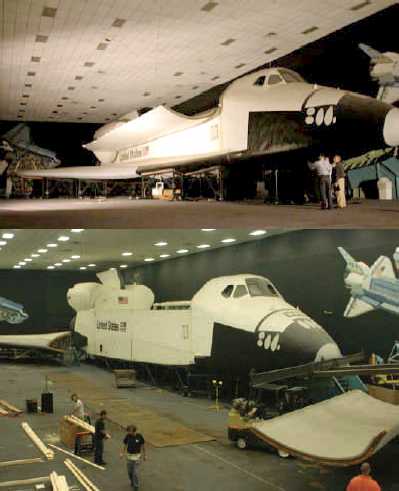
An excellent view of Space Shuttle mockup "Inspiration" - along with Apollo 14 Command Module "Kitty Hawk" - on display in the Design Engineering Implementation (DEI) room of Rockwell International's Downey plant.
An excellent observation of this particular mockup design, per the "JACQMANS SPACEFLIGHT HISTORY" website:
"As you can see...the mockup still has the original design concept for the OMS engines, i.e. a fairing for the OMS pods extended onto the aft payload bay doors. This design was abandoned very early in the development phase and the pods were designed to be fully self contained and located aft of the payload bay doors. And also the forward RSC thrusters are protected by doors."
Additionally, note the mural behind, and to either side of the orbiter, by Rockwell International’s eminently talented artist, Ted Brown. The work is a larger variant of his masterpiece, “Space Products”, which at one time (but no longer?), was prominently displayed in the Launch Control Center (LCC), Kennedy Space Center (KSC).
Check out all of the other wonderful photos of this particular display configuration:
www.disneylicenseplates.com/RSDSC/RSDSC_DEI_Inspiration.html
Credit: Disney License Plate/Rockwell Space Division Stamp Club website
An excellent reference to the mockup and - to an extent - its history, specifically, page 6:
static1.squarespace.com/static/56c78acd0442626b2590f5ea/t...
Credit: Aerospace Legacy Foundation
See also:
members.tripod.com/airfields_freeman/CA/Downey_CA_undated...
Credit: Abandoned & Little-Known Airfields: California: Central Los Angeles Area/Paul Freeman
Along with:
www.angelfire.com/fl/Jacqmans/downey.html
Credit: JACQMANS SPACEFLIGHT HISTORY website
Finally, as is all too often the case, beseeching in order to try to preserve history:
www.airspacemag.com/daily-planet/theres-one-more-shuttle-...
Credit: Smithsonian Air & Space website
en.wikipedia.org/wiki/Space_Shuttle_Inspiration
Credit: Wikipedia
Module 18,
I ran out of dark gray, I used blue instead and then covered it with some greenery.
A temporary solution so I could present something at BM Limburg.
Gaudí conceived the Sagrada Família as if it were the structure of a forest, with a set of tree-like columns divided into various branches to support a structure of intertwined hyperboloid vaults. He inclined the columns so they could better resist the perpendicular pressures on their section. He also gave them a double turn helicoid shape (right turn and left turn), as in the branches and trunks of trees. This created a structure that is now known as fractal. Together with a modulation of the space that divides it into small, independent and self-supporting modules, it creates a structure that perfectly supports the mechanical traction forces without need for buttresses, as required by the neo-Gothic style. Gaudí thus achieved a rational, structured and perfectly logical solution, creating at the same time a new architectural style that was original, simple, practical and aesthetic.