View allAll Photos Tagged mathsisfun
This particular example was once again found in a neighbor’s yard and is prime example of the Fibonacci Sequence. The number is found by adding the two numbers before it. When you do this, you get a sequence of numbers that look like this: 0, 1, 1, 2, 3, 5, 8, 13, 21,34, 55, 89, ….
When you make squares with the widths of the numbers, you get a spiral. The center of this Sunflower is built around that Fibonacci Sequence. If you would like a bit more info on the spiral effect, you can follow the link below.
www.mathsisfun.com/numbers/fibonacci-sequence.html
DSC01282uls
Created for MIXMASTER Challenge 45-Chef Clabudak.
(Winner - 1st pl)
===
CHEF clabudak wants us to have fun with math and geometry!
➤ Your image must have an overall abstract quality.
➤ It must include at least one human body part.
➤ Also at least one geometrical shape.
➤ And a mathematical or geometrical diagram and/or equation.
➤ NO MONOTONES!
===
Fibonacci sequence, courtesy of MIF.
Shell image with thanks, from Fontplaydotcom.
BG, Box, Eyes, Clock, Chain, Geometric lines, purchased from Renderosity.
Hand, my image.
Lavender eye, courtesy of PD.
Some geometric elements purchased from DS.
Pi symbol & 2 elements, from Pixabay.
= = = = = = = = = = = = =
All rights reserved. This image may not be copied, reproduced, distributed, republished, downloaded, displayed, posted or transmitted in any form or by any means, including electronic, mechanical, photocopying & recording without my written permission. Thanks.
~ Thank you for visiting my photostream, for the invites, faves, awards and kind words. It's all much appreciated. ~
A tetrahedron, cube, octahedron, dodecahedron and a icosahedron or in gaming dice terms a D4, D6, D8, D12 and a D20.
More info on platonic solids at www.mathsisfun.com/platonic_solids.html
References
The Prodigal Returns (Animated Film by Superbook)
Tenth Street Presbyterian Sermon Archive
Topic: Forgiveness
www.tenth.org/resource-library/sermons/
Connor Quigley Sound Cloud Archive (Psalm 40, Ballerma)
soundcloud.com/connorq/psalm-40-tune-ballerma
Psalm 16 (tune: Golden Hill, a cappella Scotland, similar to RPCNA)
Friends & Heroes: No Way Out (Episode 12)
www.friendsandheroes.tv/episode12.html
"The Lost Son Comes Home" by jill Kemp & Richard Gunther
www.lambsongs.co.nz/New%20Testament%20Books/The%20Lost%20...
Clipart by Masaru Horie
www.christiancliparts.net/viewillust.php?id=i06079
Guide to using Masaru Horie's clipart
www.christiancliparts.net/guide.php
Pirate Hat
www.leehansen.com/printables/masks/pirate-hat.htm
The Unforgiving Debtor by Jorge Cocco
www.pinterest.com/pin/172614598211496474/
Sushi Cones (Paper Cones)
www.mediterrasian.com/delicious_recipes_sushi_hand_rolls.htm
Science and Technology Connections
Mazes
www.mathsisfun.com/games/puzzle-games.html
Shown in Photo
Jenga block
Darice 10 mm "wiggle" ("googly") eyes
Kunin felt (royal blue)
Lee Hansen Pirate hat (printed small version on index card)
Cotton Swab
Bobo (bubble tea, milkshake) straws
Holographic Origami Paper by Yasutomo
Zots by Thermoweb (medium size glue dots)
Play money (two bills taped together,rolled into cone)
Composite numbers are numbers which are made up of combined numbers and have clear and predictable patterns, based around the multiple of their factors.
Prime numbers however, are numbers that can only be divided by one and itself and as such have no factors, other than one and itself. Prime numbers fall between Composite numbers and appear where there are no factors. This relationship between Composite numbers and Prime numbers is useful in finding and predicting when and where Prime numbers will appear. Prime numbers can be regarded as the chaotic element of Composite numbers and just as in Fractals, there are some fascinating patterns which emerge when we look at Composite numbers and Prime numbers together.
We tend to think of Prime numbers as having their own pattern and much effort has gone into finding this pattern with mixed results. However, if we accept that Prime numbers fall between Composite numbers, we start to understand that the pattern of Prime number is in fact made of the multiple overlapping patterns of Composite numbers. It is very much like trying to understand an object by seeing its shadow. Only in this case, the shadow is cast by multiple objects and we are not so much interested in the shadow as the gaps between the shadows. It’s no wonder that people are fascinated by Prime numbers.
By colour coding each number by its lowest factor we can see the pattern of Composite numbers more clearly and distinguish these from Prime numbers.
- the beautiful patterns of an uncurling sword fern leaf
"Fibonacci Sequence," the title of this photographs came from my Flickr friend Evan Fitzer. Here is the link that shows the number pattern, expressed as a spiral pattern: www.mathsisfun.com/numbers/fibonacci-sequence.html
Exhibition "Numeri", Palazzo delle Esposizioni, Roma.
The image in the background is the so-called "Golden spiral", the spiral drawn in a "golden rectangle".
The key concept is the golden ratio: the longer part of the rectangle side divided by the smaller part must be equal to the whole side divided by the longer part. The value for it is an irrational number approximated to 0.618.
The golden ratio has been considered particularly beautiful, and has been used in many artworks, from the Parthenon to the Mona Lisa, from the Vitruvian Man to the UN building in New York.
The golden rectangle, the one shown in the picture, has the sides that follow the golden ratio. It can be subdivided into a square an another rectangle with the same proportions (another golden rectangle).
The golden spiral, is a logarithmic spiral whose growth factor is the golden ratio, and a good approximation is created drawing a quarter-circles tangent to the interior of each square.
The golden spiral can be found in nature, e.g. in nautilus shells (one can be seen in the bottom right corner of the picture) or some spiral galaxies.
The little guy in the front is my boyfriend's alter-lego ;)
Text modified from:
en.wikipedia.org/wiki/Golden_ratio
www.mathsisfun.com/numbers/golden-ratio.html
en.wikipedia.org/wiki/Golden_spiral
en.wikipedia.org/wiki/List_of_works_designed_with_the_gol...
Prime Numbers
A Prime number is a number which can only be divided by itself or one. In effect this means that it has no factors, other than itself and one. With the exception of the number two, prime numbers belong to the set of natural odd numbers.
It may seem like Prime numbers are random and not related to the sequence of factors which accompany the other set of Composite numbers. However, if we put all the numbers in a grid and highlight the factors, we see a pattern emerging. Prime numbers appear in the gaps left behind in the sequence of factors. The pattern of factors becomes confused by the layer upon layer of subsequent factors but there is still a pattern at each stage. In a way, Prime numbers are the chaotic element in the set of factors. As the numbers increase in value, the more factors there are and the less opportunity for prime numbers to emerge. You can find out more about the Prime Number Theorem from this helpful website. www.whatareprimenumbers.com/prime-number-theorem.html
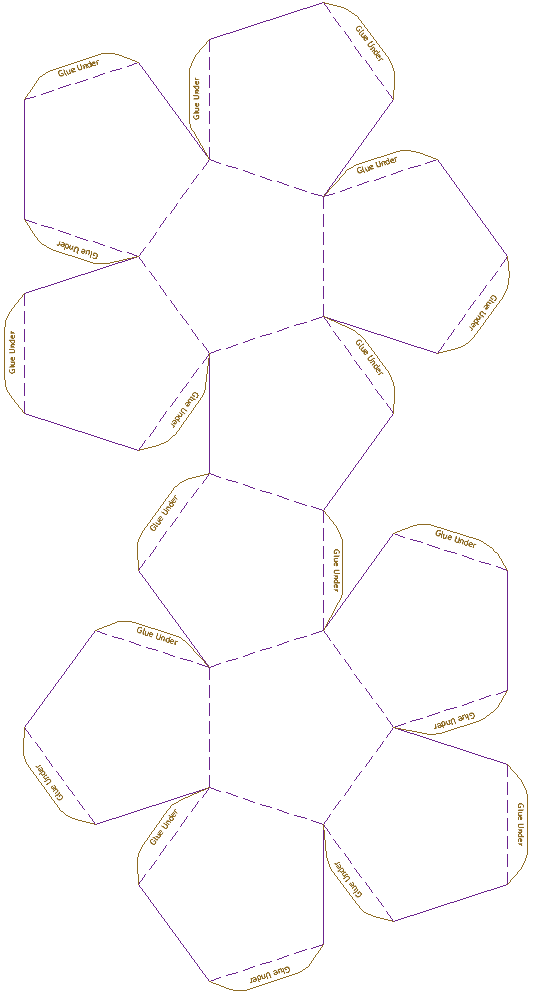
A dodecahedron assigned to the signs of the Zodiac.
The dodecahedron is one of the five Platonic Solids; it's a symbol of Universe, of Spirit, of Azoth, of the element of the Void. Its twelve sides are pentagonal, and each represents the forces of the Five Elements in their three triplicities vectoring into the visible universe. It is also a talisman of IOPHIAL, the Archangel of the Eighth Sphere, who keeps the gates between Universe and the Divine.
You can build a dodecahedron too by downloading this easy template: www.mathsisfun.com/geometry/images/dodecahedron-model.gif
The origin of this photo did not cite the credits to the photographer - so if you took this photo or know who did, PLEASE let me know so I can 1) get permission to use it an 2) properly credit the copyright owner!
I needed a better image for the cover of this album.... this photo "borrowed" from wayfarerscientista.blogspot.com/2007_10_01_archive.html however that looks like a great blog too and I'm going to go spend some time there!
This photo is reportedly from a few years ago... however we just had very comparable temps, and worse! It got to better than -50F below, a few weeks ago... so when the photo was taken is neither here nor there - it happens! Then yet, so does 90F... just not as often, and not for long!
Speaking of Fahrenheit or Celsius - what's the conversion? I use the converter at www.wbuf.noaa.gov/tempfc.htm for conversions: 32F = 0C... so -40F = -40C and
www.mathsisfun.com/temperature-conversion.html is another site w/ a good F to C explanation, the formula, and several examples.
48mm ABS tube + 60mm ABS cap + 64mm HDPE sleeve.
Overall width - 12cm aprx
Shaft positioned centrally.
Useful mallet making link - www.mathsisfun.com/numbers/images/pi.gif
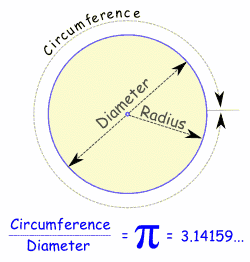
∅ABS = 48.5
Cicumference = ∅ x π = 152.4
∅ABS/2 = 24.25 = length from base of pole to drill for through bolt
Cmfr/4= 38.1=distance between through bolt and mallet shaft holes
Sophie Germain primes are Prime numbers which give rise to other Primes using the formula 2p+1, so 3 is a Sophie Germain prime as 2x3+1=7 which is also a Prime.
By generalising the formula to 2n+1 we can generate a grid of numbers. When we highlight the Prime numbers, we can easily see which are the Sophie Germain primes.
You may recall that we grouped Prime gaps by their start and end position in relation to twin Primes. Although the formula 6n-1 or 6n+1 is usually used, we denoted 6n-1 as A and 6n+1 as B. You may notice that Sophie Germain primes only appear in the A position. While other Prime numbers are generated using 2n+1, those in the B position don’t follow each other, so don’t give rise to Sophie Germain primes.
Looking a little closer, we can see that the first column of Prime Numbers follow the 6n +or- 1 pattern of P - P - - - P - P - - -, which gives an overall even distribution of primes at the A and B position. However, for the subsequent columns, using the 2n+1 formula; Sophie Germain primes follow an alternating pattern of AB in the second column and then BA in the third column and so on, which favours the A position. Those in the B position are just as frequent, but their pattern alternates, so don’t give rise to Sophie Germain primes.
We could think of the gap between Sophie Germain primes as being in the AA group, and in theory they could follow each other indefinitely, but usually the chains, called Cunningham Chains, are quite short.
More info about Marie-Sophie Germain and her work can be found en.wikipedia.org/wiki/Safe_and_Sophie_Germain_primes
Sophie Germain primes are Prime numbers which give rise to other Primes using the formula 2p+1, so 3 is a Sophie Germain prime as 2x3+1=7 which is also a Prime. The subsequent Prime is known as a Safe prime, as the level of encryption includes a Prime number.
By generalising the formula to 2n+1 we can generate a grid of numbers. When we highlight the Prime numbers, we can easily see which are the Sophie Germain primes and their subsequent Safe prime. Where there is more than two numbers, then the middle numbers are both Sophie Germain primes and Safe primes.
You may recall that we grouped Prime gaps by their start and end position in relation to twin Primes. Although the formula 6n-1 or 6n+1 is usually used, we denoted 6n-1 as A and 6n+1 as B. You may notice that Sophie Germain primes and Safe primes only appear in the A position. While other Prime numbers are generated using 2n+1, those in the B position don’t follow each other, so don’t give rise to Sophie Germain primes and Safe primes. We could think of the gap between Sophie Germain primes as being in the AA group, and in theory they could follow each other indefinitely, but usually the chains, called Cunningham Chains, are quite short.
More info about Marie-Sophie Germain and her work can be found en.wikipedia.org/wiki/Safe_and_Sophie_Germain_primes
Many flowers and plants manifest the Fibonacci Series in the way that their petals or seeds are arranged. If you look at the Sunflower - you can see two series of arcs - one going clockwise the other anticlockwise. If you count the number of arcs one way, and count the number of arcs running the other way, the two numbers are usually neighbours in the Fibonacci series, for example 55 and 89. The same happens in many seed and flower heads in nature. This arrangement has evolved over millions of years so that the seed head is uniformly packed at any stage, all the seeds being the same size, no crowding in the centre and not too sparse at the edges.
The Fibonacci Series is formed by adding the latest two numbers to get the next one, starting from 0 and 1:
0 1 --the series starts like this.
0+1=1 so the series is now
0 1 1
1+1=2 so the series continues...
0 1 1 2 and the next term is
1+2=3 so we now have
0 1 1 2 3 and it continues as follows ...
0, 1, 1, 2, 3, 5, 8, 13, 21, 34, 55, 89, 144, 233, 377, 610, 987, ..
Nice explanation here: www.mathsisfun.com/numbers/nature-golden-ratio-fibonacci....
The Monty Hall Problem
The Monty Hall Problem was made famous by Marilyn vos Savant when she provided an answer in her Ask Marilyn column in Parade Magazine in 1990.
You’re given a choice of three doors. Behind one is a car, behind the other two are goats. You pick a door—say, No. 1—and the game-show host (who knows what’s behind all the doors) opens another one (let’s say No. 3), which reveals a goat. The host asks you, “Now, do you want to pick another door?” Is it to your advantage to change your choice to door No. 2?
Marilyn said that it is better to switch as this increases your chances from 1/3 to 2/3. Her answer prompted a flurry of responses, some from very qualified people, saying she was wrong and there is now a 50:50 chance of selecting the car. The counter intuitive answer is very simple once you are shown why Marilyn was correct, but is hidden behind a lot of irrelevant complexity. You can do the maths, or even run simulations, but the answer is most simply illustrated by showing the three choices and how the revealing of the second goat switches the 2/3 against to 2/3 in your favour, assuming you want to win the car.
t.co/0Jqfw21T58 Year 4 really enjoyed the doubling and halving games this morning #mathsisfun #learningga… t.co/Wb1F1ERjdv (via Twitter twitter.com/learninggamewld/status/927623481549869062) check us out at ift.tt/2s2d4Zr
#mathphoto16 #symmetry #mathsisfun #translation #rotation There's something going on with these wheelbarrows at work t.co/l6oqAOK3Hp - @MathsCoutts