View allAll Photos Tagged lycus
Not a clue viz-a-viz specific taxonomy, and haven’t seen one these beetles in yonks. A more specific ID would be nice! Photographed in Brakwater, Windhoek, Namibia. 25mm length
Ancient ruins of Laodicea ad Lycum in Turkey.
www.sacred-destinations.com/turkey/laodicea.htm
Laodicea is an ancient city in present-day western Turkey, founded by Seleucid King Antiochus II in honor of his wife, Laodice.
Laodicea became a prosperous Roman market town on the trade route from the East, famous for its woolen and cotton cloths.
The city was an early center of Christianity and one of the Seven Churches of Revelation. In the 4th century, Apollinaris of Laodicea proposed the theory later called Apollinarianism, which was considered heretical by the Catholic Church.
A large earthquake destroyed Laodicea and it has never been rebuilt.
Remnants of the ancient city include a stadium, sarcophagi, an amphitheater, an odeon, a cistern and an aqueduct. Most of the city remains to be excavated.
только заметил, что на wiki странице оккультной группы Coven висит моя фотка с феста Roadburn 2017.
Roadburn 2017 @ Tilburg, The Netherlands (pics)
Day 1: Coven, Esben and The Witch, Deafheaven, Subrosa, Suma, Rome, Wolves In The Throne Room, Lycus, Alaric, Bongzilla
Day 2: Auðn, True Widow, Amenra, Chelsea Wolfe, Magma, Oathbreaker, Subrosa (Subdued), Naðra, Perturbator, Zhrine, Telepathy, Whores
Day 3: Mysticum, Oranssi Pazuzu, Wolvennest, Aluk Todolo, The Bug vs Dylan Carlson of Earth, Trans Am, Misþyrming, My Dying Bride, Disfear, Ahab, Memoriam, Cobalt
Day 4: Ulver, Emma Ruth Rundle, Come To Grief, Inter Arma, Radar Men From The Moon, Jaye Jayle, Les Discrets, Oxbow, Pillorian (John Haughm, ex- Agalloch), The Doomsday Kingdom
это был отличный фест!
—
сначала увидел свою собственную фотку на wiki-странице Coven, потом заметил что Jinx Dawson из тех же Coven лайкает в инсте фотки с ночных гулянок на Некрасова в СПб, это конечно удивительно что такие люди обращают внимание, спасибо!
они были в СПб первый и последний раз осенью 2019, мне очень понравилось, зря вы пропустили, когда Coven снова приедут, надо позвать их сразу на Руби
Coven @ Mod club, St Petersburg, Russia, 09.08.2019
#roadburn #coven #roadburn2017 #tilburg
** 148 B.C. the Romans came. Liked what they scoped. Snuggled in, for the long haul.
The Empire played happy-families, the next consecutive 1,123 years (accommodating 88+ Rulers). Constantinople at its height, a city of 1x million ppl.
Besieged many times, it fell only once to a lootin, shootin Venetian.
** 1204 A.D. the 85yr old Doge from Venice, on his Crusading way to sack + pillage Jerusalem... (unfortunately) had a 'light-bulb moment'...
Realised logistically - Constantinople was closer.
Wasn't an easy Victory. Siege took 11,000 armed Venetians - 9x months to win.
Formidable Land + Sea walls (50' tall) had only two vulnerable points:
a) the water gate (by Golden Horn) + a ship repelling Sea-chain (stretched from Eminonu to Galata Tower)
b) Military Gate on top of the Lycus Rivers culvert.
So began 57 years of Venetian 'slumming'.
Dissembling the richest undisturbed Treasure hoard anyone had ever seen.
They 'relocated': statuary/ gold/ jewels/ books/ furniture/ inventions/ intellectual property …siphoning off everything they fancied, Fed-Ex-ed to Venice. (ah ha ! might explain the so called "Renaissance". When was it ?)
Buildings were destroyed. Businesses in disarray. Locals in turmoil.
Split the Eastern and Western Churches down the middle. Tetchy relationship still today, despite 1962s pithy afternoon Tea-Party. (Not too much joy round THAT table.)
** Next Up (1453 A.D):
160,000 Ottomans fought for 53 days (+ an estimated 50,000 lbs of gunpowder) against 8,000 defenders. The city became Mehmet II's.
** Cycle on. Thru a couple of WW's and Ataturks Sweeping republic Reforms (1923).
Viola, 2014 !
The Turkish Delights we enjoyed during our holiday, a direct result of this AWEsome History.
Frisbee-d into Istanbul, spent some time - before hiring a vehicle to inhale a few rural-sites.
Returned to Istanbul. Explored some more.
Exited.
If time ? Swat-up before u go, gives depth to what u see.
Asia Minor Ottomans were seldom mentioned, by our Euro-focused school curriculum.
Hell, backup further: heard of Biruni : Tusi : Musa-Al Khwarizmi ?
Persians etc… waaay ahead of the game - before the Greek/ Romans stepped-up for 'ownership' (of EVERYthing) on our text book pages.
Cultural Transference…appears to have been the norm, longer than we're taught.
Maybe
ALL peoples aren't so different...
(just our 'window dressing')
ps:
Curiosity. has Never killed a cat.
In particular, the Churches of the East, being the churches east of Greek Orthodox influence, which included the churches of Syria, the Assyrian church, the church of the Chaldeans, and various churches making up Persian Christianity, still to this day hold Evagrius to be one of their three principal theological doctors and saints. Issac the Syrian would be become Evagrius’s most brilliant interpreter within the Church Orient. It is these churches, especially those within Persian Christianity, which were to have such a profound and intimate influence upon Persian Sufi psychology and theology. It is also this group of churches, the churches of the East, which Georgio Gurdjieff asserts were the most influential in the creation of his own psychological and cosmological synthesis. Evagrius’ writings: Evagrius lived in the great desert contemplative project of the Nile Delta. He was highly educated in Greek history and philosophy, and of course, Christian theology, and had been a ‘stand out’ participant at the First Council of Constantinople. He had been later exiled to rural Egypt, where he found a world of Egyptian Coptic Christianity which was down-to-earth, hard working individuals, almost all of whom could neither read nor write. As a consequence, Evagrius, who was a towering intellectual figure of late antiquity, was even more so within the earthiness and timeliness of Coptic Christianity. While much of the Evagrian Corpus has been attributed to other writers such as Cassian, remarkable recent discoveries in the libraries of Mt Athos have confirmed the Evagrian authorship of a number of ancient manuscripts previously unknown or thought to have been lost. Amongst these ‘lost’ texts is the Eulogios and an annexure that sets out Evagrius’ nine passions and their corresponding virtues. An authoritative English translation of the Eulogios and its annexure only became available in 2003. The existence of these texts is intriguing, for we know that Gurdgieff himself and his ‘Seekers after Truth’ visited Mt Athos at a time when the Russian Church had significant influence over the Holy Mountain[4]. It seems certain that he would have had access to the libraries and their manuscripts which have only recently been revealed to the West. That Evagrius wrote a treatise on nine passions which was held extant in monasteries known to have been visited by Gurdgieff or his collaborators (and only there), is a remarkable coincidence. Within Evagrius’ Corpus, his most important books have been considered to be a theological trilogy: The Praktikos (The Practice) Gnostikos (The Knower)
Kephalaia Gnostica (The Gnostic Chapters). Amongst other works, he also wrote De oratione (Chapters on Prayer), Anti Rrhetikos (Counterarguments), Scholia (Biblical Commentaries), The Eulogius (To the Monk Eulogius), 64 letters, and some smaller papers on The Eight Spirits of Evil, On Thoughts, On the Vices opposed to the Virtues, Foundations of Monastic Life (Hypotyposis), Exhortations to the Monks, and To Monks in Community and Exhortations to a Virgin (Ad Monachos).
Without question, within these works, Evagrius is best known for his systemization of the passions. The study of the passions has a long history, dating back to Plato and the New Testament, especially in letters of St Paul. However, it is within the Egyptian-contemplative-project of the third and fourth centuries that the study and documentation of the passions encompasses not only their deepest theological aspect, but also their clinical psychological consequence. In The Life of St Anthony, written by St Athanasius, St Anthony, who is traditionally ascribed the position as the founder of the Egyptian monasticism, is shown to have a highly refined understanding of the nature of the passions, and The Life describes an embryonic systemization.
Evagrius enters this contemplative world nearly 100 years after its documented establishment, where the clinical observation of the passions and therapeutic recourse (or management of the passions) was already well developed by the contemplative communities. Evagrius’ genius may not, in the end, be in his own clinical observations for which he is well recognized, but in the cataloguing of a century of observations made by theological clinicians within the contemplative communities. In other words, Evagrius’ greatest contribution to contemplation may lie in the fact that he was highly literate in a place where literacy and numeracy were almost non-existent – but where a powerful oral tradition was obviously in existence. It is worth remembering that while Evagrius is famed for ‘writing things down’, the greater part of the most important information remained oral and as such, also esoteric. Praktikos is a method of Christian introspection developed in the 4th century by Evagrius Ponticus, one of the Desert Fathers. It takes its name from a therapeutic work called “Praktikos” (“Practical Treatise”). Its objective is to analyze the states of mind, the impulses, the passions, the thoughts which agitate the human being and to achieve through its purification a non-pathological state of soul, called Apatheia. This method consists of observation, analysis and the inner struggle against the “logismoi” which could be translated as thoughts. For Evagrius, there would be eight in number: Gastrimargia, Philarguria, Pornéia, Orgè, Lupè, Acedia, Kenodoxia, Uperèphania. Reduced to 7 by Gregory the Great, this list is said to be the origin of the “seven deadly sins”. The Praktikos is one of Evagrius' pamphlets which had the most influence in Eastern monasticism, particularly in Byzantium and Syria. It was distributed in the West by Jean Cassien. The eight “logismoi”: eight “logismoi” are sometimes described as demons or “diabolos”. The omnipresence of demons is an essential component of the popular beliefs that Egyptian monks of the 4th century shared with the peasant class from which most of them came1. Through praktiké, Evagrius offers a way to combat the demonic enemies who oppose the monk's progress towards God. It is a struggle against vices through virtues to reach a state allowing the contemplation of God. Evagrius counts eight "logismoi" or vices: Gastrimargia: Gluttony. Pornéia: Sexual obsession. Philarguria: Greed. Lupè: Sadness. Orgè: Anger. Acedia: Depression, or disgust with life.
Kenodoxia: Vain glory. Uperèphania: Pride2.The Logosmoi. It has been traditionally believed by scholars (in the West at least) that Evagrius cataloged eight logosmoi, or ‘patterns of thoughts’[10]: gluttony, porneia (fornication), love of money, sadness (also called dejection), anger, listlessness (acedie), vainglory, and pride. However, in an ancient manuscript, until recently attributed to St Nilus of Ancyra (as late as 1987 and discovered on Mt Athos), but most surely authored by Evagrius and addressed to the monk Eulogios, Evagrius pairs the vices with the virtues, and adds a ninth passion, that of jealousy. Through John Cassian, Evagrius’s original nine principal logosmoi would eventually become the ‘seven deadly sins’ of Latin medieval theology as authored by Pope Gregory the Great. It is through Cassian’s influence that in the West, Evagrius was assumed to have proposed eight logosmoi only, but in light of the recent discoveries and translations at Mt Athos, this assumption must seriously be held in question. It appears as though Cassian published his works on the passions as a student of Evagrius based upon Evagrius’ early work. It is most likely that the subsequent addition of a ninth logosmoi was developed at a later point in time. As William Harmless notes, Evagrius’ originality in cataloging the logosmoi is not in the collation of the list itself, for other writers such as Origen have a similar list [and John Climacus has an even longer list], but stems from the ‘classic [clinical] descriptions he provides from his insights into the psychology and their [the passions’] interplay’. While Evagrius uses the word logosmoi to describe these psychological states, he also uses the word ‘passion’ interchangeably. The nine passions, as described by Evagrius, arise in an individual, but do not necessarily lead to their manifestation or acting out by the individual. In other words, the individual can choose to act out the passion or not. As Evagrius wrote, ‘It is not in our power to determine whether we are disturbed by these thoughts, but it is up to us to decide if they are to linger within us or not, and whether or not they are to stir up our passions’. It is important to understand in Evagrius’ schema that opposed to these logosmoi, is the purification and transformation of the ‘nous’, or mind. For Evagrius, the word ‘mind’ does not mean, as it does within Western philosophy, logical, rational thought. Instead, as Harmless SJ explains, in the Greek tradition, the mind / the nous is our intuitive side. Harmless SJ goes on to explain, ‘…it enables us to know and recognize the truth of things instantly, whether a friend’s face or a mathematical proof. For Evagrius, the way the mind knows God is not a matter of logic, of thinking; it is a direct intuition.’ There have been various attempts at the classification of demons within the contexts of classical mythology, demonology, occultism, and Renaissance magic. These classifications may be for purposes of traditional medicine, exorcisms, ceremonial magic, witch-hunts, lessons in morality, folklore, religious ritual, or combinations there of.
de.wikipedia.org/wiki/Euagrios_Pontikos
As Evagrius once wrote, ‘…For knowledge of God, one needs not a debater’s soul, but a seer’s soul.’ Harmless SJ concludes that, ‘The mind, the nous, is the highest dimension of the human person. It is the image of God within us, that which is most like its creator. And since it is the most God-like part of us, it is the faculty most capable of knowing God.’ In Evagrius’ theological tradition, the nous is unformed at birth, but in the presence of the Divine, the unformed mind is transformed like lead into gold.
The parallels with Gurdjieff’s concept of essence are striking. Gurdjieff believed that in human experience, both essence and personality existed. Essence was innate and unformed, whereas personality was acquired as a consequence of nature and the socialisation of life. Further, Gurdjieff believed that personality was the interface between the human being and the world, while the growth and maturity of the individual was dependent upon the development and transformation of the essence. The personality was ‘the false’ in human beings, but ‘The Work’ in transcending the personality provided the grit necessary to polish the essence. Likewise, Evagrius believed that the nous was unformed at birth, and the askesis, (translated as ascetics in English) and virtue required to transcend the passions provided the grit necessary to transform the soul. As personality is to essence for Gurdjieff, so are passions to the nous for Evagrius.
The logosmoi then, are thoughts that confuse, distract or divert the mind away from the contemplation of the Divine, and away from transformation. As such, they can not only be described as distractions, but as causing a perpetual immaturity in the psychology of the person, where adult maturity is finally achieved when contemplating one’s true and authentic nature in union with the Absolute. Both Gurdjieff and Evagrius believed that the personality/passions were a limited experience of human consciousness and potential. Only when ‘The Work’ (askesis) of transcending or transforming the personality/passions had been accomplished could human beings expect to experience themselves and their world in the fullness of their potential. Transcendence, self-actualisation, adult maturity, greatness, contemplation and a true understanding of the nature of creation, are all the consequences of moving past the limitations of personality / passions and unconsciousness that is the ‘ordinary waking state’of human beings and causes them to forget their origin and destiny. Thus, both Evagrius and Gurdjieff were able to connect wholeness and psychological maturity with holiness and greatness, as compared to the logosmoi or passions which were the origin of immaturity, suffering and physical disease. As part of the journey towards purification of the passions within the psychology of the person, and eventually psychological maturity and theological transformation, Evagrius mandated the practice of self-observation. As he writes, ‘[if you wish] to take the measure of some of the more fierce logosmoi (passions), so as to gain experience in your monastic art, then let you keep watch over your thoughts, let you observe their intensity, their period of decline, and follow them as they rise and fall. Note well the complexity of your thoughts, their periodicity, the passions which cause them with the order of their succession, and the nature of their associations. Then ask from Christ an explanation of this data that you have observed.’ Here we see a snapshot of Evagrius’ method – ie. to observe the passions, and in particular, the way in which they act in concert or in succession. Evagrius understood that an individual was not afflicted by a single passion, but that any number of them could influence a person’s behaviour – however, there was nonetheless a pattern to be observed concerning their rise and fall. Another way of looking at this is through a different interpretation or translation of the word logosmoi. Rightly, logosmoi is translated as ‘my thought’. However, within Christian theology, the word logos has a particular meaning, especially in relation to John’s gospel, where logos is used for the first time to mean ‘the Word’ or more conventionally, ‘the Divine’. The Divine might also be understood as ‘Life-force’. Thus, logosmoi in this context, with which Evagrius would undoubtedly have been familiar, would mean literally ‘my divines’ (idols) or more accurately, ‘my obstacles to the Divine’. The Life-force brings to life or animates the human being, giving it spirit and forming its soul. Life-force is wild, erotic, pulsing, un-trammelled, chaotic, brooding, dark, magical, healing, infinite, supra-rational, confronting and creative love. The Areopagite calls this Life-force Eros. As it enters the human being, the unformed soul is unable to control or manage it, creating in the person an existential reflex of fear, anger and envy, which are expressed eventually as the passions. In the case of Evagrius and the Enneagram, this would be nine passions or Personality-Types. When a person is able to love or to fall in love unconditionally, they surrender to the formative experience of love, thereby redirecting love not through anger, fear and envy, but through the virtues instead. Evagrius says, ‘… We must practise the virtues in order to achieve contemplation of the hidden patterns in nature, the logoi, which point to the presence of the Divine. From here, we pass to contemplation of the Divine, logos. This is revealed as a result of the practice of contemplation.’ Evagrius here connects the Life-force, contemplation, meditation and askesis. The Work or askesis with meditation allows for the contemplation of the hidden, animated by the Life-force, which leads eventually to the contemplation of the Divine itself. Thus, for Evagrius, the Divine breath gives life to creation, which when it enters the human being creates a psychological crisis for the unformed soul, which is not equipped to move with or surrender to the Life-force, producing envy, fear and anger, which are then discharged in daily life through the logosmoi – or obstacles – to contemplation, that is, the passions or personality types. ‘The Work’, or as Evagrius would have described it, askesis, forms the soul so that it can surrender to the Life-force and express it as human beings are meant to through the virtues. The highest experience of psychological maturity that can be experienced by a human being is, for Evagrius, the capacity to surrender to Divine Love or the Divine Life-force. Meditation in this context builds the awareness and capacity of the contemplative to hold or contain the Life-Force without discharging it. This act of holding onto the Life-force forms the soul, allowing the Life-force to be expressed as virtue and love. Evagrius’ penetrating clinical observations of the psychology of the passions as they were experienced within human consciousness led him to their study and, in particular, their transformation under the yoke of meditation, askesis and prayer and in association with love (agape) which Denys the Areopagite calls Eros. Evagrius was to conclude that the absence of the passions (apatheia) led the individual to recover the ground-of-their-being and to the contemplation of the Divine (theologica). Apatheia: Within Evagrius’ framework, the path towards divine contemplation (theologica) was made possible through achieving a state of apatheia. The definition of apatheia is difficult. Often it is defined as ‘passionless-ness’ in English, which as this interpretation implies, is a state where the passions have ceased to operate. Apatheia literally means the absence of suffering (patheia), and is best understood as a state of calm in a sea of swirling passions… the eye in the middle of a storm, or the calm that comes upon the sea at the end of a summer storm in February. During the Pelagian controversy in the West, apatheia was defined as ‘sinlessness’ – which it is not. Rather, it is like a solitary island of stone amidst a tempestuous ocean. Some writers have argued that apatheia was the suppression of the passions, while others believed the passions were transformed by love into psychological wholeness and virtue. Evagrius uses apatheia in both ways, and given that his theological heirs have increasingly argued for the transformational aspect of apatheia, it seems likely that Evagrius too appreciated apatheia’s remedial qualities. The way in which to achieve apatheia is through meditation, prayer, and askesis or ascetic practice. For Evagrius writes, ‘If you are chained, you cannot run. Nor can your mind enslaved by passion stand in the place of prayer and meditation. Rather, it is dragged along and tossed by your passion-filled thoughts and cannot stand firm and tranquil.’
davidburkeblog.wordpress.com/2020/02/04/71/
Classifications might be according to astrological connections, elemental forms, noble titles, or parallels to the angelic hierarchy; or by association with particular sins, diseases, and other calamities; or by what angel or saint opposes them. Many of the authors of such classifications identified as Christian, though Christians authors are not the only ones who have written on the subject. The Testament of Solomon is a pseudepigraphical work, purportedly written by King Solomon, in which the author mostly describes particular demons whom he enslaved to help build the temple, the questions he put to them about their deeds and how they could be thwarted, and their answers, which provide a kind of self-help manual against demonic activity. The date is very dubious, though it is considered the oldest surviving work particularly concerned with individual demons. Michael Psellus prepared the influential De operatione dæmonum (On the Operation of Demons) in the 11th century, with a taxonomy dividing demons into six types: Leliurium (Igneous), Aërial, Marine (Aqueous), Terrestrial (Earthly), Subterranean, and Lucifugous (Heliophobic). Lanterne of Light: In 1409–1410 The Lanterne of Light (an anonymous English Lollard tract often attributed to John Wycliffe) provided a classification system based on the seven deadly sins, known as the "seven deadly devils" or "seven princes of Hell", with each demon tempting people by means of those sins, as follows: Þe firste is Lucifer þat regneþ in his malice.̉ ouer þe children of pride
Þe secounde is clepid Belzebub.̉ þat lordiþ ouer envious
Þe þridde deuel is Sathanas.̉ & wraþþe is his lordschip
Þe fourþe is clepid Abadon.̉ þe slowȝ ben hise retenwe
Þe fifþe deuel is Mammon.̉ & haþ wiþ him þe auarouse
and also oone þat is his feere.̉ a foule synne couetise
Þe sixte is clepid Belphegor.̉ þat is þe god of glotouns
Þe seuenþ deuel is Asmodeus.̉ þat leediþ wiþ him þe leccherouse. The first is Lucifer that reigns in his malice over the children of pride. The second is called Beelzebub that lords over [the] envious. The third devil is Satan and wrath is his lordship
The fourth is called Abaddon, the sloth[ful] be his retinue
The fifth devil is Mammon and has with him the avarice [avaricious] and also fittingly, a foul sin, covetousness, is with his company of subjects. The sixth is called Belphegor, that is the god of gluttons. The seventh devil is Asmodeus, that leads with him the lecherous. In popular belief in antiquity and the Middle Ages, the idea that midday was a preferred time for the appearance of spirits and gods was widespread; claims to this effect still exist today. The term midday demon as a separate term first appears in the Septuagint, the Greek translation of the Hebrew Bible from the 3rd century BC. BC, on. In the 4th century AD, the monk Euagrios Pontikos equated the midday demon with that of akedia (Greek ἀκήδεια 'carelessness, carelessness, unwillingness to do nothing' from κῆδος 'care'), according to him one of the eight main vices that later became the seven became mortal sins.
de.wikipedia.org/wiki/Mittagsd%C3%A4mon
This list was later used in the works of John Taylor, the Water Poet. Later writers, such as Peter Binsfeld, assigned different demons to the respective sins and should not be confused with this list. The two classification systems are shown side-by-side below: The Lanterne of Light Binsfeld's classification Lucifer: Pride Beelzebub: Envy[Beelzebub is at number '5' in Binsfield's scheme]: Satan: Wrath, Abaddon: Sloth, Mammon: Greed
[Mammon is numbered '2' in Binsfield's scheme] Belphegor: Gluttony Asmodeus: Lust, Lucifer: Pride, Mammon: Greed [Mammon is at position '5' in Lanterne], Asmodeus: Lust, Leviathan: Envy, Beelzebub: Gluttony [Beelzebub is shown second in Lanterne] Satan: Wrath, Belphegor: Sloth.
Spina's classification: Alphonso de Spina, in 1467, prepared a classification of demons based on several criteria: Demons of fate, Incubi and succubi, Wandering groups or armies of demons can include multiple regions in hell, Familiars, Drudes, Cambions and other demons that are born from the union of a demon with a human being. Liar and mischievous demons: Demons that attack the saints are rogue demons. Demons that try to induce old women to attend Witches' Sabbaths. This classification is somewhat capricious and it is difficult to find a criterion for it. It seems that Spina was inspired by several legends and stories. The drudes belong to German folklore. Familiars, goblins, and other mischievous demons belong to the folklore of most European countries. The belief in incubi and succubi (and their ability to procreate) seem to have inspired the sixth category, but it could also have been inspired in the Talmudic legend of demons having sexual intercourse with mortal women and men (see also Mastema). The visions of tempting demons that some early (and not so early) saints had, perhaps inspired the eighth category (e.g. the visions of Anthony the Great). The idea of old women attending Sabbaths was common during the European Middle Ages and Renaissance, and Spina mentioned it before the Malleus Maleficarum. Agrippa's classification: In De occulta philosophia (1509-1510), Heinrich Cornelius Agrippa proposed several classifications for demons, based on numeric scales, like his whole Cosmology.[11] Francis Barrett, in his book The Magus (1801), adopted this classification of demons. Scale of unity
One prince of rebellion, of angels, and darkness: Lucifer, Scale of binary, Two chiefs of the devils: Behemoth, Leviathan. Scale of ternary. Three furies: Alecto, Megera, Ctesiphon. Three infernal judges: Minos, Aeacus, Rhadamanthus. Scale of quaternary
Four Princes of devils in the elements: Samael: Fire, Azrael: Water, Azazel: Air, Mahazael: Earth. Four Princes of spirits, upon the four angles of the world. Oriens: East, Paymon: West
Egyn: North, Amaymon: South. Despite listing these separately, Agrippa mentions that these groups are identical, making the first as the Hebrew equivalent of the names of the latter The same four demons appear in the Semiphoras and Schemhamforas. Scale of six. Six authors of all calamities:
Acteus, Megalesius, Ormenus, Lycus, Nicon, Mimon, Scale of novenary. Nine princes ruling over nine orders of devils (with biblical references): Beelzebub: False Gods (Matthew 4:1–11)
Python: Spirits of Lying (1 Kings 22:21–22) Belial: Instruments of iniquity and wrath (Genesis 49:5, Psalms 7:13, Isaiah 13:5, Jeremiah 50:25, Ezekiel 9:2) Asmodeus: Revengers of Wickedness. Satan: Deluders or Imitators of miracles (Genesis 3:1–5). Merihem: Aerial Powers (Revelation 7:1–2). Abaddon: Furies – sowing mischief. Astaroth: Calumniators – inquisitors and accusers. Mammon: evil genies – tempters and ensnarers
Binsfeld's classification. As part of his 1589 Treatise on Confessions by Evildoers and Witches, German theologian Peter Binsfeld prepared a classification of demons known as the Princes of Hell. Like the Lanterne of Light, Binsfeld used the seven deadly sins as a basis, though the two schemes differ in various ways: Lucifer: pride, Mammon: greed, Asmodeus: lust
Leviathan: envy, Beelzebub: gluttony, Satan: wrath, Belphegor: sloth. King James classification (Main article: en.wikipedia.org/wiki/Daemonologie)
King James' dissertation titled Daemonologie was first published in 1597, several years before the first publication of the King James Authorized Version of the Bible. Its three short books are in the form of a philosophical dialogue, making arguments and comparisons between magic, sorcery, and witchcraft. Within them, James classified demons into four sections: Lemures or Spectra: Spirits that trouble houses or solitary places :
Obsession: Spirits that follow upon certain people to outwardly trouble them at various times of the day: Possession: Spirits that enter inwardly into a person to trouble them :
Fairies: Spirits that prophesy, consort, and transport :
His classification was not based on separate demonic entities with their names, ranks, or titles, but rather categorized them based on four methods used by any given devil to cause mischief or torment on a living individual or a corpse. The purpose was to relay the belief that spirits caused maladies and that magic was possible only through demonic influence. He further quotes previous authors who state that each devil has the ability to appear in diverse shapes or forms for varying arrays of purposes as well. In his description of them, he relates that demons are under the direct supervision of God and are unable to act without permission, further illustrating how demonic forces are used as a "Rod of Correction" when men stray from the will of God and may be commissioned by witches, or magicians to conduct acts of ill will against others but will ultimately only conduct works that will end in the further glorification of God despite their attempts to do otherwise. Michaëlis's classification
In 1613 the Dominican prior and French inquisitor, Sébastien Michaëlis wrote a book, Admirable History, which included a classification of demons as it was told to him by the demon Berith when he was exorcising a nun, according to the author.[a] This classification is based on the Pseudo-Dionysian hierarchies, according to the sins the devil tempts one to commit, and includes the demons' adversaries (who suffered that temptation without falling). First hierarchy: The first hierarchy includes angels that were Seraphim, Cherubim, and Ophanim/Thrones:
Beelzebub was a prince of the Cherubim, founder of Hell’s Order of the Fly. He tempts men with envy and is opposed by St. Francis. Leviathan was also a prince of the Cherubim who tempts people to give into heresy, and is opposed by St. Peter.
Asmodeus was a prince of the Ophanim/Thrones, burning with desire to tempt men into wantonness. He is opposed by St. John the Baptist. Berith was a prince of the Cherubim. He tempts men to commit homicide, and to be quarrelsome, contentious, and blasphemous. He is opposed by St. Barnabas. Astaroth was a prince of Thrones, who tempts men to be lazy and is opposed by St. Bartholomew. Verrine was also a prince of Thrones, just below Astaroth. He tempts men with impatience and is opposed by St. Dominic. Gressil was the third prince of Thrones, who tempts men with impurity and is opposed by St. Bernard.
Soneillon was the fourth prince of Thrones, who tempts men to hate and is opposed by St. Stephen. Second hierarchy
The second hierarchy includes Powers, Dominions, and Virtues:
Carreau was a prince of Powers. He tempts men with hardness of heart and is opposed by St. Vincent. Carnivale was also a prince of Powers. He tempts men to obscenity and shamelessness, and is opposed by John the Evangelist.
Oeillet was a prince of Dominions. He tempts men to break the vow of poverty and is opposed by St. Martin. Rosier was the second in the order of Dominions. He tempts men against sexual purity and is opposed by St. Basil. Belias was the prince of Virtues. He tempts men with arrogance and women to be vain, raise wanton children, and gossip during mass. He is opposed by St. Francis de Paul. Third hierarchy: The third hierarchy Principalities, Archangels, and Angels: Verrier was the prince of Principalities. He tempts men against the vow of obedience and is opposed by St. Bernard. Olivier was the prince of the Archangels. He tempts men with cruelty and mercilessness toward the poor and is opposed by St. Lawrence, patron saint of the poor. Iuvart was the prince of Angels. At the time of Michaelis's writing, Iuvart was believed to have possessed a young novice nun of the Ursulines, Madeleine Demandols de La Palud, from whom it was exorcised. Many of the names and ranks of these demons appear in the Sabbath litanies of witches, according to Jules Garinet's Histoire de la magie en France, and Collin de Plancy's Dictionnaire Infernal. Classification by office
In the study of demonology, many spirits are classified by office, rank, or titles which theologians believe were once held in heaven before the fall, or which they currently hold in their infernal dwelling. These offices are usually elaborated in several grimoires which determines their authority in hell or abilities. Demons categorized by office are often depicted in a militant hierarchy, in which a general may hold command over some designated legion for a specialized function which they may trouble men. Other theologians have determined the classification of a spirit's office depending on the times or locations which they roam the Earth. The Book of Abramelin:
The Book of Abramelin, possibly written in the 14th or 15th century, lists four princes of the demons: Lucifer, Leviathan, Satan and Belial. There are also eight sub-princes: Astaroth, Magoth, Asmodee, Beelzebub, Oriens, Paimon, Ariton (Egin) and Amaymon. Under the rule of these there are many lesser demons. Le Livre des Esperitz
Main article: en.wikipedia.org/wiki/The_Book_of_Abramelin
Written in the 15th or 16th century, this grimoire was a likely source for Wierus hierarchy of demons, but while Wierus mentions 69 demons, Le Livre des Esperitz has only 46. Wierus omitted, however, the four demons of the cardinal points: Oriens, Ponymon, Amaymon and Equi (see Agrippa's classification) and the three great governors of all the other demons: Lucifer, Beelzebub and Satan. The Munich Manual of Demonic Magic
Main article: en.wikipedia.org/wiki/Munich_Manual_of_Demonic_Magic
Written in the 15th century, this manual includes a list of eleven demons. Fasciculus Rerum Germanicarum
Written in 1494, this grimoire contains a list of 37 demons.
Le Dragon Rouge (or Grand Grimoire)
Main article: en.wikipedia.org/wiki/Grand_Grimoire
Like many works of mystical nature, Le Dragon Rouge (or the Red Dragon) claims to come from Solomon and his priests and is said to be published in 1517 by Alibeck the Egyptian. However, it was most likely written in France in the 18th century. The grimoire details the different hosts of hell and their powers, describing how to enter a pact with them to attain the magicians' goals. The demons of hell are classified by three different tiers from Generals to Officers. The Grand Grimoire, also known as Le Dragon Rouge or The Red Dragon, is a black magic[1] goetic grimoire. Different editions date the book to 1521, 1522 or 1421. Owen Davies suggests 1702 is when the first edition may have been created and a Bibliothèque bleue version (a popular edition, similar to a chapbook) of the text may have been published in 1750.[2] The 19th-century French occultist Éliphas Lévi considered the contemporary edition of Le Dragon Rouge to be a counterfeit of a true, older Grand Grimoire.[3]
The "introductory chapter"[4] was written by Antonio Venitiana del Rabina, who said he had gathered his information from original writings of King Solomon.[5] Much of the material of this grimoire derives from the Key of Solomon and the Lesser Key of Solomon, pseudepigraphical grimoires attributed to King Solomon.[6] The first book contains instructions for summoning Lucifer or Lucifuge Rofocale, for the purpose of forming a deal with the Devil. Pseudomonarchia Daemonum
Main article: en.wikipedia.org/wiki/Pseudomonarchia_Daemonum
Pseudomonarchia Daemonum, by Johann Weyer, is a grimoire that contains a list of demons and the appropriate hours and rituals to conjure them in the name of God, Jesus and the Holy Ghost (simpler than those cited by The Lesser Key of Solomon below). This book was written around 1583, and lists sixty-nine demons. The demons Vassago, Seir, Dantalion and Andromalius are not listed in this book. Pseudomonarchia Daemonum does not attribute seals to the demons.Pseudomonarchia Daemonum, or False Monarchy of Demons, first appears as an Appendix to De praestigiis daemonum (1577) by Johann Weyer. An abridgment of a grimoire similar in nature to the Ars Goetia (first book of The Lesser Key of Solomon), it contains a list of demons, and the appropriate hours and rituals to conjure them. The Pseudomonarchia predates, and differs somewhat from, Ars Goetia. The Pseudomonarchia lists sixty-nine demons (in contrast to the later seventy-two), and their sequence varies, along with some of their characteristics. The demon Pruflas appears only in Pseudomonarchia, and Pseudomonarchia does not attribute any sigils to the demons. Weyer referred to his source manuscript as Liber officiorum spirituum, seu Liber dictus Empto. Salomonis, de principibus et regibus daemoniorum. (Book of the offices of spirits, or the book called 'Empto'. Solomon, concerning the princes and kings of demons.) This work is likely related to a very similar 1583 manuscript titled The Office of Spirits, both of which appear ultimately be an elaboration on a fifteenth-century manuscript titled Le Livre des Esperitz (of which 30 of its 47 spirits are nearly identical to spirits in the Ars Goetia). The Lesser Key of Solomon. Main article: en.wikipedia.org/wiki/The_Lesser_Key_of_Solomon
The Lesser Key of Solomon or Lemegeton Clavicula Salomonis is an anonymous 17th century grimoire, and one of the most popular books of demonology. The Lesser Key of Solomon contains detailed descriptions of spirits and the conjurations needed to invoke and oblige them to do the will of the conjurer (referred to as the "exorcist"). It details the protective signs and rituals to be performed, the actions necessary to prevent the spirits from gaining control, the preparations prior to the invocations, and instructions on how to make the necessary instruments for the execution of these rituals. The author of The Lesser Key of Solomon copied Pseudomonarchia Daemonum almost completely, but added demons' descriptions, their seals and details. The Ars Goetia See also: en.wikipedia.org/wiki/List_of_demons_in_the_Ars_Goetia
Ars Goetia is the first section of The Lesser Key of Solomon, containing descriptions of the seventy-two demons that King Solomon is said to have evoked and confined in a bronze vessel sealed by magic symbols, and that he obliged to work for him.
The Ars Goetia assigns a rank and a title of nobility to each member of the infernal hierarchy, and gives the demons "signs they have to pay allegiance to", or seals. Dictionnaire Infernal
Main article: en.wikipedia.org/wiki/Dictionnaire_Infernal
The Dictionnaire Infernal (English: Infernal Dictionary) is a book on demonology, organised in hellish hierarchies. It was written by Jacques Collin de Plancy and first published in 1818. There were several editions of the book, but perhaps the most famous is the edition of 1863, in which sixty-nine illustrations were added to the book. These illustrations are drawings that depict the descriptions of the appearance of a number of demons. Many of these images were later used in S. L. MacGregor Mathers's edition of The Lesser Key of Solomon though some of the images were removed. The book was first published in 1818 and then divided into two volumes, with six reprints and many changes between 1818 and 1863. This book attempts to provide an account of all the knowledge concerning superstitions and demonology. Collin de Plancy presented a hierarchy of demons based in modern European courts: Princes and dignitaries: Beelzebub, supreme chief of the empire of hell, founder of the order of the Fly. Satan, prince dethroned and chief of the opposition party. Eurynome, prince of death, Grand Cross of the order of the Fly. Moloch, prince of the country of tears, Grand Cross of the order. Pluton, Prince of Fire, also Grand Cross of the order and governor of the regions in flames. Pan, prince of incubi and Lilith, princess of succubi. Leonard, the great lord of the Sabbath, Knight of the Fly. Balberith, great pontiff, lord of alliances. Proserpina, archdiablesse, princess of evil spirits.
Ministers of the Office: Adrammelech, Grand Chancellor and Grand Cross of the Order of the Fly. Ashtaroth, general treasurer, Knight of the Fly. Nergal, chief of the secret police. Baal, commander in chief of the armies of Hell, Grand Cross of the Order of the Fly. Leviathan, Grand Admiral, Knight of the Fly.
Ambassadors: Belfegor, Ambassador of France. Mammon, of England. Belial, of Italy. Rimmon, of Russia. Tammuz, of Spain. Hutgin, of Turkey. Martinet, of Switzerland.
Justice: Lucifer, chief of (in)justice, Knight of the Fly. Alastor, executor of his sentences.
House of the princes: Verdelet, master of ceremonies. Succorbenoth, chief of the eunuchs of the seraglio. Chamos, Grand Chambelain, Knight of the Fly. Melchom, payer treasurer. Nisroch, chief of the kitchen. Behemoth, chief cupbearer. Dagon, grand pantler. Mullin, first valet.
Secret expenses: Kobal, director of theaters. Asmodeus, superintendent of the gambling houses. Nybbas, grand buffoon. Antichrist, charlatan and necromancer.
Alexis-Vincent-Charles Berbiguier used some of these names and ranks for the demons who tormented him, in his autobiographical work Les farfadets ou Tous les démons ne sont pas de l'autre monde (1821). The Satanic Bible
Main article: en.wikipedia.org/wiki/The_infernal_names
LaVey utilized the symbolism of the Four Crown Princes of Hell in The Satanic Bible, with each chapter of the book being named after each Prince. The Book of Satan: The Infernal Diatribe, The Book of Lucifer: The Enlightenment, The Book of Belial: Mastery of the Earth, and The Book of Leviathan: The Raging Sea.[30] This association was inspired by the demonic hierarchy from The Book of the Sacred Magic of Abra-Melin the Mage. Satan (Hebrew) "Lord of the Inferno": The adversary, representing opposition, the element of fire, the direction of the south, and the Sigil of Baphomet during ritual. Lucifer (Latin) "The Morning Star":
The bringer of light, representing pride and enlightenment, the element of air, the direction of the east, and candles during ritual.
Belial (Hebrew) "Without a Master": The baseness of the earth, independence and self-sufficiency, the element of earth, the direction of the north, and the sword during ritual. Leviathan (Hebrew) "Serpent of the Abyss": The great dragon, representing primal secrecy, the element of water, the direction of the west, and the chalice during ritual.
en.wikipedia.org/wiki/Classification_of_demons#Notes
(Typus religionis An allegory of religious orders, the nave of Faith is ruled by religious orders, headed by Jesuites. The founders of the various orders are represented: Saint Ignatius of Loyola, founder of the Society of Jesus, Saint Francois of Assisi, S)
The Church shown as a galleon with different religious factions attempting to gain command; etched from an allegorical painting of the French Wars of Religion, which had been discovered in the Jesuit College at Billom in Auvergne. The original painting after which this print was made is now in the Musée de l'Histoire de France housed in the Hotel de Soubise in Paris. It is on a vast scale, measuring some 10 by 20 feet. The painting was confiscated from the Jesuit College in Billom in 1762 in the course of the dissolution of the Order in France, and brought to the Parlement in Paris.It there served as the basis for a learned antiquarian investigation by le President Rolland, delivered on 15 July 1763. This is printed in full, together with a thorough study of the painting's history, Between sky and sea: around an allegory of the wars of religion. Since Antiquity, the theme of navigation has nourished the imagination and served as a metaphor, whether to designate the crossing of the tumults of existence, as Saint Augustine emphasized (the topos of navigatio vitae), or to symbolize the passage of death, which Gaston Bachelard called the “Caron complex”, which refers to the crossing of the waters of the Styx in Greek mythology and which we find in different cultures: the solar boat in Egypt ancient, to take one of the best-known examples, or the famous Anglo-Saxon “grave boats”, such as that of Sutton Hoo, or Scandinavian ones, such as the Oseberg boat, in Norway. We also often find these themes as philosophical and political metaphors, starting with Plato, who compares human life to a turbulent sea, made up of pleasures and sorrows, on which only the philosopher can establish calm. In The Republic, he compares the good ruler to the pilot who masters the art of sailing, while demagogues take the form of sailors who compete for the rudder and claim that the art of sailing "is not an art which 'learn'. According to Diogenes Laertius, Anacharsis, one of the seven wise men of Greece, considered those who sail as another species of men, between the living and the dead, while Lucretius made the shipwreck observed from the shore a metaphor for existence human. These marine metaphors irrigate the philosophical and theological culture of Antiquity and the medieval West, from Saint-Ambroise to Dante, including Hugh of Saint-Victor and Saint Thomas Aquinas. In Christian culture, the sea has long retained a repulsive, or at least ambivalent, image. As Alain Cabantous points out, “Genesis sees in the waters the symbol of chaos, the Tohu-Bohu, domain of hideous creatures”. In this way, it is a continuation of Sumerian and Assyro-Babylonian cosmologies. The image is taken up in the psalms which place the dragons and Leviathan there, then in the books of Daniel, Jonah and Jeremiah and in the Apocalypse. The sea represents both the double and the negative of the Sky. These are two infinities facing each other, delimited by the horizon line. But the inconstancy and fluidity of the sea are opposed to the Sky, immutable and symbol of eternity. Furthermore, the great ocean depths, also infinite, are bottomless pits, unfathomable abysses. The sea is therefore a symbol of death, both physical and spiritual, a symbol of perdition. One of the fears of those who take to the sea is death without burial and without viaticum. Furthermore, we already find in the Gospels the image of a sea which punishes and swallows up the unbelievers. Engulfment by the waves is in fact a fall, the opposite of the celestial ascension.
This negative vision of the sea in the collective imagination echoes the numerous risks and perils that were associated with all navigation for centuries (storms, shipwrecks, pirate attacks) and the particularly trying travel conditions of these long-distance crossings, that the “great discoveries” have made worse. Indeed, the considerable lengthening of these journeys was the cause of the appearance of scurvy, of repeated famines, not to mention the frequentation of extreme climates: heat of the "torrid zone" around the Equator, humid tropical climates , which could accelerate the rotting of ship hulls, extreme cold around Newfoundland, Labrador or Cape Horn in particular.
It is possible that these real sufferings contributed to fueling this demonic image of the sea, as Michel Mollat underlined, when he wrote that in the 16th century we were witnessing a “devaluation of the world of the sea”. In some travel stories such as accounts of pilgrimage to the Holy Land, physical degradation can be interpreted as a stigma of sin. The sea voyage sometimes resembles a descent into hell. But these crossings are also in Christian culture an opportunity to test one's faith: "If you want to learn to pray, go to the sea", declared Sancho Panza in Don Quixote. An idea that we find in the Bible, notably in Saint-Paul, who, during a storm at sea, is said to have promised his companions their lives if they put all their trust in God. A scene that echoes the storm calmed by Christ on Lake Tiberias: “Men of little faith, what are you afraid of? ". The sea is also the place of trial, redemption and redemption, of penance. Hence the metaphor of the ship as a symbol of the Church, borrowed from certain passages of the Bible (from Noah's ark to the boat of Saint Peter). According to the Dictionary of the French Academy (1694), the “vessel is also said of certain large main parts of large bastiments, large buildings, and especially of the Nave or the Choir of Churches”. The term “nave” is also significant and the roof of many churches resembles an upturned boat hull. We find this comparison in all kinds of texts, such as Canon Louis Balourdet, who went on pilgrimage to Jerusalem under Henry IV: the mast resembles the cross and the sail, whose whiteness is a symbol of innocence to Christ, while that the composition of the crew is an image of the ecclesiastical hierarchy, the one who holds the helm and rings the bell to be relayed representing “the one who holds the “pastoral staff”. An image far from reality, the missionaries often deploring the indiscipline of the crews and describing the seafarers as brutal men, quick to insult and blasphemy and inclined to violence and promiscuity.
bib.ens.psl.eu/ulm-lsh-jourdan-shs/entre-ciel-et-mer-auto...
Roadburn 2017 @ Day 1 (20/04)
Открытие дня — напрочь забойные шведы Suma, если так можно сказать про sludge/stoner бэнд с reverb. Также рекомендую заценить при случае живьём Deafheaven с Wolves In The Throne Room — обе группы резко прибавили за последние годы, помню пару лет назад в Барсе, на Примавере, Deafheaven представляли как хипстеров от black metal — теперь это мощнейший атмосферный post-black/shoegaze. Понравились калифорнийцы Alaric — post-punk/deathrock, с налётом doom metal. Но лучшими в этот день для меня стали darkwave/post-punk британцы Esben and the Witch, которые мне давно нравятся, как и SubRosa, но я их ни разу не видел. Наконец заценил и dark martial neofolk от Rome (Jérôme Reuter) из Люксембурга, хотя после шквала bm на такую музыку довольно тяжело переключаться. Помимо этого, запомнилось как Jinx Dawson из Coven, вышла на сцену из настоящего гроба, лол, и психоделический видеоряд Bongzilla — как будто посмотрел Apocalypse Now! Жаль не удалось посмотреть Batushka из-за пересечений в расписании.
01. Esben and the Witch;
02. Deafheaven;
03. Suma (Sweden);
04. Coven;
05. Rome;
06. SubRosa;
07. Wolves In The Throne Room;
08. Alaric;
09. Bongzilla;
10. Lycus.
Пропущены: Drow Elixir, Ash Borer, Batushka, Gnod, Dälek, Joy, Fórn.
#esbenandthewitch #deafheaven #sumasweden #subrosa #coven #alaric #wittr #lycus #rome #roadburnfestival #rb17 #roadburn2017 #tilburg #тилбург #stoner #doom #dronedoom #postpunk #sludge #postblackmetal #postmetal
The statue is The Death of Dirce, a work by Sir Charles Lawes-Wittewronges, and was one of a several copies of the same work he made in the early 1900s (this bronze version was made in 1906), including a couple of bronze versions and a colossal marble version. The sculptural group, based on the Hellenistic sculpture known as the Farnese Bull (which is indeed in Naples), depicts Dirce, the wife of the King of Thebes who was tied to the horns of a bull by Amphion and Zethus as a punishment. Sir Charles was something of a noted athlete in a range of sports as well as a sculptor who exhibited 12 works at the Royal Academy. He was also involved in a famous libel case in the 1880s. The statue was presented to what was then the National Gallery of British Art by his widow after his death in 1911.
(Information from: Exploringlondon.wordpress.com )
Dirce was the wife of Lycus in Greek mythology, and aunt to Antiope whom Zeus impregnated. Antiope fled in shame to King Epopeus of Sicyon, but was brought back by Lycus through force, giving birth to the twins Amphion and Zethus on the way. Dirce hated Antiope and treated her cruelly after Lycus gave Antiope to her; until Antiope, in time, escaped. In Euripides' play Antiope, Antiope flees back to the cave where Amphion and Zethus were born, now living there as young men. They disbelieve her claim to be their mother and refuse her pleas for sanctuary, but when Dirce comes to find Antiope and orders her to be killed, the twins are convinced by the shepherd who raised them that Antiope is their mother. They kill Dirce by tying her to the horns of a bull.
(Information from: Wikipedia )
Nahr al-Kalb is the ancient Lycus River. A 13th century BC treaty, concluded by Ramses II, set the Nahr al-Kalb as the border between Egypt and the possessions of the Hittites.
Past generals and conquerors have traditionally built monuments at the mouth of the Nahr al-Kalb. Ramses II, Nebuchadnezzar, Esarhaddon, Marcus Aurelius, and even armies from modern-day France and Great Britain have engaged in this practice. In 1946, a monument was erected in celebration of Lebanon’s independence, which came in 1943. In 2000, Lebanese demonstrators, including supporters of ex-general and current politician Michel Aoun, unsuccessfully attempted to erect two new monuments, one marking the departure of Israeli troops from Lebanon, and the other anticipating the withdrawal of Syrian forces.
In 2005, a commemorative stela at the river was listed in the UNESCO Memory of the World initiativeNahr al-Kalb is the ancient Lycus River. A 13th century BC treaty, concluded by Ramses II, set the Nahr al-Kalb as the border between Egypt and the possessions of the Hittites.
Past generals and conquerors have traditionally built monuments at the mouth of the Nahr al-Kalb. Ramses II, Nebuchadnezzar, Esarhaddon, Marcus Aurelius, and even armies from modern-day France and Great Britain have engaged in this practice In 1946, a monument was erected in celebration of Lebanon’s independence, which came in 1943. In 2000, Lebanese demonstrators, including supporters of ex-general and current politician Michel Aoun, unsuccessfully attempted to erect two new monuments, one marking the departure of Israeli troops from Lebanon, and the other anticipating the withdrawal of Syrian forces.
In 2005, a commemorative stela at the river was listed in the UNESCO Memory of the World initiative. (Wiki)
Illustration: from L.F. Cassas, Voyage pittoresque de La Syrie, Paris, 1798, printed in Jan St. Bystron, Wspomnienia Syryjskie, Gebethner i Wolff, Krakow, 1928.
The French painter and architect Louis François Cassas (1756-1827) was a member of the retinue
of the French ambassador to the Ottoman court, Count Marie Gabriel August de Choiseul-Gouffier.
Commissioned by the ambassador, he travelled from 1784 to 1787 to Egypt, Syria, Lebanon, Palestine, Cyprus, and Asia Minor and drew ancient sites, many of which had never before been recorded.
Phrygian Valley....Anatolia's mysterious ancient Phrygians once inhabited this rock-hewn valley (Frig Vadisi), which runs haphazardly past Eskişehir, Kütahya and Afyon. Although an increasingly popular hiking destination, it is still relatively untouched and offers spectacular Phrygian relics. The rugged terrain is exhilarating and highly photogenic. The Afyon-area ruins are the best preserved, and the Eskişehir-area ruins also impress; Kütahya's are less abundant. Phrygia describes an area on the western end of the high Anatolian plateau, an arid region quite unlike the forested lands to the north and west. Phrygia begins in the northwest where an area of dry steppe is watered by the Sakarya and Porsuk river system and is home to the settlements of Dorylaeum near modern Eskisehir, and the Phrygian capital Gordion. The climate is harsh with hot summers and cold winters; olives will not easily grow here and the land is mostly used for livestock grazing and the production of barley. South of Dorylaeum, there is another important Phrygian settlement, Midas City (Yazılıkaya, Eskişehir), situated in an area of hills and columns of volcanic tufa. To the south again, central Phrygia includes the cities of Afyonkarahisar (ancient Akroinon) with its marble quarries at nearby Docimium (İscehisar), and the town of Synnada. At the western end of Phrygia stood the towns of Aizanoi (modern Çavdarhisar) and Acmonia. From here to the southwest lies the hilly area of Phrygia that contrasts to the bare plains of the region's heartland. Southwestern Phrygia is watered by the Maeander (Büyük Menderes River) and its tributary the Lycus, and contains the towns of Laodicea on the Lycus and Hierapolis
Lycus Sulci is a very complex region surrounding the northern and western flanks of Olympus Mons. This VIS image shows several features found in Lycus Sulci including tectonic derived ridges with dark slope streaks and wind etching that is eroding these materials.
This martian scene spans 18 x 66 kilometers (11 x 41 miles). To see where on Mars this area lies, and to download high-resolution versions of the image, go to themis.asu.edu/zoom-20180329a
See the Red Planet Report at redplanet.asu.edu for updates on Mars research and exploration. For more about Mars geology, check out the Mars-ePedia: marsed.asu.edu/marsepedia
For the latest THEMIS Mars images as received by mission scientists, see themis.asu.edu/livefrommars. To learn more about the THEMIS camera and its Mars images, see themis.asu.edu.
This image is in the public domain and may be republished free of charge, but if used it should be credited as NASA/JPL-Caltech/Arizona State University.
Lorenzo Bartolini (1777-1850)
Dircé (1824-1834)
Louvre, Paris
The wife of King Lycus. To fulfill his oath to his brother Nycteus, king of Thebes, to get his daughter Antiope back, Lycus and his army marched towards Sicyon, destroyed the city and killed Antiope's husband Epopeus. Lycus put Antiope in his wife's care, but Dirce mistreated Antiope severely, using her as a slave. Antiope managed to escape and was finally reunited with her sons Amphion and Zethus, her children with Zeus. Her twins exacted a terrible vengeance upon Dirce. They tied her to the horns of a wild bull and in that fashion she was killed.
Laodicea on the Lycus was a rich ancient city in Asia Minor, now Turkey, on the river Lycus (Çürüksu). It was located in the Hellenistic regions of Caria and Lydia, which later became the Roman Province of Phrygia Pacatiana.
Laodicea was founded by Antiochus II Theos, king of the Seleucid Empire, in 261-253 BC in honour of his wife Laodice and it soon became a wealthy city. Its renowned wealth is referred to in the Bible.
After the Battle of Magnesia in 188 BC when the Romans defeated the Seleucids, the Treaty of Apamea was signed which gave control of the whole of western Asia Minor to the Kingdom of Pergamon. With the death of its last king, its territory was bequested to Rome in 133 BC. It received from Rome the title of free city.
The area often suffered from earthquakes, especially from the great shock that occurred in the reign of Nero (60 AD) in which the town was completely destroyed. But the inhabitants declined imperial assistance to rebuild the city and restored it from their own means.
The city was destroyed during the invasions of the Turks and Mongols.
Phrygian Valley....Anatolia's mysterious ancient Phrygians once inhabited this rock-hewn valley (Frig Vadisi), which runs haphazardly past Eskişehir, Kütahya and Afyon. Although an increasingly popular hiking destination, it is still relatively untouched and offers spectacular Phrygian relics. The rugged terrain is exhilarating and highly photogenic. The Afyon-area ruins are the best preserved, and the Eskişehir-area ruins also impress; Kütahya's are less abundant. Phrygia describes an area on the western end of the high Anatolian plateau, an arid region quite unlike the forested lands to the north and west. Phrygia begins in the northwest where an area of dry steppe is watered by the Sakarya and Porsuk river system and is home to the settlements of Dorylaeum near modern Eskisehir, and the Phrygian capital Gordion. The climate is harsh with hot summers and cold winters; olives will not easily grow here and the land is mostly used for livestock grazing and the production of barley. South of Dorylaeum, there is another important Phrygian settlement, Midas City (Yazılıkaya, Eskişehir), situated in an area of hills and columns of volcanic tufa. To the south again, central Phrygia includes the cities of Afyonkarahisar (ancient Akroinon) with its marble quarries at nearby Docimium (İscehisar), and the town of Synnada. At the western end of Phrygia stood the towns of Aizanoi (modern Çavdarhisar) and Acmonia. From here to the southwest lies the hilly area of Phrygia that contrasts to the bare plains of the region's heartland. Southwestern Phrygia is watered by the Maeander (Büyük Menderes River) and its tributary the Lycus, and contains the towns of Laodicea on the Lycus and Hierapolis
Lycus Sulci is a low lying area of ridges and valleys found to the northwest of Olympus Mons. It is not yet understood how this feature formed or how it relates to the formation of Olympus Mons itself. This VIS image shows the ridge forms that are typical of this region. Numerous dark streaks mark the slopes of the ridges. There are several suggested mechanisms to form these features. Two of the mechanisms are that the dusty surface has been altered to reveal darker rock beneath from motion of downward moving dust, or that the surface is darkening by fluid or other surface staining.
This martian scene spans 19 x 67 kilometers (12 x 42 miles). To see where on Mars this area lies, and to download high-resolution versions of the image go to themis.asu.edu/zoom-20211105a
See the Red Planet Report at redplanet.asu.edu for updates on Mars research and exploration. For more about Mars geology, check out the Mars-ePedia: marsed.asu.edu/marsepedia
For the latest THEMIS Mars images as received by mission scientists, see themis.asu.edu/livefrommars. To learn more about the THEMIS camera and its Mars images, see themis.asu.edu
This image is in the public domain and may be republished free of charge. If used, please credit it as NASA/JPL-Caltech/Arizona State University.
Phrygian Valley....Anatolia's mysterious ancient Phrygians once inhabited this rock-hewn valley (Frig Vadisi), which runs haphazardly past Eskişehir, Kütahya and Afyon. Although an increasingly popular hiking destination, it is still relatively untouched and offers spectacular Phrygian relics. The rugged terrain is exhilarating and highly photogenic. The Afyon-area ruins are the best preserved, and the Eskişehir-area ruins also impress; Kütahya's are less abundant. Phrygia describes an area on the western end of the high Anatolian plateau, an arid region quite unlike the forested lands to the north and west. Phrygia begins in the northwest where an area of dry steppe is watered by the Sakarya and Porsuk river system and is home to the settlements of Dorylaeum near modern Eskisehir,
and the Phrygian capital Gordion. The climate is harsh with hot summers and cold winters; olives will not easily grow here and the land is mostly used for livestock grazing and the production of barley. South of Dorylaeum, there is another important Phrygian settlement, Midas City (Yazılıkaya, Eskişehir), situated in an area of hills and columns of volcanic tufa. To the south again, central Phrygia includes the cities of Afyonkarahisar (ancient Akroinon) with its marble quarries at nearby Docimium (İscehisar), and the town of Synnada. At the western end of Phrygia stood the towns of Aizanoi (modern Çavdarhisar) and Acmonia. From here to the southwest lies the hilly area of Phrygia that contrasts to the bare plains of the region's heartland. Southwestern Phrygia is watered by the Maeander (Büyük Menderes River) and its tributary the Lycus, and contains the towns of Laodicea on the Lycus and Hierapolis
Lorenzo Bartolini (1777-1850)
Dircé (1824-1834)
Louvre, Paris
The wife of King Lycus. To fulfill his oath to his brother Nycteus, king of Thebes, to get his daughter Antiope back, Lycus and his army marched towards Sicyon, destroyed the city and killed Antiope's husband Epopeus. Lycus put Antiope in his wife's care, but Dirce mistreated Antiope severely, using her as a slave. Antiope managed to escape and was finally reunited with her sons Amphion and Zethus, her children with Zeus. Her twins exacted a terrible vengeance upon Dirce. They tied her to the horns of a wild bull and in that fashion she was killed.
A portion of "the most elaborate and unassailable fortification system ever devised in the medieval world" (Blue Guide), these 'Theodosian' walls and towers have stood since just before the fall of Rome and protected Byzantium from its enemies, incl. Mohamed and his troops, for more than 1000 yr.s. They are, simply put, the most important walls in Western history, although they're not in the west. For almost 1,000 yr.s the fate of Europe depended on them.
- "Constructed during the reign of Theodosius II (408-50 AD)...[these] extend @ 6.5 km.s, from the Sea of Marmara to the Golden Horn [2 km.s further than the walls of Constantine]. The first phase [of their construction], ... a single wall with defense towers, ... was completed in 413 and destroyed in 447 when a violent earthquake threw down 57 towers at a critical time, for Attila the Hun was then advancing on Constantinople. Reconstruction began immediately, ... the circus factions of the Hippodrome all worked together, ... [I've also read that all citizens, regardless of rank, were required to help in the reconstruction at that tense time] and within 2 mos. the walls had been rebuilt and were far stronger than ever. An outer wall and moat were added, making the city virtually impregnable to assault by land. The new walls saved the city from Attila, the scourge of god, who redirected his invasion against the western regions of the Roman empire. The inner wall, the main element in the system, was 5 m.s thick at the base, 12 m.s in height above the city, and was guarded by 96 [!] towers, 18-20 m.s high, at an average interval of 55 m.s. ... Engines were placed atop the towers for hurling missiles or the terrible incendiary mixture known as 'Greek fire'. /B/ the inner and outer walls there was a terrace varying from 15-20 m.s in breadth [home to gypsy squatters today]. The outer wall was @ 2 m.s thick, 8.5 m.s in height, with 96 towers alternating in position with those of the inner wall, and beyond this there was a terrace and a moat originally @ 10 m.s deep and 20 m.s wide. ..."
- "Most of the inner wall and nearly all of the towers still stand today, although most are split or cracked or 1/2 tumbled to the ground."
- "The walls were built from limestone with contrasting bands of thin bricks, some stamped with the name of the manufacturer or donor and bear the name of the emperor in whose reign they were made. Mortar mixed with brick dust was used liberally to bind the masonry; the towers had 2 levels, separated by brick barrel vaults." (RG)
I walked along the top of the walls and its parapets insofar as I could (as this guy does in this video: www.youtube.com/watch?v=oCjHA7hM76E ), risking my neck here and there, true to form, along their 6.5 km. length. I came across a Roma encampment at one point in the space between the walls. The Roma were friendly, and seemed to me to be happier than their brethren further NW in Bulgaria, Romania, etc. The Turks are known for their problematic, adversarial (at times pernicious) relations with their minority neighbours the Kurds, Armenian and Syriac Christians, etc., but the Roma seemed to be an exception, again at least relative to their treatment by Slavs further west. This is confirmed somewhat by this quote in the article in the next link.: "By and large, they live in poverty [in Turkey], although activists say they endure less social discrimination than Roma communities in some European countries including Portugal, Romania, the Czech Republic and Slovakia." But their communities have suffered large-scale evictions with gentrification since 2000. "Roma migrated west from India and first settled in the Sulukule district in the 11th cent. during Byzantine times, 400 years before Mehmet the Conqueror stormed through Constantinople’s previously impenetrable walls. But in 2009, the historic Roma enclave of Sulukule was demolished, prompting an international outcry given the tumultuous history of the iconic neighborhood." Sad news. www.reuters.com/article/us-turkey-roma-landrights-idUSKBN...
- yabangee.com/romance-of-the-roma-hidirellez-spring-time-a...
- This Roma community had such a reputation in the 60s (I take it) that it inspired the setting for the gypsy camp belly-dance, catfight and shoot-out scene in the Bond film 'From Russia with Love': www.youtube.com/watch?v=-j3JqPtGBKs www.youtube.com/watch?v=amXfhCAsHAU www.youtube.com/watch?v=RF7WRF1dGLc Filmed at Pinewood studios, the gypsy camp scenes were initially planned to be shot on location in a camp at 'Topkapi' (a section of the walls named after a gate and a road which led to the palace).
- Since 2000, some portions of the walls and towers have been restored or, controversially, reconstructed, incl. the Belgrade gate (named for the captives settled in this area by Suleyman following his capture of Belgrade in 1521) aka the 2nd military Byzantine gate. Lars Brownworth: "You get a real sense [in the restored or reconstructed portions] of just how massive these defenses were. You can see how many men could fit across. Looking over, down at the walls, you can see how so few defenders, only 7,000 Byzantines, held it for so long against over 100,000 Turks in 1453. [I've also heard 60,000]."
- It was at "the gate of the Pegae, named after a sacred spring a few km.s west, that on July 25, 1261, Caesar Alexius snuck into the city through an unlocked gate and overpowered the Latin garrison, returning the city to Byzantine control." The Crusaders had controlled Constantinople for 57 yr.s.
- Directly outside the St. Romanus gate, Mehmet the Conqueror positioned his largest gun, the famed 'Orban'. Just beyond [or north of] that gate the walls were at their weakest for they descend into the Lycus river valley and the higher ground to the west gives the advantage to attackers. "Mehmet knew this and in 1453 he concentrated most of his large guns on that section of the wall. That stretch of the walls is in ruins today as a result and it's likely there are still Turkish cannon-balls buried thereabouts. This was where the Turks finally breached the walls on May 29, 1453, and where the Emperor Constantine XI was last seen, throwing off his imperial insignia and charging into the scene of the thickest fighting. His body was never found."
- www.youtube.com/watch?v=S6NVbbTZI7w
- Constantine XI had no children, but he had a niece, Sophia, who would marry Ivan III, grand-duke of Muscovy, before the fall of Constantinople. Ivan and Sophia would found the Russian Imperial dynasty. She brought a Byzantine throne with her to Moscow topped by a double-headed-eagle insignia, a symbol of the Byzantine empire. (Some speculate that the double heads represent the dual nature of the Roman empire, split /b/ east and west.) Ivan III, Sophia and their descendants considered that Moscow had become the 3rd Rome. The Russians would come to identify with the Byzantine empire, so much so that the association would survive the spread of Communism. In 1991 the Russian people voted on the design of a new flag on which appears the Byzantine imperial double-headed eagle.
Lycus Sulci is a very complex region surrounding the northern and western flanks of Olympus Mons. This VIS image shows some of the tectonic ridges found in Lycus Sulci as well as the dark slope streaks that are common in this region.
Dark slope streaks show where dust avalanches have stripped off the bright dusty coating and exposed darker rocks underneath.
This martian scene spans 19 x 68 kilometers (12 x 42 miles). To see where on Mars this area lies, and to download high-resolution versions of the image, go to themis.asu.edu/zoom-20180614a
See the Red Planet Report at redplanet.asu.edu for updates on Mars research and exploration. For more about Mars geology, check out the Mars-ePedia: marsed.asu.edu/marsepedia
For the latest THEMIS Mars images as received by mission scientists, see themis.asu.edu/livefrommars. To learn more about the THEMIS camera and its Mars images, see themis.asu.edu.
This image is in the public domain and may be republished free of charge. If used, please credit it as NASA/JPL-Caltech/Arizona State University.
At Laodicea archaeological site in Turkey
en.wikipedia.org/wiki/Laodicea_on_the_Lycus
© All Rights Reserved. Please do not use or reproduce this image on Websites, Blogs or any other media without my explicit permission.
The story behind the statue: Once upon an ancient Greek time, King Lycus was bewitched by Dirce. He abandoned his pregnant wife, Antiope (standing regally in the background). The single mom gave birth to twin boys (shown here). When they grew up, they killed their deadbeat dad tied Dirce to the horns of a bull to be bashed against a mountain. Captured in marble, the action is thrilling: cape flailing, dog snarling, hooves in the air...Antiope oversees this harsh ancient justice with satisfaction.
Rick Steves, Italy
Phrygian Valley....Anatolia's mysterious ancient Phrygians once inhabited this rock-hewn valley (Frig Vadisi), which runs haphazardly past Eskişehir, Kütahya and Afyon. Although an increasingly popular hiking destination, it is still relatively untouched and offers spectacular Phrygian relics. The rugged terrain is exhilarating and highly photogenic. The Afyon-area ruins are the best preserved, and the Eskişehir-area ruins also impress; Kütahya's are less abundant. Phrygia describes an area on the western end of the high Anatolian plateau, an arid region quite unlike the forested lands to the north and west. Phrygia begins in the northwest where an area of dry steppe is watered by the Sakarya and Porsuk river system and is home to the settlements of Dorylaeum near modern Eskisehir, and the Phrygian capital Gordion. The climate is harsh with hot summers and cold winters; olives will not easily grow here and the land is mostly used for livestock grazing and the production of barley. South of Dorylaeum, there is another important Phrygian settlement, Midas City (Yazılıkaya, Eskişehir), situated in an area of hills and columns of volcanic tufa. To the south again, central Phrygia includes the cities of Afyonkarahisar (ancient Akroinon) with its marble quarries at nearby Docimium (İscehisar), and the town of Synnada. At the western end of Phrygia stood the towns of Aizanoi (modern Çavdarhisar) and Acmonia. From here to the southwest lies the hilly area of Phrygia that contrasts to the bare plains of the region's heartland. Southwestern Phrygia is watered by the Maeander (Büyük Menderes River) and its tributary the Lycus, and contains the towns of Laodicea on the Lycus and Hierapolis
Kourion (Greek: Κούριον), also Curias (Pliny v. 13) or Latin: Curium, was a city in Cyprus, which endured from antiquity until the early Middle Ages. Kourion is situated on the south shores of the island to the west of the river Lycus (now called Kouris), 16 M. P. from Amathus. (Peut. Tab.), and was recorded by numerous ancient authors including Ptolemy (v. 14. § 2), Stephanus of Byzantium, Hierocles, and Pliny the Elder. [Wikipedia.org]
IMAGE INFO
- Viewpoint would be looking approx. south-west.
- According to Frank Hurley reference photo [see link] this Memorial Plaque is actually located just south of the Nahr El Kaleb [aka "Lycus River" or colloquially known by the Australian & Allied Forces as "Dog River"] at Wady-El-Kalb on the Haifa-Tripoli road & reads - "June-July 1941, First Australian Corps captured Damour while British, Indian, Australian and Free French troops captured Damascus, bringing freedom to Syria and The Lebanon."
- Very clear Frank Hurley reference image link:
nla.gov.au/nla.obj-159452413/view
- Vintage photo showing overall view of the location site courtesy of: zoukelkharab.org/images/img1.jpg
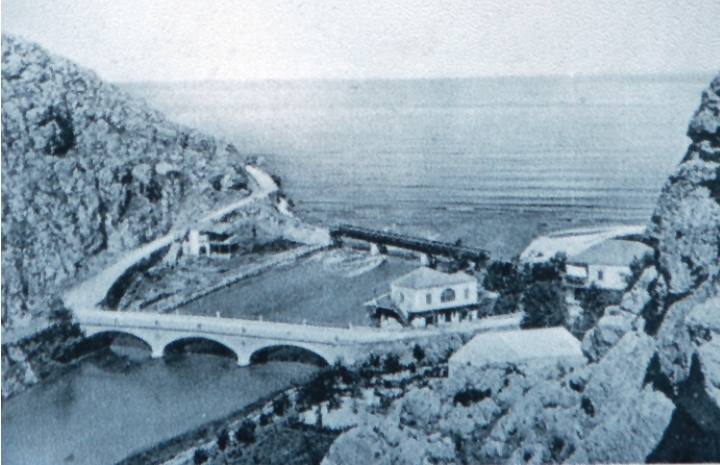
- Feb 2019 Google Street View image:
www.google.com.au/maps/@33.9564567,35.5991756,3a,65.7y,23...
******************************
SOURCE INFO
- This original image with somewhat mis-leading title [actually located next to the Haifa-Tripoli road - not the Beirut - Damascus road] was captured late evening by my late father-in-law, Driver Tom Beazley, 2/4 Anti Malaria Control Unit, 9th Division, 2nd Australian Imperial Force, using a Kodak 6-20 Folding Brownie camera with 120 B&W roll film.
We popped up at The Golden Bear to party with Buddy the Elf, Little Bo Peep, and a Breakfast Burrito? Check them out and see what we mean!
Phrygian Valley....Anatolia's mysterious ancient Phrygians once inhabited this rock-hewn valley (Frig Vadisi), which runs haphazardly past Eskişehir, Kütahya and Afyon. Although an increasingly popular hiking destination, it is still relatively untouched and offers spectacular Phrygian relics. The rugged terrain is exhilarating and highly photogenic. The Afyon-area ruins are the best preserved, and the Eskişehir-area ruins also impress; Kütahya's are less abundant. Phrygia describes an area on the western end of the high Anatolian plateau, an arid region quite unlike the forested lands to the north and west. Phrygia begins in the northwest where an area of dry steppe is watered by the Sakarya and Porsuk river system and is home to the settlements of Dorylaeum near modern Eskisehir, and the Phrygian capital Gordion. The climate is harsh with hot summers and cold winters; olives will not easily grow here and the land is mostly used for livestock grazing and the production of barley. South of Dorylaeum, there is another important Phrygian settlement, Midas City (Yazılıkaya, Eskişehir), situated in an area of hills and columns of volcanic tufa. To the south again, central Phrygia includes the cities of Afyonkarahisar (ancient Akroinon) with its marble quarries at nearby Docimium (İscehisar), and the town of Synnada. At the western end of Phrygia stood the towns of Aizanoi (modern Çavdarhisar) and Acmonia. From here to the southwest lies the hilly area of Phrygia that contrasts to the bare plains of the region's heartland. Southwestern Phrygia is watered by the Maeander (Büyük Menderes River) and its tributary the Lycus, and contains the towns of Laodicea on the Lycus and Hierapolis
Pseudolus is the laziest slave in Rome and has but one wish, to purchase his freedom. When his master and mistress leave for the day he finds out that the young master has fallen in love with a virgin in the house of Lycus, a slave dealer specializing in beautiful women. Pseudolus concocts a deal in which he will be freed if he can procure the girl for young Hero. Of course, it can't be that simple as everything begins to go wrong.
# Celæno - `swarthy' -
Had sons Lycus (``wolf'') and Chimærus (``he-goat'') by Prometheus. No other data.
The story behind the statue: Once upon an ancient Greek time, King Lycus was bewitched by Dirce. He abandoned his pregnant wife, Antiope (standing regally in the background). The single mom gave birth to twin boys (shown here). When they grew up, they killed their deadbeat dad tied Dirce to the horns of a bull to be bashed against a mountain. Captured in marble, the action is thrilling: cape flailing, dog snarling, hooves in the air...Antiope oversees this harsh ancient justice with satisfaction.
Rick Steves, Italy
And they two by the pathway came to the sacred grove, seeking the huge oak tree on which was hung the fleece, like to a cloud that blushes red with the fiery beams of the rising sun. But right in front the serpent with his keen sleepless eyes saw them coming, and stretched out his long neck and hissed in awful wise; and all round the long banks of the river echoed and the boundless grove. Those heard it who dwelt in the Colchian land very far from Titanian Aea, near the outfall of Lycus, the river which parts from loud-roaring Araxes and blends his sacred stream with Phasis, and they twain flow on together in one and pour their waters into the Caucasian Sea. And through fear young mothers awoke, and round their new-born babes, who were sleeping in their arms, threw their hands in agony, for the small limbs started at that hiss. And as when above a pile of smouldering wood countless eddies of smoke roll up mingled with soot, and one ever springs up quickly after another, rising aloft from beneath in wavering wreaths; so at that time did that monster roll his countless coils covered with hard dry scales. And as he writhed, the maiden came before his eyes, with sweet voice calling to her aid sleep, highest of gods, to charm the monster; and she cried to the queen of the underworld, the night-wanderer, to be propitious to her enterprise. And Aeson’s son followed in fear, but the serpent, already charmed by her song, was relaxing the long ridge of his giant spine, and lengthening out his myriad coils, like a dark wave, dumb and noiseless, rolling over a sluggish sea; but still he raised aloft his grisly head, eager to enclose them both in his murderous jaws. But she with a newly cut spray of juniper, dipping and drawing untempered charms from her mystic brew, sprinkled his eyes, while she chanted her song; and all around the potent scent of the charm cast sleep; and on the very spot he let his jaw sink down; and far behind through the wood with its many trees were those countless coils stretched out.
Hereupon Jason snatched the golden fleece from the oak, at the maiden bidding; and she, standing firm, smeared with the charm the monster’s head, till Jason himself bade her turn back towards their ship, and she left the grove of Ares, dusky with shade. And as a maiden catches on her finely wrought robe the gleam of the moon at the full, as it rises above her high-roofed chamber; and her heart rejoices as she beholds the fair ray; so at that time did Jason uplift the mighty fleece in his hands; and from the shimmering of the flocks of wool there settled on his fair cheeks and brow a red flush like a flame. And great as is the hide of a yearling ox or stag, which huntsmen call a brocket, so great in extent was the fleece all golden above. Heavy it was, thickly clustered with flocks; and as he moved along, even beneath his feet the sheen rose up from the earth. And he strode on now with the fleece covering his left shoulder from the height of his neck to his feet, and now again he gathered it up in his hands; for he feared exceedingly, lest some god or man should meet him and deprive him thereof. - Homer
Not much left of the ancient phrygian facade engraved in this rock. you can still barely make it out though.
Phrygian Valley....Anatolia's mysterious ancient Phrygians once inhabited this rock-hewn valley (Frig Vadisi), which runs haphazardly past Eskişehir, Kütahya and Afyon. Although an increasingly popular hiking destination, it is still relatively untouched and offers spectacular Phrygian relics. The rugged terrain is exhilarating and highly photogenic. The Afyon-area ruins are the best preserved, and the Eskişehir-area ruins also impress; Kütahya's are less abundant. Phrygia describes an area on the western end of the high Anatolian plateau, an arid region quite unlike the forested lands to the north and west. Phrygia begins in the northwest where an area of dry steppe is watered by the Sakarya and Porsuk river system and is home to the settlements of Dorylaeum near modern Eskisehir,
and the Phrygian capital Gordion. The climate is harsh with hot summers and cold winters; olives will not easily grow here and the land is mostly used for livestock grazing and the production of barley. South of Dorylaeum, there is another important Phrygian settlement, Midas City (Yazılıkaya, Eskişehir), situated in an area of hills and columns of volcanic tufa. To the south again, central Phrygia includes the cities of Afyonkarahisar (ancient Akroinon) with its marble quarries at nearby Docimium (İscehisar), and the town of Synnada. At the western end of Phrygia stood the towns of Aizanoi (modern Çavdarhisar) and Acmonia. From here to the southwest lies the hilly area of Phrygia that contrasts to the bare plains of the region's heartland. Southwestern Phrygia is watered by the Maeander (Büyük Menderes River) and its tributary the Lycus, and contains the towns of Laodicea on the Lycus and Hierapolis
Lycus Sulci is a very complex region surrounding the northern and western flanks of Olympus Mons.
This VIS image shows some of the tectonic features found in Lycus Sulci as well as the dark slope streaks that are common in this region.
Right angle intersections of valleys indicate tectonic fracturing. Bowl-shaped channel heads may form by release of a liquid such as melted subsurface ice.
This martian scene spans 19 x 67 kilometers (12 x 42 miles). To see where on Mars this area lies, and to download high-resolution versions of the image, go to themis.asu.edu/zoom-20180814a
See the Red Planet Report at redplanet.asu.edu for updates on Mars research and exploration. For more about Mars geology, check out the Mars-ePedia: marsed.asu.edu/marsepedia
For the latest THEMIS Mars images as received by mission scientists, see themis.asu.edu/livefrommars. To learn more about the THEMIS camera and its Mars images, see themis.asu.edu.
This image is in the public domain and may be republished free of charge. If used, please credit it as NASA/JPL-Caltech/Arizona State University.
Phrygian Valley....Anatolia's mysterious ancient Phrygians once inhabited this rock-hewn valley (Frig Vadisi), which runs haphazardly past Eskişehir, Kütahya and Afyon. Although an increasingly popular hiking destination, it is still relatively untouched and offers spectacular Phrygian relics. The rugged terrain is exhilarating and highly photogenic. The Afyon-area ruins are the best preserved, and the Eskişehir-area ruins also impress; Kütahya's are less abundant. Phrygia describes an area on the western end of the high Anatolian plateau, an arid region quite unlike the forested lands to the north and west. Phrygia begins in the northwest where an area of dry steppe is watered by the Sakarya and Porsuk river system and is home to the settlements of Dorylaeum near modern Eskisehir, and the Phrygian capital Gordion. The climate is harsh with hot summers and cold winters; olives will not easily grow here and the land is mostly used for livestock grazing and the production of barley. South of Dorylaeum, there is another important Phrygian settlement, Midas City (Yazılıkaya, Eskişehir), situated in an area of hills and columns of volcanic tufa. To the south again, central Phrygia includes the cities of Afyonkarahisar (ancient Akroinon) with its marble quarries at nearby Docimium (İscehisar), and the town of Synnada. At the western end of Phrygia stood the towns of Aizanoi (modern Çavdarhisar) and Acmonia. From here to the southwest lies the hilly area of Phrygia that contrasts to the bare plains of the region's heartland. Southwestern Phrygia is watered by the Maeander (Büyük Menderes River) and its tributary the Lycus, and contains the towns of Laodicea on the Lycus and Hierapolis
🗻 Nikfer Kayak Merkezi - Pamukkale ve 5* Lycus River Termal Otel Turu ⛷ 1 Gece/2 Gün, Kişi Başı 👉💥 550₺'den başlayan fiyatlarla.
🚌 Hareket Noktalarımız : Antalya – Serik – Manavgat - Alanya
👇👇👇 Tarihler 👇👇👇
📅 19 Şubat - 20 Şubat
📅 26 Şubat - 27 Şubat
🔻 5* Lycus River Termal Konaklama Ayrıcalığı
🔻 Nikfer Kayak Merkezinde Tam Gün Serbest Zaman
🔻 Dünya Harikası Pamukkale Traventerleri
🔻 Buldan Yöresel Ürünler Alışverişi
🔻 Pamukkale'de Balon Turu İmkanı
🔻 Otelden Geç Çıkış ile Termal Spa ve Havuzları Kullanma İmkanı
🔻 Kaçırılmaz Hafta Sonu Fırsatı
🌐Tur programının detaylarını görmek için web sitemizi ziyaret edebilirsiniz. Tıkla web sitesine git👇
lisinyatur.com/nikfer-kayak-turu-ve-pamukkale
✅ Ücrete Dahil Olanlar
▪ Gidiş Dönüş Ulaşım
▪ Profesyonel Rehberlik Hizmeti
▪ Araç İçi İkramlar
▪ Seyahat Sigortası
▪ 5* Lycus River Termal Hotel'de 1 Gece Konaklama
▪ Termal Havuzlar
▪ Hamam Sauna Buhar Odası
▪ Otelde Alınan 1 Akşam Yemeği ve 1 Sabah Kahvaltısı
▪ Otelde Canlı Müzik
❌ Ücrete Dahil Olmayanlar
▪ Kişisel Harcamalar
Kişi Başı - 550₺
0 - 5 Yaş Çocuk - 200₺
6 - 11 Yaş Çocuk - 450₺
Single Konaklama - 650₺
🔵 Rezervasyonlar 200₺ ön ödeme ile gerçekleşmektedir.
Gruplara özel fiyatlar uygulanmaktadır.
💳 Tüm kredi kartlarına 12 taksit, vade farksız 3 taksit imkanı
📲 İletişim : 0242 743 33 44
✅ Whatsaap-1 : 0545 475 07 07
✅ Whatsaap-2 : 0532 574 45 07