View allAll Photos Tagged kelir
The dhalang or dalang (Javanese: dhalang, Indonesian: dalang, Malay: dalang) is the puppeteer in an Indonesian wayang performance.
In a performance of wayang kulit, the dalang sits behind a screen (kelir) made of white cotton stretched on a wooden frame. Above his head, hanging from beams attached to the top of the screen, is the lamp (blencong), which projects the shadows onto the screen. In front of the dhalang is a stage (debog), traditionally made from the trunk of a banana tree, into which the sharpened control rods of the puppets can be pushed to keep them in position during the performance. To his left is the puppet chest (kotak), and to his right is the puppet chest's lid, on which the puppets sit ready for use.
Prambanan temple has three main temples in the primary yard, namely Vishnu, Brahma, and Shiva temples. Those three temples are symbols of Trimurti in Hindu belief. All of them face to the east. Each main temple has accompanying temple facing to the west, namely Nandini for Shiva, Angsa for Brahma, and Garuda for Vishnu. Besides, there are 2 flank temples, 4 kelir temples and 4 corner temples.
Prolog:
So I did a whirlwind tour of Indonesia about 3 weeks ago - there was an extra day off on account of Good Friday. As it has been with almost all of the South-East Asia trips this was quite adventure filled as well.
We decided to do the trip one a couple of days before the holidays and didn't have a plan until the last minute. Heck, we didn't even have a plan even after we arrived in Jakarta. Unlike Malaysia or Thailand or even Batam / Bintan (Although I'd like to call them Singaporean colonies rather than parts of Indonesia), the common man in Jakarta doesn't speak or understand even bits and pieces of English. This proved to be a nightmare. Somehow we managed to beat all odds and successfully completed a 30 Hour long, 1300+ Km road trip from Jakarta to Yogyakarta (pronounced Jogjakarta by the locals) amidst some of the worst, haphazard and dangerous traffic you could ever imaging. Pause for a moment and picture this phrase about traffic woes in a different country coming from an Indian.
Our main attractions were supposed to be in Jogja - Mount Merapi (an active volcano), Borabudhur (the largest buddhist temple complex in the world!) and last but not least the Prambanan Temple complex!
I will do detailed posts on the trip in its entirety an all these attractions separately, but to kick-start this series, here is a shot of Candi Prambanan.
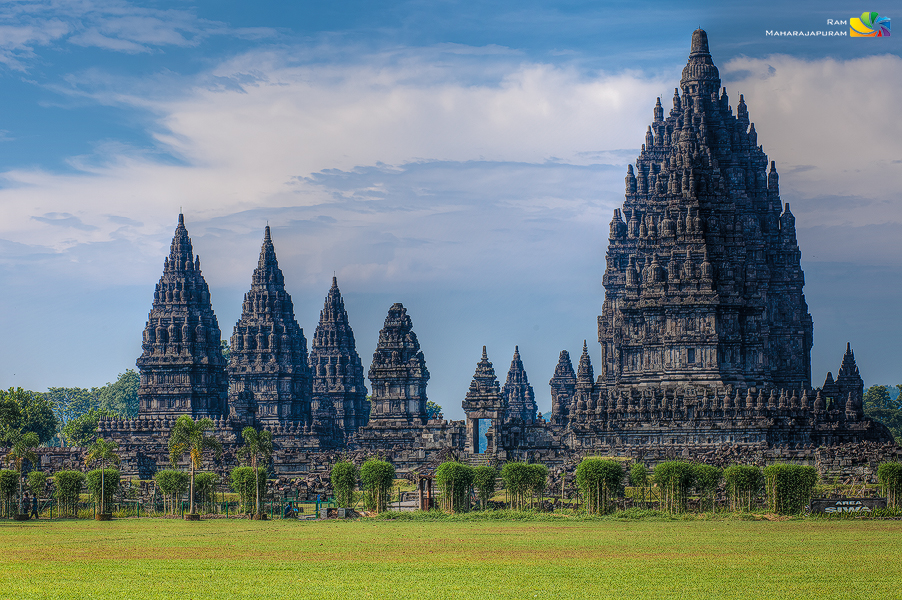
Introduction:
The opening stanza of the Wikitravel article on Prambanan sets the tone for what is about to come:
A UNESCO World Heritage Site, in almost any other country a magnificent ancient monument on the scale of Prambanan would quickly be designated a national symbol. In Indonesia though it is somewhat overshadowed by the even more awe-inspiring nature of nearby Borobudur. The two sites are quite different in style with Hindu Prambanan being a collection of sharp, jaggedly sculpted towers in contrast to the vast horizontal bulk of Buddhist Borobudur.
This temple was built around 850 CE - to put it in perspective, the famous Brihadeeswarar Temple in Thanjavur was built in 1010 AD. The complex was built by the Hindu Sanjaya dynasty apparently to mark their return to central Java after the Buddhist Sailendra Dynasty.
Etymology:
Since we are getting started with just this series, let us start by understanding the name Prambanan. A quest for this might give us some very interesting insights.
The present name Prambanan, Wikipedia tells me, is probably a corrupted Javanese pronunciation of "Para Brahman" ("of the brahmins"). What do they have to do here, you may ask?
To understand that, we need to go back a little bit in history.
Unlike most of the Eurpoean colonialism that we have been used to from the Medieval ages, Hinduism (and surprisingly, Islam) did not land in Indonesia by force. They were influencers - whose culture and way of life attracted the local kingdoms during their trading relationships and was eventually embraced upon. Apparently, references to Java and Sumatra have been found in Sanskrit texts from as early as 200 BC and such Indianized empires are supposed to have thrived in the region until Buddhism arrived in the 8th century.
Not much of this information is present in the Indian history books other than customary references to Rajendra Chola's invasion of the region in 1025 AD. This not only weakened the Srivijaya empire but also eventually led to their fall and the rise of Islam over the next couple of centuries.
On a parallel topic, let us understand how the Prambanan temple is laid out. Originally there was total 240 temples stood in Prambanan. The Prambanan Temple Compound consist of:
* 3 Trimurti temples: three main temples dedicated to Shiva, Visnu, and Brahma
* 3 Vahana temples: three temples in front of Trimurti temples dedicated to the vahana of each gods; Nandi, Garuda, and Hamsa
* 2 Apit temples: two temples located between the rows of Trimurti and Vahana temples on north and south side
* 4 Kelir temples: four small shrines located on 4 cardinal directions right beyond the 4 main gates of inner zone
* 4 Patok temples: four small shrines located on 4 corners of inner zone
* 224 Pervara temples: hundreds of temples arranged in 4 concentric square rows; numbers of temples from inner row to outer row are: 44, 52, 60, and 68
We will go about how much of it has been restored and when it happened in a future post but for now, let us understand about the Pervara temples.
Apparently the 224 Pervara (Prahara?) temples served as a place of meditation for the temple priests! In addition to the structures in the complex, there is a HUGE park around it today. Originally, this was supposed to have been a priest's boarding school (Veda Pata sala). The supporting buildings for the temple complex were made from organic material; as a consequence no remains occur.
I will dwell into a little more interesting details / history in the future posts including how different is Hinduism that is practised in Indonesia from that we see close to home in India.
Stay tuned!
Elsewhere on the Internet:
Prambanan temple is extraordinarily beautiful building constructed in the tenth century during the reigns of two kings namely Rakai Pikatan and Rakai Balitung. Soaring up to 47 meters (5 meters higher than Borobudur temple), the foundation of this temple has fulfilled the desire of the founder to show Hindu triumph in Java Island. This temple is located 17 kilometers from the city center, among an area that now functions as beautiful park.
There is a legend that Javanese people always tell about this temple. As the story tells, there was a man named Bandung Bondowoso who loved Roro Jonggrang. To refuse his love, Jonggrang asked Bondowoso to make her a temple with 1,000 statues only in one-night time. The request was nearly fulfilled when Jonggrang asked the villagers to pound rice and to set a fire in order to look like morning had broken. Feeling to be cheated, Bondowoso who only completed 999 statues cursed Jonggrang to be the thousandth statue.
Prambanan temple has three main temples in the primary yard, namely Vishnu, Brahma, and Shiva temples. Those three temples are symbols of Trimurti in Hindu belief. All of them face to the east. Each main temple has accompanying temple facing to the west, namely Nandini for Shiva, Angsa for Brahma, and Garuda for Vishnu. Besides, there are 2 flank temples, 4 kelir temples and 4 corner temples. In the second area, there are 224 temples.
Entering Shiva temple, the highest temple and is located in the middle, you will find four rooms. One main room contains Shiva statue, while the other three rooms contain the statues of Durga (Shiva's wife), Agastya (Shiva's teacher), and Ganesha (Shiva's son). Durga statue is said to be the statue of Roro Jonggrang in the above legend.
In Vishnu temple, to the north of Shiva temple, you will find only one room with Vishnu statue in it. In Brahma temple, to the south of Shiva temple, you find only room as well with Brahma statue in it.
Quite attractive accompanying temple is Garuda temple that is located close to Vishnu temple. This temple keeps a story of half-bird human being named Garuda. Garuda is a mystical bird in Hindu mythology. The figure is of golden body, white face, red wings, with the beak and wings similar to eagle's. It is assumed that the figure is Hindu adaptation of Bennu (means 'rises' or 'shines') that is associated with the god of the Sun or Re in Old Egypt mythology or Phoenix in Old Greek mythology. Garuda succeeded in saving his mother from the curse of Aruna (Garuda's handicapped brother) by stealing Tirta Amerta (the sacred water of the gods).
Its ability to save her mother made many people admire it to the present time and it is used for various purposes. Indonesia uses the bird as the symbol of the country. Other country using the same symbol is Thailand, with the same reason but different form adaptation and appearance. In Thailand, Garuda is known as Krut or Pha Krut.
Prambanan also has panels of relief describing the story of Ramayana. Experts say that the relief is similar to the story of Ramayana that is told orally from generation to generation. Another interesting relief is Kalpataru tree that - in Hindu - the tree is considered tree of life, eternity and environment harmony. In Prambanan, relief of Kalpataru tree is described as flanking a lion. The presence of this tree makes experts consider that Javanese society in the ninth century had wisdom to manage its environment.
Just like Garuda, Kalpataru tree is also used for various purposes. In Indonesia, Kalpataru is used as the logo of Indonesian Environment Institution. Some intellectuals in Bali even develop "Tri Hita Karana" concept for environment conservation by seeing Kalpataru relief in this temple. This tree of life is also seen in the gunungan (the puppet used as an opening of traditional puppet show or wayang kulit). This proves that relief panels in Prambanan have been widely known throughout the world.
If you see the relief in detail, you will see many birds on them; they are real birds as we can see on the earth right now. Relief panels of such birds are so natural that biologists can identify their genus. One of them is the relief of the Yellow-Crest Parrot (Cacatua sulphurea) that cites unanswered question. The reason is that the bird only exists in Masakambing Island, an island in the middle of Java Sea. Then, did the bird exist in Yogyakarta? No body has succeeded in revealing the mystery.
You can discover many more things in Prambanan. You can see relief of Wiracarita Ramayana based on oral tradition. If you feel tired of enjoying the relief, you can take a rest in the beautiful garden in the complex. Since 18 September 2006, you can enter zone 1 area of Prambanan temple. The damage caused by the earthquake on 27 May 2006 is being reconstructed. Please come and enjoy Prambanan temple.
Between these row of main temple, on north and south side stands two Candi Apit. Beside these 8 main temples, there's also 8 smaller shrines; 4 Candi Kelir on four cardinal direction of the entrance, and 4 Candi Patok on four corner of inner zone.(wiki)
Wayang kulit is a traditional form of puppet-shadow play originally found in the cultures of Java, Bali and Lombok in Indonesia. In a wayang kulit performance, the puppet figures are rear-projected on a taut linen screen with a coconut-oil (or electric) light. The dalang (shadow artist) manipulates carved leather figures between the lamp and the screen to bring the shadows to life.
Wayang kulit is one of the many different forms of wayang theatre found in Indonesia; the others include wayang beber, wayang klitik, wayang golek, wayang topeng, and wayang wong. Wayang kulit is among the best known, offering a unique combination of ritual, lesson and entertainment. Today, it is spread out, in various forms and guises, across Asia - from Turkey and China to Thailand and Malaysia. On November 7, 2003, UNESCO designated wayang kulit from Indonesia as one of the Masterpieces of the Oral and Intangible Heritage of Humanity.
ETYMOLOGY
The term wayang is the Javanese word for "shadow" or "imagination". Its equivalent in standard Indonesian is bayang.
In modern daily Javanese and Indonesian vocabulary, wayang can refer to the puppet itself or the whole puppet theatre performance. Kulit means "skin" or "leather", the material from which the figures are carved.
HISTORY
Wayang kulit originated in southern India as Tholpavakoothu.[citation needed] Tholpavakoothu was dedicated to a goddess to witness the slaying of Ravana in the Hindu epic Ramayana. Hinduism arrived in Indonesia from India before the Islamic and Christian era. Sanskrit became the literary and court language of Java and later of Bali. Wayang kulit was later assimilated into local culture with changes to the appearance of the characters to resemble cultural norms.
When Islam began spreading in Indonesia, the display of God or gods in human form was prohibited, and thus this style of shadow play was suppressed. King Raden Patah of Demak, Java, wanted to see the wayang in its traditional form, but failed to obtain permission from Muslim religious leaders.
Religious leaders attempted to skirt the Muslim prohibition by converting the wayang golek into wayang purwa made from leather and displayed only the shadow instead of the puppets themselves.
WAYANG PUPPET FIGURES
The wayang comes in sizes from 25 cm to 75 cm. The important characters are usually represented by several puppets each. The wayang is usually made out of water buffalo hide and goat hide and mounted on bamboo sticks. However, the best wayang is typically made from young female buffalo parchment, cured for up to ten years. The carving and punching of the rawhide, which is most responsible for the character's image and the shadows that are cast, are guided by this sketch. A mallet is used to tap special tools, called tatah, to punch the holes through the rawhide. Making the wayang sticks from horn is a complicated process of sawing, heating, hand-molding, and sanding until the desired effect is achieved. When the materials are ready, the artist attaches the handle by precisely molding the ends of the horn around the individual wayang figure and securing it with thread. A large character may take months to produce.
There are important differences between the three islands where wayang kulit is played (due to local religious canon):
In Java (where Islam is predominant), the puppets (named ringgit) are elongated, the play lasts all night and the lamp (named blencong) is, nowadays, almost always electric. A full gamelan with (pe)sinden is typically used.
In Bali (where Hinduism is predominant), the puppets look more real, the play lasts a few hours and, if at night, the lamp uses coconut oil. Music is mainly by the four gender wayang, with drums only if the story is from the Ramayana. There are no sinden. The dalang does the singing. Balinese dalangs are often also priests (amangku dalang). As such, they may also perform during daylight, for religious purposes (exorcism), without lamp and without screen (wayang sakral, or "lemah").
In Lombok (where Islam is predominant and Bali's influence is strong), vernacular wayang kulit is known as wayang sasak, with puppets similar to Javanese ringgits, a small orchestra with no sinden, but flutes, metallophones and drums. The repertoire is unique to the island and is based on the Muslim Menak Cycle (the adventures of Amir Hamzah).
PERFORMANCE
The stage of a wayang performance includes several components. A stretched linen canvas (kelir) acts as a canvas, dividing the dalang (puppeteer) and the spectator. A coconut-oil lamp (Javanese blencong or Balinese damar) – which in modern times is usually replaced with electric light – casts shadows onto the screen. A banana trunk (Javanese gedebog, Balinese gedebong) lies on the ground between the screen and the dalang, where the figures are stuck to hold them in place. To the right of the dalang sits the puppet chest, which the dalang uses as a drum during the performance, hitting it with a wooden mallet. In a Javanese wayang kulit performance, the dalang may use a cymbal-like percussion instrument at his feet to cue the musicians. The musicians sit behind the dalang in a gamelan orchestra setting. The gamelan orchestra is an integral part of the Javanese wayang kulit performance. The performance is accompanied by female singers (pesinden) and male singers (wirasuara).
The setting of the banana trunk on the ground and canvas in the air symbolizes the earth and the sky; the whole composition symbolizes the entire cosmos. When the dalang animates the puppet figures and moves them across the screen, divine forces are understood to be acting in his hands with which he directs the happening. The lamp is a symbol of the sun as well as the eye of the dalang.
A traditional wayang kulit performance begins after dark. The first of the three phases, in which the characters are introduced and the conflict is launched, lasts until midnight. The battles and intrigues of the second phase last about three hours. The third phase of reconciliation and friendship is finished at dawn.
Wayang shadow plays are usually tales from the two major Hindu epics, the Ramayana and Mahabharata. The puppet master contextualizes stories from the plays, making them relevant to current community, national or global issues. Gamelan players respond to the direction of the dalang.
WIKIPEDIA
Prambanan temple has three main temples in the primary yard, namely Vishnu, Brahma, and Shiva temples. Those three temples are symbols of Trimurti in Hindu belief. All of them face to the east. Each main temple has accompanying temple facing to the west, namely Nandini for Shiva, Angsa for Brahma, and Garuda for Vishnu. Besides, there are 2 flank temples, 4 kelir temples and 4 corner temples. In the second area, there are 224 temples.
. . . these are snapshots of my videos. Yes, I have all Asia also on semi-professional videos
____________________________
Candi Prambanan or Candi Rara Jonggrang is a 9th-century Hindu temple compound in Central Java, Indonesia, dedicated to the Trimurti, the expression of God as the Creator (Brahma), the Preserver (Vishnu) and the Destroyer (Shiva). The temple compound is located approximately 17 kilometres northeast of the city of Yogyakarta on the boundary between Central Java and Yogyakarta provinces.
The temple compound, a UNESCO World Heritage Site, is the largest Hindu temple site in Indonesia, and one of the biggest in Southeast Asia. It is characterized by its tall and pointed architecture, typical of Hindu temple architecture, and by the towering 47-metre-high central building inside a large complex of individual temples. Prambanan attracts many visitors from across the world.
ETYMOLOGY
The present name of the temple, Prambanan', was derived from the name of Prambanan village where the temple stood, this name probably comes from Javanese root '(e)mban' which means carries a duty, reflecting gods role in the world, or the villagers duty in relation to the temple. Comparable with parahyangan (western part of Java island), comes from the root hyang, means god, or (e)yang, means ancestor in Javanese.
HISTORY
CONSTRUCTION
The Prambanan temple is the largest Hindu temple of ancient Java, and the first building was completed in the mid-9th century. It was likely started by Rakai Pikatan as the Hindu Sanjaya Dynasty's answer to the Buddhist Sailendra Dynasty's Borobudur and Sewu temples nearby. Historians suggest that the construction of Prambanan probably was meant to mark the return of the Hindu Sanjaya Dynasty to power in Central Java after almost a century of Buddhist Sailendra Dynasty domination. The construction of this massive Hindu temple signifies that the Medang court had shifted its patronage from Mahayana Buddhism to Shivaist Hinduism.
A temple was first built at the site around 850 CE by Rakai Pikatan and expanded extensively by King Lokapala and Balitung Maha Sambu the Sanjaya king of the Mataram Kingdom. According to the Shivagrha inscription of 856 CE, the temple was built to honor Lord Shiva, and its original name was Shiva-grha (the House of Shiva) or Shiva-laya (the Realm of Shiva). According to the Shivagrha inscription, a public water project to change the course of a river near Shivagrha Temple was undertaken during the construction of the temple. The river, identified as the Opak River, now runs north to south on the western side of the Prambanan temple compound. Historians suggest that originally the river was curved further to east and was deemed too near to the main temple. The project was done by cutting the river along a north to south axis along the outer wall of the Shivagrha Temple compound. The former river course was filled in and made level to create a wider space for the temple expansion, the space for rows of pervara (complementary) temples.
Some archaeologists propose that the statue of Shiva in the garbhagriha (central chamber) of the main temple was modelled after King Balitung, serving as a depiction of his deified self after death.
The temple compound was expanded by successive Mataram kings, such as Daksa and Tulodong, with the addition of hundreds of perwara temples around the chief temple. Prambanan served as the royal temple of the Kingdom of Mataram, with most of the state's religious ceremonies and sacrifices being conducted there. At the height of the kingdom, scholars estimate that hundreds of brahmins with their disciples lived within the outer wall of the temple compound. The urban center and the court of Mataram were located nearby, somewhere in the Prambanan Plain.
ABANDONMENT
In the 930s, the court was shifted to East Java by Mpu Sindok, who established the Isyana Dynasty. An eruption of Mount Merapi volcano, located north of Prambanan in central Java, or a power struggle probably caused the shift. That marked the beginning of the decline of the temple. It was soon abandoned and began to deteriorate.
The temples collapsed during a major earthquake in the 16th century. Although the temple ceased to be an important center of worship, the ruins scattered around the area were still recognizable and known to the local Javanese people in later times. The statues and the ruins become the theme and the inspiration for the Loro Jonggrang folktale. After the division of Mataram Sultanate in 1755, the temple ruins and the Opak River were used to demarcate the boundary between Yogyakarta and Surakarta (Solo) Sultanates, which was adopted as the current border between Yogyakarta and the province of Central Java.
REDISCOVERY
The Javanese locals in the surrounding villages knew about the temple ruins before formal rediscovery, but they did not know about its historical background: which kingdoms ruled or which king commissioned the construction of the monuments. As a result, the locals developed tales and legends to explain the origin of temples, infused with myths of giants, and a cursed princess. They gave Prambanan and Sewu a wondorous origin; these were said in the Loro Jonggrang legend to have been created by a multitude of demons under the order of Bandung Bondowoso.
The temple attracted international attention in early 19th century. In 1811 during Britain’s short-lived rule of the Dutch East Indies, Colin Mackenzie, a surveyor in the service of Sir Thomas Stamford Raffles, came upon the temples by chance. Although Sir Thomas subsequently commissioned a full survey of the ruins, they remained neglected for decades. Dutch residents carried off sculptures as garden ornaments and native villagers used the foundation stones for construction material.
Half-hearted excavations by archaeologists in the 1880s facilitated looting. In 1918, the Dutch began reconstruction of the compound and proper restoration only in 1930. Efforts at restoration continue to this day. The reconstruction of the main Shiva temple was completed around 1953 and inaugurated by Sukarno. Since much of the original stonework has been stolen and reused at remote construction sites, restoration was hampered considerably. given the scale of the temple complex, the government decided to rebuild shrines only if at least 75% of their original masonry was available. Most of the smaller shrines are now visible only in their foundations, with no plans for their reconstruction.
CONTAMPORARY EVENTS
In the early 1990s the government removed the market that had sprung up near the temple and redeveloped the surrounding villages and rice paddies as an archaeological park. The park covers a large area, from Yogyakarta-Solo main road in the south, encompassing the whole Prambanan complex, the ruins of Lumbung and Bubrah temples, and as far as the Sewu temple compound in the north. In 1992 the Indonesian government created a State-owned Limited Liability Enterprise (PERSERO), named "PT Taman Wisata Candi Borobudur, Prambanan, dan Ratu Boko." This enterprise is the authority for the park management of Borobudur Prambanan Ratu Boko and the surrounding region. Prambanan is one of the most visited tourist attraction in Indonesia.
The Trimurti open-air and indoor stages on the west side of the temple, across the Opak River, were built to stage the ballet of the traditional Ramayana epic. This traditional Javanese dance is the centuries old dance of the Javanese court. Since the 1960s, it has been performed every full moon night in the Prambanan temple. Since then, Prambanan has become one of the major archaeological and cultural tourism attractions in Indonesia.
Since the reconstruction of the main temples in the 1990s, Prambanan has been reclaimed as an important religious center for Hindu rituals and ceremonies in Java. Balinese and Javanese Hindu communities in Yogyakarta and Central Java revived their practices of annually performing their sacred ceremonies in Prambanan, such as Galungan, Tawur Kesanga, and Nyepi.
The temple was damaged during the May 2006 Java earthquake. Early photos suggested that although the complex was structurally intact, the damage was significant. Large pieces of debris, including carvings, were scattered over the ground. The temple was closed to visitors until the damage could be fully assessed. Eventually, the head of Yogyakarta Archaeological Conservation Agency stated that it would take months to identify the full extent of the damage. Some weeks later in 2006, the site was re-opened for visitors.
There is great interest in the site. In 2008, 856,029 Indonesian visitors and 114,951 foreign visitors visited Prambanan. In 6 January 2009 the reconstruction of Nandi temple finished. As of 2009, the interior of most of the temples remains off-limits for safety reasons.
In 14 February 2014, major tourist attractions in Yogyakarta and Central Java, including Borobudur, Prambanan and Ratu Boko, were closed from visitors, after being severely affected by the volcanic ashes from the eruption of Kelud volcano in East Java, located around 200 kilometers east from Yogyakarta. The Kelud volcano erupted on 13 February 2014 with explosion heard as far away as Yogyakarta. Four years earlier, Prambanan was spared from Merapi volcanic ash and eruption in 2010 since the wind and ashfall were directed westward and affected Borobudur instead.
In 2012, the Balai Pelestarian Peninggalan Purbakala Jawa Tengah (BP3) or Central Java Heritage Preservation Authority suggested that the area in and around Prambanan should be treated as sanctuary area. The proposed area is located in Prambanan Plain measured 30 square kilometers spanned across Sleman and Klaten Regency, which includes major temples in the area such as Prambanan, Ratu Boko, Kalasan, Sari and Plaosan temples. The sanctuary area is planned to be treated in similar fashion to Angkor archaeological area in Cambodia, which means government should stop or decline the permit to construct any new buildings, especially the multi-storied buildings, as well as BTS towers in the area. This was meant to protect this archaeologically rich area from modern day visual obstructions and the encroachments of hotels, restaurants and any tourism-related buildings and businesses.
THE TEMPLE COMPOUND
Originally there were a total of 240 temples standing in Prambanan. The Prambanan Temple Compound consist of:
3 Trimurti temples: three main temples dedicated to Shiva, Visnu, and Brahma
3 Vahana temples: three temples in front of Trimurti temples dedicated to the vahana of each gods; Nandi, Garuda, and Hamsa
2 Apit temples: two temples located between the rows of Trimurti and Vahana temples on north and south side
4 Kelir temples: four small shrines located on 4 cardinal directions right beyond the 4 main gates of inner zone
4 Patok temples: four small shrines located on 4 corners of inner zone
224 Pervara temples: hundreds of temples arranged in 4 concentric square rows; numbers of temples from inner row to outer row are: 44, 52, 60, and 68
The Prambanan compound also known as Rara Jonggrang complex, named after the popular legend of Rara Jonggrang. There were once 240 temples stood in this Shivaite temple complex, either big or small. Today, all of 8 main temples and 8 small shrines in inner zone are reconstructed, but only 2 out of the original 224 pervara temples are renovated. The majority of them have deteriorated; what is left are only scattered stones. The Prambanan temple complex consists of three zones; first the outer zone, second the middle zone that contains hundreds of small temples, and third the holiest inner zone that contains eight main temples and eight small shrines.
The Hindu temple complex at Prambanan is based on a square plan that contains a total of three zone yards, each of which is surrounded by four walls pierced by four large gates. The outer zone is a large space marked by a rectangular wall. The outermost walled perimieter, which originally measured about 390 metres per side, was oriented in the northeast, southwest direction. However, except for its southern gate, not much else of this enclosure has survived down to the present. The original function is unknown; possibilities are that it was a sacred park, or priests' boarding school (ashram). The supporting buildings for the temple complex were made from organic material; as a consequence no remains occur.
SHIVA TEMPLE
The inner zone or central compound is the holiest among the three zones. Its the square elevated platform surrounded by square stone wall with stone gates on each four cardinal points. This holiest compound is assembled of eight main shrines or candi. The three main shrines, called Trimurti ("three forms"), are dedicated to the three Gods: Brahma the Creator, Vishnu the Keeper, and Shiva the Destroyer.
The Shiva temple is the tallest and largest structure in Prambanan Loro Jonggrang complex, it measures 47 metres tall and 34 metres wide. The Shiva temple encircled with galleries adorned with bas-reliefs telling the story of Ramayana carved on the inner walls of the balustrades. To follow the story accordingly, visitors must enter from the east side and began to perform pradakshina or circumambulating clockwise. The bas-reliefs of Ramayana continued to Brahma temple galleries.
The Shiva shrine located at the center and contains five chambers, four small chambers in every cardinal direction and one bigger main chamber in central part of the temple. The east chamber connect to central chamber that houses the largest temple in Prambanan, a three meter high statue of Shiva Mahadeva (the Supreme God). The statue bears Lakçana (attributes or symbol) of Shiva such as skull and sickle (crescent) at the crown, and third eye on the forehead, also four hands that holds Shiva's symbols: a prayer beads, feather duster, and trisula (trident). Some historians believe that the depiction of Shiva as Mahadeva also meant to personify king Balitung as the reincarnation of Shiva. So, when he died, a temple was built to commemorate him as Shiva. The statue of Shiva stands on lotus pad on Yoni pedestal that bears the carving of Nāga serpents on north side of pedestal.
The other three smaller chambers contain statues of Hindu Gods related to Shiva; his consort Durga, the rishi Agastya, and Ganesha, his son. Statue of Agastya occupy the south chamber, the west chamber houses the statue of Ganesha, while the north chamber contains the statue of Durga Mahisasuramardini depicting Durga as the slayer of Bull demon. The shrine of Durga is also called the temple of Rara Jonggrang (Javanese: slender virgin), after a Javanese legend of princess Rara Jonggrang.
BRAHMA & VISHNU TEMPLES
The two other main shrines are that of Vishnu on the north side of Shiva shrine, and the one of Brahma on the south. Both temple facing east and each contain only one large chamber, each dedicated to respected gods; Brahma temple contains the statue of Brahma and Vishnu temple houses the statue of Vishnu. Brahma and Vishnu temple measures 20 metres wide and 33 metres tall.
VAHANA TEMPLES
The other three shrine in front of three main temples is dedicated to vehicle (vahana) of the respective gods – the bull Nandi for Shiva, the sacred swan Hamsa for Brahma, and Vishnu's Kite Garuda. Precisely in front of Shiva temple stands Nandi temple which contains a statue of Nandi bull, the vehicle (vahana) of Lord Shiva. Besides it, there is also other statues, the statue of Chandra the god of moon and Surya the god of sun. Chandra stands on his carriage pulled by 10 horses, and the statue of Surya also standing on a carriage pulled by 7 horses. Facing Brahma temple is the temple of Hamsa or Angsa (sacred swan). In the chamber of this temple contains no statue. But it seems likely that there was once a statue of the sacred swan, vehicle of god Brahma. In front of Vishnu temple is the temple dedicated for Garuda, however just like the Hamsa temple, Garuda temple contains no statue. Probably this temple once contains the statue of Garuda, the vehicle of Vishnu. Garuda holds important role for Indonesia, as it serves as the national symbol of Indonesia, and also as the name of the airline Garuda Indonesia.
APIT TEMPLES & SMALER SHRINES
Between these row of main temple, on north and south side stands two Candi Apit. Beside these 8 main temples, there's also 8 smaller shrines; 4 Candi Kelir on four cardinal direction of the entrance, and 4 Candi Patok on four corner of inner zone.
PERVARA TEMPLES
The two walled perimeters that surround the remaining two yards to the interior are oriented to the four cardinal points. The second yard's walled perimeter, which measures about 225 metres per side, surrounds a terraced area that consists of four rows containing 44, 52, 60, and 68 pervara temples. Respectively, each with a height of 14 metres and measuring 6 metres x 6 metres at the base, or 224 structures in total. The sixteen temples located at the corners of the rows face two directions; the remaining 208 structures open to only one of the four cardinal directions.
The middle zone consists of four rows of 224 individual small shrines. There are great numbers of these temples, but most of them are still in ruins and only some have been reconstructed. These concentric rows of temples were made in identical design. Each row towards the center is slightly elevated. These shrines are called "Candi Perwara" guardian or complementary temples, the additional buildings of the main temple. Some believed it was offered to the king as a sign of submission. The Perwara are arranged in four rows around the central temples, some believed it has something to do with four castes, made according to the rank of the people allowed to enter them; the row nearest to the central compound was accessible to the priests only, the other three were reserved for the nobles, the knights, and the simple people respectively. While another believed that the four rows of Perwara has nothing to do with four castes, it just simply made as meditation place for priests and as worship place for devotees.
ARCHITECTURE
The architecture of Prambanan temple follows the typical Hindu architecture traditions based on Vastu Shastra. The temple design incorporated mandala temple plan arrangements and also the typical high towering spires of Hindu temples. Prambanan was originally named Shivagrha and dedicated to god Shiva. The temple was designed to mimic Meru, the holy mountain the abode of Hindu gods, and the home of Shiva. The whole temple complex is a model of Hindu universe according to Hindu cosmology and the layers of Loka.
Just like Borobudur, Prambanan also recognize the hierarchy of the temple zones, spanned from the less holy to the holiest realms. Each Hindu and Buddhist concepts has their own terms, but the concept's essentials is identical. Either the compound site plan (horizontally) or the temple structure (vertically) are consists of three zones:
Bhurloka (in Buddhism: Kāmadhātu), the lowest realm of common mortals; humans, animals also demons. Where humans are still bound by their lust, desire and unholy way of life. The outer courtyard and the foot (base) part of each temples is symbolized the realm of bhurloka.
Bhuvarloka (in Buddhism: Rupadhatu), the middle realm of holy people, occupied by rishis, ascetics, and lesser gods. People here begin to see the light of truth. The middle courtyard and the body of each temple symbolizes the realm of bhuvarloka.
Svarloka (in Buddhism: Arupadhatu), the highest and holiest realm, reserved for the gods. Also known as svargaloka. The inner courtyard and the roof of each temple symbolizes the realm of svarloka. The roof of Prambanan temples are adorned and crowned with ratna (sanskrit: jewel), the shape of Prambanan ratna took the altered form of vajra that represent diamonds. In ancient Java temple architecture, ratna is the Hindu counterpart of the Buddhist stupa, and served as the temple's pinnacle.
During the restoration, a well which contains a pripih (stone casket) was discovered under the center of the Shiva temple. The main temple has a well 5.75 m deep in which a stone casket was found on top a pile of charcoal, earth, and remains of burned animal bones. Sheets of gold leaves with the inscription Varuna (god of the sea) and Parvata (god of the mountains) were found here. The stone casket contained sheets of copper, charcoal, ashes, earth, 20 coins, jewels, glass, pieces of gold and silver leaves, seashells and 12 gold leaves (which were cut in the shapes of a turtle, Nāga serpent, padma, altar, and an egg).
RELIEFS
RAMAYANA & BHAGAVATA PURANA
The temple is adorned with panels of narrative bas-reliefs telling the story of Hindu epic; Ramayana and Bhagavata Purana. The narrative bas-relief panels was carved along the inner balustrades wall on the gallery around the three main temples.
The narrative panels on the balustrade read from left to right. The story started from east entrance where visitors turn left and moving around the temple gallery in clockwise direction. This conforms with pradaksina, the ritual of circumambulation performed by pilgrims who move in a clockwise direction while keeping the sanctuary to their right. The story of Ramayana started on Shiva temple balustrade and continued to Brahma temple. On the balustrades in Vishnu temple there is series of bas-relief panels depict the stories of lord Krishna from Bhagavata Purana.
The bas-relief of Ramayana illustrate how Sita, the wife of Rama, is abducted by Ravana. The monkey king Hanuman brings his army to help Rama and rescue Sita. This story is also shown by the Ramayana Ballet, regularly performed at full moon at Trimurti open air theatre in west side of the illuminated Prambanan complex.
LOKAPALAS, BRAHMINS & DEVATAS
On the other side of narrative panels, the temple wall along the gallery were adorned with the statues and reliefs of devatas and brahmin sages. The figure of lokapalas, the celestial guardians of directions can be found in Shiva temple. The brahmin sage editors of veda were carved on Brahma temple wall, while in Vishnu temple the figures of a male deities devatas flanked by two apsaras.
PRAMBANAN PANEL: LION & KALPATURU
The lower outer wall of these temples were adorned with row of small niche containing image of sinha (lion) flanked by two panels depicting bountiful kalpataru (kalpavriksha) tree. These wish-fulfilling sacred trees according to Hindu-Buddhist beliefs, is flanked on either side by kinnaras or animals, such as pairs of birds, deer, sheep, monkeys, horses, elephants etc. The pattern of lion in niche flanked by kalpataru trees is typical in Prambanan temple compound, thus it is called as "Prambanan panel".
THE RARA JONGGRAND LEGEND
The popular legend of Rara Jonggrang is what connects the site of the Ratu Boko Palace, the origin of the Durga statue in northern cell/chamber of the main shrine, and the origin of the Sewu temple temple complex nearby. The legend tells of the story about Prince Bandung Bondowoso who fell in love with Princess Rara Jonggrang, the daughter of King Boko. But the princess rejected his proposal of marriage because Bandung Bondowoso had killed King Boko and ruled her kingdom. Bandung Bondowoso insisted on the union, and finally Rara Jonggrang was forced to agree for a union in marriage, but she posed one impossible condition: Bandung must build her a thousand temples in only one night.The Prince entered into meditation and conjured up a multitude of spirits (demons) from the earth. Helped by supernatural beings, he succeeded in building 999 temples. When the prince was about to complete the condition, the princess woke her palace maids and ordered the women of the village to begin pounding rice and set a fire in the east of the temple, attempting to make the prince and the spirits believe that the sun was about to rise. As the cocks began to crow, fooled by the light and the sounds of morning time, the supernatural helpers fled back into the ground. The prince was furious about the trick and in revenge he cursed Rara Jonggrang to stone. She became the last and the most beautiful of the thousand statues. According to the traditions, the unfinished thousandth temple created by the demons become the Sewu temple compounds nearby (Sewu means "thousands" in Javanese), and the Princess is the image of Durga in the north cell of the Shiva temple at Prambanan, which is still known as Rara Jonggrang or Slender Virgin.
OTHER TEMPLES AROUND PRAMBANAN
The Prambanan Plain span between southern slopes of Merapi volcano in the north and Sewu mountain range in the south, near the present border Yogyakarta province and Klaten Regency, Central Java. Apart from the Lara Jonggrang complex, Prambanan plain, valley and hills around it is the location of some of the earliest Buddhist temples in Indonesia. Not far to the north are found the ruins of Bubrah temple, Lumbung temple, and Sewu temple. Further east are found Plaosan temple. To the west are found Kalasan temple and Sari temple, further to the west are Sambisari temple. While to the south the Ratu Boko compounds on higher ground. The discoveries of archaeological sites scattered only a few miles away suggested that this area was an important religious, political, and urban center.
NORTH OF LARA JONGRANG COMPLEX
Lumbung. Buddhist-style, consisting of one main temple surrounded by 16 smaller ones.
Candi Bubrah. Buddhist temple still in ruins.
Sewu. Buddhist temple complex, older than Roro Jonggrang. A main sanctuary surrounded by many smaller temples. Well preserved guardian statues, replicas of which stand in the central courtyard at the Jogja Kraton.
Candi Morangan. Hindu temple complex buried several meters under volcanic ashes, located northwest from Prambanan.
Candi Plaosan. Buddhist, probably 9th century. Thought to have been built by a Hindu king for his Buddhist queen. Two main temples with reliefs of Boddhisatva and Tara. Also rows of slender stupas.
SOUTH OF LARA JONGRANG COMPLEX
Ratu Boko. Complex of fortified gates, bathing pools, and elevated walled stone enclosure, all located on top of the hill.
Sajiwan. Buddhist temple decorated with reliefs concerning education. The base and staircase are decorated with animal fables.
Banyunibo. A Buddhist temple with unique design of roof.
Candi Barong. A Hindu temple complex with large stepped stone courtyard. Located on the slope of the hill.
Ijo. A cluster of Hindu temple located near the top of Ijo hill. The main temple houses a large lingam and yoni.
Arca Bugisan. Seven Buddha and bodhisattva statues, some collapsed, representing different poses and expressions.
WEST OF LARA JONGRANG COMPLEX
Kalasan. 8th-century Buddhist temple built in commemoration of the marriage of a king and his princess bride, ornamented with finely carved reliefs.
Sari. Once a sanctuary for Buddhist priests. 8th century. Nine stupas at the top with two rooms beneath, each believed to be places for priests to meditate.
Sambisari. 9th-century Hindu temple discovered in 1966, once buried 6.5 metres under volcanic ash. The main temple houses a linga and yoni, and the wall surround it displayed the images of Agastya, Durga, and Ganesha.
Gebang. A small Hindu temple discovered in 1937 located near the Yogyakarta northern ring-road. The temple display the statue of Ganesha and interesting carving of faces on the roof section.
Candi Gana. Rich in statues, bas-reliefs and sculpted stones. Frequent representations of children or dwarfs with raised hands. Located in the middle of housing complex. Under restoration since 1997.
Candi Kedulan. Discovered in 1994 by sand diggers, 4m deep. Square base of main temple visible. Secondary temples not yet fully excavated.
WIKIPEDIA
Candi Prambanan or Candi Rara Jonggrang is a 9th-century Hindu temple compound in Central Java, Indonesia, dedicated to the Trimurti, the expression of God as the Creator (Brahma), the Preserver (Vishnu) and the Destroyer (Shiva). The temple compound is located approximately 17 kilometres northeast of the city of Yogyakarta on the boundary between Central Java and Yogyakarta provinces.
The temple compound, a UNESCO World Heritage Site, is the largest Hindu temple site in Indonesia, and one of the biggest in Southeast Asia. It is characterized by its tall and pointed architecture, typical of Hindu temple architecture, and by the towering 47-metre-high central building inside a large complex of individual temples. Prambanan attracts many visitors from across the world.
ETYMOLOGY
The present name of the temple, Prambanan', was derived from the name of Prambanan village where the temple stood, this name probably comes from Javanese root '(e)mban' which means carries a duty, reflecting gods role in the world, or the villagers duty in relation to the temple. Comparable with parahyangan (western part of Java island), comes from the root hyang, means god, or (e)yang, means ancestor in Javanese.
HISTORY
CONSTRUCTION
The Prambanan temple is the largest Hindu temple of ancient Java, and the first building was completed in the mid-9th century. It was likely started by Rakai Pikatan as the Hindu Sanjaya Dynasty's answer to the Buddhist Sailendra Dynasty's Borobudur and Sewu temples nearby. Historians suggest that the construction of Prambanan probably was meant to mark the return of the Hindu Sanjaya Dynasty to power in Central Java after almost a century of Buddhist Sailendra Dynasty domination. The construction of this massive Hindu temple signifies that the Medang court had shifted its patronage from Mahayana Buddhism to Shivaist Hinduism.
A temple was first built at the site around 850 CE by Rakai Pikatan and expanded extensively by King Lokapala and Balitung Maha Sambu the Sanjaya king of the Mataram Kingdom. According to the Shivagrha inscription of 856 CE, the temple was built to honor Lord Shiva, and its original name was Shiva-grha (the House of Shiva) or Shiva-laya (the Realm of Shiva). According to the Shivagrha inscription, a public water project to change the course of a river near Shivagrha Temple was undertaken during the construction of the temple. The river, identified as the Opak River, now runs north to south on the western side of the Prambanan temple compound. Historians suggest that originally the river was curved further to east and was deemed too near to the main temple. The project was done by cutting the river along a north to south axis along the outer wall of the Shivagrha Temple compound. The former river course was filled in and made level to create a wider space for the temple expansion, the space for rows of pervara (complementary) temples.
Some archaeologists propose that the statue of Shiva in the garbhagriha (central chamber) of the main temple was modelled after King Balitung, serving as a depiction of his deified self after death.
The temple compound was expanded by successive Mataram kings, such as Daksa and Tulodong, with the addition of hundreds of perwara temples around the chief temple. Prambanan served as the royal temple of the Kingdom of Mataram, with most of the state's religious ceremonies and sacrifices being conducted there. At the height of the kingdom, scholars estimate that hundreds of brahmins with their disciples lived within the outer wall of the temple compound. The urban center and the court of Mataram were located nearby, somewhere in the Prambanan Plain.
ABANDONMENT
In the 930s, the court was shifted to East Java by Mpu Sindok, who established the Isyana Dynasty. An eruption of Mount Merapi volcano, located north of Prambanan in central Java, or a power struggle probably caused the shift. That marked the beginning of the decline of the temple. It was soon abandoned and began to deteriorate.
The temples collapsed during a major earthquake in the 16th century. Although the temple ceased to be an important center of worship, the ruins scattered around the area were still recognizable and known to the local Javanese people in later times. The statues and the ruins become the theme and the inspiration for the Loro Jonggrang folktale. After the division of Mataram Sultanate in 1755, the temple ruins and the Opak River were used to demarcate the boundary between Yogyakarta and Surakarta (Solo) Sultanates, which was adopted as the current border between Yogyakarta and the province of Central Java.
REDISCOVERY
The Javanese locals in the surrounding villages knew about the temple ruins before formal rediscovery, but they did not know about its historical background: which kingdoms ruled or which king commissioned the construction of the monuments. As a result, the locals developed tales and legends to explain the origin of temples, infused with myths of giants, and a cursed princess. They gave Prambanan and Sewu a wondorous origin; these were said in the Loro Jonggrang legend to have been created by a multitude of demons under the order of Bandung Bondowoso.
The temple attracted international attention in early 19th century. In 1811 during Britain’s short-lived rule of the Dutch East Indies, Colin Mackenzie, a surveyor in the service of Sir Thomas Stamford Raffles, came upon the temples by chance. Although Sir Thomas subsequently commissioned a full survey of the ruins, they remained neglected for decades. Dutch residents carried off sculptures as garden ornaments and native villagers used the foundation stones for construction material.
Half-hearted excavations by archaeologists in the 1880s facilitated looting. In 1918, the Dutch began reconstruction of the compound and proper restoration only in 1930. Efforts at restoration continue to this day. The reconstruction of the main Shiva temple was completed around 1953 and inaugurated by Sukarno. Since much of the original stonework has been stolen and reused at remote construction sites, restoration was hampered considerably. given the scale of the temple complex, the government decided to rebuild shrines only if at least 75% of their original masonry was available. Most of the smaller shrines are now visible only in their foundations, with no plans for their reconstruction.
CONTAMPORARY EVENTS
In the early 1990s the government removed the market that had sprung up near the temple and redeveloped the surrounding villages and rice paddies as an archaeological park. The park covers a large area, from Yogyakarta-Solo main road in the south, encompassing the whole Prambanan complex, the ruins of Lumbung and Bubrah temples, and as far as the Sewu temple compound in the north. In 1992 the Indonesian government created a State-owned Limited Liability Enterprise (PERSERO), named "PT Taman Wisata Candi Borobudur, Prambanan, dan Ratu Boko." This enterprise is the authority for the park management of Borobudur Prambanan Ratu Boko and the surrounding region. Prambanan is one of the most visited tourist attraction in Indonesia.
The Trimurti open-air and indoor stages on the west side of the temple, across the Opak River, were built to stage the ballet of the traditional Ramayana epic. This traditional Javanese dance is the centuries old dance of the Javanese court. Since the 1960s, it has been performed every full moon night in the Prambanan temple. Since then, Prambanan has become one of the major archaeological and cultural tourism attractions in Indonesia.
Since the reconstruction of the main temples in the 1990s, Prambanan has been reclaimed as an important religious center for Hindu rituals and ceremonies in Java. Balinese and Javanese Hindu communities in Yogyakarta and Central Java revived their practices of annually performing their sacred ceremonies in Prambanan, such as Galungan, Tawur Kesanga, and Nyepi.
The temple was damaged during the May 2006 Java earthquake. Early photos suggested that although the complex was structurally intact, the damage was significant. Large pieces of debris, including carvings, were scattered over the ground. The temple was closed to visitors until the damage could be fully assessed. Eventually, the head of Yogyakarta Archaeological Conservation Agency stated that it would take months to identify the full extent of the damage. Some weeks later in 2006, the site was re-opened for visitors.
There is great interest in the site. In 2008, 856,029 Indonesian visitors and 114,951 foreign visitors visited Prambanan. In 6 January 2009 the reconstruction of Nandi temple finished. As of 2009, the interior of most of the temples remains off-limits for safety reasons.
In 14 February 2014, major tourist attractions in Yogyakarta and Central Java, including Borobudur, Prambanan and Ratu Boko, were closed from visitors, after being severely affected by the volcanic ashes from the eruption of Kelud volcano in East Java, located around 200 kilometers east from Yogyakarta. The Kelud volcano erupted on 13 February 2014 with explosion heard as far away as Yogyakarta. Four years earlier, Prambanan was spared from Merapi volcanic ash and eruption in 2010 since the wind and ashfall were directed westward and affected Borobudur instead.
In 2012, the Balai Pelestarian Peninggalan Purbakala Jawa Tengah (BP3) or Central Java Heritage Preservation Authority suggested that the area in and around Prambanan should be treated as sanctuary area. The proposed area is located in Prambanan Plain measured 30 square kilometers spanned across Sleman and Klaten Regency, which includes major temples in the area such as Prambanan, Ratu Boko, Kalasan, Sari and Plaosan temples. The sanctuary area is planned to be treated in similar fashion to Angkor archaeological area in Cambodia, which means government should stop or decline the permit to construct any new buildings, especially the multi-storied buildings, as well as BTS towers in the area. This was meant to protect this archaeologically rich area from modern day visual obstructions and the encroachments of hotels, restaurants and any tourism-related buildings and businesses.
THE TEMPLE COMPOUND
Originally there were a total of 240 temples standing in Prambanan. The Prambanan Temple Compound consist of:
3 Trimurti temples: three main temples dedicated to Shiva, Visnu, and Brahma
3 Vahana temples: three temples in front of Trimurti temples dedicated to the vahana of each gods; Nandi, Garuda, and Hamsa
2 Apit temples: two temples located between the rows of Trimurti and Vahana temples on north and south side
4 Kelir temples: four small shrines located on 4 cardinal directions right beyond the 4 main gates of inner zone
4 Patok temples: four small shrines located on 4 corners of inner zone
224 Pervara temples: hundreds of temples arranged in 4 concentric square rows; numbers of temples from inner row to outer row are: 44, 52, 60, and 68
The Prambanan compound also known as Rara Jonggrang complex, named after the popular legend of Rara Jonggrang. There were once 240 temples stood in this Shivaite temple complex, either big or small. Today, all of 8 main temples and 8 small shrines in inner zone are reconstructed, but only 2 out of the original 224 pervara temples are renovated. The majority of them have deteriorated; what is left are only scattered stones. The Prambanan temple complex consists of three zones; first the outer zone, second the middle zone that contains hundreds of small temples, and third the holiest inner zone that contains eight main temples and eight small shrines.
The Hindu temple complex at Prambanan is based on a square plan that contains a total of three zone yards, each of which is surrounded by four walls pierced by four large gates. The outer zone is a large space marked by a rectangular wall. The outermost walled perimieter, which originally measured about 390 metres per side, was oriented in the northeast, southwest direction. However, except for its southern gate, not much else of this enclosure has survived down to the present. The original function is unknown; possibilities are that it was a sacred park, or priests' boarding school (ashram). The supporting buildings for the temple complex were made from organic material; as a consequence no remains occur.
SHIVA TEMPLE
The inner zone or central compound is the holiest among the three zones. Its the square elevated platform surrounded by square stone wall with stone gates on each four cardinal points. This holiest compound is assembled of eight main shrines or candi. The three main shrines, called Trimurti ("three forms"), are dedicated to the three Gods: Brahma the Creator, Vishnu the Keeper, and Shiva the Destroyer.
The Shiva temple is the tallest and largest structure in Prambanan Loro Jonggrang complex, it measures 47 metres tall and 34 metres wide. The Shiva temple encircled with galleries adorned with bas-reliefs telling the story of Ramayana carved on the inner walls of the balustrades. To follow the story accordingly, visitors must enter from the east side and began to perform pradakshina or circumambulating clockwise. The bas-reliefs of Ramayana continued to Brahma temple galleries.
The Shiva shrine located at the center and contains five chambers, four small chambers in every cardinal direction and one bigger main chamber in central part of the temple. The east chamber connect to central chamber that houses the largest temple in Prambanan, a three meter high statue of Shiva Mahadeva (the Supreme God). The statue bears Lakçana (attributes or symbol) of Shiva such as skull and sickle (crescent) at the crown, and third eye on the forehead, also four hands that holds Shiva's symbols: a prayer beads, feather duster, and trisula (trident). Some historians believe that the depiction of Shiva as Mahadeva also meant to personify king Balitung as the reincarnation of Shiva. So, when he died, a temple was built to commemorate him as Shiva. The statue of Shiva stands on lotus pad on Yoni pedestal that bears the carving of Nāga serpents on north side of pedestal.
The other three smaller chambers contain statues of Hindu Gods related to Shiva; his consort Durga, the rishi Agastya, and Ganesha, his son. Statue of Agastya occupy the south chamber, the west chamber houses the statue of Ganesha, while the north chamber contains the statue of Durga Mahisasuramardini depicting Durga as the slayer of Bull demon. The shrine of Durga is also called the temple of Rara Jonggrang (Javanese: slender virgin), after a Javanese legend of princess Rara Jonggrang.
BRAHMA & VISHNU TEMPLES
The two other main shrines are that of Vishnu on the north side of Shiva shrine, and the one of Brahma on the south. Both temple facing east and each contain only one large chamber, each dedicated to respected gods; Brahma temple contains the statue of Brahma and Vishnu temple houses the statue of Vishnu. Brahma and Vishnu temple measures 20 metres wide and 33 metres tall.
VAHANA TEMPLES
The other three shrine in front of three main temples is dedicated to vehicle (vahana) of the respective gods – the bull Nandi for Shiva, the sacred swan Hamsa for Brahma, and Vishnu's Kite Garuda. Precisely in front of Shiva temple stands Nandi temple which contains a statue of Nandi bull, the vehicle (vahana) of Lord Shiva. Besides it, there is also other statues, the statue of Chandra the god of moon and Surya the god of sun. Chandra stands on his carriage pulled by 10 horses, and the statue of Surya also standing on a carriage pulled by 7 horses. Facing Brahma temple is the temple of Hamsa or Angsa (sacred swan). In the chamber of this temple contains no statue. But it seems likely that there was once a statue of the sacred swan, vehicle of god Brahma. In front of Vishnu temple is the temple dedicated for Garuda, however just like the Hamsa temple, Garuda temple contains no statue. Probably this temple once contains the statue of Garuda, the vehicle of Vishnu. Garuda holds important role for Indonesia, as it serves as the national symbol of Indonesia, and also as the name of the airline Garuda Indonesia.
APIT TEMPLES & SMALER SHRINES
Between these row of main temple, on north and south side stands two Candi Apit. Beside these 8 main temples, there's also 8 smaller shrines; 4 Candi Kelir on four cardinal direction of the entrance, and 4 Candi Patok on four corner of inner zone.
PERVARA TEMPLES
The two walled perimeters that surround the remaining two yards to the interior are oriented to the four cardinal points. The second yard's walled perimeter, which measures about 225 metres per side, surrounds a terraced area that consists of four rows containing 44, 52, 60, and 68 pervara temples. Respectively, each with a height of 14 metres and measuring 6 metres x 6 metres at the base, or 224 structures in total. The sixteen temples located at the corners of the rows face two directions; the remaining 208 structures open to only one of the four cardinal directions.
The middle zone consists of four rows of 224 individual small shrines. There are great numbers of these temples, but most of them are still in ruins and only some have been reconstructed. These concentric rows of temples were made in identical design. Each row towards the center is slightly elevated. These shrines are called "Candi Perwara" guardian or complementary temples, the additional buildings of the main temple. Some believed it was offered to the king as a sign of submission. The Perwara are arranged in four rows around the central temples, some believed it has something to do with four castes, made according to the rank of the people allowed to enter them; the row nearest to the central compound was accessible to the priests only, the other three were reserved for the nobles, the knights, and the simple people respectively. While another believed that the four rows of Perwara has nothing to do with four castes, it just simply made as meditation place for priests and as worship place for devotees.
ARCHITECTURE
The architecture of Prambanan temple follows the typical Hindu architecture traditions based on Vastu Shastra. The temple design incorporated mandala temple plan arrangements and also the typical high towering spires of Hindu temples. Prambanan was originally named Shivagrha and dedicated to god Shiva. The temple was designed to mimic Meru, the holy mountain the abode of Hindu gods, and the home of Shiva. The whole temple complex is a model of Hindu universe according to Hindu cosmology and the layers of Loka.
Just like Borobudur, Prambanan also recognize the hierarchy of the temple zones, spanned from the less holy to the holiest realms. Each Hindu and Buddhist concepts has their own terms, but the concept's essentials is identical. Either the compound site plan (horizontally) or the temple structure (vertically) are consists of three zones:
Bhurloka (in Buddhism: Kāmadhātu), the lowest realm of common mortals; humans, animals also demons. Where humans are still bound by their lust, desire and unholy way of life. The outer courtyard and the foot (base) part of each temples is symbolized the realm of bhurloka.
Bhuvarloka (in Buddhism: Rupadhatu), the middle realm of holy people, occupied by rishis, ascetics, and lesser gods. People here begin to see the light of truth. The middle courtyard and the body of each temple symbolizes the realm of bhuvarloka.
Svarloka (in Buddhism: Arupadhatu), the highest and holiest realm, reserved for the gods. Also known as svargaloka. The inner courtyard and the roof of each temple symbolizes the realm of svarloka. The roof of Prambanan temples are adorned and crowned with ratna (sanskrit: jewel), the shape of Prambanan ratna took the altered form of vajra that represent diamonds. In ancient Java temple architecture, ratna is the Hindu counterpart of the Buddhist stupa, and served as the temple's pinnacle.
During the restoration, a well which contains a pripih (stone casket) was discovered under the center of the Shiva temple. The main temple has a well 5.75 m deep in which a stone casket was found on top a pile of charcoal, earth, and remains of burned animal bones. Sheets of gold leaves with the inscription Varuna (god of the sea) and Parvata (god of the mountains) were found here. The stone casket contained sheets of copper, charcoal, ashes, earth, 20 coins, jewels, glass, pieces of gold and silver leaves, seashells and 12 gold leaves (which were cut in the shapes of a turtle, Nāga serpent, padma, altar, and an egg).
RELIEFS
RAMAYANA & BHAGAVATA PURANA
The temple is adorned with panels of narrative bas-reliefs telling the story of Hindu epic; Ramayana and Bhagavata Purana. The narrative bas-relief panels was carved along the inner balustrades wall on the gallery around the three main temples.
The narrative panels on the balustrade read from left to right. The story started from east entrance where visitors turn left and moving around the temple gallery in clockwise direction. This conforms with pradaksina, the ritual of circumambulation performed by pilgrims who move in a clockwise direction while keeping the sanctuary to their right. The story of Ramayana started on Shiva temple balustrade and continued to Brahma temple. On the balustrades in Vishnu temple there is series of bas-relief panels depict the stories of lord Krishna from Bhagavata Purana.
The bas-relief of Ramayana illustrate how Sita, the wife of Rama, is abducted by Ravana. The monkey king Hanuman brings his army to help Rama and rescue Sita. This story is also shown by the Ramayana Ballet, regularly performed at full moon at Trimurti open air theatre in west side of the illuminated Prambanan complex.
LOKAPALAS, BRAHMINS & DEVATAS
On the other side of narrative panels, the temple wall along the gallery were adorned with the statues and reliefs of devatas and brahmin sages. The figure of lokapalas, the celestial guardians of directions can be found in Shiva temple. The brahmin sage editors of veda were carved on Brahma temple wall, while in Vishnu temple the figures of a male deities devatas flanked by two apsaras.
PRAMBANAN PANEL: LION & KALPATURU
The lower outer wall of these temples were adorned with row of small niche containing image of sinha (lion) flanked by two panels depicting bountiful kalpataru (kalpavriksha) tree. These wish-fulfilling sacred trees according to Hindu-Buddhist beliefs, is flanked on either side by kinnaras or animals, such as pairs of birds, deer, sheep, monkeys, horses, elephants etc. The pattern of lion in niche flanked by kalpataru trees is typical in Prambanan temple compound, thus it is called as "Prambanan panel".
THE RARA JONGGRAND LEGEND
The popular legend of Rara Jonggrang is what connects the site of the Ratu Boko Palace, the origin of the Durga statue in northern cell/chamber of the main shrine, and the origin of the Sewu temple temple complex nearby. The legend tells of the story about Prince Bandung Bondowoso who fell in love with Princess Rara Jonggrang, the daughter of King Boko. But the princess rejected his proposal of marriage because Bandung Bondowoso had killed King Boko and ruled her kingdom. Bandung Bondowoso insisted on the union, and finally Rara Jonggrang was forced to agree for a union in marriage, but she posed one impossible condition: Bandung must build her a thousand temples in only one night.The Prince entered into meditation and conjured up a multitude of spirits (demons) from the earth. Helped by supernatural beings, he succeeded in building 999 temples. When the prince was about to complete the condition, the princess woke her palace maids and ordered the women of the village to begin pounding rice and set a fire in the east of the temple, attempting to make the prince and the spirits believe that the sun was about to rise. As the cocks began to crow, fooled by the light and the sounds of morning time, the supernatural helpers fled back into the ground. The prince was furious about the trick and in revenge he cursed Rara Jonggrang to stone. She became the last and the most beautiful of the thousand statues. According to the traditions, the unfinished thousandth temple created by the demons become the Sewu temple compounds nearby (Sewu means "thousands" in Javanese), and the Princess is the image of Durga in the north cell of the Shiva temple at Prambanan, which is still known as Rara Jonggrang or Slender Virgin.
OTHER TEMPLES AROUND PRAMBANAN
The Prambanan Plain span between southern slopes of Merapi volcano in the north and Sewu mountain range in the south, near the present border Yogyakarta province and Klaten Regency, Central Java. Apart from the Lara Jonggrang complex, Prambanan plain, valley and hills around it is the location of some of the earliest Buddhist temples in Indonesia. Not far to the north are found the ruins of Bubrah temple, Lumbung temple, and Sewu temple. Further east are found Plaosan temple. To the west are found Kalasan temple and Sari temple, further to the west are Sambisari temple. While to the south the Ratu Boko compounds on higher ground. The discoveries of archaeological sites scattered only a few miles away suggested that this area was an important religious, political, and urban center.
NORTH OF LARA JONGRANG COMPLEX
Lumbung. Buddhist-style, consisting of one main temple surrounded by 16 smaller ones.
Candi Bubrah. Buddhist temple still in ruins.
Sewu. Buddhist temple complex, older than Roro Jonggrang. A main sanctuary surrounded by many smaller temples. Well preserved guardian statues, replicas of which stand in the central courtyard at the Jogja Kraton.
Candi Morangan. Hindu temple complex buried several meters under volcanic ashes, located northwest from Prambanan.
Candi Plaosan. Buddhist, probably 9th century. Thought to have been built by a Hindu king for his Buddhist queen. Two main temples with reliefs of Boddhisatva and Tara. Also rows of slender stupas.
SOUTH OF LARA JONGRANG COMPLEX
Ratu Boko. Complex of fortified gates, bathing pools, and elevated walled stone enclosure, all located on top of the hill.
Sajiwan. Buddhist temple decorated with reliefs concerning education. The base and staircase are decorated with animal fables.
Banyunibo. A Buddhist temple with unique design of roof.
Candi Barong. A Hindu temple complex with large stepped stone courtyard. Located on the slope of the hill.
Ijo. A cluster of Hindu temple located near the top of Ijo hill. The main temple houses a large lingam and yoni.
Arca Bugisan. Seven Buddha and bodhisattva statues, some collapsed, representing different poses and expressions.
WEST OF LARA JONGRANG COMPLEX
Kalasan. 8th-century Buddhist temple built in commemoration of the marriage of a king and his princess bride, ornamented with finely carved reliefs.
Sari. Once a sanctuary for Buddhist priests. 8th century. Nine stupas at the top with two rooms beneath, each believed to be places for priests to meditate.
Sambisari. 9th-century Hindu temple discovered in 1966, once buried 6.5 metres under volcanic ash. The main temple houses a linga and yoni, and the wall surround it displayed the images of Agastya, Durga, and Ganesha.
Gebang. A small Hindu temple discovered in 1937 located near the Yogyakarta northern ring-road. The temple display the statue of Ganesha and interesting carving of faces on the roof section.
Candi Gana. Rich in statues, bas-reliefs and sculpted stones. Frequent representations of children or dwarfs with raised hands. Located in the middle of housing complex. Under restoration since 1997.
Candi Kedulan. Discovered in 1994 by sand diggers, 4m deep. Square base of main temple visible. Secondary temples not yet fully excavated.
WIKIPEDIA
Candi Prambanan or Candi Rara Jonggrang is a 9th-century Hindu temple compound in Central Java, Indonesia, dedicated to the Trimurti, the expression of God as the Creator (Brahma), the Preserver (Vishnu) and the Destroyer (Shiva). The temple compound is located approximately 17 kilometres northeast of the city of Yogyakarta on the boundary between Central Java and Yogyakarta provinces.
The temple compound, a UNESCO World Heritage Site, is the largest Hindu temple site in Indonesia, and one of the biggest in Southeast Asia. It is characterized by its tall and pointed architecture, typical of Hindu temple architecture, and by the towering 47-metre-high central building inside a large complex of individual temples. Prambanan attracts many visitors from across the world.
ETYMOLOGY
The present name of the temple, Prambanan', was derived from the name of Prambanan village where the temple stood, this name probably comes from Javanese root '(e)mban' which means carries a duty, reflecting gods role in the world, or the villagers duty in relation to the temple. Comparable with parahyangan (western part of Java island), comes from the root hyang, means god, or (e)yang, means ancestor in Javanese.
HISTORY
CONSTRUCTION
The Prambanan temple is the largest Hindu temple of ancient Java, and the first building was completed in the mid-9th century. It was likely started by Rakai Pikatan as the Hindu Sanjaya Dynasty's answer to the Buddhist Sailendra Dynasty's Borobudur and Sewu temples nearby. Historians suggest that the construction of Prambanan probably was meant to mark the return of the Hindu Sanjaya Dynasty to power in Central Java after almost a century of Buddhist Sailendra Dynasty domination. The construction of this massive Hindu temple signifies that the Medang court had shifted its patronage from Mahayana Buddhism to Shivaist Hinduism.
A temple was first built at the site around 850 CE by Rakai Pikatan and expanded extensively by King Lokapala and Balitung Maha Sambu the Sanjaya king of the Mataram Kingdom. According to the Shivagrha inscription of 856 CE, the temple was built to honor Lord Shiva, and its original name was Shiva-grha (the House of Shiva) or Shiva-laya (the Realm of Shiva). According to the Shivagrha inscription, a public water project to change the course of a river near Shivagrha Temple was undertaken during the construction of the temple. The river, identified as the Opak River, now runs north to south on the western side of the Prambanan temple compound. Historians suggest that originally the river was curved further to east and was deemed too near to the main temple. The project was done by cutting the river along a north to south axis along the outer wall of the Shivagrha Temple compound. The former river course was filled in and made level to create a wider space for the temple expansion, the space for rows of pervara (complementary) temples.
Some archaeologists propose that the statue of Shiva in the garbhagriha (central chamber) of the main temple was modelled after King Balitung, serving as a depiction of his deified self after death.
The temple compound was expanded by successive Mataram kings, such as Daksa and Tulodong, with the addition of hundreds of perwara temples around the chief temple. Prambanan served as the royal temple of the Kingdom of Mataram, with most of the state's religious ceremonies and sacrifices being conducted there. At the height of the kingdom, scholars estimate that hundreds of brahmins with their disciples lived within the outer wall of the temple compound. The urban center and the court of Mataram were located nearby, somewhere in the Prambanan Plain.
ABANDONMENT
In the 930s, the court was shifted to East Java by Mpu Sindok, who established the Isyana Dynasty. An eruption of Mount Merapi volcano, located north of Prambanan in central Java, or a power struggle probably caused the shift. That marked the beginning of the decline of the temple. It was soon abandoned and began to deteriorate.
The temples collapsed during a major earthquake in the 16th century. Although the temple ceased to be an important center of worship, the ruins scattered around the area were still recognizable and known to the local Javanese people in later times. The statues and the ruins become the theme and the inspiration for the Loro Jonggrang folktale. After the division of Mataram Sultanate in 1755, the temple ruins and the Opak River were used to demarcate the boundary between Yogyakarta and Surakarta (Solo) Sultanates, which was adopted as the current border between Yogyakarta and the province of Central Java.
REDISCOVERY
The Javanese locals in the surrounding villages knew about the temple ruins before formal rediscovery, but they did not know about its historical background: which kingdoms ruled or which king commissioned the construction of the monuments. As a result, the locals developed tales and legends to explain the origin of temples, infused with myths of giants, and a cursed princess. They gave Prambanan and Sewu a wondorous origin; these were said in the Loro Jonggrang legend to have been created by a multitude of demons under the order of Bandung Bondowoso.
The temple attracted international attention in early 19th century. In 1811 during Britain’s short-lived rule of the Dutch East Indies, Colin Mackenzie, a surveyor in the service of Sir Thomas Stamford Raffles, came upon the temples by chance. Although Sir Thomas subsequently commissioned a full survey of the ruins, they remained neglected for decades. Dutch residents carried off sculptures as garden ornaments and native villagers used the foundation stones for construction material.
Half-hearted excavations by archaeologists in the 1880s facilitated looting. In 1918, the Dutch began reconstruction of the compound and proper restoration only in 1930. Efforts at restoration continue to this day. The reconstruction of the main Shiva temple was completed around 1953 and inaugurated by Sukarno. Since much of the original stonework has been stolen and reused at remote construction sites, restoration was hampered considerably. given the scale of the temple complex, the government decided to rebuild shrines only if at least 75% of their original masonry was available. Most of the smaller shrines are now visible only in their foundations, with no plans for their reconstruction.
CONTAMPORARY EVENTS
In the early 1990s the government removed the market that had sprung up near the temple and redeveloped the surrounding villages and rice paddies as an archaeological park. The park covers a large area, from Yogyakarta-Solo main road in the south, encompassing the whole Prambanan complex, the ruins of Lumbung and Bubrah temples, and as far as the Sewu temple compound in the north. In 1992 the Indonesian government created a State-owned Limited Liability Enterprise (PERSERO), named "PT Taman Wisata Candi Borobudur, Prambanan, dan Ratu Boko." This enterprise is the authority for the park management of Borobudur Prambanan Ratu Boko and the surrounding region. Prambanan is one of the most visited tourist attraction in Indonesia.
The Trimurti open-air and indoor stages on the west side of the temple, across the Opak River, were built to stage the ballet of the traditional Ramayana epic. This traditional Javanese dance is the centuries old dance of the Javanese court. Since the 1960s, it has been performed every full moon night in the Prambanan temple. Since then, Prambanan has become one of the major archaeological and cultural tourism attractions in Indonesia.
Since the reconstruction of the main temples in the 1990s, Prambanan has been reclaimed as an important religious center for Hindu rituals and ceremonies in Java. Balinese and Javanese Hindu communities in Yogyakarta and Central Java revived their practices of annually performing their sacred ceremonies in Prambanan, such as Galungan, Tawur Kesanga, and Nyepi.
The temple was damaged during the May 2006 Java earthquake. Early photos suggested that although the complex was structurally intact, the damage was significant. Large pieces of debris, including carvings, were scattered over the ground. The temple was closed to visitors until the damage could be fully assessed. Eventually, the head of Yogyakarta Archaeological Conservation Agency stated that it would take months to identify the full extent of the damage. Some weeks later in 2006, the site was re-opened for visitors.
There is great interest in the site. In 2008, 856,029 Indonesian visitors and 114,951 foreign visitors visited Prambanan. In 6 January 2009 the reconstruction of Nandi temple finished. As of 2009, the interior of most of the temples remains off-limits for safety reasons.
In 14 February 2014, major tourist attractions in Yogyakarta and Central Java, including Borobudur, Prambanan and Ratu Boko, were closed from visitors, after being severely affected by the volcanic ashes from the eruption of Kelud volcano in East Java, located around 200 kilometers east from Yogyakarta. The Kelud volcano erupted on 13 February 2014 with explosion heard as far away as Yogyakarta. Four years earlier, Prambanan was spared from Merapi volcanic ash and eruption in 2010 since the wind and ashfall were directed westward and affected Borobudur instead.
In 2012, the Balai Pelestarian Peninggalan Purbakala Jawa Tengah (BP3) or Central Java Heritage Preservation Authority suggested that the area in and around Prambanan should be treated as sanctuary area. The proposed area is located in Prambanan Plain measured 30 square kilometers spanned across Sleman and Klaten Regency, which includes major temples in the area such as Prambanan, Ratu Boko, Kalasan, Sari and Plaosan temples. The sanctuary area is planned to be treated in similar fashion to Angkor archaeological area in Cambodia, which means government should stop or decline the permit to construct any new buildings, especially the multi-storied buildings, as well as BTS towers in the area. This was meant to protect this archaeologically rich area from modern day visual obstructions and the encroachments of hotels, restaurants and any tourism-related buildings and businesses.
THE TEMPLE COMPOUND
Originally there were a total of 240 temples standing in Prambanan. The Prambanan Temple Compound consist of:
3 Trimurti temples: three main temples dedicated to Shiva, Visnu, and Brahma
3 Vahana temples: three temples in front of Trimurti temples dedicated to the vahana of each gods; Nandi, Garuda, and Hamsa
2 Apit temples: two temples located between the rows of Trimurti and Vahana temples on north and south side
4 Kelir temples: four small shrines located on 4 cardinal directions right beyond the 4 main gates of inner zone
4 Patok temples: four small shrines located on 4 corners of inner zone
224 Pervara temples: hundreds of temples arranged in 4 concentric square rows; numbers of temples from inner row to outer row are: 44, 52, 60, and 68
The Prambanan compound also known as Rara Jonggrang complex, named after the popular legend of Rara Jonggrang. There were once 240 temples stood in this Shivaite temple complex, either big or small. Today, all of 8 main temples and 8 small shrines in inner zone are reconstructed, but only 2 out of the original 224 pervara temples are renovated. The majority of them have deteriorated; what is left are only scattered stones. The Prambanan temple complex consists of three zones; first the outer zone, second the middle zone that contains hundreds of small temples, and third the holiest inner zone that contains eight main temples and eight small shrines.
The Hindu temple complex at Prambanan is based on a square plan that contains a total of three zone yards, each of which is surrounded by four walls pierced by four large gates. The outer zone is a large space marked by a rectangular wall. The outermost walled perimieter, which originally measured about 390 metres per side, was oriented in the northeast, southwest direction. However, except for its southern gate, not much else of this enclosure has survived down to the present. The original function is unknown; possibilities are that it was a sacred park, or priests' boarding school (ashram). The supporting buildings for the temple complex were made from organic material; as a consequence no remains occur.
SHIVA TEMPLE
The inner zone or central compound is the holiest among the three zones. Its the square elevated platform surrounded by square stone wall with stone gates on each four cardinal points. This holiest compound is assembled of eight main shrines or candi. The three main shrines, called Trimurti ("three forms"), are dedicated to the three Gods: Brahma the Creator, Vishnu the Keeper, and Shiva the Destroyer.
The Shiva temple is the tallest and largest structure in Prambanan Loro Jonggrang complex, it measures 47 metres tall and 34 metres wide. The Shiva temple encircled with galleries adorned with bas-reliefs telling the story of Ramayana carved on the inner walls of the balustrades. To follow the story accordingly, visitors must enter from the east side and began to perform pradakshina or circumambulating clockwise. The bas-reliefs of Ramayana continued to Brahma temple galleries.
The Shiva shrine located at the center and contains five chambers, four small chambers in every cardinal direction and one bigger main chamber in central part of the temple. The east chamber connect to central chamber that houses the largest temple in Prambanan, a three meter high statue of Shiva Mahadeva (the Supreme God). The statue bears Lakçana (attributes or symbol) of Shiva such as skull and sickle (crescent) at the crown, and third eye on the forehead, also four hands that holds Shiva's symbols: a prayer beads, feather duster, and trisula (trident). Some historians believe that the depiction of Shiva as Mahadeva also meant to personify king Balitung as the reincarnation of Shiva. So, when he died, a temple was built to commemorate him as Shiva. The statue of Shiva stands on lotus pad on Yoni pedestal that bears the carving of Nāga serpents on north side of pedestal.
The other three smaller chambers contain statues of Hindu Gods related to Shiva; his consort Durga, the rishi Agastya, and Ganesha, his son. Statue of Agastya occupy the south chamber, the west chamber houses the statue of Ganesha, while the north chamber contains the statue of Durga Mahisasuramardini depicting Durga as the slayer of Bull demon. The shrine of Durga is also called the temple of Rara Jonggrang (Javanese: slender virgin), after a Javanese legend of princess Rara Jonggrang.
BRAHMA & VISHNU TEMPLES
The two other main shrines are that of Vishnu on the north side of Shiva shrine, and the one of Brahma on the south. Both temple facing east and each contain only one large chamber, each dedicated to respected gods; Brahma temple contains the statue of Brahma and Vishnu temple houses the statue of Vishnu. Brahma and Vishnu temple measures 20 metres wide and 33 metres tall.
VAHANA TEMPLES
The other three shrine in front of three main temples is dedicated to vehicle (vahana) of the respective gods – the bull Nandi for Shiva, the sacred swan Hamsa for Brahma, and Vishnu's Kite Garuda. Precisely in front of Shiva temple stands Nandi temple which contains a statue of Nandi bull, the vehicle (vahana) of Lord Shiva. Besides it, there is also other statues, the statue of Chandra the god of moon and Surya the god of sun. Chandra stands on his carriage pulled by 10 horses, and the statue of Surya also standing on a carriage pulled by 7 horses. Facing Brahma temple is the temple of Hamsa or Angsa (sacred swan). In the chamber of this temple contains no statue. But it seems likely that there was once a statue of the sacred swan, vehicle of god Brahma. In front of Vishnu temple is the temple dedicated for Garuda, however just like the Hamsa temple, Garuda temple contains no statue. Probably this temple once contains the statue of Garuda, the vehicle of Vishnu. Garuda holds important role for Indonesia, as it serves as the national symbol of Indonesia, and also as the name of the airline Garuda Indonesia.
APIT TEMPLES & SMALER SHRINES
Between these row of main temple, on north and south side stands two Candi Apit. Beside these 8 main temples, there's also 8 smaller shrines; 4 Candi Kelir on four cardinal direction of the entrance, and 4 Candi Patok on four corner of inner zone.
PERVARA TEMPLES
The two walled perimeters that surround the remaining two yards to the interior are oriented to the four cardinal points. The second yard's walled perimeter, which measures about 225 metres per side, surrounds a terraced area that consists of four rows containing 44, 52, 60, and 68 pervara temples. Respectively, each with a height of 14 metres and measuring 6 metres x 6 metres at the base, or 224 structures in total. The sixteen temples located at the corners of the rows face two directions; the remaining 208 structures open to only one of the four cardinal directions.
The middle zone consists of four rows of 224 individual small shrines. There are great numbers of these temples, but most of them are still in ruins and only some have been reconstructed. These concentric rows of temples were made in identical design. Each row towards the center is slightly elevated. These shrines are called "Candi Perwara" guardian or complementary temples, the additional buildings of the main temple. Some believed it was offered to the king as a sign of submission. The Perwara are arranged in four rows around the central temples, some believed it has something to do with four castes, made according to the rank of the people allowed to enter them; the row nearest to the central compound was accessible to the priests only, the other three were reserved for the nobles, the knights, and the simple people respectively. While another believed that the four rows of Perwara has nothing to do with four castes, it just simply made as meditation place for priests and as worship place for devotees.
ARCHITECTURE
The architecture of Prambanan temple follows the typical Hindu architecture traditions based on Vastu Shastra. The temple design incorporated mandala temple plan arrangements and also the typical high towering spires of Hindu temples. Prambanan was originally named Shivagrha and dedicated to god Shiva. The temple was designed to mimic Meru, the holy mountain the abode of Hindu gods, and the home of Shiva. The whole temple complex is a model of Hindu universe according to Hindu cosmology and the layers of Loka.
Just like Borobudur, Prambanan also recognize the hierarchy of the temple zones, spanned from the less holy to the holiest realms. Each Hindu and Buddhist concepts has their own terms, but the concept's essentials is identical. Either the compound site plan (horizontally) or the temple structure (vertically) are consists of three zones:
Bhurloka (in Buddhism: Kāmadhātu), the lowest realm of common mortals; humans, animals also demons. Where humans are still bound by their lust, desire and unholy way of life. The outer courtyard and the foot (base) part of each temples is symbolized the realm of bhurloka.
Bhuvarloka (in Buddhism: Rupadhatu), the middle realm of holy people, occupied by rishis, ascetics, and lesser gods. People here begin to see the light of truth. The middle courtyard and the body of each temple symbolizes the realm of bhuvarloka.
Svarloka (in Buddhism: Arupadhatu), the highest and holiest realm, reserved for the gods. Also known as svargaloka. The inner courtyard and the roof of each temple symbolizes the realm of svarloka. The roof of Prambanan temples are adorned and crowned with ratna (sanskrit: jewel), the shape of Prambanan ratna took the altered form of vajra that represent diamonds. In ancient Java temple architecture, ratna is the Hindu counterpart of the Buddhist stupa, and served as the temple's pinnacle.
During the restoration, a well which contains a pripih (stone casket) was discovered under the center of the Shiva temple. The main temple has a well 5.75 m deep in which a stone casket was found on top a pile of charcoal, earth, and remains of burned animal bones. Sheets of gold leaves with the inscription Varuna (god of the sea) and Parvata (god of the mountains) were found here. The stone casket contained sheets of copper, charcoal, ashes, earth, 20 coins, jewels, glass, pieces of gold and silver leaves, seashells and 12 gold leaves (which were cut in the shapes of a turtle, Nāga serpent, padma, altar, and an egg).
RELIEFS
RAMAYANA & BHAGAVATA PURANA
The temple is adorned with panels of narrative bas-reliefs telling the story of Hindu epic; Ramayana and Bhagavata Purana. The narrative bas-relief panels was carved along the inner balustrades wall on the gallery around the three main temples.
The narrative panels on the balustrade read from left to right. The story started from east entrance where visitors turn left and moving around the temple gallery in clockwise direction. This conforms with pradaksina, the ritual of circumambulation performed by pilgrims who move in a clockwise direction while keeping the sanctuary to their right. The story of Ramayana started on Shiva temple balustrade and continued to Brahma temple. On the balustrades in Vishnu temple there is series of bas-relief panels depict the stories of lord Krishna from Bhagavata Purana.
The bas-relief of Ramayana illustrate how Sita, the wife of Rama, is abducted by Ravana. The monkey king Hanuman brings his army to help Rama and rescue Sita. This story is also shown by the Ramayana Ballet, regularly performed at full moon at Trimurti open air theatre in west side of the illuminated Prambanan complex.
LOKAPALAS, BRAHMINS & DEVATAS
On the other side of narrative panels, the temple wall along the gallery were adorned with the statues and reliefs of devatas and brahmin sages. The figure of lokapalas, the celestial guardians of directions can be found in Shiva temple. The brahmin sage editors of veda were carved on Brahma temple wall, while in Vishnu temple the figures of a male deities devatas flanked by two apsaras.
PRAMBANAN PANEL: LION & KALPATURU
The lower outer wall of these temples were adorned with row of small niche containing image of sinha (lion) flanked by two panels depicting bountiful kalpataru (kalpavriksha) tree. These wish-fulfilling sacred trees according to Hindu-Buddhist beliefs, is flanked on either side by kinnaras or animals, such as pairs of birds, deer, sheep, monkeys, horses, elephants etc. The pattern of lion in niche flanked by kalpataru trees is typical in Prambanan temple compound, thus it is called as "Prambanan panel".
THE RARA JONGGRAND LEGEND
The popular legend of Rara Jonggrang is what connects the site of the Ratu Boko Palace, the origin of the Durga statue in northern cell/chamber of the main shrine, and the origin of the Sewu temple temple complex nearby. The legend tells of the story about Prince Bandung Bondowoso who fell in love with Princess Rara Jonggrang, the daughter of King Boko. But the princess rejected his proposal of marriage because Bandung Bondowoso had killed King Boko and ruled her kingdom. Bandung Bondowoso insisted on the union, and finally Rara Jonggrang was forced to agree for a union in marriage, but she posed one impossible condition: Bandung must build her a thousand temples in only one night.The Prince entered into meditation and conjured up a multitude of spirits (demons) from the earth. Helped by supernatural beings, he succeeded in building 999 temples. When the prince was about to complete the condition, the princess woke her palace maids and ordered the women of the village to begin pounding rice and set a fire in the east of the temple, attempting to make the prince and the spirits believe that the sun was about to rise. As the cocks began to crow, fooled by the light and the sounds of morning time, the supernatural helpers fled back into the ground. The prince was furious about the trick and in revenge he cursed Rara Jonggrang to stone. She became the last and the most beautiful of the thousand statues. According to the traditions, the unfinished thousandth temple created by the demons become the Sewu temple compounds nearby (Sewu means "thousands" in Javanese), and the Princess is the image of Durga in the north cell of the Shiva temple at Prambanan, which is still known as Rara Jonggrang or Slender Virgin.
OTHER TEMPLES AROUND PRAMBANAN
The Prambanan Plain span between southern slopes of Merapi volcano in the north and Sewu mountain range in the south, near the present border Yogyakarta province and Klaten Regency, Central Java. Apart from the Lara Jonggrang complex, Prambanan plain, valley and hills around it is the location of some of the earliest Buddhist temples in Indonesia. Not far to the north are found the ruins of Bubrah temple, Lumbung temple, and Sewu temple. Further east are found Plaosan temple. To the west are found Kalasan temple and Sari temple, further to the west are Sambisari temple. While to the south the Ratu Boko compounds on higher ground. The discoveries of archaeological sites scattered only a few miles away suggested that this area was an important religious, political, and urban center.
NORTH OF LARA JONGRANG COMPLEX
Lumbung. Buddhist-style, consisting of one main temple surrounded by 16 smaller ones.
Candi Bubrah. Buddhist temple still in ruins.
Sewu. Buddhist temple complex, older than Roro Jonggrang. A main sanctuary surrounded by many smaller temples. Well preserved guardian statues, replicas of which stand in the central courtyard at the Jogja Kraton.
Candi Morangan. Hindu temple complex buried several meters under volcanic ashes, located northwest from Prambanan.
Candi Plaosan. Buddhist, probably 9th century. Thought to have been built by a Hindu king for his Buddhist queen. Two main temples with reliefs of Boddhisatva and Tara. Also rows of slender stupas.
SOUTH OF LARA JONGRANG COMPLEX
Ratu Boko. Complex of fortified gates, bathing pools, and elevated walled stone enclosure, all located on top of the hill.
Sajiwan. Buddhist temple decorated with reliefs concerning education. The base and staircase are decorated with animal fables.
Banyunibo. A Buddhist temple with unique design of roof.
Candi Barong. A Hindu temple complex with large stepped stone courtyard. Located on the slope of the hill.
Ijo. A cluster of Hindu temple located near the top of Ijo hill. The main temple houses a large lingam and yoni.
Arca Bugisan. Seven Buddha and bodhisattva statues, some collapsed, representing different poses and expressions.
WEST OF LARA JONGRANG COMPLEX
Kalasan. 8th-century Buddhist temple built in commemoration of the marriage of a king and his princess bride, ornamented with finely carved reliefs.
Sari. Once a sanctuary for Buddhist priests. 8th century. Nine stupas at the top with two rooms beneath, each believed to be places for priests to meditate.
Sambisari. 9th-century Hindu temple discovered in 1966, once buried 6.5 metres under volcanic ash. The main temple houses a linga and yoni, and the wall surround it displayed the images of Agastya, Durga, and Ganesha.
Gebang. A small Hindu temple discovered in 1937 located near the Yogyakarta northern ring-road. The temple display the statue of Ganesha and interesting carving of faces on the roof section.
Candi Gana. Rich in statues, bas-reliefs and sculpted stones. Frequent representations of children or dwarfs with raised hands. Located in the middle of housing complex. Under restoration since 1997.
Candi Kedulan. Discovered in 1994 by sand diggers, 4m deep. Square base of main temple visible. Secondary temples not yet fully excavated.
WIKIPEDIA
Candi Prambanan or Candi Rara Jonggrang is a 9th-century Hindu temple compound in Central Java, Indonesia, dedicated to the Trimurti, the expression of God as the Creator (Brahma), the Preserver (Vishnu) and the Destroyer (Shiva). The temple compound is located approximately 17 kilometres northeast of the city of Yogyakarta on the boundary between Central Java and Yogyakarta provinces.
The temple compound, a UNESCO World Heritage Site, is the largest Hindu temple site in Indonesia, and one of the biggest in Southeast Asia. It is characterized by its tall and pointed architecture, typical of Hindu temple architecture, and by the towering 47-metre-high central building inside a large complex of individual temples. Prambanan attracts many visitors from across the world.
ETYMOLOGY
The present name of the temple, Prambanan', was derived from the name of Prambanan village where the temple stood, this name probably comes from Javanese root '(e)mban' which means carries a duty, reflecting gods role in the world, or the villagers duty in relation to the temple. Comparable with parahyangan (western part of Java island), comes from the root hyang, means god, or (e)yang, means ancestor in Javanese.
HISTORY
CONSTRUCTION
The Prambanan temple is the largest Hindu temple of ancient Java, and the first building was completed in the mid-9th century. It was likely started by Rakai Pikatan as the Hindu Sanjaya Dynasty's answer to the Buddhist Sailendra Dynasty's Borobudur and Sewu temples nearby. Historians suggest that the construction of Prambanan probably was meant to mark the return of the Hindu Sanjaya Dynasty to power in Central Java after almost a century of Buddhist Sailendra Dynasty domination. The construction of this massive Hindu temple signifies that the Medang court had shifted its patronage from Mahayana Buddhism to Shivaist Hinduism.
A temple was first built at the site around 850 CE by Rakai Pikatan and expanded extensively by King Lokapala and Balitung Maha Sambu the Sanjaya king of the Mataram Kingdom. According to the Shivagrha inscription of 856 CE, the temple was built to honor Lord Shiva, and its original name was Shiva-grha (the House of Shiva) or Shiva-laya (the Realm of Shiva). According to the Shivagrha inscription, a public water project to change the course of a river near Shivagrha Temple was undertaken during the construction of the temple. The river, identified as the Opak River, now runs north to south on the western side of the Prambanan temple compound. Historians suggest that originally the river was curved further to east and was deemed too near to the main temple. The project was done by cutting the river along a north to south axis along the outer wall of the Shivagrha Temple compound. The former river course was filled in and made level to create a wider space for the temple expansion, the space for rows of pervara (complementary) temples.
Some archaeologists propose that the statue of Shiva in the garbhagriha (central chamber) of the main temple was modelled after King Balitung, serving as a depiction of his deified self after death.
The temple compound was expanded by successive Mataram kings, such as Daksa and Tulodong, with the addition of hundreds of perwara temples around the chief temple. Prambanan served as the royal temple of the Kingdom of Mataram, with most of the state's religious ceremonies and sacrifices being conducted there. At the height of the kingdom, scholars estimate that hundreds of brahmins with their disciples lived within the outer wall of the temple compound. The urban center and the court of Mataram were located nearby, somewhere in the Prambanan Plain.
ABANDONMENT
In the 930s, the court was shifted to East Java by Mpu Sindok, who established the Isyana Dynasty. An eruption of Mount Merapi volcano, located north of Prambanan in central Java, or a power struggle probably caused the shift. That marked the beginning of the decline of the temple. It was soon abandoned and began to deteriorate.
The temples collapsed during a major earthquake in the 16th century. Although the temple ceased to be an important center of worship, the ruins scattered around the area were still recognizable and known to the local Javanese people in later times. The statues and the ruins become the theme and the inspiration for the Loro Jonggrang folktale. After the division of Mataram Sultanate in 1755, the temple ruins and the Opak River were used to demarcate the boundary between Yogyakarta and Surakarta (Solo) Sultanates, which was adopted as the current border between Yogyakarta and the province of Central Java.
REDISCOVERY
The Javanese locals in the surrounding villages knew about the temple ruins before formal rediscovery, but they did not know about its historical background: which kingdoms ruled or which king commissioned the construction of the monuments. As a result, the locals developed tales and legends to explain the origin of temples, infused with myths of giants, and a cursed princess. They gave Prambanan and Sewu a wondorous origin; these were said in the Loro Jonggrang legend to have been created by a multitude of demons under the order of Bandung Bondowoso.
The temple attracted international attention in early 19th century. In 1811 during Britain’s short-lived rule of the Dutch East Indies, Colin Mackenzie, a surveyor in the service of Sir Thomas Stamford Raffles, came upon the temples by chance. Although Sir Thomas subsequently commissioned a full survey of the ruins, they remained neglected for decades. Dutch residents carried off sculptures as garden ornaments and native villagers used the foundation stones for construction material.
Half-hearted excavations by archaeologists in the 1880s facilitated looting. In 1918, the Dutch began reconstruction of the compound and proper restoration only in 1930. Efforts at restoration continue to this day. The reconstruction of the main Shiva temple was completed around 1953 and inaugurated by Sukarno. Since much of the original stonework has been stolen and reused at remote construction sites, restoration was hampered considerably. given the scale of the temple complex, the government decided to rebuild shrines only if at least 75% of their original masonry was available. Most of the smaller shrines are now visible only in their foundations, with no plans for their reconstruction.
CONTAMPORARY EVENTS
In the early 1990s the government removed the market that had sprung up near the temple and redeveloped the surrounding villages and rice paddies as an archaeological park. The park covers a large area, from Yogyakarta-Solo main road in the south, encompassing the whole Prambanan complex, the ruins of Lumbung and Bubrah temples, and as far as the Sewu temple compound in the north. In 1992 the Indonesian government created a State-owned Limited Liability Enterprise (PERSERO), named "PT Taman Wisata Candi Borobudur, Prambanan, dan Ratu Boko." This enterprise is the authority for the park management of Borobudur Prambanan Ratu Boko and the surrounding region. Prambanan is one of the most visited tourist attraction in Indonesia.
The Trimurti open-air and indoor stages on the west side of the temple, across the Opak River, were built to stage the ballet of the traditional Ramayana epic. This traditional Javanese dance is the centuries old dance of the Javanese court. Since the 1960s, it has been performed every full moon night in the Prambanan temple. Since then, Prambanan has become one of the major archaeological and cultural tourism attractions in Indonesia.
Since the reconstruction of the main temples in the 1990s, Prambanan has been reclaimed as an important religious center for Hindu rituals and ceremonies in Java. Balinese and Javanese Hindu communities in Yogyakarta and Central Java revived their practices of annually performing their sacred ceremonies in Prambanan, such as Galungan, Tawur Kesanga, and Nyepi.
The temple was damaged during the May 2006 Java earthquake. Early photos suggested that although the complex was structurally intact, the damage was significant. Large pieces of debris, including carvings, were scattered over the ground. The temple was closed to visitors until the damage could be fully assessed. Eventually, the head of Yogyakarta Archaeological Conservation Agency stated that it would take months to identify the full extent of the damage. Some weeks later in 2006, the site was re-opened for visitors.
There is great interest in the site. In 2008, 856,029 Indonesian visitors and 114,951 foreign visitors visited Prambanan. In 6 January 2009 the reconstruction of Nandi temple finished. As of 2009, the interior of most of the temples remains off-limits for safety reasons.
In 14 February 2014, major tourist attractions in Yogyakarta and Central Java, including Borobudur, Prambanan and Ratu Boko, were closed from visitors, after being severely affected by the volcanic ashes from the eruption of Kelud volcano in East Java, located around 200 kilometers east from Yogyakarta. The Kelud volcano erupted on 13 February 2014 with explosion heard as far away as Yogyakarta. Four years earlier, Prambanan was spared from Merapi volcanic ash and eruption in 2010 since the wind and ashfall were directed westward and affected Borobudur instead.
In 2012, the Balai Pelestarian Peninggalan Purbakala Jawa Tengah (BP3) or Central Java Heritage Preservation Authority suggested that the area in and around Prambanan should be treated as sanctuary area. The proposed area is located in Prambanan Plain measured 30 square kilometers spanned across Sleman and Klaten Regency, which includes major temples in the area such as Prambanan, Ratu Boko, Kalasan, Sari and Plaosan temples. The sanctuary area is planned to be treated in similar fashion to Angkor archaeological area in Cambodia, which means government should stop or decline the permit to construct any new buildings, especially the multi-storied buildings, as well as BTS towers in the area. This was meant to protect this archaeologically rich area from modern day visual obstructions and the encroachments of hotels, restaurants and any tourism-related buildings and businesses.
THE TEMPLE COMPOUND
Originally there were a total of 240 temples standing in Prambanan. The Prambanan Temple Compound consist of:
3 Trimurti temples: three main temples dedicated to Shiva, Visnu, and Brahma
3 Vahana temples: three temples in front of Trimurti temples dedicated to the vahana of each gods; Nandi, Garuda, and Hamsa
2 Apit temples: two temples located between the rows of Trimurti and Vahana temples on north and south side
4 Kelir temples: four small shrines located on 4 cardinal directions right beyond the 4 main gates of inner zone
4 Patok temples: four small shrines located on 4 corners of inner zone
224 Pervara temples: hundreds of temples arranged in 4 concentric square rows; numbers of temples from inner row to outer row are: 44, 52, 60, and 68
The Prambanan compound also known as Rara Jonggrang complex, named after the popular legend of Rara Jonggrang. There were once 240 temples stood in this Shivaite temple complex, either big or small. Today, all of 8 main temples and 8 small shrines in inner zone are reconstructed, but only 2 out of the original 224 pervara temples are renovated. The majority of them have deteriorated; what is left are only scattered stones. The Prambanan temple complex consists of three zones; first the outer zone, second the middle zone that contains hundreds of small temples, and third the holiest inner zone that contains eight main temples and eight small shrines.
The Hindu temple complex at Prambanan is based on a square plan that contains a total of three zone yards, each of which is surrounded by four walls pierced by four large gates. The outer zone is a large space marked by a rectangular wall. The outermost walled perimieter, which originally measured about 390 metres per side, was oriented in the northeast, southwest direction. However, except for its southern gate, not much else of this enclosure has survived down to the present. The original function is unknown; possibilities are that it was a sacred park, or priests' boarding school (ashram). The supporting buildings for the temple complex were made from organic material; as a consequence no remains occur.
SHIVA TEMPLE
The inner zone or central compound is the holiest among the three zones. Its the square elevated platform surrounded by square stone wall with stone gates on each four cardinal points. This holiest compound is assembled of eight main shrines or candi. The three main shrines, called Trimurti ("three forms"), are dedicated to the three Gods: Brahma the Creator, Vishnu the Keeper, and Shiva the Destroyer.
The Shiva temple is the tallest and largest structure in Prambanan Loro Jonggrang complex, it measures 47 metres tall and 34 metres wide. The Shiva temple encircled with galleries adorned with bas-reliefs telling the story of Ramayana carved on the inner walls of the balustrades. To follow the story accordingly, visitors must enter from the east side and began to perform pradakshina or circumambulating clockwise. The bas-reliefs of Ramayana continued to Brahma temple galleries.
The Shiva shrine located at the center and contains five chambers, four small chambers in every cardinal direction and one bigger main chamber in central part of the temple. The east chamber connect to central chamber that houses the largest temple in Prambanan, a three meter high statue of Shiva Mahadeva (the Supreme God). The statue bears Lakçana (attributes or symbol) of Shiva such as skull and sickle (crescent) at the crown, and third eye on the forehead, also four hands that holds Shiva's symbols: a prayer beads, feather duster, and trisula (trident). Some historians believe that the depiction of Shiva as Mahadeva also meant to personify king Balitung as the reincarnation of Shiva. So, when he died, a temple was built to commemorate him as Shiva. The statue of Shiva stands on lotus pad on Yoni pedestal that bears the carving of Nāga serpents on north side of pedestal.
The other three smaller chambers contain statues of Hindu Gods related to Shiva; his consort Durga, the rishi Agastya, and Ganesha, his son. Statue of Agastya occupy the south chamber, the west chamber houses the statue of Ganesha, while the north chamber contains the statue of Durga Mahisasuramardini depicting Durga as the slayer of Bull demon. The shrine of Durga is also called the temple of Rara Jonggrang (Javanese: slender virgin), after a Javanese legend of princess Rara Jonggrang.
BRAHMA & VISHNU TEMPLES
The two other main shrines are that of Vishnu on the north side of Shiva shrine, and the one of Brahma on the south. Both temple facing east and each contain only one large chamber, each dedicated to respected gods; Brahma temple contains the statue of Brahma and Vishnu temple houses the statue of Vishnu. Brahma and Vishnu temple measures 20 metres wide and 33 metres tall.
VAHANA TEMPLES
The other three shrine in front of three main temples is dedicated to vehicle (vahana) of the respective gods – the bull Nandi for Shiva, the sacred swan Hamsa for Brahma, and Vishnu's Kite Garuda. Precisely in front of Shiva temple stands Nandi temple which contains a statue of Nandi bull, the vehicle (vahana) of Lord Shiva. Besides it, there is also other statues, the statue of Chandra the god of moon and Surya the god of sun. Chandra stands on his carriage pulled by 10 horses, and the statue of Surya also standing on a carriage pulled by 7 horses. Facing Brahma temple is the temple of Hamsa or Angsa (sacred swan). In the chamber of this temple contains no statue. But it seems likely that there was once a statue of the sacred swan, vehicle of god Brahma. In front of Vishnu temple is the temple dedicated for Garuda, however just like the Hamsa temple, Garuda temple contains no statue. Probably this temple once contains the statue of Garuda, the vehicle of Vishnu. Garuda holds important role for Indonesia, as it serves as the national symbol of Indonesia, and also as the name of the airline Garuda Indonesia.
APIT TEMPLES & SMALER SHRINES
Between these row of main temple, on north and south side stands two Candi Apit. Beside these 8 main temples, there's also 8 smaller shrines; 4 Candi Kelir on four cardinal direction of the entrance, and 4 Candi Patok on four corner of inner zone.
PERVARA TEMPLES
The two walled perimeters that surround the remaining two yards to the interior are oriented to the four cardinal points. The second yard's walled perimeter, which measures about 225 metres per side, surrounds a terraced area that consists of four rows containing 44, 52, 60, and 68 pervara temples. Respectively, each with a height of 14 metres and measuring 6 metres x 6 metres at the base, or 224 structures in total. The sixteen temples located at the corners of the rows face two directions; the remaining 208 structures open to only one of the four cardinal directions.
The middle zone consists of four rows of 224 individual small shrines. There are great numbers of these temples, but most of them are still in ruins and only some have been reconstructed. These concentric rows of temples were made in identical design. Each row towards the center is slightly elevated. These shrines are called "Candi Perwara" guardian or complementary temples, the additional buildings of the main temple. Some believed it was offered to the king as a sign of submission. The Perwara are arranged in four rows around the central temples, some believed it has something to do with four castes, made according to the rank of the people allowed to enter them; the row nearest to the central compound was accessible to the priests only, the other three were reserved for the nobles, the knights, and the simple people respectively. While another believed that the four rows of Perwara has nothing to do with four castes, it just simply made as meditation place for priests and as worship place for devotees.
ARCHITECTURE
The architecture of Prambanan temple follows the typical Hindu architecture traditions based on Vastu Shastra. The temple design incorporated mandala temple plan arrangements and also the typical high towering spires of Hindu temples. Prambanan was originally named Shivagrha and dedicated to god Shiva. The temple was designed to mimic Meru, the holy mountain the abode of Hindu gods, and the home of Shiva. The whole temple complex is a model of Hindu universe according to Hindu cosmology and the layers of Loka.
Just like Borobudur, Prambanan also recognize the hierarchy of the temple zones, spanned from the less holy to the holiest realms. Each Hindu and Buddhist concepts has their own terms, but the concept's essentials is identical. Either the compound site plan (horizontally) or the temple structure (vertically) are consists of three zones:
Bhurloka (in Buddhism: Kāmadhātu), the lowest realm of common mortals; humans, animals also demons. Where humans are still bound by their lust, desire and unholy way of life. The outer courtyard and the foot (base) part of each temples is symbolized the realm of bhurloka.
Bhuvarloka (in Buddhism: Rupadhatu), the middle realm of holy people, occupied by rishis, ascetics, and lesser gods. People here begin to see the light of truth. The middle courtyard and the body of each temple symbolizes the realm of bhuvarloka.
Svarloka (in Buddhism: Arupadhatu), the highest and holiest realm, reserved for the gods. Also known as svargaloka. The inner courtyard and the roof of each temple symbolizes the realm of svarloka. The roof of Prambanan temples are adorned and crowned with ratna (sanskrit: jewel), the shape of Prambanan ratna took the altered form of vajra that represent diamonds. In ancient Java temple architecture, ratna is the Hindu counterpart of the Buddhist stupa, and served as the temple's pinnacle.
During the restoration, a well which contains a pripih (stone casket) was discovered under the center of the Shiva temple. The main temple has a well 5.75 m deep in which a stone casket was found on top a pile of charcoal, earth, and remains of burned animal bones. Sheets of gold leaves with the inscription Varuna (god of the sea) and Parvata (god of the mountains) were found here. The stone casket contained sheets of copper, charcoal, ashes, earth, 20 coins, jewels, glass, pieces of gold and silver leaves, seashells and 12 gold leaves (which were cut in the shapes of a turtle, Nāga serpent, padma, altar, and an egg).
RELIEFS
RAMAYANA & BHAGAVATA PURANA
The temple is adorned with panels of narrative bas-reliefs telling the story of Hindu epic; Ramayana and Bhagavata Purana. The narrative bas-relief panels was carved along the inner balustrades wall on the gallery around the three main temples.
The narrative panels on the balustrade read from left to right. The story started from east entrance where visitors turn left and moving around the temple gallery in clockwise direction. This conforms with pradaksina, the ritual of circumambulation performed by pilgrims who move in a clockwise direction while keeping the sanctuary to their right. The story of Ramayana started on Shiva temple balustrade and continued to Brahma temple. On the balustrades in Vishnu temple there is series of bas-relief panels depict the stories of lord Krishna from Bhagavata Purana.
The bas-relief of Ramayana illustrate how Sita, the wife of Rama, is abducted by Ravana. The monkey king Hanuman brings his army to help Rama and rescue Sita. This story is also shown by the Ramayana Ballet, regularly performed at full moon at Trimurti open air theatre in west side of the illuminated Prambanan complex.
LOKAPALAS, BRAHMINS & DEVATAS
On the other side of narrative panels, the temple wall along the gallery were adorned with the statues and reliefs of devatas and brahmin sages. The figure of lokapalas, the celestial guardians of directions can be found in Shiva temple. The brahmin sage editors of veda were carved on Brahma temple wall, while in Vishnu temple the figures of a male deities devatas flanked by two apsaras.
PRAMBANAN PANEL: LION & KALPATURU
The lower outer wall of these temples were adorned with row of small niche containing image of sinha (lion) flanked by two panels depicting bountiful kalpataru (kalpavriksha) tree. These wish-fulfilling sacred trees according to Hindu-Buddhist beliefs, is flanked on either side by kinnaras or animals, such as pairs of birds, deer, sheep, monkeys, horses, elephants etc. The pattern of lion in niche flanked by kalpataru trees is typical in Prambanan temple compound, thus it is called as "Prambanan panel".
THE RARA JONGGRAND LEGEND
The popular legend of Rara Jonggrang is what connects the site of the Ratu Boko Palace, the origin of the Durga statue in northern cell/chamber of the main shrine, and the origin of the Sewu temple temple complex nearby. The legend tells of the story about Prince Bandung Bondowoso who fell in love with Princess Rara Jonggrang, the daughter of King Boko. But the princess rejected his proposal of marriage because Bandung Bondowoso had killed King Boko and ruled her kingdom. Bandung Bondowoso insisted on the union, and finally Rara Jonggrang was forced to agree for a union in marriage, but she posed one impossible condition: Bandung must build her a thousand temples in only one night.The Prince entered into meditation and conjured up a multitude of spirits (demons) from the earth. Helped by supernatural beings, he succeeded in building 999 temples. When the prince was about to complete the condition, the princess woke her palace maids and ordered the women of the village to begin pounding rice and set a fire in the east of the temple, attempting to make the prince and the spirits believe that the sun was about to rise. As the cocks began to crow, fooled by the light and the sounds of morning time, the supernatural helpers fled back into the ground. The prince was furious about the trick and in revenge he cursed Rara Jonggrang to stone. She became the last and the most beautiful of the thousand statues. According to the traditions, the unfinished thousandth temple created by the demons become the Sewu temple compounds nearby (Sewu means "thousands" in Javanese), and the Princess is the image of Durga in the north cell of the Shiva temple at Prambanan, which is still known as Rara Jonggrang or Slender Virgin.
OTHER TEMPLES AROUND PRAMBANAN
The Prambanan Plain span between southern slopes of Merapi volcano in the north and Sewu mountain range in the south, near the present border Yogyakarta province and Klaten Regency, Central Java. Apart from the Lara Jonggrang complex, Prambanan plain, valley and hills around it is the location of some of the earliest Buddhist temples in Indonesia. Not far to the north are found the ruins of Bubrah temple, Lumbung temple, and Sewu temple. Further east are found Plaosan temple. To the west are found Kalasan temple and Sari temple, further to the west are Sambisari temple. While to the south the Ratu Boko compounds on higher ground. The discoveries of archaeological sites scattered only a few miles away suggested that this area was an important religious, political, and urban center.
NORTH OF LARA JONGRANG COMPLEX
Lumbung. Buddhist-style, consisting of one main temple surrounded by 16 smaller ones.
Candi Bubrah. Buddhist temple still in ruins.
Sewu. Buddhist temple complex, older than Roro Jonggrang. A main sanctuary surrounded by many smaller temples. Well preserved guardian statues, replicas of which stand in the central courtyard at the Jogja Kraton.
Candi Morangan. Hindu temple complex buried several meters under volcanic ashes, located northwest from Prambanan.
Candi Plaosan. Buddhist, probably 9th century. Thought to have been built by a Hindu king for his Buddhist queen. Two main temples with reliefs of Boddhisatva and Tara. Also rows of slender stupas.
SOUTH OF LARA JONGRANG COMPLEX
Ratu Boko. Complex of fortified gates, bathing pools, and elevated walled stone enclosure, all located on top of the hill.
Sajiwan. Buddhist temple decorated with reliefs concerning education. The base and staircase are decorated with animal fables.
Banyunibo. A Buddhist temple with unique design of roof.
Candi Barong. A Hindu temple complex with large stepped stone courtyard. Located on the slope of the hill.
Ijo. A cluster of Hindu temple located near the top of Ijo hill. The main temple houses a large lingam and yoni.
Arca Bugisan. Seven Buddha and bodhisattva statues, some collapsed, representing different poses and expressions.
WEST OF LARA JONGRANG COMPLEX
Kalasan. 8th-century Buddhist temple built in commemoration of the marriage of a king and his princess bride, ornamented with finely carved reliefs.
Sari. Once a sanctuary for Buddhist priests. 8th century. Nine stupas at the top with two rooms beneath, each believed to be places for priests to meditate.
Sambisari. 9th-century Hindu temple discovered in 1966, once buried 6.5 metres under volcanic ash. The main temple houses a linga and yoni, and the wall surround it displayed the images of Agastya, Durga, and Ganesha.
Gebang. A small Hindu temple discovered in 1937 located near the Yogyakarta northern ring-road. The temple display the statue of Ganesha and interesting carving of faces on the roof section.
Candi Gana. Rich in statues, bas-reliefs and sculpted stones. Frequent representations of children or dwarfs with raised hands. Located in the middle of housing complex. Under restoration since 1997.
Candi Kedulan. Discovered in 1994 by sand diggers, 4m deep. Square base of main temple visible. Secondary temples not yet fully excavated.
WIKIPEDIA
The tile means Any place is ours and all folks are our kin. It is from an ancient Tamil poem by Kanian Poonkundran from Puranaanooru compiled sometime around 100 BC.
Here are some translated lines. Translation itself is over 100 years old. It was done by Rev GU Pope, a Christian Missionary and a Tamil scholar. And gender bias was not seen critically those days!
To us all towns are one, all men our kin,
Life's good comes not from others' gifts, nor ill,
Man's pains and pain's relief are from within...
How do we look at the lines? In amazement, especially at the farsighted vision and the wisdom of the poet; or do we look at humankind cynically and say they haven't progressed at all in 2000 years; or do we find more clues on what drives groups, societies and humans at a fundamental level? Take your pick.
Some viewers had commented in my previous photo that my words were patriotic. I don't know about that. I am a pacifist and a happy member of my family, my city and my nation but I may look at humanism even ahead of nationalism. And world sooner or later will have to move beyond these 'convenient barriers' and I am sure it will. And humanism will encompass something more than humans as well.
I see many conflicts as struggles for identity. Given time, space and the means, human quest for relatedness, an equally powerful urge, will find its place. We may have to work on it. Building its vocabulary and creating its machinery and lending a hand to its apostles.
Candi Prambanan or Candi Rara Jonggrang is a 9th-century Hindu temple compound in Central Java, Indonesia, dedicated to the Trimurti, the expression of God as the Creator (Brahma), the Preserver (Vishnu) and the Destroyer (Shiva). The temple compound is located approximately 17 kilometres northeast of the city of Yogyakarta on the boundary between Central Java and Yogyakarta provinces.
The temple compound, a UNESCO World Heritage Site, is the largest Hindu temple site in Indonesia, and one of the biggest in Southeast Asia. It is characterized by its tall and pointed architecture, typical of Hindu temple architecture, and by the towering 47-metre-high central building inside a large complex of individual temples. Prambanan attracts many visitors from across the world.
ETYMOLOGY
The present name of the temple, Prambanan', was derived from the name of Prambanan village where the temple stood, this name probably comes from Javanese root '(e)mban' which means carries a duty, reflecting gods role in the world, or the villagers duty in relation to the temple. Comparable with parahyangan (western part of Java island), comes from the root hyang, means god, or (e)yang, means ancestor in Javanese.
HISTORY
CONSTRUCTION
The Prambanan temple is the largest Hindu temple of ancient Java, and the first building was completed in the mid-9th century. It was likely started by Rakai Pikatan as the Hindu Sanjaya Dynasty's answer to the Buddhist Sailendra Dynasty's Borobudur and Sewu temples nearby. Historians suggest that the construction of Prambanan probably was meant to mark the return of the Hindu Sanjaya Dynasty to power in Central Java after almost a century of Buddhist Sailendra Dynasty domination. The construction of this massive Hindu temple signifies that the Medang court had shifted its patronage from Mahayana Buddhism to Shivaist Hinduism.
A temple was first built at the site around 850 CE by Rakai Pikatan and expanded extensively by King Lokapala and Balitung Maha Sambu the Sanjaya king of the Mataram Kingdom. According to the Shivagrha inscription of 856 CE, the temple was built to honor Lord Shiva, and its original name was Shiva-grha (the House of Shiva) or Shiva-laya (the Realm of Shiva). According to the Shivagrha inscription, a public water project to change the course of a river near Shivagrha Temple was undertaken during the construction of the temple. The river, identified as the Opak River, now runs north to south on the western side of the Prambanan temple compound. Historians suggest that originally the river was curved further to east and was deemed too near to the main temple. The project was done by cutting the river along a north to south axis along the outer wall of the Shivagrha Temple compound. The former river course was filled in and made level to create a wider space for the temple expansion, the space for rows of pervara (complementary) temples.
Some archaeologists propose that the statue of Shiva in the garbhagriha (central chamber) of the main temple was modelled after King Balitung, serving as a depiction of his deified self after death.
The temple compound was expanded by successive Mataram kings, such as Daksa and Tulodong, with the addition of hundreds of perwara temples around the chief temple. Prambanan served as the royal temple of the Kingdom of Mataram, with most of the state's religious ceremonies and sacrifices being conducted there. At the height of the kingdom, scholars estimate that hundreds of brahmins with their disciples lived within the outer wall of the temple compound. The urban center and the court of Mataram were located nearby, somewhere in the Prambanan Plain.
ABANDONMENT
In the 930s, the court was shifted to East Java by Mpu Sindok, who established the Isyana Dynasty. An eruption of Mount Merapi volcano, located north of Prambanan in central Java, or a power struggle probably caused the shift. That marked the beginning of the decline of the temple. It was soon abandoned and began to deteriorate.
The temples collapsed during a major earthquake in the 16th century. Although the temple ceased to be an important center of worship, the ruins scattered around the area were still recognizable and known to the local Javanese people in later times. The statues and the ruins become the theme and the inspiration for the Loro Jonggrang folktale. After the division of Mataram Sultanate in 1755, the temple ruins and the Opak River were used to demarcate the boundary between Yogyakarta and Surakarta (Solo) Sultanates, which was adopted as the current border between Yogyakarta and the province of Central Java.
REDISCOVERY
The Javanese locals in the surrounding villages knew about the temple ruins before formal rediscovery, but they did not know about its historical background: which kingdoms ruled or which king commissioned the construction of the monuments. As a result, the locals developed tales and legends to explain the origin of temples, infused with myths of giants, and a cursed princess. They gave Prambanan and Sewu a wondorous origin; these were said in the Loro Jonggrang legend to have been created by a multitude of demons under the order of Bandung Bondowoso.
The temple attracted international attention in early 19th century. In 1811 during Britain’s short-lived rule of the Dutch East Indies, Colin Mackenzie, a surveyor in the service of Sir Thomas Stamford Raffles, came upon the temples by chance. Although Sir Thomas subsequently commissioned a full survey of the ruins, they remained neglected for decades. Dutch residents carried off sculptures as garden ornaments and native villagers used the foundation stones for construction material.
Half-hearted excavations by archaeologists in the 1880s facilitated looting. In 1918, the Dutch began reconstruction of the compound and proper restoration only in 1930. Efforts at restoration continue to this day. The reconstruction of the main Shiva temple was completed around 1953 and inaugurated by Sukarno. Since much of the original stonework has been stolen and reused at remote construction sites, restoration was hampered considerably. given the scale of the temple complex, the government decided to rebuild shrines only if at least 75% of their original masonry was available. Most of the smaller shrines are now visible only in their foundations, with no plans for their reconstruction.
CONTAMPORARY EVENTS
In the early 1990s the government removed the market that had sprung up near the temple and redeveloped the surrounding villages and rice paddies as an archaeological park. The park covers a large area, from Yogyakarta-Solo main road in the south, encompassing the whole Prambanan complex, the ruins of Lumbung and Bubrah temples, and as far as the Sewu temple compound in the north. In 1992 the Indonesian government created a State-owned Limited Liability Enterprise (PERSERO), named "PT Taman Wisata Candi Borobudur, Prambanan, dan Ratu Boko." This enterprise is the authority for the park management of Borobudur Prambanan Ratu Boko and the surrounding region. Prambanan is one of the most visited tourist attraction in Indonesia.
The Trimurti open-air and indoor stages on the west side of the temple, across the Opak River, were built to stage the ballet of the traditional Ramayana epic. This traditional Javanese dance is the centuries old dance of the Javanese court. Since the 1960s, it has been performed every full moon night in the Prambanan temple. Since then, Prambanan has become one of the major archaeological and cultural tourism attractions in Indonesia.
Since the reconstruction of the main temples in the 1990s, Prambanan has been reclaimed as an important religious center for Hindu rituals and ceremonies in Java. Balinese and Javanese Hindu communities in Yogyakarta and Central Java revived their practices of annually performing their sacred ceremonies in Prambanan, such as Galungan, Tawur Kesanga, and Nyepi.
The temple was damaged during the May 2006 Java earthquake. Early photos suggested that although the complex was structurally intact, the damage was significant. Large pieces of debris, including carvings, were scattered over the ground. The temple was closed to visitors until the damage could be fully assessed. Eventually, the head of Yogyakarta Archaeological Conservation Agency stated that it would take months to identify the full extent of the damage. Some weeks later in 2006, the site was re-opened for visitors.
There is great interest in the site. In 2008, 856,029 Indonesian visitors and 114,951 foreign visitors visited Prambanan. In 6 January 2009 the reconstruction of Nandi temple finished. As of 2009, the interior of most of the temples remains off-limits for safety reasons.
In 14 February 2014, major tourist attractions in Yogyakarta and Central Java, including Borobudur, Prambanan and Ratu Boko, were closed from visitors, after being severely affected by the volcanic ashes from the eruption of Kelud volcano in East Java, located around 200 kilometers east from Yogyakarta. The Kelud volcano erupted on 13 February 2014 with explosion heard as far away as Yogyakarta. Four years earlier, Prambanan was spared from Merapi volcanic ash and eruption in 2010 since the wind and ashfall were directed westward and affected Borobudur instead.
In 2012, the Balai Pelestarian Peninggalan Purbakala Jawa Tengah (BP3) or Central Java Heritage Preservation Authority suggested that the area in and around Prambanan should be treated as sanctuary area. The proposed area is located in Prambanan Plain measured 30 square kilometers spanned across Sleman and Klaten Regency, which includes major temples in the area such as Prambanan, Ratu Boko, Kalasan, Sari and Plaosan temples. The sanctuary area is planned to be treated in similar fashion to Angkor archaeological area in Cambodia, which means government should stop or decline the permit to construct any new buildings, especially the multi-storied buildings, as well as BTS towers in the area. This was meant to protect this archaeologically rich area from modern day visual obstructions and the encroachments of hotels, restaurants and any tourism-related buildings and businesses.
THE TEMPLE COMPOUND
Originally there were a total of 240 temples standing in Prambanan. The Prambanan Temple Compound consist of:
3 Trimurti temples: three main temples dedicated to Shiva, Visnu, and Brahma
3 Vahana temples: three temples in front of Trimurti temples dedicated to the vahana of each gods; Nandi, Garuda, and Hamsa
2 Apit temples: two temples located between the rows of Trimurti and Vahana temples on north and south side
4 Kelir temples: four small shrines located on 4 cardinal directions right beyond the 4 main gates of inner zone
4 Patok temples: four small shrines located on 4 corners of inner zone
224 Pervara temples: hundreds of temples arranged in 4 concentric square rows; numbers of temples from inner row to outer row are: 44, 52, 60, and 68
The Prambanan compound also known as Rara Jonggrang complex, named after the popular legend of Rara Jonggrang. There were once 240 temples stood in this Shivaite temple complex, either big or small. Today, all of 8 main temples and 8 small shrines in inner zone are reconstructed, but only 2 out of the original 224 pervara temples are renovated. The majority of them have deteriorated; what is left are only scattered stones. The Prambanan temple complex consists of three zones; first the outer zone, second the middle zone that contains hundreds of small temples, and third the holiest inner zone that contains eight main temples and eight small shrines.
The Hindu temple complex at Prambanan is based on a square plan that contains a total of three zone yards, each of which is surrounded by four walls pierced by four large gates. The outer zone is a large space marked by a rectangular wall. The outermost walled perimieter, which originally measured about 390 metres per side, was oriented in the northeast, southwest direction. However, except for its southern gate, not much else of this enclosure has survived down to the present. The original function is unknown; possibilities are that it was a sacred park, or priests' boarding school (ashram). The supporting buildings for the temple complex were made from organic material; as a consequence no remains occur.
SHIVA TEMPLE
The inner zone or central compound is the holiest among the three zones. Its the square elevated platform surrounded by square stone wall with stone gates on each four cardinal points. This holiest compound is assembled of eight main shrines or candi. The three main shrines, called Trimurti ("three forms"), are dedicated to the three Gods: Brahma the Creator, Vishnu the Keeper, and Shiva the Destroyer.
The Shiva temple is the tallest and largest structure in Prambanan Loro Jonggrang complex, it measures 47 metres tall and 34 metres wide. The Shiva temple encircled with galleries adorned with bas-reliefs telling the story of Ramayana carved on the inner walls of the balustrades. To follow the story accordingly, visitors must enter from the east side and began to perform pradakshina or circumambulating clockwise. The bas-reliefs of Ramayana continued to Brahma temple galleries.
The Shiva shrine located at the center and contains five chambers, four small chambers in every cardinal direction and one bigger main chamber in central part of the temple. The east chamber connect to central chamber that houses the largest temple in Prambanan, a three meter high statue of Shiva Mahadeva (the Supreme God). The statue bears Lakçana (attributes or symbol) of Shiva such as skull and sickle (crescent) at the crown, and third eye on the forehead, also four hands that holds Shiva's symbols: a prayer beads, feather duster, and trisula (trident). Some historians believe that the depiction of Shiva as Mahadeva also meant to personify king Balitung as the reincarnation of Shiva. So, when he died, a temple was built to commemorate him as Shiva. The statue of Shiva stands on lotus pad on Yoni pedestal that bears the carving of Nāga serpents on north side of pedestal.
The other three smaller chambers contain statues of Hindu Gods related to Shiva; his consort Durga, the rishi Agastya, and Ganesha, his son. Statue of Agastya occupy the south chamber, the west chamber houses the statue of Ganesha, while the north chamber contains the statue of Durga Mahisasuramardini depicting Durga as the slayer of Bull demon. The shrine of Durga is also called the temple of Rara Jonggrang (Javanese: slender virgin), after a Javanese legend of princess Rara Jonggrang.
BRAHMA & VISHNU TEMPLES
The two other main shrines are that of Vishnu on the north side of Shiva shrine, and the one of Brahma on the south. Both temple facing east and each contain only one large chamber, each dedicated to respected gods; Brahma temple contains the statue of Brahma and Vishnu temple houses the statue of Vishnu. Brahma and Vishnu temple measures 20 metres wide and 33 metres tall.
VAHANA TEMPLES
The other three shrine in front of three main temples is dedicated to vehicle (vahana) of the respective gods – the bull Nandi for Shiva, the sacred swan Hamsa for Brahma, and Vishnu's Kite Garuda. Precisely in front of Shiva temple stands Nandi temple which contains a statue of Nandi bull, the vehicle (vahana) of Lord Shiva. Besides it, there is also other statues, the statue of Chandra the god of moon and Surya the god of sun. Chandra stands on his carriage pulled by 10 horses, and the statue of Surya also standing on a carriage pulled by 7 horses. Facing Brahma temple is the temple of Hamsa or Angsa (sacred swan). In the chamber of this temple contains no statue. But it seems likely that there was once a statue of the sacred swan, vehicle of god Brahma. In front of Vishnu temple is the temple dedicated for Garuda, however just like the Hamsa temple, Garuda temple contains no statue. Probably this temple once contains the statue of Garuda, the vehicle of Vishnu. Garuda holds important role for Indonesia, as it serves as the national symbol of Indonesia, and also as the name of the airline Garuda Indonesia.
APIT TEMPLES & SMALER SHRINES
Between these row of main temple, on north and south side stands two Candi Apit. Beside these 8 main temples, there's also 8 smaller shrines; 4 Candi Kelir on four cardinal direction of the entrance, and 4 Candi Patok on four corner of inner zone.
PERVARA TEMPLES
The two walled perimeters that surround the remaining two yards to the interior are oriented to the four cardinal points. The second yard's walled perimeter, which measures about 225 metres per side, surrounds a terraced area that consists of four rows containing 44, 52, 60, and 68 pervara temples. Respectively, each with a height of 14 metres and measuring 6 metres x 6 metres at the base, or 224 structures in total. The sixteen temples located at the corners of the rows face two directions; the remaining 208 structures open to only one of the four cardinal directions.
The middle zone consists of four rows of 224 individual small shrines. There are great numbers of these temples, but most of them are still in ruins and only some have been reconstructed. These concentric rows of temples were made in identical design. Each row towards the center is slightly elevated. These shrines are called "Candi Perwara" guardian or complementary temples, the additional buildings of the main temple. Some believed it was offered to the king as a sign of submission. The Perwara are arranged in four rows around the central temples, some believed it has something to do with four castes, made according to the rank of the people allowed to enter them; the row nearest to the central compound was accessible to the priests only, the other three were reserved for the nobles, the knights, and the simple people respectively. While another believed that the four rows of Perwara has nothing to do with four castes, it just simply made as meditation place for priests and as worship place for devotees.
ARCHITECTURE
The architecture of Prambanan temple follows the typical Hindu architecture traditions based on Vastu Shastra. The temple design incorporated mandala temple plan arrangements and also the typical high towering spires of Hindu temples. Prambanan was originally named Shivagrha and dedicated to god Shiva. The temple was designed to mimic Meru, the holy mountain the abode of Hindu gods, and the home of Shiva. The whole temple complex is a model of Hindu universe according to Hindu cosmology and the layers of Loka.
Just like Borobudur, Prambanan also recognize the hierarchy of the temple zones, spanned from the less holy to the holiest realms. Each Hindu and Buddhist concepts has their own terms, but the concept's essentials is identical. Either the compound site plan (horizontally) or the temple structure (vertically) are consists of three zones:
Bhurloka (in Buddhism: Kāmadhātu), the lowest realm of common mortals; humans, animals also demons. Where humans are still bound by their lust, desire and unholy way of life. The outer courtyard and the foot (base) part of each temples is symbolized the realm of bhurloka.
Bhuvarloka (in Buddhism: Rupadhatu), the middle realm of holy people, occupied by rishis, ascetics, and lesser gods. People here begin to see the light of truth. The middle courtyard and the body of each temple symbolizes the realm of bhuvarloka.
Svarloka (in Buddhism: Arupadhatu), the highest and holiest realm, reserved for the gods. Also known as svargaloka. The inner courtyard and the roof of each temple symbolizes the realm of svarloka. The roof of Prambanan temples are adorned and crowned with ratna (sanskrit: jewel), the shape of Prambanan ratna took the altered form of vajra that represent diamonds. In ancient Java temple architecture, ratna is the Hindu counterpart of the Buddhist stupa, and served as the temple's pinnacle.
During the restoration, a well which contains a pripih (stone casket) was discovered under the center of the Shiva temple. The main temple has a well 5.75 m deep in which a stone casket was found on top a pile of charcoal, earth, and remains of burned animal bones. Sheets of gold leaves with the inscription Varuna (god of the sea) and Parvata (god of the mountains) were found here. The stone casket contained sheets of copper, charcoal, ashes, earth, 20 coins, jewels, glass, pieces of gold and silver leaves, seashells and 12 gold leaves (which were cut in the shapes of a turtle, Nāga serpent, padma, altar, and an egg).
RELIEFS
RAMAYANA & BHAGAVATA PURANA
The temple is adorned with panels of narrative bas-reliefs telling the story of Hindu epic; Ramayana and Bhagavata Purana. The narrative bas-relief panels was carved along the inner balustrades wall on the gallery around the three main temples.
The narrative panels on the balustrade read from left to right. The story started from east entrance where visitors turn left and moving around the temple gallery in clockwise direction. This conforms with pradaksina, the ritual of circumambulation performed by pilgrims who move in a clockwise direction while keeping the sanctuary to their right. The story of Ramayana started on Shiva temple balustrade and continued to Brahma temple. On the balustrades in Vishnu temple there is series of bas-relief panels depict the stories of lord Krishna from Bhagavata Purana.
The bas-relief of Ramayana illustrate how Sita, the wife of Rama, is abducted by Ravana. The monkey king Hanuman brings his army to help Rama and rescue Sita. This story is also shown by the Ramayana Ballet, regularly performed at full moon at Trimurti open air theatre in west side of the illuminated Prambanan complex.
LOKAPALAS, BRAHMINS & DEVATAS
On the other side of narrative panels, the temple wall along the gallery were adorned with the statues and reliefs of devatas and brahmin sages. The figure of lokapalas, the celestial guardians of directions can be found in Shiva temple. The brahmin sage editors of veda were carved on Brahma temple wall, while in Vishnu temple the figures of a male deities devatas flanked by two apsaras.
PRAMBANAN PANEL: LION & KALPATURU
The lower outer wall of these temples were adorned with row of small niche containing image of sinha (lion) flanked by two panels depicting bountiful kalpataru (kalpavriksha) tree. These wish-fulfilling sacred trees according to Hindu-Buddhist beliefs, is flanked on either side by kinnaras or animals, such as pairs of birds, deer, sheep, monkeys, horses, elephants etc. The pattern of lion in niche flanked by kalpataru trees is typical in Prambanan temple compound, thus it is called as "Prambanan panel".
THE RARA JONGGRAND LEGEND
The popular legend of Rara Jonggrang is what connects the site of the Ratu Boko Palace, the origin of the Durga statue in northern cell/chamber of the main shrine, and the origin of the Sewu temple temple complex nearby. The legend tells of the story about Prince Bandung Bondowoso who fell in love with Princess Rara Jonggrang, the daughter of King Boko. But the princess rejected his proposal of marriage because Bandung Bondowoso had killed King Boko and ruled her kingdom. Bandung Bondowoso insisted on the union, and finally Rara Jonggrang was forced to agree for a union in marriage, but she posed one impossible condition: Bandung must build her a thousand temples in only one night.The Prince entered into meditation and conjured up a multitude of spirits (demons) from the earth. Helped by supernatural beings, he succeeded in building 999 temples. When the prince was about to complete the condition, the princess woke her palace maids and ordered the women of the village to begin pounding rice and set a fire in the east of the temple, attempting to make the prince and the spirits believe that the sun was about to rise. As the cocks began to crow, fooled by the light and the sounds of morning time, the supernatural helpers fled back into the ground. The prince was furious about the trick and in revenge he cursed Rara Jonggrang to stone. She became the last and the most beautiful of the thousand statues. According to the traditions, the unfinished thousandth temple created by the demons become the Sewu temple compounds nearby (Sewu means "thousands" in Javanese), and the Princess is the image of Durga in the north cell of the Shiva temple at Prambanan, which is still known as Rara Jonggrang or Slender Virgin.
OTHER TEMPLES AROUND PRAMBANAN
The Prambanan Plain span between southern slopes of Merapi volcano in the north and Sewu mountain range in the south, near the present border Yogyakarta province and Klaten Regency, Central Java. Apart from the Lara Jonggrang complex, Prambanan plain, valley and hills around it is the location of some of the earliest Buddhist temples in Indonesia. Not far to the north are found the ruins of Bubrah temple, Lumbung temple, and Sewu temple. Further east are found Plaosan temple. To the west are found Kalasan temple and Sari temple, further to the west are Sambisari temple. While to the south the Ratu Boko compounds on higher ground. The discoveries of archaeological sites scattered only a few miles away suggested that this area was an important religious, political, and urban center.
NORTH OF LARA JONGRANG COMPLEX
Lumbung. Buddhist-style, consisting of one main temple surrounded by 16 smaller ones.
Candi Bubrah. Buddhist temple still in ruins.
Sewu. Buddhist temple complex, older than Roro Jonggrang. A main sanctuary surrounded by many smaller temples. Well preserved guardian statues, replicas of which stand in the central courtyard at the Jogja Kraton.
Candi Morangan. Hindu temple complex buried several meters under volcanic ashes, located northwest from Prambanan.
Candi Plaosan. Buddhist, probably 9th century. Thought to have been built by a Hindu king for his Buddhist queen. Two main temples with reliefs of Boddhisatva and Tara. Also rows of slender stupas.
SOUTH OF LARA JONGRANG COMPLEX
Ratu Boko. Complex of fortified gates, bathing pools, and elevated walled stone enclosure, all located on top of the hill.
Sajiwan. Buddhist temple decorated with reliefs concerning education. The base and staircase are decorated with animal fables.
Banyunibo. A Buddhist temple with unique design of roof.
Candi Barong. A Hindu temple complex with large stepped stone courtyard. Located on the slope of the hill.
Ijo. A cluster of Hindu temple located near the top of Ijo hill. The main temple houses a large lingam and yoni.
Arca Bugisan. Seven Buddha and bodhisattva statues, some collapsed, representing different poses and expressions.
WEST OF LARA JONGRANG COMPLEX
Kalasan. 8th-century Buddhist temple built in commemoration of the marriage of a king and his princess bride, ornamented with finely carved reliefs.
Sari. Once a sanctuary for Buddhist priests. 8th century. Nine stupas at the top with two rooms beneath, each believed to be places for priests to meditate.
Sambisari. 9th-century Hindu temple discovered in 1966, once buried 6.5 metres under volcanic ash. The main temple houses a linga and yoni, and the wall surround it displayed the images of Agastya, Durga, and Ganesha.
Gebang. A small Hindu temple discovered in 1937 located near the Yogyakarta northern ring-road. The temple display the statue of Ganesha and interesting carving of faces on the roof section.
Candi Gana. Rich in statues, bas-reliefs and sculpted stones. Frequent representations of children or dwarfs with raised hands. Located in the middle of housing complex. Under restoration since 1997.
Candi Kedulan. Discovered in 1994 by sand diggers, 4m deep. Square base of main temple visible. Secondary temples not yet fully excavated.
WIKIPEDIA
Candi Prambanan or Candi Rara Jonggrang is a 9th-century Hindu temple compound in Central Java, Indonesia, dedicated to the Trimurti, the expression of God as the Creator (Brahma), the Preserver (Vishnu) and the Destroyer (Shiva). The temple compound is located approximately 17 kilometres northeast of the city of Yogyakarta on the boundary between Central Java and Yogyakarta provinces.
The temple compound, a UNESCO World Heritage Site, is the largest Hindu temple site in Indonesia, and one of the biggest in Southeast Asia. It is characterized by its tall and pointed architecture, typical of Hindu temple architecture, and by the towering 47-metre-high central building inside a large complex of individual temples. Prambanan attracts many visitors from across the world.
ETYMOLOGY
The present name of the temple, Prambanan', was derived from the name of Prambanan village where the temple stood, this name probably comes from Javanese root '(e)mban' which means carries a duty, reflecting gods role in the world, or the villagers duty in relation to the temple. Comparable with parahyangan (western part of Java island), comes from the root hyang, means god, or (e)yang, means ancestor in Javanese.
HISTORY
CONSTRUCTION
The Prambanan temple is the largest Hindu temple of ancient Java, and the first building was completed in the mid-9th century. It was likely started by Rakai Pikatan as the Hindu Sanjaya Dynasty's answer to the Buddhist Sailendra Dynasty's Borobudur and Sewu temples nearby. Historians suggest that the construction of Prambanan probably was meant to mark the return of the Hindu Sanjaya Dynasty to power in Central Java after almost a century of Buddhist Sailendra Dynasty domination. The construction of this massive Hindu temple signifies that the Medang court had shifted its patronage from Mahayana Buddhism to Shivaist Hinduism.
A temple was first built at the site around 850 CE by Rakai Pikatan and expanded extensively by King Lokapala and Balitung Maha Sambu the Sanjaya king of the Mataram Kingdom. According to the Shivagrha inscription of 856 CE, the temple was built to honor Lord Shiva, and its original name was Shiva-grha (the House of Shiva) or Shiva-laya (the Realm of Shiva). According to the Shivagrha inscription, a public water project to change the course of a river near Shivagrha Temple was undertaken during the construction of the temple. The river, identified as the Opak River, now runs north to south on the western side of the Prambanan temple compound. Historians suggest that originally the river was curved further to east and was deemed too near to the main temple. The project was done by cutting the river along a north to south axis along the outer wall of the Shivagrha Temple compound. The former river course was filled in and made level to create a wider space for the temple expansion, the space for rows of pervara (complementary) temples.
Some archaeologists propose that the statue of Shiva in the garbhagriha (central chamber) of the main temple was modelled after King Balitung, serving as a depiction of his deified self after death.
The temple compound was expanded by successive Mataram kings, such as Daksa and Tulodong, with the addition of hundreds of perwara temples around the chief temple. Prambanan served as the royal temple of the Kingdom of Mataram, with most of the state's religious ceremonies and sacrifices being conducted there. At the height of the kingdom, scholars estimate that hundreds of brahmins with their disciples lived within the outer wall of the temple compound. The urban center and the court of Mataram were located nearby, somewhere in the Prambanan Plain.
ABANDONMENT
In the 930s, the court was shifted to East Java by Mpu Sindok, who established the Isyana Dynasty. An eruption of Mount Merapi volcano, located north of Prambanan in central Java, or a power struggle probably caused the shift. That marked the beginning of the decline of the temple. It was soon abandoned and began to deteriorate.
The temples collapsed during a major earthquake in the 16th century. Although the temple ceased to be an important center of worship, the ruins scattered around the area were still recognizable and known to the local Javanese people in later times. The statues and the ruins become the theme and the inspiration for the Loro Jonggrang folktale. After the division of Mataram Sultanate in 1755, the temple ruins and the Opak River were used to demarcate the boundary between Yogyakarta and Surakarta (Solo) Sultanates, which was adopted as the current border between Yogyakarta and the province of Central Java.
REDISCOVERY
The Javanese locals in the surrounding villages knew about the temple ruins before formal rediscovery, but they did not know about its historical background: which kingdoms ruled or which king commissioned the construction of the monuments. As a result, the locals developed tales and legends to explain the origin of temples, infused with myths of giants, and a cursed princess. They gave Prambanan and Sewu a wondorous origin; these were said in the Loro Jonggrang legend to have been created by a multitude of demons under the order of Bandung Bondowoso.
The temple attracted international attention in early 19th century. In 1811 during Britain’s short-lived rule of the Dutch East Indies, Colin Mackenzie, a surveyor in the service of Sir Thomas Stamford Raffles, came upon the temples by chance. Although Sir Thomas subsequently commissioned a full survey of the ruins, they remained neglected for decades. Dutch residents carried off sculptures as garden ornaments and native villagers used the foundation stones for construction material.
Half-hearted excavations by archaeologists in the 1880s facilitated looting. In 1918, the Dutch began reconstruction of the compound and proper restoration only in 1930. Efforts at restoration continue to this day. The reconstruction of the main Shiva temple was completed around 1953 and inaugurated by Sukarno. Since much of the original stonework has been stolen and reused at remote construction sites, restoration was hampered considerably. given the scale of the temple complex, the government decided to rebuild shrines only if at least 75% of their original masonry was available. Most of the smaller shrines are now visible only in their foundations, with no plans for their reconstruction.
CONTAMPORARY EVENTS
In the early 1990s the government removed the market that had sprung up near the temple and redeveloped the surrounding villages and rice paddies as an archaeological park. The park covers a large area, from Yogyakarta-Solo main road in the south, encompassing the whole Prambanan complex, the ruins of Lumbung and Bubrah temples, and as far as the Sewu temple compound in the north. In 1992 the Indonesian government created a State-owned Limited Liability Enterprise (PERSERO), named "PT Taman Wisata Candi Borobudur, Prambanan, dan Ratu Boko." This enterprise is the authority for the park management of Borobudur Prambanan Ratu Boko and the surrounding region. Prambanan is one of the most visited tourist attraction in Indonesia.
The Trimurti open-air and indoor stages on the west side of the temple, across the Opak River, were built to stage the ballet of the traditional Ramayana epic. This traditional Javanese dance is the centuries old dance of the Javanese court. Since the 1960s, it has been performed every full moon night in the Prambanan temple. Since then, Prambanan has become one of the major archaeological and cultural tourism attractions in Indonesia.
Since the reconstruction of the main temples in the 1990s, Prambanan has been reclaimed as an important religious center for Hindu rituals and ceremonies in Java. Balinese and Javanese Hindu communities in Yogyakarta and Central Java revived their practices of annually performing their sacred ceremonies in Prambanan, such as Galungan, Tawur Kesanga, and Nyepi.
The temple was damaged during the May 2006 Java earthquake. Early photos suggested that although the complex was structurally intact, the damage was significant. Large pieces of debris, including carvings, were scattered over the ground. The temple was closed to visitors until the damage could be fully assessed. Eventually, the head of Yogyakarta Archaeological Conservation Agency stated that it would take months to identify the full extent of the damage. Some weeks later in 2006, the site was re-opened for visitors.
There is great interest in the site. In 2008, 856,029 Indonesian visitors and 114,951 foreign visitors visited Prambanan. In 6 January 2009 the reconstruction of Nandi temple finished. As of 2009, the interior of most of the temples remains off-limits for safety reasons.
In 14 February 2014, major tourist attractions in Yogyakarta and Central Java, including Borobudur, Prambanan and Ratu Boko, were closed from visitors, after being severely affected by the volcanic ashes from the eruption of Kelud volcano in East Java, located around 200 kilometers east from Yogyakarta. The Kelud volcano erupted on 13 February 2014 with explosion heard as far away as Yogyakarta. Four years earlier, Prambanan was spared from Merapi volcanic ash and eruption in 2010 since the wind and ashfall were directed westward and affected Borobudur instead.
In 2012, the Balai Pelestarian Peninggalan Purbakala Jawa Tengah (BP3) or Central Java Heritage Preservation Authority suggested that the area in and around Prambanan should be treated as sanctuary area. The proposed area is located in Prambanan Plain measured 30 square kilometers spanned across Sleman and Klaten Regency, which includes major temples in the area such as Prambanan, Ratu Boko, Kalasan, Sari and Plaosan temples. The sanctuary area is planned to be treated in similar fashion to Angkor archaeological area in Cambodia, which means government should stop or decline the permit to construct any new buildings, especially the multi-storied buildings, as well as BTS towers in the area. This was meant to protect this archaeologically rich area from modern day visual obstructions and the encroachments of hotels, restaurants and any tourism-related buildings and businesses.
THE TEMPLE COMPOUND
Originally there were a total of 240 temples standing in Prambanan. The Prambanan Temple Compound consist of:
3 Trimurti temples: three main temples dedicated to Shiva, Visnu, and Brahma
3 Vahana temples: three temples in front of Trimurti temples dedicated to the vahana of each gods; Nandi, Garuda, and Hamsa
2 Apit temples: two temples located between the rows of Trimurti and Vahana temples on north and south side
4 Kelir temples: four small shrines located on 4 cardinal directions right beyond the 4 main gates of inner zone
4 Patok temples: four small shrines located on 4 corners of inner zone
224 Pervara temples: hundreds of temples arranged in 4 concentric square rows; numbers of temples from inner row to outer row are: 44, 52, 60, and 68
The Prambanan compound also known as Rara Jonggrang complex, named after the popular legend of Rara Jonggrang. There were once 240 temples stood in this Shivaite temple complex, either big or small. Today, all of 8 main temples and 8 small shrines in inner zone are reconstructed, but only 2 out of the original 224 pervara temples are renovated. The majority of them have deteriorated; what is left are only scattered stones. The Prambanan temple complex consists of three zones; first the outer zone, second the middle zone that contains hundreds of small temples, and third the holiest inner zone that contains eight main temples and eight small shrines.
The Hindu temple complex at Prambanan is based on a square plan that contains a total of three zone yards, each of which is surrounded by four walls pierced by four large gates. The outer zone is a large space marked by a rectangular wall. The outermost walled perimieter, which originally measured about 390 metres per side, was oriented in the northeast, southwest direction. However, except for its southern gate, not much else of this enclosure has survived down to the present. The original function is unknown; possibilities are that it was a sacred park, or priests' boarding school (ashram). The supporting buildings for the temple complex were made from organic material; as a consequence no remains occur.
SHIVA TEMPLE
The inner zone or central compound is the holiest among the three zones. Its the square elevated platform surrounded by square stone wall with stone gates on each four cardinal points. This holiest compound is assembled of eight main shrines or candi. The three main shrines, called Trimurti ("three forms"), are dedicated to the three Gods: Brahma the Creator, Vishnu the Keeper, and Shiva the Destroyer.
The Shiva temple is the tallest and largest structure in Prambanan Loro Jonggrang complex, it measures 47 metres tall and 34 metres wide. The Shiva temple encircled with galleries adorned with bas-reliefs telling the story of Ramayana carved on the inner walls of the balustrades. To follow the story accordingly, visitors must enter from the east side and began to perform pradakshina or circumambulating clockwise. The bas-reliefs of Ramayana continued to Brahma temple galleries.
The Shiva shrine located at the center and contains five chambers, four small chambers in every cardinal direction and one bigger main chamber in central part of the temple. The east chamber connect to central chamber that houses the largest temple in Prambanan, a three meter high statue of Shiva Mahadeva (the Supreme God). The statue bears Lakçana (attributes or symbol) of Shiva such as skull and sickle (crescent) at the crown, and third eye on the forehead, also four hands that holds Shiva's symbols: a prayer beads, feather duster, and trisula (trident). Some historians believe that the depiction of Shiva as Mahadeva also meant to personify king Balitung as the reincarnation of Shiva. So, when he died, a temple was built to commemorate him as Shiva. The statue of Shiva stands on lotus pad on Yoni pedestal that bears the carving of Nāga serpents on north side of pedestal.
The other three smaller chambers contain statues of Hindu Gods related to Shiva; his consort Durga, the rishi Agastya, and Ganesha, his son. Statue of Agastya occupy the south chamber, the west chamber houses the statue of Ganesha, while the north chamber contains the statue of Durga Mahisasuramardini depicting Durga as the slayer of Bull demon. The shrine of Durga is also called the temple of Rara Jonggrang (Javanese: slender virgin), after a Javanese legend of princess Rara Jonggrang.
BRAHMA & VISHNU TEMPLES
The two other main shrines are that of Vishnu on the north side of Shiva shrine, and the one of Brahma on the south. Both temple facing east and each contain only one large chamber, each dedicated to respected gods; Brahma temple contains the statue of Brahma and Vishnu temple houses the statue of Vishnu. Brahma and Vishnu temple measures 20 metres wide and 33 metres tall.
VAHANA TEMPLES
The other three shrine in front of three main temples is dedicated to vehicle (vahana) of the respective gods – the bull Nandi for Shiva, the sacred swan Hamsa for Brahma, and Vishnu's Kite Garuda. Precisely in front of Shiva temple stands Nandi temple which contains a statue of Nandi bull, the vehicle (vahana) of Lord Shiva. Besides it, there is also other statues, the statue of Chandra the god of moon and Surya the god of sun. Chandra stands on his carriage pulled by 10 horses, and the statue of Surya also standing on a carriage pulled by 7 horses. Facing Brahma temple is the temple of Hamsa or Angsa (sacred swan). In the chamber of this temple contains no statue. But it seems likely that there was once a statue of the sacred swan, vehicle of god Brahma. In front of Vishnu temple is the temple dedicated for Garuda, however just like the Hamsa temple, Garuda temple contains no statue. Probably this temple once contains the statue of Garuda, the vehicle of Vishnu. Garuda holds important role for Indonesia, as it serves as the national symbol of Indonesia, and also as the name of the airline Garuda Indonesia.
APIT TEMPLES & SMALER SHRINES
Between these row of main temple, on north and south side stands two Candi Apit. Beside these 8 main temples, there's also 8 smaller shrines; 4 Candi Kelir on four cardinal direction of the entrance, and 4 Candi Patok on four corner of inner zone.
PERVARA TEMPLES
The two walled perimeters that surround the remaining two yards to the interior are oriented to the four cardinal points. The second yard's walled perimeter, which measures about 225 metres per side, surrounds a terraced area that consists of four rows containing 44, 52, 60, and 68 pervara temples. Respectively, each with a height of 14 metres and measuring 6 metres x 6 metres at the base, or 224 structures in total. The sixteen temples located at the corners of the rows face two directions; the remaining 208 structures open to only one of the four cardinal directions.
The middle zone consists of four rows of 224 individual small shrines. There are great numbers of these temples, but most of them are still in ruins and only some have been reconstructed. These concentric rows of temples were made in identical design. Each row towards the center is slightly elevated. These shrines are called "Candi Perwara" guardian or complementary temples, the additional buildings of the main temple. Some believed it was offered to the king as a sign of submission. The Perwara are arranged in four rows around the central temples, some believed it has something to do with four castes, made according to the rank of the people allowed to enter them; the row nearest to the central compound was accessible to the priests only, the other three were reserved for the nobles, the knights, and the simple people respectively. While another believed that the four rows of Perwara has nothing to do with four castes, it just simply made as meditation place for priests and as worship place for devotees.
ARCHITECTURE
The architecture of Prambanan temple follows the typical Hindu architecture traditions based on Vastu Shastra. The temple design incorporated mandala temple plan arrangements and also the typical high towering spires of Hindu temples. Prambanan was originally named Shivagrha and dedicated to god Shiva. The temple was designed to mimic Meru, the holy mountain the abode of Hindu gods, and the home of Shiva. The whole temple complex is a model of Hindu universe according to Hindu cosmology and the layers of Loka.
Just like Borobudur, Prambanan also recognize the hierarchy of the temple zones, spanned from the less holy to the holiest realms. Each Hindu and Buddhist concepts has their own terms, but the concept's essentials is identical. Either the compound site plan (horizontally) or the temple structure (vertically) are consists of three zones:
Bhurloka (in Buddhism: Kāmadhātu), the lowest realm of common mortals; humans, animals also demons. Where humans are still bound by their lust, desire and unholy way of life. The outer courtyard and the foot (base) part of each temples is symbolized the realm of bhurloka.
Bhuvarloka (in Buddhism: Rupadhatu), the middle realm of holy people, occupied by rishis, ascetics, and lesser gods. People here begin to see the light of truth. The middle courtyard and the body of each temple symbolizes the realm of bhuvarloka.
Svarloka (in Buddhism: Arupadhatu), the highest and holiest realm, reserved for the gods. Also known as svargaloka. The inner courtyard and the roof of each temple symbolizes the realm of svarloka. The roof of Prambanan temples are adorned and crowned with ratna (sanskrit: jewel), the shape of Prambanan ratna took the altered form of vajra that represent diamonds. In ancient Java temple architecture, ratna is the Hindu counterpart of the Buddhist stupa, and served as the temple's pinnacle.
During the restoration, a well which contains a pripih (stone casket) was discovered under the center of the Shiva temple. The main temple has a well 5.75 m deep in which a stone casket was found on top a pile of charcoal, earth, and remains of burned animal bones. Sheets of gold leaves with the inscription Varuna (god of the sea) and Parvata (god of the mountains) were found here. The stone casket contained sheets of copper, charcoal, ashes, earth, 20 coins, jewels, glass, pieces of gold and silver leaves, seashells and 12 gold leaves (which were cut in the shapes of a turtle, Nāga serpent, padma, altar, and an egg).
RELIEFS
RAMAYANA & BHAGAVATA PURANA
The temple is adorned with panels of narrative bas-reliefs telling the story of Hindu epic; Ramayana and Bhagavata Purana. The narrative bas-relief panels was carved along the inner balustrades wall on the gallery around the three main temples.
The narrative panels on the balustrade read from left to right. The story started from east entrance where visitors turn left and moving around the temple gallery in clockwise direction. This conforms with pradaksina, the ritual of circumambulation performed by pilgrims who move in a clockwise direction while keeping the sanctuary to their right. The story of Ramayana started on Shiva temple balustrade and continued to Brahma temple. On the balustrades in Vishnu temple there is series of bas-relief panels depict the stories of lord Krishna from Bhagavata Purana.
The bas-relief of Ramayana illustrate how Sita, the wife of Rama, is abducted by Ravana. The monkey king Hanuman brings his army to help Rama and rescue Sita. This story is also shown by the Ramayana Ballet, regularly performed at full moon at Trimurti open air theatre in west side of the illuminated Prambanan complex.
LOKAPALAS, BRAHMINS & DEVATAS
On the other side of narrative panels, the temple wall along the gallery were adorned with the statues and reliefs of devatas and brahmin sages. The figure of lokapalas, the celestial guardians of directions can be found in Shiva temple. The brahmin sage editors of veda were carved on Brahma temple wall, while in Vishnu temple the figures of a male deities devatas flanked by two apsaras.
PRAMBANAN PANEL: LION & KALPATURU
The lower outer wall of these temples were adorned with row of small niche containing image of sinha (lion) flanked by two panels depicting bountiful kalpataru (kalpavriksha) tree. These wish-fulfilling sacred trees according to Hindu-Buddhist beliefs, is flanked on either side by kinnaras or animals, such as pairs of birds, deer, sheep, monkeys, horses, elephants etc. The pattern of lion in niche flanked by kalpataru trees is typical in Prambanan temple compound, thus it is called as "Prambanan panel".
THE RARA JONGGRAND LEGEND
The popular legend of Rara Jonggrang is what connects the site of the Ratu Boko Palace, the origin of the Durga statue in northern cell/chamber of the main shrine, and the origin of the Sewu temple temple complex nearby. The legend tells of the story about Prince Bandung Bondowoso who fell in love with Princess Rara Jonggrang, the daughter of King Boko. But the princess rejected his proposal of marriage because Bandung Bondowoso had killed King Boko and ruled her kingdom. Bandung Bondowoso insisted on the union, and finally Rara Jonggrang was forced to agree for a union in marriage, but she posed one impossible condition: Bandung must build her a thousand temples in only one night.The Prince entered into meditation and conjured up a multitude of spirits (demons) from the earth. Helped by supernatural beings, he succeeded in building 999 temples. When the prince was about to complete the condition, the princess woke her palace maids and ordered the women of the village to begin pounding rice and set a fire in the east of the temple, attempting to make the prince and the spirits believe that the sun was about to rise. As the cocks began to crow, fooled by the light and the sounds of morning time, the supernatural helpers fled back into the ground. The prince was furious about the trick and in revenge he cursed Rara Jonggrang to stone. She became the last and the most beautiful of the thousand statues. According to the traditions, the unfinished thousandth temple created by the demons become the Sewu temple compounds nearby (Sewu means "thousands" in Javanese), and the Princess is the image of Durga in the north cell of the Shiva temple at Prambanan, which is still known as Rara Jonggrang or Slender Virgin.
OTHER TEMPLES AROUND PRAMBANAN
The Prambanan Plain span between southern slopes of Merapi volcano in the north and Sewu mountain range in the south, near the present border Yogyakarta province and Klaten Regency, Central Java. Apart from the Lara Jonggrang complex, Prambanan plain, valley and hills around it is the location of some of the earliest Buddhist temples in Indonesia. Not far to the north are found the ruins of Bubrah temple, Lumbung temple, and Sewu temple. Further east are found Plaosan temple. To the west are found Kalasan temple and Sari temple, further to the west are Sambisari temple. While to the south the Ratu Boko compounds on higher ground. The discoveries of archaeological sites scattered only a few miles away suggested that this area was an important religious, political, and urban center.
NORTH OF LARA JONGRANG COMPLEX
Lumbung. Buddhist-style, consisting of one main temple surrounded by 16 smaller ones.
Candi Bubrah. Buddhist temple still in ruins.
Sewu. Buddhist temple complex, older than Roro Jonggrang. A main sanctuary surrounded by many smaller temples. Well preserved guardian statues, replicas of which stand in the central courtyard at the Jogja Kraton.
Candi Morangan. Hindu temple complex buried several meters under volcanic ashes, located northwest from Prambanan.
Candi Plaosan. Buddhist, probably 9th century. Thought to have been built by a Hindu king for his Buddhist queen. Two main temples with reliefs of Boddhisatva and Tara. Also rows of slender stupas.
SOUTH OF LARA JONGRANG COMPLEX
Ratu Boko. Complex of fortified gates, bathing pools, and elevated walled stone enclosure, all located on top of the hill.
Sajiwan. Buddhist temple decorated with reliefs concerning education. The base and staircase are decorated with animal fables.
Banyunibo. A Buddhist temple with unique design of roof.
Candi Barong. A Hindu temple complex with large stepped stone courtyard. Located on the slope of the hill.
Ijo. A cluster of Hindu temple located near the top of Ijo hill. The main temple houses a large lingam and yoni.
Arca Bugisan. Seven Buddha and bodhisattva statues, some collapsed, representing different poses and expressions.
WEST OF LARA JONGRANG COMPLEX
Kalasan. 8th-century Buddhist temple built in commemoration of the marriage of a king and his princess bride, ornamented with finely carved reliefs.
Sari. Once a sanctuary for Buddhist priests. 8th century. Nine stupas at the top with two rooms beneath, each believed to be places for priests to meditate.
Sambisari. 9th-century Hindu temple discovered in 1966, once buried 6.5 metres under volcanic ash. The main temple houses a linga and yoni, and the wall surround it displayed the images of Agastya, Durga, and Ganesha.
Gebang. A small Hindu temple discovered in 1937 located near the Yogyakarta northern ring-road. The temple display the statue of Ganesha and interesting carving of faces on the roof section.
Candi Gana. Rich in statues, bas-reliefs and sculpted stones. Frequent representations of children or dwarfs with raised hands. Located in the middle of housing complex. Under restoration since 1997.
Candi Kedulan. Discovered in 1994 by sand diggers, 4m deep. Square base of main temple visible. Secondary temples not yet fully excavated.
WIKIPEDIA
Candi Prambanan or Candi Rara Jonggrang is a 9th-century Hindu temple compound in Central Java, Indonesia, dedicated to the Trimurti, the expression of God as the Creator (Brahma), the Preserver (Vishnu) and the Destroyer (Shiva). The temple compound is located approximately 17 kilometres northeast of the city of Yogyakarta on the boundary between Central Java and Yogyakarta provinces.
The temple compound, a UNESCO World Heritage Site, is the largest Hindu temple site in Indonesia, and one of the biggest in Southeast Asia. It is characterized by its tall and pointed architecture, typical of Hindu temple architecture, and by the towering 47-metre-high central building inside a large complex of individual temples. Prambanan attracts many visitors from across the world.
ETYMOLOGY
The present name of the temple, Prambanan', was derived from the name of Prambanan village where the temple stood, this name probably comes from Javanese root '(e)mban' which means carries a duty, reflecting gods role in the world, or the villagers duty in relation to the temple. Comparable with parahyangan (western part of Java island), comes from the root hyang, means god, or (e)yang, means ancestor in Javanese.
HISTORY
CONSTRUCTION
The Prambanan temple is the largest Hindu temple of ancient Java, and the first building was completed in the mid-9th century. It was likely started by Rakai Pikatan as the Hindu Sanjaya Dynasty's answer to the Buddhist Sailendra Dynasty's Borobudur and Sewu temples nearby. Historians suggest that the construction of Prambanan probably was meant to mark the return of the Hindu Sanjaya Dynasty to power in Central Java after almost a century of Buddhist Sailendra Dynasty domination. The construction of this massive Hindu temple signifies that the Medang court had shifted its patronage from Mahayana Buddhism to Shivaist Hinduism.
A temple was first built at the site around 850 CE by Rakai Pikatan and expanded extensively by King Lokapala and Balitung Maha Sambu the Sanjaya king of the Mataram Kingdom. According to the Shivagrha inscription of 856 CE, the temple was built to honor Lord Shiva, and its original name was Shiva-grha (the House of Shiva) or Shiva-laya (the Realm of Shiva). According to the Shivagrha inscription, a public water project to change the course of a river near Shivagrha Temple was undertaken during the construction of the temple. The river, identified as the Opak River, now runs north to south on the western side of the Prambanan temple compound. Historians suggest that originally the river was curved further to east and was deemed too near to the main temple. The project was done by cutting the river along a north to south axis along the outer wall of the Shivagrha Temple compound. The former river course was filled in and made level to create a wider space for the temple expansion, the space for rows of pervara (complementary) temples.
Some archaeologists propose that the statue of Shiva in the garbhagriha (central chamber) of the main temple was modelled after King Balitung, serving as a depiction of his deified self after death.
The temple compound was expanded by successive Mataram kings, such as Daksa and Tulodong, with the addition of hundreds of perwara temples around the chief temple. Prambanan served as the royal temple of the Kingdom of Mataram, with most of the state's religious ceremonies and sacrifices being conducted there. At the height of the kingdom, scholars estimate that hundreds of brahmins with their disciples lived within the outer wall of the temple compound. The urban center and the court of Mataram were located nearby, somewhere in the Prambanan Plain.
ABANDONMENT
In the 930s, the court was shifted to East Java by Mpu Sindok, who established the Isyana Dynasty. An eruption of Mount Merapi volcano, located north of Prambanan in central Java, or a power struggle probably caused the shift. That marked the beginning of the decline of the temple. It was soon abandoned and began to deteriorate.
The temples collapsed during a major earthquake in the 16th century. Although the temple ceased to be an important center of worship, the ruins scattered around the area were still recognizable and known to the local Javanese people in later times. The statues and the ruins become the theme and the inspiration for the Loro Jonggrang folktale. After the division of Mataram Sultanate in 1755, the temple ruins and the Opak River were used to demarcate the boundary between Yogyakarta and Surakarta (Solo) Sultanates, which was adopted as the current border between Yogyakarta and the province of Central Java.
REDISCOVERY
The Javanese locals in the surrounding villages knew about the temple ruins before formal rediscovery, but they did not know about its historical background: which kingdoms ruled or which king commissioned the construction of the monuments. As a result, the locals developed tales and legends to explain the origin of temples, infused with myths of giants, and a cursed princess. They gave Prambanan and Sewu a wondorous origin; these were said in the Loro Jonggrang legend to have been created by a multitude of demons under the order of Bandung Bondowoso.
The temple attracted international attention in early 19th century. In 1811 during Britain’s short-lived rule of the Dutch East Indies, Colin Mackenzie, a surveyor in the service of Sir Thomas Stamford Raffles, came upon the temples by chance. Although Sir Thomas subsequently commissioned a full survey of the ruins, they remained neglected for decades. Dutch residents carried off sculptures as garden ornaments and native villagers used the foundation stones for construction material.
Half-hearted excavations by archaeologists in the 1880s facilitated looting. In 1918, the Dutch began reconstruction of the compound and proper restoration only in 1930. Efforts at restoration continue to this day. The reconstruction of the main Shiva temple was completed around 1953 and inaugurated by Sukarno. Since much of the original stonework has been stolen and reused at remote construction sites, restoration was hampered considerably. given the scale of the temple complex, the government decided to rebuild shrines only if at least 75% of their original masonry was available. Most of the smaller shrines are now visible only in their foundations, with no plans for their reconstruction.
CONTAMPORARY EVENTS
In the early 1990s the government removed the market that had sprung up near the temple and redeveloped the surrounding villages and rice paddies as an archaeological park. The park covers a large area, from Yogyakarta-Solo main road in the south, encompassing the whole Prambanan complex, the ruins of Lumbung and Bubrah temples, and as far as the Sewu temple compound in the north. In 1992 the Indonesian government created a State-owned Limited Liability Enterprise (PERSERO), named "PT Taman Wisata Candi Borobudur, Prambanan, dan Ratu Boko." This enterprise is the authority for the park management of Borobudur Prambanan Ratu Boko and the surrounding region. Prambanan is one of the most visited tourist attraction in Indonesia.
The Trimurti open-air and indoor stages on the west side of the temple, across the Opak River, were built to stage the ballet of the traditional Ramayana epic. This traditional Javanese dance is the centuries old dance of the Javanese court. Since the 1960s, it has been performed every full moon night in the Prambanan temple. Since then, Prambanan has become one of the major archaeological and cultural tourism attractions in Indonesia.
Since the reconstruction of the main temples in the 1990s, Prambanan has been reclaimed as an important religious center for Hindu rituals and ceremonies in Java. Balinese and Javanese Hindu communities in Yogyakarta and Central Java revived their practices of annually performing their sacred ceremonies in Prambanan, such as Galungan, Tawur Kesanga, and Nyepi.
The temple was damaged during the May 2006 Java earthquake. Early photos suggested that although the complex was structurally intact, the damage was significant. Large pieces of debris, including carvings, were scattered over the ground. The temple was closed to visitors until the damage could be fully assessed. Eventually, the head of Yogyakarta Archaeological Conservation Agency stated that it would take months to identify the full extent of the damage. Some weeks later in 2006, the site was re-opened for visitors.
There is great interest in the site. In 2008, 856,029 Indonesian visitors and 114,951 foreign visitors visited Prambanan. In 6 January 2009 the reconstruction of Nandi temple finished. As of 2009, the interior of most of the temples remains off-limits for safety reasons.
In 14 February 2014, major tourist attractions in Yogyakarta and Central Java, including Borobudur, Prambanan and Ratu Boko, were closed from visitors, after being severely affected by the volcanic ashes from the eruption of Kelud volcano in East Java, located around 200 kilometers east from Yogyakarta. The Kelud volcano erupted on 13 February 2014 with explosion heard as far away as Yogyakarta. Four years earlier, Prambanan was spared from Merapi volcanic ash and eruption in 2010 since the wind and ashfall were directed westward and affected Borobudur instead.
In 2012, the Balai Pelestarian Peninggalan Purbakala Jawa Tengah (BP3) or Central Java Heritage Preservation Authority suggested that the area in and around Prambanan should be treated as sanctuary area. The proposed area is located in Prambanan Plain measured 30 square kilometers spanned across Sleman and Klaten Regency, which includes major temples in the area such as Prambanan, Ratu Boko, Kalasan, Sari and Plaosan temples. The sanctuary area is planned to be treated in similar fashion to Angkor archaeological area in Cambodia, which means government should stop or decline the permit to construct any new buildings, especially the multi-storied buildings, as well as BTS towers in the area. This was meant to protect this archaeologically rich area from modern day visual obstructions and the encroachments of hotels, restaurants and any tourism-related buildings and businesses.
THE TEMPLE COMPOUND
Originally there were a total of 240 temples standing in Prambanan. The Prambanan Temple Compound consist of:
3 Trimurti temples: three main temples dedicated to Shiva, Visnu, and Brahma
3 Vahana temples: three temples in front of Trimurti temples dedicated to the vahana of each gods; Nandi, Garuda, and Hamsa
2 Apit temples: two temples located between the rows of Trimurti and Vahana temples on north and south side
4 Kelir temples: four small shrines located on 4 cardinal directions right beyond the 4 main gates of inner zone
4 Patok temples: four small shrines located on 4 corners of inner zone
224 Pervara temples: hundreds of temples arranged in 4 concentric square rows; numbers of temples from inner row to outer row are: 44, 52, 60, and 68
The Prambanan compound also known as Rara Jonggrang complex, named after the popular legend of Rara Jonggrang. There were once 240 temples stood in this Shivaite temple complex, either big or small. Today, all of 8 main temples and 8 small shrines in inner zone are reconstructed, but only 2 out of the original 224 pervara temples are renovated. The majority of them have deteriorated; what is left are only scattered stones. The Prambanan temple complex consists of three zones; first the outer zone, second the middle zone that contains hundreds of small temples, and third the holiest inner zone that contains eight main temples and eight small shrines.
The Hindu temple complex at Prambanan is based on a square plan that contains a total of three zone yards, each of which is surrounded by four walls pierced by four large gates. The outer zone is a large space marked by a rectangular wall. The outermost walled perimieter, which originally measured about 390 metres per side, was oriented in the northeast, southwest direction. However, except for its southern gate, not much else of this enclosure has survived down to the present. The original function is unknown; possibilities are that it was a sacred park, or priests' boarding school (ashram). The supporting buildings for the temple complex were made from organic material; as a consequence no remains occur.
SHIVA TEMPLE
The inner zone or central compound is the holiest among the three zones. Its the square elevated platform surrounded by square stone wall with stone gates on each four cardinal points. This holiest compound is assembled of eight main shrines or candi. The three main shrines, called Trimurti ("three forms"), are dedicated to the three Gods: Brahma the Creator, Vishnu the Keeper, and Shiva the Destroyer.
The Shiva temple is the tallest and largest structure in Prambanan Loro Jonggrang complex, it measures 47 metres tall and 34 metres wide. The Shiva temple encircled with galleries adorned with bas-reliefs telling the story of Ramayana carved on the inner walls of the balustrades. To follow the story accordingly, visitors must enter from the east side and began to perform pradakshina or circumambulating clockwise. The bas-reliefs of Ramayana continued to Brahma temple galleries.
The Shiva shrine located at the center and contains five chambers, four small chambers in every cardinal direction and one bigger main chamber in central part of the temple. The east chamber connect to central chamber that houses the largest temple in Prambanan, a three meter high statue of Shiva Mahadeva (the Supreme God). The statue bears Lakçana (attributes or symbol) of Shiva such as skull and sickle (crescent) at the crown, and third eye on the forehead, also four hands that holds Shiva's symbols: a prayer beads, feather duster, and trisula (trident). Some historians believe that the depiction of Shiva as Mahadeva also meant to personify king Balitung as the reincarnation of Shiva. So, when he died, a temple was built to commemorate him as Shiva. The statue of Shiva stands on lotus pad on Yoni pedestal that bears the carving of Nāga serpents on north side of pedestal.
The other three smaller chambers contain statues of Hindu Gods related to Shiva; his consort Durga, the rishi Agastya, and Ganesha, his son. Statue of Agastya occupy the south chamber, the west chamber houses the statue of Ganesha, while the north chamber contains the statue of Durga Mahisasuramardini depicting Durga as the slayer of Bull demon. The shrine of Durga is also called the temple of Rara Jonggrang (Javanese: slender virgin), after a Javanese legend of princess Rara Jonggrang.
BRAHMA & VISHNU TEMPLES
The two other main shrines are that of Vishnu on the north side of Shiva shrine, and the one of Brahma on the south. Both temple facing east and each contain only one large chamber, each dedicated to respected gods; Brahma temple contains the statue of Brahma and Vishnu temple houses the statue of Vishnu. Brahma and Vishnu temple measures 20 metres wide and 33 metres tall.
VAHANA TEMPLES
The other three shrine in front of three main temples is dedicated to vehicle (vahana) of the respective gods – the bull Nandi for Shiva, the sacred swan Hamsa for Brahma, and Vishnu's Kite Garuda. Precisely in front of Shiva temple stands Nandi temple which contains a statue of Nandi bull, the vehicle (vahana) of Lord Shiva. Besides it, there is also other statues, the statue of Chandra the god of moon and Surya the god of sun. Chandra stands on his carriage pulled by 10 horses, and the statue of Surya also standing on a carriage pulled by 7 horses. Facing Brahma temple is the temple of Hamsa or Angsa (sacred swan). In the chamber of this temple contains no statue. But it seems likely that there was once a statue of the sacred swan, vehicle of god Brahma. In front of Vishnu temple is the temple dedicated for Garuda, however just like the Hamsa temple, Garuda temple contains no statue. Probably this temple once contains the statue of Garuda, the vehicle of Vishnu. Garuda holds important role for Indonesia, as it serves as the national symbol of Indonesia, and also as the name of the airline Garuda Indonesia.
APIT TEMPLES & SMALER SHRINES
Between these row of main temple, on north and south side stands two Candi Apit. Beside these 8 main temples, there's also 8 smaller shrines; 4 Candi Kelir on four cardinal direction of the entrance, and 4 Candi Patok on four corner of inner zone.
PERVARA TEMPLES
The two walled perimeters that surround the remaining two yards to the interior are oriented to the four cardinal points. The second yard's walled perimeter, which measures about 225 metres per side, surrounds a terraced area that consists of four rows containing 44, 52, 60, and 68 pervara temples. Respectively, each with a height of 14 metres and measuring 6 metres x 6 metres at the base, or 224 structures in total. The sixteen temples located at the corners of the rows face two directions; the remaining 208 structures open to only one of the four cardinal directions.
The middle zone consists of four rows of 224 individual small shrines. There are great numbers of these temples, but most of them are still in ruins and only some have been reconstructed. These concentric rows of temples were made in identical design. Each row towards the center is slightly elevated. These shrines are called "Candi Perwara" guardian or complementary temples, the additional buildings of the main temple. Some believed it was offered to the king as a sign of submission. The Perwara are arranged in four rows around the central temples, some believed it has something to do with four castes, made according to the rank of the people allowed to enter them; the row nearest to the central compound was accessible to the priests only, the other three were reserved for the nobles, the knights, and the simple people respectively. While another believed that the four rows of Perwara has nothing to do with four castes, it just simply made as meditation place for priests and as worship place for devotees.
ARCHITECTURE
The architecture of Prambanan temple follows the typical Hindu architecture traditions based on Vastu Shastra. The temple design incorporated mandala temple plan arrangements and also the typical high towering spires of Hindu temples. Prambanan was originally named Shivagrha and dedicated to god Shiva. The temple was designed to mimic Meru, the holy mountain the abode of Hindu gods, and the home of Shiva. The whole temple complex is a model of Hindu universe according to Hindu cosmology and the layers of Loka.
Just like Borobudur, Prambanan also recognize the hierarchy of the temple zones, spanned from the less holy to the holiest realms. Each Hindu and Buddhist concepts has their own terms, but the concept's essentials is identical. Either the compound site plan (horizontally) or the temple structure (vertically) are consists of three zones:
Bhurloka (in Buddhism: Kāmadhātu), the lowest realm of common mortals; humans, animals also demons. Where humans are still bound by their lust, desire and unholy way of life. The outer courtyard and the foot (base) part of each temples is symbolized the realm of bhurloka.
Bhuvarloka (in Buddhism: Rupadhatu), the middle realm of holy people, occupied by rishis, ascetics, and lesser gods. People here begin to see the light of truth. The middle courtyard and the body of each temple symbolizes the realm of bhuvarloka.
Svarloka (in Buddhism: Arupadhatu), the highest and holiest realm, reserved for the gods. Also known as svargaloka. The inner courtyard and the roof of each temple symbolizes the realm of svarloka. The roof of Prambanan temples are adorned and crowned with ratna (sanskrit: jewel), the shape of Prambanan ratna took the altered form of vajra that represent diamonds. In ancient Java temple architecture, ratna is the Hindu counterpart of the Buddhist stupa, and served as the temple's pinnacle.
During the restoration, a well which contains a pripih (stone casket) was discovered under the center of the Shiva temple. The main temple has a well 5.75 m deep in which a stone casket was found on top a pile of charcoal, earth, and remains of burned animal bones. Sheets of gold leaves with the inscription Varuna (god of the sea) and Parvata (god of the mountains) were found here. The stone casket contained sheets of copper, charcoal, ashes, earth, 20 coins, jewels, glass, pieces of gold and silver leaves, seashells and 12 gold leaves (which were cut in the shapes of a turtle, Nāga serpent, padma, altar, and an egg).
RELIEFS
RAMAYANA & BHAGAVATA PURANA
The temple is adorned with panels of narrative bas-reliefs telling the story of Hindu epic; Ramayana and Bhagavata Purana. The narrative bas-relief panels was carved along the inner balustrades wall on the gallery around the three main temples.
The narrative panels on the balustrade read from left to right. The story started from east entrance where visitors turn left and moving around the temple gallery in clockwise direction. This conforms with pradaksina, the ritual of circumambulation performed by pilgrims who move in a clockwise direction while keeping the sanctuary to their right. The story of Ramayana started on Shiva temple balustrade and continued to Brahma temple. On the balustrades in Vishnu temple there is series of bas-relief panels depict the stories of lord Krishna from Bhagavata Purana.
The bas-relief of Ramayana illustrate how Sita, the wife of Rama, is abducted by Ravana. The monkey king Hanuman brings his army to help Rama and rescue Sita. This story is also shown by the Ramayana Ballet, regularly performed at full moon at Trimurti open air theatre in west side of the illuminated Prambanan complex.
LOKAPALAS, BRAHMINS & DEVATAS
On the other side of narrative panels, the temple wall along the gallery were adorned with the statues and reliefs of devatas and brahmin sages. The figure of lokapalas, the celestial guardians of directions can be found in Shiva temple. The brahmin sage editors of veda were carved on Brahma temple wall, while in Vishnu temple the figures of a male deities devatas flanked by two apsaras.
PRAMBANAN PANEL: LION & KALPATURU
The lower outer wall of these temples were adorned with row of small niche containing image of sinha (lion) flanked by two panels depicting bountiful kalpataru (kalpavriksha) tree. These wish-fulfilling sacred trees according to Hindu-Buddhist beliefs, is flanked on either side by kinnaras or animals, such as pairs of birds, deer, sheep, monkeys, horses, elephants etc. The pattern of lion in niche flanked by kalpataru trees is typical in Prambanan temple compound, thus it is called as "Prambanan panel".
THE RARA JONGGRAND LEGEND
The popular legend of Rara Jonggrang is what connects the site of the Ratu Boko Palace, the origin of the Durga statue in northern cell/chamber of the main shrine, and the origin of the Sewu temple temple complex nearby. The legend tells of the story about Prince Bandung Bondowoso who fell in love with Princess Rara Jonggrang, the daughter of King Boko. But the princess rejected his proposal of marriage because Bandung Bondowoso had killed King Boko and ruled her kingdom. Bandung Bondowoso insisted on the union, and finally Rara Jonggrang was forced to agree for a union in marriage, but she posed one impossible condition: Bandung must build her a thousand temples in only one night.The Prince entered into meditation and conjured up a multitude of spirits (demons) from the earth. Helped by supernatural beings, he succeeded in building 999 temples. When the prince was about to complete the condition, the princess woke her palace maids and ordered the women of the village to begin pounding rice and set a fire in the east of the temple, attempting to make the prince and the spirits believe that the sun was about to rise. As the cocks began to crow, fooled by the light and the sounds of morning time, the supernatural helpers fled back into the ground. The prince was furious about the trick and in revenge he cursed Rara Jonggrang to stone. She became the last and the most beautiful of the thousand statues. According to the traditions, the unfinished thousandth temple created by the demons become the Sewu temple compounds nearby (Sewu means "thousands" in Javanese), and the Princess is the image of Durga in the north cell of the Shiva temple at Prambanan, which is still known as Rara Jonggrang or Slender Virgin.
OTHER TEMPLES AROUND PRAMBANAN
The Prambanan Plain span between southern slopes of Merapi volcano in the north and Sewu mountain range in the south, near the present border Yogyakarta province and Klaten Regency, Central Java. Apart from the Lara Jonggrang complex, Prambanan plain, valley and hills around it is the location of some of the earliest Buddhist temples in Indonesia. Not far to the north are found the ruins of Bubrah temple, Lumbung temple, and Sewu temple. Further east are found Plaosan temple. To the west are found Kalasan temple and Sari temple, further to the west are Sambisari temple. While to the south the Ratu Boko compounds on higher ground. The discoveries of archaeological sites scattered only a few miles away suggested that this area was an important religious, political, and urban center.
NORTH OF LARA JONGRANG COMPLEX
Lumbung. Buddhist-style, consisting of one main temple surrounded by 16 smaller ones.
Candi Bubrah. Buddhist temple still in ruins.
Sewu. Buddhist temple complex, older than Roro Jonggrang. A main sanctuary surrounded by many smaller temples. Well preserved guardian statues, replicas of which stand in the central courtyard at the Jogja Kraton.
Candi Morangan. Hindu temple complex buried several meters under volcanic ashes, located northwest from Prambanan.
Candi Plaosan. Buddhist, probably 9th century. Thought to have been built by a Hindu king for his Buddhist queen. Two main temples with reliefs of Boddhisatva and Tara. Also rows of slender stupas.
SOUTH OF LARA JONGRANG COMPLEX
Ratu Boko. Complex of fortified gates, bathing pools, and elevated walled stone enclosure, all located on top of the hill.
Sajiwan. Buddhist temple decorated with reliefs concerning education. The base and staircase are decorated with animal fables.
Banyunibo. A Buddhist temple with unique design of roof.
Candi Barong. A Hindu temple complex with large stepped stone courtyard. Located on the slope of the hill.
Ijo. A cluster of Hindu temple located near the top of Ijo hill. The main temple houses a large lingam and yoni.
Arca Bugisan. Seven Buddha and bodhisattva statues, some collapsed, representing different poses and expressions.
WEST OF LARA JONGRANG COMPLEX
Kalasan. 8th-century Buddhist temple built in commemoration of the marriage of a king and his princess bride, ornamented with finely carved reliefs.
Sari. Once a sanctuary for Buddhist priests. 8th century. Nine stupas at the top with two rooms beneath, each believed to be places for priests to meditate.
Sambisari. 9th-century Hindu temple discovered in 1966, once buried 6.5 metres under volcanic ash. The main temple houses a linga and yoni, and the wall surround it displayed the images of Agastya, Durga, and Ganesha.
Gebang. A small Hindu temple discovered in 1937 located near the Yogyakarta northern ring-road. The temple display the statue of Ganesha and interesting carving of faces on the roof section.
Candi Gana. Rich in statues, bas-reliefs and sculpted stones. Frequent representations of children or dwarfs with raised hands. Located in the middle of housing complex. Under restoration since 1997.
Candi Kedulan. Discovered in 1994 by sand diggers, 4m deep. Square base of main temple visible. Secondary temples not yet fully excavated.
WIKIPEDIA
Candi Prambanan or Candi Rara Jonggrang is a 9th-century Hindu temple compound in Central Java, Indonesia, dedicated to the Trimurti, the expression of God as the Creator (Brahma), the Preserver (Vishnu) and the Destroyer (Shiva). The temple compound is located approximately 17 kilometres northeast of the city of Yogyakarta on the boundary between Central Java and Yogyakarta provinces.
The temple compound, a UNESCO World Heritage Site, is the largest Hindu temple site in Indonesia, and one of the biggest in Southeast Asia. It is characterized by its tall and pointed architecture, typical of Hindu temple architecture, and by the towering 47-metre-high central building inside a large complex of individual temples. Prambanan attracts many visitors from across the world.
ETYMOLOGY
The present name of the temple, Prambanan', was derived from the name of Prambanan village where the temple stood, this name probably comes from Javanese root '(e)mban' which means carries a duty, reflecting gods role in the world, or the villagers duty in relation to the temple. Comparable with parahyangan (western part of Java island), comes from the root hyang, means god, or (e)yang, means ancestor in Javanese.
HISTORY
CONSTRUCTION
The Prambanan temple is the largest Hindu temple of ancient Java, and the first building was completed in the mid-9th century. It was likely started by Rakai Pikatan as the Hindu Sanjaya Dynasty's answer to the Buddhist Sailendra Dynasty's Borobudur and Sewu temples nearby. Historians suggest that the construction of Prambanan probably was meant to mark the return of the Hindu Sanjaya Dynasty to power in Central Java after almost a century of Buddhist Sailendra Dynasty domination. The construction of this massive Hindu temple signifies that the Medang court had shifted its patronage from Mahayana Buddhism to Shivaist Hinduism.
A temple was first built at the site around 850 CE by Rakai Pikatan and expanded extensively by King Lokapala and Balitung Maha Sambu the Sanjaya king of the Mataram Kingdom. According to the Shivagrha inscription of 856 CE, the temple was built to honor Lord Shiva, and its original name was Shiva-grha (the House of Shiva) or Shiva-laya (the Realm of Shiva). According to the Shivagrha inscription, a public water project to change the course of a river near Shivagrha Temple was undertaken during the construction of the temple. The river, identified as the Opak River, now runs north to south on the western side of the Prambanan temple compound. Historians suggest that originally the river was curved further to east and was deemed too near to the main temple. The project was done by cutting the river along a north to south axis along the outer wall of the Shivagrha Temple compound. The former river course was filled in and made level to create a wider space for the temple expansion, the space for rows of pervara (complementary) temples.
Some archaeologists propose that the statue of Shiva in the garbhagriha (central chamber) of the main temple was modelled after King Balitung, serving as a depiction of his deified self after death.
The temple compound was expanded by successive Mataram kings, such as Daksa and Tulodong, with the addition of hundreds of perwara temples around the chief temple. Prambanan served as the royal temple of the Kingdom of Mataram, with most of the state's religious ceremonies and sacrifices being conducted there. At the height of the kingdom, scholars estimate that hundreds of brahmins with their disciples lived within the outer wall of the temple compound. The urban center and the court of Mataram were located nearby, somewhere in the Prambanan Plain.
ABANDONMENT
In the 930s, the court was shifted to East Java by Mpu Sindok, who established the Isyana Dynasty. An eruption of Mount Merapi volcano, located north of Prambanan in central Java, or a power struggle probably caused the shift. That marked the beginning of the decline of the temple. It was soon abandoned and began to deteriorate.
The temples collapsed during a major earthquake in the 16th century. Although the temple ceased to be an important center of worship, the ruins scattered around the area were still recognizable and known to the local Javanese people in later times. The statues and the ruins become the theme and the inspiration for the Loro Jonggrang folktale. After the division of Mataram Sultanate in 1755, the temple ruins and the Opak River were used to demarcate the boundary between Yogyakarta and Surakarta (Solo) Sultanates, which was adopted as the current border between Yogyakarta and the province of Central Java.
REDISCOVERY
The Javanese locals in the surrounding villages knew about the temple ruins before formal rediscovery, but they did not know about its historical background: which kingdoms ruled or which king commissioned the construction of the monuments. As a result, the locals developed tales and legends to explain the origin of temples, infused with myths of giants, and a cursed princess. They gave Prambanan and Sewu a wondorous origin; these were said in the Loro Jonggrang legend to have been created by a multitude of demons under the order of Bandung Bondowoso.
The temple attracted international attention in early 19th century. In 1811 during Britain’s short-lived rule of the Dutch East Indies, Colin Mackenzie, a surveyor in the service of Sir Thomas Stamford Raffles, came upon the temples by chance. Although Sir Thomas subsequently commissioned a full survey of the ruins, they remained neglected for decades. Dutch residents carried off sculptures as garden ornaments and native villagers used the foundation stones for construction material.
Half-hearted excavations by archaeologists in the 1880s facilitated looting. In 1918, the Dutch began reconstruction of the compound and proper restoration only in 1930. Efforts at restoration continue to this day. The reconstruction of the main Shiva temple was completed around 1953 and inaugurated by Sukarno. Since much of the original stonework has been stolen and reused at remote construction sites, restoration was hampered considerably. given the scale of the temple complex, the government decided to rebuild shrines only if at least 75% of their original masonry was available. Most of the smaller shrines are now visible only in their foundations, with no plans for their reconstruction.
CONTAMPORARY EVENTS
In the early 1990s the government removed the market that had sprung up near the temple and redeveloped the surrounding villages and rice paddies as an archaeological park. The park covers a large area, from Yogyakarta-Solo main road in the south, encompassing the whole Prambanan complex, the ruins of Lumbung and Bubrah temples, and as far as the Sewu temple compound in the north. In 1992 the Indonesian government created a State-owned Limited Liability Enterprise (PERSERO), named "PT Taman Wisata Candi Borobudur, Prambanan, dan Ratu Boko." This enterprise is the authority for the park management of Borobudur Prambanan Ratu Boko and the surrounding region. Prambanan is one of the most visited tourist attraction in Indonesia.
The Trimurti open-air and indoor stages on the west side of the temple, across the Opak River, were built to stage the ballet of the traditional Ramayana epic. This traditional Javanese dance is the centuries old dance of the Javanese court. Since the 1960s, it has been performed every full moon night in the Prambanan temple. Since then, Prambanan has become one of the major archaeological and cultural tourism attractions in Indonesia.
Since the reconstruction of the main temples in the 1990s, Prambanan has been reclaimed as an important religious center for Hindu rituals and ceremonies in Java. Balinese and Javanese Hindu communities in Yogyakarta and Central Java revived their practices of annually performing their sacred ceremonies in Prambanan, such as Galungan, Tawur Kesanga, and Nyepi.
The temple was damaged during the May 2006 Java earthquake. Early photos suggested that although the complex was structurally intact, the damage was significant. Large pieces of debris, including carvings, were scattered over the ground. The temple was closed to visitors until the damage could be fully assessed. Eventually, the head of Yogyakarta Archaeological Conservation Agency stated that it would take months to identify the full extent of the damage. Some weeks later in 2006, the site was re-opened for visitors.
There is great interest in the site. In 2008, 856,029 Indonesian visitors and 114,951 foreign visitors visited Prambanan. In 6 January 2009 the reconstruction of Nandi temple finished. As of 2009, the interior of most of the temples remains off-limits for safety reasons.
In 14 February 2014, major tourist attractions in Yogyakarta and Central Java, including Borobudur, Prambanan and Ratu Boko, were closed from visitors, after being severely affected by the volcanic ashes from the eruption of Kelud volcano in East Java, located around 200 kilometers east from Yogyakarta. The Kelud volcano erupted on 13 February 2014 with explosion heard as far away as Yogyakarta. Four years earlier, Prambanan was spared from Merapi volcanic ash and eruption in 2010 since the wind and ashfall were directed westward and affected Borobudur instead.
In 2012, the Balai Pelestarian Peninggalan Purbakala Jawa Tengah (BP3) or Central Java Heritage Preservation Authority suggested that the area in and around Prambanan should be treated as sanctuary area. The proposed area is located in Prambanan Plain measured 30 square kilometers spanned across Sleman and Klaten Regency, which includes major temples in the area such as Prambanan, Ratu Boko, Kalasan, Sari and Plaosan temples. The sanctuary area is planned to be treated in similar fashion to Angkor archaeological area in Cambodia, which means government should stop or decline the permit to construct any new buildings, especially the multi-storied buildings, as well as BTS towers in the area. This was meant to protect this archaeologically rich area from modern day visual obstructions and the encroachments of hotels, restaurants and any tourism-related buildings and businesses.
THE TEMPLE COMPOUND
Originally there were a total of 240 temples standing in Prambanan. The Prambanan Temple Compound consist of:
3 Trimurti temples: three main temples dedicated to Shiva, Visnu, and Brahma
3 Vahana temples: three temples in front of Trimurti temples dedicated to the vahana of each gods; Nandi, Garuda, and Hamsa
2 Apit temples: two temples located between the rows of Trimurti and Vahana temples on north and south side
4 Kelir temples: four small shrines located on 4 cardinal directions right beyond the 4 main gates of inner zone
4 Patok temples: four small shrines located on 4 corners of inner zone
224 Pervara temples: hundreds of temples arranged in 4 concentric square rows; numbers of temples from inner row to outer row are: 44, 52, 60, and 68
The Prambanan compound also known as Rara Jonggrang complex, named after the popular legend of Rara Jonggrang. There were once 240 temples stood in this Shivaite temple complex, either big or small. Today, all of 8 main temples and 8 small shrines in inner zone are reconstructed, but only 2 out of the original 224 pervara temples are renovated. The majority of them have deteriorated; what is left are only scattered stones. The Prambanan temple complex consists of three zones; first the outer zone, second the middle zone that contains hundreds of small temples, and third the holiest inner zone that contains eight main temples and eight small shrines.
The Hindu temple complex at Prambanan is based on a square plan that contains a total of three zone yards, each of which is surrounded by four walls pierced by four large gates. The outer zone is a large space marked by a rectangular wall. The outermost walled perimieter, which originally measured about 390 metres per side, was oriented in the northeast, southwest direction. However, except for its southern gate, not much else of this enclosure has survived down to the present. The original function is unknown; possibilities are that it was a sacred park, or priests' boarding school (ashram). The supporting buildings for the temple complex were made from organic material; as a consequence no remains occur.
SHIVA TEMPLE
The inner zone or central compound is the holiest among the three zones. Its the square elevated platform surrounded by square stone wall with stone gates on each four cardinal points. This holiest compound is assembled of eight main shrines or candi. The three main shrines, called Trimurti ("three forms"), are dedicated to the three Gods: Brahma the Creator, Vishnu the Keeper, and Shiva the Destroyer.
The Shiva temple is the tallest and largest structure in Prambanan Loro Jonggrang complex, it measures 47 metres tall and 34 metres wide. The Shiva temple encircled with galleries adorned with bas-reliefs telling the story of Ramayana carved on the inner walls of the balustrades. To follow the story accordingly, visitors must enter from the east side and began to perform pradakshina or circumambulating clockwise. The bas-reliefs of Ramayana continued to Brahma temple galleries.
The Shiva shrine located at the center and contains five chambers, four small chambers in every cardinal direction and one bigger main chamber in central part of the temple. The east chamber connect to central chamber that houses the largest temple in Prambanan, a three meter high statue of Shiva Mahadeva (the Supreme God). The statue bears Lakçana (attributes or symbol) of Shiva such as skull and sickle (crescent) at the crown, and third eye on the forehead, also four hands that holds Shiva's symbols: a prayer beads, feather duster, and trisula (trident). Some historians believe that the depiction of Shiva as Mahadeva also meant to personify king Balitung as the reincarnation of Shiva. So, when he died, a temple was built to commemorate him as Shiva. The statue of Shiva stands on lotus pad on Yoni pedestal that bears the carving of Nāga serpents on north side of pedestal.
The other three smaller chambers contain statues of Hindu Gods related to Shiva; his consort Durga, the rishi Agastya, and Ganesha, his son. Statue of Agastya occupy the south chamber, the west chamber houses the statue of Ganesha, while the north chamber contains the statue of Durga Mahisasuramardini depicting Durga as the slayer of Bull demon. The shrine of Durga is also called the temple of Rara Jonggrang (Javanese: slender virgin), after a Javanese legend of princess Rara Jonggrang.
BRAHMA & VISHNU TEMPLES
The two other main shrines are that of Vishnu on the north side of Shiva shrine, and the one of Brahma on the south. Both temple facing east and each contain only one large chamber, each dedicated to respected gods; Brahma temple contains the statue of Brahma and Vishnu temple houses the statue of Vishnu. Brahma and Vishnu temple measures 20 metres wide and 33 metres tall.
VAHANA TEMPLES
The other three shrine in front of three main temples is dedicated to vehicle (vahana) of the respective gods – the bull Nandi for Shiva, the sacred swan Hamsa for Brahma, and Vishnu's Kite Garuda. Precisely in front of Shiva temple stands Nandi temple which contains a statue of Nandi bull, the vehicle (vahana) of Lord Shiva. Besides it, there is also other statues, the statue of Chandra the god of moon and Surya the god of sun. Chandra stands on his carriage pulled by 10 horses, and the statue of Surya also standing on a carriage pulled by 7 horses. Facing Brahma temple is the temple of Hamsa or Angsa (sacred swan). In the chamber of this temple contains no statue. But it seems likely that there was once a statue of the sacred swan, vehicle of god Brahma. In front of Vishnu temple is the temple dedicated for Garuda, however just like the Hamsa temple, Garuda temple contains no statue. Probably this temple once contains the statue of Garuda, the vehicle of Vishnu. Garuda holds important role for Indonesia, as it serves as the national symbol of Indonesia, and also as the name of the airline Garuda Indonesia.
APIT TEMPLES & SMALER SHRINES
Between these row of main temple, on north and south side stands two Candi Apit. Beside these 8 main temples, there's also 8 smaller shrines; 4 Candi Kelir on four cardinal direction of the entrance, and 4 Candi Patok on four corner of inner zone.
PERVARA TEMPLES
The two walled perimeters that surround the remaining two yards to the interior are oriented to the four cardinal points. The second yard's walled perimeter, which measures about 225 metres per side, surrounds a terraced area that consists of four rows containing 44, 52, 60, and 68 pervara temples. Respectively, each with a height of 14 metres and measuring 6 metres x 6 metres at the base, or 224 structures in total. The sixteen temples located at the corners of the rows face two directions; the remaining 208 structures open to only one of the four cardinal directions.
The middle zone consists of four rows of 224 individual small shrines. There are great numbers of these temples, but most of them are still in ruins and only some have been reconstructed. These concentric rows of temples were made in identical design. Each row towards the center is slightly elevated. These shrines are called "Candi Perwara" guardian or complementary temples, the additional buildings of the main temple. Some believed it was offered to the king as a sign of submission. The Perwara are arranged in four rows around the central temples, some believed it has something to do with four castes, made according to the rank of the people allowed to enter them; the row nearest to the central compound was accessible to the priests only, the other three were reserved for the nobles, the knights, and the simple people respectively. While another believed that the four rows of Perwara has nothing to do with four castes, it just simply made as meditation place for priests and as worship place for devotees.
ARCHITECTURE
The architecture of Prambanan temple follows the typical Hindu architecture traditions based on Vastu Shastra. The temple design incorporated mandala temple plan arrangements and also the typical high towering spires of Hindu temples. Prambanan was originally named Shivagrha and dedicated to god Shiva. The temple was designed to mimic Meru, the holy mountain the abode of Hindu gods, and the home of Shiva. The whole temple complex is a model of Hindu universe according to Hindu cosmology and the layers of Loka.
Just like Borobudur, Prambanan also recognize the hierarchy of the temple zones, spanned from the less holy to the holiest realms. Each Hindu and Buddhist concepts has their own terms, but the concept's essentials is identical. Either the compound site plan (horizontally) or the temple structure (vertically) are consists of three zones:
Bhurloka (in Buddhism: Kāmadhātu), the lowest realm of common mortals; humans, animals also demons. Where humans are still bound by their lust, desire and unholy way of life. The outer courtyard and the foot (base) part of each temples is symbolized the realm of bhurloka.
Bhuvarloka (in Buddhism: Rupadhatu), the middle realm of holy people, occupied by rishis, ascetics, and lesser gods. People here begin to see the light of truth. The middle courtyard and the body of each temple symbolizes the realm of bhuvarloka.
Svarloka (in Buddhism: Arupadhatu), the highest and holiest realm, reserved for the gods. Also known as svargaloka. The inner courtyard and the roof of each temple symbolizes the realm of svarloka. The roof of Prambanan temples are adorned and crowned with ratna (sanskrit: jewel), the shape of Prambanan ratna took the altered form of vajra that represent diamonds. In ancient Java temple architecture, ratna is the Hindu counterpart of the Buddhist stupa, and served as the temple's pinnacle.
During the restoration, a well which contains a pripih (stone casket) was discovered under the center of the Shiva temple. The main temple has a well 5.75 m deep in which a stone casket was found on top a pile of charcoal, earth, and remains of burned animal bones. Sheets of gold leaves with the inscription Varuna (god of the sea) and Parvata (god of the mountains) were found here. The stone casket contained sheets of copper, charcoal, ashes, earth, 20 coins, jewels, glass, pieces of gold and silver leaves, seashells and 12 gold leaves (which were cut in the shapes of a turtle, Nāga serpent, padma, altar, and an egg).
RELIEFS
RAMAYANA & BHAGAVATA PURANA
The temple is adorned with panels of narrative bas-reliefs telling the story of Hindu epic; Ramayana and Bhagavata Purana. The narrative bas-relief panels was carved along the inner balustrades wall on the gallery around the three main temples.
The narrative panels on the balustrade read from left to right. The story started from east entrance where visitors turn left and moving around the temple gallery in clockwise direction. This conforms with pradaksina, the ritual of circumambulation performed by pilgrims who move in a clockwise direction while keeping the sanctuary to their right. The story of Ramayana started on Shiva temple balustrade and continued to Brahma temple. On the balustrades in Vishnu temple there is series of bas-relief panels depict the stories of lord Krishna from Bhagavata Purana.
The bas-relief of Ramayana illustrate how Sita, the wife of Rama, is abducted by Ravana. The monkey king Hanuman brings his army to help Rama and rescue Sita. This story is also shown by the Ramayana Ballet, regularly performed at full moon at Trimurti open air theatre in west side of the illuminated Prambanan complex.
LOKAPALAS, BRAHMINS & DEVATAS
On the other side of narrative panels, the temple wall along the gallery were adorned with the statues and reliefs of devatas and brahmin sages. The figure of lokapalas, the celestial guardians of directions can be found in Shiva temple. The brahmin sage editors of veda were carved on Brahma temple wall, while in Vishnu temple the figures of a male deities devatas flanked by two apsaras.
PRAMBANAN PANEL: LION & KALPATURU
The lower outer wall of these temples were adorned with row of small niche containing image of sinha (lion) flanked by two panels depicting bountiful kalpataru (kalpavriksha) tree. These wish-fulfilling sacred trees according to Hindu-Buddhist beliefs, is flanked on either side by kinnaras or animals, such as pairs of birds, deer, sheep, monkeys, horses, elephants etc. The pattern of lion in niche flanked by kalpataru trees is typical in Prambanan temple compound, thus it is called as "Prambanan panel".
THE RARA JONGGRAND LEGEND
The popular legend of Rara Jonggrang is what connects the site of the Ratu Boko Palace, the origin of the Durga statue in northern cell/chamber of the main shrine, and the origin of the Sewu temple temple complex nearby. The legend tells of the story about Prince Bandung Bondowoso who fell in love with Princess Rara Jonggrang, the daughter of King Boko. But the princess rejected his proposal of marriage because Bandung Bondowoso had killed King Boko and ruled her kingdom. Bandung Bondowoso insisted on the union, and finally Rara Jonggrang was forced to agree for a union in marriage, but she posed one impossible condition: Bandung must build her a thousand temples in only one night.The Prince entered into meditation and conjured up a multitude of spirits (demons) from the earth. Helped by supernatural beings, he succeeded in building 999 temples. When the prince was about to complete the condition, the princess woke her palace maids and ordered the women of the village to begin pounding rice and set a fire in the east of the temple, attempting to make the prince and the spirits believe that the sun was about to rise. As the cocks began to crow, fooled by the light and the sounds of morning time, the supernatural helpers fled back into the ground. The prince was furious about the trick and in revenge he cursed Rara Jonggrang to stone. She became the last and the most beautiful of the thousand statues. According to the traditions, the unfinished thousandth temple created by the demons become the Sewu temple compounds nearby (Sewu means "thousands" in Javanese), and the Princess is the image of Durga in the north cell of the Shiva temple at Prambanan, which is still known as Rara Jonggrang or Slender Virgin.
OTHER TEMPLES AROUND PRAMBANAN
The Prambanan Plain span between southern slopes of Merapi volcano in the north and Sewu mountain range in the south, near the present border Yogyakarta province and Klaten Regency, Central Java. Apart from the Lara Jonggrang complex, Prambanan plain, valley and hills around it is the location of some of the earliest Buddhist temples in Indonesia. Not far to the north are found the ruins of Bubrah temple, Lumbung temple, and Sewu temple. Further east are found Plaosan temple. To the west are found Kalasan temple and Sari temple, further to the west are Sambisari temple. While to the south the Ratu Boko compounds on higher ground. The discoveries of archaeological sites scattered only a few miles away suggested that this area was an important religious, political, and urban center.
NORTH OF LARA JONGRANG COMPLEX
Lumbung. Buddhist-style, consisting of one main temple surrounded by 16 smaller ones.
Candi Bubrah. Buddhist temple still in ruins.
Sewu. Buddhist temple complex, older than Roro Jonggrang. A main sanctuary surrounded by many smaller temples. Well preserved guardian statues, replicas of which stand in the central courtyard at the Jogja Kraton.
Candi Morangan. Hindu temple complex buried several meters under volcanic ashes, located northwest from Prambanan.
Candi Plaosan. Buddhist, probably 9th century. Thought to have been built by a Hindu king for his Buddhist queen. Two main temples with reliefs of Boddhisatva and Tara. Also rows of slender stupas.
SOUTH OF LARA JONGRANG COMPLEX
Ratu Boko. Complex of fortified gates, bathing pools, and elevated walled stone enclosure, all located on top of the hill.
Sajiwan. Buddhist temple decorated with reliefs concerning education. The base and staircase are decorated with animal fables.
Banyunibo. A Buddhist temple with unique design of roof.
Candi Barong. A Hindu temple complex with large stepped stone courtyard. Located on the slope of the hill.
Ijo. A cluster of Hindu temple located near the top of Ijo hill. The main temple houses a large lingam and yoni.
Arca Bugisan. Seven Buddha and bodhisattva statues, some collapsed, representing different poses and expressions.
WEST OF LARA JONGRANG COMPLEX
Kalasan. 8th-century Buddhist temple built in commemoration of the marriage of a king and his princess bride, ornamented with finely carved reliefs.
Sari. Once a sanctuary for Buddhist priests. 8th century. Nine stupas at the top with two rooms beneath, each believed to be places for priests to meditate.
Sambisari. 9th-century Hindu temple discovered in 1966, once buried 6.5 metres under volcanic ash. The main temple houses a linga and yoni, and the wall surround it displayed the images of Agastya, Durga, and Ganesha.
Gebang. A small Hindu temple discovered in 1937 located near the Yogyakarta northern ring-road. The temple display the statue of Ganesha and interesting carving of faces on the roof section.
Candi Gana. Rich in statues, bas-reliefs and sculpted stones. Frequent representations of children or dwarfs with raised hands. Located in the middle of housing complex. Under restoration since 1997.
Candi Kedulan. Discovered in 1994 by sand diggers, 4m deep. Square base of main temple visible. Secondary temples not yet fully excavated.
WIKIPEDIA
Candi Prambanan or Candi Rara Jonggrang is a 9th-century Hindu temple compound in Central Java, Indonesia, dedicated to the Trimurti, the expression of God as the Creator (Brahma), the Preserver (Vishnu) and the Destroyer (Shiva). The temple compound is located approximately 17 kilometres northeast of the city of Yogyakarta on the boundary between Central Java and Yogyakarta provinces.
The temple compound, a UNESCO World Heritage Site, is the largest Hindu temple site in Indonesia, and one of the biggest in Southeast Asia. It is characterized by its tall and pointed architecture, typical of Hindu temple architecture, and by the towering 47-metre-high central building inside a large complex of individual temples. Prambanan attracts many visitors from across the world.
ETYMOLOGY
The present name of the temple, Prambanan', was derived from the name of Prambanan village where the temple stood, this name probably comes from Javanese root '(e)mban' which means carries a duty, reflecting gods role in the world, or the villagers duty in relation to the temple. Comparable with parahyangan (western part of Java island), comes from the root hyang, means god, or (e)yang, means ancestor in Javanese.
HISTORY
CONSTRUCTION
The Prambanan temple is the largest Hindu temple of ancient Java, and the first building was completed in the mid-9th century. It was likely started by Rakai Pikatan as the Hindu Sanjaya Dynasty's answer to the Buddhist Sailendra Dynasty's Borobudur and Sewu temples nearby. Historians suggest that the construction of Prambanan probably was meant to mark the return of the Hindu Sanjaya Dynasty to power in Central Java after almost a century of Buddhist Sailendra Dynasty domination. The construction of this massive Hindu temple signifies that the Medang court had shifted its patronage from Mahayana Buddhism to Shivaist Hinduism.
A temple was first built at the site around 850 CE by Rakai Pikatan and expanded extensively by King Lokapala and Balitung Maha Sambu the Sanjaya king of the Mataram Kingdom. According to the Shivagrha inscription of 856 CE, the temple was built to honor Lord Shiva, and its original name was Shiva-grha (the House of Shiva) or Shiva-laya (the Realm of Shiva). According to the Shivagrha inscription, a public water project to change the course of a river near Shivagrha Temple was undertaken during the construction of the temple. The river, identified as the Opak River, now runs north to south on the western side of the Prambanan temple compound. Historians suggest that originally the river was curved further to east and was deemed too near to the main temple. The project was done by cutting the river along a north to south axis along the outer wall of the Shivagrha Temple compound. The former river course was filled in and made level to create a wider space for the temple expansion, the space for rows of pervara (complementary) temples.
Some archaeologists propose that the statue of Shiva in the garbhagriha (central chamber) of the main temple was modelled after King Balitung, serving as a depiction of his deified self after death.
The temple compound was expanded by successive Mataram kings, such as Daksa and Tulodong, with the addition of hundreds of perwara temples around the chief temple. Prambanan served as the royal temple of the Kingdom of Mataram, with most of the state's religious ceremonies and sacrifices being conducted there. At the height of the kingdom, scholars estimate that hundreds of brahmins with their disciples lived within the outer wall of the temple compound. The urban center and the court of Mataram were located nearby, somewhere in the Prambanan Plain.
ABANDONMENT
In the 930s, the court was shifted to East Java by Mpu Sindok, who established the Isyana Dynasty. An eruption of Mount Merapi volcano, located north of Prambanan in central Java, or a power struggle probably caused the shift. That marked the beginning of the decline of the temple. It was soon abandoned and began to deteriorate.
The temples collapsed during a major earthquake in the 16th century. Although the temple ceased to be an important center of worship, the ruins scattered around the area were still recognizable and known to the local Javanese people in later times. The statues and the ruins become the theme and the inspiration for the Loro Jonggrang folktale. After the division of Mataram Sultanate in 1755, the temple ruins and the Opak River were used to demarcate the boundary between Yogyakarta and Surakarta (Solo) Sultanates, which was adopted as the current border between Yogyakarta and the province of Central Java.
REDISCOVERY
The Javanese locals in the surrounding villages knew about the temple ruins before formal rediscovery, but they did not know about its historical background: which kingdoms ruled or which king commissioned the construction of the monuments. As a result, the locals developed tales and legends to explain the origin of temples, infused with myths of giants, and a cursed princess. They gave Prambanan and Sewu a wondorous origin; these were said in the Loro Jonggrang legend to have been created by a multitude of demons under the order of Bandung Bondowoso.
The temple attracted international attention in early 19th century. In 1811 during Britain’s short-lived rule of the Dutch East Indies, Colin Mackenzie, a surveyor in the service of Sir Thomas Stamford Raffles, came upon the temples by chance. Although Sir Thomas subsequently commissioned a full survey of the ruins, they remained neglected for decades. Dutch residents carried off sculptures as garden ornaments and native villagers used the foundation stones for construction material.
Half-hearted excavations by archaeologists in the 1880s facilitated looting. In 1918, the Dutch began reconstruction of the compound and proper restoration only in 1930. Efforts at restoration continue to this day. The reconstruction of the main Shiva temple was completed around 1953 and inaugurated by Sukarno. Since much of the original stonework has been stolen and reused at remote construction sites, restoration was hampered considerably. given the scale of the temple complex, the government decided to rebuild shrines only if at least 75% of their original masonry was available. Most of the smaller shrines are now visible only in their foundations, with no plans for their reconstruction.
CONTAMPORARY EVENTS
In the early 1990s the government removed the market that had sprung up near the temple and redeveloped the surrounding villages and rice paddies as an archaeological park. The park covers a large area, from Yogyakarta-Solo main road in the south, encompassing the whole Prambanan complex, the ruins of Lumbung and Bubrah temples, and as far as the Sewu temple compound in the north. In 1992 the Indonesian government created a State-owned Limited Liability Enterprise (PERSERO), named "PT Taman Wisata Candi Borobudur, Prambanan, dan Ratu Boko." This enterprise is the authority for the park management of Borobudur Prambanan Ratu Boko and the surrounding region. Prambanan is one of the most visited tourist attraction in Indonesia.
The Trimurti open-air and indoor stages on the west side of the temple, across the Opak River, were built to stage the ballet of the traditional Ramayana epic. This traditional Javanese dance is the centuries old dance of the Javanese court. Since the 1960s, it has been performed every full moon night in the Prambanan temple. Since then, Prambanan has become one of the major archaeological and cultural tourism attractions in Indonesia.
Since the reconstruction of the main temples in the 1990s, Prambanan has been reclaimed as an important religious center for Hindu rituals and ceremonies in Java. Balinese and Javanese Hindu communities in Yogyakarta and Central Java revived their practices of annually performing their sacred ceremonies in Prambanan, such as Galungan, Tawur Kesanga, and Nyepi.
The temple was damaged during the May 2006 Java earthquake. Early photos suggested that although the complex was structurally intact, the damage was significant. Large pieces of debris, including carvings, were scattered over the ground. The temple was closed to visitors until the damage could be fully assessed. Eventually, the head of Yogyakarta Archaeological Conservation Agency stated that it would take months to identify the full extent of the damage. Some weeks later in 2006, the site was re-opened for visitors.
There is great interest in the site. In 2008, 856,029 Indonesian visitors and 114,951 foreign visitors visited Prambanan. In 6 January 2009 the reconstruction of Nandi temple finished. As of 2009, the interior of most of the temples remains off-limits for safety reasons.
In 14 February 2014, major tourist attractions in Yogyakarta and Central Java, including Borobudur, Prambanan and Ratu Boko, were closed from visitors, after being severely affected by the volcanic ashes from the eruption of Kelud volcano in East Java, located around 200 kilometers east from Yogyakarta. The Kelud volcano erupted on 13 February 2014 with explosion heard as far away as Yogyakarta. Four years earlier, Prambanan was spared from Merapi volcanic ash and eruption in 2010 since the wind and ashfall were directed westward and affected Borobudur instead.
In 2012, the Balai Pelestarian Peninggalan Purbakala Jawa Tengah (BP3) or Central Java Heritage Preservation Authority suggested that the area in and around Prambanan should be treated as sanctuary area. The proposed area is located in Prambanan Plain measured 30 square kilometers spanned across Sleman and Klaten Regency, which includes major temples in the area such as Prambanan, Ratu Boko, Kalasan, Sari and Plaosan temples. The sanctuary area is planned to be treated in similar fashion to Angkor archaeological area in Cambodia, which means government should stop or decline the permit to construct any new buildings, especially the multi-storied buildings, as well as BTS towers in the area. This was meant to protect this archaeologically rich area from modern day visual obstructions and the encroachments of hotels, restaurants and any tourism-related buildings and businesses.
THE TEMPLE COMPOUND
Originally there were a total of 240 temples standing in Prambanan. The Prambanan Temple Compound consist of:
3 Trimurti temples: three main temples dedicated to Shiva, Visnu, and Brahma
3 Vahana temples: three temples in front of Trimurti temples dedicated to the vahana of each gods; Nandi, Garuda, and Hamsa
2 Apit temples: two temples located between the rows of Trimurti and Vahana temples on north and south side
4 Kelir temples: four small shrines located on 4 cardinal directions right beyond the 4 main gates of inner zone
4 Patok temples: four small shrines located on 4 corners of inner zone
224 Pervara temples: hundreds of temples arranged in 4 concentric square rows; numbers of temples from inner row to outer row are: 44, 52, 60, and 68
The Prambanan compound also known as Rara Jonggrang complex, named after the popular legend of Rara Jonggrang. There were once 240 temples stood in this Shivaite temple complex, either big or small. Today, all of 8 main temples and 8 small shrines in inner zone are reconstructed, but only 2 out of the original 224 pervara temples are renovated. The majority of them have deteriorated; what is left are only scattered stones. The Prambanan temple complex consists of three zones; first the outer zone, second the middle zone that contains hundreds of small temples, and third the holiest inner zone that contains eight main temples and eight small shrines.
The Hindu temple complex at Prambanan is based on a square plan that contains a total of three zone yards, each of which is surrounded by four walls pierced by four large gates. The outer zone is a large space marked by a rectangular wall. The outermost walled perimieter, which originally measured about 390 metres per side, was oriented in the northeast, southwest direction. However, except for its southern gate, not much else of this enclosure has survived down to the present. The original function is unknown; possibilities are that it was a sacred park, or priests' boarding school (ashram). The supporting buildings for the temple complex were made from organic material; as a consequence no remains occur.
SHIVA TEMPLE
The inner zone or central compound is the holiest among the three zones. Its the square elevated platform surrounded by square stone wall with stone gates on each four cardinal points. This holiest compound is assembled of eight main shrines or candi. The three main shrines, called Trimurti ("three forms"), are dedicated to the three Gods: Brahma the Creator, Vishnu the Keeper, and Shiva the Destroyer.
The Shiva temple is the tallest and largest structure in Prambanan Loro Jonggrang complex, it measures 47 metres tall and 34 metres wide. The Shiva temple encircled with galleries adorned with bas-reliefs telling the story of Ramayana carved on the inner walls of the balustrades. To follow the story accordingly, visitors must enter from the east side and began to perform pradakshina or circumambulating clockwise. The bas-reliefs of Ramayana continued to Brahma temple galleries.
The Shiva shrine located at the center and contains five chambers, four small chambers in every cardinal direction and one bigger main chamber in central part of the temple. The east chamber connect to central chamber that houses the largest temple in Prambanan, a three meter high statue of Shiva Mahadeva (the Supreme God). The statue bears Lakçana (attributes or symbol) of Shiva such as skull and sickle (crescent) at the crown, and third eye on the forehead, also four hands that holds Shiva's symbols: a prayer beads, feather duster, and trisula (trident). Some historians believe that the depiction of Shiva as Mahadeva also meant to personify king Balitung as the reincarnation of Shiva. So, when he died, a temple was built to commemorate him as Shiva. The statue of Shiva stands on lotus pad on Yoni pedestal that bears the carving of Nāga serpents on north side of pedestal.
The other three smaller chambers contain statues of Hindu Gods related to Shiva; his consort Durga, the rishi Agastya, and Ganesha, his son. Statue of Agastya occupy the south chamber, the west chamber houses the statue of Ganesha, while the north chamber contains the statue of Durga Mahisasuramardini depicting Durga as the slayer of Bull demon. The shrine of Durga is also called the temple of Rara Jonggrang (Javanese: slender virgin), after a Javanese legend of princess Rara Jonggrang.
BRAHMA & VISHNU TEMPLES
The two other main shrines are that of Vishnu on the north side of Shiva shrine, and the one of Brahma on the south. Both temple facing east and each contain only one large chamber, each dedicated to respected gods; Brahma temple contains the statue of Brahma and Vishnu temple houses the statue of Vishnu. Brahma and Vishnu temple measures 20 metres wide and 33 metres tall.
VAHANA TEMPLES
The other three shrine in front of three main temples is dedicated to vehicle (vahana) of the respective gods – the bull Nandi for Shiva, the sacred swan Hamsa for Brahma, and Vishnu's Kite Garuda. Precisely in front of Shiva temple stands Nandi temple which contains a statue of Nandi bull, the vehicle (vahana) of Lord Shiva. Besides it, there is also other statues, the statue of Chandra the god of moon and Surya the god of sun. Chandra stands on his carriage pulled by 10 horses, and the statue of Surya also standing on a carriage pulled by 7 horses. Facing Brahma temple is the temple of Hamsa or Angsa (sacred swan). In the chamber of this temple contains no statue. But it seems likely that there was once a statue of the sacred swan, vehicle of god Brahma. In front of Vishnu temple is the temple dedicated for Garuda, however just like the Hamsa temple, Garuda temple contains no statue. Probably this temple once contains the statue of Garuda, the vehicle of Vishnu. Garuda holds important role for Indonesia, as it serves as the national symbol of Indonesia, and also as the name of the airline Garuda Indonesia.
APIT TEMPLES & SMALER SHRINES
Between these row of main temple, on north and south side stands two Candi Apit. Beside these 8 main temples, there's also 8 smaller shrines; 4 Candi Kelir on four cardinal direction of the entrance, and 4 Candi Patok on four corner of inner zone.
PERVARA TEMPLES
The two walled perimeters that surround the remaining two yards to the interior are oriented to the four cardinal points. The second yard's walled perimeter, which measures about 225 metres per side, surrounds a terraced area that consists of four rows containing 44, 52, 60, and 68 pervara temples. Respectively, each with a height of 14 metres and measuring 6 metres x 6 metres at the base, or 224 structures in total. The sixteen temples located at the corners of the rows face two directions; the remaining 208 structures open to only one of the four cardinal directions.
The middle zone consists of four rows of 224 individual small shrines. There are great numbers of these temples, but most of them are still in ruins and only some have been reconstructed. These concentric rows of temples were made in identical design. Each row towards the center is slightly elevated. These shrines are called "Candi Perwara" guardian or complementary temples, the additional buildings of the main temple. Some believed it was offered to the king as a sign of submission. The Perwara are arranged in four rows around the central temples, some believed it has something to do with four castes, made according to the rank of the people allowed to enter them; the row nearest to the central compound was accessible to the priests only, the other three were reserved for the nobles, the knights, and the simple people respectively. While another believed that the four rows of Perwara has nothing to do with four castes, it just simply made as meditation place for priests and as worship place for devotees.
ARCHITECTURE
The architecture of Prambanan temple follows the typical Hindu architecture traditions based on Vastu Shastra. The temple design incorporated mandala temple plan arrangements and also the typical high towering spires of Hindu temples. Prambanan was originally named Shivagrha and dedicated to god Shiva. The temple was designed to mimic Meru, the holy mountain the abode of Hindu gods, and the home of Shiva. The whole temple complex is a model of Hindu universe according to Hindu cosmology and the layers of Loka.
Just like Borobudur, Prambanan also recognize the hierarchy of the temple zones, spanned from the less holy to the holiest realms. Each Hindu and Buddhist concepts has their own terms, but the concept's essentials is identical. Either the compound site plan (horizontally) or the temple structure (vertically) are consists of three zones:
Bhurloka (in Buddhism: Kāmadhātu), the lowest realm of common mortals; humans, animals also demons. Where humans are still bound by their lust, desire and unholy way of life. The outer courtyard and the foot (base) part of each temples is symbolized the realm of bhurloka.
Bhuvarloka (in Buddhism: Rupadhatu), the middle realm of holy people, occupied by rishis, ascetics, and lesser gods. People here begin to see the light of truth. The middle courtyard and the body of each temple symbolizes the realm of bhuvarloka.
Svarloka (in Buddhism: Arupadhatu), the highest and holiest realm, reserved for the gods. Also known as svargaloka. The inner courtyard and the roof of each temple symbolizes the realm of svarloka. The roof of Prambanan temples are adorned and crowned with ratna (sanskrit: jewel), the shape of Prambanan ratna took the altered form of vajra that represent diamonds. In ancient Java temple architecture, ratna is the Hindu counterpart of the Buddhist stupa, and served as the temple's pinnacle.
During the restoration, a well which contains a pripih (stone casket) was discovered under the center of the Shiva temple. The main temple has a well 5.75 m deep in which a stone casket was found on top a pile of charcoal, earth, and remains of burned animal bones. Sheets of gold leaves with the inscription Varuna (god of the sea) and Parvata (god of the mountains) were found here. The stone casket contained sheets of copper, charcoal, ashes, earth, 20 coins, jewels, glass, pieces of gold and silver leaves, seashells and 12 gold leaves (which were cut in the shapes of a turtle, Nāga serpent, padma, altar, and an egg).
RELIEFS
RAMAYANA & BHAGAVATA PURANA
The temple is adorned with panels of narrative bas-reliefs telling the story of Hindu epic; Ramayana and Bhagavata Purana. The narrative bas-relief panels was carved along the inner balustrades wall on the gallery around the three main temples.
The narrative panels on the balustrade read from left to right. The story started from east entrance where visitors turn left and moving around the temple gallery in clockwise direction. This conforms with pradaksina, the ritual of circumambulation performed by pilgrims who move in a clockwise direction while keeping the sanctuary to their right. The story of Ramayana started on Shiva temple balustrade and continued to Brahma temple. On the balustrades in Vishnu temple there is series of bas-relief panels depict the stories of lord Krishna from Bhagavata Purana.
The bas-relief of Ramayana illustrate how Sita, the wife of Rama, is abducted by Ravana. The monkey king Hanuman brings his army to help Rama and rescue Sita. This story is also shown by the Ramayana Ballet, regularly performed at full moon at Trimurti open air theatre in west side of the illuminated Prambanan complex.
LOKAPALAS, BRAHMINS & DEVATAS
On the other side of narrative panels, the temple wall along the gallery were adorned with the statues and reliefs of devatas and brahmin sages. The figure of lokapalas, the celestial guardians of directions can be found in Shiva temple. The brahmin sage editors of veda were carved on Brahma temple wall, while in Vishnu temple the figures of a male deities devatas flanked by two apsaras.
PRAMBANAN PANEL: LION & KALPATURU
The lower outer wall of these temples were adorned with row of small niche containing image of sinha (lion) flanked by two panels depicting bountiful kalpataru (kalpavriksha) tree. These wish-fulfilling sacred trees according to Hindu-Buddhist beliefs, is flanked on either side by kinnaras or animals, such as pairs of birds, deer, sheep, monkeys, horses, elephants etc. The pattern of lion in niche flanked by kalpataru trees is typical in Prambanan temple compound, thus it is called as "Prambanan panel".
THE RARA JONGGRAND LEGEND
The popular legend of Rara Jonggrang is what connects the site of the Ratu Boko Palace, the origin of the Durga statue in northern cell/chamber of the main shrine, and the origin of the Sewu temple temple complex nearby. The legend tells of the story about Prince Bandung Bondowoso who fell in love with Princess Rara Jonggrang, the daughter of King Boko. But the princess rejected his proposal of marriage because Bandung Bondowoso had killed King Boko and ruled her kingdom. Bandung Bondowoso insisted on the union, and finally Rara Jonggrang was forced to agree for a union in marriage, but she posed one impossible condition: Bandung must build her a thousand temples in only one night.The Prince entered into meditation and conjured up a multitude of spirits (demons) from the earth. Helped by supernatural beings, he succeeded in building 999 temples. When the prince was about to complete the condition, the princess woke her palace maids and ordered the women of the village to begin pounding rice and set a fire in the east of the temple, attempting to make the prince and the spirits believe that the sun was about to rise. As the cocks began to crow, fooled by the light and the sounds of morning time, the supernatural helpers fled back into the ground. The prince was furious about the trick and in revenge he cursed Rara Jonggrang to stone. She became the last and the most beautiful of the thousand statues. According to the traditions, the unfinished thousandth temple created by the demons become the Sewu temple compounds nearby (Sewu means "thousands" in Javanese), and the Princess is the image of Durga in the north cell of the Shiva temple at Prambanan, which is still known as Rara Jonggrang or Slender Virgin.
OTHER TEMPLES AROUND PRAMBANAN
The Prambanan Plain span between southern slopes of Merapi volcano in the north and Sewu mountain range in the south, near the present border Yogyakarta province and Klaten Regency, Central Java. Apart from the Lara Jonggrang complex, Prambanan plain, valley and hills around it is the location of some of the earliest Buddhist temples in Indonesia. Not far to the north are found the ruins of Bubrah temple, Lumbung temple, and Sewu temple. Further east are found Plaosan temple. To the west are found Kalasan temple and Sari temple, further to the west are Sambisari temple. While to the south the Ratu Boko compounds on higher ground. The discoveries of archaeological sites scattered only a few miles away suggested that this area was an important religious, political, and urban center.
NORTH OF LARA JONGRANG COMPLEX
Lumbung. Buddhist-style, consisting of one main temple surrounded by 16 smaller ones.
Candi Bubrah. Buddhist temple still in ruins.
Sewu. Buddhist temple complex, older than Roro Jonggrang. A main sanctuary surrounded by many smaller temples. Well preserved guardian statues, replicas of which stand in the central courtyard at the Jogja Kraton.
Candi Morangan. Hindu temple complex buried several meters under volcanic ashes, located northwest from Prambanan.
Candi Plaosan. Buddhist, probably 9th century. Thought to have been built by a Hindu king for his Buddhist queen. Two main temples with reliefs of Boddhisatva and Tara. Also rows of slender stupas.
SOUTH OF LARA JONGRANG COMPLEX
Ratu Boko. Complex of fortified gates, bathing pools, and elevated walled stone enclosure, all located on top of the hill.
Sajiwan. Buddhist temple decorated with reliefs concerning education. The base and staircase are decorated with animal fables.
Banyunibo. A Buddhist temple with unique design of roof.
Candi Barong. A Hindu temple complex with large stepped stone courtyard. Located on the slope of the hill.
Ijo. A cluster of Hindu temple located near the top of Ijo hill. The main temple houses a large lingam and yoni.
Arca Bugisan. Seven Buddha and bodhisattva statues, some collapsed, representing different poses and expressions.
WEST OF LARA JONGRANG COMPLEX
Kalasan. 8th-century Buddhist temple built in commemoration of the marriage of a king and his princess bride, ornamented with finely carved reliefs.
Sari. Once a sanctuary for Buddhist priests. 8th century. Nine stupas at the top with two rooms beneath, each believed to be places for priests to meditate.
Sambisari. 9th-century Hindu temple discovered in 1966, once buried 6.5 metres under volcanic ash. The main temple houses a linga and yoni, and the wall surround it displayed the images of Agastya, Durga, and Ganesha.
Gebang. A small Hindu temple discovered in 1937 located near the Yogyakarta northern ring-road. The temple display the statue of Ganesha and interesting carving of faces on the roof section.
Candi Gana. Rich in statues, bas-reliefs and sculpted stones. Frequent representations of children or dwarfs with raised hands. Located in the middle of housing complex. Under restoration since 1997.
Candi Kedulan. Discovered in 1994 by sand diggers, 4m deep. Square base of main temple visible. Secondary temples not yet fully excavated.
WIKIPEDIA
Candi Prambanan or Candi Rara Jonggrang is a 9th-century Hindu temple compound in Central Java, Indonesia, dedicated to the Trimurti, the expression of God as the Creator (Brahma), the Preserver (Vishnu) and the Destroyer (Shiva). The temple compound is located approximately 17 kilometres northeast of the city of Yogyakarta on the boundary between Central Java and Yogyakarta provinces.
The temple compound, a UNESCO World Heritage Site, is the largest Hindu temple site in Indonesia, and one of the biggest in Southeast Asia. It is characterized by its tall and pointed architecture, typical of Hindu temple architecture, and by the towering 47-metre-high central building inside a large complex of individual temples. Prambanan attracts many visitors from across the world.
ETYMOLOGY
The present name of the temple, Prambanan', was derived from the name of Prambanan village where the temple stood, this name probably comes from Javanese root '(e)mban' which means carries a duty, reflecting gods role in the world, or the villagers duty in relation to the temple. Comparable with parahyangan (western part of Java island), comes from the root hyang, means god, or (e)yang, means ancestor in Javanese.
HISTORY
CONSTRUCTION
The Prambanan temple is the largest Hindu temple of ancient Java, and the first building was completed in the mid-9th century. It was likely started by Rakai Pikatan as the Hindu Sanjaya Dynasty's answer to the Buddhist Sailendra Dynasty's Borobudur and Sewu temples nearby. Historians suggest that the construction of Prambanan probably was meant to mark the return of the Hindu Sanjaya Dynasty to power in Central Java after almost a century of Buddhist Sailendra Dynasty domination. The construction of this massive Hindu temple signifies that the Medang court had shifted its patronage from Mahayana Buddhism to Shivaist Hinduism.
A temple was first built at the site around 850 CE by Rakai Pikatan and expanded extensively by King Lokapala and Balitung Maha Sambu the Sanjaya king of the Mataram Kingdom. According to the Shivagrha inscription of 856 CE, the temple was built to honor Lord Shiva, and its original name was Shiva-grha (the House of Shiva) or Shiva-laya (the Realm of Shiva). According to the Shivagrha inscription, a public water project to change the course of a river near Shivagrha Temple was undertaken during the construction of the temple. The river, identified as the Opak River, now runs north to south on the western side of the Prambanan temple compound. Historians suggest that originally the river was curved further to east and was deemed too near to the main temple. The project was done by cutting the river along a north to south axis along the outer wall of the Shivagrha Temple compound. The former river course was filled in and made level to create a wider space for the temple expansion, the space for rows of pervara (complementary) temples.
Some archaeologists propose that the statue of Shiva in the garbhagriha (central chamber) of the main temple was modelled after King Balitung, serving as a depiction of his deified self after death.
The temple compound was expanded by successive Mataram kings, such as Daksa and Tulodong, with the addition of hundreds of perwara temples around the chief temple. Prambanan served as the royal temple of the Kingdom of Mataram, with most of the state's religious ceremonies and sacrifices being conducted there. At the height of the kingdom, scholars estimate that hundreds of brahmins with their disciples lived within the outer wall of the temple compound. The urban center and the court of Mataram were located nearby, somewhere in the Prambanan Plain.
ABANDONMENT
In the 930s, the court was shifted to East Java by Mpu Sindok, who established the Isyana Dynasty. An eruption of Mount Merapi volcano, located north of Prambanan in central Java, or a power struggle probably caused the shift. That marked the beginning of the decline of the temple. It was soon abandoned and began to deteriorate.
The temples collapsed during a major earthquake in the 16th century. Although the temple ceased to be an important center of worship, the ruins scattered around the area were still recognizable and known to the local Javanese people in later times. The statues and the ruins become the theme and the inspiration for the Loro Jonggrang folktale. After the division of Mataram Sultanate in 1755, the temple ruins and the Opak River were used to demarcate the boundary between Yogyakarta and Surakarta (Solo) Sultanates, which was adopted as the current border between Yogyakarta and the province of Central Java.
REDISCOVERY
The Javanese locals in the surrounding villages knew about the temple ruins before formal rediscovery, but they did not know about its historical background: which kingdoms ruled or which king commissioned the construction of the monuments. As a result, the locals developed tales and legends to explain the origin of temples, infused with myths of giants, and a cursed princess. They gave Prambanan and Sewu a wondorous origin; these were said in the Loro Jonggrang legend to have been created by a multitude of demons under the order of Bandung Bondowoso.
The temple attracted international attention in early 19th century. In 1811 during Britain’s short-lived rule of the Dutch East Indies, Colin Mackenzie, a surveyor in the service of Sir Thomas Stamford Raffles, came upon the temples by chance. Although Sir Thomas subsequently commissioned a full survey of the ruins, they remained neglected for decades. Dutch residents carried off sculptures as garden ornaments and native villagers used the foundation stones for construction material.
Half-hearted excavations by archaeologists in the 1880s facilitated looting. In 1918, the Dutch began reconstruction of the compound and proper restoration only in 1930. Efforts at restoration continue to this day. The reconstruction of the main Shiva temple was completed around 1953 and inaugurated by Sukarno. Since much of the original stonework has been stolen and reused at remote construction sites, restoration was hampered considerably. given the scale of the temple complex, the government decided to rebuild shrines only if at least 75% of their original masonry was available. Most of the smaller shrines are now visible only in their foundations, with no plans for their reconstruction.
CONTAMPORARY EVENTS
In the early 1990s the government removed the market that had sprung up near the temple and redeveloped the surrounding villages and rice paddies as an archaeological park. The park covers a large area, from Yogyakarta-Solo main road in the south, encompassing the whole Prambanan complex, the ruins of Lumbung and Bubrah temples, and as far as the Sewu temple compound in the north. In 1992 the Indonesian government created a State-owned Limited Liability Enterprise (PERSERO), named "PT Taman Wisata Candi Borobudur, Prambanan, dan Ratu Boko." This enterprise is the authority for the park management of Borobudur Prambanan Ratu Boko and the surrounding region. Prambanan is one of the most visited tourist attraction in Indonesia.
The Trimurti open-air and indoor stages on the west side of the temple, across the Opak River, were built to stage the ballet of the traditional Ramayana epic. This traditional Javanese dance is the centuries old dance of the Javanese court. Since the 1960s, it has been performed every full moon night in the Prambanan temple. Since then, Prambanan has become one of the major archaeological and cultural tourism attractions in Indonesia.
Since the reconstruction of the main temples in the 1990s, Prambanan has been reclaimed as an important religious center for Hindu rituals and ceremonies in Java. Balinese and Javanese Hindu communities in Yogyakarta and Central Java revived their practices of annually performing their sacred ceremonies in Prambanan, such as Galungan, Tawur Kesanga, and Nyepi.
The temple was damaged during the May 2006 Java earthquake. Early photos suggested that although the complex was structurally intact, the damage was significant. Large pieces of debris, including carvings, were scattered over the ground. The temple was closed to visitors until the damage could be fully assessed. Eventually, the head of Yogyakarta Archaeological Conservation Agency stated that it would take months to identify the full extent of the damage. Some weeks later in 2006, the site was re-opened for visitors.
There is great interest in the site. In 2008, 856,029 Indonesian visitors and 114,951 foreign visitors visited Prambanan. In 6 January 2009 the reconstruction of Nandi temple finished. As of 2009, the interior of most of the temples remains off-limits for safety reasons.
In 14 February 2014, major tourist attractions in Yogyakarta and Central Java, including Borobudur, Prambanan and Ratu Boko, were closed from visitors, after being severely affected by the volcanic ashes from the eruption of Kelud volcano in East Java, located around 200 kilometers east from Yogyakarta. The Kelud volcano erupted on 13 February 2014 with explosion heard as far away as Yogyakarta. Four years earlier, Prambanan was spared from Merapi volcanic ash and eruption in 2010 since the wind and ashfall were directed westward and affected Borobudur instead.
In 2012, the Balai Pelestarian Peninggalan Purbakala Jawa Tengah (BP3) or Central Java Heritage Preservation Authority suggested that the area in and around Prambanan should be treated as sanctuary area. The proposed area is located in Prambanan Plain measured 30 square kilometers spanned across Sleman and Klaten Regency, which includes major temples in the area such as Prambanan, Ratu Boko, Kalasan, Sari and Plaosan temples. The sanctuary area is planned to be treated in similar fashion to Angkor archaeological area in Cambodia, which means government should stop or decline the permit to construct any new buildings, especially the multi-storied buildings, as well as BTS towers in the area. This was meant to protect this archaeologically rich area from modern day visual obstructions and the encroachments of hotels, restaurants and any tourism-related buildings and businesses.
THE TEMPLE COMPOUND
Originally there were a total of 240 temples standing in Prambanan. The Prambanan Temple Compound consist of:
3 Trimurti temples: three main temples dedicated to Shiva, Visnu, and Brahma
3 Vahana temples: three temples in front of Trimurti temples dedicated to the vahana of each gods; Nandi, Garuda, and Hamsa
2 Apit temples: two temples located between the rows of Trimurti and Vahana temples on north and south side
4 Kelir temples: four small shrines located on 4 cardinal directions right beyond the 4 main gates of inner zone
4 Patok temples: four small shrines located on 4 corners of inner zone
224 Pervara temples: hundreds of temples arranged in 4 concentric square rows; numbers of temples from inner row to outer row are: 44, 52, 60, and 68
The Prambanan compound also known as Rara Jonggrang complex, named after the popular legend of Rara Jonggrang. There were once 240 temples stood in this Shivaite temple complex, either big or small. Today, all of 8 main temples and 8 small shrines in inner zone are reconstructed, but only 2 out of the original 224 pervara temples are renovated. The majority of them have deteriorated; what is left are only scattered stones. The Prambanan temple complex consists of three zones; first the outer zone, second the middle zone that contains hundreds of small temples, and third the holiest inner zone that contains eight main temples and eight small shrines.
The Hindu temple complex at Prambanan is based on a square plan that contains a total of three zone yards, each of which is surrounded by four walls pierced by four large gates. The outer zone is a large space marked by a rectangular wall. The outermost walled perimieter, which originally measured about 390 metres per side, was oriented in the northeast, southwest direction. However, except for its southern gate, not much else of this enclosure has survived down to the present. The original function is unknown; possibilities are that it was a sacred park, or priests' boarding school (ashram). The supporting buildings for the temple complex were made from organic material; as a consequence no remains occur.
SHIVA TEMPLE
The inner zone or central compound is the holiest among the three zones. Its the square elevated platform surrounded by square stone wall with stone gates on each four cardinal points. This holiest compound is assembled of eight main shrines or candi. The three main shrines, called Trimurti ("three forms"), are dedicated to the three Gods: Brahma the Creator, Vishnu the Keeper, and Shiva the Destroyer.
The Shiva temple is the tallest and largest structure in Prambanan Loro Jonggrang complex, it measures 47 metres tall and 34 metres wide. The Shiva temple encircled with galleries adorned with bas-reliefs telling the story of Ramayana carved on the inner walls of the balustrades. To follow the story accordingly, visitors must enter from the east side and began to perform pradakshina or circumambulating clockwise. The bas-reliefs of Ramayana continued to Brahma temple galleries.
The Shiva shrine located at the center and contains five chambers, four small chambers in every cardinal direction and one bigger main chamber in central part of the temple. The east chamber connect to central chamber that houses the largest temple in Prambanan, a three meter high statue of Shiva Mahadeva (the Supreme God). The statue bears Lakçana (attributes or symbol) of Shiva such as skull and sickle (crescent) at the crown, and third eye on the forehead, also four hands that holds Shiva's symbols: a prayer beads, feather duster, and trisula (trident). Some historians believe that the depiction of Shiva as Mahadeva also meant to personify king Balitung as the reincarnation of Shiva. So, when he died, a temple was built to commemorate him as Shiva. The statue of Shiva stands on lotus pad on Yoni pedestal that bears the carving of Nāga serpents on north side of pedestal.
The other three smaller chambers contain statues of Hindu Gods related to Shiva; his consort Durga, the rishi Agastya, and Ganesha, his son. Statue of Agastya occupy the south chamber, the west chamber houses the statue of Ganesha, while the north chamber contains the statue of Durga Mahisasuramardini depicting Durga as the slayer of Bull demon. The shrine of Durga is also called the temple of Rara Jonggrang (Javanese: slender virgin), after a Javanese legend of princess Rara Jonggrang.
BRAHMA & VISHNU TEMPLES
The two other main shrines are that of Vishnu on the north side of Shiva shrine, and the one of Brahma on the south. Both temple facing east and each contain only one large chamber, each dedicated to respected gods; Brahma temple contains the statue of Brahma and Vishnu temple houses the statue of Vishnu. Brahma and Vishnu temple measures 20 metres wide and 33 metres tall.
VAHANA TEMPLES
The other three shrine in front of three main temples is dedicated to vehicle (vahana) of the respective gods – the bull Nandi for Shiva, the sacred swan Hamsa for Brahma, and Vishnu's Kite Garuda. Precisely in front of Shiva temple stands Nandi temple which contains a statue of Nandi bull, the vehicle (vahana) of Lord Shiva. Besides it, there is also other statues, the statue of Chandra the god of moon and Surya the god of sun. Chandra stands on his carriage pulled by 10 horses, and the statue of Surya also standing on a carriage pulled by 7 horses. Facing Brahma temple is the temple of Hamsa or Angsa (sacred swan). In the chamber of this temple contains no statue. But it seems likely that there was once a statue of the sacred swan, vehicle of god Brahma. In front of Vishnu temple is the temple dedicated for Garuda, however just like the Hamsa temple, Garuda temple contains no statue. Probably this temple once contains the statue of Garuda, the vehicle of Vishnu. Garuda holds important role for Indonesia, as it serves as the national symbol of Indonesia, and also as the name of the airline Garuda Indonesia.
APIT TEMPLES & SMALER SHRINES
Between these row of main temple, on north and south side stands two Candi Apit. Beside these 8 main temples, there's also 8 smaller shrines; 4 Candi Kelir on four cardinal direction of the entrance, and 4 Candi Patok on four corner of inner zone.
PERVARA TEMPLES
The two walled perimeters that surround the remaining two yards to the interior are oriented to the four cardinal points. The second yard's walled perimeter, which measures about 225 metres per side, surrounds a terraced area that consists of four rows containing 44, 52, 60, and 68 pervara temples. Respectively, each with a height of 14 metres and measuring 6 metres x 6 metres at the base, or 224 structures in total. The sixteen temples located at the corners of the rows face two directions; the remaining 208 structures open to only one of the four cardinal directions.
The middle zone consists of four rows of 224 individual small shrines. There are great numbers of these temples, but most of them are still in ruins and only some have been reconstructed. These concentric rows of temples were made in identical design. Each row towards the center is slightly elevated. These shrines are called "Candi Perwara" guardian or complementary temples, the additional buildings of the main temple. Some believed it was offered to the king as a sign of submission. The Perwara are arranged in four rows around the central temples, some believed it has something to do with four castes, made according to the rank of the people allowed to enter them; the row nearest to the central compound was accessible to the priests only, the other three were reserved for the nobles, the knights, and the simple people respectively. While another believed that the four rows of Perwara has nothing to do with four castes, it just simply made as meditation place for priests and as worship place for devotees.
ARCHITECTURE
The architecture of Prambanan temple follows the typical Hindu architecture traditions based on Vastu Shastra. The temple design incorporated mandala temple plan arrangements and also the typical high towering spires of Hindu temples. Prambanan was originally named Shivagrha and dedicated to god Shiva. The temple was designed to mimic Meru, the holy mountain the abode of Hindu gods, and the home of Shiva. The whole temple complex is a model of Hindu universe according to Hindu cosmology and the layers of Loka.
Just like Borobudur, Prambanan also recognize the hierarchy of the temple zones, spanned from the less holy to the holiest realms. Each Hindu and Buddhist concepts has their own terms, but the concept's essentials is identical. Either the compound site plan (horizontally) or the temple structure (vertically) are consists of three zones:
Bhurloka (in Buddhism: Kāmadhātu), the lowest realm of common mortals; humans, animals also demons. Where humans are still bound by their lust, desire and unholy way of life. The outer courtyard and the foot (base) part of each temples is symbolized the realm of bhurloka.
Bhuvarloka (in Buddhism: Rupadhatu), the middle realm of holy people, occupied by rishis, ascetics, and lesser gods. People here begin to see the light of truth. The middle courtyard and the body of each temple symbolizes the realm of bhuvarloka.
Svarloka (in Buddhism: Arupadhatu), the highest and holiest realm, reserved for the gods. Also known as svargaloka. The inner courtyard and the roof of each temple symbolizes the realm of svarloka. The roof of Prambanan temples are adorned and crowned with ratna (sanskrit: jewel), the shape of Prambanan ratna took the altered form of vajra that represent diamonds. In ancient Java temple architecture, ratna is the Hindu counterpart of the Buddhist stupa, and served as the temple's pinnacle.
During the restoration, a well which contains a pripih (stone casket) was discovered under the center of the Shiva temple. The main temple has a well 5.75 m deep in which a stone casket was found on top a pile of charcoal, earth, and remains of burned animal bones. Sheets of gold leaves with the inscription Varuna (god of the sea) and Parvata (god of the mountains) were found here. The stone casket contained sheets of copper, charcoal, ashes, earth, 20 coins, jewels, glass, pieces of gold and silver leaves, seashells and 12 gold leaves (which were cut in the shapes of a turtle, Nāga serpent, padma, altar, and an egg).
RELIEFS
RAMAYANA & BHAGAVATA PURANA
The temple is adorned with panels of narrative bas-reliefs telling the story of Hindu epic; Ramayana and Bhagavata Purana. The narrative bas-relief panels was carved along the inner balustrades wall on the gallery around the three main temples.
The narrative panels on the balustrade read from left to right. The story started from east entrance where visitors turn left and moving around the temple gallery in clockwise direction. This conforms with pradaksina, the ritual of circumambulation performed by pilgrims who move in a clockwise direction while keeping the sanctuary to their right. The story of Ramayana started on Shiva temple balustrade and continued to Brahma temple. On the balustrades in Vishnu temple there is series of bas-relief panels depict the stories of lord Krishna from Bhagavata Purana.
The bas-relief of Ramayana illustrate how Sita, the wife of Rama, is abducted by Ravana. The monkey king Hanuman brings his army to help Rama and rescue Sita. This story is also shown by the Ramayana Ballet, regularly performed at full moon at Trimurti open air theatre in west side of the illuminated Prambanan complex.
LOKAPALAS, BRAHMINS & DEVATAS
On the other side of narrative panels, the temple wall along the gallery were adorned with the statues and reliefs of devatas and brahmin sages. The figure of lokapalas, the celestial guardians of directions can be found in Shiva temple. The brahmin sage editors of veda were carved on Brahma temple wall, while in Vishnu temple the figures of a male deities devatas flanked by two apsaras.
PRAMBANAN PANEL: LION & KALPATURU
The lower outer wall of these temples were adorned with row of small niche containing image of sinha (lion) flanked by two panels depicting bountiful kalpataru (kalpavriksha) tree. These wish-fulfilling sacred trees according to Hindu-Buddhist beliefs, is flanked on either side by kinnaras or animals, such as pairs of birds, deer, sheep, monkeys, horses, elephants etc. The pattern of lion in niche flanked by kalpataru trees is typical in Prambanan temple compound, thus it is called as "Prambanan panel".
THE RARA JONGGRAND LEGEND
The popular legend of Rara Jonggrang is what connects the site of the Ratu Boko Palace, the origin of the Durga statue in northern cell/chamber of the main shrine, and the origin of the Sewu temple temple complex nearby. The legend tells of the story about Prince Bandung Bondowoso who fell in love with Princess Rara Jonggrang, the daughter of King Boko. But the princess rejected his proposal of marriage because Bandung Bondowoso had killed King Boko and ruled her kingdom. Bandung Bondowoso insisted on the union, and finally Rara Jonggrang was forced to agree for a union in marriage, but she posed one impossible condition: Bandung must build her a thousand temples in only one night.The Prince entered into meditation and conjured up a multitude of spirits (demons) from the earth. Helped by supernatural beings, he succeeded in building 999 temples. When the prince was about to complete the condition, the princess woke her palace maids and ordered the women of the village to begin pounding rice and set a fire in the east of the temple, attempting to make the prince and the spirits believe that the sun was about to rise. As the cocks began to crow, fooled by the light and the sounds of morning time, the supernatural helpers fled back into the ground. The prince was furious about the trick and in revenge he cursed Rara Jonggrang to stone. She became the last and the most beautiful of the thousand statues. According to the traditions, the unfinished thousandth temple created by the demons become the Sewu temple compounds nearby (Sewu means "thousands" in Javanese), and the Princess is the image of Durga in the north cell of the Shiva temple at Prambanan, which is still known as Rara Jonggrang or Slender Virgin.
OTHER TEMPLES AROUND PRAMBANAN
The Prambanan Plain span between southern slopes of Merapi volcano in the north and Sewu mountain range in the south, near the present border Yogyakarta province and Klaten Regency, Central Java. Apart from the Lara Jonggrang complex, Prambanan plain, valley and hills around it is the location of some of the earliest Buddhist temples in Indonesia. Not far to the north are found the ruins of Bubrah temple, Lumbung temple, and Sewu temple. Further east are found Plaosan temple. To the west are found Kalasan temple and Sari temple, further to the west are Sambisari temple. While to the south the Ratu Boko compounds on higher ground. The discoveries of archaeological sites scattered only a few miles away suggested that this area was an important religious, political, and urban center.
NORTH OF LARA JONGRANG COMPLEX
Lumbung. Buddhist-style, consisting of one main temple surrounded by 16 smaller ones.
Candi Bubrah. Buddhist temple still in ruins.
Sewu. Buddhist temple complex, older than Roro Jonggrang. A main sanctuary surrounded by many smaller temples. Well preserved guardian statues, replicas of which stand in the central courtyard at the Jogja Kraton.
Candi Morangan. Hindu temple complex buried several meters under volcanic ashes, located northwest from Prambanan.
Candi Plaosan. Buddhist, probably 9th century. Thought to have been built by a Hindu king for his Buddhist queen. Two main temples with reliefs of Boddhisatva and Tara. Also rows of slender stupas.
SOUTH OF LARA JONGRANG COMPLEX
Ratu Boko. Complex of fortified gates, bathing pools, and elevated walled stone enclosure, all located on top of the hill.
Sajiwan. Buddhist temple decorated with reliefs concerning education. The base and staircase are decorated with animal fables.
Banyunibo. A Buddhist temple with unique design of roof.
Candi Barong. A Hindu temple complex with large stepped stone courtyard. Located on the slope of the hill.
Ijo. A cluster of Hindu temple located near the top of Ijo hill. The main temple houses a large lingam and yoni.
Arca Bugisan. Seven Buddha and bodhisattva statues, some collapsed, representing different poses and expressions.
WEST OF LARA JONGRANG COMPLEX
Kalasan. 8th-century Buddhist temple built in commemoration of the marriage of a king and his princess bride, ornamented with finely carved reliefs.
Sari. Once a sanctuary for Buddhist priests. 8th century. Nine stupas at the top with two rooms beneath, each believed to be places for priests to meditate.
Sambisari. 9th-century Hindu temple discovered in 1966, once buried 6.5 metres under volcanic ash. The main temple houses a linga and yoni, and the wall surround it displayed the images of Agastya, Durga, and Ganesha.
Gebang. A small Hindu temple discovered in 1937 located near the Yogyakarta northern ring-road. The temple display the statue of Ganesha and interesting carving of faces on the roof section.
Candi Gana. Rich in statues, bas-reliefs and sculpted stones. Frequent representations of children or dwarfs with raised hands. Located in the middle of housing complex. Under restoration since 1997.
Candi Kedulan. Discovered in 1994 by sand diggers, 4m deep. Square base of main temple visible. Secondary temples not yet fully excavated.
WIKIPEDIA
Candi Prambanan or Candi Rara Jonggrang is a 9th-century Hindu temple compound in Central Java, Indonesia, dedicated to the Trimurti, the expression of God as the Creator (Brahma), the Preserver (Vishnu) and the Destroyer (Shiva). The temple compound is located approximately 17 kilometres northeast of the city of Yogyakarta on the boundary between Central Java and Yogyakarta provinces.
The temple compound, a UNESCO World Heritage Site, is the largest Hindu temple site in Indonesia, and one of the biggest in Southeast Asia. It is characterized by its tall and pointed architecture, typical of Hindu temple architecture, and by the towering 47-metre-high central building inside a large complex of individual temples. Prambanan attracts many visitors from across the world.
ETYMOLOGY
The present name of the temple, Prambanan', was derived from the name of Prambanan village where the temple stood, this name probably comes from Javanese root '(e)mban' which means carries a duty, reflecting gods role in the world, or the villagers duty in relation to the temple. Comparable with parahyangan (western part of Java island), comes from the root hyang, means god, or (e)yang, means ancestor in Javanese.
HISTORY
CONSTRUCTION
The Prambanan temple is the largest Hindu temple of ancient Java, and the first building was completed in the mid-9th century. It was likely started by Rakai Pikatan as the Hindu Sanjaya Dynasty's answer to the Buddhist Sailendra Dynasty's Borobudur and Sewu temples nearby. Historians suggest that the construction of Prambanan probably was meant to mark the return of the Hindu Sanjaya Dynasty to power in Central Java after almost a century of Buddhist Sailendra Dynasty domination. The construction of this massive Hindu temple signifies that the Medang court had shifted its patronage from Mahayana Buddhism to Shivaist Hinduism.
A temple was first built at the site around 850 CE by Rakai Pikatan and expanded extensively by King Lokapala and Balitung Maha Sambu the Sanjaya king of the Mataram Kingdom. According to the Shivagrha inscription of 856 CE, the temple was built to honor Lord Shiva, and its original name was Shiva-grha (the House of Shiva) or Shiva-laya (the Realm of Shiva). According to the Shivagrha inscription, a public water project to change the course of a river near Shivagrha Temple was undertaken during the construction of the temple. The river, identified as the Opak River, now runs north to south on the western side of the Prambanan temple compound. Historians suggest that originally the river was curved further to east and was deemed too near to the main temple. The project was done by cutting the river along a north to south axis along the outer wall of the Shivagrha Temple compound. The former river course was filled in and made level to create a wider space for the temple expansion, the space for rows of pervara (complementary) temples.
Some archaeologists propose that the statue of Shiva in the garbhagriha (central chamber) of the main temple was modelled after King Balitung, serving as a depiction of his deified self after death.
The temple compound was expanded by successive Mataram kings, such as Daksa and Tulodong, with the addition of hundreds of perwara temples around the chief temple. Prambanan served as the royal temple of the Kingdom of Mataram, with most of the state's religious ceremonies and sacrifices being conducted there. At the height of the kingdom, scholars estimate that hundreds of brahmins with their disciples lived within the outer wall of the temple compound. The urban center and the court of Mataram were located nearby, somewhere in the Prambanan Plain.
ABANDONMENT
In the 930s, the court was shifted to East Java by Mpu Sindok, who established the Isyana Dynasty. An eruption of Mount Merapi volcano, located north of Prambanan in central Java, or a power struggle probably caused the shift. That marked the beginning of the decline of the temple. It was soon abandoned and began to deteriorate.
The temples collapsed during a major earthquake in the 16th century. Although the temple ceased to be an important center of worship, the ruins scattered around the area were still recognizable and known to the local Javanese people in later times. The statues and the ruins become the theme and the inspiration for the Loro Jonggrang folktale. After the division of Mataram Sultanate in 1755, the temple ruins and the Opak River were used to demarcate the boundary between Yogyakarta and Surakarta (Solo) Sultanates, which was adopted as the current border between Yogyakarta and the province of Central Java.
REDISCOVERY
The Javanese locals in the surrounding villages knew about the temple ruins before formal rediscovery, but they did not know about its historical background: which kingdoms ruled or which king commissioned the construction of the monuments. As a result, the locals developed tales and legends to explain the origin of temples, infused with myths of giants, and a cursed princess. They gave Prambanan and Sewu a wondorous origin; these were said in the Loro Jonggrang legend to have been created by a multitude of demons under the order of Bandung Bondowoso.
The temple attracted international attention in early 19th century. In 1811 during Britain’s short-lived rule of the Dutch East Indies, Colin Mackenzie, a surveyor in the service of Sir Thomas Stamford Raffles, came upon the temples by chance. Although Sir Thomas subsequently commissioned a full survey of the ruins, they remained neglected for decades. Dutch residents carried off sculptures as garden ornaments and native villagers used the foundation stones for construction material.
Half-hearted excavations by archaeologists in the 1880s facilitated looting. In 1918, the Dutch began reconstruction of the compound and proper restoration only in 1930. Efforts at restoration continue to this day. The reconstruction of the main Shiva temple was completed around 1953 and inaugurated by Sukarno. Since much of the original stonework has been stolen and reused at remote construction sites, restoration was hampered considerably. given the scale of the temple complex, the government decided to rebuild shrines only if at least 75% of their original masonry was available. Most of the smaller shrines are now visible only in their foundations, with no plans for their reconstruction.
CONTAMPORARY EVENTS
In the early 1990s the government removed the market that had sprung up near the temple and redeveloped the surrounding villages and rice paddies as an archaeological park. The park covers a large area, from Yogyakarta-Solo main road in the south, encompassing the whole Prambanan complex, the ruins of Lumbung and Bubrah temples, and as far as the Sewu temple compound in the north. In 1992 the Indonesian government created a State-owned Limited Liability Enterprise (PERSERO), named "PT Taman Wisata Candi Borobudur, Prambanan, dan Ratu Boko." This enterprise is the authority for the park management of Borobudur Prambanan Ratu Boko and the surrounding region. Prambanan is one of the most visited tourist attraction in Indonesia.
The Trimurti open-air and indoor stages on the west side of the temple, across the Opak River, were built to stage the ballet of the traditional Ramayana epic. This traditional Javanese dance is the centuries old dance of the Javanese court. Since the 1960s, it has been performed every full moon night in the Prambanan temple. Since then, Prambanan has become one of the major archaeological and cultural tourism attractions in Indonesia.
Since the reconstruction of the main temples in the 1990s, Prambanan has been reclaimed as an important religious center for Hindu rituals and ceremonies in Java. Balinese and Javanese Hindu communities in Yogyakarta and Central Java revived their practices of annually performing their sacred ceremonies in Prambanan, such as Galungan, Tawur Kesanga, and Nyepi.
The temple was damaged during the May 2006 Java earthquake. Early photos suggested that although the complex was structurally intact, the damage was significant. Large pieces of debris, including carvings, were scattered over the ground. The temple was closed to visitors until the damage could be fully assessed. Eventually, the head of Yogyakarta Archaeological Conservation Agency stated that it would take months to identify the full extent of the damage. Some weeks later in 2006, the site was re-opened for visitors.
There is great interest in the site. In 2008, 856,029 Indonesian visitors and 114,951 foreign visitors visited Prambanan. In 6 January 2009 the reconstruction of Nandi temple finished. As of 2009, the interior of most of the temples remains off-limits for safety reasons.
In 14 February 2014, major tourist attractions in Yogyakarta and Central Java, including Borobudur, Prambanan and Ratu Boko, were closed from visitors, after being severely affected by the volcanic ashes from the eruption of Kelud volcano in East Java, located around 200 kilometers east from Yogyakarta. The Kelud volcano erupted on 13 February 2014 with explosion heard as far away as Yogyakarta. Four years earlier, Prambanan was spared from Merapi volcanic ash and eruption in 2010 since the wind and ashfall were directed westward and affected Borobudur instead.
In 2012, the Balai Pelestarian Peninggalan Purbakala Jawa Tengah (BP3) or Central Java Heritage Preservation Authority suggested that the area in and around Prambanan should be treated as sanctuary area. The proposed area is located in Prambanan Plain measured 30 square kilometers spanned across Sleman and Klaten Regency, which includes major temples in the area such as Prambanan, Ratu Boko, Kalasan, Sari and Plaosan temples. The sanctuary area is planned to be treated in similar fashion to Angkor archaeological area in Cambodia, which means government should stop or decline the permit to construct any new buildings, especially the multi-storied buildings, as well as BTS towers in the area. This was meant to protect this archaeologically rich area from modern day visual obstructions and the encroachments of hotels, restaurants and any tourism-related buildings and businesses.
THE TEMPLE COMPOUND
Originally there were a total of 240 temples standing in Prambanan. The Prambanan Temple Compound consist of:
3 Trimurti temples: three main temples dedicated to Shiva, Visnu, and Brahma
3 Vahana temples: three temples in front of Trimurti temples dedicated to the vahana of each gods; Nandi, Garuda, and Hamsa
2 Apit temples: two temples located between the rows of Trimurti and Vahana temples on north and south side
4 Kelir temples: four small shrines located on 4 cardinal directions right beyond the 4 main gates of inner zone
4 Patok temples: four small shrines located on 4 corners of inner zone
224 Pervara temples: hundreds of temples arranged in 4 concentric square rows; numbers of temples from inner row to outer row are: 44, 52, 60, and 68
The Prambanan compound also known as Rara Jonggrang complex, named after the popular legend of Rara Jonggrang. There were once 240 temples stood in this Shivaite temple complex, either big or small. Today, all of 8 main temples and 8 small shrines in inner zone are reconstructed, but only 2 out of the original 224 pervara temples are renovated. The majority of them have deteriorated; what is left are only scattered stones. The Prambanan temple complex consists of three zones; first the outer zone, second the middle zone that contains hundreds of small temples, and third the holiest inner zone that contains eight main temples and eight small shrines.
The Hindu temple complex at Prambanan is based on a square plan that contains a total of three zone yards, each of which is surrounded by four walls pierced by four large gates. The outer zone is a large space marked by a rectangular wall. The outermost walled perimieter, which originally measured about 390 metres per side, was oriented in the northeast, southwest direction. However, except for its southern gate, not much else of this enclosure has survived down to the present. The original function is unknown; possibilities are that it was a sacred park, or priests' boarding school (ashram). The supporting buildings for the temple complex were made from organic material; as a consequence no remains occur.
SHIVA TEMPLE
The inner zone or central compound is the holiest among the three zones. Its the square elevated platform surrounded by square stone wall with stone gates on each four cardinal points. This holiest compound is assembled of eight main shrines or candi. The three main shrines, called Trimurti ("three forms"), are dedicated to the three Gods: Brahma the Creator, Vishnu the Keeper, and Shiva the Destroyer.
The Shiva temple is the tallest and largest structure in Prambanan Loro Jonggrang complex, it measures 47 metres tall and 34 metres wide. The Shiva temple encircled with galleries adorned with bas-reliefs telling the story of Ramayana carved on the inner walls of the balustrades. To follow the story accordingly, visitors must enter from the east side and began to perform pradakshina or circumambulating clockwise. The bas-reliefs of Ramayana continued to Brahma temple galleries.
The Shiva shrine located at the center and contains five chambers, four small chambers in every cardinal direction and one bigger main chamber in central part of the temple. The east chamber connect to central chamber that houses the largest temple in Prambanan, a three meter high statue of Shiva Mahadeva (the Supreme God). The statue bears Lakçana (attributes or symbol) of Shiva such as skull and sickle (crescent) at the crown, and third eye on the forehead, also four hands that holds Shiva's symbols: a prayer beads, feather duster, and trisula (trident). Some historians believe that the depiction of Shiva as Mahadeva also meant to personify king Balitung as the reincarnation of Shiva. So, when he died, a temple was built to commemorate him as Shiva. The statue of Shiva stands on lotus pad on Yoni pedestal that bears the carving of Nāga serpents on north side of pedestal.
The other three smaller chambers contain statues of Hindu Gods related to Shiva; his consort Durga, the rishi Agastya, and Ganesha, his son. Statue of Agastya occupy the south chamber, the west chamber houses the statue of Ganesha, while the north chamber contains the statue of Durga Mahisasuramardini depicting Durga as the slayer of Bull demon. The shrine of Durga is also called the temple of Rara Jonggrang (Javanese: slender virgin), after a Javanese legend of princess Rara Jonggrang.
BRAHMA & VISHNU TEMPLES
The two other main shrines are that of Vishnu on the north side of Shiva shrine, and the one of Brahma on the south. Both temple facing east and each contain only one large chamber, each dedicated to respected gods; Brahma temple contains the statue of Brahma and Vishnu temple houses the statue of Vishnu. Brahma and Vishnu temple measures 20 metres wide and 33 metres tall.
VAHANA TEMPLES
The other three shrine in front of three main temples is dedicated to vehicle (vahana) of the respective gods – the bull Nandi for Shiva, the sacred swan Hamsa for Brahma, and Vishnu's Kite Garuda. Precisely in front of Shiva temple stands Nandi temple which contains a statue of Nandi bull, the vehicle (vahana) of Lord Shiva. Besides it, there is also other statues, the statue of Chandra the god of moon and Surya the god of sun. Chandra stands on his carriage pulled by 10 horses, and the statue of Surya also standing on a carriage pulled by 7 horses. Facing Brahma temple is the temple of Hamsa or Angsa (sacred swan). In the chamber of this temple contains no statue. But it seems likely that there was once a statue of the sacred swan, vehicle of god Brahma. In front of Vishnu temple is the temple dedicated for Garuda, however just like the Hamsa temple, Garuda temple contains no statue. Probably this temple once contains the statue of Garuda, the vehicle of Vishnu. Garuda holds important role for Indonesia, as it serves as the national symbol of Indonesia, and also as the name of the airline Garuda Indonesia.
APIT TEMPLES & SMALER SHRINES
Between these row of main temple, on north and south side stands two Candi Apit. Beside these 8 main temples, there's also 8 smaller shrines; 4 Candi Kelir on four cardinal direction of the entrance, and 4 Candi Patok on four corner of inner zone.
PERVARA TEMPLES
The two walled perimeters that surround the remaining two yards to the interior are oriented to the four cardinal points. The second yard's walled perimeter, which measures about 225 metres per side, surrounds a terraced area that consists of four rows containing 44, 52, 60, and 68 pervara temples. Respectively, each with a height of 14 metres and measuring 6 metres x 6 metres at the base, or 224 structures in total. The sixteen temples located at the corners of the rows face two directions; the remaining 208 structures open to only one of the four cardinal directions.
The middle zone consists of four rows of 224 individual small shrines. There are great numbers of these temples, but most of them are still in ruins and only some have been reconstructed. These concentric rows of temples were made in identical design. Each row towards the center is slightly elevated. These shrines are called "Candi Perwara" guardian or complementary temples, the additional buildings of the main temple. Some believed it was offered to the king as a sign of submission. The Perwara are arranged in four rows around the central temples, some believed it has something to do with four castes, made according to the rank of the people allowed to enter them; the row nearest to the central compound was accessible to the priests only, the other three were reserved for the nobles, the knights, and the simple people respectively. While another believed that the four rows of Perwara has nothing to do with four castes, it just simply made as meditation place for priests and as worship place for devotees.
ARCHITECTURE
The architecture of Prambanan temple follows the typical Hindu architecture traditions based on Vastu Shastra. The temple design incorporated mandala temple plan arrangements and also the typical high towering spires of Hindu temples. Prambanan was originally named Shivagrha and dedicated to god Shiva. The temple was designed to mimic Meru, the holy mountain the abode of Hindu gods, and the home of Shiva. The whole temple complex is a model of Hindu universe according to Hindu cosmology and the layers of Loka.
Just like Borobudur, Prambanan also recognize the hierarchy of the temple zones, spanned from the less holy to the holiest realms. Each Hindu and Buddhist concepts has their own terms, but the concept's essentials is identical. Either the compound site plan (horizontally) or the temple structure (vertically) are consists of three zones:
Bhurloka (in Buddhism: Kāmadhātu), the lowest realm of common mortals; humans, animals also demons. Where humans are still bound by their lust, desire and unholy way of life. The outer courtyard and the foot (base) part of each temples is symbolized the realm of bhurloka.
Bhuvarloka (in Buddhism: Rupadhatu), the middle realm of holy people, occupied by rishis, ascetics, and lesser gods. People here begin to see the light of truth. The middle courtyard and the body of each temple symbolizes the realm of bhuvarloka.
Svarloka (in Buddhism: Arupadhatu), the highest and holiest realm, reserved for the gods. Also known as svargaloka. The inner courtyard and the roof of each temple symbolizes the realm of svarloka. The roof of Prambanan temples are adorned and crowned with ratna (sanskrit: jewel), the shape of Prambanan ratna took the altered form of vajra that represent diamonds. In ancient Java temple architecture, ratna is the Hindu counterpart of the Buddhist stupa, and served as the temple's pinnacle.
During the restoration, a well which contains a pripih (stone casket) was discovered under the center of the Shiva temple. The main temple has a well 5.75 m deep in which a stone casket was found on top a pile of charcoal, earth, and remains of burned animal bones. Sheets of gold leaves with the inscription Varuna (god of the sea) and Parvata (god of the mountains) were found here. The stone casket contained sheets of copper, charcoal, ashes, earth, 20 coins, jewels, glass, pieces of gold and silver leaves, seashells and 12 gold leaves (which were cut in the shapes of a turtle, Nāga serpent, padma, altar, and an egg).
RELIEFS
RAMAYANA & BHAGAVATA PURANA
The temple is adorned with panels of narrative bas-reliefs telling the story of Hindu epic; Ramayana and Bhagavata Purana. The narrative bas-relief panels was carved along the inner balustrades wall on the gallery around the three main temples.
The narrative panels on the balustrade read from left to right. The story started from east entrance where visitors turn left and moving around the temple gallery in clockwise direction. This conforms with pradaksina, the ritual of circumambulation performed by pilgrims who move in a clockwise direction while keeping the sanctuary to their right. The story of Ramayana started on Shiva temple balustrade and continued to Brahma temple. On the balustrades in Vishnu temple there is series of bas-relief panels depict the stories of lord Krishna from Bhagavata Purana.
The bas-relief of Ramayana illustrate how Sita, the wife of Rama, is abducted by Ravana. The monkey king Hanuman brings his army to help Rama and rescue Sita. This story is also shown by the Ramayana Ballet, regularly performed at full moon at Trimurti open air theatre in west side of the illuminated Prambanan complex.
LOKAPALAS, BRAHMINS & DEVATAS
On the other side of narrative panels, the temple wall along the gallery were adorned with the statues and reliefs of devatas and brahmin sages. The figure of lokapalas, the celestial guardians of directions can be found in Shiva temple. The brahmin sage editors of veda were carved on Brahma temple wall, while in Vishnu temple the figures of a male deities devatas flanked by two apsaras.
PRAMBANAN PANEL: LION & KALPATURU
The lower outer wall of these temples were adorned with row of small niche containing image of sinha (lion) flanked by two panels depicting bountiful kalpataru (kalpavriksha) tree. These wish-fulfilling sacred trees according to Hindu-Buddhist beliefs, is flanked on either side by kinnaras or animals, such as pairs of birds, deer, sheep, monkeys, horses, elephants etc. The pattern of lion in niche flanked by kalpataru trees is typical in Prambanan temple compound, thus it is called as "Prambanan panel".
THE RARA JONGGRAND LEGEND
The popular legend of Rara Jonggrang is what connects the site of the Ratu Boko Palace, the origin of the Durga statue in northern cell/chamber of the main shrine, and the origin of the Sewu temple temple complex nearby. The legend tells of the story about Prince Bandung Bondowoso who fell in love with Princess Rara Jonggrang, the daughter of King Boko. But the princess rejected his proposal of marriage because Bandung Bondowoso had killed King Boko and ruled her kingdom. Bandung Bondowoso insisted on the union, and finally Rara Jonggrang was forced to agree for a union in marriage, but she posed one impossible condition: Bandung must build her a thousand temples in only one night.The Prince entered into meditation and conjured up a multitude of spirits (demons) from the earth. Helped by supernatural beings, he succeeded in building 999 temples. When the prince was about to complete the condition, the princess woke her palace maids and ordered the women of the village to begin pounding rice and set a fire in the east of the temple, attempting to make the prince and the spirits believe that the sun was about to rise. As the cocks began to crow, fooled by the light and the sounds of morning time, the supernatural helpers fled back into the ground. The prince was furious about the trick and in revenge he cursed Rara Jonggrang to stone. She became the last and the most beautiful of the thousand statues. According to the traditions, the unfinished thousandth temple created by the demons become the Sewu temple compounds nearby (Sewu means "thousands" in Javanese), and the Princess is the image of Durga in the north cell of the Shiva temple at Prambanan, which is still known as Rara Jonggrang or Slender Virgin.
OTHER TEMPLES AROUND PRAMBANAN
The Prambanan Plain span between southern slopes of Merapi volcano in the north and Sewu mountain range in the south, near the present border Yogyakarta province and Klaten Regency, Central Java. Apart from the Lara Jonggrang complex, Prambanan plain, valley and hills around it is the location of some of the earliest Buddhist temples in Indonesia. Not far to the north are found the ruins of Bubrah temple, Lumbung temple, and Sewu temple. Further east are found Plaosan temple. To the west are found Kalasan temple and Sari temple, further to the west are Sambisari temple. While to the south the Ratu Boko compounds on higher ground. The discoveries of archaeological sites scattered only a few miles away suggested that this area was an important religious, political, and urban center.
NORTH OF LARA JONGRANG COMPLEX
Lumbung. Buddhist-style, consisting of one main temple surrounded by 16 smaller ones.
Candi Bubrah. Buddhist temple still in ruins.
Sewu. Buddhist temple complex, older than Roro Jonggrang. A main sanctuary surrounded by many smaller temples. Well preserved guardian statues, replicas of which stand in the central courtyard at the Jogja Kraton.
Candi Morangan. Hindu temple complex buried several meters under volcanic ashes, located northwest from Prambanan.
Candi Plaosan. Buddhist, probably 9th century. Thought to have been built by a Hindu king for his Buddhist queen. Two main temples with reliefs of Boddhisatva and Tara. Also rows of slender stupas.
SOUTH OF LARA JONGRANG COMPLEX
Ratu Boko. Complex of fortified gates, bathing pools, and elevated walled stone enclosure, all located on top of the hill.
Sajiwan. Buddhist temple decorated with reliefs concerning education. The base and staircase are decorated with animal fables.
Banyunibo. A Buddhist temple with unique design of roof.
Candi Barong. A Hindu temple complex with large stepped stone courtyard. Located on the slope of the hill.
Ijo. A cluster of Hindu temple located near the top of Ijo hill. The main temple houses a large lingam and yoni.
Arca Bugisan. Seven Buddha and bodhisattva statues, some collapsed, representing different poses and expressions.
WEST OF LARA JONGRANG COMPLEX
Kalasan. 8th-century Buddhist temple built in commemoration of the marriage of a king and his princess bride, ornamented with finely carved reliefs.
Sari. Once a sanctuary for Buddhist priests. 8th century. Nine stupas at the top with two rooms beneath, each believed to be places for priests to meditate.
Sambisari. 9th-century Hindu temple discovered in 1966, once buried 6.5 metres under volcanic ash. The main temple houses a linga and yoni, and the wall surround it displayed the images of Agastya, Durga, and Ganesha.
Gebang. A small Hindu temple discovered in 1937 located near the Yogyakarta northern ring-road. The temple display the statue of Ganesha and interesting carving of faces on the roof section.
Candi Gana. Rich in statues, bas-reliefs and sculpted stones. Frequent representations of children or dwarfs with raised hands. Located in the middle of housing complex. Under restoration since 1997.
Candi Kedulan. Discovered in 1994 by sand diggers, 4m deep. Square base of main temple visible. Secondary temples not yet fully excavated.
WIKIPEDIA
Prambanan
Prambanan or Rara Jonggrang is a 9th-century Hindu temple compound in Central Java, Indonesia, dedicated to the Trimurti, the expression of God as the Creator (Brahma), the Preserver (Vishnu) and the Destroyer (Shiva).
The temple compound, a UNESCO World Heritage Site, is the largest Hindu temple site in Indonesia, and one of the biggest in Southeast Asia. It is characterized by its tall and pointed architecture, typical of Hindu temple architecture, and by the towering 47-metre-high central building inside a large complex of individual temples.
The first building of the Prambanan temple was completed in the mid-9th century. It was likely started by Rakai Pikatan as the Hindu Sanjaya Dynasty's answer to the Buddhist Sailendra Dynasty's Borobudur and Sewu temples nearby. Historians suggest that the construction of Prambanan probably was meant to mark the return of the Hindu Sanjaya Dynasty to power in Central Java after almost a century of Buddhist Sailendra Dynasty domination. The construction of this massive Hindu temple signifies that the Medang court had shifted its patronage from Mahayana Buddhism to Shaivite Hinduism.
Originally there were a total of 240 temples standing in Prambanan. The Prambanan Temple Compound consist of:
- 3 Trimurti temples: three main temples dedicated to Vishnu, Shiva and Brahma
- 3 Vahana temples: three temples in front of Trimurti temples dedicated to the vahana (vehicle) of each god, i.e. Garuda, Nandi and Hamsa
- 2 Apit temples: two temples located between the rows of Trimurti and Vahana temples on north and south side
- 4 Kelir temples: four small shrines located on 4 cardinal directions right beyond the 4 main gates of inner zone
- 4 Patok temples: four small shrines located on 4 corners of inner zone
- 224 Pervara temples: hundreds of temples arranged in 4 concentric square rows; numbers of temples from inner row to outer row are: 44, 52, 60, and 68
So there were once 240 temples standing in this Shivaite temple complex, either big or small. Today, all of 8 main temples and 8 small shrines in the inner zone are reconstructed, but only 3 out of the original 224 pervara temples are renovated. The majority of them have deteriorated; what is left are only scattered stones.
(source: en.wikipedia.org/wiki/Prambanan)
Wayang kulit is a traditional form of puppet-shadow play originally found in the cultures of Java, Bali and Lombok in Indonesia. In a wayang kulit performance, the puppet figures are rear-projected on a taut linen screen with a coconut-oil (or electric) light. The dalang (shadow artist) manipulates carved leather figures between the lamp and the screen to bring the shadows to life.
Wayang kulit is one of the many different forms of wayang theatre found in Indonesia; the others include wayang beber, wayang klitik, wayang golek, wayang topeng, and wayang wong. Wayang kulit is among the best known, offering a unique combination of ritual, lesson and entertainment. Today, it is spread out, in various forms and guises, across Asia - from Turkey and China to Thailand and Malaysia. On November 7, 2003, UNESCO designated wayang kulit from Indonesia as one of the Masterpieces of the Oral and Intangible Heritage of Humanity.
ETYMOLOGY
The term wayang is the Javanese word for "shadow" or "imagination". Its equivalent in standard Indonesian is bayang.
In modern daily Javanese and Indonesian vocabulary, wayang can refer to the puppet itself or the whole puppet theatre performance. Kulit means "skin" or "leather", the material from which the figures are carved.
HISTORY
Wayang kulit originated in southern India as Tholpavakoothu.[citation needed] Tholpavakoothu was dedicated to a goddess to witness the slaying of Ravana in the Hindu epic Ramayana. Hinduism arrived in Indonesia from India before the Islamic and Christian era. Sanskrit became the literary and court language of Java and later of Bali. Wayang kulit was later assimilated into local culture with changes to the appearance of the characters to resemble cultural norms.
When Islam began spreading in Indonesia, the display of God or gods in human form was prohibited, and thus this style of shadow play was suppressed. King Raden Patah of Demak, Java, wanted to see the wayang in its traditional form, but failed to obtain permission from Muslim religious leaders.
Religious leaders attempted to skirt the Muslim prohibition by converting the wayang golek into wayang purwa made from leather and displayed only the shadow instead of the puppets themselves.
WAYANG PUPPET FIGURES
The wayang comes in sizes from 25 cm to 75 cm. The important characters are usually represented by several puppets each. The wayang is usually made out of water buffalo hide and goat hide and mounted on bamboo sticks. However, the best wayang is typically made from young female buffalo parchment, cured for up to ten years. The carving and punching of the rawhide, which is most responsible for the character's image and the shadows that are cast, are guided by this sketch. A mallet is used to tap special tools, called tatah, to punch the holes through the rawhide. Making the wayang sticks from horn is a complicated process of sawing, heating, hand-molding, and sanding until the desired effect is achieved. When the materials are ready, the artist attaches the handle by precisely molding the ends of the horn around the individual wayang figure and securing it with thread. A large character may take months to produce.
There are important differences between the three islands where wayang kulit is played (due to local religious canon):
In Java (where Islam is predominant), the puppets (named ringgit) are elongated, the play lasts all night and the lamp (named blencong) is, nowadays, almost always electric. A full gamelan with (pe)sinden is typically used.
In Bali (where Hinduism is predominant), the puppets look more real, the play lasts a few hours and, if at night, the lamp uses coconut oil. Music is mainly by the four gender wayang, with drums only if the story is from the Ramayana. There are no sinden. The dalang does the singing. Balinese dalangs are often also priests (amangku dalang). As such, they may also perform during daylight, for religious purposes (exorcism), without lamp and without screen (wayang sakral, or "lemah").
In Lombok (where Islam is predominant and Bali's influence is strong), vernacular wayang kulit is known as wayang sasak, with puppets similar to Javanese ringgits, a small orchestra with no sinden, but flutes, metallophones and drums. The repertoire is unique to the island and is based on the Muslim Menak Cycle (the adventures of Amir Hamzah).
PERFORMANCE
The stage of a wayang performance includes several components. A stretched linen canvas (kelir) acts as a canvas, dividing the dalang (puppeteer) and the spectator. A coconut-oil lamp (Javanese blencong or Balinese damar) – which in modern times is usually replaced with electric light – casts shadows onto the screen. A banana trunk (Javanese gedebog, Balinese gedebong) lies on the ground between the screen and the dalang, where the figures are stuck to hold them in place. To the right of the dalang sits the puppet chest, which the dalang uses as a drum during the performance, hitting it with a wooden mallet. In a Javanese wayang kulit performance, the dalang may use a cymbal-like percussion instrument at his feet to cue the musicians. The musicians sit behind the dalang in a gamelan orchestra setting. The gamelan orchestra is an integral part of the Javanese wayang kulit performance. The performance is accompanied by female singers (pesinden) and male singers (wirasuara).
. . . all puppets are of carved lether and richly painted . . .
_______________________________________________
The setting of the banana trunk on the ground and canvas in the air symbolizes the earth and the sky; the whole composition symbolizes the entire cosmos. When the dalang animates the puppet figures and moves them across the screen, divine forces are understood to be acting in his hands with which he directs the happening. The lamp is a symbol of the sun as well as the eye of the dalang.
A traditional wayang kulit performance begins after dark. The first of the three phases, in which the characters are introduced and the conflict is launched, lasts until midnight. The battles and intrigues of the second phase last about three hours. The third phase of reconciliation and friendship is finished at dawn.
Wayang shadow plays are usually tales from the two major Hindu epics, the Ramayana and Mahabharata. The puppet master contextualizes stories from the plays, making them relevant to current community, national or global issues. Gamelan players respond to the direction of the dalang.
WIKIPEDIA
Candi Prambanan or Candi Rara Jonggrang is a 9th-century Hindu temple compound in Central Java, Indonesia, dedicated to the Trimurti, the expression of God as the Creator (Brahma), the Preserver (Vishnu) and the Destroyer (Shiva). The temple compound is located approximately 17 kilometres northeast of the city of Yogyakarta on the boundary between Central Java and Yogyakarta provinces.
The temple compound, a UNESCO World Heritage Site, is the largest Hindu temple site in Indonesia, and one of the biggest in Southeast Asia. It is characterized by its tall and pointed architecture, typical of Hindu temple architecture, and by the towering 47-metre-high central building inside a large complex of individual temples. Prambanan attracts many visitors from across the world.
ETYMOLOGY
The present name of the temple, Prambanan', was derived from the name of Prambanan village where the temple stood, this name probably comes from Javanese root '(e)mban' which means carries a duty, reflecting gods role in the world, or the villagers duty in relation to the temple. Comparable with parahyangan (western part of Java island), comes from the root hyang, means god, or (e)yang, means ancestor in Javanese.
HISTORY
CONSTRUCTION
The Prambanan temple is the largest Hindu temple of ancient Java, and the first building was completed in the mid-9th century. It was likely started by Rakai Pikatan as the Hindu Sanjaya Dynasty's answer to the Buddhist Sailendra Dynasty's Borobudur and Sewu temples nearby. Historians suggest that the construction of Prambanan probably was meant to mark the return of the Hindu Sanjaya Dynasty to power in Central Java after almost a century of Buddhist Sailendra Dynasty domination. The construction of this massive Hindu temple signifies that the Medang court had shifted its patronage from Mahayana Buddhism to Shivaist Hinduism.
A temple was first built at the site around 850 CE by Rakai Pikatan and expanded extensively by King Lokapala and Balitung Maha Sambu the Sanjaya king of the Mataram Kingdom. According to the Shivagrha inscription of 856 CE, the temple was built to honor Lord Shiva, and its original name was Shiva-grha (the House of Shiva) or Shiva-laya (the Realm of Shiva). According to the Shivagrha inscription, a public water project to change the course of a river near Shivagrha Temple was undertaken during the construction of the temple. The river, identified as the Opak River, now runs north to south on the western side of the Prambanan temple compound. Historians suggest that originally the river was curved further to east and was deemed too near to the main temple. The project was done by cutting the river along a north to south axis along the outer wall of the Shivagrha Temple compound. The former river course was filled in and made level to create a wider space for the temple expansion, the space for rows of pervara (complementary) temples.
Some archaeologists propose that the statue of Shiva in the garbhagriha (central chamber) of the main temple was modelled after King Balitung, serving as a depiction of his deified self after death.
The temple compound was expanded by successive Mataram kings, such as Daksa and Tulodong, with the addition of hundreds of perwara temples around the chief temple. Prambanan served as the royal temple of the Kingdom of Mataram, with most of the state's religious ceremonies and sacrifices being conducted there. At the height of the kingdom, scholars estimate that hundreds of brahmins with their disciples lived within the outer wall of the temple compound. The urban center and the court of Mataram were located nearby, somewhere in the Prambanan Plain.
ABANDONMENT
In the 930s, the court was shifted to East Java by Mpu Sindok, who established the Isyana Dynasty. An eruption of Mount Merapi volcano, located north of Prambanan in central Java, or a power struggle probably caused the shift. That marked the beginning of the decline of the temple. It was soon abandoned and began to deteriorate.
The temples collapsed during a major earthquake in the 16th century. Although the temple ceased to be an important center of worship, the ruins scattered around the area were still recognizable and known to the local Javanese people in later times. The statues and the ruins become the theme and the inspiration for the Loro Jonggrang folktale. After the division of Mataram Sultanate in 1755, the temple ruins and the Opak River were used to demarcate the boundary between Yogyakarta and Surakarta (Solo) Sultanates, which was adopted as the current border between Yogyakarta and the province of Central Java.
REDISCOVERY
The Javanese locals in the surrounding villages knew about the temple ruins before formal rediscovery, but they did not know about its historical background: which kingdoms ruled or which king commissioned the construction of the monuments. As a result, the locals developed tales and legends to explain the origin of temples, infused with myths of giants, and a cursed princess. They gave Prambanan and Sewu a wondorous origin; these were said in the Loro Jonggrang legend to have been created by a multitude of demons under the order of Bandung Bondowoso.
The temple attracted international attention in early 19th century. In 1811 during Britain’s short-lived rule of the Dutch East Indies, Colin Mackenzie, a surveyor in the service of Sir Thomas Stamford Raffles, came upon the temples by chance. Although Sir Thomas subsequently commissioned a full survey of the ruins, they remained neglected for decades. Dutch residents carried off sculptures as garden ornaments and native villagers used the foundation stones for construction material.
Half-hearted excavations by archaeologists in the 1880s facilitated looting. In 1918, the Dutch began reconstruction of the compound and proper restoration only in 1930. Efforts at restoration continue to this day. The reconstruction of the main Shiva temple was completed around 1953 and inaugurated by Sukarno. Since much of the original stonework has been stolen and reused at remote construction sites, restoration was hampered considerably. given the scale of the temple complex, the government decided to rebuild shrines only if at least 75% of their original masonry was available. Most of the smaller shrines are now visible only in their foundations, with no plans for their reconstruction.
CONTAMPORARY EVENTS
In the early 1990s the government removed the market that had sprung up near the temple and redeveloped the surrounding villages and rice paddies as an archaeological park. The park covers a large area, from Yogyakarta-Solo main road in the south, encompassing the whole Prambanan complex, the ruins of Lumbung and Bubrah temples, and as far as the Sewu temple compound in the north. In 1992 the Indonesian government created a State-owned Limited Liability Enterprise (PERSERO), named "PT Taman Wisata Candi Borobudur, Prambanan, dan Ratu Boko." This enterprise is the authority for the park management of Borobudur Prambanan Ratu Boko and the surrounding region. Prambanan is one of the most visited tourist attraction in Indonesia.
The Trimurti open-air and indoor stages on the west side of the temple, across the Opak River, were built to stage the ballet of the traditional Ramayana epic. This traditional Javanese dance is the centuries old dance of the Javanese court. Since the 1960s, it has been performed every full moon night in the Prambanan temple. Since then, Prambanan has become one of the major archaeological and cultural tourism attractions in Indonesia.
Since the reconstruction of the main temples in the 1990s, Prambanan has been reclaimed as an important religious center for Hindu rituals and ceremonies in Java. Balinese and Javanese Hindu communities in Yogyakarta and Central Java revived their practices of annually performing their sacred ceremonies in Prambanan, such as Galungan, Tawur Kesanga, and Nyepi.
The temple was damaged during the May 2006 Java earthquake. Early photos suggested that although the complex was structurally intact, the damage was significant. Large pieces of debris, including carvings, were scattered over the ground. The temple was closed to visitors until the damage could be fully assessed. Eventually, the head of Yogyakarta Archaeological Conservation Agency stated that it would take months to identify the full extent of the damage. Some weeks later in 2006, the site was re-opened for visitors.
There is great interest in the site. In 2008, 856,029 Indonesian visitors and 114,951 foreign visitors visited Prambanan. In 6 January 2009 the reconstruction of Nandi temple finished. As of 2009, the interior of most of the temples remains off-limits for safety reasons.
In 14 February 2014, major tourist attractions in Yogyakarta and Central Java, including Borobudur, Prambanan and Ratu Boko, were closed from visitors, after being severely affected by the volcanic ashes from the eruption of Kelud volcano in East Java, located around 200 kilometers east from Yogyakarta. The Kelud volcano erupted on 13 February 2014 with explosion heard as far away as Yogyakarta. Four years earlier, Prambanan was spared from Merapi volcanic ash and eruption in 2010 since the wind and ashfall were directed westward and affected Borobudur instead.
In 2012, the Balai Pelestarian Peninggalan Purbakala Jawa Tengah (BP3) or Central Java Heritage Preservation Authority suggested that the area in and around Prambanan should be treated as sanctuary area. The proposed area is located in Prambanan Plain measured 30 square kilometers spanned across Sleman and Klaten Regency, which includes major temples in the area such as Prambanan, Ratu Boko, Kalasan, Sari and Plaosan temples. The sanctuary area is planned to be treated in similar fashion to Angkor archaeological area in Cambodia, which means government should stop or decline the permit to construct any new buildings, especially the multi-storied buildings, as well as BTS towers in the area. This was meant to protect this archaeologically rich area from modern day visual obstructions and the encroachments of hotels, restaurants and any tourism-related buildings and businesses.
THE TEMPLE COMPOUND
Originally there were a total of 240 temples standing in Prambanan. The Prambanan Temple Compound consist of:
3 Trimurti temples: three main temples dedicated to Shiva, Visnu, and Brahma
3 Vahana temples: three temples in front of Trimurti temples dedicated to the vahana of each gods; Nandi, Garuda, and Hamsa
2 Apit temples: two temples located between the rows of Trimurti and Vahana temples on north and south side
4 Kelir temples: four small shrines located on 4 cardinal directions right beyond the 4 main gates of inner zone
4 Patok temples: four small shrines located on 4 corners of inner zone
224 Pervara temples: hundreds of temples arranged in 4 concentric square rows; numbers of temples from inner row to outer row are: 44, 52, 60, and 68
The Prambanan compound also known as Rara Jonggrang complex, named after the popular legend of Rara Jonggrang. There were once 240 temples stood in this Shivaite temple complex, either big or small. Today, all of 8 main temples and 8 small shrines in inner zone are reconstructed, but only 2 out of the original 224 pervara temples are renovated. The majority of them have deteriorated; what is left are only scattered stones. The Prambanan temple complex consists of three zones; first the outer zone, second the middle zone that contains hundreds of small temples, and third the holiest inner zone that contains eight main temples and eight small shrines.
The Hindu temple complex at Prambanan is based on a square plan that contains a total of three zone yards, each of which is surrounded by four walls pierced by four large gates. The outer zone is a large space marked by a rectangular wall. The outermost walled perimieter, which originally measured about 390 metres per side, was oriented in the northeast, southwest direction. However, except for its southern gate, not much else of this enclosure has survived down to the present. The original function is unknown; possibilities are that it was a sacred park, or priests' boarding school (ashram). The supporting buildings for the temple complex were made from organic material; as a consequence no remains occur.
SHIVA TEMPLE
The inner zone or central compound is the holiest among the three zones. Its the square elevated platform surrounded by square stone wall with stone gates on each four cardinal points. This holiest compound is assembled of eight main shrines or candi. The three main shrines, called Trimurti ("three forms"), are dedicated to the three Gods: Brahma the Creator, Vishnu the Keeper, and Shiva the Destroyer.
The Shiva temple is the tallest and largest structure in Prambanan Loro Jonggrang complex, it measures 47 metres tall and 34 metres wide. The Shiva temple encircled with galleries adorned with bas-reliefs telling the story of Ramayana carved on the inner walls of the balustrades. To follow the story accordingly, visitors must enter from the east side and began to perform pradakshina or circumambulating clockwise. The bas-reliefs of Ramayana continued to Brahma temple galleries.
The Shiva shrine located at the center and contains five chambers, four small chambers in every cardinal direction and one bigger main chamber in central part of the temple. The east chamber connect to central chamber that houses the largest temple in Prambanan, a three meter high statue of Shiva Mahadeva (the Supreme God). The statue bears Lakçana (attributes or symbol) of Shiva such as skull and sickle (crescent) at the crown, and third eye on the forehead, also four hands that holds Shiva's symbols: a prayer beads, feather duster, and trisula (trident). Some historians believe that the depiction of Shiva as Mahadeva also meant to personify king Balitung as the reincarnation of Shiva. So, when he died, a temple was built to commemorate him as Shiva. The statue of Shiva stands on lotus pad on Yoni pedestal that bears the carving of Nāga serpents on north side of pedestal.
The other three smaller chambers contain statues of Hindu Gods related to Shiva; his consort Durga, the rishi Agastya, and Ganesha, his son. Statue of Agastya occupy the south chamber, the west chamber houses the statue of Ganesha, while the north chamber contains the statue of Durga Mahisasuramardini depicting Durga as the slayer of Bull demon. The shrine of Durga is also called the temple of Rara Jonggrang (Javanese: slender virgin), after a Javanese legend of princess Rara Jonggrang.
BRAHMA & VISHNU TEMPLES
The two other main shrines are that of Vishnu on the north side of Shiva shrine, and the one of Brahma on the south. Both temple facing east and each contain only one large chamber, each dedicated to respected gods; Brahma temple contains the statue of Brahma and Vishnu temple houses the statue of Vishnu. Brahma and Vishnu temple measures 20 metres wide and 33 metres tall.
VAHANA TEMPLES
The other three shrine in front of three main temples is dedicated to vehicle (vahana) of the respective gods – the bull Nandi for Shiva, the sacred swan Hamsa for Brahma, and Vishnu's Kite Garuda. Precisely in front of Shiva temple stands Nandi temple which contains a statue of Nandi bull, the vehicle (vahana) of Lord Shiva. Besides it, there is also other statues, the statue of Chandra the god of moon and Surya the god of sun. Chandra stands on his carriage pulled by 10 horses, and the statue of Surya also standing on a carriage pulled by 7 horses. Facing Brahma temple is the temple of Hamsa or Angsa (sacred swan). In the chamber of this temple contains no statue. But it seems likely that there was once a statue of the sacred swan, vehicle of god Brahma. In front of Vishnu temple is the temple dedicated for Garuda, however just like the Hamsa temple, Garuda temple contains no statue. Probably this temple once contains the statue of Garuda, the vehicle of Vishnu. Garuda holds important role for Indonesia, as it serves as the national symbol of Indonesia, and also as the name of the airline Garuda Indonesia.
APIT TEMPLES & SMALER SHRINES
Between these row of main temple, on north and south side stands two Candi Apit. Beside these 8 main temples, there's also 8 smaller shrines; 4 Candi Kelir on four cardinal direction of the entrance, and 4 Candi Patok on four corner of inner zone.
PERVARA TEMPLES
The two walled perimeters that surround the remaining two yards to the interior are oriented to the four cardinal points. The second yard's walled perimeter, which measures about 225 metres per side, surrounds a terraced area that consists of four rows containing 44, 52, 60, and 68 pervara temples. Respectively, each with a height of 14 metres and measuring 6 metres x 6 metres at the base, or 224 structures in total. The sixteen temples located at the corners of the rows face two directions; the remaining 208 structures open to only one of the four cardinal directions.
The middle zone consists of four rows of 224 individual small shrines. There are great numbers of these temples, but most of them are still in ruins and only some have been reconstructed. These concentric rows of temples were made in identical design. Each row towards the center is slightly elevated. These shrines are called "Candi Perwara" guardian or complementary temples, the additional buildings of the main temple. Some believed it was offered to the king as a sign of submission. The Perwara are arranged in four rows around the central temples, some believed it has something to do with four castes, made according to the rank of the people allowed to enter them; the row nearest to the central compound was accessible to the priests only, the other three were reserved for the nobles, the knights, and the simple people respectively. While another believed that the four rows of Perwara has nothing to do with four castes, it just simply made as meditation place for priests and as worship place for devotees.
ARCHITECTURE
The architecture of Prambanan temple follows the typical Hindu architecture traditions based on Vastu Shastra. The temple design incorporated mandala temple plan arrangements and also the typical high towering spires of Hindu temples. Prambanan was originally named Shivagrha and dedicated to god Shiva. The temple was designed to mimic Meru, the holy mountain the abode of Hindu gods, and the home of Shiva. The whole temple complex is a model of Hindu universe according to Hindu cosmology and the layers of Loka.
Just like Borobudur, Prambanan also recognize the hierarchy of the temple zones, spanned from the less holy to the holiest realms. Each Hindu and Buddhist concepts has their own terms, but the concept's essentials is identical. Either the compound site plan (horizontally) or the temple structure (vertically) are consists of three zones:
Bhurloka (in Buddhism: Kāmadhātu), the lowest realm of common mortals; humans, animals also demons. Where humans are still bound by their lust, desire and unholy way of life. The outer courtyard and the foot (base) part of each temples is symbolized the realm of bhurloka.
Bhuvarloka (in Buddhism: Rupadhatu), the middle realm of holy people, occupied by rishis, ascetics, and lesser gods. People here begin to see the light of truth. The middle courtyard and the body of each temple symbolizes the realm of bhuvarloka.
Svarloka (in Buddhism: Arupadhatu), the highest and holiest realm, reserved for the gods. Also known as svargaloka. The inner courtyard and the roof of each temple symbolizes the realm of svarloka. The roof of Prambanan temples are adorned and crowned with ratna (sanskrit: jewel), the shape of Prambanan ratna took the altered form of vajra that represent diamonds. In ancient Java temple architecture, ratna is the Hindu counterpart of the Buddhist stupa, and served as the temple's pinnacle.
During the restoration, a well which contains a pripih (stone casket) was discovered under the center of the Shiva temple. The main temple has a well 5.75 m deep in which a stone casket was found on top a pile of charcoal, earth, and remains of burned animal bones. Sheets of gold leaves with the inscription Varuna (god of the sea) and Parvata (god of the mountains) were found here. The stone casket contained sheets of copper, charcoal, ashes, earth, 20 coins, jewels, glass, pieces of gold and silver leaves, seashells and 12 gold leaves (which were cut in the shapes of a turtle, Nāga serpent, padma, altar, and an egg).
RELIEFS
RAMAYANA & BHAGAVATA PURANA
The temple is adorned with panels of narrative bas-reliefs telling the story of Hindu epic; Ramayana and Bhagavata Purana. The narrative bas-relief panels was carved along the inner balustrades wall on the gallery around the three main temples.
The narrative panels on the balustrade read from left to right. The story started from east entrance where visitors turn left and moving around the temple gallery in clockwise direction. This conforms with pradaksina, the ritual of circumambulation performed by pilgrims who move in a clockwise direction while keeping the sanctuary to their right. The story of Ramayana started on Shiva temple balustrade and continued to Brahma temple. On the balustrades in Vishnu temple there is series of bas-relief panels depict the stories of lord Krishna from Bhagavata Purana.
The bas-relief of Ramayana illustrate how Sita, the wife of Rama, is abducted by Ravana. The monkey king Hanuman brings his army to help Rama and rescue Sita. This story is also shown by the Ramayana Ballet, regularly performed at full moon at Trimurti open air theatre in west side of the illuminated Prambanan complex.
LOKAPALAS, BRAHMINS & DEVATAS
On the other side of narrative panels, the temple wall along the gallery were adorned with the statues and reliefs of devatas and brahmin sages. The figure of lokapalas, the celestial guardians of directions can be found in Shiva temple. The brahmin sage editors of veda were carved on Brahma temple wall, while in Vishnu temple the figures of a male deities devatas flanked by two apsaras.
PRAMBANAN PANEL: LION & KALPATURU
The lower outer wall of these temples were adorned with row of small niche containing image of sinha (lion) flanked by two panels depicting bountiful kalpataru (kalpavriksha) tree. These wish-fulfilling sacred trees according to Hindu-Buddhist beliefs, is flanked on either side by kinnaras or animals, such as pairs of birds, deer, sheep, monkeys, horses, elephants etc. The pattern of lion in niche flanked by kalpataru trees is typical in Prambanan temple compound, thus it is called as "Prambanan panel".
THE RARA JONGGRAND LEGEND
The popular legend of Rara Jonggrang is what connects the site of the Ratu Boko Palace, the origin of the Durga statue in northern cell/chamber of the main shrine, and the origin of the Sewu temple temple complex nearby. The legend tells of the story about Prince Bandung Bondowoso who fell in love with Princess Rara Jonggrang, the daughter of King Boko. But the princess rejected his proposal of marriage because Bandung Bondowoso had killed King Boko and ruled her kingdom. Bandung Bondowoso insisted on the union, and finally Rara Jonggrang was forced to agree for a union in marriage, but she posed one impossible condition: Bandung must build her a thousand temples in only one night.The Prince entered into meditation and conjured up a multitude of spirits (demons) from the earth. Helped by supernatural beings, he succeeded in building 999 temples. When the prince was about to complete the condition, the princess woke her palace maids and ordered the women of the village to begin pounding rice and set a fire in the east of the temple, attempting to make the prince and the spirits believe that the sun was about to rise. As the cocks began to crow, fooled by the light and the sounds of morning time, the supernatural helpers fled back into the ground. The prince was furious about the trick and in revenge he cursed Rara Jonggrang to stone. She became the last and the most beautiful of the thousand statues. According to the traditions, the unfinished thousandth temple created by the demons become the Sewu temple compounds nearby (Sewu means "thousands" in Javanese), and the Princess is the image of Durga in the north cell of the Shiva temple at Prambanan, which is still known as Rara Jonggrang or Slender Virgin.
OTHER TEMPLES AROUND PRAMBANAN
The Prambanan Plain span between southern slopes of Merapi volcano in the north and Sewu mountain range in the south, near the present border Yogyakarta province and Klaten Regency, Central Java. Apart from the Lara Jonggrang complex, Prambanan plain, valley and hills around it is the location of some of the earliest Buddhist temples in Indonesia. Not far to the north are found the ruins of Bubrah temple, Lumbung temple, and Sewu temple. Further east are found Plaosan temple. To the west are found Kalasan temple and Sari temple, further to the west are Sambisari temple. While to the south the Ratu Boko compounds on higher ground. The discoveries of archaeological sites scattered only a few miles away suggested that this area was an important religious, political, and urban center.
NORTH OF LARA JONGRANG COMPLEX
Lumbung. Buddhist-style, consisting of one main temple surrounded by 16 smaller ones.
Candi Bubrah. Buddhist temple still in ruins.
Sewu. Buddhist temple complex, older than Roro Jonggrang. A main sanctuary surrounded by many smaller temples. Well preserved guardian statues, replicas of which stand in the central courtyard at the Jogja Kraton.
Candi Morangan. Hindu temple complex buried several meters under volcanic ashes, located northwest from Prambanan.
Candi Plaosan. Buddhist, probably 9th century. Thought to have been built by a Hindu king for his Buddhist queen. Two main temples with reliefs of Boddhisatva and Tara. Also rows of slender stupas.
SOUTH OF LARA JONGRANG COMPLEX
Ratu Boko. Complex of fortified gates, bathing pools, and elevated walled stone enclosure, all located on top of the hill.
Sajiwan. Buddhist temple decorated with reliefs concerning education. The base and staircase are decorated with animal fables.
Banyunibo. A Buddhist temple with unique design of roof.
Candi Barong. A Hindu temple complex with large stepped stone courtyard. Located on the slope of the hill.
Ijo. A cluster of Hindu temple located near the top of Ijo hill. The main temple houses a large lingam and yoni.
Arca Bugisan. Seven Buddha and bodhisattva statues, some collapsed, representing different poses and expressions.
WEST OF LARA JONGRANG COMPLEX
Kalasan. 8th-century Buddhist temple built in commemoration of the marriage of a king and his princess bride, ornamented with finely carved reliefs.
Sari. Once a sanctuary for Buddhist priests. 8th century. Nine stupas at the top with two rooms beneath, each believed to be places for priests to meditate.
Sambisari. 9th-century Hindu temple discovered in 1966, once buried 6.5 metres under volcanic ash. The main temple houses a linga and yoni, and the wall surround it displayed the images of Agastya, Durga, and Ganesha.
Gebang. A small Hindu temple discovered in 1937 located near the Yogyakarta northern ring-road. The temple display the statue of Ganesha and interesting carving of faces on the roof section.
Candi Gana. Rich in statues, bas-reliefs and sculpted stones. Frequent representations of children or dwarfs with raised hands. Located in the middle of housing complex. Under restoration since 1997.
Candi Kedulan. Discovered in 1994 by sand diggers, 4m deep. Square base of main temple visible. Secondary temples not yet fully excavated.
WIKIPEDIA
EYANG Masnawi tinggal di sebuah kampung di kaki Bukit Patrawisa. Setiap setelah subuh, dia pergi ke ladangnya, membawa serta pacul dan sabit di pundak dan tangannya. Tak lupa caping bambu yang menutupi rambut putih di kepalanya. Ia baru akan pulang saat matahari berada tepat di atas kepala. Saat makan siangnya siap.
Sore hari, dia menemani sang istri membuat sapu lidi. Sapu lidi itu dibuat dari tulang daun kelapa yang ditanam Eyang Masnawi di kebun belakang rumahnya. Pohon-pohon kelapa itu ditaman mengelilingi kebun. Sedangkan, ruas antarpohon kelapa ialah batang-batang singkong yang ditanam merapat membentuk pagar hidup dengan daun-daun muda yang sedap dimasak. Di tengah kebun itu, tumbuh tanaman yang biasa dijadikan bumbu masak seperti kunyit, jahe, lengkuas, dan kencur.
Menjelang malam, Eyang Masnawi disibukkan anak-anak yang ingin belajar mengaji. Eyang Masnawi dan istrinya memang tidak memiliki anak, mereka adalah anak-anak Patrawisa. Mereka tinggal berdua di rumah kayu yang halaman depannya tumbuh rindang sepasang pohon mangga dan rambutan. Setiap pagi dan sore, rumah mereka begitu semarak karena kicauan burung yang bersarang di kedua pohon itu. Saat musim buah panen, anak-anak yang mengaji di tempat Eyang Masnawi bebas memetik dan memakan buah-buah itu.
***
Sore itu, Madha datang ke rumah Eyang Masnawi. Dari jauh, dia sudah melihat wajah guru mengajinya bersama sang istri yang sedang memisahan daun kelapa dari tulangnya di selasar rumah yang cukup menampung belasan santri kalongnya. Mereka duduk di lincak bambu ungu, wulung. Buru-buru, Madha mendekat dan mencium tangan Eyang Masnawi. Madha memperkenalkan diri. Berbinar-binarlah mata Eyang Masnawi membenarkan ingatannya tentang tamunya ketika masih kanak-kanak.
“Tapi, itu sepuluh atau belasan tahun lalu.”
“Masa lalu memang lucu ya, Eyang?”
“Begitulah. Masa lalu yang paling nyata pun hanya akan menjadi lelucon hari ini. Jadi, siapa yang dulu suka sembunyikan sandal?”
“Jadi, Eyang tahu kalau saya yang suka menyembunyikan sandal teman-teman? Karena paling kecil, saya selalu dapat giliran terakhir mengaji. Kalau giliran saya, mereka ogah menunggu. Padahal jalan pulang kan gelap. Belum lagi cerita hantu di pohon sukun di dekat mata air itu.”
“Kalau dulu aku memarahimu, tentu kamu takkan mau berangat lagi untuk mengaji.”
“Terima kasih, Eyang.”
“Boleh aku memintamu melakukan sesuatu.”
Istri Eyang Masnawi yang tangannya terus melakukan pekerjaaanya seketika melirik, ia memindahkan pandangannya tanpa gerakan otot leher, napasnya seperti ditahan, detak jantungnya diredam sebisa mungkin, kepekaan pendengarannya ditingkatkan hingga limit tertinggi.
“Apa yang bisa saya bantu, Eyang?”
“Hampir sepuluh tahun terakhir, rumah ini menjadi begitu sepi. Sebabnya, tak ada lagi orang tua mengantar anak-anak Patrawisa mengaji padaku. Kami kesepian di rumah ini.”
“Lalu?”
“Apa yang membuatmu senang mengaji, dulu?”
“Saat musim panen buah.”
“Itu saja?”
Tiga orang itu tertawa bersama. Semarak.
“Adakah yang membuatmu enggan datang mengaji?”
“Tahi burung, meski aku suka kicauan mereka.”
Selama sepuluh tahun terakhir, seiring tak berbuahnya pohon-pohon dan hilangnya burung-burung, santri-santri Eyang Masnawi makin berkurang hingga habis sama sekali. Entah ke mana burung-burung itu pergi.
“Kausudah sekolah tinggi di kota, pasti tahu caranya membuat pohon mangga dan rambutanku kembali berbuah dan memanggil kawanan burung untuk tinggal lagi dengan kami?
***
Madha memanjat untuk melihat dari dekat kedua pohon yang ketika kecil sering dipanjatnya itu. Dulu, pohon itu, ia rasakan begitu tinggi. Tapi, tidak lagi sekarang. Itulah kelucuan yang dimaksud Eyang Masnawi, pikirnya. Madha merasa kembali ke masa sepuluh atau belasan tahun yang lalu. Ia ingin sebentar saja tak mengacuhkan perintah orang yang begitu dihormatinya itu, sekadar untuk berziarah pada masa lalunya yang tak terawat. Sekali lagi, ia kembali teringat kata-kata si empunya pohon bahwa masa lalu hanya jadi lelucon hari ini. Itu berarti hari ini akan menjadi lelucon masa depan bagi anak cucunya. Bagaimana dengan sepasang pemilik pohon yang tak beranak-pinak itu. Siapa yang akan menertawaan pekerjaan-pekerjaan mereka sembari menunggu mati?
“Sudah saya periksa, pohon-pohon itu sepertinya akan berbuah lagi setelah batang-batang mangga dan rambutan saya bersihkan dari parasitnya. Pupuk yang diberikan selama ini hanya menggemukan parasit-parasitnya yang menempel di batang-batang dahan mangga dan rambutan.”
“Aku harap, musim buah yang akan datang mengundang santri-santri baru untuk mengaji.”
Madha lega menyaksikan harapan menyemburat cerlang keperakan dari mata Eyang Masnawi, “Anak-anak Patrawisa akan datang sebab mencium aroma nektar saat pohon mangga dan rambutan itu mulai berbunga.”
Eyang Masnawi tersenyum, “Santri-santriku tak hanya anak-anak Kelir, tetapi juga serangga-serangga dan burung-burung.”
“Santri-santrimu hanya akan mau datang dan tinggal di tempat yang tersedia air dan makanan yang cukup untuk membesaran anak-anak mereka,” tukas istri Eyang Masnawi.
“Burung emprit sudahkah tidak memakan biji-bijian dan menjadi pemangsa seperti saudara mereka, elang dan camar?”
***
“Eyang sudah mendengar, kalau di kampung kita akan dibangun pembangkit listrik panas bumi?” tanya Madha gusar.
“Lho, sejak dulu kamu ngaji di sini, sampai sekarang, rumah ini tidak nyalur listrik, jadi aku tidak perlu tahu berita macam itu?”
“Kalau Eyang tak mau pakai listrik, orang di luar sana ngantre-ngantre untuk mendapat aliran listrik, tak terhitung yang mencuri. Pabrik, kantor-kantor, sampai kereta tak bisa jalan kalau tak ada listrik.”
“Terus apa hubunganku dengan listrik dan orang-orang yang bergantung dari listrik itu?”
“Karena listrik itu menyangkut hajat orang banyak, alangkah baiknya kalau Eyang menjual tanah di Patrawisa. Mereka mau membeli mahal tanah Eyang.”
“Jadi, untuk itu kamu datang kepadaku?”
“Bukan begitu, aku tetap santri Eyang, tak berkurang takzimku sedikit pun, dulu atau pun sekarang.”
Sejak setahun terakhir, santri Eyang Masnawi hilang sama sekali. Ini cukup mengherankan sebab—meski tidak pernah memiliki santri yang banyak—setiap tahun selalu ada orang tua yang memasrahkan anaknya untuk mengaji kepada sesepuh Patrawisa itu. Mereka adalah para satri kalong. Nyantri yang mengaji hanya saat sore hingga malam hari.
Ketika tersiar kabar bahwa akan dibangun pembangit listrik panas bumi, semua orang yang mempunyai sertifikat tanah di Patrawisa yang termasuk jalur pegunungan yang berpuncak Slamet diiming-imingi segepok uang untuk menjual tanah mereka. Hanya tanah Eyang Masnawi yang bertahan. Sebenarnya, pusat eksplorasi berada di hutan lindung yang berbatasan langsung dengan tanah masyarakat adat, termasuk di dalamnya adalah tanah milik Eyang Masnawi yang diwarisi dari orang tua istrinya.
Eyang Masnawi yang sebenarnya menggunakan kurang dari sebagian tanahnya untuk berladang, selebihnya menjadi tempat hidup pohon-pohon besar yang menyembunyikan sebuah mata air yang menjadi hulu sungai yang menyuplai air ke rumah-rumah penduduk lima kampung terdekat dengan mata air. Sebagian lagi, tanah itu ditanami pohon yang menghasilakan buah, termasuk kebun pisang yang tak pernah dipanen. Buah-buah itu menjadi makanan kera endemi yang tinggal di punggung bukit. Hal itu dilakukan Eyang Masnawi karena peristiwa belasan tahun lalu ketika kebun orang satu kampung di serang kawanan kera saat musim kemarau panjang melanda.
“Eyang, berkenanlah menjelaskan alasan penolakan Eyang agar saya dapat membantu menjelasan pada mereka?”
“Tunggulah saatnya, peristiwa hari ini akan kamu lihat sebagai lelucon.”
“Kapan itu, Eyang?”
“Setelah aku mati. Karena waktunya semakin dekat, aku berwasiat kepadamu, istriku jadi saksi, kalau mati nanti, kuburkan aku di Patrawisa. Aku ingin selalu dekat dengan pepohonan dan kera yang akan menjadi penolongku kelak. Juga kawanan serangga dan burung.”
***
Madha medengar suara kerumun orang yang semakin mendekat. Matanya bolak-balik memandang ke arah Eyang Masnawi dan istrinya. Padangan itu adalah tanda tanya yang menggumpal sehingga meyumbat napas dan meredam detak jantung mereka. Ketiga orang itu bersitatap saling memantulkan cercah cahaya api dari lampu minyak yang bias karena gelisah. Ketegangan dan kegugupan semakin lama makin berat menekan dari dalam dada masing-masing seakan ingin mberojol karena buncah seiring makin nyata gemuruh suara itu. Entah apa saja kata-kata yang berbaur dan menggemuruh dari kerumun itu, tapi terasa nyinyirnya, sengak, seperti bau septictank, benar-benar mejijikan. Membuat nyeri di lambung sekaligus mual. Tekanan udara dari lambung itu pula mendorong bubur makanan yang telah bercampur lendir syarat enzim yang terasa pahit di lidah keluar melalui tenggorokan. Sebagian sedikit masuk ke celah kerongkongan, perih di pangkal hidung.
“Ganyang, antipembangunan!”
“Enyah belis!”
“Asu buntung!”
“Takbir!” *
Bunga Pustaka, 2017
Mufti Wibowo, lahir dan tinggal di Purbalingga dan Purwokerto. Bergiat di Komunitas Bunga Pustaka, menulis cerpen dan esai.
[1] Disalin dari karya Mufti Wibowo
[2] Pernah tersiar di surat kabar “Media Indonesia” edisi Minggu 30 September 2018
The post Lelucon Eyang Masnawi appeared first on Kliping Sastra Indonesia | Literasi Nusantara.
via Kliping Sastra Indonesia | Literasi Nusantara bit.ly/2QiCFbt
Wayang kulit is a traditional form of puppet-shadow play originally found in the cultures of Java, Bali and Lombok in Indonesia. In a wayang kulit performance, the puppet figures are rear-projected on a taut linen screen with a coconut-oil (or electric) light. The dalang (shadow artist) manipulates carved leather figures between the lamp and the screen to bring the shadows to life.
Wayang kulit is one of the many different forms of wayang theatre found in Indonesia; the others include wayang beber, wayang klitik, wayang golek, wayang topeng, and wayang wong. Wayang kulit is among the best known, offering a unique combination of ritual, lesson and entertainment. Today, it is spread out, in various forms and guises, across Asia - from Turkey and China to Thailand and Malaysia. On November 7, 2003, UNESCO designated wayang kulit from Indonesia as one of the Masterpieces of the Oral and Intangible Heritage of Humanity.
ETYMOLOGY
The term wayang is the Javanese word for "shadow" or "imagination". Its equivalent in standard Indonesian is bayang.
In modern daily Javanese and Indonesian vocabulary, wayang can refer to the puppet itself or the whole puppet theatre performance. Kulit means "skin" or "leather", the material from which the figures are carved.
HISTORY
Wayang kulit originated in southern India as Tholpavakoothu.[citation needed] Tholpavakoothu was dedicated to a goddess to witness the slaying of Ravana in the Hindu epic Ramayana. Hinduism arrived in Indonesia from India before the Islamic and Christian era. Sanskrit became the literary and court language of Java and later of Bali. Wayang kulit was later assimilated into local culture with changes to the appearance of the characters to resemble cultural norms.
When Islam began spreading in Indonesia, the display of God or gods in human form was prohibited, and thus this style of shadow play was suppressed. King Raden Patah of Demak, Java, wanted to see the wayang in its traditional form, but failed to obtain permission from Muslim religious leaders.
Religious leaders attempted to skirt the Muslim prohibition by converting the wayang golek into wayang purwa made from leather and displayed only the shadow instead of the puppets themselves.
WAYANG PUPPET FIGURES
The wayang comes in sizes from 25 cm to 75 cm. The important characters are usually represented by several puppets each. The wayang is usually made out of water buffalo hide and goat hide and mounted on bamboo sticks. However, the best wayang is typically made from young female buffalo parchment, cured for up to ten years. The carving and punching of the rawhide, which is most responsible for the character's image and the shadows that are cast, are guided by this sketch. A mallet is used to tap special tools, called tatah, to punch the holes through the rawhide. Making the wayang sticks from horn is a complicated process of sawing, heating, hand-molding, and sanding until the desired effect is achieved. When the materials are ready, the artist attaches the handle by precisely molding the ends of the horn around the individual wayang figure and securing it with thread. A large character may take months to produce.
There are important differences between the three islands where wayang kulit is played (due to local religious canon):
In Java (where Islam is predominant), the puppets (named ringgit) are elongated, the play lasts all night and the lamp (named blencong) is, nowadays, almost always electric. A full gamelan with (pe)sinden is typically used.
In Bali (where Hinduism is predominant), the puppets look more real, the play lasts a few hours and, if at night, the lamp uses coconut oil. Music is mainly by the four gender wayang, with drums only if the story is from the Ramayana. There are no sinden. The dalang does the singing. Balinese dalangs are often also priests (amangku dalang). As such, they may also perform during daylight, for religious purposes (exorcism), without lamp and without screen (wayang sakral, or "lemah").
In Lombok (where Islam is predominant and Bali's influence is strong), vernacular wayang kulit is known as wayang sasak, with puppets similar to Javanese ringgits, a small orchestra with no sinden, but flutes, metallophones and drums. The repertoire is unique to the island and is based on the Muslim Menak Cycle (the adventures of Amir Hamzah).
PERFORMANCE
The stage of a wayang performance includes several components. A stretched linen canvas (kelir) acts as a canvas, dividing the dalang (puppeteer) and the spectator. A coconut-oil lamp (Javanese blencong or Balinese damar) – which in modern times is usually replaced with electric light – casts shadows onto the screen. A banana trunk (Javanese gedebog, Balinese gedebong) lies on the ground between the screen and the dalang, where the figures are stuck to hold them in place. To the right of the dalang sits the puppet chest, which the dalang uses as a drum during the performance, hitting it with a wooden mallet. In a Javanese wayang kulit performance, the dalang may use a cymbal-like percussion instrument at his feet to cue the musicians. The musicians sit behind the dalang in a gamelan orchestra setting. The gamelan orchestra is an integral part of the Javanese wayang kulit performance. The performance is accompanied by female singers (pesinden) and male singers (wirasuara).
The setting of the banana trunk on the ground and canvas in the air symbolizes the earth and the sky; the whole composition symbolizes the entire cosmos. When the dalang animates the puppet figures and moves them across the screen, divine forces are understood to be acting in his hands with which he directs the happening. The lamp is a symbol of the sun as well as the eye of the dalang.
A traditional wayang kulit performance begins after dark. The first of the three phases, in which the characters are introduced and the conflict is launched, lasts until midnight. The battles and intrigues of the second phase last about three hours. The third phase of reconciliation and friendship is finished at dawn.
Wayang shadow plays are usually tales from the two major Hindu epics, the Ramayana and Mahabharata. The puppet master contextualizes stories from the plays, making them relevant to current community, national or global issues. Gamelan players respond to the direction of the dalang.
WIKIPEDIA
Wayang kulit is a traditional form of puppet-shadow play originally found in the cultures of Java, Bali and Lombok in Indonesia. In a wayang kulit performance, the puppet figures are rear-projected on a taut linen screen with a coconut-oil (or electric) light. The dalang (shadow artist) manipulates carved leather figures between the lamp and the screen to bring the shadows to life.
Wayang kulit is one of the many different forms of wayang theatre found in Indonesia; the others include wayang beber, wayang klitik, wayang golek, wayang topeng, and wayang wong. Wayang kulit is among the best known, offering a unique combination of ritual, lesson and entertainment. Today, it is spread out, in various forms and guises, across Asia - from Turkey and China to Thailand and Malaysia. On November 7, 2003, UNESCO designated wayang kulit from Indonesia as one of the Masterpieces of the Oral and Intangible Heritage of Humanity.
ETYMOLOGY
The term wayang is the Javanese word for "shadow" or "imagination". Its equivalent in standard Indonesian is bayang.
In modern daily Javanese and Indonesian vocabulary, wayang can refer to the puppet itself or the whole puppet theatre performance. Kulit means "skin" or "leather", the material from which the figures are carved.
HISTORY
Wayang kulit originated in southern India as Tholpavakoothu.[citation needed] Tholpavakoothu was dedicated to a goddess to witness the slaying of Ravana in the Hindu epic Ramayana. Hinduism arrived in Indonesia from India before the Islamic and Christian era. Sanskrit became the literary and court language of Java and later of Bali. Wayang kulit was later assimilated into local culture with changes to the appearance of the characters to resemble cultural norms.
When Islam began spreading in Indonesia, the display of God or gods in human form was prohibited, and thus this style of shadow play was suppressed. King Raden Patah of Demak, Java, wanted to see the wayang in its traditional form, but failed to obtain permission from Muslim religious leaders.
Religious leaders attempted to skirt the Muslim prohibition by converting the wayang golek into wayang purwa made from leather and displayed only the shadow instead of the puppets themselves.
WAYANG PUPPET FIGURES
The wayang comes in sizes from 25 cm to 75 cm. The important characters are usually represented by several puppets each. The wayang is usually made out of water buffalo hide and goat hide and mounted on bamboo sticks. However, the best wayang is typically made from young female buffalo parchment, cured for up to ten years. The carving and punching of the rawhide, which is most responsible for the character's image and the shadows that are cast, are guided by this sketch. A mallet is used to tap special tools, called tatah, to punch the holes through the rawhide. Making the wayang sticks from horn is a complicated process of sawing, heating, hand-molding, and sanding until the desired effect is achieved. When the materials are ready, the artist attaches the handle by precisely molding the ends of the horn around the individual wayang figure and securing it with thread. A large character may take months to produce.
There are important differences between the three islands where wayang kulit is played (due to local religious canon):
In Java (where Islam is predominant), the puppets (named ringgit) are elongated, the play lasts all night and the lamp (named blencong) is, nowadays, almost always electric. A full gamelan with (pe)sinden is typically used.
In Bali (where Hinduism is predominant), the puppets look more real, the play lasts a few hours and, if at night, the lamp uses coconut oil. Music is mainly by the four gender wayang, with drums only if the story is from the Ramayana. There are no sinden. The dalang does the singing. Balinese dalangs are often also priests (amangku dalang). As such, they may also perform during daylight, for religious purposes (exorcism), without lamp and without screen (wayang sakral, or "lemah").
In Lombok (where Islam is predominant and Bali's influence is strong), vernacular wayang kulit is known as wayang sasak, with puppets similar to Javanese ringgits, a small orchestra with no sinden, but flutes, metallophones and drums. The repertoire is unique to the island and is based on the Muslim Menak Cycle (the adventures of Amir Hamzah).
PERFORMANCE
The stage of a wayang performance includes several components. A stretched linen canvas (kelir) acts as a canvas, dividing the dalang (puppeteer) and the spectator. A coconut-oil lamp (Javanese blencong or Balinese damar) – which in modern times is usually replaced with electric light – casts shadows onto the screen. A banana trunk (Javanese gedebog, Balinese gedebong) lies on the ground between the screen and the dalang, where the figures are stuck to hold them in place. To the right of the dalang sits the puppet chest, which the dalang uses as a drum during the performance, hitting it with a wooden mallet. In a Javanese wayang kulit performance, the dalang may use a cymbal-like percussion instrument at his feet to cue the musicians. The musicians sit behind the dalang in a gamelan orchestra setting. The gamelan orchestra is an integral part of the Javanese wayang kulit performance. The performance is accompanied by female singers (pesinden) and male singers (wirasuara).
The setting of the banana trunk on the ground and canvas in the air symbolizes the earth and the sky; the whole composition symbolizes the entire cosmos. When the dalang animates the puppet figures and moves them across the screen, divine forces are understood to be acting in his hands with which he directs the happening. The lamp is a symbol of the sun as well as the eye of the dalang.
A traditional wayang kulit performance begins after dark. The first of the three phases, in which the characters are introduced and the conflict is launched, lasts until midnight. The battles and intrigues of the second phase last about three hours. The third phase of reconciliation and friendship is finished at dawn.
Wayang shadow plays are usually tales from the two major Hindu epics, the Ramayana and Mahabharata. The puppet master contextualizes stories from the plays, making them relevant to current community, national or global issues. Gamelan players respond to the direction of the dalang.
WIKIPEDIA
Wayang kulit is a traditional form of puppet-shadow play originally found in the cultures of Java, Bali and Lombok in Indonesia. In a wayang kulit performance, the puppet figures are rear-projected on a taut linen screen with a coconut-oil (or electric) light. The dalang (shadow artist) manipulates carved leather figures between the lamp and the screen to bring the shadows to life.
Wayang kulit is one of the many different forms of wayang theatre found in Indonesia; the others include wayang beber, wayang klitik, wayang golek, wayang topeng, and wayang wong. Wayang kulit is among the best known, offering a unique combination of ritual, lesson and entertainment. Today, it is spread out, in various forms and guises, across Asia - from Turkey and China to Thailand and Malaysia. On November 7, 2003, UNESCO designated wayang kulit from Indonesia as one of the Masterpieces of the Oral and Intangible Heritage of Humanity.
ETYMOLOGY
The term wayang is the Javanese word for "shadow" or "imagination". Its equivalent in standard Indonesian is bayang.
In modern daily Javanese and Indonesian vocabulary, wayang can refer to the puppet itself or the whole puppet theatre performance. Kulit means "skin" or "leather", the material from which the figures are carved.
HISTORY
Wayang kulit originated in southern India as Tholpavakoothu.[citation needed] Tholpavakoothu was dedicated to a goddess to witness the slaying of Ravana in the Hindu epic Ramayana. Hinduism arrived in Indonesia from India before the Islamic and Christian era. Sanskrit became the literary and court language of Java and later of Bali. Wayang kulit was later assimilated into local culture with changes to the appearance of the characters to resemble cultural norms.
When Islam began spreading in Indonesia, the display of God or gods in human form was prohibited, and thus this style of shadow play was suppressed. King Raden Patah of Demak, Java, wanted to see the wayang in its traditional form, but failed to obtain permission from Muslim religious leaders.
Religious leaders attempted to skirt the Muslim prohibition by converting the wayang golek into wayang purwa made from leather and displayed only the shadow instead of the puppets themselves.
WAYANG PUPPET FIGURES
The wayang comes in sizes from 25 cm to 75 cm. The important characters are usually represented by several puppets each. The wayang is usually made out of water buffalo hide and goat hide and mounted on bamboo sticks. However, the best wayang is typically made from young female buffalo parchment, cured for up to ten years. The carving and punching of the rawhide, which is most responsible for the character's image and the shadows that are cast, are guided by this sketch. A mallet is used to tap special tools, called tatah, to punch the holes through the rawhide. Making the wayang sticks from horn is a complicated process of sawing, heating, hand-molding, and sanding until the desired effect is achieved. When the materials are ready, the artist attaches the handle by precisely molding the ends of the horn around the individual wayang figure and securing it with thread. A large character may take months to produce.
There are important differences between the three islands where wayang kulit is played (due to local religious canon):
In Java (where Islam is predominant), the puppets (named ringgit) are elongated, the play lasts all night and the lamp (named blencong) is, nowadays, almost always electric. A full gamelan with (pe)sinden is typically used.
In Bali (where Hinduism is predominant), the puppets look more real, the play lasts a few hours and, if at night, the lamp uses coconut oil. Music is mainly by the four gender wayang, with drums only if the story is from the Ramayana. There are no sinden. The dalang does the singing. Balinese dalangs are often also priests (amangku dalang). As such, they may also perform during daylight, for religious purposes (exorcism), without lamp and without screen (wayang sakral, or "lemah").
In Lombok (where Islam is predominant and Bali's influence is strong), vernacular wayang kulit is known as wayang sasak, with puppets similar to Javanese ringgits, a small orchestra with no sinden, but flutes, metallophones and drums. The repertoire is unique to the island and is based on the Muslim Menak Cycle (the adventures of Amir Hamzah).
PERFORMANCE
The stage of a wayang performance includes several components. A stretched linen canvas (kelir) acts as a canvas, dividing the dalang (puppeteer) and the spectator. A coconut-oil lamp (Javanese blencong or Balinese damar) – which in modern times is usually replaced with electric light – casts shadows onto the screen. A banana trunk (Javanese gedebog, Balinese gedebong) lies on the ground between the screen and the dalang, where the figures are stuck to hold them in place. To the right of the dalang sits the puppet chest, which the dalang uses as a drum during the performance, hitting it with a wooden mallet. In a Javanese wayang kulit performance, the dalang may use a cymbal-like percussion instrument at his feet to cue the musicians. The musicians sit behind the dalang in a gamelan orchestra setting. The gamelan orchestra is an integral part of the Javanese wayang kulit performance. The performance is accompanied by female singers (pesinden) and male singers (wirasuara).
The setting of the banana trunk on the ground and canvas in the air symbolizes the earth and the sky; the whole composition symbolizes the entire cosmos. When the dalang animates the puppet figures and moves them across the screen, divine forces are understood to be acting in his hands with which he directs the happening. The lamp is a symbol of the sun as well as the eye of the dalang.
A traditional wayang kulit performance begins after dark. The first of the three phases, in which the characters are introduced and the conflict is launched, lasts until midnight. The battles and intrigues of the second phase last about three hours. The third phase of reconciliation and friendship is finished at dawn.
Wayang shadow plays are usually tales from the two major Hindu epics, the Ramayana and Mahabharata. The puppet master contextualizes stories from the plays, making them relevant to current community, national or global issues. Gamelan players respond to the direction of the dalang.
WIKIPEDIA
. . . artist side with Gamelan Orchestra
_________________________________
Wayang kulit is a traditional form of puppet-shadow play originally found in the cultures of Java, Bali and Lombok in Indonesia. In a wayang kulit performance, the puppet figures are rear-projected on a taut linen screen with a coconut-oil (or electric) light. The dalang (shadow artist) manipulates carved leather figures between the lamp and the screen to bring the shadows to life.
Wayang kulit is one of the many different forms of wayang theatre found in Indonesia; the others include wayang beber, wayang klitik, wayang golek, wayang topeng, and wayang wong. Wayang kulit is among the best known, offering a unique combination of ritual, lesson and entertainment. Today, it is spread out, in various forms and guises, across Asia - from Turkey and China to Thailand and Malaysia. On November 7, 2003, UNESCO designated wayang kulit from Indonesia as one of the Masterpieces of the Oral and Intangible Heritage of Humanity.
ETYMOLOGY
The term wayang is the Javanese word for "shadow" or "imagination". Its equivalent in standard Indonesian is bayang.
In modern daily Javanese and Indonesian vocabulary, wayang can refer to the puppet itself or the whole puppet theatre performance. Kulit means "skin" or "leather", the material from which the figures are carved.
HISTORY
Wayang kulit originated in southern India as Tholpavakoothu.[citation needed] Tholpavakoothu was dedicated to a goddess to witness the slaying of Ravana in the Hindu epic Ramayana. Hinduism arrived in Indonesia from India before the Islamic and Christian era. Sanskrit became the literary and court language of Java and later of Bali. Wayang kulit was later assimilated into local culture with changes to the appearance of the characters to resemble cultural norms.
When Islam began spreading in Indonesia, the display of God or gods in human form was prohibited, and thus this style of shadow play was suppressed. King Raden Patah of Demak, Java, wanted to see the wayang in its traditional form, but failed to obtain permission from Muslim religious leaders.
Religious leaders attempted to skirt the Muslim prohibition by converting the wayang golek into wayang purwa made from leather and displayed only the shadow instead of the puppets themselves.
WAYANG PUPPET FIGURES
The wayang comes in sizes from 25 cm to 75 cm. The important characters are usually represented by several puppets each. The wayang is usually made out of water buffalo hide and goat hide and mounted on bamboo sticks. However, the best wayang is typically made from young female buffalo parchment, cured for up to ten years. The carving and punching of the rawhide, which is most responsible for the character's image and the shadows that are cast, are guided by this sketch. A mallet is used to tap special tools, called tatah, to punch the holes through the rawhide. Making the wayang sticks from horn is a complicated process of sawing, heating, hand-molding, and sanding until the desired effect is achieved. When the materials are ready, the artist attaches the handle by precisely molding the ends of the horn around the individual wayang figure and securing it with thread. A large character may take months to produce.
There are important differences between the three islands where wayang kulit is played (due to local religious canon):
In Java (where Islam is predominant), the puppets (named ringgit) are elongated, the play lasts all night and the lamp (named blencong) is, nowadays, almost always electric. A full gamelan with (pe)sinden is typically used.
In Bali (where Hinduism is predominant), the puppets look more real, the play lasts a few hours and, if at night, the lamp uses coconut oil. Music is mainly by the four gender wayang, with drums only if the story is from the Ramayana. There are no sinden. The dalang does the singing. Balinese dalangs are often also priests (amangku dalang). As such, they may also perform during daylight, for religious purposes (exorcism), without lamp and without screen (wayang sakral, or "lemah").
In Lombok (where Islam is predominant and Bali's influence is strong), vernacular wayang kulit is known as wayang sasak, with puppets similar to Javanese ringgits, a small orchestra with no sinden, but flutes, metallophones and drums. The repertoire is unique to the island and is based on the Muslim Menak Cycle (the adventures of Amir Hamzah).
PERFORMANCE
The stage of a wayang performance includes several components. A stretched linen canvas (kelir) acts as a canvas, dividing the dalang (puppeteer) and the spectator. A coconut-oil lamp (Javanese blencong or Balinese damar) – which in modern times is usually replaced with electric light – casts shadows onto the screen. A banana trunk (Javanese gedebog, Balinese gedebong) lies on the ground between the screen and the dalang, where the figures are stuck to hold them in place. To the right of the dalang sits the puppet chest, which the dalang uses as a drum during the performance, hitting it with a wooden mallet. In a Javanese wayang kulit performance, the dalang may use a cymbal-like percussion instrument at his feet to cue the musicians. The musicians sit behind the dalang in a gamelan orchestra setting. The gamelan orchestra is an integral part of the Javanese wayang kulit performance. The performance is accompanied by female singers (pesinden) and male singers (wirasuara).
The setting of the banana trunk on the ground and canvas in the air symbolizes the earth and the sky; the whole composition symbolizes the entire cosmos. When the dalang animates the puppet figures and moves them across the screen, divine forces are understood to be acting in his hands with which he directs the happening. The lamp is a symbol of the sun as well as the eye of the dalang.
A traditional wayang kulit performance begins after dark. The first of the three phases, in which the characters are introduced and the conflict is launched, lasts until midnight. The battles and intrigues of the second phase last about three hours. The third phase of reconciliation and friendship is finished at dawn.
Wayang shadow plays are usually tales from the two major Hindu epics, the Ramayana and Mahabharata. The puppet master contextualizes stories from the plays, making them relevant to current community, national or global issues. Gamelan players respond to the direction of the dalang.
WIKIPEDIA
Prambanan temple is extraordinarily beautiful building constructed in the tenth century during the reigns of two kings namely Rakai Pikatan and Rakai Balitung. Soaring up to 47 meters (5 meters higher than Borobudur temple), the foundation of this temple has fulfilled the desire of the founder to show Hindu triumph in Java Island. This temple is located 17 kilometers from the city center, among an area that now functions as beautiful park.
There is a legend that Javanese people always tell about this temple. As the story tells, there was a man named Bandung Bondowoso who loved Roro Jonggrang. To refuse his love, Jonggrang asked Bondowoso to make her a temple with 1,000 statues only in one-night time. The request was nearly fulfilled when Jonggrang asked the villagers to pound rice and to set a fire in order to look like morning had broken. Feeling to be cheated, Bondowoso who only completed 999 statues cursed Jonggrang to be the thousandth statue.
Prambanan temple has three main temples in the primary yard, namely Vishnu, Brahma, and Shiva temples. Those three temples are symbols of Trimurti in Hindu belief. All of them face to the east. Each main temple has accompanying temple facing to the west, namely Nandini for Shiva, Angsa for Brahma, and Garuda for Vishnu. Besides, there are 2 flank temples, 4 kelir temples and 4 corner temples. In the second area, there are 224 temples.
Entering Shiva temple, the highest temple and is located in the middle, you will find four rooms. One main room contains Shiva statue, while the other three rooms contain the statues of Durga (Shiva's wife), Agastya (Shiva's teacher), and Ganesha (Shiva's son). Durga statue is said to be the statue of Roro Jonggrang in the above legend.
In Vishnu temple, to the north of Shiva temple, you will find only one room with Vishnu statue in it. In Brahma temple, to the south of Shiva temple, you find only room as well with Brahma statue in it.
Quite attractive accompanying temple is Garuda temple that is located close to Vishnu temple. This temple keeps a story of half-bird human being named Garuda. Garuda is a mystical bird in Hindu mythology. The figure is of golden body, white face, red wings, with the beak and wings similar to eagle's. It is assumed that the figure is Hindu adaptation of Bennu (means 'rises' or 'shines') that is associated with the god of the Sun or Re in Old Egypt mythology or Phoenix in Old Greek mythology. Garuda succeeded in saving his mother from the curse of Aruna (Garuda's handicapped brother) by stealing Tirta Amerta (the sacred water of the gods).
Its ability to save her mother made many people admire it to the present time and it is used for various purposes. Indonesia uses the bird as the symbol of the country. Other country using the same symbol is Thailand, with the same reason but different form adaptation and appearance. In Thailand, Garuda is known as Krut or Pha Krut.
Prambanan also has panels of relief describing the story of Ramayana. Experts say that the relief is similar to the story of Ramayana that is told orally from generation to generation. Another interesting relief is Kalpataru tree that - in Hindu - the tree is considered tree of life, eternity and environment harmony. In Prambanan, relief of Kalpataru tree is described as flanking a lion. The presence of this tree makes experts consider that Javanese society in the ninth century had wisdom to manage its environment.
Just like Garuda, Kalpataru tree is also used for various purposes. In Indonesia, Kalpataru is used as the logo of Indonesian Environment Institution. Some intellectuals in Bali even develop "Tri Hita Karana" concept for environment conservation by seeing Kalpataru relief in this temple. This tree of life is also seen in the gunungan (the puppet used as an opening of traditional puppet show or wayang kulit). This proves that relief panels in Prambanan have been widely known throughout the world.
If you see the relief in detail, you will see many birds on them; they are real birds as we can see on the earth right now. Relief panels of such birds are so natural that biologists can identify their genus. One of them is the relief of the Yellow-Crest Parrot (Cacatua sulphurea) that cites unanswered question. The reason is that the bird only exists in Masakambing Island, an island in the middle of Java Sea. Then, did the bird exist in Yogyakarta? No body has succeeded in revealing the mystery.
You can discover many more things in Prambanan. You can see relief of Wiracarita Ramayana based on oral tradition. If you feel tired of enjoying the relief, you can take a rest in the beautiful garden in the complex. Since 18 September 2006, you can enter zone 1 area of Prambanan temple. The damage caused by the earthquake on 27 May 2006 is being reconstructed. Please come and enjoy Prambanan temple.
. . . this is what the audience will see
_______________________________
Wayang kulit is a traditional form of puppet-shadow play originally found in the cultures of Java, Bali and Lombok in Indonesia. In a wayang kulit performance, the puppet figures are rear-projected on a taut linen screen with a coconut-oil (or electric) light. The dalang (shadow artist) manipulates carved leather figures between the lamp and the screen to bring the shadows to life.
Wayang kulit is one of the many different forms of wayang theatre found in Indonesia; the others include wayang beber, wayang klitik, wayang golek, wayang topeng, and wayang wong. Wayang kulit is among the best known, offering a unique combination of ritual, lesson and entertainment. Today, it is spread out, in various forms and guises, across Asia - from Turkey and China to Thailand and Malaysia. On November 7, 2003, UNESCO designated wayang kulit from Indonesia as one of the Masterpieces of the Oral and Intangible Heritage of Humanity.
ETYMOLOGY
The term wayang is the Javanese word for "shadow" or "imagination". Its equivalent in standard Indonesian is bayang.
In modern daily Javanese and Indonesian vocabulary, wayang can refer to the puppet itself or the whole puppet theatre performance. Kulit means "skin" or "leather", the material from which the figures are carved.
HISTORY
Wayang kulit originated in southern India as Tholpavakoothu.[citation needed] Tholpavakoothu was dedicated to a goddess to witness the slaying of Ravana in the Hindu epic Ramayana. Hinduism arrived in Indonesia from India before the Islamic and Christian era. Sanskrit became the literary and court language of Java and later of Bali. Wayang kulit was later assimilated into local culture with changes to the appearance of the characters to resemble cultural norms.
When Islam began spreading in Indonesia, the display of God or gods in human form was prohibited, and thus this style of shadow play was suppressed. King Raden Patah of Demak, Java, wanted to see the wayang in its traditional form, but failed to obtain permission from Muslim religious leaders.
Religious leaders attempted to skirt the Muslim prohibition by converting the wayang golek into wayang purwa made from leather and displayed only the shadow instead of the puppets themselves.
WAYANG PUPPET FIGURES
The wayang comes in sizes from 25 cm to 75 cm. The important characters are usually represented by several puppets each. The wayang is usually made out of water buffalo hide and goat hide and mounted on bamboo sticks. However, the best wayang is typically made from young female buffalo parchment, cured for up to ten years. The carving and punching of the rawhide, which is most responsible for the character's image and the shadows that are cast, are guided by this sketch. A mallet is used to tap special tools, called tatah, to punch the holes through the rawhide. Making the wayang sticks from horn is a complicated process of sawing, heating, hand-molding, and sanding until the desired effect is achieved. When the materials are ready, the artist attaches the handle by precisely molding the ends of the horn around the individual wayang figure and securing it with thread. A large character may take months to produce.
There are important differences between the three islands where wayang kulit is played (due to local religious canon):
In Java (where Islam is predominant), the puppets (named ringgit) are elongated, the play lasts all night and the lamp (named blencong) is, nowadays, almost always electric. A full gamelan with (pe)sinden is typically used.
In Bali (where Hinduism is predominant), the puppets look more real, the play lasts a few hours and, if at night, the lamp uses coconut oil. Music is mainly by the four gender wayang, with drums only if the story is from the Ramayana. There are no sinden. The dalang does the singing. Balinese dalangs are often also priests (amangku dalang). As such, they may also perform during daylight, for religious purposes (exorcism), without lamp and without screen (wayang sakral, or "lemah").
In Lombok (where Islam is predominant and Bali's influence is strong), vernacular wayang kulit is known as wayang sasak, with puppets similar to Javanese ringgits, a small orchestra with no sinden, but flutes, metallophones and drums. The repertoire is unique to the island and is based on the Muslim Menak Cycle (the adventures of Amir Hamzah).
PERFORMANCE
The stage of a wayang performance includes several components. A stretched linen canvas (kelir) acts as a canvas, dividing the dalang (puppeteer) and the spectator. A coconut-oil lamp (Javanese blencong or Balinese damar) – which in modern times is usually replaced with electric light – casts shadows onto the screen. A banana trunk (Javanese gedebog, Balinese gedebong) lies on the ground between the screen and the dalang, where the figures are stuck to hold them in place. To the right of the dalang sits the puppet chest, which the dalang uses as a drum during the performance, hitting it with a wooden mallet. In a Javanese wayang kulit performance, the dalang may use a cymbal-like percussion instrument at his feet to cue the musicians. The musicians sit behind the dalang in a gamelan orchestra setting. The gamelan orchestra is an integral part of the Javanese wayang kulit performance. The performance is accompanied by female singers (pesinden) and male singers (wirasuara).
. . . all puppets are of carved lether and richly painted . . .
_______________________________________________
. . . this is was the audience is seeing
_________________________________
The setting of the banana trunk on the ground and canvas in the air symbolizes the earth and the sky; the whole composition symbolizes the entire cosmos. When the dalang animates the puppet figures and moves them across the screen, divine forces are understood to be acting in his hands with which he directs the happening. The lamp is a symbol of the sun as well as the eye of the dalang.
A traditional wayang kulit performance begins after dark. The first of the three phases, in which the characters are introduced and the conflict is launched, lasts until midnight. The battles and intrigues of the second phase last about three hours. The third phase of reconciliation and friendship is finished at dawn.
Wayang shadow plays are usually tales from the two major Hindu epics, the Ramayana and Mahabharata. The puppet master contextualizes stories from the plays, making them relevant to current community, national or global issues. Gamelan players respond to the direction of the dalang.
WIKIPEDIA
Wayang ini dipentaskan tanpa menggunakan layar atau kelir, dan lampu blencong. Dalam memainkan wayangnya, dalang menyandarkan wayang-wayang pada seutas benang putih (benang tukelan) sepanjang sekitar setengah sampai satu meter yang diikat pada batang kayu dapdap yang dipancangkan pada batang pisang di kedua sisi dalang. Dipentaskan pada umumnya siang hari dan dilihat dari fungsinya adalah termasuk kesenian pelengkap upacara keagamaan. Di beberapa tempat disebut dengan Wayang Gedog.
post by eben3d.blogspot.com
Nikah Töreni
Wedding Ceremony
Al qadife ciberdim, kiyer misin?
Agamdan quda ciberdim, kelir misin?
Bir almanı böleyik, eki eteyik.
Eki göngül bir bolsa, cür keteyik!
Nebahat ve Şaban ÇETİN
ile
Şemsi ve Halis ARSLAN
25 Temmuz 2009 Cumartesi günü
Saat: 15.00’te
Mydonose Plaza’da sevgili çocukları
Dilek ile Cem’in
Nikah törenlerine teşriflerinizi beklerler.
Mydonose Plaza
Çetin Emeç Bulvarı Nu: 75 Öveçler/Ankara
0 312 472 92 22 www.plazamy.com
Kına: Kırım Türkleri Kültür ve Yardımlaşma Derneği Genel Merkezi
Meşrutiyet Cad. 20/14 Kızılay/Ankara
24 Temmuz 2009 Saat: 19.00
Wayang kulit is a traditional form of puppet-shadow play originally found in the cultures of Java, Bali and Lombok in Indonesia. In a wayang kulit performance, the puppet figures are rear-projected on a taut linen screen with a coconut-oil (or electric) light. The dalang (shadow artist) manipulates carved leather figures between the lamp and the screen to bring the shadows to life.
Wayang kulit is one of the many different forms of wayang theatre found in Indonesia; the others include wayang beber, wayang klitik, wayang golek, wayang topeng, and wayang wong. Wayang kulit is among the best known, offering a unique combination of ritual, lesson and entertainment. Today, it is spread out, in various forms and guises, across Asia - from Turkey and China to Thailand and Malaysia. On November 7, 2003, UNESCO designated wayang kulit from Indonesia as one of the Masterpieces of the Oral and Intangible Heritage of Humanity.
ETYMOLOGY
The term wayang is the Javanese word for "shadow" or "imagination". Its equivalent in standard Indonesian is bayang.
In modern daily Javanese and Indonesian vocabulary, wayang can refer to the puppet itself or the whole puppet theatre performance. Kulit means "skin" or "leather", the material from which the figures are carved.
HISTORY
Wayang kulit originated in southern India as Tholpavakoothu.[citation needed] Tholpavakoothu was dedicated to a goddess to witness the slaying of Ravana in the Hindu epic Ramayana. Hinduism arrived in Indonesia from India before the Islamic and Christian era. Sanskrit became the literary and court language of Java and later of Bali. Wayang kulit was later assimilated into local culture with changes to the appearance of the characters to resemble cultural norms.
When Islam began spreading in Indonesia, the display of God or gods in human form was prohibited, and thus this style of shadow play was suppressed. King Raden Patah of Demak, Java, wanted to see the wayang in its traditional form, but failed to obtain permission from Muslim religious leaders.
Religious leaders attempted to skirt the Muslim prohibition by converting the wayang golek into wayang purwa made from leather and displayed only the shadow instead of the puppets themselves.
WAYANG PUPPET FIGURES
The wayang comes in sizes from 25 cm to 75 cm. The important characters are usually represented by several puppets each. The wayang is usually made out of water buffalo hide and goat hide and mounted on bamboo sticks. However, the best wayang is typically made from young female buffalo parchment, cured for up to ten years. The carving and punching of the rawhide, which is most responsible for the character's image and the shadows that are cast, are guided by this sketch. A mallet is used to tap special tools, called tatah, to punch the holes through the rawhide. Making the wayang sticks from horn is a complicated process of sawing, heating, hand-molding, and sanding until the desired effect is achieved. When the materials are ready, the artist attaches the handle by precisely molding the ends of the horn around the individual wayang figure and securing it with thread. A large character may take months to produce.
There are important differences between the three islands where wayang kulit is played (due to local religious canon):
In Java (where Islam is predominant), the puppets (named ringgit) are elongated, the play lasts all night and the lamp (named blencong) is, nowadays, almost always electric. A full gamelan with (pe)sinden is typically used.
In Bali (where Hinduism is predominant), the puppets look more real, the play lasts a few hours and, if at night, the lamp uses coconut oil. Music is mainly by the four gender wayang, with drums only if the story is from the Ramayana. There are no sinden. The dalang does the singing. Balinese dalangs are often also priests (amangku dalang). As such, they may also perform during daylight, for religious purposes (exorcism), without lamp and without screen (wayang sakral, or "lemah").
In Lombok (where Islam is predominant and Bali's influence is strong), vernacular wayang kulit is known as wayang sasak, with puppets similar to Javanese ringgits, a small orchestra with no sinden, but flutes, metallophones and drums. The repertoire is unique to the island and is based on the Muslim Menak Cycle (the adventures of Amir Hamzah).
PERFORMANCE
The stage of a wayang performance includes several components. A stretched linen canvas (kelir) acts as a canvas, dividing the dalang (puppeteer) and the spectator. A coconut-oil lamp (Javanese blencong or Balinese damar) – which in modern times is usually replaced with electric light – casts shadows onto the screen. A banana trunk (Javanese gedebog, Balinese gedebong) lies on the ground between the screen and the dalang, where the figures are stuck to hold them in place. To the right of the dalang sits the puppet chest, which the dalang uses as a drum during the performance, hitting it with a wooden mallet. In a Javanese wayang kulit performance, the dalang may use a cymbal-like percussion instrument at his feet to cue the musicians. The musicians sit behind the dalang in a gamelan orchestra setting. The gamelan orchestra is an integral part of the Javanese wayang kulit performance. The performance is accompanied by female singers (pesinden) and male singers (wirasuara).
The setting of the banana trunk on the ground and canvas in the air symbolizes the earth and the sky; the whole composition symbolizes the entire cosmos. When the dalang animates the puppet figures and moves them across the screen, divine forces are understood to be acting in his hands with which he directs the happening. The lamp is a symbol of the sun as well as the eye of the dalang.
A traditional wayang kulit performance begins after dark. The first of the three phases, in which the characters are introduced and the conflict is launched, lasts until midnight. The battles and intrigues of the second phase last about three hours. The third phase of reconciliation and friendship is finished at dawn.
Wayang shadow plays are usually tales from the two major Hindu epics, the Ramayana and Mahabharata. The puppet master contextualizes stories from the plays, making them relevant to current community, national or global issues. Gamelan players respond to the direction of the dalang.
WIKIPEDIA
ViewFinders_Overseas_Outing Aug 2010- Jakarta --> Surabaya --> Bromo --> Solo --> Jogjakarta
Prambanan, the Most Beautiful Hindu Temple in the World
Prambanan temple is extraordinarily beautiful building constructed in the tenth century during the reigns
of two kings namely Rakai Pikatan and Rakai Balitung. Soaring up to 47 meters (5 meters higher than
Borobudur temple), the foundation of this temple has fulfilled the desire of the founder to show Hindu
triumph in Java Island. This temple is located 17 kilometers from the city center, among an area that now
functions as beautiful park.
There is a legend that Javanese people always tell about this temple. As the story tells, there was a man
named Bandung Bondowoso who loved Roro Jonggrang. To refuse his love, Jonggrang asked Bondowoso to make
her a temple with 1,000 statues only in one-night time. The request was nearly fulfilled when Jonggrang
asked the villagers to pound rice and to set a fire in order to look like morning had broken. Feeling to
be cheated, Bondowoso who only completed 999 statues cursed Jonggrang to be the thousandth statue.
Prambanan temple has three main temples in the primary yard, namely Vishnu, Brahma, and Shiva temples.
Those three temples are symbols of Trimurti in Hindu belief. All of them face to the east. Each main
temple has accompanying temple facing to the west, namely Nandini for Shiva, Angsa for Brahma, and Garuda
for Vishnu. Besides, there are 2 flank temples, 4 kelir temples and 4 corner temples. In the second area,
there are 224 temples.
ViewFinders_Overseas_Outing Aug 2010- Jakarta --> Surabaya --> Bromo --> Solo --> Jogjakarta
Prambanan, the Most Beautiful Hindu Temple in the World
Prambanan temple is extraordinarily beautiful building constructed in the tenth century during the reigns
of two kings namely Rakai Pikatan and Rakai Balitung. Soaring up to 47 meters (5 meters higher than
Borobudur temple), the foundation of this temple has fulfilled the desire of the founder to show Hindu
triumph in Java Island. This temple is located 17 kilometers from the city center, among an area that now
functions as beautiful park.
There is a legend that Javanese people always tell about this temple. As the story tells, there was a man
named Bandung Bondowoso who loved Roro Jonggrang. To refuse his love, Jonggrang asked Bondowoso to make
her a temple with 1,000 statues only in one-night time. The request was nearly fulfilled when Jonggrang
asked the villagers to pound rice and to set a fire in order to look like morning had broken. Feeling to
be cheated, Bondowoso who only completed 999 statues cursed Jonggrang to be the thousandth statue.
Prambanan temple has three main temples in the primary yard, namely Vishnu, Brahma, and Shiva temples.
Those three temples are symbols of Trimurti in Hindu belief. All of them face to the east. Each main
temple has accompanying temple facing to the west, namely Nandini for Shiva, Angsa for Brahma, and Garuda
for Vishnu. Besides, there are 2 flank temples, 4 kelir temples and 4 corner temples. In the second area,
there are 224 temples.
Wayang kulit is a traditional form of puppet-shadow play originally found in the cultures of Java, Bali and Lombok in Indonesia. In a wayang kulit performance, the puppet figures are rear-projected on a taut linen screen with a coconut-oil (or electric) light. The dalang (shadow artist) manipulates carved leather figures between the lamp and the screen to bring the shadows to life.
Wayang kulit is one of the many different forms of wayang theatre found in Indonesia; the others include wayang beber, wayang klitik, wayang golek, wayang topeng, and wayang wong. Wayang kulit is among the best known, offering a unique combination of ritual, lesson and entertainment. Today, it is spread out, in various forms and guises, across Asia - from Turkey and China to Thailand and Malaysia. On November 7, 2003, UNESCO designated wayang kulit from Indonesia as one of the Masterpieces of the Oral and Intangible Heritage of Humanity.
ETYMOLOGY
The term wayang is the Javanese word for "shadow" or "imagination". Its equivalent in standard Indonesian is bayang.
In modern daily Javanese and Indonesian vocabulary, wayang can refer to the puppet itself or the whole puppet theatre performance. Kulit means "skin" or "leather", the material from which the figures are carved.
HISTORY
Wayang kulit originated in southern India as Tholpavakoothu.[citation needed] Tholpavakoothu was dedicated to a goddess to witness the slaying of Ravana in the Hindu epic Ramayana. Hinduism arrived in Indonesia from India before the Islamic and Christian era. Sanskrit became the literary and court language of Java and later of Bali. Wayang kulit was later assimilated into local culture with changes to the appearance of the characters to resemble cultural norms.
When Islam began spreading in Indonesia, the display of God or gods in human form was prohibited, and thus this style of shadow play was suppressed. King Raden Patah of Demak, Java, wanted to see the wayang in its traditional form, but failed to obtain permission from Muslim religious leaders.
Religious leaders attempted to skirt the Muslim prohibition by converting the wayang golek into wayang purwa made from leather and displayed only the shadow instead of the puppets themselves.
WAYANG PUPPET FIGURES
The wayang comes in sizes from 25 cm to 75 cm. The important characters are usually represented by several puppets each. The wayang is usually made out of water buffalo hide and goat hide and mounted on bamboo sticks. However, the best wayang is typically made from young female buffalo parchment, cured for up to ten years. The carving and punching of the rawhide, which is most responsible for the character's image and the shadows that are cast, are guided by this sketch. A mallet is used to tap special tools, called tatah, to punch the holes through the rawhide. Making the wayang sticks from horn is a complicated process of sawing, heating, hand-molding, and sanding until the desired effect is achieved. When the materials are ready, the artist attaches the handle by precisely molding the ends of the horn around the individual wayang figure and securing it with thread. A large character may take months to produce.
There are important differences between the three islands where wayang kulit is played (due to local religious canon):
In Java (where Islam is predominant), the puppets (named ringgit) are elongated, the play lasts all night and the lamp (named blencong) is, nowadays, almost always electric. A full gamelan with (pe)sinden is typically used.
In Bali (where Hinduism is predominant), the puppets look more real, the play lasts a few hours and, if at night, the lamp uses coconut oil. Music is mainly by the four gender wayang, with drums only if the story is from the Ramayana. There are no sinden. The dalang does the singing. Balinese dalangs are often also priests (amangku dalang). As such, they may also perform during daylight, for religious purposes (exorcism), without lamp and without screen (wayang sakral, or "lemah").
In Lombok (where Islam is predominant and Bali's influence is strong), vernacular wayang kulit is known as wayang sasak, with puppets similar to Javanese ringgits, a small orchestra with no sinden, but flutes, metallophones and drums. The repertoire is unique to the island and is based on the Muslim Menak Cycle (the adventures of Amir Hamzah).
PERFORMANCE
The stage of a wayang performance includes several components. A stretched linen canvas (kelir) acts as a canvas, dividing the dalang (puppeteer) and the spectator. A coconut-oil lamp (Javanese blencong or Balinese damar) – which in modern times is usually replaced with electric light – casts shadows onto the screen. A banana trunk (Javanese gedebog, Balinese gedebong) lies on the ground between the screen and the dalang, where the figures are stuck to hold them in place. To the right of the dalang sits the puppet chest, which the dalang uses as a drum during the performance, hitting it with a wooden mallet. In a Javanese wayang kulit performance, the dalang may use a cymbal-like percussion instrument at his feet to cue the musicians. The musicians sit behind the dalang in a gamelan orchestra setting. The gamelan orchestra is an integral part of the Javanese wayang kulit performance. The performance is accompanied by female singers (pesinden) and male singers (wirasuara).
The setting of the banana trunk on the ground and canvas in the air symbolizes the earth and the sky; the whole composition symbolizes the entire cosmos. When the dalang animates the puppet figures and moves them across the screen, divine forces are understood to be acting in his hands with which he directs the happening. The lamp is a symbol of the sun as well as the eye of the dalang.
A traditional wayang kulit performance begins after dark. The first of the three phases, in which the characters are introduced and the conflict is launched, lasts until midnight. The battles and intrigues of the second phase last about three hours. The third phase of reconciliation and friendship is finished at dawn.
Wayang shadow plays are usually tales from the two major Hindu epics, the Ramayana and Mahabharata. The puppet master contextualizes stories from the plays, making them relevant to current community, national or global issues. Gamelan players respond to the direction of the dalang.
WIKIPEDIA
Wayang kulit is a traditional form of puppet-shadow play originally found in the cultures of Java, Bali and Lombok in Indonesia. In a wayang kulit performance, the puppet figures are rear-projected on a taut linen screen with a coconut-oil (or electric) light. The dalang (shadow artist) manipulates carved leather figures between the lamp and the screen to bring the shadows to life.
Wayang kulit is one of the many different forms of wayang theatre found in Indonesia; the others include wayang beber, wayang klitik, wayang golek, wayang topeng, and wayang wong. Wayang kulit is among the best known, offering a unique combination of ritual, lesson and entertainment. Today, it is spread out, in various forms and guises, across Asia - from Turkey and China to Thailand and Malaysia. On November 7, 2003, UNESCO designated wayang kulit from Indonesia as one of the Masterpieces of the Oral and Intangible Heritage of Humanity.
ETYMOLOGY
The term wayang is the Javanese word for "shadow" or "imagination". Its equivalent in standard Indonesian is bayang.
In modern daily Javanese and Indonesian vocabulary, wayang can refer to the puppet itself or the whole puppet theatre performance. Kulit means "skin" or "leather", the material from which the figures are carved.
HISTORY
Wayang kulit originated in southern India as Tholpavakoothu.[citation needed] Tholpavakoothu was dedicated to a goddess to witness the slaying of Ravana in the Hindu epic Ramayana. Hinduism arrived in Indonesia from India before the Islamic and Christian era. Sanskrit became the literary and court language of Java and later of Bali. Wayang kulit was later assimilated into local culture with changes to the appearance of the characters to resemble cultural norms.
When Islam began spreading in Indonesia, the display of God or gods in human form was prohibited, and thus this style of shadow play was suppressed. King Raden Patah of Demak, Java, wanted to see the wayang in its traditional form, but failed to obtain permission from Muslim religious leaders.
Religious leaders attempted to skirt the Muslim prohibition by converting the wayang golek into wayang purwa made from leather and displayed only the shadow instead of the puppets themselves.
WAYANG PUPPET FIGURES
The wayang comes in sizes from 25 cm to 75 cm. The important characters are usually represented by several puppets each. The wayang is usually made out of water buffalo hide and goat hide and mounted on bamboo sticks. However, the best wayang is typically made from young female buffalo parchment, cured for up to ten years. The carving and punching of the rawhide, which is most responsible for the character's image and the shadows that are cast, are guided by this sketch. A mallet is used to tap special tools, called tatah, to punch the holes through the rawhide. Making the wayang sticks from horn is a complicated process of sawing, heating, hand-molding, and sanding until the desired effect is achieved. When the materials are ready, the artist attaches the handle by precisely molding the ends of the horn around the individual wayang figure and securing it with thread. A large character may take months to produce.
There are important differences between the three islands where wayang kulit is played (due to local religious canon):
In Java (where Islam is predominant), the puppets (named ringgit) are elongated, the play lasts all night and the lamp (named blencong) is, nowadays, almost always electric. A full gamelan with (pe)sinden is typically used.
In Bali (where Hinduism is predominant), the puppets look more real, the play lasts a few hours and, if at night, the lamp uses coconut oil. Music is mainly by the four gender wayang, with drums only if the story is from the Ramayana. There are no sinden. The dalang does the singing. Balinese dalangs are often also priests (amangku dalang). As such, they may also perform during daylight, for religious purposes (exorcism), without lamp and without screen (wayang sakral, or "lemah").
In Lombok (where Islam is predominant and Bali's influence is strong), vernacular wayang kulit is known as wayang sasak, with puppets similar to Javanese ringgits, a small orchestra with no sinden, but flutes, metallophones and drums. The repertoire is unique to the island and is based on the Muslim Menak Cycle (the adventures of Amir Hamzah).
PERFORMANCE
The stage of a wayang performance includes several components. A stretched linen canvas (kelir) acts as a canvas, dividing the dalang (puppeteer) and the spectator. A coconut-oil lamp (Javanese blencong or Balinese damar) – which in modern times is usually replaced with electric light – casts shadows onto the screen. A banana trunk (Javanese gedebog, Balinese gedebong) lies on the ground between the screen and the dalang, where the figures are stuck to hold them in place. To the right of the dalang sits the puppet chest, which the dalang uses as a drum during the performance, hitting it with a wooden mallet. In a Javanese wayang kulit performance, the dalang may use a cymbal-like percussion instrument at his feet to cue the musicians. The musicians sit behind the dalang in a gamelan orchestra setting. The gamelan orchestra is an integral part of the Javanese wayang kulit performance. The performance is accompanied by female singers (pesinden) and male singers (wirasuara).
The setting of the banana trunk on the ground and canvas in the air symbolizes the earth and the sky; the whole composition symbolizes the entire cosmos. When the dalang animates the puppet figures and moves them across the screen, divine forces are understood to be acting in his hands with which he directs the happening. The lamp is a symbol of the sun as well as the eye of the dalang.
A traditional wayang kulit performance begins after dark. The first of the three phases, in which the characters are introduced and the conflict is launched, lasts until midnight. The battles and intrigues of the second phase last about three hours. The third phase of reconciliation and friendship is finished at dawn.
Wayang shadow plays are usually tales from the two major Hindu epics, the Ramayana and Mahabharata. The puppet master contextualizes stories from the plays, making them relevant to current community, national or global issues. Gamelan players respond to the direction of the dalang.
WIKIPEDIA
Wayang kulit is a traditional form of puppet-shadow play originally found in the cultures of Java, Bali and Lombok in Indonesia. In a wayang kulit performance, the puppet figures are rear-projected on a taut linen screen with a coconut-oil (or electric) light. The dalang (shadow artist) manipulates carved leather figures between the lamp and the screen to bring the shadows to life.
Wayang kulit is one of the many different forms of wayang theatre found in Indonesia; the others include wayang beber, wayang klitik, wayang golek, wayang topeng, and wayang wong. Wayang kulit is among the best known, offering a unique combination of ritual, lesson and entertainment. Today, it is spread out, in various forms and guises, across Asia - from Turkey and China to Thailand and Malaysia. On November 7, 2003, UNESCO designated wayang kulit from Indonesia as one of the Masterpieces of the Oral and Intangible Heritage of Humanity.
ETYMOLOGY
The term wayang is the Javanese word for "shadow" or "imagination". Its equivalent in standard Indonesian is bayang.
In modern daily Javanese and Indonesian vocabulary, wayang can refer to the puppet itself or the whole puppet theatre performance. Kulit means "skin" or "leather", the material from which the figures are carved.
HISTORY
Wayang kulit originated in southern India as Tholpavakoothu.[citation needed] Tholpavakoothu was dedicated to a goddess to witness the slaying of Ravana in the Hindu epic Ramayana. Hinduism arrived in Indonesia from India before the Islamic and Christian era. Sanskrit became the literary and court language of Java and later of Bali. Wayang kulit was later assimilated into local culture with changes to the appearance of the characters to resemble cultural norms.
When Islam began spreading in Indonesia, the display of God or gods in human form was prohibited, and thus this style of shadow play was suppressed. King Raden Patah of Demak, Java, wanted to see the wayang in its traditional form, but failed to obtain permission from Muslim religious leaders.
Religious leaders attempted to skirt the Muslim prohibition by converting the wayang golek into wayang purwa made from leather and displayed only the shadow instead of the puppets themselves.
WAYANG PUPPET FIGURES
The wayang comes in sizes from 25 cm to 75 cm. The important characters are usually represented by several puppets each. The wayang is usually made out of water buffalo hide and goat hide and mounted on bamboo sticks. However, the best wayang is typically made from young female buffalo parchment, cured for up to ten years. The carving and punching of the rawhide, which is most responsible for the character's image and the shadows that are cast, are guided by this sketch. A mallet is used to tap special tools, called tatah, to punch the holes through the rawhide. Making the wayang sticks from horn is a complicated process of sawing, heating, hand-molding, and sanding until the desired effect is achieved. When the materials are ready, the artist attaches the handle by precisely molding the ends of the horn around the individual wayang figure and securing it with thread. A large character may take months to produce.
There are important differences between the three islands where wayang kulit is played (due to local religious canon):
In Java (where Islam is predominant), the puppets (named ringgit) are elongated, the play lasts all night and the lamp (named blencong) is, nowadays, almost always electric. A full gamelan with (pe)sinden is typically used.
In Bali (where Hinduism is predominant), the puppets look more real, the play lasts a few hours and, if at night, the lamp uses coconut oil. Music is mainly by the four gender wayang, with drums only if the story is from the Ramayana. There are no sinden. The dalang does the singing. Balinese dalangs are often also priests (amangku dalang). As such, they may also perform during daylight, for religious purposes (exorcism), without lamp and without screen (wayang sakral, or "lemah").
In Lombok (where Islam is predominant and Bali's influence is strong), vernacular wayang kulit is known as wayang sasak, with puppets similar to Javanese ringgits, a small orchestra with no sinden, but flutes, metallophones and drums. The repertoire is unique to the island and is based on the Muslim Menak Cycle (the adventures of Amir Hamzah).
PERFORMANCE
The stage of a wayang performance includes several components. A stretched linen canvas (kelir) acts as a canvas, dividing the dalang (puppeteer) and the spectator. A coconut-oil lamp (Javanese blencong or Balinese damar) – which in modern times is usually replaced with electric light – casts shadows onto the screen. A banana trunk (Javanese gedebog, Balinese gedebong) lies on the ground between the screen and the dalang, where the figures are stuck to hold them in place. To the right of the dalang sits the puppet chest, which the dalang uses as a drum during the performance, hitting it with a wooden mallet. In a Javanese wayang kulit performance, the dalang may use a cymbal-like percussion instrument at his feet to cue the musicians. The musicians sit behind the dalang in a gamelan orchestra setting. The gamelan orchestra is an integral part of the Javanese wayang kulit performance. The performance is accompanied by female singers (pesinden) and male singers (wirasuara).
The setting of the banana trunk on the ground and canvas in the air symbolizes the earth and the sky; the whole composition symbolizes the entire cosmos. When the dalang animates the puppet figures and moves them across the screen, divine forces are understood to be acting in his hands with which he directs the happening. The lamp is a symbol of the sun as well as the eye of the dalang.
A traditional wayang kulit performance begins after dark. The first of the three phases, in which the characters are introduced and the conflict is launched, lasts until midnight. The battles and intrigues of the second phase last about three hours. The third phase of reconciliation and friendship is finished at dawn.
Wayang shadow plays are usually tales from the two major Hindu epics, the Ramayana and Mahabharata. The puppet master contextualizes stories from the plays, making them relevant to current community, national or global issues. Gamelan players respond to the direction of the dalang.
WIKIPEDIA
Wayang kulit is a traditional form of puppet-shadow play originally found in the cultures of Java, Bali and Lombok in Indonesia. In a wayang kulit performance, the puppet figures are rear-projected on a taut linen screen with a coconut-oil (or electric) light. The dalang (shadow artist) manipulates carved leather figures between the lamp and the screen to bring the shadows to life.
Wayang kulit is one of the many different forms of wayang theatre found in Indonesia; the others include wayang beber, wayang klitik, wayang golek, wayang topeng, and wayang wong. Wayang kulit is among the best known, offering a unique combination of ritual, lesson and entertainment. Today, it is spread out, in various forms and guises, across Asia - from Turkey and China to Thailand and Malaysia. On November 7, 2003, UNESCO designated wayang kulit from Indonesia as one of the Masterpieces of the Oral and Intangible Heritage of Humanity.
ETYMOLOGY
The term wayang is the Javanese word for "shadow" or "imagination". Its equivalent in standard Indonesian is bayang.
In modern daily Javanese and Indonesian vocabulary, wayang can refer to the puppet itself or the whole puppet theatre performance. Kulit means "skin" or "leather", the material from which the figures are carved.
HISTORY
Wayang kulit originated in southern India as Tholpavakoothu.[citation needed] Tholpavakoothu was dedicated to a goddess to witness the slaying of Ravana in the Hindu epic Ramayana. Hinduism arrived in Indonesia from India before the Islamic and Christian era. Sanskrit became the literary and court language of Java and later of Bali. Wayang kulit was later assimilated into local culture with changes to the appearance of the characters to resemble cultural norms.
When Islam began spreading in Indonesia, the display of God or gods in human form was prohibited, and thus this style of shadow play was suppressed. King Raden Patah of Demak, Java, wanted to see the wayang in its traditional form, but failed to obtain permission from Muslim religious leaders.
Religious leaders attempted to skirt the Muslim prohibition by converting the wayang golek into wayang purwa made from leather and displayed only the shadow instead of the puppets themselves.
WAYANG PUPPET FIGURES
The wayang comes in sizes from 25 cm to 75 cm. The important characters are usually represented by several puppets each. The wayang is usually made out of water buffalo hide and goat hide and mounted on bamboo sticks. However, the best wayang is typically made from young female buffalo parchment, cured for up to ten years. The carving and punching of the rawhide, which is most responsible for the character's image and the shadows that are cast, are guided by this sketch. A mallet is used to tap special tools, called tatah, to punch the holes through the rawhide. Making the wayang sticks from horn is a complicated process of sawing, heating, hand-molding, and sanding until the desired effect is achieved. When the materials are ready, the artist attaches the handle by precisely molding the ends of the horn around the individual wayang figure and securing it with thread. A large character may take months to produce.
There are important differences between the three islands where wayang kulit is played (due to local religious canon):
In Java (where Islam is predominant), the puppets (named ringgit) are elongated, the play lasts all night and the lamp (named blencong) is, nowadays, almost always electric. A full gamelan with (pe)sinden is typically used.
In Bali (where Hinduism is predominant), the puppets look more real, the play lasts a few hours and, if at night, the lamp uses coconut oil. Music is mainly by the four gender wayang, with drums only if the story is from the Ramayana. There are no sinden. The dalang does the singing. Balinese dalangs are often also priests (amangku dalang). As such, they may also perform during daylight, for religious purposes (exorcism), without lamp and without screen (wayang sakral, or "lemah").
In Lombok (where Islam is predominant and Bali's influence is strong), vernacular wayang kulit is known as wayang sasak, with puppets similar to Javanese ringgits, a small orchestra with no sinden, but flutes, metallophones and drums. The repertoire is unique to the island and is based on the Muslim Menak Cycle (the adventures of Amir Hamzah).
PERFORMANCE
The stage of a wayang performance includes several components. A stretched linen canvas (kelir) acts as a canvas, dividing the dalang (puppeteer) and the spectator. A coconut-oil lamp (Javanese blencong or Balinese damar) – which in modern times is usually replaced with electric light – casts shadows onto the screen. A banana trunk (Javanese gedebog, Balinese gedebong) lies on the ground between the screen and the dalang, where the figures are stuck to hold them in place. To the right of the dalang sits the puppet chest, which the dalang uses as a drum during the performance, hitting it with a wooden mallet. In a Javanese wayang kulit performance, the dalang may use a cymbal-like percussion instrument at his feet to cue the musicians. The musicians sit behind the dalang in a gamelan orchestra setting. The gamelan orchestra is an integral part of the Javanese wayang kulit performance. The performance is accompanied by female singers (pesinden) and male singers (wirasuara).
. . . all puppets are of carved lether and richly painted . . .
_______________________________________________
The setting of the banana trunk on the ground and canvas in the air symbolizes the earth and the sky; the whole composition symbolizes the entire cosmos. When the dalang animates the puppet figures and moves them across the screen, divine forces are understood to be acting in his hands with which he directs the happening. The lamp is a symbol of the sun as well as the eye of the dalang.
A traditional wayang kulit performance begins after dark. The first of the three phases, in which the characters are introduced and the conflict is launched, lasts until midnight. The battles and intrigues of the second phase last about three hours. The third phase of reconciliation and friendship is finished at dawn.
Wayang shadow plays are usually tales from the two major Hindu epics, the Ramayana and Mahabharata. The puppet master contextualizes stories from the plays, making them relevant to current community, national or global issues. Gamelan players respond to the direction of the dalang.
WIKIPEDIA
Wayang kulit is a traditional form of puppet-shadow play originally found in the cultures of Java, Bali and Lombok in Indonesia. In a wayang kulit performance, the puppet figures are rear-projected on a taut linen screen with a coconut-oil (or electric) light. The dalang (shadow artist) manipulates carved leather figures between the lamp and the screen to bring the shadows to life.
Wayang kulit is one of the many different forms of wayang theatre found in Indonesia; the others include wayang beber, wayang klitik, wayang golek, wayang topeng, and wayang wong. Wayang kulit is among the best known, offering a unique combination of ritual, lesson and entertainment. Today, it is spread out, in various forms and guises, across Asia - from Turkey and China to Thailand and Malaysia. On November 7, 2003, UNESCO designated wayang kulit from Indonesia as one of the Masterpieces of the Oral and Intangible Heritage of Humanity.
ETYMOLOGY
The term wayang is the Javanese word for "shadow" or "imagination". Its equivalent in standard Indonesian is bayang.
In modern daily Javanese and Indonesian vocabulary, wayang can refer to the puppet itself or the whole puppet theatre performance. Kulit means "skin" or "leather", the material from which the figures are carved.
HISTORY
Wayang kulit originated in southern India as Tholpavakoothu.[citation needed] Tholpavakoothu was dedicated to a goddess to witness the slaying of Ravana in the Hindu epic Ramayana. Hinduism arrived in Indonesia from India before the Islamic and Christian era. Sanskrit became the literary and court language of Java and later of Bali. Wayang kulit was later assimilated into local culture with changes to the appearance of the characters to resemble cultural norms.
When Islam began spreading in Indonesia, the display of God or gods in human form was prohibited, and thus this style of shadow play was suppressed. King Raden Patah of Demak, Java, wanted to see the wayang in its traditional form, but failed to obtain permission from Muslim religious leaders.
Religious leaders attempted to skirt the Muslim prohibition by converting the wayang golek into wayang purwa made from leather and displayed only the shadow instead of the puppets themselves.
WAYANG PUPPET FIGURES
The wayang comes in sizes from 25 cm to 75 cm. The important characters are usually represented by several puppets each. The wayang is usually made out of water buffalo hide and goat hide and mounted on bamboo sticks. However, the best wayang is typically made from young female buffalo parchment, cured for up to ten years. The carving and punching of the rawhide, which is most responsible for the character's image and the shadows that are cast, are guided by this sketch. A mallet is used to tap special tools, called tatah, to punch the holes through the rawhide. Making the wayang sticks from horn is a complicated process of sawing, heating, hand-molding, and sanding until the desired effect is achieved. When the materials are ready, the artist attaches the handle by precisely molding the ends of the horn around the individual wayang figure and securing it with thread. A large character may take months to produce.
There are important differences between the three islands where wayang kulit is played (due to local religious canon):
In Java (where Islam is predominant), the puppets (named ringgit) are elongated, the play lasts all night and the lamp (named blencong) is, nowadays, almost always electric. A full gamelan with (pe)sinden is typically used.
In Bali (where Hinduism is predominant), the puppets look more real, the play lasts a few hours and, if at night, the lamp uses coconut oil. Music is mainly by the four gender wayang, with drums only if the story is from the Ramayana. There are no sinden. The dalang does the singing. Balinese dalangs are often also priests (amangku dalang). As such, they may also perform during daylight, for religious purposes (exorcism), without lamp and without screen (wayang sakral, or "lemah").
In Lombok (where Islam is predominant and Bali's influence is strong), vernacular wayang kulit is known as wayang sasak, with puppets similar to Javanese ringgits, a small orchestra with no sinden, but flutes, metallophones and drums. The repertoire is unique to the island and is based on the Muslim Menak Cycle (the adventures of Amir Hamzah).
PERFORMANCE
The stage of a wayang performance includes several components. A stretched linen canvas (kelir) acts as a canvas, dividing the dalang (puppeteer) and the spectator. A coconut-oil lamp (Javanese blencong or Balinese damar) – which in modern times is usually replaced with electric light – casts shadows onto the screen. A banana trunk (Javanese gedebog, Balinese gedebong) lies on the ground between the screen and the dalang, where the figures are stuck to hold them in place. To the right of the dalang sits the puppet chest, which the dalang uses as a drum during the performance, hitting it with a wooden mallet. In a Javanese wayang kulit performance, the dalang may use a cymbal-like percussion instrument at his feet to cue the musicians. The musicians sit behind the dalang in a gamelan orchestra setting. The gamelan orchestra is an integral part of the Javanese wayang kulit performance. The performance is accompanied by female singers (pesinden) and male singers (wirasuara).
The setting of the banana trunk on the ground and canvas in the air symbolizes the earth and the sky; the whole composition symbolizes the entire cosmos. When the dalang animates the puppet figures and moves them across the screen, divine forces are understood to be acting in his hands with which he directs the happening. The lamp is a symbol of the sun as well as the eye of the dalang.
A traditional wayang kulit performance begins after dark. The first of the three phases, in which the characters are introduced and the conflict is launched, lasts until midnight. The battles and intrigues of the second phase last about three hours. The third phase of reconciliation and friendship is finished at dawn.
Wayang shadow plays are usually tales from the two major Hindu epics, the Ramayana and Mahabharata. The puppet master contextualizes stories from the plays, making them relevant to current community, national or global issues. Gamelan players respond to the direction of the dalang.
WIKIPEDIA
. . . this is what the audience will see
_________________________________
Wayang kulit is a traditional form of puppet-shadow play originally found in the cultures of Java, Bali and Lombok in Indonesia. In a wayang kulit performance, the puppet figures are rear-projected on a taut linen screen with a coconut-oil (or electric) light. The dalang (shadow artist) manipulates carved leather figures between the lamp and the screen to bring the shadows to life.
Wayang kulit is one of the many different forms of wayang theatre found in Indonesia; the others include wayang beber, wayang klitik, wayang golek, wayang topeng, and wayang wong. Wayang kulit is among the best known, offering a unique combination of ritual, lesson and entertainment. Today, it is spread out, in various forms and guises, across Asia - from Turkey and China to Thailand and Malaysia. On November 7, 2003, UNESCO designated wayang kulit from Indonesia as one of the Masterpieces of the Oral and Intangible Heritage of Humanity.
ETYMOLOGY
The term wayang is the Javanese word for "shadow" or "imagination". Its equivalent in standard Indonesian is bayang.
In modern daily Javanese and Indonesian vocabulary, wayang can refer to the puppet itself or the whole puppet theatre performance. Kulit means "skin" or "leather", the material from which the figures are carved.
HISTORY
Wayang kulit originated in southern India as Tholpavakoothu.[citation needed] Tholpavakoothu was dedicated to a goddess to witness the slaying of Ravana in the Hindu epic Ramayana. Hinduism arrived in Indonesia from India before the Islamic and Christian era. Sanskrit became the literary and court language of Java and later of Bali. Wayang kulit was later assimilated into local culture with changes to the appearance of the characters to resemble cultural norms.
When Islam began spreading in Indonesia, the display of God or gods in human form was prohibited, and thus this style of shadow play was suppressed. King Raden Patah of Demak, Java, wanted to see the wayang in its traditional form, but failed to obtain permission from Muslim religious leaders.
Religious leaders attempted to skirt the Muslim prohibition by converting the wayang golek into wayang purwa made from leather and displayed only the shadow instead of the puppets themselves.
WAYANG PUPPET FIGURES
The wayang comes in sizes from 25 cm to 75 cm. The important characters are usually represented by several puppets each. The wayang is usually made out of water buffalo hide and goat hide and mounted on bamboo sticks. However, the best wayang is typically made from young female buffalo parchment, cured for up to ten years. The carving and punching of the rawhide, which is most responsible for the character's image and the shadows that are cast, are guided by this sketch. A mallet is used to tap special tools, called tatah, to punch the holes through the rawhide. Making the wayang sticks from horn is a complicated process of sawing, heating, hand-molding, and sanding until the desired effect is achieved. When the materials are ready, the artist attaches the handle by precisely molding the ends of the horn around the individual wayang figure and securing it with thread. A large character may take months to produce.
There are important differences between the three islands where wayang kulit is played (due to local religious canon):
In Java (where Islam is predominant), the puppets (named ringgit) are elongated, the play lasts all night and the lamp (named blencong) is, nowadays, almost always electric. A full gamelan with (pe)sinden is typically used.
In Bali (where Hinduism is predominant), the puppets look more real, the play lasts a few hours and, if at night, the lamp uses coconut oil. Music is mainly by the four gender wayang, with drums only if the story is from the Ramayana. There are no sinden. The dalang does the singing. Balinese dalangs are often also priests (amangku dalang). As such, they may also perform during daylight, for religious purposes (exorcism), without lamp and without screen (wayang sakral, or "lemah").
In Lombok (where Islam is predominant and Bali's influence is strong), vernacular wayang kulit is known as wayang sasak, with puppets similar to Javanese ringgits, a small orchestra with no sinden, but flutes, metallophones and drums. The repertoire is unique to the island and is based on the Muslim Menak Cycle (the adventures of Amir Hamzah).
PERFORMANCE
The stage of a wayang performance includes several components. A stretched linen canvas (kelir) acts as a canvas, dividing the dalang (puppeteer) and the spectator. A coconut-oil lamp (Javanese blencong or Balinese damar) – which in modern times is usually replaced with electric light – casts shadows onto the screen. A banana trunk (Javanese gedebog, Balinese gedebong) lies on the ground between the screen and the dalang, where the figures are stuck to hold them in place. To the right of the dalang sits the puppet chest, which the dalang uses as a drum during the performance, hitting it with a wooden mallet. In a Javanese wayang kulit performance, the dalang may use a cymbal-like percussion instrument at his feet to cue the musicians. The musicians sit behind the dalang in a gamelan orchestra setting. The gamelan orchestra is an integral part of the Javanese wayang kulit performance. The performance is accompanied by female singers (pesinden) and male singers (wirasuara).
The setting of the banana trunk on the ground and canvas in the air symbolizes the earth and the sky; the whole composition symbolizes the entire cosmos. When the dalang animates the puppet figures and moves them across the screen, divine forces are understood to be acting in his hands with which he directs the happening. The lamp is a symbol of the sun as well as the eye of the dalang.
A traditional wayang kulit performance begins after dark. The first of the three phases, in which the characters are introduced and the conflict is launched, lasts until midnight. The battles and intrigues of the second phase last about three hours. The third phase of reconciliation and friendship is finished at dawn.
Wayang shadow plays are usually tales from the two major Hindu epics, the Ramayana and Mahabharata. The puppet master contextualizes stories from the plays, making them relevant to current community, national or global issues. Gamelan players respond to the direction of the dalang.
WIKIPEDIA