View allAll Photos Tagged isolationists
Mandalay is the second-largest city and the last royal capital of Burma. Located 716 km north of Yangon on the east bank of the Irrawaddy River, the city has a population of 1,225,553 (2014 census).
Mandalay is the economic hub of Upper Burma and considered the centre of Burmese culture. A continuing influx of Chinese immigrants, mostly from Yunnan, in the past twenty years, has reshaped the city's ethnic makeup and increased commerce with China. Despite Naypyidaw's recent rise, Mandalay remains Upper Burma's main commercial, educational and health center.
ETYMOLOGY
The city gets its name from the nearby Mandalay Hill. The name is probably a derivative of a Pali word, although the exact word of origin remains unclear. The root word has been speculated to be mandala, referring to circular plains or Mandara, a mountain from Hindu mythology.
When it was founded in 1857, the royal city was officially named Yadanabon (ရတနာပုံ, [jədənàbòʊɴ]), a loan of the Pali name Ratanapūra (ရတနပူရ) "City of Gems."[9][10] It was also called Lay Kyun Aung Myei (လေးကျွန်းအောင်မြေ, [lé dʑʊ́ɴ àʊɴ mjè], "Victorious Land over the Four Islands") and Mandalay Palace (မြနန်းစံကျော်, [mja̰ náɴ sàɴ tɕɔ̀], "Famed Royal Emerald Palace").
HISTORY
EARLY HISTORY
Like most former (and present) capitals of Burma, Mandalay was founded on the wishes of the ruler of the day. On 13 February 1857, King Mindon founded a new royal capital at the foot of Mandalay Hill, ostensibly to fulfill a prophecy on the founding of a metropolis of Buddhism in that exact place on the occasion of the 2,400th jubilee of Buddhism.The new capital city site was 66 km2 in area, surrounded by four rivers. The plan called for a 144-square block grid patterned citadel, anchored by a 16 square block royal palace compound at the center by Mandalay Hill. The 413-hectare citadel was surrounded by four 2,032 m long walls and a moat 64 m wide, 4.6 m deep. At intervals of 169 m along the wall, were turrets with gold-tipped spires for watchmen. The walls had three gates on each side, and five bridges to cross the moat. In addition, the king also commissioned the Kuthodaw Pagoda, the Pahtan-haw Shwe Thein upasampada hall, the Thudamma"Good Dharma" zayats (IPA: [zəjaʔ]) or public houses for preaching Buddhism and a library for the Pāli Canon.
In June 1857, the former royal palace of Amarapura was dismantled and moved by elephants to the new location at the foot of Mandalay Hill, although construction of the palace compound was officially completed only two years later, on Monday, 23 May 1859.
For the next 26 years, Mandalay was to be the last royal capital of the Konbaung Dynasty, the last independent Burmese kingdom before its final annexation by the British Empire. Mandalay ceased to be the capital on 28 November 1885 when the conquering British sent Thibaw Min and his queen Supayalat into exile, ending the Third Anglo-Burmese War.
COLONOAL MANDALAY (1885–1948)
While Mandalay would continue to be the chief city of Upper Burma during the British colonial rule, the commercial and political importance had irreversibly shifted to Yangon. The British view on the development of Mandalay (and Burma) was mainly with commercial intentions. While rail transport reached Mandalay in 1889, less than four years after the annexation, the first college in Mandalay, Mandalay College, was not established until 40 years later, in 1925. The British looted the palace, with some of the treasures still on display in the Victoria and Albert Museum, also renaming the palace compound Fort Dufferin and used it to billet troops.
Throughout the colonial years, Mandalay was the centre of Burmese culture and Buddhist learning, and as the last royal capital, was regarded by the Burmese as a primary symbol of sovereignty and identity. Between the two World Wars, the city was Upper Burma's focal point in a series of nationwide protests against the British rule. The British rule brought in many immigrants from India to the city. In 1904–05, a plague caused about one-third of the population to flee the city.
During World War II, Mandalay suffered the most devastating air raids of the war. On April 3, 1942, during the Japanese conquest of Burma, the Imperial Japanese Army Air Service carried out an extensive assault on the city. As the city was defenseless and its firefighting were weak that had been lost in the earlier bombing and that they met no opposition from the British RAF as all its aircraft had by now been withdrawn to India, three-fifths of the houses were destroyed and 2,000 civilians were killed. Many again fled the city when the city was under Japanese occupation from May 1942 to March 1945. The palace citadel, turned into a supply depot by the Japanese, was burnt to the ground by Allied bombing; only the royal mint and the watch tower survived. (A faithful replica of the palace was rebuilt in the 1990s.)
CONTEMPORARY MANDALAY (1948–present)
After the country gained independence from Britain in 1948, Mandalay continued to be the main cultural, educational and economic hub of Upper Burma. Until the early 1990s, most students from Upper Burma went to Mandalay for university education. Until 1991, Mandalay University, the University of Medicine, Mandalay and the Defence Services Academy were the only three universities in Upper Burma. Only a few other cities had "Degree Colleges" affiliated with Mandalay University that offered a limited number of subjects. Today, the city attracts a fraction of students as the military government requires students to attend their local universities in order to reduce concentration of students in one place.
In November 1959, Mandalay celebrated its centennial with a festival at the foot of Mandalay Hill. Special commemorative stamps were issued.
During Ne Win's isolationist rule (1962–1988), the city's infrastructure deteriorated. By the early 1980s, the second largest city of Burma resembled a town with low-rise buildings and dusty streets filled mostly with bicycles. In the 1980s, the city was hit by two major fires. In May 1981, a fire razed more than 6,000 houses and public buildings, leaving more than 36,000 homeless. On 24 March 1984, another fire destroyed 2,700 buildings and made 23,000 people homeless.
Fires continue to plague the city. A major fire destroyed Mandalay's second largest market, Yadanabon Market, in February 2008, and another major fire in February 2009 destroyed 320 homes and left over 1600 people homeless.
The 1980s fires augured a significant change in the city's physical character and ethnic makeup. Huge swaths of land left vacant by the fires were later purchased, mostly by the ethnic Chinese, many of whom were recent immigrants from Yunnan. The Chinese influx accelerated after the current State Peace and Development Council came to power in 1988. With the Burmese government turning a blind eye, many Chinese immigrants from Yunnan (and also from Sichuan) poured into Upper Burma in the 1990s and many openly ended up in Mandalay. In the 1990s alone, about 250,000 to 300,000 Yunnanese are estimated to have migrated to Mandalay. Today, ethnic Chinese people are believed to make up about 30%–40% of the city's population, and are a major factor in the city's doubling of population from about 500,000 in 1980 to one million in 2008. Chinese festivals are now firmly embedded in the city's cultural calendar. It is a common Burmese complaint that Mandalay is becoming little more than a satellite of China and that the romance of old Mandalay is long gone
The Chinese are largely responsible for the economic revitalization of the city centre, now rebuilt with apartment blocks, hotels and shopping centres, and returning the city to its role as the trading hub connecting Lower Burma, Upper Burma, China and India. The Chinese dominance in the city center has pushed out the rest to the suburbs. The urban sprawl now encompasses Amarapura, the very city King Mindon left some 150 years ago. Mandalay celebrated its 150th birthday on 15 May 2009, at precisely 4:31:36 am.
Despite the rise of Naypyidaw, the country's capital since 2006, Mandalay remains Upper Burma's main commercial, educational and health center.
AROUND THE CITY
Atumashi Monastery: The "Atumashi kyaung", which literally means "inimitable vihara", is also one of the well known sights. The original structure was destroyed by a fire in 1890 though the masonry plinth survived. It was indeed an inimitable one in its heyday. The reconstruction project was started by the government on 2 May 1995 and completed in June 1996.
Buddha's Replica Tooth Relic Pagoda: One of the Buddha's Sacred Replica Tooth Relics was enshrined in the Mandalay Swedaw Pagoda on Maha Dhammayanthi Hill in Amarapura Township. The pagoda was built with cash donations contributed by the peoples of Burma and Buddhist donors from around the world under the supervision of the State Peace and Development Council. The authorities and donors hoisted Buddha's Replica Tooth Relic Pagoda Mandalay's Shwe Htidaw (sacred golden umbrella), Hngetmyatnadaw (sacred bird perch vane) and Seinhpudaw (sacred diamond bud) on 13 December 1996.
Kuthodaw Pagoda (The World's Biggest Book): Built by King Mindon in 1857, this pagoda modeled on the Shwezigon Pagoda at Nyaung-U, is surrounded by 729 upright stone slabs on which are inscribed the entire Tipiṭaka as edited and approved by the Fifth Buddhist council. It is popularly known as "World's largest book" for its stone scriptures.
Kyauktawgyi Pagoda: Near the southern approach to Mandalay Hill stands the Kyauktawgyi Buddha image built by King Mindon in 1853–78. The Image was carved out of a huge single block of marble. Statues of 80 arahants are assembled around the Image, twenty on each side. The carving was completed in 1865.
Mahamuni Buddha Temple: The image of Gautama Buddha at Mahamuni Buddha Temple is said to have been cast in the life-time of the Gautama Buddha and that the Buddha embraced it seven times, thereby bringing it to life. Consequently, devout Buddhists hold it to be alive and refer to it as the Mahamuni Sacred Living Image. Revered as the holiest pagoda in Mandalay, It was built by King Bodawpaya in 1784. The image in a sitting posture is 3.8 m high. As the image was brought from Rakhine State, it was also called the Great Rakhine Buddha. The early morning ritual of washing the Face of Buddha Image draws a large crowd of devotees everyday. The Great Image is also considered as the greatest in Burma next to Shwedagon Pagoda. A visit to Mandalay is incomplete without a visit to Mahamuni Pagoda.
Mandalay Hill: The hill has for long been a holy mount. Legend has it that the Buddha, on his visit, had prophesied that a great city would be founded at its foot. Mandalay Hill, 230 metres in elevation, commands a magnificent view of the city and surrounding countryside. The construction of a motor road to reach the hill-top has already been finished.
Mandalay Palace: The whole magnificent palace complex was destroyed by a fire during World War II. However, the finely built palace walls, the city gates with their crowning wooden pavilions and the surrounding moat still represent an impressive scene of the Mandalay Palace, "Mya-nan-san-kyaw Shwenandaw", which has been rebuilt using forced labor. A model of the Mandalay Palace, Nanmyint-saung and Mandalay Cultural Museum are located inside the Palace grounds.
Shwenandaw Monastery: Famous for its intricate wood carvings, this monastery is a fragile reminder of the old Mandalay Palace. Actually, it was a part of the old palace later moved to its current site by King Thibaw in 1880.
The Chinese Temple of Mandalay: The Chinese Temple, well known for its old artistic architectures and cultural artifacts, reflects Mandalay's old history.
Yadanabon Zoological Gardens: A small zoo between the Mandalay Palace and Mandalay Hill. It has over 300 species and is notably the only zoo to have Burmese roofed turtles.
WIKIPEDIA
Mandalay is the second-largest city and the last royal capital of Burma. Located 716 km north of Yangon on the east bank of the Irrawaddy River, the city has a population of 1,225,553 (2014 census).
Mandalay is the economic hub of Upper Burma and considered the centre of Burmese culture. A continuing influx of Chinese immigrants, mostly from Yunnan, in the past twenty years, has reshaped the city's ethnic makeup and increased commerce with China. Despite Naypyidaw's recent rise, Mandalay remains Upper Burma's main commercial, educational and health center.
ETYMOLOGY
The city gets its name from the nearby Mandalay Hill. The name is probably a derivative of a Pali word, although the exact word of origin remains unclear. The root word has been speculated to be mandala, referring to circular plains or Mandara, a mountain from Hindu mythology.
When it was founded in 1857, the royal city was officially named Yadanabon (ရတနာပုံ, [jədənàbòʊɴ]), a loan of the Pali name Ratanapūra (ရတနပူရ) "City of Gems."[9][10] It was also called Lay Kyun Aung Myei (လေးကျွန်းအောင်မြေ, [lé dʑʊ́ɴ àʊɴ mjè], "Victorious Land over the Four Islands") and Mandalay Palace (မြနန်းစံကျော်, [mja̰ náɴ sàɴ tɕɔ̀], "Famed Royal Emerald Palace").
HISTORY
EARLY HISTORY
Like most former (and present) capitals of Burma, Mandalay was founded on the wishes of the ruler of the day. On 13 February 1857, King Mindon founded a new royal capital at the foot of Mandalay Hill, ostensibly to fulfill a prophecy on the founding of a metropolis of Buddhism in that exact place on the occasion of the 2,400th jubilee of Buddhism.The new capital city site was 66 km2 in area, surrounded by four rivers. The plan called for a 144-square block grid patterned citadel, anchored by a 16 square block royal palace compound at the center by Mandalay Hill. The 413-hectare citadel was surrounded by four 2,032 m long walls and a moat 64 m wide, 4.6 m deep. At intervals of 169 m along the wall, were turrets with gold-tipped spires for watchmen. The walls had three gates on each side, and five bridges to cross the moat. In addition, the king also commissioned the Kuthodaw Pagoda, the Pahtan-haw Shwe Thein upasampada hall, the Thudamma"Good Dharma" zayats (IPA: [zəjaʔ]) or public houses for preaching Buddhism and a library for the Pāli Canon.
In June 1857, the former royal palace of Amarapura was dismantled and moved by elephants to the new location at the foot of Mandalay Hill, although construction of the palace compound was officially completed only two years later, on Monday, 23 May 1859.
For the next 26 years, Mandalay was to be the last royal capital of the Konbaung Dynasty, the last independent Burmese kingdom before its final annexation by the British Empire. Mandalay ceased to be the capital on 28 November 1885 when the conquering British sent Thibaw Min and his queen Supayalat into exile, ending the Third Anglo-Burmese War.
COLONOAL MANDALAY (1885–1948)
While Mandalay would continue to be the chief city of Upper Burma during the British colonial rule, the commercial and political importance had irreversibly shifted to Yangon. The British view on the development of Mandalay (and Burma) was mainly with commercial intentions. While rail transport reached Mandalay in 1889, less than four years after the annexation, the first college in Mandalay, Mandalay College, was not established until 40 years later, in 1925. The British looted the palace, with some of the treasures still on display in the Victoria and Albert Museum, also renaming the palace compound Fort Dufferin and used it to billet troops.
Throughout the colonial years, Mandalay was the centre of Burmese culture and Buddhist learning, and as the last royal capital, was regarded by the Burmese as a primary symbol of sovereignty and identity. Between the two World Wars, the city was Upper Burma's focal point in a series of nationwide protests against the British rule. The British rule brought in many immigrants from India to the city. In 1904–05, a plague caused about one-third of the population to flee the city.
During World War II, Mandalay suffered the most devastating air raids of the war. On April 3, 1942, during the Japanese conquest of Burma, the Imperial Japanese Army Air Service carried out an extensive assault on the city. As the city was defenseless and its firefighting were weak that had been lost in the earlier bombing and that they met no opposition from the British RAF as all its aircraft had by now been withdrawn to India, three-fifths of the houses were destroyed and 2,000 civilians were killed. Many again fled the city when the city was under Japanese occupation from May 1942 to March 1945. The palace citadel, turned into a supply depot by the Japanese, was burnt to the ground by Allied bombing; only the royal mint and the watch tower survived. (A faithful replica of the palace was rebuilt in the 1990s.)
CONTEMPORARY MANDALAY (1948–present)
After the country gained independence from Britain in 1948, Mandalay continued to be the main cultural, educational and economic hub of Upper Burma. Until the early 1990s, most students from Upper Burma went to Mandalay for university education. Until 1991, Mandalay University, the University of Medicine, Mandalay and the Defence Services Academy were the only three universities in Upper Burma. Only a few other cities had "Degree Colleges" affiliated with Mandalay University that offered a limited number of subjects. Today, the city attracts a fraction of students as the military government requires students to attend their local universities in order to reduce concentration of students in one place.
In November 1959, Mandalay celebrated its centennial with a festival at the foot of Mandalay Hill. Special commemorative stamps were issued.
During Ne Win's isolationist rule (1962–1988), the city's infrastructure deteriorated. By the early 1980s, the second largest city of Burma resembled a town with low-rise buildings and dusty streets filled mostly with bicycles. In the 1980s, the city was hit by two major fires. In May 1981, a fire razed more than 6,000 houses and public buildings, leaving more than 36,000 homeless. On 24 March 1984, another fire destroyed 2,700 buildings and made 23,000 people homeless.
Fires continue to plague the city. A major fire destroyed Mandalay's second largest market, Yadanabon Market, in February 2008, and another major fire in February 2009 destroyed 320 homes and left over 1600 people homeless.
The 1980s fires augured a significant change in the city's physical character and ethnic makeup. Huge swaths of land left vacant by the fires were later purchased, mostly by the ethnic Chinese, many of whom were recent immigrants from Yunnan. The Chinese influx accelerated after the current State Peace and Development Council came to power in 1988. With the Burmese government turning a blind eye, many Chinese immigrants from Yunnan (and also from Sichuan) poured into Upper Burma in the 1990s and many openly ended up in Mandalay. In the 1990s alone, about 250,000 to 300,000 Yunnanese are estimated to have migrated to Mandalay. Today, ethnic Chinese people are believed to make up about 30%–40% of the city's population, and are a major factor in the city's doubling of population from about 500,000 in 1980 to one million in 2008. Chinese festivals are now firmly embedded in the city's cultural calendar. It is a common Burmese complaint that Mandalay is becoming little more than a satellite of China and that the romance of old Mandalay is long gone
The Chinese are largely responsible for the economic revitalization of the city centre, now rebuilt with apartment blocks, hotels and shopping centres, and returning the city to its role as the trading hub connecting Lower Burma, Upper Burma, China and India. The Chinese dominance in the city center has pushed out the rest to the suburbs. The urban sprawl now encompasses Amarapura, the very city King Mindon left some 150 years ago. Mandalay celebrated its 150th birthday on 15 May 2009, at precisely 4:31:36 am.
Despite the rise of Naypyidaw, the country's capital since 2006, Mandalay remains Upper Burma's main commercial, educational and health center.
AROUND THE CITY
Atumashi Monastery: The "Atumashi kyaung", which literally means "inimitable vihara", is also one of the well known sights. The original structure was destroyed by a fire in 1890 though the masonry plinth survived. It was indeed an inimitable one in its heyday. The reconstruction project was started by the government on 2 May 1995 and completed in June 1996.
Buddha's Replica Tooth Relic Pagoda: One of the Buddha's Sacred Replica Tooth Relics was enshrined in the Mandalay Swedaw Pagoda on Maha Dhammayanthi Hill in Amarapura Township. The pagoda was built with cash donations contributed by the peoples of Burma and Buddhist donors from around the world under the supervision of the State Peace and Development Council. The authorities and donors hoisted Buddha's Replica Tooth Relic Pagoda Mandalay's Shwe Htidaw (sacred golden umbrella), Hngetmyatnadaw (sacred bird perch vane) and Seinhpudaw (sacred diamond bud) on 13 December 1996.
Kuthodaw Pagoda (The World's Biggest Book): Built by King Mindon in 1857, this pagoda modeled on the Shwezigon Pagoda at Nyaung-U, is surrounded by 729 upright stone slabs on which are inscribed the entire Tipiṭaka as edited and approved by the Fifth Buddhist council. It is popularly known as "World's largest book" for its stone scriptures.
Kyauktawgyi Pagoda: Near the southern approach to Mandalay Hill stands the Kyauktawgyi Buddha image built by King Mindon in 1853–78. The Image was carved out of a huge single block of marble. Statues of 80 arahants are assembled around the Image, twenty on each side. The carving was completed in 1865.
Mahamuni Buddha Temple: The image of Gautama Buddha at Mahamuni Buddha Temple is said to have been cast in the life-time of the Gautama Buddha and that the Buddha embraced it seven times, thereby bringing it to life. Consequently, devout Buddhists hold it to be alive and refer to it as the Mahamuni Sacred Living Image. Revered as the holiest pagoda in Mandalay, It was built by King Bodawpaya in 1784. The image in a sitting posture is 3.8 m high. As the image was brought from Rakhine State, it was also called the Great Rakhine Buddha. The early morning ritual of washing the Face of Buddha Image draws a large crowd of devotees everyday. The Great Image is also considered as the greatest in Burma next to Shwedagon Pagoda. A visit to Mandalay is incomplete without a visit to Mahamuni Pagoda.
Mandalay Hill: The hill has for long been a holy mount. Legend has it that the Buddha, on his visit, had prophesied that a great city would be founded at its foot. Mandalay Hill, 230 metres in elevation, commands a magnificent view of the city and surrounding countryside. The construction of a motor road to reach the hill-top has already been finished.
Mandalay Palace: The whole magnificent palace complex was destroyed by a fire during World War II. However, the finely built palace walls, the city gates with their crowning wooden pavilions and the surrounding moat still represent an impressive scene of the Mandalay Palace, "Mya-nan-san-kyaw Shwenandaw", which has been rebuilt using forced labor. A model of the Mandalay Palace, Nanmyint-saung and Mandalay Cultural Museum are located inside the Palace grounds.
Shwenandaw Monastery: Famous for its intricate wood carvings, this monastery is a fragile reminder of the old Mandalay Palace. Actually, it was a part of the old palace later moved to its current site by King Thibaw in 1880.
The Chinese Temple of Mandalay: The Chinese Temple, well known for its old artistic architectures and cultural artifacts, reflects Mandalay's old history.
Yadanabon Zoological Gardens: A small zoo between the Mandalay Palace and Mandalay Hill. It has over 300 species and is notably the only zoo to have Burmese roofed turtles.
WIKIPEDIA
This abridgement of Universal's 12-episode serial Buck Rogers stars Buster Crabbe as Dick Calkins' famed comic-strip space adventurer. Buck and Buddy (Jackie Moran) and are recruited to battle against modernistic gangster Killer Kane (Anthony Warde), by Wilma Deering (Constance Moore) and Dr. Huer (C. Montague Shaw). The duo travels to Saturn to get help in their mission, and after Buck and Buddy quell the internal struggles of the Saturnians, Buck triumphs over Killer Kane and his cosmic thugs.
Planet Outlaws Feature link: youtu.be/UD3xKy42KUY
Link to all 12 Serial Episodes:
www.youtube.com/watch?v=iTtc-u3zFGk&feature=share&...
Starring Buster Crabbe, Constance Moore, Jackie Moran, Jack Mulhall, Anthony Warde, C. Montague Shaw, Guy Usher, William Gould, Philson Ahn. Directed by Ford Beebe, Saul A. Goodkind.
Buck Rogers and Buddy Wade are in the middle of a trans-polar dirigible flight when they are caught in a blizzard and crash. Buddy then releases a special gas to keep them in suspended animation until a rescue party can arrive. However, an avalanche covers the craft and the two are in suspended animation for 500 years. When they are found, they awake to find out that the world has been taken over by the outlaw army of Killer Kane. Along with Lieutenant Wilma Deering, Buck and Buddy join in the fight to overthrow Kane and with the help of Prince Tallen of Saturn and his forces, they eventually do and Earth is free of Kane's grip.
This is actually a pretty enjoyable serial, but it seems doomed to be forever overshadowed by the much superior Flash Gordon trilogy. Universal brought BUCK ROGERS out in 1939, in between their own chapterplays FLASH GORDON'S TRIP TO MARS and FLASH GORDON CONQUERS THE UNIVERSE; it also starred Buster Crabbe (but with his natural dark hair instead of Flash's golden curls) and although it is filled with space ships and weird gadgets, BUCK ROGERS lacks most of the elements that gave the Flash serials their intense emotional draw.
For one thing, there is none of the strong sexual charge that the Flash series had. Instead of nubile Dale Arden and sultry Princess Aura both competing for the hero's attention while the villain openly lusted for the heroine, Buck's epic featured Constance Moore as Col. Wilma Deering. Now, Moore is perfectly fine in her role, but she is after all a soldier in the resistance army and not a fair damsel in distress. She has a nice moment when she wrests a ray gun away from a guard and blasts her way out of her cell, but she and Buck seem to be merely chums on the same side.
Also, although BUCK ROGERS has plenty of futuristic gadgets (rayguns and buzzing spaceships which shoot sparks from their backs, teleportation tubes and invisibility rays), there are no grotesque monsters or nonhuman alien races on view. Prisoners have remarkably goofy metal helmets strapped on which turn them into docile zombies, and there are these homely goons called Zuggs moping around, but that's hardly as fascinating as Lion Men and Clay People and horned apes (that Orangapoid critter).
What's ironic about all this is that the comic strip BUCK ROGERS by Philip Nolan and Richard Calkins started in 1929, was immensely popular for many years and it success inspired the creation of Flash. Yet the Flash strip benefitted from the genius of Alex Raymond, one of the all-time great cartoon artists, and it produced stunning visual images (from the samples of Buck's strip I've seen, it was imaginative enough but pretty crude and drab). This contrast carried over to the serials.
Buck Rogers and his sidekick Buddy Wade (Jackie Moran) are pilots who crash in the Arctic in1938 and survive for 500 years because the 'Nirvano' gas they were carrying put them in a state of suspended animation. They both seem to adapt to waking up in the year 2424 pretty well, where I would think most people would be so traumatized it would take a while to adjust. In this dystopic future, the Earth is ruled by a mega-gangster called Killer Kane (another setback; Anthony Warde would be okay as a crimelord but he just doesn't have the imposing presence to convince me this guy can dominate an entire planet).
Luckily, Buck and Buddy have been found by the small resistance movement hopelessly trying to overthrow Kane from their hidden city. Here is Dr Huer (C. Montague Shaw, who I just saw in the UNDERSEA KINGDOM doing the same gig with his wild inventions) and Wilma Deering leading the good fight. For some reason I missed, everyone immediately puts all their trust in Buck and he pretty much takes over. (Maybe he's just one of those charismatic alpha males or something.) Most of the serial involves desperate trips back and forth to Saturn to enlist the aid of the isolationist Saturnians, and this means running the blockade of Kane's ships. The usual fistfights and explosions and captures and escapes normal for this sort of situation ensue. It's a lot of fun if you take it on its own terms, with a strong linear plot and likeable heroes, but it really never kicks into high gear and seems a bit drab.
It's interesting that some (but not all) of the Saturnians are played by Asian actors. Prince Tallen, who gets caught up in most of the fun, was portrayed by a very young Philson Ahn, and I thought for years this was the same guy who in 1972 impressed us as the head of the Shaolin Temple in TV's KUNG FU (he taught all the styles, really amazing if you think about it). Turns out that was Phiip Ahn, Philson's brother.
Dir: Ford Beebe and Saul A. Goodkind - 12 Chapters
BUCK ROGERS (1939): Director Ford Beebe, who also worked on Flash Gordon (1938), came straight from The Phantom Creeps (1939) and then went back to finish Flash Gordon Conquers The Universe (1940). Buck Rogers stars Buster Crabbe or, as his family knew him, Lawrence. Now, Lawrence ‘Larry’ ‘Buster’ Crabbe had previously starred in two Flash Gordon serials, a couple of Tarzan movies and a long string of westerns, so it was only natural for Universal to decide he was perfect as the heroic Buck Rogers, aka that blonde guy who saves the universe but isn’t Flash Gordon. Actually, Buster Crabbe wasn’t the first actor to play Buck Rogers in-the-flesh, so to speak.
That honour goes to an unknown man who played Buck in a Virginia department store, instead of their regular Santa Claus. Santa was off conquering Martians at the time, I think it was an exchange program of sorts. It strikes me that Buck Rogers is not unlike a male fantasy come to life. Just think of it – Buck gets to take a nice five-hundred-year-long sleep-in. With my busy schedule, I’m ecstatic if I can get twenty minutes nap on the weekend. Then, when he wakes up, Buck is the smartest, most dynamic guy around. In reality he’d be treated like something that’s escaped from the zoo. And finally, everyone needs Buck to go on exciting missions, fight the bad guys, test exotic equipment and crash rocket ships – out of the half-dozen flights Buck makes, he only lands successfully once. It’s easy to see the bullet cars used in the movie are the same ones from Flash Gordon’s Trip To Mars (1938), and even the script is rather suspect.
Planet Outlaws
This film is actually a compilation of the Buck Rogers serials that ran originally in 1939. The cliffhanger endings and recap beginnings have been edited out to make it flow better -- with partial success. Some new footage was shot for the introduction and summary. At the opening, there are some newspaper headlines about jets chasing flying discs, and the obligatory checkered V2 launch, etc. to add a modern segue. After that, it's pure 1939.
Sci-fi movie technology had come a long way in the 14 years since Buck's debut. Audiences had grown accustomed to sleek and pointy rockets, flying saucers, strange aliens, etc. The Buck Rogers style world-of-the-future must have looked oddly quaint. (if not laughable) Just why Universal Pictures thought re-releasing Buck Rogers was a good idea is a bit of a mystery. Kids who were 8 or so back in 1939 would be young adults in '53. Perhaps Universal was banking on those young adults would buy tickets for a trip down memory lane.
Plot Synopsis
After a bit of modern ('53) footage about the wonders of modern progress and "flying disks," the old serial begins. Rogers and Buddy crashed in the arctic while on a transpolar flight. They were in suspended animation due to the cold and a vague gas. A patrol finds them in the year 2500 and revives them. In the world of 2500, a despot named Killer Kane is trying to take over the world. The forces of good are holed up in the "hidden city." Buck arranges a decoy maneuver to elude Kane's patrol ships. They fly to the planet Saturn in hopes of finding help. On Saturn, the Council sees Rogers and party as the rebels, and Kane as the rule of law. Rogers et al, escape Saturn, return to earth and seek to disrupt Kane's bamboozling of Prince Tallen, the Saturnian representative. Rogers sneaks into Kane's city, interrupts the treaty signing and convinces Tallen of Kane's evil by revealing Kane's "robot battalion" (slaves wearing mind-control helmets). Rogers and Tallen get to Saturn and the treaty is signed. Rogers escapes Kane's patrols via the Dissolvo Ray which rendered them invisible. Rogers and the war council plan for war. Rogers enlists the Saturnians to help. Meanwhile, Rogers sneaks into Kane's city and de-zombies Minister Krenco to lead an uprising of freed robot-slave-prisoners. Rogers storms Kane's palace and puts one of the robo-slave helmets on Kane. The End
The industrial vision of the future is delightful to watch. The heavily mechanical look of everything is so radically different from the sleek rockets and glowing acrylic audiences were growing accustomed to. The space ships look like they were built at locomotive factories or steamship yards. They spew roman-candle sparks and smoke and buzz as they fly. There are no computers, no radar or electronics. It's a fascinating snapshot of what pre-electronic-age people thought the future would be like.
When originally released in 1939, the Killer Kane character was a thinly disguised allusion to Hitler. In 1953, Kane was intended to represent a communist despot. It wasn't as tidy a fit. The narrator sums it up voicing a hope that scientists will develop the means for men to stand up to today's dictators and make the world safe for democracy. In the early 50s, there's little question of who they meant.
Simple Colors -- One endearing trait of Buck Rogers is the simplicity of the characterizations. The good guys do nothing but good. The bad guys are pure bad. The good guys are crack pilots and sharp shooters and tough as nails. The bad guys do nothing but bad, have trouble hitting a flying barn and are easily knocked out with one punch.
Industrial Baroque -- Somewhat like the baroque era's compulsion to decorate every square inch with swirls and filigree, Industrial Baroque sought to fill every space with heavy-duty hardware. The sets, and especially the rocket interiors are like flying boiler rooms. Valves, pipes, levers, dials, wheels, large flashing light bulbs. To look more "high tech" in the 30s meant cramming in more industrial hardware. Buck Rogers' ships show more affinity for Captain Nemo "steampunk" than the proto-space-age of the 50s.
Family Resemblance -- There is a noticeable similarity in the sets and costumes of Flash Gordon, Buck Rogers. Even serials of the early 50s, like Captain Video and the various Rocketman serials, look more like Flash and Buck than George Pal. The industrial baroque look and costuming are distinctive, making them almost a sub-genre of their own. In that regard, Buck has a timelessness.
Another take on the story and additional background info.
A round-the-world dirigible flight commanded by US Air Force officer Buck Rogers (Buster Crabbe) encounters dangerously stormy weather above the Himalayas; said weather, along with disastrous panic on the part of Rogers’ crewmen, causes the aircraft to crash. The cowardly crewmen ditch the ship and meet quick ends, but Rogers and young Buddy Wade (Jackie Moran), son of the aircraft’s designer, survive the crash. The pair use a cylinder of “Nirvano” gas to place themselves into suspended animation until a rescue party can reach them, but an avalanche buries the ship and all searches prove fruitless; the dirigible and its two dormant inhabitants remain beneath rocks and snow for five hundred years.
Finally, in the year 2440, a spaceship unearths the wreck, and its pilots restore Buck and Buddy to consciousness. The holdovers from the 20th century soon learn that their rescuers are soldiers from the “Hidden City,” a pocket of resistance to the super-criminal who is ruling the 24th-century Earth–one “Killer” Kane (Anthony Warde). Rogers immediately pledges his support to Air Marshal Kragg (William Gould) and Scientist-General Dr. Huer (C. Montague Shaw), the leaders of the Hidden City exiles, and is soon en route to Saturn, hoping to convince that planet’s rulers to aid the Hidden City in freeing the Earth from Kane’s tyranny. To cement the Saturian alliance, Buck must battle Kane’s legions at every step of the way, with able assistance from Buddy and from Dr. Huer’s trusted aide Lieutenant Wilma Deering (Constance Moore).
Ever since its original release, Buck Rogers has stood in the shadow of Universal’s Flash Gordon serials; the studio encouraged such association by casting Flash Gordon star Buster Crabbe as a different sci-fi hero, obviously hoping that the chapterplay would capitalize on the goodwill generated by Flash Gordon and Flash Gordon’s Trip to Mars. The serial did succeed in reminding audiences of the Flash outings–but it reminded them of how much they had liked those serials and forced inevitable comparisons that were not in Rogers’ favor. Universal’s plans for a second Buck Rogers serial were quickly scrapped when the first outing failed to please matinee audiences; the intended Buck sequel was then replaced on the studio’s production schedule by–what else?–a third Flash Gordon chapterplay. Even today, Buck is typically dismissed by fans as a pale echo of the great Gordon serials.
It’s easy to see why Buck Rogers came as a disappointment to audiences expecting an outing in the Flash Gordon tradition. Its production design, while futuristic, is less quirky and more uniform than that of the Gordons; there are no monsters and no weird semi-human races besides the rather uninteresting Zuggs; there are also no supporting characters as developed or as interesting as Dr. Zarkov, Ming, King Vultan, the Clay King, Princess Aura, Prince Barin, and other major figures in the Flash Gordon chapterplays. And yet, taken on its own terms, Buck Rogers is far from a failure; it does not approach the Flash Gordon trilogy in quality, but then few serials do.
Buck Rogers’ script, by former Mascot writers Norman Hall and Ray Trampe, is fast-moving and manages to avoid repetition for most of its length. The trip to Saturn, the attempts to convince Saturnian leader Prince Tallen (Philson Ahn) of the justice of the Hidden City’s cause, the subsequent rescue of Tallen from Kane’s city, the second journey to Saturn to cement the alliance, and the attempts of Kane’s henchman Laska (Henry Brandon) to sabotage it–all these incidents keep the narrative flowing very nicely for the serial’s first eight chapters. As in many of Trampe and Hall’s Mascot scripts, however, the writers seem to run out of plot before the serial’s end. While Chapters Nine and Ten remain interesting (with Buck being converted into a hypnotized robot, Buddy’s rescue of the hero, and an infiltration of the Hidden City by one of Kane’s men), the last two chapters have a definite wheel-spinning feel to them, throwing in a redundant third trip to Saturn and an unneeded flashback sequence.
The last-chapter climax is also something of a disappointment, with Kane being overthrown quickly and undramatically instead of being definitively crushed. Here, Trampe and Hall seem to have been leaving room for the sequel that never came and trying to avoid duplicating the dramatic but very final destruction of MIng which closed the first Flash Gordon serial (and which needed to be explained away in the second). The other weak spot of the scripting is Buck and Buddy’s rather calm reaction when they realize that their old world (and everyone in it) is dead–and their extraordinarily quick adjustment to their new one. One wouldn’t have wanted the writers to dwell on our heroes’ plight (which would be absolutely crushing in real life), but I do wish Trampe or Hall could have given Buck and Buddy a few emotional lines about their displacement before getting on to the main action; Hall in his scripts for other serials (Hawk of the Wilderness, Adventures of Red Ryder), showed himself capable of far more dramatic moments.
As already mentioned, the serial’s visuals are less varied than those of the Flash Gordon serials, but that’s not to say they aren’t impressive by serial standards. Pains seem to have been taken to avoid duplicating too much of Gordon’s “look;” the spaceship miniatures are completely different than the ships in the Gordon trilogy, while Kane’s stronghold–probably the best miniature in the serial–is not the quasi-Gothic palace of Ming but rather an ominous, futuristic-looking version of New York City, complete with towering skyscrapers. The Hidden City’s great rock gates are also nifty, and the massive Saturnian Forum (a life-size set, not a miniature) is very visually impressive. The barren Red Rock Canyon area works well as the Saturnian landscape, but I think it was a mistake to also use the Canyon as the area between the Hidden City and Kane’s capital; Saturn and Earth shouldn’t look so similar.
The only major prop or set reused from the Gordon serials are the “bullet cars” from Flash Gordon’s Trip to Mars; they’re just as fun to watch in action here as in the earlier serial. Other incidental props and sets–Kane’s robot room, his mind-control helmets, the various televiewing devices, the anti-gravity belts, Dr. Huer’s invisibility ray, and the Star-Trek-like molecular transportation chamber–add further colorful touches to the serial., and are respectably represented by Universal’s always above-average array of sets and props. The Zuggs, the “primitive race” ruled by the Saturnians, are somewhat disappointing, however; while suitably grotesque-looking, they’re nowhere near as menacing or memorable–in appearance or demeanor–as their obvious inspiration, the Clay People in Flash Gordon’s Trip to Mars.
The serial’s action scenes are brisk and energetic, suffering not at all from a general lack of fistfights–thanks to the swift-moving direction of Ford Beebe (a Mascot veteran like writers Trampe and Hall) and his co-director Saul Goodkind (usually an editor). The few hand-to-hand tussles–most of them on the rocky hills of Saturn–are executed routinely but skillfully by Dave Sharpe, Tom Steele, Eddie Parker, and other stuntmen; the best of the bunch is the fight between Buck and a Kane man in the control room of the Hidden City, although this is more exciting for the suspenseful situation (Buck trying to close the gates that the henchman has opened to Kane’s oncoming armada) than for any particular flair in the staging.
Most of the action sequences consist of protracted chases and pursuits (both on foot and in rocketships), with occasional quick combats thrown in. Many of these lengthy chases are very exciting–particularly the long incursion into Kane’s city that occupies most of Chapters Three and Four, a great combination of action and suspense. Buddy’s later stealthy visit into Kane’s fortress to rescue Buck from the robot room, and the following escape, is also good, as are Buck’s skillful and repeated elusions of the rebellious Zuggs in Chapter Eight and the bullet car getaway in Chapter Six.
The cliffhanger endings are generally well-staged, with proper build-ups, but too many of them involve spaceship crashes that our heroes rather implausibly live through. The impressive collapsing forum at the end of Chapter Eleven and the bullet car crash at the end of Chapter Six provide nice variety amid the spaceship wrecks, but (alas) are also resolved by mere survival. Still, this is preferable to the blatantly cheating resolution of what is otherwise one the best chapter endings–Killer Kane’s pursuit of Buddy in a darkened council chamber and his apparently lethal zapping of the young hero. At least the resolution features a good stunt bit by Dave Sharpe.
The leading performances in Buck Rogers are all excellent (although most other critics would make a single exception; see below). Buster Crabbe, as always, makes a perfect serial hero–both genially cheerful and grimly serious, unassumingly polite and aggressively tough. As in the Flash Gordon trilogy, his down-to-earth attitude also helps to make the wild sci-fi happenings seem perfectly normal.
Jackie Moran (oddly “reduced” to serial acting only a year after playing Huck Finn in David O. Selznick’s big-budget classic Adventures of Tom Sawyer) does a fine job as Buddy Wade, handling his character’s frequent “golly, gee-whiz” lines in a low-key fashion that keeps Buddy from coming off as too naïve; his chipper but calm demeanor complements Crabbe’s well, and he has no problems carrying an entire chapter and part of another on his own.
Constance Moore, despite being saddled with perhaps the most unflattering costume ever worn by a serial leading lady (basically coveralls and a bathing cap), manages to come off as charming. Her Wilma Deering is self-possessed and capable-seeming but never too coldly efficient; she remains warmly likable even when piloting spaceships or explaining technology to Crabbe.
Henry Brandon is very good as Killer Kane’s chief henchman Captain Laska–suave and sly when acting as Kane’s ambassador to Saturn, haughtily arrogant when threatening people, and nervously jittery in the presence of his overbearing leader. Hard-bitten tough guys Wheeler Oakman and Reed Howes, along with the slicker Carleton Young , form Brandon’s backup squad.
As Killer Kane himself, perennial henchman actor Anthony Warde has been almost universally panned by critics as “miscast.” I have to dissent strongly, however; Warde does a fine job in the part and plays Kane with a memorable combination of viciousness and uncontrollable anger. The character is not a diabolical schemer like Ming, but rather a super-gangster who’s blasted and bullied his way to the top–and Warde’s bad-tempered, aggressive, and thuggish screen personality fits the part perfectly. He veers between intimidating ranting and harshly sinister sarcasm–as when he describes himself as a “kindly ruler” just after wrathfully sending a formerly trusted councilor to the robot room–but is quite menacing in both aspects.
Philson Ahn, brother of frequent serial and feature actor Phillip Ahn, does a good job as Prince Tallen of Saturn; he possesses his sibling’s deep and distinctive voice, which serves him well as a planetary dignitary. His manner also has a slightly tougher edge to it than his refined brother’s, which helps to keep the viewer in uncertainty in the earlier chapters as to whether Tallen will turn out to be friend or foe. Guy Usher plays Aldar, the head of Saturn’s ”Council of the Wise,” and does his best to seem suitably imposing and dignified, despite the almost comical way in which the “Wise” continually change their opinions–backing Kane, opposing him, giving into his demands, defying him, etc. Cyril Delevanti is enjoyable as a grumpy subordinate member of the Council.*
C. Montague Shaw has limited screen time, but is very good as Dr. Huer, balancing statesmanlike dignity with shrewdness and a touch of enjoyable scientific eccentricity (the last is particularly noticeable during his demonstration of his invisibility gas in Chapter Five). Energetic Jack Mulhall is typically affable and enthusiastic as Captain Rankin of the Hidden City, while Kenne Duncan has a rare good guy role as Mulhall’s fellow-officer Lieutenant Lacy. Perennial screen “underworld rat” John Harmon also plays against type as a Hidden City soldier, as does Stanley Price as a Hidden City pilot rescued from existence as a human robot. The dignified but stolid William Gould is good enough as Air Marshal Kragg, but I would have preferred a more dynamic actor in the role–Kragg is, after all, the top military leader of Kane’s enemies. Mulhall could have handled it well, as could Wade Boteler–who does an excellent job as the grim and concerned Professor Morgan in the first chapter, intensely instructing Buddy and Buck in the use of the Nirvano gas.
Lane Chandler also appears in the first chapter, as a military officer who demonstrates the Nirvano gas to a reporter played by another old pro, Kenneth Harlan. An unusually subdued Theodore Lorch is one of Kane’s councilors, while Karl Hackett has a good part as another councilor who gets into an argument with Kane that leads to Hackett’s being converted into a human robot (his terrified pleas as he’s dragged out of the council chamber are quite chilling). Al Bridge has some memorably sinister lines (“when this helmet is in place, you’ll never think or speak again”) in his periodic scenes as the slave-master of Kane’s human robots.
Unusually for Universal, several bit roles are filled by stuntmen; Eddie Parker and Tom Steele pop in as various soldiers and officers, but aren’t as noticeable as Dave Sharpe, who’s given multiple speaking roles as a Kane soldier, a Hidden City soldier, a Saturnian officer, and a Saturnian soldier. His ubiquity can get a little distracting at times, particularly since some of his appearances follow right on the previous one’s heels; he also seems to have a bit of trouble with the formal-sounding Saturnian dialogue, coming off as much more stiff and affected than in his co-starring turn in Daredevils of the Red Circle.
The serial’s music score, like most other Universals of the period, is an eclectic but usually effective array of stock music, some of it cues from the Flash Gordon serials but the majority of it culled from Universal’s horror features, including (most notably) Franz Waxman’s score for Bride of Frankenstein, which furnishes some memorable opening-titles music.
All in all, though Buck Rogers has its share of flaws, it also has more than enough virtues (the acting, the fast pace, the interesting sci-fi trappings) to make it a good chapterplay. Despite its similar themes, it shouldn’t be pitted against the Flash Gordon trilogy–a match it’s bound to lose–but rather judged against the field of competition in general. When judged in this fashion, it’s just as entertaining–and often more entertaining–than many serials with less shabby reputations.
*One has to wonder, though, why some Saturnians are Orientals like Ahn and others Occidentals like Usher and Delevanti; my own theory is that men from various countries emigrated from Earth to Saturn sometime before the bulk of the serial took place; this would explain the racial assortment and also explain why the Hidden City chooses Saturn in particular as an ally (as usual, I’m probably putting too much thought into this).
Hamburg 11.02.2017 - Demonstration: Stop deportations to Afghanistan now!
We, the people of Hamburg, demand: Stop deportations now!
Universal rigth to stay!
At 11th February 2017 we protest against deportations to Afghanistan. We as city society demand an end to this unworthy and inhumane policy at the expense of our fellow citizens. Afghanistan is not a safe country! The 11th February 2017 is a german-wide day of action against deportations, protests are planned in many cities. We prove a solid stance – united with people in Hamburg and Germany
Against isolationist policy!
Against deportations!
Everyone deserves to live in peace and security.
This is the design showcase for the Dutch cities of Rotterdam and Eindhoven.
There is a special affinity between the Netherlands and South Korea, thanks to the 2002 FIFA World Cup, when Dutchman Guus Hiddink served as South Korea's national soccer head coach, and led the squad to unprecedented semifinalist position. As South Korea was also the host country, many fans were able to see the matches and enjoy the victories in person. Hiddink achieved legendary status, and received honorary South Korean nationality, as a result of the success. It is also very appropriate that Eindhoven is showcased, as Hiddink hails from Eindhoven.
Even historically speaking, the ties go back centuries, most famously in the form of Dutch sailors Jan Janse Welvetree and Hendrik Hamel, stranded in isolationist Korea; Hamel managed to eventually escape, return home, and become the first European to write about Korea. In the 20th Century, the Dutch fought in the Korean War, and were among the first to import South Korea's first car, the Hyundai Pony.
However, I will admit to being very uncomfortable with Dutch-Korean juxtapositions. I was utterly fed up with Amsterdam and its Muslim sexism and homophobia during my 1999 visit there, and my home, Los Angeles, has equally sickening sexism and homophobia problem of Korean origin. In fact, there were a number of potential good photos in the Netherlands I had refused to take, simply because a Hyundai vehicle was in my frame; it was bad enough for me to be in the Netherlands then, and Korean motifs then would've been adding insult to injury.
Mandalay is the second-largest city and the last royal capital of Burma. Located 716 km north of Yangon on the east bank of the Irrawaddy River, the city has a population of 1,225,553 (2014 census).
Mandalay is the economic hub of Upper Burma and considered the centre of Burmese culture. A continuing influx of Chinese immigrants, mostly from Yunnan, in the past twenty years, has reshaped the city's ethnic makeup and increased commerce with China. Despite Naypyidaw's recent rise, Mandalay remains Upper Burma's main commercial, educational and health center.
ETYMOLOGY
The city gets its name from the nearby Mandalay Hill. The name is probably a derivative of a Pali word, although the exact word of origin remains unclear. The root word has been speculated to be mandala, referring to circular plains or Mandara, a mountain from Hindu mythology.
When it was founded in 1857, the royal city was officially named Yadanabon (ရတနာပုံ, [jədənàbòʊɴ]), a loan of the Pali name Ratanapūra (ရတနပူရ) "City of Gems."[9][10] It was also called Lay Kyun Aung Myei (လေးကျွန်းအောင်မြေ, [lé dʑʊ́ɴ àʊɴ mjè], "Victorious Land over the Four Islands") and Mandalay Palace (မြနန်းစံကျော်, [mja̰ náɴ sàɴ tɕɔ̀], "Famed Royal Emerald Palace").
HISTORY
EARLY HISTORY
Like most former (and present) capitals of Burma, Mandalay was founded on the wishes of the ruler of the day. On 13 February 1857, King Mindon founded a new royal capital at the foot of Mandalay Hill, ostensibly to fulfill a prophecy on the founding of a metropolis of Buddhism in that exact place on the occasion of the 2,400th jubilee of Buddhism.The new capital city site was 66 km2 in area, surrounded by four rivers. The plan called for a 144-square block grid patterned citadel, anchored by a 16 square block royal palace compound at the center by Mandalay Hill. The 413-hectare citadel was surrounded by four 2,032 m long walls and a moat 64 m wide, 4.6 m deep. At intervals of 169 m along the wall, were turrets with gold-tipped spires for watchmen. The walls had three gates on each side, and five bridges to cross the moat. In addition, the king also commissioned the Kuthodaw Pagoda, the Pahtan-haw Shwe Thein upasampada hall, the Thudamma"Good Dharma" zayats (IPA: [zəjaʔ]) or public houses for preaching Buddhism and a library for the Pāli Canon.
In June 1857, the former royal palace of Amarapura was dismantled and moved by elephants to the new location at the foot of Mandalay Hill, although construction of the palace compound was officially completed only two years later, on Monday, 23 May 1859.
For the next 26 years, Mandalay was to be the last royal capital of the Konbaung Dynasty, the last independent Burmese kingdom before its final annexation by the British Empire. Mandalay ceased to be the capital on 28 November 1885 when the conquering British sent Thibaw Min and his queen Supayalat into exile, ending the Third Anglo-Burmese War.
COLONOAL MANDALAY (1885–1948)
While Mandalay would continue to be the chief city of Upper Burma during the British colonial rule, the commercial and political importance had irreversibly shifted to Yangon. The British view on the development of Mandalay (and Burma) was mainly with commercial intentions. While rail transport reached Mandalay in 1889, less than four years after the annexation, the first college in Mandalay, Mandalay College, was not established until 40 years later, in 1925. The British looted the palace, with some of the treasures still on display in the Victoria and Albert Museum, also renaming the palace compound Fort Dufferin and used it to billet troops.
Throughout the colonial years, Mandalay was the centre of Burmese culture and Buddhist learning, and as the last royal capital, was regarded by the Burmese as a primary symbol of sovereignty and identity. Between the two World Wars, the city was Upper Burma's focal point in a series of nationwide protests against the British rule. The British rule brought in many immigrants from India to the city. In 1904–05, a plague caused about one-third of the population to flee the city.
During World War II, Mandalay suffered the most devastating air raids of the war. On April 3, 1942, during the Japanese conquest of Burma, the Imperial Japanese Army Air Service carried out an extensive assault on the city. As the city was defenseless and its firefighting were weak that had been lost in the earlier bombing and that they met no opposition from the British RAF as all its aircraft had by now been withdrawn to India, three-fifths of the houses were destroyed and 2,000 civilians were killed. Many again fled the city when the city was under Japanese occupation from May 1942 to March 1945. The palace citadel, turned into a supply depot by the Japanese, was burnt to the ground by Allied bombing; only the royal mint and the watch tower survived. (A faithful replica of the palace was rebuilt in the 1990s.)
CONTEMPORARY MANDALAY (1948–present)
After the country gained independence from Britain in 1948, Mandalay continued to be the main cultural, educational and economic hub of Upper Burma. Until the early 1990s, most students from Upper Burma went to Mandalay for university education. Until 1991, Mandalay University, the University of Medicine, Mandalay and the Defence Services Academy were the only three universities in Upper Burma. Only a few other cities had "Degree Colleges" affiliated with Mandalay University that offered a limited number of subjects. Today, the city attracts a fraction of students as the military government requires students to attend their local universities in order to reduce concentration of students in one place.
In November 1959, Mandalay celebrated its centennial with a festival at the foot of Mandalay Hill. Special commemorative stamps were issued.
During Ne Win's isolationist rule (1962–1988), the city's infrastructure deteriorated. By the early 1980s, the second largest city of Burma resembled a town with low-rise buildings and dusty streets filled mostly with bicycles. In the 1980s, the city was hit by two major fires. In May 1981, a fire razed more than 6,000 houses and public buildings, leaving more than 36,000 homeless. On 24 March 1984, another fire destroyed 2,700 buildings and made 23,000 people homeless.
Fires continue to plague the city. A major fire destroyed Mandalay's second largest market, Yadanabon Market, in February 2008, and another major fire in February 2009 destroyed 320 homes and left over 1600 people homeless.
The 1980s fires augured a significant change in the city's physical character and ethnic makeup. Huge swaths of land left vacant by the fires were later purchased, mostly by the ethnic Chinese, many of whom were recent immigrants from Yunnan. The Chinese influx accelerated after the current State Peace and Development Council came to power in 1988. With the Burmese government turning a blind eye, many Chinese immigrants from Yunnan (and also from Sichuan) poured into Upper Burma in the 1990s and many openly ended up in Mandalay. In the 1990s alone, about 250,000 to 300,000 Yunnanese are estimated to have migrated to Mandalay. Today, ethnic Chinese people are believed to make up about 30%–40% of the city's population, and are a major factor in the city's doubling of population from about 500,000 in 1980 to one million in 2008. Chinese festivals are now firmly embedded in the city's cultural calendar. It is a common Burmese complaint that Mandalay is becoming little more than a satellite of China and that the romance of old Mandalay is long gone
The Chinese are largely responsible for the economic revitalization of the city centre, now rebuilt with apartment blocks, hotels and shopping centres, and returning the city to its role as the trading hub connecting Lower Burma, Upper Burma, China and India. The Chinese dominance in the city center has pushed out the rest to the suburbs. The urban sprawl now encompasses Amarapura, the very city King Mindon left some 150 years ago. Mandalay celebrated its 150th birthday on 15 May 2009, at precisely 4:31:36 am.
Despite the rise of Naypyidaw, the country's capital since 2006, Mandalay remains Upper Burma's main commercial, educational and health center.
AROUND THE CITY
Atumashi Monastery: The "Atumashi kyaung", which literally means "inimitable vihara", is also one of the well known sights. The original structure was destroyed by a fire in 1890 though the masonry plinth survived. It was indeed an inimitable one in its heyday. The reconstruction project was started by the government on 2 May 1995 and completed in June 1996.
Buddha's Replica Tooth Relic Pagoda: One of the Buddha's Sacred Replica Tooth Relics was enshrined in the Mandalay Swedaw Pagoda on Maha Dhammayanthi Hill in Amarapura Township. The pagoda was built with cash donations contributed by the peoples of Burma and Buddhist donors from around the world under the supervision of the State Peace and Development Council. The authorities and donors hoisted Buddha's Replica Tooth Relic Pagoda Mandalay's Shwe Htidaw (sacred golden umbrella), Hngetmyatnadaw (sacred bird perch vane) and Seinhpudaw (sacred diamond bud) on 13 December 1996.
Kuthodaw Pagoda (The World's Biggest Book): Built by King Mindon in 1857, this pagoda modeled on the Shwezigon Pagoda at Nyaung-U, is surrounded by 729 upright stone slabs on which are inscribed the entire Tipiṭaka as edited and approved by the Fifth Buddhist council. It is popularly known as "World's largest book" for its stone scriptures.
Kyauktawgyi Pagoda: Near the southern approach to Mandalay Hill stands the Kyauktawgyi Buddha image built by King Mindon in 1853–78. The Image was carved out of a huge single block of marble. Statues of 80 arahants are assembled around the Image, twenty on each side. The carving was completed in 1865.
Mahamuni Buddha Temple: The image of Gautama Buddha at Mahamuni Buddha Temple is said to have been cast in the life-time of the Gautama Buddha and that the Buddha embraced it seven times, thereby bringing it to life. Consequently, devout Buddhists hold it to be alive and refer to it as the Mahamuni Sacred Living Image. Revered as the holiest pagoda in Mandalay, It was built by King Bodawpaya in 1784. The image in a sitting posture is 3.8 m high. As the image was brought from Rakhine State, it was also called the Great Rakhine Buddha. The early morning ritual of washing the Face of Buddha Image draws a large crowd of devotees everyday. The Great Image is also considered as the greatest in Burma next to Shwedagon Pagoda. A visit to Mandalay is incomplete without a visit to Mahamuni Pagoda.
Mandalay Hill: The hill has for long been a holy mount. Legend has it that the Buddha, on his visit, had prophesied that a great city would be founded at its foot. Mandalay Hill, 230 metres in elevation, commands a magnificent view of the city and surrounding countryside. The construction of a motor road to reach the hill-top has already been finished.
Mandalay Palace: The whole magnificent palace complex was destroyed by a fire during World War II. However, the finely built palace walls, the city gates with their crowning wooden pavilions and the surrounding moat still represent an impressive scene of the Mandalay Palace, "Mya-nan-san-kyaw Shwenandaw", which has been rebuilt using forced labor. A model of the Mandalay Palace, Nanmyint-saung and Mandalay Cultural Museum are located inside the Palace grounds.
Shwenandaw Monastery: Famous for its intricate wood carvings, this monastery is a fragile reminder of the old Mandalay Palace. Actually, it was a part of the old palace later moved to its current site by King Thibaw in 1880.
The Chinese Temple of Mandalay: The Chinese Temple, well known for its old artistic architectures and cultural artifacts, reflects Mandalay's old history.
Yadanabon Zoological Gardens: A small zoo between the Mandalay Palace and Mandalay Hill. It has over 300 species and is notably the only zoo to have Burmese roofed turtles.
WIKIPEDIA
The USS Arizona Memorial marks the resting place of 1,102 of the 1,177 sailors killed on the USS Arizona during the Attack on Pearl Harbor on December 7, 1941 by Japanese imperial forces and commemorates the events of that day. The memorial, dedicated on May 30, 1962, and visited by more than one million people annually, is only accessible via U.S. Navy boat boarded from the USS Arizona Memorial Visitor Center, which offers historical information about the attack as well as general visitor services.
The memorial was designed by architect Alfred Preis, who had been detained at Sand Island at the start of the war as an enemy of the country because of his Austrian birth. The 184-foot-long floating memorial spans the mid-portion of the sunken battleship. It has two peaks at each end, connected by a sag in the center--representing the height of American pride before the war, the depth the nation fell to after the attack, and then the ultimate victory. The central room features seven large open windows on either wall and ceiling, to commemorate the day of the attack. The total number of windows is 21, which, although not confirmed by the architect, some believe represents a 21-gun salute. An opening in the center of the floor overlooks the sunken decks of the Arizona. A shrine at the far end consists of a marble wall that bears the names of all entombed on the USS Arizona. Sometimes referred to as "black tears of the Arizona", oil can still be spotted seeping from the wreckage.
The surprise military strike on Pearl Harbor by the Imperial Japanese Navy,designed by admiral Isoroku Yamamamoto, was a culmination of a decade of deteriorating relationships. The pre-emptive measure intended to prevent the U.S. Pacific Fleet from interfering in Japan's grand strategy of conquest in the Western Pacific. Instead, it provoked the previously isolationist United States into full participation in World War II. The base was attacked in two waves by 353 Japanese aircraft, launched from six aircraft carriers. Four U.S. Navy battleships were sunk, and another four were damaged. The Japanese also sank or damaged three cruisers, three destroyers, an anti-aircraft training ship, one minelayer, and 188 U.S. aircraft. In total, 2,402 personnel were killed and 1,282 were wounded. Japanese loses were light with 29 aircraft and five midget submarines lost, and 65 servicemen killed or wounded.
The World War II Valor in the Pacific National Monument, a United States national monument spanning 9 sites in 3 states, honors several aspects of the American engagement in World War II. Six of the sites are located in Hawaii--the USS Arizona Memorial and Visitors Center, the USS Utah Memorial, the USS Oklahoma Memorial, Six Chief Petty Officer Bungalows on Ford Island, and the Mooring Quays F6, F7, and F8, which formed part of Battleship Row. The monument was created on December 5, 2008, through an executive order issued by President George W. Bush under the authority of the Antiquities Act of 1906.
USS Arizona Memorial National Register #66000944 (1966)
Pearl Harbor, U.S. Naval Base National Historic District National Register #66000940 (1966)
The surprise military strike on Pearl Harbor by the Imperial Japanese Navy,designed by admiral Isoroku Yamamamoto, was a culmination of a decade of deteriorating relationships. The pre-emptive measure intended to prevent the U.S. Pacific Fleet from interfering in Japan's grand strategy of conquest in the Western Pacific. Instead, it provoked the previously isolationist United States into full participation in World War II. The base was attacked in two waves by 353 Japanese aircraft, launched from six aircraft carriers. Four U.S. Navy battleships were sunk, and another four were damaged. The Japanese also sank or damaged three cruisers, three destroyers, an anti-aircraft training ship, one minelayer, and 188 U.S. aircraft. In total, 2,402 personnel were killed and 1,282 were wounded. Japanese loses were light with 29 aircraft and five midget submarines lost, and 65 servicemen killed or wounded.
The World War II Valor in the Pacific National Monument, a United States national monument spanning 9 sites in 3 states, honors several aspects of the American engagement in World War II. Six of the sites are located in Hawaii--the USS Arizona Memorial and Visitors Center, the USS Utah Memorial, the USS Oklahoma Memorial, Six Chief Petty Officer Bungalows on Ford Island, and the Mooring Quays F6, F7, and F8, which formed part of Battleship Row. The monument was created on December 5, 2008, through an executive order issued by President George W. Bush under the authority of the Antiquities Act of 1906.
USS Arizona Memorial National Register #66000944 (1966)
Pearl Harbor, U.S. Naval Base National Historic District National Register #66000940 (1966)
Napfplatz - Napfbrunnen
Zürich (/ˈzjʊərɪk/ ZURE-ik, German: [ˈtsyːrɪç;) is the largest city in Switzerland and the capital of the canton of Zürich. It is located in north-central Switzerland, at the northwestern tip of Lake Zürich. As of January 2023 the municipality had 443,037 inhabitants, the urban area 1.315 million (2009), and the Zürich metropolitan area 1.83 million (2011). Zürich is a hub for railways, roads, and air traffic. Both Zurich Airport and Zürich's main railway station are the largest and busiest in the country.
Permanently settled for over 2,000 years, Zürich was founded by the Romans, who called it Turicum. However, early settlements have been found dating back more than 6,400 years (although this only indicates human presence in the area and not the presence of a town that early). During the Middle Ages, Zürich gained the independent and privileged status of imperial immediacy and, in 1519, became a primary centre of the Protestant Reformation in Europe under the leadership of Huldrych Zwingli.
The official language of Zürich is German,[a] but the main spoken language is Zürich German, the local variant of the Alemannic Swiss German dialect.
Many museums and art galleries can be found in the city, including the Swiss National Museum and Kunsthaus. Schauspielhaus Zürich is generally considered to be one of the most important theatres in the German-speaking world.
As one of Switzerland's primary financial centres, Zürich is home to many financial institutions and banking companies.
History
Early history
Settlements of the Neolithic and Bronze Age were found around Lake Zürich. Traces of pre-Roman Celtic, La Tène settlements were discovered near the Lindenhof, a morainic hill dominating the SE - NW waterway constituted by Lake Zurich and the river Limmat. In Roman times, during the conquest of the alpine region in 15 BC, the Romans built a castellum on the Lindenhof. Later here was erected Turicum (a toponym of clear Celtic origin), a tax-collecting point for goods trafficked on the Limmat, which constituted part of the border between Gallia Belgica (from AD 90 Germania Superior) and Raetia: this customs point developed later into a vicus. After Emperor Constantine's reforms in AD 318, the border between Gaul and Italy (two of the four praetorian prefectures of the Roman Empire) was located east of Turicum, crossing the river Linth between Lake Walen and Lake Zürich, where a castle and garrison looked over Turicum's safety. The earliest written record of the town dates from the 2nd century, with a tombstone referring to it as the Statio Turicensis Quadragesima Galliarum ("Zürich post for collecting the 2.5% value tax of the Galliae"), discovered at the Lindenhof.
In the 5th century, the Germanic Alemanni tribe settled in the Swiss Plateau. The Roman castle remained standing until the 7th century. A Carolingian castle, built on the site of the Roman castle by the grandson of Charlemagne, Louis the German, is mentioned in 835 (in Castro Turicino iuxta fluvium Lindemaci). Louis also founded the Fraumünster abbey in 853 for his daughter Hildegard. He endowed the Benedictine convent with the lands of Zürich, Uri, and the Albis forest, and granted the convent immunity, placing it under his direct authority. In 1045, King Henry III granted the convent the right to hold markets, collect tolls, and mint coins, and thus effectively made the abbess the ruler of the city.
Zürich gained Imperial immediacy (Reichsunmittelbar, becoming an Imperial free city) in 1218 with the extinction of the main line of the Zähringer family and attained a status comparable to statehood. During the 1230s, a city wall was built, enclosing 38 hectares, when the earliest stone houses on the Rennweg were built as well. The Carolingian castle was used as a quarry, as it had started to fall into ruin.
Emperor Frederick II promoted the abbess of the Fraumünster to the rank of a duchess in 1234. The abbess nominated the mayor, and she frequently delegated the minting of coins to citizens of the city. The political power of the convent slowly waned in the 14th century, beginning with the establishment of the Zunftordnung (guild laws) in 1336 by Rudolf Brun, who also became the first independent mayor, i.e. not nominated by the abbess.
An important event in the early 14th century was the completion of the Manesse Codex, a key source of medieval German poetry. The famous illuminated manuscript – described as "the most beautifully illumined German manuscript in centuries;" – was commissioned by the Manesse family of Zürich, copied and illustrated in the city at some time between 1304 and 1340. Producing such a work was a highly expensive prestige project, requiring several years of work by highly skilled scribes and miniature painters, and it testifies to the increasing wealth and pride of Zürich citizens in this period. The work contains 6 songs by Süsskind von Trimberg, who may have been a Jew, since the work itself contains reflections on medieval Jewish life, though little is known about him.
The first mention of Jews in Zürich was in 1273. Sources show that there was a synagogue in Zürich in the 13th century, implying the existence of a Jewish community. With the rise of the Black Death in 1349, Zürich, like most other Swiss cities, responded by persecuting and burning the local Jews, marking the end of the first Jewish community there. The second Jewish community of Zürich formed towards the end of the 14th century, was short-lived, and Jews were expulsed and banned from the city from 1423 until the 19th century.
Archaeological findings
A woman who died in about 200 BC was found buried in a carved tree trunk during a construction project at the Kern school complex in March 2017 in Aussersihl. Archaeologists revealed that she was approximately 40 years old when she died and likely carried out little physical labor when she was alive. A sheepskin coat, a belt chain, a fancy wool dress, a scarf, and a pendant made of glass and amber beads were also discovered with the woman.
Old Swiss Confederacy
On 1 May 1351, the citizens of Zürich had to swear allegiance before representatives of the cantons of Lucerne, Schwyz, Uri and Unterwalden, the other members of the Swiss Confederacy. Thus, Zürich became the fifth member of the Confederacy, which was at that time a loose confederation of de facto independent states. Zürich was the presiding canton of the Diet from 1468 to 1519. This authority was the executive council and lawmaking body of the confederacy, from the Middle Ages until the establishment of the Swiss federal state in 1848. Zürich was temporarily expelled from the confederacy in 1440 due to a war with the other member states over the territory of Toggenburg (the Old Zürich War). Neither side had attained significant victory when peace was agreed upon in 1446, and Zürich was readmitted to the confederation in 1450.
Zwingli started the Swiss Reformation at the time when he was the main preacher at the Grossmünster in 1519. The Zürich Bible was printed by Christoph Froschauer in 1531. The Reformation resulted in major changes in state matters and civil life in Zürich, spreading also to several other cantons. Several cantons remained Catholic and became the basis of serious conflicts that eventually led to the outbreak of the Wars of Kappel.
During the 16th and 17th centuries, the Council of Zürich adopted an isolationist attitude, resulting in a second ring of imposing fortifications built in 1624. The Thirty Years' War which raged across Europe motivated the city to build these walls. The fortifications required a lot of resources, which were taken from subject territories without reaching any agreement. The following revolts were crushed brutally. In 1648, Zürich proclaimed itself a republic, shedding its former status of a free imperial city. In this time the political system of Zürich was an oligarchy (Patriziat): the dominant families of the city were the following ones: Bonstetten, Brun, Bürkli, Escher vom Glas, Escher vom Luchs, Hirzel, Jori (or von Jori), Kilchsperger, Landenberg, Manesse, Meiss, Meyer von Knonau, Mülner, von Orelli.
The Helvetic Revolution of 1798 saw the fall of the Ancien Régime. Zürich lost control of the land and its economic privileges, and the city and the canton separated their possessions between 1803 and 1805. In 1839, the city had to yield to the demands of its urban subjects, following the Züriputsch of 6 September. Most of the ramparts built in the 17th century were torn down, without ever having been besieged, to allay rural concerns over the city's hegemony. The Treaty of Zürich between Austria, France, and Sardinia was signed in 1859.
Modern history
Zürich was the Federal capital for 1839–40, and consequently, the victory of the Conservative party there in 1839 caused a great stir throughout Switzerland. But when in 1845 the Radicals regained power at Zürich, which was again the Federal capital for 1845–46, Zürich took the lead in opposing the Sonderbund cantons. Following the Sonderbund War and the formation of the Swiss Federal State, Zürich voted in favor of the Federal constitutions of 1848 and 1874. The enormous immigration from the country districts into the town from the 1830s onwards created an industrial class which, though "settled" in the town, did not possess the privileges of burghership, and consequently had no share in the municipal government. First of all in 1860 the town schools, hitherto open to "settlers" only on paying high fees, were made accessible to all, next in 1875 ten years' residence ipso facto conferred the right of burghership, and in 1893 the eleven outlying districts were incorporated within the town proper.
When Jews began to settle in Zürich following their equality in 1862, the Israelitische Cultusgemeinde Zürich was founded.
Extensive developments took place during the 19th century. From 1847, the Spanisch-Brötli-Bahn, the first railway on Swiss territory, connected Zürich with Baden, putting the Zürich Hauptbahnhof at the origin of the Swiss rail network. The present building of the Hauptbahnhof (the main railway station) dates to 1871. Zürich's Bahnhofstrasse (Station Street) was laid out in 1867, and the Zürich Stock Exchange was founded in 1877. Industrialisation led to migration into the cities and to rapid population growth, particularly in the suburbs of Zürich.
The Quaianlagen are an important milestone in the development of the modern city of Zürich, as the construction of the new lakefront transformed Zürich from a small medieval town on the rivers Limmat and Sihl to a modern city on the Zürichsee shore, under the guidance of the city engineer Arnold Bürkli.
In 1893, the twelve outlying districts were incorporated into Zürich, including Aussersihl, the workman's quarter on the left bank of the Sihl, and additional land was reclaimed from Lake Zürich.
In 1934, eight additional districts in the north and west of Zürich were incorporated.
Zürich was accidentally bombed during World War II. As persecuted Jews sought refuge in Switzerland, the SIG (Schweizerischer Israelitischer Gemeindebund, Israelite Community of Switzerland) raised financial resources. The Central Committee for Refugee Aid, created in 1933, was located in Zürich.
The canton of Zürich did not recognize the Jewish religious communities as legal entities (and therefore as equal to national churches) until 2005.
Geography
Zürich is situated at 408 m (1,339 ft) above sea level on the lower (northern) end of Lake Zürich (Zürichsee) about 30 km (19 mi) north of the Alps, nestling between the wooded hills on the west and east side. The Old Town stretches on both sides of the Limmat, which flows from the lake, running northwards at first and then gradually turning into a curve to the west. The geographic (and historic) centre of the city is the Lindenhof, a small natural hill on the west bank of the Limmat, about 700 m (2,300 ft) north of where the river issues from Lake Zürich. Today the incorporated city stretches somewhat beyond the natural confines of the hills and includes some districts to the northeast in the Glatt Valley (Glattal) and to the north in the Limmat Valley (Limmattal). The boundaries of the older city are easy to recognize by the Schanzengraben canal. This artificial watercourse has been used for the construction of the third fortress in the 17th and 18th centuries.
Quality of living
Zürich often performs very well in international rankings, some of which are mentioned below:
Monocle's 2012 "Quality of Life Survey" ranked Zürich first on a list of the top 25 cities in the world "to make a base within". In 2019 Zürich was ranked among the ten most liveable cities in the world by Mercer together with Geneva and Basel.
In fDi Magazine's "Global Cities of the Future 2021/22" report, Zürich placed 16th in the overall rankings (all categories). In the category "Mid-sized and small cities", Zürich was 2nd overall, behind Wroclaw, having also placed 2nd in the subcategory "Human capital and lifestyle" and 3rd under "Business friendliness". In the category "FDI strategy, overall" (relating to foreign direct investment), Zürich ranked 9th, behind such cities as New York, Montreal (1st and 2nd) and Dubai (at number 8).
Main sites
Most of Zürich's sites are located within the area on either side of the Limmat, between the Main railway station and Lake Zürich. The churches and houses of the old town are clustered here, as are the most expensive shops along the famous Bahnhofstrasse. The Lindenhof in the old town is the historical site of the Roman castle, and the later Carolingian Imperial Palace.
(Wikpedia)
Zürich (zürichdeutsch Züri [ˈt͡sʏ̞rɪ, ˈt͡sʏrɪ, ˈt͡sy̞rɪ],[6] französisch Zurich [zyʁik], italienisch Zurigo [tsuˈriːɡo, dzu-], Rumantsch Grischun Turitg) ist eine schweizerische Stadt, politische Gemeinde sowie Hauptort des gleichnamigen Kantons.
Die Stadt Zürich ist mit 427'721 Einwohnern (Stand 31. Dezember 2022) die grösste Stadt der Schweiz und weist eine Bevölkerungsdichte von 4655 Einwohnern pro Quadratkilometer auf. Das Umland ist dicht besiedelt, so dass in der Agglomeration Zürich etwa 1,3 Millionen und in der Metropolitanregion Zürich etwa 1,83 Millionen Menschen leben. Der Bezirk Zürich ist mit dem Stadtgebiet identisch.
Die Stadt liegt im östlichen Schweizer Mittelland, an der Limmat am Ausfluss des Zürichsees. Ihre Einwohner werden Zürcher genannt (bzw. Stadtzürcher zur Differenzierung von den übrigen Einwohnern des Kantons).
Das aus der römischen Siedlung Turicum entstandene Zürich wurde 1262 freie Reichsstadt und 1351 Mitglied der Eidgenossenschaft. Die Stadt des Reformators Huldrych Zwingli wurde 1519 zum zweitwichtigsten (nach Wittenberg) Zentrum der Reformation. Bis heute gilt sie als Ausgangspunkt der weltweiten reformierten Kirche und der Täufer. Die Stadt erlebte im Industriezeitalter ihren Aufstieg zur heutigen Wirtschaftsmetropole der Schweiz.
Mit ihrem Hauptbahnhof, dem grössten Bahnhof der Schweiz, und dem Flughafen (auf dem Gebiet der Gemeinde Kloten) ist die Stadt Zürich ein kontinentaler Verkehrsknotenpunkt. Aufgrund der ansässigen Grossbanken (u. a. UBS, der Zürcher Kantonalbank und Credit Suisse) und Versicherungen (Zurich Insurance Group und Swiss Re) ist sie ein internationaler Finanzplatz und der grösste Finanzplatz der Schweiz, gefolgt von Genf und Lugano. Daneben beherbergt die Stadt mit der Eidgenössischen Technischen Hochschule Zürich und der Universität Zürich die zwei grössten universitären Hochschulen der Schweiz. Trotz der vergleichsweise geringen Einwohnerzahl wird Zürich zu den Weltstädten gezählt. Zürich ist das wichtigste Zentrum der Schweizer Medien- und Kreativbranche. Mit seiner Lage am Zürichsee, seiner gut erhaltenen mittelalterlichen Altstadt und einem vielseitigen Kulturangebot und Nachtleben ist es zudem ein Zentrum des Tourismus.
Seit Jahren wird Zürich neben Basel und Genf als eine der Städte mit der weltweit höchsten Lebensqualität und zugleich neben Genf mit den höchsten Lebenshaltungskosten weltweit gelistet. Zürich ist nach Monaco und Genf die Stadt mit der dritthöchsten Millionärsdichte weltweit.
Geografie
Zürich liegt auf 408 m ü. M. am unteren (nördlichen) Ende des Zürichsees im Tal der Limmat und im unteren Tal der Sihl, eingebettet zwischen den Höhen von Uetliberg im Westen und Zürichberg im Osten. Die Limmat entspringt dem See, während die westlich des Sees fliessende Sihl nördlich der Zürcher Altstadt beim Platzspitz in die Limmat mündet. Die Altstadt erstreckt sich beidseits der Limmat, die zunächst nordwärts fliesst und dann in einem Bogen allmählich nach Westen abbiegt.
Die einstige Stadt reichte nicht bis zur Sihl, sondern hatte als westliche Abgrenzung den im 17. und 18. Jahrhundert angelegten Schanzengraben. Damals wurde Wasser aus dem See abgeleitet und in einem Graben ausserhalb der Bastionen und Bollwerke zur Limmat geführt. Noch früher erstreckte sich die Stadt im Westen nur bis zum Fröschengraben, der ungefähr parallel zur Limmat verlief. Dieser Graben wurde 1864 zugeschüttet, um Raum für den Bau der Bahnhofstrasse zu schaffen, die vom heutigen Paradeplatz bis zum Rennweg dem Verlauf des einstigen Grabens folgt.
Geschichte
Frühgeschichte, Mittelalter und ältere Neuzeit
Im Unterschied zu den meisten anderen Schweizer Grossstädten stieg Zürich im Frühmittelalter in den Rang einer Stadt auf. In Turīcum gab es zwar bereits zur Römerzeit eine Zollstation, ein hadrianisches Heiligtum auf dem Grossen Hafner im untersten Seebecken beim Ausfluss der Limmat und ein Kastell, die zugehörige Siedlung kann aber noch nicht als Stadt bezeichnet werden. Das frühmittelalterliche, alemannische Zürich war eng verbunden mit dem Herzogtum Schwaben und zwei bedeutenden geistlichen Stiftungen der deutschen Könige, dem Grossmünster und dem Fraumünster, die dem Kult um die Stadtpatrone Felix und Regula geweiht waren. Nach dem Zerfall der zentralen Gewalt im Herzogtum Schwaben und dem Aussterben der Zähringer 1218 konnte sich Zürich den Status der Reichsunmittelbarkeit sichern; 1262 wurde auch die Reichsfreiheit der Bürgerschaft ausdrücklich bestätigt. Der Titel einer Reichsstadt bedeutete de facto die Unabhängigkeit der Stadt. De jure löste sich Zürich jedoch erst 1648 von der Oberhoheit des Kaisers des Heiligen Römischen Reiches.
Im Spätmittelalter erwarb und eroberte Zürich in seinem Umland bedeutende Territorien, die der Stadt bis 1798 politisch untergeordnet waren (siehe Territoriale Entwicklung Zürichs). Im Innern wurden die Geschicke Zürichs seit der Zunftrevolution durch Bürgermeister Rudolf Brun im Jahr 1336 durch den Stadtadel und die Handwerkervereinigungen (Zünfte) gemeinsam geleitet (Brunsche Zunftverfassung). Brun war auch verantwortlich für den Überfall von Rapperswil. 1351 schloss sich Zürich zur Sicherung seiner Unabhängigkeit gegen das aufstrebende süddeutsche Adelsgeschlecht der Habsburger der schweizerischen Eidgenossenschaft an und wurde zusammen mit Bern zum Vorort dieses Staatenbundes.
Der wohl bis heute wichtigste Beitrag Zürichs zur Weltgeschichte war die Reformation von Huldrych Zwingli. Unter seiner geistigen Führung wurde seit 1519 Zürich zum reformierten Rom an der Limmat. Die Zürcher Bibel, eine der ersten deutschen Bibelübersetzungen, entstand in der Prophezei unter Zwingli, Leo Jud und weiteren Mitarbeitern 1524 bis 1525 und wurde vom Zürcher Buchdrucker Christoph Froschauer zuerst in Teilen und später als ganze Bibel herausgegeben.
Die Täuferbewegung nahm ihren Ausgangspunkt ab 1523 in Zürich unter Führung von Konrad Grebel, Felix Manz, Jörg Blaurock, Balthasar Hubmaier und weiteren Personen, die sich von Zwingli trennten und kurz darauf verfolgt und gefangen genommen wurden. Im Januar 1527 wurde Felix Manz in der Limmat ertränkt, viele Täufer flüchteten nach Schaffhausen oder ins Zürcher Oberland.
Heinrich Bullinger 1531–1575 und Rudolf Gwalther 1575–1586 konsolidierten als Antistes und Nachfolger von Zwingli die Reformation in Zürich und pflegten zahlreiche Kontakte europaweit. Während ihrer Zeit wurden viele evangelische Flüchtlinge aus dem Tessin, Italien, Frankreich und England aufgenommen. Diese trugen in der Folge durch Handwerk, Produktion noch unbekannter Textilien und Handel wesentlich zum wirtschaftlichen Gedeihen Zürichs bei.[38][39][40]
Zur Zeit der Hexenverfolgungen wurden in Zürich von 1487 bis 1701 Hexenprozesse gegen 79 Personen geführt. Im Hexenprozess 1701 wurden acht Menschen aus Wasterkingen wegen angeblicher Hexerei verurteilt. Regierungspräsident Markus Notter und Kirchenratspräsident Ruedi Reich verurteilten 2001 diese Justizmorde.
18. und 19. Jahrhundert
Das Zürich des 18. Jahrhunderts galt als «das grösste Rätsel deutscher Geistesgeschichte». Trotz relativ geringer Bevölkerungszahl entwickelte sich rund um Johann Jakob Bodmer neben dem wissenschaftlichen auch ein literarisches Zürich mit entscheidenden Beiträgen zur deutschen Literaturgeschichte.
Mit dem Untergang der freien Republik der Stadt Zürich nach dem Einmarsch der Franzosen in die Schweiz ging die Stadt zusammen mit dem ehemaligen Untertanenland im neuen Kanton Zürich auf, dessen Hauptort sie wurde. Im beginnenden 19. Jahrhundert kam es zwar zu einer Restauration der städtischen Vorherrschaft im Kanton, die jedoch von kurzer Dauer war.
Der Aufstieg Zürichs zum wirtschaftlichen Zentrum der Schweiz begann bereits mit der Textilindustrie im 18. und 19. Jahrhundert. Unter der politischen und wirtschaftlichen Führung der Liberalen, insbesondere von Alfred Escher, wurde die führende Rolle Zürichs ab 1846 durch die Gründung von zahlreichen Banken und Versicherungen auch auf den Finanz- und Dienstleistungssektor ausgedehnt. Seit dem Niedergang der Zürcher Industrie in der Nachkriegszeit hat die Bedeutung dieses Sektors noch zugenommen.
In den Jahren 1855 und 1867 starben in der Stadt Zürich in Folge prekärer hygienischer Verhältnisse in vielen Wohnungen ca. 500 Menschen an Cholera. 1867 wurde mit dem Bau einer Kanalisation begonnen. 1884 brach Typhus aus.
In der zweiten Hälfte des 19. Jahrhunderts begann ein bis in die 1970er Jahre andauernder Bauboom, der Zürich von einer Kleinstadt zur Grossstadt mit all ihren Problemen wachsen liess. Das stürmische Wachstum beschränkte sich zuerst auf einen Um- und Neubau des Zentrums und erfasste zunehmend die umliegenden ländlichen Gemeinden. In zwei Eingemeindungswellen wurden 1893 und 1934 20 Landgemeinden mit der alten Stadtgemeinde zusammengefasst. Die Errichtung eines «Millionenzürich» scheiterte jedoch bis heute. Während nämlich ursprünglich die Finanzstärke der Stadt bzw. die leeren Kassen der Vororte Motor der freiwilligen Stadterweiterungen waren, sind heute die verbleibenden Vororte finanziell eher besser gestellt als die Stadt. Dies schlägt sich insbesondere in den Steuersätzen nieder.
Zwei ausgeprägte Wachstumswellen in den Jahren 1888–1910 sowie 1950–1970 entstanden durch Zuzüger aus dem Ausland. Im Jahr 1912 waren die Bewohner Zürichs zu einem Drittel Ausländer, und Zürich war wie ein grosser Teil der Deutschschweiz im Vorfeld des Ersten Weltkriegs deutschfreundlich, wobei Hochdeutsch zu sprechen in gehobenen Kreisen zum guten Ton gehörte.
20. Jahrhundert
In der ersten Hälfte des 20. Jahrhunderts stand Zürich politisch im Bann der Arbeiterbewegung. Schon vor dem Landesstreik 1918 war in Zürich die Konfrontation zwischen Bürgertum und Arbeiterschaft besonders heftig ausgefallen, da Zürich grosse Industriebetriebe mit tausenden von Arbeitern aufwies und zugleich eine Hochburg des Grossbürgertums war. Als 1928 die Sozialdemokratische Partei unter der Führung von David Farbstein erstmals eine absolute Mehrheit in Stadtrat (Exekutive) und Gemeinderat (Legislative) erlangte, wurde in der Zwischenkriegszeit das Rote Zürich zu einem Aushängeschild für die Regierungsfähigkeit der Sozialdemokratie. Trotzdem wurde gerade in Zürich 1939 die als Landi bekannt gewordene Landesausstellung zu einem Symbol für den Zusammenhalt und den Widerstandswillen der Schweiz im Zeichen der Geistigen Landesverteidigung gegen Hitlerdeutschland. Schliesslich wurde 1943 der Zürcher Stadtpräsident Ernst Nobs als erster Sozialdemokrat in den Bundesrat gewählt. In der Nachkriegszeit blieb Zürich Sammelbecken und Bühne für Protestbewegungen, wie 1968 anlässlich der Globus-Krawalle und 1980 für die Jugendunruhen. Noch heute ist der 1. Mai in Zürich jährlich von Auseinandersetzungen des autonomen «Schwarzen Blockes» mit der Polizei gekennzeichnet.
Ein Problem der Stadt war lange auch die offene Drogenszene. In der Mitte der 1980er Jahre wurde der Platzspitz weltweit als Needlepark bekannt. Er wurde am 5. Februar 1992 zwangsgeräumt und abgeriegelt, daraufhin verschob sich die Drogenszene an den stillgelegten Bahnhof Letten.
Das Areal des stillgelegten Bahnhofs Letten bot ab 1992 die Kulisse für die grösste offene Drogenszene Europas. Mehrere tausend Drogenabhängige aus dem In- und Ausland lebten hier oder besorgten sich ihren Stoff. Hundertschaften von Polizisten nahmen des Öfteren in der Anwesenheit von Kamerateams Razzien vor und versuchten so den Markt auszutrocknen. Diese Versuche blieben erfolglos und so wurde der Letten am 14. Februar 1995 polizeilich geräumt. Auswärtige Drogenabhängige wurden grösstenteils an ihre Herkunftsgemeinden respektive Wohnortgemeinden zurückgeführt, ausländische Abhängige zwangsausgeschafft. Die Reste der Drogenszene verlagerten sich zunehmend ins Gebiet entlang der Langstrasse. Zur Entschärfung der Situation trug dabei sehr stark der Versuch der staatlichen Heroinabgabe bei, so dass sich nicht umgehend eine neue Szene bildete. Heute ist die staatliche, ärztlich kontrollierte Drogenabgabe gesetzlich verankert und vom Volk per Referendum abgesegnet.
Die Langstrasse ist ein Zentrum des Zürcher Nachtlebens. Seit der Auflösung der offenen Drogenszenen wurde das Viertel zur Jahrtausendwende hin zum Zentrum des Drogenhandels. Die Kriminalitätsrate im Langstrassenquartier ist zwar weiterhin verhältnismässig hoch, jedoch verbesserte sich die Situation aufgrund verschiedener Projekte der öffentlichen Hand. Heute hat sich die Situation stabilisiert und der Stadtteil ist zu einer festen Grösse im Kultur- und Nachtleben Zürichs geworden. Nach wie vor ist die Stadt Anziehungspunkt für Drogenkonsumenten aus den benachbarten Kantonen.
Gegenwart
In den 1980er Jahren war Zürich in einem Teufelskreis zwischen der Nachfrage nach mehr Bürofläche in der Innenstadt, der Stadtflucht und der drohenden Verslumung ganzer Stadtkreise wegen der Drogenprobleme gefangen. Massnahmen zur Attraktivitätssteigerung der Innenstadt wie die Verkehrsbefreiung des Niederdorfs konnten nicht verhindern, dass die Innenstadt Zürichs immer unattraktiver wurde. Veränderungen schienen unmöglich – 1986 brachte die damalige Baudirektorin Ursula Koch mit ihrem berühmtgewordenen Satz «Zürich ist gebaut» die Perspektivlosigkeit der Politik in Bezug auf die weitere Zukunft Zürichs zum Ausdruck. Erst Mitte der 1990er Jahre konnte die Blockade überwunden werden, zuerst durch eine neue Bau- und Zonenordnung 1996 und die Liberalisierung des Gastgewerbegesetzes 1997. Besonders letzteres wirkte enorm belebend auf das Nachtleben Zürichs und liess innerhalb kürzester Zeit unzählige neue und innovative Restaurants, Bars und Diskotheken aus dem Boden schiessen. 1998 konnte unter dem neuen Baudirektor Elmar Ledergerber (von 2002 bis April 2009 Stadtpräsident) die jahrelang nur langsam vorankommende Neugestaltung der Industriebrachen in Zürich-West und in Oerlikon beschleunigt werden, so dass sich bis heute an beiden Standorten trendige und moderne neue Stadtquartiere entwickeln konnten. Bis 2020 entsteht westlich des Hauptbahnhofs das neue Quartier Europaallee.
Im Tourismusbereich trat Zürich in den 2000er Jahren (bis 2011) mit dem Zusatz «Downtown Switzerland» auf.
Wirtschaft
Zürich gilt als das Wirtschaftszentrum der Schweiz. Der gesamte Wirtschaftsraum in und um Zürich wird auch als Greater Zurich Area bezeichnet. International zeichnet er sich insbesondere durch tiefe Steuersätze und eine hohe Lebensqualität aus, weshalb einige internationale Konzerne einen Sitz in Zürich haben. 2018 waren 5,4 % der Bevölkerung Millionäre (gerechnet in US-Dollar). Zürich ist damit, hinter Monaco und Genf, die Stadt mit der dritthöchsten Millionärsdichte weltweit. Aufgrund ihrer internationalen wirtschaftlichen Bedeutung wird die Stadt Zürich oft zu den Global- bzw. Weltstädten gezählt.
Die Wirtschaft ist sehr stark auf den Dienstleistungssektor ausgerichtet, in dem knapp 90 % der Zürcher Beschäftigten tätig sind. Im Industriesektor sind rund 10 % tätig und in der Landwirtschaft sind es heute weniger als 1 %. Bei einer erwerbstätigen Wohnbevölkerung von 200'110 (Stand: Volkszählung 2000) weist die Stadt 318'543 Arbeitsplätze vor. Die Mehrheit der Beschäftigten (56 %) waren Pendler aus anderen Gemeinden. Neben den rund 178'000 Zupendelnden gibt es rund 39'000 aus der Stadt Wegpendelnde.
Der wichtigste Wirtschaftszweig in Zürich ist der Finanzdienstleistungssektor, der am Paradeplatz sein Zentrum hat. Die beiden bis 2023 selbständigen Grossbanken UBS, die weltweit grösste Vermögensverwalterin, und Credit Suisse, die Schweizerische Nationalbank, die Zürcher Kantonalbank, die traditionsreiche Privatbank Julius Bär sowie etliche kleinere Bankinstitute haben ihren Sitz in der Stadt. Auch über 100 Auslandbanken sind in Zürich vertreten. Auf dem Bankenplatz Zürich sind rund 45'000 Personen beschäftigt, knapp die Hälfte aller Bankangestellten der Schweiz. Eine grosse Bedeutung hat das Privatkundengeschäft, da über 25 % der weltweit grenzüberschreitend angelegten Vermögenswerte in Zürich verwaltet werden (schweizweit sind es rund ein Drittel). Die schweizerische Post betrieb von 1920 bis 1996 in Zürich ein Rohrpostsystem, zu deren diskreten Kunden auch die Banken zählten. Auch die Börse SIX Swiss Exchange spielt international eine wesentliche Rolle und verstärkt die Bedeutung des Finanzplatzes Zürich. Sie gehört zu den technologisch führenden Börsen der Welt. Im Weiteren repräsentiert Zürich weltweit den drittgrössten Versicherungsmarkt. Swiss Re, eine der weltweit grössten Rückversicherungen, und Swiss Life, der grösste Lebensversicherungskonzern der Schweiz, haben ihre Hauptsitze in Zürich. Eine weitere Versicherungsgesellschaft von internationaler Bedeutung ist die Zurich Insurance Group. Der gesamte Finanzdienstleistungssektor generiert nahezu 50 % der Steuereinnahmen der Stadt Zürich.
Als zweitwichtigster Wirtschaftszweig folgen die unternehmensbezogenen Dienstleistungen wie Rechts- und Unternehmensberatung, Informatik oder Immobilienverwaltung. Zu erwähnen ist etwa das Unternehmen IBM Schweiz, das in Rüschlikon ein bedeutendes Forschungslabor betreibt. Seit 2004 betreibt zudem Google in Zürich das europäische Forschungszentrum. Auf dem ehemaligen Areal der Hürlimann AG wurde der zweitgrösste Standort des Unternehmens nach Mountain View eingerichtet.
Infolge des Strukturwandels hat die Bedeutung der produzierenden Industrie und der Bauwirtschaft abgenommen. Allerdings haben immer noch bedeutende Industriefirmen Niederlassungen in der Stadt Zürich, so zum Beispiel Siemens. Der Elektrotechnikkonzern ABB hat zudem seinen Hauptsitz in Zürich.
Aus den übrigen Wirtschaftszweigen sind insbesondere zu erwähnen: der grösste Schweizer Detailhandelskonzern Migros, der weltgrösste Schokoladenproduzent Barry Callebaut, die beiden grössten Automobilhändler AMAG-Gruppe und Emil Frey Gruppe, sowie der grösste Schweizer Reisekonzern Kuoni.
Nicht zuletzt dank der kulturellen Vielfalt in Zürich ist auch der Tourismus in den letzten Jahren ein bedeutender Wirtschaftsfaktor geworden. Jedes Jahr empfängt die Stadt Zürich rund neun Millionen Tagestouristen sowie zwei Millionen Übernachtungsgäste, von denen sich eine Mehrheit auch geschäftlich in Zürich aufhält.
Lebensqualität
Zürich galt bis zum Jahr 2008 siebenmal in Folge als Stadt mit der höchsten Lebensqualität weltweit. In der Studie «Worldwide Quality of Living Survey» («Studie zur weltweiten Lebensqualität») untersuchte die renommierte Beratungsfirma Mercer 215 Grossstädte anhand von 39 Kriterien, darunter Freizeit, Erholung, Sicherheit, Sauberkeit, politische und ökonomische Stabilität, sowie medizinische Versorgung. Seit 2009 rangiert Zürich neu an zweiter Stelle hinter Wien. Zudem wird Zürich als eine der Städte mit den weltweit höchsten Lebenshaltungskosten gelistet.
In einer Studie der Globalization and World Cities Research Group an der britischen Universität Loughborough landete Zürich in der Kategorie der Beta-Weltstädte auf dem ersten Rang, zusammen mit San Francisco, Sydney und Toronto.
Zürich besitzt die Auszeichnung Energiestadt Gold für eine nachhaltige Energiepolitik. Die offiziellen Gebäude im Eigentum der Stadt Zürich werden in der Regel nach Minergie gebaut.
Um die Lebensqualität für Geringverdiener im Hinblick auf den Wohnungsmarkt zu verbessern, hat die Stadt Zürich die Stiftungen Wohnungen für kinderreiche Familien und Alterswohnungen der Stadt Zürich gegründet.
Kunst, Kultur und Tourismus
Allgemeine Sehenswürdigkeiten
Die meisten Sehenswürdigkeiten Zürichs sind in und um die Altstadt gruppiert und deswegen am einfachsten zu Fuss oder mit kurzen Fahrten in Tram oder Bus erreichbar. Neben Gebäuden und Denkmälern ist auch die Lage Zürichs am Zürichsee einen Blick wert. Am Bellevue oder am Bürkliplatz bietet sich bei gutem Wetter ein schöner Blick auf den See und die Alpen. Beide Seeufer mit ihren Promenaden und Parkanlagen sind dann jeweils Anziehungspunkte für viele Einheimische und Touristen.
Der Zürcher Hausberg Uetliberg ist mit der Sihltal-Zürich-Uetliberg-Bahn (SZU) zu erreichen, die ab dem Hauptbahnhof verkehrt.
(Wikipedia)
Zürich (/ˈzjʊərɪk/ ZURE-ik, German: [ˈtsyːrɪç;) is the largest city in Switzerland and the capital of the canton of Zürich. It is located in north-central Switzerland, at the northwestern tip of Lake Zürich. As of January 2023 the municipality had 443,037 inhabitants, the urban area 1.315 million (2009), and the Zürich metropolitan area 1.83 million (2011). Zürich is a hub for railways, roads, and air traffic. Both Zurich Airport and Zürich's main railway station are the largest and busiest in the country.
Permanently settled for over 2,000 years, Zürich was founded by the Romans, who called it Turicum. However, early settlements have been found dating back more than 6,400 years (although this only indicates human presence in the area and not the presence of a town that early). During the Middle Ages, Zürich gained the independent and privileged status of imperial immediacy and, in 1519, became a primary centre of the Protestant Reformation in Europe under the leadership of Huldrych Zwingli.
The official language of Zürich is German,[a] but the main spoken language is Zürich German, the local variant of the Alemannic Swiss German dialect.
Many museums and art galleries can be found in the city, including the Swiss National Museum and Kunsthaus. Schauspielhaus Zürich is generally considered to be one of the most important theatres in the German-speaking world.
As one of Switzerland's primary financial centres, Zürich is home to many financial institutions and banking companies.
History
Early history
Settlements of the Neolithic and Bronze Age were found around Lake Zürich. Traces of pre-Roman Celtic, La Tène settlements were discovered near the Lindenhof, a morainic hill dominating the SE - NW waterway constituted by Lake Zurich and the river Limmat. In Roman times, during the conquest of the alpine region in 15 BC, the Romans built a castellum on the Lindenhof. Later here was erected Turicum (a toponym of clear Celtic origin), a tax-collecting point for goods trafficked on the Limmat, which constituted part of the border between Gallia Belgica (from AD 90 Germania Superior) and Raetia: this customs point developed later into a vicus. After Emperor Constantine's reforms in AD 318, the border between Gaul and Italy (two of the four praetorian prefectures of the Roman Empire) was located east of Turicum, crossing the river Linth between Lake Walen and Lake Zürich, where a castle and garrison looked over Turicum's safety. The earliest written record of the town dates from the 2nd century, with a tombstone referring to it as the Statio Turicensis Quadragesima Galliarum ("Zürich post for collecting the 2.5% value tax of the Galliae"), discovered at the Lindenhof.
In the 5th century, the Germanic Alemanni tribe settled in the Swiss Plateau. The Roman castle remained standing until the 7th century. A Carolingian castle, built on the site of the Roman castle by the grandson of Charlemagne, Louis the German, is mentioned in 835 (in Castro Turicino iuxta fluvium Lindemaci). Louis also founded the Fraumünster abbey in 853 for his daughter Hildegard. He endowed the Benedictine convent with the lands of Zürich, Uri, and the Albis forest, and granted the convent immunity, placing it under his direct authority. In 1045, King Henry III granted the convent the right to hold markets, collect tolls, and mint coins, and thus effectively made the abbess the ruler of the city.
Zürich gained Imperial immediacy (Reichsunmittelbar, becoming an Imperial free city) in 1218 with the extinction of the main line of the Zähringer family and attained a status comparable to statehood. During the 1230s, a city wall was built, enclosing 38 hectares, when the earliest stone houses on the Rennweg were built as well. The Carolingian castle was used as a quarry, as it had started to fall into ruin.
Emperor Frederick II promoted the abbess of the Fraumünster to the rank of a duchess in 1234. The abbess nominated the mayor, and she frequently delegated the minting of coins to citizens of the city. The political power of the convent slowly waned in the 14th century, beginning with the establishment of the Zunftordnung (guild laws) in 1336 by Rudolf Brun, who also became the first independent mayor, i.e. not nominated by the abbess.
An important event in the early 14th century was the completion of the Manesse Codex, a key source of medieval German poetry. The famous illuminated manuscript – described as "the most beautifully illumined German manuscript in centuries;" – was commissioned by the Manesse family of Zürich, copied and illustrated in the city at some time between 1304 and 1340. Producing such a work was a highly expensive prestige project, requiring several years of work by highly skilled scribes and miniature painters, and it testifies to the increasing wealth and pride of Zürich citizens in this period. The work contains 6 songs by Süsskind von Trimberg, who may have been a Jew, since the work itself contains reflections on medieval Jewish life, though little is known about him.
The first mention of Jews in Zürich was in 1273. Sources show that there was a synagogue in Zürich in the 13th century, implying the existence of a Jewish community. With the rise of the Black Death in 1349, Zürich, like most other Swiss cities, responded by persecuting and burning the local Jews, marking the end of the first Jewish community there. The second Jewish community of Zürich formed towards the end of the 14th century, was short-lived, and Jews were expulsed and banned from the city from 1423 until the 19th century.
Archaeological findings
A woman who died in about 200 BC was found buried in a carved tree trunk during a construction project at the Kern school complex in March 2017 in Aussersihl. Archaeologists revealed that she was approximately 40 years old when she died and likely carried out little physical labor when she was alive. A sheepskin coat, a belt chain, a fancy wool dress, a scarf, and a pendant made of glass and amber beads were also discovered with the woman.
Old Swiss Confederacy
On 1 May 1351, the citizens of Zürich had to swear allegiance before representatives of the cantons of Lucerne, Schwyz, Uri and Unterwalden, the other members of the Swiss Confederacy. Thus, Zürich became the fifth member of the Confederacy, which was at that time a loose confederation of de facto independent states. Zürich was the presiding canton of the Diet from 1468 to 1519. This authority was the executive council and lawmaking body of the confederacy, from the Middle Ages until the establishment of the Swiss federal state in 1848. Zürich was temporarily expelled from the confederacy in 1440 due to a war with the other member states over the territory of Toggenburg (the Old Zürich War). Neither side had attained significant victory when peace was agreed upon in 1446, and Zürich was readmitted to the confederation in 1450.
Zwingli started the Swiss Reformation at the time when he was the main preacher at the Grossmünster in 1519. The Zürich Bible was printed by Christoph Froschauer in 1531. The Reformation resulted in major changes in state matters and civil life in Zürich, spreading also to several other cantons. Several cantons remained Catholic and became the basis of serious conflicts that eventually led to the outbreak of the Wars of Kappel.
During the 16th and 17th centuries, the Council of Zürich adopted an isolationist attitude, resulting in a second ring of imposing fortifications built in 1624. The Thirty Years' War which raged across Europe motivated the city to build these walls. The fortifications required a lot of resources, which were taken from subject territories without reaching any agreement. The following revolts were crushed brutally. In 1648, Zürich proclaimed itself a republic, shedding its former status of a free imperial city. In this time the political system of Zürich was an oligarchy (Patriziat): the dominant families of the city were the following ones: Bonstetten, Brun, Bürkli, Escher vom Glas, Escher vom Luchs, Hirzel, Jori (or von Jori), Kilchsperger, Landenberg, Manesse, Meiss, Meyer von Knonau, Mülner, von Orelli.
The Helvetic Revolution of 1798 saw the fall of the Ancien Régime. Zürich lost control of the land and its economic privileges, and the city and the canton separated their possessions between 1803 and 1805. In 1839, the city had to yield to the demands of its urban subjects, following the Züriputsch of 6 September. Most of the ramparts built in the 17th century were torn down, without ever having been besieged, to allay rural concerns over the city's hegemony. The Treaty of Zürich between Austria, France, and Sardinia was signed in 1859.
Modern history
Zürich was the Federal capital for 1839–40, and consequently, the victory of the Conservative party there in 1839 caused a great stir throughout Switzerland. But when in 1845 the Radicals regained power at Zürich, which was again the Federal capital for 1845–46, Zürich took the lead in opposing the Sonderbund cantons. Following the Sonderbund War and the formation of the Swiss Federal State, Zürich voted in favor of the Federal constitutions of 1848 and 1874. The enormous immigration from the country districts into the town from the 1830s onwards created an industrial class which, though "settled" in the town, did not possess the privileges of burghership, and consequently had no share in the municipal government. First of all in 1860 the town schools, hitherto open to "settlers" only on paying high fees, were made accessible to all, next in 1875 ten years' residence ipso facto conferred the right of burghership, and in 1893 the eleven outlying districts were incorporated within the town proper.
When Jews began to settle in Zürich following their equality in 1862, the Israelitische Cultusgemeinde Zürich was founded.
Extensive developments took place during the 19th century. From 1847, the Spanisch-Brötli-Bahn, the first railway on Swiss territory, connected Zürich with Baden, putting the Zürich Hauptbahnhof at the origin of the Swiss rail network. The present building of the Hauptbahnhof (the main railway station) dates to 1871. Zürich's Bahnhofstrasse (Station Street) was laid out in 1867, and the Zürich Stock Exchange was founded in 1877. Industrialisation led to migration into the cities and to rapid population growth, particularly in the suburbs of Zürich.
The Quaianlagen are an important milestone in the development of the modern city of Zürich, as the construction of the new lakefront transformed Zürich from a small medieval town on the rivers Limmat and Sihl to a modern city on the Zürichsee shore, under the guidance of the city engineer Arnold Bürkli.
In 1893, the twelve outlying districts were incorporated into Zürich, including Aussersihl, the workman's quarter on the left bank of the Sihl, and additional land was reclaimed from Lake Zürich.
In 1934, eight additional districts in the north and west of Zürich were incorporated.
Zürich was accidentally bombed during World War II. As persecuted Jews sought refuge in Switzerland, the SIG (Schweizerischer Israelitischer Gemeindebund, Israelite Community of Switzerland) raised financial resources. The Central Committee for Refugee Aid, created in 1933, was located in Zürich.
The canton of Zürich did not recognize the Jewish religious communities as legal entities (and therefore as equal to national churches) until 2005.
Geography
Zürich is situated at 408 m (1,339 ft) above sea level on the lower (northern) end of Lake Zürich (Zürichsee) about 30 km (19 mi) north of the Alps, nestling between the wooded hills on the west and east side. The Old Town stretches on both sides of the Limmat, which flows from the lake, running northwards at first and then gradually turning into a curve to the west. The geographic (and historic) centre of the city is the Lindenhof, a small natural hill on the west bank of the Limmat, about 700 m (2,300 ft) north of where the river issues from Lake Zürich. Today the incorporated city stretches somewhat beyond the natural confines of the hills and includes some districts to the northeast in the Glatt Valley (Glattal) and to the north in the Limmat Valley (Limmattal). The boundaries of the older city are easy to recognize by the Schanzengraben canal. This artificial watercourse has been used for the construction of the third fortress in the 17th and 18th centuries.
Quality of living
Zürich often performs very well in international rankings, some of which are mentioned below:
Monocle's 2012 "Quality of Life Survey" ranked Zürich first on a list of the top 25 cities in the world "to make a base within". In 2019 Zürich was ranked among the ten most liveable cities in the world by Mercer together with Geneva and Basel.
In fDi Magazine's "Global Cities of the Future 2021/22" report, Zürich placed 16th in the overall rankings (all categories). In the category "Mid-sized and small cities", Zürich was 2nd overall, behind Wroclaw, having also placed 2nd in the subcategory "Human capital and lifestyle" and 3rd under "Business friendliness". In the category "FDI strategy, overall" (relating to foreign direct investment), Zürich ranked 9th, behind such cities as New York, Montreal (1st and 2nd) and Dubai (at number 8).
Main sites
Most of Zürich's sites are located within the area on either side of the Limmat, between the Main railway station and Lake Zürich. The churches and houses of the old town are clustered here, as are the most expensive shops along the famous Bahnhofstrasse. The Lindenhof in the old town is the historical site of the Roman castle, and the later Carolingian Imperial Palace.
(Wikpedia)
Zürich (zürichdeutsch Züri [ˈt͡sʏ̞rɪ, ˈt͡sʏrɪ, ˈt͡sy̞rɪ],[6] französisch Zurich [zyʁik], italienisch Zurigo [tsuˈriːɡo, dzu-], Rumantsch Grischun Turitg) ist eine schweizerische Stadt, politische Gemeinde sowie Hauptort des gleichnamigen Kantons.
Die Stadt Zürich ist mit 427'721 Einwohnern (Stand 31. Dezember 2022) die grösste Stadt der Schweiz und weist eine Bevölkerungsdichte von 4655 Einwohnern pro Quadratkilometer auf. Das Umland ist dicht besiedelt, so dass in der Agglomeration Zürich etwa 1,3 Millionen und in der Metropolitanregion Zürich etwa 1,83 Millionen Menschen leben. Der Bezirk Zürich ist mit dem Stadtgebiet identisch.
Die Stadt liegt im östlichen Schweizer Mittelland, an der Limmat am Ausfluss des Zürichsees. Ihre Einwohner werden Zürcher genannt (bzw. Stadtzürcher zur Differenzierung von den übrigen Einwohnern des Kantons).
Das aus der römischen Siedlung Turicum entstandene Zürich wurde 1262 freie Reichsstadt und 1351 Mitglied der Eidgenossenschaft. Die Stadt des Reformators Huldrych Zwingli wurde 1519 zum zweitwichtigsten (nach Wittenberg) Zentrum der Reformation. Bis heute gilt sie als Ausgangspunkt der weltweiten reformierten Kirche und der Täufer. Die Stadt erlebte im Industriezeitalter ihren Aufstieg zur heutigen Wirtschaftsmetropole der Schweiz.
Mit ihrem Hauptbahnhof, dem grössten Bahnhof der Schweiz, und dem Flughafen (auf dem Gebiet der Gemeinde Kloten) ist die Stadt Zürich ein kontinentaler Verkehrsknotenpunkt. Aufgrund der ansässigen Grossbanken (u. a. UBS, der Zürcher Kantonalbank und Credit Suisse) und Versicherungen (Zurich Insurance Group und Swiss Re) ist sie ein internationaler Finanzplatz und der grösste Finanzplatz der Schweiz, gefolgt von Genf und Lugano. Daneben beherbergt die Stadt mit der Eidgenössischen Technischen Hochschule Zürich und der Universität Zürich die zwei grössten universitären Hochschulen der Schweiz. Trotz der vergleichsweise geringen Einwohnerzahl wird Zürich zu den Weltstädten gezählt. Zürich ist das wichtigste Zentrum der Schweizer Medien- und Kreativbranche. Mit seiner Lage am Zürichsee, seiner gut erhaltenen mittelalterlichen Altstadt und einem vielseitigen Kulturangebot und Nachtleben ist es zudem ein Zentrum des Tourismus.
Seit Jahren wird Zürich neben Basel und Genf als eine der Städte mit der weltweit höchsten Lebensqualität und zugleich neben Genf mit den höchsten Lebenshaltungskosten weltweit gelistet. Zürich ist nach Monaco und Genf die Stadt mit der dritthöchsten Millionärsdichte weltweit.
Geografie
Zürich liegt auf 408 m ü. M. am unteren (nördlichen) Ende des Zürichsees im Tal der Limmat und im unteren Tal der Sihl, eingebettet zwischen den Höhen von Uetliberg im Westen und Zürichberg im Osten. Die Limmat entspringt dem See, während die westlich des Sees fliessende Sihl nördlich der Zürcher Altstadt beim Platzspitz in die Limmat mündet. Die Altstadt erstreckt sich beidseits der Limmat, die zunächst nordwärts fliesst und dann in einem Bogen allmählich nach Westen abbiegt.
Die einstige Stadt reichte nicht bis zur Sihl, sondern hatte als westliche Abgrenzung den im 17. und 18. Jahrhundert angelegten Schanzengraben. Damals wurde Wasser aus dem See abgeleitet und in einem Graben ausserhalb der Bastionen und Bollwerke zur Limmat geführt. Noch früher erstreckte sich die Stadt im Westen nur bis zum Fröschengraben, der ungefähr parallel zur Limmat verlief. Dieser Graben wurde 1864 zugeschüttet, um Raum für den Bau der Bahnhofstrasse zu schaffen, die vom heutigen Paradeplatz bis zum Rennweg dem Verlauf des einstigen Grabens folgt.
Geschichte
Frühgeschichte, Mittelalter und ältere Neuzeit
Im Unterschied zu den meisten anderen Schweizer Grossstädten stieg Zürich im Frühmittelalter in den Rang einer Stadt auf. In Turīcum gab es zwar bereits zur Römerzeit eine Zollstation, ein hadrianisches Heiligtum auf dem Grossen Hafner im untersten Seebecken beim Ausfluss der Limmat und ein Kastell, die zugehörige Siedlung kann aber noch nicht als Stadt bezeichnet werden. Das frühmittelalterliche, alemannische Zürich war eng verbunden mit dem Herzogtum Schwaben und zwei bedeutenden geistlichen Stiftungen der deutschen Könige, dem Grossmünster und dem Fraumünster, die dem Kult um die Stadtpatrone Felix und Regula geweiht waren. Nach dem Zerfall der zentralen Gewalt im Herzogtum Schwaben und dem Aussterben der Zähringer 1218 konnte sich Zürich den Status der Reichsunmittelbarkeit sichern; 1262 wurde auch die Reichsfreiheit der Bürgerschaft ausdrücklich bestätigt. Der Titel einer Reichsstadt bedeutete de facto die Unabhängigkeit der Stadt. De jure löste sich Zürich jedoch erst 1648 von der Oberhoheit des Kaisers des Heiligen Römischen Reiches.
Im Spätmittelalter erwarb und eroberte Zürich in seinem Umland bedeutende Territorien, die der Stadt bis 1798 politisch untergeordnet waren (siehe Territoriale Entwicklung Zürichs). Im Innern wurden die Geschicke Zürichs seit der Zunftrevolution durch Bürgermeister Rudolf Brun im Jahr 1336 durch den Stadtadel und die Handwerkervereinigungen (Zünfte) gemeinsam geleitet (Brunsche Zunftverfassung). Brun war auch verantwortlich für den Überfall von Rapperswil. 1351 schloss sich Zürich zur Sicherung seiner Unabhängigkeit gegen das aufstrebende süddeutsche Adelsgeschlecht der Habsburger der schweizerischen Eidgenossenschaft an und wurde zusammen mit Bern zum Vorort dieses Staatenbundes.
Der wohl bis heute wichtigste Beitrag Zürichs zur Weltgeschichte war die Reformation von Huldrych Zwingli. Unter seiner geistigen Führung wurde seit 1519 Zürich zum reformierten Rom an der Limmat. Die Zürcher Bibel, eine der ersten deutschen Bibelübersetzungen, entstand in der Prophezei unter Zwingli, Leo Jud und weiteren Mitarbeitern 1524 bis 1525 und wurde vom Zürcher Buchdrucker Christoph Froschauer zuerst in Teilen und später als ganze Bibel herausgegeben.
Die Täuferbewegung nahm ihren Ausgangspunkt ab 1523 in Zürich unter Führung von Konrad Grebel, Felix Manz, Jörg Blaurock, Balthasar Hubmaier und weiteren Personen, die sich von Zwingli trennten und kurz darauf verfolgt und gefangen genommen wurden. Im Januar 1527 wurde Felix Manz in der Limmat ertränkt, viele Täufer flüchteten nach Schaffhausen oder ins Zürcher Oberland.
Heinrich Bullinger 1531–1575 und Rudolf Gwalther 1575–1586 konsolidierten als Antistes und Nachfolger von Zwingli die Reformation in Zürich und pflegten zahlreiche Kontakte europaweit. Während ihrer Zeit wurden viele evangelische Flüchtlinge aus dem Tessin, Italien, Frankreich und England aufgenommen. Diese trugen in der Folge durch Handwerk, Produktion noch unbekannter Textilien und Handel wesentlich zum wirtschaftlichen Gedeihen Zürichs bei.[38][39][40]
Zur Zeit der Hexenverfolgungen wurden in Zürich von 1487 bis 1701 Hexenprozesse gegen 79 Personen geführt. Im Hexenprozess 1701 wurden acht Menschen aus Wasterkingen wegen angeblicher Hexerei verurteilt. Regierungspräsident Markus Notter und Kirchenratspräsident Ruedi Reich verurteilten 2001 diese Justizmorde.
18. und 19. Jahrhundert
Das Zürich des 18. Jahrhunderts galt als «das grösste Rätsel deutscher Geistesgeschichte». Trotz relativ geringer Bevölkerungszahl entwickelte sich rund um Johann Jakob Bodmer neben dem wissenschaftlichen auch ein literarisches Zürich mit entscheidenden Beiträgen zur deutschen Literaturgeschichte.
Mit dem Untergang der freien Republik der Stadt Zürich nach dem Einmarsch der Franzosen in die Schweiz ging die Stadt zusammen mit dem ehemaligen Untertanenland im neuen Kanton Zürich auf, dessen Hauptort sie wurde. Im beginnenden 19. Jahrhundert kam es zwar zu einer Restauration der städtischen Vorherrschaft im Kanton, die jedoch von kurzer Dauer war.
Der Aufstieg Zürichs zum wirtschaftlichen Zentrum der Schweiz begann bereits mit der Textilindustrie im 18. und 19. Jahrhundert. Unter der politischen und wirtschaftlichen Führung der Liberalen, insbesondere von Alfred Escher, wurde die führende Rolle Zürichs ab 1846 durch die Gründung von zahlreichen Banken und Versicherungen auch auf den Finanz- und Dienstleistungssektor ausgedehnt. Seit dem Niedergang der Zürcher Industrie in der Nachkriegszeit hat die Bedeutung dieses Sektors noch zugenommen.
In den Jahren 1855 und 1867 starben in der Stadt Zürich in Folge prekärer hygienischer Verhältnisse in vielen Wohnungen ca. 500 Menschen an Cholera. 1867 wurde mit dem Bau einer Kanalisation begonnen. 1884 brach Typhus aus.
In der zweiten Hälfte des 19. Jahrhunderts begann ein bis in die 1970er Jahre andauernder Bauboom, der Zürich von einer Kleinstadt zur Grossstadt mit all ihren Problemen wachsen liess. Das stürmische Wachstum beschränkte sich zuerst auf einen Um- und Neubau des Zentrums und erfasste zunehmend die umliegenden ländlichen Gemeinden. In zwei Eingemeindungswellen wurden 1893 und 1934 20 Landgemeinden mit der alten Stadtgemeinde zusammengefasst. Die Errichtung eines «Millionenzürich» scheiterte jedoch bis heute. Während nämlich ursprünglich die Finanzstärke der Stadt bzw. die leeren Kassen der Vororte Motor der freiwilligen Stadterweiterungen waren, sind heute die verbleibenden Vororte finanziell eher besser gestellt als die Stadt. Dies schlägt sich insbesondere in den Steuersätzen nieder.
Zwei ausgeprägte Wachstumswellen in den Jahren 1888–1910 sowie 1950–1970 entstanden durch Zuzüger aus dem Ausland. Im Jahr 1912 waren die Bewohner Zürichs zu einem Drittel Ausländer, und Zürich war wie ein grosser Teil der Deutschschweiz im Vorfeld des Ersten Weltkriegs deutschfreundlich, wobei Hochdeutsch zu sprechen in gehobenen Kreisen zum guten Ton gehörte.
20. Jahrhundert
In der ersten Hälfte des 20. Jahrhunderts stand Zürich politisch im Bann der Arbeiterbewegung. Schon vor dem Landesstreik 1918 war in Zürich die Konfrontation zwischen Bürgertum und Arbeiterschaft besonders heftig ausgefallen, da Zürich grosse Industriebetriebe mit tausenden von Arbeitern aufwies und zugleich eine Hochburg des Grossbürgertums war. Als 1928 die Sozialdemokratische Partei unter der Führung von David Farbstein erstmals eine absolute Mehrheit in Stadtrat (Exekutive) und Gemeinderat (Legislative) erlangte, wurde in der Zwischenkriegszeit das Rote Zürich zu einem Aushängeschild für die Regierungsfähigkeit der Sozialdemokratie. Trotzdem wurde gerade in Zürich 1939 die als Landi bekannt gewordene Landesausstellung zu einem Symbol für den Zusammenhalt und den Widerstandswillen der Schweiz im Zeichen der Geistigen Landesverteidigung gegen Hitlerdeutschland. Schliesslich wurde 1943 der Zürcher Stadtpräsident Ernst Nobs als erster Sozialdemokrat in den Bundesrat gewählt. In der Nachkriegszeit blieb Zürich Sammelbecken und Bühne für Protestbewegungen, wie 1968 anlässlich der Globus-Krawalle und 1980 für die Jugendunruhen. Noch heute ist der 1. Mai in Zürich jährlich von Auseinandersetzungen des autonomen «Schwarzen Blockes» mit der Polizei gekennzeichnet.
Ein Problem der Stadt war lange auch die offene Drogenszene. In der Mitte der 1980er Jahre wurde der Platzspitz weltweit als Needlepark bekannt. Er wurde am 5. Februar 1992 zwangsgeräumt und abgeriegelt, daraufhin verschob sich die Drogenszene an den stillgelegten Bahnhof Letten.
Das Areal des stillgelegten Bahnhofs Letten bot ab 1992 die Kulisse für die grösste offene Drogenszene Europas. Mehrere tausend Drogenabhängige aus dem In- und Ausland lebten hier oder besorgten sich ihren Stoff. Hundertschaften von Polizisten nahmen des Öfteren in der Anwesenheit von Kamerateams Razzien vor und versuchten so den Markt auszutrocknen. Diese Versuche blieben erfolglos und so wurde der Letten am 14. Februar 1995 polizeilich geräumt. Auswärtige Drogenabhängige wurden grösstenteils an ihre Herkunftsgemeinden respektive Wohnortgemeinden zurückgeführt, ausländische Abhängige zwangsausgeschafft. Die Reste der Drogenszene verlagerten sich zunehmend ins Gebiet entlang der Langstrasse. Zur Entschärfung der Situation trug dabei sehr stark der Versuch der staatlichen Heroinabgabe bei, so dass sich nicht umgehend eine neue Szene bildete. Heute ist die staatliche, ärztlich kontrollierte Drogenabgabe gesetzlich verankert und vom Volk per Referendum abgesegnet.
Die Langstrasse ist ein Zentrum des Zürcher Nachtlebens. Seit der Auflösung der offenen Drogenszenen wurde das Viertel zur Jahrtausendwende hin zum Zentrum des Drogenhandels. Die Kriminalitätsrate im Langstrassenquartier ist zwar weiterhin verhältnismässig hoch, jedoch verbesserte sich die Situation aufgrund verschiedener Projekte der öffentlichen Hand. Heute hat sich die Situation stabilisiert und der Stadtteil ist zu einer festen Grösse im Kultur- und Nachtleben Zürichs geworden. Nach wie vor ist die Stadt Anziehungspunkt für Drogenkonsumenten aus den benachbarten Kantonen.
Gegenwart
In den 1980er Jahren war Zürich in einem Teufelskreis zwischen der Nachfrage nach mehr Bürofläche in der Innenstadt, der Stadtflucht und der drohenden Verslumung ganzer Stadtkreise wegen der Drogenprobleme gefangen. Massnahmen zur Attraktivitätssteigerung der Innenstadt wie die Verkehrsbefreiung des Niederdorfs konnten nicht verhindern, dass die Innenstadt Zürichs immer unattraktiver wurde. Veränderungen schienen unmöglich – 1986 brachte die damalige Baudirektorin Ursula Koch mit ihrem berühmtgewordenen Satz «Zürich ist gebaut» die Perspektivlosigkeit der Politik in Bezug auf die weitere Zukunft Zürichs zum Ausdruck. Erst Mitte der 1990er Jahre konnte die Blockade überwunden werden, zuerst durch eine neue Bau- und Zonenordnung 1996 und die Liberalisierung des Gastgewerbegesetzes 1997. Besonders letzteres wirkte enorm belebend auf das Nachtleben Zürichs und liess innerhalb kürzester Zeit unzählige neue und innovative Restaurants, Bars und Diskotheken aus dem Boden schiessen. 1998 konnte unter dem neuen Baudirektor Elmar Ledergerber (von 2002 bis April 2009 Stadtpräsident) die jahrelang nur langsam vorankommende Neugestaltung der Industriebrachen in Zürich-West und in Oerlikon beschleunigt werden, so dass sich bis heute an beiden Standorten trendige und moderne neue Stadtquartiere entwickeln konnten. Bis 2020 entsteht westlich des Hauptbahnhofs das neue Quartier Europaallee.
Im Tourismusbereich trat Zürich in den 2000er Jahren (bis 2011) mit dem Zusatz «Downtown Switzerland» auf.
Wirtschaft
Zürich gilt als das Wirtschaftszentrum der Schweiz. Der gesamte Wirtschaftsraum in und um Zürich wird auch als Greater Zurich Area bezeichnet. International zeichnet er sich insbesondere durch tiefe Steuersätze und eine hohe Lebensqualität aus, weshalb einige internationale Konzerne einen Sitz in Zürich haben. 2018 waren 5,4 % der Bevölkerung Millionäre (gerechnet in US-Dollar). Zürich ist damit, hinter Monaco und Genf, die Stadt mit der dritthöchsten Millionärsdichte weltweit. Aufgrund ihrer internationalen wirtschaftlichen Bedeutung wird die Stadt Zürich oft zu den Global- bzw. Weltstädten gezählt.
Die Wirtschaft ist sehr stark auf den Dienstleistungssektor ausgerichtet, in dem knapp 90 % der Zürcher Beschäftigten tätig sind. Im Industriesektor sind rund 10 % tätig und in der Landwirtschaft sind es heute weniger als 1 %. Bei einer erwerbstätigen Wohnbevölkerung von 200'110 (Stand: Volkszählung 2000) weist die Stadt 318'543 Arbeitsplätze vor. Die Mehrheit der Beschäftigten (56 %) waren Pendler aus anderen Gemeinden. Neben den rund 178'000 Zupendelnden gibt es rund 39'000 aus der Stadt Wegpendelnde.
Der wichtigste Wirtschaftszweig in Zürich ist der Finanzdienstleistungssektor, der am Paradeplatz sein Zentrum hat. Die beiden bis 2023 selbständigen Grossbanken UBS, die weltweit grösste Vermögensverwalterin, und Credit Suisse, die Schweizerische Nationalbank, die Zürcher Kantonalbank, die traditionsreiche Privatbank Julius Bär sowie etliche kleinere Bankinstitute haben ihren Sitz in der Stadt. Auch über 100 Auslandbanken sind in Zürich vertreten. Auf dem Bankenplatz Zürich sind rund 45'000 Personen beschäftigt, knapp die Hälfte aller Bankangestellten der Schweiz. Eine grosse Bedeutung hat das Privatkundengeschäft, da über 25 % der weltweit grenzüberschreitend angelegten Vermögenswerte in Zürich verwaltet werden (schweizweit sind es rund ein Drittel). Die schweizerische Post betrieb von 1920 bis 1996 in Zürich ein Rohrpostsystem, zu deren diskreten Kunden auch die Banken zählten. Auch die Börse SIX Swiss Exchange spielt international eine wesentliche Rolle und verstärkt die Bedeutung des Finanzplatzes Zürich. Sie gehört zu den technologisch führenden Börsen der Welt. Im Weiteren repräsentiert Zürich weltweit den drittgrössten Versicherungsmarkt. Swiss Re, eine der weltweit grössten Rückversicherungen, und Swiss Life, der grösste Lebensversicherungskonzern der Schweiz, haben ihre Hauptsitze in Zürich. Eine weitere Versicherungsgesellschaft von internationaler Bedeutung ist die Zurich Insurance Group. Der gesamte Finanzdienstleistungssektor generiert nahezu 50 % der Steuereinnahmen der Stadt Zürich.
Als zweitwichtigster Wirtschaftszweig folgen die unternehmensbezogenen Dienstleistungen wie Rechts- und Unternehmensberatung, Informatik oder Immobilienverwaltung. Zu erwähnen ist etwa das Unternehmen IBM Schweiz, das in Rüschlikon ein bedeutendes Forschungslabor betreibt. Seit 2004 betreibt zudem Google in Zürich das europäische Forschungszentrum. Auf dem ehemaligen Areal der Hürlimann AG wurde der zweitgrösste Standort des Unternehmens nach Mountain View eingerichtet.
Infolge des Strukturwandels hat die Bedeutung der produzierenden Industrie und der Bauwirtschaft abgenommen. Allerdings haben immer noch bedeutende Industriefirmen Niederlassungen in der Stadt Zürich, so zum Beispiel Siemens. Der Elektrotechnikkonzern ABB hat zudem seinen Hauptsitz in Zürich.
Aus den übrigen Wirtschaftszweigen sind insbesondere zu erwähnen: der grösste Schweizer Detailhandelskonzern Migros, der weltgrösste Schokoladenproduzent Barry Callebaut, die beiden grössten Automobilhändler AMAG-Gruppe und Emil Frey Gruppe, sowie der grösste Schweizer Reisekonzern Kuoni.
Nicht zuletzt dank der kulturellen Vielfalt in Zürich ist auch der Tourismus in den letzten Jahren ein bedeutender Wirtschaftsfaktor geworden. Jedes Jahr empfängt die Stadt Zürich rund neun Millionen Tagestouristen sowie zwei Millionen Übernachtungsgäste, von denen sich eine Mehrheit auch geschäftlich in Zürich aufhält.
Lebensqualität
Zürich galt bis zum Jahr 2008 siebenmal in Folge als Stadt mit der höchsten Lebensqualität weltweit. In der Studie «Worldwide Quality of Living Survey» («Studie zur weltweiten Lebensqualität») untersuchte die renommierte Beratungsfirma Mercer 215 Grossstädte anhand von 39 Kriterien, darunter Freizeit, Erholung, Sicherheit, Sauberkeit, politische und ökonomische Stabilität, sowie medizinische Versorgung. Seit 2009 rangiert Zürich neu an zweiter Stelle hinter Wien. Zudem wird Zürich als eine der Städte mit den weltweit höchsten Lebenshaltungskosten gelistet.
In einer Studie der Globalization and World Cities Research Group an der britischen Universität Loughborough landete Zürich in der Kategorie der Beta-Weltstädte auf dem ersten Rang, zusammen mit San Francisco, Sydney und Toronto.
Zürich besitzt die Auszeichnung Energiestadt Gold für eine nachhaltige Energiepolitik. Die offiziellen Gebäude im Eigentum der Stadt Zürich werden in der Regel nach Minergie gebaut.
Um die Lebensqualität für Geringverdiener im Hinblick auf den Wohnungsmarkt zu verbessern, hat die Stadt Zürich die Stiftungen Wohnungen für kinderreiche Familien und Alterswohnungen der Stadt Zürich gegründet.
Kunst, Kultur und Tourismus
Allgemeine Sehenswürdigkeiten
Die meisten Sehenswürdigkeiten Zürichs sind in und um die Altstadt gruppiert und deswegen am einfachsten zu Fuss oder mit kurzen Fahrten in Tram oder Bus erreichbar. Neben Gebäuden und Denkmälern ist auch die Lage Zürichs am Zürichsee einen Blick wert. Am Bellevue oder am Bürkliplatz bietet sich bei gutem Wetter ein schöner Blick auf den See und die Alpen. Beide Seeufer mit ihren Promenaden und Parkanlagen sind dann jeweils Anziehungspunkte für viele Einheimische und Touristen.
Der Zürcher Hausberg Uetliberg ist mit der Sihltal-Zürich-Uetliberg-Bahn (SZU) zu erreichen, die ab dem Hauptbahnhof verkehrt.
(Wikipedia)
Think French automakers, and you think Peugeot, Renault and Citroen. For a great many years these three marques have dominated French sales and production.
France though, has a long history of car making, innovation, styling and coachbuilding. Unfortunately, like in many countries, most of this activity was severely hampered by WWII, and what was left struggled to find their feet in the 1950s and 1960s.
France, now part of the common European market, was more isolationist in the 1950s. If you wanted to sell cars in France you probably had to build cars in France. For a car-maker like Ford, this meant a French manufacturing arm combined with a design and engineering centre - Ford of France. Contrary to popular modern wisdom, Ford of France models were significantly different to those made in Germany and England - the two other large European car markets. Ultimately the market forces and logic corrected this oversight, and Ford of France's assets were sold to rival Simca in 1954.
Prior to this date though, Ford France produced this gem, the Comète. The Comète was based on the platform of the Ford Vedette, a range of cars bearing a resemblance to a 8/10ths scale Mercury from 1948. The Comète deployed a shorter wheelbase, and used the Vedette's Aquilon V8 engine, first at 2.2 litres (1951), 2.4 litres (1952) and switched to the Ford truck Mistral V8 of 3.9 litres for 1953-1954. The Mistral provided a big uplift in power and torque, but was ill-favoured due to its commercial vehicle roots, and secondly, the taxation regime for automobiles in France had strong disincentive for engine capacities over 2.0 litres.
Of further interest, the Comète had its body built by the Facel concern, who would later go on to make their own high-end luxury cars using large capacity Chrysler V8s (the Facel Vega).
In all, this is a handsome car, and very powerful for the period. The car is rare, and surviving examples have a strong following.
Read more on wikipedia:
en.wikipedia.org/wiki/Ford_Com%C3%A8te
This Lego Miniland-scale 1954 Ford Comète Monte Carlo has been created for Flickr LUGNuts' 115th Build Challenge, - "The French Connection", - for cars from France.
Lop Buri has had several incarnations. Under the Cambodian empire (also call the Khmer Empire or the Angkor Empire after it''s capitol) Lop Buri was an important royal city. It's king was Thai but it was a vassal to Angkor as were all Thai and Lao kingdoms. In the 1200s it accepted vassalage under Sukhotai. In 1351 the royal family moved to the newly established city of Ayutthaya, where they went on to take the entire kingdom. King Narai (reigned 1629 - 1688) took the now sleepy town and made it his summer capitol. He brought Thai, French and Iranian architects and artists to the city to meld their styles in his new city. Many of the surviving buildings bear the influence of all three cultures. Of course, all paintings and other ornaments are long gone, but they must have been impressive.
After Narai a isolationist coup plunged Thailand into a period of isolationism during which Lop Buri was abandoned. The coup was short lived and Ayutthaya quickly reestablished trade and diplomatic relations with the rest of the world, but Lop Buri was finished. One can only wonder what amazing wonder it would have become if Narai's dream of creating a Thai/French/Iranian city had come to fruition and lasted.
In the 1700s another Thai king took an interest in the city and it was again reestablished.
The USS Arizona Memorial marks the resting place of 1,102 of the 1,177 sailors killed on the USS Arizona during the Attack on Pearl Harbor on December 7, 1941 by Japanese imperial forces and commemorates the events of that day. The memorial, dedicated on May 30, 1962, and visited by more than one million people annually, is only accessible via U.S. Navy boat boarded from the USS Arizona Memorial Visitor Center, which offers historical information about the attack as well as general visitor services.
The memorial was designed by architect Alfred Preis, who had been detained at Sand Island at the start of the war as an enemy of the country because of his Austrian birth. The 184-foot-long floating memorial spans the mid-portion of the sunken battleship. It has two peaks at each end, connected by a sag in the center--representing the height of American pride before the war, the depth the nation fell to after the attack, and then the ultimate victory. The central room features seven large open windows on either wall and ceiling, to commemorate the day of the attack. The total number of windows is 21, which, although not confirmed by the architect, some believe represents a 21-gun salute. An opening in the center of the floor overlooks the sunken decks of the Arizona. A shrine at the far end consists of a marble wall that bears the names of all entombed on the USS Arizona. Sometimes referred to as "black tears of the Arizona", oil can still be spotted seeping from the wreckage.
The surprise military strike on Pearl Harbor by the Imperial Japanese Navy,designed by admiral Isoroku Yamamamoto, was a culmination of a decade of deteriorating relationships. The pre-emptive measure intended to prevent the U.S. Pacific Fleet from interfering in Japan's grand strategy of conquest in the Western Pacific. Instead, it provoked the previously isolationist United States into full participation in World War II. The base was attacked in two waves by 353 Japanese aircraft, launched from six aircraft carriers. Four U.S. Navy battleships were sunk, and another four were damaged. The Japanese also sank or damaged three cruisers, three destroyers, an anti-aircraft training ship, one minelayer, and 188 U.S. aircraft. In total, 2,402 personnel were killed and 1,282 were wounded. Japanese loses were light with 29 aircraft and five midget submarines lost, and 65 servicemen killed or wounded.
The World War II Valor in the Pacific National Monument, a United States national monument spanning 9 sites in 3 states, honors several aspects of the American engagement in World War II. Six of the sites are located in Hawaii--the USS Arizona Memorial and Visitors Center, the USS Utah Memorial, the USS Oklahoma Memorial, Six Chief Petty Officer Bungalows on Ford Island, and the Mooring Quays F6, F7, and F8, which formed part of Battleship Row. The monument was created on December 5, 2008, through an executive order issued by President George W. Bush under the authority of the Antiquities Act of 1906.
USS Arizona Memorial National Register #66000944 (1966)
Pearl Harbor, U.S. Naval Base National Historic District National Register #66000940 (1966)
Flags of the Netherlands and South Korea, at the entrance to the design showcase for the Dutch cities of Eindhoven and Rotterdam.
There is a special affinity between the two nations, thanks to the 2002 FIFA World Cup, when Dutchman Guus Hiddink served as South Korea's national soccer head coach, and led the squad to unprecedented semifinalist position. As South Korea was also the host country, many fans were able to see the matches and enjoy the victories in person. Hiddink achieved legendary status, and received honorary South Korean nationality, as a result of the success. It is also very appropriate that Eindhoven is showcased, as Hiddink hails from Eindhoven.
Even historically speaking, the ties go back centuries, most famously in the form of Dutch sailors Jan Janse Welvetree and Hendrik Hamel, stranded in isolationist Korea; Hamel managed to eventually escape, return home, and become the first European to write about Korea. In the 20th Century, the Dutch fought in the Korean War, and were among the first to import South Korea's first car, the Hyundai Pony.
However, I will admit to being very uncomfortable with Dutch-Korean juxtapositions. I was utterly fed up with Amsterdam and its Muslim sexism and homophobia during my 1999 visit there, and my home, Los Angeles, has equally sickening sexism and homophobia problem of Korean origin. In fact, there were a number of potential good photos in the Netherlands I had refused to take, simply because a Hyundai vehicle was in my frame; it was bad enough for me to be in the Netherlands then, and Korean motifs then would've been adding insult to injury.
Zürich (/ˈzjʊərɪk/ ZURE-ik, German: [ˈtsyːrɪç;) is the largest city in Switzerland and the capital of the canton of Zürich. It is located in north-central Switzerland, at the northwestern tip of Lake Zürich. As of January 2023 the municipality had 443,037 inhabitants, the urban area 1.315 million (2009), and the Zürich metropolitan area 1.83 million (2011). Zürich is a hub for railways, roads, and air traffic. Both Zurich Airport and Zürich's main railway station are the largest and busiest in the country.
Permanently settled for over 2,000 years, Zürich was founded by the Romans, who called it Turicum. However, early settlements have been found dating back more than 6,400 years (although this only indicates human presence in the area and not the presence of a town that early). During the Middle Ages, Zürich gained the independent and privileged status of imperial immediacy and, in 1519, became a primary centre of the Protestant Reformation in Europe under the leadership of Huldrych Zwingli.
The official language of Zürich is German,[a] but the main spoken language is Zürich German, the local variant of the Alemannic Swiss German dialect.
Many museums and art galleries can be found in the city, including the Swiss National Museum and Kunsthaus. Schauspielhaus Zürich is generally considered to be one of the most important theatres in the German-speaking world.
As one of Switzerland's primary financial centres, Zürich is home to many financial institutions and banking companies.
History
Early history
Settlements of the Neolithic and Bronze Age were found around Lake Zürich. Traces of pre-Roman Celtic, La Tène settlements were discovered near the Lindenhof, a morainic hill dominating the SE - NW waterway constituted by Lake Zurich and the river Limmat. In Roman times, during the conquest of the alpine region in 15 BC, the Romans built a castellum on the Lindenhof. Later here was erected Turicum (a toponym of clear Celtic origin), a tax-collecting point for goods trafficked on the Limmat, which constituted part of the border between Gallia Belgica (from AD 90 Germania Superior) and Raetia: this customs point developed later into a vicus. After Emperor Constantine's reforms in AD 318, the border between Gaul and Italy (two of the four praetorian prefectures of the Roman Empire) was located east of Turicum, crossing the river Linth between Lake Walen and Lake Zürich, where a castle and garrison looked over Turicum's safety. The earliest written record of the town dates from the 2nd century, with a tombstone referring to it as the Statio Turicensis Quadragesima Galliarum ("Zürich post for collecting the 2.5% value tax of the Galliae"), discovered at the Lindenhof.
In the 5th century, the Germanic Alemanni tribe settled in the Swiss Plateau. The Roman castle remained standing until the 7th century. A Carolingian castle, built on the site of the Roman castle by the grandson of Charlemagne, Louis the German, is mentioned in 835 (in Castro Turicino iuxta fluvium Lindemaci). Louis also founded the Fraumünster abbey in 853 for his daughter Hildegard. He endowed the Benedictine convent with the lands of Zürich, Uri, and the Albis forest, and granted the convent immunity, placing it under his direct authority. In 1045, King Henry III granted the convent the right to hold markets, collect tolls, and mint coins, and thus effectively made the abbess the ruler of the city.
Zürich gained Imperial immediacy (Reichsunmittelbar, becoming an Imperial free city) in 1218 with the extinction of the main line of the Zähringer family and attained a status comparable to statehood. During the 1230s, a city wall was built, enclosing 38 hectares, when the earliest stone houses on the Rennweg were built as well. The Carolingian castle was used as a quarry, as it had started to fall into ruin.
Emperor Frederick II promoted the abbess of the Fraumünster to the rank of a duchess in 1234. The abbess nominated the mayor, and she frequently delegated the minting of coins to citizens of the city. The political power of the convent slowly waned in the 14th century, beginning with the establishment of the Zunftordnung (guild laws) in 1336 by Rudolf Brun, who also became the first independent mayor, i.e. not nominated by the abbess.
An important event in the early 14th century was the completion of the Manesse Codex, a key source of medieval German poetry. The famous illuminated manuscript – described as "the most beautifully illumined German manuscript in centuries;" – was commissioned by the Manesse family of Zürich, copied and illustrated in the city at some time between 1304 and 1340. Producing such a work was a highly expensive prestige project, requiring several years of work by highly skilled scribes and miniature painters, and it testifies to the increasing wealth and pride of Zürich citizens in this period. The work contains 6 songs by Süsskind von Trimberg, who may have been a Jew, since the work itself contains reflections on medieval Jewish life, though little is known about him.
The first mention of Jews in Zürich was in 1273. Sources show that there was a synagogue in Zürich in the 13th century, implying the existence of a Jewish community. With the rise of the Black Death in 1349, Zürich, like most other Swiss cities, responded by persecuting and burning the local Jews, marking the end of the first Jewish community there. The second Jewish community of Zürich formed towards the end of the 14th century, was short-lived, and Jews were expulsed and banned from the city from 1423 until the 19th century.
Archaeological findings
A woman who died in about 200 BC was found buried in a carved tree trunk during a construction project at the Kern school complex in March 2017 in Aussersihl. Archaeologists revealed that she was approximately 40 years old when she died and likely carried out little physical labor when she was alive. A sheepskin coat, a belt chain, a fancy wool dress, a scarf, and a pendant made of glass and amber beads were also discovered with the woman.
Old Swiss Confederacy
On 1 May 1351, the citizens of Zürich had to swear allegiance before representatives of the cantons of Lucerne, Schwyz, Uri and Unterwalden, the other members of the Swiss Confederacy. Thus, Zürich became the fifth member of the Confederacy, which was at that time a loose confederation of de facto independent states. Zürich was the presiding canton of the Diet from 1468 to 1519. This authority was the executive council and lawmaking body of the confederacy, from the Middle Ages until the establishment of the Swiss federal state in 1848. Zürich was temporarily expelled from the confederacy in 1440 due to a war with the other member states over the territory of Toggenburg (the Old Zürich War). Neither side had attained significant victory when peace was agreed upon in 1446, and Zürich was readmitted to the confederation in 1450.
Zwingli started the Swiss Reformation at the time when he was the main preacher at the Grossmünster in 1519. The Zürich Bible was printed by Christoph Froschauer in 1531. The Reformation resulted in major changes in state matters and civil life in Zürich, spreading also to several other cantons. Several cantons remained Catholic and became the basis of serious conflicts that eventually led to the outbreak of the Wars of Kappel.
During the 16th and 17th centuries, the Council of Zürich adopted an isolationist attitude, resulting in a second ring of imposing fortifications built in 1624. The Thirty Years' War which raged across Europe motivated the city to build these walls. The fortifications required a lot of resources, which were taken from subject territories without reaching any agreement. The following revolts were crushed brutally. In 1648, Zürich proclaimed itself a republic, shedding its former status of a free imperial city. In this time the political system of Zürich was an oligarchy (Patriziat): the dominant families of the city were the following ones: Bonstetten, Brun, Bürkli, Escher vom Glas, Escher vom Luchs, Hirzel, Jori (or von Jori), Kilchsperger, Landenberg, Manesse, Meiss, Meyer von Knonau, Mülner, von Orelli.
The Helvetic Revolution of 1798 saw the fall of the Ancien Régime. Zürich lost control of the land and its economic privileges, and the city and the canton separated their possessions between 1803 and 1805. In 1839, the city had to yield to the demands of its urban subjects, following the Züriputsch of 6 September. Most of the ramparts built in the 17th century were torn down, without ever having been besieged, to allay rural concerns over the city's hegemony. The Treaty of Zürich between Austria, France, and Sardinia was signed in 1859.
Modern history
Zürich was the Federal capital for 1839–40, and consequently, the victory of the Conservative party there in 1839 caused a great stir throughout Switzerland. But when in 1845 the Radicals regained power at Zürich, which was again the Federal capital for 1845–46, Zürich took the lead in opposing the Sonderbund cantons. Following the Sonderbund War and the formation of the Swiss Federal State, Zürich voted in favor of the Federal constitutions of 1848 and 1874. The enormous immigration from the country districts into the town from the 1830s onwards created an industrial class which, though "settled" in the town, did not possess the privileges of burghership, and consequently had no share in the municipal government. First of all in 1860 the town schools, hitherto open to "settlers" only on paying high fees, were made accessible to all, next in 1875 ten years' residence ipso facto conferred the right of burghership, and in 1893 the eleven outlying districts were incorporated within the town proper.
When Jews began to settle in Zürich following their equality in 1862, the Israelitische Cultusgemeinde Zürich was founded.
Extensive developments took place during the 19th century. From 1847, the Spanisch-Brötli-Bahn, the first railway on Swiss territory, connected Zürich with Baden, putting the Zürich Hauptbahnhof at the origin of the Swiss rail network. The present building of the Hauptbahnhof (the main railway station) dates to 1871. Zürich's Bahnhofstrasse (Station Street) was laid out in 1867, and the Zürich Stock Exchange was founded in 1877. Industrialisation led to migration into the cities and to rapid population growth, particularly in the suburbs of Zürich.
The Quaianlagen are an important milestone in the development of the modern city of Zürich, as the construction of the new lakefront transformed Zürich from a small medieval town on the rivers Limmat and Sihl to a modern city on the Zürichsee shore, under the guidance of the city engineer Arnold Bürkli.
In 1893, the twelve outlying districts were incorporated into Zürich, including Aussersihl, the workman's quarter on the left bank of the Sihl, and additional land was reclaimed from Lake Zürich.
In 1934, eight additional districts in the north and west of Zürich were incorporated.
Zürich was accidentally bombed during World War II. As persecuted Jews sought refuge in Switzerland, the SIG (Schweizerischer Israelitischer Gemeindebund, Israelite Community of Switzerland) raised financial resources. The Central Committee for Refugee Aid, created in 1933, was located in Zürich.
The canton of Zürich did not recognize the Jewish religious communities as legal entities (and therefore as equal to national churches) until 2005.
Geography
Zürich is situated at 408 m (1,339 ft) above sea level on the lower (northern) end of Lake Zürich (Zürichsee) about 30 km (19 mi) north of the Alps, nestling between the wooded hills on the west and east side. The Old Town stretches on both sides of the Limmat, which flows from the lake, running northwards at first and then gradually turning into a curve to the west. The geographic (and historic) centre of the city is the Lindenhof, a small natural hill on the west bank of the Limmat, about 700 m (2,300 ft) north of where the river issues from Lake Zürich. Today the incorporated city stretches somewhat beyond the natural confines of the hills and includes some districts to the northeast in the Glatt Valley (Glattal) and to the north in the Limmat Valley (Limmattal). The boundaries of the older city are easy to recognize by the Schanzengraben canal. This artificial watercourse has been used for the construction of the third fortress in the 17th and 18th centuries.
Quality of living
Zürich often performs very well in international rankings, some of which are mentioned below:
Monocle's 2012 "Quality of Life Survey" ranked Zürich first on a list of the top 25 cities in the world "to make a base within". In 2019 Zürich was ranked among the ten most liveable cities in the world by Mercer together with Geneva and Basel.
In fDi Magazine's "Global Cities of the Future 2021/22" report, Zürich placed 16th in the overall rankings (all categories). In the category "Mid-sized and small cities", Zürich was 2nd overall, behind Wroclaw, having also placed 2nd in the subcategory "Human capital and lifestyle" and 3rd under "Business friendliness". In the category "FDI strategy, overall" (relating to foreign direct investment), Zürich ranked 9th, behind such cities as New York, Montreal (1st and 2nd) and Dubai (at number 8).
Main sites
Most of Zürich's sites are located within the area on either side of the Limmat, between the Main railway station and Lake Zürich. The churches and houses of the old town are clustered here, as are the most expensive shops along the famous Bahnhofstrasse. The Lindenhof in the old town is the historical site of the Roman castle, and the later Carolingian Imperial Palace.
(Wikpedia)
Zürich (zürichdeutsch Züri [ˈt͡sʏ̞rɪ, ˈt͡sʏrɪ, ˈt͡sy̞rɪ],[6] französisch Zurich [zyʁik], italienisch Zurigo [tsuˈriːɡo, dzu-], Rumantsch Grischun Turitg) ist eine schweizerische Stadt, politische Gemeinde sowie Hauptort des gleichnamigen Kantons.
Die Stadt Zürich ist mit 427'721 Einwohnern (Stand 31. Dezember 2022) die grösste Stadt der Schweiz und weist eine Bevölkerungsdichte von 4655 Einwohnern pro Quadratkilometer auf. Das Umland ist dicht besiedelt, so dass in der Agglomeration Zürich etwa 1,3 Millionen und in der Metropolitanregion Zürich etwa 1,83 Millionen Menschen leben. Der Bezirk Zürich ist mit dem Stadtgebiet identisch.
Die Stadt liegt im östlichen Schweizer Mittelland, an der Limmat am Ausfluss des Zürichsees. Ihre Einwohner werden Zürcher genannt (bzw. Stadtzürcher zur Differenzierung von den übrigen Einwohnern des Kantons).
Das aus der römischen Siedlung Turicum entstandene Zürich wurde 1262 freie Reichsstadt und 1351 Mitglied der Eidgenossenschaft. Die Stadt des Reformators Huldrych Zwingli wurde 1519 zum zweitwichtigsten (nach Wittenberg) Zentrum der Reformation. Bis heute gilt sie als Ausgangspunkt der weltweiten reformierten Kirche und der Täufer. Die Stadt erlebte im Industriezeitalter ihren Aufstieg zur heutigen Wirtschaftsmetropole der Schweiz.
Mit ihrem Hauptbahnhof, dem grössten Bahnhof der Schweiz, und dem Flughafen (auf dem Gebiet der Gemeinde Kloten) ist die Stadt Zürich ein kontinentaler Verkehrsknotenpunkt. Aufgrund der ansässigen Grossbanken (u. a. UBS, der Zürcher Kantonalbank und Credit Suisse) und Versicherungen (Zurich Insurance Group und Swiss Re) ist sie ein internationaler Finanzplatz und der grösste Finanzplatz der Schweiz, gefolgt von Genf und Lugano. Daneben beherbergt die Stadt mit der Eidgenössischen Technischen Hochschule Zürich und der Universität Zürich die zwei grössten universitären Hochschulen der Schweiz. Trotz der vergleichsweise geringen Einwohnerzahl wird Zürich zu den Weltstädten gezählt. Zürich ist das wichtigste Zentrum der Schweizer Medien- und Kreativbranche. Mit seiner Lage am Zürichsee, seiner gut erhaltenen mittelalterlichen Altstadt und einem vielseitigen Kulturangebot und Nachtleben ist es zudem ein Zentrum des Tourismus.
Seit Jahren wird Zürich neben Basel und Genf als eine der Städte mit der weltweit höchsten Lebensqualität und zugleich neben Genf mit den höchsten Lebenshaltungskosten weltweit gelistet. Zürich ist nach Monaco und Genf die Stadt mit der dritthöchsten Millionärsdichte weltweit.
Geografie
Zürich liegt auf 408 m ü. M. am unteren (nördlichen) Ende des Zürichsees im Tal der Limmat und im unteren Tal der Sihl, eingebettet zwischen den Höhen von Uetliberg im Westen und Zürichberg im Osten. Die Limmat entspringt dem See, während die westlich des Sees fliessende Sihl nördlich der Zürcher Altstadt beim Platzspitz in die Limmat mündet. Die Altstadt erstreckt sich beidseits der Limmat, die zunächst nordwärts fliesst und dann in einem Bogen allmählich nach Westen abbiegt.
Die einstige Stadt reichte nicht bis zur Sihl, sondern hatte als westliche Abgrenzung den im 17. und 18. Jahrhundert angelegten Schanzengraben. Damals wurde Wasser aus dem See abgeleitet und in einem Graben ausserhalb der Bastionen und Bollwerke zur Limmat geführt. Noch früher erstreckte sich die Stadt im Westen nur bis zum Fröschengraben, der ungefähr parallel zur Limmat verlief. Dieser Graben wurde 1864 zugeschüttet, um Raum für den Bau der Bahnhofstrasse zu schaffen, die vom heutigen Paradeplatz bis zum Rennweg dem Verlauf des einstigen Grabens folgt.
Geschichte
Frühgeschichte, Mittelalter und ältere Neuzeit
Im Unterschied zu den meisten anderen Schweizer Grossstädten stieg Zürich im Frühmittelalter in den Rang einer Stadt auf. In Turīcum gab es zwar bereits zur Römerzeit eine Zollstation, ein hadrianisches Heiligtum auf dem Grossen Hafner im untersten Seebecken beim Ausfluss der Limmat und ein Kastell, die zugehörige Siedlung kann aber noch nicht als Stadt bezeichnet werden. Das frühmittelalterliche, alemannische Zürich war eng verbunden mit dem Herzogtum Schwaben und zwei bedeutenden geistlichen Stiftungen der deutschen Könige, dem Grossmünster und dem Fraumünster, die dem Kult um die Stadtpatrone Felix und Regula geweiht waren. Nach dem Zerfall der zentralen Gewalt im Herzogtum Schwaben und dem Aussterben der Zähringer 1218 konnte sich Zürich den Status der Reichsunmittelbarkeit sichern; 1262 wurde auch die Reichsfreiheit der Bürgerschaft ausdrücklich bestätigt. Der Titel einer Reichsstadt bedeutete de facto die Unabhängigkeit der Stadt. De jure löste sich Zürich jedoch erst 1648 von der Oberhoheit des Kaisers des Heiligen Römischen Reiches.
Im Spätmittelalter erwarb und eroberte Zürich in seinem Umland bedeutende Territorien, die der Stadt bis 1798 politisch untergeordnet waren (siehe Territoriale Entwicklung Zürichs). Im Innern wurden die Geschicke Zürichs seit der Zunftrevolution durch Bürgermeister Rudolf Brun im Jahr 1336 durch den Stadtadel und die Handwerkervereinigungen (Zünfte) gemeinsam geleitet (Brunsche Zunftverfassung). Brun war auch verantwortlich für den Überfall von Rapperswil. 1351 schloss sich Zürich zur Sicherung seiner Unabhängigkeit gegen das aufstrebende süddeutsche Adelsgeschlecht der Habsburger der schweizerischen Eidgenossenschaft an und wurde zusammen mit Bern zum Vorort dieses Staatenbundes.
Der wohl bis heute wichtigste Beitrag Zürichs zur Weltgeschichte war die Reformation von Huldrych Zwingli. Unter seiner geistigen Führung wurde seit 1519 Zürich zum reformierten Rom an der Limmat. Die Zürcher Bibel, eine der ersten deutschen Bibelübersetzungen, entstand in der Prophezei unter Zwingli, Leo Jud und weiteren Mitarbeitern 1524 bis 1525 und wurde vom Zürcher Buchdrucker Christoph Froschauer zuerst in Teilen und später als ganze Bibel herausgegeben.
Die Täuferbewegung nahm ihren Ausgangspunkt ab 1523 in Zürich unter Führung von Konrad Grebel, Felix Manz, Jörg Blaurock, Balthasar Hubmaier und weiteren Personen, die sich von Zwingli trennten und kurz darauf verfolgt und gefangen genommen wurden. Im Januar 1527 wurde Felix Manz in der Limmat ertränkt, viele Täufer flüchteten nach Schaffhausen oder ins Zürcher Oberland.
Heinrich Bullinger 1531–1575 und Rudolf Gwalther 1575–1586 konsolidierten als Antistes und Nachfolger von Zwingli die Reformation in Zürich und pflegten zahlreiche Kontakte europaweit. Während ihrer Zeit wurden viele evangelische Flüchtlinge aus dem Tessin, Italien, Frankreich und England aufgenommen. Diese trugen in der Folge durch Handwerk, Produktion noch unbekannter Textilien und Handel wesentlich zum wirtschaftlichen Gedeihen Zürichs bei.[38][39][40]
Zur Zeit der Hexenverfolgungen wurden in Zürich von 1487 bis 1701 Hexenprozesse gegen 79 Personen geführt. Im Hexenprozess 1701 wurden acht Menschen aus Wasterkingen wegen angeblicher Hexerei verurteilt. Regierungspräsident Markus Notter und Kirchenratspräsident Ruedi Reich verurteilten 2001 diese Justizmorde.
18. und 19. Jahrhundert
Das Zürich des 18. Jahrhunderts galt als «das grösste Rätsel deutscher Geistesgeschichte». Trotz relativ geringer Bevölkerungszahl entwickelte sich rund um Johann Jakob Bodmer neben dem wissenschaftlichen auch ein literarisches Zürich mit entscheidenden Beiträgen zur deutschen Literaturgeschichte.
Mit dem Untergang der freien Republik der Stadt Zürich nach dem Einmarsch der Franzosen in die Schweiz ging die Stadt zusammen mit dem ehemaligen Untertanenland im neuen Kanton Zürich auf, dessen Hauptort sie wurde. Im beginnenden 19. Jahrhundert kam es zwar zu einer Restauration der städtischen Vorherrschaft im Kanton, die jedoch von kurzer Dauer war.
Der Aufstieg Zürichs zum wirtschaftlichen Zentrum der Schweiz begann bereits mit der Textilindustrie im 18. und 19. Jahrhundert. Unter der politischen und wirtschaftlichen Führung der Liberalen, insbesondere von Alfred Escher, wurde die führende Rolle Zürichs ab 1846 durch die Gründung von zahlreichen Banken und Versicherungen auch auf den Finanz- und Dienstleistungssektor ausgedehnt. Seit dem Niedergang der Zürcher Industrie in der Nachkriegszeit hat die Bedeutung dieses Sektors noch zugenommen.
In den Jahren 1855 und 1867 starben in der Stadt Zürich in Folge prekärer hygienischer Verhältnisse in vielen Wohnungen ca. 500 Menschen an Cholera. 1867 wurde mit dem Bau einer Kanalisation begonnen. 1884 brach Typhus aus.
In der zweiten Hälfte des 19. Jahrhunderts begann ein bis in die 1970er Jahre andauernder Bauboom, der Zürich von einer Kleinstadt zur Grossstadt mit all ihren Problemen wachsen liess. Das stürmische Wachstum beschränkte sich zuerst auf einen Um- und Neubau des Zentrums und erfasste zunehmend die umliegenden ländlichen Gemeinden. In zwei Eingemeindungswellen wurden 1893 und 1934 20 Landgemeinden mit der alten Stadtgemeinde zusammengefasst. Die Errichtung eines «Millionenzürich» scheiterte jedoch bis heute. Während nämlich ursprünglich die Finanzstärke der Stadt bzw. die leeren Kassen der Vororte Motor der freiwilligen Stadterweiterungen waren, sind heute die verbleibenden Vororte finanziell eher besser gestellt als die Stadt. Dies schlägt sich insbesondere in den Steuersätzen nieder.
Zwei ausgeprägte Wachstumswellen in den Jahren 1888–1910 sowie 1950–1970 entstanden durch Zuzüger aus dem Ausland. Im Jahr 1912 waren die Bewohner Zürichs zu einem Drittel Ausländer, und Zürich war wie ein grosser Teil der Deutschschweiz im Vorfeld des Ersten Weltkriegs deutschfreundlich, wobei Hochdeutsch zu sprechen in gehobenen Kreisen zum guten Ton gehörte.
20. Jahrhundert
In der ersten Hälfte des 20. Jahrhunderts stand Zürich politisch im Bann der Arbeiterbewegung. Schon vor dem Landesstreik 1918 war in Zürich die Konfrontation zwischen Bürgertum und Arbeiterschaft besonders heftig ausgefallen, da Zürich grosse Industriebetriebe mit tausenden von Arbeitern aufwies und zugleich eine Hochburg des Grossbürgertums war. Als 1928 die Sozialdemokratische Partei unter der Führung von David Farbstein erstmals eine absolute Mehrheit in Stadtrat (Exekutive) und Gemeinderat (Legislative) erlangte, wurde in der Zwischenkriegszeit das Rote Zürich zu einem Aushängeschild für die Regierungsfähigkeit der Sozialdemokratie. Trotzdem wurde gerade in Zürich 1939 die als Landi bekannt gewordene Landesausstellung zu einem Symbol für den Zusammenhalt und den Widerstandswillen der Schweiz im Zeichen der Geistigen Landesverteidigung gegen Hitlerdeutschland. Schliesslich wurde 1943 der Zürcher Stadtpräsident Ernst Nobs als erster Sozialdemokrat in den Bundesrat gewählt. In der Nachkriegszeit blieb Zürich Sammelbecken und Bühne für Protestbewegungen, wie 1968 anlässlich der Globus-Krawalle und 1980 für die Jugendunruhen. Noch heute ist der 1. Mai in Zürich jährlich von Auseinandersetzungen des autonomen «Schwarzen Blockes» mit der Polizei gekennzeichnet.
Ein Problem der Stadt war lange auch die offene Drogenszene. In der Mitte der 1980er Jahre wurde der Platzspitz weltweit als Needlepark bekannt. Er wurde am 5. Februar 1992 zwangsgeräumt und abgeriegelt, daraufhin verschob sich die Drogenszene an den stillgelegten Bahnhof Letten.
Das Areal des stillgelegten Bahnhofs Letten bot ab 1992 die Kulisse für die grösste offene Drogenszene Europas. Mehrere tausend Drogenabhängige aus dem In- und Ausland lebten hier oder besorgten sich ihren Stoff. Hundertschaften von Polizisten nahmen des Öfteren in der Anwesenheit von Kamerateams Razzien vor und versuchten so den Markt auszutrocknen. Diese Versuche blieben erfolglos und so wurde der Letten am 14. Februar 1995 polizeilich geräumt. Auswärtige Drogenabhängige wurden grösstenteils an ihre Herkunftsgemeinden respektive Wohnortgemeinden zurückgeführt, ausländische Abhängige zwangsausgeschafft. Die Reste der Drogenszene verlagerten sich zunehmend ins Gebiet entlang der Langstrasse. Zur Entschärfung der Situation trug dabei sehr stark der Versuch der staatlichen Heroinabgabe bei, so dass sich nicht umgehend eine neue Szene bildete. Heute ist die staatliche, ärztlich kontrollierte Drogenabgabe gesetzlich verankert und vom Volk per Referendum abgesegnet.
Die Langstrasse ist ein Zentrum des Zürcher Nachtlebens. Seit der Auflösung der offenen Drogenszenen wurde das Viertel zur Jahrtausendwende hin zum Zentrum des Drogenhandels. Die Kriminalitätsrate im Langstrassenquartier ist zwar weiterhin verhältnismässig hoch, jedoch verbesserte sich die Situation aufgrund verschiedener Projekte der öffentlichen Hand. Heute hat sich die Situation stabilisiert und der Stadtteil ist zu einer festen Grösse im Kultur- und Nachtleben Zürichs geworden. Nach wie vor ist die Stadt Anziehungspunkt für Drogenkonsumenten aus den benachbarten Kantonen.
Gegenwart
In den 1980er Jahren war Zürich in einem Teufelskreis zwischen der Nachfrage nach mehr Bürofläche in der Innenstadt, der Stadtflucht und der drohenden Verslumung ganzer Stadtkreise wegen der Drogenprobleme gefangen. Massnahmen zur Attraktivitätssteigerung der Innenstadt wie die Verkehrsbefreiung des Niederdorfs konnten nicht verhindern, dass die Innenstadt Zürichs immer unattraktiver wurde. Veränderungen schienen unmöglich – 1986 brachte die damalige Baudirektorin Ursula Koch mit ihrem berühmtgewordenen Satz «Zürich ist gebaut» die Perspektivlosigkeit der Politik in Bezug auf die weitere Zukunft Zürichs zum Ausdruck. Erst Mitte der 1990er Jahre konnte die Blockade überwunden werden, zuerst durch eine neue Bau- und Zonenordnung 1996 und die Liberalisierung des Gastgewerbegesetzes 1997. Besonders letzteres wirkte enorm belebend auf das Nachtleben Zürichs und liess innerhalb kürzester Zeit unzählige neue und innovative Restaurants, Bars und Diskotheken aus dem Boden schiessen. 1998 konnte unter dem neuen Baudirektor Elmar Ledergerber (von 2002 bis April 2009 Stadtpräsident) die jahrelang nur langsam vorankommende Neugestaltung der Industriebrachen in Zürich-West und in Oerlikon beschleunigt werden, so dass sich bis heute an beiden Standorten trendige und moderne neue Stadtquartiere entwickeln konnten. Bis 2020 entsteht westlich des Hauptbahnhofs das neue Quartier Europaallee.
Im Tourismusbereich trat Zürich in den 2000er Jahren (bis 2011) mit dem Zusatz «Downtown Switzerland» auf.
Wirtschaft
Zürich gilt als das Wirtschaftszentrum der Schweiz. Der gesamte Wirtschaftsraum in und um Zürich wird auch als Greater Zurich Area bezeichnet. International zeichnet er sich insbesondere durch tiefe Steuersätze und eine hohe Lebensqualität aus, weshalb einige internationale Konzerne einen Sitz in Zürich haben. 2018 waren 5,4 % der Bevölkerung Millionäre (gerechnet in US-Dollar). Zürich ist damit, hinter Monaco und Genf, die Stadt mit der dritthöchsten Millionärsdichte weltweit. Aufgrund ihrer internationalen wirtschaftlichen Bedeutung wird die Stadt Zürich oft zu den Global- bzw. Weltstädten gezählt.
Die Wirtschaft ist sehr stark auf den Dienstleistungssektor ausgerichtet, in dem knapp 90 % der Zürcher Beschäftigten tätig sind. Im Industriesektor sind rund 10 % tätig und in der Landwirtschaft sind es heute weniger als 1 %. Bei einer erwerbstätigen Wohnbevölkerung von 200'110 (Stand: Volkszählung 2000) weist die Stadt 318'543 Arbeitsplätze vor. Die Mehrheit der Beschäftigten (56 %) waren Pendler aus anderen Gemeinden. Neben den rund 178'000 Zupendelnden gibt es rund 39'000 aus der Stadt Wegpendelnde.
Der wichtigste Wirtschaftszweig in Zürich ist der Finanzdienstleistungssektor, der am Paradeplatz sein Zentrum hat. Die beiden bis 2023 selbständigen Grossbanken UBS, die weltweit grösste Vermögensverwalterin, und Credit Suisse, die Schweizerische Nationalbank, die Zürcher Kantonalbank, die traditionsreiche Privatbank Julius Bär sowie etliche kleinere Bankinstitute haben ihren Sitz in der Stadt. Auch über 100 Auslandbanken sind in Zürich vertreten. Auf dem Bankenplatz Zürich sind rund 45'000 Personen beschäftigt, knapp die Hälfte aller Bankangestellten der Schweiz. Eine grosse Bedeutung hat das Privatkundengeschäft, da über 25 % der weltweit grenzüberschreitend angelegten Vermögenswerte in Zürich verwaltet werden (schweizweit sind es rund ein Drittel). Die schweizerische Post betrieb von 1920 bis 1996 in Zürich ein Rohrpostsystem, zu deren diskreten Kunden auch die Banken zählten. Auch die Börse SIX Swiss Exchange spielt international eine wesentliche Rolle und verstärkt die Bedeutung des Finanzplatzes Zürich. Sie gehört zu den technologisch führenden Börsen der Welt. Im Weiteren repräsentiert Zürich weltweit den drittgrössten Versicherungsmarkt. Swiss Re, eine der weltweit grössten Rückversicherungen, und Swiss Life, der grösste Lebensversicherungskonzern der Schweiz, haben ihre Hauptsitze in Zürich. Eine weitere Versicherungsgesellschaft von internationaler Bedeutung ist die Zurich Insurance Group. Der gesamte Finanzdienstleistungssektor generiert nahezu 50 % der Steuereinnahmen der Stadt Zürich.
Als zweitwichtigster Wirtschaftszweig folgen die unternehmensbezogenen Dienstleistungen wie Rechts- und Unternehmensberatung, Informatik oder Immobilienverwaltung. Zu erwähnen ist etwa das Unternehmen IBM Schweiz, das in Rüschlikon ein bedeutendes Forschungslabor betreibt. Seit 2004 betreibt zudem Google in Zürich das europäische Forschungszentrum. Auf dem ehemaligen Areal der Hürlimann AG wurde der zweitgrösste Standort des Unternehmens nach Mountain View eingerichtet.
Infolge des Strukturwandels hat die Bedeutung der produzierenden Industrie und der Bauwirtschaft abgenommen. Allerdings haben immer noch bedeutende Industriefirmen Niederlassungen in der Stadt Zürich, so zum Beispiel Siemens. Der Elektrotechnikkonzern ABB hat zudem seinen Hauptsitz in Zürich.
Aus den übrigen Wirtschaftszweigen sind insbesondere zu erwähnen: der grösste Schweizer Detailhandelskonzern Migros, der weltgrösste Schokoladenproduzent Barry Callebaut, die beiden grössten Automobilhändler AMAG-Gruppe und Emil Frey Gruppe, sowie der grösste Schweizer Reisekonzern Kuoni.
Nicht zuletzt dank der kulturellen Vielfalt in Zürich ist auch der Tourismus in den letzten Jahren ein bedeutender Wirtschaftsfaktor geworden. Jedes Jahr empfängt die Stadt Zürich rund neun Millionen Tagestouristen sowie zwei Millionen Übernachtungsgäste, von denen sich eine Mehrheit auch geschäftlich in Zürich aufhält.
Lebensqualität
Zürich galt bis zum Jahr 2008 siebenmal in Folge als Stadt mit der höchsten Lebensqualität weltweit. In der Studie «Worldwide Quality of Living Survey» («Studie zur weltweiten Lebensqualität») untersuchte die renommierte Beratungsfirma Mercer 215 Grossstädte anhand von 39 Kriterien, darunter Freizeit, Erholung, Sicherheit, Sauberkeit, politische und ökonomische Stabilität, sowie medizinische Versorgung. Seit 2009 rangiert Zürich neu an zweiter Stelle hinter Wien. Zudem wird Zürich als eine der Städte mit den weltweit höchsten Lebenshaltungskosten gelistet.
In einer Studie der Globalization and World Cities Research Group an der britischen Universität Loughborough landete Zürich in der Kategorie der Beta-Weltstädte auf dem ersten Rang, zusammen mit San Francisco, Sydney und Toronto.
Zürich besitzt die Auszeichnung Energiestadt Gold für eine nachhaltige Energiepolitik. Die offiziellen Gebäude im Eigentum der Stadt Zürich werden in der Regel nach Minergie gebaut.
Um die Lebensqualität für Geringverdiener im Hinblick auf den Wohnungsmarkt zu verbessern, hat die Stadt Zürich die Stiftungen Wohnungen für kinderreiche Familien und Alterswohnungen der Stadt Zürich gegründet.
Kunst, Kultur und Tourismus
Allgemeine Sehenswürdigkeiten
Die meisten Sehenswürdigkeiten Zürichs sind in und um die Altstadt gruppiert und deswegen am einfachsten zu Fuss oder mit kurzen Fahrten in Tram oder Bus erreichbar. Neben Gebäuden und Denkmälern ist auch die Lage Zürichs am Zürichsee einen Blick wert. Am Bellevue oder am Bürkliplatz bietet sich bei gutem Wetter ein schöner Blick auf den See und die Alpen. Beide Seeufer mit ihren Promenaden und Parkanlagen sind dann jeweils Anziehungspunkte für viele Einheimische und Touristen.
Der Zürcher Hausberg Uetliberg ist mit der Sihltal-Zürich-Uetliberg-Bahn (SZU) zu erreichen, die ab dem Hauptbahnhof verkehrt.
(Wikipedia)
The USS Arizona Memorial marks the resting place of 1,102 of the 1,177 sailors killed on the USS Arizona during the Attack on Pearl Harbor on December 7, 1941 by Japanese imperial forces and commemorates the events of that day. The memorial, dedicated on May 30, 1962, and visited by more than one million people annually, is only accessible via U.S. Navy boat boarded from the USS Arizona Memorial Visitor Center, which offers historical information about the attack as well as general visitor services.
The memorial was designed by architect Alfred Preis, who had been detained at Sand Island at the start of the war as an enemy of the country because of his Austrian birth. The 184-foot-long floating memorial spans the mid-portion of the sunken battleship. It has two peaks at each end, connected by a sag in the center--representing the height of American pride before the war, the depth the nation fell to after the attack, and then the ultimate victory. The central room features seven large open windows on either wall and ceiling, to commemorate the day of the attack. The total number of windows is 21, which, although not confirmed by the architect, some believe represents a 21-gun salute. An opening in the center of the floor overlooks the sunken decks of the Arizona. A shrine at the far end consists of a marble wall that bears the names of all entombed on the USS Arizona. Sometimes referred to as "black tears of the Arizona", oil can still be spotted seeping from the wreckage.
The surprise military strike on Pearl Harbor by the Imperial Japanese Navy,designed by admiral Isoroku Yamamamoto, was a culmination of a decade of deteriorating relationships. The pre-emptive measure intended to prevent the U.S. Pacific Fleet from interfering in Japan's grand strategy of conquest in the Western Pacific. Instead, it provoked the previously isolationist United States into full participation in World War II. The base was attacked in two waves by 353 Japanese aircraft, launched from six aircraft carriers. Four U.S. Navy battleships were sunk, and another four were damaged. The Japanese also sank or damaged three cruisers, three destroyers, an anti-aircraft training ship, one minelayer, and 188 U.S. aircraft. In total, 2,402 personnel were killed and 1,282 were wounded. Japanese loses were light with 29 aircraft and five midget submarines lost, and 65 servicemen killed or wounded.
The World War II Valor in the Pacific National Monument, a United States national monument spanning 9 sites in 3 states, honors several aspects of the American engagement in World War II. Six of the sites are located in Hawaii--the USS Arizona Memorial and Visitors Center, the USS Utah Memorial, the USS Oklahoma Memorial, Six Chief Petty Officer Bungalows on Ford Island, and the Mooring Quays F6, F7, and F8, which formed part of Battleship Row. The monument was created on December 5, 2008, through an executive order issued by President George W. Bush under the authority of the Antiquities Act of 1906.
USS Arizona Memorial National Register #66000944 (1966)
Pearl Harbor, U.S. Naval Base National Historic District National Register #66000940 (1966)
Their hotly anticipated second debut hour. A sordid soiree full of wild, dark and ridiculous sketches, characters and songs woven within a narrative of underlying aggression between Norris & Parker themselves.
Photographs by Shay Rowan taken at the King's Arms, Salford, during Greater Manchester Fringe.
‘The bizarre isolationists, the power crazed, the sublimated, the sexually confused and more…’ ***** (Skinny).
'A truly formidable double act' ***** (TheReviewsHub.com).
‘Surreal, fun and frankly pretty ridiculous’ **** (WhatsOnStage.com).
'Quite simply, if you don’t spend most of the show raucously belly-laughing, you’re probably dead.' ***** (BroadwayBaby.com).
‘Topical, political, sexual and nonsensical.’ ***** (Tusk).
STORMING IT AT EDINBURGH FRINGE 2016...
FOUR AND A HALF STARS FROM SHORTCOM
www.shortcom.co.uk/comedy/comedy-reviews/norris-and-parke...
FOUR STARS FROM THE LIST edinburghfestival.list.co.uk/article/83064-norris-and-par...
FIVE STARS FROM ARTS AWARD VOICE www.artsawardvoice.com/magazine/reviews/norris-and-parker...
FOUR STARS FROM DEFINE ARTS www.definearts.co.uk/reviews/see-you-gallows-norris-parker
4 STARS FROM THE TELEGRAPH www.telegraph.co.uk/comedy/what-to-see/best-and-funniest-...
ON THE MIC AT BROADWAY BABY www.broadwaybaby.com/news/on-the-mic-edinburgh-podcast-no...
Hamburg 11.02.2017 - Demonstration: Stop deportations to Afghanistan now!
We, the people of Hamburg, demand: Stop deportations now!
Universal rigth to stay!
At 11th February 2017 we protest against deportations to Afghanistan. We as city society demand an end to this unworthy and inhumane policy at the expense of our fellow citizens. Afghanistan is not a safe country! The 11th February 2017 is a german-wide day of action against deportations, protests are planned in many cities. We prove a solid stance – united with people in Hamburg and Germany
Against isolationist policy!
Against deportations!
Everyone deserves to live in peace and security.
Hamburg 11.02.2017 - Demonstration: Stop deportations to Afghanistan now!
We, the people of Hamburg, demand: Stop deportations now!
Universal rigth to stay!
At 11th February 2017 we protest against deportations to Afghanistan. We as city society demand an end to this unworthy and inhumane policy at the expense of our fellow citizens. Afghanistan is not a safe country! The 11th February 2017 is a german-wide day of action against deportations, protests are planned in many cities. We prove a solid stance – united with people in Hamburg and Germany
Against isolationist policy!
Against deportations!
Everyone deserves to live in peace and security.
The USS Arizona Memorial marks the resting place of 1,102 of the 1,177 sailors killed on the USS Arizona during the Attack on Pearl Harbor on December 7, 1941 by Japanese imperial forces and commemorates the events of that day. The memorial, dedicated on May 30, 1962, and visited by more than one million people annually, is only accessible via U.S. Navy boat boarded from the USS Arizona Memorial Visitor Center, which offers historical information about the attack as well as general visitor services.
The memorial was designed by architect Alfred Preis, who had been detained at Sand Island at the start of the war as an enemy of the country because of his Austrian birth. The 184-foot-long floating memorial spans the mid-portion of the sunken battleship. It has two peaks at each end, connected by a sag in the center--representing the height of American pride before the war, the depth the nation fell to after the attack, and then the ultimate victory. The central room features seven large open windows on either wall and ceiling, to commemorate the day of the attack. The total number of windows is 21, which, although not confirmed by the architect, some believe represents a 21-gun salute. An opening in the center of the floor overlooks the sunken decks of the Arizona. A shrine at the far end consists of a marble wall that bears the names of all entombed on the USS Arizona. Sometimes referred to as "black tears of the Arizona", oil can still be spotted seeping from the wreckage.
The surprise military strike on Pearl Harbor by the Imperial Japanese Navy,designed by admiral Isoroku Yamamamoto, was a culmination of a decade of deteriorating relationships. The pre-emptive measure intended to prevent the U.S. Pacific Fleet from interfering in Japan's grand strategy of conquest in the Western Pacific. Instead, it provoked the previously isolationist United States into full participation in World War II. The base was attacked in two waves by 353 Japanese aircraft, launched from six aircraft carriers. Four U.S. Navy battleships were sunk, and another four were damaged. The Japanese also sank or damaged three cruisers, three destroyers, an anti-aircraft training ship, one minelayer, and 188 U.S. aircraft. In total, 2,402 personnel were killed and 1,282 were wounded. Japanese loses were light with 29 aircraft and five midget submarines lost, and 65 servicemen killed or wounded.
The World War II Valor in the Pacific National Monument, a United States national monument spanning 9 sites in 3 states, honors several aspects of the American engagement in World War II. Six of the sites are located in Hawaii--the USS Arizona Memorial and Visitors Center, the USS Utah Memorial, the USS Oklahoma Memorial, Six Chief Petty Officer Bungalows on Ford Island, and the Mooring Quays F6, F7, and F8, which formed part of Battleship Row. The monument was created on December 5, 2008, through an executive order issued by President George W. Bush under the authority of the Antiquities Act of 1906.
USS Arizona Memorial National Register #66000944 (1966)
Pearl Harbor, U.S. Naval Base National Historic District National Register #66000940 (1966)
The Douglas A-20 Havoc (company designation DB-7) is a United States attack, light bomber, intruder, and reconnaissance aircraft of World War II.
It served with several Allied air forces, principally the United States Army Air Forces (USAAF), the Soviet Air Forces (VVS), Soviet Naval Aviation (AVMF), and the Royal Air Force (RAF) of the United Kingdom. Soviet units received more than one in three (2,908 aircraft) of the DB-7s ultimately built.
It was also used by the air forces of Australia, South Africa, France, and the Netherlands during the war, and by Brazil afterwards.
In British Commonwealth air forces, bomber/attack variants of the DB-7 were usually known by the service name Boston, while night fighter and intruder variants were usually known as Havoc. An exception to this was the Royal Australian Air Force, which referred to all variants of the DB-7 by the name Boston. The USAAF referred to night fighter variants as P-70.
In March 1937, a design team headed by Donald Douglas, Jack Northrop, and Ed Heinemann produced a proposal for a light bomber powered by a pair of 450 hp (336 kW) Pratt & Whitney R-985 Wasp Junior radial engines mounted on a shoulder wing.
It was estimated that it could carry a 1,000 lb (454 kg) bomb load at 250 mph (400 km/h). Reports of aircraft performance from the Spanish Civil War indicated that this design would be seriously underpowered, and it was subsequently cancelled.
Later the same year, the United States Army Air Corps (USAAC) issued its own specification for an attack aircraft. The Douglas team, now headed by Heinemann, took the Model 7A design, upgraded with 1,100 hp (820 kW) Pratt & Whitney R-1830 Twin Wasp engines, and submitted the design as the Model 7B. It faced competition from the North American NA-40, Stearman X-100, and Martin 167F. The Model 7B was maneuverable and fast, but did not attract any US orders.
The model attracted the attention of a French Purchasing Commission visiting the United States seeking aircraft for the modernization of the Armee de l'Air in the wake of the Munich Crisis. The French discreetly participated in the flight trials, so as not to attract criticism from American isolationists. The Air Corps, which controlled the aircraft's development, but had been excluded from negotiations between the French, the Production Division, and the Navy's Bureau of Aeronautics, was directed by the White House on 19 January 1939 to release the DB-7 for assessment in contradiction of its own regulations. The "secret" was revealed when the Model 7B crashed on 23 January while demonstrating single-engine performance. The French were still impressed enough to order 100 production aircraft, with the order increased to 270 when the war began. Sixteen of those had been ordered by Belgium for its Aviation Militaire.
Although not the fastest or longest-range aircraft in its class, the Douglas DB-7 series distinguished itself as a tough, dependable combat aircraft with an excellent reputation for speed and maneuverability. In a report to the British Aeroplane and Armament Experimental Establishment (AAEE) at RAF Boscombe Down, test pilots summed it up as: "has no vices and is very easy to take off and land ... The aeroplane represents a definite advantage in the design of flying controls ... extremely pleasant to fly and manoeuvre."[4] Ex-pilots often consider it their favorite aircraft of the war due to the ability to toss it around like a fighter.[5] The Douglas bomber/night fighter was found to be extremely adaptable and found a role in every combat theater of the war, and excelled as a true "pilot's aeroplane".
When DB-7 series production finally ended on 20 September 1944, a total of 7,098 had been built by Douglas and a further 380 by Boeing. As a proof of American excellence in mass production Douglas redesigned its Santa Monica plant to create a mechanized production line to produce A-20 Havocs. The assembly line was over a mile long (6,100 feet), but by looping back and forth, fitted into a building that was only 700 feet long. Man-hours were reduced by 50% for some operations. Production tripled.
The French order called for substantial modifications to meet French standards, resulting in the DB-7 (for Douglas Bomber 7) variant. It had a narrower, deeper fuselage, 1,000 hp (746 kW) Pratt & Whitney R-1830-SC3-G radials, French-built guns, and metric instruments. Midway through the delivery phase, engines were switched to 1,100 hp (820 kW) Pratt & Whitney R-1830-S3C4-G. The French designation was DB-7 B-3 (the B-3 signifying "three-seat bomber").
The DB-7s were shipped in sections to Casablanca for assembly and service in France and French North Africa. When the Germans attacked France and the Low Countries on 10 May 1940, the 64 available DB-7s were deployed against the advancing Germans. Before the armistice surviving planes were evacuated to North Africa to avoid capture. Here, they fell under control of the Vichy government and briefly engaged the Allies during Operation Torch the Allied invasion of French North Africa in November 1942.
After French forces in North Africa had sided with the Allies, DB-7s were used as trainers and were replaced in its experienced units by Martin B-26 Marauders to serve as front line escadrilles. Free French I/120 Lorraine, under RAF control, was based in England and re-equipped in 1943 with Boston IIIAs, later with Boston IVs. It was part of Second Tactical Air Force and carried out numerous raids against targets in mainland Europe.[8]
In early 1945, a few DB-7s were moved to mainland France, where they saw action against the remaining isolated German pockets on the western coast.
After the fall of France, there were still a substantial number of DB-7s which had not yet been delivered to the Armee de l'Air. The remainder of the order which was to have been delivered to France was instead taken up by the UK via the British Purchasing Commission. In the course of the war, 24 squadrons operated the Boston. They saw action in Mediterranean and North Africa.
The French had originally intended to use the DB-7 as a short-range tactical attack aircraft, but its range was too short for the RAF to be able to use them as light bombers against German targets in Europe. But RAF was in desperate need of any aircraft suitable for night fighting and intruder duties. The type saw its first active operations with the RAF in early 1941, when 181 Boston IIs began to be deployed in night fighter and intruder roles.[9] There were two basic versions of the Havoc I, an Intruder version (glazed nose, five 0.30-inch machine guns and 2.400 pounds of bombs) and a Night Fighter version (AI Mk.IV radar and eight 0.30-inch machine guns).
Some Havocs were converted to Turbinlite aircraft which replaced the nose position with a powerful searchlight. The Turbinlite aircraft would be brought onto an enemy fighter by ground radar control. The onboard radar operator would then direct the pilot until he could illuminate the enemy. At that point a Hawker Hurricane fighter accompanying the Turbinlite aircraft would make the attack. The Turbinlite squadrons were disbanded in early 1943.
All the French DB-7As, improved DB-7 version, were delivered to the RAF, where there were given the name Havoc II and converted to night fighter role. Eventually British Purchasing Commission ordered a British version that was designated DB-7B, RAF named it Boston III. The Boston III was the first to operate with the RAF as light bomber. They were supplied to Squadrons in the United Kingdom and Middle East (later moved to bases in Italy) replacing Bristol Blenheims. Their first raid took place on February 1942. Many Boston III were modified to Turbinlite or Intruder planes.
Through Lend-Lease, Soviet forces received more than two-thirds of the A-20B variant manufactured and a significant portion of G and H variants. The A-20 was the most numerous foreign aircraft in the Soviet bomber inventory. The Soviet Air Force had more A-20s than the USAAF.
They were delivered via the ALSIB (Alaska-Siberia) air ferry route. The aircraft had its baptism of fire at the end of June 1942. The Soviets were dissatisfied with the four .30-calibre Browning machine guns, capable of 600 rounds per gun per minute, and replaced them with the faster-firing, 7.62 mm (0.300 in) calibre ShKAS, capable of up to 1,800 rounds per gun per minute. During the summer of 1942, the Bostons flew ultra-low-level raids against German convoys heavily protected by flak. Attacks were made from altitudes as low as 33 ft (10 metres) and the air regiments suffered heavy losses.
By mid-1943 Soviet pilots were very familiar with the A-20B and A-20C. The general opinion was that the aircraft was overpowered and therefore fast and agile. It could make steep turns of up to 65° angle, while the tricycle landing gear made for easier take-offs and landings. The type could be flown even by crews with minimal training. The engines were reliable but sensitive to low temperatures, so the Soviet engineers developed special covers for keeping propeller hubs from freezing up.
Some of these aircraft were armed with fixed-forward cannons and found some success in the ground attack role.
By the end of the war, 3,414 A-20s had been delivered to the USSR, 2,771 of which were used by the Soviet Air Force.
Netherlands
In October 1941 the Netherlands government in exile ordered 48 DB-7C planes for use in the Dutch East Indies. Delivery had been scheduled for May 1942 but because of the desperate situation US government agreed to divert 32 DB-7B Boston III aircraft to the Dutch East Indies in advance.
The first 6 were delivered by ship in February 1942. Only one aircraft was assembled in time to take part in the action. The Japanese captured the remaining aircraft of the delivery, and at least one was repaired and later tested by the Japanese Army.
The Argumentative Indian: Writings on Indian History, Culture and Identity, by Amartya Sen
Soumya Bhattacharya
The Observer, Saturday 2 July 2005
This needs saying at the outset. In itself, it might seem like an unremarkable fact, but it actually is not: Amartya Sen is a citizen of India. While most of his countrymen who have been able to leave India for a long time try their best to become citizens of the country they might have gone to (Britain, America, Canada, Australia), Sen, a man whom Cambridge and Harvard are said to have fought over for the privilege of offering an appointment, resolutely retains his blue Indian passport after half a century of towering intellectual achievement across the world.
Every year, the 1998 winner of the Nobel Prize for economics returns to Santiniketan, the tiny university town 100-odd miles from Calcutta. In Santiniketan, the former Master of Trinity College, Cambridge, can be seen on a bicycle, friendly and unassuming, chatting with the locals and working for a trust he has set up with the money from his Nobel Prize. One of the most influential public thinkers of our times is strongly rooted in the country in which he grew up; he is deeply engaged with its concerns.
There can, then, be few people better equipped than this Lamont University Professor at Harvard to write about India and the Indian identity, especially at a time when the stereotype of India as a land of exoticism and mysticism is being supplanted with the stereotype of India as the back office of the world.
In this superb collection of essays, Sen smashes quite a few stereotypes and places the idea of India and Indianness in its rightful, deserved context. Central to his notion of India, as the title suggests, is the long tradition of argument and public debate, of intellectual pluralism and generosity that informs India's history.
One of the book's many triumphs is its tone. Sen does not indulge in triumphalism about his country's past; nor does he spare Western influences (like James Mill's History of British India) that have oversimplified and distorted the Indian reality.
While talking about Indian democracy, for instance, he cautions: 'It is important to avoid the twin pitfalls of 1) taking democracy to be just a gift of the Western world that India simply accepted when it became independent, and 2) assuming that there is something unique in Indian history that makes the country singularly suited to democracy.' The truth is far more complex and somewhere between these two views.
Sen refutes the facile Western description of India as a 'mainly Hindu country' with the same rigorous scholarship that he demolishes the isolationist, circumscribed view of Hindutva held dear by the Hindu right that ruled India between 1999 and 2004.
Illuminated with examples from the teachings and lives of emperors such as Akbar and Ashoka, with illustrations from the epics, The Ramayana and The Mahabharata, and a staggering range of other references, he propounds a view of Hinduism as an inclusive philosophy rather than an exclusionist, divisive religion. This view of Hinduism is mature enough and magnanimous enough to accommodate dissenting views and 'even profound scepticism'. This is a 'capacious view of a broad and generous Hinduism, which contrasts sharply with the narrow and bellicose versions that are currently on offer, led particularly by parts of the Hindutva movement'.
. . . This is a book that needed to have been written. The perception of India in the West and, indeed, among Indians themselves has never been more amorphous as it is now. The Argumentative Indian will provide a new dimension and perspective to that perception. It would be no surprise if it were to become as defining and as influential a work as Edward Said's Orientalism.
Zürich (/ˈzjʊərɪk/ ZURE-ik, German: [ˈtsyːrɪç;) is the largest city in Switzerland and the capital of the canton of Zürich. It is located in north-central Switzerland, at the northwestern tip of Lake Zürich. As of January 2023 the municipality had 443,037 inhabitants, the urban area 1.315 million (2009), and the Zürich metropolitan area 1.83 million (2011). Zürich is a hub for railways, roads, and air traffic. Both Zurich Airport and Zürich's main railway station are the largest and busiest in the country.
Permanently settled for over 2,000 years, Zürich was founded by the Romans, who called it Turicum. However, early settlements have been found dating back more than 6,400 years (although this only indicates human presence in the area and not the presence of a town that early). During the Middle Ages, Zürich gained the independent and privileged status of imperial immediacy and, in 1519, became a primary centre of the Protestant Reformation in Europe under the leadership of Huldrych Zwingli.
The official language of Zürich is German,[a] but the main spoken language is Zürich German, the local variant of the Alemannic Swiss German dialect.
Many museums and art galleries can be found in the city, including the Swiss National Museum and Kunsthaus. Schauspielhaus Zürich is generally considered to be one of the most important theatres in the German-speaking world.
As one of Switzerland's primary financial centres, Zürich is home to many financial institutions and banking companies.
History
Early history
Settlements of the Neolithic and Bronze Age were found around Lake Zürich. Traces of pre-Roman Celtic, La Tène settlements were discovered near the Lindenhof, a morainic hill dominating the SE - NW waterway constituted by Lake Zurich and the river Limmat. In Roman times, during the conquest of the alpine region in 15 BC, the Romans built a castellum on the Lindenhof. Later here was erected Turicum (a toponym of clear Celtic origin), a tax-collecting point for goods trafficked on the Limmat, which constituted part of the border between Gallia Belgica (from AD 90 Germania Superior) and Raetia: this customs point developed later into a vicus. After Emperor Constantine's reforms in AD 318, the border between Gaul and Italy (two of the four praetorian prefectures of the Roman Empire) was located east of Turicum, crossing the river Linth between Lake Walen and Lake Zürich, where a castle and garrison looked over Turicum's safety. The earliest written record of the town dates from the 2nd century, with a tombstone referring to it as the Statio Turicensis Quadragesima Galliarum ("Zürich post for collecting the 2.5% value tax of the Galliae"), discovered at the Lindenhof.
In the 5th century, the Germanic Alemanni tribe settled in the Swiss Plateau. The Roman castle remained standing until the 7th century. A Carolingian castle, built on the site of the Roman castle by the grandson of Charlemagne, Louis the German, is mentioned in 835 (in Castro Turicino iuxta fluvium Lindemaci). Louis also founded the Fraumünster abbey in 853 for his daughter Hildegard. He endowed the Benedictine convent with the lands of Zürich, Uri, and the Albis forest, and granted the convent immunity, placing it under his direct authority. In 1045, King Henry III granted the convent the right to hold markets, collect tolls, and mint coins, and thus effectively made the abbess the ruler of the city.
Zürich gained Imperial immediacy (Reichsunmittelbar, becoming an Imperial free city) in 1218 with the extinction of the main line of the Zähringer family and attained a status comparable to statehood. During the 1230s, a city wall was built, enclosing 38 hectares, when the earliest stone houses on the Rennweg were built as well. The Carolingian castle was used as a quarry, as it had started to fall into ruin.
Emperor Frederick II promoted the abbess of the Fraumünster to the rank of a duchess in 1234. The abbess nominated the mayor, and she frequently delegated the minting of coins to citizens of the city. The political power of the convent slowly waned in the 14th century, beginning with the establishment of the Zunftordnung (guild laws) in 1336 by Rudolf Brun, who also became the first independent mayor, i.e. not nominated by the abbess.
An important event in the early 14th century was the completion of the Manesse Codex, a key source of medieval German poetry. The famous illuminated manuscript – described as "the most beautifully illumined German manuscript in centuries;" – was commissioned by the Manesse family of Zürich, copied and illustrated in the city at some time between 1304 and 1340. Producing such a work was a highly expensive prestige project, requiring several years of work by highly skilled scribes and miniature painters, and it testifies to the increasing wealth and pride of Zürich citizens in this period. The work contains 6 songs by Süsskind von Trimberg, who may have been a Jew, since the work itself contains reflections on medieval Jewish life, though little is known about him.
The first mention of Jews in Zürich was in 1273. Sources show that there was a synagogue in Zürich in the 13th century, implying the existence of a Jewish community. With the rise of the Black Death in 1349, Zürich, like most other Swiss cities, responded by persecuting and burning the local Jews, marking the end of the first Jewish community there. The second Jewish community of Zürich formed towards the end of the 14th century, was short-lived, and Jews were expulsed and banned from the city from 1423 until the 19th century.
Archaeological findings
A woman who died in about 200 BC was found buried in a carved tree trunk during a construction project at the Kern school complex in March 2017 in Aussersihl. Archaeologists revealed that she was approximately 40 years old when she died and likely carried out little physical labor when she was alive. A sheepskin coat, a belt chain, a fancy wool dress, a scarf, and a pendant made of glass and amber beads were also discovered with the woman.
Old Swiss Confederacy
On 1 May 1351, the citizens of Zürich had to swear allegiance before representatives of the cantons of Lucerne, Schwyz, Uri and Unterwalden, the other members of the Swiss Confederacy. Thus, Zürich became the fifth member of the Confederacy, which was at that time a loose confederation of de facto independent states. Zürich was the presiding canton of the Diet from 1468 to 1519. This authority was the executive council and lawmaking body of the confederacy, from the Middle Ages until the establishment of the Swiss federal state in 1848. Zürich was temporarily expelled from the confederacy in 1440 due to a war with the other member states over the territory of Toggenburg (the Old Zürich War). Neither side had attained significant victory when peace was agreed upon in 1446, and Zürich was readmitted to the confederation in 1450.
Zwingli started the Swiss Reformation at the time when he was the main preacher at the Grossmünster in 1519. The Zürich Bible was printed by Christoph Froschauer in 1531. The Reformation resulted in major changes in state matters and civil life in Zürich, spreading also to several other cantons. Several cantons remained Catholic and became the basis of serious conflicts that eventually led to the outbreak of the Wars of Kappel.
During the 16th and 17th centuries, the Council of Zürich adopted an isolationist attitude, resulting in a second ring of imposing fortifications built in 1624. The Thirty Years' War which raged across Europe motivated the city to build these walls. The fortifications required a lot of resources, which were taken from subject territories without reaching any agreement. The following revolts were crushed brutally. In 1648, Zürich proclaimed itself a republic, shedding its former status of a free imperial city. In this time the political system of Zürich was an oligarchy (Patriziat): the dominant families of the city were the following ones: Bonstetten, Brun, Bürkli, Escher vom Glas, Escher vom Luchs, Hirzel, Jori (or von Jori), Kilchsperger, Landenberg, Manesse, Meiss, Meyer von Knonau, Mülner, von Orelli.
The Helvetic Revolution of 1798 saw the fall of the Ancien Régime. Zürich lost control of the land and its economic privileges, and the city and the canton separated their possessions between 1803 and 1805. In 1839, the city had to yield to the demands of its urban subjects, following the Züriputsch of 6 September. Most of the ramparts built in the 17th century were torn down, without ever having been besieged, to allay rural concerns over the city's hegemony. The Treaty of Zürich between Austria, France, and Sardinia was signed in 1859.
Modern history
Zürich was the Federal capital for 1839–40, and consequently, the victory of the Conservative party there in 1839 caused a great stir throughout Switzerland. But when in 1845 the Radicals regained power at Zürich, which was again the Federal capital for 1845–46, Zürich took the lead in opposing the Sonderbund cantons. Following the Sonderbund War and the formation of the Swiss Federal State, Zürich voted in favor of the Federal constitutions of 1848 and 1874. The enormous immigration from the country districts into the town from the 1830s onwards created an industrial class which, though "settled" in the town, did not possess the privileges of burghership, and consequently had no share in the municipal government. First of all in 1860 the town schools, hitherto open to "settlers" only on paying high fees, were made accessible to all, next in 1875 ten years' residence ipso facto conferred the right of burghership, and in 1893 the eleven outlying districts were incorporated within the town proper.
When Jews began to settle in Zürich following their equality in 1862, the Israelitische Cultusgemeinde Zürich was founded.
Extensive developments took place during the 19th century. From 1847, the Spanisch-Brötli-Bahn, the first railway on Swiss territory, connected Zürich with Baden, putting the Zürich Hauptbahnhof at the origin of the Swiss rail network. The present building of the Hauptbahnhof (the main railway station) dates to 1871. Zürich's Bahnhofstrasse (Station Street) was laid out in 1867, and the Zürich Stock Exchange was founded in 1877. Industrialisation led to migration into the cities and to rapid population growth, particularly in the suburbs of Zürich.
The Quaianlagen are an important milestone in the development of the modern city of Zürich, as the construction of the new lakefront transformed Zürich from a small medieval town on the rivers Limmat and Sihl to a modern city on the Zürichsee shore, under the guidance of the city engineer Arnold Bürkli.
In 1893, the twelve outlying districts were incorporated into Zürich, including Aussersihl, the workman's quarter on the left bank of the Sihl, and additional land was reclaimed from Lake Zürich.
In 1934, eight additional districts in the north and west of Zürich were incorporated.
Zürich was accidentally bombed during World War II. As persecuted Jews sought refuge in Switzerland, the SIG (Schweizerischer Israelitischer Gemeindebund, Israelite Community of Switzerland) raised financial resources. The Central Committee for Refugee Aid, created in 1933, was located in Zürich.
The canton of Zürich did not recognize the Jewish religious communities as legal entities (and therefore as equal to national churches) until 2005.
Geography
Zürich is situated at 408 m (1,339 ft) above sea level on the lower (northern) end of Lake Zürich (Zürichsee) about 30 km (19 mi) north of the Alps, nestling between the wooded hills on the west and east side. The Old Town stretches on both sides of the Limmat, which flows from the lake, running northwards at first and then gradually turning into a curve to the west. The geographic (and historic) centre of the city is the Lindenhof, a small natural hill on the west bank of the Limmat, about 700 m (2,300 ft) north of where the river issues from Lake Zürich. Today the incorporated city stretches somewhat beyond the natural confines of the hills and includes some districts to the northeast in the Glatt Valley (Glattal) and to the north in the Limmat Valley (Limmattal). The boundaries of the older city are easy to recognize by the Schanzengraben canal. This artificial watercourse has been used for the construction of the third fortress in the 17th and 18th centuries.
Quality of living
Zürich often performs very well in international rankings, some of which are mentioned below:
Monocle's 2012 "Quality of Life Survey" ranked Zürich first on a list of the top 25 cities in the world "to make a base within". In 2019 Zürich was ranked among the ten most liveable cities in the world by Mercer together with Geneva and Basel.
In fDi Magazine's "Global Cities of the Future 2021/22" report, Zürich placed 16th in the overall rankings (all categories). In the category "Mid-sized and small cities", Zürich was 2nd overall, behind Wroclaw, having also placed 2nd in the subcategory "Human capital and lifestyle" and 3rd under "Business friendliness". In the category "FDI strategy, overall" (relating to foreign direct investment), Zürich ranked 9th, behind such cities as New York, Montreal (1st and 2nd) and Dubai (at number 8).
Main sites
Most of Zürich's sites are located within the area on either side of the Limmat, between the Main railway station and Lake Zürich. The churches and houses of the old town are clustered here, as are the most expensive shops along the famous Bahnhofstrasse. The Lindenhof in the old town is the historical site of the Roman castle, and the later Carolingian Imperial Palace.
(Wikpedia)
Grimmenturm (lit. 'Tower of the grim', referring to Johann Bilgeri the younger, nicknamed 'the grim') is a medieval tower and restaurant situated at Neumarkt in Zurich's District 1, Switzerland.
Location
The Grimmenturm building is situated at Neumarkt (Spiegelgasse 31, 8001 Zürich) in the Altstadt of Zürich on the right shore of the Limmat river. It houses the restaurant Neumarkt in one of the attached buildings towards Neumarkt.
History
The tower was probably built by the Zürich family Bilgeri (residential since 1256) between 1250 and 1280 AD as a residential tower. First mentioned in the year 1324 as tower of the Pilgrin family, it was one of about 30 residential towers that existed in the European Middle Ages in Zürich. Even before 1300 a housing was attached to the north-western side. Although the building was for decades used by the Bilgeri family as their home, it has not their name, as a building; also used as residential tower, the so-called Bilgeriturm is located just 20 meters in the north. Grimmenturm's name was given by another member of the same family, Johann Bilgeri the younger and its nickname "Grimm" or "Grimme". Even the nickname Grimm (same meaning in English and in German) was apparently so common that it even was mentioned in official documents, such as in a parchment from the year 1330[1] . On 12 July 1336 Rudolf Brun, mayor of the city of Zürich, defeated his political opponents, the former members of the Rat (council) of Zürich, of which around 12 members found refuge by count Johann I in Rapperswil. The document, sealed by the Princess Abbess of Fraumünster, the abbot of the Einsiedeln Abbey and the Propst von Zürich (Grossmünster), listed among others the names of Heinr. Bilgeri im Markt, Niclaus Bilgeri, Rudolf Bilgeri and Joh. Bilgeri der jüngere zum Steinbock to be banned at least two years from the city of Zürich.
In 1350 Sister Elsbeth Reinger handed over her house and paddock, located at the Neumarkt between the houses of Waser and Heinrich von Rapperswil to establish a hospital. Johann Pilgrim, der Grimme left over the tower together with residential buildings to the hospital for accommodation and nursing sisters, and so a monastic community was established. In occasion of the Reformation in Zürich, the nunnery was abolished in 1524, and the building was used as wine cellar and granary. The next 300 years the building served as a vicarage and accommodation building, and in 1962 it passed over to the city government of Zürich.
Architecture
Being part of the former second, even first fortification of the medieval city of Zürich, the building has an extremely irregular, octagonal floor plan, consisting of three former separate buildings. On its northeast facade a lounge corner with Gothic pointed arch windows is installed. The so-called Zum Langen Keller (Rindermarkt 26, 8001 Zürich) residential building was attached to the northwestern side of the tower even before 1300. From 1837 to 1839 the building was renewed. In the late 19th century, the property was in private hands and was once more widely rebuilt: The clock and bell were removed, on the south and north side new windows and a new roof were installed. The original clock tower was installed in 1541, in 1865 renewed and between 1964 and 1966 it was rebuilt as a distinctive clock tower.
Cultural heritage
The building is listed in the Swiss inventory of cultural property of national and regional significance as a Class B object of regional importance.
(Wikipedia)
Zürich (zürichdeutsch Züri [ˈt͡sʏ̞rɪ, ˈt͡sʏrɪ, ˈt͡sy̞rɪ],[6] französisch Zurich [zyʁik], italienisch Zurigo [tsuˈriːɡo, dzu-], Rumantsch Grischun Turitg) ist eine schweizerische Stadt, politische Gemeinde sowie Hauptort des gleichnamigen Kantons.
Die Stadt Zürich ist mit 427'721 Einwohnern (Stand 31. Dezember 2022) die grösste Stadt der Schweiz und weist eine Bevölkerungsdichte von 4655 Einwohnern pro Quadratkilometer auf. Das Umland ist dicht besiedelt, so dass in der Agglomeration Zürich etwa 1,3 Millionen und in der Metropolitanregion Zürich etwa 1,83 Millionen Menschen leben. Der Bezirk Zürich ist mit dem Stadtgebiet identisch.
Die Stadt liegt im östlichen Schweizer Mittelland, an der Limmat am Ausfluss des Zürichsees. Ihre Einwohner werden Zürcher genannt (bzw. Stadtzürcher zur Differenzierung von den übrigen Einwohnern des Kantons).
Das aus der römischen Siedlung Turicum entstandene Zürich wurde 1262 freie Reichsstadt und 1351 Mitglied der Eidgenossenschaft. Die Stadt des Reformators Huldrych Zwingli wurde 1519 zum zweitwichtigsten (nach Wittenberg) Zentrum der Reformation. Bis heute gilt sie als Ausgangspunkt der weltweiten reformierten Kirche und der Täufer. Die Stadt erlebte im Industriezeitalter ihren Aufstieg zur heutigen Wirtschaftsmetropole der Schweiz.
Mit ihrem Hauptbahnhof, dem grössten Bahnhof der Schweiz, und dem Flughafen (auf dem Gebiet der Gemeinde Kloten) ist die Stadt Zürich ein kontinentaler Verkehrsknotenpunkt. Aufgrund der ansässigen Grossbanken (u. a. UBS, der Zürcher Kantonalbank und Credit Suisse) und Versicherungen (Zurich Insurance Group und Swiss Re) ist sie ein internationaler Finanzplatz und der grösste Finanzplatz der Schweiz, gefolgt von Genf und Lugano. Daneben beherbergt die Stadt mit der Eidgenössischen Technischen Hochschule Zürich und der Universität Zürich die zwei grössten universitären Hochschulen der Schweiz. Trotz der vergleichsweise geringen Einwohnerzahl wird Zürich zu den Weltstädten gezählt. Zürich ist das wichtigste Zentrum der Schweizer Medien- und Kreativbranche. Mit seiner Lage am Zürichsee, seiner gut erhaltenen mittelalterlichen Altstadt und einem vielseitigen Kulturangebot und Nachtleben ist es zudem ein Zentrum des Tourismus.
Seit Jahren wird Zürich neben Basel und Genf als eine der Städte mit der weltweit höchsten Lebensqualität und zugleich neben Genf mit den höchsten Lebenshaltungskosten weltweit gelistet. Zürich ist nach Monaco und Genf die Stadt mit der dritthöchsten Millionärsdichte weltweit.
Geografie
Zürich liegt auf 408 m ü. M. am unteren (nördlichen) Ende des Zürichsees im Tal der Limmat und im unteren Tal der Sihl, eingebettet zwischen den Höhen von Uetliberg im Westen und Zürichberg im Osten. Die Limmat entspringt dem See, während die westlich des Sees fliessende Sihl nördlich der Zürcher Altstadt beim Platzspitz in die Limmat mündet. Die Altstadt erstreckt sich beidseits der Limmat, die zunächst nordwärts fliesst und dann in einem Bogen allmählich nach Westen abbiegt.
Die einstige Stadt reichte nicht bis zur Sihl, sondern hatte als westliche Abgrenzung den im 17. und 18. Jahrhundert angelegten Schanzengraben. Damals wurde Wasser aus dem See abgeleitet und in einem Graben ausserhalb der Bastionen und Bollwerke zur Limmat geführt. Noch früher erstreckte sich die Stadt im Westen nur bis zum Fröschengraben, der ungefähr parallel zur Limmat verlief. Dieser Graben wurde 1864 zugeschüttet, um Raum für den Bau der Bahnhofstrasse zu schaffen, die vom heutigen Paradeplatz bis zum Rennweg dem Verlauf des einstigen Grabens folgt.
Geschichte
Frühgeschichte, Mittelalter und ältere Neuzeit
Im Unterschied zu den meisten anderen Schweizer Grossstädten stieg Zürich im Frühmittelalter in den Rang einer Stadt auf. In Turīcum gab es zwar bereits zur Römerzeit eine Zollstation, ein hadrianisches Heiligtum auf dem Grossen Hafner im untersten Seebecken beim Ausfluss der Limmat und ein Kastell, die zugehörige Siedlung kann aber noch nicht als Stadt bezeichnet werden. Das frühmittelalterliche, alemannische Zürich war eng verbunden mit dem Herzogtum Schwaben und zwei bedeutenden geistlichen Stiftungen der deutschen Könige, dem Grossmünster und dem Fraumünster, die dem Kult um die Stadtpatrone Felix und Regula geweiht waren. Nach dem Zerfall der zentralen Gewalt im Herzogtum Schwaben und dem Aussterben der Zähringer 1218 konnte sich Zürich den Status der Reichsunmittelbarkeit sichern; 1262 wurde auch die Reichsfreiheit der Bürgerschaft ausdrücklich bestätigt. Der Titel einer Reichsstadt bedeutete de facto die Unabhängigkeit der Stadt. De jure löste sich Zürich jedoch erst 1648 von der Oberhoheit des Kaisers des Heiligen Römischen Reiches.
Im Spätmittelalter erwarb und eroberte Zürich in seinem Umland bedeutende Territorien, die der Stadt bis 1798 politisch untergeordnet waren (siehe Territoriale Entwicklung Zürichs). Im Innern wurden die Geschicke Zürichs seit der Zunftrevolution durch Bürgermeister Rudolf Brun im Jahr 1336 durch den Stadtadel und die Handwerkervereinigungen (Zünfte) gemeinsam geleitet (Brunsche Zunftverfassung). Brun war auch verantwortlich für den Überfall von Rapperswil. 1351 schloss sich Zürich zur Sicherung seiner Unabhängigkeit gegen das aufstrebende süddeutsche Adelsgeschlecht der Habsburger der schweizerischen Eidgenossenschaft an und wurde zusammen mit Bern zum Vorort dieses Staatenbundes.
Der wohl bis heute wichtigste Beitrag Zürichs zur Weltgeschichte war die Reformation von Huldrych Zwingli. Unter seiner geistigen Führung wurde seit 1519 Zürich zum reformierten Rom an der Limmat. Die Zürcher Bibel, eine der ersten deutschen Bibelübersetzungen, entstand in der Prophezei unter Zwingli, Leo Jud und weiteren Mitarbeitern 1524 bis 1525 und wurde vom Zürcher Buchdrucker Christoph Froschauer zuerst in Teilen und später als ganze Bibel herausgegeben.
Die Täuferbewegung nahm ihren Ausgangspunkt ab 1523 in Zürich unter Führung von Konrad Grebel, Felix Manz, Jörg Blaurock, Balthasar Hubmaier und weiteren Personen, die sich von Zwingli trennten und kurz darauf verfolgt und gefangen genommen wurden. Im Januar 1527 wurde Felix Manz in der Limmat ertränkt, viele Täufer flüchteten nach Schaffhausen oder ins Zürcher Oberland.
Heinrich Bullinger 1531–1575 und Rudolf Gwalther 1575–1586 konsolidierten als Antistes und Nachfolger von Zwingli die Reformation in Zürich und pflegten zahlreiche Kontakte europaweit. Während ihrer Zeit wurden viele evangelische Flüchtlinge aus dem Tessin, Italien, Frankreich und England aufgenommen. Diese trugen in der Folge durch Handwerk, Produktion noch unbekannter Textilien und Handel wesentlich zum wirtschaftlichen Gedeihen Zürichs bei.[38][39][40]
Zur Zeit der Hexenverfolgungen wurden in Zürich von 1487 bis 1701 Hexenprozesse gegen 79 Personen geführt. Im Hexenprozess 1701 wurden acht Menschen aus Wasterkingen wegen angeblicher Hexerei verurteilt. Regierungspräsident Markus Notter und Kirchenratspräsident Ruedi Reich verurteilten 2001 diese Justizmorde.
18. und 19. Jahrhundert
Das Zürich des 18. Jahrhunderts galt als «das grösste Rätsel deutscher Geistesgeschichte». Trotz relativ geringer Bevölkerungszahl entwickelte sich rund um Johann Jakob Bodmer neben dem wissenschaftlichen auch ein literarisches Zürich mit entscheidenden Beiträgen zur deutschen Literaturgeschichte.
Mit dem Untergang der freien Republik der Stadt Zürich nach dem Einmarsch der Franzosen in die Schweiz ging die Stadt zusammen mit dem ehemaligen Untertanenland im neuen Kanton Zürich auf, dessen Hauptort sie wurde. Im beginnenden 19. Jahrhundert kam es zwar zu einer Restauration der städtischen Vorherrschaft im Kanton, die jedoch von kurzer Dauer war.
Der Aufstieg Zürichs zum wirtschaftlichen Zentrum der Schweiz begann bereits mit der Textilindustrie im 18. und 19. Jahrhundert. Unter der politischen und wirtschaftlichen Führung der Liberalen, insbesondere von Alfred Escher, wurde die führende Rolle Zürichs ab 1846 durch die Gründung von zahlreichen Banken und Versicherungen auch auf den Finanz- und Dienstleistungssektor ausgedehnt. Seit dem Niedergang der Zürcher Industrie in der Nachkriegszeit hat die Bedeutung dieses Sektors noch zugenommen.
In den Jahren 1855 und 1867 starben in der Stadt Zürich in Folge prekärer hygienischer Verhältnisse in vielen Wohnungen ca. 500 Menschen an Cholera. 1867 wurde mit dem Bau einer Kanalisation begonnen. 1884 brach Typhus aus.
In der zweiten Hälfte des 19. Jahrhunderts begann ein bis in die 1970er Jahre andauernder Bauboom, der Zürich von einer Kleinstadt zur Grossstadt mit all ihren Problemen wachsen liess. Das stürmische Wachstum beschränkte sich zuerst auf einen Um- und Neubau des Zentrums und erfasste zunehmend die umliegenden ländlichen Gemeinden. In zwei Eingemeindungswellen wurden 1893 und 1934 20 Landgemeinden mit der alten Stadtgemeinde zusammengefasst. Die Errichtung eines «Millionenzürich» scheiterte jedoch bis heute. Während nämlich ursprünglich die Finanzstärke der Stadt bzw. die leeren Kassen der Vororte Motor der freiwilligen Stadterweiterungen waren, sind heute die verbleibenden Vororte finanziell eher besser gestellt als die Stadt. Dies schlägt sich insbesondere in den Steuersätzen nieder.
Zwei ausgeprägte Wachstumswellen in den Jahren 1888–1910 sowie 1950–1970 entstanden durch Zuzüger aus dem Ausland. Im Jahr 1912 waren die Bewohner Zürichs zu einem Drittel Ausländer, und Zürich war wie ein grosser Teil der Deutschschweiz im Vorfeld des Ersten Weltkriegs deutschfreundlich, wobei Hochdeutsch zu sprechen in gehobenen Kreisen zum guten Ton gehörte.
20. Jahrhundert
In der ersten Hälfte des 20. Jahrhunderts stand Zürich politisch im Bann der Arbeiterbewegung. Schon vor dem Landesstreik 1918 war in Zürich die Konfrontation zwischen Bürgertum und Arbeiterschaft besonders heftig ausgefallen, da Zürich grosse Industriebetriebe mit tausenden von Arbeitern aufwies und zugleich eine Hochburg des Grossbürgertums war. Als 1928 die Sozialdemokratische Partei unter der Führung von David Farbstein erstmals eine absolute Mehrheit in Stadtrat (Exekutive) und Gemeinderat (Legislative) erlangte, wurde in der Zwischenkriegszeit das Rote Zürich zu einem Aushängeschild für die Regierungsfähigkeit der Sozialdemokratie. Trotzdem wurde gerade in Zürich 1939 die als Landi bekannt gewordene Landesausstellung zu einem Symbol für den Zusammenhalt und den Widerstandswillen der Schweiz im Zeichen der Geistigen Landesverteidigung gegen Hitlerdeutschland. Schliesslich wurde 1943 der Zürcher Stadtpräsident Ernst Nobs als erster Sozialdemokrat in den Bundesrat gewählt. In der Nachkriegszeit blieb Zürich Sammelbecken und Bühne für Protestbewegungen, wie 1968 anlässlich der Globus-Krawalle und 1980 für die Jugendunruhen. Noch heute ist der 1. Mai in Zürich jährlich von Auseinandersetzungen des autonomen «Schwarzen Blockes» mit der Polizei gekennzeichnet.
Ein Problem der Stadt war lange auch die offene Drogenszene. In der Mitte der 1980er Jahre wurde der Platzspitz weltweit als Needlepark bekannt. Er wurde am 5. Februar 1992 zwangsgeräumt und abgeriegelt, daraufhin verschob sich die Drogenszene an den stillgelegten Bahnhof Letten.
Das Areal des stillgelegten Bahnhofs Letten bot ab 1992 die Kulisse für die grösste offene Drogenszene Europas. Mehrere tausend Drogenabhängige aus dem In- und Ausland lebten hier oder besorgten sich ihren Stoff. Hundertschaften von Polizisten nahmen des Öfteren in der Anwesenheit von Kamerateams Razzien vor und versuchten so den Markt auszutrocknen. Diese Versuche blieben erfolglos und so wurde der Letten am 14. Februar 1995 polizeilich geräumt. Auswärtige Drogenabhängige wurden grösstenteils an ihre Herkunftsgemeinden respektive Wohnortgemeinden zurückgeführt, ausländische Abhängige zwangsausgeschafft. Die Reste der Drogenszene verlagerten sich zunehmend ins Gebiet entlang der Langstrasse. Zur Entschärfung der Situation trug dabei sehr stark der Versuch der staatlichen Heroinabgabe bei, so dass sich nicht umgehend eine neue Szene bildete. Heute ist die staatliche, ärztlich kontrollierte Drogenabgabe gesetzlich verankert und vom Volk per Referendum abgesegnet.
Die Langstrasse ist ein Zentrum des Zürcher Nachtlebens. Seit der Auflösung der offenen Drogenszenen wurde das Viertel zur Jahrtausendwende hin zum Zentrum des Drogenhandels. Die Kriminalitätsrate im Langstrassenquartier ist zwar weiterhin verhältnismässig hoch, jedoch verbesserte sich die Situation aufgrund verschiedener Projekte der öffentlichen Hand. Heute hat sich die Situation stabilisiert und der Stadtteil ist zu einer festen Grösse im Kultur- und Nachtleben Zürichs geworden. Nach wie vor ist die Stadt Anziehungspunkt für Drogenkonsumenten aus den benachbarten Kantonen.
Gegenwart
In den 1980er Jahren war Zürich in einem Teufelskreis zwischen der Nachfrage nach mehr Bürofläche in der Innenstadt, der Stadtflucht und der drohenden Verslumung ganzer Stadtkreise wegen der Drogenprobleme gefangen. Massnahmen zur Attraktivitätssteigerung der Innenstadt wie die Verkehrsbefreiung des Niederdorfs konnten nicht verhindern, dass die Innenstadt Zürichs immer unattraktiver wurde. Veränderungen schienen unmöglich – 1986 brachte die damalige Baudirektorin Ursula Koch mit ihrem berühmtgewordenen Satz «Zürich ist gebaut» die Perspektivlosigkeit der Politik in Bezug auf die weitere Zukunft Zürichs zum Ausdruck. Erst Mitte der 1990er Jahre konnte die Blockade überwunden werden, zuerst durch eine neue Bau- und Zonenordnung 1996 und die Liberalisierung des Gastgewerbegesetzes 1997. Besonders letzteres wirkte enorm belebend auf das Nachtleben Zürichs und liess innerhalb kürzester Zeit unzählige neue und innovative Restaurants, Bars und Diskotheken aus dem Boden schiessen. 1998 konnte unter dem neuen Baudirektor Elmar Ledergerber (von 2002 bis April 2009 Stadtpräsident) die jahrelang nur langsam vorankommende Neugestaltung der Industriebrachen in Zürich-West und in Oerlikon beschleunigt werden, so dass sich bis heute an beiden Standorten trendige und moderne neue Stadtquartiere entwickeln konnten. Bis 2020 entsteht westlich des Hauptbahnhofs das neue Quartier Europaallee.
Im Tourismusbereich trat Zürich in den 2000er Jahren (bis 2011) mit dem Zusatz «Downtown Switzerland» auf.
Wirtschaft
Zürich gilt als das Wirtschaftszentrum der Schweiz. Der gesamte Wirtschaftsraum in und um Zürich wird auch als Greater Zurich Area bezeichnet. International zeichnet er sich insbesondere durch tiefe Steuersätze und eine hohe Lebensqualität aus, weshalb einige internationale Konzerne einen Sitz in Zürich haben. 2018 waren 5,4 % der Bevölkerung Millionäre (gerechnet in US-Dollar). Zürich ist damit, hinter Monaco und Genf, die Stadt mit der dritthöchsten Millionärsdichte weltweit. Aufgrund ihrer internationalen wirtschaftlichen Bedeutung wird die Stadt Zürich oft zu den Global- bzw. Weltstädten gezählt.
Die Wirtschaft ist sehr stark auf den Dienstleistungssektor ausgerichtet, in dem knapp 90 % der Zürcher Beschäftigten tätig sind. Im Industriesektor sind rund 10 % tätig und in der Landwirtschaft sind es heute weniger als 1 %. Bei einer erwerbstätigen Wohnbevölkerung von 200'110 (Stand: Volkszählung 2000) weist die Stadt 318'543 Arbeitsplätze vor. Die Mehrheit der Beschäftigten (56 %) waren Pendler aus anderen Gemeinden. Neben den rund 178'000 Zupendelnden gibt es rund 39'000 aus der Stadt Wegpendelnde.
Der wichtigste Wirtschaftszweig in Zürich ist der Finanzdienstleistungssektor, der am Paradeplatz sein Zentrum hat. Die beiden bis 2023 selbständigen Grossbanken UBS, die weltweit grösste Vermögensverwalterin, und Credit Suisse, die Schweizerische Nationalbank, die Zürcher Kantonalbank, die traditionsreiche Privatbank Julius Bär sowie etliche kleinere Bankinstitute haben ihren Sitz in der Stadt. Auch über 100 Auslandbanken sind in Zürich vertreten. Auf dem Bankenplatz Zürich sind rund 45'000 Personen beschäftigt, knapp die Hälfte aller Bankangestellten der Schweiz. Eine grosse Bedeutung hat das Privatkundengeschäft, da über 25 % der weltweit grenzüberschreitend angelegten Vermögenswerte in Zürich verwaltet werden (schweizweit sind es rund ein Drittel). Die schweizerische Post betrieb von 1920 bis 1996 in Zürich ein Rohrpostsystem, zu deren diskreten Kunden auch die Banken zählten. Auch die Börse SIX Swiss Exchange spielt international eine wesentliche Rolle und verstärkt die Bedeutung des Finanzplatzes Zürich. Sie gehört zu den technologisch führenden Börsen der Welt. Im Weiteren repräsentiert Zürich weltweit den drittgrössten Versicherungsmarkt. Swiss Re, eine der weltweit grössten Rückversicherungen, und Swiss Life, der grösste Lebensversicherungskonzern der Schweiz, haben ihre Hauptsitze in Zürich. Eine weitere Versicherungsgesellschaft von internationaler Bedeutung ist die Zurich Insurance Group. Der gesamte Finanzdienstleistungssektor generiert nahezu 50 % der Steuereinnahmen der Stadt Zürich.
Als zweitwichtigster Wirtschaftszweig folgen die unternehmensbezogenen Dienstleistungen wie Rechts- und Unternehmensberatung, Informatik oder Immobilienverwaltung. Zu erwähnen ist etwa das Unternehmen IBM Schweiz, das in Rüschlikon ein bedeutendes Forschungslabor betreibt. Seit 2004 betreibt zudem Google in Zürich das europäische Forschungszentrum. Auf dem ehemaligen Areal der Hürlimann AG wurde der zweitgrösste Standort des Unternehmens nach Mountain View eingerichtet.
Infolge des Strukturwandels hat die Bedeutung der produzierenden Industrie und der Bauwirtschaft abgenommen. Allerdings haben immer noch bedeutende Industriefirmen Niederlassungen in der Stadt Zürich, so zum Beispiel Siemens. Der Elektrotechnikkonzern ABB hat zudem seinen Hauptsitz in Zürich.
Aus den übrigen Wirtschaftszweigen sind insbesondere zu erwähnen: der grösste Schweizer Detailhandelskonzern Migros, der weltgrösste Schokoladenproduzent Barry Callebaut, die beiden grössten Automobilhändler AMAG-Gruppe und Emil Frey Gruppe, sowie der grösste Schweizer Reisekonzern Kuoni.
Nicht zuletzt dank der kulturellen Vielfalt in Zürich ist auch der Tourismus in den letzten Jahren ein bedeutender Wirtschaftsfaktor geworden. Jedes Jahr empfängt die Stadt Zürich rund neun Millionen Tagestouristen sowie zwei Millionen Übernachtungsgäste, von denen sich eine Mehrheit auch geschäftlich in Zürich aufhält.
Lebensqualität
Zürich galt bis zum Jahr 2008 siebenmal in Folge als Stadt mit der höchsten Lebensqualität weltweit. In der Studie «Worldwide Quality of Living Survey» («Studie zur weltweiten Lebensqualität») untersuchte die renommierte Beratungsfirma Mercer 215 Grossstädte anhand von 39 Kriterien, darunter Freizeit, Erholung, Sicherheit, Sauberkeit, politische und ökonomische Stabilität, sowie medizinische Versorgung. Seit 2009 rangiert Zürich neu an zweiter Stelle hinter Wien. Zudem wird Zürich als eine der Städte mit den weltweit höchsten Lebenshaltungskosten gelistet.
In einer Studie der Globalization and World Cities Research Group an der britischen Universität Loughborough landete Zürich in der Kategorie der Beta-Weltstädte auf dem ersten Rang, zusammen mit San Francisco, Sydney und Toronto.
Zürich besitzt die Auszeichnung Energiestadt Gold für eine nachhaltige Energiepolitik. Die offiziellen Gebäude im Eigentum der Stadt Zürich werden in der Regel nach Minergie gebaut.
Um die Lebensqualität für Geringverdiener im Hinblick auf den Wohnungsmarkt zu verbessern, hat die Stadt Zürich die Stiftungen Wohnungen für kinderreiche Familien und Alterswohnungen der Stadt Zürich gegründet.
Kunst, Kultur und Tourismus
Allgemeine Sehenswürdigkeiten
Die meisten Sehenswürdigkeiten Zürichs sind in und um die Altstadt gruppiert und deswegen am einfachsten zu Fuss oder mit kurzen Fahrten in Tram oder Bus erreichbar. Neben Gebäuden und Denkmälern ist auch die Lage Zürichs am Zürichsee einen Blick wert. Am Bellevue oder am Bürkliplatz bietet sich bei gutem Wetter ein schöner Blick auf den See und die Alpen. Beide Seeufer mit ihren Promenaden und Parkanlagen sind dann jeweils Anziehungspunkte für viele Einheimische und Touristen.
Der Zürcher Hausberg Uetliberg ist mit der Sihltal-Zürich-Uetliberg-Bahn (SZU) zu erreichen, die ab dem Hauptbahnhof verkehrt.
(Wikipedia)
Der Grimmenturm ist ein mittelalterlicher Wohnturm im Quartier Rathaus (Kreis 1) der Schweizer Stadt Zürich.
Geschichte
Der Grimmenturm wurde ursprünglich von der Familie Bilgeri nach dem Jahr 1250, vermutlich um 1280 als Wohnturm erstellt. Urkundlich erwähnt wurde er erstmals im Jahre 1324.
16. Jahrhundert
Zuerst und bis nach 1551 war im Grimmenturm das 1533 geschaffene «Obmannamt» untergebracht. Nach der Reformation in der Stadtrepublik war es eines der wichtigsten Ämter. Es hatte den Überschuss zu verwalten, welcher aus den Erträgen der aufgehobenen Klöster hervorging.[2]
20./21. Jahrhundert
Zu zeitgenössischen Bewohnern zählt (Stand 2019) seit 1986 der Schweizer Filmemacher Fredi M. Murer.
(Wikipedia)
Think French automakers, and you think Peugeot, Renault and Citroen. For a great many years these three marques have dominated French sales and production.
France though, has a long history of car making, innovation, styling and coachbuilding. Unfortunately, like in many countries, most of this activity was severely hampered by WWII, and what was left struggled to find their feet in the 1950s and 1960s.
France, now part of the common European market, was more isolationist in the 1950s. If you wanted to sell cars in France you probably had to build cars in France. For a car-maker like Ford, this meant a French manufacturing arm combined with a design and engineering centre - Ford of France. Contrary to popular modern wisdom, Ford of France models were significantly different to those made in Germany and England - the two other large European car markets. Ultimately the market forces and logic corrected this oversight, and Ford of France's assets were sold to rival Simca in 1954.
Prior to this date though, Ford France produced this gem, the Comète. The Comète was based on the platform of the Ford Vedette, a range of cars bearing a resemblance to a 8/10ths scale Mercury from 1948. The Comète deployed a shorter wheelbase, and used the Vedette's Aquilon V8 engine, first at 2.2 litres (1951), 2.4 litres (1952) and switched to the Ford truck Mistral V8 of 3.9 litres for 1953-1954. The Mistral provided a big uplift in power and torque, but was ill-favoured due to its commercial vehicle roots, and secondly, the taxation regime for automobiles in France had strong disincentive for engine capacities over 2.0 litres.
Of further interest, the Comète had its body built by the Facel concern, who would later go on to make their own high-end luxury cars using large capacity Chrysler V8s (the Facel Vega).
In all, this is a handsome car, and very powerful for the period. The car is rare, and surviving examples have a strong following.
Read more on wikipedia:
en.wikipedia.org/wiki/Ford_Com%C3%A8te
This Lego Miniland-scale 1954 Ford Comète Monte Carlo has been created for Flickr LUGNuts' 115th Build Challenge, - "The French Connection", - for cars from France.
The USS Arizona Memorial marks the resting place of 1,102 of the 1,177 sailors killed on the USS Arizona during the Attack on Pearl Harbor on December 7, 1941 by Japanese imperial forces and commemorates the events of that day. The memorial, dedicated on May 30, 1962, and visited by more than one million people annually, is only accessible via U.S. Navy boat boarded from the USS Arizona Memorial Visitor Center, which offers historical information about the attack as well as general visitor services.
The memorial was designed by architect Alfred Preis, who had been detained at Sand Island at the start of the war as an enemy of the country because of his Austrian birth. The 184-foot-long floating memorial spans the mid-portion of the sunken battleship. It has two peaks at each end, connected by a sag in the center--representing the height of American pride before the war, the depth the nation fell to after the attack, and then the ultimate victory. The central room features seven large open windows on either wall and ceiling, to commemorate the day of the attack. The total number of windows is 21, which, although not confirmed by the architect, some believe represents a 21-gun salute. An opening in the center of the floor overlooks the sunken decks of the Arizona. A shrine at the far end consists of a marble wall that bears the names of all entombed on the USS Arizona. Sometimes referred to as "black tears of the Arizona", oil can still be spotted seeping from the wreckage.
The surprise military strike on Pearl Harbor by the Imperial Japanese Navy,designed by admiral Isoroku Yamamamoto, was a culmination of a decade of deteriorating relationships. The pre-emptive measure intended to prevent the U.S. Pacific Fleet from interfering in Japan's grand strategy of conquest in the Western Pacific. Instead, it provoked the previously isolationist United States into full participation in World War II. The base was attacked in two waves by 353 Japanese aircraft, launched from six aircraft carriers. Four U.S. Navy battleships were sunk, and another four were damaged. The Japanese also sank or damaged three cruisers, three destroyers, an anti-aircraft training ship, one minelayer, and 188 U.S. aircraft. In total, 2,402 personnel were killed and 1,282 were wounded. Japanese loses were light with 29 aircraft and five midget submarines lost, and 65 servicemen killed or wounded.
The World War II Valor in the Pacific National Monument, a United States national monument spanning 9 sites in 3 states, honors several aspects of the American engagement in World War II. Six of the sites are located in Hawaii--the USS Arizona Memorial and Visitors Center, the USS Utah Memorial, the USS Oklahoma Memorial, Six Chief Petty Officer Bungalows on Ford Island, and the Mooring Quays F6, F7, and F8, which formed part of Battleship Row. The monument was created on December 5, 2008, through an executive order issued by President George W. Bush under the authority of the Antiquities Act of 1906.
USS Arizona Memorial National Register #66000944 (1966)
Pearl Harbor, U.S. Naval Base National Historic District National Register #66000940 (1966)
Hamburg 11.02.2017 - Demonstration: Stop deportations to Afghanistan now!
We, the people of Hamburg, demand: Stop deportations now!
Universal rigth to stay!
At 11th February 2017 we protest against deportations to Afghanistan. We as city society demand an end to this unworthy and inhumane policy at the expense of our fellow citizens. Afghanistan is not a safe country! The 11th February 2017 is a german-wide day of action against deportations, protests are planned in many cities. We prove a solid stance – united with people in Hamburg and Germany
Against isolationist policy!
Against deportations!
Everyone deserves to live in peace and security.
The USS Arizona Memorial marks the resting place of 1,102 of the 1,177 sailors killed on the USS Arizona during the Attack on Pearl Harbor on December 7, 1941 by Japanese imperial forces and commemorates the events of that day. The memorial, dedicated on May 30, 1962, and visited by more than one million people annually, is only accessible via U.S. Navy boat boarded from the USS Arizona Memorial Visitor Center, which offers historical information about the attack as well as general visitor services.
The memorial was designed by architect Alfred Preis, who had been detained at Sand Island at the start of the war as an enemy of the country because of his Austrian birth. The 184-foot-long floating memorial spans the mid-portion of the sunken battleship. It has two peaks at each end, connected by a sag in the center--representing the height of American pride before the war, the depth the nation fell to after the attack, and then the ultimate victory. The central room features seven large open windows on either wall and ceiling, to commemorate the day of the attack. The total number of windows is 21, which, although not confirmed by the architect, some believe represents a 21-gun salute. An opening in the center of the floor overlooks the sunken decks of the Arizona. A shrine at the far end consists of a marble wall that bears the names of all entombed on the USS Arizona. Sometimes referred to as "black tears of the Arizona", oil can still be spotted seeping from the wreckage.
The surprise military strike on Pearl Harbor by the Imperial Japanese Navy,designed by admiral Isoroku Yamamamoto, was a culmination of a decade of deteriorating relationships. The pre-emptive measure intended to prevent the U.S. Pacific Fleet from interfering in Japan's grand strategy of conquest in the Western Pacific. Instead, it provoked the previously isolationist United States into full participation in World War II. The base was attacked in two waves by 353 Japanese aircraft, launched from six aircraft carriers. Four U.S. Navy battleships were sunk, and another four were damaged. The Japanese also sank or damaged three cruisers, three destroyers, an anti-aircraft training ship, one minelayer, and 188 U.S. aircraft. In total, 2,402 personnel were killed and 1,282 were wounded. Japanese loses were light with 29 aircraft and five midget submarines lost, and 65 servicemen killed or wounded.
The World War II Valor in the Pacific National Monument, a United States national monument spanning 9 sites in 3 states, honors several aspects of the American engagement in World War II. Six of the sites are located in Hawaii--the USS Arizona Memorial and Visitors Center, the USS Utah Memorial, the USS Oklahoma Memorial, Six Chief Petty Officer Bungalows on Ford Island, and the Mooring Quays F6, F7, and F8, which formed part of Battleship Row. The monument was created on December 5, 2008, through an executive order issued by President George W. Bush under the authority of the Antiquities Act of 1906.
USS Arizona Memorial National Register #66000944 (1966)
Pearl Harbor, U.S. Naval Base National Historic District National Register #66000940 (1966)
Zürich (/ˈzjʊərɪk/ ZURE-ik, German: [ˈtsyːrɪç;) is the largest city in Switzerland and the capital of the canton of Zürich. It is located in north-central Switzerland, at the northwestern tip of Lake Zürich. As of January 2023 the municipality had 443,037 inhabitants, the urban area 1.315 million (2009), and the Zürich metropolitan area 1.83 million (2011). Zürich is a hub for railways, roads, and air traffic. Both Zurich Airport and Zürich's main railway station are the largest and busiest in the country.
Permanently settled for over 2,000 years, Zürich was founded by the Romans, who called it Turicum. However, early settlements have been found dating back more than 6,400 years (although this only indicates human presence in the area and not the presence of a town that early). During the Middle Ages, Zürich gained the independent and privileged status of imperial immediacy and, in 1519, became a primary centre of the Protestant Reformation in Europe under the leadership of Huldrych Zwingli.
The official language of Zürich is German,[a] but the main spoken language is Zürich German, the local variant of the Alemannic Swiss German dialect.
Many museums and art galleries can be found in the city, including the Swiss National Museum and Kunsthaus. Schauspielhaus Zürich is generally considered to be one of the most important theatres in the German-speaking world.
As one of Switzerland's primary financial centres, Zürich is home to many financial institutions and banking companies.
History
Early history
Settlements of the Neolithic and Bronze Age were found around Lake Zürich. Traces of pre-Roman Celtic, La Tène settlements were discovered near the Lindenhof, a morainic hill dominating the SE - NW waterway constituted by Lake Zurich and the river Limmat. In Roman times, during the conquest of the alpine region in 15 BC, the Romans built a castellum on the Lindenhof. Later here was erected Turicum (a toponym of clear Celtic origin), a tax-collecting point for goods trafficked on the Limmat, which constituted part of the border between Gallia Belgica (from AD 90 Germania Superior) and Raetia: this customs point developed later into a vicus. After Emperor Constantine's reforms in AD 318, the border between Gaul and Italy (two of the four praetorian prefectures of the Roman Empire) was located east of Turicum, crossing the river Linth between Lake Walen and Lake Zürich, where a castle and garrison looked over Turicum's safety. The earliest written record of the town dates from the 2nd century, with a tombstone referring to it as the Statio Turicensis Quadragesima Galliarum ("Zürich post for collecting the 2.5% value tax of the Galliae"), discovered at the Lindenhof.
In the 5th century, the Germanic Alemanni tribe settled in the Swiss Plateau. The Roman castle remained standing until the 7th century. A Carolingian castle, built on the site of the Roman castle by the grandson of Charlemagne, Louis the German, is mentioned in 835 (in Castro Turicino iuxta fluvium Lindemaci). Louis also founded the Fraumünster abbey in 853 for his daughter Hildegard. He endowed the Benedictine convent with the lands of Zürich, Uri, and the Albis forest, and granted the convent immunity, placing it under his direct authority. In 1045, King Henry III granted the convent the right to hold markets, collect tolls, and mint coins, and thus effectively made the abbess the ruler of the city.
Zürich gained Imperial immediacy (Reichsunmittelbar, becoming an Imperial free city) in 1218 with the extinction of the main line of the Zähringer family and attained a status comparable to statehood. During the 1230s, a city wall was built, enclosing 38 hectares, when the earliest stone houses on the Rennweg were built as well. The Carolingian castle was used as a quarry, as it had started to fall into ruin.
Emperor Frederick II promoted the abbess of the Fraumünster to the rank of a duchess in 1234. The abbess nominated the mayor, and she frequently delegated the minting of coins to citizens of the city. The political power of the convent slowly waned in the 14th century, beginning with the establishment of the Zunftordnung (guild laws) in 1336 by Rudolf Brun, who also became the first independent mayor, i.e. not nominated by the abbess.
An important event in the early 14th century was the completion of the Manesse Codex, a key source of medieval German poetry. The famous illuminated manuscript – described as "the most beautifully illumined German manuscript in centuries;" – was commissioned by the Manesse family of Zürich, copied and illustrated in the city at some time between 1304 and 1340. Producing such a work was a highly expensive prestige project, requiring several years of work by highly skilled scribes and miniature painters, and it testifies to the increasing wealth and pride of Zürich citizens in this period. The work contains 6 songs by Süsskind von Trimberg, who may have been a Jew, since the work itself contains reflections on medieval Jewish life, though little is known about him.
The first mention of Jews in Zürich was in 1273. Sources show that there was a synagogue in Zürich in the 13th century, implying the existence of a Jewish community. With the rise of the Black Death in 1349, Zürich, like most other Swiss cities, responded by persecuting and burning the local Jews, marking the end of the first Jewish community there. The second Jewish community of Zürich formed towards the end of the 14th century, was short-lived, and Jews were expulsed and banned from the city from 1423 until the 19th century.
Archaeological findings
A woman who died in about 200 BC was found buried in a carved tree trunk during a construction project at the Kern school complex in March 2017 in Aussersihl. Archaeologists revealed that she was approximately 40 years old when she died and likely carried out little physical labor when she was alive. A sheepskin coat, a belt chain, a fancy wool dress, a scarf, and a pendant made of glass and amber beads were also discovered with the woman.
Old Swiss Confederacy
On 1 May 1351, the citizens of Zürich had to swear allegiance before representatives of the cantons of Lucerne, Schwyz, Uri and Unterwalden, the other members of the Swiss Confederacy. Thus, Zürich became the fifth member of the Confederacy, which was at that time a loose confederation of de facto independent states. Zürich was the presiding canton of the Diet from 1468 to 1519. This authority was the executive council and lawmaking body of the confederacy, from the Middle Ages until the establishment of the Swiss federal state in 1848. Zürich was temporarily expelled from the confederacy in 1440 due to a war with the other member states over the territory of Toggenburg (the Old Zürich War). Neither side had attained significant victory when peace was agreed upon in 1446, and Zürich was readmitted to the confederation in 1450.
Zwingli started the Swiss Reformation at the time when he was the main preacher at the Grossmünster in 1519. The Zürich Bible was printed by Christoph Froschauer in 1531. The Reformation resulted in major changes in state matters and civil life in Zürich, spreading also to several other cantons. Several cantons remained Catholic and became the basis of serious conflicts that eventually led to the outbreak of the Wars of Kappel.
During the 16th and 17th centuries, the Council of Zürich adopted an isolationist attitude, resulting in a second ring of imposing fortifications built in 1624. The Thirty Years' War which raged across Europe motivated the city to build these walls. The fortifications required a lot of resources, which were taken from subject territories without reaching any agreement. The following revolts were crushed brutally. In 1648, Zürich proclaimed itself a republic, shedding its former status of a free imperial city. In this time the political system of Zürich was an oligarchy (Patriziat): the dominant families of the city were the following ones: Bonstetten, Brun, Bürkli, Escher vom Glas, Escher vom Luchs, Hirzel, Jori (or von Jori), Kilchsperger, Landenberg, Manesse, Meiss, Meyer von Knonau, Mülner, von Orelli.
The Helvetic Revolution of 1798 saw the fall of the Ancien Régime. Zürich lost control of the land and its economic privileges, and the city and the canton separated their possessions between 1803 and 1805. In 1839, the city had to yield to the demands of its urban subjects, following the Züriputsch of 6 September. Most of the ramparts built in the 17th century were torn down, without ever having been besieged, to allay rural concerns over the city's hegemony. The Treaty of Zürich between Austria, France, and Sardinia was signed in 1859.
Modern history
Zürich was the Federal capital for 1839–40, and consequently, the victory of the Conservative party there in 1839 caused a great stir throughout Switzerland. But when in 1845 the Radicals regained power at Zürich, which was again the Federal capital for 1845–46, Zürich took the lead in opposing the Sonderbund cantons. Following the Sonderbund War and the formation of the Swiss Federal State, Zürich voted in favor of the Federal constitutions of 1848 and 1874. The enormous immigration from the country districts into the town from the 1830s onwards created an industrial class which, though "settled" in the town, did not possess the privileges of burghership, and consequently had no share in the municipal government. First of all in 1860 the town schools, hitherto open to "settlers" only on paying high fees, were made accessible to all, next in 1875 ten years' residence ipso facto conferred the right of burghership, and in 1893 the eleven outlying districts were incorporated within the town proper.
When Jews began to settle in Zürich following their equality in 1862, the Israelitische Cultusgemeinde Zürich was founded.
Extensive developments took place during the 19th century. From 1847, the Spanisch-Brötli-Bahn, the first railway on Swiss territory, connected Zürich with Baden, putting the Zürich Hauptbahnhof at the origin of the Swiss rail network. The present building of the Hauptbahnhof (the main railway station) dates to 1871. Zürich's Bahnhofstrasse (Station Street) was laid out in 1867, and the Zürich Stock Exchange was founded in 1877. Industrialisation led to migration into the cities and to rapid population growth, particularly in the suburbs of Zürich.
The Quaianlagen are an important milestone in the development of the modern city of Zürich, as the construction of the new lakefront transformed Zürich from a small medieval town on the rivers Limmat and Sihl to a modern city on the Zürichsee shore, under the guidance of the city engineer Arnold Bürkli.
In 1893, the twelve outlying districts were incorporated into Zürich, including Aussersihl, the workman's quarter on the left bank of the Sihl, and additional land was reclaimed from Lake Zürich.
In 1934, eight additional districts in the north and west of Zürich were incorporated.
Zürich was accidentally bombed during World War II. As persecuted Jews sought refuge in Switzerland, the SIG (Schweizerischer Israelitischer Gemeindebund, Israelite Community of Switzerland) raised financial resources. The Central Committee for Refugee Aid, created in 1933, was located in Zürich.
The canton of Zürich did not recognize the Jewish religious communities as legal entities (and therefore as equal to national churches) until 2005.
Geography
Zürich is situated at 408 m (1,339 ft) above sea level on the lower (northern) end of Lake Zürich (Zürichsee) about 30 km (19 mi) north of the Alps, nestling between the wooded hills on the west and east side. The Old Town stretches on both sides of the Limmat, which flows from the lake, running northwards at first and then gradually turning into a curve to the west. The geographic (and historic) centre of the city is the Lindenhof, a small natural hill on the west bank of the Limmat, about 700 m (2,300 ft) north of where the river issues from Lake Zürich. Today the incorporated city stretches somewhat beyond the natural confines of the hills and includes some districts to the northeast in the Glatt Valley (Glattal) and to the north in the Limmat Valley (Limmattal). The boundaries of the older city are easy to recognize by the Schanzengraben canal. This artificial watercourse has been used for the construction of the third fortress in the 17th and 18th centuries.
Quality of living
Zürich often performs very well in international rankings, some of which are mentioned below:
Monocle's 2012 "Quality of Life Survey" ranked Zürich first on a list of the top 25 cities in the world "to make a base within". In 2019 Zürich was ranked among the ten most liveable cities in the world by Mercer together with Geneva and Basel.
In fDi Magazine's "Global Cities of the Future 2021/22" report, Zürich placed 16th in the overall rankings (all categories). In the category "Mid-sized and small cities", Zürich was 2nd overall, behind Wroclaw, having also placed 2nd in the subcategory "Human capital and lifestyle" and 3rd under "Business friendliness". In the category "FDI strategy, overall" (relating to foreign direct investment), Zürich ranked 9th, behind such cities as New York, Montreal (1st and 2nd) and Dubai (at number 8).
Main sites
Most of Zürich's sites are located within the area on either side of the Limmat, between the Main railway station and Lake Zürich. The churches and houses of the old town are clustered here, as are the most expensive shops along the famous Bahnhofstrasse. The Lindenhof in the old town is the historical site of the Roman castle, and the later Carolingian Imperial Palace.
(Wikpedia)
Zürich (zürichdeutsch Züri [ˈt͡sʏ̞rɪ, ˈt͡sʏrɪ, ˈt͡sy̞rɪ],[6] französisch Zurich [zyʁik], italienisch Zurigo [tsuˈriːɡo, dzu-], Rumantsch Grischun Turitg) ist eine schweizerische Stadt, politische Gemeinde sowie Hauptort des gleichnamigen Kantons.
Die Stadt Zürich ist mit 427'721 Einwohnern (Stand 31. Dezember 2022) die grösste Stadt der Schweiz und weist eine Bevölkerungsdichte von 4655 Einwohnern pro Quadratkilometer auf. Das Umland ist dicht besiedelt, so dass in der Agglomeration Zürich etwa 1,3 Millionen und in der Metropolitanregion Zürich etwa 1,83 Millionen Menschen leben. Der Bezirk Zürich ist mit dem Stadtgebiet identisch.
Die Stadt liegt im östlichen Schweizer Mittelland, an der Limmat am Ausfluss des Zürichsees. Ihre Einwohner werden Zürcher genannt (bzw. Stadtzürcher zur Differenzierung von den übrigen Einwohnern des Kantons).
Das aus der römischen Siedlung Turicum entstandene Zürich wurde 1262 freie Reichsstadt und 1351 Mitglied der Eidgenossenschaft. Die Stadt des Reformators Huldrych Zwingli wurde 1519 zum zweitwichtigsten (nach Wittenberg) Zentrum der Reformation. Bis heute gilt sie als Ausgangspunkt der weltweiten reformierten Kirche und der Täufer. Die Stadt erlebte im Industriezeitalter ihren Aufstieg zur heutigen Wirtschaftsmetropole der Schweiz.
Mit ihrem Hauptbahnhof, dem grössten Bahnhof der Schweiz, und dem Flughafen (auf dem Gebiet der Gemeinde Kloten) ist die Stadt Zürich ein kontinentaler Verkehrsknotenpunkt. Aufgrund der ansässigen Grossbanken (u. a. UBS, der Zürcher Kantonalbank und Credit Suisse) und Versicherungen (Zurich Insurance Group und Swiss Re) ist sie ein internationaler Finanzplatz und der grösste Finanzplatz der Schweiz, gefolgt von Genf und Lugano. Daneben beherbergt die Stadt mit der Eidgenössischen Technischen Hochschule Zürich und der Universität Zürich die zwei grössten universitären Hochschulen der Schweiz. Trotz der vergleichsweise geringen Einwohnerzahl wird Zürich zu den Weltstädten gezählt. Zürich ist das wichtigste Zentrum der Schweizer Medien- und Kreativbranche. Mit seiner Lage am Zürichsee, seiner gut erhaltenen mittelalterlichen Altstadt und einem vielseitigen Kulturangebot und Nachtleben ist es zudem ein Zentrum des Tourismus.
Seit Jahren wird Zürich neben Basel und Genf als eine der Städte mit der weltweit höchsten Lebensqualität und zugleich neben Genf mit den höchsten Lebenshaltungskosten weltweit gelistet. Zürich ist nach Monaco und Genf die Stadt mit der dritthöchsten Millionärsdichte weltweit.
Geografie
Zürich liegt auf 408 m ü. M. am unteren (nördlichen) Ende des Zürichsees im Tal der Limmat und im unteren Tal der Sihl, eingebettet zwischen den Höhen von Uetliberg im Westen und Zürichberg im Osten. Die Limmat entspringt dem See, während die westlich des Sees fliessende Sihl nördlich der Zürcher Altstadt beim Platzspitz in die Limmat mündet. Die Altstadt erstreckt sich beidseits der Limmat, die zunächst nordwärts fliesst und dann in einem Bogen allmählich nach Westen abbiegt.
Die einstige Stadt reichte nicht bis zur Sihl, sondern hatte als westliche Abgrenzung den im 17. und 18. Jahrhundert angelegten Schanzengraben. Damals wurde Wasser aus dem See abgeleitet und in einem Graben ausserhalb der Bastionen und Bollwerke zur Limmat geführt. Noch früher erstreckte sich die Stadt im Westen nur bis zum Fröschengraben, der ungefähr parallel zur Limmat verlief. Dieser Graben wurde 1864 zugeschüttet, um Raum für den Bau der Bahnhofstrasse zu schaffen, die vom heutigen Paradeplatz bis zum Rennweg dem Verlauf des einstigen Grabens folgt.
Geschichte
Frühgeschichte, Mittelalter und ältere Neuzeit
Im Unterschied zu den meisten anderen Schweizer Grossstädten stieg Zürich im Frühmittelalter in den Rang einer Stadt auf. In Turīcum gab es zwar bereits zur Römerzeit eine Zollstation, ein hadrianisches Heiligtum auf dem Grossen Hafner im untersten Seebecken beim Ausfluss der Limmat und ein Kastell, die zugehörige Siedlung kann aber noch nicht als Stadt bezeichnet werden. Das frühmittelalterliche, alemannische Zürich war eng verbunden mit dem Herzogtum Schwaben und zwei bedeutenden geistlichen Stiftungen der deutschen Könige, dem Grossmünster und dem Fraumünster, die dem Kult um die Stadtpatrone Felix und Regula geweiht waren. Nach dem Zerfall der zentralen Gewalt im Herzogtum Schwaben und dem Aussterben der Zähringer 1218 konnte sich Zürich den Status der Reichsunmittelbarkeit sichern; 1262 wurde auch die Reichsfreiheit der Bürgerschaft ausdrücklich bestätigt. Der Titel einer Reichsstadt bedeutete de facto die Unabhängigkeit der Stadt. De jure löste sich Zürich jedoch erst 1648 von der Oberhoheit des Kaisers des Heiligen Römischen Reiches.
Im Spätmittelalter erwarb und eroberte Zürich in seinem Umland bedeutende Territorien, die der Stadt bis 1798 politisch untergeordnet waren (siehe Territoriale Entwicklung Zürichs). Im Innern wurden die Geschicke Zürichs seit der Zunftrevolution durch Bürgermeister Rudolf Brun im Jahr 1336 durch den Stadtadel und die Handwerkervereinigungen (Zünfte) gemeinsam geleitet (Brunsche Zunftverfassung). Brun war auch verantwortlich für den Überfall von Rapperswil. 1351 schloss sich Zürich zur Sicherung seiner Unabhängigkeit gegen das aufstrebende süddeutsche Adelsgeschlecht der Habsburger der schweizerischen Eidgenossenschaft an und wurde zusammen mit Bern zum Vorort dieses Staatenbundes.
Der wohl bis heute wichtigste Beitrag Zürichs zur Weltgeschichte war die Reformation von Huldrych Zwingli. Unter seiner geistigen Führung wurde seit 1519 Zürich zum reformierten Rom an der Limmat. Die Zürcher Bibel, eine der ersten deutschen Bibelübersetzungen, entstand in der Prophezei unter Zwingli, Leo Jud und weiteren Mitarbeitern 1524 bis 1525 und wurde vom Zürcher Buchdrucker Christoph Froschauer zuerst in Teilen und später als ganze Bibel herausgegeben.
Die Täuferbewegung nahm ihren Ausgangspunkt ab 1523 in Zürich unter Führung von Konrad Grebel, Felix Manz, Jörg Blaurock, Balthasar Hubmaier und weiteren Personen, die sich von Zwingli trennten und kurz darauf verfolgt und gefangen genommen wurden. Im Januar 1527 wurde Felix Manz in der Limmat ertränkt, viele Täufer flüchteten nach Schaffhausen oder ins Zürcher Oberland.
Heinrich Bullinger 1531–1575 und Rudolf Gwalther 1575–1586 konsolidierten als Antistes und Nachfolger von Zwingli die Reformation in Zürich und pflegten zahlreiche Kontakte europaweit. Während ihrer Zeit wurden viele evangelische Flüchtlinge aus dem Tessin, Italien, Frankreich und England aufgenommen. Diese trugen in der Folge durch Handwerk, Produktion noch unbekannter Textilien und Handel wesentlich zum wirtschaftlichen Gedeihen Zürichs bei.[38][39][40]
Zur Zeit der Hexenverfolgungen wurden in Zürich von 1487 bis 1701 Hexenprozesse gegen 79 Personen geführt. Im Hexenprozess 1701 wurden acht Menschen aus Wasterkingen wegen angeblicher Hexerei verurteilt. Regierungspräsident Markus Notter und Kirchenratspräsident Ruedi Reich verurteilten 2001 diese Justizmorde.
18. und 19. Jahrhundert
Das Zürich des 18. Jahrhunderts galt als «das grösste Rätsel deutscher Geistesgeschichte». Trotz relativ geringer Bevölkerungszahl entwickelte sich rund um Johann Jakob Bodmer neben dem wissenschaftlichen auch ein literarisches Zürich mit entscheidenden Beiträgen zur deutschen Literaturgeschichte.
Mit dem Untergang der freien Republik der Stadt Zürich nach dem Einmarsch der Franzosen in die Schweiz ging die Stadt zusammen mit dem ehemaligen Untertanenland im neuen Kanton Zürich auf, dessen Hauptort sie wurde. Im beginnenden 19. Jahrhundert kam es zwar zu einer Restauration der städtischen Vorherrschaft im Kanton, die jedoch von kurzer Dauer war.
Der Aufstieg Zürichs zum wirtschaftlichen Zentrum der Schweiz begann bereits mit der Textilindustrie im 18. und 19. Jahrhundert. Unter der politischen und wirtschaftlichen Führung der Liberalen, insbesondere von Alfred Escher, wurde die führende Rolle Zürichs ab 1846 durch die Gründung von zahlreichen Banken und Versicherungen auch auf den Finanz- und Dienstleistungssektor ausgedehnt. Seit dem Niedergang der Zürcher Industrie in der Nachkriegszeit hat die Bedeutung dieses Sektors noch zugenommen.
In den Jahren 1855 und 1867 starben in der Stadt Zürich in Folge prekärer hygienischer Verhältnisse in vielen Wohnungen ca. 500 Menschen an Cholera. 1867 wurde mit dem Bau einer Kanalisation begonnen. 1884 brach Typhus aus.
In der zweiten Hälfte des 19. Jahrhunderts begann ein bis in die 1970er Jahre andauernder Bauboom, der Zürich von einer Kleinstadt zur Grossstadt mit all ihren Problemen wachsen liess. Das stürmische Wachstum beschränkte sich zuerst auf einen Um- und Neubau des Zentrums und erfasste zunehmend die umliegenden ländlichen Gemeinden. In zwei Eingemeindungswellen wurden 1893 und 1934 20 Landgemeinden mit der alten Stadtgemeinde zusammengefasst. Die Errichtung eines «Millionenzürich» scheiterte jedoch bis heute. Während nämlich ursprünglich die Finanzstärke der Stadt bzw. die leeren Kassen der Vororte Motor der freiwilligen Stadterweiterungen waren, sind heute die verbleibenden Vororte finanziell eher besser gestellt als die Stadt. Dies schlägt sich insbesondere in den Steuersätzen nieder.
Zwei ausgeprägte Wachstumswellen in den Jahren 1888–1910 sowie 1950–1970 entstanden durch Zuzüger aus dem Ausland. Im Jahr 1912 waren die Bewohner Zürichs zu einem Drittel Ausländer, und Zürich war wie ein grosser Teil der Deutschschweiz im Vorfeld des Ersten Weltkriegs deutschfreundlich, wobei Hochdeutsch zu sprechen in gehobenen Kreisen zum guten Ton gehörte.
20. Jahrhundert
In der ersten Hälfte des 20. Jahrhunderts stand Zürich politisch im Bann der Arbeiterbewegung. Schon vor dem Landesstreik 1918 war in Zürich die Konfrontation zwischen Bürgertum und Arbeiterschaft besonders heftig ausgefallen, da Zürich grosse Industriebetriebe mit tausenden von Arbeitern aufwies und zugleich eine Hochburg des Grossbürgertums war. Als 1928 die Sozialdemokratische Partei unter der Führung von David Farbstein erstmals eine absolute Mehrheit in Stadtrat (Exekutive) und Gemeinderat (Legislative) erlangte, wurde in der Zwischenkriegszeit das Rote Zürich zu einem Aushängeschild für die Regierungsfähigkeit der Sozialdemokratie. Trotzdem wurde gerade in Zürich 1939 die als Landi bekannt gewordene Landesausstellung zu einem Symbol für den Zusammenhalt und den Widerstandswillen der Schweiz im Zeichen der Geistigen Landesverteidigung gegen Hitlerdeutschland. Schliesslich wurde 1943 der Zürcher Stadtpräsident Ernst Nobs als erster Sozialdemokrat in den Bundesrat gewählt. In der Nachkriegszeit blieb Zürich Sammelbecken und Bühne für Protestbewegungen, wie 1968 anlässlich der Globus-Krawalle und 1980 für die Jugendunruhen. Noch heute ist der 1. Mai in Zürich jährlich von Auseinandersetzungen des autonomen «Schwarzen Blockes» mit der Polizei gekennzeichnet.
Ein Problem der Stadt war lange auch die offene Drogenszene. In der Mitte der 1980er Jahre wurde der Platzspitz weltweit als Needlepark bekannt. Er wurde am 5. Februar 1992 zwangsgeräumt und abgeriegelt, daraufhin verschob sich die Drogenszene an den stillgelegten Bahnhof Letten.
Das Areal des stillgelegten Bahnhofs Letten bot ab 1992 die Kulisse für die grösste offene Drogenszene Europas. Mehrere tausend Drogenabhängige aus dem In- und Ausland lebten hier oder besorgten sich ihren Stoff. Hundertschaften von Polizisten nahmen des Öfteren in der Anwesenheit von Kamerateams Razzien vor und versuchten so den Markt auszutrocknen. Diese Versuche blieben erfolglos und so wurde der Letten am 14. Februar 1995 polizeilich geräumt. Auswärtige Drogenabhängige wurden grösstenteils an ihre Herkunftsgemeinden respektive Wohnortgemeinden zurückgeführt, ausländische Abhängige zwangsausgeschafft. Die Reste der Drogenszene verlagerten sich zunehmend ins Gebiet entlang der Langstrasse. Zur Entschärfung der Situation trug dabei sehr stark der Versuch der staatlichen Heroinabgabe bei, so dass sich nicht umgehend eine neue Szene bildete. Heute ist die staatliche, ärztlich kontrollierte Drogenabgabe gesetzlich verankert und vom Volk per Referendum abgesegnet.
Die Langstrasse ist ein Zentrum des Zürcher Nachtlebens. Seit der Auflösung der offenen Drogenszenen wurde das Viertel zur Jahrtausendwende hin zum Zentrum des Drogenhandels. Die Kriminalitätsrate im Langstrassenquartier ist zwar weiterhin verhältnismässig hoch, jedoch verbesserte sich die Situation aufgrund verschiedener Projekte der öffentlichen Hand. Heute hat sich die Situation stabilisiert und der Stadtteil ist zu einer festen Grösse im Kultur- und Nachtleben Zürichs geworden. Nach wie vor ist die Stadt Anziehungspunkt für Drogenkonsumenten aus den benachbarten Kantonen.
Gegenwart
In den 1980er Jahren war Zürich in einem Teufelskreis zwischen der Nachfrage nach mehr Bürofläche in der Innenstadt, der Stadtflucht und der drohenden Verslumung ganzer Stadtkreise wegen der Drogenprobleme gefangen. Massnahmen zur Attraktivitätssteigerung der Innenstadt wie die Verkehrsbefreiung des Niederdorfs konnten nicht verhindern, dass die Innenstadt Zürichs immer unattraktiver wurde. Veränderungen schienen unmöglich – 1986 brachte die damalige Baudirektorin Ursula Koch mit ihrem berühmtgewordenen Satz «Zürich ist gebaut» die Perspektivlosigkeit der Politik in Bezug auf die weitere Zukunft Zürichs zum Ausdruck. Erst Mitte der 1990er Jahre konnte die Blockade überwunden werden, zuerst durch eine neue Bau- und Zonenordnung 1996 und die Liberalisierung des Gastgewerbegesetzes 1997. Besonders letzteres wirkte enorm belebend auf das Nachtleben Zürichs und liess innerhalb kürzester Zeit unzählige neue und innovative Restaurants, Bars und Diskotheken aus dem Boden schiessen. 1998 konnte unter dem neuen Baudirektor Elmar Ledergerber (von 2002 bis April 2009 Stadtpräsident) die jahrelang nur langsam vorankommende Neugestaltung der Industriebrachen in Zürich-West und in Oerlikon beschleunigt werden, so dass sich bis heute an beiden Standorten trendige und moderne neue Stadtquartiere entwickeln konnten. Bis 2020 entsteht westlich des Hauptbahnhofs das neue Quartier Europaallee.
Im Tourismusbereich trat Zürich in den 2000er Jahren (bis 2011) mit dem Zusatz «Downtown Switzerland» auf.
Wirtschaft
Zürich gilt als das Wirtschaftszentrum der Schweiz. Der gesamte Wirtschaftsraum in und um Zürich wird auch als Greater Zurich Area bezeichnet. International zeichnet er sich insbesondere durch tiefe Steuersätze und eine hohe Lebensqualität aus, weshalb einige internationale Konzerne einen Sitz in Zürich haben. 2018 waren 5,4 % der Bevölkerung Millionäre (gerechnet in US-Dollar). Zürich ist damit, hinter Monaco und Genf, die Stadt mit der dritthöchsten Millionärsdichte weltweit. Aufgrund ihrer internationalen wirtschaftlichen Bedeutung wird die Stadt Zürich oft zu den Global- bzw. Weltstädten gezählt.
Die Wirtschaft ist sehr stark auf den Dienstleistungssektor ausgerichtet, in dem knapp 90 % der Zürcher Beschäftigten tätig sind. Im Industriesektor sind rund 10 % tätig und in der Landwirtschaft sind es heute weniger als 1 %. Bei einer erwerbstätigen Wohnbevölkerung von 200'110 (Stand: Volkszählung 2000) weist die Stadt 318'543 Arbeitsplätze vor. Die Mehrheit der Beschäftigten (56 %) waren Pendler aus anderen Gemeinden. Neben den rund 178'000 Zupendelnden gibt es rund 39'000 aus der Stadt Wegpendelnde.
Der wichtigste Wirtschaftszweig in Zürich ist der Finanzdienstleistungssektor, der am Paradeplatz sein Zentrum hat. Die beiden bis 2023 selbständigen Grossbanken UBS, die weltweit grösste Vermögensverwalterin, und Credit Suisse, die Schweizerische Nationalbank, die Zürcher Kantonalbank, die traditionsreiche Privatbank Julius Bär sowie etliche kleinere Bankinstitute haben ihren Sitz in der Stadt. Auch über 100 Auslandbanken sind in Zürich vertreten. Auf dem Bankenplatz Zürich sind rund 45'000 Personen beschäftigt, knapp die Hälfte aller Bankangestellten der Schweiz. Eine grosse Bedeutung hat das Privatkundengeschäft, da über 25 % der weltweit grenzüberschreitend angelegten Vermögenswerte in Zürich verwaltet werden (schweizweit sind es rund ein Drittel). Die schweizerische Post betrieb von 1920 bis 1996 in Zürich ein Rohrpostsystem, zu deren diskreten Kunden auch die Banken zählten. Auch die Börse SIX Swiss Exchange spielt international eine wesentliche Rolle und verstärkt die Bedeutung des Finanzplatzes Zürich. Sie gehört zu den technologisch führenden Börsen der Welt. Im Weiteren repräsentiert Zürich weltweit den drittgrössten Versicherungsmarkt. Swiss Re, eine der weltweit grössten Rückversicherungen, und Swiss Life, der grösste Lebensversicherungskonzern der Schweiz, haben ihre Hauptsitze in Zürich. Eine weitere Versicherungsgesellschaft von internationaler Bedeutung ist die Zurich Insurance Group. Der gesamte Finanzdienstleistungssektor generiert nahezu 50 % der Steuereinnahmen der Stadt Zürich.
Als zweitwichtigster Wirtschaftszweig folgen die unternehmensbezogenen Dienstleistungen wie Rechts- und Unternehmensberatung, Informatik oder Immobilienverwaltung. Zu erwähnen ist etwa das Unternehmen IBM Schweiz, das in Rüschlikon ein bedeutendes Forschungslabor betreibt. Seit 2004 betreibt zudem Google in Zürich das europäische Forschungszentrum. Auf dem ehemaligen Areal der Hürlimann AG wurde der zweitgrösste Standort des Unternehmens nach Mountain View eingerichtet.
Infolge des Strukturwandels hat die Bedeutung der produzierenden Industrie und der Bauwirtschaft abgenommen. Allerdings haben immer noch bedeutende Industriefirmen Niederlassungen in der Stadt Zürich, so zum Beispiel Siemens. Der Elektrotechnikkonzern ABB hat zudem seinen Hauptsitz in Zürich.
Aus den übrigen Wirtschaftszweigen sind insbesondere zu erwähnen: der grösste Schweizer Detailhandelskonzern Migros, der weltgrösste Schokoladenproduzent Barry Callebaut, die beiden grössten Automobilhändler AMAG-Gruppe und Emil Frey Gruppe, sowie der grösste Schweizer Reisekonzern Kuoni.
Nicht zuletzt dank der kulturellen Vielfalt in Zürich ist auch der Tourismus in den letzten Jahren ein bedeutender Wirtschaftsfaktor geworden. Jedes Jahr empfängt die Stadt Zürich rund neun Millionen Tagestouristen sowie zwei Millionen Übernachtungsgäste, von denen sich eine Mehrheit auch geschäftlich in Zürich aufhält.
Lebensqualität
Zürich galt bis zum Jahr 2008 siebenmal in Folge als Stadt mit der höchsten Lebensqualität weltweit. In der Studie «Worldwide Quality of Living Survey» («Studie zur weltweiten Lebensqualität») untersuchte die renommierte Beratungsfirma Mercer 215 Grossstädte anhand von 39 Kriterien, darunter Freizeit, Erholung, Sicherheit, Sauberkeit, politische und ökonomische Stabilität, sowie medizinische Versorgung. Seit 2009 rangiert Zürich neu an zweiter Stelle hinter Wien. Zudem wird Zürich als eine der Städte mit den weltweit höchsten Lebenshaltungskosten gelistet.
In einer Studie der Globalization and World Cities Research Group an der britischen Universität Loughborough landete Zürich in der Kategorie der Beta-Weltstädte auf dem ersten Rang, zusammen mit San Francisco, Sydney und Toronto.
Zürich besitzt die Auszeichnung Energiestadt Gold für eine nachhaltige Energiepolitik. Die offiziellen Gebäude im Eigentum der Stadt Zürich werden in der Regel nach Minergie gebaut.
Um die Lebensqualität für Geringverdiener im Hinblick auf den Wohnungsmarkt zu verbessern, hat die Stadt Zürich die Stiftungen Wohnungen für kinderreiche Familien und Alterswohnungen der Stadt Zürich gegründet.
Kunst, Kultur und Tourismus
Allgemeine Sehenswürdigkeiten
Die meisten Sehenswürdigkeiten Zürichs sind in und um die Altstadt gruppiert und deswegen am einfachsten zu Fuss oder mit kurzen Fahrten in Tram oder Bus erreichbar. Neben Gebäuden und Denkmälern ist auch die Lage Zürichs am Zürichsee einen Blick wert. Am Bellevue oder am Bürkliplatz bietet sich bei gutem Wetter ein schöner Blick auf den See und die Alpen. Beide Seeufer mit ihren Promenaden und Parkanlagen sind dann jeweils Anziehungspunkte für viele Einheimische und Touristen.
Der Zürcher Hausberg Uetliberg ist mit der Sihltal-Zürich-Uetliberg-Bahn (SZU) zu erreichen, die ab dem Hauptbahnhof verkehrt.
(Wikipedia)
The USS Arizona Memorial marks the resting place of 1,102 of the 1,177 sailors killed on the USS Arizona during the Attack on Pearl Harbor on December 7, 1941 by Japanese imperial forces and commemorates the events of that day. The memorial, dedicated on May 30, 1962, and visited by more than one million people annually, is only accessible via U.S. Navy boat boarded from the USS Arizona Memorial Visitor Center, which offers historical information about the attack as well as general visitor services.
The memorial was designed by architect Alfred Preis, who had been detained at Sand Island at the start of the war as an enemy of the country because of his Austrian birth. The 184-foot-long floating memorial spans the mid-portion of the sunken battleship. It has two peaks at each end, connected by a sag in the center--representing the height of American pride before the war, the depth the nation fell to after the attack, and then the ultimate victory. The central room features seven large open windows on either wall and ceiling, to commemorate the day of the attack. The total number of windows is 21, which, although not confirmed by the architect, some believe represents a 21-gun salute. An opening in the center of the floor overlooks the sunken decks of the Arizona. A shrine at the far end consists of a marble wall that bears the names of all entombed on the USS Arizona. Sometimes referred to as "black tears of the Arizona", oil can still be spotted seeping from the wreckage.
The surprise military strike on Pearl Harbor by the Imperial Japanese Navy,designed by admiral Isoroku Yamamamoto, was a culmination of a decade of deteriorating relationships. The pre-emptive measure intended to prevent the U.S. Pacific Fleet from interfering in Japan's grand strategy of conquest in the Western Pacific. Instead, it provoked the previously isolationist United States into full participation in World War II. The base was attacked in two waves by 353 Japanese aircraft, launched from six aircraft carriers. Four U.S. Navy battleships were sunk, and another four were damaged. The Japanese also sank or damaged three cruisers, three destroyers, an anti-aircraft training ship, one minelayer, and 188 U.S. aircraft. In total, 2,402 personnel were killed and 1,282 were wounded. Japanese loses were light with 29 aircraft and five midget submarines lost, and 65 servicemen killed or wounded.
The World War II Valor in the Pacific National Monument, a United States national monument spanning 9 sites in 3 states, honors several aspects of the American engagement in World War II. Six of the sites are located in Hawaii--the USS Arizona Memorial and Visitors Center, the USS Utah Memorial, the USS Oklahoma Memorial, Six Chief Petty Officer Bungalows on Ford Island, and the Mooring Quays F6, F7, and F8, which formed part of Battleship Row. The monument was created on December 5, 2008, through an executive order issued by President George W. Bush under the authority of the Antiquities Act of 1906.
USS Arizona Memorial National Register #66000944 (1966)
Pearl Harbor, U.S. Naval Base National Historic District National Register #66000940 (1966)
The USS Arizona Memorial marks the resting place of 1,102 of the 1,177 sailors killed on the USS Arizona during the Attack on Pearl Harbor on December 7, 1941 by Japanese imperial forces and commemorates the events of that day. The memorial, dedicated on May 30, 1962, and visited by more than one million people annually, is only accessible via U.S. Navy boat boarded from the USS Arizona Memorial Visitor Center, which offers historical information about the attack as well as general visitor services.
The memorial was designed by architect Alfred Preis, who had been detained at Sand Island at the start of the war as an enemy of the country because of his Austrian birth. The 184-foot-long floating memorial spans the mid-portion of the sunken battleship. It has two peaks at each end, connected by a sag in the center--representing the height of American pride before the war, the depth the nation fell to after the attack, and then the ultimate victory. The central room features seven large open windows on either wall and ceiling, to commemorate the day of the attack. The total number of windows is 21, which, although not confirmed by the architect, some believe represents a 21-gun salute. An opening in the center of the floor overlooks the sunken decks of the Arizona. A shrine at the far end consists of a marble wall that bears the names of all entombed on the USS Arizona. Sometimes referred to as "black tears of the Arizona", oil can still be spotted seeping from the wreckage.
The surprise military strike on Pearl Harbor by the Imperial Japanese Navy,designed by admiral Isoroku Yamamamoto, was a culmination of a decade of deteriorating relationships. The pre-emptive measure intended to prevent the U.S. Pacific Fleet from interfering in Japan's grand strategy of conquest in the Western Pacific. Instead, it provoked the previously isolationist United States into full participation in World War II. The base was attacked in two waves by 353 Japanese aircraft, launched from six aircraft carriers. Four U.S. Navy battleships were sunk, and another four were damaged. The Japanese also sank or damaged three cruisers, three destroyers, an anti-aircraft training ship, one minelayer, and 188 U.S. aircraft. In total, 2,402 personnel were killed and 1,282 were wounded. Japanese loses were light with 29 aircraft and five midget submarines lost, and 65 servicemen killed or wounded.
The World War II Valor in the Pacific National Monument, a United States national monument spanning 9 sites in 3 states, honors several aspects of the American engagement in World War II. Six of the sites are located in Hawaii--the USS Arizona Memorial and Visitors Center, the USS Utah Memorial, the USS Oklahoma Memorial, Six Chief Petty Officer Bungalows on Ford Island, and the Mooring Quays F6, F7, and F8, which formed part of Battleship Row. The monument was created on December 5, 2008, through an executive order issued by President George W. Bush under the authority of the Antiquities Act of 1906.
USS Arizona Memorial National Register #66000944 (1966)
Pearl Harbor, U.S. Naval Base National Historic District National Register #66000940 (1966)
With the sinking of the RMS Lusitania in 1915, killing 128 Americans, public opinion within the United States decisively turned against Imperial Germany, contributing to the nation's eventual entry into WWI two years later. In the interim, the Preparedness Movement developed, headed by former President Theodore Roosevelt and prominent Republicans, lambasting the nation's lack of preparedness for what they saw as the eventual conflict and calling for universal conscription. In 1916 San Francisco was a Republican stronghold, though it also had a prominent labor movement and Italian anarchist community, which were vocally isolationist.
Tensions came to a head on Preparedness Day, set up by the Chamber of Commerce to promote preparations for the anticipated conflict. On July 22, 1916 the largest parade in San Francisco history was held, with 51000 marchers in 2000 organizations, ranging from civic, judicial, military and union leaders. However about 30 minutes into the parade, a time bomb went off near the Ferry Building. A suitcase bomb containing TNT wrapped in a steel pipe with metal slugs exploded, killing 10 bystanders and wounding 40, including a little girl whose legs were blown off. It was the worst terrorist attack in the history of San Francisco.
The San Francisco District Attorney Charles Fickert immediately focused on well-known radicals and anarchists in the city. Eventually, Thomas Mooney, a prominent editor of the socialist newspaper The Revolt and suspected of transporting dynamite to attack PG&E power lines, as well as Warren Billings, who had advocated direct action and was previously convicted of carrying dynamite on a train, were arrested. Conservative leaders held Mooney as a "dangerous troublemaker" whose methods "never produced anything but trouble." After his arrest (without a warrant), he was held without charge for six days and indicted without counsel. Fickett discounted all testimony with descriptions differing from that of Mooney and Billings. Both men were convicted and sentenced to hang.
Suspicions about the case quickly appeared. Rumors began during the trial of a photograph that showed Mooney at his house near the time of the explosion. This turned out to be true. Mooney was photographed standing in front of his house near a large jeweler's clock depicting 2:01-five minutes before the bombing and showing that it was impossible for him to travel to the site of the explosion in that time. This was quickly suppressed by the prosecution. Then the star witness confessed to being bribed and was shown to not even have been in San Francisco during the bombing. As the evidence piled up, labor unions began holding up Mooney as a cause celèbre and rallied to his defense. Protests appeared in the newly formed Soviet Union against the case. Sensing trouble, President Woodrow Wilson set up a "Mediation Commission" headed by the Sec of Labor William Wilson. Finally after intense pressure from the president, Gov William Stephens commuted the executions to life imprisonment.
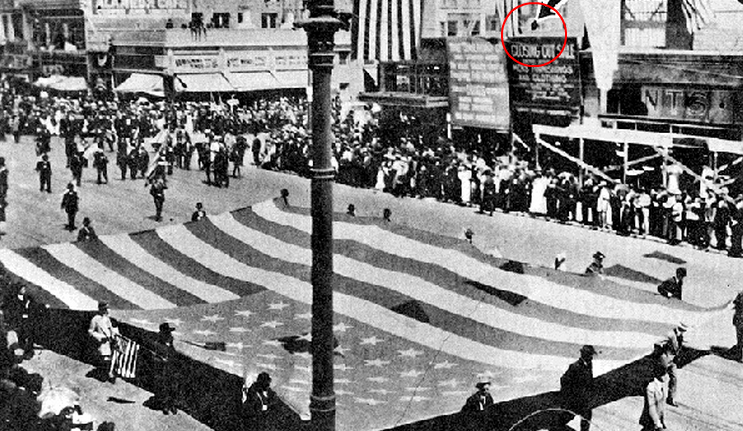
In 1926, evidence came forward of witnesses being rehearsed, bribed, and blackmailed into testifying. One was found to have been a witness only by "astral projection". The "abili clock" photo, deliberately smudged by the prosecution, appeared in detail. Finally in 1939, newly arrived Gov Culbert Olson commuted Mooney's and Billings' sentences (after 5 California governors passed). It had taken 22 years.
Mooney had a symbolic parade along the same route as the Preparedness Day Parade, stopping only to thumb his nose at the Hearst Building, holding the newspaper empire that had strongly pursued his conviction responsible. However only three years later he passed away. Billings survived until 1972, having fallen out with Mooney over the publicity of the latter while the former had suffered the same fate in isolation.
The ultimate culprit of the Preparedness Day Bombing remains unknown. Theories include Galleanist anarchist Mario Buda, a prolific bomber best known for the deadly 1920 Wall Street Bombing, an attack with very similar plans to the Preparedness Day Bombing. Another suspect is Alexander Berkman, editor of socialist newspaper the Blast and previously convicted of attempting to assassinate Henry Fick, and who hurriedly returned to New York City the day after the bombing. Finally there is the possibility of radical Celsten Eklund, who was killed with "Ricca" in 1927 while attempting to set off a bomb in front of the Saints Peter and Paul Catholic Church. Regardless, it appears Mooney and Billings were innocent.
The 1914 clock that provided Mooney's alibi was moved to Vallejo in 1932. There it was taken care of by local jeweler Robert Brown until his death in 2010. It has been neglected since then.
Vallejo, California
The USS Arizona Memorial marks the resting place of 1,102 of the 1,177 sailors killed on the USS Arizona during the Attack on Pearl Harbor on December 7, 1941 by Japanese imperial forces and commemorates the events of that day. The memorial, dedicated on May 30, 1962, and visited by more than one million people annually, is only accessible via U.S. Navy boat boarded from the USS Arizona Memorial Visitor Center, which offers historical information about the attack as well as general visitor services.
The memorial was designed by architect Alfred Preis, who had been detained at Sand Island at the start of the war as an enemy of the country because of his Austrian birth. The 184-foot-long floating memorial spans the mid-portion of the sunken battleship. It has two peaks at each end, connected by a sag in the center--representing the height of American pride before the war, the depth the nation fell to after the attack, and then the ultimate victory. The central room features seven large open windows on either wall and ceiling, to commemorate the day of the attack. The total number of windows is 21, which, although not confirmed by the architect, some believe represents a 21-gun salute. An opening in the center of the floor overlooks the sunken decks of the Arizona. A shrine at the far end consists of a marble wall that bears the names of all entombed on the USS Arizona. Sometimes referred to as "black tears of the Arizona", oil can still be spotted seeping from the wreckage.
The surprise military strike on Pearl Harbor by the Imperial Japanese Navy,designed by admiral Isoroku Yamamamoto, was a culmination of a decade of deteriorating relationships. The pre-emptive measure intended to prevent the U.S. Pacific Fleet from interfering in Japan's grand strategy of conquest in the Western Pacific. Instead, it provoked the previously isolationist United States into full participation in World War II. The base was attacked in two waves by 353 Japanese aircraft, launched from six aircraft carriers. Four U.S. Navy battleships were sunk, and another four were damaged. The Japanese also sank or damaged three cruisers, three destroyers, an anti-aircraft training ship, one minelayer, and 188 U.S. aircraft. In total, 2,402 personnel were killed and 1,282 were wounded. Japanese loses were light with 29 aircraft and five midget submarines lost, and 65 servicemen killed or wounded.
The World War II Valor in the Pacific National Monument, a United States national monument spanning 9 sites in 3 states, honors several aspects of the American engagement in World War II. Six of the sites are located in Hawaii--the USS Arizona Memorial and Visitors Center, the USS Utah Memorial, the USS Oklahoma Memorial, Six Chief Petty Officer Bungalows on Ford Island, and the Mooring Quays F6, F7, and F8, which formed part of Battleship Row. The monument was created on December 5, 2008, through an executive order issued by President George W. Bush under the authority of the Antiquities Act of 1906.
USS Arizona Memorial National Register #66000944 (1966)
Pearl Harbor, U.S. Naval Base National Historic District National Register #66000940 (1966)
This abridgement of Universal's 12-episode serial Buck Rogers stars Buster Crabbe as Dick Calkins' famed comic-strip space adventurer. Buck and Buddy (Jackie Moran) and are recruited to battle against modernistic gangster Killer Kane (Anthony Warde), by Wilma Deering (Constance Moore) and Dr. Huer (C. Montague Shaw). The duo travels to Saturn to get help in their mission, and after Buck and Buddy quell the internal struggles of the Saturnians, Buck triumphs over Killer Kane and his cosmic thugs.
Planet Outlaws Feature link: youtu.be/UD3xKy42KUY
Link to all 12 Serial Episodes:
www.youtube.com/watch?v=iTtc-u3zFGk&feature=share&...
Starring Buster Crabbe, Constance Moore, Jackie Moran, Jack Mulhall, Anthony Warde, C. Montague Shaw, Guy Usher, William Gould, Philson Ahn. Directed by Ford Beebe, Saul A. Goodkind.
Buck Rogers and Buddy Wade are in the middle of a trans-polar dirigible flight when they are caught in a blizzard and crash. Buddy then releases a special gas to keep them in suspended animation until a rescue party can arrive. However, an avalanche covers the craft and the two are in suspended animation for 500 years. When they are found, they awake to find out that the world has been taken over by the outlaw army of Killer Kane. Along with Lieutenant Wilma Deering, Buck and Buddy join in the fight to overthrow Kane and with the help of Prince Tallen of Saturn and his forces, they eventually do and Earth is free of Kane's grip.
This is actually a pretty enjoyable serial, but it seems doomed to be forever overshadowed by the much superior Flash Gordon trilogy. Universal brought BUCK ROGERS out in 1939, in between their own chapterplays FLASH GORDON'S TRIP TO MARS and FLASH GORDON CONQUERS THE UNIVERSE; it also starred Buster Crabbe (but with his natural dark hair instead of Flash's golden curls) and although it is filled with space ships and weird gadgets, BUCK ROGERS lacks most of the elements that gave the Flash serials their intense emotional draw.
For one thing, there is none of the strong sexual charge that the Flash series had. Instead of nubile Dale Arden and sultry Princess Aura both competing for the hero's attention while the villain openly lusted for the heroine, Buck's epic featured Constance Moore as Col. Wilma Deering. Now, Moore is perfectly fine in her role, but she is after all a soldier in the resistance army and not a fair damsel in distress. She has a nice moment when she wrests a ray gun away from a guard and blasts her way out of her cell, but she and Buck seem to be merely chums on the same side.
Also, although BUCK ROGERS has plenty of futuristic gadgets (rayguns and buzzing spaceships which shoot sparks from their backs, teleportation tubes and invisibility rays), there are no grotesque monsters or nonhuman alien races on view. Prisoners have remarkably goofy metal helmets strapped on which turn them into docile zombies, and there are these homely goons called Zuggs moping around, but that's hardly as fascinating as Lion Men and Clay People and horned apes (that Orangapoid critter).
What's ironic about all this is that the comic strip BUCK ROGERS by Philip Nolan and Richard Calkins started in 1929, was immensely popular for many years and it success inspired the creation of Flash. Yet the Flash strip benefitted from the genius of Alex Raymond, one of the all-time great cartoon artists, and it produced stunning visual images (from the samples of Buck's strip I've seen, it was imaginative enough but pretty crude and drab). This contrast carried over to the serials.
Buck Rogers and his sidekick Buddy Wade (Jackie Moran) are pilots who crash in the Arctic in1938 and survive for 500 years because the 'Nirvano' gas they were carrying put them in a state of suspended animation. They both seem to adapt to waking up in the year 2424 pretty well, where I would think most people would be so traumatized it would take a while to adjust. In this dystopic future, the Earth is ruled by a mega-gangster called Killer Kane (another setback; Anthony Warde would be okay as a crimelord but he just doesn't have the imposing presence to convince me this guy can dominate an entire planet).
Luckily, Buck and Buddy have been found by the small resistance movement hopelessly trying to overthrow Kane from their hidden city. Here is Dr Huer (C. Montague Shaw, who I just saw in the UNDERSEA KINGDOM doing the same gig with his wild inventions) and Wilma Deering leading the good fight. For some reason I missed, everyone immediately puts all their trust in Buck and he pretty much takes over. (Maybe he's just one of those charismatic alpha males or something.) Most of the serial involves desperate trips back and forth to Saturn to enlist the aid of the isolationist Saturnians, and this means running the blockade of Kane's ships. The usual fistfights and explosions and captures and escapes normal for this sort of situation ensue. It's a lot of fun if you take it on its own terms, with a strong linear plot and likeable heroes, but it really never kicks into high gear and seems a bit drab.
It's interesting that some (but not all) of the Saturnians are played by Asian actors. Prince Tallen, who gets caught up in most of the fun, was portrayed by a very young Philson Ahn, and I thought for years this was the same guy who in 1972 impressed us as the head of the Shaolin Temple in TV's KUNG FU (he taught all the styles, really amazing if you think about it). Turns out that was Phiip Ahn, Philson's brother.
Dir: Ford Beebe and Saul A. Goodkind - 12 Chapters
BUCK ROGERS (1939): Director Ford Beebe, who also worked on Flash Gordon (1938), came straight from The Phantom Creeps (1939) and then went back to finish Flash Gordon Conquers The Universe (1940). Buck Rogers stars Buster Crabbe or, as his family knew him, Lawrence. Now, Lawrence ‘Larry’ ‘Buster’ Crabbe had previously starred in two Flash Gordon serials, a couple of Tarzan movies and a long string of westerns, so it was only natural for Universal to decide he was perfect as the heroic Buck Rogers, aka that blonde guy who saves the universe but isn’t Flash Gordon. Actually, Buster Crabbe wasn’t the first actor to play Buck Rogers in-the-flesh, so to speak.
That honour goes to an unknown man who played Buck in a Virginia department store, instead of their regular Santa Claus. Santa was off conquering Martians at the time, I think it was an exchange program of sorts. It strikes me that Buck Rogers is not unlike a male fantasy come to life. Just think of it – Buck gets to take a nice five-hundred-year-long sleep-in. With my busy schedule, I’m ecstatic if I can get twenty minutes nap on the weekend. Then, when he wakes up, Buck is the smartest, most dynamic guy around. In reality he’d be treated like something that’s escaped from the zoo. And finally, everyone needs Buck to go on exciting missions, fight the bad guys, test exotic equipment and crash rocket ships – out of the half-dozen flights Buck makes, he only lands successfully once. It’s easy to see the bullet cars used in the movie are the same ones from Flash Gordon’s Trip To Mars (1938), and even the script is rather suspect.
Planet Outlaws
This film is actually a compilation of the Buck Rogers serials that ran originally in 1939. The cliffhanger endings and recap beginnings have been edited out to make it flow better -- with partial success. Some new footage was shot for the introduction and summary. At the opening, there are some newspaper headlines about jets chasing flying discs, and the obligatory checkered V2 launch, etc. to add a modern segue. After that, it's pure 1939.
Sci-fi movie technology had come a long way in the 14 years since Buck's debut. Audiences had grown accustomed to sleek and pointy rockets, flying saucers, strange aliens, etc. The Buck Rogers style world-of-the-future must have looked oddly quaint. (if not laughable) Just why Universal Pictures thought re-releasing Buck Rogers was a good idea is a bit of a mystery. Kids who were 8 or so back in 1939 would be young adults in '53. Perhaps Universal was banking on those young adults would buy tickets for a trip down memory lane.
Plot Synopsis
After a bit of modern ('53) footage about the wonders of modern progress and "flying disks," the old serial begins. Rogers and Buddy crashed in the arctic while on a transpolar flight. They were in suspended animation due to the cold and a vague gas. A patrol finds them in the year 2500 and revives them. In the world of 2500, a despot named Killer Kane is trying to take over the world. The forces of good are holed up in the "hidden city." Buck arranges a decoy maneuver to elude Kane's patrol ships. They fly to the planet Saturn in hopes of finding help. On Saturn, the Council sees Rogers and party as the rebels, and Kane as the rule of law. Rogers et al, escape Saturn, return to earth and seek to disrupt Kane's bamboozling of Prince Tallen, the Saturnian representative. Rogers sneaks into Kane's city, interrupts the treaty signing and convinces Tallen of Kane's evil by revealing Kane's "robot battalion" (slaves wearing mind-control helmets). Rogers and Tallen get to Saturn and the treaty is signed. Rogers escapes Kane's patrols via the Dissolvo Ray which rendered them invisible. Rogers and the war council plan for war. Rogers enlists the Saturnians to help. Meanwhile, Rogers sneaks into Kane's city and de-zombies Minister Krenco to lead an uprising of freed robot-slave-prisoners. Rogers storms Kane's palace and puts one of the robo-slave helmets on Kane. The End
The industrial vision of the future is delightful to watch. The heavily mechanical look of everything is so radically different from the sleek rockets and glowing acrylic audiences were growing accustomed to. The space ships look like they were built at locomotive factories or steamship yards. They spew roman-candle sparks and smoke and buzz as they fly. There are no computers, no radar or electronics. It's a fascinating snapshot of what pre-electronic-age people thought the future would be like.
When originally released in 1939, the Killer Kane character was a thinly disguised allusion to Hitler. In 1953, Kane was intended to represent a communist despot. It wasn't as tidy a fit. The narrator sums it up voicing a hope that scientists will develop the means for men to stand up to today's dictators and make the world safe for democracy. In the early 50s, there's little question of who they meant.
Simple Colors -- One endearing trait of Buck Rogers is the simplicity of the characterizations. The good guys do nothing but good. The bad guys are pure bad. The good guys are crack pilots and sharp shooters and tough as nails. The bad guys do nothing but bad, have trouble hitting a flying barn and are easily knocked out with one punch.
Industrial Baroque -- Somewhat like the baroque era's compulsion to decorate every square inch with swirls and filigree, Industrial Baroque sought to fill every space with heavy-duty hardware. The sets, and especially the rocket interiors are like flying boiler rooms. Valves, pipes, levers, dials, wheels, large flashing light bulbs. To look more "high tech" in the 30s meant cramming in more industrial hardware. Buck Rogers' ships show more affinity for Captain Nemo "steampunk" than the proto-space-age of the 50s.
Family Resemblance -- There is a noticeable similarity in the sets and costumes of Flash Gordon, Buck Rogers. Even serials of the early 50s, like Captain Video and the various Rocketman serials, look more like Flash and Buck than George Pal. The industrial baroque look and costuming are distinctive, making them almost a sub-genre of their own. In that regard, Buck has a timelessness.
Another take on the story and additional background info.
A round-the-world dirigible flight commanded by US Air Force officer Buck Rogers (Buster Crabbe) encounters dangerously stormy weather above the Himalayas; said weather, along with disastrous panic on the part of Rogers’ crewmen, causes the aircraft to crash. The cowardly crewmen ditch the ship and meet quick ends, but Rogers and young Buddy Wade (Jackie Moran), son of the aircraft’s designer, survive the crash. The pair use a cylinder of “Nirvano” gas to place themselves into suspended animation until a rescue party can reach them, but an avalanche buries the ship and all searches prove fruitless; the dirigible and its two dormant inhabitants remain beneath rocks and snow for five hundred years.
Finally, in the year 2440, a spaceship unearths the wreck, and its pilots restore Buck and Buddy to consciousness. The holdovers from the 20th century soon learn that their rescuers are soldiers from the “Hidden City,” a pocket of resistance to the super-criminal who is ruling the 24th-century Earth–one “Killer” Kane (Anthony Warde). Rogers immediately pledges his support to Air Marshal Kragg (William Gould) and Scientist-General Dr. Huer (C. Montague Shaw), the leaders of the Hidden City exiles, and is soon en route to Saturn, hoping to convince that planet’s rulers to aid the Hidden City in freeing the Earth from Kane’s tyranny. To cement the Saturian alliance, Buck must battle Kane’s legions at every step of the way, with able assistance from Buddy and from Dr. Huer’s trusted aide Lieutenant Wilma Deering (Constance Moore).
Ever since its original release, Buck Rogers has stood in the shadow of Universal’s Flash Gordon serials; the studio encouraged such association by casting Flash Gordon star Buster Crabbe as a different sci-fi hero, obviously hoping that the chapterplay would capitalize on the goodwill generated by Flash Gordon and Flash Gordon’s Trip to Mars. The serial did succeed in reminding audiences of the Flash outings–but it reminded them of how much they had liked those serials and forced inevitable comparisons that were not in Rogers’ favor. Universal’s plans for a second Buck Rogers serial were quickly scrapped when the first outing failed to please matinee audiences; the intended Buck sequel was then replaced on the studio’s production schedule by–what else?–a third Flash Gordon chapterplay. Even today, Buck is typically dismissed by fans as a pale echo of the great Gordon serials.
It’s easy to see why Buck Rogers came as a disappointment to audiences expecting an outing in the Flash Gordon tradition. Its production design, while futuristic, is less quirky and more uniform than that of the Gordons; there are no monsters and no weird semi-human races besides the rather uninteresting Zuggs; there are also no supporting characters as developed or as interesting as Dr. Zarkov, Ming, King Vultan, the Clay King, Princess Aura, Prince Barin, and other major figures in the Flash Gordon chapterplays. And yet, taken on its own terms, Buck Rogers is far from a failure; it does not approach the Flash Gordon trilogy in quality, but then few serials do.
Buck Rogers’ script, by former Mascot writers Norman Hall and Ray Trampe, is fast-moving and manages to avoid repetition for most of its length. The trip to Saturn, the attempts to convince Saturnian leader Prince Tallen (Philson Ahn) of the justice of the Hidden City’s cause, the subsequent rescue of Tallen from Kane’s city, the second journey to Saturn to cement the alliance, and the attempts of Kane’s henchman Laska (Henry Brandon) to sabotage it–all these incidents keep the narrative flowing very nicely for the serial’s first eight chapters. As in many of Trampe and Hall’s Mascot scripts, however, the writers seem to run out of plot before the serial’s end. While Chapters Nine and Ten remain interesting (with Buck being converted into a hypnotized robot, Buddy’s rescue of the hero, and an infiltration of the Hidden City by one of Kane’s men), the last two chapters have a definite wheel-spinning feel to them, throwing in a redundant third trip to Saturn and an unneeded flashback sequence.
The last-chapter climax is also something of a disappointment, with Kane being overthrown quickly and undramatically instead of being definitively crushed. Here, Trampe and Hall seem to have been leaving room for the sequel that never came and trying to avoid duplicating the dramatic but very final destruction of MIng which closed the first Flash Gordon serial (and which needed to be explained away in the second). The other weak spot of the scripting is Buck and Buddy’s rather calm reaction when they realize that their old world (and everyone in it) is dead–and their extraordinarily quick adjustment to their new one. One wouldn’t have wanted the writers to dwell on our heroes’ plight (which would be absolutely crushing in real life), but I do wish Trampe or Hall could have given Buck and Buddy a few emotional lines about their displacement before getting on to the main action; Hall in his scripts for other serials (Hawk of the Wilderness, Adventures of Red Ryder), showed himself capable of far more dramatic moments.
As already mentioned, the serial’s visuals are less varied than those of the Flash Gordon serials, but that’s not to say they aren’t impressive by serial standards. Pains seem to have been taken to avoid duplicating too much of Gordon’s “look;” the spaceship miniatures are completely different than the ships in the Gordon trilogy, while Kane’s stronghold–probably the best miniature in the serial–is not the quasi-Gothic palace of Ming but rather an ominous, futuristic-looking version of New York City, complete with towering skyscrapers. The Hidden City’s great rock gates are also nifty, and the massive Saturnian Forum (a life-size set, not a miniature) is very visually impressive. The barren Red Rock Canyon area works well as the Saturnian landscape, but I think it was a mistake to also use the Canyon as the area between the Hidden City and Kane’s capital; Saturn and Earth shouldn’t look so similar.
The only major prop or set reused from the Gordon serials are the “bullet cars” from Flash Gordon’s Trip to Mars; they’re just as fun to watch in action here as in the earlier serial. Other incidental props and sets–Kane’s robot room, his mind-control helmets, the various televiewing devices, the anti-gravity belts, Dr. Huer’s invisibility ray, and the Star-Trek-like molecular transportation chamber–add further colorful touches to the serial., and are respectably represented by Universal’s always above-average array of sets and props. The Zuggs, the “primitive race” ruled by the Saturnians, are somewhat disappointing, however; while suitably grotesque-looking, they’re nowhere near as menacing or memorable–in appearance or demeanor–as their obvious inspiration, the Clay People in Flash Gordon’s Trip to Mars.
The serial’s action scenes are brisk and energetic, suffering not at all from a general lack of fistfights–thanks to the swift-moving direction of Ford Beebe (a Mascot veteran like writers Trampe and Hall) and his co-director Saul Goodkind (usually an editor). The few hand-to-hand tussles–most of them on the rocky hills of Saturn–are executed routinely but skillfully by Dave Sharpe, Tom Steele, Eddie Parker, and other stuntmen; the best of the bunch is the fight between Buck and a Kane man in the control room of the Hidden City, although this is more exciting for the suspenseful situation (Buck trying to close the gates that the henchman has opened to Kane’s oncoming armada) than for any particular flair in the staging.
Most of the action sequences consist of protracted chases and pursuits (both on foot and in rocketships), with occasional quick combats thrown in. Many of these lengthy chases are very exciting–particularly the long incursion into Kane’s city that occupies most of Chapters Three and Four, a great combination of action and suspense. Buddy’s later stealthy visit into Kane’s fortress to rescue Buck from the robot room, and the following escape, is also good, as are Buck’s skillful and repeated elusions of the rebellious Zuggs in Chapter Eight and the bullet car getaway in Chapter Six.
The cliffhanger endings are generally well-staged, with proper build-ups, but too many of them involve spaceship crashes that our heroes rather implausibly live through. The impressive collapsing forum at the end of Chapter Eleven and the bullet car crash at the end of Chapter Six provide nice variety amid the spaceship wrecks, but (alas) are also resolved by mere survival. Still, this is preferable to the blatantly cheating resolution of what is otherwise one the best chapter endings–Killer Kane’s pursuit of Buddy in a darkened council chamber and his apparently lethal zapping of the young hero. At least the resolution features a good stunt bit by Dave Sharpe.
The leading performances in Buck Rogers are all excellent (although most other critics would make a single exception; see below). Buster Crabbe, as always, makes a perfect serial hero–both genially cheerful and grimly serious, unassumingly polite and aggressively tough. As in the Flash Gordon trilogy, his down-to-earth attitude also helps to make the wild sci-fi happenings seem perfectly normal.
Jackie Moran (oddly “reduced” to serial acting only a year after playing Huck Finn in David O. Selznick’s big-budget classic Adventures of Tom Sawyer) does a fine job as Buddy Wade, handling his character’s frequent “golly, gee-whiz” lines in a low-key fashion that keeps Buddy from coming off as too naïve; his chipper but calm demeanor complements Crabbe’s well, and he has no problems carrying an entire chapter and part of another on his own.
Constance Moore, despite being saddled with perhaps the most unflattering costume ever worn by a serial leading lady (basically coveralls and a bathing cap), manages to come off as charming. Her Wilma Deering is self-possessed and capable-seeming but never too coldly efficient; she remains warmly likable even when piloting spaceships or explaining technology to Crabbe.
Henry Brandon is very good as Killer Kane’s chief henchman Captain Laska–suave and sly when acting as Kane’s ambassador to Saturn, haughtily arrogant when threatening people, and nervously jittery in the presence of his overbearing leader. Hard-bitten tough guys Wheeler Oakman and Reed Howes, along with the slicker Carleton Young , form Brandon’s backup squad.
As Killer Kane himself, perennial henchman actor Anthony Warde has been almost universally panned by critics as “miscast.” I have to dissent strongly, however; Warde does a fine job in the part and plays Kane with a memorable combination of viciousness and uncontrollable anger. The character is not a diabolical schemer like Ming, but rather a super-gangster who’s blasted and bullied his way to the top–and Warde’s bad-tempered, aggressive, and thuggish screen personality fits the part perfectly. He veers between intimidating ranting and harshly sinister sarcasm–as when he describes himself as a “kindly ruler” just after wrathfully sending a formerly trusted councilor to the robot room–but is quite menacing in both aspects.
Philson Ahn, brother of frequent serial and feature actor Phillip Ahn, does a good job as Prince Tallen of Saturn; he possesses his sibling’s deep and distinctive voice, which serves him well as a planetary dignitary. His manner also has a slightly tougher edge to it than his refined brother’s, which helps to keep the viewer in uncertainty in the earlier chapters as to whether Tallen will turn out to be friend or foe. Guy Usher plays Aldar, the head of Saturn’s ”Council of the Wise,” and does his best to seem suitably imposing and dignified, despite the almost comical way in which the “Wise” continually change their opinions–backing Kane, opposing him, giving into his demands, defying him, etc. Cyril Delevanti is enjoyable as a grumpy subordinate member of the Council.*
C. Montague Shaw has limited screen time, but is very good as Dr. Huer, balancing statesmanlike dignity with shrewdness and a touch of enjoyable scientific eccentricity (the last is particularly noticeable during his demonstration of his invisibility gas in Chapter Five). Energetic Jack Mulhall is typically affable and enthusiastic as Captain Rankin of the Hidden City, while Kenne Duncan has a rare good guy role as Mulhall’s fellow-officer Lieutenant Lacy. Perennial screen “underworld rat” John Harmon also plays against type as a Hidden City soldier, as does Stanley Price as a Hidden City pilot rescued from existence as a human robot. The dignified but stolid William Gould is good enough as Air Marshal Kragg, but I would have preferred a more dynamic actor in the role–Kragg is, after all, the top military leader of Kane’s enemies. Mulhall could have handled it well, as could Wade Boteler–who does an excellent job as the grim and concerned Professor Morgan in the first chapter, intensely instructing Buddy and Buck in the use of the Nirvano gas.
Lane Chandler also appears in the first chapter, as a military officer who demonstrates the Nirvano gas to a reporter played by another old pro, Kenneth Harlan. An unusually subdued Theodore Lorch is one of Kane’s councilors, while Karl Hackett has a good part as another councilor who gets into an argument with Kane that leads to Hackett’s being converted into a human robot (his terrified pleas as he’s dragged out of the council chamber are quite chilling). Al Bridge has some memorably sinister lines (“when this helmet is in place, you’ll never think or speak again”) in his periodic scenes as the slave-master of Kane’s human robots.
Unusually for Universal, several bit roles are filled by stuntmen; Eddie Parker and Tom Steele pop in as various soldiers and officers, but aren’t as noticeable as Dave Sharpe, who’s given multiple speaking roles as a Kane soldier, a Hidden City soldier, a Saturnian officer, and a Saturnian soldier. His ubiquity can get a little distracting at times, particularly since some of his appearances follow right on the previous one’s heels; he also seems to have a bit of trouble with the formal-sounding Saturnian dialogue, coming off as much more stiff and affected than in his co-starring turn in Daredevils of the Red Circle.
The serial’s music score, like most other Universals of the period, is an eclectic but usually effective array of stock music, some of it cues from the Flash Gordon serials but the majority of it culled from Universal’s horror features, including (most notably) Franz Waxman’s score for Bride of Frankenstein, which furnishes some memorable opening-titles music.
All in all, though Buck Rogers has its share of flaws, it also has more than enough virtues (the acting, the fast pace, the interesting sci-fi trappings) to make it a good chapterplay. Despite its similar themes, it shouldn’t be pitted against the Flash Gordon trilogy–a match it’s bound to lose–but rather judged against the field of competition in general. When judged in this fashion, it’s just as entertaining–and often more entertaining–than many serials with less shabby reputations.
*One has to wonder, though, why some Saturnians are Orientals like Ahn and others Occidentals like Usher and Delevanti; my own theory is that men from various countries emigrated from Earth to Saturn sometime before the bulk of the serial took place; this would explain the racial assortment and also explain why the Hidden City chooses Saturn in particular as an ally (as usual, I’m probably putting too much thought into this).
It's nice when you can tie so different things like Judaism and Coca-Cola. Recently the Jerusalem Post published an article on 40years of the death of the Rabi that kasherized the Coca-Cola but lacked the most important information, the date. It happened in 1935. This was the same period when the arianized Coca-Cola company in Germany continued the business with the Nazis like so many other American companies. Coca-Cola was the main sponsor of 1936 Berlin Olimpics and all the pics with the mark at streets and stadiums are banned or stucked into Coca-Cola Archive not available to the public.
In some days I will publish a complete and illustrated article on that period. But it's interesting to notice the duality of isolationist politics of US at the 1930's. In Americas Coca Kosher and in Germany sponsoring the regime that openly harassed and prosecuted the Jews.
This is a unique ad, published by The Canadian Jewish Chronicle on it's pre-Passover edition. Read Carefully. There is a lot of information on it.
The USS Arizona Memorial marks the resting place of 1,102 of the 1,177 sailors killed on the USS Arizona during the Attack on Pearl Harbor on December 7, 1941 by Japanese imperial forces and commemorates the events of that day. The memorial, dedicated on May 30, 1962, and visited by more than one million people annually, is only accessible via U.S. Navy boat boarded from the USS Arizona Memorial Visitor Center, which offers historical information about the attack as well as general visitor services.
The memorial was designed by architect Alfred Preis, who had been detained at Sand Island at the start of the war as an enemy of the country because of his Austrian birth. The 184-foot-long floating memorial spans the mid-portion of the sunken battleship. It has two peaks at each end, connected by a sag in the center--representing the height of American pride before the war, the depth the nation fell to after the attack, and then the ultimate victory. The central room features seven large open windows on either wall and ceiling, to commemorate the day of the attack. The total number of windows is 21, which, although not confirmed by the architect, some believe represents a 21-gun salute. An opening in the center of the floor overlooks the sunken decks of the Arizona. A shrine at the far end consists of a marble wall that bears the names of all entombed on the USS Arizona. Sometimes referred to as "black tears of the Arizona", oil can still be spotted seeping from the wreckage.
The surprise military strike on Pearl Harbor by the Imperial Japanese Navy,designed by admiral Isoroku Yamamamoto, was a culmination of a decade of deteriorating relationships. The pre-emptive measure intended to prevent the U.S. Pacific Fleet from interfering in Japan's grand strategy of conquest in the Western Pacific. Instead, it provoked the previously isolationist United States into full participation in World War II. The base was attacked in two waves by 353 Japanese aircraft, launched from six aircraft carriers. Four U.S. Navy battleships were sunk, and another four were damaged. The Japanese also sank or damaged three cruisers, three destroyers, an anti-aircraft training ship, one minelayer, and 188 U.S. aircraft. In total, 2,402 personnel were killed and 1,282 were wounded. Japanese loses were light with 29 aircraft and five midget submarines lost, and 65 servicemen killed or wounded.
The World War II Valor in the Pacific National Monument, a United States national monument spanning 9 sites in 3 states, honors several aspects of the American engagement in World War II. Six of the sites are located in Hawaii--the USS Arizona Memorial and Visitors Center, the USS Utah Memorial, the USS Oklahoma Memorial, Six Chief Petty Officer Bungalows on Ford Island, and the Mooring Quays F6, F7, and F8, which formed part of Battleship Row. The monument was created on December 5, 2008, through an executive order issued by President George W. Bush under the authority of the Antiquities Act of 1906.
USS Arizona Memorial National Register #66000944 (1966)
Pearl Harbor, U.S. Naval Base National Historic District National Register #66000940 (1966)
Their hotly anticipated second debut hour. A sordid soiree full of wild, dark and ridiculous sketches, characters and songs woven within a narrative of underlying aggression between Norris & Parker themselves.
Photographs by Shay Rowan taken at the King's Arms, Salford, during Greater Manchester Fringe.
‘The bizarre isolationists, the power crazed, the sublimated, the sexually confused and more…’ ***** (Skinny).
'A truly formidable double act' ***** (TheReviewsHub.com).
‘Surreal, fun and frankly pretty ridiculous’ **** (WhatsOnStage.com).
'Quite simply, if you don’t spend most of the show raucously belly-laughing, you’re probably dead.' ***** (BroadwayBaby.com).
‘Topical, political, sexual and nonsensical.’ ***** (Tusk).
STORMING IT AT EDINBURGH FRINGE 2016...
FOUR AND A HALF STARS FROM SHORTCOM
www.shortcom.co.uk/comedy/comedy-reviews/norris-and-parke...
FOUR STARS FROM THE LIST edinburghfestival.list.co.uk/article/83064-norris-and-par...
FIVE STARS FROM ARTS AWARD VOICE www.artsawardvoice.com/magazine/reviews/norris-and-parker...
FOUR STARS FROM DEFINE ARTS www.definearts.co.uk/reviews/see-you-gallows-norris-parker
4 STARS FROM THE TELEGRAPH www.telegraph.co.uk/comedy/what-to-see/best-and-funniest-...
ON THE MIC AT BROADWAY BABY www.broadwaybaby.com/news/on-the-mic-edinburgh-podcast-no...
The bow of the USS Arizona is marked by a buoy. The USS Missouri stands off in the distance.
The USS Arizona Memorial marks the resting place of 1,102 of the 1,177 sailors killed on the USS Arizona during the Attack on Pearl Harbor on December 7, 1941 by Japanese imperial forces and commemorates the events of that day. The memorial, dedicated on May 30, 1962, and visited by more than one million people annually, is only accessible via U.S. Navy boat boarded from the USS Arizona Memorial Visitor Center, which offers historical information about the attack as well as general visitor services.
The surprise military strike on Pearl Harbor by the Imperial Japanese Navy,designed by admiral Isoroku Yamamamoto, was a culmination of a decade of deteriorating relationships. The pre-emptive measure intended to prevent the U.S. Pacific Fleet from interfering in Japan's grand strategy of conquest in the Western Pacific. Instead, it provoked the previously isolationist United States into full participation in World War II. The base was attacked in two waves by 353 Japanese aircraft, launched from six aircraft carriers. Four U.S. Navy battleships were sunk, and another four were damaged. The Japanese also sank or damaged three cruisers, three destroyers, an anti-aircraft training ship, one minelayer, and 188 U.S. aircraft. In total, 2,402 personnel were killed and 1,282 were wounded. Japanese loses were light with 29 aircraft and five midget submarines lost, and 65 servicemen killed or wounded.
The World War II Valor in the Pacific National Monument, a United States national monument spanning 9 sites in 3 states, honors several aspects of the American engagement in World War II. Six of the sites are located in Hawaii--the USS Arizona Memorial and Visitors Center, the USS Utah Memorial, the USS Oklahoma Memorial, Six Chief Petty Officer Bungalows on Ford Island, and the Mooring Quays F6, F7, and F8, which formed part of Battleship Row. The monument was created on December 5, 2008, through an executive order issued by President George W. Bush under the authority of the Antiquities Act of 1906.
USS Arizona Wreck National Register #89001083 (1989)
Pearl Harbor, U.S. Naval Base National Historic District National Register #66000940 (1966)
The USS Arizona Memorial marks the resting place of 1,102 of the 1,177 sailors killed on the USS Arizona during the Attack on Pearl Harbor on December 7, 1941 by Japanese imperial forces and commemorates the events of that day. The memorial, dedicated on May 30, 1962, and visited by more than one million people annually, is only accessible via U.S. Navy boat boarded from the USS Arizona Memorial Visitor Center, which offers historical information about the attack as well as general visitor services.
The memorial was designed by architect Alfred Preis, who had been detained at Sand Island at the start of the war as an enemy of the country because of his Austrian birth. The 184-foot-long floating memorial spans the mid-portion of the sunken battleship. It has two peaks at each end, connected by a sag in the center--representing the height of American pride before the war, the depth the nation fell to after the attack, and then the ultimate victory. The central room features seven large open windows on either wall and ceiling, to commemorate the day of the attack. The total number of windows is 21, which, although not confirmed by the architect, some believe represents a 21-gun salute. An opening in the center of the floor overlooks the sunken decks of the Arizona. A shrine at the far end consists of a marble wall that bears the names of all entombed on the USS Arizona. Sometimes referred to as "black tears of the Arizona", oil can still be spotted seeping from the wreckage.
The surprise military strike on Pearl Harbor by the Imperial Japanese Navy,designed by admiral Isoroku Yamamamoto, was a culmination of a decade of deteriorating relationships. The pre-emptive measure intended to prevent the U.S. Pacific Fleet from interfering in Japan's grand strategy of conquest in the Western Pacific. Instead, it provoked the previously isolationist United States into full participation in World War II. The base was attacked in two waves by 353 Japanese aircraft, launched from six aircraft carriers. Four U.S. Navy battleships were sunk, and another four were damaged. The Japanese also sank or damaged three cruisers, three destroyers, an anti-aircraft training ship, one minelayer, and 188 U.S. aircraft. In total, 2,402 personnel were killed and 1,282 were wounded. Japanese loses were light with 29 aircraft and five midget submarines lost, and 65 servicemen killed or wounded.
The World War II Valor in the Pacific National Monument, a United States national monument spanning 9 sites in 3 states, honors several aspects of the American engagement in World War II. Six of the sites are located in Hawaii--the USS Arizona Memorial and Visitors Center, the USS Utah Memorial, the USS Oklahoma Memorial, Six Chief Petty Officer Bungalows on Ford Island, and the Mooring Quays F6, F7, and F8, which formed part of Battleship Row. The monument was created on December 5, 2008, through an executive order issued by President George W. Bush under the authority of the Antiquities Act of 1906.
USS Arizona Memorial National Register #66000944 (1966)
Pearl Harbor, U.S. Naval Base National Historic District National Register #66000940 (1966)
BENTONVILLE, Ark
Former Arkansas Gov Asa Hutchinson formally launched his Republican presidential campaign Wednesday, pledging to “bring out the best of America” and aiming to draw contrasts with other GOP hopefuls on top issues, including how best to reform federal law enforcement agencies.
Hutchinson kicked off his 2024 bid in his hometown of Bentonville, on the same steps where he launched an unsuccessful U.S. Senate campaign 30 years ago.
“I ran as a conservative Republican when being a Republican was like having a career-ending handicap,” Hutchinson said, adding, “And now, I bring that same vigor to fight another battle, and that battle is for the future of our country and the soul of our party.”
The stalwart conservative, who announced in a television interview earlier this month that he intended to run, has been a rare figure among announced or expected GOP presidential hopefuls in his willingness to criticize former President Donald Trump, calling for him to drop out of the 2024 race instead of seeking another White House term.
And while Trump has fixated his campaign message around his false claims about the 2020 election he lost, Hutchinson has said voters need a candidate who is not focused on the past.
While some of the other contenders who served in Trump’s administration struggled to carve out distance from Trump, Hutchinson has been able to draw from his lengthy resume in government and roots in America’s heartland. Without mentioning Trump by name Wednesday, Hutchinson offered a contrast to the former president's derision of federal law enforcement by emphasizing his own background, with previous service as head of the Drug Enforcement Administration and former undersecretary of the Department of Homeland Security.
“There are a few misguided leaders who say we should defund law enforcement, we should defund the FBI. I am here today in support of our law enforcement heroes,” Hutchinson said.
He went on to say, “We should not defund the FBI, but we do need serious reform to refocus the core functions of our federal law enforcement.” He said the FBI needs to be “trimmed down and focused on its No. 1 duty: leading our counterterrorism mission.”
Hutchinson, also a former U.S. attorney and congressman, launched his bid a day after President Joe Biden formally announced his reelection campaign. Hutchinson has argued that neither Biden nor Trump is focused on the future.
“I am confident we will even survive through the destructive policies of the Biden administration, but the time for change is now,” said Hutchinson. “It is time to bring out the best of America.”
On Wednesday, Hutchinson also offered a contrast to the isolationist approach some other Republicans have taken about Russia’s invasion of Ukraine, saying he agreed “with those who say we do not want an unending war in Ukraine, and the best way to avoid a long war is to help Ukraine win today.”
Former U.N. Ambassador Nikki Haley, entrepreneur and “Woke, Inc.” author Vivek Ramaswamy and radio host Larry Elder are also in the Republican race. They, along with expected and potential candidates like Florida Gov Ron DeSantis, former Vice President Mike Pence and U.S. Sen. Tim Scott of South Carolina, have largely avoided criticizing Trump and have at times defended him.
Hutchinson's announcement took place in the tree-lined town square of Bentonville, the birthplace of Walmart. The city of nearly 57,000 people in the northwest part of the state is where Hutchinson first served as a city attorney starting in 1977 and where he first ran for office with an unsuccessful bid for local prosecutor.
Hutchinson’s second gubernatorial term ended in January, but he’s been a defining figure of Arkansas politics for more than four decades. His successor is Trump’s former press secretary, Sarah Huckabee Sanders.
Elected to the U.S. House in 1996, Hutchinson won a seat his older brother, Tim, had held for two terms. Serving as one of the House managers prosecuting the impeachment case against President Bill Clinton starting in 1998, Asa Hutchinson stayed in the House until 2001, when he resigned to serve in the Bush administration.
After the 2012 shooting at Sandy Hook Elementary School in Newtown, Connecticut, the National Rifle Association selected Hutchinson to lead a task force to study school safety and recommended putting armed guards at every school in the country.
Elected governor in 2014, Hutchinson signed a series of income tax cuts and restrictions on abortion, including an outright ban on the procedure that became effective when the U.S. Supreme Court overturned Roe v. Wade in 2022. Hutchinson later said he wished that the measure had included exceptions for pregnancies resulting from rape or incest, but didn't push for lawmakers to add those exemptions after the court ruling.
On Wednesday, Hutchinson steered clear of culture war issues otherwise dominant in some sectors of GOP politics, focusing on his overall commitment to safeguarding America as “democracy's lighthouse.”
Hutchinson supported many of Trump’s policies but began to break with him over his lies about the 2020 presidential election. He has also criticized Trump for the 2020 peace deal he negotiated with the Taliban and for high government spending in his administration, calling Trump "one of the reasons that we added to our national debt and our deficit.”
Randy Zook, the head of the Arkansas Chamber of Commerce, attended Wednesday's launch and said Hutchinson found a way to “thread the needle” as governor even as the state moved further to the right. Zook cited as an example Hutchinson's decision to support keeping the state's Medicaid expansion, but with changes such as a work requirement that was blocked by a federal judge.
“I think there's a lane for him,” Zook said. “The country is looking for a reasonable and sensible and positive conservative. Asa fits that bill.”
Hutchinson has also shown a willingness to criticize some of his other rivals, telling The Associated Press he disagrees with the way DeSantis has sparred with Disney after the company opposed legislation DeSantis signed in Florida barring school instruction on sexual orientation and gender identity.
“It seems very Trumpian to me as to how he's approached it,” Hutchinson said. “I don't think government ought to be punishing the private sector because we don't like what they say.”
Kathy Travis, a retired schoolteacher from Bentonville who attended Hutchinson's launch, said she voted for Biden in 2020 but was leaning toward supporting the former governor. Travis, who wore a shirt that said “#AnyoneButTrump,” said she was pleased with Hutchinson's handling as governor of the COVID-19 pandemic.
“He's just a regular guy who's made his way in politics and maintained his values,” Travis said.
The bow of the USS Arizona is marked by a buoy. The USS Missouri stands off in the distance.
The USS Arizona Memorial marks the resting place of 1,102 of the 1,177 sailors killed on the USS Arizona during the Attack on Pearl Harbor on December 7, 1941 by Japanese imperial forces and commemorates the events of that day. The memorial, dedicated on May 30, 1962, and visited by more than one million people annually, is only accessible via U.S. Navy boat boarded from the USS Arizona Memorial Visitor Center, which offers historical information about the attack as well as general visitor services.
The surprise military strike on Pearl Harbor by the Imperial Japanese Navy,designed by admiral Isoroku Yamamamoto, was a culmination of a decade of deteriorating relationships. The pre-emptive measure intended to prevent the U.S. Pacific Fleet from interfering in Japan's grand strategy of conquest in the Western Pacific. Instead, it provoked the previously isolationist United States into full participation in World War II. The base was attacked in two waves by 353 Japanese aircraft, launched from six aircraft carriers. Four U.S. Navy battleships were sunk, and another four were damaged. The Japanese also sank or damaged three cruisers, three destroyers, an anti-aircraft training ship, one minelayer, and 188 U.S. aircraft. In total, 2,402 personnel were killed and 1,282 were wounded. Japanese loses were light with 29 aircraft and five midget submarines lost, and 65 servicemen killed or wounded.
The World War II Valor in the Pacific National Monument, a United States national monument spanning 9 sites in 3 states, honors several aspects of the American engagement in World War II. Six of the sites are located in Hawaii--the USS Arizona Memorial and Visitors Center, the USS Utah Memorial, the USS Oklahoma Memorial, Six Chief Petty Officer Bungalows on Ford Island, and the Mooring Quays F6, F7, and F8, which formed part of Battleship Row. The monument was created on December 5, 2008, through an executive order issued by President George W. Bush under the authority of the Antiquities Act of 1906.
USS Arizona Wreck National Register #89001083 (1989)
Pearl Harbor, U.S. Naval Base National Historic District National Register #66000940 (1966)
Zürich (/ˈzjʊərɪk/ ZURE-ik, German: [ˈtsyːrɪç;) is the largest city in Switzerland and the capital of the canton of Zürich. It is located in north-central Switzerland, at the northwestern tip of Lake Zürich. As of January 2023 the municipality had 443,037 inhabitants, the urban area 1.315 million (2009), and the Zürich metropolitan area 1.83 million (2011). Zürich is a hub for railways, roads, and air traffic. Both Zurich Airport and Zürich's main railway station are the largest and busiest in the country.
Permanently settled for over 2,000 years, Zürich was founded by the Romans, who called it Turicum. However, early settlements have been found dating back more than 6,400 years (although this only indicates human presence in the area and not the presence of a town that early). During the Middle Ages, Zürich gained the independent and privileged status of imperial immediacy and, in 1519, became a primary centre of the Protestant Reformation in Europe under the leadership of Huldrych Zwingli.
The official language of Zürich is German,[a] but the main spoken language is Zürich German, the local variant of the Alemannic Swiss German dialect.
Many museums and art galleries can be found in the city, including the Swiss National Museum and Kunsthaus. Schauspielhaus Zürich is generally considered to be one of the most important theatres in the German-speaking world.
As one of Switzerland's primary financial centres, Zürich is home to many financial institutions and banking companies.
History
Early history
Settlements of the Neolithic and Bronze Age were found around Lake Zürich. Traces of pre-Roman Celtic, La Tène settlements were discovered near the Lindenhof, a morainic hill dominating the SE - NW waterway constituted by Lake Zurich and the river Limmat. In Roman times, during the conquest of the alpine region in 15 BC, the Romans built a castellum on the Lindenhof. Later here was erected Turicum (a toponym of clear Celtic origin), a tax-collecting point for goods trafficked on the Limmat, which constituted part of the border between Gallia Belgica (from AD 90 Germania Superior) and Raetia: this customs point developed later into a vicus. After Emperor Constantine's reforms in AD 318, the border between Gaul and Italy (two of the four praetorian prefectures of the Roman Empire) was located east of Turicum, crossing the river Linth between Lake Walen and Lake Zürich, where a castle and garrison looked over Turicum's safety. The earliest written record of the town dates from the 2nd century, with a tombstone referring to it as the Statio Turicensis Quadragesima Galliarum ("Zürich post for collecting the 2.5% value tax of the Galliae"), discovered at the Lindenhof.
In the 5th century, the Germanic Alemanni tribe settled in the Swiss Plateau. The Roman castle remained standing until the 7th century. A Carolingian castle, built on the site of the Roman castle by the grandson of Charlemagne, Louis the German, is mentioned in 835 (in Castro Turicino iuxta fluvium Lindemaci). Louis also founded the Fraumünster abbey in 853 for his daughter Hildegard. He endowed the Benedictine convent with the lands of Zürich, Uri, and the Albis forest, and granted the convent immunity, placing it under his direct authority. In 1045, King Henry III granted the convent the right to hold markets, collect tolls, and mint coins, and thus effectively made the abbess the ruler of the city.
Zürich gained Imperial immediacy (Reichsunmittelbar, becoming an Imperial free city) in 1218 with the extinction of the main line of the Zähringer family and attained a status comparable to statehood. During the 1230s, a city wall was built, enclosing 38 hectares, when the earliest stone houses on the Rennweg were built as well. The Carolingian castle was used as a quarry, as it had started to fall into ruin.
Emperor Frederick II promoted the abbess of the Fraumünster to the rank of a duchess in 1234. The abbess nominated the mayor, and she frequently delegated the minting of coins to citizens of the city. The political power of the convent slowly waned in the 14th century, beginning with the establishment of the Zunftordnung (guild laws) in 1336 by Rudolf Brun, who also became the first independent mayor, i.e. not nominated by the abbess.
An important event in the early 14th century was the completion of the Manesse Codex, a key source of medieval German poetry. The famous illuminated manuscript – described as "the most beautifully illumined German manuscript in centuries;" – was commissioned by the Manesse family of Zürich, copied and illustrated in the city at some time between 1304 and 1340. Producing such a work was a highly expensive prestige project, requiring several years of work by highly skilled scribes and miniature painters, and it testifies to the increasing wealth and pride of Zürich citizens in this period. The work contains 6 songs by Süsskind von Trimberg, who may have been a Jew, since the work itself contains reflections on medieval Jewish life, though little is known about him.
The first mention of Jews in Zürich was in 1273. Sources show that there was a synagogue in Zürich in the 13th century, implying the existence of a Jewish community. With the rise of the Black Death in 1349, Zürich, like most other Swiss cities, responded by persecuting and burning the local Jews, marking the end of the first Jewish community there. The second Jewish community of Zürich formed towards the end of the 14th century, was short-lived, and Jews were expulsed and banned from the city from 1423 until the 19th century.
Archaeological findings
A woman who died in about 200 BC was found buried in a carved tree trunk during a construction project at the Kern school complex in March 2017 in Aussersihl. Archaeologists revealed that she was approximately 40 years old when she died and likely carried out little physical labor when she was alive. A sheepskin coat, a belt chain, a fancy wool dress, a scarf, and a pendant made of glass and amber beads were also discovered with the woman.
Old Swiss Confederacy
On 1 May 1351, the citizens of Zürich had to swear allegiance before representatives of the cantons of Lucerne, Schwyz, Uri and Unterwalden, the other members of the Swiss Confederacy. Thus, Zürich became the fifth member of the Confederacy, which was at that time a loose confederation of de facto independent states. Zürich was the presiding canton of the Diet from 1468 to 1519. This authority was the executive council and lawmaking body of the confederacy, from the Middle Ages until the establishment of the Swiss federal state in 1848. Zürich was temporarily expelled from the confederacy in 1440 due to a war with the other member states over the territory of Toggenburg (the Old Zürich War). Neither side had attained significant victory when peace was agreed upon in 1446, and Zürich was readmitted to the confederation in 1450.
Zwingli started the Swiss Reformation at the time when he was the main preacher at the Grossmünster in 1519. The Zürich Bible was printed by Christoph Froschauer in 1531. The Reformation resulted in major changes in state matters and civil life in Zürich, spreading also to several other cantons. Several cantons remained Catholic and became the basis of serious conflicts that eventually led to the outbreak of the Wars of Kappel.
During the 16th and 17th centuries, the Council of Zürich adopted an isolationist attitude, resulting in a second ring of imposing fortifications built in 1624. The Thirty Years' War which raged across Europe motivated the city to build these walls. The fortifications required a lot of resources, which were taken from subject territories without reaching any agreement. The following revolts were crushed brutally. In 1648, Zürich proclaimed itself a republic, shedding its former status of a free imperial city. In this time the political system of Zürich was an oligarchy (Patriziat): the dominant families of the city were the following ones: Bonstetten, Brun, Bürkli, Escher vom Glas, Escher vom Luchs, Hirzel, Jori (or von Jori), Kilchsperger, Landenberg, Manesse, Meiss, Meyer von Knonau, Mülner, von Orelli.
The Helvetic Revolution of 1798 saw the fall of the Ancien Régime. Zürich lost control of the land and its economic privileges, and the city and the canton separated their possessions between 1803 and 1805. In 1839, the city had to yield to the demands of its urban subjects, following the Züriputsch of 6 September. Most of the ramparts built in the 17th century were torn down, without ever having been besieged, to allay rural concerns over the city's hegemony. The Treaty of Zürich between Austria, France, and Sardinia was signed in 1859.
Modern history
Zürich was the Federal capital for 1839–40, and consequently, the victory of the Conservative party there in 1839 caused a great stir throughout Switzerland. But when in 1845 the Radicals regained power at Zürich, which was again the Federal capital for 1845–46, Zürich took the lead in opposing the Sonderbund cantons. Following the Sonderbund War and the formation of the Swiss Federal State, Zürich voted in favor of the Federal constitutions of 1848 and 1874. The enormous immigration from the country districts into the town from the 1830s onwards created an industrial class which, though "settled" in the town, did not possess the privileges of burghership, and consequently had no share in the municipal government. First of all in 1860 the town schools, hitherto open to "settlers" only on paying high fees, were made accessible to all, next in 1875 ten years' residence ipso facto conferred the right of burghership, and in 1893 the eleven outlying districts were incorporated within the town proper.
When Jews began to settle in Zürich following their equality in 1862, the Israelitische Cultusgemeinde Zürich was founded.
Extensive developments took place during the 19th century. From 1847, the Spanisch-Brötli-Bahn, the first railway on Swiss territory, connected Zürich with Baden, putting the Zürich Hauptbahnhof at the origin of the Swiss rail network. The present building of the Hauptbahnhof (the main railway station) dates to 1871. Zürich's Bahnhofstrasse (Station Street) was laid out in 1867, and the Zürich Stock Exchange was founded in 1877. Industrialisation led to migration into the cities and to rapid population growth, particularly in the suburbs of Zürich.
The Quaianlagen are an important milestone in the development of the modern city of Zürich, as the construction of the new lakefront transformed Zürich from a small medieval town on the rivers Limmat and Sihl to a modern city on the Zürichsee shore, under the guidance of the city engineer Arnold Bürkli.
In 1893, the twelve outlying districts were incorporated into Zürich, including Aussersihl, the workman's quarter on the left bank of the Sihl, and additional land was reclaimed from Lake Zürich.
In 1934, eight additional districts in the north and west of Zürich were incorporated.
Zürich was accidentally bombed during World War II. As persecuted Jews sought refuge in Switzerland, the SIG (Schweizerischer Israelitischer Gemeindebund, Israelite Community of Switzerland) raised financial resources. The Central Committee for Refugee Aid, created in 1933, was located in Zürich.
The canton of Zürich did not recognize the Jewish religious communities as legal entities (and therefore as equal to national churches) until 2005.
Geography
Zürich is situated at 408 m (1,339 ft) above sea level on the lower (northern) end of Lake Zürich (Zürichsee) about 30 km (19 mi) north of the Alps, nestling between the wooded hills on the west and east side. The Old Town stretches on both sides of the Limmat, which flows from the lake, running northwards at first and then gradually turning into a curve to the west. The geographic (and historic) centre of the city is the Lindenhof, a small natural hill on the west bank of the Limmat, about 700 m (2,300 ft) north of where the river issues from Lake Zürich. Today the incorporated city stretches somewhat beyond the natural confines of the hills and includes some districts to the northeast in the Glatt Valley (Glattal) and to the north in the Limmat Valley (Limmattal). The boundaries of the older city are easy to recognize by the Schanzengraben canal. This artificial watercourse has been used for the construction of the third fortress in the 17th and 18th centuries.
Quality of living
Zürich often performs very well in international rankings, some of which are mentioned below:
Monocle's 2012 "Quality of Life Survey" ranked Zürich first on a list of the top 25 cities in the world "to make a base within". In 2019 Zürich was ranked among the ten most liveable cities in the world by Mercer together with Geneva and Basel.
In fDi Magazine's "Global Cities of the Future 2021/22" report, Zürich placed 16th in the overall rankings (all categories). In the category "Mid-sized and small cities", Zürich was 2nd overall, behind Wroclaw, having also placed 2nd in the subcategory "Human capital and lifestyle" and 3rd under "Business friendliness". In the category "FDI strategy, overall" (relating to foreign direct investment), Zürich ranked 9th, behind such cities as New York, Montreal (1st and 2nd) and Dubai (at number 8).
Main sites
Most of Zürich's sites are located within the area on either side of the Limmat, between the Main railway station and Lake Zürich. The churches and houses of the old town are clustered here, as are the most expensive shops along the famous Bahnhofstrasse. The Lindenhof in the old town is the historical site of the Roman castle, and the later Carolingian Imperial Palace.
(Wikpedia)
Zürich (zürichdeutsch Züri [ˈt͡sʏ̞rɪ, ˈt͡sʏrɪ, ˈt͡sy̞rɪ],[6] französisch Zurich [zyʁik], italienisch Zurigo [tsuˈriːɡo, dzu-], Rumantsch Grischun Turitg) ist eine schweizerische Stadt, politische Gemeinde sowie Hauptort des gleichnamigen Kantons.
Die Stadt Zürich ist mit 427'721 Einwohnern (Stand 31. Dezember 2022) die grösste Stadt der Schweiz und weist eine Bevölkerungsdichte von 4655 Einwohnern pro Quadratkilometer auf. Das Umland ist dicht besiedelt, so dass in der Agglomeration Zürich etwa 1,3 Millionen und in der Metropolitanregion Zürich etwa 1,83 Millionen Menschen leben. Der Bezirk Zürich ist mit dem Stadtgebiet identisch.
Die Stadt liegt im östlichen Schweizer Mittelland, an der Limmat am Ausfluss des Zürichsees. Ihre Einwohner werden Zürcher genannt (bzw. Stadtzürcher zur Differenzierung von den übrigen Einwohnern des Kantons).
Das aus der römischen Siedlung Turicum entstandene Zürich wurde 1262 freie Reichsstadt und 1351 Mitglied der Eidgenossenschaft. Die Stadt des Reformators Huldrych Zwingli wurde 1519 zum zweitwichtigsten (nach Wittenberg) Zentrum der Reformation. Bis heute gilt sie als Ausgangspunkt der weltweiten reformierten Kirche und der Täufer. Die Stadt erlebte im Industriezeitalter ihren Aufstieg zur heutigen Wirtschaftsmetropole der Schweiz.
Mit ihrem Hauptbahnhof, dem grössten Bahnhof der Schweiz, und dem Flughafen (auf dem Gebiet der Gemeinde Kloten) ist die Stadt Zürich ein kontinentaler Verkehrsknotenpunkt. Aufgrund der ansässigen Grossbanken (u. a. UBS, der Zürcher Kantonalbank und Credit Suisse) und Versicherungen (Zurich Insurance Group und Swiss Re) ist sie ein internationaler Finanzplatz und der grösste Finanzplatz der Schweiz, gefolgt von Genf und Lugano. Daneben beherbergt die Stadt mit der Eidgenössischen Technischen Hochschule Zürich und der Universität Zürich die zwei grössten universitären Hochschulen der Schweiz. Trotz der vergleichsweise geringen Einwohnerzahl wird Zürich zu den Weltstädten gezählt. Zürich ist das wichtigste Zentrum der Schweizer Medien- und Kreativbranche. Mit seiner Lage am Zürichsee, seiner gut erhaltenen mittelalterlichen Altstadt und einem vielseitigen Kulturangebot und Nachtleben ist es zudem ein Zentrum des Tourismus.
Seit Jahren wird Zürich neben Basel und Genf als eine der Städte mit der weltweit höchsten Lebensqualität und zugleich neben Genf mit den höchsten Lebenshaltungskosten weltweit gelistet. Zürich ist nach Monaco und Genf die Stadt mit der dritthöchsten Millionärsdichte weltweit.
Geografie
Zürich liegt auf 408 m ü. M. am unteren (nördlichen) Ende des Zürichsees im Tal der Limmat und im unteren Tal der Sihl, eingebettet zwischen den Höhen von Uetliberg im Westen und Zürichberg im Osten. Die Limmat entspringt dem See, während die westlich des Sees fliessende Sihl nördlich der Zürcher Altstadt beim Platzspitz in die Limmat mündet. Die Altstadt erstreckt sich beidseits der Limmat, die zunächst nordwärts fliesst und dann in einem Bogen allmählich nach Westen abbiegt.
Die einstige Stadt reichte nicht bis zur Sihl, sondern hatte als westliche Abgrenzung den im 17. und 18. Jahrhundert angelegten Schanzengraben. Damals wurde Wasser aus dem See abgeleitet und in einem Graben ausserhalb der Bastionen und Bollwerke zur Limmat geführt. Noch früher erstreckte sich die Stadt im Westen nur bis zum Fröschengraben, der ungefähr parallel zur Limmat verlief. Dieser Graben wurde 1864 zugeschüttet, um Raum für den Bau der Bahnhofstrasse zu schaffen, die vom heutigen Paradeplatz bis zum Rennweg dem Verlauf des einstigen Grabens folgt.
Geschichte
Frühgeschichte, Mittelalter und ältere Neuzeit
Im Unterschied zu den meisten anderen Schweizer Grossstädten stieg Zürich im Frühmittelalter in den Rang einer Stadt auf. In Turīcum gab es zwar bereits zur Römerzeit eine Zollstation, ein hadrianisches Heiligtum auf dem Grossen Hafner im untersten Seebecken beim Ausfluss der Limmat und ein Kastell, die zugehörige Siedlung kann aber noch nicht als Stadt bezeichnet werden. Das frühmittelalterliche, alemannische Zürich war eng verbunden mit dem Herzogtum Schwaben und zwei bedeutenden geistlichen Stiftungen der deutschen Könige, dem Grossmünster und dem Fraumünster, die dem Kult um die Stadtpatrone Felix und Regula geweiht waren. Nach dem Zerfall der zentralen Gewalt im Herzogtum Schwaben und dem Aussterben der Zähringer 1218 konnte sich Zürich den Status der Reichsunmittelbarkeit sichern; 1262 wurde auch die Reichsfreiheit der Bürgerschaft ausdrücklich bestätigt. Der Titel einer Reichsstadt bedeutete de facto die Unabhängigkeit der Stadt. De jure löste sich Zürich jedoch erst 1648 von der Oberhoheit des Kaisers des Heiligen Römischen Reiches.
Im Spätmittelalter erwarb und eroberte Zürich in seinem Umland bedeutende Territorien, die der Stadt bis 1798 politisch untergeordnet waren (siehe Territoriale Entwicklung Zürichs). Im Innern wurden die Geschicke Zürichs seit der Zunftrevolution durch Bürgermeister Rudolf Brun im Jahr 1336 durch den Stadtadel und die Handwerkervereinigungen (Zünfte) gemeinsam geleitet (Brunsche Zunftverfassung). Brun war auch verantwortlich für den Überfall von Rapperswil. 1351 schloss sich Zürich zur Sicherung seiner Unabhängigkeit gegen das aufstrebende süddeutsche Adelsgeschlecht der Habsburger der schweizerischen Eidgenossenschaft an und wurde zusammen mit Bern zum Vorort dieses Staatenbundes.
Der wohl bis heute wichtigste Beitrag Zürichs zur Weltgeschichte war die Reformation von Huldrych Zwingli. Unter seiner geistigen Führung wurde seit 1519 Zürich zum reformierten Rom an der Limmat. Die Zürcher Bibel, eine der ersten deutschen Bibelübersetzungen, entstand in der Prophezei unter Zwingli, Leo Jud und weiteren Mitarbeitern 1524 bis 1525 und wurde vom Zürcher Buchdrucker Christoph Froschauer zuerst in Teilen und später als ganze Bibel herausgegeben.
Die Täuferbewegung nahm ihren Ausgangspunkt ab 1523 in Zürich unter Führung von Konrad Grebel, Felix Manz, Jörg Blaurock, Balthasar Hubmaier und weiteren Personen, die sich von Zwingli trennten und kurz darauf verfolgt und gefangen genommen wurden. Im Januar 1527 wurde Felix Manz in der Limmat ertränkt, viele Täufer flüchteten nach Schaffhausen oder ins Zürcher Oberland.
Heinrich Bullinger 1531–1575 und Rudolf Gwalther 1575–1586 konsolidierten als Antistes und Nachfolger von Zwingli die Reformation in Zürich und pflegten zahlreiche Kontakte europaweit. Während ihrer Zeit wurden viele evangelische Flüchtlinge aus dem Tessin, Italien, Frankreich und England aufgenommen. Diese trugen in der Folge durch Handwerk, Produktion noch unbekannter Textilien und Handel wesentlich zum wirtschaftlichen Gedeihen Zürichs bei.[38][39][40]
Zur Zeit der Hexenverfolgungen wurden in Zürich von 1487 bis 1701 Hexenprozesse gegen 79 Personen geführt. Im Hexenprozess 1701 wurden acht Menschen aus Wasterkingen wegen angeblicher Hexerei verurteilt. Regierungspräsident Markus Notter und Kirchenratspräsident Ruedi Reich verurteilten 2001 diese Justizmorde.
18. und 19. Jahrhundert
Das Zürich des 18. Jahrhunderts galt als «das grösste Rätsel deutscher Geistesgeschichte». Trotz relativ geringer Bevölkerungszahl entwickelte sich rund um Johann Jakob Bodmer neben dem wissenschaftlichen auch ein literarisches Zürich mit entscheidenden Beiträgen zur deutschen Literaturgeschichte.
Mit dem Untergang der freien Republik der Stadt Zürich nach dem Einmarsch der Franzosen in die Schweiz ging die Stadt zusammen mit dem ehemaligen Untertanenland im neuen Kanton Zürich auf, dessen Hauptort sie wurde. Im beginnenden 19. Jahrhundert kam es zwar zu einer Restauration der städtischen Vorherrschaft im Kanton, die jedoch von kurzer Dauer war.
Der Aufstieg Zürichs zum wirtschaftlichen Zentrum der Schweiz begann bereits mit der Textilindustrie im 18. und 19. Jahrhundert. Unter der politischen und wirtschaftlichen Führung der Liberalen, insbesondere von Alfred Escher, wurde die führende Rolle Zürichs ab 1846 durch die Gründung von zahlreichen Banken und Versicherungen auch auf den Finanz- und Dienstleistungssektor ausgedehnt. Seit dem Niedergang der Zürcher Industrie in der Nachkriegszeit hat die Bedeutung dieses Sektors noch zugenommen.
In den Jahren 1855 und 1867 starben in der Stadt Zürich in Folge prekärer hygienischer Verhältnisse in vielen Wohnungen ca. 500 Menschen an Cholera. 1867 wurde mit dem Bau einer Kanalisation begonnen. 1884 brach Typhus aus.
In der zweiten Hälfte des 19. Jahrhunderts begann ein bis in die 1970er Jahre andauernder Bauboom, der Zürich von einer Kleinstadt zur Grossstadt mit all ihren Problemen wachsen liess. Das stürmische Wachstum beschränkte sich zuerst auf einen Um- und Neubau des Zentrums und erfasste zunehmend die umliegenden ländlichen Gemeinden. In zwei Eingemeindungswellen wurden 1893 und 1934 20 Landgemeinden mit der alten Stadtgemeinde zusammengefasst. Die Errichtung eines «Millionenzürich» scheiterte jedoch bis heute. Während nämlich ursprünglich die Finanzstärke der Stadt bzw. die leeren Kassen der Vororte Motor der freiwilligen Stadterweiterungen waren, sind heute die verbleibenden Vororte finanziell eher besser gestellt als die Stadt. Dies schlägt sich insbesondere in den Steuersätzen nieder.
Zwei ausgeprägte Wachstumswellen in den Jahren 1888–1910 sowie 1950–1970 entstanden durch Zuzüger aus dem Ausland. Im Jahr 1912 waren die Bewohner Zürichs zu einem Drittel Ausländer, und Zürich war wie ein grosser Teil der Deutschschweiz im Vorfeld des Ersten Weltkriegs deutschfreundlich, wobei Hochdeutsch zu sprechen in gehobenen Kreisen zum guten Ton gehörte.
20. Jahrhundert
In der ersten Hälfte des 20. Jahrhunderts stand Zürich politisch im Bann der Arbeiterbewegung. Schon vor dem Landesstreik 1918 war in Zürich die Konfrontation zwischen Bürgertum und Arbeiterschaft besonders heftig ausgefallen, da Zürich grosse Industriebetriebe mit tausenden von Arbeitern aufwies und zugleich eine Hochburg des Grossbürgertums war. Als 1928 die Sozialdemokratische Partei unter der Führung von David Farbstein erstmals eine absolute Mehrheit in Stadtrat (Exekutive) und Gemeinderat (Legislative) erlangte, wurde in der Zwischenkriegszeit das Rote Zürich zu einem Aushängeschild für die Regierungsfähigkeit der Sozialdemokratie. Trotzdem wurde gerade in Zürich 1939 die als Landi bekannt gewordene Landesausstellung zu einem Symbol für den Zusammenhalt und den Widerstandswillen der Schweiz im Zeichen der Geistigen Landesverteidigung gegen Hitlerdeutschland. Schliesslich wurde 1943 der Zürcher Stadtpräsident Ernst Nobs als erster Sozialdemokrat in den Bundesrat gewählt. In der Nachkriegszeit blieb Zürich Sammelbecken und Bühne für Protestbewegungen, wie 1968 anlässlich der Globus-Krawalle und 1980 für die Jugendunruhen. Noch heute ist der 1. Mai in Zürich jährlich von Auseinandersetzungen des autonomen «Schwarzen Blockes» mit der Polizei gekennzeichnet.
Ein Problem der Stadt war lange auch die offene Drogenszene. In der Mitte der 1980er Jahre wurde der Platzspitz weltweit als Needlepark bekannt. Er wurde am 5. Februar 1992 zwangsgeräumt und abgeriegelt, daraufhin verschob sich die Drogenszene an den stillgelegten Bahnhof Letten.
Das Areal des stillgelegten Bahnhofs Letten bot ab 1992 die Kulisse für die grösste offene Drogenszene Europas. Mehrere tausend Drogenabhängige aus dem In- und Ausland lebten hier oder besorgten sich ihren Stoff. Hundertschaften von Polizisten nahmen des Öfteren in der Anwesenheit von Kamerateams Razzien vor und versuchten so den Markt auszutrocknen. Diese Versuche blieben erfolglos und so wurde der Letten am 14. Februar 1995 polizeilich geräumt. Auswärtige Drogenabhängige wurden grösstenteils an ihre Herkunftsgemeinden respektive Wohnortgemeinden zurückgeführt, ausländische Abhängige zwangsausgeschafft. Die Reste der Drogenszene verlagerten sich zunehmend ins Gebiet entlang der Langstrasse. Zur Entschärfung der Situation trug dabei sehr stark der Versuch der staatlichen Heroinabgabe bei, so dass sich nicht umgehend eine neue Szene bildete. Heute ist die staatliche, ärztlich kontrollierte Drogenabgabe gesetzlich verankert und vom Volk per Referendum abgesegnet.
Die Langstrasse ist ein Zentrum des Zürcher Nachtlebens. Seit der Auflösung der offenen Drogenszenen wurde das Viertel zur Jahrtausendwende hin zum Zentrum des Drogenhandels. Die Kriminalitätsrate im Langstrassenquartier ist zwar weiterhin verhältnismässig hoch, jedoch verbesserte sich die Situation aufgrund verschiedener Projekte der öffentlichen Hand. Heute hat sich die Situation stabilisiert und der Stadtteil ist zu einer festen Grösse im Kultur- und Nachtleben Zürichs geworden. Nach wie vor ist die Stadt Anziehungspunkt für Drogenkonsumenten aus den benachbarten Kantonen.
Gegenwart
In den 1980er Jahren war Zürich in einem Teufelskreis zwischen der Nachfrage nach mehr Bürofläche in der Innenstadt, der Stadtflucht und der drohenden Verslumung ganzer Stadtkreise wegen der Drogenprobleme gefangen. Massnahmen zur Attraktivitätssteigerung der Innenstadt wie die Verkehrsbefreiung des Niederdorfs konnten nicht verhindern, dass die Innenstadt Zürichs immer unattraktiver wurde. Veränderungen schienen unmöglich – 1986 brachte die damalige Baudirektorin Ursula Koch mit ihrem berühmtgewordenen Satz «Zürich ist gebaut» die Perspektivlosigkeit der Politik in Bezug auf die weitere Zukunft Zürichs zum Ausdruck. Erst Mitte der 1990er Jahre konnte die Blockade überwunden werden, zuerst durch eine neue Bau- und Zonenordnung 1996 und die Liberalisierung des Gastgewerbegesetzes 1997. Besonders letzteres wirkte enorm belebend auf das Nachtleben Zürichs und liess innerhalb kürzester Zeit unzählige neue und innovative Restaurants, Bars und Diskotheken aus dem Boden schiessen. 1998 konnte unter dem neuen Baudirektor Elmar Ledergerber (von 2002 bis April 2009 Stadtpräsident) die jahrelang nur langsam vorankommende Neugestaltung der Industriebrachen in Zürich-West und in Oerlikon beschleunigt werden, so dass sich bis heute an beiden Standorten trendige und moderne neue Stadtquartiere entwickeln konnten. Bis 2020 entsteht westlich des Hauptbahnhofs das neue Quartier Europaallee.
Im Tourismusbereich trat Zürich in den 2000er Jahren (bis 2011) mit dem Zusatz «Downtown Switzerland» auf.
Wirtschaft
Zürich gilt als das Wirtschaftszentrum der Schweiz. Der gesamte Wirtschaftsraum in und um Zürich wird auch als Greater Zurich Area bezeichnet. International zeichnet er sich insbesondere durch tiefe Steuersätze und eine hohe Lebensqualität aus, weshalb einige internationale Konzerne einen Sitz in Zürich haben. 2018 waren 5,4 % der Bevölkerung Millionäre (gerechnet in US-Dollar). Zürich ist damit, hinter Monaco und Genf, die Stadt mit der dritthöchsten Millionärsdichte weltweit. Aufgrund ihrer internationalen wirtschaftlichen Bedeutung wird die Stadt Zürich oft zu den Global- bzw. Weltstädten gezählt.
Die Wirtschaft ist sehr stark auf den Dienstleistungssektor ausgerichtet, in dem knapp 90 % der Zürcher Beschäftigten tätig sind. Im Industriesektor sind rund 10 % tätig und in der Landwirtschaft sind es heute weniger als 1 %. Bei einer erwerbstätigen Wohnbevölkerung von 200'110 (Stand: Volkszählung 2000) weist die Stadt 318'543 Arbeitsplätze vor. Die Mehrheit der Beschäftigten (56 %) waren Pendler aus anderen Gemeinden. Neben den rund 178'000 Zupendelnden gibt es rund 39'000 aus der Stadt Wegpendelnde.
Der wichtigste Wirtschaftszweig in Zürich ist der Finanzdienstleistungssektor, der am Paradeplatz sein Zentrum hat. Die beiden bis 2023 selbständigen Grossbanken UBS, die weltweit grösste Vermögensverwalterin, und Credit Suisse, die Schweizerische Nationalbank, die Zürcher Kantonalbank, die traditionsreiche Privatbank Julius Bär sowie etliche kleinere Bankinstitute haben ihren Sitz in der Stadt. Auch über 100 Auslandbanken sind in Zürich vertreten. Auf dem Bankenplatz Zürich sind rund 45'000 Personen beschäftigt, knapp die Hälfte aller Bankangestellten der Schweiz. Eine grosse Bedeutung hat das Privatkundengeschäft, da über 25 % der weltweit grenzüberschreitend angelegten Vermögenswerte in Zürich verwaltet werden (schweizweit sind es rund ein Drittel). Die schweizerische Post betrieb von 1920 bis 1996 in Zürich ein Rohrpostsystem, zu deren diskreten Kunden auch die Banken zählten. Auch die Börse SIX Swiss Exchange spielt international eine wesentliche Rolle und verstärkt die Bedeutung des Finanzplatzes Zürich. Sie gehört zu den technologisch führenden Börsen der Welt. Im Weiteren repräsentiert Zürich weltweit den drittgrössten Versicherungsmarkt. Swiss Re, eine der weltweit grössten Rückversicherungen, und Swiss Life, der grösste Lebensversicherungskonzern der Schweiz, haben ihre Hauptsitze in Zürich. Eine weitere Versicherungsgesellschaft von internationaler Bedeutung ist die Zurich Insurance Group. Der gesamte Finanzdienstleistungssektor generiert nahezu 50 % der Steuereinnahmen der Stadt Zürich.
Als zweitwichtigster Wirtschaftszweig folgen die unternehmensbezogenen Dienstleistungen wie Rechts- und Unternehmensberatung, Informatik oder Immobilienverwaltung. Zu erwähnen ist etwa das Unternehmen IBM Schweiz, das in Rüschlikon ein bedeutendes Forschungslabor betreibt. Seit 2004 betreibt zudem Google in Zürich das europäische Forschungszentrum. Auf dem ehemaligen Areal der Hürlimann AG wurde der zweitgrösste Standort des Unternehmens nach Mountain View eingerichtet.
Infolge des Strukturwandels hat die Bedeutung der produzierenden Industrie und der Bauwirtschaft abgenommen. Allerdings haben immer noch bedeutende Industriefirmen Niederlassungen in der Stadt Zürich, so zum Beispiel Siemens. Der Elektrotechnikkonzern ABB hat zudem seinen Hauptsitz in Zürich.
Aus den übrigen Wirtschaftszweigen sind insbesondere zu erwähnen: der grösste Schweizer Detailhandelskonzern Migros, der weltgrösste Schokoladenproduzent Barry Callebaut, die beiden grössten Automobilhändler AMAG-Gruppe und Emil Frey Gruppe, sowie der grösste Schweizer Reisekonzern Kuoni.
Nicht zuletzt dank der kulturellen Vielfalt in Zürich ist auch der Tourismus in den letzten Jahren ein bedeutender Wirtschaftsfaktor geworden. Jedes Jahr empfängt die Stadt Zürich rund neun Millionen Tagestouristen sowie zwei Millionen Übernachtungsgäste, von denen sich eine Mehrheit auch geschäftlich in Zürich aufhält.
Lebensqualität
Zürich galt bis zum Jahr 2008 siebenmal in Folge als Stadt mit der höchsten Lebensqualität weltweit. In der Studie «Worldwide Quality of Living Survey» («Studie zur weltweiten Lebensqualität») untersuchte die renommierte Beratungsfirma Mercer 215 Grossstädte anhand von 39 Kriterien, darunter Freizeit, Erholung, Sicherheit, Sauberkeit, politische und ökonomische Stabilität, sowie medizinische Versorgung. Seit 2009 rangiert Zürich neu an zweiter Stelle hinter Wien. Zudem wird Zürich als eine der Städte mit den weltweit höchsten Lebenshaltungskosten gelistet.
In einer Studie der Globalization and World Cities Research Group an der britischen Universität Loughborough landete Zürich in der Kategorie der Beta-Weltstädte auf dem ersten Rang, zusammen mit San Francisco, Sydney und Toronto.
Zürich besitzt die Auszeichnung Energiestadt Gold für eine nachhaltige Energiepolitik. Die offiziellen Gebäude im Eigentum der Stadt Zürich werden in der Regel nach Minergie gebaut.
Um die Lebensqualität für Geringverdiener im Hinblick auf den Wohnungsmarkt zu verbessern, hat die Stadt Zürich die Stiftungen Wohnungen für kinderreiche Familien und Alterswohnungen der Stadt Zürich gegründet.
Kunst, Kultur und Tourismus
Allgemeine Sehenswürdigkeiten
Die meisten Sehenswürdigkeiten Zürichs sind in und um die Altstadt gruppiert und deswegen am einfachsten zu Fuss oder mit kurzen Fahrten in Tram oder Bus erreichbar. Neben Gebäuden und Denkmälern ist auch die Lage Zürichs am Zürichsee einen Blick wert. Am Bellevue oder am Bürkliplatz bietet sich bei gutem Wetter ein schöner Blick auf den See und die Alpen. Beide Seeufer mit ihren Promenaden und Parkanlagen sind dann jeweils Anziehungspunkte für viele Einheimische und Touristen.
Der Zürcher Hausberg Uetliberg ist mit der Sihltal-Zürich-Uetliberg-Bahn (SZU) zu erreichen, die ab dem Hauptbahnhof verkehrt.
(Wikipedia)
Hamburg 11.02.2017 - Demonstration: Stop deportations to Afghanistan now!
We, the people of Hamburg, demand: Stop deportations now!
Universal rigth to stay!
At 11th February 2017 we protest against deportations to Afghanistan. We as city society demand an end to this unworthy and inhumane policy at the expense of our fellow citizens. Afghanistan is not a safe country! The 11th February 2017 is a german-wide day of action against deportations, protests are planned in many cities. We prove a solid stance – united with people in Hamburg and Germany
Against isolationist policy!
Against deportations!
Everyone deserves to live in peace and security.
The USS Arizona Memorial marks the resting place of 1,102 of the 1,177 sailors killed on the USS Arizona during the Attack on Pearl Harbor on December 7, 1941 by Japanese imperial forces and commemorates the events of that day. The memorial, dedicated on May 30, 1962, and visited by more than one million people annually, is only accessible via U.S. Navy boat boarded from the USS Arizona Memorial Visitor Center, which offers historical information about the attack as well as general visitor services.
The memorial was designed by architect Alfred Preis, who had been detained at Sand Island at the start of the war as an enemy of the country because of his Austrian birth. The 184-foot-long floating memorial spans the mid-portion of the sunken battleship. It has two peaks at each end, connected by a sag in the center--representing the height of American pride before the war, the depth the nation fell to after the attack, and then the ultimate victory. The central room features seven large open windows on either wall and ceiling, to commemorate the day of the attack. The total number of windows is 21, which, although not confirmed by the architect, some believe represents a 21-gun salute. An opening in the center of the floor overlooks the sunken decks of the Arizona. A shrine at the far end consists of a marble wall that bears the names of all entombed on the USS Arizona. Sometimes referred to as "black tears of the Arizona", oil can still be spotted seeping from the wreckage.
The surprise military strike on Pearl Harbor by the Imperial Japanese Navy,designed by admiral Isoroku Yamamamoto, was a culmination of a decade of deteriorating relationships. The pre-emptive measure intended to prevent the U.S. Pacific Fleet from interfering in Japan's grand strategy of conquest in the Western Pacific. Instead, it provoked the previously isolationist United States into full participation in World War II. The base was attacked in two waves by 353 Japanese aircraft, launched from six aircraft carriers. Four U.S. Navy battleships were sunk, and another four were damaged. The Japanese also sank or damaged three cruisers, three destroyers, an anti-aircraft training ship, one minelayer, and 188 U.S. aircraft. In total, 2,402 personnel were killed and 1,282 were wounded. Japanese loses were light with 29 aircraft and five midget submarines lost, and 65 servicemen killed or wounded.
The World War II Valor in the Pacific National Monument, a United States national monument spanning 9 sites in 3 states, honors several aspects of the American engagement in World War II. Six of the sites are located in Hawaii--the USS Arizona Memorial and Visitors Center, the USS Utah Memorial, the USS Oklahoma Memorial, Six Chief Petty Officer Bungalows on Ford Island, and the Mooring Quays F6, F7, and F8, which formed part of Battleship Row. The monument was created on December 5, 2008, through an executive order issued by President George W. Bush under the authority of the Antiquities Act of 1906.
USS Arizona Memorial National Register #66000944 (1966)
Pearl Harbor, U.S. Naval Base National Historic District National Register #66000940 (1966)
Their hotly anticipated second debut hour. A sordid soiree full of wild, dark and ridiculous sketches, characters and songs woven within a narrative of underlying aggression between Norris & Parker themselves.
Photographs by Shay Rowan taken at the King's Arms, Salford, during Greater Manchester Fringe.
‘The bizarre isolationists, the power crazed, the sublimated, the sexually confused and more…’ ***** (Skinny).
'A truly formidable double act' ***** (TheReviewsHub.com).
‘Surreal, fun and frankly pretty ridiculous’ **** (WhatsOnStage.com).
'Quite simply, if you don’t spend most of the show raucously belly-laughing, you’re probably dead.' ***** (BroadwayBaby.com).
‘Topical, political, sexual and nonsensical.’ ***** (Tusk).
STORMING IT AT EDINBURGH FRINGE 2016...
FOUR AND A HALF STARS FROM SHORTCOM
www.shortcom.co.uk/comedy/comedy-reviews/norris-and-parke...
FOUR STARS FROM THE LIST edinburghfestival.list.co.uk/article/83064-norris-and-par...
FIVE STARS FROM ARTS AWARD VOICE www.artsawardvoice.com/magazine/reviews/norris-and-parker...
FOUR STARS FROM DEFINE ARTS www.definearts.co.uk/reviews/see-you-gallows-norris-parker
4 STARS FROM THE TELEGRAPH www.telegraph.co.uk/comedy/what-to-see/best-and-funniest-...
ON THE MIC AT BROADWAY BABY www.broadwaybaby.com/news/on-the-mic-edinburgh-podcast-no...
The USS Arizona Memorial marks the resting place of 1,102 of the 1,177 sailors killed on the USS Arizona during the Attack on Pearl Harbor on December 7, 1941 by Japanese imperial forces and commemorates the events of that day. The memorial, dedicated on May 30, 1962, and visited by more than one million people annually, is only accessible via U.S. Navy boat boarded from the USS Arizona Memorial Visitor Center, which offers historical information about the attack as well as general visitor services.
The memorial was designed by architect Alfred Preis, who had been detained at Sand Island at the start of the war as an enemy of the country because of his Austrian birth. The 184-foot-long floating memorial spans the mid-portion of the sunken battleship. It has two peaks at each end, connected by a sag in the center--representing the height of American pride before the war, the depth the nation fell to after the attack, and then the ultimate victory. The central room features seven large open windows on either wall and ceiling, to commemorate the day of the attack. The total number of windows is 21, which, although not confirmed by the architect, some believe represents a 21-gun salute. An opening in the center of the floor overlooks the sunken decks of the Arizona. A shrine at the far end consists of a marble wall that bears the names of all entombed on the USS Arizona. Sometimes referred to as "black tears of the Arizona", oil can still be spotted seeping from the wreckage.
The surprise military strike on Pearl Harbor by the Imperial Japanese Navy,designed by admiral Isoroku Yamamamoto, was a culmination of a decade of deteriorating relationships. The pre-emptive measure intended to prevent the U.S. Pacific Fleet from interfering in Japan's grand strategy of conquest in the Western Pacific. Instead, it provoked the previously isolationist United States into full participation in World War II. The base was attacked in two waves by 353 Japanese aircraft, launched from six aircraft carriers. Four U.S. Navy battleships were sunk, and another four were damaged. The Japanese also sank or damaged three cruisers, three destroyers, an anti-aircraft training ship, one minelayer, and 188 U.S. aircraft. In total, 2,402 personnel were killed and 1,282 were wounded. Japanese loses were light with 29 aircraft and five midget submarines lost, and 65 servicemen killed or wounded.
The World War II Valor in the Pacific National Monument, a United States national monument spanning 9 sites in 3 states, honors several aspects of the American engagement in World War II. Six of the sites are located in Hawaii--the USS Arizona Memorial and Visitors Center, the USS Utah Memorial, the USS Oklahoma Memorial, Six Chief Petty Officer Bungalows on Ford Island, and the Mooring Quays F6, F7, and F8, which formed part of Battleship Row. The monument was created on December 5, 2008, through an executive order issued by President George W. Bush under the authority of the Antiquities Act of 1906.
USS Arizona Memorial National Register #66000944 (1966)
Pearl Harbor, U.S. Naval Base National Historic District National Register #66000940 (1966)
The USS Arizona Memorial marks the resting place of 1,102 of the 1,177 sailors killed on the USS Arizona during the Attack on Pearl Harbor on December 7, 1941 by Japanese imperial forces and commemorates the events of that day. The memorial, dedicated on May 30, 1962, and visited by more than one million people annually, is only accessible via U.S. Navy boat boarded from the USS Arizona Memorial Visitor Center, which offers historical information about the attack as well as general visitor services.
The memorial was designed by architect Alfred Preis, who had been detained at Sand Island at the start of the war as an enemy of the country because of his Austrian birth. The 184-foot-long floating memorial spans the mid-portion of the sunken battleship. It has two peaks at each end, connected by a sag in the center--representing the height of American pride before the war, the depth the nation fell to after the attack, and then the ultimate victory. The central room features seven large open windows on either wall and ceiling, to commemorate the day of the attack. The total number of windows is 21, which, although not confirmed by the architect, some believe represents a 21-gun salute. An opening in the center of the floor overlooks the sunken decks of the Arizona. A shrine at the far end consists of a marble wall that bears the names of all entombed on the USS Arizona. Sometimes referred to as "black tears of the Arizona", oil can still be spotted seeping from the wreckage.
The surprise military strike on Pearl Harbor by the Imperial Japanese Navy,designed by admiral Isoroku Yamamamoto, was a culmination of a decade of deteriorating relationships. The pre-emptive measure intended to prevent the U.S. Pacific Fleet from interfering in Japan's grand strategy of conquest in the Western Pacific. Instead, it provoked the previously isolationist United States into full participation in World War II. The base was attacked in two waves by 353 Japanese aircraft, launched from six aircraft carriers. Four U.S. Navy battleships were sunk, and another four were damaged. The Japanese also sank or damaged three cruisers, three destroyers, an anti-aircraft training ship, one minelayer, and 188 U.S. aircraft. In total, 2,402 personnel were killed and 1,282 were wounded. Japanese loses were light with 29 aircraft and five midget submarines lost, and 65 servicemen killed or wounded.
The World War II Valor in the Pacific National Monument, a United States national monument spanning 9 sites in 3 states, honors several aspects of the American engagement in World War II. Six of the sites are located in Hawaii--the USS Arizona Memorial and Visitors Center, the USS Utah Memorial, the USS Oklahoma Memorial, Six Chief Petty Officer Bungalows on Ford Island, and the Mooring Quays F6, F7, and F8, which formed part of Battleship Row. The monument was created on December 5, 2008, through an executive order issued by President George W. Bush under the authority of the Antiquities Act of 1906.
USS Arizona Memorial National Register #66000944 (1966)
Pearl Harbor, U.S. Naval Base National Historic District National Register #66000940 (1966)
The USS Arizona Memorial marks the resting place of 1,102 of the 1,177 sailors killed on the USS Arizona during the Attack on Pearl Harbor on December 7, 1941 by Japanese imperial forces and commemorates the events of that day. The memorial, dedicated on May 30, 1962, and visited by more than one million people annually, is only accessible via U.S. Navy boat boarded from the USS Arizona Memorial Visitor Center, which offers historical information about the attack as well as general visitor services.
The memorial was designed by architect Alfred Preis, who had been detained at Sand Island at the start of the war as an enemy of the country because of his Austrian birth. The 184-foot-long floating memorial spans the mid-portion of the sunken battleship. It has two peaks at each end, connected by a sag in the center--representing the height of American pride before the war, the depth the nation fell to after the attack, and then the ultimate victory. The central room features seven large open windows on either wall and ceiling, to commemorate the day of the attack. The total number of windows is 21, which, although not confirmed by the architect, some believe represents a 21-gun salute. An opening in the center of the floor overlooks the sunken decks of the Arizona. A shrine at the far end consists of a marble wall that bears the names of all entombed on the USS Arizona. Sometimes referred to as "black tears of the Arizona", oil can still be spotted seeping from the wreckage.
The surprise military strike on Pearl Harbor by the Imperial Japanese Navy,designed by admiral Isoroku Yamamamoto, was a culmination of a decade of deteriorating relationships. The pre-emptive measure intended to prevent the U.S. Pacific Fleet from interfering in Japan's grand strategy of conquest in the Western Pacific. Instead, it provoked the previously isolationist United States into full participation in World War II. The base was attacked in two waves by 353 Japanese aircraft, launched from six aircraft carriers. Four U.S. Navy battleships were sunk, and another four were damaged. The Japanese also sank or damaged three cruisers, three destroyers, an anti-aircraft training ship, one minelayer, and 188 U.S. aircraft. In total, 2,402 personnel were killed and 1,282 were wounded. Japanese loses were light with 29 aircraft and five midget submarines lost, and 65 servicemen killed or wounded.
The World War II Valor in the Pacific National Monument, a United States national monument spanning 9 sites in 3 states, honors several aspects of the American engagement in World War II. Six of the sites are located in Hawaii--the USS Arizona Memorial and Visitors Center, the USS Utah Memorial, the USS Oklahoma Memorial, Six Chief Petty Officer Bungalows on Ford Island, and the Mooring Quays F6, F7, and F8, which formed part of Battleship Row. The monument was created on December 5, 2008, through an executive order issued by President George W. Bush under the authority of the Antiquities Act of 1906.
USS Arizona Memorial National Register #66000944 (1966)
Pearl Harbor, U.S. Naval Base National Historic District National Register #66000940 (1966)