View allAll Photos Tagged indiancurrency
NOTE: (PLEASE VIEW IN FULL SCREEN)
I wish to thanks all my viewers for their constant support and visit to my Photo Stream in flickr. Now I take pleasure to share with you some of my great collecting hobbies that I am enjoying from my early childhood days. Considering my old age, as well as for the difficulties of maintaining them, I am going to dispose all my collection of Stamps, other Philatelic materials, Coins and Bank Notes, For this reason, I wish to share with you some interesting items from my collections and do hope that you will find them interesting; at least from the angle of a new subjects of photography.
This Photograph is a great rarity of 10 Rupee Indian Bank Note and this is only single known specimen that exists. Please observe some interesting features of this unusual Indian Bank Note:
FRONT SIDE:
1.The cutting of the note like an arrowhead comprising portion of two notes.
2.The portion of second note that included, bears a number of same series but the difference of numbers are 100000 which is a matter of great surprise.
BACK SIDE:
1.Three denomination of 10 appeared due to faulty printing on the backside of the arrowhead- cutting note.
AS FOLDED WHEN STITCHED:
1. Showing of parts of three notes in one with three denominations of 10.
This is a section of the Ten Rupee note from India. I took this shot for the earlier theme of "Moolah" for the "Macro Mondays" group.
Explore #369: 26 May, 2008
f 2.0
ISO 100
1/25
Friends , after a long time i just captured this !! ufff !! Totally occupied with things :( ..
Hopefully soon i will get time to spend with my sweet heart NIKON :)
HAVE A NICE DAY FRIENDS !!
Albert Einstein said of Mahatma Gandhi that: "Generations to come will scarce believe that such a one as this ever in flesh and blood walked upon this earth."
Einstein was right??
I hope my friends are against Einstein's words!!!Or I like to believe so.!
Check out some more shots of Indian Currency at Picturejockey
These are Indian coins. The coin of lowest denomination is One Paisa Coin, then two Paisa ,then five Paisa, then ten Paisa, then twenty Paisa, then twenty five Paisa, then fifty Paisa, then one Rupee, then two Rupee and five Rupee. Only coins of denomination fifty Paisa and more are in circulation these days. Inflation has devalued these coins and these have got no value on the one side but their rarity has made them a "Collector's item", on the other side.
The Indian rupee is the official currency of India. The rupee is subdivided into 100 paise. As is standard in Indian English, large values of Indian rupees are counted in terms of thousand, lakh (100 thousand, in digits 1,00,000), and crore (100 lakhs, in digits 1,00,00,000).
Among the earliest issues of paper rupees were those by the Bank of Hindostan (1770-1832), the General Bank of Bengal and Bihar (1773-75, established by Warren Hastings), the Bengal Bank (1784-91), amongst others.
Historically, the rupee was a silver based currency. This had severe consequences in the nineteenth century, when the strongest economies in the world were on the gold standard. The discovery of vast quantities of silver in the U.S. and various European colonies resulted in a decline in the relative value of silver to gold. Suddenly the standard currency of India could not buy as much from the outside world. This event was known as "the fall of the Rupee."
During British rule, and the first decade of independence, the rupee was subdivided into 16 Annas. Each Anna was subdivided into either 4 pisas, or 12 pies.
In 1957, decimalization occurred and the rupee was now divided into 100 Naye Paise (Hindi for new paisas). After a few years, the initial "Naye" was dropped. However many still refer to 25, 50 & 75 paise as 4, 8 and 12 annas respectively, not unlike the now largely defunct usage of "bit" in American English for 1/8 dollar.
-Text From Wikipedia
The forgotten
Reserve bank of India (RBI) has notified discontinuing coins of 25 (and below) from 30.06.2011.
5 R from prime lens.
Camera: Sony DSLR-A200
Exposure: 0.3
Aperture: f/5.6
Focal Length: 50 mm
ISO Speed: 400
Exposure Bias: 0 EV
Check out some more shots of Indian Currency at Picturejockey
Myself and a patriotic Anglo/Pakistanian designer friend from Leeds (Asif Khan) who like me loves his typography designed this symbol to represent the Indian Rupee. I have searched the web for the place to enter the Indian Government design competition but have failed in my quest so I'll just upload it here instead. It's an asterisk placed on top of a zero which is a simplified version of the wheel that sits in the middle of the Indian flag. Also the asterisk and zero have monetary conetations...
EASILY TRANSCRIBED
It seems the key to the successful uptake of a new symbol is one which is easily transcribed by hand, such as the London Transport symbol (a circle with a horizontal bar through it), the Sterling currency, the Dollar and the Korean Won currency symbols, all simple glyphs with one stroke crossed through them, so this hopefully new Rupee Symbol will be seen as easy to transcribe with just a circle with an X over it, I think in the long term the 3 stroke will be lost due to convenience, just as the dollar and sterling symbols are very rarely transcribed with both official bars.
THE ASTERISK FACTOR
From wikipedia - 'The asterisk is also often used, in all branches of mathematics, to designate a correspondence between two mathematical entities represented by a single letter — one with the asterisk and one without.' and - 'In economics, the use of an asterisk after a letter indicating a variable such as price, output, or employment indicates that the variable is at its optimal level (that which is achieved in a perfect market situation). For instance, p* is the price level p when output y is at its corresponding optimal level of y*.
Also in international economics asterisks are commonly used to denote economic variables in a foreign country. So for example "p" is the price of the home good and "p*" is the price of the foreign good etc.*
THE ZERO FACTOR (Apparently an original Indian concept)
Rules of Brahmagupta
The rules governing the use of zero appeared for the first time in Brahmagupta's book Brahmasputha Siddhanta (The Opening of the Universe),[22] written in 628. Here Brahmagupta considers not only zero, but negative numbers, and the algebraic rules for the elementary operations of arithmetic with such numbers. In some instances, his rules differ from the modern standard. Here are the rules of Brahmagupta:[22]
The sum of zero and a negative number is negative.
The sum of zero and a positive number is positive.
The sum of zero and zero is zero.
The sum of a positive and a negative is their difference; or, if their absolute values are equal, zero.
A positive or negative number when divided by zero is a fraction with the zero as denominator.
Zero divided by a negative or positive number is either zero or is expressed as a fraction with zero as numerator and the finite quantity as denominator.
Zero divided by zero is zero.
In saying zero divided by zero is zero, Brahmagupta differs from the modern position. Mathematicians normally do not assign a value to this, whereas computers and calculators sometimes assign NaN, which means "not a number." Moreover, non-zero positive or negative numbers when divided by zero are either assigned no value, or a value of unsigned infinity, positive infinity, or negative infinity. Once again, these assignments are not numbers, and are associated more with computer science than pure mathematics, where in most contexts no assignment is done.
My only other good choice of symbol would be an R with a horizontal dash across it but, but that's already taken by the pharmaceutical boys for something which I've already forgotten.
This following excerpt is from wikipedia and sums up the importance of the wheel...
A few days before India became independent on August 1947, the specially constituted Constituent Assembly decided that the flag of India must be acceptable to all parties and communities.[1] A flag with three colours, Saffron, White and Green with the Ashoka Chakra (wheel) was selected. Sarvepalli Radhakrishnan, who later became India's first Vice President, clarified the adopted flag and described its significance as follows:
...The "Ashoka Chakra" (wheel) in the centre of the white is the wheel of the law of dharma. Truth or satya, dharma or virtue ought to be the controlling principle of those who work under this flag. Again, the wheel denotes motion. There is death in stagnation. There is life in movement. India should no more resist change, it must move and go forward. The wheel represents the dynamism of a peaceful change. It also represents 24 hours in a day.
NB I have recently found out that the competition was only open to Indian citizens.
Here's the French...
Moi-même et d'un patriotisme indien ami conçu ce symbole pour représenter la Roupie indienne. J'ai cherché sur le web le lieu d'entrer dans la compo Gov Indien, mais ont échoué dans ma quête, je vais juste pu tit ici à la place. C'est juste un astérisque placé sur le dessus de zéro, qui est une version simplifiée de la roue qui se trouve au milieu du drapeau indien.
Mon seul autre bon choix du symbole serait un R avec un trait horizontal à travers elle, mais, mais c'est déjà prises par l'industrie pharmaceutique pour les garçons que je l'ai déjà oublié.
Cet extrait qui suit est de wikipedia et résume l'importance de la roue ...
Quelques jours avant l'Inde est devenue indépendante en août 1947, l'Assemblée constituante, spécialement constitué a décidé que le drapeau de l'Inde doit être acceptable pour toutes les parties et les communautés. [1] Un drapeau avec trois couleurs, safran, blanc et vert avec la Ashoka Chakra ( volant) a été sélectionné. Sarvepalli Radhakrishnan, qui devint plus tard l'Inde le premier Vice President, a précisé le drapeau adopté et décrit son importance comme suit:
... Les "Ashoka Chakra (roue) dans le centre de la blanche est la roue de la loi du dharma. Vérité ou satya, dharma ou raison doit être le principe de contrôle de ceux qui travaillent sous ce drapeau. Encore une fois, la roue indique la motion. Il est mort en stagnation. Il est la vie en mouvement. L'Inde ne devrait plus résister au changement, il doit se déplacer et aller de l'avant. La roue représente le dynamisme d'un changement pacifique. Il représente aussi 24 heures dans une journée.
Here's the Hindi...
अपने आप को और मेरी भारतीय रुपया का प्रतिनिधित्व करने के लिए इस प्रतीक डिजाइन के एक देशभक्त भारतीय दोस्त. मैं, लेकिन भारतीय gov compo में प्रवेश करने के लिए अपनी खोज में मैं सिर्फ पु चूची यहाँ बजाए तो विफल रहे हैं इस जगह के लिए वेब खोज की है. यह सिर्फ एक asterix एक शून्य के शीर्ष पर रखा है, जो कि भारतीय ध्वज के बीच में बैठता है पहिया का एक सरलीकृत संस्करण है.
प्रतीक का मेरा ही अन्य अच्छा विकल्प यह पार एक क्षैतिज डेश, लेकिन साथ एक अनुसंधान पर किया जाएगा कि पहले से ही मैं पहले से ही भूल गए हैं जो कुछ के लिए दवा लड़कों द्वारा लिया है.
यह निम्नलिखित अंश Wikipedia और पहिया के महत्व को sums से है ...
कुछ दिन पहले अगस्त 1947 में भारत स्वतंत्र हुआ है, विशेष रूप से संविधान सभा का गठन किया है कि भारत का झंडा सभी पार्टियों और समुदायों को स्वीकार्य होना चाहिए फैसला किया. [1] एक झंडा तीन रंगों, केसर, सफेद और हरे रंग का अशोक चक्र के साथ ( पहिया) का चयन किया गया. Sarvepalli राधाकृष्णन, जो बाद में भारत के पहले उपराष्ट्रपति ने अपनाया झंडा स्पष्ट हो गया है और इसके महत्व के रूप में वर्णित है:
... यह 'अशोक चक्र' (पहिया) सफेद के केंद्र में धर्म की व्यवस्था की पहिया है. सच या सत्य, धर्म या गुण चाहिए जो लोग इस झंडे के नीचे काम के सिद्धांत को नियंत्रित किया जाना है. फिर से, पहिया गति denotes. वहाँ स्थिरता में मौत है. इसमें आंदोलन में जीवन है. भारत और नहीं, यह कदम होगा बदलाव का विरोध करना चाहिए और आगे जाओ. यह पहिया एक शांतिपूर्ण बदलाव की गतिशीलता का प्रतिनिधित्व करता है. यह भी एक दिन में 24 घंटे का प्रतिनिधित्व करता है.
Here's the Spanish...
Yo y un patriota indio amigo mío diseñado este símbolo para representar a la rupia india. He buscado en la web el lugar para entrar en la composición del Gobierno indio, pero han fracasado en mi búsqueda por lo que acaba de pu tit aquí. Es sólo un asterisco colocado en la parte superior de un cero que es un versión simplificada de la rueda que se encuentra en medio de la bandera india.
Mi única otra buena opción sería el símbolo de una R con un guión horizontal de separación, pero a través de ella, pero eso ya adoptadas por el farmacéutico para los niños algo que ya he olvidado.
Este extracto es de wikipedia y resume la importancia de la rueda ...
Unos días antes de que India se volvió independiente en agosto de 1947, especialmente constituido la Asamblea Constituyente decidió que la bandera de la India debe ser aceptable para todas las partes y las comunidades. [1] Una marca con tres colores, azafrán, blanca y verde con el Chakra Ashoka ( rueda) fue seleccionada. Sarvepalli Radhakrishnan, quien más tarde se convirtió en India el primer Vice President, aclaró la bandera adoptada y describe su importancia como sigue:
La ... "Chakra Ashoka" (rueda) en el centro del blanco es la rueda de la ley del dharma. Verdad o Satya, dharma o virtud debe ser el principio de control de las personas que trabajan bajo esta bandera. Una vez más, la rueda denota movimiento. No hay muerte en el estancamiento. Hay vida en movimiento. India no es más se resisten al cambio, debe avanzar y seguir adelante. La rueda representa el dinamismo de un cambio pacífico. También representa 24 horas en un día.
Here's the simplified Mandarin...
我和一个爱国印度朋友设计的这个符号代表印度卢比。我在网上搜索的地方进入印度政务成分,但没有在我的追求,所以我在这里只是浦铁代替。这只是一个阿斯特里克斯放在零这是一个简化版本的轮子坐在中间的印度国旗。
我唯一的其他不错的选择符号将被限定为R的水平,但各地破折号,但是这已经采取的制药男孩的东西,我已经忘记了。
这是由以下摘录维基百科和总结的重要性,车轮...
前几天印度成为独立于1947年8月,是专门组成的制宪议会的决定,印度的旗帜,必须以各方都能接受的和社区。 [ 1 ]国旗三种颜色,藏红花,白,绿的阿育王恰克拉(轮式)被选定。 Sarvepalli希南,谁后来成为印度第一副总统,澄清了国旗和通过描述其意义如下:
...的“阿育王轮” (轮)的中心,白色的是车轮的法律拉达尔马。真理或真理,拉达尔马或凭借应该控制原则是谁下工作这个旗标。同样,方向盘指动议。有死亡的停滞。有生命的运动。印度不应该更多的抵制变革,它必须采取行动,并向前迈进。车轮代表活力的一个和平的变化。这也是24小时一天。
Here's the Arabic...
أنا وطني الهندية صديق صمم هذا الرمز لتمثيل روبيه هندي. لقد فتشت عن مكان على الشبكة العالمية للدخول في تكوين Gov الهندية ولكنها فشلت في ذلك في بلدي السعي سآخذ فقط بو ردا هنا بدلا من ذلك. انها مجرد asterix على أعلى مستوى الصفر الذي هو صيغة مبسطة للعجلة التي تقع في وسط العلم الهندي.
بلدي الوحيد حسن اختيار الرمز سيكون صاد مع اندفاعة عبر الأفقية ولكن ، ولكن هذا اتخذتها بالفعل الصيدلانية للأولاد وهو ما قمت بالفعل طي النسيان.
هذا هو ما يلي مقتطفات من ويكيبيديا ويلخص أهمية عجلة...
قبل أيام قليلة من الهند على استقلالها في آب / أغسطس 1947 ، خصيصا للجمعية التأسيسية قررت أن علم الهند يجب أن تكون مقبولة لجميع الأطراف والمجتمعات المحلية. [1]) مع العلم ثلاثة ألوان ، الزعفران والابيض والاخضر واشوكا شقرا) عجلة) اختير. Sarvepalli رادهاكريشنان ، الذي أصبح فيما بعد أول الهند نائب الرئيس ، أوضحت اعتمد العلم وأهميته وصفها على النحو التالي :
... "اشوكا شقرا" (عجلة) في وسط البيضاء هي عجلة قانون دارما. الحقيقة أو ساتيا ، دارما أو فضيلة ينبغي أن يكون مبدأ السيطرة على أولئك الذين يعملون تحت هذا العلم. مرة أخرى ، ويدل على عجلة الحركة. هناك موت في الركود. هناك حياة في الحركة. وينبغي أن الهند لا تقاوم التغيير ، يجب التحرك والمضي قدما. عجلة يمثل دينامية التغيير السلمي. كما أنها تمثل 24 ساعة في اليوم.
And here's the Russian...
Обо мне и патриотического Индийского мой друг разработан этот символ представляет Индийская рупия. Я искал в Интернете место для входа в Индийском Gov композит, но потерпели неудачу в своем стремлении и поэтому я буду только PU сиська здесь вместо. Это просто звездочкой на вершине которой нуль является упрощенной версией колеса, который находится в центральной части Индийского флага.
Моя единственная другой хороший выбор символа будет R с горизонтальной через тире, но, однако, что уже принятые фармацевтической мальчиков на то, что я уже забыл.
Это Ниже приводится выдержка из Wikipedia и подытоживаются значение колеса ...
Несколько дней до этого Индия стала независимой в августе 1947 года специально созданной Учредительного собрания решили, что флаг Индии должно быть приемлемым для всех сторон и общин. [1] Флаг с тремя цветами, шафран, белый и зеленый с Ашока Чакра ( колесо) был выбран. Сарвепалли Радхакришнана, который позже стал Индии первый вице-президент, уточнил принял флаг и описал ее значение следующим образом:
... В "Ашока Чакра" (колесо), в центре белой это колесо закона Дхармы. Истина или Сатьи, Дхармы или в силу должен быть принцип контроля тех, кто работает под этим флагом. Опять же, обозначает движение колеса. Существует смертью в стагнацию. Существует жизнь в движении. Индия не должна больше сопротивляться изменениям, она должна двигаться, и двигаться вперед. Колесо представляет динамику мирных перемен. Он также представляет 24 часа в сутки.
Satyameva Jayate - It means "Truth Alone Triumphs".
en.wikipedia.org/wiki/Satyameva_Jayate
Macro shot of an Indian 1 rupee currency.
Dof was very very narrow and it took me a while to get a handle over that :-)
Due to the economy slowdown companies are now on to cost saving/ cutting drive..no salary increment this year! :(
Check out some more shots of Indian Currency at Picturejockey
Check out some more shots of Indian Currency at Picturejockey
I believe in equality for everyone, except reporters and photographers.--- Mahatma Gandhi
Who doesn't want to be famous.. and who doesn't need money.. Please raise your hand!!!
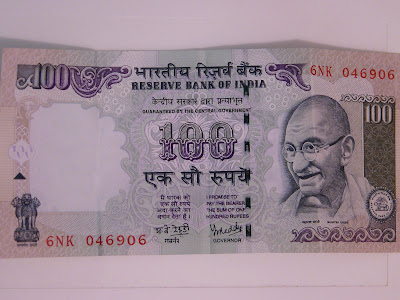
Well.. i was out of ideas today. Did not know what to do. So i was searching some ideas on Flickr... But suddenly i got this idea and looked for some EURO notes.. but i didn have. I had coins and i didnt feel like to go outside to get it from ATM. Then i remembered that i have two 100 ruppe notes in my wallet. in a secret corner of wallet where i hardly see....:) and here i am on INDIAN CURRENCY
Those who do not know how this note looks like without me.. :D HERE you can see...
PROJECT 365----16/365
Check out some more shots of Indian Currency at Picturejockey