View allAll Photos Tagged ghalib
flickriver.com/photos/javier1949/popular-interesting/
www.mundocity.com/africa/marrakech/medersa.html
Medersa Ali Ben Youssef
Situada junto a la mezquita más antigua de Marrakech, la medersa llegó a ser la escuela coránica más grande de Marruecos y la más afamada de todo el Magreb
La mezquita Ben Youssef es la más antigua de Marrakech y en torno a ella se organizó la medina. Fue construida en el siglo XII en honor a Sidi Ben Youssef Ali, un teólogo sabio proclamado con el tiempo uno de los Siete Santos patronos de la ciudad por su ejemplo de fe inquebrantable pese a estar muy enfermo de lepra.
La mezquita sufrió numerosas restauraciones con el curso del tiempo, por lo cual nada queda de la construcción original. Su minarete de piedra de 40 metros de altura domina en este sector de la medina.
Situada junto a la mezquita, la medersa Ben Youssef es uno de los monumentos más prestigiosos de Marrakech y una verdadera joya de la arquitectura árabo-andalusí. Edificada en la segunda mitad del siglo XVI sobre una antigua escuela creada en el siglo XIV, será hasta mediados del siglo XX centro de difusión del saber y luego patrimonio cultural abierto al público.
Knowing there is something to photograph but not being able to find can be rather frustrating, especially when you are underwater limited by an annoying but finite thing as an air supply. This is what we ran into when looking for a celebrity, in Egypt, again: under water.
Try imagining an area as large as a couple of football fields of seagrass and an underwater visibility of about 20 meters (60 feet) and you'll understand it's not easy to find a specific living animal, even it is as big as two grown up humans.
The "thing" I am talking about is "Dennis", the famous resident seacow (or Dugong, it's one of the three members of the Manatee family) of the Abu Dabbab bay near Port Ghalib in the Marsa Alam region of Egypt.
Seeing these pictures you've probably guessed we found it but it took us two one-hour dives to actually find it. Sure, we did come across plenty of huge and approacheable Turtles and a couple of large Stingrays but imagine being a the last stage of your dive because your tank is running empty and then spotting an enormous dust cloud among the seagrass - the telltale Dugong signature... However, no Dennis to match it.
Turned out it was right above us and while we were getting highly frustrated not seeing it, he was just getting a breath of fresh air. Our paths finally crossed when we decided to go up and finish the dive while he was going down to continue vacuuming the seafloor.
We squeezed a few last minutes at our ample air supply... not being too deep made it a safe bet but most of us came up with nearly empty tanks but a mind filled with awe!
The photo was taken with a Canon 20D in an underwater casing made by UK-Germany for this model. Attached was 1 Canon 540EX Strobe (also in an UK-Germany casing). Camera settings (manual): 400ISO, 1/200 sec. at f6.3 and ETTL flash.
Follow my work on Twitter, Facebook or Instagram. Or check my most interesting shots at Flickriver.
Bin Yousuf Madrassa was an Islamic college in Marrakech and was named after the amoravid sultan Ali ibn Yusuf (reigned 1106–1142), who expanded the city and its influence considerably. The college was founded during the period of the Merinid (14th century) by the Merinid sultan Abu al-Hassan and allied to the neighbouring Bin Yousuf Mosque. The building of the madrassa, as it is now, was (re-)constructed by the Saadian Sultan Abdallah al-Ghalib (1557–1574). It is the largest Medrassa in all of morocco. In 1565 the works ordered by Abdallah al-Ghalib were finished, as confirmed by the inscription in the prayer room. Its 130 student dormitory cells cluster around a courtyard richly carved in cedar, marble and stucco. The carvings contain no representation of humans or animals as required by Islam, and consist entirely of inscriptions and geometric patterns. This madrassa was one of the largest theological colleges in North Africa and may have housed as many as 900 students. One of its best known teachers was Mohammed El Ifrani (1670-1745). Closed down in 1960, the building was refurbished and reopened to the public as an historical site in 1982.
La medersa Ben Youssef est un joyau de l'architecture arabo-andalouse situé à Marrakech.
La structure actuelle de cette école coranique fut édifiée vers 1570 par les saadienset restaurée en 1950. Elle est l'œuvre du sultan sâadien Abdellah Al Ghalib qui en acheva la construction en 1564-65.
Le nom Ben Youssef vient du sultan Ali Ben Youssef.
La medersa fut durant plus de quatre siècles un foyer d'accueil pour les étudiants en soif de connaissances dans diverses sciences, notamment en théologie.
Abu Bakr
From Wikipedia, the free encyclopedia
For other people named Abu Bakr, see Abu Bakr (name).
Abu Bakr
Caliph Abu Bakr's Empire at its greatest extent.
Born c. 573 CE Mecca, Arabia or present-day Saudi Arabia
Died 23 August 634 Medina, Saudi Arabia
Reign 8 June 632–23 August 634
Title(s) as-Siddeeq, as-Sadiq, Sadiq al-Akbar, Khalifa-tul-Rasool (Successor of messenger of Allah)
Buried Al-Masjid al-Nabawi
Predecessor Muhammad
Successor Umar
Abu Bakr Abdallah ibn Abi Quhafa As-Siddiq (Arabic: أبو بكر الصديق or عبد الله بن أبي قحافة; Transliteration: Abū Bakr as-Siddīq or 'Abdallah bin Abī Quhāfah, c. 573 CE – 23 August 634/13 AH)[1] was an early person to convert to Islam and a senior companion (Sahaba) of the Islamic prophet Muhammad.[2] Throughout his life, Abu Bakr remained a friend and confidante of Muhammad. Upon Muhammad's death he became the first Muslim ruler (632–634), regarded in Sunni Islam as the first of the Rashidun (righteously guided Caliphs).[3] His caliphate lasted two years and three months, during which time he consolidated the Muslim state. Upon the death of Muhammad, some tribes rebelled, and in return he fought the Ridda wars against these Arab tribes to establish Islamic rule over all of Arabia. He also conquered the lands of Syria and Iraq.[4]
Lineage
Full name 'Abd Allah ibn 'Uthman ibn Amir ibn Amru ibn Ka'ab ibn Sa'ad ibn Taim ibn Murrah ibn Ka'ab ibn Lu'ai ibn Ghalib ibn Fihr al-Quraishi at-Taimi [5][6].
Early life
Abu Bakr was born in Mecca some time in the year 573 CE, in the Banu Taym branch of the Quraysh tribe. Abu Bakr's father's name was Uthman Abu Qahafa nicknamed Abu Qahafa, and his mother was Salma Umm-ul-Khair nicknamed Umm-ul-Khair. The birth name of Abu Bakr was Abdul Kaaba (servant of Kaaba) and when he accepted Islam in 610 he was named Abdullah (servant of Allah) by Muhammad. Abu Bakr was a thin man with white skin [7]. Tabari relates (Suyuti also relates the same through Ibn Sa'd al-Baghdadi's report) from Aisha her description of Abu Bakr:
He was a man with fair skin, thin, emaciated, with a sparse beard, a slightly hunched frame, sunken eyes and protruding forehead, and the bases of his fingers were hairless. [8]
By most reports he was very handsome,[citation needed] and for his beauty he earned the nickname of Atiq. He was born in a rich family. He spent his early childhood like other Arab children of the time among the Bedouins who called themselves Ahl-i-Ba'eer- the people of the camel, he developed a particular fondness for camels.
Wazir Khan Mosque, in Pakistan, (16th century) sayings of the companions of Muhammad on the northern wall of the arched gateway of the central prayer chamber.In his early years he played with the camel foals and goats, and his love for camels earned him the nickname of Abu Bakr, the father of the foal of the camel.[9] It is said that he didn't worship idols since his youth. When Abu Bakr was 10 years old he went to Syria along with his father with the merchants' caravan. Muhammad who was 12 years old at the time, was also with the caravan. Like other children of the rich Meccan merchant families, he was literate and developed a fondness for poetry. He used to attend the annual fair at Ukaz, and participate in poetical symposia. He had a very good memory. In 591 at the age of 18, Abu Bakr went into trade and adopted the profession of a cloth merchant which was the family's business. In the coming years Abu Bakr traveled extensively with caravans. Business trips took him to Yemen, Syria, and elsewhere. These travels brought him wealth and added to his experience. His business flourished and he rose in the scale of social importance. Though his father Uthman Abu Qahafa was still alive, he came to be recognized as chief of his tribe. Abu Bakr was assigned the office of awarding blood money in cases of murder. His office was something like the office of an honorary magistrate.[10] Abu Bakr was an expert in genealogical lore and he knew intimately who was who in Mecca, and what his ancestry was.
During Muhammad's times
When Muhammad married Khadijah bint Khuwaylid and moved to her house, he became a neighbor of Abu Bakr who lived in the same locality. That was the quarter of Meccan aristocracy. Like the house of Khadija, the house of Abu Bakr was double storied and palatial in structure.
As neighbors, Muhammad and Abu Bakr came in contact with each other. Both of them were of the same age, traders and good managers.
Acceptance of Islam
On his return from a business trip from Yemen, he was informed by some of his friends that in his absence Muhammad had declared himself as the Messenger of God, and proclaimed a new religion. Abu Bakr was the first akhir baligh (post-puberty) free male to accept Muhammad's Prophethood. Scholars, as well as other Sunnis and all Shi'a Muslims maintain that the second person (and first male) to accept Muhammed as the messenger of Allah was Ali ibn Abi Talib.[11] However, 'Ali was still a pre-pubescent child when he accepted Islam, and therefore excluded from the duties of a Muslim. Also he was the first person outside the family of Muhammad to become a Muslim.
Life after accepting Islam
Part of a series on
Sunni Islam
Beliefs
Monotheism
Prophethood & Messengership
Holy Books • Angels
Judgement Day • Predestination
Pillars
Declaration of Faith • Prayer
Charity • Fasting • Pilgrimage
Rightly Guided Caliphs
Abu Bakr • Umar ibn al-Khattab
Uthman ibn Affan • Ali ibn Abi Talib
Schools of Law (Shariah)
Hanafi • Shafi`i • Maliki • Hanbali
Schools of Theology
Maturidi • Ash'ari • Athari
Modern Movements
Al-Ikhwan Al-Muslimoon • Deobandi • Barelwi • Salafi • Wahhabi • Tablighi Jamaat
Hadith Collections
Sahih Bukhari • Sahih Muslim
Al-Sunan al-Sughra
Sunan Abu Dawood
Sunan al-Tirmidhi
Sunan ibn Maja • Al-Muwatta
Sunan al-Darami
This box: view • talk • edit
His birth name Abdul Kaaba was changed to Abdullah, because the former was indicative of paganism. His wife Qutaylah bint Abd-al-Uzza did not accept Islam and he divorced her. His other wife, Um Ruman, became a Muslim at his insistence. All his children except ‘Abd ar-Rahman ibn Abi Bakr accepted Islam, and Abu Bakr separated from his son Abdur Rahman.
His conversion brought the most benefit to Islam. Abu Bakr's dawah brought many people to Islam. He persuaded his intimate friends to convert to Islam. [12][13] He presented Islam to others in such a way that many of his friends opted for Islam. Those who converted to Islam at the instance of Abu Bakr were:
Uthman Ibn Affan (who would became the 3rd Caliph)
Al-Zubayr (part of the Muslim conquest of Egypt)
Talhah
Abdur Rahman bin Awf (who would remain an important part of the Rashidun Empire)
Sa`d ibn Abi Waqqas (part of the Islamic conquest of Persia)
Umar ibb Masoan
Abu Ubaidah ibn al-Jarrah (who remained commander in chief of the Rashidun army in Syria )
Abdullah bin Abdul Asad
Abu Salma
Khalid ibn Sa`id
Abu Hudhaifah ibn al-Mughirah
Abu Bakr's acceptance proved to be a milestone in Muhammad's mission. Slavery was common in Mecca, and many slaves accepted Islam. When an ordinary free man accepted Islam, despite opposition, he would enjoy the protection of his tribe. For slaves however, there was no such protection, and were subjected to persecution. He gave 40.000 dinar for the sake of Islam. [14][15] Abu Bakr felt for these slaves, so he purchased them and set them free. Abu Bakr purchased the freedom of eight slaves, four men and four women.
The men were:
Bilal ibn Ribah
Abu Fakih
Ammar ibn Yasir
Abu Fuhayra
The women were:
Lubaynah
Al-Nahdiah
Umm Ubays
Harithah bint al-Muammil
Most of the slaves liberated by Abu Bakr were either women or old and frail men.[16] The father of Abu Bakr asked him to for why doesn't he liberate strong and young slaves who could be a source of strength for him, Abu Bakr replied that he was freeing the slaves for the sake of Allah, and not for his own sake. According to Sunni tradition the following verses of the Qur'an were revealed due to this:
He who gives in charity and fears Allah And in all sincerity testifies to the Truth; We shall indeed make smooth for him the path of Bliss {92:5-7}.
Those who spend their wealth for increase in self-purification; And have in their minds no favor from any one For which a reward is expected in return, But only the desire to seek the Countenance, Of their Lord, Most High; And soon they shall attain complete satisfaction {92:8-21}.
Persecution by the Quraysh
Main article: Persecution of Muslims by the Meccans
For three years after the advent of Islam, Muslims kept secret their faith, and prayed in secret. In 613 Muhammad received a revelation to call people to Islam openly. The first public address inviting people to offer allegiance to Muhammad was delivered by Abu Bakr. In a fit of fury the young men of the Quraysh tribe rushed at Abu Bakr, and beat him mercilessly till he lost consciousness.[17] Following this incident Abu Bakr's mother converted to Islam. Abu Bakr was persecuted many times by the Quraysh.
Last years in Mecca
In 617, the Quraysh enforced a boycott against the Banu Hashim. Muhammad along with his supporters from Banu Hashim, were shut up in a pass away from Mecca. All social relations with the Banu Hashim were cut off and their state was that of imprisonment. Before it many Muslims migrated to Abyssinia (now Ethiopia). Abu Bakr, feeling distress, set out for Yemen and then to Abyssinia from there. He met a friend of his named Ad-Dughna (chief of the Qarah tribe) outside Mecca, who invited Abu Bakr to seek his protection against the Quraysh. Abu Bakr went back to Mecca, it was a relief for him, but soon due to the pressure of Quraysh, Ad-Dughna was forced to renounce his protection. Once again the Quraysh were free to persecute Abu Bakr. In the year 620 Muhammad's wife and uncle died. Abu Bakr's daughter Aisha was engaged to Muhammad, however it was decided that the actual marriage ceremony would be held later. In the year 620 Abu Bakr was the first person to testify to Muhammad's Isra and Mi'raj (night Journey).[18] According to Sunni traditions, he was given title al-Siddîq, meaning "the truthful," "the upright," or "the one who counts true," due to his immediate belief of the journey. During the Roman-Persian Wars, the sympathies of the Quraysh of Mecca was with the Persians who were Zoroastrian. The Muslims on the other hand had their sympathies for the Byzantines who were Christians and were the People of the Book with a belief in the Abrahamic God. After the Persian victories over Byzantine, verses of the Qur'an revealed of Surah rum with the prophesy that Byzantine (Romans) will regain what they lost and the Persians will be defeated within few years. Over this Abu Bakr had a wager with Ubaiy bin Khalf, it was decided that one who lost the wager will pay one hundred camels. With a decisive Byzantine victory in 627 against the Persians, Abu Bakr won the wager, though Ubaiy bin Khalf was not alive but his heirs honored the agreement and gave Abu Bakr one hundred camels. Abu Bakr gave away all the camels as charity..
Migration to Medina
Main article: Hijra (Islam)
In 622 on the invitation of the Muslims of Medina, Muhammad ordered Muslims to migrate to Medina. The migration began in batches. Abu Bakr accompanied Muhammad in his migration for Medina. Due to the danger of the Quraysh, they did not take the road to Medina. They moved in the opposite direction, and took refuge in a cave in Mount Thaur some five miles south of Mecca. `Abdullah ibn Abi Bakr the son of Abu Bakr would listen to the plans and talks of the Quraysh, and at night he would carry the news to the fugitives in the cave. Asma bint Abi Bakr the daughter of Abu Bakr brought them meals every day.[19] Aamir a servant of Abu Bakr would bring a flock of goats to the mouth of the cave every night where they were milked. The Quraysh sent search parties in all directions. One party came close to the entrance to the cave, but was unable to sight them. Due to this the following verse of the Qur'an was revealed:
If ye help not (your Leader) (it is no matter): for Allah did indeed help him; when the unbelievers drove him out: he had no more than one companion: they two were in the cave, and he said to his companion "Have no Fear, for Allah is with us": then Allah sent down His peace upon him, and strengthened him with forces which ye saw not, and humbled to the depths the word of the Unbelievers. But the word of Allah is exalted to the heights: for Allah is Exalted in might, Wise. [Qur'an 9:40]
'Aa'ishah, Abu Sa`eed al-Khudri and ibn 'Abbaas in interpreting this verse said
Abu Bakr was the one who stayed with the Prophet in that cave
It is narrated from al-Barra' ibn 'Azib, he said,
Once Abu Bakr bought a ride from 'Azib for 10 Dirham, then Abu Bakr said to 'Azib, "Tell your son the Barra to deliver that beast." Then 'Azib said, "No, until you tell us how yourjourney with the Messenger of Allah when he went out of Makkah while the Mushrikeen were busy looking for you." Abu Bakr said, "We set out from Makkah, walking day and night, until it came the time of Zuhr, so I was looking for a place to so that we can rest under it, it came to be that I saw a big rock, so I came to it and there was the place, so I spread a matress for the Prophet, then I said to him, " Rest O' Prophet of Allah." So he rested, while I surveyed the area around me, are there people looking for us coming here to spy. Suddenly I saw there was a shepherd herding his sheep to the direction of the place under the rock wanting to shade himself like us, so I asked, "Who is your master O' slave?" He answered, "Slave of the fulan, someone of the Quraish." He mentioned the name of his master and I knew him, then I asked, "Does your sheep have milk?" He answered, "Yes!" So he took one of the sheep, after that I ordered him to clean the breasts of the sheep first from dirt and dust, then I ordered him to blow his hand from dust, so he pat his two hands and he started milking, while I prepared a vessel with its mouth wrapped with cloth to contain the milk, so I poured the milk that was milked to the vessel and I waited until the bottom was cold, then I brought to the Prophet and it was that he had waken up, instantly I told him him, "Drink O' Messenger of Allah." So he started to drink until I saw that he was full, then I told him, "Are we not going to continue walking O' Messenger of Allah?" He answered, "Yes!" At last we continued the journey while the mushrikeen keep looking for us, not one one that could pursue us except Suraqah ibn Malik ibn Ju'sham who rode his horse, so I said to the Messenger of Allah, "This man has succeded in pursuing us O' Messenger of Allah," but he answered, "ﻻ ﺗﺤﺰ ﻥ ﺇ ﻥ ﺍﷲ ﻣﻌﻨﺎ" (Do not worry, verily Allah is with us).
It is narrated from Anas from Abu Bakr he said,
I said to the Prophet when were in the cave, "If only they had looked under their feet we would assuredly be seen" The Messenger answered, "ﻣﺎ ﻇﻨﻚ ﻳﺎ ﺃ ﺑﺎ ﺑﻜﺮ ﺑﺎ ﺛﻨﻴﻦ ﺍﷲ ﺛﺎ ﻟﺘﻬﻤﺎ" (What do you think O' Abu Bakr with two people while Allah is the third)[20]
After staying at the cave for three days and three nights, Abu Bakr and Muhammad proceed to Medina, staying for some time at Quba, a suburb of Medina.
Life in Medina
In Medina, Muhammad decided to construct a mosque. A piece of land was chosen and the price of the land was paid for by Abu Bakr. Muslims constructed a mosque named Al-Masjid al-Nabawi at the site and Abu Bakr also took part in construction. Abu Bakr was paired with Khaarij ah bin Zaid Ansari as a brother in faith. Abu Bakr's relationship with his brother-in-Islam was most cordial, which was further strengthened when Abu Bakr married Habiba, a daughter of Khaarijah.
Khaarij ah bin Zaid Ansari used to live at Sukh, a suburb of Medina, and Abu Bakr also settled there. After Abu Bakr's family arrived in Medina he bought another house near Muhammad's.[21]
The climate of Mecca was dry, but the climate of Medina was damp and this adversely affected the health of the immigrants, so that on arrival most of them fell sick. Abu Bakr also suffered from fever for several days and during this time he was attended to by Khaarijah and his family. At Mecca, Abu Bakr was a trader in cloth and he started the same business in Medina. He was a wholesaler, and had his store at Sukh, and from there cloth was supplied to the market at Medina. Soon his business flourished at Medina. Early in 623, Abu Bakr's daughter Aisha, who was already engaged to Muhammad, was handed over to Muhammad in a simple marriage ceremony, and this further strengthen the relation between Abu Bakr and Muhammad.
In 624 Abu Bakr participated in the first battle between the Muslims and the Quraysh of Mecca known as the Battle of Badr. In 625 he participated in the Battle of Uhud. Before the battle begun, Abu Bakr's son ‘Abd ar-Rahman ibn Abi Bakr who was still non-Muslim and was fighting from the side of the Quraysh, came forward and threw down a challenge for a duel. Abu Bakr accepted the challenge but was stopped by Muhammad. His son later converted to Islam and gained fame during the Muslim conquest of Syria as a fierce warrior. In the second phase of the battle, Khalid ibn al-Walid’s cavalry attacked the Muslims from behind, changing a Muslim victory to defeat. Many Muslim warriors were routed from the battle field but Abu Bakr remained, guarding Muhammad from the attacks of the Quraysh soldiers. During one such attack, two discs from Muhammad’s shield penetrated into Abu Ubaidah ibn al-Jarrah's cheeks. Abu Bakr went forward with the intention of extracting these discs but Abu Ubaidah ibn al-Jarrah requested he leave the matter to him, losing his two incisors during the process. Subsequently, Abu Bakr, along with other companions, led Muhammad to a place of safety. Later in the year Abu Bakr was a part of campaign again the Jewish tribe of Banu Nadir.
Later, in 627 he participated in the Battle of the Trench and also in the Battle of Banu Qurayza.[22] In 628 he participated in Treaty of Hudaybiyyah and was made one of the witnesses over the pact.[22]
In the year 628 he was a part of the Muslim campaign to Khaybar. In 629 Muhammad sent 'Amr ibn al-'As to Zaat-ul-Sallasal from where he called for reinforcements and Muhammad sent Abu Ubaidah ibn al-Jarrah. Commanding an army under him were Abu Bakr and Umar and they attacked and defeated the enemy.[23]
In 630 when Muslim armies rushed for the Conquest of Mecca, Abu Bakr was a part of the army. Before the conquest of Mecca his father Uthman Abu Qahafa converted to Islam. In 630 he was part of Battle of Hunayn and Siege of Ta'if. He was part of the Muslim army in the campaign of Tabuk under Muhammad's command and he was reported to have given all his wealth for the preparation of this expedition.
In 631, Muhammad sent from Medina a delegation of three hundred Muslims to perform the Hajj according to the new Islamic way. Abu Bakr was appointed as the leader of the delegates. Abu Bakr had thus the honor of being the first Amir-ul-Haj in the history of Islam. In the year 632 Abu Bakr followed Muhammad to Mecca for the farewell Hajj.
Hotel Al-Sana
6A, Futnani Chamber,
Surendra Nath Banerjee Road,
New Market Area,
Near Society Cinema,
Kolkata,
West Bengal 700087,
Indien
2011-10-29 Kolkata 044
thesparkhotels.com/hotel_details/hotel-housez-43
43 Mirza Ghalib Street,
Opposite Armenian College,
Park Street Area,
Kolkata,
West Bengal 700016,
Indien
2011-10-29 Kolkata 018
I dreamt I was watching
the crimson dusk strangled
My somnolent heart awaits
in the doorstep--- of fate
listening to the stillness
of the twilight choked
with melancholy and dying hope---
soon--- some distant sigh
or perhaps some faint footsteps
will be heard--- returning
coming---
I dreamt of my father
coming back--- home!
p.s. I cried alot in last night's dream , when I woke up I was really tired from crying,, does this happen to you?
ہم نے مانا کہ تغافل نہ کرو گے، لیکن
خاک ہو جائیں گے ہم،تم کو خبر ہونے تک
from this years autumn shoot... well i missed the peak time in islo when all the trees around, turn their colors :) there is plenty to capture...anyways.. took last weekend at Rose garden in Islamabad... hope this year going good so far for all out there...
Press 'L' to view large...its better..
Close Encounter with a Lionfish during an Night Dive at Coraya Bay, Marsa Alam
Red Sea - Egypt
Shoot with Canon G7X, Sea&Sea YS-03 strobe and Fantasea FG7X housing
flickriver.com/photos/javier1949/popular-interesting/
www.mundocity.com/africa/marrakech/medersa.html
Medersa Ali Ben Youssef
Situada junto a la mezquita más antigua de Marrakech, la medersa llegó a ser la escuela coránica más grande de Marruecos y la más afamada de todo el Magreb
La mezquita Ben Youssef es la más antigua de Marrakech y en torno a ella se organizó la medina. Fue construida en el siglo XII en honor a Sidi Ben Youssef Ali, un teólogo sabio proclamado con el tiempo uno de los Siete Santos patronos de la ciudad por su ejemplo de fe inquebrantable pese a estar muy enfermo de lepra.
La mezquita sufrió numerosas restauraciones con el curso del tiempo, por lo cual nada queda de la construcción original. Su minarete de piedra de 40 metros de altura domina en este sector de la medina.
Situada junto a la mezquita, la medersa Ben Youssef es uno de los monumentos más prestigiosos de Marrakech y una verdadera joya de la arquitectura árabo-andalusí. Edificada en la segunda mitad del siglo XVI sobre una antigua escuela creada en el siglo XIV, será hasta mediados del siglo XX centro de difusión del saber y luego patrimonio cultural abierto al público.
The seasons are all come and gone
In Indian file, one behind another.
Clouds flashed their teeth,
Leaves un-greened,
Both died.
Winds bite now, lash at the nape,
At open collars,
And am I glad to be a poet!
To be young! To have loved and been forsaken
In the mellow streets of Delhi ,
Among Ghalib's words
And in his silence.
You, who have often enjoyed my company,
Remember to come when I am dead,
And though the ashes, some kith or kin,
Should have washed in the milk waters of Ganges ,
Forget not my songs and my tales,
Which gathered in some old bag (you could do without),
Take to the dark banks of Yamuna,
And, weighed by a heavy stone,
From the walls of the Old Fort,
Poem by Arvvind Joshi
Let sink where the waters are deepest.
The seasons are all come and gone
In Indian file, one behind another.
Clouds flashed their teeth,
Leaves un-greened,
Both died.
Winds bite now, lash at the nape,
At open collars,
And am I glad to be a poet!
To be young! To have loved and been forsaken
In the mellow streets of Delhi ,
Among Ghalib's words
And in his silence.
You, who have often enjoyed my company,
Remember to come when I am dead,
And though the ashes, some kith or kin,
Should have washed in the milk waters of Ganges ,
Forget not my songs and my tales,
Which gathered in some old bag (you could do without),
Take to the dark banks of Yamuna,
And, weighed by a heavy stone,
From the walls of the Old Fort,
Let sink where the waters are deepest.
Poetry by Arvind Joshi
In memory of Aylan, Ghalib and Rehan Kurdi who in their tragic deaths, their beautiful faces and in the grief in the face of their husband and father, Abdullah Kurdi, have allowed us to at least try to imagine the unimaginable.
They slipped into hearts, not just minds and, from the comfort of our safe places, allowed us a small glimpse of the real human misery that we struggle to grasp with our intellects alone when confronted with numbers like this:
60 million registered refugees, asylum seekers and displaced persons globally.
6.5 million people internally displaced in Syria
4 million people have fled Syria
Half of them are children.
All of them have faces, stories, lives we cannot really imagine. They love and are loved.
They are not just numbers.
Across Australia last night, tens of thousands of people lit candles to remember Aylan and his family and to urge our Government to do more in response to the current refugee crisis.
And to stop locking up men, women and children who seek our help in places that stop us from seeing their faces and our common humanity; places that cause so much harm.
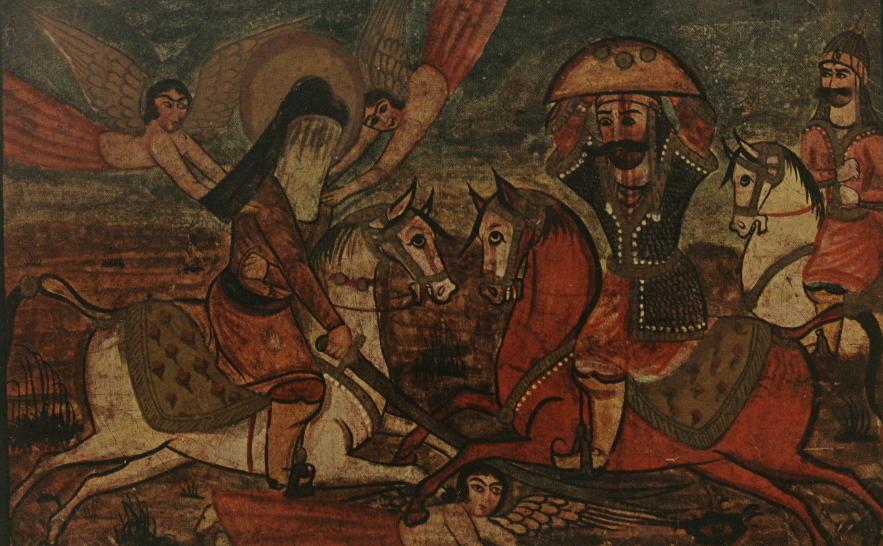
Hazrat Ali slays Marhab
photo courtesy
upload.wikimedia.org/wikipedia/commons/e/ea/Hazrat_Ali_sl...
BALLIGH KI SADA HUKM-E-KHUDAAI DEGI
RUSWAI BHI CHEHRON PA DIKHAI DEGI
AANE DO MUHAMMAD(sawaw) KO GHADEER-E-KHUM MEIN
MAN KUNTO KI AWAAZ SUNAI DEGI
DIL SE HAR GHAM NIKAAL DO APNE
AAJ EID-E-GHADEER KA DIN HAI
BHAR LO JHOLI MEIN DAULAT-E-IMAN
YE JANAB-E-AMEER(a.s.) KA DIN HAI
ABU TURAB, AIN ULLAH, WAJH ULLAH, NAFS ULLAH, YAD ULLAH, LESAN ULLAH, ABUL HASSAN, FATEH-E-KHYBER, AMEER-UL-MOMINEEN,
MUSHKIL KUSHA, HAJAT RAWA, WASI-E-RASOOL, SHAUHAR-E- BATOOL, JANAB-E-AMEER,
MAULA-E-GHADEER, IMAM-E-AWWAL, GHALIB-E-KULLE GHALIB
HAZRAT ALI IBN ABI TALIB a.s.
KA ROZE EILAN-E- WILAYAT
BA UNWANE
EID
-E-
GHADEER
TAMAAM SHIYAN-E-HAIDAR-E-KARRAR KO
MUBARAK
Message sent to me by my dear friend Jalaj Kazim Lucknowi Chinaman.. I share with you all
Article from ezsoftech.com
. Ghadir is on the way from Mecca to Madina. While returning from Mecca to Madina, after the last hajj, alongwith his companions, the Holy Prophet (S.A.W.) broke the journey at a lake, 3 miles away from Al-Johfa. He (S.A.W) halted at midday in a wayside tract of barren land with no shade other than that provided by a few acacia trees. A small lake is called as Ghadir in Arabic, so this place is known as Ghadir-e-Khumm. The name Ghadir is no longer in use.
02. WHAT HAPPENED AT GHADIR-E-KHUMM?
Tabarani and others have recorded the following tradition as related by Zayd ibn 'Arqam and transmitted through sources unanimously acknowledged to be reliable. Zayd says that the Messenger of Allah, Allah's blessings and peace be upon him and his posterity, delivered a sermon at Ghadir-e-Khumm under a cloth spread as a canopy on two large trees. He said:
Hadith
"O my people! I am going to be recalled shortly and I must comply. I shall be interrogated and you also shall be interrogated. What will you say then?" The entire audience answered: "We shall bear witness that you did convey to us the message of Allah, and tried your best to guide us on the right path and always gave us good console. May Allah bless you with a good reward." The Prophet proceeded: "Why do you not bear witness that there is no god but Allah and that Muhammad is His slave and Messenger, and that Paradise is true, Hell is true, Death is true, Resurrection after death is true, that the Day of Judgment will doubtlessly come and that Allah will raise to life the dead from their graves?." They said: "O Yes! We bear witness to all this." Then he said: "O Allah! You also may witness." Then he said: 'O my people! Allah is my Mawla and I am mawla of the faithful and I have superior right on and control over their lives. And this Ali is the mawla of all those of whom I am mawla. O Allah! Love him who loves him and hate him who hates him." He further said: "O my people! I will precede you and you also shall arrive at the pool of Kawthar, the pool wider than the distance between Basrah and San'a', and there are on the pool as many goblets of silver as stars. When you shall reach me I shall interrogate you about your behavior towards the two in-valuable assets after my death. The major asset is the Book of Allah, the Mighty and Glorious, one end of which is in the hand of Allah, the Exalted, and the other end of which in your hands. Grasp it tightly and do not go astray and do not change or amend it. The other asset is my Progeny, who are my Ahl al-Bayt. Allah the Gracious and Omniscient has informed me that the two will not part from each other before they reach me at the pool.
03. WHEN & IN FRONT OF HOW MANY MUSLIMS?
This Ghadir-e-Khumm event happened on the 18th of Dhil-Hijjah (1410 AH), in 10 Hijra in front of nearly one hundred thousand (100,000) Muslims. While returning from the last hajj (Hajjatul-wida / farewell pilgrimage) of our Holy Prophet (S.A.W.).
04. CONTEXTS
A). QURANIC EXEGESIS (Tafsir):
O Messenger! Deliver what has been revealed to you from your Lord; and if you do it not, then you have not delivered His message, and Allah will protect you from the people; (AL-MAEDA/5:67)
This day have I perfected for you your religion and completed My favor on you and chosen for you Islam as a religion; (AL-MAEDA/5:3)
One demanding, demanded the chastisement which must befall, The unbelievers there is none to avert it, From Allah, the Lord of the ways of Ascent.(AL-MAARIJ/70:1-3)
B). PROPHETIC TRADITION (Hadith):
Imam Ahmad has recorded the tradition related by Bara' ibn 'Azib in his Musnad, vol.4, p. 281, transmitted through two different sources. Bara' says: "We were with the Messenger of Allah. We alighted at Ghadir-e-Khumm. Congregational prayer was in order. An area under two trees was swept and cleaned for the Messenger of Allah, Allah's blessings and peace be upon him and his posterity. He offered midday prayers and he grasped the hand of 'Ali and said: 'Do you not know that I have superior authority over the lives of the faithful than the faithful themselves?' 'Yes you have,' they replied. He again inquired: 'Do you not know that I have superior right to the life of every believer than the believer himself?' 'Surely, you have,' they answered. Then he grasped the hand of 'Ali and said: 'Ali is the mawla of all those of whom I am mawla. O Allah! Love him who loves him and hate him who hates him.'" Bara' ibn 'Azib says: "Then 'Umar came to 'Ali and said: 'Congratulations to you the son of Abu Talib. You have become the mawla (master) of all the faithful men and women.'"
C). HISTORICAL REPORTS (Tarikh):
Here we will just mention one instance which took place in Kufa during the khilafah of Imam Ali (A.S.), 25 years after the Prophet's death.
When at Ali's insistence a large number of people gathered in the plain of Rahbah in Kufah, he addressed them saying: "I administer an oath in the name of Allah to all such Muslims as heard the Holy Prophet (S.A.W.) making a proclamation on the day of Ghadir-e-Khumm, to stand up and testify what they heard him say. Only those who saw the Holy Prophet that day with their own eyes and heard the proclamation with their own ears should stand up." Thereupon, thirty companions of the Holy Prophet(S.A.W), including twelve of those who had participated in the battle of Badr, stood up and witnessed that the Holy Prophet(S.A.W) grasped his (Ali's) hand and said to the audience: "Do you know that I have a prior right to and superior authority over the souls (i.e., lives) of the faithful than the faithful themselves?" "O yes!" they said. The Holy Prophet (S.A.W.) then said: "He (Ali) is the mawla (i.e., has prior right to and superior authority over the lives) of all those of whom I am mawla. O Allah, love him who loves him (Ali) and hate him who hates him." It is logically impossible that thirty companions might have secretly agreed to speak a unanimous lie. In addition to the thirty witnesses there were other male companions whom enmity with Ali prevented from standing up and giving their evidence as eye-witnesses, like Anas ibn Malik.
When Ali (A.S.) said to Anas: "Why do you not stand up and testify what you heard from the messenger of Allah on the day of Ghadir?" he answered, "O Amir al-Momineen! I have grown old and do not remember." Thereupon Ali said: "May Allah mark you with a white spot (of leprosy) unconcealable with your turban, if you are intentionally withholding the truth." And before Anas got up from his place he bore a large white spot on his face. Thereafter, Anas used to say: "I am under the curse of a righteous slave of Allah.
Also bear in mind that this incident took place 25 years after the event of Ghadir Khum, and during this period hundreds of eyewitnesses had died naturally or in the battles fought during the first two khulafah's rule. Add to this the fact that this incident took place in Kufa which was far from the centre of the sahabas, Medina. This incident which took place in Kufa in the year 35 A.H. has itself been narrated by four sahaba and 14 tabi'un and has been recorded in most books of history and tradition.
05. AUTHENTICITY
A). Consecutively naratted (Mutawatir)
B). Numerous Sahih versions
C). Dedicated treatisis by 26 authors (Most of them are sunnies)
06. NARRATORS
A). 110 companions of the Holy Prophet (S.A.W.)
B). 84 Successors (Tabiun)
C). Over 360 scholars to the present day (Most of them are sunnies)
1: Abaqat al-Anwar a book written in Persian by Allama Mir Hamid Husayn al-Musawi (d. 1304 AH) of India. Allama Mir Hamid Husayn has devoted two bulky volumes (consisting of about 1,080 pages) on the isnad, tawatur and meaning of the hadith of Ghadir.
2: Al-Ghadir in 11 volumes in Arabic by Allama Abdul Husayn al-Amini where he gives with full references the names of 110 sahaba of the Prophet and also 84 tabi'un (disciples of the sahaba) who have narrated the hadith of Ghadir. He has also chronologically given the names of the historians, traditionists, exegesis's and poets who have mentioned the hadith of Ghadir from the first until the fourteenth Islamic century.
07. A'MAALS FOR GHADIR-E-KHUMM
Eid-E-GhadeerAccording to ahadiths received from Imams (A.S.), some of the a'maal (rituals) recommended for the day of Ghadeer are:
* Remember the Ahlul Bayt by saying of Salawat as many times as it is possible.
ALLAHUMMA SWALLI 'ALAA MUHAMMADIWN WA-AALI MUHAMMAD
(O Allah, send blessings on Muhammad and his household).
* Istighfaar (seeking forgiveness from the Almighty). Sins are forgiven and believers get salvation on this day the way it has been promised for the days of Holy Ramadhan and the night of Qadr.
* Visiting (ziyarah) the tomb of Imam 'Ali (A.S.) in Najaf, Iraq.
* Assist the needy amongst the believers. The reward for assisting today is 1000 times the reward for other days.
* Ihsaan for fellow believers (doing good, including favouring by assisting physically, financially and morally) and making them happy (for example by forgiving their past mistakes, overlooking their slips, visiting them, giving gifts etc).
* Doing of Ghusl a few minutes before noon (midday) and then reading two rakaat Namaz. In every rak'ah after suratul Hamd read 10 times suratul Tawheed (#112) and 10 times Ayatul Kursee (verses 255 to 257 of suratul Baqarah)and 10 times suratul Qadr (#97
Article courtesy