View allAll Photos Tagged finless
Little dolphin:
Tremble... windows... branches lick... cheeks... study... drops... hands... pale stones... leaves from trees... marble from steel... slow air rocks... rocks...
Little Mai:
Pensaba que te habrían capturado en ese horroroso lugar llamado Taiji y que me hablarías en japonés. Quizá tu puedas entender y responder a mis absurdas preguntas:
¿Pierde una rosa su color con la lluvia?
¿Acaso los años desgastan las aristas de una roca?
¿Dejaron mis labios una sombra detras de ti?
Cuando cae la nieve, ¿es azul el cielo?
Si no estoy aquí... ¿tus ojos se ven iguales?
Little dolphin:
Ahora veo las líneas en la palma de tu mano. Escucho con atención, pero no me vienen palabras a la mente. Y suena tan dulce, escucho tu latido y me ahogo en tu mar cayendo a tus pies.
Heartbeat (Tainai Kaiki II) - Ryuichi Sakamoto
Little Mai:
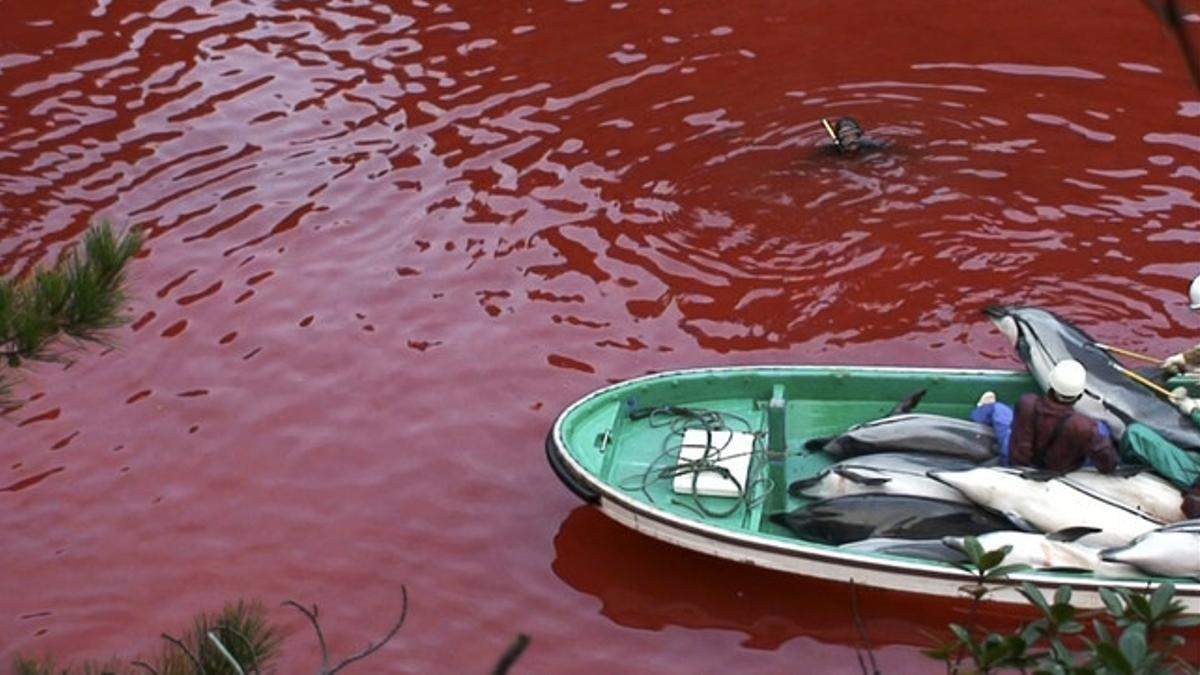
Me llaman, tengo que irme. Siento mucho la matanza de delfines que desde hace años se hace en Taiji, empleando métodos tan crueles y dolorosos. Dicen que es una tradición. Dicen que cuando los delfines son acorralados en una cala de Taiji y comienza la matanza, el océano azul se tiñe completamente de rojo... rojo de sangre, crueldad y horror. ¿Como puede un ser humano dormir tranquilamente por la noche si durante el día asesinó cruelmente a un delfín? No entiendo a los seres humanos. Me alegro que no nacieras en Taiji. Me gustaría decirte "mata ne" o "jaa ne" para despedirme de ti. Pero debo decirte "sayonara", porque sé que desgraciadamente nunca nos volveremos a ver. Pero siempre te recordaré y estarás en mi corazón. Sayonara, little dolphin... Sayonara.
Little dolphin:
Si. Los humanos sois muy extraños, pero tu eres diferente y especial. Yo también te recordaré siempre. Recordaré las lineas de las palmas de tus pequeñas manos y sentiré en la distancia cada uno de los latidos de tu corazón a lo largo de tu vida. Sayonara, little Mai... Sayonara.
.....
Heartbeat - Ryūichi Sakamoto (1991)
.....
The Toba Aquarium is a former public aquarium located in Toba Bay, opened in 1955. It was built by Haruaki Nakamura, who began by creating a "handcrafted" aquarium without pretensions or modern or luxurious facilities. It was a manual project, until he gradually transformed it into one of the largest and oldest aquariums in Japan. This is why this aquarium, although it has modernized its facilities, has never intended to become a "megalomaniac" aquarium like those in Kyoto, Osaka, and other cities around the world, combining modern facilities and preserving elements of its origins with a certain nostalgic atmosphere of decades past in its older facilities. Although not as modernized and spectacular as those mentioned above, it is one of the most visited aquariums in Japan and of greatest relevance within the scientific community. Nakamura's motivation was a deep interest and appreciation for marine life. His initiative, which began as a modest personal project, demonstrates a commitment to creating a space where the public could learn about and appreciate ocean biodiversity and turning it into a highly regarded center for marine research, education, and conservation in Japan. Toba Aquarium has been noted for its contributions to research, breeding, and conservation efforts for rare or endangered species, such as the dugong, the finless porpoise, dolphin species, and most notably the Commerson's dolphin. The aquarium has a history of successfully breeding various marine species and has been part of hundreds of research, breeding and conservation work programs throughout its history, which has earned it special recognition from the scientific community.
Toba Aquarium (Toba-suizokukan). Toba, Mie Prefecture, Japan.
.....
An image dedicated to the collective memory of all the hundreds of thousands of dolphins cruelly hunted and killed in Taiji Cove.
PS: Taiji:
Art, culture, and tradition of the annual dolphin slaughter in Taiji, Japan. I warn you that the images are hard to watch. The Japanese government condones such brutality because it is a traditional hunt and only 1,800 dolphins are killed each year. During hunting season, the cove area is fenced off, with no access possible and is sealed off by police forces. Access to the cove where the dolphin slaughter takes place is restricted and monitored by police. Dolphin Project and Action for Dolphins continue to document and report these hunts each year, which far exceed the false figures provided by the Japanese Fisheries Agency. The cruel dolphin slaughter in Taiji came to light and was exposed in the American documentary "The Cove," which was secretly filmed using high-tech cameras. In March 2010, "The Cove" won the Academy Award for Best Documentary Feature. The number of dolphins slaughtered cruelly has been decreasing over the years, not for ethical reasons but rather due to the decreasing demand for this type of meat. However, in recent years, the "traditional hunting" cruel slaughter of dolphins in Taiji has continued.
estaticos-cdn.prensaiberica.es/clip/7b83041e-17da-4a2b-a4...
youtu.be/wk1xLXhk0vI?list=PLeMOx3FAjSEsTbznThX_J8pgBFwerH...
youtu.be/hw_JhFNdFGk?list=PLeMOx3FAjSEsTbznThX_J8pgBFwerHr_s
www.dolphinproject.com/espanol/preguntas-frecuentes/
....
Located in Nam-gu, Ulsan, the Jangsaengpo Whale Museum (장생포 고래 박물관) is South Korea's only institution dedicated to the history and conservation of these marine mammals. Among the specimens on display is the skeleton of a majestic humpback whale (Megaptera novaeangliae).
Its scientific name, Megaptera novaeangliae, literally translates to "large-winged New Englander." Megaptera comes from the Greek for "large wing," a direct nod to its enormous pectoral fins, which can measure up to a third of its body length. The second part of the name, novaeangliae, means "of New England," referring to the region in the North Atlantic where the species was first scientifically described.
In the background of the image, you can also see the skeleton and a model of a Finless Porpoise (Neophocaena).
This educational experience is located on the site that was once a prominent whaling port. The museum's extensive collection, totaling approximately 1,800 artifacts, includes a variety of cetacean skeletons such as those of the Bryde's whale, the killer whale, and the gray whale, in addition to historical whaling tools.
• Humpback whale
• Ballena jorobada
• 혹등고래
Scientific Classification:
Kingdom: Animalia
Phylum: Chordata
Class: Mammalia
Order: Artiodactyla
Family: Balaenopteridae
Genus: Megaptera
Jangsaengpo Whale Museum (장생포 고래 박물관), Nam-gu, Ulsan, South Korea
Located in the Nam-gu district of Ulsan, the Jangsaengpo Whale Museum is the only institution in South Korea devoted entirely to the history of whaling and the conservation of marine life. Its exhibits trace how the area rose to prominence as a major whaling center, while also encouraging visitors to think about why protecting ocean wildlife matters today.
Among the specimens on display is the skeleton of a common bottlenose dolphin, part of a much larger holding of cetacean remains that includes Bryde's whales, killer whales, gray whales, and finless porpoises (Neophocaena), alongside tools and objects tied to the region's whaling past. Altogether, the museum's holdings run to roughly 1,800 items between artifacts and historical documents, forming a broad and educational look at cetacean life.
• Bottlenose dolphin
• Delfín mular
• 큰돌고래
Scientific Classification:
Kingdom: Animalia
Phylum: Chordata
Class: Mammalia
Order: Artiodactyla
Family: Delphinidae
Genus: Tursiops
Few marine mammals are as familiar to the public as the bottlenose dolphin. Built with a sturdy frame and a short, well-defined beak, it moves in tight social groups and turns up in nearly every temperate and tropical ocean on Earth, from shallow coastal shelves to open water far from shore. Much of what scientists know about dolphin cognition comes from this species, given how readily it engages with human observers and how often it becomes the subject of behavioral research.
Taxonomically, the genus Tursiops has been reshuffled considerably in recent years. What was once treated as a single, fairly uniform species turned out, under closer genetic and anatomical scrutiny, to contain real divisions: Tursiops aduncus, the Indo-Pacific bottlenose dolphin, is now widely accepted as its own species rather than a variant of T. truncatus. Even within T. truncatus, researchers distinguish two broad ecotypes — a smaller-bodied coastal form suited to shallow water, and a bulkier pelagic form built to handle colder temperatures and deeper dives.
Jangsaengpo Whale Museum (장생포 고래 박물관), Nam-gu, Ulsan, South Korea
The Jangsaengpo Whale Museum (장생포 고래 박물관) is located in Nam-gu, Ulsan, and is South Korea's only museum dedicated to whale history and conservation. The museum provides an overview of the region's past as a prominent whaling hub while also educating visitors about the importance of marine life preservation.
The museum's collection includes a variety of specimens. The skeleton shown in the photo is a finless porpoise (sanggwaeng-i). The museum also houses an extensive collection of other cetacean skeletons, including those of the Bryde's whale, killer whale, and gray whale, as well as whaling artifacts . The museum's total collection of artifacts and historical records numbers around 1,800 pieces . The exhibits collectively offer a comprehensive and educational experience.
• Finless porpoise
• Marsopa sin aleta
• 상괭이
The finless porpoise is a species of porpoise known for its smooth back, which lacks a dorsal fin. They are found in the coastal waters of Asia, including the Yellow Sea and the East China Sea, and are sometimes referred to as "smiling porpoises" due to their facial expressions.
Scientific Classification:
Kingdom: Animalia
Phylum: Chordata
Class: Mammalia
Order: Artiodactyla
Family: Phocoenidae
Genus: Neophocaena
The classification of finless porpoises is a subject of ongoing scientific discussion. While historically grouped under a single species, Neophocaena phocaenoides, recent genetic studies have shown that the East Asian finless porpoise (N. sunameri) and the Yangtze finless porpoise (N. asiaeorientalis) have had separate gene flows for thousands of years. For this reason, many researchers now classify them as distinct species rather than subspecies. N. sunameri is the species found in coastal waters, including those of Korea, while N. asiaeorientalis is the critically endangered freshwater porpoise found exclusively in the Yangtze River.
Jangsaengpo Whale Museum (장생포 고래 박물관), Nam-gu, Ulsan, South Korea
another morning shoot of Derek Hynd surfing a finless board
I've been shooting a lot of him and have tested myself a bit
My wife didn’t even want to be in my office to look at this creature on my monitor but I don't think the "Yuck" name she gave it is scientifically accurate.
We parked by the side of the road and watched this green heron hunt for about 10 minutes as he was very busily hunting for his breakfast in a very shallow wetland pond. Note how the bill of the green heron has penetrated what I think is the head end of the pre-historic creature.
All I can see are the two grasshopper like legs near the one end. In all of my years I have never seen something like this.
I am interested in any guesses as to what this finless water inhabitant is.
(Photographed near Cambridge, MN)
Double exposure. Finless porpoise swimming at aquarium with cherry blossoms in my town. Using a soft filter for cherry blossoms.
Canon EOS7/Lomography CN800
In 1946, Senior GM designer Frank Hershey had been working on the rear fender design idea that had first come to him before the war, when Harley Earl led the field trip to Selfridge air base to see the P-38 fighter. Looking at the plane’s twin tail rudders that day, Hershey immediately thought of fins on sea creatures—slicing through the water’s surface as a shark moved in on its prey, flashing silver-blue in the sun when a sailfish rose out of the ocean in full flight, waving a languid goodbye just before a whale disappeared into the deep—heart-stopping images long embedded in his imagination.
It struck him that fins were wondrous creations of nature—beautiful, sleek, and shiny, streamlined and symmetrical, the embodiment of power, speed, maneuverability, and stability, everything that a modern automobile should be. And yet no one had designed them into the body of a car.
The tailfin was first introduced on the 1948 Cadillac. Tailfins took particular hold on the automotive buying public’s imagination as a result of Chrysler designer Virgil Exner’s Forward Look, which subsequently resulted in manufacturers scrambling to install larger and larger tailfins onto new models.
Though sharing some design characteristics with other Fords of the time, such as single, circular headlamps and tail lamps and modest tailfins, the Thunderbird was sleeker in shape and featured a hood scoop and a 150 mph (240 km/h) speedometer not available on other Fords.
The third year of Thunderbird’s First Generation of cars was 1957. Changes included slightly reshaping the front bumper and the grille, tailfins, and taillights were made larger. The spare wheel was relocated back to inside the trunk and mounted vertically to allow more trunk space.
The tailfin era of automobile styling encompassed the 1950s and 1960s, peaking between 1955 and 1961. It was a style that spread worldwide, as car designers picked up styling trends from the US automobile industry, where it was regarded as the "golden age" of American auto design.
Tailfins soon lost popularity. By the late 1950s, Cadillac and Chrysler – driven by the respective competing visions of GM's Earl and Chrysler's Exner – had escalated the size of fins till some thought they were stylistically questionable and they became a symbol of American excess in the early 1960s. The 1961 models are considered the last of the "Forward Look" designs; Exner later referred to the finless 1962 downsized Plymouth and Dodge models as "plucked chickens". He believed Chrysler executives had "picked" away at the cars to make them lower in cost.
Although fins were out of favor by the early 1960s, fins could still give aerodynamic advantages. In the early 1970s, Porsche 917 racing automobiles sported fins reminiscent of Exner's designs.
#1144
59
The first seaplane in service in Portugal (Schreck FBA), from 1917
The FBA Type H was a French reconnaissance flying boat produced in large numbers in France and Italy during World War I by Franco-British Aviation.A development of the FBA Type A, the Type H shared the same basic pusher biplane configuration, but was a larger and heavier machine based on a Donnet-Lévêque design and powered by a water-cooled engine in place of the earlier type's rotary. Most French-built aircraft had Hispano-Suiza 8A variants with powers of 150 or 170 hp (112 or 127 kW), though a minority had 160 hp (119 kW) Lorraine 8Ns. These were all V-8 engines. Some Italian built Type Hs also used the higher-power Hispano motor but more had 180 hp (134 kW) Isotta Fraschini V.4B or 150 hp (142 kW) engines of the same make,both six-cylinder inlines.
The aircraft was a two bay biplane with the smaller span lower wing positioned just above the central fuselage on four supporting struts. There was no stagger and simple parallel interplane struts separated the bays; an extra, outward leaning pair supported the overhanging upper plane on each side. Ailerons were mounted only on this upper wing. The single pusher engine was mounted on struts just below the upper wing, its two blade propeller turning in a cut-out in the wing trailing edges.
The hull of the Type H was, like that of its predecessors, a single step design. A pair of flat bottomed floats, mounted below the outer interpane stuts, stabilized the aircraft on the water. Two flight crew members were accommodated side-by-side and a front gunner sat separately in the nose.[1] The rounded, finless rudder mounted above the high tailplane distinguished the Type H from earlier FBA flying boats, which had angular vertical tails.
From: Wikipedia
Southern China’s Poyang Lake is the largest freshwater lake in the country. Located in Jiangxi province, this lake is an important habitat for migrating Siberian cranes, many of which spend the winter there.
The lake is also home to the endangered finless porpoise, a freshwater mammal known for its high level of intelligence. Amid fears that it would soon become extinct, the porpoise made headlines last year when the Chinese government moved eight of them from Poyang Lake to two secure habitats in an effort to increase the population over the coming years.
One study found that, without action, the current rate of population decrease would likely mean extinction by 2025.
For the human population, Poyang is one of China’s most important rice-producing regions, although local inhabitants must contend with massive seasonal changes in water level.
Local scientists collaborating with ESA through the Dragon programme have identified an overall drop in water level in the lake over the last decade, but the El Niño weather phenomenon earlier this year caused precipitation levels to increase and water levels of the lake to rise.
Radar images from the Copernicus Sentinel-1 mission have been used to monitor the evolution of the lake, including this image which combines two radar scans from 7 and 19 March.
This image is also featured on the Earth from Space video programme www.esa.int/spaceinvideos/Videos/2016/09/Earth_from_Space... .
Credit: Contains modified Copernicus Sentinel data (2016), processed by ESA
nightcafe multi/gimp mix
Sunda pangolin
Amur leopard
Sunda tiger
Mountain gorilla
Bornean orangutan
Yangtze finless porpoise
Black rhino
African forest elephant
Sumatran orangutan
Hawksbill turtle
just 10 of the most endangered creatures on our planet!
many have less animals alive than we do on our friends list!
e.g
The Amur leopard is famous for having around 100 individuals left in the wild, making it one of the world's most endangered big cats.
Manufacturer: General Motors Company / Buick Motor Division, Detroit, Michigan - USA
Type: LeSabre Model 4439 4-door Hardtop Sedan
Engine: 5968cc V-8 valve-in-head (by GM)
Power: 253 bhp / 4.400 rpm
Speed: 175 km/h
Production time: 1961
Production outlet: 37,790
Curb weight: 2056 kg
Special:
- It has a two-speed Turbine Drive Dynaflow automatic transmission, drive shaft (replacing the decades-old torque tube design), a Rochester 2GC dual throat carburettor (some have a Stromberg carburettor), a "Mirrormatic" speedometer, a 12-Volts electric system, distributor and coil ignition system, a 76 liter fuel tank and rear wheel drive.
- The X-frame chassis with steel body (by Fisher) has a 123 inch wheelbase, finless rear ends, more restrained use of chrome, boxier sheetmetal, windlace, full carpeting, recirculating ball and nut steering, independent ball joint with coil spring suspension at the front, coil spring suspension at the rear, a semi-floating type rear axle, single exhaust system with crossover and 12 inch hydraulic drum brakes all round.
- Besides this Hardtop 4-door Sedan, the Series was available as Hardtop 2-door Sedan (14,474 units built), as 2-door Sedan (5,959 units built), as 4-door Sedan (35,005 units built), as 4-door Estate Wagon - 2 seats (5,628 units built), as 4-door Estate Wagon – 3 seats (2,423 units built) and as 2-door Convertible (11,951 units built).
- An "economy" 235 bhp version was offered as a "no cost" option and an optional power-pack version with four-barrel carburetor, 300 bhp and dual exhausts was available.
- Also optional was a three-speed Turbine Drive automatic, a three-speed manual gearbox, radio and an all-vinyl interior (standard on the Estate Wagon).
A finless tail can be seen here.
Thankfully, they snap on with no magnets, as previously reported and while the are a little stiff & harder to remove unless you tip the doll forward so it opens, they are all made very well (even if everyone's detailing looks like motorcycles vs. mermaids) although it would be nice if the tail itself was more flexible so you could do things like seat your doll while she's wearing it.
I do wish there was more pearlized white in her look somewhere but she mostly works and with a little effort (mostly adding the fin to the bottom and getting their balance right) they can possibly even stand. Well, on carpet at least!
Also, note that the bracelet is from MH, via Lagoona's scarisian fashion, and was added at first out of utility (her left hand is loose at the wrist; the bracelet fixes that a bit) but kept because it suited her so well. ;D
trevor glides through on a small one, riding his finless plank. i manually focused this on my (unprotected) minolta slr... pretty stoked!
Finless Porpoise
She name is Nico-chan
スナメリのニコちゃん
キス-kissしてくれました。
In the aquarium, Finless Porpoise is almost seen here and .. It was lovely.
水族館では、ほとんどここでスナメリを見てました。可愛かった!!
Skim Surfing is quite popular around Iligan (Mindanao). It is amazing to watch these skillful young athletes make their finless board race over shallow water and the sand. When the board got some speed they jump on it, jump with it, do turns, take falls and most of all: have a lot of fun. Photo: September 6, 2018
Derek Hynd Finless at Supertubes
I'm out the water with a bad knee - so took a few pics this morning
This is Derek Hynd drawing one of his beautiful speed runs
he hasn't ridden a board with fins for years
I shot a whole lot of shots of him
and they're in a private set
I'll slowly leak em out
An unidentified finless and engine-less Royal Air Force Panavia Tornado F.3 seen being towed at RAF St. Athan back in February 2005
St. Athan was a significant RAF Maintenance Unit with huge investment and development made but along with other defence cuts the Station was subsequently closed and now serves as a civilian aircraft dismantling site and a Museum
Scanned print