View allAll Photos Tagged examples
St. Paul’s Cathedral (1697)
Of all the churches on the islands, St. Paul’s Cathedral is the finest and most mature example of Maltese Baroque; not fussy and ornamental but the work of an articulate pen imbued with all the influences – Roman, Sicilian and Italian – from which the idiom evolved. From all perspectives, this monumental church with its bold swathes takes charge: at the screen façade, from a distance, in silhouette and from inside.
Tradition states the cathedral is built on the site of the villa belonging to the Roman governor, Publius, where the shipwrecked St. Paul healed Publius’s father and converted the grateful governor himself to Christianity. (Publius later became the first bishop of Malta and was martyred in Greece.) The simple 12th-century Norman structure of Count Roger was enlarged in 1419, and the present cathedral was built following the earthquake of 1693 which destroyed much of Malta. A new cathedral had been talked about before the earthquake; Lorenzo Gafa had added a new choir in 1679 and after the earthquake he was commissioned to create the new building. The site on the northeast corner of Mdina must have flattered Gafa’s inspiration (this domed cathedral would be seen from afar) and the structure went up rapidly: five years after the foundation stone was laid in 1697 it was consecrated.
St. Paul’s Cathedral sits on a low podium at the end of the eponymous rectangular square. The near-square façade with its three cleanly divided bays gives it a light but solid air. The Corinthian order of pilasters below the composite ones span the entire façade without interruption, leaving above the two side doors brave expanses of honey-coloured masonry. The bellj-towers – each with six bells – are squat, adding to the façade’s heaviness, but with Gafa’s deft touch they appear lighter, for the twin clocks nudge into the lower lip of the cornice. Note, in relief at the top of the bell-towers, St. Paul’s viper twists out of the flames. Above the main door ion the left is the escutcheon of Grand Master Perellos (during whose reign the cathedral was built) and on the right that of Bishop Palmieri, who consecrated it in 1702 two years before the dome was completed. In front are the obligatory cannons, part of the knights’ ordnance: to the left a Dutch cannon from 1681 and to the right, bearing the coat of arms of the Duke of Savoy, the Duke’s gift cannon to commemorate the knights’ defence of Rhodes.
Finally, sneaking out from under cover of the towers and pediment, is Gafa’s dynamic swansong, the light octagonal dome, with eight stone scrolls above a high drum leading up to a neat lantern. Similar in design to St. Catherine’s in Zejtun, it is best studied from inside or from a distance.
The Interior
Gafa’s plan for the church is a Latin cross with a vaulted nave, two aisles and two small side chapels. Space under the rich tessellated floor of extravagant and macabre tombstones is reserved for Maltese nobles and high-ranking clergy, unlike at St. John’s in Valletta, where only knights of the Order could be buried.
The Sicilian white marble baptismal font was a gift from Bishop Valguarnero in 1495 and survived the earthquake. The statue of St. Publius and the two lecterns of St. John and St. Luke by the main altar are by Guiseppe Valenti, who also made the statue of Queen Victoria in Republic Square, Valletta. The frescoes in the cross-vaulted ceiling were painted by two Sicilian brothers, Antonio and Vincenzo de Manno, in 1794 and depict the Life of St. Paul. The beautiful carved door to the sacristy is made of solid Irish oak and was the main door to the original cathedral which somehow survived the 1963 earthquake. In the side chapel of the Annunciation is Mattia Preti’s unconvincing image of St. Paul hysterically chasing the Saracens away from the City’s bastions during a brief siege in the early 1400s. In the chapel of the Blessed Sacrament, the icon of the Madonna, bejeweled and shrouded in reverential grime, is alleged to have been painted by St. Luke. (Sadly there is no evidence to support this or the notion that he painted a similar icon in the Sanctuary in Mellieha.) The silver tabernacle is Roman and dates from the early 18th century. The main altarpiece, the Conversion of St. Paul, the side panels and the marvelously graphic rendition of St. Paul’s shipwreck in the apse were all painted by Mattia PReti in the late 17th century; they too survived the earthquake intact. The Royal Arms of Spain hang at the apex of the arch in remembrance of the Emperor Charles V who gave the islands to the Order in 1530. The two Italian oval portraits by the front pillars are marble mosaic compositions of photographic clarity depicting St. Peter and St. Paul and date from 1873. Rarely on display is the silver cross brought by the knights from Rhodes. A weak supposition states that Godfrey de Bouillon carried it into Jerusalem in the First Crusade in 1099. The two thrones are reserved fro the bishop of Malta and the grand master. The original paintings in Gafa’s splendid dome were ruined by inclement weather and the present images represent the Divine Mission of the church and delicately inlaid marble floors resembling a carpet and somber black and gilt 18th-century gates. The crucifix was fashioned by a Franciscan monk in the 17th century. The altarpiece of the Martyrdom of St. Publius and his Baptism by St. Paul has sometimes been attributed to Preti but is only his school.
Example of a vintage, industrial asbestos packing material, shown at close detail. The product container of this packing was labeled as, "Rainbesto Asbestos Spiral", by the United States Rubber Company. The reddish material inside the packing was from a rubber constituent of the packing, which as also included thin wire strands, likely for added compression and strength.
"Remember that the most beautiful things in the world are the most useless; peacocks and lilies, for example."
John Ruskin
Cave Springs, Sedona, Arizona
Some examples of projects using conductive thread and LEDs. More information at tinkering.exploratorium.edu/sewn-circuits
Some examples of projects using conductive thread and LEDs. More information at tinkering.exploratorium.edu/sewn-circuits
In this screenshot, you see the actual results generated from our newsletter. Notice:
- Our Open Rate and Click Rate are both above industry average
- Actual revenue generated
- Fast and tangible results
This proves the effectiveness of the emails we write which is attributed to a strict focus on content and giving relevant information your clients will find valuable as well as the strategic use of conversion magnet and scheduled distribution timings.
Patent drawing examples can comprise of diagrams or representations that you use to outline an innovation for a patent application.
Read more at thepatentdrawingsfirm.com/patent-drawing-examples-everyth...
Shot with a single Canon 600EX flashgun triggered via an ST-E3-RT on my 5D Mark III with full TTL, using the handheld Dishgun solution described here:
www.janssico.com/2013/12/dishgun-handheld-strobist-portra...
Some examples of projects using conductive thread and LEDs. More information at tinkering.exploratorium.edu/sewn-circuits
THIS IS NOT BY ME -- it's a piece of an actual Edward Wesson painting. I hope this is OK. I think it's "fair use" to excerpt a bit of a master's painting.
Anyway, this shows the loose yet effective handling of trees in a line & wash by Edward Wesson.
Instructor example of stop-motion candy animation for the Chocolate Factory Mini-Camp 2/18, by Marcos
The Currituck Beach Light is a lighthouse located on the Outer Banks in Corolla, North Carolina. An example of Gothic Revival architecture, the Currituck Beach Light was added to the National Register of Historic Places on October 15, 1973.
On December 1, 1875, the Currituck Beach Light was completed, located between Cape Henry Light and Bodie Island. Unlike its fellows, Currituck Beach Light was not painted, leaving its brick facade visible. In 1939, the lighthouse was automated following a merger of the United States Coast Guard with the Bureau of Lighthouses.
Since 1991 visitors have been allowed to climb the original 214 steps to the outdoor gallery. Access to the lens room is not permitted as the first order lens is not only the original lens, but it is still a functioning one. The light comes on every night and shines from 158 feet (48 m) at 20-second intervals to warn ships hugging the chain of barrier islands along the coast.
The U.S. Light-House Board in 1872 stated that ships, cargoes, and lives continued to be lost along the 40 miles (64 km) of dark coastline that lay beyond the reaches of existing lighthouses. Southbound ships sailing closer to shore to avoid the Gulf Stream were especially in danger. In response, construction began on the Currituck Beach Lighthouse in 1873 with completion two years later. The date at the top of the entrance to the lighthouse says "1873" because on every lighthouse, the date on the structure is the date that construction began.
The Currituck Beach Lighthouse is a first order lighthouse, meaning it has the largest of seven Fresnel lens sizes. The original source of light was a Funck's hydraulic float lamp, fueled with lard oil, and consisting of four concentric wicks. In approximately 1884, the lighthouse converted to a mineral oil (kerosene) lamp with five concentric wicks; the largest was 4 inches in diameter. By 1913, an incandescent oil vapor lamp was used, with kerosene vaporized and forced into the burner by use of a hand pump attached to the storage tank.
The Currituck Beach Lighthouse was the last major brick lighthouse built on the Outer Banks.
en.wikipedia.org/wiki/Currituck_Beach_Light
en.wikipedia.org/wiki/Wikipedia:Text_of_Creative_Commons_...
Examples of vitamin A-rich fruits and vegetables. Young children need 2–3 helpings of such foods per day.
© Helen Keller International.
Published in: Community Eye Health Journal Vol. 26 No. 84 2013 www.cehjournal.org
This official Minnesota State Capitol Restoration Project photo is being made available for educational, scholarly, news or personal purposes (not advertising or any other commercial use). When any of these images are used, the photographic credit line should read “Courtesy: MN Dept. of Admin. Cathy Klima photographer.” These images may not be used in any way that would imply endorsement by the Minnesota State Capitol Restoration Project or the State of Minnesota of a product, service or point of view.
Example Bridal Shoot....
MUA/Hair: Work
gemmasuttonbrides.blogspot.com/
shoot by Kris Talikowski www.kristalikowski.com
Assistant: Vicki Blatchley www.vickiblatchley.com
Model: Donna
Dungeness, Kent is a notable example of a cuspate foreland, created by constructive waves bringing together shingle from two different directions to form a triangular shaped promontory of shingle that goes a few miles into the English Channel.
Dungeness has long been a hazard to shipping and as early as 1615 a light was displayed here, but by the 1630s such was the accumulation of shingle that a new lighthouse tower was constructed closer to the sea.
Then in the late 18thCentury the accumulated shingle had again left the lighthouse far from the sea and a new lighthouse was constructed which came into use in 1792. The new lighthouse was 35metres high and was of the same design as Smeaton's lighthouse (1759) on Eddystone Rock, Lighthouse keepers accommodation was built as a circular building around the base of the lighthouse. From 1862 this was the first lighthouse to be powered by electric arc lamps, at the time this was cutting edge technology and proved to be too expensive, so in 1875 the lamp reverted back to oil.
In 1904 a new taller (46 metres) lighthouse opened and the 1792 lighthouse was demolished except for the circular building around the case which was retained as accommodation for the lighthouse keepers.
Then next in the long history of lighthouses on Dungeness came a new Nuclear Power Station being built in the 1950's, it was realised that the height of the power station would obscure the view of the lighthouse from certain area of the sea. A new lighthouse was built 1959-61 from pre-stressed concrete which removed the need for tapered sides to the lighthouse this new lighthouse also incorporated an electric foghorn. In 1991 the lighthouse became automated. Currently the lighthouse has a range of 21 nautical miles.
The old (1904) lighthouse is open as a tourist attraction in the summer months.
see: www.dungenesslighthouse.com
www.trinityhouse.co.uk/lighthouses/dungeness.html
www.ryemuseum.co.uk/index.php/2009/10/the-dungeness-light...
Kite Aerial Photograph
22 March 2011
---
for further photographs see comment below:
Some examples of Elhiem’s extensive range of Military Figures and vehicles, the figures and vehicles shown painted are purely to show the details you can add, as please note all figures and vehicles come unpainted.
The Vehicles are 3D Printed and the photos show completed and work in progress.
Please check out the Elhiem Website and Facebook Page for further details.
Photos: Elhiem
Hello! Looking through the works of photographers I came across a wonderful picture of photographer Raehan Irfi (www.behance.net/boombleash). I would be grateful if you could subscribe to it. I could not go by and asked for the source photo for my portfolio. Now this beautiful picture, but already in my view of processing decorates my portfolio.
Canon 77D - informal ISO test
RAW, High ISO Speed Noise Reduction set for Standard, and Long Exposure Noise Reduction Enabled, Auto WB (White Priority).
Example image from Canon 77D Experience guide to the EOS 77D
This shrine, built for the Elamite king Untaš Napiriša (r. 1275-1240 BC) of the Igehalkid dynasty at Dur-Untaš (City of Untash, 38 km.s SE of Susa), is the world's best preserved ziggurat (!), the largest outside Mesopotamia, and the best surviving example of Elamite architecture anywhere. Dur-Untaš was designed to serve both as a capital city and as a federal sanctuary and centre of pilgrimage in which the principal gods of the Elamite realm, Napiriša, Inšušinak, et al. were honoured. Its construction, the largest project undertaken by the dynasty, represented a radical departure from tradition and must've been intended to challenge the long-established position of Susa as the regional centre.
- youtu.be/RvykfDQcVLA?si=L2xFW5GW2USa0ZHb
- The ziggurat's plan is square, 105.2 m.s2 in area, and it consists of a mud-brick core within a facing of baked bricks stacked 2 m.s thick, forming 5 concentric levels or terraces with a quadrangular temple at the summit (the 'kukunnum') dedicated to Inšušinak, "Lord of Susa" at times, and at others to both Inšušinak and Napiriša, the latter thought to be the chief deity of the Elamite highlands. Exclusive to Elam's elite, it was accessible by external stairs. (There's an entrance to steps at the centre of each of the 4 sides, but only the SW entrance gave access to the stairs that led to the kukunnum.) Only 3 levels or storeys remain to a height of some 25 m.s., less than 1/2 the ziggurat's estimated original height of @ 53 m.s. www.flickr.com/photos/bijantaravels/3064569086/in/faves-9... The kukunnum is known only from inscribed bricks found out of context. Nonetheless, the bldg.'s state of preservation is unsurpassed. "It's hard to believe that such an imposing landmark could have been lost to the world for over 2500 years, as it was until it was accidentally discovered in 1935 in an aerial survey conducted by the Anglo-Iranian Oil Co., forerunner to BP." (LP and Iranicaonline)
- Every 11th row of baked bricks is inscribed in intricate Elamite cuneiform with a dedication by Untaš Napiriša, with his genealogy and title, to Inšušinak, 'Lord of Susa'. Remnants of glazed brick, glass and ivory suggest the exterior was richly decorated, and that the NE wall, at least, had moulded glazed tiles depicting a huge winged bull, the symbol of Inšušinak, which guarded the main staircase at ground level. (Bradt)
- According to archaeologist R. Ghirshman, "construction of the ziggurat began with a square open courtyard paved with baked bricks, with asymmetrical interior walls and surrounded on all sides by long, relatively narrow rooms, 4 of which constituted a temple dedicated to Inšušinak (temple A), entered through the interior of the courtyard on its SE side. In a 2nd major building phase the courtyard was filled with a series of mud-brick terraces, each of diminishing dimensions as they rise. The rooms opening from the courtyard were blocked off, although some continued in use as storerooms, entered by steps leading down from the first terrace. Grain, wood, pottery, many architectural ornaments (incl. glazed tiles and knobs), door leaves [?], and shells were among the provisions stored there. North of this, a 2nd temple, Inšušinak B, entered through the exterior facade of the courtyard, consisted of rooms from the original bldg. ... Inscribed bricks found on-site seem to indicate that there had been an earlier ziggurat construction in approximately the same area of the site." (Iranicaonline)
- The LP writes that "[t]he original 5 storeys were erected vertically from the foundation level as a series of concentric towers, not one atop another as was the custom in neighbouring Mesopotamia."
- The ziggurat was surrounded by 2 concentric walls, both articulated by niches and buttresses, in a vast, walled precinct of 1,200 x 800 m.s with 7 gates, all within a 3rd concentric outer wall, @ 4 km.s in circumference, which enclosed the surrounding town in an area of @ 100 ha.s.
- Temples had stood "[a]t the foot of the ziggurat ... [that were] dedicated to the highest-ranking Elamite divinities of the time: Napiriša; Išnikarab, close associate of Inšušinak; and Kiririša, consort of Napiriša. The addition of Napiriša’s name to the kukunnum inscriptions and the construction of the Kiririša temple next to the ziggurat some time after the foundation of the city may reflect a conscious change in policy intended to give a more prominent position to highland deities and thus strengthen political links with the peoples east of Susiana" and unite the cults of the gods of both highland and lowland Elam at one site. (Iranica online)
- Two major sectors in the complex include the central enclosure with the ziggurat and its dependencies (siyan-kuk), enclosed by the innermost wall, and the 'royal quarter' adjacent to a major city gate @ 240 m.s east of the ziggurat enclosure, where 3 monumental palaces have been excavated (incl. one considered to have been a funerary palace or complex surmounting the remains of subterranean baked-brick royal tombs. See my next photo.) (Unesco) Other temples in the outer courtyard within the Outer Temenos, none aligned with the ziggurat, include "a group of 4 [small, rectangular and semi-detached in the East corner] dedicated to the goddess Pinikir, 2 divine couples, IM (IŠKUR = Adad) [sic?] and Šala, the other Simut and NIN a-li (a title of the goddess Manzat, "referred to with the epithet 'lady of the siyan kuk' ['sacred precinct']"), and to a group of 8 gods, Na-ap.ra-te-ip (Napratep), each honored by one of 8 altars amongst the 4 small shrines." Another dedicated to the Elamite divinities Hišmitik and Ruhuratir, north of the ziggurat, contained a separate wing with a washroom in which purification rituals of some type may have been performed. To the west and NW is a square temple to Nabu, the long, irregular temple of Ishnikarib and Kirisha in the wall of the Inner Temenos, and a small square temple to Napiriša, per a map in Bradt. Further south, a T-shaped sanctuary was dedicated to the god Nusku. (Iranicaonline) "Little of [any of] these remain." (LP)
- In all, the remains of some 11 sanctuaries have been identified as well as those of 3 palaces, an elaborate water system with a reservoir and ganat channels (some distance behind the ziggurat, and large and impressive [I'll scan a photo]; "[as] the site's climate became drier, qanats brought water an incredible 45 km.s from ancient rivers" [LP]), and tombs and tunnels (again, see the next photo). It's thought that urban planners planned to build 22 temples at Dur Untaš, but Untaš Napiriša died before they could be completed, his successors discontinued construction, and the Elamite nobility returned to Susa. But the sacred city remained a site of religious pilgrimage and was in use as a necropolis until @ 1000 B.C.
- An abundance of votive objects found on-site includes many stone mace-heads and bronze weapons from a shrine dedicated to Kiririša, cylinder seals (many with banquet imagery) made of faience found in association with many small animal figurines, 13th-cent.-BC "glass seals carved with images imitating or expanding on contemporary Kassite glyptic styles", and figurines of women and animals and fragments of an inscribed, 1/2-life-sized faience bull found in the temple of IM and Šala. Provisions made to secure the doors of the ziggurat's lower rooms indicate that many valuable objects were once stored there. Faience statues of winged griffins and bulls guarded the entrances to the ziggurat, and monumental stelae stood in the courtyard. (Iranicaonline)
- Walkways, altars, and podia of baked and glazed brick bear witness to the elaborate processionals and sacrifices once conducted in the temenos. Bradt writes about an altar next to a pit that was used to catch the blood of slain animals (which I don't recall). A 12th-cent. BC bronze tableau found at Susa, now in the Louvre, depicts essential features of the 'high places' ('bamah' in Hebrew) mentioned in the Old Testament (1 Kings 3:3, etc.): 2 altars for liquid offerings, 2 standing stones, tree stumps representing the goddess Asherah, a vessel of water for ritual ablutions, and 2 naked priests or supplicants squatting /b/ the altars, etc., preparing an offering, one pouring water on the outstretched hands of the other. (Bradt) commons.wikimedia.org/wiki/File:Sit-Shamski_bronze_model_...

- A gate once stood "[a]t the foot of the northeastern steps, ... [consisting of] 2 rows of 7 columns, where supplicants sought the pleasure of the king." (LP) The foundations are all that remain. On the northern side of the perimeter of the base of the ziggurat, faint remnants of blue, white, black and gold faience tiles can be seen (which I dont recall).
- A large, ancient sundial can be seen, and near the altar is an ancient Elamite footprint in the clay pavement (which I do recall).
- "Visitors are restricted to certain areas of the ground level and must follow prescribed paths /b/ roped-off areas" today, which wasn't so in 2000, although I wasn't permitted to ascend the stairs of the ziggurat.
- On my 2nd visit to the site at dusk near the end of my stay in Khuzestan, I spied a long, flattish brick sticking out of the ground near the ziggurat with much cuneiform on the exposed end. I tried to dig @ it to free it with a stick, although I was in plain view of some workmen a couple hundred metres off, but to no avail. It's just as well, of course. (What would I do with it? I'd be playing with fire if I tried to take it through customs back to Turkey and then home via Istanbul, all ethical questions aside.) I'll scan a photo I took of it.
- It's an atmospheric site on an arid, alluvial plateau, it was warm, and there were no tourists @ that I recall, but there were local workmen onsite. I took my time to see everything on site well and returned to see some of it (as it was on my route back to Andimeshk that 2nd time) although I wish I knew then what I've written above.
- Chogha Zanbil is a Unesco world heritage site, designated back in '79 and one of the first 3 in the country, together with the Meidan Emam in Esfahan and, of course, Persepolis. In a sense it's in a very elite club of tourist attractions. A 4th (Takht-e Soleyman) wouldn't be designated until 2003. 27 Iranian sites have been designated as of 2023.
- A tour with Ali Aghajanzadeh: youtu.be/oB2twPU59IA?si=EWsqCptCUG1YrFCh
- A 10 minute video with Elamite history. For Chogha Zanbil, skip to the 7:04 min. point. www.youtube.com/watch?v=kBi_qv_hGl8
- I think it was at the end of my 2nd day in the region that I wandered more or less from my home-stay that evening down to Dezful and the Dez river where I found the huge, awesome, ancient Sassanian bridge there and ate a snack or had a picnic beneath it by the banks of the river. I'll write more about it in the next photo description.
- My 3rd morning in the region I headed From Andimeshk I headed one morning (by minibus or shared taxi?) west and south down the 27 through and past Shush / Susa another 15 clicks or so and turned due east onto a side road just north of Hosseinabad and hitched and walked a few clicks along it to the 15th-14th-cent. BC 'Middle Elamite' site of Haft Tappeh, ancient Kabnak.
HAFT TAPPEH / KABNAK
- This large site is comprised of several individual mounds forming a mass that rises above the surrounding plain, once the heart of an ancient city with religious and public bldg.s constructed of sun-dried and baked brick at its centre. It became THE most prominent centre within the Elamite empire for a century or two (15th-14th cent.s BC) in the 'Middle Elamite period'. It's "a single-level site with almost no evidence of occupation before the major construction period" and with minimal evidence following. 'Haft Tappeh' is Persian for '7 mounds', although there are 14 on-site, the tallest 17 m.s in height and 1500 m.s long x 800 m.s wide with its related extensions. It's likely the city was named 'Ka-ap-nak' (aka 'Kabnak'), a name found on several seal impressions and clay tablets on-site.
- "Most construction was with sun-dried brick; baked brick was reserved for the most important bldg.s or those most exposed to the elements. Sun-dried brick was stacked with a simple clay mortar and baked brick with a strong gypsum mortar, which was also used to coat baked brick pavements and to plaster walls and the inner surfaces of vaulted roofs. Natural bitumen was used to seal basins and water channels and to coat mortar and surfaces." (Iranica online)
- The site was discovered in the 50s and 60s when land was cleared and leveled for a sugar cane plantation, and it was excavated over 14 seasons from 1965 to '78 (when the dig was suspended in light of political conditions) by the Iranian Archaeological Service, with huge trenches cut into a terrace which might've served as a platform for a temple. "Altogether over 14 seasons, 150 trenches, 10 x 10 m.s on average, concentrated together and covering an area of 15,000 m.s2, were opened." (I read somewhere or had the impression when I was there that a dig or two was hapless and involved great damage to or the destruction of a ziggurat, but I haven't read that online.) Portions of 2 monumental mud-brick complexes and a mortuary bldg. were excavated, although only a small fraction of the site was uncovered.
- "Architectural remains thus far uncovered include the Tomb Temple Complex with 2 royal tombs of baked brick and gypsum plaster under barrel-vaulted roofs, one now collapsed, used as mass graves. Inside the larger tomb a large platform was divided in 3 by a small wall." (Iranica online) I'll scan a photo. Per a plaque on-site on google maps, the positioning of the 13 skeletons in the tomb indicates they weren't all interred at once. But 23 skeletons were laid out neatly in a row within the smaller tomb indicating simultaneous interment, and "9 others [were] bundled unceremoniously in the doorway" (Bradt). On my tour I was told or read that these were sacrificed to accompany the royal occupant, likely Tepti-ahar, to the afterlife.
- On a tour of the site, a man who works in a research centre there mentioned, almost in passing, that the brick barrel vault over the tomb is the oldest in the world (I think). I was very and duly impressed, but it's not true. The barrel vault made its appearance more than a millenium earlier in both Egypt and Sumer. (See below. I wonder if he said or meant to say "the oldest in the country".)
- Update April '25: Ali Aghajanzadeh tours this site and this tomb in this vlog and seems to make or repeat the same claim that its vault "is the oldest vault in the world built by the Elamites" at the 22 min. pt. youtu.be/oB2twPU59IA?si=RdkIiWcLU6ztEotR Was he was given the same misinformation? (It's possible he meant to say that it's the oldest Elamite vault found to date, but I think he meant that it's the oldest anywhere and that the Elamites built it, what with his use of the words "in the world".)
- Both tombs were attached to a large temple of sun-dried brick with 2 parallel halls opening onto a large portico which in turn opens onto a large courtyard paved with layers of baked brick and which contained 2 broken stone stelae inscribed with the name of Tepti-ahar, the king who likely built the complex. A massive wall of sun-dried brick surrounds the Tomb complex. A large, solid, multi-sided, sun-dried-brick construction forming 'Terrace Complex I', built in sections SE of the royal tomb complex, is connected to it by an > 60 m.-long-wall. This might have been the foundation of a much taller structure, a ziggurat temple or palace. Several halls on its periphery had walls covered in polychrome paintings on a gypsum surface and flat roofs supported by large timbers of palm-tree-fibre covered with reeds and matting. An artists' workshop was found in one containing "bowls with dried paint, a sawn elephant skeleton, a solidified cluster of several hundred bronze arrowheads and bronze hooks, fragments of colourful stone mosaic framed in bronze, a butterfly pin of gold and carnelian, and the most famous objects found on-site, 2 [creepy] life-sized, painted, portrait heads of an Elamite king and queen, together with a clay mask." See those heads from the 4:17 to 4:23 min. pt. in this video filmed in the Haft Tappeh museum.: youtu.be/vYDUu8QVa20?si=OO8u1Q440pgEq5B4 Pottery and bronze were baked in a large, adjacent kiln. Another massive, solid-brick terrace sits south of the Terrace complex.
- youtube.com/shorts/M09LM91BcP0?si=FvPIfWXA2idRgAbC
- Excavations resumed in 2002, two years after my tour, and "several large complexes with very wide walls were identified in the north of the city, and ... an archive of cuneiform tablets was discovered in the south, the most important discovery on-site". The archive consists primarily of "Elamite tablets written in Babylonian which include letters, accounts, scholarly treatises, and works of divination. The name Kadashman Enlil is inscribed on one with an impression of the seal of Tepti-ahar, king of Elam, his contemporary, the Kassite king of Mesopotamia, known to have reigned before Burnaburiash III whose rule began @ 1375 B.C.E. (Negahban, 1991). One tablet with Tepti-Ahar's seal is dated to "the year when the king expelled Kadašman-KUR.GAL. (KUR.GAL could be read either as 'Harbe' or 'Enlil' [?], as Harbe is a Kassite god parallel to the Babylonian Enlil.)" Tepti-ahar, the king who built this city and who returned to use of the old title 'King of Susa and Anshan', was apparently the last king of the Kidinuid dynasty.
- The pottery on-site is comparable to that of the late Kassite period. Most vessels are plain and unpainted in various shades of buff. Other finds include stone vessels and mace heads, many small figurines of a fertility goddess (see below), male figurines incl. musicians holding stringed instruments, small figurines of animals in various materials, bronze objects incl. arrowheads, daggers, and various tools incl. a variety of chisels.
- "With Elam in decline, [this city] also declined." Again, it was sacked and burned sometime in the late 14th cent. "In the courtyard of the Tomb Temple Complex a solid platform of 9 layers of baked brick was badly damaged. Bits of stone with cuneiform, incl. fragments of stelae originally installed on the platform, were found scattered over it. The stelae were forcibly removed from the platform but proved too heavy to carry off and were abandoned. Traces of burned timbers were found in halls of the Terrace Complex I. In 2014-'15, several hundred victims of a massacre were discovered piled atop one another behind the wall of a large complex".
- While I was exploring the mounds at the site (but with less to see than from the 3:30 min. pt. in this vlog: youtu.be/5HfpJNrJn8Y?si=eYgCWefXplhbOUcq ), I met a tall, soft-spoken, kind man who was working in a bldg. at the site (likely the 'Haft Tappeh museum') in some capacity. ("Its relics [were] temporarily safeguarded in Tehran till repairs to the damages it suffered during the Iran-Iraq war [were] completed." www.iraniantours.com/attraction/haft-tappeh-museum/ Likely the case in 2000, but it's back up and running today.) He might've been an archaeologist, and he showed me @ some. (He was the one who commented about the vault over the royal tomb.) He took me into a room in the bldg. where he found an old, well thumbed booklet (in a filing cabinet I think), written about the site in English and gave it to me (very kind!), which I took with me to read on a 2nd, self-guided tour of the site.
- I was very impressed with a shelf in a case against a wall in that room, covered in clay effigy figurines of what was clearly a fertility goddess, nude with big hair (a headdress?), wide hips, and cupping her breasts in her hands. Here she is.: ishtargates.tumblr.com/image/138152349361 They were so abundant they were more or less piled up. I should've asked to take a photo. (Maybe I knew not to. It's likely he would've politely refused. I wasn't really supposed to be in there.) I note that only fragments of those figurines are seen (at the 2:30 min. pt.) in this video filmed in the museum.: youtu.be/t4XNTOPjEho?si=Uq7ADKJpx6e3UdjY and in this photo.: itto.org/iran/image-bin/1919071103335afj4kuefc.jpg?w=1100 But I'm pretty sure at least some in the jumble on that shelf were intact. - ?
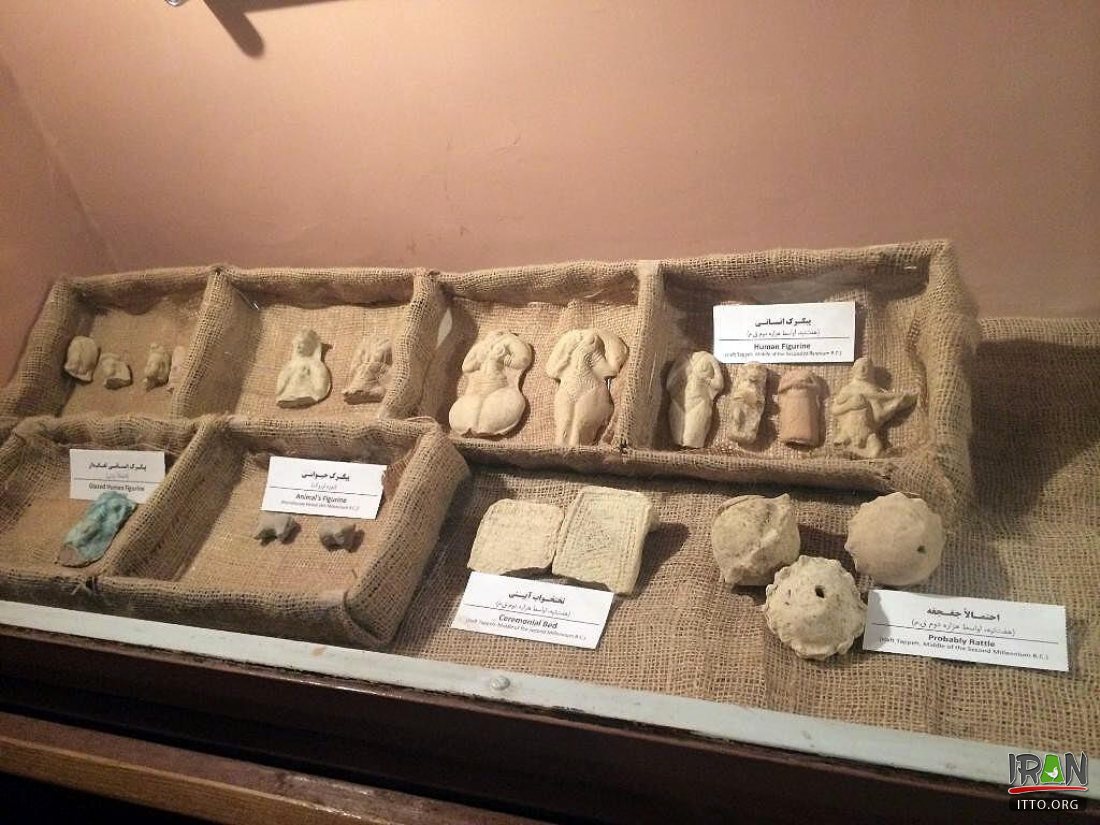
- "Who this goddess might be isn't exactly known. ... She could be the mother goddess Kiririsha, aka Kirrisi, Pinikir, Parti (her name at Izeh/Malemir, a settlement nearby), or Partikira (her name at Susa). She might've been known as the 'Great Goddess' and/or as the 'Proprietor of Heaven', titles held by similar goddesses throughout the ancient Middle East." ishtargates.tumblr.com/post/138152349361/along-with-the-r... Or she might have been the goddess Manzât, aka Mazzi'at, Manzi'at and Mazzêt, to whom a temple was dedicated at Chogha Zanbil and who was "believed to be responsible for the prosperity of cities. ... References to the worship of Manzât are known chiefly from the Elamite lowlands, esp. Susa and its surroundings. ... Theophoric names invoking her are attested in texts found at Haft Tappeh." (Wikipedia) Pinikir is discussed in this podcast.: youtu.be/uGz5zkMakjA?si=IByqOgzVSLfQ4JJp
- An older, shorter, balding man was in the vicinity while the younger man gave me that tour, made a comment to him at one point in a tone of disapproval if I recall, and the younger man seemed a bit chastened. Later as I was walking @ reading the booklet he gave me, the older man espied it, approached me and asked to see it, said the other man shouldn't've given it to me (to paraphrase), and took it back. He was the younger man's boss or supervisor evidently, and I fear that I got the kind, younger man in some trouble. (No good deed goes unpunished.)
Re the Development of the Arch or Barrel Vault:
- "The prototype [of the arch and the barrel vault] was a structure built of bundles of reeds placed upright in the ground, bent inward and tied together at the top to form a roof. Early Egyptian drawings, including hieroglyphs, depict reed vaults over sanctuaries, boat huts and other structures. Although no ancient reed bldg.s have survived, the technique has - in southern Iraq, at the confluence of the Tigris and Euphrates where 'Marsh Arabs' still construct enormous vaulted bldg.s of reeds. ... Nearly all the surviving [Near or Middle] Eastern arches are made of mud brick, or adobe (a Spanish loanword from the Arabic 'at-tub', 'the brick'). ... The same arid climate that makes mud-brick the ideal building material in the Near East makes vaulting the perfect technique for constructing a ceiling or a roof. A vaulted ceiling allows hot air to rise higher which helps to cool the living space. Many regions in the Near East lack forests, and the timber needed to support flat ceilings is scarce. A mud-brick vault requires no wooden beams for support. Not only is it practical and economical but it is a singularly graceful way to cover a building. ...
- "At Tell Razuk in Iraq a bldg. dating from @ 2,900 BC displays what may be transitional evolutionary forms: vaulted roofs in which the successive layers are both corbeled and canted inward. In Egypt radial arches and vaults were built sporadically in most periods of Pharaonic history, primarily in tombs and in monumental gateways. The earliest examples found of a radial vault in Egypt and of a pitched-brick vault anywhere are at Helwan in the same tomb which dates from late in the 1st Dynasty (@ 3,000 BC). [The "mature design" of the latter "suggests, however, that the technique had been employed for some time."] A somewhat later but particularly instructive example is the arched gateway of a mastaba (a bench-like tomb with inclined sides) at Giza from the 4th Dynasty (2,680-2,560 BC) that belonged to Neferi, a nobleman. ... The radial arch was more fully exploited in Mesopotamia. ... The earliest example known is in a hall built at Tepe Gawra late in the 4th mill. BC at the time of the emergence of Sumer. At Ur, the most famous Sumerian site, the tombs of King Abargi and Queen Shubad (@ 2,500 BC) had radially vaulted roofs and doorways. The most impressive Mesopotamian radial arches and vaults and the oldest Mesopotamian pitched-brick vaults (although a millenium younger than the earliest found in Egypt) are at Tell al Rimah, which date from the end of the 3rd and the 1st 1/2 of the 2nd mill. BC. Vaults span rooms 3.8 m.s wide in a temple, a burial chamber, 8 successive arches cover a stairway, etc. [Those at Haft Tappeh are pitched-brick vaults as well.] ... The acme of pitched-brick vaulting is the Taq Kisra, the great hall of the [Sassanian] palace at Ctesiphon, south of Baghdad, built sometime /b/ the 3rd and 6th cent.s. It still stands 28.4 m.s high and spans 25.5 m.s, the largest single-span vault of unreinforced brick anywhere." - case.edu/lifelonglearning/sites/default/files/2020-02/Van...
- According to Wikipedia, "[t]he earliest known example of [the] barrel vault [might be] under the [Sumerian] ziggurat at Nippur, built of fired bricks cemented with clay mortar." www.jstor.org/stable/496542?seq=18 A section of an arch in an ancient drain which "may have originally covered the whole drain, ... is perfectly elliptical" with a span of 1'8" and a total height of 2'4". (But I haven't found the date of construction of Nippur's arches.) Here's an old photo of that site.: en.wikipedia.org/wiki/File:John_Henry_Haynes._The_Nippur_...

The Rib or Ribbed Vault:
- It seems that the rib or ribbed vault, which became such an important and basic element of medieval Gothic architecture in Western Europe (essential to the construction of the great Gothic cathedrals, beginning with the Basilica of St. Denis near Paris in the mid 12-cent.), was invented or at least developed in ancient Iran (by the Medes?), where it "appears to have been confined, primarily." It was "employed extensively" at Nush-i-Jan (Median, 750-600 BC), with huge vault bricks, 1.2 m.s long. case.edu/lifelonglearning/sites/default/files/2020-02/Van... Van Beek writes (in his comprehensive article in the link re the development of "Arches and Vaults in the Ancient Near East") of the discovery of simple rib vaulting in a large Assyrian bldg. dating from @ 675 BC at Tell Jemmeh in Iraq (in which he also found "the oldest vaults known built of wedge-shaped bricks"). "The technique [of construction with rib vaulting] may have been brought to Tell Jemmeh by a Median builder in the service of the Assyrian imperial forces." (Nush-i-Jan is claimed to be the finest surviving Median bldg., one of the oldest surviving Zoroastrian ateshkades [it might be the oldest in Iran {?}, but I've read about the discovery of an earlier one somewhere in Central Asia which I'll write about sometime], and again, it's the site of the "extensive employment" of pioneering rib vaulting. It should be a Unesco site, but it's not on Iran's Tentative list for designation, not yet.)
"One would expect such long bricks to be fragile, but they were strong enough to support the floor of an upper room in the central temple." (Van Beek) flickr.com/photos/97924400@N00/3623624478/in/photostream/ Van Beek writes that "a rib vault couldn't have been as strong as a pitched-brick or radial vault, and apart from a certain simplicity of construction it probably had few advantages." But it was essential to Gothic architecture for good reason. "The ribs transmit the load downward and outward to specific points, usually rows of columns or piers, greatly reduc[ing] the weight and thus the outward thrust of the vault", permitting medieval Western European architects to build "higher and thinner walls with much larger windows." (Wikipedia)
- youtu.be/qU4ngo2UTXE?si=6qZHftlgYCczXpLq
- I think I hitched and walked back to Chogha Zanbil after completing my tour of Haft Tappeh, and then back to Andimeshk for the evening.
TheDiet Chronicles Documents an example of healthy eating or rather mindful eating. An idea of a way one "could" eat as a means to eat healthy and enjoy the process. As black belts and martial artist we are aware that Heart Disease is the number one cause of death among Americans and 1 out of 3 people will develop Type 2 Diabetes. It only makes sense then to make Healthy Eating a part of any self-defense program. Statistics show more people will be hurt by what's on their plate than they ever will be by a punch, kick, throw, or grappling match. Learning martial art techniques is important but where it stops the self-discipline of eating healthy and mindfully begins. Just an idea we explore and one that I ask my students to explore as well.
A martial arts education of intelligent curriculum curated by Sensei Dan Rominski at his martial art school located in Rutherford NJ. Visit our website www.thedojo.org Self-Defense for children at (201) 933-3050 or email SenseiDan@TheDOJO.org
Visit our website www.thedojo.org
Children Learn Focus, Discipline, Self-Control, Concentration, Fitness, Confidence, Respect, Have Better Self-Esteem, Healthy Eating and Self-Defense.
Adults Learn How to get and stay in shape, Stress Release, Fitness, Healthy Eating, Slow start program (come as you are), a coach in every class, Confidence, Focus, Self-Discipline, Positive Peer Group and it’s Fun!
Parents, Download your FREE Report The 7 Steps for Parents: Preventing Childhood Sexual Abuse Click HERE to visit our website
danrominski.squarespace.com/c...|/sexual-abuse-prevention
Sensei Dan is available for Scheduled TALKS & PRESENTATIONS.
Get more information about our Martial Arts Education of Intelligent Curriculum involving Everything Self-Defense at TheDOJO located in Rutherford NJ.
Contact Chief Instructor: Owner Sensei Dan Rominski at (201) 933-3050 or email SenseiDan@TheDOJO.org
Visit our website www.TheDOJO.org
TheDOJO - 52 Park Avenue, Rutherford, NJ 07070 - Phone: (201) 933-3050 - Text us for info here: (201) 838-4177
Our e-mail address: SenseiDan@TheDOJO.org - Our Facebook page: Like us at TheDOJO or Friend us DanRominski
Youtube Channel: www.youtube.com/user/DanRominski - Our Twitter www.twitter.com/danrominski
Instagram: www.instagram.com/danrominski
A link to where our school is on Google Maps: www.google.com/maps/place/TheD......
If you live in the Rutherford, NJ area and would like to inquire about our programs, reach out to us at the phone and/or e-mail or text addresses above. -Sensei Dan
Read our Blog at senseidanromisnki.blogspot.com...
Read our blog at www.DanRominski.Tumblr.com
We Teach Children, Teens and Adults from Rutherford, NJ; East Rutherford, NJ; Carlstadt, NJ; Kearny, NJ; Lyndhurst, NJ; Woodridge, NJ; Hackensack, NJ; Belleville, NJ; Bloomfield, NJ; Nutley, NJ; Clifton, NJ; Montclair, NJ; and surrounding areas.
No Matter The Martial Art we’ll help you accomplish your goals through our expertise or help you find a school that will best suit you.
Karate, Judo, Jujutsu, Juijitsu, Jiu-jitsu, Goju Ryu, Shorin Ryu, Kendo, Iaido, Aikido, Mixed Martial Arts, Grappling, Daito Ryu Aiki Jujutsu, Ryukyu Okinawa Kobudo, Shorin Ryu, TKD, Tae Kwon Do