View allAll Photos Tagged declarationofindependence
Author of the Declaration of Independence:
We hold these truths to be self-evident, that all men are created equal, that they
are endowed by their Creator with certain unalienable rights, that among these are life
liberty and the pursuit of happiness
The Benjamin Franklin Parkway, in Philadelphia, Pennsylvania.
Commonly abbreviated to Ben Franklin Parkway and colloquially called the Parkway, is a boulevard that runs through the cultural heart of Philadelphia. Named for Benjamin Franklin, a Founding Father, the mile-long Parkway cuts diagonally across the grid plan pattern of Centre City's northwest quadrant. It starts at Philadelphia City Hall, curves around Logan Circle, and ends before the Philadelphia Museum of Art.
Information Source:
A gentle reminder for those in power who seem to have forgotten these truths:
"We hold these truths to be self-evident, that all men are created equal, that they are endowed by their Creator with certain unalienable Rights, that among these are Life, Liberty and the Pursuit of Happiness"
- - Thomas Jefferson, The Declaration of Independence
The Washington Monument located at the end of the Benjamin Franklin Parkway, in Philadelphia, Pennsylvania.
The monument was commissioned and designed by sculptor Rudolf Siemering. The sculpture was dedicated in 1897 at the Green Street entrance to Fairmount Park. It was moved in 1928 to its present location after construction on the parkway was completed. In 1997, work to restore the statue began under the direction of Margo Berg of the Philadelphia Art Commission. Over the years, the sculpture had come loose from its base, and the fountain had ceased to function properly. The restoration was completed in June of the same year, 100 years after it was dedicated.
The bronze and granite sculpture features a uniformed George Washington mounted on a horse. Washington and his horse are poised on top of the fountain, facing southeast down the Benjamin Franklin Parkway towards Philadelphia City Hall. The face of the sculpture was made from an impression of the former president made while he was still alive. The body was of a Prussian General. The lowest level of the monument features Native Americans and animals that are native to the United States.
Information Source:
The Eastern State Penitentiary a former American prison and now a museum in the Fairmount section of Philadelphia, in Pennsylvania.
The penitentiary, which was in operation between 1829 and 1971, was once the most famous and expensive prison in the world. Its construction refined the revolutionary system of separate incarceration first pioneered at the Walnut Street Jail which emphasized principles of reform rather than punishment.
Notorious criminals such as Al Capone and bank robber Willie Sutton were held inside it's innovative wagon wheel design. James Bruno (Big Joe) and several male relatives were incarcerated here between 1936 and 1948 for the alleged murders in the Kelayres massacre of 1934, before they were paroled. At its completion, the building was the largest and most expensive public structure ever erected in the United States, and quickly became a model for more than 300 prisons worldwide.
Today it stands more in ruin, a haunting world of crumbling cellblocks and empty guard towers. The prison is currently a U.S. National Historic Landmark, which is open to the public for tours seven days a week, twelve months a year, 10 am to 5 pm.
Information Sources:
The Eastern State Penitentiary a former American prison and now a museum in the Fairmount section of Philadelphia, in Pennsylvania.
The penitentiary, which was in operation between 1829 and 1971, was once the most famous and expensive prison in the world. Its construction refined the revolutionary system of separate incarceration first pioneered at the Walnut Street Jail which emphasized principles of reform rather than punishment.
Notorious criminals such as Al Capone and bank robber Willie Sutton were held inside it's innovative wagon wheel design. James Bruno (Big Joe) and several male relatives were incarcerated here between 1936 and 1948 for the alleged murders in the Kelayres massacre of 1934, before they were paroled. At its completion, the building was the largest and most expensive public structure ever erected in the United States, and quickly became a model for more than 300 prisons worldwide.
Today it stands more in ruin, a haunting world of crumbling cellblocks and empty guard towers. The prison is currently a U.S. National Historic Landmark, which is open to the public for tours seven days a week, twelve months a year, 10 am to 5 pm.
Information Sources:
South Street District of Philadelphia, Pennsylvania.
Located between Front Street and Seventh Street is a neighbourhood known for its "bohemian", "punk", and generally "alternative" atmosphere and its diverse urban mix of shops, bars, and eateries. It is one of Philadelphia's largest tourist attractions.
South Street had been originally the centre of local Swedish and Dutch populations, then Irish in the early to mid-1800s, and many decades later, Jewish and Italian immigrant culture as well as a vibrant African-American neighbourhood. Because Quaker doctrine opposed live performances within the city limits, the first permanent theatre in the United States was built on the south side of the street at Leithgow Street, giving birth to a tradition of Philadelphians seeking out entertainment on South Street that continues today.
Until the 1950s, South Street was known mainly as a multi-ethnic garment district, with stores for men's suits and other clothing, while the more western areas around South Street served as a cultural and commercial center for South Philadelphia's African American community. Real estate values plummeted after city planner Edmund Bacon and others proposed the Crosstown Expressway that would have required the demolition of many buildings on South Street and Bainbridge Street. The suddenly cheap property attracted artists and counterculture-types. The proposed expressway was never built due to public opposition.
The resulting drop in rent and property prices, South Street served as an artists' haven and a hub of Beat subculture and, later, 1960s counterculture, bohemianism, and the hippie movement in Philadelphia, establishing a lasting association of South Street with avant-garde and alternative subcultures. Starting mainly in the early 1960s to the 1970s, South Street was filled with clubs and bars that fostered a live local music community.
Information Source:
en.wikipedia.org/wiki/South_Street_(Philadelphia)
Centre City District in Philadelphia, Pennsylvania, USA.
William Penn, an English Quaker, founded the city in 1682 to serve as capital of the Pennsylvania Colony. Philadelphia played an instrumental role in the American Revolution as a meeting place for the Founding Fathers of the United States, who signed the Declaration of Independence in 1776 at the Second Continental Congress, and the Constitution at the Philadelphia Convention of 1787.
Several other key events occurred in Philadelphia during the Revolutionary War including the First Continental Congress, the preservation of the Liberty Bell, the Battle of Germantown, and the Siege of Fort Mifflin. Philadelphia remained the nation's largest city until being overtaken by New York City in 1790; the city was also one of the nation's capitals during the revolution, serving as temporary U.S. capital while Washington, D.C. was under construction. In the 19th and 20th centuries, Philadelphia became a major industrial centre and a railroad hub.
The city grew due to an influx of European immigrants, most of whom initially came from Ireland and Germany—the two largest reported ancestry groups in the city as of 2015. Later immigrant groups in the 20th century came from Italy (Italian being the third largest European ethnic ancestry currently reported in Philadelphia) and other Southern European and Eastern European countries.
In the early 20th century, Philadelphia became a prime destination for African Americans during the Great Migration after the Civil War. Puerto Ricans began moving to the city in large numbers in the period between World War I and II, and in even greater numbers in the post-war period. The city's population doubled from one million to two million people between 1890 and 1950.
Philadelphia is the home of many U.S. firsts, including the first library (1731), hospital (1751), medical school (1765), national capital (1774), stock exchange (1790), zoo (1874), and business school (1881). Philadelphia contains 67 National Historic Landmarks and the World Heritage Site of Independence Hall.
Information Source:
We hold these truths to be self-evident, that all men are created equal, that they are endowed by their Creator with certain unalienable Rights, that among these are Life, Liberty and the pursuit of Happiness.-
Philadelphia's Magic Gardens a non-profit organization, folk art environment, and gallery space, in the South Street District of Philadelphia, Pennsylvania.
To date, it is the largest work created by mosaic artist Isaiah Zagar. Spanning spans three city lots and includes indoor galleries and a large outdoor labyrinth. The mosaics are made up of everything from kitchen tiles to bike wheels, Latin-American art to china plates.
Isaiah and his wife Julia moved to South Street in 1968, when the area was being slated for demolition by the city to create the Crosstown Expressway. Due to this proposed construction, the area was desolate and dangerous.
The Zagars were one of the first people to come to this area and begin to turn its image around. They opened the Eyes Gallery on 402 South Street, which was the first property that Isaiah would mosaic. Here they still showcase and sell the art of Latin-American artists.
After the Eyes Gallery, the Zagars went on to purchase and rent out several other buildings, and Isaiah would go on to create several other mosaicked spaces and public murals. He bought the building that currently houses Philadelphia's Magic Gardens in 1994. He fenced off the two vacant lots next door to keep out garbage and vermin, and over the next fourteen years began creating the Magic Gardens.
In 2002 the landowner of the two vacant lots wanted to sell the land due to rising property values on South Street. Together with members of the community, Isaiah was able to purchase the lots. With this purchase "Philadelphia's Magic Gardens" was born, and in 2008 it opened to the public, dedicated to inspiring creativity and community engagement.
It also has educational programming, performances, tours, and mosaic workshops, all of which are open to the public. Zagar continues to create mosaic murals on the streets of Philadelphia, hundreds of which can be seen in or around the South Street area.
The space is open for public view, from 11:00-18:00 Wednesday through Monday and closed on Tuesdays.
Information Source:
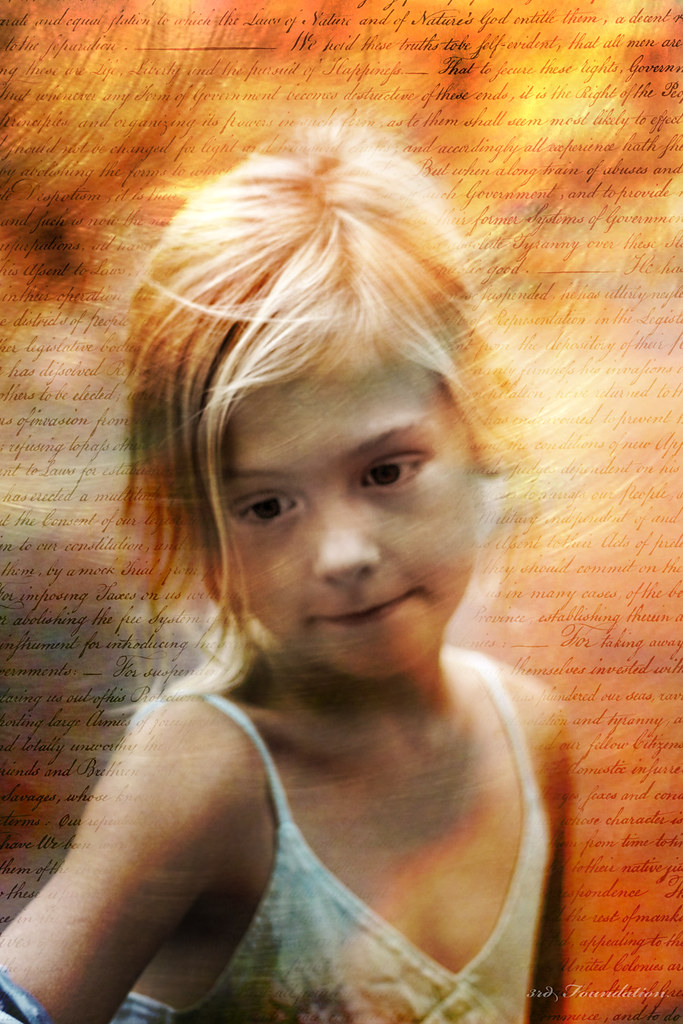
I've been wanting to do a portrait with text intermingled in the image so I dug around the web looking for text images. Among the images I found, I settled on the Declaration of Independence for this adjustment.
Centre City District in Philadelphia, Pennsylvania, USA.
William Penn, an English Quaker, founded the city in 1682 to serve as capital of the Pennsylvania Colony. Philadelphia played an instrumental role in the American Revolution as a meeting place for the Founding Fathers of the United States, who signed the Declaration of Independence in 1776 at the Second Continental Congress, and the Constitution at the Philadelphia Convention of 1787.
Several other key events occurred in Philadelphia during the Revolutionary War including the First Continental Congress, the preservation of the Liberty Bell, the Battle of Germantown, and the Siege of Fort Mifflin. Philadelphia remained the nation's largest city until being overtaken by New York City in 1790; the city was also one of the nation's capitals during the revolution, serving as temporary U.S. capital while Washington, D.C. was under construction. In the 19th and 20th centuries, Philadelphia became a major industrial centre and a railroad hub.
The city grew due to an influx of European immigrants, most of whom initially came from Ireland and Germany—the two largest reported ancestry groups in the city as of 2015. Later immigrant groups in the 20th century came from Italy (Italian being the third largest European ethnic ancestry currently reported in Philadelphia) and other Southern European and Eastern European countries.
In the early 20th century, Philadelphia became a prime destination for African Americans during the Great Migration after the Civil War. Puerto Ricans began moving to the city in large numbers in the period between World War I and II, and in even greater numbers in the post-war period. The city's population doubled from one million to two million people between 1890 and 1950.
Philadelphia is the home of many U.S. firsts, including the first library (1731), hospital (1751), medical school (1765), national capital (1774), stock exchange (1790), zoo (1874), and business school (1881). Philadelphia contains 67 National Historic Landmarks and the World Heritage Site of Independence Hall.
Information Source:
Originally published in 1926 as a cover of "The Saturday Evening Post" to celebrate the 150th anniversary of the signing, the artwork was re-published in 1976 as a signed lithograph to celebrate the bicentennial of the signing.
EXPLORE: November 8, 2008. Independence Hall - Philadelphia, Pennsylvania. Looking out of one of the upper windows from a U.S. national landmark. The United States Declaration of Independence and Constitution were both signed in this building.
Centre City District in Philadelphia, Pennsylvania, USA.
William Penn, an English Quaker, founded the city in 1682 to serve as capital of the Pennsylvania Colony. Philadelphia played an instrumental role in the American Revolution as a meeting place for the Founding Fathers of the United States, who signed the Declaration of Independence in 1776 at the Second Continental Congress, and the Constitution at the Philadelphia Convention of 1787.
Several other key events occurred in Philadelphia during the Revolutionary War including the First Continental Congress, the preservation of the Liberty Bell, the Battle of Germantown, and the Siege of Fort Mifflin. Philadelphia remained the nation's largest city until being overtaken by New York City in 1790; the city was also one of the nation's capitals during the revolution, serving as temporary U.S. capital while Washington, D.C. was under construction. In the 19th and 20th centuries, Philadelphia became a major industrial centre and a railroad hub.
The city grew due to an influx of European immigrants, most of whom initially came from Ireland and Germany—the two largest reported ancestry groups in the city as of 2015. Later immigrant groups in the 20th century came from Italy (Italian being the third largest European ethnic ancestry currently reported in Philadelphia) and other Southern European and Eastern European countries.
In the early 20th century, Philadelphia became a prime destination for African Americans during the Great Migration after the Civil War. Puerto Ricans began moving to the city in large numbers in the period between World War I and II, and in even greater numbers in the post-war period. The city's population doubled from one million to two million people between 1890 and 1950.
Philadelphia is the home of many U.S. firsts, including the first library (1731), hospital (1751), medical school (1765), national capital (1774), stock exchange (1790), zoo (1874), and business school (1881). Philadelphia contains 67 National Historic Landmarks and the World Heritage Site of Independence Hall.
Information Source:
Philadelphia's Magic Gardens a non-profit organization, folk art environment, and gallery space, in the South Street District of Philadelphia, Pennsylvania.
To date, it is the largest work created by mosaic artist Isaiah Zagar. Spanning spans three city lots and includes indoor galleries and a large outdoor labyrinth. The mosaics are made up of everything from kitchen tiles to bike wheels, Latin-American art to china plates.
Isaiah and his wife Julia moved to South Street in 1968, when the area was being slated for demolition by the city to create the Crosstown Expressway. Due to this proposed construction, the area was desolate and dangerous.
The Zagars were one of the first people to come to this area and begin to turn its image around. They opened the Eyes Gallery on 402 South Street, which was the first property that Isaiah would mosaic. Here they still showcase and sell the art of Latin-American artists.
After the Eyes Gallery, the Zagars went on to purchase and rent out several other buildings, and Isaiah would go on to create several other mosaicked spaces and public murals. He bought the building that currently houses Philadelphia's Magic Gardens in 1994. He fenced off the two vacant lots next door to keep out garbage and vermin, and over the next fourteen years began creating the Magic Gardens.
In 2002 the landowner of the two vacant lots wanted to sell the land due to rising property values on South Street. Together with members of the community, Isaiah was able to purchase the lots. With this purchase "Philadelphia's Magic Gardens" was born, and in 2008 it opened to the public, dedicated to inspiring creativity and community engagement.
It also has educational programming, performances, tours, and mosaic workshops, all of which are open to the public. Zagar continues to create mosaic murals on the streets of Philadelphia, hundreds of which can be seen in or around the South Street area.
The space is open for public view, from 11:00-18:00 Wednesday through Monday and closed on Tuesdays.
Information Source:
Benjamin Franklin, Craftsman (also known as Young Ben Franklin) a sculpture in the Centre City District in Philadelphia, Pennsylvania, USA.
For the occasion of their 250th anniversary, the Pennsylvania Freemasons commissioned artist Joseph Brown in 1981 to design a larger than life-size sculpture of Benjamin Franklin to be installed near their headquarters.
It pictures a young Benjamin Franklin working at a printing press was intended to memorialize him as a printer and an artist, and to serve as a reminder of the dignity of the craftsman.
Information Source:
www.associationforpublicart.org/artwork/benjamin-franklin...
The home of the free because of the brave.
Freedom of speech.
Freedom of worship.
Freedom from want.
Freedom from fear.
Brothers & sisters, our "leaders" are absent- we must take the reins & become the change.
Merry Christmas and a happy new year.
~Pray for Peace and Calm the Climate of Hate~
The Liberty Bell, seen through a window of reflections of Independence Hall
and its festive 4th of July decorations across the street.
Happy Independence Day!
The Eastern State Penitentiary a former American prison and now a museum in the Fairmount section of Philadelphia, in Pennsylvania.
The penitentiary, which was in operation between 1829 and 1971, was once the most famous and expensive prison in the world. Its construction refined the revolutionary system of separate incarceration first pioneered at the Walnut Street Jail which emphasized principles of reform rather than punishment.
Notorious criminals such as Al Capone and bank robber Willie Sutton were held inside it's innovative wagon wheel design. James Bruno (Big Joe) and several male relatives were incarcerated here between 1936 and 1948 for the alleged murders in the Kelayres massacre of 1934, before they were paroled. At its completion, the building was the largest and most expensive public structure ever erected in the United States, and quickly became a model for more than 300 prisons worldwide.
Today it stands more in ruin, a haunting world of crumbling cellblocks and empty guard towers. The prison is currently a U.S. National Historic Landmark, which is open to the public for tours seven days a week, twelve months a year, 10 am to 5 pm.
Information Sources:
The church was founded in 1752 in Midway, Georgia but the original building was destroyed during the American Revolution. The current structure was erected in 1792. It was occupied by the Union Cavalry of General Judson Kilpatrick during Sherman's March to the Sea but was left standing when the troops left to rejoin Sherman's main body of troops. Two church members were signers of the Declaration of Independence: Button Gwinnett and Lyman Hall The church is listed on the National Register of Historic Places..
Centre City District in Philadelphia, Pennsylvania, USA.
William Penn, an English Quaker, founded the city in 1682 to serve as capital of the Pennsylvania Colony. Philadelphia played an instrumental role in the American Revolution as a meeting place for the Founding Fathers of the United States, who signed the Declaration of Independence in 1776 at the Second Continental Congress, and the Constitution at the Philadelphia Convention of 1787.
Several other key events occurred in Philadelphia during the Revolutionary War including the First Continental Congress, the preservation of the Liberty Bell, the Battle of Germantown, and the Siege of Fort Mifflin. Philadelphia remained the nation's largest city until being overtaken by New York City in 1790; the city was also one of the nation's capitals during the revolution, serving as temporary U.S. capital while Washington, D.C. was under construction. In the 19th and 20th centuries, Philadelphia became a major industrial centre and a railroad hub.
The city grew due to an influx of European immigrants, most of whom initially came from Ireland and Germany—the two largest reported ancestry groups in the city as of 2015. Later immigrant groups in the 20th century came from Italy (Italian being the third largest European ethnic ancestry currently reported in Philadelphia) and other Southern European and Eastern European countries.
In the early 20th century, Philadelphia became a prime destination for African Americans during the Great Migration after the Civil War. Puerto Ricans began moving to the city in large numbers in the period between World War I and II, and in even greater numbers in the post-war period. The city's population doubled from one million to two million people between 1890 and 1950.
Philadelphia is the home of many U.S. firsts, including the first library (1731), hospital (1751), medical school (1765), national capital (1774), stock exchange (1790), zoo (1874), and business school (1881). Philadelphia contains 67 National Historic Landmarks and the World Heritage Site of Independence Hall.
Information Source:
This is a photo of Arthur Szyk's illustration of the Declaration of Independence of the State of Israel. This is not the actual Declaration of Independence enscribed by Otte Wallish.
blog.nli.org.il/en/arthur_szyk/#:~:text=Upon%20hearing%20....
"Arthur Szyk's magnificent artwork on the Declaration of Independence highlights the deep, meaningful connection between the new Jewish State and the ancient Jewish Past"
. . .
"As befitting a Jewish Modern artist with a passion for Zionism, Szyk created a series of magnificent images for the declaration scroll. These images included multiple Stars of David, prayers to the Almighty, famous biblical figures including Moses and Aaron, as well as the depictions of more modern characters, including a Jewish farmer planting a field and an IDF soldier bearing a flag in one hand, and rifle in the other."
. .
"It is possible that in this project, Arthur Szyk worked to artistically settle the conflict between the traditional position of trusting in God to protect the Jewish people from their enemies and the Zionist declaration that the Jews must stand strong and independent, protecting themselves from their enemies. As the phrase from Pirkei Avot, the Ethics of our Fathers, states, “If not me, then who?”"
en.wikipedia.org/wiki/Israeli_Declaration_of_Independence
The Israeli Declaration of Independence, formally the Declaration of the Establishment of the State of Israel (Hebrew: הכרזה על הקמת מדינת ישראל), was proclaimed on 14 May 1948 (5 Iyar 5708) by David Ben-Gurion, the Executive Head of the World Zionist Organization,[a][2] Chairman of the Jewish Agency for Palestine, and soon to be first Prime Minister of Israel.[3] It declared the establishment of a Jewish state in Eretz-Israel, to be known as the State of Israel, which would come into effect on termination of the British Mandate at midnight that day.[4][1] The event is celebrated annually in Israel as Independence Day, a national holiday on 5 Iyar of every year according to the Hebrew calendar.
On 12 May 1948, the Minhelet HaAm (Hebrew: מנהלת העם, lit. People's Administration) was convened to vote on declaring independence.[9][10] Three of the thirteen members were missing, with Yehuda Leib Maimon and Yitzhak Gruenbaum being blocked in besieged Jerusalem, while Yitzhak-Meir Levin was in the United States.
The meeting started at 13:45 and ended after midnight. The decision was between accepting the American proposal for a truce, or declaring independence. The latter option was put to a vote, with six of the ten members present supporting it:
Israel's Declaration of Independence scroll and ceremony
Otte Wallish was responsible for the calligraphy and design of the scroll for Israel's Declaration of Independence. Due to drafting debates beyond his control, Wallish had only finished the bottom part of the scroll by the time of the signing and announcement. In fact, David Ben-Gurion did not read the actual scroll but had to work from handwritten notes for the public declaration on 14 May 1948.[4] The photograph shown here was taken by Wallish's brother-in-law, Rudi Weissenstein.[2]
Wallish's scroll was prepared in three sections that were bound together. The original Declaration scroll is located in Israel's National Archives.[4][5] He based the calligraphy style on a Torah scroll from the sixteenth century.[2]
In addition, Walisch handled the preparation of the exhibit hall in which the State's Independence was announced. At the direction of Ben-Gurion and the immediate guidance of Ze'ev Sharef, Secretary of the National Administration, Wallish had the hall cleared of art not related to Jews and Israel. He had the hall's works exchanged for such works as Marc Chagall's "Jew Holding a Scroll."[6]
en.wikipedia.org/wiki/Otte_Wallish
English Translation
idi.theicenter.org/sites/default/files/Handout%203a-%20Is...
העצמאות Yom Ha'atzmaut
IMG_0193 Declaration of Independence Israel
Breakfast in the Centre City District in Philadelphia, Pennsylvania, USA.
William Penn, an English Quaker, founded the city in 1682 to serve as capital of the Pennsylvania Colony. Philadelphia played an instrumental role in the American Revolution as a meeting place for the Founding Fathers of the United States, who signed the Declaration of Independence in 1776 at the Second Continental Congress, and the Constitution at the Philadelphia Convention of 1787.
Several other key events occurred in Philadelphia during the Revolutionary War including the First Continental Congress, the preservation of the Liberty Bell, the Battle of Germantown, and the Siege of Fort Mifflin. Philadelphia remained the nation's largest city until being overtaken by New York City in 1790; the city was also one of the nation's capitals during the revolution, serving as temporary U.S. capital while Washington, D.C. was under construction. In the 19th and 20th centuries, Philadelphia became a major industrial centre and a railroad hub.
The city grew due to an influx of European immigrants, most of whom initially came from Ireland and Germany—the two largest reported ancestry groups in the city as of 2015. Later immigrant groups in the 20th century came from Italy (Italian being the third largest European ethnic ancestry currently reported in Philadelphia) and other Southern European and Eastern European countries.
In the early 20th century, Philadelphia became a prime destination for African Americans during the Great Migration after the Civil War. Puerto Ricans began moving to the city in large numbers in the period between World War I and II, and in even greater numbers in the post-war period. The city's population doubled from one million to two million people between 1890 and 1950.
Philadelphia is the home of many U.S. firsts, including the first library (1731), hospital (1751), medical school (1765), national capital (1774), stock exchange (1790), zoo (1874), and business school (1881). Philadelphia contains 67 National Historic Landmarks and the World Heritage Site of Independence Hall.
Information Source:
Reading Terminal Market in the Centre City District in Philadelphia, Pennsylvania, USA.
The building originates from 1893 under the elevated train shed of the Reading Railroad Company after the city of Philadelphia advocated to move public markets from the streets into indoor facilities for both safety and sanitary reasons.
When the Centre City Commuter Connection was completed in 1984, the Reading Terminal ceased operating as a train station, impacting foot traffic at the Market. The site was chosen for the convention centre, and in 1990 the Company transferred title to the complex to the Pennsylvania Convention Centre Authority.
The Market still occupies the ground floor and basement levels of the now Pennsylvania Convention Centre. The stalls are arranged in a grid pattern with an open area in the centre with tables and seating. Over one hundred merchants offer fresh produce, meats, fish, artisan cheese, groceries, ice cream, flowers, grilled cheese, baked goods, crafts, books, clothing, and specialty and ethnic foods.
Two of the vendors are descendants of original merchants from the initial opening in the late 1800s. The basement floor of the market holds the refrigerated storage area for vendor use. The storage area was considered state-of-the-art when it was built, in 1893. Currently, the market is open every day of the week, although the Pennsylvania Dutch merchants (a small but significant minority) generally do not operate Sunday through Tuesday.
Information Source:
Centre City District in Philadelphia, Pennsylvania, USA.
William Penn, an English Quaker, founded the city in 1682 to serve as capital of the Pennsylvania Colony. Philadelphia played an instrumental role in the American Revolution as a meeting place for the Founding Fathers of the United States, who signed the Declaration of Independence in 1776 at the Second Continental Congress, and the Constitution at the Philadelphia Convention of 1787.
Several other key events occurred in Philadelphia during the Revolutionary War including the First Continental Congress, the preservation of the Liberty Bell, the Battle of Germantown, and the Siege of Fort Mifflin. Philadelphia remained the nation's largest city until being overtaken by New York City in 1790; the city was also one of the nation's capitals during the revolution, serving as temporary U.S. capital while Washington, D.C. was under construction. In the 19th and 20th centuries, Philadelphia became a major industrial centre and a railroad hub.
The city grew due to an influx of European immigrants, most of whom initially came from Ireland and Germany—the two largest reported ancestry groups in the city as of 2015. Later immigrant groups in the 20th century came from Italy (Italian being the third largest European ethnic ancestry currently reported in Philadelphia) and other Southern European and Eastern European countries.
In the early 20th century, Philadelphia became a prime destination for African Americans during the Great Migration after the Civil War. Puerto Ricans began moving to the city in large numbers in the period between World War I and II, and in even greater numbers in the post-war period. The city's population doubled from one million to two million people between 1890 and 1950.
Philadelphia is the home of many U.S. firsts, including the first library (1731), hospital (1751), medical school (1765), national capital (1774), stock exchange (1790), zoo (1874), and business school (1881). Philadelphia contains 67 National Historic Landmarks and the World Heritage Site of Independence Hall.
Information Source:
South Street District of Philadelphia, Pennsylvania.
Located between Front Street and Seventh Street is a neighbourhood known for its "bohemian", "punk", and generally "alternative" atmosphere and its diverse urban mix of shops, bars, and eateries. It is one of Philadelphia's largest tourist attractions.
South Street had been originally the centre of local Swedish and Dutch populations, then Irish in the early to mid-1800s, and many decades later, Jewish and Italian immigrant culture as well as a vibrant African-American neighbourhood. Because Quaker doctrine opposed live performances within the city limits, the first permanent theatre in the United States was built on the south side of the street at Leithgow Street, giving birth to a tradition of Philadelphians seeking out entertainment on South Street that continues today.
Until the 1950s, South Street was known mainly as a multi-ethnic garment district, with stores for men's suits and other clothing, while the more western areas around South Street served as a cultural and commercial center for South Philadelphia's African American community. Real estate values plummeted after city planner Edmund Bacon and others proposed the Crosstown Expressway that would have required the demolition of many buildings on South Street and Bainbridge Street. The suddenly cheap property attracted artists and counterculture-types. The proposed expressway was never built due to public opposition.
The resulting drop in rent and property prices, South Street served as an artists' haven and a hub of Beat subculture and, later, 1960s counterculture, bohemianism, and the hippie movement in Philadelphia, establishing a lasting association of South Street with avant-garde and alternative subcultures. Starting mainly in the early 1960s to the 1970s, South Street was filled with clubs and bars that fostered a live local music community.
Information Source:
en.wikipedia.org/wiki/South_Street_(Philadelphia)
Philadelphia's Magic Gardens a non-profit organization, folk art environment, and gallery space, in the South Street District of Philadelphia, Pennsylvania.
To date, it is the largest work created by mosaic artist Isaiah Zagar. Spanning spans three city lots and includes indoor galleries and a large outdoor labyrinth. The mosaics are made up of everything from kitchen tiles to bike wheels, Latin-American art to china plates.
Isaiah and his wife Julia moved to South Street in 1968, when the area was being slated for demolition by the city to create the Crosstown Expressway. Due to this proposed construction, the area was desolate and dangerous.
The Zagars were one of the first people to come to this area and begin to turn its image around. They opened the Eyes Gallery on 402 South Street, which was the first property that Isaiah would mosaic. Here they still showcase and sell the art of Latin-American artists.
After the Eyes Gallery, the Zagars went on to purchase and rent out several other buildings, and Isaiah would go on to create several other mosaicked spaces and public murals. He bought the building that currently houses Philadelphia's Magic Gardens in 1994. He fenced off the two vacant lots next door to keep out garbage and vermin, and over the next fourteen years began creating the Magic Gardens.
In 2002 the landowner of the two vacant lots wanted to sell the land due to rising property values on South Street. Together with members of the community, Isaiah was able to purchase the lots. With this purchase "Philadelphia's Magic Gardens" was born, and in 2008 it opened to the public, dedicated to inspiring creativity and community engagement.
It also has educational programming, performances, tours, and mosaic workshops, all of which are open to the public. Zagar continues to create mosaic murals on the streets of Philadelphia, hundreds of which can be seen in or around the South Street area.
The space is open for public view, from 11:00-18:00 Wednesday through Monday and closed on Tuesdays.
Information Source:
Centre City District in Philadelphia, Pennsylvania, USA.
William Penn, an English Quaker, founded the city in 1682 to serve as capital of the Pennsylvania Colony. Philadelphia played an instrumental role in the American Revolution as a meeting place for the Founding Fathers of the United States, who signed the Declaration of Independence in 1776 at the Second Continental Congress, and the Constitution at the Philadelphia Convention of 1787.
Several other key events occurred in Philadelphia during the Revolutionary War including the First Continental Congress, the preservation of the Liberty Bell, the Battle of Germantown, and the Siege of Fort Mifflin. Philadelphia remained the nation's largest city until being overtaken by New York City in 1790; the city was also one of the nation's capitals during the revolution, serving as temporary U.S. capital while Washington, D.C. was under construction. In the 19th and 20th centuries, Philadelphia became a major industrial centre and a railroad hub.
The city grew due to an influx of European immigrants, most of whom initially came from Ireland and Germany—the two largest reported ancestry groups in the city as of 2015. Later immigrant groups in the 20th century came from Italy (Italian being the third largest European ethnic ancestry currently reported in Philadelphia) and other Southern European and Eastern European countries.
In the early 20th century, Philadelphia became a prime destination for African Americans during the Great Migration after the Civil War. Puerto Ricans began moving to the city in large numbers in the period between World War I and II, and in even greater numbers in the post-war period. The city's population doubled from one million to two million people between 1890 and 1950.
Philadelphia is the home of many U.S. firsts, including the first library (1731), hospital (1751), medical school (1765), national capital (1774), stock exchange (1790), zoo (1874), and business school (1881). Philadelphia contains 67 National Historic Landmarks and the World Heritage Site of Independence Hall.
Information Source:
IN CONGRESS, July 4, 1776.
The unanimous Declaration of the thirteen united States of America,
When in the Course of human events, it becomes necessary for one people to dissolve the political bands which have connected them with another, and to assume among the powers of the earth, the separate and equal station to which the Laws of Nature and of Nature's God entitle them, a decent respect to the opinions of mankind requires that they should declare the causes which impel them to the separation.
We hold these truths to be self-evident, that all men are created equal, that they are endowed by their Creator with certain unalienable Rights, that among these are Life, Liberty and the pursuit of Happiness.--That to secure these rights, Governments are instituted among Men, deriving their just powers from the consent of the governed, --That whenever any Form of Government becomes destructive of these ends, it is the Right of the People to alter or to abolish it, and to institute new Government, laying its foundation on such principles and organizing its powers in such form, as to them shall seem most likely to effect their Safety and Happiness. Prudence, indeed, will dictate that Governments long established should not be changed for light and transient causes; and accordingly all experience hath shewn, that mankind are more disposed to suffer, while evils are sufferable, than to right themselves by abolishing the forms to which they are accustomed. But when a long train of abuses and usurpations, pursuing invariably the same Object evinces a design to reduce them under absolute Despotism, it is their right, it is their duty, to throw off such Government, and to provide new Guards for their future security.--Such has been the patient sufferance of these Colonies; and such is now the necessity which constrains them to alter their former Systems of Government. The history of the present King of Great Britain is a history of repeated injuries and usurpations, all having in direct object the establishment of an absolute Tyranny over these States. To prove this, let Facts be submitted to a candid world.
He has refused his Assent to Laws, the most wholesome and necessary for the public good.
He has forbidden his Governors to pass Laws of immediate and pressing importance, unless suspended in their operation till his Assent should be obtained; and when so suspended, he has utterly neglected to attend to them.
He has refused to pass other Laws for the accommodation of large districts of people, unless those people would relinquish the right of Representation in the Legislature, a right inestimable to them and formidable to tyrants only.
He has called together legislative bodies at places unusual, uncomfortable, and distant from the depository of their public Records, for the sole purpose of fatiguing them into compliance with his measures.
He has dissolved Representative Houses repeatedly, for opposing with manly firmness his invasions on the rights of the people.
He has refused for a long time, after such dissolutions, to cause others to be elected; whereby the Legislative powers, incapable of Annihilation, have returned to the People at large for their exercise; the State remaining in the mean time exposed to all the dangers of invasion from without, and convulsions within.
He has endeavoured to prevent the population of these States; for that purpose obstructing the Laws for Naturalization of Foreigners; refusing to pass others to encourage their migrations hither, and raising the conditions of new Appropriations of Lands.
He has obstructed the Administration of Justice, by refusing his Assent to Laws for establishing Judiciary powers.
He has made Judges dependent on his Will alone, for the tenure of their offices, and the amount and payment of their salaries.
He has erected a multitude of New Offices, and sent hither swarms of Officers to harrass our people, and eat out their substance.
He has kept among us, in times of peace, Standing Armies without the Consent of our legislatures.
He has affected to render the Military independent of and superior to the Civil power.
He has combined with others to subject us to a jurisdiction foreign to our constitution, and unacknowledged by our laws; giving his Assent to their Acts of pretended Legislation:
For Quartering large bodies of armed troops among us:
For protecting them, by a mock Trial, from punishment for any Murders which they should commit on the Inhabitants of these States:
For cutting off our Trade with all parts of the world:
For imposing Taxes on us without our Consent:
For depriving us in many cases, of the benefits of Trial by Jury:
For transporting us beyond Seas to be tried for pretended offences
For abolishing the free System of English Laws in a neighbouring Province, establishing therein an Arbitrary government, and enlarging its Boundaries so as to render it at once an example and fit instrument for introducing the same absolute rule into these Colonies:
For taking away our Charters, abolishing our most valuable Laws, and altering fundamentally the Forms of our Governments:
For suspending our own Legislatures, and declaring themselves invested with power to legislate for us in all cases whatsoever.
He has abdicated Government here, by declaring us out of his Protection and waging War against us.
He has plundered our seas, ravaged our Coasts, burnt our towns, and destroyed the lives of our people.
He is at this time transporting large Armies of foreign Mercenaries to compleat the works of death, desolation and tyranny, already begun with circumstances of Cruelty & perfidy scarcely paralleled in the most barbarous ages, and totally unworthy the Head of a civilized nation.
He has constrained our fellow Citizens taken Captive on the high Seas to bear Arms against their Country, to become the executioners of their friends and Brethren, or to fall themselves by their Hands.
He has excited domestic insurrections amongst us, and has endeavoured to bring on the inhabitants of our frontiers, the merciless Indian Savages, whose known rule of warfare, is an undistinguished destruction of all ages, sexes and conditions.
In every stage of these Oppressions We have Petitioned for Redress in the most humble terms: Our repeated Petitions have been answered only by repeated injury. A Prince whose character is thus marked by every act which may define a Tyrant, is unfit to be the ruler of a free people.
Nor have We been wanting in attentions to our Brittish brethren. We have warned them from time to time of attempts by their legislature to extend an unwarrantable jurisdiction over us. We have reminded them of the circumstances of our emigration and settlement here. We have appealed to their native justice and magnanimity, and we have conjured them by the ties of our common kindred to disavow these usurpations, which, would inevitably interrupt our connections and correspondence. They too have been deaf to the voice of justice and of consanguinity. We must, therefore, acquiesce in the necessity, which denounces our Separation, and hold them, as we hold the rest of mankind, Enemies in War, in Peace Friends.
We, therefore, the Representatives of the united States of America, in General Congress, Assembled, appealing to the Supreme Judge of the world for the rectitude of our intentions, do, in the Name, and by Authority of the good People of these Colonies, solemnly publish and declare, That these United Colonies are, and of Right ought to be Free and Independent States; that they are Absolved from all Allegiance to the British Crown, and that all political connection between them and the State of Great Britain, is and ought to be totally dissolved; and that as Free and Independent States, they have full Power to levy War, conclude Peace, contract Alliances, establish Commerce, and to do all other Acts and Things which Independent States may of right do. And for the support of this Declaration, with a firm reliance on the protection of divine Providence, we mutually pledge to each other our Lives, our Fortunes and our sacred Honor.
Reading Terminal Market in the Centre City District in Philadelphia, Pennsylvania, USA.
The building originates from 1893 under the elevated train shed of the Reading Railroad Company after the city of Philadelphia advocated to move public markets from the streets into indoor facilities for both safety and sanitary reasons.
When the Centre City Commuter Connection was completed in 1984, the Reading Terminal ceased operating as a train station, impacting foot traffic at the Market. The site was chosen for the convention centre, and in 1990 the Company transferred title to the complex to the Pennsylvania Convention Centre Authority.
The Market still occupies the ground floor and basement levels of the now Pennsylvania Convention Centre. The stalls are arranged in a grid pattern with an open area in the centre with tables and seating. Over one hundred merchants offer fresh produce, meats, fish, artisan cheese, groceries, ice cream, flowers, grilled cheese, baked goods, crafts, books, clothing, and specialty and ethnic foods.
Two of the vendors are descendants of original merchants from the initial opening in the late 1800s. The basement floor of the market holds the refrigerated storage area for vendor use. The storage area was considered state-of-the-art when it was built, in 1893. Currently, the market is open every day of the week, although the Pennsylvania Dutch merchants (a small but significant minority) generally do not operate Sunday through Tuesday.
Information Source:
IN CONGRESS, JULY 4, 1776
The unanimous Declaration of the thirteen United States of America
When in the Course of human events it becomes necessary for one people to dissolve the political bands which have connected them with another and to assume among the powers of the earth, the separate and equal station to which the Laws of Nature and of Nature's God entitle them, a decent respect to the opinions of mankind requires that they should declare the causes which impel them to the separation.
We hold these truths to be self-evident, that all men are created equal, that they are endowed by their Creator with certain unalienable Rights, that among these are Life, Liberty and the pursuit of Happiness. — That to secure these rights, Governments are instituted among Men, deriving their just powers from the consent of the governed, — That whenever any Form of Government becomes destructive of these ends, it is the Right of the People to alter or to abolish it, and to institute new Government, laying its foundation on such principles and organizing its powers in such form, as to them shall seem most likely to effect their Safety and Happiness. Prudence, indeed, will dictate that Governments long established should not be changed for light and transient causes; and accordingly all experience hath shewn that mankind are more disposed to suffer, while evils are sufferable than to right themselves by abolishing the forms to which they are accustomed. But when a long train of abuses and usurpations, pursuing invariably the same Object evinces a design to reduce them under absolute Despotism, it is their right, it is their duty, to throw off such Government, and to provide new Guards for their future security. — Such has been the patient sufferance of these Colonies; and such is now the necessity which constrains them to alter their former Systems of Government. The history of the present King of Great Britain is a history of repeated injuries and usurpations, all having in direct object the establishment of an absolute Tyranny over these States. To prove this, let Facts be submitted to a candid world.
He has refused his Assent to Laws, the most wholesome and necessary for the public good.
He has forbidden his Governors to pass Laws of immediate and pressing importance, unless suspended in their operation till his Assent should be obtained; and when so suspended, he has utterly neglected to attend to them.
He has refused to pass other Laws for the accommodation of large districts of people, unless those people would relinquish the right of Representation in the Legislature, a right inestimable to them and formidable to tyrants only.
He has called together legislative bodies at places unusual, uncomfortable, and distant from the depository of their Public Records, for the sole purpose of fatiguing them into compliance with his measures.
He has dissolved Representative Houses repeatedly, for opposing with manly firmness his invasions on the rights of the people.
He has refused for a long time, after such dissolutions, to cause others to be elected, whereby the Legislative Powers, incapable of Annihilation, have returned to the People at large for their exercise; the State remaining in the mean time exposed to all the dangers of invasion from without, and convulsions within.
He has endeavoured to prevent the population of these States; for that purpose obstructing the Laws for Naturalization of Foreigners; refusing to pass others to encourage their migrations hither, and raising the conditions of new Appropriations of Lands.
He has obstructed the Administration of Justice by refusing his Assent to Laws for establishing Judiciary Powers.
He has made Judges dependent on his Will alone for the tenure of their offices, and the amount and payment of their salaries.
He has erected a multitude of New Offices, and sent hither swarms of Officers to harass our people and eat out their substance.
He has kept among us, in times of peace, Standing Armies without the Consent of our legislatures.
He has affected to render the Military independent of and superior to the Civil Power.
He has combined with others to subject us to a jurisdiction foreign to our constitution, and unacknowledged by our laws; giving his Assent to their Acts of pretended Legislation:
For quartering large bodies of armed troops among us:
For protecting them, by a mock Trial from punishment for any Murders which they should commit on the Inhabitants of these States:
For cutting off our Trade with all parts of the world:
For imposing Taxes on us without our Consent:
For depriving us in many cases, of the benefit of Trial by Jury:
For transporting us beyond Seas to be tried for pretended offences:
For abolishing the free System of English Laws in a neighbouring Province, establishing therein an Arbitrary government, and enlarging its Boundaries so as to render it at once an example and fit instrument for introducing the same absolute rule into these Colonies
For taking away our Charters, abolishing our most valuable Laws and altering fundamentally the Forms of our Governments:
For suspending our own Legislatures, and declaring themselves invested with power to legislate for us in all cases whatsoever.
He has abdicated Government here, by declaring us out of his Protection and waging War against us.
He has plundered our seas, ravaged our coasts, burnt our towns, and destroyed the lives of our people.
He is at this time transporting large Armies of foreign Mercenaries to compleat the works of death, desolation, and tyranny, already begun with circumstances of Cruelty & Perfidy scarcely paralleled in the most barbarous ages, and totally unworthy the Head of a civilized nation.
He has constrained our fellow Citizens taken Captive on the high Seas to bear Arms against their Country, to become the executioners of their friends and Brethren, or to fall themselves by their Hands.
He has excited domestic insurrections amongst us, and has endeavoured to bring on the inhabitants of our frontiers, the merciless Indian Savages whose known rule of warfare, is an undistinguished destruction of all ages, sexes and conditions.
In every stage of these Oppressions We have Petitioned for Redress in the most humble terms: Our repeated Petitions have been answered only by repeated injury. A Prince, whose character is thus marked by every act which may define a Tyrant, is unfit to be the ruler of a free people.
Nor have We been wanting in attentions to our British brethren. We have warned them from time to time of attempts by their legislature to extend an unwarrantable jurisdiction over us. We have reminded them of the circumstances of our emigration and settlement here. We have appealed to their native justice and magnanimity, and we have conjured them by the ties of our common kindred to disavow these usurpations, which would inevitably interrupt our connections and correspondence. They too have been deaf to the voice of justice and of consanguinity. We must, therefore, acquiesce in the necessity, which denounces our Separation, and hold them, as we hold the rest of mankind, Enemies in War, in Peace Friends.
We, therefore, the Representatives of the united States of America, in General Congress, Assembled, appealing to the Supreme Judge of the world for the rectitude of our intentions, do, in the Name, and by Authority of the good People of these Colonies, solemnly publish and declare, That these united Colonies are, and of Right ought to be Free and Independent States, that they are Absolved from all Allegiance to the British Crown, and that all political connection between them and the State of Great Britain, is and ought to be totally dissolved; and that as Free and Independent States, they have full Power to levy War, conclude Peace, contract Alliances, establish Commerce, and to do all other Acts and Things which Independent States may of right do. — And for the support of this Declaration, with a firm reliance on the protection of Divine Providence, we mutually pledge to each other our Lives, our Fortunes, and our sacred Honor.
The Avenue of the Arts the section of the cities designated arts cultural district, in Philadelphia, Pennsylvania,
It includes many of the city's cultural institutions, most notably the theatre district south of City Hall. The availability of public transportation makes Avenue of the Arts highly accessible to visitors.
The name originated in a strategy by mayor Ed Rendell to redevelop South Broad Street in Centre City. The area is overseen by the non-profit organization Avenue of the Arts, Inc. led by Executive Director Karen Lewis.
It is the locale for many of the city's large theatres, including the Kimmel Centre (home of the Philadelphia Orchestra), the Academy of Music, Merriam Theatre, Wilma Theatre, Liacouras Centre, and Suzanne Roberts Theatre. Buildings for the University of the Arts are located just south and east of the Kimmel Centre; the Merriam Theatre is often used for high-end productions involving the school.
Philadelphia International Records' offices and gift shop is also located along this strip. Just south of the strip is the Clef Club of Jazz and Performing Arts, and on Broad Street in this vicinity, just north of City Hall, is the Pennsylvania Academy of Fine Arts, which, founded in 1805, is America's oldest art school and museum and boasts a distinguished collection of American art.
Information Source:
en.wikipedia.org/wiki/Avenue_of_the_Arts_(Philadelphia)
Description: Dunlap print of the Declaration of Independence
This copy of the Declaration of Independence was found by an American antiquarian bookseller carrying out research at The National Archives in 2008. The poster-sized document was hidden among correspondence from American colonists that had been intercepted by the British in the 18th century. The discovery of the Dunlap print of the Declaration of Independence, printed on July 4 1776, brings the total of known surviving copies worldwide to 26.
The Dunlap prints were the first official printings of the Declaration of Independence and were named after John Dunlap, the printer whose name is given at the bottom of each copy. It is likely that only around 200 of these copies were ever printed.
The United States Declaration of Independence was a statement adopted by the Continental Congress which announced that the thirteen American colonies then at war with Great Britain were now independent states, and no longer a part of the British Empire.
The prints made by John Dunlap were delivered to the founders early on the morning of July 5 1776. One copy was officially entered into the Congressional Journal and the additional copies were distributed, some by horseback, throughout the colonies to be read aloud to colonists and the militia.
The last discovery of a Dunlap declaration was at a flea market in 1989, and it sold at auction in 2000 for $8.14 million.
Date: Printed 4th July 1776
Our Catalogue Reference: EXT 9/93
This image is from the collections of The National Archives. Feel free to share it within the spirit of the Commons.
For high quality reproductions of any item from our collection please contact our image library.
The Avenue of the Arts the section of the cities designated arts cultural district, in Philadelphia, Pennsylvania,
It includes many of the city's cultural institutions, most notably the theatre district south of City Hall. The availability of public transportation makes Avenue of the Arts highly accessible to visitors.
The name originated in a strategy by mayor Ed Rendell to redevelop South Broad Street in Centre City. The area is overseen by the non-profit organization Avenue of the Arts, Inc. led by Executive Director Karen Lewis.
It is the locale for many of the city's large theatres, including the Kimmel Centre (home of the Philadelphia Orchestra), the Academy of Music, Merriam Theatre, Wilma Theatre, Liacouras Centre, and Suzanne Roberts Theatre. Buildings for the University of the Arts are located just south and east of the Kimmel Centre; the Merriam Theatre is often used for high-end productions involving the school.
Philadelphia International Records' offices and gift shop is also located along this strip. Just south of the strip is the Clef Club of Jazz and Performing Arts, and on Broad Street in this vicinity, just north of City Hall, is the Pennsylvania Academy of Fine Arts, which, founded in 1805, is America's oldest art school and museum and boasts a distinguished collection of American art.
Information Source:
en.wikipedia.org/wiki/Avenue_of_the_Arts_(Philadelphia)
The Rodin Museum on the Benjamin Franklin Parkway, in Philadelphia, Pennsylvania.
It contains one of the largest collections of sculptor Auguste Rodin's works outside Paris. Opened in 1929, the museum is administered by the Philadelphia Museum of Art. The museum houses a collection of nearly 150 objects containing bronzes, marbles, and plasters by Rodin.
In 2012 the museum re-opened after a three-year, $9 million renovation that brought the museum back to its original vision of displaying Rodin's works.
The Museum was the gift of movie-theatre magnate Jules Mastbaum to the city of Philadelphia. Mastbaum began collecting works by Rodin in 1923 with the intent of founding a museum to enrich the lives of his fellow citizens. Within just three years, he had assembled the largest collection of Rodin's works outside Paris, including bronze castings, plaster studies, drawings, prints, letters, and books.
In 1926, Mastbaum commissioned French architects Paul Cret and Jacques Gréber to design the museum building and gardens. The collector did not live to see his dream realized, but his widow, Etta Wedell Mastbaum honoured his commitment to the city, and the Museum opened on November 29, 1929. Murals in the museum were executed by the painter Franklin C. Watkins.
Information Source:
The American Philosophical Society a historic civic building in Philadelphia, Pennsylvania.
It is an American scholarly organization and learned society founded in 1743 in Philadelphia that promotes knowledge in the humanities and natural sciences through research, professional meetings, publications, library resources, and community outreach. It was founded by the polymath Benjamin Franklin and is considered the first learned society founded in what became the United States.
Philosophical Hall, the society's headquarters and a museum, is located just east of Independence Hall in Independence National Historical Park. In 1965, in recognition of the building's history, it was designated a National Historic Landmark.
The society has about 1,000 elected members. As of April 2020, 5,710 members had been inducted since its creation. Through research grants, published journals, the American Philosophical Society Museum, an extensive library, and regular meetings, the society supports a variety of disciplines in the humanities and the sciences.
Information Source:
Note: On July 4, 1776, the Second Continental Congress adopted the Declaration of Independence in which the American colonies set forth a list of grievances against the British Crown and declared they were breaking from British rule to form free and independent states. On July 19, 1776, Congress resolved that the Declaration passed on the 4th be fairly engrossed on parchment with the title and stile [sic] "The unanimous declaration of the thirteen United States of America" and that the same, when engrossed, be signed by every member of Congress. The engrossing was most likely done by Timothy Matlack, an assistant to Charles Thomson, Secretary of the Congress. Although it bears the date "July 4, 1776," the engrossed Declaration was signed on August 2, 1776, by members of the Continental Congress who were present that day and later by other members of Congress. A total of 56 delegates eventually signed the document.
From: Series: Miscellaneous Papers of the Continental Congress, compiled 1774-1789 (Record Group 360)
Created by: Congress of the Confederation. (03/02/1781 - 03/04/1789)
Additional Creator: Second Continental Congress. (09/05/1775 - 03/02/1781)
Coverage Dates: 08/02/1776 - 08/02/1776
Persistent URL: research.archives.gov/description/1419123
Repository: National Archives Building - Archives I (Washington, DC)
Access Restrictions: Unrestricted
Use Restrictions: Unrestricted
We hold these truths to be self-evident, that all men are created equal, that they are endowed by their Creator with certain unalienable Rights, that among these are Life, Liberty and the pursuit of Happiness.
The Assembly Room
Independence Hall, Philadelphia
The Declaration of Independence and the United States Constitution were both signed in this room. See:
www.nps.gov/inde/learn/historyculture/places-independence...
"We the People of the United States, in Order to form a more perfect Union, establish Justice, insure domestic Tranquility, provide for the common defence, promote the general Welfare, and secure the Blessings of Liberty to ourselves and our Posterity, do ordain and establish this Constitution for the United States of America."
- Preamble, The Constitution of the United States
Founding Documents, National Archives:
www.archives.gov/founding-docs
Photographed January 2001
(Scanned 35mm color negative)
Centre City District in Philadelphia, Pennsylvania, USA.
William Penn, an English Quaker, founded the city in 1682 to serve as capital of the Pennsylvania Colony. Philadelphia played an instrumental role in the American Revolution as a meeting place for the Founding Fathers of the United States, who signed the Declaration of Independence in 1776 at the Second Continental Congress, and the Constitution at the Philadelphia Convention of 1787.
Several other key events occurred in Philadelphia during the Revolutionary War including the First Continental Congress, the preservation of the Liberty Bell, the Battle of Germantown, and the Siege of Fort Mifflin. Philadelphia remained the nation's largest city until being overtaken by New York City in 1790; the city was also one of the nation's capitals during the revolution, serving as temporary U.S. capital while Washington, D.C. was under construction. In the 19th and 20th centuries, Philadelphia became a major industrial centre and a railroad hub.
The city grew due to an influx of European immigrants, most of whom initially came from Ireland and Germany—the two largest reported ancestry groups in the city as of 2015. Later immigrant groups in the 20th century came from Italy (Italian being the third largest European ethnic ancestry currently reported in Philadelphia) and other Southern European and Eastern European countries.
In the early 20th century, Philadelphia became a prime destination for African Americans during the Great Migration after the Civil War. Puerto Ricans began moving to the city in large numbers in the period between World War I and II, and in even greater numbers in the post-war period. The city's population doubled from one million to two million people between 1890 and 1950.
Philadelphia is the home of many U.S. firsts, including the first library (1731), hospital (1751), medical school (1765), national capital (1774), stock exchange (1790), zoo (1874), and business school (1881). Philadelphia contains 67 National Historic Landmarks and the World Heritage Site of Independence Hall.
Information Source:
Website: |Bruce Wayne Photography|
Critiques and comments are most welcome!
If you are interested in licensing my copyrighted photos for websites, books, cards, etc, please email me at:
client@bruce-wayne-photography.com
------------------------------------------------------------------------------------------------------------------------------------
Better on Black, Press L
A Panoramic shot taken of Independence Hall in Philadelphia.
More to come soon, and for those of you who are Father's, have a great Father's Day and enjoy the rest of your weekend!
About the Photo:
Processed in Photoshop
Canon 350 (Full Spectrum)
50mm
f/7.1
ISO: 100
Shutter Speed: 1/100
Filter: Hoya Red 25A
***All Rights are Reserved***
Well since you can't actually go see the Declaration of Independence or any other national treasures at the moment I got you covered with this photo from The American Adventure. Here we've got Ben Franklin laying the smack down on Thomas Jefferson to get it done and Thomas is just all complaining wishing he could pawn it off on John Adams.
Thanks for looking!
Be sure to check out my Disney Lightroom Presets!
TheTimeTheSpace - My Portfolio | Facebook | Instagram | Twitter | My 500px