View allAll Photos Tagged chapelbridge
☑️ For a full view screen on black ... Just press L on your keyboard!
... one of the Lucerne's famous landmarks, a wooden bridge first erected in the 14th century !
Thanks a lot for your visits, comments, faves, invites, etc ...
Always very much appreciated !
Regards, Serge
Copyright © Serge Daigneault Photography, 2017
All rights reserved. Do not use without my written authorization.
I had planned to go to Lucerne early in the morning to photograph the sunrise over the harbor. The weather forecast looked like early morning fog and sun. When I arrived there was no fog and the sky was overcast. But I was early enough to take pictures of the bridge lights.
An early morning view of Lucerne, Switzerland, from the Chapel Bridge.
Kapellbrücke is a medieval covered bridge and has become the unofficial symbol of the city. “It was built in 1333. As you cross its 200-meter length, you'll see 120 captioned triangular paintings from the early 1500s that chronicle the city's history. The paintings feature St. Mauritius and St. Leodegar, the patron saints of Lucerne.
In reality, the bridge isn't as old as it looks. The Kapellbrücke was nearly destroyed by a 1993 fire, and much of what stands today is an excellent restoration (or reproduction, if you're a cynic or uncompromising realist).
Tip: If you're prone to arachnophobia, you may want to wear a hat and walk quickly when crossing the bridge at certain times of the year. Large spiders have been known to spin impressive webs in the Kapellbrücke's rafters--and that's something else you won't read in the tourist brochures.” It was an incredible structure, and I’m only very glad that I didn’t know about those spiders and their webs before I strolled slowly from one end to the other!
In 1993 the Chapel Bridge burned down. Two thirds of the wooden structure and most of the triangular paintings were destroyed in the process. The bridge was rebuilt - but the pictures were irretrievably lost. You can only see a few at the bridgeheads.
Camera: Mamiya RB67 SD
Film: Portra 400
Scanner: Epson V 850 Pro
Scanner SoftWare: SilverFast
One of the city's famous landmarks is the Chapel Bridge seen in thee center (German: Kapellbrücke), a wooden bridge first erected in the 14th century.
Wassertum Water Tower in Lucerne, Switzerland. Attached to the Chapel Bridge is the Wassertum. Translated it means water tower, but this octagonal, windowless, 140 foot stone structure was part of the city's fortification when it was built in the 14th century.
The Kapellbrücke is a covered wooden footbridge spanning the River Reuss diagonally in the city of Lucerne in central Switzerland.
For a long time I had planned to do this panorama of Lucerne. A short train takes you from the city up to the "Schlosshotel Gütsch". From here you have a wonderful view of Lucerne with the Chapel Bridge, Lake Lucerne and the surrounding mountains... While I was fumbling with my camera, a young woman spoke to me and asked how old this camera was. I replied how old she would guess. To which she replied, "Maybe about 100 years". She was amazed when I told her the camera was only 2 years old!
Camera: Shen Hao TZ-45 IIB
Lens: Computar 210mm f/6.3 Symmetrigon
Filmback: Shen Hao 6x17
Film: Kodak Ektar 100, 120
Scanner: Epson V850 Pro
ScannerSoftware: SilverFast
The water tower in the middle of the chapel bridge is part of the historic city fortification of Lucerne and is considered a landmark of the city.
The 35-metre-high octagonal and slightly leaning tower complements the city fortification towards the lake. Its construction time cannot be determined with certainty, but certainly after 1262, so even before the chapel bridge built. It has long served as a defensive and watchtower, as well as a cornerstone of the city's fortification. Over the years, he was a city archive, treasury, dungeon and torture chamber.
It is mentioned for the first time in 1367. The existing roof chair dates back to 1339. Since 1939 the tower has been rented to the Lucerne Artillery Association. The tower is rarely open to the public, usually only in summer.
On the lower floor of the tower is a dungeon. Its walls are three meters thick, there are neither windows nor doors. Access is only possible via an opening in the floor of the room above. The dungeon was probably used as a prison until 1759 and then abandoned. On the first floor is the so-called treasury. It served as a prison and as an interrogation and torture chamber until 1759. From 1759 to 1798 the state treasure was kept here, from 1798 to 1803 the room served again as a prison and from 1804 to keep the securities of the community. The second upper floor was until 1759 the place of storage of the Lucerne State Treasury and the State Archives.
When it was discovered in 1758 that money had been stolen for years, it was converted into a prison (until 1802). From 1804 to 1919 he again housed the municipal archive. The striking stork nest on the top of the tower has not been used for over 100 years. The 15-metre-high attic served as an interrogation and torture chamber. Since 1892 alpine sailors have been breeding here in a colony, which is supervised by the Ornithological Society of the City of Lucerne (OGL), since 1959 on behalf of the City Council of Lucerne. The Alpine sailing colony in the water tower is the largest Alpine swift "Tachymarptis melba" colony in central Switzerland.
The Kapellbrücke (literally, Chapel Bridge) is a covered wooden footbridge spanning the river Reuss diagonally in the city of Lucerne in central Switzerland.
Named after the nearby St. Peter's Chapel, the bridge is unique in containing a number of interior paintings dating back to the 17th century, although many of them were destroyed along with a larger part of the centuries-old bridge in a 1993 fire. Subsequently restored, the Kapellbrücke is the oldest wooden covered bridge in Europe, as well as the world's oldest surviving truss bridge. It serves as the city's symbol and as one of Switzerland's main tourist attractions.
Part of the bridge complex is the octagonal 34.5 m (113 ft) tall (from ground) Wasserturm, which translates to "water tower," in the sense of 'tower standing in the water.' The tower pre-dated the bridge by about 30 years. Over the centuries, the tower has been used as a prison, torture chamber, and later a municipal archive as well as a local treasury.
Today, the tower is closed to the public, although it houses a local artillery association and a tourist gift shop.
The bridge itself was originally built c.1365 as part of Lucerne's fortifications. It linked the old town on the right bank of the Reuss to the new town on the left bank, securing the town from attack from the south (i.e. from the lake).
The bridge was initially over 270 metres (890 ft) long, although numerous shortenings over the years and river bank replenishments mean the bridge now totals only 204.7 metres (672 ft) long. It is the oldest surviving truss bridge in the world, consisting of strutted and triangulated trusses of moderate span, supported on piled trestles; as such, it is probably an evolution of the strutted bridge.
The Kapellbrücke almost burned down on 18 August 1993, destroying two thirds of its interior paintings. Shortly thereafter, the Kapellbrücke was reconstructed and again opened to the public on 14 April 1994 for a total of CHF 3.4 million.
Some of the last photos were the B sides, they were not good enough or not the main one, so I left them in a folder. Always wanted to go back and check if there was some good material and I been running on those fumes the last months since... well, Budget and Forecast season.
The water tower in the middle of the chapel bridge is part of the historic city fortification of Lucerne and is considered a landmark of the city.
The 35-metre-high octagonal and slightly leaning tower complements the city fortification towards the lake. Its construction time cannot be determined with certainty, but certainly after 1262, so even before the chapel bridge built. It has long served as a defensive and watchtower, as well as a cornerstone of the city's fortification. Over the years, he was a city archive, treasury, dungeon and torture chamber.
It is mentioned for the first time in 1367. The existing roof chair dates back to 1339. Since 1939 the tower has been rented to the Lucerne Artillery Association. The tower is rarely open to the public, usually only in summer.
On the lower floor of the tower is a dungeon. Its walls are three meters thick, there are neither windows nor doors. Access is only possible via an opening in the floor of the room above. The dungeon was probably used as a prison until 1759 and then abandoned. On the first floor is the so-called treasury. It served as a prison and as an interrogation and torture chamber until 1759. From 1759 to 1798 the state treasure was kept here, from 1798 to 1803 the room served again as a prison and from 1804 to keep the securities of the community. The second upper floor was until 1759 the place of storage of the Lucerne State Treasury and the State Archives.
When it was discovered in 1758 that money had been stolen for years, it was converted into a prison (until 1802). From 1804 to 1919 he again housed the municipal archive. The striking stork nest on the top of the tower has not been used for over 100 years. The 15-metre-high attic served as an interrogation and torture chamber. Since 1892 alpine sailors have been breeding here in a colony, which is supervised by the Ornithological Society of the City of Lucerne (OGL), since 1959 on behalf of the City Council of Lucerne. The Alpine sailing colony in the water tower is the largest Alpine swift "Tachymarptis melba" colony in central Switzerland.
The water tower in the middle of the chapel bridge is part of the historic city fortification of Lucerne and is considered a landmark of the city.
The 35-metre-high octagonal and slightly leaning tower complements the city fortification towards the lake. Its construction time cannot be determined with certainty, but certainly after 1262, so even before the chapel bridge built. It has long served as a defensive and watchtower, as well as a cornerstone of the city's fortification. Over the years, he was a city archive, treasury, dungeon and torture chamber.
It is mentioned for the first time in 1367. The existing roof chair dates back to 1339. Since 1939 the tower has been rented to the Lucerne Artillery Association. The tower is rarely open to the public, usually only in summer.
On the lower floor of the tower is a dungeon. Its walls are three meters thick, there are neither windows nor doors. Access is only possible via an opening in the floor of the room above. The dungeon was probably used as a prison until 1759 and then abandoned. On the first floor is the so-called treasury. It served as a prison and as an interrogation and torture chamber until 1759. From 1759 to 1798 the state treasure was kept here, from 1798 to 1803 the room served again as a prison and from 1804 to keep the securities of the community. The second upper floor was until 1759 the place of storage of the Lucerne State Treasury and the State Archives.
When it was discovered in 1758 that money had been stolen for years, it was converted into a prison (until 1802). From 1804 to 1919 he again housed the municipal archive. The striking stork nest on the top of the tower has not been used for over 100 years. The 15-metre-high attic served as an interrogation and torture chamber. Since 1892 alpine sailors have been breeding here in a colony, which is supervised by the Ornithological Society of the City of Lucerne (OGL), since 1959 on behalf of the City Council of Lucerne. The Alpine sailing colony in the water tower is the largest Alpine swift "Tachymarptis melba" colony in central Switzerland.
Please don't use this image on websites, blogs or other media without my written permission.
© Toni_V. All rights reserved.
The water tower in the middle of the chapel bridge is part of the historic city fortification of Lucerne and is considered a landmark of the city.
The 35-metre-high octagonal and slightly leaning tower complements the city fortification towards the lake. Its construction time cannot be determined with certainty, but certainly after 1262, so even before the chapel bridge built. It has long served as a defensive and watchtower, as well as a cornerstone of the city's fortification. Over the years, he was a city archive, treasury, dungeon and torture chamber.
It is mentioned for the first time in 1367. The existing roof chair dates back to 1339. Since 1939 the tower has been rented to the Lucerne Artillery Association. The tower is rarely open to the public, usually only in summer.
On the lower floor of the tower is a dungeon. Its walls are three meters thick, there are neither windows nor doors. Access is only possible via an opening in the floor of the room above. The dungeon was probably used as a prison until 1759 and then abandoned. On the first floor is the so-called treasury. It served as a prison and as an interrogation and torture chamber until 1759. From 1759 to 1798 the state treasure was kept here, from 1798 to 1803 the room served again as a prison and from 1804 to keep the securities of the community. The second upper floor was until 1759 the place of storage of the Lucerne State Treasury and the State Archives.
When it was discovered in 1758 that money had been stolen for years, it was converted into a prison (until 1802). From 1804 to 1919 he again housed the municipal archive. The striking stork nest on the top of the tower has not been used for over 100 years. The 15-metre-high attic served as an interrogation and torture chamber. Since 1892 alpine sailors have been breeding here in a colony, which is supervised by the Ornithological Society of the City of Lucerne (OGL), since 1959 on behalf of the City Council of Lucerne. The Alpine sailing colony in the water tower is the largest Alpine swift "Tachymarptis melba" colony in central Switzerland.
The water tower in the middle of the chapel bridge is part of the historic city fortification of Lucerne and is considered a landmark of the city.
The 35-metre-high octagonal and slightly leaning tower complements the city fortification towards the lake. Its construction time cannot be determined with certainty, but certainly after 1262, so even before the chapel bridge built. It has long served as a defensive and watchtower, as well as a cornerstone of the city's fortification. Over the years, he was a city archive, treasury, dungeon and torture chamber.
It is mentioned for the first time in 1367. The existing roof chair dates back to 1339. Since 1939 the tower has been rented to the Lucerne Artillery Association. The tower is rarely open to the public, usually only in summer.
On the lower floor of the tower is a dungeon. Its walls are three meters thick, there are neither windows nor doors. Access is only possible via an opening in the floor of the room above. The dungeon was probably used as a prison until 1759 and then abandoned. On the first floor is the so-called treasury. It served as a prison and as an interrogation and torture chamber until 1759. From 1759 to 1798 the state treasure was kept here, from 1798 to 1803 the room served again as a prison and from 1804 to keep the securities of the community. The second upper floor was until 1759 the place of storage of the Lucerne State Treasury and the State Archives.
When it was discovered in 1758 that money had been stolen for years, it was converted into a prison (until 1802). From 1804 to 1919 he again housed the municipal archive. The striking stork nest on the top of the tower has not been used for over 100 years. The 15-metre-high attic served as an interrogation and torture chamber. Since 1892 alpine sailors have been breeding here in a colony, which is supervised by the Ornithological Society of the City of Lucerne (OGL), since 1959 on behalf of the City Council of Lucerne. The Alpine sailing colony in the water tower is the largest Alpine swift "Tachymarptis melba" colony in central Switzerland.
Lucerne
The city of Lucerne, with its famed - and much photographed - medieval Chapel Bridge, one of the oldest covered bridges in Europe (1).
Lucerne, a city in central Switzerland with approximately 80,000 residents, is absolutely beautiful and visiting it was one of the highlights of our trip. Life in Lucerne may be challenging for residents, however, as the city attracts nine million visitors (mostly day-trippers like me) each year (2). These visitors, many of whom come by large coach, snarl traffic, fill the streets, public squares and and restaurants, and in general, radically change the city dynamics each and every day. Research suggests that day trippers to Lucerne outnumber those to Venice, Rome, Barcelona and Paris - all much larger cities with significantly greater supporting infrastructure (2).
Suffice to say, while I have some guilt about my role in this problem, I thoroughly enjoyed my visit to this magical city on the water!
Ps - I’m sorry that I haven’t replied to comments this week - I promise that I will! It’s been a whirlwind week, and of course, with the multi-day Flickr migration, access has been challenging 😊 It’s great to have the system back up and running!
Sources: (1) www.myswitzerland.com/en-ca/destinations/lucerne/
(2) www.swissinfo.ch/eng/mass-tourism-_when-it-comes-to-day-t...
Panoramic view of the city skyline with the famous Chapel Bridge in the foreground crossing the Reuss River.
Built in 1333, Chapel Bridge/Kapellbrücke is a wooden pedestrian bridge that spans Reuss river in Lucerene, Switzerland.
The Kapellbrücke (literally, Chapel Bridge) is a covered wooden footbridge spanning diagonally across the Reuss River in the city of Lucerne in central Switzerland. Named after the nearby St. Peter's Chapel, the bridge is unique because it contains a number of interior paintings dating back to the 17th century, although many of them were destroyed along with most of the centuries-old bridge in a 1993 fire. Subsequently restored, the Kapellbrücke is the oldest wooden covered bridge in Europe as well as the world's oldest surviving truss bridge.
The bridge itself was originally built in 1333 as part of Lucerne's fortifications. It linked the old town on the right bank of the Reuss to the new town on the left bank, securing the city from attack from the south (i.e. from the lake).
The picture cycle of the chapel bridge shows scenes from Lucerne and Swiss history as well as the life and death of the two Lucerne city patron, Saint Leodegar and Saint Mauritius.
Numerous bridge images were irretrievably destroyed during the 1993 chapel bridge fire. The other paintings have been carefully restored and hang as cultural witnesses in the gables of the bridge.
The picture cycle originally comprised 158 picture panels. 147 pictures remained until 1993, of which 110 pictures were still shown there after the shortening of the bridge in the 19th century. The wooden panels are or were at the base between 150 and 181 cm wide and 85 to 95 cm high. Each board consisted of three to five spruce boards.
The picture cycle was created in the time of the Counter-Reformation, in which the city superiors propagated fidelity to the Catholic Church in an evangelical-reformed environment. The panels are propaganda in this sense. The representations from Lucerne and Federal history should remind us, when passing the bridge on the way to the city, that a pious way of life. - this certainly included the service in the military - and happiness in life belong together. A good Swiss at that time was the one that the city and Republic of Lucerne could borrow in soldier contracts to France and other states. It began on the left bank of the Reuss next to the Jesuit church with the image of the giant of Reiden and ended with the representation of the Jesuit College, today's Knight's Palace. This powerful, mythical giant was considered the origin of the strong and powerful Lucerne.
in Lucerne, Switzerland, is an historic wooden covered bridge known for its unique interior paintings. These 158 triangular paintings, depicting scenes from Swiss history and legends, adorn the bridge's gables. Although many were destroyed in a fire in 1993, the Chapel Bridge remains a major tourist attraction and a symbol of Lucerne. The walk through the bridge was charming and our tour guide was incredible.
This composition is a personal favourite.
The swan bedecked River Reuss and wooden footbridge set against the backdrop of the Swiss mountains make for a stunning experience!
هذي روابط للصوره بتعديلات ثانيه =)
farm4.static.flickr.com/3182/2544085061_7b3427d429_b.jpg
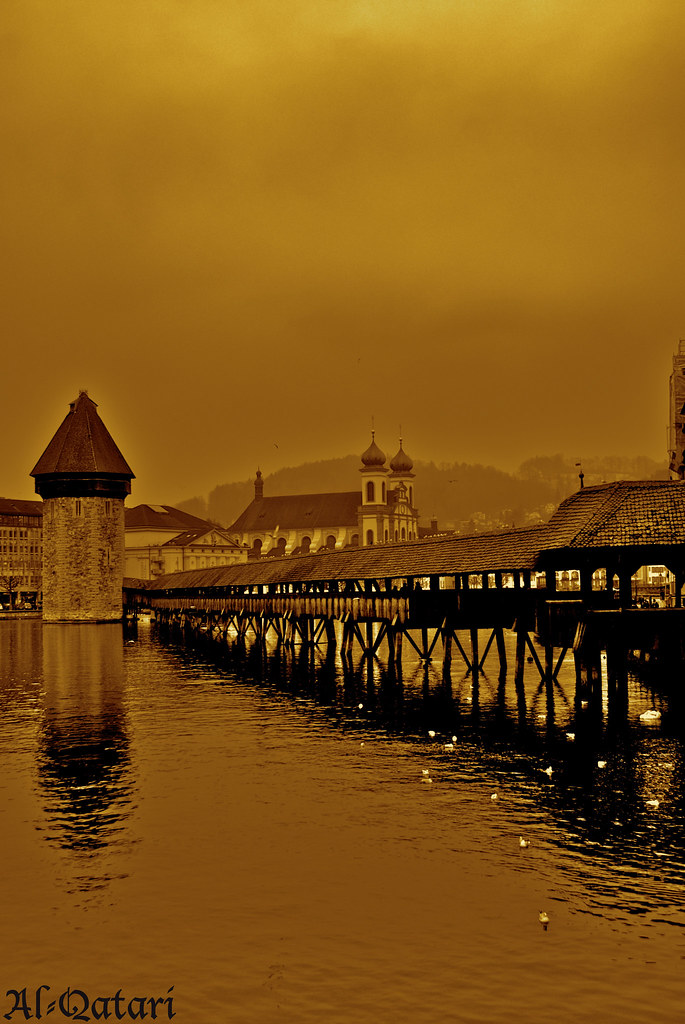
farm4.static.flickr.com/3258/2546170634_01e53d01c4_b.jpg
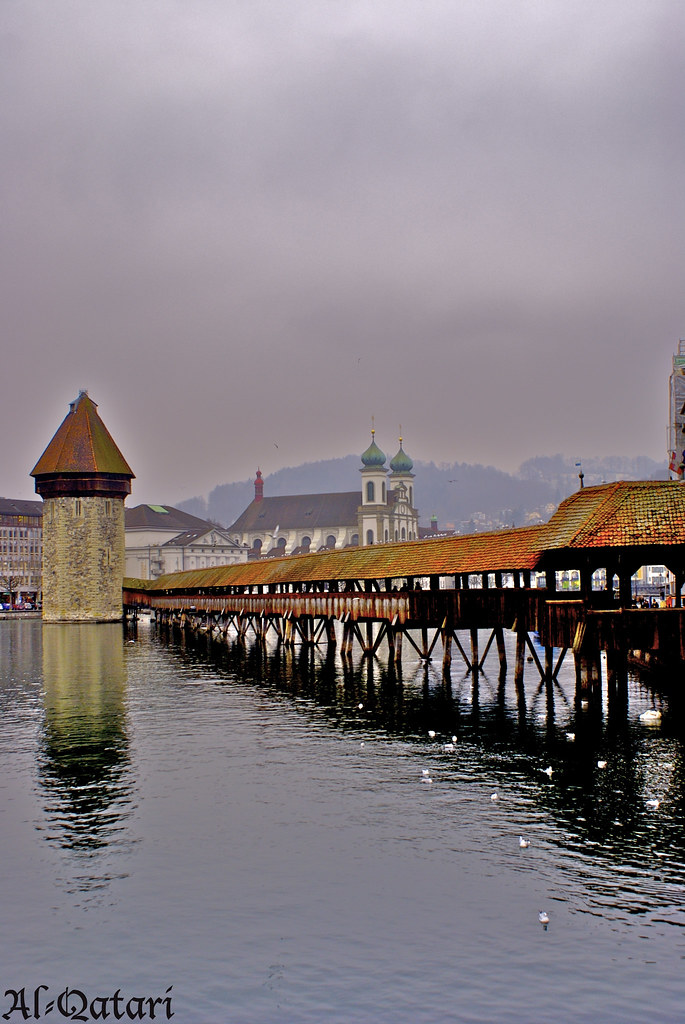
من يقول الزين ما يكمل حلاه =
كل شــيء في حـبـيبي اكتمل
الله الـلي كمله واللـه عطاه =
مــابقي للزين في خلـي محل
العيون احلى من عيون المهاه =
شافهـا قلبي وصفق واحتفل
نظرته من فتنته شعله حياه =
والجفون من الحيـا فيها كسل
ساهم رمشـه على الخد وسناه =
كن لمـعـه وجنتـه ورد وطل
والشفايا كنهـا جمر الغضاه =
تحرس الـريق المحـلى بالعسل
والشعر ليل تقل حمره مساه =
اجـعـد حول علـى صدره همل
مايج من فوق متنه ما طواه =
لـون شــلال مع المغرب نزل
انطلـق جيده يمـارى في بهاه =
فـوق مـياس تعزل واعتدل
بالرشاقه فيه من ظبى الفلاه =
لى مشى كنه على الريح انتقل
ريـحته مـن كل زهر منتقاه =
والـزيـاده للخـزامى والنفل
صافي مثل المطر فوق الصفاه =
بـاسم مثـل البشاير بالامل
جـامع مـن كل زيـن منتهاه =
مستحيل الوصف في خلى سهل
كايد مـاهو يلين لمن بغاه =
يرتفع عن كل سقطات الزلل
www.movn.net/5ald_al_fe9al/mn_ygool_alzeen.ram
www.abdu-music.org/jalsat/collections/real/mn_ygool.ra
Water Tower & Chapel Bridge
Luzern, Switzerland
Chapel Bridge and Water Tower - the number one photo subjects in Lucerne.
Thank you for your visits / comments / faves!
Die Kapellbrücke ist die älteste und mit 202 Metern die zweitlängste überdachte Holzbrücke Europas. Sie wurde um 1365 als Wehrgang gebaut und verbindet die durch die Reuss getrennte Alt- und Neustadt. Ursprünglich war die Brücke länger; durch die Auffüllung des Ufers wurde ein etwa 75 Meter langes Stück um 1835 abgebrochen. Im Giebel der Brücke befanden sich (vor dem Brand 1993) 111 dreieckige Gemälde, die wichtige Szenen der Schweizer Geschichte darstellen. Die Brücke fiel in der Nacht auf den 18. August 1993 einer Feuersbrunst zum Opfer, welche nach Vermutungen durch eine weggeworfene Zigarette ausgelöst wurde. Der Brand zerstörte einen Grossteil der Brücke und unter anderem 78 der 111 berühmten Bilder. Nach dem Brand konnten die Überreste von 47 Bildern geborgen werden. 30 Bilder liessen sich bis 1998 restaurieren. Die Brücke wurde umgehend wiederaufgebaut, am 14. April 1994 eingeweiht und erneut für Fussgänger freigegeben. (Wikipedia)
The Kapellbrücke (literally, Chapel Bridge) is a covered wooden footbridge spanning the river Reuss diagonally in the city of Lucerne in central Switzerland. Named after the nearby St. Peter's Chapel, the bridge is unique in containing a number of interior paintings dating back to the 17th century, although many of them were destroyed along with a larger part of the centuries-old bridge in a 1993 fire. Subsequently restored, the Kapellbrücke is the oldest wooden covered bridge in Europe, as well as the world's oldest surviving truss bridge. It serves as the city's symbol and as one of Switzerland's main tourist attractions. (Wikipedia).
P2030016-Bearbeitet-1