Nice pictures
View allAll Photos Tagged causation
Bench Obsession - Chapter 4
Neighbor: “Hi Neighbor!”
Wife: “Oh hi, how are you?
Neighbor: “I’m great. Say, how did that Kiwi bench photo thing go last Monday? Did they figure out that Steve didn’t actually go to New Zealand over the weekend to take that shot?”
Wife: “Everyone knew, but I don’t think anyone cared.”
Neighbor: “So did any bench photos make… Expand…Expose…Expect…”
Wife: “Explore.”
Neighbor: “Yeh, that’s it.”
Wife: “No, but he still thinks bench photos should dominate explore and he’s not giving up. He’s still plotting and scheming.”
Neighbor: “Plotting and scheming?”
Wife: “Yeh, he spent all night working on excel using AI. He collected data and created spreadsheets, graphs, charts and trend lines. He had a control chart with standard deviations and was mumbling something about correlation is not causation."
Neighbor: “So did he come up with some overarching string theory to unify all the fundamental forces that make up a great bench photo?"
Wife: ::sigh:: “He thinks so.”
Neighbor: “So tell me this brilliant new scientific revelation?”
Wife: ::clears throat:: “More is Better.”
Neighbor: “His great hypothesis is ‘more is better’?”
Wife: “Yup. More is better.”
Neighbor: ::rolls eyes:: “Elaborate.”
Wife: “Well, he figures that if you post a photo with one nice bench on it, it gets a set number of views. For round numbers, let’s say 100. So two nice benches in the same photo gets you twice as many, or 200 views. 3 benches = 300, 4 benches = 400 and so on. With enough benches multiplying the total views, the image can’t be ignored.”
Neighbor: “So, did he get a photo with lots of benches?”
Wife: “Yeh. When we were in Kansas he took one. Dodge City is a historic cowboy town where buffalo hunters roamed and where the old TV show ‘Gunsmoke’ was based. They have a place where they reenact old western gun fights and such, and there were a lot of benches there."
Neighbor: “Do you think that will work?”
Wife: “Of course not.”
Neighbor: “Did you tell him?”
Wife: “Uh huh.”
Neighbor: “What did he say?
Wife: “Happy Bench(es) Monday!"
‘…the fifth sun of immediate causation…’
Charcoal - 290mm x 136.5mm
See a different presentation layout on Flickrock :-
flickrock.com/59464034@N08/date#/59464034@N08/sets/721577...
Western Bluebird - Something interesting about this image is the beak deformity which is characterized as Avian Keratin Disorder. The beak is made out of the same stuff as our fingernails, and they do continue to grow, however there is evidence that this disorder may have a viral causation that could be environmental. My good Friend Dan Weisz sent me this study on what is becoming a more commonly seen deformity on birds. www.sciencedaily.com/rel.../2016/07/160726123107.htm
©R.C. Clark: Dancing Snake Nature Photography
All rights reserved - Pima County, AZ
#PeaceLoveConservation
Correlation is not causation.
Most things are just coincidence right. And anytime you insist on something you must insist upon it when it does not suit your narrative.
Hello there. All relevant comments are welcome here.
But please do NOT post any awards, banners, etc.
All my images are my own original work.
All my images are subject to my copyright.
All rights reserved unless otherwise stated.
You need my permission to use any image for ANY purpose.
Copyright infringement is theft.
Some Birds' Songs
www.youtube.com/watch?v=y3xrRhAzOX8
*
Chinese Ink Paintings on Birds ( 华嵒 )
www.youtube.com/watch?v=DhRxe4OXLT0
If one believes in causation and after you engaged the service of a hawk among all hawks, there is a price you have to pay for. And after you messed with a mad dog, you better run for your life, and after you solicitated the service and wisdom of the hundred years old man and yet you paid no heed to his advice, you have no one else to blame. Such are the consequences of disobeying the rules of "The Grand Chessboard "...
***
"Down By The Sally Gardens" An Irish song with a poem by William Butler Yeats and music arranged by B Britton
Maura O'Connell
www.youtube.com/watch?v=fnKbPwd2kYk
John McCormack
www.youtube.com/watch?v=4PcuGnNdCzo
It was down by the Sally Gardens, my love and I did meet.
She crossed the Sally Gardens, with little snow-white feet.
She bid me to take life easy, as the leaves grow on the tree,
But I was young and foolish, and with her I did not agree.
In a field down by the river, my love and I did stand
And upon my leaning shoulder, she laid her snow-white hand.
She bid me to take life easy, as the grass grows on the weirs,
But I was young and foolish, and now I am full of tears.
Down by the Sally Gardens, my love and I did meet.
She crossed the Sally Gardens with little snow-white feet.
She bid me to take life easy, as the leaves blow on the tree,
But I was young and foolish, and with her I did not agree.
The day enters through the door which creeks dreadfully. There is no such thing as a new soul ("everything in nature is ressurection" - Voltaire). All of us have been reincarnating (rebirth of energy) for millions of years so in truth there is no death. It is said that human subconscious always keeps some dim memories of previous lives. Howveer not recalling is a blessing in disguise that allows us to start all over again. What matters is this life, now. Ppl who understand Karma (intentional action, a deed done deliberately through body, speech or mind, a law of moral causation, like Newston's 3rd law) and rebirth see life in a better perspective. Ppl with strong and unexpected affinities for certain places may have them due to past lives connections. Life is about learning karmic lessons and the evolution of the soul (continuous thought sequence). There is no permanent rest in this cycle of birth and death. In fact, the goal would be to not reincarnate anymore, to become free from this ceaseless cycle so the soul would finally rest, but this means that you're spiritually advanced and high up on the path of evolution, attained Nirvana and gained supreme happiness. If you've ever experienced some extraordinary feelings, memories or sensations that you can't explain that is the sign that you might have touched the "other side".
I did when i saw this picture: i0.wp.com/www.themammothreflex.com/wp-content/uploads/201....

Such a violent emotion that i burst out crying in front of it at Steve McCurry's exhibition.
And i might have seen something like what? a million pictures?
Ibrahim Maalouf - Beirut
Beirut – Postcards From Italy
"The times we had
oh, when the wind would blow with rain and snow
were not all bad
we put our feet just where they had, had to go
never to go
the shattered soul
following close but nearly twice as slow
in my good times
there were always golden rocks to throw
at those who, those who admit defeat too late
those were our times, those were our times
and i will love to see that day
that day is mine
when she will marry me outside with the willow trees
and play the songs we made
they made me so
and i would love to see that day
that day was mine"
Whilst no archaeological material was found in the durable, mineral and easy-to-clean interior, objects from the Chalcolithique (4,720-4,220 ybp) have been found around the site. The lower menhir may be from anywhere between 6,000 and 4,500 ybp and that whole transitional period from the end of the Neolithic into the first ages of metal looks to be valid for this site.
The cavity is 3.20 x 2.30 x 1.90 m The entrance hole is 70 cm in diameter. The outside rim is around 10 cm wide. The rock is granit and the cavity a clean cul-de-sac, so from my understanding must be considered as man made. There seem to be basins above the site and a 2.18 m high menhir stands 30m below on the same 'path'.
Unlike some of the troglodyte sepultures from a broadly similar period in Sardinia, the interior space is curved like a large bowl and, apart from the concentric entrance rim, has no lines of form or structure.
With the menhir close-by, one must expect the area to have been frequented and the great effort to make this cavity cannot have been for the creation of a secret place to hide people or objects - the outcrop is far too dominant.
Describing the acoustic qualities needs to tip from correlation to causation in that the acoustics were the aim of the site and not a by product. Why here? What is it about this section of landscape? ...
AJM 08.05.18
My photographs and videos and any derivative works are my private property and are copyright © by me, John Russell (aka “Zoom Lens”) and ALL my rights, including my exclusive rights, are reserved. ANY use without my permission in writing is forbidden by law.
The dome bears more than a passing resemblance to that of the Cathedral of Sevilla. Students of ecclesiastical architecture may be hoping the resemblance ends there. Sevilla cathedral opened in 1506-07. Notwithstanding that it had been under construction for over a hundred years the lantern dome promptly executed a spontaneous descent in 1511. Doubtless this would have proved to be something of a disappointment to many interested parties and particularly to those gathered in trusting worship below it.
The repairs were completed and signed off by 1519. Perhaps a little optimistically, all things considered. The dome duly collapsed once more in 1888 and work continued to get it right this time until 1903.
Spanish cathedral construction has many unique features. Notably siesta where the agreeable practice of sleeping represents a significant part of the "working day." It has not been conclusively established that this is a contributory factor in the unhurried building times, nor the sometimes unreliable results. And of course correlation does not necessarily equal causation. Nonetheless, on the balance of probability a relation may well be inferred.
After discovering this phenomenon on my landlords' property here in western Montana, an odd occurrence where a ponderosa pine tree bends to a point where it actually reroots itself from its top-most branches, forming a permanent arch, I have actually discovered more such specimens in the same general vicinity.
The new discoveries are of the much smaller variety, but display the very same characteristics. As such, I have hereby decided that I have accidentally discovered a new genus of what I am calling "Ostrich Pines" in the Bitterroot Valley of the Treasure State, here in Big Sky Country, USA. Also, now, Ostrich Pine Country, apparently.
The causation is open to speculation, and I have my own un-scientific hypothesis. Still, it is probably best to consult with an experienced arborist for an explanation here, rather than with
a photographer who simply finds the phenomenon photo-graphically compelling. Which I do. And, for the record, a winterized version of this same tree follows just a short float down the photostream. Watch for rocks.
Two processes were at work in this photo: one natural, one intentional. Why do we know intuitively which is which? The background pattern is regular and geometric; that's not enough to discriminate causes. The tire tread we recognize as coming from a bicycle tire (dirt bike or mountain bike). It, too, produced a repeating pattern. Some naturally-caused patterns can be just as regular.
We might quibble over whether the tire tread represents "intelligent" design but the difference is in the intent: the foresight a cycle maker had to produce a vehicle capable of driving out on soft dirt, and the intention of a driver to take it out on this playa. That's the only distinguishing factor between the two forms of causation. One (the tire track) required a mind; the other (the mud cracks) did not. Whether a pattern is ethical or has artistic merit are separate questions. We all make these inferences to natural and intelligent causes every day. Some are intuitive; some require more investigation: e.g. mud cracks can resemble pottery.
Coming very close to the end of this year’s series, I just had to show off another vibrant snowflake. Thin film interference for the magic here – view large!
The effects of thin film interference – those beautiful colours you see in this snowflake – are much more common on smaller gems like this. Whatever physics creates the perfect thickness of ice to evoke this phenomenon might also be responsible for the smaller footprint of the crystals. I can’t quite figure the relationship out, and it might be a case of correlation having nothing to do with causation; over 90% of the colourful snowflakes I have observed have been this size or smaller. If you want to learn more about the science behind these colours, here’s some extra reading from Sky Crystals: skycrystals.ca/pages/optical-interference-pages.jpg
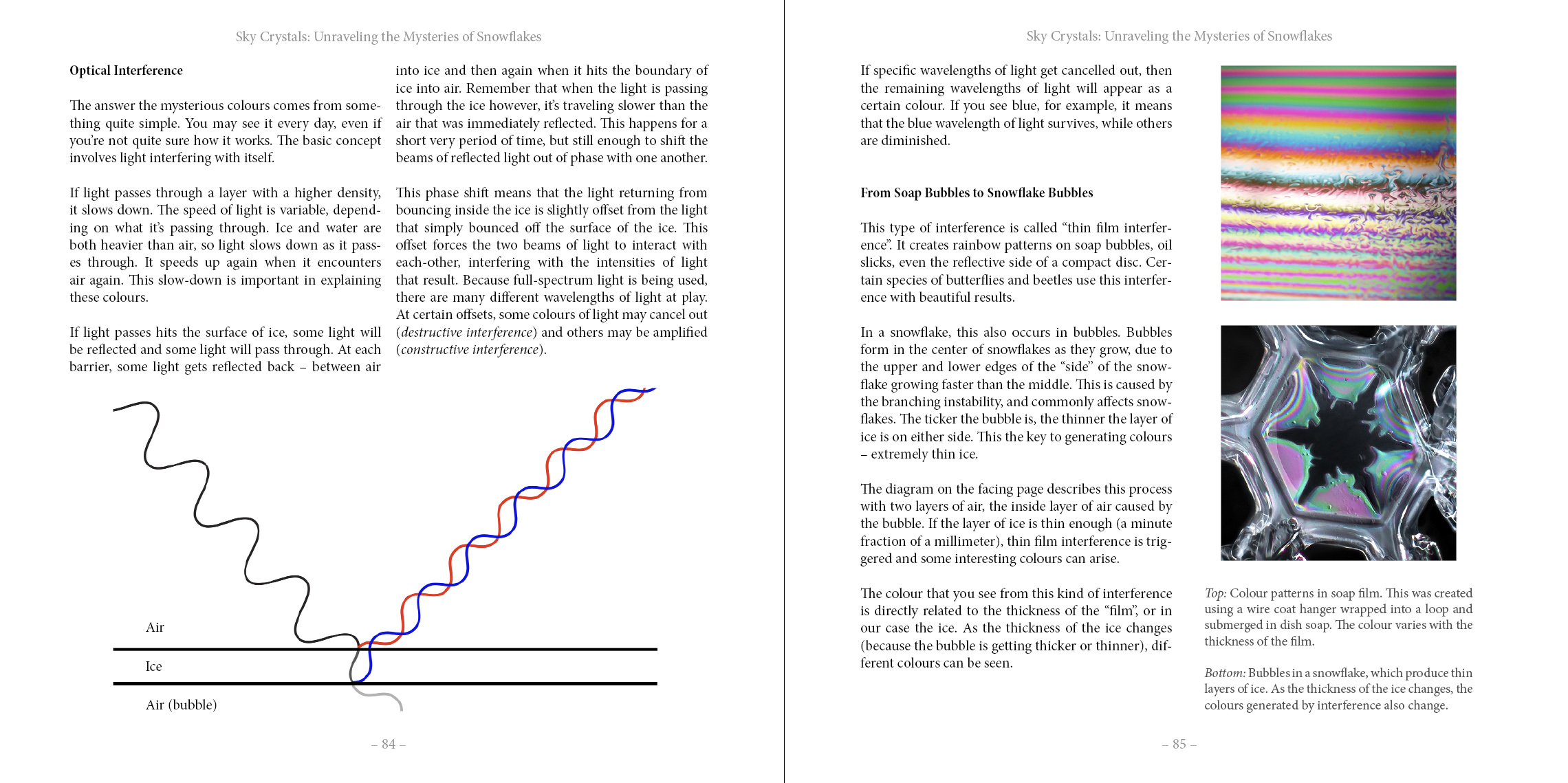
You might also notice a circle in the ice, cutting through the coloured areas of the image. This is key – inward crystal growth that is making the snowflake thicker, moving in toward the center. Because the thickness of the ice is what generates a specific colour, as the ice becomes thinner inside this circle it shifts colour. If charts like this (soapbubble.wikia.com/wiki/Color_and_Film_Thickness ) apply to water in a similar way to soap film, than we can assume a thickness of ice from roughly 600nm down to 400nm. That’s a thickness shift from 0.6 microns to 0.4 microns, or a difference of 0.0002mm (1/5,000th of a millimeter). A subtle change can have a huge impact! The only way that I think this difference can be calculated without the use of an electron microscope is by referencing the colours themselves. Science!
Much of the center of this snowflake, all of the lighter or coloured areas, are a bubble/cavity in the ice. If the thickness of the ice on top of the bubble is too thick or too thin, we don’t see any interference colours at all. We still get a brighter feature because of the multiple layers of ice shining back to the camera however! The darker Star Wars Imperial-inspired pattern in the center is solid ice – fewer reflective surfaces.
Whenever I catch a glimpse at a colourful snowflake, there is a strong likelihood that a small percentage of neighbouring snowflakes contain the same features. During these snowfalls I stay outside through the entire event – which has occasionally been an entire day. Usually the conditions change so quickly that you’ll only find the right conditions for 15-30 minutes before the possibility for these vibrant gems disappears. There’s a reason I check every single snowfall for good snowflakes – you never know when the most beautiful gems are going to fall. Call it my addiction. :)
If you’d like to know more about the science of snowflakes with an exhaustive and comprehensive tutorial on how to photograph and edit these little gems, check out my book Sky Crystals:
Hardcover: www.skycrystals.ca/book/
eBook: www.skycrystals.ca/ebook/
Other things you might be interested in:
2018 Macro Photography Workshop Schedule: www.donkom.ca/workshops/
2018 Ice Crystals Coin from the Royal Canadian Mint featuring my snowflakes: www.mint.ca/store/coins/coin-prod3040427
“The Snowflake” print, taking 2500 hours to create: skycrystals.ca/product/poster-proof/
Photo Geek Weekly, my new podcast: www.photogeekweekly.com/
It is common knowledge that Mr. Brown Pelican twists every argument into some sort of "struggle" between two parties. Mr. Pelican unvaryingly constitutes the underdog party, which is what he claims gives him the right to mete out harsh and arbitrary punishment against his adversaries until they're intimidated into a benumbed, neutralized, impotent, and non-functioning mass. Because of his eagerness to participate in riots, Mr. Pelican has repeatedly threatened to destroy our country from within.
To sum it all up, Mr. Brown Pelican is completely unaware of the difference between a correlation and a causation.
A Humpback Whale breaches from the cold waters in Alaska’s Kenai Fjords National Park, against a backdrop of towering snow capped mountains. The cause for cetacean surfacing behaviour is a relative mystery, with theories on causation ranging from display to feeding to communication.
I know, it’s crazy. This isn’t a bird. But when you have an experience as wonderful as this, you have to try to capture it.
I guess I’m officially a wildlife photographer now. Not just birds...
Last night, I went to see Mike Leigh’s latest film, Mr Turner, at the cinema. This evening, I saw Slope, a dramatisation of the relationship between Arthur Rimbaud and Paul Verlaine, at Glasgow’s Citizens Theatre. Both share themes - biographies, to some extent or other, of artists - and have in common stellar performances and extraordinary visuals. They differ in that I was not particularly moved by Mr Turner - I even, for all its beauty and power but fundamental lack of structure, found myself checking my watch - where Slope left me feeling quite wretched.
Both productions are about men who are great artists - people who can uniquely express something about what it means to be human - and yet who are totally incompetent when it comes to the dirty business of actually living a life. This, I think, is what I relate to. Not that I do, or have ever, made any claims to being an artist, but I know I make a living and a life out of translating things that I see into some form that other people peruse. But how far removed they are, understanding the way people think and the way “society” works, from understanding how to live in it. But of course it’s not (inverse) correlation, is it? It’s causation.
"It would be much better if I could only stop thinking." - Jean-Paul Sartre, Nausea
(Slope will be live-streamed on Friday 21st and Saturday 22nd November, 1930GMT. To watch it - and I strongly suggest you do - go to www.kiltr.com/slope )
Glasgow, 2014.
Immanuel Kant, the World's greatest philosopher cannot be wrong.. He is famous for stating that space, time and causation are mere sensibilities - and that "things-in-themselves" exist, but their nature is unknowable.
He is also clearly not an advocate of Black Friday.
In other words boycott this lying, consumerist tripe.
It has all been said before.
This picture is of a monument dedicated to William Cooper, who in his lifetime achieved much. Please see his Wiki page, try typing in William Cooper Australian, and in contrast here is a link to a national Australian education page adb.anu.edu.au/biography/cooper-william-5773 . Interesting reading when doing a critical comparison, and one of many stimuli for this dairy entry.
(Musings from my diary.)
Despite my office 365-word processor giving me 100% editorial rating after correcting this writing, l recorrected my diary entry, so that it scores lower. I recorrected my dairy entry after rereading it, so it was more accurate. l think office 365-word is incredible, and l will admit that it did help me, but l needed to write my observations as untainted as possible… If that is at all achievable. This is not an argumentative essay, and office 365 had me talking in absolutes, defining a majority when I was discussing the influence of a minority over the majority. A personal consideration of current day hypocrisy and war.
Well, it is my diary!
Why is it so important to be apolitical when reporting on politics?
Personally, l feel that if a person reads the above question and does not know, they might have missed critically observing the last ten or so years of social division, and extremism, from both the right and left. Extremism that has cost lives and revealed ugly truths. I think as an Australian looking from geographical isolation at the world, everything might be a lot easier while viewing it all at a distance, and with hindsight. It leaves me a bit ignorant, but l think that helps with my objectivity.
Why did it happen? The causation was like a hydra, with multiple self-replicating heads, and it was like watching a social media battle between school children who had never been hurt in the real world. Not the type of hurt that you get when you metaphorically fall, skin your knee, and get back up, but the type you get when you enter a fight, get brutalised, and lose. Bones and tissue crushed by an opponent driven by a hatred so strong that they would injure you, another human being. Was it caused by people who had never learned that to enter a fight is to risk everything? That to fight is a last resort? This lack of political and social experience cost some their friends, loved ones, and others, members of their families. But it raised in me a question. Despite the efforts of the well-meaning, what did they achieve?
America the crucible for everything, descended into something that some would call near anarchy. Some on the left assumed both fascist and anarchist tendencies that go back to the 1930s, all the while not reading the social and political history of pre-World War Two Germany. That would have been militaristic and did not serve the narrative. A narrative produced to generate a political outcome. Could they have committed the errors of the past if they had read it? Given to wide a birth, media extremists influenced millions with emotive prompting. On the other hand, some on the right looking for relief from the relentless onslaught, sold out. Losing patience, self-fortitude, and political integrity. They reduced the work of their group’s past into a parody. Debasing the history of men and woman who had really made a positive impact. Like two spoilt children in the new education system, no one could suggest or admit that they had done wrong, while the media produced single sided political narratives, but in general did not report.
Political moderates and swinging voters pondered when it would end, while living in perpetual despair. Watching a school yard fight that had descended into a riot, one that involved the media as a cheer squad for two opposing sides. The radicalized media would not allow moderates to be objective, you had to be either a right-wing neo fascist or a left-wing neo fascist, with the spectre of your personal anarchy to drive your decision. You had to take a side. The mainstream media had descended into a form of politically opportunistic rhetoric, as if it had learnt the lessons of the sixties, but this time, it was not a foreign war, it was a form of civil war at home. One thankfully that lacked major armed war fare. Thankfully, the military were not involved. All credit due, but it left western law prostrate. The law could not be consensually blind. It was not a peaceful protest, people did not thread flowers down barrels of guns pointed at them in acts of peace, and monks did not self-immolate, producing images that moved millions to peace. Some asking for peace and equality, did the opposite, mostly peaceful protestors tried to immolate others. They tried repeatedly to incinerate living humans. It was shocking. The sixties saw the west implement peaceful protest, and we all saw how effective it was at causing change, but in the last decade those that referenced the sixties insighted indirectly by narrative omission the used Molotov cocktails and violence. Peaceful protest is notoriously difficult to combat, as the law was and is hamstrung with misdemeanours, aided by the images of people not harming others. But this new form of western protest differed. Who needs a little naked burnt Vietnamese girl running down the road to achieve peace, when you can try to incinerate a people, to force for peace? Simultaneously, the right with extraordinarily little representation outside of the lumbering behemoth of Fox, surrendered to social media, a place where the Kardashians once ruled. Quite a historical event. History was made, if you realise that one of the reasons for the development of the internet, was as a military defence system. One designed and built to defend communications, if all else failed. It was a war in which both sides lost, but extremism gained power. Media integrity on both sides was and is running ragged, with no one prepared to fly their flags at half-mast, to mourn the distress of western communications. Distress caused by the media’s dissemination of radicalized neo right-wing and neo left-wing politically biased narratives. Narratives enforced by wilful omissions of blatant historical truths and current day conduct.
The result was that America regardless of political persuasion had failed to successfully defend the constitution, not the second amendment, but the principle of the constitution. It was America’s greatest failing over the last ten years, but they were not alone in this failure. With the use of the internet and the world media, the world failed to defend the principle of a document that 620,000 lost their lives for, and it destabilized the world. A document that was purported by some in the world media as an antiquated inadequate document, neglecting the principle that all men are equal before the law, but not created equal. This consideration made me reflect heavily on me experience of university. The adage was, “…That the best you can do, is stand on the shoulders of giants….” And I wondered how a person could neglect the work and sacrifice of those that had built humanity. Institutions promoted as being pacifist and educated, institutions built to serve everyone, now indirectly instigated violence. In this new form of civil war, where was Hans Blix to say no weapons of mass destruction are to be found? Was this modern achievement, achieved by children, now adults, whose parents had lied to them? Where these the children that had been told they could do anything, or become anyone? It raised in me the rhetorical questions, did the neo right, and neo left media, use a military grade apparatus to wage a war? And had everyone forgot that the pen is mightier than the sword, and thus just as dangerous?
History education starts at school, and I personally had experienced the new education system as a stepfather here in Australia. When it comes to educating children, the new system that fails no one, has become a system that has already failed. How can you learn history, and think critically, if you cannot read? I considered the potential political motives for the instigation of an education system that does not indiscriminately educate, but selectively indoctrinates. I thought that it was an effective tool for maintaining power. It is something l heard about the church. Someone had told me that the church had only allowed priests to read the bible in Latin. It is said that this practice allowed those in positions of power to quote verse, and interpret codes of conduct, for those under them. It kept those who could not read Latin ignorant. This is an activity, that has now been banned by the church. It appears that the new education system has now adopted a similar practice. As a result, the education system, now has a new ignorant flock to shepherd. What happens when the history channel algorithms or sponsored feeds, have turned into a political shill? Yes, even history, is not apolitical. I think someone, somewhere, had read the adage, that “…those that win the war, write the history…” Ironically, someone was ignorant enough, not to know that it was not a term of endearment, nor did this fact entitle the writer a position of everlasting power. Ironically, people postured one position, and then did the reverse. Some in the media left and right, assumed what some would call, a militaristic imperialistic mode, using their viewers, fans, and their audience as cannon fodder. Driving them with politically vested rhetoric and association, to achieve a political end. Both sides looked for someone to blame other than themselves, or looked for someone other than themselves to pay.
Fascists once did this, now neo liberals and neo conservatives in the media looked for a group to classify as mentally deficient or ill. The mob had to become the populous, classifying the opposition as inferior. Someone to other, someone internally to blame for all the world’s problems. The language from both sides was remarkably familiar. It had all happened before. But on the media chanted like zealots, willingly oblivious to history like a petulant child, and it resulted in deaths. Instead of reporting, the media sold themselves to become a self-pontified populist political cheer squad of indoctrination. In this communications war, some in the media’s right, and some in the media’s left, had surrendered to a form of self-serving political prostitution. It produced 1930s like self-cannibalism. The radicalized political media’s appetite to feed their opposing mob’s zest, could not be quenched. They ate their own, seeing who could jeer the loudest, while destroying the integrity of all the institutions that surrounded them. Neo right, and neo left, used 1930s fascist language and influence, while relying on others to apply anarchy as the vector for change, thus negating any personal responsibility for death and violence.
I think back, and to be honest, what the west in the majority lacked, was apolitical reporting. The result over the last ten years, was that we had all lost. In a political war of words where the media became the protagonists, the west did not just sacrifice its integrity and dignity, the west surrendered lives.
Buildings don't have a 13th floor, why have a 13th lifeboat?
superstition
noun
su·per·sti·tion ˌsü-pər-ˈsti-shən
1
a
: a belief or practice resulting from ignorance, fear of the unknown, trust in magic or chance, or a false conception of causation
b
: an irrational abject attitude of mind toward the supernatural, nature, or God resulting from superstition.
2
: a notion maintained despite evidence to the contrary.
We've all got them, rational or not. It might be a cultural thing, a religious thing, or a personal thing but nonetheless we've all got them.
The number 13 seems to be one of those things that people avoid, and Holland America it seems doesn't have a problem with it. I feel kind of bad for those folks who think it's a bad omen, especially when it shows up on your boarding pass as your lifeboat. For them, the thing that's supposed to save them is quite possibly going to kill them!
Personally I don't care what lifeboat I'm assigned to since I don't plan on using it anyway. Should disaster strike my plan is to get off the ship and far away as possible, lifeboat or not!
Saint Patrick's parade was the causation, a long photowalk in the streets of Boston was the real motivation. I tried to use my prime (Nikon 35mm) only, and it worked perfectly. Here are some random people walking in Boston common. Boston common is Boston's largest and oldest park (1634).
De-regulation of British bus services in the mid 1980s extended the lives of many buses that would have likely been scrapped a few years before. Non PVS use of buses also has the same affect. At life's end, both causations of extended service life are witnessed here.
Former Merseybus AN68 Atlanteans 1546 (OLV546M) & 1527 (GKA527M) were in just excess of 20-years old, so did well.
The former Preston Corporation PD3A No71 (ARN656C) had seen further service with Taylor-Woodrow on works contract services in Lancaster. It then found extended use as a driver training vehicle before it arrived at the breaker's, coming via North's of Sherburn.-in-Elmet.
The AN68s devoid of mechanicals, the PD3 still retains its engine, but it's just a matter of time before all three will meet the cutter's torch.
PVS Carlton, 27th July 1994
Hand-specimen of asbestiform serpentine ore, also known as chrysotile, one of six minerals currently regulated as "asbestos".
In this example, from a Canadian locality, a seam of silky crystalline chrysotile in rocky matrix demonstrates the inherently fibrous nature of this toxic mineral oddity.
Medieval myth and lore once mistakenly believed the hair-like qualities of asbestos originated from "salamander's wool", then later erroneously thought to be based in the plant kingdom in the 19th-century.
When disturbed, chrysotile asbestos can split into innumerable bundles, often referred to as "fibers", a characteristic somewhat unique to asbestos minerals. Individual unit fibrils of chrysotile are extremely thin tubular crystals or rolled sheet-silicates on the order of microns and angstroms in diameter. Visible asbestos "fibers" can further sub-divide into such small, microscopic particles that they practically become "invisible" and can become airborne.
Inhalation exposures to microscopic airborne asbestos particles have been well documented to cause serious respiratory diseases, cancers, and has been linked to disease-causation in other bodily systems, which can ultimately lead to fatality.
i heard this interview of richard dawkins at WNYC radiolab entitled 'in defense of darwin' this morning and it fit perfectly with the picture i shot yesterday.
i took the time to write down a bit of the interview on my blog, if you're inclined to further reading.
EDIT: i decided to add the text here, after all... those with patience can continue:
-----
Q: your daughter is driving around with you and you look and… she’s 6 years old. she sees a field of flowers. you say to her, well, what do you think they’re for? she says 'well, to make the world pretty and to help bees make honey for us. and you think, well, i’m sorry to tell her that this wasn’t true. and i explained to her that the flowers are not there to make the world beautiful and they are not there to delight bees or anything else. they’re in the world to copy their DNA.'
this is to a six-year old.
(audience laughs)
but essentially what you’re doing there is you’re addressing you’re opening the notion to her that the world is a purposeless, indifferent machine where the meaning of things is not clear, if it exists at all. you’ve found it, i think, kind of brave to say to your daughter , look, step into the wind…
(richard interrupts)
A: no, exciting! it’s a far more exciting view of flowers to understand what they’re really doing and, as six years old, she had no problem understanding that. i explained it to her.
but to come to your ‘what’s it for’ question, it’s a piece of massive presumption to think that the ‘what it’s for’ question deserves an answer. there’s no reason at all why something should have a ‘for’ about it. if i said to you, ‘what is the sun for?’ or 'what is mt. everest for', you would say 'don’t be so silly... it’s not an appropriate question'… but, because it’s flowers, you sort of feel there ought to be a ‘what is it for’ question.
Q: no actually i think it’s a harder question than that. i think most human beings have some deep impulse to explain their being here to wonder about the origins of here and the destiny of them and here. and that question, the meaning of it all is not a silly question.
A: that’s not a silly question and it has a perfectly good answer, which is not an answer to be couched in the language of purpose. it’s an answer to be couched in the language of scientific causation. what brought us all to be here… what is the explanation for our existence… that has a perfectly good scientific answer… and you go back in evolutionary time to the origin of life, and you go back before the origin of life to the origin of the world, the origin of the solar system, the origin of the universe… and that becomes deeply mysterious. needless to say, it’s not a question i could even begin to answer and i don’t think that, at the present stage, physics can either. but to the extent that there’s going to be an answer, it’s going to come from science and that is a deeply satisfying kind of answer to the question, 'why are we here?' we already have, in principle, the answer to that question and it is not an answer of the form ‘we are here in order to achieve some purpose’ it’s an answer of the form, ‘we are here because something happened, which led that something else that happened, which led to something else that happened'.
Q: are you … let me ask you the harder question … is this hard-looking and this telling your 6-year old, this leads to this leads to this, this kind of reductionist way of thinking about everything … does that seem to you to be less than joyously imaginative ?
A: no, i think that’s kind of super-romantic to actually understand that flowers are devices … beautiful devices, elegant devices which are shaped precisely to attract insects and hummingbirds and bats to take pollen from one to another… that is such a mind-blowing thought compared to the tame, sort of washed-out view that flowers are just sort of nice things to have around.’
(audience claps)
interviewer to audience: 'don’t encourage him.'
Graph by Tony Piro. Please keep it mind that it shows a correlation, not causation.
It is a very similar curve to that found in a Pew survey of 45,000 people globally (and includes Africa).
In his book, The Moral Landscape, Sam Harris offers a commentary on the U.S. as outlier:
“While most developed societies have grown predominantly secular, with the curious exception of the United States, orthodox religion is in florid bloom throughout the developing world.
Religiosity is strongly coupled to perceptions of societal insecurity. In addition to being the most religious of developed nations, the United States also has the greatest economic inequality. The poor tend to be more religious than the rich, both within and between nations.
And on almost every measure of societal health, the least religious countries are better off than the most religious.” (p.146)
But there may be more to it. Americans believe all kinds of crazy stuff, and it begs the question whether it correlates with insecurities as well.
In a class I co-taught with Larry Lessig, we used a pre-print of Posner’s book, Catastrophe: Risk and Response, which relates the following statistics on American adults:
• 39% believe astrology is scientific (astrology, not astronomy).
• 33% believe in ghosts and communication with the dead.
Ponder that for a moment. One out of every three U.S. adults believes in ghosts. Who knows what their kids think!
People’s willingness to believe untruths relates to the ability of the average person to reason critically about reality. Here are some less amusing statistics on American adults:
• 49% don’t know that it takes a year for the earth to revolve around the sun.
• 67% don't know what a molecule is.
• 80% can't understand the NY Times Tuesday science section.
Posner concludes: “It is possible that science is valued by most Americans as another form of magic.”
Have a life-long feeling of apprehension involving carnivals and fairs. It's one of many phobias in my adult life that are rooted in childhood. Some have a very distinct point of origin. The causation of others is more vague. And I'm convinced some are simply genetically programmed. I think carnivals fall into this category. They just make me uneasy in a visceral sense and I stopped questioning it long ago. I avoided carnivals for years, but started venturing back some time ago. It wasn't a sudden change of heart. It had much more to do with channeling mental dysfunction for creative purposes. I tend to shoot around the periphery of these venues, going largely unnoticed by the crowds. But curiosity eventually led to portraits of the carnies themselves. I could do so much to soften up these poses, but choose instead a straight on deadpan expression, with carnie in the center of their booth. It preserves an often gritty reality that is generally lost in the moment as the human eye tends to be distracted by the proliferation of colors and shapes within the booth. These encounters are sometimes uncomfortable or even frightening. But holding a camera provides me with a sense of agency that, trust me, would not otherwise exist under these circumstances. I just make it a point to get in and get out quickly. Spontaneity is key.
In recent years there has been a relentless and vociferous campaign by militant atheists intent on attacking and ridiculing religion. Numerous books have been written on the subject and, it seems, at every opportunity the secular establishment and media seeks out atheists or secular humanists to give what amounts to a jaundiced attack on religion.
For the most part, the opinions they express are the same old, worn out slogans we have heard over and over again, and can only be described as ideological propaganda.
We are all familiar with the atheist slogans such as: 'religion is irrational nonsense'.
Or that: 'believing in God is no different from believing in Santa or fairies.'
Or that: 'there is no evidence for God'.
Or that: 'religion is just a crutch for weak-minded people'
Or that: 'religion is outdated, superstitious nonsense',
Or that: 'religion is just for ignorant, unintelligent, backward people who know nothing about science'
Or that: belief in God is 'just a lazy way of filling gaps in knowledge'.
Or that: believing in God is 'like believing the Earth is flat'.
Or that: Christians 'believe in an old man in the sky with a beard'
Or that: Christians 'believe in a sky fairy'.
Or that: Christianity/the Bible was 'invented by ignorant, bronze age, goat herders'.
Or that: Belief in a God 'is just a delusion'.
Or that: Christians have 'an imaginary, invisable friend'.
Etc. etc.
As we will show later, such slogans are either ignorant nonsense, or devised as deliberate, ideological propaganda.
If you remember, several years ago, atheists, such as Richard Dawkins, decided to ramp up their anti-religious propaganda effort with slogans on buses. It originated in Britain, but spread to several other countries.
It was known as the Atheist Bus Campaign.
The Atheist Bus Campaign, set out to convince you that a loving creator God does not exist, that you have no prospect of eternal life and that all you can look forward to is eternal oblivion.
Atheists have no evidence to back up that assertion. In fact logic, natural law and the basic principles of the scientific method rule out their naturalistic alternative to a creator as impossible.
They invent all sort of bizarre scenarios to replace a supernatural first cause (God), they even try to present their fantastical, naturalistic replacements for God as 'scientific'. Please don't be taken in by it.
Their naturalistic replacements for God are illogical, they all violate natural laws and the basic principles of science.
Atheism is rightly referred to as the no-hope philosophy.
Their ultimate goal and pinnacle of their short life is - eternal oblivion.
And, quite perversely, they want to convince you that is all you can look forward to.
Please don't be dragged down with them into that depressing pit of hopelessness.
The Good News is that they are entirely wrong, and furthermore, it is not just an opinion. It can be satisfactorily demonstrated by logic, natural law, and the basic principle of the scientific method ......
Read on .... and you will understand, why atheists can never replace God, however much they try.
Their Atheist Bus Campaign is deceitful because atheists have no logical or scientific grounds for claiming "There's Probably No God", in fact, the evidence of applied logic and natural law, is completely the contrary. The atheist claim that there's probably no God is just an unsubstantiated opinion based only on their own ideological beliefs.
You may wonder why they inserted the word 'probably'? Obviously, they knew that if they were challenged to present evidence for the truth of their advertisement and had to defend it in court, they would be unable to do so. Science and logic can be used to prove they have no alternative to a supernatural first cause, and they know it.
For atheists to propose that believing there is no God, is somehow a reason to stop worrying and the recipe for an enjoyable life, is perverse in the extreme.
For most sane people it would be the opposite - a road to depression, hopelessness, and a feeling that this short existence is worthless. It will all end in oblivion, and you might as well never have lived.
Thankfully, atheists are demonstrably wrong, there is every reason for hope - as we will show - a loving Creator definitely does exist. Your life is not a few short, stressful and worthless years leading to eternal oblivion. You are a unique, valuable, person, specially created out of supreme love, every human life is of infinite value right from the moment of conception. Humans really are special and not just intelligent apes, or a mere collection of atoms, as atheists would have you believe You can live forever in eternal bliss - that is the gift of life the loving Creator of the universe offers you, and it is all offered for free.
Please don't be fooled ... people who think for themselves (the REAL freethinkers), are able to see right through the atheist hype and propaganda. Ignore the relentless bombardment of atheist propaganda, such as the atheist bus campaign. Seek out and learn the real truth and the truth will set you free.
Please read on and you will understand ......
Because there is a law of cause and effect, the universe can't and won't create itself from nothing.
Consider this ....
A creator God (or supernatural first cause) has been made redundant and the final gap (pertaining to the so-called God of the gaps) has now been filled ... who says so?
Atheists, along with the secularist pundits in the popular media.
Why do they say that?
Because they believe that the greatest brain in atheism - Stephen Hawking, has finally discovered the secret of the origin of the universe and a naturalistic replacement for God.
The atheist replacement for God is summed up in a single sentence written by Hawking:
"Because there is a law such as gravity, the universe can and will create itself from nothing"
That is it .... problem solved - apparently!
The secularists in the popular media loved it, as far as they were concerned the problem certainly was solved. Hawking had finally dealt the fatal blow to all religion, especially Christianity. No need to question it, if a revered scientist of his calibre, is so sure of how the universe came into being, it must be correct.
The new atheists loved it, they wasted no time in proclaiming the ultimate triumph of 'science' over religious mythology and superstition.
So just how credible is the atheist claim that God has been made redundant?
And just how 'scientific' is Hawking's replacement for God?
Shall we analyse it?
"Because there is a law of gravity ....
So,
1) If the law of gravity existed, how is that nothing?
AND -
2) Where did the law of gravity come from?
AND -
3) How can a law of gravity exist before that which gravity relates to ... i.e. matter?
"the universe can and will create itself from nothing"
4) How can something create itself, without pre-existing its own creation?
(A) could possibly create (B), but how could (A) create (A)? Of course it can't.
5) What about the 'nothing' that is not really nothing, as most people understand 'nothing', but a bizarre 'nothing' in which a law of gravity exists. A nothing which is actually a 'something' where a law of gravity is presumably some sort of eternally, existent entity?
AND -
6) Is Hawking implying that the self-creation of the universe is made possible by the pre-existence of the law of gravity?
Of course, natural laws are not creative agents, they simply describe basic properties and operation of material things. They can't create anything, or cause the creation of anything. Something which is a property of something, cannot create that which it is a property of.
So, even if we ignore the law of cause and effect which definitively rules out a natural, first cause of the universe, the atheist notion of the universe arising of its own volition from nothing is still impossible, and can be regarded as illogical and unscientific nonsense. Hawking's naturalistic replacement for God, presented in his single sentence, and so loved by the new, atheist cabal, is obviously just contradictory and confused nonsense.
The truth, which atheists don't want to hear, is that atheism is intellectually and scientifically indefensible. That is why they always duck out of explaining how the concept of an uncaused, inadequate, natural first cause is possible.
The best they ever come up with, is something like "we don't really know what laws existed at the start of the universe".
However, the atheist claim that - we don't really know... is completely spurious.
We certainly do know that the Law of Cause and Effect is universal, there is no way round it.
The only reason atheists don't want to accept it, is ideological.
And ... isn't it strange, that the only laws atheists dispute are precisely those that interfere with their beliefs. For example, atheists seem pretty sure that one law existed .... the law of gravity (even prior to that which gravity is a property of … matter).
Why are they so sure that the law of gravity existed?
Because their naturalistic substitute for God, summed up in the sentence by Stephen Hawking, apparently requires that the law of gravity existed before anything else …..
Here it is again ...
‘Because there is a law such as gravity, the universe can and will create itself from nothing’ Stephen Hawking.
So, atheists DO KNOW for sure that the law of gravity existed, but they don’t really know what other laws existed at the start of the universe. They especially doubt that the Law of Cause and Effect existed.
AMAZING!
Well, how about this for a refutation of Hawking’s replacement for God, also summed up in a single sentence?
Because there is a Law of Cause and Effect, the universe can’t and won’t create itself from nothing!
That is something Stephen Hawking conveniently forgot.
Apparently, he accepts that the law of gravity existed, because he thinks it suits his argument, but he ignores the existence of other laws that positively destroy his argument.
So, now you know the truth about the best substitute for God that atheists have ever come up with.
IMPRESSED? I think not!
Why is it ATHEISTS that try to dispute the universality of natural laws?
According to their claims, atheists are supposed to be the champions of science. Yet we find in practice that it is actually theists who end up defending natural laws and the scientific method against those atheists who try to refute any laws and scientific principles that interfere with their naturalistic beliefs.
Whatever happened to the alleged conflict between science and religion?
That is revealed as purely, atheist propaganda. There is obviously much more conflict between atheism and science.
Why is the law of cause and effect so important?
Because it tells us that all natural entities, events and processes are contingent.
They are all subject to preceding causes. It tells us that natural entities and events are not autonomous, they cannot operate independently of causes.
That is such an important principle, it is actually the basis of the scientific method. Science is about looking for adequate causes of ALL natural events. According to science, a natural event without a cause, is a scientific impossibility.
Once you suggest such a notion, you are abandoning science and you violate the basic principle of the scientific method.
What about the first cause of the universe and everything?
How does that fit in?
Well, the first cause was obviously a unique thing, not only unique, but radically different to all NATURAL entities and occurrences. The first cause HAD to be an autonomous entity, it HAD to be eternally self-existent, self-reliant, NON-CONTINGENT ... i.e. it was completely independent of causes and the limitations that causes impose.
The first cause, by virtue of being the very first, could not have had any preceding cause, and obviously didn't require any cause for its existence. When we talk about the first cause, we mean the very first cause, i.e. FIRST means FIRST, not second or third.
The first cause also had to be capable of creating everything that followed it. It is responsible for every subsequent cause and effect that is, or has ever been. That means that nothing, nor the sum total of everything that followed the first cause, can ever be greater, in any respect, than the first cause.
So the idea that the first cause could be a natural entity or event is just ludicrous.
We know that the first cause is radically different to any natural entity, it is NOT contingent and that is why it is called a SUPERNATURAL entity, the Supernatural, First Cause (or Creator God). All natural events and entities ARE contingent without exception, so the first cause simply CANNOT be a natural thing.
That is the verdict of science, logic and reason. Atheists dispute the verdict of science and insist that the first cause was a 'natural' event which was somehow able to defy natural laws that govern all natural events.
Consequently, atheism can be regarded as anti-science. Which means .... the real enemy of atheism is science, not religion. And the real enemy of science is atheism, not religion.
An idea which seems to be popular with atheists at present, is a continuously, reciprocating universe, one which ends by running out of energy potential and then rewinds itself in an never ending cycle ..... this is an attempt to evade the fact that an uncaused, natural, first cause is impossible. They claim that, in this way a first cause, is not necessary. And that matter/energy is some sort of eternally existent entity.
So is it a valid solution?
Firstly .....
Matter/energy cannot be eternally existent in a cycle with no beginning).
Why?
Because all natural things are contingent, they have to comply with the law of cause and effect, so they cannot exist independently of causes. The nearest you could get to eternally existent matter/energy would be a very, long chain of causes and effects, but a long chain is not eternally existent, it has to have a beginning at some point. At the beginning there would still have to be a non-contingent first cause. So a long chain of causes and effects simply pushes the first cause further back in time, it can't eliminate it.
Secondly ....
It is pretty obvious that the idea of the universe simply rewinding itself in a never ending cycle, which had no beginning, is complete, unscientific nonsense. How such a proposal can be presented as serious science, beggars belief.
It seems atheists will try anything to justify their naturalist ideology. They apparently have no compunction about completely disregarding natural laws.
The Second Law of Thermodynamics rules out such atheist, pie-in-the-sky, origins mythology.
There is no such thing as a free lunch, the idea of a rewinding universe is tantamount to applying the discredited notion of perpetual motion - on a grand scale, to the universe.
Contingent things don't just rewind of their own accord.
The Second Law (not to mention common sense) rules it out.
Where does the renewed power or renewed energy potential come from?
If you wind up a clock, it doesn't rewind itself after it has stopped.
The universe had a beginning and it will have an end. That is what science tells us, it cannot rewind itself.
Such ridiculous, atheist musings are just a desperate attempt to wriggle out of the inevitable conclusion of logic, and the Law of Cause and Effect which are the real enemies of atheist ideology.
Once again atheism is hoisted on its own petard by natural law and science, not by religion.
A variation of the cyclical universe is the argument proposed by some that the universe just is?
Presumably they mean that the universe is some sort of eternally-existent entity with no beginning - and therefore not in need of a cause? Once again an eternally self-existent universe is not possible for the same reason outlined above.
In addition ....
The Second Law of Thermodynamics tells us the universe certainly had a beginning and will have an end. The energy potential of the universe is decreasing from an original peak at the beginning of the universe. Even the most rabid atheists seem to accept that. Which is why most of them believe in a beginning event, such as a big bang explosion.
So the question is how did it (the universe) begin to exist, not whether it began to exist?
Which takes us back to the question of the nature of the very first cause.
It can only be one of two options,
an uncaused, natural first cause
OR
an uncaused, supernatural first cause.
An uncaused, NATURAL first cause is impossible.
Thus the only possible option is a supernatural first cause, i.e. God.
Atheists can’t refute the Law of Cause and Effect which is so devastating to their naturalist agenda, so they regularly invent bizarre scenarios which ignore natural laws, and hope people won’t notice. If anyone does they just brush it off with remarks like “we just don’t know ” what laws existed prior to the beginning of the universe.
Sorry, the atheist apologists may not know …. but all sensible people do know, we certainly know what is impossible ….
And we certainly know that you cannot blithely step outside the constraints of natural laws and scientific principles, as atheists do, and remain credible.
We know that natural laws describe the inherent properties of matter/energy. Which means wherever matter/energy exist, the inherent properties of matter/energy also exist - and so do the natural laws that describe those properties. if the universe began, as some propose, with a cosmic egg. or a previous universe, those things are still natural entities with natural properties, and as such would be subject to natural laws. So the idea that there were natural events leading up to the origin of the universe that were not subject to natural laws is ridiculous.
The atheist claim; that we just don't know, is not valid, and should be treated as the silliness it really is.
The existence of the law of cause and effect is essential to the scientific method, but fatal to the atheist ideology.
SO ....
Is the law of cause and effect really universal?
Causation is necessary for the existence of the universe, but ALSO for the existence of any natural entities or events that may have preceded the creation of the universe.
In other words, causation is necessary for all matter/energy and all natural entities and occurrences, whether within the universe or elsewhere.
ALL natural entities are contingent wherever they may be, whether in some sort of cosmic egg, a big bang, a previous universe or whatever.
Contingency is an inherent character of all natural entities, so it is impossible for any natural entity to be non-contingent.
Which means you simply CANNOT have a natural entity which is UNCAUSED, anywhere.
If, for example, matter/energy was not contingent at the start of the universe, or before the universe began, how and why would it be contingent now?
Why would nature have changed its basic character to an inferior one?
If matter/energy once had such awesome, autonomous power - if it was, at some time, self-sufficient, not reliant on causes for its operation and existence, and not restricted by the limitations causes impose, it would effectively mean it was once an infinite, necessary, self-existent entity, similar to God.
Now if matter once had the autonomous, non-contingent powers of a god, why would it change itself to a subordinate character and role, when it became part of the universe?
Why would it change to a role where it is limited by the strictures of natural laws. And where it cannot operate without a preceding, adequate cause?
To claim matter/energy was, at one time, not contingent, not subject to causes (which is what atheists have to claim) – is to actually imbue it with the autonomous power of a god.
That is why atheism is really just a revamped version of pagan naturalism.
By denying the basic, contingent character of matter/nature, atheism effectively deifies nature, and credits it with godlike powers, which science clearly tells us it doesn’t possess.
Thus, if anyone dismisses causality, they effectively deify matter/nature.
Which means they have chosen the first of the 2 following choices …
1. Atheism ... the unscientific, illogical belief in a natural, uncaused god (of matter or nature) which violates natural laws - which science recognises restrict its autonomy?
2. Theism ... the logical belief in an uncaused, supernatural God, which created matter and the laws that govern matter. And therefore does not violate any laws, is not contingent, and thus has completely unrestricted autonomy and infinite powers?
Which one would you choose?
Which one do scientists who respect natural laws and the scientific method choose?
The great, scientific luminaries and founders of modern science, such as Isaac Newton, Michael Faraday, Louis Pasteur etc., in fact, nearly all of the really great scientists and founders of modern science, had no doubts or problem understanding that choice, and they readily chose the second (theism), as the only logical option.
So, by choosing the second - a supernatural first cause – rather than meaning you are anti-science or anti-reason or some sort of uneducated, superstitious, religious nut (as atheists frequently claim) actually puts you in the greatest of scientific company.
To put it another way, who would you rather trust in science, such scientific giants as: Newton, Pasteur, Faraday, Von Braun, Copernicus, Kepler, Galileo, Mendel, Marconi, Kelvin, Babbage, Pascal, Herschel, Peacock etc. who believed in a supernatural, first cause?
OR,
the likes of: Richard Dawkins, Sam Harris, Christopher Hitchens, Lawrence Krauss, Stephen Hawking, Daniel Dennett etc. who believe in an uncaused, natural, first cause?
No contest!
We can see that atheists are anti-science, because they treat natural law and the whole principle of the scientific method with utter contempt, and all the while, they masquerade as the champions of science to the public.
The question of purpose ....
A further nail in the coffin of bogus, atheist science is the existence of order.
Atheists assume that the universe is purposeless, but they cannot explain the existence of order.
The development of order requires an organizational element.
To do useful work, or to counter the effects of entropy, energy needs to be directed or guided.
Raw energy alone actually tends to increase the effects of entropy, it doesn't increase order.
The organizational principle in living systems is provided by the informational element encoded in DNA.
Atheists have yet to explain how that first, genetic information arose of its own volition in the so-called Primordial Soup?
Natural laws pertinent to all natural entities, they guide the behaviour of energy and matter, but also serve to limit it, because natural laws are based only on the inherent properties of matter and energy.
So ... natural laws describe inherent properties of matter/energy, and natural processes operate only within the confines of natural laws which are based on their own properties. They can never exceed the parameters of those laws.
The much acclaimed, Dawkinsian principle that randomness can develop into order by means of a sieving process, such as shaken pebbles being sorted by falling through a hole of a particular size is erroneous, because it completely ignores the regulatory influence of natural laws on the outcome, which are not at all random.
If we can predict the outcome in advance, as we can with Dawkins' example, it cannot be called random. We CAN predict the outcome because we know that the pebbles will behave according to the regulatory influence of natural laws, such as the law of gravity. If there was no law of gravity, then Dawkins' pebbles, when shaken, would not fall through the hole, they would not be sorted, they would act completely unpredictably, possibly floating about in the air in all directions. In that case, the randomness would not result in any order. That is true randomness.
Dawkins' randomness, allegedly developing into order, is not random at all, the outcome is predictable and controlled by natural laws and the inherent properties of matter. He is starting with 2 organizational principles, natural laws and the inherent, ordered structure and properties of matter, and he calls that randomness!
Bogus science indeed!
This tells us that order is already there at the beginning of the universe, in the form of natural laws and the ordered composition and structure of matter .... it doesn't just develop from random events.
A major problem for atheists is to explain where natural laws came from?
In a purposeless universe there should be no regulatory principles at all.
Firstly, we would not expect anything to exist, we would expect eternal nothingness.
Secondly, even if we overlook that impossible hurdle, and assume by some amazing fluke and contrary to logic, something was able to create itself from nothing ….. we would expect the ‘something’ would have no ordered structure, and no laws based on that ordered structure. We would expect it to behave randomly and chaotically.
This is an absolutely fundamental question to which atheists have no answer. The basic properties of matter/energy, and the universe, scream …. ‘purpose’.
Atheists say the exact opposite.
Furthermore, if we consider the accepted, atheist belief; that matter is inherently predisposed to produce life and the genetic information for life, whenever environmental conditions are conducive (so-called abiogenesis), where does that predisposition for life come from? Once again, atheists are hoisted on their own petard, and the atheist idea of a random, purposeless, universe is left completely in tatters.
It is the atheist ideology that is anti-science, not necessarily individual scientists.
There may be sincere, atheist scientists who respect the scientific method and natural laws, but they are wedded to an ideology that - when push comes to shove, does not respect natural laws.
It is evident that whenever natural laws interfere with atheist naturalist beliefs, the beliefs take precedence over the rigorous, scientific method. It is then that natural laws are disregarded by atheists in favour of unscientific fantasies which are conducive to their ideology.
Of course, in much day-to-day practical science and technology, the question of violating laws doesn't even arise, and we cannot deny that in the course of such work, atheists will respect the scientific method of experiment and observation within the framework of the Law of Cause and Effect and other established laws of science.
Bizarrely, It is a different matter entirely, when it comes to hypotheses about origins. It then becomes an 'anything goes' situation. The main criteria then seems to be that it doesn’t matter whether your hypothesis violates natural laws (all sorts of excuses can be made as to why natural laws need not apply), all that matters is that it is entirely naturalistic, and can be made to sound plausible to the public.
However, the same atheist scientists would not entertain anything in general, day-to-day science, that is not completely in accordance with the scientific method, they make an exception ONLY with anything to do with origins, whether it be the origin of the universe, or the origin of life, or the origin of species.
Atheism is not simply passive non-belief, you can only be a ‘genuine’ atheist if you proactively believe in the following illogical and unscientific propositions:
1. A natural, first cause of the universe that was ‘uncaused’.
2. A natural, first cause of the universe that was patently not adequate for the effect, (a cause which was able to produce an effect far greater than itself and superior to its own abilities).
3. That the universe created ITSELF from nothing.
4. That natural laws simply arose of their own accord, without any reason, purpose or cause.
5. That energy potential at the start of everything material was able to wind itself up from absolute zero, of its own accord, without any reason, purpose or cause.
6. That the effect of entropy (Second Law of Thermodynamics) was somehow suspended or didn’t operate to permit the development of order in the universe.
7. That life spontaneously generated itself, of its own volition, from sterile matter, contrary to: the Law of Biogenesis, the laws of probability, the Second Law of Thermodynamics, Information Theory and common sense.
8. That the complete human genome was created by means of a long chain of copying mistakes of the original, genetic information in the first living cell, (mutations of mutations of mutations, etc. etc.).
9. That the complex DNA code was produced by chemical processes.
10. That the very first, genetic information, encoded in the DNA of the first living cell, created itself by some unknown means.
11. That matter is somehow inherently predisposed to develop into living cells, whenever conditions are conducive to life. But such a predisposition for life just arose of its own accord, with no purpose and with no apparent cause.
12. That an ordered structure of atoms, guiding laws of physics, order in the cosmos, order in the living cell and complex information, are what we would expect to occur naturally in a purposeless universe.
The claim of atheists to be the champions of science and reason is clearly bogus.
They think they can get away with it by pretending to have no beliefs.
However, when seriously challenged to justify their dogmatic rejection of a Supernatural First Cause, they indirectly espouse the unscientific beliefs outlined above, in their futile attempts to refute the evidence for a supernatural first cause.
Of course, whenever possible, they avoid declaring those beliefs explicitly, but you don’t need to be very astute to realize that relying on those beliefs is the unavoidable conclusion of their arguments.
That is why atheism is intellectually bankrupt and is doomed to the dustbin of history. And that is why we are seeing such a rise in militant, evangelizing, atheist zealots, such as Richard Dawkins and the late Christopher Hitchens.
Their crusading, bravado masks their desperation that the public is so hard to convince. What Dawkins et al need to face is that they are in no position to attack what they consider are the bizarre beliefs of others, when their own beliefs (which they fail to publicly acknowledge) are much more bizarre.
What about Christianity and pagan gods?
Atheists frequently try to dismiss and ridicule the idea of a Creator by comparing it to the numerous, pagan gods that people have worshipped throughout history.
Do they have a good point?
Certainly not, this is just a red herring ….
Other gods, cannot be the first cause or Creator.
Idols of wood or stone, or the Sun, Moon, planets, Mother Nature, Mother Earth etc. are all material, contingent things, they cannot be the first cause.
They are rejected as false gods by the Bible and by logic and natural laws.
They are considered gods by people who worship things which are 'created' rather than the Creator, which the Bible condemns.
In fact, they are much more similar to the atheist belief in the powers of a naturalistic entity to create the universe, than they are to the one, Creator God of Christianity.
For example, the pagan belief in the creative powers of Ra (the Sun god) is similar to the atheist belief that raw energy from the Sun acting on sterile chemicals was able to create life.
So atheist mythology credits the Sun (Ra) with the godlike power of creating life on Earth. And thus, atheism is just a revamped version of paganism.
Just like paganism, atheism rejects worship of a Supernatural, First Cause, and rather chooses to worship created, natural entities, imbuing them with the same godlike powers, that theists attribute to the Creator.
There is nothing new under the Sun ... We can see that atheism is just the age old deception of ancient paganism, revisited.
The Creator is a Supernatural, First Cause, which is not a contingent entity, nothing like the pagan gods, but rather a self-existent, necessary entity. As the very first cause of everything in the universe, it cannot be contingent (it cannot rely on anything outside itself for its existence, i.e. it is self-existent) and therefore it cannot be a material entity.
The first cause is necessary because, not being contingent, it necessarily exists.
If anything exists that is not contingent, it has to have within itself everything necessary for its own existence. If it is also responsible for the existence of anything outside itself (which as the first cause of the universe, we know it is) it is also necessary for the existence of those things, and has to be entirely adequate for the purpose of bringing them into being and maintaining their continued existence. It is not subject to natural laws, which only apply to natural events and effects, because, as the first cause, it is the initiator and creator of everything material, including the laws which govern material events, and of time itself.
The atheist view of a natural first cause is not even rational, to propose that all the qualities I have mentioned above could apply to a material entity is clearly ridiculous. But apparently, atheism has no regard for natural laws or logic. Atheists get round it by simply dressing up their irrational beliefs to make them appear ‘scientific’.
This combined with rants and erroneous and derisory slogans about religious myths and superstition makes it all seem perfectly reasonable. Unfortunately, those with little knowledge, or who can’t be bothered to think for themselves are taken in by it.
Atheists repeatedly claim that they have refuted the law of cause and effect by asking : So what caused God then?
How true is that?
The ... what caused God? argument is a rather silly argument which atheists regularly trot out. All it demonstrates is that they don't understand basic logic.
The question to always ask them is; what part of FIRST don't you understand?
If something is the very FIRST, it means there is nothing that precedes it. First means first, not second or third.
That means that the first cause cannot be a contingent entity, because a contingent entity depends on something preceding it for its existence. In which case, if something precedes it, it couldn't be FIRST.
All natural entities, events and effects are contingent ... that is why the Law of Cause and Effect states that ... every NATURAL effect requires an adequate cause.
That means that the first cause cannot be a natural entity. An UNCAUSED, NATURAL event or entity is ruled out as not possible by the Law of Cause and Effect.
Therefore the very FIRST CAUSE of the universe, which we know cannot be caused, by virtue of it being FIRST (not second or third) CANNOT be a natural entity or event.
Thus we deduce that the first cause ... cannot be contingent, cannot be a natural entity, and cannot be subject to the Law of Cause and Effect.
So the first cause has to be non-material, i.e. supernatural.
The first cause also has to have the creative potential to create every other cause and effect that follows it.
In other words, the first cause cannot be inferior in any respect to the properties, powers or qualities of anything that exists...
The effect cannot be greater than the cause....
So we can thus deduce that the first cause is: UNCAUSED, SUPERNATURAL, self-existent, and capable of creating everything we see in the existing universe.
If there is life in the universe, the first cause must have the ability to create life,
If there is intelligence in the universe, the first cause must have the ability to create intelligence.
If there is information in the universe, the first cause must have the ability to create information.
If there is consciousness in the universe, the first cause must have the ability to create consciousness. And so on and on. If it exists, the first cause is responsible for it, and must have the ability to create it.
That is the Creator God … and His existence is supported by impeccable logic and adherence to the demands of natural law.
Atheists often say: you can’t fill gaps in knowledge with a supernatural first cause.
But we are not talking about filling gaps, we are talking about a fundamental issue ... the origin of everything in the material realm.
The first cause is not a gap, it is the beginning - and many of the greatest scientists in the history of science had no problem whatsoever with the logic that - a natural, first cause was impossible, and the only possible option was a supernatural creator.
Why do atheists have such a problem with it?
Atheists also seem to think that to explain the origin of the universe without a God, simply involves explaining what triggered it, as though its formation from that point on, just happens automatically.
This has been compared by some as similar to lighting the blue touch paper of a firework. They think that if they can propose such a naturalistic trigger, then God is made redundant.
That may sound plausible to some members of the public, who take such pronouncements at face value, and are somewhat in awe of anything that is claimed to be 'scientific'.
But it is obvious to anyone who thinks seriously about it, that a mere trigger is not necessarily an adequate cause.
A trigger presupposes that there is some sort of a mechanism/blueprint/plan already existing which is ready to spring into action if it is provided with an appropriate trigger. So a trigger is not a sole cause, or a first cause, it is merely one contributing cause.
Natural things do only what they are programmed to do, i.e. they obey natural laws and the demands of their own pre-ordered composition and structure. Lighting blue touch paper would do absolutely nothing, unless there is a carefully designed and manufactured firework already attached to it.
What about the idea proposed by some atheists that space must have always existed, and therefore the first cause was not the only eternally, uncaused self-existent power?
This implies that the first cause was limited by a self-existent rival (space,) which was also uncaused, and therefore the first cause could not be infinite and could not even be a proper first cause, because there was something it didn’t cause i.e. ‘space’.
There seems to be some confusion here about what ‘space’ actually is.
Space is part of the created universe, it is what lies between and around material objects in the cosmos, if there were no material objects in the cosmos, there would be no space. The confusion lies in the failure to distinguish between empty space and nothing. Nothing is the absence of everything, whereas space is a medium in which cosmic bodies exist. ‘Empty’ space is just the space between objects. So space is not an uncaused, eternally self-existent entity, it is dependent on material objects existing within it, for its own existence.
What about nothing? Is that an uncaused eternally self-existent thing? Firstly, it is not a thing, it is the absence of all things. So has nothing always existed? Well, yes it essentially would have always existed, but only if the first cause didn’t exist. If there is a first cause is that is eternally self-existent, then there is no such thing as absolute nothing, because nothing is the absence of everything. If a first cause exists (which it had to), then any proposed eternal ‘nothing’ has always contained something, and therefore can never have been ‘nothing’.
What about the idea that the first cause created everything material from nothing? Obviously, the ‘nothing’ that is meant here is … nothing material, i.e. the absence of any material entities.
The uncaused, first cause cannot be material, because all material things are contingent, so the first cause brought material things into being, when nothing material had previously existed. That is what is meant by creation from nothing.
Continued in next comment.
Back to the art of fencing and the weatherproofing properties of paint. I got in closer for this patina shot. I liked the texture of the peeling paint under a steep sun on weathering wood at the abandoned feed lot. Some of the paint is actually sticking to the wood. I carefully wiped any Trump-19 from my camera after shooting this; did the virus singe this paint when I wasn't looking? This paint may or may not last the year; the wood, somewhat longer. It almost looks like this abandoned feed lot stretches out to the Rockies. As usual, I trekked out on the flats toward the Foothills for anything I may have missed by not thoroughly observing on previous passes. I even backtracked as I wandered. I found this detail shot and my trek became a bit of a release for me. Today is another crud day along the St. Vrain. Gotta do what I can while spring starts sprouting colors. I'll make another swing shortly on a better day.
As long as I found the abandoned feed lot, I decided to get detail shots I could as long as I saw no one around ready to give me a load of Don Corona Trumpandemic-19. At least two of the big Weld county slaughter houses are closed now due to serving up Trumedemic-19 to their workers instead of pork or beef. Our gov. had enough. I guess Smithfield plants are sending Trumporkolypse back to their owners in China. Here we go again, another round. Personally, as of today, we may be free of our last serious snow dumping, not so the Trumpocolypse. Boulder, CO set a new all-time snow fall record, and yet the gov. had to shut down the ski areas in the snow-laden Rockies to stop the spread of the orange contagion. Ever more Texans are doing the spreading, one Texan died in Park County. Texas is suing CO counties for shutting out non-residents. I thought Texas seceded?
I could no longer social distance at home last Saturday but decided that I probably had not contracted Donnievid-19. I never stopped and talked to anyone on my trek. I waited until Wednesday's senior moment at King Soaker's before shopping and will avoid shopping again until later in the week and practice my best dodge the virus moves; gov. ordered face masks for grocery workers for a period. I have not contracted Don Trump's corona by now, I must have dodged it one more time around. I have a couple of quarts of hydrogen peroxide horded for the duration of the Trumpandemic. The Germans horded TP, the Italians horded vino, the Frogs horded EU's condoms and the US horded mindless stupidity.
These corral fences ain't gonna keep that scurrilous Trumpvid-19 in nor out and sequestered to Pres. Agent Orange or even his FOX-Holer troops. His brain-damaged troops ought to be allowed to open the economy with a signed waiver of non-responsibilty for their subsequent causation of future dead. Let the courts finally open wide. I salute the efforts of us all for social distancing from the Trump Crime Family and it's ilk. I see no reason to coronate the Trump Crime Family instead of awarding them terms in prison. He already created his own entire corona-tion. Trump's and Jerod's daddies learned absolutely nothing in prison to pass on to their crime families. Maybe it's time for a return to the past and Trump-Jerod lockup? Admittedly, Trump is falling short of the million Boy George Bush slaughtered in useless conquest. I discovered the WHO - Trumpedemic problem; they failed to praise Trump the narciscist and cut him a check. He's having to rely on scamming the bailout funds for his filthy lucre.
What a president, after stealing 400 of the 500 ventilators Colorado was already buying is now pressing them into max use in FLA. I bet they will need them. What a peach... er orange. Indeed, summer is coming and we can all drink boiling water while contrails from Chinese aircraft dust us with Trump-19. Outstaters brought their virus to our ski areas but they are closed and we have already peaked due to a wise governor. Now we will have to ban the crime family and the Koch-owned Sen. Gardner from the state. We have a stable working governor instead of Agent Orange. I generally accost door to door thumpers or gift them with a bus tour to spring break in Mazatlan, Mexico and a cruise ship voyage back. Grifters all. Darwin requires his share and seems to be getting them.
This feedlot shot on my recent trek became a bit of release for me. We were just delivered another hammering of snow and another dud day. A cover of snow atop leftover corona will be our blow to the Trumpandemic virus. I've seen many things everywhere along my paths on display in the Rockies. My day stretched out nicely as I travel back and found other hits on rural routes on my way home and some captures I liked. I hookied over to Mac Lake for a look-see and little look-found. Even this day is stretching on. With so many snaps in my directories, pictures are everywhere if I break my safe home distancing.
With great fanfare, it was reported last week that the current health advice about eating five portions of fruit and vegetables a day is outdated, and that scientists now believe that eight portions is more beneficial.
While many people grumbled about how on earth they would manage those extra portions, I -allowed myself a wry smile.
For more than two years I’ve known that the ‘five-a-day’ mantra we’re all so familiar with is nothing but a fairytale.
Myth: The truth is that fruit and veg are pretty useless nutritionally
Myth: The truth is that fruit and veg are pretty useless nutritionally
Of course, they are tasty, colourful additions to any meal. But in terms of health and nutrition, fruit and veg have little to offer, and telling us to eat eight portions a day is compounding one of the worst health fallacies in recent history.
Surprised? Many people will be, and no doubt some dieticians and nutritionists will reject my arguments. But science backs me up.
The latest findings come from a European study into diet and health looking at 300,000 people in eight countries.
It found that people who ate eight or more portions of fresh food a day had a 22 per cent lower chance of dying from heart disease. Yet just 1,636 participants died during the study from heart disease, which is about half of one per cent.
Out of that very small proportion, fewer people died from the group that ate more fruit and veg.
However, the researchers cautioned that these people may have healthier lifestyles generally. They may be less likely to smoke; they may eat less processed food; they may be more active.
What we should not do is to make the usual bad science leap from association to causation and say ‘eating more fruit and veg lowers the risk of dying from heart disease’.
Vegetables offer some vitamins, but your body will be able to absorb these only if you add some fat, such as butter or olive oil
This survey comes not long after another large study, which examined half a million people over eight years, reported that fruit and veg offer no protection against breast, prostate, bowel, lung or any other kind of tumour. Those eating the most fruit and veg showed no difference in cancer risk compared with those -eating the least.
So how have we been duped for so long?
You might assume our five-a-day -fixation is based on firm evidence. But you’d be wrong.
It started as a marketing campaign dreamt up by around 20 fruit and veg -companies and the U.S. National Cancer Institute at a meeting in California in 1991. And it’s been remarkably successful.
People in 25 countries, across three continents, have been urged to eat more greens, and have done so in their millions, believing it was good for them.
No doubt it was set up with the best intentions — to improve the health of the nation and reduce the incidence of cancer. But there was no evidence that it was doing us any good at all.
The fact that our own government has spent £3.3 million over the past four years on the five-a-day message shows how pervasive this belief is.
People are convinced that fruit and vegetables are a particularly good source of vitamins and minerals.
Andrew Lansley: Said that only three in ten adults eat the recommended five-a-day
Andrew Lansley: Said that only three in ten adults eat the recommended five-a-day
For a long time, I too was a believer. I was a vegetarian for 20 years. It is only after nearly two decades of my own research — I am a Cambridge graduate and currently studying for a PhD in nutrition —that I have changed my views.
The message that fruit and veg are pretty useless, nutritionally, gradually dawned on me.
The facts are these. There are 13 vitamins and fruit is good for one of them, vitamin C.
Vegetables offer some vitamins — vitamin C and the vegetable form of the fat-soluble vitamins A and vitamin K1 — but your body will be able to absorb these only if you add some fat, such as butter or olive oil.
The useful forms of A and K — -retinol and K2 respectively — are found only in animal foods. As for minerals, there are 16 and fruit is good for one of them, potassium, which is not a substance we are often short of, as it is found in water.
Vegetables can be OK for iron and calcium but the vitamins and minerals in animal foods (meat, fish, eggs and dairy products) beat those in fruit and vegetables hands down. There is far more vitamin A in liver than in an apple, for instance.
But surely, people ask, even if there is no evidence that increasing our intake of fruit and vegetables will help prevent disease, they remain good things to eat?
I don’t think so. If people try to add five portions of fruit and veg — let alone eight — a day to their diet, it can be counterproductive. Fruit contains high levels of fructose, or fruit sugar.
Among dieticians, fructose is known as ‘the fattening carbohydrate’. It is not metabolised by the body in the same way as glucose, which enters the bloodstream and has a chance to be used for energy before it heads to the liver.
Fructose goes straight to the liver and is stored as fat. Very few -people understand or want to believe this biochemical fact.
Another argument that is often put forward by dieticians on behalf of fruit and vegetables is that they are ‘a source of antioxidants’.
They believe we need to have more -antioxidants in our diet to counteract the oxidants that damage the body’s cells, either as a result of normal metabolic processes or as a reaction to environmental chemicals and pollutants.
But I would rather concentrate on not putting oxidants such as sugar, processed food, cigarette smoke or chemicals into my body.
Good to eat: But five a day is not necessarily helpful
Good to eat: But five a day is not necessarily helpful
Besides, fruit has a fraction of the antioxidants of coffee, though you rarely hear dieticians singing -coffee’s praises.
Incidentally, the body’s -natural antioxidant is vitamin E, which is found in seeds — and -particularly sunflower seeds.
Another problem is that dieticians tell you to eat less fat. We’re told that fat is bad for us but this has not been proven at all.
Of course, man-made trans-fats such as those found in biscuits and cakes are very unhealthy and should be banned.
But natural fats such as those in eggs, meat and fish should not be demonised alongside trans-fats. They are essential to our wellbeing and they are what we’ve lived on for thousands of years.
According to a recent survey, the British people are deficient in -vitamins A, D, E — all of which are fat-soluble. If we added a dollop of butter to our portion of vegetables, they would be better for us — not worse.
Essential minerals are absorbed while food is in the intestines, so why do we want to flush everything out? It is far better to concentrate on not putting bad foods into your body
Then there is the issue of fibre. Again, I don’t agree with the -prevailing view that we should all eat more fibre in order to help us feel full and keep our digestive systems moving.
The fact is, we can’t digest fibre. How can something we can’t even digest be so important to us, nutritionally?
We are told that we need to ‘flush out’ our digestive systems. But essential minerals are absorbed while food is in the intestines, so why do we want to flush everything out? It is far better to concentrate on not putting bad foods into your body.
The biggest tragedy of all is the lost opportunity from this misguided five-a-day campaign.
If only we had hand-picked the five foodstuffs that are actually most nutritious and spent what the Department of Health has spent on promoting fruit and vegetables over the past 20 years on recommending them, we could have made an -enormous difference to the health and weight of our nation.
If you ask me, these foodstuffs are liver (good for all vitamins and packed with minerals), sardines (for vitamin D and calcium), eggs (all-round super-food with vitamins A, B, D, E and K, iron, zinc, calcium and more), sunflower seeds (magnesium, vitamin E and zinc) and dark-green vegetables such as broccoli or spinach (for vitamins C, K and iron).
Add milk (good for calcium, vitamins A and D), porridge oats (magnesium, zinc and B vitamins) and cocoa powder (magnesium and iron) and, hey presto, you’re provided with the full quota of every vitamin and mineral our bodies need.
In a long-awaited Public Health White Paper late last year, Health Secretary Andrew Lansley said that only three in ten adults eat the -recommended five-a-day.
Later in the same document, he asks how can we improve the use of evidence in public health. My suggestion is that he gets his own facts on five-a-day straight and saves himself the bother of worrying about fruit and veg.
The nation — and his budget — would thank him for it.
Read more: www.dailymail.co.uk/femail/food/article-1349960/5-day-fru...
Follow us: @MailOnline on Twitter | DailyMail on Facebook
www.dailymail.co.uk/femail/food/article-1349960/5-day-fru...
1. The Mind-Body Problem and the History of Dualism
1.1 The Mind-Body Problem
The mind-body problem is the problem: what is the relationship between mind and body? Or alternatively: what is the relationship between mental properties and physical properties?
Humans have (or seem to have) both physical properties and mental properties. People have (or seem to have)the sort of properties attributed in the physical sciences. These physical properties include size, weight, shape, colour, motion through space and time, etc. But they also have (or seem to have) mental properties, which we do not attribute to typical physical objects These properties involve consciousness (including perceptual experience, emotional experience, and much else), intentionality (including beliefs, desires, and much else), and they are possessed by a subject or a self. Physical properties are public, in the sense that they are, in principle, equally observable by anyone. Some physical properties – like those of an electron – are not directly observable at all, but they are equally available to all, to the same degree, with scientific equipment and techniques. The same is not true of mental properties. I may be able to tell that you are in pain by your behaviour, but only you can feel it directly. Similarly, you just know how something looks to you, and I can only surmise. Conscious mental events are private to the subject, who has a privileged access to them of a kind no-one has to the physical. The mind-body problem concerns the relationship between these two sets of properties. The mind-body problem breaks down into a number of components. The ontological question: what are mental states and what are physical states? Is one class a subclass of the other, so that all mental states are physical, or vice versa? Or are mental states and physical states entirely distinct?
The causal question: do physical states influence mental states? Do mental states influence physical states? If so, how?
Different aspects of the mind-body problem arise for different aspects of the mental, such as consciousness, intentionality, the self. The problem of consciousness: what is consciousness? How is it related to the brain and the body? The problem of intentionality: what is intentionality? How is it related to the brain and the body? The problem of the self: what is the self? How is it related to the brain and the body? Other aspects of the mind-body problem arise for aspects of the physical. For example:
The problem of embodiment: what is it for the mind to be housed in a body? What is it for a body to belong to a particular subject?
The seemingly intractable nature of these problems have given rise to many different philosophical views.
Materialist views say that, despite appearances to the contrary, mental states are just physical states. Behaviourism, functionalism, mind-brain identity theory and the computational theory of mind are examples of how materialists attempt to explain how this can be so. The most common factor in such theories is the attempt to explicate the nature of mind and consciousness in terms of their ability to directly or indirectly modify behaviour, but there are versions of materialism that try to tie the mental to the physical without explicitly explaining the mental in terms of its behaviour-modifying role. The latter are often grouped together under the label ‘non-reductive physicalism’, though this label is itself rendered elusive because of the controversial nature of the term ‘reduction’.
Idealist views say that physical states are really mental. This is because the physical world is an empirical world and, as such, it is the intersubjective product of our collective experience.
Dualist views (the subject of this entry) say that the mental and the physical are both real and neither can be assimilated to the other. For the various forms that dualism can take and the associated problems, see below.
In sum, we can say that there is a mind-body problem because both consciousness and thought, broadly construed, seem very different from anything physical and there is no convincing consensus on how to build a satisfactorily unified picture of creatures possessed of both a mind and a body.
Other entries which concern aspects of the mind-body problem include (among many others): behaviorism, consciousness, eliminative materialism, epiphenomenalism, functionalism, identity theory, intentionality, mental causation, neutral monism, and physicalism.
1.2 History of dualism
In dualism, ‘mind’ is contrasted with ‘body’, but at different times, different aspects of the mind have been the centre of attention. In the classical and mediaeval periods, it was the intellect that was thought to be most obviously resistant to a materialistic account: from Descartes on, the main stumbling block to materialist monism was supposed to be ‘consciousness’, of which phenomenal consciousness or sensation came to be considered as the paradigm instance.
The classical emphasis originates in Plato’s Phaedo. Plato believed that the true substances are not physical bodies, which are ephemeral, but the eternal Forms of which bodies are imperfect copies. These Forms not only make the world possible, they also make it intelligible, because they perform the role of universals, or what Frege called ‘concepts’. It is their connection with intelligibility that is relevant to the philosophy of mind. Because Forms are the grounds of intelligibility, they are what the intellect must grasp in the process of understanding. In Phaedo Plato presents a variety of arguments for the immortality of the soul, but the one that is relevant for our purposes is that the intellect is immaterial because Forms are immaterial and intellect must have an affinity with the Forms it apprehends (78b4–84b8). This affinity is so strong that the soul strives to leave the body in which it is imprisoned and to dwell in the realm of Forms. It may take many reincarnations before this is achieved. Plato’s dualism is not, therefore, simply a doctrine in the philosophy of mind, but an integral part of his whole metaphysics.
One problem with Plato’s dualism was that, though he speaks of the soul as imprisoned in the body, there is no clear account of what binds a particular soul to a particular body. Their difference in nature makes the union a mystery.
Aristotle did not believe in Platonic Forms, existing independently of their instances. Aristotelian forms (the capital ‘F’ has disappeared with their standing as autonomous entities) are the natures and properties of things and exist embodied in those things. This enabled Aristotle to explain the union of body and soul by saying that the soul is the form of the body. This means that a particular person’s soul is no more than his nature as a human being. Because this seems to make the soul into a property of the body, it led many interpreters, both ancient and modern, to interpret his theory as materialistic. The interpretation of Aristotle’s philosophy of mind – and, indeed, of his whole doctrine of form – remains as live an issue today as it was immediately after his death (Robinson 1983 and 1991; Nussbaum 1984; Rorty and Nussbaum, eds, 1992). Nevertheless, the text makes it clear that Aristotle believed that the intellect, though part of the soul, differs from other faculties in not having a bodily organ. His argument for this constitutes a more tightly argued case than Plato’s for the immateriality of thought and, hence, for a kind of dualism. He argued that the intellect must be immaterial because if it were material it could not receive all forms. Just as the eye, because of its particular physical nature, is sensitive to light but not to sound, and the ear to sound and not to light, so, if the intellect were in a physical organ it could be sensitive only to a restricted range of physical things; but this is not the case, for we can think about any kind of material object (De Anima III,4; 429a10–b9). As it does not have a material organ, its activity must be essentially immaterial.
It is common for modern Aristotelians, who otherwise have a high view of Aristotle’s relevance to modern philosophy, to treat this argument as being of purely historical interest, and not essential to Aristotle’s system as a whole. They emphasize that he was not a ‘Cartesian’ dualist, because the intellect is an aspect of the soul and the soul is the form of the body, not a separate substance. Kenny (1989) argues that Aristotle’s theory of mind as form gives him an account similar to Ryle (1949), for it makes the soul equivalent to the dispositions possessed by a living body. This ‘anti-Cartesian’ approach to Aristotle arguably ignores the fact that, for Aristotle, the form is the substance.
These issues might seem to be of purely historical interest. But we shall see in below, in section 4.5, that this is not so.
The identification of form and substance is a feature of Aristotle’s system that Aquinas effectively exploits in this context, identifying soul, intellect and form, and treating them as a substance. (See, for example, Aquinas (1912), Part I, questions 75 and 76.) But though the form (and, hence, the intellect with which it is identical) are the substance of the human person, they are not the person itself. Aquinas says that when one addresses prayers to a saint – other than the Blessed Virgin Mary, who is believed to retain her body in heaven and is, therefore, always a complete person – one should say, not, for example, ‘Saint Peter pray for us’, but ‘soul of Saint Peter pray for us’. The soul, though an immaterial substance, is the person only when united with its body. Without the body, those aspects of its personal memory that depend on images (which are held to be corporeal) will be lost.(See Aquinas (1912), Part I, question 89.)
The more modern versions of dualism have their origin in Descartes’ Meditations, and in the debate that was consequent upon Descartes’ theory. Descartes was a substance dualist. He believed that there were two kinds of substance: matter, of which the essential property is that it is spatially extended; and mind, of which the essential property is that it thinks. Descartes’ conception of the relation between mind and body was quite different from that held in the Aristotelian tradition. For Aristotle, there is no exact science of matter. How matter behaves is essentially affected by the form that is in it. You cannot combine just any matter with any form – you cannot make a knife out of butter, nor a human being out of paper – so the nature of the matter is a necessary condition for the nature of the substance. But the nature of the substance does not follow from the nature of its matter alone: there is no ‘bottom up’ account of substances. Matter is a determinable made determinate by form. This was how Aristotle thought that he was able to explain the connection of soul to body: a particular soul exists as the organizing principle in a particular parcel of matter.
The belief in the relative indeterminacy of matter is one reason for Aristotle’s rejection of atomism. If matter is atomic, then it is already a collection of determinate objects in its own right, and it becomes natural to regard the properties of macroscopic substances as mere summations of the natures of the atoms.
Although, unlike most of his fashionable contemporaries and immediate successors, Descartes was not an atomist, he was, like the others, a mechanist about the properties of matter. Bodies are machines that work according to their own laws. Except where there are minds interfering with it, matter proceeds deterministically, in its own right. Where there are minds requiring to influence bodies, they must work by ‘pulling levers’ in a piece of machinery that already has its own laws of operation. This raises the question of where those ‘levers’ are in the body. Descartes opted for the pineal gland, mainly because it is not duplicated on both sides of the brain, so it is a candidate for having a unique, unifying function.
The main uncertainty that faced Descartes and his contemporaries, however, was not where interaction took place, but how two things so different as thought and extension could interact at all. This would be particularly mysterious if one had an impact view of causal interaction, as would anyone influenced by atomism, for whom the paradigm of causation is like two billiard balls cannoning off one another.
Various of Descartes’ disciples, such as Arnold Geulincx and Nicholas Malebranche, concluded that all mind-body interactions required the direct intervention of God. The appropriate states of mind and body were only the occasions for such intervention, not real causes. Now it would be convenient to think that occasionalists held that all causation was natural except for that between mind and body. In fact they generalized their conclusion and treated all causation as directly dependent on God. Why this was so, we cannot discuss here.
Descartes’ conception of a dualism of substances came under attack from the more radical empiricists, who found it difficult to attach sense to the concept of substance at all. Locke, as a moderate empiricist, accepted that there were both material and immaterial substances. Berkeley famously rejected material substance, because he rejected all existence outside the mind. In his early Notebooks, he toyed with the idea of rejecting immaterial substance, because we could have no idea of it, and reducing the self to a collection of the ‘ideas’ that constituted its contents. Finally, he decided that the self, conceived as something over and above the ideas of which it was aware, was essential for an adequate understanding of the human person. Although the self and its acts are not presented to consciousness as objects of awareness, we are obliquely aware of them simply by dint of being active subjects. Hume rejected such claims, and proclaimed the self to be nothing more than a concatenation of its ephemeral contents.
In fact, Hume criticised the whole conception of substance for lacking in empirical content: when you search for the owner of the properties that make up a substance, you find nothing but further properties. Consequently, the mind is, he claimed, nothing but a ‘bundle’ or ‘heap’ of impressions and ideas – that is, of particular mental states or events, without an owner. This position has been labelled bundle dualism, and it is a special case of a general bundle theory of substance, according to which objects in general are just organised collections of properties. The problem for the Humean is to explain what binds the elements in the bundle together. This is an issue for any kind of substance, but for material bodies the solution seems fairly straightforward: the unity of a physical bundle is constituted by some form of causal interaction between the elements in the bundle. For the mind, mere causal connection is not enough; some further relation of co-consciousness is required. We shall see in 5.2.1 that it is problematic whether one can treat such a relation as more primitive than the notion of belonging to a subject.
One should note the following about Hume’s theory. His bundle theory is a theory about the nature of the unity of the mind. As a theory about this unity, it is not necessarily dualist. Parfit (1970, 1984) and Shoemaker (1984, ch. 2), for example, accept it as physicalists. In general, physicalists will accept it unless they wish to ascribe the unity to the brain or the organism as a whole. Before the bundle theory can be dualist one must accept property dualism, for more about which, see the next section.
A crisis in the history of dualism came, however, with the growing popularity of mechanism in science in the nineteenth century. According to the mechanist, the world is, as it would now be expressed, ‘closed under physics’. This means that everything that happens follows from and is in accord with the laws of physics. There is, therefore, no scope for interference in the physical world by the mind in the way that interactionism seems to require. According to the mechanist, the conscious mind is an epiphenomenon (a notion given general currency by T. H. Huxley 1893): that is, it is a by-product of the physical system which has no influence back on it. In this way, the facts of consciousness are acknowledged but the integrity of physical science is preserved. However, many philosophers found it implausible to claim such things as the following; the pain that I have when you hit me, the visual sensations I have when I see the ferocious lion bearing down on me or the conscious sense of understanding I have when I hear your argument – all have nothing directly to do with the way I respond. It is very largely due to the need to avoid this counterintuitiveness that we owe the concern of twentieth century philosophy to devise a plausible form of materialist monism. But, although dualism has been out of fashion in psychology since the advent of behaviourism (Watson 1913) and in philosophy since Ryle (1949), the argument is by no means over. Some distinguished neurologists, such as Sherrington (1940) and Eccles (Popper and Eccles 1977) have continued to defend dualism as the only theory that can preserve the data of consciousness. Amongst mainstream philosophers, discontent with physicalism led to a modest revival of property dualism in the last decade of the twentieth century. At least some of the reasons for this should become clear below.
2. Varieties of Dualism: Ontology
There are various ways of dividing up kinds of dualism. One natural way is in terms of what sorts of things one chooses to be dualistic about. The most common categories lighted upon for these purposes are substance and property, giving one substance dualism and property dualism. There is, however, an important third category, namely predicate dualism. As this last is the weakest theory, in the sense that it claims least, I shall begin by characterizing it.
2.1 Predicate dualism
Predicate dualism is the theory that psychological or mentalistic predicates are (a) essential for a full description of the world and (b) are not reducible to physicalistic predicates. For a mental predicate to be reducible, there would be bridging laws connecting types of psychological states to types of physical ones in such a way that the use of the mental predicate carried no information that could not be expressed without it. An example of what we believe to be a true type reduction outside psychology is the case of water, where water is always H2O: something is water if and only if it is H2O. If one were to replace the word ‘water’ by ‘H2O’, it is plausible to say that one could convey all the same information. But the terms in many of the special sciences (that is, any science except physics itself) are not reducible in this way. Not every hurricane or every infectious disease, let alone every devaluation of the currency or every coup d’etat has the same constitutive structure. These states are defined more by what they do than by their composition or structure. Their names are classified as functional terms rather than natural kind terms. It goes with this that such kinds of state are multiply realizable; that is, they may be constituted by different kinds of physical structures under different circumstances. Because of this, unlike in the case of water and H2O, one could not replace these terms by some more basic physical description and still convey the same information. There is no particular description, using the language of physics or chemistry, that would do the work of the word ‘hurricane’, in the way that ‘H2O’ would do the work of ‘water’. It is widely agreed that many, if not all, psychological states are similarly irreducible, and so psychological predicates are not reducible to physical descriptions and one has predicate dualism. (The classic source for irreducibility in the special sciences in general is Fodor (1974), and for irreducibility in the philosophy of mind, Davidson (1971).)
2.2 Property Dualism
Whereas predicate dualism says that there are two essentially different kinds of predicates in our language, property dualism says that there are two essentially different kinds of property out in the world. Property dualism can be seen as a step stronger than predicate dualism. Although the predicate ‘hurricane’ is not equivalent to any single description using the language of physics, we believe that each individual hurricane is nothing but a collection of physical atoms behaving in a certain way: one need have no more than the physical atoms, with their normal physical properties, following normal physical laws, for there to be a hurricane. One might say that we need more than the language of physics to describe and explain the weather, but we do not need more than its ontology. There is token identity between each individual hurricane and a mass of atoms, even if there is no type identity between hurricanes as kinds and some particular structure of atoms as a kind. Genuine property dualism occurs when, even at the individual level, the ontology of physics is not sufficient to constitute what is there. The irreducible language is not just another way of describing what there is, it requires that there be something more there than was allowed for in the initial ontology. Until the early part of the twentieth century, it was common to think that biological phenomena (‘life’) required property dualism (an irreducible ‘vital force’), but nowadays the special physical sciences other than psychology are generally thought to involve only predicate dualism. In the case of mind, property dualism is defended by those who argue that the qualitative nature of consciousness is not merely another way of categorizing states of the brain or of behaviour, but a genuinely emergent phenomenon.
2.3 Substance Dualism
There are two important concepts deployed in this notion. One is that of substance, the other is the dualism of these substances. A substance is characterized by its properties, but, according to those who believe in substances, it is more than the collection of the properties it possesses, it is the thing which possesses them. So the mind is not just a collection of thoughts, but is that which thinks, an immaterial substance over and above its immaterial states. Properties are the properties of objects. If one is a property dualist, one may wonder what kinds of objects possess the irreducible or immaterial properties in which one believes. One can use a neutral expression and attribute them to persons, but, until one has an account of person, this is not explanatory. One might attribute them to human beings qua animals, or to the brains of these animals. Then one will be holding that these immaterial properties are possessed by what is otherwise a purely material thing. But one may also think that not only mental states are immaterial, but that the subject that possesses them must also be immaterial. Then one will be a dualist about that to which mental states and properties belong as well about the properties themselves. Now one might try to think of these subjects as just bundles of the immaterial states. This is Hume’s view. But if one thinks that the owner of these states is something quite over and above the states themselves, and is immaterial, as they are, one will be a substance dualist.
Substance dualism is also often dubbed ‘Cartesian dualism’, but some substance dualists are keen to distinguish their theories from Descartes’s. E. J. Lowe, for example, is a substance dualist, in the following sense. He holds that a normal human being involves two substances, one a body and the other a person. The latter is not, however, a purely mental substance that can be defined in terms of thought or consciousness alone, as Descartes claimed. But persons and their bodies have different identity conditions and are both substances, so there are two substances essentially involved in a human being, hence this is a form of substance dualism. Lowe (2006) claims that his theory is close to P. F. Strawson’s (1959), whilst admitting that Strawson would not have called it substance dualism.
3. Varieties of Dualism: Interaction
If mind and body are different realms, in the way required by either property or substance dualism, then there arises the question of how they are related. Common sense tells us that they interact: thoughts and feelings are at least sometimes caused by bodily events and at least sometimes themselves give rise to bodily responses. I shall now consider briefly the problems for interactionism, and its main rivals, epiphenomenalism and parallelism.
3.1 Interactionism
Interactionism is the view that mind and body – or mental events and physical events – causally influence each other. That this is so is one of our common-sense beliefs, because it appears to be a feature of everyday experience. The physical world influences my experience through my senses, and I often react behaviourally to those experiences. My thinking, too, influences my speech and my actions. There is, therefore, a massive natural prejudice in favour of interactionism. It has been claimed, however, that it faces serious problems (some of which were anticipated in section 1).
The simplest objection to interaction is that, in so far as mental properties, states or substances are of radically different kinds from each other, they lack that communality necessary for interaction. It is generally agreed that, in its most naive form, this objection to interactionism rests on a ‘billiard ball’ picture of causation: if all causation is by impact, how can the material and the immaterial impact upon each other? But if causation is either by a more ethereal force or energy or only a matter of constant conjunction, there would appear to be no problem in principle with the idea of interaction of mind and body.
Even if there is no objection in principle, there appears to be a conflict between interactionism and some basic principles of physical science. For example, if causal power was flowing in and out of the physical system, energy would not be conserved, and the conservation of energy is a fundamental scientific law. Various responses have been made to this. One suggestion is that it might be possible for mind to influence the distribution of energy, without altering its quantity. (See Averill and Keating 1981). Another response is to challenge the relevance of the conservation principle in this context. The conservation principle states that ‘in a causally isolated system the total amount of energy will remain constant’. Whereas ‘[t]he interactionist denies…that the human body is an isolated system’, so the principle is irrelevant (Larmer (1986), 282: this article presents a good brief survey of the options). This approach has been termed conditionality, namely the view that conservation is conditional on the physical system being closed, that is, that nothing non-physical is interacting or interfering with it, and, of course, the interactionist claims that this condition is, trivially, not met. That conditionality is the best line for the dualist to take, and that other approaches do not work, is defended in Pitts (2019) and Cucu and Pitts (2019). This, they claim, makes the plausibility of interactionism an empirical matter which only close investigation on the fine operation of the brain could hope to settle. Cucu, in a separate article (2018), claims to find critical neuronal events which do not have sufficient physical explanation.This claim clearly needs further investigation.
Robins Collins (2011) has claimed that the appeal to conservation by opponents of interactionism is something of a red herring because conservation principles are not ubiquitous in physics. He argues that energy is not conserved in general relativity, in quantum theory, or in the universe taken as a whole. Why then, should we insist on it in mind-brain interaction?
Most discussion of interactionism takes place in the context of the assumption that it is incompatible with the world’s being ‘closed under physics’. This is a very natural assumption, but it is not justified if causal overdetermination of behaviour is possible. There could then be a complete physical cause of behaviour, and a mental one. The strongest intuitive objection against overdetermination is clearly stated by Mills (1996: 112), who is himself a defender of overdetermination.
For X to be a cause of Y, X must contribute something to Y. The only way a purely mental event could contribute to a purely physical one would be to contribute some feature not already determined by a purely physical event. But if physical closure is true, there is no feature of the purely physical effect that is not contributed by the purely physical cause. Hence interactionism violates physical closure after all.
Mills says that this argument is invalid, because a physical event can have features not explained by the event which is its sufficient cause. For example, “the rock’s hitting the window is causally sufficient for the window’s breaking, and the window’s breaking has the feature of being the third window-breaking in the house this year; but the facts about prior window-breakings, rather than the rock’s hitting the window, are what cause this window-breaking to have this feature.”
The opponent of overdetermination could perhaps reply that his principle applies, not to every feature of events, but to a subgroup – say, intrinsic features, not merely relational or comparative ones. It is this kind of feature that the mental event would have to cause, but physical closure leaves no room for this. These matters are still controversial.
The problem with closure of physics may be radically altered if physical laws are indeterministic, as quantum theory seems to assert. If physical laws are deterministic, then any interference from outside would lead to a breach of those laws. But if they are indeterministic, might not interference produce a result that has a probability greater than zero, and so be consistent with the laws? This way, one might have interaction yet preserve a kind of nomological closure, in the sense that no laws are infringed. Because it involves assessing the significance and consequences of quantum theory, this is a difficult matter for the non-physicist to assess. Some argue that indeterminacy manifests itself only on the subatomic level, being cancelled out by the time one reaches even very tiny macroscopic objects: and human behaviour is a macroscopic phenomenon. Others argue that the structure of the brain is so finely tuned that minute variations could have macroscopic effects, rather in the way that, according to ‘chaos theory’, the flapping of a butterfly’s wings in China might affect the weather in New York. (For discussion of this, see Eccles (1980), (1987), and Popper and Eccles (1977).) Still others argue that quantum indeterminacy manifests itself directly at a high level, when acts of observation collapse the wave function, suggesting that the mind may play a direct role in affecting the state of the world (Hodgson 1988; Stapp 1993).
3.2 Epiphenomenalism
If the reality of property dualism is not to be denied, but the problem of how the immaterial is to affect the material is to be avoided, then epiphenomenalism may seem to be the answer. According to this theory, mental events are caused by physical events, but have no causal influence on the physical. I have introduced this theory as if its point were to avoid the problem of how two different categories of thing might interact. In fact, it is, at best, an incomplete solution to this problem. If it is mysterious how the non-physical can have it in its nature to influence the physical, it ought to be equally mysterious how the physical can have it in its nature to produce something non-physical. But that this latter is what occurs is an essential claim of epiphenomenalism. (For development of this point, see Green (2003), 149–51). In fact, epiphenomenalism is more effective as a way of saving the autonomy of the physical (the world as ‘closed under physics’) than as a contribution to avoiding the need for the physical and non-physical to have causal commerce.
There are at least three serious problems for epiphenomenalism. First, as I indicated in section 1, it is profoundly counterintuitive. What could be more apparent than that it is the pain that I feel that makes me cry, or the visual experience of the boulder rolling towards me that makes me run away? At least one can say that epiphenomenalism is a fall-back position: it tends to be adopted because other options are held to be unacceptable.
The second problem is that, if mental states do nothing, there is no reason why they should have evolved. This objection ties in with the first: the intuition there was that conscious states clearly modify our behaviour in certain ways, such as avoiding danger, and it is plain that they are very useful from an evolutionary perspective.
Frank Jackson (1982) replies to this objection by saying that it is the brain state associated with pain that evolves for this reason: the sensation is a by-product. Evolution is full of useless or even harmful by-products. For example, polar bears have evolved thick coats to keep them warm, even though this has the damaging side effect that they are heavy to carry. Jackson’s point is true in general, but does not seem to apply very happily to the case of mind. The heaviness of the polar bear’s coat follows directly from those properties and laws which make it warm: one could not, in any simple way, have one without the other. But with mental states, dualistically conceived, the situation is quite the opposite. The laws of physical nature which, the mechanist says, make brain states cause behaviour, in no way explain why brain states should give rise to conscious ones. The laws linking mind and brain are what Feigl (1958) calls nomological danglers, that is, brute facts added onto the body of integrated physical law. Why there should have been by-products of that kind seems to have no evolutionary explanation.
The third problem concerns the rationality of belief in epiphenomenalism, via its effect on the problem of other minds. It is natural to say that I know that I have mental states because I experience them directly. But how can I justify my belief that others have them? The simple version of the ‘argument from analogy’ says that I can extrapolate from my own case. I know that certain of my mental states are correlated with certain pieces of behaviour, and so I infer that similar behaviour in others is also accompanied by similar mental states. Many hold that this is a weak argument because it is induction from one instance, namely, my own. The argument is stronger if it is not a simple induction but an ‘argument to the best explanation’. I seem to know from my own case that mental events can be the explanation of behaviour, and I know of no other candidate explanation for typical human behaviour, so I postulate the same explanation for the behaviour of others. But if epiphenomenalism is true, my mental states do not explain my behaviour and there is a physical explanation for the behaviour of others. It is explanatorily redundant to postulate such states for others. I know, by introspection, that I have them, but is it not just as likely that I alone am subject to this quirk of nature, rather than that everyone is?
For more detailed treatment and further reading on this topic, see the entry epiphenomenalism.
3.3 Parallelism
The epiphenomenalist wishes to preserve the integrity of physical science and the physical world, and appends those mental features that he cannot reduce. The parallelist preserves both realms intact, but denies all causal interaction between them. They run in harmony with each other, but not because their mutual influence keeps each other in line. That they should behave as if they were interacting would seem to be a bizarre coincidence. This is why parallelism has tended to be adopted only by those – like Leibniz – who believe in a pre-established harmony, set in place by God. The progression of thought can be seen as follows. Descartes believes in a more or less natural form of interaction between immaterial mind and material body. Malebranche thought that this was impossible naturally, and so required God to intervene specifically on each occasion on which interaction was required. Leibniz decided that God might as well set things up so that they always behaved as if they were interacting, without particular intervention being required. Outside such a theistic framework, the theory is incredible. Even within such a framework, one might well sympathise with Berkeley’s instinct that once genuine interaction is ruled out one is best advised to allow that God creates the physical world directly, within the mental realm itself, as a construct out of experience.
4. Arguments for Dualism
4.1 The Knowledge Argument Against Physicalism
One category of arguments for dualism is constituted by the standard objections against physicalism. Prime examples are those based on the existence of qualia, the most important of which is the so-called ‘knowledge argument’. Because this argument has its own entry (see the entry qualia: the knowledge argument), I shall deal relatively briefly with it here. One should bear in mind, however, that all arguments against physicalism are also arguments for the irreducible and hence immaterial nature of the mind and, given the existence of the material world, are thus arguments for dualism.
The knowledge argument asks us to imagine a future scientist who has lacked a certain sensory modality from birth, but who has acquired a perfect scientific understanding of how this modality operates in others. This scientist – call him Harpo – may have been born stone deaf, but become the world’s greatest expert on the machinery of hearing: he knows everything that there is to know within the range of the physical and behavioural sciences about hearing. Suppose that Harpo, thanks to developments in neurosurgery, has an operation which finally enables him to hear. It is suggested that he will then learn something he did not know before, which can be expressed as what it is like to hear, or the qualitative or phenomenal nature of sound. These qualitative features of experience are generally referred to as qualia. If Harpo learns something new, he did not know everything before. He knew all the physical facts before. So what he learns on coming to hear – the facts about the nature of experience or the nature of qualia – are non-physical. This establishes at least a state or property dualism. (See Jackson 1982; Robinson 1982.)
There are at least two lines of response to this popular but controversial argument. First is the ‘ability’ response. According to this, Harpo does not acquire any new factual knowledge, only ‘knowledge how’, in the form of the ability to respond directly to sounds, which he could not do before. This essentially behaviouristic account is exactly what the intuition behind the argument is meant to overthrow. Putting ourselves in Harpo’s position, it is meant to be obvious that what he acquires is knowledge of what something is like, not just how to do something. Such appeals to intuition are always, of course, open to denial by those who claim not to share the intuition. Some ability theorists seem to blur the distinction between knowing what something is like and knowing how to do something, by saying that the ability Harpo acquires is to imagine or remember the nature of sound. In this case, what he acquires the ability to do involves the representation to himself of what the thing is like. But this conception of representing to oneself, especially in the form of imagination, seems sufficiently close to producing in oneself something very like a sensory experience that it only defers the problem: until one has a physicalist gloss on what constitutes such representations as those involved in conscious memory and imagination, no progress has been made.
The other line of response is to argue that, although Harpo’s new knowledge is factual, it is not knowledge of a new fact. Rather, it is new way of grasping something that he already knew. He does not realise this, because the concepts employed to capture experience (such as ‘looks red’ or ‘sounds C-sharp’) are similar to demonstratives, and demonstrative concepts lack the kind of descriptive content that allow one to infer what they express from other pieces of information that one may already possess. A total scientific knowledge of the world would not enable you to say which time was ‘now’ or which place was ‘here’. Demonstrative concepts pick something out without saying anything extra about it. Similarly, the scientific knowledge that Harpo originally possessed did not enable him to anticipate what it would be like to re-express some parts of that knowledge using the demonstrative concepts that only experience can give one. The knowledge, therefore, appears to be genuinely new, whereas only the mode of conceiving it is novel.
Proponents of the epistemic argument respond that it is problematic to maintain both that the qualitative nature of experience can be genuinely novel, and that the quality itself be the same as some property already grasped scientifically: does not the experience’s phenomenal nature, which the demonstrative concepts capture, constitute a property in its own right? Another way to put this is to say that phenomenal concepts are not pure demonstratives, like ‘here’ and ‘now’, or ‘this’ and ‘that’, because they do capture a genuine qualitative content. Furthermore, experiencing does not seem to consist simply in exercising a particular kind of concept, demonstrative or not. When Harpo has his new form of experience, he does not simply exercise a new concept; he also grasps something new – the phenomenal quality – with that concept. How decisive these considerations are, remains controversial.
4.2 The Argument from Predicate Dualism to Property Dualism
I said above that predicate dualism might seem to have no ontological consequences, because it is concerned only with the different way things can be described within the contexts of the different sciences, not with any real difference in the things themselves. This, however, can be disputed.
The argument from predicate to property dualism moves in two steps, both controversial. The first claims that the irreducible special sciences, which are the sources of irreducible predicates, are not wholly objective in the way that physics is, but depend for their subject matter upon interest-relative perspectives on the world. This means that they, and the predicates special to them, depend on the existence of minds and mental states, for only minds have interest-relative perspectives. The second claim is that psychology – the science of the mental – is itself an irreducible special science, and so it, too, presupposes the existence of the mental. Mental predicates therefore presuppose the mentality that creates them: mentality cannot consist simply in the applicability of the predicates themselves.
First, let us consider the claim that the special sciences are not fully objective, but are interest-relative.
No-one would deny, of course, that the very same subject matter or ‘hunk of reality’ can be described in irreducibly different ways and it still be just that subject matter or piece of reality. A mass of matter could be characterized as a hurricane, or as a collection of chemical elements, or as mass of sub-atomic particles, and there be only the one mass of matter. But such different explanatory frameworks seem to presuppose different perspectives on that subject matter.
This is where basic physics, and perhaps those sciences reducible to basic physics, differ from irreducible special sciences. On a realist construal, the completed physics cuts physical reality up at its ultimate joints: any special science which is nomically strictly reducible to physics also, in virtue of this reduction, it could be argued, cuts reality at its joints, but not at its minutest ones. If scientific realism is true, a completed physics will tell one how the world is, independently of any special interest or concern: it is just how the world is. It would seem that, by contrast, a science which is not nomically reducible to physics does not take its legitimation from the underlying reality in this direct way. Rather, such a science is formed from the collaboration between, on the one hand, objective similarities in the world and, on the other, perspectives and interests of those who devise the science. The concept of hurricane is brought to bear from the perspective of creatures concerned about the weather. Creatures totally indifferent to the weather would have no reason to take the real patterns of phenomena that hurricanes share as constituting a single kind of thing. With the irreducible special sciences, there is an issue of salience , which involves a subjective component: a selection of phenomena with a certain teleology in mind is required before their structures or patterns are reified. The entities of metereology or biology are, in this respect, rather like Gestalt phenomena.
Even accepting this, why might it be thought that the perspectivality of the special sciences leads to a genuine property dualism in the philosophy of mind? It might seem to do so for the following reason. Having a perspective on the world, perceptual or intellectual, is a psychological state. So the irreducible special sciences presuppose the existence of mind. If one is to avoid an ontological dualism, the mind that has this perspective must be part of the physical reality on which it has its perspective. But psychology, it seems to be almost universally agreed, is one of those special sciences that is not reducible to physics, so if its subject matter is to be physical, it itself presupposes a perspective and, hence, the existence of a mind to see matter as psychological. If this mind is physical and irreducible, it presupposes mind to see it as such. We seem to be in a vicious circle or regress.
We can now understand the motivation for full-blown reduction. A true basic physics represents the world as it is in itself, and if the special sciences were reducible, then the existence of their ontologies would make sense as expressions of the physical, not just as ways of seeing or interpreting it. They could be understood ‘from the bottom up’, not from top down. The irreducibility of the special sciences creates no problem for the dualist, who sees the explanatory endeavor of the physical sciences as something carried on from a perspective conceptually outside of the physical world. Nor need this worry a physicalist, if he can reduce psychology, for then he could understand ‘from the bottom up’ the acts (with their internal, intentional contents) which created the irreducible ontologies of the other sciences. But psychology is one of the least likely of sciences to be reduced. If psychology cannot be reduced, this line of reasoning leads to real emergence for mental acts and hence to a real dualism for the properties those acts instantiate (Robinson 2003).
4.3 The Modal Argument
There is an argument, which has roots in Descartes (Meditation VI), which is a modal argument for dualism. One might put it as follows:
It is imaginable that one’s mind might exist without one’s body.
therefore
It is conceivable that one’s mind might exist without one’s body.
therefore
It is possible one’s mind might exist without one’s body.
therefore
One’s mind is a different entity from one’s body.
The rationale of the argument is a move from imaginability to real possibility. I include (2) because the notion of conceivability has one foot in the psychological camp, like imaginability, and one in the camp of pure logical possibility and therefore helps in the transition from one to the other.
This argument should be distinguished from a similar ‘conceivability’ argument, often known as the ‘zombie hypothesis’, which claims the imaginability and possibility of my body (or, in some forms, a body physically just like it) existing without there being any conscious states associated with it. (See, for example, Chalmers (1996), 94–9.) This latter argument, if sound, would show that conscious states were something over and above physical states. It is a different argument because the hypothesis that the unaltered body could exist without the mind is not the same as the suggestion that the mind might continue to exist without the body, nor are they trivially equivalent. The zombie argument establishes only property dualism and a property dualist might think disembodied existence inconceivable – for example, if he thought the identity of a mind through time depended on its relation to a body (e.g., Penelhum 1970).
Before Kripke (1972/80), the first challenge to such an argument would have concerned the move from (3) to (4). When philosophers generally believed in contingent identity, that move seemed to them invalid. But nowadays that inference is generally accepted and the issue concerns the relation between imaginability and possibility. No-one would nowadays identify the two (except, perhaps, for certain quasi-realists and anti-realists), but the view that imaginability is a solid test for possibility has been strongly defended. W. D. Hart ((1994), 266), for example, argues that no clear example has been produced such that “one can imagine that p (and tell less imaginative folk a story that enables them to imagine that p) plus a good argument that it is impossible that p. No such counterexamples have been forthcoming…” This claim is at least contentious. There seem to be good arguments that time-travel is incoherent, but every episode of Star-Trek or Doctor Who shows how one can imagine what it might be like were it possible.
It is worth relating the appeal to possibility in this argument to that involved in the more modest, anti-physicalist, zombie argument. The possibility of this hypothesis is also challenged, but all that is necessary for a zombie to be possible is that all and only the things that the physical sciences say about the body be true of such a creature. As the concepts involved in such sciences – e.g., neuron, cell, muscle – seem to make no reference, explicit or implicit, to their association with consciousness, and are defined in purely physical terms in the relevant science texts, there is a very powerful prima facie case for thinking that something could meet the condition of being just like them and lack any connection with consciousness. There is no parallel clear, uncontroversial and regimented account of mental concepts as a whole that fails to invoke, explicitly or implicitly, physical (e.g., behavioural) states.
For an analytical behaviourist the appeal to imaginability made in the argument fails, not because imagination is not a reliable guide to possibility, but because we cannot imagine such a thing, as it is a priori impossible. The impossibility of disembodiment is rather like that of time travel, because it is demonstrable a priori, though only by arguments that are controversial. The argument can only get under way for those philosophers who accept that the issue cannot be settled a priori, so the possibility of the disembodiment that we can imagine is still prima facie open.
A major rationale of those who think that imagination is not a safe indication of possibility, even when such possibility is not eliminable a priori, is that we can imagine that a posteriori necessities might be false – for example, that Hesperus might not be identical to Phosphorus. But if Kripke is correct, that is not a real possibility. Another way of putting this point is that there are many epistemic possibilities which are imaginable because they are epistemic possibilities, but which are not real possibilities. Richard Swinburne (1997, New Appendix C), whilst accepting this argument in general, has interesting reasons for thinking that it cannot apply in the mind-body case. He argues that in cases that involve a posteriori necessities, such as those identities that need discovering, it is because we identify those entities only by their ‘stereotypes’ (that is, by their superficial features observable by the layman) that we can be wrong about their essences. In the case of our experience of ourselves this is not true.
Now it is true that the essence of Hesperus cannot be discovered by a mere thought experiment. That is because what makes Hesperus Hesperus is not the stereotype, but what underlies it. But it does not follow that no one can ever have access to the essence of a substance, but must always rely for identification on a fallible stereotype. One might think that for the person him or herself, while what makes that person that person underlies what is observable to others, it does not underlie what is experienceable by that person, but is given directly in their own self-awareness.
This is a very appealing Cartesian intuition: my identity as the thinking thing that I am is revealed to me in consciousness, it is not something beyond the veil of consciousness. Now it could be replied to this that though I do access myself as a conscious subject, so classifying myself is rather like considering myself qua cyclist. Just as I might never have been a cyclist, I might never have been conscious, if things had gone wrong in my very early life. I am the organism, the animal, which might not have developed to the point of consciousness, and that essence as animal is not revealed to me just by introspection.
But there are vital differences between these cases. A cyclist is explicitly presented as a human being (or creature of some other animal species) cycling: there is no temptation to think of a cyclist as a basic kind of thing in its own right. Consciousness is not presented as a property of something, but as the subject itself. Swinburne’s claim that when we refer to ourselves we are referring to something we think we are directly aware of and not to ‘something we know not what’ that underlies our experience seemingly ‘of ourselves’ has powerful intuitive appeal and could only be overthrown by very forceful arguments. Yet, even if we are not referring primarily to a substrate, but to what is revealed in consciousness, could it not still be the case that there is a necessity stronger than causal connecting this consciousness to something physical? To consider this further we must investigate what the limits are of the possible analogy between cases of the water-H2O kind, and the mind-body relation.
We start from the analogy between the water stereotype – how water presents itself – and how consciousness is given first-personally to the subject. It is plausible to claim that something like water could exist without being H2O, but hardly that it could exist without some underlying nature. There is, however, no reason to deny that this underlying nature could be homogenous with its manifest nature: that is, it would seem to be possible that there is a world in which the water-like stuff is an element, as the ancients thought, and is water-like all the way down. The claim of the proponents of the dualist argument is that this latter kind of situation can be known to be true a priori in the case of the mind: that is, one can tell by introspection that it is not more-than-causally dependent on something of a radically different nature, such as a brain or body. What grounds might one have for thinking that one could tell that a priori?
The only general argument that seem to be available for this would be the principle that, for any two levels of discourse, A and B, they are more-than-causally connected only if one entails the other a priori. And the argument for accepting this principle would be that the relatively uncontroversial cases of a posteriori necessary connections are in fact cases in which one can argue a priori from facts about the microstructure to the manifest facts. In the case of water, for example, it would be claimed that it follows a priori that if there were something with the properties attributed to H2O by chemistry on a micro level, then that thing would possess waterish properties on a macro level. What is established a posteriori is that it is in fact H2O that underlies and explains the waterish properties round here, not something else: the sufficiency of the base – were it to obtain – to explain the phenomena, can be deduced a priori from the supposed nature of the base. This is, in effect, the argument that Chalmers uses to defend the zombie hypothesis. The suggestion is that the whole category of a posteriori more-than-causally necessary connections (often identified as a separate category of metaphysical necessity) comes to no more than this. If we accept that this is the correct account of a posteriori necessities, and also deny the analytically reductionist theories that would be necessary for a priori connections between mind and body, as conceived, for example, by the behaviourist or the functionalist, does it follow that we can tell a priori that consciousness is not more-than-causally dependent on the body?
It is helpful in considering this question to employ a distinction like Berkeley’s between ideas and notions. Ideas are the objects of our mental acts, and they capture transparently – ‘by way of image or likeness’ (Principles, sect. 27) – that of which they are the ideas. The self and its faculties are not the objects of our mental acts, but are captured only obliquely in the performance of its acts, and of these Berkeley says we have notions, meaning by this that what we capture of the nature of the dynamic agent does not seem to have the same transparency as what we capture as the normal objects of the agent’s mental acts. It is not necessary to become involved in Berkeley’s metaphysics in general to feel the force of the claim that the contents and internal objects of our mental acts are grasped with a lucidity that exceeds that of our grasp of the agent and the acts per se. Because of this, notions of the self perhaps have a ‘thickness’ and are permanently contestable: there seems always to be room for more dispute as to what is involved in that concept. (Though we shall see later, in 5.2.2, that there is a ‘non-thick’ way of taking the Berkeleyan concept of a notion.)
Because ‘thickness’ always leaves room for dispute, this is one of those cases in philosophy in which one is at the mercy of the arguments philosophers happen to think up. The conceivability argument creates a prima facie case for thinking that mind has no more than causal ontological dependence on the body. Let us assume that one rejects analytical (behaviourist or functionalist) accounts of mental predicates. Then the above arguments show that any necessary dependence of mind on body does not follow the model that applies in other scientific cases. This does not show that there may not be other reasons for believing in such dependence, for so many of the concepts in the area are still contested. For example, it might be argued that identity through time requires the kind of spatial existence that only body can give: or that the causal continuity required by a stream of consciousness cannot be a property of mere phenomena. All these might be put forward as ways of filling out those aspects of our understanding of the self that are only obliquely, not transparently, presented in self-awareness. The dualist must respond to any claim as it arises: the conceivability argument does not pre-empt them.......
5.2 The Unity of the Mind
Whether one believes that the mind is a substance or just a bundle of properties, the same challenge arises, which is to explain the nature of the unity of the immaterial mind. For the Cartesian, that means explaining how he understands the notion of immaterial substance. For the Humean, the issue is to explain the nature of the relationship between the different elements in the bundle that binds them into one thing. Neither tradition has been notably successful in this latter task: indeed, Hume, in the appendix to the Treatise, declared himself wholly mystified by the problem, rejecting his own initial solution (though quite why is not clear from the text).
Whoops, it looks like some of the calves split the encampment - either that or some red foxes got in, dinnertime. Red foxes need to eat too! Sky Pilot farms keeps big dogs penned with their livestock leaving red foxes chasing rabbits. As long as I found the abandoned feed lot, I decided to get detail shots I could as long as I saw no one around ready to give me a load of Trumpandemic-19. As of today, we may be free of our last snow dumping, not so the Trumpocolypse. Boulder, CO set a new all-time snow fall record, and yet the gov. had to shut down the ski areas to stop the spread of the orange contagion.
It almost looks like this abandoned lot stretches out to the Rockies. I could no longer social distance at home for Saturday but decided that I probably had not contracted Donnievid-19 yet, even while Boulder County cases keep slowly escalating. It would be nice to have WHO tests available. I never stopped and talked to anyone on my trek. I waited until Wednesday's senior moment at King Soaker's before shopping and will avoid shopping again until next week. I had not contracted Trump's corona by then, I must have dodged it one more time. I have a couple of quarts of hydrogen peroxide horded for the duration of the Trumpandemic. The Germans horded TP, the Italians horded vino, the Frogs horded EU's condums and the US horded mindless stupidity.
As usual, I trekked out on the flats toward the Foothills for anything I may have missed by not thoroughly observing. I even backtracked as I wandered. I found this detail shot and my trek became a bit of release for me. Gotta do what I can while spring starts sprouting colors. I'll make another swing shortly.
These corral fences ain't gonna keep that scurrilous Trumpvid-19 in nor out and sequestered to Pres. Agent Orange or even his FOX-Holer troops. His brain-damaged troops ought to be allowed to open the economy with a signed waiver of non-responsibility for their subsequent causation of future dead. Let the courts open wide. I salute the efforts of us all for social distancing from the Trump Crime Family and it's ilk. I see no reason to coronate the Trump Crime Family instead of awarding them terms in prison. He already created his own entire corona-tion. Trump's and Jerod's daddies learned absolutely nothing in prison to pass on to their crime families. Maybe it's time for a return to the past and lockup?
Pres. Agent Orange is fencing Boulder County for his Donnyvid-19 cases and this is it. Pick your side of the corral fencing. What a present, after stealing 400 of the 500 ventilators Colorado was already buying. What a peach... er orange. Indeed, summer is coming and we can all drink boiling water. After all, Agent Orange stole Colorado's ventilators for his red states. Outstaters brought their virus to our ski areas but we may have peaked and we can then ban the crime family from our state. What a Trumpocolypse! We have a stable working governor instead of Agent Orange. I discovered the WHO - Trumpedemic problem; they failed to praise Trump the narcissist and cut him a check. He's having to rely on scamming the bailout funds for his filthy lucre.
What a president, after stealing 400 of the 500 ventilators Colorado was already buying is now pressing them into max use in FLA. What a peach... er orange. Indeed, summer is coming and we can all drink boiling water. Outstaters brought their virus to our ski areas but we have already peaked due to the a wise governor. Now we will ban the crime family from the state. We have a stable working governor instead of Agent Orange. I generally accost door to door thumpers or gift them with a bus tour to spring break in Mazatlan, Mexico. Texas is suing CO counties for shutting out non-residents. I thought they seceded?
This feedlot shot on my recent trek became a bit of release for me. Gotta do what I can while spring starts sprouting colors. Today is another hammering of snow. A cover of snow atop leftover corona will be our blow to the Trumpandemic virus. I've seen many things everywhere along my paths on display in the Rockies. My day stretched out nicely as I travel back and found other hits on rural routes on my way home and some captures I liked. I hookied over to Mac Lake for a look-see and little look-found. Even this day is stretching on. With so many snaps in my directories, pictures are everywhere if I break my safe home distancing.
Magnus: “You’re all back already? Prez has been keeping me updated on things.”
Prez: “I suspect there’s foul play. Hours of interrogation with no end, is magic truly curable? For such boredom? What do you think?”
Magnus: “I believe not. Jury’s still in process. We have nowhere to go but probably Asia That’s what Koles said. However the teleportation process will take time lifting our belongings; stationed in Korea.”
Prez: “Korea? I heard they do have good molten there so I can forge some luatins?”
Magnus: “Luatins would be good. We should rendezvous in a few days…maybe, maybe not?
***
As the court trials continued, so did the process of annoyance continue. Footage of our battles were put on display. The fight against the queen couldn’t have minimized damage control.
I protested with all my right, as I heard those reports of the communities outside, as work broke for our feats.
But one of the judges wasn’t here. He was clearly not. Creek, I believe his name was. Those bastards didn’t have tags, but I was sure as hell magic is one hell of a memory.
Luc: “No, I’ve seen enough. If I said diving into the heart was a plan, would you believe it?”
Judge Thow: “It is a causation of life.”
Luc: “There were no casualties! We did our best. If you were there, you’d the same, wouldn’t you?
Judge Thow: “You’re overstepping it.”
Luc: “Because I’m an elf?”
Judge Thow: “Y—“
And then, the judge chokes on his throat. My eyes couldn’t help but witness the horror of a bladed slice.
It’s metallic poison. Cuthroat.
Another judge is down. I should have known…
And the opposing team loses its representative lawyer as well. The court room panics. I try to motion my way even with my cuffed hands and legs, as I shout to the guards to free me.
Luc: “You have to free me! Please! I know what’s got him killed!”
Guard: “Uh…”
Luc: “Verdict is no more! Do it! Alert my team! Call your captain on!”
A shadow emerges from the grounds, showcasing the form of none other than the creepy Judge Seams. As he walks towards me, being stuck in the room while everyone else is losing their minds. The insane screams of blood as another guard bites the dust, his body splitting into pieces.
Seams pins the guard who I was talking with against the wall. He choke slams him twice his his fists telekinetically, until he loses all sorts of consciousness.
Luc: “What is this?” Prison break? Salvation? On my verdict?”
Seams: “You’re a strong one, Lucien. I know you always were the good hearted among Valeryvich. But I am here to cleanse whatever’s left of you, poor soul.”
Sean: “Pray tell you haven’t ridden of me yet.”
The electric Irishman pops up from the other side of the door, and lunges with a knife. He’s still in his prisoner attire, but all his energy has charged up, and stabs quickly, faster than the speed of light.
But the Judge himself was unharmed. Like they were nothing. He grabs Sean by the empty hand, as he shouts in pain.
Seams: “Nice try, human. But a worthless effort.”
He tosses Sean away as he attempts to heal his numbed hand. It hurts more than it looks. The unfazed Judge keeps moving forward, and telekinetically forces me to kneel.
Then Koles appears. He’s the one in his attire. The look on his face has lost its sterness, his eyes icier then usual. He was carrying his signature black whip, ready to attack
Koles: “Let go of my student, Seams. You’ve pulled the worst stunt I’ve ever witnessed.”
Seams: “Kolesnikov. At last. Today was your verdict, but none better than the man I finally could meet himself.”
Koles: “Locking me was a waste of time. But please, shut the fuck up, for Christ’s sake.”
The whip launches and it wraps around the menacing Judge’s neck, and radiates his chakra. It should be a power that can paralyze the enemy, and given Koles’ experience he shouldn’t have problems, unless….
Seams’ nails snap to life, elongated twice the size. His face morphs into something of a winged lizard, but disfigured. That’s bloody disgusting. The whip returns and it keeps on hitting, as if Koles were a ringmaster. He pulls out his handheld camera from his sleeves and snaps a picture, flashing the disfigured Judge who screams at the light.
Then he launches himself up through the roof, which revealed we were pretty deep on the bottom, considering our sanction. Koles rushes over to heal Sean, who is still withering in pain. In his pocket, he grabs some salt to help with the wound as he asks me to tend to my teammate.
Luc: “What the hell was that?”
Koles: “Attempting to kill us. Death isn’t our first time. He’s a former general under the King. Trying to prove his worth, but his goals must have changed through the years.”
Luc: “Can you narrow it down?”
Koles: “Once we’re out of here. Florence’s old team of cops are gonna come over. We’ll be hunted for murder…look at those dead bodies in the room. He killed them so swiftly. Lucien, we have to leave.”
A bloodbath. I tremble in fear more as I turn my head around slowly. Those were just civilians, even the hearing panel…
What the fuck happened today?!
Etymology
Luatins: Slang for treasure forges.
Scientific Evidence and Medicinal Product Liability
Professor Richard Goldberg is Chair of LLB Board of Examiners, Durham Law School.
Description
This book provides a comparative account of the legal and scientific issues relating to proof of causation in alleged cases of drug-induced injury.
Table Of Contents
- causation and medicinal products - a legal and probability analysis
- diethylstilbestrol and causation
- scientific evidence, causation and the law, lessons of Bendectin (debendox) litigation
- vaccine damage and causation - a comparative perspective
- causation, medicinal products and the Gulf War Syndrome
- causation and medicinal products - an economic analysis; the development risk defence and medicinal products
- possible economic consequences of probabilistic approaches to causation
- conclusion
More Information
* DES DiEthylSilbestrol Resources by NCBI : Cancer and Pregnancy.
* DES DiEthylSilbestrol Resources by NCBI : In-Utero Exposure to DES.
* All our posts tagged DES, the DES-exposed and NCBI.
Clocks show their faces
moments pass us by in silence
there is no time today
Time. I've never truly gotten a handle on it … slippery thing that it is. I can count. I count really well. I count in even beats and measures … I turned this into percussion and music … it seemed a natural progression. I read an interesting series of articles in New Scientist recently on the nature of time … of causation both forward and backward (think about that for a bit … something in the future having a causal effect on the past). Of how time doesn't inherently have direction …that it doesn't implicitly flow one way or the other - it is how we perceive time that makes it appear that it flows. That bends my mind it – really does.
What is time to you? What your watch or phone says. Is it a feeling or a notion? Is it an instant or a the suite of sensations that accompany an event or moment? For me it can be all of those things … how about you? I'm interested.
About the photo:
Camera: Mamiya 645 Super with 80mm f/2.8
Film: Fuji FP-3000B B&W Polaroid
Scanned: my dusty 3-in-1 multifunction scanner
Subject: Old clock sitting on the piano at NessLushpup Images | Pictures with Words
Some places seem set to move at speed and with a cadence of innovation and even manipuation, and in late prehistory the specialisations that gathered behind the walls and earthworks of castros, conglomerates and hill forts will have favoured uptake of idea and issues of power.
The coast can favour dispersed communities of coastal fishermen and herdsmen with occasional surprise passage and trade: simple sails, oars and rudders; weights and nets; baskets for bivalves and fields of water to evaporate between brine and iodinated salt crystal. Even today, a low tide can be filled with gatherers using tools and gestures that are from a universal palate known in the distant ages of man.
Some places retain knowledge and habits from deeper time and the area around these flint faced Medieval slabs may be one of those.
An element of history that speaks about distant tradition is an element that might offer insight, so, although this may be an example of correlation (two distant and unrelated examples of using flint) we should at least look at the potential and implication for causation.
The current Cathedral dates from between the twelfth and thirteenth centuries, but a church/cathedral existed on the site from at least 633 with associated sarcophagi reaching back and witnessing visiting Iron Age Étrusques.
The above photographs were taken in a sombre wing of the Cathedral, which is on a site so strange that it perhaps asks to have had a deeper local/regional significance to seed its origins - for it is a Cathedral without a city, town ... or even village.
The coast of the French western Mediterranean sea can fade with salt marshland, or stutter with semi freshwater lakes known as Etang. Etang amass behind dunes and barrier chains of gravel spit, turning the seafront into a braided isthmus between styles of water and wave: flamingos preferring one side and seagulls the other.
The protected Etang will have allowed boating skills to present from an early age, and representatives from the Maguelone area must be expected to be one of the visiting parties to the Neolithic regattas around the monumental 'boat havens' of Fontvielle (see below).
No two seashores are alike as differences in grade of sand, stone, iodine, shell, algae, crab, and mollusc express themselves on the local. The seashore aside the slight rise of Maguelone is a resting and maturing zone for flat and oval polished stones. Naturally akin to the polished stones of the Neolithic, and perfect for necklace and amulet. The polished stones of this shore are similar to the river stones found aside the Mas D'Azil and the less frequent river stones of the Deba (both valued natural stones within Prehistory). I further cover this idea below, with the principle being that as the Mediterranean sea turns from north south to east west, it signs a beach that 'speaks' the polished language of Neolithic tools: that was the site of the Maguelone. The Maguelone is on a safe rise between all qualities of water, and asks to be a meeting place or shared ground for locals, 'littorals' and visitors who were making the detour for an amulet or to see the place where 'Mother Earth' generates a polished and shaped fecundity. A constant and ephemeral population talking, trading and teaching as they make knots, sharpen and stitch.
Neolithic stone tools were regularly polished evenly and without consideration of 'need' as there is no 'need' to polish the overhang of a stone axe, but it was done. Was a spirit of 'life' being found within the stone by polishing or knapping the flesh into flint and other adapted minerals? An opinion deeply held by spiritual leaders and enjoyed aside other functions and qualities by the general population? In the above slabs, are we seeing a last memory of this principle in the flint flesh faces of local religious leaders, as the church tries to marry its institution with the local?
If the above flint faces are 'saying' that the local clergy were on a par and spirit with the residual local spiritual leaders (now often referred to as pagan), then the act of making a face from the principle may suggest that the local belief system included spiritual leaders who professed access to the life force of stone and thus 'mother earth' - animisms.
Thinking that old ways disappear at speed is an intrusive apriorism - local differences tell their stories at their own speeds.
AJM 10.09.21