View allAll Photos Tagged catheter
I was based at Springburn Ambulance Station and so was thrilled to learn that a model was being released of Springburn’s (Glasgow Central Ambulance Station) fully electric powered BMW i3. This car was used as a Paramedic Response Unit across the city, as well as being used in the Mental Health car trial, in which it was crewed by a Paramedic and Police Officer.
The model is pictured here providing an escort to SH62 XDY, a Mercedes Sprinter, box body A&E Double Crewed Ambulance. The patient is critically unwell and their details have been radioed ahead to the Resuscitation Department. The PRU Paramedic has escorted the ambulance, ready to pull over and assist should the patient have deteriorated en-route. As they were first on scene it is also helpful for them to provide the handover to Emergency Dept staff, maintaining continuity of care.
Mossend District General Hospital, part of NHS Lanarkside is a medium sized teaching Hospital within Belshotmuir, North Lanarkside. While without Major Trauma specialists it has a 24/7 Stroke Team and Primary Percutaneous Coronary Intervention (PPCI) for the treatment of Heart Attacks, a catheter is inserted through the wrist and passes through the blood vessels to the blocked artery and removes the clot while leaving a stent to keep the vessel open and blood flowing. This facility also allows for day patient angiography. With 510 bed capacity, Mossend serves a wide catchment area including several towns, multiple villages and a major motorway connecting Glasgow and Edinburgh.
Police vehicles are a common sight at Hospitals across the country, some have their own dedicated Officers with an office to use. Again, not pictured but often seen at Hospitals across Britain are the Red Cross, between social care services, assisting with arranging post discharge home visits and care packages to assisting the Ambulance Services with low acuity discharges - those brought to Hospital by Ambulance and who require one due to mobility but don’t require treatment or interventions from a clinically trained crew. Indeed, out of shot, Mossend has a Portakabin in spare ground next to A&E for use as a crew room/rest room by SAS, Police Scotland, Red Cross.
In reality the Hospital is a card model made by the wonderful Kingsway Models. It is based on the Emergency Department of the equally fictional Holby City Hospital, featured in the BBC’s “Casualty” & “Holby City”. The story/background comes from my previous work experience both within hospitals and in the driver seat/attendant seat of an ambulance.
I recognize some of those megalomaniacal male tendencies you are describing, and why wouldn’t I (DUH!)? I know that ‘lost boy’ behaviour. It’s even attractive until one reaches a certain age, then it slopes off through unfortunate, and heads downhill rather swiftly towards downright tragedy. Applying the brakes at that stage is no party, let me tell you. Sometimes I feel as if I had been worn down up to the knees, a would-be demi-legged, own-trumpet-blowing, Falstaff, (if only those Jesuits had gotten hold of me) but then this isn’t about me. All these men searching for mammys, what can I say other than sorry about my gender, and thank Yahweh that I am a cis-gender homo (can I call myself that anymore?).
I think you can tell that I have arrived at the point that I am at, now, not at all sure what I am, or am not, permitted to call myself. I fear that I, at last, know what and who I am, but I am not at all sure if being that is acceptable in an evolving world. Luckily, we will all be dead soon enough. Now that’s something to really look forward to for the terminally bewildered. I like the idea of ‘A Death’ as the inflexion point of this ‘Comedy’ we are constructing. I have that funny death story to tell yet properly. That one where Jeffrey suddenly shot upright, screaming at his parents who were quibbling over what to watch on the TV. He screamed fiercely at them “I’m dying, I get to choose the video!”. It was gloriously well said. I do love the tyranny of the dying. I do love the abject tyranny of the victim (my specialty). Feck it, I will go the whole hog. I do love tyranny. I also love saying ‘Feck’, when everyone understands that you are insinuating another vowel in the place of that ‘e’. I love that feck is proper and Irish, a softening of that blow, liked a dropped ‘h’, that sort of softening and lilting.
He chose 'Singing in the Rain' and collapsed back into bed raving madly about having to make three different types of pies to prepare for some party or other in his head.
I did my job. I pressed the button and released more morphine, through the catheter in his chest, awash in the 'poor meeees'.
mea culpa, mea culpa,
mea máxima culpa.
Later, I made a drawing about his wonderful, life-affirming, self-assertion. I photographed myself beside it, the drawing that is, but discovered, whilst looking at it later, that I seemed to have disappeared.
I guess that's how things go. (Secretly, I love removing myself (with photoshop), but don't tell anyone).
John: A fine eulogy, full of life.
Ruin: I want to reply to this, a little later. I might even have to go into the third person, to get a little distance from the answer, and what it means. This will be an important part of 'the book'. I am putting this here as a sort of commitment.
Anyway, to start, another extended version of this 'story' begins under this photo (the title in parentheses below) below this. It starts with “I’m dying, I get to choose the video”, about halfway down. But I now want to write something a lot more personal, a lot more 'private' perhaps. So far I have been writing about what I call the 'Wild Geese', a recognised phenomenon in Irish history and culture. Now I want to talk about something a little more close to home. and that's the cuckoo gene. That born out of desperation taking up domicile in the 'nests' of other birds, that type of 'taking over'. I think of it slightly relative to that 'banquet idea' that excess, like a pheasant being stuffed with a quail, and the quail in turn being stuffed with a starling, or any smaller bird, that decadence. Anyway, I want to look at that goose initially stuffed with a cuckoo, that idea of the self as a desperate exploiter, but also looking at it as a survival strategy, a Darwinian ploy, even. I am still brewing it in my head, so it will stutteringly along.
‘On Universal Innocence and The Forgiveness of Freckles’.
But back to Geese and cuckoos.
‘The Rôti Sans Pareil Is 17 Birds Stuffed Inside Each Other and It Is Delicious’. So ran the headline.
"The recipe calls for a bustard stuffed with a turkey stuffed with a goose stuffed with a pheasant stuffed with a chicken stuffed with a duck stuffed with a guinea fowl stuffed with a teal stuffed with a woodcock stuffed with a partridge stuffed with a..."
There is a sort of madness there, manifesting, perhaps, one of the reasons we don't deserve to be here at all. Not that deserving has anything to do with it anyway.
Chickenman, Wild Geese, and now Cuckoo, this sounds like I am on a type of fowl trajectory. Here's to soaring, or swansonging, or attempting both, even!
John: The cuckoo was a popular metaphor in the 1950's, quite possibly in response to the aftermath of WWII and your revival gifts greater depth. One of the explorations of Bernard Malamud and Saul Bellow was the impossibly undermined reconstruction of male identity, no matter what roots they sought to revive. The cuckoo, with its echo of cuckold, the returners from war rewarded with the ghost of doubt of paternity, puts all into those same murky depths of identity which artists equally embrace or flee. As ancient mythology evidences, we have always had a need to understand and belong. Post wars and natural disasters our need for the perceived solidity of information is greatly enhanced.. Technically, having a family formed of my partner's and her ex's three daughters, I am a cuckoo.
Apart from the actual people (greatly rewarding) I have also wondered if I was defying my sense of unbelonging by consciously electing to be the cuckoo, which, unlike artist, is I believe a choice.
Ruin: Yes, that would be true, that returning soldier thing. I would guess it has always been the case, have soldiers not been returning since time immemorial? I didn't make the connection between cuckoo and cuckold, a 'duh!' moment for me. Of course, it is there. I particularly like the cuckold personage. If I was going by the evidence of Reddit, or wherever, cuckolding seems to be enjoying a huge revival in the fetish world currently. I would guess it was all part and parcel of dealing with the diminished, and further diminishing, male, that area of 'twixt and 'tween being generated by an excess of hormone disruptors now in the environment (in plastics and whatever). But I have a whole theory about that relative to the possibility of the human animal evolving from sexual reproduction to bifurcatory splitting, that laboratory assisted dividing known as cloning, the copying of the self, whilst we are at that point of the Y chromosome being, apparently, at 3% of its former glory. Scientists tell us that it appears to be stable at 3%, but infinity is funny like that relative to stability.
The only place we would differ on here is that "unlike artist", which I am pretty sure we might partially agree on anyway. I don't see making art (or writing, even), any form of communication really, as a 'choice'. I see it both as an instinct and a compulsion, and for the most part a disruptive nuisance, an itch. I would have to fight very hard to resist it, that scratching called art making or communicating. I would have to go totally against my 'natural' self.
But this is something I will continue to work out until I no longer can, compulsively, this awful/wonderful itch. I like writing here, simply because it is immediate communication, and sometimes the feedback like yours is invaluable. There is this idea that writing needs to be done alone, like art, but I don't think that is necessarily 'true'. I think you have to work it out the best way you can, and there are no rules.
When I quote you, should I call you John Seven, or just John.? I have been calling you John, but thought I should ask. As in "John: A fine eulogy, full of life." Would you prefer John Seven?
John: Well, I don't know what went wrong with my sentence construction there, as I intended to state that artist is not a choice (nor a guarantee of quality). Now amended. Regarding my name - John used to be the skinhead universal form of address, as in "Y'want bovver Jon?"
It was also, in the the year I was born, the Mohamed, Muhammad, Muhamad, or Mohammad of its day, the most common male name in the world. In its many forms - Ian, Iain, Ifan, Sean, Shaun, Shane, Jens, Jean, Joan, Johan and so on.
I am happy with whatever you choose.
Ruin: I guessed we were on the same page relative to art, or writing, this 'fever' to communicate, is uncontrollable. It’s not a choice at all. But I feel the same about this cuckoo behaviour and this catfishing too. I see them both as survival manoeuvres, generated mostly out of desperation. Anyway, that's the point I will be starting from for this 'chapter'. I will be using the text generated here, and pulling it through the pronoun mangle, writing it in the third person, to get some distance, some overview.
Blimey, he realised, his behaviour had been stark raving cuckoo. He found it as difficult to think about as to write about this, but felt in the writing of it, that some liberation might be found there. The working out of it was going to have to be in the present, but there would be references and stories that harked back to his ‘Wild Goose’ history, his wandering, his running away. He knew too that he was going to have to stop playing with words, stop trying to entertain, this was not the way to go. By this he meant that “meself” as opposed to myself, that ‘cod Irish’, that “at all, at all”. That would naturally fall away anyway, as he moved away from childhood, as he learnt to speak, to communicate, even. His leaving Ireland was, in a way, his learning to talk. Before that period, he had been that oft-described stuttering, nervous, entity, floundering between church-generated guilt, and maintaining his secret, that abuse, that incest, that familial interference that could only serve to completely sunder him from family, and any semblance of security, of a feeling of belonging or of ever having been nurtured. It was nobody’s fault. Those who haven’t been nurtured have no idea how to nurture, and similarly those who have never been protected have no way of knowing how to proffer protection. Both his parents had, in their turn, being abandoned as children. It was all they knew. This was somehow part-and-parceled in with the history of that emerald island, that history of hundreds of years of abuse. That this abuse caused Irish literature to blossom, in that foreign tongue, English, is one of those creative offshoots of abuse, one of those ‘miracles’, as his mother used to say, describing anything good or beneficial, a silver-lining around those multi-generational deadening clouds.
He was angry, sad, and excited when he discovered that he had to leave to survive, that he had to give up everything, and everyone he had ever known, and set out alone for that pagan land, on the other side of the Irish Sea. Looking back, he liked that this cuckoo also described a sort of madness, other than the survival instinct it became somewhat renowned for, it also described that ‘stark raving’ idea, that there had always been this connection we humans make about this misunderstood creature, and its development of certain Darwinian characteristics generated by its struggle to survive.
Stealing somewhat from the title of the book by Mr. Foster Wallace (of the multiple footnotes on footnotes), he suspected that he had come to that point where he might, at last, ‘Consider the Cuckoo’.
John: This riffing on a thought, expanding out to discover surprises and similarities is a thing of wonder.
Ruin: It's a bit strange to be working it out in 'real time' here. I am literally working it through in my head as I write it. It becomes a self-justification, of sorts, I guess. I will tie it in, somehow, to the main theme. I am coming out of that chapter which has to do with childhood, and heading towards London, via a year in Liverpool, that age-old Irish route, through Aristophanes 'The Birds', from which the expression 'Cloud Cuckoo Land' comes, through Mr. Darwin, on the way towards New York, and 'Rack and Ruin'.
But yes, he was heading for ‘Cloud Cuckoo Land’, only in as much as it was to be totally unfamiliar, there was the madness there of difference, a way of thinking that was foreign to everything he knew. The old rules just didn’t apply, but there were also new rules to learn.
On Universal Order
Or blessed lack thereof.
Dear Rack,
I suspect we have both had our moments with each other, compassionate and understanding, and the opposite. I have never felt particularly worthy, but that’s a universal, some dreadful leftover from a hideously insecure childhood, neglectful parents, absent alcoholic father and abusive uncle, all that palaver, that stuff of amateur melodrama, probably endemic, commonplace even, on that little emerald jewel called ‘home’. The thing is, or the pedestrian tragedy is, that you don’t really realise what you are carrying with you when you set off into the world alone, when you put on your walking shoes, you have no idea what your coping mechanisms are, how skew-whiff they might be relative to a world out there, a place that has most likely generated another type of abuse, a foreign variant, one which you have no experience of at all. It’s not unlike our beloved Omicron, another spiked battering ram, something that you might survive or not.
Yes, it’s the same old same old, those ‘Wild Geese’ setting off, full of youthful energy and dreams of conquest, already weighed down by their own undoing. Compassion was easy for me when we met. You had, apparently, fallen at the first hurdle, or so it seemed. I was very wrong about that. Wrecked Rack was phoenix-like. I didn’t know that then, though that constant re-igniting can work a certain ruin on the old cadaver. I notice a chemical smell in my urine, and I was wondering if you do too. We are now part chemical; a bit liked our beloved de Selby’s part bicycle, part human. We have been absorbing chemicals now for decades, and you even two decades more than I have. One cannot help but wonder how they have an effect on our very DNA, our day-to-day thoughts, our moods and our hopes, or despairs. But, butt, chicken butt, as I like to say, I have decided to make their influence positive. We are hybrid, a new man, and woman, a chemically enhanced super-breed of survivors.
How’s that for famous last words?
We are like no one else, though this is true of everyone. Now we have the added in-put of our screens, our hard-drives and external devices, all brain-enhancers and exploitable. These are our external memories, as that innate ability to remember slopes off, and it’s nothing less than a frigging ‘Universal Superhighway’. Nobody has had that before, though I would question as to whether this is a recurring phenomenon, forgotten but recurring, on an infinite ever-expanding loop (call me loopy). Heloise and Abelard could have done with a bit of that, but they managed anyway, so how can we not rape and pillage the universe with this magnificent, unimaginable, tool at our disposal? The only thing that holds us back is our massive insecurity, and our excuses. But the proffering of these to each other, the unashamed exposing of them, is the beginning of this Knausgaardian ‘struggle’, and we have been doing this for almost 30 years. We have the capacity to cross germinate, to percolate Sontag’s ‘Camp’ through Knausgaard’s, and the other tyrant’s, ‘Kampf’, that tragedy and camp comedy combined. I would like a little more of that ‘fun’ back, the laughing at the absurdity of it all combined with the realization of what we wrought, and how blindly reactive it was, and we were.
It would be wonderful to laugh, and scream, together again.
"But I wonder if you share my feeling that to write anything sufficiently accurate and engaging, and actually get it over all the hurdles of publication, and risk the ultimate disappointment of remaindering ... Oh, I could not do it now."
No, I have no intention of 'publishing', or even presenting what I am writing and thinking about, other than on Flickr. I find that I do things in 4-year traunches. The idea is just to sort out some of the mess I made, that cacophony of images I generated whilst trying to understand.
I am looking for where I didn't manage to communicate, although some of it ended up in museums (with appropriate puffing out of chest). A 4-year traunch/tranche is a challenge, a challenge because of age and the dragging of another 'fatal' disease along, with one, through a pandemic. Blissfully, science has intervened, yet again, somewhat offering respite, temporarily, from the Horsemen. I got that second Astra Zeneca yesterday, but am still jealous of those enjoying the intervention of the MRNA vaccines into the livestream of their DNA. If we are going to be so interfered with in that way, I want to be one of the first, on that cutting edge of the glorious new Science religion (that I love)! I would have loved to have been the Musk of death, that space pioneer and not the smell. Although, one appears to have missed that boat, along with many others, for now. But there is an acute awareness of their fetlocks and broomsticks, of those aforementioned Horsemen, that is, and their Woo and Woe.
Publishers, Bookshops, Museums and Galleries are over. Didn't you get the memo?
At the same time that remainder bin is essential. It is, more or less, where we all end up, the good and the bad, those who write with clarity and those who lick and salve their purple wounds in public.
You know that I love Purple, in a hate purple sort of way. Don't start me on Orange.
©2014 RESilU | Please don't use this image without my explicit permission.
|| FreiRaum - My Blog || My most interestings
________________________________________________________________________
One of my strongest memories of the event, was not only the shock of finding out I was having a heart attack, but being told that they had to do a double catheterization (neck & leg) and there was a chance of losing my leg. Thankfully, there were no complications.
.Rough time for me this Christmas season...a deep vein thrombosis in my left calf, followed by a pulmonary embolism with multiple clots (despite starting Xarelto for the DVT) Spent a few days in the hospital getting my blood thinned.
I'm o.k., but it came with zero warning.They're trying to figure out why.
This is a Balloon Pump, they insert a catheter and the balloon pumps to help the heart deliver blood to the body.
The item on a diagonal just to the bottom of the blue screen in the photo is the balloon part of the catheter, it was pumping at 120 beats per minute .
I just thought I'd share something that most people normally wouldn't see.
I volunteer with Community Care Durham. I help their mission in supporting people with needs related to age, physical and/or mental health, as well as strengthening community.
This is Roger. He has survived cancer and a stroke...now speaks with a catheter and gets around with a left arm that is paralyzed. Yet he still finds a way to get through life's shit the best he can.
Facebook | Twitter | Youtube | Blog
I'm completely exhausted! for the past two days I've busted my ass getting ready for the Happy Camper Foundation’s Annual Ghouls Gone Wild Halloween Party. All the work ended up paying off as we really pulled off a show stopper. I couldn't of asked for a better outcome. The tweaked system from the 80's Prom Party really worked out great. We were able to keep up with the demand yet had a line from 8 till midnight. Joyce played PR/Customer Relations extraordinaire tonight. Taming the wild masses, informing them of the process and keeping them at bay was only part of her duties. I'm very happy that she was there. Shawn kept the printing running smooth and we didn't fall behind once. I am shocked that the printer ink held up. We've now printed over 200 4x6 prints and still have a good amount of ink left. I'm glad for this since ink is $70.00
I found it funny that I had worked solid from 6pm and come 9:30pm I asked Joyce to cut off the line at the enter sign. She did and a few people were giving her a hard time, saying they've been waiting for 10 minutes. I apologize for the wait but I'm only one person. Next time I'll be sure to have a catheter, beer hat and a feed bag of chips so I can work straight through the night. But since I didn't have any of those items, I took a 15 minute break.
99% of the people were pleasant, understanding and dressed great! Typing(speaking) of costumes, I have to say that my costume was amazingly comfortable! The theme of the party was insane asylum so I decided to dress as a patient. I wore my comfy rubber ducky pants, white T-shirt and a hospital gown. The only way I could have been more comfortable was if I was naked under that gown! I did think about it!
Joyce went as Dorothy from the Wizard of OZ and Shawn went as Lil Bobby. Some of the best costumes of the night were Gaddafi, a Smurf gang and Dora the Explorer and Diego (adult porn edition) complete with giant nipples!
Food was plentiful yet I didn't have enough time to eat more than a few bites. Jello Shots were served in big syringes! Joyce knows all about that. Diego nearly force fed her about a dozen of them.
Luckily it was after the main party ended and the after party/cleanup party started. The staff and charity heads continued and I'm pretty sure Diego cleaned them out of jello shots. I did however, enjoy two ice cold Sam Adams that really hit the spot.
The only issues during the night was the drive there when the rain poured SO hard that we were forced to slow down to 20mph. I was worried about the barely protected set pieces. I only had a barrier 1/2 inch piece of plywood covering the floor and wall panels. This is the first time I was happy we used foam core insulation and not drywall. the rain didn't effect the walls or paint at all. I was very relieved when we arrived and I checked everything.
So it may be a bit out of order but I figure I'll go into a little detail of how we set up.
When we arrived we quickly ran into the event planner Susan. She told us that we'd be setting up next to the bar, which was the BEST spot as people hang out at the bar. The total space was about 25 feet long by 15 feet wide. We were to share the space with the flip book company. I setup the tables quick so I could reserve my space. Out of the 25 feet I was originally taking up 18 feet by 15 feet. Susan saw this and figured the flip book company could move to the other side of the bar. This was great for me as the space they were using now became my lobby/viewing area. We setup two 6 foot tables in an L shape and setup. The 40inch TV for my portfolio slideshow, the 2 computers, the printer, the preview monitor set up vertical to maximize resolution and finally a whole bunch of business cards. I was pleasantly surprised when I remembered my Samsung TV has a USB port for video slideshows. This freed up a computer and reduced the complexity of the last shoot by one piece of technology.
My Macbook Pro was used for tethered capture to Lightroom with Raw adjustments set to automatically be applied each time I take a picture. Joyce's Macbook was networked to my computer and was used for printing. Each final selection was exported with the logo graphic and showed up in Shawn's print cue. He then printed, slapped a label instructing people where to go to get more.
The set was 8 feet wide by 4 feet deep. I had two edge lights at 10:00 and 2:00 and a beauty dish boomed directly overhead. There was no angle to the beauty dish as I wanted more dramatic lighting. Tonight would of been a great night for a grid for the beauty dish. This would of stopped light from spilling on the backdrop. I didn't have enough floor to get the subjects far enough away so the the Shutter Speed controlled the ambient light. I was pretty much working with what I had. if I had something to jack the floor up with I would of been able to set it 4 feet forward, step back a bit with the camera and use a telephoto lens to compress the space. You'd of never known of the 4 foot gap between floor and wall. Oh well, live and learn. I'm happy we had enough room to work with and with the size of the line, we needed each square foot we had. Can I improve? of course! I already know what I'll do differently next time.
I met a lot of great people, had a blast, made a whole bunch of connections and did what I love to do… Great night!
Thank you to each person who stepped in front of my camera. A special thanks to the people in the final photos.
Lighting:
AB800 Med Gridded Softbox at both 10:00 (1/2 power) & 2:00 (3/4 power)
AB800 Beauty Dish w/DIffusion sock boomed directly overhead and pointing straight down. 1/4 power
Triggered via Cyber syncs and commander.
To view a drawing of the complete setup for last night shoot visit www.michaelherbphoto.com/365blogs/day301
Go to Page with image in the Internet Archive
Title: United States Naval Medical Bulletin Vol. 27, Nos. 1-4, 1929
Creator: U.S. Navy. Bureau of Medicine and Surgery
Publisher:
Sponsor:
Contributor:
Date: 1929-01
Language: eng
<p class="MsoNormal" style="margin-bottom:.0001pt;line-height:normal;">Table of Contents</p>
<p class="MsoNormal" style="margin-bottom:.0001pt;line-height:normal;"> </p>
<p class="MsoNormal" style="margin-bottom:.0001pt;line-height:normal;">Number 1</p>
<p class="MsoNormal" style="margin-bottom:.0001pt;line-height:normal;"> </p>
<p class="MsoNormal" style="margin-bottom:.0001pt;line-height:normal;">PREFACE vii</p>
<p class="MsoNormal" style="margin-bottom:.0001pt;line-height:normal;">NOTICE TO SERVICE CONTRIBUTORS viii</p>
<p class="MsoNormal" style="margin-bottom:.0001pt;line-height:normal;">SPECIAL ARTICLES:</p>
<p class="MsoNormal" style="margin-bottom:.0001pt;line-height:normal;">Maintenance of Equilibrium in Aviation.</p>
<p class="MsoNormal" style="margin-bottom:.0001pt;line-height:normal;">By Lieut. (Junior Grade) C. M. Longstreth, Medical Corps,</p>
<p class="MsoNormal" style="margin-bottom:.0001pt;line-height:normal;">United States Navy 1</p>
<p class="MsoNormal" style="margin-bottom:.0001pt;line-height:normal;">Physical Qualifications and Aeronautical Adaptability.</p>
<p class="MsoNormal" style="margin-bottom:.0001pt;line-height:normal;">By Lieut. (Junior Grade) A. Ickstadt, jr,. Medical Corps, United States
Navy 9</p>
<p class="MsoNormal" style="margin-bottom:.0001pt;line-height:normal;">Simplified Rebreather Procedure.</p>
<p class="MsoNormal" style="margin-bottom:.0001pt;line-height:normal;">By Lieut. W. Dana, Medical Corps, United States Navy 16</p>
<p class="MsoNormal" style="margin-bottom:.0001pt;line-height:normal;">Physiology of Respiration in Relationship to the Problems of Naval
Medicine, Part V.</p>
<p class="MsoNormal" style="margin-bottom:.0001pt;line-height:normal;">By Capt. E. F. DuBois, Medical Corps, United States Naval Reserve 22</p>
<p class="MsoNormal" style="margin-bottom:.0001pt;line-height:normal;">Dental Supplies and Equipment.</p>
<p class="MsoNormal" style="margin-bottom:.0001pt;line-height:normal;">By Lieut. Commander H. A. Daniels, Dental Corps, United States Navy 42</p>
<p class="MsoNormal" style="margin-bottom:.0001pt;line-height:normal;">Edema Disease Among Haitian Prisoners.</p>
<p class="MsoNormal" style="margin-bottom:.0001pt;line-height:normal;">By Lieut. Commander W. W. Wickersham, Medical Corps, United States Navy
69</p>
<p class="MsoNormal" style="margin-bottom:.0001pt;line-height:normal;">Compressed Air as a Possible Factor in the Prevention of Respiratory
Diseases.</p>
<p class="MsoNormal" style="margin-bottom:.0001pt;line-height:normal;">By Lieut. Commander G. H. Mankin, Medical Corps, United States Navy 73</p>
<p class="MsoNormal" style="margin-bottom:.0001pt;line-height:normal;">Dengue.</p>
<p class="MsoNormal" style="margin-bottom:.0001pt;line-height:normal;">By Lieut. Commander J. E. Miller, Medical Corps, United States Navy 77</p>
<p class="MsoNormal" style="margin-bottom:.0001pt;line-height:normal;">CLINICAL NOTES:</p>
<p class="MsoNormal" style="margin-bottom:.0001pt;line-height:normal;">Report of Malaria and Microfilaria Survey of 11,000 Laborers and 2,007
Children in Haiti.</p>
<p class="MsoNormal" style="margin-bottom:.0001pt;line-height:normal;">By Lieut. Commander P. W. Wilson, Medical Corps, United States Navy 87</p>
<p class="MsoNormal" style="margin-bottom:.0001pt;line-height:normal;">An Outbreak of Cerebrospinal Fever in Northern Haiti.</p>
<p class="MsoNormal" style="margin-bottom:.0001pt;line-height:normal;">By Lieut. Commander O. Wildman, Medical Corps, United States Navy 94</p>
<p class="MsoNormal" style="margin-bottom:.0001pt;line-height:normal;">Tuberculosis in Haiti.</p>
<p class="MsoNormal" style="margin-bottom:.0001pt;line-height:normal;">By Commander M. E. Higgins, Medical Corps, United States Navy 96</p>
<p class="MsoNormal" style="margin-bottom:.0001pt;line-height:normal;">Rabies.</p>
<p class="MsoNormal" style="margin-bottom:.0001pt;line-height:normal;">By Capt. U. R. Webb, and Lieut. Commander F. W. Muller, Medical Corps,
United States Navy, 98</p>
<p class="MsoNormal" style="margin-bottom:.0001pt;line-height:normal;">Agranulocytic Angina.</p>
<p class="MsoNormal" style="margin-bottom:.0001pt;line-height:normal;">By Lieut. Commander E. A. Sharp, Medical Corps, United States Navy, and
C. A. Setterstrom, Chief Pharmacist, United States Navy 112</p>
<p class="MsoNormal" style="margin-bottom:.0001pt;line-height:normal;">Rupture of the Long Head of the Biceps Flexor Cubiti Muscle.</p>
<p class="MsoNormal" style="margin-bottom:.0001pt;line-height:normal;">By Lieut. C. M. Shaar, Medical Corps, United States Navy 118</p>
<p class="MsoNormal" style="margin-bottom:.0001pt;line-height:normal;">Choked Disk.</p>
<p class="MsoNormal" style="margin-bottom:.0001pt;line-height:normal;">By Lieut. A. H. Cecha, Medical Corps, United Statis Navy 125</p>
<p class="MsoNormal" style="margin-bottom:.0001pt;line-height:normal;">Amebic Abscess of the Liver Rupturing Through the Lungs.</p>
<p class="MsoNormal" style="margin-bottom:.0001pt;line-height:normal;">By Lieut. Commander O. Davis, Medical Corps, United States Navy 130</p>
<p class="MsoNormal" style="margin-bottom:.0001pt;line-height:normal;">Compound Fracture of Maxilla.</p>
<p class="MsoNormal" style="margin-bottom:.0001pt;line-height:normal;">By Lieut. Commander M. W. Mangold, Dental Corps, United States Navy 132</p>
<p class="MsoNormal" style="margin-bottom:.0001pt;line-height:normal;">Addison's Disease.</p>
<p class="MsoNormal" style="margin-bottom:.0001pt;line-height:normal;">By Lieut. W. S. SargenJ, and Lieut. (Junior Grade) C. E. Fitzgerald,
Medical Corps, United States Navy 133</p>
<p class="MsoNormal" style="margin-bottom:.0001pt;line-height:normal;">Endarteritis of Feet with Gangrene.</p>
<p class="MsoNormal" style="margin-bottom:.0001pt;line-height:normal;">By Lieut. Commander L. H. Williams, Medical Corps, United Slates Navy.
136</p>
<p class="MsoNormal" style="margin-bottom:.0001pt;line-height:normal;">Obstructive Massive Atalectasis of the Lung.</p>
<p class="MsoNormal" style="margin-bottom:.0001pt;line-height:normal;">By Capt. C. P. Kindleberger, Medical Corps, United States Navy. 137</p>
<p class="MsoNormal" style="margin-bottom:.0001pt;line-height:normal;">Tremor of Tongue in Syphilis.</p>
<p class="MsoNormal" style="margin-bottom:.0001pt;line-height:normal;">By Lieut. W. F. Murdy, Dental Corps, United States Navy 139</p>
<p class="MsoNormal" style="margin-bottom:.0001pt;line-height:normal;">Graph for Determining Weight Variation.</p>
<p class="MsoNormal" style="margin-bottom:.0001pt;line-height:normal;">By Lieut. F. K. Soukup, Medical Corps, United States Navy.- 140</p>
<p class="MsoNormal" style="margin-bottom:.0001pt;line-height:normal;">RESERVE CORPS:</p>
<p class="MsoNormal" style="margin-bottom:.0001pt;line-height:normal;">Training in Aviation Medicine 143</p>
<p class="MsoNormal" style="margin-bottom:.0001pt;line-height:normal;">New Appointments 146</p>
<p class="MsoNormal" style="margin-bottom:.0001pt;line-height:normal;">NURSE CORPS:</p>
<p class="MsoNormal" style="margin-bottom:.0001pt;line-height:normal;">The Institute for Nurses.</p>
<p class="MsoNormal" style="margin-bottom:.0001pt;line-height:normal;">By Chief Nurse I. F. Erskine, United States Navy 147</p>
<p class="MsoNormal" style="margin-bottom:.0001pt;line-height:normal;">A Week Worth While 161</p>
<p class="MsoNormal" style="margin-bottom:.0001pt;line-height:normal;">Impressions and Conclusions After More Than a Year of Duty at the
Pharmacist's Mates School 152</p>
<p class="MsoNormal" style="margin-bottom:.0001pt;line-height:normal;">The Public Health Service of Samoa.</p>
<p class="MsoNormal" style="margin-bottom:.0001pt;line-height:normal;">By Grace Pepe, Samoan Chief Nurse 154</p>
<p class="MsoNormal" style="margin-bottom:.0001pt;line-height:normal;">NOTES AND COMMENTS:</p>
<p class="MsoNormal" style="margin-bottom:.0001pt;line-height:normal;">The public health service of Haiti —Intestinal amebiasis —Blackwater
fever—Research in yellow fever—Treatment of malaria with plasmochin
—Undiagnosed renal hematuria —The sedimentation test in urology —Vas injection—
Treatment of gonorrheal epididymitis— Wassermann-fast syphilis— Treatment of
neuro-syphilis by "inoculation malaria" —Diabetes —Streptococcus
cardioarthritidis</p>
<p class="MsoNormal" style="margin-bottom:.0001pt;line-height:normal;">—Liver extract in pernicious anemia —Alcoholism —Epidemic encephalitis
— Temperature and the sedimentation rate— Novocaine in the reduction of
fractures —Worry: causes and prevention —</p>
<p class="MsoNormal" style="margin-bottom:.0001pt;line-height:normal;">Examination of feces. A rapid method for the detection of parasitic ova
and cysts —Ancient fallacies in medical literature — American College of
Surgeons —American College of Physicians- Resignation after special
courses—American Association for the Study of Goiter —Administering typhoid
prophylaxis 157</p>
<p class="MsoNormal" style="margin-bottom:.0001pt;line-height:normal;">BOOK NOTICES.. 185</p>
<p class="MsoNormal" style="margin-bottom:.0001pt;line-height:normal;">PREVENTIVE MEDICINE, STATISTICS:</p>
<p class="MsoNormal" style="margin-bottom:.0001pt;line-height:normal;">Reactions Incidental to the Administration of 191,778 Doses of
Neoarsphenamine and Other Arsenical Compounds in the United States Navy.</p>
<p class="MsoNormal" style="margin-bottom:.0001pt;line-height:normal;">By Commander J. R. Phelps, Medical Corps, United States Navy. 205</p>
<p class="MsoNormal" style="margin-bottom:.0001pt;line-height:normal;">Succinchlorimide Proposed As A Chemical Agent For The Preparation Of
Potable Water.</p>
<p class="MsoNormal" style="margin-bottom:.0001pt;line-height:normal;">By Maj. C. B. Wood, Medical Corps, United States Army 223 </p>
<p class="MsoNormal" style="margin-bottom:.0001pt;line-height:normal;">Experiments With Succinchlorimid Conducted at United States Naval
Medical School, April, 1928 235</p>
<p class="MsoNormal" style="margin-bottom:.0001pt;line-height:normal;">The Minimal "Chlorine Death Points" of Bacteria (Vegetative
Forms).</p>
<p class="MsoNormal" style="margin-bottom:.0001pt;line-height:normal;">By Fred O. Tonney, M. D., Frank E. Greer, and T. F. Danforth, D. V. M
238</p>
<p class="MsoNormal" style="margin-bottom:.0001pt;line-height:normal;">Unsatisfactory Water Supply, Olongapo, P. I.</p>
<p class="MsoNormal" style="margin-bottom:.0001pt;line-height:normal;">By Lieut. Commander W. D. Davis, Medical Corps, United States Navy 242</p>
<p class="MsoNormal" style="margin-bottom:.0001pt;line-height:normal;">Dishwashing and Sterilizing Equipment on Board the U. S. S. Saratoga.</p>
<p class="MsoNormal" style="margin-bottom:.0001pt;line-height:normal;">By Lieut. Commander F. L. McDaniel, Medical Corps, United States Navy,
and J. L. Ross, Chief Pharmacist's Mate, United States Navy 245</p>
<p class="MsoNormal" style="margin-bottom:.0001pt;line-height:normal;">Experience with Cerebrospinal Fever at the United States Naval Training
Station, Newport, R. I.</p>
<p class="MsoNormal" style="margin-bottom:.0001pt;line-height:normal;">By Commander R. J. Straeten, and Lieut. Commander G. A. Alden, Medical
Corps, United States Navy 252</p>
<p class="MsoNormal" style="margin-bottom:.0001pt;line-height:normal;">Report of a Case of Cerebrospinal Fever Which Developed on Board the U.
S. S. Paul Hamilton.</p>
<p class="MsoNormal" style="margin-bottom:.0001pt;line-height:normal;">By Lieut. Commander E. L. Whitehead, Medical Corps, United States Navy
257</p>
<p class="MsoNormal" style="margin-bottom:.0001pt;line-height:normal;">Case of Cerebrospinal Fever at the United States Naval Training
Station, San Diego, Calif 259</p>
<p class="MsoNormal" style="margin-bottom:.0001pt;line-height:normal;">An Epidemic of Influenza on Board the U. S. S. Ludlow. .. 261</p>
<p class="MsoNormal" style="margin-bottom:.0001pt;line-height:normal;">Outbreak of Catarrhal Fever on Board the U. S. S. Cleveland.. 262</p>
<p class="MsoNormal" style="margin-bottom:.0001pt;line-height:normal;">An Epidemiological and Statistical Study of Tonsillitis, Including
Related Throat Conditions 263</p>
<p class="MsoNormal" style="margin-bottom:.0001pt;line-height:normal;">Bacterial Flora of Ground Market Meats.</p>
<p class="MsoNormal" style="margin-bottom:.0001pt;line-height:normal;">By J. C. Geiger, M. D., F. E. Greer, M. S., and J. L. White, M.D. 265</p>
<p class="MsoNormal" style="margin-bottom:.0001pt;line-height:normal;">Outbreak of Food Poisoning on Board the U. S. S. Canopus, Attributed to
Fish.</p>
<p class="MsoNormal" style="margin-bottom:.0001pt;line-height:normal;">By Commander G. A. Riker, Medical Corps, United States Navy. 269</p>
<p class="MsoNormal" style="margin-bottom:.0001pt;line-height:normal;">Small Outbreak of Food Poisoning on Board the U. S. S. Argonne as a
Result of an Unsafe Practice.</p>
<p class="MsoNormal" style="margin-bottom:.0001pt;line-height:normal;">By Commander W. C. Espach, Medical Corps, United States Navy 271</p>
<p class="MsoNormal" style="margin-bottom:.0001pt;line-height:normal;">Organization of a Quarantine Camp at Olongapo, P. I.</p>
<p class="MsoNormal" style="margin-bottom:.0001pt;line-height:normal;">By Commander G. A. Riker, Medical Corps, United States Navy. 272</p>
<p class="MsoNormal" style="margin-bottom:.0001pt;line-height:normal;">What is Semple Vaccine for Rabies? 278</p>
<p class="MsoNormal" style="margin-bottom:.0001pt;line-height:normal;">Health of the Navy —Statistics.. 279</p>
<p class="MsoNormal" style="margin-bottom:.0001pt;line-height:normal;"> </p>
<p class="MsoNormal" style="margin-bottom:.0001pt;line-height:normal;">Number 2</p>
<p class="MsoNormal" style="margin-bottom:.0001pt;line-height:normal;"> </p>
<p class="MsoNormal" style="margin-bottom:.0001pt;line-height:normal;">PREFACE v</p>
<p class="MsoNormal" style="margin-bottom:.0001pt;line-height:normal;">NOTICE TO SERVICE CONTRIBUTORS vi</p>
<p class="MsoNormal" style="margin-bottom:.0001pt;line-height:normal;">SPECIAL ARTICLES :</p>
<p class="MsoNormal" style="margin-bottom:.0001pt;line-height:normal;">FUNDAMENTALISM AND MODERNISM IN PSYCHIATRY.</p>
<p class="MsoNormal" style="margin-bottom:.0001pt;line-height:normal;">By Karl A. Mennlnger, M. D., Topeka, Kans 291</p>
<p class="MsoNormal" style="margin-bottom:.0001pt;line-height:normal;">Dermatomycosis and its Treatment.</p>
<p class="MsoNormal" style="margin-bottom:.0001pt;line-height:normal;">By Lieut. Commander E. A. Sharp, Medical Corps, United States Navy 298</p>
<p class="MsoNormal" style="margin-bottom:.0001pt;line-height:normal;">POST-TONSILLECTOMY PAIN.</p>
<p class="MsoNormal" style="margin-bottom:.0001pt;line-height:normal;">By Lieut. Commander F. E. Locy, Medical Corps, United States Navy 303</p>
<p class="MsoNormal" style="margin-bottom:.0001pt;line-height:normal;">The Use of Lipiodol in Maxillary Sinus Diagnosis.</p>
<p class="MsoNormal" style="margin-bottom:.0001pt;line-height:normal;">By G. B. Trible, M. D., F. A. C. S., former Commander, Medical Corps,
United States Navy, and M. L Bierman, B. S., M. D 306</p>
<p class="MsoNormal" style="margin-bottom:.0001pt;line-height:normal;">Disposal of Hospital Garbage and Trash.</p>
<p class="MsoNormal" style="margin-bottom:.0001pt;line-height:normal;">By Capt. A. Farenholt, Medical Corps, United States Navy 310</p>
<p class="MsoNormal" style="margin-bottom:.0001pt;line-height:normal;">Physiology of Respiration in Relationship to the Problems of Naval
Medicine.</p>
<p class="MsoNormal" style="margin-bottom:.0001pt;line-height:normal;">By Capt. E. F. Du Bois, Medical Corps, United States Naval Reserve 311</p>
<p class="MsoNormal" style="margin-bottom:.0001pt;line-height:normal;">Amoebiases in Haiti.</p>
<p class="MsoNormal" style="margin-bottom:.0001pt;line-height:normal;">By Lieut. Commander L. H. Williams, Lieut. Commander O. Wildman,
Medical Corps, United States Navy, and Chief Pharmacist's Mate, Lee F. Curtis,
United States Navy 331</p>
<p class="MsoNormal" style="margin-bottom:.0001pt;line-height:normal;">Disqualifying Eye Muscle Imbalances in Aviation.</p>
<p class="MsoNormal" style="margin-bottom:.0001pt;line-height:normal;">By Lieut. (Junior Grade) A. W. Loy, Medical Corps, United States Navy
335</p>
<p class="MsoNormal" style="margin-bottom:.0001pt;line-height:normal;">Thoracic Empyema.</p>
<p class="MsoNormal" style="margin-bottom:.0001pt;line-height:normal;">By Lieut. (Junior Grade) L. E. McDonald, Medical Corps, United States
Navy 339</p>
<p class="MsoNormal" style="margin-bottom:.0001pt;line-height:normal;">Antidoting Some Common Poisons with Chemicals Listed on the United
States Navy Medical Supply Table.</p>
<p class="MsoNormal" style="margin-bottom:.0001pt;line-height:normal;">By Chief Pharmacist W. Zur-Linden, United States Navy 343</p>
<p class="MsoNormal" style="margin-bottom:.0001pt;line-height:normal;">CLINICAL NOTES :</p>
<p class="MsoNormal" style="margin-bottom:.0001pt;line-height:normal;">Preservation of the Facial Nerve in the Excision of Parotid Tumors.</p>
<p class="MsoNormal" style="margin-bottom:.0001pt;line-height:normal;">By Lieut. C. M. Shaar, Medical Corps, United States Navy 351</p>
<p class="MsoNormal" style="margin-bottom:.0001pt;line-height:normal;">Acute Influenzal Infection, an Interpretation of Mild Respiratory
Diseases.</p>
<p class="MsoNormal" style="margin-bottom:.0001pt;line-height:normal;">By Lieut. Commander E. A. Sharp, Medical Corps, United States Navy 360</p>
<p class="MsoNormal" style="margin-bottom:.0001pt;line-height:normal;">Meckel's Diverticulum —A Surgical Anomaly.</p>
<p class="MsoNormal" style="margin-bottom:.0001pt;line-height:normal;">By Commander H. L. Kelley, Medical Corps, United States Navy_ 368</p>
<p class="MsoNormal" style="margin-bottom:.0001pt;line-height:normal;">Operative Gynecology in the Tropics.</p>
<p class="MsoNormal" style="margin-bottom:.0001pt;line-height:normal;">By Lieut. Commander L. H. Williams, Medical Corps, United States Navy
370</p>
<p class="MsoNormal" style="margin-bottom:.0001pt;line-height:normal;">An Unusual Amputation.</p>
<p class="MsoNormal" style="margin-bottom:.0001pt;line-height:normal;">By Lieut. Commander J. C. Adams, Medical Corps, United States Navy ,
379</p>
<p class="MsoNormal" style="margin-bottom:.0001pt;line-height:normal;">Acromegaly.</p>
<p class="MsoNormal" style="margin-bottom:.0001pt;line-height:normal;">By Capt. C. P. Kindleberger, Medical Corps, United States Navy. 380</p>
<p class="MsoNormal" style="margin-bottom:.0001pt;line-height:normal;">Report of an Epidemic of Dysentery.</p>
<p class="MsoNormal" style="margin-bottom:.0001pt;line-height:normal;">By Lieut. Commander W. D. Davis, Medical Corps, United States Navy 382</p>
<p class="MsoNormal" style="margin-bottom:.0001pt;line-height:normal;">Antimony and Potassium Tartrate in Treponematosis.</p>
<p class="MsoNormal" style="margin-bottom:.0001pt;line-height:normal;">By Lieut. Commander L. H. Williams, Medical Corps, United States Navy<span> </span>386</p>
<p class="MsoNormal" style="margin-bottom:.0001pt;line-height:normal;">NAVAL RESERVE 389</p>
<p class="MsoNormal" style="margin-bottom:.0001pt;line-height:normal;">NURSE CORPS :</p>
<p class="MsoNormal" style="margin-bottom:.0001pt;line-height:normal;">The Art of Anesthesia.</p>
<p class="MsoNormal" style="margin-bottom:.0001pt;line-height:normal;">By Nurse E. S. Everman, United States Navy 391</p>
<p class="MsoNormal" style="margin-bottom:.0001pt;line-height:normal;">What Psychology is and Does 394</p>
<p class="MsoNormal" style="margin-bottom:.0001pt;line-height:normal;">NOTES AND COMMENTS :</p>
<p class="MsoNormal" style="margin-bottom:.0001pt;line-height:normal;">Letters of commendation —Corrections —Principles governing distribution
of personnel of Medical and Hospital Corps— Danger of ephedrine in heart
failure—Differential diagnosis of surgical from</p>
<p class="MsoNormal" style="margin-bottom:.0001pt;line-height:normal;">nonsurgical jaundice by laboratory methods—Agranulocytic angina —Health
of the British Navy— Injection treatment of varicose veins—Internal fixation of
fractures and dislocations with human</p>
<p class="MsoNormal" style="margin-bottom:.0001pt;line-height:normal;">fascial suture — Prevention of recurrent renal calculi —Advantages and
dangers of inlying ureteral catheter in kidney infections — Cystitis —Recent
advances in the chemotherapy of syphilis —Effect</p>
<p class="MsoNormal" style="margin-bottom:.0001pt;line-height:normal;">of strain on the heart —A simplified bedside blood-sugar method— Spinal
anaesthesia —Drinking water for travelers in the Tropics — Use of crude oil as
the larvicide of preference on the Isthmus of</p>
<p class="MsoNormal" style="margin-bottom:.0001pt;line-height:normal;">Panama — Spleen and parasite rates as measures of malaria —
Elephantiasis —Oroya fever —Safety standards of protection against X-ray
dangers —Measurement of effective wave lengths of X rays —</p>
<p class="MsoNormal" style="margin-bottom:.0001pt;line-height:normal;">The saturation method In Rontgen therapy as applied to deep seated
malignant disease—A study of endemic pellagra in certain southern States — Surgeon
General of the United States Public</p>
<p class="MsoNormal" style="margin-bottom:.0001pt;line-height:normal;">Health Service reviews world health conditions —The Association of
Military Surgeons 405</p>
<p class="MsoNormal" style="margin-bottom:.0001pt;line-height:normal;">BOOK NOTICES 441</p>
<p class="MsoNormal" style="margin-bottom:.0001pt;line-height:normal;">PREVENTIVE MEDICINE, STATISTICS:</p>
<p class="MsoNormal" style="margin-bottom:.0001pt;line-height:normal;">Tuberculosis.</p>
<p class="MsoNormal" style="margin-bottom:.0001pt;line-height:normal;">By Commander M. A. Stuart, Medical Corps, United States Navy_ 467</p>
<p class="MsoNormal" style="margin-bottom:.0001pt;line-height:normal;">Influenza 479</p>
<p class="MsoNormal" style="margin-bottom:.0001pt;line-height:normal;">The Recent Epidemic of Influenza 484</p>
<p class="MsoNormal" style="margin-bottom:.0001pt;line-height:normal;">Outbreak of Catarrhal Fever at the United States Naval Training
Station, Great Lakes, III.</p>
<p class="MsoNormal" style="margin-bottom:.0001pt;line-height:normal;">By Capt. C. G. Smith, Medical Corps, United States Navy 488</p>
<p class="MsoNormal" style="margin-bottom:.0001pt;line-height:normal;">Outbreak of Influenza on Board the U. S. S. "Melville."</p>
<p class="MsoNormal" style="margin-bottom:.0001pt;line-height:normal;">By Lieut. (Junior Grade) J. T. Parker, Medical Corps, United States
Navy 493</p>
<p class="MsoNormal" style="margin-bottom:.0001pt;line-height:normal;">Practical Points about Active Immunization against Diphtheria and
Scarlet Fever.</p>
<p class="MsoNormal" style="margin-bottom:.0001pt;line-height:normal;">By William H. Park, M. D., and May C. Schroder, M. D. 494</p>
<p class="MsoNormal" style="margin-bottom:.0001pt;line-height:normal;">Separation of Group IV Pneumococci into Recognizable Types 504</p>
<p class="MsoNormal" style="margin-bottom:.0001pt;line-height:normal;">Report of a Fatal Case of Acute Poisoning by Neoarsphenamine. </p>
<p class="MsoNormal" style="margin-bottom:.0001pt;line-height:normal;">By Lieut. Commander C. L Wood, Medical Corps, United States Navy 505</p>
<p class="MsoNormal" style="margin-bottom:.0001pt;line-height:normal;">Caisson Disease Resulting from Disregard of Published Instructions and
Established Practice 514</p>
<p class="MsoNormal" style="margin-bottom:.0001pt;line-height:normal;">Longevity of Typhoid Bacilli in Cheddar Cheese.</p>
<p class="MsoNormal" style="margin-bottom:.0001pt;line-height:normal;">By E. M. Wade, Fellow A. P. H. A., and Lewis Shere 518</p>
<p class="MsoNormal" style="margin-bottom:.0001pt;line-height:normal;">Experimental Food Poisoning in White Mice with Heat Stabile Paratyphoid
Poisons.</p>
<p class="MsoNormal" style="margin-bottom:.0001pt;line-height:normal;">By J. C. Geiger and K. F. Meyer, M. D 527</p>
<p class="MsoNormal" style="margin-bottom:.0001pt;line-height:normal;">Small Outbreak of Food Poisoning at Campo De Marte, Managua, Nicaragua
529</p>
<p class="MsoNormal" style="margin-bottom:.0001pt;line-height:normal;">Small Outbreak of Food Poisoning Probably Caused by Veal Stew on Board
the U. S. S. "Procyon " 532</p>
<p class="MsoNormal" style="margin-bottom:.0001pt;line-height:normal;">Outbreak of Food Poisoning Attributed to Baked Beans on Board the U. S.
S. "Melville."</p>
<p class="MsoNormal" style="margin-bottom:.0001pt;line-height:normal;">By Lieut. Commander C. I. Wood, Medical Corps, United States Navy 533</p>
<p class="MsoNormal" style="margin-bottom:.0001pt;line-height:normal;">Mussel Poisoning in California.</p>
<p class="MsoNormal" style="margin-bottom:.0001pt;line-height:normal;">By K. F. Meyer, M. D 535</p>
<p class="MsoNormal" style="margin-bottom:.0001pt;line-height:normal;">Some Practical Points to be Observed in the Use of Paris Green Dusting
Mixtures 536</p>
<p class="MsoNormal" style="margin-bottom:.0001pt;line-height:normal;">Endemic Typhus Fever in the United States 538</p>
<p class="MsoNormal" style="margin-bottom:.0001pt;line-height:normal;">Health of the Navy— Statistics 540</p>
<p class="MsoNormal" style="margin-bottom:.0001pt;line-height:normal;"> </p>
<p class="MsoNormal" style="margin-bottom:.0001pt;line-height:normal;">Number 3-4</p>
<p class="MsoNormal" style="margin-bottom:.0001pt;line-height:normal;"> </p>
<p class="MsoNormal" style="margin-bottom:.0001pt;line-height:normal;">PREFACE.... V</p>
<p class="MsoNormal" style="margin-bottom:.0001pt;line-height:normal;">NOTICE TO SERVICE CONTRIBUTORS VI</p>
<p class="MsoNormal" style="margin-bottom:.0001pt;line-height:normal;">SPECIAL ARTICLES:</p>
<p class="MsoNormal" style="margin-bottom:.0001pt;line-height:normal;">Pathology in the Tropics.</p>
<p class="MsoNormal" style="margin-bottom:.0001pt;line-height:normal;">By Lieut. Commander R. M. Choisser, Medical Corps, United States Navy
551</p>
<p class="MsoNormal" style="margin-bottom:.0001pt;line-height:normal;">Public Health in Haiti.</p>
<p class="MsoNormal" style="margin-bottom:.0001pt;line-height:normal;">By Captain K. C. Melhorn, Medical Corps, United States Navy 568</p>
<p class="MsoNormal" style="margin-bottom:.0001pt;line-height:normal;">Specialization in the Navy.</p>
<p class="MsoNormal" style="margin-bottom:.0001pt;line-height:normal;">By Capt. H. W. Smith, Medical Corps, United States Navy 573</p>
<p class="MsoNormal" style="margin-bottom:.0001pt;line-height:normal;">Clinical Analysis of 100 Operations upon the Gall-Bladder and Biliary
Tract.</p>
<p class="MsoNormal" style="margin-bottom:.0001pt;line-height:normal;">By Lieut. C. M. Shaar, Medical Corps, United States Navy 596</p>
<p class="MsoNormal" style="margin-bottom:.0001pt;line-height:normal;">The Isolation Type of Personality.</p>
<p class="MsoNormal" style="margin-bottom:.0001pt;line-height:normal;">By K. A. Menninger, M. D., Topeka, Kansas<span> </span>609</p>
<p class="MsoNormal" style="margin-bottom:.0001pt;line-height:normal;">Hydrogen Ion Concentration.</p>
<p class="MsoNormal" style="margin-bottom:.0001pt;line-height:normal;">By Chief Pharmacist C. Schaffer, United States Navy 621</p>
<p class="MsoNormal" style="margin-bottom:.0001pt;line-height:normal;">Chancroids.</p>
<p class="MsoNormal" style="margin-bottom:.0001pt;line-height:normal;">By Lieut. Commander J. E. Potter, Medical Corps, United States Navy,
and F. H. Redewill, B. S.,M. A., M. D., San Francisco, Calif 635</p>
<p class="MsoNormal" style="margin-bottom:.0001pt;line-height:normal;">Control and Treatment of Epidermophytosis.</p>
<p class="MsoNormal" style="margin-bottom:.0001pt;line-height:normal;">By Lieut. (Junior Grade) D. S. O'Connor, Medical Corps, United States
Naval Reserve Force 641</p>
<p class="MsoNormal" style="margin-bottom:.0001pt;line-height:normal;">Medical Social Problems of Follow-up as Presented by Service Groups.</p>
<p class="MsoNormal" style="margin-bottom:.0001pt;line-height:normal;">By F. McClaughry, field director, American Red Cross, United States
Naval Hospital, Bremerton, Wash 644</p>
<p class="MsoNormal" style="margin-bottom:.0001pt;line-height:normal;">The Laboratory Consultant.</p>
<p class="MsoNormal" style="margin-bottom:.0001pt;line-height:normal;">By Lieut. Commander G. B. Dowling, Medical Corps, United States Navy
654</p>
<p class="MsoNormal" style="margin-bottom:.0001pt;line-height:normal;">CLINICAL NOTES:</p>
<p class="MsoNormal" style="margin-bottom:.0001pt;line-height:normal;">Coccidioidal Granuloma, with Report of a Case.</p>
<p class="MsoNormal" style="margin-bottom:.0001pt;line-height:normal;">By Lieut. Commander H. E. Ragle, Medical Corps, United States Navy 657</p>
<p class="MsoNormal" style="margin-bottom:.0001pt;line-height:normal;">Japanese Schistosomiasis.</p>
<p class="MsoNormal" style="margin-bottom:.0001pt;line-height:normal;">By Lieut. Commander J. Harper, Medical Corps, United States Navy 661</p>
<p class="MsoNormal" style="margin-bottom:.0001pt;line-height:normal;">Rhinolith.</p>
<p class="MsoNormal" style="margin-bottom:.0001pt;line-height:normal;">By Lieut. Commander F. E. Locy, Medical Corps, United States Navy 668</p>
<p class="MsoNormal" style="margin-bottom:.0001pt;line-height:normal;">The Eradication of Bedbugs.</p>
<p class="MsoNormal" style="margin-bottom:.0001pt;line-height:normal;">By Lieut. Commander E. A. Sharp, Medical Corps, United States Navy..
669</p>
<p class="MsoNormal" style="margin-bottom:.0001pt;line-height:normal;">Simple and Easily Made Traction Splint for Fractures of Humerus.</p>
<p class="MsoNormal" style="margin-bottom:.0001pt;line-height:normal;">By Lieut. Commander L. H. Williams, Medical Corps, United States Navy.
671</p>
<p class="MsoNormal" style="margin-bottom:.0001pt;line-height:normal;">Complete Unilateral Duplication of Ureter and Pelvis.</p>
<p class="MsoNormal" style="margin-bottom:.0001pt;line-height:normal;">By Lieut. (Junior Grade) F. R. Moore, Medical Corps, United States Navy
672</p>
<p class="MsoNormal" style="margin-bottom:.0001pt;line-height:normal;">Removal of Tattoo Marks.</p>
<p class="MsoNormal" style="margin-bottom:.0001pt;line-height:normal;">By Lieut. (Junior Grade) J. H. Korb, Medical Corps, United States Navy
674</p>
<p class="MsoNormal" style="margin-bottom:.0001pt;line-height:normal;">Use of Tonsillectomy Snare in Eye Enucleation.</p>
<p class="MsoNormal" style="margin-bottom:.0001pt;line-height:normal;">By Lieut. Commander E. C. Ebert, Medical Corps, United States Navy 677</p>
<p class="MsoNormal" style="margin-bottom:.0001pt;line-height:normal;">Syphilis — Recurrence or Reinfection?</p>
<p class="MsoNormal" style="margin-bottom:.0001pt;line-height:normal;">By Lieut. Commander C. S. Stephenson and Lieut. J. Love, Medical Corps,
United States Navy 677</p>
<p class="MsoNormal" style="margin-bottom:.0001pt;line-height:normal;">Systematic Arrangement of Dental Instruments.</p>
<p class="MsoNormal" style="margin-bottom:.0001pt;line-height:normal;">By Lieut. Commander C. V. Rault, Dental Corps, United States Navy<span> </span>680</p>
<p class="MsoNormal" style="margin-bottom:.0001pt;line-height:normal;">NAVAL RESERVE 685</p>
<p class="MsoNormal" style="margin-bottom:.0001pt;line-height:normal;">NURSE CORPS:</p>
<p class="MsoNormal" style="margin-bottom:.0001pt;line-height:normal;">Personality of the Nurse.</p>
<p class="MsoNormal" style="margin-bottom:.0001pt;line-height:normal;">By Captain K. C. Melhorn, Medical Corps, United States Navy 687</p>
<p class="MsoNormal" style="margin-bottom:.0001pt;line-height:normal;">Resignation from the Nurse Corps „ 689</p>
<p class="MsoNormal" style="margin-bottom:.0001pt;line-height:normal;">Psychology for Nurses 692</p>
<p class="MsoNormal" style="margin-bottom:.0001pt;line-height:normal;">NOTES AND COMMENTS:</p>
<p class="MsoNormal" style="margin-bottom:.0001pt;line-height:normal;">Management of syphilis — Comparison of the practical value of the
Wassermann and Kahn tests—Treatment of chancroid and bubo—Clinical significance
of cardiac asthma —Simple exercise tolerance</p>
<p class="MsoNormal" style="margin-bottom:.0001pt;line-height:normal;">test—Treatment of sprue with liver extract —Ringworm of the
feet—Limitations of screens in prevention of malaria — Future of surgery —Acute
osteomyelitis — Fascial transplants in treatment of</p>
<p class="MsoNormal" style="margin-bottom:.0001pt;line-height:normal;">certain dislocations —Sympathectomy and paravertebral alcohol
injections in the treatment of angina pectoris —Training young women for Navy
duty in schools of nursing 703</p>
<p class="MsoNormal" style="margin-bottom:.0001pt;line-height:normal;">BOOK NOTICES... 721</p>
<p class="MsoNormal" style="margin-bottom:.0001pt;line-height:normal;">PREVENTIVE MEDICINE, STATISTICS:</p>
<p class="MsoNormal" style="margin-bottom:.0001pt;line-height:normal;">Tuberculosis.</p>
<p class="MsoNormal" style="margin-bottom:.0001pt;line-height:normal;">By Captain M. A. Stuart, Medical Corps, United States Navy 753 </p>
<p class="MsoNormal" style="margin-bottom:.0001pt;line-height:normal;">Report of an Explosive Outbreak of Scarlet Fever and Acute Tonsillitis
on Board the U. S. S. "New York."</p>
<p class="MsoNormal" style="margin-bottom:.0001pt;line-height:normal;">By Commander S. D. Hart, Medical Corps, United States Navy. 772</p>
<p class="MsoNormal" style="margin-bottom:.0001pt;line-height:normal;">Fatal Case of Acute Poisoning by Neoarsphenamine Reported as
"Encephalitis" 778</p>
<p class="MsoNormal" style="margin-bottom:.0001pt;line-height:normal;">Case of Yellow Fever Among Personnel Attached to the United States
Naval Mission to Brazil.</p>
<p class="MsoNormal" style="margin-bottom:.0001pt;line-height:normal;">By Capt. R. A. Warner, Medical Corps, United States Navy... 786</p>
<p class="MsoNormal" style="margin-bottom:.0001pt;line-height:normal;">Unauthorized Substitution of Jugs for the Sanitary Scuttle Butt_. 789</p>
<p class="MsoNormal" style="margin-bottom:.0001pt;line-height:normal;">Report of an Outbreak of Mumps on Board the U. S. S.
"Tennessee."</p>
<p class="MsoNormal" style="margin-bottom:.0001pt;line-height:normal;">By Lieut. Commander E. P. Huff, Medical Corps, United States Navy 791</p>
<p class="MsoNormal" style="margin-bottom:.0001pt;line-height:normal;">Outbreak of Food Poisoning on Board the U. S. S. "Wright,"
Due to Violation, Through Misinterpretation, of Existing Instructions and
Orders.</p>
<p class="MsoNormal" style="margin-bottom:.0001pt;line-height:normal;">By Lieut. Commander J. H. Harris, Medical Corps, United States Navy 793</p>
<p class="MsoNormal" style="margin-bottom:.0001pt;line-height:normal;">Health of the Navy—Statistics 802</p>
<p class="MsoNormal" style="margin-bottom:.0001pt;line-height:normal;">INDEX TO SUBJECTS, VOLUME XXVII.. 813</p>
<p class="MsoNormal" style="margin-bottom:.0001pt;line-height:normal;">INDEX TO AUTHORS, VOLUME XXVII 823</p>
If you have questions concerning reproductions, please contact the Contributing Library.
Note: The colors, contrast and appearance of these illustrations are unlikely to be true to life. They are derived from scanned images that have been enhanced for machine interpretation and have been altered from their originals.
Read/Download from the Internet Archive
Advertisement,
American Journal of Nursing
-------
M.J. Chase (1851-1925) was famous for making toys.
Looks like her company branched out after her death.
"In 1899, Martha Jenks Chase of Pawtucket, Rhode Island, began applying her talents as a seamstress to making cloth dolls. A doctor’s wife with progressive ideas, Chase objected to the mechanical dolls that filled store shelves."
-- Museum of Play. Org
Fixed, and preparing to be stretched on large canvas.
Reworked with heightened contrast and minor changes, allowing for the lush blackness of the printing method, so that details in the darkness don't get lost, like the morphine catheter tube feeding into Jeffrey's chest.
Details so easily get lost.
It will have to be reprinted in segments, an improvement on the attempt illustrated just below this.
“Love is just another dirty lie. Love is ergoapiol pills to make me come around because you were afraid to have a baby. Love is quinine and quinine and quinine until I'm deaf with it. Love is that dirty aborting horror that you took me to. Love is my insides all messed up. It's half catheters and half whirling douches. I know about love. Love always hangs up behind the bathroom door. It smells like lysol. To hell with love. Love is making me happy and then going off to sleep with your mouth open while I lie awake all night afraid to say my prayers even because I know I have no right to anymore. Love is all the dirty little tricks you taught me that you probably got out of some book. All right. I'm through with you and I'm through with love.” ―Ernest Hemingway
Alby spent the afternoon at the Vets today. He was having trouble swallowing and wouldn't eat or drink for a little more than a day. We knew he had eaten some grass I'd picked with some wild flowers at the park and thought some of that had gotten stuck in his throat. That might have happened, but if it did it had gone thru him by the time he got to the Vets. He had IV fluids, tests and his throat and mouth checked and x rays and was found to have tonsillitis and pharyngitis. He gets to keep the catheter in overnight until his check up tomorrow. He's eating again, but no purrs for now. Glad it wasn't worse.
Sooo, I've been a little MIA because... my daughter decided she wanted to arrive 4 weeks early!
I worked July 4th just as I always did, ate at work since they fed us hamburgers & hotdogs for the day. Went home and asked Gabe if he'd like to watch fireworks later that night since we never go anywhere for the 4th and he said, 'maybe'. I go to lay down as I do on some days when I'm too tired and Gabe joins me and we take a 2-3 hour nap. I wake up thinking I literally wet my pants, so I tell Gabe that I did, lol. I wash, change, then go on to make dinner and it happens again, but we notice that it isn't yellowish like urine, but a pinkish clear hue.
We try not to panic and search all over the internet for answers and concluded that my water had broke, 4 weeks and a day early. The contractions started out as menstrual cramps, but the timing on them were so sporadic, so I told Gabe to wait a bit before we go to the hospital (I called the nurse there and she told me to come in to get checked).
Things happened in a blur, my sisters rushed over as soon as they could (the drive was 1.5 hours). I am thankful to have Gabe as well as my sisters there, my parents weren't able to make it until the day after. Other than the contractions, I think the things that hurt the most were the IV catheter and the epidural, though the epidural made labor so much more easier. Dilation took about 8 hours, but actual pushing took 20-25 minutes.
Anyway, my little girl Catalina is here and she's officially one week old today! And in just that little bit of time, she has taught us so much already, lol!
Glenfield Hospital (Aerial View)
This is Glenfield Hospital on the north-west side of Leicester, one of the three main hospitals that make up the University Hospitals of Leicester NHS Trust. The site you see here began to take shape in the mid-1980s, built in phases to provide a modern centre for specialist cardiac and respiratory care. The first major buildings opened in 1984 and were formally launched in 1986, with a second construction phase completed towards the end of that decade.
The hospital sits on land that has a longer history than its modern appearance suggests. Part of the grounds once formed the estate of Leicester Frith, whose Victorian mansion still survives on the right-hand side of the image. That building dates from around 1870 and was used for many years as part of a mental health institution, even caring for soldiers suffering shell shock after the First World War. Over time the expanding hospital campus absorbed the surrounding estate.
Today Glenfield is best known as a major specialist centre rather than a typical general hospital. It handles advanced cardiology, cardiac surgery, thoracic surgery, respiratory medicine, cystic fibrosis care, vascular services and imaging, along with several linked children’s and adolescent services. It routinely receives tertiary referrals from a wide region, and has developed an international reputation for its expertise in heart and lung disease. The site typically provides around 400–420 inpatient beds.
Several key wards and departments lie within the white-roofed blocks at the centre of the photo: cardiac operating theatres, intensive care units, respiratory wards, catheter laboratories, diagnostic imaging and clinical research units. The helipad is prominent on the left, positioned for rapid access to the specialist teams. The large plant building with chimneys near the centre provides power, heating and medical gases across the site.
Glenfield, together with Leicester Royal Infirmary and Leicester General, forms the University Hospitals of Leicester NHS Trust, which is responsible for the administration, staffing and strategic planning of the city’s hospital services. The trust is one of the largest in the country, employing many thousands of staff and treating well over a million patients across its three sites each year.
Looking ahead, Glenfield is part of a major multi-hundred-million-pound redevelopment planned for Leicester’s hospital network. The long-term vision includes reconfiguring services across the three hospitals, updating older buildings, expanding specialist care and modernising the estate to support research and teaching. While some services may move between sites, Glenfield’s specialist role in heart and lung care is expected to remain central to the trust’s future plans.
A fascinating blend of Victorian legacy and modern medical engineering, Glenfield Hospital is one of the UK’s notable centres for advanced cardiothoracic and respiratory care — and from the air, its scale and complexity are unmistakable.
Nikkor 50mm ƒ1.8
Strobist: AlienBee 800 with Softlighter II camera left. AlienBee 800 with umbrella camera right. Reflector at 6:00. Triggered by Cybersync.
Il PICC (peripherally inserted central catheter) è un catetere
venoso centrale inserito perifericamente all’altezza del
braccio (v.basilica) con l’aiuto di ecoguida.
E’ un accesso venoso, in una vena di grosso calibro, che permette la somministrazione di farmaci che se iniettati perifericamente potrebbero causare danni tessutali alla vena stessa o al braccio (in caso di stravaso);
• richiede una minima “manutenzione;”
• riduce il rischio di infezioni;
• riduce il rischio di trombosi venosa centrale;
• il suo utilizzo è consentito sia in ambito ospedaliero
che domiciliare;
• consente libertà di movimento.
www.easyvegan.info/2009/02/16/kinship-circle-victoria-bur...
Photos and video of Tree, 44, approaching Sam while talking gently to her, and feeding her water from a plastic bottle as she put her burned claw in his cold, wet hand quickly hit YouTube, making her an Internet sensation.
---------- Forwarded message ----------
From: Kinship Circle - kinshipcircle [at] accessus.net
Date: Thu, Feb 12, 2009 at 6:27 PM
Subject: Victoria Burning - Help Animal Fire Victims In Australia
KINSHIP CIRCLE ANIMAL DISASTER AID NETWORK
ONLINE VOLUNTEER FORM: Tell us what you can do! Be on file in our Disaster Aid Network: www.kinshipcircle.org/disasters/volunteer/default.html
2/13/09: Victoria Burning - Help Animal Fire Victims
IN THIS ALERT:
1. KC Directory: Animal Relief Efforts You Can Help. Millions Died...
2. Nigel’s Animal Rescue: Send Money & Supplies ASAP
3. Wildlife Victoria: Overwhelmed With Fire Victims
4. Help For Wildlife: Long Recovery Ahead For Animals
5. RSPCA: Emergency Aid For Companion Animals
6. Wildlife Burning
7. IFAW: Team On The Ground For Animals In Victoria
8. Survivors Of The Fire - Symbols of Hope
Please review resources below to see WHO and HOW to help.
PHOTOS: Help For Wildlife, Victoria (Australia) -- www.helpforwildlife.com/bushfires/photos.html
====================
1. Animal Relief Efforts You Can Help. Millions Died...
EYEWITNESS TO THE FIRES -- VICTORIA, AUSTRALIA
2/12/09, Katie, Lake Nagambie - Victoria, Australia, beachside64 [at] optusnet.com.au -- It feels like the whole of Victoria is up in flames. We expect [human] fatalities to climb over 300 when they get around to more isolated areas. [It is estimated] well over 1 million wild and domestic animals have perished... Animals lucky enough to be rescued will need months of care and rehabilitation. There are still 31 fires burning...
Kinship Circle Directory
HELP FOR WILDLIFE
WEBSITE: www.helpforwildlife.com/
WILDLIFE IN FIRES: www.helpforwildlife.com/bushfires/how_to_help.html
DONATE BY MAIL:
Help For Wildlife, PO Box 181
Coldstream, VIC 3770, Australia
ph: 0417 380 687
WILDLIFE VICTORIA’S URGENT BUSHFIRE APPEAL
WEBSITE: www.wildlifevictoria.org.au/cms/index.php
DONATE ONLINE: www.wildlifevictoria.org.au/cms/index.php?option=com_wrap...
BY MAIL:
Jon Rowdon, President, Wildlife Victoria
Reply Paid 84688
MELBOURNE VIC 3000
DIRECT DEPOSIT:
Account Name: Wildlife Rescue and Rehabilitation Account
Bank Name: Commonwealth Bank
BSB: 063 806
Account: 1007 7387
NIGEL'S ANIMAL RESCUE
WEBSITE: www.animalrescue.com.au/
DONATE BY MAIL:
Nigel’s Animal Rescue, PO Box 1096
Hartwell 3124
ph: 0427 533 083
ONLINE INFORMATION: www.animalrescue.com.au/fire_crisis.php
RSPCA – INJURED/DISPLACED COMPANION ANIMALS
WEBSITE: www.rspcavic.org/index.htm
DONATE ONLINE: wic032p.server-secure.com/vs138364_secure/Default.aspx?Re...
BY MAIL:
Bushfire Appeal, RSPCA Victoria
3 Burwood Highway
Burwood East VIC 3151
ph: 03 9224 2222
DIRECT DEPOSIT:
RSPCA Bushfire Appeal
BSB 083-153
A/c 868326451
Email your contact info to: accounts [at] rspcavic.org.au
(name, address, date, amount donated)
IFAW / ASIA-PACIFIC
DONATE ONLINE: www.ifaw.org/ifaw_asia_pacific/donate_now/index.php?msour...
WILDLIFE RESCUE & INFORMATION INC
WEBSITE: www.wrin.asn.au/
EMAIL: secretary [at] wrin.asn.au
DONATE ONLINE: www.wrin.asn.au/payments.htm
BY MAIL:
W.R.I.N. Inc., P.O. Box 2412
Bendigo, VICTORIA 3554, AUSTRALIA
ADDITIONAL RESOURCES + NEWS LINKS:
DOGS Victoria Bushfire Appeal
www.dogsvictoria.org.au/Content.asp?ID=277&SubID=367
Australian Wildlife Health Centre / RACV Wildlife Connect 13 11 11
www.awhc.zoo.org.au/Get%20Involved/Found%20Injured%20Wild...
Millions of animals feared dead
www.msnbc.msn.com/id/29143295/
Millions of animals dead in Australia fires
www.rr.com/news/news/article/9002/6834427/Millions_of_ani...
Koala rescued from Australia's wildfire wasteland
news.yahoo.com/s/ap/20090210/ap_on_re_as/as_australia_wil...
Wildfire toll could surpass 200
www.msnbc.msn.com/id/29114722/
====================
2. Nigel’s Animal Rescue: Send Money & Supplies ASAP
2/9/09, Victoria Fire Crisis – Your Urgent Assistance Is Required
FULL STORY: www.animalrescue.com.au/fire_crisis.php
NIGEL’S ANIMAL RESCUE – CENTRAL HUB FOR DONATIONS & SUPPLIES:
Nigel's Animal Rescue has been working around the clock to provide emergency assistance to animals affected by the bushfires and we desperately need your help! Nigel’s Animal Rescue currently operates as the central hub for donations and supplies for all animal rescues in the area.
SUPPLIES NEEDED FOR ANIMALS:
Hay, Straw / Food Cat-Dog-Chaff / Medical Supplies
Cages Transportable Collapsible / Temporary pens
Transport for injured animals
4g and 22g catheters (prefer introcan but anything would be fine)
5cm coplus & soffban / Idexx urea and creat slides
0.9% sodium chloride 1 litre bags
Gloves / Swabs / Bedding
Giving sets / Extension sets
Melolin 10cm x 10cm
Silvazine / Baytril injectable
Tramal injectable / Temgesic injectable
Alfaxan CD / Solosite
IV Drip pumps J / Heat pads/packs
1ml, 3ml, 5, 10ml, 20, syringes
DONATE TO NIGEL'S ANIMAL RESCUE:
WEBSITE: www.animalrescue.com.au/
EMAIL: nigel [at] animalrescue.com.au
DONATE MONEY OR SUPPLIES BY MAIL:
Nigel’s Animal Rescue, PO Box 1096
Hartwell 3124
ph: 0427 533 083
ONLINE INFO ON HOW TO DONATE: www.animalrescue.com.au/fire_crisis.php
====================
3. Wildlife Victoria: Overwhelmed With Fire Victims
2/09, Bushfires threaten wildlife survival – affected wildlife already in care
FULL: www.wildlifevictoria.org.au/cms/index.php?option=com_cont...
The fires have devastated our wildlife, including the loss of at least two wildlife shelters... Wildlife rescuers are preparing for one of the largest operations in our history once we can safely enter fire grounds... Unfortunately we cannot take volunteers at this time unless they’re already trained. If people want to help -- please donate to the appeal.
FOR INJURED ANIMALS, ONLY: 13 000 94535 (13 000 WILDLIFE), 24 hours
DONATE TO WILDLIFE VICTORIA’S URGENT BUSHFIRE APPEAL:
To fund bandages, treatment, medicines and food for injured wildlife, plus activities to help our volunteers best respond to wildlife needs.
WEBSITE: www.wildlifevictoria.org.au/cms/index.php
EMAIL: office [at] wildlifevictoria.org.auThis
ONLINE: www.wildlifevictoria.org.au/cms/index.php?option=com_wrap...
BY MAIL:
Wildlife Victoria, 3/288 Brunswick St.
Fitzroy 3065
ph: 9445 0310
DIRECT DEPOSIT:
Account Name: Wildlife Rescue and Rehabilitation Account
Bank Name: Commonwealth Bank
BSB: 063 806
Account: 1007 7387
====================
4. Help For Wildlife: Long Recovery Ahead For Animals
2/10/09, Rescuers And Firefighters Helping Wildlife During Bush Fires in Victoria, Australia
FULL STORY: network.bestfriends.org/rapidresponse/news/32108.html
POSTED COMMENT IN BEST FRIENDS AUSTRALIA NETWORK COMMUNITY:
network.bestfriends.org/foaaustralia/news/
The Help for Wildlife response team -- based in the vicinity where Kinglake/Healesville fires occurred -- are on standby to enter fire grounds when safe to rescue injured wildlife. They already have a number of animals in care and are expecting many more. Kangaroos and wallabies found in abundance in this area can take months to recover and require a great deal of dressings and medication.
SUPPLIES NEEDED FOR ANIMALS:
silverzine cream / non-stick dressings
soft bandages / vet wrap
saline / disinfectant/clorhexidine
syringes / pain relief / antibiotics
feed / hay (for starving wildlife)
Donations for fuel (to carry out the extensive search and rescue)
DONATE TO HELP FOR WILDLIFE:
WEBSITE: www.helpforwildlife.com/help_for_wildlife.html
EMAIL: helpforwildlife [at] bigpond.com
DONATE MONEY OR SUPPLIES BY MAIL:
Help For Wildlife, PO Box 181
Coldstream 3770 VIC, Australia
ph: 0417 380 687, 0359 649, 480
Denise Garratt, Director
Parched koala bear gets a drink from a biker
www.lobsa.org/images20/ThirstyKoalaVictorianBushfires09.jpg

====================
5. RSPCA: Emergency Aid For Companion Animals
2/12/09, How the RSPCA is helping Victoria’s bushfire victims
FULL STORY: www.rspcavic.org/campaigns_news/news_bushfires.htm
HOW RSPCA IS HELPING BUSHFIRE VICTIMS:
* Emergency advice is available at 03 9224 2222.
* Free veterinary care to animals in need at RSPCA Burwood and Pearcedale Veterinary Clinics.
* Financial assistance to cover expenses provided by other vets: Call 03 9224 2251 or 0405 015 794.
* For all other enquiries call: 03 9224 2222.
* Pet Supplies: RSPCA has delivered pet food to relief centres.
* To donate pet food, bedding, leads and bowls, deliver these to your local RSPCA.
* Lost & Found: Working to reunite lost pets with their families.
* Temporary Accommodation: To animals at our shelters across Victoria. Call: 03 9224 2222.
* FOR MORE DETAILS -- www.rspcavic.org/campaigns_news/news_bushfires.htm
DONATE TO RSPCA - INJURED/DISPLACED COMPANION ANIMALS:
WEBSITE: www.rspcavic.org/index.htm
DONATE ONLINE: wic032p.server-secure.com/vs138364_secure/Default.aspx?Re...
BY MAIL:
Bushfire Appeal, RSPCA Victoria
3 Burwood Highway
Burwood East VIC 3151
DIRECT DESPOSIT:
RSPCA Bushfire Appeal
BSB 083-153
A/c 868326451
Email your contact info to: accounts [at] rspcavic.org.au
(name, address, date, amount donated)
====================
6. Wildlife Burning
2/12/09, Animals fall victim to Australian fire
FULL STORY: newsok.com/animals-fall-victim-to-australian-fire/article...
SYDNEY -- Wildlife rescue officials worked frantically to help the animals that made it through Australia’s worst-ever wildfires, but they said millions of animals likely perished in the inferno. Hundreds of burned, stressed and dehydrated animals -- including kangaroos, koalas, lizards and birds -- already have arrived at shelters across the scorched region. Rescuers have doled out antibiotics, pain relievers and fluids to the critters in a bid to keep them comfortable, but some of the severely injured were euthanized to spare any more suffering.
Sam, a koala saved from the bushfires, is treated 2/11/09 at the Mountain Ash Wildlife Center in Rawson, Australia. AP PHOTO.
newsok.com/animals-fall-victim-to-australian-fire/article...
====================
7. IFAW: Team On The Ground For Animals In Victoria
2/11/09, Bushfire Emergency
FULL STORY: www.ifaw.org/ifaw_asia_pacific/index.php
Bushfire emergency in Australia - a message from Erica Martin
FULL STORY: www.animalrescueblog.org/
Photo © IFAW / M. Fillinger. 2/11/09, IFAW helps Victoria's animal victims
www.ifaw.org/ifaw_asia_pacific/media_center/press_release...
IFAW (International Fund for Animal Welfare) has sent an emergency relief team to help wild and domestic animals affected by the devastating fires in Victoria. Tania Duratovic is leading the IFAW team in Whittlesea. We arrived in Whittlesea (2/9/09) and set up in the staging area...
Today we traveled to Kinglake West and Kinglake Central - two of the worst hit areas. Remnants of trees and piles of rubble are all that is left of what used to people’s homes and indeed whole towns. People are happy...to see something emerge alive from the devastation. As one person recounted as they handed over a slightly burned ring-tailed possum, “We have lost our house, our neighbours and our pets but we found this little guy alive -- please help him, I just want him to live.”
IFAW vet Dr. Howard Ralph administered first aid and the possum is now under the care of Help for Wildlife volunteers. Dr. Ralph, is a renowned vet, burns specialist and human doctor. He is helping local vets treat pets at the survivors’ shelter in Whittlesea. Photo © IFAW / M. Fillinger
So far we have been able to provide immediate aid to many animals suffering from the effects of the fire including dogs, cats, horses, ducks, chickens, wallabies, possums, kangaroos, joeys, koalas, a peacock, a lyrebird, a goat, a dingo and an orphaned baby deer...
ONGOING IFAW UPDATES FROM THE FIELD:
www.animalrescueblog.org/2009/02/bushfire-update.html#more
DONATE TO IFAW / ASIA-PACIFIC:
www.ifaw.org/ifaw_asia_pacific/donate_now/index.php?msour...
Anyone who finds an injured animal should call Tania Duratovic on 0428 229 000.
====================
8. Survivors Of The Fire – Symbols of Hope
2/11/09, Aussies find symbols of hope in two koalas
FULL STORY: www.msnbc.msn.com/id/29123220/
A koala nicknamed Bob puts his paw around fellow fire survivor Sam at the Southern Ash Wildlife Shelter in Rawson, Australia. Colleen Wood / Southern Ash Wildlife Shelter via Reuters. www.msnbc.msn.com/id/29123220/
SYDNEY -- A bond between two burned koalas rescued from Australia's deadliest wildfires has provided some heart-warming relief after days of devastation and the loss of more than 180 lives and possibly millions of animals. The story of the koalas emerged after volunteer firefighter David Tree used a mobile phone to photograph and film the rescue of the bewildered female, since nicknamed Sam, that was found cowering in a burned-out forest at Mirboo North, 90 miles southeast of Melbourne.
Photos and video of Tree, 44, approaching Sam while talking gently to her, and feeding her water from a plastic bottle as she put her burned claw in his cold, wet hand quickly hit YouTube, making her an Internet sensation.
But it was after reaching a wildlife shelter that Sam met and befriended another koala, nicknamed Bob, who was saved by wildlife workers two days before Sam, in Boolarra, about 110 miles from Melbourne...
CONTINUE STORY: www.msnbc.msn.com/id/29123220/
====================
Your Support Lets Us Work For Animals
* DONATE SECURELY ONLINE: www.kinshipcircle.org/donation
* DONATE BY CHECK OR MONEY ORDER:
Kinship Circle / 7380 Kingsbury Blvd. / St. Louis, MO 63130
ACTION CAMPAIGNS • EDUCATION • ANIMAL DISASTER AID NETWORK
info [at] kinshipcircle.org or kinshipcircle [at] accessus.net
www.KinshipCircle.org * www.kinshipcircle.org/disasters/
KINSHIP CIRCLE is a 501c3 public charity. Donations are tax-deductible.
UNSUBSCRIBE:
* Select a Kinship Circle ALERT received in your mailbox
* Hit "FORWARD"
* Enter kinshipcircle [at] accessus.net
* Type UNSUBSCRIBE in your subject line and hit send
SUBSCRIBE:
Kinship Circle Primary: subscribe [at] kinshipcircle.org
Action campaigns on animal cruelty issues worldwide
Kinship Circle Animal Disaster Aid Network: kinshipcircle [at] accessus.net
Animal rescue coordination/news in disasters + companion animal alerts
SEND: Address / Phone / Email for placement in geographic disaster zone
As discussed somewhere in this very long comment thread, the drinking of cocktails has been and will continue to be off-limits to me for a little while.
To work around this problem, and because the doctor and nurses specifically said I shouldn't "drink" alcohol during this period, I figured it shouldn't be too problematic if I simply infused cocktails directly into my bloodstream.
As seen in this photo, using a shot glass full of Meyer's Dark Rum (You can use any alcohol you like. I use rum 'cause it's the "in" thing to ingest here in the islands.), I simply dip a replaceable in-line fuel filter, that I would normally use on MiniPup, into a shot glass filled with rum.
I let the fuel filter soak up as much of the alcohol as possible, then insert the filter between the doctor prescribed drug (Zosyn) and the portal of my previously installed catheter (PIC Line).
I just finished my 8:30am infusion and am feeling much better than I was earlier this morning, after my 2:30am infusion.
My past engineering experience really came in handy here.
Here's a larger version.
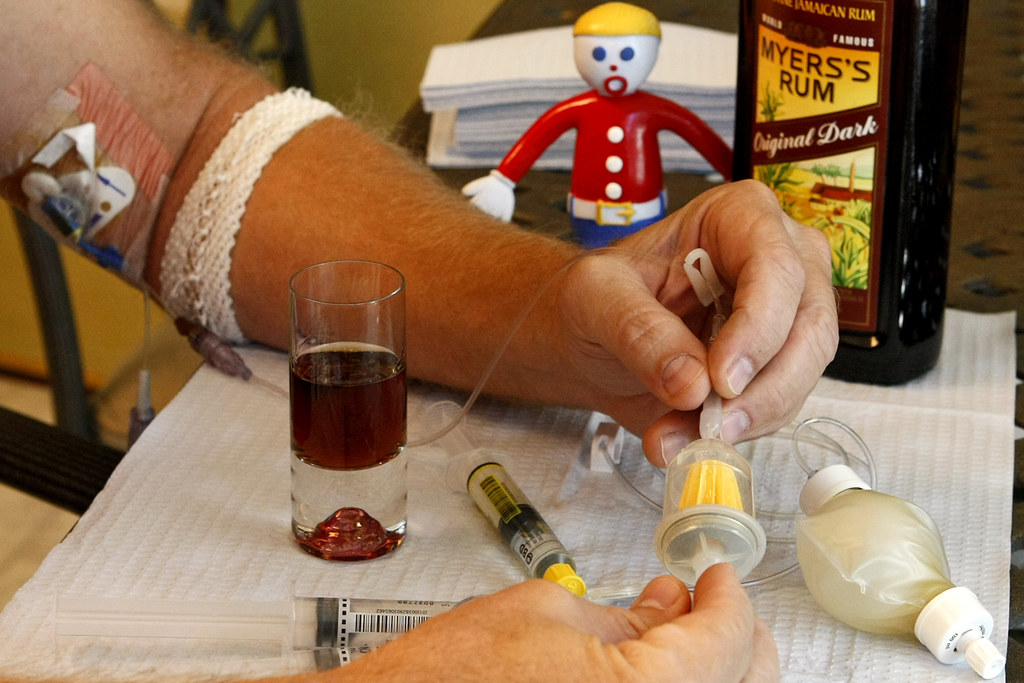
he is in good form!
Urinary incontinence continuing. He has had a urinary catheter inserted for past few days to keep his bladder from being over distended and he is starting some treatment to relax the muscles.
Hopefully we will see some progress over coming days.
"Jesus Christ!," wrote one observer, "That's the WORST sterile technique I've ever seen!"
Like many other professions, medical/health personnel can have a dark sense of humor.
While working at a Medical College Hospital, I stopped in to the library one afternoon, and began to browse. One of the books I happened upon was one about humor in the medical/healthcare field. I perused the contents, and found it quite fascinating, and the commentary & observations quite erudite, and spot on.
One anecdotal observation I can share from personal experience. Once, while working in a Major City's University Hospital's Level 1Trauma Center, I was performing postmortem care to a male patient. In the process, we pulled the lines & drains from his corpse, and began to clean his Earthly remains before bagging them in a zippered body bag, complete with toe tag, and sending them to the refrigerated mortuary downstairs.
As we pulled the Foley catheter from his penis (that's a bladder access system that enables continuous urinary drainage without needing to go to the toilet or urinal) we noticed a message tattooed lengthwise upon his penis which read "Love lifted me."
Now, bear in mind, that was several years ago - in fact, very nearly a decade - before tattooing & body piercing of various types seemed to be all the rage. What made this observation even more peculiar, was that the decedent was in this 60's. Of course, we called others to see this remarkable intimate "signage," and chuckled about it's message, and postulated various and sundry theories about psychological theories & correlated functions.
While that is true, we must bear in mind that humor must be based in reality in order to be funny.
And as I recollected, there was a joke based upon similarly related material, which was something like this:
A man went to his physician, who ordered an injection which could only be administered in the gluteus (buttocks). A female nurse administered the injection to the patient, which - of course - required lowering his undergarments.
It just so happened, that during the administration, she caught a glimpse of his manhood, and observed that it was tattooed, and read "Shorty." And it was indeed - to all appearances - quite diminished. She commented to her colleagues about it, and they cackled, chortled and gabbled about it.
Some time later, the Nurse and male patient happened upon each other's company outside the professional environment, and as fate would have it, they began courting, and eventually married.
When news of her marriage and honeymoon circulated amongst the office staff, some of her colleagues made mock of her and taunted her about their honeymoon asking, "How could a man with such an obviously short appendage give you any satisfaction?"
"Short!?!," she exclaimed.
Why of course!," replied her colleagues. "You told us all how his penis was tattooed with short."
"Short nothing!," she retorted.
"That tattoo reads Shorty's Bar and Grille, Birmingham, Alabama!"
As some of you may know, I've been battling an ear infection in both ears since back in November of 2007. This problem has affected virtually every aspect of my life due to a partial loss of hearing and almost chronic pain.
Two different doctors attempted to treat the malady with a variety of ear drop medicines, oral antibiotics and pain medication. None of these things solved the problem or stopped the pain.
The week before last, my ENT (Ear Nose and Throat) doctor finally decided to take a culture from matter inside my ear. The analysis of that culture came back early last week. The problem was identified as being a bacteria called Pseudomonas otitidis.
This bacteria is resistant to all drugs specific to treating ear infections.
As a result, I have to undergo intravenous antibiotic injections every 6 hours for the next 2-3 weeks. The drug they'll be using to treat this condition is called Zosyn (Piperacillin).
To avoid having to stick me with a needle every six hours, I went in for an outpatient surgical procedure this afternoon to have a PICC (Peripherally Inserted Central Catheter) (or PIC Line) installed into my upper left arm.
The PIC line is inserted into a peripheral vein, and then advanced through increasingly larger veins, toward the heart until the tip rests in the distal superior vena cava or cavo-atrial junction.
I don't know what that means, but it sure sounds cool.
The PIC line acts as a portal and will be the point of entry for the intravenous administering of the antibiotic.
Anyway, today's procedure to install the PIC line was successful and I'm back home and operating normally, or as normally as one can operate when one can't hear and has near constant pain in one's head.
I'm still waiting to hear back from my doctor as to when the nurse from the home health care service will arrive here to begin to administer the dope...err...drugs.
I'll be posting several photos of today's procedure to this thread in the coming hours/days, as the pain and discomfort allows.
Some of these photos will be graphic. If you're not a fan of trauma-thon-style television shows, you won't like many of these.
I took this first photo as Dr. Ainge was beginning the procedure. He's operating on the inside portion of my left arm.
In his left hand is a wand which is part of an Acuson Cypress ultrasound imaging device manufactured by the company I work for; Siemens.
He's looking at the real-time ultrasound image on a monitor which shows him precisely where the arteries and veins are located in that area of my arm.
In his right hand is a syringe filled with Lidocaine, which is used to numb the area where the PIC line will eventually be inserted.
Here's the Trauma-thon view.

I have been quite wobbly since last Friday.
My wonderful friends had a baby boy on 9th October. His entry into this world was dramatic for all of the wrong reasons, and he got deprived of oxygen at some point on the way out.
He spent the first few days of his life sedated and on a ventilator, having seizures, with his heart, brain and kidneys not working properly. Gradually his heart started working better, so his meds were reduced, and then his kidneys started working so his catheter was removed... and they reduced his sedation to the point where he woke up and fought the ventilator, so they took that off too.
The final hurdle was to get an eeg scan to see what sort of brain function he had. They got the results back yesterday.
Their beautiful, wonderful, waited-for boy has cerebral palsy, and will have learning difficulties for the rest of his life.
I keep crying for my friends, and I can barely look at my own boy without wanting to squeeze the life out of him by holding him so tightly. So many things about their little boy's arrival rang so true with my own experience of having a baby. Minutes separate their outcome with mine. It all seems so horribly unfair, and so cruel that he had made such fantastic progress only to fall at the final hurdle.
While I know that people can live fulfilling lives with CP and learning difficulties, it is quite an adjustment to make, from the rosy, easy, perfect future that everyone plans for their unborn baby. It's been so cruelly snatched away.
I'm finding it hard to come to terms with their awful luck. It feels so horribly self-indulgent though- if I am feeling this - what on earth must they be going through?
If anyone can spare a thought for little baby Dylan, I know his Mum and Dad would appreciate all the vibes they can get.
Little baby Dylan, I still can't wait to meet you. xxx
Hailey was born Sep 2001 in Columbus, OH. She had a very healthy childhood. 2-3 ear infections, a few colds, nothing serious. She was always my little hellion. Now I realize that fighting spirit was for the hard battle ahead. Then when she was 3 1/2 in Apr 2005 I noticed she had quite a bit of bruising. I waited a couple of weeks thinking she must have had an active week. Then on Apr 12, I took her to the pediatrician thinking her iron was probably low and she would give me a script and off we would go. But....that isn't what happened. After checking Hailey the Dr. left and returned with a nurse and ask Summer, our 8 yr old daughter, if she could step out with the nurse. After they left I looked at her and said "you're going to make me cry" and she said "I'm going to cry". The Dr. said she thought it was a viral infection or leukemia, but without blood test she wasn't sure. She felt strongly that it was leukemia and she wanted to give me the worst case scenario in person, because after the blood test she would be contacting us by phone. So she sent us to Children's Urgent Care to have labs drawn. We talked to her on the phone after she received the results and she said that it was leukemia, to head home, pack some clothes and then head to Children's Hospital. She would call ahead and inform the hospital that we were coming. In my darkest hour!
I had lost my mom last year to breast cancer, so I knew the horror of the "C" word and watching someone you love die slowly. I just couldn't believe that now my daughter had cancer, life could not be so cruel. Someone please wake me from this horrible nightmare!!
We were admitted to the hospital that day. The next day she had to be awake as they drove nails into her bone (might as well have been nails) for the bone marrow aspiration. She was awake because her platelets were so low they couldn't put her under. The test came back negative for leukemia. Yea, I was hoping it must be viral, but I think the docs still leaned towards leukemia. They sent some of her marrow to OSU for testing and it came back that she had Monosomy 7. Which indicates JMML. Which was not good news. During this time, I am walking around in a state of shock. I'm not eating, I lost 18 lbs that I didn't need to lose. Most of it is a fog. I remember I hated to see the Dr's. coming because it felt like they always had more bad news. I wondered how could this be, she has always been so healthy and if she was going to get leukemia, why this one. Couldn't it at least be a good one. (as if there is a good cancer). I did not know that there were different types of leukemia, nor did I know what a bone marrow transplant entailed. I am now learning many things that I wish I never had too.
Next came her broviac. A catheter placed in her chest to give her IV nutrition and transfusions. We head down to pre-op, the anesthesiologist refuses to put her under, saying her platelets were to low and it was to dangerous. I told her that Hailey's docs were well aware of what her counts were, that we couldn''t get her platelets above 47,000 and that is with her getting them twice a day, she still refused. I was pissed, Hailey had been NPO all this time, begging for something to eat or drink.(she had gone all night and 7 hrs today without anything). We go back up to J5, our oncology unit. The docs said they don't understand our patients and I'm thinking "no, but they know their job and they say it's dangerous". So we had to get up the next day and try it all again and of course I am even more terrified this time after the one had refused. I remember telling myself Hailey would come through it okay because she was going to beat the cancer and to do that she had to come thru this okay. Which she did, they gave her an infusion of platelets during the procedure. She had really bad bruising all over her chest from it though.
A few days later our Insurance Co. calls telling us we can't have our BMT in Columbus. They do not have a contract with them for a BMT. This is all we need after the bomb we had just received about her dx. We only live about 35 min. from the hosp. So we'd be able to go home some and spend time with our older daughter, Summer. Our family & friends are here. Our Dr. has seen 12 other cases of JMML which is unusual since it is so rare. We liked the fact that he had experience with JMML. We did not want to leave, it would be different if they were sending us to another hospital for better care but not financial reasons. So we called the financial office at the hosp. and they came to our room to talk to us. They said we had enough on our plate right now just dealing with her dx, to let them worry and take care of the financial side of it. Which thankfully they did without us having to do a thing.
Hailey received 5 days of Chemo to stabilize her, so they wouldn't have to give her so many blood & platelet transfusions. They gave her Ara-C, Fludarabine and she stayed on Cis Retinoic Acid until BMT. She did really good, she only threw up the first night. Then we finally got to go home after being there for 3 1/2 weeks. Grandma came down from Michigan and took care of Summer while we were in the hospital.
We finally received some good news! Dad is a 9/10 match. YEA!!! Which is rare for a parent to match. I had saved her cord blood at birth but we couldn't use it because JMML is in the stem cells, so we'd be making her go thru transplant to turn around and give the JMML right back to her. We are hoping to give it to research. Didn't have to get blood or platelets that often after taking the chemo. We could finally get her platelets over 50, they even went above 100.
We had a meeting with her doc about getting ready for BMT. He said Hailey was in remission from the chemo she had received. So my thoughts are lets wait on the BMT and see what happens. Why send a healthy child to transplant. You would never know anything was wrong with her. She runs & plays just like any other 3 1/2 yr old. In fact she always makes me worried with the way she rough houses with those tubes coming out of her chest. Of course the Dr. said no, we need to hit her now while her cancer cells are down & dormant and she is healthy. The less chemo he had to give her prior to transplant the better.
Our Dr. chose to remove her spleen. He was afraid the cancer cells would pool down in the spleen, which was happening. She had a severely enlarged spleen and his thoughts were we might not be able to kill them all with chemo. She also had a 2nd broviac put in. So now she has 2 double lumens. I'm wondering how much stuff are they going to be putting in her that they need 4 lines. The operation took a looong 5 hrs. She had a laparoscopy. It took so long cuz her pancreas was close and they were worried about nicking it. For precautionary measures she spent the night in PICU. I don't ever want to be there again!! I thought J5 was depressing but the kids smile, play, ride bikes down the hall... I wasn't prepared for PICU and the kids I seen there. Nor was I prepared for how sick and weak Hailey was. I can still see her just laying there with all the tubes coming out of her and me just watching the monitors. The next night we were back up on J5. I was so glad I wanted to get out of PICU. Hailey had a tube with a bulb on the end going into her side to check to see that they didn't nick her pancreas. The surgeon comes in at 6:00 the following evening, gives her some morphine and yanks the tube out, puts a bandage on it and sends us on our way home. The next day she is riding her big wheel out to pick her sister up off the bus. Children are amazing with the way they bounce back. My sister-n-law, Shawn, came down from MI for the operation and she really helped out.
We ended up in the hosp. a couple of times between dx and transplant for infections with her line. So we''d stay a couple of days then they would send us home on IV antibiotics. In fact her transplant was delayed a week because of an infection. We started BMT on Jun 15, 2005. So we went from dx to transplant in 2 months.
The day we checked in for BMT, I remember sitting there rubbing Hailey crying cuz I wouldn't be able to touch her skin until after transplant and we were home because I have to wear gloves all the time, don't want to give her anything since she won't have any immunity. Even though I did give her kisses on the head & hugs throughout the stay.
We were allowed 4 people to help us with the BMT isolation. They helped us keep our sanity. We had my dad, Russell, my brother's wife, Steph, my best friend, Lea, and my mother-n-law, Becky. Sometimes they would come up and spend the night with one of us or come by for a few hours to give us a break. Grandma and I took turns between the hospital and the house to take care of Summer. Daniel, dad, stayed almost every night at the hospital except when we would make him go home. My brother took care of Daniel's work for him, I know this created a lot of extra work and stress for Bryan. I honestly don't know what we would have done without family.
Our doc followed the EWOG protocol. No radiation. For Hailey's conditioning, she received 4 days of Busulfan, 2 days of Cytoxin and 1 day of Melphalan (she was not a happy camper that she had to get a sponge bath every 6 hrs for 48 hrs cuz of the Melphalan, to prevent it from burning her skin) then a day of rest. Then the day of transplant came, which is melodramatic, cuz all they do is hang a bag of marrow which looks like blood, then the nurse stays in there with her constantly to monitor her the few hrs it takes. Everyday we kept waiting for her to get deathly sick from the chemo, she never did.
The BMT isolation was strict. We had a small anti-room where we had to keep all our stuff. We washed our hands in there and gloved up. We had to wear gloves at all times while in her room. Except when sleeping. We had to make sure the 1st door was closed before we could open the door to her room. Something to do with negative ionization. Anything going into her room had to be cleaned in the anti-room thoroughly with alcohol. If anything fell on the floor it had to be kicked out of her room. Hands can't touch the floor. Then clean it in the anti-room before taking it back in. Hailey had a 1/2 hr to eat off her food tray then it must be removed. Anytime she got off her bed we had to put slippers on her which were not allowed to touch her bed. Because they had touched the floor. We were not even allowed on her bed. Before isolation I slept in bed with her while at the hospital. The alternative was a couch that was hard as a board, or a recliner that would propel me across the room. Both in and out of isolation, same deluxe sleeping arrangements. Trying to find some humor somewhere. I was just happy that we could stay with her. Everything in her room was wiped down thoroughly everyday. Her sheets changed, the bed wiped down, a daily bath, even our linens had to be changed daily. To hold her we had to gown up to keep a barrier between us. You do whatever it takes!
Then around day 5 or 6 her mouth sores really kicked in. She would just lay in bed, no playing, no eating, no talking, she would only get up to use the restroom or for her daily bath. They put her on TPN (iv nutrition) on day 7. (which she ended up having to go home on, she took it 12 hrs every night for a month after being home). She started throwing up blood, where she was swallowing it from the mouth sores that go all the way down their throat and into their stomach. They said it was normal which eased my mind some but still hard watching her go thru it. The docs said she was doing great, that her mouth sores weren''t bad compared to what they could be, we were diligent with her mouth care. Which with mouth sores it was horribly painful for her and heartbreaking for us, but we didn''t want her to get an infection.
She started grafting on day 8, which is on the early side. They put her on phentinol which is stronger than morphine because she was having a little bit of reaction to the morphine they had her on for the mouth sores. She had a constant push of it every hr and then she had a button she could push every 15 min to release more as she needed. That way they could monitor how much pain she was in by how much she pushed her button. It would register if she pushed it even if it didn't release any meds. She showed signs of mild GVH (graft versus host, Daniel's marrow attacking her) on the skin around day 13 so they started her on steroids.
Around day 17 her liver swelled, her Bilirubin went up and she complained of stomach pain. They did an ultrasound and found sludge in the gull bladder but blood flow thru the liver looked good. Day 22 they did an x-ray on her belly still trying to figure out what the pain was from. She kept throwing-up and having watery stools. Their best guess is the pain might be caused by the intense chemo that it ate her intestinal lining up and it will take time for it to heal itself. They have ran all kinds of test ruling out this and that. Day 26 they are doing a rectal biopsy to see if it is GVH. Her test came back clean, no GVH. Yea! (at least not in the organs) she still has it on the skin. She ate a tiny bit finally, it's a start.
Hailey was being mean to everyone but her dad & me, and her grandpa who she ignored but was not mean too. I could understand the docs & nurses but she was even mean to our family who was helping us out and which she usually loves & adores. She wanted us to do everything for her. We gave her meds, took b/p... I think it was a combination of steroids, isolation for 2 months and feeling crummy. She was just so miserable. I told her she didn't have to talk to people, but not to be rude. It was like I had a different child, this wasn't the Hailey that I knew. Still she held up better than I would have. They sure are troopers.
Hailey finally was allowed to go to the BMT playroom, which I had to trick her into going because she had no interest in it and she use to love the main playroom. Then they let her sister, Summer, go in with her since Hailey's ANC was up. (has to do with the white blood count and ability to fight infection). They both got a kick out of that, they had not been together for 5 weeks. Summer did come to the hospital quite a bit during our stay. She would go down to the cafeteria with us, or we would go to the main playroom on the floor and do things with her. She would even come and hang out in the anti room some and look thru the window at Hailey or open the door and talk to her a little. Hailey did not lose all her hair, but it sure got thin.
On day 40, she had one of her broviacs removed so that we could go home in 2 days. We could have left 2 weeks before: her blood counts were high enough except for this tummy pain. It hadn't gotten any better and they were still guessing, but at least they had ruled out a lot of things with all the test they have run. It's just frustrating not knowing. Anyways the docs thought she'd feel better and heal faster at home. I sure couldn't wait!!!
We came home Aug 5, 2005. 7 weeks from admission. Hailey's attitude did an about face immediately after returning home. She was smiling again!!!!!!
At day 70 she was having trouble with her magnesium & potassium level but since we were weening her off her Tacrolimus (anti-rejection drug, fk506) which was eating her mag, we were hoping it will level out. Magnesium levels affect muscle tone and can affect the heart. Hailey could not keep down her potassium med, so we had to put her on an iv drip at night with those nutrients. She stayed on the iv about a month. Hailey started bending over picking things up, trotting at a fast pace. Her strength really started improving. When we first arrived home, she was so weak, she would fall sometimes while walking, if she bent over to pick something up, she couldn't raise back up. She knew it wasn't normal, she ask me what happen to her strength? She isn't quite up to par yet but on her way.
Day 82, Hailey was weaned off her steroids, with that we dropped 2 other meds. She has gone from 9 different meds twice a day down to 3. On day 110, we went off the Tac, she got GVH of the skin again, she broke out in a rash that drove her nuts with the itching and it looked horrible. The docs just had us use steroid cream on her. I was worried we might have to go back on oral steroids. They say a little bit of gvh is good that it will also fight the leukemia cells if there are any left. I sure hope so! Day 150, she no longer has watery stools. I was so happy, it isn't normal to have it for 4 1/2 months, I was really beginning to worry that something was wrong.
We are a little past day 180 and so far Hailey is doing great. She has not needed to get an IVIG in about 7-8 weeks, her level has been above 800. We started going in monthly now. Her HGB is 14.2 and her ANC is above 9000. So all her counts are good. Her chimerism was checked a week ago, and she is 100% donor!!! She had her 2nd broviac removed on Dec. 30 - What a way to start the New Year! We are still under heavy restriction at home. Company to a very minimal. Hailey is to only go places that aren't crowded and must wear a hepa mask and gloves. No fast food. Still on a low bacteria diet, snacks must be individually packaged. It will be nice when we can be "somewhat" normal again, but I'm not complaining. I'm happy as long as she is healthy.
Gone forever is my innocent child. Now I have one that worries about germs, being stuck with a needle, being sick, dressing changes... Concerns that a 4 yr. old should never have to face. Sometimes I just watch her laugh and play, I want to capture the moment and hold on to it. The fear never leaves, it is a constant companion now.
It is so hard for the siblings also, we mustn't forget them. They go through so much. Summer joined a 6 week sibling oncology support group at Children's sponsored by the Columbus Blue Jackets (hockey). She went to her 1st hockey game and thought that was cool. She had a great time and really loved it at the meetings. Made her feel special too. I look at both Summer & Hailey as my HEROES.
I would like to end this with a paragraph I found in my cancer recovery pamphlet.
I just want to be a kid again.
The smell of grass on a spring morning.
The splash of a swimming pool on a summer afternoon.
The aroma of French fries at a country fair.
The crack of a bat against a ball.
The laughter of friends doing silly things.
A week at summer camp.
The sounds, smells and experiences that are part of life for most children are often sadly missing from the lives of children with cancer.
They are often confined to scary hospital rooms or to their homes.
These precious children miss out on many of the simple...
Joys of childhood
Joys that are really the best parts of being a kid
Joys that provide memories that last a lifetime.
Tami, mom to Summer (8) and Hailey (4) JMML
January 2006
* The JMML Foundation (www.jmmlfoundation.org) publishes the stories of children and their families affected by JMML. Please remember there are many ways you can help us to help them. Visit our “How to Help” pages to find out how you can show your support.
An old homeless woman we came across in 2015 Scott Kelby's world wide Photowalk in the old historic Jeddah, Saudi Arabia. I'm planning to meet her again and get to know her better and hopefully help transform her life. She's carrying her catheter with here where ever she goes. I got her some water and something to eat that's when I took the photograph. Talking to her touched me in a way beside her condition. She's educated and according what she said that she traveled to so many places and that she lived a very good life. But you can't always trust life and how it could harm you with no mercy.
Dabei wird durch die Pulsschlagader im Handgelenk das Katheter eingeführt und bis zum Herzen vorgeschoben (links).
Anschließend wird ein Luftdruckverband angelegt, der nach etwa 3 Stunden enfernt werden kann (rechts). (Handy-Fotos) /
The intracardiac catheter comes through the pulse artery at the hand up to the heart (left).
After that the wound is closed with an air compressive bandage, which can be removed after 3 hours (right). (mobile shots)
Shay got his cone off during the night, bit through his catheter, pulled the dressing off his wound (and ate it).
7.30 am phonecall to vet ...and all sorted by 9 am. Wound looked at, re-dressed, new catheter tube.
New cone arrangement in place.
Catheter needs to stay in situ until after weekend. I'll be glad to see the end of it. ...so will Shay
we have been at the vets 4 times this week!
Lou Doillon - Where To Start
Because hydrophalus can injure the brain, thought and behavior may be adversely affected. Learning disabilities including short-term memory loss are common among those with hydrophalus, who tend to score better on verbal IQ than on performance IQ, which is thought to reflect the distribution of nerve damage to the brain. However the severity of hydrophalus can differ considerably between individuals and some are of average or above-average intelligence. Someone with hydrophalus may have motion and visual problems, problems with coordination, or may be clumsy. They may reach puberty earlier than the average child (see precocious puberty). About one in four develops epilepsy.
this pump is inserted for a contant supply of painkillers into the patient, without having to swallow pills and harm the stomach. it's usually for severe local pain (e.g. after a knee joint replacement) or for long-term treatment.
190612-N-TH560-2213 CAMP GONSALVES, Okinawa (June 12, 2019) Hospitalman Mitchell Bromley, left, from Birmingham, Ala., applies an intravenous catheter to Hospital Corpsman 3rd Class Kevin Gizara, a Jungle Medicine Course instructor from Eugene, Ore., inside of a UH-1Y Huey, assigned to Marine Light Attack Helicopter Squadron (HMLA) 169, during a Jungle Medicine Course exercise at Jungle Warfare Training Center, Okinawa, Japan. As part of the course’s final evolution, students were evaluated on their ability to treat casualties, transport patients and execute an aerial casualty evacuation. The 10-day medical course trains Navy medical personnel assigned to Marine forces on jungle survival skills, patient tracking, field medical care, and casualty evacuation techniques. (U.S. Navy photo by Mass Communication Specialist 2nd Class Jeanette Mullinax)
Casey and I met with her oncology team today to discuss the amputation, and how it's affected by her lung surgery.
Turns out, the nodules in her lungs weren't entirely dead. What this means is that the chances that there is more cancer in her body that we don't know about are higher, thus that it is more likely she'll get the cancer again after treatment ends. We knew that from the beginning though; that since her cancer had metastasized when we found it, her chances of surviving and her chances of not getting it again were very low.
So. The amputation. They can't justify putting it off anymore. She's got two more rounds of methotrexate, and she'll be getting the amputation the end of February/first week of March. All the soft tissue swelling is gone, but the bone tumor hasn't really shrunk a whole lot, and part of it still stretches across her spine. Her surgeon can save her left leg's nerves, but not the nerves that control bowel and bladder function. Casey will have a colostomy bag and catheter for the rest of her life.
While she's recovering from the surgery (a several-week stay in the hospital), she'll get radiation treatment on the shoulder she got biopsied. With osteosarcoma, they have to surgically remove or radiate any spots that even touched osteosarcoma. So, just to be safe, they're going to radiate that shoulder. It'd be no good to lose arm/shoulder function after a leg amputation.
In case you're new to my photostream: Casey can't get a prosthetic leg. The tumor is in her pelvis, and so they have to remove her right hip and the right half of her pelvis. They can't reattach her leg, as there won't be anything to attach it to. There won't be any muscles left to control a prosthesis.
However, everyone there believed she'll be able to go back to school in the fall.
250 PARKRUNS IN NUMBERS:
• 412 Weeks
• 1,250km (776.7 miles)
• 21 PB’s
• 35:35 Average finish time
• 8 Different locations (from Rosliston to Land’s End)
• 10 Tailwalker/parkwalker duties
• 10 Other volunteer duties
• 2 Angioplasties
• 3 Additional stents
• 1 Cardiac rehabilitation
• 2 Cardioversions
• 1 Catheter Ablation
• 9 Ambulance rides
• 7 Nights in hospital
• 58 Weeks with Atrial Fibrillation (arrhythmia)
• 119 Weeks with Chronotropic Incompetence (exercise intolerance)
• 1 Fistual surgery
• 1 Upper GI endoscopy & dilation
• 1 Night in resuscitation
• 250 PARKRUNS!!
It’s been quite a journey – and it’s all covered in my blogs!
After missing the last 3 weeks recovering from Covid this was always going to be a tough one, but my grateful thanks has to go to Paul Szefer who accompanied around the course and pushed & prodded me onto my final sub 40 minute parkrun, 39:35 (I’m semi-retired now) – I would never have achieved it without him!!
Thank you to everyone who left a donation on my JustGiving page. Having been through the cardiac rehab I know just how important it is in restoring your confidence to get active again following a heart procedure. This is a little known local charity that really deserves our support; please help me to help those who have suffered a recent cardiac event.
www.justgiving.com/page/peter-jemmett-250parkruns?utm_med...
Fangruida: human landing on Mars 10 cutting-edge technology
[Fangruida- human landing on Mars 10 innovative and sophisticated technologies]
Aerospace Science and space science and technology major innovation of the most critical of sophisticated technology R & D project
-------------------------------------------------- -------------
Aerospace Science Space Science and Technology on behalf of the world's most cutting-edge leader in high technology, materials, mechatronics, information and communication, energy, biomedical, marine, aviation aerospace, microelectronics, computer, automation, intelligent biochips, use of nuclear energy, light mechanical and electrical integration, astrophysics, celestial chemistry, astrophysics and so a series of geological science and technology. Especially after the moon landing, the further development of mankind to Mars and other planets into the powerful offensive, the world's major powers eager to Daxian hand of God, increase investment, vigorously develop new sophisticated technology projects for space to space. Satellite, space station, the new spacecraft, the new space suits, the new radiation protection materials, intelligent materials, new manufacturing technology, communications technology, computer technology, detector technology, rover, rover technology, biomedical technology, and so one after another, is expected to greater breakthroughs and leaps. For example, rocket technology, spacecraft design, large power spacecraft, spacesuits design improvements, radiation multifunctional composite materials, life health care technology and space medicine, prevention against microgravity microgravity applicable drugs, tracking control technology, landing and return technology. Mars lander and returned safely to Earth as a top priority. Secondly, Mars, the Moon base and the use of transforming Mars, the Moon and other development will follow. Whether the former or the latter, are the modern aerospace science, space science basic research, applied basic research and applied research in the major cutting-edge technology. These major cutting-edge technology research and innovation, not only for human landing on Mars and the safe return of great significance, but for the entire space science, impact immeasurable universe sciences, earth sciences and human life. Here the most critical of the most important research projects of several sophisticated technology research and development as well as its core technology brief. Limit non-scientific techniques include non-technical limits of technology, the key lies in technology research and development of technology maturity, advanced technology, innovative, practical, reliable, practical application, business value and investment costs, and not simply like the idea mature technology achievements, difficult to put into things. This is the high-tech research and development, testing, prototype, test application testing, until the outcome of industrialization. Especially in aerospace technology, advanced, novelty, practicality, reliability, economy, maturity, commercial value and so on. For technical and research purely science fiction and the like may be irrelevant depth, but not as aerospace engineering and technology practice. Otherwise, Mars will become a dream fantasy, and even into settling crashed out of danger.
Regardless of the moon or Mars, many technical difficulties, especially a human landing on Mars and return safely to Earth, technical difficulties mainly in the following aspects. (Transformation of Mars and the Moon and other planets and detect other livable technology more complex and difficult, at this stage it is difficult to achieve and therefore not discussed in detail in this study). In fact, Mars will be the safe return of a full set of technology, space science, aerospace crucial scientific research development, its significance is not confined to Mars simply a return to scientific value, great commercial value, can not be measure.
1. Powered rocket, the spacecraft overall structural design not be too complex large, otherwise, the safety factor to reduce the risk of failure accidents. Fusion rocket engine main problem to be solved is the high-temperature materials and fuel ignition chamber (reaction chamber temperatures of up to tens of millions of supreme billion degrees), fissile class rocket engine whose essence is the miniaturization of nuclear reactors, and placed on the rocket. Nuclear rocket engine fuel as an energy source, with liquid hydrogen, liquid helium, liquid ammonia working fluid. Nuclear rocket engine mounted in the thrust chamber of the reactor, cooling nozzle, the working fluid delivery and control systems and other components. This engine due to nuclear radiation protection, exhaust pollution, reactor control and efficient heat exchanger design and other issues unresolved. Electrothermal rocket engine utilizing heat energy (resistance heating or electric arc heating) working medium (hydrogen, amines, hydrazine ), vaporized; nozzle expansion accelerated after discharged from the spout to generate thrust. Static rocket engine working fluid (mercury, cesium, hydrogen, etc.) from the tank enter the ionization chamber is formed thrust ionized into a plasma jet. Electric rocket engines with a high specific impulse (700-2500 sec), extremely long life (can be repeated thousands of times a starter, a total of up to thousands of hours of work). But the thrust of less than 100N. This engine is only available for spacecraft attitude control, station-keeping and the like. One nuclear - power rocket design is as follows: Firstly, the reactor heats water to make it into steam, and then the high-speed steam ejected, push the rocket. Nuclear rocket using hydrogen as working substance may be a better solution, it is one of the most commonly used liquid hydrogen rocket fuel rocket carrying liquid hydrogen virtually no technical difficulties. Heating hydrogen nuclear reactor, as long as it eventually reaches or exceeds current jet velocity hydrogen rocket engine jet speed, the same weight of the rocket will be able to work longer, it can accelerate the Rockets faster. Here there are only two problems: First, the final weight includes the weight of the rocket in nuclear reactors, so it must be as light as possible. Ultra-small nuclear reactor has been able to achieve. Furthermore, if used in outer space, we can not consider the problem of radioactive residues, simply to just one proton hydrogen nuclei are less likely to produce induced radioactivity, thus shielding layer can be made thinner, injected hydrogen gas can flow directly through the reactor core, it is not easy to solve, and that is how to get back at high speed heated gas is ejected.
Rocket engine with a nuclear fission reactor, based on the heating liquid hydrogen propellant, rather than igniting flammable propellant
High-speed heavy rocket is a major cutting-edge technology. After all, space flight and aircraft carriers, submarines, nuclear reactors differ greatly from the one hand, the use of traditional fuels, on the one hand can be nuclear reactor technology. From the control, for security reasons, the use of nuclear power rocket technology, safe and reliable overriding indicators. Nuclear atomic energy in line with the norms and rules of outer space. For the immature fetal abdominal hatchery technology, and resolutely reject use. This is the most significant development of nuclear-powered rocket principle.
Nuclear-powered spaceship for Use of nuclear power are three kinds:
The first method: no water or air space such media can not be used propeller must use jet approach. Reactor nuclear fission or fusion to produce a lot of heat, we will propellant (such as liquid hydrogen) injection, the rapid expansion of the propellant will be heated and then discharged from the engine speed tail thrust. This method is most readily available.
The second method: nuclear reactor will have a lot of fast-moving ions, these energetic particles moving very fast, so you can use a magnetic field to control their ejection direction. This principle ion rocket similar to the tail of the rocket ejected from the high-speed mobile ions, so that the recoil movement of a rocket. The advantage of this approach is to promote the unusually large ratio, without carrying any medium, continued strong. Ion engine, which is commonly referred to as "electric rocket", the principle is not complicated, the propellant is ionized particles,
Plasma Engine
Electromagnetic acceleration, high-speed spray. From the development trend, the US research scope covers almost all types of electric thrusters, but mainly to the development of ion engines, NASA in which to play the most active intake technology and preparedness plans. "
The third method: the use of nuclear explosions. It is a bold and crazy way, no longer is the use of a controlled nuclear reaction, but to use nuclear explosions to drive the ship, this is not an engine, and it is called a nuclear pulse rocket. This spacecraft will carry a lot of low-yield atomic bombs out one behind, and then detonated, followed by a spacecraft propulsion installation disk, absorbing the blast pushing the spacecraft forward. This was in 1955 to Orion (Project Orion) name of the project, originally planned to bring two thousand atomic bombs, Orion later fetal nuclear thermal rocket. Its principle is mounted on a small rocket reactor, the reactor utilizing thermal energy generated by the propellant is heated to a high temperature, high pressure and high temperature of the propellant from the high-speed spray nozzle, a tremendous impetus.
Common nuclear fission technologies, including nuclear pulse rocket engines, nuclear rockets, nuclear thermal rocket and nuclear stamping rockets to nuclear thermal rocket, for example, the size of its land-based nuclear power plant reactor structure than the much smaller, more uranium-235 purity requirements high, reaching more than 90%, at the request of the high specific impulse engine core temperature will reach about 3000K, require excellent high temperature properties of materials.
Research and test new IT technologies and new products and new technology and new materials, new equipment, things are difficult, design is the most important part, especially in the overall design, technical solutions, technical route, technical process, technical and economic particularly significant. The overall design is defective, technology there are loopholes in the program, will be a major technical route deviation, but also directly related to the success of research trials. so, any time, under any circumstances, a good grasp of the overall control of design, technical design, is essential. otherwise, a done deal, it is difficult save. aerospace technology research and product development is true.
3, high-performance nuclear rocket
Nuclear rocket nuclear fission and fusion energy can rocket rocket two categories. Nuclear fission and fusion produce heat, radiation and shock waves and other large amounts of energy, but here they are contemplated for use as a thermal energy rocket.
Uranium and other heavy elements, under certain conditions, will split their nuclei, called nuclear fission reaction. The atomic bomb is the result of nuclear fission reactions. Nuclear fission reaction to release energy, is a million times more chemical rocket propellant combustion energy. Therefore, nuclear fission energy is a high-performance rocket rockets. Since it requires much less propellant than chemical rockets can, so to its own weight is much lighter than chemical rockets energy. For the same quality of the rocket, the rocket payload of nuclear fission energy is much greater than the chemical energy of the rocket. Just nuclear fission energy rocket is still in the works.
Use of nuclear fission energy as the energy of the rocket, called the atomic rockets. It is to make hydrogen or other inert gas working fluid through the reactor, the hydrogen after the heating temperature quickly rose to 2000 ℃, and then into the nozzle, high-speed spray to produce thrust.
A vision plan is to use liquid hydrogen working fluid, in operation, the liquid hydrogen tank in the liquid hydrogen pump is withdrawn through the catheter and the engine cooling jacket and liquid hydrogen into hydrogen gas, hydrogen gas turbine-driven, locally expansion. Then by nuclear fission reactors, nuclear fission reactions absorb heat released, a sharp rise in temperature, and finally into the nozzle, the rapid expansion of high-speed spray. Calculations show that the amount of atomic payload rockets, rocket high chemical energy than 5-8 times.
Hydrogen and other light elements, under certain conditions, their nuclei convergent synthesis of new heavy nuclei, and release a lot of energy, called nuclear fusion reaction, also called thermonuclear reaction.
Using energy generated by the fusion reaction for energy rocket, called fusion energy rocket or nuclear thermal rockets. But it is also not only take advantage of controlled nuclear fusion reaction to manufacture hydrogen bombs, rockets and controlled nuclear fusion reaction needs still studying it.
Of course there are various research and development of rocket technology and technical solutions to try.
It is envisaged that the rocket deuterium, an isotope of hydrogen with deuterium nuclear fusion reaction of helium nuclei, protons and neutrons, and release huge amounts of energy, just polymerized ionized helium to temperatures up to 100 million degrees the plasma, and then nozzle expansion, high-speed ejection, the exhaust speed of up to 15,000 km / sec, atomic energy is 1800 times the rocket, the rocket is the chemical energy of 3700 times.
Nuclear rocket engine fuel as an energy source, with liquid hydrogen, liquid helium, liquid ammonia working fluid. Nuclear rocket engine mounted in the thrust chamber of the reactor, cooling nozzle, the working fluid delivery and control systems and other components. In a nuclear reactor, nuclear energy into heat to heat the working fluid, the working fluid is heated after expansion nozzle to accelerate to the speed of 6500 ~ 11,000 m / sec from the discharge orifice to produce thrust. Nuclear rocket engine specific impulse (250 to 1000 seconds) long life, but the technology is complex, apply only to long-term spacecraft. This engine due to nuclear radiation protection, exhaust pollution, reactor control and efficient heat exchanger design and other issues not resolved, is still in the midst of trials. Nuclear rocket technology is cutting-edge aerospace science technology, centralized many professional and technical sciences and aerospace, nuclear physics, nuclear chemistry, materials science, the long term future ___-- wide width. The United States, Russia and Europe, China, India, Japan, Britain, Brazil and other countries in this regard have studies, in particular the United States and Russia led the way, impressive. Of course, at this stage of nuclear rocket technology, technology development there are still many difficulties. Fully formed, still to be. But humanity marching to the universe, nuclear reactor applications is essential.
Outer Space Treaty (International Convention on the Peaceful Uses of Outer Space) ****
Use of Nuclear Power Sources in Outer Space Principle 15
General Assembly,
Having considered the report of its thirty-fifth session of the Committee on the Peaceful Uses of Outer Space and the Commission of 16 nuclear
It can be attached in principle on the use of nuclear power sources in outer space of the text of its report, 17
Recognize that nuclear power sources due to small size, long life and other characteristics, especially suitable for use even necessary
For some missions in outer space,
Recognizing also that the use of nuclear power sources in outer space should focus on the possible use of nuclear power sources
Those uses,
Recognizing also that the use of nuclear power sources should include or probabilistic risk analysis is complete security in outer space
Full evaluation is based, in particular, the public should focus on reducing accidental exposure to harmful radiation or radioactive material risk
risk,
Recognizing the need to a set of principles containing goals and guidelines in this regard to ensure the safety of outer space makes
With nuclear power sources,
Affirming that this set principles apply exclusively on space objects for non-power generation, which is generally characteristic
Mission systems and implementation of nuclear power sources in outer space on similar principles and used by,
Recognizing this need to refer to a new set of principles for future nuclear power applications and internationally for radiological protection
The new proposal will be revised
By the following principles on the use of nuclear power sources in outer space.
Principle 1. Applicability of international law
Involving the use of nuclear power sources in outer space activities should be carried out in accordance with international law, especially the "UN
Principles of the Charter "and" States in the Exploration and Use of Outer Space, including the Moon and Other Celestial Bodies Activities
Treaty "3
.
2. The principle terms
1. For the purpose of these principles, "launching State" and "launching State ......" two words mean, in related
Principles related to a time of nuclear power sources in space objects exercises jurisdiction and control of the country.
2. For the purpose of principle 9, wherein the definition of the term "launching State" as contained in that principle.
3. For the purposes of principle 3, the terms "foreseeable" and "all possible" two words are used to describe the actual hair
The overall likelihood of students that it is considered for safety analysis is credible possibilities for a class of things
Member or circumstances. "General concept of defense in depth" when the term applies to nuclear power sources in outer space refers to various settings
Count form and space operations replace or supplement the operation of the system in order to prevent system failures or mitigate thereafter
"Official Records of the General Assembly, Forty-seventh Session, Supplement No. 20" 16 (A / 47/20).
17 Ibid., Annex.
38
fruit. To achieve this purpose is not necessarily required for each individual member has redundant safety systems. Given space
Use and special requirements of various space missions, impossible to any particular set of systems or features can be specified as
Necessary to achieve this purpose. For the purpose of Principle 3 (d) of paragraph 2, "made critical" does not include
Including such as zero-power testing which are fundamental to ensuring system safety required.
Principle 3. Guidelines and criteria for safe use
To minimize the risk of radioactive material in space and the number involved, nuclear power sources in outer space
Use should be limited to non-nuclear power sources in space missions can not reasonably be performed
1. General goals for radiation protection and nuclear safety
(A) States launching space objects with nuclear power sources on board shall endeavor to protect individuals, populations and the biosphere
From radiation hazards. The design and use of space objects with nuclear power sources on board shall ensure that risk with confidence
Harm in the foreseeable operational or accidental circumstances, paragraph 1 (b) and (c) to define acceptable water
level.
Such design and use shall also ensure that radioactive material does not reliably significant contamination of outer space.
(B) the normal operation of nuclear power sources in space objects, including from paragraph 2 (b) as defined in foot
High enough to return to the track, shall be subject to appropriate anti-radiation recommended by the International Commission on Radiological Protection of the public
Protection goals. During such normal operation there shall be no significant radiation exposure;
(C) To limit exposure in accidents, the design and construction of nuclear power source systems shall take into account the international
Relevant and generally accepted radiological protection guidelines.
In addition to the probability of accidents with potentially serious radiological consequences is extremely low, the nuclear power source
Design systems shall be safely irradiated limited limited geographical area, for the individual radiation dose should be
Limited to no more than a year 1mSv primary dose limits. Allows the use of irradiation year for some years 5mSv deputy agent
Quantity limit, but the average over a lifetime effective dose equivalent annual dose not exceed the principal limit 1mSv
degree.
Should make these conditions occur with potentially serious radiological consequences of the probability of the system design is very
small.
Criteria mentioned in this paragraph Future modifications should be applied as soon as possible;
(D) general concept of defense in depth should be based on the design, construction and operation of systems important for safety. root
According to this concept, foreseeable safety-related failures or malfunctions must be capable of automatic action may be
Or procedures to correct or offset.
It should ensure that essential safety system reliability, inter alia, to make way for these systems
Component redundancy, physical separation, functional isolation and adequate independence.
It should also take other measures to increase the level of safety.
2. The nuclear reactor
(A) nuclear reactor can be used to:
39
(I) On interplanetary missions;
(Ii) the second high enough orbit paragraph (b) as defined;
(Iii) low-Earth orbit, with the proviso that after their mission is complete enough to be kept in a nuclear reactor
High on the track;
(B) sufficiently high orbit the orbital lifetime is long enough to make the decay of fission products to approximately actinides
Element active track. The sufficiently high orbit must be such that existing and future outer space missions of crisis
Risk and danger of collision with other space objects to a minimum. In determining the height of the sufficiently high orbit when
It should also take into account the destroyed reactor components before re-entering the Earth's atmosphere have to go through the required decay time
between.
(C) only 235 nuclear reactors with highly enriched uranium fuel. The design shall take into account the fission and
Activation of radioactive decay products.
(D) nuclear reactors have reached their operating orbit or interplanetary trajectory can not be made critical state
state.
(E) nuclear reactor design and construction shall ensure that, before reaching the operating orbit during all possible events
Can not become critical state, including rocket explosion, re-entry, impact on ground or water, submersion
In water or water intruding into the core.
(F) a significant reduction in satellites with nuclear reactors to operate on a lifetime less than in the sufficiently high orbit orbit
For the period (including during operation into the sufficiently high orbit) the possibility of failure, there should be a very
Reliable operating system, in order to ensure an effective and controlled disposal of the reactor.
3. Radioisotope generators
(A) interplanetary missions and other spacecraft out of Earth's gravitational field tasks using radioactive isotopes
Su generator. As they are stored after completion of their mission in high orbit, the Earth can also be used
track. We are required to make the final treatment under any circumstances.
(B) Radioisotope generators shall be protected closed systems, design and construction of the system should
Ensure that in the foreseeable conditions of the track to withstand the heat and aerodynamic forces of re-entry in the upper atmosphere, orbit
Conditions including highly elliptical or hyperbolic orbits when relevant. Upon impact, the containment system and the occurrence of parity
Physical morpheme shall ensure that no radioactive material is scattered into the environment so you can complete a recovery operation
Clear all radioactive impact area.
Principle 4. Safety Assessment
1. When launching State emission consistent with the principles defined in paragraphs 1, prior to the launch in applicable under the
Designed, constructed or manufactured the nuclear power sources, or will operate the space object person, or from whose territory or facility
Transmits the object will be to ensure a thorough and comprehensive safety assessment. This assessment shall cover
All relevant stages of space mission and shall deal with all systems involved, including the means of launching, the space level
Taiwan, nuclear power source and its equipment and the means of control and communication between ground and space.
2. This assessment shall respect the principle of 3 contained in the guidelines and criteria for safe use.
40
3. The principle of States in the Exploration and Use, including the Moon and Other Celestial Bodies Outer Space Activities Article
Results of about 11, this safety assessment should be published prior to each transmit simultaneously to the extent feasible
Note by the approximate intended time of launch, and shall notify the Secretary-General of the United Nations, how to be issued
This safety assessment before the shot to get the results as soon as possible.
Principle 5. Notification of re-entry
1. Any State launching a space object with nuclear power sources in space objects that failed to produce discharge
When radioactive substances dangerous to return to the earth, it shall promptly notify the country concerned. Notice shall be in the following format:
(A) System parameters:
(I) Name of launching State, including which may be contacted in the event of an accident to Request
Information or assistance to obtain the relevant authorities address;
(Ii) International title;
(Iii) Date and territory or location of launch;
(Iv) the information needed to make the best prediction of orbit lifetime, trajectory and impact region;
(V) General function of spacecraft;
(B) information on the radiological risk of nuclear power source:
(I) the type of power source: radioisotopes / reactor;
(Ii) the fuel could fall into the ground and may be affected by the physical state of contaminated and / or activated components, the number of
The amount and general radiological characteristics. The term "fuel" refers to as a source of heat or power of nuclear material.
This information shall also be sent to the Secretary-General of the United Nations.
2. Once you know the failure, the launching State shall provide information on the compliance with the above format. Information should as far as possible
To be updated frequently, and in the dense layers of the Earth's atmosphere is expected to return to a time when close to the best increase
Frequency of new data, so that the international community understand the situation and will have sufficient time to plan for any deemed necessary
National contingency measures.
3. It should also be at the same frequency of the latest information available to the Secretary-General of the United Nations.
Principle 6. consultation
5 According to the national principles provide information shall, as far as reasonably practicable, other countries
Requirements to obtain further information or consultations promptly reply.
Principle 7. Assistance to States
1. Upon receipt of expected with nuclear power sources on space objects and their components will return through the Earth's atmosphere
After know that all countries possessing space monitoring and tracking facilities, in the spirit of international cooperation, as soon as possible to
The Secretary-General of the United Nations and the countries they may have made space objects carrying nuclear power sources
A fault related information, so that the States may be affected to assess the situation and take any
It is considered to be the necessary precautions.
41
2. In carrying space objects with nuclear power sources back to the Earth's atmosphere after its components:
(A) launching State shall be requested by the affected countries to quickly provide the necessary assistance to eliminate actual
And possible effects, including nuclear power sources to assist in identifying locations hit the Earth's surface, to detect the re substance
Quality and recovery or cleanup activities.
(B) All countries with relevant technical capabilities other than the launching State, and with such technical capabilities
International organizations shall, where possible, in accordance with the requirements of the affected countries to provide the necessary co
help.
When according to the above (a) and subparagraph (b) to provide assistance, should take into account the special needs of developing countries.
Principle 8. Responsibility
In accordance with the States in the Exploration and Use of Outer Space, including the Moon and Other Celestial Bodies activities, including the principles of Article
About Article, States shall bear international responsibility for their use of nuclear power sources in outer space relates to the activities
Whether such activities are carried on by governmental agencies or non-governmental entities, and shall bear international responsibility to ensure that this
Such activities undertaken by the country in line with the principles of the Treaty and the recommendations contained therein. If it involves the use of nuclear power sources
Activities in outer space by an international organization, should be done by the international organizations and States to participate in the organization
Undertakes to comply with the principles of the Treaty and the recommendations contained in these responsibilities.
Principle 9. Liability and Compensation
1. In accordance with the principle of States in the Exploration and Use, including the Moon and Other Celestial Bodies Outer Space Activities Article
And the Convention on International Liability for Damage Caused by Space Objects covenant of Article 7
Provisions, which launches or on behalf of the State
Each State launching a space object and each State from which territory or facility a space object is launched
Kinds of space object or damage caused by components shall bear international liability. This fully applies to this
Kind of space object carrying a nuclear power source case. Two or more States jointly launch a space object,
Each launching State shall in accordance with the above Article of the Convention for any damages jointly and severally liable.
2. Such countries under the aforesaid Convention shall bear the damages shall be in accordance with international law and fair and reasonable
The principles set out in order to provide for damages to make a claim on behalf of its natural or juridical persons, national or
International organizations to restore to the state before the occurrence of the damage.
3. For the purposes of this principle, compensation should be made to include reimbursement of the duly substantiated expenses for search, recovery and clean
Cost management work, including the cost of providing assistance to third parties.
10. The principle of dispute settlement
Since the implementation of these principles will lead to any dispute in accordance with the provisions of the UN Charter, by negotiation or
Other established procedures to resolve the peaceful settlement of disputes.
Here quoted the important provisions of the United Nations concerning the use of outer space for peaceful nuclear research and international conventions, the main emphasis on the Peaceful Uses of provisions related constraints .2 the use of nuclear rockets in outer space nuclear studies, etc., can cause greater attention in nuclear power nuclear rocket ship nuclear research, manufacture, use and other aspects of the mandatory hard indicators. this scientists, engineering and technical experts are also important constraints and requirements. as IAEA supervision and management as very important.
2. radiation. Space radiation is one of the greatest threats to the safety of the astronauts, including X-rays, γ-rays, cosmic rays and high-speed solar particles. Better than aluminum protective effect of high polymer composite materials.
3. Air. Perhaps the oxygen needed to rely on oxidation-reduction reaction of hydrogen and ilmenite production of water, followed by water electrolysis to generate oxygen. Mars oxygen necessary for survival but also from the decomposition of water, electrolytically separating water molecules of oxygen and hydrogen, this oxygen equipment has been successfully used in the International Space Station. Oxygen is released into the air to sustain life, the hydrogen system into the water system.
4. The issue of food waste recycling. At present, the International Space Station on the use of dehumidifiers, sucked moisture in the air to be purified, and then changed back to drinkable water. The astronauts' urine and sweat recycling. 5. water. The spacecraft and the space station on purification system also makes urine and other liquids can be purified utilization. 6. microgravity. In microgravity or weightlessness long-term space travel, if protective measures shall not be treated, the astronauts will be muscle atrophy, bone softening health. 7. contact. 8. Insulation, 9 energy. Any space exploration are inseparable from the energy battery is a new super hybrid energy storage device, the asymmetric lead-acid batteries and supercapacitors in the same compound within the system - and the so-called inside, no additional separate electronic control unit, this is an optimal combination. The traditional lead-acid battery PbO2 monomer is a positive electrode plate and a negative electrode plate spongy Pb composition, not a super cell. : Silicon solar cells, multi-compound thin film solar cells, multi-layer polymer-modified electrode solar cells, nano-crystalline solar cells, batteries and super class. For example, the solar aircraft .10. To protect the health and life safety and security systems. Lysophosphatidic acid LPA is a growth factor-like lipid mediators, the researchers found that this substance can on apoptosis after radiation injury and animal cells was inhibited. Stable lysophosphatidic acid analogs having the hematopoietic system and gastrointestinal tract caused by acute radiation sickness protection, knockout experiments show that lysophosphatidic acid receptors is an important foundation for the protection of radiation injury. In addition to work under high pressure, the astronauts face a number of health threats, including motion sickness, bacterial infections, blindness space, as well as psychological problems, including toxic dust. In the weightless environment of space, the astronaut's body will be like in preadolescents, as the emergence of various changes.
Plantar molt
After the environment to adapt to zero gravity, the astronaut's body will be some strange changes. Weightlessness cause fluid flow around the main flow torso and head, causing the astronauts facial swelling and inflammation, such as nasal congestion. During long-term stay in space
Bone and muscle loss
Most people weightlessness caused by the impact may be known bone and muscle degeneration. In addition, the calcium bones become very fragile and prone to fracture, which is why some of the astronauts after landing need on a stretcher.
Space Blindness
Space Blindness refers astronaut decreased vision.
Solar storms and radiation is one of the biggest challenges facing the long-term space flight. Since losing the protection of Earth's magnetic field, astronauts suffer far more than normal levels of radiation. The cumulative amount of radiation exposure in low earth orbit them exceeded by workers close to nuclear reactors, thereby increasing the risk of cancer.
Prolonged space flight can cause a series of psychological problems, including depression or mood swings, vulnerability, anxiety and fear, as well as other sequelae. We are familiar with the biology of the Earth, the Earth biochemistry, biophysics, after all, the Earth is very different astrophysics, celestial chemistry, biophysics and astrophysics, biochemistry and other celestial bodies. Therefore, you must be familiar with and adapt to these differences and changes.
Osteoporosis and its complications ranked first in the space of disease risk.
Long-term health risks associated with flying Topics
The degree of influence long-term biological effects of radiation in human flight can withstand the radiation and the maximum limit of accumulated radiation on physiology, pathology and genetics.
Physiological effects of weightlessness including: long-term bone loss and a return flight after the maximum extent and severity of the continued deterioration of other pathological problems induced by the; maximum flexibility and severity of possible long-term Flight Center in vascular function.
Long-term risk of disease due to the high risk of flight stress, microbial variation, decreased immune function, leading to infections
Radiation hazards and protection
1) radiation medicine, biology and pathway effects Features
Radiation protection for interplanetary flight, since the lack of protective effect of Earth's magnetic field, and by the irradiation time is longer, the possibility of increased radiation hazard.
Analysis of space flight medical problems that may occur, loss of appetite topped the list, sleep disorders, fatigue and insomnia, in addition, space sickness, musculoskeletal system problems, eye problems, infections problems, skin problems and cardiovascular problems
---------------------------------------------------------
Development of diagnostic techniques in orbit, the development of the volume of power consumption, features a wide range of diagnostic techniques, such as applied research of ultrasound diagnostic techniques in the abdominal thoracic trauma, bone, ligament damage, dental / sinus infections and other complications and integrated;
Actively explore in orbit disposal of medical technology, weightlessness surgical methods, development of special surgical instruments, the role of narcotic drugs and the like.
——————————————————————————————-
However, space technology itself is integrated with the use of the most advanced technology, its challenging technical reserves and periodic demanding
With the continuous development of science and technology, space agencies plan a manned landing on the moon and Mars, space exploration emergency medicine current concern.
Space sickness
In the weightless environment of space, in the weightless environment of space, surgery may be extremely difficult and risky.
Robot surgeons
Space disease in three days after entering the space started to ease, although individual astronauts might subsequently relapse. January 2015 NASA declared working on a fast, anti-nausea and nasal sprays. In addition, due to the zero-gravity environment, and anti-nausea drugs can only be administered by injection or transdermal patches manner.
Manned spaceflight in the 21st century is the era of interplanetary flight, aerospace medicine is closely watched era is the era of China's manned space flourish. Only the central issue, and grasp the opportunity to open up a new world of human survival and development.
Various emergency contingency measures in special circumstances. Invisible accident risk prevention. Enhancing drugs and other screening methods immunity aerospace medicine and tissue engineering a microgravity environment. Drug mixture of APS, ginseng polysaccharides, Ganoderma lucidum polysaccharides, polysaccharides and Lentinan, from other compounds. Drug development space syndrome drug, chemical structure modification will be an important part.
These issues are very sensitive, cutting-edge technology is a major difficulty landing on Mars. Countries in the world, especially the world's major space powers in the country strategies and technical research, the results of all kinds continue to emerge. United States, Russia, China, Europe, India, Japan and other countries is different. United States, Russia extraordinary strength. Many patented technology and health, and most belong to the top-secret technology. Especially in aerospace engineering and technological achievements is different from the general scientific literature, practical, commercial, industrial great, especially the performance of patents, know-how, technical drawings, engineering design and other aspects. Present Mars and return safely to Earth, the first manned, significance, everything is hard in the beginning, especially the first person to land on Mars This Mars for Human Sciences Research Mars, the moon, the earth, the solar system and the universe, life and other significant. Its far greater than the value of direct investments and business interests.
In addition, it is the development of new materials, suitable for deep space operations universe, life, and other detection, wider field.
Many aerospace materials, continuous research and development of materials are key areas of aerospace development, including material rocket, the spacecraft materials, the suit materials, radiation materials, materials and equipment, instruments, materials and so on biochemistry.
Temperature metal-based compound with a metal matrix composite body with a more primordial higher temperature strength, creep resistance, impact resistance, thermal fatigue and other excellent high temperature performance.
In B, C, SiC fiber reinforced Ti3Al, TiAl, Ni3Al intermetallic matrix composites, etc.
W Fiber Reinforced with nickel-based, iron-based alloys as well as SiC, TiB2, Si3N4 and BN particle reinforced metal matrix composites
High temperature service conditions require the development of ceramic and carbon-based composite materials, etc., not in this eleven Cheung said.
Fuel storage
In order to survive in space, people need many things: food, oxygen, shelter, and, perhaps most importantly, fuel. The initial quality Mars mission somewhere around 80 percent of the space launch humans will be propellant. The fuel amount of storage space is very difficult.
This difference in low Earth orbit cause liquid hydrogen and liquid oxygen - rocket fuel - vaporization.
Hydrogen is particularly likely to leak out, resulting in a loss of about 4% per month.
When you want to get people to Mars speed to minimize exposure to weightlessness and space radiation hazards
Mars
Landings on the Martian surface, they realized that they reached the limit. The rapid expansion of the thin Martian atmosphere can not be very large parachute, such as those that will need to be large enough to slow down, carry human spacecraft.
Therefore, the parachute strong mass ratio, high temperature resistance, Bing shot performance and other aspects of textile materials used have special requirements, in order to make a parachute can be used in rockets, missiles, Yu arrows spacecraft and other spacecraft recovery, it is necessary to improve the canopy heat resistance, a high melting point polymeric fiber fabric used, the metal fabric, ceramic fiber fabrics, and other devices.
Super rigid parachute to help slow the landing vehicle.
Spacecraft entered the Martian atmosphere at 24,000 km / h. Even after slowing parachute or inflatable, it will be very
Once we have the protection of the Earth magnetic field, the solar radiation will accumulate in the body, a huge explosion threw the spacecraft may potentially lethal doses of radiation astronauts.
In addition to radiation, the biggest challenge is manned trip to Mars microgravity, as previously described.
The moon is sterile. Mars is another case entirely.
With dust treatment measures.
Arid Martian environment to create a super-tiny dust particles flying around the Earth for billions of years.
Apollo moon dust encountered. Ultra-sharp and abrasive lunar dust was named something that can clog the basic functions of mechanical damage. High chloride salt, which can cause thyroid problems in people.
*** Mars geological structure and geological structure of the moon, water on Mars geology, geology of the Moon is very important, because he, like the Earth's geology is related to many important issues. Water, the first element of life, air, temperature, and complex geological formations are geological structure. Cosmic geology research methods, mainly through a variety of detection equipment equipped with a space probe, celestial observations of atmospheric composition, composition and distribution of temperature, pressure, wind speed, vertical structure, composition of the solar wind, the water, the surface topography and Zoning, topsoil the composition and characteristics of the component surface of the rock, type and distribution, stratigraphic sequence, structural system and the internal shell structure.
Mars internal situation only rely on its surface condition of large amounts of data and related information inferred. It is generally believed that the core radius of 1700 km of high-density material composition; outsourcing a layer of lava, it is denser than the Earth's mantle some; outermost layer is a thin crust. Compared to other terrestrial planets, the lower the density of Mars, which indicates that the Martian core of iron (magnesium and iron sulfide) with may contain more sulfur. Like Mercury and the Moon, Mars and lack active plate movement; there is no indication that the crust of Mars occurred can cause translational events like the Earth like so many of folded mountains. Since there is no lateral movement in the earth's crust under the giant hot zone relative to the ground in a stationary state. Slight stress coupled with the ground, resulting in Tharis bumps and huge volcano. For the geological structure of Mars is very important, which is why repeated explorations and studies of Martian geological reasons.
Earth's surface
Each detector component landing site soil analysis:
Element weight percent
Viking 1
Oxygen 40-45
Si 18-25
Iron 12-15
K 8
Calcium 3-5
Magnesium 3-6
S 2-5
Aluminum 2-5
Cesium 0.1-0.5
Core
Mars is about half the radius of the core radius, in addition to the primary iron further comprises 15 to 17% of the sulfur content of lighter elements is also twice the Earth, so the low melting point, so that the core portion of a liquid, such as outside the Earth nuclear.
Mantle
Nuclear outer coating silicate mantle.
Crust
The outermost layer of the crust.
Crustal thickness obtained, the original thickness of the low north 40 km south plateau 70 kilometers thick, an average of 50 kilometers, at least 80 km Tharsis plateau and the Antarctic Plateau, and in the impact basin is thin, as only about 10 kilometers Greece plains.
Canyon of Mars there are two categories: outflow channels (outflow channel) and tree valley (valley network). The former is very large, it can be 100 km wide, over 2000 km long, streamlined, mainly in the younger Northern Hemisphere, such as the plain around Tyre Chris Canyon and Canyon jam.
In addition, the volcanic activity sometimes lava formation lava channels (lava channel); crustal stress generated by fissures, faults, forming numerous parallel extending grooves (fossa), such as around the huge Tharsis volcanic plateau radially distributed numerous grooves, which can again lead to volcanic activity.
Presumably, Mars has an iron as the main component of the nucleus, and contains sulfur, magnesium and other light elements, the nuclear share of Mars, the Earth should be relatively small. The outer core is covered with a thick layer of magnesium-rich silicate mantle, the surface of rocky crust. The density of Earth-like planets Mars is the lowest, only 3.93g / cc.
Hierarchy
The crust
Lunar core
The average density of the Moon is 3.3464 g / cc, the solar system satellites second highest (after Aiou). However, there are few clues mean lunar core is small, only about 350 km radius or less [2]. The core of the moon is only about 20% the size of the moon, the moon's interior has a solid, iron-rich core diameter of about 240 kilometers (150 miles); in addition there is a liquid core, mainly composed of iron outer core, about 330 km in diameter (205 miles), and for the first time compared with the core of the Earth, considered as the earth's outer core, like sulfur and oxygen may have lighter elements [4].
Chemical elements on the lunar surface constituted in accordance with its abundance as follows: oxygen (O), silicon (Si), iron (Fe), magnesium (Mg), calcium (Ca), aluminum (Al), manganese (Mn), titanium ( Ti). The most abundant is oxygen, silicon and iron. The oxygen content is estimated to be 42% (by weight). Carbon (C) and nitrogen (N) only traces seem to exist only in trace amounts deposited in the solar wind brings.
Lunar Prospector from the measured neutron spectra, the hydrogen (H) mainly in the lunar poles [2].
Element content (%)
Oxygen 42%
Silicon 21%
Iron 13%
Calcium 8%
Aluminum 7%
Magnesium 6%
Other 3%
Lunar surface relative content of each element (% by weight)
Moon geological history is an important event in recent global magma ocean crystallization. The specific depth is not clear, but some studies have shown that at least a depth of about 500 kilometers or more.
Lunar landscape
Lunar landscape can be described as impact craters and ejecta, some volcanoes, hills, lava-filled depressions.
Regolith
TABLE bear the asteroid and comets billions of years of bombardment. Over time, the impact of these processes have already broken into fine-grained surface rock debris, called regolith. Young mare area, regolith thickness of about 2 meters, while the oldest dated land, regolith thickness of up to 20 meters. Through the analysis of lunar soil components, in particular the isotopic composition changes can determine the period of solar activity. Solar wind gases possible future lunar base is useful because oxygen, hydrogen (water), carbon and nitrogen is not only essential to life, but also may be useful for fuel production. Lunar soil constituents may also be as a future source of energy.
Here, repeatedly stressed that the geological structure and geological structure of celestial bodies, the Earth, Moon, Mars, or that this human existence and development of biological life forms is very important, especially in a series of data Martian geological structure geological structure is directly related to human landing Mars and the successful transformation of Mars or not. for example, water, liquid water, water, oxygen, synthesis, must not be taken lightly.
____________________________________________________________----
Mars landing 10 Technology
Aerospace Science and space science and technology major innovation of the most critical of sophisticated technology R & D project
[
"1" rocket propulsion technology ion fusion nuclear pulse propulsion rocket powered high-speed heavy rocket technology, space nuclear reactors spacecraft] brought big problems reflected in the nuclear reaction, nuclear radiation on spacecraft launch, control, brakes and other impact.
In particular, for the future of nuclear power spacecraft, the need to solve the nuclear reactor design, manufacture, control, cooling, radiation shielding, exhaust pollution, high thermoelectric conversion efficiency and a series of technical problems.
In particular, nuclear reactors produce radiation on astronauts' health will pose a great threat, which requires the spacecraft to be nuclear radiation shielding to ensure astronaut and ship the goods from radiation and heat from the reactor influence, but this will greatly increase the weight of the detector.
Space nuclear process applications, nuclear reaction decay is not a problem, but in a vacuum, ultra-low temperature environment, the nuclear reaction materials, energy transport materials have very high demands.
Space facing the reality of a nuclear reactor cooling cooling problems. To prevent problems with the reactor, "Washington" aircraft carrier to take four heavy protective measures for the radiation enclosed in the warship. These four measures are: the fuel itself, fuel storage pressure vessel, reactor shell and the hull. US Navy fuel all metal fuel, designed to take the impact resistance of the war, does not release fission product can withstand more than 50 times the gravity of the impact load; product of nuclear fission reactor fuel will never enter loop cooling water. The third layer of protection is specially designed and manufactured the reactor shell. The fourth layer is a very strong anti-impact combat ship, the reactor is arranged in the center of the ship, very safe. Engage in a reactor can only be loaded up to the aircraft, so as to drive the motor, and then drive the propeller. That is the core advantage of the heat generated by the heated gas flow, high temperature high pressure gas discharge backward, thereby generating thrust.
.
After installation AMPS1000 type nuclear power plant, a nuclear fuel assembly: He is a core member of the nuclear fuel chain reaction. Usually made into uranium dioxide, of which only a few percent uranium-235, and most of it is not directly involved in the nuclear fission of uranium 238. The uranium dioxide sintered into cylindrical pieces, into a stainless steel or a zirconium alloy do metal tubes called fuel rods or the original, then the number of fuel rods loaded metal cylinder in an orderly composition of the fuel assembly, and finally put a lot of vertical distribution of fuel assemblies in the reactor.
Nuclear reactor pressure vessel is a housing for containing nuclear fuel and reactor internals, for producing high-quality high-strength steel is made to withstand the pressure of dozens MPa. Import and export of the coolant in the pressure vessel.
The top of the pressure vessel closure, and can be used to accommodate the fixed control rod drive mechanism, pressure vessel head has a semi-circular, flat-topped.
Roof bolt: used to connect the locking pressure vessel head, so that the cylinder to form a completely sealed container.
Neutron Source: Plug in nuclear reactors can provide sufficient neutron, nuclear fuel ignition, to start to enhance the role of nuclear reactors and nuclear power. Neutron source generally composed of radium, polonium, beryllium, antimony production. Neutron source and neutron fission reactors are fast neutron, can not cause fission of uranium 235, in order to slow down, we need to moderator ---- full of pure water in a nuclear reactor. Aircraft carriers, submarines use nuclear reactor control has proven more successful.
Rod: has a strong ability to absorb neutrons, driven by the control rod drive mechanism, can move up and down in a nuclear reactor control rods within the nuclear fuel used to start, shut down the nuclear reactor, and maintain, regulate reactor power. Hafnium control rods in general, silver, indium, cadmium and other metals production.
Control rod drive mechanism: He is the executive body of nuclear reactors operating system and security protection systems, in strict accordance with requirements of the system or its operator control rod drives do move up and down in a nuclear reactor, nuclear reactor for power control. In a crisis situation, you also can quickly control rods fully inserted into the reactor in order to achieve the purpose of the emergency shutdown
Upper and lower support plate: used to secure the fuel assembly. High temperature and pressure inside the reactor is filled with pure water (so called pressurized water reactors), on the one hand he was passing through a nuclear reactor core, cooling the nuclear fuel, to act as a coolant, on the other hand it accumulates in the pressure vessel in play moderated neutrons role, acting as moderator.
Water quality monitoring sampling system:
Adding chemical system: under normal circumstances, for adding hydrazine, hydrogen, pH control agents to the primary coolant system, the main purpose is to remove and reduce coolant oxygen, high oxygen water suppression equipment wall corrosion (usually at a high temperature oxygen with hydrogen, especially at low temperatures during startup of a nuclear reactor with added hydrazine oxygen); when the nuclear reactor control rods stuck for some reason can not shutdown time by the the system can inject the nuclear reactor neutron absorber (such as boric acid solution), emergency shutdown, in order to ensure the safety of nuclear submarines.
Water system: a loop inside the water will be reduced at work, such as water sampling and analysis, equipment leaks, because the shutdown process cooling water and reduction of thermal expansion and contraction.
Equipment cooling water system:
Pressure safety systems: pressure reactor primary coolant system may change rapidly for some reason, the need for effective control. And in severe burn nuclear fuel rods, resulting in a core melt accident, it is necessary to promptly increase the pressure. Turn the regulator measures the electric, heating and cooling water. If necessary, also temporary startup booster pump.
Residual Heat Removal System: reactor scram may be due to an accident, such as when the primary coolant system of the steam generator heat exchanger tube is damaged, it must be urgently closed reactors.
Safety Injection System: The main components of this system is the high-pressure injection pump.
Radioactive waste treatment systems:
Decontamination Systems: for the removal of radioactive deposits equipment, valves, pipes and accessories, and other surfaces.
Europe, the United States and Russia and other countries related to aircraft carriers, submarines, icebreakers, nuclear-powered research aircraft, there are lots of achievements use of nuclear energy, it is worth analysis. However, nuclear reactor technology, rocket ships and the former are very different, therefore, requires special attention and innovative research. Must adopt a new new design techniques, otherwise, fall into the stereotype, it will avail, nothing even cause harm Aerospace.
[ "2" spacecraft structure]
[ "3"] radiation technology is the use of deep-sea sedimentation fabric fabrics deepwater technology development precipitated silver metal fibers or fiber lint and other materials and micronaire value between 4.1 to 4.3 fibers made from blends. For radiation protection field, it greatly enhances the effects of radiation and service life of clothing. Radiation resistant fiber) radiation resistant fiber - fiber polyimide polyimide fibers
60 years the United States has successfully developed polyimide fibers, it has highlighted the high temperature, radiation-resistant, fire-retardant properties.
[ "4" cosmic radiation resistant clothing design multifunctional anti-aging, wear underwear] ① comfort layer: astronauts can not wash clothes in a long flight, a lot of sebum, perspiration, etc. will contaminate underwear, so use soft, absorbent and breathable cotton knitwear making.
② warm layer: at ambient temperature range is not the case, warm layer to maintain a comfortable temperature environment. Choose warm and good thermal resistance large, soft, lightweight material, such as synthetic fibers, flakes, wool and silk and so on.
③ ventilation and cooling clothes clothes
Spacesuit
In astronaut body heat is too high, water-cooled ventilation clothing and clothing to a different way of heat. If the body heat production more than 350 kcal / h (ventilated clothes can not meet the cooling requirements, then that is cooled by a water-cooled suit. Ventilating clothing and water-cooled multi-use compression clothing, durable, flexible plastic tubing, such as polyvinyl chloride pipe or nylon film.
④ airtight limiting layer:
⑤ insulation: astronaut during extravehicular activities, from hot or cold insulation protection. It multilayer aluminized polyester film or a polyimide film and sandwiched between layers of nonwoven fabric to be made.
⑥ protective cover layer: the outermost layer of the suit is to require fire, heat and anti-space radiation on various factors (micrometeorites, cosmic rays, etc.) on the human body. Most of this layer with aluminized fabric.
New space suits using a special radiation shielding material, double design.
And also supporting spacesuit helmet, gloves, boots and so on.
[ "5" space - Aerospace biomedical technology, space, special use of rescue medication Space mental health care systems in space without damage restful sleep positions - drugs, simple space emergency medical system
]
[ "6" landing control technology, alternate control technology, high-performance multi-purpose landing deceleration device (parachute)]
[ "7" Mars truck, unitary Mars spacecraft solar energy battery super multi-legged (rounds) intelligent robot] multifunction remote sensing instruments on Mars, Mars and more intelligent giant telescope
[8 <> Mars warehouse activities, automatic Mars lander - Automatic start off cabin
]
[ "9" Mars - spacecraft docking control system, return to the system design]
Space flight secondary emergency life - support system
Spacecraft automatic, manual, semi-automatic operation control, remote control switch system
Automatic return spacecraft systems, backup design, the spacecraft automatic control operating system modular blocks of]
[10 lunar tracking control system
Martian dust storms, pollution prevention, anti-corrosion and other special conditions thereof
Electric light aircraft, Mars lander, Mars, living spaces, living spaces Mars, Mars entry capsule, compatible utilization technology, plant cultivation techniques, nutrition space - space soil]
Aerospace technology, space technology a lot, a lot of cutting-edge technology. Human landing on Mars technology bear the brunt. The main merge the human landing on Mars 10 cutting-edge technology, in fact, these 10 cutting-edge technology, covering a wide range, focused, and is the key to key technologies. They actually shows overall trends and technology Aerospace Science and Technology space technology. Human triumph Mars and safe return of 10 cutting-edge technology is bound to innovation. Moreover, in order to explore the human Venus, Jupiter satellites and the solar system, the Milky Way and other future development of science and laid the foundation guarantee. But also for the transformation of human to Mars, the Moon and other planets livable provides strong technical support. Aerospace Science and Technology which is a major support system.
Preparation of oxygen, water, synthesis, temperature, radiation, critical force confrontation. Regardless of the moon or Mars, survive three elements bear the brunt.
Chemical formula: H₂O
Formula: H-O-H (OH bond between two angle 104.5 °).
Molecular Weight: 18.016
Chemical Experiment: water electrolysis. Formula: 2H₂O = energized = 2H₂ ↑ + O₂ ↑ (decomposition)
Molecules: a hydrogen atom, an oxygen atom.
Ionization of water: the presence of pure water ionization equilibrium following: H₂O == == H⁺ + OH⁻ reversible or irreversible H₂O + H₂O = = H₃O⁺ + OH⁻.
NOTE: "H₃O⁺" hydronium ions, for simplicity, often abbreviated as H⁺, more accurate to say the H9O4⁺, the amount of hydrogen ion concentration in pure water material is 10⁻⁷mol / L.
Electrolysis of water:
Water at DC, decomposition to produce hydrogen and oxygen, this method is industrially prepared pure hydrogen and oxygen 2H₂O = 2H₂ ↑ + O₂ ↑.
. Hydration Reaction:
Water with an alkaline active metal oxides, as well as some of the most acidic oxide hydration reaction of unsaturated hydrocarbons.
Na₂O + H₂O = 2NaOH
CaO + H₂O = Ca (OH) ₂
SO₃ + H₂O = H₂SO₄
P₂O₅ + 3H₂O = 2H₃PO₄ molecular structure
CH₂ = CH₂ + H₂O ← → C₂H₅OH
6. The diameter of the order of magnitude of 10 water molecules negative power of ten, the water is generally believed that a diameter of 2 to 3 this organization. water
7. Water ionization:
In the water, almost no water molecules ionized to generate ions.
H₂O ← → H⁺ + OH⁻
Heating potassium chlorate or potassium permanganate preparation of oxygen
Pressurized at low temperatures, the air into a liquid, and then evaporated, since the boiling point of liquid nitrogen is -196 deg.] C, lower than the boiling point of liquid oxygen (-183 ℃), so the liquid nitrogen evaporated from the first air, remaining the main liquid oxygen.
Of course, the development of research in space there is a great difference, even more special preparation harsh environments on Earth and synthetic water and oxygen, over the need for more technological breakthroughs.
The main component of air oxygen and nitrogen. The use of oxygen and nitrogen with
Mars - Mars - Mars first person / human landing on Mars station tackling cutting-edge technology
Mars--Fangruida//science tech.
Enc:Special multi-purpose anti-radiation suit 50 million dollars
Aerospace Medical Emergency cabin 1.5 billion dollars
Multi-purpose intelligent life support system 10 billion dollars
Mars truck 300 million dollars
Aerospace / Water Planet synthesis 1.2 billion dollars
Cutting-edge aerospace technology transfer 50 million dollars of new rocket radiation material 10 billion dollars against drugs microgravity $ 2 billion contact: Fangda337svb125@gmail.com,banxin123 @ gmail.com, mdin.jshmith @ gmail.com technology entry fee / technical margin of 1 million dollars , signed on demand
Table of Contents
Fangruida: human landing on Mars 10 cutting-edge technology
[Fangruida- human landing on Mars 10 innovative and sophisticated technologies]
Aerospace Science and space science and technology major innovation of the most critical of sophisticated technology R & D project
-------------------------------------------------- -------------
Aerospace Science Space Science and Technology on behalf of the world's most cutting-edge leader in high technology, materials, mechatronics, information and communication, energy, biomedical, marine, aviation aerospace, microelectronics, computer, automation, intelligent biochips, use of nuclear energy, light mechanical and electrical integration, astrophysics, celestial chemistry, astrophysics and so a series of geological science and technology. Especially after the moon landing, the further development of mankind to Mars and other planets into the powerful offensive, the world's major powers eager to Daxian hand of God, increase investment, vigorously develop new sophisticated technology projects for space to space. Satellite, space station, the new spacecraft, the new space suits, the new radiation protection materials, intelligent materials, new manufacturing technology, communications technology, computer technology, detector technology, rover, rover technology, biomedical technology, and so one after another, is expected to greater breakthroughs and leaps. For example, rocket technology, spacecraft design, large power spacecraft, spacesuits design improvements, radiation multifunctional composite materials, life health care technology and space medicine, prevention against microgravity microgravity applicable drugs, tracking control technology, landing and return technology. Mars lander and returned safely to Earth as a top priority. Secondly, Mars, the Moon base and the use of transforming Mars, the Moon and other development will follow. Whether the former or the latter, are the modern aerospace science, space science basic research, applied basic research and applied research in the major cutting-edge technology. These major cutting-edge technology research and innovation, not only for human landing on Mars and the safe return of great significance, but for the entire space science, impact immeasurable universe sciences, earth sciences and human life. Here the most critical of the most important research projects of several sophisticated technology research and development as well as its core technology brief. Limit non-scientific techniques include non-technical limits of technology, the key lies in technology research and development of technology maturity, advanced technology, innovative, practical, reliable, practical application, business value and investment costs, and not simply like the idea mature technology achievements, difficult to put into things. This is the high-tech research and development, testing, prototype, test application testing, until the outcome of industrialization. Especially in aerospace technology, advanced, novelty, practicality, reliability, economy, maturity, commercial value and so on. For technical and research purely science fiction and the like may be irrelevant depth, but not as aerospace engineering and technology practice. Otherwise, Mars will become a dream fantasy, and even into settling crashed out of danger.
Regardless of the moon or Mars, many technical difficulties, especially a human landing on Mars and return safely to Earth, technical difficulties mainly in the following aspects. (Transformation of Mars and the Moon and other planets and detect other livable technology more complex and difficult, at this stage it is difficult to achieve and therefore not discussed in detail in this study). In fact, Mars will be the safe return of a full set of technology, space science, aerospace crucial scientific research development, its significance is not confined to Mars simply a return to scientific value, great commercial value, can not be measure.
1. Powered rocket, the spacecraft overall structural design not be too complex large, otherwise, the safety factor to reduce the risk of failure accidents. Fusion rocket engine main problem to be solved is the high-temperature materials and fuel ignition chamber (reaction chamber temperatures of up to tens of millions of supreme billion degrees), fissile class rocket engine whose essence is the miniaturization of nuclear reactors, and placed on the rocket. Nuclear rocket engine fuel as an energy source, with liquid hydrogen, liquid helium, liquid ammonia working fluid. Nuclear rocket engine mounted in the thrust chamber of the reactor, cooling nozzle, the working fluid delivery and control systems and other components. This engine due to nuclear radiation protection, exhaust pollution, reactor control and efficient heat exchanger design and other issues unresolved. Electrothermal rocket engine utilizing heat energy (resistance heating or electric arc heating) working medium (hydrogen, amines, hydrazine ), vaporized; nozzle expansion accelerated after discharged from the spout to generate thrust. Static rocket engine working fluid (mercury, cesium, hydrogen, etc.) from the tank enter the ionization chamber is formed thrust ionized into a plasma jet. Electric rocket engines with a high specific impulse (700-2500 sec), extremely long life (can be repeated thousands of times a starter, a total of up to thousands of hours of work). But the thrust of less than 100N. This engine is only available for spacecraft attitude control, station-keeping and the like. One nuclear - power rocket design is as follows: Firstly, the reactor heats water to make it into steam, and then the high-speed steam ejected, push the rocket. Nuclear rocket using hydrogen as working substance may be a better solution, it is one of the most commonly used liquid hydrogen rocket fuel rocket carrying liquid hydrogen virtually no technical difficulties. Heating hydrogen nuclear reactor, as long as it eventually reaches or exceeds current jet velocity hydrogen rocket engine jet speed, the same weight of the rocket will be able to work longer, it can accelerate the Rockets faster. Here there are only two problems: First, the final weight includes the weight of the rocket in nuclear reactors, so it must be as light as possible. Ultra-small nuclear reactor has been able to achieve. Furthermore, if used in outer space, we can not consider the problem of radioactive residues, simply to just one proton hydrogen nuclei are less likely to produce induced radioactivity, thus shielding layer can be made thinner, injected hydrogen gas can flow directly through the reactor core, it is not easy to solve, and that is how to get back at high speed heated gas is ejected.
Rocket engine with a nuclear fission reactor, based on the heating liquid hydrogen propellant, rather than igniting flammable propellant
High-speed heavy rocket is a major cutting-edge technology. After all, space flight and aircraft carriers, submarines, nuclear reactors differ greatly from the one hand, the use of traditional fuels, on the one hand can be nuclear reactor technology. From the control, for security reasons, the use of nuclear power rocket technology, safe and reliable overriding indicators. Nuclear atomic energy in line with the norms and rules of outer space. For the immature fetal abdominal hatchery technology, and resolutely reject use. This is the most significant development of nuclear-powered rocket principle.
Nuclear-powered spaceship for Use of nuclear power are three kinds:
The first method: no water or air space such media can not be used propeller must use jet approach. Reactor nuclear fission or fusion to produce a lot of heat, we will propellant (such as liquid hydrogen) injection, the rapid expansion of the propellant will be heated and then discharged from the engine speed tail thrust. This method is most readily available.
The second method: nuclear reactor will have a lot of fast-moving ions, these energetic particles moving very fast, so you can use a magnetic field to control their ejection direction. This principle ion rocket similar to the tail of the rocket ejected from the high-speed mobile ions, so that the recoil movement of a rocket. The advantage of this approach is to promote the unusually large ratio, without carrying any medium, continued strong. Ion engine, which is commonly referred to as "electric rocket", the principle is not complicated, the propellant is ionized particles,
Plasma Engine
Electromagnetic acceleration, high-speed spray. From the development trend, the US research scope covers almost all types of electric thrusters, but mainly to the development of ion engines, NASA in which to play the most active intake technology and preparedness plans. "
The third method: the use of nuclear explosions. It is a bold and crazy way, no longer is the use of a controlled nuclear reaction, but to use nuclear explosions to drive the ship, this is not an engine, and it is called a nuclear pulse rocket. This spacecraft will carry a lot of low-yield atomic bombs out one behind, and then detonated, followed by a spacecraft propulsion installation disk, absorbing the blast pushing the spacecraft forward. This was in 1955 to Orion (Project Orion) name of the project, originally planned to bring two thousand atomic bombs, Orion later fetal nuclear thermal rocket. Its principle is mounted on a small rocket reactor, the reactor utilizing thermal energy generated by the propellant is heated to a high temperature, high pressure and high temperature of the propellant from the high-speed spray nozzle, a tremendous impetus.
Common nuclear fission technologies, including nuclear pulse rocket engines, nuclear rockets, nuclear thermal rocket and nuclear stamping rockets to nuclear thermal rocket, for example, the size of its land-based nuclear power plant reactor structure than the much smaller, more uranium-235 purity requirements high, reaching more than 90%, at the request of the high specific impulse engine core temperature will reach about 3000K, require excellent high temperature properties of materials.
Research and test new IT technologies and new products and new technology and new materials, new equipment, things are difficult, design is the most important part, especially in the overall design, technical solutions, technical route, technical process, technical and economic particularly significant. The overall design is defective, technology there are loopholes in the program, will be a major technical route deviation, but also directly related to the success of research trials. so, any time, under any circumstances, a good grasp of the overall control of design, technical design, is essential. otherwise, a done deal, it is difficult save. aerospace technology research and product development is true.
3, high-performance nuclear rocket
Nuclear rocket nuclear fission and fusion energy can rocket rocket two categories. Nuclear fission and fusion produce heat, radiation and shock waves and other large amounts of energy, but here they are contemplated for use as a thermal energy rocket.
Uranium and other heavy elements, under certain conditions, will split their nuclei, called nuclear fission reaction. The atomic bomb is the result of nuclear fission reactions. Nuclear fission reaction to release energy, is a million times more chemical rocket propellant combustion energy. Therefore, nuclear fission energy is a high-performance rocket rockets. Since it requires much less propellant than chemical rockets can, so to its own weight is much lighter than chemical rockets energy. For the same quality of the rocket, the rocket payload of nuclear fission energy is much greater than the chemical energy of the rocket. Just nuclear fission energy rocket is still in the works.
Use of nuclear fission energy as the energy of the rocket, called the atomic rockets. It is to make hydrogen or other inert gas working fluid through the reactor, the hydrogen after the heating temperature quickly rose to 2000 ℃, and then into the nozzle, high-speed spray to produce thrust.
A vision plan is to use liquid hydrogen working fluid, in operation, the liquid hydrogen tank in the liquid hydrogen pump is withdrawn through the catheter and the engine cooling jacket and liquid hydrogen into hydrogen gas, hydrogen gas turbine-driven, locally expansion. Then by nuclear fission reactors, nuclear fission reactions absorb heat released, a sharp rise in temperature, and finally into the nozzle, the rapid expansion of high-speed spray. Calculations show that the amount of atomic payload rockets, rocket high chemical energy than 5-8 times.
Hydrogen and other light elements, under certain conditions, their nuclei convergent synthesis of new heavy nuclei, and release a lot of energy, called nuclear fusion reaction, also called thermonuclear reaction.
Using energy generated by the fusion reaction for energy rocket, called fusion energy rocket or nuclear thermal rockets. But it is also not only take advantage of controlled nuclear fusion reaction to manufacture hydrogen bombs, rockets and controlled nuclear fusion reaction needs still studying it.
Of course there are various research and development of rocket technology and technical solutions to try.
It is envisaged that the rocket deuterium, an isotope of hydrogen with deuterium nuclear fusion reaction of helium nuclei, protons and neutrons, and release huge amounts of energy, just polymerized ionized helium to temperatures up to 100 million degrees the plasma, and then nozzle expansion, high-speed ejection, the exhaust speed of up to 15,000 km / sec, atomic energy is 1800 times the rocket, the rocket is the chemical energy of 3700 times.
Nuclear rocket engine fuel as an energy source, with liquid hydrogen, liquid helium, liquid ammonia working fluid. Nuclear rocket engine mounted in the thrust chamber of the reactor, cooling nozzle, the working fluid delivery and control systems and other components. In a nuclear reactor, nuclear energy into heat to heat the working fluid, the working fluid is heated after expansion nozzle to accelerate to the speed of 6500 ~ 11,000 m / sec from the discharge orifice to produce thrust. Nuclear rocket engine specific impulse (250 to 1000 seconds) long life, but the technology is complex, apply only to long-term spacecraft. This engine due to nuclear radiation protection, exhaust pollution, reactor control and efficient heat exchanger design and other issues not resolved, is still in the midst of trials. Nuclear rocket technology is cutting-edge aerospace science technology, centralized many professional and technical sciences and aerospace, nuclear physics, nuclear chemistry, materials science, the long term future _-- wide width. The United States, Russia and Europe, China, India, Japan, Britain, Brazil and other countries in this regard have studies, in particular the United States and Russia led the way, impressive. Of course, at this stage of nuclear rocket technology, technology development there are still many difficulties. Fully formed, still to be. But humanity marching to the universe, nuclear reactor applications is essential.
Outer Space Treaty (International Convention on the Peaceful Uses of Outer Space) **
Use of Nuclear Power Sources in Outer Space Principle 15
General Assembly,
Having considered the report of its thirty-fifth session of the Committee on the Peaceful Uses of Outer Space and the Commission of 16 nuclear
It can be attached in principle on the use of nuclear power sources in outer space of the text of its report, 17
Recognize that nuclear power sources due to small size, long life and other characteristics, especially suitable for use even necessary
For some missions in outer space,
Recognizing also that the use of nuclear power sources in outer space should focus on the possible use of nuclear power sources
Those uses,
Recognizing also that the use of nuclear power sources should include or probabilistic risk analysis is complete security in outer space
Full evaluation is based, in particular, the public should focus on reducing accidental exposure to harmful radiation or radioactive material risk
risk,
Recognizing the need to a set of principles containing goals and guidelines in this regard to ensure the safety of outer space makes
With nuclear power sources,
Affirming that this set principles apply exclusively on space objects for non-power generation, which is generally characteristic
Mission systems and implementation of nuclear power sources in outer space on similar principles and used by,
Recognizing this need to refer to a new set of principles for future nuclear power applications and internationally for radiological protection
The new proposal will be revised
By the following principles on the use of nuclear power sources in outer space.
Principle 1. Applicability of international law
Involving the use of nuclear power sources in outer space activities should be carried out in accordance with international law, especially the "UN
Principles of the Charter "and" States in the Exploration and Use of Outer Space, including the Moon and Other Celestial Bodies Activities
Treaty "3
.
2. The principle terms
1. For the purpose of these principles, "launching State" and "launching State ......" two words mean, in related
Principles related to a time of nuclear power sources in space objects exercises jurisdiction and control of the country.
2. For the purpose of principle 9, wherein the definition of the term "launching State" as contained in that principle.
3. For the purposes of principle 3, the terms "foreseeable" and "all possible" two words are used to describe the actual hair
The overall likelihood of students that it is considered for safety analysis is credible possibilities for a class of things
Member or circumstances. "General concept of defense in depth" when the term applies to nuclear power sources in outer space refers to various settings
Count form and space operations replace or supplement the operation of the system in order to prevent system failures or mitigate thereafter
"Official Records of the General Assembly, Forty-seventh Session, Supplement No. 20" 16 (A / 47/20).
17 Ibid., Annex.
38
fruit. To achieve this purpose is not necessarily required for each individual member has redundant safety systems. Given space
Use and special requirements of various space missions, impossible to any particular set of systems or features can be specified as
Necessary to achieve this purpose. For the purpose of Principle 3 (d) of paragraph 2, "made critical" does not include
Including such as zero-power testing which are fundamental to ensuring system safety required.
Principle 3. Guidelines and criteria for safe use
To minimize the risk of radioactive material in space and the number involved, nuclear power sources in outer space
Use should be limited to non-nuclear power sources in space missions can not reasonably be performed
1. General goals for radiation protection and nuclear safety
(A) States launching space objects with nuclear power sources on board shall endeavor to protect individuals, populations and the biosphere
From radiation hazards. The design and use of space objects with nuclear power sources on board shall ensure that risk with confidence
Harm in the foreseeable operational or accidental circumstances, paragraph 1 (b) and (c) to define acceptable water
level.
Such design and use shall also ensure that radioactive material does not reliably significant contamination of outer space.
(B) the normal operation of nuclear power sources in space objects, including from paragraph 2 (b) as defined in foot
High enough to return to the track, shall be subject to appropriate anti-radiation recommended by the International Commission on Radiological Protection of the public
Protection goals. During such normal operation there shall be no significant radiation exposure;
(C) To limit exposure in accidents, the design and construction of nuclear power source systems shall take into account the international
Relevant and generally accepted radiological protection guidelines.
In addition to the probability of accidents with potentially serious radiological consequences is extremely low, the nuclear power source
Design systems shall be safely irradiated limited limited geographical area, for the individual radiation dose should be
Limited to no more than a year 1mSv primary dose limits. Allows the use of irradiation year for some years 5mSv deputy agent
Quantity limit, but the average over a lifetime effective dose equivalent annual dose not exceed the principal limit 1mSv
degree.
Should make these conditions occur with potentially serious radiological consequences of the probability of the system design is very
small.
Criteria mentioned in this paragraph Future modifications should be applied as soon as possible;
(D) general concept of defense in depth should be based on the design, construction and operation of systems important for safety. root
According to this concept, foreseeable safety-related failures or malfunctions must be capable of automatic action may be
Or procedures to correct or offset.
It should ensure that essential safety system reliability, inter alia, to make way for these systems
Component redundancy, physical separation, functional isolation and adequate independence.
It should also take other measures to increase the level of safety.
2. The nuclear reactor
(A) nuclear reactor can be used to:
39
(I) On interplanetary missions;
(Ii) the second high enough orbit paragraph (b) as defined;
(Iii) low-Earth orbit, with the proviso that after their mission is complete enough to be kept in a nuclear reactor
High on the track;
(B) sufficiently high orbit the orbital lifetime is long enough to make the decay of fission products to approximately actinides
Element active track. The sufficiently high orbit must be such that existing and future outer space missions of crisis
Risk and danger of collision with other space objects to a minimum. In determining the height of the sufficiently high orbit when
It should also take into account the destroyed reactor components before re-entering the Earth's atmosphere have to go through the required decay time
between.
(C) only 235 nuclear reactors with highly enriched uranium fuel. The design shall take into account the fission and
Activation of radioactive decay products.
(D) nuclear reactors have reached their operating orbit or interplanetary trajectory can not be made critical state
state.
(E) nuclear reactor design and construction shall ensure that, before reaching the operating orbit during all possible events
Can not become critical state, including rocket explosion, re-entry, impact on ground or water, submersion
In water or water intruding into the core.
(F) a significant reduction in satellites with nuclear reactors to operate on a lifetime less than in the sufficiently high orbit orbit
For the period (including during operation into the sufficiently high orbit) the possibility of failure, there should be a very
Reliable operating system, in order to ensure an effective and controlled disposal of the reactor.
3. Radioisotope generators
(A) interplanetary missions and other spacecraft out of Earth's gravitational field tasks using radioactive isotopes
Su generator. As they are stored after completion of their mission in high orbit, the Earth can also be used
track. We are required to make the final treatment under any circumstances.
(B) Radioisotope generators shall be protected closed systems, design and construction of the system should
Ensure that in the foreseeable conditions of the track to withstand the heat and aerodynamic forces of re-entry in the upper atmosphere, orbit
Conditions including highly elliptical or hyperbolic orbits when relevant. Upon impact, the containment system and the occurrence of parity
Physical morpheme shall ensure that no radioactive material is scattered into the environment so you can complete a recovery operation
Clear all radioactive impact area.
Principle 4. Safety Assessment
1. When launching State emission consistent with the principles defined in paragraphs 1, prior to the launch in applicable under the
Designed, constructed or manufactured the nuclear power sources, or will operate the space object person, or from whose territory or facility
Transmits the object will be to ensure a thorough and comprehensive safety assessment. This assessment shall cover
All relevant stages of space mission and shall deal with all systems involved, including the means of launching, the space level
Taiwan, nuclear power source and its equipment and the means of control and communication between ground and space.
2. This assessment shall respect the principle of 3 contained in the guidelines and criteria for safe use.
40
3. The principle of States in the Exploration and Use, including the Moon and Other Celestial Bodies Outer Space Activities Article
Results of about 11, this safety assessment should be published prior to each transmit simultaneously to the extent feasible
Note by the approximate intended time of launch, and shall notify the Secretary-General of the United Nations, how to be issued
This safety assessment before the shot to get the results as soon as possible.
Principle 5. Notification of re-entry
1. Any State launching a space object with nuclear power sources in space objects that failed to produce discharge
When radioactive substances dangerous to return to the earth, it shall promptly notify the country concerned. Notice shall be in the following format:
(A) System parameters:
(I) Name of launching State, including which may be contacted in the event of an accident to Request
Information or assistance to obtain the relevant authorities address;
(Ii) International title;
(Iii) Date and territory or location of launch;
(Iv) the information needed to make the best prediction of orbit lifetime, trajectory and impact region;
(V) General function of spacecraft;
(B) information on the radiological risk of nuclear power source:
(I) the type of power source: radioisotopes / reactor;
(Ii) the fuel could fall into the ground and may be affected by the physical state of contaminated and / or activated components, the number of
The amount and general radiological characteristics. The term "fuel" refers to as a source of heat or power of nuclear material.
This information shall also be sent to the Secretary-General of the United Nations.
2. Once you know the failure, the launching State shall provide information on the compliance with the above format. Information should as far as possible
To be updated frequently, and in the dense layers of the Earth's atmosphere is expected to return to a time when close to the best increase
Frequency of new data, so that the international community understand the situation and will have sufficient time to plan for any deemed necessary
National contingency measures.
3. It should also be at the same frequency of the latest information available to the Secretary-General of the United Nations.
Principle 6. consultation
5 According to the national principles provide information shall, as far as reasonably practicable, other countries
Requirements to obtain further information or consultations promptly reply.
Principle 7. Assistance to States
1. Upon receipt of expected with nuclear power sources on space objects and their components will return through the Earth's atmosphere
After know that all countries possessing space monitoring and tracking facilities, in the spirit of international cooperation, as soon as possible to
The Secretary-General of the United Nations and the countries they may have made space objects carrying nuclear power sources
A fault related information, so that the States may be affected to assess the situation and take any
It is considered to be the necessary precautions.
41
2. In carrying space objects with nuclear power sources back to the Earth's atmosphere after its components:
(A) launching State shall be requested by the affected countries to quickly provide the necessary assistance to eliminate actual
And possible effects, including nuclear power sources to assist in identifying locations hit the Earth's surface, to detect the re substance
Quality and recovery or cleanup activities.
(B) All countries with relevant technical capabilities other than the launching State, and with such technical capabilities
International organizations shall, where possible, in accordance with the requirements of the affected countries to provide the necessary co
help.
When according to the above (a) and subparagraph (b) to provide assistance, should take into account the special needs of developing countries.
Principle 8. Responsibility
In accordance with the States in the Exploration and Use of Outer Space, including the Moon and Other Celestial Bodies activities, including the principles of Article
About Article, States shall bear international responsibility for their use of nuclear power sources in outer space relates to the activities
Whether such activities are carried on by governmental agencies or non-governmental entities, and shall bear international responsibility to ensure that this
Such activities undertaken by the country in line with the principles of the Treaty and the recommendations contained therein. If it involves the use of nuclear power sources
Activities in outer space by an international organization, should be done by the international organizations and States to participate in the organization
Undertakes to comply with the principles of the Treaty and the recommendations contained in these responsibilities.
Principle 9. Liability and Compensation
1. In accordance with the principle of States in the Exploration and Use, including the Moon and Other Celestial Bodies Outer Space Activities Article
And the Convention on International Liability for Damage Caused by Space Objects covenant of Article 7
Provisions, which launches or on behalf of the State
Each State launching a space object and each State from which territory or facility a space object is launched
Kinds of space object or damage caused by components shall bear international liability. This fully applies to this
Kind of space object carrying a nuclear power source case. Two or more States jointly launch a space object,
Each launching State shall in accordance with the above Article of the Convention for any damages jointly and severally liable.
2. Such countries under the aforesaid Convention shall bear the damages shall be in accordance with international law and fair and reasonable
The principles set out in order to provide for damages to make a claim on behalf of its natural or juridical persons, national or
International organizations to restore to the state before the occurrence of the damage.
3. For the purposes of this principle, compensation should be made to include reimbursement of the duly substantiated expenses for search, recovery and clean
Cost management work, including the cost of providing assistance to third parties.
10. The principle of dispute settlement
Since the implementation of these principles will lead to any dispute in accordance with the provisions of the UN Charter, by negotiation or
Other established procedures to resolve the peaceful settlement of disputes.
Here quoted the important provisions of the United Nations concerning the use of outer space for peaceful nuclear research and international conventions, the main emphasis on the Peaceful Uses of provisions related constraints .2 the use of nuclear rockets in outer space nuclear studies, etc., can cause greater attention in nuclear power nuclear rocket ship nuclear research, manufacture, use and other aspects of the mandatory hard indicators. this scientists, engineering and technical experts are also important constraints and requirements. as IAEA supervision and management as very important.
2. radiation. Space radiation is one of the greatest threats to the safety of the astronauts, including X-rays, γ-rays, cosmic rays and high-speed solar particles. Better than aluminum protective effect of high polymer composite materials.
3. Air. Perhaps the oxygen needed to rely on oxidation-reduction reaction of hydrogen and ilmenite production of water, followed by water electrolysis to generate oxygen. Mars oxygen necessary for survival but also from the decomposition of water, electrolytically separating water molecules of oxygen and hydrogen, this oxygen equipment has been successfully used in the International Space Station. Oxygen is released into the air to sustain life, the hydrogen system into the water system.
4. The issue of food waste recycling. At present, the International Space Station on the use of dehumidifiers, sucked moisture in the air to be purified, and then changed back to drinkable water. The astronauts' urine and sweat recycling. 5. water. The spacecraft and the space station on purification system also makes urine and other liquids can be purified utilization. 6. microgravity. In microgravity or weightlessness long-term space travel, if protective measures shall not be treated, the astronauts will be muscle atrophy, bone softening health. 7. contact. 8. Insulation, 9 energy. Any space exploration are inseparable from the energy battery is a new super hybrid energy storage device, the asymmetric lead-acid batteries and supercapacitors in the same compound within the system - and the so-called inside, no additional separate electronic control unit, this is an optimal combination. The traditional lead-acid battery PbO2 monomer is a positive electrode plate and a negative electrode plate spongy Pb composition, not a super cell. : Silicon solar cells, multi-compound thin film solar cells, multi-layer polymer-modified electrode solar cells, nano-crystalline solar cells, batteries and super class. For example, the solar aircraft .10. To protect the health and life safety and security systems. Lysophosphatidic acid LPA is a growth factor-like lipid mediators, the researchers found that this substance can on apoptosis after radiation injury and animal cells was inhibited. Stable lysophosphatidic acid analogs having the hematopoietic system and gastrointestinal tract caused by acute radiation sickness protection, knockout experiments show that lysophosphatidic acid receptors is an important foundation for the protection of radiation injury. In addition to work under high pressure, the astronauts face a number of health threats, including motion sickness, bacterial infections, blindness space, as well as psychological problems, including toxic dust. In the weightless environment of space, the astronaut's body will be like in preadolescents, as the emergence of various changes.
Plantar molt
After the environment to adapt to zero gravity, the astronaut's body will be some strange changes. Weightlessness cause fluid flow around the main flow torso and head, causing the astronauts facial swelling and inflammation, such as nasal congestion. During long-term stay in space
Bone and muscle loss
Most people weightlessness caused by the impact may be known bone and muscle degeneration. In addition, the calcium bones become very fragile and prone to fracture, which is why some of the astronauts after landing need on a stretcher.
Space Blindness
Space Blindness refers astronaut decreased vision.
Solar storms and radiation is one of the biggest challenges facing the long-term space flight. Since losing the protection of Earth's magnetic field, astronauts suffer far more than normal levels of radiation. The cumulative amount of radiation exposure in low earth orbit them exceeded by workers close to nuclear reactors, thereby increasing the risk of cancer.
Prolonged space flight can cause a series of psychological problems, including depression or mood swings, vulnerability, anxiety and fear, as well as other sequelae. We are familiar with the biology of the Earth, the Earth biochemistry, biophysics, after all, the Earth is very different astrophysics, celestial chemistry, biophysics and astrophysics, biochemistry and other celestial bodies. Therefore, you must be familiar with and adapt to these differences and changes.
Osteoporosis and its complications ranked first in the space of disease risk.
Long-term health risks associated with flying Topics
The degree of influence long-term biological effects of radiation in human flight can withstand the radiation and the maximum limit of accumulated radiation on physiology, pathology and genetics.
Physiological effects of weightlessness including: long-term bone loss and a return flight after the maximum extent and severity of the continued deterioration of other pathological problems induced by the; maximum flexibility and severity of possible long-term Flight Center in vascular function.
Long-term risk of disease due to the high risk of flight stress, microbial variation, decreased immune function, leading to infections
Radiation hazards and protection
1) radiation medicine, biology and pathway effects Features
Radiation protection for interplanetary flight, since the lack of protective effect of Earth's magnetic field, and by the irradiation time is longer, the possibility of increased radiation hazard.
Analysis of space flight medical problems that may occur, loss of appetite topped the list, sleep disorders, fatigue and insomnia, in addition, space sickness, musculoskeletal system problems, eye problems, infections problems, skin problems and cardiovascular problems
---------------------------------------------------------
Development of diagnostic techniques in orbit, the development of the volume of power consumption, features a wide range of diagnostic techniques, such as applied research of ultrasound diagnostic techniques in the abdominal thoracic trauma, bone, ligament damage, dental / sinus infections and other complications and integrated;
Actively explore in orbit disposal of medical technology, weightlessness surgical methods, development of special surgical instruments, the role of narcotic drugs and the like.
——————————————————————————————-
However, space technology itself is integrated with the use of the most advanced technology, its challenging technical reserves and periodic demanding
With the continuous development of science and technology, space agencies plan a manned landing on the moon and Mars, space exploration emergency medicine current concern.
Space sickness
In the weightless environment of space, in the weightless environment of space, surgery may be extremely difficult and risky.
Robot surgeons
Space disease in three days after entering the space started to ease, although individual astronauts might subsequently relapse. January 2015 NASA declared working on a fast, anti-nausea and nasal sprays. In addition, due to the zero-gravity environment, and anti-nausea drugs can only be administered by injection or transdermal patches manner.
Manned spaceflight in the 21st century is the era of interplanetary flight, aerospace medicine is closely watched era is the era of China's manned space flourish. Only the central issue, and grasp the opportunity to open up a new world of human survival and development.
Various emergency contingency measures in special circumstances. Invisible accident risk prevention. Enhancing drugs and other screening methods immunity aerospace medicine and tissue engineering a microgravity environment. Drug mixture of APS, ginseng polysaccharides, Ganoderma lucidum polysaccharides, polysaccharides and Lentinan, from other compounds. Drug development space syndrome drug, chemical structure modification will be an important part.
These issues are very sensitive, cutting-edge technology is a major difficulty landing on Mars. Countries in the world, especially the world's major space powers in the country strategies and technical research, the results of all kinds continue to emerge. United States, Russia, China, Europe, India, Japan and other countries is different. United States, Russia extraordinary strength. Many patented technology and health, and most belong to the top-secret technology. Especially in aerospace engineering and technological achievements is different from the general scientific literature, practical, commercial, industrial great, especially the performance of patents, know-how, technical drawings, engineering design and other aspects. Present Mars and return safely to Earth, the first manned, significance, everything is hard in the beginning, especially the first person to land on Mars This Mars for Human Sciences Research Mars, the moon, the earth, the solar system and the universe, life and other significant. Its far greater than the value of direct investments and business interests.
In addition, it is the development of new materials, suitable for deep space operations universe, life, and other detection, wider field.
Many aerospace materials, continuous research and development of materials are key areas of aerospace development, including material rocket, the spacecraft materials, the suit materials, radiation materials, materials and equipment, instruments, materials and so on biochemistry.
Temperature metal-based compound with a metal matrix composite body with a more primordial higher temperature strength, creep resistance, impact resistance, thermal fatigue and other excellent high temperature performance.
In B, C, SiC fiber reinforced Ti3Al, TiAl, Ni3Al intermetallic matrix composites, etc.
W Fiber Reinforced with nickel-based, iron-based alloys as well as SiC, TiB2, Si3N4 and BN particle reinforced metal matrix composites
High temperature service conditions require the development of ceramic and carbon-based composite materials, etc., not in this eleven Cheung said.
Fuel storage
In order to survive in space, people need many things: food, oxygen, shelter, and, perhaps most importantly, fuel. The initial quality Mars mission somewhere around 80 percent of the space launch humans will be propellant. The fuel amount of storage space is very difficult.
This difference in low Earth orbit cause liquid hydrogen and liquid oxygen - rocket fuel - vaporization.
Hydrogen is particularly likely to leak out, resulting in a loss of about 4% per month.
When you want to get people to Mars speed to minimize exposure to weightlessness and space radiation hazards
Mars
Landings on the Martian surface, they realized that they reached the limit. The rapid expansion of the thin Martian atmosphere can not be very large parachute, such as those that will need to be large enough to slow down, carry human spacecraft.
Therefore, the parachute strong mass ratio, high temperature resistance, Bing shot performance and other aspects of textile materials used have special requirements, in order to make a parachute can be used in rockets, missiles, Yu arrows spacecraft and other spacecraft recovery, it is necessary to improve the canopy heat resistance, a high melting point polymeric fiber fabric used, the metal fabric, ceramic fiber fabrics, and other devices.
Super rigid parachute to help slow the landing vehicle.
Spacecraft entered the Martian atmosphere at 24,000 km / h. Even after slowing parachute or inflatable, it will be very
Once we have the protection of the Earth magnetic field, the solar radiation will accumulate in the body, a huge explosion threw the spacecraft may potentially lethal doses of radiation astronauts.
In addition to radiation, the biggest challenge is manned trip to Mars microgravity, as previously described.
The moon is sterile. Mars is another case entirely.
With dust treatment measures.
Arid Martian environment to create a super-tiny dust particles flying around the Earth for billions of years.
Apollo moon dust encountered. Ultra-sharp and abrasive lunar dust was named something that can clog the basic functions of mechanical damage. High chloride salt, which can cause thyroid problems in people.
Mars geological structure and geological structure of the moon, water on Mars geology, geology of the Moon is very important, because he, like the Earth's geology is related to many important issues. Water, the first element of life, air, temperature, and complex geological formations are geological structure. Cosmic geology research methods, mainly through a variety of detection equipment equipped with a space probe, celestial observations of atmospheric composition, composition and distribution of temperature, pressure, wind speed, vertical structure, composition of the solar wind, the water, the surface topography and Zoning, topsoil the composition and characteristics of the component surface of the rock, type and distribution, stratigraphic sequence, structural system and the internal shell structure.
Mars internal situation only rely on its surface condition of large amounts of data and related information inferred. It is generally believed that the core radius of 1700 km of high-density material composition; outsourcing a layer of lava, it is denser than the Earth's mantle some; outermost layer is a thin crust. Compared to other terrestrial planets, the lower the density of Mars, which indicates that the Martian core of iron (magnesium and iron sulfide) with may contain more sulfur. Like Mercury and the Moon, Mars and lack active plate movement; there is no indication that the crust of Mars occurred can cause translational events like the Earth like so many of folded mountains. Since there is no lateral movement in the earth's crust under the giant hot zone relative to the ground in a stationary state. Slight stress coupled with the ground, resulting in Tharis bumps and huge volcano. For the geological structure of Mars is very important, which is why repeated explorations and studies of Martian geological reasons.
Earth's surface
Each detector component landing site soil analysis:
Element weight percent
Viking 1
Oxygen 40-45
Si 18-25
Iron 12-15
K 8
Calcium 3-5
Magnesium 3-6
S 2-5
Aluminum 2-5
Cesium 0.1-0.5
Core
Mars is about half the radius of the core radius, in addition to the primary iron further comprises 15 to 17% of the sulfur content of lighter elements is also twice the Earth, so the low melting point, so that the core portion of a liquid, such as outside the Earth nuclear.
Mantle
Nuclear outer coating silicate mantle.
Crust
The outermost layer of the crust.
Crustal thickness obtained, the original thickness of the low north 40 km south plateau 70 kilometers thick, an average of 50 kilometers, at least 80 km Tharsis plateau and the Antarctic Plateau, and in the impact basin is thin, as only about 10 kilometers Greece plains.
Canyon of Mars there are two categories: outflow channels (outflow channel) and tree valley (valley network). The former is very large, it can be 100 km wide, over 2000 km long, streamlined, mainly in the younger Northern Hemisphere, such as the plain around Tyre Chris Canyon and Canyon jam.
In addition, the volcanic activity sometimes lava formation lava channels (lava channel); crustal stress generated by fissures, faults, forming numerous parallel extending grooves (fossa), such as around the huge Tharsis volcanic plateau radially distributed numerous grooves, which can again lead to volcanic activity.
Presumably, Mars has an iron as the main component of the nucleus, and contains sulfur, magnesium and other light elements, the nuclear share of Mars, the Earth should be relatively small. The outer core is covered with a thick layer of magnesium-rich silicate mantle, the surface of rocky crust. The density of Earth-like planets Mars is the lowest, only 3.93g / cc.
Hierarchy
The crust
Lunar core
The average density of the Moon is 3.3464 g / cc, the solar system satellites second highest (after Aiou). However, there are few clues mean lunar core is small, only about 350 km radius or less [2]. The core of the moon is only about 20% the size of the moon, the moon's interior has a solid, iron-rich core diameter of about 240 kilometers (150 miles); in addition there is a liquid core, mainly composed of iron outer core, about 330 km in diameter (205 miles), and for the first time compared with the core of the Earth, considered as the earth's outer core, like sulfur and oxygen may have lighter elements [4].
Chemical elements on the lunar surface constituted in accordance with its abundance as follows: oxygen (O), silicon (Si), iron (Fe), magnesium (Mg), calcium (Ca), aluminum (Al), manganese (Mn), titanium ( Ti). The most abundant is oxygen, silicon and iron. The oxygen content is estimated to be 42% (by weight). Carbon (C) and nitrogen (N) only traces seem to exist only in trace amounts deposited in the solar wind brings.
Lunar Prospector from the measured neutron spectra, the hydrogen (H) mainly in the lunar poles [2].
Element content (%)
Oxygen 42%
Silicon 21%
Iron 13%
Calcium 8%
Aluminum 7%
Magnesium 6%
Other 3%
Lunar surface relative content of each element (% by weight)
Moon geological history is an important event in recent global magma ocean crystallization. The specific depth is not clear, but some studies have shown that at least a depth of about 500 kilometers or more.
Lunar landscape
Lunar landscape can be described as impact craters and ejecta, some volcanoes, hills, lava-filled depressions.
Regolith
TABLE bear the asteroid and comets billions of years of bombardment. Over time, the impact of these processes have already broken into fine-grained surface rock debris, called regolith. Young mare area, regolith thickness of about 2 meters, while the oldest dated land, regolith thickness of up to 20 meters. Through the analysis of lunar soil components, in particular the isotopic composition changes can determine the period of solar activity. Solar wind gases possible future lunar base is useful because oxygen, hydrogen (water), carbon and nitrogen is not only essential to life, but also may be useful for fuel production. Lunar soil constituents may also be as a future source of energy.
Here, repeatedly stressed that the geological structure and geological structure of celestial bodies, the Earth, Moon, Mars, or that this human existence and development of biological life forms is very important, especially in a series of data Martian geological structure geological structure is directly related to human landing Mars and the successful transformation of Mars or not. for example, water, liquid water, water, oxygen, synthesis, must not be taken lightly.
__________________________________________________________----
Mars landing 10 Technology
Aerospace Science and space science and technology major innovation of the most critical of sophisticated technology R & D project
[
"1" rocket propulsion technology ion fusion nuclear pulse propulsion rocket powered high-speed heavy rocket technology, space nuclear reactors spacecraft] brought big problems reflected in the nuclear reaction, nuclear radiation on spacecraft launch, control, brakes and other impact.
In particular, for the future of nuclear power spacecraft, the need to solve the nuclear reactor design, manufacture, control, cooling, radiation shielding, exhaust pollution, high thermoelectric conversion efficiency and a series of technical problems.
In particular, nuclear reactors produce radiation on astronauts' health will pose a great threat, which requires the spacecraft to be nuclear radiation shielding to ensure astronaut and ship the goods from radiation and heat from the reactor influence, but this will greatly increase the weight of the detector.
Space nuclear process applications, nuclear reaction decay is not a problem, but in a vacuum, ultra-low temperature environment, the nuclear reaction materials, energy transport materials have very high demands.
Space facing the reality of a nuclear reactor cooling cooling problems. To prevent problems with the reactor, "Washington" aircraft carrier to take four heavy protective measures for the radiation enclosed in the warship. These four measures are: the fuel itself, fuel storage pressure vessel, reactor shell and the hull. US Navy fuel all metal fuel, designed to take the impact resistance of the war, does not release fission product can withstand more than 50 times the gravity of the impact load; product of nuclear fission reactor fuel will never enter loop cooling water. The third layer of protection is specially designed and manufactured the reactor shell. The fourth layer is a very strong anti-impact combat ship, the reactor is arranged in the center of the ship, very safe. Engage in a reactor can only be loaded up to the aircraft, so as to drive the motor, and then drive the propeller. That is the core advantage of the heat generated by the heated gas flow, high temperature high pressure gas discharge backward, thereby generating thrust.
.
After installation AMPS1000 type nuclear power plant, a nuclear fuel assembly: He is a core member of the nuclear fuel chain reaction. Usually made into uranium dioxide, of which only a few percent uranium-235, and most of it is not directly involved in the nuclear fission of uranium 238. The uranium dioxide sintered into cylindrical pieces, into a stainless steel or a zirconium alloy do metal tubes called fuel rods or the original, then the number of fuel rods loaded metal cylinder in an orderly composition of the fuel assembly, and finally put a lot of vertical distribution of fuel assemblies in the reactor.
Nuclear reactor pressure vessel is a housing for containing nuclear fuel and reactor internals, for producing high-quality high-strength steel is made to withstand the pressure of dozens MPa. Import and export of the coolant in the pressure vessel.
The top of the pressure vessel closure, and can be used to accommodate the fixed control rod drive mechanism, pressure vessel head has a semi-circular, flat-topped.
Roof bolt: used to connect the locking pressure vessel head, so that the cylinder to form a completely sealed container.
Neutron Source: Plug in nuclear reactors can provide sufficient neutron, nuclear fuel ignition, to start to enhance the role of nuclear reactors and nuclear power. Neutron source generally composed of radium, polonium, beryllium, antimony production. Neutron source and neutron fission reactors are fast neutron, can not cause fission of uranium 235, in order to slow down, we need to moderator ---- full of pure water in a nuclear reactor. Aircraft carriers, submarines use nuclear reactor control has proven more successful.
Rod: has a strong ability to absorb neutrons, driven by the control rod drive mechanism, can move up and down in a nuclear reactor control rods within the nuclear fuel used to start, shut down the nuclear reactor, and maintain, regulate reactor power. Hafnium control rods in general, silver, indium, cadmium and other metals production.
Control rod drive mechanism: He is the executive body of nuclear reactors operating system and security protection systems, in strict accordance with requirements of the system or its operator control rod drives do move up and down in a nuclear reactor, nuclear reactor for power control. In a crisis situation, you also can quickly control rods fully inserted into the reactor in order to achieve the purpose of the emergency shutdown
Upper and lower support plate: used to secure the fuel assembly. High temperature and pressure inside the reactor is filled with pure water (so called pressurized water reactors), on the one hand he was passing through a nuclear reactor core, cooling the nuclear fuel, to act as a coolant, on the other hand it accumulates in the pressure vessel in play moderated neutrons role, acting as moderator.
Water quality monitoring sampling system:
Adding chemical system: under normal circumstances, for adding hydrazine, hydrogen, pH control agents to the primary coolant system, the main purpose is to remove and reduce coolant oxygen, high oxygen water suppression equipment wall corrosion (usually at a high temperature oxygen with hydrogen, especially at low temperatures during startup of a nuclear reactor with added hydrazine oxygen); when the nuclear reactor control rods stuck for some reason can not shutdown time by the the system can inject the nuclear reactor neutron absorber (such as boric acid solution), emergency shutdown, in order to ensure the safety of nuclear submarines.
Water system: a loop inside the water will be reduced at work, such as water sampling and analysis, equipment leaks, because the shutdown process cooling water and reduction of thermal expansion and contraction.
Equipment cooling water system:
Pressure safety systems: pressure reactor primary coolant system may change rapidly for some reason, the need for effective control. And in severe burn nuclear fuel rods, resulting in a core melt accident, it is necessary to promptly increase the pressure. Turn the regulator measures the electric, heating and cooling water. If necessary, also temporary startup booster pump.
Residual Heat Removal System: reactor scram may be due to an accident, such as when the primary coolant system of the steam generator heat exchanger tube is damaged, it must be urgently closed reactors.
Safety Injection System: The main components of this system is the high-pressure injection pump.
Radioactive waste treatment systems:
Decontamination Systems: for the removal of radioactive deposits equipment, valves, pipes and accessories, and other surfaces.
Europe, the United States and Russia and other countries related to aircraft carriers, submarines, icebreakers, nuclear-powered research aircraft, there are lots of achievements use of nuclear energy, it is worth analysis. However, nuclear reactor technology, rocket ships and the former are very different, therefore, requires special attention and innovative research. Must adopt a new new design techniques, otherwise, fall into the stereotype, it will avail, nothing even cause harm Aerospace.
[ "2" spacecraft structure]
[ "3"] radiation technology is the use of deep-sea sedimentation fabric fabrics deepwater technology development precipitated silver metal fibers or fiber lint and other materials and micronaire value between 4.1 to 4.3 fibers made from blends. For radiation protection field, it greatly enhances the effects of radiation and service life of clothing. Radiation resistant fiber) radiation resistant fiber - fiber polyimide polyimide fibers
60 years the United States has successfully developed polyimide fibers, it has highlighted the high temperature, radiation-resistant, fire-retardant properties.
[ "4" cosmic radiation resistant clothing design multifunctional anti-aging, wear underwear] ① comfort layer: astronauts can not wash clothes in a long flight, a lot of sebum, perspiration, etc. will contaminate underwear, so use soft, absorbent and breathable cotton knitwear making.
② warm layer: at ambient temperature range is not the case, warm layer to maintain a comfortable temperature environment. Choose warm and good thermal resistance large, soft, lightweight material, such as synthetic fibers, flakes, wool and silk and so on.
③ ventilation and cooling clothes clothes
Spacesuit
In astronaut body heat is too high, water-cooled ventilation clothing and clothing to a different way of heat. If the body heat production more than 350 kcal / h (ventilated clothes can not meet the cooling requirements, then that is cooled by a water-cooled suit. Ventilating clothing and water-cooled multi-use compression clothing, durable, flexible plastic tubing, such as polyvinyl chloride pipe or nylon film.
④ airtight limiting layer:
⑤ insulation: astronaut during extravehicular activities, from hot or cold insulation protection. It multilayer aluminized polyester film or a polyimide film and sandwiched between layers of nonwoven fabric to be made.
⑥ protective cover layer: the outermost layer of the suit is to require fire, heat and anti-space radiation on various factors (micrometeorites, cosmic rays, etc.) on the human body. Most of this layer with aluminized fabric.
New space suits using a special radiation shielding material, double design.
And also supporting spacesuit helmet, gloves, boots and so on.
[ "5" space - Aerospace biomedical technology, space, special use of rescue medication Space mental health care systems in space without damage restful sleep positions - drugs, simple space emergency medical system
]
[ "6" landing control technology, alternate control technology, high-performance multi-purpose landing deceleration device (parachute)]
[ "7" Mars truck, unitary Mars spacecraft solar energy battery super multi-legged (rounds) intelligent robot] multifunction remote sensing instruments on Mars, Mars and more intelligent giant telescope
[8 <> Mars warehouse activities, automatic Mars lander - Automatic start off cabin
]
[ "9" Mars - spacecraft docking control system, return to the system design]
Space flight secondary emergency life - support system
Spacecraft automatic, manual, semi-automatic operation control, remote control switch system
Automatic return spacecraft systems, backup design, the spacecraft automatic control operating system modular blocks of]
[10 lunar tracking control system
Martian dust storms, pollution prevention, anti-corrosion and other special conditions thereof
Electric light aircraft, Mars lander, Mars, living spaces, living spaces Mars, Mars entry capsule, compatible utilization technology, plant cultivation techniques, nutrition space - space soil]
Aerospace technology, space technology a lot, a lot of cutting-edge technology. Human landing on Mars technology bear the brunt. The main merge the human landing on Mars 10 cutting-edge technology, in fact, these 10 cutting-edge technology, covering a wide range, focused, and is the key to key technologies. They actually shows overall trends and technology Aerospace Science and Technology space technology. Human triumph Mars and safe return of 10 cutting-edge technology is bound to innovation. Moreover, in order to explore the human Venus, Jupiter satellites and the solar system, the Milky Way and other future development of science and laid the foundation guarantee. But also for the transformation of human to Mars, the Moon and other planets livable provides strong technical support. Aerospace Science and Technology which is a major support system.
Preparation of oxygen, water, synthesis, temperature, radiation, critical force confrontation. Regardless of the moon or Mars, survive three elements bear the brunt.
Chemical formula: H₂O
Formula: H-O-H (OH bond between two angle 104.5 °).
Molecular Weight: 18.016
Chemical Experiment: water electrolysis. Formula: 2H₂O = energized = 2H₂ ↑ + O₂ ↑ (decomposition)
Molecules: a hydrogen atom, an oxygen atom.
Ionization of water: the presence of pure water ionization equilibrium following: H₂O == == H⁺ + OH⁻ reversible or irreversible H₂O + H₂O = = H₃O⁺ + OH⁻.
NOTE: "H₃O⁺" hydronium ions, for simplicity, often abbreviated as H⁺, more accurate to say the H9O4⁺, the amount of hydrogen ion concentration in pure water material is 10⁻⁷mol / L.
Electrolysis of water:
Water at DC, decomposition to produce hydrogen and oxygen, this method is industrially prepared pure hydrogen and oxygen 2H₂O = 2H₂ ↑ + O₂ ↑.
. Hydration Reaction:
Water with an alkaline active metal oxides, as well as some of the most acidic oxide hydration reaction of unsaturated hydrocarbons.
Na₂O + H₂O = 2NaOH
CaO + H₂O = Ca (OH) ₂
SO₃ + H₂O = H₂SO₄
P₂O₅ + 3H₂O = 2H₃PO₄ molecular structure
CH₂ = CH₂ + H₂O ← → C₂H₅OH
6. The diameter of the order of magnitude of 10 water molecules negative power of ten, the water is generally believed that a diameter of 2 to 3 this organization. water
7. Water ionization:
In the water, almost no water molecules ionized to generate ions.
H₂O ← → H⁺ + OH⁻
Heating potassium chlorate or potassium permanganate preparation of oxygen
Pressurized at low temperatures, the air into a liquid, and then evaporated, since the boiling point of liquid nitrogen is -196 deg.] C, lower than the boiling point of liquid oxygen (-183 ℃), so the liquid nitrogen evaporated from the first air, remaining the main liquid oxygen.
Of course, the development
He has a resounding sense of humor, but he is all business when it comes to cardiology. He wants me to come around in July for another stress test.
“Healing takes courage, and we all have courage, even if we have to dig a little to find it.” ~ Tori Amos
Today my wife's kidney function tanked so they had to install a temporary catheter in her neck so she can start dialysis tomorrow. As I was waiting about for the procedure to be finished I found a few things to shoot...
by Unknown:
Cancer is so limited...
It cannot cripple love.
It cannot shatter hope.
It cannot corrode faith.
It cannot eat away peace.
It cannot destroy confidence.
It cannot kill friendship.
It cannot shut out memories.
It cannot silence courage.
It cannot reduce eternal life.
It cannot quench the Spirit.
A Story to tell (this picture is 9 years old):
Several years before they found my cancer - I had pain in my left pelvic area the entire time. In December 1999 a doctor diagnosed a hernia. I had my first operation in December of 1999. A few weeks later I still had pain in the area. I started to train for a marathon (26 miles) and had a consultation with a different doctor. His diagnosis was a second hernia, or a tumor. This doctor insisted that I needed to have the second operation immediately, but I wanted to finish training. In June 2000 my father and I ran and completed the Newport Marathon. Three days later I had my second operation and the doctor found a golf ball size tumor. The doctor was unable to identify the specific kind of cancer and sent an autopsy to Spokane. They could not identify it either and they sent it to Seattle. Seattle had difficulties too and sent it to Washington D.C. Then, Washington D.C. identified this cancer as ‘Spindle Cell Sarcoma’ and contacted Seattle. After a few weeks we learned that it was a very rare cancer and Seattle identified it as: Monophasic Synovial Sarcoma, a soft tissue cancer. If this cancer spreads into the lungs a patient only has a 10% chance to live through the next five years. After my tests they were able to let me know this cancer had not spread to my lungs.
.
Soon after we received the results my doctor in Richland contacted a specialist in Seattle. The
doctor in Seattle decided that I needed eight cycles of chemotherapy immediately, through a vein
port. A vein port, also known as a port-a-catheter, is a small plastic tube that goes into a major
vein under the collarbone. "Patients receiving chemotherapy typically need intravenous
medications. These normally require an IV in the patient’s hand or arm, but in my case the
surgeon implanted a vein port." (source Internet)
Because the doctor was afraid that the cancer would spread to my lungs, I started chemotherapy
in Seattle. I was in the hospital for five days and had three weeks off to recover. After three
cycles like this I had a third operation in November 2000. The surgeon took out the rest of my
cancer. After the last operation they gave me a 50% chance to live through the next five years.
.
My body was used to physical training. The nurses ordered me a stationary bicycle. The doctors
were impressed and surprised that I was able to use the bicycle after such strong chemotherapy. I was in a really good shape. Also, the heart specialist was shocked by the test results. He mentioned that normally, after such strong chemotherapy, the patient will have trouble with the heart.
It was clear to me that I will loose my hair. I decided to have a short hair cut and donated my hair
to “Looks of Love.” I would like to add a funny experience. After the second day of
Chemotherapy I lost all of my hair. I did not want to wear a wig so I decided to put temporary tattoos on my head. My friends mailed me tattoos from all over the world.
.
During my “recovery time” I was so weak that I sometimes needed to be in the hospital. After
six cycles I quit my chemotherapy treatments because I was not able to handle the pain any
longer. During this time I had shingles as well. It started on my forehead.
.
I can describe my pain and symptoms as: bleeding of the gums, swollen gums, stomach ulcers,
swollen tongue, pain when I swallowed, stomach ache, extreme migraine, sensitivity to heat,
breakout in my face, forgetfulness, confusion, heartburn, loss of hair and eyebrows, nausea,
hormone problems, orange spit and bowel movement (the chemotherapy poison has an orange
color) -- my mucous membrane was effected.
.
I thought to myself “now I am finished with all of my treatments, and now I can start to get
healthy again”, but after a few weeks my leg started to swell. I got lymphodema and I received
treatments for this as well. This sometimes happens after surgery, removable of lymph nodes, or
radiation treatments. I have finally gotten this problem pretty much under control. If my leg gets
too swollen, I have to wear a special stocking but sometimes my leg swelled up to 9 cm on bad days.
.
In August 2001 I fell a few times. When my leg is in a certain position I am not able to hold my
balance. In October 2001, I saw a neurologist and had a very painful examination. During this
test I thought, I could “climb the wall”. After a few days, the doctor told me to have patience. It
may take 18 or 24 months for the nerve in my leg to heal, and maybe will heal 10% or 90%.
Now, I have to use a cane.
..
AND the story continues to 2011........ A lot to tell....
.
Don't want to bother you...
Thanks for listening...
.
Talk to you soon...when I am back.