View allAll Photos Tagged capability
Former astronaut Bob Cabana, director of NASA's Kennedy Space Center in Florida, speaks during a news conference where it was announced that Boeing and SpaceX have been selected to transport U.S. crews to and from the International Space Station using the Boeing CST-100 and the SpaceX Crew Dragon spacecraft, at NASA’s Kennedy Space Center in Cape Canaveral, Fla. on Tuesday, Sept. 16, 2014. These Commercial Crew Transportation Capability (CCtCap) contracts are designed to complete the NASA certification for a human space transportation system capable of carrying people into orbit. Once certification is complete, NASA plans to use these systems to transport astronauts to the space station and return them safely to Earth. Photo Credit: (NASA/Bill Ingalls)
Croome Court is a mid-18th-century Neo-Palladian mansion surrounded by extensive landscaped parkland at Croome D'Abitot, near Upton-upon-Severn in south Worcestershire, England. The mansion and park were designed by Lancelot "Capability" Brown for George Coventry, 6th Earl of Coventry, and they were Brown's first landscape design and first major architectural project. Some of the mansion's rooms were designed by Robert Adam. St Mary Magdalene's Church, Croome D'Abitot that sits within the grounds of the park is now owned and cared for by the Churches Conservation Trust.
The mansion house is owned by Croome Heritage Trust and leased to the National Trust, which operates it as a tourist attraction. The National Trust owns the surrounding parkland, which is also open to the public.
Location
Croome Court is located near to Croome D'Abitot, in Worcestershire,[1] near Pirton, Worcestershire.[2] The wider estate was established on lands that were once part of the royal forest of Horewell.[3] Traces of these older landscapes, such as unimproved commons and ancient woodlands, can be found across the former Croome Estate.[4]
House
Croome Court South Portico
History
See also: History of Worcestershire § Georgian society, politics and religion
The foundations and core of Croome Court, including the central chimney stack structure, date back to the early 1640s.[5] Substantial changes to this early house were made by Gilbert Coventry, 4th Earl of Coventry.[6]
George Coventry, the 6th Earl, inherited the estate in 1751, along with the existing Jacobean house. He commissioned Lancelot "Capability" Brown, with the assistance of Sanderson Miller, to redesign the house and estate.[7][1] It was Brown's "first flight into the realms of architecture" and a "rare example of his architectural work",[8] and it is an important and seminal work.[9] It was built between 1751 and 1752, and it and Hagley Hall are considered to be the finest examples of Neo-Palladian architecture in Worcestershire. Notable Neo-Palladian features incorporated into Croome Court include the plain exterior and the corner towers with pyramidal roofs (a feature first used by Inigo Jones in the design of Wilton House in Wiltshire).[1] Robert Adam worked on the interior of the building from 1760 onwards.[10] The house was visited by George III,[2][11] as well as by Queen Victoria[7] during summers when she was a child, and George V (when Duke of York).[11]
A jam factory was built near Pershore railway station by George Coventry, 9th Earl of Coventry in about 1880, to provide a market for Vale of Evesham fruit growers in times of surplus. Although the Croome connection with jam-making had ceased, the building was leased by the Croome Estate Trust during the First World War to the Huddersfield Fruit Preserving Company as a pulping station.[12] The First World War deeply affected Croome; there were many local casualties, although the house was not requisitioned for the war effort. This is possibly because it was the home of the Lord-lieutenant of the county, who needed a residence for his many official engagements.[13] Croome Court was requisitioned during the Second World War by the Ministry of Works, and leased for a year to the Dutch Government as a possible refuge for Queen Wilhelmina of the Netherlands to escape the Nazi occupation of the Netherlands. However, evidence shows that Queen Wilhelmina stayed for two weeks at the most, perhaps because of the noise and the fear created by the proximity of RAF Defford. The Dutch Royal family later emigrated to Canada for the duration of the war.
The Croome Estate Trust sold the Court in 1948, along with 38 acres (15 ha) of land, to the Roman Catholic Archdiocese of Birmingham, and the mansion became St Joseph's Special School, which was run by nuns[14] from 1950[11] until 1979.[14] In 1979, the hall was taken over by the International Society for Krishna Consciousness (ISKCON, the Hare Krishna movement) which used it as its UK headquarters and a training college,[15] called Chaitanya College.[14] During their tenure they repainted the Dining Room.[16] ISKCON left the estate in 1984 for financial reasons. It held a festival at the hall in 2011.[15] From 1984 onwards, various owners tried to use the property as a training centre; apartments; a restaurant and conference centre; and a hotel and golf course,[14] before once more becoming a private family home,[2][14] with outbuildings converted to private houses.[14]
The house was purchased by the Croome Heritage Trust, a registered charity,[17] in October 2007,[18] and it is now managed by the National Trust as a tourist attraction. It opened to the public in September 2009, at which point six of the rooms had been restored, costing £400,000, including the Saloon. It was estimated that another £4 million[2][19] to £4.8 million would be needed to restore the entire building. Fundraising activities for the restoration included a 2011 raffle for a Morgan sports car organised by Lord and Lady Flight. After the restoration is complete, a 999-year lease on the building will be granted to the National Trust.[20] An oral history project to record recollections about Croome was funded by the Heritage Lottery Fund.[14] As of 2009, the service wing was empty and in need of substantial repair.[21] The house was listed on 11 August 1952; it is currently Grade I listed.[10]
Exterior
The mansion is faced with Bath stone,[7] limestone ashlar, and has both north and south facing fronts. It has a basement and two stories, with three stories in the end pavilions. A slate roof, with pyramid roofs over the corner towers, tops the building, along with three pair-linked chimneys along the axis of the house.[10]
Both fronts have 11 bays, split into three central sets of three each, and one additional bay each side. The north face has a pedimented centre, with two balustraded staircases leading to a Roman Doric doorcase. The south face has a projecting Ionic tetrastyle portico and Venetian windows. It has a broad staircase, with Coade stone sphinxes on each side, leading to a south door topped with a cornice on consoles. The wings have modillion cornice and balustrade.[10]
A two-story L-shaped service wing is attached to the east side of the mansion. It is made of red brick and stone, with slate roofs.[10] It was designed by Capability Brown in 1751–1752.[21] On the far side of the service wing, a wall connects it to a stable court.[10]
Interior
The Tapestry Room, now at the Metropolitan Museum of Art
... and the Tapestry Room at Croome Court today
The interior of the house was designed partially by Capability Brown, with plasterwork by G. Vassalli, and partially by Robert Adam, with plasterwork by Joseph Rose, Jr. It has a central spine corridor. A stone staircase, with iron balusters, is at the east end.[10]
The entrance hall is on the north side of the building, and has four fluted Doric columns, along with moulded doorcases. To the east of the entrance hall is the dining room, which has a plaster ceiling and cornice, while to the west is a billiard room, featuring fielded panelling, a plaster cornice, and a rococo chimneypiece. The three rooms were probably decorated around 1758–1759 by Capability Brown.[10] The dining room was vibrantly repainted by the Hare Krishnas in the 1970s-80s.[16]
The central room on the south side is a saloon, probably by Brown and Vassalli. It has an elaborate ceiling, with three panels, deep coving, and a cornice, along with two Ionic chimneypieces, and Palladian doorcases.[22] King George III was entertained by George Coventry, the 6th Earl, in the house's Saloon.[2] A drawing room is to the west of the saloon, and features rococo plasterwork and a marble chimneypiece.[10]
To the east of the saloon is the Tapestry Room.[10] This was designed in 1763–1771, based on a design by Robert Adam, and contained tapestries and furniture covers possibly designed by François Boucher and Maurice Jacques, and made by Manufacture Nationale des Gobelins.[23] Around 1902 the 9th Earl sold the tapestries and seating to a Parisian dealer. The Samuel H. Kress Foundation purchased the ceiling, floor, chimneypiece, chair rails, doors and door surrounds in 1949; they were donated to the Metropolitan Museum of Art, New York, in 1958. In 1959, the Kress Foundation also helped the Metropolitan Museum acquire the chair and sofa frames, which they recovered using the original tapestry seats.[7][23] A copy of the ceiling was installed in place of the original.[10] As of 2016, the room is displayed as it would have looked after the tapestries had been sold, with a jug and ewer on display as the only original decoration of the room that remains in it. The adjacent library is used to explain what happened to the tapestry room;[16] the former library was designed by Adam, and was dismantled except for the marble chimneypiece.[10]
At the west side of the building is a Long Gallery[10] which was designed by Robert Adam and installed between 1761 and 1766. It is the best preserved element of the original interior (little of the rest has survived in situ).[1] It has an octagonal panelled ceiling, and plaster reliefs of griffins. A half-hexagonal bay faces the garden. The room also contains a marble caryatid chimneypiece designed by J Wilton.[10] As of 2016, modern sculptures are displayed in empty niches along the Long Gallery....Wikipedia
We decided to go for a city break rather than sun in Tenerife again this September. Other than a few days in the North East we haven’t been away since last March and wanted a change and hopefully some sun. The problem is getting flights from the north of England to the places we want to go to. We chose Valencia as we could fly from East Midlands – which was still a pain to get to as it involved the most notorious stretch of the M1 at five in the morning. In the end we had a fairly good journey, the new Ryanair business class pre-booked scheme worked quite well and bang on time as usual. It was dull when we landed with storms forecast all week, the sky was bright grey – the kiss of death to the photography I had in mind. I was full of cold and wishing I was at work. It did rain but it was overnight on our first night and didn't affect us. There has been a drought for eleven months apparently and it rained on our first day there! The forecast storms didn't materialise in Valencia but they got it elsewhere.
You May notice discrepancies in the spelling of some Spanish words or names, this is because Valencian is used on signs, in some guide books and maps. There are two languages in common use with distinct differences. There may also be genuine mistakes - it has been known!
Over the course of a Monday to Sunday week we covered 75 miles on foot and saw most of the best of Valencia – The City of Bell Towers. The Old City covers a pretty large area in a very confusing layout. There was a lot of referring to maps – even compass readings! – a first in a city for us. The problem with photography in Valencia is that most of the famous and attractive building are closely built around, some have poor quality housing built on to them. Most photographs have to be taken from an extreme angle looking up. There are no high points as it is pan flat, there are a small number of buildings where you can pay to go up on to the roof for a better view and we went up them – more than once!
The modern buildings of The City of Arts and Sciences – ( Ciutat de Las Arts I de les Ciencies ) are what the city has more recently become famous for, with tourists arriving by the coachload all day until late at night. They must be photographed millions of times a month. We went during the day and stayed till dark one evening, I gave it my best shot but a first time visit is always a compromise between ambition and realism, time dictates that we have to move on to the next destination. I travelled with a full size tripod – another first – I forgot to take it with me to TCoAaS! so It was time to wind up the ISO, again! Needless to say I never used the tripod.
On a day when rain was forecast but it stayed fine, albeit a bit dull, we went to the Bioparc north west of the city, a zoo by another name. There are many claims made for this place, were you can appear to walk alongside some very large animals, including, elephants, lions, giraffe, rhino, gorillas and many types of monkey to name a few. It is laid out in different geographical regions and there is very little between you and the animals, in some cases there is nothing, you enter the enclosure through a double door arrangement and the monkeys are around you. It gets rave reviews and we stayed for most of the day. The animals it has to be said gave the appearance of extreme boredom and frustration and I felt quite sorry for them.
The course of The River Turia was altered after a major flood in the 50’s. The new river runs west of the city flanked by a motorway. The old river, which is massive, deep and very wide between ancient walls, I can’t imagine how it flooded, has been turned into a park that is five miles long. There is an athletics track, football pitches, cycle paths, restaurants, numerous kids parks, ponds, fountains, loads of bridges, historic and modern. At the western end closest to the sea sits The City of Arts and Sciences – in the river bed. Where it meets the sea there is Valencia’s urban Formula One racetrack finishing in the massive marina built for The Americas Cup. The race track is in use as roadways complete with fully removable street furniture, kerbs, bollards, lights, islands and crossings, everything is just sat on the surface ready to be moved.
We found the beach almost by accident, we were desperate for food after putting in a lot of miles and the afternoon was ticking by. What a beach, 100’s of metres wide and stretching as far as the eye could see with a massive promenade. The hard thing was choosing, out of the dozens of restaurants, all next door to each other, all serving traditional Paella – rabbit and chicken – as well as seafood, we don’t eat seafood and it constituted 90% of the menu in most places. Every restaurant does a fixed price dish of the day, with a few choices, three courses and a drink. Some times this was our only meal besides making the most of the continental breakfast at the hotel. We had a fair few bar stops with the local wine being cheap and pleasant it would have been a shame not to, there would have been a one woman riot – or strike!
On our final day, a Sunday, we were out of bed and down for breakfast at 7.45 as usual, the place was deserted barring a waiter. We walked out of the door at 8.30 – in to the middle of a mass road race with many thousands of runners, one of a series that take place in Valencia – apparently! We struggled to find out the distance, possibly 10km. The finish was just around the corner so off we went with the camera gear, taking photos of random runners and groups. There was a TV crew filming it and some local celebrity (I think) commentating. Next we came across some sort of wandering religious and musical event. Some sort of ritual was played out over the course of Sunday morning in various locations, it involved catholic priests and religious buildings and another film crew. The Catholic tourists and locals were filling the (many) churches for Sunday mass. Amongst all of this we had seen men walking around in Arab style dress – the ones in black looked like the ones from ISIS currently beheading people – all carrying guns. A bit disconcerting. We assumed that there had been some sort of battle enactment. We were wrong, it hadn’t happened yet. A while later, about 11.30 we could hear banging, fireworks? No it was our friends with the guns. We were caught up in total mayhem, around 60 men randomly firing muskets with some sort of blank rounds, the noise, smoke and flames from the muzzles were incredible. We were about to climb the Torres de Serranos which is where, unbeknown to us, the grand, and deafening, finale was going to be. We could feel the blast in our faces on top of the tower. Yet again there was a film camera in attendance. I couldn’t get close ups but I got a good overview and shot my first video with the 5D, my first in 5 years of owning a DLSR with the capability. I usually use my phone ( I used my phone as well). Later in the day there was a bullfight taking place, the ring was almost next to our hotel, in the end we had other things to do and gave it a miss, it was certainly a busy Sunday in the city centre, whether it’s the norm or not I don’t know.
There is a tram system in Valencia but it goes from the port area into the newer part of the city on the north side, it wouldn’t be feasible to serve the historic old city really. A quick internet search told me that there are 55,000 university students in the city, a pretty big number. I think a lot of the campus is on the north side and served by the tram although there is a massive fleet of buses as well. There is a massive, very impressive market building , with 100’s of stalls that would make a photo project on its own, beautiful on the inside and out but very difficult to get decent photos of the exterior other than detail shots owing to the closeness of other buildings and the sheer size of it. Across town, another market has been beautifully renovated and is full of bars and restaurants and a bit of a destination in its own right.
A downside was the all too typical shafting by the taxi drivers who use every trick in the book to side step the official tariffs and rob you. The taxi from the airport had a “broken” meter and on the way home we were driven 22 km instead of the nine that is the actual distance. Some of them seem to view tourists as cash cows to be robbed at all costs. I emailed the Marriot hotel as they ordered the taxi, needless to say no answer from Marriot – they’ve had their money. We didn’t get the rip off treatment in the bars etc. that we experienced in Rome, prices are very fair on most things, certainly considering the city location.
All in all we had a good trip and can highly recommend Valencia.
Croome Park was Lancelot ‘Capability’ Brown’s first complete landscape design. He was brought to Croome in 1752 by George William Coventry, the 6th Earl of Coventry, who had just inherited Croome Court and its deer parks together with 15,000 acres of Worcestershire.
Croome Park has a man made lake and river, statues, temples and other buildings with the Court as the central focus. The other buildings around the park include Gatehouses, a Grotto, a Church and buildings termed "eye-catchers". These are Pirton Tower, Panorama Tower, Dunstall Castle and Park Seat. They are set away from the core of the Park and are intended to draw the eye into the wider landscape.[citation needed] Croome and Hagley Hall have more follies and other similar features than any estate in the England.
The National Trust own and have restored the core of the original 18th century parkland and it is open to visitors throughout the of the year. To visit many of the features below, you have to enter the pay for entry National Trust parkland. Some areas, however, are accessible via public footpaths.
By Greg Fuderer
LOS ALAMITOS, Calif. – The Los Angeles District will be well prepared for its next disaster response with the recent acquisition of one of the Corps’ newest Emergency Command and Control Vehicles.
The ECCV, built on an International truck chassis, is a 47-foot vehicle designed to serve as a temporary mobile command post. It provides 11 work stations that each have a computer jack, 110- and 12-volt power sockets, and a phone that has cell, Voice over Internet Protocol and satellite capabilities. There is also onboard Wi-Fi capability to provide access for additional computers, and a rear compartment that houses a conference table, video camera and large screen TV for video conferencing.
“The old RRVs were extremely functional in their time,” said Alex Watt, referring to the 12-year old Response and Recovery Vehicle that served as the District’s previous emergency command vehicle. “But these are state-of-the-art. I’m so glad the Corps went this route with the truck chassis, because where we’re going is not just into town. We have to be able to get into and out of rough situations.”
Watt, a rehired annuitant and one of three District employees licensed to drive the ECCV, is a classic car enthusiast. He speaks that language when he describes the new vehicle’s capabilities.
“The old RRV was thirty-seven feet long and powered by a seven-and-a-half liter diesel engine,” Watt said. “It was similar to a roach-coach or UPS van. It was woefully underpowered for our needs and would have trouble getting over a two-by-four without a running start. This one is powered by an International six-cylinder, twelve-and-a-half liter twin turbo engine and an Allison six-speed automatic transmission. It’s the second-most powerful engine International makes.”
Sgt. Maj. Jeffery Koontz worked in the previous RRV when he deployed to hurricanes Rita and Katrina. He is another of the drivers qualified to operate the ECCV, and he echoed Watt’s comments.
“In comparison, the old vehicle couldn’t get out of its own way,” Koontz said. “The ease of setup with the new ECCV is a drastic improvement. The satellite uplink is fully operational in minutes, not to mention the operational staff reduction for the new equipment. You know, ‘Faster, smarter, better.’”
When compact and travelling, the ECCV sports a narrow interior hallway from front to back. When deployed and operational, the vehicle becomes an emergency response “Transformer,” extending leveling pads, four side-compartments, a satellite dish and radio antennas, emergency floodlights and, of course, the Corps flag. The process is a two-man (one outside for safety purposes), 15-minute evolution that allows responders near-immediate access to the equipment and capabilities necessary to conduct response and recovery operations in a disaster environment.
The vehicle has rearview and sideview cameras to eliminate blind spots, and a CB-radio to keep up with current traffic and weather conditions. In addition, a “trucker’s GPS” unit provides the driver with information about the height of upcoming underpasses, tunnels and bridges, weight capacities and curves, and other physical restrictions that could impact the vehicle’s ability to traverse roads and highways.
“I have been a driver for Emergency Operations since 2001, when the request went out for people who would like to drive the Emergency Response Vehicle,” Watt said. “As I love driving I immediately volunteered, and four of us went through a two-week training course learning to drive tractor trailers. EM is always looking for additional drivers and currently two other members of the ECCV team are working to obtain their commercial driving licenses.”
According to the Corps’ website, ECCVs provide an expedient tactical operations and communications platform for first responders where there are no available facilities or communications to support response operations. Each ECCV has onboard radio, interagency voice interoperability, satellite and cellular capabilities that deliver both voice and data communications. It is totally self-contained for up to 72 continuous hours with onboard fuel before additional fuel or alternative shore power is required.
The ECCV is about 13.5 feet high and 8.5 feet wide (about 15 feet with the side compartments extended) and weighs 44,000 pounds. A class 'B' Commercial Driver License with air brakes endorsement is required to drive the ECCV.
The Corps has 15 of the new ECCVs located across the continental United States. Mobile District maintains six, Sacramento District three, and Baltimore, Ft. Worth, Los Angeles, Nashville, Portland, Ore. and St. Louis districts one each.
Croome Court is a mid 18th century Neo-Palladian mansion surrounded by an extensive landscaped parkland at Croome D'Abitot, near Pershore in south Worcestershire. The mansion and park were designed by Lancelot "Capability" Brown for George Coventry, 6th Earl of Coventry, and was Brown's first landscape design and first major architectural project. Some of the internal rooms of the mansion were designed by Robert Adam.
The mansion house is owned by Croome Heritage Trust, and is leased to the National Trust who operate it, along with the surrounding parkland, as a tourist attraction. The National Trust own the surrounding parkland, which is also open to the public.
Location[edit]
Croome Court is located near to Croome D'Abitot, in Worcestershire,[1] near Pirton, Worcestershire.[2] The wider estate was established on lands that were once part of the royal forest of Horewell.[3] Traces of these older landscapes, such as unimproved commons and ancient woodlands, can be found across the former Croome Estate.[4]
House[edit]
Croome Court South Portico
History[edit]
The foundations and core of Croome Court, including the central chimney stack structure, date back to the early 1640s.[5] Substantial changes to this early house were made by Gilbert Coventry, 4th Earl of Coventry.[6]
In 1751, George Coventry, the 6th Earl, inherited the estate, along with the existing Jacobean house. He commissioned Lancelot "Capability" Brown, with the assistance of Sanderson Miller, to redesign the house and estate.[7][1] It was Brown's "first flight into the realms of architecture" and a "rare example of his architectural work",[8] and it is an important and seminal work.[9] It was built between 1751 and 1752, and it and Hagley Hall are considered to be the finest examples of Neo-Palladian architecture in Worcestershire. Notable Neo-Palladian features incorporated into Croome Court include the plain exterior and the corner towers with pyramidal roofs (a feature first used by Inigo Jones in the design of Wilton House in Wiltshire).[1] Robert Adam worked on the interior of the building from 1760 onwards.[10]
The house has been visited by George III,[2][11] as well as Queen Victoria[7] during summers when she was a child, and George V (then Duke of York).[11]
A jam factory was built by the 9th Earl of Coventry, near to Pershore railway station, in about 1880, to provide a market for Vale of Evesham fruit growers in times of surplus. Although the Croome connection with jam making had ceased, during the First World War, the building was leased by the Croome Estate Trust to the Huddersfield Fruit Preserving Company as a pulping station.[12]
The First World War deeply affected Croome, with many local casualties, although the house was not requisitioned for the war effort. This is possibly because it was the home of the Lord Lieutenant of the County, who needed a residence for his many official engagements.[13]
During the Second World War Croome Court was requisitioned by the Ministry of Works and leased for a year to the Dutch Government as a possible refuge for Queen Wilhelmina of the Netherlands; to escape the Nazi occupation of the Netherlands. However, evidence shows that they stayed two weeks at the most, perhaps because of the noise and fear created by the proximity of Defford Aerodrome. They later emigrated to Canada.[14]
In 1948 the Croome Estate Trust sold the Court, along with 38 acres (15 ha) of land, to the Roman Catholic Archdiocese of Birmingham, and the mansion became St Joseph's Special School, which was run by nuns[15] from 1950[11] until 1979.[15]
The house was listed on 11 August 1952; it is currently Grade I listed.[10]
In 1979 the hall was taken over by the International Society for Krishna Consciousness (Hare Krishna movement), who used it as their UK headquarters and a training college[16] called Chaitanya College,[15] run by 25 members of the movement.[16] During their tenure they repainted the Dining Room.[17] In 1984 they had to leave the estate for financial reasons. They held a festival at the hall in 2011.[16]
From 1984 onwards various owners tried to use the property as a training centre; apartments; a restaurant and conference centre; and a hotel and golf course,[15] before once more becoming a private family home,[2][15] with outbuildings converted to private houses.[15]
The house was purchased by the Croome Heritage Trust, a registered charity,[18] in October 2007,[19] and it is now managed by the National Trust as a tourist attraction. It opened to the public in September 2009, at which point six of the rooms had restored, costing £400,000, including the Saloon. It was estimated that another £4 million[2][20] to £4.8 million would be needed to restore the entire building. Fundraising activities for the restoration included a 2011 raffle for a Morgan sports car organised by Lord and Lady Flight. After the restoration is complete, a 999-year lease on the building will be granted to the National Trust.[21] An oral history project to record recollections about Croome was funded by the Heritage Lottery Fund.[15] As of 2009, the service wing was empty and in need of substantial repair.[22]
Exterior[edit]
The mansion is faced with Bath stone,[7] limestone ashlar, and has both north and south facing fronts. It has a basement and two stories, with three stories in the end pavilions. A slate roof, with pyramid roofs over the corner towers, tops the building, along with three pair-linked chimneys along the axis of the house.[10]
Both fronts have 11 bays, split into three central sets of three each, and one additional bay each side. The north face has a pedimented centre, with two balustraded staircases leading to a Roman Doric doorcase. The south face has a projecting Ionic tetrastyle portico and Venetian windows. It has a broad staircase, with cast stone sphinxes on each side, leading to a south door topped with a cornice on consoles. The wings have modillion cornice and balustrade.[10]
A two-story L-shaped service wing is attached to the east side of the mansion. It is made of red brick and stone, with slate roofs.[10] It was designed by Capability Brown in 1751-2.[22] On the far side of the service wing, a wall connects it to a stable court.[10]
Interior[edit]
The interior of the house was designed partially by Capability Brown, with plasterwork by G. Vassalli, and partially by Robert Adam, with plasterwork by J. Rose Jr. It has a central spine corridor. A stone staircase, with iron balusters, is at the east end.[10]
The entrance hall is on the north side of the building, and has four fluted Doric columns, along with moulded doorcases. To the east of the entrance hall is the dining room, which has a plaster ceiling and cornice, while to the west is a billiard room, featuring fielded panelling, a plaster cornice, and a rococo fireplace. The three rooms were probably decorated around 1758-59 by Capability Brown.[10] The dining room was vibrantly repainted by the Hare Krishnas in the 1970s-80s.[17]
The central room on the south side is a saloon, probably by Brown and Vassalli. It has an elaborate ceiling, with three panels, deep coving, and a cornice, along with two Ionic fireplaces, and Palladian doorcases.[10] George III was entertained by George Coventry, the 6th Earl, in the house's Saloon.[2] A drawing room is to the west of the saloon, and features rococo plasterwork and a marble fireplace.[10]
To the east of the saloon is the Tapestry Room.[10] This was designed in 1763-71, based on a design by Robert Adam, and contained tapestries and furniture covers possibly designed by Jacques Germain Soufflot, and made by Manufacture Nationale des Gobelins.[23] Around 1902 the ninth Earl sold the tapestries and seating to a Parisian dealer. In 1949 the Samuel H. Kress Foundation purchased the ceiling, floor, mantlepiece, chair rails, doors and the door surrounds, which were donated to the Metropolitan Museum of Art, New York, in 1958. In 1959 the Kress Foundation also helped the Metropolitan Museum acquire the chair and sofa frames, which they recovered using the original tapestry seats.[7][23] A copy of the ceiling was installed in place of the original.[10] As of 2016, the room is displayed as it would have looked after the tapestries had been sold, with a jug and ewer on display as the only original decoration of the room that remains in it. The adjacent library room is used to explain what happened to the tapestry room;[17] the former library was designed by Adam, and was dismantled except for the marble fireplace.[10]
At the west side of the building is a long gallery,[10] which was designed by Robert Adam and installed between 1761 and 1766. It is the best preserved of the original interior (little of the rest has survived in situ).[1] It has an octagonal panelled ceiling, and plaster reliefs of griffins. A half-hexagonal bay faces the garden. The room also contains a marble caryatid fireplace designed by J Wilton.[10] As of 2016, modern sculptures are displayed in empty niches along the Long Gallery
wikipedia
+++ DISCLAIMER +++
Nothing you see here is real, even though the conversion or the presented background story might be based historical facts. BEWARE!
Some background
The Imperial Japanese Army Air Force's fighter force, especially the Nakajima Ki-43, had been underestimated in its capability, numbers and the strategy of its commanders. Within a few months, Japanese forces had conquered vast areas of the Pacific and South East Asia. During these campaigns, the ill-prepared Allied air forces in the Pacific suffered devastating losses.
Because of political and cultural ties between the United Kingdom and Australia, British manufacturers were the main source of RAAF aircraft. However, the British aircraft industry had long been hard-pressed to meet the needs of the RAF. Although United States companies had enormous aircraft manufacturing capacity, their output was now intended first and foremost for US air units. Even if aircraft built overseas did become available, they would be shipped long distances in wartime conditions, with consequent delays and losses. As a consequence, CAC came into its own with the development of the Boomerang fighter, which was not operational before late 1942.
Following the outbreak of war with Japan, 51 Hurricane Mk IIs were sent as a stop-gap in crates to Singapore, with 24 pilots, the nucleus of five squadrons. They arrived on 3 January 1942, by which time the Allied fighter squadrons in Singapore, flying Brewster Buffalos, had been overwhelmed in the Malayan campaign. Even though the Hurricanes were a significant progress, they suffered in performance.
Because of inadequate early warning systems, Japanese air raids were able to destroy 30 Hurricanes on the ground in Sumatra, most of them in one raid on 7 February. After Japanese landings in Singapore, on 10 February, only 18 serviceable Hurricanes remained out of the original 99. After Java was invaded, some of the pilots were evacuated by sea to Australia. 31 Hurricane airframes, which had been on the wayby ship, not been assembled and lacked Merlin engines, were directed to Australia in the wake of events.
From these unfinished machines, the Hurricane Mk. VI was quickly devised: the airframes were mated with P&W Twin Wasp engines, which were produced under license at the CAC plant in Lidcombe, Sydney, for the RAAF's Boomerang and Bristol Beaufort. It was clear from the start that these Twin Wasp-powered machines would rather be stop-gaps and no true fighters, rather fighter bombers and more suited for the ground attack role. Hence, like the latest fighters at the time, planning for the Mk. VI included automatic cannons. As no such weapons were manufactured locally, a British-made Hispano-Suiza 20 mm which an Australian airman had collected as a souvenir in the Middle East was reverse engineered – and four of them replaced the eight and partly twelve 0.303 machine guns of the original Mk. IIB machines. Additionally, the pilot received extra armor plating, and the wings were reinforced for external ordnance.
The RAAF Mk. VI Hurricanes carried A60-02 through -32 registrations. As a side note, A60-01 was a single Hurricane Mk.I serialled V-7476. This aircraft served with No.2 and 3 Communications Flights RAAF and was used on occasion for experimental work at RAAF Base Laverton on the outskirts of Melbourne. The aircraft was scrapped in 1945.
The Hurricane Mk. VIs actively took part in Pacific operations with RAAF’s No. 4 Squadron and No. 5 Squadron, being joined by Boomerangs in early 1943. They were operated in New Guinea and during the Solomon Islands Campaign as well as the Borneo Campaign, mostly in the close support role and with marked success.
Flying in pairs (one to observe the ground, the other to observe the air around them), their tasks included bombing, strafing, close infantry support and artillery spotting. When attacking larger enemy formations, the Hurricanes often operated in conjunction with the smaller and much more agile Boomerang fighter. In this role, a Boomerang would get in close to confirm the identity of the target and mark it with a 20 lb (9 kg) smoke bomb with the "cooperating" Hurricane, Beaufort or Havoc delivering the major ordnance in a quick run and from a safer distance. The partnership between RAAF planes and Royal New Zealand Air Force Corsair fighter bombers during the Bougainville Campaign was said to be particularly effective.
The Australian Hurricane Mk. VIs soldiered on until early 1945, when they were finally retired. The Twin Wasp engines were used for spares, all airframes were scrapped, no plane survived the war.
General characteristics:
Crew: 1
Length: 32 ft 3 in (9.84 m)
Wingspan: 40 ft 0 in (12.19 m)
Height: 13 ft 1½ in (4.0 m)
Wing area: 257.5 ft² (23.92 m²)
Empty weight: 5,745 lb (2,605 kg)
Loaded weight: 7,670 lb (3,480 kg)
Max. takeoff weight: 8,710 lb (3,950 kg)
Maximum speed: 331 mph (531 km/h)
Range: 650 mi (1.045 km)
Service ceiling: 36,000 ft (10,970 m)
Rate of climb: 2,303 ft/min (11.7 m/s)
Wing loading: 29.8 lb/ft² (121.9 kg/m²)
Power/mass: 0.15 hp/lb (0.25 kW/kg)
Engine: 1× Pratt & Whitney R-1830 Twin Wasp radial engine, 1,200 hp (895 kW)
Armament: 4× 20 mm (0.787 in) Hispano or CAC cannons; 2x 45-gallon (205 l) drop tanks or 2× 250 or 500 lb (110 or 230 kg) bombs
The kit and its assembly
The Hurricane Mk. VI is a whif, even though with little effort but a good story behind it. The original idea to mate a Hurricane with a radial engine came when I found a drawing of a Russian Hurricane, mated with a Schwezow ASch-82 engine. It looked… interesting. Not certain if this had been done for sure, but a great inspiration.
While browsing through the scrap heap I later found a Twin Wasp engine – that fueled the idea of a respective conversion. The Russian option was dead, but when I checked contemporary planes I came across the small Boomerang, and the historical facts were perfect for an obscure Australian Hurricane variant.
The rest was quickly done: the basic kit is a Hurricane Mk. IIC (Trop) from Hobby Boss, the Twin Wasp comes from a wrecked Matchbox PB4Y Privateer. The original Merlin was simply cut away and replaced by the "new" and relatively small radial engine. A surprisingly easy task, even though I had to widen the area in front of the cockpit by about 1mm to each side. With some putty and a new exhaust pipe with flame dampers, the surgical part was quickly done. A pilot was added, too, in order to distract from the rather bleak cockpit.
To make the plane look more interesting and suitable for a display on the ground, the flaps were lowered (scratch-built) and vertical and horizontal stabilizer were moved away from OOB neutral position. Additionally, the cooler under the fuselage was omitted, what creates together with the radial engine a very different side view. This "Aussie'cane" looks stout but disturbingly realistic, like a Boomerang’s big brother!
Only other changes/additions are a pilot figure and two wing hardpoints, holding bombs. The rest is OOB.
Painting
I have always been a fan of all-green RAAF WWII planes, so I chose such a simple livery. Inspiration came from real-life 4. Squadron Boomerangs, so I adopted the “QE” code and tried to mimic the overall look.
Interior surfaces were kept in Humbrol 78 ('Cockpit Green', dry-painted with light grey). The plane was painted with “Foilage Green” on all outer surfaces - a tone which seems to be heavily debated. Most sources claim FS 34092 (Humbrol 149) as a nowaday's replacement, but to me, this color is just too green and blue-ish. IMHO, “Foilage Green” has a rather yellow-ish hue - Humbrol 75 ("Bronze Green") would be better, if it wasn't too dark.
After some trials I settled for Humbrol 105 ("Army Green"). I think it is a sound compromise. It resembles FS 34096, but is (much) less grey-ish and offers that yellow hue I was looking for. Heavy weathering was done, esp. at the panel lines with dry-painted FS 34096 (Testors) and some panels "bleached" with Humbrol 86 ("Light live Green"). After deacls had been applied, some dry brushing with olive drab and light grey added to the worn and faded look, as well as flaked paint around the engine and the wings' leading egdes and soot stains at exhausts and guns. I wanted to emphasize the harsh climate conditions and duties of this fictional machine.
Only other colors are typical white quick recognition markings on tail and wings, painted with a mix of Humbrol 130 and 196 for a very light grey, with some white dry painting on th eleading edges.For a final clear coat, I used a matte varnish which still has a light gloss to it - “Foilage Green” and RAAF finishes were AFAIK supposed to be semi-matte and of higher quality that USAF paintjobs.
Markings come mostly from the scrap box. The RAAF insignia were taken from a Vultee Vengeance aftermarket sheet by Kanga Decals, which also provided the mid sea grey codes. The Australian registration numbers were improvised with single white letters from TL Modellbau decal sheets.
All in all I am happy with the result - a simple measure, a good story and even a very simple livery that allows room for imagination and painting effects. A nice lil' whif, the "Aussie'cane" Mk. VI.
In June 1938, Lockheed began design work on an airliner to satisfy a Transcontinental Western & Air (later Trans-World Airlines) (TWA), requirement for a non-stop transcontinental airliner with a 3,500-mile range and 6,000 lb. payload capability. Construction of a prototype began in 1940. The U.S. was soon involved in the Second World War and all transport production was directed to military needs and consequently the prototype first flew on January 9, 1943, as a military aircraft. Hydraulic-powered controls were used, full feathering and reversing propellers were also installed. First known by its civil designator as Model 049, it soon became better known during wartime by its military designation, the C-69 Constellation. Improvements were steadily made, beginning with the L-649, which was the first Constellation built as a commercial type and the L-749 which was the long-range version of the 649.
The next stage in development led to the L-1049 Super Constellation. The first prototype Super Constellation was a "stretched" version of the original Model 049 (C-69), modified by lengthening the fuselage from 95’ 2" to 113’ 7", adding more fuel capacity, more powerful engines, higher gross weight, and increasing its tourist-class seating from 69 to 92. These L-1049 aircraft were powered by four 2700 hp Wright engines. The prototype aircraft was first flown on October 13, 1950. The production version of the Model L-1049, of which fourteen were built for Eastern Airlines, and ten for TWA, ended up with a strengthened fuselage, stiffened outer wing panels and rectangular windows instead of the Constellation’s round ones. This production version was first flown on July 14, 1951, and the type entered service on December 7, 1951, with Eastern Airlines (EAL). The last Model 1049 produced was delivered in September 1952. Passenger accommodations on the 1049 varied - 88 for Eastern; 65 over water or 75 domestic for TWA, with adaptation to 102 in high density configuration. The flight crew consisted of three, with two cabin attendants.
The Model 1049 was followed by an A version (military WV-2, WV-3, and RC-121D) the B version (USN R7V-1, USAF RC-121C, the presidential VC-121E), and the C version, the first commercial transport certificated with turbo-compound engines. These Double Cyclone Wright engines had three "blow-down" turbines, which converted the heat energy of exhaust gases into additional power, with a 20% reduction in fuel consumption.
The engine produced 3,250 h.p. for take-off for which the aircraft weight had been increased to 133,000 lb. The Model 1049C, Turbo-Cyclone-powered Super Constellation began flight trials on February 17, 1953. A convertible model, the 1049D was built for Seaboard and Western Airlines in 1954. They were fitted with reinforced flooring and they had main deck cargo loading doors on the part side of the fuselage, fore and aft of the wings. They could carry either 18 tons of freight or up to 104 passengers. Maximum take—off weight was 135,400 lb. A Model 1049E was delivered between May 1954 and April 1955 which was identical to the 1049C but with the increased take-off and landing weight of the 1049D. Next on the model list was the Model 1049F, which was Lockheed’s designation for 33 C-121C cargo/personnel transports built for the USAF and fitted with stronger landing gear. The F was followed by a "G" model which was determined to be the most successful version of the Super Constellation. It was powered by 3,400 h.p. engines, it had longer range than the E, and the maximum take-off weight was increased to 137,500 lb. with some models modified to 140,000 lb. Often known as Super Gs, 42 of these aircraft were delivered to domestic carriers (20 to TWA, 10 to EAL, and 4 to NW), and 50 to foreign carriers. The final version to the Super Constellation was the Model 1049H, a combination of Model 1049D, and the convertible and improved Model 1049G.
The Super Constellation and its derivatives represent, along with the Douglas DC-7, the ultimate step in the development of longer range, more capacity and more powerful piston-engined aircraft to meet the needs of both commercial and military aviation. Eastern Air Lines, the first airline to order Super Constellations, introduced the type on its New York-Miami route on December 15, 1951. It was able to take advantage of the 1049s additional capacity to absorb an increased holiday seasonal demand. A decade later on April 30, 1961, Eastern inaugurated its revolutionary air shuttle, no-reservation service, Washington-New York-Boston with Super Constellations. Incidentally, as it turns out, the last use of the Super Constellations by a major U.S. domestic airline was a backup for the shuttle until February 1968.
TWA, a co-sponsor with EAL on the design of the Super Constellation, first used the Model 1049 on its domestic network in September 1952, and when it received the higher performance "C" version, it began scheduled non-stop transcontinental service on October 19, 1953, a first for the industry. On its trans-Atlantic routes, TWA made use of its early Super Constellation models, but on November 1, 1955, it could offer improved service, using its newer Model l049Gs which enabled it to operate non-stop most of the time, at least in the eastbound direction.
Over the Atlantic and other long distance routes, the Super Constellation was also operated by several former Constellation operators, until Lockheed was again challenged by Douglas and its DC-7C, the first aircraft capable of flying non-stop in both directions over the North Atlantic. To compete, Lockheed responded by mating the Super Constellation’s fuselage and tail surfaces with an entirely new wing, resulting in a major redesign. The outcome, the Model 1649A Starliner, which entered service on June 1, 1957, it was the most attractive of the Constellation series, but its success was short lived for in six months it was overtaken in 1958 by the faster, turbine-powered (Bristol Britannia) and jet aircraft (the Boeing 707-120) which finally made all propeller-driven aircraft obsolescent in October 1958. A total of 44 Lockheed L-1649As were built, 29 went to TWA, 10 to Air France, 4 to Lufthansa.
When the age of piston-powered passenger transport aircraft was coming to a close, Lockheed offered to carriers a convertible Model 1049H, suggesting that when they were no longer competitive in the passenger market they could convert to carrying cargo. This second hand market did materialize briefly with the H model but the market for 1049s soon dried up as they were becoming too expensive to operate and maintain. The engines were giving problems not only in the Lockheed Super Connies, but also in the Douglas DC-7s, and the aircraft were becoming known as the "world’s best trimotors." A total of 579 Super Constellations were built but by the end of 1980 only four Super Constellations remained in airline service..
The Museum’s Lockheed C-121C (1049F-55-96), with former Air Force serial number 54-177, and now registered N-1104W, is one of the thirty-three C-l2lCs delivered to the USAF and the Atlantic Division of the Military Air Transport Service at Charleston AFB, South Carolina. This airplane arrived there in March 1956 and was assigned to the 1608th Air Transport Wing. Its original configuration was that of an over-water cargo/passenger transport, having eight crew members and accommodations for up to 80 passengers.
While with the 1608th ATW, the "Super Connies" flew throughout the Caribbean, made crossings of the North and South Atlantic to Europe, the Mediterranean, the Middle East and as far east as India. They participated in the Hungarian airlift during 1956-57, carrying refugees from Eastern Europe to the U.S. and flew troops to Lebanon during the crisis there in 1958. In general, this "Connie" and others of the unit flew a variety of transport missions including cargo, passenger, medical evacuation, and humanitarian support.
On October 30, 1962, the Museum’s C-121C left the regular USAF and was transferred to the 183rd Air Transport Squadron of the Mississippi Air National Guard. This unit was re-designated the 183rd Military Airlift Squadron as of January 1, 1966. While with the 183rd, it flew transport, evacuation, and support missions across the North Atlantic. It remained with the Guard unit until April 19, 1967, at which time it was transferred to the West Virginia ANG and the 167th Military Airlift Squadron. This and other C-l2lCs of this unit flew across the Atlantic and Pacific Oceans, the Caribbean, and to South America, taking part in operation "Creek Guardlift" in Europe from June 1971 to March 1972.
This Super Constellation served with the 167th until 1972 and was again transferred, this time to the 193rd Tactical Electronic Warfare (TEW) Squadron, Pennsylvania ANG, at Olmstead AFB, Middletown, Pennsylvania. This squadron had one other C-121, an electronic countermeasure configured aircraft. Together they took part in many exercises and training missions such as "Reforger VI," "Flintlock" and "Northern Merger" in 1974. While operating out of Ramey AFB in Puerto Rico, they took part in "Gallant Shield" and "Solid Shield," both in 1975.
This "Connie" remained with the 193rd and operations with the ANG until November 1977, when it was retired after 21½ years of military service, thousands of flying hours, and countless ocean crossings, which for propeller driven aircraft were long endurance flights often exceeding 12 or 14 hours. When taken out of service, it was transferred to the Military Aircraft Storage and Disposition Center (MASDC), at Davis Monthan AFB, Arizona, for storage. It remained there until August 1981, at which time it was sold at auction to Ascher Ward of Classic Air Inc., and flown to Van Nuys Airport, California, where the new company was forming. As a civil aircraft in a hoped-for new career, it was assigned FAA registration number Nll04W. It retained its 193rd TEW paint scheme of a royal blue cheat-line outlined in gold, with a white cabin roof and empennage, and pale blue under surfaces. It carried its small serial number on the left side under the stabilizer and a U.S. flag on the center fin.
The newly formed company Classic Air Inc., which intended to operate two or three passenger—carrying "Connies" between Los Angeles and Reno, Nevada, failed to receive FAA approval and the airplanes remained dormant. At this time the National Air and Space Museum was seeking a Super Constellation. Mr. Darryl Greenameyer soon became a party to this transaction as he had acquired two of the Constellations from Air Classics. He negotiated a trade with NASM a C-121C, NllO4W in exchange for two Grumman HU-16 Albatrosses drawn from the remaining holdings of spare Albatross belonging to the Smithsonian, and which had been used in support of one Albatross that was operated by the Museum of Natural History.
The fallow deer (Dama dama) is a ruminant mammal belonging to the family Cervidae. This common species is native to western Eurasia, but has been introduced widely elsewhere.
Petworth House and Park in Petworth, West Sussex, England, has been a family home for over 800 years. The estate was a royal gift from the widow of Henry I to her brother Jocelin de Louvain, who soon after married into the renowned Percy family. As the Percy stronghold was in the north, Petworth was originally only intended for occasional use.
Petworth, formerly known as Leconfield, is a major country estate on the outskirts of Petworth, itself a town created to serve the house. Described by English Heritage as "the most important residence in the County of Sussex", there was a manorial house here from 1309, but the present buildings were built for the Dukes of Somerset from the late 17th century, the park being landscaped by "Capability" Brown. The house contains a fine collection of paintings and sculptures.
The house itself is grade I listed (List Entry Number 1225989) and the park as a historic park (1000162). Several individual features in the park are also listed.
It was in the late 1500s that Petworth became a permanent home to the Percys after Elizabeth I grew suspicious of their allegiance to Mary, Queen of Scots and confined the family to the south.
The 2nd Earl of Egremont commissioned Capability Brown to design and landscape the deer park. The park, one of Brownâs first commissions as an independent designer, consists of 700 acres of grassland and trees. It is inhabited by the largest herd of fallow deer in England. There is also a 12-hectare (30-acre) woodland garden, known as the Pleasure Ground.
Brown removed the formal garden and fishponds of the 1690âs and relocated 64,000 tons of soil, creating a serpentine lake. He bordered the lake with poplars, birches and willows to make the ânaturalâ view pleasing. A 1987 hurricane devastated the park, and 35,000 trees were planted to replace the losses. Gracing the 30 acres of gardens and pleasure grounds around the home are seasonal shrubs and bulbs that include lilies, primroses, and azaleas. A Doric temple and Ionic rotunda add interest in the grounds.
Petworth House is a late 17th-century mansion, rebuilt in 1688 by Charles Seymour, 6th Duke of Somerset, and altered in the 1870s by Anthony Salvin. The site was previously occupied by a fortified manor house founded by Henry de Percy, the 13th-century chapel and undercroft of which still survive.
Today's building houses an important collection of paintings and sculptures, including 19 oil paintings by J. M. W. Turner (some owned by the family, some by Tate Britain), who was a regular visitor to Petworth, paintings by Van Dyck, carvings by Grinling Gibbons and Ben Harms, classical and neoclassical sculptures (including ones by John Flaxman and John Edward Carew), and wall and ceiling paintings by Louis Laguerre. There is also a terrestrial globe by Emery Molyneux, believed to be the only one in the world in its original 1592 state.
For the past 250 years the house and the estate have been in the hands of the Wyndham family â currently Lord Egremont. He and his family live in the south wing, allowing much of the remainder to be open to the public.
The house and deer park were handed over to the nation in 1947 and are now managed by the National Trust under the name "Petworth House & Park". The Leconfield Estates continue to own much of Petworth and the surrounding area. As an insight into the lives of past estate workers the Petworth Cottage Museum has been established in High Street, Petworth, furnished as it would have been in about 1910.
All-new 2015 Jeep® Renegade: Most Capable Small SUV Expands the Brand's Global Portfolio
- All-new 2015 Jeep® Renegade marks the brand's first entry in the small SUV segment
- Renegade Trailhawk model delivers best-in-class 4x4 Trail Rated capability with class-exclusive Jeep Active Drive Low, which includes 20:1 crawl ratio and Jeep Selec-Terrain system
- Designed to expand the Jeep brand globally, the all-new 2015 Renegade combines the brand's heritage with fresh new styling to appeal to youthful and adventurous customers
- Nothing else like it: Renegade displays a powerful stance with aggressive wheel-to- body proportions, plus the freedom of two My Sky open-air roof systems
- Renegade's all-new interior exudes an energetic appearance with rugged and functional details, crafted in high-quality materials and inspired colors
- All-new "small-wide 4x4 architecture" combines best-in-class off-road capability with world-class on-road driving dynamics
- Designed for global markets – with 16 fuel-efficient powertrain combinations for different markets around the world – including the world's first nine-speed automatic transmission in a small SUV
- Renegade will offer a best-in-class combination of fuel efficiency and off-road capability
- Technology once limited to premium SUVs: award-winning Uconnect Access, Uconnect touchscreen radios and the segment's largest full-color instrument cluster
- Loaded with up to 70 available advanced safety and security features
- Designed in America, crafted in Italy, the 2015 Renegade highlights the Jeep brand's global resources and dedication to meeting customer needs in more than 100 countries
The all-new 2015 Jeep® Renegade expands the brand's global vehicle lineup, entering the growing small SUV segment, while staying true to the adventurous lifestyle Jeep is known for. Renegade delivers a unique combination of best-in-class off-road capability, open-air freedom and convenience, a segment-first nine-speed automatic transmission that contributes to outstanding on- road and off-road driving dynamics, fuel-efficient engines, world-class refinement, and a host of innovative safety and advanced technology offerings. The result is an efficient vehicle created to attract youthful and adventurous customers around the world to the Jeep brand.
The all-new 2015 Jeep Renegade expands the brand's product portfolio and targets the rapidly expanding small SUV segment around the globe with benchmark levels of efficiency and driving dynamics, while at the same time delivering best-in-class 4x4 capability that customers expect from Jeep,‖ said Mike Manley, President and CEO - Jeep Brand, Chrysler Group LLC. ―Renegade symbolizes the brand's renowned American design, ingenuity and innovation, marking the Jeep brand's first entry into the small SUV segment in more than 100 markets around the globe.
Best-in-class off-road capability thanks to two all-new 4x4 systems
Leveraging 4x4 technology from the all-new Jeep Cherokee, the all-new 2015 Jeep Renegade offers two of the most advanced and intelligent 4x4 systems in its class, all to deliver best-in-class off-road capability. Both systems can provide up to 100 percent of the engine's available torque to the ground, through any wheel, for optimal grip.
- Jeep Active Drive – full-time 4x4 system
- Jeep Active Drive Low – class-exclusive full-time 4x4 system with 20:1 crawl ratio
Innovation is also at the forefront of any new Jeep vehicle, and the Renegade is the first small SUV to feature a disconnecting rear axle and power take-off unit (PTU) – all to provide Jeep Renegade 4x4 models with enhanced fuel economy. The system instantly engages when 4x4 traction is needed.
Both Jeep Active Drive and Active Drive Low 4x4 systems include the Jeep Selec-Terrain system, providing up to five modes (Auto, Snow, Sand and Mud modes, plus exclusive Rock mode on the Trailhawk model) for the best four-wheel-drive performance on- or off-road and in any weather condition.
Trail Rated: Renegade Trailhawk 4x4 model
For customers who demand the most off-road capability from their Jeep vehicles, the Renegade Trailhawk model delivers best-in-class Trail Rated 4x4 capability with:
- Standard Jeep Active Drive Low (20:1 crawl ratio)
- Selec-Terrain system with exclusive Rock mode
- Increased ride height 20 mm (0.8 inches)
- Skid plates, and red front and rear tow hooks
- Unique fascias deliver 30.5 degree approach, 25.7 degree breakover and 34.3 degree departure angles
- 17-inch all-terrain tires
- Up to 205 mm (8.1 inches) of wheel articulation
- Hill-descent Control
- Up to 480 mm (19 inches) of water fording
- Up to 1,500 kg (3,300-lb.) towing capability with MultiJet II diesel engine and 907 kg (2,000- lb.) towing capability with 2.4-liter Tigershark engine, with available tow package
A global Jeep design for a rapidly growing global brand
From the start, Jeep designers knew the Renegade would need to deliver best-in-class off-road capability with city-sized proportions that exuded the brand's rugged style while at the same time enhancing versatility, maneuverability and style. Additionally designers were tasked to create an all- new SUV that would symbolize the brand's renowned American design and ingenuity, as it would mark the Jeep brand's first entry into the small SUV segment in more than 100 markets around the globe. Last, Renegade had to offer the open-air freedom that dates back to its 1941 roots with the Willys MB Jeep.
The result is the all-new 2015 Renegade, a vehicle that builds on the Jeep Wrangler's powerful stance, and features fresh new styling with rugged body forms and aggressive proportions that enable best-in-class approach and departure angles purposely designed to deliver best-in-class off- road capability. And for segment-exclusive panoramic views, two available My Sky open-air roof panel systems conveniently stow to provide passengers open-air freedom with ease.
All-new interior exudes a rugged and energetic appearance
The all-new Jeep Renegade interior features a rugged and energetic appearance that builds upon Jeep's legendary brand heritage. Its precisely crafted detail, innovative and high-quality color and material appointments, state-of-the-art technology, and clever storage features draw inspiration from contemporary extreme sports gear and lifestyles.
The interior of the all-new 2015 Jeep Renegade has a distinctive form language which Jeep designers have titled ―Tek-Tonic.‖ This new design theme is defined by the intersections of soft and tactile forms with rugged and functional details. Major surfaces such as the sculpted soft-touch instrument panel are intersected with bold functional elements like the passenger grab handle – indispensable for off-road adventures and borrowed from its big brother, the legendary Jeep Wrangler. Unique ―protective clamp fasteners,‖ anodized design accents and inspired colors are derived from extreme sports equipment, while the newly familiar ―X‖ shapes inspired by its roof and tail lamps add to Renegade's Tek-Tonic interior look. And to make sure all of the needed passenger gear fits, the Renegade is designed with an efficient and flexible interior package that includes a removable, reversible and height-adjustable cargo floor panel and fold-forward front-passenger seat.
My Sky: continuing Jeep open-air freedom since 1941
Keeping the tradition of the legendary 1941 Willys MB Jeep, the all-new 2015 Renegade offers open-air freedom with two available My Sky open-air roof systems. With a manual removable, or removable with premium power tilt/slide feature, the segment-exclusive My Sky roof-panel systems quickly bring the outdoors inside. Designed for convenience, the honeycomb fiberglass polyurethane roof panels are lightweight and stow neatly in the rear cargo area. For added design detail, both My Sky roof systems feature a debossed ―X‖ stamped into the roof that exude strength and play on the brand's utilitarian history.
Best-in-class off-road capability with world-class on-road driving dynamics
Designed and engineered to first and foremost deliver legendary Jeep 4x4 capability, the all-new 2015 Renegade is the first small SUV from Chrysler Group to use the all-new ―small-wide 4x4 architecture.‖
With its fully independent suspension capable of up to 205 mm (8.1 inches) of wheel articulation and 220 mm (8.7 inches) of ground clearance (Trailhawk), Renegade raises the bar in the small SUV segment with best-in-class off-road capability. Extensive use of advanced steels, composites and advanced computer-impact simulations enable the all-new 2015 Renegade's architecture to deliver world-class torsional stiffness and Jeep brand's durability required for Trail Rated adventures.
The all-new Renegade is the first Jeep to integrate Koni's frequency selective damping (FSD) front and rear strut system. This damping system enables the Jeep Renegade to deliver world-class road-holding and handling characteristics.
Designed for global markets: 16 powertrain combinations
True to the Jeep brand, the all-new Renegade will offer customers in global markets maximum off- road capability and fuel efficiency. The Renegade will offer up to 16 strategic powertrain combinations – the most ever in a Jeep vehicle – customized to markets around the world to meet a range of performance and efficiency needs. Powertrain options include:
- Four MultiAir gasoline engine offerings
- Two MultiJet II diesel engine offerings
- Efficient and flex-fuel capable E.torQ engine
- Emissions and fuel-saving Stop&Start technology
- Segment-first nine-speed automatic transmission
- Two manual and one dual-dry clutch transmission (DDCT) offerings
World's first small SUV with nine-speed automatic transmission
Like the new Jeep Cherokee, the all-new 2015 Jeep Renegade has raised the bar - this time in the small SUV class - with the first available nine-speed automatic transmission. When paired with either the 2.0-liter MultiJet II diesel engine, or 2.4-liter MultiAir2 gas engine, the nine-speed transmission delivers numerous benefits customers will appreciate, including aggressive launches, smooth power delivery at highway speeds and improved fuel efficiency versus a six-speed automatic transmission.
Segment-exclusive technologies once found only on higher classed SUVs
The all-new 2015 Jeep Renegade offers technology features once found only in upper-segment vehicles, and makes them attainable to customers in the growing small SUV segment – including award-winning Uconnect Access, Uconnect touchscreens and the segment's largest full-color instrument cluster.
- Uconnect Access: Utilizes embedded cellular technology to allow Jeep Renegade occupants to get directly in contact with local emergency-service dispatchers – all with the push of the 9-1-1 Assist button on the rearview mirror. Uconnect Access applies the same logic to roadside assistance. One push of the ―ASSIST‖ button summons help directly from Chrysler Group's roadside assistance provider, or the Vehicle Customer Care Center. Further peace of mind comes from the system's ability to receive text messages, announce receipt of texts, identify senders and then ―read‖ the messages aloud with Bluetooth-equipped cell phones. AOL Autos named Uconnect Access its ―Technology of the Year for 2013.‖ (Uconnect services may vary in different markets)
- Uconnect touchscreen radio systems: Award-winning in-vehicle handsfree communication, entertainment and available navigation. Key features available on the Uconnect 5.0 and 6.5AN systems include a 5.0-inch or 6.5-inch touchscreen display, Bluetooth connectivity, single or dual-turner, radio data system capability (RDS), digital audio broadcast (DAB), HD Radio, digital media broadcasting (DMB), SiriusXM Radio, SiriusXM Travel Link, SiriusXM Travel Link, USB port and auxiliary audio jack input. (Uconnect services may vary in different markets)
- Segment's largest full-color instrument cluster display: Filling the Jeep Renegade's gauge cluster in front of the driver is an available 7-inch, full-color, premium multiview display, featuring a reconfigurable function that enables drivers to personalize information inside the instrument cluster. The information display is designed to visually communicate information, using graphics and text, quickly and easily.
Renegade features up to 70 advanced safety and security features
Safety and security were at the forefront in the development of the all-new 2015 Jeep Renegade, setting the stage for up to 70 available safety and security features – including the availability of Forward Collision Warning-Plus and LaneSense Departure Warning-Plus.
In addition, engineers added both active and passive safety and security features, including Blind- spot Monitoring; Rear Cross Path detection; ParkView rear backup camera with dynamic grid lines; electronic stability control (ESC) with electronic roll mitigation and seven standard air bags.
Jeep brand's global resources
Designed in America and crafted in Italy, the 2015 Renegade continues the Jeep brand's dedication to the global marketplace and demonstrates the depths of its available resources. The final assembly location for the Renegade will be at the Melfi Assembly Plant. The Renegade's global portfolio of powertrain production includes the United States, Italy and Brazil.
Ickworth House, Horringer, Bury St Edmunds, Suffolk
The House was built between the years of 1795 and 1829 to the designs of the Italian Architect Mario Asprucci, his most noted work being the Villa Borghese. It was this work that Frederick Hervey, the then 4th Earl of Bristol and Bishop of Derry had seen.
Asprucci’s plans were then taken up by the brothers Francis & Joseph Sandys, English architects.
The Parkland, of which there is 1,800 acres in total, was designed by Capability Brown and was Italianate in style. This style much loved by the 4th Earl.
Most of the friezes running around the rotunda were based upon John Flaxman’s illustrations of The Iliad and The Odyssey although, within the entrance portico there are some panels designed by Lady Caroline, the Earl’s Granddaughter and are based upon the Roman Olympic Games.
There are many works of art inside the house and very much well worth the visit.
This image is excerpted from a U.S. GAO report:
www.gao.gov/products/GAO-17-331
SOUTHWEST BORDER SECURITY: Additional Actions Needed to Better Assess Fencing's Contributions to Operations and Provide Guidance for Identifying Capability Gaps
View full size to read placards
The News Line Wednesday March 4 2015 page 2
THERE was a lively picket of St Mary's House in Norwich Monday lunchtime by disabled people against government policies and the inaccessibility of the assessment centre which has now been taken over by Maximus.
News Line spoke to Marion Fallon from Disabled People Against Cuts (DPAC), Norfolk, who said: 'I can't quite believe that we are here three years on from all the campaigns, all the protests.
'We've had letters back and forth to the MPs to the Minister For Disabled People; we're now on the second Minister For Disabled People who has taken over.
'We've had promises and promises that this St Mary's House ground floor rooms access would be resolved.
'Here we are 2nd March a new company, Maximus, has taken over from ATOS and it's still not been resolved; so it just looks like things are going on as they were before.'
Mark Harrison of the disabled people's charity 'Equal Lives' said 'Two reasons for this protest today. One is that today's the day that Maximus have taken over from ATOS the discredited and disgraceful Work Capability Assessments and they are another bastardoutsourcing company brought in to destroy disabled people's lives.
'Secondly because strangely enough we've got a disabled assessment centre in Norwich that is not accessible to disabled people and we've campaigned here for three years and the government has refused to close it or make it accessible.'
Asked about how government legislation has affected disabled people over the last five years Harrison said: 'Disabled people have lost their lives, have committed suicide as a result of their so-called "Welfare Reforms", the scrapping of the Independent Living Fund, the scrapping of DLA, the millions and millions of cuts to local authority care budgets and the £20 billion they cut out of the Health Service.
'The sooner we see the back end of this government the better. We need a government that is going to put the needs of disabled people, poor people, and the population first.'
The Strategic Airlift Capability (SAC)'s Boeing C-17 Globemaster III (03 F-211/SAC-3 C/N 50212) taxiing at the Swiss Air Force base at Payerne. The SAC is a consortium of 12 nations, 10 of which are member states of NATO and two of which are Partners For Peace, to pool resources to purchase and operate Boeing C-17 Globemaster III aircraft for joint strategic airlift purposes. Based at Papa in Hungary, they are operated and flown by members of the SAC's armed forces. However, the aircraft are maintained by Boeing as described by the European Aviation Safety Agency (EASA). specified European standards. Photo taken by my son.
At Highcliffe Castle in Highcliffe near Christchurch, Dorset.
The Castle burnt down in the late 1960s. And since the late 1970s has been owned by Christchurch Borough Council, who have since restored it.
Highcliffe Castle is a Grade I listed building.
The following listing text dates to 1953. (so doesn't take into account the fire of 1967) and the restoration of 1977-1998.
Highcliffe Castle, Christchurch
ROTHESAY DRIVE
1.
5187 Highcliffe Castle
(formerly listed under
Lymington Road)
SZ 2093 13/51 14.10.53.
I
2.
The original house here was built about 1775 for the third Earl of Bute either
by Robert Adam or by Capability Brown, but it did not stand on the excat site of
the present building and was demolished in 1794. It was replaced by a nondescript
building which in its turn was demolished in 1830. The present Highcliffe Castle
was built by Lord Stuart de Rothesay in 1830-34. The architect was W J Donthorne
who collaborated with Lord Stuart de Rothesay. The design incorporated materials
from the Hotel des Andelys near Rouen in Normandy, where Antoine de Bourbon, the
father of Henri IV died in 1562. Lord Stuart de Rothesay when returning to England
on his retirement from the British Embassy in Paris in 1830, saw the house being
demolished, bought it and had it shipped down the Scine and across to this site,
where it was re-erected.
The building forms a large L. It is built of rosy-tinged ashlar and has 2 storeys
and basement. The north or entrance front is dominated by the great Gothic porte
cochere archway at least 30 ft high flanked by ribbed octagonal buttresses with
a gable between surmounted by a pierced parapet. Beneath the archway is a groined
vaulted roof an elaborate carved doorway and a tall 5-light pointed window over
it. The east wing which is to the left of this porte cochere has a terrace over
an enclosed forecourt containing the obtusely-pointed windows of the basement.
The ground floor of the wing has 5 casement windows of 3 tiers of 2 lights each
with depressed heads, the top tier of lights lighting an entresol. Cornice and
parapet above ground floor. The first floor is set back with a flat walk on the
roof of the ground floor in front of it, terminating at the east end in a rectangular
tower of 1 window with rectangular or octagonal buttress at the angles and parapet
between. Beyond the tower the ground floor only, without basement, projects and
has 6 more windows, the 3 easternmost ones in a canted bay. The west front is
made up of the hall at the north end. This has 4 buttresses and a narrow half-octagonal
oriel window at the north end, 4 lancet windows at first floor level, and a pierced
parapet surmounted by finials. At the south end of the front is a rectangular
projection at right angles, with one window on each front and parapet over with
octagonal corbel cupolas at the angles. Its west face has projecting oriel window
on ground floor and elaborate window of 2 tiers of 4 lights above. At the south
end of the south wing is an L-shaped projection on the ground floor only which
was a garden-room, or conservatory and chapel combined, Its south front is entirely
made up of windows with a huge bay in the centre approached by 7 steps. The south-east
side of the Castle shows its L-plan but the angle is partly filled in so that this
front gives somewhat the impression of 3 sides of octagon. The centre has 3 windows
with flat heads on both floors. Pierced parapet over containing the words "Suave
mari magno turbantibus aequora ventise terra magnum alterius spectare laborem"
in it. On each side of this is a tower at a slight angle to centre portion. The
east one is of 3 storeys flanked by octagmml buttresses with a 4-light window
on each floor. The west one has 2 storeys only, a round-headed archway forms a
porch on the ground floor and above the elaborate carved oriel window from the
Manoir d' Andelys in which Henri IV stood while he waited for his father Antoine
de Bourbon die. On each side of the oriel is tracery buttresses. On each side
of these east and south towers are wings of ground floor height only which are
again at an angle to the towers. These wings are alike and have 3 windows of 2
tiers of 2 lights. Pierced parapet over surmounted by finials above the angles
of the bays. All the windows in the Castle are casement windows with stone mullions
and transom. The interior contains French C18 panelling marble chimney-pieces.
The chief feature of the interior is the hall (the double staircase has now been
removed). This formerly led from the hall to the principal bedroom, in which the
Emperor William II of Germany slept when he rented the house during his "rest-cure"
in 1907.
Listing NGR: SZ2030693208
Medallions portrait busts on the wall.
This magnificent informal landscape garden was laid out in the 18th century by 'Capability' Brown and further developed in the early years of the 20th century by its owner, Arthur G. Soames. The original four lakes form the centrepiece. There are dramatic shows of daffodils and bluebells in spring, and the rhododendrons and azaleas are spectacular in early summer. Autumn brings stunning colours from the many rare trees and shrubs, and winter walks can be enjoyed in this garden for all seasons. Visitors can now also explore South Park, 107 hectares (265 acres) of historic parkland, with stunning views.
+++ DISCLAIMER +++
Nothing you see here is real, even though the conversion or the presented background story might be based historical facts. BEWARE!
Some background:
In 1964 the Royal Air Force specified a requirement (Air Staff Target (AST) 362) for a new fast jet trainer to replace the Folland Gnat. The SEPECAT Jaguar was originally intended for this role, but it was soon realized that it would be too complex an aircraft for fast jet training and only a small number of two-seat versions were purchased. Accordingly, in 1968, Hawker Siddeley Aviation (HSA) began studies for a simpler aircraft, initially as special project (SP) 117. The design team was led by Ralph Hooper.
This project was funded by the company as a private venture, in anticipation of possible RAF interest. The design was conceived of as having tandem seating and a combat capability in addition to training, as it was felt the latter would improve export sales potential. By the end of the year HSA had submitted a proposal to the Ministry of Defense based on the design concept, and in early 1970 the RAF issued Air Staff Target (AST) 397 which formalized the requirement for new trainers of this type. The RAF selected the HS.1182 for their requirement on 1 October 1971 and the principal contract, for 175 aircraft, was signed in March 1972.
Design of the Hawk was conventional by any approach. The two-seat crew - made up of an instructor in the rear cockpit and his student pilot in the front - sat in tandem under a wide field-of-view canopy. Controls at each position were redundant with the instructor having the ability to override student functions as needed. The cockpit was situated well-forward in the design behind a pointed, sloped-down nose assembly. Intakes to aspirate the single engine mounting came in the form of two half-circle openings to either side of the rear cockpit. The turbofan engine was buried deep within the short fuselage which was streamlined with a certain engineering elegance common to British military aircraft.
The intake ducts bulged out at the fuselage sides but were absorbed into the fuselage proper to continue the aircraft's smooth design layout. Wings were fitted amidships and sported modest sweep along the leading edge and lesser sweep along the trailing edge. They were also low-mounted assemblies along the fuselage to help increased expediency for ground operation. The empennage was traditional with a single vertical tail fin flanked by a pair of downward-canted horizontal tail planes. The tail planes were all-moving surfaces to add to the Hawk's agility. Small ventral strakes were noted along the empennage base. The undercarriage was conventional in layout and consisted of two main single-wheeled landing gear legs and a single-wheeled nose leg. The main legs retracted inwards towards centerline while the nose leg retracted forwards.
Standard armament for the Hawk was an optional gun pod commonly fitted to the centerline hard point under the fuselage (there were, in effect, five total hard points). The gun pod housed a 30mm ADEN series cannon for close-in work but remained an optional fixture. There were originally two underwing hard points (later expanded to four) cleared for the carrying of external munitions including guided/homing missiles, rocket pods and conventional drop bombs with the two inner-most hard points plumbed to accept fuel from external drop tanks. Up to 6,800lbs of external stores could be lifted by the Hawk airframe.
The prototype aircraft first flew on 21 August 1974. All development aircraft were built on production jigs; the program remained on time and to budget throughout. The Hawk T1 entered RAF service in late 1976. The first export Hawk 50 flew on 17 May 1976. This variant had been specifically designed for the dual-role of lightweight fighter and advanced trainer. It had a greater weapons capacity than the T.1, featured a total of five hard points, avionics improvements, the ability to carry larger drop tanks of 590 liter (156 US gallon) capacity, and an uprated engine which made the Hawk 50 qualified for 30% greater takeoff weight than the RAF's Hawk T.1.
One of the initial foreign customers was the Finnish Air Force (Suomen Ilmavoimat). In January 1978, Britain and Finland announced a deal to in which the Finnish Air Force was to receive 50 Hawk Mk. 51s in 1980. The Finnish Hawk 51s had a unique avionics fit, used a Saab RS-2 gunsight, and were fitted with a VKT 12.7 millimeter gun pod instead of the 30 millimeter Aden cannon pod provided with the T.1. Interestingly, Finnish Hawks are in some cases fitted with the Russian R-60 (AA-8) AAM, and they are also used for reconnaissance, carrying Vinten optical-infrared camera pods. The first four Hawks in the Finnish order were built in the UK, with the other 46 assembled from kits by Valmet of Finland.
These aircraft were built in Finland under licence by Valtion lentokonetehdas. At that time. the Finnish Air Force was still limited to 60 first-line fighter aircraft by the Paris Peace Treaty of 1947. But by acquiring Hawks, which counted as trainers rather than fighters, capacity could be increased while continuing treaty compliance. These conditions were nullified during the 1990s by the break-up of the Soviet Union, though.
Seven additional Mk. 51As were delivered in 1993–94 to make up for losses, and due to rising levels of metal fatigue, a major structural reinforcement program was carried out to extend the operational life of Finland's Hawks during the 1990s.
More variants of the Hawk followed and common improvements to the base design typically include increased range, more powerful engines, redesigned wing and undercarriage, the addition of radar and forward-looking infrared (FLIR), GPS navigation, and night vision compatibility. Later models were manufactured with a great variety in terms of avionics and system compatibility to suit the individual customer nation. Cockpit functionality was often rearranged and programmed, too, in order to be common to an operator's main fighter fleet to increase the Hawk's training value.
General characteristics:
Crew: 2: student, instructor
Length: 12.43 m (40 ft 9 in)
Wingspan: 9.94 m (32 ft 7 in)
Height: 3.98 m (13 ft 1 in)
Wing area: 16.70 m2 (179.64 ft²)
Empty weight: 4,480 kg (9,880 lb)
Useful load: 3,000 kg (6,600 lb)
Max takeoff weight: 9,100 kg (20,000 lb)
Powerplant:
1× Rolls-Royce Adour Mk. 851 non-afterburning turbofan with 23,1 kN (5.200 lbf) static thrust
Performance:
Maximum speed: Mach 0.84 (1,028 km/h, 638 mph) at altitude
Range: 2,520 km (1,360 nmi, 1,565 mi)
Service ceiling: 13,565 m (44,500 ft)
Rate of climb: 47 m/s (9,300 ft/min)
Thrust/weight: 0.65
Armament:
No internal armament, but an optional VKT 12.7 millimeter gun in a centerline pod;
Up to 2.200 lb (1.000 kg) of weapons on four underwing hard points, including 4× AAMs like
AIM-9 Sidewinder or R-60 (AA-8 'Aphid'), bombs of up to 1.000 lb (454 kg) caliber, unguided rocket
pods, drop tanks or reconnaissance pods with cameras
The kit and its assembly:
A simple build, sparked from a short-notice inspiration when I did online legwork for paint schemes. Then I stumbled upon profiles of fictional Finnish MiG-29 and Su-27, posted in 2011 by fellow member Wenzel from the CZ What if SIG a.k.a. PantherG at whatifmodelers.com, featuring interesting, fictional four-tone splinter schemes:
i730.photobucket.com/albums/ww303/PoorWhistler/Doodles/Su...
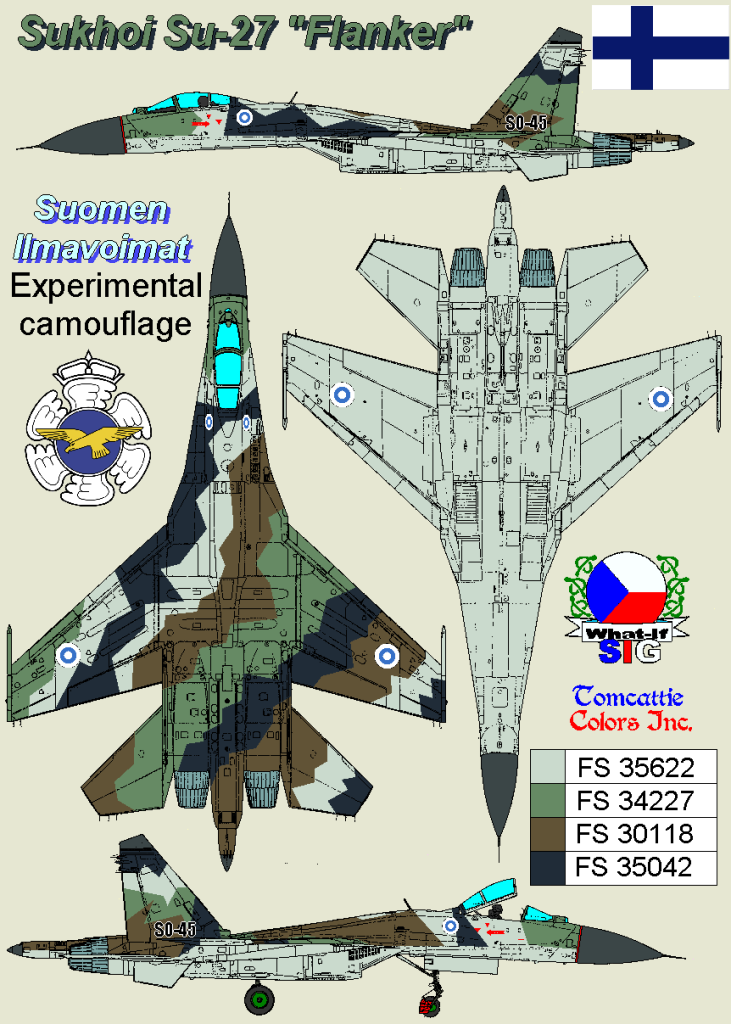
i730.photobucket.com/albums/ww303/PoorWhistler/Doodles/Mi...
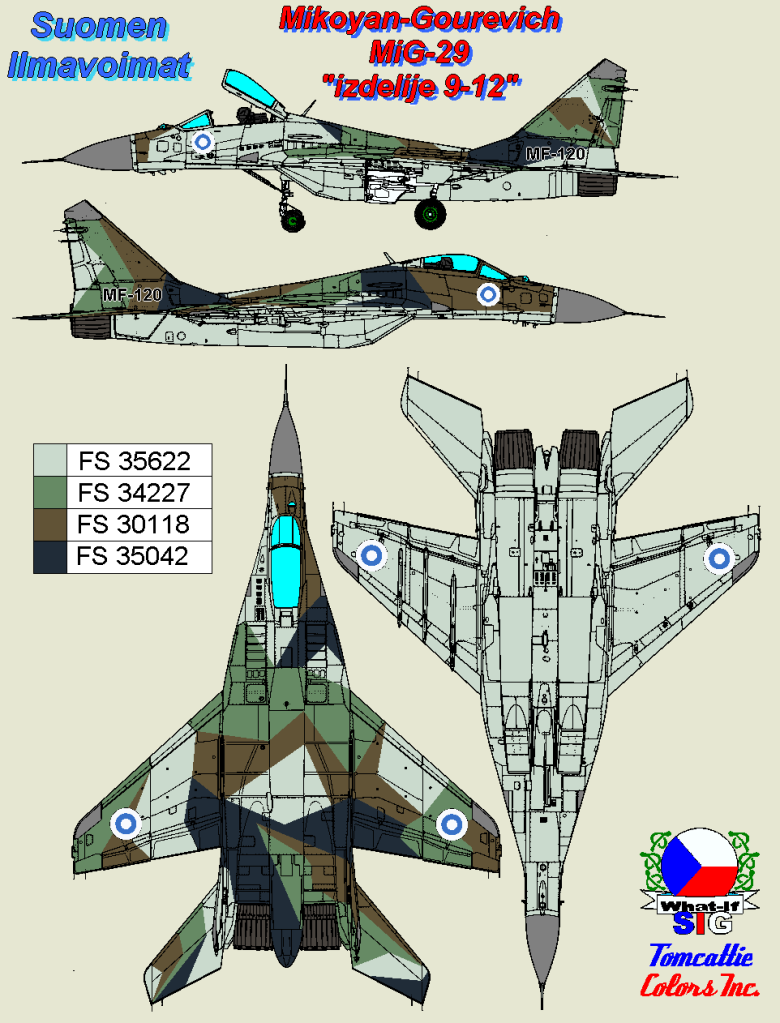
These got me thinking, but instead of building one of the Russian fighters I wondered how this camouflage concept would look on a smaller aircraft already in Ilmavoimat service. This led directly to the Hawk 51!
Thankfully, there are several kits available for this aircraft, and I settled upon the relatively new Airfix kit from 2007. It's main selling point was that it actually contains parts and decals for a Finnish aircraft, esp. a set of the modern, very tiny roundels.
Good experience with recent Airfix offerings were confirmed. Effectively, the Airfix Hawk is a nice and simple build, done in just one and a half day. One of the kit’s positive features is the crew: there are actually two modern and well-sculpted pilot figures included, a rarity these days.
The kit was mostly built OOB, only mods are a cover inside of the ventral air brake (which can be built into open position, but this leaves an ugly seam visible) and some extra antennae. Fit is good (not perfect, though), and only little PSR was needed - biggest issue was the ventral wing/fuselage intersection, esp. its rear end.
One truly tricky feat is the mounting of the protective clear separating screen between the cockpit seats – the clear wall has (somehow) to be glued into the clear canopy, without any reference where to actually place it. Altogether a risky business, and I was lucky to get the wall into place with only a little white glue so that a total mess could be avoided. The positive thing about this construction is that you can mount the canopy in open position with the wall inside.
The engraved panel lines appear a little massive at first glance (far from Matchbox' trenches on the Hawk 200, though!), but once you add paint the kit this evens out and looks much better than on the sprues. A nice and literally simple kit!
Painting and markings:
The more challenging part of the build - and I stuck closely to the inspiring profiles and their color choice, choosing a pattern of diagonal "splinter stripes" in rather unique tones:
• FS 35042 (USN Sea Blue; Humbrol 181)
• FS 34227 (Intermediate Green; Humbrol 120)
• FS 30118 (US Field Drab; Humbrol 142)
• FS 35622 (IDF Pale Blue; Humbrol 122), which was also used for the undersides
Painting was done free-handedly, with brushes and some tape for masking, and I stuck to the original color suggestions except for the pure FS35622 on the upper surfaces: I toned it slightly down with a little RLM76 (Humbrol 247), but it is still very bright and the contrast between all colors is really harsh.
Anyway, painting the splinter scheme was easier than it seems, since the areas of each of the four upper side tones was rather small, so that the straight lines were rather short. Only the tight edges needed some corrections, but that was mostly mended during the washing/shading process.
As a design twist, the drop tanks (taken OOB, these are the bigger tanks for the Hawk's export versions) and their respective pylons received the colors of the standard Ilmavoimat Hawks: the pylons were painted in a light olive green (Humbrol 159) while the tanks were painted in a murky, dark brown (a mix of Humbrol 10 and 66) with pale grey (Humbrol 166) undersides.
The cockpit interior was painted in Gull Gray (FS 36231), while other interior surfaces and the landing gear were kept in lighter RAF Aircraft Grey.
For the markings I relied upon the OOB decal sheet; deviating from the inspiring profiles I stuck to the OOB tiny Finnish roundels that were introduced in the Nineties, and they go well with this experimental scheme. Otherwise, markings are rather minimal, just a lot of stencils were applied, the Airfix OOB sheet is pretty exhaustive (with a zillion of stencils, merely 1x1mm in size… There are even decals to be placed on landing gear joints!? Seriously?). As a side benefit, the OOB Finnish aircraft comes with low-viz stencils, placed on a green background. On the fictional splinter livery of my build they blend well into the overall look, the whole aircraft looks very natural (but still original).
In order to emphasize the engraved panel line the kit received a black ink wash and some panel shading through dry-brushing on the upper surfaces, with only slightly lighter tones (e. g. RAL 5008 on the dark blue and RAF Cockpit Green on the FS 34227). I just wanted a subtle effect. Finally, after the decals had been applied, the kit was sealed with matt acrylic varnish (Italeri).
A quick and pleasant build, and it's actually a relaxing experience to build something OOB, without transplants, major, Frankenstein-ish surgery and endless PSR sessions. In fact, the Airfix Bae Hawk kit makes it easy for the builder to create a decent model with little effort. You see that some thought went into the moulds and the kit’s construction.
The fictional four-tone splinter scheme looks really weird, though, almost like an anniversary scheme? O.K., it is, according to its creator, actually based/inspired by a pre-WWII Fokker D.VII fighter in Finnish service, but this real life version was created from different and less “loud” colors! Anyway, this Hawk is colorful in a certain way, even though I have doubts concerning its camouflage’s effectiveness? However, it’s a nice, bright addition to the whif collection. :D
+++ DISCLAIMER +++
Nothing you see here is real, even though the conversion or the presented background story might be based on historical facts. BEWARE!
Some background:
The Hawker Sea Hawk was a British single-seat jet fighter of the Royal Navy, built by Hawker Aircraft and its sister company, Armstrong Whitworth Aircraft. In the final years of the Second World War, Hawker's design team had become increasingly interested in developing a fighter aircraft that took advantage of the newly developed jet propulsion technology. On 1 September 1944, the first prototype of the company's latest piston engine fighter aircraft, the Hawker Fury/Sea Fury, conducted its maiden flight; it was this aircraft that would serve as the fundamental design basis for Hawker's first jet-powered aircraft, the P.1035, which was submitted for evaluation by the Air Ministry in November 1944.
The design was substantially modified in December 1944, leading to a new designation for the project, P.1040. The jet exhaust was moved from beneath the tail and re-designed as two short, split-lateral bifurcated exhausts, embedded in the trailing edge of the wing root. The tail plane was raised in order to clear the jet exhausts. The air intakes were moved to the wing root leading edge, similar to the contemporary de Havilland Vampire. The unusual bifurcated jet pipe reduced pressure losses in the jet pipe and had the additional advantage of freeing up space in the rear fuselage for fuel tanks, which gave the aircraft a longer range than many other early jets. The fuselage fuel tanks, being fore and aft of the engine, also provided for a stable center of gravity during flight. The absence of fuel tanks also meant that a thinner wing could be adopted without any loss of range. To ease manufacture, the elliptical wing form of the Fury was discarded in favor of a straight tapered wing design The P.1040 also featured a nose wheel undercarriage arrangement, the first for a Hawker-built aircraft, and the aircraft was armed with four 20mm Hispano-Suiza Mk. V cannons.
In October 1945, Sydney Camm, Hawker's chief designer, being satisfied with the results generated from engineering mock-ups and wind tunnel testing, authorized the raising of a production order for a single prototype. In light of the diminished RAF interest in the project in the post-WWII era, allegedly due to the aircraft offering insufficient advances over the jet fighters already in service, a navalized version of the P.1040 was offered in January 1946 to the Admiralty as a fleet support fighter.
However, the Admiralty were not initially encouraging to Hawker's approaches, in part due the presence of the in-development jet-powered Supermarine Attacker aircraft, but the service was intrigued by the type's long-range capability, as well as by the promise of increased power from the Nene engine. Thus, in May 1946, the Naval Staff authorized the manufacture of three prototypes and a further test specimen.
On 2 September 1947, the first prototype, VP401, now called “Sea Hawk” and sometimes referred to as the Hawker N.7/46 after the related naval specification, conducted its maiden flight from RAF Boscombe Down.
An initial order was received in November 1949, and shortly after the outbreak of the Korean War, an urgent operational demand for Britain's aircraft carriers, and thus their accompanying aircraft, had become apparent. The rate of production was substantially increased, and further orders for the Sea Hawk were soon placed. The first production Sea Hawk was the F 1, it first flew in 1951 and entered service two years later with 806 Squadron, first based at Brawdy, then transferred to the HMS Eagle. All Sea Hawks were in service by the mid-1950s and eventually over 500 were built in different versions, which soon became fighter bombers. Beyond these ever-improving variants, it was soon clear that a two seat variant would be necessary for naval operation transition training. Hawker responded to this request by the Admirality in 1952 with the T 20 variant.
The Sea Hawk T 20 was based on the FGA 3, the Sea Hawk’s first fighter bomber version which could, beyond its gun armament, also carry offensive ordnance under its wings. In order to accommodate a crew of two, this advanced trainer variant received a completely new front section with a side-by side cockpit, fitted with duplicated flight controls and instrumentation, and a bulbous canopy that allowed both passengers an excellent field of view for carrier landings. In order to allow a seamless transition from initial trainings, the cockpit layout and much of the operational equipment fittings was very similar to that of the Percival Provost. A key feature for the era amongst the fittings in the cockpit was the Centralized Warning Panel, which alerted the pilots in the event of a number of unfavorable or hazardous conditions being detected, such as icing conditions, fire or oxygen failure.
In order to compensate for a loss of directional stability due to the new cockpit section, the aircraft received a taller fin, which was also introduced to export versions of the Sea Hawk. As a weight saving measure and in order to keep the center of gravity within safe limits, the gun armament was reduced from four to two 20 mm Hispano cannon. The underwing hardpoints for bombs, unguided missiles and drop tanks were retained, so that the trainer could - with slight performance losses and a reduced ordnance load - fly the Sea Hawk’s complete mission envelope.
After the T20’s successful acceptance trials during late 1954 at 738 NAS at Lossiemouth, the FAA formally accepted the type in 1956. A total of 32 aircraft were produced and exclusively operated by the Royal Navy, where it quickly received the nickname “Puffin”, due to its bulbous nose section.
The Sea Hawk T20’s were distributed between 738 NAS (18 machines) for land-based conversion training and active, navel units, which received two or three trainers each for advanced training aboard of carriers.
The Sea Hawks in Fleet Air Arm service began being phased out from first line service in 1958, the year in which the Supermarine Scimitar and de Havilland Sea Vixen entered service, both of which types would eventually replace the Sea Hawk in the fighter and attack role. The last front line Sea Hawk squadron, No. 806, disbanded at RNAS Brawdy on 15 December 1960, ending a very brief operational career for the Sea Hawk. Most Sea Hawks in second line service were withdrawn by the mid-1960s, the trainers were retired in 1967, but four of them were refurbished and sold to India, where they served until 1983, partly from the Indian aircraft carrier Vikrant.
General characteristics:
Crew: One
Length: 40 ft 5 in (12.34 m)
Wingspan: 39 ft 0 in (11.89 m)
Height: 9 ft 8 in (2,95 m )
17 ft 8 in (5,39 m with folded wings)
Wing area: 278 ft² (25.83 m²)
Empty weight: 9,482 lb (4,305 kg)
Loaded weight: 13,220 lb (5,996 kg)
Max. takeoff weight: 16,150 lb (7,325 kg)
Powerplant:
1× Rolls-Royce Nene 101 turbojet, rated at 5,000 lbf (22.24 kN) thrust
Performance:
Maximum speed: 583 mph (940 km/h)
Range: 480 mi (770 km)
Service ceiling: 44,500 ft (13,564 m)
Rate of climb: 5,700 ft/min (29.0 m/s)
Wing loading: 48 lb/ft² (232 kg/m²)
Thrust/weight: 0.38
Armament:
2× 20 mm (0.79 in) Hispano Mk V cannons (200 RPG) in the lower front fuselage
Underwing hardpoints and provisions to carry combinations of:
16× 60 lb (27 kg) unguided 3" rockets or 8× 5” (127 mm) unguided HVAR rockets, and
2× 500 lb (227 kg) bombs, or
2 × 90 Imp gal (410 l) drop tanks
The kit and its assembly:
This one is my submission to the 2018 One Week Group Build at whatifmodelers.com, and it was originally inspired by the work a fellow modeler in 2015 (Glenn Gilbertson, from that year’s One Week GB) who mated a Hawker Sea Hawk with the nose section from a Hawker Hunter trainer. The result was, for my personal taste, a rather nose-heavy affair, but it looked very convincing. I liked the concept and I kept the idea in the back of my mind. And the 2018 GB was now a good occasion to tackle this project, also because I had proper ingredients at hand.
This included a Hobby Boss Sea Hawk kit that I had purchased as a cheap, special offer (but without a plan for it yet), and a surplus BAC Strikemaster fuselage (Matchbox) that I had in my stash after the recent BAC Bushmaster kitbashing. A quick test revealed that a transplantation of the Strikemaster nose section appeared feasible, since the width is very similar. Compared with the Hunter nose section from Glenn Gilbertson’s build, the Strikemaster nose is considerably shorter and more compact, but it still offers the plausible side-by-side arrangement.
From this starting point things evolved straightforward, since there was only a limited time frame available to complete the build from box to beauty pics. Most of the Sea Hawk (the Hobby Boss model is a lovely “real” kit!) was built OOB, only the cut for the nose transplant caused some headaches. I eventually settled on a staggered solution, keeping the Strikemaster’s floor section and internal cockpit rear bulkhead in front of the wing roots, but with an extended spine donation so that the whole slide-back canopy could be transferred and opened. All in all, and in contrast to Glenn Gilbertson’s 2015 build, the length of the new aircraft just grew only little, so that the overall proportions could be kept.
Using the Sea Hawk Mk. 100/101 kit had the benefit of a taller fin – which would have had to be scratched in some way in order to balance the trainer’s profile, since the original short fin would look pretty wacky with the enlarged nose section. The whole thing still looks a little goofy, though…?
Inside of the cockpit, I replaced the Strikemaster’s OOB double seat with two single seats from an Intech TS-11 Iskra, and I added a new floor and a rear bulkhead. The dashboard was taken OOB but decorated with instrument decals (from a Matchbox Hunter two-seater). Two scratched gunsights decorate the dashboard, too. The rest of the nose was stuffed with lead beads for a proper stance.
The canopy was cut into two pieces for an opened presentation, and for this purpose I also cut away a part of the Strikemaster spine which is, in real life, attached to the canopy’s sliding part.
The landing gear was taken OOB from the Sea Hawk, I just shortened the length of the nose wheel strut and modified the front wheel well covers (made from much thinner plastic sheet), since the Strikemaster has a shorter and smaller arrangement than the Sea Hawk.
Being a trainer, I just added a pair of OOB drop tanks under the wings.
Painting and markings:
Well, there are only a few potential options for a Fifties RN aircraft, and I guess that a silver livery with orange dayglow markings would have been the most probable option. But I wanted to attach the trainer to an active carrier unit, so I rather settled upon an elegant, shiny Extra Dark Sea Grey/White livery with some orange accents.
Basic colors are a very light grey (instead of pure white, acrylic paint from a rattle can) and Humbrol 123, with the upper tone carried around the leading edges.The kit received a very light black ink wash, so that the engraved panel lines would catch some pigments, as well as some light post-shading with Humbrol 164 and 125 (Dark Sea Grey and FS 36118, respectively) and Humbrol 34, flat white.
The fluorescent orange stripes are all decals, generic material from TL Modellbau. The RN markings were puzzled together from various sources, since the Hobby Boss Sea Hawk Mk. 100/101 only comes with German and Indian markings. The serial number, XA454, actually belongs to a Fairey Gannet and was adapted from a respective Xtradecal sheet. The 809 NAS emblems come from an Model Alliance Buccaneer sheet, while other markings come from a Sea Harrier sheet from the same company.
The aircraft’s tactical code number had to be improvised: placing it on a uniform background on the medium waterline for better contrast and readability was inspired by contemporary types like the Scimitar. Both cases of black code on white or white code on EDSG were used, as far as I can tell, as well as black letters with a thin, white outline. I settled for white, generic decal material as background, which adds to the impression that the code had been applied in the field, and black letters.
Finally the kit was sealed with a mix of Italeri acrylic varnishes, 2/3 “semi gloss” and 1/3 “matt”, for a slightly shiny finish.
You can say that this Sea Hawk trainer “has character”, but the tadpole cockpit from the Strikemaster somewhat ruins the original fighter’s clean lines? The result reminds me of the TF-102, at least when you compare the trainer variant with the original fighter, and the Sea Hawk trainer’s overall lines somewhat resemble a McDonnell F2H Banshee night fighter or even a Grumman A-6 intruder?
However, I like the outcome of this quick rhinoplasty adventure, and within the Group Build’s limited timeframe (and real life happening in parallel) I am quite pleased with the result, even though there are some flaws. Tough job, though, since it involved some serious bodywork and I just did not only build the model, but also produced a beauty pics series.
Battle of Santa Cruz Sign in USS Yorktown CV10's Hangar at Patriot's Point Naval and Maritime Museum in Mount Pleasant, SC on May-21st-2019.USS Hornet CV8 is the Centerpiece. USS Hornet CV8 was the Third and Final Member of the Yorktown Class of Aircraft Carriers and the 7th United States Navy Ship to Bear that Name.
Because of the cap on aggregate aircraft carrier tonnage included in the Washington Naval Treaty and subsequent London treaties, the United States had intended to build two of Yorktown class and use up the remaining allocated tonnage with a smaller, revised version of the same design, which eventually became Wasp. With war looming in Europe, though, and the repudiation of the naval limitation treaties by Japan and Italy, the Navy's General Board decided to lay down a third carrier to the Yorktown design immediately - followed by the first carrier of the follow-on CV-9 (Essex) class when that design was finalized; authorization from Congress came in the Naval Expansion Act of 1938.
Hornet had a length of 770 feet (235 m) at the waterline and 824 feet 9 inches (251.38 m) overall. She had a beam of 83 feet 3 inches (25.37 m) at the waterline, 114 feet (35 m) overall, with a draft of 24 feet 4 inches (7.42 m) as designed and 28 feet (8.5 m) at full load. She displaced 20,000 long tons (20,000 t) at standard load and 25,500 long tons (25,900 t) at full load. She was designed for a ship's crew consisting of 86 officers and 1280 men and an air complement consisting of 141 officers and 710 men.
She was powered by nine Babcock & Wilcox boilers providing steam at 400 psi (2,800 kPa) and 648 °F (342 °C) to four Parsons Marine geared steam turbines each driving its own propeller. The turbines were designed to produce a total of 120,000 shaft horsepower [shp] (89,000 kW), giving her a range of 12,000 nautical miles (14,000 mi; 22,000 km) at a speed of 15 knots (17 mph; 28 km/h). She was designed to carry 4,280 long tons (4,350 t) of fuel oil and 178,000 US gallons (670,000 l) of Avgas. Her designed speed was 32.5 knots (60.2 km/h; 37.4 mph). During sea trials, she produced 120,500 shp (89,900 kW) and reached 33.85 knots (62.69 km/h; 38.95 mph).
Hornet was equipped with eight 5-inch (127 mm)/38 caliber dual-purpose guns and 16 1.1-inch (28 mm)/75 caliber antiaircraft guns in quad mounts (four guns operating together). Originally, she had 24 M2 Browning .50-inch (12.7 mm) machine guns, but these were replaced in January 1942 with 30 20-mm Oerlikon antiaircraft cannon.An additional 1.1-inch (28 mm) quad mount was later added at her bow and two more 20 mm antiaircraft guns were added for a total of 32 mounts. In addition, her athwartships hangar-deck aircraft catapult was removed.[5] In June 1942, following the battle of Midway, Hornet had a new CXAM radar installed atop her tripod mast, and her SC radar was relocated to her mainmast. Unlike her sisters, Hornet's tripod mast and its signal bridge were not enclosed when the CXAM was installed, making her unique among the three ships.
For armor, she had an armor belt that was 2.5 to 4 inches (64–102 mm) thick on a backing of 30-pound (14 kg) special treatment steel (STS). The flight and hangar decks had no armor but the protective deck was 60-pound (27 kg) STS. Bulkheads had 4-inch (100 mm) armor, while the conning tower had splinter protection only, in contrast with her sister's 4-inch (100 mm) armor on the sides with 2 inches (51 mm) on top. The steering gear had 4-inch (100 mm) protection on the sides with splinter protection on the deck.
Her flight deck was 814 by 86 feet (248 m × 26 m) and her hangar deck was 546 by 63 feet (166 m × 19 m) and 17 feet 3 inches (5.26 m) high. She had three aircraft elevators each 48 by 44 feet (15 by 13 m) with a lifting capacity of 17,000 pounds (7,700 kg). She had two flight-deck and one hangar-deck hydraulic catapults and equipped with Mark IV Mod 3A arresting gear with a capability of 16,000 pounds (7,300 kg) and 85 miles per hour (137 km/h). She was designed to host a Carrier Air Group of 18 fighters, 18 bombers, 37 scout planes, 18 torpedo bombers, and six utility aircraft.
CV8's keel was laid down on 25 September 1939 by Newport News Shipbuilding of Newport News, Virginia, and was launched on 14 December 1940, sponsored by Annie Reid Knox, wife of Secretary of the Navy Frank M. Knox. She was commissioned at Naval Station Norfolk on 20 October 1941, with Captain Marc A. Mitscher in command.
During the period before the attack on Pearl Harbor, Hornet trained out of Norfolk. A hint of a future mission occurred on 2 February 1942, when Hornet departed Norfolk with two Army Air Forces B-25 Mitchell medium bombers on deck. Once at sea, the planes were launched to the surprise and amazement of Hornet's crew. Her men were unaware of the meaning of this experiment, as Hornet returned to Norfolk, prepared to leave for combat, and on 4 March sailed for the West Coast via the Panama Canal.
Hornet arrived at Naval Air Station Alameda, California, on 20 March 1942. With her own planes on the hangar deck, by midafternoon on 1 April, she loaded 16 B-25s on the flight deck.Under the command of Lieutenant Colonel James H. Doolittle, 70 United States Army Air Corps officers and 64 enlisted men reported aboard. In company of her escort, Hornet departed Alameda on 2 April under sealed orders. That afternoon, Captain Mitscher informed his men of their mission: a bombing raid on Japan.
Eleven days later, Hornet joined the aircraft carrier Enterprise at Midway, and Task Force 16 turned toward Japan.With Enterprise providing combat air patrol cover, Hornet was to steam deep into enemy waters. Originally, the task force intended to proceed to within 400 nmi (460 mi; 740 km) of the Japanese coast, but on the morning of 18 April, a Japanese patrol boat, No. 23 Nitto Maru, sighted the American task force. Nashville sank the patrol boat. Amid concerns that the Japanese had been made aware of their presence, Doolittle and his raiders launched prematurely from 600 nmi (690 mi; 1,100 km) out, instead of the planned 400 nmi (460 mi; 740 km). Because of this decision, none of the 16 planes made it to their designated landing strips in China. After the war, Tokyo was found to have received the Nitto Maru's message in a garbled form and the Japanese ship was sunk before it could get a clear message through to the Japanese mainland.
As Hornet came about and prepared to launch the bombers, which had been readied for take-off the previous day, a gale of more than 40 kn (46 mph; 74 km/h) churned the sea with 30-foot (9.1 m) crests; heavy swells, which caused the ship to pitch violently, shipped sea and spray over the bow, wet the flight deck, and drenched the deck crews. The lead plane, commanded by Colonel Doolittle, had only 467 ft (142 m) of flight deck, while the last B-25 hung its twin rudders far out over the fantail. Doolittle, timing himself against the rise and fall of the ship's bow, lumbered down the flight deck, circled Hornet after take-off, and set course for Japan. By 09:20, all 16 were airborne, heading for the first American air strike against the Japanese home islands.
Hornet brought her own planes on deck as Task Force 16 steamed at full speed for Pearl Harbor. Intercepted broadcasts, both in Japanese and English, confirmed at 14:46 the success of the raids. Exactly one week to the hour after launching the B-25s, Hornet sailed into Pearl Harbor.That the Tokyo raid was the Hornet's mission was kept an official secret for a year; until then, President Roosevelt referred to the ship from which the bombers were launched only as "Shangri-La." Two years later, the Navy gave this name to an aircraft carrier.
Hornet steamed from Pearl Harbor on 30 April to aid Yorktown and Lexington at the Battle of the Coral Sea, but the battle ended before she reached the scene. On 4 May, Task Force 16 crossed the equator, the first time ever for Hornet. After executing, with Enterprise, a feint towards Nauru and Banaba (Ocean) islands, which caused the Japanese to cancel their operation to seize the two islands, she returned to Hawaii on 26 May, and sailed two days later to help repulse an expected Japanese assault on Midway.
SBDs from Hornet at Midway
On 28 May 1942, Hornet and Task Force 16 steamed out of Pearl Harbor heading for Point "Luck", an arbitrary spot in the ocean roughly 325 miles (523 km) northeast of Midway, where they would be in a flank position to ambush Japan's mobile strike force of four frontline aircraft carriers, the Kidō Butai. Japanese carrier-based planes were reported headed for Midway in the early morning of 4 June. Hornet, Yorktown, and Enterprise launched aircraft, just as the Japanese carriers struck their planes below to prepare for a second attack on Midway. Hornet dive bombers followed an incorrect heading and did not find the enemy fleet. Several bombers and all of the escorting fighters were forced to ditch when they ran out of fuel attempting to return to the ship; 15 torpedo bombers of Torpedo Squadron 8 (VT-8) found the Japanese ships and attacked. They were met by overwhelming fighter opposition about eight nautical miles (9 mi; 15 km) out, and with no escorts to protect them, they were shot down one by one. Ensign George H. Gay, USNR, was the only survivor of 30 men.
Further attacks by Enterprise and Yorktown torpedo planes proved equally disastrous, but succeeded in forcing the Japanese carriers to keep their decks clear for combat air patrol operations, rather than launching a counter-attack against the Americans. Japanese fighters were shooting down the last of the torpedo planes over Hiryū when dive bombers of Enterprise and Yorktown attacked, causing enormous fires aboard the three other Japanese carriers, ultimately leading to their loss. Hiryu was hit late in the afternoon of 4 June by a strike from Enterprise and sank early the next morning. Hornet aircraft, launching late due to the necessity of recovering Yorktown scout planes and faulty communications, attacked a battleship and other escorts, but failed to score hits. Yorktown was lost to combined aerial and submarine attack.
Hornet's warplanes attacked the fleeing Japanese fleet on 6 June and they assisted in sinking the heavy cruiser Mikuma, damaging a destroyer, and leaving the heavy cruiser Mogami, heavily damaged and on fire, to limp away from the battle zone. The attack by Hornet on the Mogami ended one of the great decisive battles of naval history.Midway Atoll was saved as an important base for American operations into the Western Pacific Ocean. Of greatest importance was the crippling of the Japanese carrier strength, a severe blow from which the Imperial Japanese Navy never fully recovered. The four large carriers took with them to the bottom about 250 naval aircraft and a high percentage of the most highly trained and experienced Japanese aircraft maintenance personnel. The victory at Midway was a decisive turning point in the War in the Pacific.
On 16 June 1942, Captain Charles P. Mason became commanding officer of Hornet upon her return to Pearl Harbor] Hornet spent the next six weeks replenishing her stores, having minor repairs performed, and most importantly, having additional light antiaircraft guns and the new RCA CXAM air-search radar fitted. She did not sail in late July with the forces sent to recapture Guadalcanal, but instead remained at Pearl Harbor in case she were needed elsewhere.
Solomons campaign, August–October, 1942
Hornet steamed out of harbor on 17 August 1942 to guard the sea approaches to the bitterly contested Guadalcanal in the Solomon Islands. Bomb damage to Enterprise on 24 August, torpedo damage to Saratoga on 31 August, and the sinking of Wasp on 15 September left Hornet as the only operational U.S. carrier in the South Pacific. She was responsible for providing air cover over the Solomon Islands until 24 October 1942, when she was joined by Enterprise just northwest of the New Hebrides Islands. These two carriers and their escorts then steamed out to intercept a Japanese aircraft carrier/battleship/cruiser force closing in on Guadalcanal.
The Battle of the Santa Cruz Islands took place on 26 October 1942 without contact between surface ships of the opposing forces. That morning, Enterprise's planes bombed the carrier Zuihō, while planes from Hornet severely damaged the carrier Shōkaku and the heavy cruiser Chikuma. Two other cruisers were also attacked by Hornet's warplanes. Meanwhile, Hornet was attacked by a coordinated dive bomber and torpedo plane attack.[12] In a 15-minute period, Hornet was hit by three bombs from Aichi D3A "Val" dive bombers. One "Val", after being heavily damaged by antiaircraft fire while approaching Hornet, crashed into the carrier's island, killing seven men and spreading burning aviation gas over the deck. Meanwhile, a flight of Nakajima B5N "Kate" torpedo planes attacked Hornet and scored two hits, which seriously damaged the electrical systems and engines. As the carrier came to a halt, another damaged "Val" deliberately crashed into Hornet's port side near the bow.
With power knocked out to her engines, Hornet was unable to launch or land aircraft, forcing her aviators to either land on Enterprise or ditch in the ocean. Rear Admiral George D. Murray ordered the heavy cruiser Northampton to tow Hornet clear of the action. Since the Japanese planes were attacking Enterprise, this allowed Northampton to tow Hornet at a speed of about five knots (9 km/h; 6 mph). Repair crews were on the verge of restoring power when another flight of nine "Kate" torpedo planes attacked. Eight of these aircraft were either shot down or failed to score hits, but the ninth scored a fatal hit on the starboard side. The torpedo hit destroyed the repairs to the electrical system and caused a 14° list. After being informed that Japanese surface forces were approaching and that further towing efforts were futile, Vice Admiral William Halsey ordered Hornet sunk, and an order of "abandon ship" was issued. Captain Mason, the last man on board, climbed over the side, and the survivors were soon picked up by the escorting destroyers.
American warships next attempted to scuttle the stricken carrier, which absorbed nine torpedoes, many of which failed to explode, and more than 400 5-inch (130 mm) rounds from the destroyers Mustin and Anderson. The destroyers steamed away when a Japanese surface force entered the area. The Japanese destroyers Makigumo and Akigumo finally finished off Hornet with four 24-inch (610 mm) Long Lance torpedoes. At 01:35 on 27 October, Hornet finally sank with the loss of 140 of her 2,200 sailors; 21 aircraft went down with the ship.
Hornet was removed from the Naval Vessel Register on January 13th-1943 and was the Last Fleet Carrier of the United States Navy Lost in Combat.
Albeit the light carrier Princeton and a number of much smaller escort carriers were sunk in combat in other battles.Her wreck was found in January 2019. Hornet Received Four Battle Stars for the Asiatic Pacific Campaign for her WW2 Service. Her Torpedo Squadron 8 flying from Hornet was awarded the Presidential Unit Citation "for extraordinary heroism and distinguished service beyond the call of duty" during the Battle of Midway.
7 For every kind of beast and bird, of reptile and sea creature, can be tamed and has been tamed by mankind, 8 but no human being can tame the tongue. It is a restless evil, full of deadly poison. 9 With it we bless our Lord and Father, and with it we curse people lwho are made in the likeness of God. 10 From the same mouth come blessing and cursing. My brothers,3 these things ought not to be so. 11 Does a spring pour forth from the same opening both fresh and salt water? 12 Can a fig tree, my brothers, bear olives, or a grapevine produce figs? Neither can a salt pond yield fresh water.
The Holy Bible: English Standard Version (Wheaton: Standard Bible Society, 2001), Jas 3:7–12.
Communication involves both what we say (content) and how we say it (tone, inflection, body language). God has given us enormous capability in this area, and we must make sure we are pleasing him with our words.
1. Positive traits to develop in speech.
BUILDING UP
Ephesians 4:29 Let no corrupting talk come out of your mouths, but only such as is good for building up, as fits the occasion, that it may give grace to those who hear. (ESV)
Colossians 4:6 Let your conversation be always full of grace, seasoned with salt, so that you may know how to answer everyone. (NIV)
GENTLENESS
Proverbs 15:1 A gentle answer turns away wrath, but a harsh word stirs up anger. (NASB)
Galatians 6:1
KINDNESS
Proverbs 16:24 Kind words are like honey—sweet to the soul and healthy for the body. (NLT)
Ephesians 4:32 Be kind and compassionate to one another, forgiving each other, just as in Christ God forgave you. (NIV)
Proverbs 12:25
PATIENCE
Proverbs 25:15 With patience a ruler may be persuaded, and a soft tongue will break a bone. (ESV)
SPEAKING TRUTH
Ephesians 4:25 Therefore, having put away falsehood, let each one of you speak the truth with his neighbor, for we are members one of another. (ESV)
SPEAKING AFTER LISTENING
James 1:19–20 Know this, my beloved brothers: let every person be quick to hear, slow to speak, slow to anger; for the anger of man does not produce the righteousness of God. (ESV)
Proverbs 18:13 If one gives an answer before he hears, it is his folly and shame. (ESV)
Proverbs 15:28
COMMUNICATING KNOWLEDGE
Proverbs 20:15 There is gold, and an abundance of jewels; but the lips of knowledge are a more precious thing. (NASB)
APPROPRIATE WORDS
Psalm 37:30 The mouth of the righteous utters wisdom, and his tongue speaks justice. (ESV)
Proverbs 10:19; 15:23; 25:11; 1 Timothy 4:12
2. Negative traits to avoid in speech.
MISUSING GOD’S NAME (IN VAIN OR WITH CONTEMPT)
Exodus 20:7 You shall not misuse the name of the LORD your God, for the LORD will not hold anyone guiltless who misuses his name. (NIV)
OBSCENE, FOOLISH, RAW HUMOR
Ephesians 4:29 Do not let any unwholesome talk come out of your mouths, but only what is helpful for building others up according to their needs, that it may benefit those who listen. (NIV)
Ephesians 5:4
FALSEHOOD, LYING
Colossians 3:9–10 Do not lie to one another, seeing that you have put off the old self with its practices and have put on the new self, which is being renewed in knowledge after the image of its creator. (ESV)
Ephesians 4:25, Zechariah 8:16
ANSWERING BEFORE LISTENING
Proverbs 18:13 If one gives an answer before he hears, it is his folly and shame. (ESV)
Proverbs 18:17
FOOLISH, IGNORANT ARGUMENTS
2 Timothy 2:23–24 But keep away from foolish and ignorant arguments; you know that they end up in quarrels. As the Lord’s servant, you must not quarrel. You must be kind toward all, a good and patient teacher. (GNT)
SLANDER, GOSSIP
Proverbs 20:19 He who goes about as a slanderer reveals secrets, therefore do not associate with a gossip. (NASB)
Ephesians 4:31 Let all bitterness and wrath and anger and clamor and slander be put away from you, along with all malice. (ESV)
1 Timothy 5:13–14; Titus 3:1–2
LACK OF CONTROL
James 1:26 If you claim to be religious but don’t control your tongue, you are fooling yourself, and your religion is worthless. (NLT)
COMPLAINING
Philippians 2:14 Do everything without grumbling or arguing. (NIV)
1 Corinthians 10:6–10; James 5:9
SUMMARY OF THE TONGUE’S NEGATIVE POTENTIAL
James 3:8 But no one has ever been able to tame the tongue. It is evil and uncontrollable, full of deadly poison. (GNT) (See verses 5–12.)
3. Speech can both grieve and please the Holy Spirit.
Ephesians 4:29–30 Do not use harmful words, but only helpful words, the kind that build up and provide what is needed, so that what you say will do good to those who hear you. And do not make God’s Holy Spirit sad; for the Spirit is God’s mark of ownership on you, a guarantee that the Day will come when God will set you free. (GNT)
4. As creation gives glory to God, so should our speech.
Psalm 19:1–4 The heavens declare the glory of God; and the firmament shows His handiwork. Day unto day utters speech, and night unto night reveals knowledge. There is no speech nor language where their voice is not heard. Their line has gone out through all the earth, and their words to the end of the world. (NKJV)
5. Additional contrasts from Proverbs.
Proverbs 12:18 Some people make cutting remarks, but the words of the wise bring healing. (NLT)
Proverbs 10:20–21 The tongue of the righteous is choice silver, but the heart of the wicked is of little value. The lips of the righteous nourish many, but fools die for lack of sense. (NIV)
Proverbs 15:4
Biblical Narratives
• Israelites, grumbling, Numbers 16:41; 17:5–10
• Abigail, calming David down, 1 Samuel 25
• Ananias and Sapphira, lying, Acts 5:1–11
Practical Steps
• As you drive home from work, commit to speaking with your family positively and without complaining.
• Be aware of your body language or nonverbal communication habits. Ask others to evaluate. Work on corrections where needed.
• Pray before you go into social situations, before calling or writing someone, or before posting on a social media site.
• Practice not responding to or laughing at rude or cruel speech or off-color humor.
• Openly communicate when you need to take a stand against sin or wrong. Your silence communicates agreement.
Keith R. Miller, Quick Scripture Reference for Counseling Men (Grand Rapids, MI: Baker Books, 2014), 67–71.
A fine day down at Aberdeen Harbour Scotland today 11th March 2019 .
Grampian Devotion .
Dimensions
LOA 50.70 metres
LBP 40.40 metres
Breadth Moulded 13.00 metres
Draft Loaded / Depth 4.3 metres / 6.0 metres
Tonnage
GRT 1130 Tonnes
NRT 398 Tonnes
DWT 690 Tonnes
Capacities/Cranes
Fuel Oil (MGO) / Connection 300 m³
Fresh Water / Connection 150 m³
Bllast Water Approx 350 m³
Oil Based Mud / Connection N/A
Brine / Connection N/A
DMA (Base Fluid) / Connection N/A
Dry Bulk(s) / Connection N/A
Deck Area Approx 120 m² (Steel Deck)
Deck Loading 3 Tonnes per metre²
Deck Crane # 1 Heila 1.5T @ 15 Metres (3t @ 10m)
Winch Option - Buoy Recovery System fitted
Wire Reel N/A
Deck Tuggers N/A
Engines/Thrusters/Aux
Main Engine(s) MAK 6M20 (2133 BHP)
Propeller(s) 1 x CPP
Bow Thruster(s) HRP Azimuth @ 500BHP
Stern Thruster(s) N/A
Rudder Systems / Type Fishtail HP Rudder
Aux Engines 2 x Cat @ 547kW per unit
Shaft PTO’s 1 x PTO from Main Engine
Emergency Generators 1 x Emer Genset @ 365 kW
Control Systems/Dynamic Positioning
Control Positions Fwd, Aft, Port & Stbd
Full Manual Control Fwd & Aft consoles
Integrated Joystick Control Coverteam Joystick System
Joystick Control Aft, Port and Starboard consoles
Dynamic Positioning System N/A
Fan Beam Laser N/A
DGPS # 1 N/A
DGPS # 2 N/A
Hydro Acoustic Pos Ref # 1 N/A
Hydro Acoustic Pos Ref # 2 N/A
Vertical Taut Wire N/A
Rescue/Emergency Response Equipment
Daughter Craft Davit # 1 NED DECK MARINE Heave Compensated
Daughter Craft Delta Phantom 10.25 metre (Diesel)
Daughter Craft Davit # 2 Option
Daughter Craft Option
Fast Rescue Craft Davit # 1 NED DECK MARINE Heave Compensated
Fast Rescue Craft 1 x Avon SR 6.4 15 Man (Petrol)
Dacon Scoop Fitted
Dacon Rescue Crane Heila Telescopic Boom crane 1.5t@15m
Cosalt Rescue Basket Fitted & Launched from aft deck
Jason Cradles Frames Fitted
Winch Area Located on Aft Main Deck
Emergency Towing Capability Towing Hook Fitted
Dispersant Tanks 2 x 5 Tonne Tanks below Main Deck
Dispersant Spray Booms Fully outfitted Port & Starboard
Searchlights 4 x IBAK Kiel Fwd, Port, Stbd & Aft
Navigation/Communication Equipment
Radar(s) (Fwd) Furuno 2817 ARPA Furuno 2837 ARPA
Radar Rptr (Aft) Hatteland
ECDIS Microplot ECDIS
PLB System N/A
DGPS(s) Furuno DGPS 90
Gyro(s) Anschutz S22 Gyro
Autopilot Anschutz NP 60
Magnetic Comp Gillie 2000
Echo Sounder FE 700 ES
Digital Depth Recorder FE 720
Navtex Furuno NX 700 Navtex
Sat Comms Inmarsat C Felcon, Fleet 77 CapSat (A3)
MF/HF Radio Furuno FS 2570 C (A3)
UHF 3 x UHF Units
VHF (Fwd) FM8800 GMDSS VHF, ICOM ICM 401E
VHF (Aft) FM8800 GMDSS VHF, ICOM ICM 401E
Helo Radio ICOM IC A110
AIS Jotrun AIS TR 2500
VHF Direction Finder Taiyo TDL 1550
Doppler Log Furuno DS 80
SSAS Furuno Felcom
Portable VHF 3 x Jotrun GMDSS
Portable VHF 6 x ENTEL HT 640 VHF
Portable UHF 3 x ENTEL HT 880 UHF
Portable UHF 2 x Kenwood UHF
Sonic Helmets 4 x Sonic Helmets Mk 10
Smartpatch Phone ICOM PS1
Crew Facilities
Crew Cabins 15 Man Single Berth cabins c/w en suite facilites
Recreation & Leisure 1 Messroom, 2 Lounges
Leisure 1x Sauna, 1x Gym, 1x Ship's Office
A variety of material is employed for loading practice by Uganda People's Defense Force (UPDF) logisticians during a hands-on segment of Uganda ADAPT 2010, a mentoring program conducted in Entebbe, Uganda, that resulted in certifying 25 soldiers as C-130 aircraft load planners.
U.S. Army photo by Gordon Christensen
A U.S. Army Africa (USARAF) organized Africa Deployment Assistance Partnership Team (ADAPT) recently trained, and for the first time ever, certified 25 soldiers of the Uganda People’s Defense Force (UPDF) as C-130 aircraft load planners in Entebbe, Uganda.
A five-person team, led by Gordon Christensen of Army Africa’s G-4 Mobility Division, completed Phase III training with UPDF soldiers Aug. 27 in Entebbe, Uganda, said John Hanson, chief of the G-4 Policy and Programs Branch.
“This was the first actual air load certification we’ve done, of all the previous ADAPT engagements,” Hanson said. “That’s what makes it unique.”
Two weeks of classroom instruction and hands-on training enabled 25 of 31 students to earn U.S. Air Force Air Mobility Command Form 9 certification, significantly augmenting the Uganda land force’s air deployment capability, while developing greater interoperability with U.S. military forces, Hanson said.
The ADAPT program, developed to enhance the force projection capabilities of African militaries, is managed by the USARAF G-4 staff. Its aim is to bridge the gap between limited deployment capacity and the need to provide forces in support of peacekeeping or humanitarian relief operations, Hanson said.
“We’re building capacity for people to deploy, to do their own missions,” he said.
Even when the training doesn’t lead to actual U.S. Air Force certification, as it did this time in Uganda, it contributes to an enhanced deployment capacity for the land force involved, Hanson said.
“That’s the intent. They can’t do the certification, but they can continue to train their own people. Then we back off and they continue to do that,” he said.
The program is a Title 22 tactical logistics engagement funded by the U.S. Department of State, and focuses on African countries that contribute troops to peacekeeping operations, Hanson said.
Training is executed in four installments in order to create a long-term, phased approach to building deployment capacity, Hanson said. Instructors take students from a general orientation to tactical deployment principles to an advanced level of practical proficiency.
Instructors for the UPDF course were sourced using the Request For Forces (RFF) process, Hanson said.
Christensen was accompanied U.S. Army Capt. Jedmund Greene of 21st Theater Support Command’s 16th Sustainment Brigade, based in Kaiserslautern, Germany, and three Air Force noncommissioned officers: Tech. Sgt. Venus Washington, Robbins Air Force Base, Ga.; Tech. Sgt. Byran Quinn, Pope Air Force Base, N.C.; and Senior Master Sgt. Anthony D. Tate of the Illinois Air National Guard.
“The training helped to strengthen the relationship with our Ugandan partners, and also helped them build a self-sustaining deployment capacity,” Greene said. “I hope 21st TSC can increase its support to USARAF logistics theater security cooperation events in the future.”
Army Africa’s G-4 staff is presently working to synchronize ADAPT with the Africa Contingency Operations Training and Assistance (ACOTA) program. A proof of concept joint training was conducted with ACOTA in Rwanda earlier this year, combining tactical- and support-staff training in logistics with the more complex operational techniques of force deployment and mobility, Hanson said.
The Rwanda training demonstrated the feasibility of combining available U.S. government resources to achieve the most efficient and focused effort to advance common foreign policy objectives with U.S. partners in Africa, he said.
To date, ADAPT missions have been funded for eight African countries. Previous training sessions have been conducted in Rwanda, Ghana and Burkina Faso as well as Uganda, and the number is likely to grow in coming years, Hanson said.
“The programs were identified as being of interest to several other countries during the Army Africa Theater Army Security Cooperation Conference, held in Vicenza in August,” Hanson said.
The next planned ADAPT mission is for Phase I training in Botswana, scheduled for the first quarter of 2011, he said.
To learn more about U.S. Army Africa visit our official website at www.usaraf.army.mil
Official Twitter Feed: www.twitter.com/usarmyafrica
Official YouTube video channel: www.youtube.com/usarmyafrica
A striking statue of Lancelot “Capability” Brown - the renowned landscape garden designer whose tercentenary has been celebrated throughout 2016 - has gone on show at Trentham Gardens. The bronze statue has been a part of an international sculpture exhibition at Doddington Hall near Lincoln, and is soon due to take up permanent residence beside the River Thames in Hammersmith close to where Brown lived for thirteen years.
Prior to its journey south, however, it has now gone on show until next spring at The Trentham Estate.
U.S. Navy engineers from Navy Mobile Construction Battalion 133, Gulfport, Mississippi, fill in an excavated hole during an Expedient and Expeditionary Airfield Damage Repair (E-ADR) Joint Capability Technology Demonstration at McEntire Joint National Guard Base, South Carolina, April 22, 2021. The demonstration field tests the “just enough, just-in-time” repair capability on a decommissioned runway at McEntire Joint National Guard Base. The Department of Defense’s E-ADR concept uses local materials and minimal personnel and equipment in order to expedite a temporary runway repair. (U.S. Air National Guard photo by Lt. Col. Jim St.Clair, 169th Fighter Wing Public Affairs)
Kenworth is offering integrated battery monitoring with engine auto start and stop capability in a new option available on the company’s flagship T680 sleeper trucks. The new option is available with or without the Kenworth Idle Management System. Engine auto start monitors the starting batteries. It also monitors auxiliary batteries used with the battery-based Kenworth Idle Management System, or batteries used to power hotel loads through an inverter. When batteries get to a critical level, the Kenworth T680 automatically turns on the engine to begin battery charging.
Harcourt Arboretum
The University of Oxford Arboretum
Acquired by the University in 1947 from the Harcourt family. It is now an integral part of the tree and plant collection of the University of Oxford Botanic Garden.
The original Pinetum, which forms the core of the arboretum, was laid out by William Sawrey Gilpin in the 1830s. Gilpin was a leading promoter of the picturesque style of planting and advised the Harcourt family on the establishment and layout of the arboretum. The trees are now mature, with Giant Redwoods and Monkey-Puzzle trees in the collection.
The arboretum also contains some of the finest conifer collections in the UK all set within 130 acres of historic Capability Brown landscape. The grounds include a 10-acre typical English woodland and a 37-acre summer flowering meadow.
[1]
Broadway Tower was inspired by the famous Capability Brown and completed in 1799 from designs by the renowned architect James Wyatt. It was built for the Earl of Coventry as a folly to his Springhill Estate and dedicated to his wife Peggy.
Legend has it Broadway Tower was used as a signalling tower between Springhill Estate and Croome Court near Worcester, which can be seen from the roof platform.
Many famous people have had association with Broadway Tower, including Sir Thomas Phillips and the pre-Raphaelite artists William Morris, Edward Burne-Jones and Rosetti.
Broadway Tower is open to the public allowing you to travel into the past of this important building and visit the viewing platform constituting the highest point in the Cotswolds at 1089 feet or 331.6 metres altitude.
[2]
Broadway Tower is a folly located on Broadway Hill, near the village of Broadway, in the English county of Worcestershire, at the second highest point of the Cotswolds after Cleeve Hill. Broadway Tower's base is 1,024 feet (312 metres) above sea level. The tower itself stands 55 feet (17 metres) high.
The "Saxon" tower was designed by James Wyatt in 1794 to resemble a mock castle, and built for Lady Coventry in 1799. The tower was built on a "beacon" hill, where beacons were lit on special occasions. Lady Coventry wondered if a beacon on this hill could be seen from her house in Worcester - approximately 22 miles (35 km) away - and sponsored the construction of the folly to find out. The beacon could be seen clearly.
Over the years, the tower was home to the printing press of Sir Thomas Phillips, and served as a country retreat for artists including William Morris and Edward Burne-Jones who rented it together in the 1880s.
Today, the tower is a tourist attraction and the centre of a country park with various exhibitions open to the public at a fee as well as a gift shop. The place is on the Cotswold Way and can be reached by following the Cotswold Way from the A44 road at Fish Hill, or by a steep climb out of Broadway village. Near the tower is a memorial to the crew of an A.W.38 Whitley bomber that crashed there during a training mission in June 1943.
At Highcliffe Castle in Highcliffe near Christchurch, Dorset.
The Castle burnt down in the late 1960s. And since the late 1970s has been owned by Christchurch Borough Council, who have since restored it.
Highcliffe Castle is a Grade I listed building.
The following listing text dates to 1953. (so doesn't take into account the fire of 1967) and the restoration of 1977-1998.
Highcliffe Castle, Christchurch
ROTHESAY DRIVE
1.
5187 Highcliffe Castle
(formerly listed under
Lymington Road)
SZ 2093 13/51 14.10.53.
I
2.
The original house here was built about 1775 for the third Earl of Bute either
by Robert Adam or by Capability Brown, but it did not stand on the excat site of
the present building and was demolished in 1794. It was replaced by a nondescript
building which in its turn was demolished in 1830. The present Highcliffe Castle
was built by Lord Stuart de Rothesay in 1830-34. The architect was W J Donthorne
who collaborated with Lord Stuart de Rothesay. The design incorporated materials
from the Hotel des Andelys near Rouen in Normandy, where Antoine de Bourbon, the
father of Henri IV died in 1562. Lord Stuart de Rothesay when returning to England
on his retirement from the British Embassy in Paris in 1830, saw the house being
demolished, bought it and had it shipped down the Scine and across to this site,
where it was re-erected.
The building forms a large L. It is built of rosy-tinged ashlar and has 2 storeys
and basement. The north or entrance front is dominated by the great Gothic porte
cochere archway at least 30 ft high flanked by ribbed octagonal buttresses with
a gable between surmounted by a pierced parapet. Beneath the archway is a groined
vaulted roof an elaborate carved doorway and a tall 5-light pointed window over
it. The east wing which is to the left of this porte cochere has a terrace over
an enclosed forecourt containing the obtusely-pointed windows of the basement.
The ground floor of the wing has 5 casement windows of 3 tiers of 2 lights each
with depressed heads, the top tier of lights lighting an entresol. Cornice and
parapet above ground floor. The first floor is set back with a flat walk on the
roof of the ground floor in front of it, terminating at the east end in a rectangular
tower of 1 window with rectangular or octagonal buttress at the angles and parapet
between. Beyond the tower the ground floor only, without basement, projects and
has 6 more windows, the 3 easternmost ones in a canted bay. The west front is
made up of the hall at the north end. This has 4 buttresses and a narrow half-octagonal
oriel window at the north end, 4 lancet windows at first floor level, and a pierced
parapet surmounted by finials. At the south end of the front is a rectangular
projection at right angles, with one window on each front and parapet over with
octagonal corbel cupolas at the angles. Its west face has projecting oriel window
on ground floor and elaborate window of 2 tiers of 4 lights above. At the south
end of the south wing is an L-shaped projection on the ground floor only which
was a garden-room, or conservatory and chapel combined, Its south front is entirely
made up of windows with a huge bay in the centre approached by 7 steps. The south-east
side of the Castle shows its L-plan but the angle is partly filled in so that this
front gives somewhat the impression of 3 sides of octagon. The centre has 3 windows
with flat heads on both floors. Pierced parapet over containing the words "Suave
mari magno turbantibus aequora ventise terra magnum alterius spectare laborem"
in it. On each side of this is a tower at a slight angle to centre portion. The
east one is of 3 storeys flanked by octagmml buttresses with a 4-light window
on each floor. The west one has 2 storeys only, a round-headed archway forms a
porch on the ground floor and above the elaborate carved oriel window from the
Manoir d' Andelys in which Henri IV stood while he waited for his father Antoine
de Bourbon die. On each side of the oriel is tracery buttresses. On each side
of these east and south towers are wings of ground floor height only which are
again at an angle to the towers. These wings are alike and have 3 windows of 2
tiers of 2 lights. Pierced parapet over surmounted by finials above the angles
of the bays. All the windows in the Castle are casement windows with stone mullions
and transom. The interior contains French C18 panelling marble chimney-pieces.
The chief feature of the interior is the hall (the double staircase has now been
removed). This formerly led from the hall to the principal bedroom, in which the
Emperor William II of Germany slept when he rented the house during his "rest-cure"
in 1907.
Listing NGR: SZ2030693208
Entrance / way in.
Hulne Park, near Alnwick, Northumberland
Nature as man intended, crafted by Lancelot 'Capability' Brown in the 18th century.
DPAC & UK Uncut protest against benefit cuts at DWP - 31.08.2012
Following their earlier joint protest that morning at the Euston headquarters of ATOS Origin - the French IT company which has sponsored the paralympics, despite its role in forcing tens of thousands of severely sick and disabled people off their life-saving benefits after declaring them "Fit for Work" following the seriously flawed Work Capability Assessment stipulated by the Dept. fo0r Work and Pensions (DWP), DPAC and UK Uncut activists descended on the Westminster headquarters of the DWP and protested outside.
Several activists managed to get inside the entrance foyer of the government building, which was the trigger for a short-but-overly-aggressive encounter with a large number of Territorial Support Group police who waded into the disabled and able-bodied protesters to force them away from the front of the building which houses the offices of Secretary for State for Work and Pensions Ian Duncan Smith and Minister for Disabled People Maria Miller.
During the quite unnecessary action against the peaceful protesters - several in wheelchairs - one disabled man was thrown out of his wheelchair to the ground, breaking his shoulder. Another man's motorised wheelchair was broken in the fracas, and one man was arrested.
Some of the protesters managed to speak to Maria Miller, MP, and told her to her facve how much misery and human despair her department's policies of demonisation of the disabled - portraying them publicly as workshy scroungers and benefits cheats, even though Disability Benefit fraud is extremely small, only 0.4% of the overall benefits budget, despite frequent, outrageous lies peddled by the DWP and minister Ian Duncan Smith as it behaves no better than the German government in the years running up to World War II as they turn the public against the very weakest, most vulnerable members of the British population, blaming disabled people for the country's economic misery - cause by corrupt bankers.
All photos © 2012 Pete Riches
Do not reproduce, alter, re-transmit or reblog my images without my written permission.
Hi-Res, un-watermarked versions of these files are available on application
Media buyers should email me directly or view this story on <a href="http://www.demotix.com/users/pete-riches/profile.
Standard NUJ rates apply.
A ceremony to commemorate the production, handover and acceptance of the first group of Mobile Surveillance Capability vehicles for enhanced situational awareness along our Nation's borders with Office of Border Patrol and FLIR Systems inc. photo by James Tourtellotte
A ceremony to commemorate the production, handover and acceptance of the first group of Mobile Surveillance Capability vehicles for enhanced situational awareness along our Nation's borders with Office of Border Patrol and the FLIR Systems Inc. photo by James Tourtellotte
+++ DISCLAIMER +++
Nothing you see here is real, even though the conversion or the presented background story might be based on historical facts. BEWARE!
Some background:
Armored wheeled vehicles were developed early in Germany, since they were not subject to the restrictions of the Versailles Treaty. The Sd.Kfz. 234 (Sonder-Kraftfahrzeug, or Special Purpose Vehicle) belonged to the so-called ARK series vehicles (the type designation of the chassis) and was the successor to the earlier, eight-wheeled Sd.Kfz. 231/232/233 heavy scout car family. The Sd.Kfz. 234 was a considerable step forward and incorporated several innovative features, including a monocoque chassis with eight wheels and an air-cooled Tatra 103 diesel engine that was originally chosen for use in North Africa. The latter gave the vehicle an extraordinary range of more than 600 miles (1.000 km) and a very good performance. The vehicle had eight-wheel steering and drive and was able to quickly change direction thanks to a second, rear-facing driver's seat, what made quick retreats and unexpected position changes easier.
Chassis were built by Büssing-NAG in Leipzig-Wahren, while armoured bodies were provided by Deutsche Edelstahlwerke of Krefeld and turrets by Daimler Benz in Berlin-Marienfelde and Schichau of Elbing, with engines from Ringhoffer-Tatra-Werke AG of Nesseldorf. The first and possibly best known version to reach frontline service was the Sd.Kfz. 234/2 ‘Puma’. It had a horseshoe-shaped turret armed with a 5cm L/60 gun, which had originally been developed for the VK 16.02 Leopard light tank which never made into production. Even though it was a dedicated reconnaissance vehicle, the armament made it possible to defend the vehicle effectively and even take on light armored vehicles. The Sd.Kfz. 234/2 was produced from late 1943 to mid-1944 and replaced in production by the second version, the Sd.Kfz. 234/1, which was less complex and easier to build. It had a simpler open turret and was armed only with a light 2 cm KwK 38 gun (in the so-called Hängelafette 38). It was manufactured from mid-1944 to early 1945 and became the standard reconnaissance vehicle in this period.
Other versions were derived from the Sd.Kfz. 234, too. The Sd.Kfz. 234/3, produced simultaneously with the 234/1, served as a support for the lightly armed reconnaissance vehicles with more firepower. It had an open-topped superstructure, too, but carried a short-barreled 7.5cm K51 L/24 gun. This gun was intended primarily for use against soft targets, but when using a hollow charge shell, the penetration power exceeded that of the 5cm L/60 gun. This variant was produced until late 1944, before switching production to the 234/4. This version replaced the L/24 gun with the 7.5cm L/46 PaK 40 and was primarily another attempt to increase the mobility of this anti-tank gun and not a reconnaissance vehicle. It was not very successful, though: the heavy weapon stretched the light 234 chassis to its limits and only a very limited ammunition load of just twelve rounds could be carried on board due to lack of storage space. This variant was manufactured from the end of 1944 on only in limited numbers.
In mid-1945 another reconnaissance variant appeared, the Sd.Kfz. 234/5. It was a kind of hybrid between the earlier 234/1 and 234/2 variants, combining the light armament with a fully closed turret that offered the crew better protection from enemy fire and climatic conditions. The origins of the Sd.Kfz. 234/5 remain a little unclear – in fact, this variant started as a field conversion of a handful of Sd.Kfz. 234/2s in Hungary in mid-1944, which were retrofitted in field workshops with turrets from damaged Panzer-Spähwagen (neue Art) II ‘Luchs’ (also known as ‘Panzer II Ausf. L’, ‘Sd.Kfz. 123 mit 2-cm-KwK 38’ and VK 13.03 during the vehicle’s development phase). This simple combination of existing components turned out to be so effective and popular among the crews that it was quickly ordered into production.
Both chassis and turret remained unchanged, with a maximum armor of 30 mm (1.18 in), but the small turret with its light weapon (which had been adapted from a 20 mm anti-aircraft gun with a higher rate of fire than earlier guns of this type) reduced the overall weight to a little under 11 tons. This, and a slightly more powerful variant of the Tatra 103 V12 diesel engine, raised the vehicle’s top speed by 10 km/h (6 mph). In service the Sd.Kfz. 234/5 was generally known as ‘Puma II’ and the frontline units frequently modified their vehicles.
Among these field updates were commander cupolas, transplanted from damaged Panzer III and IV and sometimes outfitted with a mount for a light Fla-MG (anti-aircraft machine gun), as well as more effective exhaust mufflers for a reduced noise signature. Additional thin, spaced armor plates were sometimes bolted to the hull and/or to the turret front to better protect the vehicle from armor-piercing weapons, esp. against rounds from Russian 14.5 mm tank rifles. Makeshift wire mesh shields against hollow charges, similar to heavier Thoma shields on battle tanks, were occasionally added, too, as well as smoke dischargers, mounted to the turret sides or to the vehicle’s front. Night vision devices (Infrarot-Nachtsichtgerät F.G. 1250 or F.G. 1252) were fitted when available, and some late-production Sd.Kfz. 234/5s had a 140 cm (55 in) Telemeter KDO 44 stereoscopic rangefinder/telescope integrated into the turret, protruding from it on both sides. Vehicles that were almost exclusively operated on roads frequently had the wheels of the 2nd axle removed in order to reduce overall weight, rolling resistance and save precious rubber/tires.
Since production could not meet the operational units’ demand the Sd.Kfz. 234/5s were issued very selectively to Panzerspähwagen companies of the Panzer Aufklärung battalions. They were operated alongside other Sd.Kfz. 234 versions and Panzer II, III and 38(t) Spähpanzer versions to provide artillery, AA and AT support. The Puma IIs were mostly given to veteran crews and equipped primarily Panzerdivision units operating in Russia, even though a few were sent to the Western front, too.
Exact production numbers remain uncertain because the original production of 81 new vehicles by Büssing-NAG was complemented by an uncertain number of field conversions that allowed older/damaged Sd.Kfz. 234/1 and 2s to be repaired and/or updated with the light ‘Luchs’ turret. The total number of operational Sd.Kfz. 234/5s remained less than 100, though.
Specifications:
Crew: Four (commander, gunner, driver, radio operator/2nd driver)
Weight: 10,600 kg (25,330 lb)
Length: 6.02 m (19 ft 9 in)
Width: 2.36 m (7 ft 9 in)
Height: 2.32 meters (7 ft 7¼ in)
2.53 meters (8 ft 3½ in) when outfitted with a commander cupola
Suspension: Wheeled (Tires: 270–20, bulletproof), with leaf springs
Track width: 1.95 m (6 ft 4 1/2 in)
Wading depth: 1.2 m (3 ft 11 in)
Trench crossing capability: 2m (6 ft 6 1/2 in)
Ground clearance: 350 mm (13 3/4 in)
Climbing capability: 30°
Fuel capacity: 360 l
Fuel consumption: 40 l/100 km on roads, 60 l/100 km off-road
Armor:
9 — 30 mm (0.35-1.18 in), sometimes augmented with
additional 5 — 10 mm (0.2-0.4 in) armor plates on the front of hull and/or turret
Performance:
Maximum road speed: 90 km/h (56 mph)
Operational range: 1,000 km (625 mi) on-road
600 km (373 mi) off-road
Power/weight: 20,75 PS/t
Engine:
Air-cooled 14,825 cc (905³ in) Tatra 103 V12 diesel engine,
with 157 kW (220 hp) output at 2.200 RPM
Transmission:
Büssing-NAG "GS" with 3 forward and reverse gears, eight-wheel drive
Armament:
1× 20mm KwK 38 L/55 machine cannon with 330 rounds
1× co-axial 7.92 mm Maschinengewehr 42 with 2.550 rounds
The kit and its assembly:
A straightforward conversion, and at its core this is not a what-if model because the Sd.Kfz. 234 was actually outfitted with the light ‘Luchs’ turret – even though this was probably only a field-modified, single vehicle that was eventually captured by Allied troops in Czechoslovakia in 1945. It was not an official variant (yet). However, as exotic as this combo seems, there is a complete 1:72 kit of this exotic vehicle from Attack Kits, but it’s pricey, and ModelTrans/Silesian Models from Germany does a resin conversion kit with the ‘Luchs’ turret. The latter set was used for this model and mated it with a Hasegawa Sd.Kfz. 234/2 hull, IMHO the best model of this vehicle, and even as a combo cheaper than the Attack kit.
Building the fictional Sd.Kfz. 234/5 from these ingredients was a very simple affair, everything was basically taken over OOB. For a more sophisticated in-service vehicle, I took over the smoke dischargers from the Hasegawa kit, added a leftover Panzer IV cupola as well as scratched fairings for a stereoscopic rangefinder, and replaced the original twin exhaust mufflers on the rear fenders with a different/bigger piece from an early Panzer IV, placed above the spare tire. This made enough room to add stowage boxes and no less than six jerry cans (all from the Hasegawa kit).
The antennae were made from heated sprue material and the gun barrels are brass pieces, left over from a First To Fight Sd.Kfz. 232, which looked better than the (already fine and good, though) parts from the ModelTrans conversion set. The commander figure came from the Hasegawa kit.
Painting and markings:
A conservative approach, and I stuck to German late-war practice to apply a uniform Dunkelgelb (RAL 7028) livery over a red primer base upon delivery. Individual camouflage in medium green and dark brown was later applied in the field on top of that – a classic ‘Hinterhalt’ scheme.
Initially, the hull’s underside was sprayed with Oxidrot (RAL 3009) from the rattle can, while the upper surfaces received a primer coat with a sandy brown. On top of the sand brown came a thin layer of RAL 7028 (thinned Tamiya XF-60, which is a rather desert-yellowish and pale interpretation of the tone, it should AFAIK have a slight greenish hue) to all directly visible surfaces, wheel hubs and the turret, for a cloudy and uneven basic camouflage. The individual, disruptive ‘tiger stripe’ camouflage was inspired by a late-war Panther battle tank from literature.
The stripes were applied to the Dunkelgelb basis with a small brush and thinned Tamiya XF-58 (Olive Green) and XF-64 (Red Brown), for a makeshift camouflage with scarce paint that still meets official regulations. Following these, the wheel hubs remained in just a single color (making them less obvious when on the move), and the light Dunkelgelb was chosen to lighten the lower vehicle areas up, esp. with the rel. dark interior of the wheelhouses. The interior of the turret and the hatch were painted in a yellowish ivory tone (Revell 314), the tires were painted with Revell 09 (Anthracite) and later dry-brushed with light grey and beige.
A thin black-brown ink wash and some dry-brushing along the many edges with grey and beige were used to weather the model and emphasize details. After decals had been applied (taken from the Hasegawa kit), the kit was sealed with matt acrylic varnish and grey-brown mineral pigments were very lightly dusted onto the model with a soft brush around the wheels and the lower hull to simulate some dust.
Well, this can be considered a semi-whif since such a vehicle actually existed – but there never was a serial production, and I tried to enhance the fictional aspect with some added details like the commander cupola or the rangefinder. It’s a subtle conversion, though. I was initially skeptical about the “tiger stripe” livery, but when it was applied, I was surprised how effective it is! It really blurs the vehicle’s outlines and details – making the turret conversion even less apparent.
Roche Abbey, near Maltby, showing the late twelfth century eastern gable of the Cistercian foundation's abbey church. The secluded site, partially landscaped by 'Capability' Brown during the 1700s, is in the care of English Heritage.
Captured image showing microscopic asbestos fibers (bundles) and other ambient particles under 400x magnification using Phase-Contrast Microscopy (PCM) optical illumination method.
Although certain technical fiber-counting rules prohibit identification of specific fiber types using the PCM technique, this particular example depicts a reference slide with a known type of fiber; in this case, amosite asbestos fibers. Note characteristic parallel splitting, straightness, narrow width, and splayed ends of the fibers (fiber bundles).
The visible "fibers" in the image are actually bundles of yet further bundles of "fibers". One of the more distinguishing features of asbestos is its incredible capability to subdivide into increasingly smaller and thinner fibers (far beyond the resolution of this microscopy method); until the fiber might possibly reach its ultimate particle size: the theoretical, individual unit fibril (on the order of angstroms and nanometers).
Among other scientific applications, PCM is a fairly common, standard analytical technique utilized for testing air monitoring samples for airborne fiber concentrations pertaining to asbestos-related work, such as projects related to: abatement, repair, clean-up, worker exposure, ambient background, etc.
Further, PCM equipment is relatively inexpensive, portable, and sturdy enough that it can be setup directly on many project sites, a particularly convenient advantage. This testing method is currently so routine, that if one is familiar with an asbestos abatement work project that has occurred, occurring or will occur, it's quite likely that PCM air monitoring analysis is/was involved.
However, while PCM is used as an acceptable standard method for determining worker exposure levels to airborne fiber concentrations and for "clearance" of post-abatement work areas, there are a number of significant issues regarding over-reliance on PCM for airborne asbestos fiber detection.
One main cause for concern are serious limitations of PCM's optical resolution. Unknown quantities of asbestos fibers too small or too thin may not be discernible using PCM, but are easily detected using more advanced, sensitive and asbestos-specific imaging techniques such as transmission-electron microscopy (TEM). This situation could allow possible false "clearance" of an asbestos abatement work area using PCM, when in reality TEM analyses may find airborne asbestos fibers "too small" for PCM detection and subsequently fail the "clearance".
Moreover, also considering potential for wide ranges of analysts' variances in reporting results, PCM may be considered simply more as a "screening" method and possibly inadequate for truly accurate analyses of airborne asbestos fiber concentrations; another debate that typically boils down to "Cost vs. Health" and method limitations.
Also depicted, partially shown, is a standardized Walton-Beckett graticule with incremental graduated x-y axes measured in micrometer units (microns); diameter is approx. 100-µm across. Encircling the graticule area are measured scale markers in 3:1 length-to-width aspect ratio for visual reference. The green color is from a green-tinted light interference filter.
From the sand dunes of Essaouira to the peaks of the Atlas Mountains, the all-new Range Rover demonstrates its full breadth of capability in Morocco.
The house was built in the 1750s for the Coventry family and designed by Lancelot 'Capability' Brown and assisted by Sanderson Miller. Much of the interior work was undertaken by Robert Adam. Brown also landscaped the grounds and designed the estate church.
At Highcliffe Castle in Highcliffe near Christchurch, Dorset.
The Castle burnt down in the late 1960s. And since the late 1970s has been owned by Christchurch Borough Council, who have since restored it.
Highcliffe Castle is a Grade I listed building.
The following listing text dates to 1953. (so doesn't take into account the fire of 1967) and the restoration of 1977-1998.
Highcliffe Castle, Christchurch
ROTHESAY DRIVE
1.
5187 Highcliffe Castle
(formerly listed under
Lymington Road)
SZ 2093 13/51 14.10.53.
I
2.
The original house here was built about 1775 for the third Earl of Bute either
by Robert Adam or by Capability Brown, but it did not stand on the excat site of
the present building and was demolished in 1794. It was replaced by a nondescript
building which in its turn was demolished in 1830. The present Highcliffe Castle
was built by Lord Stuart de Rothesay in 1830-34. The architect was W J Donthorne
who collaborated with Lord Stuart de Rothesay. The design incorporated materials
from the Hotel des Andelys near Rouen in Normandy, where Antoine de Bourbon, the
father of Henri IV died in 1562. Lord Stuart de Rothesay when returning to England
on his retirement from the British Embassy in Paris in 1830, saw the house being
demolished, bought it and had it shipped down the Scine and across to this site,
where it was re-erected.
The building forms a large L. It is built of rosy-tinged ashlar and has 2 storeys
and basement. The north or entrance front is dominated by the great Gothic porte
cochere archway at least 30 ft high flanked by ribbed octagonal buttresses with
a gable between surmounted by a pierced parapet. Beneath the archway is a groined
vaulted roof an elaborate carved doorway and a tall 5-light pointed window over
it. The east wing which is to the left of this porte cochere has a terrace over
an enclosed forecourt containing the obtusely-pointed windows of the basement.
The ground floor of the wing has 5 casement windows of 3 tiers of 2 lights each
with depressed heads, the top tier of lights lighting an entresol. Cornice and
parapet above ground floor. The first floor is set back with a flat walk on the
roof of the ground floor in front of it, terminating at the east end in a rectangular
tower of 1 window with rectangular or octagonal buttress at the angles and parapet
between. Beyond the tower the ground floor only, without basement, projects and
has 6 more windows, the 3 easternmost ones in a canted bay. The west front is
made up of the hall at the north end. This has 4 buttresses and a narrow half-octagonal
oriel window at the north end, 4 lancet windows at first floor level, and a pierced
parapet surmounted by finials. At the south end of the front is a rectangular
projection at right angles, with one window on each front and parapet over with
octagonal corbel cupolas at the angles. Its west face has projecting oriel window
on ground floor and elaborate window of 2 tiers of 4 lights above. At the south
end of the south wing is an L-shaped projection on the ground floor only which
was a garden-room, or conservatory and chapel combined, Its south front is entirely
made up of windows with a huge bay in the centre approached by 7 steps. The south-east
side of the Castle shows its L-plan but the angle is partly filled in so that this
front gives somewhat the impression of 3 sides of octagon. The centre has 3 windows
with flat heads on both floors. Pierced parapet over containing the words "Suave
mari magno turbantibus aequora ventise terra magnum alterius spectare laborem"
in it. On each side of this is a tower at a slight angle to centre portion. The
east one is of 3 storeys flanked by octagmml buttresses with a 4-light window
on each floor. The west one has 2 storeys only, a round-headed archway forms a
porch on the ground floor and above the elaborate carved oriel window from the
Manoir d' Andelys in which Henri IV stood while he waited for his father Antoine
de Bourbon die. On each side of the oriel is tracery buttresses. On each side
of these east and south towers are wings of ground floor height only which are
again at an angle to the towers. These wings are alike and have 3 windows of 2
tiers of 2 lights. Pierced parapet over surmounted by finials above the angles
of the bays. All the windows in the Castle are casement windows with stone mullions
and transom. The interior contains French C18 panelling marble chimney-pieces.
The chief feature of the interior is the hall (the double staircase has now been
removed). This formerly led from the hall to the principal bedroom, in which the
Emperor William II of Germany slept when he rented the house during his "rest-cure"
in 1907.
Listing NGR: SZ2030693208
Entrance / way in.
At Highcliffe Castle in Highcliffe near Christchurch, Dorset.
The Castle burnt down in the late 1960s. And since the late 1970s has been owned by Christchurch Borough Council, who have since restored it.
Highcliffe Castle is a Grade I listed building.
The following listing text dates to 1953. (so doesn't take into account the fire of 1967) and the restoration of 1977-1998.
Highcliffe Castle, Christchurch
ROTHESAY DRIVE
1.
5187 Highcliffe Castle
(formerly listed under
Lymington Road)
SZ 2093 13/51 14.10.53.
I
2.
The original house here was built about 1775 for the third Earl of Bute either
by Robert Adam or by Capability Brown, but it did not stand on the excat site of
the present building and was demolished in 1794. It was replaced by a nondescript
building which in its turn was demolished in 1830. The present Highcliffe Castle
was built by Lord Stuart de Rothesay in 1830-34. The architect was W J Donthorne
who collaborated with Lord Stuart de Rothesay. The design incorporated materials
from the Hotel des Andelys near Rouen in Normandy, where Antoine de Bourbon, the
father of Henri IV died in 1562. Lord Stuart de Rothesay when returning to England
on his retirement from the British Embassy in Paris in 1830, saw the house being
demolished, bought it and had it shipped down the Scine and across to this site,
where it was re-erected.
The building forms a large L. It is built of rosy-tinged ashlar and has 2 storeys
and basement. The north or entrance front is dominated by the great Gothic porte
cochere archway at least 30 ft high flanked by ribbed octagonal buttresses with
a gable between surmounted by a pierced parapet. Beneath the archway is a groined
vaulted roof an elaborate carved doorway and a tall 5-light pointed window over
it. The east wing which is to the left of this porte cochere has a terrace over
an enclosed forecourt containing the obtusely-pointed windows of the basement.
The ground floor of the wing has 5 casement windows of 3 tiers of 2 lights each
with depressed heads, the top tier of lights lighting an entresol. Cornice and
parapet above ground floor. The first floor is set back with a flat walk on the
roof of the ground floor in front of it, terminating at the east end in a rectangular
tower of 1 window with rectangular or octagonal buttress at the angles and parapet
between. Beyond the tower the ground floor only, without basement, projects and
has 6 more windows, the 3 easternmost ones in a canted bay. The west front is
made up of the hall at the north end. This has 4 buttresses and a narrow half-octagonal
oriel window at the north end, 4 lancet windows at first floor level, and a pierced
parapet surmounted by finials. At the south end of the front is a rectangular
projection at right angles, with one window on each front and parapet over with
octagonal corbel cupolas at the angles. Its west face has projecting oriel window
on ground floor and elaborate window of 2 tiers of 4 lights above. At the south
end of the south wing is an L-shaped projection on the ground floor only which
was a garden-room, or conservatory and chapel combined, Its south front is entirely
made up of windows with a huge bay in the centre approached by 7 steps. The south-east
side of the Castle shows its L-plan but the angle is partly filled in so that this
front gives somewhat the impression of 3 sides of octagon. The centre has 3 windows
with flat heads on both floors. Pierced parapet over containing the words "Suave
mari magno turbantibus aequora ventise terra magnum alterius spectare laborem"
in it. On each side of this is a tower at a slight angle to centre portion. The
east one is of 3 storeys flanked by octagmml buttresses with a 4-light window
on each floor. The west one has 2 storeys only, a round-headed archway forms a
porch on the ground floor and above the elaborate carved oriel window from the
Manoir d' Andelys in which Henri IV stood while he waited for his father Antoine
de Bourbon die. On each side of the oriel is tracery buttresses. On each side
of these east and south towers are wings of ground floor height only which are
again at an angle to the towers. These wings are alike and have 3 windows of 2
tiers of 2 lights. Pierced parapet over surmounted by finials above the angles
of the bays. All the windows in the Castle are casement windows with stone mullions
and transom. The interior contains French C18 panelling marble chimney-pieces.
The chief feature of the interior is the hall (the double staircase has now been
removed). This formerly led from the hall to the principal bedroom, in which the
Emperor William II of Germany slept when he rented the house during his "rest-cure"
in 1907.
Listing NGR: SZ2030693208
Entrance / way in.
One last look at the exterior. With tea room on right.
Joint capability demonstration.
Trident Juncture 2018 is NATO’s largest exercise in many years, bringing together around 50,000 personnel from all 29 Allies, plus partners Finland and Sweden. Around 65 vessels, 250 aircraft and 10,000 vehicles will participate.
Harewood House, near Leeds, West Yorkshire.
Harewood House is a Grade 1 Country House near Leeds in West Yorkshire.
It was designed by architects John Carr and Robert Adam and built between 1759 and 1771 for wealthy plantation and slave owner Edwin Lascelles - the 1st Baron Harewood, and is still home to the Lascelles family.
The 1000 acre grounds were designed by Capability Brown.
The house is one of the ten 'Treasure Houses of England'.
[1]
Broadway Tower was inspired by the famous Capability Brown and completed in 1799 from designs by the renowned architect James Wyatt. It was built for the Earl of Coventry as a folly to his Springhill Estate and dedicated to his wife Peggy.
Legend has it Broadway Tower was used as a signalling tower between Springhill Estate and Croome Court near Worcester, which can be seen from the roof platform.
Many famous people have had association with Broadway Tower, including Sir Thomas Phillips and the pre-Raphaelite artists William Morris, Edward Burne-Jones and Rosetti.
Broadway Tower is open to the public allowing you to travel into the past of this important building and visit the viewing platform constituting the highest point in the Cotswolds at 1089 feet or 331.6 metres altitude.
[2]
Broadway Tower is a folly located on Broadway Hill, near the village of Broadway, in the English county of Worcestershire, at the second highest point of the Cotswolds after Cleeve Hill. Broadway Tower's base is 1,024 feet (312 metres) above sea level. The tower itself stands 55 feet (17 metres) high.
The "Saxon" tower was designed by James Wyatt in 1794 to resemble a mock castle, and built for Lady Coventry in 1799. The tower was built on a "beacon" hill, where beacons were lit on special occasions. Lady Coventry wondered if a beacon on this hill could be seen from her house in Worcester - approximately 22 miles (35 km) away - and sponsored the construction of the folly to find out. The beacon could be seen clearly.
Over the years, the tower was home to the printing press of Sir Thomas Phillips, and served as a country retreat for artists including William Morris and Edward Burne-Jones who rented it together in the 1880s.
Today, the tower is a tourist attraction and the centre of a country park with various exhibitions open to the public at a fee as well as a gift shop. The place is on the Cotswold Way and can be reached by following the Cotswold Way from the A44 road at Fish Hill, or by a steep climb out of Broadway village. Near the tower is a memorial to the crew of an A.W.38 Whitley bomber that crashed there during a training mission in June 1943.
Wildcat Industry Day/Evening. Picture: LA(Phot) Abbie Herron
Wildcat fielding team host various members of the Armed Forces and Civilian Industries to introduce the new Wildcat aircraft. The Wildcat will eventually replace the current Lynx helicopter.
Various stances of equipment and capability were presented to the guests to show off what the Wildcat can do. Two aircraft landed on outside the hangar to show the aircraft in action.
Joint capability demonstration.
Trident Juncture 2018 is NATO’s largest exercise in many years, bringing together around 50,000 personnel from all 29 Allies, plus partners Finland and Sweden. Around 65 vessels, 250 aircraft and 10,000 vehicles will participate.
U.S. Navy divers and other personnel in a rigid hull inflatable boat are handling tether lines attached to a test version of the Orion crew module during Underway Recovery Test 5 in the Pacific Ocean off the coast of California. U.S. Navy divers in a smaller watercraft called a Zodiac boat are farther away. NASA's Ground Systems Development and Operations Program and the U.S. Navy are conducting a series of tests using the well deck of the USS San Diego, several watercraft and personnel to prepare for recovery of Orion on its return from deep space missions. The testing will allow the team to demonstrate and evaluate recovery processes, procedures, hardware and personnel in open waters. Orion is the exploration spacecraft designed to carry astronauts to destinations not yet explored by humans, including an asteroid and NASA's Journey to Mars. It will have emergency abort capability, sustain the crew during space travel and provide safe re-entry from deep space return velocities. Orion is scheduled to launch on NASA's Space Launch System in late 2018. For more information, visit www.nasa.gov/orion.
One of my favourite views of Croome landscape Park and Court in the beautiful county of Worcestershire.
Capability Brown was born on this day in 1715.
Pápa Air Base was selected in 2007 as the Main Operating Base (MOB) to host the SAC C-17 aircraft. This fighter base, which hosted the Hungarian Defence Forces 47th Tactical Fighter Wing until August 2000, had been chosen as a NATO contingency air base. The base is situated in the heart of Central Europe; 163 km from Budapest, 161 km from Vienna, and 118 km from Bratislava.
The Strategic Airlift Capability (SAC) is a multinational initiative that provides its participating nations assured access to military airlift capability to address the growing needs for both strategic airlifts and tactical airlifts.
The SAC program, which operates independently of NATO's military command, includes NATO member nations Bulgaria, Estonia, Hungary, Lithuania, the Netherlands, Norway, Poland, Romania, Slovenia and the United States, as well as Partnership for Peace nations Finland and Sweden.
All rights reserved © 2019 Paul Larson
A special thank you to Ned Harris for the alert on this DM arrival.