View allAll Photos Tagged cabinet_maker
Dates From: 1860
Original Location: Sebringville, Ontario (Perth County)
The carriage works building originally housed a blacksmith and wheelwright shop. As the business prospered in the 1870s, it was enlarged into a full-fledged carriage works that included an upholsterer and cabinet maker.
With the advent of the automobile, the carriage-making declined. Nevertheless, the Dominion Carriage Works continued to operate on a limited basis until 1972.
In 1973 the building was moved to Black Creek Pioneer Village, complete with its original tools and patterns. Restoration and re-assembly was completed and the building was opened for viewing by the general public in 1976
have a wonderful Mayday
This is the final re-do of older images I loved the bold colour of this one, its of the Majorelle Gardens in Morocco.
The Majorelle Garden is a one-hectare (two-acre) botanical garden and artist's landscape garden in Marrakesh, . It was created by the French Orientalist artist Jacques Majorelle over almost forty years, starting in 1923, and features a Cubist villa designed by French architect Paul Sinoir in the 1930s. The property was the residence of the artist and his wife from 1923 until their divorce in the 1950s.
In the 1980s, the property was purchased by the fashion designer Yves Saint-Laurent and his business manager Pierre Bergé who worked to restore it. Today, the garden and villa complex is open to the public.
The Majorelle Garden was designed by the French artist, Jacques Majorelle (1886–1962), son of the Art Nouveau ébéniste (cabinet-maker) of Nancy, Louis Majorelle. As a young aspiring painter, Jacques Majorelle was sent to Morocco in around 1917 to convalesce from a serious medical condition. After spending a short time in Casablanca, he travelled to Marrakech and like many of his contemporaries, fell in love with the vibrant colours and street life he found there. After travelling around North Africa and the Mediterranean, he eventually decided to settle permanently in Marrakech.
THANKS FOR YOUR VISIT TO MY STREAM.
I WOULD BE VERY GRATEFUL IF YOU COULD NOT FAVE A PHOTO
WITHOUT ALSO LEAVING A COMMENT
1951 Talbot-Lago Saoutchik designed T-26 Coupe'. A very sensuous art deco design to begin the second half of the 20th century. The engine and drive train are the same as the Talbot-Lago that won outright the 1950 Le Mans 24 hour race, so a quick and reliable......and gorgeous ride.
Founded by cabinet maker Jacques Saoutchik (born Iakov Savtchuk in Russian Empire in 1880), Saoutchik was a French coachbuilding company founded in 1906. In the 1930s, the company became well known for their often extravagant automobile designs for high end luxury car manufacturers. After Jacques died in 1955, the company passed into the hands of his son Pierre. With most of the well known French luxury car manufacturers going out of business and independent automotive coachbuilding as an industry in decline, the market for Saoutchik designs evaporated and the company ceased trading in 1955.[1]
The company was known for designing flamboyant and expensive automobile bodies for brands such as Bugatti, Delahaye, Pegaso, Hispano-Suiza Talbot-Lago and others. (WP)
AS ALWAYS....COMMENTS & INVITATIONS with AWARD BANNERS will be respectfully DELETED!
The City of Destiny, Tacoma Washington, so named because it was here that the Great Northern Pacific Railroad decided to make the terminus of it's epic cross country rail line. With the deep Commencement Bay off to the left Tacoma became a hub for commerce as the largest of ships can load and unload here. With an abundance of trees, cabinet makers, furniture makers and lumber mills flourished and the small town became a large city for better or worse.
The rounded building up there was the NPRR headquarters built in 1888 and then my favorite structure, the old City Hall building styled after Italian architecture was put right across the street in 1893. To the right of it was the Elk's Lodge, a gentleman's hangout for the rich in the area, now it's a magnificent
Macminimens hotel with many bars and lounges including one with a secret entrance.
So there we are, longshoremen, lumber titans, and Railroad barons and an occasional Ivar's. :)
I wonder how long ago it was that this ceased being a cabinet maker? It’s now occupied by an office concern.
Here's the Clock Tower from a different direction. If you look carefully, you'll see the numbers on the clock are actually letters and they spell out Ernest Smith, which shows on the building on the right that he was an upholsterer and cabinet maker! He must have been a wealthy one to have a lovely building with a clock tower!!
Excerpt from www.cambridge.ca/en/learn-about/resources/Old-Galt-Histor...:
Alexander Addison House or Wesley House (circa 1847) at 55 Ainslie Street North: Alexander Addison was a prominent cabinet maker, the treasurer of the Galt’s Mechanics’ Institute, and a volunteer librarian.
Addison’s Georgian style home is typical of the type built by immigrant Scottish merchants and tradesmen. Following the tradition of Scottish town houses it was built close to the road. The solid stone walls were made twenty inches thick to provide insulation. Period lamps and bay windows were added to the house in the 1970’s when it became a boutique mall. It is another example of historical preservation and modern day function fitting together.
I don’t know exactly how old this box is but it was made by my (Di’s) Grandfather (1876-1945) so it’s most likely well over 100 years old. It’s part of a group of five highly decorated wooden boxes he made that have been left to me. Worth noting is the long screw thread which works perfectly. He was a motor mechanic by trade but his father was a cabinet maker so I guess the lathe and tools were to hand.
HLCoF 😊
Excerpt from parkscanadahistory.com/brochures/fortgeorge/booklet-tour-...:
Officers’ Quarters: Officers expected to live like gentlemen, even on the frontier, and those at Fort George were no exception. They attempted to re-create in their living quarters the high material and social standards they were accustomed to in Great Britain. The mess — the centre of social activity — is the central feature of this building. Originally, the word mess meant to eat. Later, it came to mean dining together, and ultimately, to signify a dining room or social area.
Elaborate mess rules were established, and social life here became a military version of civilian "high society." Dinners were sophisticated affairs, complete with silverware, fine china, pewter serving dishes, and decanters of port and sherry. After dinner, card games, music, and more imbibing of wine would conclude the evening in the games room.
The bedrooms or personal quarters reflect the background, rank, and interests of the officers. Some furniture was brought from home, some purchased from local cabinet-makers or tradesmen, and some supplied by the barrackmaster.
Excerpt from www.rideau-info.com/canal/history/merrickville-tour/index...:
John Mills House c.1860 - 130 Brock Street W
Constructed as a store and furniture factory by cabinet maker John Mills. Note the parapeted end gables to help prevent spread of roof fires to neighbours.
My Dad recently passed away after a 7 month battle with cancer. I've not just lost my Dad but a best buddy as well as chief photo critic, and the best cabinet maker that ever lived. This is my favourite shot of him in his workshop checking his plane. We already said goodbye yesterday at the funeral, but once again R.I.P Dad.
Jewel of Pays d’Auge, Normandy en.normandie-tourisme.fr/normandy-tourism-109-2.html , the Castle of Saint-Germain de Livet is striking by its architecture. Surrounded by moats, it is made up of a timber-framed manor dates back to the 15th century and a Renaissance wing built during the 16th century. This part is remarkable for its painting tiles. The castle houses marvellous frescoes dated from the 16th century. The visit is extended by the discovery of the flowery and raised park. This castle is also a museum. It presents the furniture and the works of art of the family Riesener-Pillaut who bequeathed the castle to the city of Lisieux in 1957. The inside testifies the refinement and the lifestyle of the 19th century. The trail evokes the artistic and personal journey of the painter Léon Riesener (1808-1878), grandson of the cabinet maker Jean-Henri Riesener and cousin of Eugène Delacroix. Visit the furnished interior of the Château de Saint-Germain-de-Livet, where you can also admire paintings by the artist Léon Riesener. The castle has been the property of the town of Lisieux since 1958. www.calvados-tourisme.co.uk/diffusio/en/discover/sites-mo...
Lush vegetation surrounds the ruins of the Deep Valley of the Mills in Sorrento.
The name âValley of the Millsâ, derives from the existence of a mill â functioning since the â900â²s â used for grinding wheat. Attached to the mill, rose a sawmill which furnished chaff to the Sorrentine cabinet makers. The creation of Tasso Square in 1866 cut off the mill area from the sea, increasing the humidity of the valley, making it unsuitable for a mill.
This building was designed by Richard Gillow (architect), son of the more famous Robert Gillow (cabinet maker). It is now part of the Lancaster Maritime Museum. I like how the stone facings and pillars have weathered over the centuries since it was built.
Excerpt from www.brant.ca/en/live-and-discover/resources/discover-page...:
Holy Trinity Church and Cemetery, 102-104 King Street, Burford:
The Holy Trinity Church had its beginning in 1836. It was visited regularly by Thomas Green, a travelling missionary, who held services at the school house which was located across from the church site.
Land for the church was given by William Hearne who lived where the rectory now stands. He was a master cabinet maker and undertaker. When Hearne sold one of his caskets, he leaped into it to demonstrate its size and suitability. It was rumored that he built his own casket and often took naps in it when he got tired on the job.
In 1843, the cornerstone for the church was laid. The congregation worshipped at the school house until 1852 when the church was finished. Because many of the local military men attended here, it was the place to carry out military ceremonies which led to its being known as Burford’s Garrison Church.
Jewel of Pays d’Auge, Normandy en.normandie-tourisme.fr/normandy-tourism-109-2.html , the Castle of Saint-Germain de Livet is striking by its architecture. Surrounded by moats, it is made up of a timber-framed manor dates back to the 15th century and a Renaissance wing built during the 16th century. This part is remarkable for its painting tiles. The castle houses marvellous frescoes dated from the 16th century. The visit is extended by the discovery of the flowery and raised park. This castle is also a museum. It presents the furniture and the works of art of the family Riesener-Pillaut who bequeathed the castle to the city of Lisieux in 1957. The inside testifies the refinement and the lifestyle of the 19th century. The trail evokes the artistic and personal journey of the painter Léon Riesener (1808-1878), grandson of the cabinet maker Jean-Henri Riesener and cousin of Eugène Delacroix. Visit the furnished interior of the Château de Saint-Germain-de-Livet, where you can also admire paintings by the artist Léon Riesener. The castle has been the property of the town of Lisieux since 1958. www.calvados-tourisme.co.uk/diffusio/en/discover/sites-mo...
On the corner of Lawnmarket and Bank Street.
William Brodie (28 September 1741 – 1 October 1788), more commonly known by his prestigious title of Deacon Brodie, was a Scottish cabinet-maker, deacon of the trades guild and Edinburgh city councillor, who maintained a secret life as a burglar, partly for the thrill, and partly to fund his gambling.
By day, Brodie was a respectable businessman, member of the burgh council and deacon (or president) of the Incorporation of Wrights and Masons. Part of his job in building cabinets was to install and repair their locks and other security mechanisms and repair door locks. He also served on a jury. He socialised with the gentry of Edinburgh, meeting poet Robert Burns and the painter Sir Henry Raeburn. He was also a member of The Edinburgh Cape Club.
By day, Brodie was a respectable businessman, member of the burgh council and deacon (or president) of the Incorporation of Wrights and Masons. Part of his job in building cabinets was to install and repair their locks and other security mechanisms and repair door locks. He also served on a jury. He socialised with the gentry of Edinburgh, meeting poet Robert Burns and the painter Sir Henry Raeburn. He was also a member of The Edinburgh Cape Club.
At night, however, Brodie became a burglar and thief. He used his daytime job as a way to gain knowledge about the security mechanisms of his clients and to copy their keys using wax impressions. As the foremost wright of the city, Brodie was asked to work in the homes of many of the richest members of Edinburgh society. He used the illicit money to maintain his second life, including five children, two mistresses who did not know of each other, and a gambling habit. He reputedly began his criminal career around 1768 when he copied keys to a bank door and stole £800. In 1786 he recruited a gang of three thieves, Brown, Smith and Ainslie.
The case that lead to Brodie's downfall began later in 1786 when he organised an armed raid on an Excise office in Chessel's Court on the Canongate. Brodie's plan failed and Ainslie was captured. Ainslie agreed to turn King's evidence, to avoid transportation, and informed on the rest of the gang. Brodie escaped to the Netherlands intending to flee to the United States but was arrested in Amsterdam and shipped back to Edinburgh for trial.
The trial started on 27 August 1788. At first there was no hard evidence against Brodie before the tools of his criminal trade were found in his house; copied keys, a disguise and pistols. The jury found Brodie and his henchman George Smith, a grocer, guilty. Smith was an English locksmith responsible for a number of thefts, even stealing the silver mace from the University of Edinburgh.
Brodie and Smith were hanged at the Tolbooth on 1 October 1788, using a gallows Brodie had designed and funded the year before. According to one tale, Brodie wore a steel collar and silver tube to prevent the hanging from being fatal. It was said that he had bribed the hangman to ignore it and arranged for his body to be removed quickly in the hope that he could later be revived. If so, the plan failed. Brodie was buried in an unmarked grave at the Parish Church in Buccleuch. However rumours of his being seen in Paris circulated later and gave the story of his scheme to evade death further publicity.
Popular myth holds that Deacon Brodie built the first gallows in Edinburgh and was also its first victim. Of this William Roughead in Classic Crimes states that after research he was sure that although the Deacon may have had some hand in the design "...it was certainly not of his construction, nor was he the first to benefit by its ingenuity".
The dichotomy between Brodie's respectable façade, and his real nature inspired Robert Louis Stevenson to write The Strange Case of Dr Jekyll and Mr Hyde. Stevenson's father had furniture made by Brodie.
Deacon Brodie is commemorated by a pub of that name on Edinburgh's Royal Mile, on the corner between the Lawnmarket and Bank Street which leads down to The Mound, and a close (or alleyway) off the Royal Mile has been named after him. There is also a pub in Ward Road, Dundee named after him. A pub in New York City carrying his name sits on the south side of the famous west side 46th Street Restaurant Row between 8th Avenue and 9th Avenue, closer to 9th Avenue.
In 1975 publisher Hamish Hamilton published a book by Forbes Bramble about his life: The Strange Case of Deacon Brodie.
In 1997 a TV movie of the same name was made starring Billy Connolly.
Jewel of Pays d’Auge, Normandy en.normandie-tourisme.fr/normandy-tourism-109-2.html , the Castle of Saint-Germain de Livet is striking by its architecture. Surrounded by moats, it is made up of a timber-framed manor dates back to the 15th century and a Renaissance wing built during the 16th century. This part is remarkable for its painting tiles. The castle houses marvellous frescoes dated from the 16th century. The visit is extended by the discovery of the flowery and raised park. This castle is also a museum. It presents the furniture and the works of art of the family Riesener-Pillaut who bequeathed the castle to the city of Lisieux in 1957. The inside testifies the refinement and the lifestyle of the 19th century. The trail evokes the artistic and personal journey of the painter Léon Riesener (1808-1878), grandson of the cabinet maker Jean-Henri Riesener and cousin of Eugène Delacroix. Visit the furnished interior of the Château de Saint-Germain-de-Livet, where you can also admire paintings by the artist Léon Riesener. The castle has been the property of the town of Lisieux since 1958. www.calvados-tourisme.co.uk/diffusio/en/discover/sites-mo...
Undertaker & Cabinet Maker.
I not only box 'em up I also build the cabinet.
Nothing quite like having a foot in both camps.
R.F. Perkin, Undertaker & Cabinet Maker.
Windsor, New South Wales, Australia.
Jewel of Pays d’Auge, Normandy en.normandie-tourisme.fr/normandy-tourism-109-2.html, the Castle of Saint-Germain de Livet is striking by its architecture. Surrounded by moats, it is made up of a timber-framed manor dates back to the 15th century and a Renaissance wing built during the 16th century. This part is remarkable for its painting tiles. The castle houses marvellous frescoes dated from the 16th century. The visit is extended by the discovery of the flowery and raised park. This castle is also a museum. It presents the furniture and the works of art of the family Riesener-Pillaut who bequeathed the castle to the city of Lisieux in 1957. The inside testifies the refinement and the lifestyle of the 19th century. The trail evokes the artistic and personal journey of the painter Léon Riesener (1808-1878), grandson of the cabinet maker Jean-Henri Riesener and cousin of Eugène Delacroix. Visit the furnished interior of the Château de Saint-Germain-de-Livet, where you can also admire paintings by the artist Léon Riesener. The castle has been the property of the town of Lisieux since 1958. www.calvados-tourisme.co.uk/diffusio/en/discover/sites-mo...
Jewel of Pays d’Auge, Normandy en.normandie-tourisme.fr/normandy-tourism-109-2.html, the Castle of Saint-Germain de Livet is striking by its architecture. Surrounded by moats, it is made up of a timber-framed manor dates back to the 15th century and a Renaissance wing built during the 16th century. This part is remarkable for its painting tiles. The castle houses marvellous frescoes dated from the 16th century. The visit is extended by the discovery of the flowery and raised park. This castle is also a museum. It presents the furniture and the works of art of the family Riesener-Pillaut who bequeathed the castle to the city of Lisieux in 1957. The inside testifies the refinement and the lifestyle of the 19th century. The trail evokes the artistic and personal journey of the painter Léon Riesener (1808-1878), grandson of the cabinet maker Jean-Henri Riesener and cousin of Eugène Delacroix. Visit the furnished interior of the Château de Saint-Germain-de-Livet, where you can also admire paintings by the artist Léon Riesener. The castle has been the property of the town of Lisieux since 1958. www.calvados-tourisme.co.uk/diffusio/en/discover/sites-mo...
This building at 600 Palisade Avenue was once a soap factory. Now, it houses small businesses including cabinet makers and portrait painters.
Macro Mondays : “Made of Metal”
This is part of a hand drill I was given by a friend. It was her fathers, who was a master cabinet maker. Looking around the drill, it looks like it had a hard life, well used. But sadly as he has passed away for more than 30 years, it has seized. I will try my best to get it working again.
The French-inspired stall and bar "Le Petit Paris" at the Christmas market "Winter Dreams" in the gardens of Faber-Castell Castle, Stein near Nuremberg, Franconia (Bavaria), Germany
Some background information:
Being held already in mid-November, the annual pre-Christmas fair "Winter Dreams" at Faber Castell Castle in Stein near Nuremberg is definitely the earliest Christmas market in our region. It takes place both in the gardens and the interiors of Faber Castell Castle that is sometimes also called "pencil castle", because it’s the ancestral seat of the noble family von Faber-Castell, which gained wealth by the manufacturing of pencils.
From 1843 to 1846, the so-called Old Castle was designed and built in the Neo-Renaissance style by the architect Friedrich Bürklein for Lothar von Faber. In 1903, the Faber-Castell family also commissioned the construction of the New Castle based on plans by Theodor von Kramer in the style of German Romanesque architecture. The two parts are connected by an elaborately structured, five-storey tower through which the gate passage runs.
The family used to live in the castle until 1939, when it was confiscated by the Wehrmacht. After the end of World War II American occupation troops moved into the building. But when the famous Nuremberg Trials had begun in 1948, the castle was converted into a sleeping accommodation for the many international journalists, who reported on the court proceedings. In 1953, the last Americans left the castle and it was returned to the family, who did not move back in themselves. After decades of neglect, Anton-Wolfgang Count von Faber-Castell initiated the renovation and inventorying of the castle, and since 1986 the complex has once again been used for events.
In the last few years the castle was fully renovated. It is now used as a place of different events, such as the Christmas market. One weekend a month Faber Castell Castle also opens its doors for visitors, who are interested in the interior of the building. We already grabbed this chance and were quite surprised about its interesting and richly ornamented art noveau décor with lots of marble used.
The mansion is part of the historic complex surrounding Faber-Castell Castle. It was built for Wilhelm von Faber-Castell and is located directly in the castle gardens, which originally covered around 30 hectares and were laid out in the 19th century as an English-style landscape garden. The mansion predates the main castle and originally served as the representative residence of the Faber-Castell family. However, today, the building is used as an office space rather than a family residence.
With its headquarters and huge production sheds in the immediate vicinity of the castle, Faber-Castell is the biggest pencil manufacturing company around the world. In altogether 14 production centres it employs a staff of 7,000 on a global scale. Founded already in 1761 by the cabinet maker Kaspar Faber, whose grandson Lothar was ennobled in 1888, the company soon took off, favoured by the beginning industrial revolution.
In 1900, after the marriage of Lothar von Faber’s granddaughter baroness Ottilie von Faber with count Alexander von Castell-Ruedenhausen, the enterprise was renamed Faber-Castell. At that time also a new logo was implemented, the "jousting knights", which is still the company’s logo at the present day. In 1901 Alexander was granted the hereditary title of prince as well as count von Faber-Castell by Luitpold, Prince Regent of Bavaria. Nowadays the family continues to be ranked with the reigning dynasties of Europe and belongs to the German high nobility.
A Merry Christmas 2025 to all of you! Have a great festive season together with your families and friends!
or, in the north of England, a spinning jenny. I found this in our yard yesterday. This is the first time I've used a little lightbox constructed by my significant other (a former cabinet maker) for photographing teensy weensy macro subjects. :-) Thank you, Charles! He used the tips in this video to construct the lightbox: www.facebook.com/skillshare/videos/1389344294424336/
Not completely satisfied with the lighting here. I can see that I'll be doing a lot of experimenting with lighting.
Exploring in Sorrento
The Valle dei Mulini, or 'Valley of Mills', in Sorrento is home to a beautifully haunting menagerie of abandoned mills, which were once part of the area's pasta production industry.
In the historical centre of Sorrento, behind Tasso Square, it is possible to admire from above – in a suggestive perspective – a natural extraordinary spectacle: The Valley of the Mills.The Valley encircles on the southeast side, the tuffaceous block of the present historical centre of Sorrento; observing it from above a characteristic rift of the rock is visible, that carves profound and transversely the platform. This incisive rift has originated from the vastest eruption which shook the Mediterranean about 35,000 years ago.
The potent eruption filled the entire calcareous valley with debris between Punta Scutolo and the Capo of Sorrento; the waters which passed through the valleys – finding them clogged up with volcanic materials – searched for a new path towards the sea cutting progressively through the volcanic tuffaceous bank.The valleys became privileged places of the human’s settlement. The pre-historic cave of the Conca (Nicolucci Cave), on the uphill of the Valley of Marina Grande and the settlement of Gaudo in Piano of Sorrento, remain two tangible traces of this phenomenon.The Valley of the Mills is incised by two streams of water: Casarlano-Cesarano and Saint Antonino. The lack of water has contributed to form very narrow gorges, only at the point where the two streams of water meet the gorge widens and forms a vast area at the foot of “La Rupe” Villa.
The name “Valley of the Mills”, derives from the existence of a mill – functioning since the beginning of the ‘900’s – used for grinding wheat. Attached to the mill, rose a sawmill which furnished chaff to the Sorrentine cabinet makers. Everything is completed by a public wash-house used by the women of the community.The creation of Tasso Square, since 1866, determined the isolation of the mill area from the sea, provoking a sharp rise of the percentage of humidity, which made the area unbearable and determined its progressive abandon.The new microclimate favoured the development of a thriving and spontaneous vegetation in which the dominant element is the Phillitis Vulgaris, a splendid and rare model belonging to the fern family.
Today it is possible to have access to the remaining part of the Deep Valley crossing antique ramps engraved into the tuff with entrance from a trapdoor near the Stragazzi parking.
Sorrentoinfo.com suggestion: Equip yourself with binoculars and camera to observe from above the remains of the mill and the splendid savage vegetation. The best position is Fuorimura Street, behind Tasso Square.
Visitors guide to Sorrento
West Side View
In the early 1830s the settlement known as Alton grew up in this vicinity. A log schoolhouse, the first in the township, was built on this corner in 1839. In 1842, Gideon Hendricks and Newcomb Godfrey organized the Christian Church Society, and in 1868 the society built this structure. The Honorable Walter White, justice of the peace for the village, served as the area's first postmaster from 1851 to 1866. W. H. Keech and his wife, Jenny, (Carver), ran the general store that later served as the post office.
Alton was a thriving village in the years following the Civil War. Porter's flour mill was built in 1865. By 1870 Edmund Ring had a sawmill a half mile west of Alton Corners. There he made wooden farm wagons and rakes until around 1900. In 1880 the community boasted a cooper, three blacksmith shops, two carriage repair shops, two shoemakers, a general store, a cabinet maker, and a machinery dealer. Alton began to lose population around 1900 after the Pere Marquette Railroad, which ran to nearby Moseley and Lowell, bypassed the village.
Box like cabinets on open stands became fashionable towards the end of the seventeenth century.The attention of the cabinet maker was lavished on exquisite marquetry decoration especially blomwerk (floralwork) rather than on the overall shape.Over two hundred flowers embellish this cabinet,several of which occur more than once,sometimes in reverse.This striking floral marquetry had been attributed to Jan van MeeKeren,who achieved a rich and naturalistic palette quite like that of contemporary flower painters.
Excerpt from Wikipedia:
Central Market was a fresh food market in Central, Hong Kong. Located between Jubilee Street, Queen Victoria Street, Queen's Road Central and Des Voeux Road Central, it was the first wet market in Hong Kong. By its side is the first public female toilet and first above-ground toilets in Hong Kong. It is one of two existing Bauhaus market buildings in Hong Kong, the other one being Wan Chai Market.
The precursor of the market was Canton Bazaar, which was established in 1842 on Queen's Road Central between Cochrane Street and Graham Street. In 1843 it was also known as the Middle Bazaar. The Chinese population were later forced to relocate from Central to the Tai Ping Shan area due to a series of fires. The market was then replaced by residential houses for Europeans. The bazaar was moved to Queensway, where the present-day High Court stands. It housed Chinese furniture dealers, joiners, cabinet makers and curio shops. Due to its proximity of Naval Yard and the construction of cantonment, the bazaar, shops and civil tenement had to be moved. In the 1850s, it was moved to its current location on Des Voeux Road (then known as The Praya). Its name also changed to Central Market (中環街市).
The market was rebuilt in 1858, then completely replaced with a Western marble structure in 1895. The rebuilt market was a three-storey Victorian-style structure with a tower in the middle.
The market was demolished again in 1937, this time replaced with a Bauhaus structure. Construction was completed in 1938, and cost HK$900,000. The market re-opened on 1 May 1939.
During the Japanese Occupation of Hong Kong between 1941 and 1945, the Chinese name of the market was changed from 中環街市 (chung wan kai shi) to 中央市場 (chung yeung shi cheung). The Chinese name displayed at the Des Voeux Road Central entrance was not restored until 1993. Central Market was the biggest meat market in Southeast Asia and the then-Governor of Hong Kong David Trench made a visit to the market in 1967. The importance of the market attracted another Governor Alexander Grantham to pay another visit.
In 1994, the western part of its second floor was converted into the Central Escalator Link Alley Shopping Arcade, an access way between the Central Elevated Walkway and Central–Mid-levels escalators. It was managed by the Urban Council until its dissolution in 1999. The market was then closed in March 2003.
The market is housed in a 4-storey reinforced concrete structure, and contains 200 booths inside. The market is spacious with a central court, high ceiling and window walls for natural light and ventilation. There are two entrances of the market. The Des Voeux Road Central entrance is on the ground floor while the Queen's Road Central entrance bridges the first floor. In the early days, the root floor were offices and quarters of hygiene inspectors and other staff.
Current
The building is largely abandoned with few stores along a renovated pedestrian corridor inside, Central Escalator Link Alley Shopping Arcade (中環購物廊). The corridor is linked by two footbridges to Hang Seng Bank Headquarters Building and Central Elevated Walkway, and another footbridge to the Central–Mid-Levels escalator. Shops in the arcade include tailors, cleanser, collectors and other trades. On Sunday, one side of the corridor is a popular gathering place among Filipino domestic workers.
The building has temporarily been redecorated on the theme of Central Oasis, pending further development.
Central Market is listed as a Grade III historic building. It is part of the Central and Western Heritage Trail.
Jewel of Pays d’Auge, Normandy en.normandie-tourisme.fr/normandy-tourism-109-2.html, the Castle of Saint-Germain de Livet is striking by its architecture. Surrounded by moats, it is made up of a timber-framed manor dates back to the 15th century and a Renaissance wing built during the 16th century. This part is remarkable for its painting tiles. The castle houses marvellous frescoes dated from the 16th century. The visit is extended by the discovery of the flowery and raised park. This castle is also a museum. It presents the furniture and the works of art of the family Riesener-Pillaut who bequeathed the castle to the city of Lisieux in 1957. The inside testifies the refinement and the lifestyle of the 19th century. The trail evokes the artistic and personal journey of the painter Léon Riesener (1808-1878), grandson of the cabinet maker Jean-Henri Riesener and cousin of Eugène Delacroix. Visit the furnished interior of the Château de Saint-Germain-de-Livet, where you can also admire paintings by the artist Léon Riesener. The castle has been the property of the town of Lisieux since 1958. www.calvados-tourisme.co.uk/diffusio/en/discover/sites-mo...
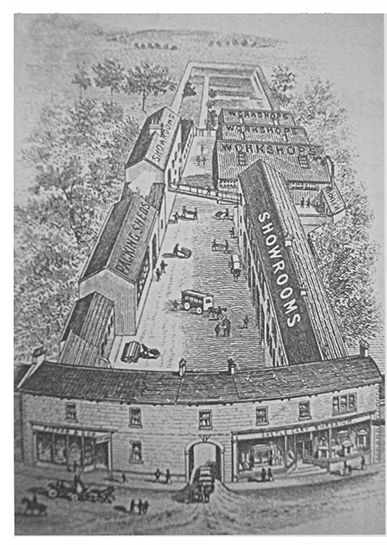
cabinet-making firm was Charles Pither and Son which began at Bailey Hill in 1877 with a workshop, and later a glass and china shop. John Pither invented a method of locking sets of drawers simultaneously. By 1907 the business had moved to a large site opposite the market place including shops and workshops for cabinet making and upholstery. They offered a complete home furnishing and removals business with their own covered waggons. By 1914 they had two shops and a showroom and by 1947 employed c. 40 people. There were branches at Crewkerne, Wells, and Yeovil. In 1951 the premises were put up for sale including the Emporium with two floors of showrooms, upholstery workshop, mattress repair shop, and storerooms. Thereafter the business was based at Crewkerne.
in the graffiti lane this cabinet maker was busy at work and the sun was strong...the light and shadow caught my eye and the moment .
William Brodie (1741-1788), often known by his title of Deacon Brodie, was a Scottish cabinet-maker, deacon of a trades guild, and Edinburgh city councillor, who maintained a secret life as a housebreaker, partly for the thrill, and partly to fund his gambling.
View of Faber Castel Mansion in the gardens of Faber-Castell Castle during the Christmas market "Winter Dreams", Stein near Nuremberg, Franconia (Bavaria), Germany
Some background information:
Being held already in mid-November, the annual pre-Christmas fair "Winter Dreams" at Faber Castell Castle in Stein near Nuremberg is definitely the earliest Christmas market in our region. It takes place both in the gardens and the interiors of Faber Castell Castle that is sometimes also called "pencil castle", because it’s the ancestral seat of the noble family von Faber-Castell, which gained wealth by the manufacturing of pencils.
From 1843 to 1846, the so-called Old Castle was designed and built in the Neo-Renaissance style by the architect Friedrich Bürklein for Lothar von Faber. In 1903, the Faber-Castell family also commissioned the construction of the New Castle based on plans by Theodor von Kramer in the style of German Romanesque architecture. The two parts are connected by an elaborately structured, five-storey tower through which the gate passage runs.
The family used to live in the castle until 1939, when it was confiscated by the Wehrmacht. After the end of World War II American occupation troops moved into the building. But when the famous Nuremberg Trials had begun in 1948, the castle was converted into a sleeping accommodation for the many international journalists, who reported on the court proceedings. In 1953, the last Americans left the castle and it was returned to the family, who did not move back in themselves. After decades of neglect, Anton-Wolfgang Count von Faber-Castell initiated the renovation and inventorying of the castle, and since 1986 the complex has once again been used for events.
In the last few years the castle was fully renovated. It is now used as a place of different events, such as the Christmas market. One weekend a month Faber Castell Castle also opens its doors for visitors, who are interested in the interior of the building. We already grabbed this chance and were quite surprised about its interesting and richly ornamented art noveau décor with lots of marble used.
The mansion is part of the historic complex surrounding Faber-Castell Castle. It was built for Wilhelm von Faber-Castell and is located directly in the castle gardens, which originally covered around 30 hectares and were laid out in the 19th century as an English-style landscape garden. The mansion predates the main castle and originally served as the representative residence of the Faber-Castell family. However, today, the building is used as an office space rather than a family residence.
With its headquarters and huge production sheds in the immediate vicinity of the castle, Faber-Castell is the biggest pencil manufacturing company around the world. In altogether 14 production centres it employs a staff of 7,000 on a global scale. Founded already in 1761 by the cabinet maker Kaspar Faber, whose grandson Lothar was ennobled in 1888, the company soon took off, favoured by the beginning industrial revolution.
In 1900, after the marriage of Lothar von Faber’s granddaughter baroness Ottilie von Faber with count Alexander von Castell-Ruedenhausen, the enterprise was renamed Faber-Castell. At that time also a new logo was implemented, the "jousting knights", which is still the company’s logo at the present day. In 1901 Alexander was granted the hereditary title of prince as well as count von Faber-Castell by Luitpold, Prince Regent of Bavaria. Nowadays the family continues to be ranked with the reigning dynasties of Europe and belongs to the German high nobility.
A Merry Christmas 2025 to all of you! Have a great festive season together with your families and friends!
Coachwork by Saoutchik
This Talbot Lago is an automotive sculpture, a work of art. Function follows form and not the other way round.
This type of car cannot be judged against general standards. The flamboyant styling is by Jacques Saoutchik, a cabinet maker who fled from Belarus and set up his own coachbuilding company in Paris in 1906. His only aim was to make it to the top in the motorcar industry, and this he finally achieved in the 1920s.
The exaggerated, voluptuous contours and the excessive use of chrome were typical of Saoutchik’s designs. It was reminiscent of the flamboyance of the 1930s, but after the war this was however no longer appropriate. The world was focusing on reconstruction and such extravagant cars looked out of place. Only 36 Grand Sports were built.
Antonio Lago, the Italian major who bought out the declining French marque Talbot in 1935, misjudged the post-war opportunities. The marque did enjoy some racing success, but things soon went downhill. Talbot Lago was taken over by Simca in 1959. Saoutchik had already ceased to operate a few years earlier.
4,5 Liter
6 Cylinder
190 hp
Louwman Museum
Den Haag - The Hague
Nederland - Netherlands
March 2013
These were the last days of Magic Kitchens in Coburg. Magic Kitchens created cabinetry for over 50 years until the unexpected passing of the owner and primary cabinet maker. His brother did what he could to keep the business going, but eventually had to close operations in early 2023.
Sony RX0 | Lightroom
Once one of the nation's busiest ports and shipbuilding cities, Portsmouth expressed its wealth in fine architecture. It contains significant examples of Colonial, Georgian, and Federal style houses, a selection of which are now museums. Portsmouth's heart contains stately brick Federalist stores and townhouses, built all-of-a-piece after devastating early 19th-century fires. The worst was in 1813 when 244 buildings burned. A fire district was created that required all new buildings within its boundaries to be built of brick with slate roofs; this created the downtown's distinctive appearance. The city was also noted for the production of boldly wood-veneered Federalist furniture, particularly by the master cabinet maker Langley Boardman.
To see more of my images, purchase prints, or arrange for stock licensing, visit www.dawnamoorephotography.com.
Follow more of my adventures on Instagram, Facebook, Twitter and Google+.
Jewel of Pays d’Auge, Normandy en.normandie-tourisme.fr/normandy-tourism-109-2.html, the Castle of Saint-Germain de Livet is striking by its architecture. Surrounded by moats, it is made up of a timber-framed manor dates back to the 15th century and a Renaissance wing built during the 16th century. This part is remarkable for its painting tiles. The castle houses marvellous frescoes dated from the 16th century. The visit is extended by the discovery of the flowery and raised park. This castle is also a museum. It presents the furniture and the works of art of the family Riesener-Pillaut who bequeathed the castle to the city of Lisieux in 1957. The inside testifies the refinement and the lifestyle of the 19th century. The trail evokes the artistic and personal journey of the painter Léon Riesener (1808-1878), grandson of the cabinet maker Jean-Henri Riesener and cousin of Eugène Delacroix. Visit the furnished interior of the Château de Saint-Germain-de-Livet, where you can also admire paintings by the artist Léon Riesener. The castle has been the property of the town of Lisieux since 1958. www.calvados-tourisme.co.uk/diffusio/en/discover/sites-mo...
Ghost sign in white glazed brick at the former premises of Godfrey William Bonson (1858-1932), cabinet maker and upholsterer, removal and storage contractor, Moss Lane, Altrincham. The business also offered mechanical carpet beating services.
Excerpt from Wikipedia:
Central Market was a fresh food market in Central, Hong Kong. Located between Jubilee Street, Queen Victoria Street, Queen's Road Central and Des Voeux Road Central, it was the first wet market in Hong Kong. By its side is the first public female toilet and first above-ground toilets in Hong Kong. It is one of two existing Bauhaus market buildings in Hong Kong, the other one being Wan Chai Market.
The precursor of the market was Canton Bazaar, which was established in 1842 on Queen's Road Central between Cochrane Street and Graham Street. In 1843 it was also known as the Middle Bazaar. The Chinese population were later forced to relocate from Central to the Tai Ping Shan area due to a series of fires. The market was then replaced by residential houses for Europeans. The bazaar was moved to Queensway, where the present-day High Court stands. It housed Chinese furniture dealers, joiners, cabinet makers and curio shops. Due to its proximity of Naval Yard and the construction of cantonment, the bazaar, shops and civil tenement had to be moved. In the 1850s, it was moved to its current location on Des Voeux Road (then known as The Praya). Its name also changed to Central Market (中環街市).
The market was rebuilt in 1858, then completely replaced with a Western marble structure in 1895. The rebuilt market was a three-storey Victorian-style structure with a tower in the middle.
The market was demolished again in 1937, this time replaced with a Bauhaus structure. Construction was completed in 1938, and cost HK$900,000. The market re-opened on 1 May 1939.
During the Japanese Occupation of Hong Kong between 1941 and 1945, the Chinese name of the market was changed from 中環街市 (chung wan kai shi) to 中央市場 (chung yeung shi cheung). The Chinese name displayed at the Des Voeux Road Central entrance was not restored until 1993. Central Market was the biggest meat market in Southeast Asia and the then-Governor of Hong Kong David Trench made a visit to the market in 1967. The importance of the market attracted another Governor Alexander Grantham to pay another visit.
In 1994, the western part of its second floor was converted into the Central Escalator Link Alley Shopping Arcade, an access way between the Central Elevated Walkway and Central–Mid-levels escalators. It was managed by the Urban Council until its dissolution in 1999. The market was then closed in March 2003.
The market is housed in a 4-storey reinforced concrete structure, and contains 200 booths inside. The market is spacious with a central court, high ceiling and window walls for natural light and ventilation. There are two entrances of the market. The Des Voeux Road Central entrance is on the ground floor while the Queen's Road Central entrance bridges the first floor. In the early days, the root floor were offices and quarters of hygiene inspectors and other staff.
Current
The building is largely abandoned with few stores along a renovated pedestrian corridor inside, Central Escalator Link Alley Shopping Arcade (中環購物廊). The corridor is linked by two footbridges to Hang Seng Bank Headquarters Building and Central Elevated Walkway, and another footbridge to the Central–Mid-Levels escalator. Shops in the arcade include tailors, cleanser, collectors and other trades. On Sunday, one side of the corridor is a popular gathering place among Filipino domestic workers.
The building has temporarily been redecorated on the theme of Central Oasis, pending further development.
Central Market is listed as a Grade III historic building. It is part of the Central and Western Heritage Trail.
nrhp # 91001457- Bethany Danish Evangelical Lutheran Church is a historic church in Kimballton, in Audubon County, Iowa. It was built in 1898 and was added to the National Register in 1991.[1]
It is a T-shaped one-story gable-front frame building with a central entry tower, similar to other Danish churches in Audubon County and adjacent Shelby County. It faces to the west, and has an ell on the north which was built in 1906 to serve as a schoolhouse.
It was deemed significant in part for its association with the history of the Danish Lutheran Church, which split in 1894, in the two county area. It was built, at least partly, by skilled Danish carpenter/cabinet-maker, Nis P. Hjuler, and reflects Danish decorative arts.
from Wikipedia