View allAll Photos Tagged baaderplanetarium
Imaged over a total of 6 nights, Sharpless 132, The Lion Nebula, is a very faint emission nebula. It's on the border of the constellations of Cepheus and Lacerta. It's estimated to be about 10,000 light years away. The star field is very rich, so the nebula is almost lost amidst all the stars.
I decided on this object over some of the more common targets in the Cepheus reason simply because I had never really seen the object and wanted to capture something less commonly imaged. The Ha and OIII data was much more substantial than the SII data. I think a bi-colour image with just Ha and OIII would also produce a great image.
The "Head" of the lion has a lot if fine detail and structures and I may image this area again with a longer focal length scope and focus on just this area, see what mother nature says to that!
I wasn't originally planning on going 33 hours on this project, but since I had some nights with a near full moon I figured some more integration time would help increase the signal over the moon washed background.
Love the feedback!
CS, be well, and thank you!
Dan.
Pickerings Triangle, the lesser photographed part of the Cygnus Loop supernova remnant. It actually has no NGC classification number, although NGC 6979 is sometimes used. This portion of the Cygnus loop was discovered in 1904 by Willamina Fleming, but credited to Edward Pickering, the director of her observatory. This was customary back in that time.
I tried this object last year but was not happy with the data as my timing and clear skies happen to occur during some extremely hot and smoky filled(forest fires) days. This year, the skies cooperated and was able to capture some decent data.
The Rosette Nebula (also known as Caldwell 49) is a large spherical H II region (circular in appearance) located near one end of a giant molecular cloud in the Momoceros region of the Milky way galaxy. The open cluster NGC 2244 (Caldwell 50) is closely associated with the nebulosity, the stars of the cluster having been formed from the nebula's matter
The cluster and nebula lie at a distance of some 5,000 light yeads from Earth and measure roughly 130 light years in diameter. The radiation from the young stars excites the atoms in the nebula, causing them to emit radiation themselves producing the emission nebula we see. The mass of the nebula is estimated to be around 10,000 solar masses.
This image is a total of 6 hours of integration split between OIII and Ha. First light with the Esprit 80 Telescope.
The Triangulum Galaxy is a spiral galaxy 2.73 million light-years from Earth in the constellation Triangulum. It is catalogued as Messier 33 or NGC 598. The Triangulum Galaxy is the third-largest member of the Local Group of galaxies, behind the Milky Way and the Andromeda Galaxy
This was a challenge to image as I struggled with constant fog and seeing problems and a 70% or more moon on every night of imaging. I never captured Ha in last years version so I wanted to highlight the numerous Ha regions within the galaxy.
Very difficult to process out the effects of the ³moon and keep the image clean, but I'm happy with the result. I cant be too picky at this time of the year when clear skies are a rarity!
Acquisition details:
Dates:Dec. 1, 2020 , Dec. 2, 2020 , Dec. 4, 2020 , Dec. 5, 2020
Frames:
Optolong B 36mm: 88x60" (gain: 139.00) -20C bin 1x1
Optolong G 36mm: 90x60" (gain: 139.00) -20C bin 1x1
Antlia Ha 3.5nm 36mm: 72x600" (gain: 139.00) -20C bin 1x1
Optolong L 36mm: 163x60" (gain: 139.00) -20C bin 1x1
Optolong R 36mm: 90x60" (gain: 139.00) -20C bin 1x1
Integration: 19.2 hours
Equipment used:
Imaging telescope: SkyWatcher Esprit 80ED Super APO Triplet
Imaging camera: ZWO ASI1600MM-P (Pro Cooled Mono)
Mount: SkyWatcher EQ6-R Pro
more information can be found here,
Messier 81 and Messier 82 galaxies are part of the M81 Group, a group of 34 galaxies in Ursa Major and Camelopardalis constellations. Due to the distance of approximately 12M light years from Earth, this group together with the Local Group (containing the Milky Way) are relative neighbors in the Virgo Supercluster. M81 was discovered initially be Johann Bode (a German astronomer famous for determining the orbit of Uranus) at the end of 1774, hence the alternate name this object is sometimes referred as: Bode's Galaxy. In 1779 Pierre Méchain together with Charles Messier re-discovered the object and included it in the Messier Catalogue. M81 is a grand spiral galaxy with a very active nucleus, "hosting" a super-massive black hole with a mass of around 70 million times the mass of our Sun.
M82, sometimes called the Cigar galaxy due to it's edge on view from Earth, is the brightest galaxy in the night sky in infrared light, being a lot brighter in infrared than in the visible part of the spectrum. It is a starburst class galaxy that got caught in a gravitational struggle with M81 for past billion years. M82 is famous for its heavy star forming activity and the outburst of ionized hydrogen that can be seen in this photo as jets almost perpendicular to the galaxy disk. Around 100 newly formed globular star clusters have been discovered in this galaxy by Hubble Space Telescope. Many of the newly formed stars are so massive that they have a relatively short life and at the end of it, they explode as supernovas and drive gas and matter out of the galaxy at speeds of millions of kilometers per hour.
This image was taken over 3 consecutive nights with a total of 21.9 hours of total integration time, with 10 hours dedicated to hydrogen alpha.
more details here
My biggest project so far, finally hit the 20 hours mark on a single image! let me know what you think. Im really happy with the nebulosity detail that came through.
Flaming Star Nebula, IC 405 is an emission and reflection nebula in the constellation Auriga, surrounding the bluish star AE Aurigae. It shines at magnitude +6.0. It surrounds the irregular variable star AE Aurigae and is located near the emission nebula IC 410, the open clusters M38 and M36, and the K-class star Iota Aurigae. The nebula measures approximately 37.0' x 19.0', and lies about 1,500 light-years away from Earth. It is believed that the proper motion of the central star can be traced back to the Orion's Belt area. The nebula is about 5 light-years across.
Elephants trunk nebula IC1396 Elephant’s Trunk nebula (13.06&14.062021) as a mosaic captured with a C11 & Hyperstar V3. It’s is a combination of h-alpha, O3 and RGB data. Postprocessed in APP & Photoshop
#idaslpsd2 & #lEnhance Filter
#qhy268c #celestroncgxlmount #youresa
#astrophotography #universetoday #milkyway #astrophoto #astrography #nightsky #nightscaper #starphotography #starscape #natgeospace #starrynight #longexposure #astro_photography #deepsky #galaxy #neustadtanderweinstrasse #astromaniacmag #celestronrocks #astrobin #baaderplanetarium #jw #jwphotography
Good morning! Sunshine! H-alpha! Full disk!
Weather front passed over Moscow bringing warm and bright yet slightly hazy gap between unending rains. I took a chance to test another way of coupling camera with Coronado PST. This time - via projection-enabled zoom eye-piece (specs below), as suggested in a very usefull document by Raymond Gilchrist, Flickr member.
Going this way I have achieved the optimal balance between the resolving power of PST's optics and pixel density of the camera. Now the level of detailing depends only on atmospheric conditions.
WARNING! Sun is dangerous, use proper filters for observing and imaging!
Aquisition time: 13.09.2013, 09:07 MSK (UTC+4)
Image orientation: inverted (North is down, East is to the right to keep the Sun crested :).
Equipment:
Canon EOS 60D (unmodded) coupled to Coronado PST via Baader Planetarium Hyperion Zoom 8-24 mm Mark III click-stop system eyepiece and Baader Planetarium M43(sic!)-to-T2 conversion ring and mounted on photo-tripod.
Aperture 40 mm
Native focal length 400 mm
Effective focal length 931 mm (zoom setting - 20 or 16 mm, just forgot to take a note of it)
Tv = 1/30 seconds
Av (effective) = f/23 (tolerable, but f/20-21 would be better)
ISO 200
Exposures: 5 (plus 10 dark frames and 10 offset/bias frames)
Processing: if it were the Moon I would say that I have gone lunatic :) +1,1 EV was added in DPP, images were converted to monochrome and exported as 16- bit .TIFF. All dark and offset frames were processed in the same way. Resulting images were opened as stacks in
ImageJ and averaged to get master calibration files. Substraction was done in ImageJ also. Calibrated images were assembled into 2560x2560x5 frames .AVI. When I have stepped on the rake :) - Autostakker processed it, but badly cropped the result to 2400x2000 pixels, removing the cutest feature. So I have sliced the image into nine .avi fragments, stacked them separately, and stitched them back in Microsoft ICE.
Resulting image was subjected to to Richardson-Lucy deconvolution in AstraImage 3.0 (Cauchy-type PSF, size 6 units, 7 iterations - harsh, but stacked images are less noisy and can tolerate harsher processing).
Contrast enchancement, high-pass filtering and coloration made in Photoshop.
SOL 11/02/24
In an effort to beat the heat from the last 2 days, I imaged the Sun this morning, it was still pretty warm but the seeing was excellent - best I have had in a long time
Kelda 500mm
Baader Ca-K & Astrosolar film
QHY 178M
Best 20% of 200 frames captured.
Mercury is the tiny dot at about 7 o'clock on the suns disc. Observed and photographed using a Skywatcher star travel 80 . Objective filtered with Baader astro solar film . Panasonic Lumix GF 6..
Always seek advise before attempting to observe and photograph the sun. If in doubt DONT, you could easily blind yourself .
#M106 cluster
Final version
It includes also the galaxies: #NGC4248, #NGC4231, #NGC4232, #NGC4217, #NGC4226
55 lights 180 sec. Gain26 + 80 Lights 240 sec Gain 26
30 darks
30 bias
30 (dark) flats
#idaslpsd2 Filter
#qhy268c f4 #celestroncgxlmount#
#astrophotography #universetoday #milkyway #astrophoto #astrography #nightsky #nightscaper #starphotography #starscape #natgeospace #starrynight #longexposure #astro_photography #deepsky #galaxy #neustadtanderweinstrasse #astrobin #baaderplanetarium #jw #jwphotography
Markarians Chain (13.05.2021)
M84 aka NGC4374
M86 aka NGC4406
It includes also
the galaxies:
NGC4435 The Eyes (Copelands Augen) ~52 mly distance
NGC4438 The Eyes (Copelands Augen) ~52 mly distance
NGC4402~ 50 mly distance, 55 kly diameter
NGC4425 ~83 mly distance, 70kly diameter
NGC4413 / NGC4407 2 mly distance (ignoring redshift),
NGC4387 18mly distance 120kly diametr
IC3303
IC3393
IC3355
IC3333
IC3315
The bigger Stars:
HD108450
HD108285
HD108091
40 lights 180 sec. Gain26
30 darks
30 bias
30 (dark) flats
#idaslpsd2 Filter
#qhy268c f4 #celestroncgxlmount #
#astrophotography #universetoday #milkyway #astrophoto #astrography #nightsky #nightscaper #starphotography #starscape #natgeospace #starrynight #longexposure #astro_photography #deepsky #galaxy #neustadtanderweinstrasse #astromaniacmag #celestronrocks #astrobin #baaderplanetarium #jw #jwphotography
#M104 #SombreroGalaxy (04.04.2021)
It has a diameter of approximately 49,000 light-years anderen 30Million ly disrance to earth.
59 lights 180 sec. Gain26
30 darks
30 bias
30 (dark) flats
#idaslpsd2 Filter
#qhy268c f4 #celestroncgxlmount #youresa
#astrophotography #universetoday #milkyway #astrophoto #astrography #nightsky #nightscaper #starphotography #starscape #natgeospace #starrynight #longexposure #astro_photography #deepsky #galaxy #neustadtanderweinstrasse #astromaniacmag #celestronrocks #astrobin #baaderplanetarium #jw #jwphotography
4K MP4s processed with PIPP and AutoStakkert then merged with Phot0Shop.
2400mm f/12 1/125s 400 ISO 104-9887-9
3600mm f/18 1/125s 800 ISO 104-9890-2
4800mm f/24 1/125s 1250 ISO 104_9893-5
6000mm f/30 1/125s 1600 ISO 104_9896-8
M101 is a large face-on spiral galaxy located 22 million kight-years away in the cinstellation of Ursa Major. At magnitude +7.9, it can be glimpsed in binoculars or small telescopes from dark sites. However, this galaxy suffers from low surface brightness and in bad seeing conditions or light polluted areas is sometimes difficult to spot even with 200mm (8-inch) scopes. M101 is best seen from the Northern Hemisphere during the months of March, April and May.
M101 is also known as the Pinwheel galaxy and was discovered by Pierre Méchain on March 27, 1781. He described it as "nebula without star, very obscure and pretty large, 6' to 7' in diameter, between the left hand of Boötes and the tail of the great Bear." He communicated this to Charles Messier, who verified its position and then included it in his catalogue as one of the final entries.
Locating the part of sky where M101 is positioned is easy, since it's close to the handle of the bowl that forms the Plough or Big Dipper asterism of Ursa Major. The Pinwheel galaxy is located at one corner of an equatorial triangle formed with second magnitude stars Mizar (ζ UMa - mag. +2.2) and Alkaid (η UMa - mag. +1.8). M101 is 5.5 degrees east of Mizar (the celebrated naked eye double star) and 5.5 degrees northeast of Alkaid.
This image was taken over 5 nights in early to mid March 2020. its a combination of over 32 hours of total exposure time using Hydrogen Alpha and LRGB filters.
#NGC7635 #BubbleNebula from 21.07.2021). The bubble in the middle has a diameter of ~10 lightyears.
The moon was over 90%.
Lights 68 x 180
Darks 30 x 180
Flats 30 x
Darkflats 30x
Bias 30 x
#lEnhance C11 f6.3 1764mm
#qhy268c #celestroncgxlmount #youresa
#astrophotography #universetoday #milkyway #astrophoto #astrography #nightsky #nightscaper #starphotography #starscape #natgeospace #starrynight #longexposure #astro_photography #deepsky #galaxy #neustadtanderweinstrasse #astromaniacmag #celestronrocks #astrobin #baaderplanetarium #jw #jwphotography
#M63 aka #NGC5055 #SunflowerGalaxy has approximately 400 billion stars.
40 lights 180 sec. Gain26
30 darks
30 bias
30 (dark) flats
#idaslpsd2 Filter
#qhy268c f4 #celestroncgxlmount #youresa
#astrophotography #universetoday #milkyway #astrophoto #astrography #nightsky #nightscaper #starphotography #starscape #natgeospace #starrynight #longexposure #astro_photography #deepsky #galaxy #neustadtanderweinstrasse #astromaniacmag #celestronrocks #astrobin #baaderplanetarium #jw #jwphotography
Note: The image is not at full resolution, but because of the fine detail, it is best viewed as LARGE as possible. Zoom in and out by clicking on the image.
WARNING:
Don't look at the Sun though a Telescope's Eyepiece or Finder Scope without protective Solar filters, as it can cause permanent eye damage. The same applies when you use a camera, and look through the Camera's Eyepiece. If at all possible, rather look at the Sun in Live View on the Camera's LCD Screen.
About this photo:
This is a photograph of the surface of the Sun (mostly in the wavelengths of visible light, and the H-Alpha (Ha) Infrared (IR) spectral line of Hydrogen at 656.28 nm).
Over 99.999% of the light was blocked with a R-G "White Light" Solar filter. Sunspots, granulation and filaments are visible due to the use of an additional Baader Planetarium Solar Continuum filter (passing a narrowband spectral wavelength of light at 540 nm).
This image was created by Stacking several High Dynamic Range RAW images, that were photographed with a Canon 60Da DSLR, on a 6" wide field Newtonian Reflector Telescope (Astrograph).
About Sunspots:
The dark spots are cooler holes in the Sun's Photosphere and are called Sunspots. The Photosphere has a temperature of 5,800 degrees Kelvin, and Sunspots have temperatures of about 3,800 degrees K. Sunspots only appear to be dark, as they are surrounded by much brighter and hotter regions of the Sun's Photosphere.
With the use of extreme narrowband Hydrogen-Alpha Solar filters, Ca K-Line filters, and other wavelengths of light like Ultraviolet (UV), the detail of the Sun's surface, prominences and solar flares will be far more apparent.
About the Sun:
The Sun is a G-type Main-Sequence Yellow Dwarf (G2V) Star. As far as stars go, the Sun is a very average star in the middle of its life cycle (around 5 billion years old). To give an indication of the Sun's size, about 1.3 million Earth sized planets can fit into the volume of the Sun. Through the process of fusion, the Sun burns approximately 600 million tonnes (metric tons) of Hydrogen each second, turning it into 596 million tonnes of Helium. As the Hydrogen nuclei fuse, Photons are emitted, which in short is why the Sun and other stars shine.
The Sun is roughly 150,000,000 km (93,205,679 mi) from Earth. The speed of light is 300,000 km/sec (186,000 miles/sec), which means that the light took just over 8 light-minutes (8 minutes and 26 seconds) to reach my Telescope.
The mass of the Sun is about 2 Nonillion kilograms:
M☉ = (1.98855±0.00025) × 10^30 kilograms or 10^27 metric tons, and is referred to as 1 Solar Mass. The Sun contains 99.86% of the mass in our Solar System.
About Hydrogen and the Chemical Elements:
The Hydrogen Atom is the simplest and most abundant element in the Universe (with only 1 Proton and 1 Electron). Through the process of fusion, more complex elements are made at different stages of a star's life and death cycle.
This is what Carl Sagan meant with one of his well known quotes from Cosmos, "The nitrogen in our DNA, the calcium in our teeth, the iron in our blood, the carbon in our apple pies were made in the interiors of collapsing stars. We are made of starstuff."
About the Milky Way, and our Solar System's place within it:
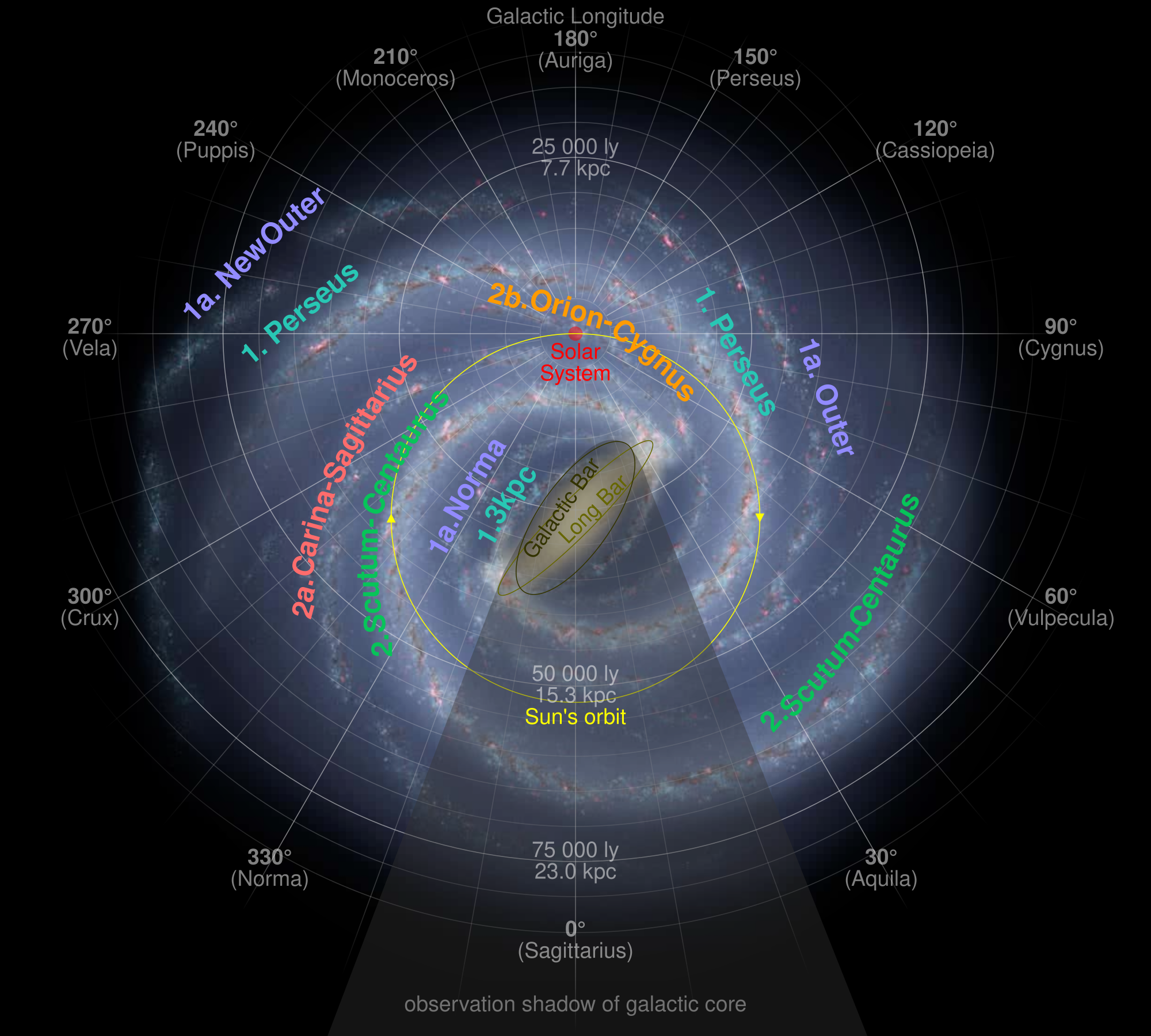
The Milky Way Galaxy is estimated to have over 400 billion stars. Stars are suns, and just like in our Solar System, many of the stars have planets with moons orbiting them. Our sun is a middle aged Yellow Dwarf star, located in the Orion Arm (or Orion Spur) of the Milky Way Galaxy. It's a minor side spiral arm, located between two larger arms of the Milky Way Galaxy's spiral. The Milky Way is merely one mid-sized barred spiral Galaxy, amongst over 100 billion other Galaxies in the observable Universe. When we look up at the night sky from Earth, we see a glimpse of the Carina-Sagittarius Arm of the Milky Way Galaxy. It takes about 250 million years for the Milky Way Galaxy's spiral arms to complete one rotation.
The size, distance and age of the Universe is far beyond human comprehension. The known Universe is estimated to contain over One Billion Trillion stars.
1 000 000 000 000 000 000 000
Click on this link to view an image that illustrates ''our Solar System's position within the Milky Way Galaxy''.
View the spectacular images and videos captured in several wavelengths of light with the NASA Solar Dynamics Observatory.
This image was published in Astrophotography Ezine - Issue 23.
Martin
-
[Home Page] [Photography Showcase] [My Free Photo App]
[Flickr Profile] [Facebook] [Twitter] [My Science & Physics Page]
Note: The image is not at full resolution, but is best viewed as LARGE as possible. Zoom in and out by clicking on the image.
WARNING:
Don't look at the Sun though a Telescope's Eyepiece or Finder Scope without protective Solar filters, as it can cause permanent eye damage. The same applies when you use a camera, and look through the Camera's Eyepiece. If at all possible, rather look at the Sun in Live View on the Camera's LCD Screen.
About this photo:
The Sun on 28 March 2016 from the Southern Hemisphere. Our Star is ever changing, and today there was a huge Sunspot.
This image was created by Stacking several 16 bit RAW images, that were photographed with a Canon 60Da DSLR, on a 6" wide field Newtonian Reflector Telescope (Astrograph).
Scale Reference:
If you consider that the planet Earth fits into the volume of the Sun 1.3 million times, the scale of the Sunspot becomes apparent. Don't be alarmed, this is normal.
Wavelength of Light:
This is a photograph of the Sun was mostly photographed in the wavelengths of visible light, and the H-Alpha (Ha) Infrared (IR) spectral line of Hydrogen at 656.28 nm).
Over 99.999% of the light was blocked with a R-G "White Light" Solar filter. Some finer details like the surface granulation and filaments are visible due to the use of an additional Baader Planetarium Solar Continuum filter (passing a narrowband spectral wavelength of light at 540 nm).
About Sunspots:
The dark spots are cooler holes in the Sun's Photosphere and are called Sunspots. The Photosphere has a temperature of 5,800 degrees Kelvin, and Sunspots have temperatures of about 3,800 degrees K. Sunspots only appear to be dark, as they are surrounded by much brighter and hotter regions of the Sun's Photosphere.
With the use of extreme narrowband Hydrogen-Alpha Solar filters, Ca K-Line filters, and other wavelengths of light like Ultraviolet (UV), the detail of the Sun's surface, prominences and solar flares will be apparent.
About the Sun:
The Sun is a G-type Main-Sequence Yellow Dwarf (G2V) Star. As far as stars go, the Sun is a very average star in the middle of its life cycle (around 5 billion years old). To give an indication of the Sun's size, about 1.3 million Earth sized planets can fit into the volume of the Sun. Through the process of fusion, the Sun burns approximately 600 million tonnes (metric tons) of Hydrogen each second, turning it into 596 million tonnes of Helium. As the Hydrogen nuclei fuse, Photons are emitted, which in short is why the Sun and other stars shine.
The Sun is roughly 150,000,000 km (93,205,679 mi) from Earth. The speed of light is 300,000 km/sec (186,000 miles/sec), which means that the light took just over 8 light-minutes (8 minutes and 26 seconds) to reach my Telescope.
The mass of the Sun is about 2 Nonillion kilograms:
M☉ = (1.98855±0.00025) × 10^30 kilograms or 10^27 metric tons, and is referred to as 1 Solar Mass. The Sun contains 99.86% of the mass in our Solar System.
About Hydrogen and the Chemical Elements:
The Hydrogen Atom is the simplest and most abundant element in the Universe (with only 1 Proton and 1 Electron). Through the process of fusion, more complex elements are made at different stages of a star's life and death cycle.
This is what Carl Sagan meant with one of his well known quotes from Cosmos, "The nitrogen in our DNA, the calcium in our teeth, the iron in our blood, the carbon in our apple pies were made in the interiors of collapsing stars. We are made of starstuff."
About the Milky Way, and our Solar System's place within it:
The Milky Way Galaxy is estimated to have over 400 billion stars. Stars are suns, and just like in our Solar System, many of the stars have planets with moons orbiting them. Our sun is a middle aged Yellow Dwarf star, located in the Orion Arm (or Orion Spur) of the Milky Way Galaxy. It's a minor side spiral arm, located between two larger arms of the Milky Way Galaxy's spiral. The Milky Way is merely one mid-sized barred spiral Galaxy, amongst over 100 billion other Galaxies in the observable Universe. When we look up at the night sky from Earth, we see a glimpse of the Carina-Sagittarius Arm of the Milky Way Galaxy. It takes about 250 million years for the Milky Way Galaxy's spiral arms to complete one rotation.
The size, distance and age of the Universe is far beyond human comprehension. The known Universe is estimated to contain over One Billion Trillion stars.
1 000 000 000 000 000 000 000
Click on this link to view an image that illustrates ''our Solar System's position within the Milky Way Galaxy''.
View the spectacular images and videos captured in several wavelengths of light with the NASA Solar Dynamics Observatory.
Martin
-
[Home Page] [Photography Showcase] [My Free Photo App]
[Flickr Profile] [Facebook] [Twitter] [My Science & Physics Page]
Target:NGC 1499, California Nebula. An emission nebula in the constellation of Persius at 1500 light years from Earth.
Location:Imaged on 16/12/2020 from St.Helens UK, Bortle 8, No Moon.
Aquisition:20x 180s Ha, 20x 180s (OIII), Gain 139, Offset 21, Total Integration 120 min.
Equipment:Imaging: Skywatcher Esprit 100ED, HEQ5Pro, Zwo ASI1600MM Pro with EFW, BaaderPlanetarium narrowband filters.
Guiding: Skywatcher 9x50 Finder, Zwo ASI120MM.
Software:Aquisition: NINA,PHD2.
Processing: DeepSkyStacker, Photoshop
Memories:Advantage was made of three hours of rare and unexpected relatively clear sky between showers.
Mind blowing 900 Million light years of distance - the galaxy #UGC6211. You can see it in the middle of the bottom.
#M97 OwlNebula #M108 aka NGC3556
31 lights 180 sec. Gain26
30 darks
30 bias
30 (dark) flats
#idaslpsd2 Filter
#qhy268c f4 #celestroncgxlmount #youresa
#astrophotography #universetoday #milkyway #astrophoto #astrography #nightsky #nightscaper #starphotography #starscape #natgeospace #starrynight #longexposure #astro_photography #deepsky #galaxy #neustadtanderweinstrasse #astromaniacmag #celestronrocks #astrobin #baaderplanetarium #jw #jwphotography
Please note all solar images by myself are taken using specialist equipment, never look at the sun through telescopes or binoculars!
Image taken on 21/04/18 of sunspot 2760, which has appeared during the Suns solar minimum period of the 11 year solar cycle.
Image was processed from video taken with a ZWO ASI224MC camera, with a Sywatcher ED80 DS Pro telescope and Baader Solar wedge.
#NGC7023 aka Iris Nebula
85 lights 300sec. Gain0
30 darks
30 bias
30 (dark) flats
#idaslpsd2 Filter
#qhy268c f4 #celestroncgxlmount #youresa
#astrophotography #universetoday #milkyway #astrophoto #astrography #nightsky #nightscaper #starphotography #starscape #natgeospace #starrynight #longexposure #astro_photography #deepsky #galaxy #neustadtanderweinstrasse #astromaniacmag #celestronrocks #astrobin #baaderplanetarium #jw #jwphotography
Having damaged my solar filter, I visited f1telescopes in Sittingbourne with the intention of simply replacing my filter. I came away though with a lot of good advice and after some contemplation ordered a Baader planetarium solar wedge.
This Sunday between clouds and rain I was able to give it its first light and capture the Sun for the first time with this great bit of kit. The mark top centre I hope was a bit of dust, since removed from my ASI224MC camera.
Solar activity was a lot less than the other weekend.
Skywatcher ED80 DS-PRO, Baader Planetarium Herschel Wedge with continuum filter. White light image processed from video in autostakkert and Photoshop.
Not had much chance to use the telescope lately, the weather has been that bad. Clear day today, only the remnants of sunspot AR2692 can be seen.
Taken with a Skywatrcher ED80 telescope, Herschel wedge and ZWO 224MC camera.
Sun - 100% crop from 88 stacked subexposures
Image Scale = 1.11 arc-second/pixel
Date: 2012/09/13 - 3:04PM to 3:26 PM
Exposure: 88 x 1/3200 sec at f/8, ISO 100
Lens: Nikon 800mm f/5.6 ED AI-S at f/8
Camera : unmodified Canon T2i = 550D
Filter: Astrozap filter with Baader AstroSolar film.
Mount: Astro-Physics AP900 -- rough polar alignment (no drift alignment)
Focusing: Live view was used with the EOS utility to get approximate best focus. At total of 88 frames were taken with the lens focus ring at 4 positions about 1/12 mm apart -- total range - 1/4 mm.
Processing: Raw conversion to TIFF using Canon Digital Photo Professional. The 88 individual shots were pre-cropped to 2000 x 2000 with Photoshop CS5 to reduce the size. Autostakkert2 was tried, but results had dark patches. Note that the shutter accuracy is apparently not too good at 1/3200, since the exposures varied quite a bit in brightness. Maybe this was the problem.
Zerene Stacker (normally used for macro photography DOF stacking) was used to combine the sharpest parts of each of the 88 images in PMAX mode, and this worked well. The Zerene Stacker output was then adjusted with Photoshop CS5. Levels was used individually on each R G and B channel, and then the image was desaturated, and levels was used again to touch up the image. 150% unsharp mask with a radius of 3 pixels was then used to bring out the granular surface of the sun. (Unfortunately, this caused the centers of some sunspots to go to 0 brightness.) The sun was then centered and the image was recropped to 2000 x 2000 pixels. The orange image was made by reducing the green channel gamma to 0.50 and the blue channel gamma to 0.25 using Photoshop levels. The images were then combined side-by-side into a single 4001 x 2000 canvas. JPEG conversion was done with quality = 10.
Transit of Venus captured from Mt Bonnell in Austin, TX, USA at around 23:06 UTC on June 5th, 2012.
1st Filter: Baader Planeterium AstroSolar™ Photo Film OD = 3.8
2nd Filter: Baader Planeterium Solar Continuum Filter (540nm wavelength, 10nm wide), Φ48mm, stepped-down from Φ95mm.
Lens: Sigma 50-500mm F4.5-6.3 APO DG OS HSM with
1.4X Teleconverter EX APO DG. No telescope.
See metadata for lens capture information and adjustments in processing.
Anniversary post: Asteroid Leona in front of the bright star Betelgeuse! For me personally it was the most spectacular astronomical event ever. This image was taken through a @baaderplanetarium DADOS slit spectrograph.
This is a widefield image contains amongst others the following galaxies:
#M81 Bodes Galaxy contains ~200.000.000.000 stars
#M82 Cigar Galaxy
#NGC2976
#NGC3077
#NGC2959 is 200.000.000 light years away
#NGC2961
#UGC5302
#UGC5210
#UGC5247
70 lights 240 seconds
30 darks
30 bias
30 flats
#UHC Filter
#qhy268c # f6.3 #c11 #celestroncgxlmount #youresa
#astrophotography #universetoday #milkyway #astrophoto #astrography #nightsky #nightscaper #starphotography #starscape #longexpo_additction #milkywaychasers #natgeospace #starrynight #longexposure #astro_photography #deepsky #galaxy #neustadtanderweinstrasse #celestronrocks #astrobin #baaderplanetarium
1 Billion Star Hotel
#M101 Pinwheel galaxy (02.04.2021)
A spiral galaxy around 21 Million light years distance to earth in the constellation Ursa Major .
59 lights 180 sec. Gain26
30 darks
30 bias
30 (dark) flats
#idaslpsd2 Filter
#qhy268c f4 #celestroncgxlmount #youresa
#astrophotography #universetoday #milkyway #astrophoto #astrography #nightsky #nightscaper #starphotography #starscape #natgeospace #starrynight #longexposure #astro_photography #deepsky #galaxy #neustadtanderweinstrasse #astromaniacmag #celestronrocks #astrobin #baaderplanetarium #jw #jwphotography
This image was made through a piece of BAADER AstroSolar™ Safety Film (optical density 5.0). It worked fabulously when I shot the Venus transit a year or two ago, using a carefully made filter holder for my lens, and shooting images of the Sun at 1/500th of a second.
But for this shoot, I intended to use it as an ultra-dense "ND" filter for very long exposures. So I cut the filter down to a size that would fit in my Chinese knock-off of the Cokin P square filter holder. I found a piece of thin card stock that would fit well in the filter slots, then carefully taped the Baader film to the card stock, within the limits of my shaky hands. Last time, my surgeon girlfriend helped me get it all taut and straight.
Unfortunately, there was enough of a gap between the card stock and the filter holder that a lot of light could leak through, so I intended to tape it all up with black vinyl electrical tape.
And of course, I left the tape in the car, so this is my result after a 30-second exposure. Color shift was not as bad as I expected, despite this certainly not being a "Neutral Density" filter. So I'll try again, and be sure to seal up all the light gaps.
An optical density of 5.0 translates to 16-2/3 stops! That's a ND100000 filter.
My, my...
Photography 2005: © Antonio Moreno Salmoral. Agrupación Astronómica...
www.agrupacionastronomicaibiza.com/index.php?option=com_c...
El cielo nos deja imagenes fantasticas, que con el paso del tiempo no pierden su belleza.
www.ucm.es/info/Astrof/obs_ucm/eclipse_anular05/eclipse_a...
Partial solar eclipse captured in Austin, TX, USA at around 18:29 UTC on August 21st, 2017.
1st Filter: Baader Planeterium AstroSolar™ Photo Film OD = 3.8
2nd Filter: Baader Planeterium Solar Continuum Filter (540nm wavelength, 10nm wide), Φ48mm, stepped-down from Φ95mm.
Lens: Sigma 50-500mm F4.5-6.3 APO DG OS HSM with
1.4X Teleconverter EX APO DG. No telescope.
See metadata for lens capture information and adjustments in processing.
Anniversary post: Asteroid Leona in front of the bright star Betelgeuse! For me personally it was the most spectacular astronomical event ever. This image was taken through a @baaderplanetarium DADOS slit spectrograph.
SOL 03/01/2024
Ca-K UV 394nm
AR3536 & 3537 are looking pretty mean, here's hoping to another decent flare while they are Earth facing!
Kelda 500mm
QHY 178M
Baader CA-K II & Astrosolar film
Best 50% of 200 frames
An amazing device produced by Baader Planetarium in the mid 1960's. It lights up to projects stars in a darkened room. At the same time it shows the earth and moon revolving around the Sun. The moon in fact also revolves around the Earth. It has a light dimmer, planet speed control and can reverse direction.
he Sun imaged at 394nm narrowband UV,, Ca-K 28/12/2023.
Inverted colour.
Kelda 500mm
QHY 178M
Baader CA-K II & Astrosolar film
Best 50% of 200 frames.
Thankfully, the sky cleared up enough to image the Sun this afternoon, Keen to see how the coronal hole pans out aurora wise in the next few days. Why is the Sun purple in this image? Is actually a false colour representation of the UV filter used
Kelda 500mm
QHY 178M
Baader CA-K II & Astrosolar film
Mid-day sun from Austin.
1st Filter: Baader Planeterium AstroSolar™ Photo Film OD = 3.8
2nd Filter: Baader Planeterium Solar Continuum Filter (540nm wavelength, 10nm wide), Φ48mm, stepped-down from Φ95mm.
Lens: Sigma 50-500mm F4.5-6.3 APO DG OS HSM with
1.4X Teleconverter EX APO DG. No telescope.
See metadata for lens capture information and adjustments in processing.
This image shows how the inner moving parts are held. The Moon is on an elbow arm with it's own gear, seen under the earth, to allow the Moon to revolve around the Earth. The arm also rotates around the Sun. The Sun has dual brightness control and it's globe is removable to allow the outer start globe to better show stars on a darkened room's walls. The elbow has a flexible shaft that works the Earth/Moon. The large black globe is actually transparent when the sun is lit in a darkened room. The stars and other graphics then project on the room's walls and ceiling.
394nm Ca-K UV Inverted & positive.
Another decent active region 3540 has appeared...
I am taking more Solar pics lately, because it's still Summer holidays & I have the time during the day, as well as having too much fun while out to bother taking the G9 😊
Kelda 500mm
QHY 178M
Baader CA-K II & Astrosolar film
Best 50% of 200 frames.
Solar filter made using Baader-Planetarium solar film. Note that this will not give you the sexy views that a Hydrogen Alpha filter will. But you can see sunspots, and watch eclipses, and see the Transit of Venus. If you make this, make absolutely sure that it can't fail, and do not substitute something cheaper for the filter material. Remember that "photocoagulation" is just fancy talk for turning your eye into this.