View allAll Photos Tagged autolycus
English below, followed by Portuguese (texto em inglês abaixo, seguido da versão em português).
This picture comprises a vast lunar region of its Northern Hemisphere, in the central part of the near side.
Many lunar surface features are visible. Five large craters and the sumptuous Montes Apenninus mountain range are immediately noticed.
Eratosthenes is the deep prominent crater in the bottom left corner of the image. From there, the Apenninus begin to rise and follow their arched path towards the northeast, ending with the Santos Dummont crater and the Promontorium Fresnel, to allow a brief communication between Mare Imbrium and Mare Serenitatis.
Along the Apenninus mountains, one can easily spot some river-like features, called 'rimae'. From southwest to northeast, they are Rima Bradley, Rima Hadley and Rimae Fresnel.
Near the upper right corner, are three large craters, two of them are smaller and almost aligned meridionally; they are called Aristillus and Autolycus (from north to south). The bigger one to the left is Archimedes. To the south of it, Montes Archimedes and its rimae. Between them and Montes Apenninus, is Palus Putredinis.
Now, going west (in a counter clockwise direction since the beginning of the description), one can clearly notice the Wallace crater almost entirely immersed in Mare Imbrium. To the north from there, after several dorsa in the plains of that "sea", lies the deep Timocharis crater.
Have you been able to follow the guided tour? Let me know in the comments, as well as what you found of the picture.
Telescope: Meade LX90-ACF 12"
Camera: ZWO ASI1600MM
Accessory: Televue Powermate 2" 2x
Image acquired on 7th Septemper 2019.
Português:
Esta imagem abarca uma vasta região do Hemisfério Norte lunar, na parte central da face voltada para a Terra.
Muitas características do relevo lunar são visíveis nessa imagem. Cinco grandes crateras e a suntuosa cordilheira Montes Apenninus são notadas de pronto.
Eratosthenes é a proeminente e profunda cratera no canto inferior esquerdo da imagem. Dali, os Apenninus começam a se erguer e seguem seu caminho arqueado em direção ao nordeste, findando-se om a cratera Santos Dummont e o Promontorium Fresnel, para permitir uma breve comunicação entre o Mare Imbrium e o Mare Serenitatis.
Ao longo dos Apenninus, pode-se facilmente notar características semelhantes a rios, chamadas de “rimae”. De sudoeste a nordeste, sucedem-se Rima Bradley, Rima Hadley e Rima Fresnel.
Próximo ao canto superior direito, estão três grandes crateras, duas delas, menores e quase alinhadas meridionalmente, são chamadas de Aristillus e Autolycus (de norte para sul). A maior, à esquerda delas, é Archimedes. A sul dali, jazem os Montes Archimedes e suas rimae. Entre eles e os Montes Apenninus, está Palus Putredinis.
Agora, seguindo para oeste (num percurso em sentido anti-horário desde o início), pode-se claramente perceber a cratera Wallace quase inteiramente imersa no Mare Imbrium. Ao norte dali, após passar por várias dorsa nas planícies daquele “mar”, está a profunda cratera Timocharis.
Conseguiu acompanhar o tour guiado? Responda no campo de comentários e diga o que achou da imagem.
False-color image(Ir/R-G-Uv/B). Base Ir image (with shadows) and lower resolution RGB channels and Ir channel(for colors) from me. Uv channel from Elina Niemi.
The Waning Gibbous Moon at 66% of full illumination in the early morning hours of Friday May 11, 2012. Notable features along the terminator include Aristoteles and Eudoxus in the north, an impressive shadowing of Cyrillus and Catharina just below the equatorial line, and a Zagut and Rabbi Levi just south ot Catharina.
The Apollo 15 landing site is visible in this north- looking oblique photograph. This is one of the northernmost views photographed during the Apollo missions. The Caucasus Mountains are on the upper right horizon, with Mare Serenitatis off the image on their right and Mare Imbrium on their left. Two large rayed craters, Aristillus and Autolycus, 55 and 40 km in diameter, respectively, penetrate the mare. In September 1959, the first manmade object to strike the Moon, the Soviet Luna 2 spacecraft, impacted just west of Autolycus. The massive mountains in the foreground are the Apennines. At their western slope is the sinuous Hadley Rille, which was examined at close range by the Apollo 15 astronauts who drove to its eastern rim in the first manned roving vehicle used on the Moon.
See also:
history.nasa.gov/afj/ap15fj/photos/metric/as15-1537m.jpg

and, (specifically "FIGURE 29"):
English below (Português a seguir):
A huge lunar mosaic, with a full resolution of 8000x3400 pixels. The Moon was slightly gibbous, a day or two after the First Quarter, but the terminator was already clearly convex, providing generous amount of contrast between lit and unlit areas in a broad stretch of lunar land, enough to vividly define surface features from the mountainous South Pole region, with Clavius and Tycho craters as patent sights, to the smoother plains of Mare Frigoris, not far from the North Pole. At equatorial latitudes, a very low Sun shines over the eastern edge of Copernicus crater, sovereign of Oceanus Procellarum, with its ray system spreading throughout the entire "tempestuous ocean", and even beyond in some directions. To the northeast from Copernicus, Eratosthenes and Montes Apenninus find the Sun at a higher altitude, as the majestic mountain range prevents the meeting between Mare Vaporum and Mare Imbrium and keeps turning north as it seems to gently embrace Archimedes, Autolycus and Aristillus. The ridge than bows to provide brief communication between Mare Serenitatis and Mare Imbrium, before Montes Caucasus rise in the north, reinstating segregation between both "seas". Proceeding to the north, the Caucasus find Cassini, Eudoxus and Aristoteles as prominent features in those boreal surroundings. Heading west from there, Montes Alpes and its distinct Vallis Alpes are harbingers of the unmistakable, lava-flooded, Plato crater. Had we went, otherwise, southeast from Copernicus, a beautiful arch of three large shallow craters could be seen: Ptolemaeus, Alphonsus and Arzachel, preceded by Herschel and almost followed by Thebit. To the west of the latter, lies the unequivocal Rupes Recta and its companion, Rima Birt, both on the eastern coast of Mare Nubium, which hosts, on its austral edge, the peculiar Pitatus crater.
This image was the winning entry (1st place) in the Solar System objects category of the AstroCamera 2019 (@astrocamera2019) international astrophotography competition, organized by the Hevelianum Centre (@hevelianum), in Gdansk, Poland.
www.hevelianum.pl/news/433_astrocamera-2019
Telescope: Meade LX90-12 ACF
Camera: ZWO ASI 1600 MM-Cool
Location and date: Maceió-AL, Brazil – 14th April 2019
See it at full resolution... zoom in and enjoy the lunar tour!
Português:
Gigantesco mosaico lunar, com resolução total de 8000x3400 pixel. A Lua estava sutilmente gibosa, um dia ou dois após o início do quarto crescente, mas com o terminador já claramente convexo, proporcionando contraste suficiente para definir vividamente características do relevo lunar numa ampla faixa central, que vai desde a montanhosa região polar sul - com as crateras Clavius e Tycho patentemente reconhecíveis - às mais suaves planícies de Mare Frigoris, não distantes do polo norte. Nas latitudes equatoriais, brilha o Sol ainda obliquamente sobre a borda oriental da cratera Copernicus, soberana de Oceanus Procellarum, com seu sistema de raios alcançando as mais longínquas regiões do "oceano proceloso", e até além deste nalgumas direções. A nordeste dali, a cratera Eratosthenes e os Montes Apenninus encontram um Sol mais soerguido sobre o horizonte, com a majestosa cordilheira evitando o encontro entre Mare Vaporum e Mare Imbrium e, ao trilhar seu caminho para norte, gentimente esboça um enlace às crateras Archimedes, Autolycus e Aristillus, mas hesita e inclina-se em reverência ao encontro entre Mare Serenitatis e Mare Imbrium, até que os Montes Caucasus se ergam mais ao norte e tornem a prover segregação aos dois "mares". Prosseguindo para norte, os Cáucasos encontram Eudoxus e Aristoteles, não antes de ladear Cassini. A oeste dali, os Montes Alpes e seu distinto vale (Vallis Alpes) servem de arautos para a inconfundível cratera Plato, inundada por lava em tempos exordiais. Se, de outra forma, tivéssemos rumado para sudeste desde Copérnico, teríamos encontrado um belo arco de três grandes crateras rasas em sequência: Ptolemaeus, Alphonsus e Arzachel, precedidas por Herschel e quase seguidas (com breve interrupção), por Thebit. A oeste da última, jaz o inequívoco Rupes Recta e sua companheira, Rima Birt, ambos na costa oriental de Mare Nubium, que hospeda, em sua margem austral, a peculiar cratera Pitatus.
A imagem foi a vencedora (1º lugar) da categoria “Objetos do Sistema Solar”, do concurso internacional de astrofotografia AstroCamera 2019 (@astrocamera2019), promovido pelo Centrum Hevelianum (@hevelianum), sediado em Gdansk, Polônia.
Telescópio: Meade LX90-12 ACF
Câmera: ZWO ASI 1600 MM-Cool
Local e data: Maceió-AL, Brasil – 14 de abril de 2019
Veja em máxima resolução... dê zoom e aproveite o passeio lunar!
6344. We've not seen this image previously, but it shows the Pensacoila Class USS SALT LAKE CITY closest to the camera, Northampton Class USS CHICAGO, HMAS AUSTRALIA [II] and HMAS CANBERRA [I] third and fourth in unknown order, and all being seen probably among the ships assembling at Fiji at the end of July prior to the Guadalcanal invasion in August 1942,
The disastrousa first battle of Savo Island in which CANBERRA and three USN heavy cruisers, USS VINCENNES, QUINCY and ASTORIA will be lost - the heaviest USN defeat at sea - is just nine days away.
There are inaccurate captioning records for this photo, identifying the ships as the joint USN-RAN Task Force 44 at the Battle of the Cortal Sea, in early May 1942, but for reasons explained in following entries that cannot be, as two of the ships seen here were not present then.
EDIT: a third, and credible scenario later arrived from Bruce Constable in comments below a succeeding entry. We're reproducing it here for the record,
Bruce's information: "The war diary for HMAS CANBERRA ( Online at the AWM) shows that on 3rd June 1942 she left Brisbane for exercises in Moreton Bay with HMASs AUSTRALIA and HOBART and USSs CHICAGO, SALT LAKE CITY, HENLEY,HELM, BAGLEY MUGFORD, and PERKINS (Task Force 44 ) and returned next day.
On 23 June all the cruisers along with USSs HENLEY, BAGLEY, JARVIS, and PATTERSON left Brisbane for a sweep into the Coral Sea and then headed for Noumea arriving 28 June.
{Hence the miscaption by the AWM of the Coral Sea Battle?)
Unfortunately no later War Diary for CANBERRA online at the moment. I would guess that the photos are around one of these dates, possibly taken from HOBART which is not in the photos. CANBERRA is still in her Dapple disruptive camo which must have been painted over soon after as she appears in her blue overall color leaving Wellington on 22 July 1942.
Thanks Bruce.
This photo comes from the album collections of former Able Seaman, the late David Ralph Goodwin, RAN 1938-1943, held at Museum Victoria in Melbourne.
Mr Goodwin was serving on on the Modified Leander Class HMAS HOBART [I] at this time, and she was present at both battles, Coral Sea and Savo Island [not engaged] but is not seen in this image..,Brice Constable [Perthone] first suggested that the foreground US cruiser here was Pensacola Class USS SALT LAKE CITY, and that has finally helped us unravel the official captioning mess with several of these Goodwin Collection entries. The suggestion was partly confirmed when we saw that the Pensacola Class had a single pole-type mainmast aft, as in the foregrounbd here, while CHICAGO's Northampton Class had the heavy tripod masts both fore and aft.
USS SALT LAKE CITY was finally confirmed when we came acxross her name in other related captions.
The compiler and donor of this Museum Victoria collection, the late David Ralph Goodwin was born in Mordialloc, Victoria on Nov. 14, 1921, and enlisted in the RAN on Nov. 11, 1938.
After training at HMAS CERBERUS, Flinders Naval Depot, he was posted to the destroyer HMAS VENDETTA [I] and subsequently served on the HMAS PENGUIN and cruiser HMAS ADELAIDE [I].
He was transferred to the cruiser HMAS PERTH [I] in May 1939, travelling to the U.K. with other crew on S.S. AUTOLYCUS for her commissioning, although Museum Victoria records do not state this. Ralph Goodwin, as he was known, saw many harrowing events both in the Mediterranean and the early stages of the Pacific War. In a transfer that was fated to be merciful, however, he left HMAS PERTH and joined her more fortunate sister ship HMAS HOBART [I] in August 1941.
But war takes its toll on a man, and in Sept. 1942 Goodwin was transferred back to HMAS CERBERUS at Flinders suffering an anxiety neurosis, which saw him discharged from the Navy in July 1943.
He married his wife Molly and became a postal employee after the war. According to records of the HMAS Perth Association, of which he was a founding member, he died on June 4, 2011.
Photo: David Ralph Goodwin Collection, Museum Victoria, image ID 426442.
A view of the northern end of the Apenninus mountain range. Also visible are the craters Archimedes, Autolycus and Aristillus.
In the centre of the image is the landing site of Apollo 15, Hadley Rille.
Taken 29nd December 2014 - Celestron 8SE
ZWO ASI 120MCS
Stacked in AutoStakkert 2.20
Post Processed in Registax 6
Total stacked frames: 4157. Best 831 frames used.
6 May 2006 - 200mm reflector, 10mm eyepiece 2X Barlow. North West area including Archimedes, Autolycus, Aristillus, Mons Pico, Mons Piton and Eudoxus
Edwin Roscoe Mullins, who was born at 1 Great James Street, Bedford Row, London, on 22 August 1848, studied sculpture “at Lambeth School of Art, the Royal Academy Schools, and in the workshop of John Birnie Philip. Between 1866 and 1874 he studied under Professor Wagmüller at Munich, where he shared a studio with Edward Onslow Ford. Mullins was awarded a silver medal at Munich and a bronze medal at Vienna for a group entitled 'Sympathy' exhibited in 1872. He suffered from poor health in the last decade or so of his life which limited his ability to work and died in January 1907 in at Shirley, Walberswick, Suffolk.” Mapping Sculpture.
Commentary by Marion Harry Spielmann (1901)
The career of Mr. Roscoe Mullins has been one of remarkable diligence and activity. A pupil of the schools of Lambeth and the Royal Academy, of Birnie Philip, and Professor Wagmuller of Munich, under whom he stayed from 1866 to 1874, Mr. Mullins made his professional debut in Vienna and Munich in 1872, gaining a bronze medal at the former and a silver medal at the latter for his group of "Sympathy." He first appeared in London in 1873, when his "Child and Dog" was exhibited at the Royal Academy. Since then few years have passed without a goodly array of work. Busts, statuettes, and statues, numerous as they have been, have not by any means monopolised the sculptor's energies, although from 1877 onwards many distinguished persons have passed through his hands. Among these, for busts, are Mr. W. W. Ouless, R.A., in 1877; Dr. Martineau in 1878; Mr. Stopford Brooke (Grosvenor (Gallery) and Professor Jevons in 1882; Mr. Spurgeon in 1884; Mr. Ritchie in 1888; and Sir Evelyn Wood in 1896. Then there are the statuettes of Mr. Gladstone, Mr. Edmund Yates, and Mr. Val Prinsep, R.A.; and statues of General Barrow (marble, 1882, for the Senate House, Lucknow), of the Rev. William Barnes, "the Dorsetshire poet" (in bronze for Dorchester), the bronze equestrian statue of the Thehore Saheb of Marir, and the marble effigy of Queen Victoria for Port Elizabeth.
But Mr. Mullins' main, work has been, not portraiture, but ideal and decorative. In 1876 the marble figure of a girl, personifying "Innocence," appeared at the Royal Academy, and in 1881 "Rest" (acquired by Miss Hoole) Was exhibited at the Grosvenor Gallery. The figures, also in marble, of the heroines of opera, "Marguerite" and "Mignon," were shown respectively at the Royal Academy and the Grosvenor in 1883; "Isaac and Esau" at the Academy, and "Morn Waked by the Circling Hours" at the Grosvenor, in the following year. In 1884 came "Autolycus," at the Academy; in 1887, the small group in bronze called "Conquerors;" in 1891, "Love's Token," a female nude. In 1895 the bronze statue of "Boy with a Top," here reproduced, was shown first in the Academy, and then was selected for the International Exhibition of Brussels in 1897. The other figure in these pages — "Cain: My Punishment is greater than I can bear," in the New Gallery of 1896 shows the sculptor's further progress, not only in execution, but in range of feeling.
It would be impossible to enumerate all Mr. Mullins' work of a purely decorative kind during the twenty years in which he has devoted himself to the beautifying of buildings. He has helped forward the movement in furtherance of architectural embellishment by the skill with which he has seconded the efforts, and worked up to the directions, of the architects for whom he has laboured. Statuary, panels, and architectural carvings, in marble, stone, and brick, have occupied him with scarce a break since he beyan with the carvings for the hotel at the Royal Albert Docks, and for the building of the Fine Art Society in Bond Street.
Those, too, may be mentioned which were executed for the Commercial Banking Company of Sydney, in Birchin Lane, London; the pediment for the Orthopædic Hospital in Great Portland Street; the carvings for the Chartered Bank of India; the decorative panels for the City Banks in Sloane Street and Oxford Street, and for the York Union Bank in Hull and the Town Hall at Hackney. There are, besides, the five panels representing; "Health," "Education," "Religion," "Music," and "Recreation," for the municipal buildings at Croydon: the bronze spandrels for the Bank of Scotland in Bishopsgate Street, and the frieze for the drawing rooms of the Grocers' Hall, representing the entry of Charles II into London. The most curious of all the artist's work is the Circus Horse which constitutes the memorial in the Brighton Cemetery to Mr. Ginnett, a notorious circus-owner one of the strangest subjects for treatment, it must be allowed, that could be presented to a sculptor for solution.
It must be said of Mr. Mullins that his work has strong individuality, for it could not be mistaken for that of anyone else. His ideal work shows at times a tendency to be yery quiet; his architectural work is good in style, appropriate to its purpose, and as effective as an artist-craftsman of cleverness and experience can make it. [British Sculpture and Sculptors of Today]
Works
Major General Lousada Barrow (1816-1877)
Cain
Rising of the Dawn
Edwin Roscoe Mullins Monument
“Bless me, even me also, O my father”
Sisters
Boy with a Top
Man and his Burden
Putti and Shield, The Fine Art Society
Cain. “My punishment is more than I can bear.”
Robin Goodfellow
Britain, China, India and Australia on the Standard Chartered Bank, Mumbai
Hendon Cemetery, Holders Hill Road, Mill Hill, London
The Avro Shackleton was a British long-range maritime patrol aircraft used by the Royal Air Force (RAF) and the South African Air Force (SAAF). It was developed by Avro from the Avro Lincoln bomber, itself being a development of the famous wartime Avro Lancaster bomber. It was replaced by Nimrod maritime patrol aircraft in the 1970s. The aircraft was also adapted for airborne early warning (AEW) roles within the RAF, replaced by the Boeing E-3 Sentry in 1990. The type is named after the polar explorer Sir Ernest Shackleton. Entering service with the RAF in 1951, the Shackleton was used primarily in the anti-submarine warfare (ASW) and maritime patrol aircraft (MPA) roles; it also became used as a search and rescue (SAR) platform and for performing several other secondary roles such as being a troop-transport. In later life, a small number of the RAF's Shackletons were subsequently adapted for airborne early warning (AEW) duties, performing in this capacity until the type's retirement in 1991. The Shackleton was also procured by South Africa, and was operated by the SAAF between 1957 and 1984. The Battle of the Atlantic was a crucial element of the Second World War, in which Britain sought to protect its shipping from the German U-boat threat. The development of increasingly capable diesel-electric submarines had been rapid, in particular the elimination of oxygen restrictions that had previously limited underwater endurance via the use of a snorkel to eliminate the need for surfacing when recharging a vessel's batteries. Aircraft that had once been highly effective submarine-killers had very quickly become incapable in the face of these advances. In addition, lend-leased aircraft such as the Consolidated B-24 Liberator had been returned following the end of hostilities. Several Avro Lancasters had undergone rapid conversion - designated as Maritime Reconnaissance Mk 3 (MR3) - as a stopgap measure for maritime search and rescue and general reconnaissance duties; however, RAF Coastal Command had diminished to only a third of its size immediately prior to the Second World War. In the emerging climate of the Cold War and the potential requirement to guard the North Atlantic from an anticipated rapid expansion of the Soviet Navy's submarine force, a new aerial platform to perform the anti-submarine mission was required. Work had begun on the requirement for a new maritime patrol aircraft in 1944, at which point there had been an emphasis for long-range platforms for Far East operations; however, with the early end of the war in the Pacific, the requirement was refined considerably. In late 1945, the Air Staff had expressed interest in a conversion of the Avro Lincoln as general reconnaissance and air/sea rescue aircraft; they formalised their requirements for such an aircraft under Air Ministry specification R.5/46. Avro's Chief Designer Roy Chadwickinitially led the effort to build an aircraft to this requirement, designated as the Avro Type 696.
The Type 696 was a significant development upon the Lincoln. Elements of the Avro Tudor airliner were also reused in the design; Lincoln and Tudor had been derivatives of the successful wartime Avro Lancaster bomber. Crucially, the new aircraft was to be capable of a 3,000 nautical mile range while carrying up to 6,000 lb of weapons and equipment. In addition to featuring a large amount of electronic equipment, the Type 696 had a much improved crew environment over other aircraft types to allow them to be more effective during the lengthy mission times anticipated. During development the Type 696 was provisionally referred to as the Lincoln ASR.3before the officially allocated name 'Shackleton' was selected.
The first test flight of the prototype Shackleton GR.1, serial VW135, was made on 9 March 1949 from the manufacturer's airfield at Woodford, Cheshire in the hands of Avro's Chief Test Pilot J.H. "Jimmy" Orrell.[12] The GR.1 was later redesignated "Maritime Reconnaissance Mark I" (MR 1). The prototype differed from subsequent production Shackletons in a number of areas; it featured a number of turrets and was equipped for air-to-air refuelling using the looped-line method. These did not feature on production aircraft due to judgments of ineffectiveness or performance difficulties incurred. However, the performance of the prototype had been such that, in addition to the go-ahead for the MR1's production, a specification for improved variant was issued in December 1949, before the first production Shackleton had even flown. By 1951, the MR1 had become officially considered as an interim type due to several shortcomings. The MR 2 was an improved version of the Shackleton, featuring numerous refinements that had been proposed for the MR1. The radar was upgraded to ASV Mk 13, and the radome relocated from the aircraft's nose to aventral position aft of the bomb bay, the radome was retractable and could be fully extended only with the bomb bay doors open. It had improved allround radar coverage and minimised the risk of bird strikes.[16] Both the nose and tail section were lengthened, the tailplane was redesigned, the undercarriage was strengthened and twin-retractable tailwheels were fitted. The dorsal turret was initially retained, but was later removed from all aircraft after delivery. The prototype, VW 126, was modified as an aerodynamic prototype at the end of 1950 and first flew with the MR 2 modification on 19 July 1951. VW 126 was tested at Boscombe Down in August 1951, particular attention being paid to changes made to improve its ground handling, such as the addition of toebrakes and a lockable rudder system. One production Mk 1 aircraft was modified on the line at Woodford with the Mk 2 changes and first flew on 17 June 1952. After trials were successful, it was decided to complete the last ten aircraft being built under the Mk 1 contract to MR 2 standard and further orders were placed for new aircraft. In order to keep pace with changing submarine threats, the Mk 2 force was progressively upgraded, with Phase I, II and III modifications introducing improved radar, weapons and other systems, as well as structural work to increase fatigue life.[16] Production of the MR 2 ended in May 1954.
The Type 716 Shackleton MR 3 was another redesign in response to crew feedback and observations. A new tricycle undercarriage was introduced, the fuselage was increased in all main dimensions and had new wings with better ailerons and tip tanks. The weapons capability was also upgraded to include homing torpedoes and Mk 101 Lulu nuclear depth bombs. To facilitate crews on 15-hour flights, the sound deadening was improved and a proper galley and sleeping space were included. Due to these upgrades, the takeoff weight of the RAF's MR 3s had risen by over 30,000 lb (13,600 kg) (Ph. III) and assistance from Armstrong Siddeley Viper Mk 203 turbojetswas needed on takeoff (JATO) This extra strain took a toll on the airframe and flight life of the RAF MR 3s was so reduced that they were outlived by the MR 2s. Due to the arms embargo against South Africa, the SAAF's MR 3s never received these upgrades but were maintained independently by the SAAF.
The Type 719 Shackleton IV, later known as the MR 4, was a projected variant intended to meet a Canadian requirement for a long-range patrol aircraft. The MR 4 would have been practically a new aircraft, sharing only the nose, cockpit, and outer wings with earlier variants; it would have also been powered by the Napier Nomad compound engine. The Shackleton IV was cancelled in 1955 and the Canadian requirement subsequently met by the Canadair Argus.
In 1967, ten MR 2s were modified as training aircraft to replace the T 4 in-service with the Maritime Operational Training Unit; known as T 2s, the crew rest areas were replaced by additional radar equipment and the original radar fittings removed.
The Shackleton was a purpose-built aircraft for the maritime patrol role; however, the legacy of Avro's preceding aircraft is present in many aspects of the overall design. The centre section of the Shackleton's wing originates from the Lincoln, while the outer wing and undercarriage were sourced from the Tudor outer wings; at one stage during development, the tailplane had closely resembled the Lincoln's, but was enlarged and changed soon after An entirely new fuselage was adopted, being wider and deeper to provide a large space in which to accommodate the crew, their equipment, and a large bomb bay. Later variants of the Shackleton were substantially redesigned, adopting a new nosewheel undercarriage, redesigned wings and centre-section, and a larger fuel capacity for more range. Various armaments and equipment were carried by the Shackleton in order to perform its missions. In ASW operations, the ASV Mk 13 radar was the primary detection tool; it could detect a destroyer at a range of 40 nautical miles, a surfaced submarine at 20 nautical miles, and a submarine's conning tower at eight nautical miles, although rough seas considerably reduced the radar's effectiveness. Other equipment included droppablesonobuoys, electronic warfare support measures, an Autolycus diesel fume detection system and a magnetic anomaly detector (MAD) system. A special camera bay housed several reconnaissance cameras capable of medium altitude and nighttime vertical photography, and low-altitude oblique photography. The crew would also perform visual searches using various lookout positions that were provided for this purpose. Weapons carried included up to nine bombs, three homing torpedoes or depth-charges; the aircraft also had two 20 mm cannon in a Bristol dorsal turret. An in-flight refueling receptacle could be accommodated, but was not fitted on production aircraft.
The Merlin engines were replaced with the larger, more powerful and slower-revving Rolls-Royce Griffons with 13 ft (4 m)-diameter contra-rotating propellers. This engine's distinctive noise often caused pilots to develop high-tone deafness. Use of the Griffon was necessitated by the Shackleton weighing more than the preceding Lincoln, and suffering from greater drag. The Griffon provided equivalent power to the Merlins but at lower engine speed, which led to greater fuel efficiency in the dense air encountered at low altitude; the Shackleton would often loiter for several hours at roughly 500 ft (150 m) or lower when hunting submarines. This use of the Griffons over the Merlins also made for less engine stress and hence greater reliability. Using conventional propellers would have needed an increase in propeller diameter to absorb the engine's power and torque, this not being possible due to space limitations imposed by the undercarriage length and engine nacelle positioning; the contra-rotating propellers gave greater blade area within the same propeller diameter.
Numerous problems were encountered during the Shackleton's operational service. In practice, the diesel fume detection system was prone to false alarms and thus received little operational use. The engines, hydraulics, and elements of the avionics were known for their unreliability, and the aircraft proved to be fairly maintenance-intensive. The prototype MR 3 was lost due to poor stalling characteristics; this was rectified prior to production, although a satisfactory stall-warning device was not installed until 1969. The Shackleton is often incorrectly attributed the unfortunate distinction of holding the record for the highest number of aircrew killed in one type in peacetime in the RAF. The true figures suggest rather differently in that some of its contemporaries fared far worse, such as the Gloster Meteor with over 430 fatal losses of aircrew against the Shackleton's 156. Several programs to support and extend the fatigue life limits of the Shackleton's airframe were required; the fatigue life problems ultimately necessitated the rapid introduction of a whole new maritime patrol aircraft in the form of the Hawker Siddeley Nimrod, which began being introduced to RAF service in 1969.
On 30 March 1951, the first Shackleton was delivered to No. 120 Squadron RAF; by the end of 1952 seven squadrons were operating the type. The first operational deployment of the Shackleton occurred in 1955 as a troop-transport for British Army movements to Cyprus; less than a year later, the type's first combat deployment took place during the Suez Crisis, codenamed Operation Musketeer.[36]
During the 1960s, the typical Shackleton crew comprised two pilots, two navigators, a flight engineer, an air electronics officer, and four air electronics operators. During this period, equipment upgrades had become routine in order to keep pace with ever more capable submarines; problems with airframe fatigue were identified, leading to several programs being carried out to strengthen the aircraft and thus extend its viable service life. In 1966,nuclear depth charges were introduced to the Shackleton's arsenal with the aim of countering the Soviets' development of deep-diving submarines
Maritime reconnaissance was a large element of the Shackleton's service. This mission was often performed to identify and monitor naval and merchant shipping and to demonstrate sovereignty. During the Indonesia–Malaysia confrontation in the 1960s, Shackletons monitored the seas for vessels involved in arms smuggling. Similar operations were conducted in Cyprus, and Shackletons operating from bases in Madagascar cooperated with Royal Navy vessels to enforce a United Nation-mandated oil blockade of Rhodesia.
The Shackleton would often be used to perform search and rescue missions, at all times one crew being kept on standby somewhere across the UK for this role. The Shackleton had also replaced the Avro Lincoln in the colonial policing mission, aircraft often being stationed in the Aden Protectorate and Oman to carry out various support missions, including convoy escorting, supply dropping, photo reconnaissance, communication relaying, and ground-attack missions; the Shackleton was also employed in several short-term bombing operations. Other roles included weather reconnaissance and transport duties, in the latter role each Shackleton could carry freight panniers in the bomb bay or up to 16 fully equipped soldiers.
In 1969, a jet-powered replacement patrol aircraft, the Hawker Siddeley Nimrod, began to enter RAF service, which was to spell the end for the Shackleton in most roles. While radically differing in external appearance, the Shackleton and the initial version of the Nimrod shared many sensor systems and onboard equipment.
The intention to retire the Shackleton was thwarted by the need to provide AEW coverage in the North Sea and northern Atlantic following the withdrawal of the Fleet Air Arm's Fairey Gannet aircraft used in the AEW role in the 1970s. As an interim replacement, the existing AN/APS-20 radar was installed in modified Shackleton MR 2s, redesignated the AEW 2, as an interim measure from 1972. These were operated by No. 8 Sqn, based at RAF Lossiemouth. All 12 AEW aircraft were given names from The Magic Roundabout and The Herbs TV series.[16] The intended replacement, the British Aerospace Nimrod AEW3, suffered considerable development difficulties which culminated in the Nimrod AEW 3 being cancelled in favor of an off-the-shelf purchasing of the Boeing E-3 Sentry, which allowed the last Shackletons to be retired in 1991.
The model from kit has been done in Italy by skilled personnel is produced by Piazzai Models company of Arona - Novara, is a scale of 1:72
The Avro Shackleton was a British long-range maritime patrol aircraft used by the Royal Air Force (RAF) and the South African Air Force (SAAF). It was developed by Avro from the Avro Lincoln bomber, itself being a development of the famous wartime Avro Lancaster bomber. It was replaced by Nimrod maritime patrol aircraft in the 1970s. The aircraft was also adapted for airborne early warning (AEW) roles within the RAF, replaced by the Boeing E-3 Sentry in 1990. The type is named after the polar explorer Sir Ernest Shackleton. Entering service with the RAF in 1951, the Shackleton was used primarily in the anti-submarine warfare (ASW) and maritime patrol aircraft (MPA) roles; it also became used as a search and rescue (SAR) platform and for performing several other secondary roles such as being a troop-transport. In later life, a small number of the RAF's Shackletons were subsequently adapted for airborne early warning (AEW) duties, performing in this capacity until the type's retirement in 1991. The Shackleton was also procured by South Africa, and was operated by the SAAF between 1957 and 1984. The Battle of the Atlantic was a crucial element of the Second World War, in which Britain sought to protect its shipping from the German U-boat threat. The development of increasingly capable diesel-electric submarines had been rapid, in particular the elimination of oxygen restrictions that had previously limited underwater endurance via the use of a snorkel to eliminate the need for surfacing when recharging a vessel's batteries. Aircraft that had once been highly effective submarine-killers had very quickly become incapable in the face of these advances. In addition, lend-leased aircraft such as the Consolidated B-24 Liberator had been returned following the end of hostilities. Several Avro Lancasters had undergone rapid conversion - designated as Maritime Reconnaissance Mk 3 (MR3) - as a stopgap measure for maritime search and rescue and general reconnaissance duties; however, RAF Coastal Command had diminished to only a third of its size immediately prior to the Second World War. In the emerging climate of the Cold War and the potential requirement to guard the North Atlantic from an anticipated rapid expansion of the Soviet Navy's submarine force, a new aerial platform to perform the anti-submarine mission was required. Work had begun on the requirement for a new maritime patrol aircraft in 1944, at which point there had been an emphasis for long-range platforms for Far East operations; however, with the early end of the war in the Pacific, the requirement was refined considerably. In late 1945, the Air Staff had expressed interest in a conversion of the Avro Lincoln as general reconnaissance and air/sea rescue aircraft; they formalised their requirements for such an aircraft under Air Ministry specification R.5/46. Avro's Chief Designer Roy Chadwickinitially led the effort to build an aircraft to this requirement, designated as the Avro Type 696.
The Type 696 was a significant development upon the Lincoln. Elements of the Avro Tudor airliner were also reused in the design; Lincoln and Tudor had been derivatives of the successful wartime Avro Lancaster bomber. Crucially, the new aircraft was to be capable of a 3,000 nautical mile range while carrying up to 6,000 lb of weapons and equipment. In addition to featuring a large amount of electronic equipment, the Type 696 had a much improved crew environment over other aircraft types to allow them to be more effective during the lengthy mission times anticipated. During development the Type 696 was provisionally referred to as the Lincoln ASR.3before the officially allocated name 'Shackleton' was selected.
The first test flight of the prototype Shackleton GR.1, serial VW135, was made on 9 March 1949 from the manufacturer's airfield at Woodford, Cheshire in the hands of Avro's Chief Test Pilot J.H. "Jimmy" Orrell.[12] The GR.1 was later redesignated "Maritime Reconnaissance Mark I" (MR 1). The prototype differed from subsequent production Shackletons in a number of areas; it featured a number of turrets and was equipped for air-to-air refuelling using the looped-line method. These did not feature on production aircraft due to judgments of ineffectiveness or performance difficulties incurred. However, the performance of the prototype had been such that, in addition to the go-ahead for the MR1's production, a specification for improved variant was issued in December 1949, before the first production Shackleton had even flown. By 1951, the MR1 had become officially considered as an interim type due to several shortcomings. The MR 2 was an improved version of the Shackleton, featuring numerous refinements that had been proposed for the MR1. The radar was upgraded to ASV Mk 13, and the radome relocated from the aircraft's nose to aventral position aft of the bomb bay, the radome was retractable and could be fully extended only with the bomb bay doors open. It had improved allround radar coverage and minimised the risk of bird strikes.[16] Both the nose and tail section were lengthened, the tailplane was redesigned, the undercarriage was strengthened and twin-retractable tailwheels were fitted. The dorsal turret was initially retained, but was later removed from all aircraft after delivery. The prototype, VW 126, was modified as an aerodynamic prototype at the end of 1950 and first flew with the MR 2 modification on 19 July 1951. VW 126 was tested at Boscombe Down in August 1951, particular attention being paid to changes made to improve its ground handling, such as the addition of toebrakes and a lockable rudder system. One production Mk 1 aircraft was modified on the line at Woodford with the Mk 2 changes and first flew on 17 June 1952. After trials were successful, it was decided to complete the last ten aircraft being built under the Mk 1 contract to MR 2 standard and further orders were placed for new aircraft. In order to keep pace with changing submarine threats, the Mk 2 force was progressively upgraded, with Phase I, II and III modifications introducing improved radar, weapons and other systems, as well as structural work to increase fatigue life.[16] Production of the MR 2 ended in May 1954.
The Type 716 Shackleton MR 3 was another redesign in response to crew feedback and observations. A new tricycle undercarriage was introduced, the fuselage was increased in all main dimensions and had new wings with better ailerons and tip tanks. The weapons capability was also upgraded to include homing torpedoes and Mk 101 Lulu nuclear depth bombs. To facilitate crews on 15-hour flights, the sound deadening was improved and a proper galley and sleeping space were included. Due to these upgrades, the takeoff weight of the RAF's MR 3s had risen by over 30,000 lb (13,600 kg) (Ph. III) and assistance from Armstrong Siddeley Viper Mk 203 turbojetswas needed on takeoff (JATO) This extra strain took a toll on the airframe and flight life of the RAF MR 3s was so reduced that they were outlived by the MR 2s. Due to the arms embargo against South Africa, the SAAF's MR 3s never received these upgrades but were maintained independently by the SAAF.
The Type 719 Shackleton IV, later known as the MR 4, was a projected variant intended to meet a Canadian requirement for a long-range patrol aircraft. The MR 4 would have been practically a new aircraft, sharing only the nose, cockpit, and outer wings with earlier variants; it would have also been powered by the Napier Nomad compound engine. The Shackleton IV was cancelled in 1955 and the Canadian requirement subsequently met by the Canadair Argus.
In 1967, ten MR 2s were modified as training aircraft to replace the T 4 in-service with the Maritime Operational Training Unit; known as T 2s, the crew rest areas were replaced by additional radar equipment and the original radar fittings removed.
The Shackleton was a purpose-built aircraft for the maritime patrol role; however, the legacy of Avro's preceding aircraft is present in many aspects of the overall design. The centre section of the Shackleton's wing originates from the Lincoln, while the outer wing and undercarriage were sourced from the Tudor outer wings; at one stage during development, the tailplane had closely resembled the Lincoln's, but was enlarged and changed soon after An entirely new fuselage was adopted, being wider and deeper to provide a large space in which to accommodate the crew, their equipment, and a large bomb bay. Later variants of the Shackleton were substantially redesigned, adopting a new nosewheel undercarriage, redesigned wings and centre-section, and a larger fuel capacity for more range. Various armaments and equipment were carried by the Shackleton in order to perform its missions. In ASW operations, the ASV Mk 13 radar was the primary detection tool; it could detect a destroyer at a range of 40 nautical miles, a surfaced submarine at 20 nautical miles, and a submarine's conning tower at eight nautical miles, although rough seas considerably reduced the radar's effectiveness. Other equipment included droppablesonobuoys, electronic warfare support measures, an Autolycus diesel fume detection system and a magnetic anomaly detector (MAD) system. A special camera bay housed several reconnaissance cameras capable of medium altitude and nighttime vertical photography, and low-altitude oblique photography. The crew would also perform visual searches using various lookout positions that were provided for this purpose. Weapons carried included up to nine bombs, three homing torpedoes or depth-charges; the aircraft also had two 20 mm cannon in a Bristol dorsal turret. An in-flight refueling receptacle could be accommodated, but was not fitted on production aircraft.
The Merlin engines were replaced with the larger, more powerful and slower-revving Rolls-Royce Griffons with 13 ft (4 m)-diameter contra-rotating propellers. This engine's distinctive noise often caused pilots to develop high-tone deafness. Use of the Griffon was necessitated by the Shackleton weighing more than the preceding Lincoln, and suffering from greater drag. The Griffon provided equivalent power to the Merlins but at lower engine speed, which led to greater fuel efficiency in the dense air encountered at low altitude; the Shackleton would often loiter for several hours at roughly 500 ft (150 m) or lower when hunting submarines. This use of the Griffons over the Merlins also made for less engine stress and hence greater reliability. Using conventional propellers would have needed an increase in propeller diameter to absorb the engine's power and torque, this not being possible due to space limitations imposed by the undercarriage length and engine nacelle positioning; the contra-rotating propellers gave greater blade area within the same propeller diameter.
Numerous problems were encountered during the Shackleton's operational service. In practice, the diesel fume detection system was prone to false alarms and thus received little operational use. The engines, hydraulics, and elements of the avionics were known for their unreliability, and the aircraft proved to be fairly maintenance-intensive. The prototype MR 3 was lost due to poor stalling characteristics; this was rectified prior to production, although a satisfactory stall-warning device was not installed until 1969. The Shackleton is often incorrectly attributed the unfortunate distinction of holding the record for the highest number of aircrew killed in one type in peacetime in the RAF. The true figures suggest rather differently in that some of its contemporaries fared far worse, such as the Gloster Meteor with over 430 fatal losses of aircrew against the Shackleton's 156. Several programs to support and extend the fatigue life limits of the Shackleton's airframe were required; the fatigue life problems ultimately necessitated the rapid introduction of a whole new maritime patrol aircraft in the form of the Hawker Siddeley Nimrod, which began being introduced to RAF service in 1969.
On 30 March 1951, the first Shackleton was delivered to No. 120 Squadron RAF; by the end of 1952 seven squadrons were operating the type. The first operational deployment of the Shackleton occurred in 1955 as a troop-transport for British Army movements to Cyprus; less than a year later, the type's first combat deployment took place during the Suez Crisis, codenamed Operation Musketeer.[36]
During the 1960s, the typical Shackleton crew comprised two pilots, two navigators, a flight engineer, an air electronics officer, and four air electronics operators. During this period, equipment upgrades had become routine in order to keep pace with ever more capable submarines; problems with airframe fatigue were identified, leading to several programs being carried out to strengthen the aircraft and thus extend its viable service life. In 1966,nuclear depth charges were introduced to the Shackleton's arsenal with the aim of countering the Soviets' development of deep-diving submarines
Maritime reconnaissance was a large element of the Shackleton's service. This mission was often performed to identify and monitor naval and merchant shipping and to demonstrate sovereignty. During the Indonesia–Malaysia confrontation in the 1960s, Shackletons monitored the seas for vessels involved in arms smuggling. Similar operations were conducted in Cyprus, and Shackletons operating from bases in Madagascar cooperated with Royal Navy vessels to enforce a United Nation-mandated oil blockade of Rhodesia.
The Shackleton would often be used to perform search and rescue missions, at all times one crew being kept on standby somewhere across the UK for this role. The Shackleton had also replaced the Avro Lincoln in the colonial policing mission, aircraft often being stationed in the Aden Protectorate and Oman to carry out various support missions, including convoy escorting, supply dropping, photo reconnaissance, communication relaying, and ground-attack missions; the Shackleton was also employed in several short-term bombing operations. Other roles included weather reconnaissance and transport duties, in the latter role each Shackleton could carry freight panniers in the bomb bay or up to 16 fully equipped soldiers.
In 1969, a jet-powered replacement patrol aircraft, the Hawker Siddeley Nimrod, began to enter RAF service, which was to spell the end for the Shackleton in most roles. While radically differing in external appearance, the Shackleton and the initial version of the Nimrod shared many sensor systems and onboard equipment.
The intention to retire the Shackleton was thwarted by the need to provide AEW coverage in the North Sea and northern Atlantic following the withdrawal of the Fleet Air Arm's Fairey Gannet aircraft used in the AEW role in the 1970s. As an interim replacement, the existing AN/APS-20 radar was installed in modified Shackleton MR 2s, redesignated the AEW 2, as an interim measure from 1972. These were operated by No. 8 Sqn, based at RAF Lossiemouth. All 12 AEW aircraft were given names from The Magic Roundabout and The Herbs TV series.[16] The intended replacement, the British Aerospace Nimrod AEW3, suffered considerable development difficulties which culminated in the Nimrod AEW 3 being cancelled in favor of an off-the-shelf purchasing of the Boeing E-3 Sentry, which allowed the last Shackletons to be retired in 1991.
The model from kit has been done in Italy by skilled personnel is produced by Piazzai Models company of Arona - Novara, is a scale of 1:72
english
The Argonauts (Ancient Greek: Ἀργοναῦται, Argonautai; Georgian: არგონავტები, Argonavtebi) were a band of heroes in Greek mythology who, in the years before the Trojan War, accompanied Jason to Colchis (ancient Georgian Kingdom) in his quest to find the Golden Fleece. Their name comes from their ship, the Argo, which was named after its builder, Argus. "Argonauts", therefore, literally means "Argo sailors". They were sometimes called Minyans, after a prehistoric tribe of the area.
Story
After the death of King Cretheus, the Aeolian Pelias usurped the Iolcan throne from his half-brother Aeson and became king of Iolcus in Thessaly (near the modern city of Volos). Because of this unlawful act, an oracle warned him that a descendant of Aeolus would seek revenge. Pelias put to death every prominent descendant of Aeolus he could, but spared Aeson because of the pleas of their mother Tyro. Instead, Pelias kept Aeson prisoner and forced him to renounce his inheritance. Aeson married Alcimede, who bore him a son named Diomedes. Pelias intended to kill the baby at once, but Alcimede summoned her kinswomen to weep over him as if he were stillborn. She faked a burial and smuggled the baby to Mount Pelion. He was raised by the centaur Chiron, who changed the boy's name to Jason.
When Jason was 20 years old, an oracle ordered him to dress as a Magnesian and head to the Iolcan court. While traveling Jason lost his sandal crossing the muddy Anavros river while helping an old woman (Hera in disguise). The goddess was angry with King Pelias for killing his stepmother Sidero after she had sought refuge in Hera's temple.
Another oracle warned Pelias to be on his guard against a man with one shoe. Pelias was presiding over a sacrifice to Poseidon with several neighboring kings in attendance. Among the crowd stood a tall youth in leopard skin with only one sandal. Pelias recognized that Jason was his cousin. He could not kill him because prominent kings of the Aeolian family were present. Instead, he asked Jason: "What would you do if an oracle announced that one of your fellow-citizens were destined to kill you?". Jason replied that he would send him to go and fetch the Golden Fleece, not knowing that Hera had put those words in his mouth.
Jason learned later that Pelias was being haunted by the ghost of Phrixus. Phrixus had fled from Orchomenus riding on a divine ram to avoid being sacrificed and took refuge in Colchis where he was later denied proper burial. According to an oracle, Iolcus would never prosper unless his ghost was taken back in a ship, together with the golden ram's fleece. This fleece now hung from a tree in the grove of the Colchian Ares, guarded night and day by a dragon that never slept. Pelias swore before Zeus that he would give up the throne at Jason's return while expecting that Jason's attempt to steal the Golden Fleece would be a fatal enterprise. However, Hera acted in Jason's favour during the perilous journey.
Jason was accompanied by some of the principal heroes of ancient Greece. The number of Argonauts varies, but usually totals between 40 and 55; traditional versions of the story place their number at 50.
Some have hypothesized that the legend of the Golden Fleece was based on a practice of the Black Sea tribes; they would place a lamb's fleece at the bottom of a stream to entrap gold dust being washed down from upstream. This practice is still in use, particularly in the Svaneti region of Georgia. See Golden Fleece for other, more speculative interpretations.
The crew of the Argo
There is no definite list of the Argonauts. The following list is collated from several lists given in ancient sources.
1.Acastus
2.Actor (son of Hippas)
3.Admetus
4.Aethalides
5.Amphiaraus
6.Amphidamas
7.Amphion (son of Hyperasius)
8.Ancaeus
9.Areius
10.Argus (builder of Argo)
11.Argus (son of Phrixus)
12.Ascalaphus
13.Asclepius
14.Asterion (son of Cometes)
15.Asterius (brother of Amphion)
16.Atalanta
17.Augeas
18.Autolycus, son of Deimachus
19.Bellerophon
20.Butes
21.Calaïs (son of Boreas)
22.Caeneus (son of Coronus)
23.Canthus
24.Castor (son of Zeus)
25.Cepheus, King of Tegea
26.Clytius (son of Eurytus)
27.Coronus (son of Caeneus)
28.Cytissorus
29.Deucalion of Crete
30.Echion
31.Eribotes
32.Erginus (son of Poseidon)
33.Erytus (brother of Echion)
34.Euphemus
35.Euryalus
36.Eurydamas
37.Eurymedon (son of Dionysus)
38.Eurytion
39.Heracles (son of Zeus)
40.Hippalcimus
41.Hylas
42.Idas
43.Idmon
44.Iolaus (nephew of Heracles)
45.Iphitos
46.Jason
47.Laërtes
48.Laocoön (half-brother of Oeneus and tutor of Meleager)
49.Leitus
50.Leodocus
51.Lynceus
52.Medea
53.Melas
54.Meleager
55.Menoetius
56.Mopsus
57.Nauplius
58.Neleus (son of Poseidon)
59.Nestor
60.Oileus
61.Orpheus
62.Palaemon
63.Palaimonius (son of Hephaestus)
64.Peleus
65.Peneleos
66.Perseus
67.Periclymenus
68.Phalerus
69.Phanus (brother of Staphylus and Eurymedon)
70.Philoctetes
71.Phlias (son of Dionysus)
72.Phocus
73.Phrontis
74.Poeas
75.Prias (brother of Phocus)
76.Pollux (son of Zeus)
77.Polyphemus
78.Staphylus
79.Talaus
80.Telamon
81.Thersanon (son of Helios and Leucothoe)
82.Theseus
83.Tiphys
84.Zetes (son of Boreas)
Português
Na mitologia grega, Argonautas eram tripulantes da nau Argo que, segundo a lenda grega, foi até à Cólquida (actual Geórgia) em busca do Velocíno de Ouro.
Usando informações astronômicas, a mitologia e a precessão dos equinócios, o cientista inglês Isaac Newton calculou a data do início da expedição como sendo o ano 939 a.C.: 2645 anos antes do início do ano 1690 d.C.[1], ou 2627 anos antes[2],[3]. Já o padre e apologista cristão, Jerônimo de Stridon (347-420), estima que a viagem ocorre por volta do ano 1270 a.C.[4].
A saga dos argonautas descreve a perigosa expedição rumo à Cólquida em busca do Velocino de Ouro. Conta o mito que Éson havia sido destronado por Pélias, seu meio irmão. Seu filho Jasão, exilado na Tessália aos cuidados do centauro Quíron, retornou ao atingir a maioridade para reclamar ao trono que por direito lhe pertencia. Pélias então, que tencionava livrar-se do intruso, resolveu enviá-lo em busca do Velo de Ouro, tarefa deveras arriscada. Um arauto foi enviado por toda a Grécia a fim de agregar heróis que estivessem dispostos a participar da difícil empreitada. Dessa forma, aproximadamente cinquenta jovens se apresentaram, todos eles heróis de grande renome e valor. Cada um deles desempenhou na expedição uma função específica, de acordo com suas habilidades.
A Orfeu, por exemplo, que tinha o dom da música, coube a tarefa de cadenciar o trabalho dos remadores e de, principalmente, sobrepujar com sua voz, o canto das sereias que seduziam os navegantes. Argos, filho de Frixo, construiu o navio e por isso, em sua homenagem, a embarcação recebeu seu nome.[5] Tífis, discípulo de Atena na arte da navegação foi designado piloto. Morto na Bitínia, foi substituído por Ergino, filho de Posídon. Castor e Pólux, gêmeos filhos de Dionisio e Leda, atraíram a proteção do pai durante a tempestade que a nau foi obrigada a enfrentar. Destacavam-se ainda entre os heróis: Admeto, filho do rei Feres; Ídmon e Anfiarau, célebres adivinhos ; Teseu , considerado o maior herói grego; Hércules que não completou a expedição; Etálides, filho de Hermes que atuou como arauto; os irmãos Idas e Linceu e, é claro, Jasão, chefe e comandante da expedição.
Principais Argonautas
Jasão; o nemesis de pelias.
Acasto, primo de Jasão, filho de Pélias;
Idmon, o adivinho, filho de Apolo;
Pólux, os dióscuros (gêmeos filhos de Zeus);
Calais semi-deus do vento, filhos de Bóreas,
Zetes, irmão de Calais;
Anfião;
Etalides, filho do deus Hermes;
Argos, o construtor do navio e seu piloto;
Ascálafo, filho do deus Ares e rei de Orcomêno;
Atalanta, mulher que tentou embarcar disfarçada de homem, mas foi descoberta por Jasão;
Autólico, um ladrão filho do deus Hermes e avô materno de Ulisses;
Laertes, pai de Ulisses;
Butes, filho de Téleon;
Équion, filho de Hermes;
Eufemo, filho de Poseidon;
Euríalo;
Héracles ou Hércules, filho de Zeus;
Iolau, sobrinho de Hércules;
Hilas, discípulo de Hércules;
Poias, amigo de Hércules;
Filoctetes, filho de Poias;
Idas e Linceu, os gêmeos rivais de Castor e Pólux;
Oileu, pai de Ajax;
Meléagro;
Orfeu, o poeta que desceu aos Infernos, filho de Apolo e da musa Calíope, inspiradora da literatura;
Peleu, pai de Aquiles;
Télamon, irmão de Peleu;
Palemon, o reparador, filho de Hefesto capaz de consertar praticamente tudo;
Poriclimeno, filho de Poseidon, que tinha o poder de se metamorfosear em qualquer animal marinho;
Talau, rei de Argos;
Tífis, timoneiro que acabou morto durante a viagem;
Anceu, timoneiro que revezava enquanto Tífis dormia;
Ergino, timoneiro que revezava com Anceu e que substituíra Tífis, quando este morrera;
Anfiarau, adivinho célebre;
Admeto, filho do rei Feres.
Teseu, matou o minotauro.
Orion,abusou sexualmente de Ártemis
Heitor;
Em sua primeira escala, aportaram na ilha de Lemnos, habitada somente por mulheres. É que Afrodite, insultada por estas que lhe negavam culto, castigou-as com um cheiro insuportável de forma que seus maridos partiam em busca das escravas da Trácia. Movidas pelo ódio e pelo despeito, assassinaram seus esposos instalando na ilha uma espécie de república feminina, situação que perdurou até a chegada dos argonautas, que então lhes deram filhos. Na ilha de Samotrácia, segunda escala do grupo se iniciaram nos Mistérios dos Cabiros com o intuito de obter proteção contra naufrágios. A seguir, penetrando no Helesponto, mar onde caiu e morreu a jovem Heles, ancoraram na península da Propôntida, no país dos doliones, povo governado pelo rei Cízico. Foram ali recebidos com festas e honrarias e já se fazia noite quando os argonautas partiram para Mísia. Porém, foram obrigados a retornar devido a uma grande tempestade que se abateu sobre eles. Os doliones não reconheceram os argonautas por causa da escuridão da noite e, pensando tratar-se de invasores, atacaram. Instalou-se uma sangrenta batalha que se estendeu por toda a noite. Com o amanhecer, os vitoriosos tripulantes de Argo verificaram o triste engano. Jazia entre os mortos, o rei Cízico, que foi enterrado por Jasão e seus companheiros com homenagens e magníficos funerais......
Telescope: Celestron 11 - CGEM
Powermate 2X - Filter #25 (Red)
Camera: ASI120MM
Software: Firecapture - Autostakkert!2 - Registax - PS6
The Avro Shackleton was a British long-range maritime patrol aircraft used by the Royal Air Force (RAF) and the South African Air Force (SAAF). It was developed by Avro from the Avro Lincoln bomber, itself being a development of the famous wartime Avro Lancaster bomber. It was replaced by Nimrod maritime patrol aircraft in the 1970s. The aircraft was also adapted for airborne early warning (AEW) roles within the RAF, replaced by the Boeing E-3 Sentry in 1990. The type is named after the polar explorer Sir Ernest Shackleton. Entering service with the RAF in 1951, the Shackleton was used primarily in the anti-submarine warfare (ASW) and maritime patrol aircraft (MPA) roles; it also became used as a search and rescue (SAR) platform and for performing several other secondary roles such as being a troop-transport. In later life, a small number of the RAF's Shackletons were subsequently adapted for airborne early warning (AEW) duties, performing in this capacity until the type's retirement in 1991. The Shackleton was also procured by South Africa, and was operated by the SAAF between 1957 and 1984. The Battle of the Atlantic was a crucial element of the Second World War, in which Britain sought to protect its shipping from the German U-boat threat. The development of increasingly capable diesel-electric submarines had been rapid, in particular the elimination of oxygen restrictions that had previously limited underwater endurance via the use of a snorkel to eliminate the need for surfacing when recharging a vessel's batteries. Aircraft that had once been highly effective submarine-killers had very quickly become incapable in the face of these advances. In addition, lend-leased aircraft such as the Consolidated B-24 Liberator had been returned following the end of hostilities. Several Avro Lancasters had undergone rapid conversion - designated as Maritime Reconnaissance Mk 3 (MR3) - as a stopgap measure for maritime search and rescue and general reconnaissance duties; however, RAF Coastal Command had diminished to only a third of its size immediately prior to the Second World War. In the emerging climate of the Cold War and the potential requirement to guard the North Atlantic from an anticipated rapid expansion of the Soviet Navy's submarine force, a new aerial platform to perform the anti-submarine mission was required. Work had begun on the requirement for a new maritime patrol aircraft in 1944, at which point there had been an emphasis for long-range platforms for Far East operations; however, with the early end of the war in the Pacific, the requirement was refined considerably. In late 1945, the Air Staff had expressed interest in a conversion of the Avro Lincoln as general reconnaissance and air/sea rescue aircraft; they formalised their requirements for such an aircraft under Air Ministry specification R.5/46. Avro's Chief Designer Roy Chadwickinitially led the effort to build an aircraft to this requirement, designated as the Avro Type 696.
The Type 696 was a significant development upon the Lincoln. Elements of the Avro Tudor airliner were also reused in the design; Lincoln and Tudor had been derivatives of the successful wartime Avro Lancaster bomber. Crucially, the new aircraft was to be capable of a 3,000 nautical mile range while carrying up to 6,000 lb of weapons and equipment. In addition to featuring a large amount of electronic equipment, the Type 696 had a much improved crew environment over other aircraft types to allow them to be more effective during the lengthy mission times anticipated. During development the Type 696 was provisionally referred to as the Lincoln ASR.3before the officially allocated name 'Shackleton' was selected.
The first test flight of the prototype Shackleton GR.1, serial VW135, was made on 9 March 1949 from the manufacturer's airfield at Woodford, Cheshire in the hands of Avro's Chief Test Pilot J.H. "Jimmy" Orrell.[12] The GR.1 was later redesignated "Maritime Reconnaissance Mark I" (MR 1). The prototype differed from subsequent production Shackletons in a number of areas; it featured a number of turrets and was equipped for air-to-air refuelling using the looped-line method. These did not feature on production aircraft due to judgments of ineffectiveness or performance difficulties incurred. However, the performance of the prototype had been such that, in addition to the go-ahead for the MR1's production, a specification for improved variant was issued in December 1949, before the first production Shackleton had even flown. By 1951, the MR1 had become officially considered as an interim type due to several shortcomings. The MR 2 was an improved version of the Shackleton, featuring numerous refinements that had been proposed for the MR1. The radar was upgraded to ASV Mk 13, and the radome relocated from the aircraft's nose to aventral position aft of the bomb bay, the radome was retractable and could be fully extended only with the bomb bay doors open. It had improved allround radar coverage and minimised the risk of bird strikes.[16] Both the nose and tail section were lengthened, the tailplane was redesigned, the undercarriage was strengthened and twin-retractable tailwheels were fitted. The dorsal turret was initially retained, but was later removed from all aircraft after delivery. The prototype, VW 126, was modified as an aerodynamic prototype at the end of 1950 and first flew with the MR 2 modification on 19 July 1951. VW 126 was tested at Boscombe Down in August 1951, particular attention being paid to changes made to improve its ground handling, such as the addition of toebrakes and a lockable rudder system. One production Mk 1 aircraft was modified on the line at Woodford with the Mk 2 changes and first flew on 17 June 1952. After trials were successful, it was decided to complete the last ten aircraft being built under the Mk 1 contract to MR 2 standard and further orders were placed for new aircraft. In order to keep pace with changing submarine threats, the Mk 2 force was progressively upgraded, with Phase I, II and III modifications introducing improved radar, weapons and other systems, as well as structural work to increase fatigue life.[16] Production of the MR 2 ended in May 1954.
The Type 716 Shackleton MR 3 was another redesign in response to crew feedback and observations. A new tricycle undercarriage was introduced, the fuselage was increased in all main dimensions and had new wings with better ailerons and tip tanks. The weapons capability was also upgraded to include homing torpedoes and Mk 101 Lulu nuclear depth bombs. To facilitate crews on 15-hour flights, the sound deadening was improved and a proper galley and sleeping space were included. Due to these upgrades, the takeoff weight of the RAF's MR 3s had risen by over 30,000 lb (13,600 kg) (Ph. III) and assistance from Armstrong Siddeley Viper Mk 203 turbojetswas needed on takeoff (JATO) This extra strain took a toll on the airframe and flight life of the RAF MR 3s was so reduced that they were outlived by the MR 2s. Due to the arms embargo against South Africa, the SAAF's MR 3s never received these upgrades but were maintained independently by the SAAF.
The Type 719 Shackleton IV, later known as the MR 4, was a projected variant intended to meet a Canadian requirement for a long-range patrol aircraft. The MR 4 would have been practically a new aircraft, sharing only the nose, cockpit, and outer wings with earlier variants; it would have also been powered by the Napier Nomad compound engine. The Shackleton IV was cancelled in 1955 and the Canadian requirement subsequently met by the Canadair Argus.
In 1967, ten MR 2s were modified as training aircraft to replace the T 4 in-service with the Maritime Operational Training Unit; known as T 2s, the crew rest areas were replaced by additional radar equipment and the original radar fittings removed.
The Shackleton was a purpose-built aircraft for the maritime patrol role; however, the legacy of Avro's preceding aircraft is present in many aspects of the overall design. The centre section of the Shackleton's wing originates from the Lincoln, while the outer wing and undercarriage were sourced from the Tudor outer wings; at one stage during development, the tailplane had closely resembled the Lincoln's, but was enlarged and changed soon after An entirely new fuselage was adopted, being wider and deeper to provide a large space in which to accommodate the crew, their equipment, and a large bomb bay. Later variants of the Shackleton were substantially redesigned, adopting a new nosewheel undercarriage, redesigned wings and centre-section, and a larger fuel capacity for more range. Various armaments and equipment were carried by the Shackleton in order to perform its missions. In ASW operations, the ASV Mk 13 radar was the primary detection tool; it could detect a destroyer at a range of 40 nautical miles, a surfaced submarine at 20 nautical miles, and a submarine's conning tower at eight nautical miles, although rough seas considerably reduced the radar's effectiveness. Other equipment included droppablesonobuoys, electronic warfare support measures, an Autolycus diesel fume detection system and a magnetic anomaly detector (MAD) system. A special camera bay housed several reconnaissance cameras capable of medium altitude and nighttime vertical photography, and low-altitude oblique photography. The crew would also perform visual searches using various lookout positions that were provided for this purpose. Weapons carried included up to nine bombs, three homing torpedoes or depth-charges; the aircraft also had two 20 mm cannon in a Bristol dorsal turret. An in-flight refueling receptacle could be accommodated, but was not fitted on production aircraft.
The Merlin engines were replaced with the larger, more powerful and slower-revving Rolls-Royce Griffons with 13 ft (4 m)-diameter contra-rotating propellers. This engine's distinctive noise often caused pilots to develop high-tone deafness. Use of the Griffon was necessitated by the Shackleton weighing more than the preceding Lincoln, and suffering from greater drag. The Griffon provided equivalent power to the Merlins but at lower engine speed, which led to greater fuel efficiency in the dense air encountered at low altitude; the Shackleton would often loiter for several hours at roughly 500 ft (150 m) or lower when hunting submarines. This use of the Griffons over the Merlins also made for less engine stress and hence greater reliability. Using conventional propellers would have needed an increase in propeller diameter to absorb the engine's power and torque, this not being possible due to space limitations imposed by the undercarriage length and engine nacelle positioning; the contra-rotating propellers gave greater blade area within the same propeller diameter.
Numerous problems were encountered during the Shackleton's operational service. In practice, the diesel fume detection system was prone to false alarms and thus received little operational use. The engines, hydraulics, and elements of the avionics were known for their unreliability, and the aircraft proved to be fairly maintenance-intensive. The prototype MR 3 was lost due to poor stalling characteristics; this was rectified prior to production, although a satisfactory stall-warning device was not installed until 1969. The Shackleton is often incorrectly attributed the unfortunate distinction of holding the record for the highest number of aircrew killed in one type in peacetime in the RAF. The true figures suggest rather differently in that some of its contemporaries fared far worse, such as the Gloster Meteor with over 430 fatal losses of aircrew against the Shackleton's 156. Several programs to support and extend the fatigue life limits of the Shackleton's airframe were required; the fatigue life problems ultimately necessitated the rapid introduction of a whole new maritime patrol aircraft in the form of the Hawker Siddeley Nimrod, which began being introduced to RAF service in 1969.
On 30 March 1951, the first Shackleton was delivered to No. 120 Squadron RAF; by the end of 1952 seven squadrons were operating the type. The first operational deployment of the Shackleton occurred in 1955 as a troop-transport for British Army movements to Cyprus; less than a year later, the type's first combat deployment took place during the Suez Crisis, codenamed Operation Musketeer.[36]
During the 1960s, the typical Shackleton crew comprised two pilots, two navigators, a flight engineer, an air electronics officer, and four air electronics operators. During this period, equipment upgrades had become routine in order to keep pace with ever more capable submarines; problems with airframe fatigue were identified, leading to several programs being carried out to strengthen the aircraft and thus extend its viable service life. In 1966,nuclear depth charges were introduced to the Shackleton's arsenal with the aim of countering the Soviets' development of deep-diving submarines
Maritime reconnaissance was a large element of the Shackleton's service. This mission was often performed to identify and monitor naval and merchant shipping and to demonstrate sovereignty. During the Indonesia–Malaysia confrontation in the 1960s, Shackletons monitored the seas for vessels involved in arms smuggling. Similar operations were conducted in Cyprus, and Shackletons operating from bases in Madagascar cooperated with Royal Navy vessels to enforce a United Nation-mandated oil blockade of Rhodesia.
The Shackleton would often be used to perform search and rescue missions, at all times one crew being kept on standby somewhere across the UK for this role. The Shackleton had also replaced the Avro Lincoln in the colonial policing mission, aircraft often being stationed in the Aden Protectorate and Oman to carry out various support missions, including convoy escorting, supply dropping, photo reconnaissance, communication relaying, and ground-attack missions; the Shackleton was also employed in several short-term bombing operations. Other roles included weather reconnaissance and transport duties, in the latter role each Shackleton could carry freight panniers in the bomb bay or up to 16 fully equipped soldiers.
In 1969, a jet-powered replacement patrol aircraft, the Hawker Siddeley Nimrod, began to enter RAF service, which was to spell the end for the Shackleton in most roles. While radically differing in external appearance, the Shackleton and the initial version of the Nimrod shared many sensor systems and onboard equipment.
The intention to retire the Shackleton was thwarted by the need to provide AEW coverage in the North Sea and northern Atlantic following the withdrawal of the Fleet Air Arm's Fairey Gannet aircraft used in the AEW role in the 1970s. As an interim replacement, the existing AN/APS-20 radar was installed in modified Shackleton MR 2s, redesignated the AEW 2, as an interim measure from 1972. These were operated by No. 8 Sqn, based at RAF Lossiemouth. All 12 AEW aircraft were given names from The Magic Roundabout and The Herbs TV series.[16] The intended replacement, the British Aerospace Nimrod AEW3, suffered considerable development difficulties which culminated in the Nimrod AEW 3 being cancelled in favor of an off-the-shelf purchasing of the Boeing E-3 Sentry, which allowed the last Shackletons to be retired in 1991.
The model from kit has been done in Italy by skilled personnel is produced by Piazzai Models company of Arona - Novara, is a scale of 1:72
“Though I am not naturally honest, I am sometimes so by chance.”
CAST
Paulina Maureen Beattie
Autolycus Jimmy Chisholm
Polixenes Andy Clark
Mopsa / Emilia Annie Grace
Hermoine Frances Grey
Camilla Janet Kumah
Florizel Scott Mackie
Actor Musician Aly Macrae
Leontes John Michie
Clown / Ensemble Brian James O’Sullivan
Antigonus / Old Shepherd John Stahl
Perdita Fiona Wood
Young Company David Carnie, Will Robertson
CREATIVE TEAM
Director Max Webster
Designer Fly Davis
Lighting Designer Lee Curran
Composer Aly Macrae
Sound Design Gregory Clarke
Casting Director Laura Donnelly
The Lyceum returns to the Shakespearian canon with acclaimed director Max Webster (King Lear with Michael Pennington; Much Ado About Nothing at Shakespeare's Globe) presenting a uniquely Scottish take on this bitter-sweet masterpiece.
When King Leontes suspects his wife Hermione of adultery his jealousy tears the kingdom apart. The queen is banished and believed dead, while their daughter Perdita is abandoned among simple shepherd folk. Passionate tragedy interweaves with pastoral comedy, leading to one of Shakespeare’s most magical and moving denouements
#TheWintersTale #Lyceum1617
Photography by Aly Wight
The Waxing Gibbous Moon for Tuesday May 1, 2012. The moon is at 69% of full illumination. As the moon races towards full on Saturday May 5th at 11:35pm it features are becoming obscured by the brightness. Prominent features tonight include Philolaus and Anaxagoras in the far north, Bianchini sitting on the northern rim on Sinus Iridium, Hainzel and Mee along the southern terminator and Longomontanus, Clavius, Blancanus, and Scheiner in the far south. Atmospheric conditions were not favorable with high humidity and intermittent cloud cover.
“Though I am not naturally honest, I am sometimes so by chance.”
CAST
Paulina Maureen Beattie
Autolycus Jimmy Chisholm
Polixenes Andy Clark
Mopsa / Emilia Annie Grace
Hermoine Frances Grey
Camilla Janet Kumah
Florizel Scott Mackie
Actor Musician Aly Macrae
Leontes John Michie
Clown / Ensemble Brian James O’Sullivan
Antigonus / Old Shepherd John Stahl
Perdita Fiona Wood
Young Company David Carnie, Will Robertson
CREATIVE TEAM
Director Max Webster
Designer Fly Davis
Lighting Designer Lee Curran
Composer Aly Macrae
Sound Design Gregory Clarke
Casting Director Laura Donnelly
The Lyceum returns to the Shakespearian canon with acclaimed director Max Webster (King Lear with Michael Pennington; Much Ado About Nothing at Shakespeare's Globe) presenting a uniquely Scottish take on this bitter-sweet masterpiece.
When King Leontes suspects his wife Hermione of adultery his jealousy tears the kingdom apart. The queen is banished and believed dead, while their daughter Perdita is abandoned among simple shepherd folk. Passionate tragedy interweaves with pastoral comedy, leading to one of Shakespeare’s most magical and moving denouements
#TheWintersTale #Lyceum1617
Photography by Aly Wight
Rev. G. Ashcraft
New Covenant
Click and watch
video.yahoo.com/watch/5578731/14649207
Oneness Pentecostalism
By Jason Barker
Founder: Frank Ewart
Founding Date: 1913
Structure: Numerous denominations and independent churches.
Official Publications: Harvestime radio program, The New Birth, The Oneness of God.
Unique Terms: Apostolic, Jesus Only, Jesus Name baptism, prophecy wheel, emphasis on Acts 2:38.
Groups: United Pentecostal Church International, Apostolic World Christian Federation, Assemblies of the Lord Jesus Christ, Church of the Lord Jesus Christ of the Apostolic Faith, Pentecostal Assemblies of the World.
History
The founding date of the Oneness Pentecostal movement can be traced to a specific event: a revival meeting in Los Angeles on April 15, 1913. The culmination of the meeting occurred when Canadian revivalist R.E. McAlister baptized converts not according to the Trinitarian formula of the historic Christian Church, but in the name of Jesus only.1 While many at the meeting were shocked by this action, the burgeoning evangelist Frank Ewart spent many hours with McAlister following the service and was converted to the practice. According to many Oneness Pentecostals, McAlister taught Ewart that baptizing in the name of the Lord Jesus Christ, as stated in Acts 2:38,2 was the fulfillment of the Trinitarian creed in Matthew 28:19.3 The passage from Matthew is fulfilled because Jesus, the Son, is simply the ultimate expression of the monotheistic God (rather than the Son being a distinct Person within the Trinitarian Godhead).
The next significant date in the development of the movement occurred exactly two years later, on April 15, 1915, when Ewart gave his first sermon on Acts 2:38. David Reed believes that, despite the claims of Oneness Pentecostals that Ewart preached the message given to him by McCalister, Ewart did not actually develop his modalistic theology until after this sermon.4 Nonetheless, the approximate date for the development of Ewart's teaching regarding the necessity of baptism in the name of Jesus only can be traced to this period.
Also on this date, Ewart rebaptized supporter Glenn A. Cook according to the Jesus only formula; Cook then rebaptized Ewart.5 This was the beginning of the rebaptism of thousands of Pentecostals. The Oneness movement quickly spread through Pentecostal churches, particularly the Assemblies of God. The AG debated the issue of baptism in Jesus' name at their 1915 general assembly, and in 1916 defeated the movement in their denomination by requiring adherence to Trinitarian theology in the Statement of Fundamental Truths.6 156 ministers subsequently left the AG to form an independent Oneness denomination. In January, 1918, the General Assembly of the Apostolic Assemblies merged with the Pentecostal Assemblies of the World, a denomination affiliated with the original Pentecostal revival on Azusa Street in Los Angeles.7
A particularly significant event in the history of the Oneness Pentecostal movement occurred in 1945, when the Pentecostal Church, Incorporated, merged with the Pentecostal Assemblies of Jesus Christ to form the United Pentecostal Church International. Beginning with 617 churches in 1946, the UPCI currently has 25,283 churches with a membership of over 2.6 million.8
Numerous individuals who are accepted within mainstream Evangelicalism are affiliated with Oneness Pentecostalism. The Christian musical trio Phillips, Craig, and Dean are all ministers in the UPCI. T.D. Jakes has roots in the Oneness Pentecostal movement,9 and his doctrinal statement currently proclaims his belief in three "dimensions" or "manifestations" of the one God;10 not surprisingly, doctrine is one of the two areas with which people typically express disagreement with Jakes.11 Also, the popular worship choruses "Holy Ground" and "In the Presence of Jehovah" were written by UPC songwriter Geron Davis.12
In contrast to this popularity, Steve Winter, an allegedly defrocked Oneness Pentecostal pastor,13 is a particularly unpopular representative of Oneness Pentecostalism. He refers to both mainstream Christians and other Oneness Pentecostals on the Internet as "false Christian scum," and runs a web site from which he charges Christians with adhering to "sub canine morals."14 The extremity of his behavior motivated Oneness apologist Mark Bassett to tell him, "You imbecile.YOU [have] habitually and regularly been involved in the disemination [sic] of inflamatory [sic] and defamatory material. matter [sic] of fact, this IS your universal reputation, in spite of the fact that you cranked a "Rev" in front of your name by personal whim."15
Doctrine
Trinity
One of the two most distinguishing beliefs and practices within Oneness Pentecostalism (along with Jesus Only baptism - see below) is modalism. Oneness Pentecostals deny the Trinity, believing instead that the monotheistic God simply "manifests" Himself in the offices or roles of the members of the Trinity. For example, one statement of Oneness beliefs claims:
God is absolutely one, with no distinction of persons. (Deuteronomy 6:4; Isaiah 44:8; 45:5-6, 21-23; 46:9 Romans 3:30; Galatians 3:20; James 2:19). In order to save sinful humanity, God provided a sinless Man as a sacrifice of atonement - Jesus Christ, the Son of God. In begetting the Son and in relating to humanity, God is the Father. In working to transform and empower human lives, God is the Holy Spirit. Thus, for our salvation, God has revealed Himself as Father (in parental relationship to humanity), in His Son (in human flesh), and as the Holy Spirit (in spiritual action). (Malachi 2:10; Luke 1:35; 2 Corinthians 3:17-18; 1 Timothy 2:5).16
David K. Bernard, one of the most significant Oneness apologists, elaborates: "The term 'God the Father' is biblical and refers to God Himself.[The Bible] also clearly teaches that Jesus is the one Father. The Spirit that dwelt in the Son of God was none other than the Father."17
In other words, the Godhead does not consist of three distinct Persons with one substance. Instead, the single Person performs various roles to which He assigns the titles of Father, Son, and Holy Spirit. When the monotheistic God acts as the Creator, He is performing as the Father. When He provided the atoning sacrifice to enable humans to be saved, He was performing as the Son. Finally, when He works to transform redeemed humans, He is performing as the Holy Spirit.
Theophilus of Antioch, a second-century Christian, is widely recognized (according to available evidence) as the first individual to use the word "Trinity" in explaining the biblical teachings about God.18 The lack of earlier documentary evidence for the word "Trinity" leads many Oneness Pentecostals to assume that "power hungry bishops" in the early conciliar period devised the doctrine in order to accommodate Greco-Roman traditions.19 They allege that the doctrine was developed further at the Council of Nicaea to accommodate the combined theological and political aspirations of Emperor Constantine.20
This belief system displays three misunderstandings: a misunderstanding of the bases for conciliar proclamations, a misunderstanding of the origins of modalism, and a misunderstanding of what the Bible teaches regarding the Trinity. Properly understanding all three points is vital for accurate Christian theology.
Conciliar Proclamations: Many Christians inaccurately believe that the seven Ecumenical Councils of the early Church were occasions on which new doctrine was developed. Instead, the councils clarified the consensus fidelium (consensus of the faithful, or the "mind of the Church"), and defended it from heretical attacks. For example, the Council of Nicaea (325 A.D.) did not "decide" that Jesus Christ is of the same substance as the Father. Similarly, the Council of Constantinople (381 A.D.) did not "decide" that the Holy Spirit is also God. Instead, these councils, in reaction to heresies afflicting the Church at the time, clarified the biblical teachings for the faithful by creating pronouncements that would teach the biblical doctrines in ways that could be easily understood by the Church. Thus, the Nicene Creed was written at the Council of Nicaea in order to clearly promote the core doctrines of Christianity (including the belief that Jesus Christ is a distinct Person who is of one substance with the Father).
Modalism: The doctrine of the Godhead taught by Oneness Pentecostals, rather than having its roots in the Bible, can instead be traced to the heresy of modalism taught in the third century by Sabellius (although it was first taught in 190 by Theodotus of Byzantium). Sabellius taught that the monotheistic God (called a monad) progressively revealed Himself through the offices of the Trinity. Significantly, Sabellius was excommunicated from the Church for his aberrant teachings. The Oneness Pentecostal teaching that God "manifested" Himself through the offices of Father, Son, and Holy Spirit comes directly from Sabellius, who even used the term "manifesting" to define his doctrine.21
Biblical Teaching of the Trinity: A Oneness teacher wrote, "To say that God is three persons and find substantiation for it in the Scripture is a work in futility. There is literally nothing in the Bible that supports God being three persons."22 On the contrary, however, the passages at the end of this Profile clearly show that the concept of the Trinity can be found in the Bible. Oneness Pentecostals are correct in pointing out that the God of the Bible is monotheistic. Nonetheless, because the Bible also teaches that there is a Person called God the Father, a Person called God the Son, and a Person called God the Holy Spirit, it is clear that the Bible teaches that within the nature of the one God there exist three separate and distinct Persons.
Jesus Only Baptism
As stated in the "History" section of this Profile, the Oneness Pentecostal movement started when R.E. McAlister baptized respondents at a revival in the name of Jesus only. Modern Oneness Pentecostals continue the practice because they believe, as did McAlister, that Acts 2:38 was the fulfillment of Matthew 28:19. David K. Bernard states, "[Matthew 28:19] teaches the titles of the Father, Son, and Holy Ghost identify one name and therefore one being. The church correctly carried out the instructions Jesus gave in Mt.28:19 when the apostles used the name of Jesus in water baptism."23 The UPCI elaborates: "The word name is used here in the singular, and it is the focal point of the baptismal command. The titles Father, Son, and Holy Ghost describe God's relationships to humanity and are not the supreme, caving name describe here, which is Jesus."24 In other words, the apostles baptized in the name of Jesus alone, and in doing so perfectly carried out the instructions of the Lord.
Furthermore, Oneness Pentecostals claim that Christians must be baptized according to the "Jesus Only" formula in order to be saved.25 The "Jesus Only" understanding and practice of baptism is thus tremendously significant to the spiritual state of Oneness Pentecostals.
The "Jesus Only" formula reflects an egregious decontextualization of Scripture. For example, examining Matthew 28:18 clearly refutes the Oneness understanding of Matthew 28:19. Jesus claims in verse 18 that all power was given to him by the Father; this claim would be meaningless, and would perhaps even be an indication of schizophrenia, if the Father and Son were actually the same person. Thus, just as he claimed in verse 18 the authority given to him, in verse 19 he commands the apostles to go forth and to baptize upon that authority (i.e., the command of Jesus).26 Such an understanding is confirmed by Acts 10:48, which similarly expresses the authority by which baptism is performed.
The Oneness understanding that salvation depends upon Jesus' Name baptism is similarly refuted by Scripture. Oneness Pentecostals use Acts 4:12 as evidence that salvation comes through this baptismal formula.27 If salvation comes only through being baptized by the sacred name of God, and if the Son is simply a manifestation of God the Father, then baptism would therefore need to be performed in the name of Elohim or Yahweh (provided in the Old Testament). Since even Oneness Pentecostals would dispute this understanding, the necessity of baptism in the name of Jesus only is easily refuted using their own logic.
Tongues
Many Oneness Pentecostals believe that Christians must receive the gift of tongues, or glossolalia, in order to be saved. It should be pointed out that such Oneness Pentecostals do not believe that the gift of tongues in itself will save individuals; however, any individual who has received the Holy Spirit, and thus will be saved, will also receive and exhibit the gift of tongues. David K. Bernard explains,
Tongues in and of themselves do not save. Nevertheless, the relationship between the Spirit baptism and tongues is similar to that of faith and works. We are saved by faith, not works, yet works always accompany genuine faith. Likewise, tongues cannot save us, yet the Spirit baptism produces tongues as the initial sign.A Spirit baptism without tongues is a nonbiblical concept; the Bible does not discuss this possibility. We should always expect speaking in tongues when someone receives the baptism of the Holy Ghost.
It is not the purpose of this Profile to argue for or against glossolalia. Nonetheless, it is necessary to point out that the Oneness belief in the gift of tongues as a necessary evidence of having the Holy Spirit (as opposed to the gift as an evidence of the fullness of the Spirit, as some Pentecostals believe) is unbiblical. Even Bernard admits that many of the biblical accounts of conversions do not describe receiving the gift of tongues. Therefore, Oneness Pentecostals are erroneously attempting to argue that something that occasionally occurred should therefore always occur; it is impossible to argue this point when the Bible does not make such a claim.
Biblical Response
1. There is one God.28 Within the Godhead there are three distinct Persons: God the Father,29 God the Son,30 and God the Holy Spirit.31
2. The Son cannot be simply a temporary manifestation of the Father, because the all things were created through the Son32 and He is eternal.33
3. A relationship with the true God of the Bible is necessary for salvation.34
1 David Reed, "Oneness Pentecostal Origins," [Online]. URL eli.elilabs.com/~mbasset/oporigin.txt.
2 "Be baptized everyone of you in the name of the Lord Jesus Christ for the remissions of your
sins and you shall receive the gift of the Holy Ghost."
3 "Therefore go and make disciples of all nations, baptizing them in the name of the Father and of the Son and of the Holy Spirit."
4 Reed, [Online]. URL eli.elilabs.com/~mbasset/oporigin.txt. Reed spells Frank Ewart's last name "Uert." This variance exists in several other texts as well.
5 Mike Oppenheimer, "The Modern Beginnings of Oneness," [Online]. URL www.letusreason.org/Onenes21.htm.
6 Ibid.
7 Ibid.
8 About the United Pentecostal Church International, [Online]. URL www.upci.org/main/about.
9 J. Lee Grady, "The Other Pentecostals," Charisma, June (1997), p. 68.
10 Doctrinal Statement for T.D. Jakes/Potter's House Ministries, [Online]. URL www.tdjakes.org/ministry/doctrine.html.
11 Questions for T.D. Jakes, [Online]. URL www.tdjakes.org/ministry/faq/tdjakes.html.
12 Grady, p. 68.
13 Steve Adams, The Steve Winter FAQ, [Online]. URL www.mcs.net/~sadams/winfaq.html.
14 See www.prime.org.
15 Mark Bassett, "Re: The false christian [sic] scum, Richard "the harlot" Harlos," [Online]. URL x26.deja.com/=dnc/[ST_rn=ps]/getdoc.xp?AN=463693601&CONTEXT=928772598.353501326&hitnum=75.
16 The United Pentecostal Church International, [Online]. URL www.prairienet.org/community/religion/fire/meet.html.
17 David K. Bernard, J.D., The Oneness of God, [Online]. URL ourworld.compuserve.com/homepages/pentecostal/One-Ch6.htm.
18 See the letter of Theophilus to Autolycus in Rev. Alexander Roberts, D.D., and James Donaldson, LL.D., Ante-Nicene Fathers: The Writings of the Fathers down to A.D. 325 (Edinburgh: n.p., 1884), Book 2, Chapter 18.
19 Timothy Crews, Spiritual Roots, 2nd edition (n.p.: n.p., n.d.), p. 10.
20 Ibid., p. 11.
21 Gene Frost, The 'Oneness' Doctrine of Pentecostalism (Nelson, B.C.: MacGregor Ministries, 1974), pp. 21-22.
22 Thomas Weisser, Three Persons from the Bible? or Babylon (n.p.: n.p., 1983), p. 2.
23 Bernard, [Online]. URL ourworld.compuserve.com/homepages/pentecostal/One-Ch6.htm.
24 Why We Baptize in Jesus' Name, [Online]. URL www.upci.org/tracts/baptize.htm.
25 The Apostles' Doctrine, [Online]. URL www.upci.org/tracts/doctrine.htm.
26 See Mark McNeil, An Evaluation of the Oneness Pentecostal Movement (n.p.: n.p., n.d.), p. 8.
27 "Neither is there salvation in any other; for there is none other name under heaven given among men, whereby we must be saved."
28 Deuteronomy 4:35, 39; 6:4; 32:39; Isaiah 43:10-11; James 2:19.
29 2 Peter 1:17.
30 John 1:1; 20:28.
31 Acts 5:4.
32 Hebrews 1:3.
33 Hebrews 1:8, 10.
34 Matthew 7:21; Luke 23:42.
A short message on the covenant of God>
“Though I am not naturally honest, I am sometimes so by chance.”
CAST
Paulina Maureen Beattie
Autolycus Jimmy Chisholm
Polixenes Andy Clark
Mopsa / Emilia Annie Grace
Hermoine Frances Grey
Camilla Janet Kumah
Florizel Scott Mackie
Actor Musician Aly Macrae
Leontes John Michie
Clown / Ensemble Brian James O’Sullivan
Antigonus / Old Shepherd John Stahl
Perdita Fiona Wood
Young Company David Carnie, Will Robertson
CREATIVE TEAM
Director Max Webster
Designer Fly Davis
Lighting Designer Lee Curran
Composer Aly Macrae
Sound Design Gregory Clarke
Casting Director Laura Donnelly
Assistant Director Jack Nurse
Scots translation of selected scenes by James Robertson, 2017.
The Lyceum returns to the Shakespearian canon with acclaimed director Max Webster (King Lear with Michael Pennington; Much Ado About Nothing at Shakespeare's Globe) presenting a uniquely Scottish take on this bitter-sweet masterpiece.
When King Leontes suspects his wife Hermione of adultery his jealousy tears the kingdom apart. The queen is banished and believed dead, while their daughter Perdita is abandoned among simple shepherd folk. Passionate tragedy interweaves with pastoral comedy, leading to one of Shakespeare’s most magical and moving denouements
#TheWintersTale #Lyceum1617
Photography by Mihaela Bodlovic
The Avro Shackleton was a British long-range maritime patrol aircraft used by the Royal Air Force (RAF) and the South African Air Force (SAAF). It was developed by Avro from the Avro Lincoln bomber, itself being a development of the famous wartime Avro Lancaster bomber. It was replaced by Nimrod maritime patrol aircraft in the 1970s. The aircraft was also adapted for airborne early warning (AEW) roles within the RAF, replaced by the Boeing E-3 Sentry in 1990. The type is named after the polar explorer Sir Ernest Shackleton.
Entering service with the RAF in 1951, the Shackleton was used primarily in the anti-submarine warfare (ASW) and maritime patrol aircraft (MPA) roles; it also became used as a search and rescue (SAR) platform and for performing several other secondary roles such as being a troop-transport. In later life, a small number of the RAF's Shackletons were subsequently adapted for airborne early warning (AEW) duties, performing in this capacity until the type's retirement in 1991. The Shackleton was also procured by South Africa, and was operated by the SAAF between 1957 and 1984.
The MR 2 was an improved version of the Shackleton, featuring numerous refinements that had been proposed for the MR1. The radar was upgraded to ASV Mk 13, and the radome relocated from the aircraft's nose to a ventral position aft of the bomb bay, the radome was retractable and could only be fully extended with the bomb bay doors open. It had improved all-round radar coverage and minimised the risk of bird-strikes. Both the nose and tail section were lengthened, the tailplane was redesigned, the undercarriage was strengthened and twin-retractable tail wheels were fitted. The dorsal turret was initially retained, but was later removed from all aircraft after delivery. The prototype, VW 126, was modified as an aerodynamic prototype at the end of 1950 and first flew with the MR 2 modification on 19 July 1951.
The Type 716 Shackleton MR 3 was another redesign in response to crew feedback and observations. A new 'tricycle' undercarriage was introduced, the fuselage was increased in all main dimensions and had new wings with better ailerons and tip tanks. The weapons capability was also upgraded to include homing torpedoes and Mk 101 Lulu nuclear depth bombs. To facilitate crews on 15-hour flights, the sound deadening was improved and a proper galley and sleeping space were included. Due to these upgrades, the take-off weight of the RAF's MR 3s had risen by over 30,000 lb (13,600 kg) (Ph. III) and assistance from Armstrong Siddeley Viper Mk 203 turbojets was needed on take-off (JATO). This extra strain took a toll on the airframe and flight life of the RAF MR 3s was so reduced that they were outlived by the MR 2s. Due to the arms embargo against South Africa, the SAAF's MR 3s never received these upgrades but were maintained independently by the SAAF.
The Shackleton was a purpose-built aircraft for the maritime patrol role; however, the legacy of Avro's preceding aircraft is present in many aspects of the overall design. The centre section of the Shackleton's wing originates from the Lincoln, while the outer wing and undercarriage were sourced from the Tudor outer wings; at one stage during development, the tail plane had closely resembled the Lincoln's, but were enlarged and changed soon after. An entirely new fuselage was adopted, being wider and deeper to provide a large space in which to accommodate the crew, their equipment, and a large bomb-bay. Later variants of the Shackleton were substantially redesigned, adopting a new nose-wheel undercarriage, redesigned wings and centre-section, and a larger fuel capacity for more range.
Various armaments and equipment were carried by the Shackleton in order to perform its missions. In ASW operations, the ASV Mk 13 radar was the primary detection tool; it could detect a destroyer at a range of 40 nautical miles, a surfaced submarine at 20 nautical miles, and a submarine's conning tower at 8 nautical miles, although rough seas considerably reduced the radar's effectiveness. Other equipment included droppable sonobuoys, electronic warfare support measures, an Autolycus diesel fume detection system and an magnetic anomaly detector (MAD) system. A special camera bay housed several reconnaissance cameras capable of medium altitude and night time vertical photography, and low-altitude oblique photography. The crew would also perform visual searches using various lookout positions that were provided for this purpose. Weapons carried included up to nine bombs, three homing torpedoes or depth-charges; the aircraft also had two 20 mm cannon in a Bristol dorsal turret. An in-flight refueling receptacle could be accommodated, but was not fitted on production aircraft.
The Merlin engines were replaced with the larger, more powerful and slower-revving Rolls-Royce Griffons with 13 ft (4 m)-diameter contra-rotating propellers. This engine's distinctive noise often caused pilots to develop high-tone deafness. Use of the Griffon was necessitated by the Shackleton weighing more than the preceding Lincoln, and suffering from greater drag. The Griffon provided equivalent power to the Merlins but at lower engine speed, which led to greater fuel efficiency in the dense air encountered at a low altitude; the Shackleton would often loiter for several hours at roughly 500 feet or lower when hunting submarines. This also made for less engine stress and hence greater reliability. Using conventional propellers would have needed an increase in propeller diameter to absorb the engine's power and torque, this was not possible due to space limitations imposed by the undercarriage length and engine nacelle positioning; the contra-rotating propellers gave greater blade area within the same propeller diameter.
Numerous problems were encountered during the Shackleton's operational service. In practice, the diesel fume detection system was prone to false alarms and thus received little operational use. The engines, hydraulics, and elements of the avionics were known for their unreliability, and the aircraft proved to be fairly maintenance-intensive. The prototype MR 3 was lost due to poor stalling characteristics; this was rectified prior to production, although a satisfactory stall-warning device was not installed until 1969. The Shackleton is often incorrectly attributed the unfortunate distinction of holding the record for the highest number of aircrew killed in one type in peacetime in the RAF. The true figures suggest rather differently in that some of its contemporaries fared far worse, such as the Gloster Meteor with over 430 fatal losses of aircrew against the Shackleton's 156. Several programs to support and extend the fatigue life limits of the Shackleton's airframe were required; the fatigue life problems ultimately necessitated the rapid introduction of a whole new maritime patrol aircraft in the form of the Hawker Siddeley Nimrod, which began being introduced to RAF service in 1969. (wiki)
“Though I am not naturally honest, I am sometimes so by chance.”
CAST
Paulina Maureen Beattie
Autolycus Jimmy Chisholm
Polixenes Andy Clark
Mopsa / Emilia Annie Grace
Hermoine Frances Grey
Camilla Janet Kumah
Florizel Scott Mackie
Actor Musician Aly Macrae
Leontes John Michie
Clown / Ensemble Brian James O’Sullivan
Antigonus / Old Shepherd John Stahl
Perdita Fiona Wood
Young Company David Carnie, Will Robertson
CREATIVE TEAM
Director Max Webster
Designer Fly Davis
Lighting Designer Lee Curran
Composer Aly Macrae
Sound Design Gregory Clarke
Casting Director Laura Donnelly
Assistant Director Jack Nurse
Scots translation of selected scenes by James Robertson, 2017.
The Lyceum returns to the Shakespearian canon with acclaimed director Max Webster (King Lear with Michael Pennington; Much Ado About Nothing at Shakespeare's Globe) presenting a uniquely Scottish take on this bitter-sweet masterpiece.
When King Leontes suspects his wife Hermione of adultery his jealousy tears the kingdom apart. The queen is banished and believed dead, while their daughter Perdita is abandoned among simple shepherd folk. Passionate tragedy interweaves with pastoral comedy, leading to one of Shakespeare’s most magical and moving denouements
#TheWintersTale #Lyceum1617
Photography by Mihaela Bodlovic
Homer and the works attributed to him, poems the Iliad and the Odyssey
The Odyssey By Homer Written 800 B.C.E and hero Odysseus who travelled far and wide imaged heroic age about evocation of a real droppingly beautiful rendering of Homer's Odyssey,an inconvenient truth,ongoing multi-year global,expedition studying independent participating stand at the head of the literature don't forget that The Odyssey was translation materials about homeric poems and ancient myths,is a cataloging on the socials networkings sites for booklovers features and reviews include a modern exterior profile.
Book 1 Apparition of Athena to Telemakhos
Book 2 Telemakhos and the assembled Ithakans, attention to eagles iurnal birds of prey
Book 3 Telemakhos learns from the wisdom of Nestor
Book 4 Proteus's ability to change shapes
Book 5 Odysseus trapped in Kalypso, the sea nymph who detained Odysseus for seven years
Book 6 Odysseus's choice of behavior, Phaeacian princess who met the shipwrecked Odysseus
Book 7 The transfiguration of Athena goddess of wisdom and useful arts and prudent warfare; guardian of Athens
Book 8 Odyssey by Homer, Demodocus, Odysseus upon hearing the songs of Ares and Aphrodite
Book 9 Peaceful people island of the Lotos Eaters Odysseus gives the Kyklops
Polyphemos devoured many of Odysseus' men
Book 10 Aeolians founded several cities around 1100 BC Laestrygones gigantic cannibals encountered by Odysseus in the Odyssey is laistrygones like the cyclops? even more cruel than the Cyclops.
Book 11 the Odyssey (XI. 84-224) the mother of Odysseus Antikleia died while Odysseus was fighting at the siege of the city of Troy Teiresias was a blind prophet of Thebes Agamemnon and Akhilleus in the Underworld.
Book 12 Kirke thought Seirenes sing Scylla a sea nymph transformed Kharybdis into a sea monster whose gigantic whirlpool.
Book 13 Poseidon the god of the sea and earthquakes petrifaction of the Phaeacian ship at Odyssey.
Book 14 Ithaca Odysseus was its king Odysseus go first to the forest
Book 15 proximity of Odysseus and Telemakhos's return home was a prophet from Argos,
Book 16 reveals his identity to his son to push ahead with something that proper in a divinity
Athena, the goddess of wisdom to apply knowledge or experience or understanding or common sense and insight.
Book 17 important for to show patience and self-restraint master once more after twenty years,death of Argos, old dog,
Book 18 Despite Odysseus's warning, he was compelled by Athena to stay, about the danger of his return
Book 19 Penelope wife of Odysseus Eurykleia, Odysseus' nurse,
learns to appreciate the ideal Grecian woman Autolycus the grandfather of Odysseus.
Book 20 attention to the visions and prophecies of Theoklymenos,conversation with Athena
Book 21 contest bow harp or lyre extreme attention
Book 22 killing of the suitors prophet Leodes, who fails to string the bow.
Book 23 Penelope finally recognize Odysseus rooted olive tree symbolize that this is his house like that its really.
Book 24 Odysseus's father, recognize Odysseus. Homer meant his readers to realize poet who is believed to have written the Iliad and the Odyssey (circa 850 BC).
GELDER, van, Jan & RUITENBERG-de WIT, A.F. (1955). Ovidius : bloemlezing uit de werken van Publius Ovidius Naso in nieuwe vertaling.
Drukkerij de Spaarnestad, Haarlem.
---
In Greek mythology, Aeson was a king of Iolcus in Thessaly. He was the father of the hero Jason. According to one version of the story, he was imprisoned by his half-brother Pelias, and when Pelias intended to kill him he committed suicide. In another story, he was killed by Jason's wife Medea, who brought him back to life as a young man.
Aeson was the son of Cretheus and Tyro. He had two brothers Pheres and Amythaon. Through his mother Tyro who consorted with the sea god Poseidon, he had two half-brothers, Neleus and Pelias.
Aeson was the father of Jason and Promachus with Alcimede, daughter of Phylacus and Clymene. Other sources say the mother of his children was (1) Polymede or Polymele, or Polypheme a daughter of Autolycus, (2) Amphinome, (3) Theognete, daughter of Laodicus, (4) Rhoeo or (5) Arne or (6) Scarphe.
Waning phase illumination of the Apennine Mountains, brightly illuminated on their western slopes. Move cursor over image for notes:
Montes Apenninus - Named after the Apennine Mountains in Italy.
This range forms the southeastern border of Mare Imbrium. To the west of these mountains is a narrow gap where Mare Imbrium in the north joins Mare Insularum to the south. Some of the peaks rise over 3 miles in height.
Palus Putredinus (latin for "Marsh of Decay") is an area of the lunar surface that stretches from the crater Archimedes southeast toward the rugged Montes Apenninus range located on the southeastern edge of Mare Imbrium. This region is a nearly level, lava-flooded plain bounded by the crater Autolycus to the north and the foothills of the Montes Archimedes to the west. It has a diameter of 100 miles.
In the southern part of this area is a rille system designated Rimae Archimedes. To the south is a prominent linear rille named Rima Bradley, and to the east is the Rima Hadley, which served as the landing site for Apollo 15, and the Rimae Fresnel. Just to the northwest of the Palus Putredinus midpoint is the nearly submerged crater Spurr. Luna 2 crashed in this area.
NASA archive image of Apollo 15 landing site - apollo.sese.asu.edu/LIW/img/20071114_img1.png
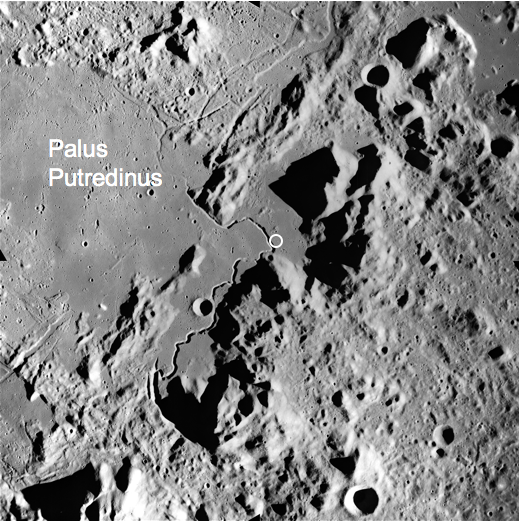
Kaguya flyover of Apollo 15 landing site - www.youtube.com/watch?v=L0GX-nGSXMA
“Though I am not naturally honest, I am sometimes so by chance.”
CAST
Paulina Maureen Beattie
Autolycus Jimmy Chisholm
Polixenes Andy Clark
Mopsa / Emilia Annie Grace
Hermoine Frances Grey
Camilla Janet Kumah
Florizel Scott Mackie
Actor Musician Aly Macrae
Leontes John Michie
Clown / Ensemble Brian James O’Sullivan
Antigonus / Old Shepherd John Stahl
Perdita Fiona Wood
Young Company David Carnie, Will Robertson
CREATIVE TEAM
Director Max Webster
Designer Fly Davis
Lighting Designer Lee Curran
Composer Aly Macrae
Sound Design Gregory Clarke
Casting Director Laura Donnelly
Assistant Director Jack Nurse
Scots translation of selected scenes by James Robertson, 2017.
The Lyceum returns to the Shakespearian canon with acclaimed director Max Webster (King Lear with Michael Pennington; Much Ado About Nothing at Shakespeare's Globe) presenting a uniquely Scottish take on this bitter-sweet masterpiece.
When King Leontes suspects his wife Hermione of adultery his jealousy tears the kingdom apart. The queen is banished and believed dead, while their daughter Perdita is abandoned among simple shepherd folk. Passionate tragedy interweaves with pastoral comedy, leading to one of Shakespeare’s most magical and moving denouements
#TheWintersTale #Lyceum1617
Photography by Mihaela Bodlovic
Royal Air Force Avro 696 Shackleton AEW.2 WR965 65 of 8 Squadron taking part in the Woodford air display at Woodford airfield. Saturday 27th June 1981
Note, WR965 was built by A.V. Roe & Company Limited at Woodford for the Royal Air Force as WR965. It first flew on 7th April 1954 and was awaiting collection on 30th April 1954. It was flown to Royal Air Force Kinloss on 11th May 1954 and then two days later to Number 23 Maintenance Unit at Royal Air Force Aldergrove for storage. It was allocated to the Middle East Air Force on 3rd November 1954 and issued to 37 Squadron coded B on 5th November 1954. Autolycus submarine detection system was installed, initially at Number 49 Maintenance Unit at Royal Air Force Colerne between 9th and 23rd July 1955 and being completed by the CCMC at Royal Air Force St Mawgan, WR965 returning to 37 Squadron. It was moved to at Royal Air Force Safi on Malta on 13th June 1955 and then to A.V. Roe & Company Limited at Langar for major servicing, returning to 37 Squadron on 4th November 1956. It was issued to 38 Squadron coded S on 8th July 1957. It was allocated to A.V. Roe & Company Limited at Langar 23rd May 1959 for Phase I modifications which were completed on 31st March 1960, being issued to 224 Squadron coded T on 6th April 1960. It went to The De Havilland Aircraft Company Limited at Chester on 28th August 1961 for a Phase II update that was completed on 29th March 1962. It was soon loaned to the Ministry of Aviation and moved to the Aeroplane and Armament Experimental Establishment at Boscombe Down for trials on redesigned flame-float launching chute (mod 1013). It was released on 5th April 1962 and allocated to Royal Air Force Ballykelly, being taken on charge by 203 Squadron coded K on 9th April 1962. To Hawker Siddeley Aviation Limited at Langar on 17th March 1966 for Phase III modernisation and after completion arrived with 205 Squadron coded L on 24th May 1967. It was issued to the Ballykelly Wing coded Q on 2nd December 1968. It was allocated to Hawker Siddeley Aviation Limited on 18th December 1968 for revised tailplane de-icing panel fitting. It was then loaned to the Ministry of Technology between 24th March and 9th May 1969 for flight trials from Bitteswell to determine optimum flow rate, returning to the Ballykelly Wing coded Q on 15th May 1969. It was issued to 204 Squadron coded Q in October 1970 and was moved to Number 5 Maintenance Unit at Royal Air Force Kemble on 2nd April 1971 for storage. It was delivered to Hawker Siddeley Aviation Limited at Bitteswell on 28th April 1972 for conversion from a MR.2 variant to an AEW.2 variant. It was test flown from Woodford on 15th November 1972, was moved to Number 5 Maintenance Unit at Royal Air Force Kemble on 28th November 1972 for repainting and was moved to Royal Air Force Lossiemouth on 18th January 1973 for radar installation before being issued to 8 Squadron. It was allocated to Hawker Siddeley Aviation Limited on 16th April 1974 for refurbishing. It returned to 8 Squadron but was soon moved to Number 60 Maintenance Unit at Royal Air Force Leconfield on 29th April 1975 for modifications and then to Hawker Siddeley Aviation Limited at Bitteswell on 1st September 1976 for major servicing and re-sparring. It returned to Royal Air Force Lossiemouth on 19th October 1977 and was taken on charge by 8 Squadron two days later
Ref no BT/00167
Crater Archimedes, Autolycus, Aristillus.DMK 21af04 Firewire webcam 800 frames.& 10" SCT telescope
I captured this close-up of the Archimedes, Autolycus, and Aristillus Craters Region! The Red Dot Mark's the location of the USSR's Lunik 2 Spacecraft impact site!
Luna 2, or Lunik 2, was the first man-made object to land on the Moon. When we say "land on", we actually mean "crash into the Moon at a great speed."
Luna 2 was launched from the Bailkonur Cosmodrome's launch pad 1 (also known as Gagarin's Start) at 06:39:42 GMT on 12th September 1959. The Bailkonur Cosmodrome, in Kazakhstan (although in land leased to Russia), is the world's oldest and largest spaceport.
Luna 2 was Russia's sixth attempt to land on the Moon. Its first three attempts all failed to take off. Its fourth attempt, Luna 1, launched in January 1959, actually went to the moon but missed it, flying past it instead. Luna 1 therefore became the first successful flyby mission of the Moon. Another failed launch took place in June 1959, before eventual success with Luna 2.
While it was making its journey, Luna 2 released sodium gas. This gas reacted with radiation from the Sun which made it glow. This made Luna 2 easier to spot and basically turned the spacecraft into a man-made comet.
The mass of Luna 2 was 390 kilograms. Its diameter was just under 1 metre (90 centimetres).
Luna 2 would have been traveling at a speed of 3.3 kilometres a second, or over 7200 miles an hour, when it hit the Moon.
Russia wanted the world to know that they had reached the Moon. They did this by providing the details of Luna 2's trip to Jodrell Bank in Cheshire,
England. At the time, Jodrell Bank was the world's largest radio telescope and just about the only one capable of tracking Luna 2 from Earth to the Moon.
Jodrell Bank began receiving signals from Luna 2 after take-off. When the signals stopped, this was confirmation that Luna 2 had reached the surface of the Moon as the impact would have destroyed the spacecraft. Impact happened at 21:02:24 GMT on 13th September 1959. Several astronomers confirm that at around
the same time, they spotted a flash of light on the Moon's surface.
Amongst Luna 2's scientific findings were that the Moon doesn't possess a magnetic field (or if it does, it is extremely weak) and that there is a flow of plasma coming from the Sun - it's what we now know as the solar wind.
The mass of Luna 2 was 390 kilograms. Its diameter was just under 1 metre (90 centimetres).
No, the spaceraft or the remnants would not be visible from Earth with any telescope on Earth.
Archimedes Crater (Bottom Left) 83km or 51.8 miles wide & 2.1km or 1.3 miles deep. The diameter of Archimedes is the largest of any crater on the Mare Imbrium. Named for Archimedes of Syracuse who was a Greek mathematician, physicist, engineer, inventor, and astronomer.
Autolycus Crater(bottom right) 39km or 24.4 miles wide & 3.4km or 2.1 miles deep. In Greek mythology, Autolycus was a son of the Olympian god Hermes.
Aristillus Crater(upper right) 55km or 34.4 miles wide & 3.6km or 2.3 miles deep. The crater impact created a ray system that extends outward from the rim for a distance of over 600 kilometers.
inside near center of this crater has a bunch of peaks that are about 1/2 mile high.....Looks like a racked set of Billiard balls, to some the center peaks appears as a heart shape.
Best Regards,
John Chumack
“Though I am not naturally honest, I am sometimes so by chance.”
CAST
Paulina Maureen Beattie
Autolycus Jimmy Chisholm
Polixenes Andy Clark
Mopsa / Emilia Annie Grace
Hermoine Frances Grey
Camilla Janet Kumah
Florizel Scott Mackie
Actor Musician Aly Macrae
Leontes John Michie
Clown / Ensemble Brian James O’Sullivan
Antigonus / Old Shepherd John Stahl
Perdita Fiona Wood
Young Company David Carnie, Will Robertson
CREATIVE TEAM
Director Max Webster
Designer Fly Davis
Lighting Designer Lee Curran
Composer Aly Macrae
Sound Design Gregory Clarke
Casting Director Laura Donnelly
Assistant Director Jack Nurse
Scots translation of selected scenes by James Robertson, 2017.
The Lyceum returns to the Shakespearian canon with acclaimed director Max Webster (King Lear with Michael Pennington; Much Ado About Nothing at Shakespeare's Globe) presenting a uniquely Scottish take on this bitter-sweet masterpiece.
When King Leontes suspects his wife Hermione of adultery his jealousy tears the kingdom apart. The queen is banished and believed dead, while their daughter Perdita is abandoned among simple shepherd folk. Passionate tragedy interweaves with pastoral comedy, leading to one of Shakespeare’s most magical and moving denouements
#TheWintersTale #Lyceum1617
Photography by Mihaela Bodlovic
“Though I am not naturally honest, I am sometimes so by chance.”
CAST
Paulina Maureen Beattie
Autolycus Jimmy Chisholm
Polixenes Andy Clark
Mopsa / Emilia Annie Grace
Hermoine Frances Grey
Camilla Janet Kumah
Florizel Scott Mackie
Actor Musician Aly Macrae
Leontes John Michie
Clown / Ensemble Brian James O’Sullivan
Antigonus / Old Shepherd John Stahl
Perdita Fiona Wood
Young Company David Carnie, Will Robertson
CREATIVE TEAM
Director Max Webster
Designer Fly Davis
Lighting Designer Lee Curran
Composer Aly Macrae
Sound Design Gregory Clarke
Casting Director Laura Donnelly
Assistant Director Jack Nurse
Scots translation of selected scenes by James Robertson, 2017.
The Lyceum returns to the Shakespearian canon with acclaimed director Max Webster (King Lear with Michael Pennington; Much Ado About Nothing at Shakespeare's Globe) presenting a uniquely Scottish take on this bitter-sweet masterpiece.
When King Leontes suspects his wife Hermione of adultery his jealousy tears the kingdom apart. The queen is banished and believed dead, while their daughter Perdita is abandoned among simple shepherd folk. Passionate tragedy interweaves with pastoral comedy, leading to one of Shakespeare’s most magical and moving denouements
#TheWintersTale #Lyceum1617
Photography by Mihaela Bodlovic
“Though I am not naturally honest, I am sometimes so by chance.”
CAST
Paulina Maureen Beattie
Autolycus Jimmy Chisholm
Polixenes Andy Clark
Mopsa / Emilia Annie Grace
Hermoine Frances Grey
Camilla Janet Kumah
Florizel Scott Mackie
Actor Musician Aly Macrae
Leontes John Michie
Clown / Ensemble Brian James O’Sullivan
Antigonus / Old Shepherd John Stahl
Perdita Fiona Wood
Young Company David Carnie, Will Robertson
CREATIVE TEAM
Director Max Webster
Designer Fly Davis
Lighting Designer Lee Curran
Composer Aly Macrae
Sound Design Gregory Clarke
Casting Director Laura Donnelly
Assistant Director Jack Nurse
Scots translation of selected scenes by James Robertson, 2017.
The Lyceum returns to the Shakespearian canon with acclaimed director Max Webster (King Lear with Michael Pennington; Much Ado About Nothing at Shakespeare's Globe) presenting a uniquely Scottish take on this bitter-sweet masterpiece.
When King Leontes suspects his wife Hermione of adultery his jealousy tears the kingdom apart. The queen is banished and believed dead, while their daughter Perdita is abandoned among simple shepherd folk. Passionate tragedy interweaves with pastoral comedy, leading to one of Shakespeare’s most magical and moving denouements
#TheWintersTale #Lyceum1617
Photography by Mihaela Bodlovic
Sinus Lunicus
Archimedes, Autolycus, Aristillus
Montes Spitzbergen
Mons Hadley, Rima Hadley, Apollo 15 site
The Waxing Gibbous Moon for Monday April 30, 2012. The Moon is at 62% of full illumination. Once again less than optimal conditions for photography with a thick layer of moisture creating a glow around the moon and reducing the clarity and quality of the image. Tonight's prominent features include Plato, Copernicus, Rheinhold, Bullialdus, Tycho, Wilhem, Longomontanus, Clavius, and Blancanus.
“Though I am not naturally honest, I am sometimes so by chance.”
CAST
Paulina Maureen Beattie
Autolycus Jimmy Chisholm
Polixenes Andy Clark
Mopsa / Emilia Annie Grace
Hermoine Frances Grey
Camilla Janet Kumah
Florizel Scott Mackie
Actor Musician Aly Macrae
Leontes John Michie
Clown / Ensemble Brian James O’Sullivan
Antigonus / Old Shepherd John Stahl
Perdita Fiona Wood
Young Company David Carnie, Will Robertson
CREATIVE TEAM
Director Max Webster
Designer Fly Davis
Lighting Designer Lee Curran
Composer Aly Macrae
Sound Design Gregory Clarke
Casting Director Laura Donnelly
Assistant Director Jack Nurse
Scots translation of selected scenes by James Robertson, 2017.
The Lyceum returns to the Shakespearian canon with acclaimed director Max Webster (King Lear with Michael Pennington; Much Ado About Nothing at Shakespeare's Globe) presenting a uniquely Scottish take on this bitter-sweet masterpiece.
When King Leontes suspects his wife Hermione of adultery his jealousy tears the kingdom apart. The queen is banished and believed dead, while their daughter Perdita is abandoned among simple shepherd folk. Passionate tragedy interweaves with pastoral comedy, leading to one of Shakespeare’s most magical and moving denouements
#TheWintersTale #Lyceum1617
Photography by Mihaela Bodlovic
“Though I am not naturally honest, I am sometimes so by chance.”
CAST
Paulina Maureen Beattie
Autolycus Jimmy Chisholm
Polixenes Andy Clark
Mopsa / Emilia Annie Grace
Hermoine Frances Grey
Camilla Janet Kumah
Florizel Scott Mackie
Actor Musician Aly Macrae
Leontes John Michie
Clown / Ensemble Brian James O’Sullivan
Antigonus / Old Shepherd John Stahl
Perdita Fiona Wood
Young Company David Carnie, Will Robertson
CREATIVE TEAM
Director Max Webster
Designer Fly Davis
Lighting Designer Lee Curran
Composer Aly Macrae
Sound Design Gregory Clarke
Casting Director Laura Donnelly
Assistant Director Jack Nurse
Scots translation of selected scenes by James Robertson, 2017.
The Lyceum returns to the Shakespearian canon with acclaimed director Max Webster (King Lear with Michael Pennington; Much Ado About Nothing at Shakespeare's Globe) presenting a uniquely Scottish take on this bitter-sweet masterpiece.
When King Leontes suspects his wife Hermione of adultery his jealousy tears the kingdom apart. The queen is banished and believed dead, while their daughter Perdita is abandoned among simple shepherd folk. Passionate tragedy interweaves with pastoral comedy, leading to one of Shakespeare’s most magical and moving denouements
#TheWintersTale #Lyceum1617
Photography by Mihaela Bodlovic
“Though I am not naturally honest, I am sometimes so by chance.”
CAST
Paulina Maureen Beattie
Autolycus Jimmy Chisholm
Polixenes Andy Clark
Mopsa / Emilia Annie Grace
Hermoine Frances Grey
Camilla Janet Kumah
Florizel Scott Mackie
Actor Musician Aly Macrae
Leontes John Michie
Clown / Ensemble Brian James O’Sullivan
Antigonus / Old Shepherd John Stahl
Perdita Fiona Wood
Young Company David Carnie, Will Robertson
CREATIVE TEAM
Director Max Webster
Designer Fly Davis
Lighting Designer Lee Curran
Composer Aly Macrae
Sound Design Gregory Clarke
Casting Director Laura Donnelly
Assistant Director Jack Nurse
Scots translation of selected scenes by James Robertson, 2017.
The Lyceum returns to the Shakespearian canon with acclaimed director Max Webster (King Lear with Michael Pennington; Much Ado About Nothing at Shakespeare's Globe) presenting a uniquely Scottish take on this bitter-sweet masterpiece.
When King Leontes suspects his wife Hermione of adultery his jealousy tears the kingdom apart. The queen is banished and believed dead, while their daughter Perdita is abandoned among simple shepherd folk. Passionate tragedy interweaves with pastoral comedy, leading to one of Shakespeare’s most magical and moving denouements
#TheWintersTale #Lyceum1617
Photography by Mihaela Bodlovic
“Though I am not naturally honest, I am sometimes so by chance.”
CAST
Paulina Maureen Beattie
Autolycus Jimmy Chisholm
Polixenes Andy Clark
Mopsa / Emilia Annie Grace
Hermoine Frances Grey
Camilla Janet Kumah
Florizel Scott Mackie
Actor Musician Aly Macrae
Leontes John Michie
Clown / Ensemble Brian James O’Sullivan
Antigonus / Old Shepherd John Stahl
Perdita Fiona Wood
Young Company David Carnie, Will Robertson
CREATIVE TEAM
Director Max Webster
Designer Fly Davis
Lighting Designer Lee Curran
Composer Aly Macrae
Sound Design Gregory Clarke
Casting Director Laura Donnelly
Assistant Director Jack Nurse
Scots translation of selected scenes by James Robertson, 2017.
The Lyceum returns to the Shakespearian canon with acclaimed director Max Webster (King Lear with Michael Pennington; Much Ado About Nothing at Shakespeare's Globe) presenting a uniquely Scottish take on this bitter-sweet masterpiece.
When King Leontes suspects his wife Hermione of adultery his jealousy tears the kingdom apart. The queen is banished and believed dead, while their daughter Perdita is abandoned among simple shepherd folk. Passionate tragedy interweaves with pastoral comedy, leading to one of Shakespeare’s most magical and moving denouements
#TheWintersTale #Lyceum1617
Photography by Mihaela Bodlovic
“Though I am not naturally honest, I am sometimes so by chance.”
CAST
Paulina Maureen Beattie
Autolycus Jimmy Chisholm
Polixenes Andy Clark
Mopsa / Emilia Annie Grace
Hermoine Frances Grey
Camilla Janet Kumah
Florizel Scott Mackie
Actor Musician Aly Macrae
Leontes John Michie
Clown / Ensemble Brian James O’Sullivan
Antigonus / Old Shepherd John Stahl
Perdita Fiona Wood
Young Company David Carnie, Will Robertson
CREATIVE TEAM
Director Max Webster
Designer Fly Davis
Lighting Designer Lee Curran
Composer Aly Macrae
Sound Design Gregory Clarke
Casting Director Laura Donnelly
Assistant Director Jack Nurse
Scots translation of selected scenes by James Robertson, 2017.
The Lyceum returns to the Shakespearian canon with acclaimed director Max Webster (King Lear with Michael Pennington; Much Ado About Nothing at Shakespeare's Globe) presenting a uniquely Scottish take on this bitter-sweet masterpiece.
When King Leontes suspects his wife Hermione of adultery his jealousy tears the kingdom apart. The queen is banished and believed dead, while their daughter Perdita is abandoned among simple shepherd folk. Passionate tragedy interweaves with pastoral comedy, leading to one of Shakespeare’s most magical and moving denouements
#TheWintersTale #Lyceum1617
Photography by Mihaela Bodlovic
“Though I am not naturally honest, I am sometimes so by chance.”
CAST
Paulina Maureen Beattie
Autolycus Jimmy Chisholm
Polixenes Andy Clark
Mopsa / Emilia Annie Grace
Hermoine Frances Grey
Camilla Janet Kumah
Florizel Scott Mackie
Actor Musician Aly Macrae
Leontes John Michie
Clown / Ensemble Brian James O’Sullivan
Antigonus / Old Shepherd John Stahl
Perdita Fiona Wood
Young Company David Carnie, Will Robertson
CREATIVE TEAM
Director Max Webster
Designer Fly Davis
Lighting Designer Lee Curran
Composer Aly Macrae
Sound Design Gregory Clarke
Casting Director Laura Donnelly
Assistant Director Jack Nurse
Scots translation of selected scenes by James Robertson, 2017.
The Lyceum returns to the Shakespearian canon with acclaimed director Max Webster (King Lear with Michael Pennington; Much Ado About Nothing at Shakespeare's Globe) presenting a uniquely Scottish take on this bitter-sweet masterpiece.
When King Leontes suspects his wife Hermione of adultery his jealousy tears the kingdom apart. The queen is banished and believed dead, while their daughter Perdita is abandoned among simple shepherd folk. Passionate tragedy interweaves with pastoral comedy, leading to one of Shakespeare’s most magical and moving denouements
#TheWintersTale #Lyceum1617
Photography by Mihaela Bodlovic
“Though I am not naturally honest, I am sometimes so by chance.”
CAST
Paulina Maureen Beattie
Autolycus Jimmy Chisholm
Polixenes Andy Clark
Mopsa / Emilia Annie Grace
Hermoine Frances Grey
Camilla Janet Kumah
Florizel Scott Mackie
Actor Musician Aly Macrae
Leontes John Michie
Clown / Ensemble Brian James O’Sullivan
Antigonus / Old Shepherd John Stahl
Perdita Fiona Wood
Young Company David Carnie, Will Robertson
CREATIVE TEAM
Director Max Webster
Designer Fly Davis
Lighting Designer Lee Curran
Composer Aly Macrae
Sound Design Gregory Clarke
Casting Director Laura Donnelly
Assistant Director Jack Nurse
Scots translation of selected scenes by James Robertson, 2017.
The Lyceum returns to the Shakespearian canon with acclaimed director Max Webster (King Lear with Michael Pennington; Much Ado About Nothing at Shakespeare's Globe) presenting a uniquely Scottish take on this bitter-sweet masterpiece.
When King Leontes suspects his wife Hermione of adultery his jealousy tears the kingdom apart. The queen is banished and believed dead, while their daughter Perdita is abandoned among simple shepherd folk. Passionate tragedy interweaves with pastoral comedy, leading to one of Shakespeare’s most magical and moving denouements
#TheWintersTale #Lyceum1617
Photography by Mihaela Bodlovic
“Though I am not naturally honest, I am sometimes so by chance.”
CAST
Paulina Maureen Beattie
Autolycus Jimmy Chisholm
Polixenes Andy Clark
Mopsa / Emilia Annie Grace
Hermoine Frances Grey
Camilla Janet Kumah
Florizel Scott Mackie
Actor Musician Aly Macrae
Leontes John Michie
Clown / Ensemble Brian James O’Sullivan
Antigonus / Old Shepherd John Stahl
Perdita Fiona Wood
Young Company David Carnie, Will Robertson
CREATIVE TEAM
Director Max Webster
Designer Fly Davis
Lighting Designer Lee Curran
Composer Aly Macrae
Sound Design Gregory Clarke
Casting Director Laura Donnelly
The Lyceum returns to the Shakespearian canon with acclaimed director Max Webster (King Lear with Michael Pennington; Much Ado About Nothing at Shakespeare's Globe) presenting a uniquely Scottish take on this bitter-sweet masterpiece.
When King Leontes suspects his wife Hermione of adultery his jealousy tears the kingdom apart. The queen is banished and believed dead, while their daughter Perdita is abandoned among simple shepherd folk. Passionate tragedy interweaves with pastoral comedy, leading to one of Shakespeare’s most magical and moving denouements
#TheWintersTale #Lyceum1617
Photography by Aly Wight
“Though I am not naturally honest, I am sometimes so by chance.”
CAST
Paulina Maureen Beattie
Autolycus Jimmy Chisholm
Polixenes Andy Clark
Mopsa / Emilia Annie Grace
Hermoine Frances Grey
Camilla Janet Kumah
Florizel Scott Mackie
Actor Musician Aly Macrae
Leontes John Michie
Clown / Ensemble Brian James O’Sullivan
Antigonus / Old Shepherd John Stahl
Perdita Fiona Wood
Young Company David Carnie, Will Robertson
CREATIVE TEAM
Director Max Webster
Designer Fly Davis
Lighting Designer Lee Curran
Composer Aly Macrae
Sound Design Gregory Clarke
Casting Director Laura Donnelly
Assistant Director Jack Nurse
Scots translation of selected scenes by James Robertson, 2017.
The Lyceum returns to the Shakespearian canon with acclaimed director Max Webster (King Lear with Michael Pennington; Much Ado About Nothing at Shakespeare's Globe) presenting a uniquely Scottish take on this bitter-sweet masterpiece.
When King Leontes suspects his wife Hermione of adultery his jealousy tears the kingdom apart. The queen is banished and believed dead, while their daughter Perdita is abandoned among simple shepherd folk. Passionate tragedy interweaves with pastoral comedy, leading to one of Shakespeare’s most magical and moving denouements
#TheWintersTale #Lyceum1617
Photography by Mihaela Bodlovic
“Though I am not naturally honest, I am sometimes so by chance.”
CAST
Paulina Maureen Beattie
Autolycus Jimmy Chisholm
Polixenes Andy Clark
Mopsa / Emilia Annie Grace
Hermoine Frances Grey
Camilla Janet Kumah
Florizel Scott Mackie
Actor Musician Aly Macrae
Leontes John Michie
Clown / Ensemble Brian James O’Sullivan
Antigonus / Old Shepherd John Stahl
Perdita Fiona Wood
Young Company David Carnie, Will Robertson
CREATIVE TEAM
Director Max Webster
Designer Fly Davis
Lighting Designer Lee Curran
Composer Aly Macrae
Sound Design Gregory Clarke
Casting Director Laura Donnelly
The Lyceum returns to the Shakespearian canon with acclaimed director Max Webster (King Lear with Michael Pennington; Much Ado About Nothing at Shakespeare's Globe) presenting a uniquely Scottish take on this bitter-sweet masterpiece.
When King Leontes suspects his wife Hermione of adultery his jealousy tears the kingdom apart. The queen is banished and believed dead, while their daughter Perdita is abandoned among simple shepherd folk. Passionate tragedy interweaves with pastoral comedy, leading to one of Shakespeare’s most magical and moving denouements
#TheWintersTale #Lyceum1617
Photography by Aly Wight
“Though I am not naturally honest, I am sometimes so by chance.”
CAST
Paulina Maureen Beattie
Autolycus Jimmy Chisholm
Polixenes Andy Clark
Mopsa / Emilia Annie Grace
Hermoine Frances Grey
Camilla Janet Kumah
Florizel Scott Mackie
Actor Musician Aly Macrae
Leontes John Michie
Clown / Ensemble Brian James O’Sullivan
Antigonus / Old Shepherd John Stahl
Perdita Fiona Wood
Young Company David Carnie, Will Robertson
CREATIVE TEAM
Director Max Webster
Designer Fly Davis
Lighting Designer Lee Curran
Composer Aly Macrae
Sound Design Gregory Clarke
Casting Director Laura Donnelly
Assistant Director Jack Nurse
Scots translation of selected scenes by James Robertson, 2017.
The Lyceum returns to the Shakespearian canon with acclaimed director Max Webster (King Lear with Michael Pennington; Much Ado About Nothing at Shakespeare's Globe) presenting a uniquely Scottish take on this bitter-sweet masterpiece.
When King Leontes suspects his wife Hermione of adultery his jealousy tears the kingdom apart. The queen is banished and believed dead, while their daughter Perdita is abandoned among simple shepherd folk. Passionate tragedy interweaves with pastoral comedy, leading to one of Shakespeare’s most magical and moving denouements
#TheWintersTale #Lyceum1617
Photography by Mihaela Bodlovic
“Though I am not naturally honest, I am sometimes so by chance.”
CAST
Paulina Maureen Beattie
Autolycus Jimmy Chisholm
Polixenes Andy Clark
Mopsa / Emilia Annie Grace
Hermoine Frances Grey
Camilla Janet Kumah
Florizel Scott Mackie
Actor Musician Aly Macrae
Leontes John Michie
Clown / Ensemble Brian James O’Sullivan
Antigonus / Old Shepherd John Stahl
Perdita Fiona Wood
Young Company David Carnie, Will Robertson
CREATIVE TEAM
Director Max Webster
Designer Fly Davis
Lighting Designer Lee Curran
Composer Aly Macrae
Sound Design Gregory Clarke
Casting Director Laura Donnelly
Assistant Director Jack Nurse
Scots translation of selected scenes by James Robertson, 2017.
The Lyceum returns to the Shakespearian canon with acclaimed director Max Webster (King Lear with Michael Pennington; Much Ado About Nothing at Shakespeare's Globe) presenting a uniquely Scottish take on this bitter-sweet masterpiece.
When King Leontes suspects his wife Hermione of adultery his jealousy tears the kingdom apart. The queen is banished and believed dead, while their daughter Perdita is abandoned among simple shepherd folk. Passionate tragedy interweaves with pastoral comedy, leading to one of Shakespeare’s most magical and moving denouements
#TheWintersTale #Lyceum1617
Photography by Mihaela Bodlovic
“Though I am not naturally honest, I am sometimes so by chance.”
CAST
Paulina Maureen Beattie
Autolycus Jimmy Chisholm
Polixenes Andy Clark
Mopsa / Emilia Annie Grace
Hermoine Frances Grey
Camilla Janet Kumah
Florizel Scott Mackie
Actor Musician Aly Macrae
Leontes John Michie
Clown / Ensemble Brian James O’Sullivan
Antigonus / Old Shepherd John Stahl
Perdita Fiona Wood
Young Company David Carnie, Will Robertson
CREATIVE TEAM
Director Max Webster
Designer Fly Davis
Lighting Designer Lee Curran
Composer Aly Macrae
Sound Design Gregory Clarke
Casting Director Laura Donnelly
The Lyceum returns to the Shakespearian canon with acclaimed director Max Webster (King Lear with Michael Pennington; Much Ado About Nothing at Shakespeare's Globe) presenting a uniquely Scottish take on this bitter-sweet masterpiece.
When King Leontes suspects his wife Hermione of adultery his jealousy tears the kingdom apart. The queen is banished and believed dead, while their daughter Perdita is abandoned among simple shepherd folk. Passionate tragedy interweaves with pastoral comedy, leading to one of Shakespeare’s most magical and moving denouements
#TheWintersTale #Lyceum1617
Photography by Aly Wight
“Though I am not naturally honest, I am sometimes so by chance.”
CAST
Paulina Maureen Beattie
Autolycus Jimmy Chisholm
Polixenes Andy Clark
Mopsa / Emilia Annie Grace
Hermoine Frances Grey
Camilla Janet Kumah
Florizel Scott Mackie
Actor Musician Aly Macrae
Leontes John Michie
Clown / Ensemble Brian James O’Sullivan
Antigonus / Old Shepherd John Stahl
Perdita Fiona Wood
Young Company David Carnie, Will Robertson
CREATIVE TEAM
Director Max Webster
Designer Fly Davis
Lighting Designer Lee Curran
Composer Aly Macrae
Sound Design Gregory Clarke
Casting Director Laura Donnelly
The Lyceum returns to the Shakespearian canon with acclaimed director Max Webster (King Lear with Michael Pennington; Much Ado About Nothing at Shakespeare's Globe) presenting a uniquely Scottish take on this bitter-sweet masterpiece.
When King Leontes suspects his wife Hermione of adultery his jealousy tears the kingdom apart. The queen is banished and believed dead, while their daughter Perdita is abandoned among simple shepherd folk. Passionate tragedy interweaves with pastoral comedy, leading to one of Shakespeare’s most magical and moving denouements
#TheWintersTale #Lyceum1617
Photography by Aly Wight
“Though I am not naturally honest, I am sometimes so by chance.”
CAST
Paulina Maureen Beattie
Autolycus Jimmy Chisholm
Polixenes Andy Clark
Mopsa / Emilia Annie Grace
Hermoine Frances Grey
Camilla Janet Kumah
Florizel Scott Mackie
Actor Musician Aly Macrae
Leontes John Michie
Clown / Ensemble Brian James O’Sullivan
Antigonus / Old Shepherd John Stahl
Perdita Fiona Wood
Young Company David Carnie, Will Robertson
CREATIVE TEAM
Director Max Webster
Designer Fly Davis
Lighting Designer Lee Curran
Composer Aly Macrae
Sound Design Gregory Clarke
Casting Director Laura Donnelly
Assistant Director Jack Nurse
Scots translation of selected scenes by James Robertson, 2017.
The Lyceum returns to the Shakespearian canon with acclaimed director Max Webster (King Lear with Michael Pennington; Much Ado About Nothing at Shakespeare's Globe) presenting a uniquely Scottish take on this bitter-sweet masterpiece.
When King Leontes suspects his wife Hermione of adultery his jealousy tears the kingdom apart. The queen is banished and believed dead, while their daughter Perdita is abandoned among simple shepherd folk. Passionate tragedy interweaves with pastoral comedy, leading to one of Shakespeare’s most magical and moving denouements
#TheWintersTale #Lyceum1617
Photography by Mihaela Bodlovic
“Though I am not naturally honest, I am sometimes so by chance.”
CAST
Paulina Maureen Beattie
Autolycus Jimmy Chisholm
Polixenes Andy Clark
Mopsa / Emilia Annie Grace
Hermoine Frances Grey
Camilla Janet Kumah
Florizel Scott Mackie
Actor Musician Aly Macrae
Leontes John Michie
Clown / Ensemble Brian James O’Sullivan
Antigonus / Old Shepherd John Stahl
Perdita Fiona Wood
Young Company David Carnie, Will Robertson
CREATIVE TEAM
Director Max Webster
Designer Fly Davis
Lighting Designer Lee Curran
Composer Aly Macrae
Sound Design Gregory Clarke
Casting Director Laura Donnelly
Assistant Director Jack Nurse
Scots translation of selected scenes by James Robertson, 2017.
The Lyceum returns to the Shakespearian canon with acclaimed director Max Webster (King Lear with Michael Pennington; Much Ado About Nothing at Shakespeare's Globe) presenting a uniquely Scottish take on this bitter-sweet masterpiece.
When King Leontes suspects his wife Hermione of adultery his jealousy tears the kingdom apart. The queen is banished and believed dead, while their daughter Perdita is abandoned among simple shepherd folk. Passionate tragedy interweaves with pastoral comedy, leading to one of Shakespeare’s most magical and moving denouements
#TheWintersTale #Lyceum1617
Photography by Mihaela Bodlovic