View allAll Photos Tagged Understanding
Old Schools, University of Cambridge. Taken yesterday during the signing of the Memorandum of Understanding between the University and Shromani Gurdwara Parbandhak Committee.
More on Sikhism: en.wikipedia.org/wiki/Sikhism .
this is for the group fabulous fountain friday.
Im sorry ive been absent... its been one thing after another here. and since my Father Inlaws Alzheimer's is getting much worse , im the new taxi:). i wont bore you all, but ive been pretty busy.. ill try to keep up with every one.
thanks for understanding
This and all of my images have copyright protection. Do not use, copy, or reproduce my photos in any format for any purpose without my written permission.
This message especially applies; but not limited to, Reddit.com, socialsavanna.com, reddpipe.com, Facebook, Twitter, Pintrest, and Tumblr.
In my opinion members of these groups appear to have difficulty understanding the concept of copyright infringement or fair use.
Red Crossbills returned today! Did not have time to photograph so posting an oldie. 'One' of my favourite birds! They are on the endangered species list here in Newfoundland.
The Free Life Pond is an annex pond of the Han Chinese Buddhist temples. It is usually located in front of the Shanmen or the Hall of Four Heavenly Kings. The Free Life Pond embodies Buddhist thoughts of compassion and understanding of all living beings.
The Free Life Pond can regulate the air, inhibit dust, but also has the role of fire prevention. If the Buddhist temple is on fire, the water in the pond can be used to fight the fire.
en.wikipedia.org/wiki/Free_Life_Pond
El Estanque de la Vida Libre es un estanque anexo de los templos budistas chinos Han. Suele estar situado frente al Shanmen o Salón de los Cuatro Reyes Celestiales. El Estanque de la Vida Libre encarna los pensamientos budistas de compasión y comprensión hacia todos los seres vivos.
El Estanque de la Vida Libre puede regular el aire, inhibir el polvo, pero también tiene la función de prevenir incendios. Si el templo budista se incendia, el agua del estanque puede utilizarse para combatir el fuego.
Lingyin Temple (simplified Chinese: 灵隐寺; traditional Chinese: 靈隱寺; pinyin: Língyǐn Sì) is a Buddhist temple of the Chan sect located north-west of Hangzhou, Zhejiang Province, China. The temple's name is commonly translated into English as Temple of the Soul's Retreat, which is a literal translation of the Chinese. It is one of the largest and wealthiest Buddhist temples in China, and contains numerous pagodas and Buddhist grottoes.
The monastery is the largest of several temples in the Wulin Mountains (Chinese: 武林山; Pinyin: Wǔlínshān), which also features many grottos and religious rock carvings, the most famous of which is the Feilai Feng (Traditional Chinese: 飛來峰石窟; Simplified Chinese:飞来峰石窟; literally: "the peak that flew hither").
According to tradition, the monastery was founded in 328 AD during the Eastern Jin dynasty (266–420) by an Indian monk, named Huili in Chinese. From its inception, Lingyin was a famous monastery in the Jiangnan region.
During the Cultural Revolution, the temple and grounds suffered damage at the hands of red guards, but the students of Zhejiang University tried to protect the temple. The temple managed to avoid large scale destruction partly because of the instructions of Premier Zhou Enlai.
Today the temple is thriving as a destination for both pilgrims and tourists. It is regarded as one of the wealthiest monasteries in China, and regular pilgrims have included former paramount leader Deng Xiaoping.
The Wuling Mountains area is a major centre of Chan Buddhism in south-eastern China. A number of smaller temples are also located in the area. Today, Lingyin and the surrounding areas are marketed as the Lingyin-Feilai Feng Scenic Area, with ticketed admission.
en.wikipedia.org/wiki/Lingyin_Temple
www.viajeachina.com/atracciones-de-hangzhou/templo-lingyi...
www.thechinaguide.com/es/sight/lingyin-temple
El templo de Lingyin (chino simplificado: 灵隐寺; chino tradicional: 靈隱寺; pinyin: Língyǐn Sì) es un templo budista de la secta Chan situado al noroeste de Hangzhou, en la provincia china de Zhejiang. El nombre del templo se traduce comúnmente al inglés como Temple of the Soul's Retreat (Retiro del Templo del Alma), que es una traducción literal del chino. Es uno de los templos budistas más grandes y ricos de China, y contiene numerosas pagodas y grutas budistas.
El monasterio es el mayor de varios templos de las montañas Wulin (chino: 武林山; pinyin: Wǔlínshān), que también cuenta con numerosas grutas y tallas religiosas en la roca, la más famosa de las cuales es el Feilai Feng (chino tradicional: 飛來峰石窟; chino simplificado:飞来峰石窟; literalmente: "el pico que voló hasta aquí").
Según la tradición, el monasterio fue fundado en el año 328 d.C. durante la dinastía Jin Oriental (266-420) por un monje indio, llamado Huili en chino. Desde sus inicios, Lingyin fue un famoso monasterio de la región de Jiangnan.
Durante la Revolución Cultural, el templo y sus terrenos sufrieron daños a manos de los guardias rojos, pero los estudiantes de la Universidad de Zhejiang intentaron protegerlo. El templo logró evitar la destrucción a gran escala en parte gracias a las instrucciones del primer ministro Zhou Enlai.
En la actualidad, el templo prospera como destino tanto para peregrinos como para turistas. Está considerado uno de los monasterios más ricos de China, y entre sus peregrinos habituales se encuentra el antiguo líder supremo Deng Xiaoping.
La zona de las montañas Wuling es un importante centro del budismo Chan en el sureste de China. En la zona también hay varios templos más pequeños. En la actualidad, Lingyin y sus alrededores se comercializan como Zona Escénica de Lingyin-Feilai Feng, con entrada.
Not the greatest sunrise but I’ll take what I get while it lasts. For reasons that surpass my understanding, once the black walnut starts leafing out, this silhouette — which is a staple for me in the winter -- doesn’t work.
Nikon D7500 — Nikon 18-300mm F6.3 ED VR
24mm
F8@1/20th
ISO 400
GND filter
DSB_9934.JPG
©Don Brown 2026
The Egg Nebula is a preplanetary nebula, created by a dying star in the process of becoming a planetary nebula. Planetary nebulas have nothing to do with planets – the name arose when 18th century astronomers spotted them in their telescopes and thought they looked like planets. Instead, they are the remnants of material expelled by Sun-like stars in the later stages of their lives.
The preplanetary nebula phase is extremely short-lived in astronomical terms – only a few thousand years. This makes them rare objects and, combined with the fact that they are quite faint, rather difficult to spot. The Egg Nebula, located around 3000 light years from us, was the first of its kind to be discovered in the 1970s. This image is based on observations performed in the mid 1990s by the Wide Field and Planetary Camera 2 (WFPC2) on the NASA/ESA Hubble Space Telescope.
During the preplanetary nebula phase, the central star periodically sheds its outer layers, which are then illuminated by the dying star at the centre. Eventually the star stops shedding material and the core remnant heats up, exciting the expelled gas so that it glows brightly and becomes a planetary nebula.
The dark band, sweeping beams, and criss-crossing arcs in this image can reveal a lot about the complex environment of a dying star. The central band is a cocoon of dust hiding the star from view.
Beams of light emanate from the obscured star, and it is thought that they are due to starlight escaping from the ring-shaped holes in the dusty cocoon that surrounds the star. The holes are possibly carved by a high-speed stream of matter, although the cause of these jets are unknown. The spoke-like features are shadows cast by blobs of material within the region of the holes in the cocoon.
Numerous bright arcs intersect the beams: these are shells of matter ejected by the star. The arcs are like tree rings, and can tell us something about the object's age as they reveal that the rate of mass ejection has varied between 100 and 500 years throughout its 10 000 year history. The gas is expanding at a rate of 20 km/s and matter has been detected out to a radius of 0.6 light years, providing an estimate of the amount of matter in the nebula.
This image was previously published on NASA's and ESA's Hubble websites.
Credit: Raghvendra Sahai and John Trauger (JPL), the WFPC2 science team, and NASA/ESA
The Free Life Pond is an annex pond of the Han Chinese Buddhist temples. It is usually located in front of the Shanmen or the Hall of Four Heavenly Kings. The Free Life Pond embodies Buddhist thoughts of compassion and understanding of all living beings.
The Free Life Pond can regulate the air, inhibit dust, but also has the role of fire prevention. If the Buddhist temple is on fire, the water in the pond can be used to fight the fire.
en.wikipedia.org/wiki/Free_Life_Pond
El Estanque de la Vida Libre es un estanque anexo de los templos budistas chinos Han. Suele estar situado frente al Shanmen o Salón de los Cuatro Reyes Celestiales. El Estanque de la Vida Libre encarna los pensamientos budistas de compasión y comprensión hacia todos los seres vivos.
El Estanque de la Vida Libre puede regular el aire, inhibir el polvo, pero también tiene la función de prevenir incendios. Si el templo budista se incendia, el agua del estanque puede utilizarse para combatir el fuego.
Feilai Feng, or "the Peak that Flew Hither", also commonly translated as "Flying Peak" (Traditional Chinese: 飛來峰石窟; Simplified Chinese:飞来峰石窟), is located in front of the temple proper. The peak is so-named because it is made of limestone, giving it a craggy appearance very different from the surrounding mountains. Legend holds that the peak was originally from India (with some versions suggesting that it is Vulture Peak), but flew to Hangzhou overnight as a demonstration of the omnipotence of Buddhist law. A large number of grottoes can be found on the peak, such as Qinglin Grotto, Yuru Grotto and Longhong Grotto. Many rock reliefs dot the peak surface, and more are located in the various caves and grottoes throughout the peak. Within the main cave, dedicated to the bodhisattva Guanyin, there is a crack in the ceiling of the cave that stretches up to the surface, so that a person standing at a certain position can see a sliver of sunlight. This is known as the "one thread of heaven" (Traditional Chinese: 一線天; Simplified Chinese: 一线天; Pinyin: Yīxiàn Tiān).
The stone carvings on Feilai Feng are located in an area measuring 600 meters long and 200 meters wide. In total, there are 153 shrines and more than 470 pieces of carvings, among which 338 are relatively well-preserved, 96 carvings from the Yuan Dynasty as well as several from the Ming Dynasty.
Around 11 carvings date to the late Tang Dynasty and Five Dynasties and Ten Kingdoms Period. These carvings dot the top of the peak and the mouth of Qinglin Grotto and they all prominently feature the “Three Saints of the West”, which refers to the triad of Amitābha Buddha and the Bodhisattvas Guanyin and Mahasthamaprapta from Pure Land Buddhism.
A total of 222 carvings were produced in the Northern Song Dynasty period, which feature a diverse range of Buddhist figures including the Six Patriarchs of Chan (or Zen) Buddhism, various arhats, Bodhisattvas and Buddhas such as Vairocana. One of the more prominent carvings from this period is a shrine to Budai, a monk who is traditionally regarded as an incarnation of Maitreya, surrounded by the Eighteen Arhats. This shrine stands at 3.6 meters high and 9.9 meters long, making it the largest shrine on Feilai Feng.
Most of the nearly 100 carvings produced during the Yuan Dynasty are located on the southern bank of Lengquan Stream and on the cliff near Qinglin Grotto and Yuru Grotto. The carvings from this period resembles the art styles of the Tang and Song dynasties, while also reflecting influences from Tibetan and Mongolian art.
www.viajeachina.com/atracciones-de-hangzhou/templo-lingyi...
www.thechinaguide.com/es/sight/lingyin-temple
en.wikipedia.org/wiki/Lingyin_Temple
Feilai Feng, o "el pico que voló hasta aquí", también traducido comúnmente como "pico volador" (chino tradicional: 飛來峰石窟; chino simplificado:飞来峰石窟), está situado frente al templo propiamente dicho. El pico se llama así porque está hecho de piedra caliza, lo que le da un aspecto escarpado muy diferente del de las montañas circundantes. La leyenda sostiene que el pico era originario de la India (algunas versiones sugieren que se trata del Pico del Buitre), pero voló a Hangzhou de la noche a la mañana como demostración de la omnipotencia de la ley budista. En la cima hay un gran número de grutas, como la Gruta Qinglin, la Gruta Yuru y la Gruta Longhong. Numerosos relieves rocosos salpican la superficie de la cima, y hay más en las diversas cuevas y grutas que la recorren. En la cueva principal, dedicada al bodhisattva Guanyin, hay una grieta en el techo que se extiende hasta la superficie, de modo que una persona situada en una determinada posición puede ver un resquicio de luz solar. Esto se conoce como "el hilo del cielo" (chino tradicional: 一線天; chino simplificado: 一线天; pinyin: Yīxiàn Tiān).
Las tallas de piedra de Feilai Feng se encuentran en un área de 600 metros de largo y 200 metros de ancho. En total, hay 153 santuarios y más de 470 tallas, de las que 338 están relativamente bien conservadas, 96 tallas de la dinastía Yuan y varias de la dinastía Ming.
Unas 11 tallas datan de finales de la Dinastía Tang y del Periodo de las Cinco Dinastías y los Diez Reinos. Estas tallas salpican la cima del pico y la boca de la gruta de Qinglin y en todas ellas destacan los "Tres Santos de Occidente", que hacen referencia a la tríada del Buda Amitābha y los bodhisattvas Guanyin y Mahasthamaprapta del budismo de la Tierra Pura.
En el periodo de la dinastía Song del Norte se produjeron un total de 222 tallas, en las que aparecen diversas figuras budistas, como los Seis Patriarcas del budismo chan (o zen), varios arhats, bodhisattvas y budas como Vairocana. Una de las tallas más destacadas de este periodo es un santuario dedicado a Budai, un monje que tradicionalmente se considera una encarnación de Maitreya, rodeado de los Dieciocho Arhats. Este santuario mide 3,6 metros de alto y 9,9 metros de largo, lo que lo convierte en el más grande de Feilai Feng.
La mayoría de las casi 100 tallas producidas durante la Dinastía Yuan se encuentran en la orilla sur del arroyo Lengquan y en el acantilado cercano a la Gruta Qinglin y la Gruta Yuru. Las tallas de este periodo se asemejan a los estilos artísticos de las dinastías Tang y Song, aunque también reflejan influencias del arte tibetano y mongol.
From my garden and my heart I give you the gift of love. For a whole year now since my current illness began I was unable to tend my garden, but my garden has unconditional love and understanding and still furnishes me with gifts such as this. From nature I learn so much. Wish you all a very happy weekend <3
“We have a long way to go before we are able to hear the voices of everyone on earth, but I believe that providing voices and building bridges is essential for the World Peace we all wish for.”
- Joichi Ito
Soundtrack : www.youtube.com/watch?v=wlR0KElxxVg
I'D LIKE TO TEACH THE WORLD TO SING – THE NEW SEEKERS
How beautiful the world appears to me
through peaceful soul transfers tranquility
my heart is full with love and understanding
like milk and honey; sweet and nourishing thoughts are landing
little seeds of hope erasing doubt
sown now will grow and chase blue feelings out
encase me in a bubble with rainbows overhead
allow me gentle sleep to dream and cast out anxious dread
I kneel and pray before I fall in slumber
and listen for the answers; some come as numbers
these are the messages from angels voices
and in the night deciphering and making better choices
I wake before the dawn has chance to break
the little birds already singing make my heart ache
but not with sadness; more in yearning for the truth
I pray for words to seek me out; not be aloof
and like a gentle stream that carries boats from every nation
my ears receive the sounds with such elation
I see a future bound with endless gifts of love
for each and everyone on earth from Heaven above
reach out your hands and look towards your neighbour
and see reflected there the efforts of their labour
like looking into mirrored glass we see the souls
that are our own and theirs; life takes it's toll
but we can make things better for one and all
if only we let our inner light shine bright and tall
no matter who you are or where you're from
smile at your fellow man; let peace and love succumb
don't fight against each other; lay down arms
for we are in this life together; you and I
and all of us are hurting; I hear your cry
but if you stop to listen to the wind
you'll hear my plea more clearly and rescind
I hear your voice; I share in your humility
If you can but perceive the possibility
that yesterday you thought I was your enemy
but today and all the morrows I hope you now see
that I was not at all what you first thought
and changing minds is not a sign of weakness wrought
but more a sign of intelligent supposition
to merge our futures is not at all submission
it is a sign of strength; a sign of love
of hope and peace; sent freely from above
and once the world is ready for this change
we'll see that pain is gone and peace will reign
for quite often we make bad choices and some worse
forgiveness is the forefront to give peace a chance; rebirth
look in your neighbour's eyes; what do you see
that I am you and you are me and so is he.
- AP - Copyright © remains with and is the intellectual property of the author
Copyright © protected image please do not reproduce without permission
Artwork by British artist Martin Creed at his exhibition SAY CHEESE! in Museum Voorlinden Wassenaar, Holland.
More Martin Creed at
when someone can truly look into you and know you and really see what you are and how you think and what you would do. when someone has been looking for so long for the things that they have always had within themselves, but needed the right mirror. the right mirror.
double exposure on the hasselblad.
"Imagine there's no countries
It isn't hard to do
Nothing to kill or die for
And no religion too
Imagine all the people
Living life in peace..."
- John Lennon
The older that you get, the more you understand how your mind processes your reality. The biggest and only critic lives in your perception of people's perception of yourself rather than people's perception of you.
My pictures at GettyImages and SeenBy
Nikon D300 with Tokina 12-24mm/f4: 12mm - ISO200 - 1/160 - f5.6
For the singularity of understanding, each comprehends the others as itself in a flow of spacetime. We are as one with the things around - each is no thing but its understanding with the others - each a symbol of the others.
Good morning Panda Loving Friends! Happy WednesMei! Happy FwendzBei! Happy WenzJi!
Please be careful going outdoors if you're affected by the Canadian wildfires.
Still hoping the cams get fixed at some point. Not understanding this issue. Happy at this point to grab a few shots.
Happy 2.5 YEARS / 33 MONTHS / 145 WEEKS / 1020 DAYS cutie miracle cub Qi Ji!
Have a panderific day everyone, be kind, enjoy some little thing, and be safe.
Here is Vincent's Cypress tree through my 18mm Nikkor lens shortly after sunrise. Like all superwide angle lenses with large hemispherical front elements, optical aberrations result when strong directional light reaches the front element unshaded. The most intense source of direct light that I have access to is just behind the branch on the right, and it is causing the orange and yellow blobs you see. This is called ghosting, fitting for a tree inhabited by a Dutch painter thats been dead since 1890! Reminds me of a quote: "To understand blue you must first understand yellow and orange". I am beginning to understand!
The immensity of existence truly defies human understanding - which makes it very humanly awesome of us to try anyway. If people could understand for a single second the true scale of everything out there, all our idiotic problems would evaporate instantly. (Either because we got our acts together or our heads popped, no bets on which.)
Luke McKinney
www.dailygalaxy.com/my_weblog/2009/08/great-wall-of-space...
Lacul Morii-Bucharest city
*Not the brand or technique is important in photographic art, but the understanding of the things behind the photographed subjects, the emotion, the composition, the joy or the sadness, the life itself that is mysteriously coming unrepeatable as a gift.
(Horia Stanicel)
* I have seen a large part of the most popular or devoted photographers' photographs over time and of course I can say that most of them have speculated on different situations, angles of photography, shadows, different brightness, feelings, human tragedies, all kinds of paradoxical situations that of course make them noticed. I do not want to bring any name into question for the simple reason that each photographic artist has a unique value. However, I regard the photographic art as a simple spectator that is difficult to be convince most of the times. I contemplate the creation of God and every time I photograph I do not forget how grateful we should be for all the beauty that our Creator gave it to us! People who forget this do nothing but hate themselves and the world they live in and photography is nothing but a mirror of this beautiful or crooked world.(Horia Stanicel)
*Nu aparatul foto sau tehnica este importantă în arta fotografică, ci înțelegerea lucrurilor care stau în spatele subiectelor fotografiate,emoția, compoziția, bucuria sau tristețea, viața însăși care vine tainic irepetabil ca un dar.
(Horia Stanicel)
*Am văzut o mare parte a fotografiilor celor mai populari sau consacrați artiști fotografi de-a lungul timpului și desigur pot spune că majoritatea dintre ei au speculat diversele situații,unghiuri de fotografiere, umbre, luminozitati diferite,sentimente,tragedii umane chiar,tot felul de situații paradoxale care desigur să-i facă remarcați.Nu vreau să aduc vreun nume în discuție pentru simplul motiv că fiecare artist fotograf are o valoare unică. Totuși eu privesc arta fotografică ca un simplu spectator greu de convins de cele mai multe ori.Eu contemplu creația lui Dumnezeu și de fiecare dată când fotografiez nu uit cât de recunoscători ar trebui să fim pentru toată frumusețea pe care Creatorul nostru ne-a daruit-o! Oamenii care uită aceasta nu fac decât să se urâțească pe ei înșiși dar și lumea în care trăiesc iar fotografia nu este decât o oglindă a acestei lumi frumoase sau urâțite.
(Horia Stanicel)
© DM Parody 2022 (www.flickr.com/photos/davidparody/) These images are protected by copyright. You CANNOT copy or republish any of these photos without written consent of the photographer even if you retain the watermark (if present) and/or credit the photographer. You cannot use on any media including social media either. You CAN post a link to the page where the image appears without reference to the photographer only if not promoting a commercial product or service. Copyright infringements will be followed up, legally if necessary. Thank you for your understanding.
Two stars both alike in dignity, in the fair Southern Ring planetary nebula where we lay our scene...
Here our “star-crossed lovers” are actually a dying star expelling gas & dust, in orbit with a younger star that is helping to change the shape of this nebula’s intricate rings by creating turbulence. The James Webb Space Telescope can see through the gas and dust in unprecedented detail. In thousands of years, these delicate, gaseous layers will dissipate into surrounding space.
This image is from Webb’s NIRCam instrument, which saw this nebula in the near-infrared.
The Southern Ring nebula is called a planetary nebula. Despite “planet” in the name, which comes from how these objects first appeared to astronomers observing them hundreds of years ago, these are shells of dust and gas shed by dying Sun-like stars. The new details from Webb will transform our understanding of how stars evolve and influence their environments.
Read more about the new Webb observations of this object: nasa.gov/webbfirstimages/
Credits: NASA, ESA, CSA, and STScI
Image description
A planetary nebula, seen by the Webb telescope’s NIRCam instrument, against the blackness of space, with points of starlight behind it. The nebula itself is shaped like an irregular oval, with lacy, reddish orange plumes of gas and dust. Further inside the circle, the gas and dust glows bright blue. A glowing white ring separates the red and blue gases. In the center of the rings are two stars, one glowing much brighter than the other, with diffraction spikes radiating out from it.
Whether a snowflake is delicate and ornate, or dense and pellet-like heavily depends on how "rimed" it is. Riming happens when water vapor fills small cavities within the ice crystals, and then overflows, allowing water to pool into droplets.
Credit: NASA/JPL/Jussi Leinonen
More info: NASA has produced the first three-dimensional numerical model of melting snowflakes in the atmosphere. Developed by scientist Jussi Leinonen of NASA's Jet Propulsion Laboratory in Pasadena, California, the model provides a better understanding of how snow melts can help scientists recognize the signature in radar signals of heavier, wetter snow -- the kind that breaks power lines and tree limbs -- and could be a step toward improving predictions of this hazard.
www.nasa.gov/feature/goddard/2018/nasa-visualizes-the-dan...
NASA Goddard Space Flight Center enables NASA’s mission through four scientific endeavors: Earth Science, Heliophysics, Solar System Exploration, and Astrophysics. Goddard plays a leading role in NASA’s accomplishments by contributing compelling scientific knowledge to advance the Agency’s mission.
Follow us on Twitter
Like us on Facebook
Find us on Instagram
"Love the whole world as a mother lovers her only child."
- Buddha
--------------------------------------------------------------------------------------------------
P.S. Thank you all for your support through the hard times.
I love the center of this snowflake, I just wish I found it sooner. This is a fantastic example of layered geometry in the center, but also a textbook example of sublimation. It doesn’t take long for a snowflake to return to the air that gave it existence in the first place!
The patterns in the center really need to be seen up close, so here’s a magnified view: donkom.ca/bts/PDKP1647-closeup.jpg . It’s important to notice the layers – the Hershey Kiss-shaped bubbles in the center actually appear underneath the larger central bubble; on close inspection, you can see there’s an overlap. How?
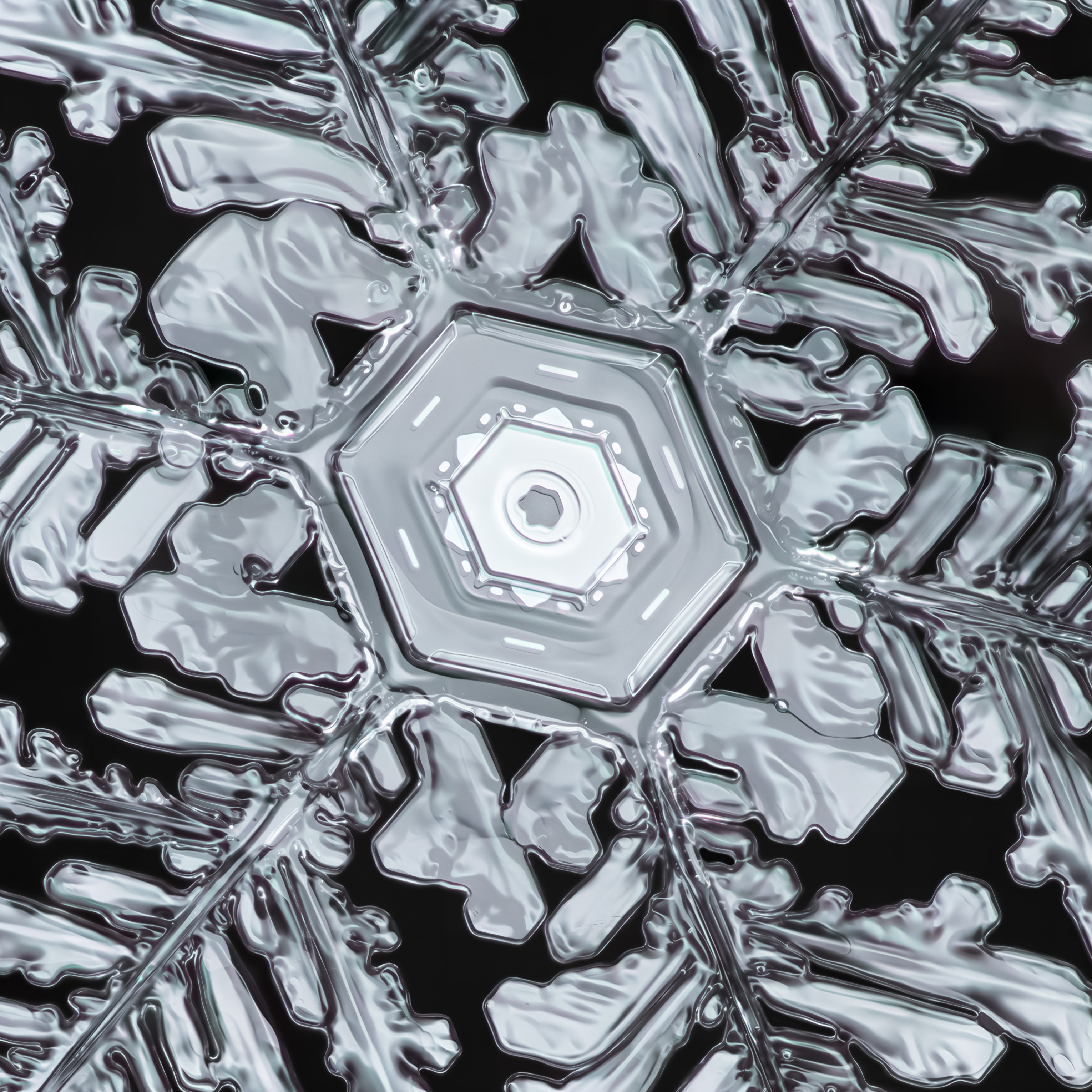
There are a few theories on this, but it’s helpful to identify that there are multiple rounds of inward crystal growth – the circle in the very center and the rounded hexagon outside the overlapping bubbles. Some of these bubbles may have formed on the outer edge of the crystal. Some may have formed by the crystal “back-filling” in thickness due to cascading outward growth. There’s also the chance that inward growth causes a ceiling to form over steep “cliffs” on the snowflake topography. Snowflakes are fully three-dimensional objects, but the true understanding can sometimes be hard to piece together.
You’ll also notice a prominent feature on this crystal: very rounded outer edges. This is caused by sublimation, effectively evaporation from a solid without first becoming a liquid. As soon as a snowflake begins its descent from the heavens, it starts to fade: lower humidity switches the accumulation of water molecules to the shedding of them. The outer corners are the first to go, they stick out the farthest and are more susceptible to such losses. Eventually, all 60-degree edges become little “nubs”.
This can happen fairly quickly. If you don’t photograph a snowflake within the first few minutes of its arrival, you may start to see this. Snow that fell overnight that you are just waking up to discover? You’re probably too late. This one was probably a rescue mission, trying to salvage it’s beauty before it faded any further.
Want to know more about the shooting techniques here? I know a lot of you have a ton of snow! It’s all detailed exhaustively in my book on macro photography: www.amazon.com/Macro-Photography-Universe-Our-Feet/dp/103...
A fictional lesson on understanding, from George MacDonald's children's (and adults) fantasy work, The Princess and the Goblin.
Thank you for looking. The script font is Viner Hand.
OLYMPUS DIGITAL CAMERA
This is a reworking of a 2008 photograph which I liked very much but attracted few views and no faves. Not understanding the social aspects of Flickr I made the mistake of uploading more than 2000 photos this time last year when I first posted on Flickr. I uploaded as many the night after. Naturally they were resoundingly ignored. Posting between 1 and 4 shots each day seems to be more normal behaviour and I have been so grateful for the comments and encouragement and friendship I have received doing just that. I believe Flickr disapproves of reposting so I have now made a couple of different treatments of the image I liked. Here they are.
This work represents a Kanyen’kehaka woman’s development through the stages of her life, passing from young girl to teenager, then woman to elder. Each stage reveals a progression of growth, understanding and development.
This picture is part of a small series. You might take a look at the album for some better understanding of the idea.
And there is no door.
Tokyo, Japan
She'd been attacked, pecked relentlessly on every side, little bruises covering virtually every inch of her, all hidden under the endless layers of silk, lace and fur. Curiously, there was no blood anywhere. Not a single puncture wound visible. She reeled for a while, not understanding anything, completely dazed as she watched her world change from black and to white again. The ravens had flown away to find something fresh, and left her in lying in the cold snow that numbed the pain and invited her to sleep. And when she agreed and shut her eyes, she no longer saw black and white, simply gray nothingness. Soft gray noise, comforting like a pillow wrapped around her body, buffering her rough edges, pressed even against her mouth. And it was reassuring, all this fuzzy softness, and she relaxed and fell back to sleep. First one day, then the next and then the next after that, waking only to note that she was still sore, then nodding off again, returning to her new world of gray noise.
At some point, she caught herself dreaming, "This is so much better. Perhaps I'll just keep lying here forever. I'll let the snow come and make me a warm, thick, last blanket, and just fade into the gray noise." And again, she shut her eyes.
She was awakened by a tapping but ignored it and soon feel back asleep. A moment later, she felt a little pain in her hand, something she had not experienced in days (weeks?). She tried to ignore it, but there it was again, worse. She tried to rouse herself, but felt like she was under water and could not swim to the surface. The pain in her hand intensified. She forced herself to focus and summoned everything inside her to rise to the surface, grasping to find her voice, puncturing the thick, gray noise that enveloped her. She opened a watery eye and was met with an inky black stare. A raven was looking directly at her. A long moment passed as they studied one another calmly, the victor and the vanquished.
A few flakes of snow glided down, decorating her wrist like charms of bracelet, then landing on the raven's feathers, melting into a darker shade of black. The bird blinked then resumed his task, pecking hard into the soft skin of her palm.
She shut her eyes again.
As a teenager, when somebody would ask her to describe herself in one word, She would always say “enigma”. At that time, she thought it was cool to be all mysterious and enigmatic.
As she grew up a little and understood herself somewhat better, she started using the word “passionate”. She thought that the passion she has towards life is what describes her.
Now a few years down the line, she feels she has a better understanding of life and herself, so now the word she would use to describe herself is “flawed”. Flawed not in a negative way, but just in the most beautiful sense of being innately human.
She is sure as she grows and evolves more, this word would again change, and that is the beauty of life :)
So what is your word? How would you describe yourself in one word? Please do share in comments if you feel comfortable doing so :)