*****Expressions of Affection*****
View allAll Photos Tagged Thereby
The Stone Forest or Shilin (Chinese: 石林; pinyin: Shílín) is a notable set of limestone formations about 500 km2 located in Shilin Yi Autonomous County, Yunnan Province, People's Republic of China, near Shilin approximately 90 km (56 mi) from the provincial capital Kunming.
The tall rocks seem to fall to the ground in the manner of stalagmites, with many looking like petrified trees thereby creating the illusion of a forest made of stone. Since 2007, two parts of the site, the Naigu Stone Forest (乃古石林) and Suogeyi Village (所各邑村), have been UNESCO World Heritage Sites as part of the South China Karst.[1] The site is classified as a AAAAA-class tourist site.[2]
As if Mother Nature had grabbed giant cans of paint and poured them with zeal over the Engadin forests. Such a boisterous feast of colours covers the mountain sides. Such a magnificent gold, red and yellow fashion show of the trees’ festive clothing. And – quite literally – on top of that, the sun tries to outshine this luminous display and thereby turns each Engadin autumn excursion into a dream tour.
The first abbey at Buckfast was founded as a Benedictine monastery in 1018. The abbey was believed to be founded by either Aethelweard (Aylward), Earldorman of Devon, or King Cnut. This first monastery was "small and unprosperous", and it is unknown where exactly it was located, and its existence was "precarious" especially after the Norman Conquest.
In 1134 or 1136, the abbey was established in its current position; King Stephen having granted Buckfast to the French Abbot of Savigny. This second abbey was home to Savignac monks. In 1147 the Savignac congregation merged with the Cistercian, and the abbey thereby became a Cistercian monastery. Following the conversion to the Cistercian Congregation, the abbey was rebuilt in stone.Limited excavation work undertaken in 1882 revealed that the monastery was built to the standard plan for Cistercian monasteries.
In medieval times the abbey became rich through fishing and trading in sheep wool, By the 14th century Buckfast was one of the wealthiest abbeys in the south-west of England. It had come to own "extensive sheep runs on Dartmoor, seventeen manors in central and south Devon, town houses in Exeter, fisheries on the Dart and the Avon, and a country house for the abbot at Kingsbridge" The Black Death killed two abbots and many monks; by the mid 1300s, there were few left to maintain the buildings, some of which collapsed. By the mid 1400s however, the abbey again flourished.
By the 16th century, the abbey was in decline. Only 22 new monks were tonsured between 1500 and 1539, and at the time of the abbey's dissolution in 1539, there were only 10 monks in residence
Information by Wikipedia
Artwork by William Walton & Topaz.
What to do with old books…….?
Happy Wall Wednesday ;-))
This artwork by Anouk Kruithof (1981) is part of the exhibition 'One and One is Three (Eén en Eén is Drie)' in the museum Voorlinden (Wassenaar, The Netherlands.) The collection shows the magic that arises from the sum.
Information from her website : anoukkruithof.com/, where you also can see more of her work.
ENCLOSED CONTENT CHATTING AWAY IN THE COLOUR INVISIBILITY
""2009–ongoing | 410 cm x 230 cm installation out of approximately 3500 so found coloured books + video loop + photograph
Enclosed content chatting away in the colour invisibility is a work consisting of an installation of approximately 3500 found colored books, a video loop with sound, and a photograph depicting the respective books. Throughout the year of 2008, Kruithof collected these 3500 books, most of which are from the early 20th century. Some were acquired from Eastern Europe, but had been written in the DDR and consequently dismissed after the state had collapsed. In today’s Germany, these books are usually sold in ‘1Euro Bookshops” or end up at the ’Papierbank,’ a recycling dump for paper, where they are destroyed or attending their slow decay. Kruithof revitalizes these books by using them as objects or building materials to construct a wall.
Color and size determine the rhythm of this haptic installation that is always presented a different order. Seen from a closer distance, these books might evoke abstract landscapes. Yet, these piles of old books can also trigger the idea of pixels and thereby allude to the continuous progress of digitalization (e.g. e-books) within our 21st century society. In doing so, Kruithof plays with not only physically, but also conceptually with the notions of stability and precariousness. It is particularly this notion of instability that sets the main theme of Kruithof’s video, in which she features one version of her book installation. Projected 1:1, the viewer witnesses the sudden collapse of the wall, which is accompanied by the sound of a crash, to see it then being re-built by an invisible hand. With this unexpected, unpredictable cycle of transformation, Kruithof examines the status of physical objects in our digital age, and also redirects our attention to the immaterial value of enclosed, forgotten or disregarded cultural goods.""
Soon to be 125 years old:
On October 1, 2015, the park will commemorate the 125th anniversary of the establishment of Yosemite National Park. President Benjamin Harrison signed the legislation, thereby creating the nation’s third National Park. The establishment of Yosemite National Park preserved over 1,500 square miles of land including Tuolumne Meadows, the park’s high country, Hetch Hetchy and lands surrounding Yosemite Valley.
An old work i discovered in my files. The hands i created on one of my apps. I must have then distorted them using another one of my apps, thereby creating also the beasties on the left and right.This was made for an old KP TT but i didn't get around to publishing it back then.
The dots are from Abstractarchangel77 in 1st comment box:
www.flickr.com/photos/abstractartangel77/48763575131/
For:
**VIVID SPOOKS!!** Vivid Halloween challenge!~
www.flickr.com/groups/2817915@N22/discuss/72157716186680921/
The iconic Buddha head surrounded by fig tree roots in the ruins of Ayutthaya.
Wikipedia: The Ayutthaya Kingdom was a Siamese kingdom that existed in Southeast Asia from 1351 to 1767, centered around the city of Ayutthaya, in Siam, or present-day Thailand. The Ayutthaya Kingdom is considered to be the precursor of modern Thailand and its developments are an important part of the History of Thailand.
In April 1767, after a 14-month siege, the city of Ayutthaya fell to besieging Burmese forces and was completely destroyed, thereby ending the 417-year-old Ayutthaya Kingdom. Siam, however, quickly recovered from the collapse and the seat of Siamese authority was moved to Thonburi, and later Bangkok, within the next 15 years.
Oleander aphid: Widespread in regions with tropical and Mediterranean climates. Oleander aphid has a wide range of hosts, but mainly feeds on plants in the dogbane family, including milkweeds, oleander and periwinkle.
Red Milkweed Beetle: The milkweed beetle, a herbivore, is given this name because it is host-specific to common milkweed. It is thought the beetle, which as an adult feeds on the foliage of the plant, and its early instars, which eat the roots, derive a measure of protection from predators by incorporating toxins from the plant into their bodies, thereby becoming distasteful, much as the monarch butterfly and its larvae do. (Wikipedia)
--------------
Two for the price of one. These two insects were on an old milkweed plant.
Pinhey Dunes, Ottawa, Ontario, Canada. August 2022.
In her work, Laura Belém recontextualizes objects from daily life, completely changing their meaning, renovating their situation and, moreover, the viewer’s perception of them. Thus, in a work like Enamorados [In Love], presented at the 51st Bienal de Veneza, two small boats seem to chatting with each other. The resource used is a simple one: Belém installed the boats front to front, and placed a spotlight on each of their bows. These lights turn on and off, sometimes coinciding, sometimes disagreeing with each other, thereby establishing the sensation of dialogue and, consequently, resulting in the personification of the boats.
***
City of São Paulo records the hottest month of July in almost 40 years in the NEW winter of the southern hemisphere.
Average maximum temperatures recorded from July 1st until yesterday were 25.9ºC / 78.8ºF. 😮😭
In antiquity a town called Thermae (Greek: Θερμαί, hot springs) existed on the site. In 1847, an announcement in Italy asserting the therapeutic benefits of bathing in the natural thermal spas found in Loutraki caused an influx of settlers in the surrounding areas, thereby creating modern Loutraki. In 1928 Loutraki was completely destroyed by earthquake and rebuilt. A large park was created by reclaiming sea area using the rubble of the fallen houses. Another strong earthquake hit the area in 1981 with less destructive effects.
It shows some aspect of humanity, the way that the person who looks at the picture will at once recognize as startlingly true :-)
Bert Hardy
Ukraine Matters! Peace Now!
peony, 'Coral Charm', j c raulston arboretum, ncsu, raleigh, north carolina
A the front on the other side of the river is the world famous rock "The Loreley" on which many ships have crashed.
The Rhine is at his narrowest here (113 meters), but with a depth of 25 meters at its deepest and there is also a dangerous current here.
Originally the rock protruded much further into the river, but this part was blown up with dynamite in 1930.
Legend has it that once a nymph lived on top of the rock who with her beautiful voice, her beauty and her long golden hair enchanted the boatsmen who thereby smashed their ships on the rocks...;
Kruger national Park
South Africa
Smith's bush squirrel (Paraxerus cepapi), also known as the yellow-footed squirrel or tree squirrel, is an African bush squirrel which is native to woodlands of the southern Afrotropics.
It is found in Angola, Botswana, the DRCongo, Malawi, Mozambique, Namibia, South Africa, Tanzania, Zambia, and Zimbabwe. It is a common rodent which is diurnal by nature.
Its total length is 350 mm, half of which is tail. This species only weighs 200 g. The coat colour varies throughout the region. In the western and arid parts of its range, it is pale grey, and in the eastern localities, more brown. Its head and legs are a rusty colour. Colouration on the chest varies from yellowish to buff in the east, to white in the west. This squirrel's belly is white. These alert and ever busy creatures carry their long tails extended backwards.
Smith's bush squirrels are primarily vegetarian, but like most rodents, they take insect prey and use their front feet to manipulate food items when feeding. They scatter-hoard seeds next to tree trunks or grass tufts, thereby facilitating tree regeneration.
Essentially arboreal animals, they also spend a great deal of time on the ground, foraging for food. When disturbed, Smith's bush squirrels always seek the refuge of trees. At night, territorial family groups nest together in holes in trees. - Wikipedia
This huge glacial lake has dramatically increased in size over recent years. If you're interested follow this link ichef.bbci.co.uk/news/976/cpsprodpb/14B96/production/_109... to see a 1989 image compared to 2019 as the Breiðamerkurjökull glacier retreats (melts!) thereby increasing the size of the lake.
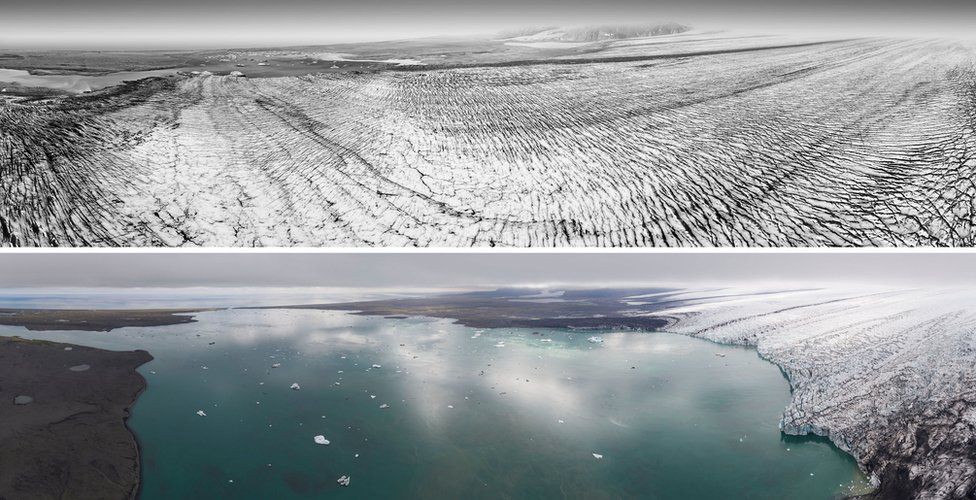
Whole article: www.bbc.co.uk/news/science-environment-55346329
The ballroom of the castle "Herren Chiemsee" built in the Bavarian lake of the same name. However his world famous castle is Neu Schwanstein, this castle is no less beautiful.
Because his financial situation was at last unentable, he could not complete this building and he only stayed for three days in this residence. The government had him declared insane and his kingship could thereby avoided.
Not long afterwards he drowned in mysterious ways and the actual circumstances of his death have never been clarified.
Ludwig II was known as a fairy tale prince, but his life was certainly not.
OLYMPUS DIGITAL CAMERA
Couldn't resist sharing this photo of a fox squirrel having its way with one of the sunflower feeders. Thanks to all who visit and comment. I will be sure to visit your photostreams in return.
“We need another and a wiser and perhaps a more mystical concept of animals. Remote from universal nature and living by complicated artifice, man in civilization surveys the creature through the glass of his knowledge and sees thereby a feather magnified and the whole image in distortion. We patronize them for their incompleteness, for their tragic fate for having taken form so far below ourselves. And therein do we err. For the animal shall not be measured by man. In a world older and more complete than ours, they move finished and complete, gifted with the extension of the senses we have lost or never attained, living by voices we shall never hear. They are not brethren, they are not underlings: they are other nations, caught with ourselves in the net of life and time, fellow prisoners of the splendour and travail of the earth.” Henry Beston ❤
Thank-you to all who take the time to comment on my photos it is greatly appreciated.
www.youtube.com/watch?v=SrR09LJaf5Y
Stay well my Flickr friends <3
Expanse of rice paddy as seen from Phuoc Dien Temple. The Vietnam - Cambodia border is just beyond the row of houses and trees along the Vĩnh Tế canal.
The canal is constructed in parallel to the border and leads to Ha Tien facing the Gulf of Thailand.
It is only 39 km from Nui Sam to the site of Ba Chúc Massacre that was carried out by Khmer Rouge forces in 1978. They crossed the Vĩnh Tế canal and killed 3,157 civilians in Ba Chuc town in An Giang Province.
The incident triggered the Vietnam's invasion of Cambodia in the same year, which led to the demise of the Pol Pot regime thereby stopping "the killing fields."
Toros Dağları
Turkiye - Turquia
The bull was commonly the symbol and depiction of ancient Near Eastern storm gods, hence Taurus the bull, and hence the name of the mountains. The mountains are a place of many ancient storm-god temples.[6] Torrential thunderstorms in these mountains were deemed by the ancient Syrians to be the work of the storm-god Adad to make the Tigris and Euphrates rivers rise and flood and thereby fertilise their land.
Marche Italy - “A great photograph is a full expression of what one feels about what is being photographed in the deepest sense and is thereby a true expression of what one feels about life in its entirety.”
― Ansel Adams
228/09/2007
I sometimes travel by trains and coaches and take photos with longer shutter speeds. Thereby the world outside is blurred, one sees the dirt on the window, the reflexions and sometimes the world is askew...
Ich reise manchmal in Zügen und Bussen und mache Photos mit längeren Verschlußzeiten.
Dadurch ist die Welt da draußen verwischt, man sieht den Schmutz auf der Scheibe, die Reflexionen und manchmal ist die Welt schief ...
In the pristine waters of the Canada and Alaska's Inland Passage the moss green reflection of the coastal conifers was split by our zodiac thereby revealing the clear deep blue water.
Small, compact duck with a long, fan-shaped tail, often held sticking up out of water. Breeding males have a chestnut body, black cap, white cheek, and baby-blue bill. Winter males have a brown body, black cap and white cheek. Females and immature males are brown overall with a dark cap and dark line through the cheek. Often in tight groups bobbing like corks on ponds and bays. Dives to forage on aquatic invertebrates. Not often seen flying. (eBird)
------------------
He chases away an interloper and contestant for the female's interest in splashy fashion, thereby demonstrating his fitness for mating.
John E. Poole Wetland, St. Albert, Alberta, Canada. June 2022.
www.youtube.com/watch?v=rtnv5cVViRw
“Be not forgetful to entertain strangers: for thereby some have entertained angels unawares.” Hebrews 13:2
19 For this is thankworthy, if a man for conscience toward God endure grief, suffering wrongfully.
20 For what glory is it, if, when ye be buffeted for your faults, ye shall take it patiently? but if, when ye do well, and suffer for it, ye take it patiently, this is acceptable with God.
21 For even hereunto were ye called: because Christ also suffered for us, leaving us an example, that ye should follow his steps:
22 Who did no sin, neither was guile found in his mouth:
23 Who, when he was reviled, reviled not again; when he suffered, he threatened not; but committed himself to him that judgeth righteously: 1 Peter 2:19-23
Isaiah 53:6,7
All we like sheep have gone astray; we have turned every one to his own way; and the Lord hath laid on him the iniquity of us all.
7 He was oppressed, and he was afflicted, yet he opened not his mouth: he is brought as a lamb to the slaughter, and as a sheep before her shearers is dumb, so he openeth not his mouth.
Crossandra infundibuliformis, the "Firecracker flower", is a species of flowering plant native to southern India and Sri Lanka.
It is an erect, evergreen subshrub growing to 1 m with glossy, wavy-margined leaves and fan-shaped flowers, which may appear at any time throughout the year.The flowers are unusually shaped with 3 to 5 asymmetrical petals. The colours range from the common orange to salmon-orange or apricot, coral to red, yellow and even turquoise.
This plant requires a minimum temperature of 10 °C, and in temperate regions is cultivated as a houseplant.
The flowers have no perfume but stay fresh for several days on the bush.
The common name "firecracker flower" refers to the seed pods, which are found after the flower has dried up, and tend to "explode" when near high humidity or rainfall. The "explosion" releases the seeds onto the ground, thereby creating new seedlings.
Informations from Wikipedia
Photo from the archives, taken at Botanic Garden/ RJ
This is just the top part of the falls and thereby avoids the problem of different exposures for the falls and to get the "swirl" at the bottom. There is a fairly safe way to climb the rocks to a second landing, where the photo was taken.
Explore - (www.flickr.com/explore): November 29, 2020 (#160).
Kolona beach, Kythnos island, Cyclades, Greece.
Kolona is a unique beach, due to the area’s geomorphological peculiarities. It is in fact a sandy bank of about 240 meters length, connecting the island of Kythnos with a small rocky island, that of St. Luke.
The strip of sand that connects the two land masses is similar to a lying column, thus explaining the name. The sea wets both sides of the sand strip, thereby resulting in two beaches with common sand, creating a truly unique image.
In 1793 the great German botanist and entomologist Christian Konrad Sprengel (1750-1816) wrote the first study of flower markings related to all kinds of insect activity. I've mentioned his work before: www.flickr.com/photos/87453322@N00/41504637505/in/photoli....
Of course, this is a fascinating topic and lots of research has been done on it since Sprengel's time.
In the photo you can see in a Crocus those so-called flower or nectar lines or guides purple against the white petals.
In 2013 scientists in the USA (Anne S. Leonard, Joshua Brent, Daniel R. Papaj, Anna Dornhaus) studied how efficient those lines are for Bumblebees in their foraging
(www.ncbi.nlm.nih.gov/pmc/articles/PMC3572167/). By ingenious methods they found that Bees gather nectar twice as quickly on flowers with nectar guides than if they lack them. Moreover, so-called 'nectar robbing' is cut back as well. 'Nectar robbing' is the phenomenon that Bumblebees 'illegitimately' by-pass the top of the flower altogether and gnaw a hole at its base to access nectar there. That procedure is quite inefficient from the flower's perspective, because the Bee thereby passes by all the instruments (stamen and pistil) necessary for its pollination.
Highly interesting stuff, indeed.
When it was opened it quickly became apparent that the large number of pedestrians crossing London's Millennium Bridge were causing it to sway from side to side (pedestrians crossing a bridge have an unconscious tendency to match their footsteps to the sway, thereby exacerbating the small sideways oscillations of the bridge). The extent of this had not been anticipated by the designers and the bridge was closed until dampers were added to nullify the sway effect. And this, in my opinion, took all the fun out of crossing the bridge :)
Gluggafoss, according to Google also called Merkjárfoss, birthing the river Merkjár that takes its meandering course towards the opposite Eyjafjallajokull mountain massif in South Iceland.
"The Merkjá River has several beautiful waterfalls, but the most outstanding is Gluggafoss or Window Falls. (also known as Merkjárfoss) The upper half of the cliff is palagonite or tuff rock and the lower ledge is basalt. The river has formed tunnels and grooves through the soft rock and a series of 'windows' in the tunnels, thereby earning the name 'Gluggafoss'. At the very top of the falls, the river passes under a stone arch. As the rock is rather soft, the waterfall has changed over time. Around 1947 the upper half of the waterfall could hardly be seen, as the water flowed into a vertical tunnel behind the cliff. It was only visible through three different openings or 'windows' one above the other. The water came out through the bottom 'window', forming a beautiful arch, except when the water rose in the river, forcing it through all three windows. Further changes occurred when Hekla erupted in 1947, causing a 20 cm thick layer of volcanic ash to be carried downstream by the river. The vertical tunnel formation nearly disappeared as it filled with ash. It has taken nearly 50 years for the falls to return to its former glory." (from: www.south.is/en/moya/toy/index/place/merkjarfoss-gluggafoss)
Les jardins de Poësia / Poësia gardens
On dit que le vent connaît bien leurs secrets…
Ces petits arbustes habitent les grandes plaines naturelles
Depuis des millénaires
Certes, ils n’ont pas la beauté facile des plantes ornementales
Ni la volupté des fleurs qui embellissent les jardins humains
Mais elles résistent, saisons après saisons, aux assauts des vents, du froid glacial, de la sécheresse, des maladies, voire même du feu!
Mais surtout, elles s’unissent à leurs voisines pour créer un rempart vivant face aux menaces extérieures, créant ainsi un habitat vital pour les autres espèces vivantes.
Ici, vous êtes dans les jardins de Poësia,
Des jardins modestes, sans doute
Mais des jardins qui connaissent les secrets de la résilience
Ces secrets que le vent transporte
Dans un bruissement unique, primordial
Écoutez les histoires que raconte le vent…Elles pourraient vous être utiles…
Patrice
________________
They say the wind knows their secrets well…
These small shrubs inhabit the large natural plains
For millennia
Certainly they do not have the easy beauty of ornamental plants
Neither the voluptuousness of the flowers that embellish human gardens
But they resist, season after season, the onslaught of the winds, the freezing cold, drought, diseases, and even fire!
Most importantly, they unite with their neighbors to create a living bulwark in the face of external threats, thereby creating vital habitat for other living species.
Here you are in the gardens of Poësia,
Modest gardens, no doubt
But gardens that know the secrets of resilience
These secrets that the wind carries
In a unique and primordial whispering.
Listen to the stories of the wind, they may be useful
Patrice
Luckily I had my boots with me as you need to walk in through a soggy field.
Completed in 1462, and consecrated by Donatus O’Connor-Sligo, a Dominican monk, and member of a noble family which gave more than one bishop to the See of Killala, it is told, Moyne was to rise to prominence within Irish Franciscan circles, with Provincial Chapters of the order being held there on several occasions between 1464 and 1550. At its zenith the monastery boasted a valuable library, infirmary, two mills for grinding corn, excellent pasturage, pools for fish, a water-mill and a never-failing spring of wholesome water. The community including priests, professors, students and lay-brothers, would have numbered upwards of 50.
According to a local legend reminiscent of the selection of the site of the church of ‘Sancta Maria ad Nives’ in Rome, the monks had their choice of all of the lands owned by their benefactor, and having examined several likely sites, O Donoghue, the Provincial, in the company of a Father Chilvart, settled on Moyne (Maighin translated as a small plain), apparently with the help of either a little robin or wren. The little robin was held in high regard by the Irish as this bird was said to have got its red breast through its efforts to stanch the blood on the brow of the crucified Christ. Conversely, the wren is a maligned bird as it was regarded as promiscuous, which would not have endeared it to the more puritanical of Christian preachers. Apparently the upright tail of the wren was viewed as sexual imagery, as was the black chafer, which raises its tail when threatened. The chafer (known in Irish as daradaol or deargadaol ) also had an anti-Christian representation as it was believed that it informed on Christ, thereby leading to His arrest.
In any case, the intervention of the robin was taken as a divine gesture, after which the Provincial exclaimed: ‘God has shown us and that is the site of our monastery,’ and further referred to the location as:
The abbey stands on the site of an earlier oratory attributed to St. Muinchin/Mucna, a local folk-saint. He is reputed to have been a disciple of St. Patrick’s who ruled a church which is called Maighin; that he lived until about 520AD and that his birthday was celebrated at Moyne on the 4 March.
As I was standing on top of mt. Lilienstein on that morning, enjoying the sunrise, there was a impermeable wall of fog everywhere below me. After the photographing, I started a round tour on the rock to visit the other viewpoints as well. Thereby I realised, that the fog slowly started to
clear out and suddenly, out of nothing, some buildings of a village were appearing in front of me. It was so exciting (I felt like a child what had dicovered a magical secret), that I did stay here for a while watching this play.
Later, I found out, that it wasn't a village but only the single farm Sellnitz, where the administration of the Saxonian Switzerland National Park is located.
Als ich an diesem Morgen auf dem Lilienstein im Elbsandsteingebirge stand und den Sonnenaufgang genoss, war unter mir eine undurchdringliche Nebelwand.
Nach dem Fotofgrafieren machte ich einen Rundgang auf dem Felsen, um mir die anderen Aussichten noch anzuschauen. Dabei bemerkte ich, dass sich der Nebel langsam lichtete und plötzlich, wie aus dem Nichts, einige Gebäude eines Dorfes vor mir zum Vorschein kamen. Das war so aufregend (Ich habe mich wie ein Kind gefühlt, welches ein magisches Geheimnis entdeckt hat), dass ich eine Weile dort geblieben bin, um dieses Schauspiel zu beeobachten.
Wie ich später herausgefunden habe, handelte es sich garnicht um ein Dorf, sondern nur um das einzelnes Gut Sellnitz, in dem sich die Verwaltung des Nationalparks Sächsische Schweiz befindet.
more of this on my website at: www.shoot-to-catch.de
Always need to be ready when on hike, there were a number of birds feeding along a stream not too far from the campsite earlier this year. I was tracking this Parula and was very lucky when it finally jumped into a clear spot for this photograph.
This was the first time I was dressed in nearly full camo and well, it's better than not being dressed in camo for birds but still attracts a little too much attention if someone drives by and sees you, stops, and then comes over, thereby well, completely making the use of camo pointless!
Hier steht ein Würfel aus Acryl auf einem Spiegel und vor einem Spiegel. Die Außenflächen des Würfels sind transparent eingefärbt in gelb, magenta und blau dadurch entstehen die vielen Farbnuancen. Das Licht kommt von oben. Das Bild ist hier 90° gegen den Uhrzeiger gedreht.
Here is a cube of acrylic on a mirror and in front of a mirror. The outer surfaces of the cube are transparent colored in yellow, magenta and blue thereby arise the many color nuances. The light comes from above. The image is rotated here 90 ° counterclockwise.
HSoS! :-)
Light gives of itself freely, filling all available space. It does not seek anything in return; it asks not whether you are friend or foe. It gives of itself and is not thereby diminished. ~Michael Strassfeld
~ Dubrovnik, Croatia ~
In approaching summer, which is finally about to arrive here in Croatia, I keep thinking about how thankful, privileged and blessed I am to have an old friend of mine who lives in this gem of the Adriatic coast... thereby my many stays and many sights seen each time with a new and fresh outlook ... :)
Chau Doc is a border city located by the Hau Giang, one of the two major distributaries of the Mekong. The same distributary is called Tonlé Bassac or the Bassac river in Phnom Penh, 100 km upstream.
Can Tho is located 100 km downstream.
The Mekong as a whole is called Sông Cửu Long or the Cu Long river in Vietnam, which means "nine dragons." Nine implies "many" and the dragon is an avatar of the river thereby referring to the topography of the delta.
This photo was taken from a riverside park in Chau Doc City located at the confluence of the Hau Giang and the Chau Doc rivers. The Hau Giang is seen only at the upper right corner of the photo.
Please note that some houses are floating on the river.
When are we going to care for our environment and heed nature thereby lessening these increasing and more violent storms?
As I have said before:
We the people can and should act now to help prevent the inevitable destruction caused by us. We cannot afford to keep on ignoring it. We have already created a crisis that we could have prevented and we only have ourselves to blame.
The loss of life, cities, homes, food, animal life is beyond imagination and this year, in particular, has created even more havoc. It is time to sit down and study the facts and the possibility of being responsible and good guardians and try and learn fully how to look after not abuse our globe.
Thank you for your kind visit. Have a wonderful and beautiful day! ❤️❤️❤️
This late afternoon scene was taken just prior to sunset on a west facing slope of Mount Hotham in Victoria, Australia.
This is an alpine area where snow gums abound and the white tree trunks standing like grave markers in a cemetery, are the trunks of snow gums that died from the intense heat of a recent bushfire.
As can be seen the forest floor has regenerated, and this process was started by the very same fire that destroyed so many trees - the heat from a fire is required to both release some seeds and crack open others that have sat dormant waiting for the right conditions.
Fire removes low-growing underbrush, cleans the forest floor of debris, nourishes the soil and opens up the ground to more sunlight thereby allowing seedlings that were released by the fire to sprout and grow.
Fire also kills diseases and insects that prey on trees, and it has been stated that worldwide more trees die each year from insect infestations and disease than from fire.
Eventually these dead trunks will fall and decay thereby adding further nutrients to the soil.
In architecture, a gargoyle is a carved or formed grotesque with a spout designed to convey water from a roof and away from the side of a building, thereby preventing rainwater from running down masonry walls and eroding the mortar between. Architects often used multiple gargoyles on a building to divide the flow of rainwater off the roof to minimize the potential damage from a rainstorm. A trough is cut in the back of the gargoyle and rainwater typically exits through the open mouth.
My good friend, colleague and Mongolian brother Gala proudly holds the final of 4 reports we completed for the Mongolian government. You'll note the cover photo is the same one seen in the background. The work has been an amazing effort by Mongolian partners that has lead to tremendous conservation outcomes. Following completion in 2011 of a regional conservation plan for the Eastern Mongolian Grasslands (published in 2011), 31 new protected areas covering 64 000 km2 were designated. Similarly, after completion in 2013 of a regional conservation plan for the Gobi Desert (published in 2013), 34 900 km2 of new protected areas were designated. In June 2016, planning for the remaining Western and Central regions was completed (Finally published in 2017), leading to a national conservation portfolio that now includes an additional 48 400 km2 of new protected areas. In total, approximately 150 000 km2 of new protected areas have been established (that's roughly the size of the state of New York or the country of Nepal) and the planning approach utilized was ratified by the Mongolian Academy of Sciences, thereby establishing it as a basis for mitigation policy. In addition, this process has led to significant regulatory and legal improvements within Mongolia that advance conservation. For example In 2012, the national Environmental Impact Assessment law was amended to require offsets for all new mineral and petroleum leases.
Switcher Sunday finds a pair of P&S SW-9's moving westbound coal loads southward along the Allegheny River (out of the photo but following to the right) on a gorgeous fall day. The friendly crew is enjoying the trip and nice weather, as they move the very cool hopper train made up of mostly 2-bay shorties. Might as well as I'm sure they are well aware of the "fun of railroading" coming up soon in the winter months around this area.
After crossing the Allegheny River near Nubbs (Mosgrove), the railroad follows it's west bank for about 25 miles to Freeport, and the Conrail connection located there. Wisely for the railroad but not so fun for the railfan photographer, the track was always a good bit away from the riverbank, thereby avoiding issues that other operations have being right on the riverbanks.
Serralunga d'Alba (located on the left in the foreground) is a municipality in the Province of Cuneo in the Italian region Piedmont. This region is named the Langhe and is a hilly area to the south and east of the river Tanaro. It is famous for its wines, cheeses, and truffles—particularly the white truffles of Alba.
These vineyards constitute an outstanding example of man’s interaction with his natural environment. Following a long and slow evolution of winegrowing expertise, the best possible adaptation of grape varieties to land with specific soil and climatic components has been carried out, which in itself is related to winemaking expertise, thereby becoming an international benchmark. The winegrowing landscape also expresses great aesthetic qualities, making it into an archetype of European vineyards.
Luckily, this morning, I could also see the Alps!. In the middle, we see the Matterhorn, next to it and very small Dent Blanche. On the right is the Monte Rosa massif: On the far right
Signalkuppe, then Nordend and the highest point the Dufourspitze, right next to it the wide front is the Lyskamm.
Text adapted from Wikipedia.
Ein Grossteil Lanzarotes ist auf Lava und Asche gebaut. Dadurch entstehen ganz eigene Kontraste, wenn die Häuser in Weiß gehalten werden.
Most of Lanzarote is built on lava and ashes. Thereby, some very special contrasts are created if the houses are kept in white.
refuses to take pictures that are not artistically “correct”, processes the result (giving you a choice of enlargement sizes), and can be sent to the picnic at the beach alone, thereby relieving the owner of the boring responsibility of fooling around in the sand, eating burnt hot dogs, and getting a sunburn :-)
Jean Shepherd
many petalled star magnolia, 'Waterlily', j c raulston arboretum, ncsu, raleigh, north carolina
May people will be kinder to animals & birds, as well as to humans,
May the universe and our own small world begin to heal from the negative effects we have created,
May PEACE reign in every person's heart and thereby spread to all countries,
May my family and friends not suffer bad health or losses in the new year, but, if they do,
May healing & love accompany their grief
I looked through my archives for a bench photograph and found this one. I took it at Carsington Water in Derbyshire, UK, in November 2014. My family specialised in cold winter picnics at dusk. Here’s my Dad and niece watching birds in the gloom, flask of coffee to hand.
I’ve edited the photograph in Snapseed. It’s now square, grainy and blue/greenish. I only managed to get it onto Sliders Sunday after several attempts. The Flickr Moderation bot had changed its safety level, thereby making it ineligible. I changed the safety level back to safe. HSS!