View allAll Photos Tagged ScienceNotSilence
Rapid strata formation in soft sand (field evidence).
Photo of strata formation in soft sand on a beach, created by tidal action of the sea.
Formed in a single, high tidal event. Stunning evidence which displays multiple strata/layers.
Why this is so important ....
It has long been assumed, ever since the 17th century, that layers/strata observed in sedimentary rocks were built up gradually, layer upon layer, over many years. It certainly seemed logical at the time, from just looking at rocks, that lower layers would always be older than the layers above them, i.e. that lower layers were always laid down first followed, in time, by successive layers on top.
This was assumed to be true and became known as the superposition principle.
It was also assumed that a layer comprising a different material from a previous layer, represented a change in environmental conditions/factors.
These changes in composition of layers or strata were considered to represent different, geological eras on a global scale, spanning millions of years. This formed the basis for the Geologic Column, which is used to date rocks and also fossils. The evolutionary, 'fossil record' was based on the vast ages and assumed geological eras of the Geologic Column.
There was also circular reasoning applied with the assumed age of 'index' fossils (based on evolutionary beliefs & preconceptions) used to date strata in the Geologic Column. Dating strata from the assumed age of (index) fossils is known as Biostratigraphy.
We now know that, although these assumptions seemed logical, they are not supported by the evidence.
At the time, the mechanics of stratification were not properly known or studied.
An additional factor was that this assumed superposition and uniformitarian model became essential, with the wide acceptance of Darwinism, for the long ages required for progressive microbes-to-human evolution. There was no incentive to question or challenge the superposition, uniformitarian model, because the presumed, fossil 'record' had become dependant on it, and any change in the accepted model would present devastating implications for Darwinism.
This had the unfortunate effect of linking the study of geology so closely to Darwinism, that any study independent of Darwinian considerations was effectively stymied. This link of geology with Darwinian preconceptions is known as biostratigraphy.
Some other field evidence, in various situations, can be observed here: www.flickr.com/photos/101536517@N06/sets/72157635944904973/
and also in the links to stunning, experimental evidence, carried out by sedimentologists, given later.
_______________________________________________
GEOLOGIC PRINCIPLES (established by Nicholas Steno in the 17th Century):
What Nicolas Steno believed about strata formation is the basis of the principle of Superposition and the principle of Original Horizontality.
dictionary.sensagent.com/Law_of_superposition/en-en/
“Assuming that all rocks and minerals had once been fluid, Nicolas Steno reasoned that rock strata were formed when particles in a fluid such as water fell to the bottom. This process would leave horizontal layers. Thus Steno's principle of original horizontality states that rock layers form in the horizontal position, and any deviations from this horizontal position are due to the rocks being disturbed later.”)
BEDDING PLANES.
'Bedding plane' describes the surface in between each stratum which are formed during sediment deposition.
science.jrank.org/pages/6533/Strata.html
“Strata form during sediment deposition, that is, the laying down of sediment. Meanwhile, if a change in current speed or sediment grain size occurs or perhaps the sediment supply is cut off, a bedding plane forms. Bedding planes are surfaces that separate one stratum from another. Bedding planes can also form when the upper part of a sediment layer is eroded away before the next episode of deposition. Strata separated by a bedding plane may have different grain sizes, grain compositions, or colours. Sometimes these other traits are better indicators of stratification as bedding planes may be very subtle.”
______________________________________________
Several catastrophic events, flash floods, volcanic eruptions etc. have forced Darwinian, influenced geologists to admit to rapid stratification in some instances. However they claim it is a rare phenomenon, which they have known about for many years, and which does nothing to invalidate the Geologic Column, the fossil record, evolutionary timescale, or any of the old assumptions regarding strata formation, sedimentation and the superposition principle. They fail to face up to the fact that rapid stratification is not an extraordinary phenonemon, but rather the prevailing and normal mechanism of sedimentary deposition whenever and wherever there is moving, sediment-laden water. The experimental evidence demonstrates the mechanism and a mass of field evidence in normal (non-catastrophic) conditions shows it is a normal everyday occurrence.
It is clear from the experimental evidence that the usual process of stratification is - that strata are not formed by horizontal layers being laid on top of each other in succession, as was assumed. But by sediment being sorted in the flowing water and laid down diagonally in the direction of flow. See diagram:
www.flickr.com/photos/truth-in-science/39821536092/in/dat...
The field evidence (in the image) presented here - of rapid, simultaneous stratification refutes the Superposition Principle and the Principle of Lateral Continuity.
We now know, the Superposition Principle only applies on a rare occasion where sedimentary deposits are laid down in still water.
Superposition is required for the long evolutionary timescale, but the evidence shows it is not the general rule, as was once believed. Most sediment is laid down in moving water, where particle segregation is the general rule, resulting in the simultaneous deposition of strata/layers as shown in the photo.
See many other examples of rapid stratification (with geological features): www.flickr.com/photos/101536517@N06/sets/72157635944904973/
Rapid, simultaneous formation of layers/strata, through particle segregation in moving water, is so easily created it has even been described by sedimentologists (working on flume experiments) as a law ...
"Upon filling the tank with water and pouring in sediments, we immediately saw what was to become the rule: The sediments sorted themselves out in very clear layers. This became so common that by the end of two weeks, we jokingly referred to Andrew's law as "It's difficult not to make layers," and Clark's law as "It's easy to make layers." Later on, I proposed the "law" that liquefaction destroys layers, as much to my surprise as that was." Ian Juby, www.ianjuby.org/sedimentation/
The example in the photo is the result of normal, everyday tidal action formed in a single incident. Where the water current or movement is more turbulent, violent, or catastrophic, great depths (many metres) of stratified sediment can be laid down in a short time. Certainly not the many millions of years assumed by evolutionists.
The composition of strata formed in any deposition event. is related to whatever materials are in the sediment mix, not to any particular timescale. Whatever is in the mix will be automatically sorted into strata/layers. It could be sand, or other material added from mud slides, erosion of chalk deposits, coastal erosion, volcanic ash etc. Any organic material (potential fossils), alive or dead, engulfed by, or swept into, a turbulent sediment mix, will also be sorted and buried within the rapidly, forming layers.
See many other examples of rapid stratification with geological features: www.flickr.com/photos/101536517@N06/sets/72157635944904973/
Stratified, soft sand deposit. demonstrates the rapid, stratification principle.
Important, field evidence which supports the work of the eminent, sedimentologist Dr Guy Berthault MIAS - Member of the International Association of Sedimentologists.
(Dr Berthault's experiments (www.sedimentology.fr/)
And also the experimental work of Dr M.E. Clark (Professor Emeritus, U of Illinois @ Urbana), Andrew Rodenbeck and Dr. Henry Voss, (www.ianjuby.org/sedimentation/)
Location: Sandown, Isle of Wight. Formed 31/01/2019
This field evidence demonstrates that multiple strata in sedimentary deposits do not need millions of years to form and can be formed rapidly. This natural example confirms the principle demonstrated by the sedimentation experiments carried out by Dr Guy Berthault and other sedimentologists. It calls into question the standard, multi-million year dating of sedimentary rocks, and the dating of fossils by depth of burial or position in the strata.
Mulltiple strata/layers are evident in this example.
Dr Berthault's experiments (www.sedimentology.fr/) and other experiments (www.ianjuby.org/sedimentation/) and field studies of floods and volcanic action show that, rather than being formed by gradual, slow deposition of sucessive layers superimposed upon previous layers, with the strata or layers representing a particular timescale, particle segregation in moving water or airborne particles can form strata or layers very quickly, frequently, in a single event.
And, most importantly, lower strata are not older than upper strata, they are the same age, having been created in the same sedimentary episode.
Such field studies confirm experiments which have shown that there is no longer any reason to conclude that strata/layers in sedimentary rocks relate to different geological eras and/or a multi-million year timescale. www.youtube.com/watch?v=5PVnBaqqQw8&feature=share&.... they also show that the relative position of fossils in rocks is not indicative of an order of evolutionary succession. Obviously, the uniformitarian principle, on which the geologic column is based, can no longer be considered valid. And the multi-million, year dating of sedimentary rocks and fossils needs to be reassessed. Rapid deposition of stratified sediments also explains the enigma of polystrate fossils, i.e. large fossils that intersect several strata. In some cases, tree trunk fossils are found which intersect the strata of sedimentary rock up to forty feet in depth. upload.wikimedia.org/wikipedia/commons/thumb/0/08/Lycopsi... They must have been buried in stratified sediment in a short time (certainly not millions, thousands, or even hundreds of years), or they would have rotted away. youtu.be/vnzHU9VsliQ
In fact, the vast majority of fossils are found in good, intact condition, which is testament to their rapid burial. You don't get good fossils from gradual burial, because they would be damaged or destroyed by decay, predation or erosion. The existence of so many fossils in sedimentary rock on a global scale is stunning evidence for the rapid depostion of sedimentary rock as the general rule. It is obvious that all rock containing good intact fossils was formed from sediment laid down in a very short time, not millions, or even thousands of years.
See set of photos of other examples of rapid stratification: www.flickr.com/photos/101536517@N06/sets/72157635944904973/
Carbon dating of coal should not be possible if it is millions of years old, yet significant amounts of Carbon 14 have been detected in coal and other fossil material, which indicates that it is less than 50,000 years old. www.ldolphin.org/sewell/c14dating.html
www.grisda.org/origins/51006.htm
Evolutionists confidently cite multi-million year ages for rocks and fossils, but what most people don't realise is that no one actually knows the age of sedimentary rocks or the fossils found within them. So how are evolutionists so sure of the ages they so confidently quote? The astonishing thing is they aren't. Sedimentary rocks cannot be dated by radiometric methods*, and fossils can only be dated to less than 50,000 years with Carbon 14 dating. The method evolutionists use is based entirely on assumptions. Unbelievably, fossils are dated by the assumed age of rocks, and rocks are dated by the assumed age of fossils, that's right ... it is known as circular reasoning.
* Regarding the radiometric dating of igneous rocks, which is claimed to be relevant to the dating of sedimentary rocks, in an occasional instance there is an igneous intrusion associated with a sedimentary deposit -
Prof. Aubouin says in his Précis de Géologie: "Each radioactive element disintegrates in a characteristic and constant manner, which depends neither on the physical state (no variation with pressure or temperature or any other external constraint) nor on the chemical state (identical for an oxide or a phosphate)."
"Rocks form when magma crystallizes. Crystallisation depends on pressure and temperature, from which radioactivity is independent. So, there is no relationship between radioactivity and crystallisation.
Consequently, radioactivity doesn't date the formation of rocks. Moreover, daughter elements contained in rocks result mainly from radioactivity in magma where gravity separates the heavier parent element, from the lighter daughter element. Thus radiometric dating has no chronological signification." Dr. Guy Berthault www.sciencevsevolution.org/Berthault.htm
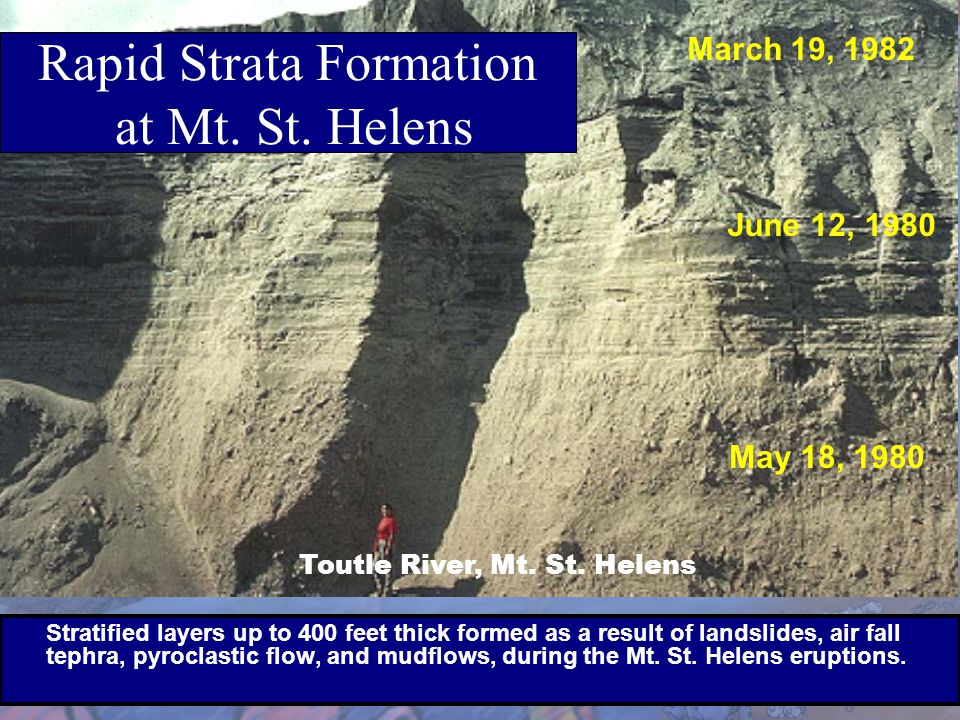
Rapid strata formation and rapid erosion at Mount St Helens.
slideplayer.com/slide/5703217/18/images/28/Rapid+Strata+F...

Visit the fossil museum:
www.flickr.com/photos/101536517@N06/sets/72157641367196613/
Just how good are peer reviews of scientific papers?
www.sciencemag.org/content/342/6154/60.full
www.examiner.com/article/want-to-publish-science-paper-ju...
The neo-Darwinian idea that the human genome consists entirely of an accumulation of billions of mutations is, quite obviously, completely bonkers. Nevertheless, it is compulsorily taught in schools and universities as 'science'.
Rapid strata formation in soft sand (field evidence).
Photo of strata formation in soft sand on a beach, created by tidal action of the sea.
Formed in a single, high tidal event. Stunning evidence which displays multiple strata/layers.
Why this is so important ....
It has long been assumed, ever since the 17th century, that layers/strata observed in sedimentary rocks were built up gradually, layer upon layer, over many years. It certainly seemed logical at the time, from just looking at rocks, that lower layers would always be older than the layers above them, i.e. that lower layers were always laid down first followed, in time, by successive layers on top.
This was assumed to be true and became known as the superposition principle.
It was also assumed that a layer comprising a different material from a previous layer, represented a change in environmental conditions/factors.
These changes in composition of layers or strata were considered to represent different, geological eras on a global scale, spanning millions of years. This formed the basis for the Geologic Column, which is used to date rocks and also fossils. The evolutionary, 'fossil record' was based on the vast ages and assumed geological eras of the Geologic Column.
There was also circular reasoning applied with the assumed age of 'index' fossils (based on evolutionary beliefs & preconceptions) used to date strata in the Geologic Column. Dating strata from the assumed age of (index) fossils is known as Biostratigraphy.
We now know that, although these assumptions seemed logical, they are not supported by the evidence.
At the time, the mechanics of stratification were not properly known or studied.
An additional factor was that this assumed superposition and uniformitarian model became essential, with the wide acceptance of Darwinism, for the long ages required for progressive microbes-to-human evolution. There was no incentive to question or challenge the superposition, uniformitarian model, because the presumed, fossil 'record' had become dependant on it, and any change in the accepted model would present devastating implications for Darwinism.
This had the unfortunate effect of linking the study of geology so closely to Darwinism, that any study independent of Darwinian considerations was effectively stymied. This link of geology with Darwinian preconceptions is known as biostratigraphy.
Some other field evidence, in various situations, can be observed here: www.flickr.com/photos/101536517@N06/sets/72157635944904973/
and also in the links to stunning, experimental evidence, carried out by sedimentologists, given later.
_______________________________________________
GEOLOGIC PRINCIPLES (established by Nicholas Steno in the 17th Century):
What Nicolas Steno believed about strata formation is the basis of the principle of Superposition and the principle of Original Horizontality.
dictionary.sensagent.com/Law_of_superposition/en-en/
“Assuming that all rocks and minerals had once been fluid, Nicolas Steno reasoned that rock strata were formed when particles in a fluid such as water fell to the bottom. This process would leave horizontal layers. Thus Steno's principle of original horizontality states that rock layers form in the horizontal position, and any deviations from this horizontal position are due to the rocks being disturbed later.”)
BEDDING PLANES.
'Bedding plane' describes the surface in between each stratum which are formed during sediment deposition.
science.jrank.org/pages/6533/Strata.html
“Strata form during sediment deposition, that is, the laying down of sediment. Meanwhile, if a change in current speed or sediment grain size occurs or perhaps the sediment supply is cut off, a bedding plane forms. Bedding planes are surfaces that separate one stratum from another. Bedding planes can also form when the upper part of a sediment layer is eroded away before the next episode of deposition. Strata separated by a bedding plane may have different grain sizes, grain compositions, or colours. Sometimes these other traits are better indicators of stratification as bedding planes may be very subtle.”
______________________________________________
Several catastrophic events, flash floods, volcanic eruptions etc. have forced Darwinian, influenced geologists to admit to rapid stratification in some instances. However they claim it is a rare phenomenon, which they have known about for many years, and which does nothing to invalidate the Geologic Column, the fossil record, evolutionary timescale, or any of the old assumptions regarding strata formation, sedimentation and the superposition principle. They fail to face up to the fact that rapid stratification is not an extraordinary phenonemon, but rather the prevailing and normal mechanism of sedimentary deposition whenever and wherever there is moving, sediment-laden water. The experimental evidence demonstrates the mechanism and a mass of field evidence in normal (non-catastrophic) conditions shows it is a normal everyday occurrence.
It is clear from the experimental evidence that the usual process of stratification is - that strata are not formed by horizontal layers being laid on top of each other in succession, as was assumed. But by sediment being sorted in the flowing water and laid down diagonally in the direction of flow. See diagram:
www.flickr.com/photos/truth-in-science/39821536092/in/dat...
The field evidence (in the image) presented here - of rapid, simultaneous stratification refutes the Superposition Principle and the Principle of Lateral Continuity.
We now know, the Superposition Principle only applies on a rare occasion where sedimentary deposits are laid down in still water.
Superposition is required for the long evolutionary timescale, but the evidence shows it is not the general rule, as was once believed. Most sediment is laid down in moving water, where particle segregation is the general rule, resulting in the simultaneous deposition of strata/layers as shown in the photo.
See many other examples of rapid stratification (with geological features): www.flickr.com/photos/101536517@N06/sets/72157635944904973/
Rapid, simultaneous formation of layers/strata, through particle segregation in moving water, is so easily created it has even been described by sedimentologists (working on flume experiments) as a law ...
"Upon filling the tank with water and pouring in sediments, we immediately saw what was to become the rule: The sediments sorted themselves out in very clear layers. This became so common that by the end of two weeks, we jokingly referred to Andrew's law as "It's difficult not to make layers," and Clark's law as "It's easy to make layers." Later on, I proposed the "law" that liquefaction destroys layers, as much to my surprise as that was." Ian Juby, www.ianjuby.org/sedimentation/
The field example in the photo is the result of normal, everyday tidal action formed in a single incident,
Where the water current or movement is more turbulent, violent, or catastrophic, great depths (many metres) of stratified sediment can be laid down in a short time. Certainly not the many millions of years assumed by evolutionists.
The composition of strata formed in any deposition event. is related to whatever materials are in the sediment mix, not to any particular timescale. Whatever is in the mix will be automatically sorted into strata/layers. It could be sand, or other material added from mud slides, erosion of chalk deposits, coastal erosion, volcanic ash etc. Any organic material (potential fossils), alive or dead, engulfed by, or swept into, a turbulent sediment mix, will also be sorted and buried within the rapidly, forming layers.
See many other examples of rapid stratification with geological features: www.flickr.com/photos/101536517@N06/sets/72157635944904973/
Stratified, soft sand deposit. demonstrates the rapid, stratification principle.
Important, field evidence which supports the work of the eminent, sedimentologist Dr Guy Berthault MIAS - Member of the International Association of Sedimentologists.
(Dr Berthault's experiments (www.sedimentology.fr/)
And also the experimental work of Dr M.E. Clark (Professor Emeritus, U of Illinois @ Urbana), Andrew Rodenbeck and Dr. Henry Voss, (www.ianjuby.org/sedimentation/)
Location: Yaverland, Isle of Wight. photographed 04/06/2018, formed several months earlier and in the early stages of consolidation.
This field evidence demonstrates that multiple strata in sedimentary deposits do not need millions of years to form and can be formed rapidly. This natural example confirms the principle demonstrated by the sedimentation experiments carried out by Dr Guy Berthault and other sedimentologists. It calls into question the standard, multi-million year dating of sedimentary rocks, and the dating of fossils by depth of burial or position in the strata.
Mulltiple strata/layers are evident in this example.
Dr Berthault's experiments (www.sedimentology.fr/) and other experiments (www.ianjuby.org/sedimentation/) and field studies of floods and volcanic action show that, rather than being formed by gradual, slow deposition of sucessive layers superimposed upon previous layers, with the strata or layers representing a particular timescale, particle segregation in moving water or airborne particles can form strata or layers very quickly, frequently, in a single event.
And, most importantly, lower strata are not older than upper strata, they are the same age, having been created in the same sedimentary episode.
Such field studies confirm experiments which have shown that there is no longer any reason to conclude that strata/layers in sedimentary rocks relate to different geological eras and/or a multi-million year timescale. www.youtube.com/watch?v=5PVnBaqqQw8&feature=share&.... they also show that the relative position of fossils in rocks is not indicative of an order of evolutionary succession. Obviously, the uniformitarian principle, on which the geologic column is based, can no longer be considered valid. And the multi-million, year dating of sedimentary rocks and fossils needs to be reassessed. Rapid deposition of stratified sediments also explains the enigma of polystrate fossils, i.e. large fossils that intersect several strata. In some cases, tree trunk fossils are found which intersect the strata of sedimentary rock up to forty feet in depth. upload.wikimedia.org/wikipedia/commons/thumb/0/08/Lycopsi... They must have been buried in stratified sediment in a short time (certainly not millions, thousands, or even hundreds of years), or they would have rotted away. youtu.be/vnzHU9VsliQ
In fact, the vast majority of fossils are found in good, intact condition, which is testament to their rapid burial. You don't get good fossils from gradual burial, because they would be damaged or destroyed by decay, predation or erosion. The existence of so many fossils in sedimentary rock on a global scale is stunning evidence for the rapid depostion of sedimentary rock as the general rule. It is obvious that all rock containing good intact fossils was formed from sediment laid down in a very short time, not millions, or even thousands of years.
See set of photos of other examples of rapid stratification: www.flickr.com/photos/101536517@N06/sets/72157635944904973/
Carbon dating of coal should not be possible if it is millions of years old, yet significant amounts of Carbon 14 have been detected in coal and other fossil material, which indicates that it is less than 50,000 years old. www.ldolphin.org/sewell/c14dating.html
www.grisda.org/origins/51006.htm
Evolutionists confidently cite multi-million year ages for rocks and fossils, but what most people don't realise is that no one actually knows the age of sedimentary rocks or the fossils found within them. So how are evolutionists so sure of the ages they so confidently quote? The astonishing thing is they aren't. Sedimentary rocks cannot be dated by radiometric methods*, and fossils can only be dated to less than 50,000 years with Carbon 14 dating. The method evolutionists use is based entirely on assumptions. Unbelievably, fossils are dated by the assumed age of rocks, and rocks are dated by the assumed age of fossils, that's right ... it is known as circular reasoning.
* Regarding the radiometric dating of igneous rocks, which is claimed to be relevant to the dating of sedimentary rocks, in an occasional instance there is an igneous intrusion associated with a sedimentary deposit -
Prof. Aubouin says in his Précis de Géologie: "Each radioactive element disintegrates in a characteristic and constant manner, which depends neither on the physical state (no variation with pressure or temperature or any other external constraint) nor on the chemical state (identical for an oxide or a phosphate)."
"Rocks form when magma crystallizes. Crystallisation depends on pressure and temperature, from which radioactivity is independent. So, there is no relationship between radioactivity and crystallisation.
Consequently, radioactivity doesn't date the formation of rocks. Moreover, daughter elements contained in rocks result mainly from radioactivity in magma where gravity separates the heavier parent element, from the lighter daughter element. Thus radiometric dating has no chronological signification." Dr. Guy Berthault www.sciencevsevolution.org/Berthault.htm
"A team of Russian sedimentologists directed by Alexander Lalomov (Russian Academy of Sciences’ Institute of Ore Deposits) applied paleohydraulic analyses to geological formations in Russia. One example is the publication of a report in 2007 by the Lithology and Mineral Resources journal of the Russian Academy of Sciences. It concerns the Crimean Peninsular. It shows that the time of sedimentation of the sequence studied corresponds to a virtually instantaneous episode whilst according to stratigraphy it took several millions of years. Moreover, a recent report concerning the North-West Russian plateau in the St. Petersburg region shows that the time of sedimentation was much shorter than that attributed to it by the stratigraphic time-scale: 0.05% of the time."
www.sciencevsevolution.org/Berthault.htm
Rapid strata formation and rapid erosion at Mount St Helens.
slideplayer.com/slide/5703217/18/images/28/Rapid+Strata+F...
Visit the fossil museum:
www.flickr.com/photos/101536517@N06/sets/72157641367196613/
Just how good are peer reviews of scientific papers?
www.sciencemag.org/content/342/6154/60.full
www.examiner.com/article/want-to-publish-science-paper-ju...
The neo-Darwinian idea that the human genome consists entirely of an accumulation of billions of mutations is, quite obviously, completely bonkers. Nevertheless, it is compulsorily taught in schools and universities as 'science'.
Rapid strata formation in soft sand (field evidence).
Photo of strata formation in soft sand on a beach, created by tidal action of the sea.
Formed in a single, high tidal event. Stunning evidence which displays multiple strata/layers.
Why this is so important ....
It has long been assumed, ever since the 17th century, that layers/strata observed in sedimentary rocks were built up gradually, layer upon layer, over many years. It certainly seemed logical at the time, from just looking at rocks, that lower layers would always be older than the layers above them, i.e. that lower layers were always laid down first followed, in time, by successive layers on top.
This was assumed to be true and became known as the superposition principle.
It was also assumed that a layer comprising a different material from a previous layer, represented a change in environmental conditions/factors.
These changes in composition of layers or strata were considered to represent different, geological eras on a global scale, spanning millions of years. This formed the basis for the Geologic Column, which is used to date rocks and also fossils. The evolutionary, 'fossil record' was based on the vast ages and assumed geological eras of the Geologic Column.
There was also circular reasoning applied with the assumed age of 'index' fossils (based on evolutionary beliefs & preconceptions) used to date strata in the Geologic Column. Dating strata from the assumed age of fossils is known as Biostratigraphy.
We now know that, although these assumptions seemed logical, they are not supported by the evidence.
At the time, the mechanics of stratification were not properly known or studied.
An additional factor was that this assumed superposition and uniformitarian model became essential, with the wide acceptance of Darwinism, for the long ages required for progressive microbes-to-human evolution. There was no incentive to question or challenge the superposition, uniformitarian model, because the presumed, fossil 'record' had become dependant on it, and any change in the accepted model would present devastating implications for Darwinism.
This had the unfortunate effect of linking the study of geology so closely to Darwinism, that any study independent of Darwinian considerations was effectively stymied. This link of geology with Darwinian preconceptions is known as biostratigraphy.
Some of the wealth of evidence can be observed here: www.flickr.com/photos/101536517@N06/sets/72157635944904973/
and also in the links to stunning, experimental evidence, carried out by sedimentologists, given later.
_______________________________________________
GEOLOGIC PRINCIPLES (established by Nicholas Steno in the 17th Century):
What Nicolas Steno believed about strata formation is the basis of the principle of Superposition and the principle of Original Horizontality.
dictionary.sensagent.com/Law_of_superposition/en-en/
“Assuming that all rocks and minerals had once been fluid, Nicolas Steno reasoned that rock strata were formed when particles in a fluid such as water fell to the bottom. This process would leave horizontal layers. Thus Steno's principle of original horizontality states that rock layers form in the horizontal position, and any deviations from this horizontal position are due to the rocks being disturbed later.”)
BEDDING PLANES.
'Bedding plane' describes the surface in between each stratum which are formed during sediment deposition.
science.jrank.org/pages/6533/Strata.html
“Strata form during sediment deposition, that is, the laying down of sediment. Meanwhile, if a change in current speed or sediment grain size occurs or perhaps the sediment supply is cut off, a bedding plane forms. Bedding planes are surfaces that separate one stratum from another. Bedding planes can also form when the upper part of a sediment layer is eroded away before the next episode of deposition. Strata separated by a bedding plane may have different grain sizes, grain compositions, or colours. Sometimes these other traits are better indicators of stratification as bedding planes may be very subtle.”
______________________________________________
Several catastrophic events, flash floods, volcanic eruptions etc. have forced Darwinian influenced geologists to admit to rapid stratification in some instances. However they claim it is a rare phenomenon, which they known about for many years, and which does nothing to invalidate the Geologic Column, the fossil record, evotuionary timescale, or any of the old assumptions regarding strata formation, sedimentation and the superposition principle. They fail to face up to the fact that rapid stratification is not an extraordinary phenonemon, but rather the prevailing and normal mechanism of sedimantary deposition whenever and wherever there is moving, sediment-laden water. The experimental evidence demonstrates the mechanism and a mass of field evidence in normal (non-catastrophic) conditions shows it is a normal everyday occurrence.
It is clear from the experimental evidence that the usual process of stratification is - that strata are not formed by horizontal layers being laid on top of each other in succession, as was assumed. But by sediment being sorted in the flowing water and laid down diagonally in the direction of flow.
Several catastrophic events, flash floods, volcanic eruptions etc. have forced Darwinian, influenced geologists to admit to rapid stratification in some instances. However they claim it is a rare phenomenon, which they have known about for many years, and which does nothing to invalidate the Geologic Column, the fossil record, evotuionary timescale, or any of the old assumptions regarding strata formation, sedimentation and the superposition principle. They fail to face up to the fact that rapid stratification is not an extraordinary phenonemon, but rather the prevailing and normal mechanism of sedimentary deposition whenever and wherever there is moving, sediment-laden water. The experimental evidence demonstrates the mechanism and a mass of field evidence in normal (non-catastrophic) conditions shows it is a normal everyday occurrence.
It is clear from the experimental evidence that the usual process of stratification is - that strata are not formed by horizontal layers being laid on top of each other in succession, as was assumed. But by sediment being sorted in the flowing water and laid down diagonally in the direction of flow. See diagram:
www.flickr.com/photos/truth-in-science/39821536092/in/dat...
The field evidence (in the image) presented here - of rapid, simultaneous stratification refutes the Superposition Principle, and the Principle of Lateral Continuity.
We now know, the Superposition Principle only applies on a rare occasion of sedimentary deposits in perfectly, still water. Superposition is required for the long evolutionary timescale, but the evidence shows it is not the general rule, as was once believed. Most sediment is laid down in moving water, where particle segregation is the general rule, resulting in the simultaneous deposition of strata/layers as shown in the photo.
See many other examples of rapid stratification with geological features: www.flickr.com/photos/101536517@N06/sets/72157635944904973/
Rapid, simultaneous formation of layers/strata, through particle segregation in moving water, is so easily created it has even been described by sedimentologists (working on flume experiments) as a law ...
"Upon filling the tank with water and pouring in sediments, we immediately saw what was to become the rule: The sediments sorted themselves out in very clear layers. This became so common that by the end of two weeks, we jokingly referred to Andrew's law as "It's difficult not to make layers," and Clark's law as "It's easy to make layers." Later on, I proposed the "law" that liquefaction destroys layers, as much to my surprise as that was." Ian Juby, www.ianjuby.org/sedimentation/
The example in the photo is the result of normal, everyday tidal action in a single incident. Where the water current or movement is more turbulent, violent, or catastrophic, great depths (many metres) of stratified sediment can be laid down in a short time. Certainly not the many millions of years assumed by evolutionists.
The composition of strata formed in any deposition event. is related to whatever materials are in the sediment mix, not to any particular timescale. Whatever is in the mix will be automatically sorted into strata/layers. It could be sand, or other material added from mud slides, erosion of chalk deposits, coastal erosion, volcanic ash etc. Any organic material (potential fossils), alive or dead, engulfed by, or swept into, a turbulent sediment mix, will also be sorted and buried within the rapidly, forming layers.
See many other examples of rapid stratification with geological features: www.flickr.com/photos/101536517@N06/sets/72157635944904973/
Stratified, soft sand deposit. demonstrates the rapid, stratification principle.
Important, field evidence which supports the work of the eminent, sedimentologist Dr Guy Berthault MIAS - Member of the International Association of Sedimentologists.
(Dr Berthault's experiments (www.sedimentology.fr/)
And also the experimental work of Dr M.E. Clark (Professor Emeritus, U of Illinois @ Urbana), Andrew Rodenbeck and Dr. Henry Voss, (www.ianjuby.org/sedimentation/)
Location: Sandown, Isle of Wight. Formed 17/02/2018, This field evidence demonstrates that multiple strata in sedimentary deposits do not need millions of years to form and can be formed rapidly. This natural example confirms the principle demonstrated by the sedimentation experiments carried out by Dr Guy Berthault and other sedimentologists. It calls into question the standard, multi-million year dating of sedimentary rocks, and the dating of fossils by depth of burial or position in the strata.
Mulltiple strata/layers are evident in this example.
Dr Berthault's experiments (www.sedimentology.fr/) and other experiments (www.ianjuby.org/sedimentation/) and field studies of floods and volcanic action show that, rather than being formed by gradual, slow deposition of sucessive layers superimposed upon previous layers, with the strata or layers representing a particular timescale, particle segregation in moving water or airborne particles can form strata or layers very quickly, frequently, in a single event.
And, most importantly, lower strata are not older than upper strata, they are the same age, having been created in the same sedimentary episode.
Such field studies confirm experiments which have shown that there is no longer any reason to conclude that strata/layers in sedimentary rocks relate to different geological eras and/or a multi-million year timescale. www.youtube.com/watch?v=5PVnBaqqQw8&feature=share&.... they also show that the relative position of fossils in rocks is not indicative of an order of evolutionary succession. Obviously, the uniformitarian principle, on which the geologic column is based, can no longer be considered valid. And the multi-million, year dating of sedimentary rocks and fossils needs to be reassessed. Rapid deposition of stratified sediments also explains the enigma of polystrate fossils, i.e. large fossils that intersect several strata. In some cases, tree trunk fossils are found which intersect the strata of sedimentary rock up to forty feet in depth. upload.wikimedia.org/wikipedia/commons/thumb/0/08/Lycopsi... They must have been buried in stratified sediment in a short time (certainly not millions, thousands, or even hundreds of years), or they would have rotted away. youtu.be/vnzHU9VsliQ
In fact, the vast majority of fossils are found in good, intact condition, which is testament to their rapid burial. You don't get good fossils from gradual burial, because they would be damaged or destroyed by decay, predation or erosion. The existence of so many fossils in sedimentary rock on a global scale is stunning evidence for the rapid depostion of sedimentary rock as the general rule. It is obvious that all rock containing good intact fossils was formed from sediment laid down in a very short time, not millions, or even thousands of years.
See set of photos of other examples of rapid stratification: www.flickr.com/photos/101536517@N06/sets/72157635944904973/
Carbon dating of coal should not be possible if it is millions of years old, yet significant amounts of Carbon 14 have been detected in coal and other fossil material, which indicates that it is less than 50,000 years old. www.ldolphin.org/sewell/c14dating.html
www.grisda.org/origins/51006.htm
Evolutionists confidently cite multi-million year ages for rocks and fossils, but what most people don't realise is that no one actually knows the age of sedimentary rocks or the fossils found within them. So how are evolutionists so sure of the ages they so confidently quote? The astonishing thing is they aren't. Sedimentary rocks cannot be dated by radiometric methods*, and fossils can only be dated to less than 50,000 years with Carbon 14 dating. The method evolutionists use is based entirely on assumptions. Unbelievably, fossils are dated by the assumed age of rocks, and rocks are dated by the assumed age of fossils, that's right ... it is known as circular reasoning.
* Regarding the radiometric dating of igneous rocks, which is claimed to be relevant to the dating of sedimentary rocks, in an occasional instance there is an igneous intrusion associated with a sedimentary deposit -
Prof. Aubouin says in his Précis de Géologie: "Each radioactive element disintegrates in a characteristic and constant manner, which depends neither on the physical state (no variation with pressure or temperature or any other external constraint) nor on the chemical state (identical for an oxide or a phosphate)."
"Rocks form when magma crystallizes. Crystallisation depends on pressure and temperature, from which radioactivity is independent. So, there is no relationship between radioactivity and crystallisation.
Consequently, radioactivity doesn't date the formation of rocks. Moreover, daughter elements contained in rocks result mainly from radioactivity in magma where gravity separates the heavier parent element, from the lighter daughter element. Thus radiometric dating has no chronological signification." Dr. Guy Berthault www.sciencevsevolution.org/Berthault.htm
Visit the fossil museum:
www.flickr.com/photos/101536517@N06/sets/72157641367196613/
Just how good are peer reviews of scientific papers?
www.sciencemag.org/content/342/6154/60.full
www.examiner.com/article/want-to-publish-science-paper-ju...
The neo-Darwinian idea that the human genome consists entirely of an accumulation of billions of mutations is, quite obviously, completely bonkers. Nevertheless, it is compulsorily taught in schools and universities as 'science'.
Rapid strata formation in soft sand (field evidence).
Photo of strata formation in soft sand on a beach, created by tidal action of the sea.
Formed in a single, high tidal event. Stunning evidence which displays multiple strata/layers.
Why this is so important ....
It has long been assumed, ever since the 17th century, that layers/strata observed in sedimentary rocks were built up gradually, layer upon layer, over many years. It certainly seemed logical at the time, from just looking at rocks, that lower layers would always be older than the layers above them, i.e. that lower layers were always laid down first followed, in time, by successive layers on top.
This was assumed to be true and became known as the superposition principle.
It was also assumed that a layer comprising a different material from a previous layer, represented a change in environmental conditions/factors.
These changes in composition of layers or strata were considered to represent different, geological eras on a global scale, spanning millions of years. This formed the basis for the Geologic Column, which is used to date rocks and also fossils. The evolutionary, 'fossil record' was based on the vast ages and assumed geological eras of the Geologic Column.
There was also circular reasoning applied with the assumed age of 'index' fossils (based on evolutionary beliefs & preconceptions) used to date strata in the Geologic Column. Dating strata from the assumed age of (index) fossils is known as Biostratigraphy.
We now know that, although these assumptions seemed logical, they are not supported by the evidence.
At the time, the mechanics of stratification were not properly known or studied.
An additional factor was that this assumed superposition and uniformitarian model became essential, with the wide acceptance of Darwinism, for the long ages required for progressive microbes-to-human evolution. There was no incentive to question or challenge the superposition, uniformitarian model, because the presumed, fossil 'record' had become dependant on it, and any change in the accepted model would present devastating implications for Darwinism.
This had the unfortunate effect of linking the study of geology so closely to Darwinism, that any study independent of Darwinian considerations was effectively stymied. This link of geology with Darwinian preconceptions is known as biostratigraphy.
Some other field evidence can be observed here: www.flickr.com/photos/101536517@N06/sets/72157635944904973/
and also in the links to stunning, experimental evidence, carried out by sedimentologists, given later.
_______________________________________________
GEOLOGIC PRINCIPLES (established by Nicholas Steno in the 17th Century):
What Nicolas Steno believed about strata formation is the basis of the principle of Superposition and the principle of Original Horizontality.
dictionary.sensagent.com/Law_of_superposition/en-en/
“Assuming that all rocks and minerals had once been fluid, Nicolas Steno reasoned that rock strata were formed when particles in a fluid such as water fell to the bottom. This process would leave horizontal layers. Thus Steno's principle of original horizontality states that rock layers form in the horizontal position, and any deviations from this horizontal position are due to the rocks being disturbed later.”)
BEDDING PLANES.
'Bedding plane' describes the surface in between each stratum which are formed during sediment deposition.
science.jrank.org/pages/6533/Strata.html
“Strata form during sediment deposition, that is, the laying down of sediment. Meanwhile, if a change in current speed or sediment grain size occurs or perhaps the sediment supply is cut off, a bedding plane forms. Bedding planes are surfaces that separate one stratum from another. Bedding planes can also form when the upper part of a sediment layer is eroded away before the next episode of deposition. Strata separated by a bedding plane may have different grain sizes, grain compositions, or colours. Sometimes these other traits are better indicators of stratification as bedding planes may be very subtle.”
______________________________________________
Several catastrophic events, flash floods, volcanic eruptions etc. have forced Darwinian, influenced geologists to admit to rapid stratification in some instances. However they claim it is a rare phenomenon, which they have known about for many years, and which does nothing to invalidate the Geologic Column, the fossil record, evolutionary timescale, or any of the old assumptions regarding strata formation, sedimentation and the superposition principle. They fail to face up to the fact that rapid stratification is not an extraordinary phenonemon, but rather the prevailing and normal mechanism of sedimentary deposition whenever and wherever there is moving, sediment-laden water. The experimental evidence demonstrates the mechanism and a mass of field evidence in normal (non-catastrophic) conditions shows it is a normal everyday occurrence.
It is clear from the experimental evidence that the usual process of stratification is - that strata are not formed by horizontal layers being laid on top of each other in succession, as was assumed. But by sediment being sorted in the flowing water and laid down diagonally in the direction of flow. See diagram:
www.flickr.com/photos/truth-in-science/39821536092/in/dat...
The field evidence (in the image) presented here - of rapid, simultaneous stratification refutes the Superposition Principle and the Principle of Lateral Continuity.
We now know, the Superposition Principle only applies on a rare occasion where sedimentary deposits are laid down in still water.
Superposition is required for the long evolutionary timescale, but the evidence shows it is not the general rule, as was once believed. Most sediment is laid down in moving water, where particle segregation is the general rule, resulting in the simultaneous deposition of strata/layers as shown in the photo.
See many other examples of rapid stratification (with geological features): www.flickr.com/photos/101536517@N06/sets/72157635944904973/
Rapid, simultaneous formation of layers/strata, through particle segregation in moving water, is so easily created it has even been described by sedimentologists (working on flume experiments) as a law ...
"Upon filling the tank with water and pouring in sediments, we immediately saw what was to become the rule: The sediments sorted themselves out in very clear layers. This became so common that by the end of two weeks, we jokingly referred to Andrew's law as "It's difficult not to make layers," and Clark's law as "It's easy to make layers." Later on, I proposed the "law" that liquefaction destroys layers, as much to my surprise as that was." Ian Juby, www.ianjuby.org/sedimentation/
The example in the photo is the result of normal, everyday tidal action in a single incident. Where the water current or movement is more turbulent, violent, or catastrophic, great depths (many metres) of stratified sediment can be laid down in a short time. Certainly not the many millions of years assumed by evolutionists.
The composition of strata formed in any deposition event. is related to whatever materials are in the sediment mix, not to any particular timescale. Whatever is in the mix will be automatically sorted into strata/layers. It could be sand, or other material added from mud slides, erosion of chalk deposits, coastal erosion, volcanic ash etc. Any organic material (potential fossils), alive or dead, engulfed by, or swept into, a turbulent sediment mix, will also be sorted and buried within the rapidly, forming layers.
See many other examples of rapid stratification with geological features: www.flickr.com/photos/101536517@N06/sets/72157635944904973/
Stratified, soft sand deposit. demonstrates the rapid, stratification principle.
Important, field evidence which supports the work of the eminent, sedimentologist Dr Guy Berthault MIAS - Member of the International Association of Sedimentologists.
(Dr Berthault's experiments (www.sedimentology.fr/)
And also the experimental work of Dr M.E. Clark (Professor Emeritus, U of Illinois @ Urbana), Andrew Rodenbeck and Dr. Henry Voss, (www.ianjuby.org/sedimentation/)
Location: Sandown, Isle of Wight. Formed 06/06/2018, This field evidence demonstrates that multiple strata in sedimentary deposits do not need millions of years to form and can be formed rapidly. This natural example confirms the principle demonstrated by the sedimentation experiments carried out by Dr Guy Berthault and other sedimentologists. It calls into question the standard, multi-million year dating of sedimentary rocks, and the dating of fossils by depth of burial or position in the strata.
Mulltiple strata/layers are evident in this example.
Note the human footprints in the soft sand deposit.
Dr Berthault's experiments (www.sedimentology.fr/) and other experiments (www.ianjuby.org/sedimentation/) and field studies of floods and volcanic action show that, rather than being formed by gradual, slow deposition of sucessive layers superimposed upon previous layers, with the strata or layers representing a particular timescale, particle segregation in moving water or airborne particles can form strata or layers very quickly, frequently, in a single event.
And, most importantly, lower strata are not older than upper strata, they are the same age, having been created in the same sedimentary episode.
Such field studies confirm experiments which have shown that there is no longer any reason to conclude that strata/layers in sedimentary rocks relate to different geological eras and/or a multi-million year timescale. www.youtube.com/watch?v=5PVnBaqqQw8&feature=share&.... they also show that the relative position of fossils in rocks is not indicative of an order of evolutionary succession. Obviously, the uniformitarian principle, on which the geologic column is based, can no longer be considered valid. And the multi-million, year dating of sedimentary rocks and fossils needs to be reassessed. Rapid deposition of stratified sediments also explains the enigma of polystrate fossils, i.e. large fossils that intersect several strata. In some cases, tree trunk fossils are found which intersect the strata of sedimentary rock up to forty feet in depth. upload.wikimedia.org/wikipedia/commons/thumb/0/08/Lycopsi... They must have been buried in stratified sediment in a short time (certainly not millions, thousands, or even hundreds of years), or they would have rotted away. youtu.be/vnzHU9VsliQ
In fact, the vast majority of fossils are found in good, intact condition, which is testament to their rapid burial. You don't get good fossils from gradual burial, because they would be damaged or destroyed by decay, predation or erosion. The existence of so many fossils in sedimentary rock on a global scale is stunning evidence for the rapid depostion of sedimentary rock as the general rule. It is obvious that all rock containing good intact fossils was formed from sediment laid down in a very short time, not millions, or even thousands of years.
See set of photos of other examples of rapid stratification: www.flickr.com/photos/101536517@N06/sets/72157635944904973/
Carbon dating of coal should not be possible if it is millions of years old, yet significant amounts of Carbon 14 have been detected in coal and other fossil material, which indicates that it is less than 50,000 years old. www.ldolphin.org/sewell/c14dating.html
www.grisda.org/origins/51006.htm
Evolutionists confidently cite multi-million year ages for rocks and fossils, but what most people don't realise is that no one actually knows the age of sedimentary rocks or the fossils found within them. So how are evolutionists so sure of the ages they so confidently quote? The astonishing thing is they aren't. Sedimentary rocks cannot be dated by radiometric methods*, and fossils can only be dated to less than 50,000 years with Carbon 14 dating. The method evolutionists use is based entirely on assumptions. Unbelievably, fossils are dated by the assumed age of rocks, and rocks are dated by the assumed age of fossils, that's right ... it is known as circular reasoning.
* Regarding the radiometric dating of igneous rocks, which is claimed to be relevant to the dating of sedimentary rocks, in an occasional instance there is an igneous intrusion associated with a sedimentary deposit -
Prof. Aubouin says in his Précis de Géologie: "Each radioactive element disintegrates in a characteristic and constant manner, which depends neither on the physical state (no variation with pressure or temperature or any other external constraint) nor on the chemical state (identical for an oxide or a phosphate)."
"Rocks form when magma crystallizes. Crystallisation depends on pressure and temperature, from which radioactivity is independent. So, there is no relationship between radioactivity and crystallisation.
Consequently, radioactivity doesn't date the formation of rocks. Moreover, daughter elements contained in rocks result mainly from radioactivity in magma where gravity separates the heavier parent element, from the lighter daughter element. Thus radiometric dating has no chronological signification." Dr. Guy Berthault www.sciencevsevolution.org/Berthault.htm
Visit the fossil museum:
www.flickr.com/photos/101536517@N06/sets/72157641367196613/
Just how good are peer reviews of scientific papers?
www.sciencemag.org/content/342/6154/60.full
www.examiner.com/article/want-to-publish-science-paper-ju...
The neo-Darwinian idea that the human genome consists entirely of an accumulation of billions of mutations is, quite obviously, completely bonkers. Nevertheless, it is compulsorily taught in schools and universities as 'science'.
Rapid strata formation in soft sand (field evidence).
Photo of strata formation in soft sand on a beach, created by tidal action of the sea.
Formed in a single, high tidal event. Stunning evidence which displays multiple strata/layers.
Why this is so important ....
It has long been assumed, ever since the 17th century, that layers/strata observed in sedimentary rocks were built up gradually, layer upon layer, over many years. It certainly seemed logical at the time, from just looking at rocks, that lower layers would always be older than the layers above them, i.e. that lower layers were always laid down first followed, in time, by successive layers on top.
This was assumed to be true and became known as the superposition principle.
It was also assumed that a layer comprising a different material from a previous layer, represented a change in environmental conditions/factors.
These changes in composition of layers or strata were considered to represent different, geological eras on a global scale, spanning millions of years. This formed the basis for the Geologic Column, which is used to date rocks and also fossils. The evolutionary, 'fossil record' was based on the vast ages and assumed geological eras of the Geologic Column.
There was also circular reasoning applied with the assumed age of 'index' fossils (based on evolutionary beliefs & preconceptions) used to date strata in the Geologic Column. Dating strata from the assumed age of (index) fossils is known as Biostratigraphy.
We now know that, although these assumptions seemed logical, they are not supported by the evidence.
At the time, the mechanics of stratification were not properly known or studied.
An additional factor was that this assumed superposition and uniformitarian model became essential, with the wide acceptance of Darwinism, for the long ages required for progressive microbes-to-human evolution. There was no incentive to question or challenge the superposition, uniformitarian model, because the presumed, fossil 'record' had become dependant on it, and any change in the accepted model would present devastating implications for Darwinism.
This had the unfortunate effect of linking the study of geology so closely to Darwinism, that any study independent of Darwinian considerations was effectively stymied. This link of geology with Darwinian preconceptions is known as biostratigraphy.
Some other field evidence, in various situations, can be observed here: www.flickr.com/photos/101536517@N06/sets/72157635944904973/
and also in the links to stunning, experimental evidence, carried out by sedimentologists, given later.
_______________________________________________
GEOLOGIC PRINCIPLES (established by Nicholas Steno in the 17th Century):
What Nicolas Steno believed about strata formation is the basis of the principle of Superposition and the principle of Original Horizontality.
dictionary.sensagent.com/Law_of_superposition/en-en/
“Assuming that all rocks and minerals had once been fluid, Nicolas Steno reasoned that rock strata were formed when particles in a fluid such as water fell to the bottom. This process would leave horizontal layers. Thus Steno's principle of original horizontality states that rock layers form in the horizontal position, and any deviations from this horizontal position are due to the rocks being disturbed later.”)
BEDDING PLANES.
'Bedding plane' describes the surface in between each stratum which are formed during sediment deposition.
science.jrank.org/pages/6533/Strata.html
“Strata form during sediment deposition, that is, the laying down of sediment. Meanwhile, if a change in current speed or sediment grain size occurs or perhaps the sediment supply is cut off, a bedding plane forms. Bedding planes are surfaces that separate one stratum from another. Bedding planes can also form when the upper part of a sediment layer is eroded away before the next episode of deposition. Strata separated by a bedding plane may have different grain sizes, grain compositions, or colours. Sometimes these other traits are better indicators of stratification as bedding planes may be very subtle.”
______________________________________________
Several catastrophic events, flash floods, volcanic eruptions etc. have forced Darwinian, influenced geologists to admit to rapid stratification in some instances. However they claim it is a rare phenomenon, which they have known about for many years, and which does nothing to invalidate the Geologic Column, the fossil record, evolutionary timescale, or any of the old assumptions regarding strata formation, sedimentation and the superposition principle. They fail to face up to the fact that rapid stratification is not an extraordinary phenonemon, but rather the prevailing and normal mechanism of sedimentary deposition whenever and wherever there is moving, sediment-laden water. The experimental evidence demonstrates the mechanism and a mass of field evidence in normal (non-catastrophic) conditions shows it is a normal everyday occurrence.
It is clear from the experimental evidence that the usual process of stratification is - that strata are not formed by horizontal layers being laid on top of each other in succession, as was assumed. But by sediment being sorted in the flowing water and laid down diagonally in the direction of flow. See diagram:
www.flickr.com/photos/truth-in-science/39821536092/in/dat...
The field evidence (in the image) presented here - of rapid, simultaneous stratification refutes the Superposition Principle and the Principle of Lateral Continuity.
We now know, the Superposition Principle only applies on a rare occasion where sedimentary deposits are laid down in still water.
Superposition is required for the long evolutionary timescale, but the evidence shows it is not the general rule, as was once believed. Most sediment is laid down in moving water, where particle segregation is the general rule, resulting in the simultaneous deposition of strata/layers as shown in the photo.
See many other examples of rapid stratification (with geological features): www.flickr.com/photos/101536517@N06/sets/72157635944904973/
Rapid, simultaneous formation of layers/strata, through particle segregation in moving water, is so easily created it has even been described by sedimentologists (working on flume experiments) as a law ...
"Upon filling the tank with water and pouring in sediments, we immediately saw what was to become the rule: The sediments sorted themselves out in very clear layers. This became so common that by the end of two weeks, we jokingly referred to Andrew's law as "It's difficult not to make layers," and Clark's law as "It's easy to make layers." Later on, I proposed the "law" that liquefaction destroys layers, as much to my surprise as that was." Ian Juby, www.ianjuby.org/sedimentation/
The example in the photo is the result of normal, everyday tidal action formed in a single incident, and subsequently eroded by water flow revealing the strata/layers.
Where the water current or movement is more turbulent, violent, or catastrophic, great depths (many metres) of stratified sediment can be laid down in a short time. Certainly not the many millions of years assumed by evolutionists.
The composition of strata formed in any deposition event. is related to whatever materials are in the sediment mix, not to any particular timescale. Whatever is in the mix will be automatically sorted into strata/layers. It could be sand, or other material added from mud slides, erosion of chalk deposits, coastal erosion, volcanic ash etc. Any organic material (potential fossils), alive or dead, engulfed by, or swept into, a turbulent sediment mix, will also be sorted and buried within the rapidly, forming layers.
See many other examples of rapid stratification with geological features: www.flickr.com/photos/101536517@N06/sets/72157635944904973/
Stratified, soft sand deposit. demonstrates the rapid, stratification principle.
Important, field evidence which supports the work of the eminent, sedimentologist Dr Guy Berthault MIAS - Member of the International Association of Sedimentologists.
(Dr Berthault's experiments (www.sedimentology.fr/)
And also the experimental work of Dr M.E. Clark (Professor Emeritus, U of Illinois @ Urbana), Andrew Rodenbeck and Dr. Henry Voss, (www.ianjuby.org/sedimentation/)
Location: Sandown, Isle of Wight. Formed 11/10/2018 This field evidence demonstrates that multiple strata in sedimentary deposits do not need millions of years to form and can be formed rapidly. This natural example confirms the principle demonstrated by the sedimentation experiments carried out by Dr Guy Berthault and other sedimentologists. It calls into question the standard, multi-million year dating of sedimentary rocks, and the dating of fossils by depth of burial or position in the strata.
Mulltiple strata/layers are evident in this example.
Dr Berthault's experiments (www.sedimentology.fr/) and other experiments (www.ianjuby.org/sedimentation/) and field studies of floods and volcanic action show that, rather than being formed by gradual, slow deposition of sucessive layers superimposed upon previous layers, with the strata or layers representing a particular timescale, particle segregation in moving water or airborne particles can form strata or layers very quickly, frequently, in a single event.
And, most importantly, lower strata are not older than upper strata, they are the same age, having been created in the same sedimentary episode.
Such field studies confirm experiments which have shown that there is no longer any reason to conclude that strata/layers in sedimentary rocks relate to different geological eras and/or a multi-million year timescale. www.youtube.com/watch?v=5PVnBaqqQw8&feature=share&.... they also show that the relative position of fossils in rocks is not indicative of an order of evolutionary succession. Obviously, the uniformitarian principle, on which the geologic column is based, can no longer be considered valid. And the multi-million, year dating of sedimentary rocks and fossils needs to be reassessed. Rapid deposition of stratified sediments also explains the enigma of polystrate fossils, i.e. large fossils that intersect several strata. In some cases, tree trunk fossils are found which intersect the strata of sedimentary rock up to forty feet in depth. upload.wikimedia.org/wikipedia/commons/thumb/0/08/Lycopsi... They must have been buried in stratified sediment in a short time (certainly not millions, thousands, or even hundreds of years), or they would have rotted away. youtu.be/vnzHU9VsliQ
In fact, the vast majority of fossils are found in good, intact condition, which is testament to their rapid burial. You don't get good fossils from gradual burial, because they would be damaged or destroyed by decay, predation or erosion. The existence of so many fossils in sedimentary rock on a global scale is stunning evidence for the rapid depostion of sedimentary rock as the general rule. It is obvious that all rock containing good intact fossils was formed from sediment laid down in a very short time, not millions, or even thousands of years.
See set of photos of other examples of rapid stratification: www.flickr.com/photos/101536517@N06/sets/72157635944904973/
Carbon dating of coal should not be possible if it is millions of years old, yet significant amounts of Carbon 14 have been detected in coal and other fossil material, which indicates that it is less than 50,000 years old. www.ldolphin.org/sewell/c14dating.html
www.grisda.org/origins/51006.htm
Evolutionists confidently cite multi-million year ages for rocks and fossils, but what most people don't realise is that no one actually knows the age of sedimentary rocks or the fossils found within them. So how are evolutionists so sure of the ages they so confidently quote? The astonishing thing is they aren't. Sedimentary rocks cannot be dated by radiometric methods*, and fossils can only be dated to less than 50,000 years with Carbon 14 dating. The method evolutionists use is based entirely on assumptions. Unbelievably, fossils are dated by the assumed age of rocks, and rocks are dated by the assumed age of fossils, that's right ... it is known as circular reasoning.
* Regarding the radiometric dating of igneous rocks, which is claimed to be relevant to the dating of sedimentary rocks, in an occasional instance there is an igneous intrusion associated with a sedimentary deposit -
Prof. Aubouin says in his Précis de Géologie: "Each radioactive element disintegrates in a characteristic and constant manner, which depends neither on the physical state (no variation with pressure or temperature or any other external constraint) nor on the chemical state (identical for an oxide or a phosphate)."
"Rocks form when magma crystallizes. Crystallisation depends on pressure and temperature, from which radioactivity is independent. So, there is no relationship between radioactivity and crystallisation.
Consequently, radioactivity doesn't date the formation of rocks. Moreover, daughter elements contained in rocks result mainly from radioactivity in magma where gravity separates the heavier parent element, from the lighter daughter element. Thus radiometric dating has no chronological signification." Dr. Guy Berthault www.sciencevsevolution.org/Berthault.htm
Rapid strata formation and rapid erosion at Mount St Helens.
slideplayer.com/slide/5703217/18/images/28/Rapid+Strata+F...
Visit the fossil museum:
www.flickr.com/photos/101536517@N06/sets/72157641367196613/
Just how good are peer reviews of scientific papers?
www.sciencemag.org/content/342/6154/60.full
www.examiner.com/article/want-to-publish-science-paper-ju...
The neo-Darwinian idea that the human genome consists entirely of an accumulation of billions of mutations is, quite obviously, completely bonkers. Nevertheless, it is compulsorily taught in schools and universities as 'science'.
Rapid strata formation in soft sand (field evidence).
Photo of strata formation in soft sand on a beach, created by tidal action of the sea.
Formed in a single, high tidal event. Stunning evidence which displays multiple strata/layers.
Why this is so important ....
It has long been assumed, ever since the 17th century, that layers/strata observed in sedimentary rocks were built up gradually, layer upon layer, over many years. It certainly seemed logical at the time, from just looking at rocks, that lower layers would always be older than the layers above them, i.e. that lower layers were always laid down first followed, in time, by successive layers on top.
This was assumed to be true and became known as the superposition principle.
It was also assumed that a layer comprising a different material from a previous layer, represented a change in environmental conditions/factors.
These changes in composition of layers or strata were considered to represent different, geological eras on a global scale, spanning millions of years. This formed the basis for the Geologic Column, which is used to date rocks and also fossils. The evolutionary, 'fossil record' was based on the vast ages and assumed geological eras of the Geologic Column.
There was also circular reasoning applied with the assumed age of 'index' fossils (based on evolutionary beliefs & preconceptions) used to date strata in the Geologic Column. Dating strata from the assumed age of fossils is known as Biostratigraphy.
We now know that, although these assumptions seemed logical, they are not supported by the evidence.
At the time, the mechanics of stratification were not properly known or studied.
An additional factor was that this assumed superposition and uniformitarian model became essential, with the wide acceptance of Darwinism, for the long ages required for progressive microbes-to-human evolution. There was no incentive to question or challenge the superposition, uniformitarian model, because the presumed, fossil 'record' had become dependant on it, and any change in the accepted model would present devastating implications for Darwinism.
This had the unfortunate effect of linking the study of geology so closely to Darwinism, that any study independent of Darwinian considerations was effectively stymied. This link of geology with Darwinian preconceptions is known as biostratigraphy.
Some of the wealth of evidence can be observed here: www.flickr.com/photos/101536517@N06/sets/72157635944904973/
and also in the links to stunning, experimental evidence, carried out by sedimentologists, given later.
_______________________________________________
GEOLOGIC PRINCIPLES (established by Nicholas Steno in the 17th Century):
What Nicolas Steno believed about strata formation is the basis of the principle of Superposition and the principle of Original Horizontality.
dictionary.sensagent.com/Law_of_superposition/en-en/
“Assuming that all rocks and minerals had once been fluid, Nicolas Steno reasoned that rock strata were formed when particles in a fluid such as water fell to the bottom. This process would leave horizontal layers. Thus Steno's principle of original horizontality states that rock layers form in the horizontal position, and any deviations from this horizontal position are due to the rocks being disturbed later.”)
BEDDING PLANES.
'Bedding plane' describes the surface in between each stratum which are formed during sediment deposition.
science.jrank.org/pages/6533/Strata.html
“Strata form during sediment deposition, that is, the laying down of sediment. Meanwhile, if a change in current speed or sediment grain size occurs or perhaps the sediment supply is cut off, a bedding plane forms. Bedding planes are surfaces that separate one stratum from another. Bedding planes can also form when the upper part of a sediment layer is eroded away before the next episode of deposition. Strata separated by a bedding plane may have different grain sizes, grain compositions, or colours. Sometimes these other traits are better indicators of stratification as bedding planes may be very subtle.”
______________________________________________
Several catastrophic events, flash floods, volcanic eruptions etc. have forced Darwinian influenced geologists to admit to rapid stratification in some instances. However they claim it is a rare phenomenon, which they known about for many years, and which does nothing to invalidate the Geologic Column, the fossil record, evotuionary timescale, or any of the old assumptions regarding strata formation, sedimentation and the superposition principle. They fail to face up to the fact that rapid stratification is not an extraordinary phenonemon, but rather the prevailing and normal mechanism of sedimantary deposition whenever and wherever there is moving, sediment-laden water. The experimental evidence demonstrates the mechanism and a mass of field evidence in normal (non-catastrophic) conditions shows it is a normal everyday occurrence.
It is clear from the experimental evidence that the usual process of stratification is - that strata are not formed by horizontal layers being laid on top of each other in succession, as was assumed. But by sediment being sorted in the flowing water and laid down diagonally in the direction of flow.
Several catastrophic events, flash floods, volcanic eruptions etc. have forced Darwinian, influenced geologists to admit to rapid stratification in some instances. However they claim it is a rare phenomenon, which they have known about for many years, and which does nothing to invalidate the Geologic Column, the fossil record, evotuionary timescale, or any of the old assumptions regarding strata formation, sedimentation and the superposition principle. They fail to face up to the fact that rapid stratification is not an extraordinary phenonemon, but rather the prevailing and normal mechanism of sedimentary deposition whenever and wherever there is moving, sediment-laden water. The experimental evidence demonstrates the mechanism and a mass of field evidence in normal (non-catastrophic) conditions shows it is a normal everyday occurrence.
It is clear from the experimental evidence that the usual process of stratification is - that strata are not formed by horizontal layers being laid on top of each other in succession, as was assumed. But by sediment being sorted in the flowing water and laid down diagonally in the direction of flow. See diagram:
www.flickr.com/photos/truth-in-science/39821536092/in/dat...
The field evidence (in the image) presented here - of rapid, simultaneous stratification refutes the Superposition Principle, and the Principle of Lateral Continuity.
We now know, the Superposition Principle only applies on a rare occasion of sedimentary deposits in perfectly, still water. Superposition is required for the long evolutionary timescale, but the evidence shows it is not the general rule, as was once believed. Most sediment is laid down in moving water, where particle segregation is the general rule, resulting in the simultaneous deposition of strata/layers as shown in the photo.
See many other examples of rapid stratification with geological features: www.flickr.com/photos/101536517@N06/sets/72157635944904973/
Rapid, simultaneous formation of layers/strata, through particle segregation in moving water, is so easily created it has even been described by sedimentologists (working on flume experiments) as a law ...
"Upon filling the tank with water and pouring in sediments, we immediately saw what was to become the rule: The sediments sorted themselves out in very clear layers. This became so common that by the end of two weeks, we jokingly referred to Andrew's law as "It's difficult not to make layers," and Clark's law as "It's easy to make layers." Later on, I proposed the "law" that liquefaction destroys layers, as much to my surprise as that was." Ian Juby, www.ianjuby.org/sedimentation/
The example in the photo is the result of normal, everyday tidal action in a single incident. Where the water current or movement is more turbulent, violent, or catastrophic, great depths (many metres) of stratified sediment can be laid down in a short time. Certainly not the many millions of years assumed by evolutionists.
The composition of strata formed in any deposition event. is related to whatever materials are in the sediment mix, not to any particular timescale. Whatever is in the mix will be automatically sorted into strata/layers. It could be sand, or other material added from mud slides, erosion of chalk deposits, coastal erosion, volcanic ash etc. Any organic material (potential fossils), alive or dead, engulfed by, or swept into, a turbulent sediment mix, will also be sorted and buried within the rapidly, forming layers.
See many other examples of rapid stratification with geological features: www.flickr.com/photos/101536517@N06/sets/72157635944904973/
Stratified, soft sand deposit. demonstrates the rapid, stratification principle.
Important, field evidence which supports the work of the eminent, sedimentologist Dr Guy Berthault MIAS - Member of the International Association of Sedimentologists.
(Dr Berthault's experiments (www.sedimentology.fr/)
And also the experimental work of Dr M.E. Clark (Professor Emeritus, U of Illinois @ Urbana), Andrew Rodenbeck and Dr. Henry Voss, (www.ianjuby.org/sedimentation/)
Location: Sandown, Isle of Wight. Formed 20/02/2018, This field evidence demonstrates that multiple strata in sedimentary deposits do not need millions of years to form and can be formed rapidly. This natural example confirms the principle demonstrated by the sedimentation experiments carried out by Dr Guy Berthault and other sedimentologists. It calls into question the standard, multi-million year dating of sedimentary rocks, and the dating of fossils by depth of burial or position in the strata.
Mulltiple strata/layers are evident in this example.
Dr Berthault's experiments (www.sedimentology.fr/) and other experiments (www.ianjuby.org/sedimentation/) and field studies of floods and volcanic action show that, rather than being formed by gradual, slow deposition of sucessive layers superimposed upon previous layers, with the strata or layers representing a particular timescale, particle segregation in moving water or airborne particles can form strata or layers very quickly, frequently, in a single event.
And, most importantly, lower strata are not older than upper strata, they are the same age, having been created in the same sedimentary episode.
Such field studies confirm experiments which have shown that there is no longer any reason to conclude that strata/layers in sedimentary rocks relate to different geological eras and/or a multi-million year timescale. www.youtube.com/watch?v=5PVnBaqqQw8&feature=share&.... they also show that the relative position of fossils in rocks is not indicative of an order of evolutionary succession. Obviously, the uniformitarian principle, on which the geologic column is based, can no longer be considered valid. And the multi-million, year dating of sedimentary rocks and fossils needs to be reassessed. Rapid deposition of stratified sediments also explains the enigma of polystrate fossils, i.e. large fossils that intersect several strata. In some cases, tree trunk fossils are found which intersect the strata of sedimentary rock up to forty feet in depth. upload.wikimedia.org/wikipedia/commons/thumb/0/08/Lycopsi... They must have been buried in stratified sediment in a short time (certainly not millions, thousands, or even hundreds of years), or they would have rotted away. youtu.be/vnzHU9VsliQ
In fact, the vast majority of fossils are found in good, intact condition, which is testament to their rapid burial. You don't get good fossils from gradual burial, because they would be damaged or destroyed by decay, predation or erosion. The existence of so many fossils in sedimentary rock on a global scale is stunning evidence for the rapid depostion of sedimentary rock as the general rule. It is obvious that all rock containing good intact fossils was formed from sediment laid down in a very short time, not millions, or even thousands of years.
See set of photos of other examples of rapid stratification: www.flickr.com/photos/101536517@N06/sets/72157635944904973/
Carbon dating of coal should not be possible if it is millions of years old, yet significant amounts of Carbon 14 have been detected in coal and other fossil material, which indicates that it is less than 50,000 years old. www.ldolphin.org/sewell/c14dating.html
www.grisda.org/origins/51006.htm
Evolutionists confidently cite multi-million year ages for rocks and fossils, but what most people don't realise is that no one actually knows the age of sedimentary rocks or the fossils found within them. So how are evolutionists so sure of the ages they so confidently quote? The astonishing thing is they aren't. Sedimentary rocks cannot be dated by radiometric methods*, and fossils can only be dated to less than 50,000 years with Carbon 14 dating. The method evolutionists use is based entirely on assumptions. Unbelievably, fossils are dated by the assumed age of rocks, and rocks are dated by the assumed age of fossils, that's right ... it is known as circular reasoning.
* Regarding the radiometric dating of igneous rocks, which is claimed to be relevant to the dating of sedimentary rocks, in an occasional instance there is an igneous intrusion associated with a sedimentary deposit -
Prof. Aubouin says in his Précis de Géologie: "Each radioactive element disintegrates in a characteristic and constant manner, which depends neither on the physical state (no variation with pressure or temperature or any other external constraint) nor on the chemical state (identical for an oxide or a phosphate)."
"Rocks form when magma crystallizes. Crystallisation depends on pressure and temperature, from which radioactivity is independent. So, there is no relationship between radioactivity and crystallisation.
Consequently, radioactivity doesn't date the formation of rocks. Moreover, daughter elements contained in rocks result mainly from radioactivity in magma where gravity separates the heavier parent element, from the lighter daughter element. Thus radiometric dating has no chronological signification." Dr. Guy Berthault www.sciencevsevolution.org/Berthault.htm
Visit the fossil museum:
www.flickr.com/photos/101536517@N06/sets/72157641367196613/
Just how good are peer reviews of scientific papers?
www.sciencemag.org/content/342/6154/60.full
www.examiner.com/article/want-to-publish-science-paper-ju...
The neo-Darwinian idea that the human genome consists entirely of an accumulation of billions of mutations is, quite obviously, completely bonkers. Nevertheless, it is compulsorily taught in schools and universities as 'science'.
Rapid strata formation in soft sand (field evidence).
Photos of strata formation in soft sand on a beach, created by tidal action of the sea.
Formed in a single, tidal event of turbulent, high tide.
See many other examples of rapid stratification with geological features: www.flickr.com/photos/101536517@N06/sets/72157635944904973/
This natural example of rapid, simultaneous stratification refutes the Superposition Principle and the Principle of Lateral Continuity.
Superposition only applies on a rare occasion of sedimentary deposits in perfectly, still water. Superposition is required for the long evolutionary timescale, but the evidence shows it is not the general rule, as was once believed. Most sediment is laid down in moving water, where particle segregation is the rule, resulting in the simultaneous deposition of strata/layers as shown in the photo.
Where the water movement is very turbulent, violent, or catastrophic, great depths of stratified sediment can be laid down in a short time. Certainly not the many millions of years assumed by evolutionists.
The composition of strata formed in any deposition event. is related to whatever materials are in the sediment mix. Whatever is in the mix will be automatically sorted into strata/layers. It could be sand, or material added from mud slides, erosion of chalk deposits, volcanic ash etc. Any organic material (potential fossils) will also be sorted and buried within the rapidly, formed strata.
Stratified, soft sand deposit. demonstrates the rapid, stratification principle.
Important, field evidence which supports the work of the eminent, sedimentologist Dr Guy Berthault.
(Dr Berthault's experiments (www.sedimentology.fr/)
And also the experimental work of Dr M.E. Clark (Professor Emeritus, U of Illinois @ Urbana), Andrew Rodenbeck and Dr. Henry Voss, (www.ianjuby.org/sedimentation/)
Location: Sandown beach, Isle of Wight. Formed 07/12/2017, This field evidence demonstrates that multiple strata in sedimentary deposits do not need millions of years to form and can be formed rapidly. This natural example confirms the principle demonstrated by the sedimentation experiments carried out by Dr Guy Berthault and other sedimentologists. It calls into question the standard, multi-million year dating of sedimentary rocks, and the dating of fossils by depth of burial or position in the strata.
Mulltiple strata/layers are evident in this example.
Dr Berthault's experiments (www.sedimentology.fr/) and other experiments (www.ianjuby.org/sedimentation/) and field studies of floods and volcanic action show that, rather than being formed by gradual, slow deposition of sucessive layers superimposed upon previous layers, with the strata or layers representing a particular timescale, particle segregation in moving water or airborne particles can form strata or layers very quickly, frequently, in a single event.
Such field studies confirm experiments which have shown that there is no longer any reason to conclude that strata/layers in sedimentary rocks relate to different geological eras and/or a multi-million year timescale. www.youtube.com/watch?v=5PVnBaqqQw8&feature=share&.... they also show that the relative position of fossils in rocks is not indicative of an order of evolutionary succession. Obviously, the uniformitarian principle, on which the geologic column is based, can no longer be considered valid. And the multi-million, year dating of sedimentary rocks and fossils needs to be reassessed. Rapid deposition of stratified sediments also explains the enigma of polystrate fossils, i.e. large fossils that intersect several strata. In some cases, tree trunk fossils are found which intersect the strata of sedimentary rock up to forty feet in depth. upload.wikimedia.org/wikipedia/commons/thumb/0/08/Lycopsi... They must have been buried in stratified sediment in a short time (certainly not millions or even thousands of years), or they would have rotted away. youtu.be/vnzHU9VsliQ
In fact, the vast majority of fossils are found in good, intact condition, which is testament to their rapid burial. You don't get good fossils from gradual burial, because they would be damaged or destroyed by decay, predation or erosion. The existence of so many fossils in sedimentary rock on a global scale is stunning evidence for the rapid depostion of sedimentary rock as the general rule. It is obvious that all rock containing good intact fossils was formed from sediment laid down in a very short time, not millions, or even thousands of years.
See set of photos of other examples of rapid stratification: www.flickr.com/photos/101536517@N06/sets/72157635944904973/
Carbon dating of coal should not be possible if it is millions of years old, yet significant amounts of Carbon 14 have been detected in coal and other fossil material, which indicates that it is less than 50,000 years old. www.ldolphin.org/sewell/c14dating.html
www.grisda.org/origins/51006.htm
Evolutionists confidently cite multi-million year ages for rocks and fossils, but what most people don't realise is that no one actually knows the age of sedimentary rocks or the fossils found within them. So how are evolutionists so sure of the ages they so confidently quote? The astonishing thing is they aren't. Sedimentary rocks cannot be dated by radiometric methods*, and fossils can only be dated to less than 50,000 years with Carbon 14 dating. The method evolutionists use is based entirely on assumptions. Unbelievably, fossils are dated by the assumed age of rocks, and rocks are dated by the assumed age of fossils, that's right ... it is known as circular reasoning.
* Regarding the radiometric dating of igneous rocks, which is claimed to be relevant to the dating of sedimentary rocks, in an occasional instance there is an igneous intrusion associated with a sedimentary deposit -
Prof. Aubouin says in his Précis de Géologie: "Each radioactive element disintegrates in a characteristic and constant manner, which depends neither on the physical state (no variation with pressure or temperature or any other external constraint) nor on the chemical state (identical for an oxide or a phosphate)."
"Rocks form when magma crystallizes. Crystallisation depends on pressure and temperature, from which radioactivity is independent. So, there is no relationship between radioactivity and crystallisation.
Consequently, radioactivity doesn't date the formation of rocks. Moreover, daughter elements contained in rocks result mainly from radioactivity in magma where gravity separates the heavier parent element, from the lighter daughter element. Thus radiometric dating has no chronological signification." Dr. Guy Berthault www.sciencevsevolution.org/Berthault.htm
Visit the fossil museum:
www.flickr.com/photos/101536517@N06/sets/72157641367196613/
Just how good are peer reviews of scientific papers?
www.sciencemag.org/content/342/6154/60.full
www.examiner.com/article/want-to-publish-science-paper-ju...
The neo-Darwinian idea that the human genome consists entirely of an accumulation of billions of mutations is, quite obviously, completely bonkers. Nevertheless, it is compulsorily taught in schools and universities as 'science'.
Something or nothing?
If something exists - there are only two options…. Either something came from nothing, or something has always existed.
Something does exist.
Therefore, either:
A) Something came from nothing,
or
B) something has always existed.
So, which is it?
A) The idea that something can come from absolutely nothing is evidently preposterous. It is not an option any sane person would contemplate as a serious proposition. In fact, it is so illogical and clearly impossible, it must be ruled out as absurd nonsense.
Something cannot give what it doesn’t possess. ‘Nothing’ possesses nothing, so it cannot give anything.
An effect cannot be greater than its cause. If the cause is nothing, the effect is nothing.
Therefore:
B) It is safe and logical to conclude that - if something exists, something must have always existed.
‘Always existed’ means it must exist infinitely/eternally.
That is the ONLY possible option.
What are the 7 essential attributes, qualities or properties of such an entity?
1) It is not temporal, i.e. it had, and required, no beginning.
2) It is non-contingent, (self-existent) it exists without any ‘cause’ for its existence.
3) It is not subject to any natural laws.
4) It is everlasting (not temporary) without any deterioration (not subject to entropy).
5) It is not restricted or limited in any way by physical time.
6) It is infinite, and therefore must be a single entity (if there were two or more different entities, the unique properties of one would limit the infinite qualities of the other and neither would be infinite).
7) It must be the necessary, first cause of everything else that exists, and it cannot be inferior, in any way, to anything it causes.
These 7 qualities/properties cannot be applied to any natural entity.
Therefore, every conceivable, natural, origin scenario hypothesised by atheists is, a priori, ruled out as impossible.
Apparently, atheists know this. They have become aware, the only way to escape from this major dilemma, is to propose and support the crazy option ..... that something can come from nothing. It seems they have realised they have no other choice.
Examples:
‘A Universe from Nothing’ is a book, by the militant atheist Lawrence Krauss. It attempts to claim, as the title suggests, that everything came from nothing of its own accord.
“Because there is a law, such as gravity, the universe can and will create itself from nothing.”
This was the proposed, natural, origin of the universe, summed up in a single sentence, by the late Stephen Hawking.
Something creating itself, before it exists, in order to do the creating, from a nothing, which isn’t really nothing, but which already contains the law of gravity, a property of matter, prior to the existence of matter.
Was there ever a more confused and contradictory sentence in the history of science?
“Something can come from nothing” that bold claim was made by Richard Dawkins in a debate.
See video clip:below:
Renowned, militant atheist, Richard Dawkins tries to define 'nothing' as 'something', and is surprised and shocked when the audience predictably reacts with laughter.
www.youtube.com/watch?v=b6H9XirkhZY
Being forced to resort to such a preposterous explanation, reveals that atheist ideology is intellectually bankrupt.
Nevertheless, atheists publicly try to bluff it out, they pretend that, not only is such utter nonsense feasible, it is actually the ‘scientific’ solution to the origin of the universe.
It is incredible how atheists can have the audacity to publicly pose as the champions and defenders of science, while proposing such an illogical and unscientific notion.
It is surely an affront to scientific integrity, and an insult to the intelligence of the public.
They mostly get away with it, because people tend to trust scientists and are, understandably, reticent to question something regularly presented by the mainstream media as the ‘scientific’ explanation.
A throwback to paganism.
The old pagan naturalism; the idea of powerful and creative, natural deities, such as Mother Nature, or Mother Earth, was, many centuries ago, soundly debunked by logic, natural laws and scientific principles. However, atheists have resurrected a similar concept.
The new, ‘improved’ naturalism of modern atheism is supported by the (bogus) claim of being backed by ‘science’.
In reality, it is just the same old, debunked, pagan naturalism in a new guise.
The new atheist nonsense is just the old pagan nonsense re-invented.
Why a creator God must exist.
Consider this simple chain of causes and effects:
A causes B
B causes C
C causes D
D causes E
‘A, B, C & D’ are all causes and may all look similar, but they are not, there is an enormous and crucial difference between them. Causes B, C & D are fundamentally different from cause A.
Why?
Because A is the very first cause and thus had no previous cause. It exists without a cause. It doesn’t rely on anything else for its existence, it is completely independent of causes - while B, C & D would not exist without A. They are entirely dependent on A.
Causes; B, C & D are also effects, whereas A is not an effect, only a cause.
So, we can say that the first cause ‘A’ is both self-existent and necessary. It is necessary because the rest of the chain of causes and effects could not exist without it.
We also must say that the subsequent causes and effects B, C, D and E are all contingent. That is; they are not self-existent, they all depend entirely on other causes to exist. We can also say that A is eternally self-existent, i.e. it has always existed, it had no beginning.
Why?
Because if A came into being at some point, there must have been something other than itself that brought it into being … which would mean A was not the first cause (A could not create A) … the something that brought A into being would be the first cause. In which case, A would be contingent and no different from B, C, D & E. We can also say that A is adequate to produce all the properties of B, C, D & E.
Why?
Well, in the case of E, we can see that it relies entirely on D for its existence. E can in no way be superior to D, because D had to contain within itself everything necessary to produce E.
The same applies to D, it cannot be superior to C. Furthermore, neither E or D can be superior to C, because both rely on C for their existence, and C had to contain everything necessary to produce D & E.
Likewise, with B, which is wholly responsible for the existence of C, D & E.
As they all depend on A for their existence and all their properties, abilities and potentials, none can be superior to A, whether singly or combined. A had to contain everything necessary to produce B, C, D & E including all their properties, abilities and potentials.
Thus, we deduce that; nothing in the universe can be superior in any way to the very first cause of the universe, because the whole universe, and all material things that exist, depend entirely on the abilities and properties of the first cause to produce them.
Conclusion …
A first cause must be uncaused, must have always existed, and cannot be in any way inferior to all subsequent causes and effects. In other words, the first cause of the universe must be eternally, self-existent and omnipotent (greater than everything that exists). No natural entity can have those attributes, that is why a Supernatural, Creator God MUST exist.
——————————————————————————-
The Second Law of Thermodynamics.
There is a good reason why atheists dislike the Second Law of Thermodynamics, almost as much as they dislike the Law of Cause and Effect.
Apart from its negative implications for abiogenesis and the alleged development of order, it is to do with the existence of entropy in the universe ...
If the material universe was infinite, we wouldn’t have entropy. Entropy is a characteristic of a temporal state.
The infinite cannot be subject to entropy.
Entropy can apply only to temporal, natural entities.
Therefore, we know that the material universe, as a temporal entity, had to have a beginning and will have an end.
That which existed before the universe, as an original cause of everything material, had to be infinite, because you cannot have an infinite chain of temporal (material) events. The temporal can only exist if it is sustained by the infinite.
As natural entities are temporal, the (infinite) first cause could not be a natural entity.
So, the Second Law of Thermodynamics confirms the only logical conclusion we can reach from the Law of Cause and Effect; that a natural, first cause is impossible, according to science.
This is fatal to the atheist ideology of naturalism because it means there is no alternative to an infinite, supernatural, first cause (a Creator God).
Rapid strata formation in soft sand (field evidence).
Photo of strata formation in soft sand on a beach, created by tidal action of the sea.
Formed in a high tidal event. Stunning evidence which displays multiple strata/layers.
Why this is so important ....
It has long been assumed, ever since the 17th century, that layers/strata observed in sedimentary rocks were built up gradually, layer upon layer, over many years. It certainly seemed logical at the time, from just looking at rocks, that lower layers would always be older than the layers above them, i.e. that lower layers were always laid down first followed, in time, by successive layers on top.
This was assumed to be true and became known as the superposition principle.
It was also assumed that a layer comprising a different material from a previous layer, represented a change in environmental conditions/factors.
These changes in composition of layers or strata were considered to represent different, geological eras on a global scale, spanning millions of years. This formed the basis for the Geologic Column, which is used to date rocks and also fossils. The evolutionary, 'fossil record' was based on the vast ages and assumed geological eras of the Geologic Column.
There was also circular reasoning applied with the assumed age of 'index' fossils (based on evolutionary beliefs & preconceptions) used to date strata in the Geologic Column. Dating strata from the assumed age of (index) fossils is known as Biostratigraphy.
We now know that, although these assumptions seemed logical, they are not supported by the evidence.
At the time, the mechanics of stratification were not properly known or studied.
An additional factor was that this assumed superposition and uniformitarian model became essential, with the wide acceptance of Darwinism, for the long ages required for progressive microbes-to-human evolution. There was no incentive to question or challenge the superposition, uniformitarian model, because the presumed, fossil 'record' had become dependant on it, and any change in the accepted model would present devastating implications for Darwinism.
This had the unfortunate effect of linking the study of geology so closely to Darwinism, that any study independent of Darwinian considerations was effectively stymied. This link of geology with Darwinian preconceptions is known as biostratigraphy.
Some other field evidence, in various situations, can be observed here: www.flickr.com/photos/101536517@N06/sets/72157635944904973/
and also in the links to stunning, experimental evidence, carried out by sedimentologists, given later.
_______________________________________________
GEOLOGIC PRINCIPLES (established by Nicholas Steno in the 17th Century):
What Nicolas Steno believed about strata formation is the basis of the principle of Superposition and the principle of Original Horizontality.
dictionary.sensagent.com/Law_of_superposition/en-en/
“Assuming that all rocks and minerals had once been fluid, Nicolas Steno reasoned that rock strata were formed when particles in a fluid such as water fell to the bottom. This process would leave horizontal layers. Thus Steno's principle of original horizontality states that rock layers form in the horizontal position, and any deviations from this horizontal position are due to the rocks being disturbed later.”)
BEDDING PLANES.
'Bedding plane' describes the surface in between each stratum which are formed during sediment deposition.
science.jrank.org/pages/6533/Strata.html
“Strata form during sediment deposition, that is, the laying down of sediment. Meanwhile, if a change in current speed or sediment grain size occurs or perhaps the sediment supply is cut off, a bedding plane forms. Bedding planes are surfaces that separate one stratum from another. Bedding planes can also form when the upper part of a sediment layer is eroded away before the next episode of deposition. Strata separated by a bedding plane may have different grain sizes, grain compositions, or colours. Sometimes these other traits are better indicators of stratification as bedding planes may be very subtle.”
______________________________________________
Several catastrophic events, flash floods, volcanic eruptions etc. have forced Darwinian, influenced geologists to admit to rapid stratification in some instances. However they claim it is a rare phenomenon, which they have known about for many years, and which does nothing to invalidate the Geologic Column, the fossil record, evolutionary timescale, or any of the old assumptions regarding strata formation, sedimentation and the superposition principle. They fail to face up to the fact that rapid stratification is not an extraordinary phenonemon, but rather the prevailing and normal mechanism of sedimentary deposition whenever and wherever there is moving, sediment-laden water. The experimental evidence demonstrates the mechanism and a mass of field evidence in normal (non-catastrophic) conditions shows it is a normal everyday occurrence.
It is clear from the experimental evidence that the usual process of stratification is - that strata are not formed by horizontal layers being laid on top of each other in succession, as was assumed. But by sediment being sorted in the flowing water and laid down diagonally in the direction of flow. See diagram:
www.flickr.com/photos/truth-in-science/39821536092/in/dat...
The field evidence (in the image) presented here - of rapid, simultaneous stratification refutes the Superposition Principle and the Principle of Lateral Continuity.
We now know, the Superposition Principle only applies on a rare occasion where sedimentary deposits are laid down in still water.
Superposition is required for the long evolutionary timescale, but the evidence shows it is not the general rule, as was once believed. Most sediment is laid down in moving water, where particle segregation is the general rule, resulting in the simultaneous deposition of strata/layers as shown in the photo.
See many other examples of rapid stratification (with geological features): www.flickr.com/photos/101536517@N06/sets/72157635944904973/
Rapid, simultaneous formation of layers/strata, through particle segregation in moving water, is so easily created it has even been described by sedimentologists (working on flume experiments) as a law ...
"Upon filling the tank with water and pouring in sediments, we immediately saw what was to become the rule: The sediments sorted themselves out in very clear layers. This became so common that by the end of two weeks, we jokingly referred to Andrew's law as "It's difficult not to make layers," and Clark's law as "It's easy to make layers." Later on, I proposed the "law" that liquefaction destroys layers, as much to my surprise as that was." Ian Juby, www.ianjuby.org/sedimentation/
The example in the photo is the result of normal, everyday tidal action formed in a single incident. Where the water current or movement is more turbulent, violent, or catastrophic, great depths (many metres) of stratified sediment can be laid down in a short time. Certainly not the many millions of years assumed by evolutionists.
The composition of strata formed in any deposition event. is related to whatever materials are in the sediment mix, not to any particular timescale. Whatever is in the mix will be automatically sorted into strata/layers. It could be sand, or other material added from mud slides, erosion of chalk deposits, coastal erosion, volcanic ash etc. Any organic material (potential fossils), alive or dead, engulfed by, or swept into, a turbulent sediment mix, will also be sorted and buried within the rapidly, forming layers.
See many other examples of rapid stratification with geological features: www.flickr.com/photos/101536517@N06/sets/72157635944904973/
Stratified, soft sand deposit. demonstrates the rapid, stratification principle.
Important, field evidence which supports the work of the eminent, sedimentologist Dr Guy Berthault MIAS - Member of the International Association of Sedimentologists.
(Dr Berthault's experiments (www.sedimentology.fr/)
And also the experimental work of Dr M.E. Clark (Professor Emeritus, U of Illinois @ Urbana), Andrew Rodenbeck and Dr. Henry Voss, (www.ianjuby.org/sedimentation/)
Location: Sandown, Isle of Wight. Photographed: 26/07/2019
This field evidence demonstrates that multiple strata in sedimentary deposits do not need millions of years to form and can be formed rapidly. This natural example confirms the principle demonstrated by the sedimentation experiments carried out by Dr Guy Berthault and other sedimentologists. It calls into question the standard, multi-million year dating of sedimentary rocks, and the dating of fossils by depth of burial or position in the strata.
Mulltiple strata/layers are evident in this example.
Dr Berthault's experiments (www.sedimentology.fr/) and other experiments (www.ianjuby.org/sedimentation/) and field studies of floods and volcanic action show that, rather than being formed by gradual, slow deposition of sucessive layers superimposed upon previous layers, with the strata or layers representing a particular timescale, particle segregation in moving water or airborne particles can form strata or layers very quickly, frequently, in a single event.
And, most importantly, lower strata are not older than upper strata, they are the same age, having been created in the same sedimentary episode.
Such field studies confirm experiments which have shown that there is no longer any reason to conclude that strata/layers in sedimentary rocks relate to different geological eras and/or a multi-million year timescale. www.youtube.com/watch?v=5PVnBaqqQw8&feature=share&.... they also show that the relative position of fossils in rocks is not indicative of an order of evolutionary succession. Obviously, the uniformitarian principle, on which the geologic column is based, can no longer be considered valid. And the multi-million, year dating of sedimentary rocks and fossils needs to be reassessed. Rapid deposition of stratified sediments also explains the enigma of polystrate fossils, i.e. large fossils that intersect several strata. In some cases, tree trunk fossils are found which intersect the strata of sedimentary rock up to forty feet in depth. upload.wikimedia.org/wikipedia/commons/thumb/0/08/Lycopsi... They must have been buried in stratified sediment in a short time (certainly not millions, thousands, or even hundreds of years), or they would have rotted away. youtu.be/vnzHU9VsliQ
In fact, the vast majority of fossils are found in good, intact condition, which is testament to their rapid burial. You don't get good fossils from gradual burial, because they would be damaged or destroyed by decay, predation or erosion. The existence of so many fossils in sedimentary rock on a global scale is stunning evidence for the rapid depostion of sedimentary rock as the general rule. It is obvious that all rock containing good intact fossils was formed from sediment laid down in a very short time, not millions, or even thousands of years.
See set of photos of other examples of rapid stratification: www.flickr.com/photos/101536517@N06/sets/72157635944904973/
Carbon dating of coal should not be possible if it is millions of years old, yet significant amounts of Carbon 14 have been detected in coal and other fossil material, which indicates that it is less than 50,000 years old. www.ldolphin.org/sewell/c14dating.html
www.grisda.org/origins/51006.htm
Evolutionists confidently cite multi-million year ages for rocks and fossils, but what most people don't realise is that no one actually knows the age of sedimentary rocks or the fossils found within them. So how are evolutionists so sure of the ages they so confidently quote? The astonishing thing is they aren't. Sedimentary rocks cannot be dated by radiometric methods*, and fossils can only be dated to less than 50,000 years with Carbon 14 dating. The method evolutionists use is based entirely on assumptions. Unbelievably, fossils are dated by the assumed age of rocks, and rocks are dated by the assumed age of fossils, that's right ... it is known as circular reasoning.
* Regarding the radiometric dating of igneous rocks, which is claimed to be relevant to the dating of sedimentary rocks, in an occasional instance there is an igneous intrusion associated with a sedimentary deposit -
Prof. Aubouin says in his Précis de Géologie: "Each radioactive element disintegrates in a characteristic and constant manner, which depends neither on the physical state (no variation with pressure or temperature or any other external constraint) nor on the chemical state (identical for an oxide or a phosphate)."
"Rocks form when magma crystallizes. Crystallisation depends on pressure and temperature, from which radioactivity is independent. So, there is no relationship between radioactivity and crystallisation.
Consequently, radioactivity doesn't date the formation of rocks. Moreover, daughter elements contained in rocks result mainly from radioactivity in magma where gravity separates the heavier parent element, from the lighter daughter element. Thus radiometric dating has no chronological signification." Dr. Guy Berthault www.sciencevsevolution.org/Berthault.htm
Radiometric dating based on unverifiable assumptions.
scienceagainstevolution.info/v8i8f.htm
Rapid strata formation and rapid erosion at Mount St Helens.
slideplayer.com/slide/5703217/18/images/28/Rapid+Strata+F...
Visit the fossil museum:
www.flickr.com/photos/101536517@N06/sets/72157641367196613/
Just how good are peer reviews of scientific papers?
www.sciencemag.org/content/342/6154/60.full
www.examiner.com/article/want-to-publish-science-paper-ju...
The neo-Darwinian idea that the human genome consists entirely of an accumulation of billions of mutations is, quite obviously, completely bonkers. Nevertheless, it is compulsorily taught in schools and universities as 'science'.
www.flickr.com/photos/truth-in-science/35505679183
Dr James Tour - 'The Origin of Life' - Abiogenesis decisively refuted.
Rapid strata formation in soft sand (field evidence).
Photo of strata formation in soft sand on a beach, created by tidal action of the sea.
Formed in a single, high tidal event. Stunning evidence which displays multiple strata/layers.
Why this is so important ....
It has long been assumed, ever since the 17th century, that layers/strata observed in sedimentary rocks were built up gradually, layer upon layer, over many years. It certainly seemed logical at the time, from just looking at rocks, that lower layers would always be older than the layers above them, i.e. that lower layers were always laid down first followed, in time, by successive layers on top.
This was assumed to be true and became known as the superposition principle.
It was also assumed that a layer comprising a different material from a previous layer, represented a change in environmental conditions/factors.
These changes in composition of layers or strata were considered to represent different, geological eras on a global scale, spanning millions of years. This formed the basis for the Geologic Column, which is used to date rocks and also fossils. The evolutionary, 'fossil record' was based on the vast ages and assumed geological eras of the Geologic Column.
There was also circular reasoning applied with the assumed age of 'index' fossils (based on evolutionary beliefs & preconceptions) used to date strata in the Geologic Column. Dating strata from the assumed age of (index) fossils is known as Biostratigraphy.
We now know that, although these assumptions seemed logical, they are not supported by the evidence.
At the time, the mechanics of stratification were not properly known or studied.
An additional factor was that this assumed superposition and uniformitarian model became essential, with the wide acceptance of Darwinism, for the long ages required for progressive microbes-to-human evolution. There was no incentive to question or challenge the superposition, uniformitarian model, because the presumed, fossil 'record' had become dependant on it, and any change in the accepted model would present devastating implications for Darwinism.
This had the unfortunate effect of linking the study of geology so closely to Darwinism, that any study independent of Darwinian considerations was effectively stymied. This link of geology with Darwinian preconceptions is known as biostratigraphy.
Some other field evidence, in various situations, can be observed here: www.flickr.com/photos/101536517@N06/sets/72157635944904973/
and also in the links to stunning, experimental evidence, carried out by sedimentologists, given later.
_______________________________________________
GEOLOGIC PRINCIPLES (established by Nicholas Steno in the 17th Century):
What Nicolas Steno believed about strata formation is the basis of the principle of Superposition and the principle of Original Horizontality.
dictionary.sensagent.com/Law_of_superposition/en-en/
“Assuming that all rocks and minerals had once been fluid, Nicolas Steno reasoned that rock strata were formed when particles in a fluid such as water fell to the bottom. This process would leave horizontal layers. Thus Steno's principle of original horizontality states that rock layers form in the horizontal position, and any deviations from this horizontal position are due to the rocks being disturbed later.”)
BEDDING PLANES.
'Bedding plane' describes the surface in between each stratum which are formed during sediment deposition.
science.jrank.org/pages/6533/Strata.html
“Strata form during sediment deposition, that is, the laying down of sediment. Meanwhile, if a change in current speed or sediment grain size occurs or perhaps the sediment supply is cut off, a bedding plane forms. Bedding planes are surfaces that separate one stratum from another. Bedding planes can also form when the upper part of a sediment layer is eroded away before the next episode of deposition. Strata separated by a bedding plane may have different grain sizes, grain compositions, or colours. Sometimes these other traits are better indicators of stratification as bedding planes may be very subtle.”
______________________________________________
Several catastrophic events, flash floods, volcanic eruptions etc. have forced Darwinian, influenced geologists to admit to rapid stratification in some instances. However they claim it is a rare phenomenon, which they have known about for many years, and which does nothing to invalidate the Geologic Column, the fossil record, evolutionary timescale, or any of the old assumptions regarding strata formation, sedimentation and the superposition principle. They fail to face up to the fact that rapid stratification is not an extraordinary phenonemon, but rather the prevailing and normal mechanism of sedimentary deposition whenever and wherever there is moving, sediment-laden water. The experimental evidence demonstrates the mechanism and a mass of field evidence in normal (non-catastrophic) conditions shows it is a normal everyday occurrence.
It is clear from the experimental evidence that the usual process of stratification is - that strata are not formed by horizontal layers being laid on top of each other in succession, as was assumed. But by sediment being sorted in the flowing water and laid down diagonally in the direction of flow. See diagram:
www.flickr.com/photos/truth-in-science/39821536092/in/dat...
The field evidence (in the image) presented here - of rapid, simultaneous stratification refutes the Superposition Principle and the Principle of Lateral Continuity.
We now know, the Superposition Principle only applies on a rare occasion where sedimentary deposits are laid down in still water.
Superposition is required for the long evolutionary timescale, but the evidence shows it is not the general rule, as was once believed. Most sediment is laid down in moving water, where particle segregation is the general rule, resulting in the simultaneous deposition of strata/layers as shown in the photo.
See many other examples of rapid stratification (with geological features): www.flickr.com/photos/101536517@N06/sets/72157635944904973/
Rapid, simultaneous formation of layers/strata, through particle segregation in moving water, is so easily created it has even been described by sedimentologists (working on flume experiments) as a law ...
"Upon filling the tank with water and pouring in sediments, we immediately saw what was to become the rule: The sediments sorted themselves out in very clear layers. This became so common that by the end of two weeks, we jokingly referred to Andrew's law as "It's difficult not to make layers," and Clark's law as "It's easy to make layers." Later on, I proposed the "law" that liquefaction destroys layers, as much to my surprise as that was." Ian Juby, www.ianjuby.org/sedimentation/
The example in the photo is the result of normal, everyday tidal action in a single incident. Where the water current or movement is more turbulent, violent, or catastrophic, great depths (many metres) of stratified sediment can be laid down in a short time. Certainly not the many millions of years assumed by evolutionists.
The composition of strata formed in any deposition event. is related to whatever materials are in the sediment mix, not to any particular timescale. Whatever is in the mix will be automatically sorted into strata/layers. It could be sand, or other material added from mud slides, erosion of chalk deposits, coastal erosion, volcanic ash etc. Any organic material (potential fossils), alive or dead, engulfed by, or swept into, a turbulent sediment mix, will also be sorted and buried within the rapidly, forming layers.
See many other examples of rapid stratification with geological features: www.flickr.com/photos/101536517@N06/sets/72157635944904973/
Stratified, soft sand deposit. demonstrates the rapid, stratification principle.
Important, field evidence which supports the work of the eminent, sedimentologist Dr Guy Berthault MIAS - Member of the International Association of Sedimentologists.
(Dr Berthault's experiments (www.sedimentology.fr/)
And also the experimental work of Dr M.E. Clark (Professor Emeritus, U of Illinois @ Urbana), Andrew Rodenbeck and Dr. Henry Voss, (www.ianjuby.org/sedimentation/)
Location: Sandown, Isle of Wight. Formed 23/04/2018 This field evidence demonstrates that multiple strata in sedimentary deposits do not need millions of years to form and can be formed rapidly. This natural example confirms the principle demonstrated by the sedimentation experiments carried out by Dr Guy Berthault and other sedimentologists. It calls into question the standard, multi-million year dating of sedimentary rocks, and the dating of fossils by depth of burial or position in the strata.
Mulltiple strata/layers are evident in this example.
Dr Berthault's experiments (www.sedimentology.fr/) and other experiments (www.ianjuby.org/sedimentation/) and field studies of floods and volcanic action show that, rather than being formed by gradual, slow deposition of sucessive layers superimposed upon previous layers, with the strata or layers representing a particular timescale, particle segregation in moving water or airborne particles can form strata or layers very quickly, frequently, in a single event.
And, most importantly, lower strata are not older than upper strata, they are the same age, having been created in the same sedimentary episode.
Such field studies confirm experiments which have shown that there is no longer any reason to conclude that strata/layers in sedimentary rocks relate to different geological eras and/or a multi-million year timescale. www.youtube.com/watch?v=5PVnBaqqQw8&feature=share&.... they also show that the relative position of fossils in rocks is not indicative of an order of evolutionary succession. Obviously, the uniformitarian principle, on which the geologic column is based, can no longer be considered valid. And the multi-million, year dating of sedimentary rocks and fossils needs to be reassessed. Rapid deposition of stratified sediments also explains the enigma of polystrate fossils, i.e. large fossils that intersect several strata. In some cases, tree trunk fossils are found which intersect the strata of sedimentary rock up to forty feet in depth. upload.wikimedia.org/wikipedia/commons/thumb/0/08/Lycopsi... They must have been buried in stratified sediment in a short time (certainly not millions, thousands, or even hundreds of years), or they would have rotted away. youtu.be/vnzHU9VsliQ
In fact, the vast majority of fossils are found in good, intact condition, which is testament to their rapid burial. You don't get good fossils from gradual burial, because they would be damaged or destroyed by decay, predation or erosion. The existence of so many fossils in sedimentary rock on a global scale is stunning evidence for the rapid depostion of sedimentary rock as the general rule. It is obvious that all rock containing good intact fossils was formed from sediment laid down in a very short time, not millions, or even thousands of years.
See set of photos of other examples of rapid stratification: www.flickr.com/photos/101536517@N06/sets/72157635944904973/
Carbon dating of coal should not be possible if it is millions of years old, yet significant amounts of Carbon 14 have been detected in coal and other fossil material, which indicates that it is less than 50,000 years old. www.ldolphin.org/sewell/c14dating.html
www.grisda.org/origins/51006.htm
Evolutionists confidently cite multi-million year ages for rocks and fossils, but what most people don't realise is that no one actually knows the age of sedimentary rocks or the fossils found within them. So how are evolutionists so sure of the ages they so confidently quote? The astonishing thing is they aren't. Sedimentary rocks cannot be dated by radiometric methods*, and fossils can only be dated to less than 50,000 years with Carbon 14 dating. The method evolutionists use is based entirely on assumptions. Unbelievably, fossils are dated by the assumed age of rocks, and rocks are dated by the assumed age of fossils, that's right ... it is known as circular reasoning.
* Regarding the radiometric dating of igneous rocks, which is claimed to be relevant to the dating of sedimentary rocks, in an occasional instance there is an igneous intrusion associated with a sedimentary deposit -
Prof. Aubouin says in his Précis de Géologie: "Each radioactive element disintegrates in a characteristic and constant manner, which depends neither on the physical state (no variation with pressure or temperature or any other external constraint) nor on the chemical state (identical for an oxide or a phosphate)."
"Rocks form when magma crystallizes. Crystallisation depends on pressure and temperature, from which radioactivity is independent. So, there is no relationship between radioactivity and crystallisation.
Consequently, radioactivity doesn't date the formation of rocks. Moreover, daughter elements contained in rocks result mainly from radioactivity in magma where gravity separates the heavier parent element, from the lighter daughter element. Thus radiometric dating has no chronological signification." Dr. Guy Berthault www.sciencevsevolution.org/Berthault.htm
Visit the fossil museum:
www.flickr.com/photos/101536517@N06/sets/72157641367196613/
Just how good are peer reviews of scientific papers?
www.sciencemag.org/content/342/6154/60.full
www.examiner.com/article/want-to-publish-science-paper-ju...
The neo-Darwinian idea that the human genome consists entirely of an accumulation of billions of mutations is, quite obviously, completely bonkers. Nevertheless, it is compulsorily taught in schools and universities as 'science'.
Rapid strata formation in soft sand (field evidence).
Photo of strata formation in soft sand on a beach, created by tidal action of the sea.
Formed in a single, high tidal event. Stunning evidence which displays multiple strata/layers.
Why this is so important ....
It has long been assumed, ever since the 17th century, that layers/strata observed in sedimentary rocks were built up gradually, layer upon layer, over many years. It certainly seemed logical at the time, from just looking at rocks, that lower layers would always be older than the layers above them, i.e. that lower layers were always laid down first followed, in time, by successive layers on top.
This was assumed to be true and became known as the superposition principle.
It was also assumed that a layer comprising a different material from a previous layer, represented a change in environmental conditions/factors.
These changes in composition of layers or strata were considered to represent different, geological eras on a global scale, spanning millions of years. This formed the basis for the Geologic Column, which is used to date rocks and also fossils. The evolutionary, 'fossil record' was based on the vast ages and assumed geological eras of the Geologic Column.
There was also circular reasoning applied with the assumed age of 'index' fossils (based on evolutionary beliefs & preconceptions) used to date strata in the Geologic Column. Dating strata from the assumed age of (index) fossils is known as Biostratigraphy.
We now know that, although these assumptions seemed logical, they are not supported by the evidence.
At the time, the mechanics of stratification were not properly known or studied.
An additional factor was that this assumed superposition and uniformitarian model became essential, with the wide acceptance of Darwinism, for the long ages required for progressive microbes-to-human evolution. There was no incentive to question or challenge the superposition, uniformitarian model, because the presumed, fossil 'record' had become dependant on it, and any change in the accepted model would present devastating implications for Darwinism.
This had the unfortunate effect of linking the study of geology so closely to Darwinism, that any study independent of Darwinian considerations was effectively stymied. This link of geology with Darwinian preconceptions is known as biostratigraphy.
Some other field evidence, in various situations, can be observed here: www.flickr.com/photos/101536517@N06/sets/72157635944904973/
and also in the links to stunning, experimental evidence, carried out by sedimentologists, given later.
_______________________________________________
GEOLOGIC PRINCIPLES (established by Nicholas Steno in the 17th Century):
What Nicolas Steno believed about strata formation is the basis of the principle of Superposition and the principle of Original Horizontality.
dictionary.sensagent.com/Law_of_superposition/en-en/
“Assuming that all rocks and minerals had once been fluid, Nicolas Steno reasoned that rock strata were formed when particles in a fluid such as water fell to the bottom. This process would leave horizontal layers. Thus Steno's principle of original horizontality states that rock layers form in the horizontal position, and any deviations from this horizontal position are due to the rocks being disturbed later.”)
BEDDING PLANES.
'Bedding plane' describes the surface in between each stratum which are formed during sediment deposition.
science.jrank.org/pages/6533/Strata.html
“Strata form during sediment deposition, that is, the laying down of sediment. Meanwhile, if a change in current speed or sediment grain size occurs or perhaps the sediment supply is cut off, a bedding plane forms. Bedding planes are surfaces that separate one stratum from another. Bedding planes can also form when the upper part of a sediment layer is eroded away before the next episode of deposition. Strata separated by a bedding plane may have different grain sizes, grain compositions, or colours. Sometimes these other traits are better indicators of stratification as bedding planes may be very subtle.”
______________________________________________
Several catastrophic events, flash floods, volcanic eruptions etc. have forced Darwinian, influenced geologists to admit to rapid stratification in some instances. However they claim it is a rare phenomenon, which they have known about for many years, and which does nothing to invalidate the Geologic Column, the fossil record, evolutionary timescale, or any of the old assumptions regarding strata formation, sedimentation and the superposition principle. They fail to face up to the fact that rapid stratification is not an extraordinary phenonemon, but rather the prevailing and normal mechanism of sedimentary deposition whenever and wherever there is moving, sediment-laden water. The experimental evidence demonstrates the mechanism and a mass of field evidence in normal (non-catastrophic) conditions shows it is a normal everyday occurrence.
It is clear from the experimental evidence that the usual process of stratification is - that strata are not formed by horizontal layers being laid on top of each other in succession, as was assumed. But by sediment being sorted in the flowing water and laid down diagonally in the direction of flow. See diagram:
www.flickr.com/photos/truth-in-science/39821536092/in/dat...
The field evidence (in the image) presented here - of rapid, simultaneous stratification refutes the Superposition Principle and the Principle of Lateral Continuity.
We now know, the Superposition Principle only applies on a rare occasion where sedimentary deposits are laid down in still water.
Superposition is required for the long evolutionary timescale, but the evidence shows it is not the general rule, as was once believed. Most sediment is laid down in moving water, where particle segregation is the general rule, resulting in the simultaneous deposition of strata/layers as shown in the photo.
See many other examples of rapid stratification (with geological features): www.flickr.com/photos/101536517@N06/sets/72157635944904973/
Rapid, simultaneous formation of layers/strata, through particle segregation in moving water, is so easily created it has even been described by sedimentologists (working on flume experiments) as a law ...
"Upon filling the tank with water and pouring in sediments, we immediately saw what was to become the rule: The sediments sorted themselves out in very clear layers. This became so common that by the end of two weeks, we jokingly referred to Andrew's law as "It's difficult not to make layers," and Clark's law as "It's easy to make layers." Later on, I proposed the "law" that liquefaction destroys layers, as much to my surprise as that was." Ian Juby, www.ianjuby.org/sedimentation/
The example in the photo is the result of normal, everyday tidal action formed in a single incident. Where the water current or movement is more turbulent, violent, or catastrophic, great depths (many metres) of stratified sediment can be laid down in a short time. Certainly not the many millions of years assumed by evolutionists.
The composition of strata formed in any deposition event. is related to whatever materials are in the sediment mix, not to any particular timescale. Whatever is in the mix will be automatically sorted into strata/layers. It could be sand, or other material added from mud slides, erosion of chalk deposits, coastal erosion, volcanic ash etc. Any organic material (potential fossils), alive or dead, engulfed by, or swept into, a turbulent sediment mix, will also be sorted and buried within the rapidly, forming layers.
See many other examples of rapid stratification with geological features: www.flickr.com/photos/101536517@N06/sets/72157635944904973/
Stratified, soft sand deposit. demonstrates the rapid, stratification principle.
Important, field evidence which supports the work of the eminent, sedimentologist Dr Guy Berthault MIAS - Member of the International Association of Sedimentologists.
(Dr Berthault's experiments (www.sedimentology.fr/)
And also the experimental work of Dr M.E. Clark (Professor Emeritus, U of Illinois @ Urbana), Andrew Rodenbeck and Dr. Henry Voss, (www.ianjuby.org/sedimentation/)
Location: Yaverland, Isle of Wight. Photographed: 14/03/2019
This field evidence demonstrates that multiple strata in sedimentary deposits do not need millions of years to form and can be formed rapidly. This natural example confirms the principle demonstrated by the sedimentation experiments carried out by Dr Guy Berthault and other sedimentologists. It calls into question the standard, multi-million year dating of sedimentary rocks, and the dating of fossils by depth of burial or position in the strata.
Mulltiple strata/layers are evident in this example.
Dr Berthault's experiments (www.sedimentology.fr/) and other experiments (www.ianjuby.org/sedimentation/) and field studies of floods and volcanic action show that, rather than being formed by gradual, slow deposition of sucessive layers superimposed upon previous layers, with the strata or layers representing a particular timescale, particle segregation in moving water or airborne particles can form strata or layers very quickly, frequently, in a single event.
And, most importantly, lower strata are not older than upper strata, they are the same age, having been created in the same sedimentary episode.
Such field studies confirm experiments which have shown that there is no longer any reason to conclude that strata/layers in sedimentary rocks relate to different geological eras and/or a multi-million year timescale. www.youtube.com/watch?v=5PVnBaqqQw8&feature=share&.... they also show that the relative position of fossils in rocks is not indicative of an order of evolutionary succession. Obviously, the uniformitarian principle, on which the geologic column is based, can no longer be considered valid. And the multi-million, year dating of sedimentary rocks and fossils needs to be reassessed. Rapid deposition of stratified sediments also explains the enigma of polystrate fossils, i.e. large fossils that intersect several strata. In some cases, tree trunk fossils are found which intersect the strata of sedimentary rock up to forty feet in depth. upload.wikimedia.org/wikipedia/commons/thumb/0/08/Lycopsi... They must have been buried in stratified sediment in a short time (certainly not millions, thousands, or even hundreds of years), or they would have rotted away. youtu.be/vnzHU9VsliQ
In fact, the vast majority of fossils are found in good, intact condition, which is testament to their rapid burial. You don't get good fossils from gradual burial, because they would be damaged or destroyed by decay, predation or erosion. The existence of so many fossils in sedimentary rock on a global scale is stunning evidence for the rapid depostion of sedimentary rock as the general rule. It is obvious that all rock containing good intact fossils was formed from sediment laid down in a very short time, not millions, or even thousands of years.
See set of photos of other examples of rapid stratification: www.flickr.com/photos/101536517@N06/sets/72157635944904973/
Carbon dating of coal should not be possible if it is millions of years old, yet significant amounts of Carbon 14 have been detected in coal and other fossil material, which indicates that it is less than 50,000 years old. www.ldolphin.org/sewell/c14dating.html
www.grisda.org/origins/51006.htm
Evolutionists confidently cite multi-million year ages for rocks and fossils, but what most people don't realise is that no one actually knows the age of sedimentary rocks or the fossils found within them. So how are evolutionists so sure of the ages they so confidently quote? The astonishing thing is they aren't. Sedimentary rocks cannot be dated by radiometric methods*, and fossils can only be dated to less than 50,000 years with Carbon 14 dating. The method evolutionists use is based entirely on assumptions. Unbelievably, fossils are dated by the assumed age of rocks, and rocks are dated by the assumed age of fossils, that's right ... it is known as circular reasoning.
* Regarding the radiometric dating of igneous rocks, which is claimed to be relevant to the dating of sedimentary rocks, in an occasional instance there is an igneous intrusion associated with a sedimentary deposit -
Prof. Aubouin says in his Précis de Géologie: "Each radioactive element disintegrates in a characteristic and constant manner, which depends neither on the physical state (no variation with pressure or temperature or any other external constraint) nor on the chemical state (identical for an oxide or a phosphate)."
"Rocks form when magma crystallizes. Crystallisation depends on pressure and temperature, from which radioactivity is independent. So, there is no relationship between radioactivity and crystallisation.
Consequently, radioactivity doesn't date the formation of rocks. Moreover, daughter elements contained in rocks result mainly from radioactivity in magma where gravity separates the heavier parent element, from the lighter daughter element. Thus radiometric dating has no chronological signification." Dr. Guy Berthault www.sciencevsevolution.org/Berthault.htm
Rapid strata formation and rapid erosion at Mount St Helens.
slideplayer.com/slide/5703217/18/images/28/Rapid+Strata+F...
Visit the fossil museum:
www.flickr.com/photos/101536517@N06/sets/72157641367196613/
Just how good are peer reviews of scientific papers?
www.sciencemag.org/content/342/6154/60.full
www.examiner.com/article/want-to-publish-science-paper-ju...
The neo-Darwinian idea that the human genome consists entirely of an accumulation of billions of mutations is, quite obviously, completely bonkers. Nevertheless, it is compulsorily taught in schools and universities as 'science'.
www.flickr.com/photos/truth-in-science/35505679183
Dr James Tour - 'The Origin of Life'
Rapid strata formation in soft sand (field evidence).
Photo of strata formation in soft sand on a beach, created by tidal action of the sea.
Formed in a single, high tidal event. Stunning evidence which displays multiple strata/layers.
Why this is so important ....
It has long been assumed, ever since the 17th century, that layers/strata observed in sedimentary rocks were built up gradually, layer upon layer, over many years. It certainly seemed logical at the time, from just looking at rocks, that lower layers would always be older than the layers above them, i.e. that lower layers were always laid down first followed, in time, by successive layers on top.
This was assumed to be true and became known as the superposition principle.
It was also assumed that a layer comprising a different material from a previous layer, represented a change in environmental conditions/factors.
These changes in composition of layers or strata were considered to represent different, geological eras on a global scale, spanning millions of years. This formed the basis for the Geologic Column, which is used to date rocks and also fossils. The evolutionary, 'fossil record' was based on the vast ages and assumed geological eras of the Geologic Column.
There was also circular reasoning applied with the assumed age of 'index' fossils (based on evolutionary beliefs & preconceptions) used to date strata in the Geologic Column. Dating strata from the assumed age of (index) fossils is known as Biostratigraphy.
We now know that, although these assumptions seemed logical, they are not supported by the evidence.
At the time, the mechanics of stratification were not properly known or studied.
An additional factor was that this assumed superposition and uniformitarian model became essential, with the wide acceptance of Darwinism, for the long ages required for progressive microbes-to-human evolution. There was no incentive to question or challenge the superposition, uniformitarian model, because the presumed, fossil 'record' had become dependant on it, and any change in the accepted model would present devastating implications for Darwinism.
This had the unfortunate effect of linking the study of geology so closely to Darwinism, that any study independent of Darwinian considerations was effectively stymied. This link of geology with Darwinian preconceptions is known as biostratigraphy.
Some other field evidence, in various situations, can be observed here: www.flickr.com/photos/101536517@N06/sets/72157635944904973/
and also in the links to stunning, experimental evidence, carried out by sedimentologists, given later.
_______________________________________________
GEOLOGIC PRINCIPLES (established by Nicholas Steno in the 17th Century):
What Nicolas Steno believed about strata formation is the basis of the principle of Superposition and the principle of Original Horizontality.
dictionary.sensagent.com/Law_of_superposition/en-en/
“Assuming that all rocks and minerals had once been fluid, Nicolas Steno reasoned that rock strata were formed when particles in a fluid such as water fell to the bottom. This process would leave horizontal layers. Thus Steno's principle of original horizontality states that rock layers form in the horizontal position, and any deviations from this horizontal position are due to the rocks being disturbed later.”)
BEDDING PLANES.
'Bedding plane' describes the surface in between each stratum which are formed during sediment deposition.
science.jrank.org/pages/6533/Strata.html
“Strata form during sediment deposition, that is, the laying down of sediment. Meanwhile, if a change in current speed or sediment grain size occurs or perhaps the sediment supply is cut off, a bedding plane forms. Bedding planes are surfaces that separate one stratum from another. Bedding planes can also form when the upper part of a sediment layer is eroded away before the next episode of deposition. Strata separated by a bedding plane may have different grain sizes, grain compositions, or colours. Sometimes these other traits are better indicators of stratification as bedding planes may be very subtle.”
______________________________________________
Several catastrophic events, flash floods, volcanic eruptions etc. have forced Darwinian, influenced geologists to admit to rapid stratification in some instances. However they claim it is a rare phenomenon, which they have known about for many years, and which does nothing to invalidate the Geologic Column, the fossil record, evolutionary timescale, or any of the old assumptions regarding strata formation, sedimentation and the superposition principle. They fail to face up to the fact that rapid stratification is not an extraordinary phenonemon, but rather the prevailing and normal mechanism of sedimentary deposition whenever and wherever there is moving, sediment-laden water. The experimental evidence demonstrates the mechanism and a mass of field evidence in normal (non-catastrophic) conditions shows it is a normal everyday occurrence.
It is clear from the experimental evidence that the usual process of stratification is - that strata are not formed by horizontal layers being laid on top of each other in succession, as was assumed. But by sediment being sorted in the flowing water and laid down diagonally in the direction of flow. See diagram:
www.flickr.com/photos/truth-in-science/39821536092/in/dat...
The field evidence (in the image) presented here - of rapid, simultaneous stratification refutes the Superposition Principle and the Principle of Lateral Continuity.
We now know, the Superposition Principle only applies on a rare occasion where sedimentary deposits are laid down in still water.
Superposition is required for the long evolutionary timescale, but the evidence shows it is not the general rule, as was once believed. Most sediment is laid down in moving water, where particle segregation is the general rule, resulting in the simultaneous deposition of strata/layers as shown in the photo.
See many other examples of rapid stratification (with geological features): www.flickr.com/photos/101536517@N06/sets/72157635944904973/
Rapid, simultaneous formation of layers/strata, through particle segregation in moving water, is so easily created it has even been described by sedimentologists (working on flume experiments) as a law ...
"Upon filling the tank with water and pouring in sediments, we immediately saw what was to become the rule: The sediments sorted themselves out in very clear layers. This became so common that by the end of two weeks, we jokingly referred to Andrew's law as "It's difficult not to make layers," and Clark's law as "It's easy to make layers." Later on, I proposed the "law" that liquefaction destroys layers, as much to my surprise as that was." Ian Juby, www.ianjuby.org/sedimentation/
The example in the photo is the result of normal, everyday tidal action formed in a single incident, and subsequently eroded by water flow revealing the strata/layers.
Where the water current or movement is more turbulent, violent, or catastrophic, great depths (many metres) of stratified sediment can be laid down in a short time. Certainly not the many millions of years assumed by evolutionists.
The composition of strata formed in any deposition event. is related to whatever materials are in the sediment mix, not to any particular timescale. Whatever is in the mix will be automatically sorted into strata/layers. It could be sand, or other material added from mud slides, erosion of chalk deposits, coastal erosion, volcanic ash etc. Any organic material (potential fossils), alive or dead, engulfed by, or swept into, a turbulent sediment mix, will also be sorted and buried within the rapidly, forming layers.
See many other examples of rapid stratification with geological features: www.flickr.com/photos/101536517@N06/sets/72157635944904973/
Stratified, soft sand deposit. demonstrates the rapid, stratification principle.
Important, field evidence which supports the work of the eminent, sedimentologist Dr Guy Berthault MIAS - Member of the International Association of Sedimentologists.
(Dr Berthault's experiments (www.sedimentology.fr/)
And also the experimental work of Dr M.E. Clark (Professor Emeritus, U of Illinois @ Urbana), Andrew Rodenbeck and Dr. Henry Voss, (www.ianjuby.org/sedimentation/)
Location: Sandown, Isle of Wight. Formed 09/12/2017 This field evidence demonstrates that multiple strata in sedimentary deposits do not need millions of years to form and can be formed rapidly. This natural example confirms the principle demonstrated by the sedimentation experiments carried out by Dr Guy Berthault and other sedimentologists. It calls into question the standard, multi-million year dating of sedimentary rocks, and the dating of fossils by depth of burial or position in the strata.
Mulltiple strata/layers are evident in this example.
Dr Berthault's experiments (www.sedimentology.fr/) and other experiments (www.ianjuby.org/sedimentation/) and field studies of floods and volcanic action show that, rather than being formed by gradual, slow deposition of sucessive layers superimposed upon previous layers, with the strata or layers representing a particular timescale, particle segregation in moving water or airborne particles can form strata or layers very quickly, frequently, in a single event.
And, most importantly, lower strata are not older than upper strata, they are the same age, having been created in the same sedimentary episode.
Such field studies confirm experiments which have shown that there is no longer any reason to conclude that strata/layers in sedimentary rocks relate to different geological eras and/or a multi-million year timescale. www.youtube.com/watch?v=5PVnBaqqQw8&feature=share&.... they also show that the relative position of fossils in rocks is not indicative of an order of evolutionary succession. Obviously, the uniformitarian principle, on which the geologic column is based, can no longer be considered valid. And the multi-million, year dating of sedimentary rocks and fossils needs to be reassessed. Rapid deposition of stratified sediments also explains the enigma of polystrate fossils, i.e. large fossils that intersect several strata. In some cases, tree trunk fossils are found which intersect the strata of sedimentary rock up to forty feet in depth. upload.wikimedia.org/wikipedia/commons/thumb/0/08/Lycopsi... They must have been buried in stratified sediment in a short time (certainly not millions, thousands, or even hundreds of years), or they would have rotted away. youtu.be/vnzHU9VsliQ
In fact, the vast majority of fossils are found in good, intact condition, which is testament to their rapid burial. You don't get good fossils from gradual burial, because they would be damaged or destroyed by decay, predation or erosion. The existence of so many fossils in sedimentary rock on a global scale is stunning evidence for the rapid depostion of sedimentary rock as the general rule. It is obvious that all rock containing good intact fossils was formed from sediment laid down in a very short time, not millions, or even thousands of years.
See set of photos of other examples of rapid stratification: www.flickr.com/photos/101536517@N06/sets/72157635944904973/
Carbon dating of coal should not be possible if it is millions of years old, yet significant amounts of Carbon 14 have been detected in coal and other fossil material, which indicates that it is less than 50,000 years old. www.ldolphin.org/sewell/c14dating.html
www.grisda.org/origins/51006.htm
Evolutionists confidently cite multi-million year ages for rocks and fossils, but what most people don't realise is that no one actually knows the age of sedimentary rocks or the fossils found within them. So how are evolutionists so sure of the ages they so confidently quote? The astonishing thing is they aren't. Sedimentary rocks cannot be dated by radiometric methods*, and fossils can only be dated to less than 50,000 years with Carbon 14 dating. The method evolutionists use is based entirely on assumptions. Unbelievably, fossils are dated by the assumed age of rocks, and rocks are dated by the assumed age of fossils, that's right ... it is known as circular reasoning.
* Regarding the radiometric dating of igneous rocks, which is claimed to be relevant to the dating of sedimentary rocks, in an occasional instance there is an igneous intrusion associated with a sedimentary deposit -
Prof. Aubouin says in his Précis de Géologie: "Each radioactive element disintegrates in a characteristic and constant manner, which depends neither on the physical state (no variation with pressure or temperature or any other external constraint) nor on the chemical state (identical for an oxide or a phosphate)."
"Rocks form when magma crystallizes. Crystallisation depends on pressure and temperature, from which radioactivity is independent. So, there is no relationship between radioactivity and crystallisation.
Consequently, radioactivity doesn't date the formation of rocks. Moreover, daughter elements contained in rocks result mainly from radioactivity in magma where gravity separates the heavier parent element, from the lighter daughter element. Thus radiometric dating has no chronological signification." Dr. Guy Berthault www.sciencevsevolution.org/Berthault.htm
Rapid strata formation and rapid erosion at Mount St Helens.
slideplayer.com/slide/5703217/18/images/28/Rapid+Strata+F...
Visit the fossil museum:
www.flickr.com/photos/101536517@N06/sets/72157641367196613/
Just how good are peer reviews of scientific papers?
www.sciencemag.org/content/342/6154/60.full
www.examiner.com/article/want-to-publish-science-paper-ju...
The neo-Darwinian idea that the human genome consists entirely of an accumulation of billions of mutations is, quite obviously, completely bonkers. Nevertheless, it is compulsorily taught in schools and universities as 'science'.
Rapid strata formation in soft sand (field evidence).
Photo of strata formation in soft sand on a beach, created by tidal action of the sea.
Formed in a single, high tidal event. Stunning evidence which displays multiple strata/layers.
Why this is so important ....
It has long been assumed, ever since the 17th century, that layers/strata observed in sedimentary rocks were built up gradually, layer upon layer, over many years. It certainly seemed logical at the time, from just looking at rocks, that lower layers would always be older than the layers above them, i.e. that lower layers were always laid down first followed, in time, by successive layers on top.
This was assumed to be true and became known as the superposition principle.
It was also assumed that a layer comprising a different material from a previous layer, represented a change in environmental conditions/factors.
These changes in composition of layers or strata were considered to represent different, geological eras on a global scale, spanning millions of years. This formed the basis for the Geologic Column, which is used to date rocks and also fossils. The evolutionary, 'fossil record' was based on the vast ages and assumed geological eras of the Geologic Column.
There was also circular reasoning applied with the assumed age of 'index' fossils (based on evolutionary beliefs & preconceptions) used to date strata in the Geologic Column. Dating strata from the assumed age of fossils is known as Biostratigraphy.
We now know that, although these assumptions seemed logical, they are not supported by the evidence.
At the time, the mechanics of stratification were not properly known or studied.
An additional factor was that this assumed superposition and uniformitarian model became essential, with the wide acceptance of Darwinism, for the long ages required for progressive microbes-to-human evolution. There was no incentive to question or challenge the superposition, uniformitarian model, because the presumed, fossil 'record' had become dependant on it, and any change in the accepted model would present devastating implications for Darwinism.
This had the unfortunate effect of linking the study of geology so closely to Darwinism, that any study independent of Darwinian considerations was effectively stymied. This link of geology with Darwinian preconceptions is known as biostratigraphy.
Some of the wealth of evidence can be observed here: www.flickr.com/photos/101536517@N06/sets/72157635944904973/
and also in the links to stunning, experimental evidence, carried out by sedimentologists, given later.
_______________________________________________
GEOLOGIC PRINCIPLES (established by Nicholas Steno in the 17th Century):
What Nicolas Steno believed about strata formation is the basis of the principle of Superposition and the principle of Original Horizontality.
dictionary.sensagent.com/Law_of_superposition/en-en/
“Assuming that all rocks and minerals had once been fluid, Nicolas Steno reasoned that rock strata were formed when particles in a fluid such as water fell to the bottom. This process would leave horizontal layers. Thus Steno's principle of original horizontality states that rock layers form in the horizontal position, and any deviations from this horizontal position are due to the rocks being disturbed later.”)
BEDDING PLANES.
'Bedding plane' describes the surface in between each stratum which are formed during sediment deposition.
science.jrank.org/pages/6533/Strata.html
“Strata form during sediment deposition, that is, the laying down of sediment. Meanwhile, if a change in current speed or sediment grain size occurs or perhaps the sediment supply is cut off, a bedding plane forms. Bedding planes are surfaces that separate one stratum from another. Bedding planes can also form when the upper part of a sediment layer is eroded away before the next episode of deposition. Strata separated by a bedding plane may have different grain sizes, grain compositions, or colours. Sometimes these other traits are better indicators of stratification as bedding planes may be very subtle.”
______________________________________________
Several catastrophic events, flash floods, volcanic eruptions etc. have forced Darwinian, influenced geologists to admit to rapid stratification in some instances. However they claim it is a rare phenomenon, which they have known about for many years, and which does nothing to invalidate the Geologic Column, the fossil record, evotuionary timescale, or any of the old assumptions regarding strata formation, sedimentation and the superposition principle. They fail to face up to the fact that rapid stratification is not an extraordinary phenonemon, but rather the prevailing and normal mechanism of sedimentary deposition whenever and wherever there is moving, sediment-laden water. The experimental evidence demonstrates the mechanism and a mass of field evidence in normal (non-catastrophic) conditions shows it is a normal everyday occurrence.
It is clear from the experimental evidence that the usual process of stratification is - that strata are not formed by horizontal layers being laid on top of each other in succession, as was assumed. But by sediment being sorted in the flowing water and laid down diagonally in the direction of flow. See diagram:
www.flickr.com/photos/truth-in-science/39821536092/in/dat...
The field evidence (in the image) presented here - of rapid, simultaneous stratification refutes the Superposition Principle, and the Principle of Lateral Continuity.
We now know, the Superposition Principle only applies on a rare occasion of sedimentary deposits in perfectly, still water. Superposition is required for the long evolutionary timescale, but the evidence shows it is not the general rule, as was once believed. Most sediment is laid down in moving water, where particle segregation is the general rule, resulting in the simultaneous deposition of strata/layers as shown in the photo.
See many other examples of rapid stratification with geological features: www.flickr.com/photos/101536517@N06/sets/72157635944904973/
Rapid, simultaneous formation of layers/strata, through particle segregation in moving water, is so easily created it has even been described by sedimentologists (working on flume experiments) as a law ...
"Upon filling the tank with water and pouring in sediments, we immediately saw what was to become the rule: The sediments sorted themselves out in very clear layers. This became so common that by the end of two weeks, we jokingly referred to Andrew's law as "It's difficult not to make layers," and Clark's law as "It's easy to make layers." Later on, I proposed the "law" that liquefaction destroys layers, as much to my surprise as that was." Ian Juby, www.ianjuby.org/sedimentation/
The example in the photo is the result of normal, everyday tidal action in a single incident. Where the water current or movement is more turbulent, violent, or catastrophic, great depths (many metres) of stratified sediment can be laid down in a short time. Certainly not the many millions of years assumed by evolutionists.
The composition of strata formed in any deposition event. is related to whatever materials are in the sediment mix, not to any particular timescale. Whatever is in the mix will be automatically sorted into strata/layers. It could be sand, or other material added from mud slides, erosion of chalk deposits, coastal erosion, volcanic ash etc. Any organic material (potential fossils), alive or dead, engulfed by, or swept into, a turbulent sediment mix, will also be sorted and buried within the rapidly, forming layers.
See many other examples of rapid stratification with geological features: www.flickr.com/photos/101536517@N06/sets/72157635944904973/
Stratified, soft sand deposit. demonstrates the rapid, stratification principle.
Important, field evidence which supports the work of the eminent, sedimentologist Dr Guy Berthault MIAS - Member of the International Association of Sedimentologists.
(Dr Berthault's experiments (www.sedimentology.fr/)
And also the experimental work of Dr M.E. Clark (Professor Emeritus, U of Illinois @ Urbana), Andrew Rodenbeck and Dr. Henry Voss, (www.ianjuby.org/sedimentation/)
Location: Sandown, Isle of Wight. Formed 21/02/2018, This field evidence demonstrates that multiple strata in sedimentary deposits do not need millions of years to form and can be formed rapidly. This natural example confirms the principle demonstrated by the sedimentation experiments carried out by Dr Guy Berthault and other sedimentologists. It calls into question the standard, multi-million year dating of sedimentary rocks, and the dating of fossils by depth of burial or position in the strata.
Mulltiple strata/layers are evident in this example.
Dr Berthault's experiments (www.sedimentology.fr/) and other experiments (www.ianjuby.org/sedimentation/) and field studies of floods and volcanic action show that, rather than being formed by gradual, slow deposition of sucessive layers superimposed upon previous layers, with the strata or layers representing a particular timescale, particle segregation in moving water or airborne particles can form strata or layers very quickly, frequently, in a single event.
And, most importantly, lower strata are not older than upper strata, they are the same age, having been created in the same sedimentary episode.
Such field studies confirm experiments which have shown that there is no longer any reason to conclude that strata/layers in sedimentary rocks relate to different geological eras and/or a multi-million year timescale. www.youtube.com/watch?v=5PVnBaqqQw8&feature=share&.... they also show that the relative position of fossils in rocks is not indicative of an order of evolutionary succession. Obviously, the uniformitarian principle, on which the geologic column is based, can no longer be considered valid. And the multi-million, year dating of sedimentary rocks and fossils needs to be reassessed. Rapid deposition of stratified sediments also explains the enigma of polystrate fossils, i.e. large fossils that intersect several strata. In some cases, tree trunk fossils are found which intersect the strata of sedimentary rock up to forty feet in depth. upload.wikimedia.org/wikipedia/commons/thumb/0/08/Lycopsi... They must have been buried in stratified sediment in a short time (certainly not millions, thousands, or even hundreds of years), or they would have rotted away. youtu.be/vnzHU9VsliQ
In fact, the vast majority of fossils are found in good, intact condition, which is testament to their rapid burial. You don't get good fossils from gradual burial, because they would be damaged or destroyed by decay, predation or erosion. The existence of so many fossils in sedimentary rock on a global scale is stunning evidence for the rapid depostion of sedimentary rock as the general rule. It is obvious that all rock containing good intact fossils was formed from sediment laid down in a very short time, not millions, or even thousands of years.
See set of photos of other examples of rapid stratification: www.flickr.com/photos/101536517@N06/sets/72157635944904973/
Carbon dating of coal should not be possible if it is millions of years old, yet significant amounts of Carbon 14 have been detected in coal and other fossil material, which indicates that it is less than 50,000 years old. www.ldolphin.org/sewell/c14dating.html
www.grisda.org/origins/51006.htm
Evolutionists confidently cite multi-million year ages for rocks and fossils, but what most people don't realise is that no one actually knows the age of sedimentary rocks or the fossils found within them. So how are evolutionists so sure of the ages they so confidently quote? The astonishing thing is they aren't. Sedimentary rocks cannot be dated by radiometric methods*, and fossils can only be dated to less than 50,000 years with Carbon 14 dating. The method evolutionists use is based entirely on assumptions. Unbelievably, fossils are dated by the assumed age of rocks, and rocks are dated by the assumed age of fossils, that's right ... it is known as circular reasoning.
* Regarding the radiometric dating of igneous rocks, which is claimed to be relevant to the dating of sedimentary rocks, in an occasional instance there is an igneous intrusion associated with a sedimentary deposit -
Prof. Aubouin says in his Précis de Géologie: "Each radioactive element disintegrates in a characteristic and constant manner, which depends neither on the physical state (no variation with pressure or temperature or any other external constraint) nor on the chemical state (identical for an oxide or a phosphate)."
"Rocks form when magma crystallizes. Crystallisation depends on pressure and temperature, from which radioactivity is independent. So, there is no relationship between radioactivity and crystallisation.
Consequently, radioactivity doesn't date the formation of rocks. Moreover, daughter elements contained in rocks result mainly from radioactivity in magma where gravity separates the heavier parent element, from the lighter daughter element. Thus radiometric dating has no chronological signification." Dr. Guy Berthault www.sciencevsevolution.org/Berthault.htm
Visit the fossil museum:
www.flickr.com/photos/101536517@N06/sets/72157641367196613/
Just how good are peer reviews of scientific papers?
www.sciencemag.org/content/342/6154/60.full
www.examiner.com/article/want-to-publish-science-paper-ju...
The neo-Darwinian idea that the human genome consists entirely of an accumulation of billions of mutations is, quite obviously, completely bonkers. Nevertheless, it is compulsorily taught in schools and universities as 'science'.
Rapid strata formation in soft sand (field evidence).
Photo of strata formation in soft sand on a beach, created by tidal action of the sea.
Formed in a single, high tidal event. Stunning evidence which displays multiple strata/layers.
Why this is so important ....
It has long been assumed, ever since the 17th century, that layers/strata observed in sedimentary rocks were built up gradually, layer upon layer, over many years. It certainly seemed logical at the time, from just looking at rocks, that lower layers would always be older than the layers above them, i.e. that lower layers were always laid down first followed, in time, by successive layers on top.
This was assumed to be true and became known as the superposition principle.
It was also assumed that a layer comprising a different material from a previous layer, represented a change in environmental conditions/factors.
These changes in composition of layers or strata were considered to represent different, geological eras on a global scale, spanning millions of years. This formed the basis for the Geologic Column, which is used to date rocks and also fossils. The evolutionary, 'fossil record' was based on the vast ages and assumed geological eras of the Geologic Column.
There was also circular reasoning applied with the assumed age of 'index' fossils (based on evolutionary beliefs & preconceptions) used to date strata in the Geologic Column. Dating strata from the assumed age of (index) fossils is known as Biostratigraphy.
We now know that, although these assumptions seemed logical, they are not supported by the evidence.
At the time, the mechanics of stratification were not properly known or studied.
An additional factor was that this assumed superposition and uniformitarian model became essential, with the wide acceptance of Darwinism, for the long ages required for progressive microbes-to-human evolution. There was no incentive to question or challenge the superposition, uniformitarian model, because the presumed, fossil 'record' had become dependant on it, and any change in the accepted model would present devastating implications for Darwinism.
This had the unfortunate effect of linking the study of geology so closely to Darwinism, that any study independent of Darwinian considerations was effectively stymied. This link of geology with Darwinian preconceptions is known as biostratigraphy.
Some other field evidence, in various situations, can be observed here: www.flickr.com/photos/101536517@N06/sets/72157635944904973/
and also in the links to stunning, experimental evidence, carried out by sedimentologists, given later.
_______________________________________________
GEOLOGIC PRINCIPLES (established by Nicholas Steno in the 17th Century):
What Nicolas Steno believed about strata formation is the basis of the principle of Superposition and the principle of Original Horizontality.
dictionary.sensagent.com/Law_of_superposition/en-en/
“Assuming that all rocks and minerals had once been fluid, Nicolas Steno reasoned that rock strata were formed when particles in a fluid such as water fell to the bottom. This process would leave horizontal layers. Thus Steno's principle of original horizontality states that rock layers form in the horizontal position, and any deviations from this horizontal position are due to the rocks being disturbed later.”)
BEDDING PLANES.
'Bedding plane' describes the surface in between each stratum which are formed during sediment deposition.
science.jrank.org/pages/6533/Strata.html
“Strata form during sediment deposition, that is, the laying down of sediment. Meanwhile, if a change in current speed or sediment grain size occurs or perhaps the sediment supply is cut off, a bedding plane forms. Bedding planes are surfaces that separate one stratum from another. Bedding planes can also form when the upper part of a sediment layer is eroded away before the next episode of deposition. Strata separated by a bedding plane may have different grain sizes, grain compositions, or colours. Sometimes these other traits are better indicators of stratification as bedding planes may be very subtle.”
______________________________________________
Several catastrophic events, flash floods, volcanic eruptions etc. have forced Darwinian, influenced geologists to admit to rapid stratification in some instances. However they claim it is a rare phenomenon, which they have known about for many years, and which does nothing to invalidate the Geologic Column, the fossil record, evolutionary timescale, or any of the old assumptions regarding strata formation, sedimentation and the superposition principle. They fail to face up to the fact that rapid stratification is not an extraordinary phenonemon, but rather the prevailing and normal mechanism of sedimentary deposition whenever and wherever there is moving, sediment-laden water. The experimental evidence demonstrates the mechanism and a mass of field evidence in normal (non-catastrophic) conditions shows it is a normal everyday occurrence.
It is clear from the experimental evidence that the usual process of stratification is - that strata are not formed by horizontal layers being laid on top of each other in succession, as was assumed. But by sediment being sorted in the flowing water and laid down diagonally in the direction of flow. See diagram:
www.flickr.com/photos/truth-in-science/39821536092/in/dat...
The field evidence (in the image) presented here - of rapid, simultaneous stratification refutes the Superposition Principle and the Principle of Lateral Continuity.
We now know, the Superposition Principle only applies on a rare occasion where sedimentary deposits are laid down in still water.
Superposition is required for the long evolutionary timescale, but the evidence shows it is not the general rule, as was once believed. Most sediment is laid down in moving water, where particle segregation is the general rule, resulting in the simultaneous deposition of strata/layers as shown in the photo.
See many other examples of rapid stratification (with geological features): www.flickr.com/photos/101536517@N06/sets/72157635944904973/
Rapid, simultaneous formation of layers/strata, through particle segregation in moving water, is so easily created it has even been described by sedimentologists (working on flume experiments) as a law ...
"Upon filling the tank with water and pouring in sediments, we immediately saw what was to become the rule: The sediments sorted themselves out in very clear layers. This became so common that by the end of two weeks, we jokingly referred to Andrew's law as "It's difficult not to make layers," and Clark's law as "It's easy to make layers." Later on, I proposed the "law" that liquefaction destroys layers, as much to my surprise as that was." Ian Juby, www.ianjuby.org/sedimentation/
The example in the photo is the result of normal, everyday tidal action formed in a single incident. Where the water current or movement is more turbulent, violent, or catastrophic, great depths (many metres) of stratified sediment can be laid down in a short time. Certainly not the many millions of years assumed by evolutionists.
The composition of strata formed in any deposition event. is related to whatever materials are in the sediment mix, not to any particular timescale. Whatever is in the mix will be automatically sorted into strata/layers. It could be sand, or other material added from mud slides, erosion of chalk deposits, coastal erosion, volcanic ash etc. Any organic material (potential fossils), alive or dead, engulfed by, or swept into, a turbulent sediment mix, will also be sorted and buried within the rapidly, forming layers.
See many other examples of rapid stratification with geological features: www.flickr.com/photos/101536517@N06/sets/72157635944904973/
Stratified, soft sand deposit. demonstrates the rapid, stratification principle.
Important, field evidence which supports the work of the eminent, sedimentologist Dr Guy Berthault MIAS - Member of the International Association of Sedimentologists.
(Dr Berthault's experiments (www.sedimentology.fr/)
And also the experimental work of Dr M.E. Clark (Professor Emeritus, U of Illinois @ Urbana), Andrew Rodenbeck and Dr. Henry Voss, (www.ianjuby.org/sedimentation/)
Location: Sandown, Isle of Wight. Photographed: 12/03/2019
This field evidence demonstrates that multiple strata in sedimentary deposits do not need millions of years to form and can be formed rapidly. This natural example confirms the principle demonstrated by the sedimentation experiments carried out by Dr Guy Berthault and other sedimentologists. It calls into question the standard, multi-million year dating of sedimentary rocks, and the dating of fossils by depth of burial or position in the strata.
Mulltiple strata/layers are evident in this example.
Dr Berthault's experiments (www.sedimentology.fr/) and other experiments (www.ianjuby.org/sedimentation/) and field studies of floods and volcanic action show that, rather than being formed by gradual, slow deposition of sucessive layers superimposed upon previous layers, with the strata or layers representing a particular timescale, particle segregation in moving water or airborne particles can form strata or layers very quickly, frequently, in a single event.
And, most importantly, lower strata are not older than upper strata, they are the same age, having been created in the same sedimentary episode.
Such field studies confirm experiments which have shown that there is no longer any reason to conclude that strata/layers in sedimentary rocks relate to different geological eras and/or a multi-million year timescale. www.youtube.com/watch?v=5PVnBaqqQw8&feature=share&.... they also show that the relative position of fossils in rocks is not indicative of an order of evolutionary succession. Obviously, the uniformitarian principle, on which the geologic column is based, can no longer be considered valid. And the multi-million, year dating of sedimentary rocks and fossils needs to be reassessed. Rapid deposition of stratified sediments also explains the enigma of polystrate fossils, i.e. large fossils that intersect several strata. In some cases, tree trunk fossils are found which intersect the strata of sedimentary rock up to forty feet in depth. upload.wikimedia.org/wikipedia/commons/thumb/0/08/Lycopsi... They must have been buried in stratified sediment in a short time (certainly not millions, thousands, or even hundreds of years), or they would have rotted away. youtu.be/vnzHU9VsliQ
In fact, the vast majority of fossils are found in good, intact condition, which is testament to their rapid burial. You don't get good fossils from gradual burial, because they would be damaged or destroyed by decay, predation or erosion. The existence of so many fossils in sedimentary rock on a global scale is stunning evidence for the rapid depostion of sedimentary rock as the general rule. It is obvious that all rock containing good intact fossils was formed from sediment laid down in a very short time, not millions, or even thousands of years.
See set of photos of other examples of rapid stratification: www.flickr.com/photos/101536517@N06/sets/72157635944904973/
Carbon dating of coal should not be possible if it is millions of years old, yet significant amounts of Carbon 14 have been detected in coal and other fossil material, which indicates that it is less than 50,000 years old. www.ldolphin.org/sewell/c14dating.html
www.grisda.org/origins/51006.htm
Evolutionists confidently cite multi-million year ages for rocks and fossils, but what most people don't realise is that no one actually knows the age of sedimentary rocks or the fossils found within them. So how are evolutionists so sure of the ages they so confidently quote? The astonishing thing is they aren't. Sedimentary rocks cannot be dated by radiometric methods*, and fossils can only be dated to less than 50,000 years with Carbon 14 dating. The method evolutionists use is based entirely on assumptions. Unbelievably, fossils are dated by the assumed age of rocks, and rocks are dated by the assumed age of fossils, that's right ... it is known as circular reasoning.
* Regarding the radiometric dating of igneous rocks, which is claimed to be relevant to the dating of sedimentary rocks, in an occasional instance there is an igneous intrusion associated with a sedimentary deposit -
Prof. Aubouin says in his Précis de Géologie: "Each radioactive element disintegrates in a characteristic and constant manner, which depends neither on the physical state (no variation with pressure or temperature or any other external constraint) nor on the chemical state (identical for an oxide or a phosphate)."
"Rocks form when magma crystallizes. Crystallisation depends on pressure and temperature, from which radioactivity is independent. So, there is no relationship between radioactivity and crystallisation.
Consequently, radioactivity doesn't date the formation of rocks. Moreover, daughter elements contained in rocks result mainly from radioactivity in magma where gravity separates the heavier parent element, from the lighter daughter element. Thus radiometric dating has no chronological signification." Dr. Guy Berthault www.sciencevsevolution.org/Berthault.htm
Rapid strata formation and rapid erosion at Mount St Helens.
slideplayer.com/slide/5703217/18/images/28/Rapid+Strata+F...
Visit the fossil museum:
www.flickr.com/photos/101536517@N06/sets/72157641367196613/
Just how good are peer reviews of scientific papers?
www.sciencemag.org/content/342/6154/60.full
www.examiner.com/article/want-to-publish-science-paper-ju...
The neo-Darwinian idea that the human genome consists entirely of an accumulation of billions of mutations is, quite obviously, completely bonkers. Nevertheless, it is compulsorily taught in schools and universities as 'science'.
Rapid strata formation in soft sand (field evidence).
Photo of strata formation in soft sand on a beach, created by tidal action of the sea.
Formed in a single, high tidal event. Stunning evidence which displays multiple strata/layers.
Why this is so important ....
It has long been assumed, ever since the 17th century, that layers/strata observed in sedimentary rocks were built up gradually, layer upon layer, over many years. It certainly seemed logical at the time, from just looking at rocks, that lower layers would always be older than the layers above them, i.e. that lower layers were always laid down first followed, in time, by successive layers on top.
This was assumed to be true and became known as the superposition principle.
It was also assumed that a layer comprising a different material from a previous layer, represented a change in environmental conditions/factors.
These changes in composition of layers or strata were considered to represent different, geological eras on a global scale, spanning millions of years. This formed the basis for the Geologic Column, which is used to date rocks and also fossils. The evolutionary, 'fossil record' was based on the vast ages and assumed geological eras of the Geologic Column.
There was also circular reasoning applied with the assumed age of 'index' fossils (based on evolutionary beliefs & preconceptions) used to date strata in the Geologic Column. Dating strata from the assumed age of (index) fossils is known as Biostratigraphy.
We now know that, although these assumptions seemed logical, they are not supported by the evidence.
At the time, the mechanics of stratification were not properly known or studied.
An additional factor was that this assumed superposition and uniformitarian model became essential, with the wide acceptance of Darwinism, for the long ages required for progressive microbes-to-human evolution. There was no incentive to question or challenge the superposition, uniformitarian model, because the presumed, fossil 'record' had become dependant on it, and any change in the accepted model would present devastating implications for Darwinism.
This had the unfortunate effect of linking the study of geology so closely to Darwinism, that any study independent of Darwinian considerations was effectively stymied. This link of geology with Darwinian preconceptions is known as biostratigraphy.
Some other field evidence can be observed here: www.flickr.com/photos/101536517@N06/sets/72157635944904973/
and also in the links to stunning, experimental evidence, carried out by sedimentologists, given later.
_______________________________________________
GEOLOGIC PRINCIPLES (established by Nicholas Steno in the 17th Century):
What Nicolas Steno believed about strata formation is the basis of the principle of Superposition and the principle of Original Horizontality.
dictionary.sensagent.com/Law_of_superposition/en-en/
“Assuming that all rocks and minerals had once been fluid, Nicolas Steno reasoned that rock strata were formed when particles in a fluid such as water fell to the bottom. This process would leave horizontal layers. Thus Steno's principle of original horizontality states that rock layers form in the horizontal position, and any deviations from this horizontal position are due to the rocks being disturbed later.”)
BEDDING PLANES.
'Bedding plane' describes the surface in between each stratum which are formed during sediment deposition.
science.jrank.org/pages/6533/Strata.html
“Strata form during sediment deposition, that is, the laying down of sediment. Meanwhile, if a change in current speed or sediment grain size occurs or perhaps the sediment supply is cut off, a bedding plane forms. Bedding planes are surfaces that separate one stratum from another. Bedding planes can also form when the upper part of a sediment layer is eroded away before the next episode of deposition. Strata separated by a bedding plane may have different grain sizes, grain compositions, or colours. Sometimes these other traits are better indicators of stratification as bedding planes may be very subtle.”
______________________________________________
Several catastrophic events, flash floods, volcanic eruptions etc. have forced Darwinian, influenced geologists to admit to rapid stratification in some instances. However they claim it is a rare phenomenon, which they have known about for many years, and which does nothing to invalidate the Geologic Column, the fossil record, evolutionary timescale, or any of the old assumptions regarding strata formation, sedimentation and the superposition principle. They fail to face up to the fact that rapid stratification is not an extraordinary phenonemon, but rather the prevailing and normal mechanism of sedimentary deposition whenever and wherever there is moving, sediment-laden water. The experimental evidence demonstrates the mechanism and a mass of field evidence in normal (non-catastrophic) conditions shows it is a normal everyday occurrence.
It is clear from the experimental evidence that the usual process of stratification is - that strata are not formed by horizontal layers being laid on top of each other in succession, as was assumed. But by sediment being sorted in the flowing water and laid down diagonally in the direction of flow. See diagram:
www.flickr.com/photos/truth-in-science/39821536092/in/dat...
The field evidence (in the image) presented here - of rapid, simultaneous stratification refutes the Superposition Principle, the Principle of Original Horizontality and the Principle of Lateral Continuity.
We now know, the Superposition Principle only applies on a rare occasion where sedimentary deposits are laid down in still water.
Superposition is required for the long evolutionary timescale, but the evidence shows it is not the general rule, as was once believed. Most sediment is laid down in moving water, where particle segregation is the general rule, resulting in the simultaneous deposition of strata/layers as shown in the photo.
See many other examples of rapid stratification (with geological features): www.flickr.com/photos/101536517@N06/sets/72157635944904973/
Rapid, simultaneous formation of layers/strata, through particle segregation in moving water, is so easily created it has even been described by sedimentologists (working on flume experiments) as a law ...
"Upon filling the tank with water and pouring in sediments, we immediately saw what was to become the rule: The sediments sorted themselves out in very clear layers. This became so common that by the end of two weeks, we jokingly referred to Andrew's law as "It's difficult not to make layers," and Clark's law as "It's easy to make layers." Later on, I proposed the "law" that liquefaction destroys layers, as much to my surprise as that was." Ian Juby, www.ianjuby.org/sedimentation/
The example in the photo is the result of normal, everyday tidal action in a single incident. Where the water current or movement is more turbulent, violent, or catastrophic, great depths (many metres) of stratified sediment can be laid down in a short time. Certainly not the many millions of years assumed by evolutionists.
The composition of strata formed in any deposition event. is related to whatever materials are in the sediment mix, not to any particular timescale. Whatever is in the mix will be automatically sorted into strata/layers. It could be sand, or other material added from mud slides, erosion of chalk deposits, coastal erosion, volcanic ash etc. Any organic material (potential fossils), alive or dead, engulfed by, or swept into, a turbulent sediment mix, will also be sorted and buried within the rapidly, forming layers.
See many other examples of rapid stratification with geological features: www.flickr.com/photos/101536517@N06/sets/72157635944904973/
Stratified, soft sand deposit. demonstrates the rapid, stratification principle.
Important, field evidence which supports the work of the eminent, sedimentologist Dr Guy Berthault MIAS - Member of the International Association of Sedimentologists.
(Dr Berthault's experiments (www.sedimentology.fr/)
And also the experimental work of Dr M.E. Clark (Professor Emeritus, U of Illinois @ Urbana), Andrew Rodenbeck and Dr. Henry Voss, (www.ianjuby.org/sedimentation/)
Location: Sandown, Isle of Wight. Formed 6/06/2018, This field evidence demonstrates that multiple strata in sedimentary deposits do not need millions of years to form and can be formed rapidly. This natural example confirms the principle demonstrated by the sedimentation experiments carried out by Dr Guy Berthault and other sedimentologists. It calls into question the standard, multi-million year dating of sedimentary rocks, and the dating of fossils by depth of burial or position in the strata.
Mulltiple strata/layers are evident in this example.
Dr Berthault's experiments (www.sedimentology.fr/) and other experiments (www.ianjuby.org/sedimentation/) and field studies of floods and volcanic action show that, rather than being formed by gradual, slow deposition of sucessive layers superimposed upon previous layers, with the strata or layers representing a particular timescale, particle segregation in moving water or airborne particles can form strata or layers very quickly, frequently, in a single event.
And, most importantly, lower strata are not older than upper strata, they are the same age, having been created in the same sedimentary episode.
Such field studies confirm experiments which have shown that there is no longer any reason to conclude that strata/layers in sedimentary rocks relate to different geological eras and/or a multi-million year timescale. www.youtube.com/watch?v=5PVnBaqqQw8&feature=share&.... they also show that the relative position of fossils in rocks is not indicative of an order of evolutionary succession. Obviously, the uniformitarian principle, on which the geologic column is based, can no longer be considered valid. And the multi-million, year dating of sedimentary rocks and fossils needs to be reassessed. Rapid deposition of stratified sediments also explains the enigma of polystrate fossils, i.e. large fossils that intersect several strata. In some cases, tree trunk fossils are found which intersect the strata of sedimentary rock up to forty feet in depth. upload.wikimedia.org/wikipedia/commons/thumb/0/08/Lycopsi... They must have been buried in stratified sediment in a short time (certainly not millions, thousands, or even hundreds of years), or they would have rotted away. youtu.be/vnzHU9VsliQ
In fact, the vast majority of fossils are found in good, intact condition, which is testament to their rapid burial. You don't get good fossils from gradual burial, because they would be damaged or destroyed by decay, predation or erosion. The existence of so many fossils in sedimentary rock on a global scale is stunning evidence for the rapid depostion of sedimentary rock as the general rule. It is obvious that all rock containing good intact fossils was formed from sediment laid down in a very short time, not millions, or even thousands of years.
See set of photos of other examples of rapid stratification: www.flickr.com/photos/101536517@N06/sets/72157635944904973/
Carbon dating of coal should not be possible if it is millions of years old, yet significant amounts of Carbon 14 have been detected in coal and other fossil material, which indicates that it is less than 50,000 years old. www.ldolphin.org/sewell/c14dating.html
www.grisda.org/origins/51006.htm
Evolutionists confidently cite multi-million year ages for rocks and fossils, but what most people don't realise is that no one actually knows the age of sedimentary rocks or the fossils found within them. So how are evolutionists so sure of the ages they so confidently quote? The astonishing thing is they aren't. Sedimentary rocks cannot be dated by radiometric methods*, and fossils can only be dated to less than 50,000 years with Carbon 14 dating. The method evolutionists use is based entirely on assumptions. Unbelievably, fossils are dated by the assumed age of rocks, and rocks are dated by the assumed age of fossils, that's right ... it is known as circular reasoning.
* Regarding the radiometric dating of igneous rocks, which is claimed to be relevant to the dating of sedimentary rocks, in an occasional instance there is an igneous intrusion associated with a sedimentary deposit -
Prof. Aubouin says in his Précis de Géologie: "Each radioactive element disintegrates in a characteristic and constant manner, which depends neither on the physical state (no variation with pressure or temperature or any other external constraint) nor on the chemical state (identical for an oxide or a phosphate)."
"Rocks form when magma crystallizes. Crystallisation depends on pressure and temperature, from which radioactivity is independent. So, there is no relationship between radioactivity and crystallisation.
Consequently, radioactivity doesn't date the formation of rocks. Moreover, daughter elements contained in rocks result mainly from radioactivity in magma where gravity separates the heavier parent element, from the lighter daughter element. Thus radiometric dating has no chronological signification." Dr. Guy Berthault www.sciencevsevolution.org/Berthault.htm
Visit the fossil museum:
www.flickr.com/photos/101536517@N06/sets/72157641367196613/
Just how good are peer reviews of scientific papers?
www.sciencemag.org/content/342/6154/60.full
www.examiner.com/article/want-to-publish-science-paper-ju...
The neo-Darwinian idea that the human genome consists entirely of an accumulation of billions of mutations is, quite obviously, completely bonkers. Nevertheless, it is compulsorily taught in schools and universities as 'science'.
Rapid strata formation in soft sand (field evidence).
Photo of strata formation in soft sand on a beach, created by tidal action of the sea.
Formed in a single, high tidal event. Stunning evidence which displays multiple strata/layers.
Why this is so important ....
It has long been assumed, ever since the 17th century, that layers/strata observed in sedimentary rocks were built up gradually, layer upon layer, over many years. It certainly seemed logical at the time, from just looking at rocks, that lower layers would always be older than the layers above them, i.e. that lower layers were always laid down first followed, in time, by successive layers on top.
This was assumed to be true and became known as the superposition principle.
It was also assumed that a layer comprising a different material from a previous layer, represented a change in environmental conditions/factors.
These changes in composition of layers or strata were considered to represent different, geological eras on a global scale, spanning millions of years. This formed the basis for the Geologic Column, which is used to date rocks and also fossils. The evolutionary, 'fossil record' was based on the vast ages and assumed geological eras of the Geologic Column.
There was also circular reasoning applied with the assumed age of 'index' fossils (based on evolutionary beliefs & preconceptions) used to date strata in the Geologic Column. Dating strata from the assumed age of (index) fossils is known as Biostratigraphy.
We now know that, although these assumptions seemed logical, they are not supported by the evidence.
At the time, the mechanics of stratification were not properly known or studied.
An additional factor was that this assumed superposition and uniformitarian model became essential, with the wide acceptance of Darwinism, for the long ages required for progressive microbes-to-human evolution. There was no incentive to question or challenge the superposition, uniformitarian model, because the presumed, fossil 'record' had become dependant on it, and any change in the accepted model would present devastating implications for Darwinism.
This had the unfortunate effect of linking the study of geology so closely to Darwinism, that any study independent of Darwinian considerations was effectively stymied. This link of geology with Darwinian preconceptions is known as biostratigraphy.
Some other field evidence, in various situations, can be observed here: www.flickr.com/photos/101536517@N06/sets/72157635944904973/
and also in the links to stunning, experimental evidence, carried out by sedimentologists, given later.
_______________________________________________
GEOLOGIC PRINCIPLES (established by Nicholas Steno in the 17th Century):
What Nicolas Steno believed about strata formation is the basis of the principle of Superposition and the principle of Original Horizontality.
dictionary.sensagent.com/Law_of_superposition/en-en/
“Assuming that all rocks and minerals had once been fluid, Nicolas Steno reasoned that rock strata were formed when particles in a fluid such as water fell to the bottom. This process would leave horizontal layers. Thus Steno's principle of original horizontality states that rock layers form in the horizontal position, and any deviations from this horizontal position are due to the rocks being disturbed later.”)
BEDDING PLANES.
'Bedding plane' describes the surface in between each stratum which are formed during sediment deposition.
science.jrank.org/pages/6533/Strata.html
“Strata form during sediment deposition, that is, the laying down of sediment. Meanwhile, if a change in current speed or sediment grain size occurs or perhaps the sediment supply is cut off, a bedding plane forms. Bedding planes are surfaces that separate one stratum from another. Bedding planes can also form when the upper part of a sediment layer is eroded away before the next episode of deposition. Strata separated by a bedding plane may have different grain sizes, grain compositions, or colours. Sometimes these other traits are better indicators of stratification as bedding planes may be very subtle.”
______________________________________________
Several catastrophic events, flash floods, volcanic eruptions etc. have forced Darwinian, influenced geologists to admit to rapid stratification in some instances. However they claim it is a rare phenomenon, which they have known about for many years, and which does nothing to invalidate the Geologic Column, the fossil record, evolutionary timescale, or any of the old assumptions regarding strata formation, sedimentation and the superposition principle. They fail to face up to the fact that rapid stratification is not an extraordinary phenonemon, but rather the prevailing and normal mechanism of sedimentary deposition whenever and wherever there is moving, sediment-laden water. The experimental evidence demonstrates the mechanism and a mass of field evidence in normal (non-catastrophic) conditions shows it is a normal everyday occurrence.
It is clear from the experimental evidence that the usual process of stratification is - that strata are not formed by horizontal layers being laid on top of each other in succession, as was assumed. But by sediment being sorted in the flowing water and laid down diagonally in the direction of flow. See diagram:
www.flickr.com/photos/truth-in-science/39821536092/in/dat...
The field evidence (in the image) presented here - of rapid, simultaneous stratification refutes the Superposition Principle and the Principle of Lateral Continuity.
We now know, the Superposition Principle only applies on a rare occasion where sedimentary deposits are laid down in still water.
Superposition is required for the long evolutionary timescale, but the evidence shows it is not the general rule, as was once believed. Most sediment is laid down in moving water, where particle segregation is the general rule, resulting in the simultaneous deposition of strata/layers as shown in the photo.
See many other examples of rapid stratification (with geological features): www.flickr.com/photos/101536517@N06/sets/72157635944904973/
Rapid, simultaneous formation of layers/strata, through particle segregation in moving water, is so easily created it has even been described by sedimentologists (working on flume experiments) as a law ...
"Upon filling the tank with water and pouring in sediments, we immediately saw what was to become the rule: The sediments sorted themselves out in very clear layers. This became so common that by the end of two weeks, we jokingly referred to Andrew's law as "It's difficult not to make layers," and Clark's law as "It's easy to make layers." Later on, I proposed the "law" that liquefaction destroys layers, as much to my surprise as that was." Ian Juby, www.ianjuby.org/sedimentation/
The example in the photo is the result of normal, everyday tidal action formed in a single incident. Where the water current or movement is more turbulent, violent, or catastrophic, great depths (many metres) of stratified sediment can be laid down in a short time. Certainly not the many millions of years assumed by evolutionists.
The composition of strata formed in any deposition event. is related to whatever materials are in the sediment mix, not to any particular timescale. Whatever is in the mix will be automatically sorted into strata/layers. It could be sand, or other material added from mud slides, erosion of chalk deposits, coastal erosion, volcanic ash etc. Any organic material (potential fossils), alive or dead, engulfed by, or swept into, a turbulent sediment mix, will also be sorted and buried within the rapidly, forming layers.
See many other examples of rapid stratification with geological features: www.flickr.com/photos/101536517@N06/sets/72157635944904973/
Stratified, soft sand deposit. demonstrates the rapid, stratification principle.
Important, field evidence which supports the work of the eminent, sedimentologist Dr Guy Berthault MIAS - Member of the International Association of Sedimentologists.
(Dr Berthault's experiments (www.sedimentology.fr/)
And also the experimental work of Dr M.E. Clark (Professor Emeritus, U of Illinois @ Urbana), Andrew Rodenbeck and Dr. Henry Voss, (www.ianjuby.org/sedimentation/)
Location: Yaverland, Isle of Wight. Formed 31/01/2019
This field evidence demonstrates that multiple strata in sedimentary deposits do not need millions of years to form and can be formed rapidly. This natural example confirms the principle demonstrated by the sedimentation experiments carried out by Dr Guy Berthault and other sedimentologists. It calls into question the standard, multi-million year dating of sedimentary rocks, and the dating of fossils by depth of burial or position in the strata.
Mulltiple strata/layers are evident in this example.
Dr Berthault's experiments (www.sedimentology.fr/) and other experiments (www.ianjuby.org/sedimentation/) and field studies of floods and volcanic action show that, rather than being formed by gradual, slow deposition of sucessive layers superimposed upon previous layers, with the strata or layers representing a particular timescale, particle segregation in moving water or airborne particles can form strata or layers very quickly, frequently, in a single event.
And, most importantly, lower strata are not older than upper strata, they are the same age, having been created in the same sedimentary episode.
Such field studies confirm experiments which have shown that there is no longer any reason to conclude that strata/layers in sedimentary rocks relate to different geological eras and/or a multi-million year timescale. www.youtube.com/watch?v=5PVnBaqqQw8&feature=share&.... they also show that the relative position of fossils in rocks is not indicative of an order of evolutionary succession. Obviously, the uniformitarian principle, on which the geologic column is based, can no longer be considered valid. And the multi-million, year dating of sedimentary rocks and fossils needs to be reassessed. Rapid deposition of stratified sediments also explains the enigma of polystrate fossils, i.e. large fossils that intersect several strata. In some cases, tree trunk fossils are found which intersect the strata of sedimentary rock up to forty feet in depth. upload.wikimedia.org/wikipedia/commons/thumb/0/08/Lycopsi... They must have been buried in stratified sediment in a short time (certainly not millions, thousands, or even hundreds of years), or they would have rotted away. youtu.be/vnzHU9VsliQ
In fact, the vast majority of fossils are found in good, intact condition, which is testament to their rapid burial. You don't get good fossils from gradual burial, because they would be damaged or destroyed by decay, predation or erosion. The existence of so many fossils in sedimentary rock on a global scale is stunning evidence for the rapid depostion of sedimentary rock as the general rule. It is obvious that all rock containing good intact fossils was formed from sediment laid down in a very short time, not millions, or even thousands of years.
See set of photos of other examples of rapid stratification: www.flickr.com/photos/101536517@N06/sets/72157635944904973/
Carbon dating of coal should not be possible if it is millions of years old, yet significant amounts of Carbon 14 have been detected in coal and other fossil material, which indicates that it is less than 50,000 years old. www.ldolphin.org/sewell/c14dating.html
www.grisda.org/origins/51006.htm
Evolutionists confidently cite multi-million year ages for rocks and fossils, but what most people don't realise is that no one actually knows the age of sedimentary rocks or the fossils found within them. So how are evolutionists so sure of the ages they so confidently quote? The astonishing thing is they aren't. Sedimentary rocks cannot be dated by radiometric methods*, and fossils can only be dated to less than 50,000 years with Carbon 14 dating. The method evolutionists use is based entirely on assumptions. Unbelievably, fossils are dated by the assumed age of rocks, and rocks are dated by the assumed age of fossils, that's right ... it is known as circular reasoning.
* Regarding the radiometric dating of igneous rocks, which is claimed to be relevant to the dating of sedimentary rocks, in an occasional instance there is an igneous intrusion associated with a sedimentary deposit -
Prof. Aubouin says in his Précis de Géologie: "Each radioactive element disintegrates in a characteristic and constant manner, which depends neither on the physical state (no variation with pressure or temperature or any other external constraint) nor on the chemical state (identical for an oxide or a phosphate)."
"Rocks form when magma crystallizes. Crystallisation depends on pressure and temperature, from which radioactivity is independent. So, there is no relationship between radioactivity and crystallisation.
Consequently, radioactivity doesn't date the formation of rocks. Moreover, daughter elements contained in rocks result mainly from radioactivity in magma where gravity separates the heavier parent element, from the lighter daughter element. Thus radiometric dating has no chronological signification." Dr. Guy Berthault www.sciencevsevolution.org/Berthault.htm
Rapid strata formation and rapid erosion at Mount St Helens.
slideplayer.com/slide/5703217/18/images/28/Rapid+Strata+F...
Visit the fossil museum:
www.flickr.com/photos/101536517@N06/sets/72157641367196613/
Just how good are peer reviews of scientific papers?
www.sciencemag.org/content/342/6154/60.full
www.examiner.com/article/want-to-publish-science-paper-ju...
The neo-Darwinian idea that the human genome consists entirely of an accumulation of billions of mutations is, quite obviously, completely bonkers. Nevertheless, it is compulsorily taught in schools and universities as 'science'.
Rapid strata formation in soft sand (field evidence).
Photo of strata formation in soft sand on a beach, created by tidal action of the sea.
Formed in a single, high tidal event. Stunning evidence which displays multiple strata/layers.
Why this is so important ....
It has long been assumed, ever since the 17th century, that layers/strata observed in sedimentary rocks were built up gradually, layer upon layer, over many years. It certainly seemed logical at the time, from just looking at rocks, that lower layers would always be older than the layers above them, i.e. that lower layers were always laid down first followed, in time, by successive layers on top.
This was assumed to be true and became known as the superposition principle.
It was also assumed that a layer comprising a different material from a previous layer, represented a change in environmental conditions/factors.
These changes in composition of layers or strata were considered to represent different, geological eras on a global scale, spanning millions of years. This formed the basis for the Geologic Column, which is used to date rocks and also fossils. The evolutionary, 'fossil record' was based on the vast ages and assumed geological eras of the Geologic Column.
There was also circular reasoning applied with the assumed age of 'index' fossils (based on evolutionary preconceptions) used to date strata in the Geologic Column.
We now know that, although these assumptions seemed logical, they are not supported by the evidence.
At the time, the mechanics of stratification were not properly known or studied.
An additional factor was that this assumed superposition and uniformitarian model became essential, with the wide acceptance of Darwinism, for the long ages required for progressive microbes-to-human evolution. There was no incentive to question or challenge the superposition, uniformitarian model, because the presumed, fossil 'record' had become dependant on it, and any change in the accepted model would present devastating implications for Darwinism.
This had the unfortunate effect of linking the study of geology so closely to Darwinism, that any study independent of Darwinian considerations was effectively stymied.
Some of the wealth of field evidence can be observed here: www.flickr.com/photos/101536517@N06/sets/72157635944904973/
and also in the links to stunning, experimental evidence, carried out by sedimentologists, given later.
Several catastrophic events, flash floods, volcanic eruptions etc. have forced Darwinian influenced geologists to admit to rapid stratification in some instances. However they claim it is a rare phenomenon, which they known about for many years, and which does nothing to invalidate the Geologic Column, the fossil record, evotuionary timescale, or any of the old assumptions regarding strata formation, sedimentation and the superposition principle. They fail to face up to the fact that rapid stratification is not an extraordinary phenonemon, but rather the prevailing and normal mechanism of sedimantary deposition whenever and wherever there is moving, sediment-laden water. The experimental evidence demonstrates the mechanism and a mass of field evidence in normal (non-catastrophic) conditions shows it is a normal everyday occurrence.
It is clear from the experimental evidence that the usual process of stratification is - that strata are not formed by horizontal layers being laid on top of each other in succession, as was assumed. But by sediment being sorted in the flowing water and laid down diagonally in the direction of flow.
_______________________________________________
GEOLOGIC PRINCIPLES (established by Nicholas Steno in the 17th Century):
What Nicolas Steno believed about strata formation is the basis of the principle of Superposition and the principle of Original Horizontality.
dictionary.sensagent.com/Law_of_superposition/en-en/
“Assuming that all rocks and minerals had once been fluid, Nicolas Steno reasoned that rock strata were formed when particles in a fluid such as water fell to the bottom. This process would leave horizontal layers. Thus Steno's principle of original horizontality states that rock layers form in the horizontal position, and any deviations from this horizontal position are due to the rocks being disturbed later.”)
BEDDING PLANES.
'Bedding plane' describes the surface in between each stratum which are formed during sediment deposition.
science.jrank.org/pages/6533/Strata.html
“Strata form during sediment deposition, that is, the laying down of sediment. Meanwhile, if a change in current speed or sediment grain size occurs or perhaps the sediment supply is cut off, a bedding plane forms. Bedding planes are surfaces that separate one stratum from another. Bedding planes can also form when the upper part of a sediment layer is eroded away before the next episode of deposition. Strata separated by a bedding plane may have different grain sizes, grain compositions, or colours. Sometimes these other traits are better indicators of stratification as bedding planes may be very subtle.”
______________________________________________
Several catastrophic events, flash floods, volcanic eruptions etc. have forced Darwinian, influenced geologists to admit to rapid stratification in some instances. However they claim it is a rare phenomenon, which they have known about for many years, and which does nothing to invalidate the Geologic Column, the fossil record, evotuionary timescale, or any of the old assumptions regarding strata formation, sedimentation and the superposition principle. They fail to face up to the fact that rapid stratification is not an extraordinary phenonemon, but rather the prevailing and normal mechanism of sedimentary deposition whenever and wherever there is moving, sediment-laden water. The experimental evidence demonstrates the mechanism and a mass of field evidence in normal (non-catastrophic) conditions shows it is a normal everyday occurrence.
It is clear from the experimental evidence that the usual process of stratification is - that strata are not formed by horizontal layers being laid on top of each other in succession, as was assumed. But by sediment being sorted in the flowing water and laid down diagonally in the direction of flow. See diagram:
www.flickr.com/photos/truth-in-science/39821536092/in/dat...
The field evidence (in the image) presented here - of rapid, simultaneous stratification refutes the Superposition Principle, and the Principle of Lateral Continuity.
We now know, the Superposition Principle only applies on a rare occasion of sedimentary deposits in perfectly, still water. Superposition is required for the long evolutionary timescale, but the evidence shows it is not the general rule, as was once believed. Most sediment is laid down in moving water, where particle segregation is the general rule, resulting in the simultaneous deposition of strata/layers as shown in the photo.
See many other examples of rapid stratification with geological features: www.flickr.com/photos/101536517@N06/sets/72157635944904973/
Rapid, simultaneous formation of layers/strata, through particle segregation in moving water, is so easily created it has even been described by sedimentologists (working on flume experiments) as a law ...
"Upon filling the tank with water and pouring in sediments, we immediately saw what was to become the rule: The sediments sorted themselves out in very clear layers. This became so common that by the end of two weeks, we jokingly referred to Andrew's law as "It's difficult not to make layers," and Clark's law as "It's easy to make layers." Later on, I proposed the "law" that liquefaction destroys layers, as much to my surprise as that was." Ian Juby, www.ianjuby.org/sedimentation/
The example in the photo is the result of normal, everyday tidal action in a single incident. Where the water current or movement is more turbulent, violent, or catastrophic, great depths (many metres) of stratified sediment can be laid down in a short time. Certainly not the many millions of years assumed by evolutionists.
The composition of strata formed in any deposition event. is related to whatever materials are in the sediment mix, not to any particular timescale. Whatever is in the mix will be automatically sorted into strata/layers. It could be sand, or other material added from mud slides, erosion of chalk deposits, coastal erosion, volcanic ash etc. Any organic material (potential fossils), alive or dead, engulfed by, or swept into, a turbulent sediment mix, will also be sorted and buried within the rapidly, forming layers.
See many other examples of rapid stratification with geological features: www.flickr.com/photos/101536517@N06/sets/72157635944904973/
Stratified, soft sand deposit. demonstrates the rapid, stratification principle.
Important, field evidence which supports the work of the eminent, sedimentologist Dr Guy Berthault MIAS - Member of the International Association of Sedimentologists.
(Dr Berthault's experiments (www.sedimentology.fr/)
And also the experimental work of Dr M.E. Clark (Professor Emeritus, U of Illinois @ Urbana), Andrew Rodenbeck and Dr. Henry Voss, (www.ianjuby.org/sedimentation/)
Location: Sandown beach, Isle of Wight. Formed 17/01/2018, This field evidence demonstrates that multiple strata in sedimentary deposits do not need millions of years to form and can be formed rapidly. This natural example confirms the principle demonstrated by the sedimentation experiments carried out by Dr Guy Berthault and other sedimentologists. It calls into question the standard, multi-million year dating of sedimentary rocks, and the dating of fossils by depth of burial or position in the strata.
Mulltiple strata/layers are evident in this example.
Dr Berthault's experiments (www.sedimentology.fr/) and other experiments (www.ianjuby.org/sedimentation/) and field studies of floods and volcanic action show that, rather than being formed by gradual, slow deposition of sucessive layers superimposed upon previous layers, with the strata or layers representing a particular timescale, particle segregation in moving water or airborne particles can form strata or layers very quickly, frequently, in a single event.
And, most importantly, lower strata are not older than upper strata, they are the same age, having been created in the same sedimentary episode.
Such field studies confirm experiments which have shown that there is no longer any reason to conclude that strata/layers in sedimentary rocks relate to different geological eras and/or a multi-million year timescale. www.youtube.com/watch?v=5PVnBaqqQw8&feature=share&.... they also show that the relative position of fossils in rocks is not indicative of an order of evolutionary succession. Obviously, the uniformitarian principle, on which the geologic column is based, can no longer be considered valid. And the multi-million, year dating of sedimentary rocks and fossils needs to be reassessed. Rapid deposition of stratified sediments also explains the enigma of polystrate fossils, i.e. large fossils that intersect several strata. In some cases, tree trunk fossils are found which intersect the strata of sedimentary rock up to forty feet in depth. upload.wikimedia.org/wikipedia/commons/thumb/0/08/Lycopsi... They must have been buried in stratified sediment in a short time (certainly not millions, thousands, or even hundreds of years), or they would have rotted away. youtu.be/vnzHU9VsliQ
In fact, the vast majority of fossils are found in good, intact condition, which is testament to their rapid burial. You don't get good fossils from gradual burial, because they would be damaged or destroyed by decay, predation or erosion. The existence of so many fossils in sedimentary rock on a global scale is stunning evidence for the rapid depostion of sedimentary rock as the general rule. It is obvious that all rock containing good intact fossils was formed from sediment laid down in a very short time, not millions, or even thousands of years.
See set of photos of other examples of rapid stratification: www.flickr.com/photos/101536517@N06/sets/72157635944904973/
Carbon dating of coal should not be possible if it is millions of years old, yet significant amounts of Carbon 14 have been detected in coal and other fossil material, which indicates that it is less than 50,000 years old. www.ldolphin.org/sewell/c14dating.html
www.grisda.org/origins/51006.htm
Evolutionists confidently cite multi-million year ages for rocks and fossils, but what most people don't realise is that no one actually knows the age of sedimentary rocks or the fossils found within them. So how are evolutionists so sure of the ages they so confidently quote? The astonishing thing is they aren't. Sedimentary rocks cannot be dated by radiometric methods*, and fossils can only be dated to less than 50,000 years with Carbon 14 dating. The method evolutionists use is based entirely on assumptions. Unbelievably, fossils are dated by the assumed age of rocks, and rocks are dated by the assumed age of fossils, that's right ... it is known as circular reasoning.
* Regarding the radiometric dating of igneous rocks, which is claimed to be relevant to the dating of sedimentary rocks, in an occasional instance there is an igneous intrusion associated with a sedimentary deposit -
Prof. Aubouin says in his Précis de Géologie: "Each radioactive element disintegrates in a characteristic and constant manner, which depends neither on the physical state (no variation with pressure or temperature or any other external constraint) nor on the chemical state (identical for an oxide or a phosphate)."
"Rocks form when magma crystallizes. Crystallisation depends on pressure and temperature, from which radioactivity is independent. So, there is no relationship between radioactivity and crystallisation.
Consequently, radioactivity doesn't date the formation of rocks. Moreover, daughter elements contained in rocks result mainly from radioactivity in magma where gravity separates the heavier parent element, from the lighter daughter element. Thus radiometric dating has no chronological signification." Dr. Guy Berthault www.sciencevsevolution.org/Berthault.htm
Visit the fossil museum:
www.flickr.com/photos/101536517@N06/sets/72157641367196613/
Just how good are peer reviews of scientific papers?
www.sciencemag.org/content/342/6154/60.full
www.examiner.com/article/want-to-publish-science-paper-ju...
The neo-Darwinian idea that the human genome consists entirely of an accumulation of billions of mutations is, quite obviously, completely bonkers. Nevertheless, it is compulsorily taught in schools and universities as 'science'.
Rapid strata formation in soft sand (field evidence).
Photo of strata formation in soft sand on a beach, created by tidal action of the sea.
Formed in a single, high tidal event. Stunning evidence which displays multiple strata/layers.
Why this is so important ....
It has long been assumed, ever since the 17th century, that layers/strata observed in sedimentary rocks were built up gradually, layer upon layer, over many years. It certainly seemed logical at the time, from just looking at rocks, that lower layers would always be older than the layers above them, i.e. that lower layers were always laid down first followed, in time, by successive layers on top.
This was assumed to be true and became known as the superposition principle.
It was also assumed that a layer comprising a different material from a previous layer, represented a change in environmental conditions/factors.
These changes in composition of layers or strata were considered to represent different, geological eras on a global scale, spanning millions of years. This formed the basis for the Geologic Column, which is used to date rocks and also fossils. The evolutionary, 'fossil record' was based on the vast ages and assumed geological eras of the Geologic Column.
There was also circular reasoning applied with the assumed age of 'index' fossils (based on evolutionary beliefs & preconceptions) used to date strata in the Geologic Column. Dating strata from the assumed age of (index) fossils is known as Biostratigraphy.
We now know that, although these assumptions seemed logical, they are not supported by the evidence.
At the time, the mechanics of stratification were not properly known or studied.
An additional factor was that this assumed superposition and uniformitarian model became essential, with the wide acceptance of Darwinism, for the long ages required for progressive microbes-to-human evolution. There was no incentive to question or challenge the superposition, uniformitarian model, because the presumed, fossil 'record' had become dependant on it, and any change in the accepted model would present devastating implications for Darwinism.
This had the unfortunate effect of linking the study of geology so closely to Darwinism, that any study independent of Darwinian considerations was effectively stymied. This link of geology with Darwinian preconceptions is known as biostratigraphy.
Some other field evidence, in various situations, can be observed here: www.flickr.com/photos/101536517@N06/sets/72157635944904973/
and also in the links to stunning, experimental evidence, carried out by sedimentologists, given later.
_______________________________________________
GEOLOGIC PRINCIPLES (established by Nicholas Steno in the 17th Century):
What Nicolas Steno believed about strata formation is the basis of the principle of Superposition and the principle of Original Horizontality.
dictionary.sensagent.com/Law_of_superposition/en-en/
“Assuming that all rocks and minerals had once been fluid, Nicolas Steno reasoned that rock strata were formed when particles in a fluid such as water fell to the bottom. This process would leave horizontal layers. Thus Steno's principle of original horizontality states that rock layers form in the horizontal position, and any deviations from this horizontal position are due to the rocks being disturbed later.”)
BEDDING PLANES.
'Bedding plane' describes the surface in between each stratum which are formed during sediment deposition.
science.jrank.org/pages/6533/Strata.html
“Strata form during sediment deposition, that is, the laying down of sediment. Meanwhile, if a change in current speed or sediment grain size occurs or perhaps the sediment supply is cut off, a bedding plane forms. Bedding planes are surfaces that separate one stratum from another. Bedding planes can also form when the upper part of a sediment layer is eroded away before the next episode of deposition. Strata separated by a bedding plane may have different grain sizes, grain compositions, or colours. Sometimes these other traits are better indicators of stratification as bedding planes may be very subtle.”
______________________________________________
Several catastrophic events, flash floods, volcanic eruptions etc. have forced Darwinian, influenced geologists to admit to rapid stratification in some instances. However they claim it is a rare phenomenon, which they have known about for many years, and which does nothing to invalidate the Geologic Column, the fossil record, evolutionary timescale, or any of the old assumptions regarding strata formation, sedimentation and the superposition principle. They fail to face up to the fact that rapid stratification is not an extraordinary phenonemon, but rather the prevailing and normal mechanism of sedimentary deposition whenever and wherever there is moving, sediment-laden water. The experimental evidence demonstrates the mechanism and a mass of field evidence in normal (non-catastrophic) conditions shows it is a normal everyday occurrence.
It is clear from the experimental evidence that the usual process of stratification is - that strata are not formed by horizontal layers being laid on top of each other in succession, as was assumed. But by sediment being sorted in the flowing water and laid down diagonally in the direction of flow. See diagram:
www.flickr.com/photos/truth-in-science/39821536092/in/dat...
The field evidence (in the image) presented here - of rapid, simultaneous stratification refutes the Superposition Principle and the Principle of Lateral Continuity.
We now know, the Superposition Principle only applies on a rare occasion where sedimentary deposits are laid down in still water.
Superposition is required for the long evolutionary timescale, but the evidence shows it is not the general rule, as was once believed. Most sediment is laid down in moving water, where particle segregation is the general rule, resulting in the simultaneous deposition of strata/layers as shown in the photo.
See many other examples of rapid stratification (with geological features): www.flickr.com/photos/101536517@N06/sets/72157635944904973/
Rapid, simultaneous formation of layers/strata, through particle segregation in moving water, is so easily created it has even been described by sedimentologists (working on flume experiments) as a law ...
"Upon filling the tank with water and pouring in sediments, we immediately saw what was to become the rule: The sediments sorted themselves out in very clear layers. This became so common that by the end of two weeks, we jokingly referred to Andrew's law as "It's difficult not to make layers," and Clark's law as "It's easy to make layers." Later on, I proposed the "law" that liquefaction destroys layers, as much to my surprise as that was." Ian Juby, www.ianjuby.org/sedimentation/
The example in the photo is the result of normal, everyday tidal action formed in a single incident, and subsequently eroded by water flow revealing the strata/layers.
Where the water current or movement is more turbulent, violent, or catastrophic, great depths (many metres) of stratified sediment can be laid down in a short time. Certainly not the many millions of years assumed by evolutionists.
The composition of strata formed in any deposition event. is related to whatever materials are in the sediment mix, not to any particular timescale. Whatever is in the mix will be automatically sorted into strata/layers. It could be sand, or other material added from mud slides, erosion of chalk deposits, coastal erosion, volcanic ash etc. Any organic material (potential fossils), alive or dead, engulfed by, or swept into, a turbulent sediment mix, will also be sorted and buried within the rapidly, forming layers.
See many other examples of rapid stratification with geological features: www.flickr.com/photos/101536517@N06/sets/72157635944904973/
Stratified, soft sand deposit. demonstrates the rapid, stratification principle.
Important, field evidence which supports the work of the eminent, sedimentologist Dr Guy Berthault MIAS - Member of the International Association of Sedimentologists.
(Dr Berthault's experiments (www.sedimentology.fr/)
And also the experimental work of Dr M.E. Clark (Professor Emeritus, U of Illinois @ Urbana), Andrew Rodenbeck and Dr. Henry Voss, (www.ianjuby.org/sedimentation/)
Location: Yaverland, Isle of Wight. Photographed 28/01/2019 This field evidence demonstrates that multiple strata in sedimentary deposits do not need millions of years to form and can be formed rapidly. This natural example confirms the principle demonstrated by the sedimentation experiments carried out by Dr Guy Berthault and other sedimentologists. It calls into question the standard, multi-million year dating of sedimentary rocks, and the dating of fossils by depth of burial or position in the strata.
Mulltiple strata/layers are evident in this example.
Dr Berthault's experiments (www.sedimentology.fr/) and other experiments (www.ianjuby.org/sedimentation/) and field studies of floods and volcanic action show that, rather than being formed by gradual, slow deposition of sucessive layers superimposed upon previous layers, with the strata or layers representing a particular timescale, particle segregation in moving water or airborne particles can form strata or layers very quickly, frequently, in a single event.
And, most importantly, lower strata are not older than upper strata, they are the same age, having been created in the same sedimentary episode.
Such field studies confirm experiments which have shown that there is no longer any reason to conclude that strata/layers in sedimentary rocks relate to different geological eras and/or a multi-million year timescale. www.youtube.com/watch?v=5PVnBaqqQw8&feature=share&.... they also show that the relative position of fossils in rocks is not indicative of an order of evolutionary succession. Obviously, the uniformitarian principle, on which the geologic column is based, can no longer be considered valid. And the multi-million, year dating of sedimentary rocks and fossils needs to be reassessed. Rapid deposition of stratified sediments also explains the enigma of polystrate fossils, i.e. large fossils that intersect several strata. In some cases, tree trunk fossils are found which intersect the strata of sedimentary rock up to forty feet in depth. upload.wikimedia.org/wikipedia/commons/thumb/0/08/Lycopsi... They must have been buried in stratified sediment in a short time (certainly not millions, thousands, or even hundreds of years), or they would have rotted away. youtu.be/vnzHU9VsliQ
In fact, the vast majority of fossils are found in good, intact condition, which is testament to their rapid burial. You don't get good fossils from gradual burial, because they would be damaged or destroyed by decay, predation or erosion. The existence of so many fossils in sedimentary rock on a global scale is stunning evidence for the rapid depostion of sedimentary rock as the general rule. It is obvious that all rock containing good intact fossils was formed from sediment laid down in a very short time, not millions, or even thousands of years.
See set of photos of other examples of rapid stratification: www.flickr.com/photos/101536517@N06/sets/72157635944904973/
Carbon dating of coal should not be possible if it is millions of years old, yet significant amounts of Carbon 14 have been detected in coal and other fossil material, which indicates that it is less than 50,000 years old. www.ldolphin.org/sewell/c14dating.html
www.grisda.org/origins/51006.htm
Evolutionists confidently cite multi-million year ages for rocks and fossils, but what most people don't realise is that no one actually knows the age of sedimentary rocks or the fossils found within them. So how are evolutionists so sure of the ages they so confidently quote? The astonishing thing is they aren't. Sedimentary rocks cannot be dated by radiometric methods*, and fossils can only be dated to less than 50,000 years with Carbon 14 dating. The method evolutionists use is based entirely on assumptions. Unbelievably, fossils are dated by the assumed age of rocks, and rocks are dated by the assumed age of fossils, that's right ... it is known as circular reasoning.
* Regarding the radiometric dating of igneous rocks, which is claimed to be relevant to the dating of sedimentary rocks, in an occasional instance there is an igneous intrusion associated with a sedimentary deposit -
Prof. Aubouin says in his Précis de Géologie: "Each radioactive element disintegrates in a characteristic and constant manner, which depends neither on the physical state (no variation with pressure or temperature or any other external constraint) nor on the chemical state (identical for an oxide or a phosphate)."
"Rocks form when magma crystallizes. Crystallisation depends on pressure and temperature, from which radioactivity is independent. So, there is no relationship between radioactivity and crystallisation.
Consequently, radioactivity doesn't date the formation of rocks. Moreover, daughter elements contained in rocks result mainly from radioactivity in magma where gravity separates the heavier parent element, from the lighter daughter element. Thus radiometric dating has no chronological signification." Dr. Guy Berthault www.sciencevsevolution.org/Berthault.htm
Rapid strata formation and rapid erosion at Mount St Helens.
slideplayer.com/slide/5703217/18/images/28/Rapid+Strata+F...
Visit the fossil museum:
www.flickr.com/photos/101536517@N06/sets/72157641367196613/
Just how good are peer reviews of scientific papers?
www.sciencemag.org/content/342/6154/60.full
www.examiner.com/article/want-to-publish-science-paper-ju...
The neo-Darwinian idea that the human genome consists entirely of an accumulation of billions of mutations is, quite obviously, completely bonkers. Nevertheless, it is compulsorily taught in schools and universities as 'science'.
Rapid strata formation in soft sand (field evidence).
Photo of strata formation in soft sand on a beach, created by tidal action of the sea.
Formed in a single, high tidal event. Stunning evidence which displays multiple strata/layers.
Why this is so important ....
It has long been assumed, ever since the 17th century, that layers/strata observed in sedimentary rocks were built up gradually, layer upon layer, over many years. It certainly seemed logical at the time, from just looking at rocks, that lower layers would always be older than the layers above them, i.e. that lower layers were always laid down first followed, in time, by successive layers on top.
This was assumed to be true and became known as the superposition principle.
It was also assumed that a layer comprising a different material from a previous layer, represented a change in environmental conditions/factors.
These changes in composition of layers or strata were considered to represent different, geological eras on a global scale, spanning millions of years. This formed the basis for the Geologic Column, which is used to date rocks and also fossils. The evolutionary, 'fossil record' was based on the vast ages and assumed geological eras of the Geologic Column.
There was also circular reasoning applied with the assumed age of 'index' fossils (based on evolutionary beliefs & preconceptions) used to date strata in the Geologic Column. Dating strata from the assumed age of (index) fossils is known as Biostratigraphy.
We now know that, although these assumptions seemed logical, they are not supported by the evidence.
At the time, the mechanics of stratification were not properly known or studied.
An additional factor was that this assumed superposition and uniformitarian model became essential, with the wide acceptance of Darwinism, for the long ages required for progressive microbes-to-human evolution. There was no incentive to question or challenge the superposition, uniformitarian model, because the presumed, fossil 'record' had become dependant on it, and any change in the accepted model would present devastating implications for Darwinism.
This had the unfortunate effect of linking the study of geology so closely to Darwinism, that any study independent of Darwinian considerations was effectively stymied. This link of geology with Darwinian preconceptions is known as biostratigraphy.
Some other field evidence, in various situations, can be observed here: www.flickr.com/photos/101536517@N06/sets/72157635944904973/
and also in the links to stunning, experimental evidence, carried out by sedimentologists, given later.
_______________________________________________
GEOLOGIC PRINCIPLES (established by Nicholas Steno in the 17th Century):
What Nicolas Steno believed about strata formation is the basis of the principle of Superposition and the principle of Original Horizontality.
dictionary.sensagent.com/Law_of_superposition/en-en/
“Assuming that all rocks and minerals had once been fluid, Nicolas Steno reasoned that rock strata were formed when particles in a fluid such as water fell to the bottom. This process would leave horizontal layers. Thus Steno's principle of original horizontality states that rock layers form in the horizontal position, and any deviations from this horizontal position are due to the rocks being disturbed later.”)
BEDDING PLANES.
'Bedding plane' describes the surface in between each stratum which are formed during sediment deposition.
science.jrank.org/pages/6533/Strata.html
“Strata form during sediment deposition, that is, the laying down of sediment. Meanwhile, if a change in current speed or sediment grain size occurs or perhaps the sediment supply is cut off, a bedding plane forms. Bedding planes are surfaces that separate one stratum from another. Bedding planes can also form when the upper part of a sediment layer is eroded away before the next episode of deposition. Strata separated by a bedding plane may have different grain sizes, grain compositions, or colours. Sometimes these other traits are better indicators of stratification as bedding planes may be very subtle.”
______________________________________________
Several catastrophic events, flash floods, volcanic eruptions etc. have forced Darwinian, influenced geologists to admit to rapid stratification in some instances. However they claim it is a rare phenomenon, which they have known about for many years, and which does nothing to invalidate the Geologic Column, the fossil record, evolutionary timescale, or any of the old assumptions regarding strata formation, sedimentation and the superposition principle. They fail to face up to the fact that rapid stratification is not an extraordinary phenonemon, but rather the prevailing and normal mechanism of sedimentary deposition whenever and wherever there is moving, sediment-laden water. The experimental evidence demonstrates the mechanism and a mass of field evidence in normal (non-catastrophic) conditions shows it is a normal everyday occurrence.
It is clear from the experimental evidence that the usual process of stratification is - that strata are not formed by horizontal layers being laid on top of each other in succession, as was assumed. But by sediment being sorted in the flowing water and laid down diagonally in the direction of flow. See diagram:
www.flickr.com/photos/truth-in-science/39821536092/in/dat...
The field evidence (in the image) presented here - of rapid, simultaneous stratification refutes the Superposition Principle and the Principle of Lateral Continuity.
We now know, the Superposition Principle only applies on a rare occasion where sedimentary deposits are laid down in still water.
Superposition is required for the long evolutionary timescale, but the evidence shows it is not the general rule, as was once believed. Most sediment is laid down in moving water, where particle segregation is the general rule, resulting in the simultaneous deposition of strata/layers as shown in the photo.
See many other examples of rapid stratification (with geological features): www.flickr.com/photos/101536517@N06/sets/72157635944904973/
Rapid, simultaneous formation of layers/strata, through particle segregation in moving water, is so easily created it has even been described by sedimentologists (working on flume experiments) as a law ...
"Upon filling the tank with water and pouring in sediments, we immediately saw what was to become the rule: The sediments sorted themselves out in very clear layers. This became so common that by the end of two weeks, we jokingly referred to Andrew's law as "It's difficult not to make layers," and Clark's law as "It's easy to make layers." Later on, I proposed the "law" that liquefaction destroys layers, as much to my surprise as that was." Ian Juby, www.ianjuby.org/sedimentation/
The example in the photo is the result of normal, everyday tidal action in a single incident. Where the water current or movement is more turbulent, violent, or catastrophic, great depths (many metres) of stratified sediment can be laid down in a short time. Certainly not the many millions of years assumed by evolutionists.
The composition of strata formed in any deposition event. is related to whatever materials are in the sediment mix, not to any particular timescale. Whatever is in the mix will be automatically sorted into strata/layers. It could be sand, or other material added from mud slides, erosion of chalk deposits, coastal erosion, volcanic ash etc. Any organic material (potential fossils), alive or dead, engulfed by, or swept into, a turbulent sediment mix, will also be sorted and buried within the rapidly, forming layers.
See many other examples of rapid stratification with geological features: www.flickr.com/photos/101536517@N06/sets/72157635944904973/
Stratified, soft sand deposit. demonstrates the rapid, stratification principle.
Important, field evidence which supports the work of the eminent, sedimentologist Dr Guy Berthault MIAS - Member of the International Association of Sedimentologists.
(Dr Berthault's experiments (www.sedimentology.fr/)
And also the experimental work of Dr M.E. Clark (Professor Emeritus, U of Illinois @ Urbana), Andrew Rodenbeck and Dr. Henry Voss, (www.ianjuby.org/sedimentation/)
Location: Sandown, Isle of Wight. Formed 21/02/2018 This field evidence demonstrates that multiple strata in sedimentary deposits do not need millions of years to form and can be formed rapidly. This natural example confirms the principle demonstrated by the sedimentation experiments carried out by Dr Guy Berthault and other sedimentologists. It calls into question the standard, multi-million year dating of sedimentary rocks, and the dating of fossils by depth of burial or position in the strata.
Mulltiple strata/layers are evident in this example.
Dr Berthault's experiments (www.sedimentology.fr/) and other experiments (www.ianjuby.org/sedimentation/) and field studies of floods and volcanic action show that, rather than being formed by gradual, slow deposition of sucessive layers superimposed upon previous layers, with the strata or layers representing a particular timescale, particle segregation in moving water or airborne particles can form strata or layers very quickly, frequently, in a single event.
And, most importantly, lower strata are not older than upper strata, they are the same age, having been created in the same sedimentary episode.
Such field studies confirm experiments which have shown that there is no longer any reason to conclude that strata/layers in sedimentary rocks relate to different geological eras and/or a multi-million year timescale. www.youtube.com/watch?v=5PVnBaqqQw8&feature=share&.... they also show that the relative position of fossils in rocks is not indicative of an order of evolutionary succession. Obviously, the uniformitarian principle, on which the geologic column is based, can no longer be considered valid. And the multi-million, year dating of sedimentary rocks and fossils needs to be reassessed. Rapid deposition of stratified sediments also explains the enigma of polystrate fossils, i.e. large fossils that intersect several strata. In some cases, tree trunk fossils are found which intersect the strata of sedimentary rock up to forty feet in depth. upload.wikimedia.org/wikipedia/commons/thumb/0/08/Lycopsi... They must have been buried in stratified sediment in a short time (certainly not millions, thousands, or even hundreds of years), or they would have rotted away. youtu.be/vnzHU9VsliQ
In fact, the vast majority of fossils are found in good, intact condition, which is testament to their rapid burial. You don't get good fossils from gradual burial, because they would be damaged or destroyed by decay, predation or erosion. The existence of so many fossils in sedimentary rock on a global scale is stunning evidence for the rapid depostion of sedimentary rock as the general rule. It is obvious that all rock containing good intact fossils was formed from sediment laid down in a very short time, not millions, or even thousands of years.
See set of photos of other examples of rapid stratification: www.flickr.com/photos/101536517@N06/sets/72157635944904973/
Carbon dating of coal should not be possible if it is millions of years old, yet significant amounts of Carbon 14 have been detected in coal and other fossil material, which indicates that it is less than 50,000 years old. www.ldolphin.org/sewell/c14dating.html
www.grisda.org/origins/51006.htm
Evolutionists confidently cite multi-million year ages for rocks and fossils, but what most people don't realise is that no one actually knows the age of sedimentary rocks or the fossils found within them. So how are evolutionists so sure of the ages they so confidently quote? The astonishing thing is they aren't. Sedimentary rocks cannot be dated by radiometric methods*, and fossils can only be dated to less than 50,000 years with Carbon 14 dating. The method evolutionists use is based entirely on assumptions. Unbelievably, fossils are dated by the assumed age of rocks, and rocks are dated by the assumed age of fossils, that's right ... it is known as circular reasoning.
* Regarding the radiometric dating of igneous rocks, which is claimed to be relevant to the dating of sedimentary rocks, in an occasional instance there is an igneous intrusion associated with a sedimentary deposit -
Prof. Aubouin says in his Précis de Géologie: "Each radioactive element disintegrates in a characteristic and constant manner, which depends neither on the physical state (no variation with pressure or temperature or any other external constraint) nor on the chemical state (identical for an oxide or a phosphate)."
"Rocks form when magma crystallizes. Crystallisation depends on pressure and temperature, from which radioactivity is independent. So, there is no relationship between radioactivity and crystallisation.
Consequently, radioactivity doesn't date the formation of rocks. Moreover, daughter elements contained in rocks result mainly from radioactivity in magma where gravity separates the heavier parent element, from the lighter daughter element. Thus radiometric dating has no chronological signification." Dr. Guy Berthault www.sciencevsevolution.org/Berthault.htm
Visit the fossil museum:
www.flickr.com/photos/101536517@N06/sets/72157641367196613/
Just how good are peer reviews of scientific papers?
www.sciencemag.org/content/342/6154/60.full
www.examiner.com/article/want-to-publish-science-paper-ju...
The neo-Darwinian idea that the human genome consists entirely of an accumulation of billions of mutations is, quite obviously, completely bonkers. Nevertheless, it is compulsorily taught in schools and universities as 'science'.
Rapid strata formation in soft sand (field evidence).
Photo of strata formation in soft sand on a beach, created by tidal action of the sea.
Formed in a single, high tidal event. Stunning evidence which displays multiple strata/layers.
Why this is so important ....
It has long been assumed, ever since the 17th century, that layers/strata observed in sedimentary rocks were built up gradually, layer upon layer, over many years. It certainly seemed logical at the time, from just looking at rocks, that lower layers would always be older than the layers above them, i.e. that lower layers were always laid down first followed, in time, by successive layers on top.
This was assumed to be true and became known as the superposition principle.
It was also assumed that a layer comprising a different material from a previous layer, represented a change in environmental conditions/factors.
These changes in composition of layers or strata were considered to represent different, geological eras on a global scale, spanning millions of years. This formed the basis for the Geologic Column, which is used to date rocks and also fossils. The evolutionary, 'fossil record' was based on the vast ages and assumed geological eras of the Geologic Column.
There was also circular reasoning applied with the assumed age of 'index' fossils (based on evolutionary beliefs & preconceptions) used to date strata in the Geologic Column. Dating strata from the assumed age of (index) fossils is known as Biostratigraphy.
We now know that, although these assumptions seemed logical, they are not supported by the evidence.
At the time, the mechanics of stratification were not properly known or studied.
An additional factor was that this assumed superposition and uniformitarian model became essential, with the wide acceptance of Darwinism, for the long ages required for progressive microbes-to-human evolution. There was no incentive to question or challenge the superposition, uniformitarian model, because the presumed, fossil 'record' had become dependant on it, and any change in the accepted model would present devastating implications for Darwinism.
This had the unfortunate effect of linking the study of geology so closely to Darwinism, that any study independent of Darwinian considerations was effectively stymied. This link of geology with Darwinian preconceptions is known as biostratigraphy.
Some other field evidence can be observed here: www.flickr.com/photos/101536517@N06/sets/72157635944904973/
and also in the links to stunning, experimental evidence, carried out by sedimentologists, given later.
_______________________________________________
GEOLOGIC PRINCIPLES (established by Nicholas Steno in the 17th Century):
What Nicolas Steno believed about strata formation is the basis of the principle of Superposition and the principle of Original Horizontality.
dictionary.sensagent.com/Law_of_superposition/en-en/
“Assuming that all rocks and minerals had once been fluid, Nicolas Steno reasoned that rock strata were formed when particles in a fluid such as water fell to the bottom. This process would leave horizontal layers. Thus Steno's principle of original horizontality states that rock layers form in the horizontal position, and any deviations from this horizontal position are due to the rocks being disturbed later.”)
BEDDING PLANES.
'Bedding plane' describes the surface in between each stratum which are formed during sediment deposition.
science.jrank.org/pages/6533/Strata.html
“Strata form during sediment deposition, that is, the laying down of sediment. Meanwhile, if a change in current speed or sediment grain size occurs or perhaps the sediment supply is cut off, a bedding plane forms. Bedding planes are surfaces that separate one stratum from another. Bedding planes can also form when the upper part of a sediment layer is eroded away before the next episode of deposition. Strata separated by a bedding plane may have different grain sizes, grain compositions, or colours. Sometimes these other traits are better indicators of stratification as bedding planes may be very subtle.”
______________________________________________
Several catastrophic events, flash floods, volcanic eruptions etc. have forced Darwinian, influenced geologists to admit to rapid stratification in some instances. However they claim it is a rare phenomenon, which they have known about for many years, and which does nothing to invalidate the Geologic Column, the fossil record, evolutionary timescale, or any of the old assumptions regarding strata formation, sedimentation and the superposition principle. They fail to face up to the fact that rapid stratification is not an extraordinary phenonemon, but rather the prevailing and normal mechanism of sedimentary deposition whenever and wherever there is moving, sediment-laden water. The experimental evidence demonstrates the mechanism and a mass of field evidence in normal (non-catastrophic) conditions shows it is a normal everyday occurrence.
It is clear from the experimental evidence that the usual process of stratification is - that strata are not formed by horizontal layers being laid on top of each other in succession, as was assumed. But by sediment being sorted in the flowing water and laid down diagonally in the direction of flow. See diagram:
www.flickr.com/photos/truth-in-science/39821536092/in/dat...
The field evidence (in the image) presented here - of rapid, simultaneous stratification refutes the Superposition Principle and the Principle of Lateral Continuity.
We now know, the Superposition Principle only applies on a rare occasion where sedimentary deposits are laid down in still water.
Superposition is required for the long evolutionary timescale, but the evidence shows it is not the general rule, as was once believed. Most sediment is laid down in moving water, where particle segregation is the general rule, resulting in the simultaneous deposition of strata/layers as shown in the photo.
See many other examples of rapid stratification (with geological features): www.flickr.com/photos/101536517@N06/sets/72157635944904973/
Rapid, simultaneous formation of layers/strata, through particle segregation in moving water, is so easily created it has even been described by sedimentologists (working on flume experiments) as a law ...
"Upon filling the tank with water and pouring in sediments, we immediately saw what was to become the rule: The sediments sorted themselves out in very clear layers. This became so common that by the end of two weeks, we jokingly referred to Andrew's law as "It's difficult not to make layers," and Clark's law as "It's easy to make layers." Later on, I proposed the "law" that liquefaction destroys layers, as much to my surprise as that was." Ian Juby, www.ianjuby.org/sedimentation/
The example in the photo is the result of normal, everyday tidal action in a single incident. Where the water current or movement is more turbulent, violent, or catastrophic, great depths (many metres) of stratified sediment can be laid down in a short time. Certainly not the many millions of years assumed by evolutionists.
The composition of strata formed in any deposition event. is related to whatever materials are in the sediment mix, not to any particular timescale. Whatever is in the mix will be automatically sorted into strata/layers. It could be sand, or other material added from mud slides, erosion of chalk deposits, coastal erosion, volcanic ash etc. Any organic material (potential fossils), alive or dead, engulfed by, or swept into, a turbulent sediment mix, will also be sorted and buried within the rapidly, forming layers.
See many other examples of rapid stratification with geological features: www.flickr.com/photos/101536517@N06/sets/72157635944904973/
Stratified, soft sand deposit. demonstrates the rapid, stratification principle.
Important, field evidence which supports the work of the eminent, sedimentologist Dr Guy Berthault MIAS - Member of the International Association of Sedimentologists.
(Dr Berthault's experiments (www.sedimentology.fr/)
And also the experimental work of Dr M.E. Clark (Professor Emeritus, U of Illinois @ Urbana), Andrew Rodenbeck and Dr. Henry Voss, (www.ianjuby.org/sedimentation/)
Location: Sandown, Isle of Wight. Formed 06/06/2018, This field evidence demonstrates that multiple strata in sedimentary deposits do not need millions of years to form and can be formed rapidly. This natural example confirms the principle demonstrated by the sedimentation experiments carried out by Dr Guy Berthault and other sedimentologists. It calls into question the standard, multi-million year dating of sedimentary rocks, and the dating of fossils by depth of burial or position in the strata.
Mulltiple strata/layers are evident in this example.
Dr Berthault's experiments (www.sedimentology.fr/) and other experiments (www.ianjuby.org/sedimentation/) and field studies of floods and volcanic action show that, rather than being formed by gradual, slow deposition of sucessive layers superimposed upon previous layers, with the strata or layers representing a particular timescale, particle segregation in moving water or airborne particles can form strata or layers very quickly, frequently, in a single event.
And, most importantly, lower strata are not older than upper strata, they are the same age, having been created in the same sedimentary episode.
Such field studies confirm experiments which have shown that there is no longer any reason to conclude that strata/layers in sedimentary rocks relate to different geological eras and/or a multi-million year timescale. www.youtube.com/watch?v=5PVnBaqqQw8&feature=share&.... they also show that the relative position of fossils in rocks is not indicative of an order of evolutionary succession. Obviously, the uniformitarian principle, on which the geologic column is based, can no longer be considered valid. And the multi-million, year dating of sedimentary rocks and fossils needs to be reassessed. Rapid deposition of stratified sediments also explains the enigma of polystrate fossils, i.e. large fossils that intersect several strata. In some cases, tree trunk fossils are found which intersect the strata of sedimentary rock up to forty feet in depth. upload.wikimedia.org/wikipedia/commons/thumb/0/08/Lycopsi... They must have been buried in stratified sediment in a short time (certainly not millions, thousands, or even hundreds of years), or they would have rotted away. youtu.be/vnzHU9VsliQ
In fact, the vast majority of fossils are found in good, intact condition, which is testament to their rapid burial. You don't get good fossils from gradual burial, because they would be damaged or destroyed by decay, predation or erosion. The existence of so many fossils in sedimentary rock on a global scale is stunning evidence for the rapid depostion of sedimentary rock as the general rule. It is obvious that all rock containing good intact fossils was formed from sediment laid down in a very short time, not millions, or even thousands of years.
See set of photos of other examples of rapid stratification: www.flickr.com/photos/101536517@N06/sets/72157635944904973/
Carbon dating of coal should not be possible if it is millions of years old, yet significant amounts of Carbon 14 have been detected in coal and other fossil material, which indicates that it is less than 50,000 years old. www.ldolphin.org/sewell/c14dating.html
www.grisda.org/origins/51006.htm
Evolutionists confidently cite multi-million year ages for rocks and fossils, but what most people don't realise is that no one actually knows the age of sedimentary rocks or the fossils found within them. So how are evolutionists so sure of the ages they so confidently quote? The astonishing thing is they aren't. Sedimentary rocks cannot be dated by radiometric methods*, and fossils can only be dated to less than 50,000 years with Carbon 14 dating. The method evolutionists use is based entirely on assumptions. Unbelievably, fossils are dated by the assumed age of rocks, and rocks are dated by the assumed age of fossils, that's right ... it is known as circular reasoning.
* Regarding the radiometric dating of igneous rocks, which is claimed to be relevant to the dating of sedimentary rocks, in an occasional instance there is an igneous intrusion associated with a sedimentary deposit -
Prof. Aubouin says in his Précis de Géologie: "Each radioactive element disintegrates in a characteristic and constant manner, which depends neither on the physical state (no variation with pressure or temperature or any other external constraint) nor on the chemical state (identical for an oxide or a phosphate)."
"Rocks form when magma crystallizes. Crystallisation depends on pressure and temperature, from which radioactivity is independent. So, there is no relationship between radioactivity and crystallisation.
Consequently, radioactivity doesn't date the formation of rocks. Moreover, daughter elements contained in rocks result mainly from radioactivity in magma where gravity separates the heavier parent element, from the lighter daughter element. Thus radiometric dating has no chronological signification." Dr. Guy Berthault www.sciencevsevolution.org/Berthault.htm
Visit the fossil museum:
www.flickr.com/photos/101536517@N06/sets/72157641367196613/
Just how good are peer reviews of scientific papers?
www.sciencemag.org/content/342/6154/60.full
www.examiner.com/article/want-to-publish-science-paper-ju...
The neo-Darwinian idea that the human genome consists entirely of an accumulation of billions of mutations is, quite obviously, completely bonkers. Nevertheless, it is compulsorily taught in schools and universities as 'science'.
Rapid strata formation in soft sand (field evidence).
Photo of strata formation in soft sand on a beach, created by tidal action of the sea.
Formed in a single, high tidal event. Stunning evidence which displays multiple strata/layers.
Why this is so important ....
It has long been assumed, ever since the 17th century, that layers/strata observed in sedimentary rocks were built up gradually, layer upon layer, over many years. It certainly seemed logical at the time, from just looking at rocks, that lower layers would always be older than the layers above them, i.e. that lower layers were always laid down first followed, in time, by successive layers on top.
This was assumed to be true and became known as the superposition principle.
It was also assumed that a layer comprising a different material from a previous layer, represented a change in environmental conditions/factors.
These changes in composition of layers or strata were considered to represent different, geological eras on a global scale, spanning millions of years. This formed the basis for the Geologic Column, which is used to date rocks and also fossils. The evolutionary, 'fossil record' was based on the vast ages and assumed geological eras of the Geologic Column.
There was also circular reasoning applied with the assumed age of 'index' fossils (based on evolutionary beliefs & preconceptions) used to date strata in the Geologic Column. Dating strata from the assumed age of (index) fossils is known as Biostratigraphy.
We now know that, although these assumptions seemed logical, they are not supported by the evidence.
At the time, the mechanics of stratification were not properly known or studied.
An additional factor was that this assumed superposition and uniformitarian model became essential, with the wide acceptance of Darwinism, for the long ages required for progressive microbes-to-human evolution. There was no incentive to question or challenge the superposition, uniformitarian model, because the presumed, fossil 'record' had become dependant on it, and any change in the accepted model would present devastating implications for Darwinism.
This had the unfortunate effect of linking the study of geology so closely to Darwinism, that any study independent of Darwinian considerations was effectively stymied. This link of geology with Darwinian preconceptions is known as biostratigraphy.
Some other field evidence, in various situations, can be observed here: www.flickr.com/photos/101536517@N06/sets/72157635944904973/
and also in the links to stunning, experimental evidence, carried out by sedimentologists, given later.
_______________________________________________
GEOLOGIC PRINCIPLES (established by Nicholas Steno in the 17th Century):
What Nicolas Steno believed about strata formation is the basis of the principle of Superposition and the principle of Original Horizontality.
dictionary.sensagent.com/Law_of_superposition/en-en/
“Assuming that all rocks and minerals had once been fluid, Nicolas Steno reasoned that rock strata were formed when particles in a fluid such as water fell to the bottom. This process would leave horizontal layers. Thus Steno's principle of original horizontality states that rock layers form in the horizontal position, and any deviations from this horizontal position are due to the rocks being disturbed later.”)
BEDDING PLANES.
'Bedding plane' describes the surface in between each stratum which are formed during sediment deposition.
science.jrank.org/pages/6533/Strata.html
“Strata form during sediment deposition, that is, the laying down of sediment. Meanwhile, if a change in current speed or sediment grain size occurs or perhaps the sediment supply is cut off, a bedding plane forms. Bedding planes are surfaces that separate one stratum from another. Bedding planes can also form when the upper part of a sediment layer is eroded away before the next episode of deposition. Strata separated by a bedding plane may have different grain sizes, grain compositions, or colours. Sometimes these other traits are better indicators of stratification as bedding planes may be very subtle.”
______________________________________________
Several catastrophic events, flash floods, volcanic eruptions etc. have forced Darwinian, influenced geologists to admit to rapid stratification in some instances. However they claim it is a rare phenomenon, which they have known about for many years, and which does nothing to invalidate the Geologic Column, the fossil record, evolutionary timescale, or any of the old assumptions regarding strata formation, sedimentation and the superposition principle. They fail to face up to the fact that rapid stratification is not an extraordinary phenonemon, but rather the prevailing and normal mechanism of sedimentary deposition whenever and wherever there is moving, sediment-laden water. The experimental evidence demonstrates the mechanism and a mass of field evidence in normal (non-catastrophic) conditions shows it is a normal everyday occurrence.
It is clear from the experimental evidence that the usual process of stratification is - that strata are not formed by horizontal layers being laid on top of each other in succession, as was assumed. But by sediment being sorted in the flowing water and laid down diagonally in the direction of flow. See diagram:
www.flickr.com/photos/truth-in-science/39821536092/in/dat...
The field evidence (in the image) presented here - of rapid, simultaneous stratification refutes the Superposition Principle and the Principle of Lateral Continuity.
We now know, the Superposition Principle only applies on a rare occasion where sedimentary deposits are laid down in still water.
Superposition is required for the long evolutionary timescale, but the evidence shows it is not the general rule, as was once believed. Most sediment is laid down in moving water, where particle segregation is the general rule, resulting in the simultaneous deposition of strata/layers as shown in the photo.
See many other examples of rapid stratification (with geological features): www.flickr.com/photos/101536517@N06/sets/72157635944904973/
Rapid, simultaneous formation of layers/strata, through particle segregation in moving water, is so easily created it has even been described by sedimentologists (working on flume experiments) as a law ...
"Upon filling the tank with water and pouring in sediments, we immediately saw what was to become the rule: The sediments sorted themselves out in very clear layers. This became so common that by the end of two weeks, we jokingly referred to Andrew's law as "It's difficult not to make layers," and Clark's law as "It's easy to make layers." Later on, I proposed the "law" that liquefaction destroys layers, as much to my surprise as that was." Ian Juby, www.ianjuby.org/sedimentation/
The example in the photo is the result of normal, everyday tidal action formed in a single incident, and subsequently eroded by water flow revealing the strata/layers.
Where the water current or movement is more turbulent, violent, or catastrophic, great depths (many metres) of stratified sediment can be laid down in a short time. Certainly not the many millions of years assumed by evolutionists.
The composition of strata formed in any deposition event. is related to whatever materials are in the sediment mix, not to any particular timescale. Whatever is in the mix will be automatically sorted into strata/layers. It could be sand, or other material added from mud slides, erosion of chalk deposits, coastal erosion, volcanic ash etc. Any organic material (potential fossils), alive or dead, engulfed by, or swept into, a turbulent sediment mix, will also be sorted and buried within the rapidly, forming layers.
See many other examples of rapid stratification with geological features: www.flickr.com/photos/101536517@N06/sets/72157635944904973/
Stratified, soft sand deposit. demonstrates the rapid, stratification principle.
Important, field evidence which supports the work of the eminent, sedimentologist Dr Guy Berthault MIAS - Member of the International Association of Sedimentologists.
(Dr Berthault's experiments (www.sedimentology.fr/)
And also the experimental work of Dr M.E. Clark (Professor Emeritus, U of Illinois @ Urbana), Andrew Rodenbeck and Dr. Henry Voss, (www.ianjuby.org/sedimentation/)
Location: Yaverland, Isle of Wight. Formed 11/10/2018 This field evidence demonstrates that multiple strata in sedimentary deposits do not need millions of years to form and can be formed rapidly. This natural example confirms the principle demonstrated by the sedimentation experiments carried out by Dr Guy Berthault and other sedimentologists. It calls into question the standard, multi-million year dating of sedimentary rocks, and the dating of fossils by depth of burial or position in the strata.
Mulltiple strata/layers are evident in this example.
Dr Berthault's experiments (www.sedimentology.fr/) and other experiments (www.ianjuby.org/sedimentation/) and field studies of floods and volcanic action show that, rather than being formed by gradual, slow deposition of sucessive layers superimposed upon previous layers, with the strata or layers representing a particular timescale, particle segregation in moving water or airborne particles can form strata or layers very quickly, frequently, in a single event.
And, most importantly, lower strata are not older than upper strata, they are the same age, having been created in the same sedimentary episode.
Such field studies confirm experiments which have shown that there is no longer any reason to conclude that strata/layers in sedimentary rocks relate to different geological eras and/or a multi-million year timescale. www.youtube.com/watch?v=5PVnBaqqQw8&feature=share&.... they also show that the relative position of fossils in rocks is not indicative of an order of evolutionary succession. Obviously, the uniformitarian principle, on which the geologic column is based, can no longer be considered valid. And the multi-million, year dating of sedimentary rocks and fossils needs to be reassessed. Rapid deposition of stratified sediments also explains the enigma of polystrate fossils, i.e. large fossils that intersect several strata. In some cases, tree trunk fossils are found which intersect the strata of sedimentary rock up to forty feet in depth. upload.wikimedia.org/wikipedia/commons/thumb/0/08/Lycopsi... They must have been buried in stratified sediment in a short time (certainly not millions, thousands, or even hundreds of years), or they would have rotted away. youtu.be/vnzHU9VsliQ
In fact, the vast majority of fossils are found in good, intact condition, which is testament to their rapid burial. You don't get good fossils from gradual burial, because they would be damaged or destroyed by decay, predation or erosion. The existence of so many fossils in sedimentary rock on a global scale is stunning evidence for the rapid depostion of sedimentary rock as the general rule. It is obvious that all rock containing good intact fossils was formed from sediment laid down in a very short time, not millions, or even thousands of years.
See set of photos of other examples of rapid stratification: www.flickr.com/photos/101536517@N06/sets/72157635944904973/
Carbon dating of coal should not be possible if it is millions of years old, yet significant amounts of Carbon 14 have been detected in coal and other fossil material, which indicates that it is less than 50,000 years old. www.ldolphin.org/sewell/c14dating.html
www.grisda.org/origins/51006.htm
Evolutionists confidently cite multi-million year ages for rocks and fossils, but what most people don't realise is that no one actually knows the age of sedimentary rocks or the fossils found within them. So how are evolutionists so sure of the ages they so confidently quote? The astonishing thing is they aren't. Sedimentary rocks cannot be dated by radiometric methods*, and fossils can only be dated to less than 50,000 years with Carbon 14 dating. The method evolutionists use is based entirely on assumptions. Unbelievably, fossils are dated by the assumed age of rocks, and rocks are dated by the assumed age of fossils, that's right ... it is known as circular reasoning.
* Regarding the radiometric dating of igneous rocks, which is claimed to be relevant to the dating of sedimentary rocks, in an occasional instance there is an igneous intrusion associated with a sedimentary deposit -
Prof. Aubouin says in his Précis de Géologie: "Each radioactive element disintegrates in a characteristic and constant manner, which depends neither on the physical state (no variation with pressure or temperature or any other external constraint) nor on the chemical state (identical for an oxide or a phosphate)."
"Rocks form when magma crystallizes. Crystallisation depends on pressure and temperature, from which radioactivity is independent. So, there is no relationship between radioactivity and crystallisation.
Consequently, radioactivity doesn't date the formation of rocks. Moreover, daughter elements contained in rocks result mainly from radioactivity in magma where gravity separates the heavier parent element, from the lighter daughter element. Thus radiometric dating has no chronological signification." Dr. Guy Berthault www.sciencevsevolution.org/Berthault.htm
"A team of Russian sedimentologists directed by Alexander Lalomov (Russian Academy of Sciences’ Institute of Ore Deposits) applied paleohydraulic analyses to geological formations in Russia. One example is the publication of a report in 2007 by the Lithology and Mineral Resources journal of the Russian Academy of Sciences. It concerns the Crimean Peninsular. It shows that the time of sedimentation of the sequence studied corresponds to a virtually instantaneous episode whilst according to stratigraphy it took several millions of years. Moreover, a recent report concerning the North-West Russian plateau in the St. Petersburg region shows that the time of sedimentation was much shorter than that attributed to it by the stratigraphic time-scale: 0.05% of the time."
www.sciencevsevolution.org/Berthault.htm
Rapid strata formation and rapid erosion at Mount St Helens.
slideplayer.com/slide/5703217/18/images/28/Rapid+Strata+F...
Visit the fossil museum:
www.flickr.com/photos/101536517@N06/sets/72157641367196613/
Just how good are peer reviews of scientific papers?
www.sciencemag.org/content/342/6154/60.full
www.examiner.com/article/want-to-publish-science-paper-ju...
The neo-Darwinian idea that the human genome consists entirely of an accumulation of billions of mutations is, quite obviously, completely bonkers. Nevertheless, it is compulsorily taught in schools and universities as 'science'.
Rapid strata formation in soft sand (field evidence).
Photo of strata formation in soft sand on a beach, created by tidal action of the sea.
Formed in a single, high tidal event. Stunning evidence which displays multiple strata/layers.
Why this is so important ....
It has long been assumed, ever since the 17th century, that layers/strata observed in sedimentary rocks were built up gradually, layer upon layer, over many years. It certainly seemed logical at the time, from just looking at rocks, that lower layers would always be older than the layers above them, i.e. that lower layers were always laid down first followed, in time, by successive layers on top.
This was assumed to be true and became known as the superposition principle.
It was also assumed that a layer comprising a different material from a previous layer, represented a change in environmental conditions/factors.
These changes in composition of layers or strata were considered to represent different, geological eras on a global scale, spanning millions of years. This formed the basis for the Geologic Column, which is used to date rocks and also fossils. The evolutionary, 'fossil record' was based on the vast ages and assumed geological eras of the Geologic Column.
There was also circular reasoning applied with the assumed age of 'index' fossils (based on evolutionary beliefs & preconceptions) used to date strata in the Geologic Column. Dating strata from the assumed age of (index) fossils is known as Biostratigraphy.
We now know that, although these assumptions seemed logical, they are not supported by the evidence.
At the time, the mechanics of stratification were not properly known or studied.
An additional factor was that this assumed superposition and uniformitarian model became essential, with the wide acceptance of Darwinism, for the long ages required for progressive microbes-to-human evolution. There was no incentive to question or challenge the superposition, uniformitarian model, because the presumed, fossil 'record' had become dependant on it, and any change in the accepted model would present devastating implications for Darwinism.
This had the unfortunate effect of linking the study of geology so closely to Darwinism, that any study independent of Darwinian considerations was effectively stymied. This link of geology with Darwinian preconceptions is known as biostratigraphy.
Some other field evidence, in various situations, can be observed here: www.flickr.com/photos/101536517@N06/sets/72157635944904973/
and also in the links to stunning, experimental evidence, carried out by sedimentologists, given later.
_______________________________________________
GEOLOGIC PRINCIPLES (established by Nicholas Steno in the 17th Century):
What Nicolas Steno believed about strata formation is the basis of the principle of Superposition and the principle of Original Horizontality.
dictionary.sensagent.com/Law_of_superposition/en-en/
“Assuming that all rocks and minerals had once been fluid, Nicolas Steno reasoned that rock strata were formed when particles in a fluid such as water fell to the bottom. This process would leave horizontal layers. Thus Steno's principle of original horizontality states that rock layers form in the horizontal position, and any deviations from this horizontal position are due to the rocks being disturbed later.”)
BEDDING PLANES.
'Bedding plane' describes the surface in between each stratum which are formed during sediment deposition.
science.jrank.org/pages/6533/Strata.html
“Strata form during sediment deposition, that is, the laying down of sediment. Meanwhile, if a change in current speed or sediment grain size occurs or perhaps the sediment supply is cut off, a bedding plane forms. Bedding planes are surfaces that separate one stratum from another. Bedding planes can also form when the upper part of a sediment layer is eroded away before the next episode of deposition. Strata separated by a bedding plane may have different grain sizes, grain compositions, or colours. Sometimes these other traits are better indicators of stratification as bedding planes may be very subtle.”
______________________________________________
Several catastrophic events, flash floods, volcanic eruptions etc. have forced Darwinian, influenced geologists to admit to rapid stratification in some instances. However they claim it is a rare phenomenon, which they have known about for many years, and which does nothing to invalidate the Geologic Column, the fossil record, evolutionary timescale, or any of the old assumptions regarding strata formation, sedimentation and the superposition principle. They fail to face up to the fact that rapid stratification is not an extraordinary phenonemon, but rather the prevailing and normal mechanism of sedimentary deposition whenever and wherever there is moving, sediment-laden water. The experimental evidence demonstrates the mechanism and a mass of field evidence in normal (non-catastrophic) conditions shows it is a normal everyday occurrence.
It is clear from the experimental evidence that the usual process of stratification is - that strata are not formed by horizontal layers being laid on top of each other in succession, as was assumed. But by sediment being sorted in the flowing water and laid down diagonally in the direction of flow. See diagram:
www.flickr.com/photos/truth-in-science/39821536092/in/dat...
The field evidence (in the image) presented here - of rapid, simultaneous stratification refutes the Superposition Principle and the Principle of Lateral Continuity.
We now know, the Superposition Principle only applies on a rare occasion where sedimentary deposits are laid down in still water.
Superposition is required for the long evolutionary timescale, but the evidence shows it is not the general rule, as was once believed. Most sediment is laid down in moving water, where particle segregation is the general rule, resulting in the simultaneous deposition of strata/layers as shown in the photo.
See many other examples of rapid stratification (with geological features): www.flickr.com/photos/101536517@N06/sets/72157635944904973/
Rapid, simultaneous formation of layers/strata, through particle segregation in moving water, is so easily created it has even been described by sedimentologists (working on flume experiments) as a law ...
"Upon filling the tank with water and pouring in sediments, we immediately saw what was to become the rule: The sediments sorted themselves out in very clear layers. This became so common that by the end of two weeks, we jokingly referred to Andrew's law as "It's difficult not to make layers," and Clark's law as "It's easy to make layers." Later on, I proposed the "law" that liquefaction destroys layers, as much to my surprise as that was." Ian Juby, www.ianjuby.org/sedimentation/
The example in the photo is the result of normal, everyday tidal action in a single incident. Where the water current or movement is more turbulent, violent, or catastrophic, great depths (many metres) of stratified sediment can be laid down in a short time. Certainly not the many millions of years assumed by evolutionists.
The composition of strata formed in any deposition event. is related to whatever materials are in the sediment mix, not to any particular timescale. Whatever is in the mix will be automatically sorted into strata/layers. It could be sand, or other material added from mud slides, erosion of chalk deposits, coastal erosion, volcanic ash etc. Any organic material (potential fossils), alive or dead, engulfed by, or swept into, a turbulent sediment mix, will also be sorted and buried within the rapidly, forming layers.
See many other examples of rapid stratification with geological features: www.flickr.com/photos/101536517@N06/sets/72157635944904973/
Stratified, soft sand deposit. demonstrates the rapid, stratification principle.
Important, field evidence which supports the work of the eminent, sedimentologist Dr Guy Berthault MIAS - Member of the International Association of Sedimentologists.
(Dr Berthault's experiments (www.sedimentology.fr/)
And also the experimental work of Dr M.E. Clark (Professor Emeritus, U of Illinois @ Urbana), Andrew Rodenbeck and Dr. Henry Voss, (www.ianjuby.org/sedimentation/)
Location: Sandown, Isle of Wight. Formed 05/06/2018 This field evidence demonstrates that multiple strata in sedimentary deposits do not need millions of years to form and can be formed rapidly. This natural example confirms the principle demonstrated by the sedimentation experiments carried out by Dr Guy Berthault and other sedimentologists. It calls into question the standard, multi-million year dating of sedimentary rocks, and the dating of fossils by depth of burial or position in the strata.
Mulltiple strata/layers are evident in this example.
Dr Berthault's experiments (www.sedimentology.fr/) and other experiments (www.ianjuby.org/sedimentation/) and field studies of floods and volcanic action show that, rather than being formed by gradual, slow deposition of sucessive layers superimposed upon previous layers, with the strata or layers representing a particular timescale, particle segregation in moving water or airborne particles can form strata or layers very quickly, frequently, in a single event.
And, most importantly, lower strata are not older than upper strata, they are the same age, having been created in the same sedimentary episode.
Such field studies confirm experiments which have shown that there is no longer any reason to conclude that strata/layers in sedimentary rocks relate to different geological eras and/or a multi-million year timescale. www.youtube.com/watch?v=5PVnBaqqQw8&feature=share&.... they also show that the relative position of fossils in rocks is not indicative of an order of evolutionary succession. Obviously, the uniformitarian principle, on which the geologic column is based, can no longer be considered valid. And the multi-million, year dating of sedimentary rocks and fossils needs to be reassessed. Rapid deposition of stratified sediments also explains the enigma of polystrate fossils, i.e. large fossils that intersect several strata. In some cases, tree trunk fossils are found which intersect the strata of sedimentary rock up to forty feet in depth. upload.wikimedia.org/wikipedia/commons/thumb/0/08/Lycopsi... They must have been buried in stratified sediment in a short time (certainly not millions, thousands, or even hundreds of years), or they would have rotted away. youtu.be/vnzHU9VsliQ
In fact, the vast majority of fossils are found in good, intact condition, which is testament to their rapid burial. You don't get good fossils from gradual burial, because they would be damaged or destroyed by decay, predation or erosion. The existence of so many fossils in sedimentary rock on a global scale is stunning evidence for the rapid depostion of sedimentary rock as the general rule. It is obvious that all rock containing good intact fossils was formed from sediment laid down in a very short time, not millions, or even thousands of years. It is a rule that, wherever good fossils are found, the sediment was laid own rapidly.
The existence of fossils in a deposit means rapid sedimentation and rapid strata formation..
See set of photos of other examples of rapid stratification: www.flickr.com/photos/101536517@N06/sets/72157635944904973/
Carbon dating of coal should not be possible if it is millions of years old, yet significant amounts of Carbon 14 have been detected in coal and other fossil material, which indicates that it is less than 50,000 years old. www.ldolphin.org/sewell/c14dating.html
www.grisda.org/origins/51006.htm
Evolutionists confidently cite multi-million year ages for rocks and fossils, but what most people don't realise is that no one actually knows the age of sedimentary rocks or the fossils found within them. So how are evolutionists so sure of the ages they so confidently quote? The astonishing thing is they aren't. Sedimentary rocks cannot be dated by radiometric methods*, and fossils can only be dated to less than 50,000 years with Carbon 14 dating. The method evolutionists use is based entirely on assumptions. Unbelievably, fossils are dated by the assumed age of rocks, and rocks are dated by the assumed age of fossils, that's right ... it is known as circular reasoning.
* Regarding the radiometric dating of igneous rocks, which is claimed to be relevant to the dating of sedimentary rocks, in an occasional instance there is an igneous intrusion associated with a sedimentary deposit -
Prof. Aubouin says in his Précis de Géologie: "Each radioactive element disintegrates in a characteristic and constant manner, which depends neither on the physical state (no variation with pressure or temperature or any other external constraint) nor on the chemical state (identical for an oxide or a phosphate)."
"Rocks form when magma crystallizes. Crystallisation depends on pressure and temperature, from which radioactivity is independent. So, there is no relationship between radioactivity and crystallisation.
Consequently, radioactivity doesn't date the formation of rocks. Moreover, daughter elements contained in rocks result mainly from radioactivity in magma where gravity separates the heavier parent element, from the lighter daughter element. Thus radiometric dating has no chronological signification." Dr. Guy Berthault www.sciencevsevolution.org/Berthault.htm
Visit the fossil museum:
www.flickr.com/photos/101536517@N06/sets/72157641367196613/
Just how good are peer reviews of scientific papers?
www.sciencemag.org/content/342/6154/60.full
www.examiner.com/article/want-to-publish-science-paper-ju...
The neo-Darwinian idea that the human genome consists entirely of an accumulation of billions of mutations is, quite obviously, completely bonkers. Nevertheless, it is compulsorily taught in schools and universities as 'science'.
ATHEISM - THE NEW MYTHOLOGY.
The so-called M theory or Multiverse.
An atheist idea which has become popular in the last few years, and is being enthusiastically promoted by the secular media is the idea that our universe is just one of an infinite number of universes - they call this the 'Multiverse'.
So is it credible?
An infinite number of universes, is just another unscientific, atheist myth, invented in order to get around the law of cause and effect, and the fact that the universe screams order and purpose. However, like all other atheist attempts to evade logic and natural law, the ‘multiverse’ concept is full of flaws and doomed to failure. It may sound plausible to those who are not willing to think for themselves, and are easily bamboozled by pronouncements that are claimed to be 'scientific', but it doesn’t stand up to any close scrutiny.
Firstly,
there is no evidence whatsoever for any universe other than this one.
Secondly,
a ‘multiverse’ is just as in need of a non-contingent, first cause as this single universe. Atheists try to get round the problem of a first cause by saying that the multiverse (and this universe) arose from ‘nothing’. Then they tell us we mustn’t think that idea is as crazy as it seems, because the ‘nothing’, they call nothing, wasn’t really nothing, but ‘something’, i.e. space/time.
Confusing or what?
So why do atheists refer to SOMETHING (space and time) which clearly isn’t NOTHING - as nothing?
The answer is simple … smoke and mirrors.
They know that people can accept the idea of an eternal nothingness, because ‘nothing’ in its true sense of the word (meaning NO thing) doesn’t need a first cause. It simply means non-existence of everything.
And that which doesn’t exist, doesn’t need a cause.
So for atheists to say the universe or multiverse came from nothing is a device to avoid explaining what caused that which existed before the universe.
However, the atheist’s ‘nothing’ actually turns out to be part of the material realm.
The atheist’s nothing is … ‘space’, and space is NOT nothing. Space is the medium which is around and between cosmic bodies.
In our universe, there is no such thing as empty space, even though it may look empty. We know that ‘space’ contains light, radio waves, gravitational forces, cosmic rays etc. Space is an integral part of the material universe, and is just as dependant on a first cause as the cosmic bodies it surrounds. The confusion between ‘space’ and ‘nothing’ is deliberate.
The space/time that atheists refer to as ‘nothing’ in their “UNIVERSE FROM NOTHING” scenario, apparently also contains energy and gravity.
Therefore, the atheist ‘nothing’ turns out to be - not nothing, but a definite SOMETHING, and an integral part of the material realm. Which means, like all material things, – space cannot be non-contingent or eternally self-existent. So atheists are back to square one with the major problem of explaining a 'natural' first cause, because they still need to explain what caused it (space) to exist?
Thirdly,
For the universe or multiverse to have come from nothing, the stuff of the universe/multiverse, i.e. matter/energy and natural laws would have had to create THEMSELVES from 'nothing' which is obviously impossible. Something can never create itself, because for something to create itself, it would have to pre-exist its own creation in order to do the creating. The whole idea is illogical and unscientific nonsense.
Fourthly,
an infinite number of universes is logically and scientifically IMPOSSIBLE.
Why?
Because, if the infinite universes were all different, all with different natural laws and constants, they could not begin to exist.
If you believe in the big bang (as atheists do), you believe that this universe was only able to come into existence through the big bang because it had the right natural laws or physical constants. If gravity or the speed of light had been different in this universe, there could not have been a big bang, or the coalescence of matter into cosmic bodies.
In other words, with different natural laws, THIS universe could not have come into existence. So, with an infinite number of universes, all allegedly popping into existence in big bang-like scenarios from the nothing that is really something - most would NOT have similar, physical constants and laws to our universe. Therefore most would not be viable, and would not be capable of originating in a big bang-like scenario.
Indeed, the idea that the infinite number of universe are all different, is an essential part of atheism's multiverse scenario. If they all have laws the same as our universe, then the atheist idea that out of an infinite number of universes one must be well ordered, by sheer chance, is null and void.
So it is back to the drawing board.
The multiverse myth is a dead duck, logically and scientifically.
FOUNDATIONS OF SCIENCE
The Law of Cause and Effect. Dominant Principle of Classical Physics. David L. Bergman and Glen C. Collins
www.thewarfareismental.net/b/wp-content/uploads/2011/02/b...
"The Big Bang's Failed Predictions and Failures to Predict: (Updated Aug 3, 2017.) As documented below, trust in the big bang's predictive ability has been misplaced when compared to the actual astronomical observations that were made, in large part, in hopes of affirming the theory."
Rapid strata formation in soft sand (field evidence).
Photo of strata formation in soft sand on a beach, created by tidal action of the sea.
Formed in a single, high tidal event. Stunning evidence which displays multiple strata/layers.
Why this is so important ....
It has long been assumed, ever since the 17th century, that layers/strata observed in sedimentary rocks were built up gradually, layer upon layer, over many years. It certainly seemed logical at the time, from just looking at rocks, that lower layers would always be older than the layers above them, i.e. that lower layers were always laid down first followed, in time, by successive layers on top.
This was assumed to be true and became known as the superposition principle.
It was also assumed that a layer comprising a different material from a previous layer, represented a change in environmental conditions/factors.
These changes in composition of layers or strata were considered to represent different, geological eras on a global scale, spanning millions of years. This formed the basis for the Geologic Column, which is used to date rocks and also fossils. The evolutionary, 'fossil record' was based on the vast ages and assumed geological eras of the Geologic Column.
There was also circular reasoning applied with the assumed age of 'index' fossils (based on evolutionary beliefs & preconceptions) used to date strata in the Geologic Column. Dating strata from the assumed age of (index) fossils is known as Biostratigraphy.
We now know that, although these assumptions seemed logical, they are not supported by the evidence.
At the time, the mechanics of stratification were not properly known or studied.
An additional factor was that this assumed superposition and uniformitarian model became essential, with the wide acceptance of Darwinism, for the long ages required for progressive microbes-to-human evolution. There was no incentive to question or challenge the superposition, uniformitarian model, because the presumed, fossil 'record' had become dependant on it, and any change in the accepted model would present devastating implications for Darwinism.
This had the unfortunate effect of linking the study of geology so closely to Darwinism, that any study independent of Darwinian considerations was effectively stymied. This link of geology with Darwinian preconceptions is known as biostratigraphy.
Some other field evidence, in various situations, can be observed here: www.flickr.com/photos/101536517@N06/sets/72157635944904973/
and also in the links to stunning, experimental evidence, carried out by sedimentologists, given later.
_______________________________________________
GEOLOGIC PRINCIPLES (established by Nicholas Steno in the 17th Century):
What Nicolas Steno believed about strata formation is the basis of the principle of Superposition and the principle of Original Horizontality.
dictionary.sensagent.com/Law_of_superposition/en-en/
“Assuming that all rocks and minerals had once been fluid, Nicolas Steno reasoned that rock strata were formed when particles in a fluid such as water fell to the bottom. This process would leave horizontal layers. Thus Steno's principle of original horizontality states that rock layers form in the horizontal position, and any deviations from this horizontal position are due to the rocks being disturbed later.”)
BEDDING PLANES.
'Bedding plane' describes the surface in between each stratum which are formed during sediment deposition.
science.jrank.org/pages/6533/Strata.html
“Strata form during sediment deposition, that is, the laying down of sediment. Meanwhile, if a change in current speed or sediment grain size occurs or perhaps the sediment supply is cut off, a bedding plane forms. Bedding planes are surfaces that separate one stratum from another. Bedding planes can also form when the upper part of a sediment layer is eroded away before the next episode of deposition. Strata separated by a bedding plane may have different grain sizes, grain compositions, or colours. Sometimes these other traits are better indicators of stratification as bedding planes may be very subtle.”
______________________________________________
Several catastrophic events, flash floods, volcanic eruptions etc. have forced Darwinian, influenced geologists to admit to rapid stratification in some instances. However they claim it is a rare phenomenon, which they have known about for many years, and which does nothing to invalidate the Geologic Column, the fossil record, evolutionary timescale, or any of the old assumptions regarding strata formation, sedimentation and the superposition principle. They fail to face up to the fact that rapid stratification is not an extraordinary phenonemon, but rather the prevailing and normal mechanism of sedimentary deposition whenever and wherever there is moving, sediment-laden water. The experimental evidence demonstrates the mechanism and a mass of field evidence in normal (non-catastrophic) conditions shows it is a normal everyday occurrence.
It is clear from the experimental evidence that the usual process of stratification is - that strata are not formed by horizontal layers being laid on top of each other in succession, as was assumed. But by sediment being sorted in the flowing water and laid down diagonally in the direction of flow. See diagram:
www.flickr.com/photos/truth-in-science/39821536092/in/dat...
The field evidence (in the image) presented here - of rapid, simultaneous stratification refutes the Superposition Principle and the Principle of Lateral Continuity.
We now know, the Superposition Principle only applies on a rare occasion where sedimentary deposits are laid down in still water.
Superposition is required for the long evolutionary timescale, but the evidence shows it is not the general rule, as was once believed. Most sediment is laid down in moving water, where particle segregation is the general rule, resulting in the simultaneous deposition of strata/layers as shown in the photo.
See many other examples of rapid stratification (with geological features): www.flickr.com/photos/101536517@N06/sets/72157635944904973/
Rapid, simultaneous formation of layers/strata, through particle segregation in moving water, is so easily created it has even been described by sedimentologists (working on flume experiments) as a law ...
"Upon filling the tank with water and pouring in sediments, we immediately saw what was to become the rule: The sediments sorted themselves out in very clear layers. This became so common that by the end of two weeks, we jokingly referred to Andrew's law as "It's difficult not to make layers," and Clark's law as "It's easy to make layers." Later on, I proposed the "law" that liquefaction destroys layers, as much to my surprise as that was." Ian Juby, www.ianjuby.org/sedimentation/
The example in the photo is the result of normal, everyday tidal action formed in a single incident, and subsequently eroded by water flow revealing the strata/layers.
Where the water current or movement is more turbulent, violent, or catastrophic, great depths (many metres) of stratified sediment can be laid down in a short time. Certainly not the many millions of years assumed by evolutionists.
The composition of strata formed in any deposition event. is related to whatever materials are in the sediment mix, not to any particular timescale. Whatever is in the mix will be automatically sorted into strata/layers. It could be sand, or other material added from mud slides, erosion of chalk deposits, coastal erosion, volcanic ash etc. Any organic material (potential fossils), alive or dead, engulfed by, or swept into, a turbulent sediment mix, will also be sorted and buried within the rapidly, forming layers.
See many other examples of rapid stratification with geological features: www.flickr.com/photos/101536517@N06/sets/72157635944904973/
Stratified, soft sand deposit. demonstrates the rapid, stratification principle.
Important, field evidence which supports the work of the eminent, sedimentologist Dr Guy Berthault MIAS - Member of the International Association of Sedimentologists.
(Dr Berthault's experiments (www.sedimentology.fr/)
And also the experimental work of Dr M.E. Clark (Professor Emeritus, U of Illinois @ Urbana), Andrew Rodenbeck and Dr. Henry Voss, (www.ianjuby.org/sedimentation/)
Location: Sandown, Isle of Wight. Formed 11/10/2018 This field evidence demonstrates that multiple strata in sedimentary deposits do not need millions of years to form and can be formed rapidly. This natural example confirms the principle demonstrated by the sedimentation experiments carried out by Dr Guy Berthault and other sedimentologists. It calls into question the standard, multi-million year dating of sedimentary rocks, and the dating of fossils by depth of burial or position in the strata.
Mulltiple strata/layers are evident in this example.
Dr Berthault's experiments (www.sedimentology.fr/) and other experiments (www.ianjuby.org/sedimentation/) and field studies of floods and volcanic action show that, rather than being formed by gradual, slow deposition of sucessive layers superimposed upon previous layers, with the strata or layers representing a particular timescale, particle segregation in moving water or airborne particles can form strata or layers very quickly, frequently, in a single event.
And, most importantly, lower strata are not older than upper strata, they are the same age, having been created in the same sedimentary episode.
Such field studies confirm experiments which have shown that there is no longer any reason to conclude that strata/layers in sedimentary rocks relate to different geological eras and/or a multi-million year timescale. www.youtube.com/watch?v=5PVnBaqqQw8&feature=share&.... they also show that the relative position of fossils in rocks is not indicative of an order of evolutionary succession. Obviously, the uniformitarian principle, on which the geologic column is based, can no longer be considered valid. And the multi-million, year dating of sedimentary rocks and fossils needs to be reassessed. Rapid deposition of stratified sediments also explains the enigma of polystrate fossils, i.e. large fossils that intersect several strata. In some cases, tree trunk fossils are found which intersect the strata of sedimentary rock up to forty feet in depth. upload.wikimedia.org/wikipedia/commons/thumb/0/08/Lycopsi... They must have been buried in stratified sediment in a short time (certainly not millions, thousands, or even hundreds of years), or they would have rotted away. youtu.be/vnzHU9VsliQ
In fact, the vast majority of fossils are found in good, intact condition, which is testament to their rapid burial. You don't get good fossils from gradual burial, because they would be damaged or destroyed by decay, predation or erosion. The existence of so many fossils in sedimentary rock on a global scale is stunning evidence for the rapid depostion of sedimentary rock as the general rule. It is obvious that all rock containing good intact fossils was formed from sediment laid down in a very short time, not millions, or even thousands of years.
See set of photos of other examples of rapid stratification: www.flickr.com/photos/101536517@N06/sets/72157635944904973/
Carbon dating of coal should not be possible if it is millions of years old, yet significant amounts of Carbon 14 have been detected in coal and other fossil material, which indicates that it is less than 50,000 years old. www.ldolphin.org/sewell/c14dating.html
www.grisda.org/origins/51006.htm
Evolutionists confidently cite multi-million year ages for rocks and fossils, but what most people don't realise is that no one actually knows the age of sedimentary rocks or the fossils found within them. So how are evolutionists so sure of the ages they so confidently quote? The astonishing thing is they aren't. Sedimentary rocks cannot be dated by radiometric methods*, and fossils can only be dated to less than 50,000 years with Carbon 14 dating. The method evolutionists use is based entirely on assumptions. Unbelievably, fossils are dated by the assumed age of rocks, and rocks are dated by the assumed age of fossils, that's right ... it is known as circular reasoning.
* Regarding the radiometric dating of igneous rocks, which is claimed to be relevant to the dating of sedimentary rocks, in an occasional instance there is an igneous intrusion associated with a sedimentary deposit -
Prof. Aubouin says in his Précis de Géologie: "Each radioactive element disintegrates in a characteristic and constant manner, which depends neither on the physical state (no variation with pressure or temperature or any other external constraint) nor on the chemical state (identical for an oxide or a phosphate)."
"Rocks form when magma crystallizes. Crystallisation depends on pressure and temperature, from which radioactivity is independent. So, there is no relationship between radioactivity and crystallisation.
Consequently, radioactivity doesn't date the formation of rocks. Moreover, daughter elements contained in rocks result mainly from radioactivity in magma where gravity separates the heavier parent element, from the lighter daughter element. Thus radiometric dating has no chronological signification." Dr. Guy Berthault www.sciencevsevolution.org/Berthault.htm
Rapid strata formation and rapid erosion at Mount St Helens.
slideplayer.com/slide/5703217/18/images/28/Rapid+Strata+F...
Visit the fossil museum:
www.flickr.com/photos/101536517@N06/sets/72157641367196613/
Just how good are peer reviews of scientific papers?
www.sciencemag.org/content/342/6154/60.full
www.examiner.com/article/want-to-publish-science-paper-ju...
The neo-Darwinian idea that the human genome consists entirely of an accumulation of billions of mutations is, quite obviously, completely bonkers. Nevertheless, it is compulsorily taught in schools and universities as 'science'.
Rapid strata formation in soft sand (field evidence).
Photo of strata formation in soft sand on a beach, created by tidal action of the sea.
Formed in a single, high tidal event. Stunning evidence which displays multiple strata/layers.
Why this is so important ....
It has long been assumed, ever since the 17th century, that layers/strata observed in sedimentary rocks were built up gradually, layer upon layer, over many years. It certainly seemed logical at the time, from just looking at rocks, that lower layers would always be older than the layers above them, i.e. that lower layers were always laid down first followed, in time, by successive layers on top.
This was assumed to be true and became known as the superposition principle.
It was also assumed that a layer comprising a different material from a previous layer, represented a change in environmental conditions/factors.
These changes in composition of layers or strata were considered to represent different, geological eras on a global scale, spanning millions of years. This formed the basis for the Geologic Column, which is used to date rocks and also fossils. The evolutionary, 'fossil record' was based on the vast ages and assumed geological eras of the Geologic Column.
There was also circular reasoning applied with the assumed age of 'index' fossils (based on evolutionary beliefs & preconceptions) used to date strata in the Geologic Column. Dating strata from the assumed age of (index) fossils is known as Biostratigraphy.
We now know that, although these assumptions seemed logical, they are not supported by the evidence.
At the time, the mechanics of stratification were not properly known or studied.
An additional factor was that this assumed superposition and uniformitarian model became essential, with the wide acceptance of Darwinism, for the long ages required for progressive microbes-to-human evolution. There was no incentive to question or challenge the superposition, uniformitarian model, because the presumed, fossil 'record' had become dependant on it, and any change in the accepted model would present devastating implications for Darwinism.
This had the unfortunate effect of linking the study of geology so closely to Darwinism, that any study independent of Darwinian considerations was effectively stymied. This link of geology with Darwinian preconceptions is known as biostratigraphy.
Some other field evidence, in various situations, can be observed here: www.flickr.com/photos/101536517@N06/sets/72157635944904973/
and also in the links to stunning, experimental evidence, carried out by sedimentologists, given later.
_______________________________________________
GEOLOGIC PRINCIPLES (established by Nicholas Steno in the 17th Century):
What Nicolas Steno believed about strata formation is the basis of the principle of Superposition and the principle of Original Horizontality.
dictionary.sensagent.com/Law_of_superposition/en-en/
“Assuming that all rocks and minerals had once been fluid, Nicolas Steno reasoned that rock strata were formed when particles in a fluid such as water fell to the bottom. This process would leave horizontal layers. Thus Steno's principle of original horizontality states that rock layers form in the horizontal position, and any deviations from this horizontal position are due to the rocks being disturbed later.”)
BEDDING PLANES.
'Bedding plane' describes the surface in between each stratum which are formed during sediment deposition.
science.jrank.org/pages/6533/Strata.html
“Strata form during sediment deposition, that is, the laying down of sediment. Meanwhile, if a change in current speed or sediment grain size occurs or perhaps the sediment supply is cut off, a bedding plane forms. Bedding planes are surfaces that separate one stratum from another. Bedding planes can also form when the upper part of a sediment layer is eroded away before the next episode of deposition. Strata separated by a bedding plane may have different grain sizes, grain compositions, or colours. Sometimes these other traits are better indicators of stratification as bedding planes may be very subtle.”
______________________________________________
Several catastrophic events, flash floods, volcanic eruptions etc. have forced Darwinian, influenced geologists to admit to rapid stratification in some instances. However they claim it is a rare phenomenon, which they have known about for many years, and which does nothing to invalidate the Geologic Column, the fossil record, evolutionary timescale, or any of the old assumptions regarding strata formation, sedimentation and the superposition principle. They fail to face up to the fact that rapid stratification is not an extraordinary phenonemon, but rather the prevailing and normal mechanism of sedimentary deposition whenever and wherever there is moving, sediment-laden water. The experimental evidence demonstrates the mechanism and a mass of field evidence in normal (non-catastrophic) conditions shows it is a normal everyday occurrence.
It is clear from the experimental evidence that the usual process of stratification is - that strata are not formed by horizontal layers being laid on top of each other in succession, as was assumed. But by sediment being sorted in the flowing water and laid down diagonally in the direction of flow. See diagram:
www.flickr.com/photos/truth-in-science/39821536092/in/dat...
The field evidence (in the image) presented here - of rapid, simultaneous stratification refutes the Superposition Principle and the Principle of Lateral Continuity.
We now know, the Superposition Principle only applies on a rare occasion where sedimentary deposits are laid down in still water.
Superposition is required for the long evolutionary timescale, but the evidence shows it is not the general rule, as was once believed. Most sediment is laid down in moving water, where particle segregation is the general rule, resulting in the simultaneous deposition of strata/layers as shown in the photo.
See many other examples of rapid stratification (with geological features): www.flickr.com/photos/101536517@N06/sets/72157635944904973/
Rapid, simultaneous formation of layers/strata, through particle segregation in moving water, is so easily created it has even been described by sedimentologists (working on flume experiments) as a law ...
"Upon filling the tank with water and pouring in sediments, we immediately saw what was to become the rule: The sediments sorted themselves out in very clear layers. This became so common that by the end of two weeks, we jokingly referred to Andrew's law as "It's difficult not to make layers," and Clark's law as "It's easy to make layers." Later on, I proposed the "law" that liquefaction destroys layers, as much to my surprise as that was." Ian Juby, www.ianjuby.org/sedimentation/
The example in the photo is the result of normal, everyday tidal action formed in a single incident, and subsequently eroded by water flow revealing the strata/layers.
Where the water current or movement is more turbulent, violent, or catastrophic, great depths (many metres) of stratified sediment can be laid down in a short time. Certainly not the many millions of years assumed by evolutionists.
The composition of strata formed in any deposition event. is related to whatever materials are in the sediment mix, not to any particular timescale. Whatever is in the mix will be automatically sorted into strata/layers. It could be sand, or other material added from mud slides, erosion of chalk deposits, coastal erosion, volcanic ash etc. Any organic material (potential fossils), alive or dead, engulfed by, or swept into, a turbulent sediment mix, will also be sorted and buried within the rapidly, forming layers.
See many other examples of rapid stratification with geological features: www.flickr.com/photos/101536517@N06/sets/72157635944904973/
Stratified, soft sand deposit. demonstrates the rapid, stratification principle.
Important, field evidence which supports the work of the eminent, sedimentologist Dr Guy Berthault MIAS - Member of the International Association of Sedimentologists.
(Dr Berthault's experiments (www.sedimentology.fr/)
And also the experimental work of Dr M.E. Clark (Professor Emeritus, U of Illinois @ Urbana), Andrew Rodenbeck and Dr. Henry Voss, (www.ianjuby.org/sedimentation/)
Location: Yaverland, Isle of Wight. Photographed 12/10/2018 This field evidence demonstrates that multiple strata in sedimentary deposits do not need millions of years to form and can be formed rapidly. This natural example confirms the principle demonstrated by the sedimentation experiments carried out by Dr Guy Berthault and other sedimentologists. It calls into question the standard, multi-million year dating of sedimentary rocks, and the dating of fossils by depth of burial or position in the strata.
Mulltiple strata/layers are evident in this example.
Dr Berthault's experiments (www.sedimentology.fr/) and other experiments (www.ianjuby.org/sedimentation/) and field studies of floods and volcanic action show that, rather than being formed by gradual, slow deposition of sucessive layers superimposed upon previous layers, with the strata or layers representing a particular timescale, particle segregation in moving water or airborne particles can form strata or layers very quickly, frequently, in a single event.
And, most importantly, lower strata are not older than upper strata, they are the same age, having been created in the same sedimentary episode.
Such field studies confirm experiments which have shown that there is no longer any reason to conclude that strata/layers in sedimentary rocks relate to different geological eras and/or a multi-million year timescale. www.youtube.com/watch?v=5PVnBaqqQw8&feature=share&.... they also show that the relative position of fossils in rocks is not indicative of an order of evolutionary succession. Obviously, the uniformitarian principle, on which the geologic column is based, can no longer be considered valid. And the multi-million, year dating of sedimentary rocks and fossils needs to be reassessed. Rapid deposition of stratified sediments also explains the enigma of polystrate fossils, i.e. large fossils that intersect several strata. In some cases, tree trunk fossils are found which intersect the strata of sedimentary rock up to forty feet in depth. upload.wikimedia.org/wikipedia/commons/thumb/0/08/Lycopsi... They must have been buried in stratified sediment in a short time (certainly not millions, thousands, or even hundreds of years), or they would have rotted away. youtu.be/vnzHU9VsliQ
In fact, the vast majority of fossils are found in good, intact condition, which is testament to their rapid burial. You don't get good fossils from gradual burial, because they would be damaged or destroyed by decay, predation or erosion. The existence of so many fossils in sedimentary rock on a global scale is stunning evidence for the rapid depostion of sedimentary rock as the general rule. It is obvious that all rock containing good intact fossils was formed from sediment laid down in a very short time, not millions, or even thousands of years.
See set of photos of other examples of rapid stratification: www.flickr.com/photos/101536517@N06/sets/72157635944904973/
Carbon dating of coal should not be possible if it is millions of years old, yet significant amounts of Carbon 14 have been detected in coal and other fossil material, which indicates that it is less than 50,000 years old. www.ldolphin.org/sewell/c14dating.html
www.grisda.org/origins/51006.htm
Evolutionists confidently cite multi-million year ages for rocks and fossils, but what most people don't realise is that no one actually knows the age of sedimentary rocks or the fossils found within them. So how are evolutionists so sure of the ages they so confidently quote? The astonishing thing is they aren't. Sedimentary rocks cannot be dated by radiometric methods*, and fossils can only be dated to less than 50,000 years with Carbon 14 dating. The method evolutionists use is based entirely on assumptions. Unbelievably, fossils are dated by the assumed age of rocks, and rocks are dated by the assumed age of fossils, that's right ... it is known as circular reasoning.
* Regarding the radiometric dating of igneous rocks, which is claimed to be relevant to the dating of sedimentary rocks, in an occasional instance there is an igneous intrusion associated with a sedimentary deposit -
Prof. Aubouin says in his Précis de Géologie: "Each radioactive element disintegrates in a characteristic and constant manner, which depends neither on the physical state (no variation with pressure or temperature or any other external constraint) nor on the chemical state (identical for an oxide or a phosphate)."
"Rocks form when magma crystallizes. Crystallisation depends on pressure and temperature, from which radioactivity is independent. So, there is no relationship between radioactivity and crystallisation.
Consequently, radioactivity doesn't date the formation of rocks. Moreover, daughter elements contained in rocks result mainly from radioactivity in magma where gravity separates the heavier parent element, from the lighter daughter element. Thus radiometric dating has no chronological signification." Dr. Guy Berthault www.sciencevsevolution.org/Berthault.htm
Rapid strata formation and rapid erosion at Mount St Helens.
slideplayer.com/slide/5703217/18/images/28/Rapid+Strata+F...
Visit the fossil museum:
www.flickr.com/photos/101536517@N06/sets/72157641367196613/
Just how good are peer reviews of scientific papers?
www.sciencemag.org/content/342/6154/60.full
www.examiner.com/article/want-to-publish-science-paper-ju...
The neo-Darwinian idea that the human genome consists entirely of an accumulation of billions of mutations is, quite obviously, completely bonkers. Nevertheless, it is compulsorily taught in schools and universities as 'science'.
Rapid strata formation in soft sand (field evidence).
Photo of strata formation in soft sand on a beach, created by tidal action of the sea.
Formed in a single, high tidal event. Stunning evidence which displays multiple strata/layers.
Why this is so important ....
It has long been assumed, ever since the 17th century, that layers/strata observed in sedimentary rocks were built up gradually, layer upon layer, over many years. It certainly seemed logical at the time, from just looking at rocks, that lower layers would always be older than the layers above them, i.e. that lower layers were always laid down first followed, in time, by successive layers on top.
This was assumed to be true and became known as the superposition principle.
It was also assumed that a layer comprising a different material from a previous layer, represented a change in environmental conditions/factors.
These changes in composition of layers or strata were considered to represent different, geological eras on a global scale, spanning millions of years. This formed the basis for the Geologic Column, which is used to date rocks and also fossils. The evolutionary, 'fossil record' was based on the vast ages and assumed geological eras of the Geologic Column.
There was also circular reasoning applied with the assumed age of 'index' fossils (based on evolutionary beliefs & preconceptions) used to date strata in the Geologic Column. Dating strata from the assumed age of (index) fossils is known as Biostratigraphy.
We now know that, although these assumptions seemed logical, they are not supported by the evidence.
At the time, the mechanics of stratification were not properly known or studied.
An additional factor was that this assumed superposition and uniformitarian model became essential, with the wide acceptance of Darwinism, for the long ages required for progressive microbes-to-human evolution. There was no incentive to question or challenge the superposition, uniformitarian model, because the presumed, fossil 'record' had become dependant on it, and any change in the accepted model would present devastating implications for Darwinism.
This had the unfortunate effect of linking the study of geology so closely to Darwinism, that any study independent of Darwinian considerations was effectively stymied. This link of geology with Darwinian preconceptions is known as biostratigraphy.
Some other field evidence, in various situations, can be observed here: www.flickr.com/photos/101536517@N06/sets/72157635944904973/
and also in the links to stunning, experimental evidence, carried out by sedimentologists, given later.
_______________________________________________
GEOLOGIC PRINCIPLES (established by Nicholas Steno in the 17th Century):
What Nicolas Steno believed about strata formation is the basis of the principle of Superposition and the principle of Original Horizontality.
dictionary.sensagent.com/Law_of_superposition/en-en/
“Assuming that all rocks and minerals had once been fluid, Nicolas Steno reasoned that rock strata were formed when particles in a fluid such as water fell to the bottom. This process would leave horizontal layers. Thus Steno's principle of original horizontality states that rock layers form in the horizontal position, and any deviations from this horizontal position are due to the rocks being disturbed later.”)
BEDDING PLANES.
'Bedding plane' describes the surface in between each stratum which are formed during sediment deposition.
science.jrank.org/pages/6533/Strata.html
“Strata form during sediment deposition, that is, the laying down of sediment. Meanwhile, if a change in current speed or sediment grain size occurs or perhaps the sediment supply is cut off, a bedding plane forms. Bedding planes are surfaces that separate one stratum from another. Bedding planes can also form when the upper part of a sediment layer is eroded away before the next episode of deposition. Strata separated by a bedding plane may have different grain sizes, grain compositions, or colours. Sometimes these other traits are better indicators of stratification as bedding planes may be very subtle.”
______________________________________________
Several catastrophic events, flash floods, volcanic eruptions etc. have forced Darwinian, influenced geologists to admit to rapid stratification in some instances. However they claim it is a rare phenomenon, which they have known about for many years, and which does nothing to invalidate the Geologic Column, the fossil record, evolutionary timescale, or any of the old assumptions regarding strata formation, sedimentation and the superposition principle. They fail to face up to the fact that rapid stratification is not an extraordinary phenonemon, but rather the prevailing and normal mechanism of sedimentary deposition whenever and wherever there is moving, sediment-laden water. The experimental evidence demonstrates the mechanism and a mass of field evidence in normal (non-catastrophic) conditions shows it is a normal everyday occurrence.
It is clear from the experimental evidence that the usual process of stratification is - that strata are not formed by horizontal layers being laid on top of each other in succession, as was assumed. But by sediment being sorted in the flowing water and laid down diagonally in the direction of flow. See diagram:
www.flickr.com/photos/truth-in-science/39821536092/in/dat...
The field evidence (in the image) presented here - of rapid, simultaneous stratification refutes the Superposition Principle and the Principle of Lateral Continuity.
We now know, the Superposition Principle only applies on a rare occasion where sedimentary deposits are laid down in still water.
Superposition is required for the long evolutionary timescale, but the evidence shows it is not the general rule, as was once believed. Most sediment is laid down in moving water, where particle segregation is the general rule, resulting in the simultaneous deposition of strata/layers as shown in the photo.
See many other examples of rapid stratification (with geological features): www.flickr.com/photos/101536517@N06/sets/72157635944904973/
Rapid, simultaneous formation of layers/strata, through particle segregation in moving water, is so easily created it has even been described by sedimentologists (working on flume experiments) as a law ...
"Upon filling the tank with water and pouring in sediments, we immediately saw what was to become the rule: The sediments sorted themselves out in very clear layers. This became so common that by the end of two weeks, we jokingly referred to Andrew's law as "It's difficult not to make layers," and Clark's law as "It's easy to make layers." Later on, I proposed the "law" that liquefaction destroys layers, as much to my surprise as that was." Ian Juby, www.ianjuby.org/sedimentation/
The example in the photo is the result of normal, everyday tidal action formed in a single incident, and subsequently eroded by water flow revealing the strata/layers.
Where the water current or movement is more turbulent, violent, or catastrophic, great depths (many metres) of stratified sediment can be laid down in a short time. Certainly not the many millions of years assumed by evolutionists.
The composition of strata formed in any deposition event. is related to whatever materials are in the sediment mix, not to any particular timescale. Whatever is in the mix will be automatically sorted into strata/layers. It could be sand, or other material added from mud slides, erosion of chalk deposits, coastal erosion, volcanic ash etc. Any organic material (potential fossils), alive or dead, engulfed by, or swept into, a turbulent sediment mix, will also be sorted and buried within the rapidly, forming layers.
See many other examples of rapid stratification with geological features: www.flickr.com/photos/101536517@N06/sets/72157635944904973/
Stratified, soft sand deposit. demonstrates the rapid, stratification principle.
Important, field evidence which supports the work of the eminent, sedimentologist Dr Guy Berthault MIAS - Member of the International Association of Sedimentologists.
(Dr Berthault's experiments (www.sedimentology.fr/)
And also the experimental work of Dr M.E. Clark (Professor Emeritus, U of Illinois @ Urbana), Andrew Rodenbeck and Dr. Henry Voss, (www.ianjuby.org/sedimentation/)
Location: Yaverland, Isle of Wight. Formed 31/01/2019
This field evidence demonstrates that multiple strata in sedimentary deposits do not need millions of years to form and can be formed rapidly. This natural example confirms the principle demonstrated by the sedimentation experiments carried out by Dr Guy Berthault and other sedimentologists. It calls into question the standard, multi-million year dating of sedimentary rocks, and the dating of fossils by depth of burial or position in the strata.
Mulltiple strata/layers are evident in this example.
Dr Berthault's experiments (www.sedimentology.fr/) and other experiments (www.ianjuby.org/sedimentation/) and field studies of floods and volcanic action show that, rather than being formed by gradual, slow deposition of sucessive layers superimposed upon previous layers, with the strata or layers representing a particular timescale, particle segregation in moving water or airborne particles can form strata or layers very quickly, frequently, in a single event.
And, most importantly, lower strata are not older than upper strata, they are the same age, having been created in the same sedimentary episode.
Such field studies confirm experiments which have shown that there is no longer any reason to conclude that strata/layers in sedimentary rocks relate to different geological eras and/or a multi-million year timescale. www.youtube.com/watch?v=5PVnBaqqQw8&feature=share&.... they also show that the relative position of fossils in rocks is not indicative of an order of evolutionary succession. Obviously, the uniformitarian principle, on which the geologic column is based, can no longer be considered valid. And the multi-million, year dating of sedimentary rocks and fossils needs to be reassessed. Rapid deposition of stratified sediments also explains the enigma of polystrate fossils, i.e. large fossils that intersect several strata. In some cases, tree trunk fossils are found which intersect the strata of sedimentary rock up to forty feet in depth. upload.wikimedia.org/wikipedia/commons/thumb/0/08/Lycopsi... They must have been buried in stratified sediment in a short time (certainly not millions, thousands, or even hundreds of years), or they would have rotted away. youtu.be/vnzHU9VsliQ
In fact, the vast majority of fossils are found in good, intact condition, which is testament to their rapid burial. You don't get good fossils from gradual burial, because they would be damaged or destroyed by decay, predation or erosion. The existence of so many fossils in sedimentary rock on a global scale is stunning evidence for the rapid depostion of sedimentary rock as the general rule. It is obvious that all rock containing good intact fossils was formed from sediment laid down in a very short time, not millions, or even thousands of years.
See set of photos of other examples of rapid stratification: www.flickr.com/photos/101536517@N06/sets/72157635944904973/
Carbon dating of coal should not be possible if it is millions of years old, yet significant amounts of Carbon 14 have been detected in coal and other fossil material, which indicates that it is less than 50,000 years old. www.ldolphin.org/sewell/c14dating.html
www.grisda.org/origins/51006.htm
Evolutionists confidently cite multi-million year ages for rocks and fossils, but what most people don't realise is that no one actually knows the age of sedimentary rocks or the fossils found within them. So how are evolutionists so sure of the ages they so confidently quote? The astonishing thing is they aren't. Sedimentary rocks cannot be dated by radiometric methods*, and fossils can only be dated to less than 50,000 years with Carbon 14 dating. The method evolutionists use is based entirely on assumptions. Unbelievably, fossils are dated by the assumed age of rocks, and rocks are dated by the assumed age of fossils, that's right ... it is known as circular reasoning.
* Regarding the radiometric dating of igneous rocks, which is claimed to be relevant to the dating of sedimentary rocks, in an occasional instance there is an igneous intrusion associated with a sedimentary deposit -
Prof. Aubouin says in his Précis de Géologie: "Each radioactive element disintegrates in a characteristic and constant manner, which depends neither on the physical state (no variation with pressure or temperature or any other external constraint) nor on the chemical state (identical for an oxide or a phosphate)."
"Rocks form when magma crystallizes. Crystallisation depends on pressure and temperature, from which radioactivity is independent. So, there is no relationship between radioactivity and crystallisation.
Consequently, radioactivity doesn't date the formation of rocks. Moreover, daughter elements contained in rocks result mainly from radioactivity in magma where gravity separates the heavier parent element, from the lighter daughter element. Thus radiometric dating has no chronological signification." Dr. Guy Berthault www.sciencevsevolution.org/Berthault.htm
Rapid strata formation and rapid erosion at Mount St Helens.
slideplayer.com/slide/5703217/18/images/28/Rapid+Strata+F...
Visit the fossil museum:
www.flickr.com/photos/101536517@N06/sets/72157641367196613/
Just how good are peer reviews of scientific papers?
www.sciencemag.org/content/342/6154/60.full
www.examiner.com/article/want-to-publish-science-paper-ju...
The neo-Darwinian idea that the human genome consists entirely of an accumulation of billions of mutations is, quite obviously, completely bonkers. Nevertheless, it is compulsorily taught in schools and universities as 'science'.
Rapid strata formation in soft sand (field evidence).
Photo of strata formation in soft sand on a beach, created by tidal action of the sea.
Formed in a single, high tidal event. Stunning evidence which displays multiple strata/layers.
Why this is so important ....
It has long been assumed, ever since the 17th century, that layers/strata observed in sedimentary rocks were built up gradually, layer upon layer, over many years. It certainly seemed logical at the time, from just looking at rocks, that lower layers would always be older than the layers above them, i.e. that lower layers were always laid down first followed, in time, by successive layers on top.
This was assumed to be true and became known as the superposition principle.
It was also assumed that a layer comprising a different material from a previous layer, represented a change in environmental conditions/factors.
These changes in composition of layers or strata were considered to represent different, geological eras on a global scale, spanning millions of years. This formed the basis for the Geologic Column, which is used to date rocks and also fossils. The evolutionary, 'fossil record' was based on the vast ages and assumed geological eras of the Geologic Column.
There was also circular reasoning applied with the assumed age of 'index' fossils (based on evolutionary beliefs & preconceptions) used to date strata in the Geologic Column. Dating strata from the assumed age of (index) fossils is known as Biostratigraphy.
We now know that, although these assumptions seemed logical, they are not supported by the evidence.
At the time, the mechanics of stratification were not properly known or studied.
An additional factor was that this assumed superposition and uniformitarian model became essential, with the wide acceptance of Darwinism, for the long ages required for progressive microbes-to-human evolution. There was no incentive to question or challenge the superposition, uniformitarian model, because the presumed, fossil 'record' had become dependant on it, and any change in the accepted model would present devastating implications for Darwinism.
This had the unfortunate effect of linking the study of geology so closely to Darwinism, that any study independent of Darwinian considerations was effectively stymied. This link of geology with Darwinian preconceptions is known as biostratigraphy.
Some other field evidence, in various situations, can be observed here: www.flickr.com/photos/101536517@N06/sets/72157635944904973/
and also in the links to stunning, experimental evidence, carried out by sedimentologists, given later.
_______________________________________________
GEOLOGIC PRINCIPLES (established by Nicholas Steno in the 17th Century):
What Nicolas Steno believed about strata formation is the basis of the principle of Superposition and the principle of Original Horizontality.
dictionary.sensagent.com/Law_of_superposition/en-en/
“Assuming that all rocks and minerals had once been fluid, Nicolas Steno reasoned that rock strata were formed when particles in a fluid such as water fell to the bottom. This process would leave horizontal layers. Thus Steno's principle of original horizontality states that rock layers form in the horizontal position, and any deviations from this horizontal position are due to the rocks being disturbed later.”)
BEDDING PLANES.
'Bedding plane' describes the surface in between each stratum which are formed during sediment deposition.
science.jrank.org/pages/6533/Strata.html
“Strata form during sediment deposition, that is, the laying down of sediment. Meanwhile, if a change in current speed or sediment grain size occurs or perhaps the sediment supply is cut off, a bedding plane forms. Bedding planes are surfaces that separate one stratum from another. Bedding planes can also form when the upper part of a sediment layer is eroded away before the next episode of deposition. Strata separated by a bedding plane may have different grain sizes, grain compositions, or colours. Sometimes these other traits are better indicators of stratification as bedding planes may be very subtle.”
______________________________________________
Several catastrophic events, flash floods, volcanic eruptions etc. have forced Darwinian, influenced geologists to admit to rapid stratification in some instances. However they claim it is a rare phenomenon, which they have known about for many years, and which does nothing to invalidate the Geologic Column, the fossil record, evolutionary timescale, or any of the old assumptions regarding strata formation, sedimentation and the superposition principle. They fail to face up to the fact that rapid stratification is not an extraordinary phenonemon, but rather the prevailing and normal mechanism of sedimentary deposition whenever and wherever there is moving, sediment-laden water. The experimental evidence demonstrates the mechanism and a mass of field evidence in normal (non-catastrophic) conditions shows it is a normal everyday occurrence.
It is clear from the experimental evidence that the usual process of stratification is - that strata are not formed by horizontal layers being laid on top of each other in succession, as was assumed. But by sediment being sorted in the flowing water and laid down diagonally in the direction of flow. See diagram:
www.flickr.com/photos/truth-in-science/39821536092/in/dat...
The field evidence (in the image) presented here - of rapid, simultaneous stratification refutes the Superposition Principle and the Principle of Lateral Continuity.
We now know, the Superposition Principle only applies on a rare occasion where sedimentary deposits are laid down in still water.
Superposition is required for the long evolutionary timescale, but the evidence shows it is not the general rule, as was once believed. Most sediment is laid down in moving water, where particle segregation is the general rule, resulting in the simultaneous deposition of strata/layers as shown in the photo.
See many other examples of rapid stratification (with geological features): www.flickr.com/photos/101536517@N06/sets/72157635944904973/
Rapid, simultaneous formation of layers/strata, through particle segregation in moving water, is so easily created it has even been described by sedimentologists (working on flume experiments) as a law ...
"Upon filling the tank with water and pouring in sediments, we immediately saw what was to become the rule: The sediments sorted themselves out in very clear layers. This became so common that by the end of two weeks, we jokingly referred to Andrew's law as "It's difficult not to make layers," and Clark's law as "It's easy to make layers." Later on, I proposed the "law" that liquefaction destroys layers, as much to my surprise as that was." Ian Juby, www.ianjuby.org/sedimentation/
The example in the photo is the result of normal, everyday tidal action formed in a single incident. Where the water current or movement is more turbulent, violent, or catastrophic, great depths (many metres) of stratified sediment can be laid down in a short time. Certainly not the many millions of years assumed by evolutionists.
The composition of strata formed in any deposition event. is related to whatever materials are in the sediment mix, not to any particular timescale. Whatever is in the mix will be automatically sorted into strata/layers. It could be sand, or other material added from mud slides, erosion of chalk deposits, coastal erosion, volcanic ash etc. Any organic material (potential fossils), alive or dead, engulfed by, or swept into, a turbulent sediment mix, will also be sorted and buried within the rapidly, forming layers.
See many other examples of rapid stratification with geological features: www.flickr.com/photos/101536517@N06/sets/72157635944904973/
Stratified, soft sand deposit. demonstrates the rapid, stratification principle.
Important, field evidence which supports the work of the eminent, sedimentologist Dr Guy Berthault MIAS - Member of the International Association of Sedimentologists.
(Dr Berthault's experiments (www.sedimentology.fr/)
And also the experimental work of Dr M.E. Clark (Professor Emeritus, U of Illinois @ Urbana), Andrew Rodenbeck and Dr. Henry Voss, (www.ianjuby.org/sedimentation/)
Location: Yaverland, Isle of Wight. Photographed: 14/03/2019
This field evidence demonstrates that multiple strata in sedimentary deposits do not need millions of years to form and can be formed rapidly. This natural example confirms the principle demonstrated by the sedimentation experiments carried out by Dr Guy Berthault and other sedimentologists. It calls into question the standard, multi-million year dating of sedimentary rocks, and the dating of fossils by depth of burial or position in the strata.
Mulltiple strata/layers are evident in this example.
Dr Berthault's experiments (www.sedimentology.fr/) and other experiments (www.ianjuby.org/sedimentation/) and field studies of floods and volcanic action show that, rather than being formed by gradual, slow deposition of sucessive layers superimposed upon previous layers, with the strata or layers representing a particular timescale, particle segregation in moving water or airborne particles can form strata or layers very quickly, frequently, in a single event.
And, most importantly, lower strata are not older than upper strata, they are the same age, having been created in the same sedimentary episode.
Such field studies confirm experiments which have shown that there is no longer any reason to conclude that strata/layers in sedimentary rocks relate to different geological eras and/or a multi-million year timescale. www.youtube.com/watch?v=5PVnBaqqQw8&feature=share&.... they also show that the relative position of fossils in rocks is not indicative of an order of evolutionary succession. Obviously, the uniformitarian principle, on which the geologic column is based, can no longer be considered valid. And the multi-million, year dating of sedimentary rocks and fossils needs to be reassessed. Rapid deposition of stratified sediments also explains the enigma of polystrate fossils, i.e. large fossils that intersect several strata. In some cases, tree trunk fossils are found which intersect the strata of sedimentary rock up to forty feet in depth. upload.wikimedia.org/wikipedia/commons/thumb/0/08/Lycopsi... They must have been buried in stratified sediment in a short time (certainly not millions, thousands, or even hundreds of years), or they would have rotted away. youtu.be/vnzHU9VsliQ
In fact, the vast majority of fossils are found in good, intact condition, which is testament to their rapid burial. You don't get good fossils from gradual burial, because they would be damaged or destroyed by decay, predation or erosion. The existence of so many fossils in sedimentary rock on a global scale is stunning evidence for the rapid depostion of sedimentary rock as the general rule. It is obvious that all rock containing good intact fossils was formed from sediment laid down in a very short time, not millions, or even thousands of years.
See set of photos of other examples of rapid stratification: www.flickr.com/photos/101536517@N06/sets/72157635944904973/
Carbon dating of coal should not be possible if it is millions of years old, yet significant amounts of Carbon 14 have been detected in coal and other fossil material, which indicates that it is less than 50,000 years old. www.ldolphin.org/sewell/c14dating.html
www.grisda.org/origins/51006.htm
Evolutionists confidently cite multi-million year ages for rocks and fossils, but what most people don't realise is that no one actually knows the age of sedimentary rocks or the fossils found within them. So how are evolutionists so sure of the ages they so confidently quote? The astonishing thing is they aren't. Sedimentary rocks cannot be dated by radiometric methods*, and fossils can only be dated to less than 50,000 years with Carbon 14 dating. The method evolutionists use is based entirely on assumptions. Unbelievably, fossils are dated by the assumed age of rocks, and rocks are dated by the assumed age of fossils, that's right ... it is known as circular reasoning.
* Regarding the radiometric dating of igneous rocks, which is claimed to be relevant to the dating of sedimentary rocks, in an occasional instance there is an igneous intrusion associated with a sedimentary deposit -
Prof. Aubouin says in his Précis de Géologie: "Each radioactive element disintegrates in a characteristic and constant manner, which depends neither on the physical state (no variation with pressure or temperature or any other external constraint) nor on the chemical state (identical for an oxide or a phosphate)."
"Rocks form when magma crystallizes. Crystallisation depends on pressure and temperature, from which radioactivity is independent. So, there is no relationship between radioactivity and crystallisation.
Consequently, radioactivity doesn't date the formation of rocks. Moreover, daughter elements contained in rocks result mainly from radioactivity in magma where gravity separates the heavier parent element, from the lighter daughter element. Thus radiometric dating has no chronological signification." Dr. Guy Berthault www.sciencevsevolution.org/Berthault.htm
Rapid strata formation and rapid erosion at Mount St Helens.
slideplayer.com/slide/5703217/18/images/28/Rapid+Strata+F...
Visit the fossil museum:
www.flickr.com/photos/101536517@N06/sets/72157641367196613/
Just how good are peer reviews of scientific papers?
www.sciencemag.org/content/342/6154/60.full
www.examiner.com/article/want-to-publish-science-paper-ju...
The neo-Darwinian idea that the human genome consists entirely of an accumulation of billions of mutations is, quite obviously, completely bonkers. Nevertheless, it is compulsorily taught in schools and universities as 'science'.
www.flickr.com/photos/truth-in-science/35505679183
Dr James Tour - 'The Origin of Life'
Rapid strata formation in soft sand (field evidence).
Photo of strata formation in soft sand on a beach, created by tidal action of the sea.
Formed in a single, high tidal event. Stunning evidence which displays multiple strata/layers.
Why this is so important ....
It has long been assumed, ever since the 17th century, that layers/strata observed in sedimentary rocks were built up gradually, layer upon layer, over many years. It certainly seemed logical at the time, from just looking at rocks, that lower layers would always be older than the layers above them, i.e. that lower layers were always laid down first followed, in time, by successive layers on top.
This was assumed to be true and became known as the superposition principle.
It was also assumed that a layer comprising a different material from a previous layer, represented a change in environmental conditions/factors.
These changes in composition of layers or strata were considered to represent different, geological eras on a global scale, spanning millions of years. This formed the basis for the Geologic Column, which is used to date rocks and also fossils. The evolutionary, 'fossil record' was based on the vast ages and assumed geological eras of the Geologic Column.
There was also circular reasoning applied with the assumed age of 'index' fossils (based on evolutionary beliefs & preconceptions) used to date strata in the Geologic Column. Dating strata from the assumed age of (index) fossils is known as Biostratigraphy.
We now know that, although these assumptions seemed logical, they are not supported by the evidence.
At the time, the mechanics of stratification were not properly known or studied.
An additional factor was that this assumed superposition and uniformitarian model became essential, with the wide acceptance of Darwinism, for the long ages required for progressive microbes-to-human evolution. There was no incentive to question or challenge the superposition, uniformitarian model, because the presumed, fossil 'record' had become dependant on it, and any change in the accepted model would present devastating implications for Darwinism.
This had the unfortunate effect of linking the study of geology so closely to Darwinism, that any study independent of Darwinian considerations was effectively stymied. This link of geology with Darwinian preconceptions is known as biostratigraphy.
Some other field evidence, in various situations, can be observed here: www.flickr.com/photos/101536517@N06/sets/72157635944904973/
and also in the links to stunning, experimental evidence, carried out by sedimentologists, given later.
_______________________________________________
GEOLOGIC PRINCIPLES (established by Nicholas Steno in the 17th Century):
What Nicolas Steno believed about strata formation is the basis of the principle of Superposition and the principle of Original Horizontality.
dictionary.sensagent.com/Law_of_superposition/en-en/
“Assuming that all rocks and minerals had once been fluid, Nicolas Steno reasoned that rock strata were formed when particles in a fluid such as water fell to the bottom. This process would leave horizontal layers. Thus Steno's principle of original horizontality states that rock layers form in the horizontal position, and any deviations from this horizontal position are due to the rocks being disturbed later.”)
BEDDING PLANES.
'Bedding plane' describes the surface in between each stratum which are formed during sediment deposition.
science.jrank.org/pages/6533/Strata.html
“Strata form during sediment deposition, that is, the laying down of sediment. Meanwhile, if a change in current speed or sediment grain size occurs or perhaps the sediment supply is cut off, a bedding plane forms. Bedding planes are surfaces that separate one stratum from another. Bedding planes can also form when the upper part of a sediment layer is eroded away before the next episode of deposition. Strata separated by a bedding plane may have different grain sizes, grain compositions, or colours. Sometimes these other traits are better indicators of stratification as bedding planes may be very subtle.”
______________________________________________
Several catastrophic events, flash floods, volcanic eruptions etc. have forced Darwinian, influenced geologists to admit to rapid stratification in some instances. However they claim it is a rare phenomenon, which they have known about for many years, and which does nothing to invalidate the Geologic Column, the fossil record, evolutionary timescale, or any of the old assumptions regarding strata formation, sedimentation and the superposition principle. They fail to face up to the fact that rapid stratification is not an extraordinary phenonemon, but rather the prevailing and normal mechanism of sedimentary deposition whenever and wherever there is moving, sediment-laden water. The experimental evidence demonstrates the mechanism and a mass of field evidence in normal (non-catastrophic) conditions shows it is a normal everyday occurrence.
It is clear from the experimental evidence that the usual process of stratification is - that strata are not formed by horizontal layers being laid on top of each other in succession, as was assumed. But by sediment being sorted in the flowing water and laid down diagonally in the direction of flow. See diagram:
www.flickr.com/photos/truth-in-science/39821536092/in/dat...
The field evidence (in the image) presented here - of rapid, simultaneous stratification refutes the Superposition Principle and the Principle of Lateral Continuity.
We now know, the Superposition Principle only applies on a rare occasion where sedimentary deposits are laid down in still water.
Superposition is required for the long evolutionary timescale, but the evidence shows it is not the general rule, as was once believed. Most sediment is laid down in moving water, where particle segregation is the general rule, resulting in the simultaneous deposition of strata/layers as shown in the photo.
See many other examples of rapid stratification (with geological features): www.flickr.com/photos/101536517@N06/sets/72157635944904973/
Rapid, simultaneous formation of layers/strata, through particle segregation in moving water, is so easily created it has even been described by sedimentologists (working on flume experiments) as a law ...
"Upon filling the tank with water and pouring in sediments, we immediately saw what was to become the rule: The sediments sorted themselves out in very clear layers. This became so common that by the end of two weeks, we jokingly referred to Andrew's law as "It's difficult not to make layers," and Clark's law as "It's easy to make layers." Later on, I proposed the "law" that liquefaction destroys layers, as much to my surprise as that was." Ian Juby, www.ianjuby.org/sedimentation/
The example in the photo is the result of normal, everyday tidal action formed in a single incident. Where the water current or movement is more turbulent, violent, or catastrophic, great depths (many metres) of stratified sediment can be laid down in a short time. Certainly not the many millions of years assumed by evolutionists.
The composition of strata formed in any deposition event. is related to whatever materials are in the sediment mix, not to any particular timescale. Whatever is in the mix will be automatically sorted into strata/layers. It could be sand, or other material added from mud slides, erosion of chalk deposits, coastal erosion, volcanic ash etc. Any organic material (potential fossils), alive or dead, engulfed by, or swept into, a turbulent sediment mix, will also be sorted and buried within the rapidly, forming layers.
See many other examples of rapid stratification with geological features: www.flickr.com/photos/101536517@N06/sets/72157635944904973/
Stratified, soft sand deposit. demonstrates the rapid, stratification principle.
Important, field evidence which supports the work of the eminent, sedimentologist Dr Guy Berthault MIAS - Member of the International Association of Sedimentologists.
(Dr Berthault's experiments (www.sedimentology.fr/)
And also the experimental work of Dr M.E. Clark (Professor Emeritus, U of Illinois @ Urbana), Andrew Rodenbeck and Dr. Henry Voss, (www.ianjuby.org/sedimentation/)
Location: Yaverland, Isle of Wight. Photographed: 14/03/2019
This field evidence demonstrates that multiple strata in sedimentary deposits do not need millions of years to form and can be formed rapidly. This natural example confirms the principle demonstrated by the sedimentation experiments carried out by Dr Guy Berthault and other sedimentologists. It calls into question the standard, multi-million year dating of sedimentary rocks, and the dating of fossils by depth of burial or position in the strata.
Mulltiple strata/layers are evident in this example.
Dr Berthault's experiments (www.sedimentology.fr/) and other experiments (www.ianjuby.org/sedimentation/) and field studies of floods and volcanic action show that, rather than being formed by gradual, slow deposition of sucessive layers superimposed upon previous layers, with the strata or layers representing a particular timescale, particle segregation in moving water or airborne particles can form strata or layers very quickly, frequently, in a single event.
And, most importantly, lower strata are not older than upper strata, they are the same age, having been created in the same sedimentary episode.
Such field studies confirm experiments which have shown that there is no longer any reason to conclude that strata/layers in sedimentary rocks relate to different geological eras and/or a multi-million year timescale. www.youtube.com/watch?v=5PVnBaqqQw8&feature=share&.... they also show that the relative position of fossils in rocks is not indicative of an order of evolutionary succession. Obviously, the uniformitarian principle, on which the geologic column is based, can no longer be considered valid. And the multi-million, year dating of sedimentary rocks and fossils needs to be reassessed. Rapid deposition of stratified sediments also explains the enigma of polystrate fossils, i.e. large fossils that intersect several strata. In some cases, tree trunk fossils are found which intersect the strata of sedimentary rock up to forty feet in depth. upload.wikimedia.org/wikipedia/commons/thumb/0/08/Lycopsi... They must have been buried in stratified sediment in a short time (certainly not millions, thousands, or even hundreds of years), or they would have rotted away. youtu.be/vnzHU9VsliQ
In fact, the vast majority of fossils are found in good, intact condition, which is testament to their rapid burial. You don't get good fossils from gradual burial, because they would be damaged or destroyed by decay, predation or erosion. The existence of so many fossils in sedimentary rock on a global scale is stunning evidence for the rapid depostion of sedimentary rock as the general rule. It is obvious that all rock containing good intact fossils was formed from sediment laid down in a very short time, not millions, or even thousands of years.
See set of photos of other examples of rapid stratification: www.flickr.com/photos/101536517@N06/sets/72157635944904973/
Carbon dating of coal should not be possible if it is millions of years old, yet significant amounts of Carbon 14 have been detected in coal and other fossil material, which indicates that it is less than 50,000 years old. www.ldolphin.org/sewell/c14dating.html
www.grisda.org/origins/51006.htm
Evolutionists confidently cite multi-million year ages for rocks and fossils, but what most people don't realise is that no one actually knows the age of sedimentary rocks or the fossils found within them. So how are evolutionists so sure of the ages they so confidently quote? The astonishing thing is they aren't. Sedimentary rocks cannot be dated by radiometric methods*, and fossils can only be dated to less than 50,000 years with Carbon 14 dating. The method evolutionists use is based entirely on assumptions. Unbelievably, fossils are dated by the assumed age of rocks, and rocks are dated by the assumed age of fossils, that's right ... it is known as circular reasoning.
* Regarding the radiometric dating of igneous rocks, which is claimed to be relevant to the dating of sedimentary rocks, in an occasional instance there is an igneous intrusion associated with a sedimentary deposit -
Prof. Aubouin says in his Précis de Géologie: "Each radioactive element disintegrates in a characteristic and constant manner, which depends neither on the physical state (no variation with pressure or temperature or any other external constraint) nor on the chemical state (identical for an oxide or a phosphate)."
"Rocks form when magma crystallizes. Crystallisation depends on pressure and temperature, from which radioactivity is independent. So, there is no relationship between radioactivity and crystallisation.
Consequently, radioactivity doesn't date the formation of rocks. Moreover, daughter elements contained in rocks result mainly from radioactivity in magma where gravity separates the heavier parent element, from the lighter daughter element. Thus radiometric dating has no chronological signification." Dr. Guy Berthault www.sciencevsevolution.org/Berthault.htm
Rapid strata formation and rapid erosion at Mount St Helens.
slideplayer.com/slide/5703217/18/images/28/Rapid+Strata+F...
Visit the fossil museum:
www.flickr.com/photos/101536517@N06/sets/72157641367196613/
Just how good are peer reviews of scientific papers?
www.sciencemag.org/content/342/6154/60.full
www.examiner.com/article/want-to-publish-science-paper-ju...
The neo-Darwinian idea that the human genome consists entirely of an accumulation of billions of mutations is, quite obviously, completely bonkers. Nevertheless, it is compulsorily taught in schools and universities as 'science'.
Rapid strata formation in soft sand (field evidence).
Photo of strata formation in soft sand on a beach, created by tidal action of the sea.
Formed in a single, high tidal event. Stunning evidence which displays multiple strata/layers.
Why this is so important ....
It has long been assumed, ever since the 17th century, that layers/strata observed in sedimentary rocks were built up gradually, layer upon layer, over many years. It certainly seemed logical at the time, from just looking at rocks, that lower layers would always be older than the layers above them, i.e. that lower layers were always laid down first followed, in time, by successive layers on top.
This was assumed to be true and became known as the superposition principle.
It was also assumed that a layer comprising a different material from a previous layer, represented a change in environmental conditions/factors.
These changes in composition of layers or strata were considered to represent different, geological eras on a global scale, spanning millions of years. This formed the basis for the Geologic Column, which is used to date rocks and also fossils. The evolutionary, 'fossil record' was based on the vast ages and assumed geological eras of the Geologic Column.
There was also circular reasoning applied with the assumed age of 'index' fossils (based on evolutionary beliefs & preconceptions) used to date strata in the Geologic Column. Dating strata from the assumed age of (index) fossils is known as Biostratigraphy.
We now know that, although these assumptions seemed logical, they are not supported by the evidence.
At the time, the mechanics of stratification were not properly known or studied.
An additional factor was that this assumed superposition and uniformitarian model became essential, with the wide acceptance of Darwinism, for the long ages required for progressive microbes-to-human evolution. There was no incentive to question or challenge the superposition, uniformitarian model, because the presumed, fossil 'record' had become dependant on it, and any change in the accepted model would present devastating implications for Darwinism.
This had the unfortunate effect of linking the study of geology so closely to Darwinism, that any study independent of Darwinian considerations was effectively stymied. This link of geology with Darwinian preconceptions is known as biostratigraphy.
Some other field evidence, in various situations, can be observed here: www.flickr.com/photos/101536517@N06/sets/72157635944904973/
and also in the links to stunning, experimental evidence, carried out by sedimentologists, given later.
_______________________________________________
GEOLOGIC PRINCIPLES (established by Nicholas Steno in the 17th Century):
What Nicolas Steno believed about strata formation is the basis of the principle of Superposition and the principle of Original Horizontality.
dictionary.sensagent.com/Law_of_superposition/en-en/
“Assuming that all rocks and minerals had once been fluid, Nicolas Steno reasoned that rock strata were formed when particles in a fluid such as water fell to the bottom. This process would leave horizontal layers. Thus Steno's principle of original horizontality states that rock layers form in the horizontal position, and any deviations from this horizontal position are due to the rocks being disturbed later.”)
BEDDING PLANES.
'Bedding plane' describes the surface in between each stratum which are formed during sediment deposition.
science.jrank.org/pages/6533/Strata.html
“Strata form during sediment deposition, that is, the laying down of sediment. Meanwhile, if a change in current speed or sediment grain size occurs or perhaps the sediment supply is cut off, a bedding plane forms. Bedding planes are surfaces that separate one stratum from another. Bedding planes can also form when the upper part of a sediment layer is eroded away before the next episode of deposition. Strata separated by a bedding plane may have different grain sizes, grain compositions, or colours. Sometimes these other traits are better indicators of stratification as bedding planes may be very subtle.”
______________________________________________
Several catastrophic events, flash floods, volcanic eruptions etc. have forced Darwinian, influenced geologists to admit to rapid stratification in some instances. However they claim it is a rare phenomenon, which they have known about for many years, and which does nothing to invalidate the Geologic Column, the fossil record, evolutionary timescale, or any of the old assumptions regarding strata formation, sedimentation and the superposition principle. They fail to face up to the fact that rapid stratification is not an extraordinary phenonemon, but rather the prevailing and normal mechanism of sedimentary deposition whenever and wherever there is moving, sediment-laden water. The experimental evidence demonstrates the mechanism and a mass of field evidence in normal (non-catastrophic) conditions shows it is a normal everyday occurrence.
It is clear from the experimental evidence that the usual process of stratification is - that strata are not formed by horizontal layers being laid on top of each other in succession, as was assumed. But by sediment being sorted in the flowing water and laid down diagonally in the direction of flow. See diagram:
www.flickr.com/photos/truth-in-science/39821536092/in/dat...
The field evidence (in the image) presented here - of rapid, simultaneous stratification refutes the Superposition Principle and the Principle of Lateral Continuity.
We now know, the Superposition Principle only applies on a rare occasion where sedimentary deposits are laid down in still water.
Superposition is required for the long evolutionary timescale, but the evidence shows it is not the general rule, as was once believed. Most sediment is laid down in moving water, where particle segregation is the general rule, resulting in the simultaneous deposition of strata/layers as shown in the photo.
See many other examples of rapid stratification (with geological features): www.flickr.com/photos/101536517@N06/sets/72157635944904973/
Rapid, simultaneous formation of layers/strata, through particle segregation in moving water, is so easily created it has even been described by sedimentologists (working on flume experiments) as a law ...
"Upon filling the tank with water and pouring in sediments, we immediately saw what was to become the rule: The sediments sorted themselves out in very clear layers. This became so common that by the end of two weeks, we jokingly referred to Andrew's law as "It's difficult not to make layers," and Clark's law as "It's easy to make layers." Later on, I proposed the "law" that liquefaction destroys layers, as much to my surprise as that was." Ian Juby, www.ianjuby.org/sedimentation/
The example in the photo is the result of normal, everyday tidal action formed in a single incident. Where the water current or movement is more turbulent, violent, or catastrophic, great depths (many metres) of stratified sediment can be laid down in a short time. Certainly not the many millions of years assumed by evolutionists.
The composition of strata formed in any deposition event. is related to whatever materials are in the sediment mix, not to any particular timescale. Whatever is in the mix will be automatically sorted into strata/layers. It could be sand, or other material added from mud slides, erosion of chalk deposits, coastal erosion, volcanic ash etc. Any organic material (potential fossils), alive or dead, engulfed by, or swept into, a turbulent sediment mix, will also be sorted and buried within the rapidly, forming layers.
See many other examples of rapid stratification with geological features: www.flickr.com/photos/101536517@N06/sets/72157635944904973/
Stratified, soft sand deposit. demonstrates the rapid, stratification principle.
Important, field evidence which supports the work of the eminent, sedimentologist Dr Guy Berthault MIAS - Member of the International Association of Sedimentologists.
(Dr Berthault's experiments (www.sedimentology.fr/)
And also the experimental work of Dr M.E. Clark (Professor Emeritus, U of Illinois @ Urbana), Andrew Rodenbeck and Dr. Henry Voss, (www.ianjuby.org/sedimentation/)
Location: Yaverland, Isle of Wight. Photographed: 14/03/2019
This field evidence demonstrates that multiple strata in sedimentary deposits do not need millions of years to form and can be formed rapidly. This natural example confirms the principle demonstrated by the sedimentation experiments carried out by Dr Guy Berthault and other sedimentologists. It calls into question the standard, multi-million year dating of sedimentary rocks, and the dating of fossils by depth of burial or position in the strata.
Mulltiple strata/layers are evident in this example.
Dr Berthault's experiments (www.sedimentology.fr/) and other experiments (www.ianjuby.org/sedimentation/) and field studies of floods and volcanic action show that, rather than being formed by gradual, slow deposition of sucessive layers superimposed upon previous layers, with the strata or layers representing a particular timescale, particle segregation in moving water or airborne particles can form strata or layers very quickly, frequently, in a single event.
And, most importantly, lower strata are not older than upper strata, they are the same age, having been created in the same sedimentary episode.
Such field studies confirm experiments which have shown that there is no longer any reason to conclude that strata/layers in sedimentary rocks relate to different geological eras and/or a multi-million year timescale. www.youtube.com/watch?v=5PVnBaqqQw8&feature=share&.... they also show that the relative position of fossils in rocks is not indicative of an order of evolutionary succession. Obviously, the uniformitarian principle, on which the geologic column is based, can no longer be considered valid. And the multi-million, year dating of sedimentary rocks and fossils needs to be reassessed. Rapid deposition of stratified sediments also explains the enigma of polystrate fossils, i.e. large fossils that intersect several strata. In some cases, tree trunk fossils are found which intersect the strata of sedimentary rock up to forty feet in depth. upload.wikimedia.org/wikipedia/commons/thumb/0/08/Lycopsi... They must have been buried in stratified sediment in a short time (certainly not millions, thousands, or even hundreds of years), or they would have rotted away. youtu.be/vnzHU9VsliQ
In fact, the vast majority of fossils are found in good, intact condition, which is testament to their rapid burial. You don't get good fossils from gradual burial, because they would be damaged or destroyed by decay, predation or erosion. The existence of so many fossils in sedimentary rock on a global scale is stunning evidence for the rapid depostion of sedimentary rock as the general rule. It is obvious that all rock containing good intact fossils was formed from sediment laid down in a very short time, not millions, or even thousands of years.
See set of photos of other examples of rapid stratification: www.flickr.com/photos/101536517@N06/sets/72157635944904973/
Carbon dating of coal should not be possible if it is millions of years old, yet significant amounts of Carbon 14 have been detected in coal and other fossil material, which indicates that it is less than 50,000 years old. www.ldolphin.org/sewell/c14dating.html
www.grisda.org/origins/51006.htm
Evolutionists confidently cite multi-million year ages for rocks and fossils, but what most people don't realise is that no one actually knows the age of sedimentary rocks or the fossils found within them. So how are evolutionists so sure of the ages they so confidently quote? The astonishing thing is they aren't. Sedimentary rocks cannot be dated by radiometric methods*, and fossils can only be dated to less than 50,000 years with Carbon 14 dating. The method evolutionists use is based entirely on assumptions. Unbelievably, fossils are dated by the assumed age of rocks, and rocks are dated by the assumed age of fossils, that's right ... it is known as circular reasoning.
* Regarding the radiometric dating of igneous rocks, which is claimed to be relevant to the dating of sedimentary rocks, in an occasional instance there is an igneous intrusion associated with a sedimentary deposit -
Prof. Aubouin says in his Précis de Géologie: "Each radioactive element disintegrates in a characteristic and constant manner, which depends neither on the physical state (no variation with pressure or temperature or any other external constraint) nor on the chemical state (identical for an oxide or a phosphate)."
"Rocks form when magma crystallizes. Crystallisation depends on pressure and temperature, from which radioactivity is independent. So, there is no relationship between radioactivity and crystallisation.
Consequently, radioactivity doesn't date the formation of rocks. Moreover, daughter elements contained in rocks result mainly from radioactivity in magma where gravity separates the heavier parent element, from the lighter daughter element. Thus radiometric dating has no chronological signification." Dr. Guy Berthault www.sciencevsevolution.org/Berthault.htm
Rapid strata formation and rapid erosion at Mount St Helens.
slideplayer.com/slide/5703217/18/images/28/Rapid+Strata+F...
Visit the fossil museum:
www.flickr.com/photos/101536517@N06/sets/72157641367196613/
Just how good are peer reviews of scientific papers?
www.sciencemag.org/content/342/6154/60.full
www.examiner.com/article/want-to-publish-science-paper-ju...
The neo-Darwinian idea that the human genome consists entirely of an accumulation of billions of mutations is, quite obviously, completely bonkers. Nevertheless, it is compulsorily taught in schools and universities as 'science'.
www.flickr.com/photos/truth-in-science/35505679183
Dr James Tour - 'The Origin of Life' - Abiogenesis decisively refuted.
Rapid strata formation in soft sand (field evidence).
Photo of strata formation in soft sand on a beach, created by tidal action of the sea.
Formed in a single, high tidal event. Stunning evidence which displays multiple strata/layers.
Why this is so important ....
It has long been assumed, ever since the 17th century, that layers/strata observed in sedimentary rocks were built up gradually, layer upon layer, over many years. It certainly seemed logical at the time, from just looking at rocks, that lower layers would always be older than the layers above them, i.e. that lower layers were always laid down first followed, in time, by successive layers on top.
This was assumed to be true and became known as the superposition principle.
It was also assumed that a layer comprising a different material from a previous layer, represented a change in environmental conditions/factors.
These changes in composition of layers or strata were considered to represent different, geological eras on a global scale, spanning millions of years. This formed the basis for the Geologic Column, which is used to date rocks and also fossils. The evolutionary, 'fossil record' was based on the vast ages and assumed geological eras of the Geologic Column.
There was also circular reasoning applied with the assumed age of 'index' fossils (based on evolutionary beliefs & preconceptions) used to date strata in the Geologic Column. Dating strata from the assumed age of (index) fossils is known as Biostratigraphy.
We now know that, although these assumptions seemed logical, they are not supported by the evidence.
At the time, the mechanics of stratification were not properly known or studied.
An additional factor was that this assumed superposition and uniformitarian model became essential, with the wide acceptance of Darwinism, for the long ages required for progressive microbes-to-human evolution. There was no incentive to question or challenge the superposition, uniformitarian model, because the presumed, fossil 'record' had become dependant on it, and any change in the accepted model would present devastating implications for Darwinism.
This had the unfortunate effect of linking the study of geology so closely to Darwinism, that any study independent of Darwinian considerations was effectively stymied. This link of geology with Darwinian preconceptions is known as biostratigraphy.
Some other field evidence, in various situations, can be observed here: www.flickr.com/photos/101536517@N06/sets/72157635944904973/
and also in the links to stunning, experimental evidence, carried out by sedimentologists, given later.
_______________________________________________
GEOLOGIC PRINCIPLES (established by Nicholas Steno in the 17th Century):
What Nicolas Steno believed about strata formation is the basis of the principle of Superposition and the principle of Original Horizontality.
dictionary.sensagent.com/Law_of_superposition/en-en/
“Assuming that all rocks and minerals had once been fluid, Nicolas Steno reasoned that rock strata were formed when particles in a fluid such as water fell to the bottom. This process would leave horizontal layers. Thus Steno's principle of original horizontality states that rock layers form in the horizontal position, and any deviations from this horizontal position are due to the rocks being disturbed later.”)
BEDDING PLANES.
'Bedding plane' describes the surface in between each stratum which are formed during sediment deposition.
science.jrank.org/pages/6533/Strata.html
“Strata form during sediment deposition, that is, the laying down of sediment. Meanwhile, if a change in current speed or sediment grain size occurs or perhaps the sediment supply is cut off, a bedding plane forms. Bedding planes are surfaces that separate one stratum from another. Bedding planes can also form when the upper part of a sediment layer is eroded away before the next episode of deposition. Strata separated by a bedding plane may have different grain sizes, grain compositions, or colours. Sometimes these other traits are better indicators of stratification as bedding planes may be very subtle.”
______________________________________________
Several catastrophic events, flash floods, volcanic eruptions etc. have forced Darwinian, influenced geologists to admit to rapid stratification in some instances. However they claim it is a rare phenomenon, which they have known about for many years, and which does nothing to invalidate the Geologic Column, the fossil record, evolutionary timescale, or any of the old assumptions regarding strata formation, sedimentation and the superposition principle. They fail to face up to the fact that rapid stratification is not an extraordinary phenonemon, but rather the prevailing and normal mechanism of sedimentary deposition whenever and wherever there is moving, sediment-laden water. The experimental evidence demonstrates the mechanism and a mass of field evidence in normal (non-catastrophic) conditions shows it is a normal everyday occurrence.
It is clear from the experimental evidence that the usual process of stratification is - that strata are not formed by horizontal layers being laid on top of each other in succession, as was assumed. But by sediment being sorted in the flowing water and laid down diagonally in the direction of flow. See diagram:
www.flickr.com/photos/truth-in-science/39821536092/in/dat...
The field evidence (in the image) presented here - of rapid, simultaneous stratification refutes the Superposition Principle and the Principle of Lateral Continuity.
We now know, the Superposition Principle only applies on a rare occasion where sedimentary deposits are laid down in still water.
Superposition is required for the long evolutionary timescale, but the evidence shows it is not the general rule, as was once believed. Most sediment is laid down in moving water, where particle segregation is the general rule, resulting in the simultaneous deposition of strata/layers as shown in the photo.
See many other examples of rapid stratification (with geological features): www.flickr.com/photos/101536517@N06/sets/72157635944904973/
Rapid, simultaneous formation of layers/strata, through particle segregation in moving water, is so easily created it has even been described by sedimentologists (working on flume experiments) as a law ...
"Upon filling the tank with water and pouring in sediments, we immediately saw what was to become the rule: The sediments sorted themselves out in very clear layers. This became so common that by the end of two weeks, we jokingly referred to Andrew's law as "It's difficult not to make layers," and Clark's law as "It's easy to make layers." Later on, I proposed the "law" that liquefaction destroys layers, as much to my surprise as that was." Ian Juby, www.ianjuby.org/sedimentation/
The example in the photo is the result of normal, everyday tidal action formed in a single incident. Where the water current or movement is more turbulent, violent, or catastrophic, great depths (many metres) of stratified sediment can be laid down in a short time. Certainly not the many millions of years assumed by evolutionists.
The composition of strata formed in any deposition event. is related to whatever materials are in the sediment mix, not to any particular timescale. Whatever is in the mix will be automatically sorted into strata/layers. It could be sand, or other material added from mud slides, erosion of chalk deposits, coastal erosion, volcanic ash etc. Any organic material (potential fossils), alive or dead, engulfed by, or swept into, a turbulent sediment mix, will also be sorted and buried within the rapidly, forming layers.
See many other examples of rapid stratification with geological features: www.flickr.com/photos/101536517@N06/sets/72157635944904973/
Stratified, soft sand deposit. demonstrates the rapid, stratification principle.
Important, field evidence which supports the work of the eminent, sedimentologist Dr Guy Berthault MIAS - Member of the International Association of Sedimentologists.
(Dr Berthault's experiments (www.sedimentology.fr/)
And also the experimental work of Dr M.E. Clark (Professor Emeritus, U of Illinois @ Urbana), Andrew Rodenbeck and Dr. Henry Voss, (www.ianjuby.org/sedimentation/)
Location: Sandown, Isle of Wight. Formed 03/03/2019
This field evidence demonstrates that multiple strata in sedimentary deposits do not need millions of years to form and can be formed rapidly. This natural example confirms the principle demonstrated by the sedimentation experiments carried out by Dr Guy Berthault and other sedimentologists. It calls into question the standard, multi-million year dating of sedimentary rocks, and the dating of fossils by depth of burial or position in the strata.
Mulltiple strata/layers are evident in this example.
Dr Berthault's experiments (www.sedimentology.fr/) and other experiments (www.ianjuby.org/sedimentation/) and field studies of floods and volcanic action show that, rather than being formed by gradual, slow deposition of sucessive layers superimposed upon previous layers, with the strata or layers representing a particular timescale, particle segregation in moving water or airborne particles can form strata or layers very quickly, frequently, in a single event.
And, most importantly, lower strata are not older than upper strata, they are the same age, having been created in the same sedimentary episode.
Such field studies confirm experiments which have shown that there is no longer any reason to conclude that strata/layers in sedimentary rocks relate to different geological eras and/or a multi-million year timescale. www.youtube.com/watch?v=5PVnBaqqQw8&feature=share&.... they also show that the relative position of fossils in rocks is not indicative of an order of evolutionary succession. Obviously, the uniformitarian principle, on which the geologic column is based, can no longer be considered valid. And the multi-million, year dating of sedimentary rocks and fossils needs to be reassessed. Rapid deposition of stratified sediments also explains the enigma of polystrate fossils, i.e. large fossils that intersect several strata. In some cases, tree trunk fossils are found which intersect the strata of sedimentary rock up to forty feet in depth. upload.wikimedia.org/wikipedia/commons/thumb/0/08/Lycopsi... They must have been buried in stratified sediment in a short time (certainly not millions, thousands, or even hundreds of years), or they would have rotted away. youtu.be/vnzHU9VsliQ
In fact, the vast majority of fossils are found in good, intact condition, which is testament to their rapid burial. You don't get good fossils from gradual burial, because they would be damaged or destroyed by decay, predation or erosion. The existence of so many fossils in sedimentary rock on a global scale is stunning evidence for the rapid depostion of sedimentary rock as the general rule. It is obvious that all rock containing good intact fossils was formed from sediment laid down in a very short time, not millions, or even thousands of years.
See set of photos of other examples of rapid stratification: www.flickr.com/photos/101536517@N06/sets/72157635944904973/
Carbon dating of coal should not be possible if it is millions of years old, yet significant amounts of Carbon 14 have been detected in coal and other fossil material, which indicates that it is less than 50,000 years old. www.ldolphin.org/sewell/c14dating.html
www.grisda.org/origins/51006.htm
Evolutionists confidently cite multi-million year ages for rocks and fossils, but what most people don't realise is that no one actually knows the age of sedimentary rocks or the fossils found within them. So how are evolutionists so sure of the ages they so confidently quote? The astonishing thing is they aren't. Sedimentary rocks cannot be dated by radiometric methods*, and fossils can only be dated to less than 50,000 years with Carbon 14 dating. The method evolutionists use is based entirely on assumptions. Unbelievably, fossils are dated by the assumed age of rocks, and rocks are dated by the assumed age of fossils, that's right ... it is known as circular reasoning.
* Regarding the radiometric dating of igneous rocks, which is claimed to be relevant to the dating of sedimentary rocks, in an occasional instance there is an igneous intrusion associated with a sedimentary deposit -
Prof. Aubouin says in his Précis de Géologie: "Each radioactive element disintegrates in a characteristic and constant manner, which depends neither on the physical state (no variation with pressure or temperature or any other external constraint) nor on the chemical state (identical for an oxide or a phosphate)."
"Rocks form when magma crystallizes. Crystallisation depends on pressure and temperature, from which radioactivity is independent. So, there is no relationship between radioactivity and crystallisation.
Consequently, radioactivity doesn't date the formation of rocks. Moreover, daughter elements contained in rocks result mainly from radioactivity in magma where gravity separates the heavier parent element, from the lighter daughter element. Thus radiometric dating has no chronological signification." Dr. Guy Berthault www.sciencevsevolution.org/Berthault.htm
Rapid strata formation and rapid erosion at Mount St Helens.
slideplayer.com/slide/5703217/18/images/28/Rapid+Strata+F...
Visit the fossil museum:
www.flickr.com/photos/101536517@N06/sets/72157641367196613/
Just how good are peer reviews of scientific papers?
www.sciencemag.org/content/342/6154/60.full
www.examiner.com/article/want-to-publish-science-paper-ju...
The neo-Darwinian idea that the human genome consists entirely of an accumulation of billions of mutations is, quite obviously, completely bonkers. Nevertheless, it is compulsorily taught in schools and universities as 'science'.
Rapid strata formation in soft sand (field evidence).
Photo of strata formation in soft sand on a beach, created by tidal action of the sea.
Formed in a single, high tidal event. Stunning evidence which displays multiple strata/layers.
Why this is so important ....
It has long been assumed, ever since the 17th century, that layers/strata observed in sedimentary rocks were built up gradually, layer upon layer, over many years. It certainly seemed logical at the time, from just looking at rocks, that lower layers would always be older than the layers above them, i.e. that lower layers were always laid down first followed, in time, by successive layers on top.
This was assumed to be true and became known as the superposition principle.
It was also assumed that a layer comprising a different material from a previous layer, represented a change in environmental conditions/factors.
These changes in composition of layers or strata were considered to represent different, geological eras on a global scale, spanning millions of years. This formed the basis for the Geologic Column, which is used to date rocks and also fossils. The evolutionary, 'fossil record' was based on the vast ages and assumed geological eras of the Geologic Column.
There was also circular reasoning applied with the assumed age of 'index' fossils (based on evolutionary beliefs & preconceptions) used to date strata in the Geologic Column. Dating strata from the assumed age of (index) fossils is known as Biostratigraphy.
We now know that, although these assumptions seemed logical, they are not supported by the evidence.
At the time, the mechanics of stratification were not properly known or studied.
An additional factor was that this assumed superposition and uniformitarian model became essential, with the wide acceptance of Darwinism, for the long ages required for progressive microbes-to-human evolution. There was no incentive to question or challenge the superposition, uniformitarian model, because the presumed, fossil 'record' had become dependant on it, and any change in the accepted model would present devastating implications for Darwinism.
This had the unfortunate effect of linking the study of geology so closely to Darwinism, that any study independent of Darwinian considerations was effectively stymied. This link of geology with Darwinian preconceptions is known as biostratigraphy.
Some other field evidence, in various situations, can be observed here: www.flickr.com/photos/101536517@N06/sets/72157635944904973/
and also in the links to stunning, experimental evidence, carried out by sedimentologists, given later.
_______________________________________________
GEOLOGIC PRINCIPLES (established by Nicholas Steno in the 17th Century):
What Nicolas Steno believed about strata formation is the basis of the principle of Superposition and the principle of Original Horizontality.
dictionary.sensagent.com/Law_of_superposition/en-en/
“Assuming that all rocks and minerals had once been fluid, Nicolas Steno reasoned that rock strata were formed when particles in a fluid such as water fell to the bottom. This process would leave horizontal layers. Thus Steno's principle of original horizontality states that rock layers form in the horizontal position, and any deviations from this horizontal position are due to the rocks being disturbed later.”)
BEDDING PLANES.
'Bedding plane' describes the surface in between each stratum which are formed during sediment deposition.
science.jrank.org/pages/6533/Strata.html
“Strata form during sediment deposition, that is, the laying down of sediment. Meanwhile, if a change in current speed or sediment grain size occurs or perhaps the sediment supply is cut off, a bedding plane forms. Bedding planes are surfaces that separate one stratum from another. Bedding planes can also form when the upper part of a sediment layer is eroded away before the next episode of deposition. Strata separated by a bedding plane may have different grain sizes, grain compositions, or colours. Sometimes these other traits are better indicators of stratification as bedding planes may be very subtle.”
______________________________________________
Several catastrophic events, flash floods, volcanic eruptions etc. have forced Darwinian, influenced geologists to admit to rapid stratification in some instances. However they claim it is a rare phenomenon, which they have known about for many years, and which does nothing to invalidate the Geologic Column, the fossil record, evolutionary timescale, or any of the old assumptions regarding strata formation, sedimentation and the superposition principle. They fail to face up to the fact that rapid stratification is not an extraordinary phenonemon, but rather the prevailing and normal mechanism of sedimentary deposition whenever and wherever there is moving, sediment-laden water. The experimental evidence demonstrates the mechanism and a mass of field evidence in normal (non-catastrophic) conditions shows it is a normal everyday occurrence.
It is clear from the experimental evidence that the usual process of stratification is - that strata are not formed by horizontal layers being laid on top of each other in succession, as was assumed. But by sediment being sorted in the flowing water and laid down diagonally in the direction of flow. See diagram:
www.flickr.com/photos/truth-in-science/39821536092/in/dat...
The field evidence (in the image) presented here - of rapid, simultaneous stratification refutes the Superposition Principle and the Principle of Lateral Continuity.
We now know, the Superposition Principle only applies on a rare occasion where sedimentary deposits are laid down in still water.
Superposition is required for the long evolutionary timescale, but the evidence shows it is not the general rule, as was once believed. Most sediment is laid down in moving water, where particle segregation is the general rule, resulting in the simultaneous deposition of strata/layers as shown in the photo.
See many other examples of rapid stratification (with geological features): www.flickr.com/photos/101536517@N06/sets/72157635944904973/
Rapid, simultaneous formation of layers/strata, through particle segregation in moving water, is so easily created it has even been described by sedimentologists (working on flume experiments) as a law ...
"Upon filling the tank with water and pouring in sediments, we immediately saw what was to become the rule: The sediments sorted themselves out in very clear layers. This became so common that by the end of two weeks, we jokingly referred to Andrew's law as "It's difficult not to make layers," and Clark's law as "It's easy to make layers." Later on, I proposed the "law" that liquefaction destroys layers, as much to my surprise as that was." Ian Juby, www.ianjuby.org/sedimentation/
The example in the photo is the result of normal, everyday tidal action formed in a single incident. Where the water current or movement is more turbulent, violent, or catastrophic, great depths (many metres) of stratified sediment can be laid down in a short time. Certainly not the many millions of years assumed by evolutionists.
The composition of strata formed in any deposition event. is related to whatever materials are in the sediment mix, not to any particular timescale. Whatever is in the mix will be automatically sorted into strata/layers. It could be sand, or other material added from mud slides, erosion of chalk deposits, coastal erosion, volcanic ash etc. Any organic material (potential fossils), alive or dead, engulfed by, or swept into, a turbulent sediment mix, will also be sorted and buried within the rapidly, forming layers.
See many other examples of rapid stratification with geological features: www.flickr.com/photos/101536517@N06/sets/72157635944904973/
Stratified, soft sand deposit. demonstrates the rapid, stratification principle.
Important, field evidence which supports the work of the eminent, sedimentologist Dr Guy Berthault MIAS - Member of the International Association of Sedimentologists.
(Dr Berthault's experiments (www.sedimentology.fr/)
And also the experimental work of Dr M.E. Clark (Professor Emeritus, U of Illinois @ Urbana), Andrew Rodenbeck and Dr. Henry Voss, (www.ianjuby.org/sedimentation/)
Location: Yaverland, Isle of Wight. Photographed: 14/03/2019
This field evidence demonstrates that multiple strata in sedimentary deposits do not need millions of years to form and can be formed rapidly. This natural example confirms the principle demonstrated by the sedimentation experiments carried out by Dr Guy Berthault and other sedimentologists. It calls into question the standard, multi-million year dating of sedimentary rocks, and the dating of fossils by depth of burial or position in the strata.
Mulltiple strata/layers are evident in this example.
Dr Berthault's experiments (www.sedimentology.fr/) and other experiments (www.ianjuby.org/sedimentation/) and field studies of floods and volcanic action show that, rather than being formed by gradual, slow deposition of sucessive layers superimposed upon previous layers, with the strata or layers representing a particular timescale, particle segregation in moving water or airborne particles can form strata or layers very quickly, frequently, in a single event.
And, most importantly, lower strata are not older than upper strata, they are the same age, having been created in the same sedimentary episode.
Such field studies confirm experiments which have shown that there is no longer any reason to conclude that strata/layers in sedimentary rocks relate to different geological eras and/or a multi-million year timescale. www.youtube.com/watch?v=5PVnBaqqQw8&feature=share&.... they also show that the relative position of fossils in rocks is not indicative of an order of evolutionary succession. Obviously, the uniformitarian principle, on which the geologic column is based, can no longer be considered valid. And the multi-million, year dating of sedimentary rocks and fossils needs to be reassessed. Rapid deposition of stratified sediments also explains the enigma of polystrate fossils, i.e. large fossils that intersect several strata. In some cases, tree trunk fossils are found which intersect the strata of sedimentary rock up to forty feet in depth. upload.wikimedia.org/wikipedia/commons/thumb/0/08/Lycopsi... They must have been buried in stratified sediment in a short time (certainly not millions, thousands, or even hundreds of years), or they would have rotted away. youtu.be/vnzHU9VsliQ
In fact, the vast majority of fossils are found in good, intact condition, which is testament to their rapid burial. You don't get good fossils from gradual burial, because they would be damaged or destroyed by decay, predation or erosion. The existence of so many fossils in sedimentary rock on a global scale is stunning evidence for the rapid depostion of sedimentary rock as the general rule. It is obvious that all rock containing good intact fossils was formed from sediment laid down in a very short time, not millions, or even thousands of years.
See set of photos of other examples of rapid stratification: www.flickr.com/photos/101536517@N06/sets/72157635944904973/
Carbon dating of coal should not be possible if it is millions of years old, yet significant amounts of Carbon 14 have been detected in coal and other fossil material, which indicates that it is less than 50,000 years old. www.ldolphin.org/sewell/c14dating.html
www.grisda.org/origins/51006.htm
Evolutionists confidently cite multi-million year ages for rocks and fossils, but what most people don't realise is that no one actually knows the age of sedimentary rocks or the fossils found within them. So how are evolutionists so sure of the ages they so confidently quote? The astonishing thing is they aren't. Sedimentary rocks cannot be dated by radiometric methods*, and fossils can only be dated to less than 50,000 years with Carbon 14 dating. The method evolutionists use is based entirely on assumptions. Unbelievably, fossils are dated by the assumed age of rocks, and rocks are dated by the assumed age of fossils, that's right ... it is known as circular reasoning.
* Regarding the radiometric dating of igneous rocks, which is claimed to be relevant to the dating of sedimentary rocks, in an occasional instance there is an igneous intrusion associated with a sedimentary deposit -
Prof. Aubouin says in his Précis de Géologie: "Each radioactive element disintegrates in a characteristic and constant manner, which depends neither on the physical state (no variation with pressure or temperature or any other external constraint) nor on the chemical state (identical for an oxide or a phosphate)."
"Rocks form when magma crystallizes. Crystallisation depends on pressure and temperature, from which radioactivity is independent. So, there is no relationship between radioactivity and crystallisation.
Consequently, radioactivity doesn't date the formation of rocks. Moreover, daughter elements contained in rocks result mainly from radioactivity in magma where gravity separates the heavier parent element, from the lighter daughter element. Thus radiometric dating has no chronological signification." Dr. Guy Berthault www.sciencevsevolution.org/Berthault.htm
Rapid strata formation and rapid erosion at Mount St Helens.
slideplayer.com/slide/5703217/18/images/28/Rapid+Strata+F...
Visit the fossil museum:
www.flickr.com/photos/101536517@N06/sets/72157641367196613/
Just how good are peer reviews of scientific papers?
www.sciencemag.org/content/342/6154/60.full
www.examiner.com/article/want-to-publish-science-paper-ju...
The neo-Darwinian idea that the human genome consists entirely of an accumulation of billions of mutations is, quite obviously, completely bonkers. Nevertheless, it is compulsorily taught in schools and universities as 'science'.
www.flickr.com/photos/truth-in-science/35505679183
Dr James Tour - 'The Origin of Life'
Rapid strata formation in soft sand (field evidence).
Photo of strata formation in soft sand on a beach, created by tidal action of the sea.
Formed in a single, high tidal event. Stunning evidence which displays multiple strata/layers.
Why this is so important ....
It has long been assumed, ever since the 17th century, that layers/strata observed in sedimentary rocks were built up gradually, layer upon layer, over many years. It certainly seemed logical at the time, from just looking at rocks, that lower layers would always be older than the layers above them, i.e. that lower layers were always laid down first followed, in time, by successive layers on top.
This was assumed to be true and became known as the superposition principle.
It was also assumed that a layer comprising a different material from a previous layer, represented a change in environmental conditions/factors.
These changes in composition of layers or strata were considered to represent different, geological eras on a global scale, spanning millions of years. This formed the basis for the Geologic Column, which is used to date rocks and also fossils. The evolutionary, 'fossil record' was based on the vast ages and assumed geological eras of the Geologic Column.
There was also circular reasoning applied with the assumed age of 'index' fossils (based on evolutionary beliefs & preconceptions) used to date strata in the Geologic Column. Dating strata from the assumed age of (index) fossils is known as Biostratigraphy.
We now know that, although these assumptions seemed logical, they are not supported by the evidence.
At the time, the mechanics of stratification were not properly known or studied.
An additional factor was that this assumed superposition and uniformitarian model became essential, with the wide acceptance of Darwinism, for the long ages required for progressive microbes-to-human evolution. There was no incentive to question or challenge the superposition, uniformitarian model, because the presumed, fossil 'record' had become dependant on it, and any change in the accepted model would present devastating implications for Darwinism.
This had the unfortunate effect of linking the study of geology so closely to Darwinism, that any study independent of Darwinian considerations was effectively stymied. This link of geology with Darwinian preconceptions is known as biostratigraphy.
Some other field evidence, in various situations, can be observed here: www.flickr.com/photos/101536517@N06/sets/72157635944904973/
and also in the links to stunning, experimental evidence, carried out by sedimentologists, given later.
_______________________________________________
GEOLOGIC PRINCIPLES (established by Nicholas Steno in the 17th Century):
What Nicolas Steno believed about strata formation is the basis of the principle of Superposition and the principle of Original Horizontality.
dictionary.sensagent.com/Law_of_superposition/en-en/
“Assuming that all rocks and minerals had once been fluid, Nicolas Steno reasoned that rock strata were formed when particles in a fluid such as water fell to the bottom. This process would leave horizontal layers. Thus Steno's principle of original horizontality states that rock layers form in the horizontal position, and any deviations from this horizontal position are due to the rocks being disturbed later.”)
BEDDING PLANES.
'Bedding plane' describes the surface in between each stratum which are formed during sediment deposition.
science.jrank.org/pages/6533/Strata.html
“Strata form during sediment deposition, that is, the laying down of sediment. Meanwhile, if a change in current speed or sediment grain size occurs or perhaps the sediment supply is cut off, a bedding plane forms. Bedding planes are surfaces that separate one stratum from another. Bedding planes can also form when the upper part of a sediment layer is eroded away before the next episode of deposition. Strata separated by a bedding plane may have different grain sizes, grain compositions, or colours. Sometimes these other traits are better indicators of stratification as bedding planes may be very subtle.”
______________________________________________
Several catastrophic events, flash floods, volcanic eruptions etc. have forced Darwinian, influenced geologists to admit to rapid stratification in some instances. However they claim it is a rare phenomenon, which they have known about for many years, and which does nothing to invalidate the Geologic Column, the fossil record, evolutionary timescale, or any of the old assumptions regarding strata formation, sedimentation and the superposition principle. They fail to face up to the fact that rapid stratification is not an extraordinary phenonemon, but rather the prevailing and normal mechanism of sedimentary deposition whenever and wherever there is moving, sediment-laden water. The experimental evidence demonstrates the mechanism and a mass of field evidence in normal (non-catastrophic) conditions shows it is a normal everyday occurrence.
It is clear from the experimental evidence that the usual process of stratification is - that strata are not formed by horizontal layers being laid on top of each other in succession, as was assumed. But by sediment being sorted in the flowing water and laid down diagonally in the direction of flow. See diagram:
www.flickr.com/photos/truth-in-science/39821536092/in/dat...
The field evidence (in the image) presented here - of rapid, simultaneous stratification refutes the Superposition Principle and the Principle of Lateral Continuity.
We now know, the Superposition Principle only applies on a rare occasion where sedimentary deposits are laid down in still water.
Superposition is required for the long evolutionary timescale, but the evidence shows it is not the general rule, as was once believed. Most sediment is laid down in moving water, where particle segregation is the general rule, resulting in the simultaneous deposition of strata/layers as shown in the photo.
See many other examples of rapid stratification (with geological features): www.flickr.com/photos/101536517@N06/sets/72157635944904973/
Rapid, simultaneous formation of layers/strata, through particle segregation in moving water, is so easily created it has even been described by sedimentologists (working on flume experiments) as a law ...
"Upon filling the tank with water and pouring in sediments, we immediately saw what was to become the rule: The sediments sorted themselves out in very clear layers. This became so common that by the end of two weeks, we jokingly referred to Andrew's law as "It's difficult not to make layers," and Clark's law as "It's easy to make layers." Later on, I proposed the "law" that liquefaction destroys layers, as much to my surprise as that was." Ian Juby, www.ianjuby.org/sedimentation/
The example in the photo is the result of normal, everyday tidal action formed in a single incident. Where the water current or movement is more turbulent, violent, or catastrophic, great depths (many metres) of stratified sediment can be laid down in a short time. Certainly not the many millions of years assumed by evolutionists.
The composition of strata formed in any deposition event. is related to whatever materials are in the sediment mix, not to any particular timescale. Whatever is in the mix will be automatically sorted into strata/layers. It could be sand, or other material added from mud slides, erosion of chalk deposits, coastal erosion, volcanic ash etc. Any organic material (potential fossils), alive or dead, engulfed by, or swept into, a turbulent sediment mix, will also be sorted and buried within the rapidly, forming layers.
See many other examples of rapid stratification with geological features: www.flickr.com/photos/101536517@N06/sets/72157635944904973/
Stratified, soft sand deposit. demonstrates the rapid, stratification principle.
Important, field evidence which supports the work of the eminent, sedimentologist Dr Guy Berthault MIAS - Member of the International Association of Sedimentologists.
(Dr Berthault's experiments (www.sedimentology.fr/)
And also the experimental work of Dr M.E. Clark (Professor Emeritus, U of Illinois @ Urbana), Andrew Rodenbeck and Dr. Henry Voss, (www.ianjuby.org/sedimentation/)
Location: Sandown, Isle of Wight. Photographed: 08/03/2019
This field evidence demonstrates that multiple strata in sedimentary deposits do not need millions of years to form and can be formed rapidly. This natural example confirms the principle demonstrated by the sedimentation experiments carried out by Dr Guy Berthault and other sedimentologists. It calls into question the standard, multi-million year dating of sedimentary rocks, and the dating of fossils by depth of burial or position in the strata.
Mulltiple strata/layers are evident in this example.
Dr Berthault's experiments (www.sedimentology.fr/) and other experiments (www.ianjuby.org/sedimentation/) and field studies of floods and volcanic action show that, rather than being formed by gradual, slow deposition of sucessive layers superimposed upon previous layers, with the strata or layers representing a particular timescale, particle segregation in moving water or airborne particles can form strata or layers very quickly, frequently, in a single event.
And, most importantly, lower strata are not older than upper strata, they are the same age, having been created in the same sedimentary episode.
Such field studies confirm experiments which have shown that there is no longer any reason to conclude that strata/layers in sedimentary rocks relate to different geological eras and/or a multi-million year timescale. www.youtube.com/watch?v=5PVnBaqqQw8&feature=share&.... they also show that the relative position of fossils in rocks is not indicative of an order of evolutionary succession. Obviously, the uniformitarian principle, on which the geologic column is based, can no longer be considered valid. And the multi-million, year dating of sedimentary rocks and fossils needs to be reassessed. Rapid deposition of stratified sediments also explains the enigma of polystrate fossils, i.e. large fossils that intersect several strata. In some cases, tree trunk fossils are found which intersect the strata of sedimentary rock up to forty feet in depth. upload.wikimedia.org/wikipedia/commons/thumb/0/08/Lycopsi... They must have been buried in stratified sediment in a short time (certainly not millions, thousands, or even hundreds of years), or they would have rotted away. youtu.be/vnzHU9VsliQ
In fact, the vast majority of fossils are found in good, intact condition, which is testament to their rapid burial. You don't get good fossils from gradual burial, because they would be damaged or destroyed by decay, predation or erosion. The existence of so many fossils in sedimentary rock on a global scale is stunning evidence for the rapid depostion of sedimentary rock as the general rule. It is obvious that all rock containing good intact fossils was formed from sediment laid down in a very short time, not millions, or even thousands of years.
See set of photos of other examples of rapid stratification: www.flickr.com/photos/101536517@N06/sets/72157635944904973/
Carbon dating of coal should not be possible if it is millions of years old, yet significant amounts of Carbon 14 have been detected in coal and other fossil material, which indicates that it is less than 50,000 years old. www.ldolphin.org/sewell/c14dating.html
www.grisda.org/origins/51006.htm
Evolutionists confidently cite multi-million year ages for rocks and fossils, but what most people don't realise is that no one actually knows the age of sedimentary rocks or the fossils found within them. So how are evolutionists so sure of the ages they so confidently quote? The astonishing thing is they aren't. Sedimentary rocks cannot be dated by radiometric methods*, and fossils can only be dated to less than 50,000 years with Carbon 14 dating. The method evolutionists use is based entirely on assumptions. Unbelievably, fossils are dated by the assumed age of rocks, and rocks are dated by the assumed age of fossils, that's right ... it is known as circular reasoning.
* Regarding the radiometric dating of igneous rocks, which is claimed to be relevant to the dating of sedimentary rocks, in an occasional instance there is an igneous intrusion associated with a sedimentary deposit -
Prof. Aubouin says in his Précis de Géologie: "Each radioactive element disintegrates in a characteristic and constant manner, which depends neither on the physical state (no variation with pressure or temperature or any other external constraint) nor on the chemical state (identical for an oxide or a phosphate)."
"Rocks form when magma crystallizes. Crystallisation depends on pressure and temperature, from which radioactivity is independent. So, there is no relationship between radioactivity and crystallisation.
Consequently, radioactivity doesn't date the formation of rocks. Moreover, daughter elements contained in rocks result mainly from radioactivity in magma where gravity separates the heavier parent element, from the lighter daughter element. Thus radiometric dating has no chronological signification." Dr. Guy Berthault www.sciencevsevolution.org/Berthault.htm
Rapid strata formation and rapid erosion at Mount St Helens.
slideplayer.com/slide/5703217/18/images/28/Rapid+Strata+F...
Visit the fossil museum:
www.flickr.com/photos/101536517@N06/sets/72157641367196613/
Just how good are peer reviews of scientific papers?
www.sciencemag.org/content/342/6154/60.full
www.examiner.com/article/want-to-publish-science-paper-ju...
The neo-Darwinian idea that the human genome consists entirely of an accumulation of billions of mutations is, quite obviously, completely bonkers. Nevertheless, it is compulsorily taught in schools and universities as 'science'.
Rapid strata formation in soft sand (field evidence).
Photo of strata formation in soft sand on a beach, created by tidal action of the sea.
Formed in a single, high tidal event. Stunning evidence which displays multiple strata/layers.
Why this is so important ....
It has long been assumed, ever since the 17th century, that layers/strata observed in sedimentary rocks were built up gradually, layer upon layer, over many years. It certainly seemed logical at the time, from just looking at rocks, that lower layers would always be older than the layers above them, i.e. that lower layers were always laid down first followed, in time, by successive layers on top.
This was assumed to be true and became known as the superposition principle.
It was also assumed that a layer comprising a different material from a previous layer, represented a change in environmental conditions/factors.
These changes in composition of layers or strata were considered to represent different, geological eras on a global scale, spanning millions of years. This formed the basis for the Geologic Column, which is used to date rocks and also fossils. The evolutionary, 'fossil record' was based on the vast ages and assumed geological eras of the Geologic Column.
There was also circular reasoning applied with the assumed age of 'index' fossils (based on evolutionary beliefs & preconceptions) used to date strata in the Geologic Column. Dating strata from the assumed age of (index) fossils is known as Biostratigraphy.
We now know that, although these assumptions seemed logical, they are not supported by the evidence.
At the time, the mechanics of stratification were not properly known or studied.
An additional factor was that this assumed superposition and uniformitarian model became essential, with the wide acceptance of Darwinism, for the long ages required for progressive microbes-to-human evolution. There was no incentive to question or challenge the superposition, uniformitarian model, because the presumed, fossil 'record' had become dependant on it, and any change in the accepted model would present devastating implications for Darwinism.
This had the unfortunate effect of linking the study of geology so closely to Darwinism, that any study independent of Darwinian considerations was effectively stymied. This link of geology with Darwinian preconceptions is known as biostratigraphy.
Some other field evidence, in various situations, can be observed here: www.flickr.com/photos/101536517@N06/sets/72157635944904973/
and also in the links to stunning, experimental evidence, carried out by sedimentologists, given later.
_______________________________________________
GEOLOGIC PRINCIPLES (established by Nicholas Steno in the 17th Century):
What Nicolas Steno believed about strata formation is the basis of the principle of Superposition and the principle of Original Horizontality.
dictionary.sensagent.com/Law_of_superposition/en-en/
“Assuming that all rocks and minerals had once been fluid, Nicolas Steno reasoned that rock strata were formed when particles in a fluid such as water fell to the bottom. This process would leave horizontal layers. Thus Steno's principle of original horizontality states that rock layers form in the horizontal position, and any deviations from this horizontal position are due to the rocks being disturbed later.”)
BEDDING PLANES.
'Bedding plane' describes the surface in between each stratum which are formed during sediment deposition.
science.jrank.org/pages/6533/Strata.html
“Strata form during sediment deposition, that is, the laying down of sediment. Meanwhile, if a change in current speed or sediment grain size occurs or perhaps the sediment supply is cut off, a bedding plane forms. Bedding planes are surfaces that separate one stratum from another. Bedding planes can also form when the upper part of a sediment layer is eroded away before the next episode of deposition. Strata separated by a bedding plane may have different grain sizes, grain compositions, or colours. Sometimes these other traits are better indicators of stratification as bedding planes may be very subtle.”
______________________________________________
Several catastrophic events, flash floods, volcanic eruptions etc. have forced Darwinian, influenced geologists to admit to rapid stratification in some instances. However they claim it is a rare phenomenon, which they have known about for many years, and which does nothing to invalidate the Geologic Column, the fossil record, evolutionary timescale, or any of the old assumptions regarding strata formation, sedimentation and the superposition principle. They fail to face up to the fact that rapid stratification is not an extraordinary phenonemon, but rather the prevailing and normal mechanism of sedimentary deposition whenever and wherever there is moving, sediment-laden water. The experimental evidence demonstrates the mechanism and a mass of field evidence in normal (non-catastrophic) conditions shows it is a normal everyday occurrence.
It is clear from the experimental evidence that the usual process of stratification is - that strata are not formed by horizontal layers being laid on top of each other in succession, as was assumed. But by sediment being sorted in the flowing water and laid down diagonally in the direction of flow. See diagram:
www.flickr.com/photos/truth-in-science/39821536092/in/dat...
The field evidence (in the image) presented here - of rapid, simultaneous stratification refutes the Superposition Principle and the Principle of Lateral Continuity.
We now know, the Superposition Principle only applies on a rare occasion where sedimentary deposits are laid down in still water.
Superposition is required for the long evolutionary timescale, but the evidence shows it is not the general rule, as was once believed. Most sediment is laid down in moving water, where particle segregation is the general rule, resulting in the simultaneous deposition of strata/layers as shown in the photo.
See many other examples of rapid stratification (with geological features): www.flickr.com/photos/101536517@N06/sets/72157635944904973/
Rapid, simultaneous formation of layers/strata, through particle segregation in moving water, is so easily created it has even been described by sedimentologists (working on flume experiments) as a law ...
"Upon filling the tank with water and pouring in sediments, we immediately saw what was to become the rule: The sediments sorted themselves out in very clear layers. This became so common that by the end of two weeks, we jokingly referred to Andrew's law as "It's difficult not to make layers," and Clark's law as "It's easy to make layers." Later on, I proposed the "law" that liquefaction destroys layers, as much to my surprise as that was." Ian Juby, www.ianjuby.org/sedimentation/
The example in the photo is the result of normal, everyday tidal action formed in a single incident. Where the water current or movement is more turbulent, violent, or catastrophic, great depths (many metres) of stratified sediment can be laid down in a short time. Certainly not the many millions of years assumed by evolutionists.
The composition of strata formed in any deposition event. is related to whatever materials are in the sediment mix, not to any particular timescale. Whatever is in the mix will be automatically sorted into strata/layers. It could be sand, or other material added from mud slides, erosion of chalk deposits, coastal erosion, volcanic ash etc. Any organic material (potential fossils), alive or dead, engulfed by, or swept into, a turbulent sediment mix, will also be sorted and buried within the rapidly, forming layers.
See many other examples of rapid stratification with geological features: www.flickr.com/photos/101536517@N06/sets/72157635944904973/
Stratified, soft sand deposit. demonstrates the rapid, stratification principle.
Important, field evidence which supports the work of the eminent, sedimentologist Dr Guy Berthault MIAS - Member of the International Association of Sedimentologists.
(Dr Berthault's experiments (www.sedimentology.fr/)
And also the experimental work of Dr M.E. Clark (Professor Emeritus, U of Illinois @ Urbana), Andrew Rodenbeck and Dr. Henry Voss, (www.ianjuby.org/sedimentation/)
Location: Yaverland, Isle of Wight. Photographed: 12/03/2019
This field evidence demonstrates that multiple strata in sedimentary deposits do not need millions of years to form and can be formed rapidly. This natural example confirms the principle demonstrated by the sedimentation experiments carried out by Dr Guy Berthault and other sedimentologists. It calls into question the standard, multi-million year dating of sedimentary rocks, and the dating of fossils by depth of burial or position in the strata.
Mulltiple strata/layers are evident in this example.
Dr Berthault's experiments (www.sedimentology.fr/) and other experiments (www.ianjuby.org/sedimentation/) and field studies of floods and volcanic action show that, rather than being formed by gradual, slow deposition of sucessive layers superimposed upon previous layers, with the strata or layers representing a particular timescale, particle segregation in moving water or airborne particles can form strata or layers very quickly, frequently, in a single event.
And, most importantly, lower strata are not older than upper strata, they are the same age, having been created in the same sedimentary episode.
Such field studies confirm experiments which have shown that there is no longer any reason to conclude that strata/layers in sedimentary rocks relate to different geological eras and/or a multi-million year timescale. www.youtube.com/watch?v=5PVnBaqqQw8&feature=share&.... they also show that the relative position of fossils in rocks is not indicative of an order of evolutionary succession. Obviously, the uniformitarian principle, on which the geologic column is based, can no longer be considered valid. And the multi-million, year dating of sedimentary rocks and fossils needs to be reassessed. Rapid deposition of stratified sediments also explains the enigma of polystrate fossils, i.e. large fossils that intersect several strata. In some cases, tree trunk fossils are found which intersect the strata of sedimentary rock up to forty feet in depth. upload.wikimedia.org/wikipedia/commons/thumb/0/08/Lycopsi... They must have been buried in stratified sediment in a short time (certainly not millions, thousands, or even hundreds of years), or they would have rotted away. youtu.be/vnzHU9VsliQ
In fact, the vast majority of fossils are found in good, intact condition, which is testament to their rapid burial. You don't get good fossils from gradual burial, because they would be damaged or destroyed by decay, predation or erosion. The existence of so many fossils in sedimentary rock on a global scale is stunning evidence for the rapid depostion of sedimentary rock as the general rule. It is obvious that all rock containing good intact fossils was formed from sediment laid down in a very short time, not millions, or even thousands of years.
See set of photos of other examples of rapid stratification: www.flickr.com/photos/101536517@N06/sets/72157635944904973/
Carbon dating of coal should not be possible if it is millions of years old, yet significant amounts of Carbon 14 have been detected in coal and other fossil material, which indicates that it is less than 50,000 years old. www.ldolphin.org/sewell/c14dating.html
www.grisda.org/origins/51006.htm
Evolutionists confidently cite multi-million year ages for rocks and fossils, but what most people don't realise is that no one actually knows the age of sedimentary rocks or the fossils found within them. So how are evolutionists so sure of the ages they so confidently quote? The astonishing thing is they aren't. Sedimentary rocks cannot be dated by radiometric methods*, and fossils can only be dated to less than 50,000 years with Carbon 14 dating. The method evolutionists use is based entirely on assumptions. Unbelievably, fossils are dated by the assumed age of rocks, and rocks are dated by the assumed age of fossils, that's right ... it is known as circular reasoning.
* Regarding the radiometric dating of igneous rocks, which is claimed to be relevant to the dating of sedimentary rocks, in an occasional instance there is an igneous intrusion associated with a sedimentary deposit -
Prof. Aubouin says in his Précis de Géologie: "Each radioactive element disintegrates in a characteristic and constant manner, which depends neither on the physical state (no variation with pressure or temperature or any other external constraint) nor on the chemical state (identical for an oxide or a phosphate)."
"Rocks form when magma crystallizes. Crystallisation depends on pressure and temperature, from which radioactivity is independent. So, there is no relationship between radioactivity and crystallisation.
Consequently, radioactivity doesn't date the formation of rocks. Moreover, daughter elements contained in rocks result mainly from radioactivity in magma where gravity separates the heavier parent element, from the lighter daughter element. Thus radiometric dating has no chronological signification." Dr. Guy Berthault www.sciencevsevolution.org/Berthault.htm
Rapid strata formation and rapid erosion at Mount St Helens.
slideplayer.com/slide/5703217/18/images/28/Rapid+Strata+F...
Visit the fossil museum:
www.flickr.com/photos/101536517@N06/sets/72157641367196613/
Just how good are peer reviews of scientific papers?
www.sciencemag.org/content/342/6154/60.full
www.examiner.com/article/want-to-publish-science-paper-ju...
The neo-Darwinian idea that the human genome consists entirely of an accumulation of billions of mutations is, quite obviously, completely bonkers. Nevertheless, it is compulsorily taught in schools and universities as 'science'.
www.flickr.com/photos/truth-in-science/35505679183
Dr James Tour - 'The Origin of Life' - Abiogenesis decisively refuted.
Rapid strata formation in soft sand (field evidence).
Photo of strata formation in soft sand on a beach, created by tidal action of the sea.
Formed in a single, high tidal event. Stunning evidence which displays multiple strata/layers.
Why this is so important ....
It has long been assumed, ever since the 17th century, that layers/strata observed in sedimentary rocks were built up gradually, layer upon layer, over many years. It certainly seemed logical at the time, from just looking at rocks, that lower layers would always be older than the layers above them, i.e. that lower layers were always laid down first followed, in time, by successive layers on top.
This was assumed to be true and became known as the superposition principle.
It was also assumed that a layer comprising a different material from a previous layer, represented a change in environmental conditions/factors.
These changes in composition of layers or strata were considered to represent different, geological eras on a global scale, spanning millions of years. This formed the basis for the Geologic Column, which is used to date rocks and also fossils. The evolutionary, 'fossil record' was based on the vast ages and assumed geological eras of the Geologic Column.
There was also circular reasoning applied with the assumed age of 'index' fossils (based on evolutionary beliefs & preconceptions) used to date strata in the Geologic Column. Dating strata from the assumed age of (index) fossils is known as Biostratigraphy.
We now know that, although these assumptions seemed logical, they are not supported by the evidence.
At the time, the mechanics of stratification were not properly known or studied.
An additional factor was that this assumed superposition and uniformitarian model became essential, with the wide acceptance of Darwinism, for the long ages required for progressive microbes-to-human evolution. There was no incentive to question or challenge the superposition, uniformitarian model, because the presumed, fossil 'record' had become dependant on it, and any change in the accepted model would present devastating implications for Darwinism.
This had the unfortunate effect of linking the study of geology so closely to Darwinism, that any study independent of Darwinian considerations was effectively stymied. This link of geology with Darwinian preconceptions is known as biostratigraphy.
Some other field evidence, in various situations, can be observed here: www.flickr.com/photos/101536517@N06/sets/72157635944904973/
and also in the links to stunning, experimental evidence, carried out by sedimentologists, given later.
_______________________________________________
GEOLOGIC PRINCIPLES (established by Nicholas Steno in the 17th Century):
What Nicolas Steno believed about strata formation is the basis of the principle of Superposition and the principle of Original Horizontality.
dictionary.sensagent.com/Law_of_superposition/en-en/
“Assuming that all rocks and minerals had once been fluid, Nicolas Steno reasoned that rock strata were formed when particles in a fluid such as water fell to the bottom. This process would leave horizontal layers. Thus Steno's principle of original horizontality states that rock layers form in the horizontal position, and any deviations from this horizontal position are due to the rocks being disturbed later.”)
BEDDING PLANES.
'Bedding plane' describes the surface in between each stratum which are formed during sediment deposition.
science.jrank.org/pages/6533/Strata.html
“Strata form during sediment deposition, that is, the laying down of sediment. Meanwhile, if a change in current speed or sediment grain size occurs or perhaps the sediment supply is cut off, a bedding plane forms. Bedding planes are surfaces that separate one stratum from another. Bedding planes can also form when the upper part of a sediment layer is eroded away before the next episode of deposition. Strata separated by a bedding plane may have different grain sizes, grain compositions, or colours. Sometimes these other traits are better indicators of stratification as bedding planes may be very subtle.”
______________________________________________
Several catastrophic events, flash floods, volcanic eruptions etc. have forced Darwinian, influenced geologists to admit to rapid stratification in some instances. However they claim it is a rare phenomenon, which they have known about for many years, and which does nothing to invalidate the Geologic Column, the fossil record, evolutionary timescale, or any of the old assumptions regarding strata formation, sedimentation and the superposition principle. They fail to face up to the fact that rapid stratification is not an extraordinary phenonemon, but rather the prevailing and normal mechanism of sedimentary deposition whenever and wherever there is moving, sediment-laden water. The experimental evidence demonstrates the mechanism and a mass of field evidence in normal (non-catastrophic) conditions shows it is a normal everyday occurrence.
It is clear from the experimental evidence that the usual process of stratification is - that strata are not formed by horizontal layers being laid on top of each other in succession, as was assumed. But by sediment being sorted in the flowing water and laid down diagonally in the direction of flow. See diagram:
www.flickr.com/photos/truth-in-science/39821536092/in/dat...
The field evidence (in the image) presented here - of rapid, simultaneous stratification refutes the Superposition Principle and the Principle of Lateral Continuity.
We now know, the Superposition Principle only applies on a rare occasion where sedimentary deposits are laid down in still water.
Superposition is required for the long evolutionary timescale, but the evidence shows it is not the general rule, as was once believed. Most sediment is laid down in moving water, where particle segregation is the general rule, resulting in the simultaneous deposition of strata/layers as shown in the photo.
See many other examples of rapid stratification (with geological features): www.flickr.com/photos/101536517@N06/sets/72157635944904973/
Rapid, simultaneous formation of layers/strata, through particle segregation in moving water, is so easily created it has even been described by sedimentologists (working on flume experiments) as a law ...
"Upon filling the tank with water and pouring in sediments, we immediately saw what was to become the rule: The sediments sorted themselves out in very clear layers. This became so common that by the end of two weeks, we jokingly referred to Andrew's law as "It's difficult not to make layers," and Clark's law as "It's easy to make layers." Later on, I proposed the "law" that liquefaction destroys layers, as much to my surprise as that was." Ian Juby, www.ianjuby.org/sedimentation/
The field example in the photo is the result of normal, everyday tidal action formed in a single incident,
Where the water current or movement is more turbulent, violent, or catastrophic, great depths (many metres) of stratified sediment can be laid down in a short time. Certainly not the many millions of years assumed by evolutionists.
The composition of strata formed in any deposition event. is related to whatever materials are in the sediment mix, not to any particular timescale. Whatever is in the mix will be automatically sorted into strata/layers. It could be sand, or other material added from mud slides, erosion of chalk deposits, coastal erosion, volcanic ash etc. Any organic material (potential fossils), alive or dead, engulfed by, or swept into, a turbulent sediment mix, will also be sorted and buried within the rapidly, forming layers.
See many other examples of rapid stratification with geological features: www.flickr.com/photos/101536517@N06/sets/72157635944904973/
Stratified, soft sand deposit. demonstrates the rapid, stratification principle.
Important, field evidence which supports the work of the eminent, sedimentologist Dr Guy Berthault MIAS - Member of the International Association of Sedimentologists.
(Dr Berthault's experiments (www.sedimentology.fr/)
And also the experimental work of Dr M.E. Clark (Professor Emeritus, U of Illinois @ Urbana), Andrew Rodenbeck and Dr. Henry Voss, (www.ianjuby.org/sedimentation/)
Location: Yaverland, Isle of Wight. photographed 04/06/2018, formed several months earlier and in the early stages of consolidation.
This field evidence demonstrates that multiple strata in sedimentary deposits do not need millions of years to form and can be formed rapidly. This natural example confirms the principle demonstrated by the sedimentation experiments carried out by Dr Guy Berthault and other sedimentologists. It calls into question the standard, multi-million year dating of sedimentary rocks, and the dating of fossils by depth of burial or position in the strata.
Mulltiple strata/layers are evident in this example.
Dr Berthault's experiments (www.sedimentology.fr/) and other experiments (www.ianjuby.org/sedimentation/) and field studies of floods and volcanic action show that, rather than being formed by gradual, slow deposition of sucessive layers superimposed upon previous layers, with the strata or layers representing a particular timescale, particle segregation in moving water or airborne particles can form strata or layers very quickly, frequently, in a single event.
And, most importantly, lower strata are not older than upper strata, they are the same age, having been created in the same sedimentary episode.
Such field studies confirm experiments which have shown that there is no longer any reason to conclude that strata/layers in sedimentary rocks relate to different geological eras and/or a multi-million year timescale. www.youtube.com/watch?v=5PVnBaqqQw8&feature=share&.... they also show that the relative position of fossils in rocks is not indicative of an order of evolutionary succession. Obviously, the uniformitarian principle, on which the geologic column is based, can no longer be considered valid. And the multi-million, year dating of sedimentary rocks and fossils needs to be reassessed. Rapid deposition of stratified sediments also explains the enigma of polystrate fossils, i.e. large fossils that intersect several strata. In some cases, tree trunk fossils are found which intersect the strata of sedimentary rock up to forty feet in depth. upload.wikimedia.org/wikipedia/commons/thumb/0/08/Lycopsi... They must have been buried in stratified sediment in a short time (certainly not millions, thousands, or even hundreds of years), or they would have rotted away. youtu.be/vnzHU9VsliQ
In fact, the vast majority of fossils are found in good, intact condition, which is testament to their rapid burial. You don't get good fossils from gradual burial, because they would be damaged or destroyed by decay, predation or erosion. The existence of so many fossils in sedimentary rock on a global scale is stunning evidence for the rapid depostion of sedimentary rock as the general rule. It is obvious that all rock containing good intact fossils was formed from sediment laid down in a very short time, not millions, or even thousands of years.
See set of photos of other examples of rapid stratification: www.flickr.com/photos/101536517@N06/sets/72157635944904973/
Carbon dating of coal should not be possible if it is millions of years old, yet significant amounts of Carbon 14 have been detected in coal and other fossil material, which indicates that it is less than 50,000 years old. www.ldolphin.org/sewell/c14dating.html
www.grisda.org/origins/51006.htm
Evolutionists confidently cite multi-million year ages for rocks and fossils, but what most people don't realise is that no one actually knows the age of sedimentary rocks or the fossils found within them. So how are evolutionists so sure of the ages they so confidently quote? The astonishing thing is they aren't. Sedimentary rocks cannot be dated by radiometric methods*, and fossils can only be dated to less than 50,000 years with Carbon 14 dating. The method evolutionists use is based entirely on assumptions. Unbelievably, fossils are dated by the assumed age of rocks, and rocks are dated by the assumed age of fossils, that's right ... it is known as circular reasoning.
* Regarding the radiometric dating of igneous rocks, which is claimed to be relevant to the dating of sedimentary rocks, in an occasional instance there is an igneous intrusion associated with a sedimentary deposit -
Prof. Aubouin says in his Précis de Géologie: "Each radioactive element disintegrates in a characteristic and constant manner, which depends neither on the physical state (no variation with pressure or temperature or any other external constraint) nor on the chemical state (identical for an oxide or a phosphate)."
"Rocks form when magma crystallizes. Crystallisation depends on pressure and temperature, from which radioactivity is independent. So, there is no relationship between radioactivity and crystallisation.
Consequently, radioactivity doesn't date the formation of rocks. Moreover, daughter elements contained in rocks result mainly from radioactivity in magma where gravity separates the heavier parent element, from the lighter daughter element. Thus radiometric dating has no chronological signification." Dr. Guy Berthault www.sciencevsevolution.org/Berthault.htm
"A team of Russian sedimentologists directed by Alexander Lalomov (Russian Academy of Sciences’ Institute of Ore Deposits) applied paleohydraulic analyses to geological formations in Russia. One example is the publication of a report in 2007 by the Lithology and Mineral Resources journal of the Russian Academy of Sciences. It concerns the Crimean Peninsular. It shows that the time of sedimentation of the sequence studied corresponds to a virtually instantaneous episode whilst according to stratigraphy it took several millions of years. Moreover, a recent report concerning the North-West Russian plateau in the St. Petersburg region shows that the time of sedimentation was much shorter than that attributed to it by the stratigraphic time-scale: 0.05% of the time."
www.sciencevsevolution.org/Berthault.htm
Rapid strata formation and rapid erosion at Mount St Helens.
slideplayer.com/slide/5703217/18/images/28/Rapid+Strata+F...
Visit the fossil museum:
www.flickr.com/photos/101536517@N06/sets/72157641367196613/
Just how good are peer reviews of scientific papers?
www.sciencemag.org/content/342/6154/60.full
www.examiner.com/article/want-to-publish-science-paper-ju...
The neo-Darwinian idea that the human genome consists entirely of an accumulation of billions of mutations is, quite obviously, completely bonkers. Nevertheless, it is compulsorily taught in schools and universities as 'science'.
Rapid strata formation in soft sand (field evidence).
Photo of strata formation in soft sand on a beach, created by tidal action of the sea.
Formed in a single, high tidal event. Stunning evidence which displays multiple strata/layers.
Why this is so important ....
It has long been assumed, ever since the 17th century, that layers/strata observed in sedimentary rocks were built up gradually, layer upon layer, over many years. It certainly seemed logical at the time, from just looking at rocks, that lower layers would always be older than the layers above them, i.e. that lower layers were always laid down first followed, in time, by successive layers on top.
This was assumed to be true and became known as the superposition principle.
It was also assumed that a layer comprising a different material from a previous layer, represented a change in environmental conditions/factors.
These changes in composition of layers or strata were considered to represent different, geological eras on a global scale, spanning millions of years. This formed the basis for the Geologic Column, which is used to date rocks and also fossils. The evolutionary, 'fossil record' was based on the vast ages and assumed geological eras of the Geologic Column.
There was also circular reasoning applied with the assumed age of 'index' fossils (based on evolutionary beliefs & preconceptions) used to date strata in the Geologic Column. Dating strata from the assumed age of (index) fossils is known as Biostratigraphy.
We now know that, although these assumptions seemed logical, they are not supported by the evidence.
At the time, the mechanics of stratification were not properly known or studied.
An additional factor was that this assumed superposition and uniformitarian model became essential, with the wide acceptance of Darwinism, for the long ages required for progressive microbes-to-human evolution. There was no incentive to question or challenge the superposition, uniformitarian model, because the presumed, fossil 'record' had become dependant on it, and any change in the accepted model would present devastating implications for Darwinism.
This had the unfortunate effect of linking the study of geology so closely to Darwinism, that any study independent of Darwinian considerations was effectively stymied. This link of geology with Darwinian preconceptions is known as biostratigraphy.
Some other field evidence, in various situations, can be observed here: www.flickr.com/photos/101536517@N06/sets/72157635944904973/
and also in the links to stunning, experimental evidence, carried out by sedimentologists, given later.
_______________________________________________
GEOLOGIC PRINCIPLES (established by Nicholas Steno in the 17th Century):
What Nicolas Steno believed about strata formation is the basis of the principle of Superposition and the principle of Original Horizontality.
dictionary.sensagent.com/Law_of_superposition/en-en/
“Assuming that all rocks and minerals had once been fluid, Nicolas Steno reasoned that rock strata were formed when particles in a fluid such as water fell to the bottom. This process would leave horizontal layers. Thus Steno's principle of original horizontality states that rock layers form in the horizontal position, and any deviations from this horizontal position are due to the rocks being disturbed later.”)
BEDDING PLANES.
'Bedding plane' describes the surface in between each stratum which are formed during sediment deposition.
science.jrank.org/pages/6533/Strata.html
“Strata form during sediment deposition, that is, the laying down of sediment. Meanwhile, if a change in current speed or sediment grain size occurs or perhaps the sediment supply is cut off, a bedding plane forms. Bedding planes are surfaces that separate one stratum from another. Bedding planes can also form when the upper part of a sediment layer is eroded away before the next episode of deposition. Strata separated by a bedding plane may have different grain sizes, grain compositions, or colours. Sometimes these other traits are better indicators of stratification as bedding planes may be very subtle.”
______________________________________________
Several catastrophic events, flash floods, volcanic eruptions etc. have forced Darwinian, influenced geologists to admit to rapid stratification in some instances. However they claim it is a rare phenomenon, which they have known about for many years, and which does nothing to invalidate the Geologic Column, the fossil record, evolutionary timescale, or any of the old assumptions regarding strata formation, sedimentation and the superposition principle. They fail to face up to the fact that rapid stratification is not an extraordinary phenonemon, but rather the prevailing and normal mechanism of sedimentary deposition whenever and wherever there is moving, sediment-laden water. The experimental evidence demonstrates the mechanism and a mass of field evidence in normal (non-catastrophic) conditions shows it is a normal everyday occurrence.
It is clear from the experimental evidence that the usual process of stratification is - that strata are not formed by horizontal layers being laid on top of each other in succession, as was assumed. But by sediment being sorted in the flowing water and laid down diagonally in the direction of flow. See diagram:
www.flickr.com/photos/truth-in-science/39821536092/in/dat...
The field evidence (in the image) presented here - of rapid, simultaneous stratification refutes the Superposition Principle and the Principle of Lateral Continuity.
We now know, the Superposition Principle only applies on a rare occasion where sedimentary deposits are laid down in still water.
Superposition is required for the long evolutionary timescale, but the evidence shows it is not the general rule, as was once believed. Most sediment is laid down in moving water, where particle segregation is the general rule, resulting in the simultaneous deposition of strata/layers as shown in the photo.
See many other examples of rapid stratification (with geological features): www.flickr.com/photos/101536517@N06/sets/72157635944904973/
Rapid, simultaneous formation of layers/strata, through particle segregation in moving water, is so easily created it has even been described by sedimentologists (working on flume experiments) as a law ...
"Upon filling the tank with water and pouring in sediments, we immediately saw what was to become the rule: The sediments sorted themselves out in very clear layers. This became so common that by the end of two weeks, we jokingly referred to Andrew's law as "It's difficult not to make layers," and Clark's law as "It's easy to make layers." Later on, I proposed the "law" that liquefaction destroys layers, as much to my surprise as that was." Ian Juby, www.ianjuby.org/sedimentation/
The example in the photo is the result of normal, everyday tidal action formed in a single incident. Where the water current or movement is more turbulent, violent, or catastrophic, great depths (many metres) of stratified sediment can be laid down in a short time. Certainly not the many millions of years assumed by evolutionists.
The composition of strata formed in any deposition event. is related to whatever materials are in the sediment mix, not to any particular timescale. Whatever is in the mix will be automatically sorted into strata/layers. It could be sand, or other material added from mud slides, erosion of chalk deposits, coastal erosion, volcanic ash etc. Any organic material (potential fossils), alive or dead, engulfed by, or swept into, a turbulent sediment mix, will also be sorted and buried within the rapidly, forming layers.
See many other examples of rapid stratification with geological features: www.flickr.com/photos/101536517@N06/sets/72157635944904973/
Stratified, soft sand deposit. demonstrates the rapid, stratification principle.
Important, field evidence which supports the work of the eminent, sedimentologist Dr Guy Berthault MIAS - Member of the International Association of Sedimentologists.
(Dr Berthault's experiments (www.sedimentology.fr/)
And also the experimental work of Dr M.E. Clark (Professor Emeritus, U of Illinois @ Urbana), Andrew Rodenbeck and Dr. Henry Voss, (www.ianjuby.org/sedimentation/)
Location: Sandown, Isle of Wight. Formed 31/01/2019
This field evidence demonstrates that multiple strata in sedimentary deposits do not need millions of years to form and can be formed rapidly. This natural example confirms the principle demonstrated by the sedimentation experiments carried out by Dr Guy Berthault and other sedimentologists. It calls into question the standard, multi-million year dating of sedimentary rocks, and the dating of fossils by depth of burial or position in the strata.
Mulltiple strata/layers are evident in this example.
Dr Berthault's experiments (www.sedimentology.fr/) and other experiments (www.ianjuby.org/sedimentation/) and field studies of floods and volcanic action show that, rather than being formed by gradual, slow deposition of sucessive layers superimposed upon previous layers, with the strata or layers representing a particular timescale, particle segregation in moving water or airborne particles can form strata or layers very quickly, frequently, in a single event.
And, most importantly, lower strata are not older than upper strata, they are the same age, having been created in the same sedimentary episode.
Such field studies confirm experiments which have shown that there is no longer any reason to conclude that strata/layers in sedimentary rocks relate to different geological eras and/or a multi-million year timescale. www.youtube.com/watch?v=5PVnBaqqQw8&feature=share&.... they also show that the relative position of fossils in rocks is not indicative of an order of evolutionary succession. Obviously, the uniformitarian principle, on which the geologic column is based, can no longer be considered valid. And the multi-million, year dating of sedimentary rocks and fossils needs to be reassessed. Rapid deposition of stratified sediments also explains the enigma of polystrate fossils, i.e. large fossils that intersect several strata. In some cases, tree trunk fossils are found which intersect the strata of sedimentary rock up to forty feet in depth. upload.wikimedia.org/wikipedia/commons/thumb/0/08/Lycopsi... They must have been buried in stratified sediment in a short time (certainly not millions, thousands, or even hundreds of years), or they would have rotted away. youtu.be/vnzHU9VsliQ
In fact, the vast majority of fossils are found in good, intact condition, which is testament to their rapid burial. You don't get good fossils from gradual burial, because they would be damaged or destroyed by decay, predation or erosion. The existence of so many fossils in sedimentary rock on a global scale is stunning evidence for the rapid depostion of sedimentary rock as the general rule. It is obvious that all rock containing good intact fossils was formed from sediment laid down in a very short time, not millions, or even thousands of years.
See set of photos of other examples of rapid stratification: www.flickr.com/photos/101536517@N06/sets/72157635944904973/
Carbon dating of coal should not be possible if it is millions of years old, yet significant amounts of Carbon 14 have been detected in coal and other fossil material, which indicates that it is less than 50,000 years old. www.ldolphin.org/sewell/c14dating.html
www.grisda.org/origins/51006.htm
Evolutionists confidently cite multi-million year ages for rocks and fossils, but what most people don't realise is that no one actually knows the age of sedimentary rocks or the fossils found within them. So how are evolutionists so sure of the ages they so confidently quote? The astonishing thing is they aren't. Sedimentary rocks cannot be dated by radiometric methods*, and fossils can only be dated to less than 50,000 years with Carbon 14 dating. The method evolutionists use is based entirely on assumptions. Unbelievably, fossils are dated by the assumed age of rocks, and rocks are dated by the assumed age of fossils, that's right ... it is known as circular reasoning.
* Regarding the radiometric dating of igneous rocks, which is claimed to be relevant to the dating of sedimentary rocks, in an occasional instance there is an igneous intrusion associated with a sedimentary deposit -
Prof. Aubouin says in his Précis de Géologie: "Each radioactive element disintegrates in a characteristic and constant manner, which depends neither on the physical state (no variation with pressure or temperature or any other external constraint) nor on the chemical state (identical for an oxide or a phosphate)."
"Rocks form when magma crystallizes. Crystallisation depends on pressure and temperature, from which radioactivity is independent. So, there is no relationship between radioactivity and crystallisation.
Consequently, radioactivity doesn't date the formation of rocks. Moreover, daughter elements contained in rocks result mainly from radioactivity in magma where gravity separates the heavier parent element, from the lighter daughter element. Thus radiometric dating has no chronological signification." Dr. Guy Berthault www.sciencevsevolution.org/Berthault.htm
Rapid strata formation and rapid erosion at Mount St Helens.
slideplayer.com/slide/5703217/18/images/28/Rapid+Strata+F...
Visit the fossil museum:
www.flickr.com/photos/101536517@N06/sets/72157641367196613/
Just how good are peer reviews of scientific papers?
www.sciencemag.org/content/342/6154/60.full
www.examiner.com/article/want-to-publish-science-paper-ju...
The neo-Darwinian idea that the human genome consists entirely of an accumulation of billions of mutations is, quite obviously, completely bonkers. Nevertheless, it is compulsorily taught in schools and universities as 'science'.
Rapid strata formation in soft sand (field evidence).
Photo of strata formation in soft sand on a beach, created by tidal action of the sea.
Formed in a single, high tidal event. Stunning evidence which displays multiple strata/layers.
Why this is so important ....
It has long been assumed, ever since the 17th century, that layers/strata observed in sedimentary rocks were built up gradually, layer upon layer, over many years. It certainly seemed logical at the time, from just looking at rocks, that lower layers would always be older than the layers above them, i.e. that lower layers were always laid down first followed, in time, by successive layers on top.
This was assumed to be true and became known as the superposition principle.
It was also assumed that a layer comprising a different material from a previous layer, represented a change in environmental conditions/factors.
These changes in composition of layers or strata were considered to represent different, geological eras on a global scale, spanning millions of years. This formed the basis for the Geologic Column, which is used to date rocks and also fossils. The evolutionary, 'fossil record' was based on the vast ages and assumed geological eras of the Geologic Column.
There was also circular reasoning applied with the assumed age of 'index' fossils (based on evolutionary beliefs & preconceptions) used to date strata in the Geologic Column. Dating strata from the assumed age of (index) fossils is known as Biostratigraphy.
We now know that, although these assumptions seemed logical, they are not supported by the evidence.
At the time, the mechanics of stratification were not properly known or studied.
An additional factor was that this assumed superposition and uniformitarian model became essential, with the wide acceptance of Darwinism, for the long ages required for progressive microbes-to-human evolution. There was no incentive to question or challenge the superposition, uniformitarian model, because the presumed, fossil 'record' had become dependant on it, and any change in the accepted model would present devastating implications for Darwinism.
This had the unfortunate effect of linking the study of geology so closely to Darwinism, that any study independent of Darwinian considerations was effectively stymied. This link of geology with Darwinian preconceptions is known as biostratigraphy.
Some other field evidence, in various situations, can be observed here: www.flickr.com/photos/101536517@N06/sets/72157635944904973/
and also in the links to stunning, experimental evidence, carried out by sedimentologists, given later.
_______________________________________________
GEOLOGIC PRINCIPLES (established by Nicholas Steno in the 17th Century):
What Nicolas Steno believed about strata formation is the basis of the principle of Superposition and the principle of Original Horizontality.
dictionary.sensagent.com/Law_of_superposition/en-en/
“Assuming that all rocks and minerals had once been fluid, Nicolas Steno reasoned that rock strata were formed when particles in a fluid such as water fell to the bottom. This process would leave horizontal layers. Thus Steno's principle of original horizontality states that rock layers form in the horizontal position, and any deviations from this horizontal position are due to the rocks being disturbed later.”)
BEDDING PLANES.
'Bedding plane' describes the surface in between each stratum which are formed during sediment deposition.
science.jrank.org/pages/6533/Strata.html
“Strata form during sediment deposition, that is, the laying down of sediment. Meanwhile, if a change in current speed or sediment grain size occurs or perhaps the sediment supply is cut off, a bedding plane forms. Bedding planes are surfaces that separate one stratum from another. Bedding planes can also form when the upper part of a sediment layer is eroded away before the next episode of deposition. Strata separated by a bedding plane may have different grain sizes, grain compositions, or colours. Sometimes these other traits are better indicators of stratification as bedding planes may be very subtle.”
______________________________________________
Several catastrophic events, flash floods, volcanic eruptions etc. have forced Darwinian, influenced geologists to admit to rapid stratification in some instances. However they claim it is a rare phenomenon, which they have known about for many years, and which does nothing to invalidate the Geologic Column, the fossil record, evolutionary timescale, or any of the old assumptions regarding strata formation, sedimentation and the superposition principle. They fail to face up to the fact that rapid stratification is not an extraordinary phenonemon, but rather the prevailing and normal mechanism of sedimentary deposition whenever and wherever there is moving, sediment-laden water. The experimental evidence demonstrates the mechanism and a mass of field evidence in normal (non-catastrophic) conditions shows it is a normal everyday occurrence.
It is clear from the experimental evidence that the usual process of stratification is - that strata are not formed by horizontal layers being laid on top of each other in succession, as was assumed. But by sediment being sorted in the flowing water and laid down diagonally in the direction of flow. See diagram:
www.flickr.com/photos/truth-in-science/39821536092/in/dat...
The field evidence (in the image) presented here - of rapid, simultaneous stratification refutes the Superposition Principle and the Principle of Lateral Continuity.
We now know, the Superposition Principle only applies on a rare occasion where sedimentary deposits are laid down in still water.
Superposition is required for the long evolutionary timescale, but the evidence shows it is not the general rule, as was once believed. Most sediment is laid down in moving water, where particle segregation is the general rule, resulting in the simultaneous deposition of strata/layers as shown in the photo.
See many other examples of rapid stratification (with geological features): www.flickr.com/photos/101536517@N06/sets/72157635944904973/
Rapid, simultaneous formation of layers/strata, through particle segregation in moving water, is so easily created it has even been described by sedimentologists (working on flume experiments) as a law ...
"Upon filling the tank with water and pouring in sediments, we immediately saw what was to become the rule: The sediments sorted themselves out in very clear layers. This became so common that by the end of two weeks, we jokingly referred to Andrew's law as "It's difficult not to make layers," and Clark's law as "It's easy to make layers." Later on, I proposed the "law" that liquefaction destroys layers, as much to my surprise as that was." Ian Juby, www.ianjuby.org/sedimentation/
The example in the photo is the result of normal, everyday tidal action formed in a single incident. Where the water current or movement is more turbulent, violent, or catastrophic, great depths (many metres) of stratified sediment can be laid down in a short time. Certainly not the many millions of years assumed by evolutionists.
The composition of strata formed in any deposition event. is related to whatever materials are in the sediment mix, not to any particular timescale. Whatever is in the mix will be automatically sorted into strata/layers. It could be sand, or other material added from mud slides, erosion of chalk deposits, coastal erosion, volcanic ash etc. Any organic material (potential fossils), alive or dead, engulfed by, or swept into, a turbulent sediment mix, will also be sorted and buried within the rapidly, forming layers.
See many other examples of rapid stratification with geological features: www.flickr.com/photos/101536517@N06/sets/72157635944904973/
Stratified, soft sand deposit. demonstrates the rapid, stratification principle.
Important, field evidence which supports the work of the eminent, sedimentologist Dr Guy Berthault MIAS - Member of the International Association of Sedimentologists.
(Dr Berthault's experiments (www.sedimentology.fr/)
And also the experimental work of Dr M.E. Clark (Professor Emeritus, U of Illinois @ Urbana), Andrew Rodenbeck and Dr. Henry Voss, (www.ianjuby.org/sedimentation/)
Location: Sandown, Isle of Wight. Photographed: 08/03/2019
This field evidence demonstrates that multiple strata in sedimentary deposits do not need millions of years to form and can be formed rapidly. This natural example confirms the principle demonstrated by the sedimentation experiments carried out by Dr Guy Berthault and other sedimentologists. It calls into question the standard, multi-million year dating of sedimentary rocks, and the dating of fossils by depth of burial or position in the strata.
Mulltiple strata/layers are evident in this example.
Dr Berthault's experiments (www.sedimentology.fr/) and other experiments (www.ianjuby.org/sedimentation/) and field studies of floods and volcanic action show that, rather than being formed by gradual, slow deposition of sucessive layers superimposed upon previous layers, with the strata or layers representing a particular timescale, particle segregation in moving water or airborne particles can form strata or layers very quickly, frequently, in a single event.
And, most importantly, lower strata are not older than upper strata, they are the same age, having been created in the same sedimentary episode.
Such field studies confirm experiments which have shown that there is no longer any reason to conclude that strata/layers in sedimentary rocks relate to different geological eras and/or a multi-million year timescale. www.youtube.com/watch?v=5PVnBaqqQw8&feature=share&.... they also show that the relative position of fossils in rocks is not indicative of an order of evolutionary succession. Obviously, the uniformitarian principle, on which the geologic column is based, can no longer be considered valid. And the multi-million, year dating of sedimentary rocks and fossils needs to be reassessed. Rapid deposition of stratified sediments also explains the enigma of polystrate fossils, i.e. large fossils that intersect several strata. In some cases, tree trunk fossils are found which intersect the strata of sedimentary rock up to forty feet in depth. upload.wikimedia.org/wikipedia/commons/thumb/0/08/Lycopsi... They must have been buried in stratified sediment in a short time (certainly not millions, thousands, or even hundreds of years), or they would have rotted away. youtu.be/vnzHU9VsliQ
In fact, the vast majority of fossils are found in good, intact condition, which is testament to their rapid burial. You don't get good fossils from gradual burial, because they would be damaged or destroyed by decay, predation or erosion. The existence of so many fossils in sedimentary rock on a global scale is stunning evidence for the rapid depostion of sedimentary rock as the general rule. It is obvious that all rock containing good intact fossils was formed from sediment laid down in a very short time, not millions, or even thousands of years.
See set of photos of other examples of rapid stratification: www.flickr.com/photos/101536517@N06/sets/72157635944904973/
Carbon dating of coal should not be possible if it is millions of years old, yet significant amounts of Carbon 14 have been detected in coal and other fossil material, which indicates that it is less than 50,000 years old. www.ldolphin.org/sewell/c14dating.html
www.grisda.org/origins/51006.htm
Evolutionists confidently cite multi-million year ages for rocks and fossils, but what most people don't realise is that no one actually knows the age of sedimentary rocks or the fossils found within them. So how are evolutionists so sure of the ages they so confidently quote? The astonishing thing is they aren't. Sedimentary rocks cannot be dated by radiometric methods*, and fossils can only be dated to less than 50,000 years with Carbon 14 dating. The method evolutionists use is based entirely on assumptions. Unbelievably, fossils are dated by the assumed age of rocks, and rocks are dated by the assumed age of fossils, that's right ... it is known as circular reasoning.
* Regarding the radiometric dating of igneous rocks, which is claimed to be relevant to the dating of sedimentary rocks, in an occasional instance there is an igneous intrusion associated with a sedimentary deposit -
Prof. Aubouin says in his Précis de Géologie: "Each radioactive element disintegrates in a characteristic and constant manner, which depends neither on the physical state (no variation with pressure or temperature or any other external constraint) nor on the chemical state (identical for an oxide or a phosphate)."
"Rocks form when magma crystallizes. Crystallisation depends on pressure and temperature, from which radioactivity is independent. So, there is no relationship between radioactivity and crystallisation.
Consequently, radioactivity doesn't date the formation of rocks. Moreover, daughter elements contained in rocks result mainly from radioactivity in magma where gravity separates the heavier parent element, from the lighter daughter element. Thus radiometric dating has no chronological signification." Dr. Guy Berthault www.sciencevsevolution.org/Berthault.htm
Rapid strata formation and rapid erosion at Mount St Helens.
slideplayer.com/slide/5703217/18/images/28/Rapid+Strata+F...
Visit the fossil museum:
www.flickr.com/photos/101536517@N06/sets/72157641367196613/
Just how good are peer reviews of scientific papers?
www.sciencemag.org/content/342/6154/60.full
www.examiner.com/article/want-to-publish-science-paper-ju...
The neo-Darwinian idea that the human genome consists entirely of an accumulation of billions of mutations is, quite obviously, completely bonkers. Nevertheless, it is compulsorily taught in schools and universities as 'science'.
Rapid strata formation in soft sand (field evidence).
Photo of strata formation in soft sand on a beach, created by tidal action of the sea.
Formed in a single, high tidal event. Stunning evidence which displays multiple strata/layers.
Why this is so important ....
It has long been assumed, ever since the 17th century, that layers/strata observed in sedimentary rocks were built up gradually, layer upon layer, over many years. It certainly seemed logical at the time, from just looking at rocks, that lower layers would always be older than the layers above them, i.e. that lower layers were always laid down first followed, in time, by successive layers on top.
This was assumed to be true and became known as the superposition principle.
It was also assumed that a layer comprising a different material from a previous layer, represented a change in environmental conditions/factors.
These changes in composition of layers or strata were considered to represent different, geological eras on a global scale, spanning millions of years. This formed the basis for the Geologic Column, which is used to date rocks and also fossils. The evolutionary, 'fossil record' was based on the vast ages and assumed geological eras of the Geologic Column.
There was also circular reasoning applied with the assumed age of 'index' fossils (based on evolutionary beliefs & preconceptions) used to date strata in the Geologic Column. Dating strata from the assumed age of (index) fossils is known as Biostratigraphy.
We now know that, although these assumptions seemed logical, they are not supported by the evidence.
At the time, the mechanics of stratification were not properly known or studied.
An additional factor was that this assumed superposition and uniformitarian model became essential, with the wide acceptance of Darwinism, for the long ages required for progressive microbes-to-human evolution. There was no incentive to question or challenge the superposition, uniformitarian model, because the presumed, fossil 'record' had become dependant on it, and any change in the accepted model would present devastating implications for Darwinism.
This had the unfortunate effect of linking the study of geology so closely to Darwinism, that any study independent of Darwinian considerations was effectively stymied. This link of geology with Darwinian preconceptions is known as biostratigraphy.
Some other field evidence can be observed here: www.flickr.com/photos/101536517@N06/sets/72157635944904973/
and also in the links to stunning, experimental evidence, carried out by sedimentologists, given later.
_______________________________________________
GEOLOGIC PRINCIPLES (established by Nicholas Steno in the 17th Century):
What Nicolas Steno believed about strata formation is the basis of the principle of Superposition and the principle of Original Horizontality.
dictionary.sensagent.com/Law_of_superposition/en-en/
“Assuming that all rocks and minerals had once been fluid, Nicolas Steno reasoned that rock strata were formed when particles in a fluid such as water fell to the bottom. This process would leave horizontal layers. Thus Steno's principle of original horizontality states that rock layers form in the horizontal position, and any deviations from this horizontal position are due to the rocks being disturbed later.”)
BEDDING PLANES.
'Bedding plane' describes the surface in between each stratum which are formed during sediment deposition.
science.jrank.org/pages/6533/Strata.html
“Strata form during sediment deposition, that is, the laying down of sediment. Meanwhile, if a change in current speed or sediment grain size occurs or perhaps the sediment supply is cut off, a bedding plane forms. Bedding planes are surfaces that separate one stratum from another. Bedding planes can also form when the upper part of a sediment layer is eroded away before the next episode of deposition. Strata separated by a bedding plane may have different grain sizes, grain compositions, or colours. Sometimes these other traits are better indicators of stratification as bedding planes may be very subtle.”
______________________________________________
Several catastrophic events, flash floods, volcanic eruptions etc. have forced Darwinian, influenced geologists to admit to rapid stratification in some instances. However they claim it is a rare phenomenon, which they have known about for many years, and which does nothing to invalidate the Geologic Column, the fossil record, evolutionary timescale, or any of the old assumptions regarding strata formation, sedimentation and the superposition principle. They fail to face up to the fact that rapid stratification is not an extraordinary phenonemon, but rather the prevailing and normal mechanism of sedimentary deposition whenever and wherever there is moving, sediment-laden water. The experimental evidence demonstrates the mechanism and a mass of field evidence in normal (non-catastrophic) conditions shows it is a normal everyday occurrence.
It is clear from the experimental evidence that the usual process of stratification is - that strata are not formed by horizontal layers being laid on top of each other in succession, as was assumed. But by sediment being sorted in the flowing water and laid down diagonally in the direction of flow. See diagram:
www.flickr.com/photos/truth-in-science/39821536092/in/dat...
The field evidence (in the image) presented here - of rapid, simultaneous stratification refutes the Superposition Principle, the Principle of Original Horizontality and the Principle of Lateral Continuity.
We now know, the Superposition Principle only applies on a rare occasion where sedimentary deposits are laid down in still water.
Superposition is required for the long evolutionary timescale, but the evidence shows it is not the general rule, as was once believed. Most sediment is laid down in moving water, where particle segregation is the general rule, resulting in the simultaneous deposition of strata/layers as shown in the photo.
See many other examples of rapid stratification (with geological features): www.flickr.com/photos/101536517@N06/sets/72157635944904973/
Rapid, simultaneous formation of layers/strata, through particle segregation in moving water, is so easily created it has even been described by sedimentologists (working on flume experiments) as a law ...
"Upon filling the tank with water and pouring in sediments, we immediately saw what was to become the rule: The sediments sorted themselves out in very clear layers. This became so common that by the end of two weeks, we jokingly referred to Andrew's law as "It's difficult not to make layers," and Clark's law as "It's easy to make layers." Later on, I proposed the "law" that liquefaction destroys layers, as much to my surprise as that was." Ian Juby, www.ianjuby.org/sedimentation/
The example in the photo is the result of normal, everyday tidal action in a single incident. Where the water current or movement is more turbulent, violent, or catastrophic, great depths (many metres) of stratified sediment can be laid down in a short time. Certainly not the many millions of years assumed by evolutionists.
The composition of strata formed in any deposition event. is related to whatever materials are in the sediment mix, not to any particular timescale. Whatever is in the mix will be automatically sorted into strata/layers. It could be sand, or other material added from mud slides, erosion of chalk deposits, coastal erosion, volcanic ash etc. Any organic material (potential fossils), alive or dead, engulfed by, or swept into, a turbulent sediment mix, will also be sorted and buried within the rapidly, forming layers.
See many other examples of rapid stratification with geological features: www.flickr.com/photos/101536517@N06/sets/72157635944904973/
Stratified, soft sand deposit. demonstrates the rapid, stratification principle.
Important, field evidence which supports the work of the eminent, sedimentologist Dr Guy Berthault MIAS - Member of the International Association of Sedimentologists.
(Dr Berthault's experiments (www.sedimentology.fr/)
And also the experimental work of Dr M.E. Clark (Professor Emeritus, U of Illinois @ Urbana), Andrew Rodenbeck and Dr. Henry Voss, (www.ianjuby.org/sedimentation/)
Location: Sandown, Isle of Wight. Formed 04/06/2018, This field evidence demonstrates that multiple strata in sedimentary deposits do not need millions of years to form and can be formed rapidly. This natural example confirms the principle demonstrated by the sedimentation experiments carried out by Dr Guy Berthault and other sedimentologists. It calls into question the standard, multi-million year dating of sedimentary rocks, and the dating of fossils by depth of burial or position in the strata.
Mulltiple strata/layers are evident in this example.
Note the bird and human footprints on the surface. Footprints are often found as fossil imprints within the strata of sedimentary rock. If this deposit was undisturbed until the next deposition event and subsequent events, the footprints would be covered and preserved in the strata.
Dr Berthault's experiments (www.sedimentology.fr/) and other experiments (www.ianjuby.org/sedimentation/) and field studies of floods and volcanic action show that, rather than being formed by gradual, slow deposition of sucessive layers superimposed upon previous layers, with the strata or layers representing a particular timescale, particle segregation in moving water or airborne particles can form strata or layers very quickly, frequently, in a single event.
And, most importantly, lower strata are not older than upper strata, they are the same age, having been created in the same sedimentary episode.
Such field studies confirm experiments which have shown that there is no longer any reason to conclude that strata/layers in sedimentary rocks relate to different geological eras and/or a multi-million year timescale. www.youtube.com/watch?v=5PVnBaqqQw8&feature=share&.... they also show that the relative position of fossils in rocks is not indicative of an order of evolutionary succession. Obviously, the uniformitarian principle, on which the geologic column is based, can no longer be considered valid. And the multi-million, year dating of sedimentary rocks and fossils needs to be reassessed. Rapid deposition of stratified sediments also explains the enigma of polystrate fossils, i.e. large fossils that intersect several strata. In some cases, tree trunk fossils are found which intersect the strata of sedimentary rock up to forty feet in depth. upload.wikimedia.org/wikipedia/commons/thumb/0/08/Lycopsi... They must have been buried in stratified sediment in a short time (certainly not millions, thousands, or even hundreds of years), or they would have rotted away. youtu.be/vnzHU9VsliQ
In fact, the vast majority of fossils are found in good, intact condition, which is testament to their rapid burial. You don't get good fossils from gradual burial, because they would be damaged or destroyed by decay, predation or erosion. The existence of so many fossils in sedimentary rock on a global scale is stunning evidence for the rapid depostion of sedimentary rock as the general rule. It is obvious that all rock containing good intact fossils was formed from sediment laid down in a very short time, not millions, or even thousands of years.
See set of photos of other examples of rapid stratification: www.flickr.com/photos/101536517@N06/sets/72157635944904973/
Carbon dating of coal should not be possible if it is millions of years old, yet significant amounts of Carbon 14 have been detected in coal and other fossil material, which indicates that it is less than 50,000 years old. www.ldolphin.org/sewell/c14dating.html
www.grisda.org/origins/51006.htm
Evolutionists confidently cite multi-million year ages for rocks and fossils, but what most people don't realise is that no one actually knows the age of sedimentary rocks or the fossils found within them. So how are evolutionists so sure of the ages they so confidently quote? The astonishing thing is they aren't. Sedimentary rocks cannot be dated by radiometric methods*, and fossils can only be dated to less than 50,000 years with Carbon 14 dating. The method evolutionists use is based entirely on assumptions. Unbelievably, fossils are dated by the assumed age of rocks, and rocks are dated by the assumed age of fossils, that's right ... it is known as circular reasoning.
* Regarding the radiometric dating of igneous rocks, which is claimed to be relevant to the dating of sedimentary rocks, in an occasional instance there is an igneous intrusion associated with a sedimentary deposit -
Prof. Aubouin says in his Précis de Géologie: "Each radioactive element disintegrates in a characteristic and constant manner, which depends neither on the physical state (no variation with pressure or temperature or any other external constraint) nor on the chemical state (identical for an oxide or a phosphate)."
"Rocks form when magma crystallizes. Crystallisation depends on pressure and temperature, from which radioactivity is independent. So, there is no relationship between radioactivity and crystallisation.
Consequently, radioactivity doesn't date the formation of rocks. Moreover, daughter elements contained in rocks result mainly from radioactivity in magma where gravity separates the heavier parent element, from the lighter daughter element. Thus radiometric dating has no chronological signification." Dr. Guy Berthault www.sciencevsevolution.org/Berthault.htm
Visit the fossil museum:
www.flickr.com/photos/101536517@N06/sets/72157641367196613/
Just how good are peer reviews of scientific papers?
www.sciencemag.org/content/342/6154/60.full
www.examiner.com/article/want-to-publish-science-paper-ju...
The neo-Darwinian idea that the human genome consists entirely of an accumulation of billions of mutations is, quite obviously, completely bonkers. Nevertheless, it is compulsorily taught in schools and universities as 'science'.
Rapid strata formation in soft sand (field evidence).
Photo of strata formation in soft sand on a beach, created by tidal action of the sea.
Formed in a single, high tidal event. Stunning evidence which displays multiple strata/layers.
Why this is so important ....
It has long been assumed, ever since the 17th century, that layers/strata observed in sedimentary rocks were built up gradually, layer upon layer, over many years. It certainly seemed logical at the time, from just looking at rocks, that lower layers would always be older than the layers above them, i.e. that lower layers were always laid down first followed, in time, by successive layers on top.
This was assumed to be true and became known as the superposition principle.
It was also assumed that a layer comprising a different material from a previous layer, represented a change in environmental conditions/factors.
These changes in composition of layers or strata were considered to represent different, geological eras on a global scale, spanning millions of years. This formed the basis for the Geologic Column, which is used to date rocks and also fossils. The evolutionary, 'fossil record' was based on the vast ages and assumed geological eras of the Geologic Column.
There was also circular reasoning applied with the assumed age of 'index' fossils (based on evolutionary beliefs & preconceptions) used to date strata in the Geologic Column. Dating strata from the assumed age of (index) fossils is known as Biostratigraphy.
We now know that, although these assumptions seemed logical, they are not supported by the evidence.
At the time, the mechanics of stratification were not properly known or studied.
An additional factor was that this assumed superposition and uniformitarian model became essential, with the wide acceptance of Darwinism, for the long ages required for progressive microbes-to-human evolution. There was no incentive to question or challenge the superposition, uniformitarian model, because the presumed, fossil 'record' had become dependant on it, and any change in the accepted model would present devastating implications for Darwinism.
This had the unfortunate effect of linking the study of geology so closely to Darwinism, that any study independent of Darwinian considerations was effectively stymied. This link of geology with Darwinian preconceptions is known as biostratigraphy.
Some other field evidence can be observed here: www.flickr.com/photos/101536517@N06/sets/72157635944904973/
and also in the links to stunning, experimental evidence, carried out by sedimentologists, given later.
_______________________________________________
GEOLOGIC PRINCIPLES (established by Nicholas Steno in the 17th Century):
What Nicolas Steno believed about strata formation is the basis of the principle of Superposition and the principle of Original Horizontality.
dictionary.sensagent.com/Law_of_superposition/en-en/
“Assuming that all rocks and minerals had once been fluid, Nicolas Steno reasoned that rock strata were formed when particles in a fluid such as water fell to the bottom. This process would leave horizontal layers. Thus Steno's principle of original horizontality states that rock layers form in the horizontal position, and any deviations from this horizontal position are due to the rocks being disturbed later.”)
BEDDING PLANES.
'Bedding plane' describes the surface in between each stratum which are formed during sediment deposition.
science.jrank.org/pages/6533/Strata.html
“Strata form during sediment deposition, that is, the laying down of sediment. Meanwhile, if a change in current speed or sediment grain size occurs or perhaps the sediment supply is cut off, a bedding plane forms. Bedding planes are surfaces that separate one stratum from another. Bedding planes can also form when the upper part of a sediment layer is eroded away before the next episode of deposition. Strata separated by a bedding plane may have different grain sizes, grain compositions, or colours. Sometimes these other traits are better indicators of stratification as bedding planes may be very subtle.”
______________________________________________
Several catastrophic events, flash floods, volcanic eruptions etc. have forced Darwinian, influenced geologists to admit to rapid stratification in some instances. However they claim it is a rare phenomenon, which they have known about for many years, and which does nothing to invalidate the Geologic Column, the fossil record, evolutionary timescale, or any of the old assumptions regarding strata formation, sedimentation and the superposition principle. They fail to face up to the fact that rapid stratification is not an extraordinary phenonemon, but rather the prevailing and normal mechanism of sedimentary deposition whenever and wherever there is moving, sediment-laden water. The experimental evidence demonstrates the mechanism and a mass of field evidence in normal (non-catastrophic) conditions shows it is a normal everyday occurrence.
It is clear from the experimental evidence that the usual process of stratification is - that strata are not formed by horizontal layers being laid on top of each other in succession, as was assumed. But by sediment being sorted in the flowing water and laid down diagonally in the direction of flow. See diagram:
www.flickr.com/photos/truth-in-science/39821536092/in/dat...
The field evidence (in the image) presented here - of rapid, simultaneous stratification refutes the Superposition Principle, the Principle of Original Horizontality and the Principle of Lateral Continuity.
We now know, the Superposition Principle only applies on a rare occasion where sedimentary deposits are laid down in still water.
Superposition is required for the long evolutionary timescale, but the evidence shows it is not the general rule, as was once believed. Most sediment is laid down in moving water, where particle segregation is the general rule, resulting in the simultaneous deposition of strata/layers as shown in the photo.
See many other examples of rapid stratification (with geological features): www.flickr.com/photos/101536517@N06/sets/72157635944904973/
Rapid, simultaneous formation of layers/strata, through particle segregation in moving water, is so easily created it has even been described by sedimentologists (working on flume experiments) as a law ...
"Upon filling the tank with water and pouring in sediments, we immediately saw what was to become the rule: The sediments sorted themselves out in very clear layers. This became so common that by the end of two weeks, we jokingly referred to Andrew's law as "It's difficult not to make layers," and Clark's law as "It's easy to make layers." Later on, I proposed the "law" that liquefaction destroys layers, as much to my surprise as that was." Ian Juby, www.ianjuby.org/sedimentation/
The example in the photo is the result of normal, everyday tidal action in a single incident. Where the water current or movement is more turbulent, violent, or catastrophic, great depths (many metres) of stratified sediment can be laid down in a short time. Certainly not the many millions of years assumed by evolutionists.
The composition of strata formed in any deposition event. is related to whatever materials are in the sediment mix, not to any particular timescale. Whatever is in the mix will be automatically sorted into strata/layers. It could be sand, or other material added from mud slides, erosion of chalk deposits, coastal erosion, volcanic ash etc. Any organic material (potential fossils), alive or dead, engulfed by, or swept into, a turbulent sediment mix, will also be sorted and buried within the rapidly, forming layers.
See many other examples of rapid stratification with geological features: www.flickr.com/photos/101536517@N06/sets/72157635944904973/
Stratified, soft sand deposit. demonstrates the rapid, stratification principle.
Important, field evidence which supports the work of the eminent, sedimentologist Dr Guy Berthault MIAS - Member of the International Association of Sedimentologists.
(Dr Berthault's experiments (www.sedimentology.fr/)
And also the experimental work of Dr M.E. Clark (Professor Emeritus, U of Illinois @ Urbana), Andrew Rodenbeck and Dr. Henry Voss, (www.ianjuby.org/sedimentation/)
Location: Sandown, Isle of Wight. Formed 23/02/2018, This field evidence demonstrates that multiple strata in sedimentary deposits do not need millions of years to form and can be formed rapidly. This natural example confirms the principle demonstrated by the sedimentation experiments carried out by Dr Guy Berthault and other sedimentologists. It calls into question the standard, multi-million year dating of sedimentary rocks, and the dating of fossils by depth of burial or position in the strata.
Mulltiple strata/layers are evident in this example.
Dr Berthault's experiments (www.sedimentology.fr/) and other experiments (www.ianjuby.org/sedimentation/) and field studies of floods and volcanic action show that, rather than being formed by gradual, slow deposition of sucessive layers superimposed upon previous layers, with the strata or layers representing a particular timescale, particle segregation in moving water or airborne particles can form strata or layers very quickly, frequently, in a single event.
And, most importantly, lower strata are not older than upper strata, they are the same age, having been created in the same sedimentary episode.
Such field studies confirm experiments which have shown that there is no longer any reason to conclude that strata/layers in sedimentary rocks relate to different geological eras and/or a multi-million year timescale. www.youtube.com/watch?v=5PVnBaqqQw8&feature=share&.... they also show that the relative position of fossils in rocks is not indicative of an order of evolutionary succession. Obviously, the uniformitarian principle, on which the geologic column is based, can no longer be considered valid. And the multi-million, year dating of sedimentary rocks and fossils needs to be reassessed. Rapid deposition of stratified sediments also explains the enigma of polystrate fossils, i.e. large fossils that intersect several strata. In some cases, tree trunk fossils are found which intersect the strata of sedimentary rock up to forty feet in depth. upload.wikimedia.org/wikipedia/commons/thumb/0/08/Lycopsi... They must have been buried in stratified sediment in a short time (certainly not millions, thousands, or even hundreds of years), or they would have rotted away. youtu.be/vnzHU9VsliQ
In fact, the vast majority of fossils are found in good, intact condition, which is testament to their rapid burial. You don't get good fossils from gradual burial, because they would be damaged or destroyed by decay, predation or erosion. The existence of so many fossils in sedimentary rock on a global scale is stunning evidence for the rapid depostion of sedimentary rock as the general rule. It is obvious that all rock containing good intact fossils was formed from sediment laid down in a very short time, not millions, or even thousands of years.
See set of photos of other examples of rapid stratification: www.flickr.com/photos/101536517@N06/sets/72157635944904973/
Carbon dating of coal should not be possible if it is millions of years old, yet significant amounts of Carbon 14 have been detected in coal and other fossil material, which indicates that it is less than 50,000 years old. www.ldolphin.org/sewell/c14dating.html
www.grisda.org/origins/51006.htm
Evolutionists confidently cite multi-million year ages for rocks and fossils, but what most people don't realise is that no one actually knows the age of sedimentary rocks or the fossils found within them. So how are evolutionists so sure of the ages they so confidently quote? The astonishing thing is they aren't. Sedimentary rocks cannot be dated by radiometric methods*, and fossils can only be dated to less than 50,000 years with Carbon 14 dating. The method evolutionists use is based entirely on assumptions. Unbelievably, fossils are dated by the assumed age of rocks, and rocks are dated by the assumed age of fossils, that's right ... it is known as circular reasoning.
* Regarding the radiometric dating of igneous rocks, which is claimed to be relevant to the dating of sedimentary rocks, in an occasional instance there is an igneous intrusion associated with a sedimentary deposit -
Prof. Aubouin says in his Précis de Géologie: "Each radioactive element disintegrates in a characteristic and constant manner, which depends neither on the physical state (no variation with pressure or temperature or any other external constraint) nor on the chemical state (identical for an oxide or a phosphate)."
"Rocks form when magma crystallizes. Crystallisation depends on pressure and temperature, from which radioactivity is independent. So, there is no relationship between radioactivity and crystallisation.
Consequently, radioactivity doesn't date the formation of rocks. Moreover, daughter elements contained in rocks result mainly from radioactivity in magma where gravity separates the heavier parent element, from the lighter daughter element. Thus radiometric dating has no chronological signification." Dr. Guy Berthault www.sciencevsevolution.org/Berthault.htm
Visit the fossil museum:
www.flickr.com/photos/101536517@N06/sets/72157641367196613/
Just how good are peer reviews of scientific papers?
www.sciencemag.org/content/342/6154/60.full
www.examiner.com/article/want-to-publish-science-paper-ju...
The neo-Darwinian idea that the human genome consists entirely of an accumulation of billions of mutations is, quite obviously, completely bonkers. Nevertheless, it is compulsorily taught in schools and universities as 'science'.
Rapid strata formation in soft sand (field evidence).
Photo of strata formation in soft sand on a beach, created by tidal action of the sea.
Formed in a single, high tidal event. Stunning evidence which displays multiple strata/layers.
Why this is so important ....
It has long been assumed, ever since the 17th century, that layers/strata observed in sedimentary rocks were built up gradually, layer upon layer, over many years. It certainly seemed logical at the time, from just looking at rocks, that lower layers would always be older than the layers above them, i.e. that lower layers were always laid down first followed, in time, by successive layers on top.
This was assumed to be true and became known as the superposition principle.
It was also assumed that a layer comprising a different material from a previous layer, represented a change in environmental conditions/factors.
These changes in composition of layers or strata were considered to represent different, geological eras on a global scale, spanning millions of years. This formed the basis for the Geologic Column, which is used to date rocks and also fossils. The evolutionary, 'fossil record' was based on the vast ages and assumed geological eras of the Geologic Column.
There was also circular reasoning applied with the assumed age of 'index' fossils (based on evolutionary beliefs & preconceptions) used to date strata in the Geologic Column. Dating strata from the assumed age of (index) fossils is known as Biostratigraphy.
We now know that, although these assumptions seemed logical, they are not supported by the evidence.
At the time, the mechanics of stratification were not properly known or studied.
An additional factor was that this assumed superposition and uniformitarian model became essential, with the wide acceptance of Darwinism, for the long ages required for progressive microbes-to-human evolution. There was no incentive to question or challenge the superposition, uniformitarian model, because the presumed, fossil 'record' had become dependant on it, and any change in the accepted model would present devastating implications for Darwinism.
This had the unfortunate effect of linking the study of geology so closely to Darwinism, that any study independent of Darwinian considerations was effectively stymied. This link of geology with Darwinian preconceptions is known as biostratigraphy.
Some other field evidence can be observed here: www.flickr.com/photos/101536517@N06/sets/72157635944904973/
and also in the links to stunning, experimental evidence, carried out by sedimentologists, given later.
_______________________________________________
GEOLOGIC PRINCIPLES (established by Nicholas Steno in the 17th Century):
What Nicolas Steno believed about strata formation is the basis of the principle of Superposition and the principle of Original Horizontality.
dictionary.sensagent.com/Law_of_superposition/en-en/
“Assuming that all rocks and minerals had once been fluid, Nicolas Steno reasoned that rock strata were formed when particles in a fluid such as water fell to the bottom. This process would leave horizontal layers. Thus Steno's principle of original horizontality states that rock layers form in the horizontal position, and any deviations from this horizontal position are due to the rocks being disturbed later.”)
BEDDING PLANES.
'Bedding plane' describes the surface in between each stratum which are formed during sediment deposition.
science.jrank.org/pages/6533/Strata.html
“Strata form during sediment deposition, that is, the laying down of sediment. Meanwhile, if a change in current speed or sediment grain size occurs or perhaps the sediment supply is cut off, a bedding plane forms. Bedding planes are surfaces that separate one stratum from another. Bedding planes can also form when the upper part of a sediment layer is eroded away before the next episode of deposition. Strata separated by a bedding plane may have different grain sizes, grain compositions, or colours. Sometimes these other traits are better indicators of stratification as bedding planes may be very subtle.”
______________________________________________
Several catastrophic events, flash floods, volcanic eruptions etc. have forced Darwinian, influenced geologists to admit to rapid stratification in some instances. However they claim it is a rare phenomenon, which they have known about for many years, and which does nothing to invalidate the Geologic Column, the fossil record, evolutionary timescale, or any of the old assumptions regarding strata formation, sedimentation and the superposition principle. They fail to face up to the fact that rapid stratification is not an extraordinary phenonemon, but rather the prevailing and normal mechanism of sedimentary deposition whenever and wherever there is moving, sediment-laden water. The experimental evidence demonstrates the mechanism and a mass of field evidence in normal (non-catastrophic) conditions shows it is a normal everyday occurrence.
It is clear from the experimental evidence that the usual process of stratification is - that strata are not formed by horizontal layers being laid on top of each other in succession, as was assumed. But by sediment being sorted in the flowing water and laid down diagonally in the direction of flow. See diagram:
www.flickr.com/photos/truth-in-science/39821536092/in/dat...
The field evidence (in the image) presented here - of rapid, simultaneous stratification refutes the Superposition Principle and the Principle of Lateral Continuity.
We now know, the Superposition Principle only applies on a rare occasion where sedimentary deposits are laid down in still water.
Superposition is required for the long evolutionary timescale, but the evidence shows it is not the general rule, as was once believed. Most sediment is laid down in moving water, where particle segregation is the general rule, resulting in the simultaneous deposition of strata/layers as shown in the photo.
See many other examples of rapid stratification (with geological features): www.flickr.com/photos/101536517@N06/sets/72157635944904973/
Rapid, simultaneous formation of layers/strata, through particle segregation in moving water, is so easily created it has even been described by sedimentologists (working on flume experiments) as a law ...
"Upon filling the tank with water and pouring in sediments, we immediately saw what was to become the rule: The sediments sorted themselves out in very clear layers. This became so common that by the end of two weeks, we jokingly referred to Andrew's law as "It's difficult not to make layers," and Clark's law as "It's easy to make layers." Later on, I proposed the "law" that liquefaction destroys layers, as much to my surprise as that was." Ian Juby, www.ianjuby.org/sedimentation/
The example in the photo is the result of normal, everyday tidal action in a single incident. Where the water current or movement is more turbulent, violent, or catastrophic, great depths (many metres) of stratified sediment can be laid down in a short time. Certainly not the many millions of years assumed by evolutionists.
The composition of strata formed in any deposition event. is related to whatever materials are in the sediment mix, not to any particular timescale. Whatever is in the mix will be automatically sorted into strata/layers. It could be sand, or other material added from mud slides, erosion of chalk deposits, coastal erosion, volcanic ash etc. Any organic material (potential fossils), alive or dead, engulfed by, or swept into, a turbulent sediment mix, will also be sorted and buried within the rapidly, forming layers.
See many other examples of rapid stratification with geological features: www.flickr.com/photos/101536517@N06/sets/72157635944904973/
Stratified, soft sand deposit. demonstrates the rapid, stratification principle.
Important, field evidence which supports the work of the eminent, sedimentologist Dr Guy Berthault MIAS - Member of the International Association of Sedimentologists.
(Dr Berthault's experiments (www.sedimentology.fr/)
And also the experimental work of Dr M.E. Clark (Professor Emeritus, U of Illinois @ Urbana), Andrew Rodenbeck and Dr. Henry Voss, (www.ianjuby.org/sedimentation/)
Location: Sandown, Isle of Wight. Formed 25/04/2018, This field evidence demonstrates that multiple strata in sedimentary deposits do not need millions of years to form and can be formed rapidly. This natural example confirms the principle demonstrated by the sedimentation experiments carried out by Dr Guy Berthault and other sedimentologists. It calls into question the standard, multi-million year dating of sedimentary rocks, and the dating of fossils by depth of burial or position in the strata.
Mulltiple strata/layers are evident in this example.
Dr Berthault's experiments (www.sedimentology.fr/) and other experiments (www.ianjuby.org/sedimentation/) and field studies of floods and volcanic action show that, rather than being formed by gradual, slow deposition of sucessive layers superimposed upon previous layers, with the strata or layers representing a particular timescale, particle segregation in moving water or airborne particles can form strata or layers very quickly, frequently, in a single event.
And, most importantly, lower strata are not older than upper strata, they are the same age, having been created in the same sedimentary episode.
Such field studies confirm experiments which have shown that there is no longer any reason to conclude that strata/layers in sedimentary rocks relate to different geological eras and/or a multi-million year timescale. www.youtube.com/watch?v=5PVnBaqqQw8&feature=share&.... they also show that the relative position of fossils in rocks is not indicative of an order of evolutionary succession. Obviously, the uniformitarian principle, on which the geologic column is based, can no longer be considered valid. And the multi-million, year dating of sedimentary rocks and fossils needs to be reassessed. Rapid deposition of stratified sediments also explains the enigma of polystrate fossils, i.e. large fossils that intersect several strata. In some cases, tree trunk fossils are found which intersect the strata of sedimentary rock up to forty feet in depth. upload.wikimedia.org/wikipedia/commons/thumb/0/08/Lycopsi... They must have been buried in stratified sediment in a short time (certainly not millions, thousands, or even hundreds of years), or they would have rotted away. youtu.be/vnzHU9VsliQ
In fact, the vast majority of fossils are found in good, intact condition, which is testament to their rapid burial. You don't get good fossils from gradual burial, because they would be damaged or destroyed by decay, predation or erosion. The existence of so many fossils in sedimentary rock on a global scale is stunning evidence for the rapid depostion of sedimentary rock as the general rule. It is obvious that all rock containing good intact fossils was formed from sediment laid down in a very short time, not millions, or even thousands of years.
See set of photos of other examples of rapid stratification: www.flickr.com/photos/101536517@N06/sets/72157635944904973/
Carbon dating of coal should not be possible if it is millions of years old, yet significant amounts of Carbon 14 have been detected in coal and other fossil material, which indicates that it is less than 50,000 years old. www.ldolphin.org/sewell/c14dating.html
www.grisda.org/origins/51006.htm
Evolutionists confidently cite multi-million year ages for rocks and fossils, but what most people don't realise is that no one actually knows the age of sedimentary rocks or the fossils found within them. So how are evolutionists so sure of the ages they so confidently quote? The astonishing thing is they aren't. Sedimentary rocks cannot be dated by radiometric methods*, and fossils can only be dated to less than 50,000 years with Carbon 14 dating. The method evolutionists use is based entirely on assumptions. Unbelievably, fossils are dated by the assumed age of rocks, and rocks are dated by the assumed age of fossils, that's right ... it is known as circular reasoning.
* Regarding the radiometric dating of igneous rocks, which is claimed to be relevant to the dating of sedimentary rocks, in an occasional instance there is an igneous intrusion associated with a sedimentary deposit -
Prof. Aubouin says in his Précis de Géologie: "Each radioactive element disintegrates in a characteristic and constant manner, which depends neither on the physical state (no variation with pressure or temperature or any other external constraint) nor on the chemical state (identical for an oxide or a phosphate)."
"Rocks form when magma crystallizes. Crystallisation depends on pressure and temperature, from which radioactivity is independent. So, there is no relationship between radioactivity and crystallisation.
Consequently, radioactivity doesn't date the formation of rocks. Moreover, daughter elements contained in rocks result mainly from radioactivity in magma where gravity separates the heavier parent element, from the lighter daughter element. Thus radiometric dating has no chronological signification." Dr. Guy Berthault www.sciencevsevolution.org/Berthault.htm
Visit the fossil museum:
www.flickr.com/photos/101536517@N06/sets/72157641367196613/
Just how good are peer reviews of scientific papers?
www.sciencemag.org/content/342/6154/60.full
www.examiner.com/article/want-to-publish-science-paper-ju...
The neo-Darwinian idea that the human genome consists entirely of an accumulation of billions of mutations is, quite obviously, completely bonkers. Nevertheless, it is compulsorily taught in schools and universities as 'science'.
Rapid strata formation in soft sand (field evidence).
Photo of strata formation in soft sand on a beach, created by tidal action of the sea.
Formed in a single, high tidal event. Stunning evidence which displays multiple strata/layers.
Why this is so important ....
It has long been assumed, ever since the 17th century, that layers/strata observed in sedimentary rocks were built up gradually, layer upon layer, over many years. It certainly seemed logical at the time, from just looking at rocks, that lower layers would always be older than the layers above them, i.e. that lower layers were always laid down first followed, in time, by successive layers on top.
This was assumed to be true and became known as the superposition principle.
It was also assumed that a layer comprising a different material from a previous layer, represented a change in environmental conditions/factors.
These changes in composition of layers or strata were considered to represent different, geological eras on a global scale, spanning millions of years. This formed the basis for the Geologic Column, which is used to date rocks and also fossils. The evolutionary, 'fossil record' was based on the vast ages and assumed geological eras of the Geologic Column.
There was also circular reasoning applied with the assumed age of 'index' fossils (based on evolutionary beliefs & preconceptions) used to date strata in the Geologic Column. Dating strata from the assumed age of (index) fossils is known as Biostratigraphy.
We now know that, although these assumptions seemed logical, they are not supported by the evidence.
At the time, the mechanics of stratification were not properly known or studied.
An additional factor was that this assumed superposition and uniformitarian model became essential, with the wide acceptance of Darwinism, for the long ages required for progressive microbes-to-human evolution. There was no incentive to question or challenge the superposition, uniformitarian model, because the presumed, fossil 'record' had become dependant on it, and any change in the accepted model would present devastating implications for Darwinism.
This had the unfortunate effect of linking the study of geology so closely to Darwinism, that any study independent of Darwinian considerations was effectively stymied. This link of geology with Darwinian preconceptions is known as biostratigraphy.
Some other field evidence can be observed here: www.flickr.com/photos/101536517@N06/sets/72157635944904973/
and also in the links to stunning, experimental evidence, carried out by sedimentologists, given later.
_______________________________________________
GEOLOGIC PRINCIPLES (established by Nicholas Steno in the 17th Century):
What Nicolas Steno believed about strata formation is the basis of the principle of Superposition and the principle of Original Horizontality.
dictionary.sensagent.com/Law_of_superposition/en-en/
“Assuming that all rocks and minerals had once been fluid, Nicolas Steno reasoned that rock strata were formed when particles in a fluid such as water fell to the bottom. This process would leave horizontal layers. Thus Steno's principle of original horizontality states that rock layers form in the horizontal position, and any deviations from this horizontal position are due to the rocks being disturbed later.”)
BEDDING PLANES.
'Bedding plane' describes the surface in between each stratum which are formed during sediment deposition.
science.jrank.org/pages/6533/Strata.html
“Strata form during sediment deposition, that is, the laying down of sediment. Meanwhile, if a change in current speed or sediment grain size occurs or perhaps the sediment supply is cut off, a bedding plane forms. Bedding planes are surfaces that separate one stratum from another. Bedding planes can also form when the upper part of a sediment layer is eroded away before the next episode of deposition. Strata separated by a bedding plane may have different grain sizes, grain compositions, or colours. Sometimes these other traits are better indicators of stratification as bedding planes may be very subtle.”
______________________________________________
Several catastrophic events, flash floods, volcanic eruptions etc. have forced Darwinian, influenced geologists to admit to rapid stratification in some instances. However they claim it is a rare phenomenon, which they have known about for many years, and which does nothing to invalidate the Geologic Column, the fossil record, evolutionary timescale, or any of the old assumptions regarding strata formation, sedimentation and the superposition principle. They fail to face up to the fact that rapid stratification is not an extraordinary phenonemon, but rather the prevailing and normal mechanism of sedimentary deposition whenever and wherever there is moving, sediment-laden water. The experimental evidence demonstrates the mechanism and a mass of field evidence in normal (non-catastrophic) conditions shows it is a normal everyday occurrence.
It is clear from the experimental evidence that the usual process of stratification is - that strata are not formed by horizontal layers being laid on top of each other in succession, as was assumed. But by sediment being sorted in the flowing water and laid down diagonally in the direction of flow. See diagram:
www.flickr.com/photos/truth-in-science/39821536092/in/dat...
The field evidence (in the image) presented here - of rapid, simultaneous stratification refutes the Superposition Principle and the Principle of Lateral Continuity.
We now know, the Superposition Principle only applies on a rare occasion where sedimentary deposits are laid down in still water.
Superposition is required for the long evolutionary timescale, but the evidence shows it is not the general rule, as was once believed. Most sediment is laid down in moving water, where particle segregation is the general rule, resulting in the simultaneous deposition of strata/layers as shown in the photo.
See many other examples of rapid stratification (with geological features): www.flickr.com/photos/101536517@N06/sets/72157635944904973/
Rapid, simultaneous formation of layers/strata, through particle segregation in moving water, is so easily created it has even been described by sedimentologists (working on flume experiments) as a law ...
"Upon filling the tank with water and pouring in sediments, we immediately saw what was to become the rule: The sediments sorted themselves out in very clear layers. This became so common that by the end of two weeks, we jokingly referred to Andrew's law as "It's difficult not to make layers," and Clark's law as "It's easy to make layers." Later on, I proposed the "law" that liquefaction destroys layers, as much to my surprise as that was." Ian Juby, www.ianjuby.org/sedimentation/
The example in the photo is the result of normal, everyday tidal action in a single incident. Where the water current or movement is more turbulent, violent, or catastrophic, great depths (many metres) of stratified sediment can be laid down in a short time. Certainly not the many millions of years assumed by evolutionists.
The composition of strata formed in any deposition event. is related to whatever materials are in the sediment mix, not to any particular timescale. Whatever is in the mix will be automatically sorted into strata/layers. It could be sand, or other material added from mud slides, erosion of chalk deposits, coastal erosion, volcanic ash etc. Any organic material (potential fossils), alive or dead, engulfed by, or swept into, a turbulent sediment mix, will also be sorted and buried within the rapidly, forming layers.
See many other examples of rapid stratification with geological features: www.flickr.com/photos/101536517@N06/sets/72157635944904973/
Stratified, soft sand deposit. demonstrates the rapid, stratification principle.
Important, field evidence which supports the work of the eminent, sedimentologist Dr Guy Berthault MIAS - Member of the International Association of Sedimentologists.
(Dr Berthault's experiments (www.sedimentology.fr/)
And also the experimental work of Dr M.E. Clark (Professor Emeritus, U of Illinois @ Urbana), Andrew Rodenbeck and Dr. Henry Voss, (www.ianjuby.org/sedimentation/)
Location: Sandown, Isle of Wight. Formed 06/06/2018, This field evidence demonstrates that multiple strata in sedimentary deposits do not need millions of years to form and can be formed rapidly. This natural example confirms the principle demonstrated by the sedimentation experiments carried out by Dr Guy Berthault and other sedimentologists. It calls into question the standard, multi-million year dating of sedimentary rocks, and the dating of fossils by depth of burial or position in the strata.
Mulltiple strata/layers are evident in this example.
Dr Berthault's experiments (www.sedimentology.fr/) and other experiments (www.ianjuby.org/sedimentation/) and field studies of floods and volcanic action show that, rather than being formed by gradual, slow deposition of sucessive layers superimposed upon previous layers, with the strata or layers representing a particular timescale, particle segregation in moving water or airborne particles can form strata or layers very quickly, frequently, in a single event.
And, most importantly, lower strata are not older than upper strata, they are the same age, having been created in the same sedimentary episode.
Such field studies confirm experiments which have shown that there is no longer any reason to conclude that strata/layers in sedimentary rocks relate to different geological eras and/or a multi-million year timescale. www.youtube.com/watch?v=5PVnBaqqQw8&feature=share&.... they also show that the relative position of fossils in rocks is not indicative of an order of evolutionary succession. Obviously, the uniformitarian principle, on which the geologic column is based, can no longer be considered valid. And the multi-million, year dating of sedimentary rocks and fossils needs to be reassessed. Rapid deposition of stratified sediments also explains the enigma of polystrate fossils, i.e. large fossils that intersect several strata. In some cases, tree trunk fossils are found which intersect the strata of sedimentary rock up to forty feet in depth. upload.wikimedia.org/wikipedia/commons/thumb/0/08/Lycopsi... They must have been buried in stratified sediment in a short time (certainly not millions, thousands, or even hundreds of years), or they would have rotted away. youtu.be/vnzHU9VsliQ
In fact, the vast majority of fossils are found in good, intact condition, which is testament to their rapid burial. You don't get good fossils from gradual burial, because they would be damaged or destroyed by decay, predation or erosion. The existence of so many fossils in sedimentary rock on a global scale is stunning evidence for the rapid depostion of sedimentary rock as the general rule. It is obvious that all rock containing good intact fossils was formed from sediment laid down in a very short time, not millions, or even thousands of years.
See set of photos of other examples of rapid stratification: www.flickr.com/photos/101536517@N06/sets/72157635944904973/
Carbon dating of coal should not be possible if it is millions of years old, yet significant amounts of Carbon 14 have been detected in coal and other fossil material, which indicates that it is less than 50,000 years old. www.ldolphin.org/sewell/c14dating.html
www.grisda.org/origins/51006.htm
Evolutionists confidently cite multi-million year ages for rocks and fossils, but what most people don't realise is that no one actually knows the age of sedimentary rocks or the fossils found within them. So how are evolutionists so sure of the ages they so confidently quote? The astonishing thing is they aren't. Sedimentary rocks cannot be dated by radiometric methods*, and fossils can only be dated to less than 50,000 years with Carbon 14 dating. The method evolutionists use is based entirely on assumptions. Unbelievably, fossils are dated by the assumed age of rocks, and rocks are dated by the assumed age of fossils, that's right ... it is known as circular reasoning.
* Regarding the radiometric dating of igneous rocks, which is claimed to be relevant to the dating of sedimentary rocks, in an occasional instance there is an igneous intrusion associated with a sedimentary deposit -
Prof. Aubouin says in his Précis de Géologie: "Each radioactive element disintegrates in a characteristic and constant manner, which depends neither on the physical state (no variation with pressure or temperature or any other external constraint) nor on the chemical state (identical for an oxide or a phosphate)."
"Rocks form when magma crystallizes. Crystallisation depends on pressure and temperature, from which radioactivity is independent. So, there is no relationship between radioactivity and crystallisation.
Consequently, radioactivity doesn't date the formation of rocks. Moreover, daughter elements contained in rocks result mainly from radioactivity in magma where gravity separates the heavier parent element, from the lighter daughter element. Thus radiometric dating has no chronological signification." Dr. Guy Berthault www.sciencevsevolution.org/Berthault.htm
Visit the fossil museum:
www.flickr.com/photos/101536517@N06/sets/72157641367196613/
Just how good are peer reviews of scientific papers?
www.sciencemag.org/content/342/6154/60.full
www.examiner.com/article/want-to-publish-science-paper-ju...
The neo-Darwinian idea that the human genome consists entirely of an accumulation of billions of mutations is, quite obviously, completely bonkers. Nevertheless, it is compulsorily taught in schools and universities as 'science'.
Rapid strata formation in soft sand (field evidence).
Photo of strata formation in soft sand on a beach, created by tidal action of the sea.
Formed in a single, high tidal event. Stunning evidence which displays multiple strata/layers.
Why this is so important ....
It has long been assumed, ever since the 17th century, that layers/strata observed in sedimentary rocks were built up gradually, layer upon layer, over many years. It certainly seemed logical at the time, from just looking at rocks, that lower layers would always be older than the layers above them, i.e. that lower layers were always laid down first followed, in time, by successive layers on top.
This was assumed to be true and became known as the superposition principle.
It was also assumed that a layer comprising a different material from a previous layer, represented a change in environmental conditions/factors.
These changes in composition of layers or strata were considered to represent different, geological eras on a global scale, spanning millions of years. This formed the basis for the Geologic Column, which is used to date rocks and also fossils. The evolutionary, 'fossil record' was based on the vast ages and assumed geological eras of the Geologic Column.
There was also circular reasoning applied with the assumed age of 'index' fossils (based on evolutionary beliefs & preconceptions) used to date strata in the Geologic Column. Dating strata from the assumed age of fossils is known as Biostratigraphy.
We now know that, although these assumptions seemed logical, they are not supported by the evidence.
At the time, the mechanics of stratification were not properly known or studied.
An additional factor was that this assumed superposition and uniformitarian model became essential, with the wide acceptance of Darwinism, for the long ages required for progressive microbes-to-human evolution. There was no incentive to question or challenge the superposition, uniformitarian model, because the presumed, fossil 'record' had become dependant on it, and any change in the accepted model would present devastating implications for Darwinism.
This had the unfortunate effect of linking the study of geology so closely to Darwinism, that any study independent of Darwinian considerations was effectively stymied. This link of geology with Darwinian preconceptions is known as biostratigraphy.
Some of the wealth of evidence can be observed here: www.flickr.com/photos/101536517@N06/sets/72157635944904973/
and also in the links to stunning, experimental evidence, carried out by sedimentologists, given later.
_______________________________________________
GEOLOGIC PRINCIPLES (established by Nicholas Steno in the 17th Century):
What Nicolas Steno believed about strata formation is the basis of the principle of Superposition and the principle of Original Horizontality.
dictionary.sensagent.com/Law_of_superposition/en-en/
“Assuming that all rocks and minerals had once been fluid, Nicolas Steno reasoned that rock strata were formed when particles in a fluid such as water fell to the bottom. This process would leave horizontal layers. Thus Steno's principle of original horizontality states that rock layers form in the horizontal position, and any deviations from this horizontal position are due to the rocks being disturbed later.”)
BEDDING PLANES.
'Bedding plane' describes the surface in between each stratum which are formed during sediment deposition.
science.jrank.org/pages/6533/Strata.html
“Strata form during sediment deposition, that is, the laying down of sediment. Meanwhile, if a change in current speed or sediment grain size occurs or perhaps the sediment supply is cut off, a bedding plane forms. Bedding planes are surfaces that separate one stratum from another. Bedding planes can also form when the upper part of a sediment layer is eroded away before the next episode of deposition. Strata separated by a bedding plane may have different grain sizes, grain compositions, or colours. Sometimes these other traits are better indicators of stratification as bedding planes may be very subtle.”
______________________________________________
Several catastrophic events, flash floods, volcanic eruptions etc. have forced Darwinian influenced geologists to admit to rapid stratification in some instances. However they claim it is a rare phenomenon, which they known about for many years, and which does nothing to invalidate the Geologic Column, the fossil record, evotuionary timescale, or any of the old assumptions regarding strata formation, sedimentation and the superposition principle. They fail to face up to the fact that rapid stratification is not an extraordinary phenonemon, but rather the prevailing and normal mechanism of sedimantary deposition whenever and wherever there is moving, sediment-laden water. The experimental evidence demonstrates the mechanism and a mass of field evidence in normal (non-catastrophic) conditions shows it is a normal everyday occurrence.
It is clear from the experimental evidence that the usual process of stratification is - that strata are not formed by horizontal layers being laid on top of each other in succession, as was assumed. But by sediment being sorted in the flowing water and laid down diagonally in the direction of flow.
Several catastrophic events, flash floods, volcanic eruptions etc. have forced Darwinian, influenced geologists to admit to rapid stratification in some instances. However they claim it is a rare phenomenon, which they have known about for many years, and which does nothing to invalidate the Geologic Column, the fossil record, evotuionary timescale, or any of the old assumptions regarding strata formation, sedimentation and the superposition principle. They fail to face up to the fact that rapid stratification is not an extraordinary phenonemon, but rather the prevailing and normal mechanism of sedimentary deposition whenever and wherever there is moving, sediment-laden water. The experimental evidence demonstrates the mechanism and a mass of field evidence in normal (non-catastrophic) conditions shows it is a normal everyday occurrence.
It is clear from the experimental evidence that the usual process of stratification is - that strata are not formed by horizontal layers being laid on top of each other in succession, as was assumed. But by sediment being sorted in the flowing water and laid down diagonally in the direction of flow. See diagram:
www.flickr.com/photos/truth-in-science/39821536092/in/dat...
The field evidence (in the image) presented here - of rapid, simultaneous stratification refutes the Superposition Principle, and the Principle of Lateral Continuity.
We now know, the Superposition Principle only applies on a rare occasion of sedimentary deposits in perfectly, still water. Superposition is required for the long evolutionary timescale, but the evidence shows it is not the general rule, as was once believed. Most sediment is laid down in moving water, where particle segregation is the general rule, resulting in the simultaneous deposition of strata/layers as shown in the photo.
See many other examples of rapid stratification with geological features: www.flickr.com/photos/101536517@N06/sets/72157635944904973/
Rapid, simultaneous formation of layers/strata, through particle segregation in moving water, is so easily created it has even been described by sedimentologists (working on flume experiments) as a law ...
"Upon filling the tank with water and pouring in sediments, we immediately saw what was to become the rule: The sediments sorted themselves out in very clear layers. This became so common that by the end of two weeks, we jokingly referred to Andrew's law as "It's difficult not to make layers," and Clark's law as "It's easy to make layers." Later on, I proposed the "law" that liquefaction destroys layers, as much to my surprise as that was." Ian Juby, www.ianjuby.org/sedimentation/
The example in the photo is the result of normal, everyday tidal action in a single incident. Where the water current or movement is more turbulent, violent, or catastrophic, great depths (many metres) of stratified sediment can be laid down in a short time. Certainly not the many millions of years assumed by evolutionists.
The composition of strata formed in any deposition event. is related to whatever materials are in the sediment mix, not to any particular timescale. Whatever is in the mix will be automatically sorted into strata/layers. It could be sand, or other material added from mud slides, erosion of chalk deposits, coastal erosion, volcanic ash etc. Any organic material (potential fossils), alive or dead, engulfed by, or swept into, a turbulent sediment mix, will also be sorted and buried within the rapidly, forming layers.
See many other examples of rapid stratification with geological features: www.flickr.com/photos/101536517@N06/sets/72157635944904973/
Stratified, soft sand deposit. demonstrates the rapid, stratification principle.
Important, field evidence which supports the work of the eminent, sedimentologist Dr Guy Berthault MIAS - Member of the International Association of Sedimentologists.
(Dr Berthault's experiments (www.sedimentology.fr/)
And also the experimental work of Dr M.E. Clark (Professor Emeritus, U of Illinois @ Urbana), Andrew Rodenbeck and Dr. Henry Voss, (www.ianjuby.org/sedimentation/)
Location: Sandown, Isle of Wight. Formed 17/02/2018, This field evidence demonstrates that multiple strata in sedimentary deposits do not need millions of years to form and can be formed rapidly. This natural example confirms the principle demonstrated by the sedimentation experiments carried out by Dr Guy Berthault and other sedimentologists. It calls into question the standard, multi-million year dating of sedimentary rocks, and the dating of fossils by depth of burial or position in the strata.
Mulltiple strata/layers are evident in this example.
Dr Berthault's experiments (www.sedimentology.fr/) and other experiments (www.ianjuby.org/sedimentation/) and field studies of floods and volcanic action show that, rather than being formed by gradual, slow deposition of sucessive layers superimposed upon previous layers, with the strata or layers representing a particular timescale, particle segregation in moving water or airborne particles can form strata or layers very quickly, frequently, in a single event.
And, most importantly, lower strata are not older than upper strata, they are the same age, having been created in the same sedimentary episode.
Such field studies confirm experiments which have shown that there is no longer any reason to conclude that strata/layers in sedimentary rocks relate to different geological eras and/or a multi-million year timescale. www.youtube.com/watch?v=5PVnBaqqQw8&feature=share&.... they also show that the relative position of fossils in rocks is not indicative of an order of evolutionary succession. Obviously, the uniformitarian principle, on which the geologic column is based, can no longer be considered valid. And the multi-million, year dating of sedimentary rocks and fossils needs to be reassessed. Rapid deposition of stratified sediments also explains the enigma of polystrate fossils, i.e. large fossils that intersect several strata. In some cases, tree trunk fossils are found which intersect the strata of sedimentary rock up to forty feet in depth. upload.wikimedia.org/wikipedia/commons/thumb/0/08/Lycopsi... They must have been buried in stratified sediment in a short time (certainly not millions, thousands, or even hundreds of years), or they would have rotted away. youtu.be/vnzHU9VsliQ
In fact, the vast majority of fossils are found in good, intact condition, which is testament to their rapid burial. You don't get good fossils from gradual burial, because they would be damaged or destroyed by decay, predation or erosion. The existence of so many fossils in sedimentary rock on a global scale is stunning evidence for the rapid depostion of sedimentary rock as the general rule. It is obvious that all rock containing good intact fossils was formed from sediment laid down in a very short time, not millions, or even thousands of years.
See set of photos of other examples of rapid stratification: www.flickr.com/photos/101536517@N06/sets/72157635944904973/
Carbon dating of coal should not be possible if it is millions of years old, yet significant amounts of Carbon 14 have been detected in coal and other fossil material, which indicates that it is less than 50,000 years old. www.ldolphin.org/sewell/c14dating.html
www.grisda.org/origins/51006.htm
Evolutionists confidently cite multi-million year ages for rocks and fossils, but what most people don't realise is that no one actually knows the age of sedimentary rocks or the fossils found within them. So how are evolutionists so sure of the ages they so confidently quote? The astonishing thing is they aren't. Sedimentary rocks cannot be dated by radiometric methods*, and fossils can only be dated to less than 50,000 years with Carbon 14 dating. The method evolutionists use is based entirely on assumptions. Unbelievably, fossils are dated by the assumed age of rocks, and rocks are dated by the assumed age of fossils, that's right ... it is known as circular reasoning.
* Regarding the radiometric dating of igneous rocks, which is claimed to be relevant to the dating of sedimentary rocks, in an occasional instance there is an igneous intrusion associated with a sedimentary deposit -
Prof. Aubouin says in his Précis de Géologie: "Each radioactive element disintegrates in a characteristic and constant manner, which depends neither on the physical state (no variation with pressure or temperature or any other external constraint) nor on the chemical state (identical for an oxide or a phosphate)."
"Rocks form when magma crystallizes. Crystallisation depends on pressure and temperature, from which radioactivity is independent. So, there is no relationship between radioactivity and crystallisation.
Consequently, radioactivity doesn't date the formation of rocks. Moreover, daughter elements contained in rocks result mainly from radioactivity in magma where gravity separates the heavier parent element, from the lighter daughter element. Thus radiometric dating has no chronological signification." Dr. Guy Berthault www.sciencevsevolution.org/Berthault.htm
Visit the fossil museum:
www.flickr.com/photos/101536517@N06/sets/72157641367196613/
Just how good are peer reviews of scientific papers?
www.sciencemag.org/content/342/6154/60.full
www.examiner.com/article/want-to-publish-science-paper-ju...
The neo-Darwinian idea that the human genome consists entirely of an accumulation of billions of mutations is, quite obviously, completely bonkers. Nevertheless, it is compulsorily taught in schools and universities as 'science'.
Rapid strata formation in soft sand (field evidence).
Photo of strata formation in soft sand on a beach, created by tidal action of the sea.
Formed in a single, high tidal event. Stunning evidence which displays multiple strata/layers.
Why this is so important ....
It has long been assumed, ever since the 17th century, that layers/strata observed in sedimentary rocks were built up gradually, layer upon layer, over many years. It certainly seemed logical at the time, from just looking at rocks, that lower layers would always be older than the layers above them, i.e. that lower layers were always laid down first followed, in time, by successive layers on top.
This was assumed to be true and became known as the superposition principle.
It was also assumed that a layer comprising a different material from a previous layer, represented a change in environmental conditions/factors.
These changes in composition of layers or strata were considered to represent different, geological eras on a global scale, spanning millions of years. This formed the basis for the Geologic Column, which is used to date rocks and also fossils. The evolutionary, 'fossil record' was based on the vast ages and assumed geological eras of the Geologic Column.
There was also circular reasoning applied with the assumed age of 'index' fossils (based on evolutionary beliefs & preconceptions) used to date strata in the Geologic Column. Dating strata from the assumed age of (index) fossils is known as Biostratigraphy.
We now know that, although these assumptions seemed logical, they are not supported by the evidence.
At the time, the mechanics of stratification were not properly known or studied.
An additional factor was that this assumed superposition and uniformitarian model became essential, with the wide acceptance of Darwinism, for the long ages required for progressive microbes-to-human evolution. There was no incentive to question or challenge the superposition, uniformitarian model, because the presumed, fossil 'record' had become dependant on it, and any change in the accepted model would present devastating implications for Darwinism.
This had the unfortunate effect of linking the study of geology so closely to Darwinism, that any study independent of Darwinian considerations was effectively stymied. This link of geology with Darwinian preconceptions is known as biostratigraphy.
Some other field evidence, in various situations, can be observed here: www.flickr.com/photos/101536517@N06/sets/72157635944904973/
and also in the links to stunning, experimental evidence, carried out by sedimentologists, given later.
_______________________________________________
GEOLOGIC PRINCIPLES (established by Nicholas Steno in the 17th Century):
What Nicolas Steno believed about strata formation is the basis of the principle of Superposition and the principle of Original Horizontality.
dictionary.sensagent.com/Law_of_superposition/en-en/
“Assuming that all rocks and minerals had once been fluid, Nicolas Steno reasoned that rock strata were formed when particles in a fluid such as water fell to the bottom. This process would leave horizontal layers. Thus Steno's principle of original horizontality states that rock layers form in the horizontal position, and any deviations from this horizontal position are due to the rocks being disturbed later.”)
BEDDING PLANES.
'Bedding plane' describes the surface in between each stratum which are formed during sediment deposition.
science.jrank.org/pages/6533/Strata.html
“Strata form during sediment deposition, that is, the laying down of sediment. Meanwhile, if a change in current speed or sediment grain size occurs or perhaps the sediment supply is cut off, a bedding plane forms. Bedding planes are surfaces that separate one stratum from another. Bedding planes can also form when the upper part of a sediment layer is eroded away before the next episode of deposition. Strata separated by a bedding plane may have different grain sizes, grain compositions, or colours. Sometimes these other traits are better indicators of stratification as bedding planes may be very subtle.”
______________________________________________
Several catastrophic events, flash floods, volcanic eruptions etc. have forced Darwinian, influenced geologists to admit to rapid stratification in some instances. However they claim it is a rare phenomenon, which they have known about for many years, and which does nothing to invalidate the Geologic Column, the fossil record, evolutionary timescale, or any of the old assumptions regarding strata formation, sedimentation and the superposition principle. They fail to face up to the fact that rapid stratification is not an extraordinary phenonemon, but rather the prevailing and normal mechanism of sedimentary deposition whenever and wherever there is moving, sediment-laden water. The experimental evidence demonstrates the mechanism and a mass of field evidence in normal (non-catastrophic) conditions shows it is a normal everyday occurrence.
It is clear from the experimental evidence that the usual process of stratification is - that strata are not formed by horizontal layers being laid on top of each other in succession, as was assumed. But by sediment being sorted in the flowing water and laid down diagonally in the direction of flow. See diagram:
www.flickr.com/photos/truth-in-science/39821536092/in/dat...
The field evidence (in the image) presented here - of rapid, simultaneous stratification refutes the Superposition Principle and the Principle of Lateral Continuity.
We now know, the Superposition Principle only applies on a rare occasion where sedimentary deposits are laid down in still water.
Superposition is required for the long evolutionary timescale, but the evidence shows it is not the general rule, as was once believed. Most sediment is laid down in moving water, where particle segregation is the general rule, resulting in the simultaneous deposition of strata/layers as shown in the photo.
See many other examples of rapid stratification (with geological features): www.flickr.com/photos/101536517@N06/sets/72157635944904973/
Rapid, simultaneous formation of layers/strata, through particle segregation in moving water, is so easily created it has even been described by sedimentologists (working on flume experiments) as a law ...
"Upon filling the tank with water and pouring in sediments, we immediately saw what was to become the rule: The sediments sorted themselves out in very clear layers. This became so common that by the end of two weeks, we jokingly referred to Andrew's law as "It's difficult not to make layers," and Clark's law as "It's easy to make layers." Later on, I proposed the "law" that liquefaction destroys layers, as much to my surprise as that was." Ian Juby, www.ianjuby.org/sedimentation/
The field example in the photo is the result of normal, everyday tidal action formed in a single incident,
Where the water current or movement is more turbulent, violent, or catastrophic, great depths (many metres) of stratified sediment can be laid down in a short time. Certainly not the many millions of years assumed by evolutionists.
The composition of strata formed in any deposition event. is related to whatever materials are in the sediment mix, not to any particular timescale. Whatever is in the mix will be automatically sorted into strata/layers. It could be sand, or other material added from mud slides, erosion of chalk deposits, coastal erosion, volcanic ash etc. Any organic material (potential fossils), alive or dead, engulfed by, or swept into, a turbulent sediment mix, will also be sorted and buried within the rapidly, forming layers.
See many other examples of rapid stratification with geological features: www.flickr.com/photos/101536517@N06/sets/72157635944904973/
Stratified, soft sand deposit. demonstrates the rapid, stratification principle.
Important, field evidence which supports the work of the eminent, sedimentologist Dr Guy Berthault MIAS - Member of the International Association of Sedimentologists.
(Dr Berthault's experiments (www.sedimentology.fr/)
And also the experimental work of Dr M.E. Clark (Professor Emeritus, U of Illinois @ Urbana), Andrew Rodenbeck and Dr. Henry Voss, (www.ianjuby.org/sedimentation/)
Location: Yaverland, Isle of Wight. photographed 04/06/2018, formed several months earlier and in the early stages of consolidation.
This field evidence demonstrates that multiple strata in sedimentary deposits do not need millions of years to form and can be formed rapidly. This natural example confirms the principle demonstrated by the sedimentation experiments carried out by Dr Guy Berthault and other sedimentologists. It calls into question the standard, multi-million year dating of sedimentary rocks, and the dating of fossils by depth of burial or position in the strata.
Mulltiple strata/layers are evident in this example.
Dr Berthault's experiments (www.sedimentology.fr/) and other experiments (www.ianjuby.org/sedimentation/) and field studies of floods and volcanic action show that, rather than being formed by gradual, slow deposition of sucessive layers superimposed upon previous layers, with the strata or layers representing a particular timescale, particle segregation in moving water or airborne particles can form strata or layers very quickly, frequently, in a single event.
And, most importantly, lower strata are not older than upper strata, they are the same age, having been created in the same sedimentary episode.
Such field studies confirm experiments which have shown that there is no longer any reason to conclude that strata/layers in sedimentary rocks relate to different geological eras and/or a multi-million year timescale. www.youtube.com/watch?v=5PVnBaqqQw8&feature=share&.... they also show that the relative position of fossils in rocks is not indicative of an order of evolutionary succession. Obviously, the uniformitarian principle, on which the geologic column is based, can no longer be considered valid. And the multi-million, year dating of sedimentary rocks and fossils needs to be reassessed. Rapid deposition of stratified sediments also explains the enigma of polystrate fossils, i.e. large fossils that intersect several strata. In some cases, tree trunk fossils are found which intersect the strata of sedimentary rock up to forty feet in depth. upload.wikimedia.org/wikipedia/commons/thumb/0/08/Lycopsi... They must have been buried in stratified sediment in a short time (certainly not millions, thousands, or even hundreds of years), or they would have rotted away. youtu.be/vnzHU9VsliQ
In fact, the vast majority of fossils are found in good, intact condition, which is testament to their rapid burial. You don't get good fossils from gradual burial, because they would be damaged or destroyed by decay, predation or erosion. The existence of so many fossils in sedimentary rock on a global scale is stunning evidence for the rapid depostion of sedimentary rock as the general rule. It is obvious that all rock containing good intact fossils was formed from sediment laid down in a very short time, not millions, or even thousands of years.
See set of photos of other examples of rapid stratification: www.flickr.com/photos/101536517@N06/sets/72157635944904973/
Carbon dating of coal should not be possible if it is millions of years old, yet significant amounts of Carbon 14 have been detected in coal and other fossil material, which indicates that it is less than 50,000 years old. www.ldolphin.org/sewell/c14dating.html
www.grisda.org/origins/51006.htm
Evolutionists confidently cite multi-million year ages for rocks and fossils, but what most people don't realise is that no one actually knows the age of sedimentary rocks or the fossils found within them. So how are evolutionists so sure of the ages they so confidently quote? The astonishing thing is they aren't. Sedimentary rocks cannot be dated by radiometric methods*, and fossils can only be dated to less than 50,000 years with Carbon 14 dating. The method evolutionists use is based entirely on assumptions. Unbelievably, fossils are dated by the assumed age of rocks, and rocks are dated by the assumed age of fossils, that's right ... it is known as circular reasoning.
* Regarding the radiometric dating of igneous rocks, which is claimed to be relevant to the dating of sedimentary rocks, in an occasional instance there is an igneous intrusion associated with a sedimentary deposit -
Prof. Aubouin says in his Précis de Géologie: "Each radioactive element disintegrates in a characteristic and constant manner, which depends neither on the physical state (no variation with pressure or temperature or any other external constraint) nor on the chemical state (identical for an oxide or a phosphate)."
"Rocks form when magma crystallizes. Crystallisation depends on pressure and temperature, from which radioactivity is independent. So, there is no relationship between radioactivity and crystallisation.
Consequently, radioactivity doesn't date the formation of rocks. Moreover, daughter elements contained in rocks result mainly from radioactivity in magma where gravity separates the heavier parent element, from the lighter daughter element. Thus radiometric dating has no chronological signification." Dr. Guy Berthault www.sciencevsevolution.org/Berthault.htm
"A team of Russian sedimentologists directed by Alexander Lalomov (Russian Academy of Sciences’ Institute of Ore Deposits) applied paleohydraulic analyses to geological formations in Russia. One example is the publication of a report in 2007 by the Lithology and Mineral Resources journal of the Russian Academy of Sciences. It concerns the Crimean Peninsular. It shows that the time of sedimentation of the sequence studied corresponds to a virtually instantaneous episode whilst according to stratigraphy it took several millions of years. Moreover, a recent report concerning the North-West Russian plateau in the St. Petersburg region shows that the time of sedimentation was much shorter than that attributed to it by the stratigraphic time-scale: 0.05% of the time."
www.sciencevsevolution.org/Berthault.htm
Rapid strata formation and rapid erosion at Mount St Helens.
slideplayer.com/slide/5703217/18/images/28/Rapid+Strata+F...
Visit the fossil museum:
www.flickr.com/photos/101536517@N06/sets/72157641367196613/
Just how good are peer reviews of scientific papers?
www.sciencemag.org/content/342/6154/60.full
www.examiner.com/article/want-to-publish-science-paper-ju...
The neo-Darwinian idea that the human genome consists entirely of an accumulation of billions of mutations is, quite obviously, completely bonkers. Nevertheless, it is compulsorily taught in schools and universities as 'science'.
Rapid strata formation in soft sand (field evidence).
Photo of strata formation in soft sand on a beach, created by tidal action of the sea.
Formed in a single, high tidal event. Stunning evidence which displays strata/layers revealed by digging into beach sand.
This natural example of rapid, simultaneous stratification refutes the Superposition Principle and the Principle of Lateral Continuity.
The Superposition Principle only applies on a rare occasion of sedimentary deposits in perfectly, still water. Superposition is required for the long evolutionary timescale, but the evidence shows it is not the general rule, as was once believed. Most sediment is laid down in moving water, where particle segregation is the general rule, resulting in the simultaneous deposition of strata/layers as shown in the photo.
See many other examples of rapid stratification with geological features: www.flickr.com/photos/101536517@N06/sets/72157635944904973/
Rapid, simultaneous formation of layers/strata, through particle segregation in moving water, is so easily created it has even been described by sedimentologists (working on flume experiments) as a law ...
"Upon filling the tank with water and pouring in sediments, we immediately saw what was to become the rule: The sediments sorted themselves out in very clear layers. This became so common that by the end of two weeks, we jokingly referred to Andrew's law as "It's difficult not to make layers," and Clark's law as "It's easy to make layers." Later on, I proposed the "law" that liquefaction destroys layers, as much to my surprise as that was." Ian Juby, www.ianjuby.org/sedimentation/
The example in the photo is the result of normal, everyday tidal action i a single incident. Where the water current or movement is more turbulent, violent, or catastrophic, great depths (many metres) of stratified sediment can be laid down in a short time. Certainly not the many millions of years assumed by evolutionists.
The composition of strata formed in any deposition event. is related to whatever materials are in the sediment mix, not to any particular timescale. Whatever is in the mix will be automatically sorted into strata/layers. It could be sand, or other material added from mud slides, erosion of chalk deposits, coastal erosion, volcanic ash etc. Any organic material (potential fossils), alive or dead, engulfed by, or swept into, a turbulent sediment mix, will also be sorted and buried within the rapidly, forming layers.
See many other examples of rapid stratification with geological features: www.flickr.com/photos/101536517@N06/sets/72157635944904973/
Stratified, soft sand deposit. demonstrates the rapid, stratification principle.
Important, field evidence which supports the work of the eminent, sedimentologist Dr Guy Berthault MIAS - Member of the International Association of Sedimentologists.
(Dr Berthault's experiments (www.sedimentology.fr/)
And also the experimental work of Dr M.E. Clark (Professor Emeritus, U of Illinois @ Urbana), Andrew Rodenbeck and Dr. Henry Voss, (www.ianjuby.org/sedimentation/)
Location: Sandown beach, Isle of Wight. Formed 19/01/2018, This field evidence demonstrates that multiple strata in sedimentary deposits do not need millions of years to form and can be formed rapidly. This natural example confirms the principle demonstrated by the sedimentation experiments carried out by Dr Guy Berthault and other sedimentologists. It calls into question the standard, multi-million year dating of sedimentary rocks, and the dating of fossils by depth of burial or position in the strata.
Mulltiple strata/layers and several, geological features are evident in this example.
Dr Berthault's experiments (www.sedimentology.fr/) and other experiments (www.ianjuby.org/sedimentation/) and field studies of floods and volcanic action show that, rather than being formed by gradual, slow deposition of sucessive layers superimposed upon previous layers, with the strata or layers representing a particular timescale, particle segregation in moving water or airborne particles can form strata or layers very quickly, frequently, in a single event.
And, most importantly, lower strata are not older than upper strata, they are the same age, having been created in the same sedimentary episode.
Such field studies confirm experiments which have shown that there is no longer any reason to conclude that strata/layers in sedimentary rocks relate to different geological eras and/or a multi-million year timescale. www.youtube.com/watch?v=5PVnBaqqQw8&feature=share&.... they also show that the relative position of fossils in rocks is not indicative of an order of evolutionary succession. Obviously, the uniformitarian principle, on which the geologic column is based, can no longer be considered valid. And the multi-million, year dating of sedimentary rocks and fossils needs to be reassessed. Rapid deposition of stratified sediments also explains the enigma of polystrate fossils, i.e. large fossils that intersect several strata. In some cases, tree trunk fossils are found which intersect the strata of sedimentary rock up to forty feet in depth. upload.wikimedia.org/wikipedia/commons/thumb/0/08/Lycopsi... They must have been buried in stratified sediment in a short time (certainly not millions, thousands, or even hundreds of years), or they would have rotted away. youtu.be/vnzHU9VsliQ
In fact, the vast majority of fossils are found in good, intact condition, which is testament to their rapid burial. You don't get good fossils from gradual burial, because they would be damaged or destroyed by decay, predation or erosion. The existence of so many fossils in sedimentary rock on a global scale is stunning evidence for the rapid depostion of sedimentary rock as the general rule. It is obvious that all rock containing good intact fossils was formed from sediment laid down in a very short time, not millions, or even thousands of years.
See set of photos of other examples of rapid stratification: www.flickr.com/photos/101536517@N06/sets/72157635944904973/
Carbon dating of coal should not be possible if it is millions of years old, yet significant amounts of Carbon 14 have been detected in coal and other fossil material, which indicates that it is less than 50,000 years old. www.ldolphin.org/sewell/c14dating.html
www.grisda.org/origins/51006.htm
Evolutionists confidently cite multi-million year ages for rocks and fossils, but what most people don't realise is that no one actually knows the age of sedimentary rocks or the fossils found within them. So how are evolutionists so sure of the ages they so confidently quote? The astonishing thing is they aren't. Sedimentary rocks cannot be dated by radiometric methods*, and fossils can only be dated to less than 50,000 years with Carbon 14 dating. The method evolutionists use is based entirely on assumptions. Unbelievably, fossils are dated by the assumed age of rocks, and rocks are dated by the assumed age of fossils, that's right ... it is known as circular reasoning.
* Regarding the radiometric dating of igneous rocks, which is claimed to be relevant to the dating of sedimentary rocks, in an occasional instance there is an igneous intrusion associated with a sedimentary deposit -
Prof. Aubouin says in his Précis de Géologie: "Each radioactive element disintegrates in a characteristic and constant manner, which depends neither on the physical state (no variation with pressure or temperature or any other external constraint) nor on the chemical state (identical for an oxide or a phosphate)."
"Rocks form when magma crystallizes. Crystallisation depends on pressure and temperature, from which radioactivity is independent. So, there is no relationship between radioactivity and crystallisation.
Consequently, radioactivity doesn't date the formation of rocks. Moreover, daughter elements contained in rocks result mainly from radioactivity in magma where gravity separates the heavier parent element, from the lighter daughter element. Thus radiometric dating has no chronological signification." Dr. Guy Berthault www.sciencevsevolution.org/Berthault.htm
Visit the fossil museum:
www.flickr.com/photos/101536517@N06/sets/72157641367196613/
Just how good are peer reviews of scientific papers?
www.sciencemag.org/content/342/6154/60.full
www.examiner.com/article/want-to-publish-science-paper-ju...
The neo-Darwinian idea that the human genome consists entirely of an accumulation of billions of mutations is, quite obviously, completely bonkers. Nevertheless, it is compulsorily taught in schools and universities as 'science'.
www.flickr.com/photos/truth-in-science/35505679183
_______________________________________________
GEOLOGIC PRINCIPLES (established by Nicholas Steno in the 17th Century):
What Nicolas Steno believed about strata formation is the basis of the principle of Superposition and the principle of Original Horizontality.
dictionary.sensagent.com/Law_of_superposition/en-en/
“Assuming that all rocks and minerals had once been fluid, Nicolas Steno reasoned that rock strata were formed when particles in a fluid such as water fell to the bottom. This process would leave horizontal layers. Thus Steno's principle of original horizontality states that rock layers form in the horizontal position, and any deviations from this horizontal position are due to the rocks being disturbed later.”)
BEDDING PLANES.
'Bedding plane' describes the surface in between each stratum which are formed during sediment deposition.
science.jrank.org/pages/6533/Strata.html
“Strata form during sediment deposition, that is, the laying down of sediment. Meanwhile, if a change in current speed or sediment grain size occurs or perhaps the sediment supply is cut off, a bedding plane forms. Bedding planes are surfaces that separate one stratum from another. Bedding planes can also form when the upper part of a sediment layer is eroded away before the next episode of deposition. Strata separated by a bedding plane may have different grain sizes, grain compositions, or colours. Sometimes these other traits are better indicators of stratification as bedding planes may be very subtle.”
______________________________________________
Rapid strata formation in soft sand (field evidence).
Photo of strata formation in soft sand on a beach, created by tidal action of the sea.
Formed in a single, high tidal event. Stunning evidence which displays multiple strata/layers.
Why this is so important ....
It has long been assumed, ever since the 17th century, that layers/strata observed in sedimentary rocks were built up gradually, layer upon layer, over many years. It certainly seemed logical at the time, from just looking at rocks, that lower layers would always be older than the layers above them, i.e. that lower layers were always laid down first followed, in time, by successive layers on top.
This was assumed to be true and became known as the superposition principle.
It was also assumed that a layer comprising a different material from a previous layer, represented a change in environmental conditions/factors.
These changes in composition of layers or strata were considered to represent different, geological eras on a global scale, spanning millions of years. This formed the basis for the Geologic Column, which is used to date rocks and also fossils. The evolutionary, 'fossil record' was based on the vast ages and assumed geological eras of the Geologic Column.
There was also circular reasoning applied with the assumed age of 'index' fossils (based on evolutionary preconceptions) used to date strata in the Geologic Column.
We now know that, although these assumptions seemed logical, they are not supported by the evidence.
At the time, the mechanics of stratification were not properly known or studied.
An additional factor was that this assumed superposition and uniformitarian model became essential, with the wide acceptance of Darwinism, for the long ages required for progressive microbes-to-human evolution. There was no incentive to question or challenge the superposition, uniformitarian model, because the presumed, fossil 'record' had become dependant on it, and any change in the accepted model would present devastating implications for Darwinism.
This had the unfortunate effect of linking the study of geology so closely to Darwinism, that any study independent of Darwinian considerations was effectively stymied. This link of geology with Darwinian preconceptions is known as biostratigraphy.
Some of the wealth of evidence can be observed here: www.flickr.com/photos/101536517@N06/sets/72157635944904973/
and also in the links to stunning, experimental evidence, carried out by sedimentologists, given later.
_______________________________________________
GEOLOGIC PRINCIPLES (established by Nicholas Steno in the 17th Century):
What Nicolas Steno believed about strata formation is the basis of the principle of Superposition and the principle of Original Horizontality.
dictionary.sensagent.com/Law_of_superposition/en-en/
“Assuming that all rocks and minerals had once been fluid, Nicolas Steno reasoned that rock strata were formed when particles in a fluid such as water fell to the bottom. This process would leave horizontal layers. Thus Steno's principle of original horizontality states that rock layers form in the horizontal position, and any deviations from this horizontal position are due to the rocks being disturbed later.”)
BEDDING PLANES.
'Bedding plane' describes the surface in between each stratum which are formed during sediment deposition.
science.jrank.org/pages/6533/Strata.html
“Strata form during sediment deposition, that is, the laying down of sediment. Meanwhile, if a change in current speed or sediment grain size occurs or perhaps the sediment supply is cut off, a bedding plane forms. Bedding planes are surfaces that separate one stratum from another. Bedding planes can also form when the upper part of a sediment layer is eroded away before the next episode of deposition. Strata separated by a bedding plane may have different grain sizes, grain compositions, or colours. Sometimes these other traits are better indicators of stratification as bedding planes may be very subtle.”
______________________________________________
Several catastrophic events, flash floods, volcanic eruptions etc. have forced Darwinian, influenced geologists to admit to rapid stratification in some instances. However they claim it is a rare phenomenon, which they have known about for many years, and which does nothing to invalidate the Geologic Column, the fossil record, evotuionary timescale, or any of the old assumptions regarding strata formation, sedimentation and the superposition principle. They fail to face up to the fact that rapid stratification is not an extraordinary phenonemon, but rather the prevailing and normal mechanism of sedimentary deposition whenever and wherever there is moving, sediment-laden water. The experimental evidence demonstrates the mechanism and a mass of field evidence in normal (non-catastrophic) conditions shows it is a normal everyday occurrence.
It is clear from the experimental evidence that the usual process of stratification is - that strata are not formed by horizontal layers being laid on top of each other in succession, as was assumed. But by sediment being sorted in the flowing water and laid down diagonally in the direction of flow. See diagram:
www.flickr.com/photos/truth-in-science/39821536092/in/dat...
The field evidence (in the image) presented here - of rapid, simultaneous stratification refutes the Superposition Principle, the Principle of Original Horizontality and the Principle of Lateral Continuity.
We now know, the Superposition Principle only applies on a rare occasion of sedimentary deposits in perfectly, still water. Superposition is required for the long evolutionary timescale, but the evidence shows it is not the general rule, as was once believed. Most sediment is laid down in moving water, where particle segregation is the general rule, resulting in the simultaneous deposition of strata/layers as shown in the photo.
See many other examples of rapid stratification with geological features: www.flickr.com/photos/101536517@N06/sets/72157635944904973/
Rapid, simultaneous formation of layers/strata, through particle segregation in moving water, is so easily created it has even been described by sedimentologists (working on flume experiments) as a law ...
"Upon filling the tank with water and pouring in sediments, we immediately saw what was to become the rule: The sediments sorted themselves out in very clear layers. This became so common that by the end of two weeks, we jokingly referred to Andrew's law as "It's difficult not to make layers," and Clark's law as "It's easy to make layers." Later on, I proposed the "law" that liquefaction destroys layers, as much to my surprise as that was." Ian Juby, www.ianjuby.org/sedimentation/
The example in the photo is the result of normal, everyday tidal action in a single incident. Where the water current or movement is more turbulent, violent, or catastrophic, great depths (many metres) of stratified sediment can be laid down in a short time. Certainly not the many millions of years assumed by evolutionists.
The composition of strata formed in any deposition event. is related to whatever materials are in the sediment mix, not to any particular timescale. Whatever is in the mix will be automatically sorted into strata/layers. It could be sand, or other material added from mud slides, erosion of chalk deposits, coastal erosion, volcanic ash etc. Any organic material (potential fossils), alive or dead, engulfed by, or swept into, a turbulent sediment mix, will also be sorted and buried within the rapidly, forming layers.
See many other examples of rapid stratification with geological features: www.flickr.com/photos/101536517@N06/sets/72157635944904973/
Stratified, soft sand deposit. demonstrates the rapid, stratification principle.
Important, field evidence which supports the work of the eminent, sedimentologist Dr Guy Berthault MIAS - Member of the International Association of Sedimentologists.
(Dr Berthault's experiments (www.sedimentology.fr/)
And also the experimental work of Dr M.E. Clark (Professor Emeritus, U of Illinois @ Urbana), Andrew Rodenbeck and Dr. Henry Voss, (www.ianjuby.org/sedimentation/)
Location: Sandown, Isle of Wight. Formed 09/12/2017, This field evidence demonstrates that multiple strata in sedimentary deposits do not need millions of years to form and can be formed rapidly. This natural example confirms the principle demonstrated by the sedimentation experiments carried out by Dr Guy Berthault and other sedimentologists. It calls into question the standard, multi-million year dating of sedimentary rocks, and the dating of fossils by depth of burial or position in the strata.
Mulltiple strata/layers are evident in this example.
Dr Berthault's experiments (www.sedimentology.fr/) and other experiments (www.ianjuby.org/sedimentation/) and field studies of floods and volcanic action show that, rather than being formed by gradual, slow deposition of sucessive layers superimposed upon previous layers, with the strata or layers representing a particular timescale, particle segregation in moving water or airborne particles can form strata or layers very quickly, frequently, in a single event.
And, most importantly, lower strata are not older than upper strata, they are the same age, having been created in the same sedimentary episode.
Such field studies confirm experiments which have shown that there is no longer any reason to conclude that strata/layers in sedimentary rocks relate to different geological eras and/or a multi-million year timescale. www.youtube.com/watch?v=5PVnBaqqQw8&feature=share&.... they also show that the relative position of fossils in rocks is not indicative of an order of evolutionary succession. Obviously, the uniformitarian principle, on which the geologic column is based, can no longer be considered valid. And the multi-million, year dating of sedimentary rocks and fossils needs to be reassessed. Rapid deposition of stratified sediments also explains the enigma of polystrate fossils, i.e. large fossils that intersect several strata. In some cases, tree trunk fossils are found which intersect the strata of sedimentary rock up to forty feet in depth. upload.wikimedia.org/wikipedia/commons/thumb/0/08/Lycopsi... They must have been buried in stratified sediment in a short time (certainly not millions, thousands, or even hundreds of years), or they would have rotted away. youtu.be/vnzHU9VsliQ
In fact, the vast majority of fossils are found in good, intact condition, which is testament to their rapid burial. You don't get good fossils from gradual burial, because they would be damaged or destroyed by decay, predation or erosion. The existence of so many fossils in sedimentary rock on a global scale is stunning evidence for the rapid depostion of sedimentary rock as the general rule. It is obvious that all rock containing good intact fossils was formed from sediment laid down in a very short time, not millions, or even thousands of years.
See set of photos of other examples of rapid stratification: www.flickr.com/photos/101536517@N06/sets/72157635944904973/
Carbon dating of coal should not be possible if it is millions of years old, yet significant amounts of Carbon 14 have been detected in coal and other fossil material, which indicates that it is less than 50,000 years old. www.ldolphin.org/sewell/c14dating.html
www.grisda.org/origins/51006.htm
Evolutionists confidently cite multi-million year ages for rocks and fossils, but what most people don't realise is that no one actually knows the age of sedimentary rocks or the fossils found within them. So how are evolutionists so sure of the ages they so confidently quote? The astonishing thing is they aren't. Sedimentary rocks cannot be dated by radiometric methods*, and fossils can only be dated to less than 50,000 years with Carbon 14 dating. The method evolutionists use is based entirely on assumptions. Unbelievably, fossils are dated by the assumed age of rocks, and rocks are dated by the assumed age of fossils, that's right ... it is known as circular reasoning.
* Regarding the radiometric dating of igneous rocks, which is claimed to be relevant to the dating of sedimentary rocks, in an occasional instance there is an igneous intrusion associated with a sedimentary deposit -
Prof. Aubouin says in his Précis de Géologie: "Each radioactive element disintegrates in a characteristic and constant manner, which depends neither on the physical state (no variation with pressure or temperature or any other external constraint) nor on the chemical state (identical for an oxide or a phosphate)."
"Rocks form when magma crystallizes. Crystallisation depends on pressure and temperature, from which radioactivity is independent. So, there is no relationship between radioactivity and crystallisation.
Consequently, radioactivity doesn't date the formation of rocks. Moreover, daughter elements contained in rocks result mainly from radioactivity in magma where gravity separates the heavier parent element, from the lighter daughter element. Thus radiometric dating has no chronological signification." Dr. Guy Berthault www.sciencevsevolution.org/Berthault.htm
Visit the fossil museum:
www.flickr.com/photos/101536517@N06/sets/72157641367196613/
Just how good are peer reviews of scientific papers?
www.sciencemag.org/content/342/6154/60.full
www.examiner.com/article/want-to-publish-science-paper-ju...
The neo-Darwinian idea that the human genome consists entirely of an accumulation of billions of mutations is, quite obviously, completely bonkers. Nevertheless, it is compulsorily taught in schools and universities as 'science'.
Rapid strata formation in soft sand (field evidence).
Photo of strata formation in soft sand on a beach, created by tidal action of the sea.
Formed in a single, high tidal event. Stunning evidence which displays multiple strata/layers.
Why this is so important ....
It has long been assumed, ever since the 17th century, that layers/strata observed in sedimentary rocks were built up gradually, layer upon layer, over many years. It certainly seemed logical at the time, from just looking at rocks, that lower layers would always be older than the layers above them, i.e. that lower layers were always laid down first followed, in time, by successive layers on top.
This was assumed to be true and became known as the superposition principle.
It was also assumed that a layer comprising a different material from a previous layer, represented a change in environmental conditions/factors.
These changes in composition of layers or strata were considered to represent different, geological eras on a global scale, spanning millions of years. This formed the basis for the Geologic Column, which is used to date rocks and also fossils. The evolutionary, 'fossil record' was based on the vast ages and assumed geological eras of the Geologic Column.
There was also circular reasoning applied with the assumed age of 'index' fossils (based on evolutionary beliefs & preconceptions) used to date strata in the Geologic Column. Dating strata from the assumed age of (index) fossils is known as Biostratigraphy.
We now know that, although these assumptions seemed logical, they are not supported by the evidence.
At the time, the mechanics of stratification were not properly known or studied.
An additional factor was that this assumed superposition and uniformitarian model became essential, with the wide acceptance of Darwinism, for the long ages required for progressive microbes-to-human evolution. There was no incentive to question or challenge the superposition, uniformitarian model, because the presumed, fossil 'record' had become dependant on it, and any change in the accepted model would present devastating implications for Darwinism.
This had the unfortunate effect of linking the study of geology so closely to Darwinism, that any study independent of Darwinian considerations was effectively stymied. This link of geology with Darwinian preconceptions is known as biostratigraphy.
Some other field evidence, in various situations, can be observed here: www.flickr.com/photos/101536517@N06/sets/72157635944904973/
and also in the links to stunning, experimental evidence, carried out by sedimentologists, given later.
_______________________________________________
GEOLOGIC PRINCIPLES (established by Nicholas Steno in the 17th Century):
What Nicolas Steno believed about strata formation is the basis of the principle of Superposition and the principle of Original Horizontality.
dictionary.sensagent.com/Law_of_superposition/en-en/
“Assuming that all rocks and minerals had once been fluid, Nicolas Steno reasoned that rock strata were formed when particles in a fluid such as water fell to the bottom. This process would leave horizontal layers. Thus Steno's principle of original horizontality states that rock layers form in the horizontal position, and any deviations from this horizontal position are due to the rocks being disturbed later.”)
BEDDING PLANES.
'Bedding plane' describes the surface in between each stratum which are formed during sediment deposition.
science.jrank.org/pages/6533/Strata.html
“Strata form during sediment deposition, that is, the laying down of sediment. Meanwhile, if a change in current speed or sediment grain size occurs or perhaps the sediment supply is cut off, a bedding plane forms. Bedding planes are surfaces that separate one stratum from another. Bedding planes can also form when the upper part of a sediment layer is eroded away before the next episode of deposition. Strata separated by a bedding plane may have different grain sizes, grain compositions, or colours. Sometimes these other traits are better indicators of stratification as bedding planes may be very subtle.”
______________________________________________
Several catastrophic events, flash floods, volcanic eruptions etc. have forced Darwinian, influenced geologists to admit to rapid stratification in some instances. However they claim it is a rare phenomenon, which they have known about for many years, and which does nothing to invalidate the Geologic Column, the fossil record, evolutionary timescale, or any of the old assumptions regarding strata formation, sedimentation and the superposition principle. They fail to face up to the fact that rapid stratification is not an extraordinary phenonemon, but rather the prevailing and normal mechanism of sedimentary deposition whenever and wherever there is moving, sediment-laden water. The experimental evidence demonstrates the mechanism and a mass of field evidence in normal (non-catastrophic) conditions shows it is a normal everyday occurrence.
It is clear from the experimental evidence that the usual process of stratification is - that strata are not formed by horizontal layers being laid on top of each other in succession, as was assumed. But by sediment being sorted in the flowing water and laid down diagonally in the direction of flow. See diagram:
www.flickr.com/photos/truth-in-science/39821536092/in/dat...
The field evidence (in the image) presented here - of rapid, simultaneous stratification refutes the Superposition Principle and the Principle of Lateral Continuity.
We now know, the Superposition Principle only applies on a rare occasion where sedimentary deposits are laid down in still water.
Superposition is required for the long evolutionary timescale, but the evidence shows it is not the general rule, as was once believed. Most sediment is laid down in moving water, where particle segregation is the general rule, resulting in the simultaneous deposition of strata/layers as shown in the photo.
See many other examples of rapid stratification (with geological features): www.flickr.com/photos/101536517@N06/sets/72157635944904973/
Rapid, simultaneous formation of layers/strata, through particle segregation in moving water, is so easily created it has even been described by sedimentologists (working on flume experiments) as a law ...
"Upon filling the tank with water and pouring in sediments, we immediately saw what was to become the rule: The sediments sorted themselves out in very clear layers. This became so common that by the end of two weeks, we jokingly referred to Andrew's law as "It's difficult not to make layers," and Clark's law as "It's easy to make layers." Later on, I proposed the "law" that liquefaction destroys layers, as much to my surprise as that was." Ian Juby, www.ianjuby.org/sedimentation/
The example in the photo is the result of normal, everyday tidal action formed in a single incident. Where the water current or movement is more turbulent, violent, or catastrophic, great depths (many metres) of stratified sediment can be laid down in a short time. Certainly not the many millions of years assumed by evolutionists.
The composition of strata formed in any deposition event. is related to whatever materials are in the sediment mix, not to any particular timescale. Whatever is in the mix will be automatically sorted into strata/layers. It could be sand, or other material added from mud slides, erosion of chalk deposits, coastal erosion, volcanic ash etc. Any organic material (potential fossils), alive or dead, engulfed by, or swept into, a turbulent sediment mix, will also be sorted and buried within the rapidly, forming layers.
See many other examples of rapid stratification with geological features: www.flickr.com/photos/101536517@N06/sets/72157635944904973/
Stratified, soft sand deposit. demonstrates the rapid, stratification principle.
Important, field evidence which supports the work of the eminent, sedimentologist Dr Guy Berthault MIAS - Member of the International Association of Sedimentologists.
(Dr Berthault's experiments (www.sedimentology.fr/)
And also the experimental work of Dr M.E. Clark (Professor Emeritus, U of Illinois @ Urbana), Andrew Rodenbeck and Dr. Henry Voss, (www.ianjuby.org/sedimentation/)
Location: Sandown, Isle of Wight. Photographed: 12/03/2019
This field evidence demonstrates that multiple strata in sedimentary deposits do not need millions of years to form and can be formed rapidly. This natural example confirms the principle demonstrated by the sedimentation experiments carried out by Dr Guy Berthault and other sedimentologists. It calls into question the standard, multi-million year dating of sedimentary rocks, and the dating of fossils by depth of burial or position in the strata.
Mulltiple strata/layers are evident in this example.
Dr Berthault's experiments (www.sedimentology.fr/) and other experiments (www.ianjuby.org/sedimentation/) and field studies of floods and volcanic action show that, rather than being formed by gradual, slow deposition of sucessive layers superimposed upon previous layers, with the strata or layers representing a particular timescale, particle segregation in moving water or airborne particles can form strata or layers very quickly, frequently, in a single event.
And, most importantly, lower strata are not older than upper strata, they are the same age, having been created in the same sedimentary episode.
Such field studies confirm experiments which have shown that there is no longer any reason to conclude that strata/layers in sedimentary rocks relate to different geological eras and/or a multi-million year timescale. www.youtube.com/watch?v=5PVnBaqqQw8&feature=share&.... they also show that the relative position of fossils in rocks is not indicative of an order of evolutionary succession. Obviously, the uniformitarian principle, on which the geologic column is based, can no longer be considered valid. And the multi-million, year dating of sedimentary rocks and fossils needs to be reassessed. Rapid deposition of stratified sediments also explains the enigma of polystrate fossils, i.e. large fossils that intersect several strata. In some cases, tree trunk fossils are found which intersect the strata of sedimentary rock up to forty feet in depth. upload.wikimedia.org/wikipedia/commons/thumb/0/08/Lycopsi... They must have been buried in stratified sediment in a short time (certainly not millions, thousands, or even hundreds of years), or they would have rotted away. youtu.be/vnzHU9VsliQ
In fact, the vast majority of fossils are found in good, intact condition, which is testament to their rapid burial. You don't get good fossils from gradual burial, because they would be damaged or destroyed by decay, predation or erosion. The existence of so many fossils in sedimentary rock on a global scale is stunning evidence for the rapid depostion of sedimentary rock as the general rule. It is obvious that all rock containing good intact fossils was formed from sediment laid down in a very short time, not millions, or even thousands of years.
See set of photos of other examples of rapid stratification: www.flickr.com/photos/101536517@N06/sets/72157635944904973/
Carbon dating of coal should not be possible if it is millions of years old, yet significant amounts of Carbon 14 have been detected in coal and other fossil material, which indicates that it is less than 50,000 years old. www.ldolphin.org/sewell/c14dating.html
www.grisda.org/origins/51006.htm
Evolutionists confidently cite multi-million year ages for rocks and fossils, but what most people don't realise is that no one actually knows the age of sedimentary rocks or the fossils found within them. So how are evolutionists so sure of the ages they so confidently quote? The astonishing thing is they aren't. Sedimentary rocks cannot be dated by radiometric methods*, and fossils can only be dated to less than 50,000 years with Carbon 14 dating. The method evolutionists use is based entirely on assumptions. Unbelievably, fossils are dated by the assumed age of rocks, and rocks are dated by the assumed age of fossils, that's right ... it is known as circular reasoning.
* Regarding the radiometric dating of igneous rocks, which is claimed to be relevant to the dating of sedimentary rocks, in an occasional instance there is an igneous intrusion associated with a sedimentary deposit -
Prof. Aubouin says in his Précis de Géologie: "Each radioactive element disintegrates in a characteristic and constant manner, which depends neither on the physical state (no variation with pressure or temperature or any other external constraint) nor on the chemical state (identical for an oxide or a phosphate)."
"Rocks form when magma crystallizes. Crystallisation depends on pressure and temperature, from which radioactivity is independent. So, there is no relationship between radioactivity and crystallisation.
Consequently, radioactivity doesn't date the formation of rocks. Moreover, daughter elements contained in rocks result mainly from radioactivity in magma where gravity separates the heavier parent element, from the lighter daughter element. Thus radiometric dating has no chronological signification." Dr. Guy Berthault www.sciencevsevolution.org/Berthault.htm
Rapid strata formation and rapid erosion at Mount St Helens.
slideplayer.com/slide/5703217/18/images/28/Rapid+Strata+F...
Visit the fossil museum:
www.flickr.com/photos/101536517@N06/sets/72157641367196613/
Just how good are peer reviews of scientific papers?
www.sciencemag.org/content/342/6154/60.full
www.examiner.com/article/want-to-publish-science-paper-ju...
The neo-Darwinian idea that the human genome consists entirely of an accumulation of billions of mutations is, quite obviously, completely bonkers. Nevertheless, it is compulsorily taught in schools and universities as 'science'.
Rapid strata formation in soft sand (field evidence).
Photo of strata formation in soft sand on a beach, created by tidal action of the sea.
Formed in a single, high tidal event. Stunning evidence which displays multiple strata/layers.
Why this is so important ....
It has long been assumed, ever since the 17th century, that layers/strata observed in sedimentary rocks were built up gradually, layer upon layer, over many years. It certainly seemed logical at the time, from just looking at rocks, that lower layers would always be older than the layers above them, i.e. that lower layers were always laid down first followed, in time, by successive layers on top.
This was assumed to be true and became known as the superposition principle.
It was also assumed that a layer comprising a different material from a previous layer, represented a change in environmental conditions/factors.
These changes in composition of layers or strata were considered to represent different, geological eras on a global scale, spanning millions of years. This formed the basis for the Geologic Column, which is used to date rocks and also fossils. The evolutionary, 'fossil record' was based on the vast ages and assumed geological eras of the Geologic Column.
There was also circular reasoning applied with the assumed age of 'index' fossils (based on evolutionary beliefs & preconceptions) used to date strata in the Geologic Column. Dating strata from the assumed age of (index) fossils is known as Biostratigraphy.
We now know that, although these assumptions seemed logical, they are not supported by the evidence.
At the time, the mechanics of stratification were not properly known or studied.
An additional factor was that this assumed superposition and uniformitarian model became essential, with the wide acceptance of Darwinism, for the long ages required for progressive microbes-to-human evolution. There was no incentive to question or challenge the superposition, uniformitarian model, because the presumed, fossil 'record' had become dependant on it, and any change in the accepted model would present devastating implications for Darwinism.
This had the unfortunate effect of linking the study of geology so closely to Darwinism, that any study independent of Darwinian considerations was effectively stymied. This link of geology with Darwinian preconceptions is known as biostratigraphy.
Some other field evidence, in various situations, can be observed here: www.flickr.com/photos/101536517@N06/sets/72157635944904973/
and also in the links to stunning, experimental evidence, carried out by sedimentologists, given later.
_______________________________________________
GEOLOGIC PRINCIPLES (established by Nicholas Steno in the 17th Century):
What Nicolas Steno believed about strata formation is the basis of the principle of Superposition and the principle of Original Horizontality.
dictionary.sensagent.com/Law_of_superposition/en-en/
“Assuming that all rocks and minerals had once been fluid, Nicolas Steno reasoned that rock strata were formed when particles in a fluid such as water fell to the bottom. This process would leave horizontal layers. Thus Steno's principle of original horizontality states that rock layers form in the horizontal position, and any deviations from this horizontal position are due to the rocks being disturbed later.”)
BEDDING PLANES.
'Bedding plane' describes the surface in between each stratum which are formed during sediment deposition.
science.jrank.org/pages/6533/Strata.html
“Strata form during sediment deposition, that is, the laying down of sediment. Meanwhile, if a change in current speed or sediment grain size occurs or perhaps the sediment supply is cut off, a bedding plane forms. Bedding planes are surfaces that separate one stratum from another. Bedding planes can also form when the upper part of a sediment layer is eroded away before the next episode of deposition. Strata separated by a bedding plane may have different grain sizes, grain compositions, or colours. Sometimes these other traits are better indicators of stratification as bedding planes may be very subtle.”
______________________________________________
Several catastrophic events, flash floods, volcanic eruptions etc. have forced Darwinian, influenced geologists to admit to rapid stratification in some instances. However they claim it is a rare phenomenon, which they have known about for many years, and which does nothing to invalidate the Geologic Column, the fossil record, evolutionary timescale, or any of the old assumptions regarding strata formation, sedimentation and the superposition principle. They fail to face up to the fact that rapid stratification is not an extraordinary phenonemon, but rather the prevailing and normal mechanism of sedimentary deposition whenever and wherever there is moving, sediment-laden water. The experimental evidence demonstrates the mechanism and a mass of field evidence in normal (non-catastrophic) conditions shows it is a normal everyday occurrence.
It is clear from the experimental evidence that the usual process of stratification is - that strata are not formed by horizontal layers being laid on top of each other in succession, as was assumed. But by sediment being sorted in the flowing water and laid down diagonally in the direction of flow. See diagram:
www.flickr.com/photos/truth-in-science/39821536092/in/dat...
The field evidence (in the image) presented here - of rapid, simultaneous stratification refutes the Superposition Principle, Principle of Original Horizontality and the Principle of Lateral Continuity.
We now know, the Superposition Principle only applies on a rare occasion where sedimentary deposits are laid down in still water.
Superposition is required for the long evolutionary timescale, but the evidence shows it is not the general rule, as was once believed. Most sediment is laid down in moving water, where particle segregation is the general rule, resulting in the simultaneous deposition of strata/layers as shown in the photo.
See many other examples of rapid stratification (with geological features): www.flickr.com/photos/101536517@N06/sets/72157635944904973/
Rapid, simultaneous formation of layers/strata, through particle segregation in moving water, is so easily created it has even been described by sedimentologists (working on flume experiments) as a law ...
"Upon filling the tank with water and pouring in sediments, we immediately saw what was to become the rule: The sediments sorted themselves out in very clear layers. This became so common that by the end of two weeks, we jokingly referred to Andrew's law as "It's difficult not to make layers," and Clark's law as "It's easy to make layers." Later on, I proposed the "law" that liquefaction destroys layers, as much to my surprise as that was." Ian Juby, www.ianjuby.org/sedimentation/
The example in the photo is the result of normal, everyday tidal action formed in a single incident, and subsequently eroded by water flow revealing the strata/layers.
Where the water current or movement is more turbulent, violent, or catastrophic, great depths (many metres) of stratified sediment can be laid down in a short time. Certainly not the many millions of years assumed by evolutionists.
The composition of strata formed in any deposition event. is related to whatever materials are in the sediment mix, not to any particular timescale. Whatever is in the mix will be automatically sorted into strata/layers. It could be sand, or other material added from mud slides, erosion of chalk deposits, coastal erosion, volcanic ash etc. Any organic material (potential fossils), alive or dead, engulfed by, or swept into, a turbulent sediment mix, will also be sorted and buried within the rapidly, forming layers.
See many other examples of rapid stratification with geological features: www.flickr.com/photos/101536517@N06/sets/72157635944904973/
Stratified, soft sand deposit. demonstrates the rapid, stratification principle.
Important, field evidence which supports the work of the eminent, sedimentologist Dr Guy Berthault MIAS - Member of the International Association of Sedimentologists.
(Dr Berthault's experiments (www.sedimentology.fr/)
And also the experimental work of Dr M.E. Clark (Professor Emeritus, U of Illinois @ Urbana), Andrew Rodenbeck and Dr. Henry Voss, (www.ianjuby.org/sedimentation/)
Location: Sandown, Isle of Wight. Photographed 17/11/2018 This field evidence demonstrates that multiple strata in sedimentary deposits do not need millions of years to form and can be formed rapidly. This natural example confirms the principle demonstrated by the sedimentation experiments carried out by Dr Guy Berthault and other sedimentologists. It calls into question the standard, multi-million year dating of sedimentary rocks, and the dating of fossils by depth of burial or position in the strata.
Mulltiple strata/layers are evident in this example.
Dr Berthault's experiments (www.sedimentology.fr/) and other experiments (www.ianjuby.org/sedimentation/) and field studies of floods and volcanic action show that, rather than being formed by gradual, slow deposition of sucessive layers superimposed upon previous layers, with the strata or layers representing a particular timescale, particle segregation in moving water or airborne particles can form strata or layers very quickly, frequently, in a single event.
And, most importantly, lower strata are not older than upper strata, they are the same age, having been created in the same sedimentary episode.
Such field studies confirm experiments which have shown that there is no longer any reason to conclude that strata/layers in sedimentary rocks relate to different geological eras and/or a multi-million year timescale. www.youtube.com/watch?v=5PVnBaqqQw8&feature=share&.... they also show that the relative position of fossils in rocks is not indicative of an order of evolutionary succession. Obviously, the uniformitarian principle, on which the geologic column is based, can no longer be considered valid. And the multi-million, year dating of sedimentary rocks and fossils needs to be reassessed. Rapid deposition of stratified sediments also explains the enigma of polystrate fossils, i.e. large fossils that intersect several strata. In some cases, tree trunk fossils are found which intersect the strata of sedimentary rock up to forty feet in depth. upload.wikimedia.org/wikipedia/commons/thumb/0/08/Lycopsi... They must have been buried in stratified sediment in a short time (certainly not millions, thousands, or even hundreds of years), or they would have rotted away. youtu.be/vnzHU9VsliQ
In fact, the vast majority of fossils are found in good, intact condition, which is testament to their rapid burial. You don't get good fossils from gradual burial, because they would be damaged or destroyed by decay, predation or erosion. The existence of so many fossils in sedimentary rock on a global scale is stunning evidence for the rapid depostion of sedimentary rock as the general rule. It is obvious that all rock containing good intact fossils was formed from sediment laid down in a very short time, not millions, or even thousands of years.
See set of photos of other examples of rapid stratification: www.flickr.com/photos/101536517@N06/sets/72157635944904973/
The law of superposition falsified:
malagabay.files.wordpress.com/2013/07/law-of-superpositio...

Carbon dating of coal should not be possible if it is millions of years old, yet significant amounts of Carbon 14 have been detected in coal and other fossil material, which indicates that it is less than 50,000 years old. www.ldolphin.org/sewell/c14dating.html
www.grisda.org/origins/51006.htm
Evolutionists confidently cite multi-million year ages for rocks and fossils, but what most people don't realise is that no one actually knows the age of sedimentary rocks or the fossils found within them. So how are evolutionists so sure of the ages they so confidently quote? The astonishing thing is they aren't. Sedimentary rocks cannot be dated by radiometric methods*, and fossils can only be dated to less than 50,000 years with Carbon 14 dating. The method evolutionists use is based entirely on assumptions. Unbelievably, fossils are dated by the assumed age of rocks, and rocks are dated by the assumed age of fossils, that's right ... it is known as circular reasoning.
* Regarding the radiometric dating of igneous rocks, which is claimed to be relevant to the dating of sedimentary rocks, in an occasional instance there is an igneous intrusion associated with a sedimentary deposit -
Prof. Aubouin says in his Précis de Géologie: "Each radioactive element disintegrates in a characteristic and constant manner, which depends neither on the physical state (no variation with pressure or temperature or any other external constraint) nor on the chemical state (identical for an oxide or a phosphate)."
"Rocks form when magma crystallizes. Crystallisation depends on pressure and temperature, from which radioactivity is independent. So, there is no relationship between radioactivity and crystallisation.
Consequently, radioactivity doesn't date the formation of rocks. Moreover, daughter elements contained in rocks result mainly from radioactivity in magma where gravity separates the heavier parent element, from the lighter daughter element. Thus radiometric dating has no chronological signification." Dr. Guy Berthault www.sciencevsevolution.org/Berthault.htm
Rapid strata formation and rapid erosion at Mount St Helens.
slideplayer.com/slide/5703217/18/images/28/Rapid+Strata+F...
Visit the fossil museum:
www.flickr.com/photos/101536517@N06/sets/72157641367196613/
Just how good are peer reviews of scientific papers?
www.sciencemag.org/content/342/6154/60.full
www.examiner.com/article/want-to-publish-science-paper-ju...
The neo-Darwinian idea that the human genome consists entirely of an accumulation of billions of mutations is, quite obviously, completely bonkers. Nevertheless, it is compulsorily taught in schools and universities as 'science'.
Rapid strata formation in soft sand (field evidence).
Photo of strata formation in soft sand on a beach, created by tidal action of the sea.
Formed in a high tidal event. Stunning evidence which displays multiple strata/layers.
Why this is so important ....
It has long been assumed, ever since the 17th century, that layers/strata observed in sedimentary rocks were built up gradually, layer upon layer, over many years. It certainly seemed logical at the time, from just looking at rocks, that lower layers would always be older than the layers above them, i.e. that lower layers were always laid down first followed, in time, by successive layers on top.
This was assumed to be true and became known as the superposition principle.
It was also assumed that a layer comprising a different material from a previous layer, represented a change in environmental conditions/factors.
These changes in composition of layers or strata were considered to represent different, geological eras on a global scale, spanning millions of years. This formed the basis for the Geologic Column, which is used to date rocks and also fossils. The evolutionary, 'fossil record' was based on the vast ages and assumed geological eras of the Geologic Column.
There was also circular reasoning applied with the assumed age of 'index' fossils (based on evolutionary beliefs & preconceptions) used to date strata in the Geologic Column. Dating strata from the assumed age of (index) fossils is known as Biostratigraphy.
We now know that, although these assumptions seemed logical, they are not supported by the evidence.
At the time, the mechanics of stratification were not properly known or studied.
An additional factor was that this assumed superposition and uniformitarian model became essential, with the wide acceptance of Darwinism, for the long ages required for progressive microbes-to-human evolution. There was no incentive to question or challenge the superposition, uniformitarian model, because the presumed, fossil 'record' had become dependant on it, and any change in the accepted model would present devastating implications for Darwinism.
This had the unfortunate effect of linking the study of geology so closely to Darwinism, that any study independent of Darwinian considerations was effectively stymied. This link of geology with Darwinian preconceptions is known as biostratigraphy.
Some other field evidence, in various situations, can be observed here: www.flickr.com/photos/101536517@N06/sets/72157635944904973/
and also in the links to stunning, experimental evidence, carried out by sedimentologists, given later.
_______________________________________________
GEOLOGIC PRINCIPLES (established by Nicholas Steno in the 17th Century):
What Nicolas Steno believed about strata formation is the basis of the principle of Superposition and the principle of Original Horizontality.
dictionary.sensagent.com/Law_of_superposition/en-en/
“Assuming that all rocks and minerals had once been fluid, Nicolas Steno reasoned that rock strata were formed when particles in a fluid such as water fell to the bottom. This process would leave horizontal layers. Thus Steno's principle of original horizontality states that rock layers form in the horizontal position, and any deviations from this horizontal position are due to the rocks being disturbed later.”)
BEDDING PLANES.
'Bedding plane' describes the surface in between each stratum which are formed during sediment deposition.
science.jrank.org/pages/6533/Strata.html
“Strata form during sediment deposition, that is, the laying down of sediment. Meanwhile, if a change in current speed or sediment grain size occurs or perhaps the sediment supply is cut off, a bedding plane forms. Bedding planes are surfaces that separate one stratum from another. Bedding planes can also form when the upper part of a sediment layer is eroded away before the next episode of deposition. Strata separated by a bedding plane may have different grain sizes, grain compositions, or colours. Sometimes these other traits are better indicators of stratification as bedding planes may be very subtle.”
______________________________________________
Several catastrophic events, flash floods, volcanic eruptions etc. have forced Darwinian, influenced geologists to admit to rapid stratification in some instances. However they claim it is a rare phenomenon, which they have known about for many years, and which does nothing to invalidate the Geologic Column, the fossil record, evolutionary timescale, or any of the old assumptions regarding strata formation, sedimentation and the superposition principle. They fail to face up to the fact that rapid stratification is not an extraordinary phenonemon, but rather the prevailing and normal mechanism of sedimentary deposition whenever and wherever there is moving, sediment-laden water. The experimental evidence demonstrates the mechanism and a mass of field evidence in normal (non-catastrophic) conditions shows it is a normal everyday occurrence.
It is clear from the experimental evidence that the usual process of stratification is - that strata are not formed by horizontal layers being laid on top of each other in succession, as was assumed. But by sediment being sorted in the flowing water and laid down diagonally in the direction of flow. See diagram:
www.flickr.com/photos/truth-in-science/39821536092/in/dat...
The field evidence (in the image) presented here - of rapid, simultaneous stratification refutes the Superposition Principle and the Principle of Lateral Continuity.
We now know, the Superposition Principle only applies on a rare occasion where sedimentary deposits are laid down in still water.
Superposition is required for the long evolutionary timescale, but the evidence shows it is not the general rule, as was once believed. Most sediment is laid down in moving water, where particle segregation is the general rule, resulting in the simultaneous deposition of strata/layers as shown in the photo.
See many other examples of rapid stratification (with geological features): www.flickr.com/photos/101536517@N06/sets/72157635944904973/
Rapid, simultaneous formation of layers/strata, through particle segregation in moving water, is so easily created it has even been described by sedimentologists (working on flume experiments) as a law ...
"Upon filling the tank with water and pouring in sediments, we immediately saw what was to become the rule: The sediments sorted themselves out in very clear layers. This became so common that by the end of two weeks, we jokingly referred to Andrew's law as "It's difficult not to make layers," and Clark's law as "It's easy to make layers." Later on, I proposed the "law" that liquefaction destroys layers, as much to my surprise as that was." Ian Juby, www.ianjuby.org/sedimentation/
The example in the photo is the result of normal, everyday tidal action formed in a single incident. Where the water current or movement is more turbulent, violent, or catastrophic, great depths (many metres) of stratified sediment can be laid down in a short time. Certainly not requiring the many millions of years assumed by evolutionists.
The composition of strata formed in any deposition event. is related to whatever materials are in the sediment mix, not to any particular timescale. Whatever is in the mix will be automatically sorted into strata/layers. It could be sand, or other material added from mud slides, erosion of chalk deposits, coastal erosion, volcanic ash etc. Any organic material (potential fossils), alive or dead, engulfed by, or swept into, a turbulent sediment mix, will also be sorted and buried within the rapidly, forming layers.
See many other examples of rapid stratification with geological features: www.flickr.com/photos/101536517@N06/sets/72157635944904973/
Stratified, soft sand deposit. demonstrates the rapid, stratification principle.
Important, field evidence which supports the work of the eminent, sedimentologist Dr Guy Berthault MIAS - Member of the International Association of Sedimentologists.
(Dr Berthault's experiments (www.sedimentology.fr/)
And also the experimental work of Dr M.E. Clark (Professor Emeritus, U of Illinois @ Urbana), Andrew Rodenbeck and Dr. Henry Voss, (www.ianjuby.org/sedimentation/)
Location: Sandown, Isle of Wight. Photographed: 12/11/2019
This field evidence demonstrates that multiple strata in sedimentary deposits do not need millions of years to form and can be formed rapidly. This natural example confirms the principle demonstrated by the sedimentation experiments carried out by Dr Guy Berthault and other sedimentologists. It calls into question the standard, multi-million year dating of sedimentary rocks, and the dating of fossils by depth of burial or position in the strata.
Mulltiple strata/layers are evident in this example.
Dr Berthault's experiments (www.sedimentology.fr/) and other experiments (www.ianjuby.org/sedimentation/) and field studies of floods and volcanic action show that, rather than being formed by gradual, slow deposition of sucessive layers superimposed upon previous layers, with the strata or layers representing a particular timescale, particle segregation in moving water or airborne particles can form strata or layers very quickly, frequently, in a single event.
And, most importantly, lower strata are not older than upper strata, they are the same age, having been created in the same sedimentary episode.
Such field studies confirm experiments which have shown that there is no longer any reason to conclude that strata/layers in sedimentary rocks relate to different geological eras and/or a multi-million year timescale. www.youtube.com/watch?v=5PVnBaqqQw8&feature=share&.... they also show that the relative position of fossils in rocks is not indicative of an order of evolutionary succession. Obviously, the uniformitarian principle, on which the geologic column is based, can no longer be considered valid. And the multi-million, year dating of sedimentary rocks and fossils needs to be reassessed. Rapid deposition of stratified sediments also explains the enigma of polystrate fossils, i.e. large fossils that intersect several strata. In some cases, tree trunk fossils are found which intersect the strata of sedimentary rock up to forty feet in depth. upload.wikimedia.org/wikipedia/commons/thumb/0/08/Lycopsi... They must have been buried in stratified sediment in a short time (certainly not millions, thousands, or even hundreds of years), or they would have rotted away. youtu.be/vnzHU9VsliQ
In fact, the vast majority of fossils are found in good, intact condition, which is testament to their rapid burial. You don't get good fossils from gradual burial, because they would be damaged or destroyed by decay, predation or erosion. The existence of so many fossils in sedimentary rock on a global scale is stunning evidence for the rapid depostion of sedimentary rock as the general rule. It is obvious that all rock containing good intact fossils was formed from sediment laid down in a very short time, not millions, or even thousands of years.
See set of photos of other examples of rapid stratification: www.flickr.com/photos/101536517@N06/sets/72157635944904973/
Carbon dating of coal should not be possible if it is millions of years old, yet significant amounts of Carbon 14 have been detected in coal and other fossil material, which indicates that it is less than 50,000 years old. www.ldolphin.org/sewell/c14dating.html
www.grisda.org/origins/51006.htm
Evolutionists confidently cite multi-million year ages for rocks and fossils, but what most people don't realise is that no one actually knows the age of sedimentary rocks or the fossils found within them. So how are evolutionists so sure of the ages they so confidently quote? The astonishing thing is they aren't. Sedimentary rocks cannot be dated by radiometric methods*, and fossils can only be dated to less than 50,000 years with Carbon 14 dating. The method evolutionists use is based entirely on assumptions. Unbelievably, fossils are dated by the assumed age of rocks, and rocks are dated by the assumed age of fossils, that's right ... it is known as circular reasoning.
* Regarding the radiometric dating of igneous rocks, which is claimed to be relevant to the dating of sedimentary rocks, in an occasional instance there is an igneous intrusion associated with a sedimentary deposit -
Prof. Aubouin says in his Précis de Géologie: "Each radioactive element disintegrates in a characteristic and constant manner, which depends neither on the physical state (no variation with pressure or temperature or any other external constraint) nor on the chemical state (identical for an oxide or a phosphate)."
"Rocks form when magma crystallizes. Crystallisation depends on pressure and temperature, from which radioactivity is independent. So, there is no relationship between radioactivity and crystallisation.
Consequently, radioactivity doesn't date the formation of rocks. Moreover, daughter elements contained in rocks result mainly from radioactivity in magma where gravity separates the heavier parent element, from the lighter daughter element. Thus radiometric dating has no chronological signification." Dr. Guy Berthault www.sciencevsevolution.org/Berthault.htm
Radiometric dating based on unverifiable assumptions.
scienceagainstevolution.info/v8i8f.htm
Rapid strata formation and rapid erosion at Mount St Helens.
slideplayer.com/slide/5703217/18/images/28/Rapid+Strata+F...
Visit the fossil museum:
www.flickr.com/photos/101536517@N06/sets/72157641367196613/
Just how good are peer reviews of scientific papers?
www.sciencemag.org/content/342/6154/60.full
www.examiner.com/article/want-to-publish-science-paper-ju...
The neo-Darwinian idea that the human genome consists entirely of an accumulation of billions of mutations is, quite obviously, completely bonkers. Nevertheless, it is compulsorily taught in schools and universities as 'science'.
www.flickr.com/photos/truth-in-science/35505679183
Dr James Tour - 'The Origin of Life' - Abiogenesis decisively refuted.
youtu.be/B1E4QMn2mxk
Rapid strata formation in soft sand (field evidence).
Photo of strata formation in soft sand on a beach, created by tidal action of the sea.
Formed in a single, high tidal event. Stunning evidence which displays multiple strata/layers.
Why this is so important ....
It has long been assumed, ever since the 17th century, that layers/strata observed in sedimentary rocks were built up gradually, layer upon layer, over many years. It certainly seemed logical at the time, from just looking at rocks, that lower layers would always be older than the layers above them, i.e. that lower layers were always laid down first followed, in time, by successive layers on top.
This was assumed to be true and became known as the superposition principle.
It was also assumed that a layer comprising a different material from a previous layer, represented a change in environmental conditions/factors.
These changes in composition of layers or strata were considered to represent different, geological eras on a global scale, spanning millions of years. This formed the basis for the Geologic Column, which is used to date rocks and also fossils. The evolutionary, 'fossil record' was based on the vast ages and assumed geological eras of the Geologic Column.
There was also circular reasoning applied with the assumed age of 'index' fossils (based on evolutionary beliefs & preconceptions) used to date strata in the Geologic Column. Dating strata from the assumed age of (index) fossils is known as Biostratigraphy.
We now know that, although these assumptions seemed logical, they are not supported by the evidence.
At the time, the mechanics of stratification were not properly known or studied.
An additional factor was that this assumed superposition and uniformitarian model became essential, with the wide acceptance of Darwinism, for the long ages required for progressive microbes-to-human evolution. There was no incentive to question or challenge the superposition, uniformitarian model, because the presumed, fossil 'record' had become dependant on it, and any change in the accepted model would present devastating implications for Darwinism.
This had the unfortunate effect of linking the study of geology so closely to Darwinism, that any study independent of Darwinian considerations was effectively stymied. This link of geology with Darwinian preconceptions is known as biostratigraphy.
Some other field evidence, in various situations, can be observed here: www.flickr.com/photos/101536517@N06/sets/72157635944904973/
and also in the links to stunning, experimental evidence, carried out by sedimentologists, given later.
_______________________________________________
GEOLOGIC PRINCIPLES (established by Nicholas Steno in the 17th Century):
What Nicolas Steno believed about strata formation is the basis of the principle of Superposition and the principle of Original Horizontality.
dictionary.sensagent.com/Law_of_superposition/en-en/
“Assuming that all rocks and minerals had once been fluid, Nicolas Steno reasoned that rock strata were formed when particles in a fluid such as water fell to the bottom. This process would leave horizontal layers. Thus Steno's principle of original horizontality states that rock layers form in the horizontal position, and any deviations from this horizontal position are due to the rocks being disturbed later.”)
BEDDING PLANES.
'Bedding plane' describes the surface in between each stratum which are formed during sediment deposition.
science.jrank.org/pages/6533/Strata.html
“Strata form during sediment deposition, that is, the laying down of sediment. Meanwhile, if a change in current speed or sediment grain size occurs or perhaps the sediment supply is cut off, a bedding plane forms. Bedding planes are surfaces that separate one stratum from another. Bedding planes can also form when the upper part of a sediment layer is eroded away before the next episode of deposition. Strata separated by a bedding plane may have different grain sizes, grain compositions, or colours. Sometimes these other traits are better indicators of stratification as bedding planes may be very subtle.”
______________________________________________
Several catastrophic events, flash floods, volcanic eruptions etc. have forced Darwinian, influenced geologists to admit to rapid stratification in some instances. However they claim it is a rare phenomenon, which they have known about for many years, and which does nothing to invalidate the Geologic Column, the fossil record, evolutionary timescale, or any of the old assumptions regarding strata formation, sedimentation and the superposition principle. They fail to face up to the fact that rapid stratification is not an extraordinary phenonemon, but rather the prevailing and normal mechanism of sedimentary deposition whenever and wherever there is moving, sediment-laden water. The experimental evidence demonstrates the mechanism and a mass of field evidence in normal (non-catastrophic) conditions shows it is a normal everyday occurrence.
It is clear from the experimental evidence that the usual process of stratification is - that strata are not formed by horizontal layers being laid on top of each other in succession, as was assumed. But by sediment being sorted in the flowing water and laid down diagonally in the direction of flow. See diagram:
www.flickr.com/photos/truth-in-science/39821536092/in/dat...
The field evidence (in the image) presented here - of rapid, simultaneous stratification refutes the Superposition Principle and the Principle of Lateral Continuity.
We now know, the Superposition Principle only applies on a rare occasion where sedimentary deposits are laid down in still water.
Superposition is required for the long evolutionary timescale, but the evidence shows it is not the general rule, as was once believed. Most sediment is laid down in moving water, where particle segregation is the general rule, resulting in the simultaneous deposition of strata/layers as shown in the photo.
See many other examples of rapid stratification (with geological features): www.flickr.com/photos/101536517@N06/sets/72157635944904973/
Rapid, simultaneous formation of layers/strata, through particle segregation in moving water, is so easily created it has even been described by sedimentologists (working on flume experiments) as a law ...
"Upon filling the tank with water and pouring in sediments, we immediately saw what was to become the rule: The sediments sorted themselves out in very clear layers. This became so common that by the end of two weeks, we jokingly referred to Andrew's law as "It's difficult not to make layers," and Clark's law as "It's easy to make layers." Later on, I proposed the "law" that liquefaction destroys layers, as much to my surprise as that was." Ian Juby, www.ianjuby.org/sedimentation/
The example in the photo is the result of normal, everyday tidal action in a single incident. Where the water current or movement is more turbulent, violent, or catastrophic, great depths (many metres) of stratified sediment can be laid down in a short time. Certainly not the many millions of years assumed by evolutionists.
The composition of strata formed in any deposition event. is related to whatever materials are in the sediment mix, not to any particular timescale. Whatever is in the mix will be automatically sorted into strata/layers. It could be sand, or other material added from mud slides, erosion of chalk deposits, coastal erosion, volcanic ash etc. Any organic material (potential fossils), alive or dead, engulfed by, or swept into, a turbulent sediment mix, will also be sorted and buried within the rapidly, forming layers.
See many other examples of rapid stratification with geological features: www.flickr.com/photos/101536517@N06/sets/72157635944904973/
Stratified, soft sand deposit. demonstrates the rapid, stratification principle.
Important, field evidence which supports the work of the eminent, sedimentologist Dr Guy Berthault MIAS - Member of the International Association of Sedimentologists.
(Dr Berthault's experiments (www.sedimentology.fr/)
And also the experimental work of Dr M.E. Clark (Professor Emeritus, U of Illinois @ Urbana), Andrew Rodenbeck and Dr. Henry Voss, (www.ianjuby.org/sedimentation/)
Location: Sandown, Isle of Wight. Formed 15/01/2018 This field evidence demonstrates that multiple strata in sedimentary deposits do not need millions of years to form and can be formed rapidly. This natural example confirms the principle demonstrated by the sedimentation experiments carried out by Dr Guy Berthault and other sedimentologists. It calls into question the standard, multi-million year dating of sedimentary rocks, and the dating of fossils by depth of burial or position in the strata.
Mulltiple strata/layers are evident in this example.
Dr Berthault's experiments (www.sedimentology.fr/) and other experiments (www.ianjuby.org/sedimentation/) and field studies of floods and volcanic action show that, rather than being formed by gradual, slow deposition of sucessive layers superimposed upon previous layers, with the strata or layers representing a particular timescale, particle segregation in moving water or airborne particles can form strata or layers very quickly, frequently, in a single event.
And, most importantly, lower strata are not older than upper strata, they are the same age, having been created in the same sedimentary episode.
Such field studies confirm experiments which have shown that there is no longer any reason to conclude that strata/layers in sedimentary rocks relate to different geological eras and/or a multi-million year timescale. www.youtube.com/watch?v=5PVnBaqqQw8&feature=share&.... they also show that the relative position of fossils in rocks is not indicative of an order of evolutionary succession. Obviously, the uniformitarian principle, on which the geologic column is based, can no longer be considered valid. And the multi-million, year dating of sedimentary rocks and fossils needs to be reassessed. Rapid deposition of stratified sediments also explains the enigma of polystrate fossils, i.e. large fossils that intersect several strata. In some cases, tree trunk fossils are found which intersect the strata of sedimentary rock up to forty feet in depth. upload.wikimedia.org/wikipedia/commons/thumb/0/08/Lycopsi... They must have been buried in stratified sediment in a short time (certainly not millions, thousands, or even hundreds of years), or they would have rotted away. youtu.be/vnzHU9VsliQ
In fact, the vast majority of fossils are found in good, intact condition, which is testament to their rapid burial. You don't get good fossils from gradual burial, because they would be damaged or destroyed by decay, predation or erosion. The existence of so many fossils in sedimentary rock on a global scale is stunning evidence for the rapid depostion of sedimentary rock as the general rule. It is obvious that all rock containing good intact fossils was formed from sediment laid down in a very short time, not millions, or even thousands of years.
See set of photos of other examples of rapid stratification: www.flickr.com/photos/101536517@N06/sets/72157635944904973/
Carbon dating of coal should not be possible if it is millions of years old, yet significant amounts of Carbon 14 have been detected in coal and other fossil material, which indicates that it is less than 50,000 years old. www.ldolphin.org/sewell/c14dating.html
www.grisda.org/origins/51006.htm
Evolutionists confidently cite multi-million year ages for rocks and fossils, but what most people don't realise is that no one actually knows the age of sedimentary rocks or the fossils found within them. So how are evolutionists so sure of the ages they so confidently quote? The astonishing thing is they aren't. Sedimentary rocks cannot be dated by radiometric methods*, and fossils can only be dated to less than 50,000 years with Carbon 14 dating. The method evolutionists use is based entirely on assumptions. Unbelievably, fossils are dated by the assumed age of rocks, and rocks are dated by the assumed age of fossils, that's right ... it is known as circular reasoning.
* Regarding the radiometric dating of igneous rocks, which is claimed to be relevant to the dating of sedimentary rocks, in an occasional instance there is an igneous intrusion associated with a sedimentary deposit -
Prof. Aubouin says in his Précis de Géologie: "Each radioactive element disintegrates in a characteristic and constant manner, which depends neither on the physical state (no variation with pressure or temperature or any other external constraint) nor on the chemical state (identical for an oxide or a phosphate)."
"Rocks form when magma crystallizes. Crystallisation depends on pressure and temperature, from which radioactivity is independent. So, there is no relationship between radioactivity and crystallisation.
Consequently, radioactivity doesn't date the formation of rocks. Moreover, daughter elements contained in rocks result mainly from radioactivity in magma where gravity separates the heavier parent element, from the lighter daughter element. Thus radiometric dating has no chronological signification." Dr. Guy Berthault www.sciencevsevolution.org/Berthault.htm
Visit the fossil museum:
www.flickr.com/photos/101536517@N06/sets/72157641367196613/
Just how good are peer reviews of scientific papers?
www.sciencemag.org/content/342/6154/60.full
www.examiner.com/article/want-to-publish-science-paper-ju...
The neo-Darwinian idea that the human genome consists entirely of an accumulation of billions of mutations is, quite obviously, completely bonkers. Nevertheless, it is compulsorily taught in schools and universities as 'science'.
Rapid strata formation in soft sand (field evidence).
Photo of strata formation in soft sand on a beach, created by tidal action of the sea.
Formed in a single, high tidal event. Stunning evidence which displays multiple strata/layers.
Why this is so important ....
It has long been assumed, ever since the 17th century, that layers/strata observed in sedimentary rocks were built up gradually, layer upon layer, over many years. It certainly seemed logical at the time, from just looking at rocks, that lower layers would always be older than the layers above them, i.e. that lower layers were always laid down first followed, in time, by successive layers on top.
This was assumed to be true and became known as the superposition principle.
It was also assumed that a layer comprising a different material from a previous layer, represented a change in environmental conditions/factors.
These changes in composition of layers or strata were considered to represent different, geological eras on a global scale, spanning millions of years. This formed the basis for the Geologic Column, which is used to date rocks and also fossils. The evolutionary, 'fossil record' was based on the vast ages and assumed geological eras of the Geologic Column.
There was also circular reasoning applied with the assumed age of 'index' fossils (based on evolutionary beliefs & preconceptions) used to date strata in the Geologic Column. Dating strata from the assumed age of (index) fossils is known as Biostratigraphy.
We now know that, although these assumptions seemed logical, they are not supported by the evidence.
At the time, the mechanics of stratification were not properly known or studied.
An additional factor was that this assumed superposition and uniformitarian model became essential, with the wide acceptance of Darwinism, for the long ages required for progressive microbes-to-human evolution. There was no incentive to question or challenge the superposition, uniformitarian model, because the presumed, fossil 'record' had become dependant on it, and any change in the accepted model would present devastating implications for Darwinism.
This had the unfortunate effect of linking the study of geology so closely to Darwinism, that any study independent of Darwinian considerations was effectively stymied. This link of geology with Darwinian preconceptions is known as biostratigraphy.
Some other field evidence, in various situations, can be observed here: www.flickr.com/photos/101536517@N06/sets/72157635944904973/
and also in the links to stunning, experimental evidence, carried out by sedimentologists, given later.
_______________________________________________
GEOLOGIC PRINCIPLES (established by Nicholas Steno in the 17th Century):
What Nicolas Steno believed about strata formation is the basis of the principle of Superposition and the principle of Original Horizontality.
dictionary.sensagent.com/Law_of_superposition/en-en/
“Assuming that all rocks and minerals had once been fluid, Nicolas Steno reasoned that rock strata were formed when particles in a fluid such as water fell to the bottom. This process would leave horizontal layers. Thus Steno's principle of original horizontality states that rock layers form in the horizontal position, and any deviations from this horizontal position are due to the rocks being disturbed later.”)
BEDDING PLANES.
'Bedding plane' describes the surface in between each stratum which are formed during sediment deposition.
science.jrank.org/pages/6533/Strata.html
“Strata form during sediment deposition, that is, the laying down of sediment. Meanwhile, if a change in current speed or sediment grain size occurs or perhaps the sediment supply is cut off, a bedding plane forms. Bedding planes are surfaces that separate one stratum from another. Bedding planes can also form when the upper part of a sediment layer is eroded away before the next episode of deposition. Strata separated by a bedding plane may have different grain sizes, grain compositions, or colours. Sometimes these other traits are better indicators of stratification as bedding planes may be very subtle.”
______________________________________________
Several catastrophic events, flash floods, volcanic eruptions etc. have forced Darwinian, influenced geologists to admit to rapid stratification in some instances. However they claim it is a rare phenomenon, which they have known about for many years, and which does nothing to invalidate the Geologic Column, the fossil record, evolutionary timescale, or any of the old assumptions regarding strata formation, sedimentation and the superposition principle. They fail to face up to the fact that rapid stratification is not an extraordinary phenonemon, but rather the prevailing and normal mechanism of sedimentary deposition whenever and wherever there is moving, sediment-laden water. The experimental evidence demonstrates the mechanism and a mass of field evidence in normal (non-catastrophic) conditions shows it is a normal everyday occurrence.
It is clear from the experimental evidence that the usual process of stratification is - that strata are not formed by horizontal layers being laid on top of each other in succession, as was assumed. But by sediment being sorted in the flowing water and laid down diagonally in the direction of flow. See diagram:
www.flickr.com/photos/truth-in-science/39821536092/in/dat...
The field evidence (in the image) presented here - of rapid, simultaneous stratification refutes the Superposition Principle and the Principle of Lateral Continuity.
We now know, the Superposition Principle only applies on a rare occasion where sedimentary deposits are laid down in still water.
Superposition is required for the long evolutionary timescale, but the evidence shows it is not the general rule, as was once believed. Most sediment is laid down in moving water, where particle segregation is the general rule, resulting in the simultaneous deposition of strata/layers as shown in the photo.
See many other examples of rapid stratification (with geological features): www.flickr.com/photos/101536517@N06/sets/72157635944904973/
Rapid, simultaneous formation of layers/strata, through particle segregation in moving water, is so easily created it has even been described by sedimentologists (working on flume experiments) as a law ...
"Upon filling the tank with water and pouring in sediments, we immediately saw what was to become the rule: The sediments sorted themselves out in very clear layers. This became so common that by the end of two weeks, we jokingly referred to Andrew's law as "It's difficult not to make layers," and Clark's law as "It's easy to make layers." Later on, I proposed the "law" that liquefaction destroys layers, as much to my surprise as that was." Ian Juby, www.ianjuby.org/sedimentation/
The example in the photo is the result of normal, everyday tidal action in a single incident. Where the water current or movement is more turbulent, violent, or catastrophic, great depths (many metres) of stratified sediment can be laid down in a short time. Certainly not the many millions of years assumed by evolutionists.
The composition of strata formed in any deposition event. is related to whatever materials are in the sediment mix, not to any particular timescale. Whatever is in the mix will be automatically sorted into strata/layers. It could be sand, or other material added from mud slides, erosion of chalk deposits, coastal erosion, volcanic ash etc. Any organic material (potential fossils), alive or dead, engulfed by, or swept into, a turbulent sediment mix, will also be sorted and buried within the rapidly, forming layers.
See many other examples of rapid stratification with geological features: www.flickr.com/photos/101536517@N06/sets/72157635944904973/
Stratified, soft sand deposit. demonstrates the rapid, stratification principle.
Important, field evidence which supports the work of the eminent, sedimentologist Dr Guy Berthault MIAS - Member of the International Association of Sedimentologists.
(Dr Berthault's experiments (www.sedimentology.fr/)
And also the experimental work of Dr M.E. Clark (Professor Emeritus, U of Illinois @ Urbana), Andrew Rodenbeck and Dr. Henry Voss, (www.ianjuby.org/sedimentation/)
Location: Sandown, Isle of Wight. Formed 08/12/2017 This field evidence demonstrates that multiple strata in sedimentary deposits do not need millions of years to form and can be formed rapidly. This natural example confirms the principle demonstrated by the sedimentation experiments carried out by Dr Guy Berthault and other sedimentologists. It calls into question the standard, multi-million year dating of sedimentary rocks, and the dating of fossils by depth of burial or position in the strata.
Mulltiple strata/layers are evident in this example.
Dr Berthault's experiments (www.sedimentology.fr/) and other experiments (www.ianjuby.org/sedimentation/) and field studies of floods and volcanic action show that, rather than being formed by gradual, slow deposition of sucessive layers superimposed upon previous layers, with the strata or layers representing a particular timescale, particle segregation in moving water or airborne particles can form strata or layers very quickly, frequently, in a single event.
And, most importantly, lower strata are not older than upper strata, they are the same age, having been created in the same sedimentary episode.
Such field studies confirm experiments which have shown that there is no longer any reason to conclude that strata/layers in sedimentary rocks relate to different geological eras and/or a multi-million year timescale. www.youtube.com/watch?v=5PVnBaqqQw8&feature=share&.... they also show that the relative position of fossils in rocks is not indicative of an order of evolutionary succession. Obviously, the uniformitarian principle, on which the geologic column is based, can no longer be considered valid. And the multi-million, year dating of sedimentary rocks and fossils needs to be reassessed. Rapid deposition of stratified sediments also explains the enigma of polystrate fossils, i.e. large fossils that intersect several strata. In some cases, tree trunk fossils are found which intersect the strata of sedimentary rock up to forty feet in depth. upload.wikimedia.org/wikipedia/commons/thumb/0/08/Lycopsi... They must have been buried in stratified sediment in a short time (certainly not millions, thousands, or even hundreds of years), or they would have rotted away. youtu.be/vnzHU9VsliQ
In fact, the vast majority of fossils are found in good, intact condition, which is testament to their rapid burial. You don't get good fossils from gradual burial, because they would be damaged or destroyed by decay, predation or erosion. The existence of so many fossils in sedimentary rock on a global scale is stunning evidence for the rapid depostion of sedimentary rock as the general rule. It is obvious that all rock containing good intact fossils was formed from sediment laid down in a very short time, not millions, or even thousands of years.
See set of photos of other examples of rapid stratification: www.flickr.com/photos/101536517@N06/sets/72157635944904973/
Carbon dating of coal should not be possible if it is millions of years old, yet significant amounts of Carbon 14 have been detected in coal and other fossil material, which indicates that it is less than 50,000 years old. www.ldolphin.org/sewell/c14dating.html
www.grisda.org/origins/51006.htm
Evolutionists confidently cite multi-million year ages for rocks and fossils, but what most people don't realise is that no one actually knows the age of sedimentary rocks or the fossils found within them. So how are evolutionists so sure of the ages they so confidently quote? The astonishing thing is they aren't. Sedimentary rocks cannot be dated by radiometric methods*, and fossils can only be dated to less than 50,000 years with Carbon 14 dating. The method evolutionists use is based entirely on assumptions. Unbelievably, fossils are dated by the assumed age of rocks, and rocks are dated by the assumed age of fossils, that's right ... it is known as circular reasoning.
* Regarding the radiometric dating of igneous rocks, which is claimed to be relevant to the dating of sedimentary rocks, in an occasional instance there is an igneous intrusion associated with a sedimentary deposit -
Prof. Aubouin says in his Précis de Géologie: "Each radioactive element disintegrates in a characteristic and constant manner, which depends neither on the physical state (no variation with pressure or temperature or any other external constraint) nor on the chemical state (identical for an oxide or a phosphate)."
"Rocks form when magma crystallizes. Crystallisation depends on pressure and temperature, from which radioactivity is independent. So, there is no relationship between radioactivity and crystallisation.
Consequently, radioactivity doesn't date the formation of rocks. Moreover, daughter elements contained in rocks result mainly from radioactivity in magma where gravity separates the heavier parent element, from the lighter daughter element. Thus radiometric dating has no chronological signification." Dr. Guy Berthault www.sciencevsevolution.org/Berthault.htm
Rapid strata formation at Mount St Helens.
slideplayer.com/slide/5703217/18/images/28/Rapid+Strata+F...
Visit the fossil museum:
www.flickr.com/photos/101536517@N06/sets/72157641367196613/
Just how good are peer reviews of scientific papers?
www.sciencemag.org/content/342/6154/60.full
www.examiner.com/article/want-to-publish-science-paper-ju...
The neo-Darwinian idea that the human genome consists entirely of an accumulation of billions of mutations is, quite obviously, completely bonkers. Nevertheless, it is compulsorily taught in schools and universities as 'science'.