View allAll Photos Tagged Schematic
I am more than just pixels on a monitor, or lines drawn in a 3-dimensional space, I am a heart and a mind. What you see here is only a sketchy representation of the 'real me'. So be aware that what you say to me is not merely words in a text box. They are thoughts, full of life, full of you. Because I see you as more than just pixels and lines in a 3-dimensional space.
Plan of Luxembourg - Schematic drawing of the Fronts by (c) Robert Wagner
Schematic Map of the Front Fortifications of the City of Luxembourg before the dismantling in 1867, by (c) Robert Wagner.
Fortress of Luxembourg: en.wikipedia.org/wiki/Fortress_of_Luxembourg
Kasematte vun der Stad Lëtzebuerg: lb.wikipedia.org/wiki/Kasematte_vun_der_Stad_L%C3%ABtzebuerg
FFGL (Frënn vun der Festungsgeschicht Lëtzebuerg): www.ffgl.lu/
Map of the Fortifications: www.flickr.com/photos/robert_glod/50652297687/
Some more (modified) schematics. Top down: head, body, arms, legs. Left to right: HatRabies' Super Chub followed by SuspendedAnimation's Comanche, Watchdog, and Rigel II.
Tony Oursler : Glare Schematics
Albert Baronian Gallery | 2 Rue Isidore Verheyden 1050, Brussels, Belgium, from November 21, 2013 to January 11, 2014.
See Tony Oursler's site for more pictures :
tonyoursler.com/individual_work_slideshow.php?navItem=wor...
When I was in Denmark a week ago, I visited the Arken art gallery in a small suburb of Copenhagen called Ishøj. Ishøj was clearly in need of a revamp, and with such stunning ocean views and flat expanses of land, when I came home I was inspired to build a house for Ishøj.
I thought the best way of showing the entire building would be a schematic. It didn't come out all that well, but for the sheer man-hours of Photoshop I put into this I think it deserves place on my Flickr photostream.
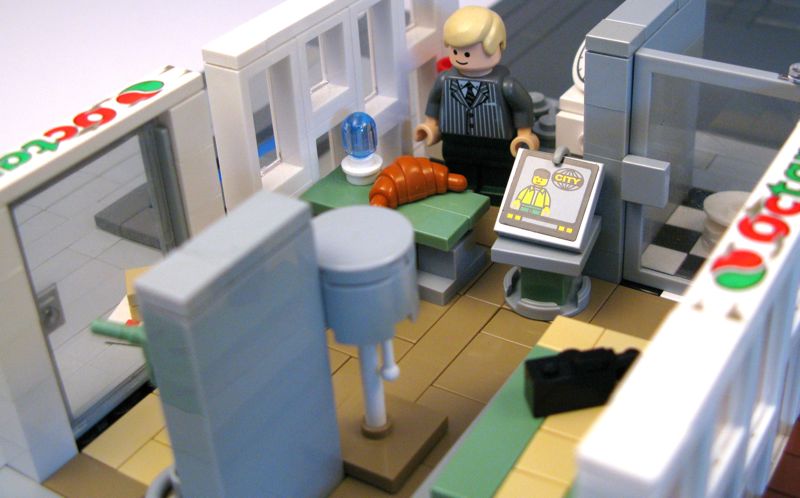
~John
[clicky]
[twitter]
The Interstellar Spark is one piece of Blacktron II technology that is an example of the expression: “If its not broken… don’t fix it!”. With a heavy bulky structure, this ship won’t break a lot of record speeds like its successors, but it is one of the most reliable Vic Vipers in use by the Blacktron II air force.
---
This small Vic Viper was part of my participation on the New Elementary - 2019 Parts Fest #2.
You can see some of the other builds I made here:
www.newelementary.com/2019/11/lego-techniques-sagh-paulo-...
---
And here is a small description of the process:
"When I saw the Roof Tile 1x8x3 Deg 25 No 1 in White (6262530|49618) I thought that they would be great to make spaceship wings because of their larger surface areas with fewer lines/unions. Since we are in “Novvember" I decided to make this year’s Vic Viper. Although I wanted to make a cleaner ship, I was able to incorporate some greebling on the wings using the “circular saw” part from the Mini Accessory, No. 11."
Neolithic schematic petroglyphs
4,800 ybp - Neolithic final.
The small Neolithic 'menhir' is found to the left of the entrance to the extraordinary Prieuré de Serrabona : the menhir-stèle du Mas Nou. The Priory is at the top of another piedmont from the Canigou massif in the Pyrénées-Orientales. The priory is whispering with serious cameras from all over the world, drawn to attention and detail by the stunning light and extraordinary Roman chapiteaux. (Here 'Roman' is not Roman empire - just an equivalent of Norman). The local stone of the menhir and priory is schist - reflective and grained like petrified wood. The menhir's stone is 1.3m long and 0.4m wide.
The image is clearly anthropomorphic. There may be a space for large eyes and a tall head piece. Assuring that you can be seen from afar across a valley - standing out from long grass; and the pleasure of a parade or ritual can all lead to hyperbolic, exaggerated ornaments. With a heart shaped head - the top half may be the 'hat' that is the point of attachment for a colorful 'stem' dress rising to a ball towards the top of the image. Similar exaggerated silhouettes can be found in the Alpes Maritime pétroglyphes and again one must see the advantages of being seen at distance in a world free from most predators.
There is an alternative interpretation of the lines that links to schematic figures found in Spain. Here the upper 'ball' is the head followed by a long neck and a thorax which is above the legs drawn with the width of two lines. With this interpretation the arms are inside the thorax and then fall down the body. For the future, I shall try and find the Ibérique schematic so that I can post a comparison.
Wavebands: LW beacon 190 - 400 kHz, MW broadcast 550 - 1600 kHz, SW marine 1.6 - 4.5 MHz, VHF low 70 - 85 MHz, VHF high 150 - 175 MHz. AM/FM selectable independent of waveband by switch on side of radio.
Rockets: Nuclear powered pulse rockets capable of rotating forward, backwards, and out to the sides.
Gyroscopes: Mounted on the sides and bottom of the Dragonfly, these can either be used to stabilize the fighter (for example, to counteract the force of the rocket's rotating) or to quickly spin the fighter to face a target.
Autocannon: The Dragonfly is equipped with a twin-linked pair of 20mm recoilless autocannons fed from helical magazines mounted below. ("Helix Magazine" redirects to here.)
Ordinance Chute: It's a chute, along with an ignition system and magnetic clamps to operate the mass torpedo.
Mass Torpedo: A rod of high density metal with a simple rocket system. The Mass torpedo is scored to break up on impact to impart as much force upon its target as possible- a concept similar to hollow-point bullets. The mass torpedo is also resistant to point defense, as a hit will usually break it into a number of high velocity projectiles rather than deflecting away.
Hangar Crane Hardpoint: The Dragonfly has a major hardpoint on the rear as well as a number of docking lugs along its undercarriage to allow it to be housed in a zero-g hangar. It could also be equipped with landing gear if appropriate for its mission.
Retrieval Hook: For catching a brake tether when docking.
Compression Harness: A pneumatic system that interlinks with the pilot's space suit, the harness is designed to reduce the physical strain of high-g maneuvers on the pilot. The air system can feed directly into the space suit to provide emergency atmosphere.
Reactor: A muon catalyzed fission reactor that is pre-charged before launch. The low start temperature and self limiting nature of the muon reaction proved to be ideal for small craft that could rely on a larger power source to provide catalyzing agents between missions.
Cockpit Canopy: The door in and out, of course, it also uses windows made of lab-grown sheets of aluminum crystals. The view ports are very small, and largely intended to be used in certain emergency scenarios, as the pilot's helmet has an internal monitor that provides the necessary visual inputs (as well as anti-nausea display lag during fast maneuvers). Similarly there is a redundant computer display in the front dashboard.
Found in 2002, during works on the road that passes through the area around the village of Balaguier-sur-Rance, this fascinating schematic standing stone dates between 5,500 and 4,500 ybp, so end of the neolithic through into the early bronze age. It was located quite high up in a rolling countryside that twists and unfolds its steep sides and deep valleys. The "Dame de Saint-Sernin" is perhaps the most iconic statue-menhir in the world, and it was found several meanders along the same River Rance. The village of Mioles, with its own collection of quite excellent examples, is just up the hill, and it is safe to say that this is 'Statue-Menhir country' - even if, as you root around, you learn that Statue menhirs covered a vast continuous zone that can only seem small when skipping through books and papers. As an aside, 'L'Enfant sauvage' (a wild child that grew up ... in the wild) that featured in a 1970 Truffaut film, was also found in the countryside of this greater zone.
Schematic art does not ask for expression or nuance or movement and (as with logos and letters) it demands that loose rules of representation are followed. A craftsman with no 'artistic' training may venture with confidence and create an image. As a rule, schematic art is not an art of observation and the adjacent 'Dame de Saint Sernin' is so spectacular as the schematic overflows with a slight sense of realistic stoop. The 'language' of the schematic lines is heavily studied and argumented, and it should be said that it is generally believed that the sex of this statue was changed - probably after a change in local hierarchies, and that the original female was converted into a male. Reasoning will be presented in another post.
A last detail of this statue (currently 82cm in height) is that the feet seem to be at the wrong end of the legs. I have read a recent paper arguing that Statue menhirs were originally presented horizontally with arguments of speed of deterioration being forwarded. It would seem logical that this Statue-Menhir was planted and that when amendments were made, feet were added above the foundation. A local statue may have been revered and looked after, covered with protective clay based paint, an old cloak or any other amelioration of presentation long gone. Bronze age and Iron age instability or simple changes of cultural visual language may lead to a menhir being laid flat and under cover to protect the memory, and it is a this stage of protection that some may be discovered today. An alternative view regarding the poorly placed feet is intriguing and forwarded by the specialist Michel Maillé. He proposes that the original stone was long (let's imaging a menhir like Pousthomy 2), and after the top broke away, the 'root' was reused by inverting and carving into the space. It is often the case that legs dangle over 'blank' stone surface and this idea is simple and appealing.
A suggestion of a face behind a scarf - in which case a rare example of 'layers' or 'transparency' with the parallel lines evoking the scarf of the Dame de Saint Sernin more than face tatoos - a thick scarf potentially made of fur - fox tail etc. A face in the shape of a tool - memories of late neolithic stones polished to the limit of a stone skin? A farmer's knife around the neck held to a leather belt brace by a ring - an essential tool for eating, post making, carving, cropping and general lifestyle including defence from bandits or rustlers in any eventuality
The local Mayors bureau is only open twice a week during the winter months, and maybe only afternoons. You need to ask the secretary and she should be able to lead you up the stairs to see the niche where the original now stands.
Some background to the chronology of Statue Menhirs by Michel Maillé:
journals.openedition.org/dam/pdf/2674
AJ
A relatively small zone of limestone (le Planturel) was tilted and skewed during the tectonic formation of the Pyrenees. Melt waters built up as a lake behind this last barrier before the flat lands below. Initially the lake overflowed as a large waterfall, whilst waters riddled through natural cracks eventually opening them with a mix of pressure, percussion and chemistry - gradually blasting the 50m high and 420m long tunnel now known as the Mas D'Azil. Both ends of the tunnel are vast, and a family of modern human heads can be seen looking down on the river Arize.
The 'open plan' cave rightly sits with Isturitz, El Castillio and the Vézère valley as a prehistoric megasite. New 35,000 year old Aurignacian deposits sit far below Magdalenian frequented tunnels and aside Azilian river banks. As far as I understand the ice age sheets did not descend as far as the Mas D'Azil (Don's Maps has an excellent resource here: www.donsmaps.com/images26/archsitessthfrancnobasemap3.pdf) and one might expect Gravettian and Solutrean deposits to be attracted to the mega abri in the way of Isuritz to the west. Vast quantities of archaeological deposit were employed during the construction of the road that now passes through the cave, and it may be that the Gravettian and Solutrean are currently under the weight of tyre and slightly reduced travel times.
Many of the schematically painted river stones associated with the Azilian period (a variant within Mesolithic) were found on the far bank of this shot. Some of the most important Magdalenian finds were found in chambers to the left of the tripod (faon aux oiseaux, ibex propulseur, two Ibex carved on a Sperm Whale tooth, carved scapula discs and several excellent hyoid bone horse heads...). These are from the elite objects that now addition to ornament glossy books on European 'Sapiens Sapiens' prehistory.
Cathars are said to have taken refuge here in the 12th century. Protestants and later anti Nazi resistance and Spanish Republican maquisards also used the cave's naturally 'secret' chambers. The tunnel is administered from the local city of Foix - a French city liberated at the end of WW2 by Spanish resistance soldiers. A low foundation wall in the cool mineral side chamber known as the Salle du Temple must have witness multiple chapters of exclusion, passion and will.
50 years after the St. Bartholomew's Day massacre, during the War of Religions, the Catholic church allowed the appropriation of assets of other beliefs (Protestant). This decision aided conflict, with the siege of the Mas D'Azil being an application. 14,000 soldiers surrounded the town which sits just below the cave. They bombarded the town's walls and inhabitants with cannon fire. On Sunday the 21st of September they aimed their cannons at the Church hoping to kill a congregation. Caution had meant that the 300-400 assembled were using an alternative building. The largely pastoral peoples were against terrible odds, and they came up with an idea for an attack: during a night they crossed the river with around 30 goats. Torches were attached to their horns and these were lit and the flock charged through vinyards towards the Catholic army, resulting in panic and loss of munitions - a single act that helped villages towards their final defeat the siege (from research by Hubert d'Amboix).
Years of James Bond plots showing factories hidden in geology: in 1943 the above site was studied for potential appropriation as a Nazi aircraft facility, with the final site being the equally impressive nearby prehistorical cave of Bédeilhac.
AJ
Very much inspired by some of BMW's new commercials I keep seeing. Would be fun to do a series of these with all my favourite cars from yesteryear.
I have finished drawing out the schematics of the drawers for my cabinet. Next I am going to build a prototype and make sure my math adds up. I was a Physics and Mathematics major so I’m pretty confident that it will, but I’m also a man and that means somehow in the workshop- math works against you!
Theme: Building A Legacy
Year Nine Of My 365 Project
As I was leaving the store, I took the time to photograph this schematic showing the projected post-remodel floorplan that was hanging out in the vestibule, in order to share it with y’all (just in case you care enough to zoom in and see how the store will be laid out once all is said and done). It probably would have made a lot more sense to share this with y’all at the onset of this album instead, but hey, better late than never, right? XD
(c) 2019 Retail Retell
These places are public so these photos are too, but just as I tell where they came from, I'd appreciate if you'd say who :)
The new "Evren" could carry 13 fully equipped soldiers; the engine was located on the front and both active and passive defensive systems were installed.
Following the latest fashion, the vehicle features a remotely operated main gun turret with almost all the main weapons.
The vehicle was equipped with a 100mm main gun; this was a basic gun that could only fire high explosive and fragmentation shells (to destroy buildings and infantry). A coaxial 7,62mm machine gun was also carried. It also had two 50mm auto-cannons which could be used both to destroy incoming enemy planes and drones or other IFVs and light tanks. Two anti-tank missile launchers were also installed and they could be equipped with short range SAMs if needed.
Once the troops were on board, they could engage the enemy from within using two remotely operated machine gun turrets.
For more info, click the next picture:
www.flickr.com/photos/einon/46670875484/
Eínon